
A complete issue · 16 pages · 1899
Judge — September 9, 1899
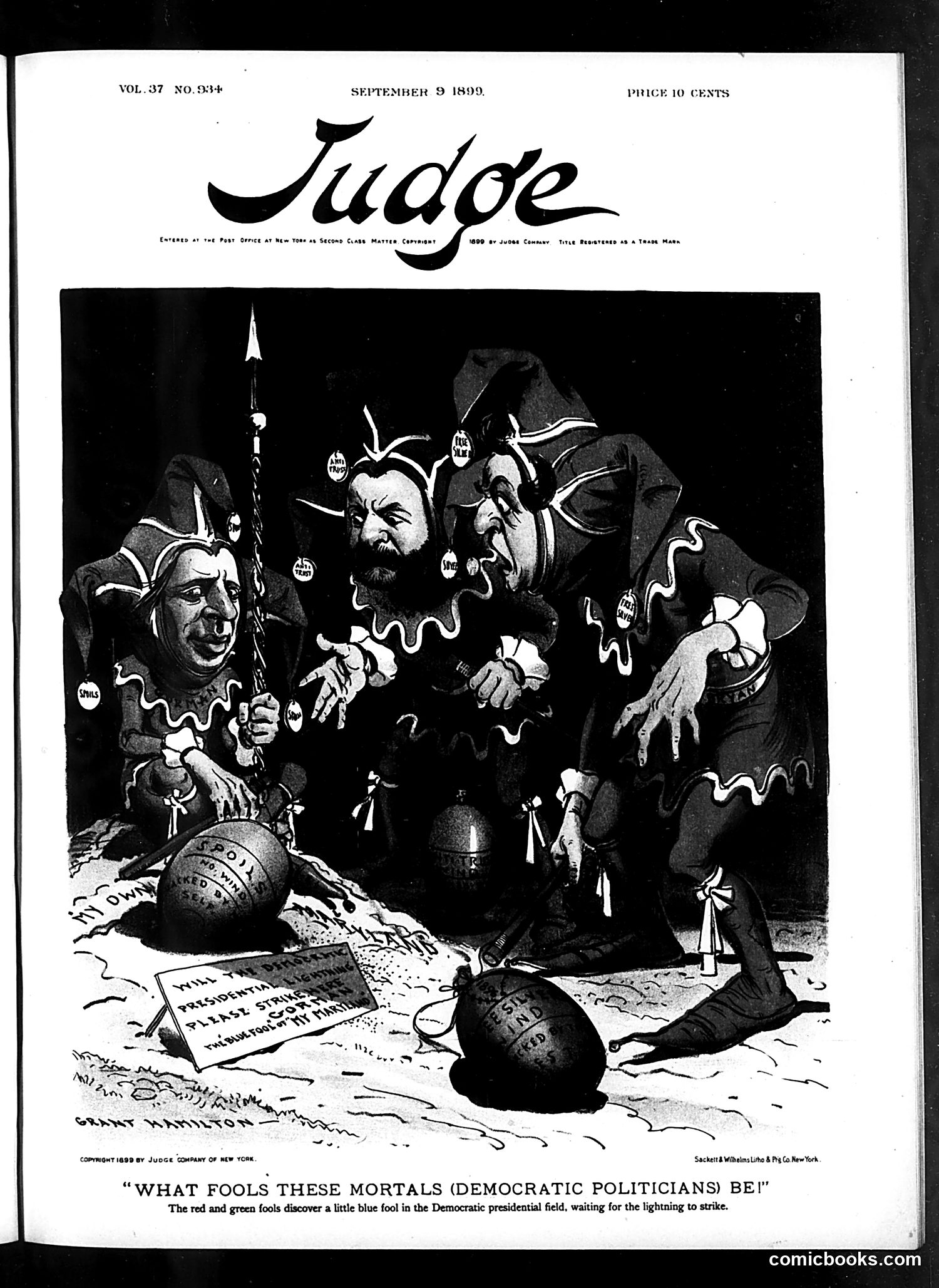
This **1899 Judge magazine cartoon** depicts four jesters or fools in a graveyard setting, apparently discovering a "blue fool" in the Democratic presidential field. The jester costumes and bells suggest foolishness and mockery. The satire targets **Democratic politicians** preparing for the 1900 presidential election. The graveyard imagery and explosive bombs labeled "1900" suggest the cartoonist views Democratic prospects as doomed or dangerous. The text explicitly mocks Democratic candidates as fools waiting "for the lightning to strike"—implying they're hoping for salvation or a miracle amid internal division. This reflects Republican satirical attacks on Democrats during the McKinley presidency, portraying the opposition as chaotic and incompetent heading into the election cycle.
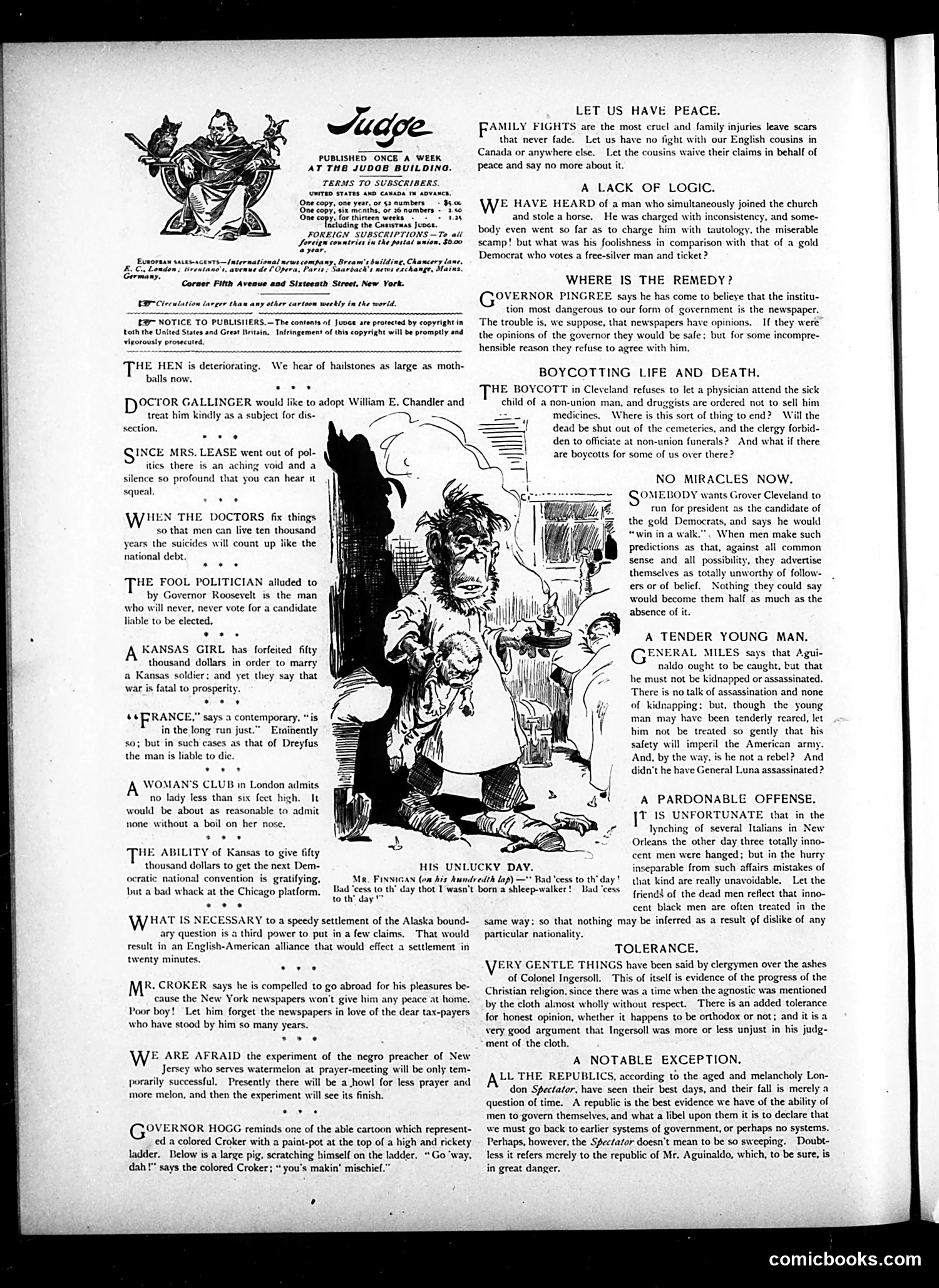
The central cartoon depicts a grotesque figure labeled "Ma Finnigan's [or her Sandwich Lay]" — "Bad 'tees to th' day I had 'tees to th' day I wasn't born a sheep-walker" — emerging from or associated with what appears to be a tenement or urban poverty setting. The exaggerated facial features and crude dress suggest stereotypical Irish immigrant caricature, common in Gilded Age satire. The surrounding text items critique various public figures and policies: references to Governor Pinghee, Governor Roosevelt's political maneuvering, and debates over newspapers' influence on governance. The piece titled "BOYCOTTING LIFE AND DEATH" discusses labor disputes and union tactics. The satire targets late 19th-century American political corruption, immigrant communities, and reform movements — reflecting Judge magazine's generally Republican, establishment perspective skeptical of populism and organized labor.
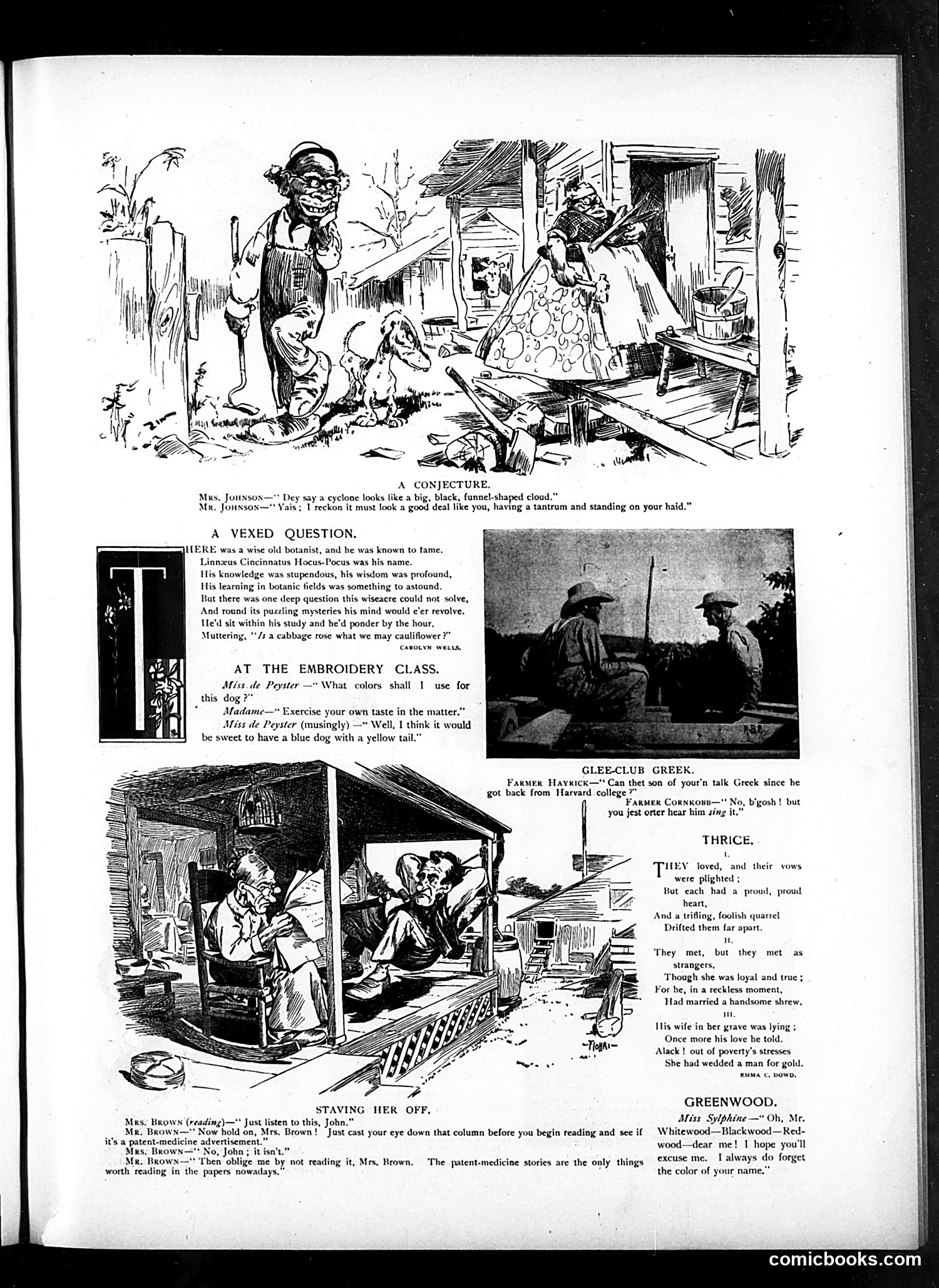
This page contains several separate humorous sketches and poems rather than unified political satire. The content includes: **"A Conjecture"** (top): A joke about weather prediction featuring caricatured figures with exaggerated features, likely reflecting period racial stereotyping common to the era. **"A Vexed Question"** and other literary pieces: Short humorous poems and dialogue snippets addressing domestic and social situations of the period. **"At the Embroidery Class"** and **"Staying Her Off"**: Comic sketches depicting everyday middle-class scenes—women's activities and marital/romantic situations—rendered as gentle domestic humor. The illustrations use heavy cross-hatching and pen work typical of late 19th/early 20th-century magazine cartooning. The overall tone is light social comedy rather than sharp political critique, focusing on universal human foibles and miscommunications rather than specific current events.
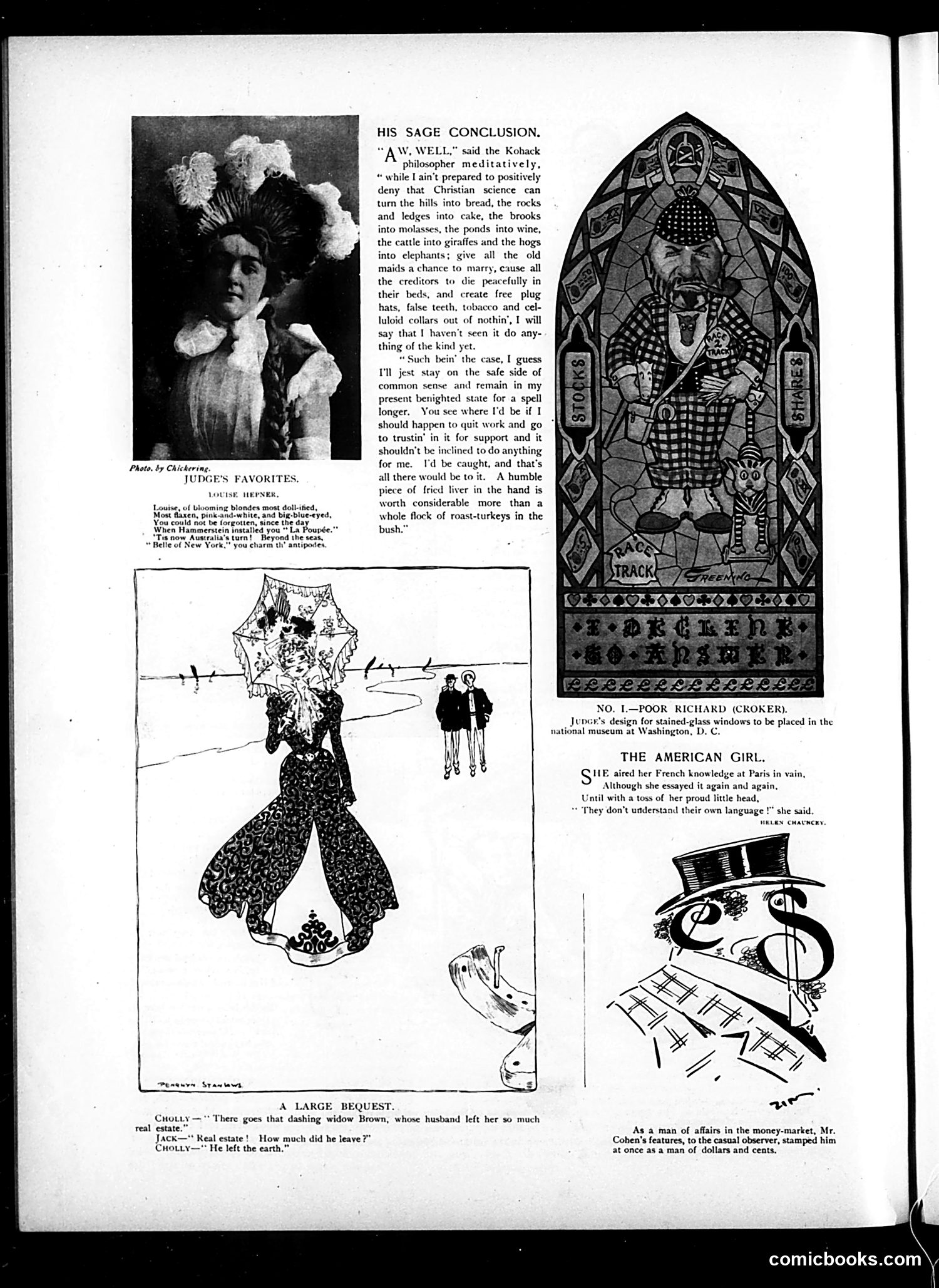
This page contains several satirical pieces typical of early 20th-century American humor: **"His Sage Conclusion"** features a Kohack philosopher rejecting Christian Science's miraculous claims (turning rocks to bread, brooks to molasses) as impractical, preferring common sense over spiritual transformation. **"Judge's Favorites"** shows a woman in elaborate Edwardian dress—likely satirizing high society fashion excess or wealthy women's vanity. **"A Large Request"** is a brief joke about a widow whose husband left her "so much real estate"—likely mocking inheritance disputes or financial disputes among the wealthy. **"The American Girl"** and the stained-glass window design ("Poor Richard/Croker") appear to reference contemporary figures or social commentary, though the specific references are unclear without additional context. The overall tone mocks pretension, excessive wealth display, and dubious philosophies popular among America's elite.
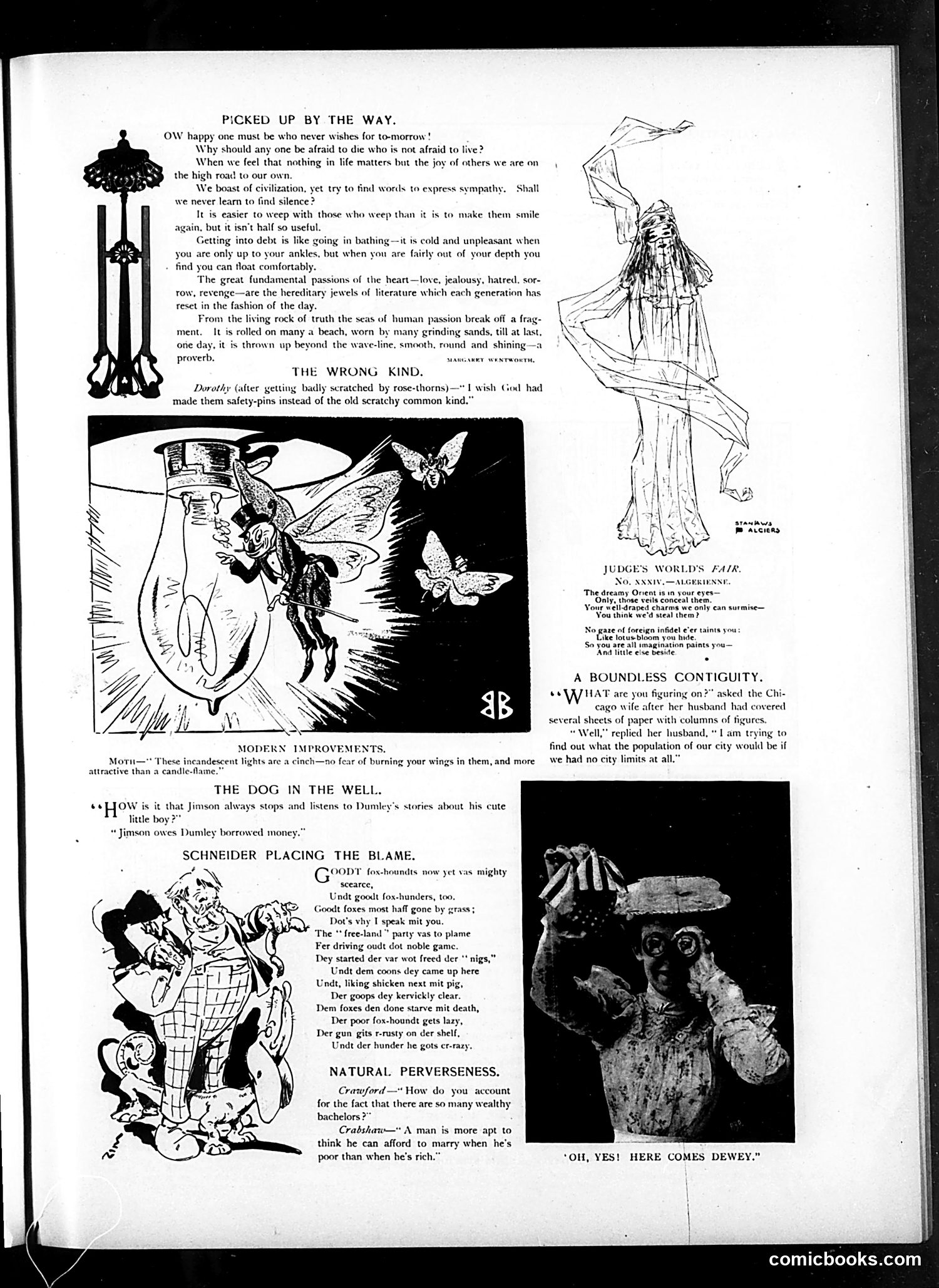
This page contains several satirical pieces typical of Judge's editorial humor: **"The Wrong Kind"** mocks a woman's complaint about rose thorns, suggesting she wishes God had made them safety-pins instead—satirizing trivial complaints about natural inconveniences. **"Modern Improvements"** jokes about electric lights being safer than candles because you won't burn your wings—likely referencing fairy folklore or whimsical anxieties. **"Schneider Placing the Blame"** uses a German-accented character to blame the "free-land party" (likely Republicans/abolitionists) for the Civil War. He claims freed enslaved people drove away foxes by hunting them, ruining his sport—a racist complaint disguised as economic grievance. **"A Boundless Contiguity"** satirizes a Chicago businessman calculating city population without limits, mocking urban expansion obsession. Minor pieces joke about borrowed money excusing bad storytelling and wealthy bachelors' false confidence about affording marriage. The page reflects early-20th-century Judge satire: political jabs, ethnic humor, and social commentary on American life.
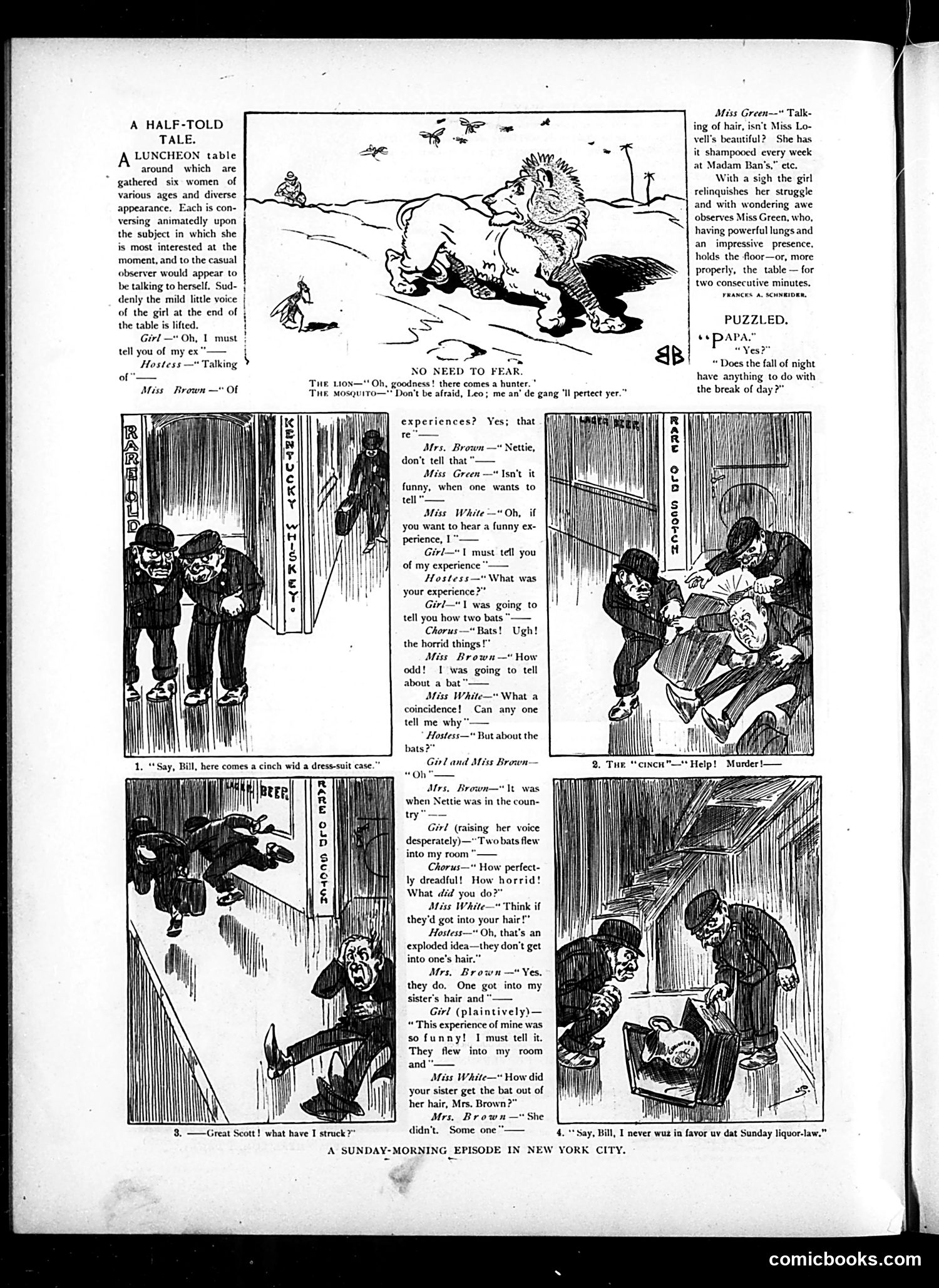
This page contains two distinct satirical pieces: **"A Half-Told Tale"** (main story with four illustrations) satirizes the social dynamics of women's luncheon conversation. The joke centers on how one shy young woman repeatedly attempts to share an anecdote about bats entering her room, but is constantly interrupted by six other women who either redirect conversation to their own experiences or tangential topics. Each interruption prevents her from finishing, until Miss Green—described as having "powerful lungs and an impressive presence"—commandeers the conversation entirely, leaving the girl defeated. The satire targets Victorian-era women's social gatherings, where dominating personalities and conversational narcissism prevent genuine dialogue. **"No Need to Fear"** (top center) is a brief animal joke: a lion worries about an approaching hunter, but a mosquito reassures him they'll "protect" him—the implication being mosquitoes are more dangerous than hunters. **"Puzzled"** (sidebar): A brief philosophical non-sequitur without clear satirical target. The page reflects turn-of-century American social humor focusing on domestic and gender-based comedy.
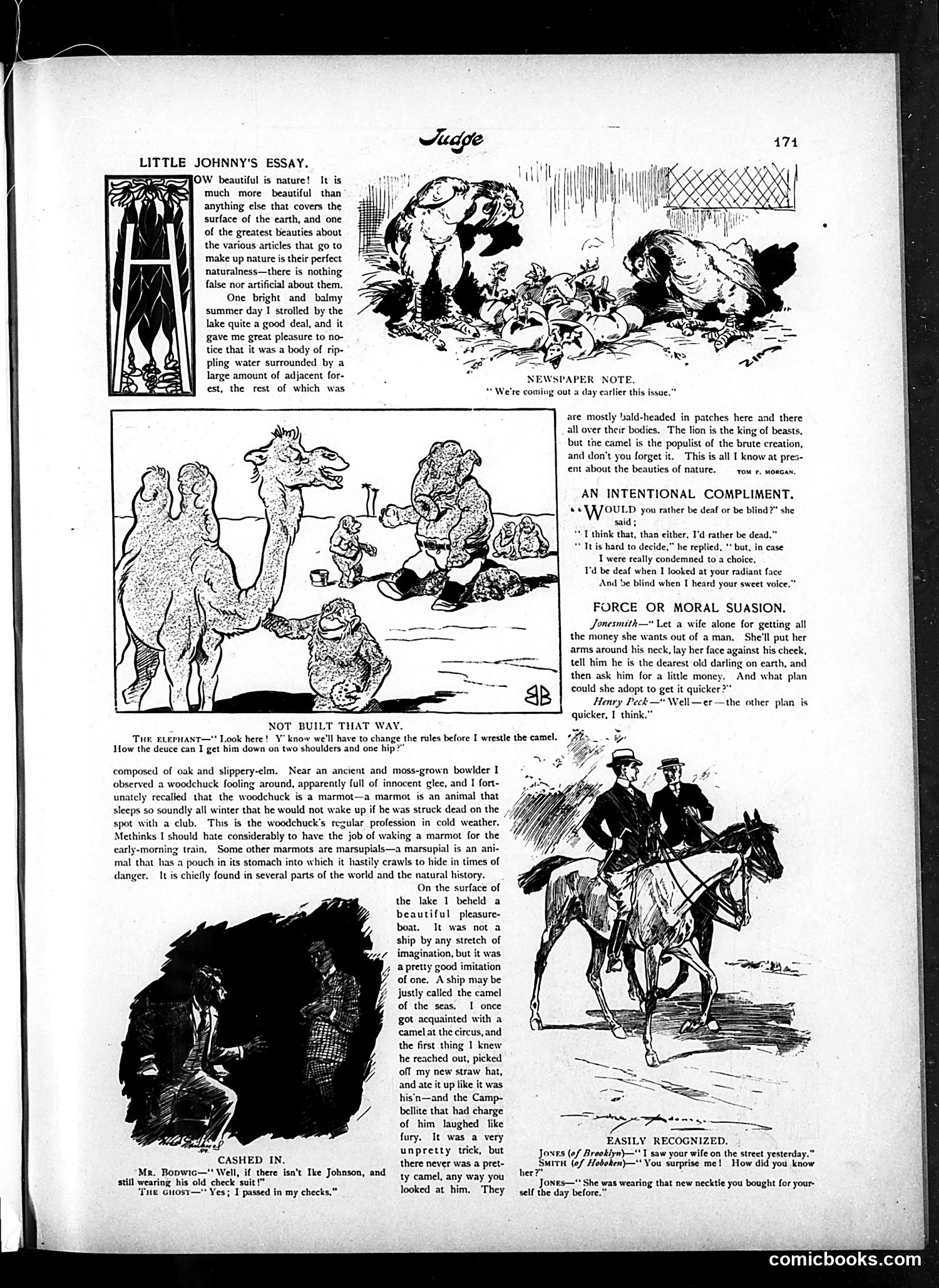
This page contains multiple satirical pieces typical of early Judge magazine humor: **"Little Johnny's Essay"**: A parody of pretentious nature writing, where a student pompously describes natural beauty while revealing his ignorance (confusing woodchucks with marmots, calling camels "populist"). **"An Intentional Compliment"**: A romantic cliché where a man chooses deafness over blindness to avoid hearing his beloved's voice—mocking overwrought Victorian courtship rhetoric. **"Force or Moral Suasion"**: A cynical domestic joke where a wife's manipulative affection ("putting arms around his neck") proves more effective than direct approaches—satire of gender relations and marriage dynamics. **"Not Built That Way"**: An anthropomorphized elephant and camel discuss wrestling rules, likely satirizing animal acts common in circuses of the era. **"Cashed In" and "Easily Recognized"**: Brief joke vignettes about mistaken identity and marital misadventure. The humor targets pretension, romantic sentimentality, marital conflict, and social conventions of the period.
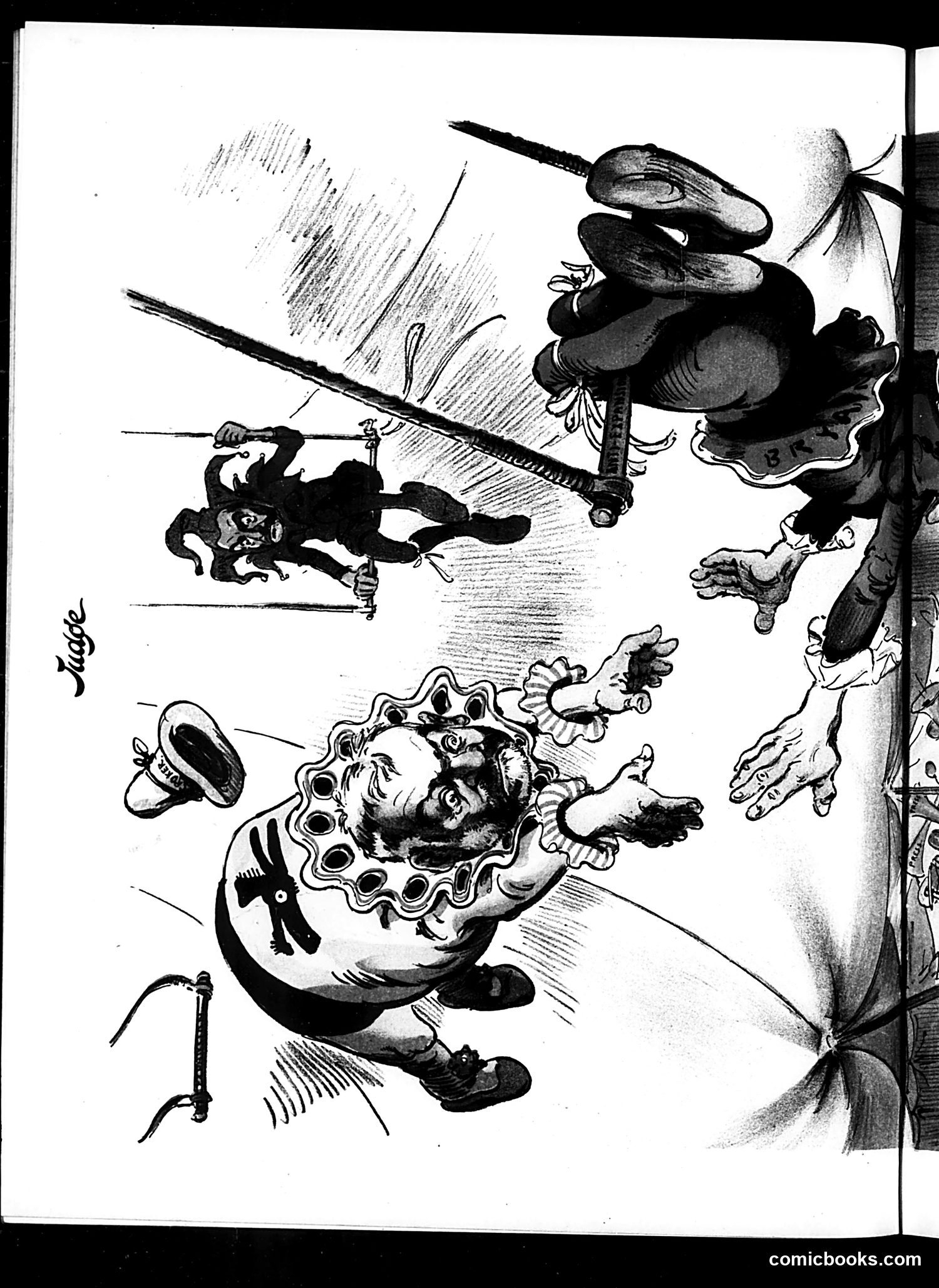
This appears to be a satirical cartoon from *Judge* magazine depicting a confrontation between two figures. The lower figure—a rotund man with exaggerated facial features wearing formal attire with decorative collar—confronts an ape-like creature wielding a sword above him. A smaller monkey figure operates the larger creature like a puppet or mechanism on the right side. The satire likely comments on political manipulation or control, with the grotesque lower figure representing a politician or public figure being threatened or dominated by forces beyond his control. The puppet-master imagery suggests criticism of hidden influences or orchestrated political theater. Without visible text identifying specific figures or dates, the exact political context remains unclear, though the work exemplifies *Judge*'s typical approach to lampooning power dynamics and deception.
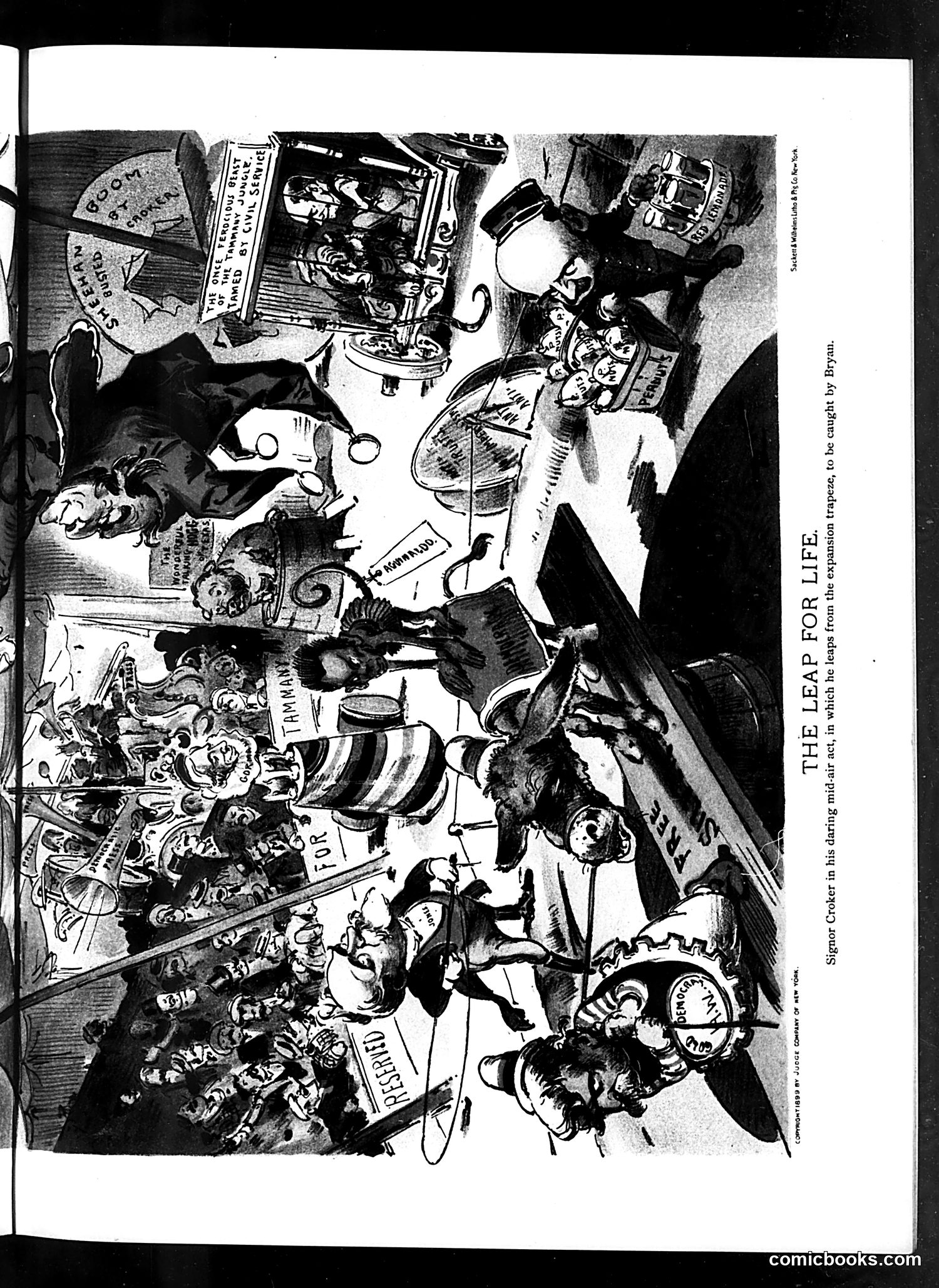
This is a satirical cartoon showing a figure (appearing to be a political or business leader) performing a dangerous leap over various obstacles and hazards labeled with terms like "Panic" and "Hammock." The imagery suggests someone taking extreme risks or making a precarious escape from financial or political crisis. The cartoon likely comments on a specific economic or political crisis—possibly a bank panic, market collapse, or scandal requiring desperate measures. The "leap" metaphor suggests reckless action taken under pressure. Various figures and objects surround the scene in chaotic arrangement, typical of Judge magazine's crowded satirical style. The OCR text is corrupted and unreadable, making precise dating and specific references unclear. Without additional context about the publication date, I cannot identify the exact historical event being satirized.
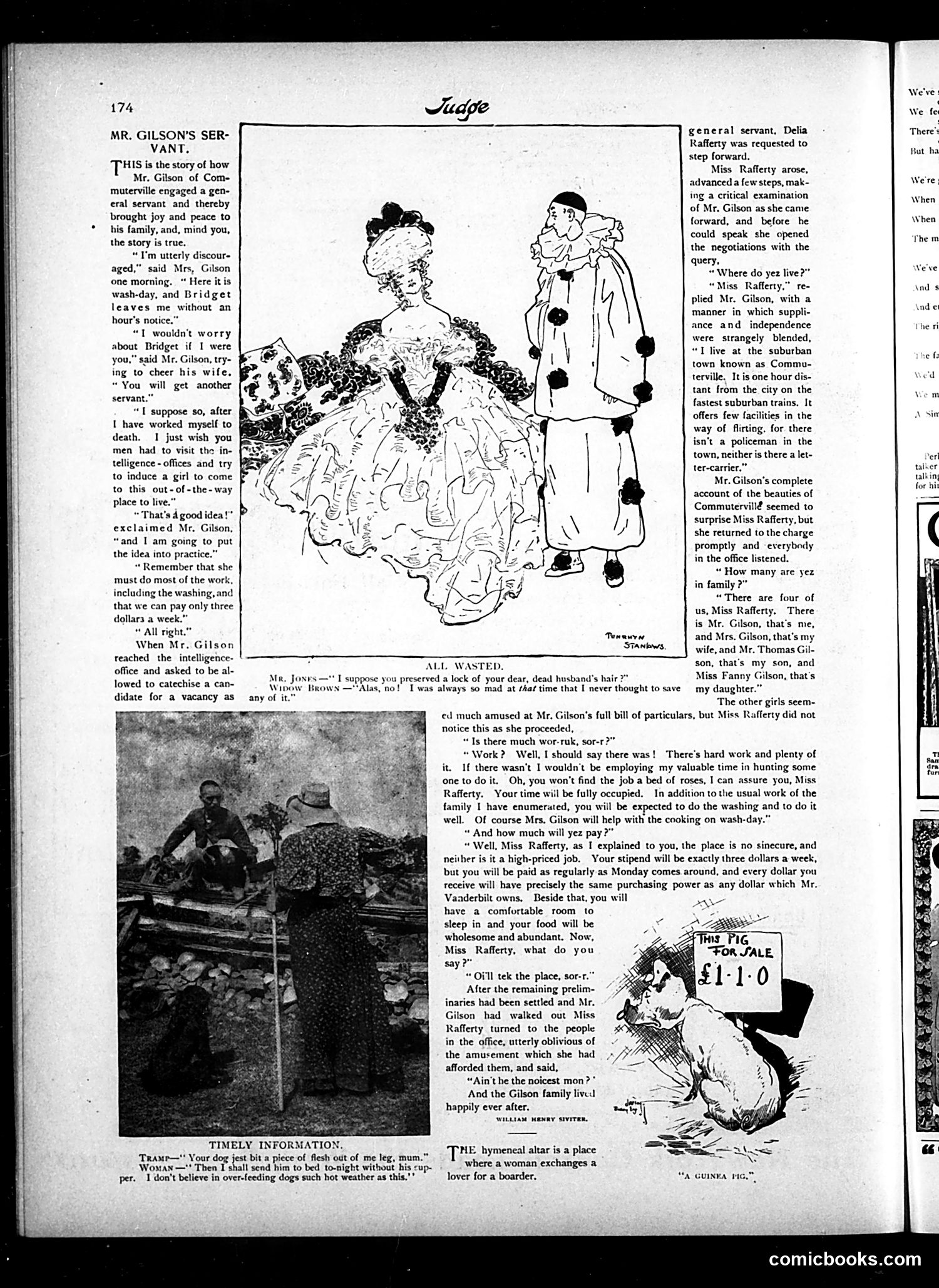
This story-cartoon satirizes the domestic help crisis of early 20th-century America. Mr. Gilson seeks a servant after his previous maid "Bridget" quits without notice—a common frustration for middle-class employers. The humor targets both parties: Mr. Gilson's pompous self-importance (boasting about his suburban town "Commuterville," claiming to pay wages with the purchasing power of Vanderbilt's money) and Miss Rafferty's blunt Irish-accented interrogation of her potential employer. The satire mocks the absurdity of the servant-hiring process and class pretensions—Gilson's exaggeration of humble domestic work as arduous ("bed of roses"), his three-dollar weekly wage, and his comic self-aggrandizement. The cartoon's point: both employers and working-class employees engaged in ridiculous posturing during hiring negotiations, revealing the awkwardness and mutual suspicion characterizing early American labor relations.
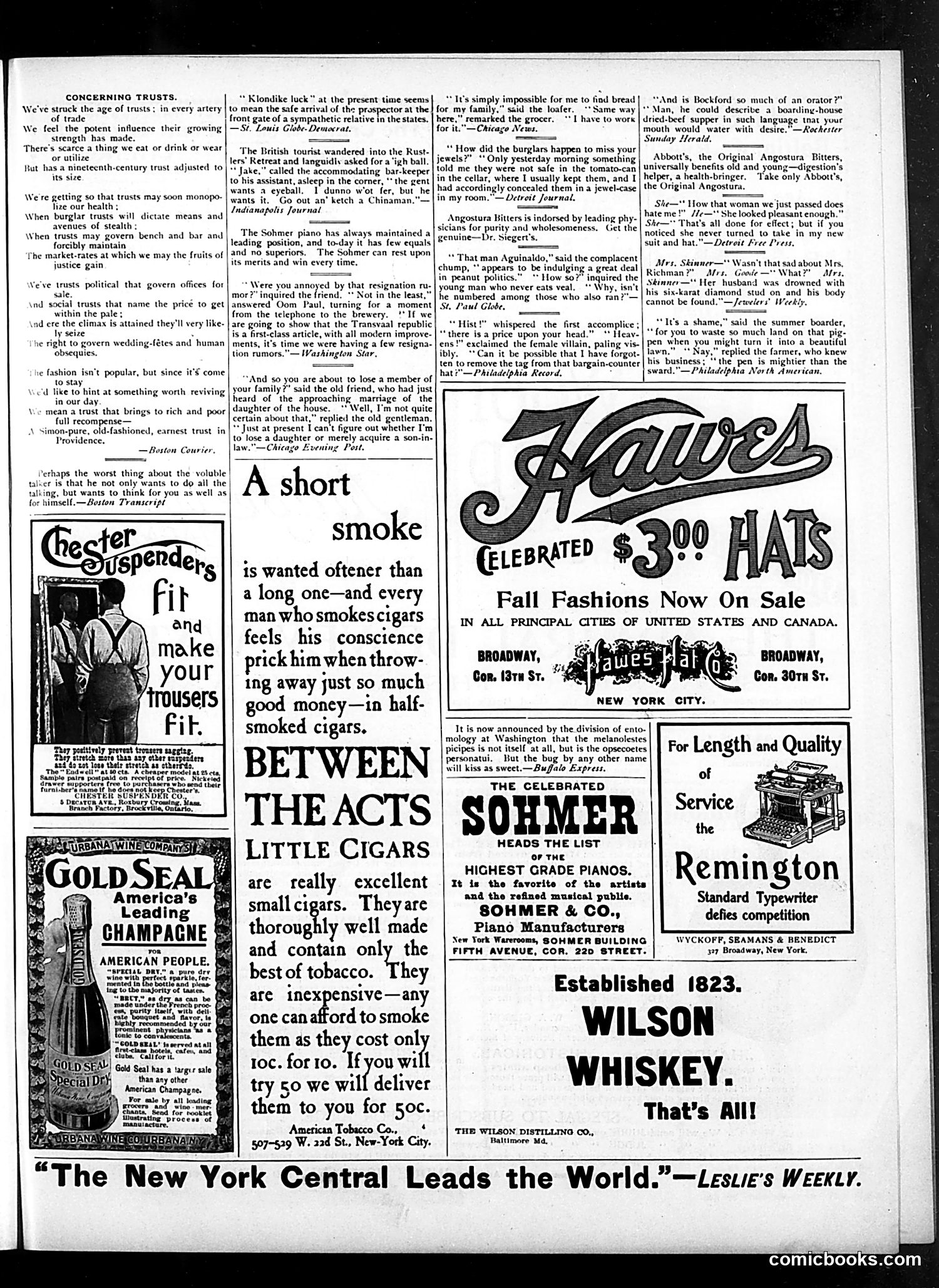
This page is primarily **advertising and humor vignettes** rather than political cartoons. The content includes: **Main Editorial Piece:** "Concerning Trusts" is a satirical poem criticizing the era's massive corporate trusts—monopolies controlling everything from food to justice systems. The satirist proposes reviving old-fashioned "trust in Providence" as an antidote, a common progressive-era complaint about concentrated corporate power. **Humor Vignettes:** Short jokes mock: - Gold prospectors' luck (arriving at relatives' homes instead of finding wealth) - Paul Kruger's Transvaal Republic (contemporary South African politics) - A grocer dismissing a loafer's poverty excuses—social commentary on unemployment **Advertisements:** The page is dominated by product ads (Chester Suspenders, Gold Seal Champagne, Hayes Hats, Sohmer Pianos, Remington Typewriters, Wilson Whiskey), typical of Judge's revenue model. The overall tone reflects **turn-of-the-century Progressive Era concerns** about monopolies and social inequality, presented through gentle satire and advertising.
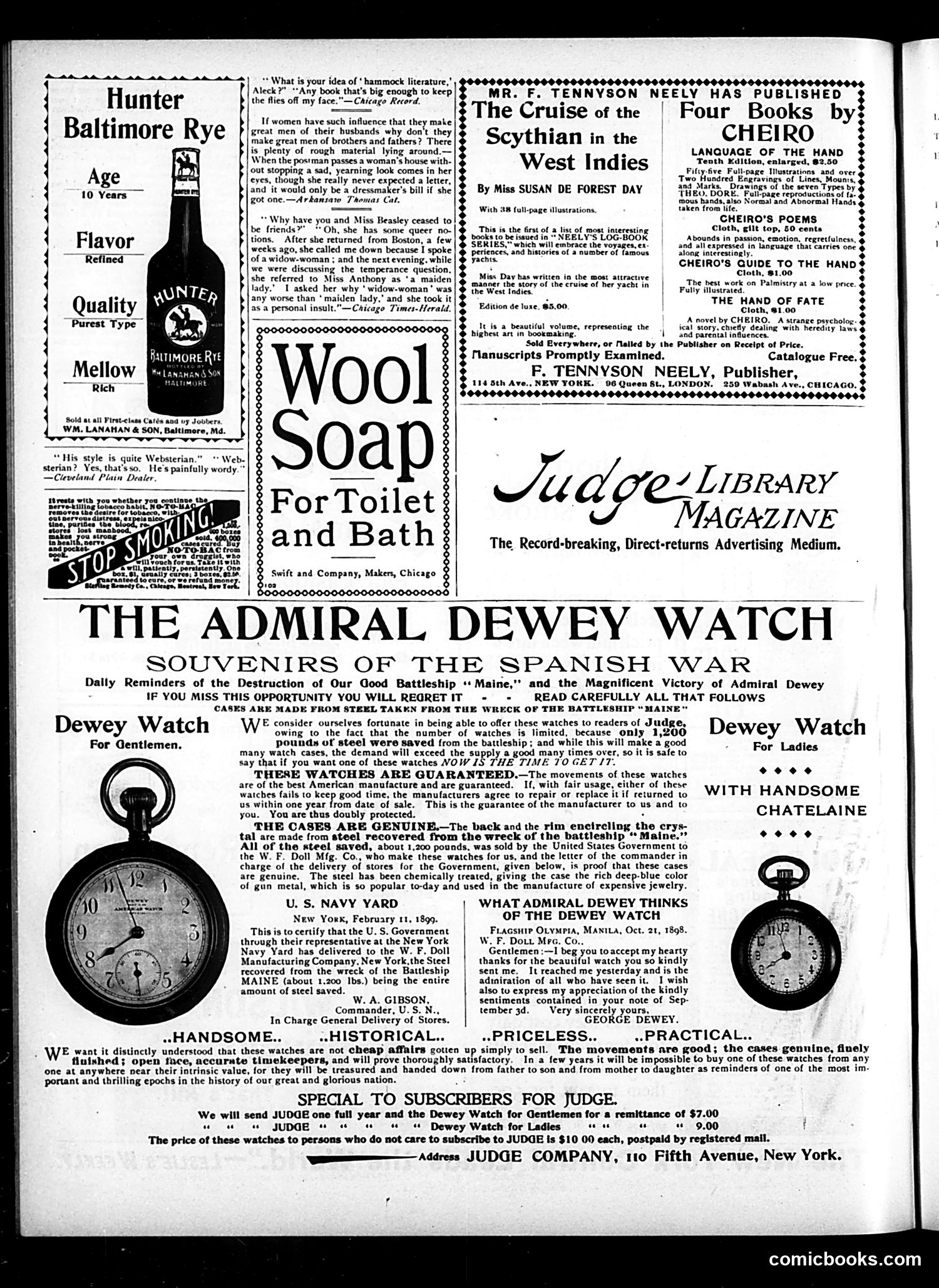
This is primarily an **advertising page** from Judge magazine, with minimal satirical content. The page features multiple product advertisements interspersed with brief humor pieces. The main satirical elements are short joke exchanges about social behavior—discussions of "hammock literature," women's influence, and social etiquette—typical of period humor magazines. These are gentle observations rather than political commentary. The dominant content is **commercial advertising**: Hunter Baltimore Rye whiskey, Wool Soap, books by publisher F. Tennyson Neely (including works on palmistry/chiromancy), and most prominently, the "Admiral Dewey Watch"—souvenirs made from steel salvaged from the USS Maine wreck. The Dewey watches reference the **Spanish-American War (1898)**, specifically Admiral Dewey's naval victory and the battleship Maine's destruction, which had triggered American entry into the conflict. These watches were patriotic merchandise capitalizing on recent war fervor. The page reflects late-1890s advertising practices and consumer culture more than satire.
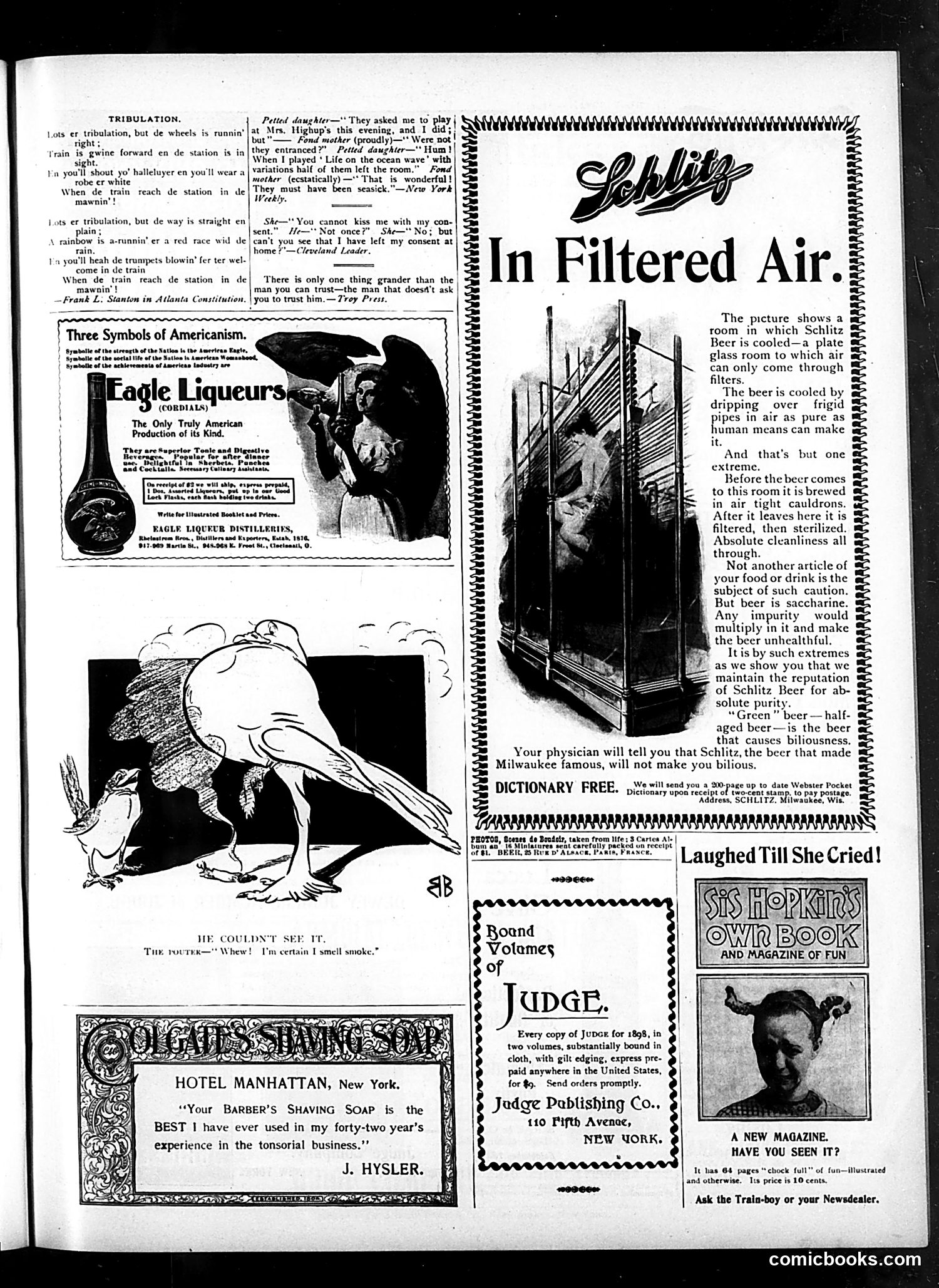
This page primarily contains **advertisements and light humor** rather than political satire. **Main cartoon**: "He Couldn't See It" depicts a porter unable to see smoke, a simple visual gag with no political content. **Content overview**: - A dialect poem about spiritual perseverance ("Tribulation") - Three brief jokes about courting, trust, and musical performance - **"Three Symbols of Americanism"** advertises Eagle Liqueurs, humorously claiming liqueur represents American achievement alongside the eagle and womanhood—clearly tongue-in-cheek advertising **Major advertisement**: Schlitz Beer's "In Filtered Air" emphasizes purity and cleanliness in brewing, addressing contemporary concerns about contaminated food/drink. The ad claims their process prevents "biliousness" (digestive upset), a common beer complaint. This reflects early-20th-century anxieties about industrial food safety. **Other ads**: shaving soap, bound Judge volumes, and a new magazine. The page is primarily **commercial**, using humor to sell products rather than critiquing politics or society.
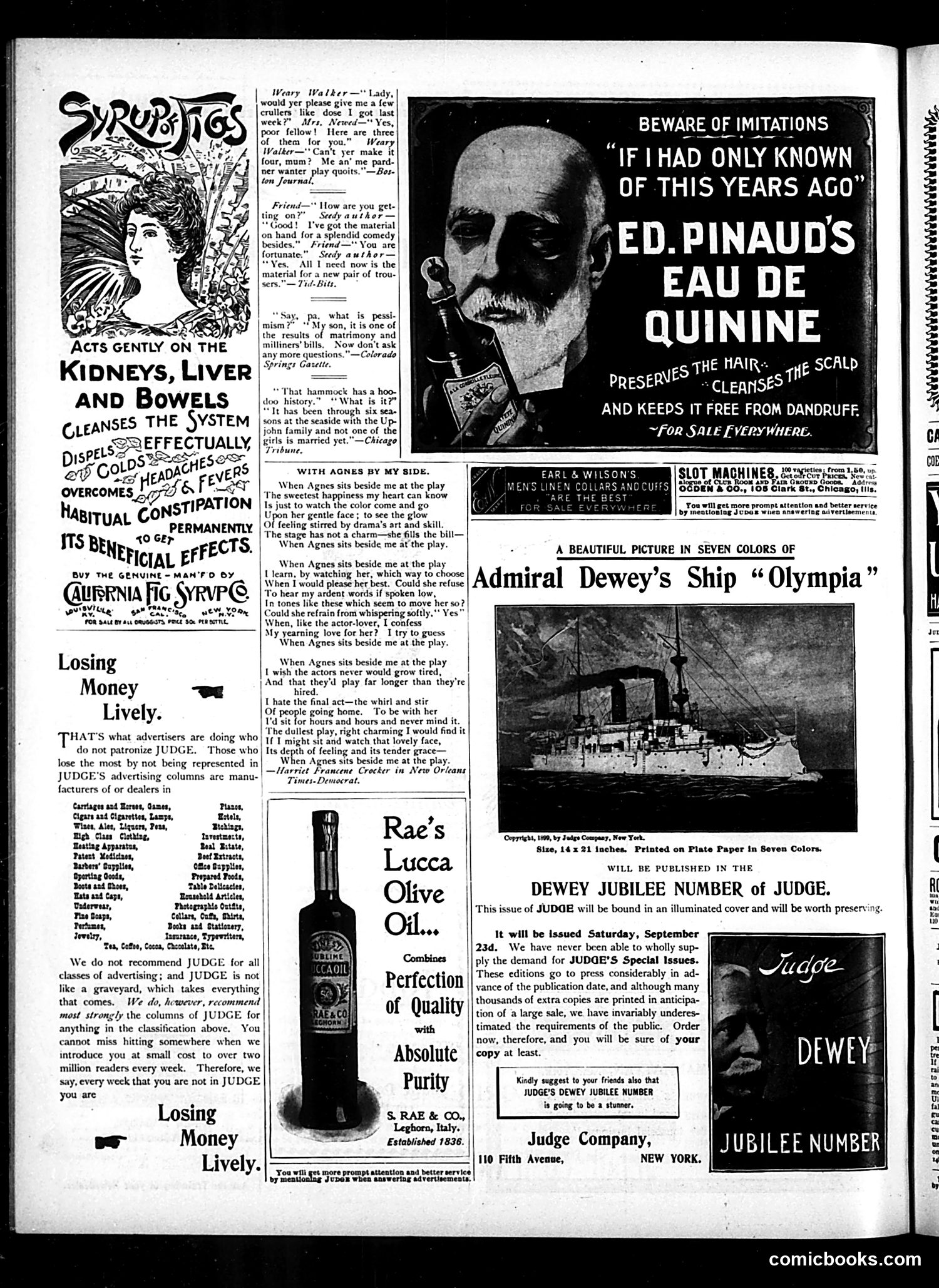
This page is primarily **advertising with light comedic filler content**, typical of Judge magazine's format. The main cartoons are brief jokes: - "Weary Walker" depicts a homeless man (the "weary walker" was a stock character) negotiating with a charitable woman over food scraps—satire on poverty and working-class desperation. - "With Agnes by My Side" is a sentimental poem about courtship at the theater, likely gentle parody of Victorian romance clichés. - A brief joke about a cursed hammock with a "hoodoo history." The advertisements dominate: California Fig Syrup (digestive aid), Ed. Pinaud's hair tonic, Rae's olive oil, and a slot machine company. The "Losing Money Lively" section warns manufacturers they're wasting money by not advertising in Judge. The Admiral Dewey ship image appears to promote Judge's upcoming "Dewey Jubilee Number" (celebrating Admiral Dewey, likely the Spanish-American War hero). The page lacks political satire; it's primarily a **commercial publication using humor to attract both readers and advertisers**.
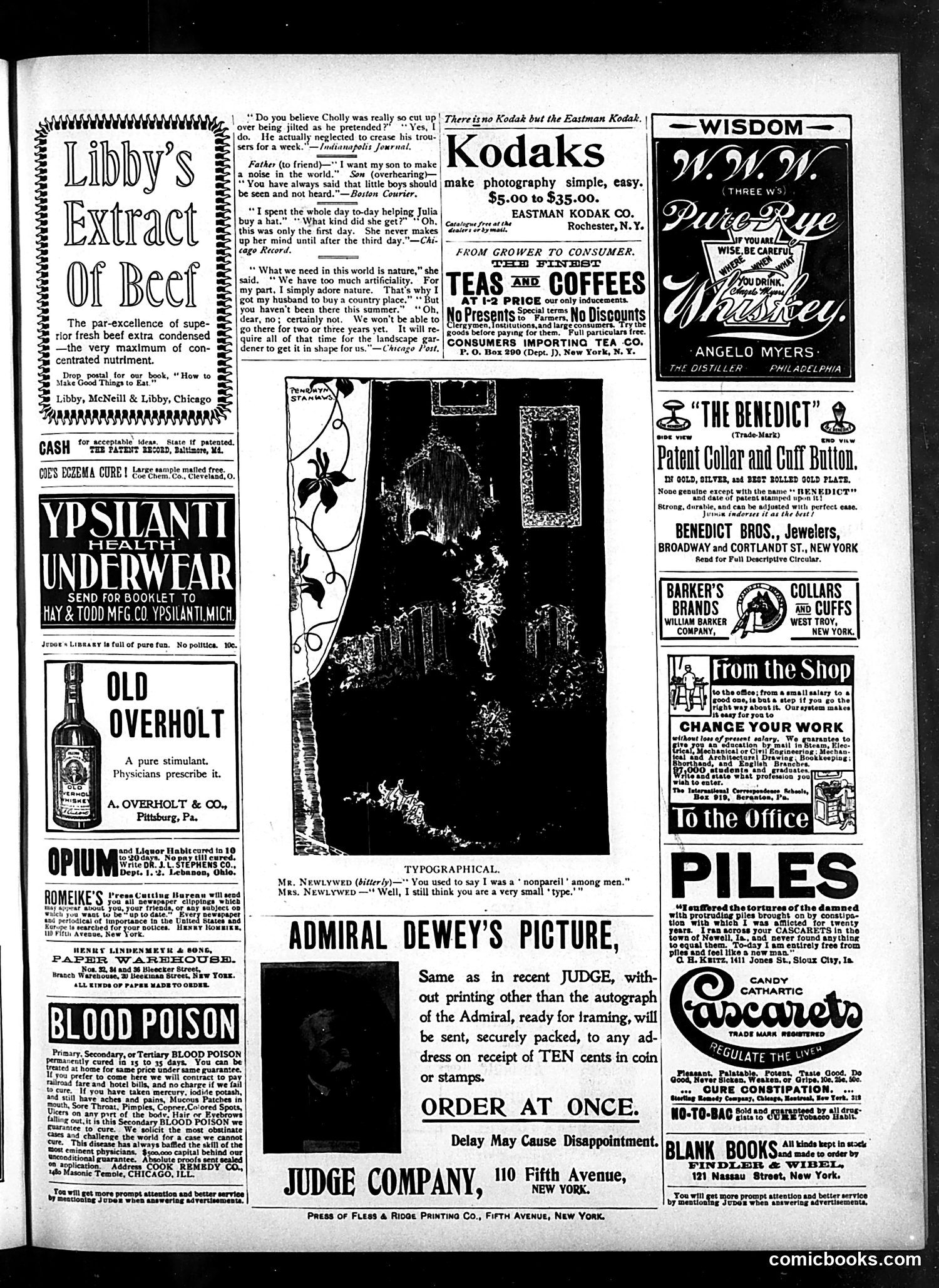
This page is primarily **advertising**, with brief humorous anecdotes interspersed. The central image appears to be a typographical illustration (possibly relating to Admiral Dewey, based on the text below). The comedic content consists of short jokes about turn-of-the-century domestic life: - A man neglects grooming after romantic disappointment - A father's desire for his son to "make noise" ironically contradicts parental discipline - A wife delays hat-shopping decisions indefinitely - A woman claims to love "nature" but needs years for landscapers to artificially improve their property - A husband, once called a "stone among men," is now mockingly called a "small type" These reflect period anxieties: masculine pride, women's consumer power, and the artificiality of upper-class life. The "Typographical" header suggests these are drawn from newspaper columns. The bulk of the page advertises patent medicines (Overholt whiskey, Cascarets laxative), photography equipment (Kodak), clothing, and jewelry—typical of Judge's revenue model and era.
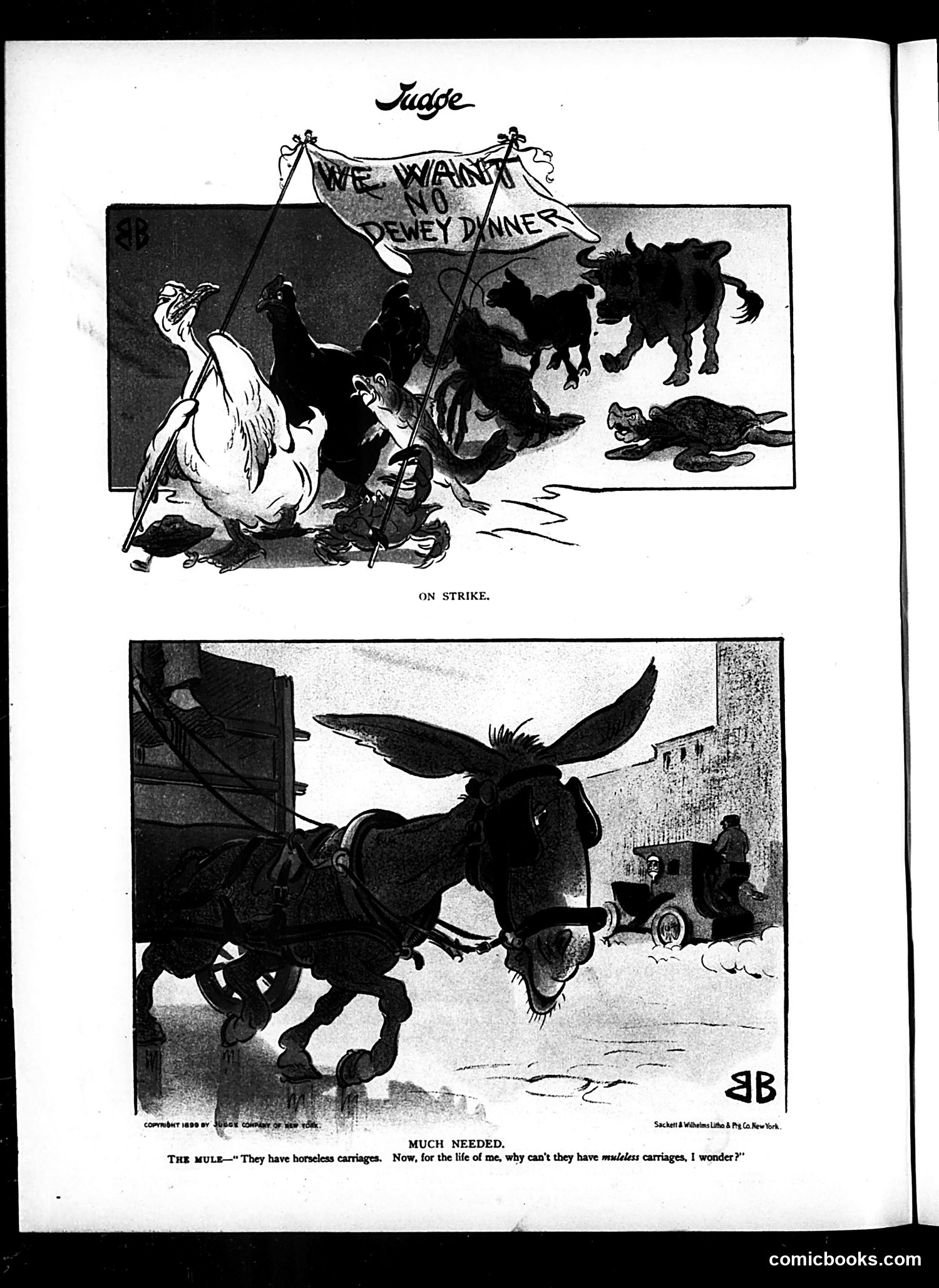
This page contains two cartoons satirizing early automobile technology. The top cartoon, "ON STRIKE," depicts various animals (goats, dogs, a cat) protesting with a banner reading "WE WANT NO DEWEY DINNERS"—likely referencing Admiral Dewey's fame after the Spanish-American War. The animals appear to be striking against their replacement by horseless carriages (automobiles). The bottom cartoon, "MUCH NEEDED," shows a mule observing an early motorized vehicle, remarking that since humans invented horseless carriages, they should invent "muddless carriages"—a pun on the mule's complaint about mud. Both cartoons humorously express anxiety about automotive technology displacing traditional animal labor, a genuine concern during the early automobile era (1890s-1900s). The satire mocks both the animals' concerns and the limitations of early cars, which were notoriously unreliable and got stuck in mud.