
A complete issue · 16 pages · 1899
Judge — August 12, 1899
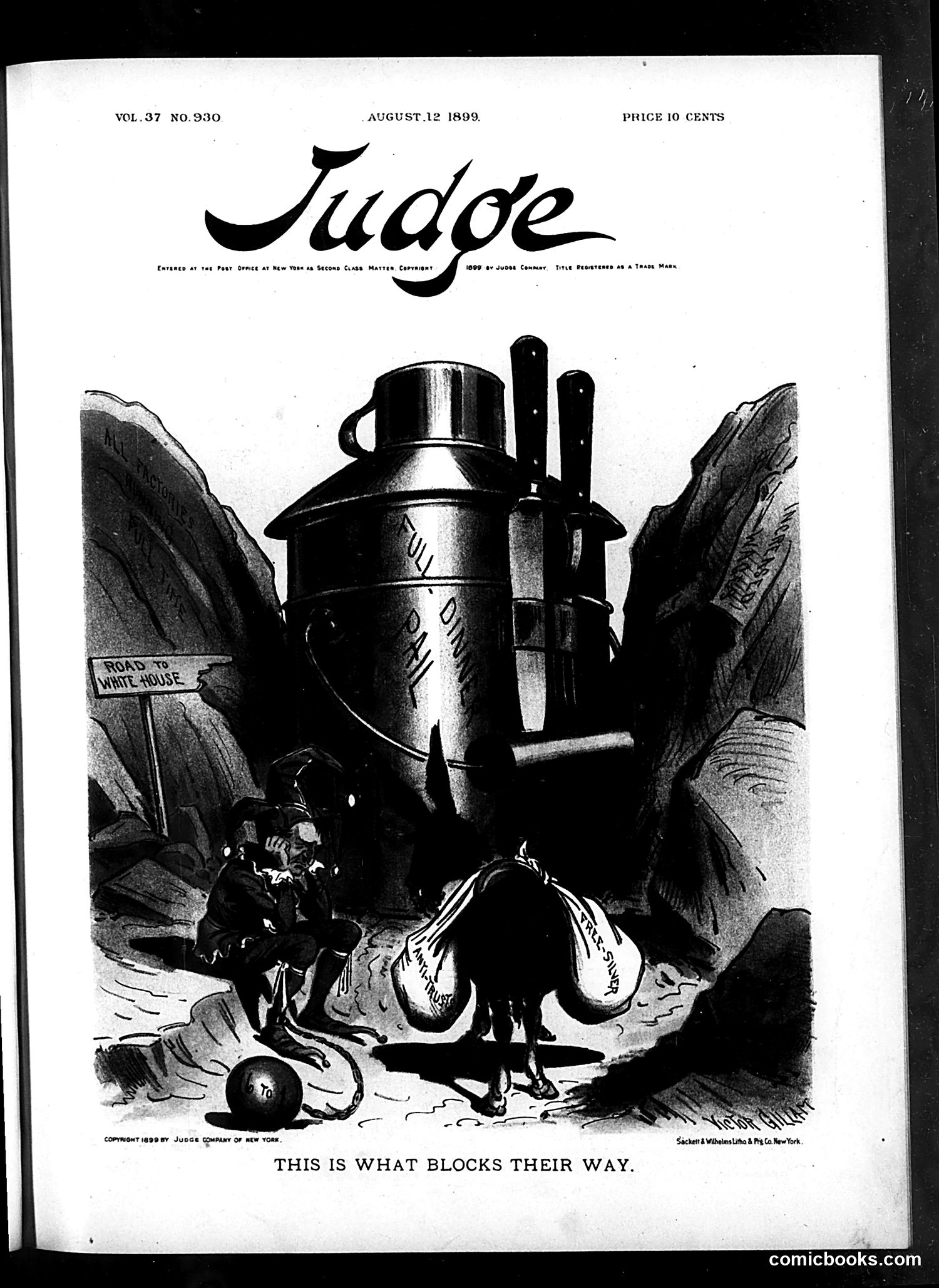
This political cartoon depicts a large military cannon or siege weapon blocking a road to the "White House" (visible on the left sign). A small figure (likely representing the President or political leadership) sits astride what appears to be a donkey labeled with text suggesting political obstruction or opposition. The satire criticizes how military/industrial interests or a particular political faction are "blocking" the path to the White House or presidential authority. The caption "THIS IS WHAT BLOCKS THEIR WAY" suggests the cartoon critiques obstacles to a particular political agenda during the McKinley administration (1897-1901). Without clearer context about specific 1899 political conflicts, the exact referent remains unclear—possibly relating to imperialism, military spending, or executive power struggles of that era.
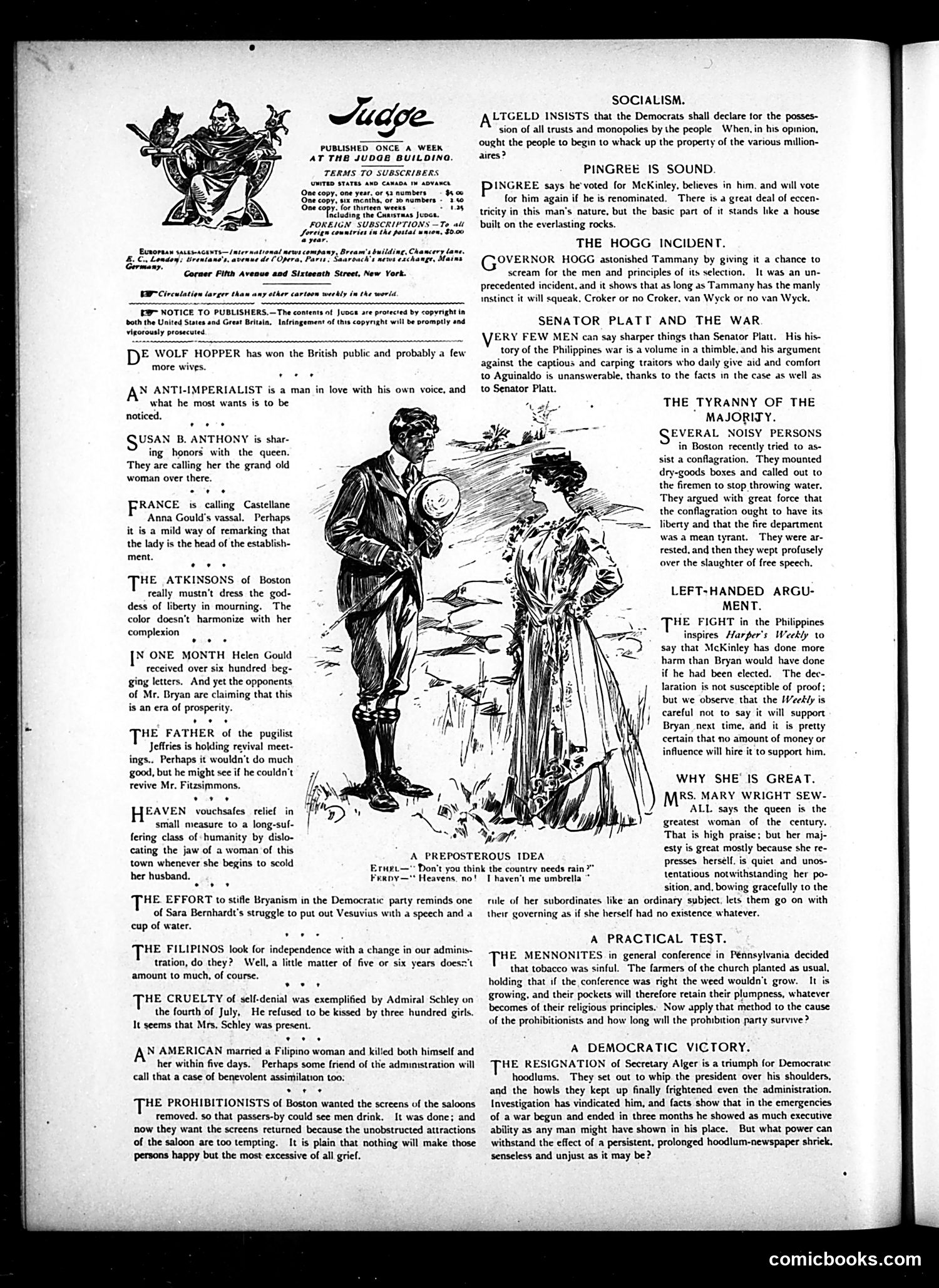
The main cartoon depicts a confrontation between a fireman and a woman during what appears to be a building fire. The caption reads "A Preposterous Idea," with dialogue suggesting the woman wants rain instead of the fireman's water to extinguish the flames. This satirizes what the text calls "THE TYRANNY OF THE MAJORITY"—referring to a real incident where a fire department was prevented from fighting a fire due to religious objections from Mennonites in Pennsylvania. The Mennonite farmers opposed the use of the fire department (seen as tyrannical interference), preferring divine intervention. The cartoon mocks this religious extremism by showing the absurdity of choosing prayer over practical firefighting methods, illustrating the tension between religious principle and public safety needs.
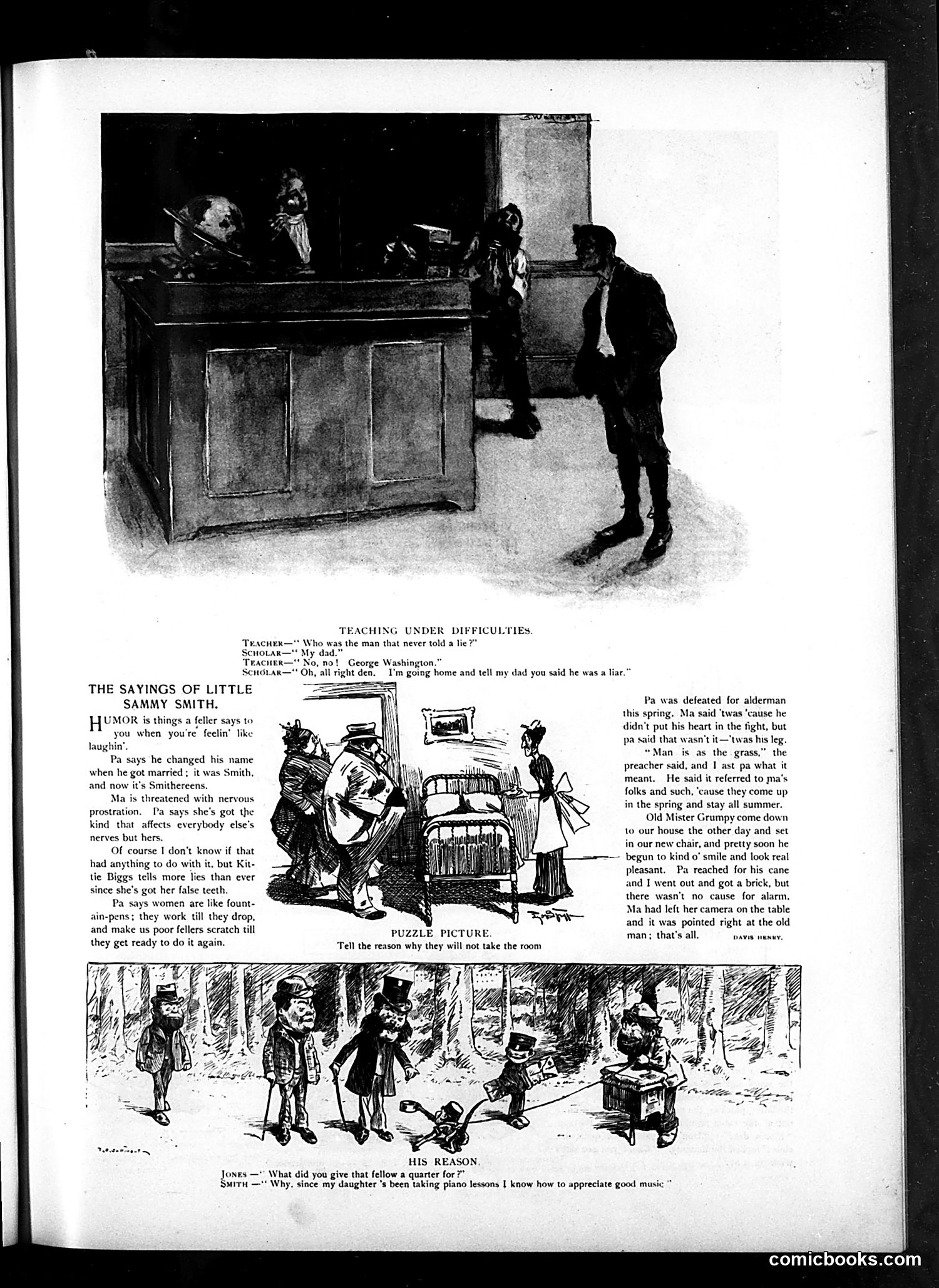
This page contains three separate humorous pieces satirizing American life: 1. **"Teaching Under Difficulties"**: A schoolroom scene mocking a teacher trying to instruct a scholar who claims his father never told a lie—the joke being that the scholar himself admits lying about it. 2. **"The Sayings of Little Sammy Smith"**: Humor pieces about a boy's observations on life, including jokes about his father changing his name after marriage and his mother's nervous condition. 3. **"Puzzle Picture" and "His Reason"**: A visual puzzle asking readers to identify why boys won't enter a room, with the punchline revealing a man playing piano—the joke being that piano lessons are considered torture by children of the era. The page reflects turn-of-the-century American domestic humor and attitudes toward child-rearing and education.
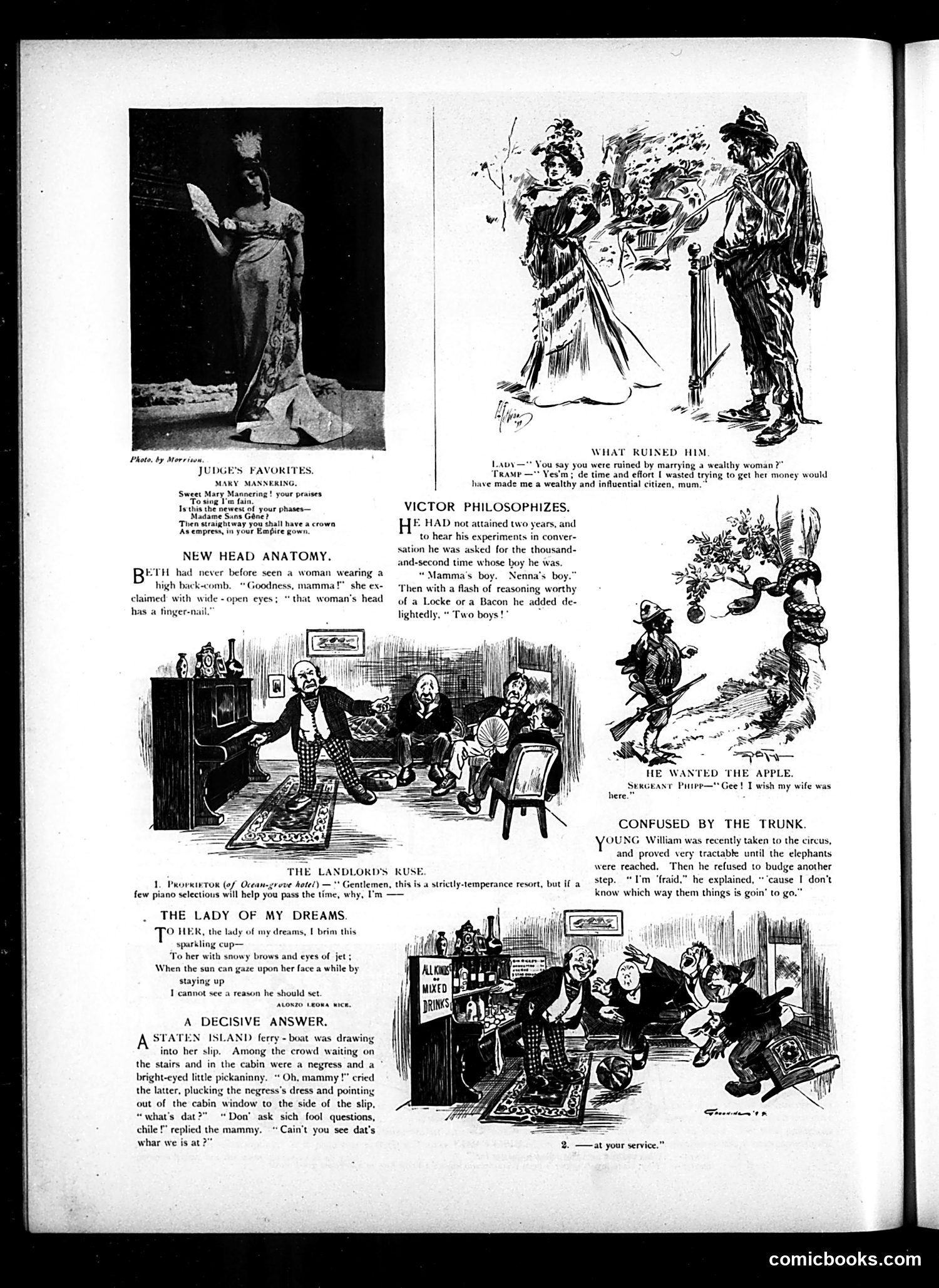
This page contains several humorous sketches with social commentary typical of early 20th-century American satire: **"New Hat Anatomy"** mocks women's elaborate, impractical millinery fashion—a woman's hat is so wide it obscures her features. **"Judge's Favorites: Many Mannering"** appears to reference a character or society figure, with commentary on fashionable appearance. **"The Landlord's Ruse"** satirizes landlord-tenant disputes, likely depicting an evasion of housing complaints through musical distraction. **"The Lady of My Dreams"** romanticizes an unattainable woman through poetic description. **"A Decisive Answer"** recounts a shipboard anecdote about a child's innocent observation, using dialect humor common to period comedy. The remaining sketches satirize circus elephants, trunk confusion, and working-class behavior—typical Judge fare targeting contemporary social pretensions and absurdities.
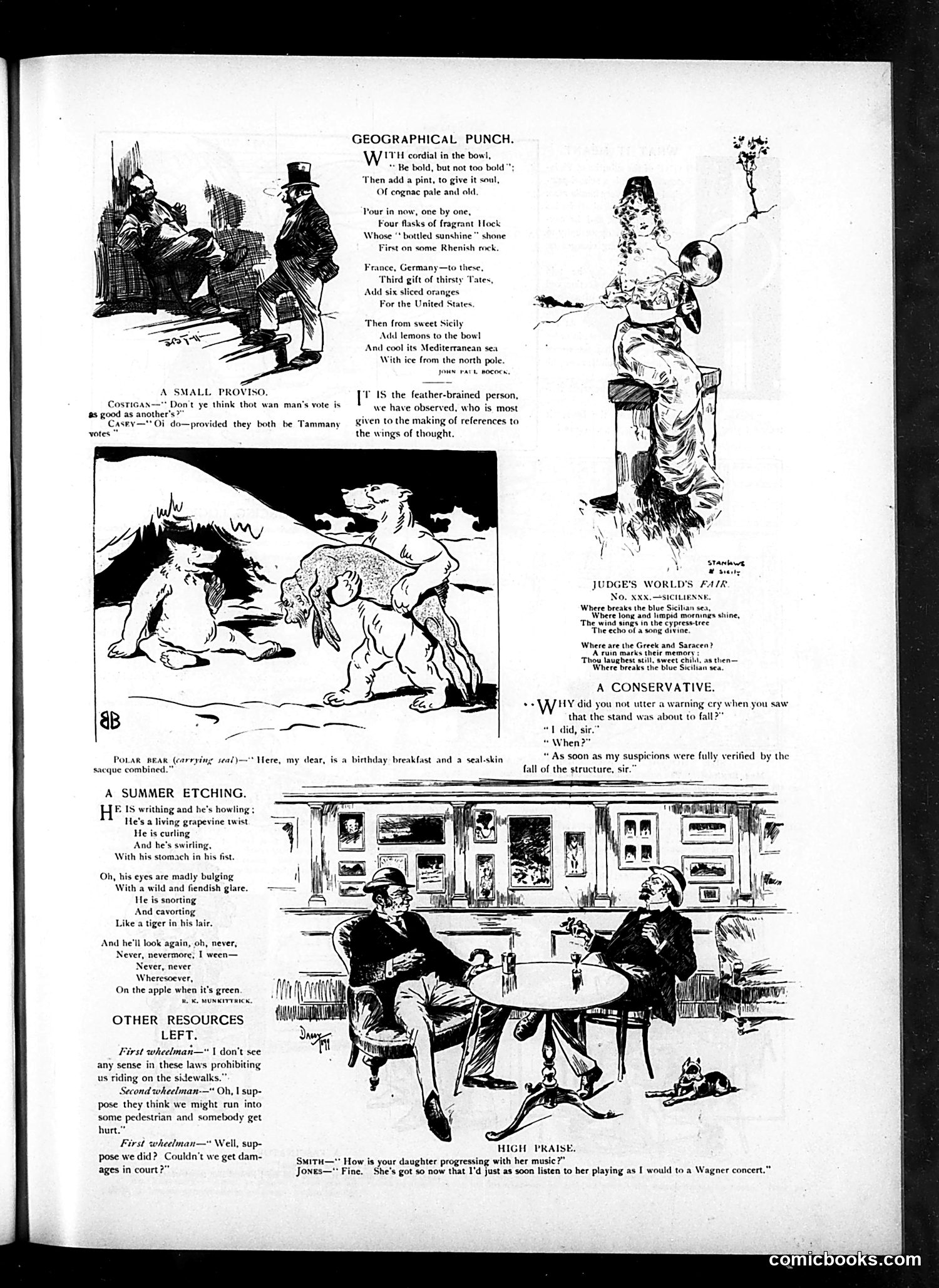
This page contains several distinct satirical pieces: **"Geographical Punch"** is a recipe poem mocking international relations, blending nations as cocktail ingredients—France and Germany providing spirits, Sicily lemons, and the United States oranges. It reflects late-19th-century attitudes toward European powers and American identity. **"A Small Proviso"** references Tammany Hall (New York's Democratic machine), satirizing voting rights debates of the era, likely touching on Irish immigrant voting blocs ("Tammany votes"). **"A Conservative"** mocks cautious attitudes—a figure warns of danger only *after* disaster strikes, satirizing those who avoid preventive action. **"Polar Bear"** is a visual gag about an unusual meal combination. **"A Summer Etching"** describes a man's violent reaction to a green apple, likely medical commentary on stomach ailments. **"Other Resources Left"** jokes about bicycle laws and pedestrian safety—a contemporary urban concern. **"High Praise"** punches at amateur music performance, suggesting the daughter plays so poorly that Wagner (then cutting-edge classical music) sounds preferable.
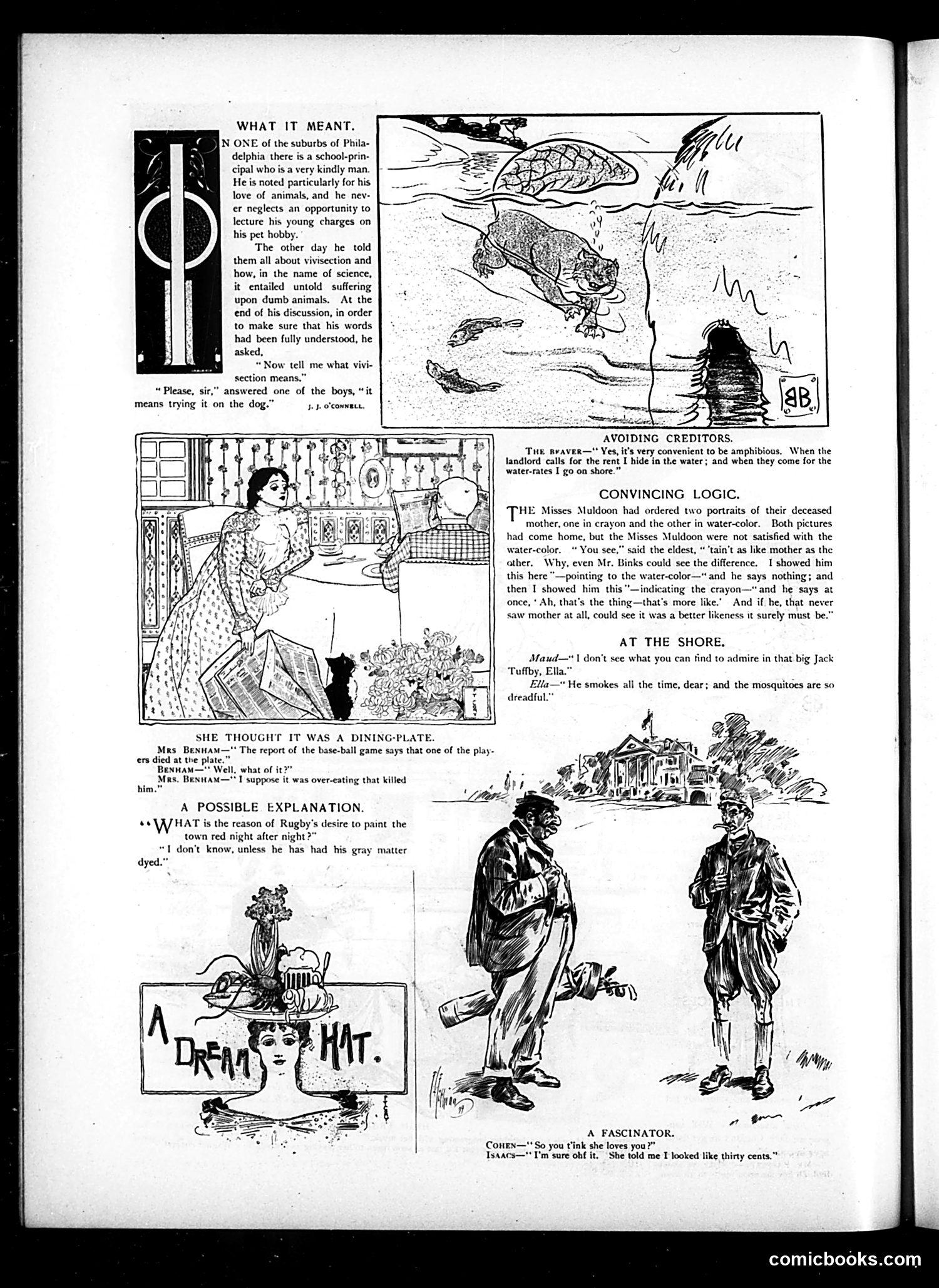
This page contains multiple unrelated satirical items typical of early 20th-century humor magazines: **"What It Meant"**: A school principal lectures students against vivisection (animal experimentation). When asked to define it, a boy answers "trying it on the dog"—a humorous misunderstanding that plays on the phrase "trying it on" (testing something). **"Avoiding Creditors"**: A joke about an amphibious person hiding from landlords in water and from water-rate collectors on shore—satirizing the evasion tactics of those avoiding debts. **"Convincing Logic"** and other items use circular reasoning or non-sequiturs for comedic effect. **"A Fascinator"**: A man boasts that a woman told him he looked like "thirty cents"—implying low value—yet he interprets this as flattery, showing self-delusion. The page reflects period concerns: animal welfare, housing/rent disputes, and dating dynamics. No specific political figures are caricatured here; these are general social satires aimed at everyday human folly and misunderstanding.
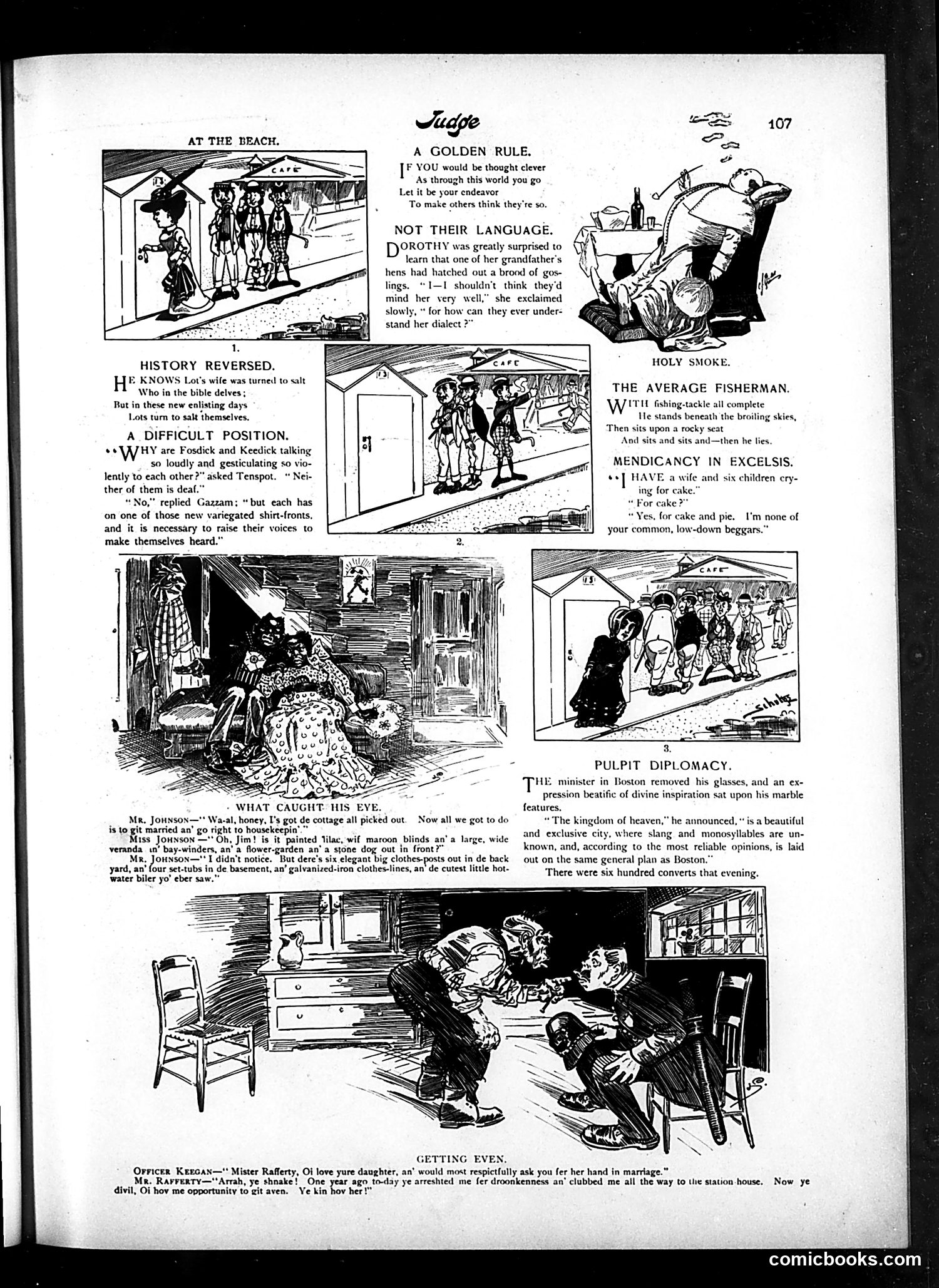
This page from *Judge* contains several short satirical pieces typical of early 20th-century American humor: **"A Golden Rule"** and **"Not Their Language"** are brief wordplay jokes about cleverness and a child's confusion about goslings not understanding a hen's "dialect." **"History Reversed"** and **"A Difficult Position"** appear to reference contemporary social issues—likely relating to military enlistment (the phrase "new enlisting days" suggests wartime) and modern fashion (the "variegated shirt-fronts" suggest new, garish menswear styles). **"Pulpit Diplomacy"** satirizes a Boston minister who describes heaven as an exclusive, refined city without "slang and monosyllables"—mocking pretentious clergy who equate genteel speech with spirituality. **"Setting Even"** depicts an Irish immigrant officer asking a man for his daughter's hand, only to be reminded the officer previously arrested him for drunkenness—a comedic reversal suggesting social mobility anxieties. The remaining pieces offer light beach and fishing humor. Overall, the page targets class pretensions, immigration, and modern social changes through gentle satire.
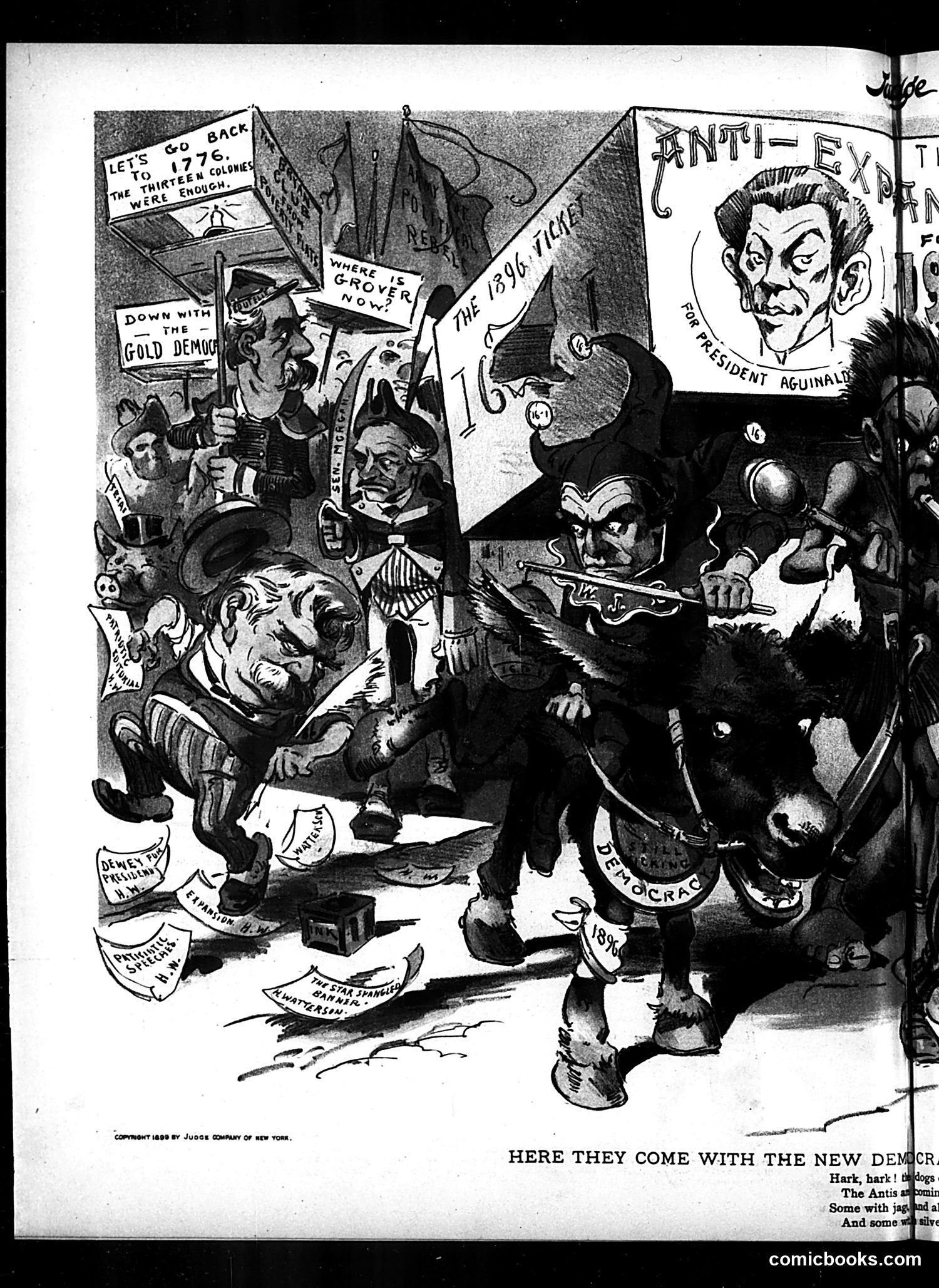
This 1899 Judge magazine cartoon satirizes the arrival of new Democratic Party members or policies. The caption "HERE THEY COME WITH THE NEW DEM[OCRACY]" introduces a procession of caricatured figures marching from the left side. The cartoon shows various political figures and symbols approaching what appears to be an "Anti-Expansion" figure on the right. Signs visible include references to the 1896 election and "Gold Demons," suggesting debate over currency policy and imperial expansion—key Democratic Party divisions of the era. The exaggerated, grotesque caricatures and menacing tone indicate Judge's skepticism toward Democratic initiatives. The specific individuals remain unclear without additional context, but the visual mockery of their arrival represents Republican satirical opposition to Democratic political movements circa 1899.
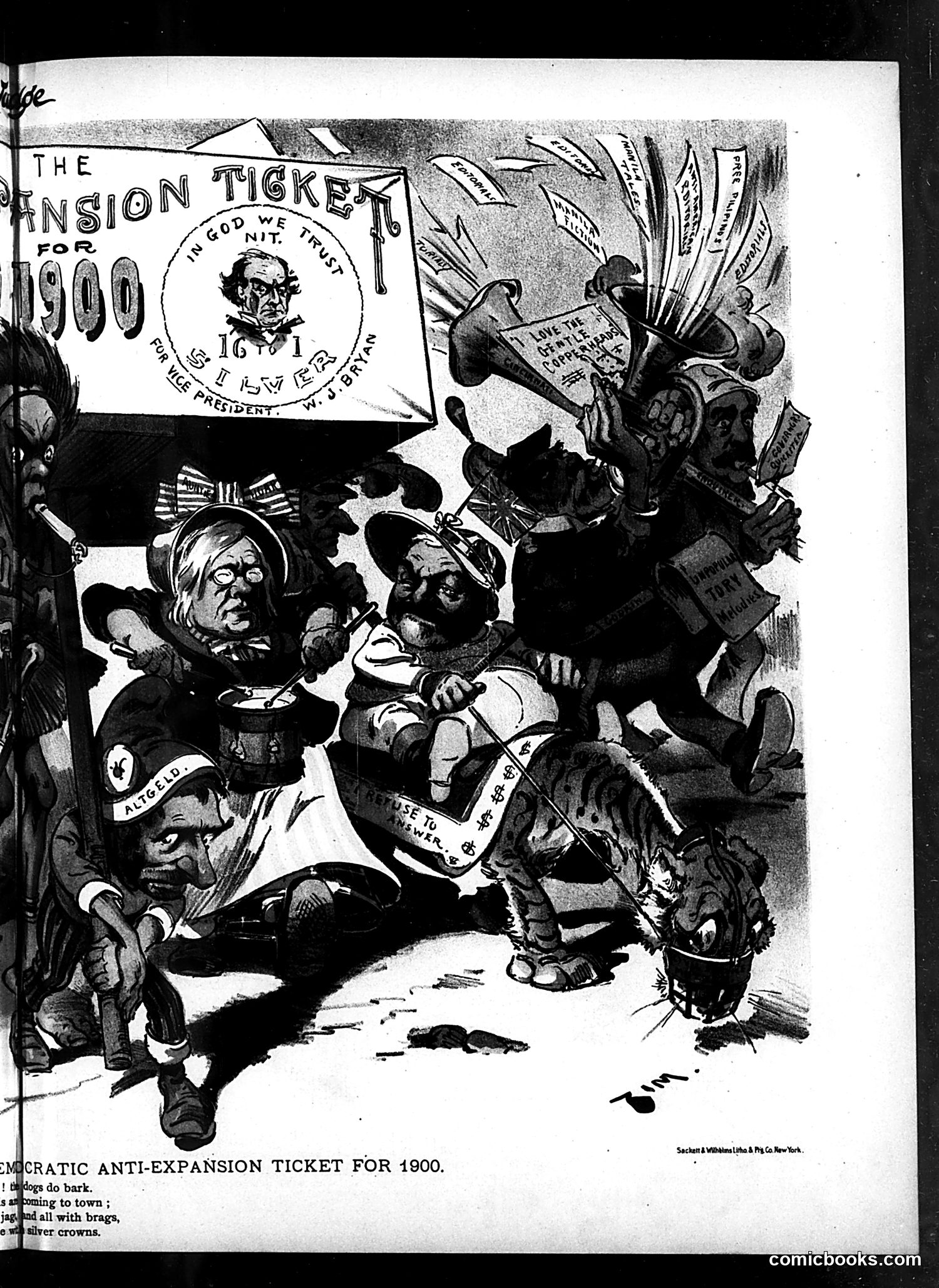
This Judge magazine cartoon satirizes the 1900 Democratic presidential platform opposing American imperial expansion. The ticket shows a chaotic scene of figures representing Democratic positions, with William Jennings Bryan (the party's candidate) depicted among caricatured characters. The central banner references "In God We Trust" and shows a portrait, likely McKinley or a Republican figure being mocked. The satire criticizes Democrats for their anti-expansion stance during America's imperialist period (following the Spanish-American War). The cartoon portrays their opposition as absurd or buffoonish, using exaggerated caricatures typical of Judge's partisan Republican perspective. The composition suggests chaos and instability resulting from this political position, reflecting contemporary debates over American overseas territorial acquisition.
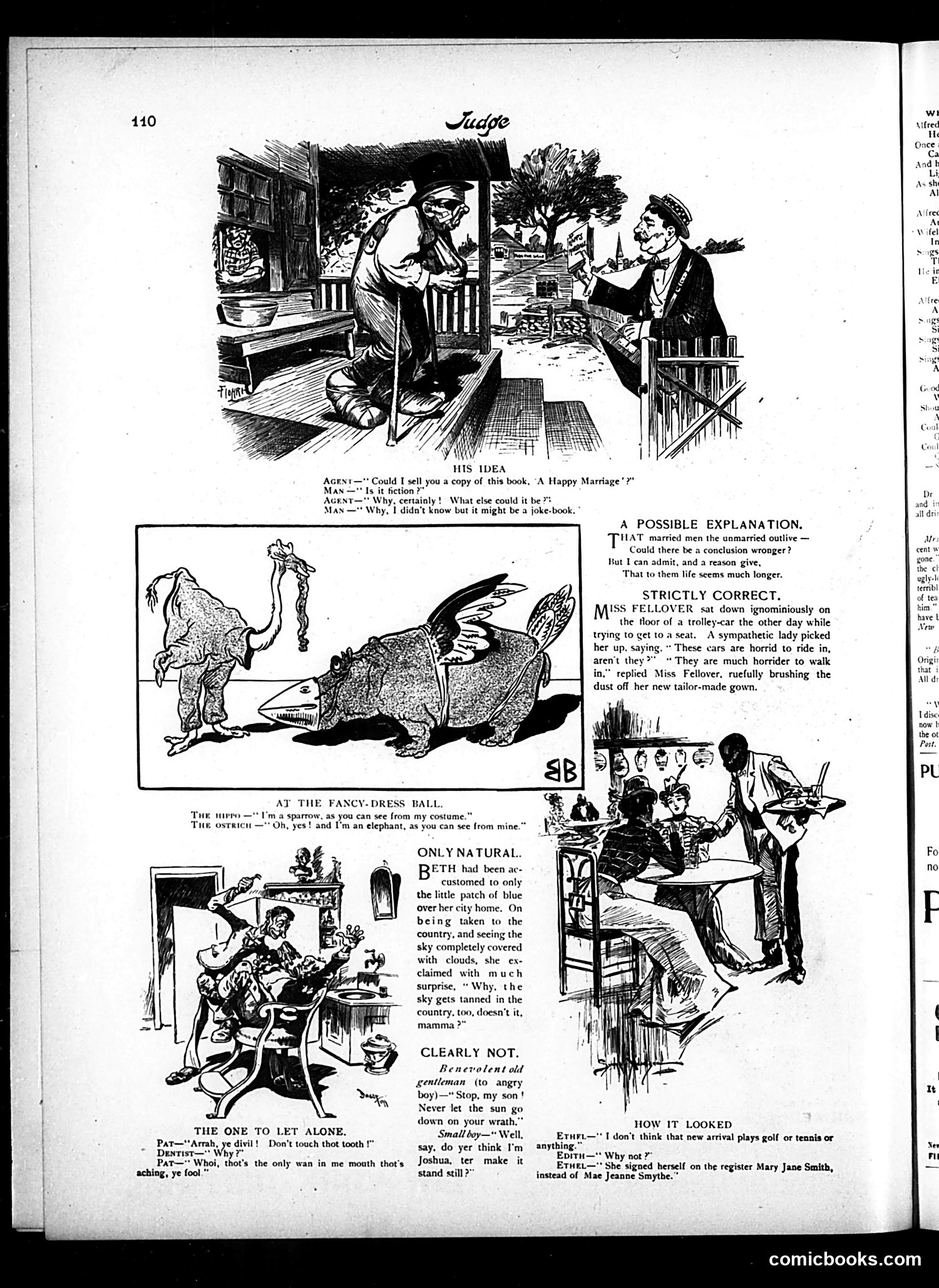
This page contains six brief humorous vignettes satirizing early 20th-century American life and social conventions: **"His Idea"** mocks the contradiction between marketing "A Happy Marriage" as fiction when it's actually presented as a practical book—implying happy marriages are fictional fantasies. **"The Fancy-Dress Ball"** plays on animal costumes: a character dressed as a sparrow and one as an elephant, with the joke implying the costumes are absurdly unconvincing. **"The One to Let Alone"** features Irish dialect humor (Pat) about a toothache—the joke being the ironic advice to leave the only aching tooth untouched. **"Only Natural"** ridicules urban children's limited knowledge; a city girl assumes sky clouds mean the sky gets "tanned" in the country. **"Clearly Not"** presents a boy's impudent response to moral instruction, refusing to suppress anger because he cannot literally stop the sun. **"Strictly Correct"** and **"How It Looked"** satirize female vanity and pretension—one woman's complaint about trolleys and another's suspicious use of affected names on hotel registers. The overall tone targets everyday absurdities and social pretense.
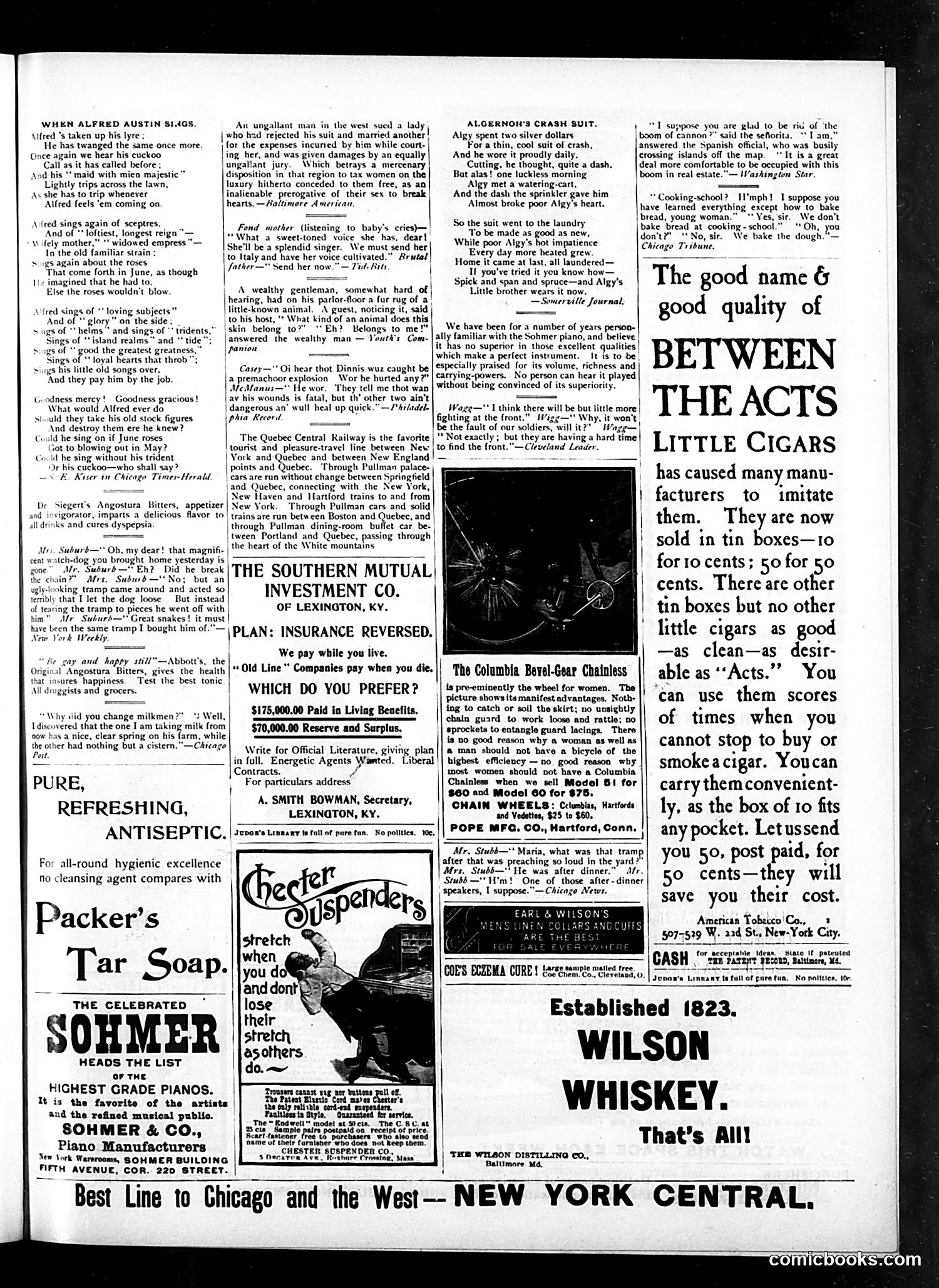
This page from *Judge* magazine is primarily **advertising and miscellaneous humor pieces**, not a unified political cartoon. The main literary content is a poem titled "When Alfred Austin Slags" (top left), mocking **Alfred Austin, Britain's Poet Laureate**. The satire ridicules his repetitive verse about patriotic themes—"sceptres," "loyal hearts," "island realms," "tridents"—suggesting his poetry is formulaic doggerel he produces mechanically for payment. The poem implies Austin recycles the same tired imagery regardless of current events, relying on clichéd "stock figures" rather than genuine inspiration. This reflects contemporary British literary criticism dismissing Austin's work as uninspired jingoism. The remaining content consists of **period advertisements** (Packer's Tar Soap, Sohmer Pianos, Wilson Whiskey) and brief humor items about unrelated topics (a rejected suitor suing, a baby's singing voice, hearing loss). There is no unified satirical message across the page.
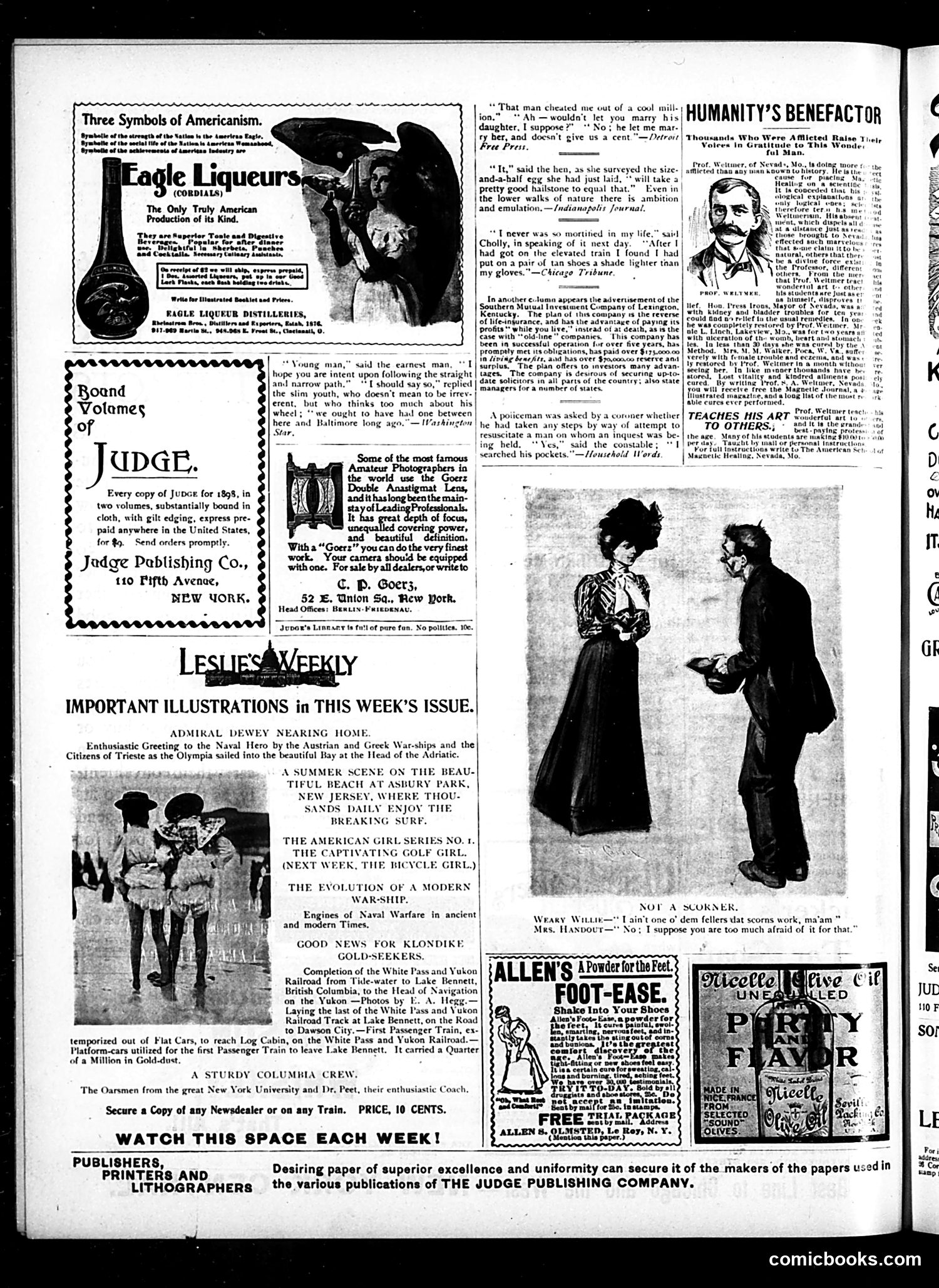
This page from Judge (a prominent American satirical magazine) contains: **"Three Symbols of Americanism"** (top left): An Eagle Liqueurs advertisement styled as patriotic symbolism, satirizing commercialism masquerading as national values. **"Bound Volumes of Judge"** (left): A book advertisement for previous issues. **"Not a Scorner"** (center illustration): A cartoon showing a young boy and woman, where the boy insists he doesn't scorn work. The joke satirizes youth unemployment or reluctance—a social concern of the era. **Various humorous quotes**: Including jokes about a hen's egg-laying achievement and a woman embarrassed about wearing mismatched tan shoes and gloves—trivial social anxieties typical of Judge's gentle mockery of middle-class concerns. **Bottom sections**: Announcements of illustrated features including Admiral Dewey's return (reference to the 1898 Spanish-American War hero), summer beach scenes, and a golf girl series. The page largely showcases advertising and content promotion rather than heavy political satire, reflecting Judge's mix of sophisticated humor and commercial enterprise.
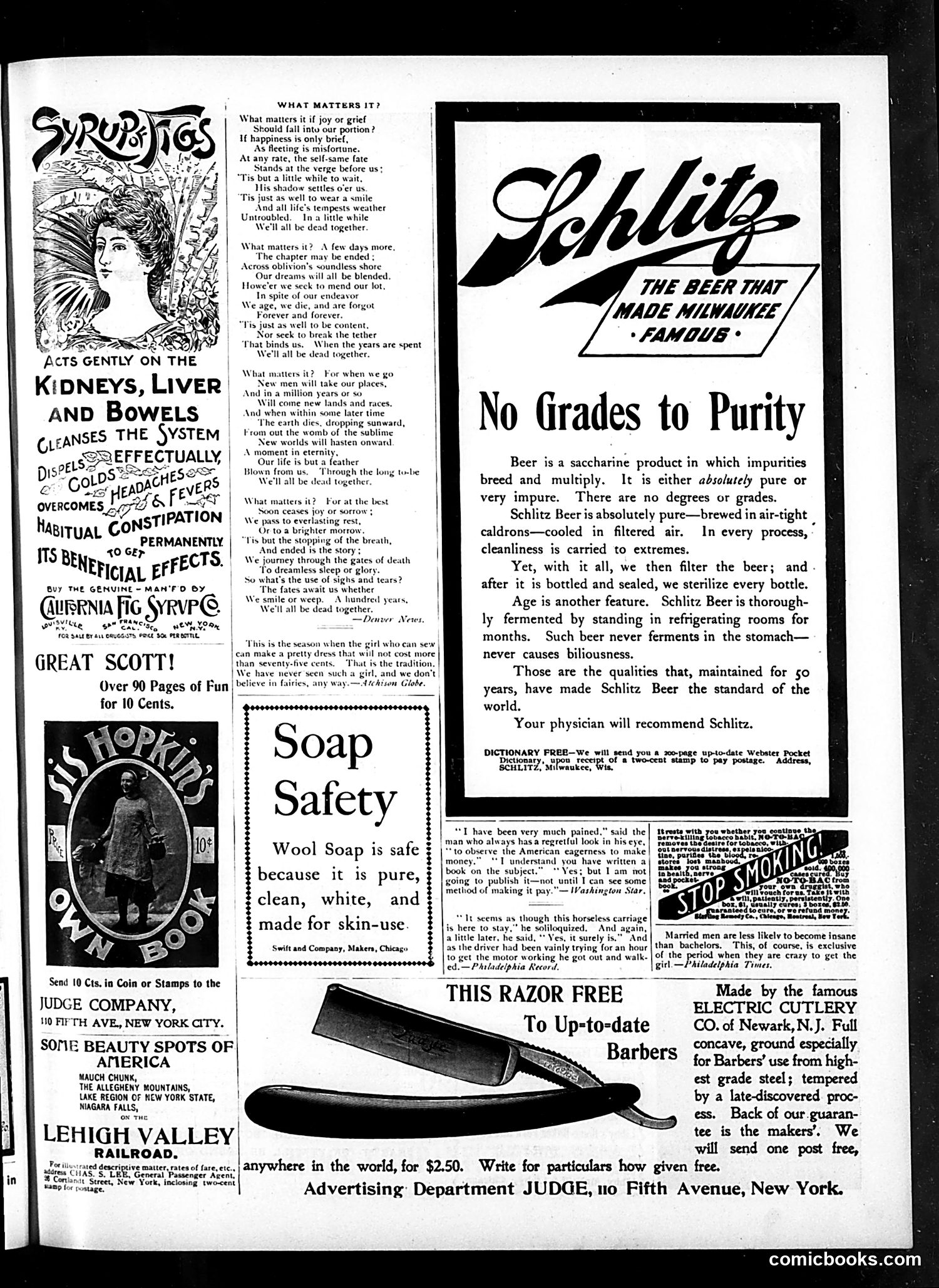
This page is primarily **advertisements and light humor**, not political satire requiring historical context. The main content includes: **"What Matters It?"** — A melancholic poem (credited to Denver News) about life's brevity and inevitability of death. It's philosophical verse, not satirical. **Patent medicine ads** (left column) — Typical early-1900s advertisements claiming remedies cure kidneys, liver, bowels, and constipation. These were common in period magazines. **Commercial ads** — Schlitz Beer ("No Grades to Purity"), wool soap, razor manufacturers, and railroad tourism. Standard advertising copy emphasizing product purity and quality. **Small filler jokes** — A quip about sewing dresses cheaply, and a joke about a man regretting American money-making obsession but unwilling to publish his book without profit—gentle, non-partisan humor. The page contains **no identifiable political cartoon, caricature, or specific historical reference** requiring specialized knowledge. It's a typical Judge magazine layout mixing advertisement revenue with light verse and humor.
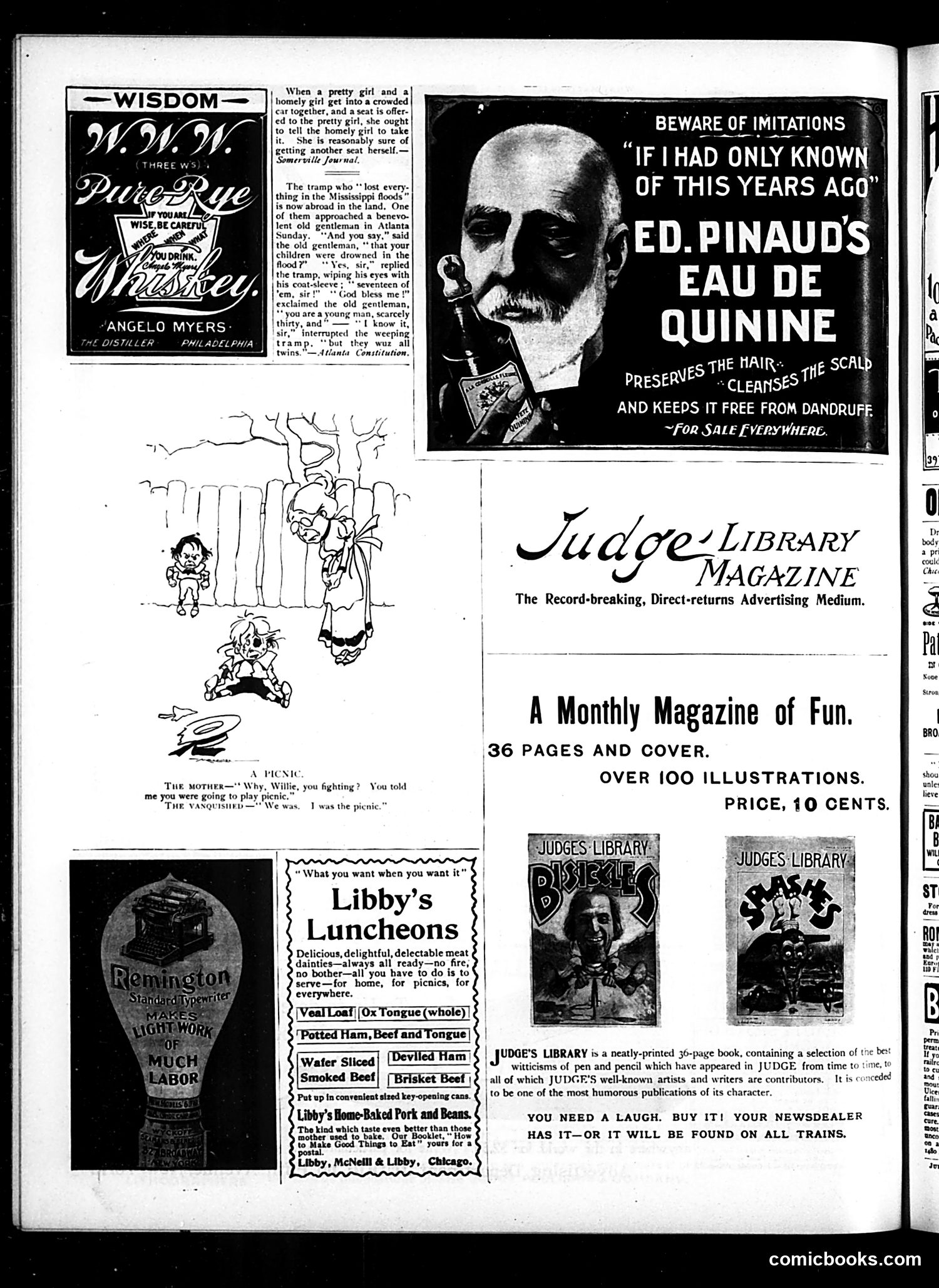
This page contains mixed content: satirical cartoons, advertisements, and magazine promotion. **The "Picnic" Cartoon**: A brief joke about children playing—one child claims to be "the picnic" after being beaten up by others, a dark humor pun on the word's double meaning. **The "Wisdom" Section**: A morality tale about tramps (homeless men) manipulating benevolent gentlemen through sob stories. One tramp claims seventeen children drowned, exaggerating misfortune to extract sympathy and money. The satire targets both naive wealthy people and the con-artist schemes of vagrants. **Advertisements**: The page heavily features period product ads (Remington typewriters, Libby's canned foods, Ed. Pinaud hair tonic) typical of early 20th-century magazines. **Judge Library Magazine Promotion**: The lower section advertises Judge's own humor collection book—emphasizing its cartoons and "witticisms" as entertainment. The overall tone reflects Judge's satirical mission: mocking human folly, social pretension, and street-level deception while selling products and entertainment.
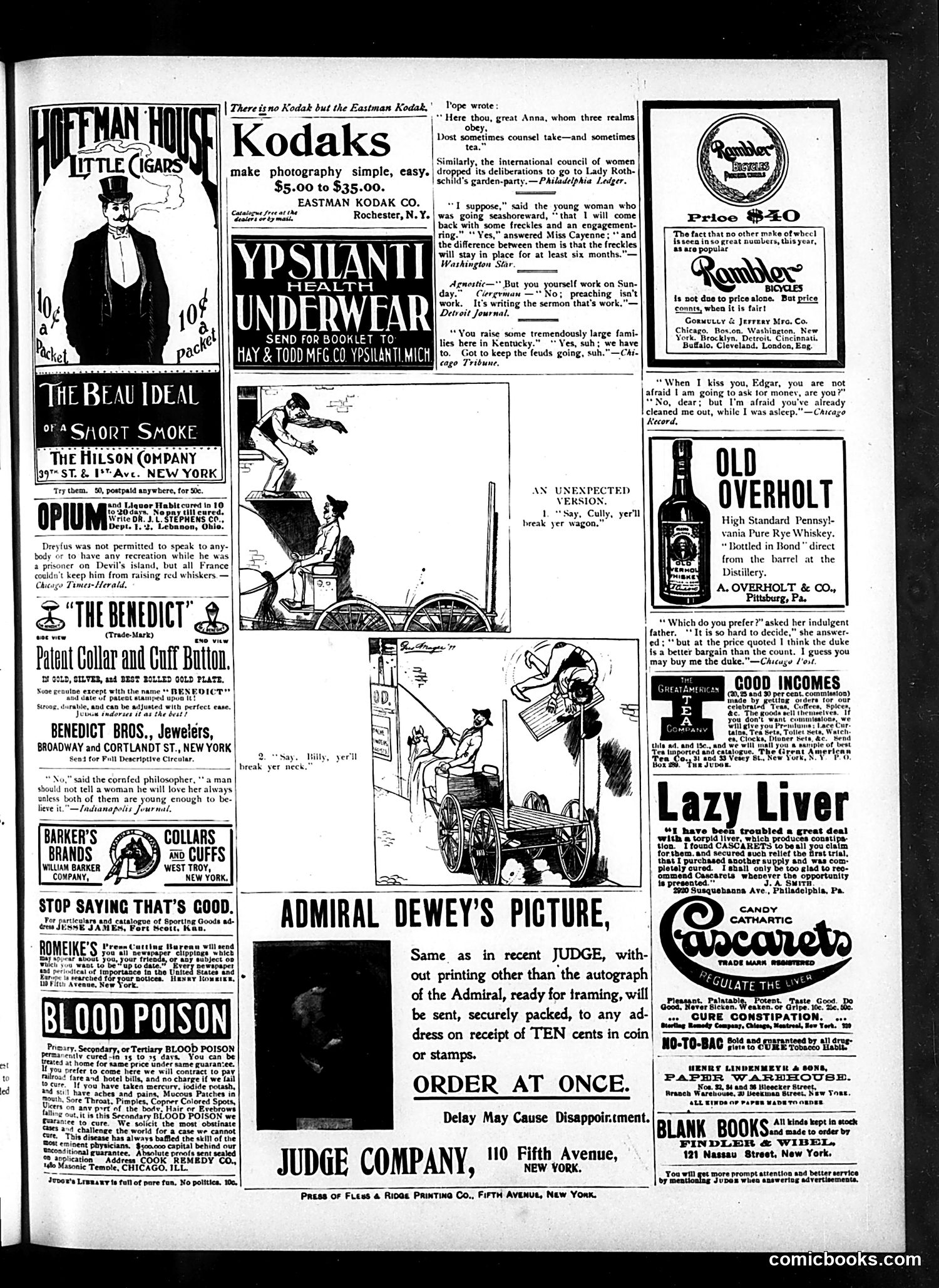
This page is primarily **advertising**, typical of early 20th-century magazines. However, it contains several short humor pieces: **Notable Comics/Cartoons:** - "An Unexpected Version" shows two scenes of a man warning someone ("Cully"/"Milly") they'll break a wagon/neck—likely satirizing repetitive or predictable situations. - A larger cartoon depicts what appears to be a domestic scene with a woman and man in a vehicle or room, captioned with dialogue about breaking things. **Social Satire:** The brief jokes mock: - **Gender dynamics**: A woman calculating marriage prospects by "bargain" value (duke vs. count) - **Class/wealth**: Implied commentary on wealthy women's frivolous concerns - **Rural stereotypes**: References to Kentucky feuds and "cornfed" philosophy **Context:** These are gentle, domestic humor pieces typical of Judge's satirical approach—poking fun at courtship, marriage, class pretensions, and regional stereotypes rather than hard political commentary. The page is dominated by patent medicines, jewelry, and consumer goods advertising.
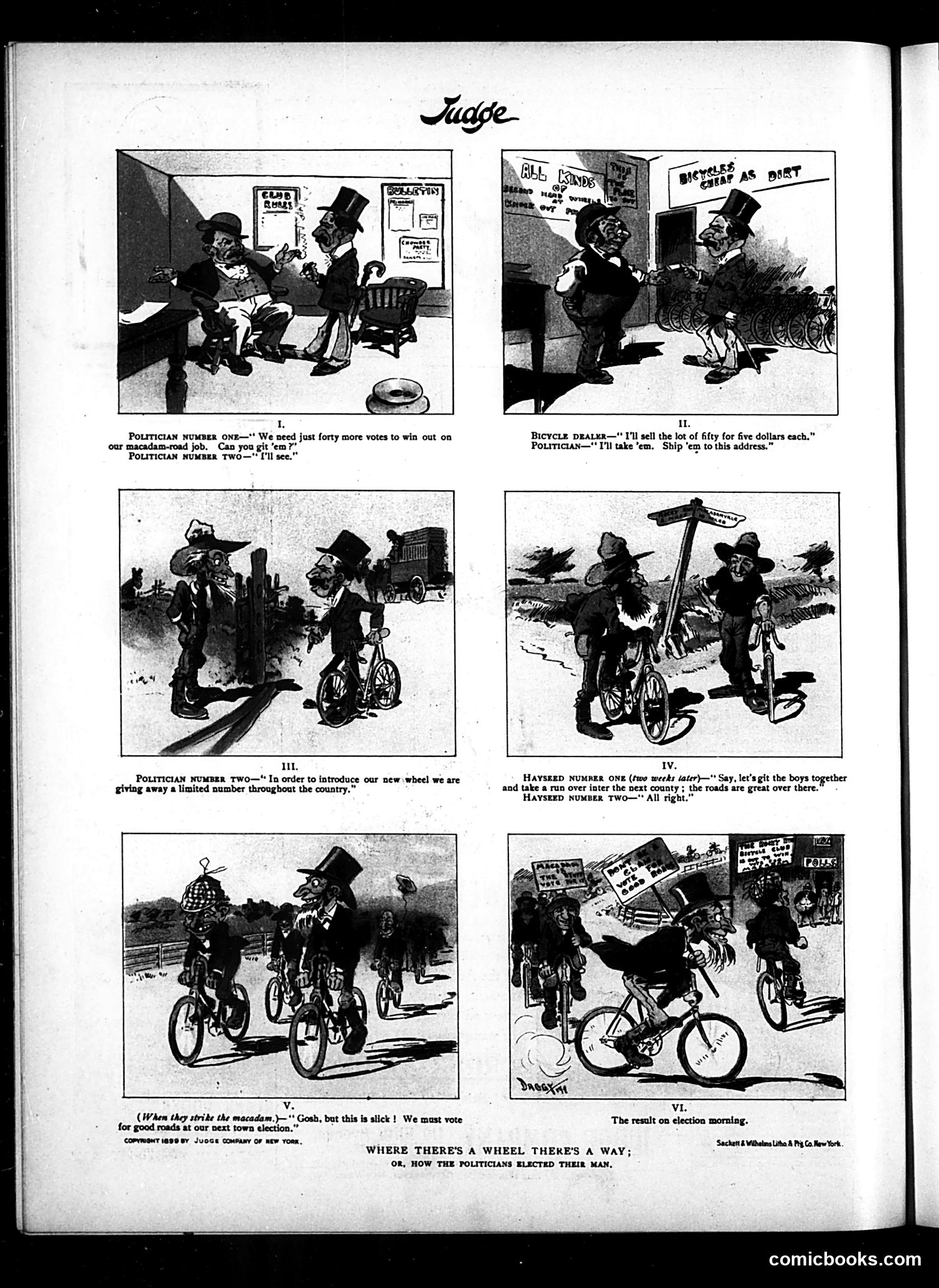
This six-panel cartoon satirizes corrupt electoral practices in late-1890s America. Two politicians need forty votes to pass a macadam (paved) road project. Rather than campaign honestly, they purchase bicycles cheaply from a dealer and distribute them to rural voters ("hayseeds") across the county. The scheme works: once country people experience the smooth macadam roads while riding their new bicycles, they're impressed and vote for the politicians at the next election—presumably for the same candidate who "gave" them the wheels. The satire targets machine politics and vote-buying through bribery disguised as gifts. It mocks both the cynical politicians exploiting voter simplicity and the rural voters whose support can be purchased with consumer goods. The title's pun ("where there's a wheel there's a way") underscores how the bicycle becomes the tool of political manipulation.