
A complete issue · 16 pages · 1899
Judge — July 15, 1899
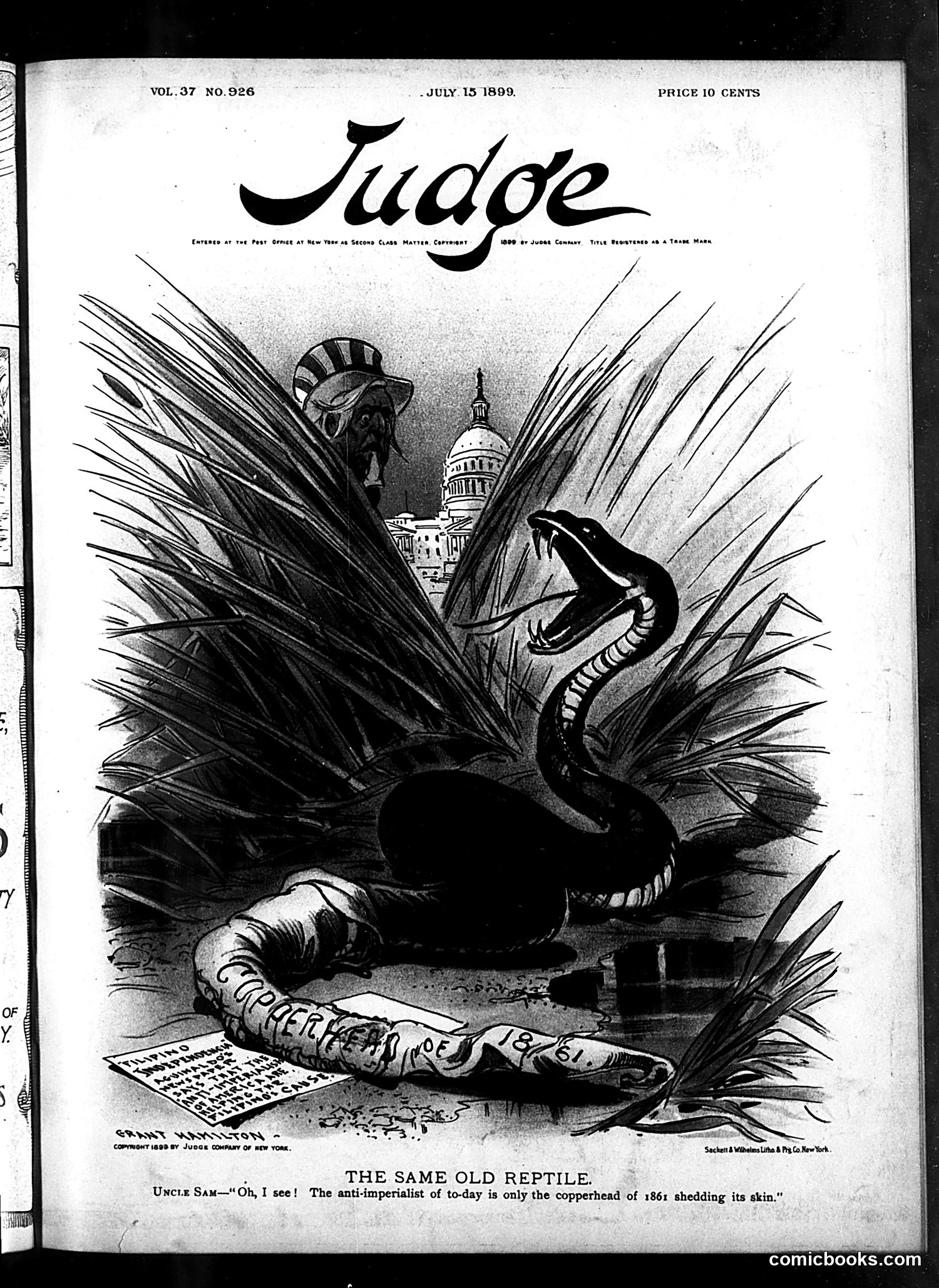
This political cartoon depicts **Uncle Sam** (representing the United States) confronting a large snake shedding its skin. The Capitol building appears in the background. The caption reads: "Oh, I see! The anti-imperialist of to-day is only the copperhead of 1861 shedding its skin." The satire equates **anti-imperialists** (opponents of American imperial expansion, a major 1890s debate) with **Copperheads**—Northern Democrats who opposed the Civil War. The snake imagery suggests these groups are fundamentally the same, merely disguising themselves in new rhetoric. By invoking the Copperhead label, the cartoonist delegitimizes anti-imperialists as unpatriotic, comparing their opposition to American expansion with disloyalty during the Civil War.
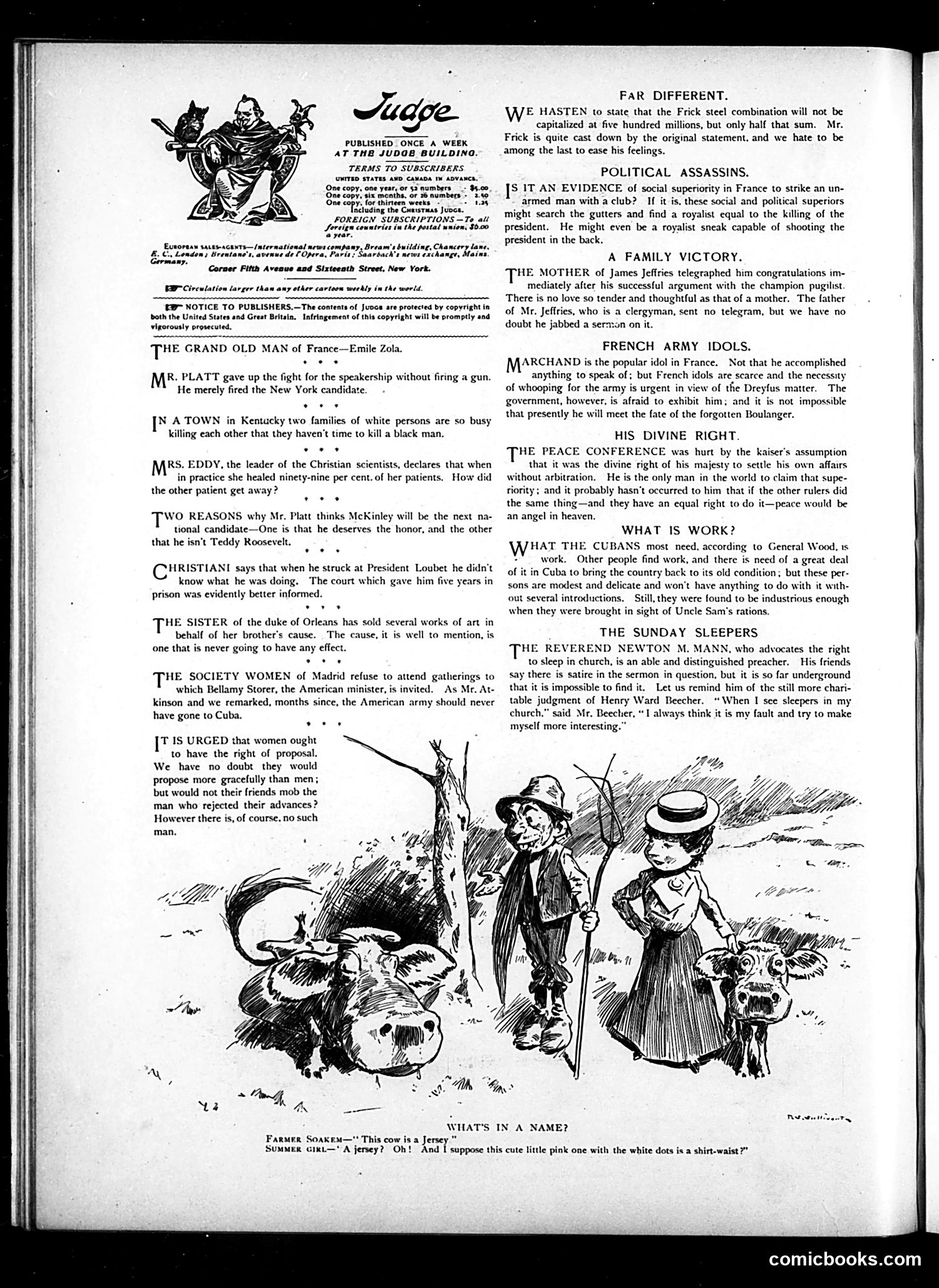
The main cartoon titled "WHAT'S IN A NAME?" depicts a farmer and summer girl examining a cow. The farmer says the cow is a "Jersey," prompting the girl to ask if it's a Jersey cow with "white dots" and whether it's wearing a "shirt-waist." This is a pun-based joke playing on the word "Jersey"—she's confusing the dairy breed name with Jersey fabric or a Jersey shirt-waist (a common women's garment of the era). The humor relies on the girl's urban unfamiliarity with farm animals and rural terminology. The surrounding text contains brief political and social commentary typical of Judge's satirical style, including pieces on McKinley, French politics, and gender issues—standard early 1900s magazine fare attacking public figures and social pretensions.
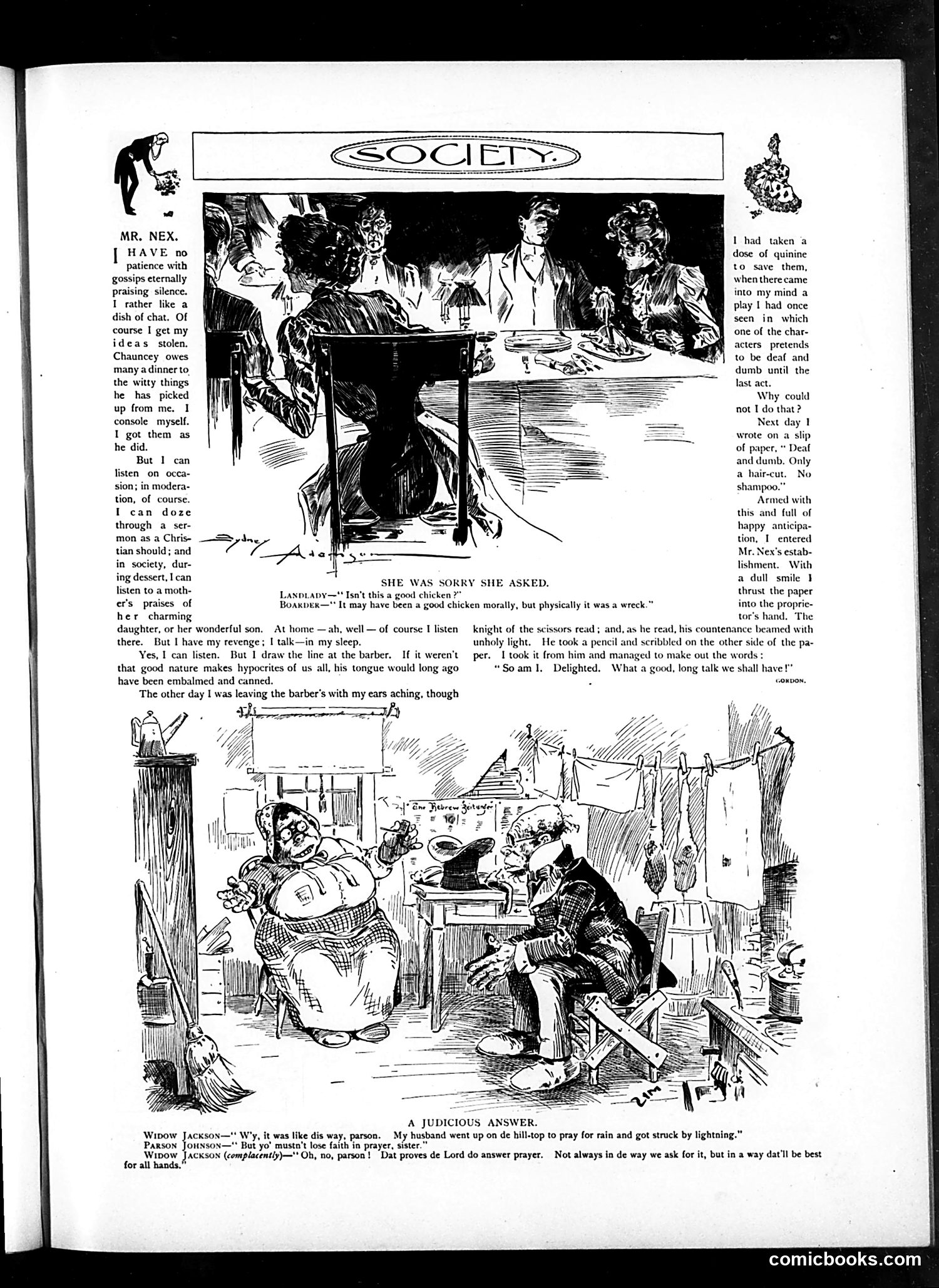
This page contains two satirical pieces from *Judge* magazine: **Top cartoon ("She Was Sorry She Asked")**: A dinner party scene where a lady asks if the chicken is good. A gentleman responds it was "a good chicken morally, but physically it was a wreck"—satirizing Victorian hypocrisy about judging things by appearances versus substance. **Bottom cartoon ("A Judicious Answer")**: Depicts Widow Jackson and Parson Johnson discussing prayer. When she mentions her husband prays for rain and lightning protection, the parson responds that "the Lord" doesn't always answer prayer "in the way we ask for it, but in a way dat'll be best for all hands"—poking fun at religious platitudes and the gap between faith and practical outcomes. Both mock polite society's tendency toward empty, evasive rhetoric.
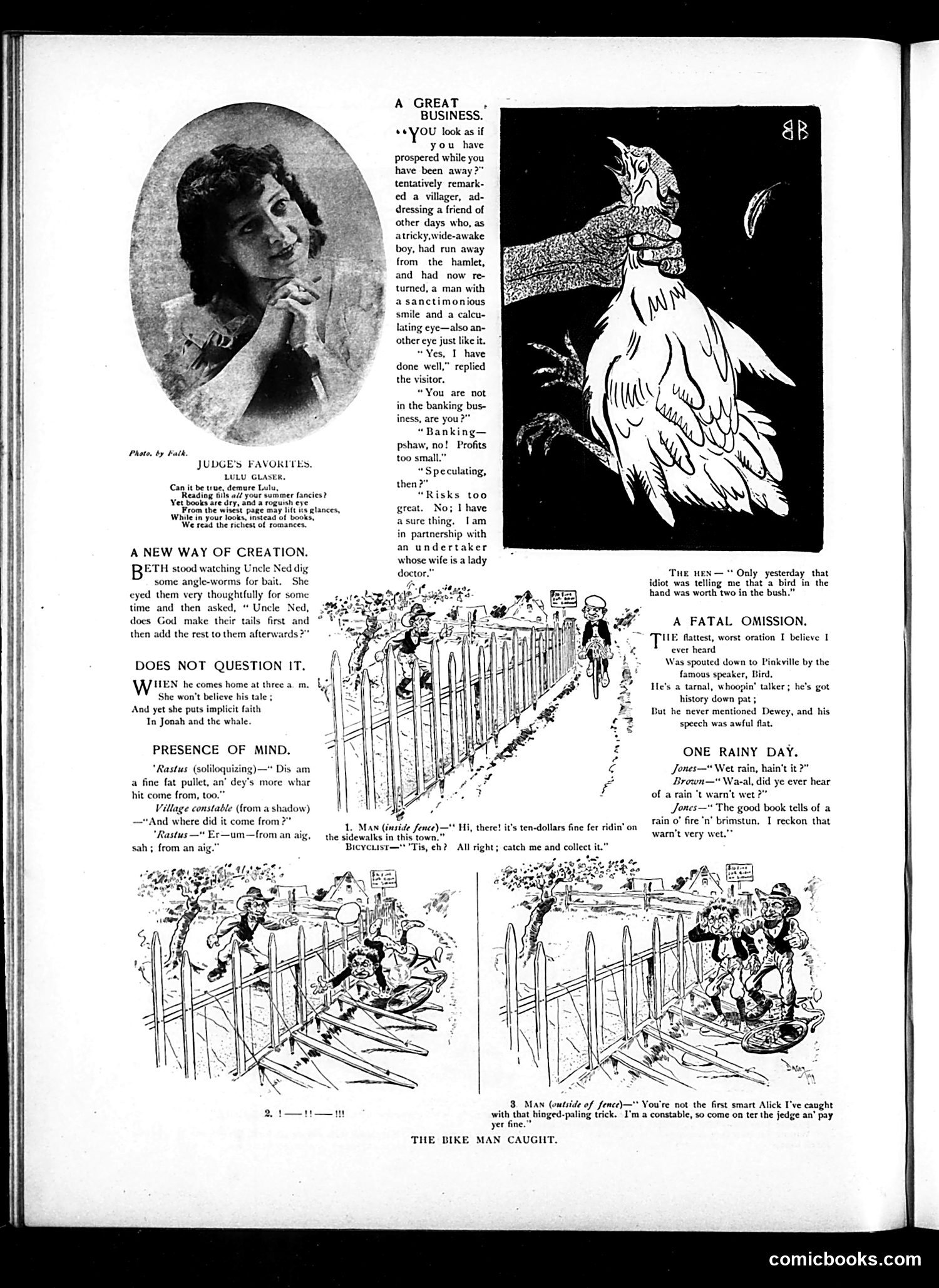
This page contains several unrelated humorous sketches and verses rather than unified political cartoons. The content includes: **"A Great Business"** — a dialogue about prospering during absence, likely satirizing small-town gossip or business opportunism. **"A New Way of Creation"** — features Uncle Ned and Beth, appearing to be domestic/family humor without clear political reference. **"Does Not Question It"** and **"Presence of Mind"** — brief comedic verses about everyday situations (late arrivals, witty responses). **"The Hike Man Caught"** — illustrated bottom section showing someone caught in rain or caught by law enforcement, with dialogue about constables. The page lacks identifiable political figures or dated references. It represents Judge's typical format: mixing domestic comedy, puns, and light social observation rather than pointed political satire. Without additional context, the specific targets and meanings remain unclear to modern readers.
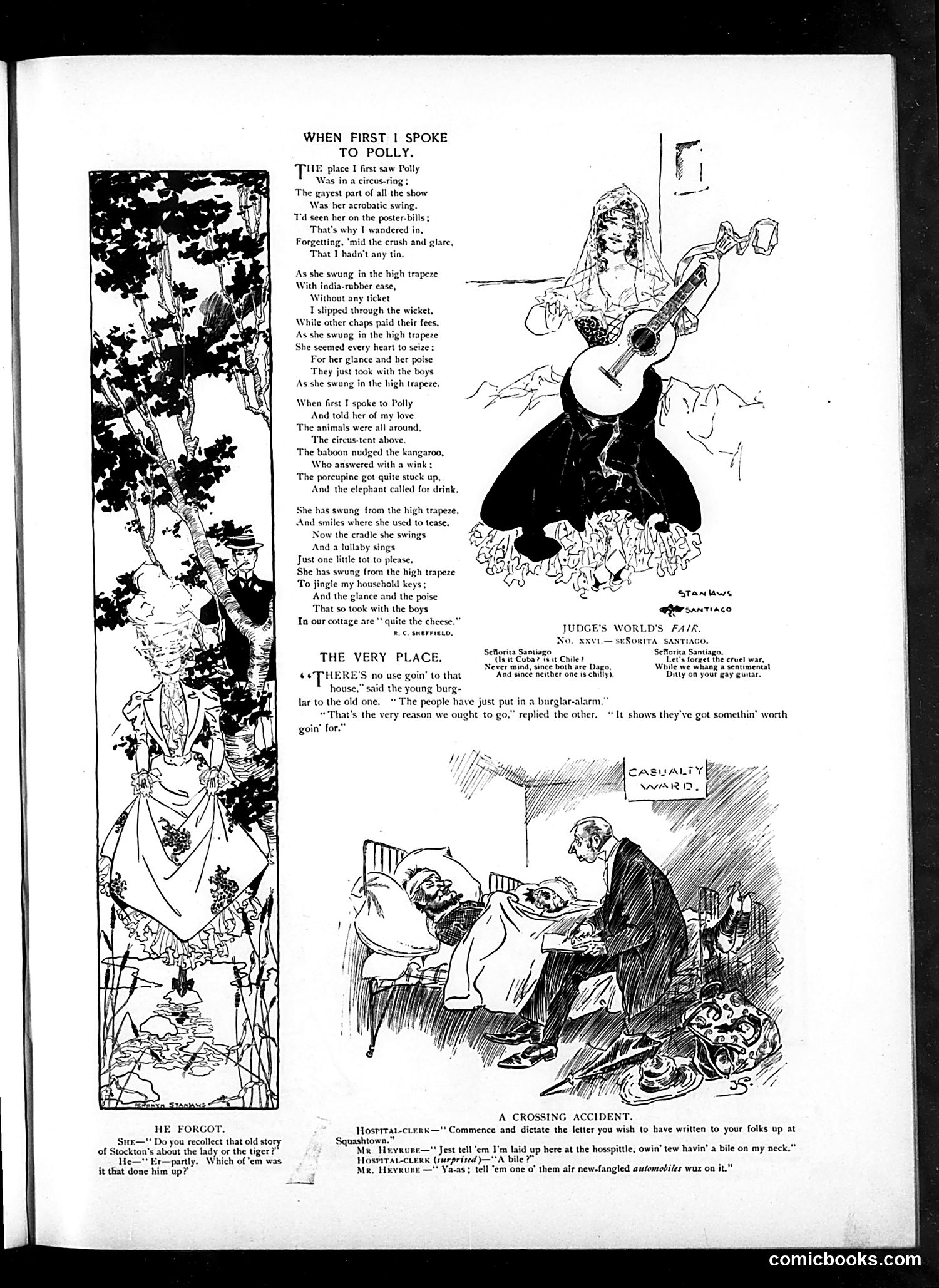
This page contains three separate satirical pieces: **"When First I Spoke to Polly"** is a sentimental poem about a man who sneaks into a circus, falls in love with an acrobat performer, and later marries her. The satire mocks romantic idealization—the "thrilling" trapeze artist becomes a domestic mother "jingling household keys," reducing her from exciting performer to ordinary housewife. It's commentary on how marriage domesticates women. **"The Very Place"** jokes about burglars discussing a house with a new burglar alarm. The humor relies on the irony that an alarm indicates valuable possessions worth stealing—the wealthy inadvertently advertise their worth through security measures. **"A Crossing Accident"** depicts a hospital casualty ward where a man with injuries claims he was hit by an "automobile" rather than admitting something more embarrassing (possibly a bicycle or fall). The joke plays on the then-novel status of automobiles as fashionable explanations for accidents—more socially acceptable than mundane causes. The references to "Dago" (derogatory Spanish term) and Cuba/Chile reflect period attitudes during the Spanish-American War era.
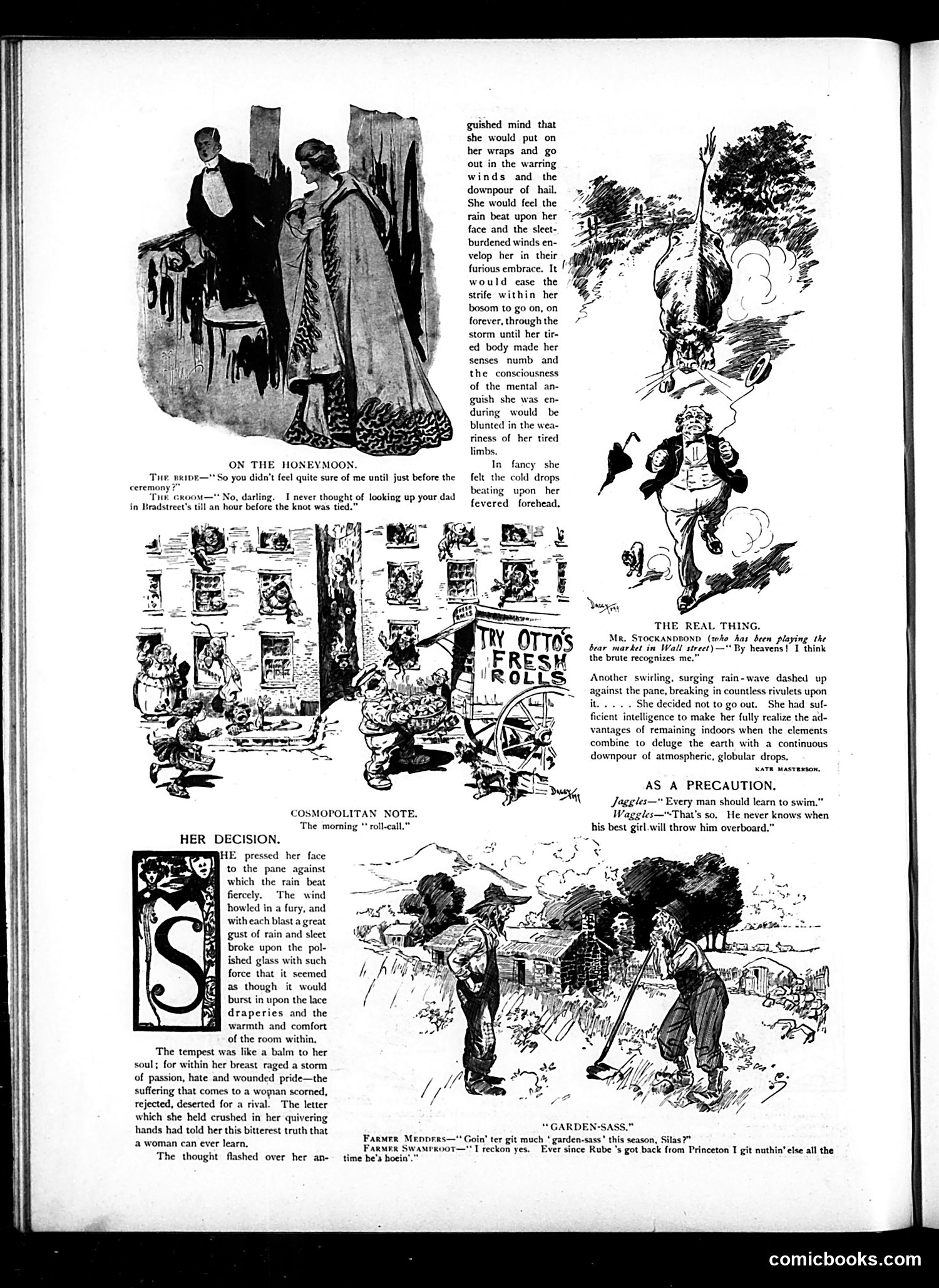
This page contains multiple short humor pieces typical of early 20th-century satirical magazines: **"On the Honeymoon"**: A groom admits he checked the bride's father's credit rating (via Bradstreet's financial directory) only an hour before the wedding—mocking mercenary marriage motivations. **"The Real Thing"**: A Wall Street bear-market speculator encounters an actual bear and believes it "recognizes" him, likely satirizing financial manipulation and anthropomorphizing market behavior. **"Her Decision"**: A melodramatic narrative contrasts a woman's fantasy of suffering outdoors during a storm with practical reality—she stays inside. This appears to parody sentimental Victorian fiction. **"Cosmopolitan Note"**: A brief joke about military roll-call. **"As a Precaution"** and **"Garden-Sass"**: Rural humor about swimming lessons and a farmer's son recently returned from Princeton who neglects vegetable gardening. The cartoons mock contemporary attitudes toward courtship, speculation, sentimentality, and class anxieties, using exaggeration and ironic juxtaposition as comedic techniques.
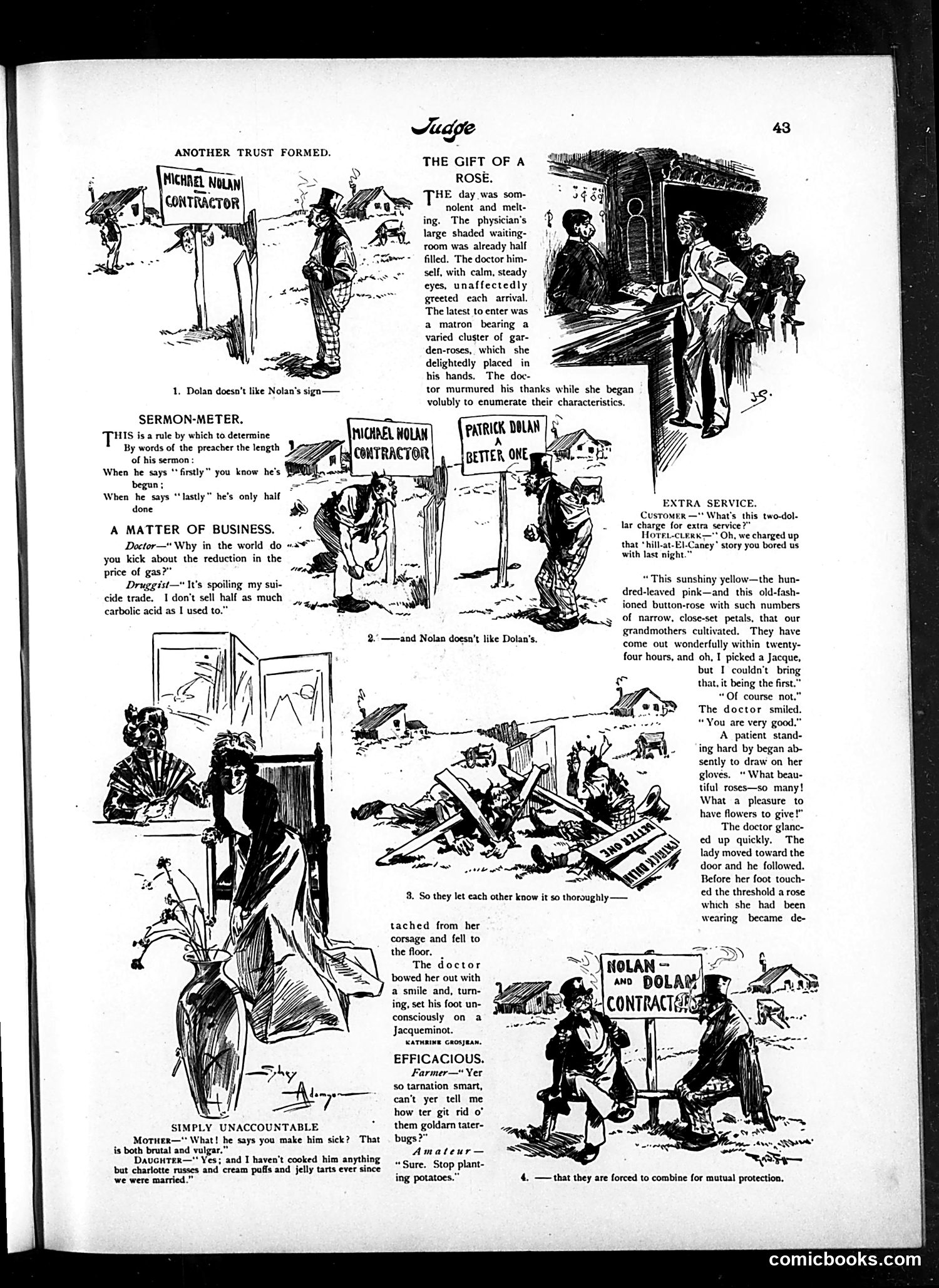
This page contains several unrelated satirical sketches typical of Judge's humor: **"Another Trust Formed"** mocks the era's epidemic of business monopolies (trusts). Two contractors, Nolan and Dolan, are forced into partnership—suggesting even small competitors must combine to survive against larger economic forces. The joke reflects public anxiety about trust monopolization. **"Sermon-Meter"** jokes about long-winded preachers—a perennial complaint about clergy. **"A Matter of Business"** features dark humor: a druggist laments that cheaper gas prices reduce suicide attempts, thus lowering his carbolic acid (poison) sales. It's gallows humor about commercial self-interest. **"The Gift of a Rose"** is sentimental fiction about a doctor's gracious response to a patient's gift. Minor sketches mock farmers' potato-bug problems and hotel clerks charging for boredom. Overall, the page emphasizes turn-of-century concerns: monopolistic trusts, economic anxiety, and social pretension.
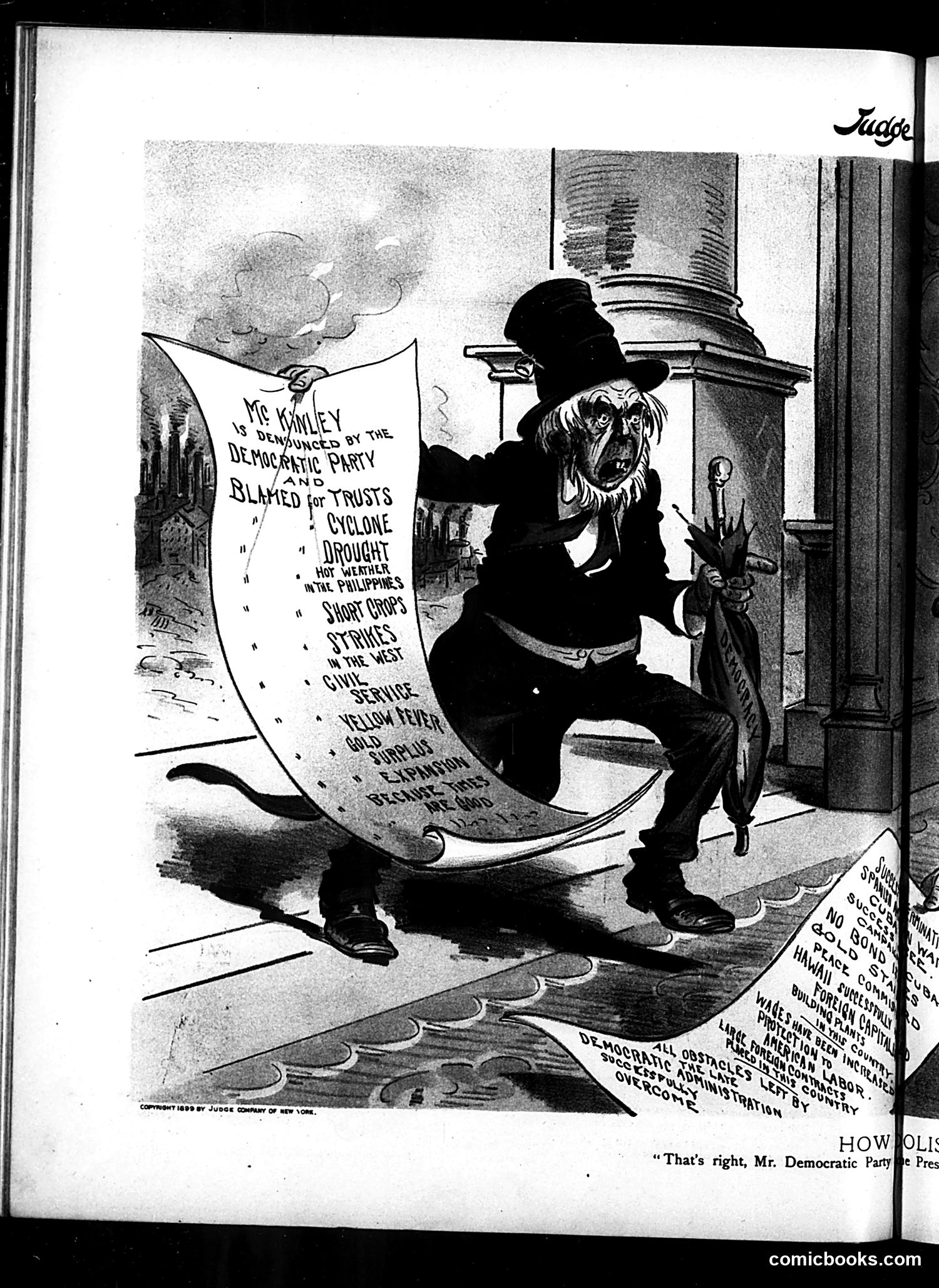
This is a satirical cartoon blaming the Democratic Party for various American troubles. An anthropomorphic donkey (the Democratic Party symbol) holds a scroll listing grievances: trusts, cyclones, drought, hot weather in the Philippines, short crops, strikes in the West, civil service issues, yellow fever, gold shortage, and bad harvests. The figure pointing at the donkey appears to be a Republican or political opponent sarcastically saying "That's right, Mr. Democratic Party"—implying the Democrats are responsible for all these national problems, from natural disasters to economic issues. This is typical turn-of-the-century partisan attack cartoons, using exaggeration to blame one party for widespread societal ills beyond any government's actual control. The visual metaphor equates Democratic governance with accumulated national failures.
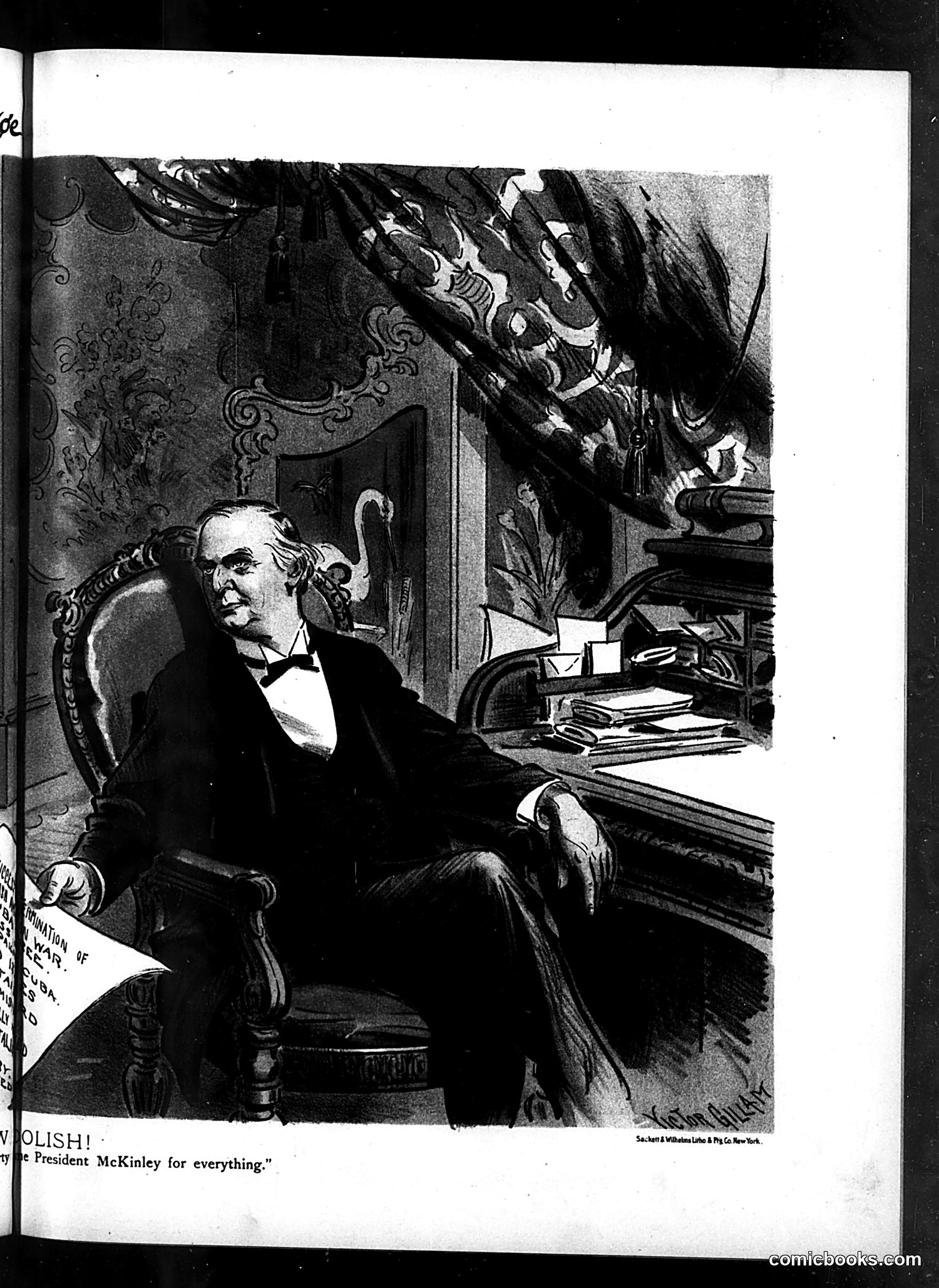
This appears to be a satirical cartoon from *Judge* magazine depicting a man in formal attire seated at a desk in an ornate office setting. The visible text references "President McKinley for everything," suggesting the figure represents someone in McKinley's administration. The cartoon likely satirizes political obsequiousness or blind loyalty to President McKinley (who served 1897-1901). The incomplete caption "OLISH!" may be part of a longer word like "abolish" or "foolish," though the full text is unclear. The ornate interior with draped fabrics and elaborate furnishings suggests commentary on governmental pretense or excess. Without the complete caption, the specific political critique—whether about policy, corruption, or sycophantic behavior—cannot be definitively determined, though the tone appears mocking of uncritical support for McKinley.
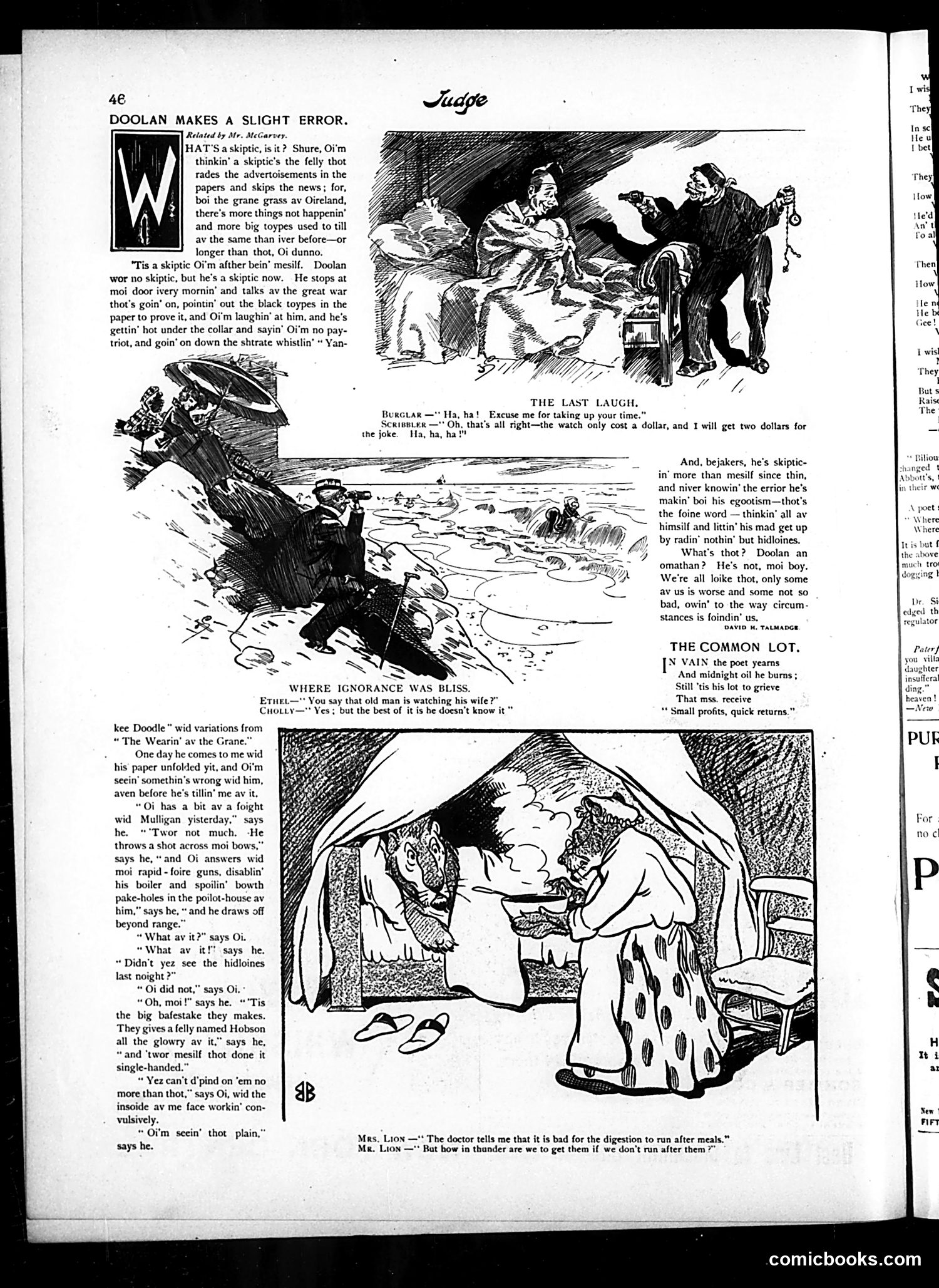
This Judge magazine page contains three separate satirical pieces: **"Doolan Makes a Slight Error"** mocks Irish immigrants who obsess over newspaper headlines about WWI without understanding actual events. Doolan boasts about a minor personal fight but is outraged the newspapers credited someone else ("Hobson") in the headlines—showing he reads only sensational headlines, not real news. The satire: people mistake media attention for actual importance. **"The Last Laugh"** jokes about a burglar and scriptwriter—the burglar steals a cheap watch, but the scriptwriter pays him two dollars for the story, profiting from the theft's narrative value. It's a cynical jab at how media commodifies crime. **"The Common Lot"** is a short poem lamenting poets' unprofitable struggles, contrasting their artistic ideals with publishers' demands for quick commercial returns. The page satirizes early 20th-century American culture: immigrant gullibility regarding media, the sensationalism of newspaper headlines, and commerce's triumph over art.
This page is primarily **advertising and light verse**, not political satire. The main content includes: **"When Paw Was a Boy"** — A nostalgic poem (by "Georgie" from Chicago Times-Herald) satirizing the common trope of idealized childhood memories. The narrator wishes he'd lived when his father was young, imagining an impossibly perfect boy who was strong, obedient, and accomplished. The joke's punchline undercuts this: his mother calls his father "the worst fool that she ever saw"—suggesting the rosy childhood memories are false, and he "ought of stayed a boy." It's gentle satire on generational nostalgia and parental mythmaking. **The rest is commercial advertising**: Angostura Bitters, Packer's Tar Soap, Sohmer Pianos, cigars, whiskey, and travel promotions occupy most space. Several **brief humor fillers** appear (faith-healers, elopement jokes), typical of Judge's format. No major political figures or events are referenced on this page.
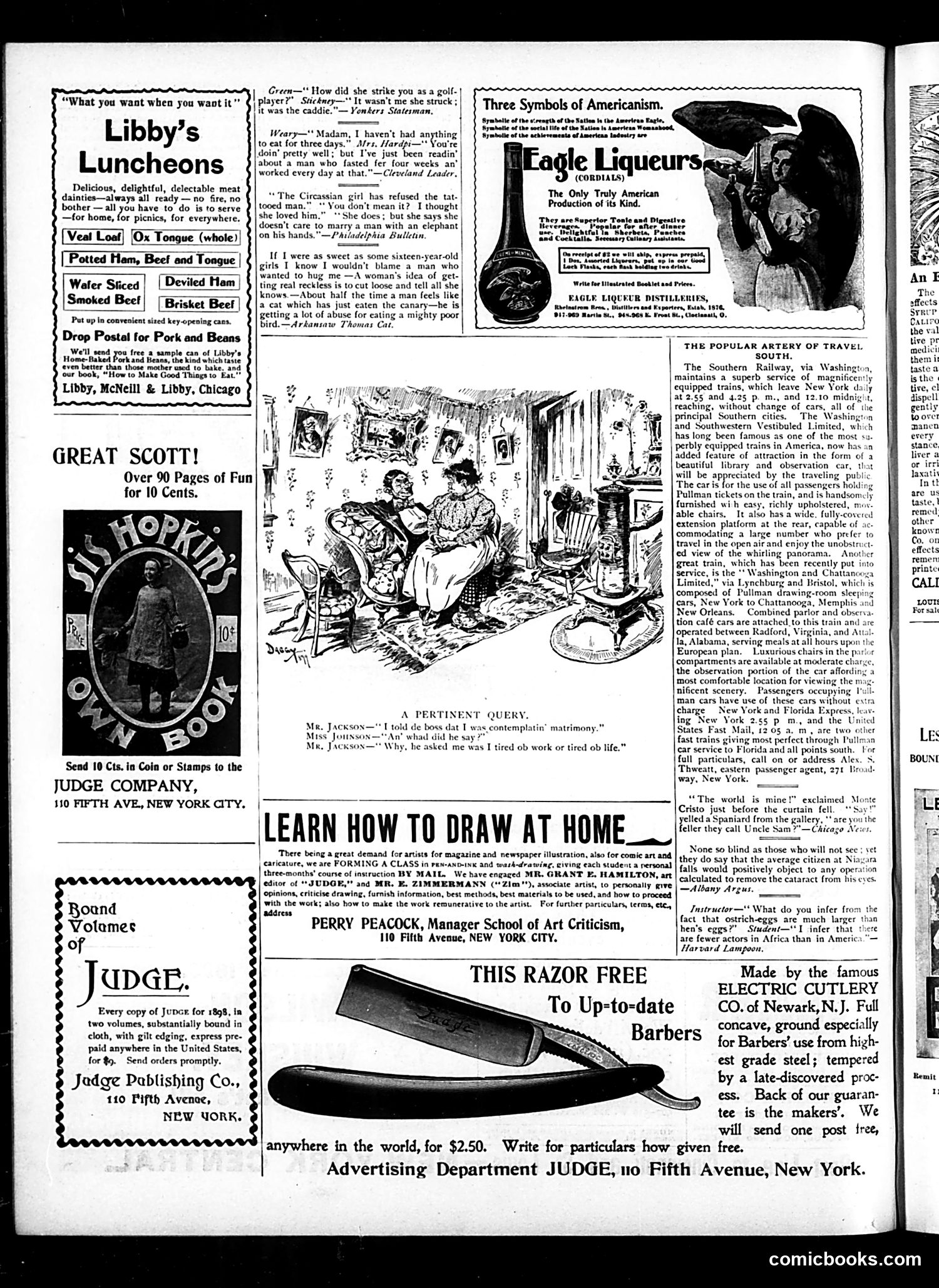
This page is primarily **advertisements and miscellaneous content** rather than political satire. The visible cartoon ("A Pertinent Query") shows a dialogue-based joke about courtship: a man asks a woman if she's "tired ob work or tired ob life," implying marriage is equivalent to death—a common turn-of-the-century joke about matrimonial burden. The "Three Symbols of Americanism" advertisement features the eagle, American womanhood, and Eagle Liqueurs as national emblems—a promotional claim that cordials represent American industrial achievement, which reads as exaggerated patriotic marketing. The page's primary content is **product advertising** (Libby's canned goods, razors, Judge magazine itself, art instruction courses) typical of a late-1890s periodical. There is no major political cartoon or significant satire visible on this particular page.
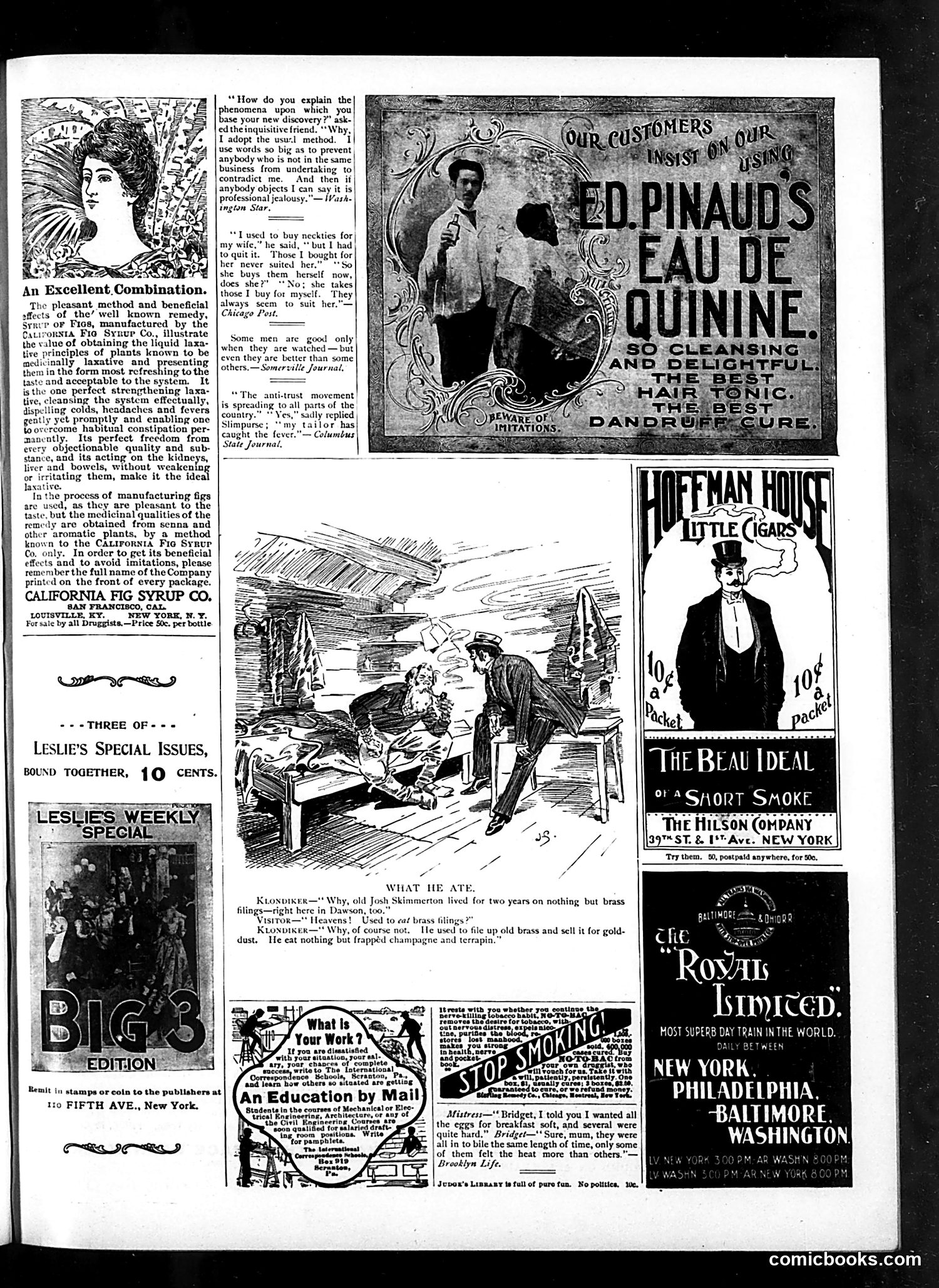
This page is primarily **advertising and filler content** rather than political satire. The main elements include: **Advertisements:** California Fig Syrup Co. (laxative), Hoffmann House Little Cigars, "Eau de Quinine" hair tonic, and a tobacco-cessation remedy dominate the layout. **Humor sections:** Brief jokes and anecdotes fill the gaps—including a tale of a man surviving two years on brass filings in Dawson (likely referencing the Klondike Gold Rush), and domestic humor about wives buying their own neckties and eggs boiling unevenly. **Promotional content:** Leslie's Weekly announces special bound issues for 10 cents. The page reflects early 1900s American magazine formatting: advertising-heavy with light, inconsequential humor interspersed. The jokes are genteel domestic comedy rather than pointed political commentary. No significant political figures or events appear to be satirized here.
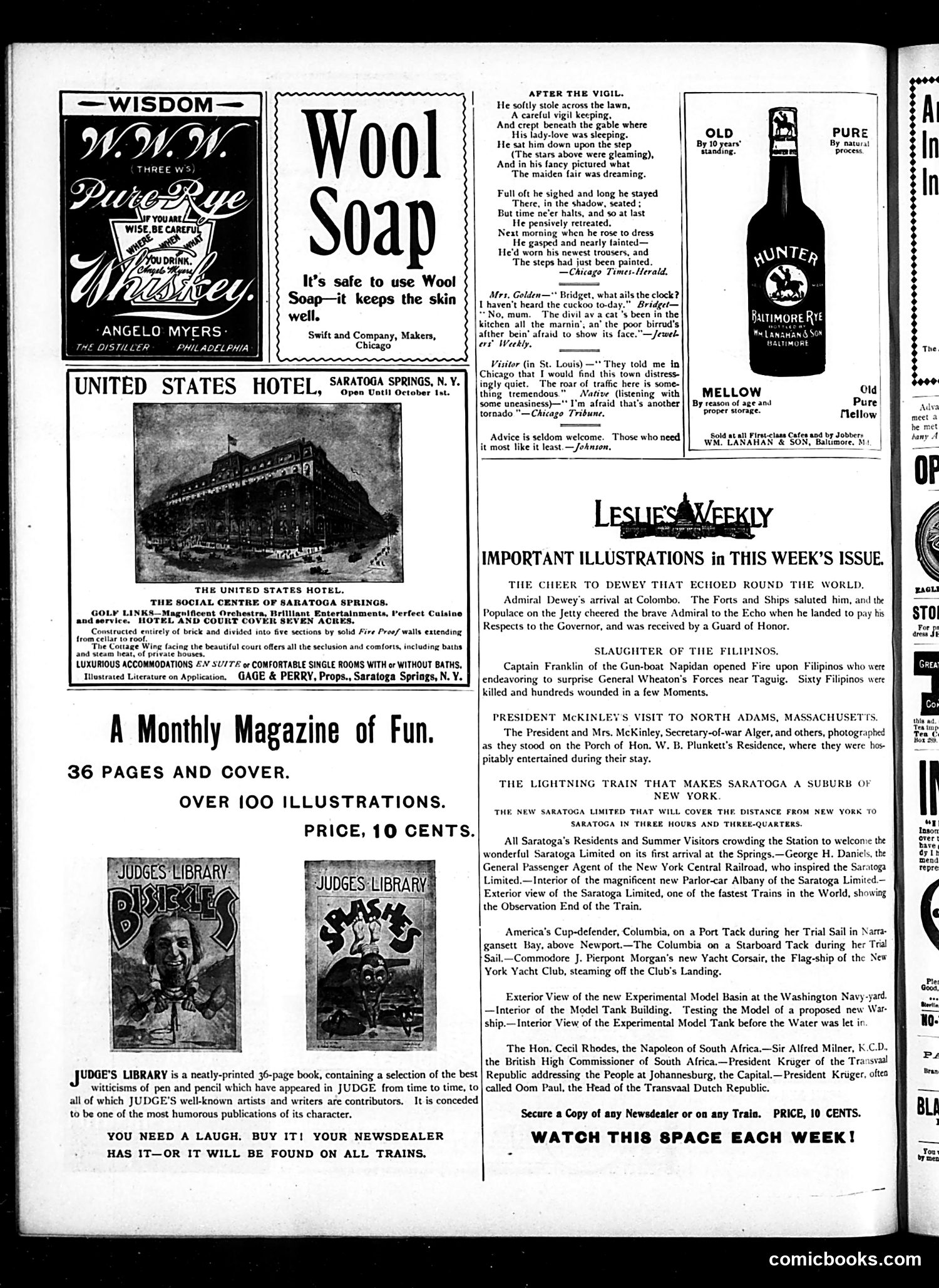
This is primarily an **advertising and promotional page** rather than political satire. The page contains several advertisements (Wool Soap, Pure Rye Whiskey, hotels, Judge's Library book series) interspersed with light humor content. The non-advertising humor includes short jokes and anecdotes: - A poem about a young man courting a woman, who ruins his new trousers sitting on freshly-painted steps—a gentle romantic comedy - Brief dialect jokes about a cuckoo clock and a cat, and a visitor's impression of St. Louis being quieter than Chicago The right column announces **Judge magazine's current coverage**, including Admiral Dewey's arrival in Colombo (Philippine-American War era), Filipino casualties in combat, President McKinley's visit to Massachusetts, and a new fast train service to Saratoga Springs. **Context for modern readers**: This reflects the turn-of-the-century Philippines conflict and McKinley-era politics, presented as straightforward news rather than satirical commentary—indicating Judge's mixed approach of humor, advertising, and contemporary event coverage.
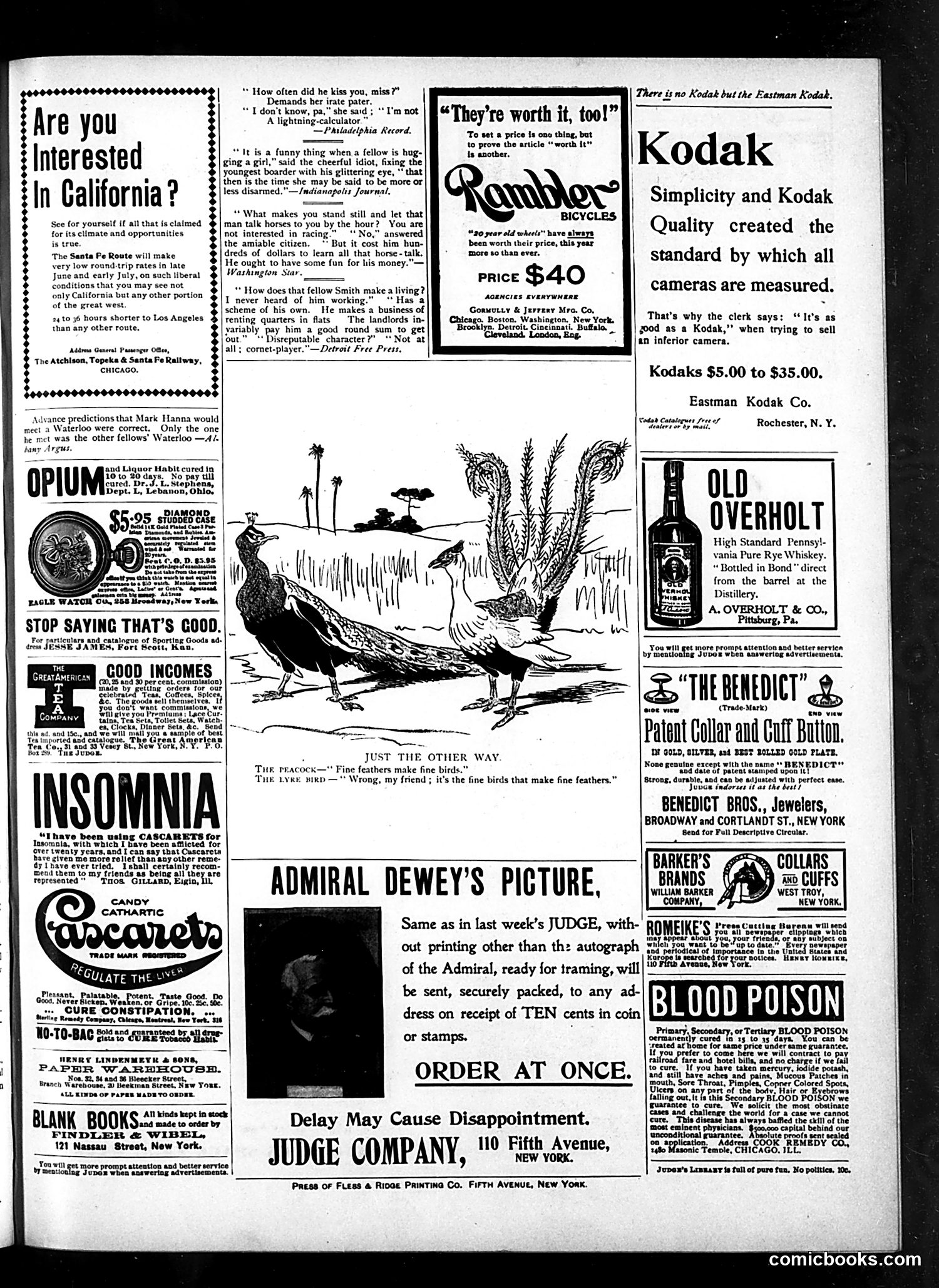
This page is primarily **advertisements** interspersed with brief humorous anecdotes—typical of Judge's format. The central cartoon depicts **two birds** (a peacock and lyre bird) with the caption "JUST THE OTHER WAY," illustrating a joke about which comes first: fine feathers or fine birds. It's a visual pun on the expression "fine feathers make fine birds." The page contains numerous **period advertisements**: Kodak cameras, Old Overholt whiskey, patent collar buttons, railroad travel, insomnia remedies, and blank books—reflecting early 1900s consumer goods. One text item references **Mark Hanna's "Waterloo,"** a political joke: Hanna (McKinley's campaign manager) faced electoral defeat, but the joke plays on the word "Waterloo" (a definitive defeat) by suggesting he met "the other fellow's Waterloo" instead—meaning his opponent suffered the defeat. The short jokes address domestic life: kissing, hugging, horse-talk conversations, and rooming-house scheming—gentle social satire aimed at middle-class readers.
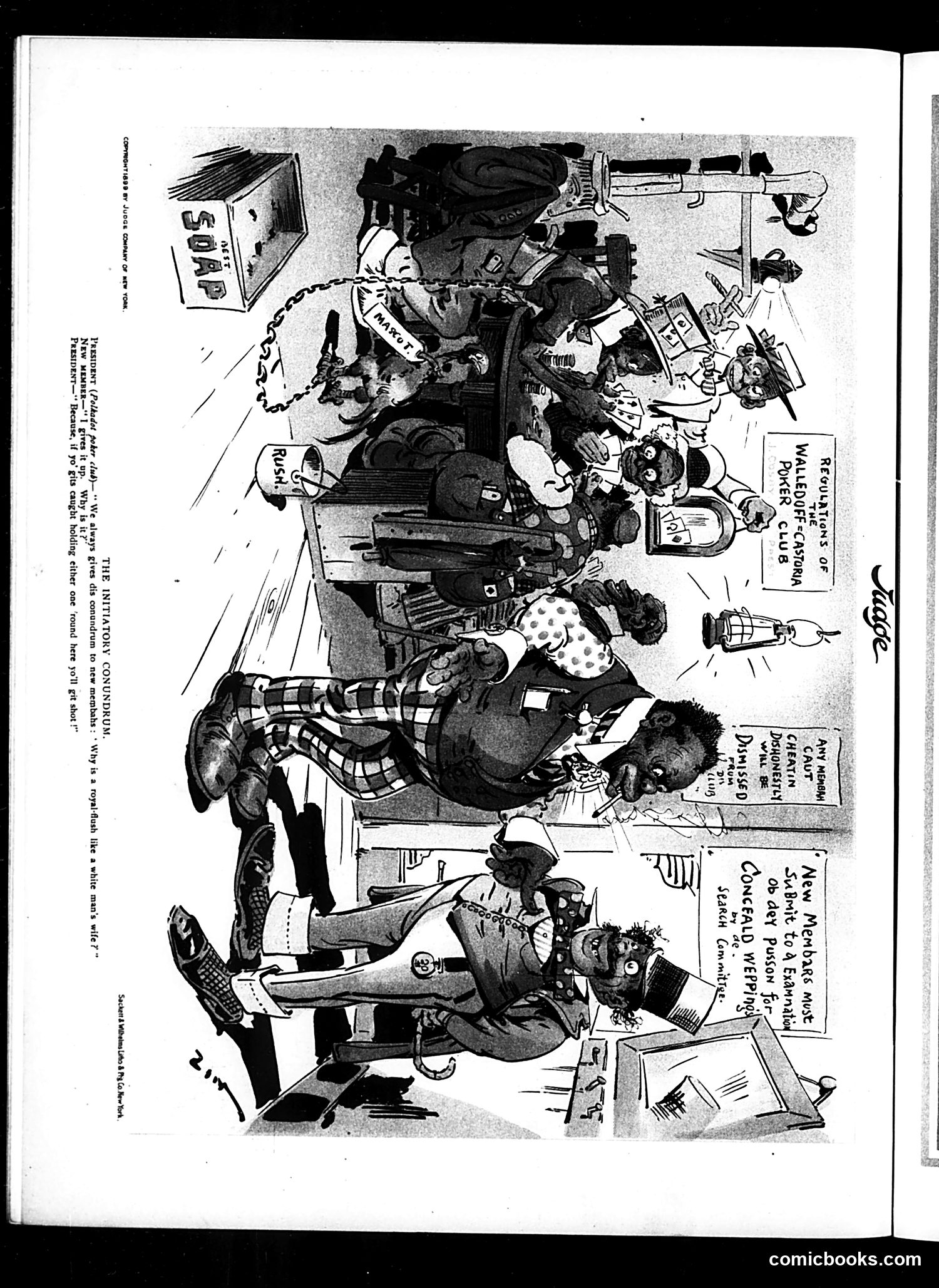
This cartoon satirizes an all-Black poker club's initiation ritual through crude racial stereotypes. The "President" (depicted with exaggerated features) poses a riddle to a new member that equates possessing a royal flush with "holding" a white man's wife—implying both are punishable by death. The satire targets two audiences: it mocks Black men as violent and lawless (suggesting they'd shoot over poker), while also implying white supremacist anxieties about interracial relationships. The "Walled Off Poker Club" and "Search Committee" references suggest insularity and exclusion. The humor relies entirely on racist caricature and period assumptions about Black criminality. The cartoon reflects late-19th-century attitudes that positioned Black communities as inherently dangerous, using a poker-club setting as cover for depicting them as threatening. This represents Judge magazine's routine deployment of blackface stereotypes as "comedy."