
A complete issue · 16 pages · 1899
Judge — March 4, 1899
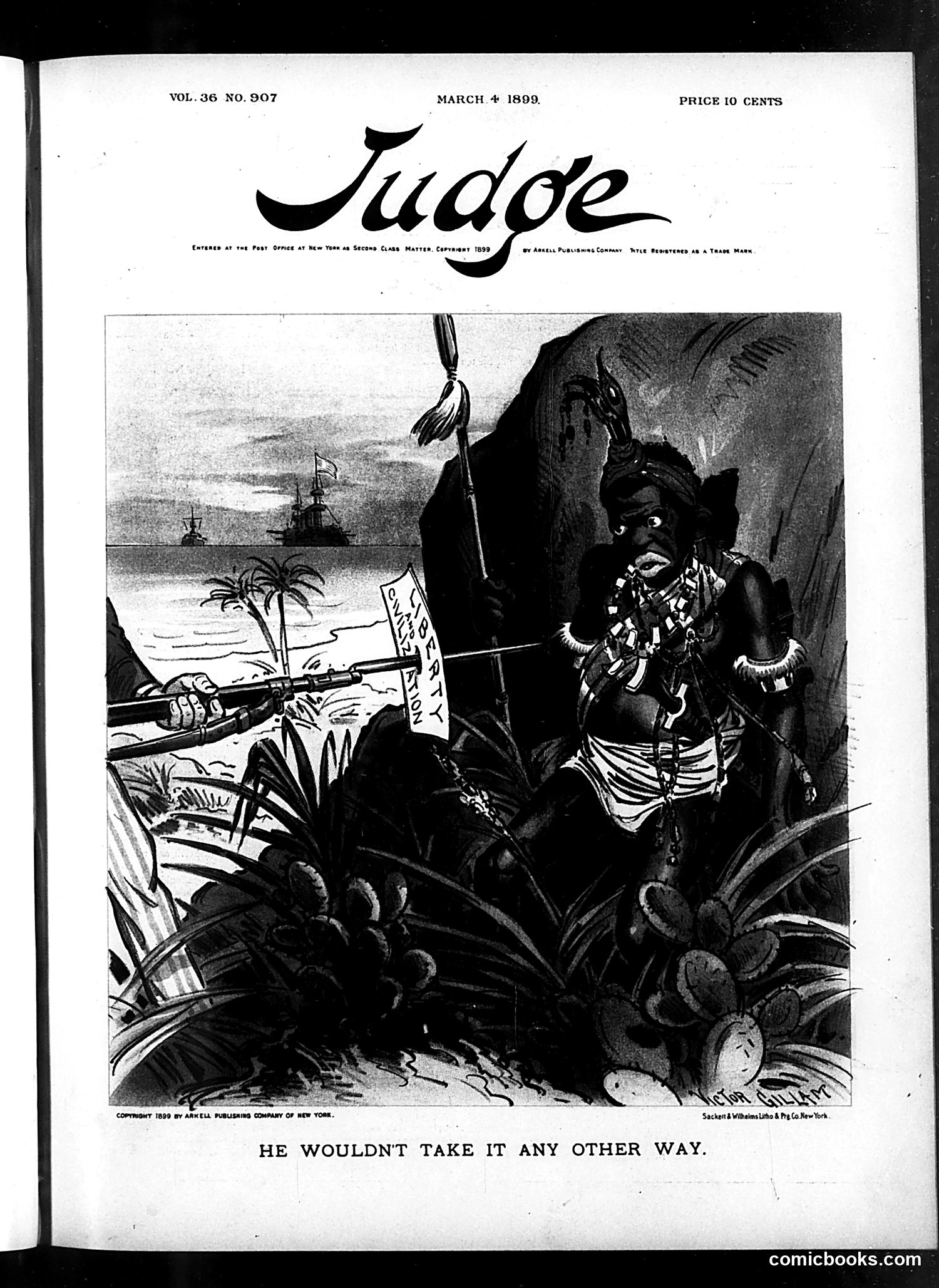
This cartoon satirizes European imperial ambitions in tropical colonies, likely referencing the Spanish-American War era (1898) and subsequent colonial competitions. The central figure appears to be a caricatured colonial administrator or European power, depicted with exaggerated racist features standard to period satire. He's shown in a tropical setting with palm trees and colonial ships offshore, holding a sign—presumably claiming territorial rights or commercial dominance. The title "HE WOULDN'T TAKE IT ANY OTHER WAY" suggests commentary on colonial exploitation: the figure accepts or demands colonial control as inevitable or necessary. The imagery reflects contemporary anxieties about imperial expansion, though the racist caricature represents the offensive visual conventions Judge employed regularly. The satire's specific target—whether criticizing colonialism itself or particular nations' methods—remains unclear from the visual alone.
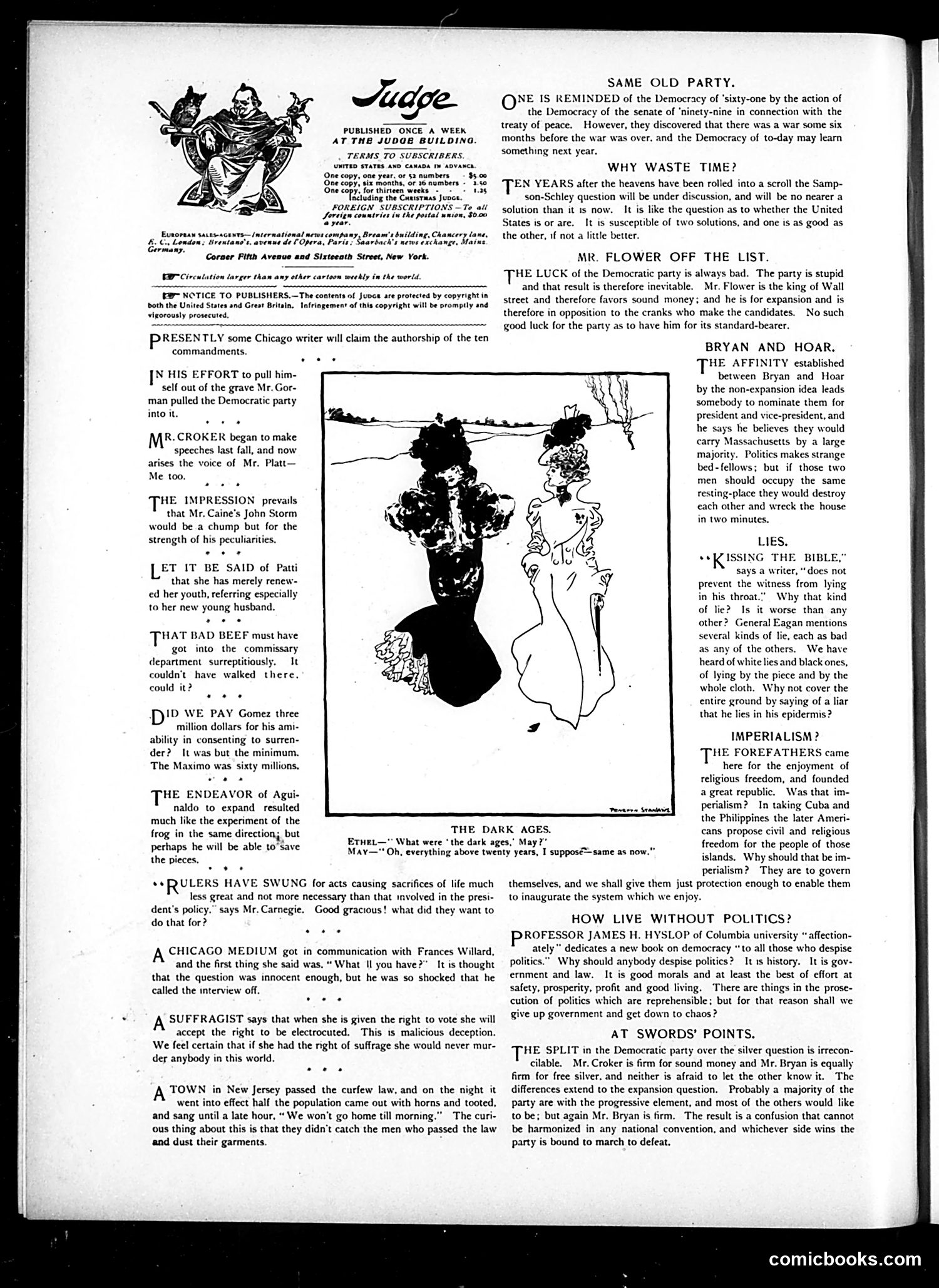
This page contains several brief political commentary pieces typical of Judge's satirical format. The central cartoon, titled "THE DARK AGES," depicts a caricatured figure (likely representing a political opponent) and appears to mock outdated thinking. The text sections critique Democratic Party politics, including attacks on Mr. Flower regarding his opposition to party candidates, and commentary on Bryan and Hoar's potential nomination. References to "silver" versus "sound money" debates suggest this dates to the 1890s free-silver controversy. The "KISSING LIES" section criticizes dishonesty in political rhetoric, while "HOW LIVE WITHOUT POLITICS?" quotes Professor James H. Hislop arguing that avoiding politics is impossible since government affects daily life. The overall tone is caustic Republican commentary on Democratic Party dysfunction and progressive political debates of the era.
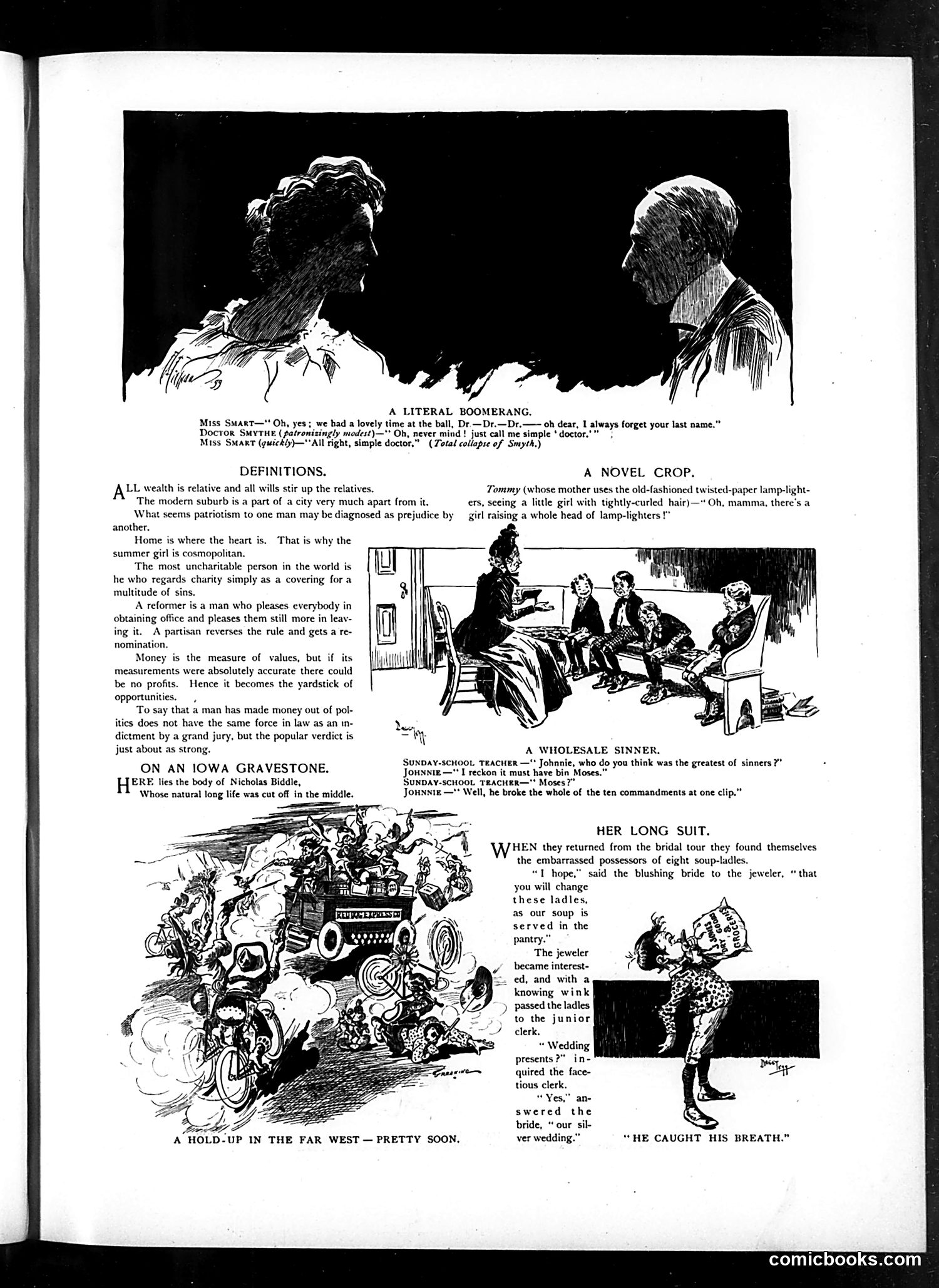
This page contains several separate humor pieces rather than connected political cartoons: **"A Literal Boomerang"** (top): A dialogue joke about forgetting someone's name at a social event, with the punchline involving the word "doctor." **"Definitions" and other sections**: Satirical definitions of wealth, suburbs, and social behavior—general commentary on class distinctions and hypocrisy rather than specific political targets. **"A Novel Crop"** and **"A Wholesale Sinner"**: Brief humorous anecdotes about domestic life and Sunday school, poking fun at middle-class pretension and children's behavior. **"Her Long Suit"**: A story about newlyweds and jewelry, satirizing marital dynamics and social climbing among the upper classes. The page represents Judge's typical format: miscellaneous social satire targeting Victorian-era middle and upper-class attitudes rather than specific political events or figures.
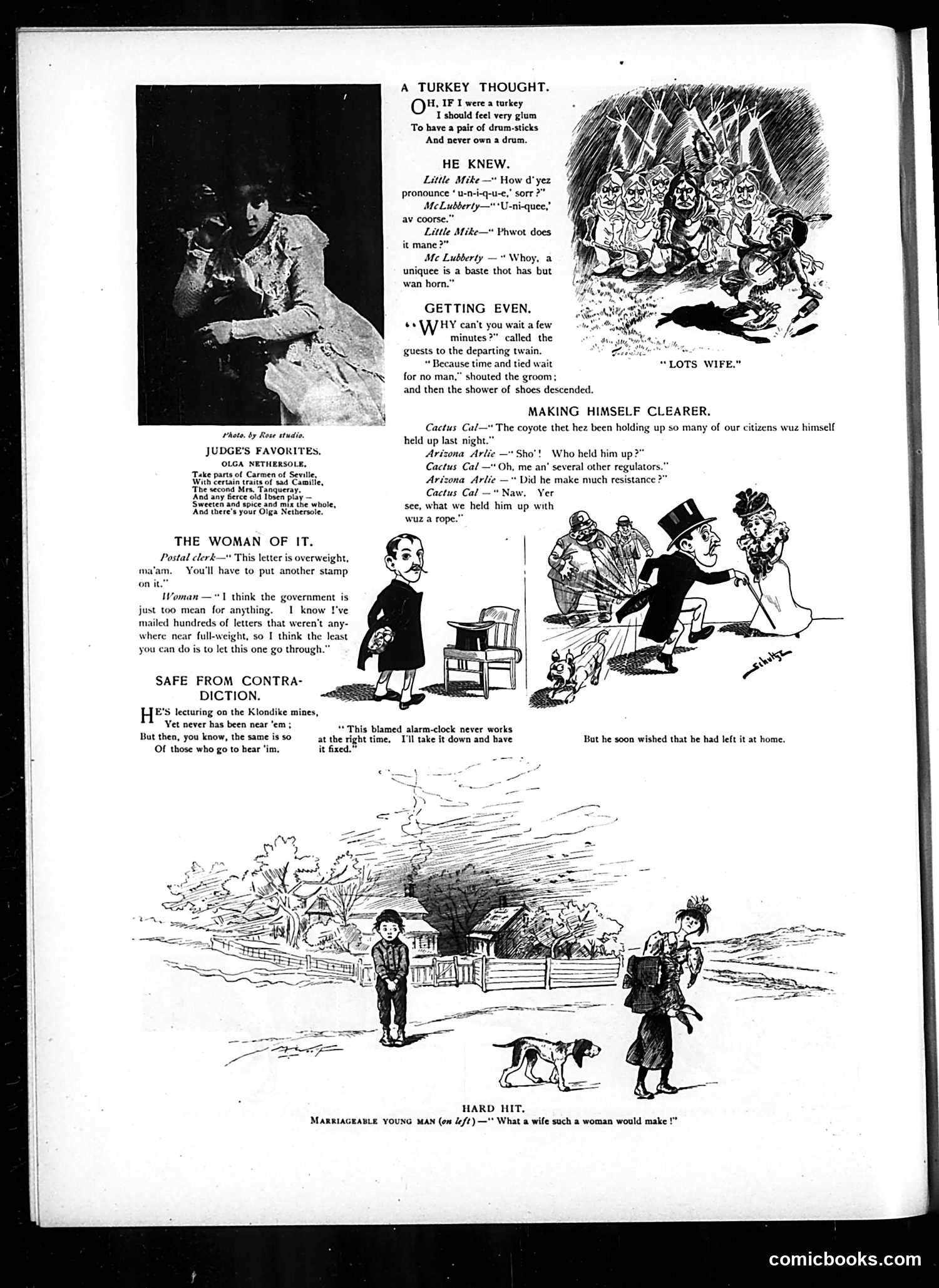
This page contains several satirical humor pieces typical of early 20th-century Judge magazine: **"A Turkey Thought"** and **"He Knew"** are brief wordplay jokes about pronunciation and word definitions—typical magazine filler humor. **"Judge's Favorites"** credits a photograph by Ross Verdi of what appears to be a theatrical scene. **"The Woman of It"** satirizes government inefficiency regarding mail volume, suggesting women recognize bureaucratic absurdity. **"Safe From Contradiction"** and **"Making Himself Clearer"** use domestic and public scenes for humor about communication gaps. **"Hard Hit"** (bottom) depicts a rural scene where a young man contemplates marriage, with the caption "What a wife such a woman would make!"—satirizing either matrimonial desperation or female expectations. The cartoons collectively mock bureaucracy, gender relations, and domestic life through simple visual gags and punchlines typical of the era's satirical humor.
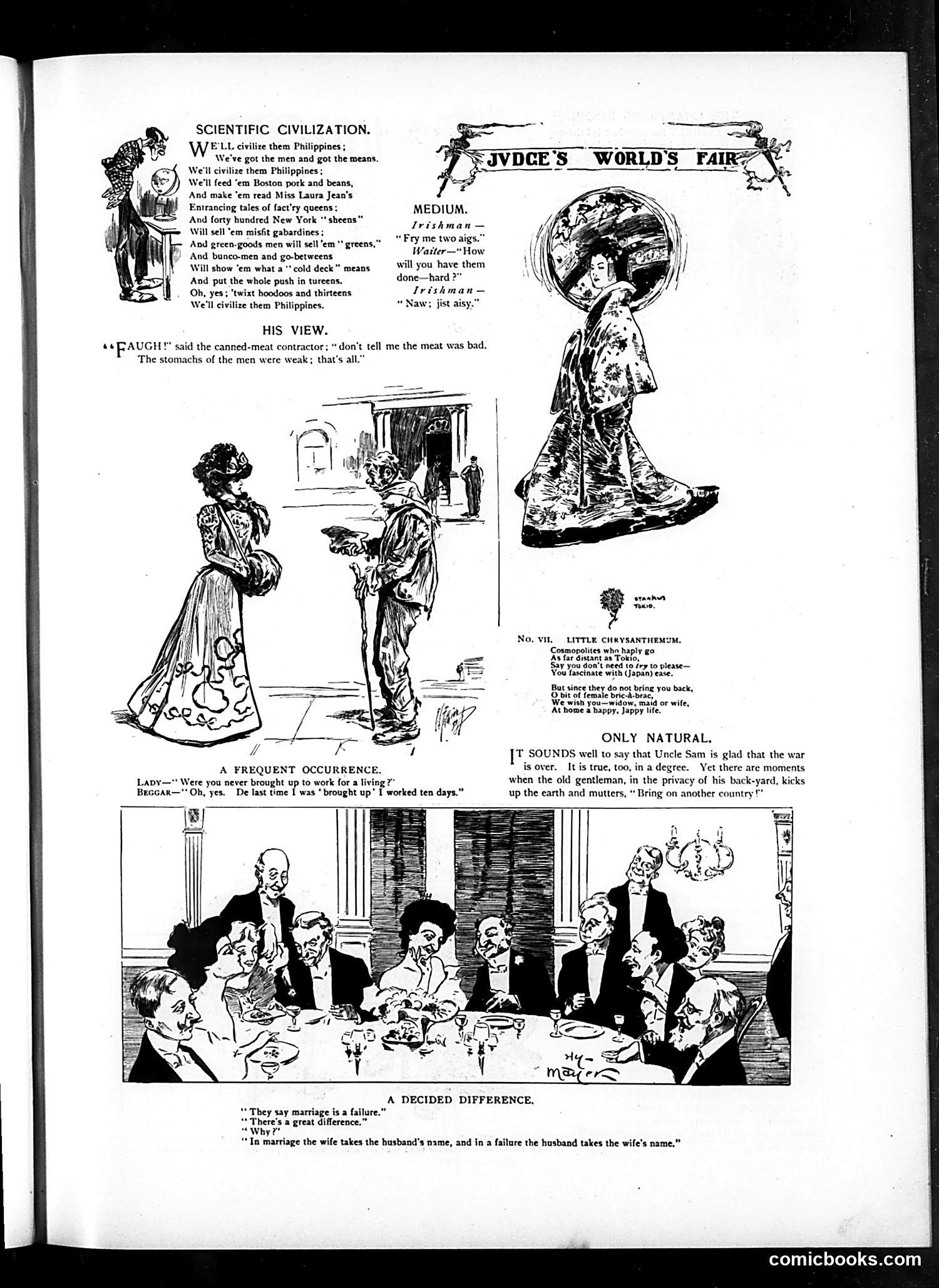
This page satirizes American imperialism following the Spanish-American War (1898), particularly the Philippine-American War. **"Scientific Civilization"** mocks the notion that America will "civilize" the Philippines by exporting not enlightenment but American commercial exploitation: cheap goods, con artists ("green-goods men," "bunco-men"), and mass-produced fiction. The irony undercuts jingoistic rhetoric about uplift. **"His View"** references the poisoned meat scandal affecting American troops in the Philippines—the canned-meat contractor dismisses soldiers' deaths as weakness rather than accountability, satirizing military incompetence. **"A Frequent Occurrence"** depicts a working-class woman, suggesting economic desperation forces women into labor. **"A Decided Difference"** is a marriage joke: in business failure, the husband assumes the wife's debts; in marital failure, vice versa—commentary on women's legal subordination. **"Only Natural"** suggests America, having won one war, hungers for another imperial conquest. The cartoons collectively critique imperial ambitions, commercial exploitation, military negligence, and gender inequality.
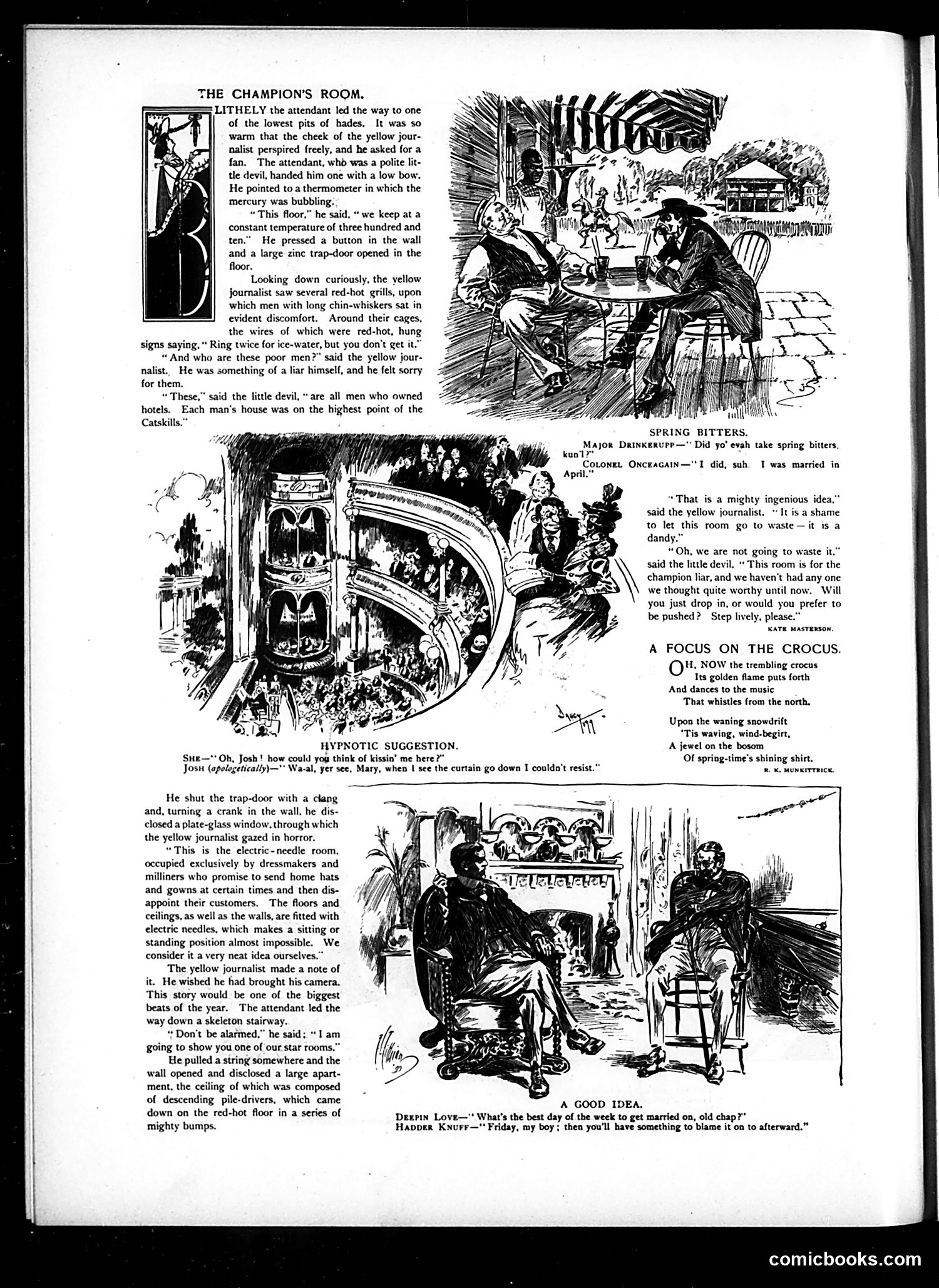
This page satirizes yellow journalism through a Faustian descent into Hell. A yellow journalist (a derogatory term for sensationalist newspaper writers) tours the underworld and encounters a room reserved for "the champion liar"—clearly a jab at his own profession's dishonesty. The satire includes subsidiary jokes: hotel owners who exploited Catskill Mountain locations suffer eternal torment; dressmakers and milliners who break delivery promises endure electric needles. The "hypnotic suggestion" comic depicts social propriety violations, while "Spring Bitters" and "A Good Idea" offer lighter social humor about marriage. The cartoons mock both yellow journalists specifically (for fabricating stories and exaggeration) and various professions for consumer deception. The hell-themed framing suggests Judge viewed sensationalist journalism as morally reprehensible—fitting punishment deserves the worst sinners.
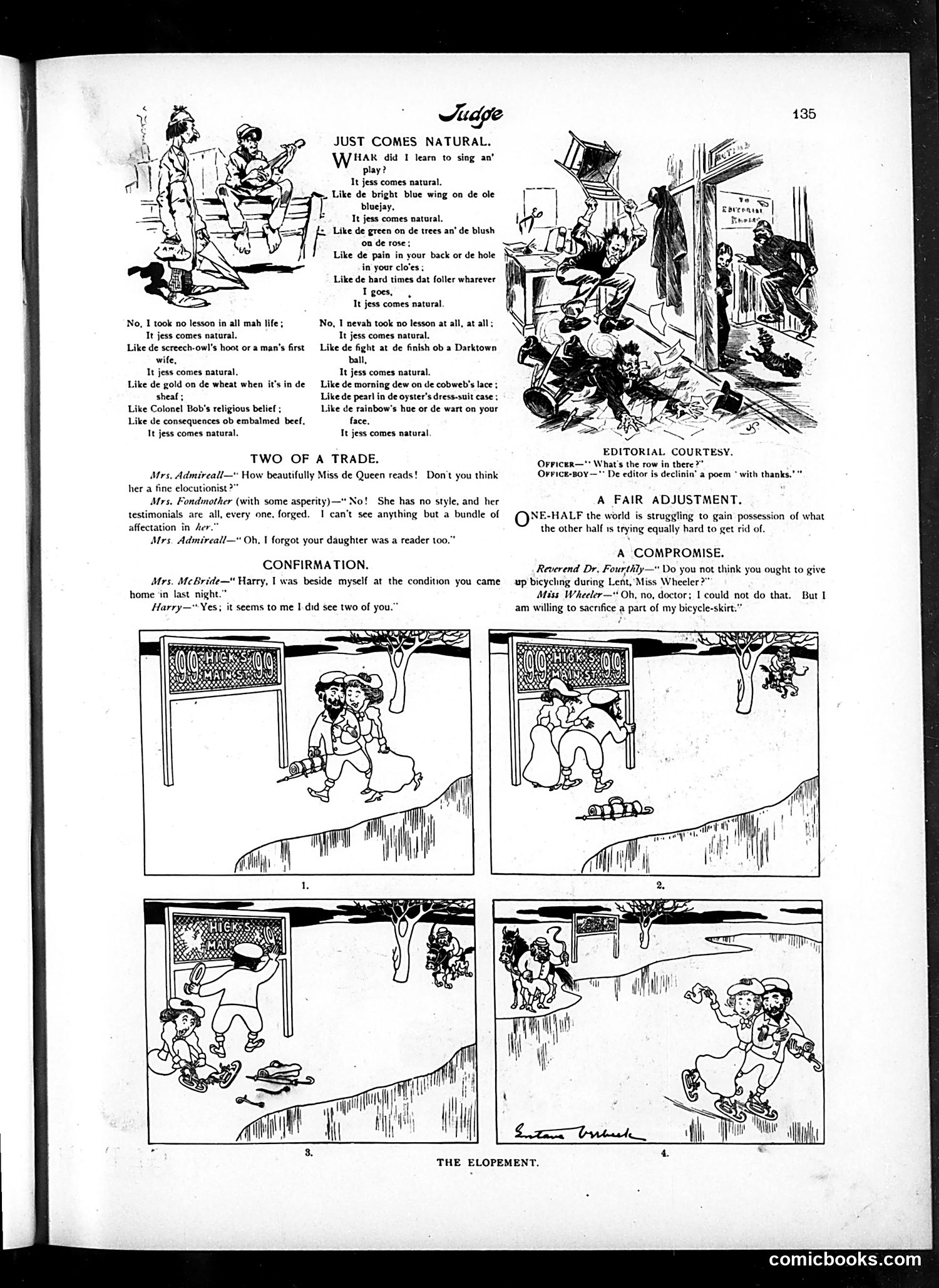
This page contains multiple satirical pieces from an American humor magazine: **"Just Comes Natural"** — A dialect song mocking African American speech patterns, using stereotypical "plantation" vernacular ("jess comes natural," "de"). The humor relies on racist caricature, comparing natural phenomena to supposed inherent Black behaviors, including references to "Darktown ball" fights. This reflects the deeply racist entertainment conventions of the era. **Remaining sketches** — Social satire unrelated to race: "Two of a Trade" ridicules women's pretentious literary affectations; "Confirmation" is a marital joke about drunkenness; "Editorial Courtesy" mocks magazine editors rejecting poetry; "A Compromise" offers general philosophical commentary; and "The Elopement" (four-panel comic) depicts a runaway couple, likely satirizing romantic escapism. The page demonstrates Judge's mix of social satire alongside offensive racial stereotyping typical of early 20th-century American humor publications.
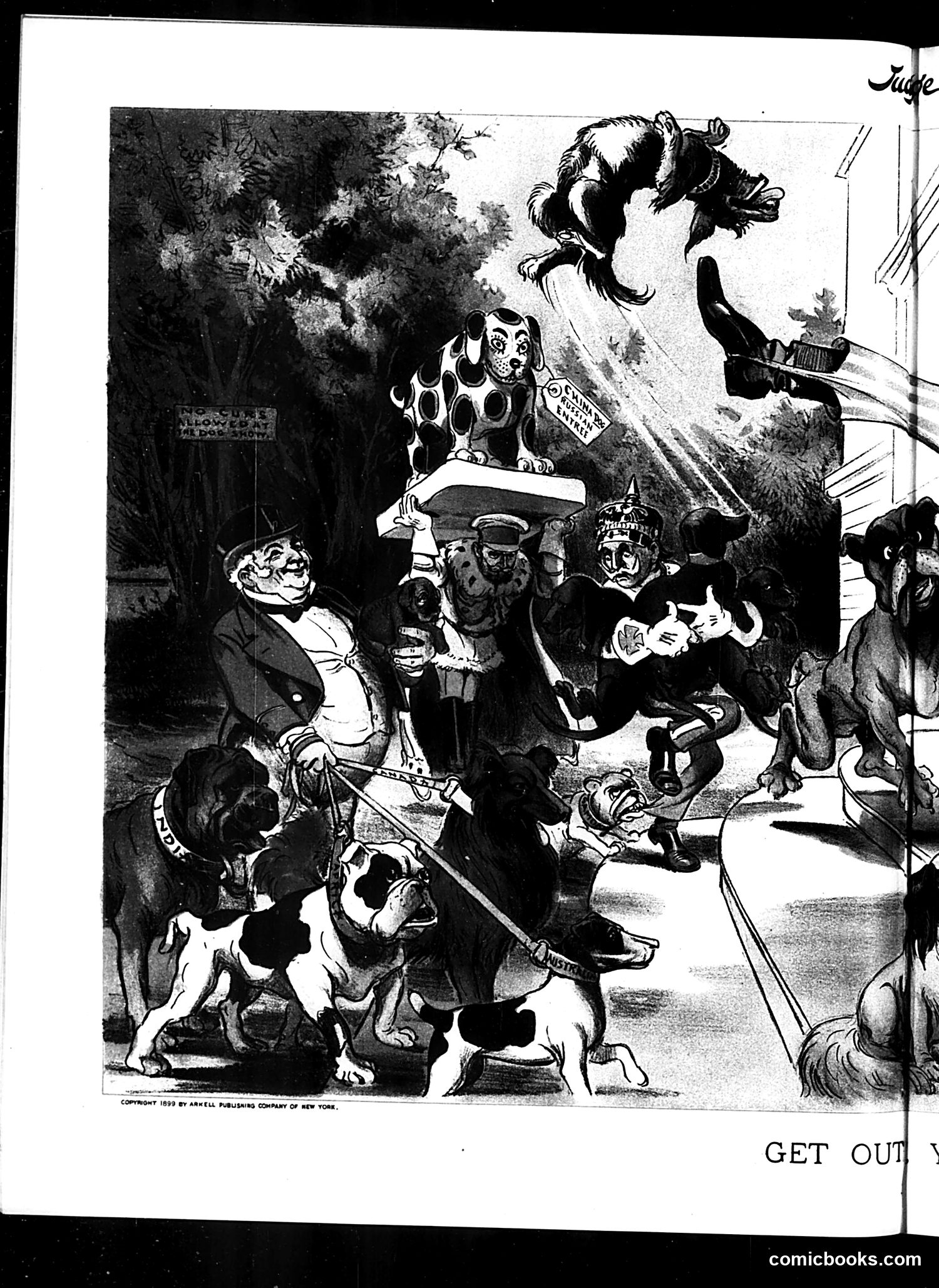
This is a satirical cartoon from *Judge* magazine (copyright 1893, per the visible text). The image depicts a chaotic scene featuring anthropomorphized dogs in human clothing and situations, with exaggerated caricatures typical of late-19th-century political satire. The visible text reads "GET OUT" at the bottom, suggesting the cartoon's commentary concerns expulsion or removal of some group. The dogs appear to be dressed as various social types—possibly representing immigrants, political figures, or social classes of the era. The crowded, tumultuous composition emphasizes conflict or invasion. Without additional context or visible bylines identifying specific targets, the exact political reference remains unclear, though the style suggests commentary on contemporary social tensions, possibly regarding immigration or class conflict during the 1890s.
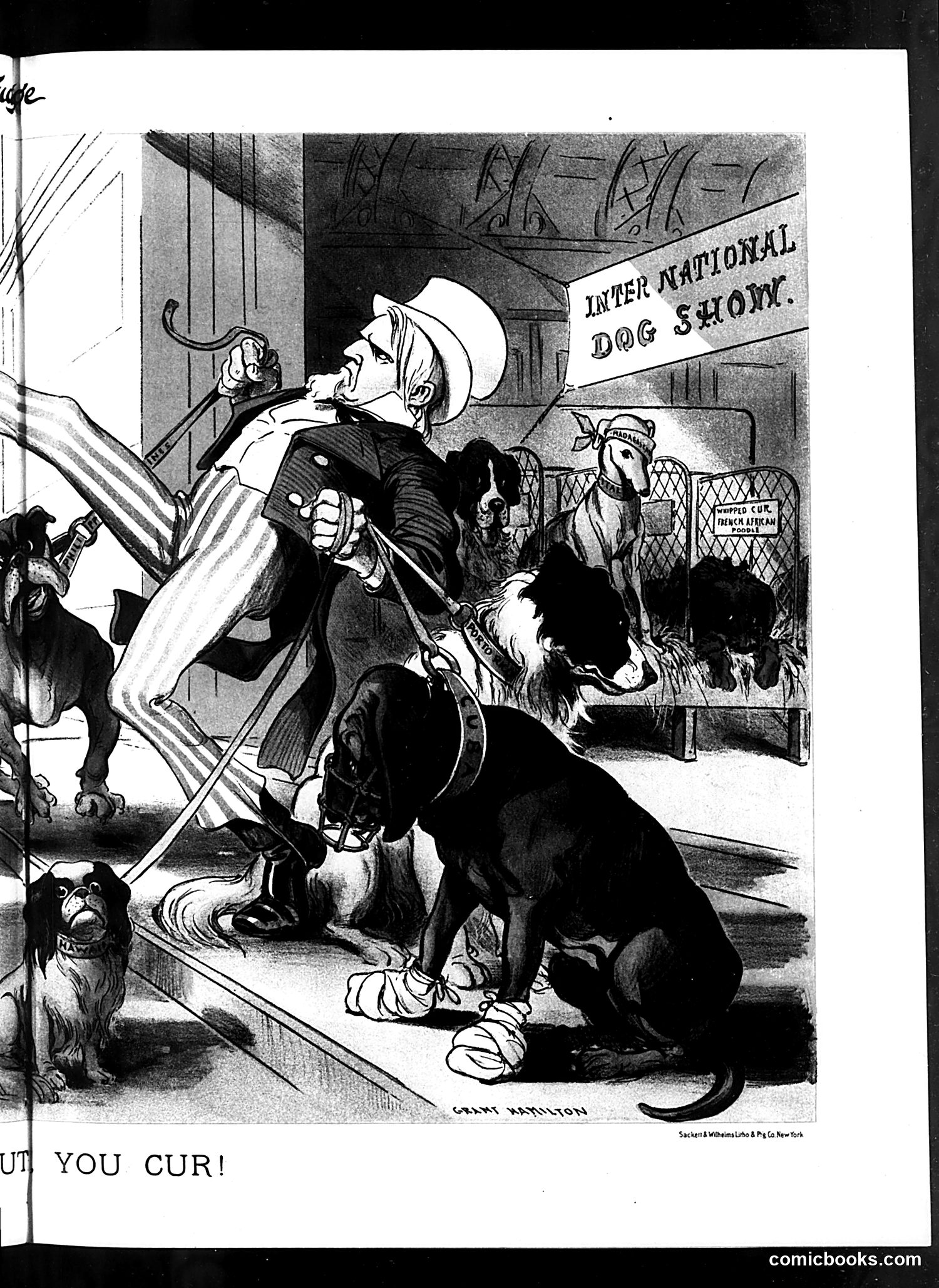
This Judge magazine cartoon depicts an "Inter National Dog Show" scene. A portly gentleman in a top hat—appearing to represent a wealthy show organizer or judge—wields a cane while managing various dogs, including what appear to be breed specimens in a pen labeled "TRAPPED CUR" or similar. The satire likely comments on class pretension and artificial hierarchies. The gentleman's exaggerated physique and pompous bearing suggest mocking wealthy elites who organize such exclusive events. The title "OUT YOU CUR!" implies he's dismissing an undesirable dog—possibly a satirical jab at how the upper class discriminates or excludes those deemed "unfit." The cartoon appears to use dog-show imagery as metaphor for social stratification and snobbish behavior among America's wealthy classes, typical of Judge magazine's satirical approach to Gilded Age society.
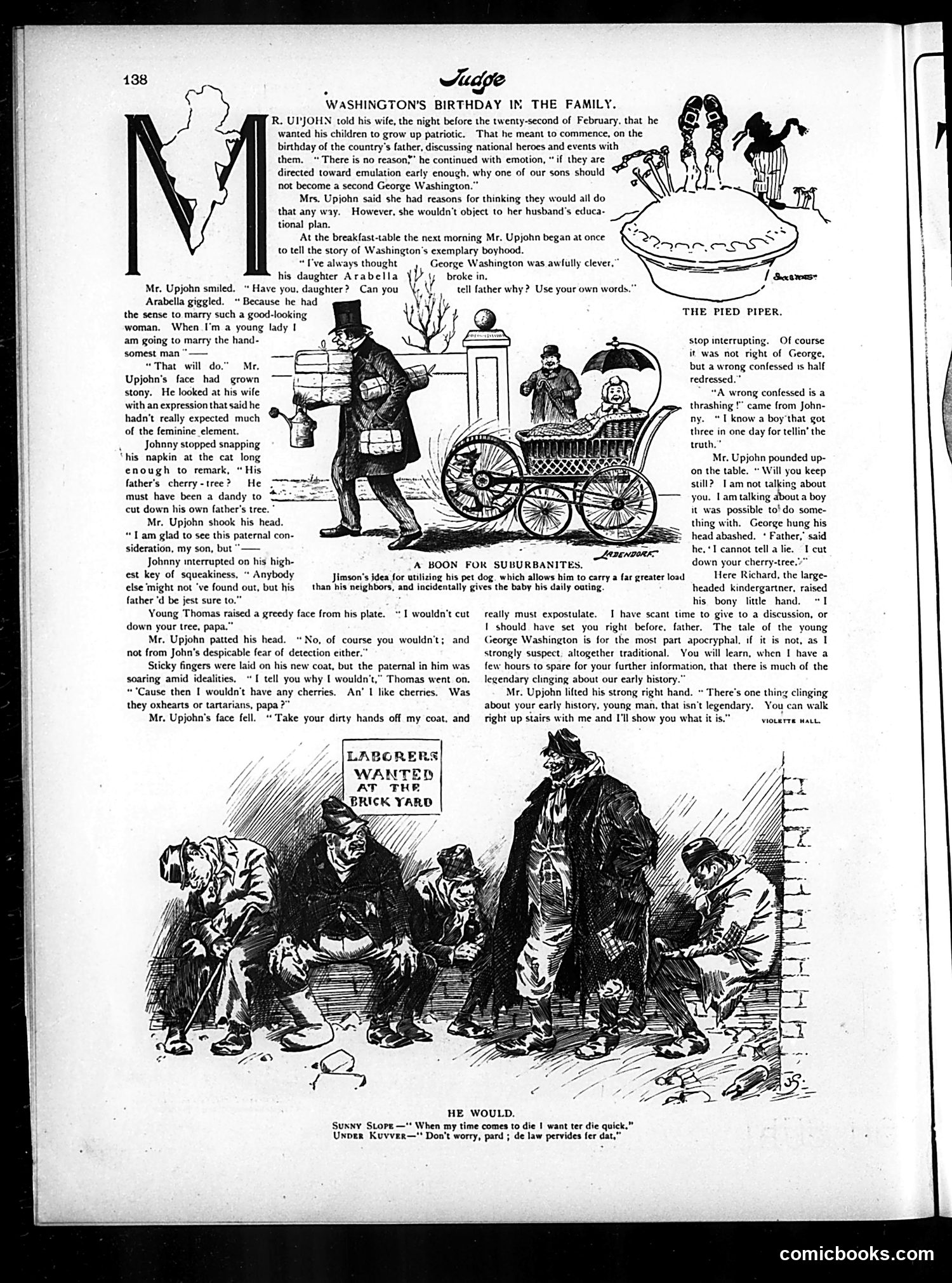
This satirical piece mocks the pretensions of patriotic education. Mr. Upjohn announces plans to inspire his children toward heroic emulation by discussing George Washington on the president's birthday. However, his children systematically derail the lesson through self-interested interruptions: Arabella fixates on Washington's marriage prospects; Johnny focuses on the cherry-tree myth's practical implications for avoiding detection; Thomas wants to know if the cherries were "oxhearts or tartarians" (varieties); and Richard pedantically dismisses the story as "apocryphal" and "legendary." The cartoon satirizes both well-meaning parental moralizing and children's inability or unwillingness to absorb patriotic lessons—they reduce noble history to personal advantage or literal appetite. The humor lies in the gap between Mr. Upjohn's earnest idealism and his family's relentless materialism and literalism, ending when he abandons education for corporal punishment.
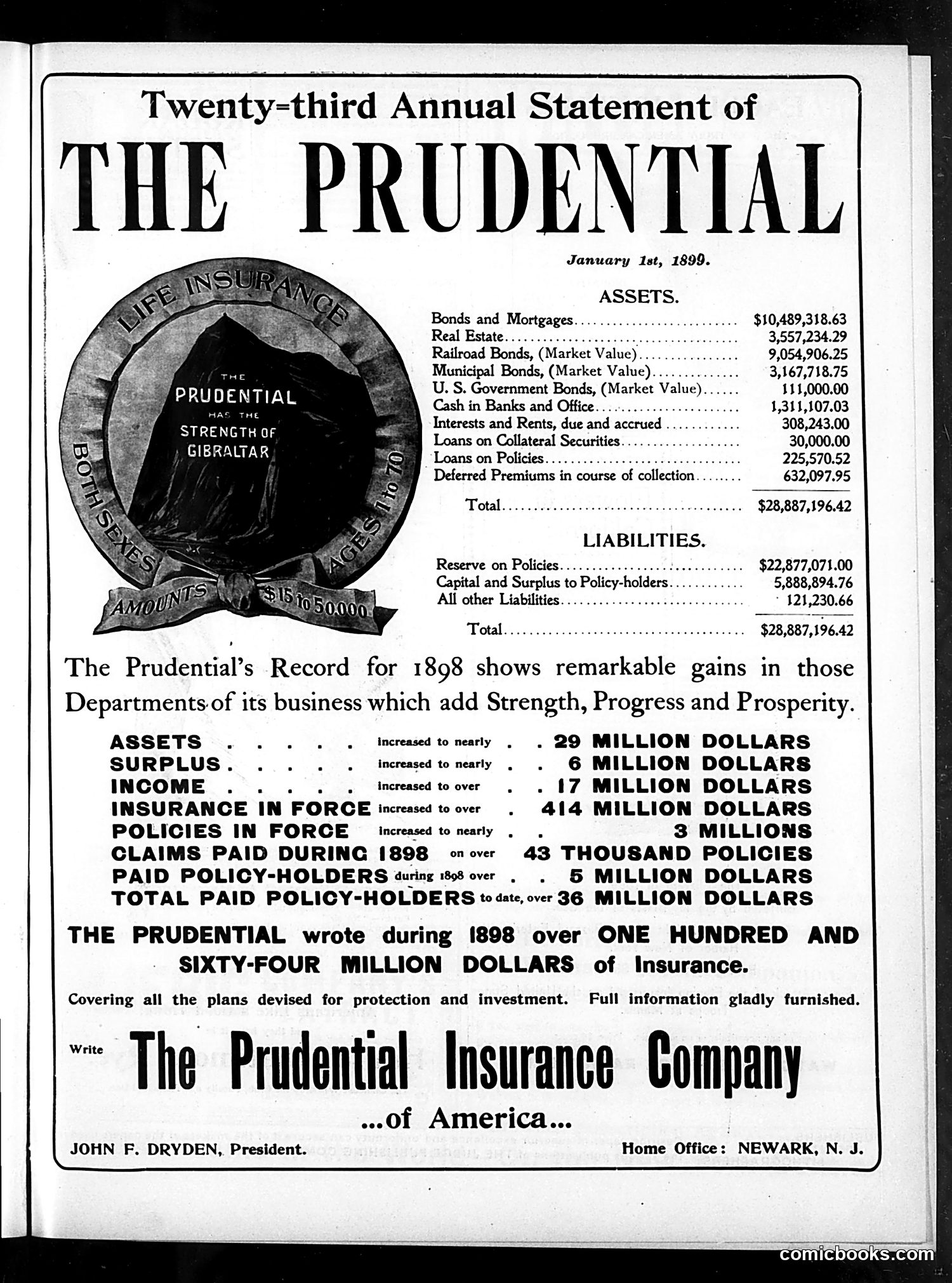
This is primarily a **corporate advertisement**, not satire. The Prudential Insurance Company's twenty-third annual financial statement (January 1, 1899) showcases its rapid growth and financial strength to potential customers and investors. The circular logo featuring Gibraltar—a symbol of stability and strength—reinforces the company's reliability message. The extensive asset listings ($28.8 million total) and growth metrics (414 million dollars in force, 3 million policies) demonstrate Prudential's dominance in the emerging life insurance industry. The page emphasizes that Prudential paid policy-holders $5 million during 1898 alone, establishing consumer confidence during an era when life insurance was still relatively new. The prominent positioning of President John F. Dryden's name and Newark headquarters lends authority. Rather than satirizing insurance, Judge appears to have accepted this as legitimate advertising—reflecting how commercial life insurance had become mainstream American business by the 1890s.
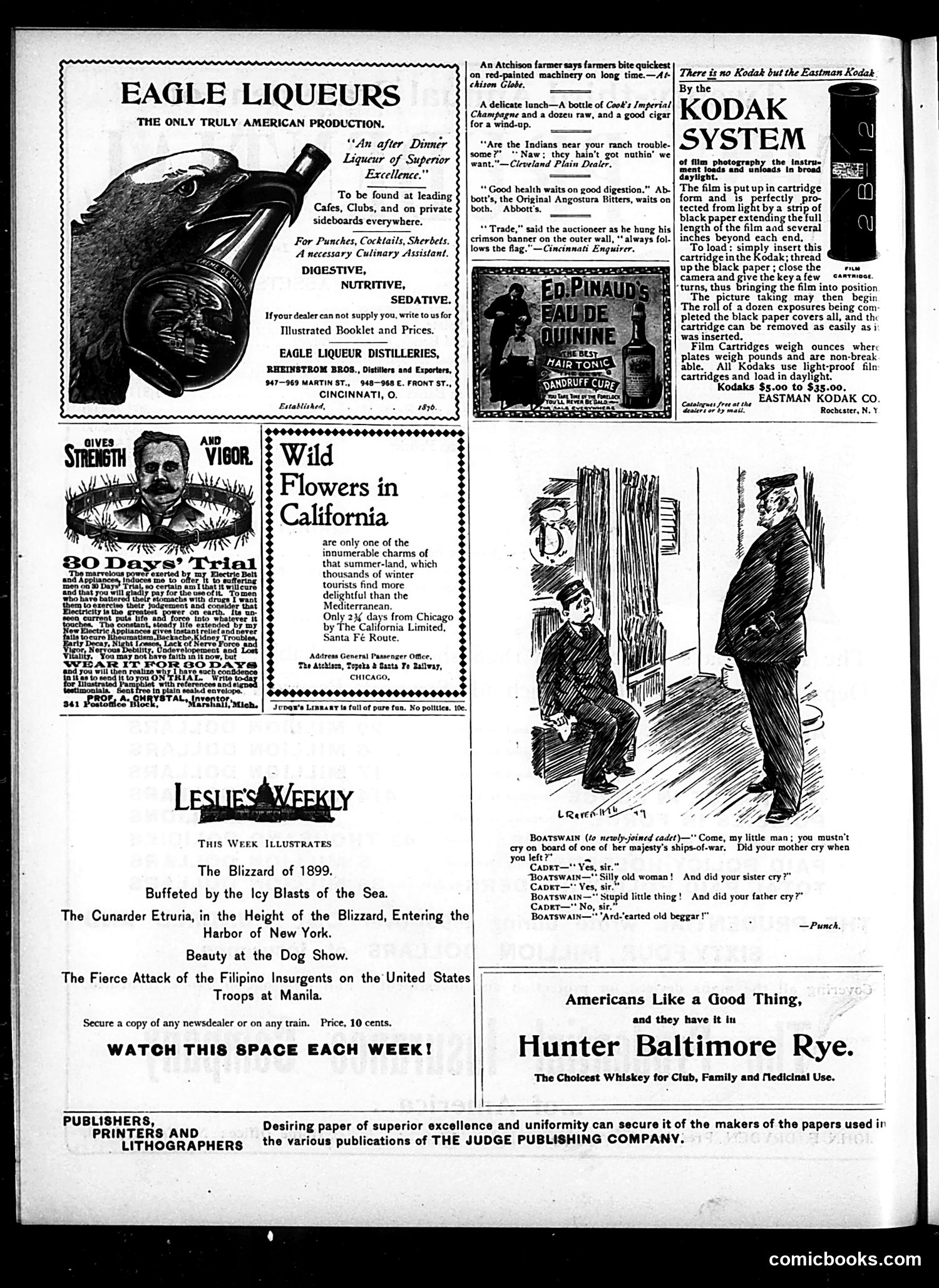
This is primarily an **advertising page** from Judge magazine, circa 1899, with minimal editorial content. The page features multiple product advertisements typical of the era: Eagle Liqueurs (a Cincinnati distillery), California tourist travel, a patent medicine ("30 Days' Trial"), Kodak cameras, and whiskey. These ads reflect turn-of-the-century consumer culture and brand marketing strategies. The only cartoon is a small **maritime joke** (credited to "Punch"): a boatswain interrogates a crying naval cadet, asking if his mother and sister cried, then sarcastically concluding the boy must be "an old beggar"—the humor resting on class assumptions and Victorian attitudes toward emotional restraint. The page's main content notes Leslie's Weekly covers upcoming issues about the **1899 Blizzard**, the **Filipino-American War** (referenced as "Filipino Insurgents"), and a dog show—reflecting contemporary news interests rather than satire.
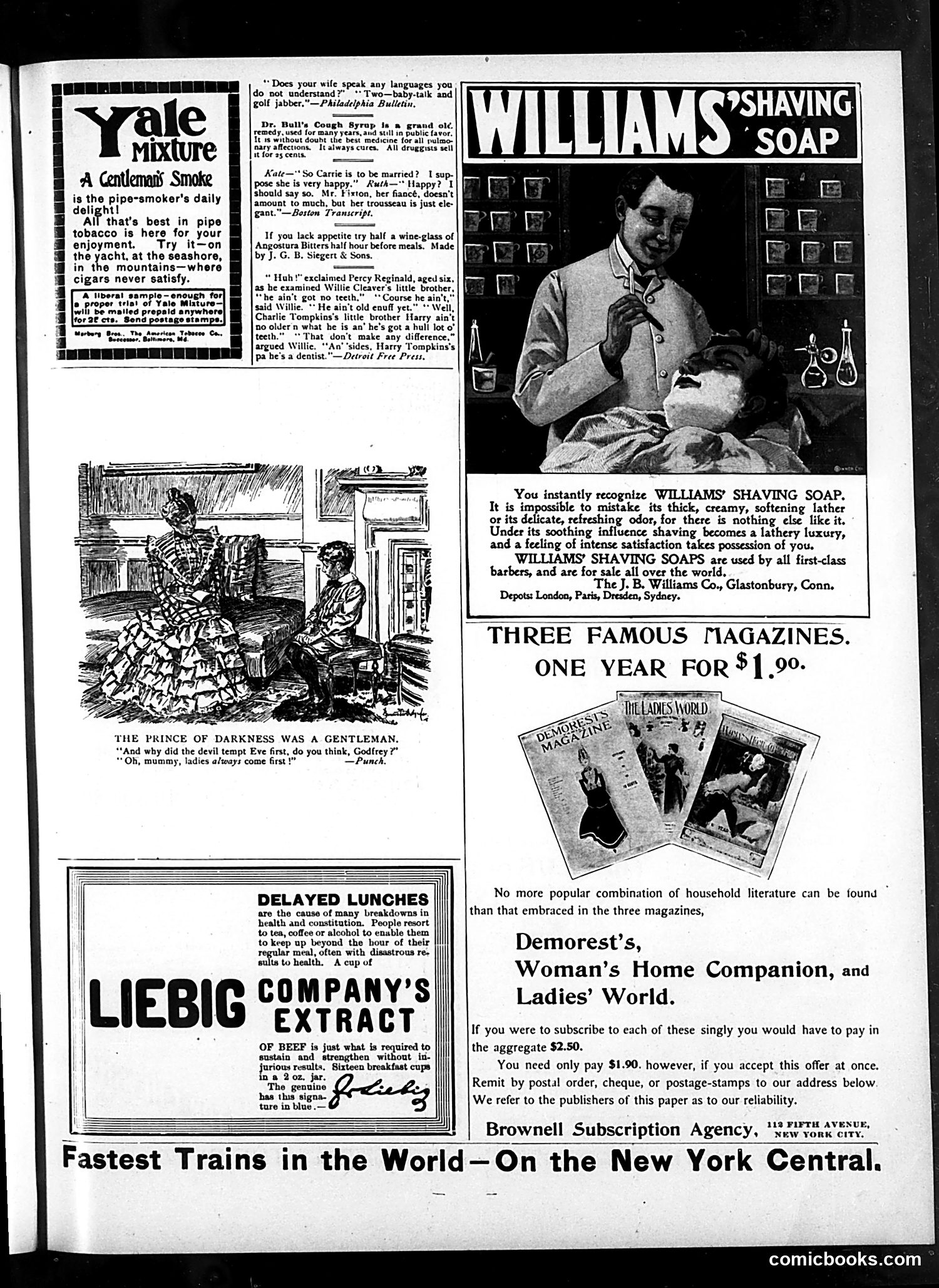
This page is primarily **advertising** with one satirical cartoon. The main cartoon, captioned "THE PRINCE OF DARKNESS WAS A GENTLEMAN," depicts a Victorian-era scene where a mother asks her son why the devil tempted Eve first. The boy's answer—"Oh, mummy, ladies always come first!"—is the joke's punchline, credited to *Punch* magazine. The humor relies on Victorian-era gender etiquette: the phrase "ladies always come first" was a polite social convention about deference to women. The cartoon's satire inverts this by applying it to the Devil's choice of temptation victim in the Garden of Eden, treating demonic seduction as a matter of gentlemanly courtesy rather than malice. It's a gentle joke about how deeply ingrained social politeness was in the era. The rest of the page consists of period advertisements for Yale Mixture tobacco, Dr. Bull's Cough Syrup, Williams' Shaving Soap, Liebig Company's Beef Extract, and a magazine subscription offer—typical of early 20th-century periodical advertising.
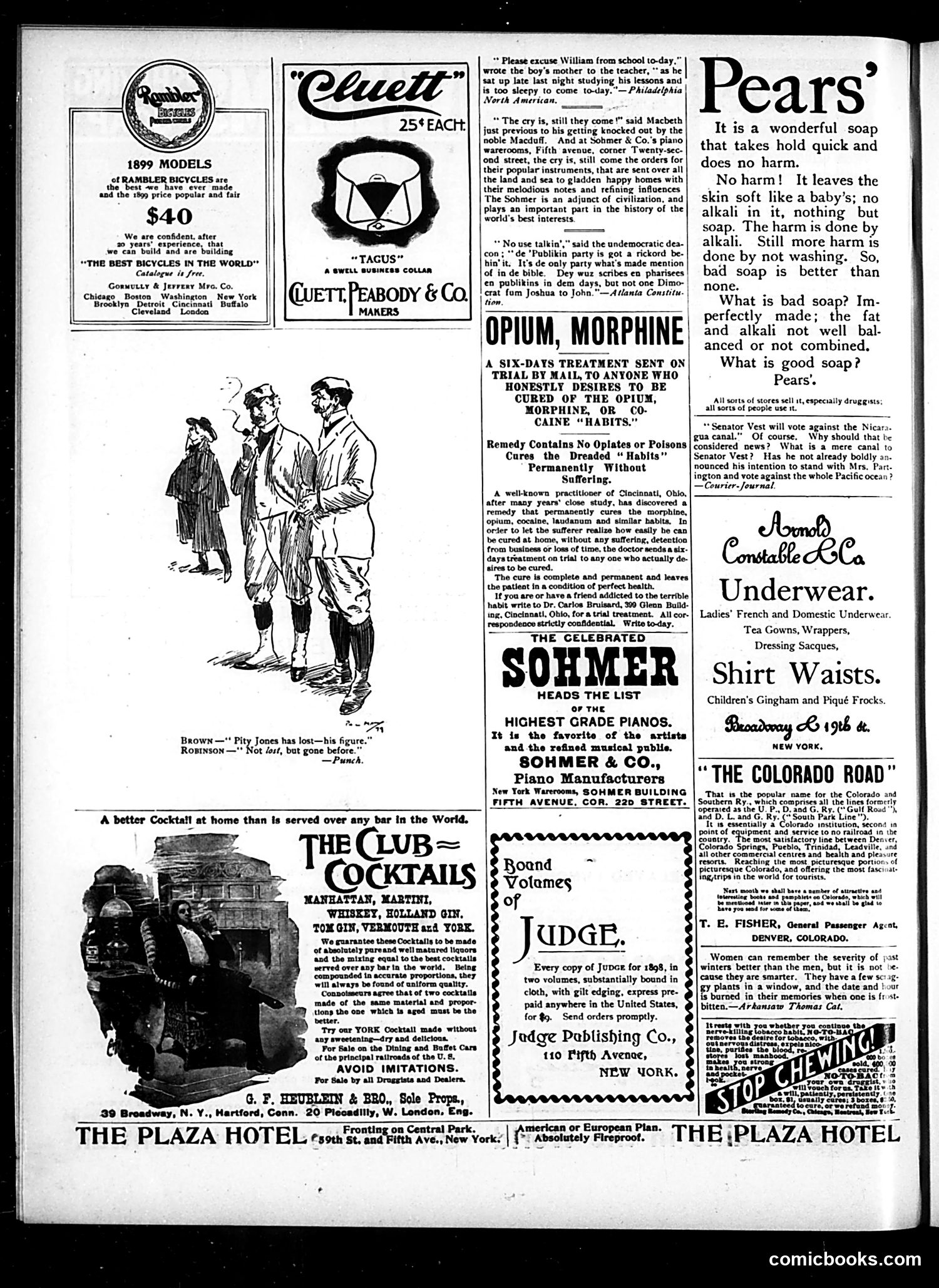
This page is primarily **advertisements and filler content** from Judge magazine, circa 1898. The main cartoon (upper left) shows three men in conversation. The caption attributes a joke to publications "Punch" and "Panacea," with Brown pitying Jones for losing "his figure" and Robinson responding he's "not lost, but gone before"—a mild joke about weight loss or disappearance, likely referencing popular culture of the era that a modern reader would need additional context to fully understand. The page is otherwise dominated by **product advertisements**: bicycles, collars, cocktails (notably pre-Prohibition), soap, patent medicine for opium/morphine addiction, pianos, and hotels. The most striking advertisement is the **drug-cure remedy**—a six-day mail treatment for opium, morphine, and cocaine addiction. This reflects the historical reality that such drugs were legal and widely marketed as cure-alls in 1890s America. The "Brown-Robinson" joke and deacon dialect piece are satirical but lack sufficient context for clear modern interpretation.
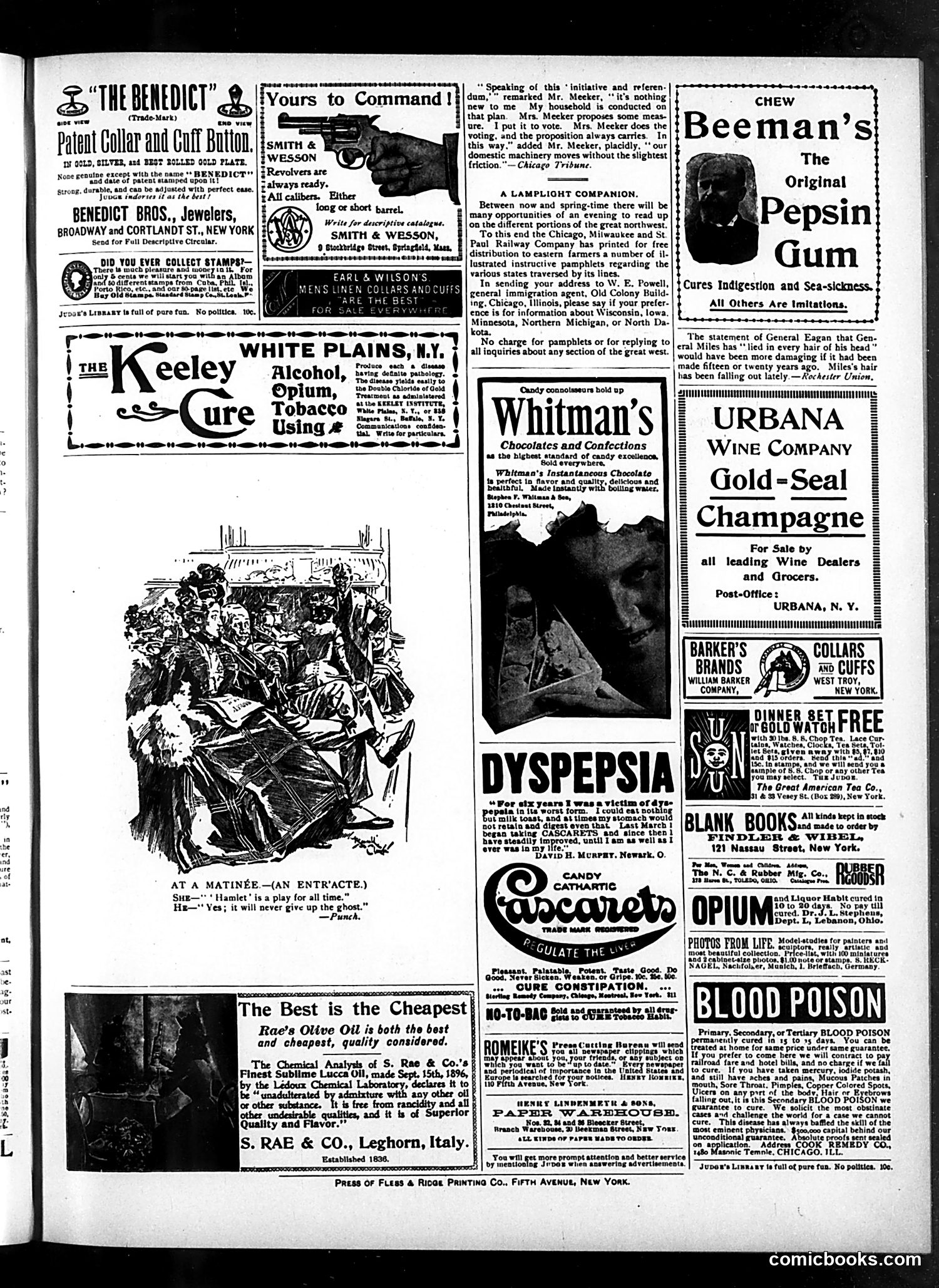
This page is primarily **advertising**, with minimal editorial content. The notable satirical piece is a brief dialogue titled "AT A MATINEE": **The Theater Joke:** A man and woman discuss *Hamlet*, with him saying the play "will never give up the ghost." This is wordplay—a pun on the play's famous ghost and the phrase "give up the ghost" (meaning to die). It's gentle theatrical humor typical of *Punch* magazine (credited as the source). **The Political Cartoon:** The main illustrated piece satirizes the **"initiative and referendum"** movement (progressive-era voting reforms allowing direct democracy). Mrs. Meeker runs household decisions by vote, yet "the proposition always carries" because she controls outcomes anyway—mocking how direct democracy mechanisms might be manipulated. The satire suggests reform ideals don't prevent power concentration. **Advertisements dominate:** patent collars, Smith & Wesson revolvers, patent medicines (notably "Keeley Cure" for alcohol/opium/tobacco addiction, and blood poison remedies—period medical dubieties), champagne, chocolates, and railroad pamphlets. The page reflects *Judge's* 1890s-era mix of mild political commentary, theatrical references, and commercial sponsorship.
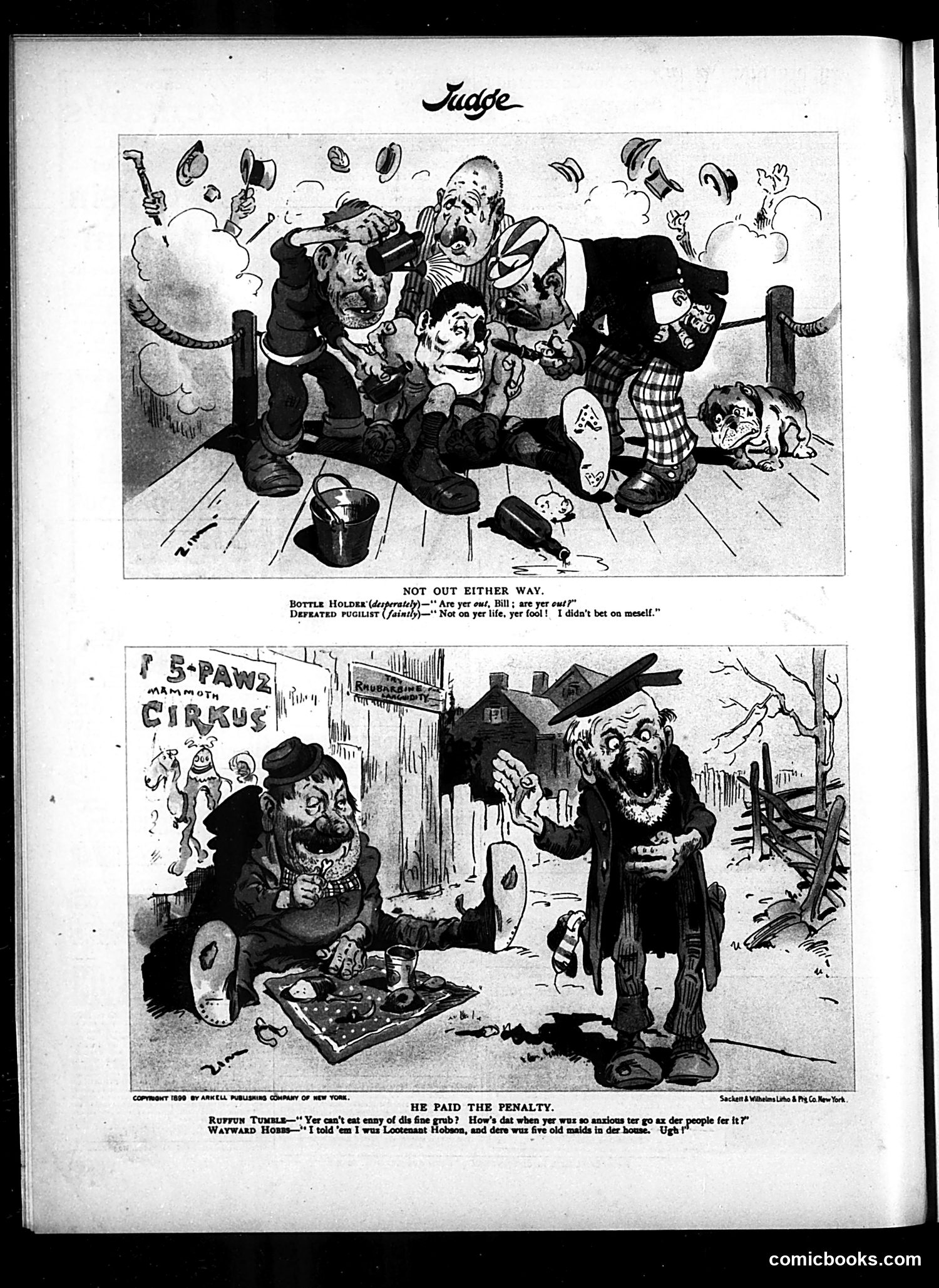
**Top Cartoon: "Not Out Either Way"** This depicts a chaotic scene with two figures labeled "Bottle Holder" and "Defeated Pugilist" in what appears to be a boxing context. The dialogue suggests a dispute over a wager—the defeated boxer claims he didn't bet on himself, creating a comedic legal/logical trap where neither party can claim victory or collect winnings. This satirizes the absurdity of certain betting disputes or contractual loopholes. **Bottom Cartoon: "He Paid the Penalty"** Shows two rough-looking men (labeled "Ruffian Tumble" and "Wayward Hoss") discussing a failed robbery attempt. One claims he couldn't eat the stolen food; the other boasts about impersonating a lieutenant to gain house access, but found only five old maids instead of valuables. The joke mocks incompetent criminals whose careful planning yields nothing, illustrating consequences of their misadventure. Both cartoons use exaggerated caricature and dialect to satirize working-class or criminal desperation during an unspecified period.