
Judge, 1899-03-04 · page 2 of 16
Judge — March 4, 1899 — page 2: what you’re looking at
What you’re looking at
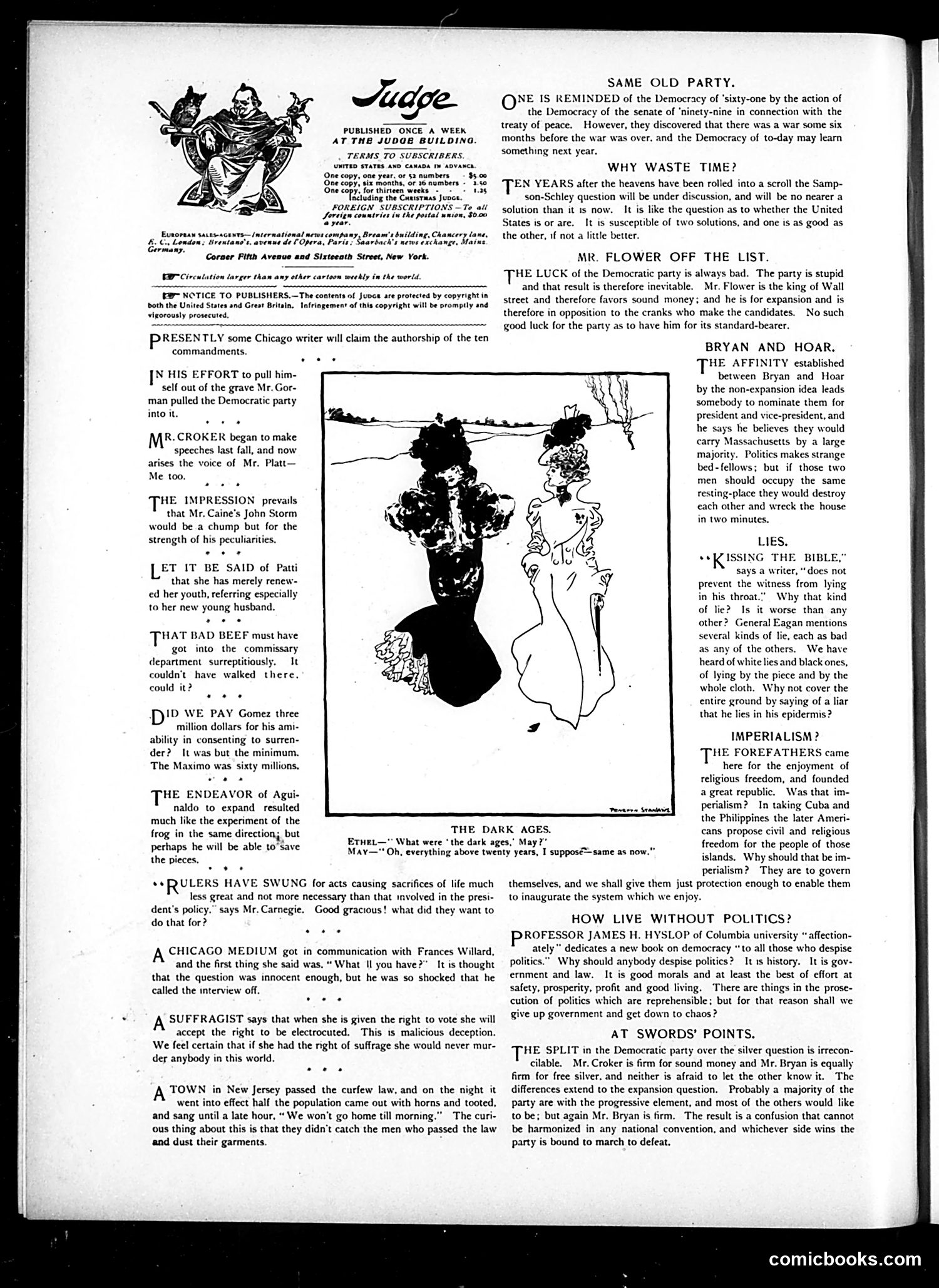
This page contains several brief political commentary pieces typical of Judge's satirical format. The central cartoon, titled "THE DARK AGES," depicts a caricatured figure (likely representing a political opponent) and appears to mock outdated thinking. The text sections critique Democratic Party politics, including attacks on Mr. Flower regarding his opposition to party candidates, and commentary on Bryan and Hoar's potential nomination. References to "silver" versus "sound money" debates suggest this dates to the 1890s free-silver controversy. The "KISSING LIES" section criticizes dishonesty in political rhetoric, while "HOW LIVE WITHOUT POLITICS?" quotes Professor James H. Hislop arguing that avoiding politics is impossible since government affects daily life. The overall tone is caustic Republican commentary on Democratic Party dysfunction and progressive political debates of the era.
📄 Transcribed text from this page (OCR, searchable)
Machine-transcribed from the original scan — historical spelling and the odd misread are preserved.
PUBLISHED ONCE A WEEK AT THE JUDGE BUILDI TERMS TO SUBSCRIBERS. UNITED STATES AND CANADA IH ADVAMCR One copy, one year, or $2 numbers One copy, six months, or 16 numbers - One copy fr thirteen weeks facluding the Cuaistaas J FOREIGN SUBSCRIPTIO: Soreign countries in the postal @ year. Eunoraan sautsacewrs—/nter 4 tional news company, Bream's building, Chancery lane, im: Brentano's, ne del Opera, Paris; Saarbach's news exchange, Corner Fitth Avenue and Sixteeath Street, New York. jom larger than any other cartoon weekly in the world. EB NOTICE TO PUBLISHERS.—The contents of Juoce are protected by copyright in both the United States and Great Britain, Infringement of this copyright will be promptly and vigorously prosecuted, RESENTLY some Chicago writer will claim the authorship of the ten commandments. [N HIS EFFORT to pull him- self out of the grave Mr. Gor- man pulled the Democratic party into it. R.CROKER began to make speeches last fall, and now arises the voice of Mr. Platt— Me too. THE IMPRESSION prevails that Mr. Caine’s John Storm would be a chump but for the strength of his peculiarities. ET IT BE SAID of Patti that she has merely renew- ed her youth, referring especially to her new young husband, THAT BAD BEEF must have got into the commissary department surreptitiously. It couldn't have walked there, could it? D!D WE PAY Gomez three million dollars for his ami- ability in consenting to surren- der? It was but the minimum. The Maximo was sixty millions. HE ENDEAVOR of Agui- naldo to expand resulted much like the experiment of the frog in the same direction; but perhaps he will be able to"Save the pieces. THE Erner— an **PULERS HAVE SWUNG for acts causing sacrifices of life much less great and not more necessary than that involved in the presi- dent's policy,” says Mr. Carnegie. Good gracious! what did they want to do that for? A CHICAGO MEDIUM got in communication with Frances Willard, and the first thing she said was, “ What Il you have?” It is thought that the question was innocent enough, but he was so shocked that he called the interview off. A SUFFRAGIST says that when she is given the right to vote she will accept the right to be electrocuted. This 1s malicious deception. We feel certain that if she had the right of suffrage she would never mur- der anybody in this world. TOWN in New Jersey passed the curfew law, and on the night it went into effect half the population came out with horns and tooted, and sang until a late hour, “We won't go home till morning.” The curi- ous thing about this is that they didn’t catch the men who passed the law and dust their garments. DARK AGES. What were ‘the dark ages,’ May?” Mav—"Oh, everything above twenty years, I supposé~same as now.” SAME OLD PARTY. Q)NE IS REMINDED of the Democracy of ‘sixty-one by the action of the Democracy of the senate of ‘ninety-nine in connection with the treaty of peace. However, they discovered that there was a war some six months before the war was over, and the Democracy of to-day may learn something next year. WHY WASTE TIME? TEN YEARS after the heavens have been rolled into a seroll the Samp- son-Schley question will be under discussion, and will be no nearer a solution than it 1s now. It is like the question as to whether the United States is or are. It is susceptible of two solutions, and one is as good as the other, if not a little better. MR. FLOWER OFF THE LIST. THE LUCK of the Democratic party is always bad. The party is stupid and that result is therefore inevitable. Mr. Flower is the king of Wall street and therefore favors sound money; and he is for expansion and is therefore in opposition to the cranks who make the candidates. No such good luck for the party as to have him for its standard-bearer. BRYAN AND HOAR. ‘THE AFFINITY established between Bryan and Hoar by the non-expansion idea leads somebody to nominate them for president and vice-president, and he says he believes they would carry Massachusetts by a large majority. Politics makes strange bed-fellows; but if those wo men should occupy the same resting-place they would destroy cach other and wreck the house in two minutes. LIES. ‘S KISSING THE BIBLE,” says a writer, “does not prevent the witness from lying in his throat.” Why that kind of lie? Is it worse than any other? General Eagan mentions several kinds of lie, each as bad as any of the others. We have heard of white lies and black ones, of lying by the piece and by the whole cloth, Why not cover the entire ground by saying of a liar that he lies in his epidermis? IMPERIALISM ? ‘THE FOREFATHERS came here for the enjoyment of religious freedom, and founded a great republic, Was that im- perialism? In taking Cuba and the Philippines the later Ameri- cans propose civil and religious freedom for the people of those islands. Why should that be im- perialism? They are to govern themselves, and we shall give them just protection enough to enable them to inaugurate the system which we enjoy. HOW LIVE WITHOUT POLITICS? PROFEsSOR JAMES H. HYSLOP of Columbia univer “affection- ately” dedicates a new book on democracy “to all those who despise politics.” Why should anybody despise politics? It 1s history. It is gov- ernment and law. It is good morals and at least the best of effort at safety, prosperity, profit and good living. There are things in the prose- cution of politics which are reprehensible; but for that reason shall we give up government and get down to chaos? AT SWORDS’ POINTS. THE SPLIT in the Democratic party over the silver question is irrecon- cilable. Mr. Croker is firm for sound money and Mr. Bryan is equally firm for free silver. and neither is afraid to let the other know it. The differences extend to the expansion question. Probably a majority of the party are with the progressive element, and most of the others would like to be; but again Mr. Bryan is firm. The result is a confusion that cannot be harmonized in any national convention, and whichever side wins the party is bound to march to defeat. comicbooks.com