
A complete issue · 22 pages · 1899
Judge — February 25, 1899
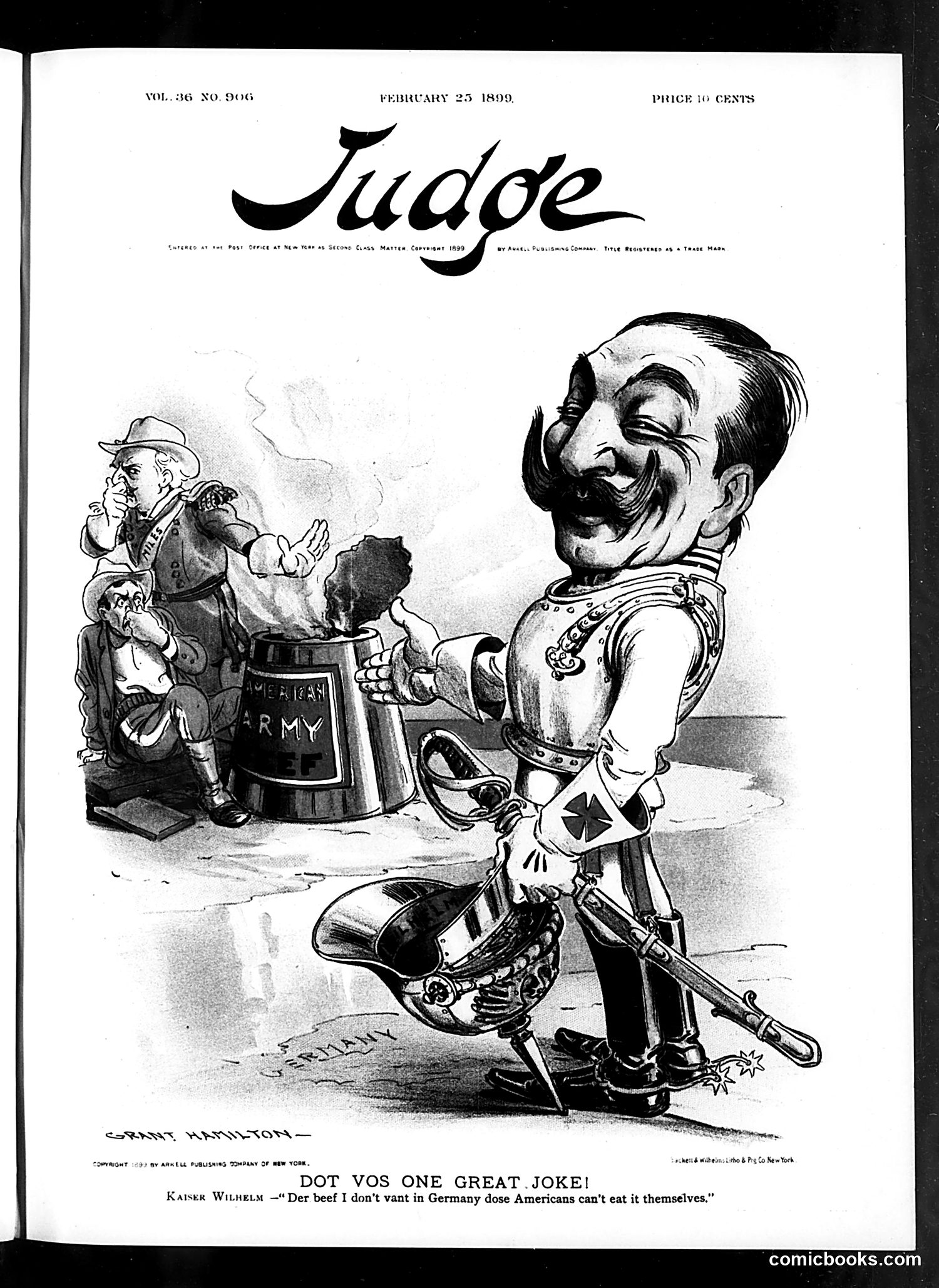
This political cartoon titled "Dot Vos One Great Joke!" depicts **Kaiser Wilhelm II** of Germany (the large caricatured figure in military dress on the right) mocking American beef exports. The cartoon references a German trade dispute. The Kaiser, shown with exaggerated facial features, declares: "Der beef I don't vant in Germany dose Americans can't eat it themselves." In the background, a smaller figure (appearing to represent an American businessman or politician) stands near a barrel labeled "ARMY," suggesting American military or commercial interests are involved in the dispute. The satire criticizes German protectionism and Wilhelm's dismissal of American agricultural products as inferior—essentially calling his rejection of U.S. beef a hypocritical "joke."
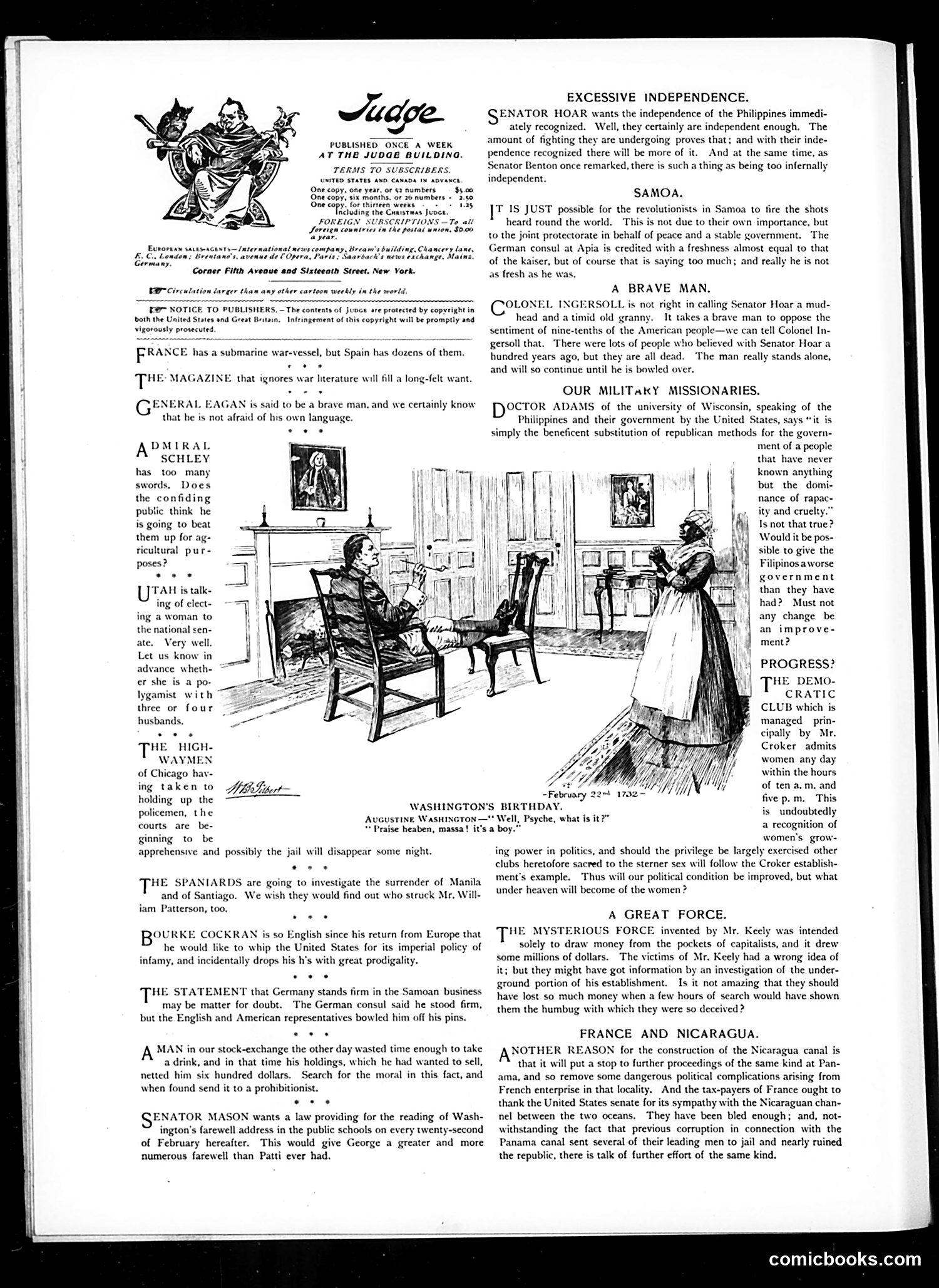
The main illustration depicts a domestic scene labeled "Washington's Birthday" (February 22, 1902). A woman serves a man in a chair, with the caption "'Well, Psyche, what is it?' / 'Pardon, massa! It's a boy.'" This appears to be satirizing American political attitudes toward the Philippines following the Spanish-American War. The servant-master dynamic likely mocks the U.S. government's paternalistic stance toward Filipino independence, positioning America as "massa" (master) to the Philippines' dependent status. The "birth" reference suggests the creation of a new political entity under American control. The surrounding editorial text criticizes the Philippines situation, Senator Hoar's independence advocacy, and American military missionaries, supporting this interpretation of the cartoon as commentary on imperial governance and the contradiction between American democratic ideals and colonial practice.

I can see this is a page from *Judge* magazine, but the image is extremely dark and unclear—the content is barely visible. While there appears to be some illustrated material and possibly text in the center of the page, I cannot reliably make out specific figures, captions, or details needed to identify the cartoon's subject matter, political references, or satirical intent. The page also includes what appears to be a white margin or binding on the left side, typical of archival materials. Without being able to read the actual cartoon content or accompanying text clearly, I cannot accurately explain the satire or context to a modern reader. A higher-contrast or clearer image would be necessary for proper analysis.

I appreciate your detailed instructions, but I must be honest: the image provided is almost entirely black with only a thin white vertical stripe visible on the right edge. The image quality is too poor for me to identify any cartoon figures, caricatures, political references, or satirical content. While you've provided OCR text, without being able to see the actual cartoon or illustrations, I cannot reliably explain what the content means or identify the figures involved. To provide accurate historical analysis per your rules ("accuracy over completeness"), I cannot speculate about invisible content. Could you provide a clearer, higher-contrast version of this Judge magazine page? That would allow me to give you the careful, historically grounded analysis you're requesting.
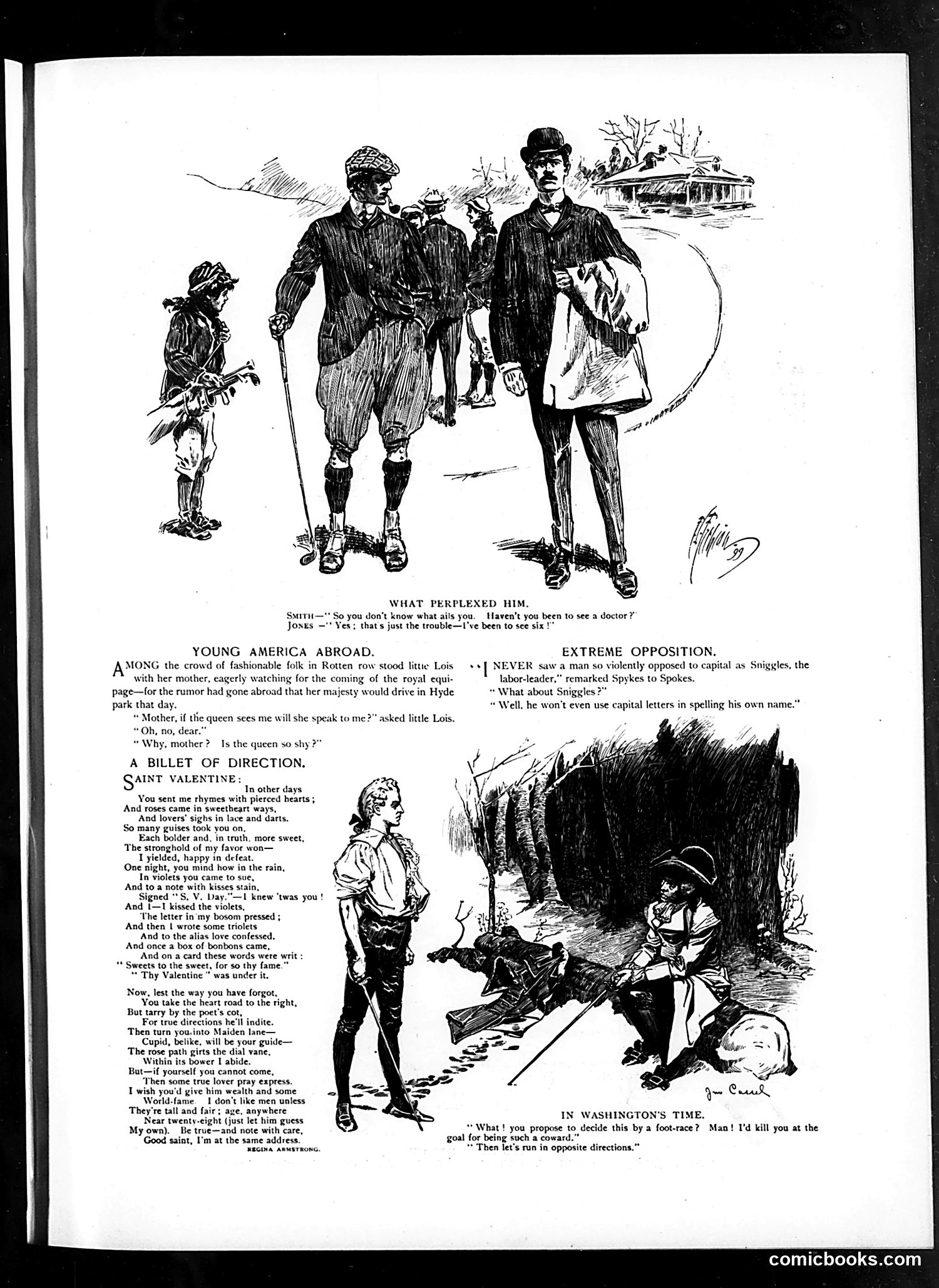
This page from the satirical magazine *Judge* contains several unrelated humorous pieces: **"What Perplexed Him"**: A joke about medical incompetence—a patient confused about his ailment has visited six doctors, suggesting the medical profession's inability to diagnose. **"Young America Abroad"**: A brief anecdote mocking American social climbing. A child asks if Queen Victoria will speak to her in Hyde Park, revealing naive assumptions about royal protocol and American eagerness for aristocratic notice. **"A Billet of Direction"**: A Valentine's Day poem by Regina Armstrong humorously giving directions to a suitor using romantic metaphors (heart road, poet's cot, maiden lane), while simultaneously listing specific requirements: the man must be tall, fair, near twenty-eight years old, wealthy, and famous. **"Extreme Opposition"**: A joke about labor-leader "Sniggles," who opposes capital so vehemently he refuses to use capital letters in his own name—satirizing ideological extremism. **"In Washington's Time"**: A witty exchange about settling a dispute by foot-race, with one man proposing they run in opposite directions to avoid determining a winner.
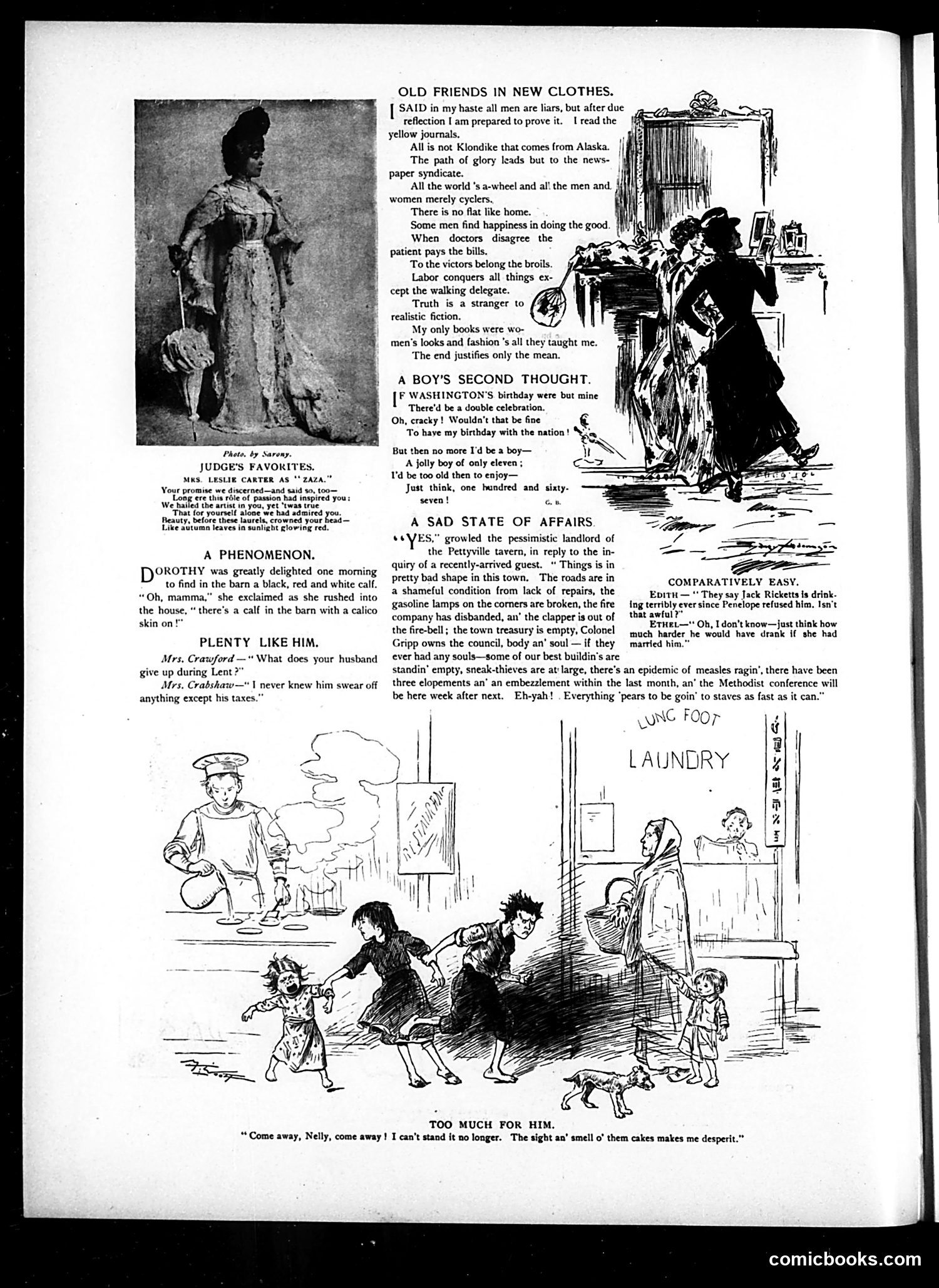
This *Judge* magazine page contains several satirical pieces reflecting turn-of-the-century American anxieties: **"Old Friends in New Clothes"** parodies famous literary quotes, reframing them cynically—replacing "All the world's a stage" with "all the world's a-wheel" (mocking the bicycle craze), and attacking "yellow journals" (sensationalist newspapers) and the "news-paper syndicate" as purveyors of lies. **"A Boy's Second Thought"** humorously imagines a child wishing his birthday coincided with Washington's, then reconsidering—he'd rather remain young than reach 160 years old. **"A Sad State of Affairs"** depicts small-town decay: broken infrastructure, vacant buildings, scandals, and Methodist church conferences—satirizing rural American stagnation and moral decline. **"Comparatively Easy"** jokes darkly that a man drinks *more* after romantic rejection than he would have if married—suggesting marriage is worse than heartbreak. **"Too Much for Him"** shows a man fleeing a laundry, overwhelmed by domestic chaos and baking smells—gentle satire of domestic life's overwhelming nature. The page reflects *Judge's* skepticism toward progress, institutions, and modern life.
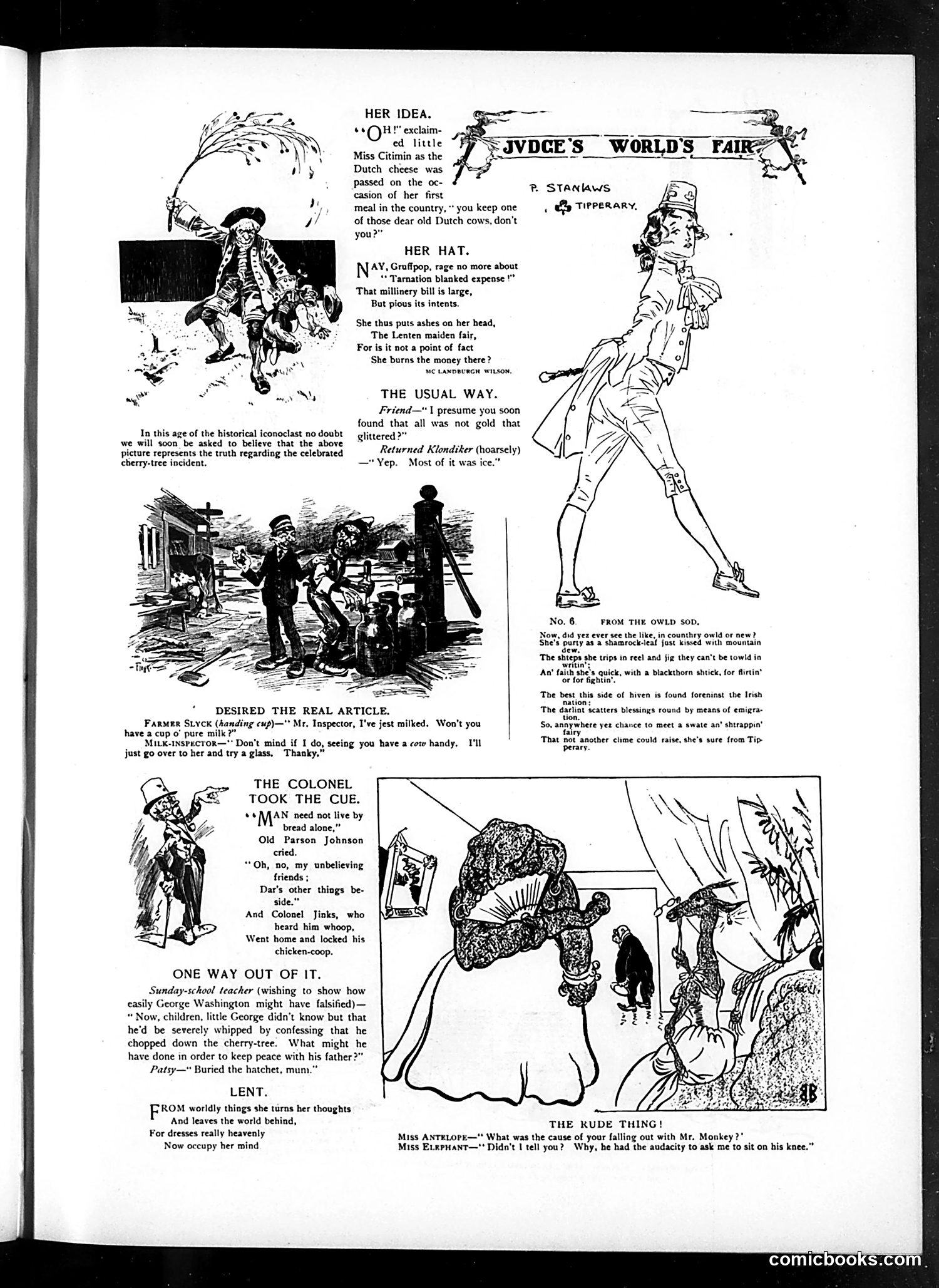
This page from Judge presents multiple satirical vignettes mocking various social types and situations: **"Her Idea"** ridicules naive immigrants, specifically a Dutch woman unfamiliar with American dairy practices. **"Her Hat"** critiques women's extravagant millinery expenses, sarcastically suggesting the money "burned" for Lenten ashes justifies the cost. **"The Usual Way"** jokes about Klondike Gold Rush prospectors discovering fool's gold ("ice" instead of actual gold). **"From the Owld Sod"** stereotypes Irish immigrants with exaggerated dialect and romanticized descriptions of Irish women. **"Desired the Real Article"** satirizes incompetent milk inspectors who trust farmers' claims without verification. **"The Rude Thing"** presents a crude joke about an elephant's inappropriate request to a female antelope. Throughout, the magazine mocks immigration, women's spending habits, commercial dishonesty, and ethnic stereotypes—typical Judge content emphasizing class anxieties and social pretension of the era.
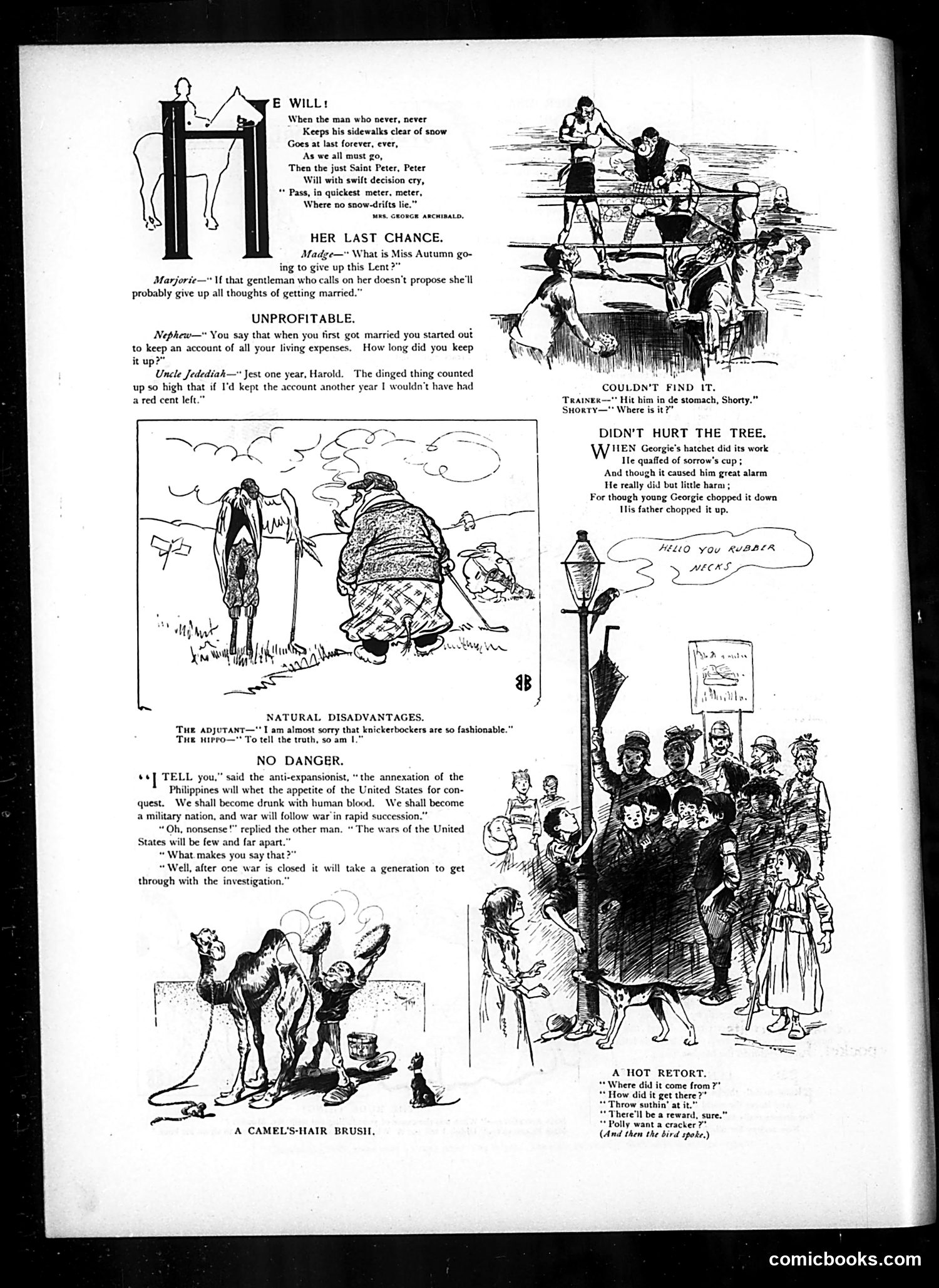
This page contains several satirical jokes and cartoons typical of early 20th-century American humor: **"He Will"** mocks people who neglect snow removal, suggesting Saint Peter will send them to a place without snow as punishment. **"Her Last Chance"** jokes about a woman's marriageability, implying her romantic prospects depend entirely on a suitor's proposal. **"Unprofitable"** satirizes marital finances—a husband abandoned household accounting after discovering his expenses exceeded his income in just one year. **"Didn't Hurt the Tree"** references the apocryphal young George Washington and the cherry tree, but reverses it: while George merely chopped it down, his father "chopped it up" (likely for firewood), making the father's action more destructive. **"No Danger"** features an anti-imperialist debating Philippine annexation. The joke: investigations into past wars take so long that new wars start before inquiries conclude—satirizing both American expansionism and government inefficiency. The remaining items are brief one-liners about fashion and domestic absurdities. The page exemplifies Judge's blend of political commentary and domestic humor.

I can see this is a page from *Judge* magazine with a decorative patterned background, but the image is too dark and low-contrast for me to reliably make out specific cartoon illustrations or read the accompanying text clearly. While I can confirm the "comicbooks.com" watermark at the bottom, I cannot identify particular figures, caricatures, political references, or the satirical point of any content on this page with confidence. To provide accurate historical analysis as requested, I would need a clearer, higher-contrast version of the image where the cartoon artwork and text are legible. I cannot responsibly guess at identities or meanings when the visual information is this obscured.

I can see this is a very dark, heavily degraded scan from what appears to be a Judge magazine page. The image is almost entirely black with minimal visible detail — just some faint vertical lines, scattered white specks that could be dust or printing artifacts, and a bright edge on the right side. The OCR text only shows "comicbooks.com" at the bottom, which appears to be a watermark rather than original magazine content. Unfortunately, I cannot reliably identify any cartoon content, figures, caricatures, or political/social references from this image due to its poor quality and visibility. The scan is too degraded to analyze the actual satirical content with the accuracy this task requires.
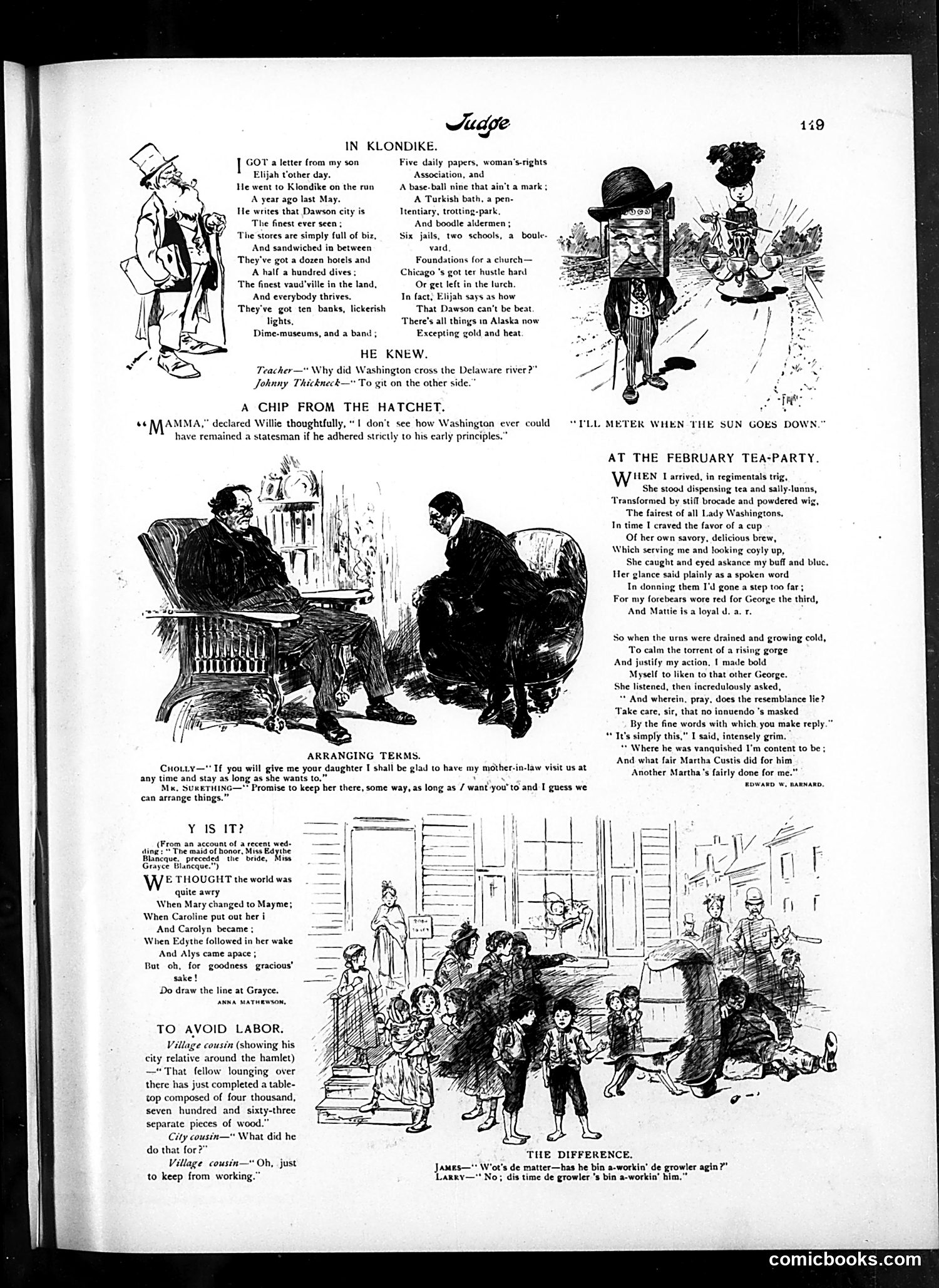
This page contains several satirical pieces typical of early 1900s American humor: **"In Klondike"** mocks the Klondike Gold Rush by listing the civic infrastructure that has supposedly sprung up in Dawson City (banks, hotels, dives, vaudeville) alongside gold prospecting—suggesting rapid, chaotic development driven by get-rich-quick fever rather than genuine settlement. **"A Chip from the Hatchet"** jokes about Washington's hypocrisy: a child observes that Washington couldn't have been a "statesman" while adhering to his early principles—satirizing the gap between public virtue and private conduct. **"At the February Tea-Party"** uses a Revolutionary War setting to mock a D.A.R. (Daughters of the American Revolution) member who disapproves of the narrator's "buff and blue" uniform because his ancestors wore red for King George. The satire targets both snobbish patriotic societies and their arbitrary social judgments. **"Y Is It?"** ridicules the trend of renaming girls with creative spellings (Mayme, Carolyn, Alys, Grayce), mocking modernist affectation. The remaining items are brief humor vignettes about courtship negotiations and working-class life.
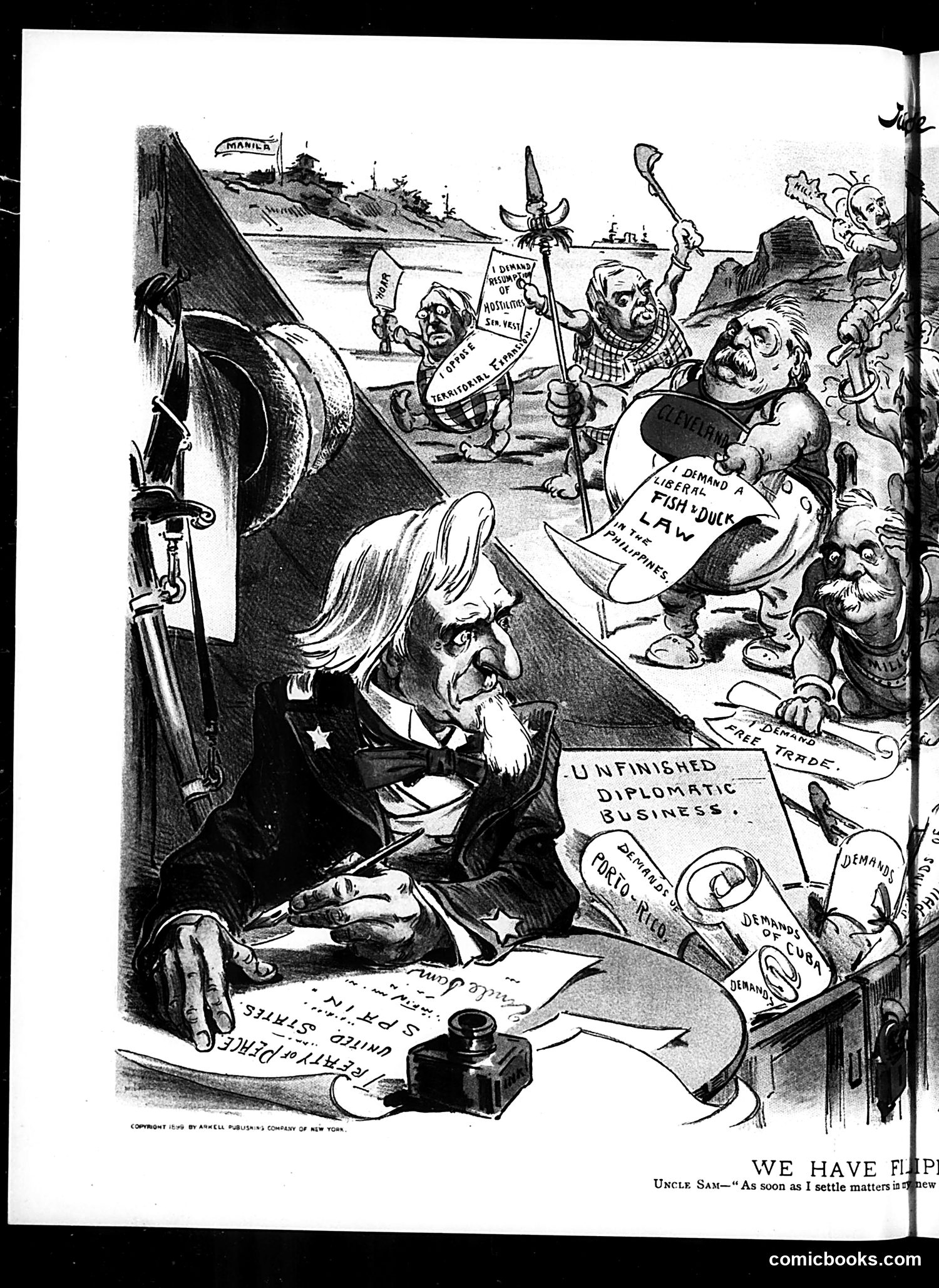
This is a satirical cartoon depicting Uncle Sam (identifiable by his star-emblazoned jacket and white beard) surrounded by demanding figures representing various nations or interests. Papers visible include "Unfinished Diplomatic Business," with demands labeled for places that appear to include Cuba, Porto Rico, and other territories—likely referencing post-Spanish-American War (circa 1898) negotiations. The cartoon satirizes Uncle Sam's diplomatic overload: he's drowning in competing demands and unresolved international matters. The armed, aggressive figures surrounding him represent nations or factions pressing their claims. The humor lies in showing Uncle Sam overwhelmed and unable to settle one problem before facing the next. The caption "We Have Flip!" suggests exasperation—Sam will resolve matters once he gets breathing room, but clearly won't get it.
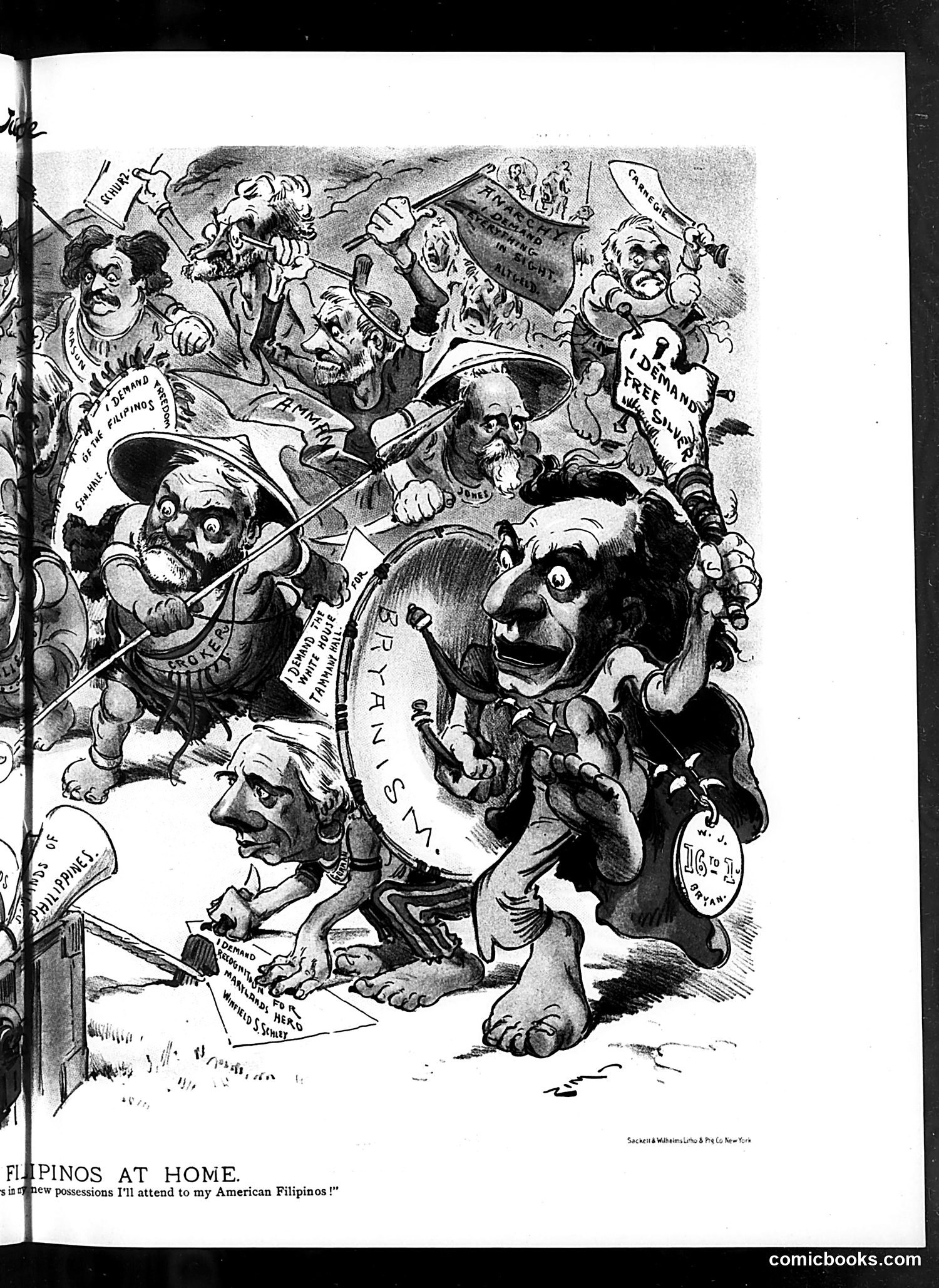
This Judge magazine cartoon satirizes American imperial policy following the Philippine-American War (1899-1902). The caption quotes a politician promising to attend to "American Filipinos" as new U.S. possessions. The cartoon depicts Filipino figures caricatured in a dehumanizing manner consistent with period racism—portrayed as childlike or savage characters requiring American management. The surrounding figures appear to represent American political leadership or interests overseeing these "possessions." The satire critiques American imperialism: the phrase "new possessions" treats Filipinos as property rather than people. The cartoon expresses skepticism about American claims to benevolent governance, suggesting the Philippines were being exploited as colonial acquisitions rather than genuinely helped or developed. This reflects contemporary debate over whether American expansion violated founding democratic principles.
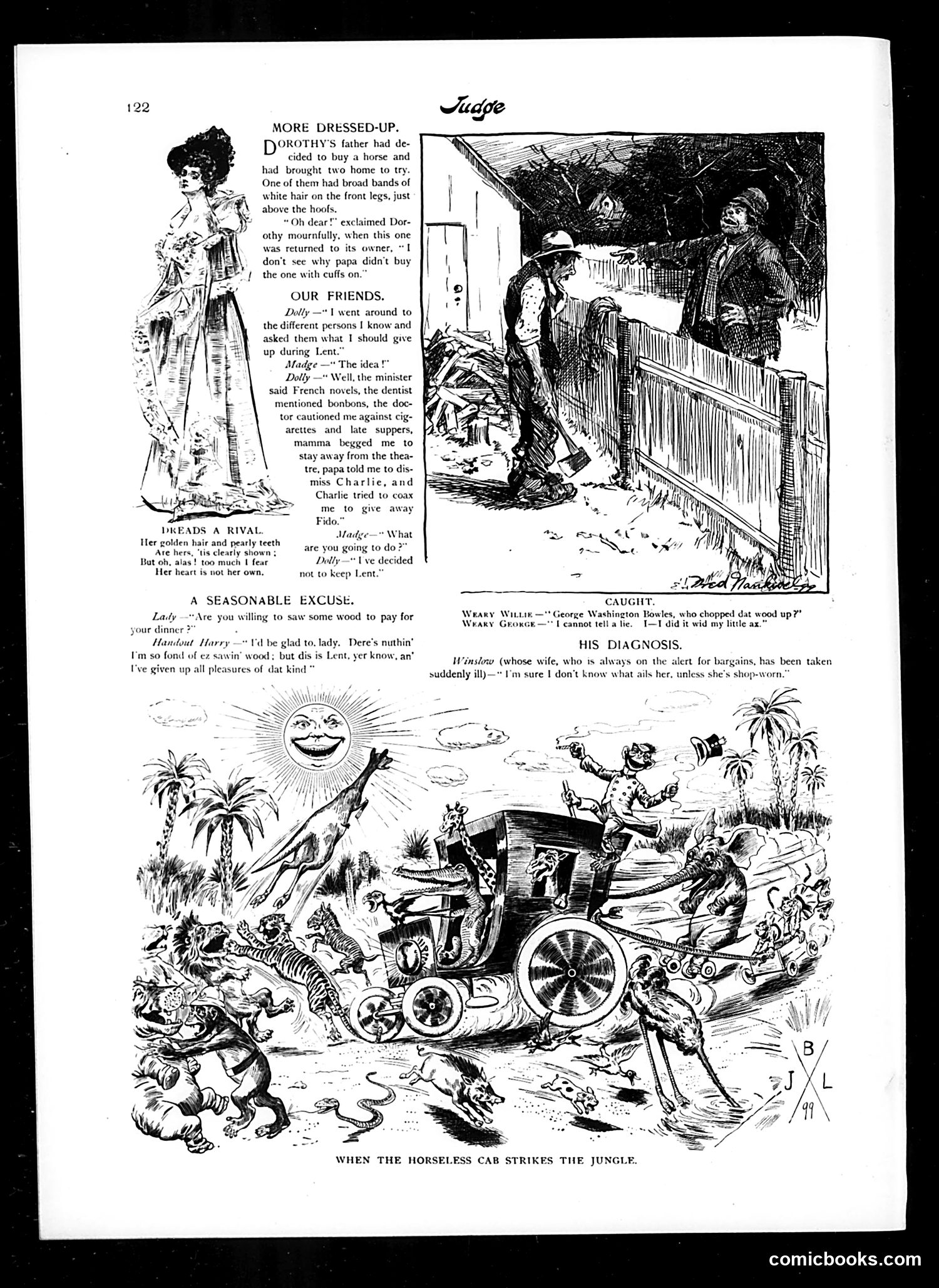
This page contains multiple satirical humor pieces typical of early 20th-century American comedy: **"More Dressed-Up"**: Dorothy wants her father to buy a horse with white markings on its legs because they resemble formal "cuffs"—a joke about overdressing and fashion obsession. **"Our Friends"**: A girl decides to give up nothing for Lent after listing what various authority figures suggested (novels, candy, cigarettes, late suppers, her boyfriend Charlie, and her dog). The humor lies in her rejecting all religious sacrifice. **"A Seasonable Excuse"**: A destitute man ("Handout Harry") refuses work during Lent, using religious observance as a transparent excuse to avoid labor—satirizing both poverty and convenient religiosity. **"His Diagnosis"**: A husband suggests his ill wife is "shop-worn"—a period insult implying she's damaged goods from excessive shopping, mocking both hypochondria and consumerism. **Bottom cartoon**: "When the Horseless Cab Strikes the Jungle" depicts an early automobile invading a fantastical jungle scene, likely satirizing technology's disruptive influence on nature or society.

I can see this is a page from *Judge* magazine, but the image is extremely dark and difficult to read clearly. While I can make out what appears to be a repeating decorative pattern or possibly repeated figures/caricatures throughout the page, I cannot reliably discern: - Specific cartoon content or illustrations - Character identities or political figures - The satirical message or joke - Any legible text beyond the watermark To provide accurate historical context as requested, I would need a clearer, higher-contrast version of this page. Without being able to read the details confidently, I cannot responsibly identify the figures, references, or satire involved.

I can see this is a nearly entirely black page from Judge magazine with minimal visible content except for the "comicbooks.com" watermark at the bottom right and what appears to be binding marks or page edges on the right side. The image quality and darkness make it impossible to discern any cartoon artwork, text, political figures, or satirical content that would typically appear on a Judge magazine page. Without legible text or visible illustrations, I cannot identify what this page's satirical point, referenced events, or caricatured figures might be. This appears to be either a damaged scan, a blank page, or an image with severely compromised contrast that prevents meaningful analysis of its historical or satirical content.
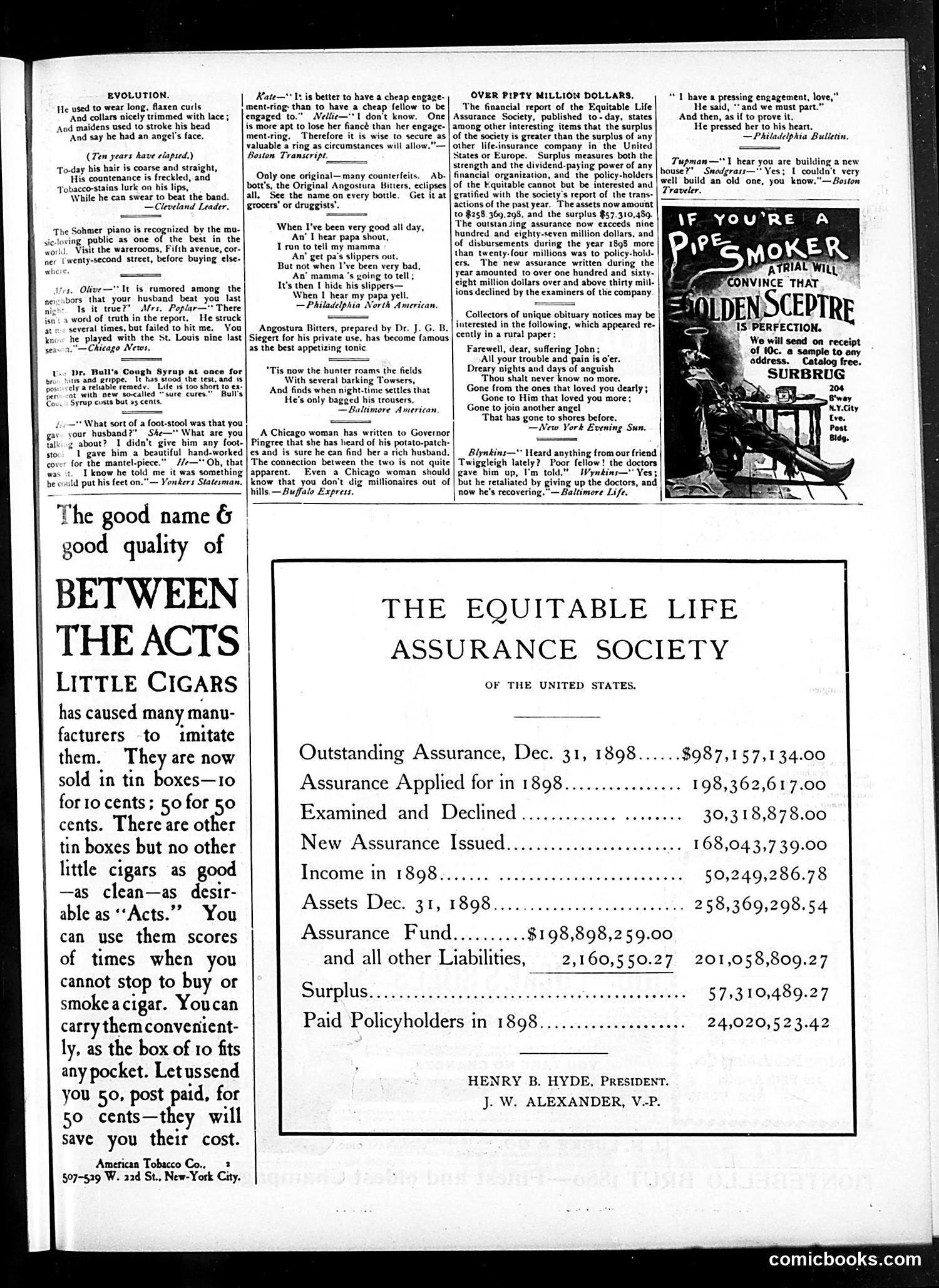
This page from Judge (circa 1898) contains several satirical pieces: **"Evolution"** (top left): A poem mocking the transformation of an angelic-looking boy into a crude man—with coarse hair, freckled face, tobacco-stained lips, and profanity. The satire targets how "civilizing" influences (or lack thereof) corrupt innocence into working-class vulgarity. **The cartoons and jokes** scattered throughout mock everyday life: a wife hiding her husband's slippers when he's angry; children's logic about misbehavior; a hunter's mishap. **The main content** is advertising and financial reporting—particularly The Equitable Life Assurance Society's annual statement showing over $50 million in assets (substantial for 1898). Between the Acts cigars are promoted as a convenient alternative to full cigars. The page is primarily **commercial/financial** rather than political satire. The humor targets social manners and gender dynamics of the era rather than specific political figures or events. Modern readers would mainly notice the quaint, moralistic tone about childhood innocence and the casual domestic violence jokes (now shocking).
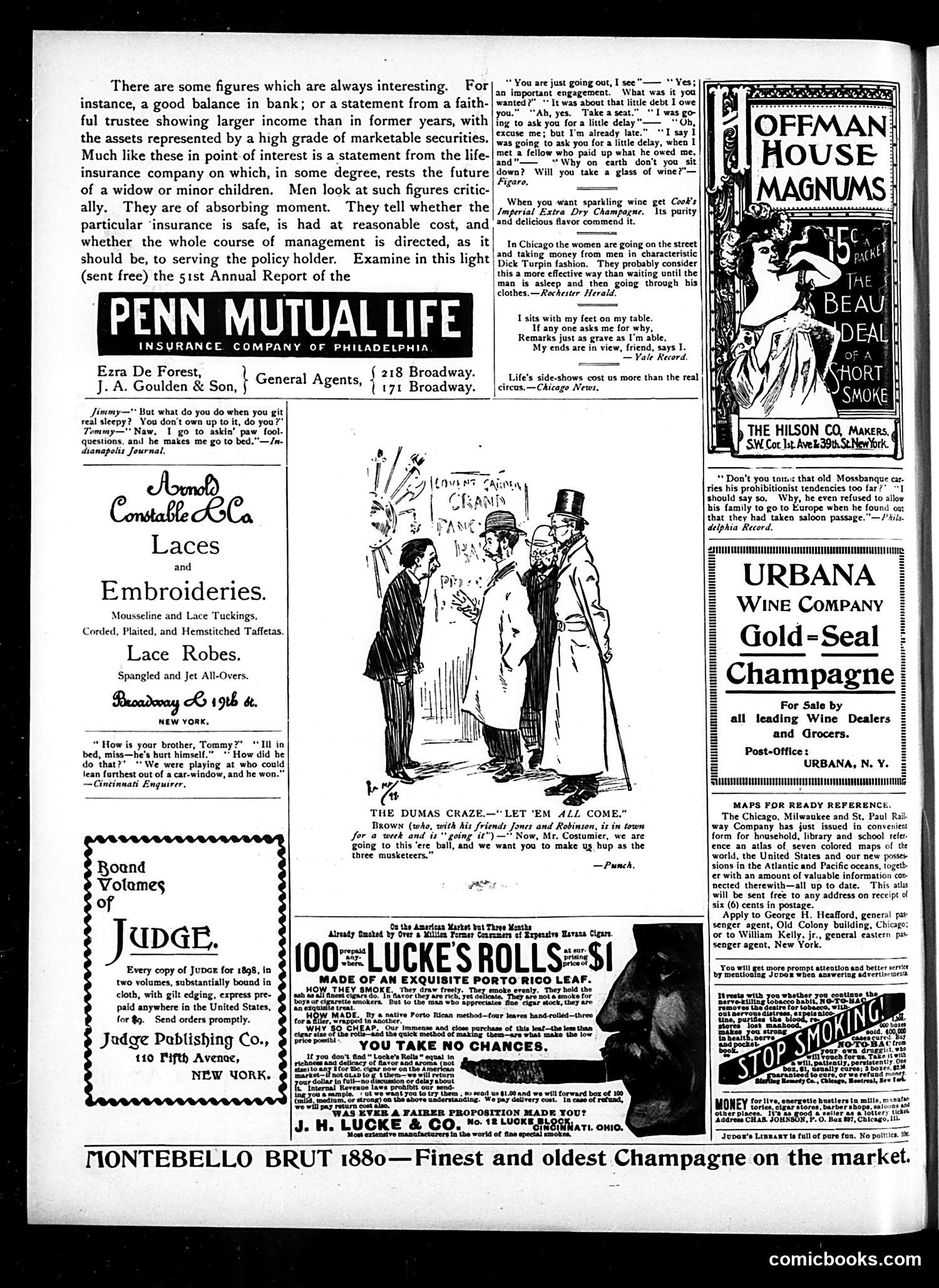
This page is primarily **advertising**, with one central cartoon titled "The Dumas Craze." **The Main Cartoon:** Three men in period costume approach a costumier, claiming to be "Brown...Jones and Robinson" planning to attend a ball as "the three musketeers" (referencing Dumas's famous novel). The joke plays on the 1890s craze for Dumas adaptations—the men are ordinary contemporary Chicagoans attempting to costume themselves as literary heroes. The satire mocks both the theatrical fashion of the era and ordinary people's desire to perform romanticism. **Other Content:** The page includes small humorous anecdotes (about sleepy children, dangerous games, and Chicago women robbing men), mixed with advertisements for insurance, champagne, laces, Judge volumes, and cigars. The "Dumas Craze" reference suggests Dumas's works were experiencing renewed popularity in the 1890s, likely through theatrical productions and adaptations.
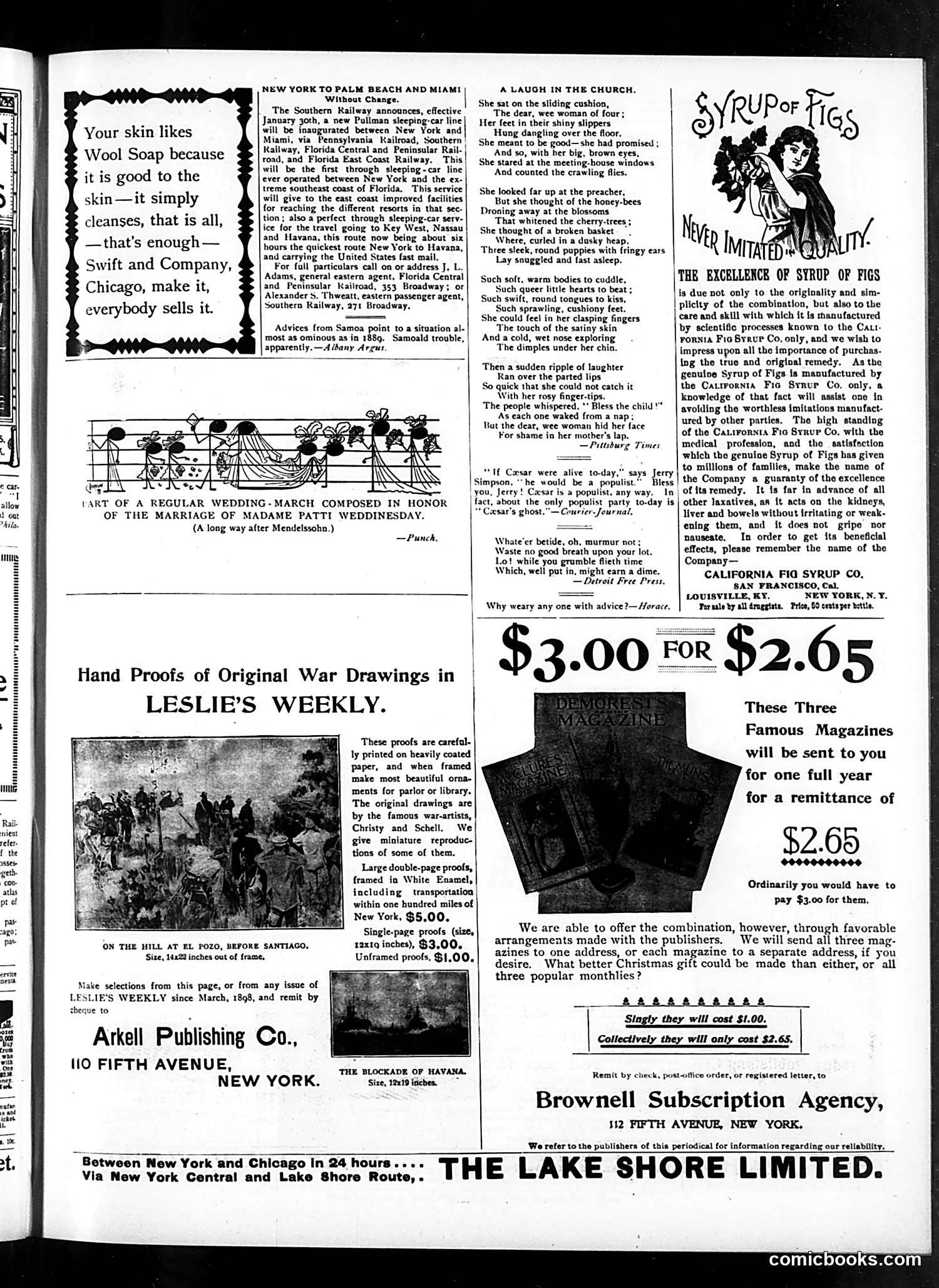
This page is primarily **advertising and miscellaneous content** rather than coherent satire. The notable cartoon appears to be "Part of a Regular Wedding March" (credited to Punch), depicting a wedding procession with exaggerated figures—likely satirizing pretentious wedding ceremonies, though the specific target is unclear from the image alone. The text humor includes a joke about **Jerry Simpson** (a Populist politician of the 1890s), claiming Caesar would be a Populist if alive today—mocking the Populist Party's radical positions. There's also gentle humor about a bored child in church, daydreaming about puppies rather than listening to sermons—a relatable domestic scene. The remainder consists of product advertisements (Wool Soap, California Fig Syrup, magazine subscriptions) and travel notices for new railroad service to Florida. Overall, this is a typical Judge page mixing light verse, political jabs at contemporary figures, and commercial messaging rather than sustained editorial cartooning.
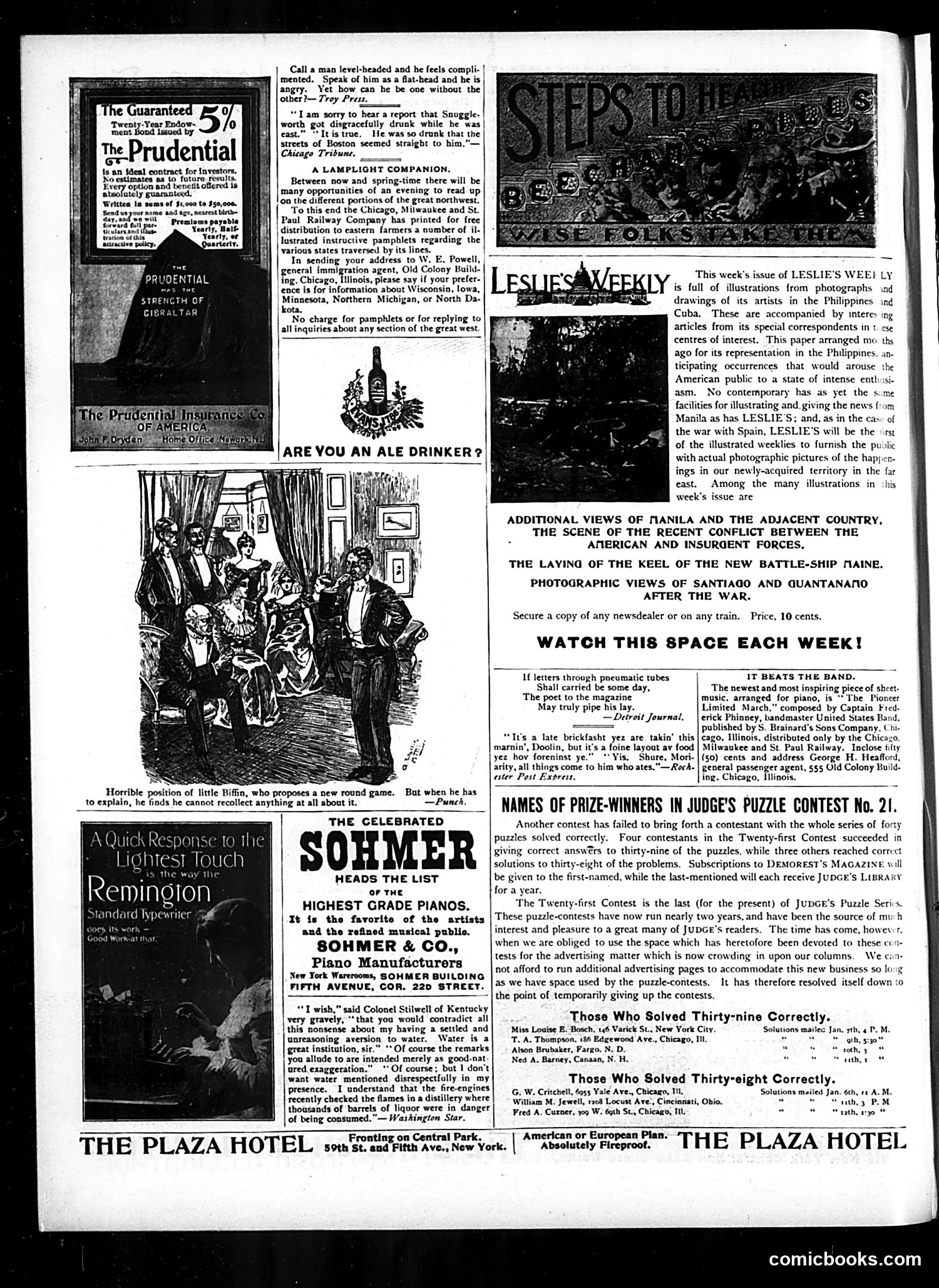
This Judge magazine page contains several brief satirical pieces and advertisements from the Spanish-American War era (circa 1898-1899). **Key satirical content:** The "levelheaded/flat-headed" joke mocks logical inconsistency in how we praise or insult people using contradictory terms. A second joke ridicules drunkenness: a man gets so intoxicated in Boston that the city's streets appear straight to him—absurd because Boston's streets are famously crooked. The satire targets both excessive drinking and the drinker's distorted perception. A third piece features "Colonel Stilwell of Kentucky," apparently a caricature of a Kentucky politician or public figure known for avoiding water/alcohol. The humor derives from his indignant denial of this reputation while inadvertently praising whiskey by referencing a distillery fire—revealing his actual priorities. The remainder consists of advertisements (Prudential Insurance, Sohmer pianos, Plaza Hotel) and Leslie's Weekly promoting coverage of the Philippines conflict and the new USS Maine battleship—reflecting contemporary American imperial expansion.
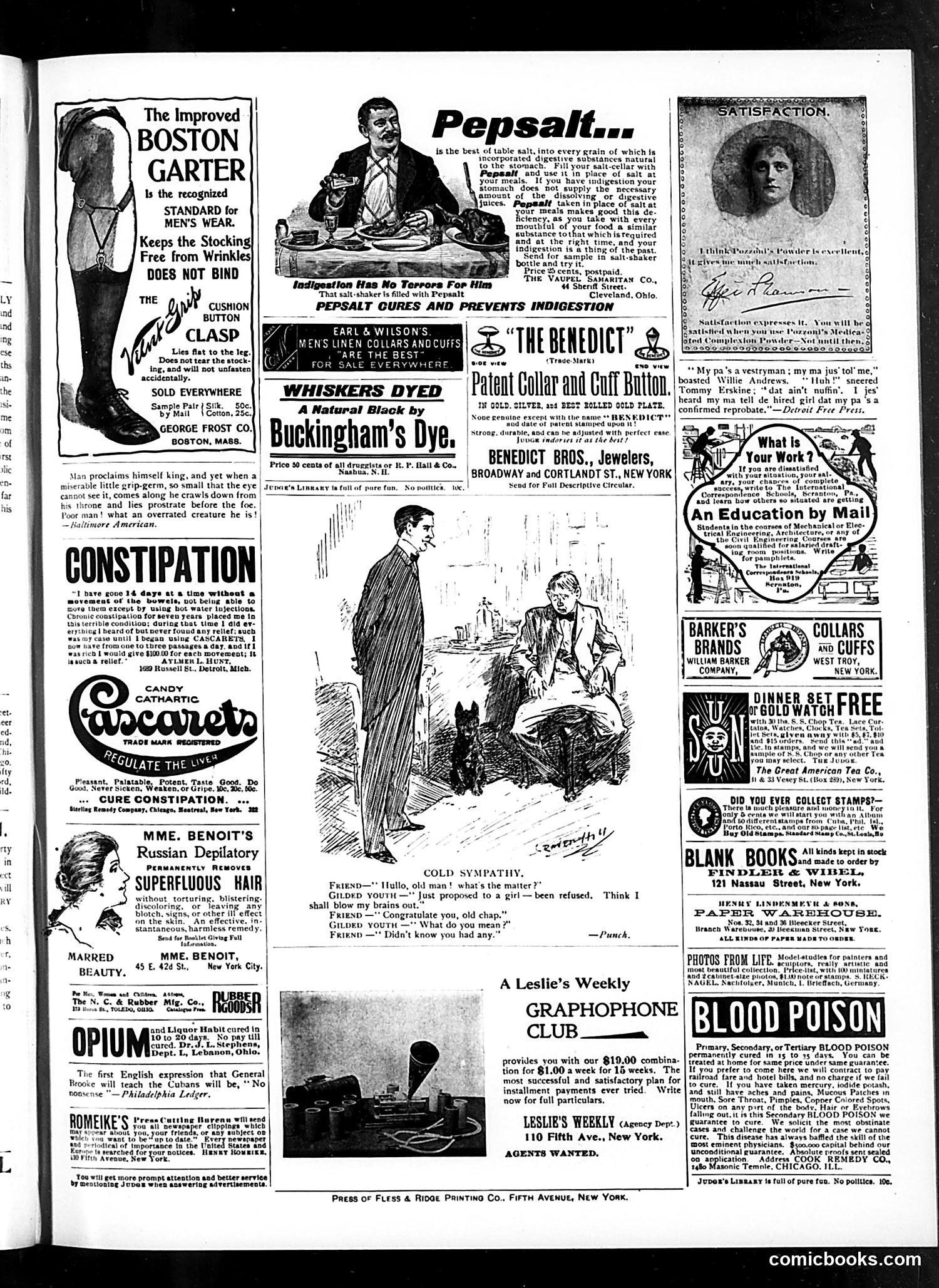
This page is primarily **advertisements** interspersed with one small cartoon titled "Cold Sympathy." **The Main Cartoon:** The sketch depicts two men discussing a romantic rejection. The rejected suitor threatens suicide; his friend congratulates him "on not having any brains" to blow out—a cruel joke suggesting the man lacked intelligence to propose in the first place. **Historical Context:** The ads reveal period obsessions: patent medicines (Pepsalt for "indigestion," Cascarets for constipation), hair removal (Mme. Benoit's depilatory), and male grooming (Boston Garters, collars). These advertisements suggest widespread anxiety about digestive health and appearance. One ad references "General Brooke" teaching Cubans English—likely alluding to early 1900s American military presence in Cuba post-Spanish-American War, though the exact reference remains unclear without dating. The overall page reflects **early 20th-century consumer culture** and mild satire rather than serious political commentary.
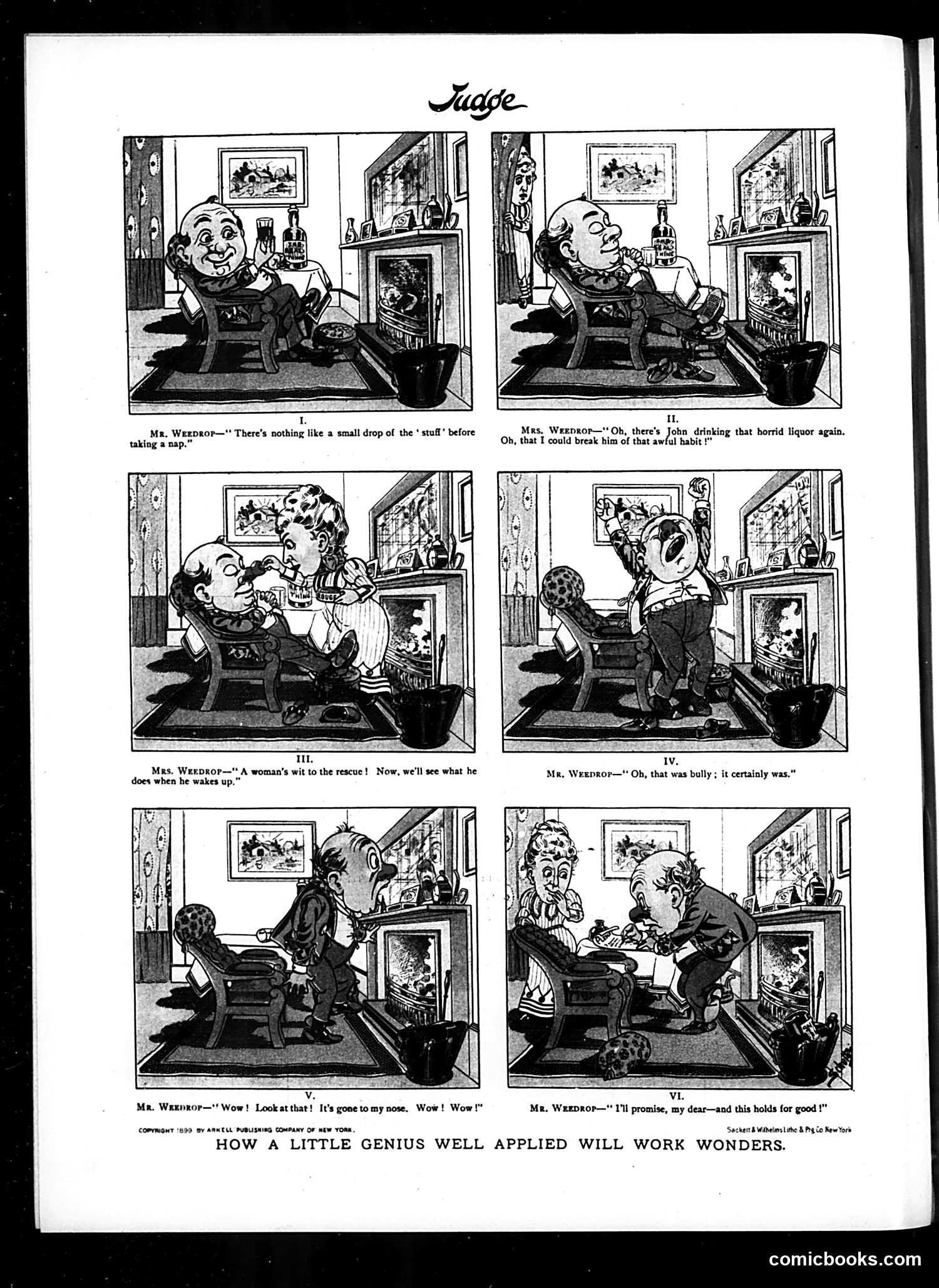
This six-panel comic depicts Mr. Weeprop's alcoholism and his wife's intervention. The husband drinks liquor to aid his nap; his wife, observing his "awful habit," devises a scheme. While he sleeps, she apparently applies something (likely a strong-smelling substance) to his face—possibly mustard or similar irritant. He wakes violently sneezing ("Wow!"), and his wife uses this moment to extract a promise: he'll quit drinking permanently. The satire targets both alcohol addiction and domestic remedy-culture. The joke rests on the wife's "genius"—using physical discomfort as shock therapy to cure his vice. By the 1890s-1900s (Judge's era), such temperance themes were common, though the comic's tone is lighthearted rather than preachy. It reflects period attitudes that women's "wit" could reform men's moral failings through cunning rather than argument.