
A complete issue · 17 pages · 1898
Judge — December 31, 1898
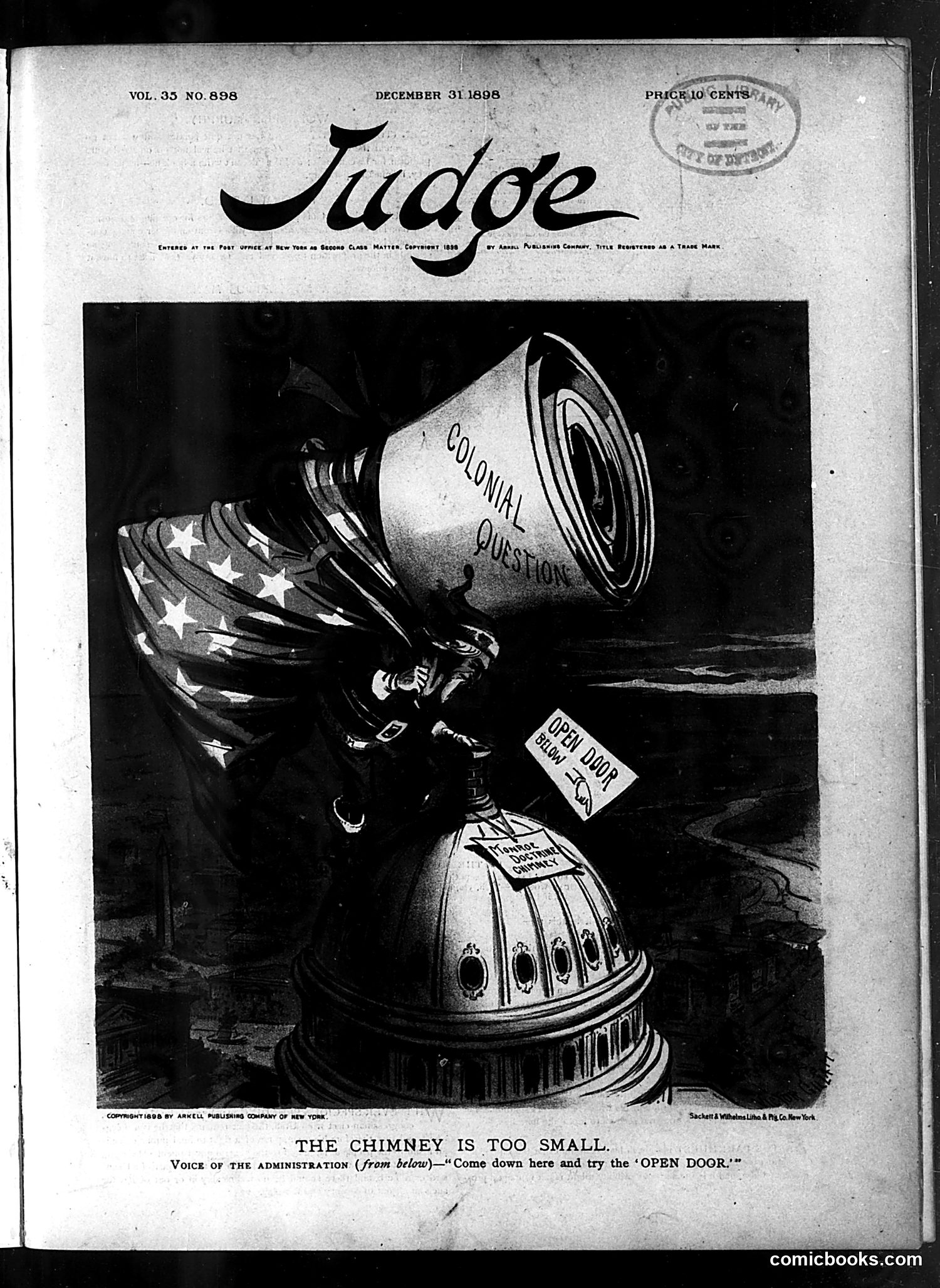
This December 31, 1898 Judge cartoon satirizes American reluctance to address "colonial questions"—likely referring to debates over U.S. imperial expansion following the Spanish-American War. The central image shows an American eagle (representing the nation) wearing the American flag, perched atop a dome labeled "OPEN DOOR" with a megaphone labeled "COLONIAL QUESTIONS" above it. The caption "THE CHIMNEY IS TOO SMALL" quotes "the Administration" saying "Come down here and try the 'open door.'" The satire suggests the U.S. government is avoiding difficult discussions about America's new colonial territories and imperial ambitions—treating serious policy matters as something too large to address through normal channels. The chimney/door metaphor implies these questions cannot be ignored indefinitely.
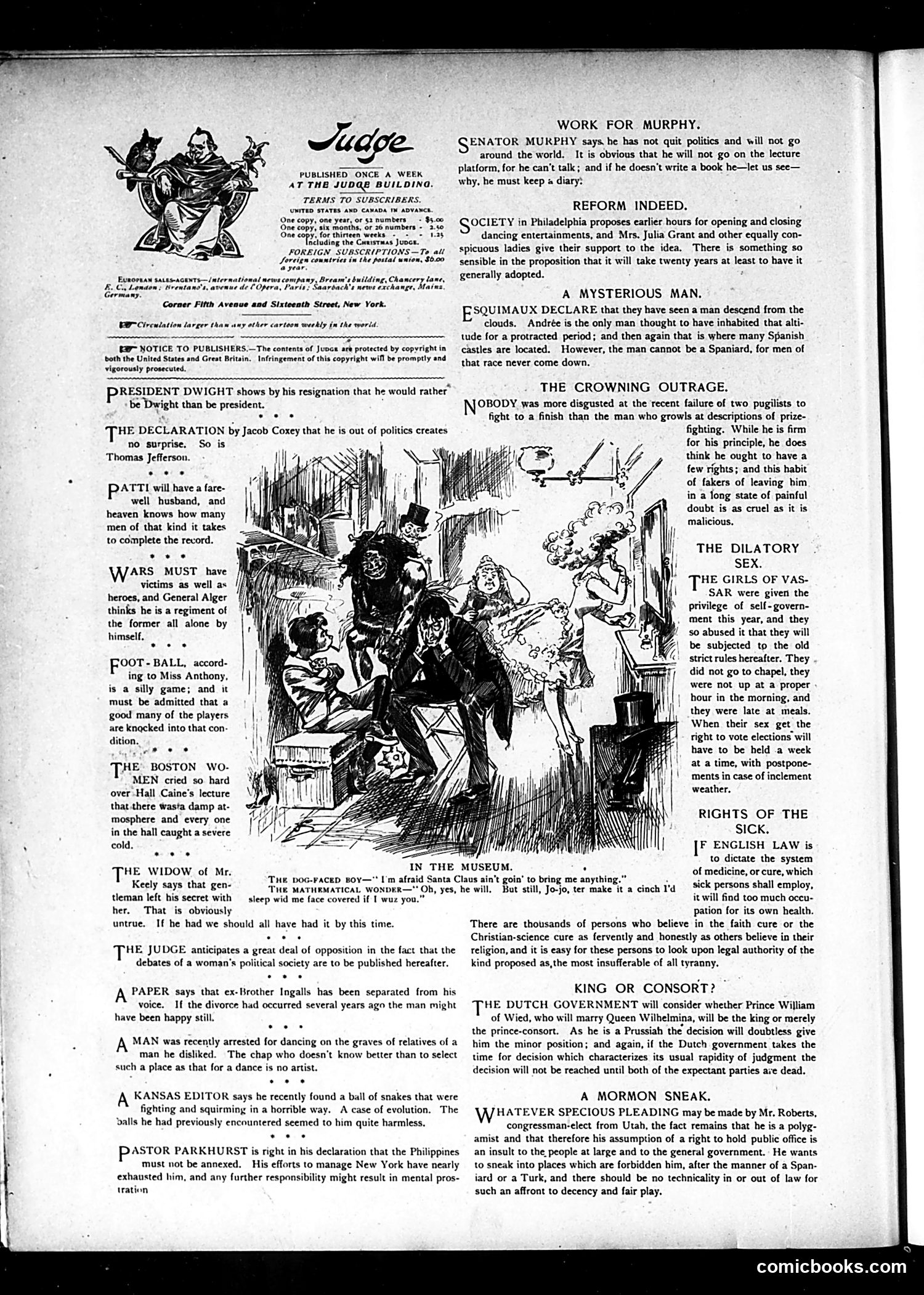
The central cartoon depicts Santa Claus appearing distressed or angry, surrounded by various figures in what appears to be a chaotic domestic scene. The caption reads: "I'm afraid Santa Claus ain't goin' bring me anything" and references a child's sleepy face covered in "fur you." The satire likely mocks **failed Christmas expectations** and possibly critiques **broken promises or corrupt practices** of the era. The surrounding text columns discuss various political and social issues including women's suffrage ("The Dilatory Sex"), English law regarding medical authority, and Dutch governance. Without clearer date markers or additional context, the specific political figures or events remain unclear, though the overall tone suggests **early 20th-century American satirical commentary** on government dysfunction and social reform debates.
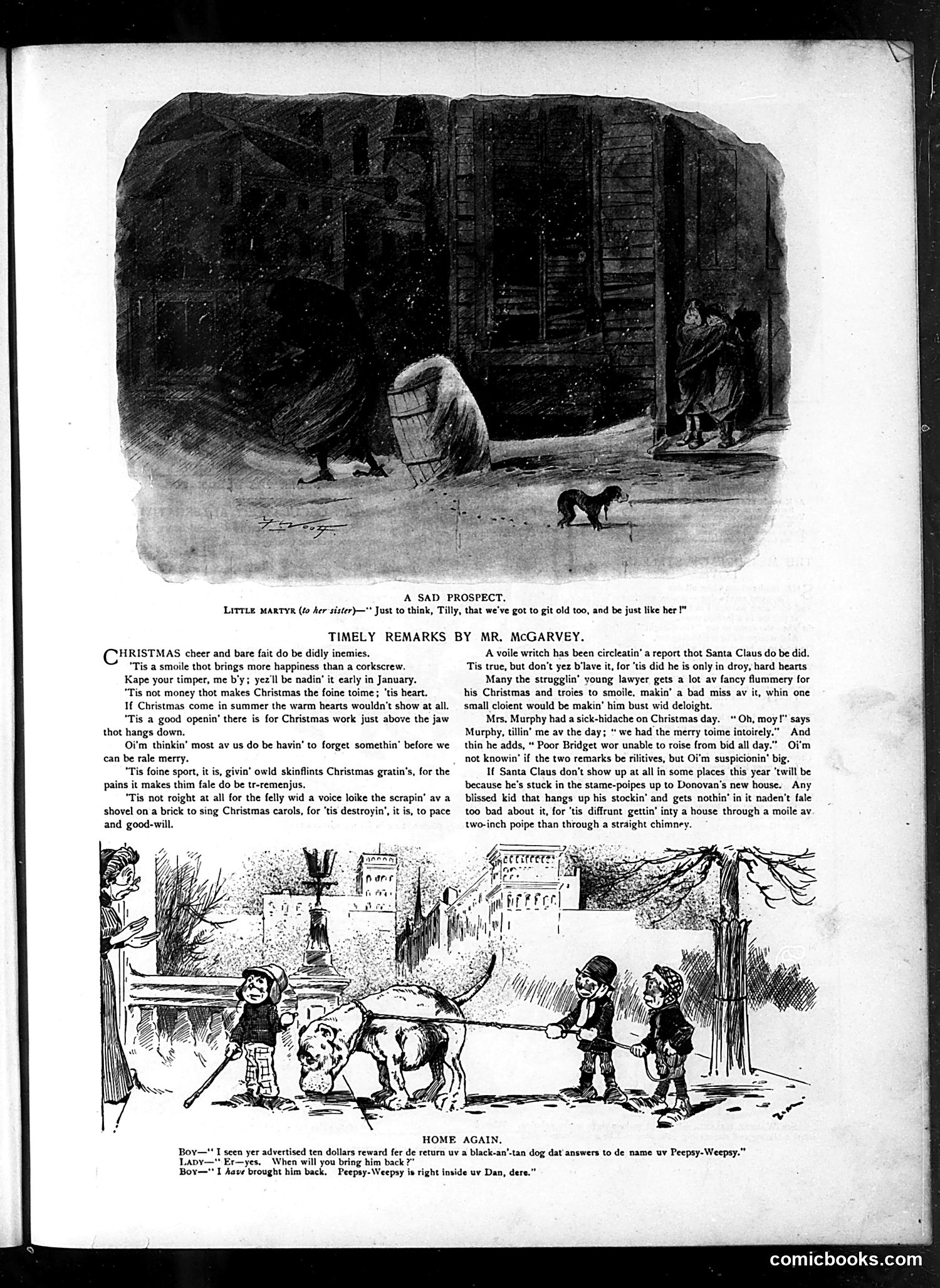
**Top Cartoon:** Depicts urban poverty at Christmas—a woman with a barrel (likely homeless) and child begging while a dog scavenges. The caption references "Little Martyrs" saying they must "go beg too," satirizing the contrast between Christmas cheer and actual poverty. **Mr. McGarvey's Commentary:** A lengthy piece about Christmas hypocrisy. It mocks the gap between holiday sentiment and reality—Christmas should come in summer when hardship is less visible; it critiques lawyers who neglect clients before holidays, and references Santa Claus myths. The tone suggests cynicism about society's failure to address winter poverty. **Bottom Cartoon:** Children with a makeshift sled being pulled by a dog, captioned "Home Again," with a joking reference to advertising for a lost dog's reward. Overall, the page juxtaposes Christmas sentimentality against urban social hardship.
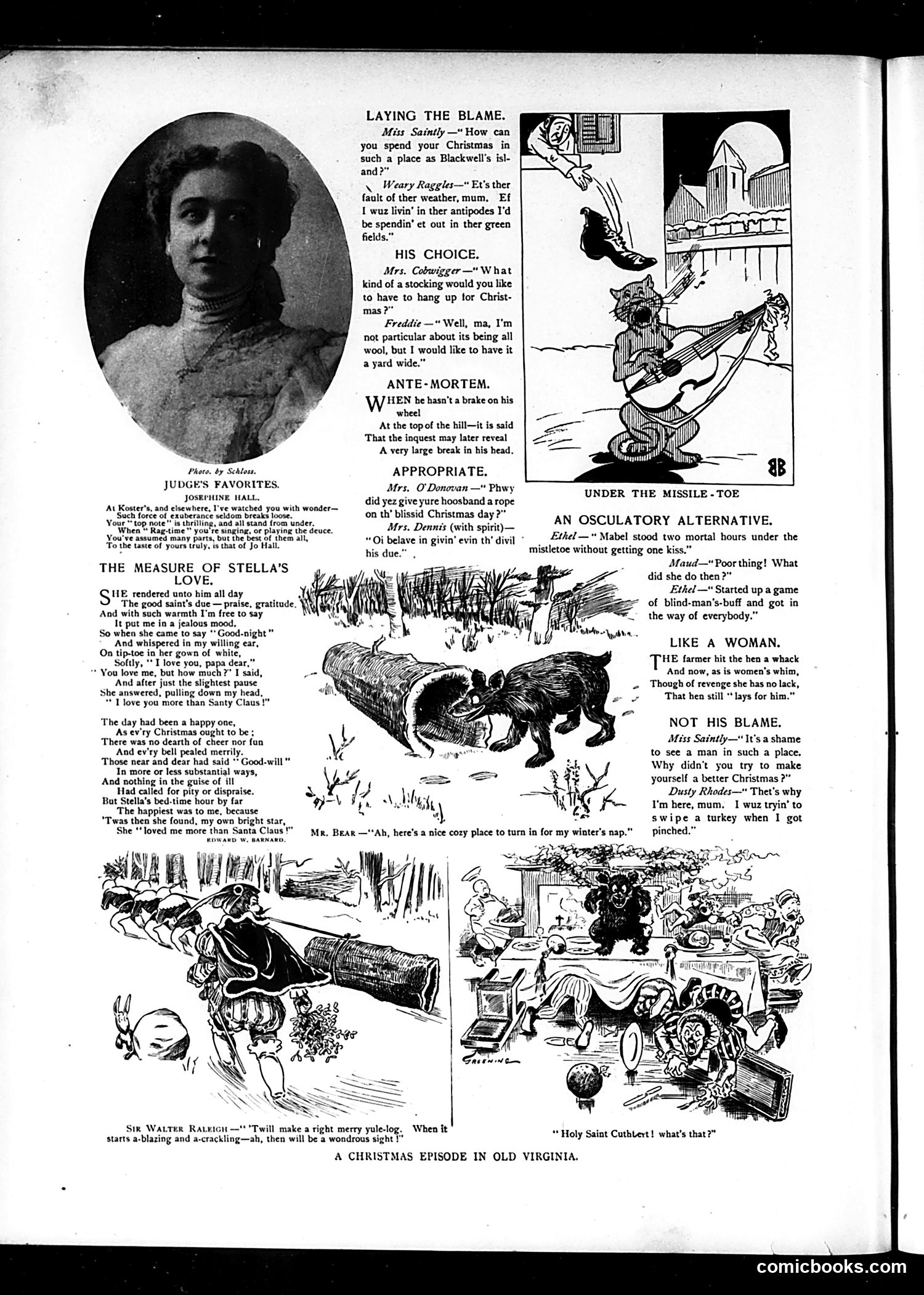
This page contains several humorous dialogues and illustrations about Christmas traditions and domestic life, circa early 1900s. "Judge's Favorites" features witty exchanges about holiday customs. "The Measure of Stella's" tells of a woman's romantic fickleness toward a suitor named Santy Claus. The cartoons satirize Victorian-era gender relations and class attitudes. "Under the Missile-Toe" jokes about kissing under mistletoe. "Like a Woman" mocks female revenge. "Not His Blame" presents a domestic squabble where a husband claims he "tried to wipe a turkey when I got pinched." The final cartoon "A Christmas Episode in Old Virginia" (bottom) appears to reference Sir Walter Raleigh and depicts colonial American Christmas chaos. The satire targets conventional social expectations and marital dynamics of the period.
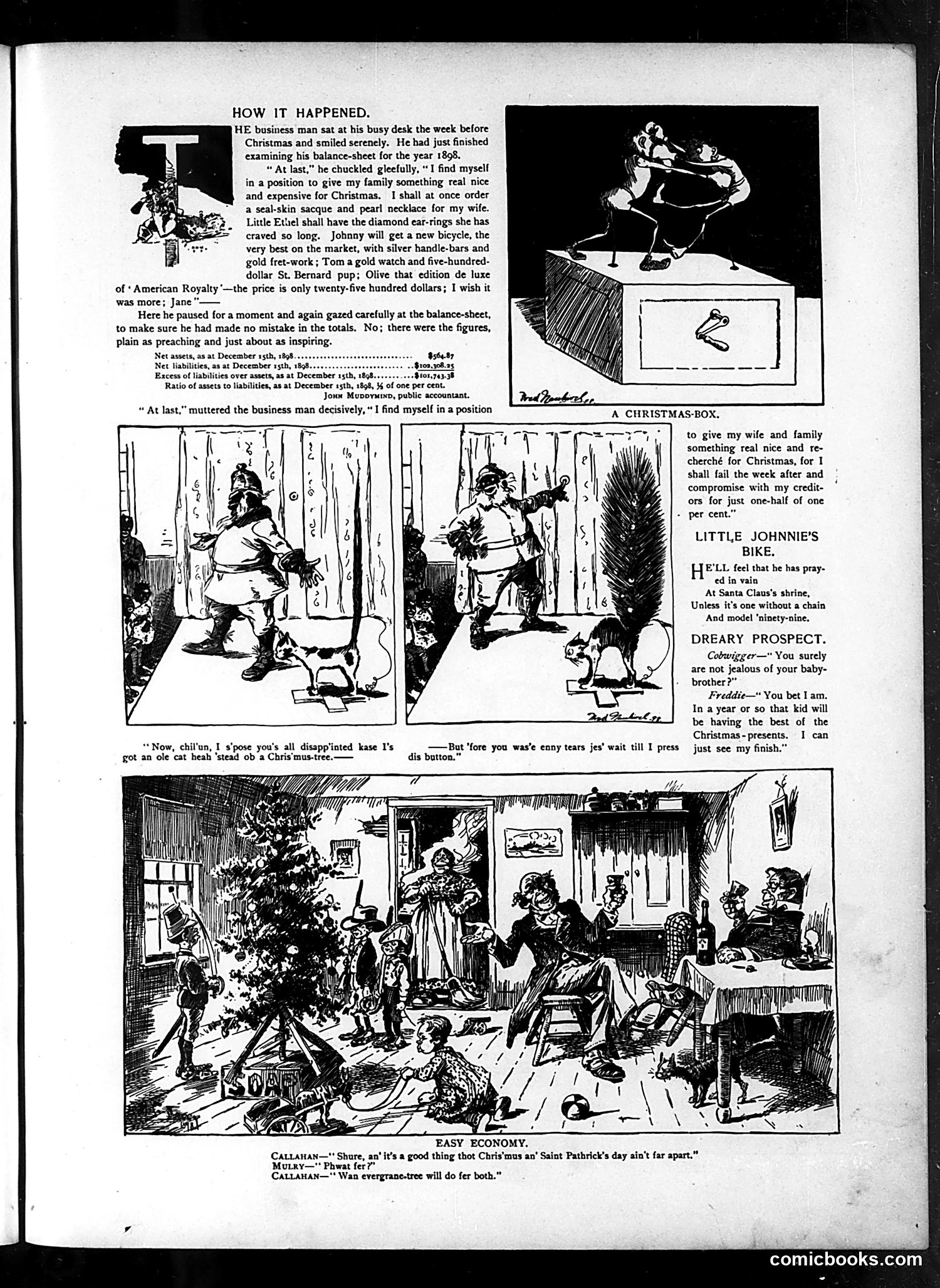
This page satirizes the gap between appearance and financial reality during the 1898 economic climate. The central cartoon depicts a businessman who, after reviewing his balance sheet, plans lavish Christmas gifts (seal-skin jacket, diamonds, bicycles, gold watches, expensive books). However, the accountant's detailed figures reveal a devastating truth: he has only $564.87 in assets against $109,308.25 in liabilities—essentially insolvent. The joke's dark humor lies in his cheerful declaration that he can now afford extravagance, when in fact he'll declare bankruptcy "the week after" Christmas, settling debts at mere pennies on the dollar. The surrounding items mock similar financial delusions and working-class Christmas struggles, including comic bits about children's bicycle expectations and an Irishman's economical solution of using one evergreen tree for both Christmas and St. Patrick's Day. The satire reflects genuine 1898 economic anxiety and the precarious financial situations many faced.
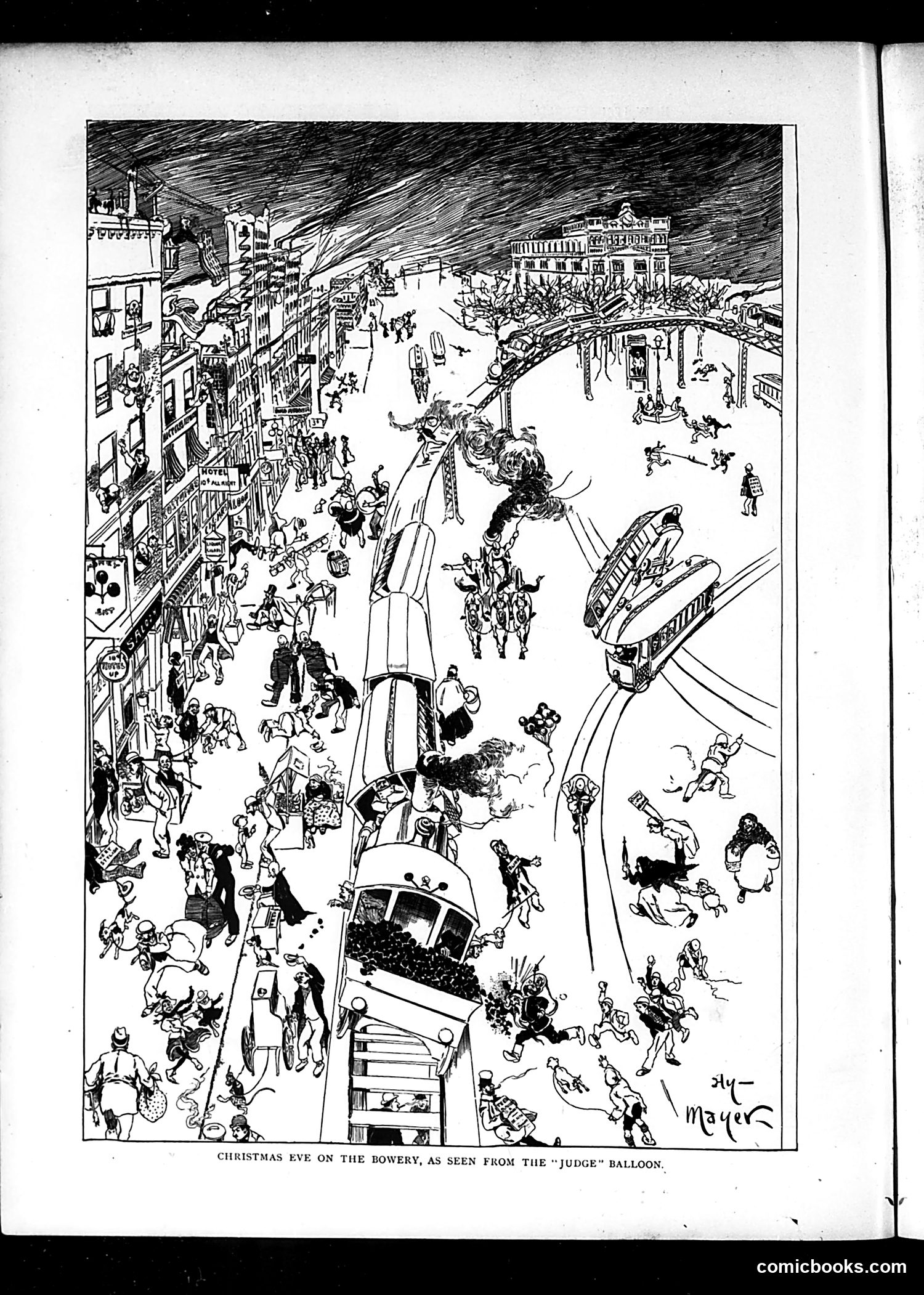
This is an aerial-perspective illustration satirizing Christmas celebrations on the Bowery, New York's notorious lower-class neighborhood. The bird's-eye view reveals the chaotic street life: crowds, vehicles, storefronts, and what appears to be holiday festivities juxtaposed with urban disorder. The satire likely critiques the contrast between idealized Christmas sentimentality and gritty urban reality. The "Judge" balloon vantage point suggests the magazine's mocking, detached perspective on working-class holiday traditions. The dense, frantic scene emphasizes overcrowding and social disorder in this immigrant and poor neighborhood, which was a common subject of Judge magazine's social commentary during the late 19th/early 20th century.
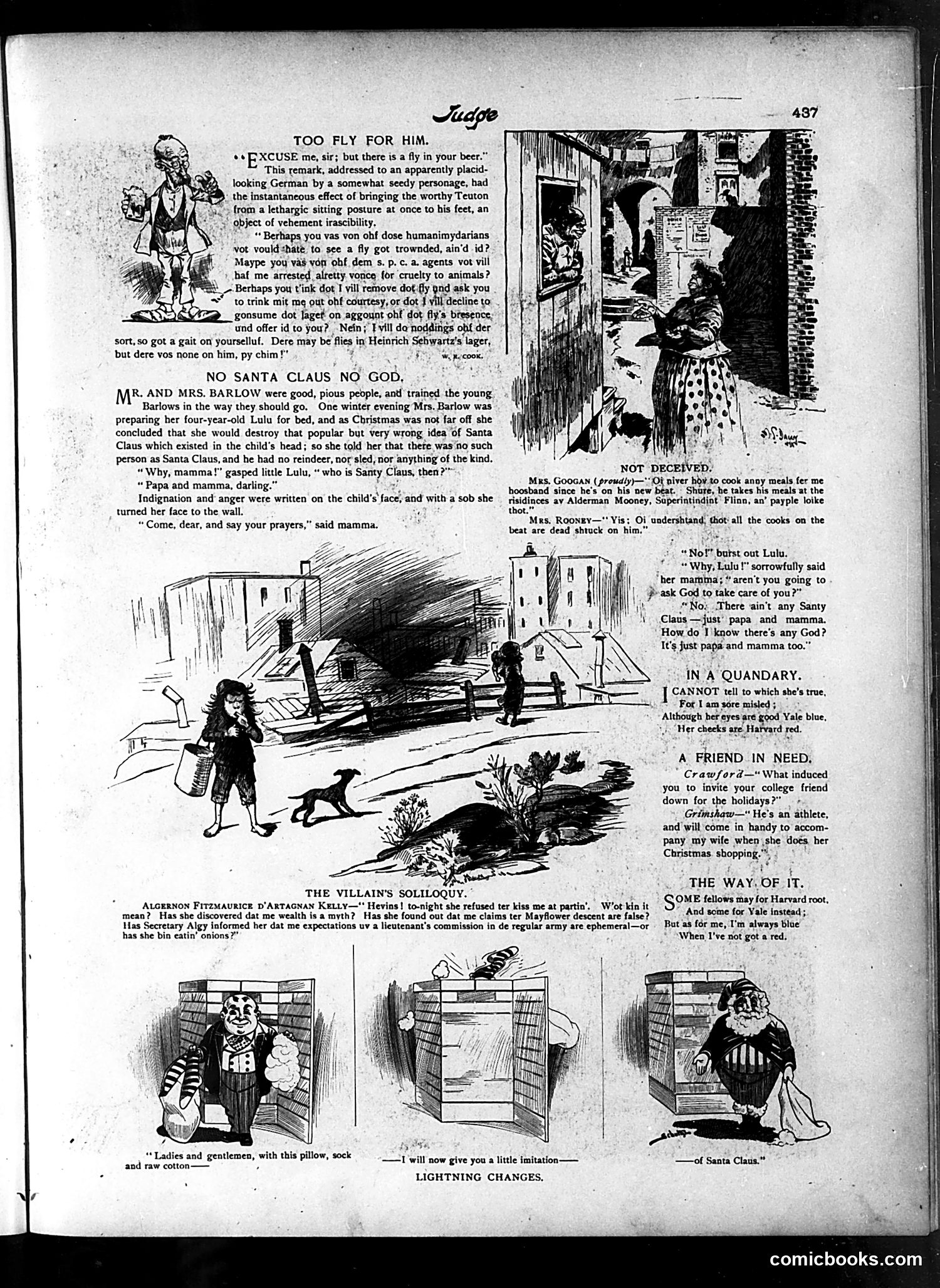
This page contains several satirical pieces mocking contemporary social types and pretensions: **"Too Fly for Him"** ridicules a German immigrant's exaggerated accent and defensive pride. When a polite stranger mentions a fly in his beer, the German launches into an indignant tirade, suspicious the stranger is a "humanitarian" or SPCA (animal welfare) agent intent on arresting him. The satire targets both ethnic caricature and the emerging animal-welfare movement, presenting the German as absurdly hostile to any suggestion of refinement or concern for creatures. **"No Santa Claus No God"** satirizes overzealous religious parents who destroy children's innocent beliefs in Santa Claus by explaining he's fictional—only to face the logical consequence when their daughter concludes God must be equally invented ("just papa and mamma too"). The satire mocks parental rigidity and unintended atheism. The remaining brief pieces mock college social climbing, martial infidelity, and theatrical performers—typical Judge fare targeting middle-class pretension and hypocrisy of the period.
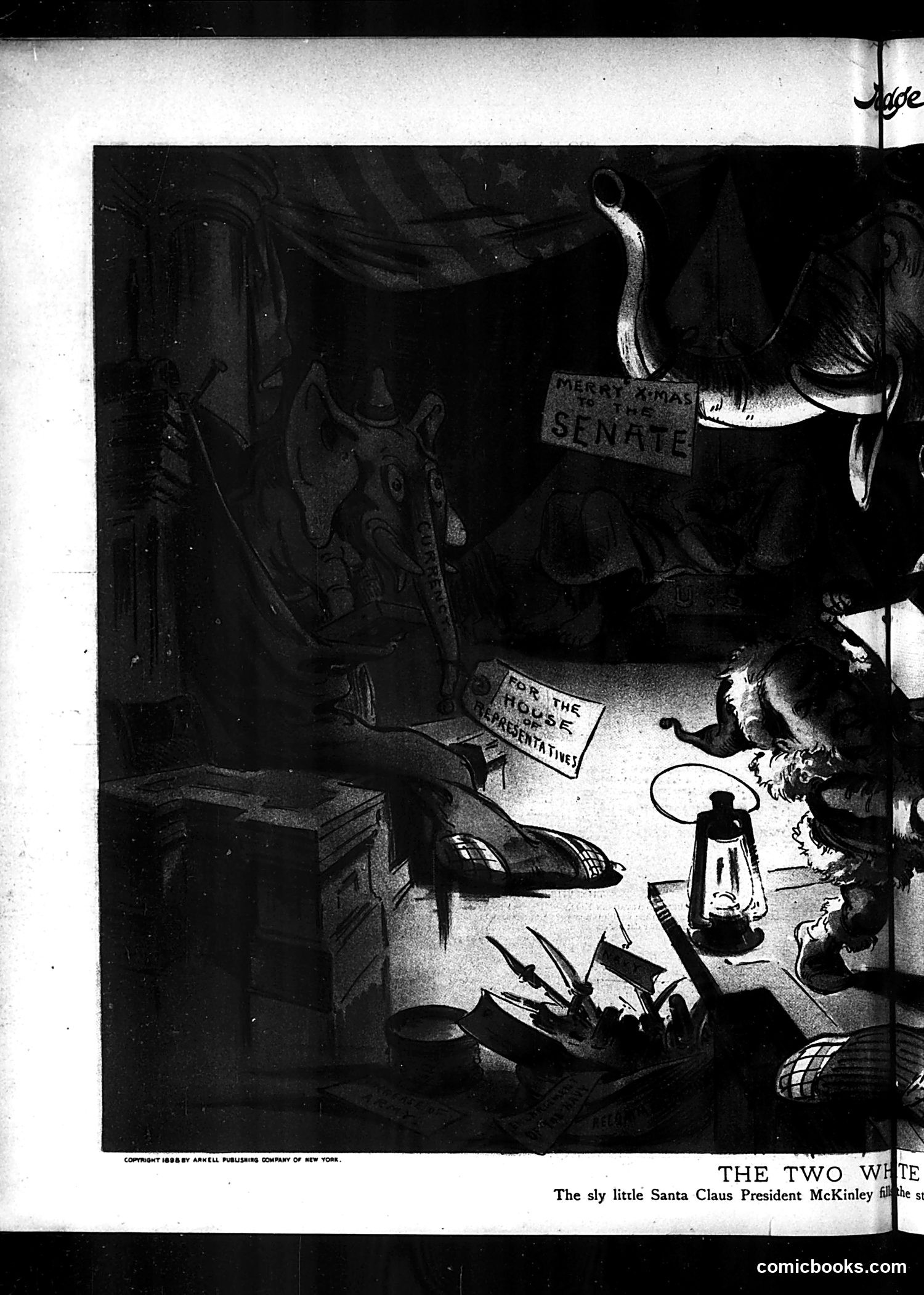
This 1898 *Judge* cartoon satirizes President McKinley as a deceptive "Santa Claus" figure. The cartoon depicts animals and figures in what appears to be a dark scene with labels including "SENATE" and "FOR THE PEOPLE'S REPRESENTATIVES." The satire suggests McKinley presents himself benevolently to the public (like Santa) while operating differently behind closed doors—a common critique of politicians who claim populist intent while serving other interests. The "sly little Santa Claus President" phrase indicates he's being portrayed as cunningly duplicitous. The precise historical reference (likely relating to 1898 political events, possibly the Spanish-American War or tariff debates) is unclear from the visible text alone, but the cartoon attacks McKinley's public persona versus his actual policies.
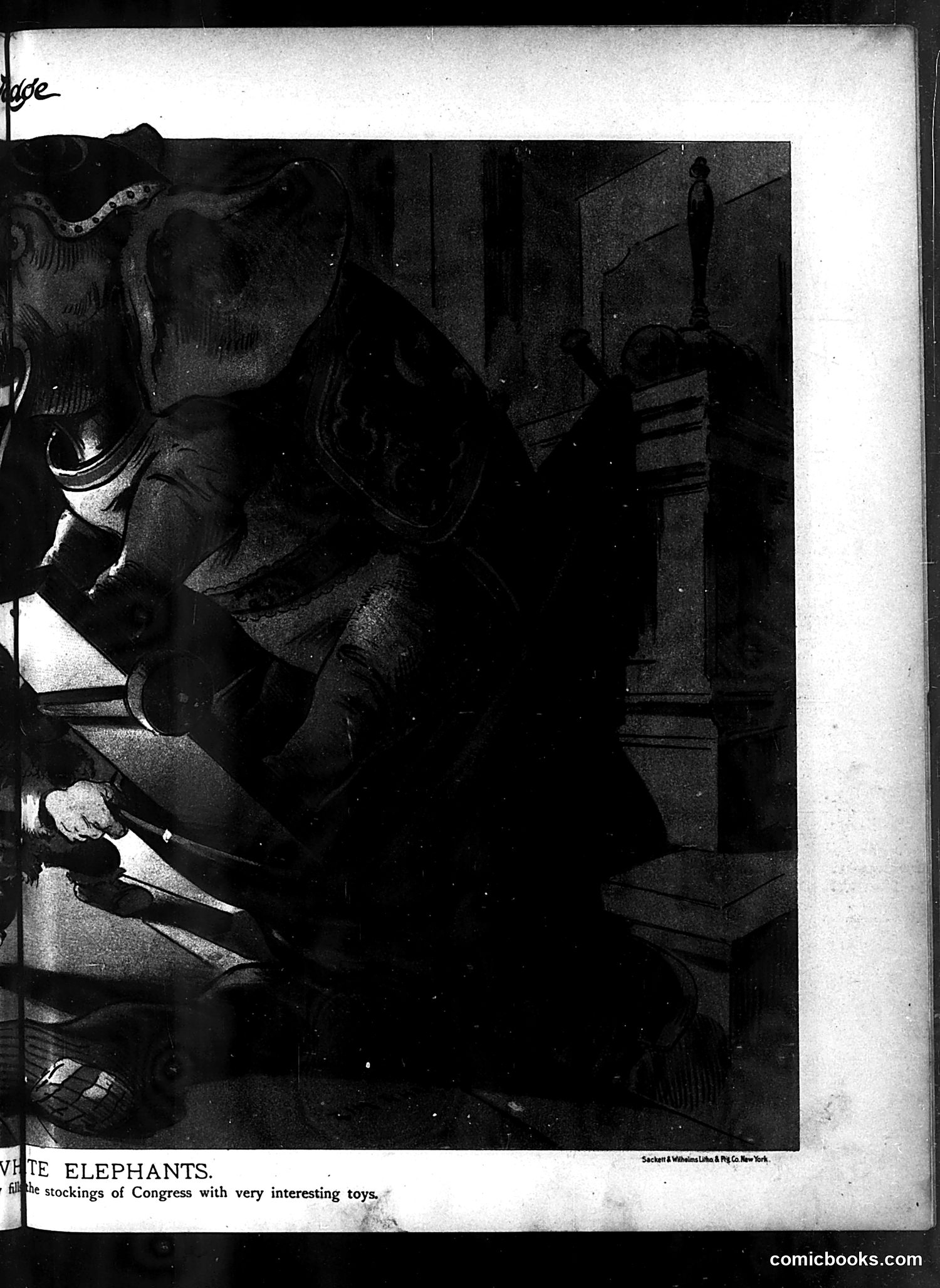
This political cartoon, titled "White Elephants," satirizes Congress as a source of wasteful spending. The image depicts elephant figures (a symbol traditionally associated with the Republican Party) alongside what appears to be a figure in formal dress, likely representing a congressman or political figure. The caption references "stockings of Congress with very interesting toys," suggesting that Congress distributes government funds—characterized as frivolous "toys"—like gifts from Christmas stockings, implying wasteful appropriation of public money. The "white elephant" metaphor refers to expensive, burdensome possessions of little practical value, critiquing legislative spending practices as extravagant and poorly justified expenditures that burden taxpayers.
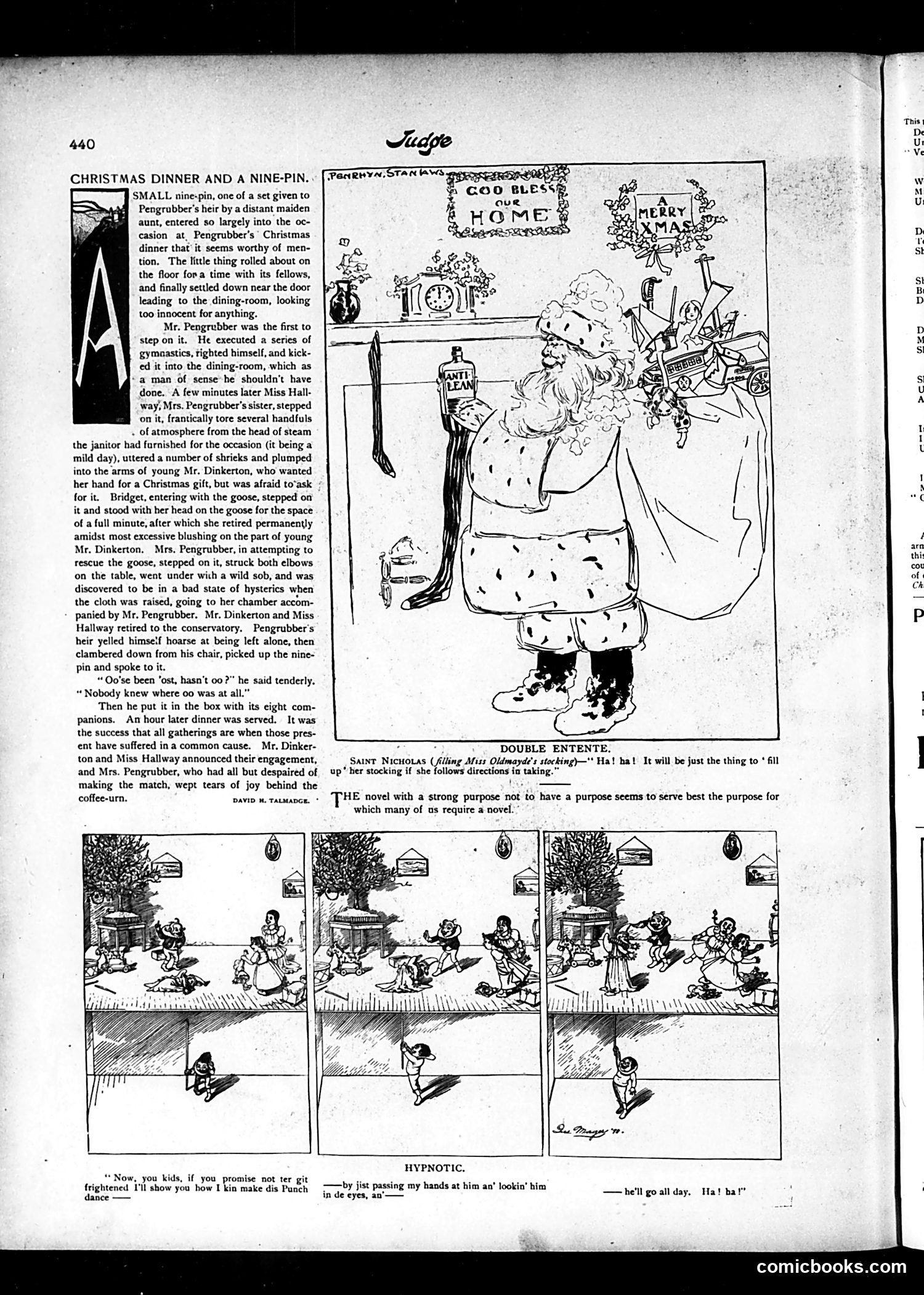
This page contains two distinct pieces of Victorian-era humor: **"Christmas Dinner and a Nine-Pin"** is a domestic comedy story where a child's bowling pin becomes an accidental instrument of chaos at a Christmas dinner party. Each guest who steps on it experiences increasingly dramatic mishaps—Mr. Pengrubber executes gymnastics, Miss Hallway shrieks and falls into a young man's arms, a servant loses her composure. The satire targets Victorian social pretension: the dinner becomes "successful" precisely because the shared embarrassment bonds the guests, and a marriage proposal results from the chaos. The humor mocks how easily proper society unravels and how misfortune paradoxically strengthens social connections. **"Double Entente"** makes a mild sexual joke about filling a woman's stocking, playing on double meaning. **"Hypnotic"** depicts someone claiming to hypnotize, a popular entertainment of the era. The overall tone is gentle, slapstick domestic humor typical of early 20th-century American magazines aimed at middle-class readers.
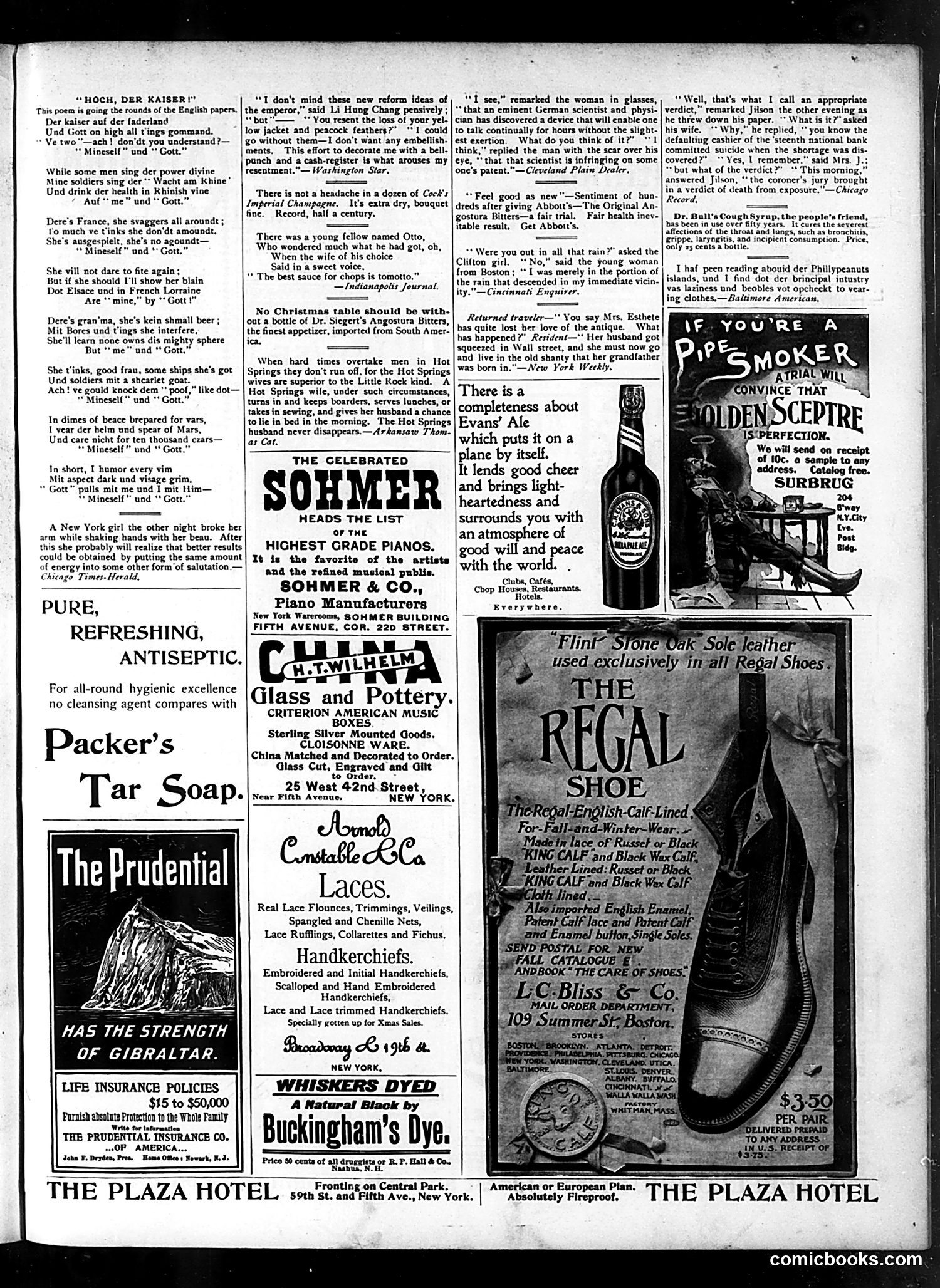
This page features a satirical poem mocking German Emperor Wilhelm II's imperial arrogance during the pre-World War I era. Written in exaggerated German-accented English, the poem ridicules the Kaiser's grandiose self-regard through the repeated refrain "Mineself" und "Gott" (myself and God), suggesting he considers himself divine or godlike. The satire targets Wilhelm's: - Military swagger and nationalist pride - Contempt for rival powers (France, Britain) - Territorial ambitions (Alsace-Lorraine) - Militaristic preparation for war The poem appeared in English publications, indicating American and British anxiety about German imperial expansion. The dialect mockery—typical of early-20th-century satire—was meant to ridicule both the Kaiser's character and German militarism generally. This reflects pre-war tensions that would culminate in World War I. The page is primarily advertisements, indicating *Judge* magazine's commercial nature alongside its political commentary.
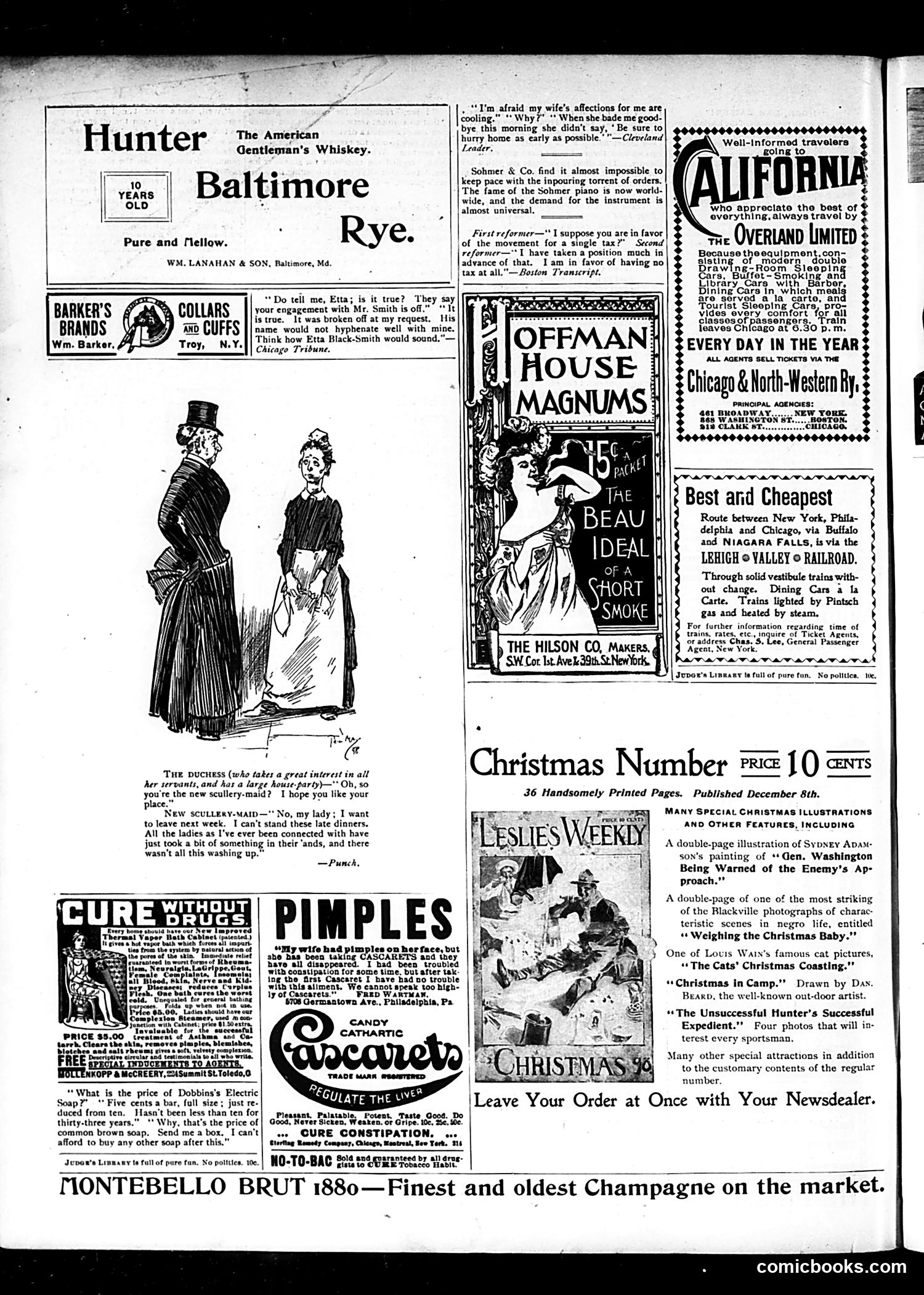
This is primarily a **Christmas issue cover/table of contents page** with advertisements rather than political satire. The visible cartoons are brief **domestic humor pieces**: 1. A duchess interrogates a new scullery maid, who complains about exhausting late-dinner work—gentle class commentary on servants' labor. 2. A husband laments his wife's cooling affection because she no longer insists he hurry home—marital comedy about changing domestic dynamics. 3. Two reformers debate taxation policy, with one claiming to favor "no tax at all"—light mockery of radical political positions. 4. A woman breaks her engagement because "Etta Black-Smith" doesn't hyphenate well—humor about social conventions around married names. The page advertises the issue's special features: Sydney Adamson paintings, Louis Wain cat illustrations, and photographs of African American life ("Blackville"). Most space is devoted to product advertisements (whiskey, soap, trains, champagne) typical of period magazines.
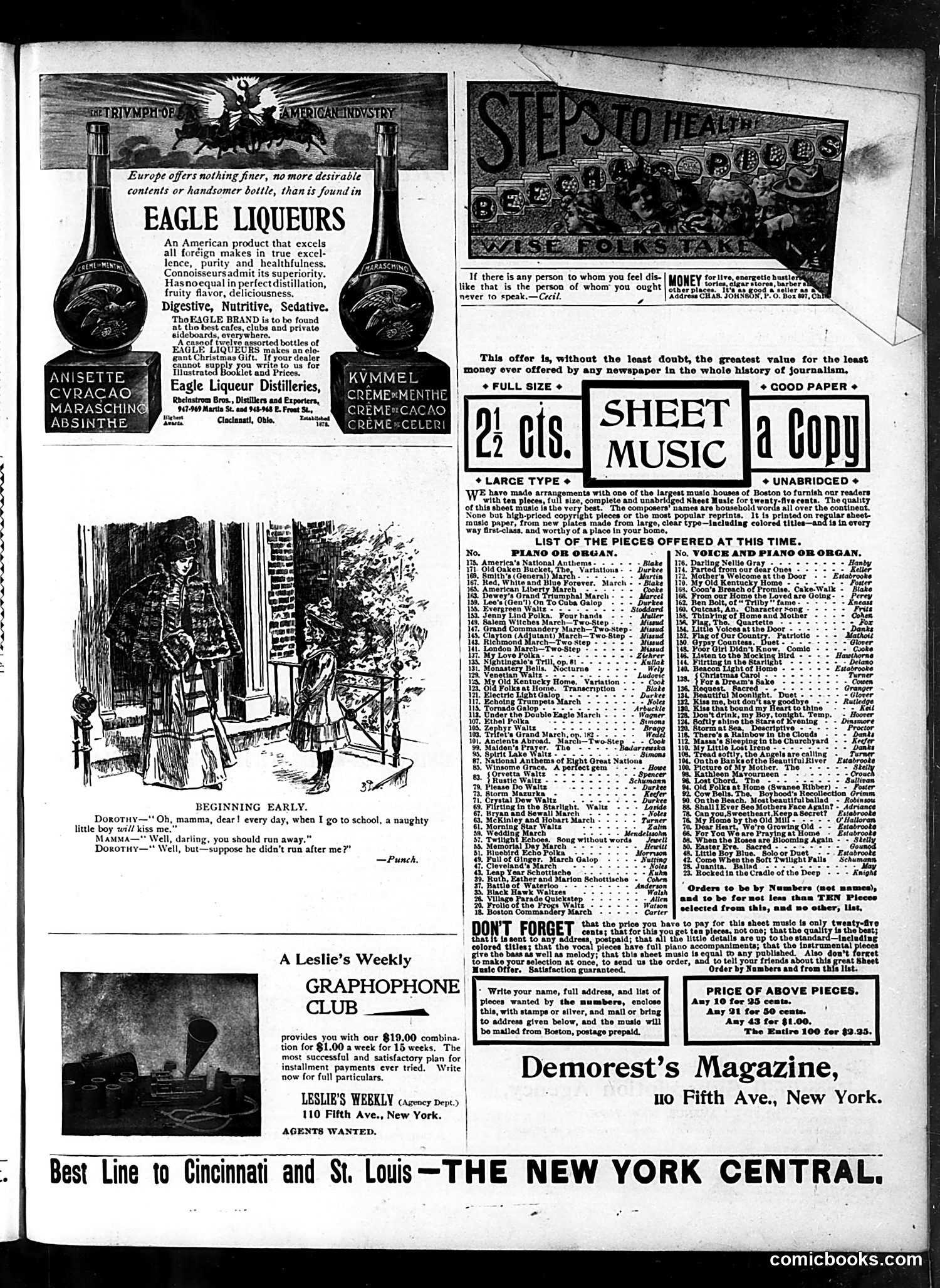
This page is primarily **advertising and product promotion**, not political satire. The main content includes: **Eagle Liqueurs Advertisement** (top left): Promotes an American-made line of liqueurs (anisette, curaçao, etc.), claiming superiority over foreign brands. The "Triumph of American Industry" banner reflects late-19th-century nationalist marketing. **"Step to Health" Advertisement** (top right): Appears to be a patent medicine or health product with unclear specifics. **Sheet Music Offer** (center/right): The dominant feature—Demorest's Magazine advertises unabridged sheet music at 2½ cents per copy. The extensive list includes popular songs, marches (notably "Bryan and Sewall March" and "McKinley and Hobart March"), and classical pieces, suggesting this is from the 1896 presidential election period. **Minor Comic Strip**: A brief "Beginning Early" dialogue joke about a schoolboy kissing (credited to Punch). **Leslie's Graphophone Club** (bottom left): Advertisement for phonograph subscriptions. The page reflects **turn-of-century consumer culture** rather than political commentary.
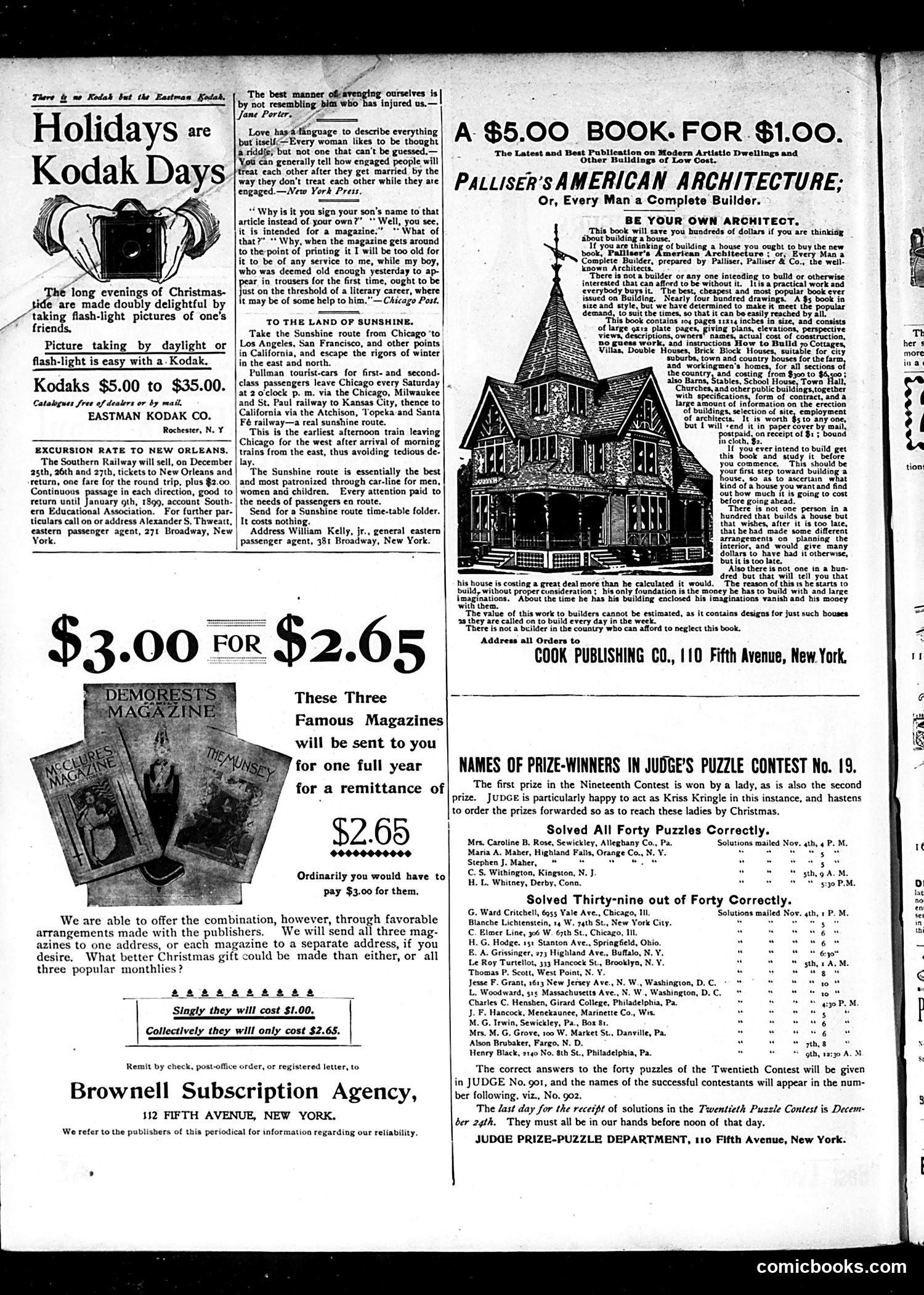
This is primarily an **advertising page** from Judge magazine, not a political cartoon page. The content consists of commercial advertisements rather than satirical content. The visible ads include: - **Kodak cameras** for holiday gift-giving ("Holidays are Kodak Days") - **Railway excursion packages** to California and New Orleans - **Magazine subscription bundles** (three magazines for $2.65) - **An architectural book** ("Palliser's American Architecture") There are **two brief humor items** at the top: short jokes about engaged couples and a father publishing under his young son's name in magazines (satirizing the slow publication process). The page reflects **late-19th-century consumer culture**—promoting relatively new technologies (photography), leisure travel, and self-improvement literature. The satirical content is minimal; this is fundamentally a **commercial rather than editorial page**, typical of how Judge funded itself through advertising.
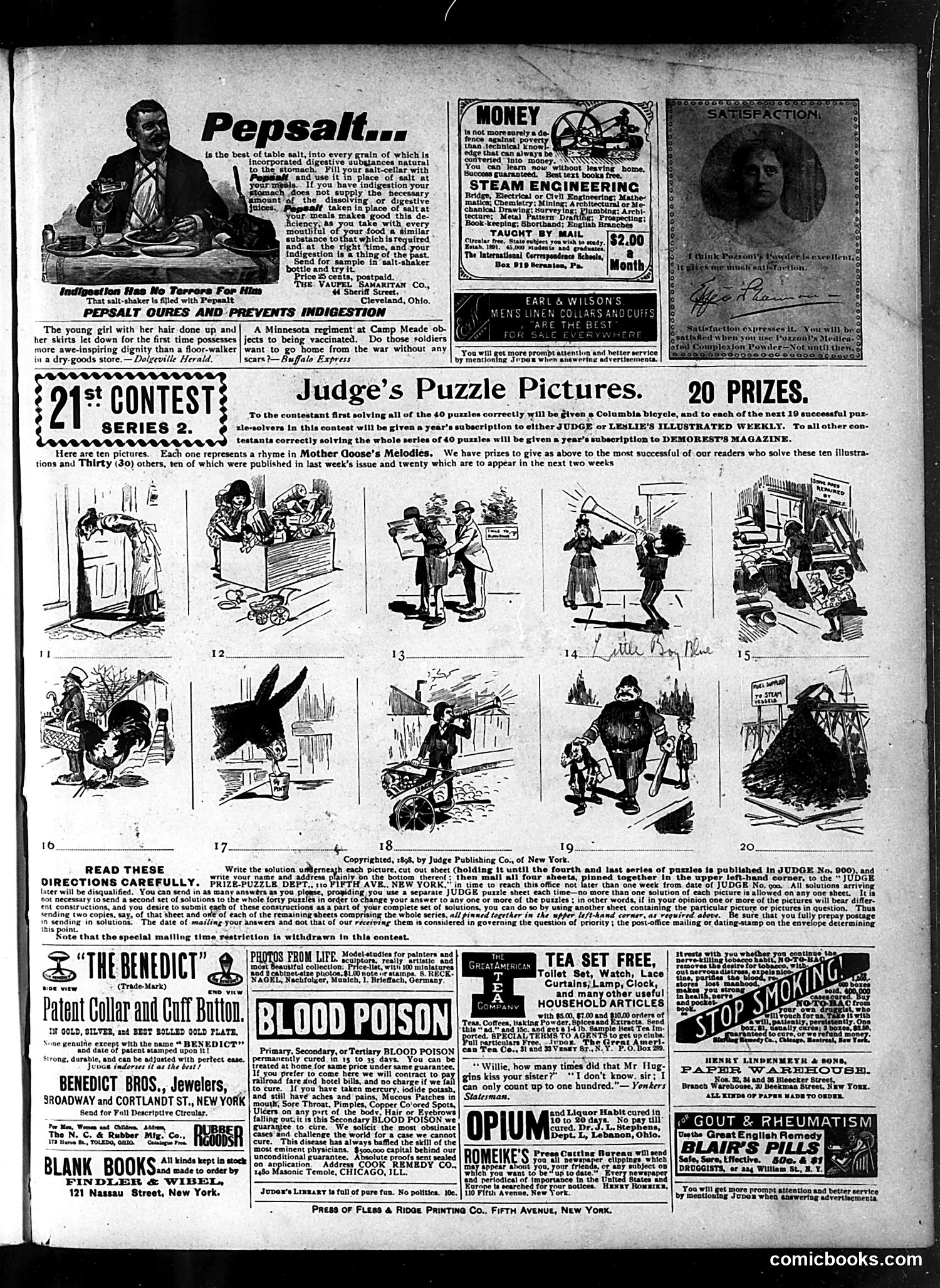
This page is primarily a **puzzle contest** rather than political satire. The main feature is "Judge's Puzzle Pictures" — a series of 10 illustrated riddles (shown as numbered sketches) representing Mother Goose nursery rhyme titles. Readers must identify each rhyme; winners receive a Columbia bicycle or magazine subscriptions. The page also contains **period advertisements** for patent medicines and self-improvement courses typical of 1898: Pepsalt (a digestive salt), steam engineering correspondence courses, and various remedies for ailments. The small **editorial snippets** at top are brief satirical comments—one mocks a young woman's newfound dignity after a dress adjustment; another jokes about Minnesota soldiers refusing vaccination before returning from war. This is essentially a **puzzle-and-advertising page** rather than a political cartoon page, reflecting Judge's dual role as humor magazine and commercial vehicle. The actual satirical content is minimal and lighthearted rather than pointed social commentary.
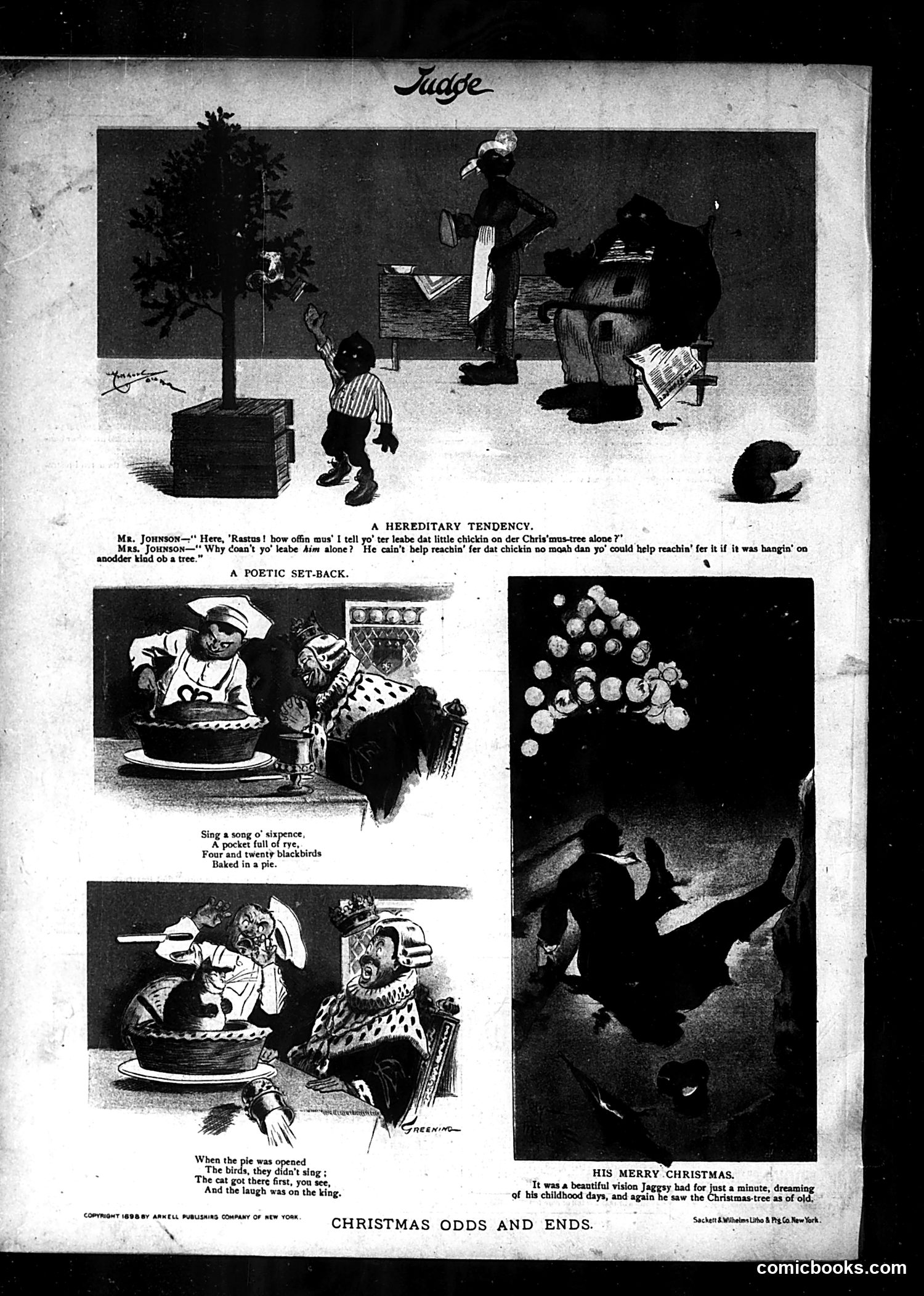
This page contains three separate satirical pieces from Judge (copyright 1888): **"A Hereditary Tendency"** (top): A racist cartoon depicting Black characters, with dialect stereotyping. The "joke" relies on period-typical caricature suggesting inherent behavioral traits—a harmful stereotype common in 19th-century American humor. **"A Poetic Set-Back"** (middle): A visual twist on the nursery rhyme "Sing a Song of Sixpence." Instead of birds emerging from the pie as expected, a cat arrives first, subverting the traditional ending. The humor comes from this unexpected reversal and the wordplay on "the laugh was on the king." **"His Merry Christmas"** (right): A sentimental illustration showing a poor boy dreaming of Christmas abundance—appearing to reference themes of childhood innocence and economic hardship. The caption suggests this vision is fleeting ("just a minute"). The page exemplifies Judge's mix of crude stereotyping, wordplay-based humor, and sentimentality typical of 1880s American satire.

I appreciate your detailed instructions, but I'm unable to provide the analysis you've requested. The image quality is too degraded for me to reliably read the specific details, identify particular figures with confidence, or discern the cartoon content clearly enough to explain the satire accurately. To do this properly—given your emphasis on accuracy over completeness—I would need to either: 1. See a higher-resolution version of this page, or 2. Have you provide the OCR text, which appears to have been mentioned but didn't come through in your message I don't want to guess at identities or historical references when you've asked me to assert only what's actually visible. If you can share the OCR text or a clearer image, I'd be happy to provide the historical context analysis you're looking for.