
A complete issue · 30 pages · 1898
Judge — December 24, 1898
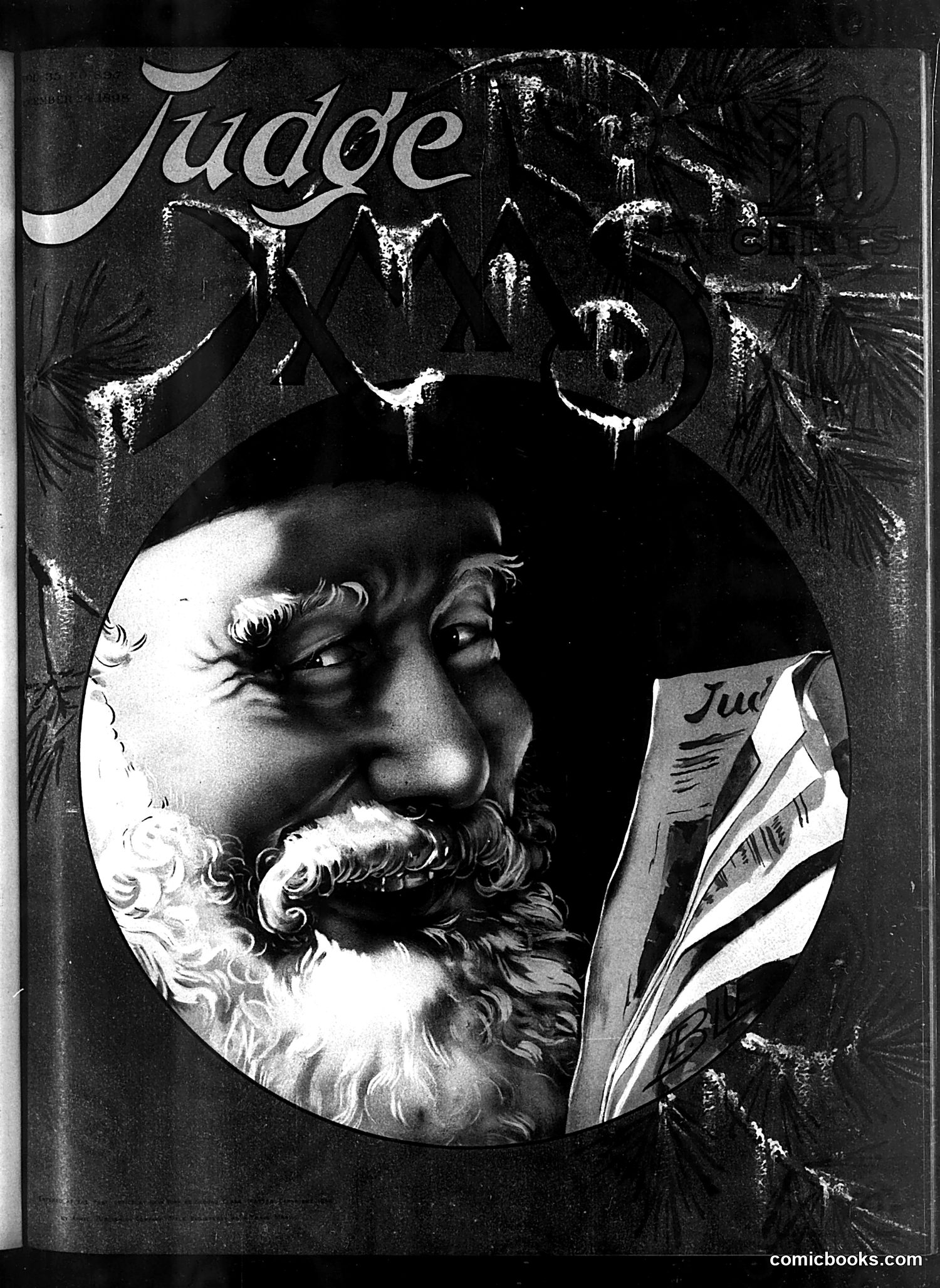
This appears to be a cover or title page from *Judge* magazine featuring a bearded man's profile in a circular frame, wearing what looks like judicial or formal attire. The ornate styling and the word "Judge" at the top suggest this is the magazine's masthead or a featured satirical portrait. The decorative elements—ornate lettering spelling what appears to be a name, classical imagery, and formal presentation—suggest this depicts a prominent public figure of the period, likely a judge, politician, or other authority figure being satirized. However, without being able to clearly read the OCR'd text or identify the specific individual from the caricature alone, I cannot definitively state who is being depicted or what particular political/social commentary is intended. The artistic style is consistent with late 19th or early 20th-century American satirical illustration.
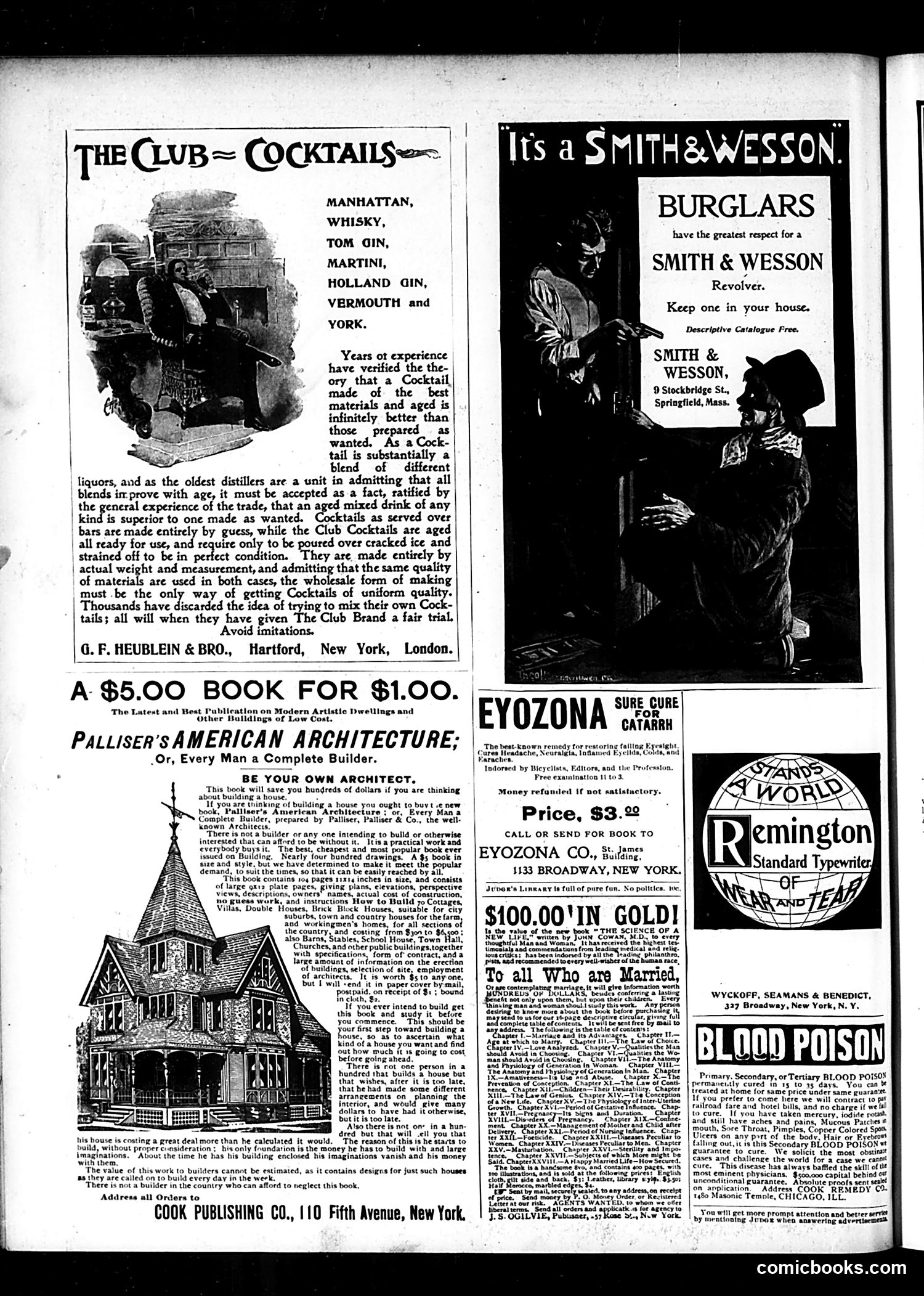
This page is **primarily advertising** from Judge magazine, containing no apparent political cartoons or satire requiring historical context. The advertisements include: - **The Club Cocktails** (top left): A spirits brand emphasizing quality and standardized recipes - **Smith & Wesson Revolvers** (top right): A security product marketed to homeowners concerned about burglaries - **Palliser's American Architecture** (center): A how-to building guide - **Eyozona** (center-right): A patent medicine claiming to cure cataracts - **Remington Typewriter** (right): Office equipment - **Blood Poison** (bottom right): Another patent medicine The advertisements reflect early 20th-century consumer concerns: home security, self-improvement through DIY building, and medical remedies (many patent medicines made dubious health claims).
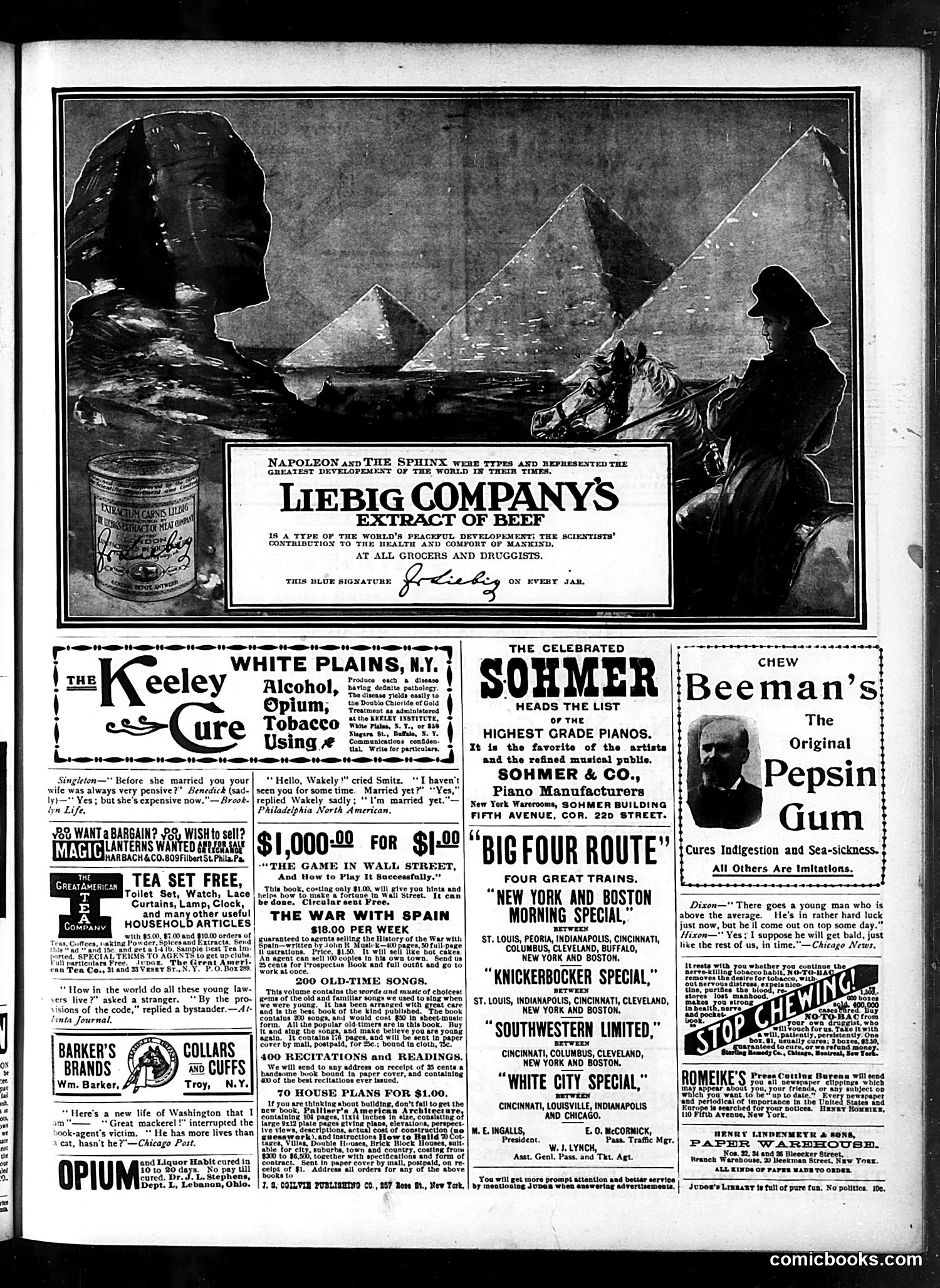
This page is primarily **advertising**, not political satire. The top features a Liebig Company's Extract of Beef ad comparing the product to Napoleon and the Sphinx as "types" representing "the greatest achievement of the world in their time." Below are various commercial advertisements for patent medicines and consumer goods typical of the early 20th century: the Keeley Cure (for alcoholism/opium addiction), Beeman's Pepsin Gum, Stop Chewing gum, Sohmer Pianos, and railroad routes. The single political reference appears minor: a small dialogue joke about "How'd you get that black eye?" suggests domestic humor rather than serious commentary. The page demonstrates how **Judge magazine mixed satire with extensive advertising** to fund operations—a common practice for period publications.
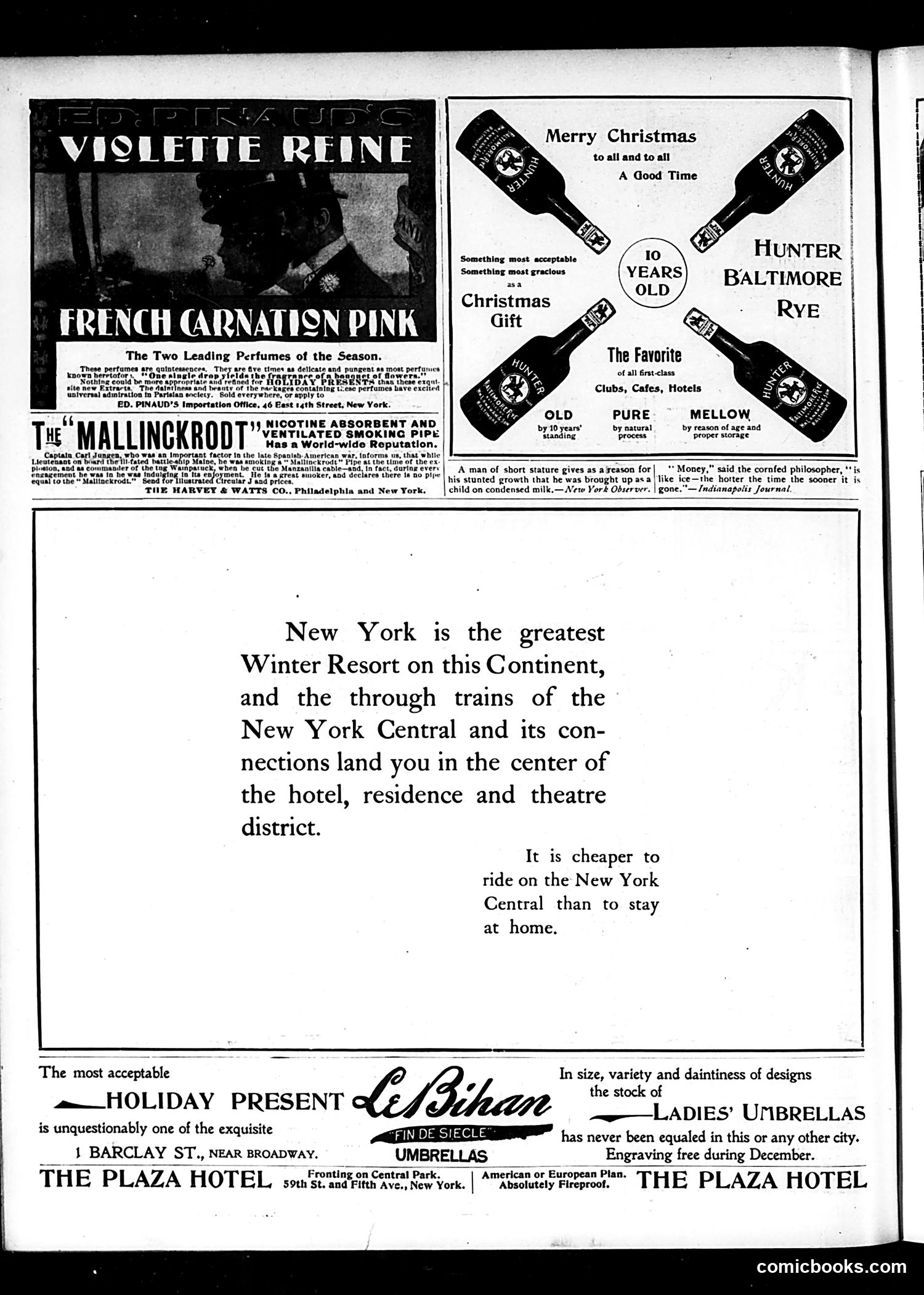
This page is **primarily advertising**, not satirical content. It features: 1. **Perfume ads** (top left): "Violette Reine" and "French Carnation Pink" marketed as "leading perfumes of the season," plus a "Mallinckrodt" nicotine absorbent pipe advertisement. 2. **Liquor ad** (top right): Hunter Baltimore Rye whiskey, marketed as a 10-year-old "favorite of all first-class clubs, cafes, hotels"—emphasizing quality and age. 3. **Travel promotion** (center): New York Central Railroad promoting NYC as a winter resort, claiming train travel is cheaper than staying home. 4. **Umbrella ad** (bottom): Le Pelham umbrellas from a Broadway shop near The Plaza Hotel. The page reflects early-20th-century consumer culture and luxury marketing rather than political satire. No cartoon characters or political commentary are evident.
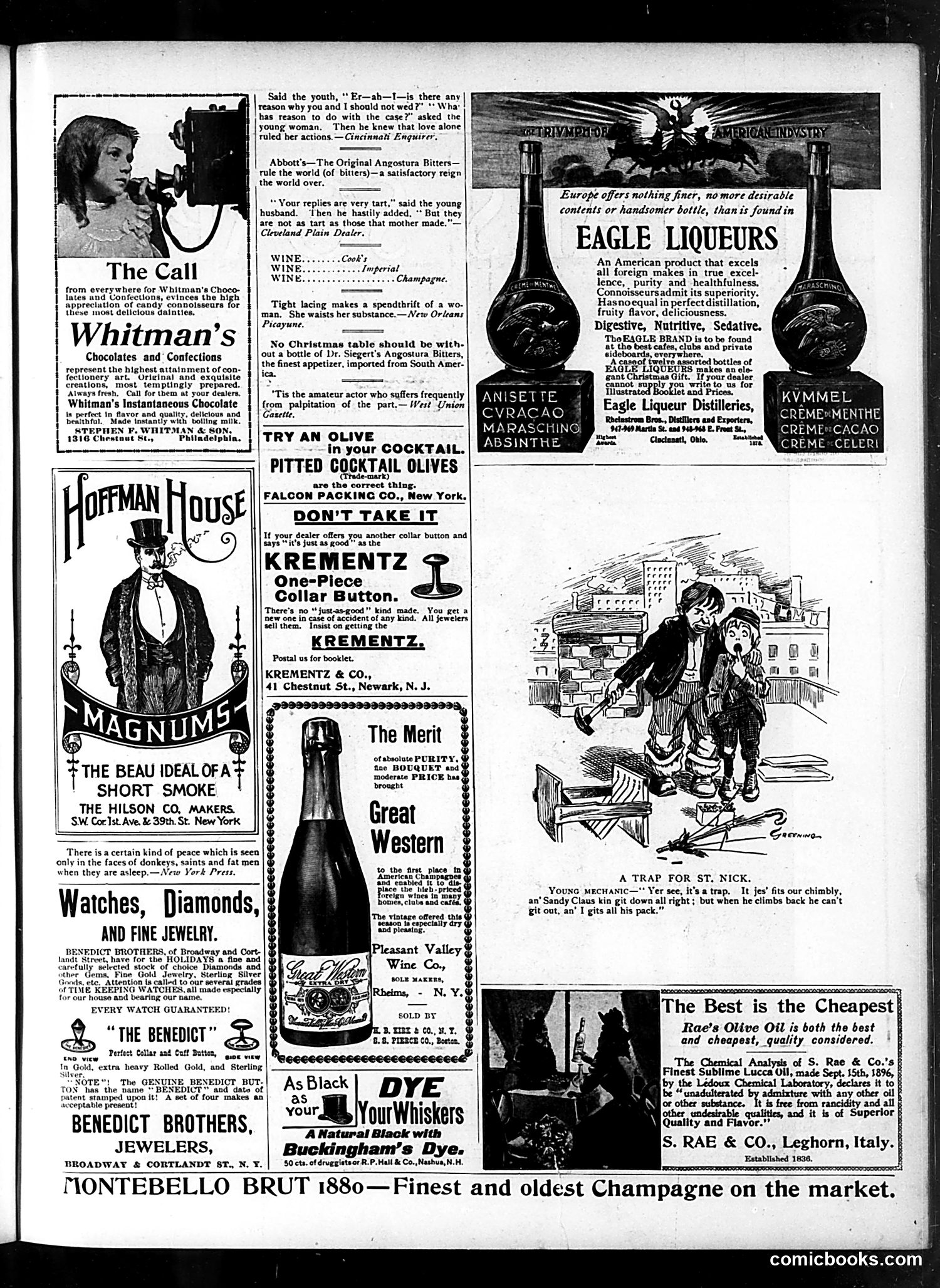
This page is primarily **advertising**, with minimal editorial cartooning. The main content consists of product advertisements: liqueurs, chocolates, watches, collar buttons, wines, and hair dye. The few jokes present are small **comic vignettes**: one depicts a couple discussing marriage, with the punchline that love, not reason, motivates the woman's acceptance. Another shows a husband remarking that his wife's sharp replies rival his mother's tartness. These appear to be generic domestic humor—common early-20th-century magazine filler about marital relationships and romantic absurdities. There is **no clear political satire** on this page. The cartoonish illustration titled "A Trap for St. Nick" shows children apparently punishing a boy, but lacks sufficient context to explain its meaning. The overall tone reflects period attitudes toward courtship and gender relations through gentle ridicule, but contains nothing of significant satirical weight.
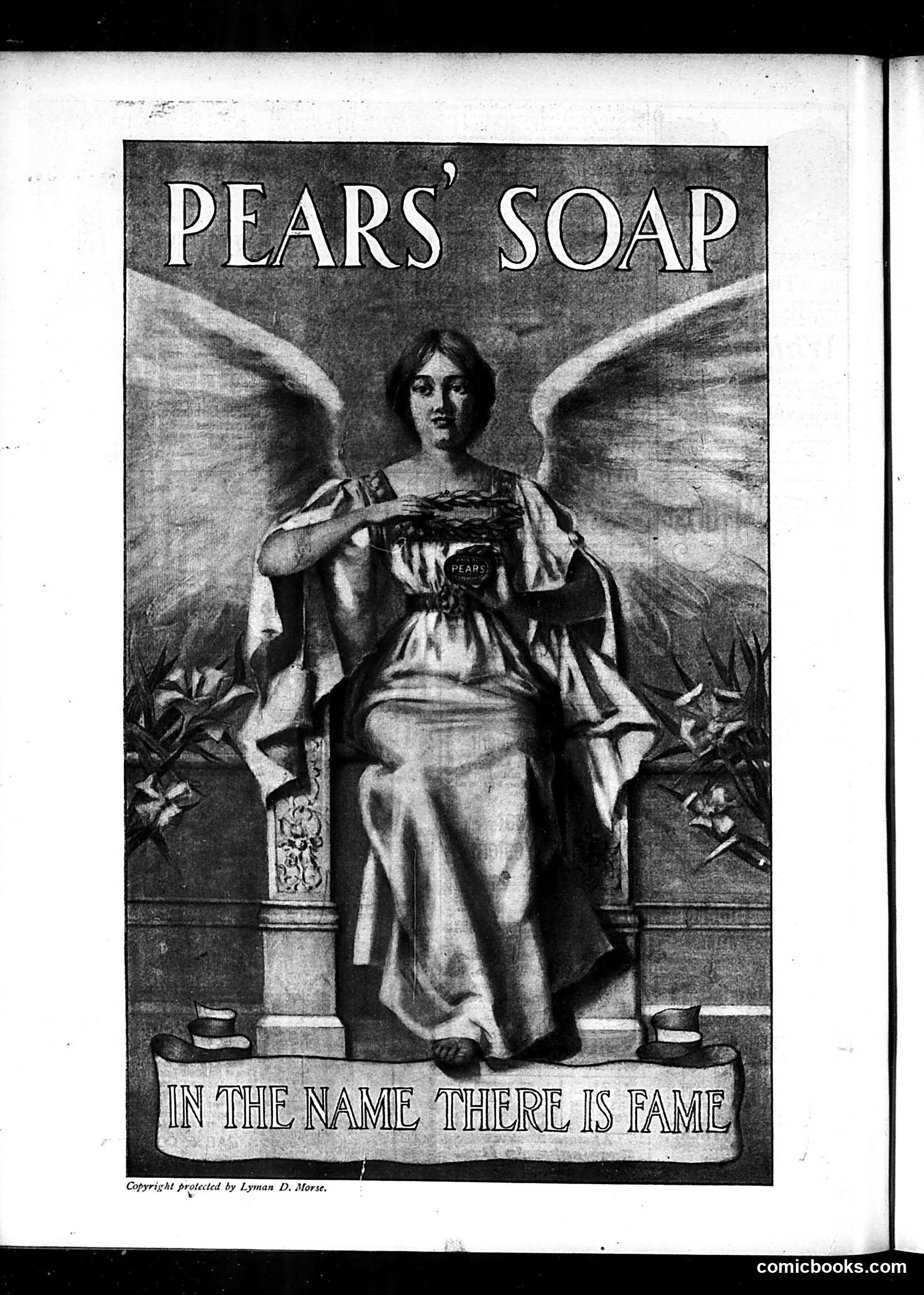
This is a vintage advertisement for Pears' soap, not political satire. The image depicts an angelic female figure with wings, dressed in classical robes and holding a bar of Pears soap. She stands in a serene, ethereal setting with flowers flanking her sides. The tagline "In the Name There is Fame" plays on the product's brand recognition. The angelic imagery suggests purity and cleanliness—common advertising tropes for soap products in this era. The classical, allegorical aesthetic was typical of late-19th/early-20th century luxury product marketing, positioning Pears as an elevated, refined commodity rather than a mundane household item. The copyright attribution to Lyman D. Morse indicates professional artistic creation.
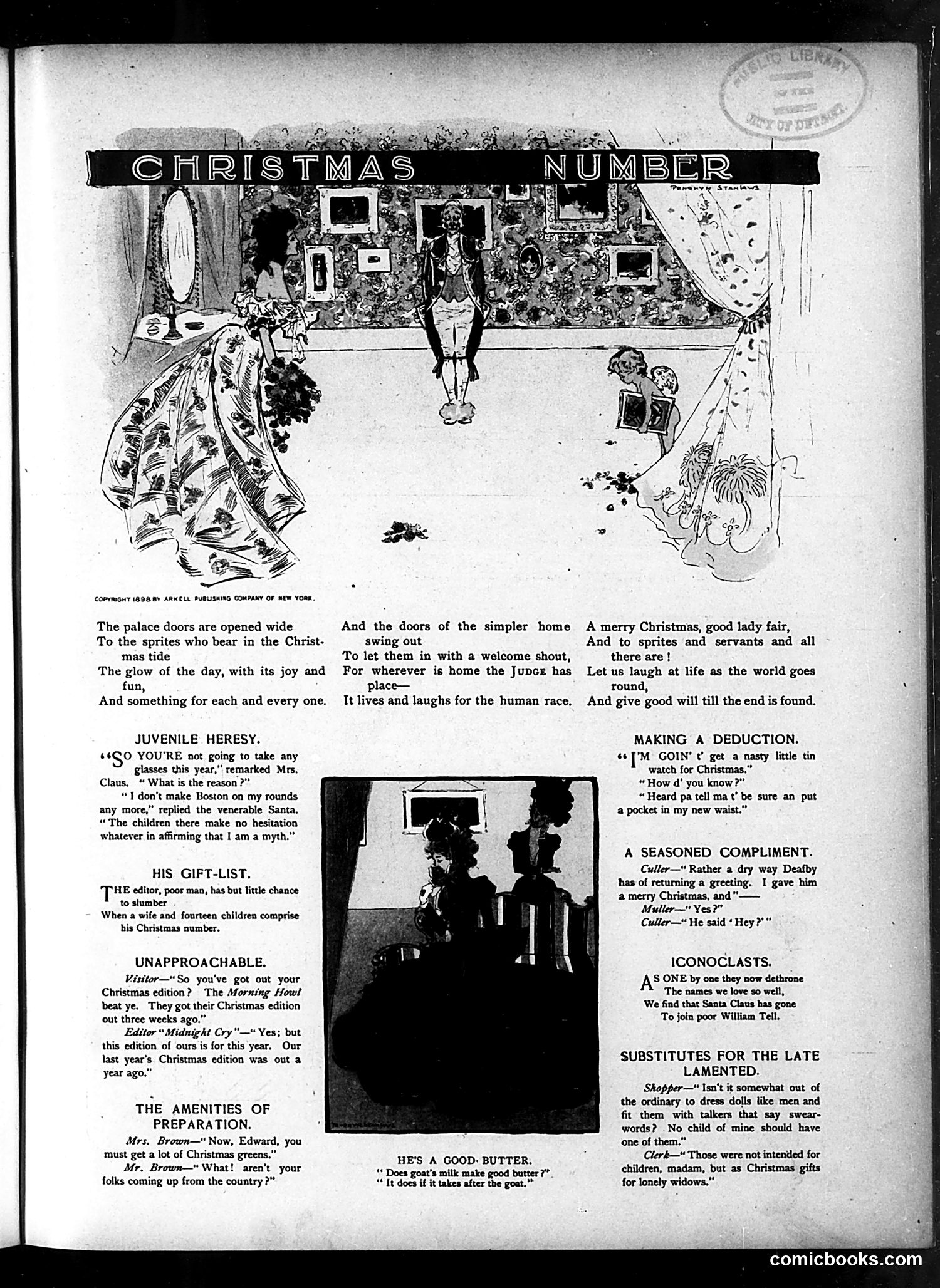
This is a *Judge* magazine Christmas issue (1888, based on copyright) featuring seasonal humor and social commentary. **Key Content:** The main cartoon depicts Christmas gift-giving across social classes—palace and humble home alike. The accompanying poem celebrates Christmas's democratic spirit. **The Satire:** Multiple brief jokes mock contemporary issues: - **"Juvenile Heresy"**: Children in Boston openly deny Santa Claus exists, embarrassing the myth itself—satirizing growing skepticism and scientific rationalism among youth. - **Editor jokes**: Mock the newspaper industry's competitive rushing and repetitive annual content. - **"Iconoclasts"**: References the era's debunking of traditional figures (Santa, William Tell), suggesting cultural skepticism is replacing cherished myths. - **Doll joke**: Dark humor about dressing dolls like men with "swear-words" as gifts for "lonely widows"—implies these are actually intended for adults, mocking both gift-giving conventions and unmarried women. The overall tone reflects *Judge*'s satirical style: poking fun at social pretension, modern skepticism replacing tradition, and the absurdities of holiday commercialism.
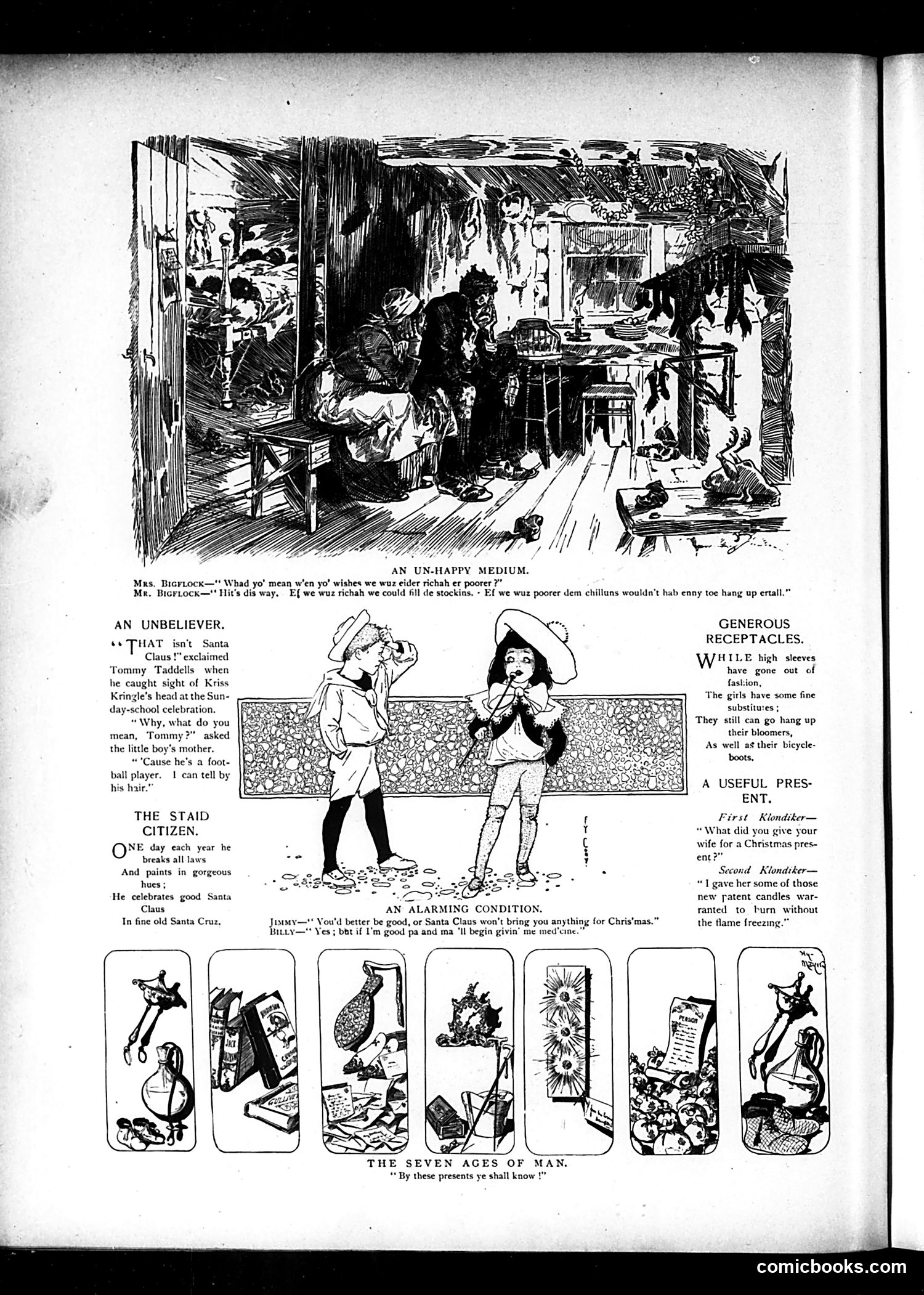
This page contains several satirical vignettes about Christmas gift-giving and social behavior, typical of Judge's humor: **"An Un-Happy Medium"**: A Black man expresses the catch-22 of poverty—if wealthy, he could fill stockings; if poor, children have no feet to hang them on. The dialect reflects period racism in humor. **"An Unbeliever"**: A boy debunks Santa by identifying him as a football player based on his hair, mocking childhood innocence. **"The Staid Citizen"**: Satirizes hypocrisy—a man breaks laws and misbehaves one day yearly (Christmas) while celebrating Santa, yet parents threaten medicine if children misbehave. **"Generous Receptacles"**: A joke about women using bloomers and bicycle boots as makeshift gift holders since high sleeves went out of fashion—commenting on women's fashion practicality. **"A Useful Present"**: Klondike prospectors exchange joke gifts; one gives patent candles that burn without flame—absurd novelty items. **"Seven Ages of Man"**: Seven illustrated vignettes depicting life stages through gift-giving contexts.
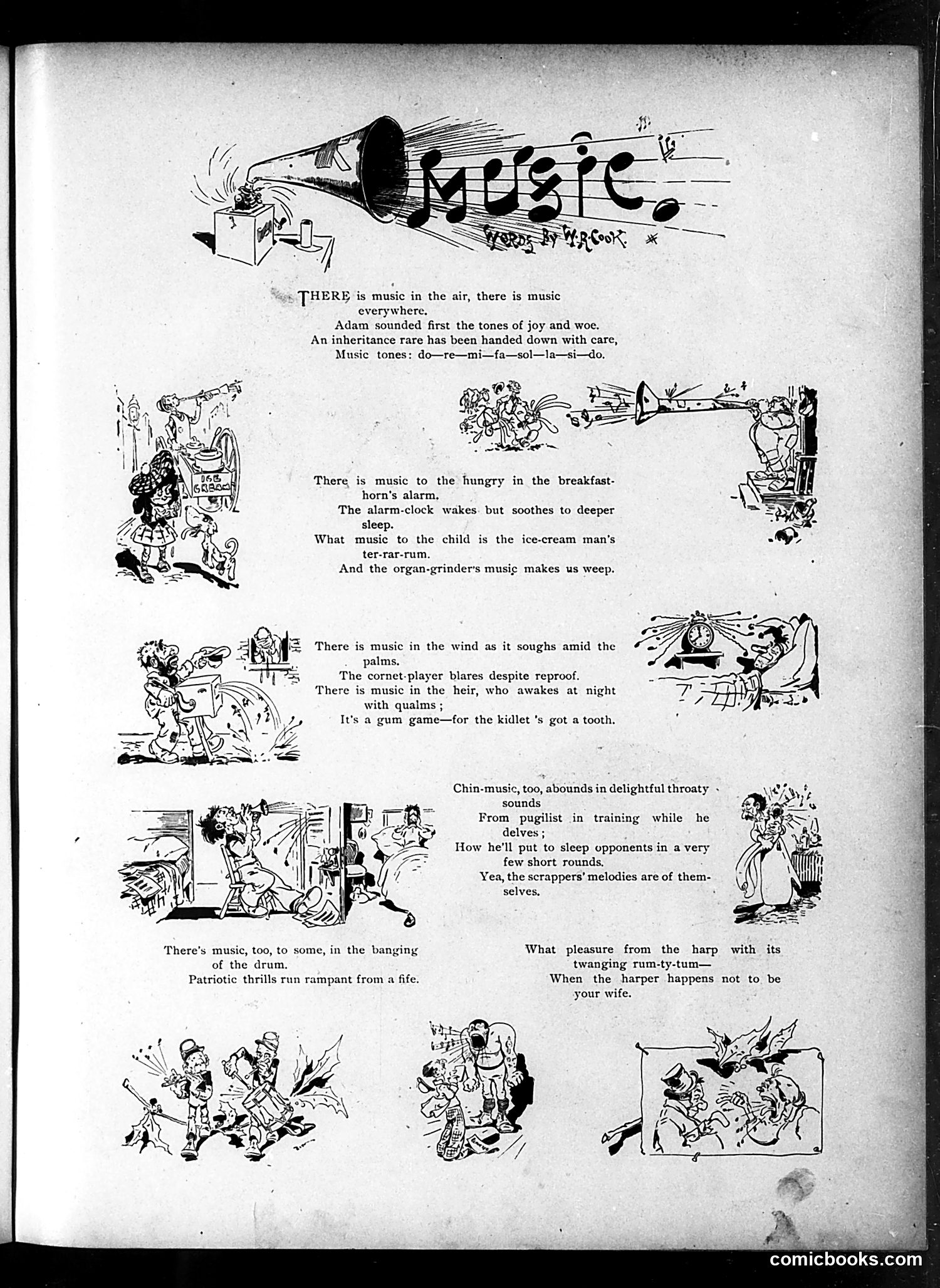
This is a humorous poem illustrated with vignettes celebrating "music" in everyday American life, though most examples are actually *noise* or unpleasant sounds. The satire mocks sentimental romanticism about music by reframing mundane or annoying sounds as "musical": - **Breakfast horn's alarm** and **alarm clocks** disrupt sleep - **Ice-cream man's bell** attracts children - **Organ-grinder's music** evokes tears (of frustration, not joy) - **Cornet-player blares despite reproof** (noise complaint) - **Baby's teething cries** described as "music" - **Pugilist's "chin-music"** (boxing slang for punches) - **Drum-banging and fife** for patriotic fervor - **Harp music is pleasant only if the player isn't your wife** (domestic complaint humor) The illustrations depict these scenarios with comic chaos. The overall joke: life's irritating, cacophonous sounds are romanticized as "music," satirizing both sentimental Victorian poetry and the noisy reality of urban/domestic American life.
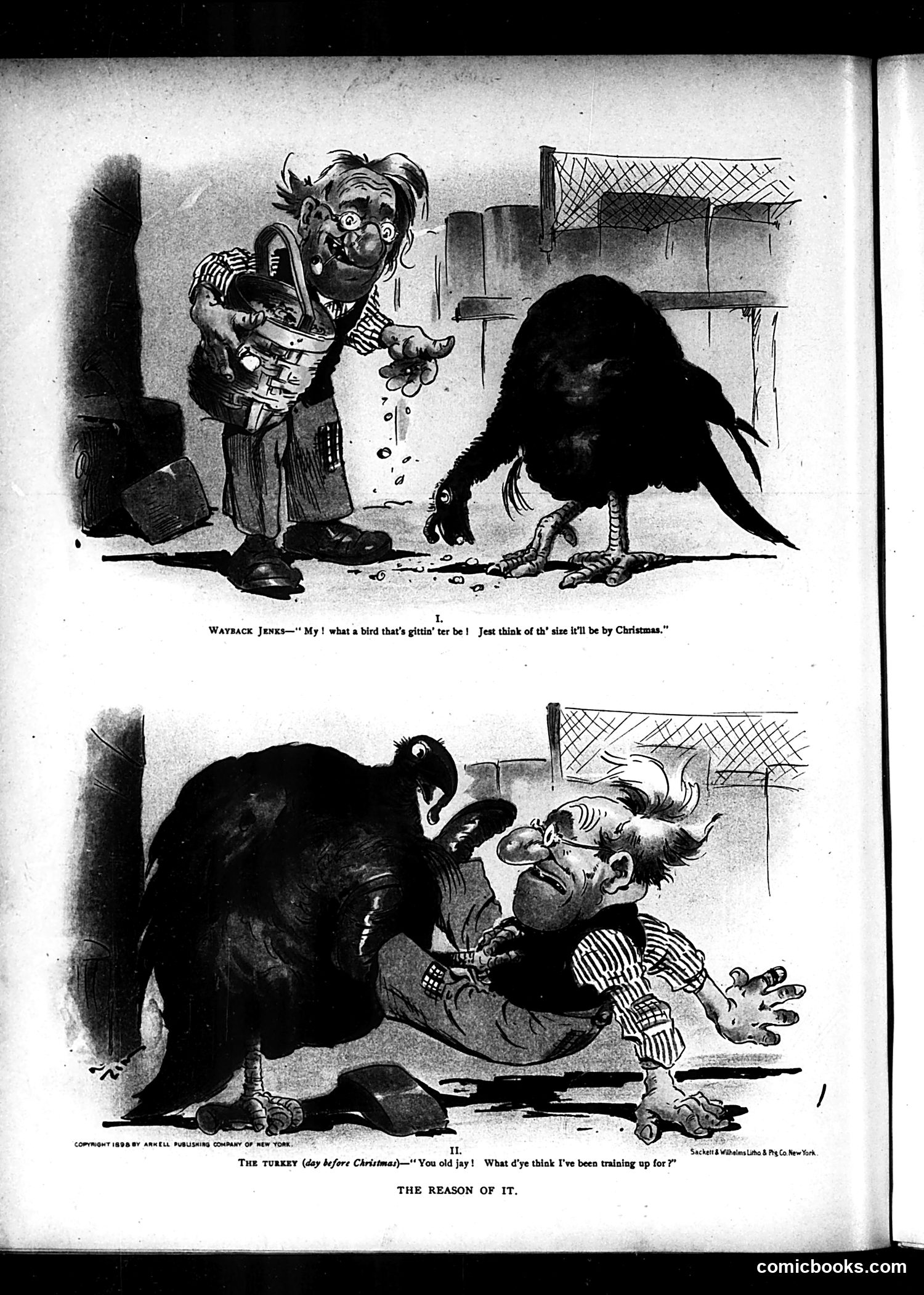
This two-panel Christmas cartoon satirizes the relationship between a turkey and its human keeper. **Panel I** shows a caricatured man named "Wayback Jakes" commenting on a bird's size, expecting it to be ready by Christmas—the traditional holiday meal. **Panel II** reveals "the reason": the turkey, now attacking the man, explains it has been "training up" all year—implying the bird deliberately fattened itself to become a formidable opponent rather than a passive victim heading to slaughter. The joke inverts expectations: instead of accepting its fate as dinner, the turkey has weaponized itself. This anthropomorphizes the bird as clever and self-preserving, mocking human assumptions about holiday meals while playing on period humor about animals outwitting their keepers. The cartoon's satire lies in giving the turkey agency and aggressive intent against its would-be consumer.
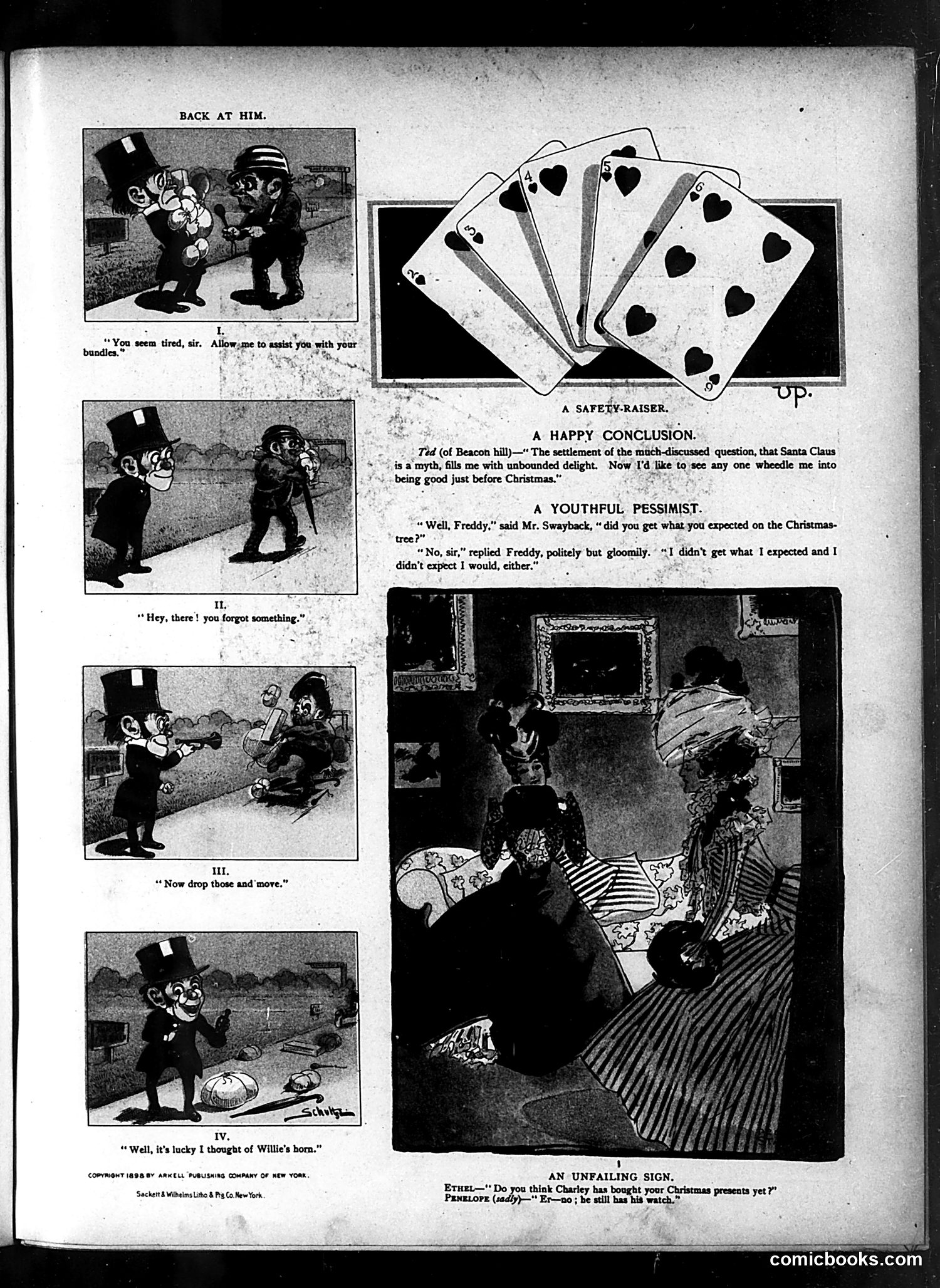
This page contains multiple standalone comic vignettes satirizing Christmas behavior and social pretense circa 1898. **"Back at Him"** depicts two well-dressed gentlemen—one offering to help the other with bundles, who then steals them. The joke relies on feigned politeness masking criminal intent. **"A Safety-Raiser"** shows playing cards (hearts) and jokes that learning Santa Claus is mythical relieves children of pressure to behave before Christmas—satirizing parental manipulation tactics. **"A Youthful Pessimist"** mocks a child's cynical disappointment with Christmas gifts, expressing pessimism about both expectations and reality—commentary on childhood disillusionment. The remaining vignettes (I-IV) appear to show petty theft or pickpocketing scenarios with similar dark humor about deception during the holiday season. **"An Unfailing Sign"** (bottom) makes an unclear reference to Christmas shopping, likely satirizing consumer materialism or social climbing through gift-giving. Overall, the page satirizes the gap between Christmas's sentimental ideals and actual human behavior—theft, manipulation, greed, and disappointment.
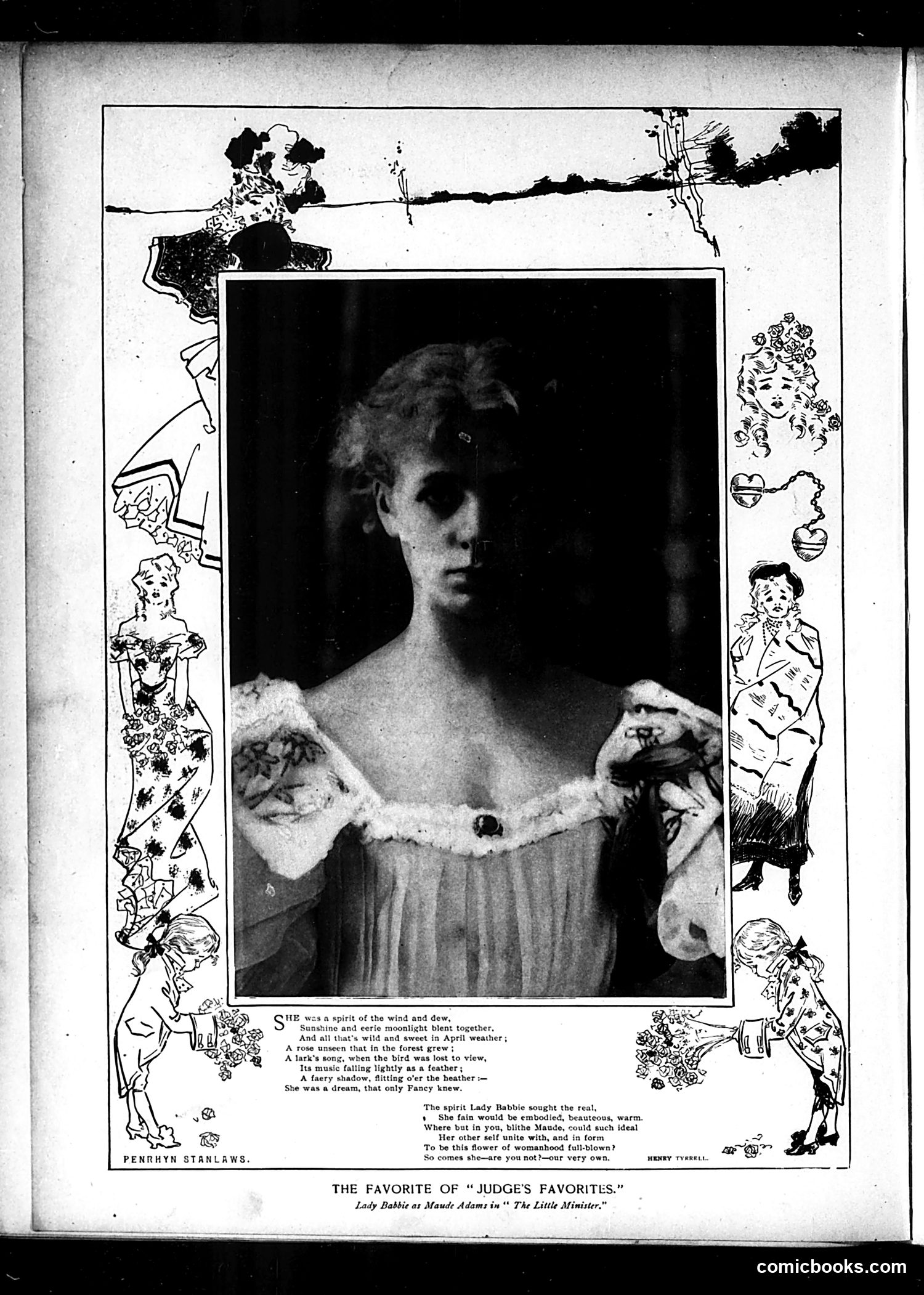
This page features a photograph of actress **Maude Adams** in the role of Lady Babbie from the play *The Little Minister*, surrounded by decorative illustrations and an accompanying poem. The caption identifies this as "The Favorite of 'Judge's Favorites'"—meaning *Judge* magazine's readers voted this their preferred theatrical image. The romantic poem beneath celebrates the character as an ethereal, dreamy figure who seeks embodiment in real form through the actress's portrayal. The decorative borders contain whimsical pen-and-ink illustrations in the Art Nouveau style typical of *Judge's* design aesthetic, featuring figures in fashionable dress and floral motifs. This appears to be **not satire but celebration**—a genuine tribute to a popular actress and performance, showcasing *Judge's* role as a cultural arbititer of American theatrical taste in the early 20th century. The page demonstrates the magazine's blend of humor, illustrated commentary, and entertainment coverage.
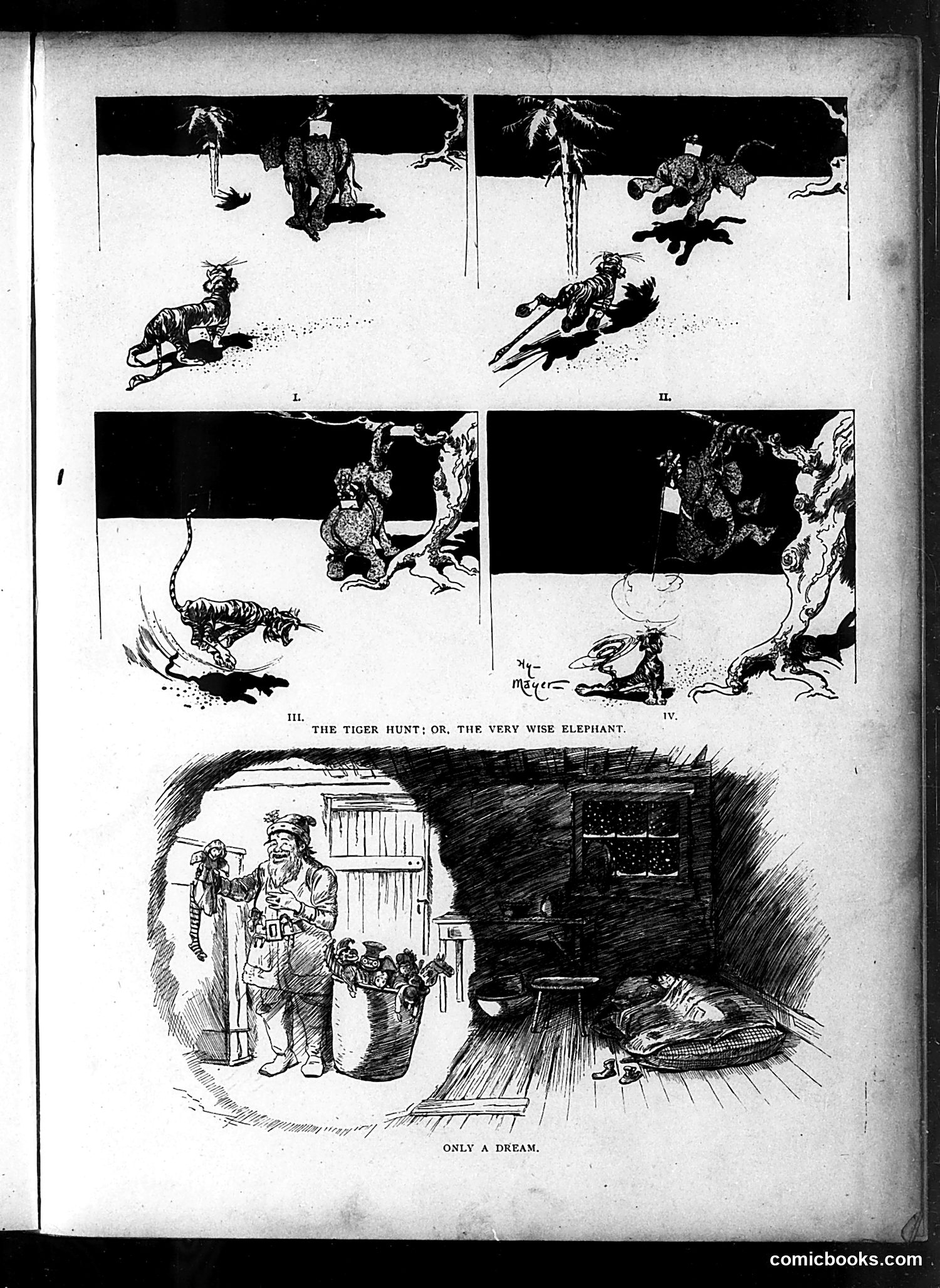
This is a four-panel narrative comic (panels I-IV) followed by a single-panel conclusion titled "Only a Dream." The top four panels show an elephant apparently hunting a tiger through increasingly dramatic encounters—chasing, fleeing, and confronting the animal. The final panel reveals the resolution: an elderly man and child wake indoors, with the man holding what appears to be a tiger skin or trophy, suggesting the entire hunt was a dream. The satire likely mocks exaggerated hunting tales or adventure fantasies—a common target of *Judge* magazine's humor. The "very wise elephant" of the title suggests the joke centers on the elephant's foolishness in pursuing a dangerous hunt, only for the entire escapade to prove imaginary. This deflates grandiose adventure narratives popular in the era.
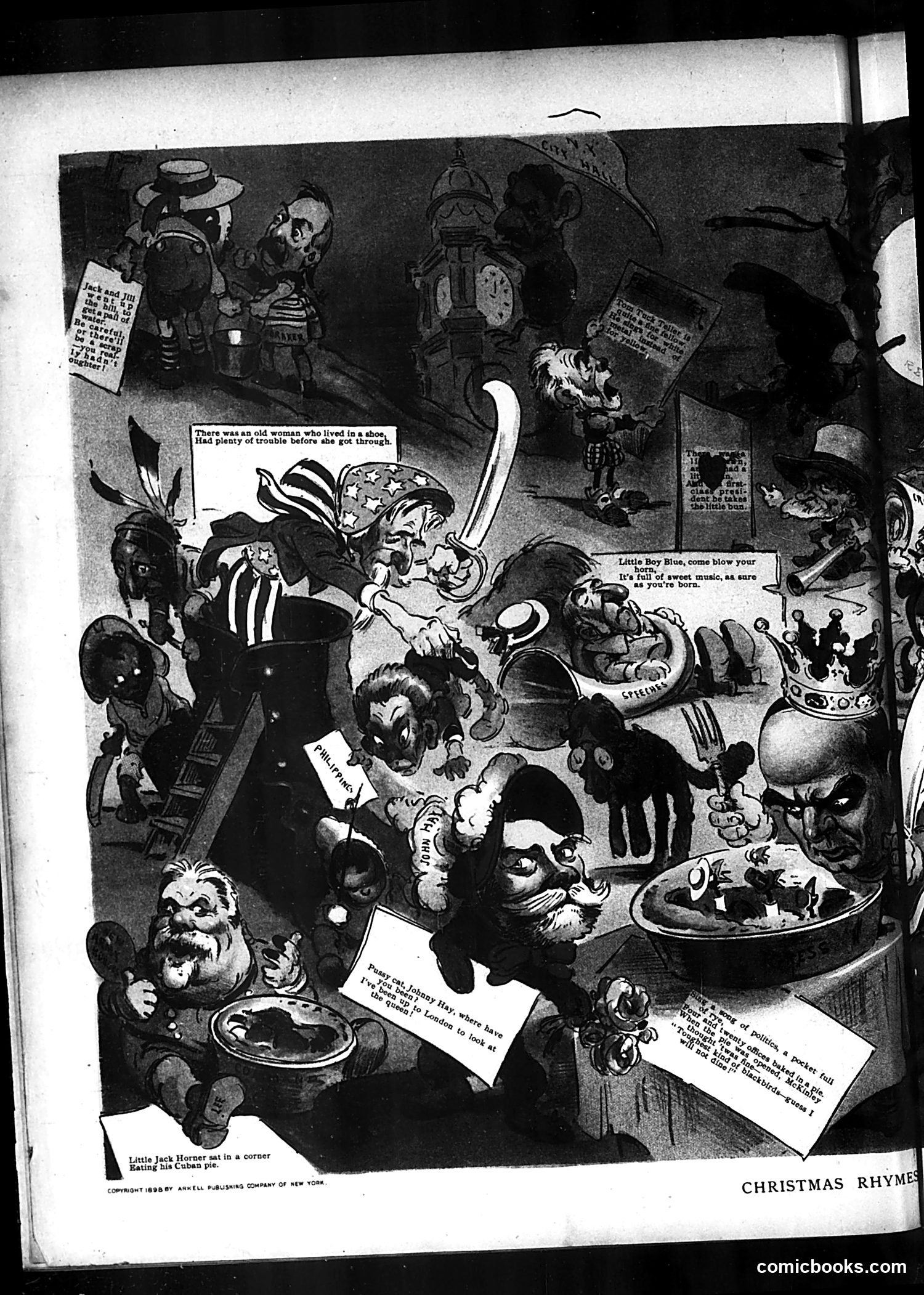
This page reimagines classic nursery rhymes with political commentary. "The Old Woman Who Lived in a Shoe" appears to reference political troubles or scandals. "Little Jack Horner Eating His Cuban Pie" is the clearest reference: it satirizes American involvement in Cuba around 1898—likely the Spanish-American War or its aftermath. "Jack Horner" pulling out a "plum" (gaining advantage) from Cuba suggests politicians or businessmen profiting from Cuban affairs. The grotesque character designs and crowded composition typical of Judge's style create chaotic, mocking scenes. Without seeing all text clearly, the exact political targets remain partially unclear, but the overall theme uses familiar children's verses to mock contemporary political greed and opportunism regarding American imperial expansion in the Caribbean.
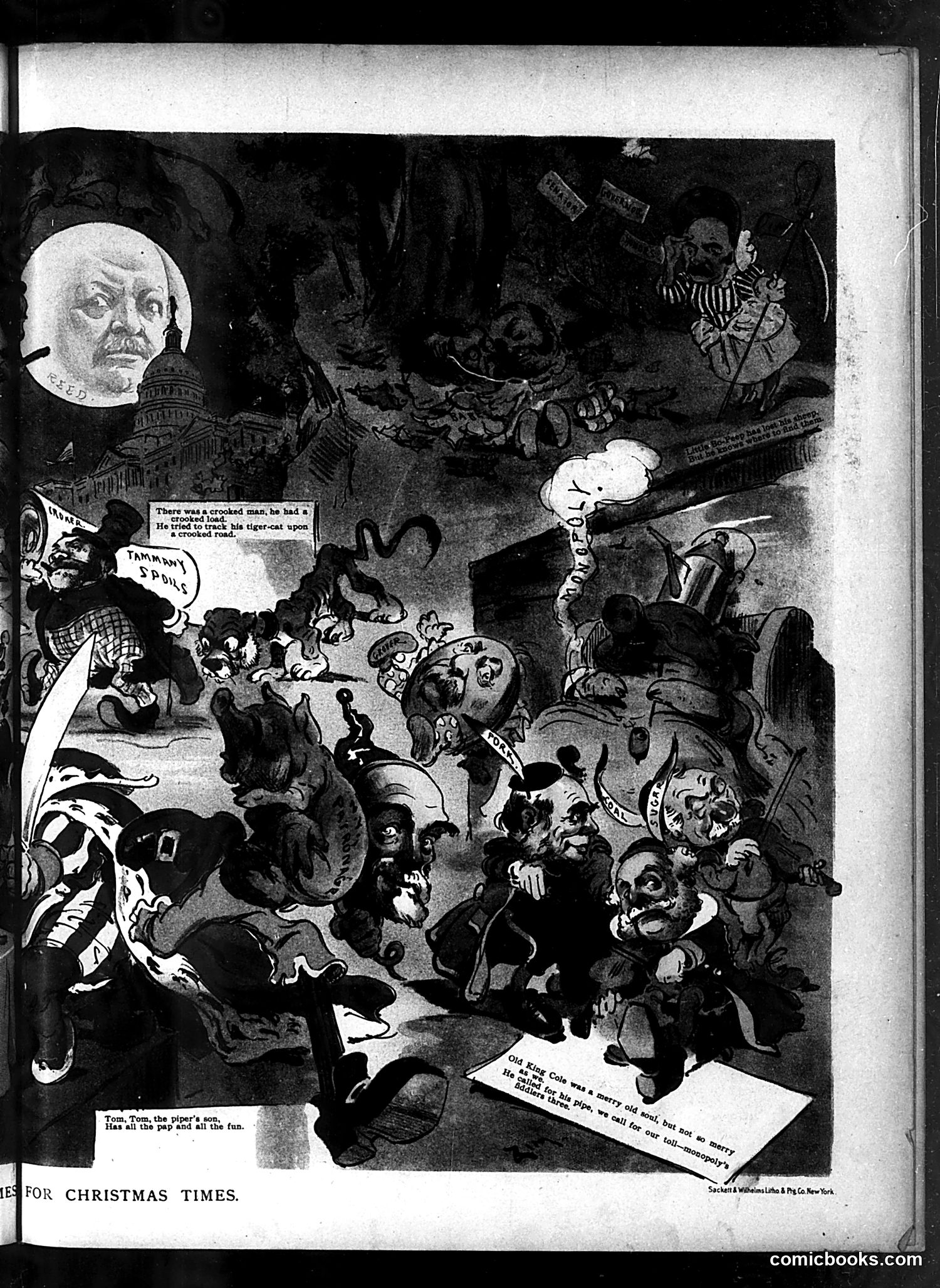
This satirical cartoon appears to reference political corruption and malfeasance, using nursery rhyme imagery. "There was a crooked man" alludes to dishonest politicians or officials. The Capitol building visible in the upper left suggests U.S. government corruption. The figures depicted—appearing as caricatured politicians or public figures engaged in questionable activities—are portrayed in a chaotic, hellish scene, suggesting moral depravity. The reference to "Tom, Tom, the piper's son" and someone having "all the pap and all the fun" likely critiques how corrupt officials enriched themselves while ordinary citizens lost out. Without visible dates or clearer labels, the specific targets remain unclear, but the overall message condemns political graft and misuse of public office during an unspecified period. The Christmas Times heading suggests this was seasonal commentary on corruption.
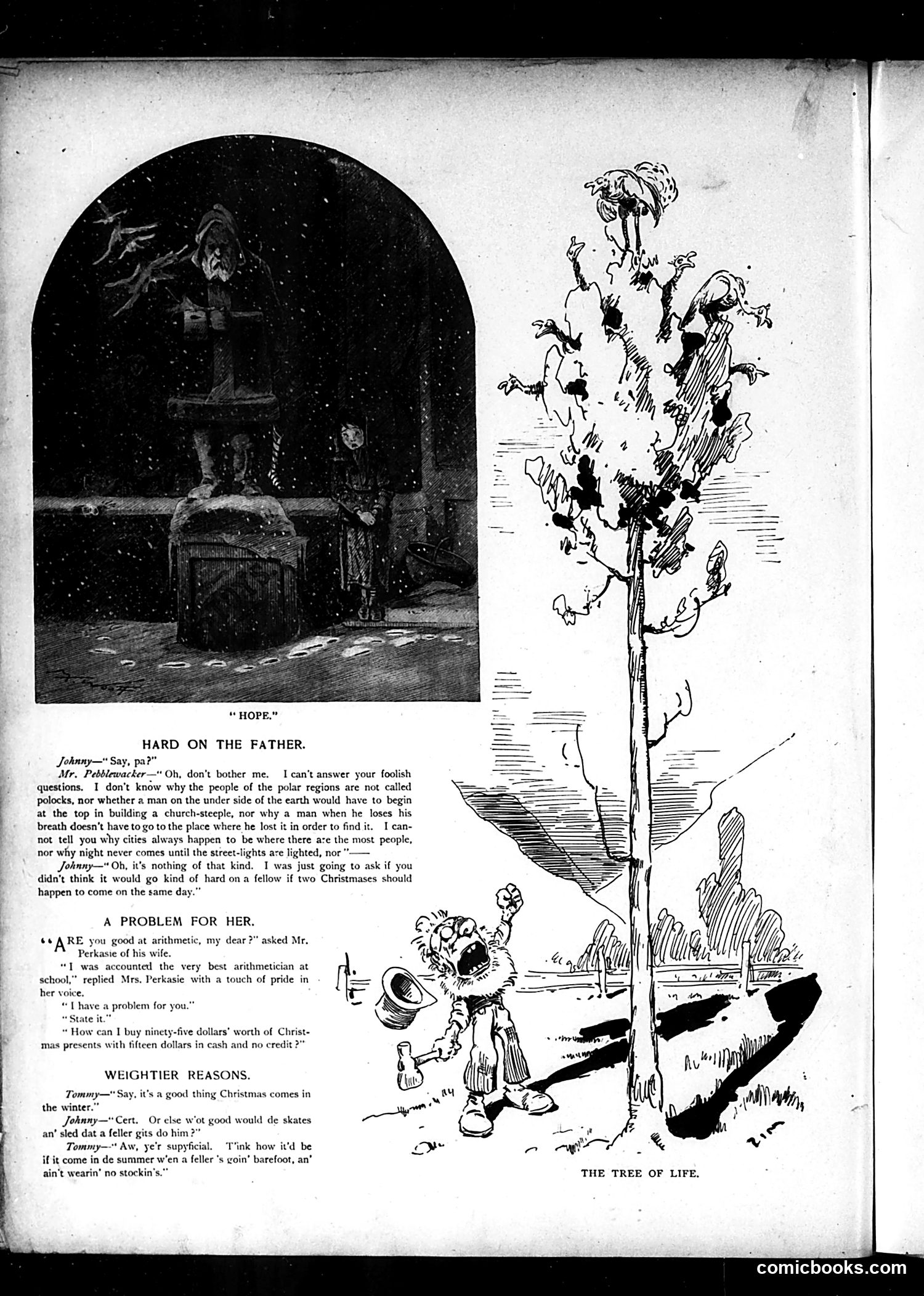
This page contains three separate humorous anecdotes satirizing everyday middle-class life around the Christmas holiday: **"Hard on the Father"** mocks an exasperated parent pestered by his son Johnny with absurd philosophical questions—until the boy asks something unexpectedly simple, showing adults' tendency to overcomplicate things. **"A Problem for Her"** jokes about the economic squeeze of Christmas shopping: a wife proudly claims arithmetic expertise but cannot solve the impossible math of buying $95 worth of gifts with only $15 cash and no credit—a jab at holiday consumerism and household finances. **"Weightier Reasons"** features working-class boys debating why Christmas timing in winter is actually advantageous (for sleds and skates), with Tommy humorously pointing out it's even better because bare feet in summer need no stockings—simple logic that undercuts assumptions. "The Tree of Life" illustration depicts a figure amid fantastical growth, likely symbolic commentary on prosperity or growth. The satire targets universal human foibles rather than specific political figures or events.
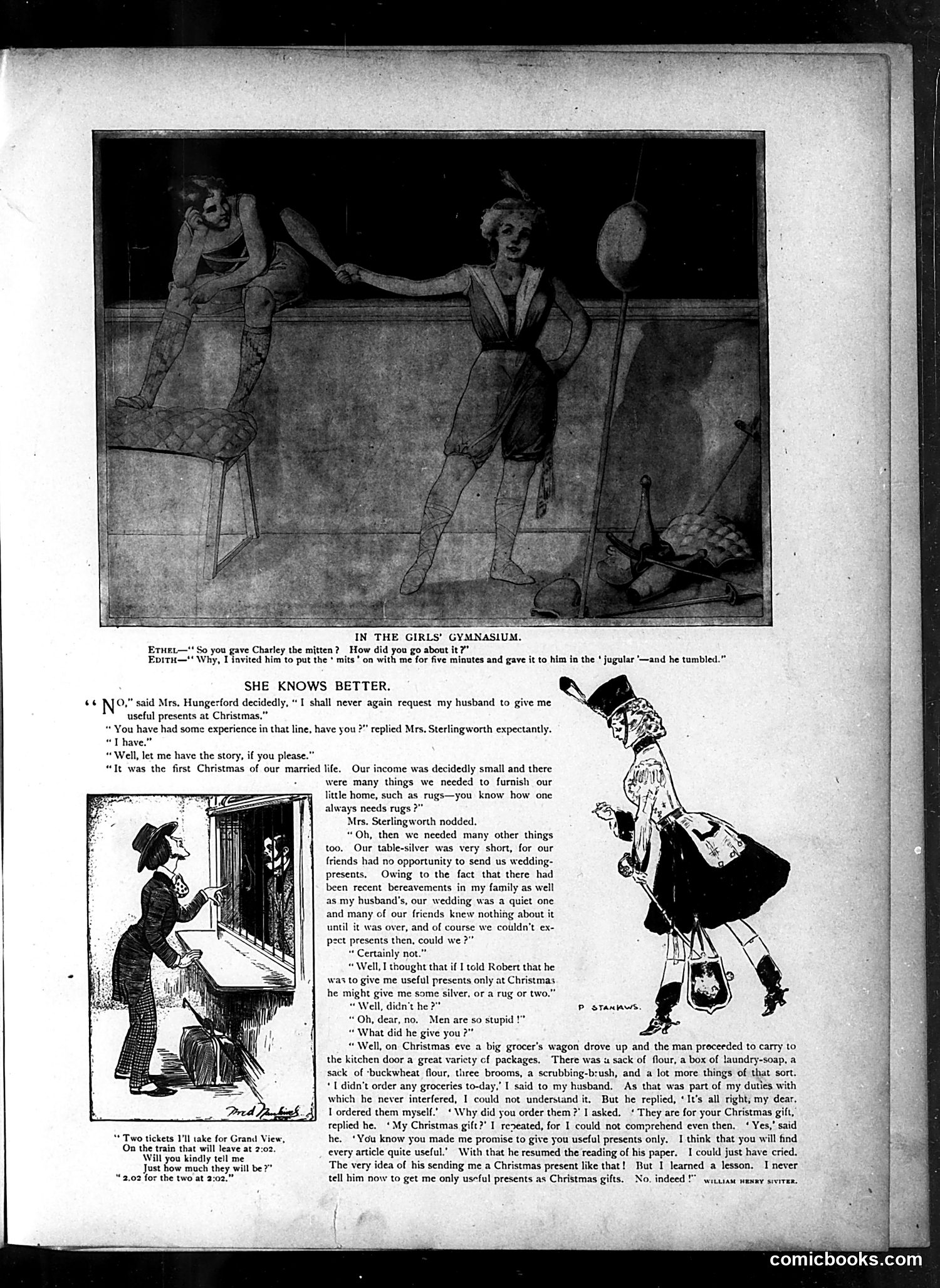
The page contains two satirical pieces about relationships and gift-giving: **"In the Girls' Gymnasium"** (top): A brief joke about a woman rejecting a suitor named Charley by challenging him to boxing ("put the 'mits' on"), then defeating him decisively ("gave it to him in the 'jugular'"). The humor relies on wordplay—"mits" (mittens/boxing gloves) and the unexpected violence of a woman besting a man physically. **"She Knows Better"** (main story): Mrs. Hungerford recounts how her husband literally interpreted her request for "useful" Christmas presents by giving her groceries and household supplies (flour, soap, brooms) instead of luxuries like silverware or rugs. The satire mocks the gap between male and female expectations: husbands' literal-minded practicality versus wives' desires for gifts reflecting thoughtfulness or status. The moral is that wives must manage husbands' expectations carefully—she now avoids specific requests to preserve romance. Both pieces reflect early 20th-century gender dynamics and marital comedy conventions typical of Judge magazine's audience.
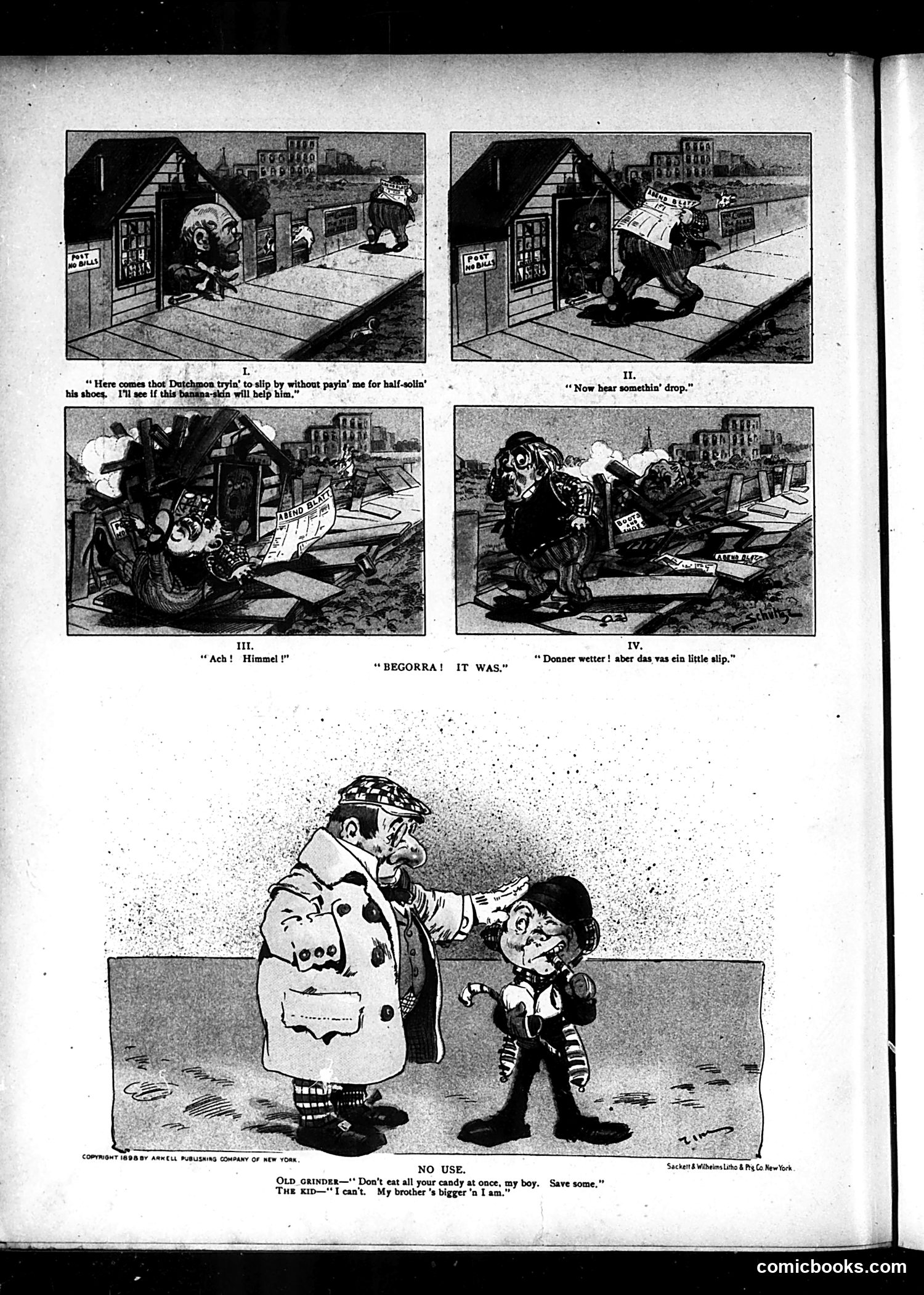
This page contains two separate satirical pieces from Judge magazine (pre-1908, based on copyright). **Top section (4-panel comic):** Depicts an immigrant shoe-shiner attempting to trick a customer ("Dutchman") into paying twice for shoe-shining by pretending to slip and fall. The dialogue uses exaggerated ethnic stereotypes—Irish ("Begorra!") and German ("Ach! Himmel!")—to mock working-class immigrant hustlers and their broken English. The satire ridicules petty street scams. **Bottom section ("No Use"):** Shows an old man and child, with the child unable to save candy because his bigger brother will take it. The moral lesson—about restraint and savings—ironically fails due to family power dynamics. This satirizes the difficulty of teaching financial prudence to the poor. Both pieces use ethnic caricature and working-class scenarios typical of Judge's early 20th-century humor, targeting immigrant and lower-class subjects for middle-class audiences.
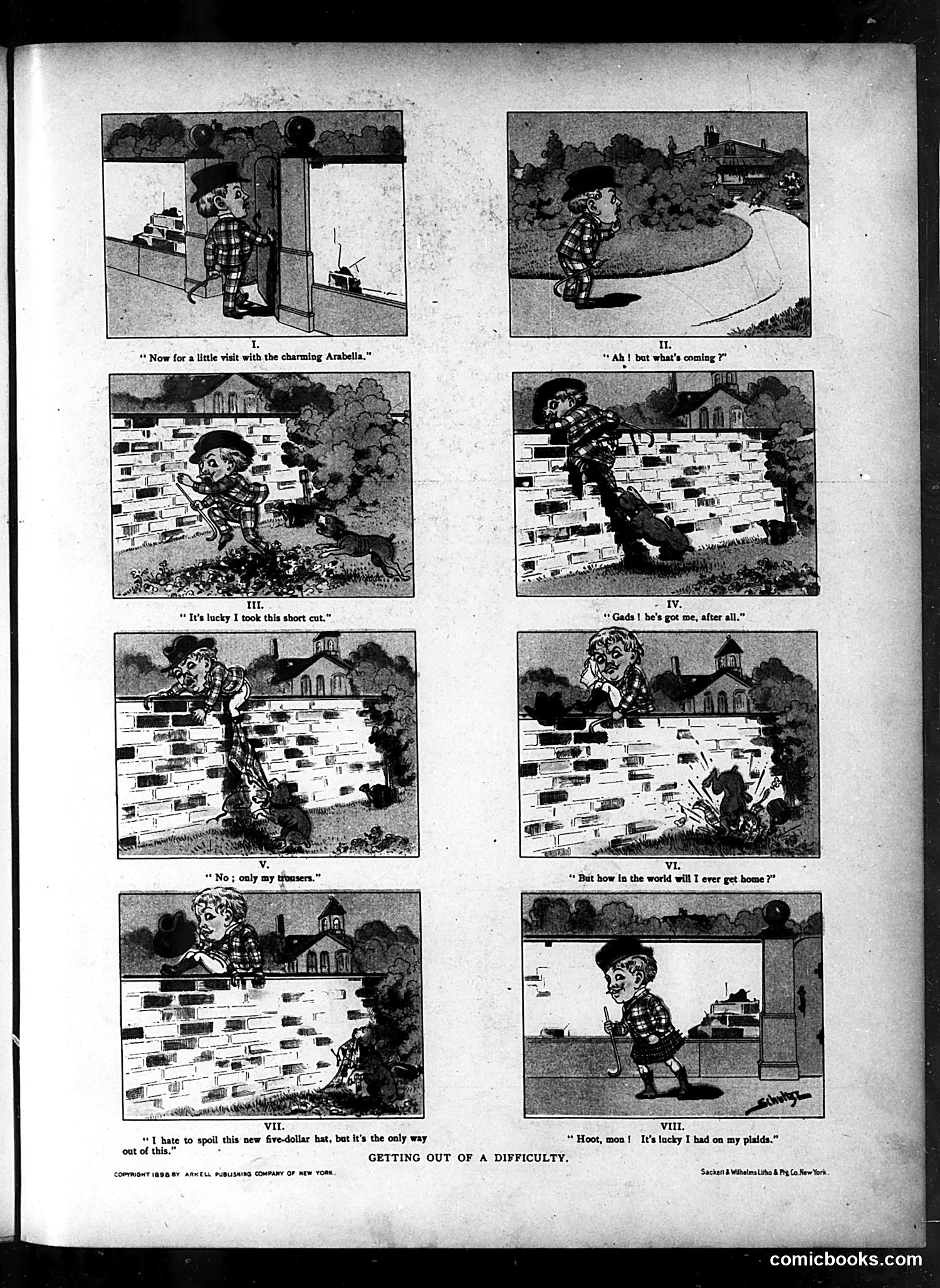
This eight-panel comic strip follows a Scottish character (identifiable by his plaid clothing and "Hoot, mon!" dialect) who takes a shortcut through a brick wall while courting a woman named Arabella. He becomes progressively trapped within the collapsing wall structure. The humor derives from the character's escalating predicament—each panel shows him deeper in trouble—culminating in his hat being destroyed. His final relief that his *trousers* (pants) survived intact, rather than his hat or person, provides the punchline through absurd priorities. The satire appears to mock Scottish stereotypes and working-class manners, common in 1890s American humor. The "difficulty" is both literal (physical entrapment) and social (the embarrassment of ruined clothing during courtship).
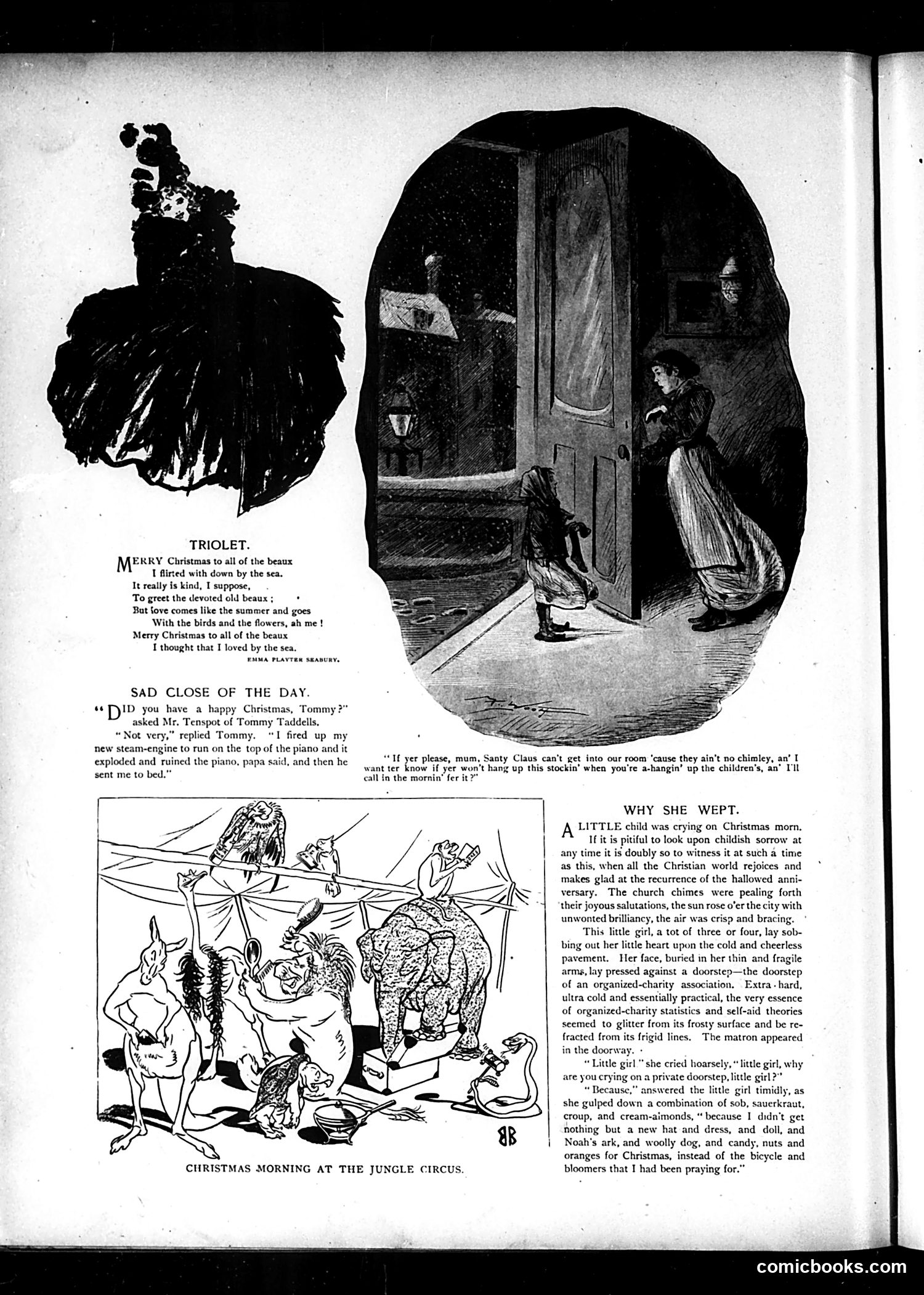
This page contains three Christmas-themed pieces satirizing different aspects of American life: **"Triolet"** is a lighthearted poem about a woman's romantic inconstancy, wishing merry Christmas to former beaux while acknowledging love's transience. **"Sad Close of the Day"** presents two brief anecdotes: a boy disappointed after his toy steam-engine exploded and ruined the piano (earning him bed instead of Christmas joy), and a servant girl worried Santa won't visit because their room lacks a chimney. **"Why She Wept"** satirizes both organized charity and children's materialism. A poor girl cries on a charity doorstep, but her complaint reveals she *did* receive gifts (hat, dress, doll, Noah's ark, toys, candy)—just not the bicycle and bloomers she wanted. The satire mocks both the cold bureaucracy of "organized-charity" and middle-class children's ungrateful entitlement, contrasting sharply with genuinely destitute circumstances. The accompanying cartoon shows exaggerated circus animals, likely illustrating holiday excess.
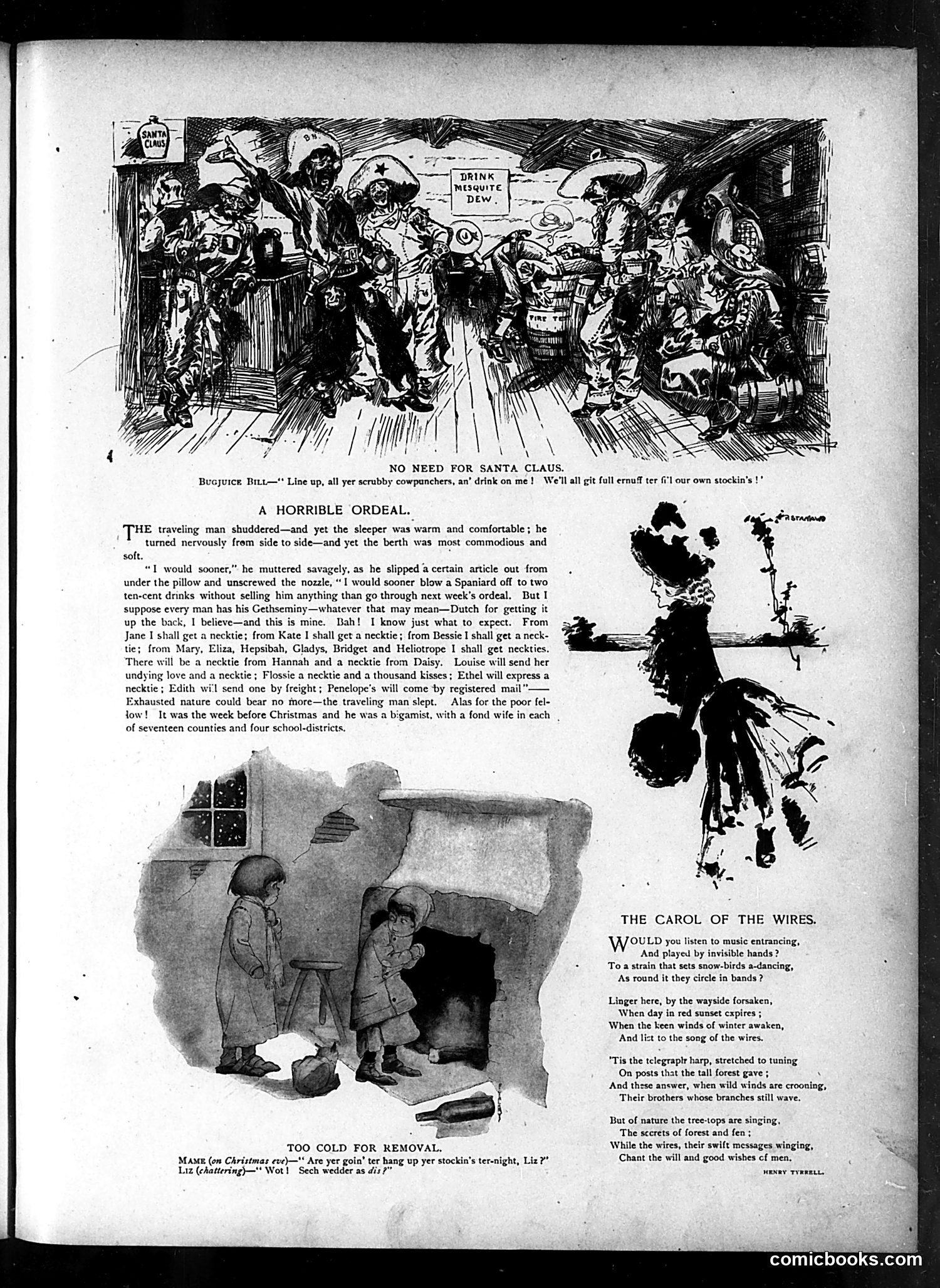
This page contains three separate satirical pieces: **"No Need for Santa Claus"** (top cartoon): A saloon scene where a rough cowboy ("Bugjuice Bill") offers drinks to other cowboys, sarcastically suggesting they don't need Santa since they can get drunk themselves. The satire targets working-class excess and frontier rowdiness. **"A Horrible Ordeal"** (text story): A traveling salesman dreads Christmas because he expects to receive neckties from multiple women—revealed to be his wives in different counties. The joke satirizes bigamy and infidelity, framing receiving identical gifts as the traveler's "punishment" for his deception. **"The Carol of the Wires"** (poem with illustration): Romanticizes telegraph wires as nature's instruments, singing messages of "good wishes" between people. This celebrates the telegraph as humanity's connection to nature and each other. **"Too Cold for Removal"** (bottom): A woman declines to hang Christmas stockings due to freezing weather—mild domestic humor. The page reflects Gilded Age concerns: frontier culture, urban infidelity, technological progress, and working-class life.
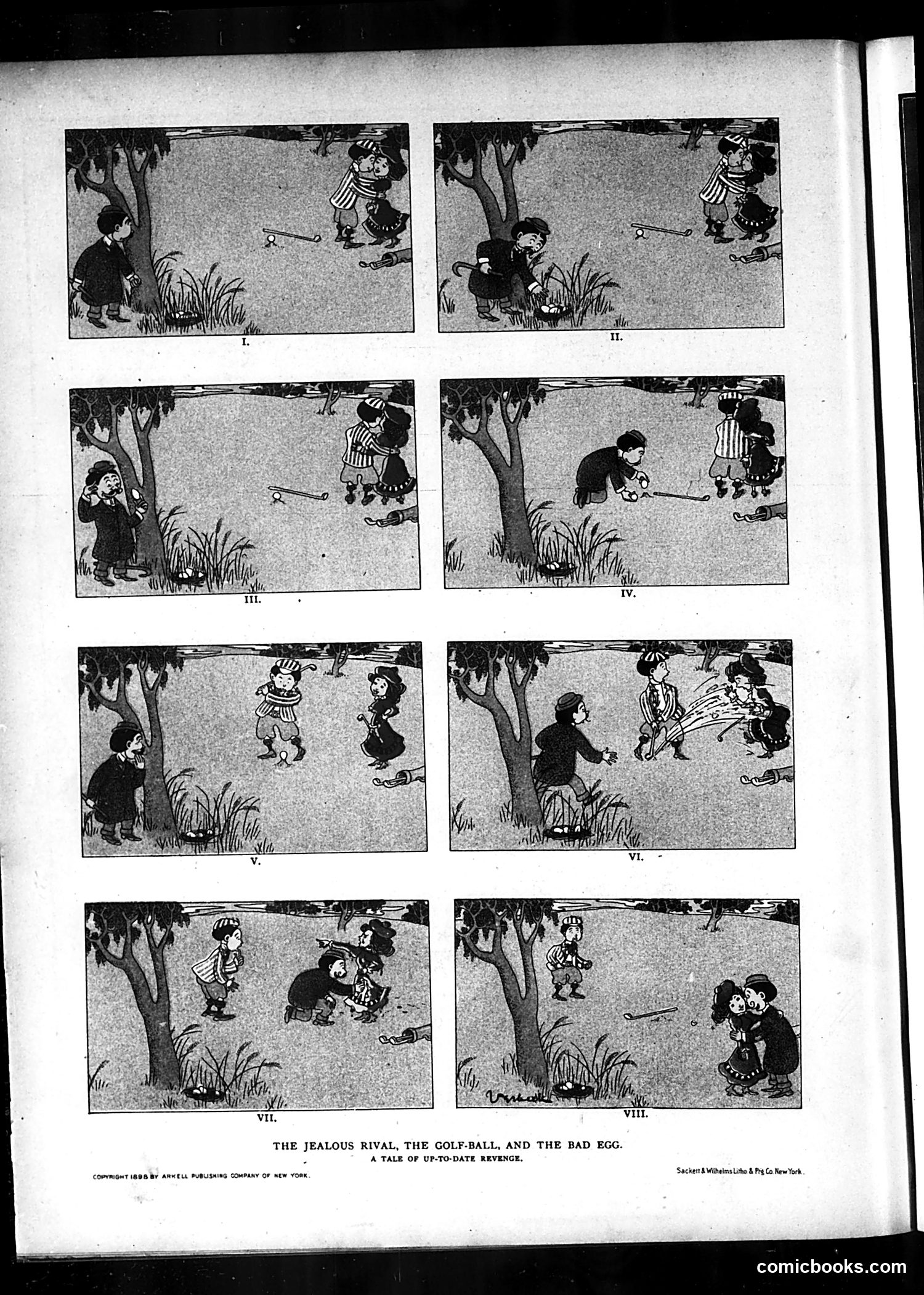
This eight-panel comic strip from Judge (1898) depicts a revenge narrative involving children. The story appears to show a jealous rivalry between two boys over a girl, centered on a golf ball. The sequence progresses from initial conflict through escalating retaliation: the boy in the striped shirt appears to provoke the boy in black, who responds by throwing the golf ball at him. The final panels show the antagonist's comeuppance when he receives a "bad egg" (likely thrown or placed) as payback. The humor relies on the slapstick punishment and the title's play on words—"bad egg" serving as both a literal object and slang for a disreputable person. The comic satirizes contemporary childhood games and the petty disputes of the era, presented with the exaggerated physical comedy typical of Judge's satirical style.
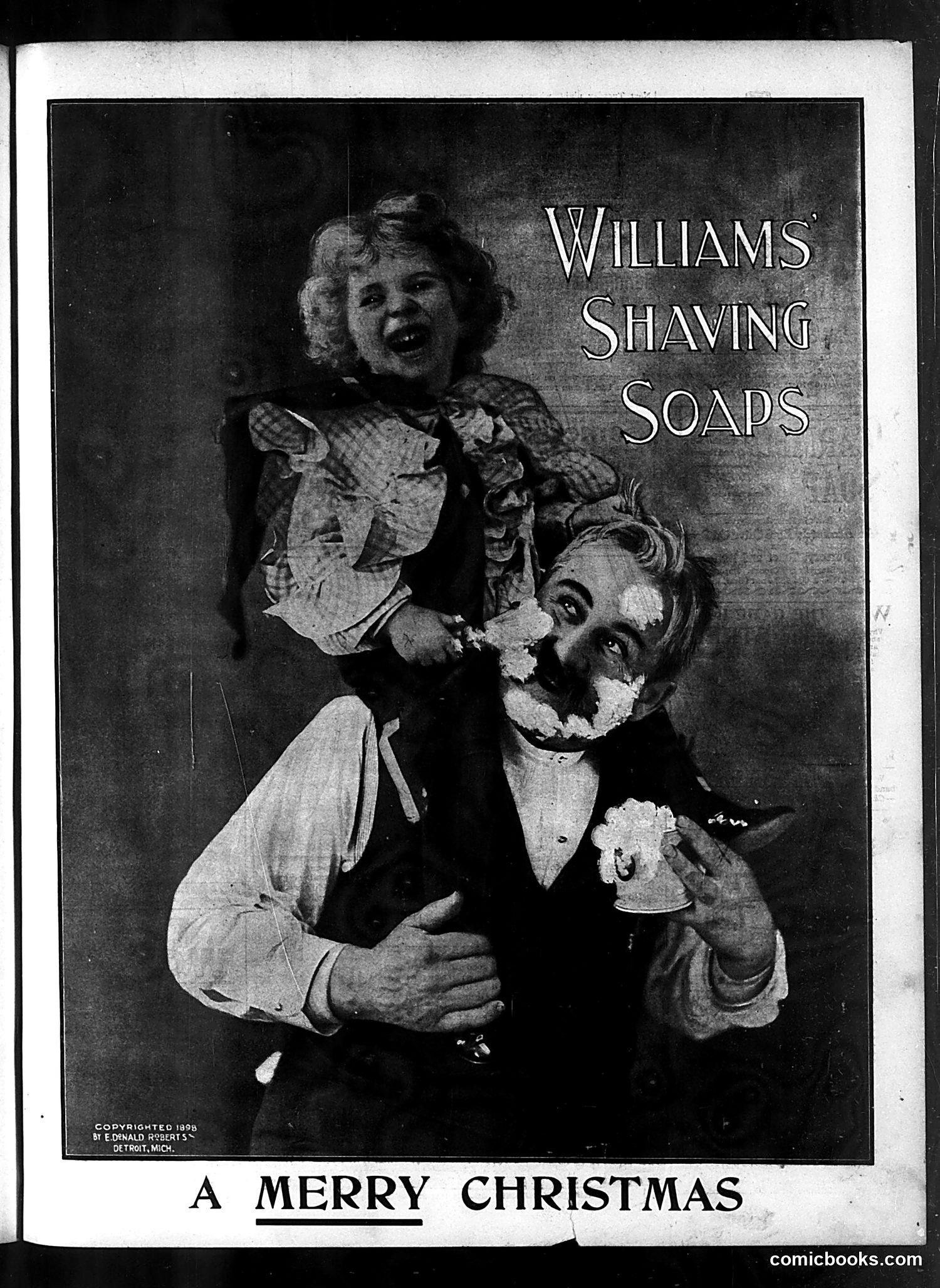
This is a **Christmas advertisement** for Williams Shaving Soaps, not a political cartoon. The image shows a bearded man with shaving soap on his face, holding a child who appears delighted. The message is straightforward commercial messaging: Williams soap produces a cheerful shaving experience suitable as a holiday gift. The humor relies on the man's exaggerated facial expression and the child's joy—suggesting the product makes shaving so pleasant that even children find it entertaining. The "Merry Christmas" greeting frames this as seasonal gift marketing. The copyright attribution to "E. Donald Roberts, Detroit, Mich." dates to 1898, making this a vintage advertisement from Judge magazine's early era, when such hand-drawn product ads were common editorial content.
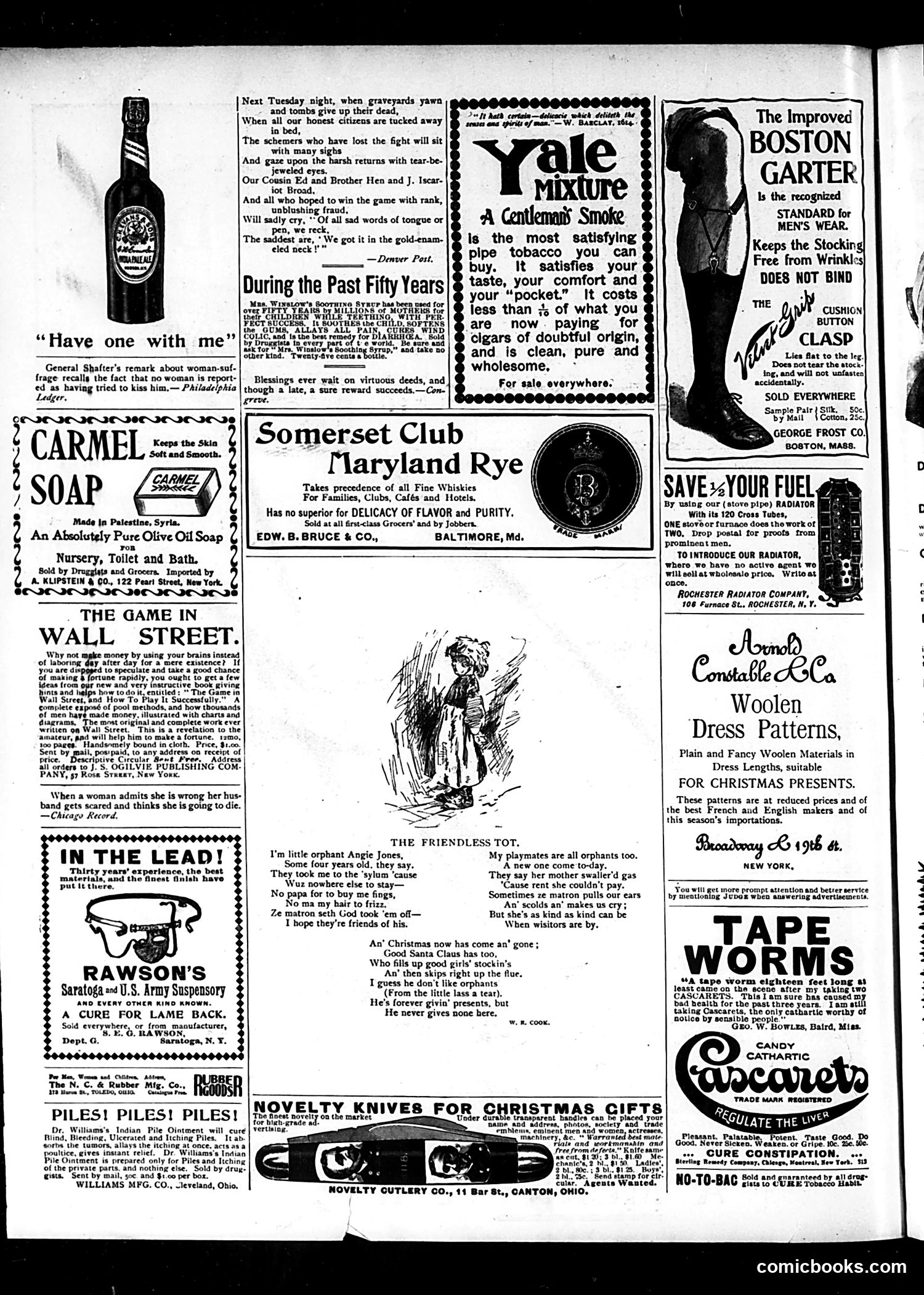
This page is primarily **advertisements** interspersed with minor satirical content. The notable satirical items are: 1. **General Shafter joke**: References General William R. Shafter (Spanish-American War commander) and woman suffrage. The humor mocks suffragettes by suggesting no woman would attempt to kiss the famously unattractive general—a dismissive jab at both Shafter's appearance and suffrage advocates. 2. **Election night poem** ("Next Tuesday night"): Appears to reference a recent election where fraudsters ("schemers") lost their schemes. References to "Brother Hen" and "Cons 'Ed" suggest political figures of the era, though their specific identities are unclear. The tone mocks defeated political operatives. 3. **"Game in Wall Street"** advertisement: Satirizes stock speculation as a get-rich-quick scheme, warning against fraud. The page otherwise features period advertisements for patent medicines, clothing, and spirits—typical of early 1900s Judge magazine content.
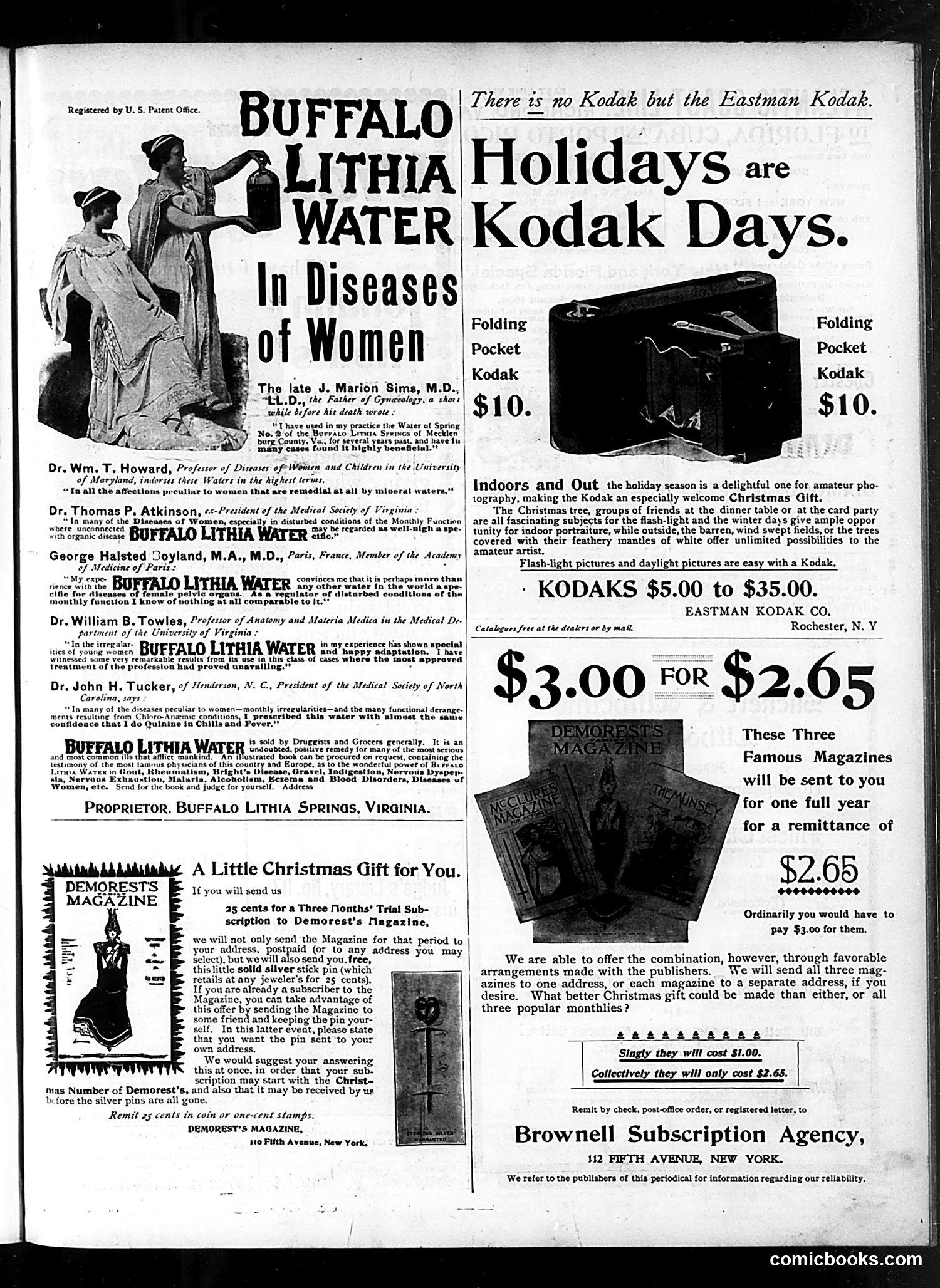
This page is primarily **advertising**, not satire or political commentary. It contains: 1. **Buffalo Lithia Water advertisement** (left side): Promotes mineral water as treatment for women's diseases, particularly gynecological issues. Multiple doctors endorse it. This reflects early 20th-century patent medicine marketing—many such products made unsubstantiated health claims. The emphasis on "women's diseases" reflects period attitudes about female health as uniquely problematic. 2. **Kodak camera ads** (right side): Promoting folding pocket cameras ($10) as holiday gifts, positioning photography as leisure activity. 3. **Magazine subscription offers** (bottom): Demorest's Magazine offers trial subscriptions with promotional gifts (silver stick pins). **No cartoon or satire is evident.** This appears to be a typical Judge magazine page mixing editorial space with paid advertisements—standard magazine practice. The "satire" Judge typically offered elsewhere isn't present here.
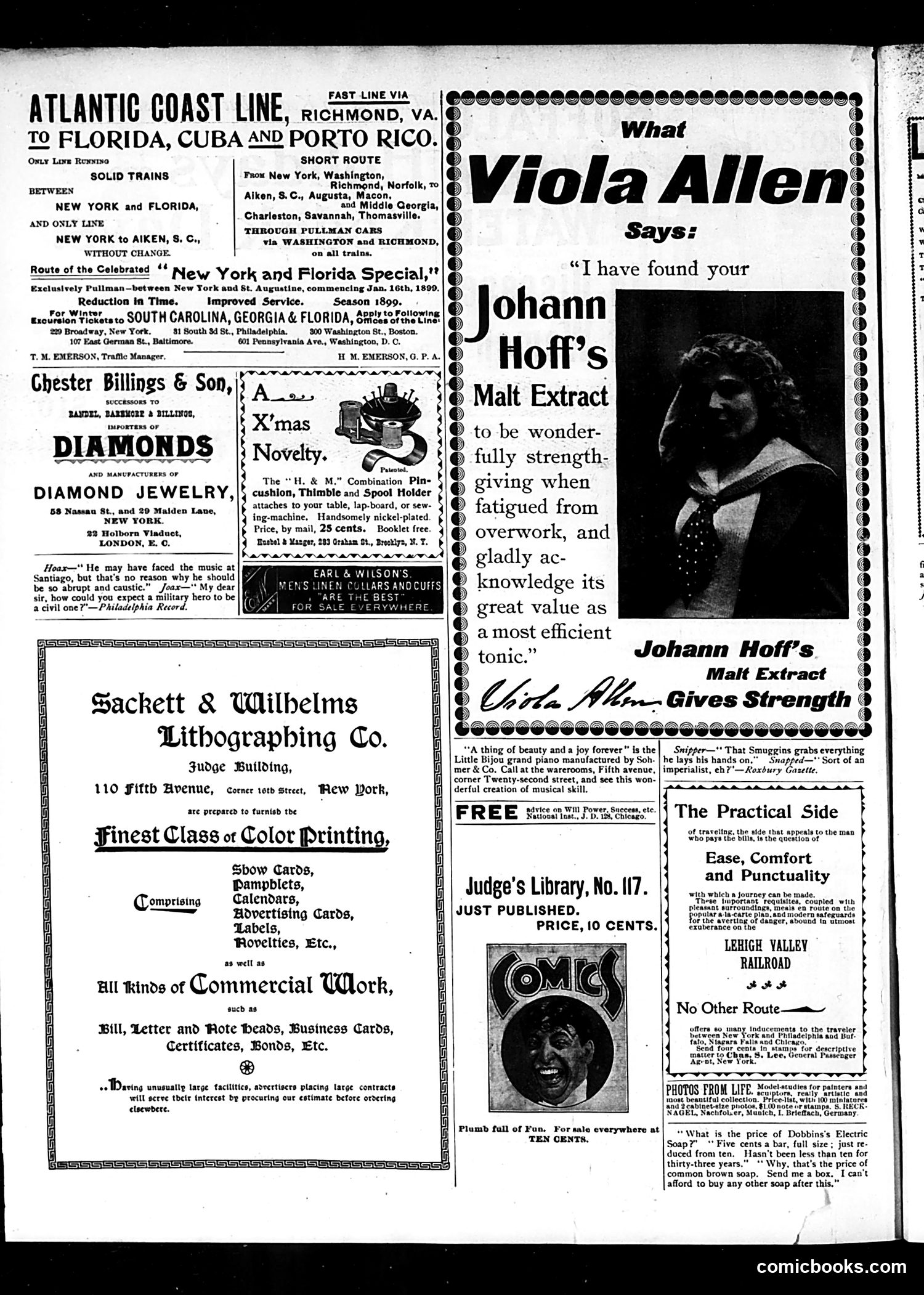
This page is primarily **advertising**, not satirical political cartoons. It contains commercial advertisements for railroad services, jewelry, lithography, and patent medicines typical of late-1890s publications. The one identifiable humor piece is a brief dialogue joke labeled "Hoax" about a military officer (likely referencing the Spanish-American War and Santiago, Cuba, circa 1898). The joke contrasts battlefield conduct with civilian rudeness—suggesting that military heroes aren't necessarily civil in everyday interactions. The largest feature is an endorsement advertisement for **Johann Hoff's Malt Extract**, a patent medicine marketed as a tonic for fatigue and overwork. This represents the era's common practice of celebrity testimonials for unregulated medicinal products. The remainder consists of standard period advertisements: Atlantic Coast Line railroad routes to Florida, diamond jewelry, lithography services, and piano manufacturers. These reflect the economic interests of Judge's upper-middle-class readership during the Gilded Age.
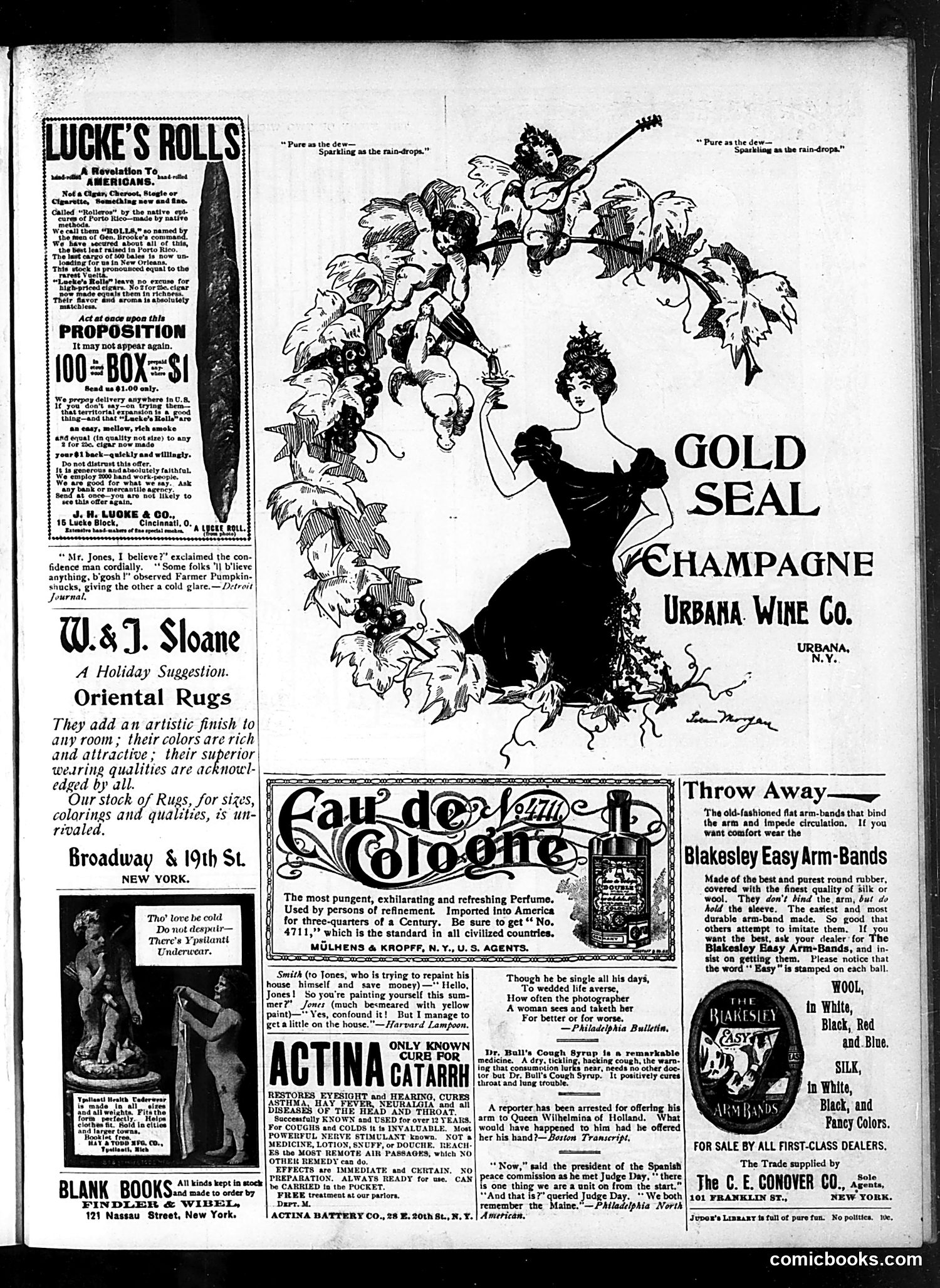
This is primarily an **advertising page** from Judge magazine, with one small cartoon and accompanying joke. The main satirical content is a brief cartoon-joke dialogue between "Mr. Jones" (a confidence man) and "Farmer Pumpkinshucks." Jones tries to sell the farmer something dubious, claiming it's a genuine opportunity. The farmer, skeptical and suspicious, responds sarcastically with a "cold glare." The joke satirizes the common con-artist schemes of the era—likely referencing fake investment or product scams targeting rural Americans. The page itself is dominated by period advertisements for Lucke's Rolls (cigars from Puerto Rico), Oriental Rugs, perfume, arm-bands, cough syrup, and other products. These ads reflect turn-of-the-century consumer culture and marketing tactics. The satirical edge is minimal here; the page functions mainly as a commercial vehicle typical of magazines of this era.
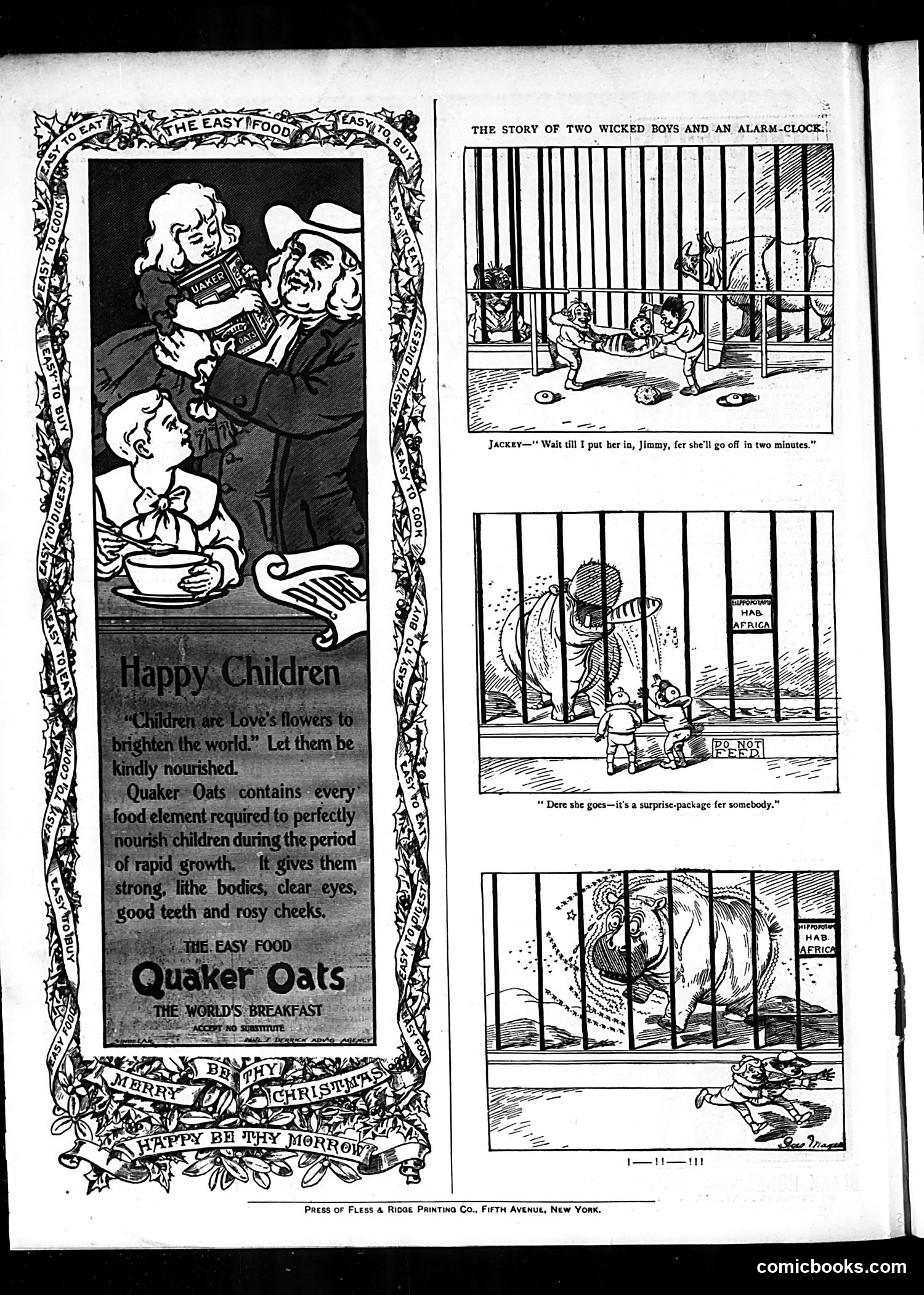
This three-panel comic strip depicts two mischievous boys ("Jackey" and "Jimmy") playing a prank with an alarm clock. In the first panel, one boy tells the other to "Wait till I put her in, Jimmy, for she'll go off in two minutes"—referring to placing the clock in a shop window. The subsequent panels show the boys' surprise when a woman (likely a shop owner) discovers the ticking package they've left, apparently intended as a disruptive prank. The humor relies on wordplay and the chaos that ensues from the unexpected "surprise package." This represents typical turn-of-the-century children's mischief humor common in Judge magazine. The left page contains a Quaker Oats advertisement using sentimental language about nourishing children.
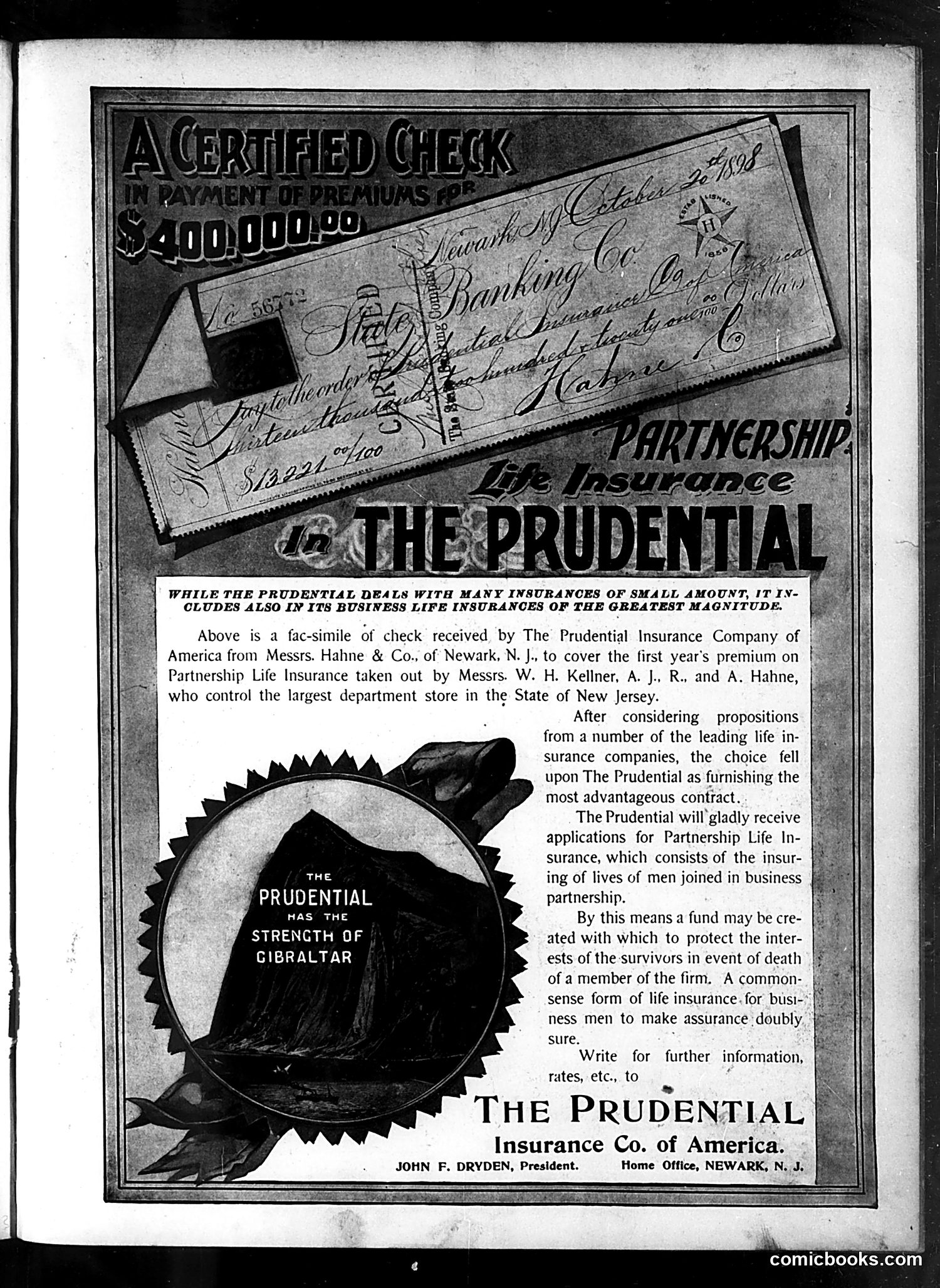
This page is **not satirical content but rather an advertisement** masquerading as editorial material—a common Judge magazine practice. The top shows a facsimile of an actual check for $400,000 paid by Hahne & Co. (Newark's largest department store) to The Prudential Insurance Company for "Partnership Life Insurance." The accompanying text presents this as a success story, describing how Messrs. Kellner and Hahne chose Prudential over competitors. The "strength of Gibraltar" image (bottom) is The Prudential's corporate logo, emphasizing the company's stability and reliability. **What modern readers should know:** This is **advertorial content**—the page blurs advertising and journalism. Judge ran such features to generate revenue while appearing to report business news. The enormous check amount ($400,000 in what appears to be early 20th century) emphasizes Prudential's capacity to handle large policies, legitimizing the company through a real business transaction.
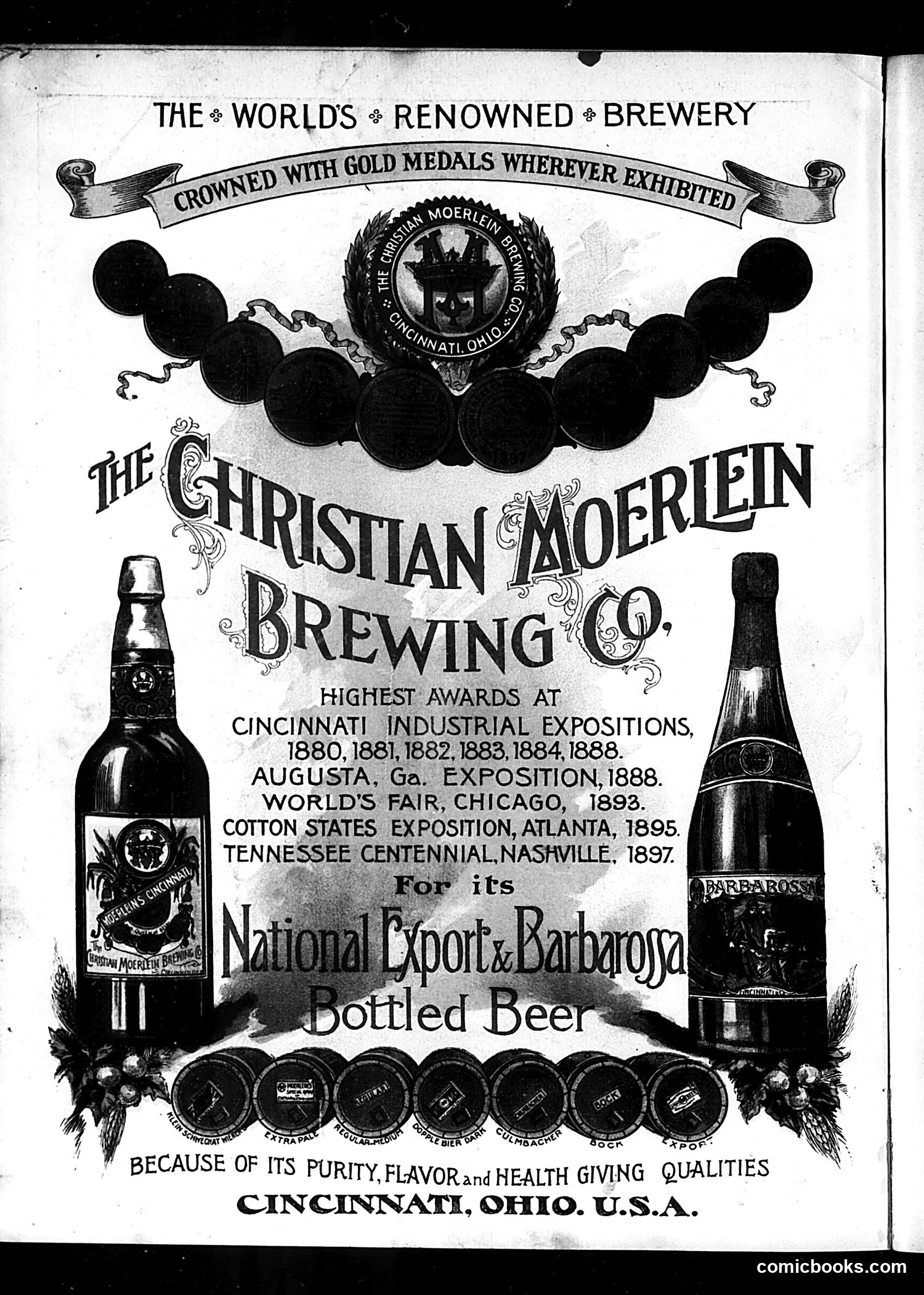
This is an **advertisement, not satirical content**. The Christian Moerlein Brewing Company of Cincinnati is promoting their bottled beers—specifically "National Export" and "Barbarossa"—through a full-page ad in Judge magazine. The page displays the brewery's many award medals from expositions spanning 1880-1897, emphasizing prestige and quality. The decorative elements (ornate lettering, medal illustrations, beer bottles) are typical period advertising design. **No political satire or caricature is present.** This is straightforward commercial promotion leveraging the brewery's numerous industrial fair awards to build consumer confidence. The references to health-giving qualities reflect late-19th-century marketing practices when beer was often marketed for medicinal benefits. The page demonstrates how major advertisers used Judge's pages for branded content alongside the magazine's satirical cartoons.