
A complete issue · 16 pages · 1898
Judge — November 5, 1898
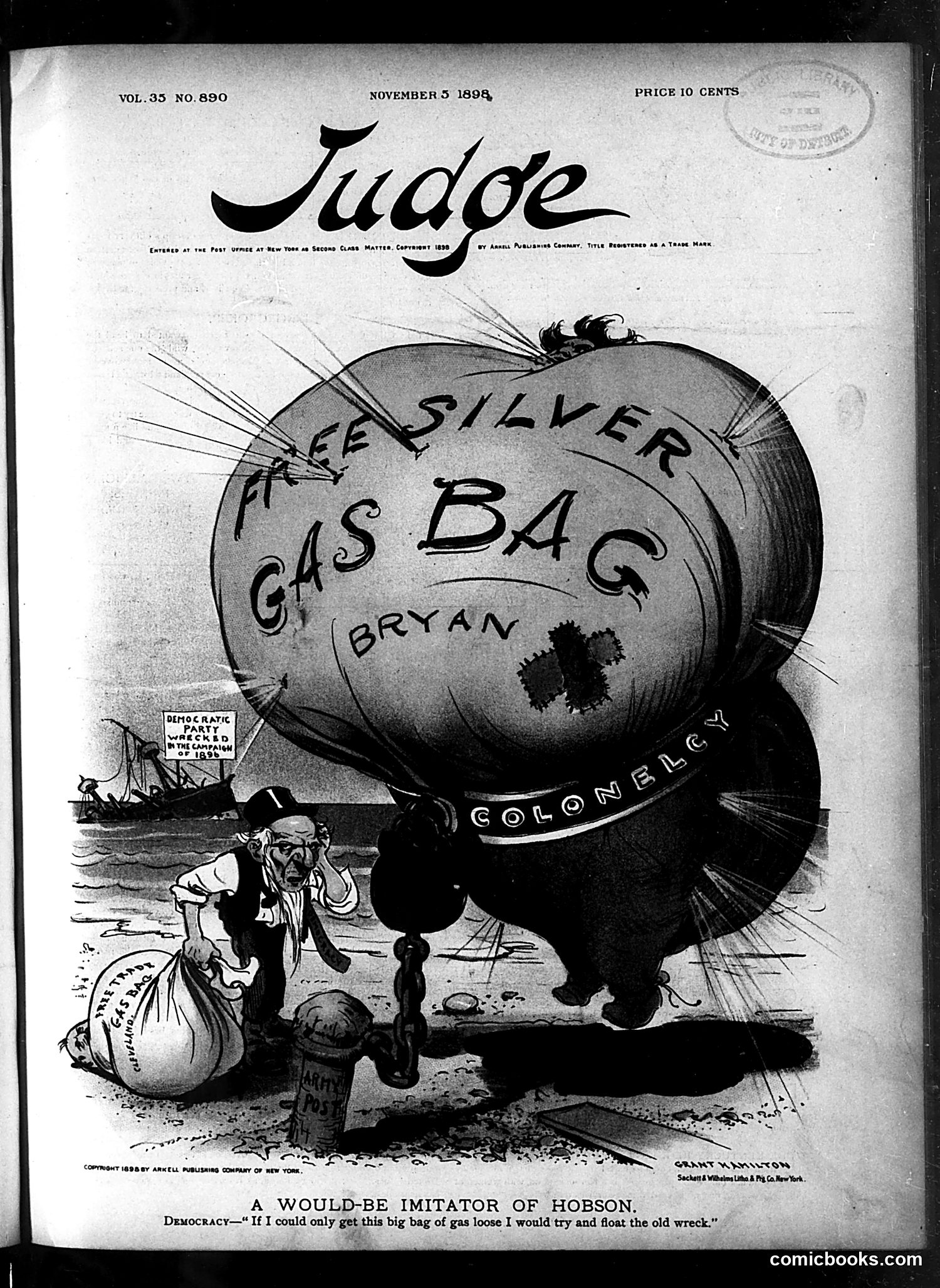
This 1898 *Judge* cartoon satirizes someone attempting to imitate Admiral George Dewey's naval success during the Spanish-American War. The large gas bag labeled "SILVER" and "GAS BAG BRYAN" references William Jennings Bryan, the Democratic presidential candidate. The caricatured figure at left appears to be trying to inflate this bag using a pump, suggesting Bryan is attempting to replicate Hobson's (or Dewey's) military heroism through political bluster rather than genuine achievement. The caption reads: "If I could only get this big bag of gas loose I would try and float the old wreck"—mocking Bryan's inflated rhetoric as mere hot air incapable of producing real results. The ship in the background and Colonel O'Neill's signature complete the political commentary on Democratic overreach during the 1898 election cycle.
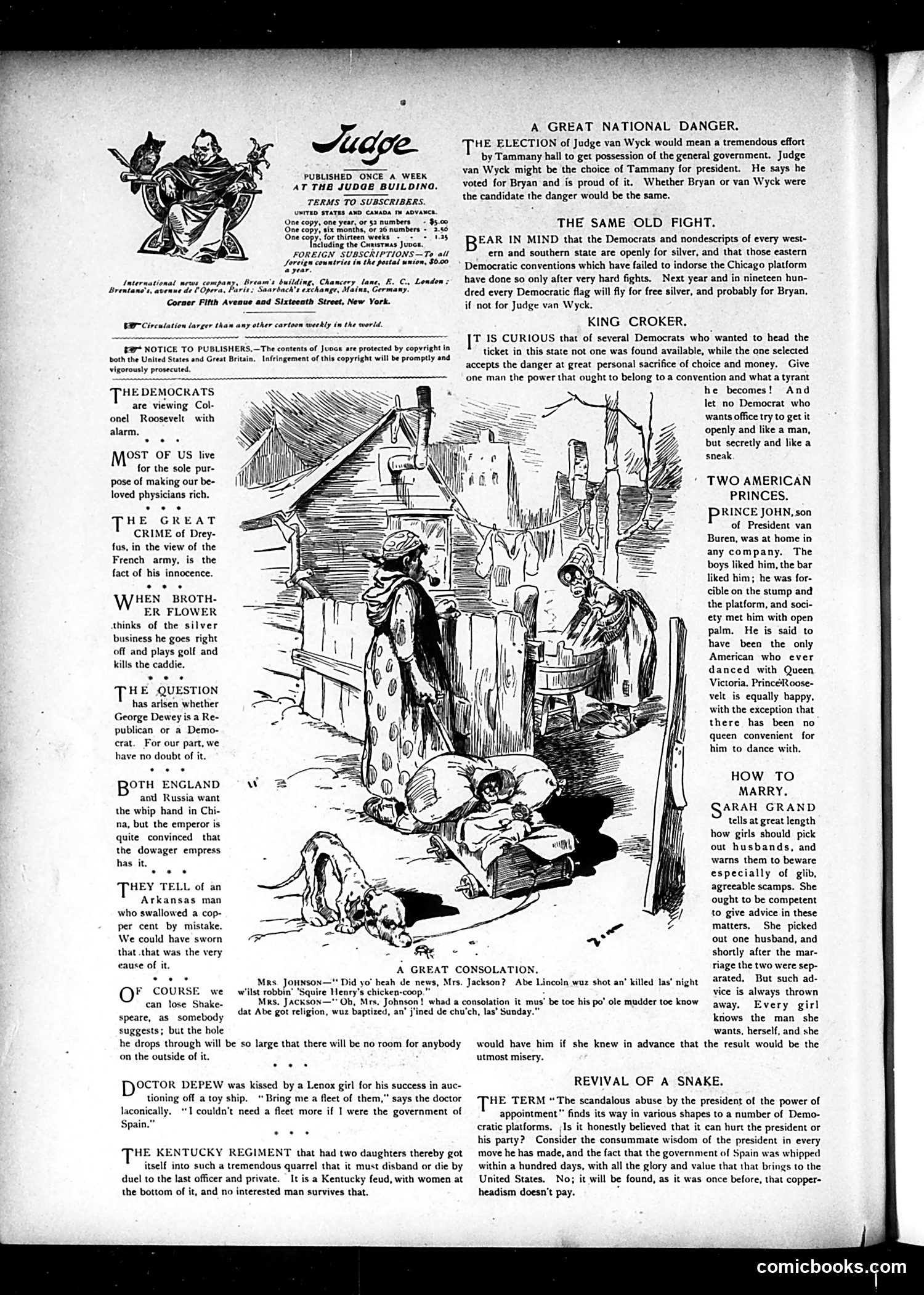
This page critiques the 1896 Democratic presidential nomination contest. The main cartoon depicts urban poverty and suffering, serving as visual commentary on Democratic policy debates. The text "A Great National Danger" warns that Judge van Wyck's potential nomination would mirror Bryan's candidacy—both representing similar threats to the magazine's Republican perspective. "King Croker" references Richard Croker, Tammany Hall's boss, satirizing how Democratic machine politicians secretly wielded power while publicly denying it. "Two American Princes" compares British royalty (Prince John) to American political heirs, mocking the aristocratic pretensions of wealthy Democratic families. The scattered minor items ("How to Marry," "Revival of a Snake") appear to be typical magazine filler, not directly related to the main political content.
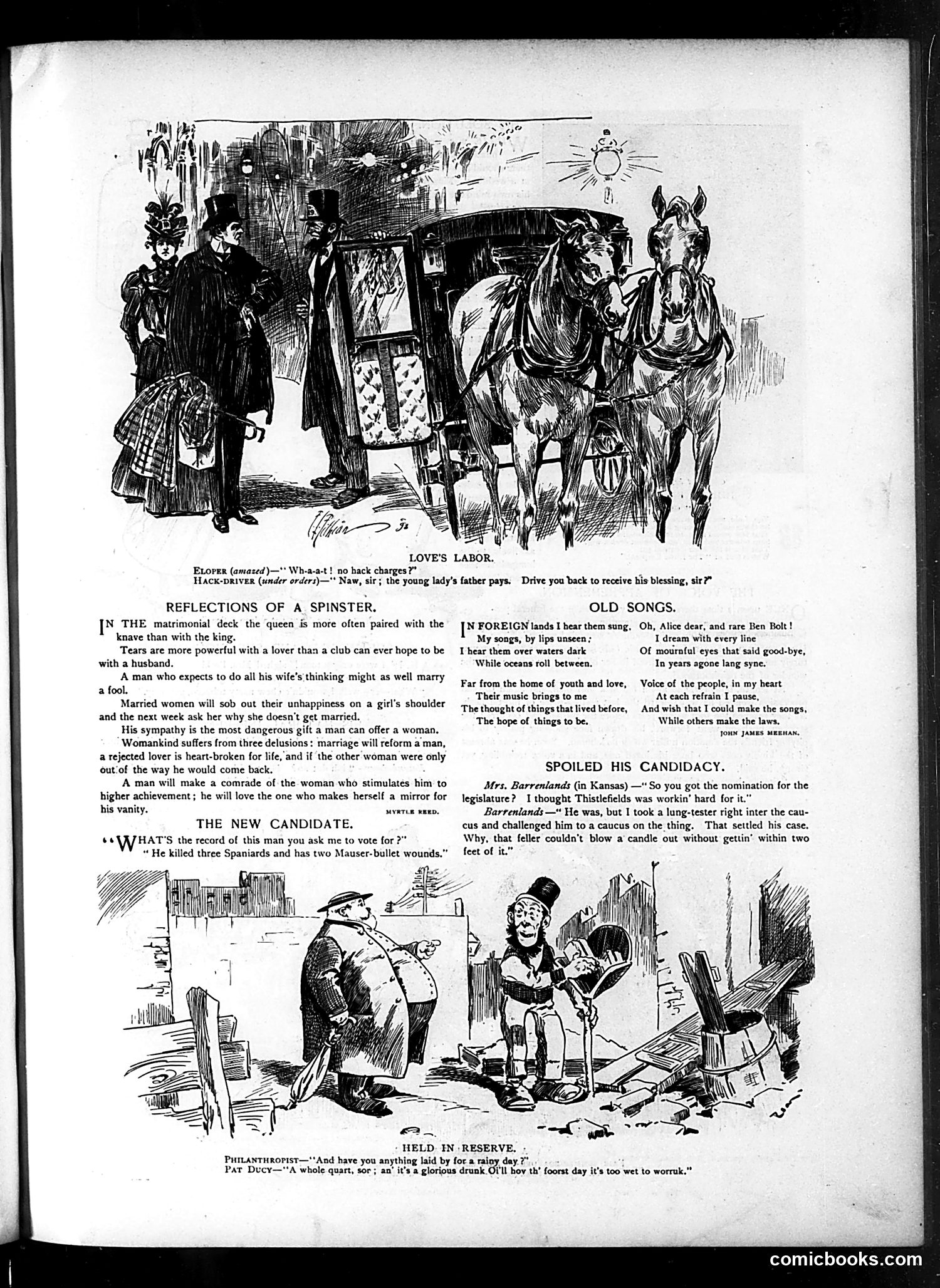
**Top Cartoon - "Love's Labor":** A horse-drawn carriage scene satirizing courtship and marriage. The elopers (young couple) seek the hack-driver's help to escape, while an elderly figure (likely the bride's father) pursues them in a carriage. The joke concerns the financial and social complications of hasty marriages. **Middle Sections:** Three separate satirical pieces mock: - Spinsters' romantic illusions vs. reality - A political candidate's vague record ("What's the record of this man you ask me to vote for?") - "Old Songs" - nostalgic poetry about lost love **Bottom Cartoon - "Held in Reserve":** A fat philanthropist and ragged poor man discuss charity work, with the punchline suggesting the wealthy make excuses ("it's too wet to work") rather than truly helping the needy. The page reflects late-19th/early-20th-century American social commentary on class, politics, and romance.
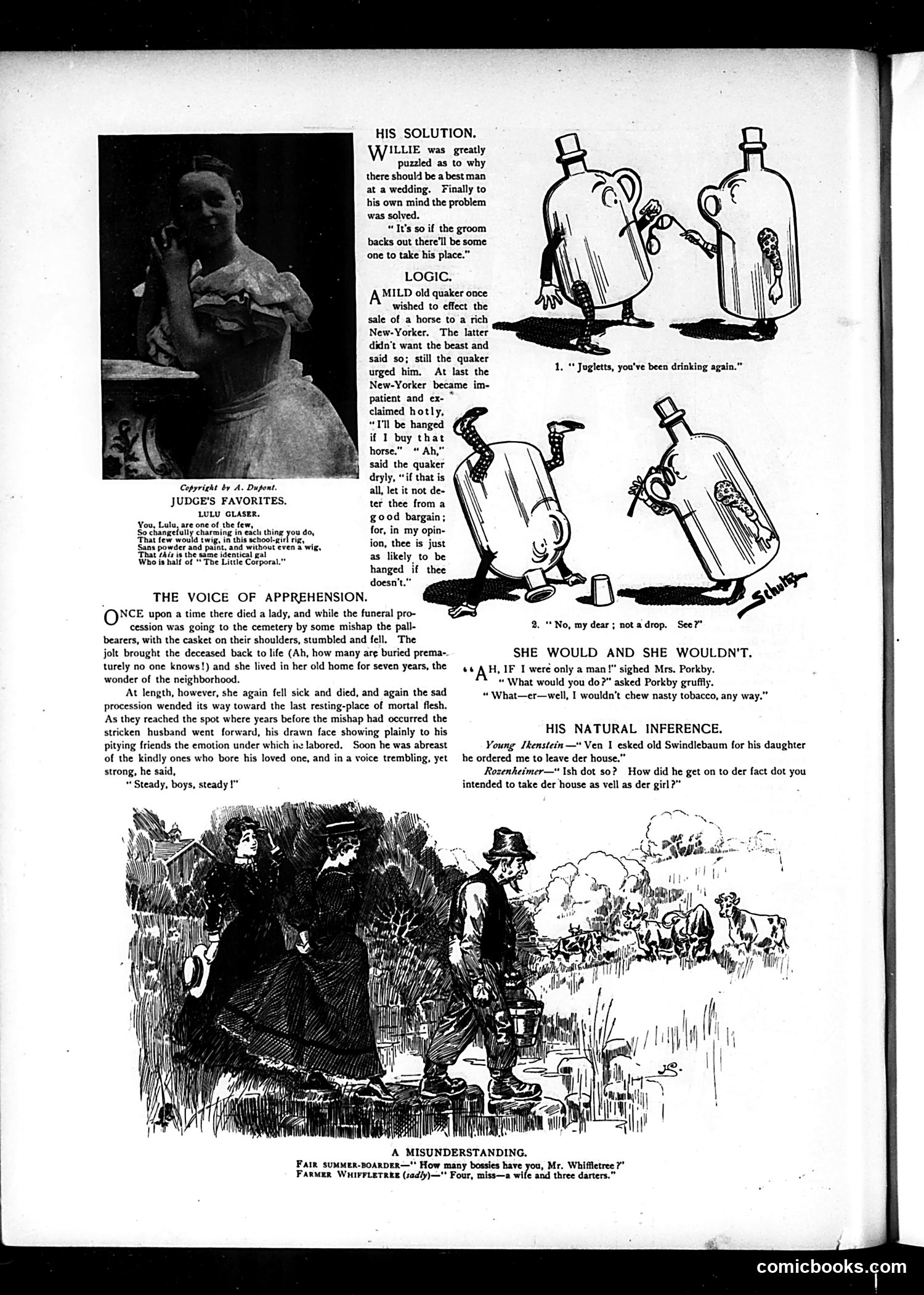
This page contains several unrelated humor pieces typical of Judge magazine's format: 1. **"His Solution"** features Willie solving the "best man" problem at weddings by suggesting the groom back out—a straightforward joke about wedding etiquette. 2. **"Logic"** satirizes a Quaker's haggling over a horse sale, playing on stereotypes of Quakers as both pacifist ("I'll be hanged") and shrewd negotiators. 3. **"The Voice of Apprehension"** depicts a funeral procession, apparently referencing superstitions about premature burials—a Victorian-era anxiety about being buried alive. 4. **"A Misunderstanding"** (bottom) shows a rural/farming joke about miscounted children, playing on class stereotypes. The page is primarily humor without clear political content, focusing instead on domestic situations, social conventions, and period anxieties.
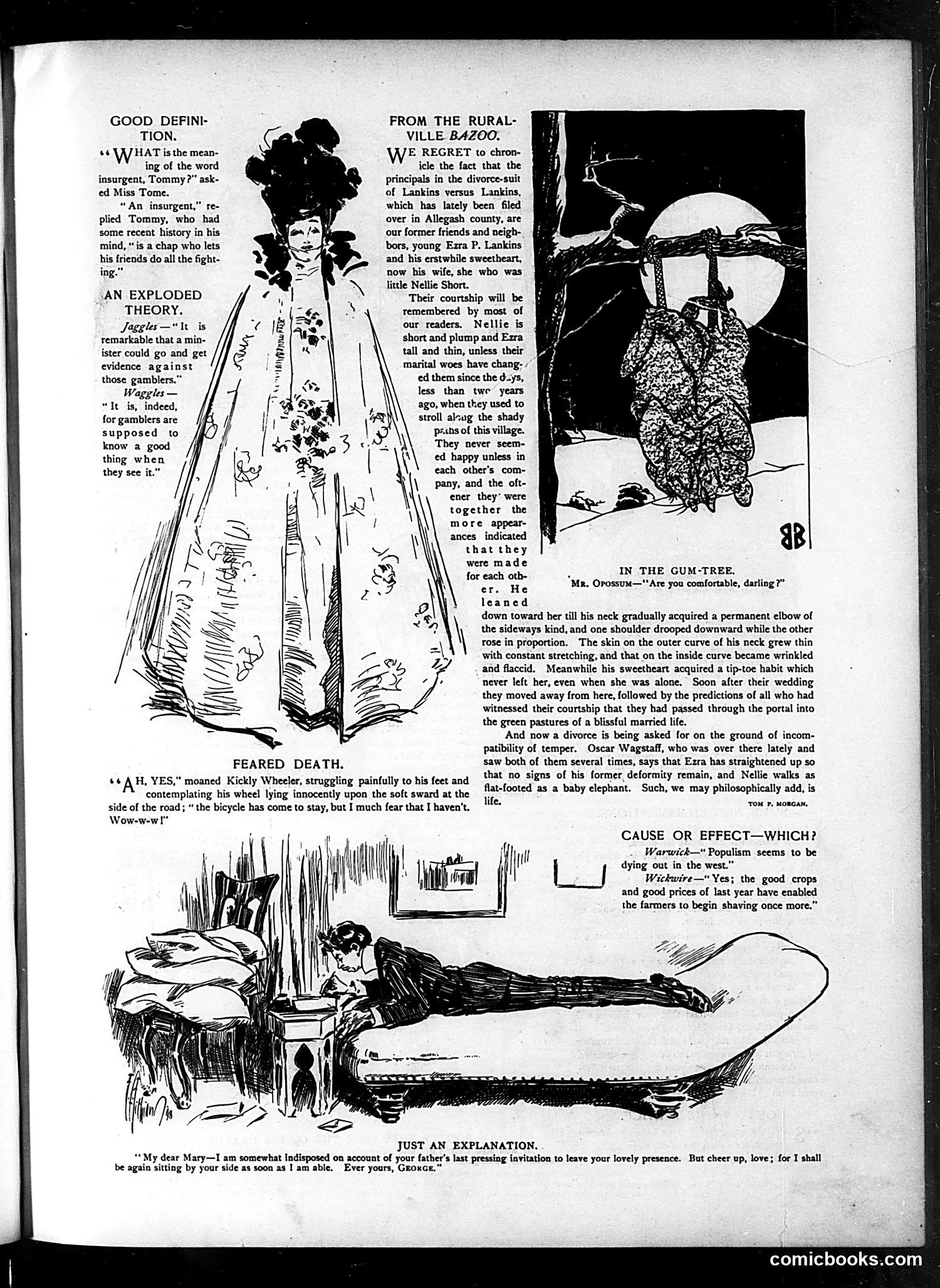
This page contains several satirical sketches typical of early 20th-century American humor: **"Good Definition"** mocks political "insurgents" (likely referencing Progressive/reform movements) through a child's innocent observation that insurgents simply let their friends do the fighting—suggesting hypocrisy or cowardice. **"From the Ruralville Bazoo"** recounts a rural divorce case with dark humor: a courtship where the couple's physical incompatibility (he tall and thin, she short and plump) literally warped their bodies through years of strained togetherness. The ironic conclusion is that their separation has straightened them out physically—suggesting marriage itself caused their deformities, a sardonic commentary on matrimonial mismatch. **"An Exploded Theory"** and **"Cause or Effect"** are brief gags about gamblers recognizing opportunity and Populist farmers' improved fortunes. **"Feared Death"** jokes about a bicycle accident victim's relief that the bicycle survives. The overall tone is cynical about marriage, politics, and rural life—typical Judge satire targeting American social pretensions.
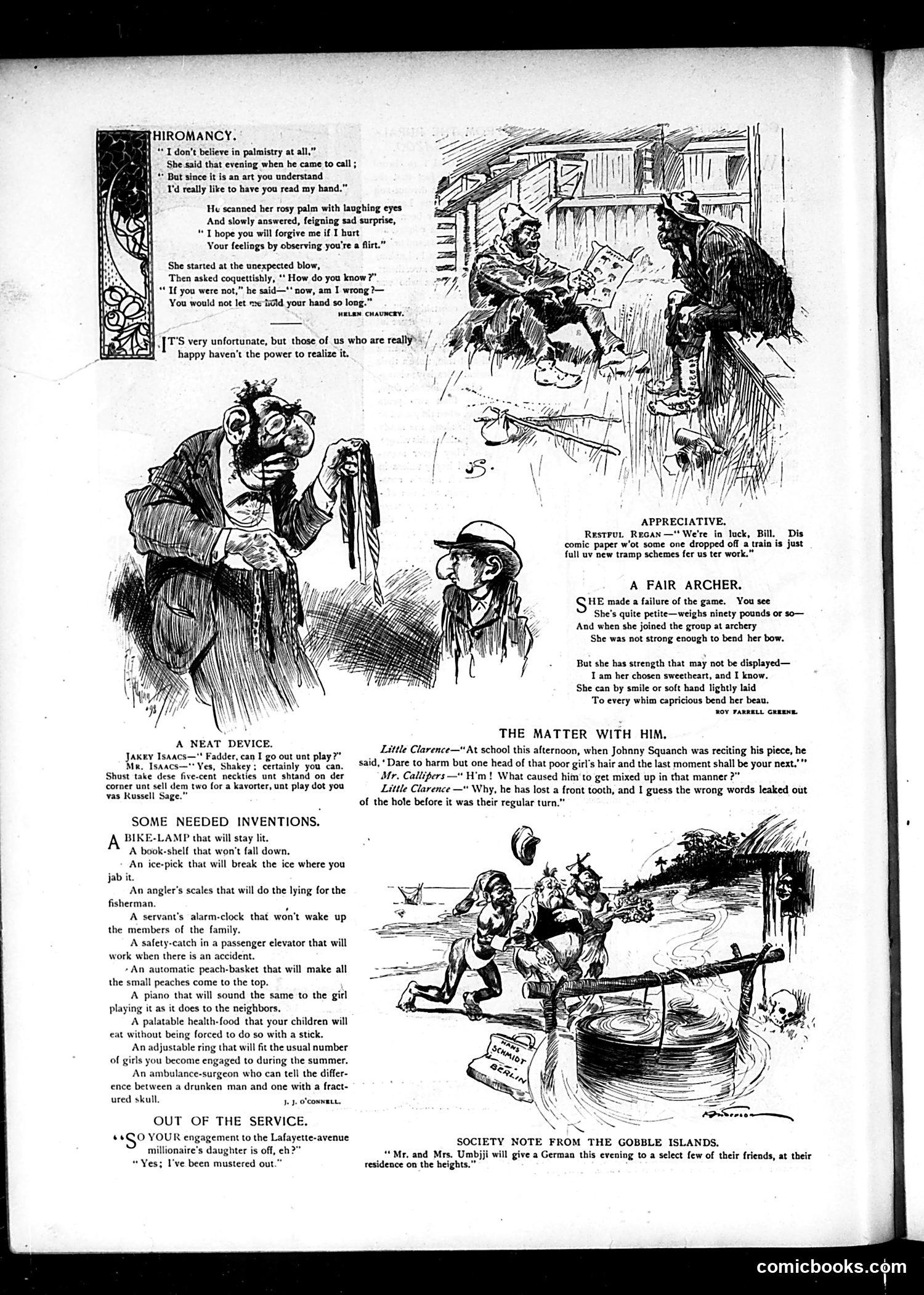
This page from *Judge* contains several brief satirical pieces typical of the publication's humor: **"Hiromancy"** plays on palmistry—a man reads a woman's palm and deduces she's a flirt by the fact that she allows him to hold her hand too long. The joke mocks both fortune-telling and flirtation customs. **"A Fair Archer"** uses a pun: a slight woman can't physically bend an archery bow, but she can "bend" her suitor to her will through charm—commenting on gender dynamics and female manipulation. **"A Neat Device"** mocks child labor and Jewish immigrants: a father sends his son to sell cheap neckties on the street while pretending to be "Russell Sage" (a famous businessman), satirizing both poverty schemes and ethnic stereotypes common to the era. **"Some Needed Inventions"** is a humorous list of practical problems lacking solutions, from faulty bike lamps to unreliable elevators—reflecting early-20th-century consumer frustrations. The remaining pieces are brief social jokes with minimal political content.
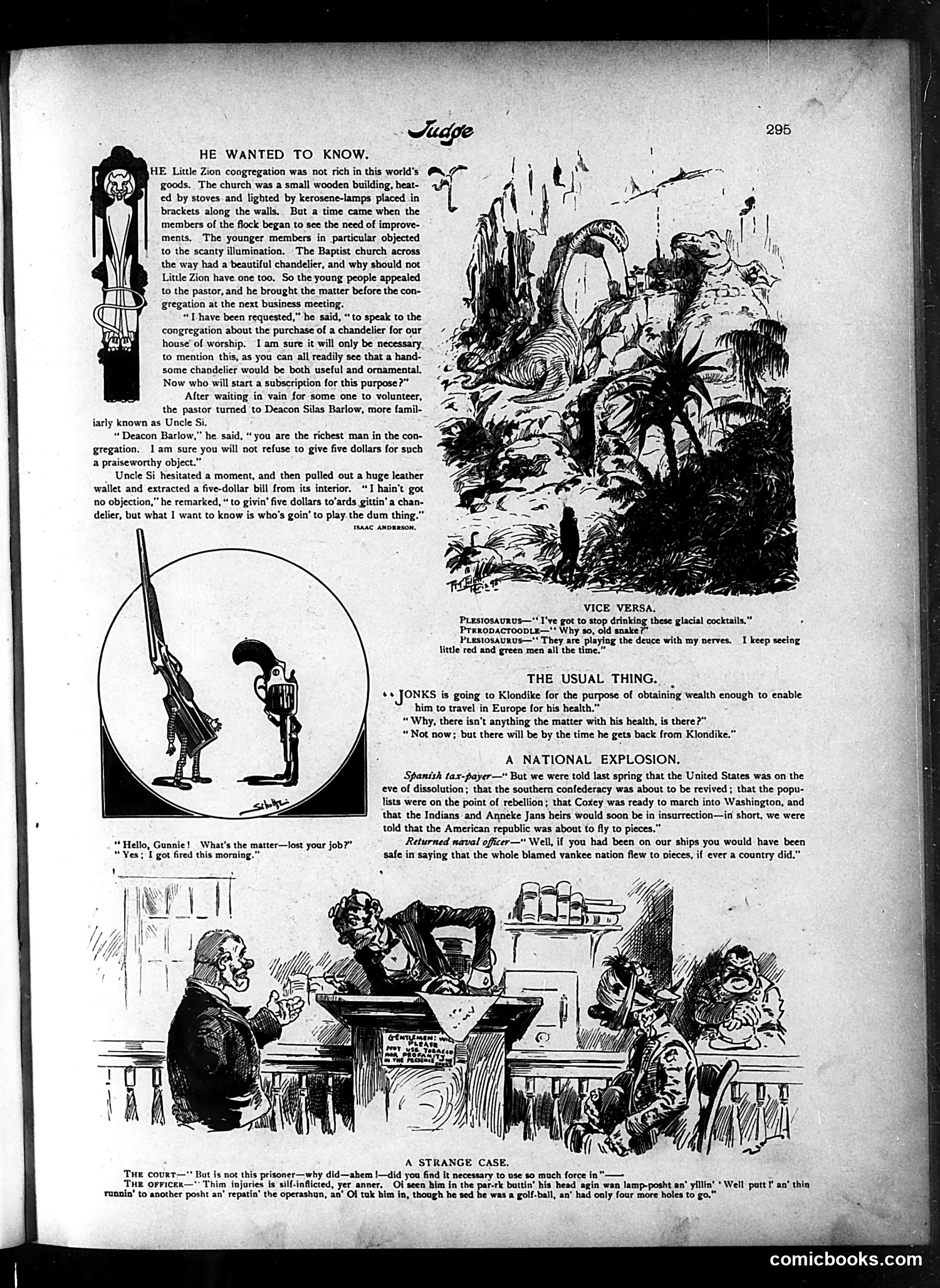
This page contains several satirical pieces reflecting turn-of-the-century American concerns: **"He Wanted to Know"** mocks rural/working-class practicality. Uncle Si agrees to donate $5 for a church chandelier but asks the crucial question: who will operate it? The humor lies in his common-sense objection to an ornamental luxury when the congregation lacks someone qualified to use it. **"Vice Versa"** presents prehistoric creatures discussing cocktails and nervousness—likely satirizing contemporary anxiety about modern life and alcohol's effects. **"The Usual Thing"** jokes about Jonks going to the Klondike gold rush ostensibly for health travel, but predicting he'll ruin his health there first. **"A National Explosion"** references a Spanish taxpayer's bewilderment: American newspapers predicted U.S. dissolution (Civil War revival, Populist rebellion, Coxey's Army march, Native American uprising), yet the nation survived. The naval officer's punchline suggests America did "explode" internally anyway. **"A Strange Case"** depicts an Irish officer explaining an arrested man self-inflicted injuries while acting like a golf ball—absurdist humor about immigrant police and public drunkenness.
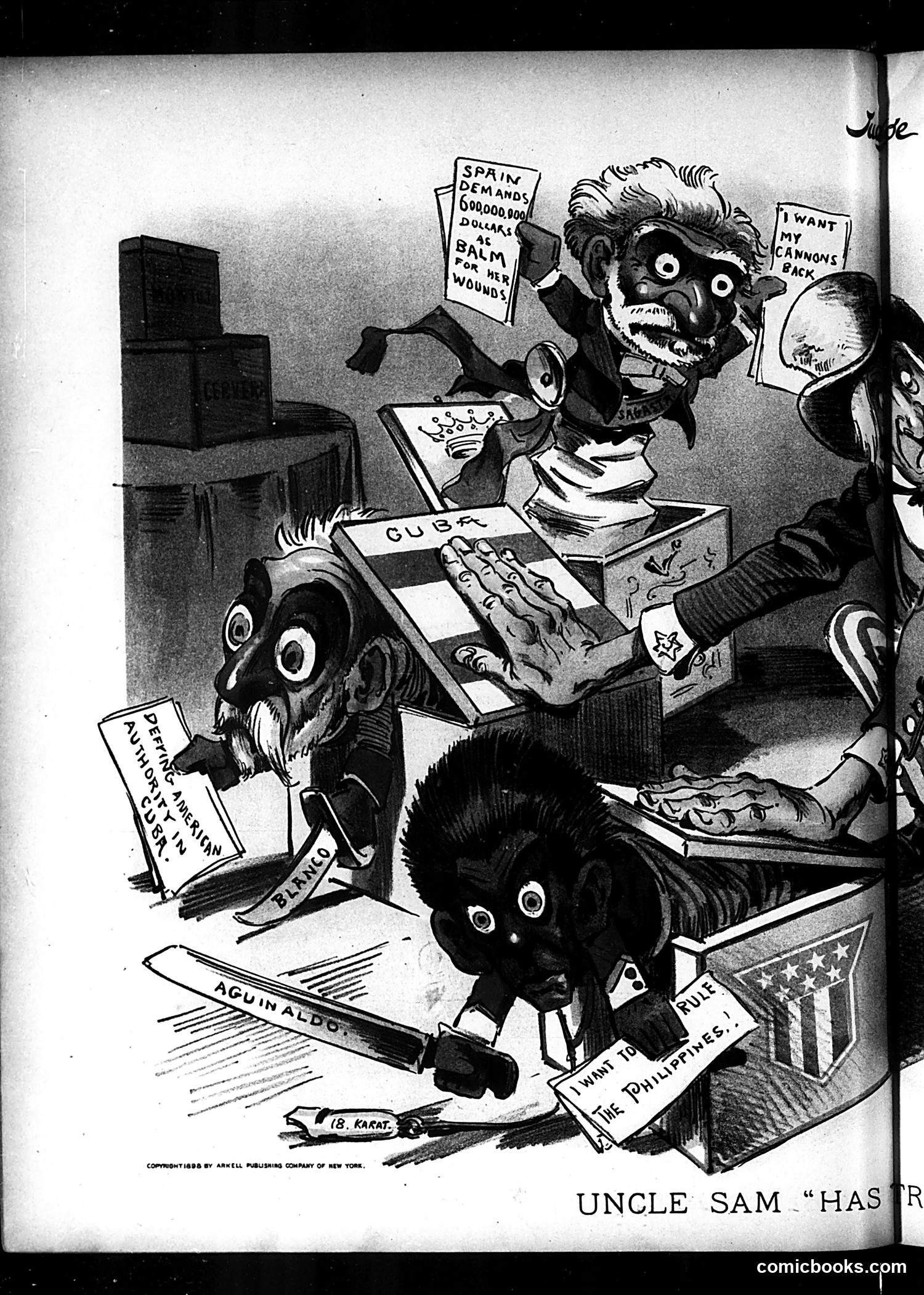
This appears to be a satirical cartoon titled "Uncle Sam 'Has...'" (title cut off). It depicts Uncle Sam (identifiable by the star-spangled hat visible on the right) surrounded by aggressive caricatured figures representing various international adversaries or problematic nations. The figures hold signs referencing: - Spain (demanding "600,000,000 dollars" and "Balm for wounds") - Cuba - The Philippines (with "I want the Philippines!") The cartoon satirizes Uncle Sam juggling multiple foreign policy crises and demands simultaneously—likely referencing the Spanish-American War era (1898) and its aftermath. The exaggerated, menacing character designs reflect period stereotyping. The overall message critiques the complications and financial/military burdens America faced managing its newfound imperial territories and war settlements.
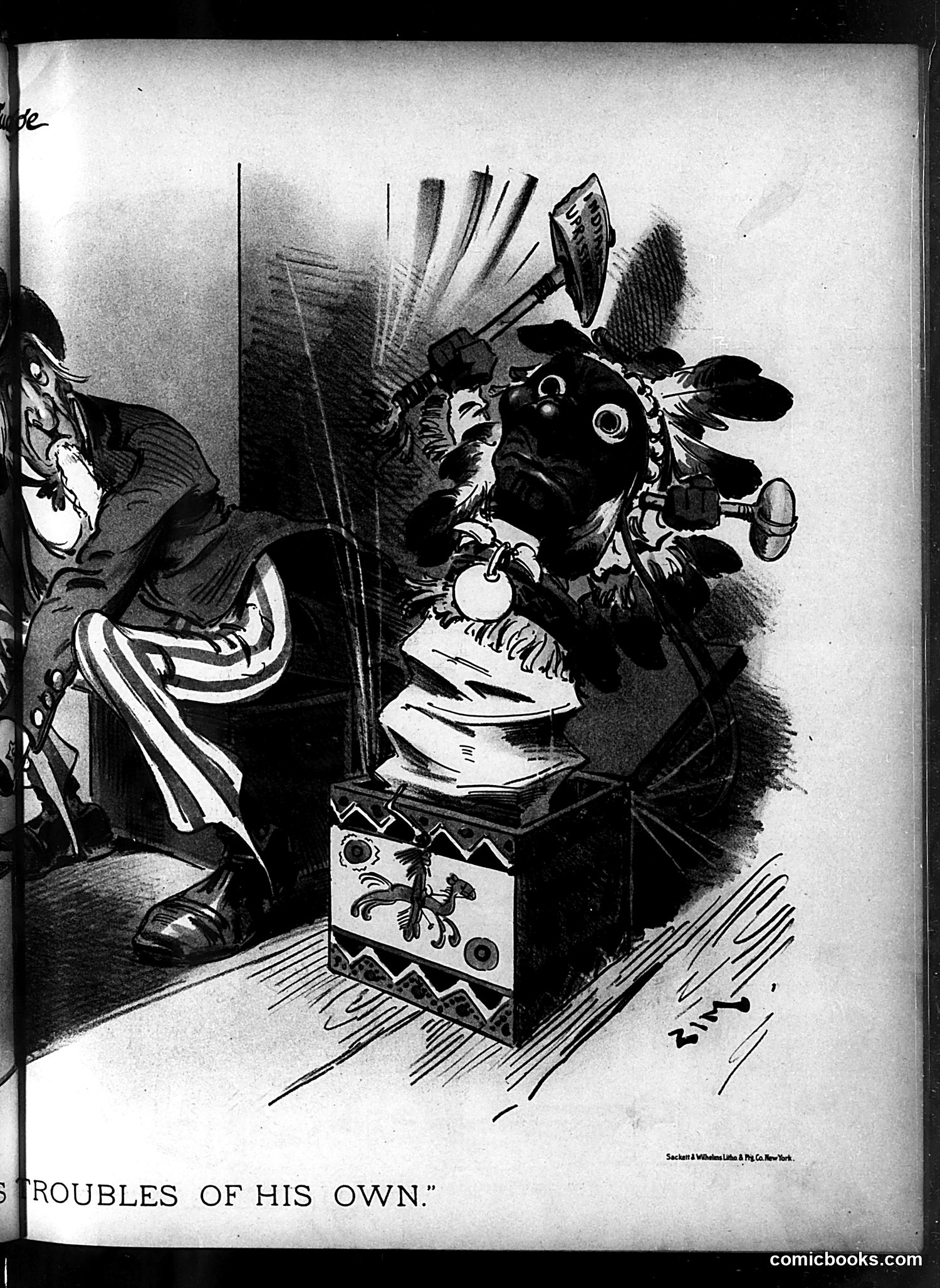
This cartoon depicts a figure (left) observing what appears to be a ornate box or container sprouting multiple heads with exaggerated features and German military imagery, including what looks like Prussian or German Imperial insignia on the base. The sprouting heads suggest proliferation or multiplication of problems. Given *Judge* magazine's satirical nature and the German military visual references, this likely comments on German territorial expansion or military aggression in the early 20th century. The title "Troubles of His Own" suggests the cartoon criticizes a political leader (possibly American, given the figure's apparent nationality) for being preoccupied with domestic problems while overlooking—or being unable to control—emerging international threats or complications emanating from Germany. The exact historical moment remains unclear without publication date confirmation.
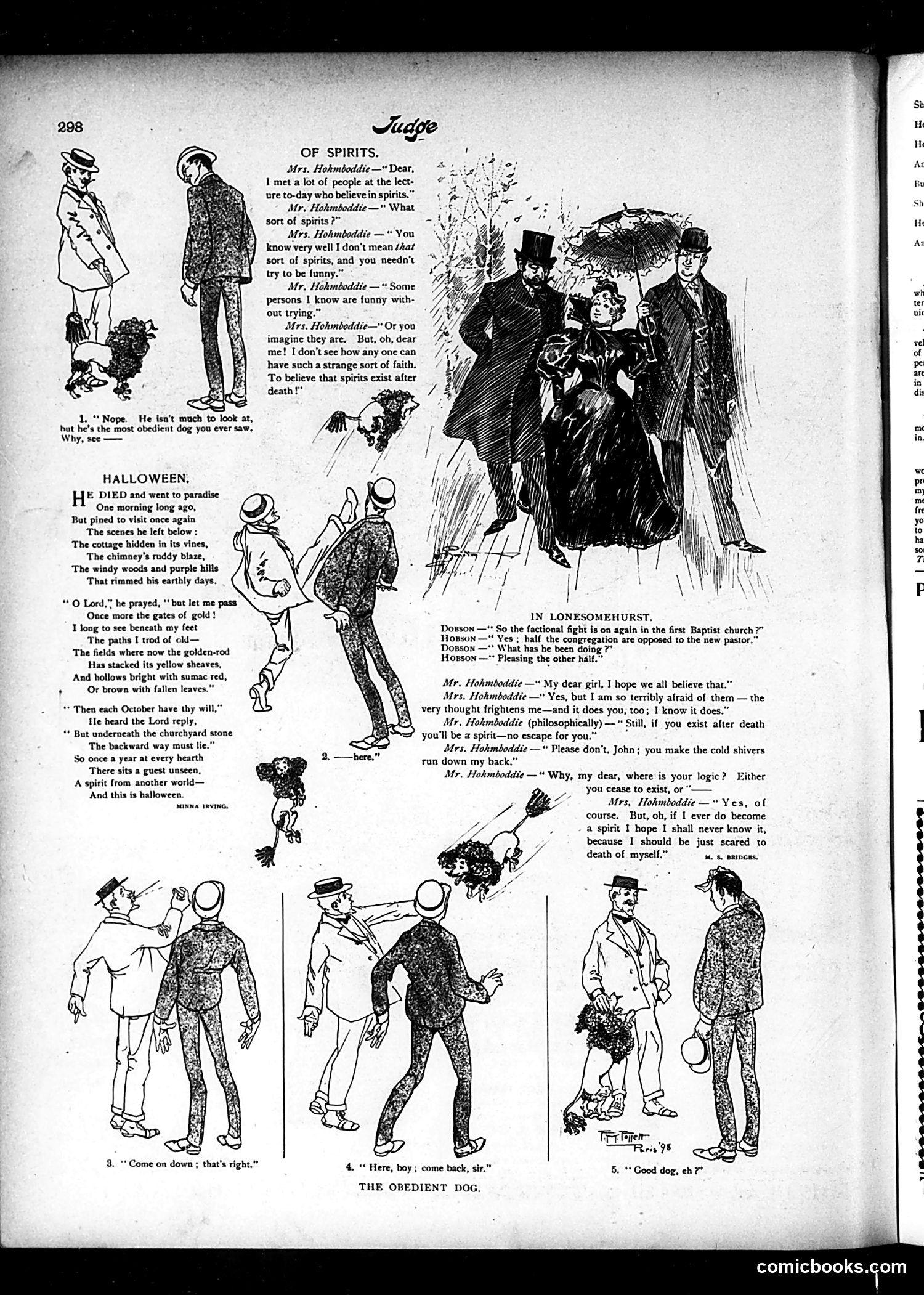
**"Of Spirits"**: A domestic comedy where Mr. and Mrs. Hohmboddie debate spiritualism. She attended a lecture on belief in ghosts; he makes a double entendre about "spirits" (alcohol), which she indignantly rejects. The satire mocks spiritualism—a popular Victorian pseudoscience—while also gently ribbing spousal banter and female gullibility toward supernatural fads. **"Halloween"**: A sentimental poem about a dog granted yearly visits to Earth on Halloween. It's gentle whimsy rather than satire, treating the holiday's ghostly traditions sentimentally. **"In Lonesomehurst" & "The Obedient Dog"**: Two brief vignettes: one about church factionalism, the other depicting a well-trained dog's obedience through sequential comic panels showing the dog responding to commands. These are lighthearted genre sketches typical of *Judge's* humor. The page reflects late-19th-century concerns with spiritualism as fashionable folly.
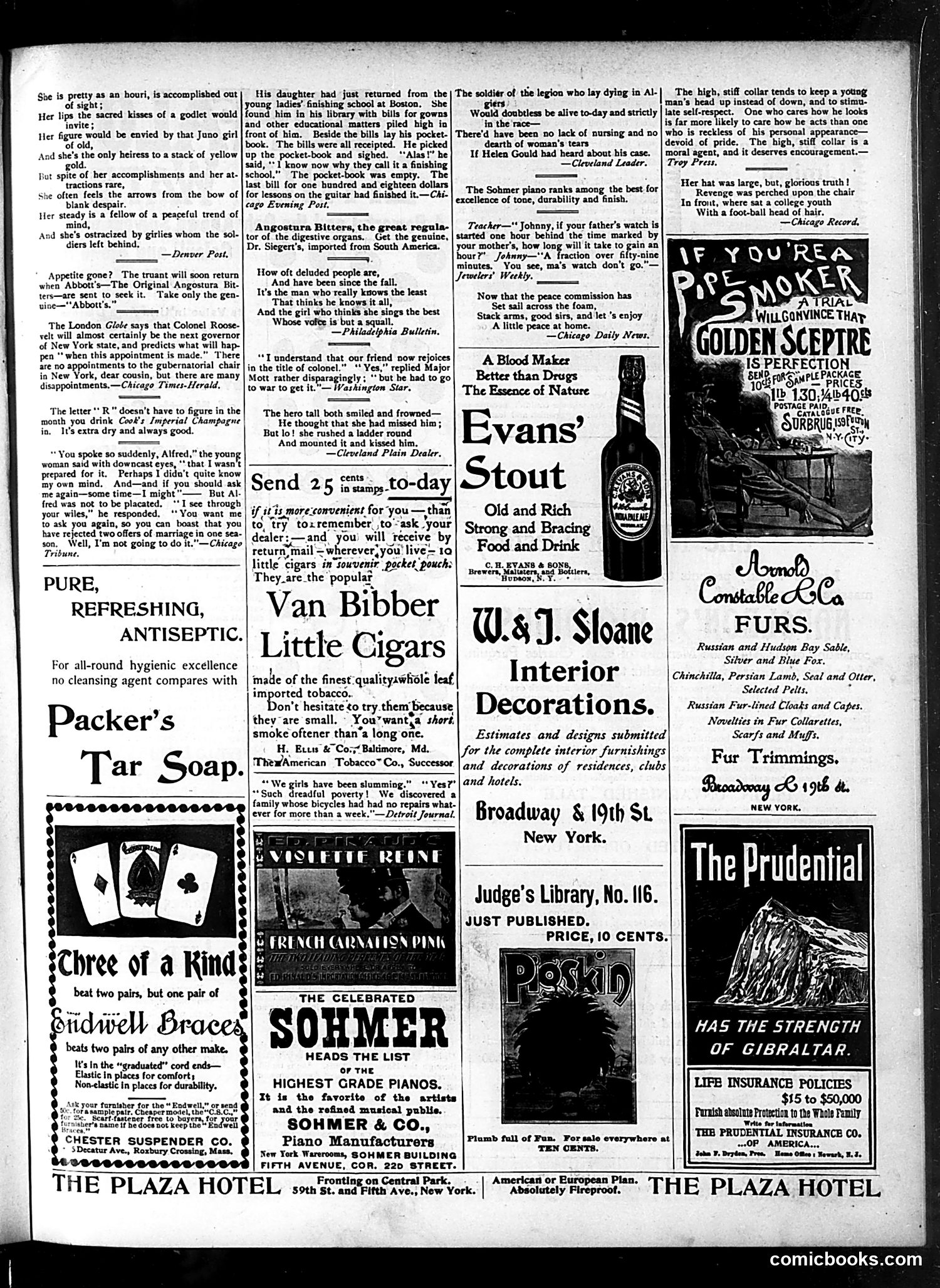
This page is primarily **advertisements and filler humor** rather than political satire. The content reflects early 1900s American commercial culture. **Key elements:** The scattered short jokes and anecdotes address typical period concerns: a wealthy heiress unhappy despite advantages; a young woman rejecting marriage proposals to boast about rejections; a father bankrupted by his daughter's "finishing school" education (particularly expensive music lessons); jokes about deluded people and poor singing voices. **Historical context:** These pieces reflect anxieties about women's education, courtship rituals, and conspicuous consumption among the wealthy. The "finishing school" joke particularly satirizes the expense of genteel female education. The remainder consists of product advertisements (cigars, soap, pianos, insurance, hotels) typical of Judge's commercial content. No identifiable political figures or events appear on this page.
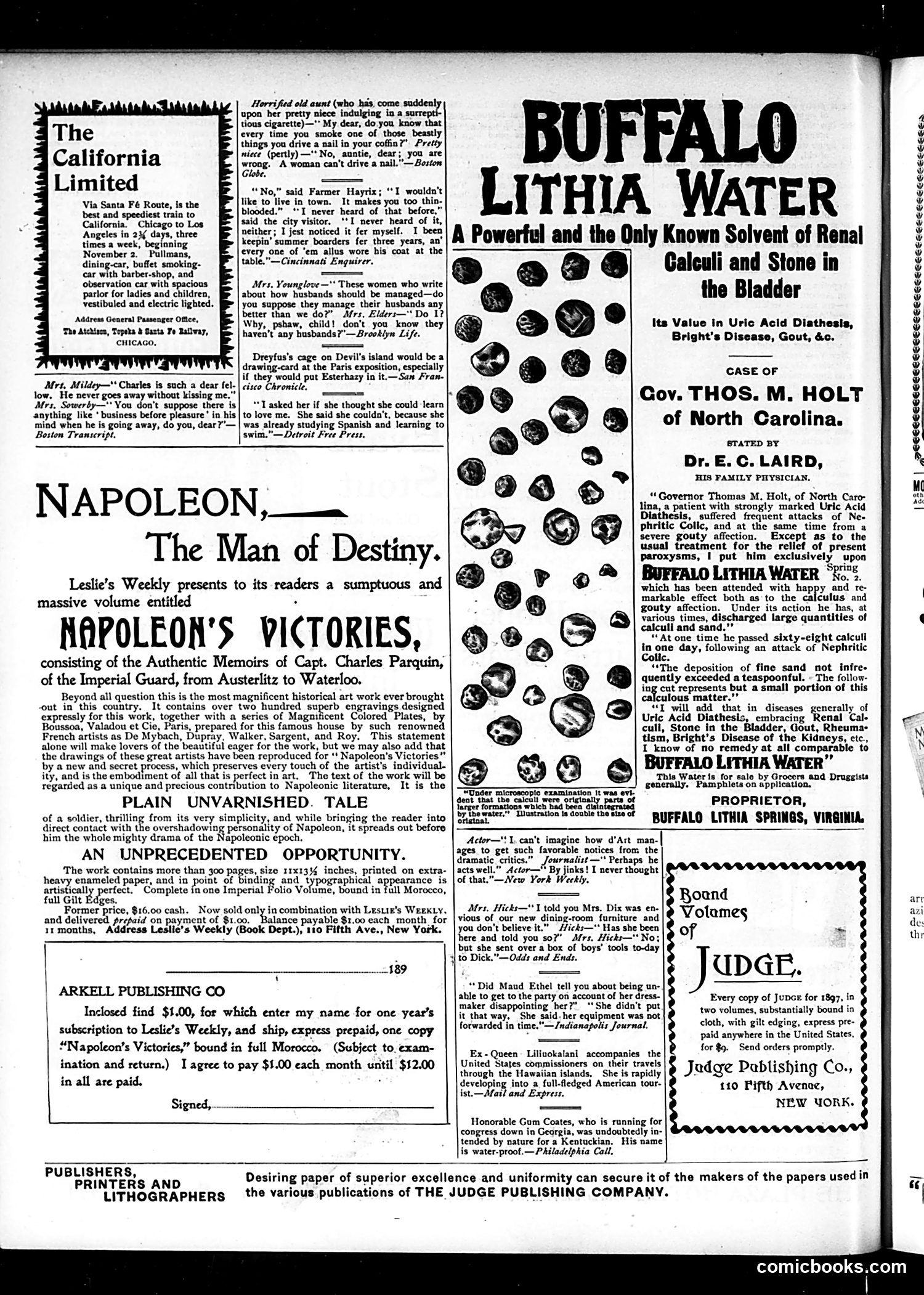
This page is primarily **advertising and light humor** rather than political satire. The main content includes: **Advertisements:** - The California Limited train service - Leslie's Weekly's Napoleon book offer - Buffalo Lithia Water (a patent medicine claiming to treat kidney stones and gout) - Judge Publishing Company's bound volumes **Humorous Vignettes:** The page contains several short, mild jokes typical of the era: - A wife's observation about her husband's "business before pleasure" - An aunt scandalized by a niece smoking - A farmer's observation about thin-blooded townspeople - Women's magazine advice about managing husbands - A brief reference to the Dreyfus affair (the controversial French military case) - A joke about learning Spanish **Context:** These are gentle domestic humor and social commentary—nothing sharp or biting. The Dreyfus reference is the only political content, appearing as a throwaway joke rather than serious critique. The page reflects turn-of-century magazine culture mixing advertising with lighthearted entertainment.
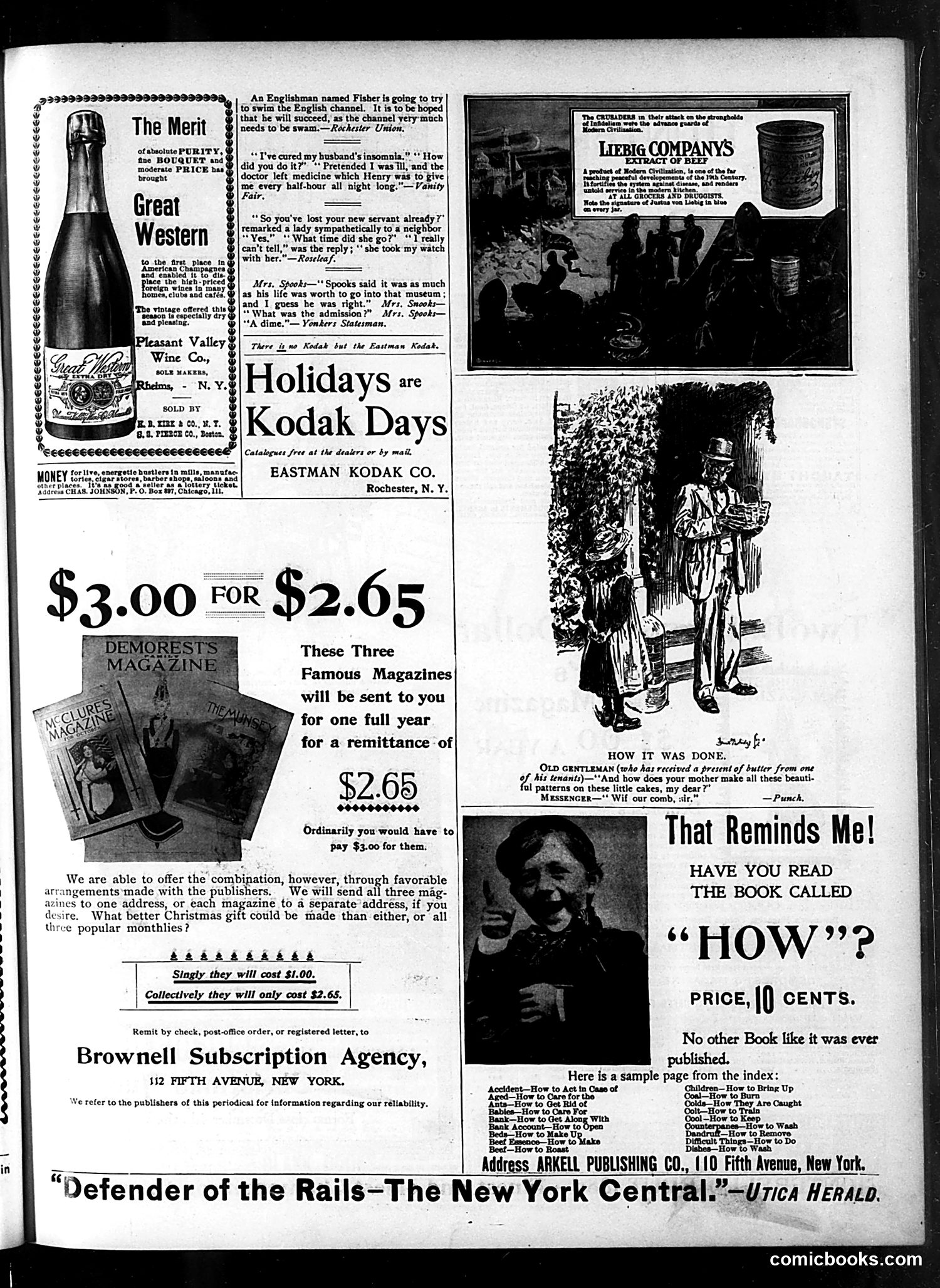
This page is primarily **advertising and humor filler**, not political satire. It contains: **Short Jokes**: Four brief comedic anecdotes about everyday situations—an Englishman swimming the English Channel, a wife curing her husband's insomnia by pretending illness, a servant who steals her employer's watch, and a museum admission price. These appear to be reprinted from other publications (*Vanity Fair*, *Punch*, *Yonkers Statesman*). **Advertisements**: Wine, Kodak cameras, magazine subscriptions, and a self-help book titled "HOW?" (ten cents). **One Cartoon**: A sketch of an old gentleman asking a messenger how butter was patterned—the punchline being it was made with a comb, a simple visual joke about household ingenuity. The page reflects early 20th-century Judge content: lighthearted domestic humor with no apparent political commentary. The jokes rely on class observations and mild domestic mishaps rather than satire of current events or public figures.
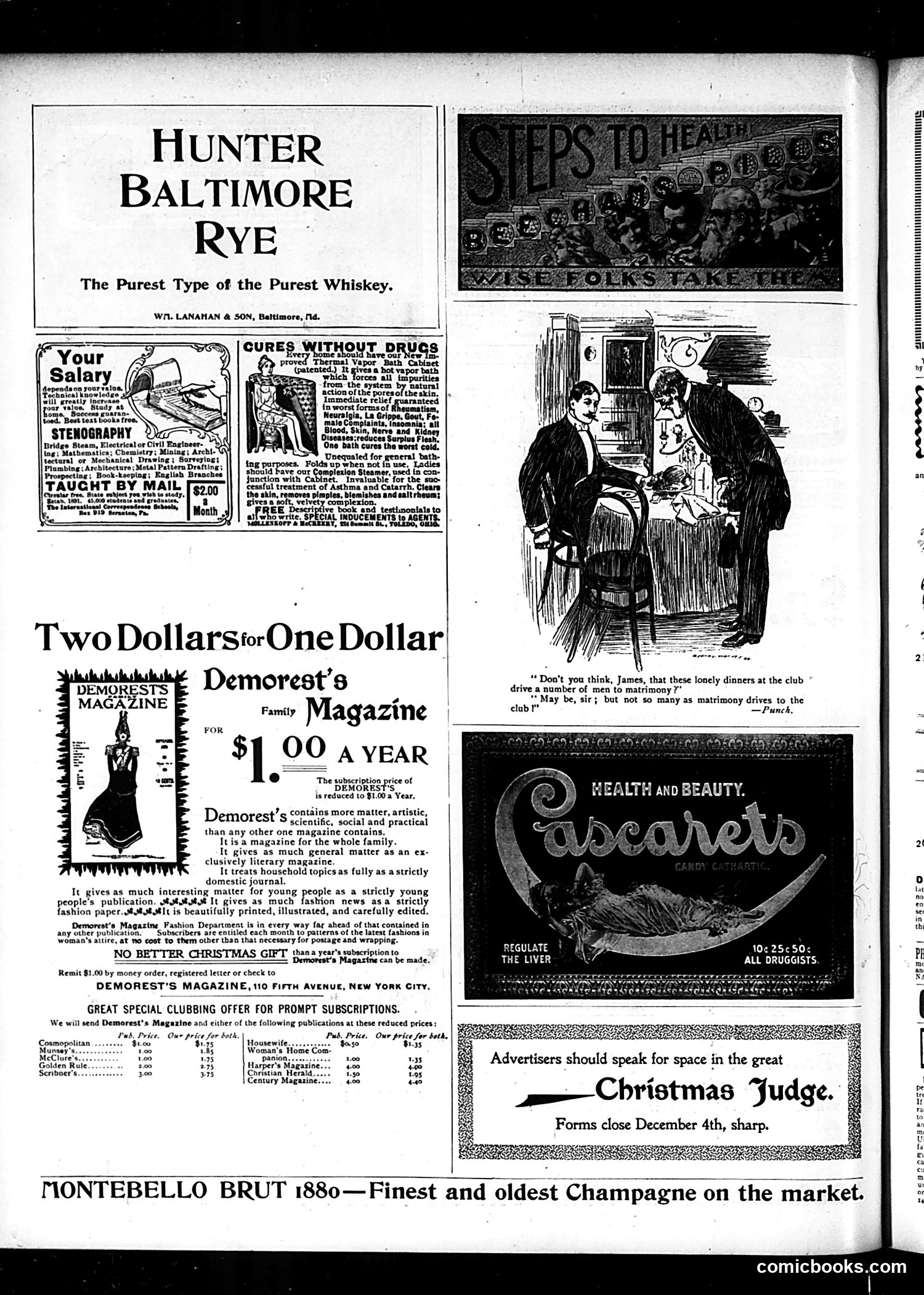
This page is primarily **advertising and promotional content** from Judge magazine, with one small cartoon. The main cartoon (center-right) depicts two men in conversation at a club, with the caption joking about how club dinners might drive men toward matrimony—or conversely, how matrimony drives men *to* clubs. This reflects turn-of-century anxieties about bachelor life versus marriage. The page is dominated by ads: Hunter Baltimore Rye whiskey ("purest type"), stenography courses promising salary increases, Demorest's Family Magazine (offering two subscriptions for one dollar), medical patent remedies claiming to cure various ailments without drugs, and a "Cascarets" liver regulator. The "Christmas Judge" notice at bottom announces a deadline for advertisers seeking space in an upcoming holiday issue. The content reflects early-1900s consumer culture: mail-order education, patent medicines (many containing unregulated substances), women's magazines emphasizing fashion and domesticity, and alcohol advertising—all presented matter-of-factly alongside editorial content.
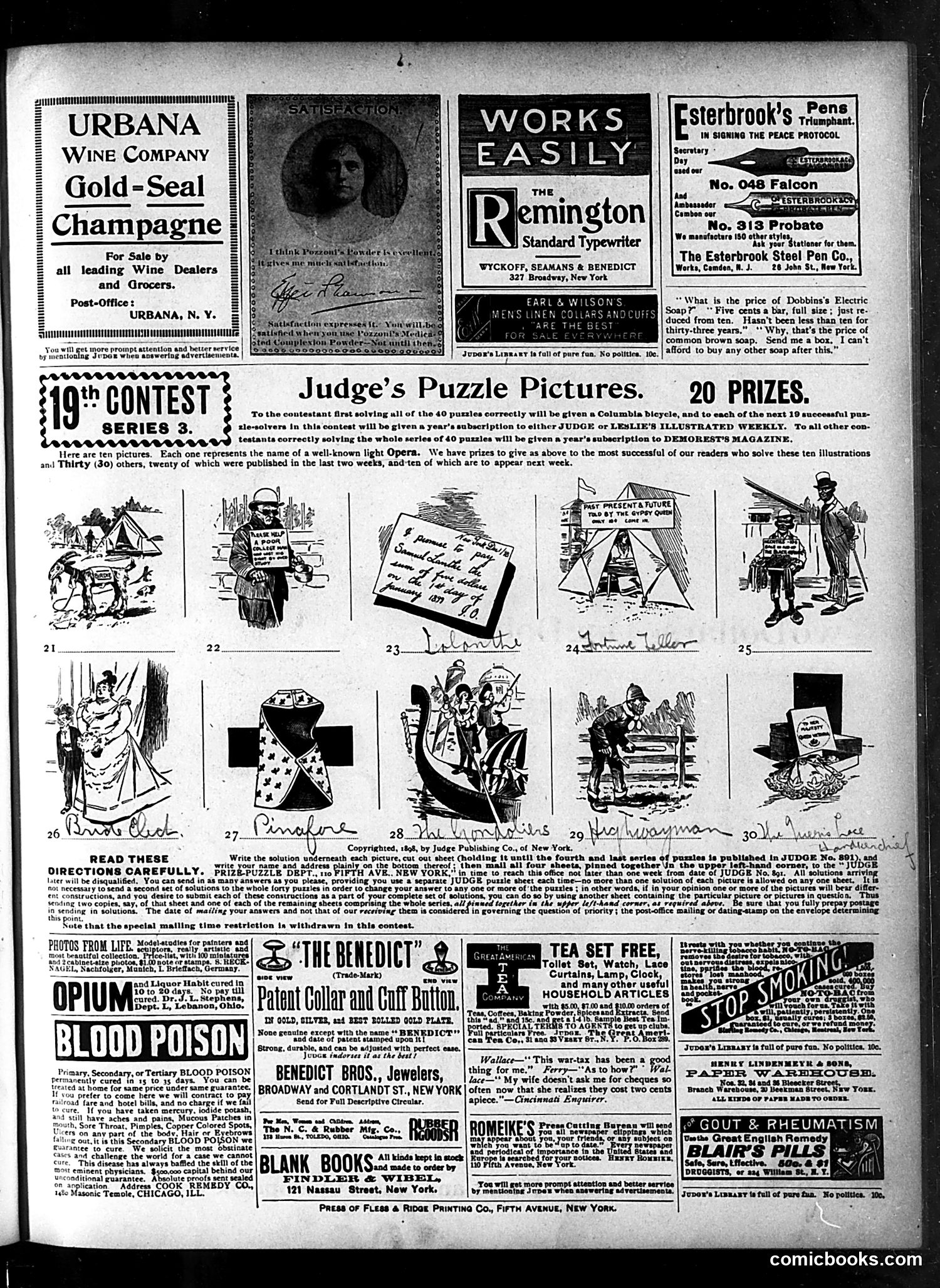
This page is primarily **advertising and contest material** rather than political satire. The main feature is "Judge's Puzzle Pictures" — a contest where readers solve ten illustrated rebuses (visual word puzzles) representing names of light operas. Winners receive prizes including a Columbia bicycle and magazine subscriptions. Contestants must mail solutions to Judge's offices on Fifth Avenue. The surrounding advertisements promote period products: Urbana Wine Company's champagne, Remington typewriters, Esterbrook pens, and various patent medicines (notably including treatments for "blood poison" — a common euphemism for syphilis). The page includes instructions emphasizing fair contest rules: contestants must use separate sheets, include proper postage, and can submit multiple entries. The fine print warns against submitting duplicate solutions. This represents typical late-19th/early-20th century magazine content: **entertainment puzzles subsidizing publication through reader engagement and product advertising**, with no apparent political commentary visible on this particular page.
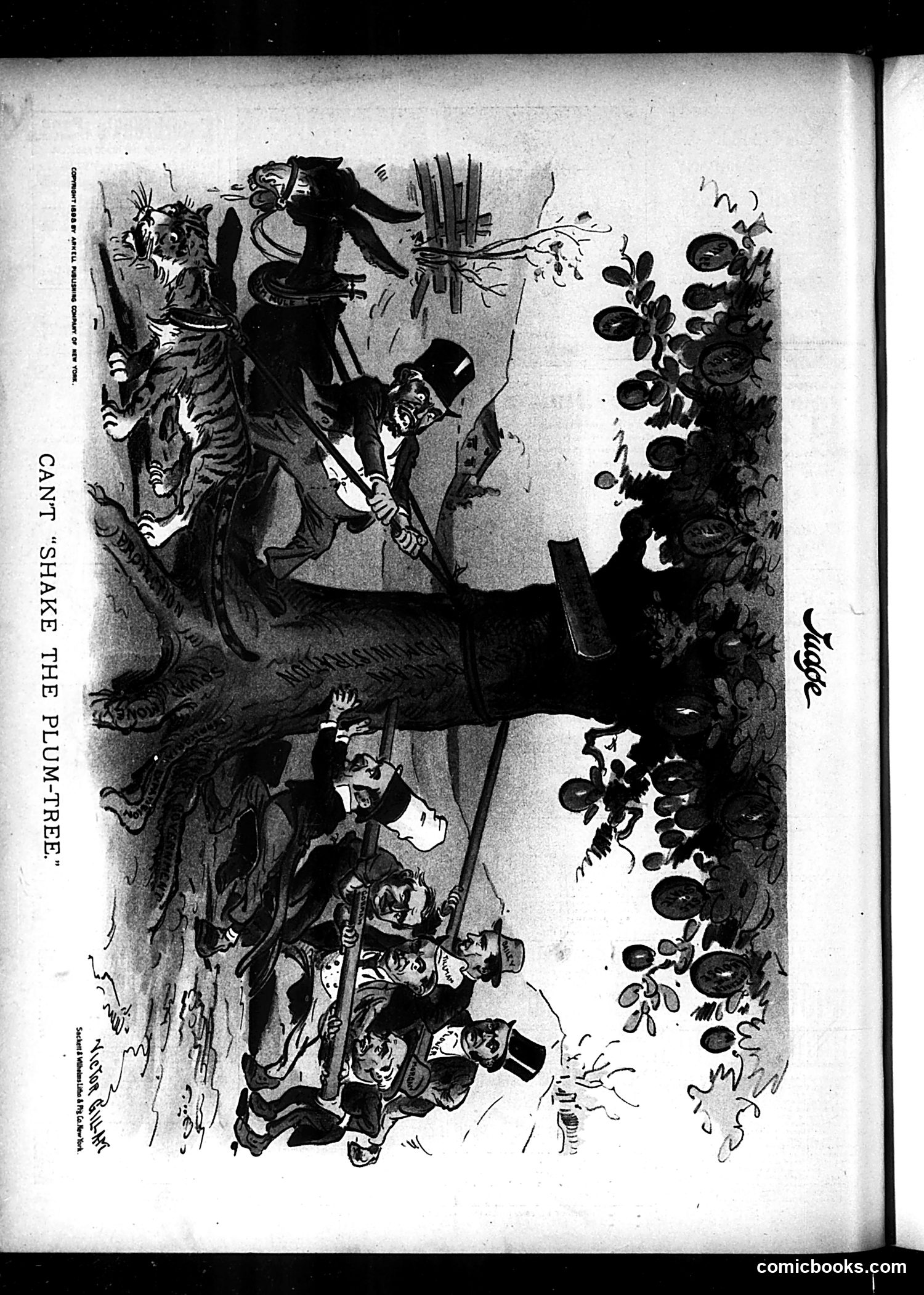
This political satire depicts figures literally shaking a tree to harvest "plums"—a period metaphor for political patronage jobs and corrupt profits. The well-dressed gentlemen in top hats appear to be politicians or party operatives extracting benefits from government positions. The cartoon critiques the spoils system: the practice of rewarding political allies with lucrative government appointments regardless of merit. "Plums" represents these patronage positions and the financial gains they provided. The shaking motion suggests aggressive, greedy extraction of public resources for private benefit. The figures on the ground catching falling plums reinforce the idea of widespread corruption filtering down through political networks. This was a common Judge theme—satirizing machine politics and the corrupt distribution of government sinecures to party loyalists rather than qualified candidates.