
A complete issue · 16 pages · 1898
Judge — September 10, 1898
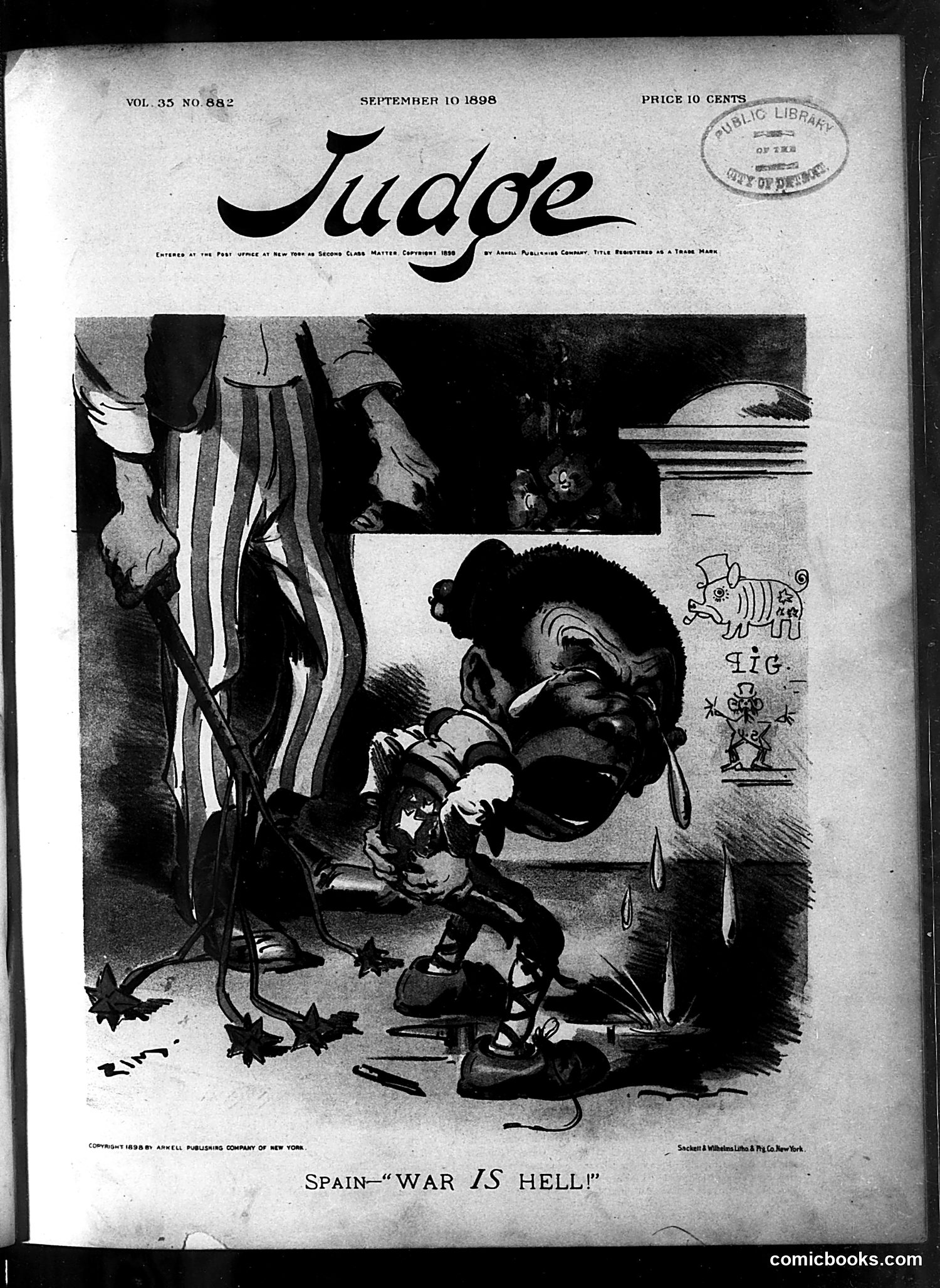
This political cartoon satirizes the Spanish-American War (1898) through an allegorical scene. A large figure representing Spain appears overwhelmed and defeated, bent over amid chaos and destruction. Small demonic or grotesque figures swarm around—likely representing the consequences of war itself or American military forces. The caption "War Is Hell" sarcastically comments on Spain's military disaster. In 1898, Spain was decisively defeated by the United States in Cuba and the Philippines, marking the end of Spain's colonial empire and America's emergence as a global power. The cartoon mocks Spain's position, suggesting the nation brought this catastrophe upon itself through imperial overreach. The chaotic imagery emphasizes the brutality and futility the conflict exposed.
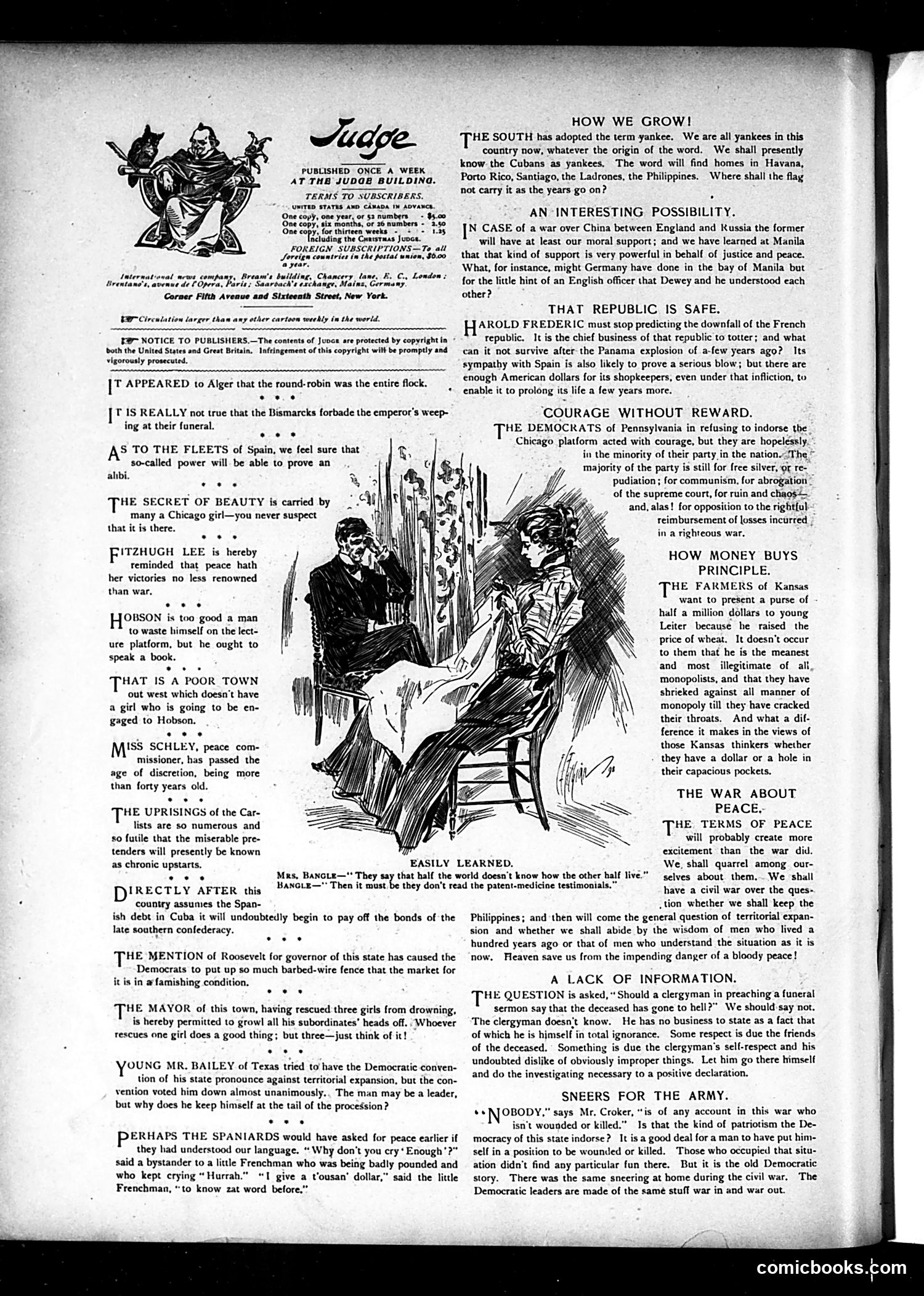
The central cartoon depicts two figures in conversation—one appears to be a woman (likely Mrs. Hangle, per the caption) telling a man: "They say that half the world doesn't know how the other half live." The man responds: "That is most as they don't read the patent-medicine testimonials." **The satire targets patent-medicine advertising**, a notorious early 20th-century practice. Patent medicines made exaggerated health claims through fabricated customer testimonials. Judge is mocking how absurdly false these testimonials were—so obviously fake that they revealed nothing truthful about "how the other half live." The joke suggests Americans consumed this obvious fiction uncritically, suggesting both gullibility and the entertainment value of patent-medicine ads as unintentional comedy.
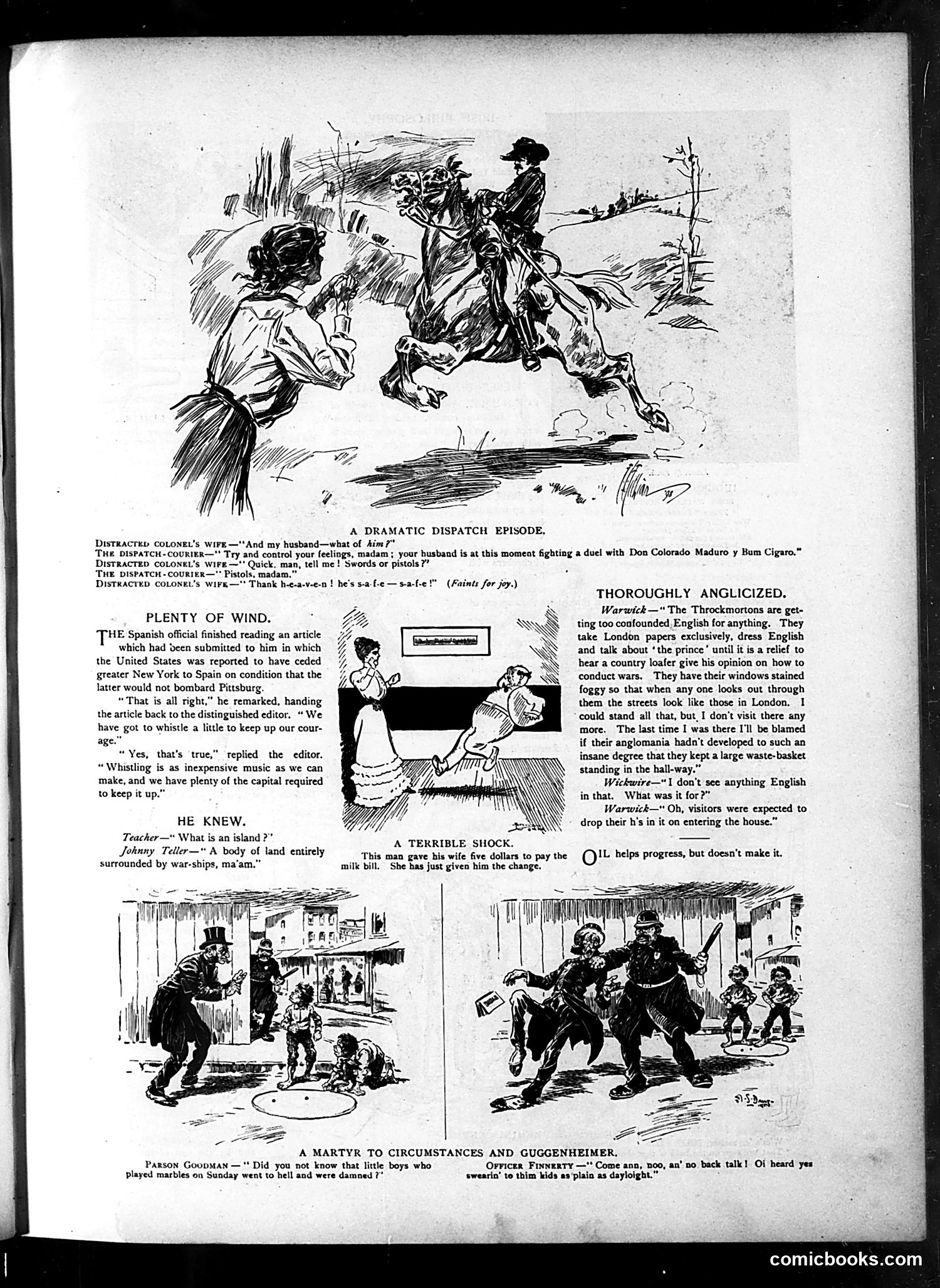
This page contains several satirical sketches commenting on early 20th-century American politics and social issues: **"A Dramatic Dispatch Episode"** depicts a domestic quarrel between a colonel's wife and her husband over his absence during a duel with Don Colorado Maduro and Rum Cigaro—likely satirizing sensationalized war reporting. **"Plenty of Wind"** mocks a Spanish official who submitted an article to the U.S. about having ceded Cuba, with the editor responding that "whistling" won't accomplish the goal—commentary on Spanish-American War diplomacy. **"Thoroughly Anglicized"** critiques wealthy Americans who adopt English mannerisms and pretensions, viewing themselves as superior to common countrymen. The lower sketches address urban social commentary, though specific references are unclear without additional context.
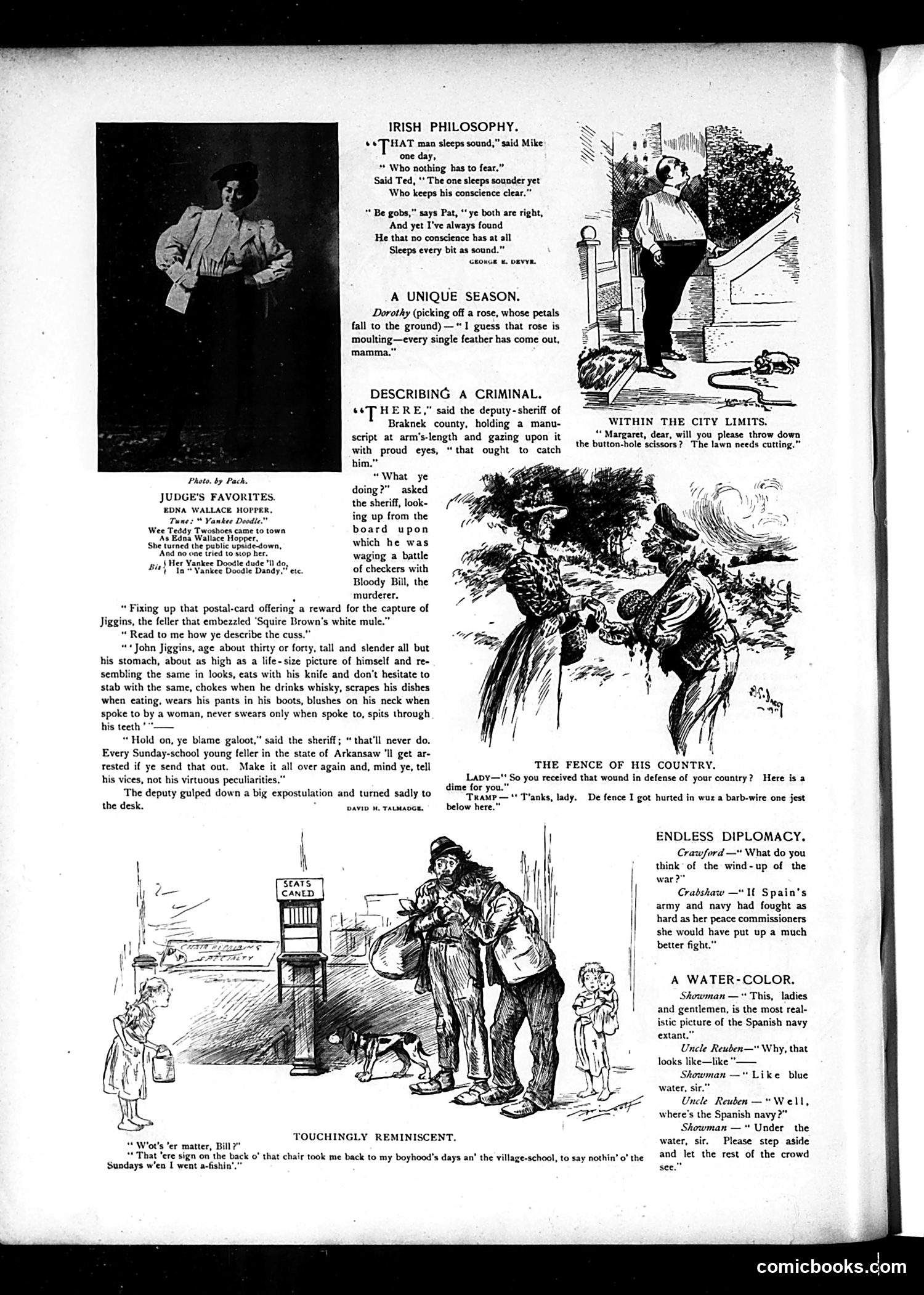
This page from the satirical magazine **Judge** contains several humorous sketches and short comic pieces typical of early 20th-century American humor: **"Irish Philosophy"** presents ethnic humor playing on stereotypes about Irish logic and conscience—common in period magazines. **"A Unique Season"** and **"Describing a Criminal"** appear to be brief comedic anecdotes about rural or small-town characters, including references to a deputy sheriff and criminal descriptions. The sketches throughout use exaggerated caricature and working-class or rural settings for comedic effect. **"Touchingly Reminiscent"** references schoolhouse memories. Overall, the page represents Judge's typical formula: ethnic stereotypes, class-based humor, rural character sketches, and gentle social observation—entertainment conventions acceptable to early 20th-century audiences but reflecting period prejudices we'd now recognize as problematic.
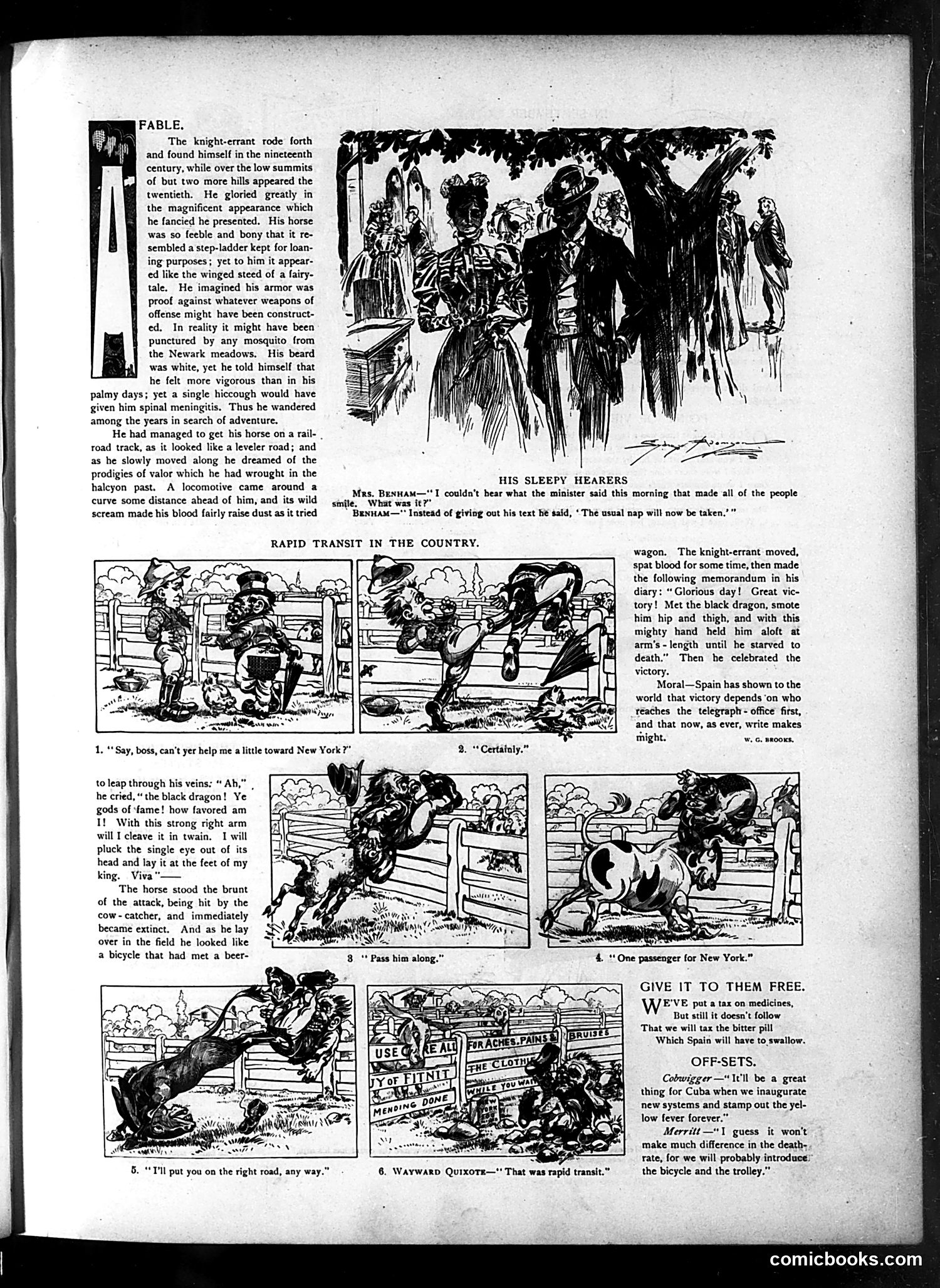
This page satirizes an aging, delusional knight-errant (likely representing quixotic American expansionism, particularly regarding Spain and Cuba) who wanders into the modern era with medieval delusions intact. The main comic strips show him being struck by a locomotive while riding on railroad tracks—which he mistakes for a "level road"—yet interprets his near-fatal collision as a glorious victory over a "black dragon." The satire mocks those who romanticize warfare and conquest while remaining willfully blind to modern reality. The knight's written account of "victory" when he's actually been nearly killed by a train exemplifies this disconnect. The page also includes topical jabs: references to Spain (likely the Spanish-American War context), and a debate about introducing bicycles and trolleys to Cuba alongside yellow fever eradication efforts—suggesting American "modernization" efforts abroad were more about control than genuine improvement.
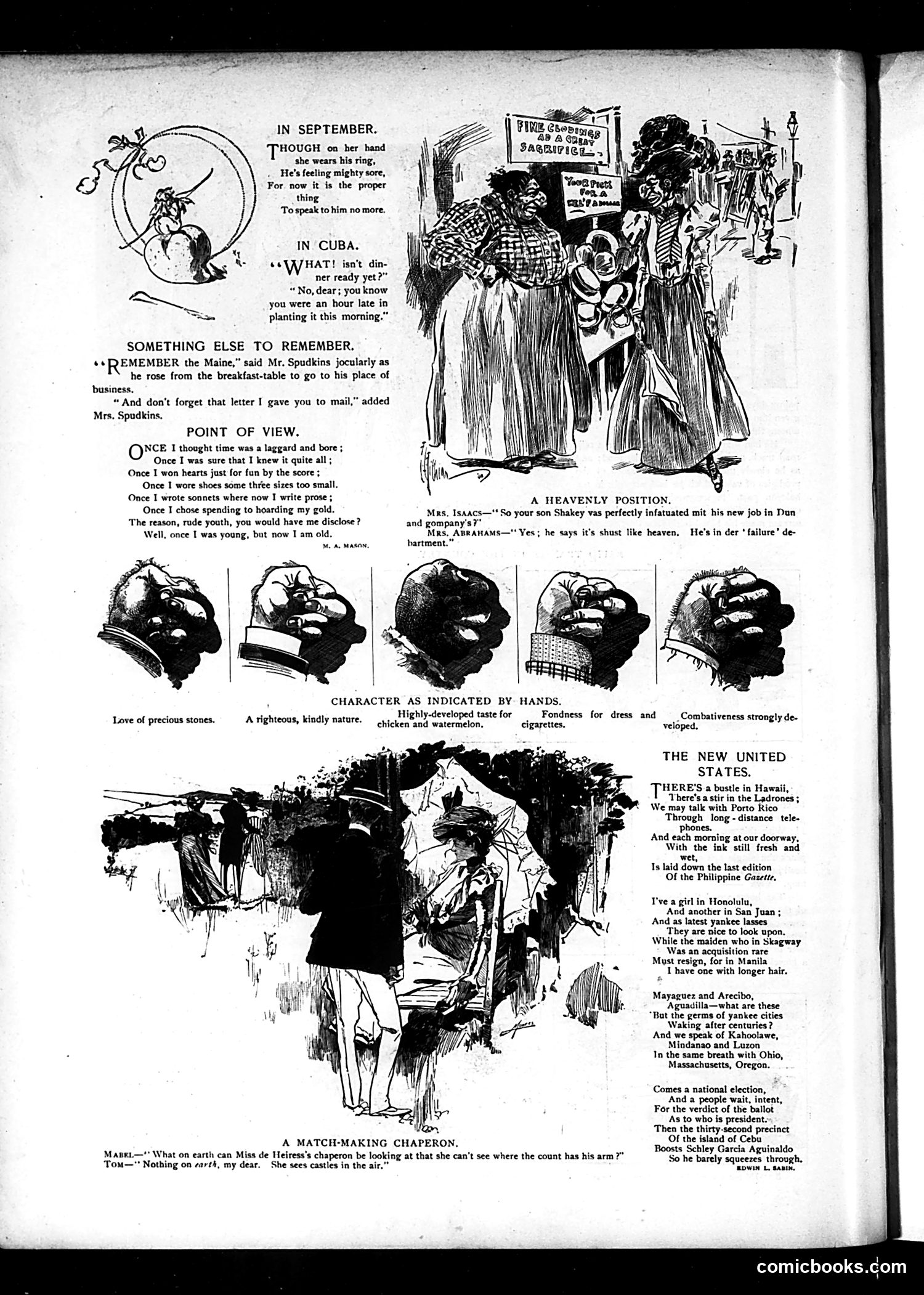
This page contains satirical commentary on American imperialism following the Spanish-American War (1898). **Key content:** The "Cuba" joke mocks the delayed planting of dinner—a reference to Spain's slow response to events leading to war. "Remember the Maine" references the battleship explosion that sparked the conflict. **"The New United States"** poem satirizes American territorial expansion. It mocks the sudden acquisition of Hawaii, Puerto Rico, the Philippines, and other islands, treating distant colonial possessions as casually as domestic states (Ohio, Massachusetts, Oregon). The speaker boasts of romantic interests across new territories, suggesting American dominance and cultural presumption. The references to Honolulu, San Juan, Manila, and Philippine locations reflect real 1898 acquisitions. The joke about "failure department" at Dun and Company appears unrelated local humor. **"Match-Making Chaperon"** uses a period-appropriate innuendo about a woman seeing "castles in the air"—she's willfully ignoring impropriety. The hand-character analysis section is filler psychology content typical of the era.
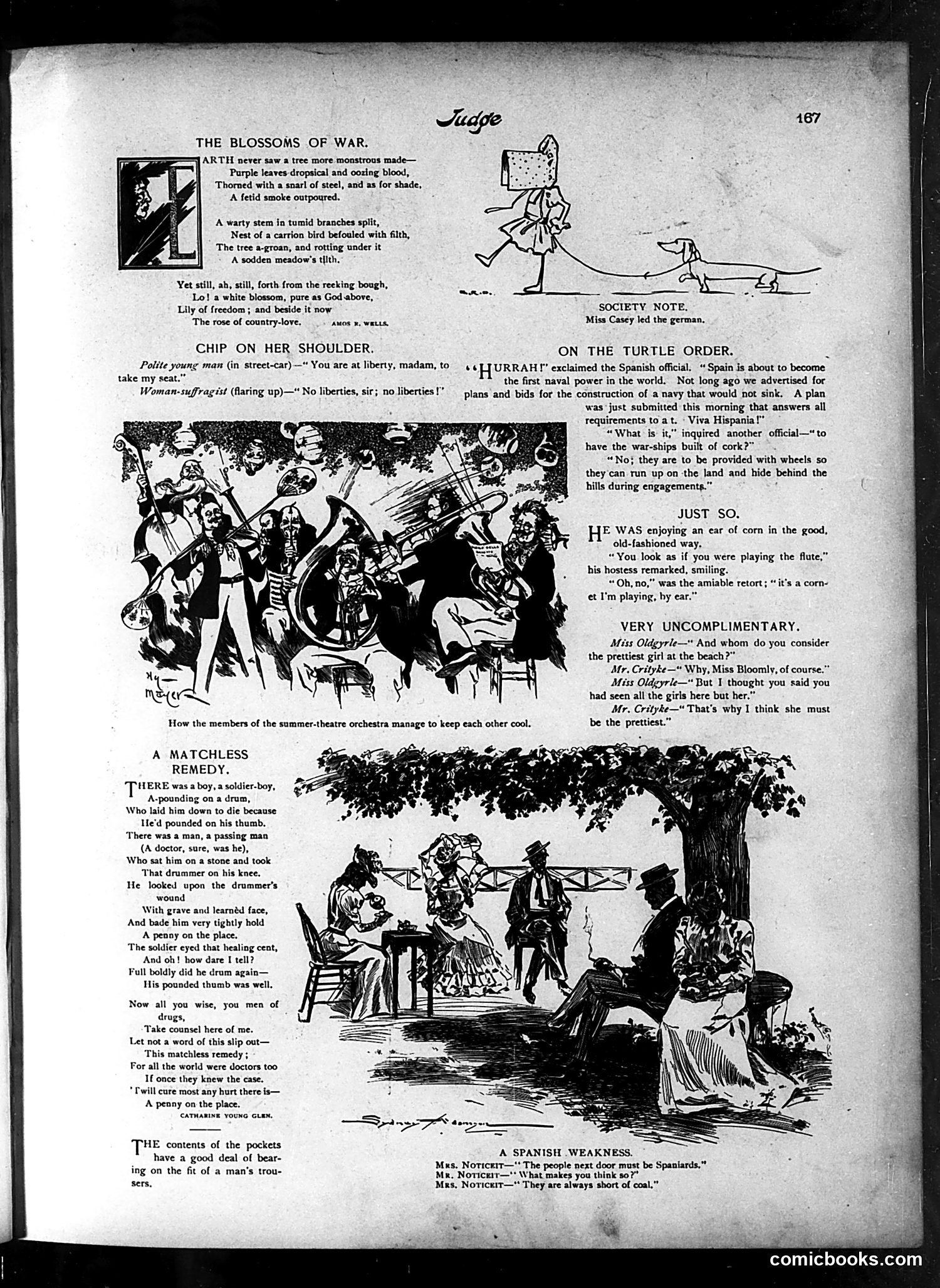
This page from Judge contains several satirical pieces reflecting early 20th-century American humor and social commentary. **"The Blossoms of War"** is a poem contrasting war's horrors (a grotesque tree of violence and death) with the enduring ideals of freedom and patriotic love that persist despite conflict—likely referencing World War I. **"Chip on Her Shoulder"** mocks the woman-suffrage movement through a street encounter where a male offers his seat to a woman activist, who indignantly rejects even this courtesy as an unwanted "liberty"—satirizing suffragists as unreasonably combative. **"On the Turtle Order"** ridicules Spanish naval incompetence through Spanish officials' absurd solution: building warships with wheels to escape onto land during battles—mocking Spain's declining military power. The remaining items are lighter humor: puns about corn/cornet playing, beach beauty judgments, a folk remedy joke about a penny healing a drummer's thumb, and a closing gag about Spanish coal shortages. Overall: typical Judge content mixing anti-suffrage sentiment with mockery of foreign powers and light domestic humor.
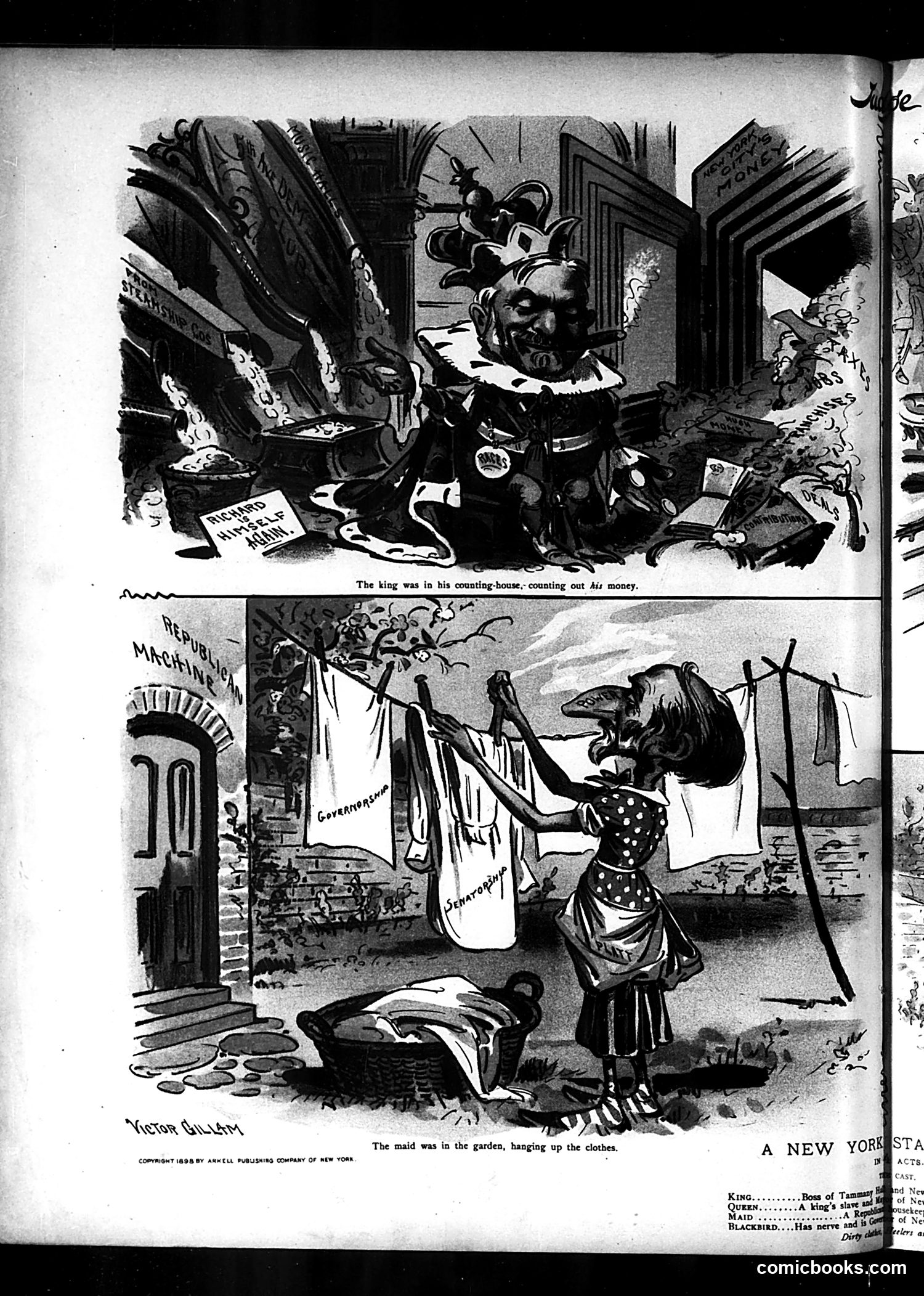
This page contains two related satirical panels by Victor Gillam from Judge magazine (1898). Both depict a demonic or devilish figure labeled "The King" in his "counting-house" (top) and later in a garden (bottom), where a maid hangs clothes. The cartoons appear to satirize political corruption or mismanagement—likely targeting a specific political leader or governmental figure of 1898. The King character, with exaggerated demonic features, represents corrupt authority hoarding money and resources while common people (represented by the maid) labor. The progression from counting money to laundry suggests the contrast between ill-gotten wealth and honest work. Without additional context about 1898 politics, the specific target remains unclear, but the satire clearly criticizes governmental greed and exploitation of the working class.
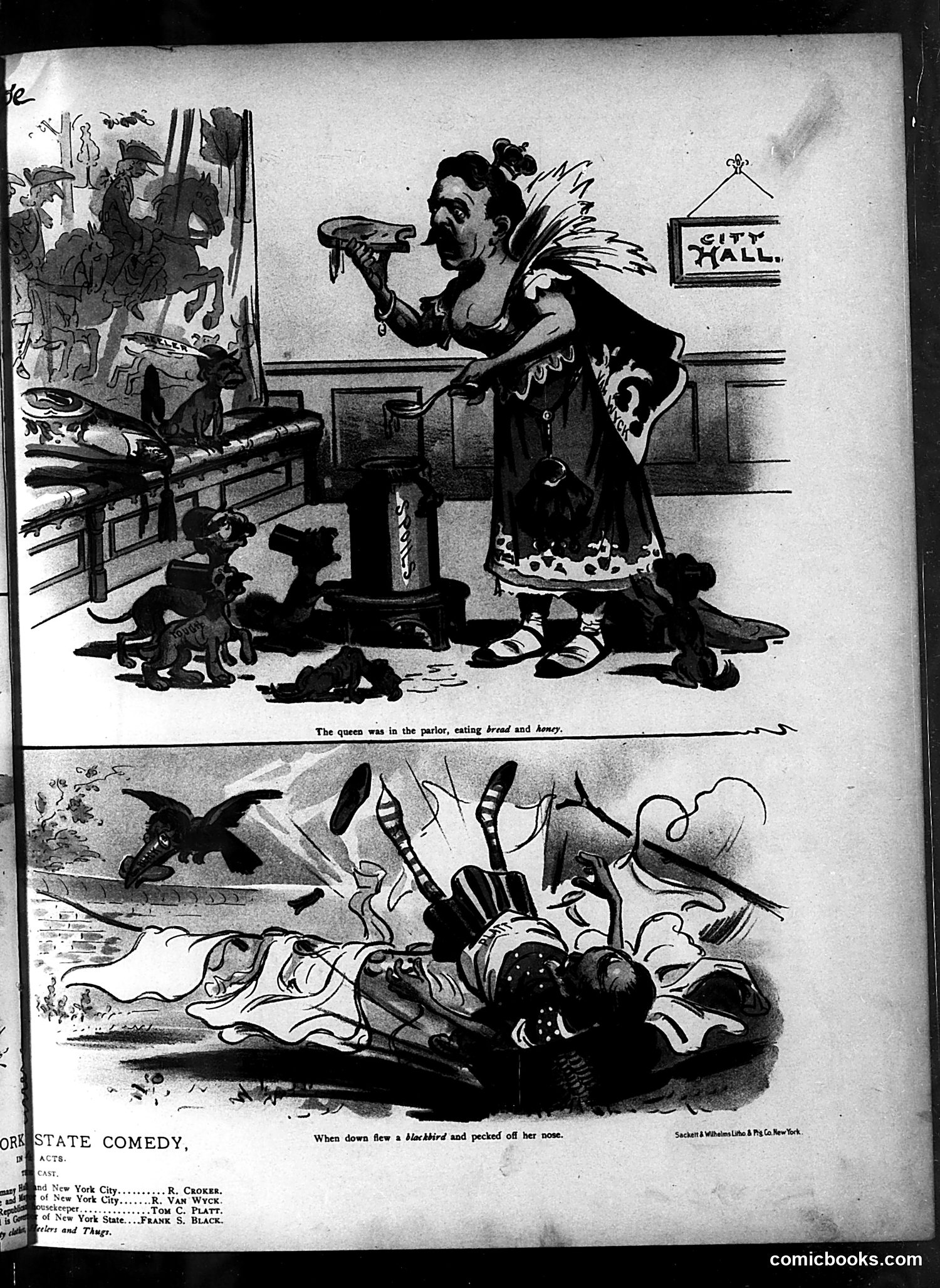
This page from *Judge* magazine illustrates a satirical comic strip based on the nursery rhyme "Sing a Song of Sixpence." The top panel shows a caricatured figure (appearing to represent a political or social figure) in elaborate costume at City Hall, serving "bread and money" to what appear to be rats or similar creatures—likely depicting corruption or misuse of public funds for political purposes. The bottom panel shows the figure knocked down, with a "blackbird" pecking at their nose, completing the nursery rhyme's narrative while serving as satire: the comeuppance for corrupt officials who feed patronage to political allies. The exaggerated facial features and theatrical costume suggest this mocks a specific contemporary political figure or practice involving municipal corruption or graft, though the exact target remains unclear without additional context.
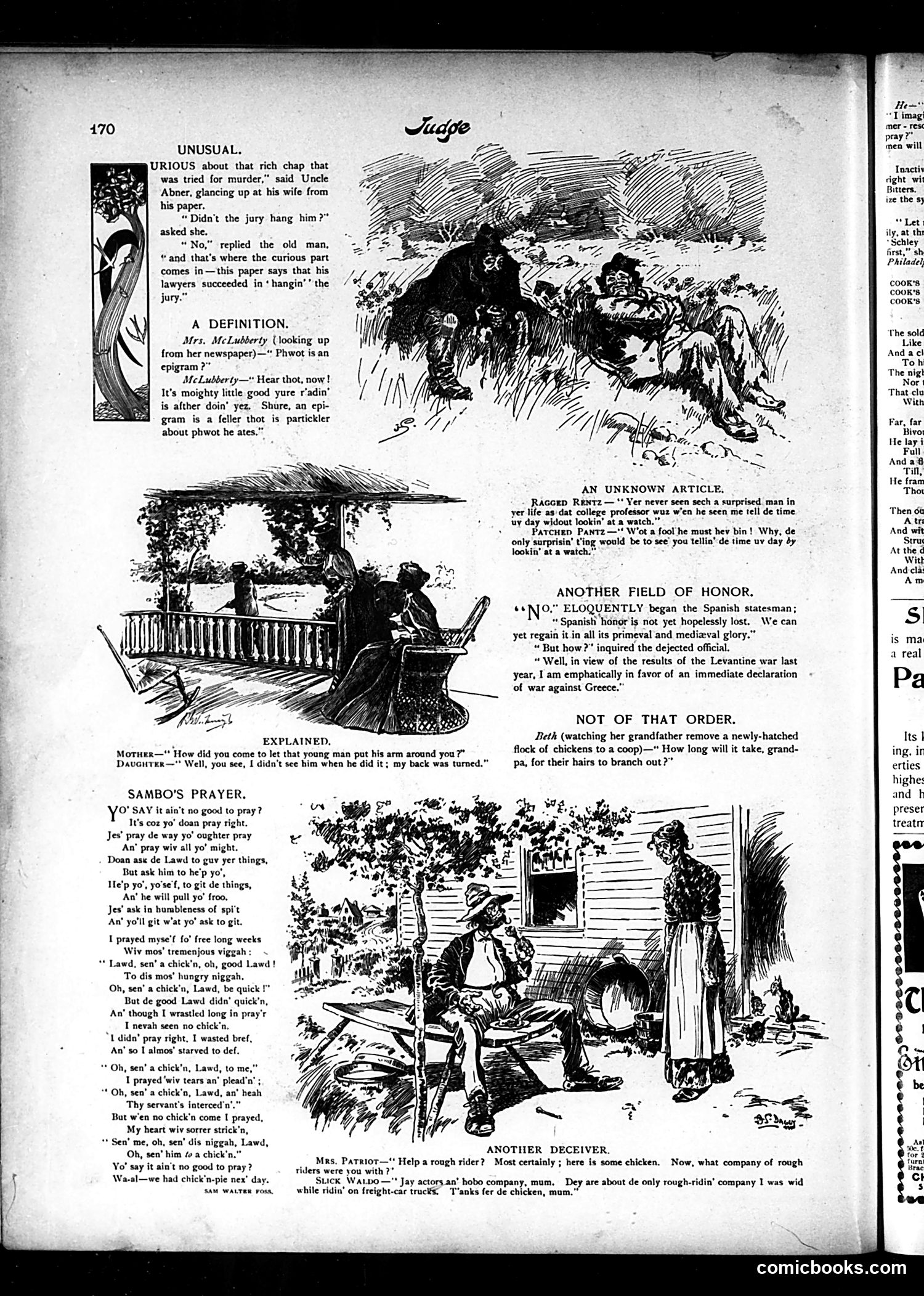
This page from *Judge* contains several satirical pieces targeting American society and politics: **"UNUSUAL"** jokes about a wealthy murder defendant whose lawyers succeeded in getting a hung jury—a play on words suggesting they "hung" the case rather than the man. **"ANOTHER FIELD OF HONOR"** satirizes Spanish politics, likely referencing the Spanish-American War. A Spanish statesman claims Spain can regain honor by declaring war on Greece—absurd logic suggesting Spain should fight a weaker nation after already losing to America. **"SAMBO'S PRAYER"** uses racist dialect humor (standard for the era) about a Black man praying for chickens, eventually getting one through hard work rather than prayer alone—moralizing about self-reliance. **"ANOTHER DECEIVER"** appears to mock someone claiming "rough rider" credentials (possibly referencing Theodore Roosevelt's Rough Riders), revealed as a fraud who only rode freight cars. The cartoons use period-typical caricature and stereotypes to lampoon politicians, social pretense, and human folly—characteristic of *Judge*'s satirical agenda.
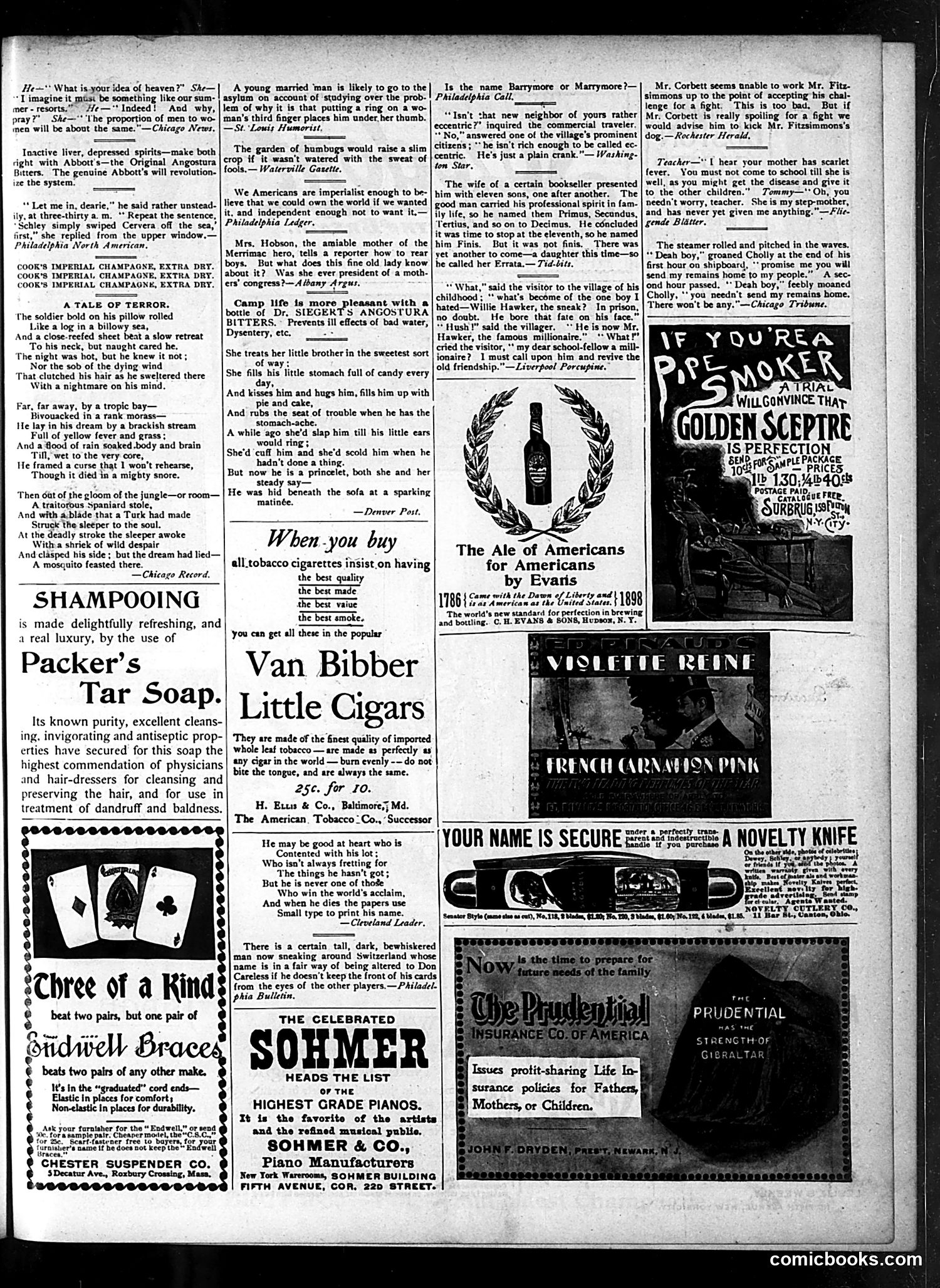
This page is primarily **advertising** with brief satirical jokes interspersed. The cartoons are minimal—mostly text-based humor rather than visual satire. The jokes reference contemporary 1898-1899 events: one mentions "Schley" (Admiral Winfield Schley, famous for the Spanish-American War naval victory) and another references the "Merrimac hero" (likely the USS Merrimac's role in Santiago harbor during the same war). These were recent, celebrated American military events. Most content consists of product advertisements (champagne, cigars, soap, pianos, insurance) typical of Judge's revenue model. The satirical elements are light social commentary about marriage, mothers, and domestic life—standard magazine humor of the era. There's no sharp political cartoon or sustained satire visible here; it's a commercial page with filler jokes rather than editorial commentary.
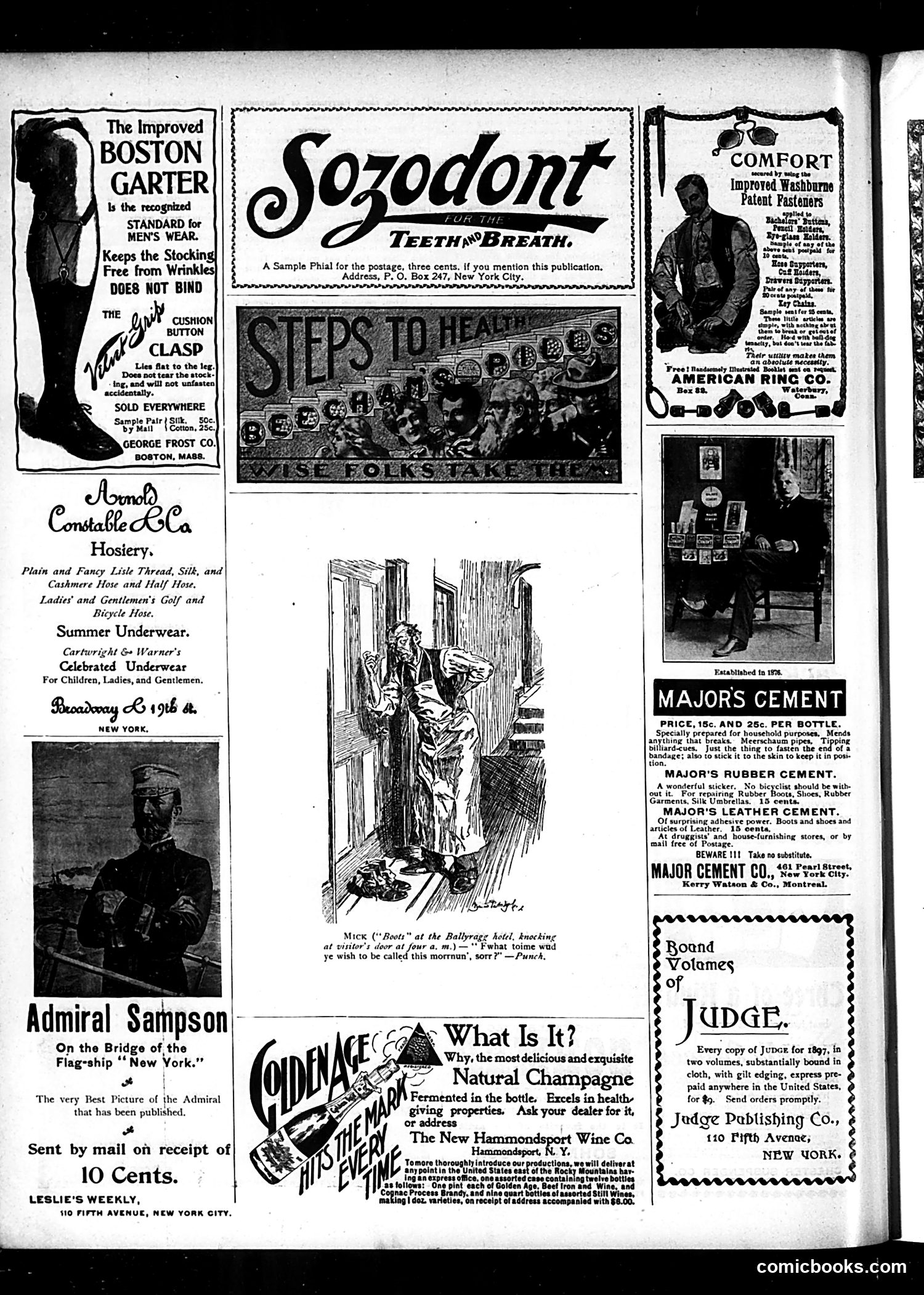
This is primarily an **advertising page** from Judge magazine, with one cartoon visible. The main cartoon depicts **Mick, an Irish hotel porter** at the fictional "Ballyrage hotel," waking a guest at 4 a.m. with an exaggerated Irish accent. The joke relies on ethnic stereotyping common to the era—portraying Irish workers through dialect humor and depicting them as comically subservient ("Boots" was period slang for a hotel porter). The page is dominated by **product advertisements** typical of 1890s magazines: patent medicines (Sozodont toothpaste, Major's Cement), clothing (Boston Garter, hosiery), and champagne. One ad features **Admiral Sampson**, celebrated for his role in the 1898 Spanish-American War, offered as a purchasable portrait photograph. The cartoons and advertisements together reflect late-Victorian American consumer culture and casual ethnic humor that would be considered offensive today. The Irish porter caricature exemplifies how such stereotypes were normalized in period entertainment.
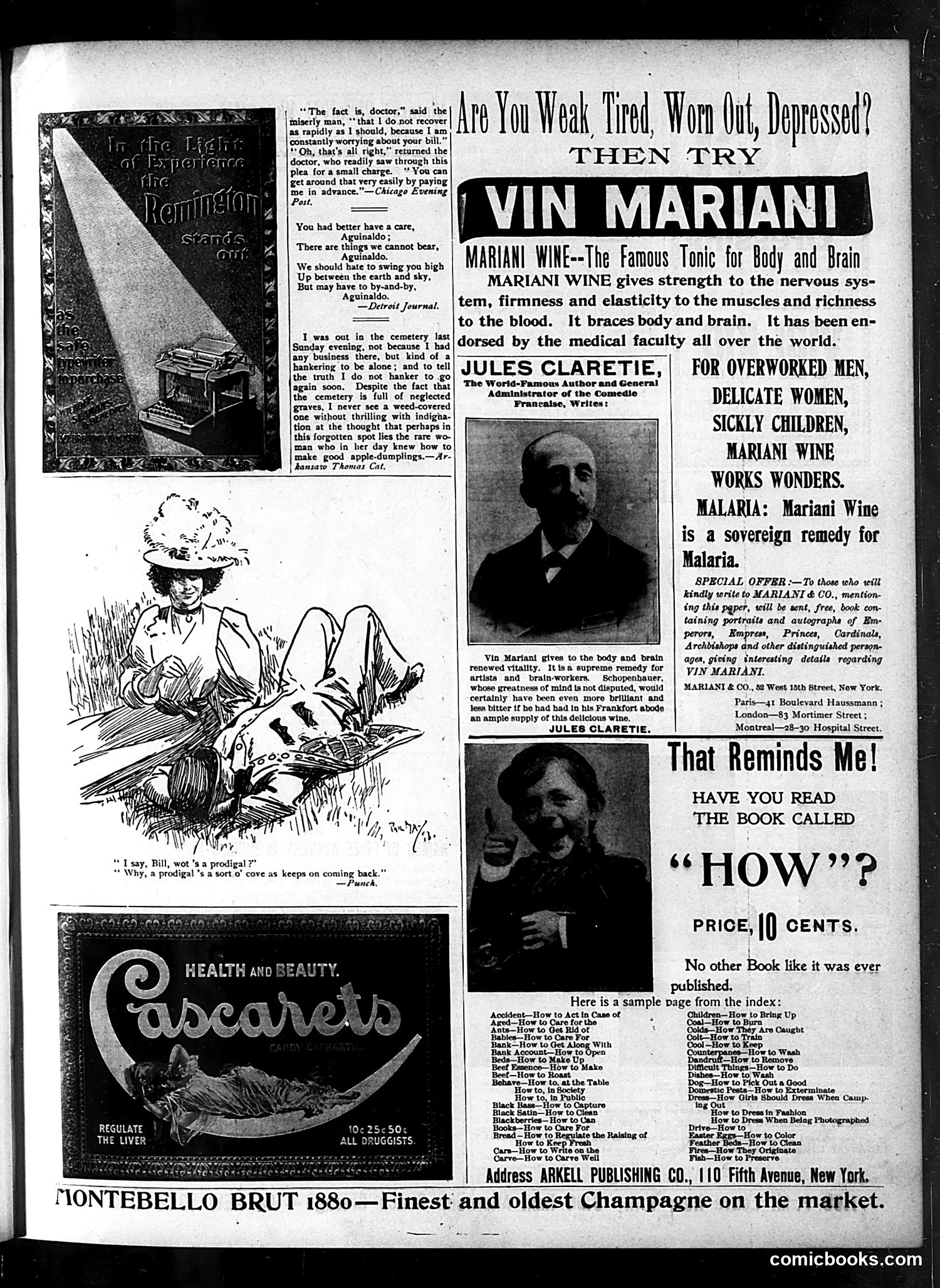
This page contains three distinct humor pieces targeting turn-of-the-century audiences: 1. **The Doctor's Bill joke**: A miser claims he won't recover quickly due to worry about medical costs. The doctor shrewdly offers to accept advance payment, exposing the patient's deception—satire of both penny-pinching patients and the financial anxieties of medical care. 2. **The Aguinaldo verse**: References Emilio Aguinaldo, Filipino resistance leader during the American-Philippine War (1899-1902). The poem warns him that Americans might execute him by hanging—dark humor about ongoing colonial conflict and American imperialist threats. 3. **Cemetery/apple dumplings joke**: Nostalgic lament that old-fashioned domestic skills are disappearing, using absurdist humor to mock sentimentality about the past. The page is primarily **advertising**, promoting Mariani Wine (cocaine-containing patent medicine), Cascarets laxative, a self-help book called "HOW," and champagne. These ads reflect the era's largely unregulated patent medicine market and mail-order publishing.
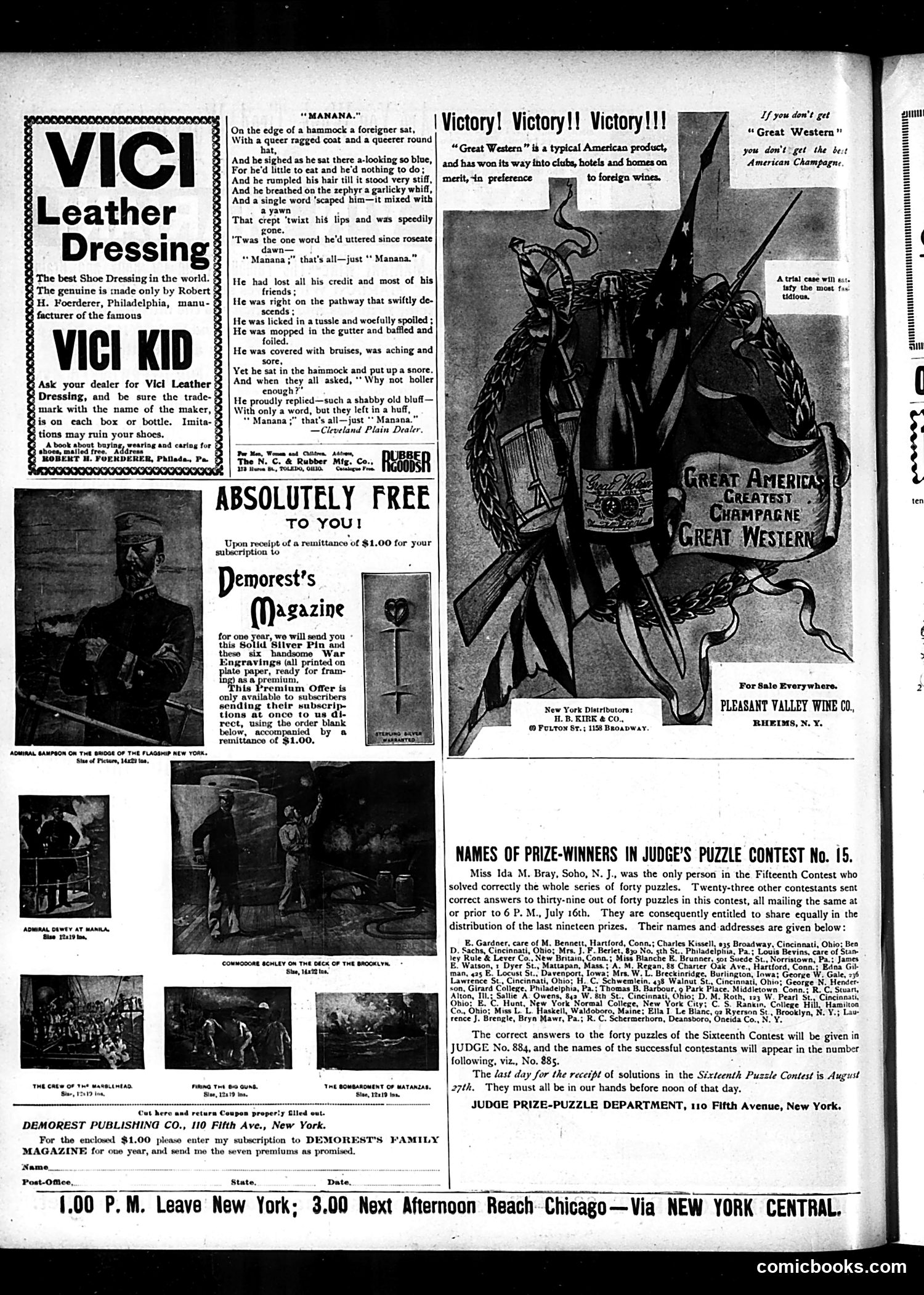
This page combines **advertisements and editorial content** typical of Judge magazine's satirical format. ## Main Content: "Manana" Poem The central literary piece satirizes **procrastination and resigned poverty**. It depicts a foreign laborer (suggested by the "garlicky whiff" and accent) who has lost his job, credit, and dignity—yet responds to all misfortune with the single word "Manana" (tomorrow). The satire targets both the character's passive acceptance of hardship and, implicitly, stereotypes about Latin American or Southern European indolence. The *Cleveland Plain Dealer* credit indicates this was reprinted satire. ## Advertisements The page features typical period ads: **Vici Leather Dressing** (shoe polish), **Demorests Magazine** (offering premium engravings), and **Pleasant Valley Wine Co.** (champagne marketed as "Great Western"). ## Other Content A **puzzle contest results section** lists prize-winners—standard Judge reader engagement. The page reflects *Judge's* dual function: satirical commentary wrapped in commercial content for a middle-class audience.
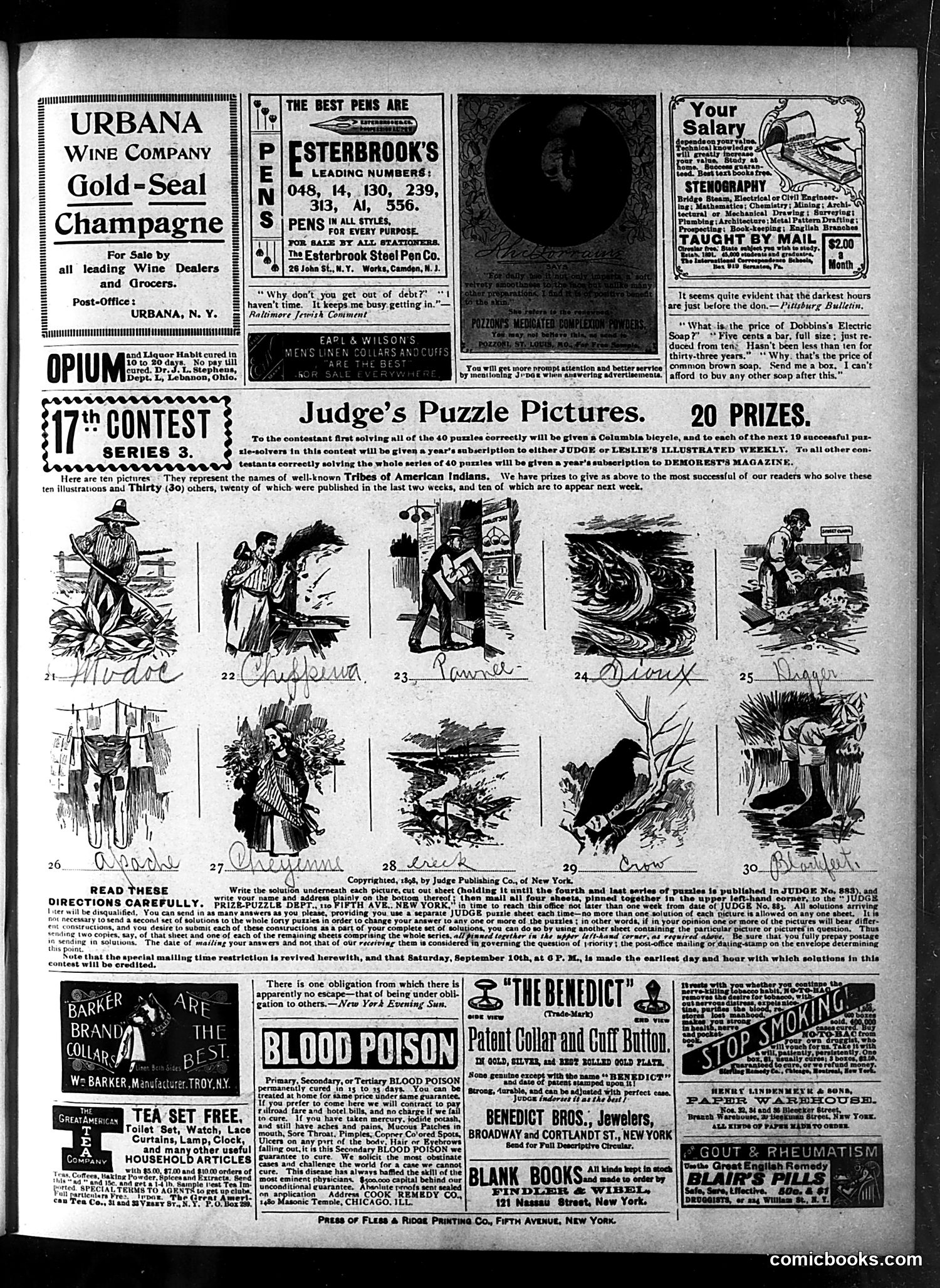
This page is primarily **advertising and a puzzle contest**, not political satire. The main content is the "17th Contest Series 3"—a puzzle competition where readers identify American Indian tribe names from ten illustrated sketches (numbered 21-30). Winners receive prizes including a Columbia bicycle and magazine subscriptions. The contest rules occupy substantial space with detailed submission instructions. The page is dominated by **period advertisements** for products including champagne, pens, opium treatments, jewelry, soaps, and patent medicines—typical of late-19th-century magazine advertising. A small joke appears: "Why don't you get out of debt?" / "I haven't time. It keeps me busy getting in"—a mild quip about financial struggle with no apparent political target. The puzzle illustrations themselves appear to depict generic scenes (hunting, domestic life, water activities) meant to evoke tribal names, though the specific identifications are illegible in this reproduction. This is a **commercial/entertainment page** rather than satirical commentary.
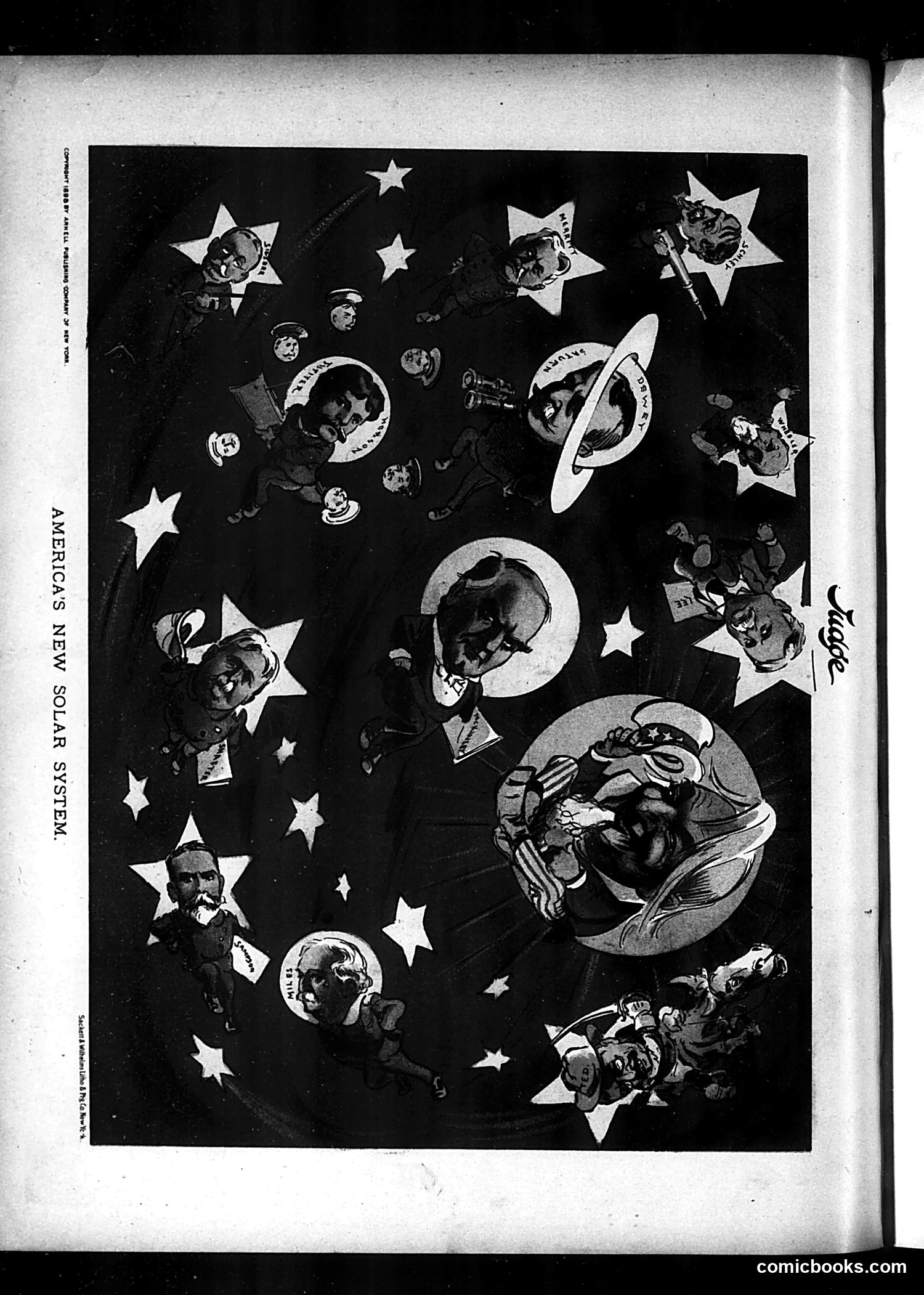
This satirical illustration depicts various American political and public figures as celestial bodies orbiting around a central sun. The cartoon uses the solar system as a metaphor for the American political hierarchy and influence structure of its era. The central, largest figure appears to represent the president or dominant political force. The surrounding figures in stars and planetary orbits likely represent other politicians, industrialists, and public personalities of significance. The composition suggests a commentary on power dynamics and the relative importance or influence of different American figures. Without clearer identification of specific individuals or a visible date, the exact political moment remains unclear, though the satire targets America's power structure and celebrity culture through astronomical imagery—a common Judge magazine approach.