A complete issue · 16 pages · 1898
Judge — August 27, 1898
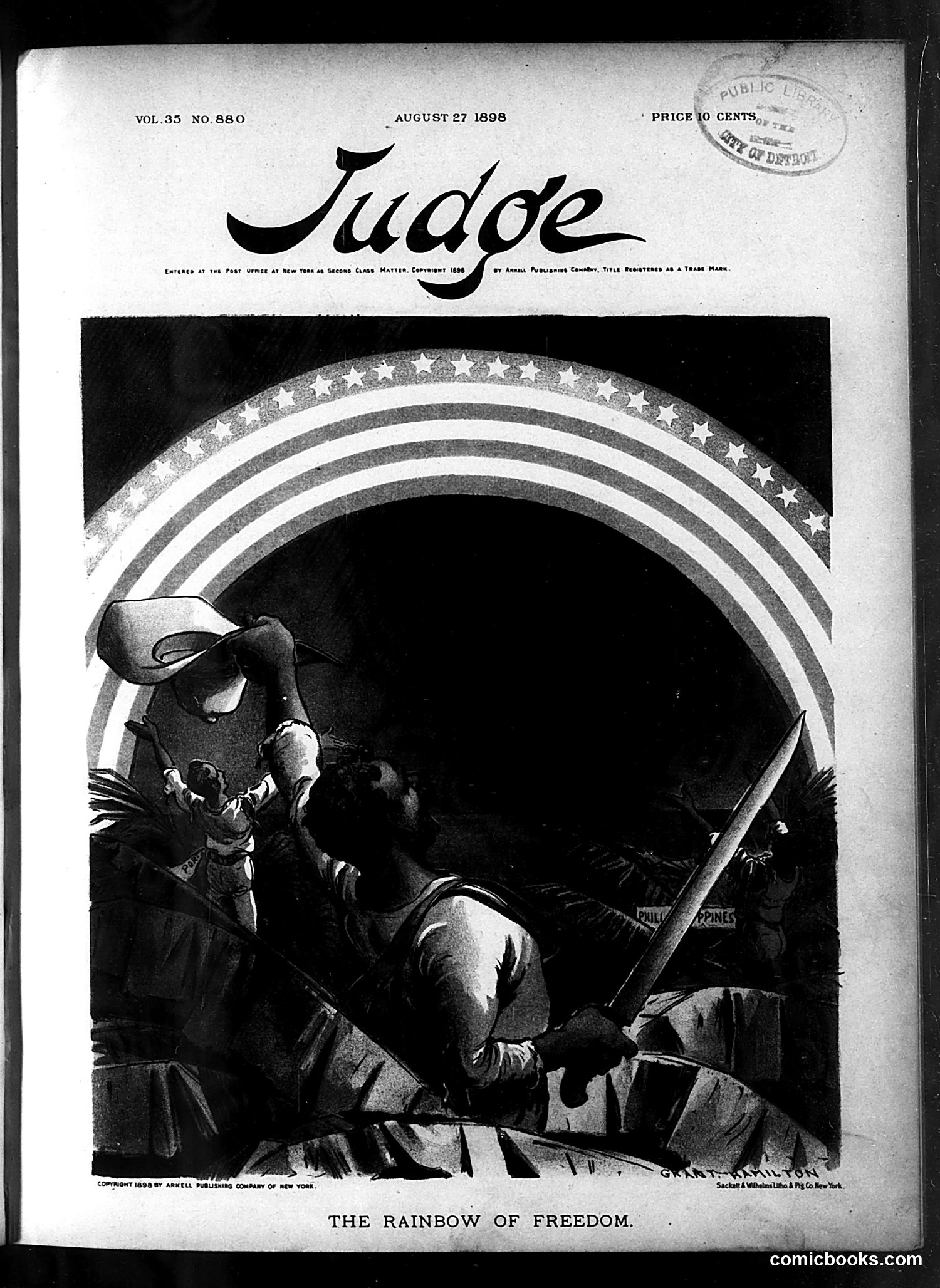
This cover illustration depicts soldiers or military figures emerging from or entering a tunnel beneath an American rainbow. The composition suggests a patriotic narrative about freedom achieved through military action. Given the 1898 date, this likely references the Spanish-American War, which concluded that year. The soldiers appear to be emerging victorious, with the rainbow symbolizing hope or promise following conflict. The imagery suggests American expansion or intervention is presented as liberating—though the satirical nature of Judge magazine means this could be ironic commentary on American imperialism rather than straightforward patriotism. The text "THE RAINBOW OF FREEDOM" reinforces the patriotic framing, though without additional context, whether Judge endorses or critiques this military expansion remains unclear from the image alone.
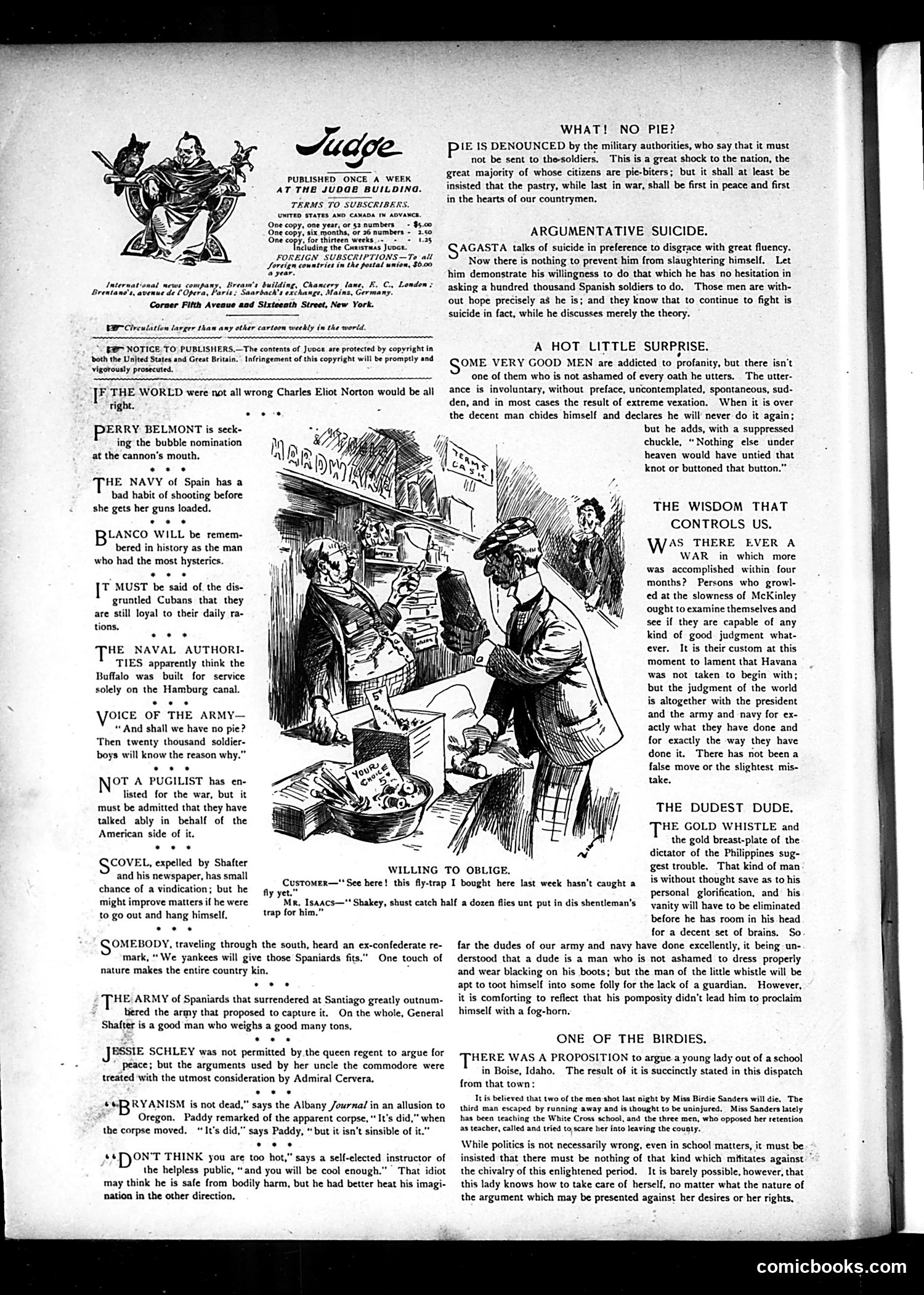
This page contains political commentary from the Spanish-American War era (appears to be 1898, based on references to McKinley and the Philippines campaign). **Main cartoon** ("Willing to Oblige"): Shows a shop owner serving customers—likely representing American merchants profiting from wartime supplies. The satirical point appears to be about war profiteering. **Political commentary** includes: - Criticism of Secretary of War Russell Alger and military leadership - Debate over whether the war was justified ("Argumentative Suicide") - Commentary on soldiers' conduct ("The Dudest Dude")—mocking overly-fastidious officers - A story about a schoolgirl in Idaho arguing against war, suggesting anti-war sentiment existed The overall tone is skeptical of military leadership competence and questioning whether the war's cost was justified, while supporting ordinary soldiers. The satire targets both military brass and war profiteers.
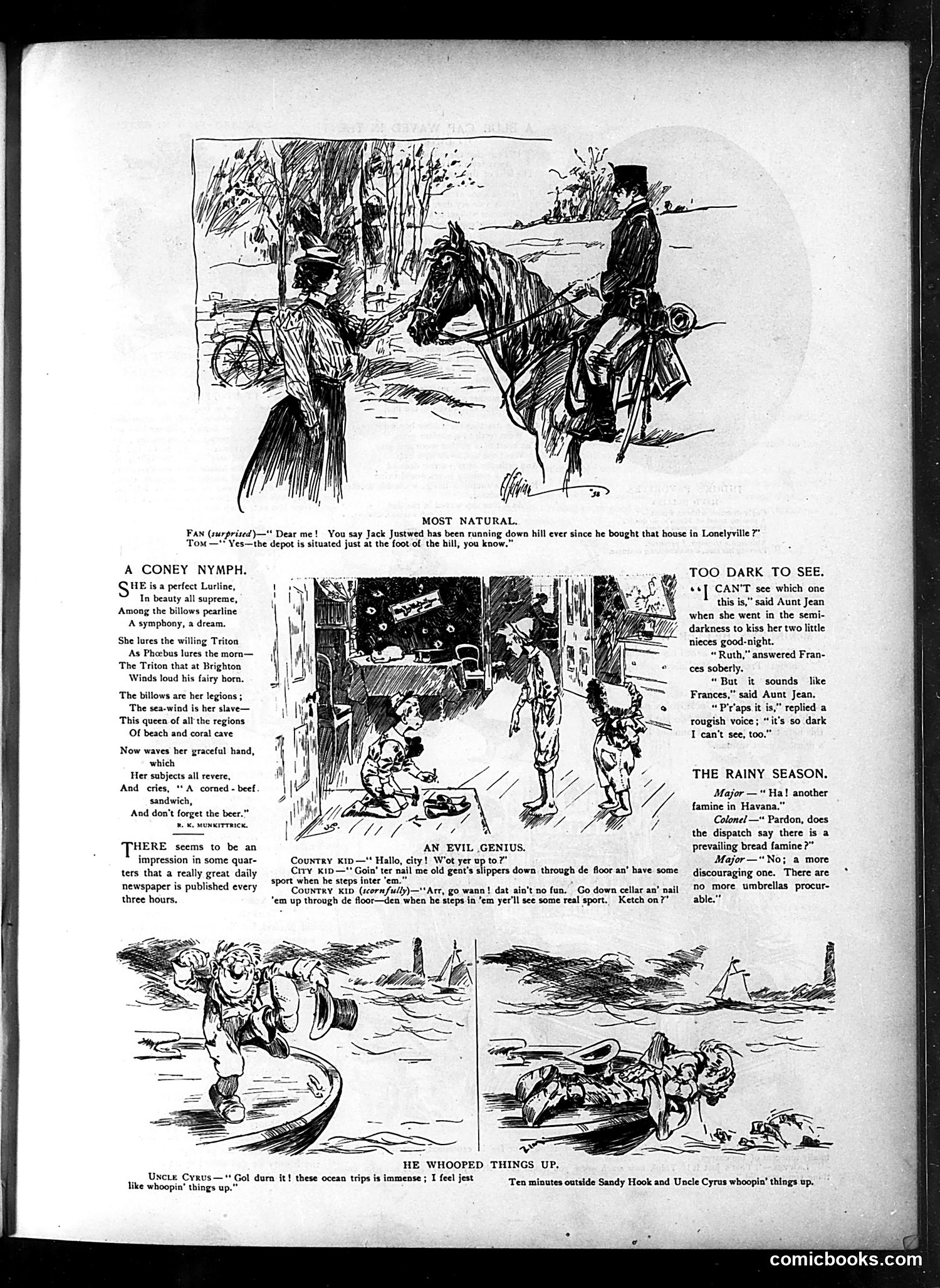
This page contains several humorous sketches and comic dialogues rather than political cartoons. The top illustration shows figures on horseback discussing a horse named Jack that has "been running down hill ever since he bought that house in Louisville." The middle section includes a poem "A Coney Nymph" and three separate comedic vignettes: - "An Evil Genius": A dialogue between country and city kids about causing mischief - "Too Dark to See": A conversation about visibility in darkness - "The Rainy Season": A military dialogue about famine in Havana The bottom sketches show maritime scenes with captions referencing "Uncle Cyrus" and ocean trips. This appears to be a humor and entertainment page rather than political satire, featuring domestic comedy, children's pranks, and seaside humor typical of late 19th/early 20th-century American magazines.
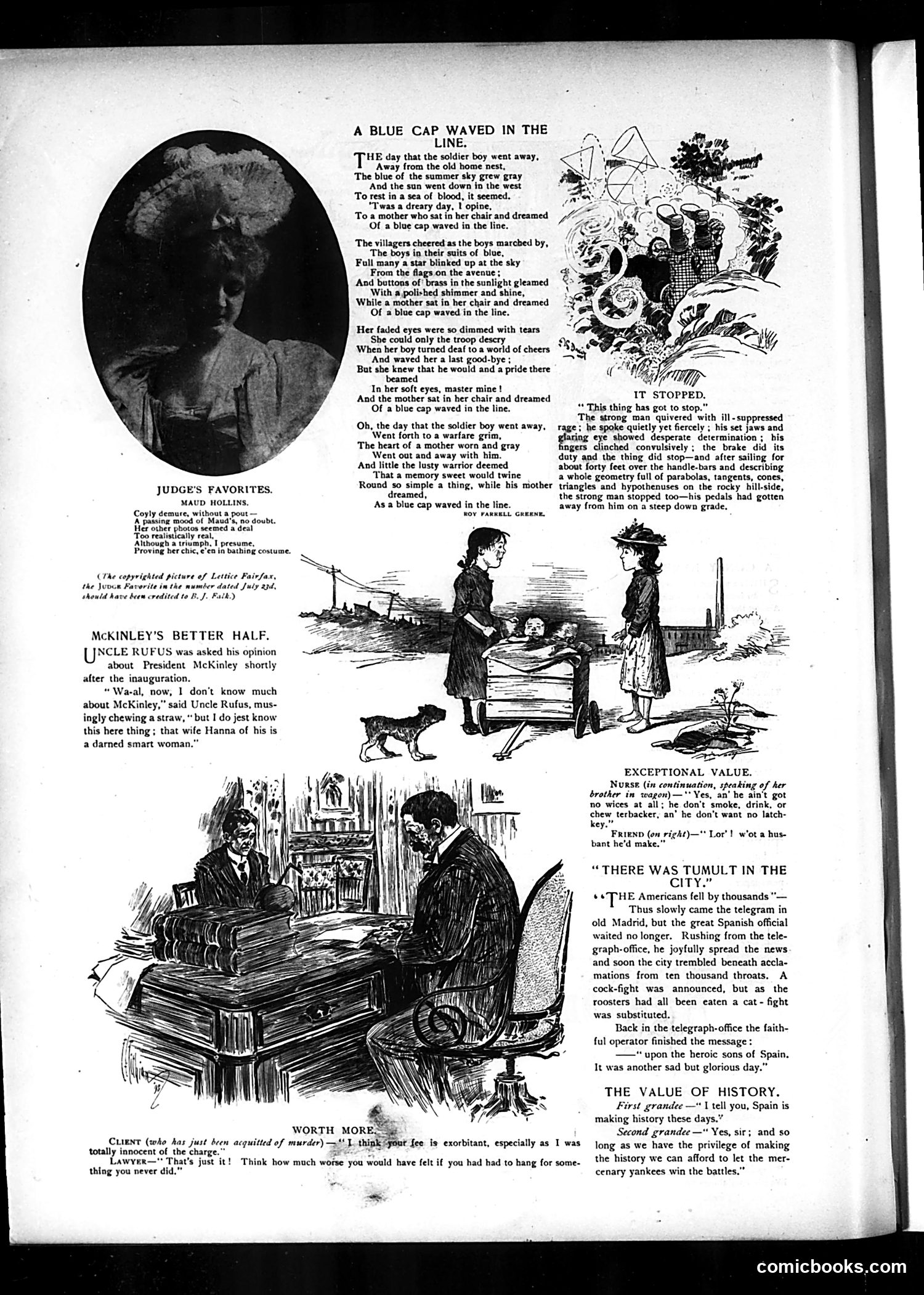
This page contains several unrelated satirical pieces typical of Judge's format: **"A Blue Cap Waved in the Line"** presents a sentimental poem about a mother watching her soldier son march away to war, focusing on her emotional response to seeing his blue military cap. **"Judge's Favorites"** appears to be a brief poetic tribute to someone named Little Panfles. **"McKinley's Better Half"** mocks President McKinley's wife Hanna through Uncle Rufus's commentary, calling her "a darned smart woman"—likely satirizing either her political influence or the president's dependence on her judgment. The remaining sections—"It Stopped," "Exceptional Value," "There Was Tumult in the City," and "Worth More"—appear to be disconnected short humor pieces or anecdotes without clear political targets visible in the OCR text.
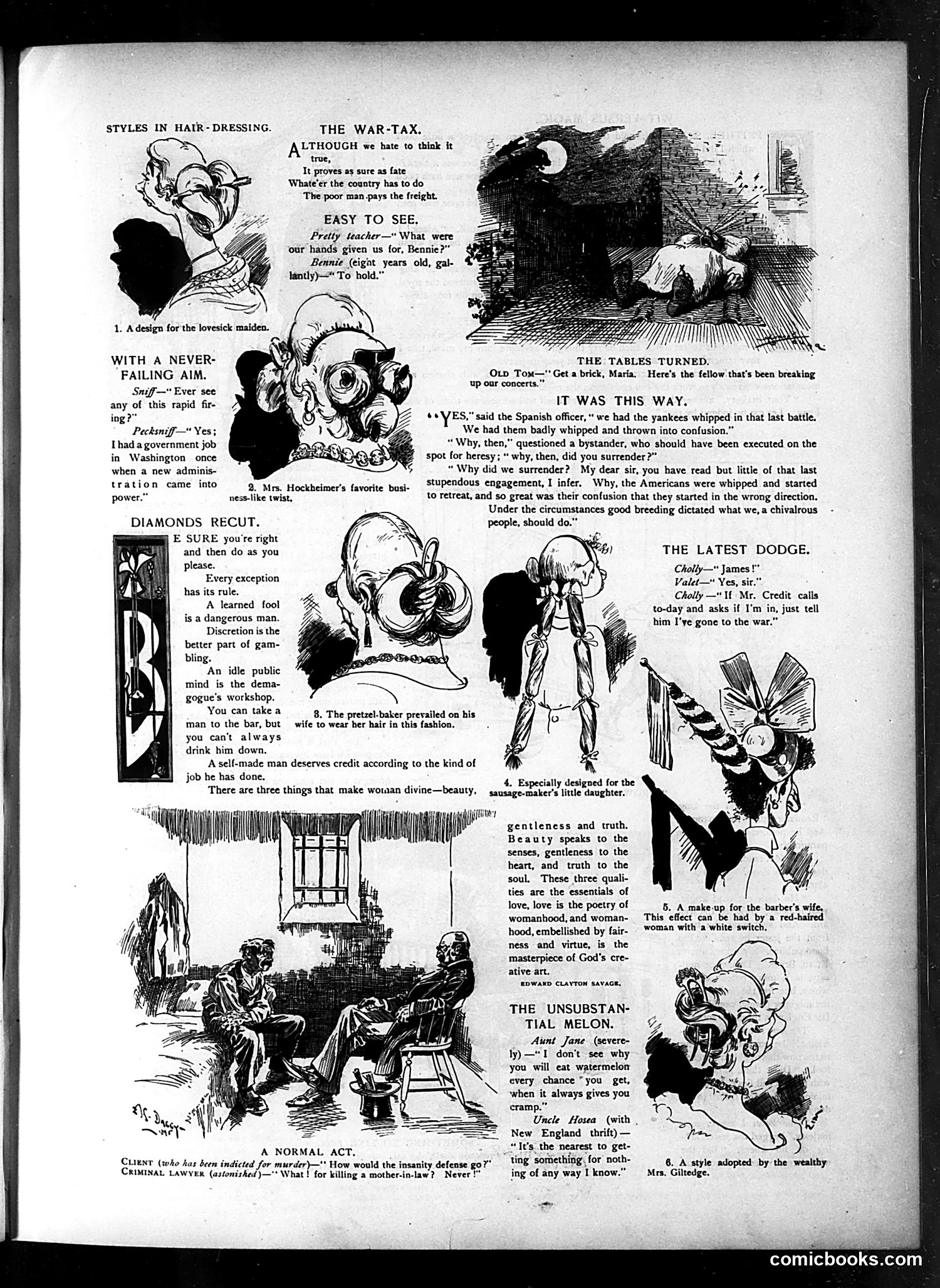
This page contains multiple satirical pieces reflecting early 20th-century American concerns: **"The War-Tax"** criticizes how military taxation disproportionately burdens the poor—a common Progressive Era complaint about tax policy. **"It Was This Way"** mocks Spanish military leadership from the Spanish-American War, portraying a Spanish officer explaining away his army's defeat through absurd logic about "good breeding" and "chivalrous" retreat—satirizing both Spanish imperial hubris and genteel excuses for military failure. **"The Latest Dodge"** jokes about wealthy men evading creditors by falsely claiming they've enlisted for war service. The hairdressing and other sections are lighthearted humor about fashion and social pretension, while pieces like "Diamonds Recut" and "A Normal Act" offer cynical aphorisms about human nature and justice. The overall tone reflects Judge's stance as a publication skeptical of both military adventurism and upper-class hypocrisy.
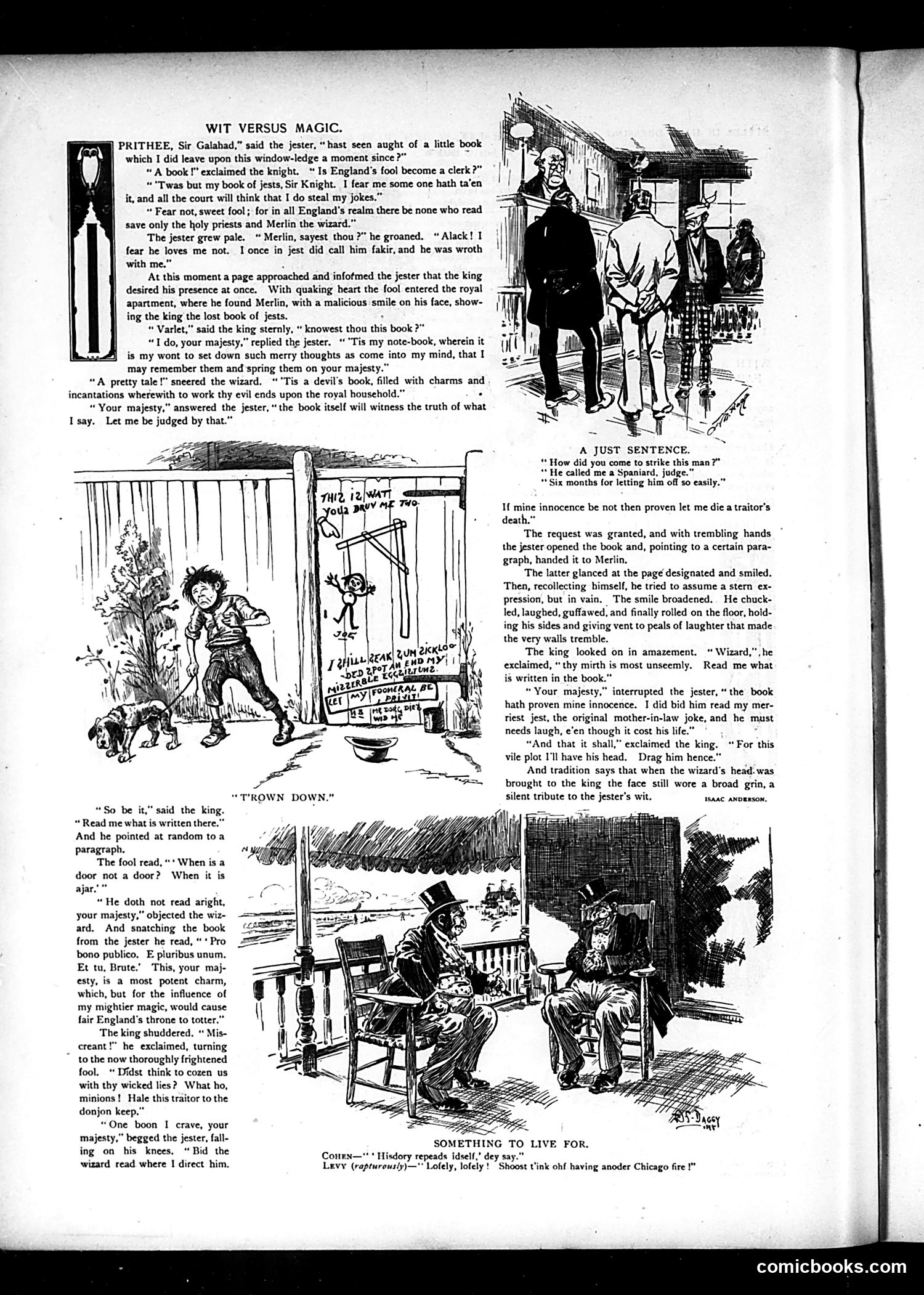
This page presents a medieval fantasy tale satirizing the clash between intellectual wit and fraudulent authority. The story features a jester whose book of jokes is discovered by the wizard Merlin, who attempts to frame the jester by selectively reading Latin phrases ("Pro bono publico. E pluribus unum. Et tu, Brute") as "evil incantations" to trick the king. The satire targets charlatans who manipulate authority through deception and selective presentation of evidence. The jester's triumph—proving innocence by having Merlin read an actual joke that compels laughter—suggests that truth and genuine wit ultimately expose fraud, even when that fraud appears magical or authoritative. The accompanying cartoon "Something to Live For" (bottom) appears unrelated, showing a different scene. The piece reflects Judge magazine's typical theme: exposing deception through humor and logic.
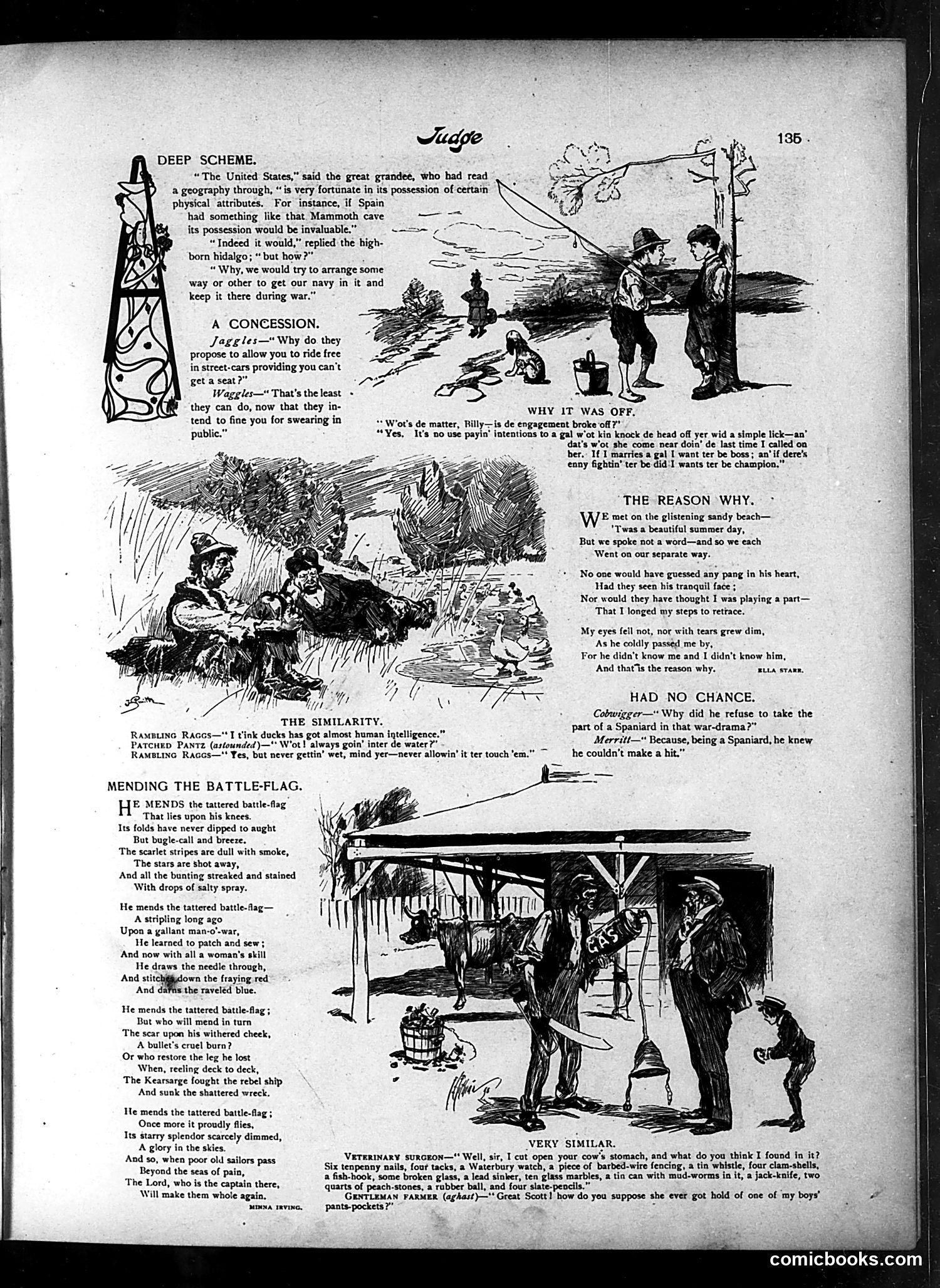
This page contains several satirical pieces from the American Civil War era, likely 1860s: **"Deep Scheme"** mocks Spanish-American tensions by having a Spanish grandee propose hiding Spain's navy in a cave—suggesting Spain's naval inferiority and desperation. **"Why It Was Off"** presents working-class dialect humor about a broken engagement, where a man refuses to marry a woman who physically bested him, valuing his status as "boss" over love. **"Mending the Battle-Flag"** is a sentimental poem honoring Civil War veterans, particularly an aging sailor who repairs a battle-damaged flag while bearing his own war wounds—a poignant contrast between the flag's restoration and his irreparable injuries. **"Had No Chance"** jokes that a Spanish actor refused a war-drama role because "being a Spaniard, he knew he couldn't make a hit"—anti-Spanish mockery common during this period. The humor ranges from gentle to barbed, reflecting 1860s attitudes toward disability, class, gender, and national rivalry.
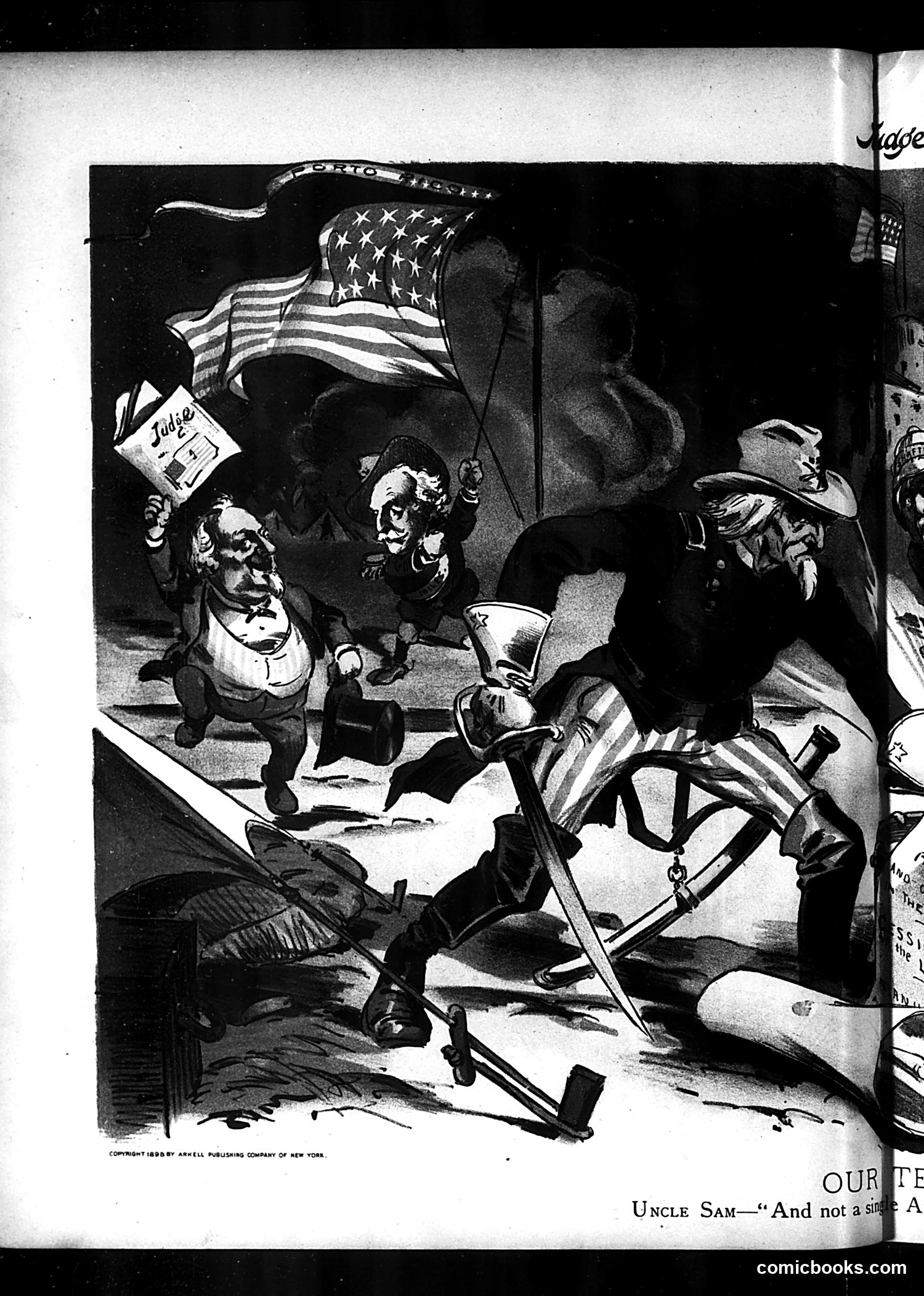
This is a satirical cartoon from **Judge magazine** (copyright 1899, Arkell Publishing Company). The image shows **Uncle Sam** (the tall figure in stars-and-stripes top hat, center-right) confronting several caricatured figures. One figure on the left holds what appears to be a "Judge" publication. The cartoon's incomplete caption begins "Uncle Sam—'And not a single..." suggesting Uncle Sam is making a disapproving statement. The scene depicts what appears to be **political corruption or malpractice**, with the caricatured figures seemingly caught in wrongdoing before the nation's personified authority. Without the complete caption, the specific political event referenced is unclear, though the 1899 date suggests this relates to **late-19th-century American political scandals or reform issues**. The tone is clearly critical of those being confronted.
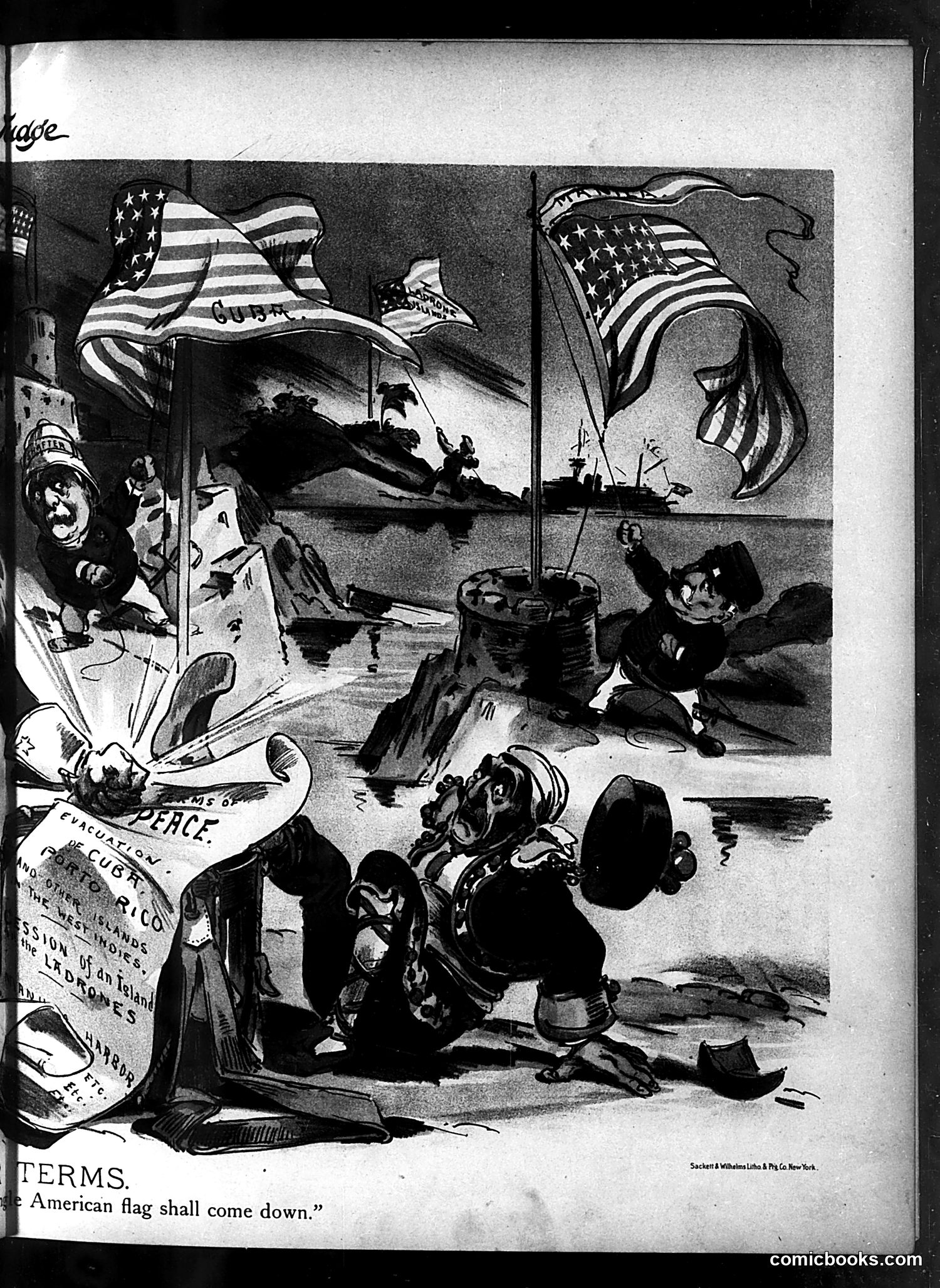
This Judge magazine cartoon depicts a negotiation scene with American flags prominently featured. The visible text reads "The American flag shall come down," suggesting a surrender or capitulation scenario. On the left sits a figure in military dress with what appears to be Irish imagery (based on visible text fragments mentioning "Ireland"), while figures on the right appear to be negotiating or capitulating. The American flags in the background—one appearing damaged or lowered—reinforce the theme of American defeat or concession. The cartoon appears to satirize Irish-American political demands or independence movements, suggesting they would require America to compromise its sovereignty or values. Without clearer date context, the specific historical moment remains uncertain, though this reflects late 19th or early 20th-century tensions between Irish-American interests and American nationalism.
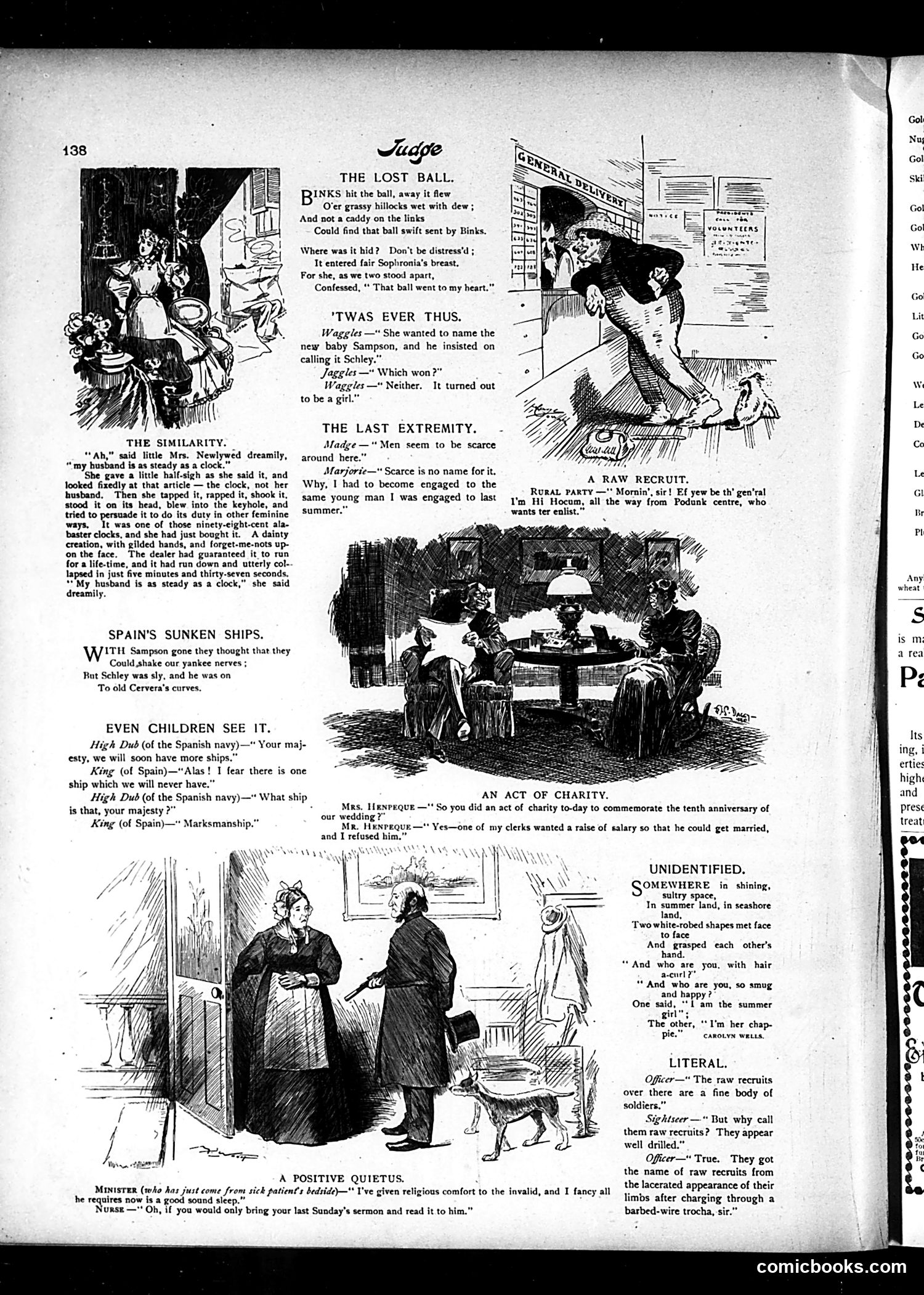
This page contains multiple short humorous pieces typical of Judge's satirical style, circa 1898 (based on references to the Spanish-American War). **Key Content:** - **"The Lost Ball"**: A golf joke with romantic double entendre—a ball literally enters a woman's chest, which she sweetly reinterprets as striking her heart. - **Spanish-American War references**: Multiple pieces mock Spanish naval defeats. "Spain's Sunken Ships" jokes about Admiral Cervera's fleet and mentions Sampson and Schley (American naval commanders). "Marksmanship" is the punchline about Spain's inability to fight effectively. - **"A Raw Recruit"**: Rural dialect humor about a country person enlisting, using exaggerated speech patterns common to period comedy. - **Social satire**: "An Act of Charity" mocks hypocrisy—refusing an employee a raise while claiming charitable acts. The humor relies on puns, gentle romantic misunderstandings, contemporary war mockery, and class-based dialect comedy typical of 1890s American magazines.
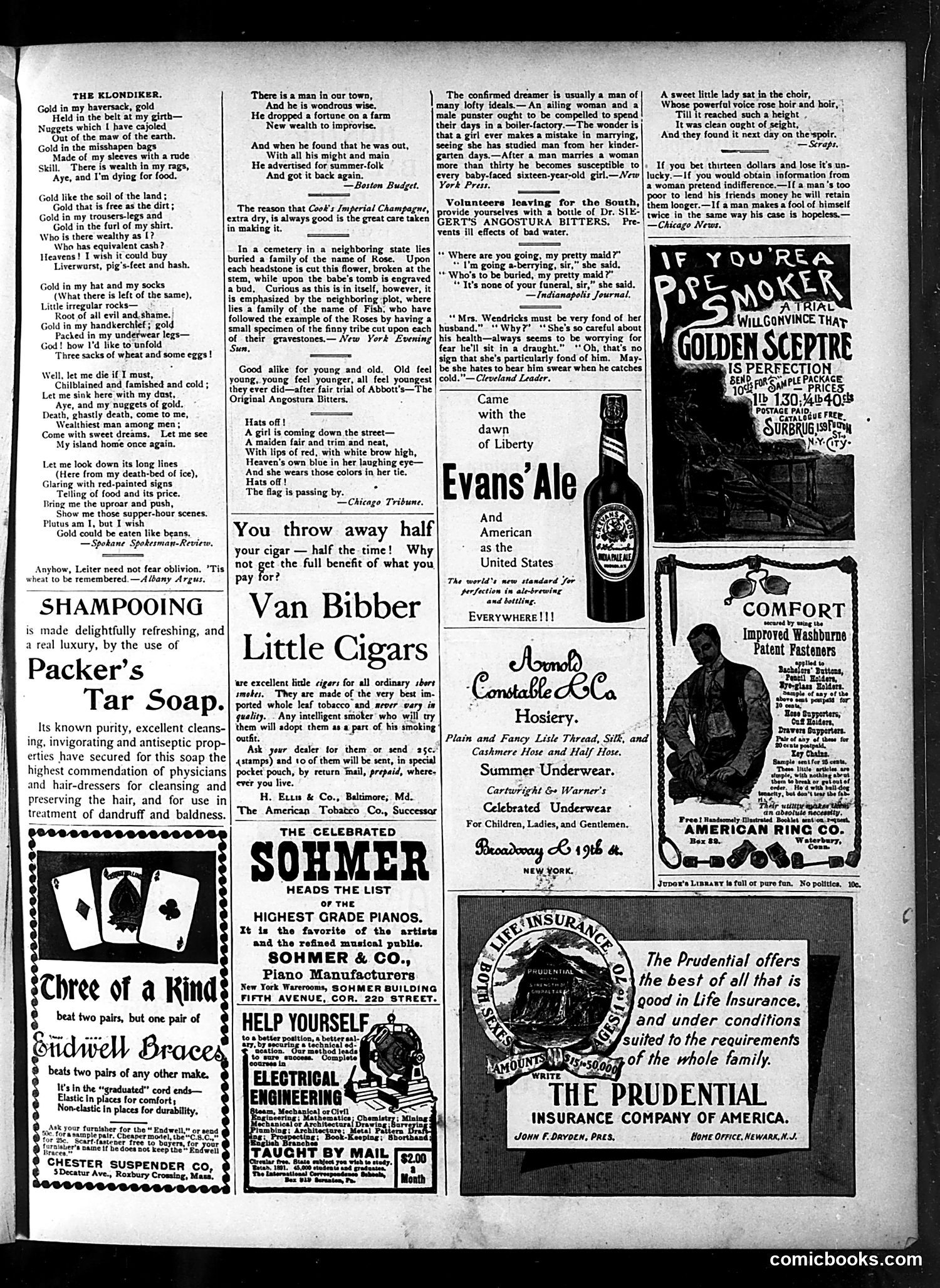
This page is primarily advertisements with one significant satirical poem: "The Klondiker." **The Poem's Meaning:** "The Klondiker" satirizes gold prospectors from the Klondike Gold Rush (1896-1899). The speaker is a miner who has successfully extracted gold but is starving—his wealth is worthless without food. The irony is absolute: he possesses "nuggets," gold in his socks, hat, and underwear, yet he's "dying for food" and wishes he could "eat" gold "like beans." **The Satire:** The poem mocks the gold rush itself and the false promise of sudden wealth. It references "Leiter" (likely Joseph Leiter, a wealthy speculator), suggesting that even wealthy men can face ruin. The joke cuts deeper: material wealth means nothing without basic sustenance. The prospector would trade all his gold for "liverworst, pig's-feet and hash." **Social Context:** During the economic depression of the 1890s, this satirized get-rich-quick schemes and the desperation of fortune-seekers. The poem suggests that mere possession of wealth doesn't equal security or survival.
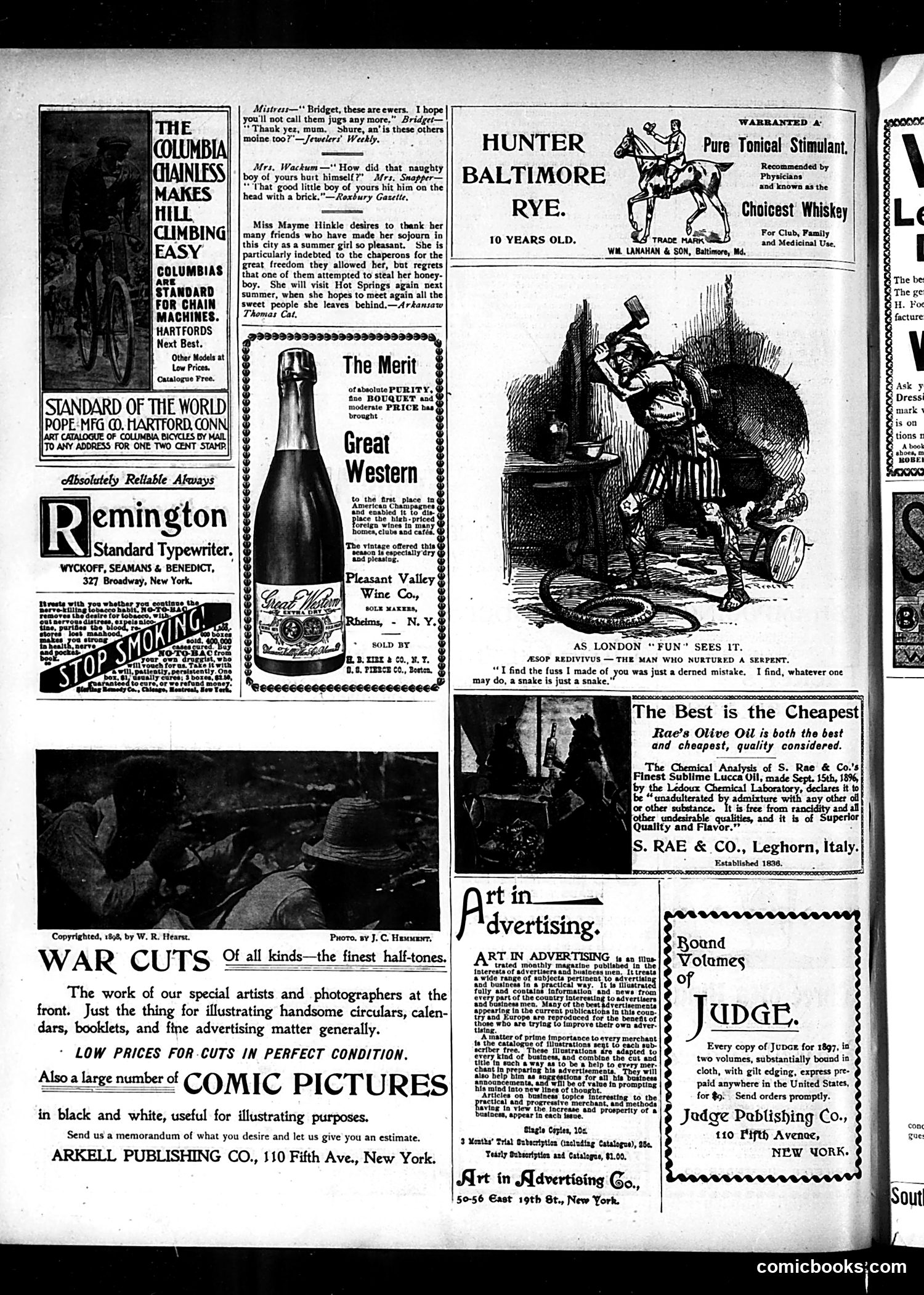
The main cartoon depicts the classical Aesop's fable of the farmer and the serpent—a man has nurtured a snake, which now bites him. His caption reads: "I find the fuss I made of you was just a derned mistake. I find, whatever one may do, a snake is just a snake." This is likely political allegory about American foreign policy. The cartoon references the Spanish-American War (page includes "War Cuts" advertising), suggesting the "serpent" could represent either Cuba or the Philippines—territories the U.S. championed as liberation projects but found troublesome after intervention. The moral is cynical: good intentions cannot reform inherently problematic situations; a snake remains a snake regardless of care given. The page is otherwise dominated by period product advertisements (whiskey, wine, bicycles, typewriters, olive oil) typical of Judge magazine's revenue model.
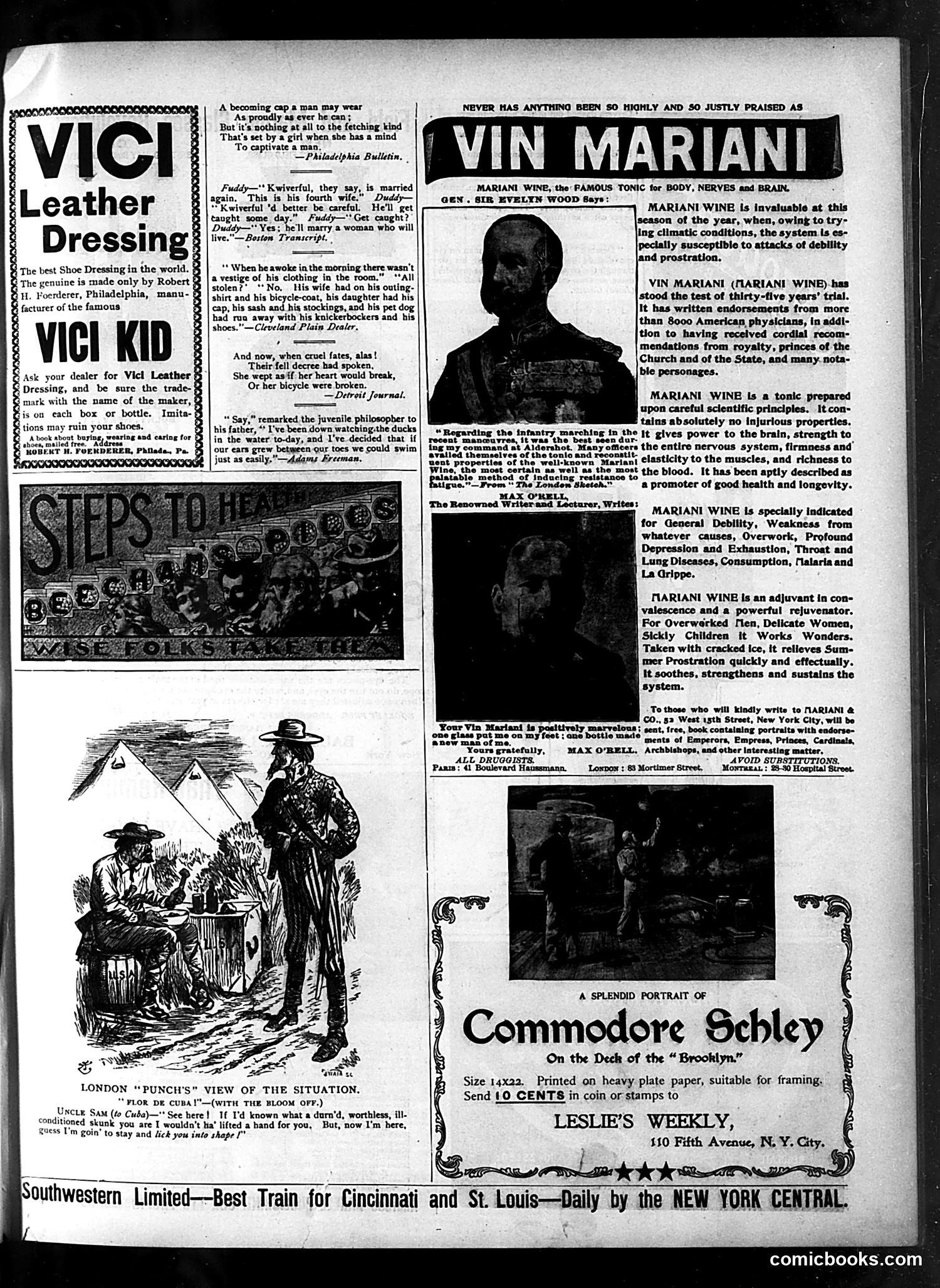
This page mixes satirical cartoons with period advertising, primarily focused on gender relations and imperialist politics. **The cartoons** use humor about marriage and clothing to satirize gender dynamics. Multiple jokes mock men losing control to wives—one man's fourth wife might finally "catch" him; another loses all his clothing to family members. A separate cartoon titled "Flor de Cuba" shows Uncle Sam addressing Cuba like a wayward child, reflecting post-Spanish American War sentiment. The image depicts American paternalism toward Cuba, with Sam claiming he'll "lick you into shape"—expressing the era's imperialist assumption that American intervention was civilizing and corrective. **The advertising** for Vin Mariani wine dominates the right side, claiming endorsements from thousands of physicians and royalty. This patent medicine advertisement typifies the period's largely unregulated pharmaceutical marketing, making sweeping health claims without modern FDA oversight. The page reflects turn-of-century American attitudes: domestic anxiety about shifting gender roles and confident imperial expansion abroad.
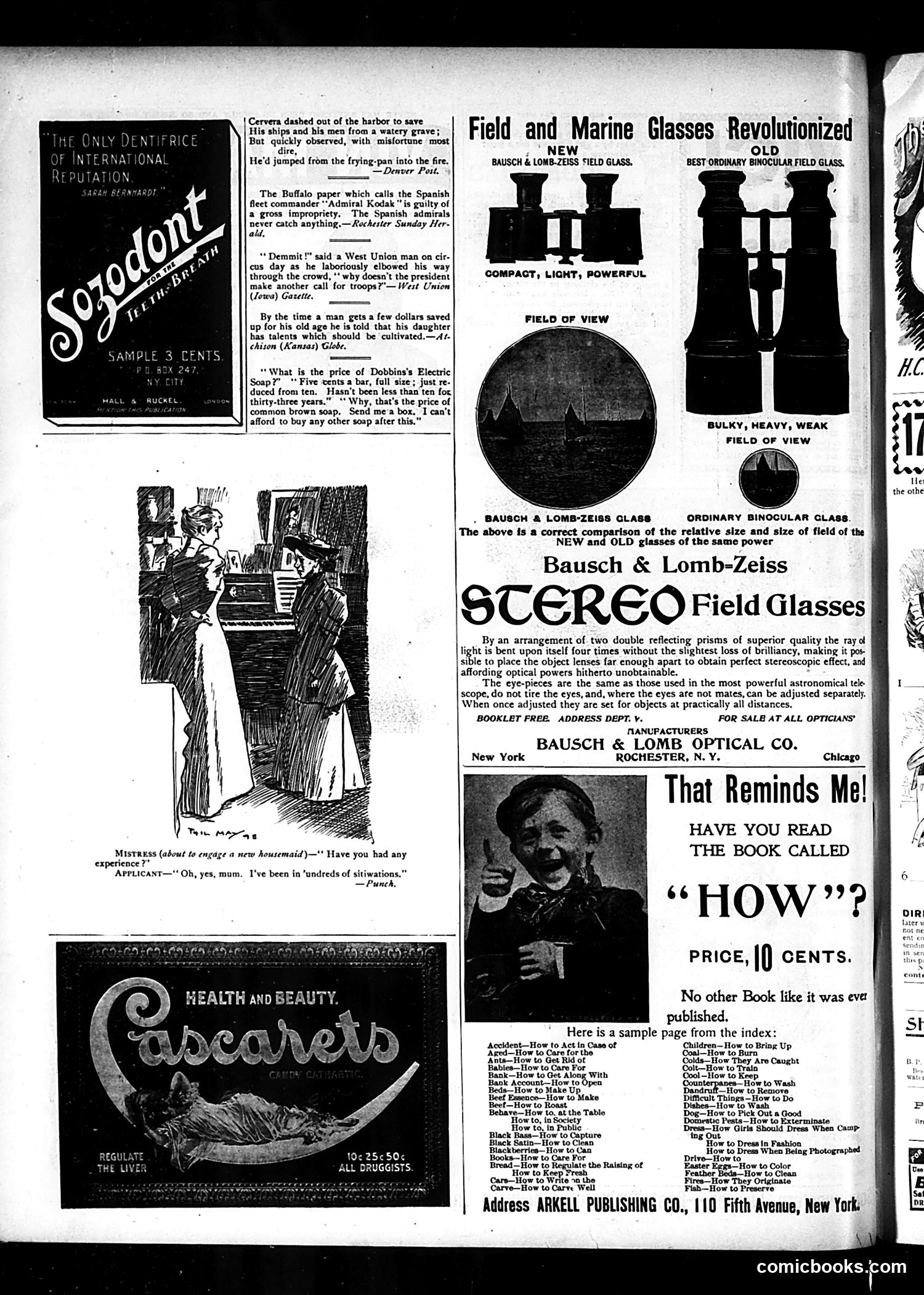
This page is primarily **advertising and humor snippets**, not a single cohesive political cartoon. The main satirical content includes brief quips mocking contemporary issues: 1. **Spanish-American War reference**: A verse about Admiral Cervera's fleet, with commentary that Spanish admirals "never catch anything"—satirizing Spanish military incompetence during the 1898 conflict. 2. **Military recruitment joke**: A West Union man frustrated by troop calls during circus season, poking fun at mobilization efforts. 3. **Domestic satire**: Jokes about fathers saving for retirement only to finance daughters' "cultivated talents," and a soap price comparison exposing deceptive marketing. 4. **British servant humor**: A Punch reprint featuring an applicant claiming hundreds of previous positions—implying dishonesty or job-hopping. The page is dominated by product advertisements (Sozodont toothpaste, Cabarets health product, Bausch & Lomb binoculars, and "How?" instructional book), which was standard Judge magazine format.