
A complete issue · 16 pages · 1898
Judge — August 6, 1898
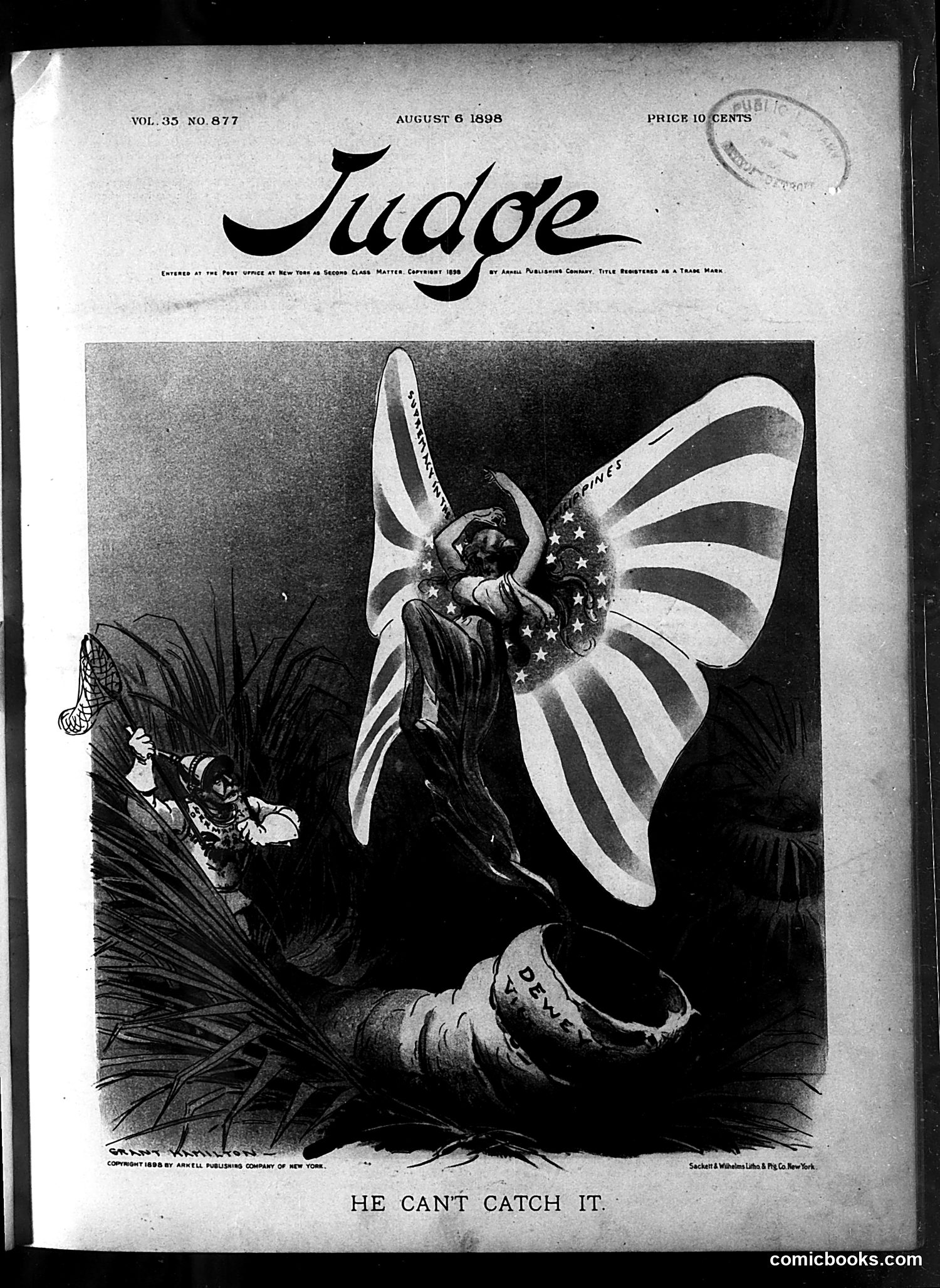
This political cartoon depicts a large butterfly with American flag imagery on its wings being pursued by a figure on the left (appearing to be a caricatured foreign power or rival nation, likely Spain given the 1898 date during the Spanish-American War). The butterfly represents American expansion or territorial gains—the stars and stripes pattern suggests U.S. imperial ambitions. The caption "He Can't Catch It" suggests the satirist is mocking someone's inability to seize or prevent American territorial expansion. The 1898 timeframe indicates this likely references the Spanish-American War's outcome, when the U.S. acquired colonies like the Philippines, Guam, and Puerto Rico. The cartoon appears to celebrate American imperial success while mocking a competitor's failure.
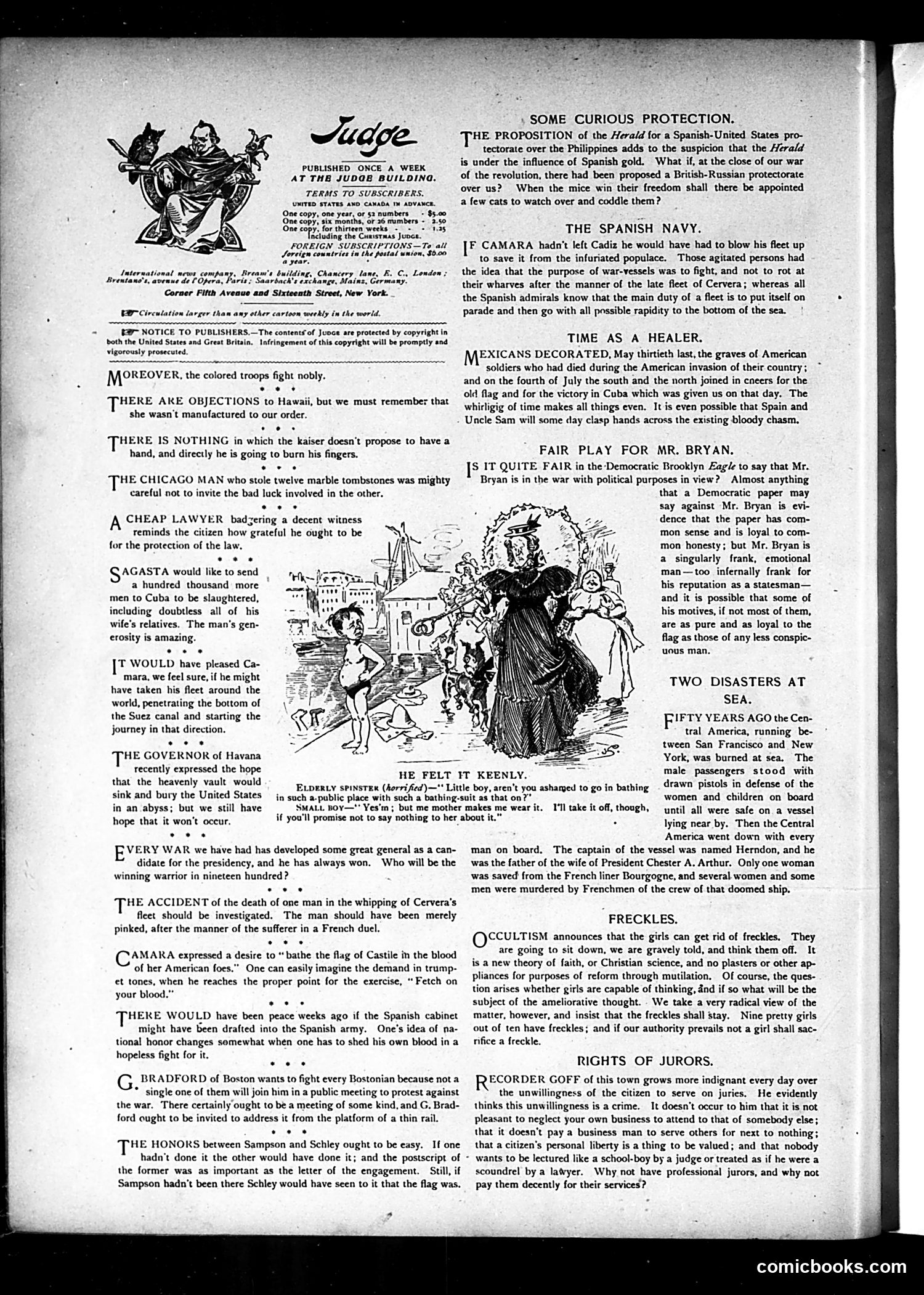
This page contains multiple short editorial commentaries and one central cartoon titled "HE FELT IT KEENLY," depicting an elderly bearded man (likely representing Spain or a Spanish official) being struck or confronted by a woman in black. The surrounding text references the Spanish-American War, discussing Spain's naval losses, the treatment of American soldiers' graves, and Cuban independence. One section criticizes Mr. Bryan (William Jennings Bryan) regarding the war's political purposes. The cartoon satirizes Spain's humiliation during the conflict—the "keenly felt" blow representing military and imperial defeat. The commentaries mock Spanish leadership's failures while discussing broader war consequences, including casualty treatment and American expansionist outcomes in the Philippines and Cuba.
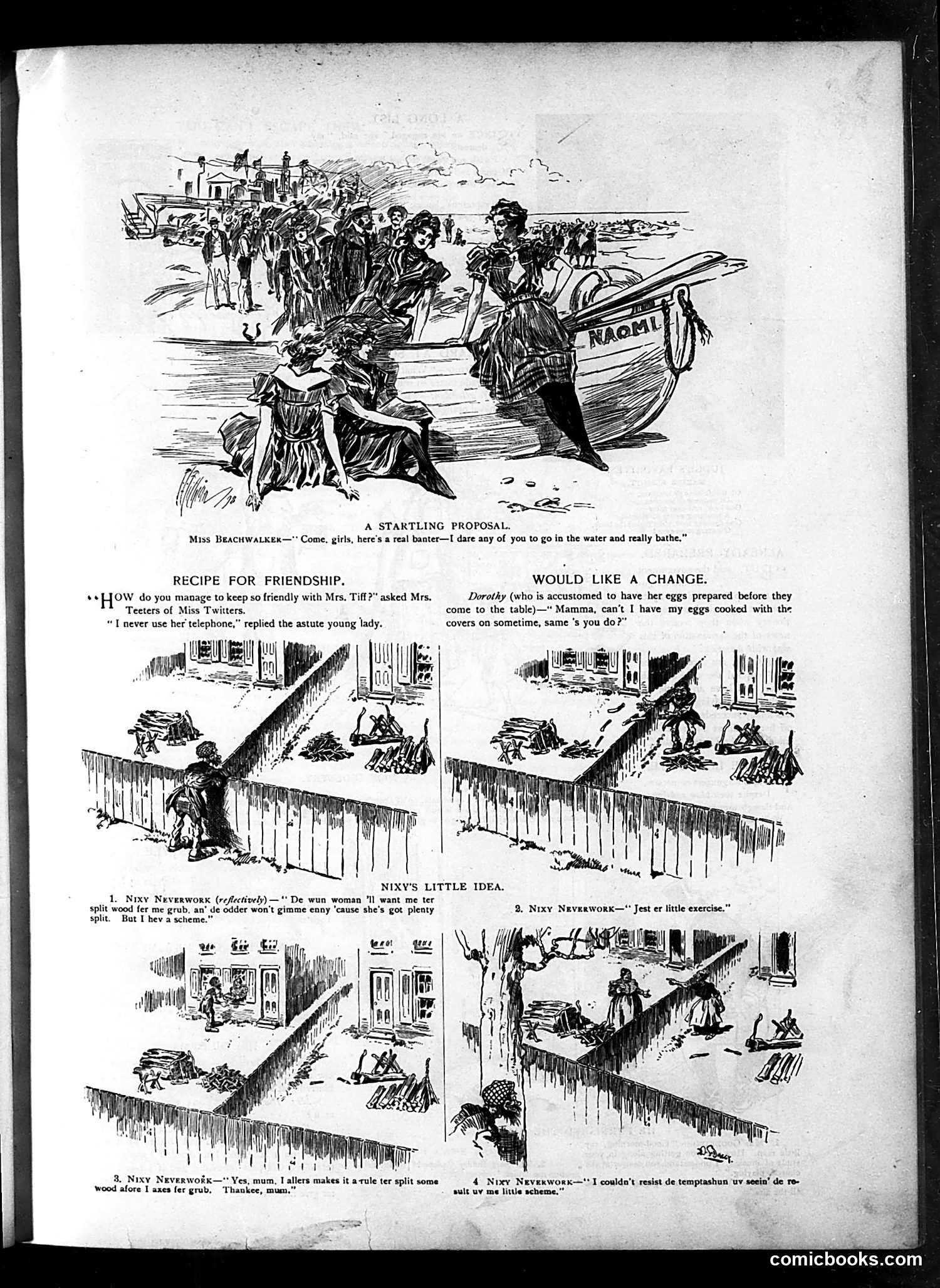
This page contains three separate humorous sketches with social commentary: **"A Startling Proposal"** (top) depicts Miss Beachwalker inviting girls to bathe in the sea—a daring suggestion for the era, when mixed bathing and female swimming in public were considered scandalous. The boat labeled "Naomi" suggests this involves actual swimmers rather than modest wading. **"Recipe for Friendship"** and **"Would Like a Change"** are domestic humor pieces about maintaining social relationships through telephone etiquette and managing household routines (egg preparation, cleaning). **"Nixy's Little Idea"** shows a woman splitting wood before asking her husband—establishing her contribution to household labor to justify requests—presumably to pressure him into granting her wishes. All sketches satirize gender roles and domestic life conventions of the period.
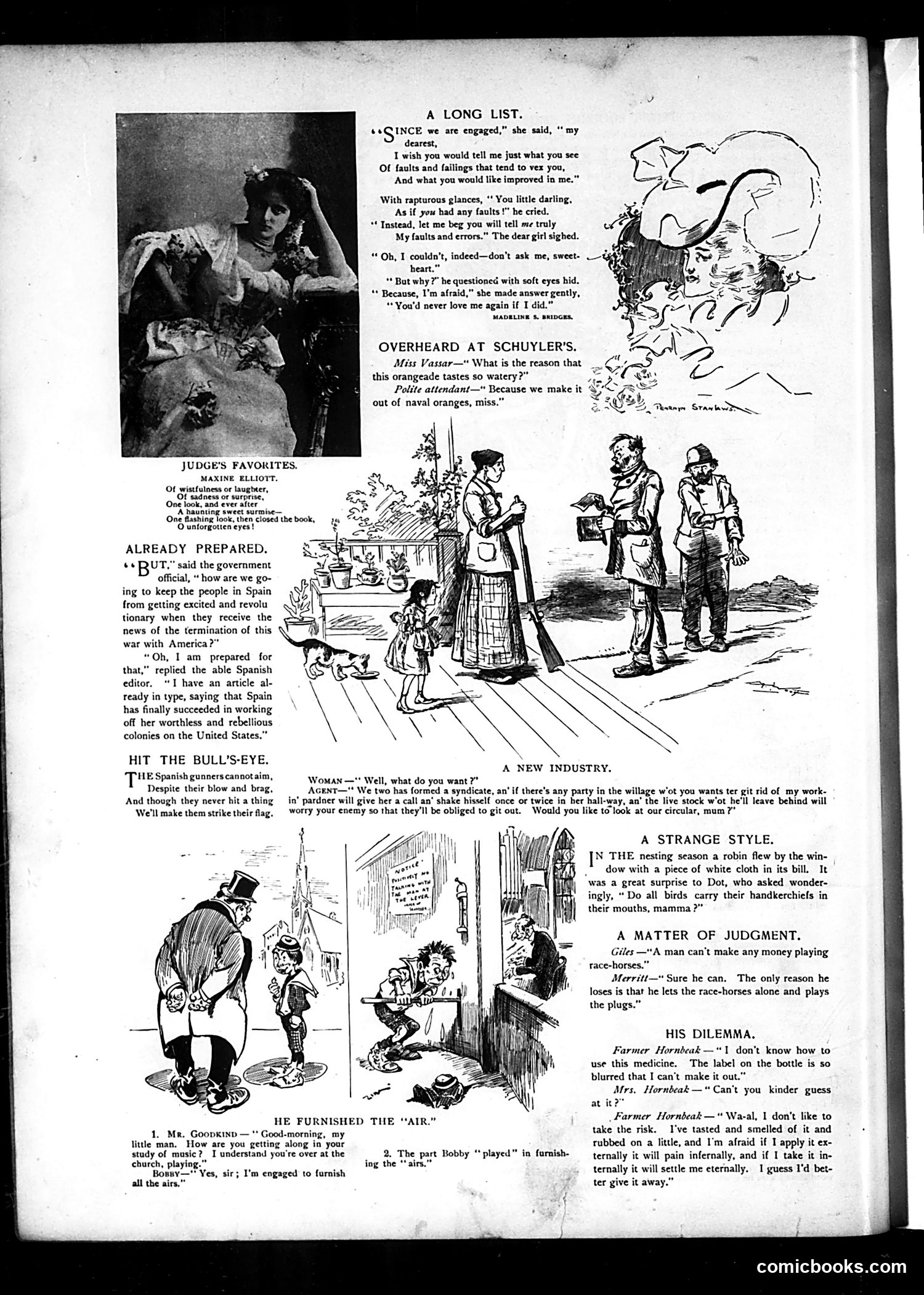
This page contains multiple unrelated satirical sketches and humorous anecdotes typical of Judge magazine's format. The cartoons appear to address: **"Already Prepared"**: A joke about Spanish colonial policy regarding American independence, suggesting Spain anticipated preventing revolution in its colonies. **"Hit the Bull's-Eye"**: A dialogue about a woman seeking to rid herself of a suitor through manipulation and bribery. **"The Furnished the Air"**: A musical joke about a conductor claiming to have composed all the airs at church. The remaining sections are brief comedic vignettes about everyday situations—a robin with a handkerchief, betting on horses, and a farmer's wife fearing medicine side effects. These appear designed as quick humor pieces for entertainment rather than partisan political commentary.
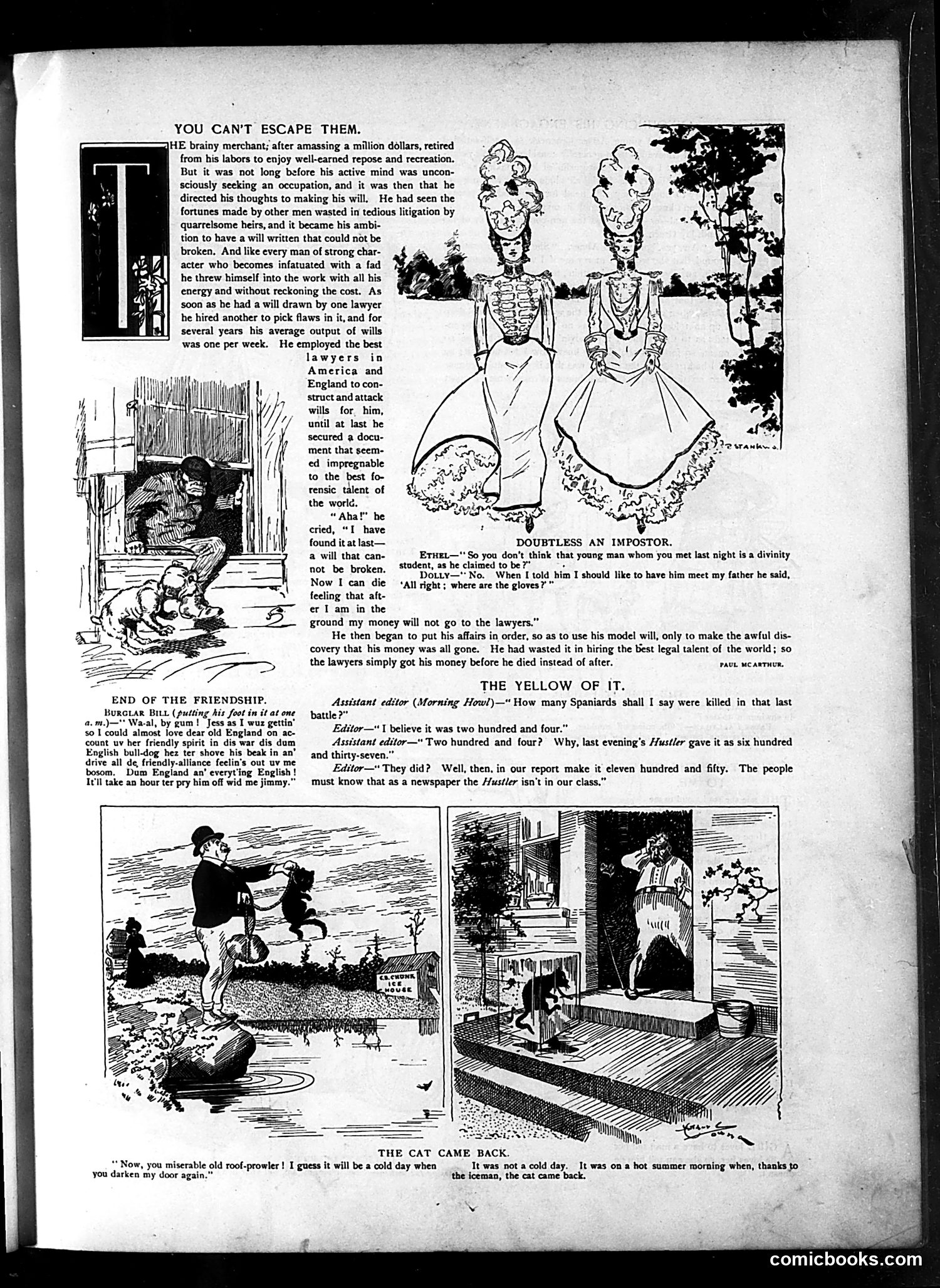
This page contains three distinct satirical pieces mocking American social pretensions and professional incompetence: **"You Can't Escape Them"** ridicules a wealthy merchant who obsessively hires competing lawyers to create an "unbreakable" will. The satire: his obsession with defeating future litigation costs him his entire fortune to the lawyers themselves—defeating his original purpose. **"Doubtless an Impostor"** is a brief joke about a young man claiming to be a divinity student who reveals himself as a fraud when asked to meet the woman's father, suggesting con artists were common. **"The Yellow of It"** satirizes newspaper rivalry and editorial dishonesty. Two editors discuss inflating casualty figures from a Spanish battle (likely the Spanish-American War), each competing to claim higher numbers than competitors to appear more authoritative—mocking sensationalism and the "yellow journalism" era. The cartoons reflect turn-of-century American anxieties: legal parasitism, social fraud, and media manipulation.
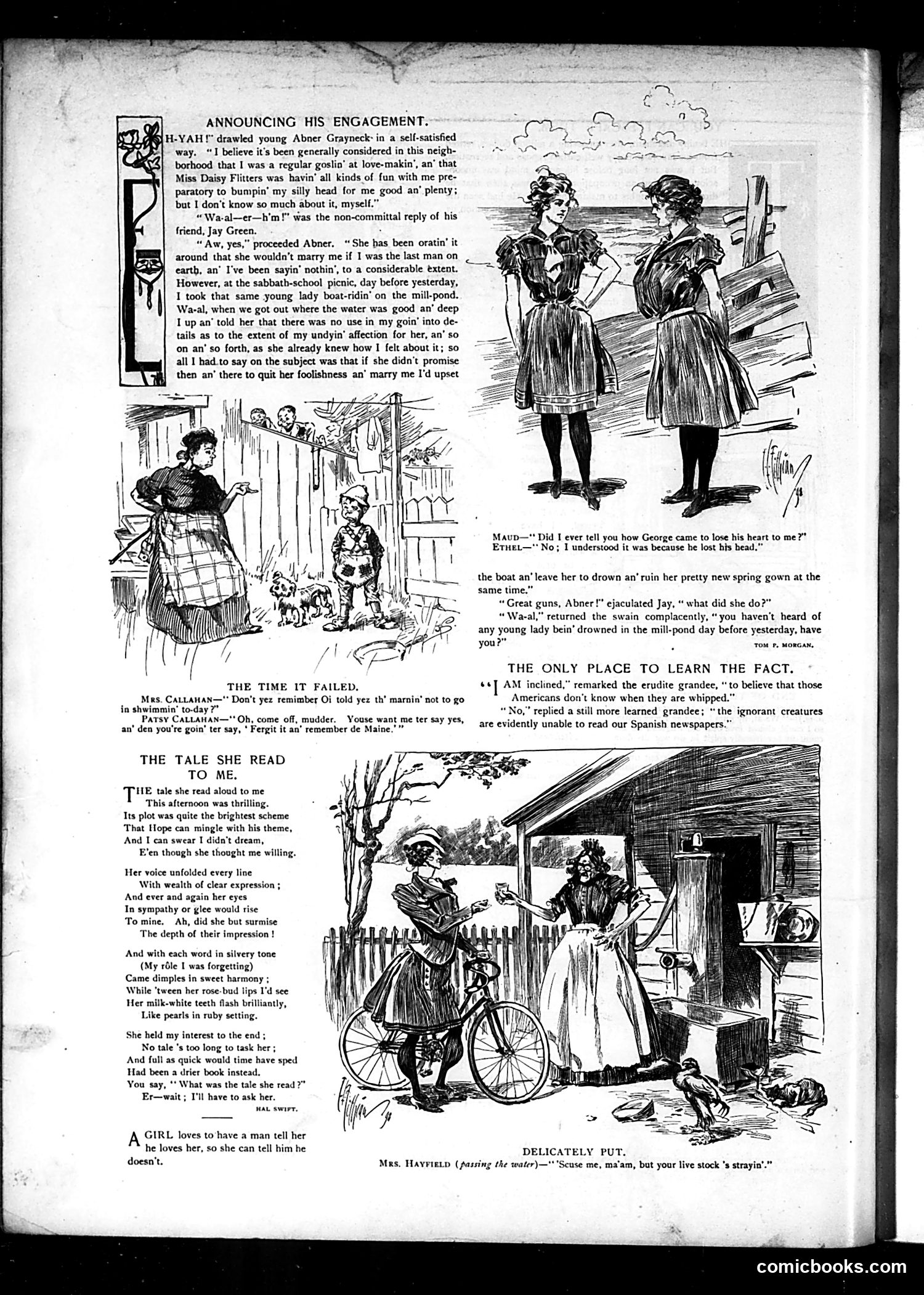
This page contains multiple unrelated satirical pieces typical of Judge magazine's humor: **"Announcing His Engagement"**: A rural courtship story where young farmer Abner Grayneck threatens to capsize a boat and drown his reluctant sweetheart Daisy Flitters unless she agrees to marry him. The joke plays on rural dialect and the absurdity of his "successful" coercion—she apparently agreed, proving his bumbling courtship worked. **"The Time It Failed"**: A brief exchange where Irish mother Mrs. Callahan scolds son Patsy for swimming after being warned, invoking "Remember the Maine"—referencing the 1898 battleship explosion that triggered the Spanish-American War. The humor lies in Patsy treating her warnings as reflexive rhetoric rather than genuine concern. **"The Tale She Read to Me"**: A sentimental poem about a young man distracted by a woman reading to him, too enamored to remember what story she read. **"The Only Place to Learn the Fact"**: A quip suggesting Spanish newspapers are the only source for learning American military defeats—likely referencing American difficulties in the Spanish-American War or Philippines campaign. The page satirizes rural courtship, immigrant speech patterns, and American military performance.
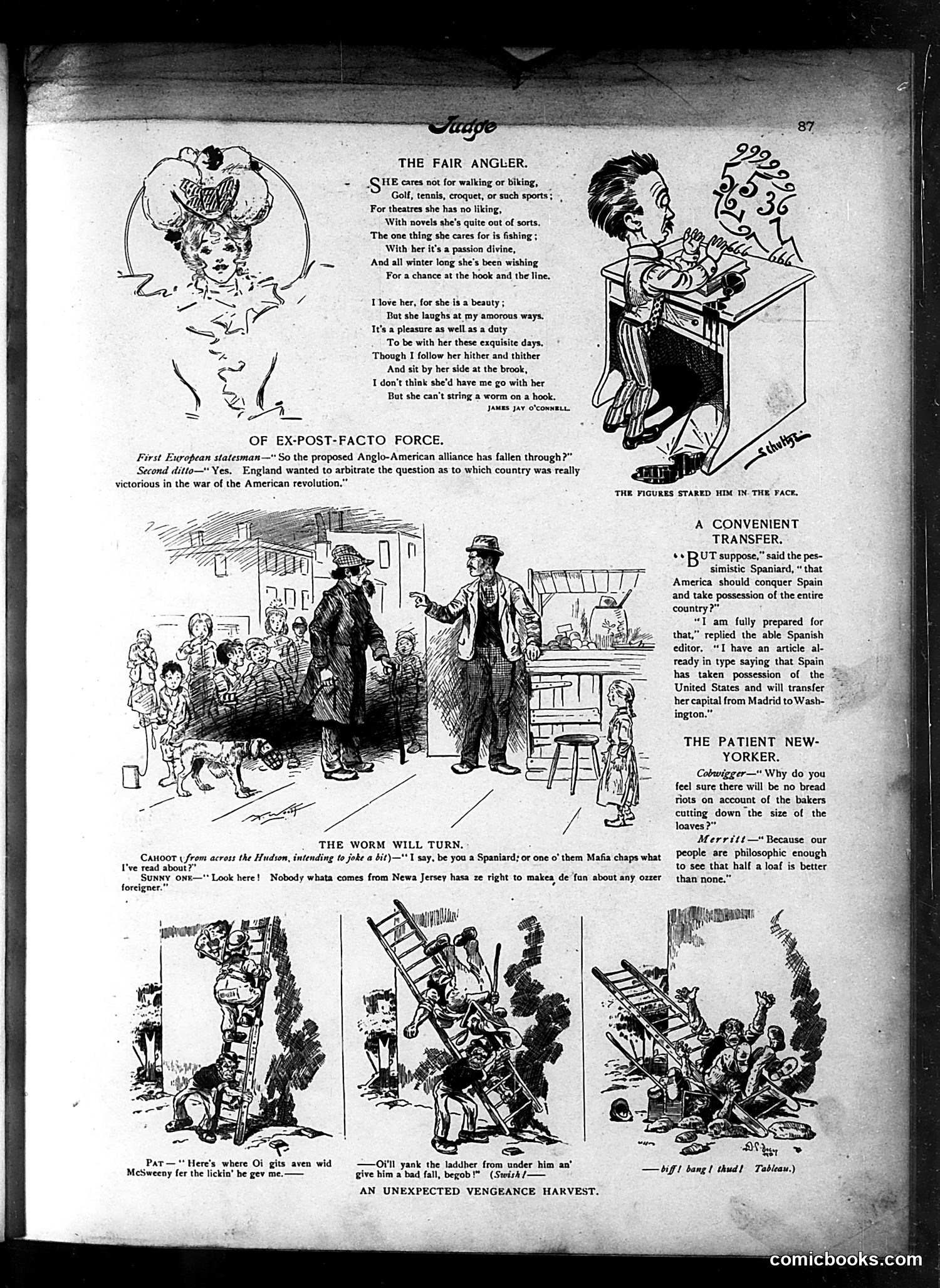
This page contains several satirical pieces typical of late-19th/early-20th century American humor: **"The Fair Angler"** is a light romantic poem about a woman passionate only about fishing, indifferent to suitors' traditional courtship attempts—poking fun at both her single-mindedness and male romantic frustration. **"Of Ex-Post-Facto Force"** jokes about failed Anglo-American alliance negotiations, with European statesmen debating which country actually won the American Revolution—satirizing historical revisionism and diplomatic absurdity. **"A Convenient Transfer"** mocks Spanish pessimism about American conquest by suggesting Spain would simply publish articles claiming the opposite—satirizing nationalist spin and media manipulation. **"The Patient New-Yorker"** uses bread rationing to joke about New York stoicism—people accept smaller loaves philosophically. **"The Worm Will Turn"** and **"An Unexpected Vengeance Harvest"** depict Irish and working-class characters seeking revenge through slapstick violence, playing on period stereotypes. The cartoons emphasize themes of national pride, immigrant humor, and romantic/domestic comedy typical of Judge's satirical voice.
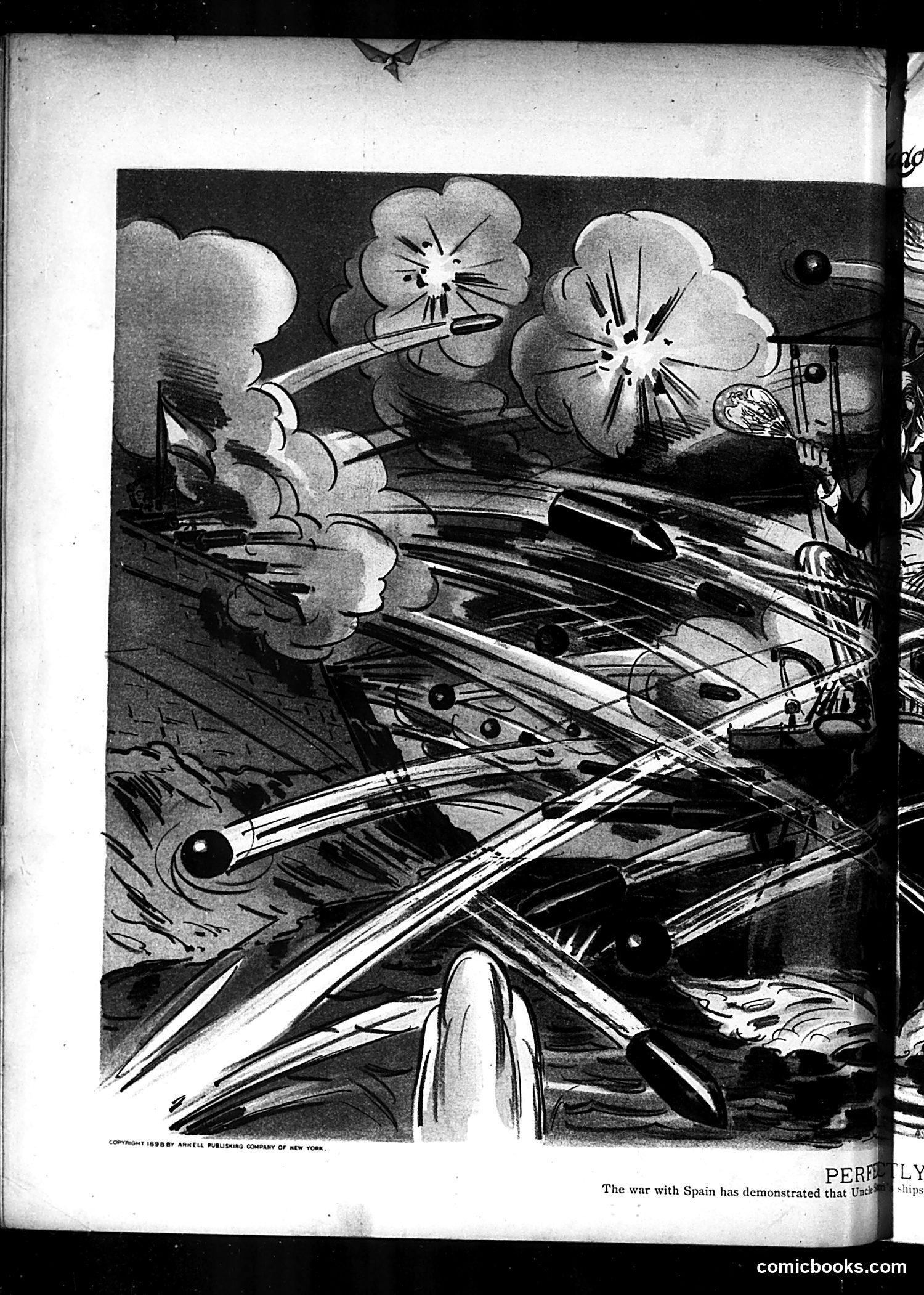
This page appears to be from Judge magazine and contains a political cartoon with anthropomorphized flowers engaged in what looks like a violent confrontation. The flowers are depicted with aggressive stances and appear to be wielding implements. The partial visible text at the bottom references "The war with Spain has demonstrated that U[nknown]," suggesting this cartoon relates to the Spanish-American War (1898). The cartoon likely uses the flowers as metaphorical figures—possibly representing nations or political entities—to satirize conflict. However, without clearer visibility of identifying labels or the complete caption, I cannot definitively identify which specific nations or political figures the flowers represent or precisely what aspect of the Spanish-American War is being satirized. The artistic style is consistent with late-19th-century Judge magazine political commentary.
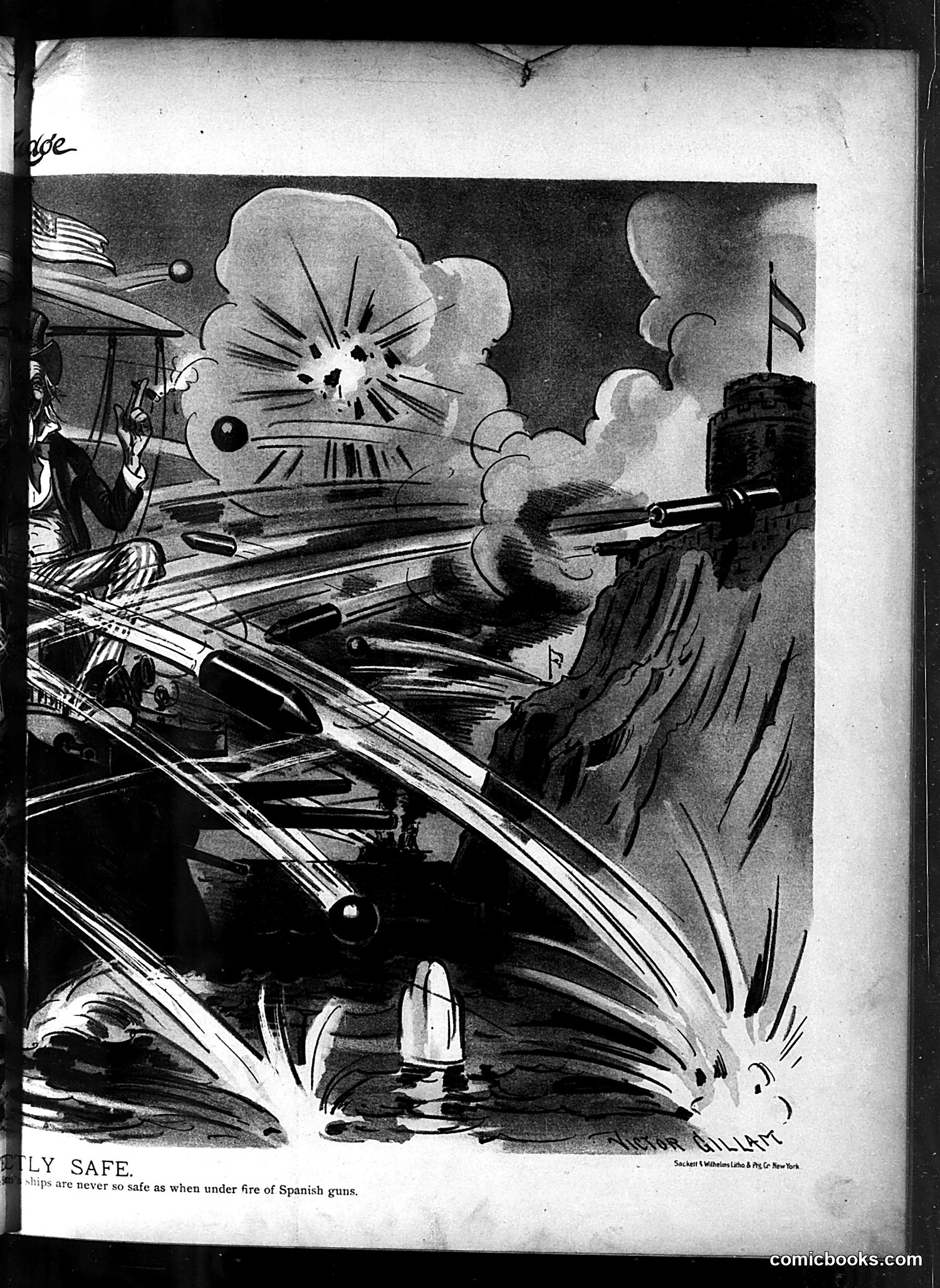
This Judge magazine cartoon satirizes American naval safety during conflict with Spain. The caption reads "COMPARATIVELY SAFE" with the subtitle "Ships are never so safe as when under fire of Spanish guns." The image depicts a fortified position (likely representing an American fort or ship) firing artillery while under bombardment from Spanish cannons. Explosions burst around the installation, with projectiles and smoke dominating the scene. An American flag is visible on the left. The satire is ironic: the phrase "comparatively safe" contradicts the chaotic violence shown, mocking either Spanish military incompetence or American overconfidence during the Spanish-American War era. The cartoon likely ridicules either Spanish gunnery accuracy or promotes confidence in American defensive capabilities during the conflict.
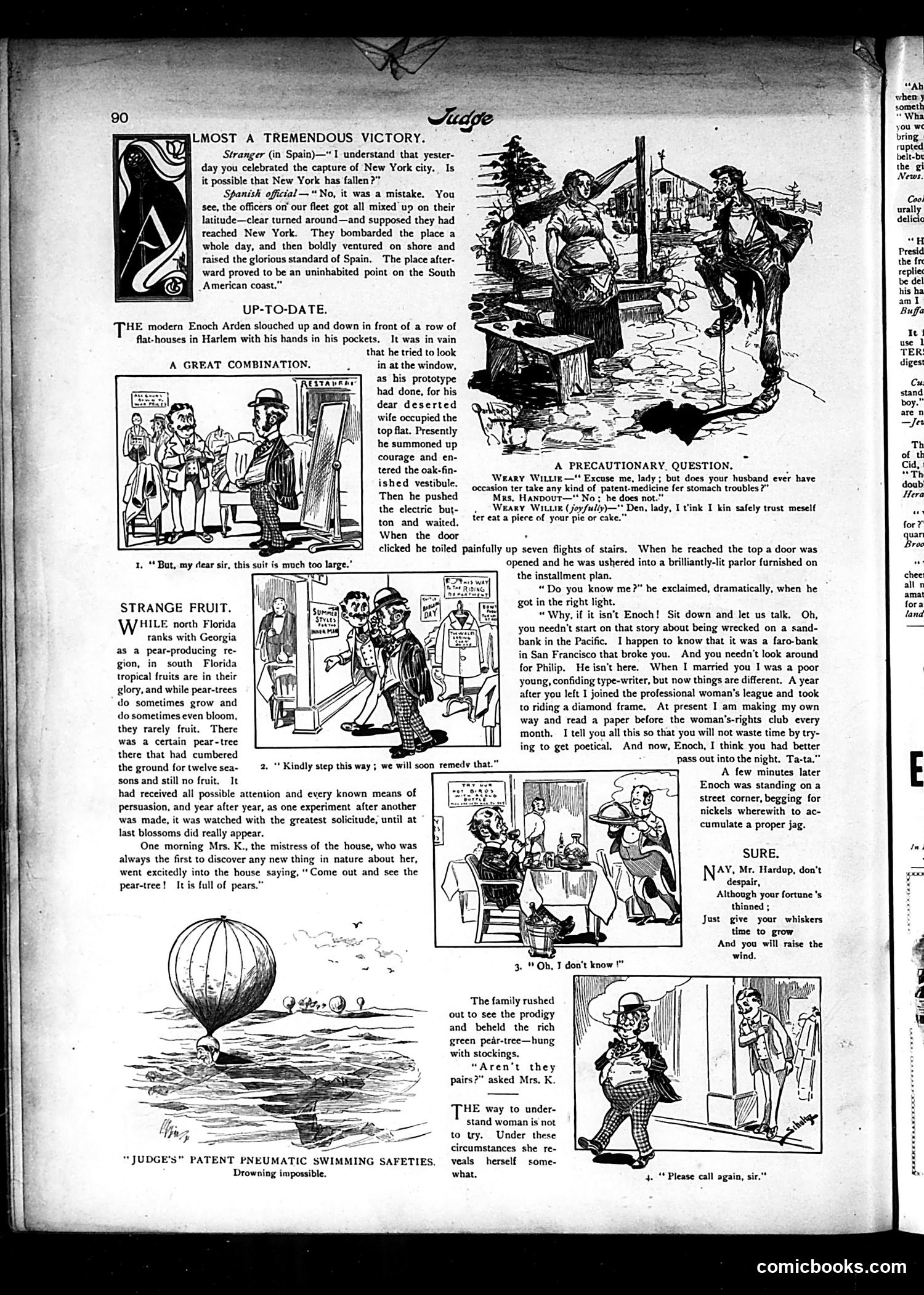
This page from Judge contains several satirical pieces targeting late 19th-century American society and politics. **"Almost a Tremendous Victory"** mocks Spanish military incompetence during the Spanish-American War. A Spanish official admits his fleet mistakenly bombarded an uninhabited South American location instead of New York City, then claimed victory anyway—satirizing both Spanish military blunders and absurd official spin. **"Up-to-Date"** presents a modern twist on the "Enoch Arden" legend (a man presumed lost returns home). Here, the returning husband finds his wife has become independent, joining the "professional woman's league" and supporting herself. She dismisses his romantic dramatics and throws him out—satire on changing gender roles and women's increasing independence. **"Strange Fruit"** humorously describes a Florida pear-tree that finally bears fruit after twelve years of fruitless effort, celebrating unexpected agricultural success. The remaining pieces include wordplay-based humor typical of the era. Overall, the page reflects Judge's satirical focus on contemporary American life, international affairs, and social change.
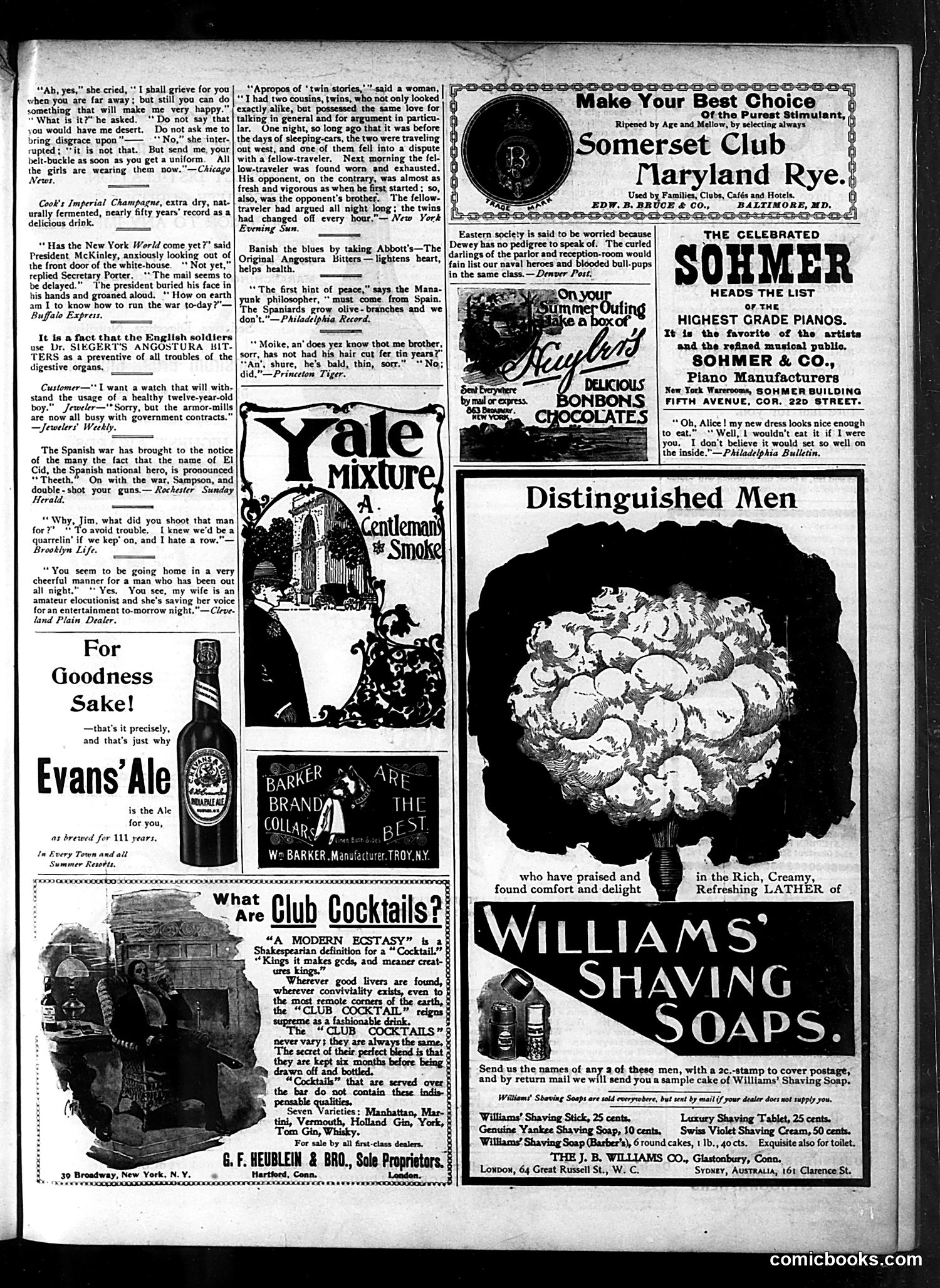
This page from Judge (likely 1898, during the Spanish-American War) contains several satirical pieces mocking contemporary society: **War-Related Humor**: Multiple jokes exploit the Spanish-American War context. One references President McKinley anxiously awaiting the New York World newspaper to learn how to conduct the war—satirizing both his leadership and media dependence. Another mocks soldiers' concerns with trivial matters (belt buckles as souvenirs) over serious military service. **Social Satire**: A jeweler cannot sell a watch to a boy because "armor-mills are busy with government contracts"—jabbing at wartime industrial priorities. A joke about "El Cid" pronunciation mocks American unfamiliarity with Spanish culture despite fighting Spain. **Personal Relationships**: Several domestic humor pieces portray wives negatively (as elocutionists or nagging spouses), reflecting period attitudes. The page is dominated by **advertisements** for alcohol (Evans Ale, Somerset Club Maryland Rye, Club Cocktails), tobacco (Yale Mixture), and grooming products (Williams' Shaving Soaps), reflecting Judge's commercial orientation.
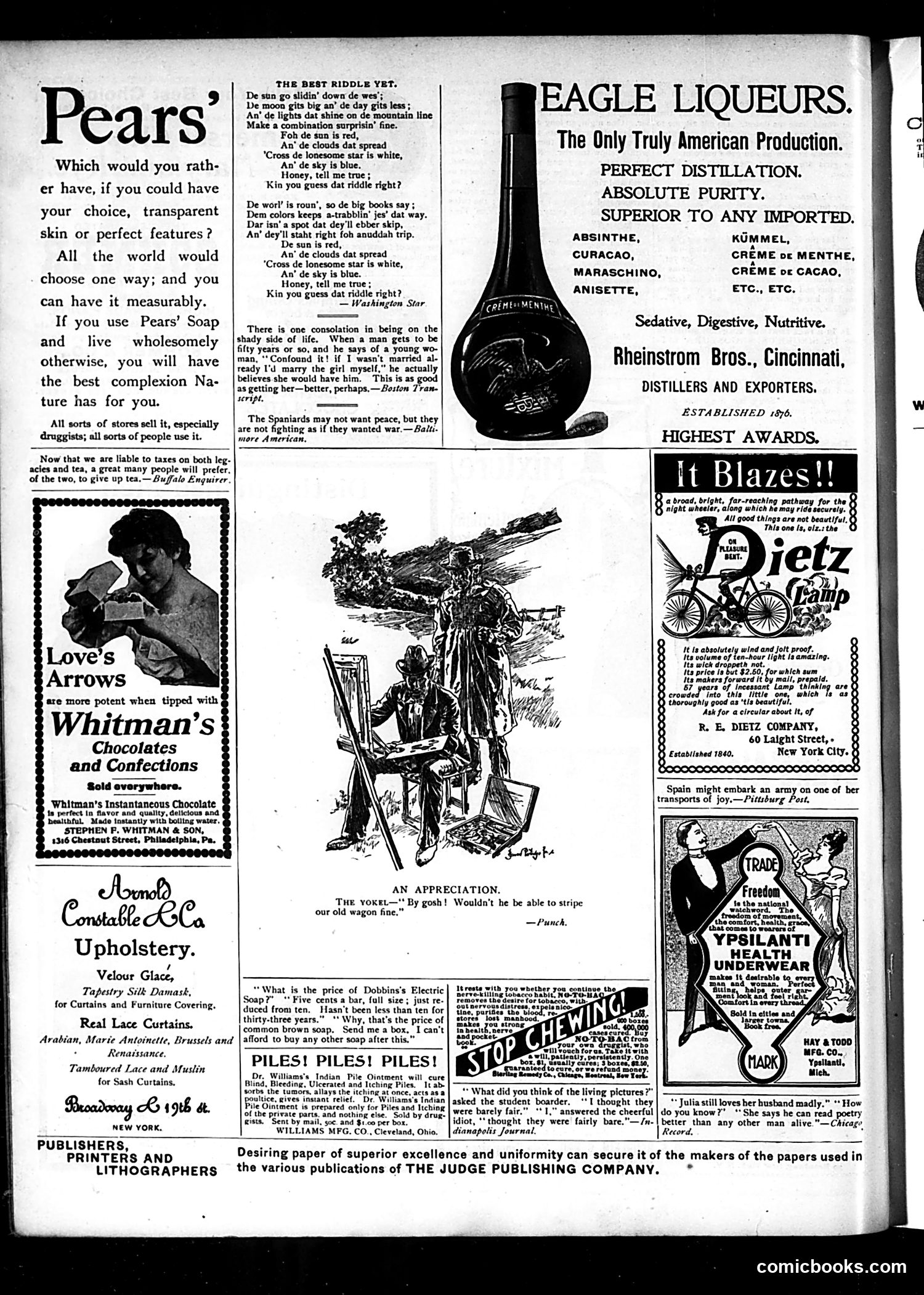
This page is primarily **advertising and light humor** rather than political satire. The main content includes: **The Central Cartoon** ("An Appreciation"): Depicts a man with a broken-down wagon, illustrating a humorous "appreciation" of the Dietz lamp—a practical joke about finding beauty in utility. The satire is gentle: praising an ordinary oil lamp as if it were fine art. **The Poetry Section** ("The Best Riddle Yet"): Features dialect verse (written in African American vernacular typical of period humor) posing as a riddle about natural phenomena—the sun, moon, and stars. **Advertisements dominate**: Including Pears' Soap (with "transparent skin" messaging reflecting period beauty standards), Whitman's Chocolates, Dietz lamps, and other consumer goods. **Notable context**: The brief quote about Spain possibly "embarking an army" suggests this is from the Spanish-American War period (late 1890s), though no specific date appears. The page reflects **turn-of-century consumer culture** and advertising conventions rather than substantive political commentary.
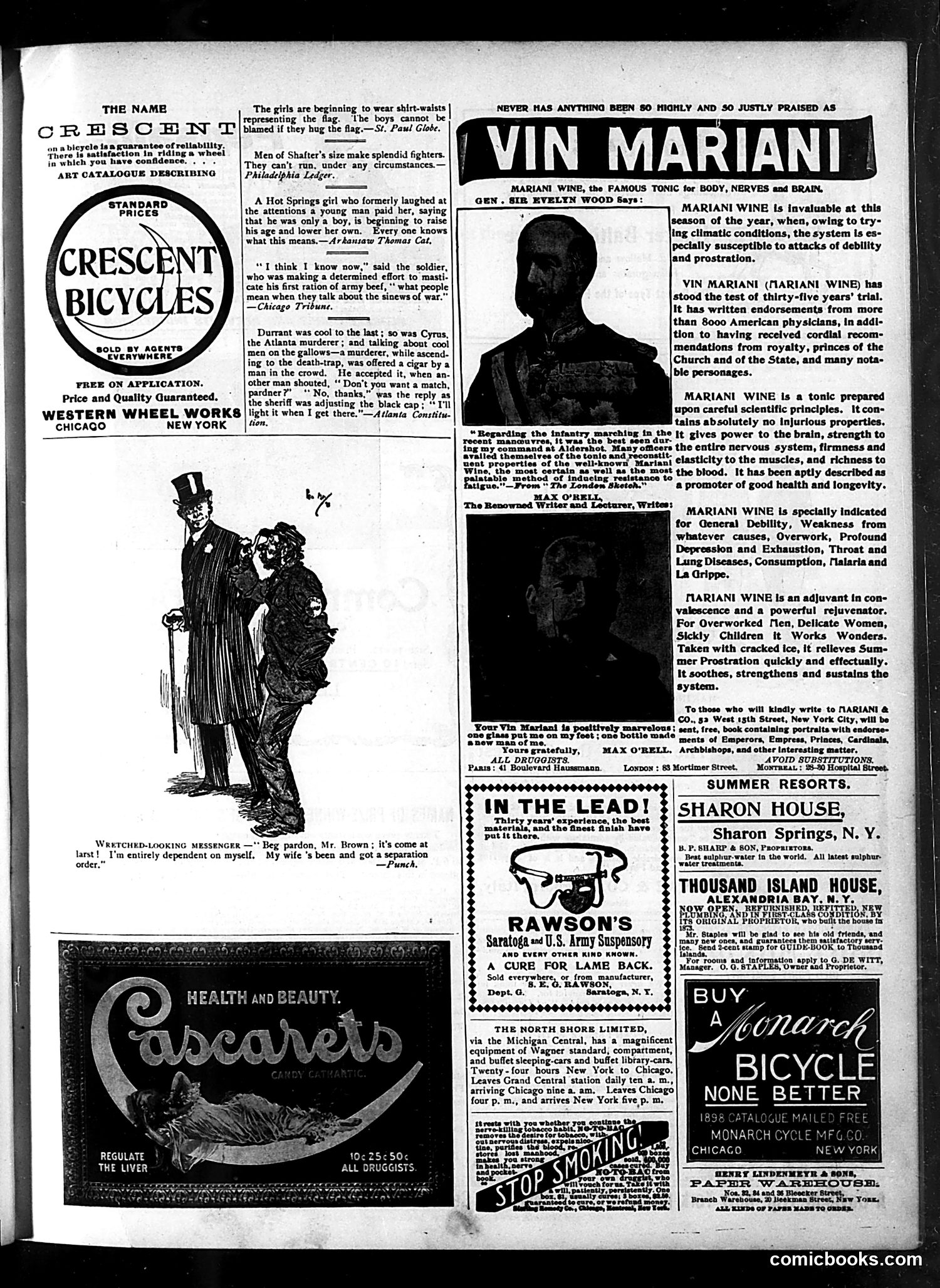
This page is primarily **advertising**, not political satire. The dominant content is a large advertisement for Mariani Wine, a patent medicine tonic claiming to cure debility, exhaustion, consumption, malaria, and various ailments. The endorsements from "Gen. Sir Evelyn Wood" and writer "Max O'Rell" were typical marketing tactics of the era—celebrity testimonials lending false credibility. The upper left contains brief satirical quips typical of Judge magazine's humor section, including jokes about flag-themed clothing, an Atlanta murderer's composure, and a soldier's difficulty eating military rations. These are disconnected social observations rather than unified political commentary. Also visible: advertisements for Crescent bicycles and Rawson's Saratoga U.S. Army Suspensory ("cure for lame back"). **Modern context:** This reflects the late 1800s when unregulated patent medicines made extravagant, unproven health claims before FDA regulations existed.
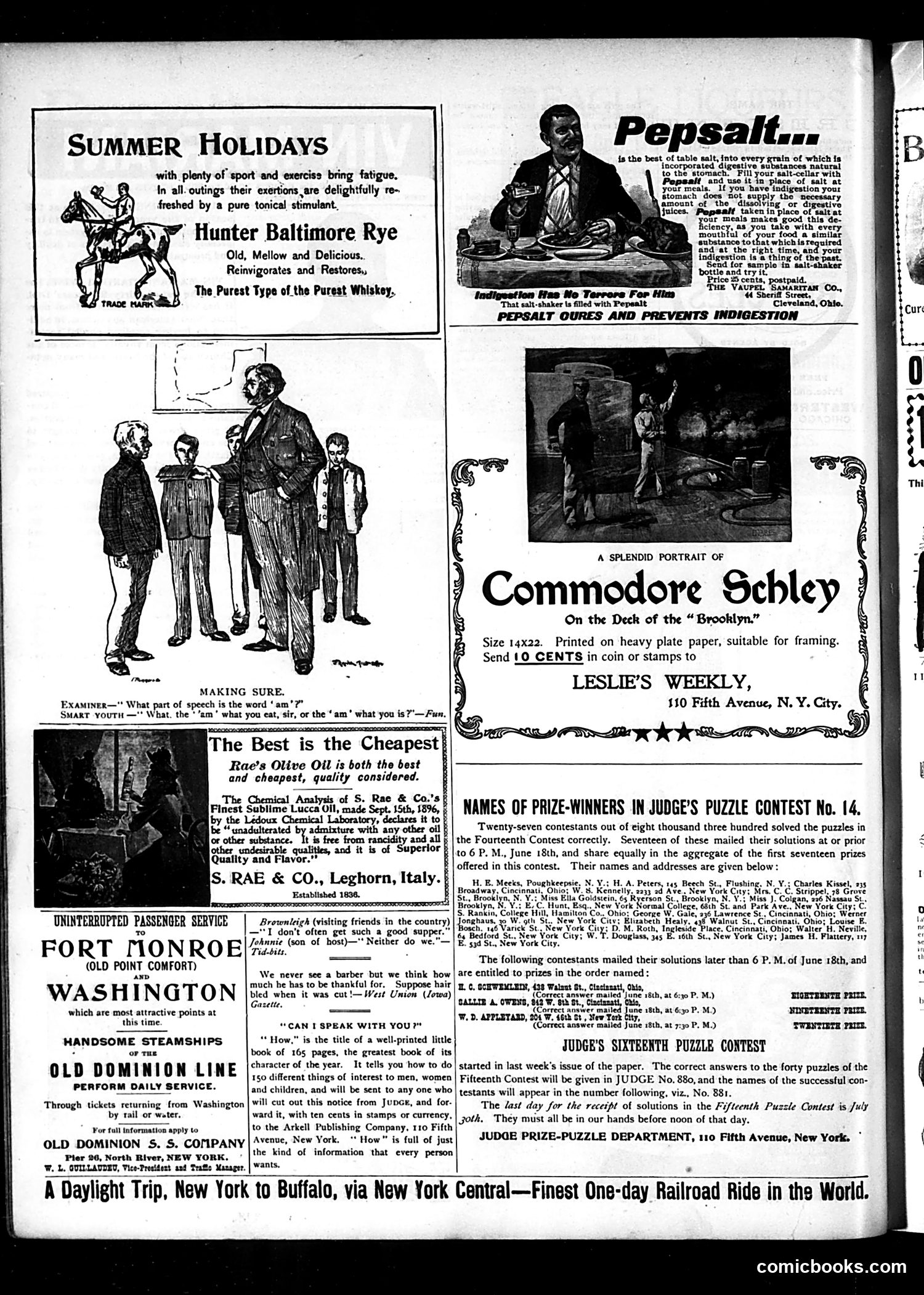
This page is primarily **advertising and contests**, with minimal editorial content. The main cartoon ("Making Sure") is a simple joke: an examiner asks a student what part of speech the word "am" is. The smart-aleck student responds by playing on homonyms—asking if it means the verb "am," the food "ham," or something else. It's gentle wordplay humor typical of the era. Most of the page comprises advertisements for whiskey (Hunter Baltimore Rye), olive oil, steamship service, and notably **Pepsalt**—a product claiming to cure indigestion by adding "digestive substances" to table salt. The Pepsalt ad features an illustration of a man at dinner, emphasizing relief from stomach troubles. The page also announces **Commodore Schley** (likely Admiral William T. Schley, famous from the Spanish-American War) with an available portrait print, and lists winners of Judge's puzzle contest. The content reflects late-19th/early-20th-century consumer culture and patent medicine marketing practices.
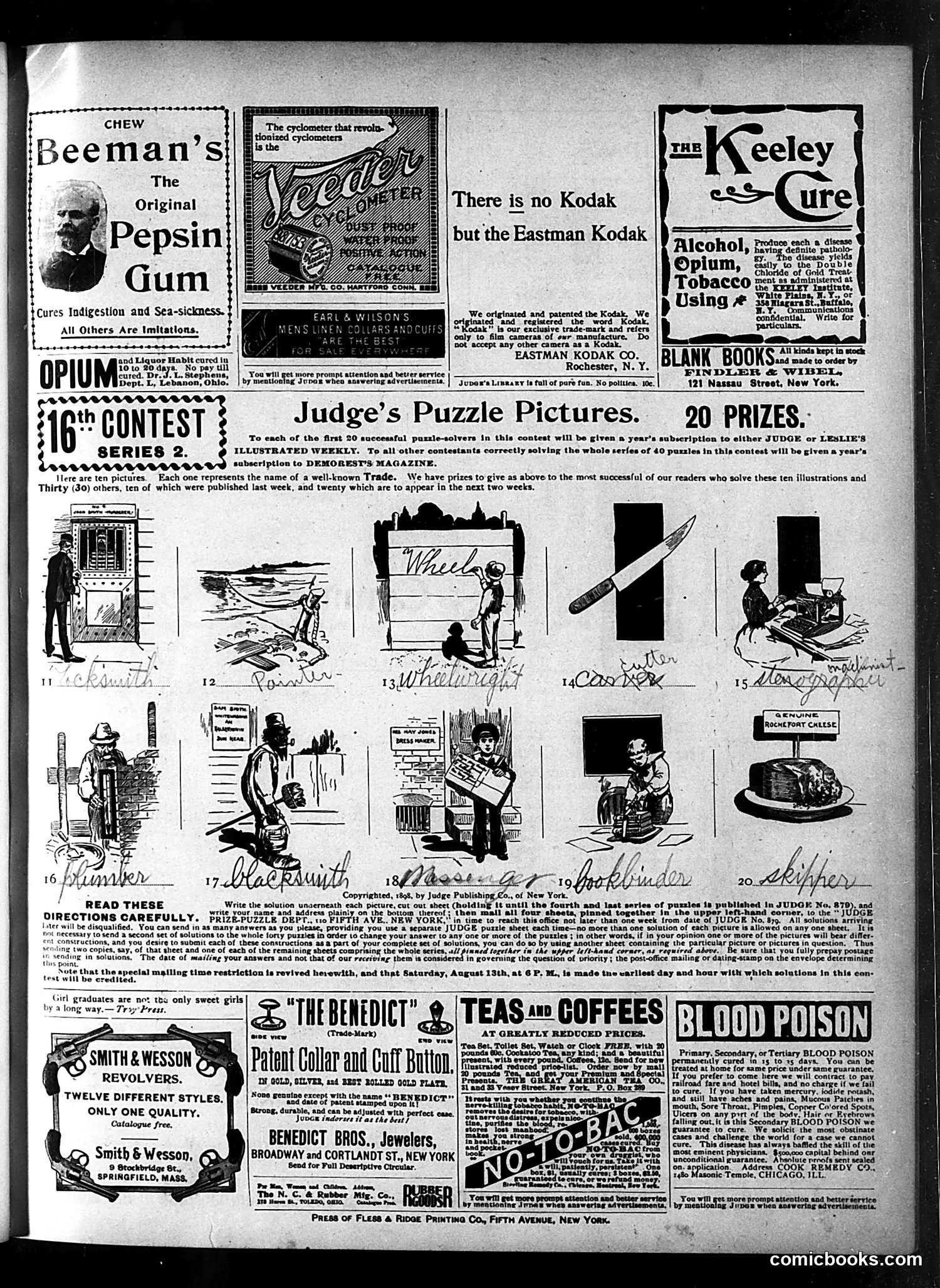
This is primarily an **advertising page** with a puzzle contest, not political satire. The dominant feature is "Judge's Puzzle Pictures"—a contest where readers solve ten visual riddles representing "well-known Trade" names. Winners receive subscriptions to *Judge* or *Demorest's Magazine*. The puzzles themselves (numbered 11-20) show illustrated cryptic scenes that apparently encode brand names, though the solutions aren't visible here. Surrounding the puzzle section are period advertisements for patent medicines (*The Keeley Cure* for alcohol/opium/tobacco addiction), photography (*Eastman Kodak*), chewing gum (*Beeman's Pepsin Gum*), firearms (*Smith & Wesson*), and other products typical of late 19th-century *Judge* content. The page demonstrates how *Judge* monetized reader engagement through contests while generating revenue from advertisers. The puzzle format was common entertainment in this era before modern mass media.
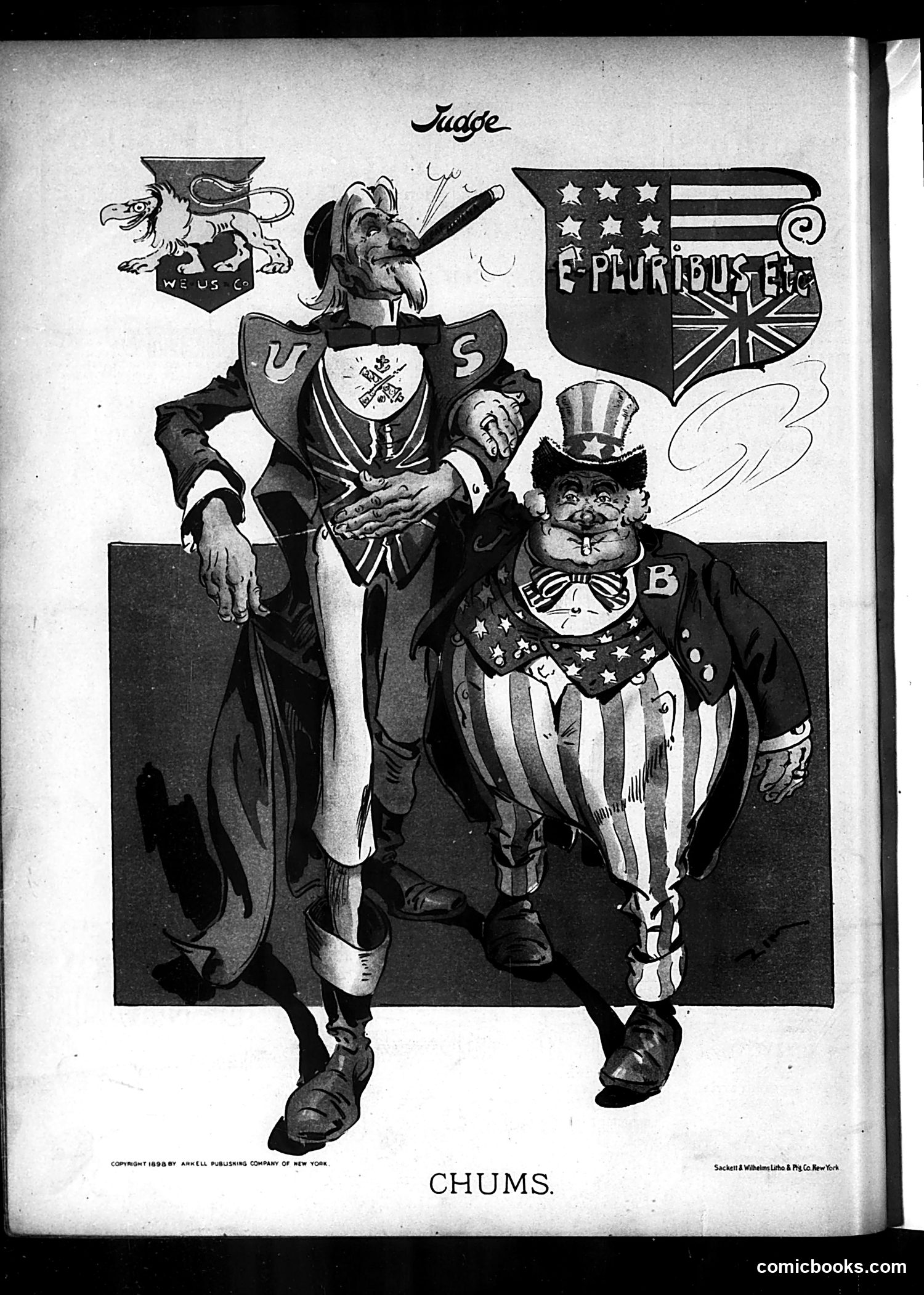
This satirical cartoon depicts two figures labeled as representing the United States ("U.S." on the tall figure's chest) and Britain ("B" on the shorter figure). Both are dressed in patriotic military attire with American and British iconography. The title "Chums" suggests an alliance between the two nations. The imagery appears to reference early 20th-century Anglo-American relations, likely commenting on their growing diplomatic or military cooperation. The caricatured style—particularly the exaggerated features of the British figure—was typical of period satire. The heraldic shields in the upper corners reinforce the nationalist theme. Without a specific date visible, the exact historical moment referenced remains unclear, though the aesthetic suggests pre-1920s publication.