
A complete issue · 16 pages · 1898
Judge — July 23, 1898
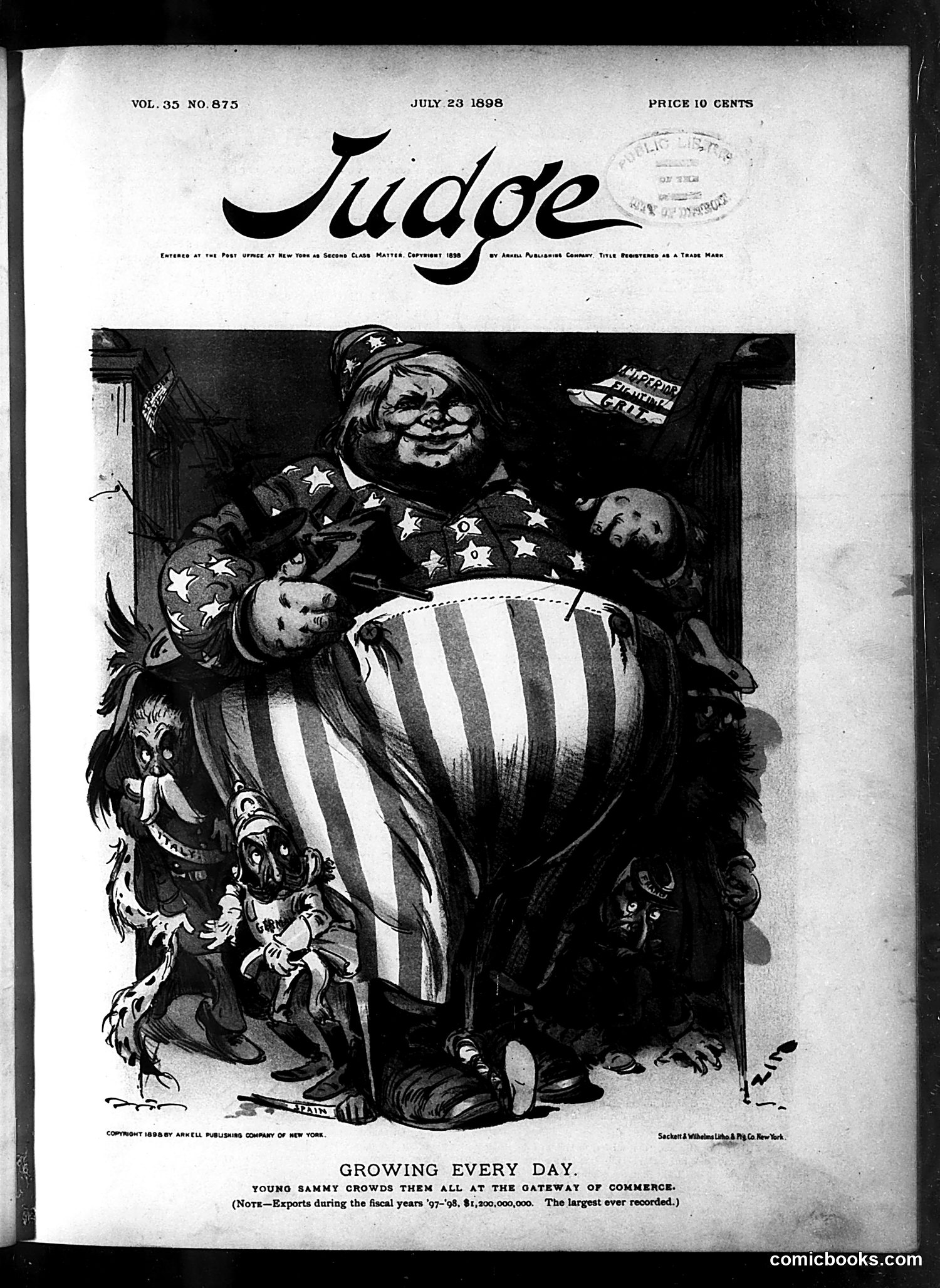
This political cartoon satirizes American imperialism and commercial expansion during the Spanish-American War era. Uncle Sam, depicted as a grotesque figure wearing a star-spangled outfit and Uncle Sam hat, is shown as an enormous, bloated character holding a striped balloon or sphere (likely representing the expanding U.S. economy or territorial acquisitions). Smaller caricatured figures—appearing to represent various nations or foreign interests—surround him at the "gateway of commerce," looking on with concern or alarm. The caption "Growing Every Day" and the note about record exports ($1.2 billion during fiscal year '97-'98) suggests the cartoon critiques how American commercial and imperial ambitions are expanding aggressively, with Uncle Sam dominating international trade and territory.
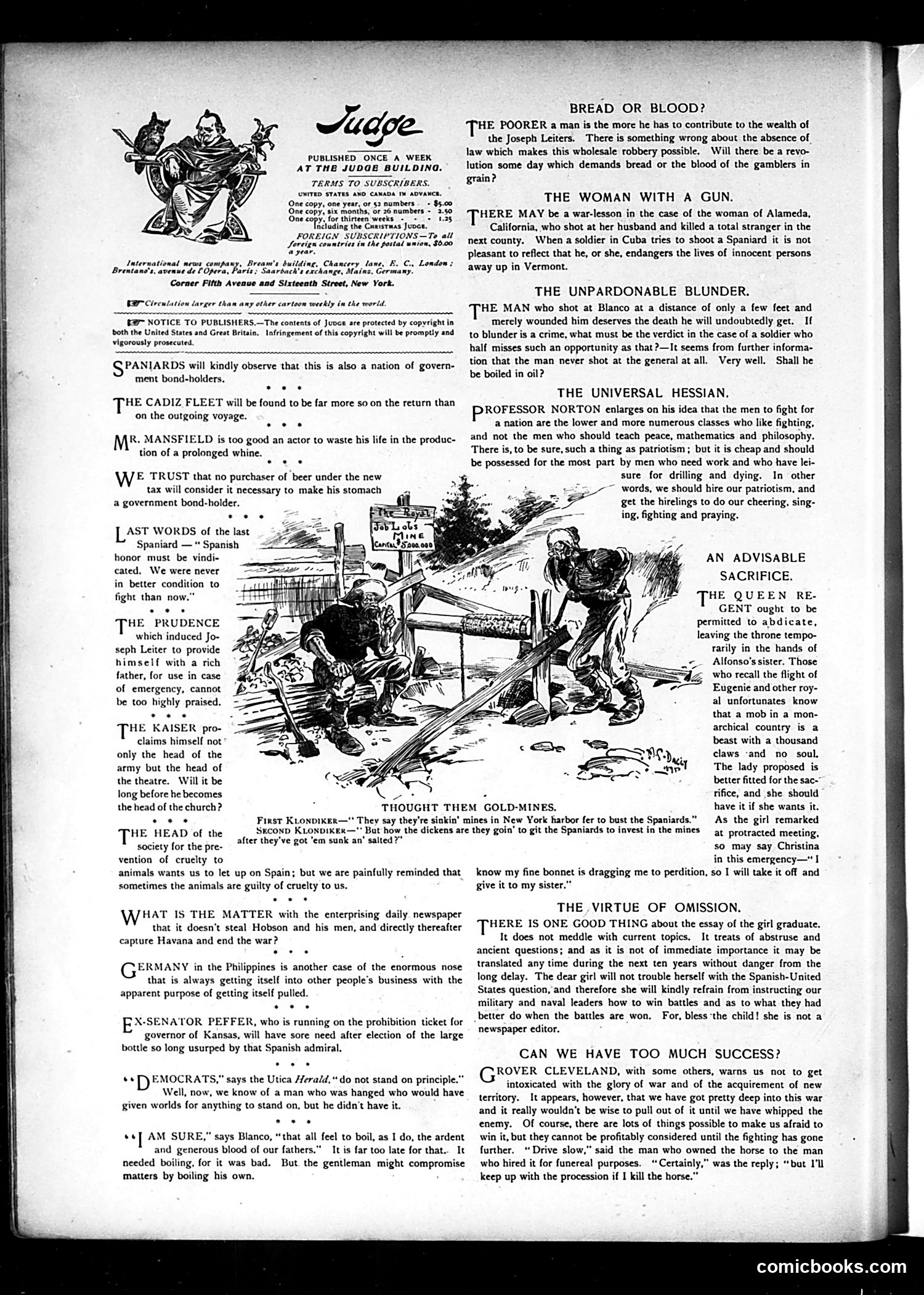
This page contains several editorial commentaries rather than a single unified cartoon. The main illustration depicts soldiers in a trench or fortified position, likely referencing World War I combat conditions. Key commentary topics include: **"The Woman with a Gun"** - References a California woman who shot her husband and a stranger, critiquing how such incidents endanger innocent lives. **"The Universal Hessian"** - Professor Horton's argument that lower classes fight wars while upper classes avoid combat, suggesting hypocrisy in patriotism. **"Thought Them Gold-Mines"** - A dialogue joke about Spanish investors being duped regarding mining investments in New York. The page satirizes military inequality, civilian gun violence, and financial schemes—typical Progressive-era Judge commentary addressing class disparities and social problems of the WWI period.
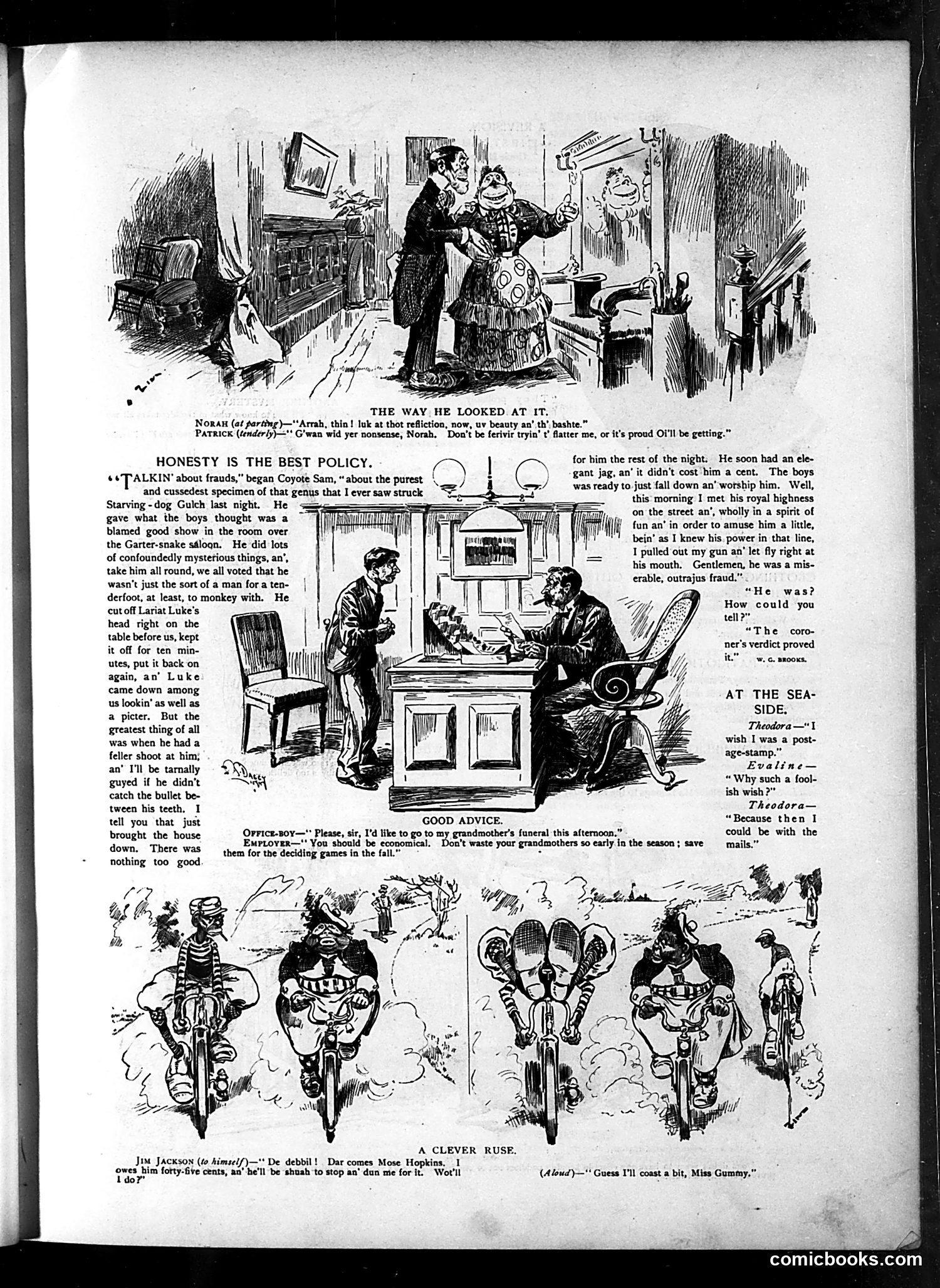
This page contains three separate satirical pieces: **"The Way He Looked At It"** (top): A domestic scene depicting Noah (biblical reference) and his wife debating whether to take animals on the ark. The satire mocks marital disagreements about practical decisions. **"Honesty Is the Best Policy"** (center): A story about Coyote Sam's con artist schemes. The narrative satirizes fraud and deception in business dealings, with the ironic title suggesting honesty would have served him better. **"A Clever Ruse"** (bottom): Shows cyclists on a beach road. The dialogue between Jim Jackson and Mose Hopkins concerns avoiding tolls—likely satirizing petty dishonesty and attempts to circumvent fees. The page overall emphasizes fraud, deception, and dishonest shortcuts as recurring themes in human behavior, treating them with humorous cynicism typical of Judge magazine's social commentary.
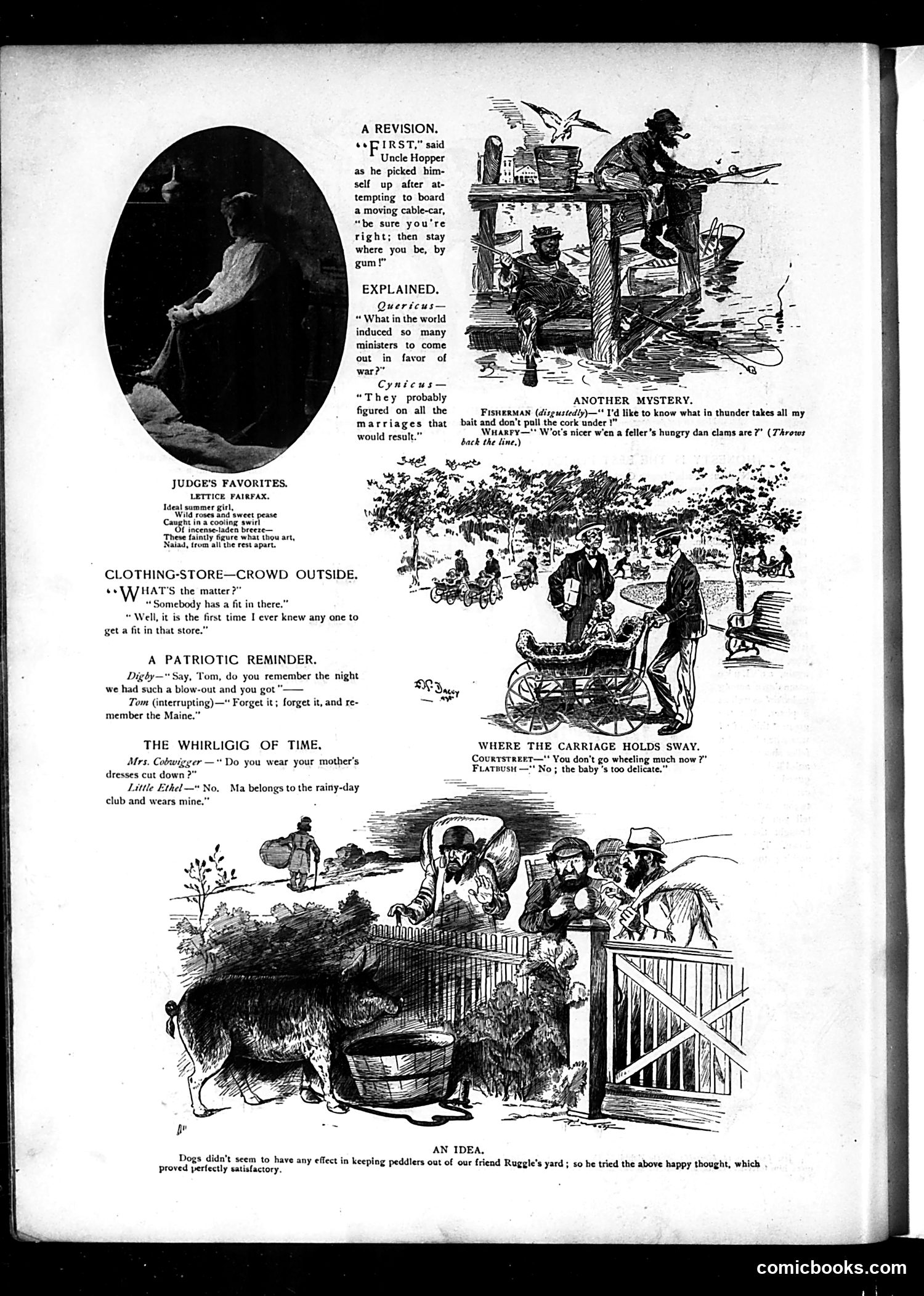
This page contains several brief satirical sketches typical of Judge's humor: **"A Revision"** mocks Uncle Hopper's cautious advice about boarding moving cable-cars—humor about urban transportation dangers. **"Explained"** shows Cynicus questioning why ministers favor war, with the sardonic answer that wars produce marriages (and thus wedding fees). **"Clothing-Store Crowd Outside"** is a brief joke about someone getting a fit in a clothing store. **"A Patriotic Reminder"** depicts Tom forgetting a shout-out event, with Dig interrupting to jog his memory—domestic humor about forgetfulness. **"The Whirligig of Time"** concerns dress code changes across generations. **"Where the Carriage Holds Sway"** and **"An Idea"** appear to be illustrated jokes about carriages and dogs. The page emphasizes domestic life, urban experiences, and gentle social observation rather than pointed political commentary.
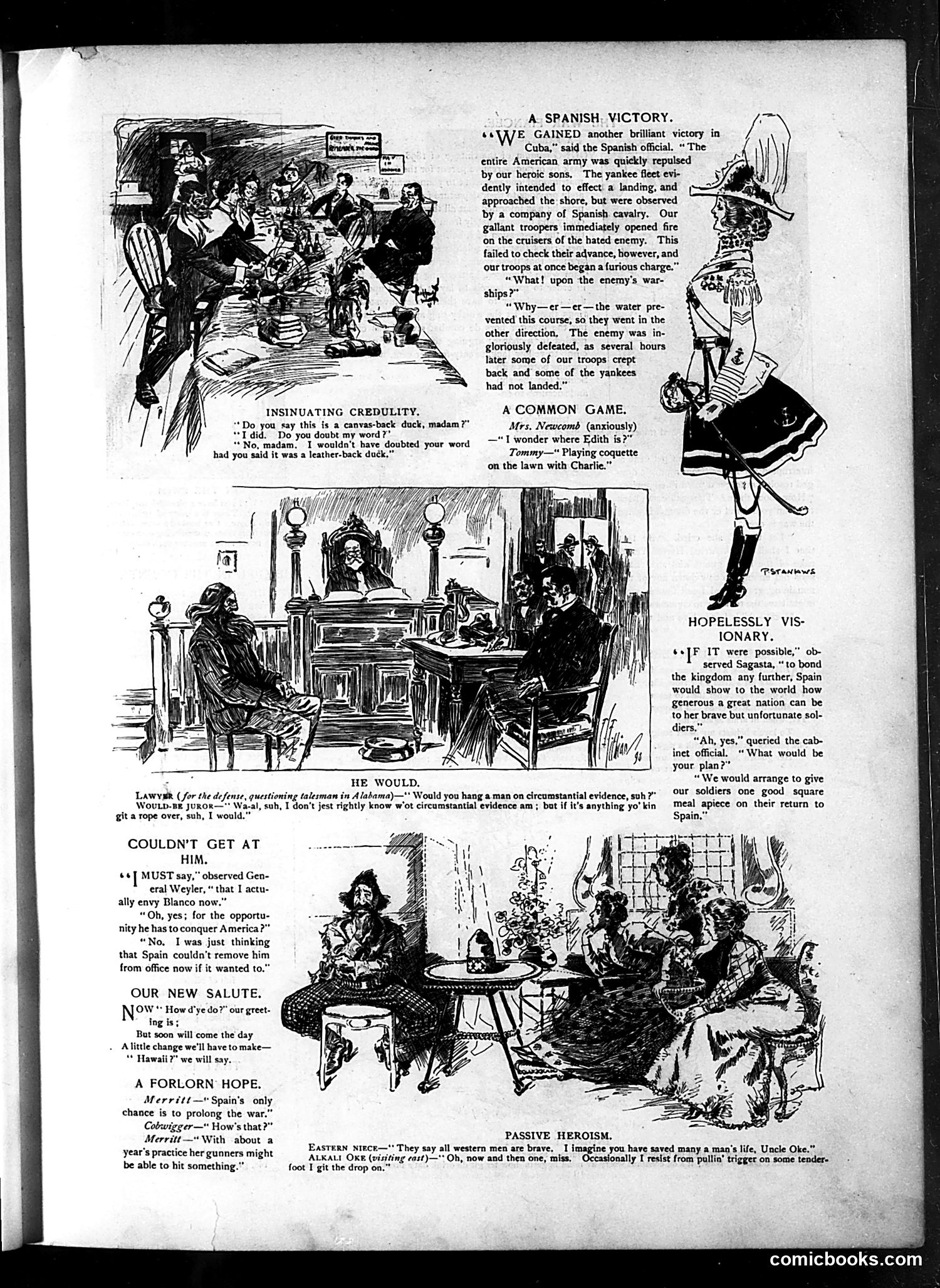
This page satirizes American attitudes toward the Spanish-American War (appears to be 1898). The top cartoon mocks Spanish military claims of victory in Cuba—Spanish officials claim triumph while admitting their troops "crept back" and Yankees hadn't even landed, exposing obvious fabrication and Spanish military incompetence. The "Hopelessly Visionary" section ridicules Spanish Prime Minister Sagasta's empty promises to reward soldiers through financial borrowing Spain cannot afford—satirizing disconnect from reality. "Our New Salute" jokes about American imperial expansion, suggesting "Hawaii" will replace "How d'ye do?" as America's greeting, reflecting anxieties about U.S. territorial ambitions following the war. "A Forlorn Hope" mocks Spanish artillery as so inaccurate that even with a year's practice improvement remains unlikely. The remaining cartoons (about legal testimony and frontier justice) appear unrelated to the war theme. Overall, the page celebrates American military superiority while ridiculing Spanish pretensions.
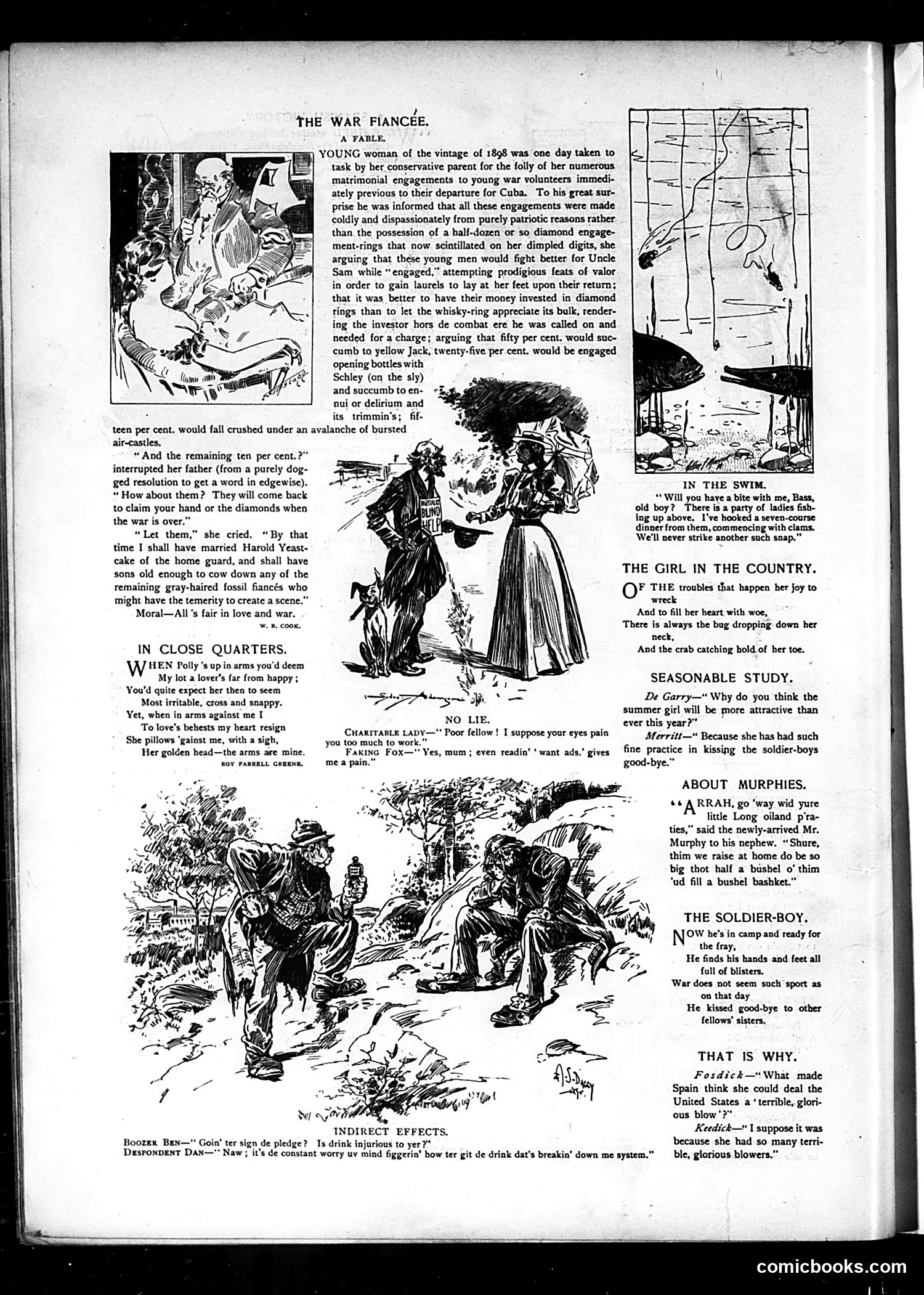
This page satirizes American society during the Spanish-American War (1898). The main story mocks young women who become engaged to soldiers departing for Cuba, ostensibly for patriotic reasons but actually to accumulate diamond rings. The fable's moral twist—the woman marries a "Harold Yeastcake of the home guard" instead—ridicules both the women's mercenary motives and men who avoid combat. The accompanying short pieces lampoon war-era social follies: soldiers' romantic complications, the drinking culture, young women's newfound freedom flirting with soldiers, and the gap between military glamour and harsh battlefield reality (blisters, fear). References to "Yellow Jack" (yellow fever), Admiral Schley, and Spain's failed military capabilities ground these jokes in 1898 events. The humor targets middle-class hypocrisy—patriotic rhetoric masking self-interest—typical of Judge's satirical approach.
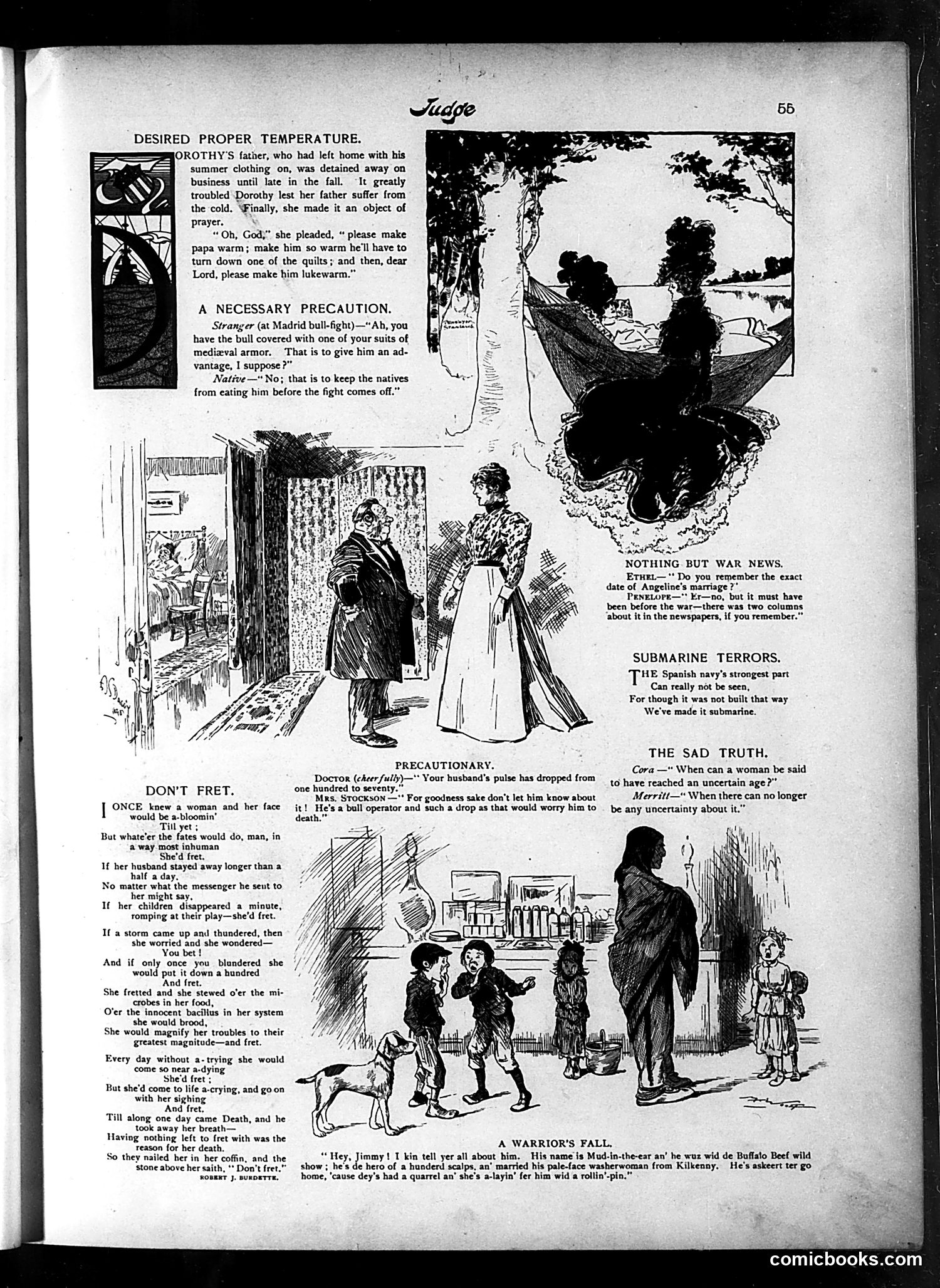
This page contains several satirical pieces reflecting early 20th-century American concerns: **"Desired Proper Temperature"** mocks overly literal prayer—a child asks God to make her father warm enough to remove quilts, then "lukewarm," absurdly contradicting herself. **"A Necessary Precaution"** jokes about Spain's economic poverty: a Madrid bullfighter covers a bull in medieval armor not for protection, but to prevent locals from eating the animal beforehand. **"Nothing but War News"** references WWI's overwhelming newspaper coverage—a woman can't recall her friend's wedding date except that it appeared in two newspaper columns before "the war" dominated all reporting. **"The Sad Truth"** presents gender stereotypes about women's aging and uncertainty. **"Don't Fret"** is a lengthy poem satirizing neurotic, anxious women who worry constantly about trivial matters until death finally stops their fretting. The page reflects wartime preoccupations and period attitudes toward gender and nationality, using humor to comment on social anxiety and media saturation during WWI.
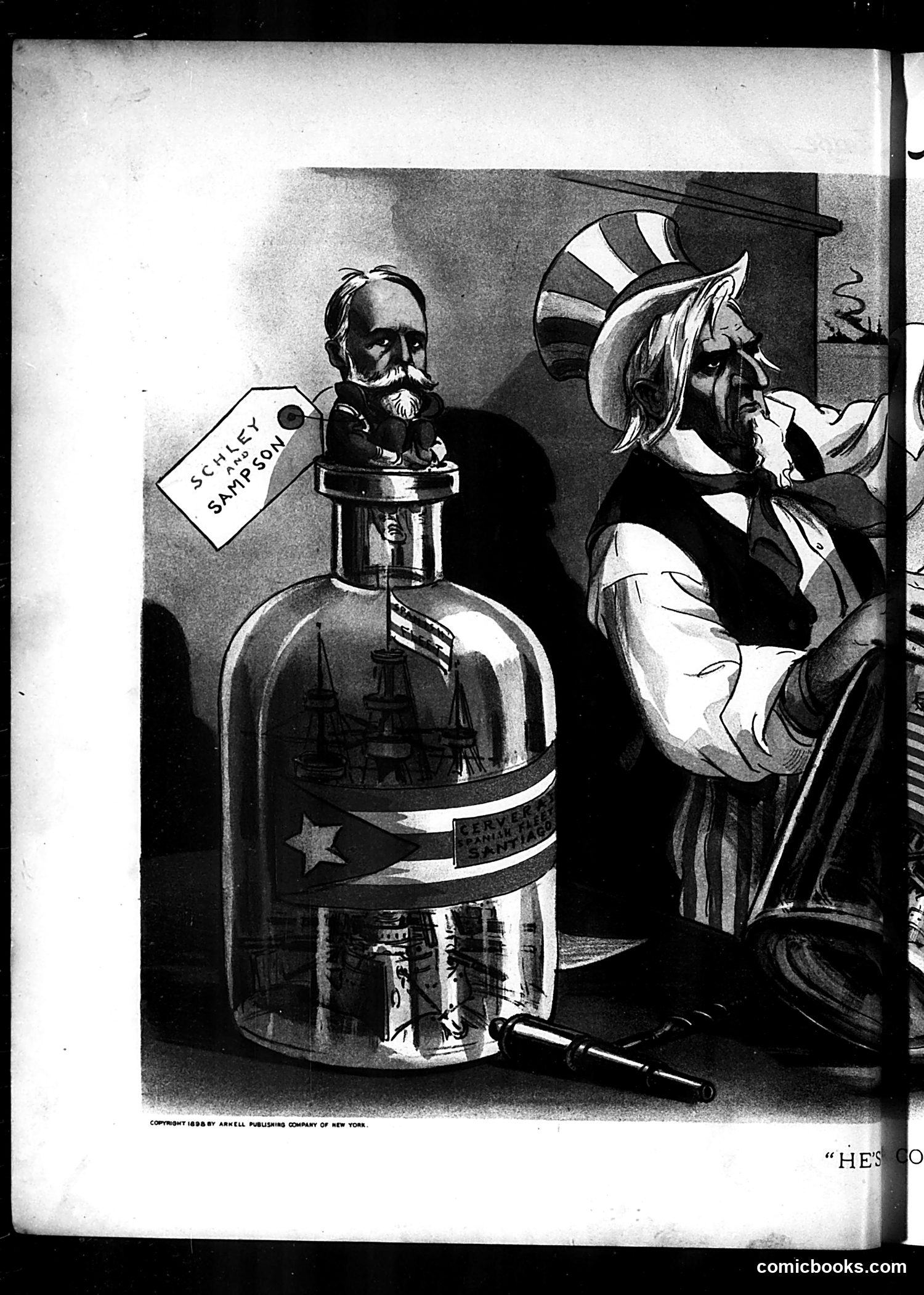
This appears to be a satirical Judge magazine cartoon, though the OCR text is largely illegible. The image shows two figures examining a large bottle labeled "Schley and Sampson" with a bust of a bearded man atop it. The bottle features a star and what appears to be a naval vessel. The cartoon likely references the Spanish-American War era (1898), satirizing Admirals William T. Sampson and William S. Schley, whose public dispute over credit for the naval victory at Santiago de Cuba was a significant controversy. The "soap" label suggests mockery—possibly commenting on how their competing claims were being "packaged" or sold to the public, or satirizing the commercialization of their wartime achievements. The figure on the right appears to be Uncle Sam or another allegorical American figure observing this product.
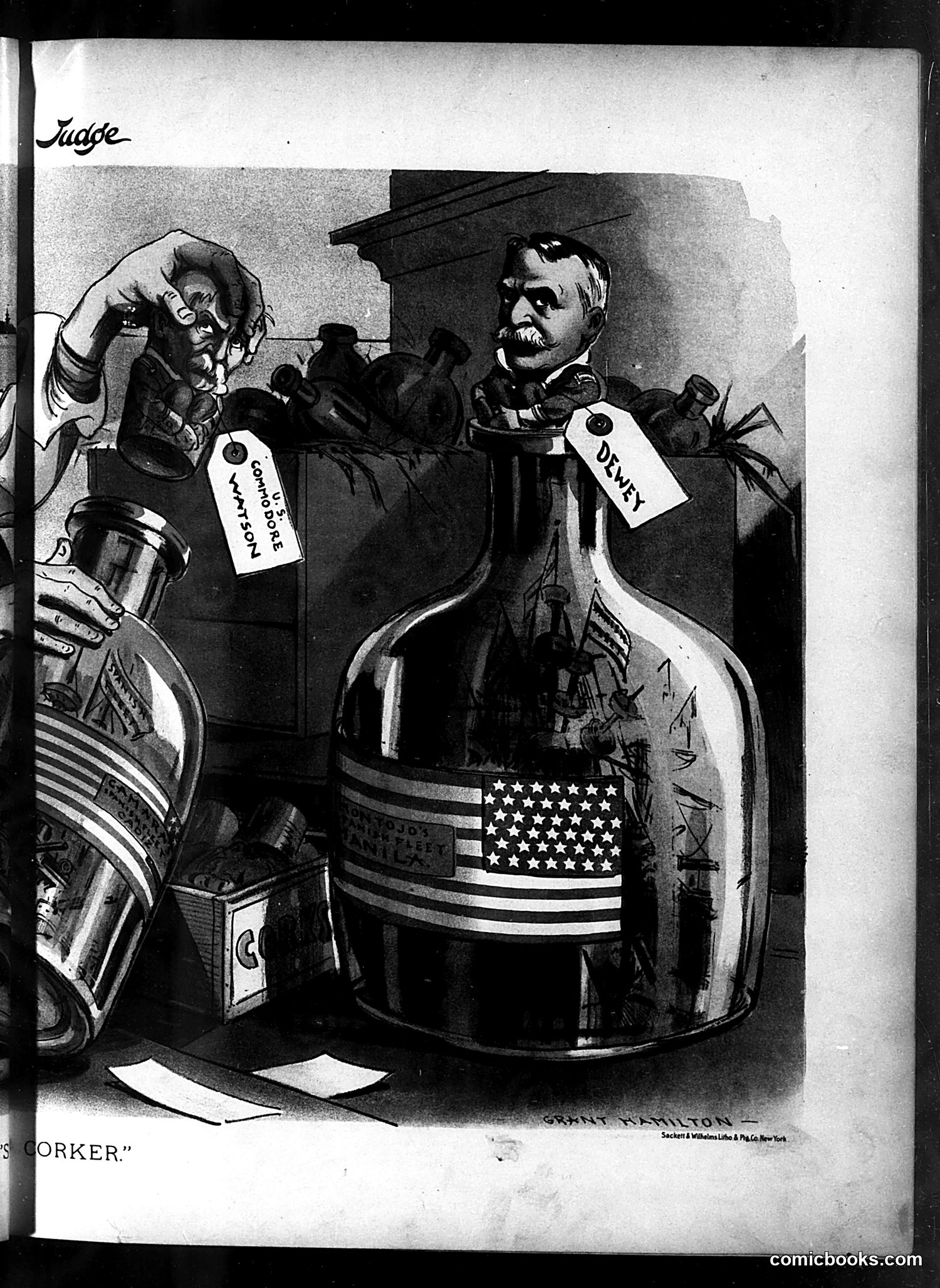
This Judge magazine cartoon, signed by Grant Hamilton, depicts two military or political figures examining bottles labeled "DEWEY" and "HARRISON." The bottles bear American flags and tags reading "CANDIDATE" and "DEWEY." One figure holds up what appears to be a magnifying glass or inspection tool, suggesting scrutiny of these candidates. This likely satirizes the selection or evaluation of presidential candidates, probably referencing Thomas Dewey and William Henry Harrison (or a Harrison-era figure). The cartoon suggests these candidates are being examined like commodities or products, mocking the political process of candidate selection. The specific election year and full context remain unclear without additional publication information.
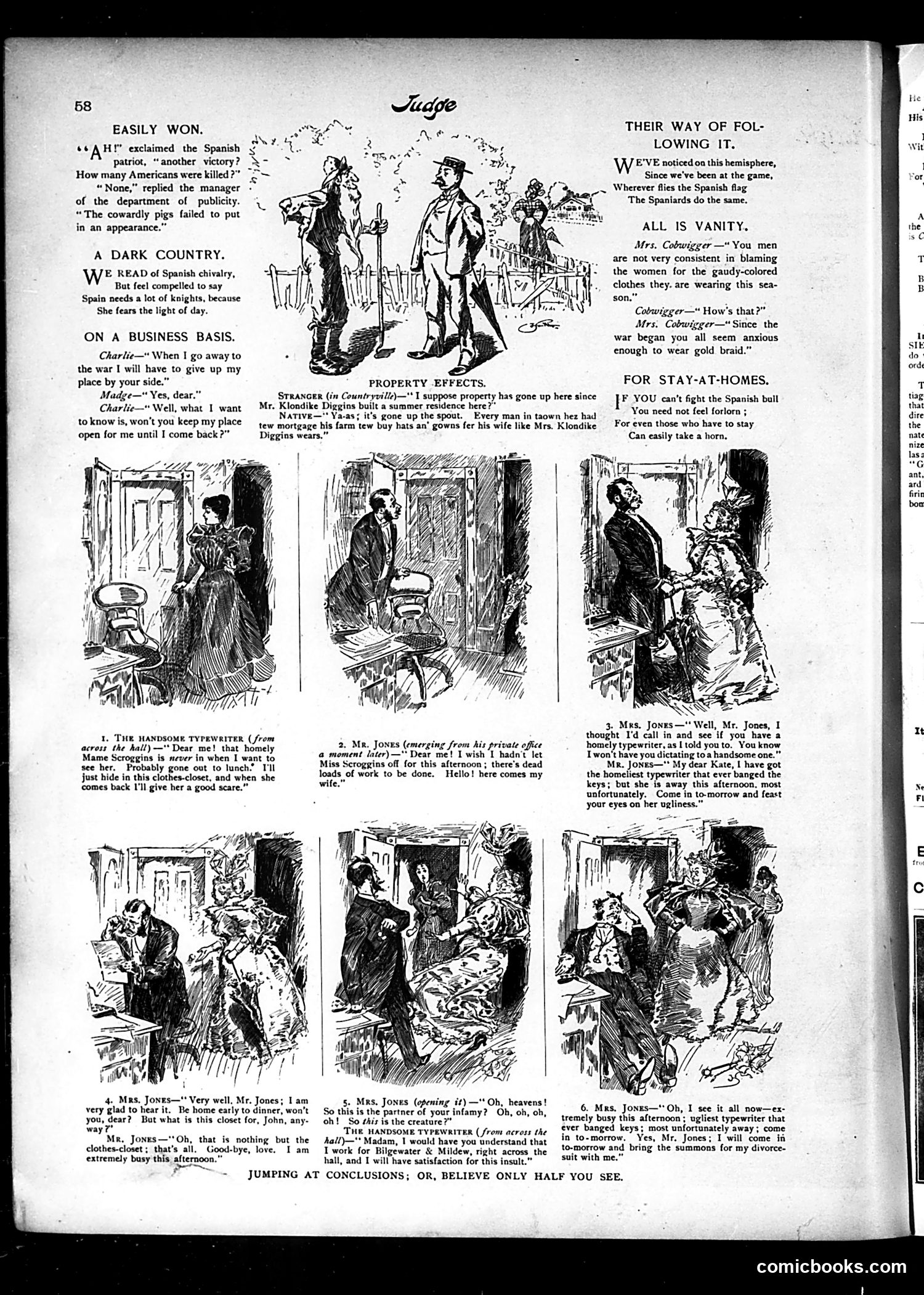
This page contains several unrelated satirical pieces mocking contemporary issues (circa Spanish-American War era): **Spanish War Satire**: The top cartoons mock Spain's military ineffectiveness—a Spanish patriot celebrates a "victory" where no Americans died because they didn't show up, and Spain is criticized for fearing daylight (lacking courage/transparency). **"Jumping at Conclusions" Serial**: The main narrative follows Mr. Jones, who hides in a office closet to scare his homely coworker Mame Scroggins. When his wife Mrs. Jones arrives looking for him, she discovers a handsome female typewriter emerging from the closet instead, leading her to assume infidelity. The joke is the misunderstanding—the handsome typewriter actually works across the hall; Jones's claim about keeping an "ugly" typewriter is exposed as a lie, prompting divorce plans. **Social Commentary**: Other pieces satirize vanity (wives buying expensive Spanish fashions while husbands buy military medals), rural greed during gold rushes, and masculine hypocrisy regarding women's appearance.
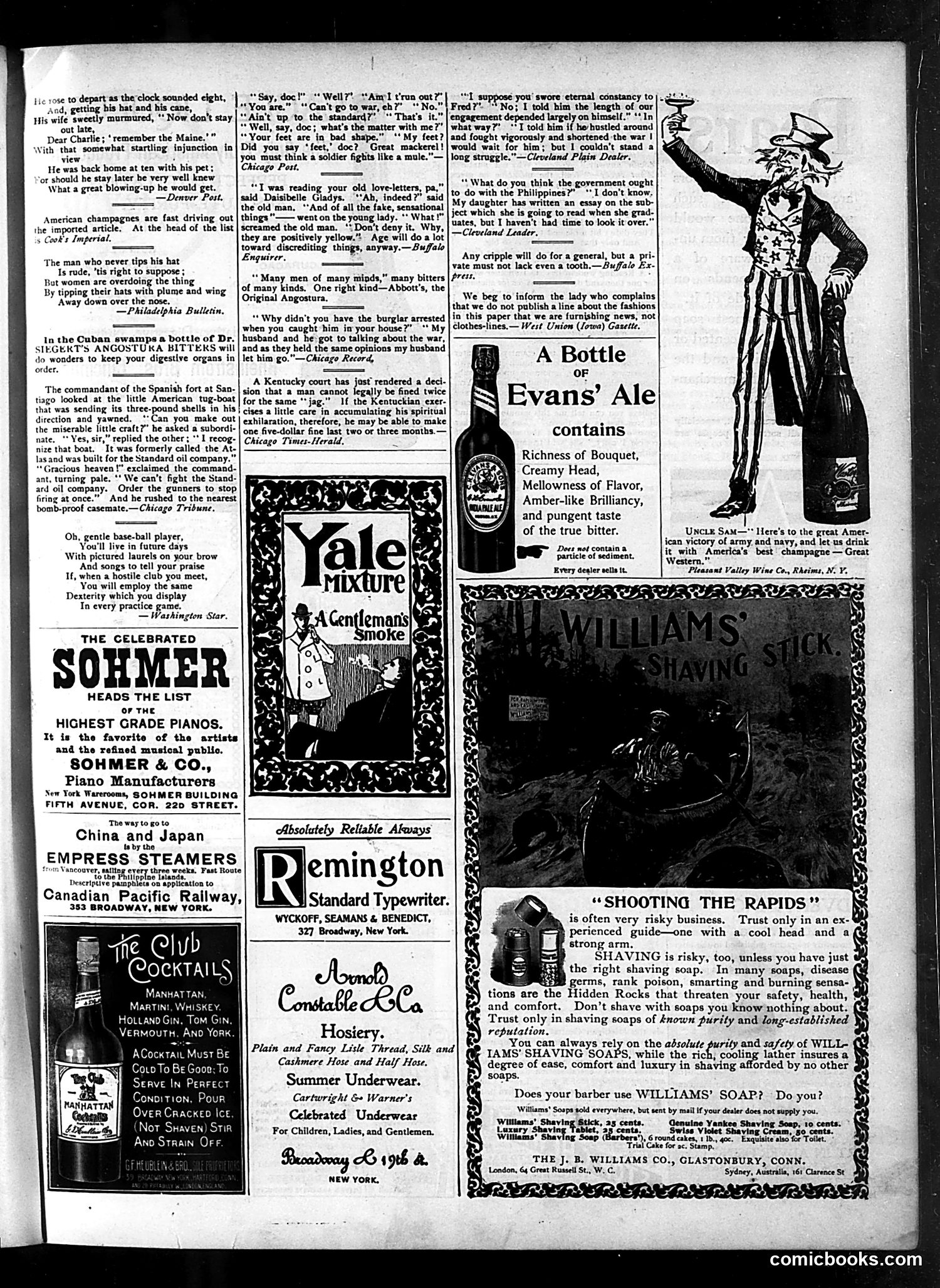
This page from Judge magazine (a satirical publication) contains multiple brief humorous items about American life and the Spanish-American War, interspersed with period advertisements. The dominant satirical theme is the **Spanish-American War** (1898). Several jokes mock both American military preparedness and Spanish incompetence: - One cartoon jokes that a Spanish commander surrenders upon learning an American vessel is the former **Standard Oil Company** ship—suggesting American industrial power is more formidable than military hardware. - Another item satirizes a soldier unfit for war because his feet are bad, poking fun at both military standards and the absurdity of foot-based combat. - The opening poem references "Remember the Maine" (the battleship explosion that sparked the war), showing how thoroughly the conflict saturated American consciousness and domestic life. Other items mock contemporary social trends: women's exaggerated hat styles and complaints about American champagne replacing imports. The page is primarily **advertisements** for pianos, steamships, typewriters, beverages, and grooming products—typical of Judge's revenue model. The satirical content is brief, topical, and designed for quick laughs rather than deep political commentary.
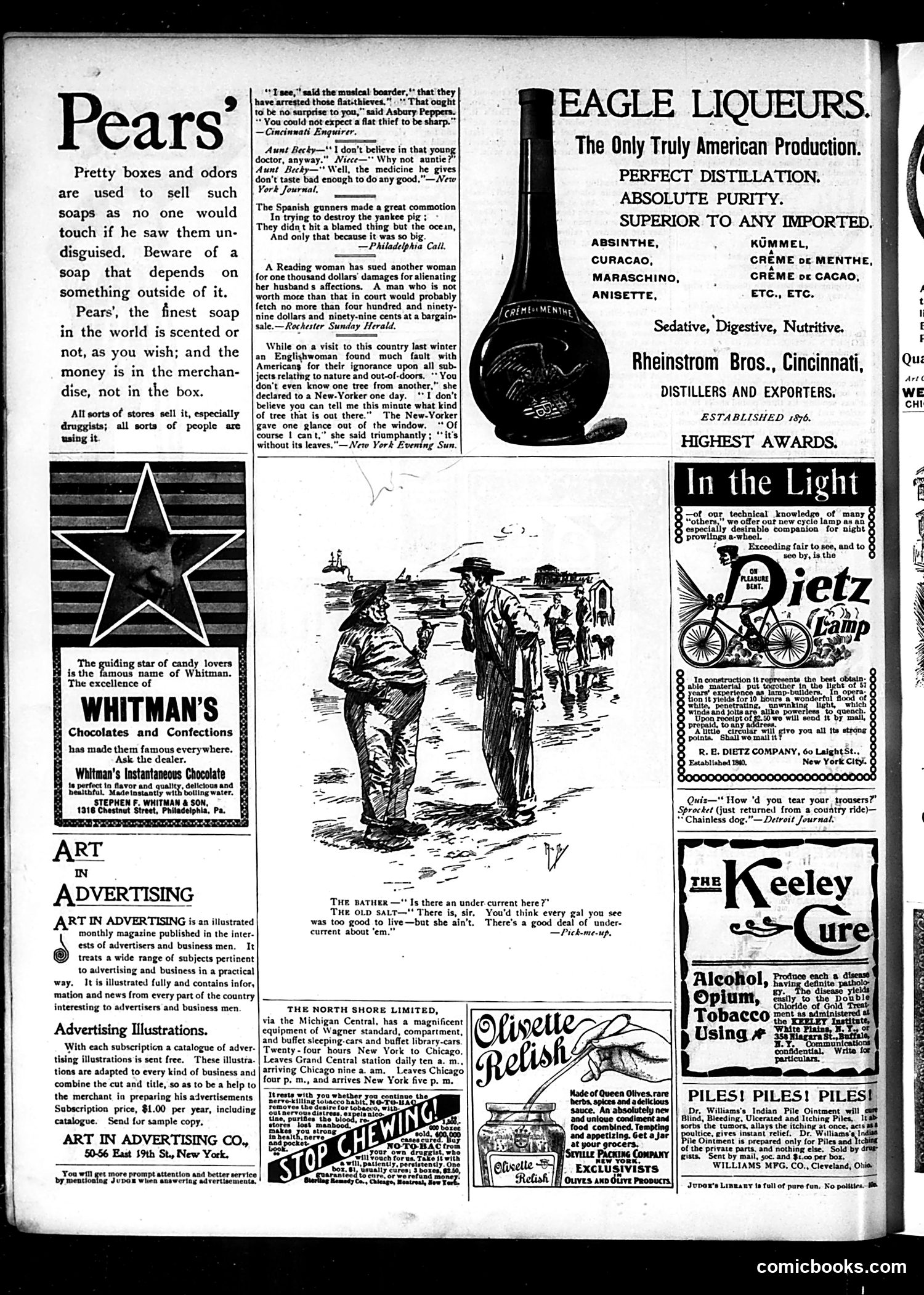
This page is primarily **advertisements and filler jokes** from Judge magazine, not political satire. The content includes: **Main Cartoon**: A sketch showing two figures by water—appears to be a bather and "old salt" (seasoned sailor) discussing an "under current." This is a visual pun: the joke plays on "undercurrent" (literal water current) versus the phrase's figurative meaning. **Advertisements**: Pears' soap, Whitman's chocolates, Eagle Liqueurs, Dietz bicycle lamps, and other products from the late 19th/early 20th century. These ads emphasize quality, purity, and American manufacture. **Filler Jokes**: Several brief humorous items mock various groups—a musical boarder's ignorance, an aunt's skepticism of medicine, Spanish gunners' incompetence, and an Englishwoman's condescension about American nature knowledge. **Notable**: The Spanish gunners reference suggests this is post-Spanish-American War (1898), mocking Spanish military failure while celebrating American competence—typical patriotic humor of the era. The page demonstrates Judge's mix of satirical humor and commercial advertising that subsidized the publication.
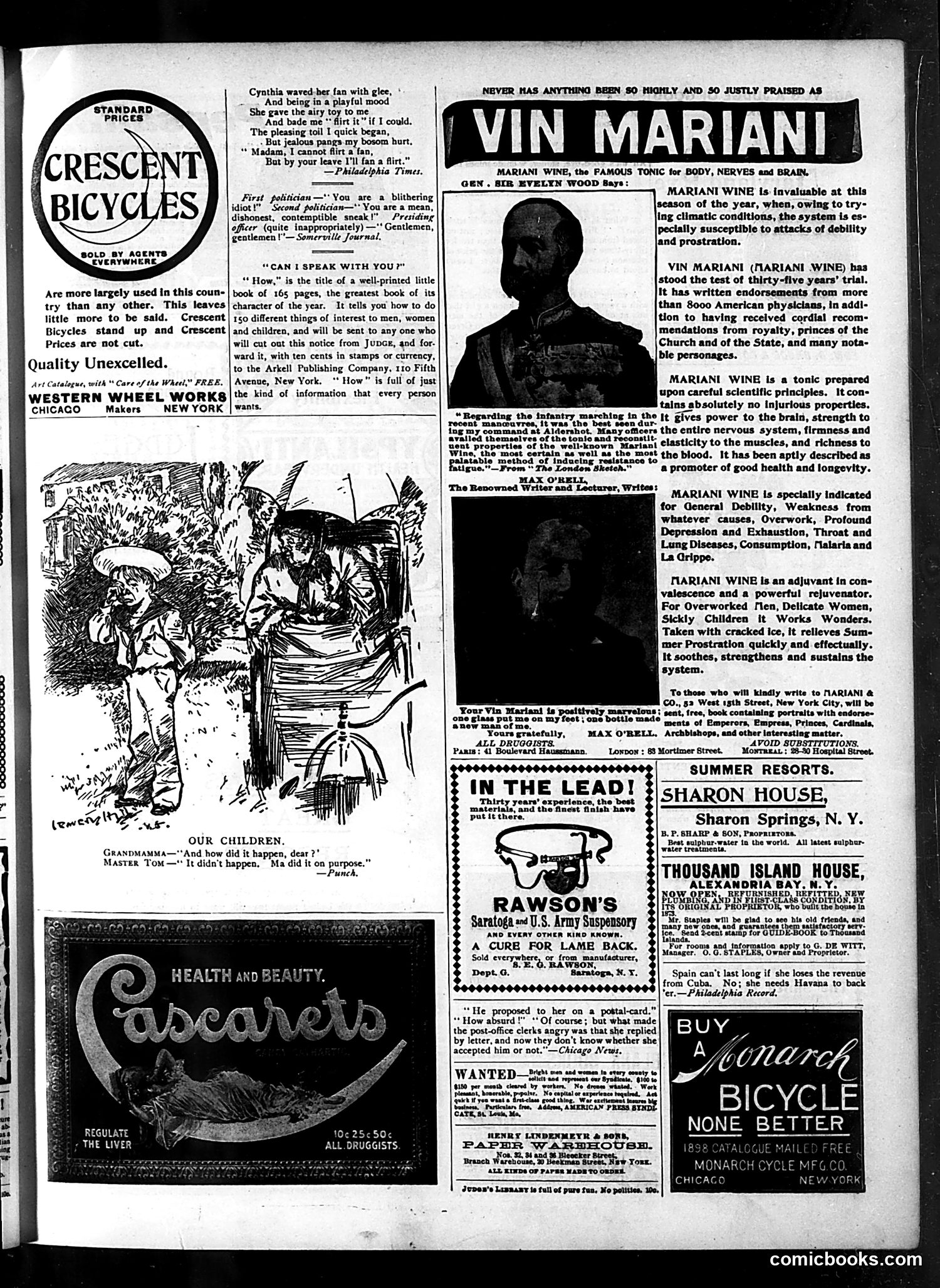
This page is primarily **advertising-heavy**, dominated by a large advertisement for Vin Mariani wine (a patent medicine tonic). The actual editorial content is minimal. The small cartoons present are light satirical humor: 1. **"Our Children"** (bottom left): A child's logic joke—when asked how an accident happened, the child says his mother deliberately caused it ("Ma did it on purpose"), inverting adult expectations about accidents. 2. **Two brief political jokes** at top: One depicts bickering politicians hurling insults while a presiding officer ineffectually pleads for civility—satirizing the coarseness of parliamentary debate. 3. **"Can I Speak With You?"**: A flirtation joke playing on double meanings of "flirting" with a fan versus flirting with a person. The **Vin Mariani advertisement** is notable historically: it prominently features endorsements from "Gen. Sir Evelyn Wood" and writer "Max O'Rell," claiming the wine tonic treats debility, exhaustion, consumption, and "La Grippe"—typical exaggerated patent medicine claims of the era, before FDA regulation.
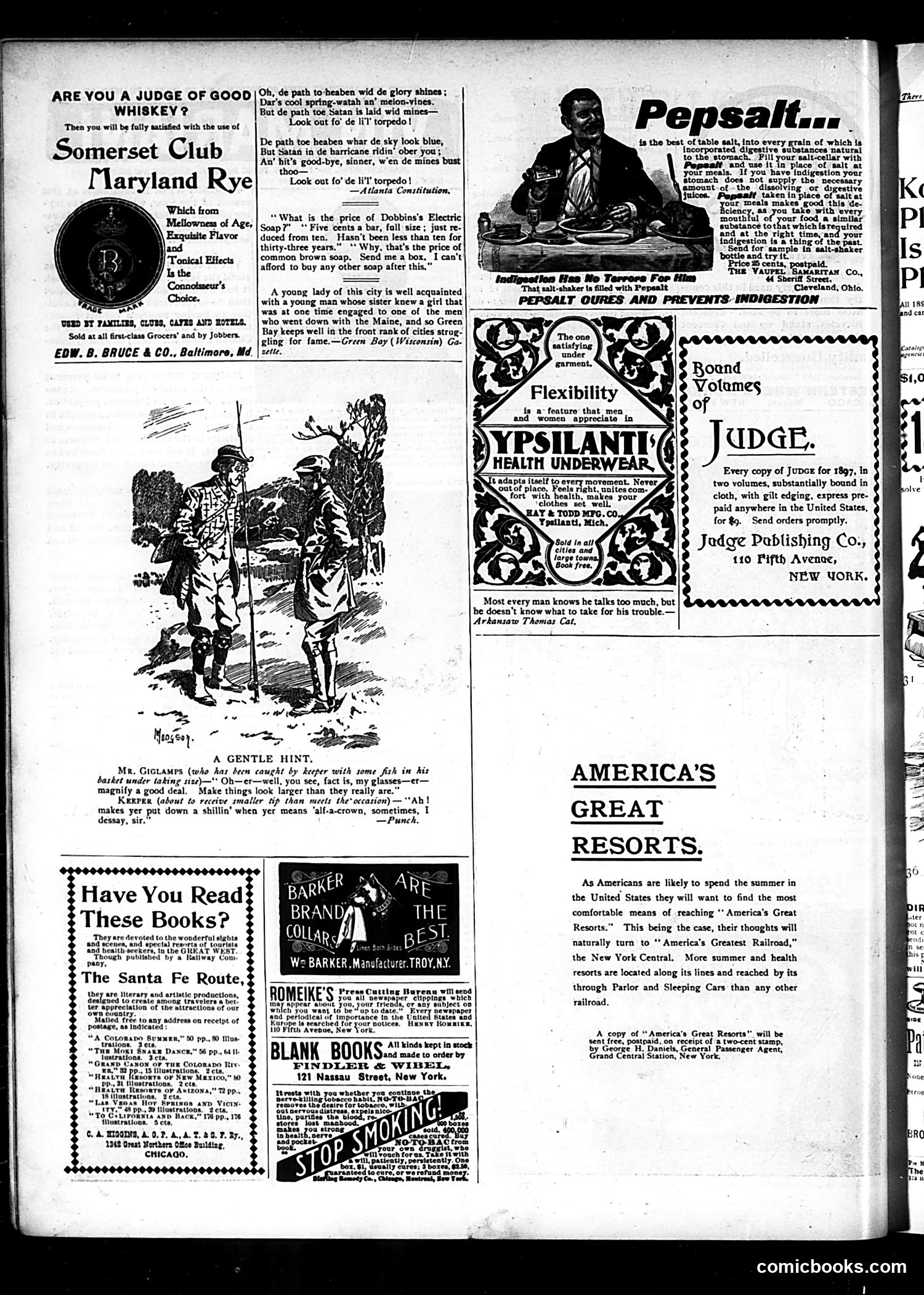
This page is primarily **advertising and filler content** rather than political commentary. The main elements include: **Advertisements:** - Somerset Club Maryland Rye whiskey - Dobbins's Electric Soap (reduced price) - Pepsalt (a digestive aid in salt-shaker form) - Ypsilanti Health Underwear - Judge Publishing's bound volumes - Santa Fe Route travel guides - Blank books and other products **Humor/Filler:** - A dialect poem about avoiding "Satan's mines" (naval torpedoes), likely referencing the USS Maine explosion - A "Gentle Hint" cartoon showing a fisherman caught by a keeper, using poor eyesight as an excuse—a joke about exaggeration - A joke about a girl connected to someone involved with the Maine disaster **Context:** The Maine reference dates this around 1898, during the Spanish-American War buildup. Otherwise, this is typical period advertising mixed with light humor—not satirical commentary. The page reflects late-19th-century consumer culture and publication practices.
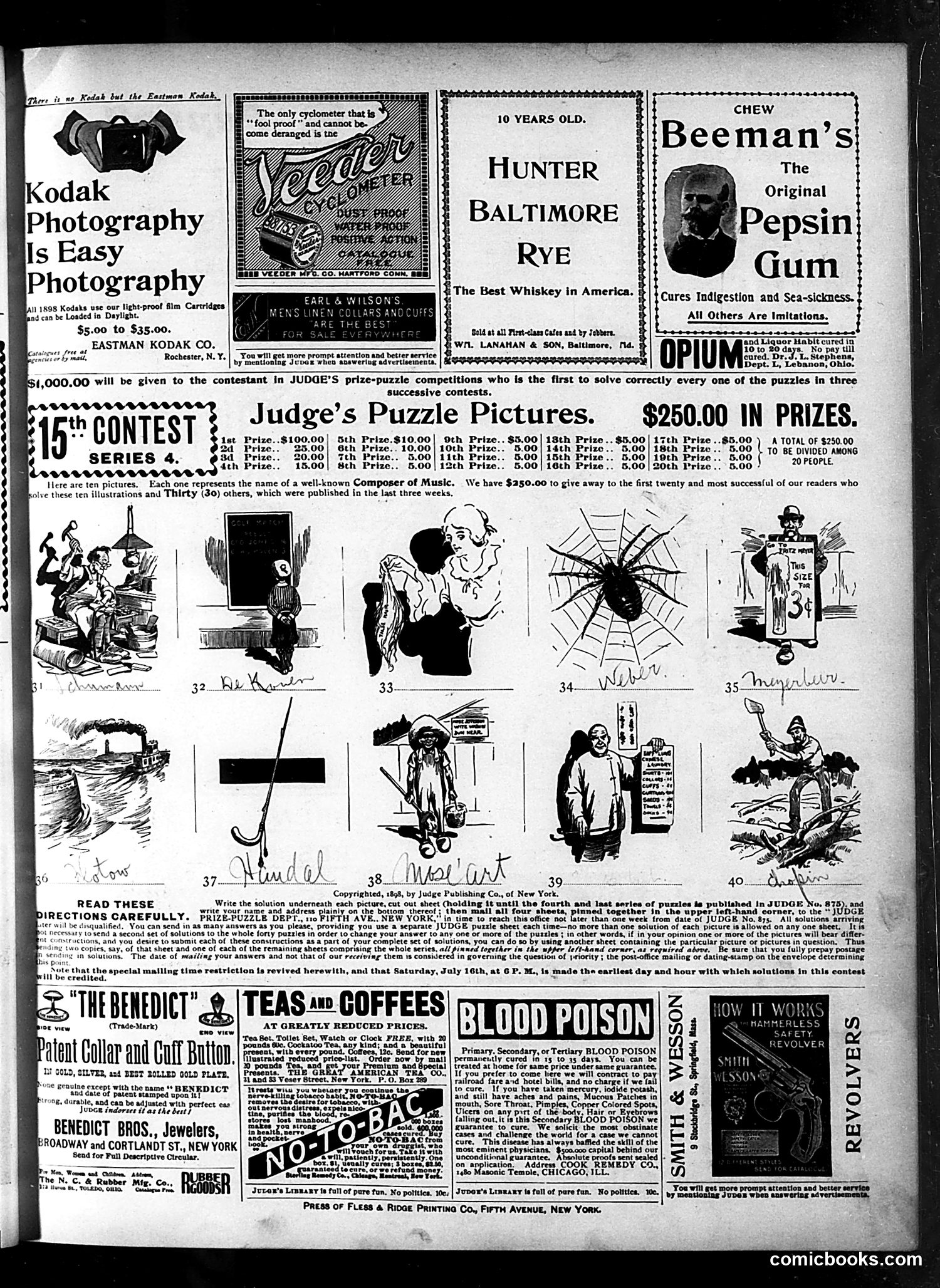
This page is primarily **advertising and contest material** rather than political satire. The main content is Judge's 15th "Puzzle Pictures" contest, where readers identify ten musical composers from illustrated clues (numbered 31-40). The prize pool totals $250, divided among twenty winners. The page features typical late-1890s advertisements: Eastman Kodak cameras, Beeman's Pepsin Gum, Hunter Baltimore Rye whiskey, and various patent medicines (notably treatments for opium and "blood poison" addiction—reflecting common medical advertisements of the era). The small illustrated puzzle clues themselves appear to use visual puns or caricatures to suggest composers' names, though specific identifications aren't clearly legible in this reproduction. The elaborate contest rules emphasize that multiple solutions per person are permitted, with solutions due by July 16th. This represents Judge's business model: combining satirical content with revenue-generating contests and paid advertising.
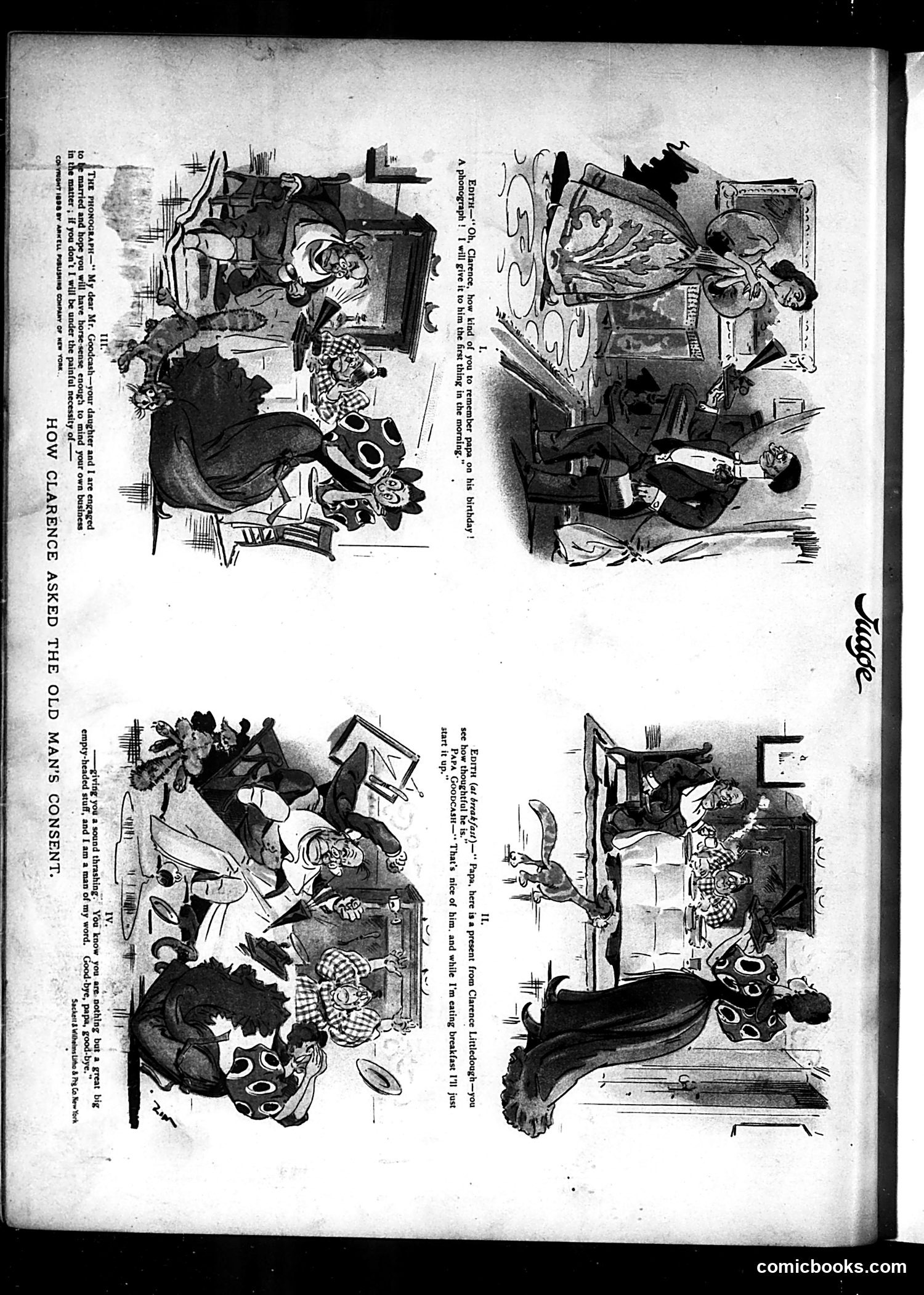
This Judge magazine cartoon satirizes the courtship ritual of the wealthy Gilded Age. The sequence shows a suitor named Clarence seeking permission to marry Mr. Goodcash's daughter by attempting to win over the father through gift-giving rather than genuine sentiment. The humor lies in the transparent transactionalism: Clarence presents an expensive phonograph (a cutting-edge luxury item) while the daughter dismisses herself as "empty-headed," and Clarence promises to tolerate her vapidity. Mr. Goodcash, a caricatured plutocrat, is portrayed as mercenary—willing to sell his daughter to the highest bidder rather than concerned with her happiness or character. The satire targets both the marriage-as-commerce mentality among the wealthy and the assumption that women were decorative, intellectually negligible possessions. The phonograph symbolizes materialism triumphing over genuine romantic or moral values in upper-class matrimony.