
A complete issue · 16 pages · 1898
Judge — May 21, 1898
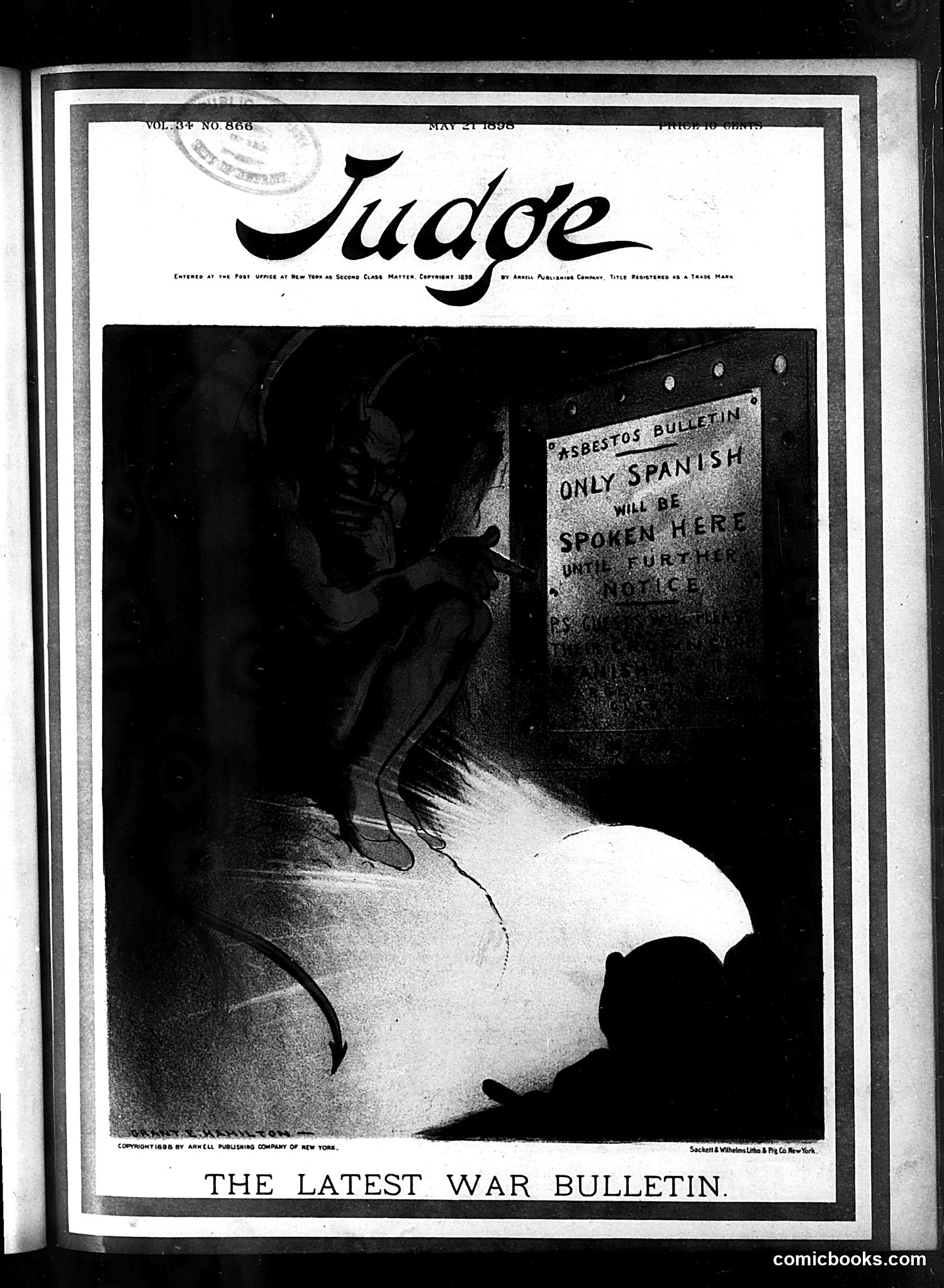
This satirical cover depicts a figure reading an "Asbestos Bulletin" with a sign stating "Only Spanish will be spoken here until further notice." The image appears to reference the Spanish-American War (1898), which was then ongoing. The joke seems to mock American military confidence and expansionism: the asbestos bulletin suggests the information is so hot or inflammatory it requires fireproof material, while the Spanish-language sign implies American dominance over Spanish territories. The figure's posture suggests casual, almost dismissive certainty about American victory. This reflects the contemporary American attitude toward the war—optimistic, somewhat cocky, and focused on territorial acquisition. The "war bulletin" framing suggests rapid, almost comedic confidence in military superiority.
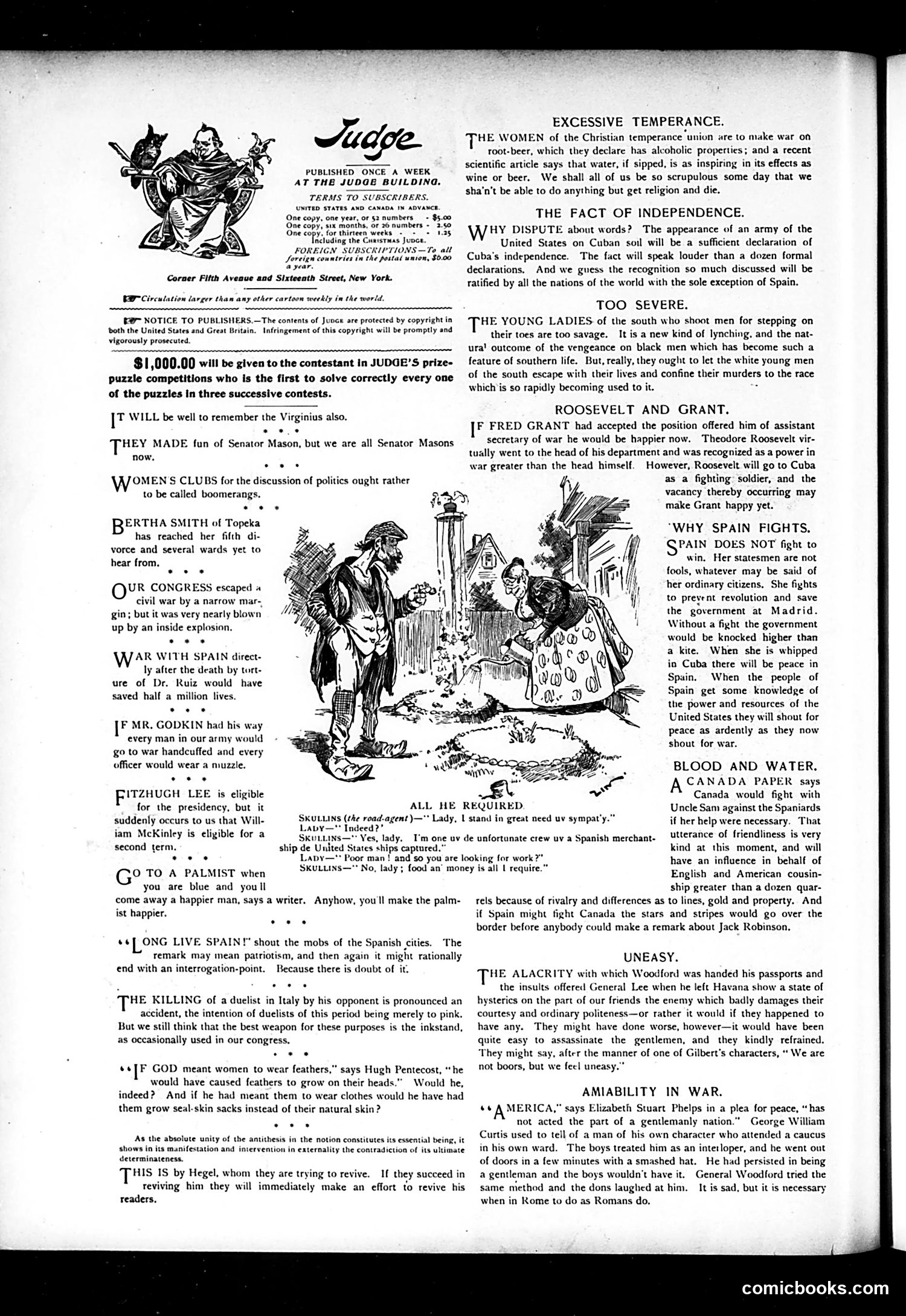
The main cartoon titled "ALL HE REQUIRED" depicts a skeletal figure (Death/privation) asking a ragged man for "sympathy" and "a ship of United States ships captured." The accompanying dialogue satirizes Spanish complaints about American naval power during what appears to be the Spanish-American War era. The editorial sections address contemporary political issues: excessive temperance advocacy, Cuban independence, Southern racial violence against Black men, Roosevelt and Grant comparisons, and Spain's military weakness. One section notes Spain "does not fight to preserve order" but rather from foolish patriotism. The satire primarily critiques Spanish military pretensions while supporting American intervention, reflecting Judge's pro-American imperial stance during this period.
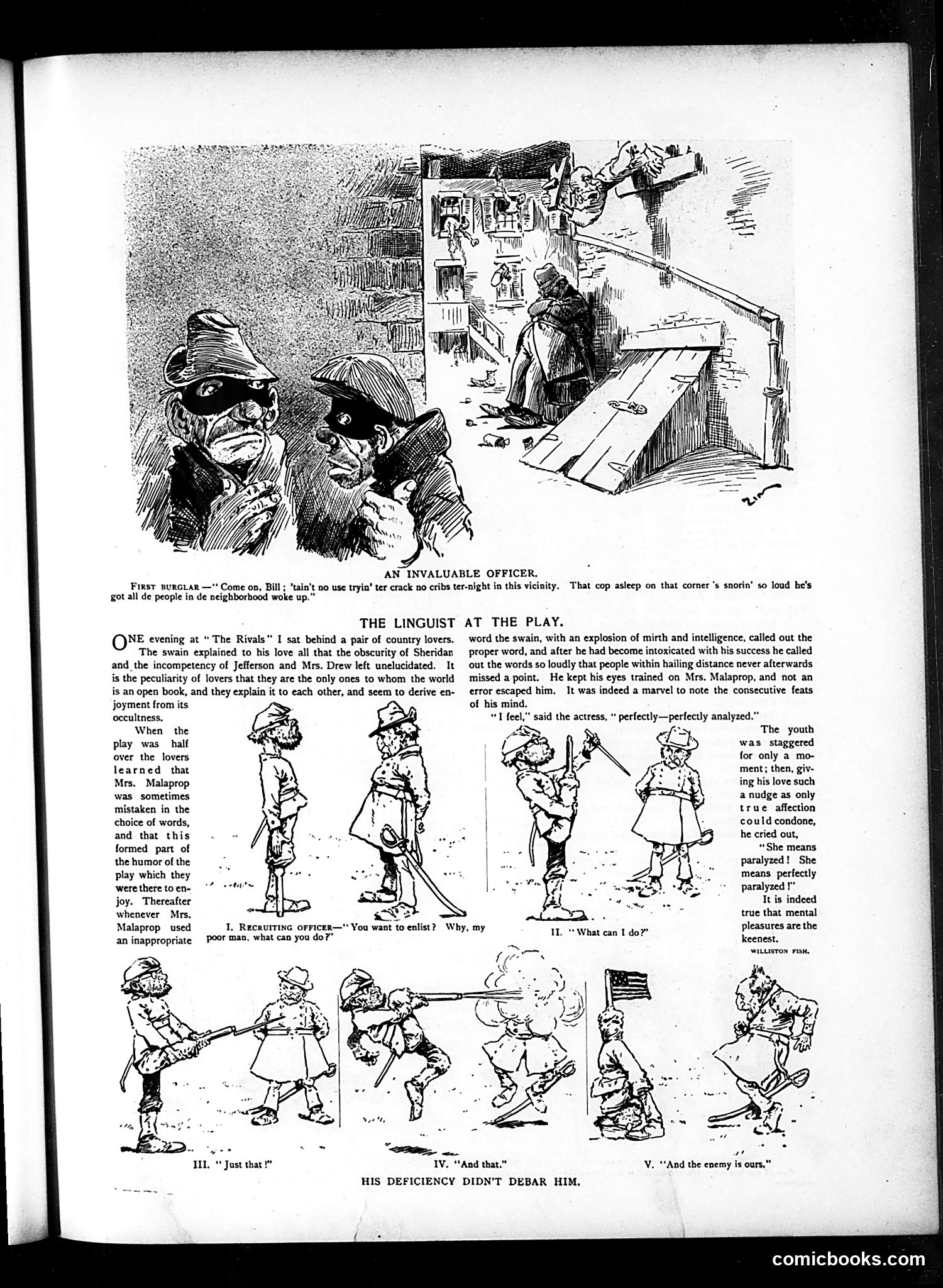
This page contains two separate satirical pieces from *Judge* magazine: **"An Invaluable Officer"** (top) depicts police corruption, showing officers sleeping on duty while criminals operate in their precinct—a common reform-era criticism of urban police forces. **"The Linguist at the Play"** (middle/bottom) mocks a theater-goer who pedantically corrects Mrs. Malapropl's malapropisms (deliberate misuse of words for comic effect) during a performance. The swain interrupts the show to lecture her on proper English, appearing foolish in his inability to recognize she's intentionally misusing language for theatrical effect. The series of illustrated panels shows his increasingly pompous behavior. **"His Deficiency Didn't Debar Him"** (bottom) appears to show military/recruitment humor, though specific details are unclear without additional context. The satire targets social pretension and humorless pedantry.
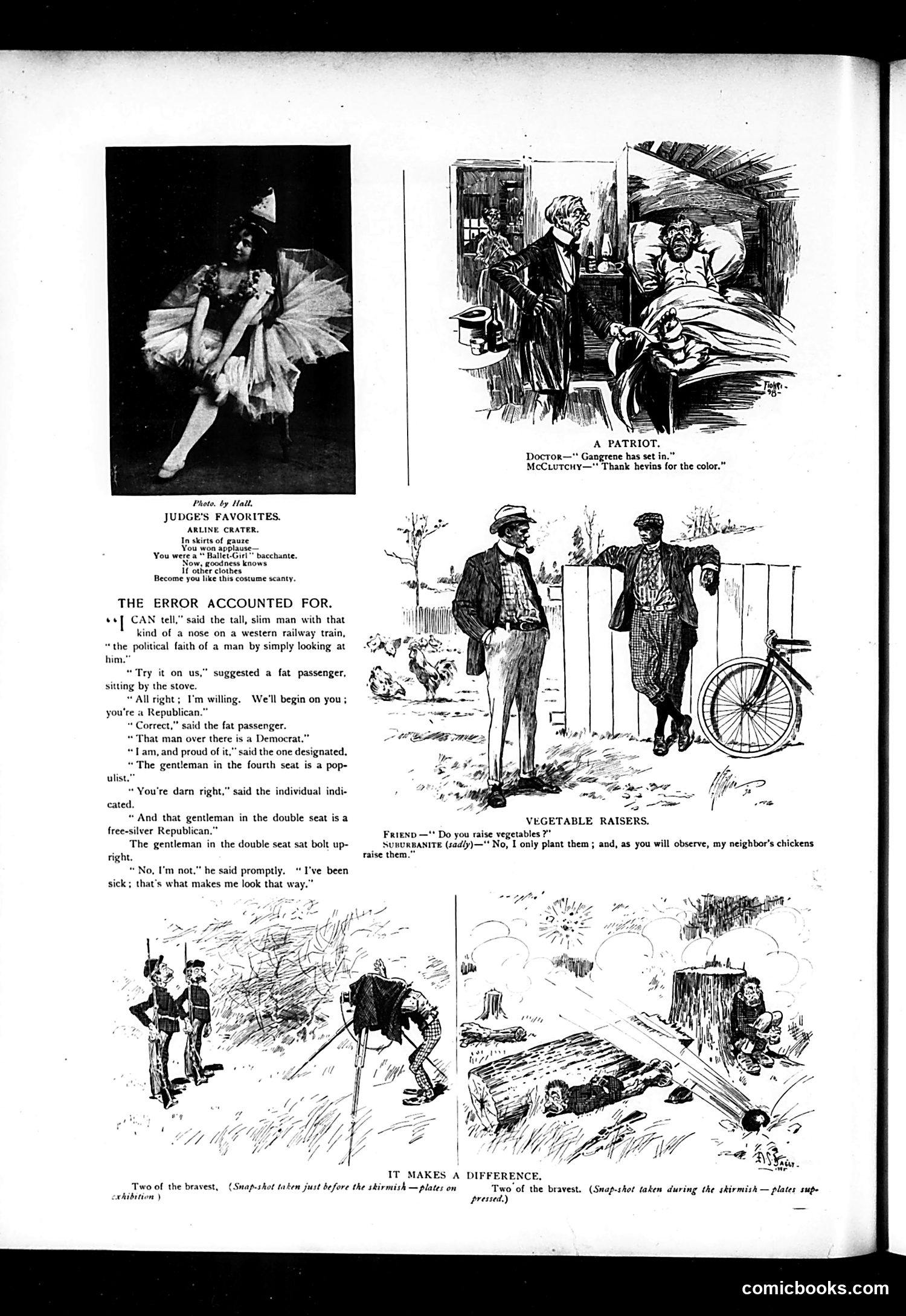
This page contains several satirical pieces mocking American politics and social attitudes of the era (appears to be early 20th century based on style). **"The Error Accounted For"** ridicules the ease with which political affiliation can be determined by appearance alone—a tall man is automatically assumed Republican, a fat man Democratic, etc. The joke critiques superficial political stereotyping. **"A Patriot"** appears to satirize medical or scientific authority figures, though the exact reference is unclear. **"Vegetable Raisers"** and **"It Makes a Difference"** use rural/outdoor scenes, likely mocking agricultural practices or class distinctions, though specific references remain ambiguous without additional historical context. The overall tone suggests skepticism toward political categorization and social pretension.
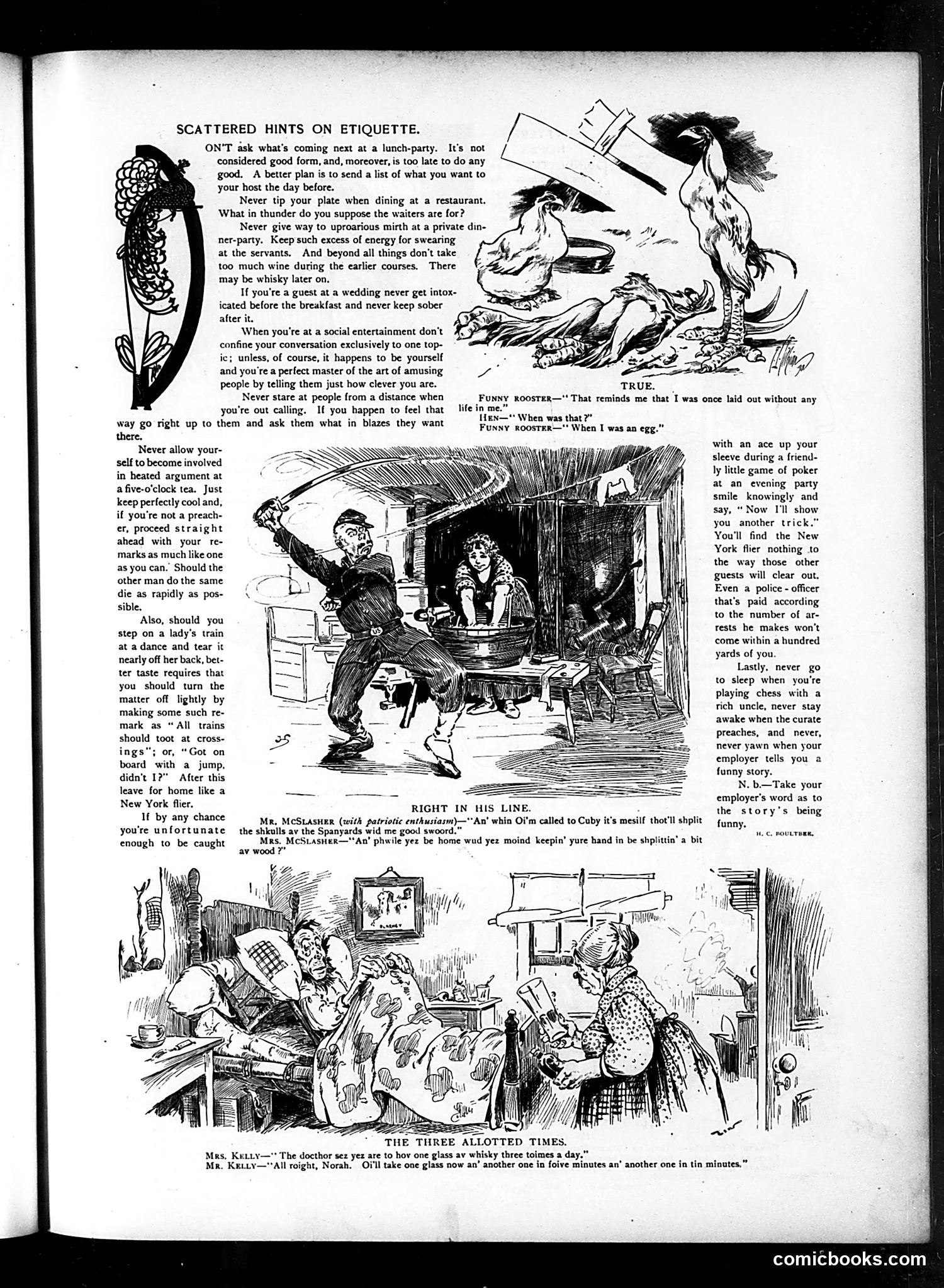
This page satirizes American social etiquette and working-class Irish immigrants through humor. **"Scattered Hints on Etiquette"** (left column) mocks upper-class dinner conventions with absurdist advice—don't ask what's for lunch, tip your plate, get drunk at weddings—inverting proper behavior to highlight how arbitrary and pretentious such rules appear. **"Right in His Line"** depicts "Mr. McSlasher," an Irish immigrant soldier with exaggerated brogue, claiming he'll split Spanish skulls in Cuba (referencing the Spanish-American War, likely 1898). The satire targets both his violent patriotism and stereotyped Irish dialect ("shplit," "Spanyards"). **"The Three Allotted Times"** shows an Irish woman ("Norah") and doctor discussing whisky doses, but she ingeniously interprets "three times a day" as taking all three doses consecutively—a working-class loophole exploiting the wealthy's rules. Overall, the page contrasts elite etiquette pretension with working-class Irish immigrant cunning, using dialect humor and social commentary typical of Judge's satirical approach.
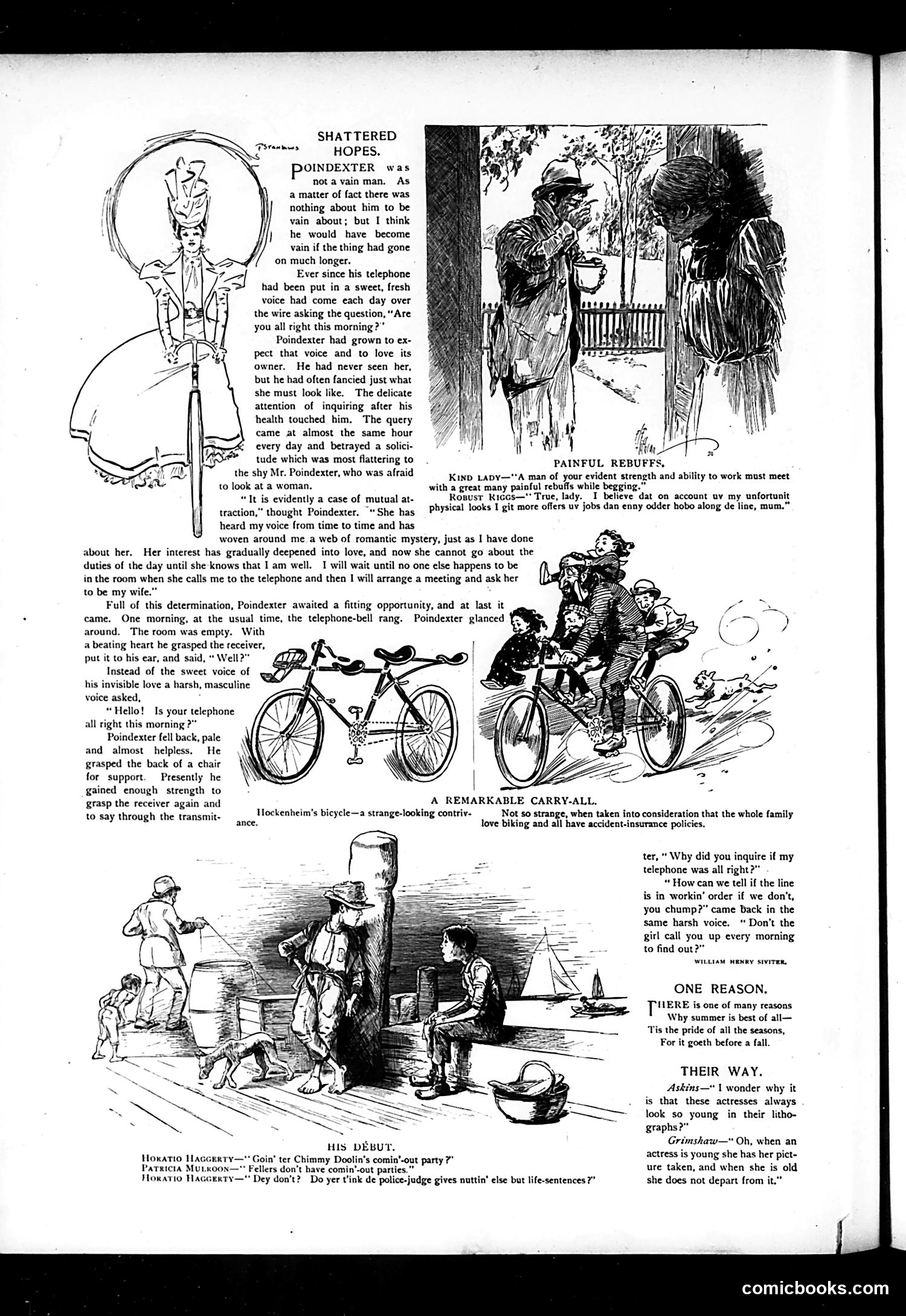
**Main Story:** Poindexter, a shy man, receives daily telephone calls asking "Are you all right this morning?" He fantasizes that a woman caller is romantically interested in him, imagining her as mysterious and devoted. He plans to propose when finally alone to answer. His romantic bubble bursts when he picks up the phone to discover the caller is a telephone company operator—a man—performing routine line checks. The "sweet voice" was likely a different operator on previous calls. **The Satire:** This mocks both male vanity and the era's emerging telephone technology. The joke exploits early-1900s telephone novelty and social awkwardness, plus the irony that Poindexter's romantic fantasy was sustained by misidentification and his own projections. The accompanying illustrations of bicycles, vagrants, and society gossip are typical Judge filler content, unrelated to the main story.
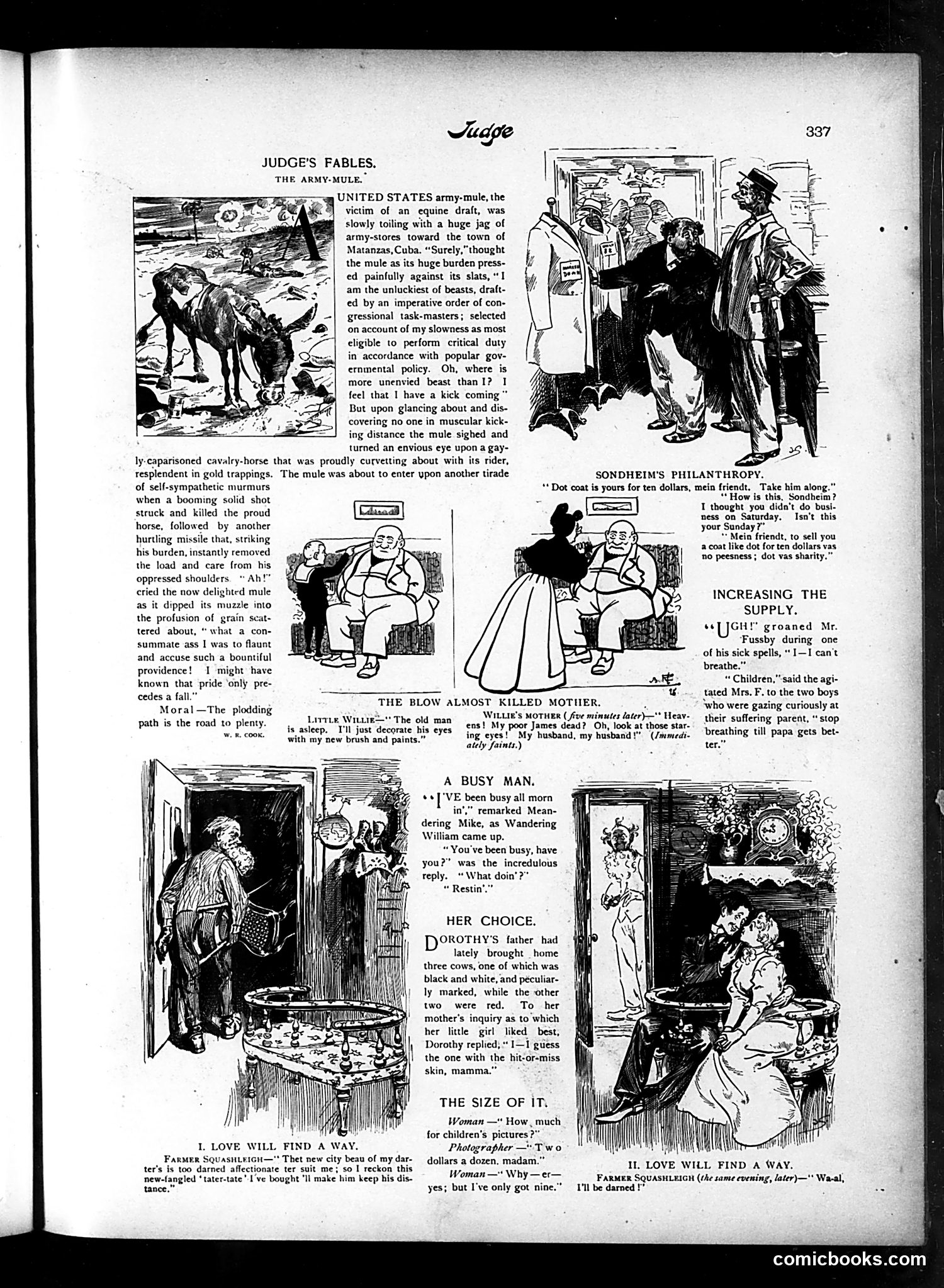
This page contains multiple short fables and comic vignettes typical of Judge's satirical format: **"The Army-Mule"** (main story) uses the Spanish-American War context (Cuba, Matanzas mentioned) to satirize military bureaucracy. The mule complains of unfair burden, envies a decorated cavalry horse, then is relieved when enemy fire kills the horse and destroys his load. The moral: patience and duty are rewarded—a critique of those who complain rather than accept their role. The smaller items mock everyday life: **"Sondheim's Philanthropy"** lampoons a Jewish peddler's dubious charity; **"The Blow Almost Killed Mother"** jokes about a child's mischief; **"Her Choice"** finds humor in a child's malapropism ("hit-or-miss skin"); **"Increasing the Supply"** presents dark humor about overpopulation; **"I Love Will Find a Way"** uses a farmer character resisting his daughter's city suitor. The humor relies on period stereotypes, slapstick, and puns now dated or offensive.
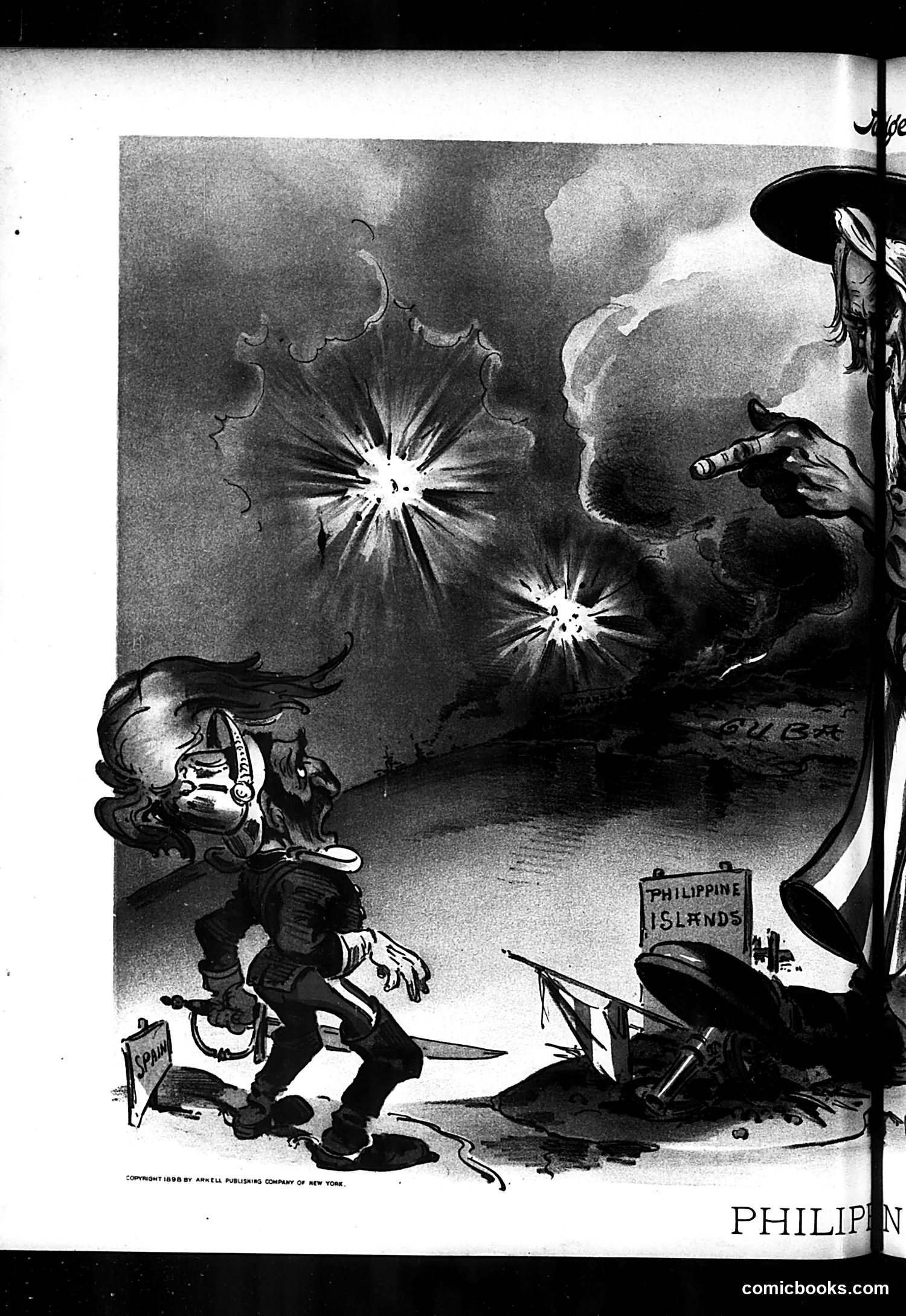
This 1896 Judge magazine cartoon depicts Spain (labeled with a Spanish flag) as a caricatured figure on the left, cowering or retreating in fear. The figure on the right appears to represent American military power or imperialism, depicted as a aggressive force with a sword and what looks like military insignia. The "Philippine Islands" sign visible in the scene suggests this cartoon comments on American expansion into the Philippines during the Spanish-American War era (1898). Spain appears frightened and diminished, while the American figure looms larger and more dominant. The satire likely mocks Spain's weakening colonial position and celebrates American military might and imperial ambitions in the Pacific. This reflects late 19th-century American imperialist sentiment and the decline of Spanish power.
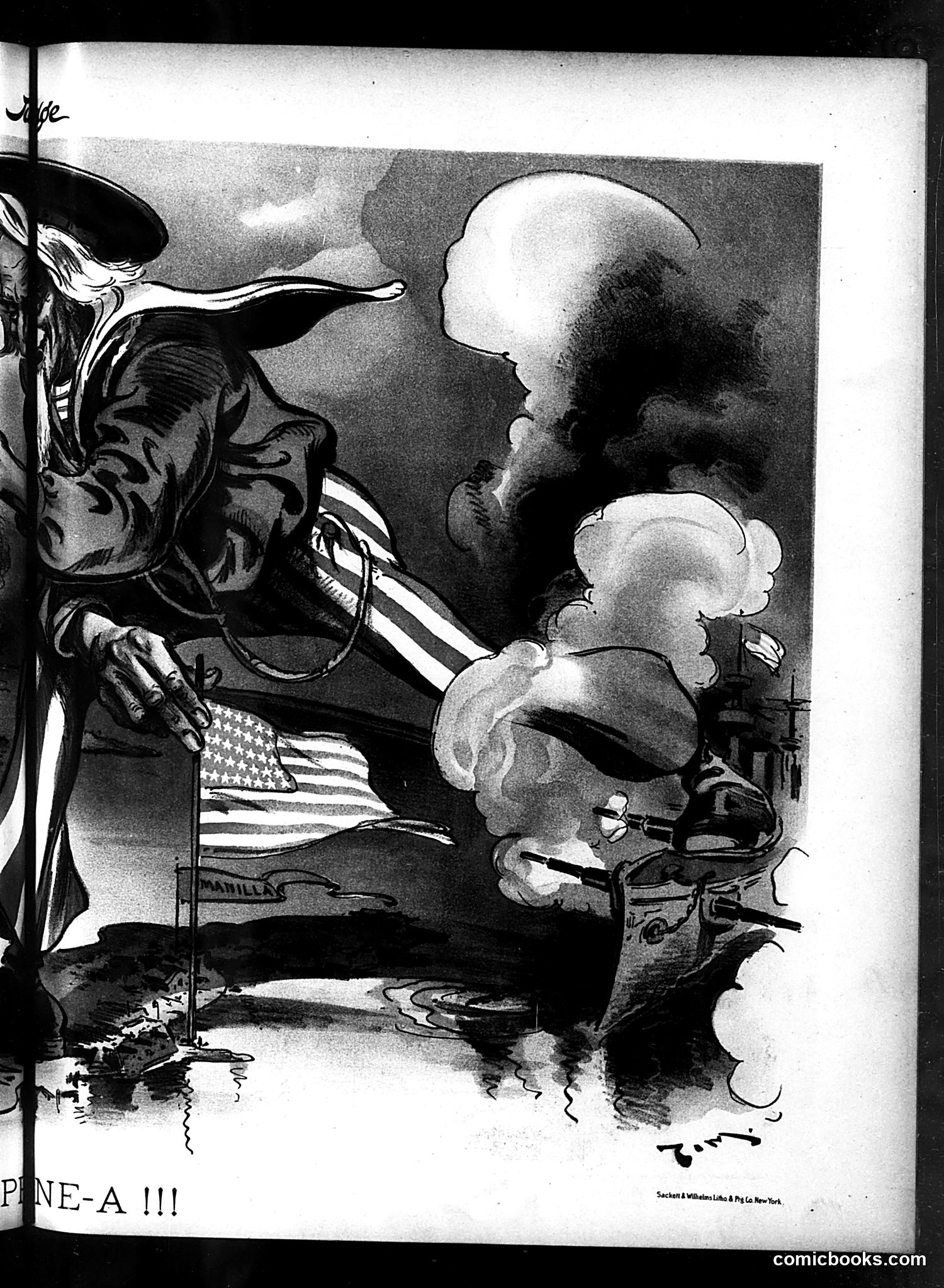
This appears to be a Judge magazine satirical cartoon, likely from the early 20th century based on style. The image shows a caricatured figure on the left (appearing to be a military or political leader, suggested by the ornate uniform) pointing accusingly at two figures on the right emerging from clouds of smoke. An American flag is visible below. The composition suggests commentary on American foreign policy or military intervention—the pointing gesture and smoke imagery imply conflict or confrontation. However, without clear identifying labels or legible text on the figures themselves, I cannot definitively identify which specific historical figures, conflicts, or political events this references. The style and composition suggest critique of aggressive American foreign policy, but the specific target remains unclear from this image alone.
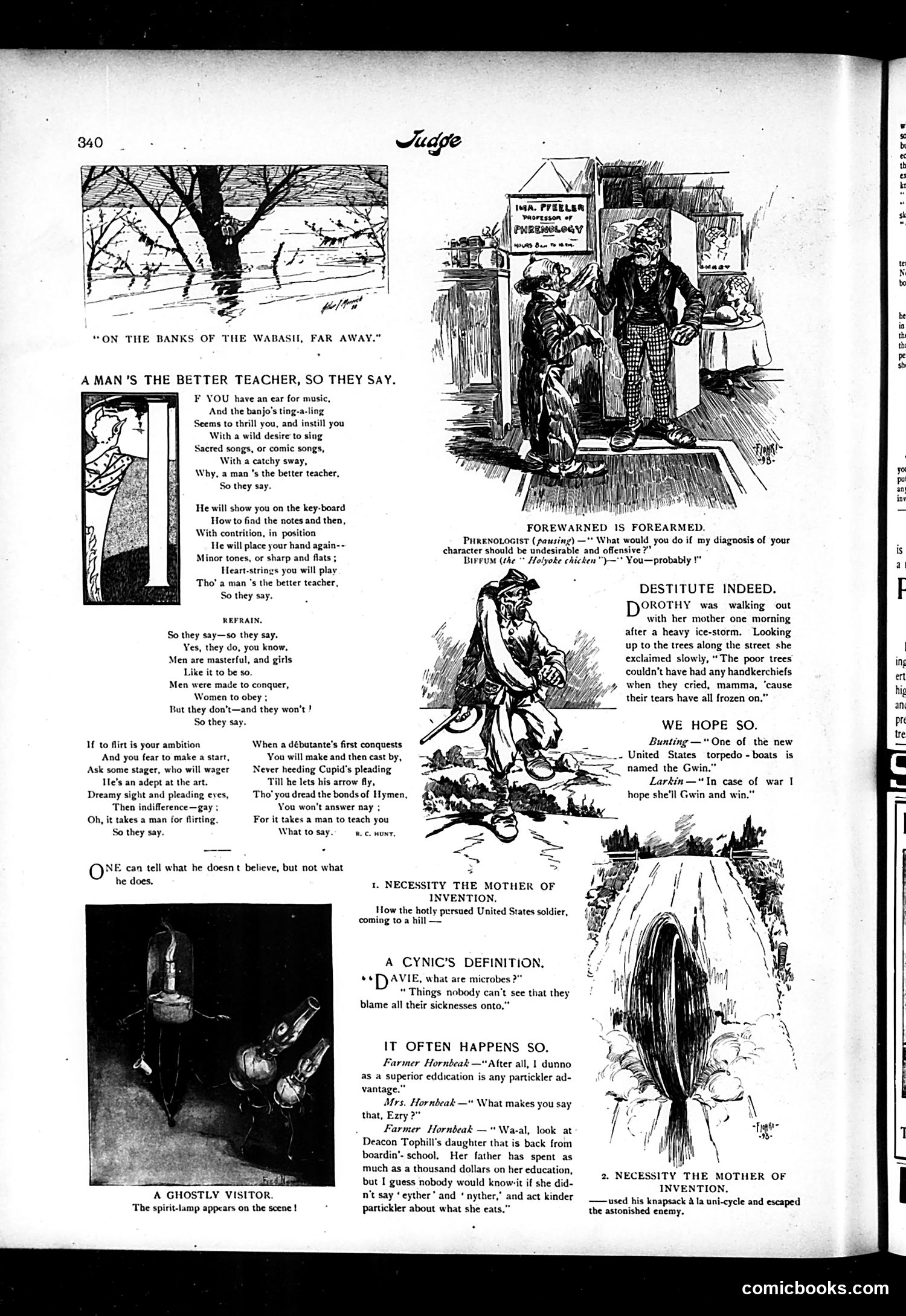
This page contains multiple satirical pieces typical of early 20th-century Judge magazine: **"A Man's the Better Teacher"** — A song mocking the era's claim that men are superior educators and that women naturally prefer male authority. The satire undercuts this by noting women "don't—and they won't" actually obey, suggesting the premise is false despite what "they say." **"Destitute Indeed"** — A gentle comic anecdote where a child misunderstands frozen tears on trees as evidence of poverty, offering social commentary through childish innocence. **"We Hope So"** — A brief joke about a new U.S. Navy torpedo boat named the *Gwin*, with wordplay on "Gwin and win." **"A Cynic's Definition"** — Mockery of germ theory by presenting an ignorant rural perspective that blames illness on invisible scapegoats. **"It Often Happens So"** — Satirizes the notion that expensive education guarantees refinement, showing an educated farmer's daughter still lacks manners despite her father's expenditure. The page emphasizes gender roles, rural ignorance versus urban sophistication, and skepticism toward contemporary claims about progress and improvement.
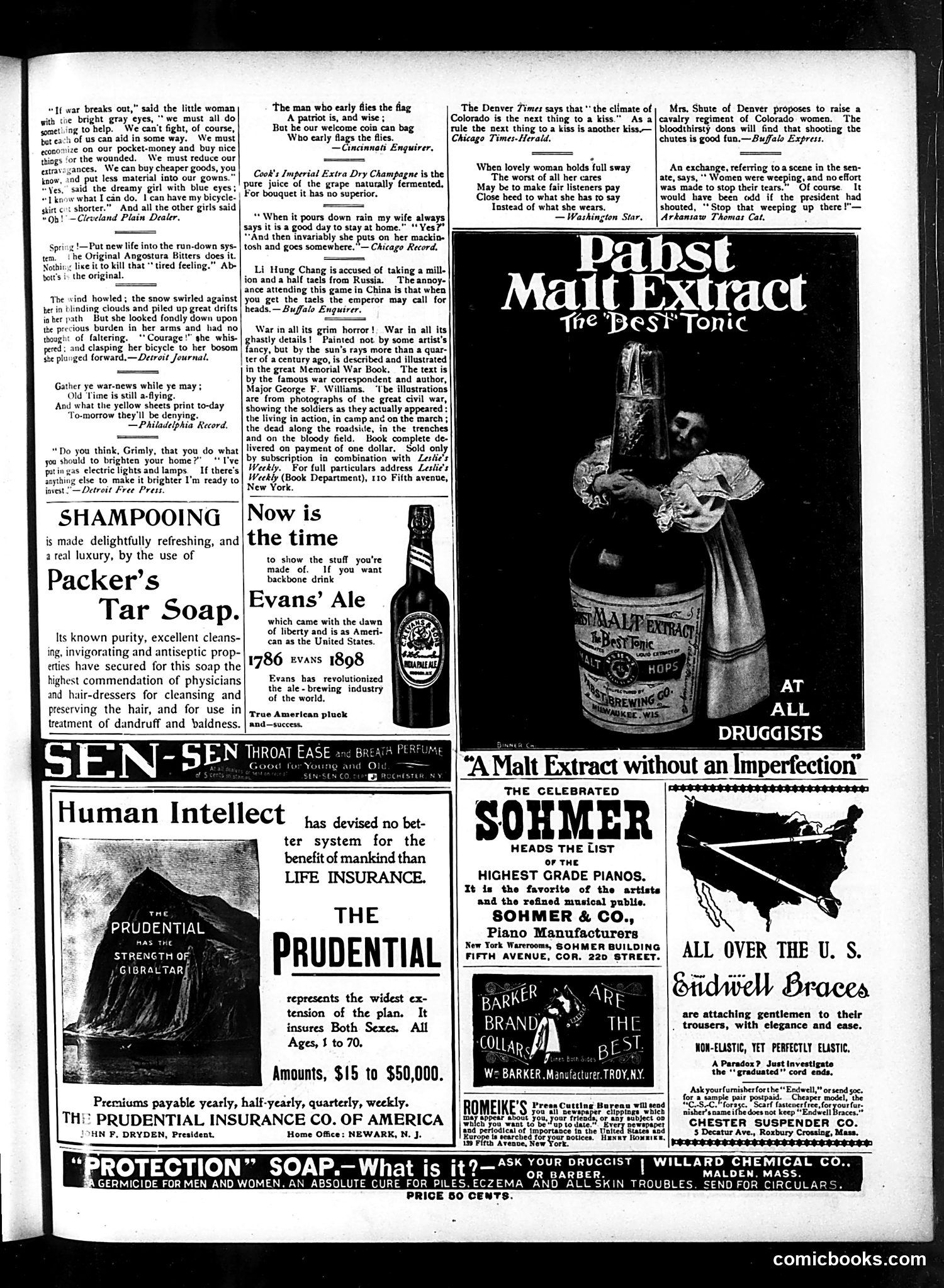
This page is primarily **advertising**, not political satire. However, the upper section contains brief humorous editorial snippets typical of Judge's style. The notable content includes: **"If war breaks out"** — A satirical jab at women's patriotic rhetoric during wartime. Women claim they'll economize and sacrifice, yet the punchline reveals vanity: one woman will shorten her bicycle skirt. The joke mocks performative patriotism and the gap between stated commitment and actual behavior. **"The man who early flies the flag"** — A cynical quip suggesting that true patriotism is financial exploitation—the real "patriot" is whoever profits from war supplies and flag-waving sentiment. The remainder consists of period advertisements for products like Packer's Tar Soap, Evans' Ale, Prudential Insurance, and Pabst Malt Extract. These ads are representative of Judge's business model and show contemporary consumer culture and medical claims (tonic products marketed as cures). The page reflects late-19th-century American attitudes: skepticism toward war enthusiasm, commercialism, and patent-medicine culture.
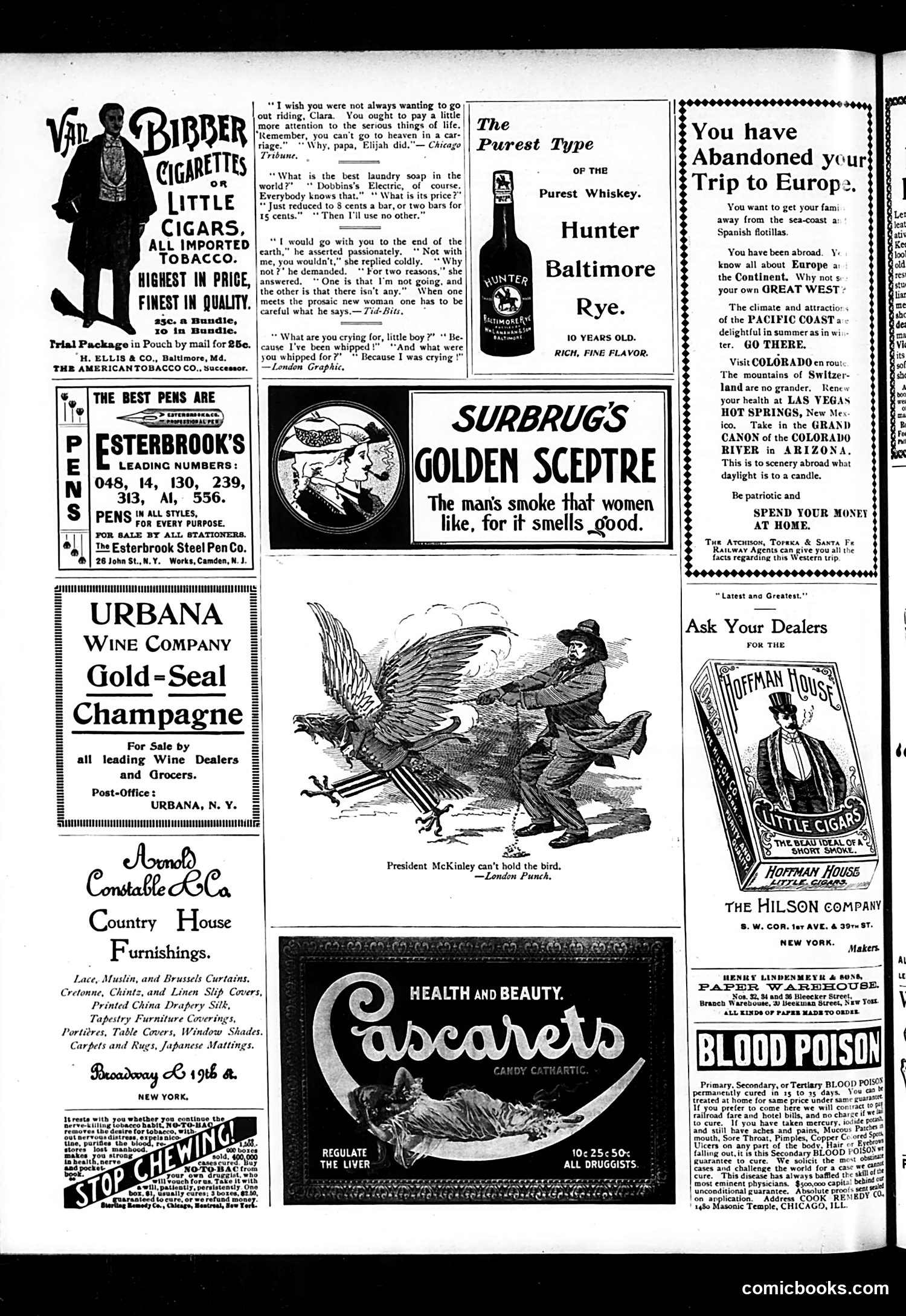
This page is primarily **advertisements** interspersed with brief humorous anecdotes, not political cartoons requiring historical context. The main illustration—labeled "President McKinley can't hold the bird"—appears to reference **President William McKinley** struggling to control a bird, likely a political allegory about his difficulty managing some policy or situation, though the specific reference is unclear without additional context. The page otherwise contains commercial advertisements for tobacco, whiskey, pens, wine, furniture, and patent medicines typical of early-1900s publications. One notable ad promotes travel to the American West (Colorado, Arizona, Las Vegas) as an alternative to European tourism—possibly reflecting contemporary concerns about Spanish naval power or simply promoting domestic travel. The humorous quotes scattered throughout are generic domestic humor about courtship and family life, containing no specific political references requiring historical explanation for modern readers.
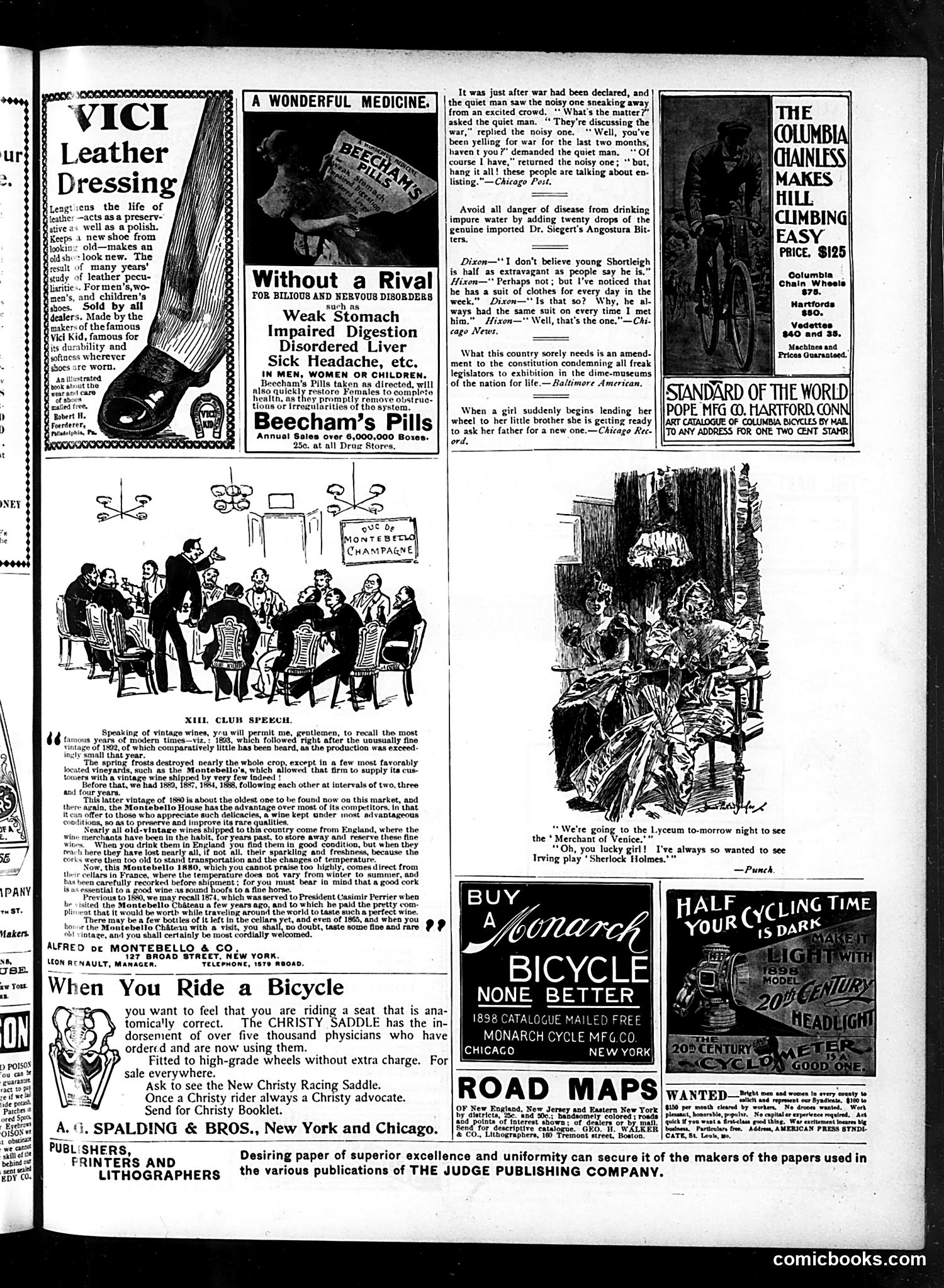
This is primarily an **advertising page** from Judge magazine, with one notable cartoon at the top center. ## The Main Cartoon ("XIII Club Speech") The illustration depicts a formal dinner gathering where a well-dressed man stands addressing the assembled guests at a table labeled "Montebello Champagne." This accompanies a lengthy text about vintage wines, specifically praising the 1880 Montebello vintage and comparing it to other notable years (1874, 1860s). **The satire appears to be about pretentiousness**: The elaborate, flowery speech about wine appreciation—with its discussion of storage conditions, French vineyards, and rare bottles—exemplifies the self-important posturing of wealthy clubs and connoisseurs. The humor lies in how seriously these gentlemen treat their wine expertise. **Social context**: This reflects the Gilded Age obsession with European luxury goods and conspicuous consumption among the wealthy. ## Other Content The page is otherwise filled with period advertisements: Beecham's Pills (patent medicine), VICI Leather Dressing, Columbia bicycles, Monarch bicycles, and Christy bicycle saddles—typical commercial fare for the era. There is also a brief anecdote about war declarations, likely referencing contemporary conflict.
This page is primarily **advertisements and miscellaneous content** rather than satirical cartoons. The dominant features are: **Key Advertisements:** - Paul Masson Champagne (California wine marketed as equal to French) - Rambler Bicycles ($60, positioned as high-quality) - Search-Light product (Bridgeport Brass) - Leslie's Weekly (promotional material claiming it documents American naval power and war scenes) **Humor Items:** The page includes brief comic anecdotes typical of Judge's "filler" content: - A phrenology joke about benevolence vs. greed - A Vassar girls joke about pretending to be "devilish" - A dialect humor piece about remarriage - A joke about a woman's "better half" marriages **Notable Context:** The Leslie's Weekly promotion emphasizes collecting copies "as a war souvenir," suggesting this is from the Spanish-American War era (1898, visible on Rambler ad), when war documentation was commercially valuable. The page reflects turn-of-century American consumer culture and period humor conventions rather than substantial political satire.
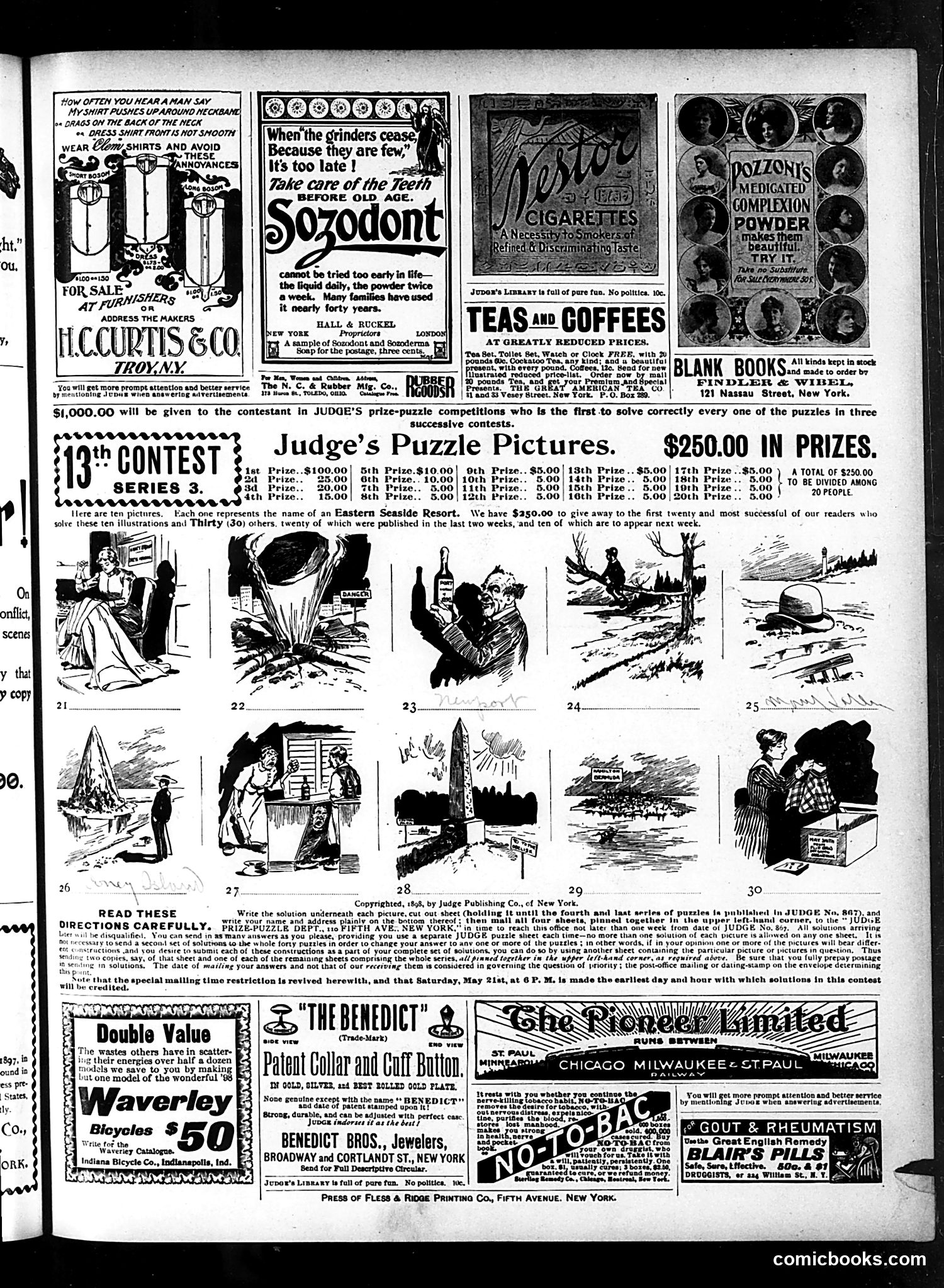
This page is primarily **advertising and a puzzle contest**, not political satire. The main content is Judge's "$250 Puzzle Pictures" contest (Series 3), offering $250 in prizes to readers who identify ten Eastern Seaside Resorts from illustrated clues. The surrounding advertisements are typical period products: Sozodont toothpaste, Waverley bicycles ($50), teas and coffees at reduced prices, Patent Collar and Cuff Buttons, and Blair's Pills for gout and rheumatism. The only notable satirical element is a brief shirt advertisement complaining about poorly-fitting dress shirts that "push up around the neck" or "drag on the back"—a mundane consumer complaint dressed in mock-exasperated language typical of Judge's advertising parodies. The page reflects late-1890s consumer culture and Judge's business model: entertainment (puzzles with financial incentives) subsidized by paid advertising.
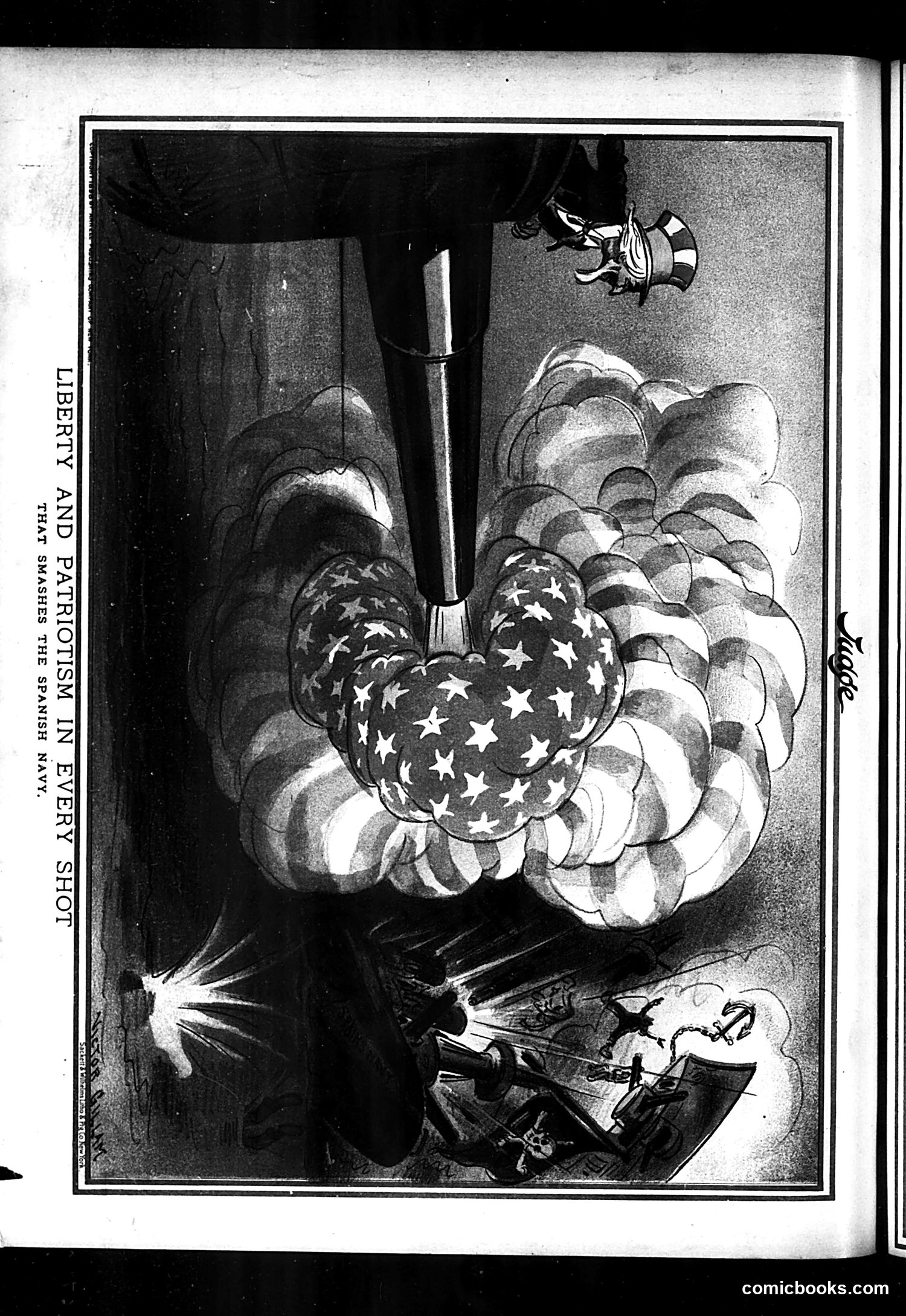
This Judge magazine cartoon satirizes American military action against Spain, likely referencing the Spanish-American War (1898). The central image shows a large bomb or explosive device decorated with stars and stripes (American flag imagery) being held aloft—symbolizing American military power. The title "Liberty and Patriotism in Every Shot That Smashes the Spanish Navy" uses ironic, jingoistic language typical of pro-war propaganda. The cartoon appears to mock the way American patriotic rhetoric wrapped military aggression in noble language. The figures at the bottom (appearing to include military or political figures) seem to celebrate this weaponized "patriotism." The satire suggests Judge viewed such patriotic justifications for war as hollow or cynical rhetoric masking imperial ambitions—a critical perspective on American expansionism and the Spanish-American War.