
A complete issue · 20 pages · 1898
Judge — April 30, 1898
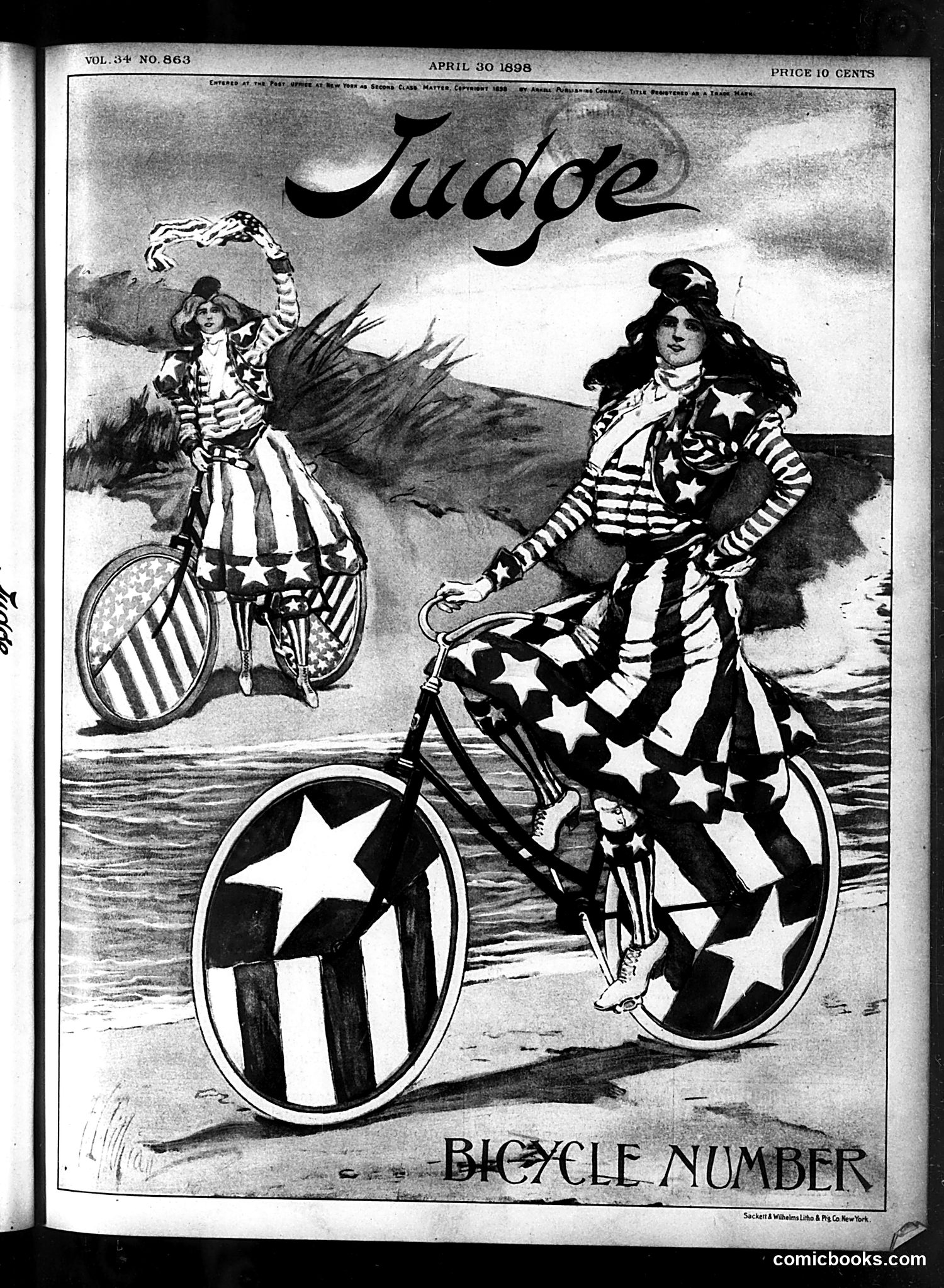
This is the "Bicycle Number" cover of Judge magazine, featuring two women in patriotic American-themed cycling costumes. The bicycles themselves are decorated with stars and stripes, and the riders wear matching striped outfits with star patterns. The satire likely celebrates the bicycle craze of the 1890s, which was transforming women's fashion and mobility. The exaggerated patriotic imagery suggests either celebratory nationalism (possibly related to the Spanish-American War beginning that April) or gentle mockery of how aggressively Americans commercialized and patriotized popular trends. The cover capitalizes on two simultaneous cultural phenomena: the bicycle boom and evolving women's roles, presenting them as quintessentially American enterprises worthy of star-spangled decoration.
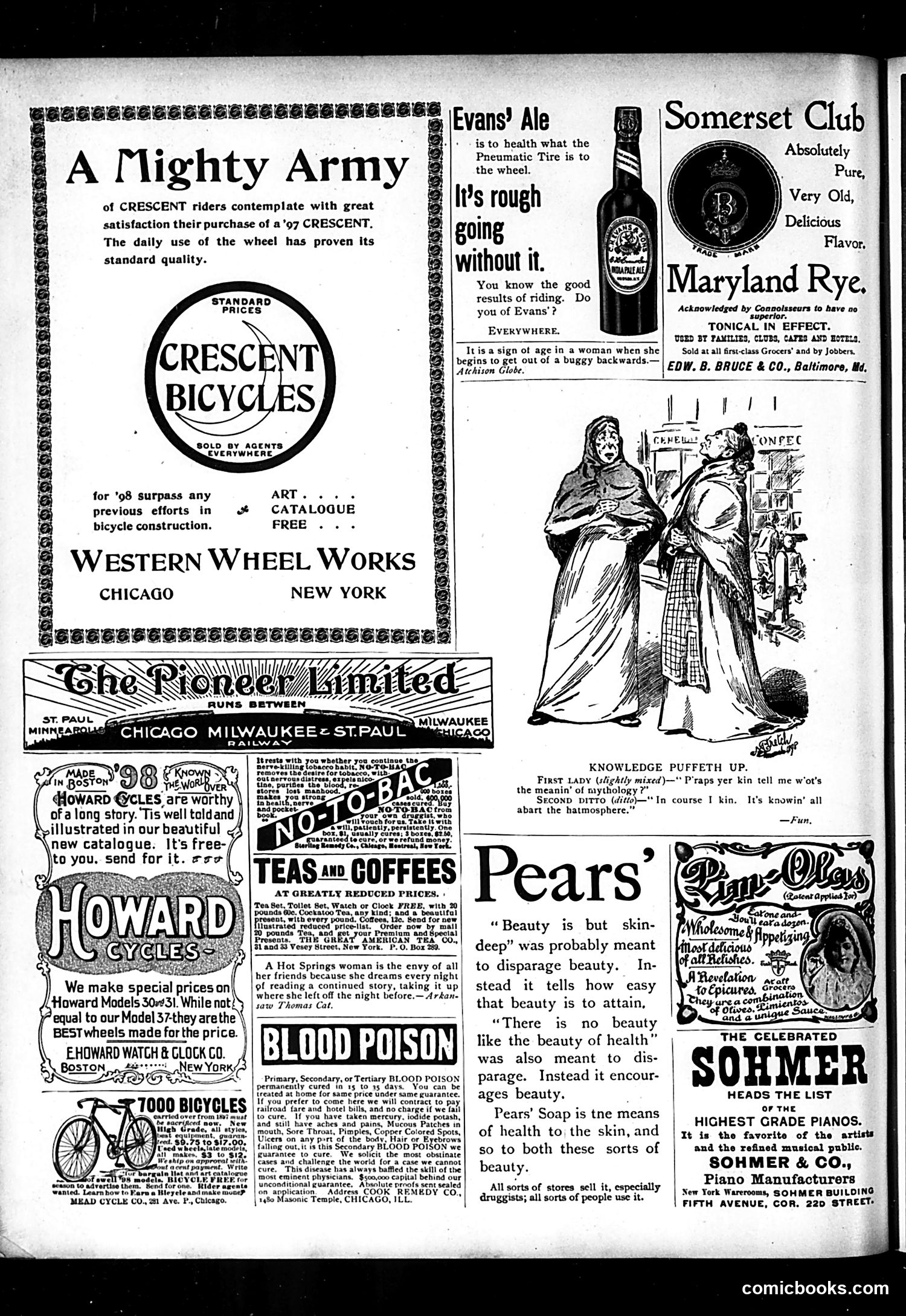
This page is **primarily advertisements** from an early 1900s Judge magazine, with minimal editorial cartoon content. The one notable cartoon appears in the lower right, titled "Knowledge Puffeth Up," showing two figures in conversation. The joke plays on the biblical phrase "knowledge puffeth up" (from 1 Corinthians 8:1), with the caption suggesting someone has become arrogant or inflated with self-importance from learning mythology. The bulk of the page advertises bicycles (Crescent, Howard, Pioneer Limited train), alcoholic beverages (Evans' Ale, Somerset Club Maryland Rye), patent medicines (Blood Poison cure, No-To-Bac smoking remedy), and pianos. This reflects late-19th/early-20th-century consumer culture and the magazine's reliance on paid advertising to fund publication.
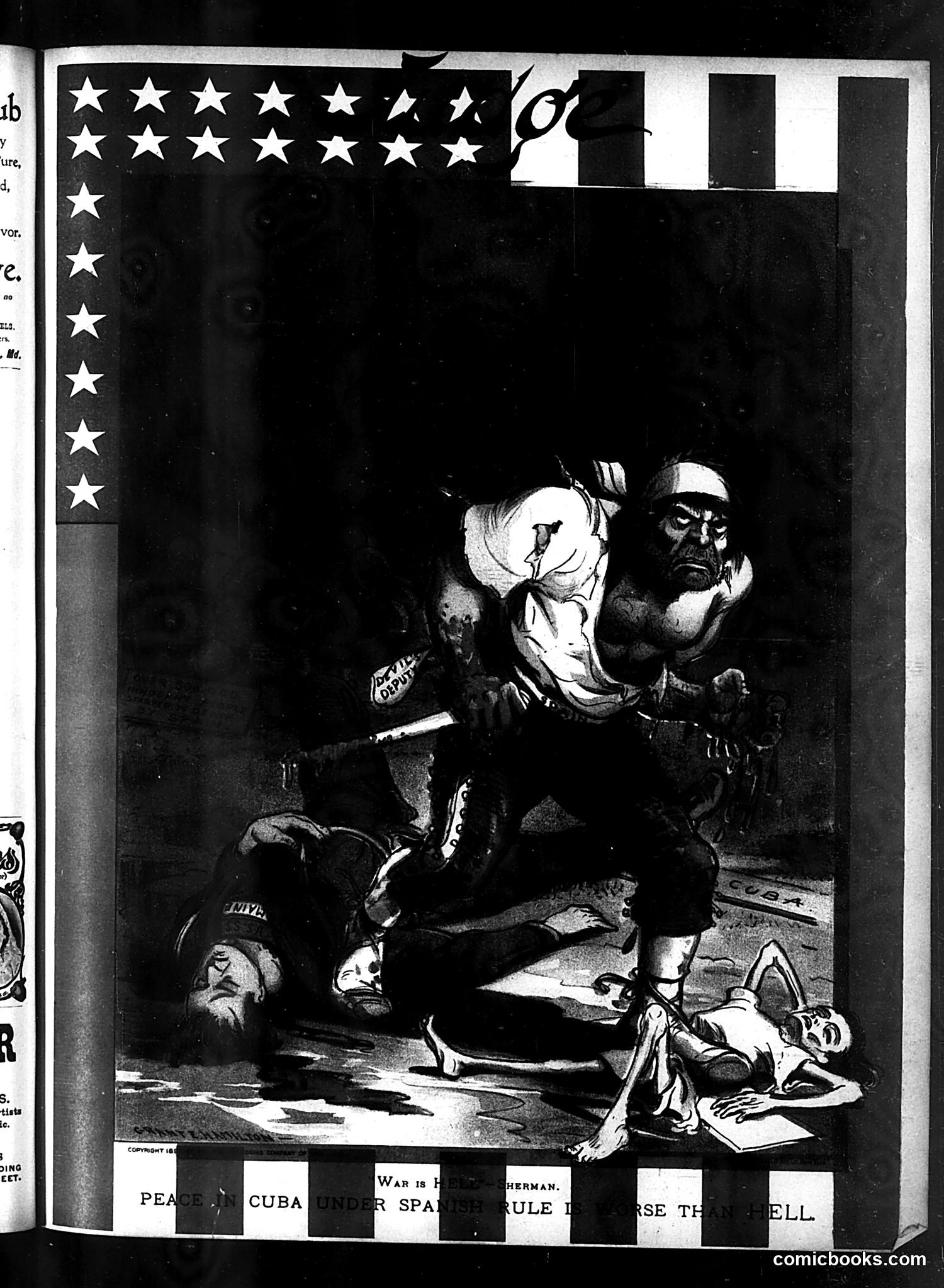
This appears to be a political cartoon from **Judge magazine** criticizing American intervention in Cuba under Spanish rule. The caption reads: "Peace, Cuba under Spanish rule is worse than hell." The image depicts caricatured figures (likely American politicians or military leaders) seemingly indifferent to or complicit in Cuban suffering under Spanish colonial oppression. The American flag frames the scene, suggesting critique of U.S. policy toward Cuba. The satire likely references the **Spanish-American War era** (1898) or preceding debates about American intervention. The cartoon argues that remaining passive while Spain ruled Cuba meant accepting atrocities—that inaction itself constituted moral failure. The grotesque depiction of suffering figures emphasizes the human cost of maintaining the status quo in colonial Cuba.
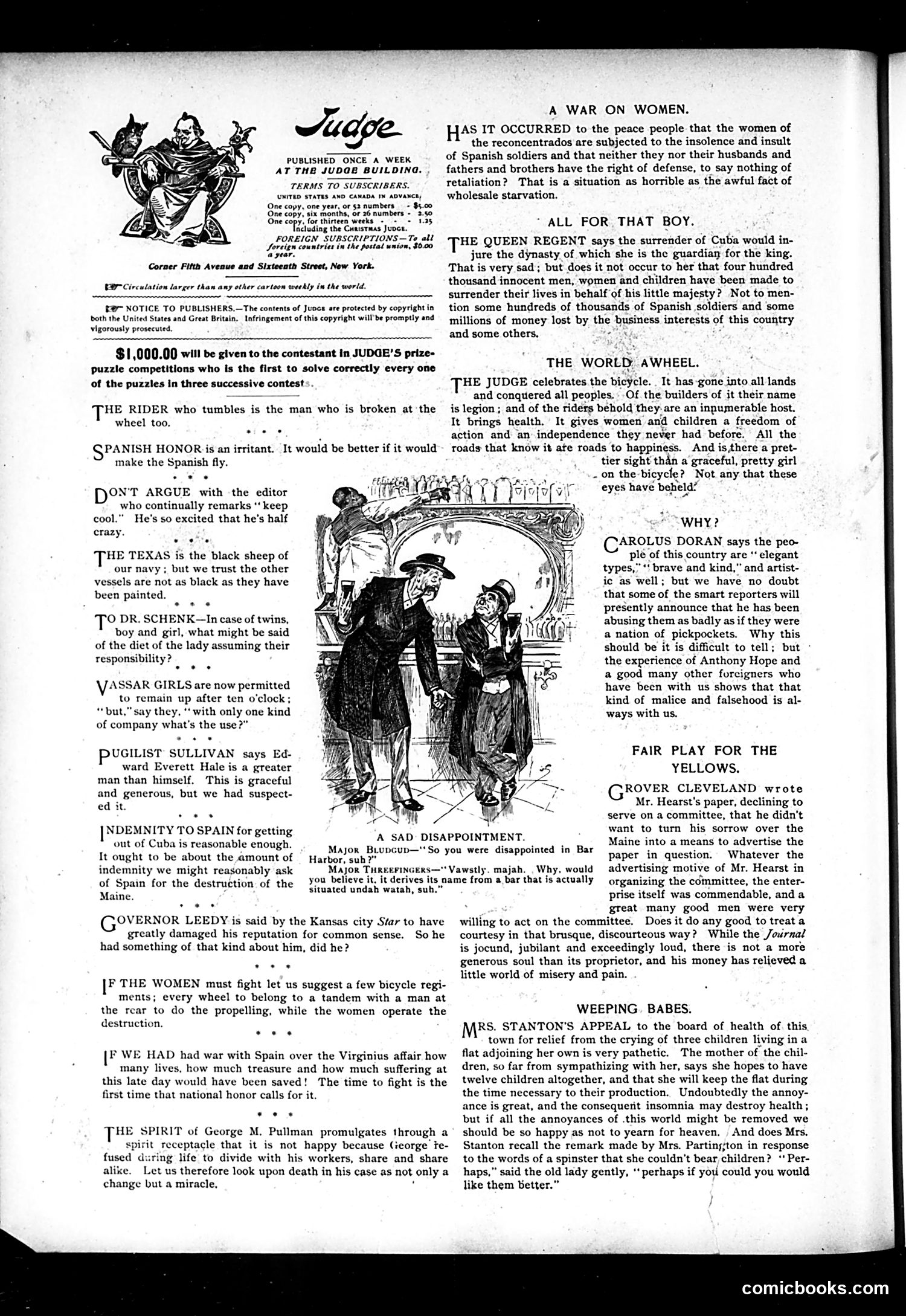
This page contains political commentary and opinion pieces rather than a single cartoon. The main illustrated piece shows two figures in conversation, with a caption about "Bar Harbor" and disappointment—likely satirizing wealthy Americans' social circles or vacation destinations. The articles reference contemporary issues: Spanish soldiers' conduct toward Cuban civilians during the Spanish-American War ("A War on Women"), Carolus Doran's commentary on foreigners' character, and Grover Cleveland's declining to serve on a committee. A piece titled "Weeping Babes" mocks a woman's appeal to reduce neighborhood noise from children, using sentimentality to criticize her complaint. The satire targets political hypocrisy, social pretension among the wealthy, and sentimental arguments. Without clearer context on specific dates or figures, precise attribution remains uncertain, though the Cuba references suggest late-1890s publication.
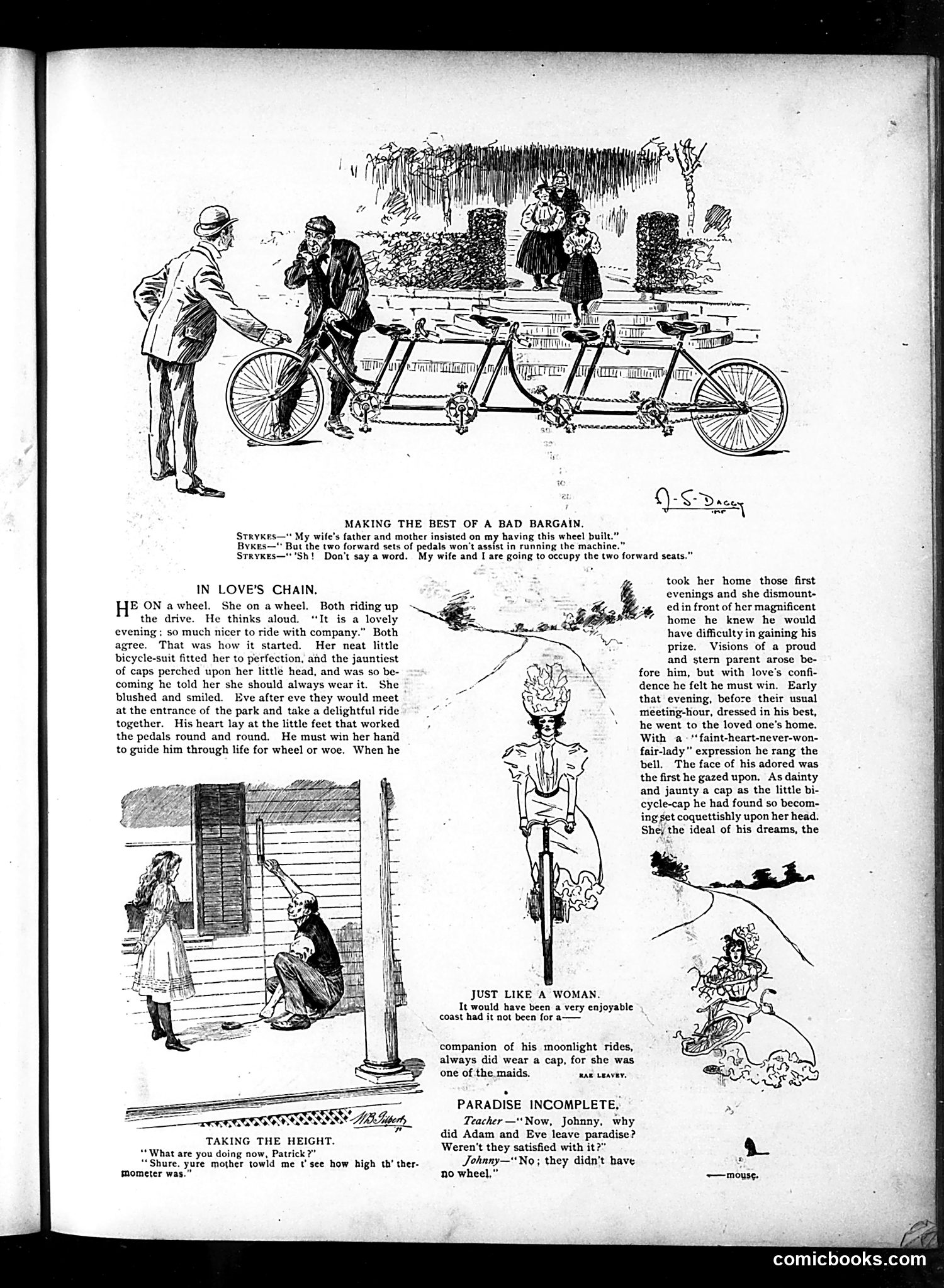
This page celebrates the bicycle craze of the 1890s through multiple satirical cartoons: **"Making the Best of a Bad Bargain"** mocks a man forced by in-laws to buy a tandem bicycle with non-functional pedals—a joke about unwanted family obligations. **"In Love's Chain"** romanticizes courtship via bicycle riding, where a man falls for a woman cyclist, only to discover she's actually a maid (the family servant wearing a cap). The satire critiques class pretensions and the illusions of romance. **Other shorts** include Irish dialect humor ("Taking the Height"), gender stereotypes ("Just Like a Woman"), and a joke making bicycles central to human happiness—even more essential than paradise itself. The page reflects the bicycle's cultural significance in 1890s America: it enabled leisure dating, challenged social hierarchies (servants could access the same public spaces as their employers), and became tied to women's independence and fashion. The humor often relies on class anxiety and romantic confusion enabled by cycling's social democratization.
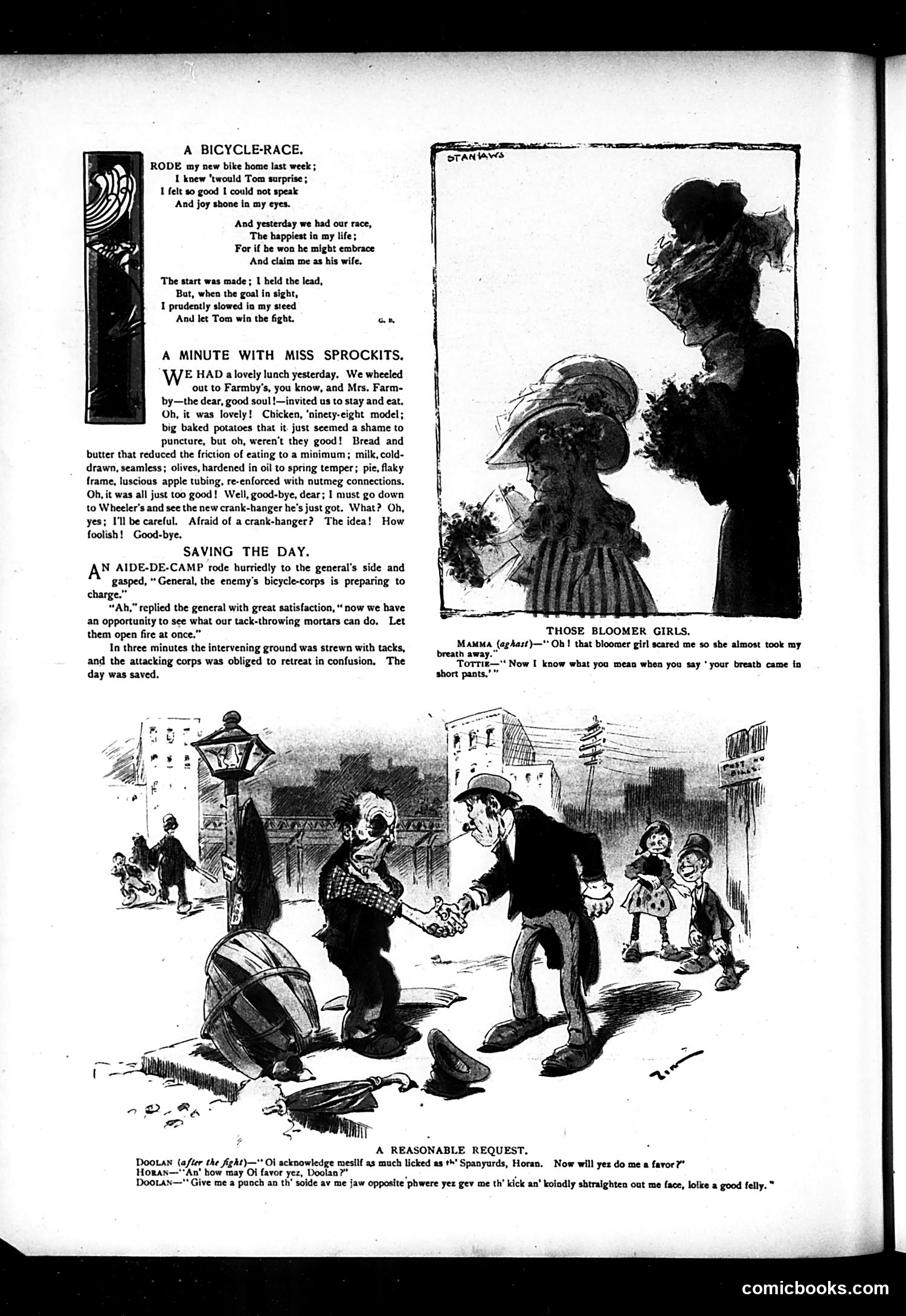
This page satirizes the bicycle craze and "New Woman" of the 1890s through several pieces: **"A Bicycle-Race"**: A poem mocking courtship rituals—a woman deliberately loses a race to her suitor, Tom, to secure marriage, suggesting women strategically underperform to win husbands. **"A Minute with Miss Sprockits"**: Mocks bicycling enthusiasts using mechanical language ("crank-hanger," "friction") to describe a social outing, satirizing how bike culture permeated genteel society conversation. **"Saving the Day"**: A military satire imagining bicycles as weaponry—an enemy "bicycle-corps" is defeated by scattering tacks, ridiculing contemporary anxieties about technology and military innovation. **"Those Bloomer Girls"**: References women wearing bloomers (practical cycling attire), with a pun on "breath came in short pants"—mocking both the garment and the social scandal of women in trousers. **"A Reasonable Request"**: An ethnic joke featuring Irish characters (Doolan, Horan) in a street fight, typical of period humor. The page reflects upper-class anxiety about bicycles as agents of social change, particularly women's independence and fashion.
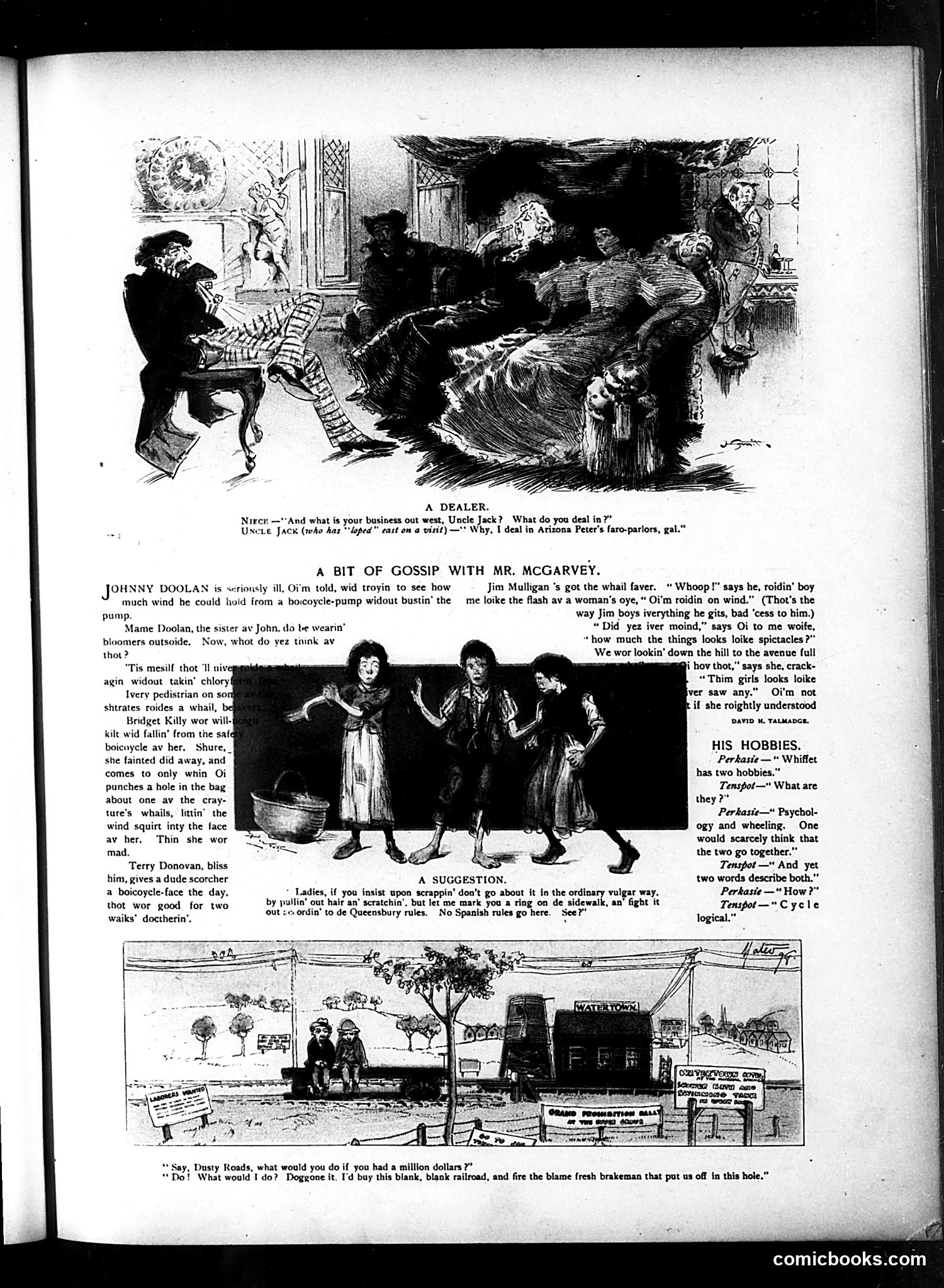
This page contains three distinct satirical pieces targeting Irish-American stereotypes and social issues of the era: **"A Dealer"**: A brief joke mocking an Irishman ("Uncle Jack") who admits to dealing in faro parlors (illegal gambling operations) out West, presented as casual business. **"A Bit of Gossip with Mr. McGarvey"**: A gossip column written in exaggerated Irish dialect, recounting neighborhood anecdotes about working-class Irish characters—illness from bicycle pumps, women wearing bloomers, cycling accidents. The humor relies on ethnic stereotyping and malapropisms. **"A Suggestion"** and **"His Hobbies"**: Brief joke exchanges depicting Irish and working-class characters with crude speech patterns. **"Dusty Roads" (bottom)**: A railroad worker expressing frustration about being fired, wanting revenge through sabotage—commentary on labor discontent. The page reflects Judge magazine's consistent use of Irish-American caricature for comedy, relying on dialect humor and stereotypical situations rather than political commentary. The content reveals period attitudes toward Irish immigrants and working-class labor disputes.
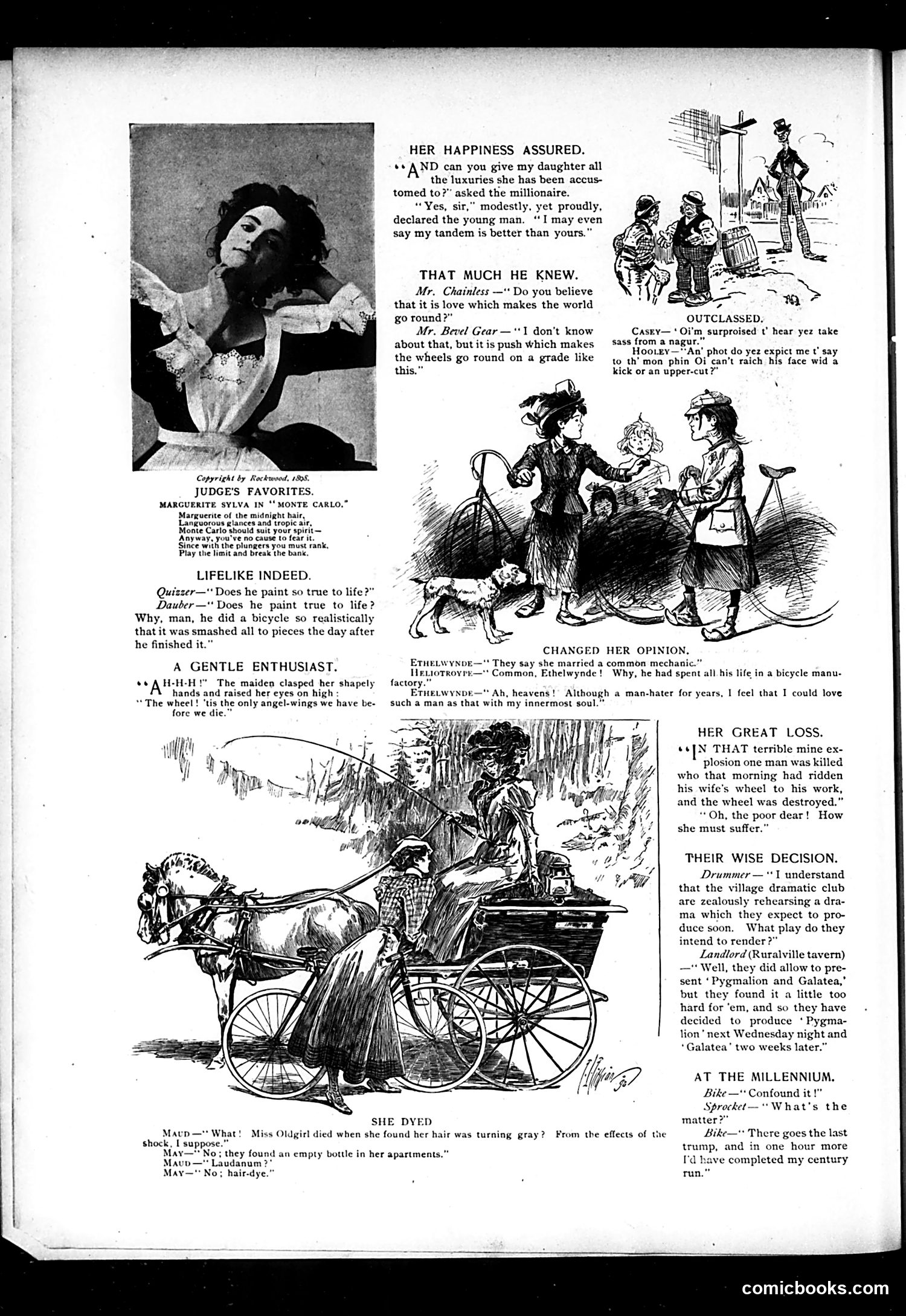
This page collects humorous vignettes satirizing the bicycle craze of the 1890s. The bicycle was revolutionary technology that disrupted social hierarchies and gender norms. **Key satirical points:** - **Class anxiety**: A wealthy father accepts his daughter's suitor solely because the young man owns a superior bicycle ("my tandem is better than yours"), mocking how bicycle ownership became a status symbol. - **Gender disruption**: A woman who was a "man-hater for years" falls in love with a bicycle mechanic, suggesting bicycles and mechanical work elevated working-class men's social status. - **Obsession**: Multiple jokes depict bicycles as dangerously life-consuming—a man dies in a mine explosion, but the real tragedy is his lost bicycle; a painter renders a bicycle so realistically it gets smashed. - **Irish/working-class humor**: Dialect jokes mock lower-class characters unfamiliar with bicycle culture. The satire captures contemporary anxiety about how bicycles were transforming Victorian society's rigid class and gender structures.
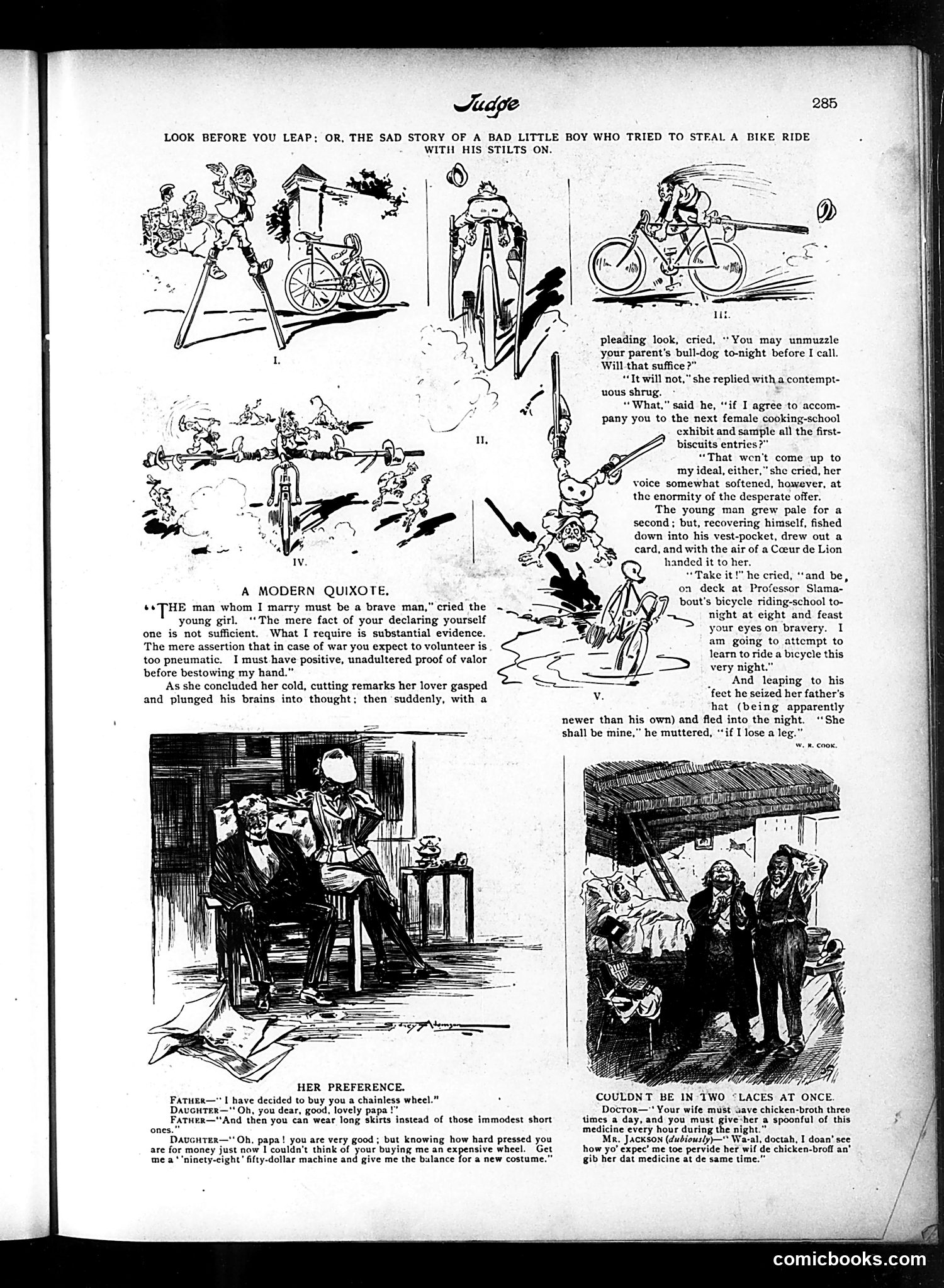
This page contains three separate satirical pieces reflecting late-19th/early-20th-century American concerns: **"A Modern Quixote"** mocks the "New Woman" era by showing a young woman demanding proof of a suitor's bravery. His absurd solution—enrolling in a bicycle riding school—satirizes how the bicycle had become symbolic of women's liberation and modern independence. The young man's willingness to risk injury learning to ride reflects contemporary anxiety about changing gender roles. **"Her Preference"** humorously depicts a father offering his daughter an expensive "chainless wheel" (early automobile or motorized bike) as a status symbol, only to have her demand both the vehicle AND money for a new costume—satirizing female materialism and consumerism. **"Couldn't Be in Two Places at Once"** presents a humorous medical scenario where a rural Black man (indicated by dialect) cannot simultaneously administer chicken broth and medicine to his wife, poking fun at practical domestic absurdities. The page reflects period preoccupations: women's changing roles, consumer culture, and rural/urban contrasts.
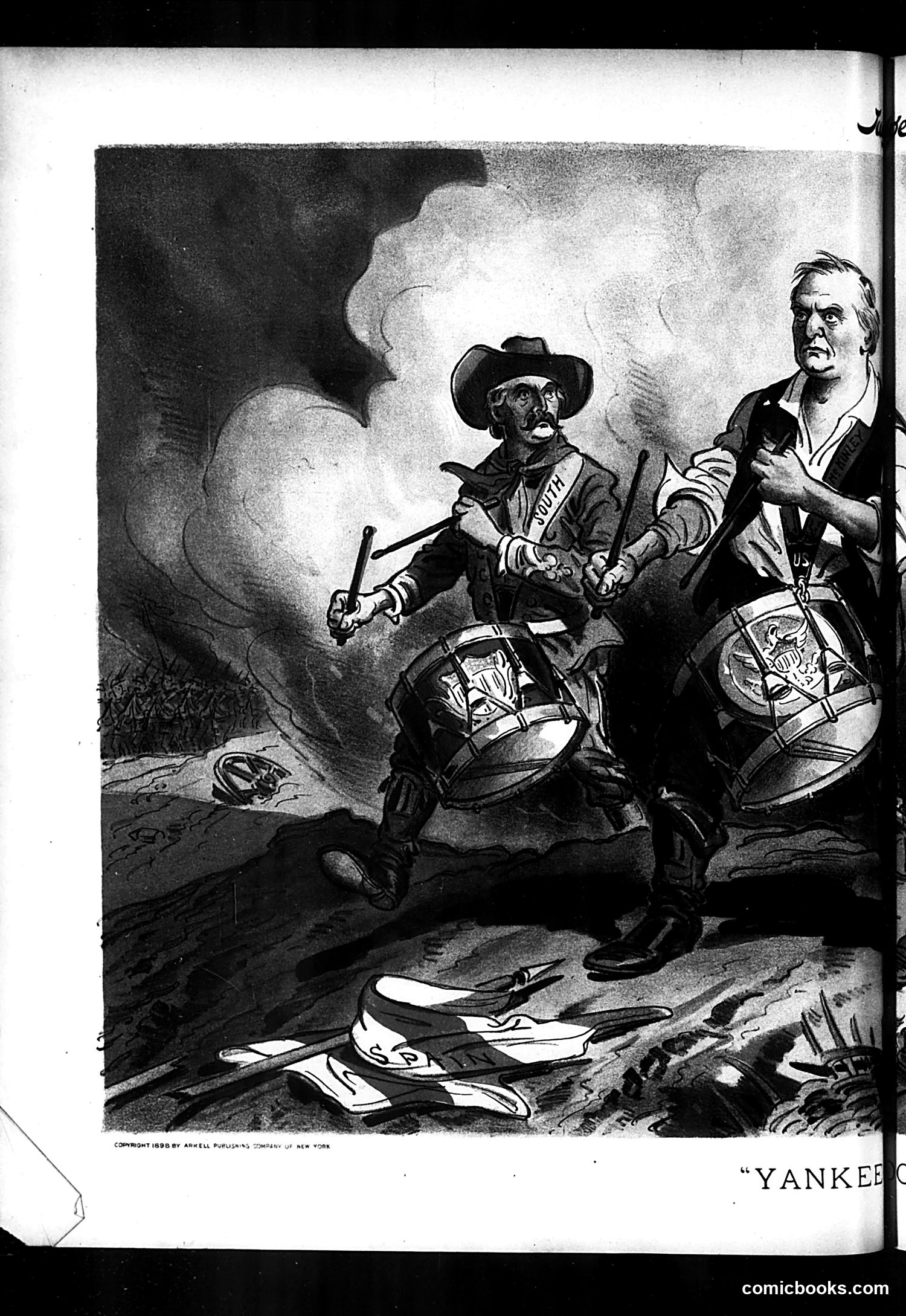
This appears to be a political cartoon titled "Yankee[?]" from **Judge** magazine, though the complete title is cut off. The image shows two figures dressed as American soldiers or military personnel with drums, positioned dramatically against a dark, smoky background suggesting warfare or conflict. The cartoon likely satirizes American military involvement or foreign policy from the period when Judge was actively published. The soldiers' exaggerated expressions and theatrical poses suggest mockery of military posturing or warmongering rhetoric. However, **without the complete title, date, or visible OCR text beyond the fragmentary heading, I cannot definitively identify which specific conflict, political figure, or historical event this cartoon references**. The style and technique suggest late 19th or early 20th century production, but precise dating and interpretation require additional context not fully legible in this reproduction.
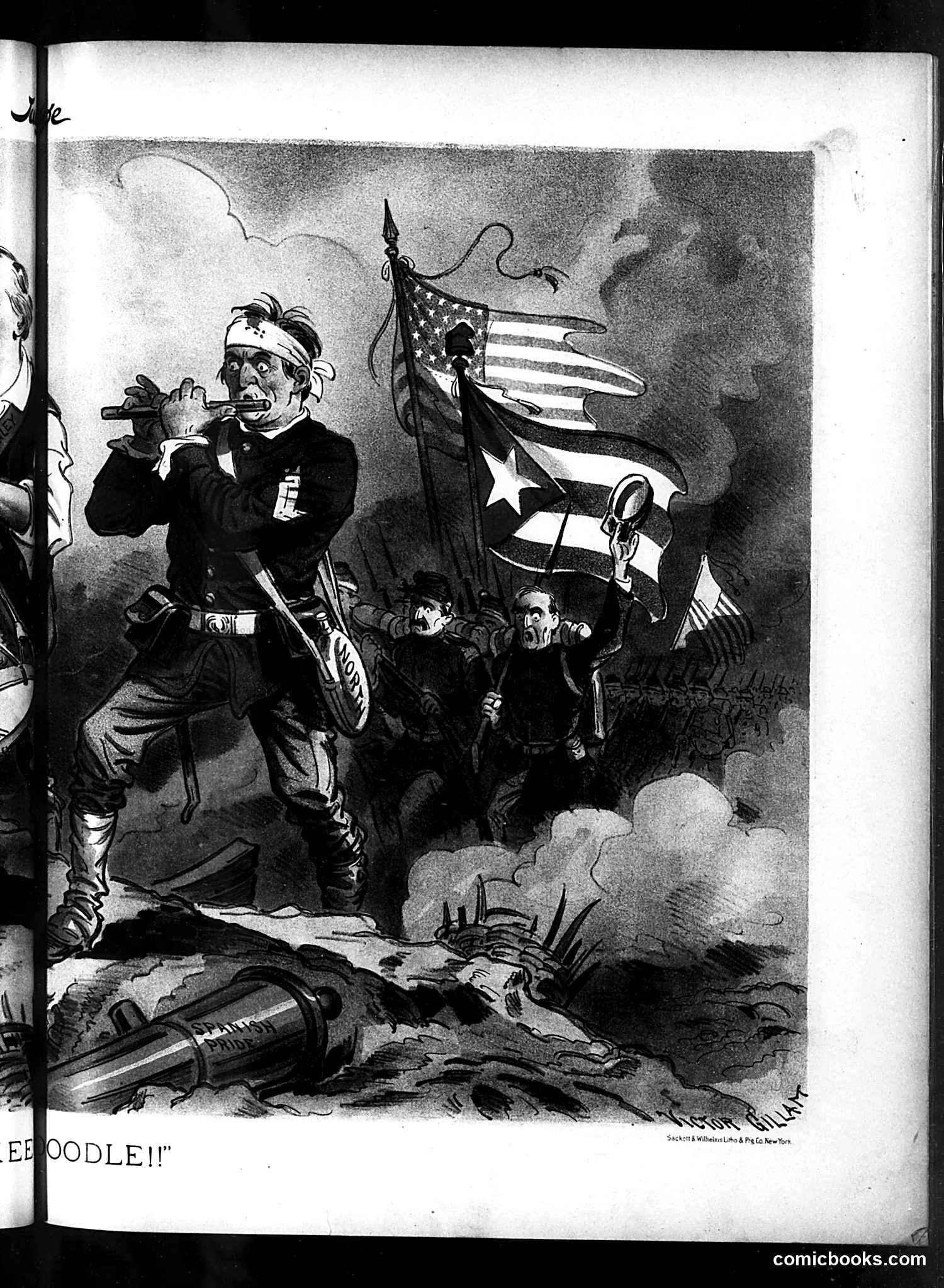
This satirical cartoon depicts a military or political figure (caricatured with exaggerated features) blowing a horn or bugle while holding what appears to be the Cuban flag. Smaller figures huddle beneath, and fallen military equipment and debris scatter the ground below. The title "Ebb Oodle!!" likely references political corruption or graft ("boodle" was period slang for bribery/fraud). The Cuban flag suggests this concerns American intervention or policy regarding Cuba, probably during the Spanish-American War era or its aftermath. The cartoon satirizes a military leader using patriotic rhetoric (the flag, the horn call) while the wreckage and smaller figures suggest actual human and material costs being ignored or minimized by political posturing. Without the date, specific identity remains unclear.
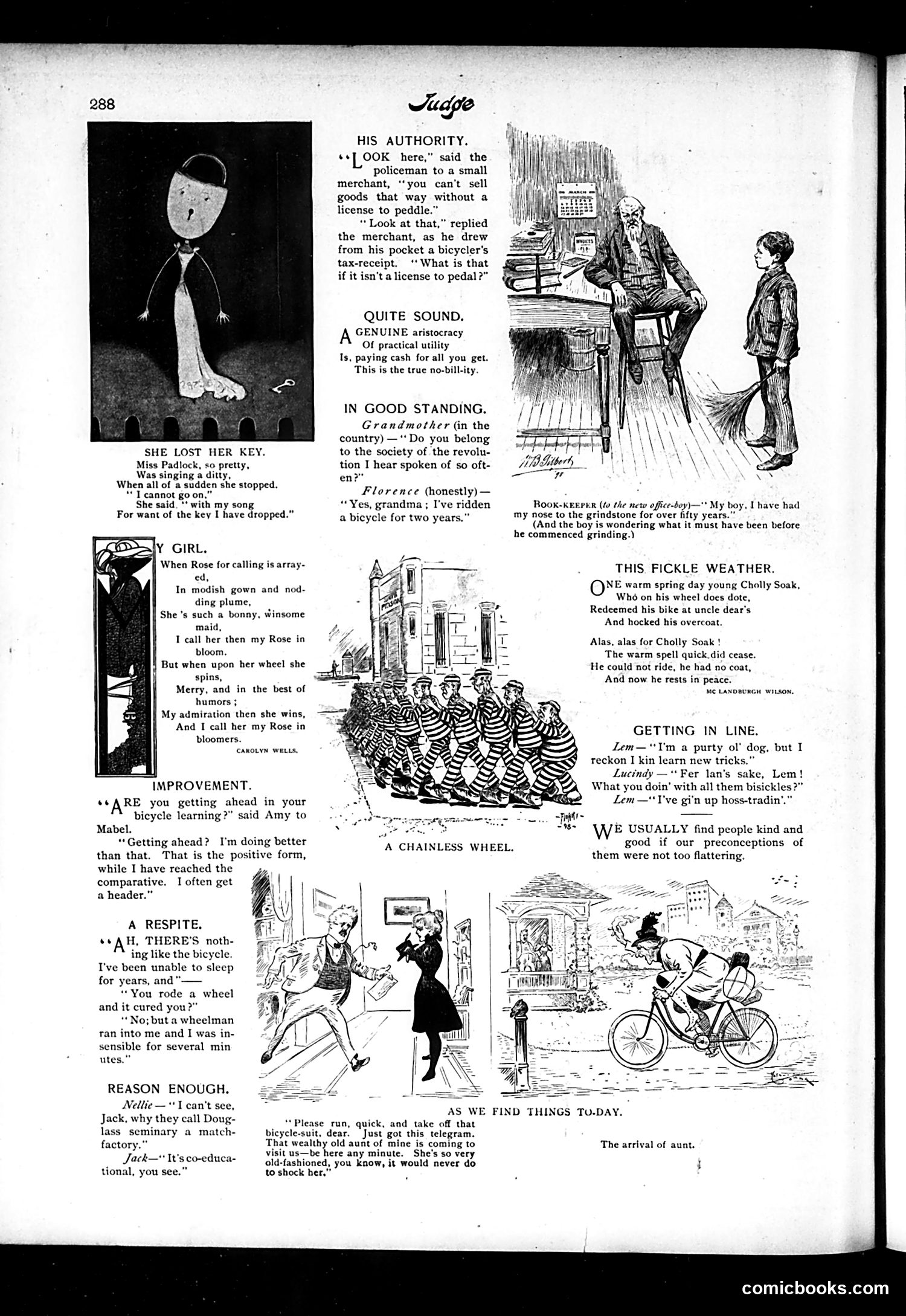
This page contains multiple short humorous pieces satirizing late 19th/early 20th-century American society, particularly fixated on the bicycle craze. **"His Authority"** mocks bureaucratic absurdity: a merchant argues a bicycle tax-receipt serves as a peddling license—a pun on "pedal/peddle." **"She Lost Her Key"** and **"Ivy Girl"** are light romantic verses about women in bloomers (the cycling outfit that scandalized conservatives). **"This Fickle Weather"** satirizes the bicycle's grip on fashion: a man pawns his coat to afford a bike, then can't use it when spring ends—trapped by his own materialism. **"A Chainless Wheel"** jokes about a woman arriving late to social gatherings via bicycle, considered undignified. **"Getting in Line"** presents rural dialect humor about an elderly man taking up cycling. The overall theme: Judge ridicules how the bicycle had become a social obsession, disrupting traditional gender norms (women in bloomers), class pretensions, and practical decision-making. The satire targets both the bicycle fad itself and society's dramatic reactions to it.
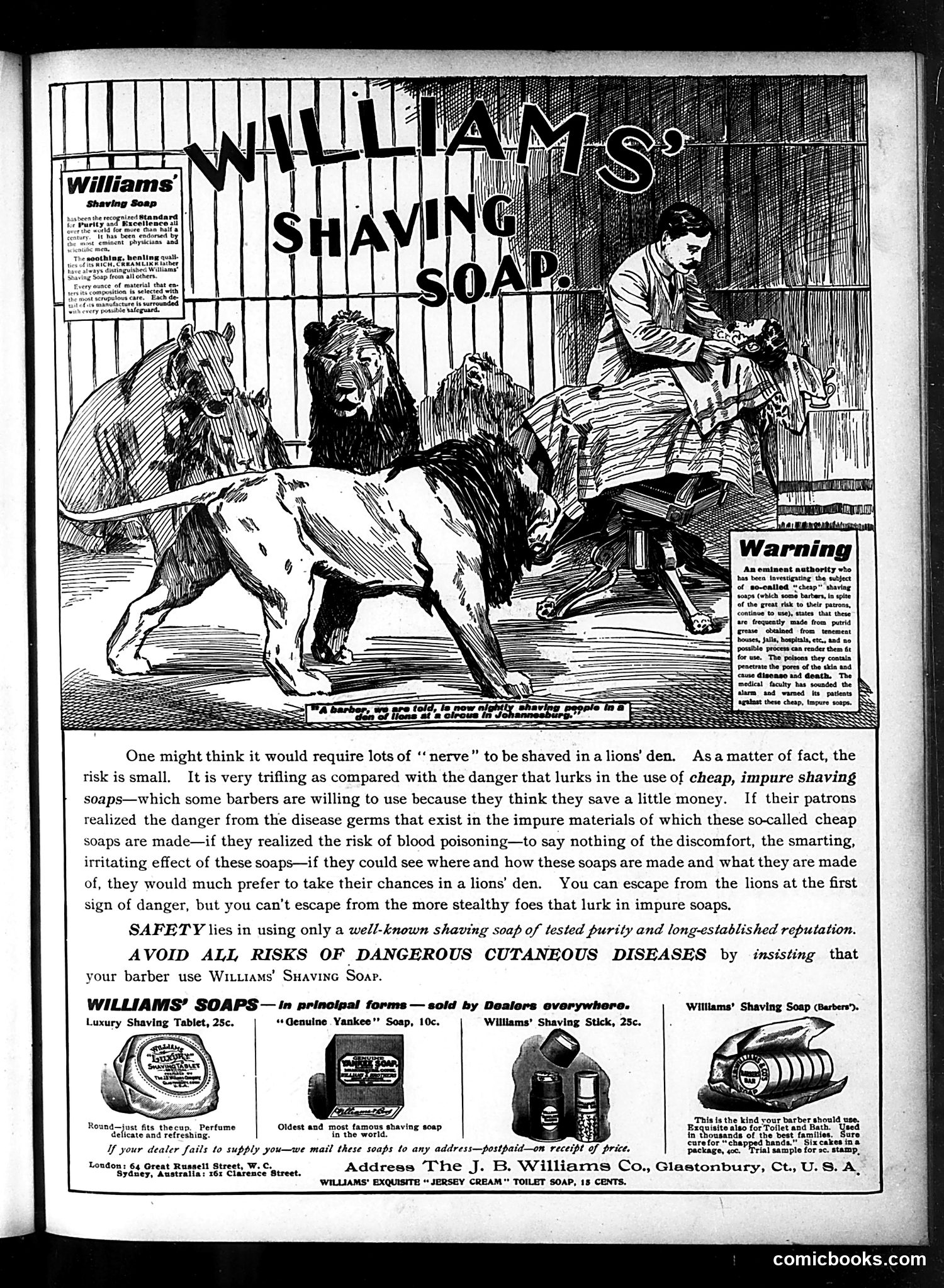
This is primarily a **product advertisement**, not political satire, though it uses sensationalist imagery to sell shaving soap. The cartoon depicts a barber shaving a customer while lions prowl nearby—a visual metaphor comparing the (manageable) danger of a lions' den to the (overlooked) hazard of cheap shaving soap. The accompanying text warns that some barbers use inferior soaps made from contaminated materials (allegedly including "putrid grease" from tenements and hospitals) to save money, risking customers' health through infection and blood poisoning. The "Warning" box cites an unnamed "eminent authority" investigating cheap soap manufacturing, lending credibility to the fear-based pitch. The advertisement's core argument: choosing Williams' soap—with its "tested purity and long-established reputation"—protects against "dangerous cutaneous diseases" better than gambling with unsafe alternatives. This reflects early 20th-century concerns about product safety and manufacturing standards before modern regulation.
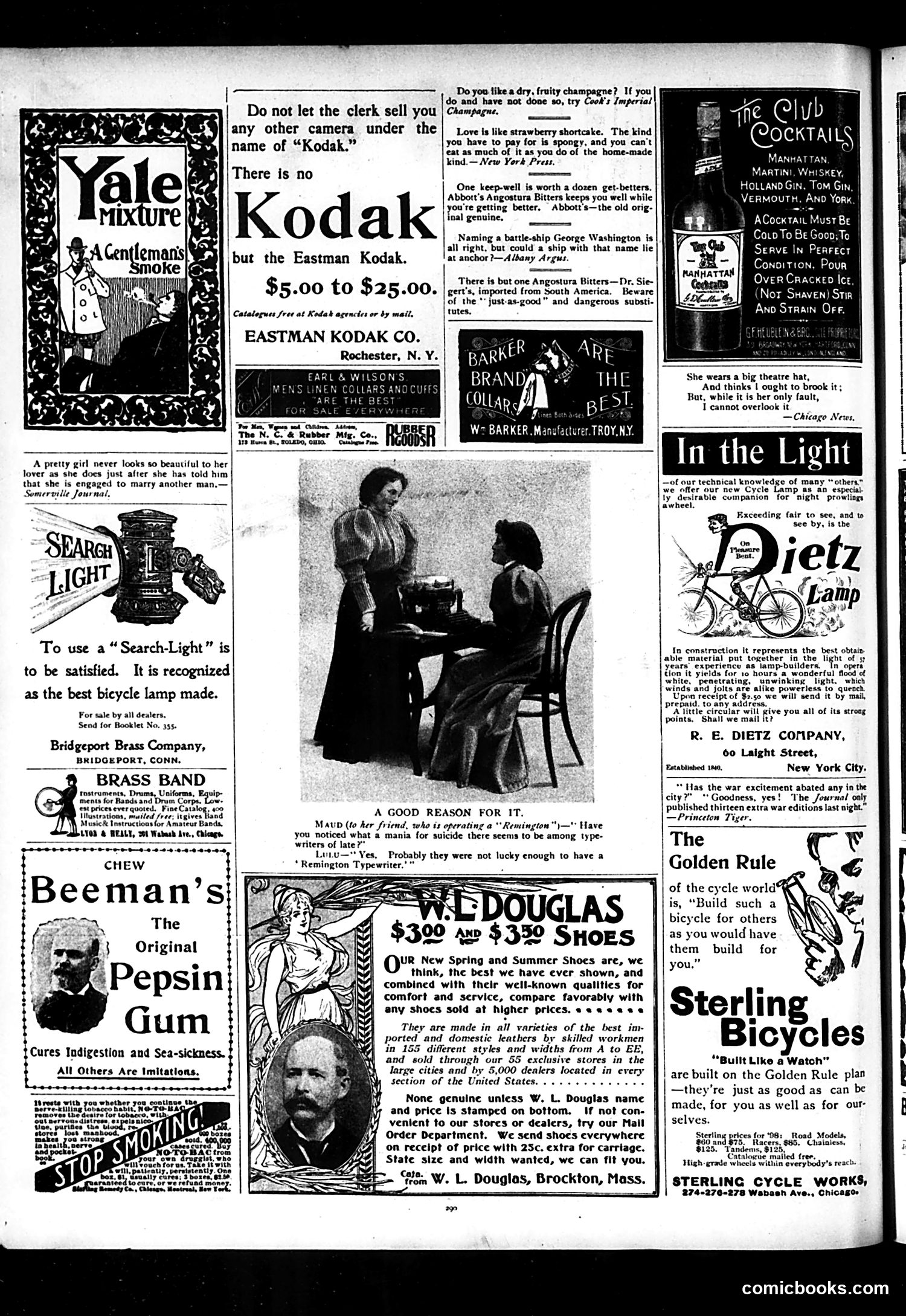
This is primarily an **advertising page**, not a satirical cartoon. It contains multiple product advertisements typical of early 20th-century magazines, including: - **Kodak cameras** (Eastman Kodak asserting brand exclusivity) - **Bicycles and bicycle accessories** (Search-Light lamps, Sterling Bicycles) - **Shoes** (W.L. Douglas brand) - **Patent medicines** (Abbott's Angostura Bitters, Beeman's Pepsin Gum) - **Typewriters** (Remington) The page includes one humorous line: a brief joke about typewriter writers contemplating suicide, presented as a Remington advertisement. Otherwise, it consists of standard commercial pitches with period illustrations and pricing. The only identifiable figure is the photograph labeled "A Good Reason for It," showing what appears to be a domestic scene between two women, though the context remains unclear without fuller caption information.
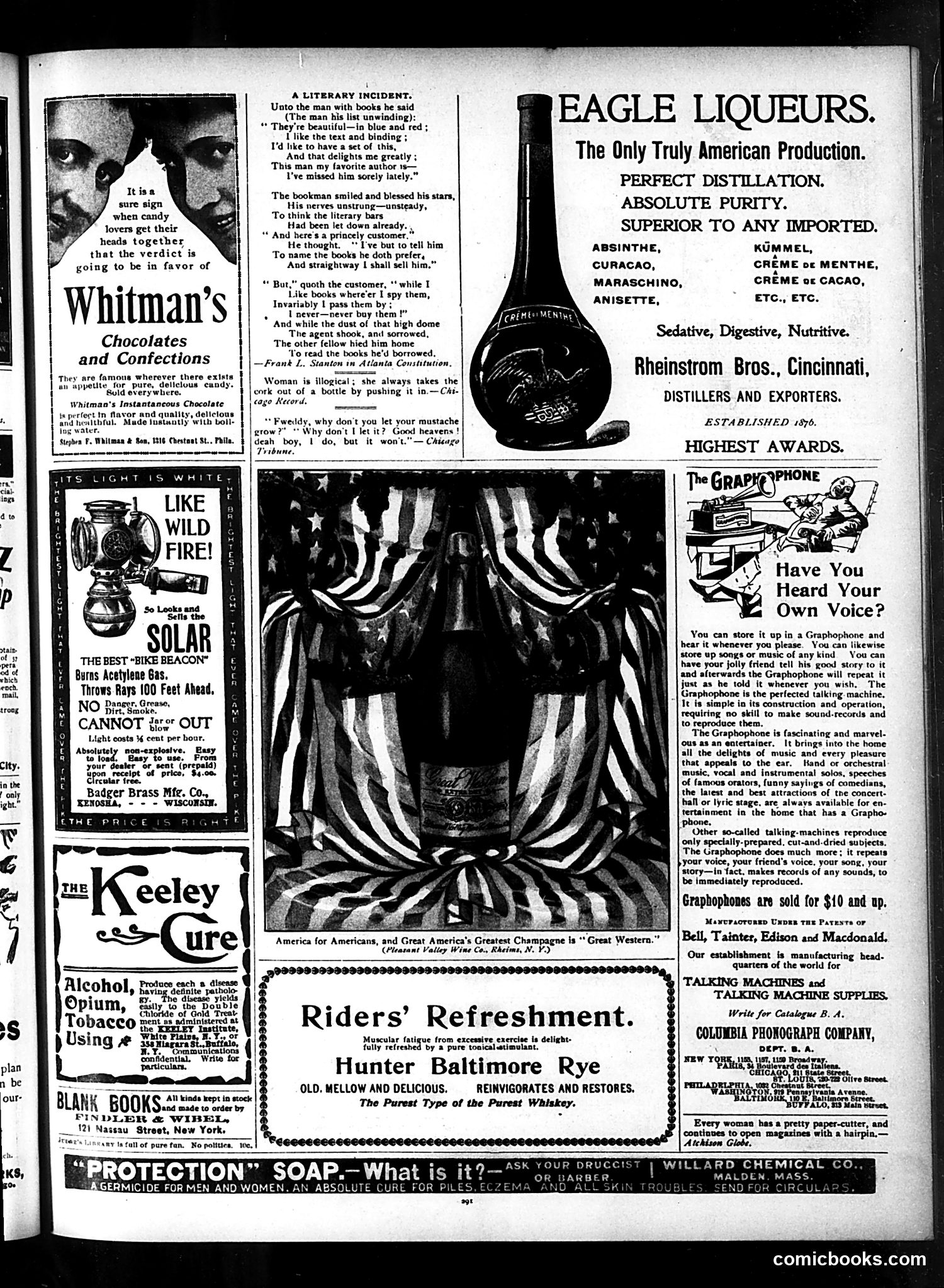
This page is primarily **advertising**, with one literary humor piece at the top. The main cartoon/article, "A Literary Incident," satirizes **consumer behavior and intellectual pretense**. A bookseller observes a customer examining books by a favorite author, assuming the customer will buy them because he loves the author. However, the customer reveals the ironic truth: he *never* actually purchases books—he only borrows them or has others read them aloud to him. The satire targets the gap between **claimed cultural sophistication and actual purchasing habits**. The customer appreciates literature enough to want it around but won't pay for it, exposing a common hypocrisy where people value books as status symbols without supporting authors financially. The remainder of the page consists of period advertisements for liqueurs (Eagle), chocolates (Whitman's), bicycle lamps, gramophones, and other consumer goods—typical of Judge's revenue model.
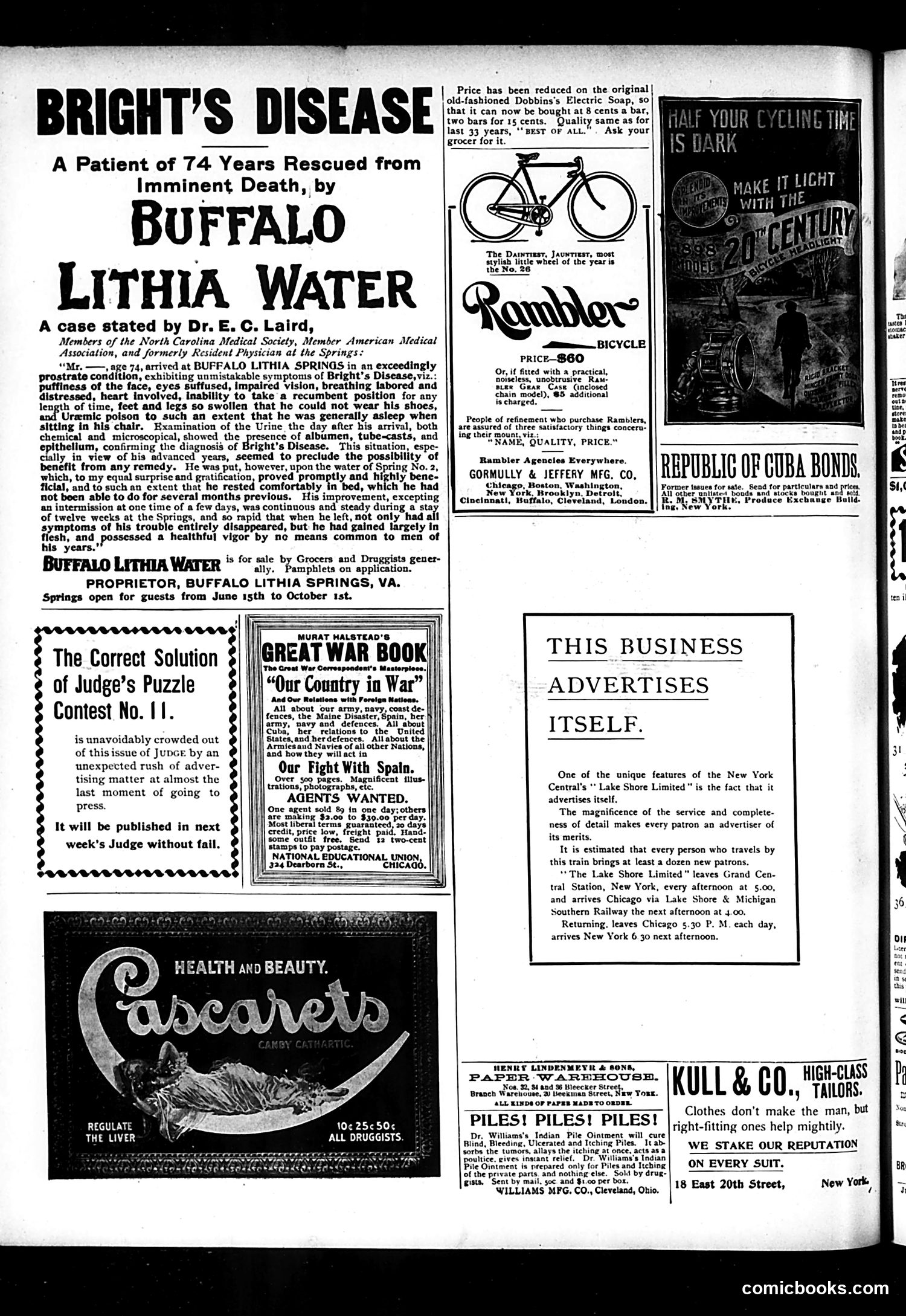
This page contains **no political cartoons or caricatures**—it is primarily advertisements and articles. The main content is a **testimonial advertisement** for Buffalo Lithia Water, promoting a mineral spring as a cure for Bright's disease (a kidney ailment). The advertisement presents a doctor's case study claiming a 74-year-old patient with severe Bright's disease symptoms (swelling, kidney failure signs) recovered after drinking spring water at Buffalo Lithia Springs, Virginia. The page also includes unrelated advertisements for: - A bicycle ("Rambler") - A patent medicine ("Cascarets") - A book about the Spanish-American War (relevant to Judge's 1898 timeframe) - Various other products **Context for modern readers:** This reflects the era's "patent medicine" craze, where mineral springs and bottled water were marketed as cure-alls. Bright's disease was genuinely serious and untreatable by modern standards; such testimonials exploited desperate patients and had no scientific basis.
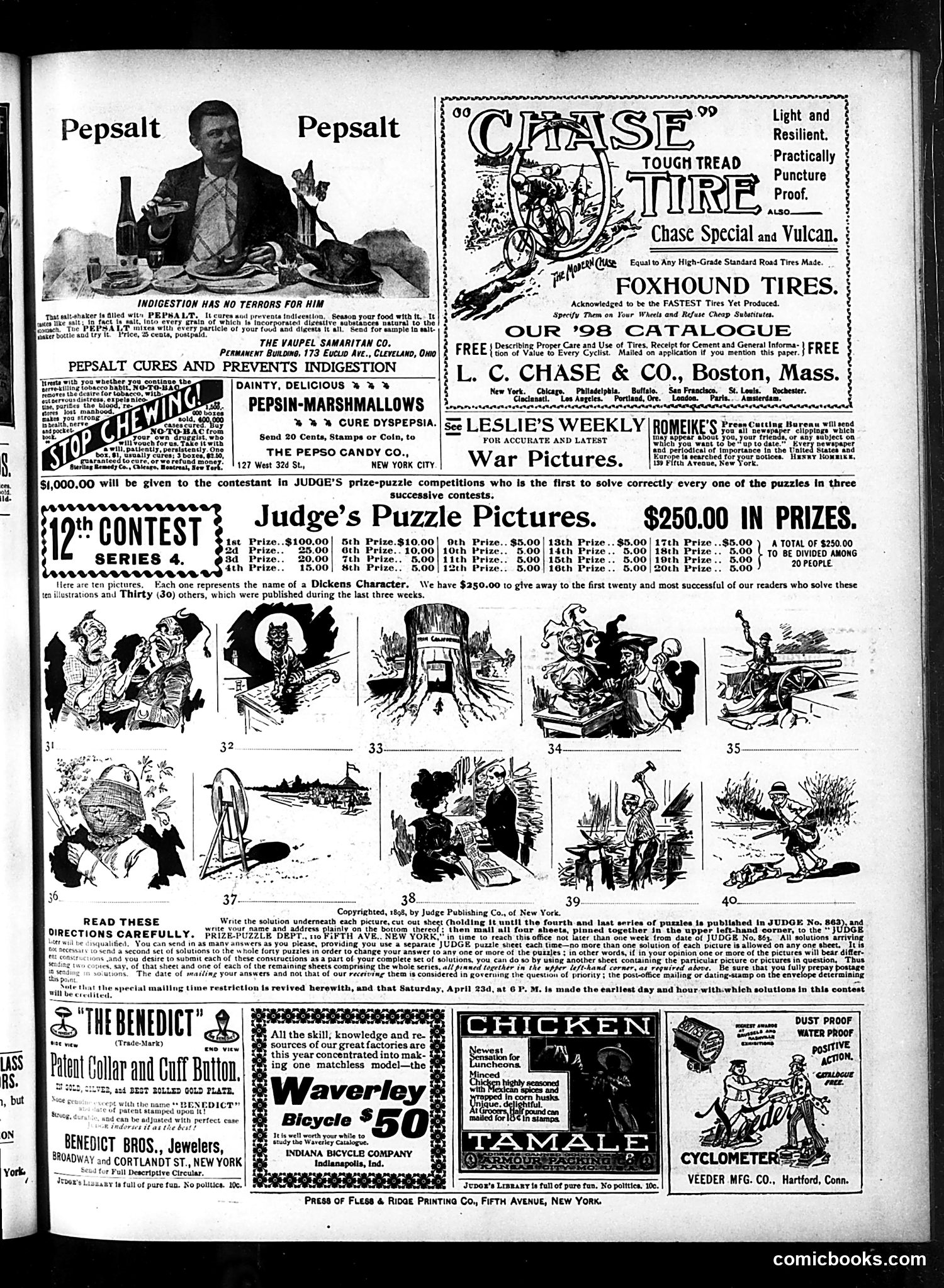
This page is primarily **advertising and a puzzle contest**, not political satire. The dominant content is Judge's "$250 Prize-Puzzle" competition featuring ten cartoon panels numbered 31-40, inviting readers to identify Dickens characters depicted in each illustration. The page is cluttered with product advertisements typical of 1898, including: - Pepsalt (digestive aid) - Chase tire company - Pepsin-marshmallows - Various other remedies and goods The puzzle instructions are elaborate, requiring readers to collect four consecutive weeks of puzzle sheets and mail them together by April 23rd. Winners receive prizes totaling $250. **The actual puzzle cartoons** (images 31-40) appear to be humorous vignettes meant to evoke specific Dickens characters through visual caricature and situation, though the individual character identifications aren't legible at this image resolution. This represents Judge functioning as entertainment/engagement vehicle rather than primarily as political commentary on this particular page.
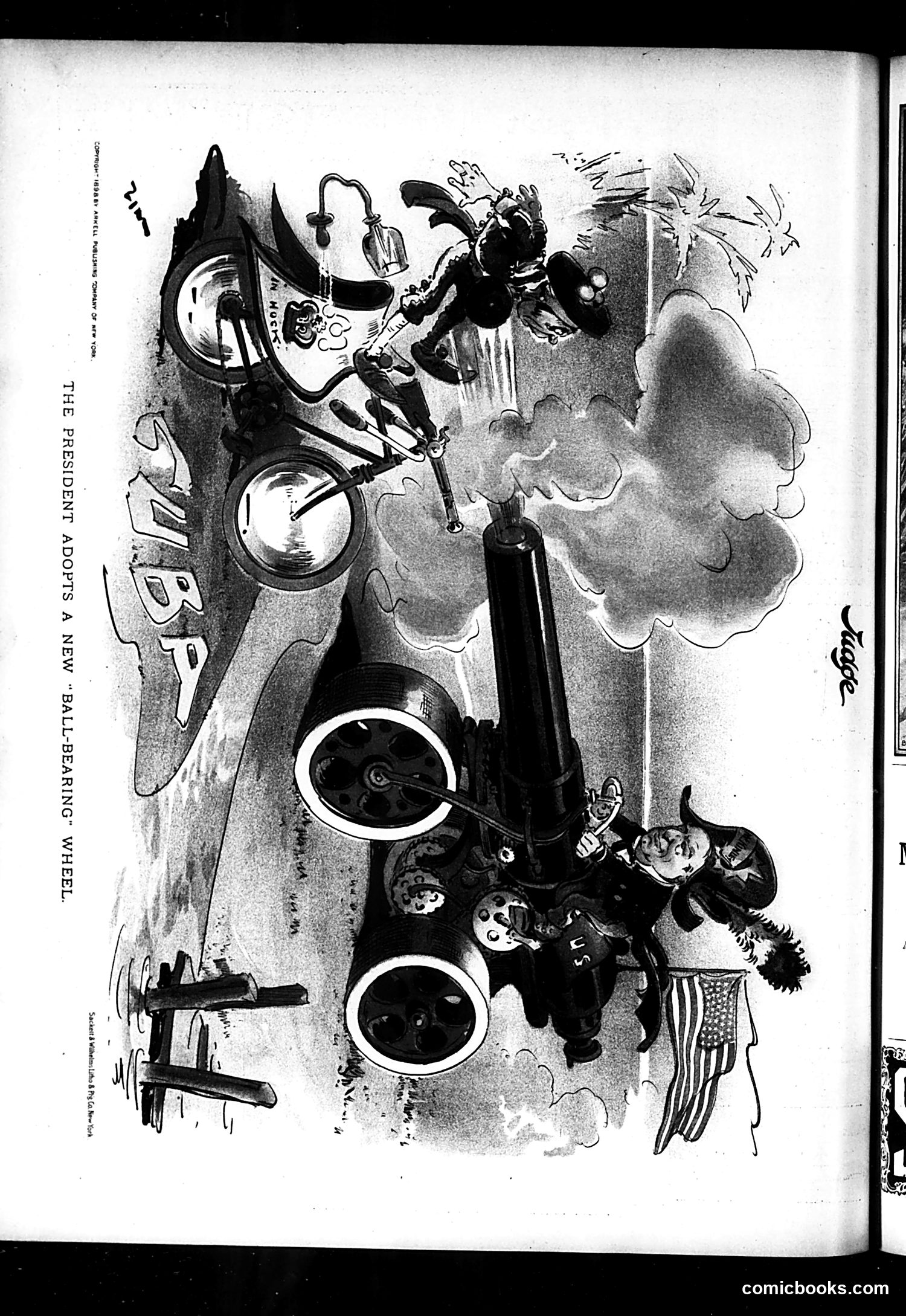
This political cartoon satirizes the President's adoption of a "ball-bearing wheel"—a metaphor for some new policy or approach. The image shows what appears to be an early automobile or mechanical device with rotating wheels, with figures operating or riding on it. The cartoon likely critiques the President for implementing a supposedly modern or efficient solution that the cartoonist views skeptically. The "ball-bearing" reference suggests the satire concerns technological innovation or administrative efficiency being adopted at the executive level. Without the publication date visible, the specific President and policy remain unclear, though the cartoon's style suggests early 20th century. The cartoonist's intent appears critical—suggesting the new approach is either impractical, unstable, or merely cosmetic change rather than substantive reform. The mechanical imagery emphasizes the cartoonist's skepticism about the initiative's actual effectiveness.
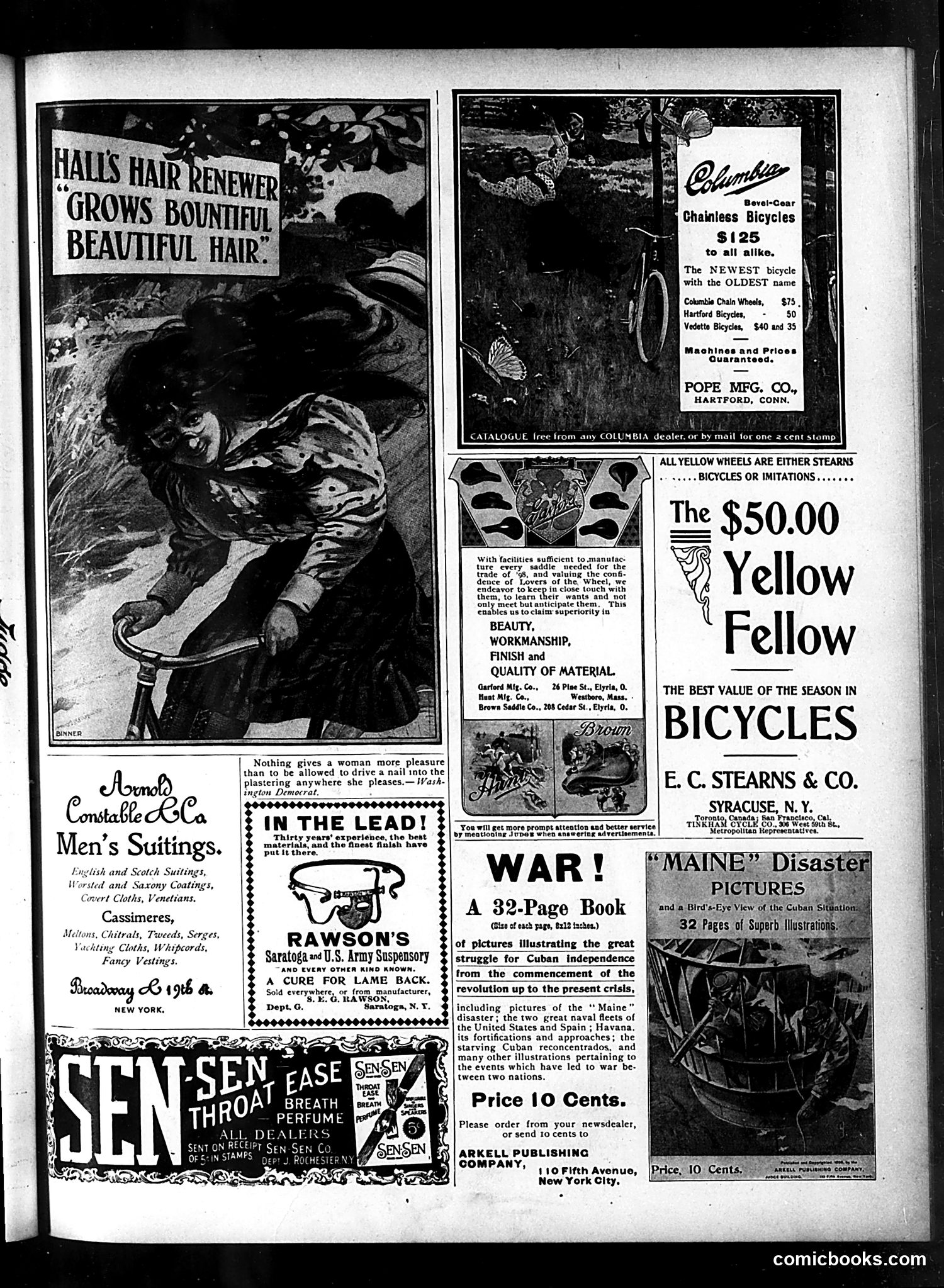
This page is primarily **advertising**, with no significant political cartoon or satirical content. The layout features various product advertisements from circa 1898, including: - Hair renewal products and men's clothing (Arnold Constable & Co.) - Bicycles (Columbia, Hartford, Vedette, Stearns brands) - Medical devices (Rawson's suspensory for "lame back") - Throat perfume (Sen-Sen) The only content approaching editorial commentary is a brief quoted joke: "Nothing gives a woman more pleasure than to be allowed to drive a nail into the plastering anywhere she pleases"—a mild domestic humor suggesting women's limited autonomy in home decoration. The most notable non-advertisement item is a small promotional box for a 32-page illustrated book about the **Cuban War for Independence**, priced 10 cents, suggesting this magazine dates to 1898 during the Spanish-American War period. This reflects contemporary American interest in Cuban affairs rather than satirical commentary.
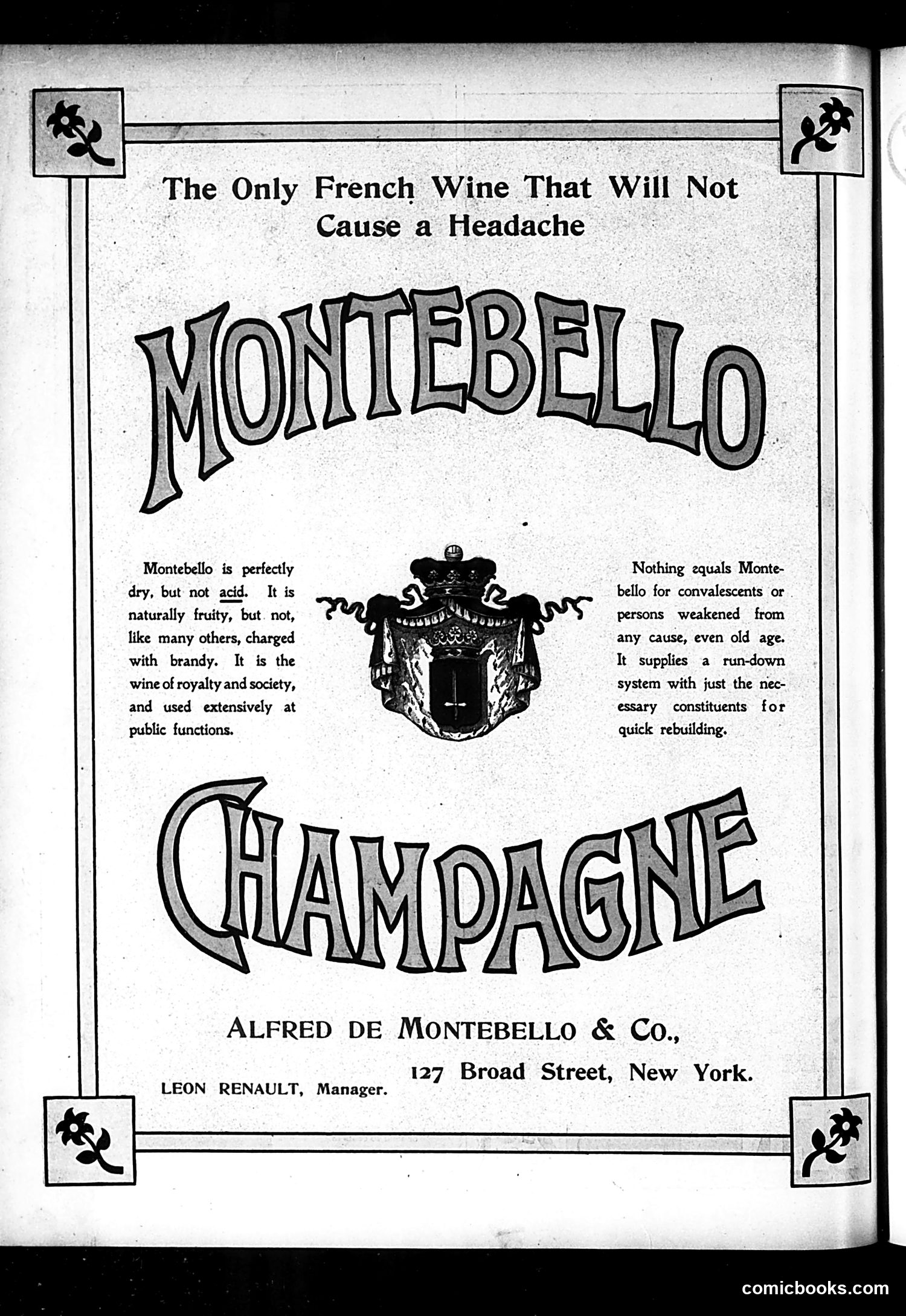
This is a **wine advertisement**, not a political cartoon. It's a full-page ad for Montebello Champagne by Alfred de Montebello & Co., positioned in *Judge* magazine. The headline uses humor to market the product: "The Only French Wine That Will Not Cause a Headache." This plays on the common complaint that French wines—particularly cheaper varieties or those "charged with brandy"—caused headaches, likely from additives or poor quality. The ad claims Montebello's superiority through purity ("perfectly dry, but not acid") and social prestige ("wine of royalty and society"). The right column makes a health claim: the wine is beneficial for "convalescents or persons weakened from any cause, even old age"—a common medicinal pitch for wines in this era, before modern FDA regulations prohibited such claims. The heraldic coat of arms adds legitimacy and aristocratic cachet. This is straightforward advertising using period conventions of class aspiration and dubious health claims.