
A complete issue · 16 pages · 1898
Judge — April 23, 1898
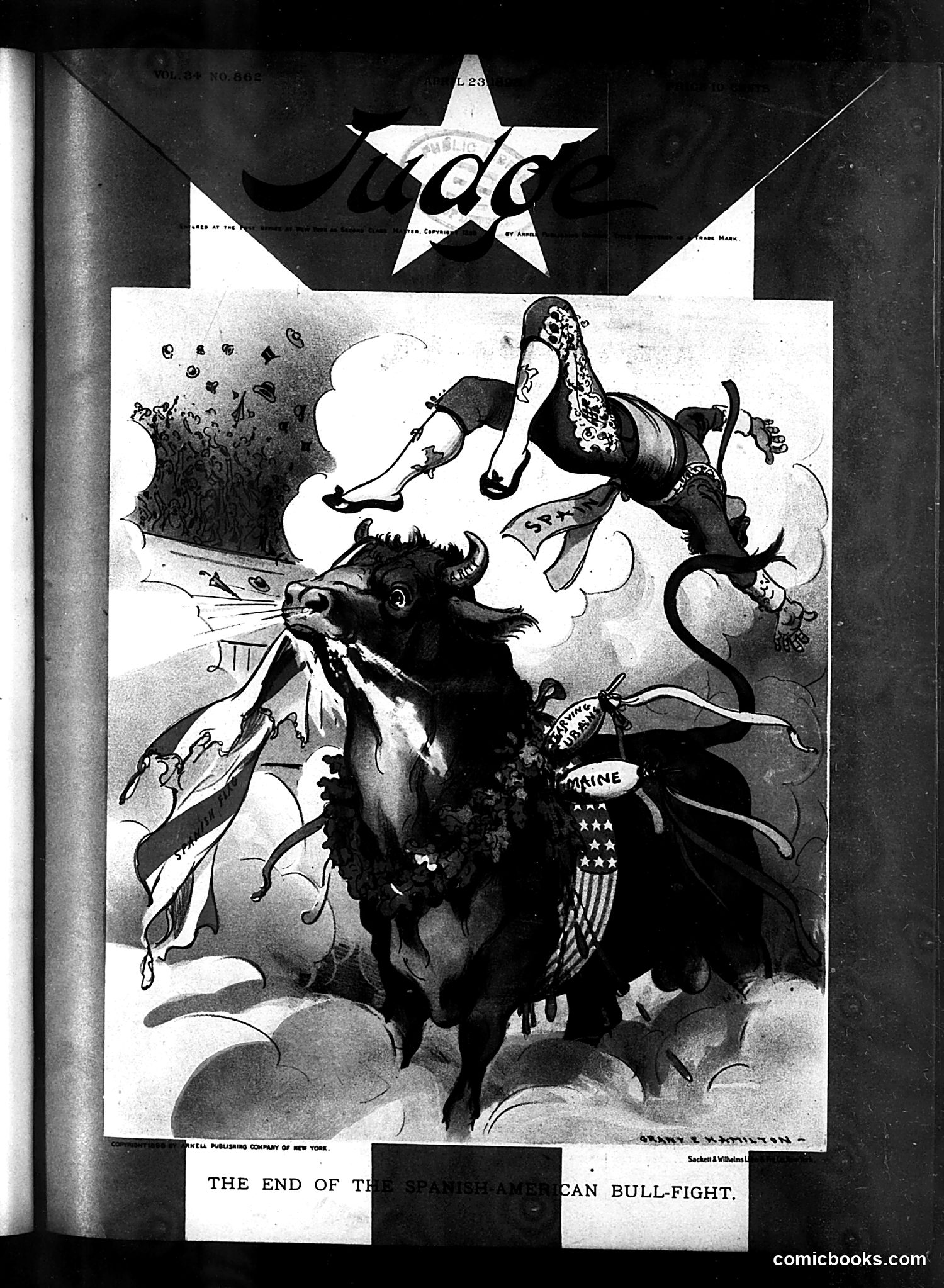
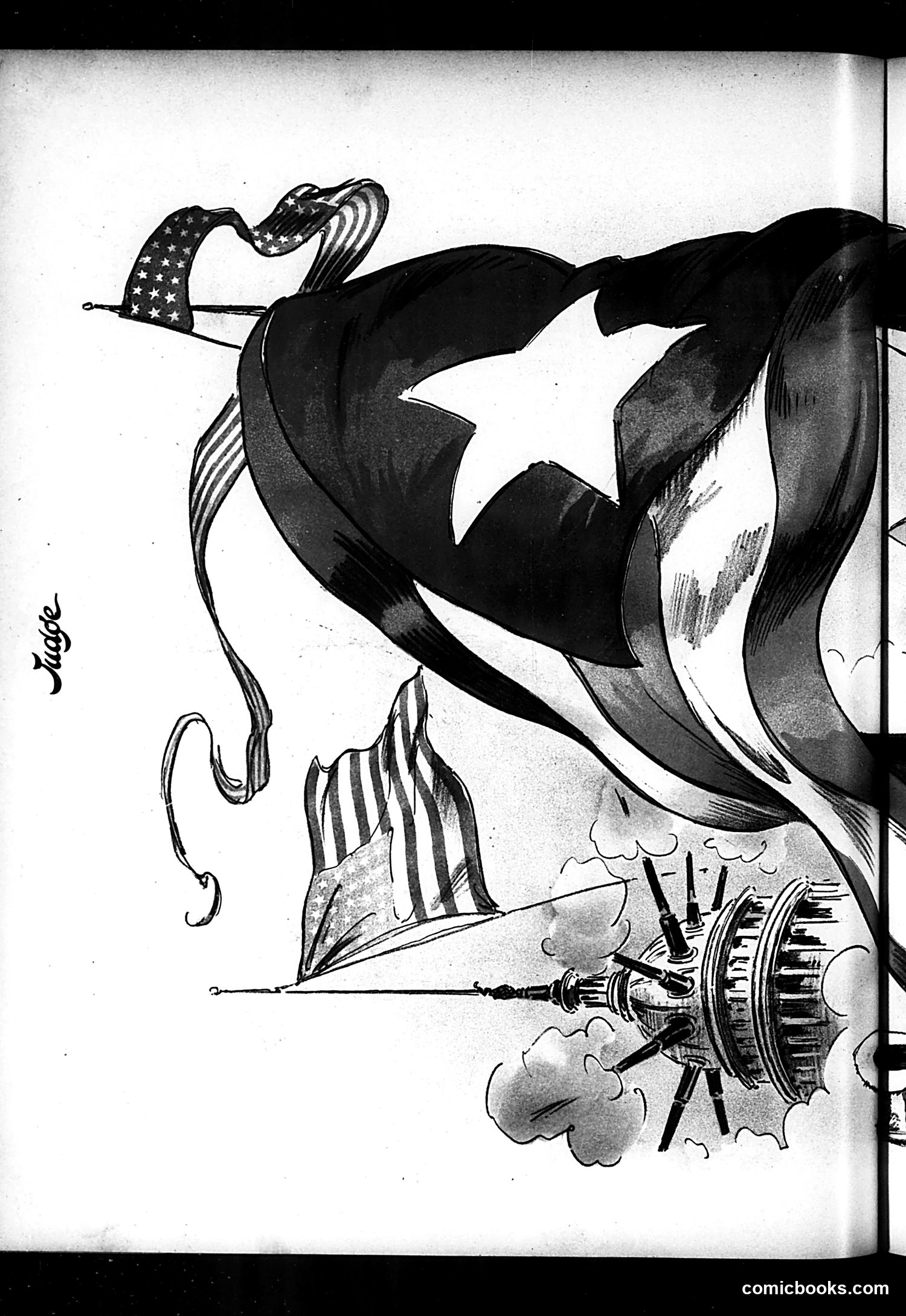
This political cartoon satirizes the Spanish-American War (1898). The central figure is a bull wearing what appears to be Spanish military regalia, representing Spain. It's being attacked by various American figures and symbols—including what looks like Uncle Sam's top hat and military imagery—depicted as matadors and picadors. The title's pun equates Spain's military defeat to a bullfight's conclusion: the bull (Spain) is being killed. The cartoon celebrates American victory in the brief conflict that resulted in Spain ceding territories including Cuba, Puerto Rico, and the Philippines to the United States. This reflects Judge magazine's pro-expansionist stance during the period of American imperialism.
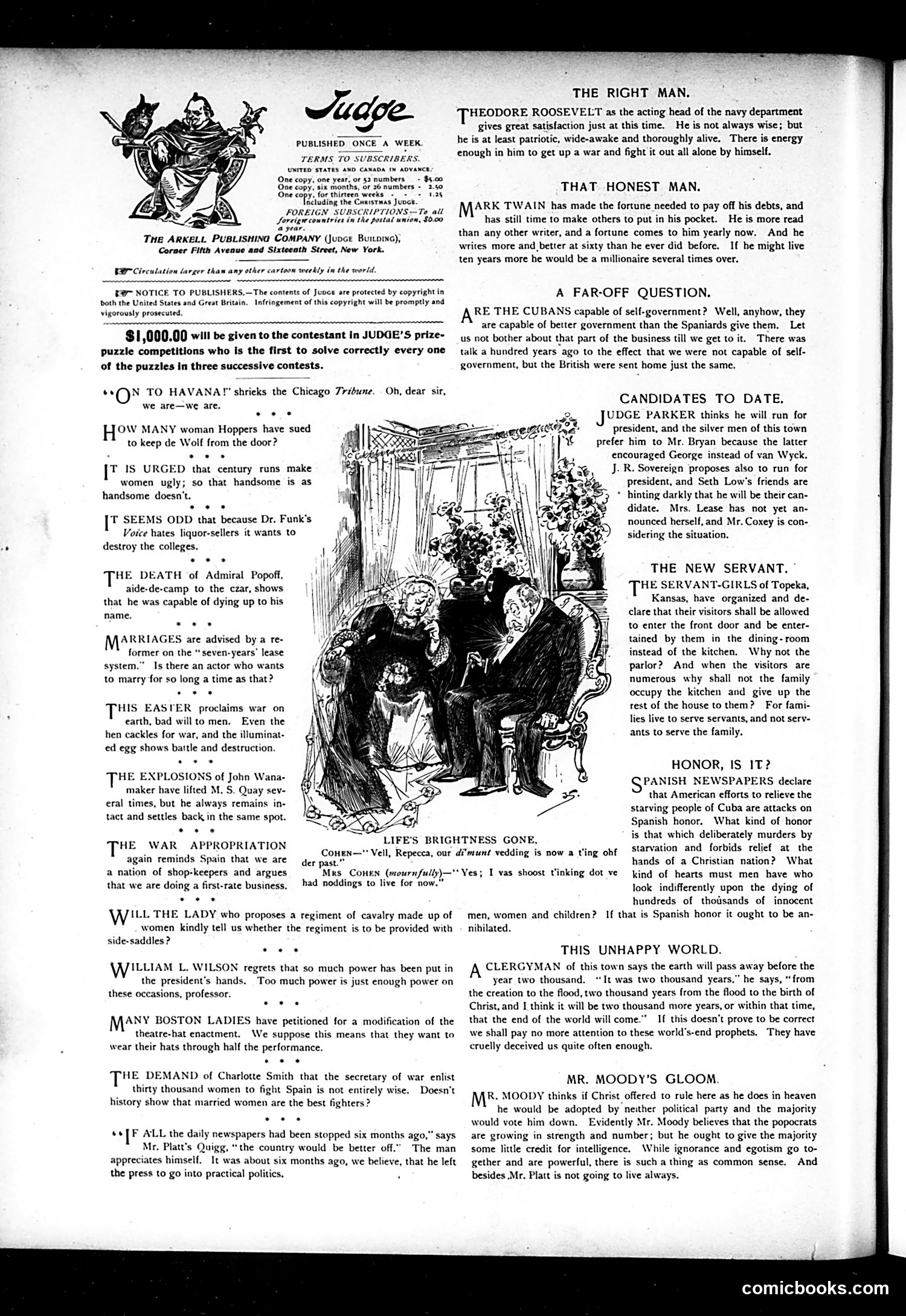
The central illustration depicts a domestic scene where a woman (labeled "Mrs. Cohen") announces she's "shot" her husband's drinking habits. Her husband responds he'll stop drinking "for now"—suggesting temporary rather than genuine reform. The cartoon satirizes both temperance advocates and spousal dynamics of the era. The joke appears to target overzealous anti-alcohol campaigners (a major political movement in early 1900s America) while mocking husbands' half-hearted promises to reform. The title "Life's Brightness Gone" ironically refers to the loss of alcohol rather than any improvement in family life, emphasizing the satirical point that prohibition rhetoric often missed—that many men viewed drinking as essential to happiness, making reform proposals absurd.
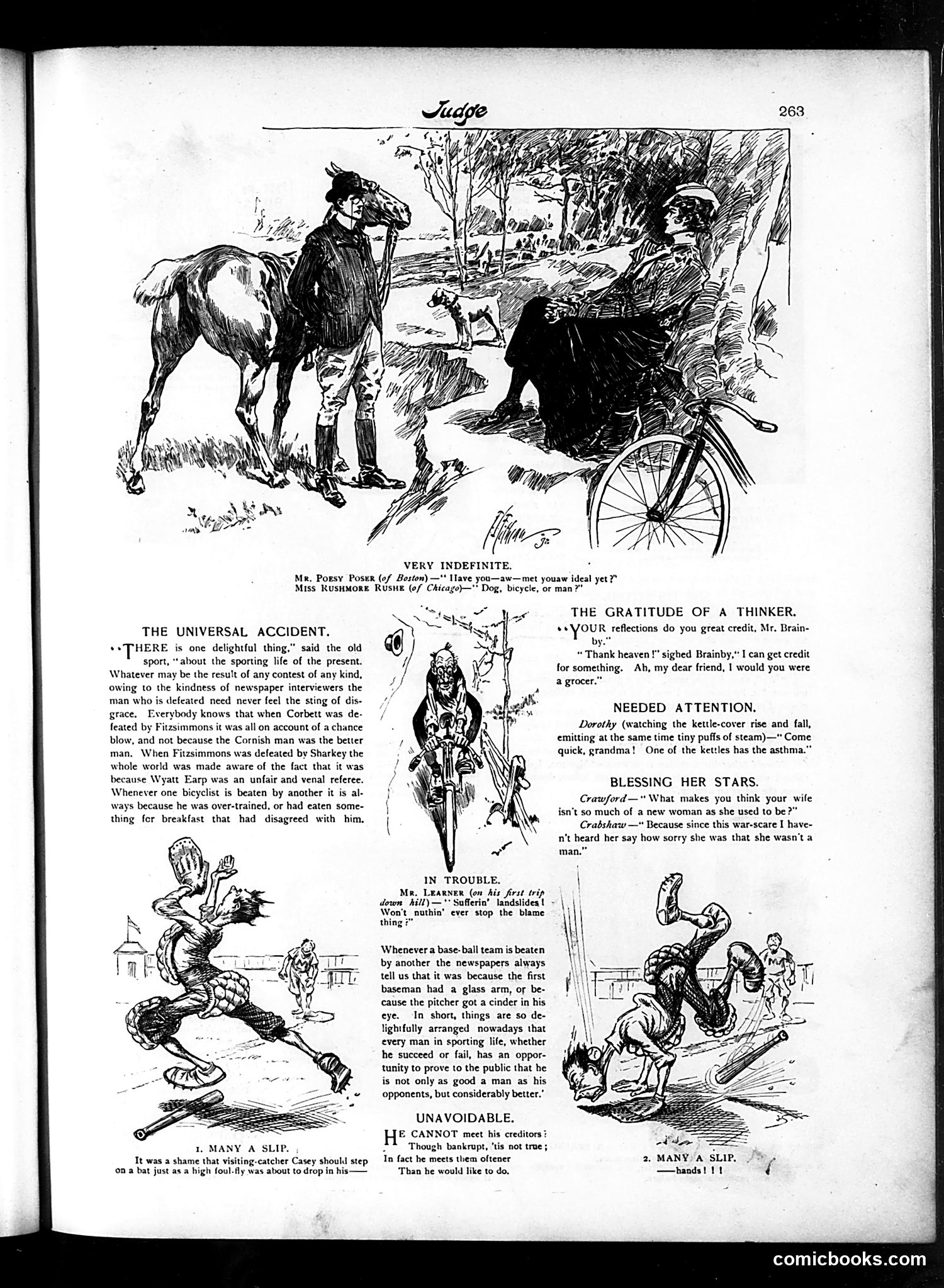
This page contains several unrelated humorous cartoons mocking everyday misfortunes and social awkwardness: **Top cartoon** ("Very Indefinite"): A woman on a bicycle encounters a man on horseback, with dialogue about whether he's a "dog, bicycle, or man"—apparently satirizing ambiguous masculine presentation or confused first impressions. **"The Universal Accident"**: Mocks how cyclists routinely blame others when collisions occur, suggesting bicyclists always find convenient excuses. **Other cartoons** ("In Trouble," "Many a Slip," "Blessing Her Stars"): Brief gags about romantic mishaps, slapstick falls, and domestic quarrels—typical Judge magazine humor. The cartoons lack specific political references and appear designed for general amusement rather than commentary on particular events or figures.
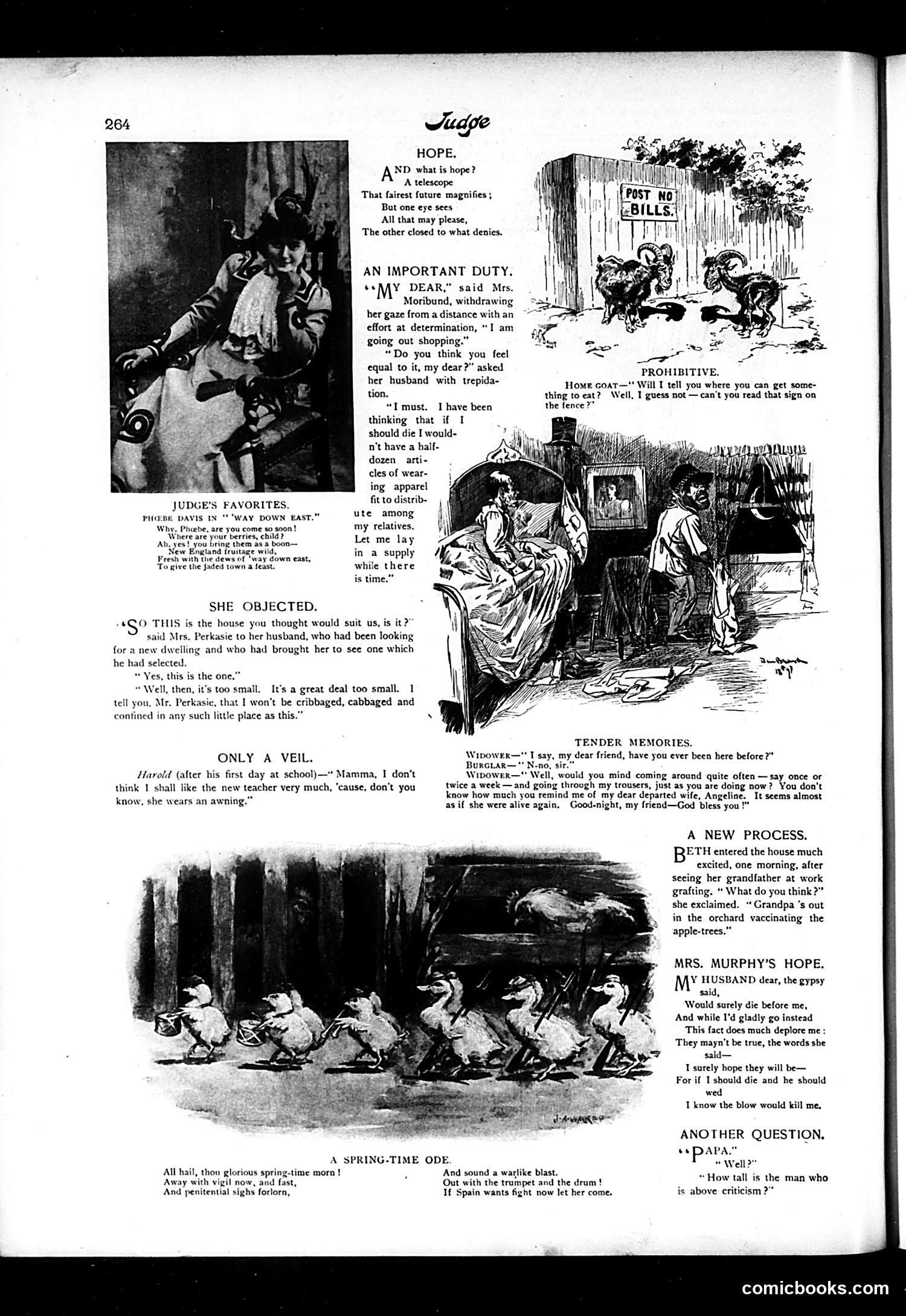
This page contains multiple satirical items typical of Judge's humor: **"Judges Favorites"** (top left): A photograph captioned "The Davis is 'Way Down East'" with verses about a judge's preferences—likely mocking judicial tastes or a specific judge's decisions. **"Prohibitive"** (top right): A cartoon showing goats at a "Post No Bills" sign. The joke plays on the phrase "prohibitive"—the goats cannot read the prohibition notice, so they proceed to eat anyway. This satirizes the futility of laws or rules that cannot be enforced against all parties. **"A New Process"** and **"Mrs. Murphy's Hope"**: Brief domestic humor pieces about family life and unrealistic expectations. **"A Spring-Time Ode"**: Patriotic verse referencing Spain and military conflict, suggesting this issue addresses early-1900s Spanish-American War tensions. The page exemplifies Judge's mix of visual cartoons, poetry, and short comedic pieces targeting American social and political topics of the era.
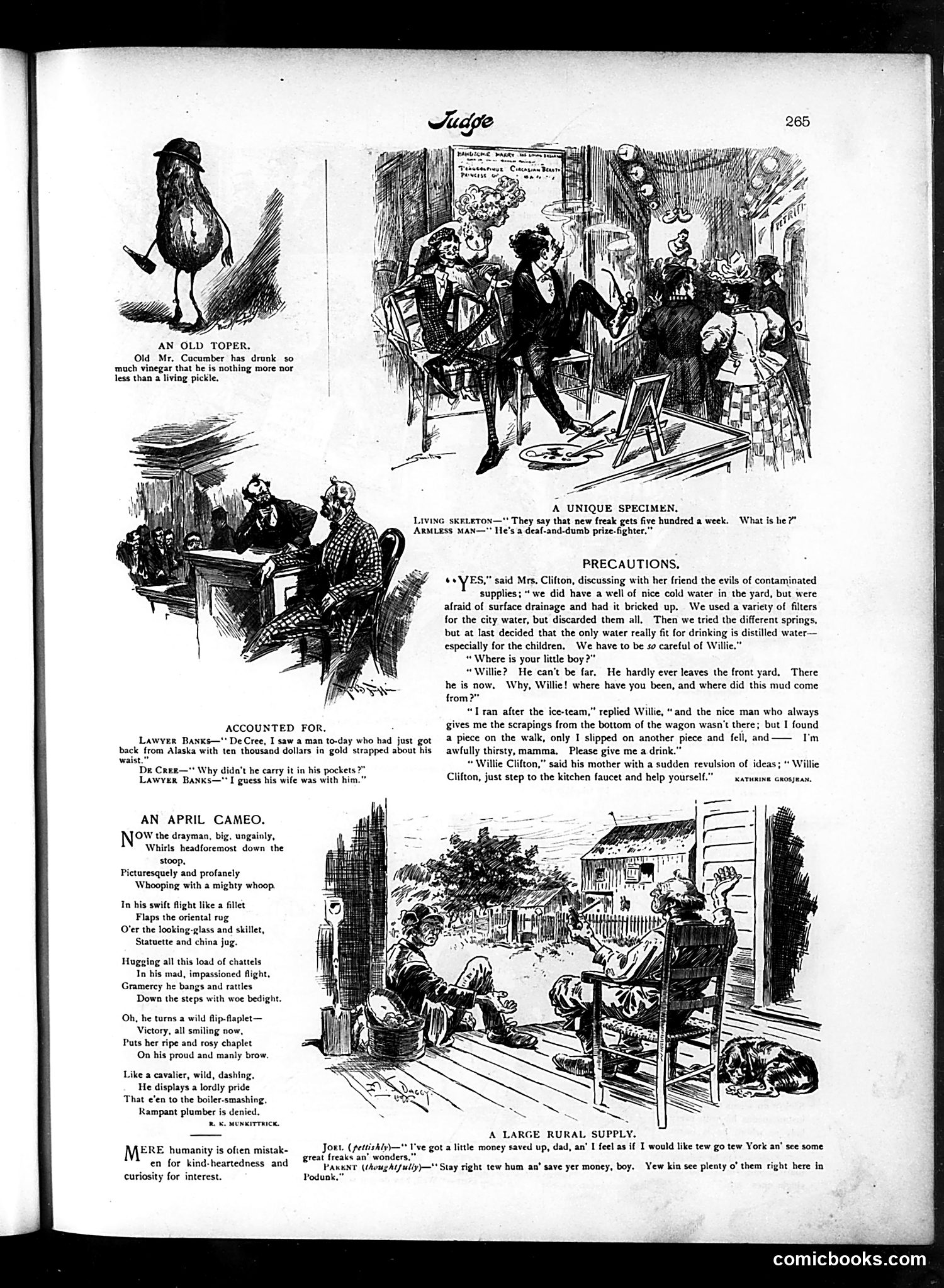
This page contains several disconnected satirical pieces typical of Judge magazine's format: **"Precautions"** is the main piece—a commentary on the water contamination anxieties of the era. Mrs. Clifton obsesses over "contaminated supplies," installing elaborate filtration systems and distilled water for her children's safety. The satire's punch: while she frets about pristine drinking water, her son Willie has been playing in mud and drinking from an ice wagon. The joke mocks excessive upper-class worry about hygiene while children remain unsupervised and dirty—highlighting the gap between anxious parental concern and actual child welfare. The surrounding items are lighter fare: "An Old Toper" jokes about alcoholism; "A Unique Specimen" presents circus-freak humor; "An April Cameo" is a comedic poem about a clumsy drayman; "Accounted For" offers a quick lawyer joke; "A Large Rural Supply" depicts rural simplicity versus urban temptation. The page reflects late 19th/early 20th-century concerns about public health, class anxieties, and urban versus rural life.
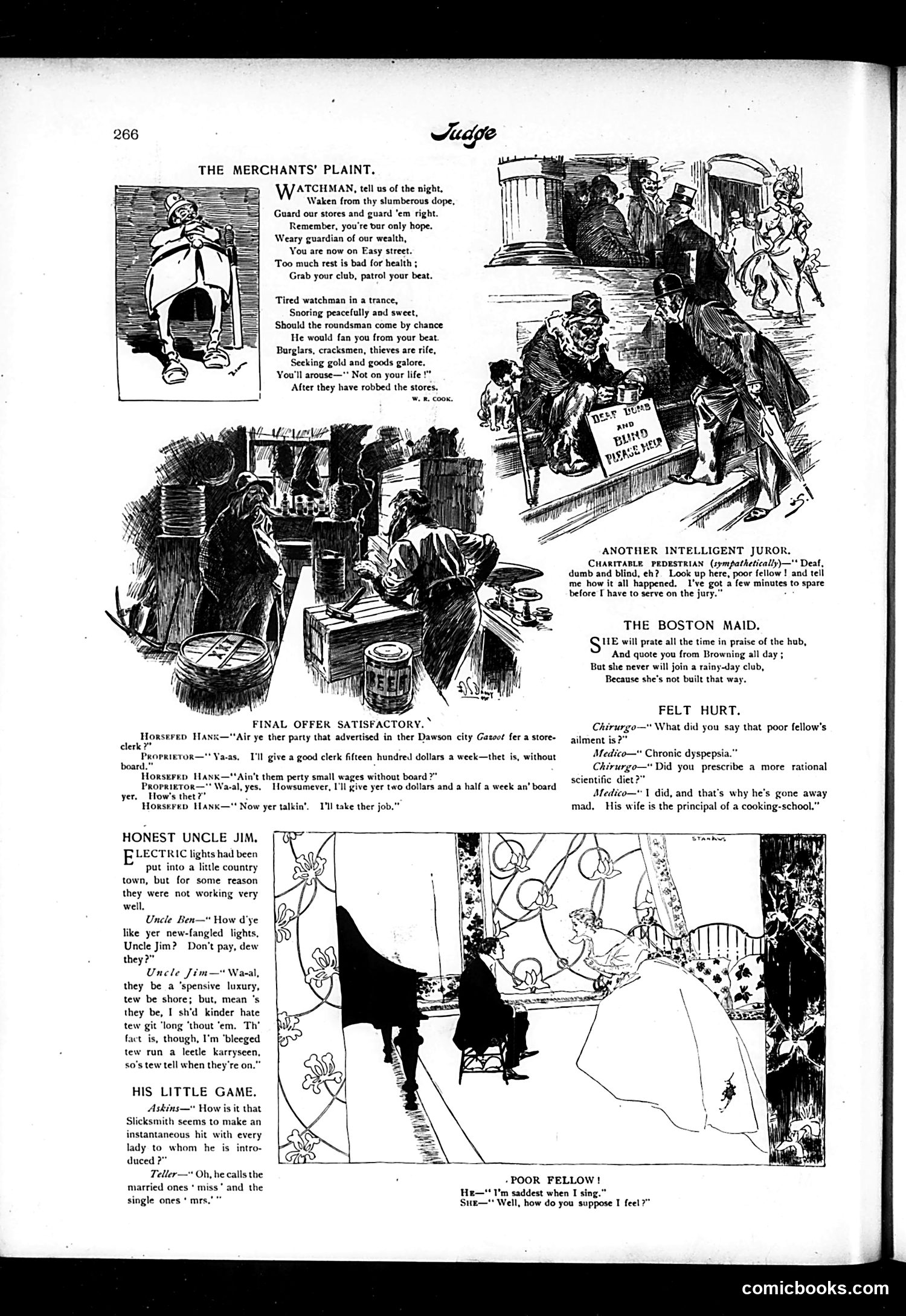
This page collects satirical humor pieces targeting late 19th/early 20th-century American life: **"The Merchants' Plaint"** mocks negligent night watchmen sleeping on duty while stores face robbery—a real urban problem of the era. **"Final Offer Satisfactory"** satirizes the Klondike Gold Rush (referenced by "Dawson city Gazette"), showing how wildly inflated wages in remote mining towns were actually poverty wages once cost of living was considered. **"Another Intelligent Juror"** ridicules jurors who feign sympathy for strangers while shirking jury duty obligations—social hypocrisy. The remaining pieces are lighter domestic humor: a Boston woman's regional snobbery, marital discord over medical diet advice, rural confusion over new electric lighting technology, and social manipulation through name-calling ("miss" vs. "mrs."). The cartoons use exaggerated dialect and character types typical of Judge's satirical approach to contemporary social follies and technological/economic disruptions.
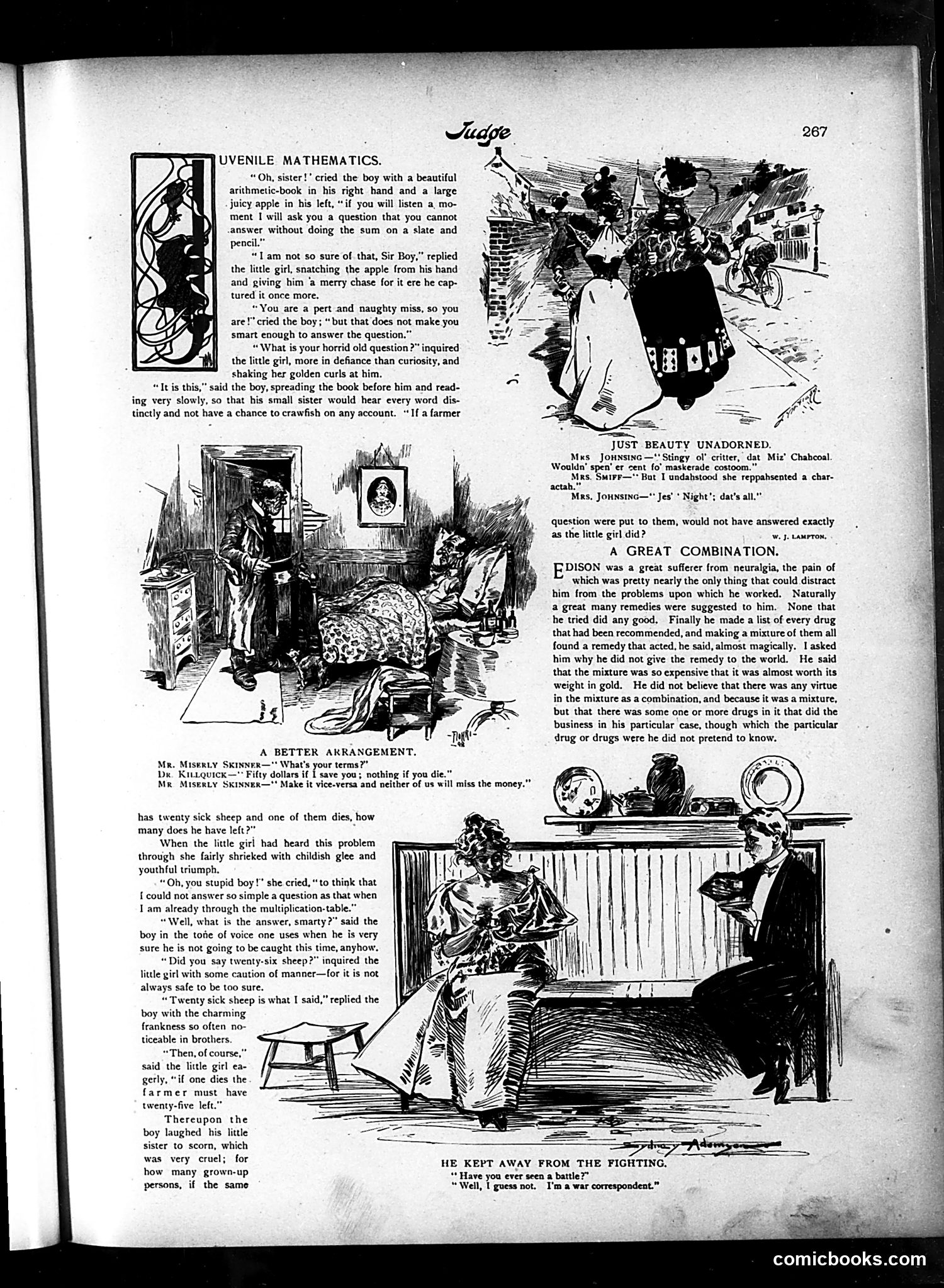
This page contains three separate humorous pieces from Judge magazine: **"Juvenile Mathematics"** depicts a brother asking his sister a trick arithmetic question: if a farmer has twenty sick sheep and one dies, how many remain? The sister confidently answers "twenty-five," falling for the wordplay—the farmer would have twenty-five *healthy* sheep left, not twenty-five total. The humor satirizes childhood logic and sibling teasing. **"Just Beauty Unadorned"** is a brief racial stereotype joke featuring two Black women (rendered in period dialect) gossiping about a third woman who wore no costume to a masquerade, with one saying she represented "Night"—implying she wore nothing but blackface. **"A Great Combination"** recounts Thomas Edison's remedy for neuralgia, noting he refused to commercialize an expensive drug mixture he'd created, uncertain which ingredient actually worked. **"A Better Arrangement"** is a brief joke about a miserly patient negotiating medical fees in reverse. The page is primarily light comedic content typical of early-20th-century satirical magazines.
This appears to be a Judge magazine political cartoon featuring an American eagle carrying a white star (likely representing a U.S. state or territory) while grasping an American flag. Below, a factory or industrial structure emits smoke, suggesting industrial power or manufacturing capacity. The cartoon likely satirizes American expansion or imperialism, possibly referencing territorial acquisition or industrial growth during the late 19th or early 20th century. The eagle—a symbol of American strength and authority—dominates the composition, while the industrial imagery emphasizes American economic and military power. Without the publication date or caption clearly visible, the specific historical event remains unclear, though the imagery suggests commentary on American territorial ambitions or industrial supremacy during this period.
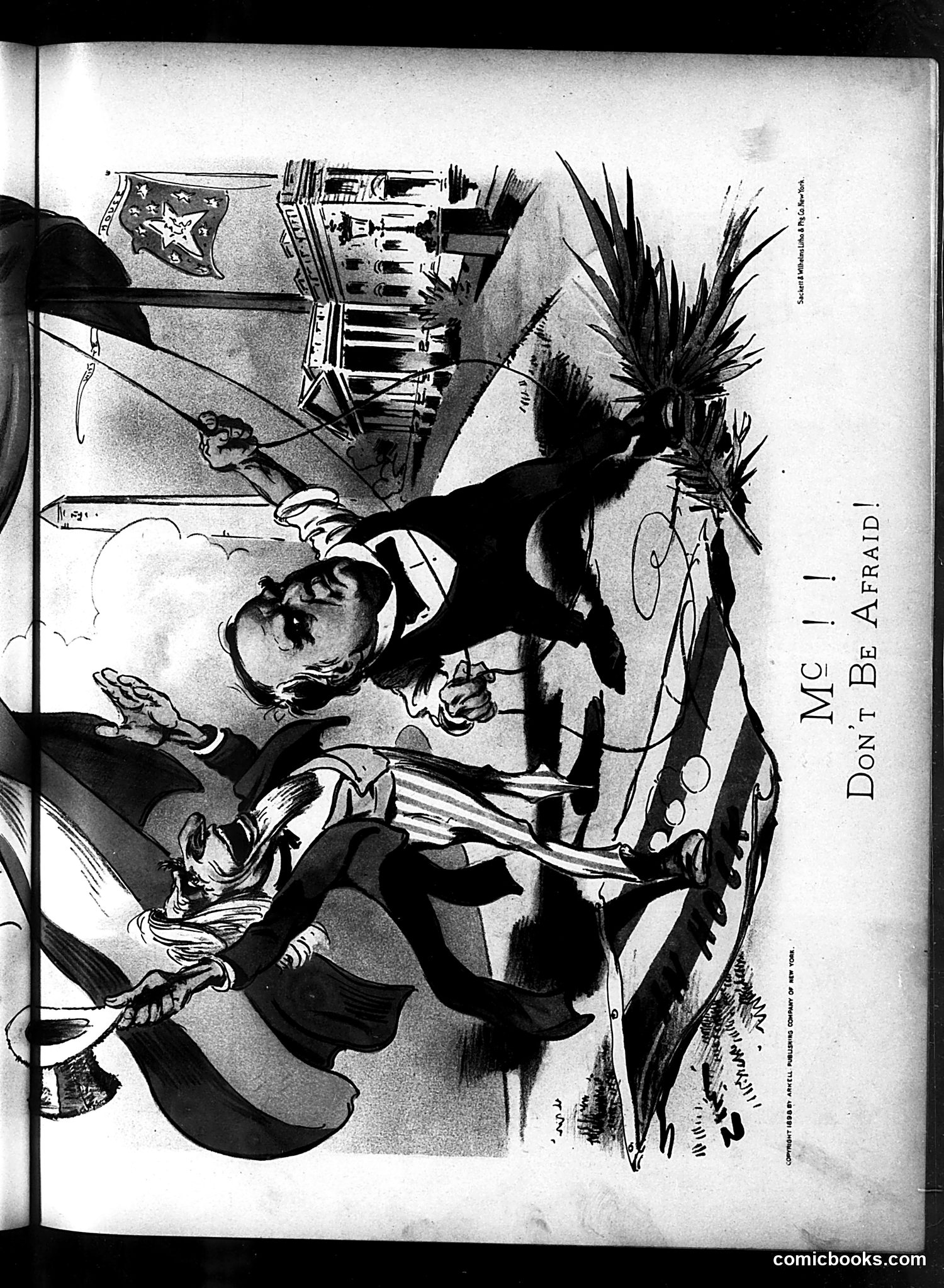
The visible title reads "MC II: Don't Be Afraid," though the OCR text is largely corrupted and unreadable. The cartoon appears to depict a caricatured figure in formal dress (top hat and coat) who seems anxious or fearful, interacting with what looks like decorative plant elements and possibly a servant or attendant figure. The crude caricature style and exaggerated features are typical of Judge's satirical approach. Without legible text or clearer context, the specific political or social reference remains unclear. The title "Don't Be Afraid" suggests the cartoon mocks someone's cowardice or unfounded anxiety about a particular situation, but identifying the specific figure, event, or issue being satirized would require additional documentation about Judge's publication date and contemporary context.
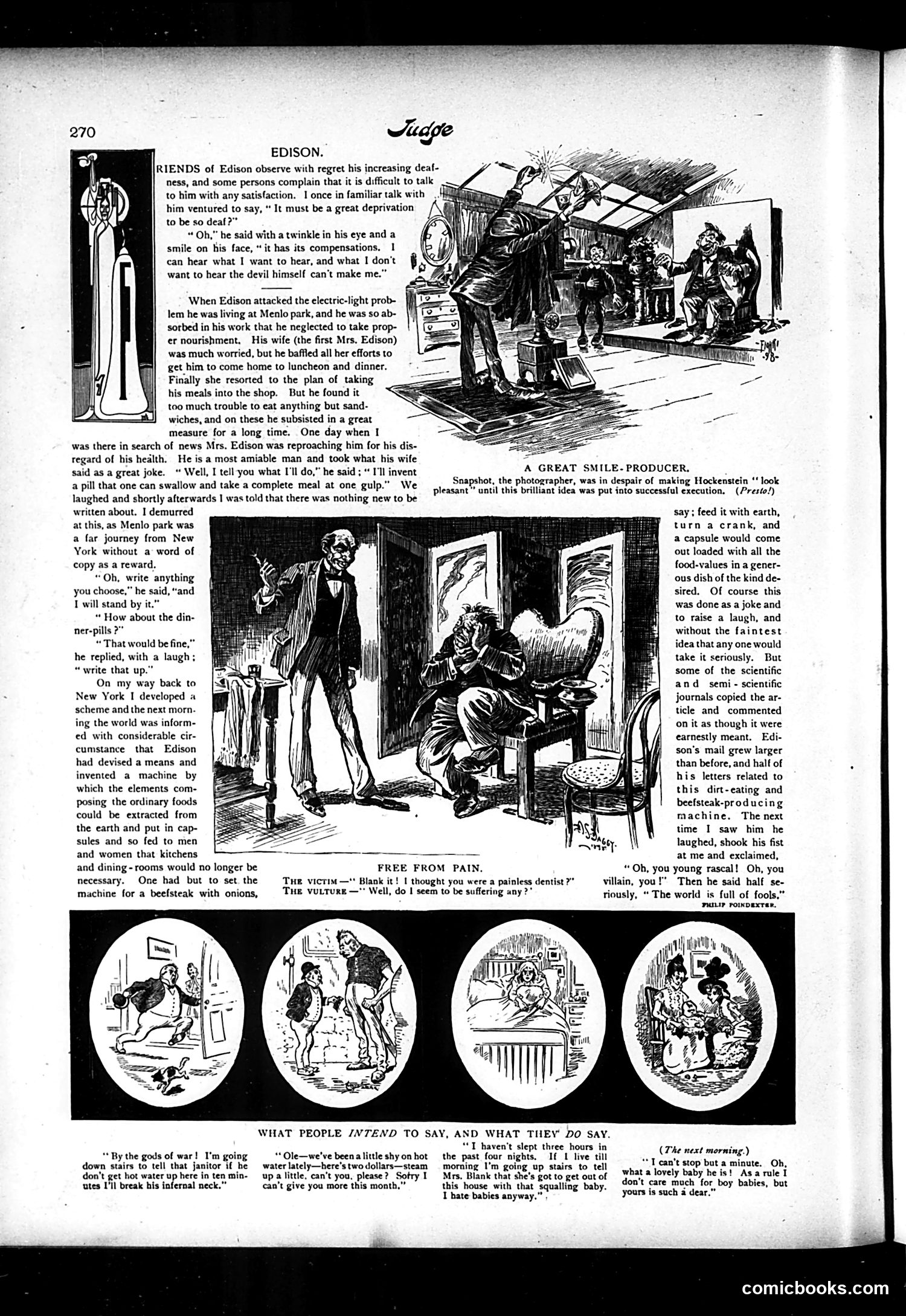
This page satirizes Thomas Edison through anecdotes and cartoons. The main text recounts how Edison, when developing electric lighting at Menlo Park, neglected meals. His wife worried about his health; Edison joked he'd invent a pill containing complete meals. The author published this as fact, and it went viral—Edison received letters from people taking it seriously, despite being intended as satire. The cartoons illustrate related themes: "A Great Smile-Producer" shows a photographer using a mechanical device to force a smile on an unwilling subject. "Free from Pain" depicts a dentist claiming painlessness while his patient grimaces. The bottom section, "What People Intend to Say, and What They Do Say," contrasts stated intentions with actual behavior—showing the gap between people's words and actions. The overall point: modern readers believe fantastical claims without critical thinking; Edison's joke became "news" through credulous reporting.
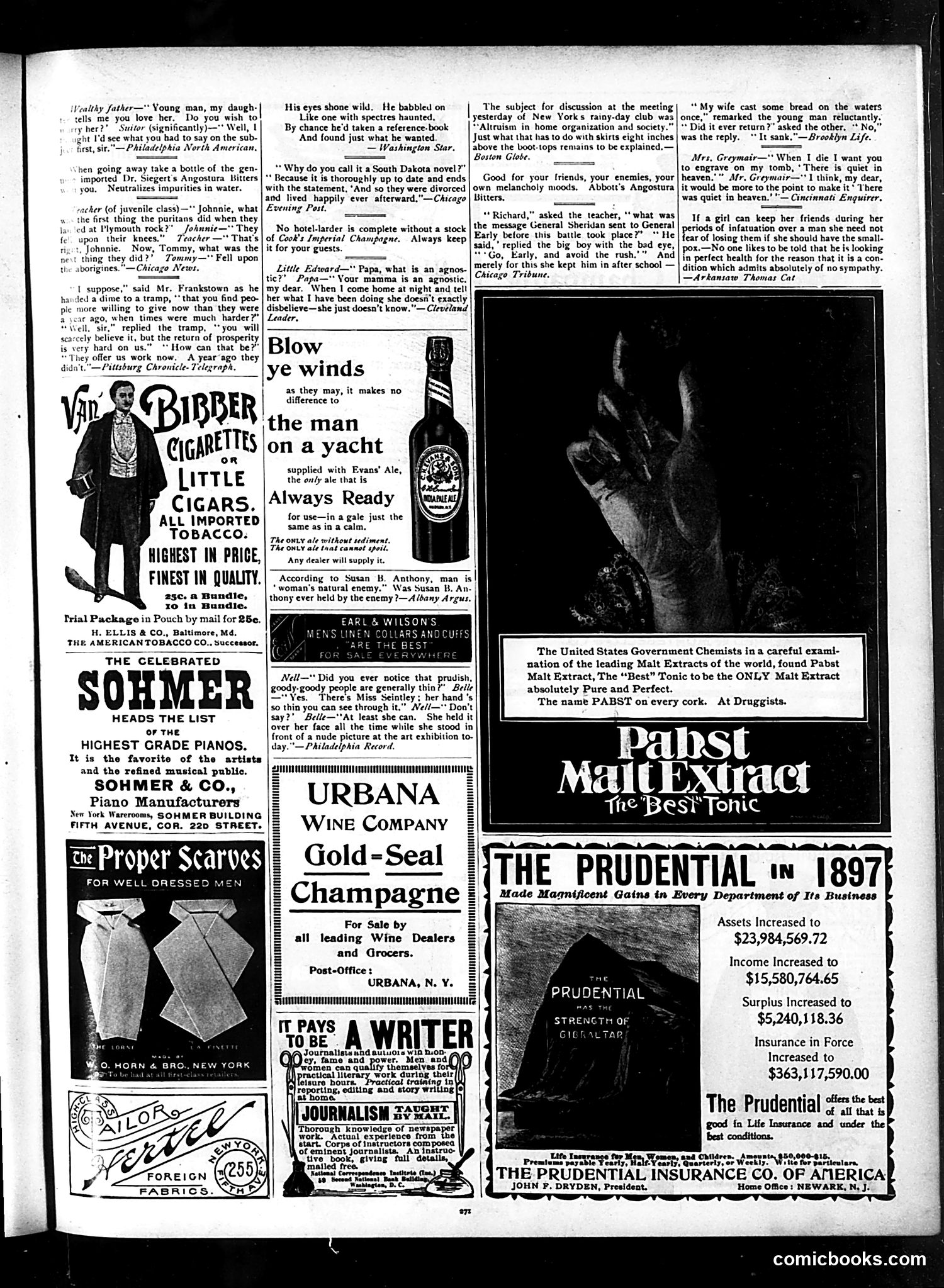
This page is primarily **advertisements and short joke columns**, typical of Judge magazine's format. The cartoons are minimal; instead, the page features: **Joke Columns** satirizing contemporary American life: - A Puritan joke (children's classroom humor) - Marriage humor (the "Mrs. Greymair" bit mocking nagging wives) - Class commentary (a tramp noting that post-depression prosperity is bad for beggars because people now offer work instead of charity—subtle social criticism) - Gender satire (women's fashion criticism, marital dynamics) **The Advertisements** reflect turn-of-century consumer culture: tobacco products, champagne, piano manufacturers, malt extract tonics, and insurance—positioning these as markers of respectability and middle-class status. **No clear political content** is visible. This appears to be a standard magazine issue mixing light domestic humor with commercial pitches to affluent readers. The satire targets personal relationships and social pretension rather than politics.
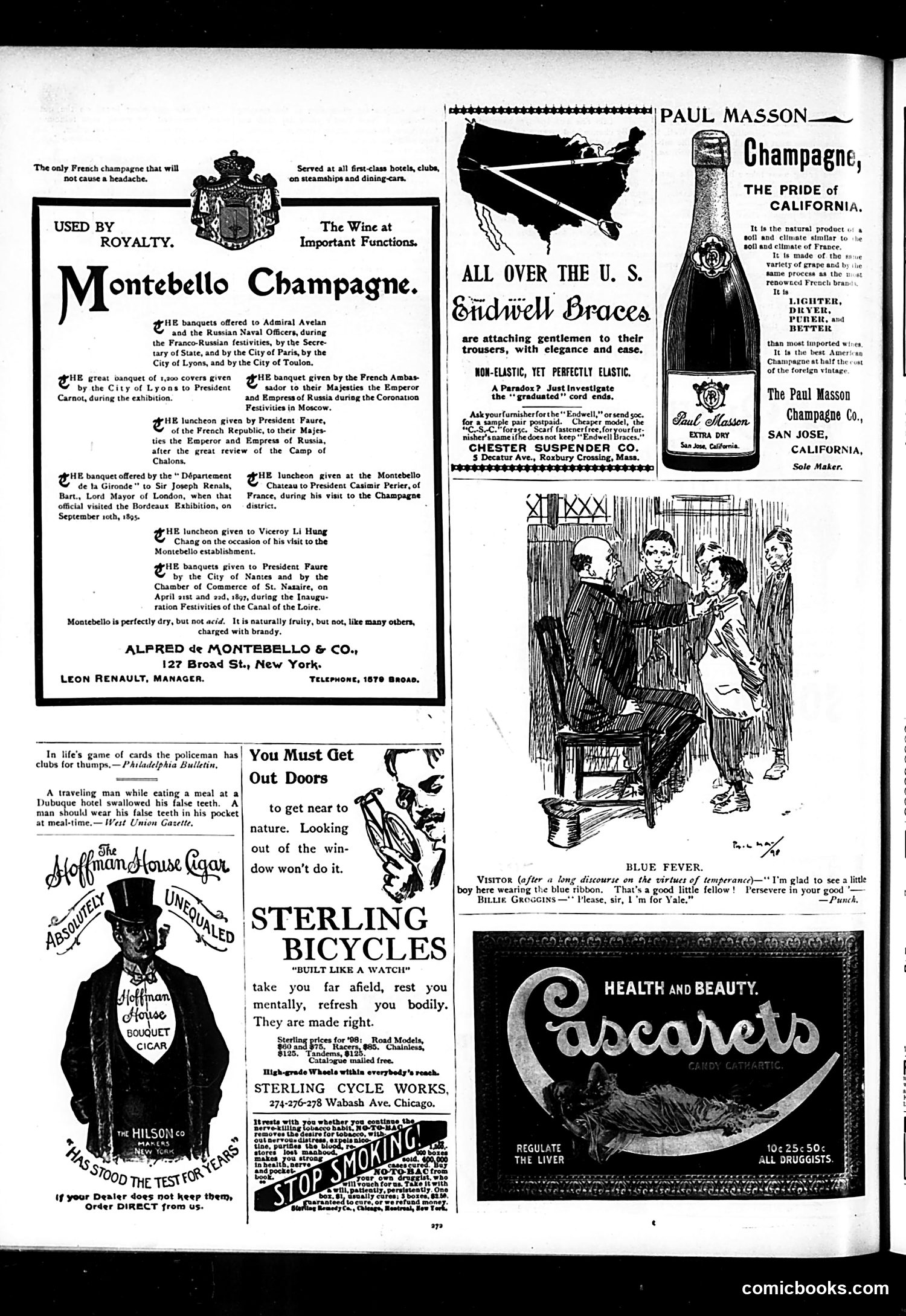
This page is primarily **advertising** interspersed with minor comic elements. The largest advertisement promotes **Montebello Champagne**, a French brand, emphasizing its use at prestigious diplomatic and state functions (banquets for Russian dignitaries, President Faure, Viceroy Li Hung Chang, etc.). The copy claims it won't cause headaches—a common complaint about champagne in that era. Secondary advertisements include: - **Paul Masson Champagne** (California competitor, marketed as cheaper than imports) - **Sterling Bicycles** (marketed for health and recreation) - **Endwell Braces** (suspenders with elastic cord fasteners) - **Hoffmann House Cigar** and other minor products The two small cartoons are minor humor pieces: one about a policeman's "clubs," another showing a visitor promoting temperance to a boy wearing a "blue ribbon" (temperance symbol), who reveals he wears it "for Yale" (the university)—a joke about class/prestige over principle. The page reflects 1890s consumer culture and advertising strategies targeting middle/upper-class readers.
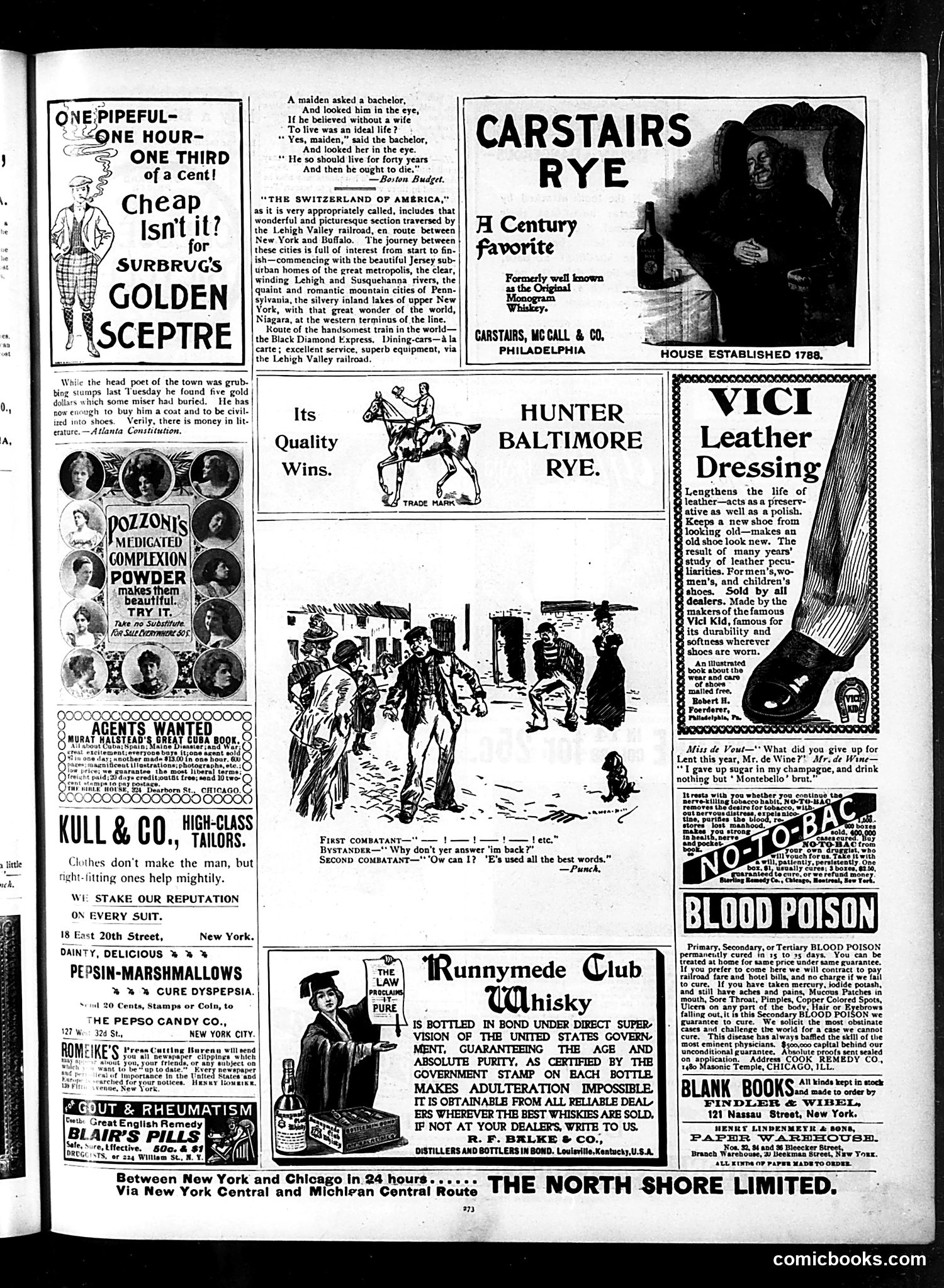
This page from *Judge* magazine is primarily **advertising**, with one small cartoon at the bottom center. The cartoon shows two men fighting. One says he can't answer back because his opponent has "used all the best words." This is a light social satire: it jokes that in arguments, sometimes one person has exhausted the supply of effective insults or rhetoric, leaving the other speechless—a commentary on verbal combat and wit. The page is dominated by period advertisements for whiskey (Carstairs Rye, Hunter Baltimore Rye, Runnymede Club Whisky), clothing tailors, leather dressing, and patent medicines claiming to cure dyspepsia, blood poison, and tobacco addiction. These ads reflect early 20th-century consumer products and medical claims now recognized as dubious or harmful. At top left, a poem about a bachelor rejecting marriage appears—typical light verse filler common to such magazines.
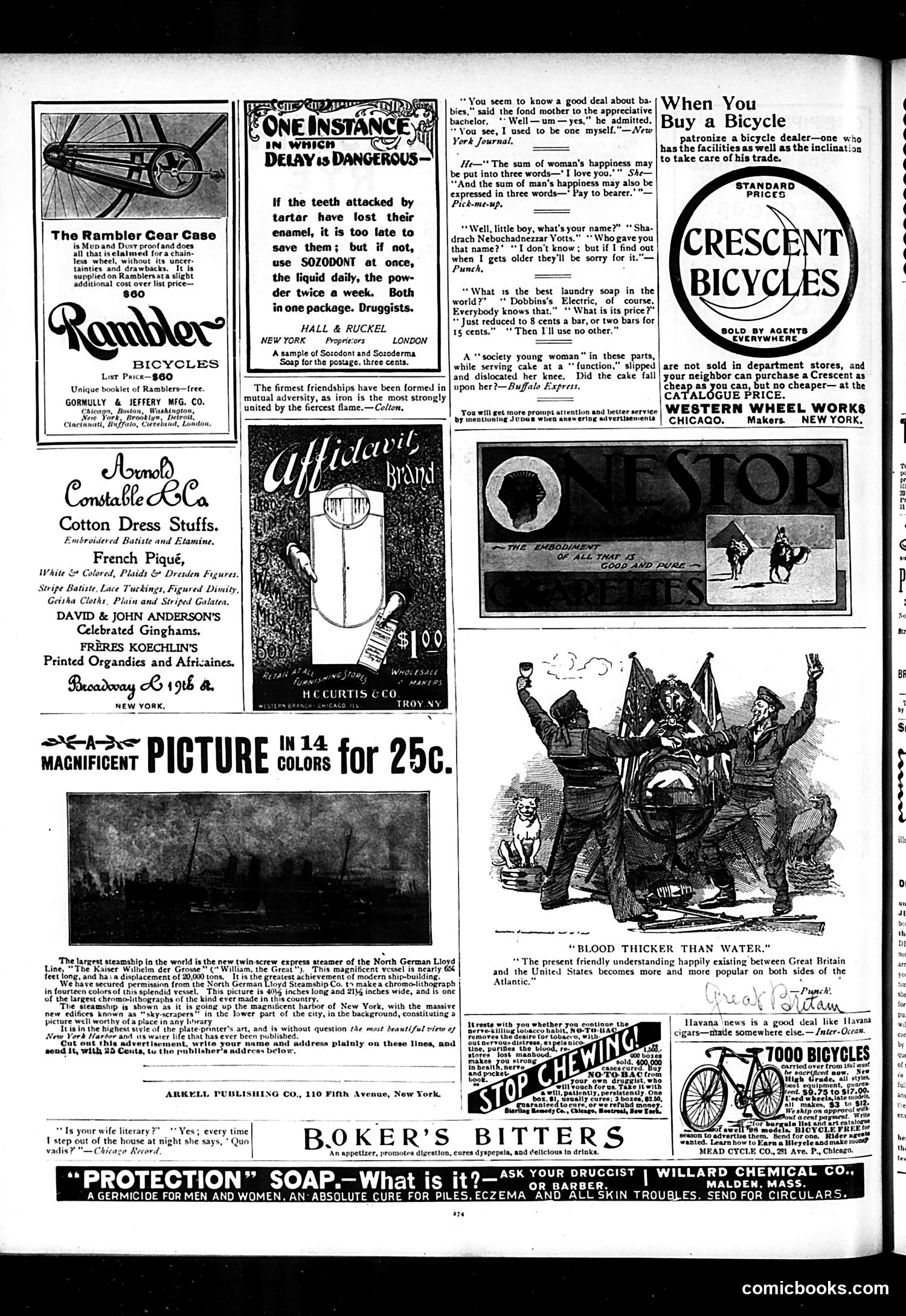
This page is primarily **advertisements and filler content** typical of Judge magazine's business model, not political satire. The small comic snippets are light humor rather than satire: a bachelor admitting he "used to be" a baby, wordplay about women's happiness versus payment obligations, and a boy with an absurdly long Biblical name. These are generic jokes about courtship, gender differences, and children—mildly comedic social observations rather than pointed political commentary. The dominant content is **product advertising**: bicycles (Rambler, Crescent), textiles, soap, steamship imagery, and chemical products. The large illustration of the Kaiser Wilhelm der Grosse steamship demonstrates German industrial achievement, though presented here as commercial content rather than satirical commentary. The page reflects Judge's era (appears early 1900s) when magazines relied heavily on advertising revenue. Any "satire" is incidental to the commercial purpose.
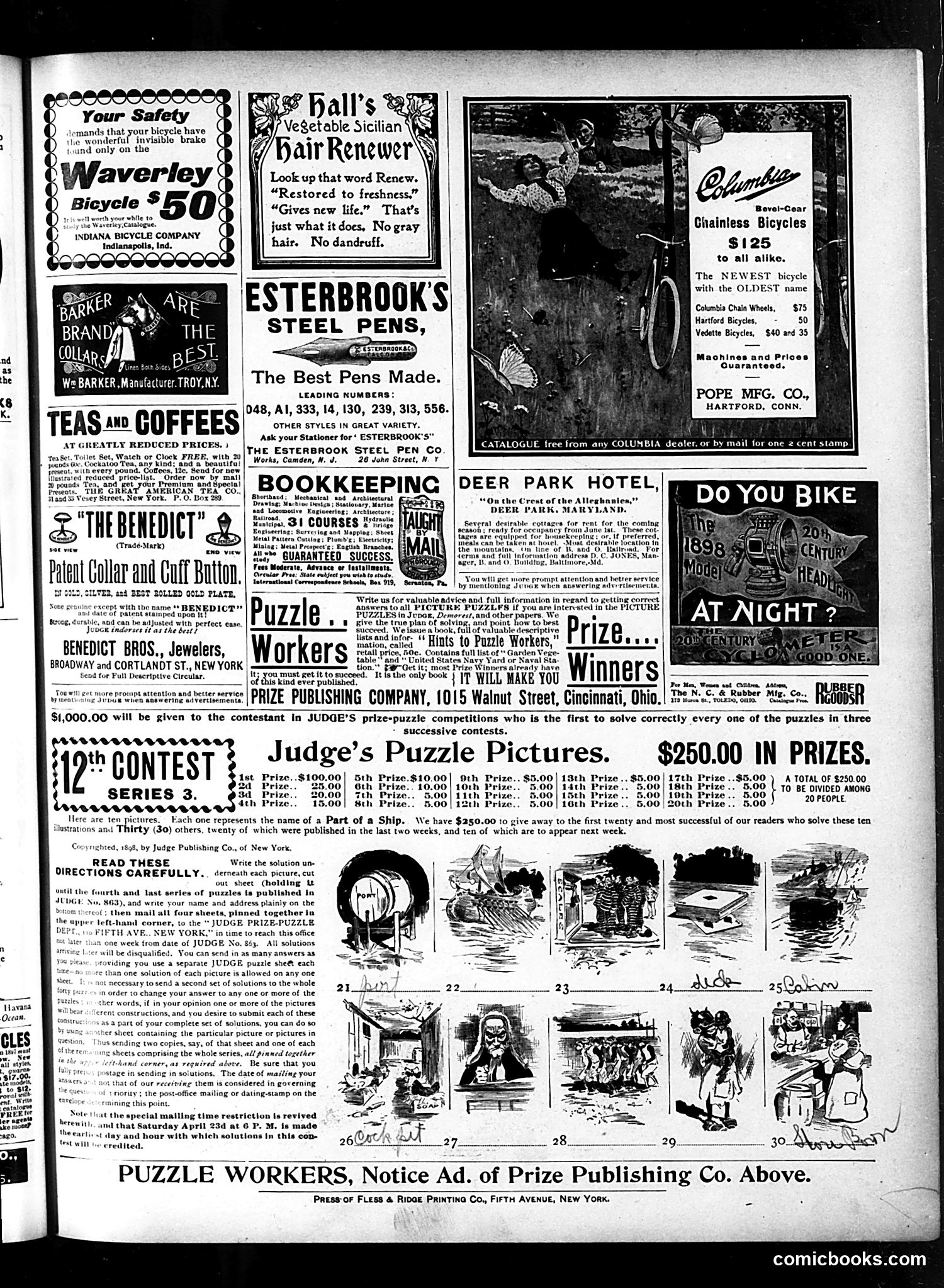
This page is primarily **advertisements and a puzzle contest**, not political satire. The main content is Judge magazine's "Puzzle Pictures" competition offering $250 in prizes for solving ten ship-part riddles (images 21-30 shown). The advertisements showcase late-1890s consumer goods: bicycles (Waverley, Columbia), steel pens (Esterbrook), hair products (Hall's Hair Renewer), and various services. The bicycle ads are notable—they advertise chains, wheels, and "chainless" models, reflecting the cycling craze of that era. The **only cartoon-like element** is the small illustrated scenes accompanying the puzzles, which appear to be visual hints rather than satirical commentary. They depict everyday activities and objects. **No clear political figures or social satire** are visible on this page. It's a straightforward commercial and entertainment page typical of Judge magazine's mixed content format, where serious satire shared pages with advertisements and contests to fund publication.
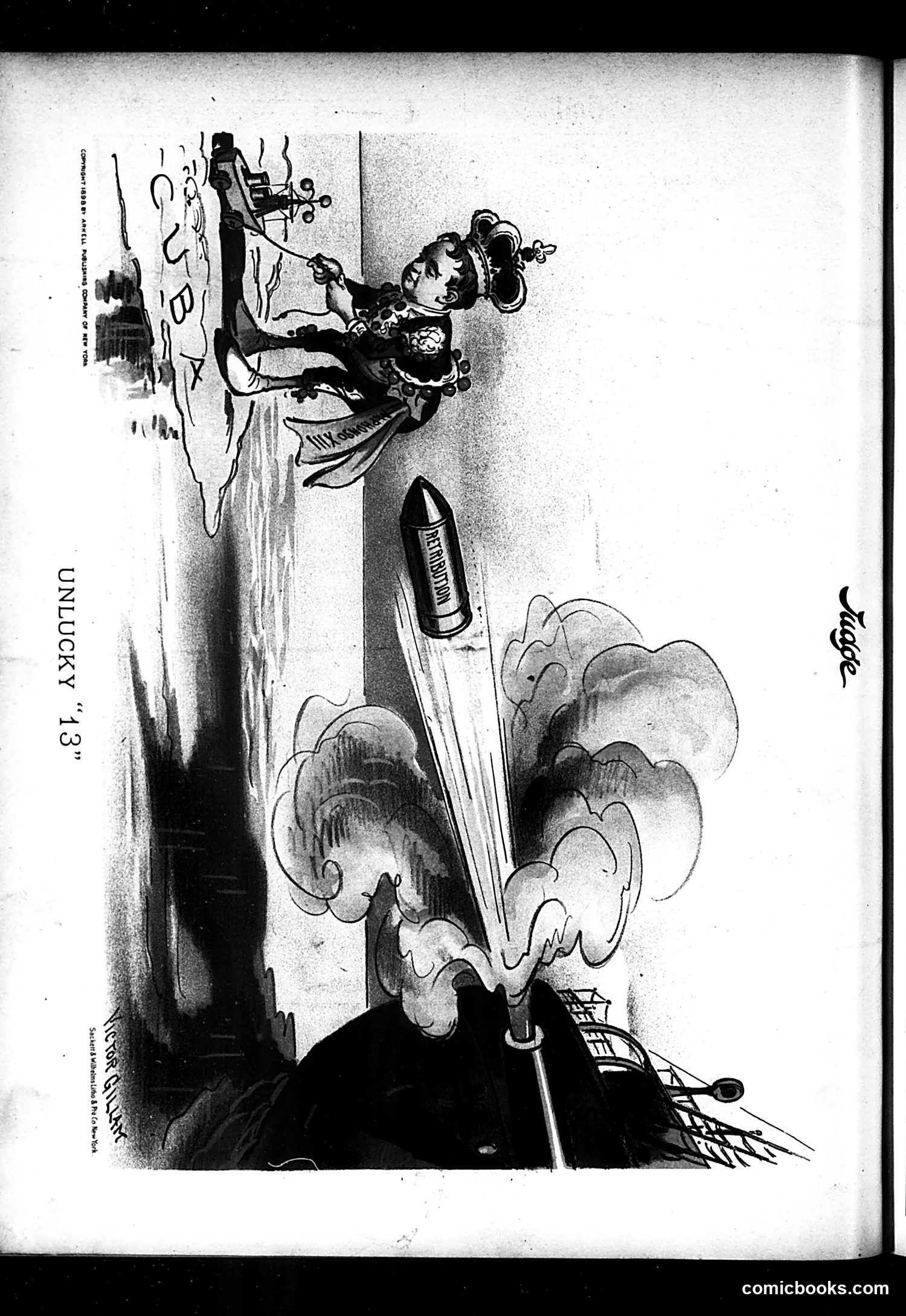
This political cartoon depicts a figure at a drafting table or writing desk, appearing to be working on something labeled "13." A large bomb or artillery shell rises dramatically from below, with explosive clouds surrounding it. The cartoon's title, "Unlucky '13'," suggests commentary on the number 13 as an ill omen. Without visible publication dating or clearer context, this appears to reference World War I-era anxieties about weapons development or military conflict. The figure seems caught between creating or managing something dangerous (the "13"), suggesting irony about attempts to control destructive forces. The "unlucky" framing implies the endeavor is doomed to failure or will produce unintended catastrophic consequences. The exact historical reference remains unclear without additional context.