
A complete issue · 16 pages · 1898
Judge — March 26, 1898
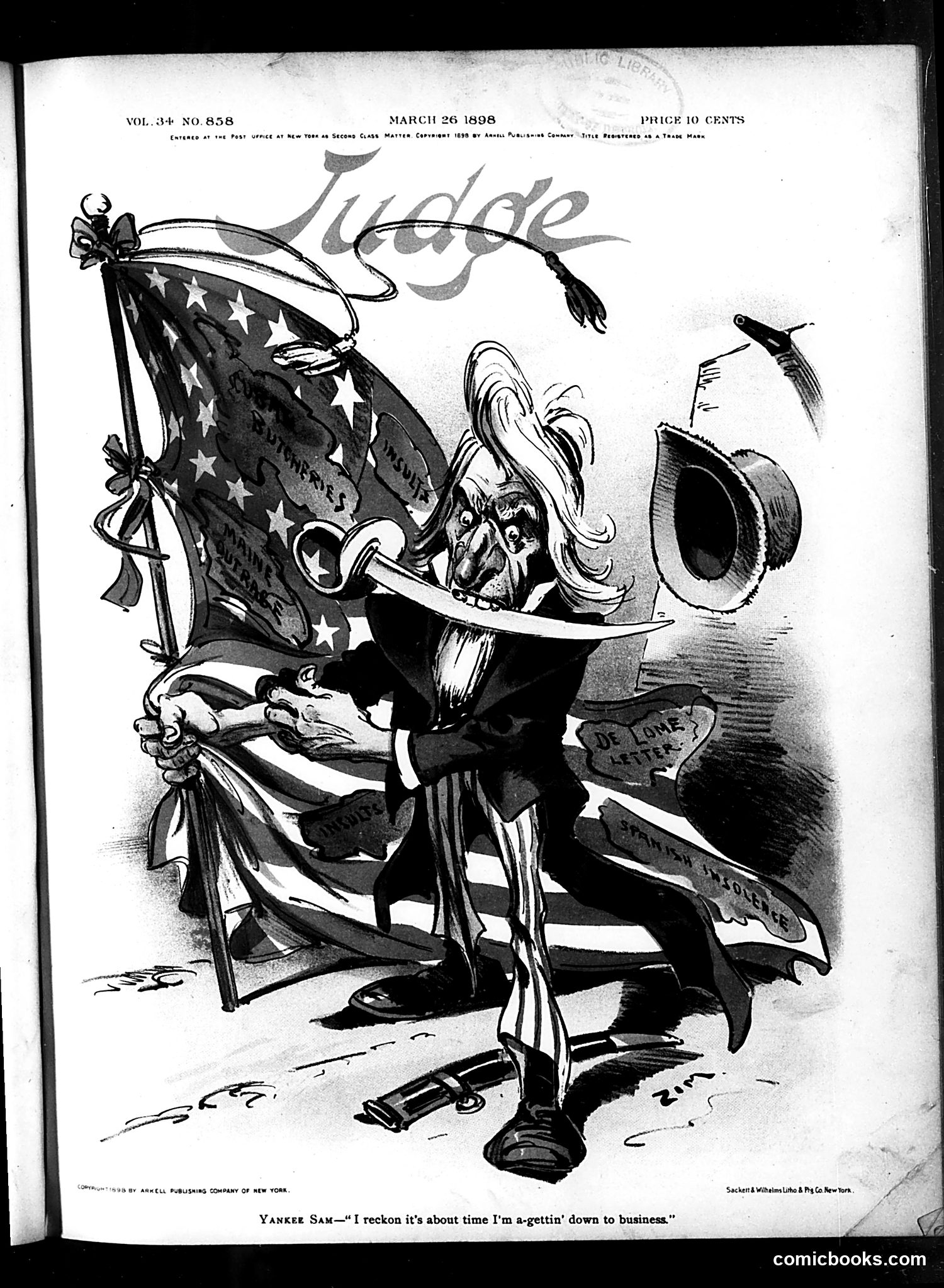
This political cartoon titled "Yankee Sam—'I reckon it's about time I'm a-gettin' down to business'" depicts Uncle Sam (recognizable by the starred hat and goatee) in a dynamic pose, wielding swords and appearing ready for conflict. The American flags and martial imagery suggest preparation for war. The timing—March 1898—points to the Spanish-American War, which began that April. The cartoon satirizes American readiness for military action against Spain, likely over Cuban independence. The exaggerated, energetic pose mocks American eagerness or impetuousness about entering the conflict. The caption's casual dialect ("I'm a-gettin'") suggests both the colloquial American spirit and perhaps criticism of how casually the nation approached warfare.
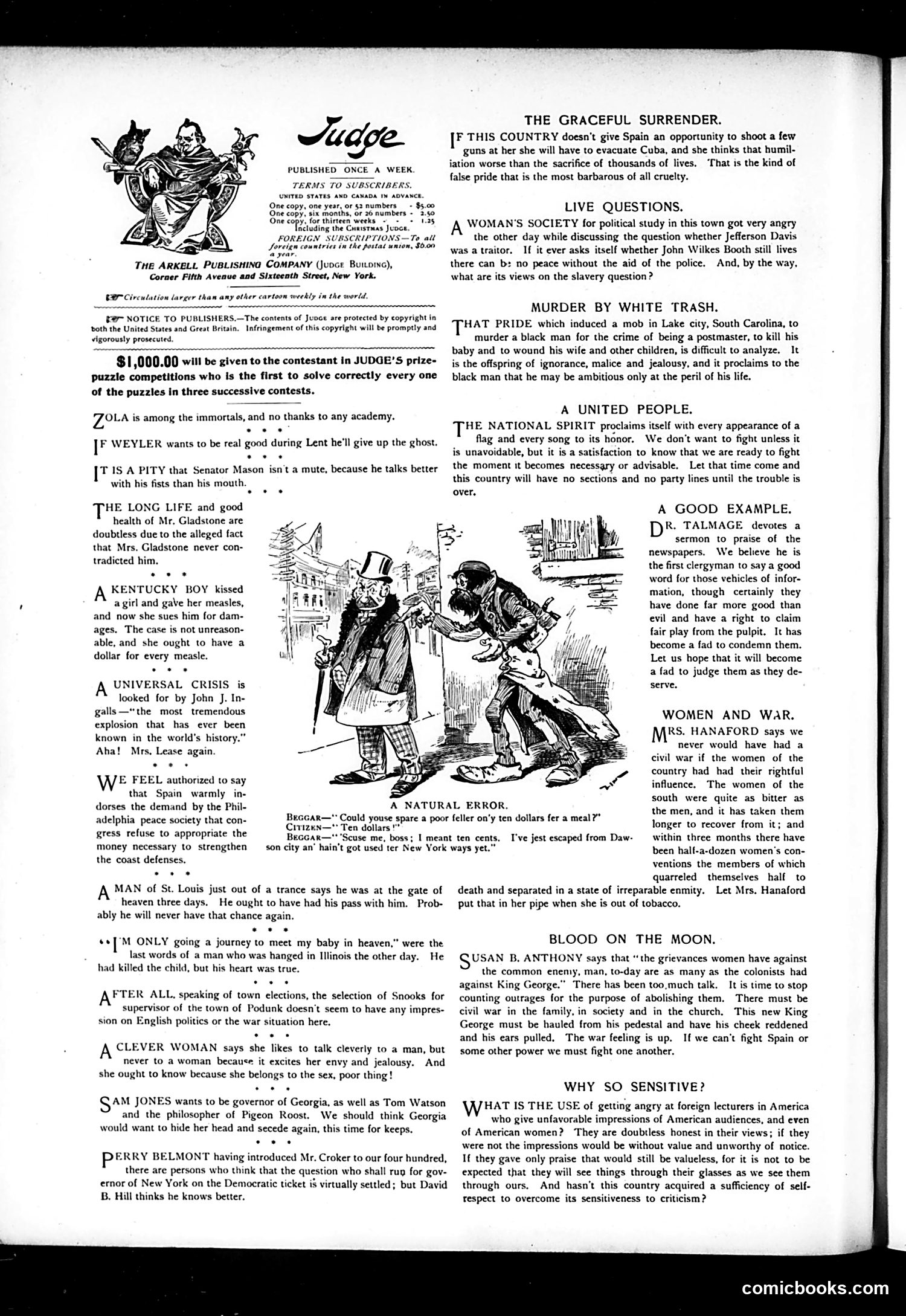
This cartoon depicts a beggar asking a well-dressed man for money for a meal. The beggar says he hasn't eaten in ten days and needs ten cents; the man responds that he's "just escaped from Dawson City" and only has ten cents himself for New York wages. The satire refers to the Klondike Gold Rush (Dawson City, Yukon) of the 1890s. The joke is ironic: despite striking it rich in one of history's most famous gold rushes, the man claims he's penniless—suggesting either that prospectors returned broke despite expectations, or that wealth from the Yukon couldn't sustain someone in expensive New York. The cartoon mocks both gold-rush fever and the economic gap between rich and poor in urban America.
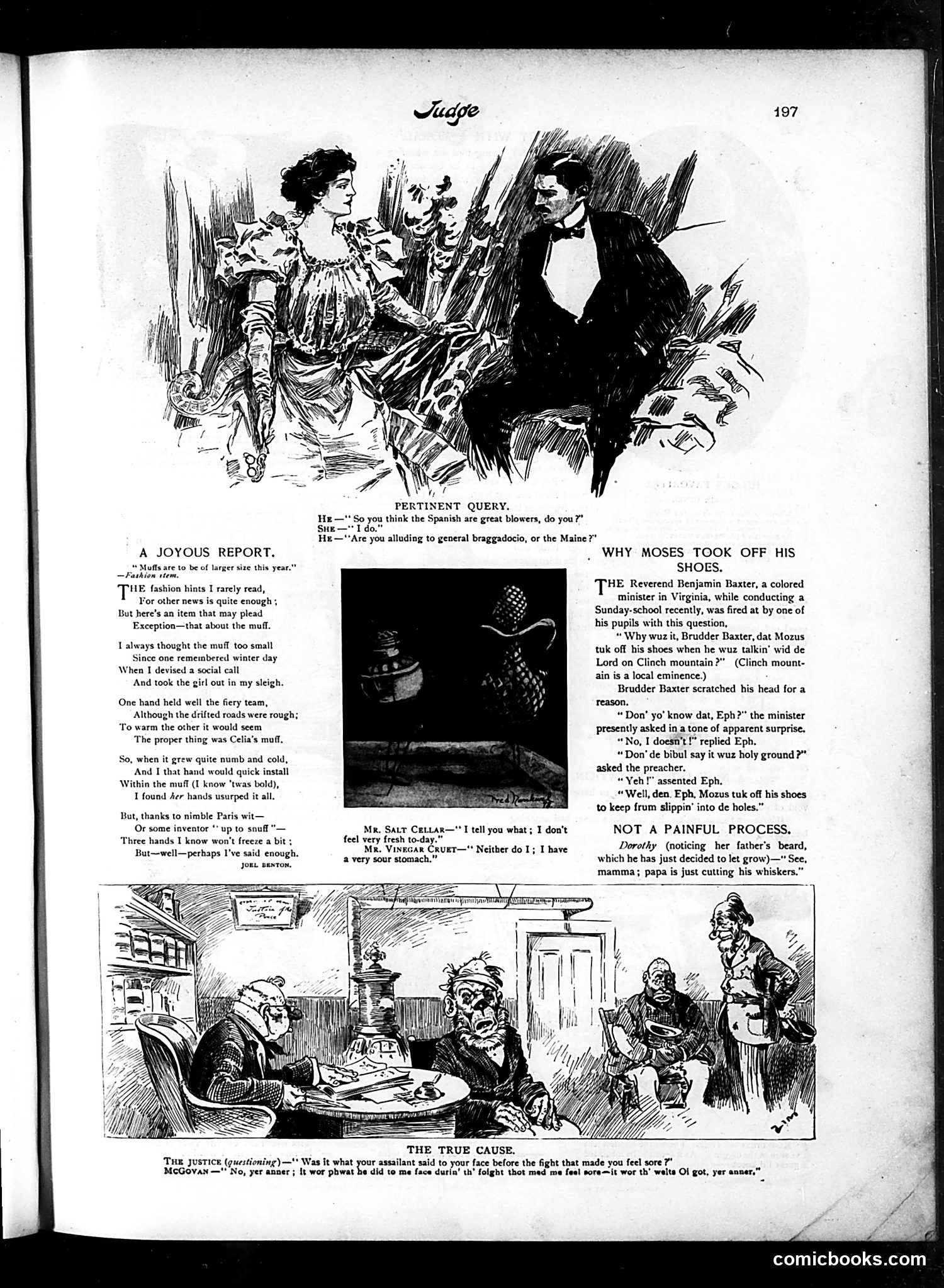
This page contains three distinct satirical pieces: 1. **"A Joyous Report"**: A poem mocking the fashion industry's prediction that muffs will be larger that year—poking fun at absurd fashion trends and their arbitrary nature. 2. **"Pertinent Query"**: A cartoon depicting a well-dressed couple, with the man asking if the woman thinks "Spanish are great blowers"—likely referencing contemporary political debates about Spain, possibly related to colonial conflicts or naval tensions of the era. 3. **"Why Moses Took Off His Shoes"** and **"Not a Painful Process"**: Anecdotes satirizing religious hypocrisy and domestic life, mocking ministers' pretentiousness and father-child interactions. 4. **"The True Cause"**: A cartoon showing characters in discussion, apparently satirizing judicial proceedings or social conflict resolution. The page reflects Judge's characteristic blend of political, social, and domestic humor.
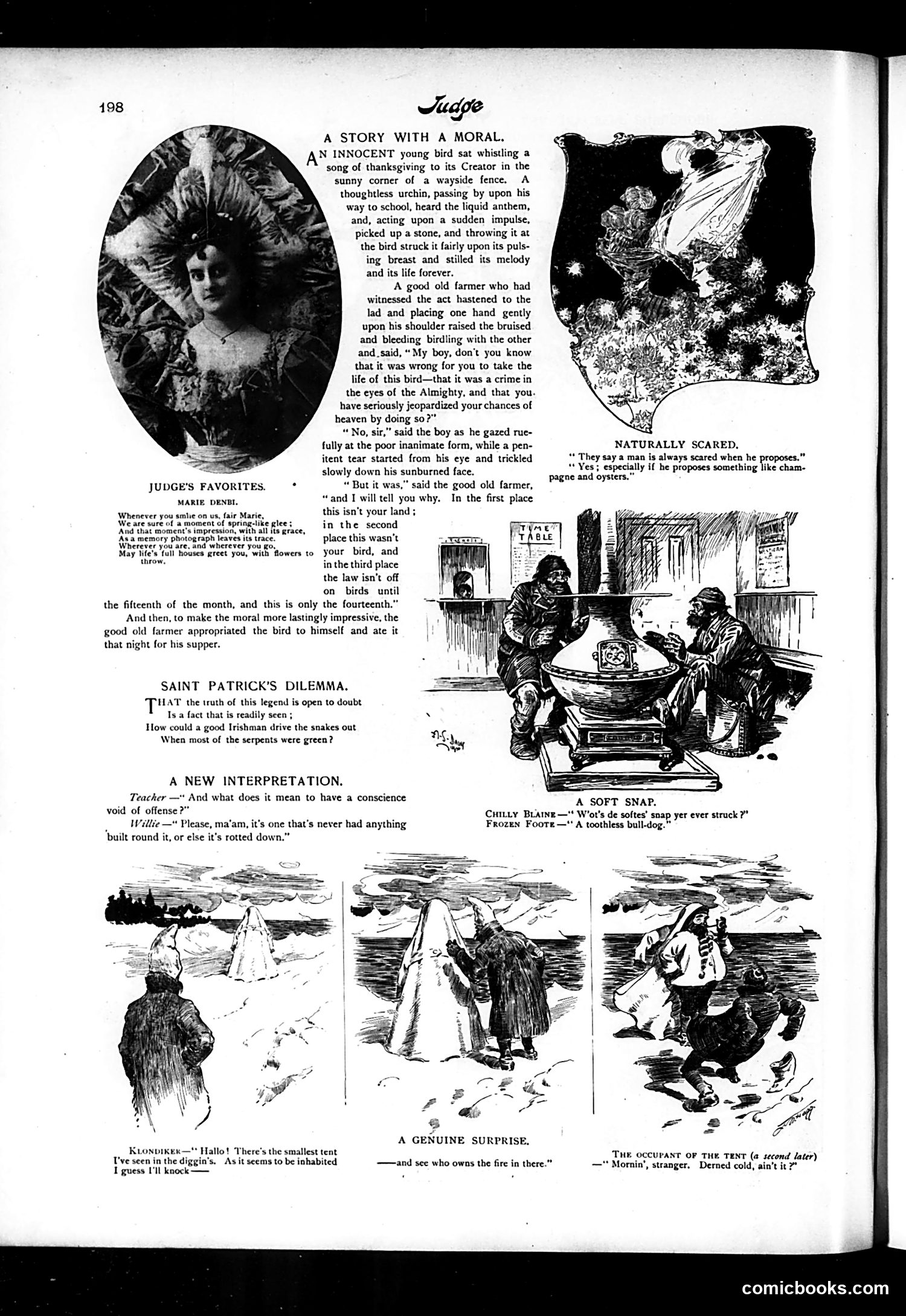
This page contains several unrelated humor pieces typical of early Judge magazine: **"A Story with a Moral"** depicts a boy killing a singing bird. A farmer then lectures him about the moral wrong of the act and its consequences for his soul. The moral appears straightforward: don't harm innocent creatures. **"Saint Patrick's Dilemma"** references the legend of Saint Patrick driving snakes from Ireland, questioning how he could accomplish this when snakes were already extinct there—a playful logical contradiction. **"A New Interpretation"** and **"A Soft Snap"** are brief joke exchanges about conscience and marriage proposal mishaps. **"A Genuine Surprise"** shows a three-panel comic about someone discovering an unauthorized tent in the snow—appears to be a camping/wilderness humor piece. The page is primarily light satirical humor rather than political commentary.
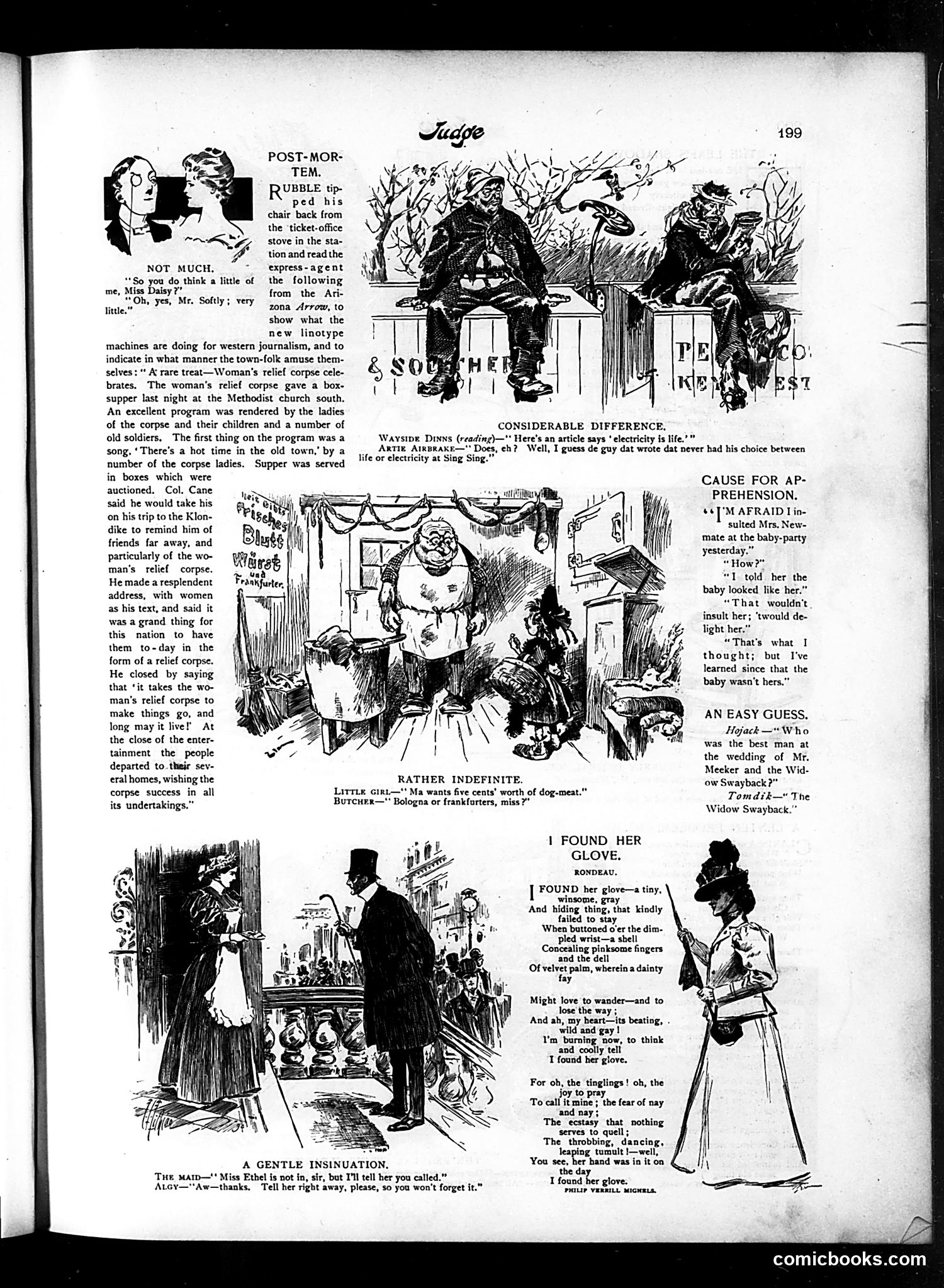
This page from Judge magazine contains several short humorous pieces typical of late 19th-century American satire: **"Post-Mortem"**: A brief anecdote mocking small-town journalism. It satirizes how western newspapers fill space with trivial local news—here, a "Woman's Relief Corpse" (a charitable organization) holding a box supper. The humor lies in the mundane detail presented as important. **"Considerable Difference"**: A one-liner joke contrasting electricity as life-giving versus its use in executions at Sing Sing prison (then famous for electric chair executions). **"Rather Indefinite"**: A butcher shop joke playing on a child's vague request for "dog-meat"—the butcher comically asks whether she means bologna or frankfurters (both made from questionable ingredients). **"I Found Her Glove"**: A sentimental poem in rondeau form about finding a woman's glove, treating the lost object romantically. This parodies Victorian romantic poetry's overwrought sentimentality. **"A Gentle Insinuation"**: A brief domestic comic strip showing a maid cleverly getting her mistress to dismiss her employer by claiming he said she'd be called back later.
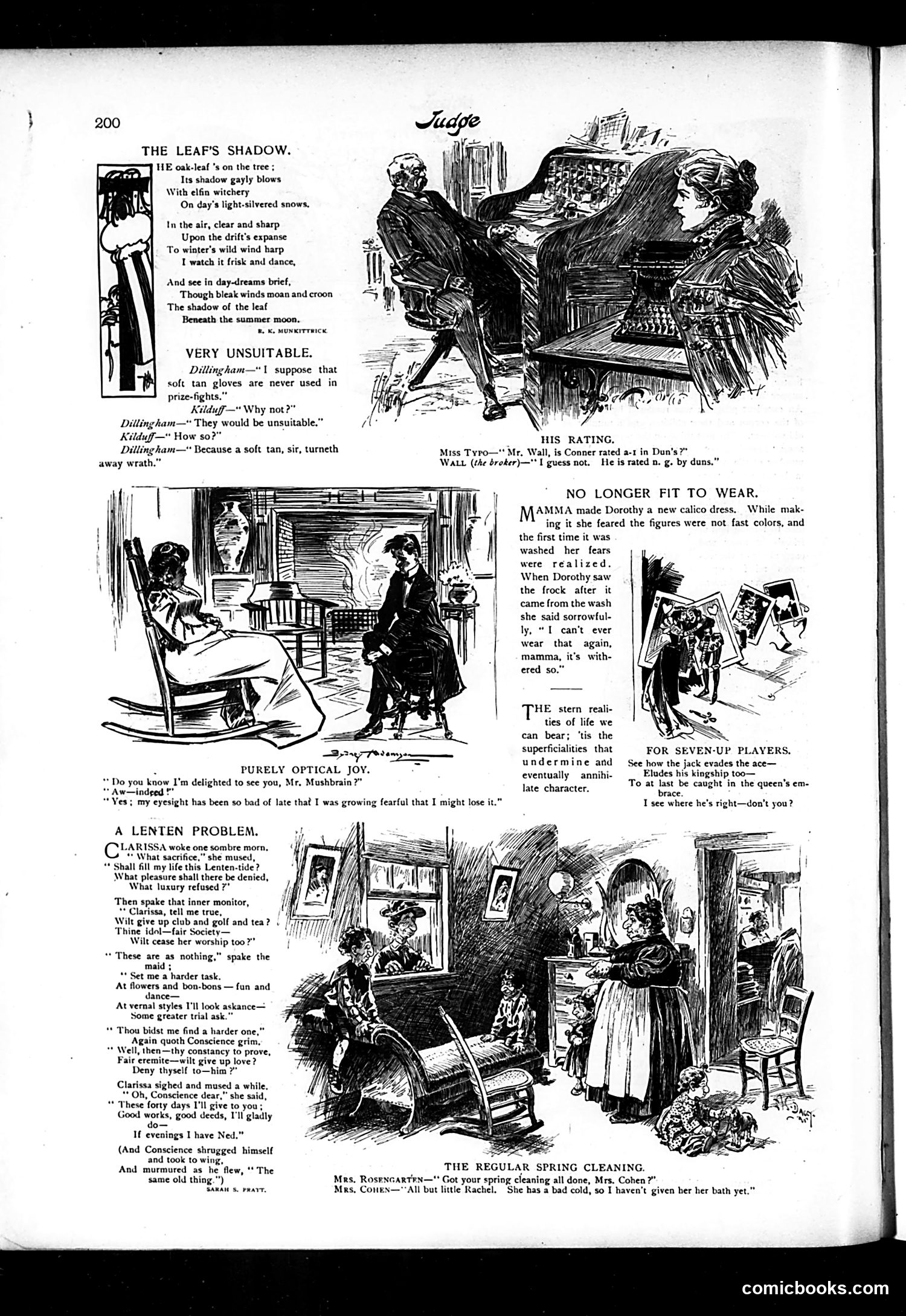
This page contains multiple satirical vignettes typical of Judge magazine's humor: **"Very Unsuitable"** plays on a pun: soft tan gloves are "unsuitable" for prize fights because "soft tan, sir, turneth away wrath"—a biblical reference twisted into wordplay about the color absorbing aggression. **"His Rating"** jokes about financial credibility: Mr. Wall is rated poorly in Dun's (the credit-rating agency) because he's repeatedly pursued by "duns" (debt collectors)—a play on the company name. **"No Longer Fit to Wear"** satirizes childhood literalism: a girl believes her calico dress "withered" after washing, misunderstanding that the dyes faded rather than the fabric deteriorating. **"A Lenten Problem"** mocks shallow religious observance: a woman promises Lenten sacrifices but refuses to give up her romantic interests, suggesting society women's faith is superficial. **"The Regular Spring Cleaning"** contains dark humor: a mother postpones bathing her sick daughter during spring cleaning—implying neglect disguised as household routine. The page emphasizes class anxieties, gender stereotypes, and the gap between professed values and actual behavior.
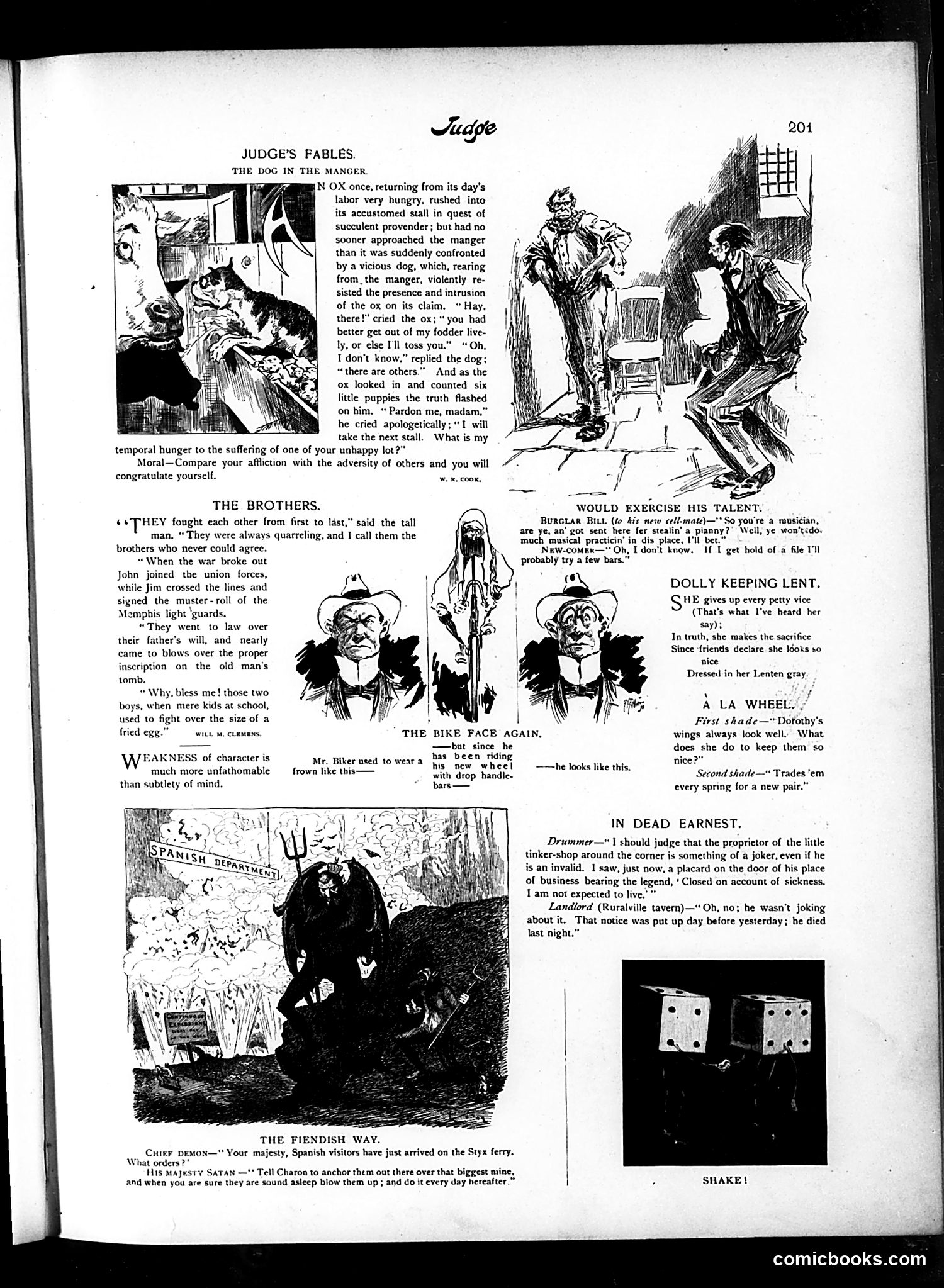
This page contains several short humorous fables and comic vignettes typical of Judge's satirical format: **"The Dog in the Manger"** illustrates the classical fable about selfishness—a dog hoards hay it cannot eat, blocking an ox from feeding. The moral encourages sympathy for others' suffering over petty grievances. **"The Brothers"** depicts two men who quarreled constantly in life, even fighting over their father's tomb inscription. It satirizes pointless, perpetual conflict. **Other brief items** include social satire: "Dolly Keeping Lent" mocks women performing religious sacrifice for vanity; "A La Wheel" jokes about replacing bicycle parts; "The Bike Face Again" references the contemporary "bicycle face" fad complaint. **"The Fiendish Way"** contains a dark supernatural joke about Spanish visitors to the underworld—likely referencing Spain's involvement in some contemporary conflict, though the specific reference is unclear. The page emphasizes Judge's typical blend of moral fables, social commentary on contemporary fashions and habits, and absurdist humor.
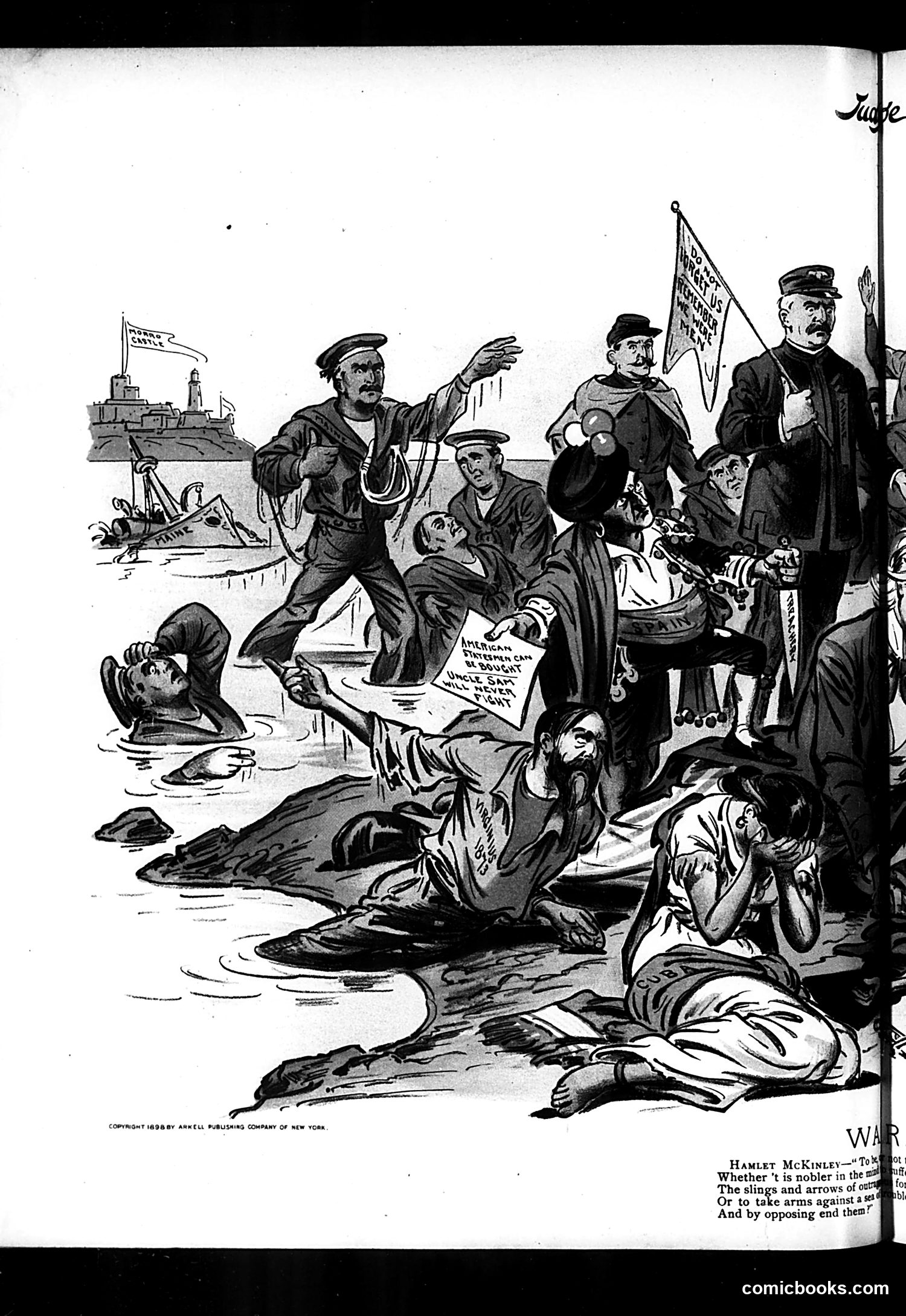
This Judge magazine cartoon satirizes a political figure (identified in the caption as "Hamlet McKinley") using Shakespeare's famous "To be or not to be" soliloquy. The setup presents a scene of apparent suffering or hardship—figures in distress at what appears to be a waterfront, with officials observing. The satire suggests McKinley faces a choice: endure the "slings and arrows" of circumstance, or take active opposition to end them. This likely comments on McKinley's response to a contemporary crisis or social problem. The allusion to Hamlet's existential contemplation implies the figure is hesitating or philosophizing rather than acting decisively. The drowning/desperate figures visualize the human cost of inaction. Without knowing the specific date, the exact political context remains unclear, though this clearly critiques perceived indecision or inadequate response to suffering.
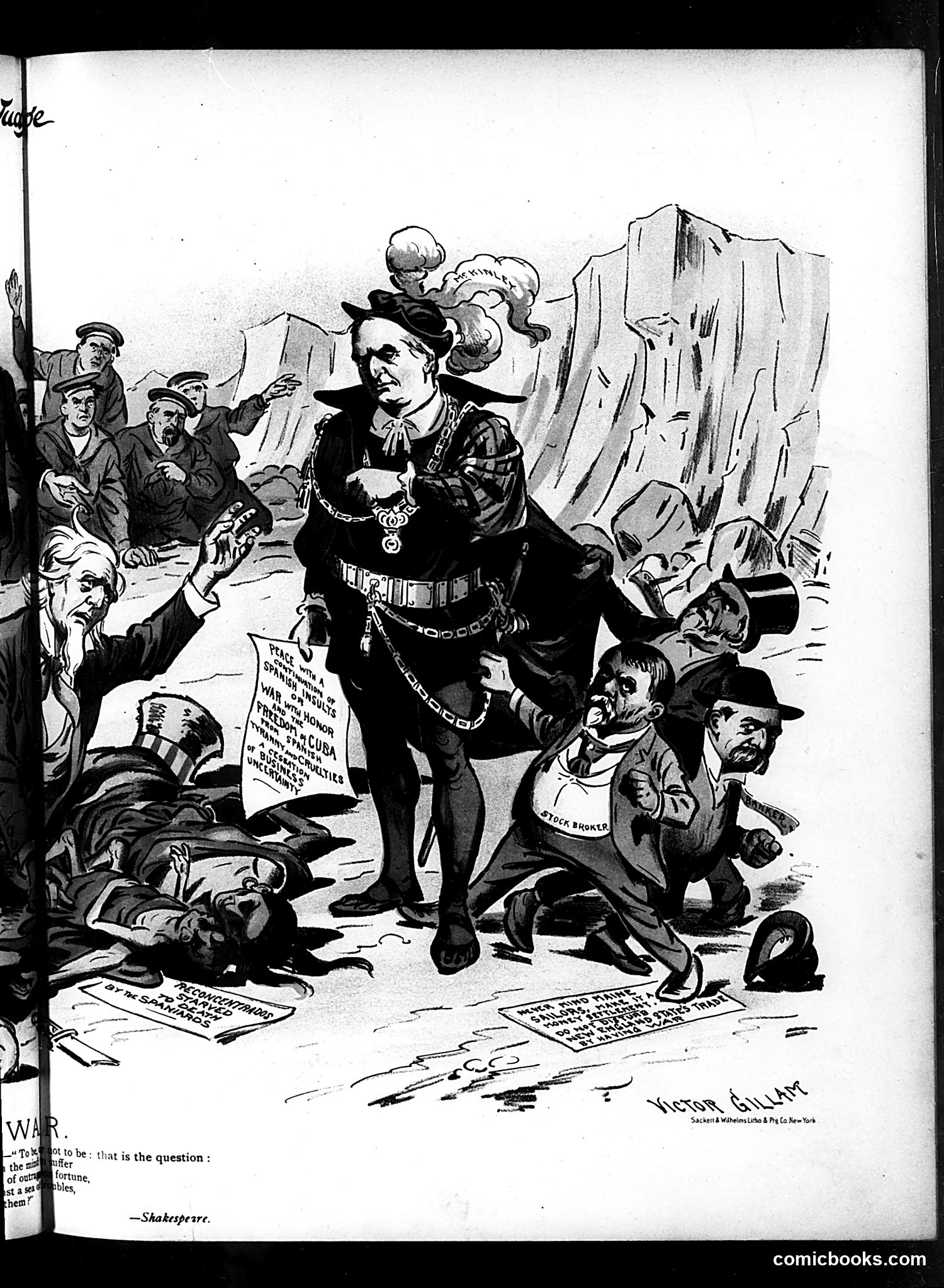
This is a satirical cartoon by Victor Gillam depicting a central female figure (likely representing Europe or a nation) surrounded by smaller caricatured male figures labeled "Stock Broker" and others, amid scenes of death and destruction. The classical reference to Shakespeare's "To be or not to be" suggests existential crisis. The cartoon appears to critique financial speculation and stock market manipulation during wartime or economic turmoil. The dead bodies and ruined architecture indicate the human cost of financial schemes. The smaller figures—identified as stock brokers—are portrayed as parasitic vultures profiting from widespread suffering and destruction. The overall message seems to be that financial elites exploit national crises for personal gain, while ordinary people suffer the consequences.
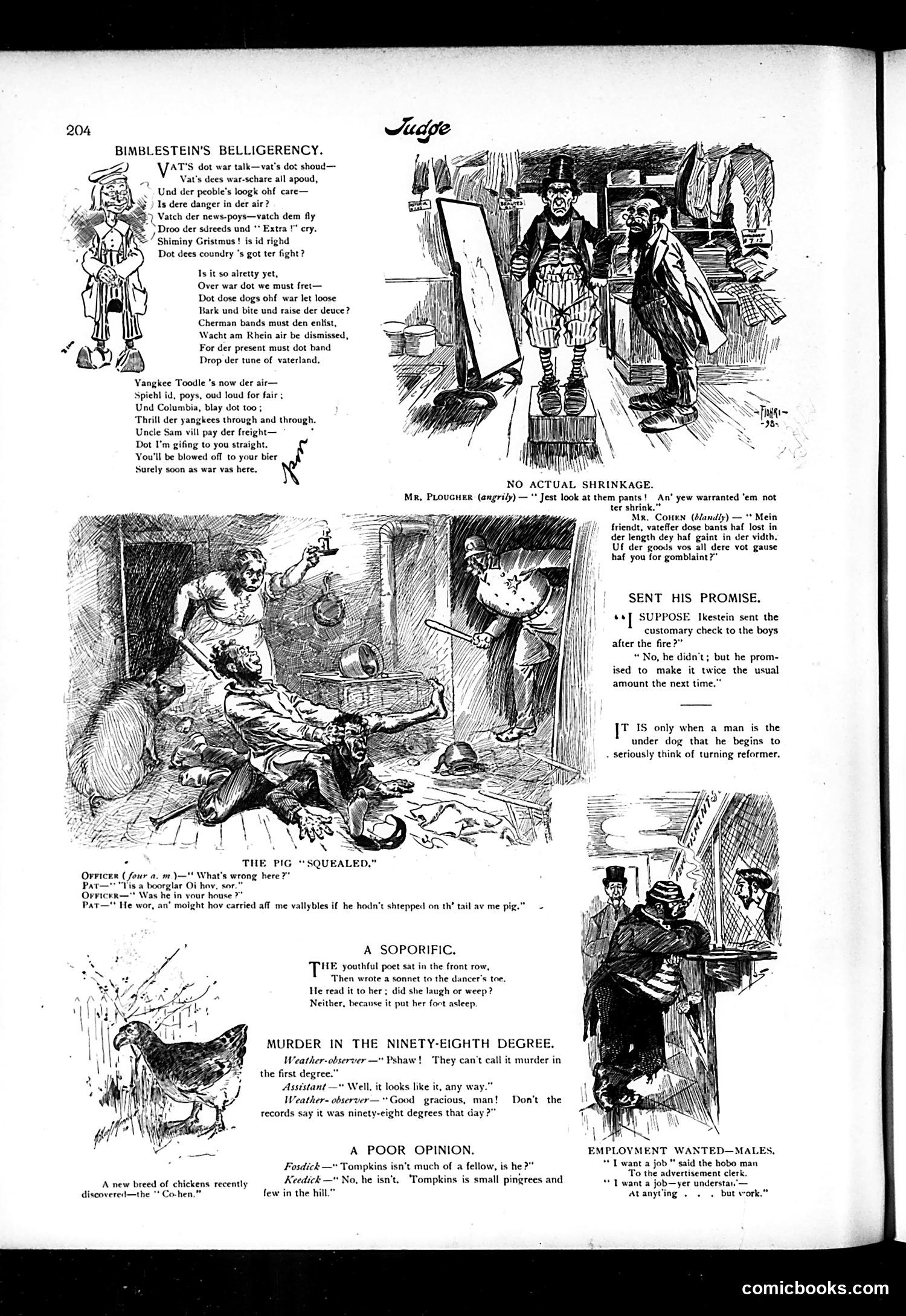
This page contains multiple satirical items typical of Judge magazine's humor: **"Bimblestein's Belligerency"** features a German-accented character anxiously discussing war preparations, written in heavy dialect. This reflects pre-WWI American anxiety about European conflict and satirizes German-American concerns about potential U.S. involvement. **"No Actual Shrinkage"** jokes about a tailor and customer disputing whether pants actually shrank—a common consumer complaint, here played for comic effect. **"The Pig Squealed"** presents a burglar who stepped on a pig's tail instead of stealing from the house—absurdist humor. Other brief gags include **"A Soporific"** (a bad poem literally puts someone to sleep), **"Murder in the Ninety-Eighth Degree"** (weather humor), and **"Employment Wanted"** (a hobo wanting work but specifically not work). The heavy German dialect in the lead piece suggests this dates to early 1900s when such caricatures were common in American comedy. The overall tone is light vaudeville-style humor mixing immigrant stereotypes with everyday domestic situations.
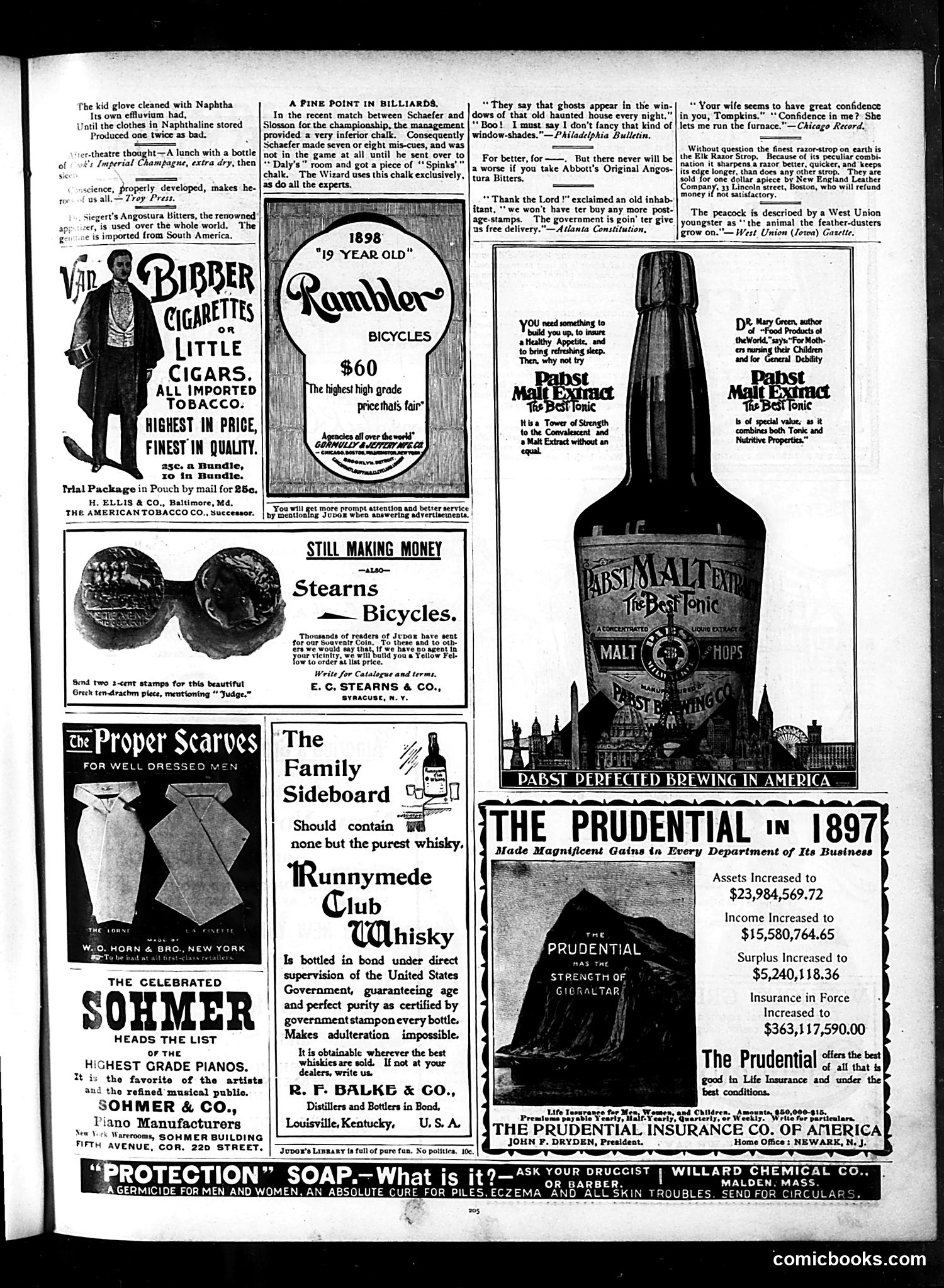
This page is primarily **advertising**, not political satire. It contains numerous product advertisements typical of an 1898 *Judge* magazine issue, including cigars, bicycles, whisky, pianos, and razors. However, scattered throughout are brief **humorous anecdotes** rather than cartoons: - A joke about billiards player Schaefer needing proper chalk to perform well - Wordplay about "window-shades" and ghosts - A comment on free mail delivery (referencing postal reform) - A pun about peacocks and feather dusters The **Prudential Insurance advertisement** is notably large, showcasing the company's financial growth in 1897—reflecting the era's trust in insurance companies and corporate stability as markers of progress. The **satirical content is minimal**: mostly light, conversational humor about everyday life rather than political commentary. The page reflects *Judge*'s dual nature as both satirical magazine and advertising vehicle for affluent readers interested in luxury goods.
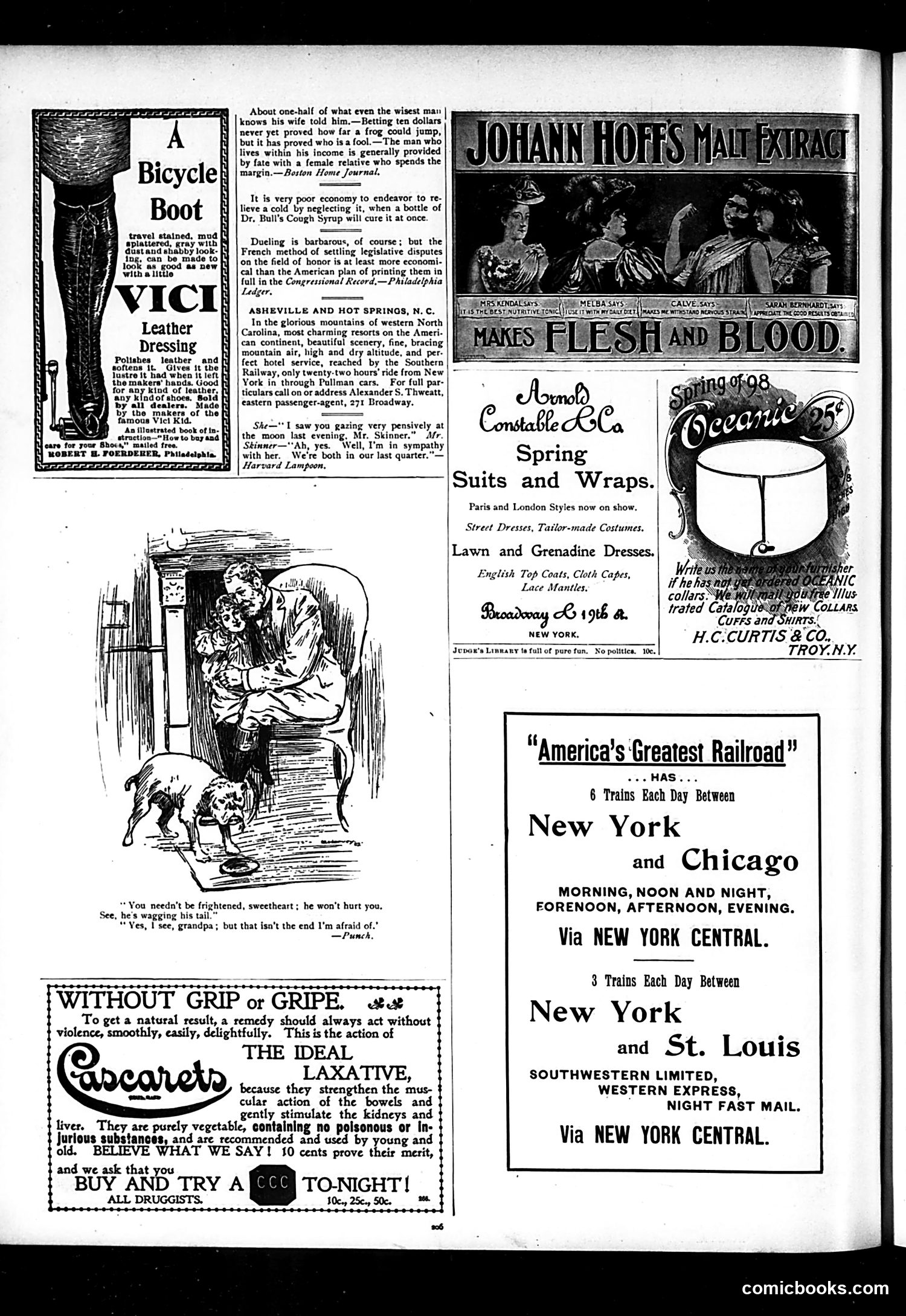
This is primarily an **advertising page** from Judge magazine, with minimal satirical content. The page features: **Main Cartoon (lower left):** A domestic scene where a grandfather reassures his granddaughter about a dog, saying "he won't hurt you" and "he's wagging his tail." The child replies she's not afraid of being hurt, but rather "that isn't the end I'm afraid of"—a crude joke implying the dog will defecate. This is typical mild bathroom humor for the era. **Text Aphorisms:** Short satirical observations about human nature (wives, gambling, marital finances) sourced from Boston Home Journal and Harvard Lampoon. **Advertisements:** The page is dominated by product ads (Vici leather dressing, Johann Hoff's Malt Extract, railroad services, clothing, laxatives), which was standard for Judge's revenue model. **Note:** No specific political figures or events are referenced. This appears to be a regular issue page mixing light humor with commercial content rather than focused political satire.
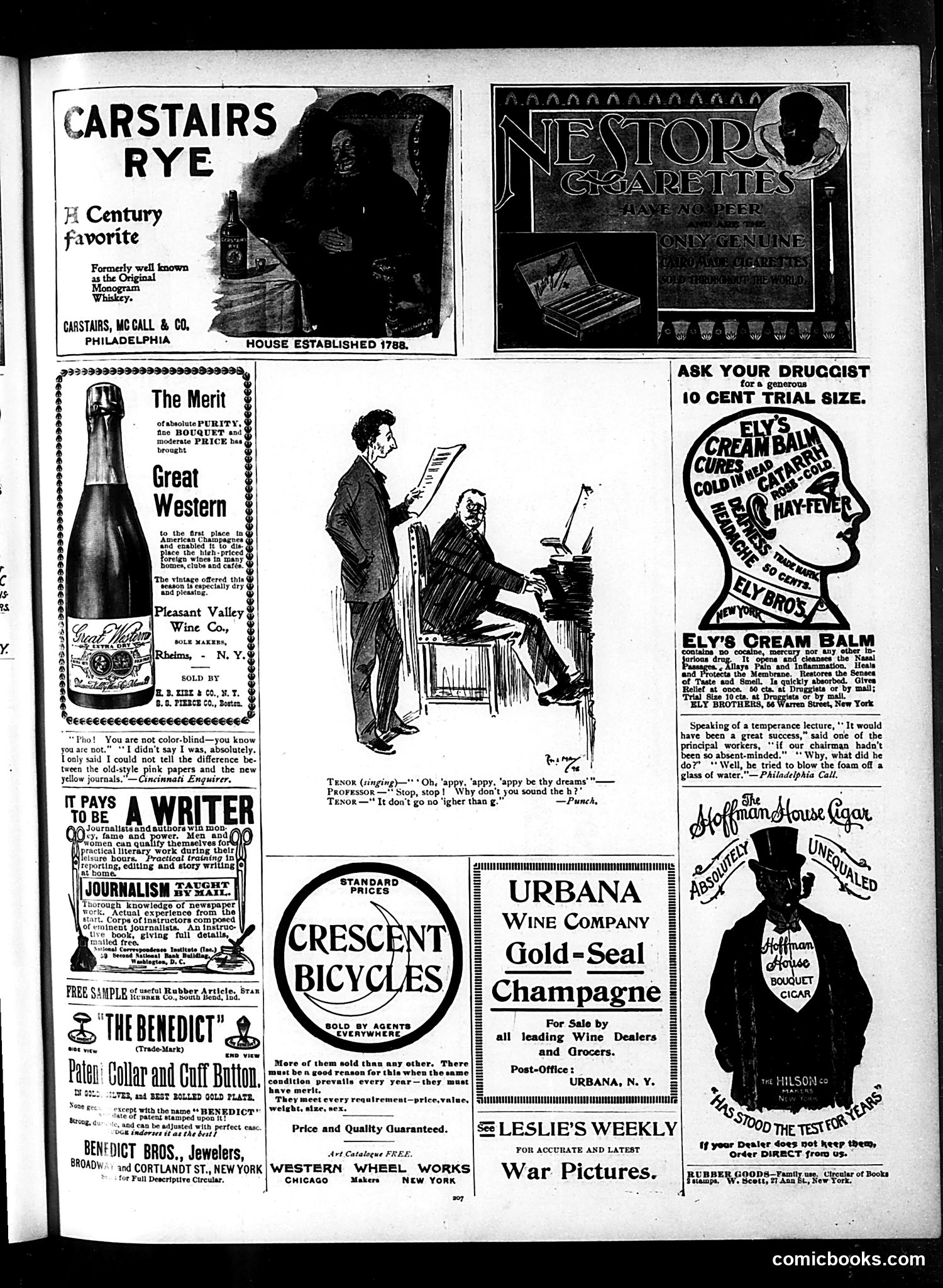
This page is primarily **advertising**, with one small cartoon joke embedded among product ads. The single cartoon shows a **music lesson scene**: a Professor instructs a Tenor singer, asking why he doesn't "sound the h" in his singing. The Tenor replies it won't go higher than "g"—a pun on the musical note. This is British humor (credited to *Punch*), poking fun at both dropped H's (a class marker in English speech) and musical limitation. The rest of the page contains ads for liquor (Carstairs Rye, Great Western Wine, Urbana Champagne), Crescent Bicycles, Ely's Cream Balm (a nasal remedy), and other products typical of early 20th-century magazines. The only non-advertising content is a brief joke about a temperance lecturer whose chairman tried to "blow the foam off a glass of water"—mocking absent-mindedness. **Context for modern readers**: This reflects an era when magazines mixed editorial content with advertising seamlessly, and British humor was regularly reprinted in American publications.
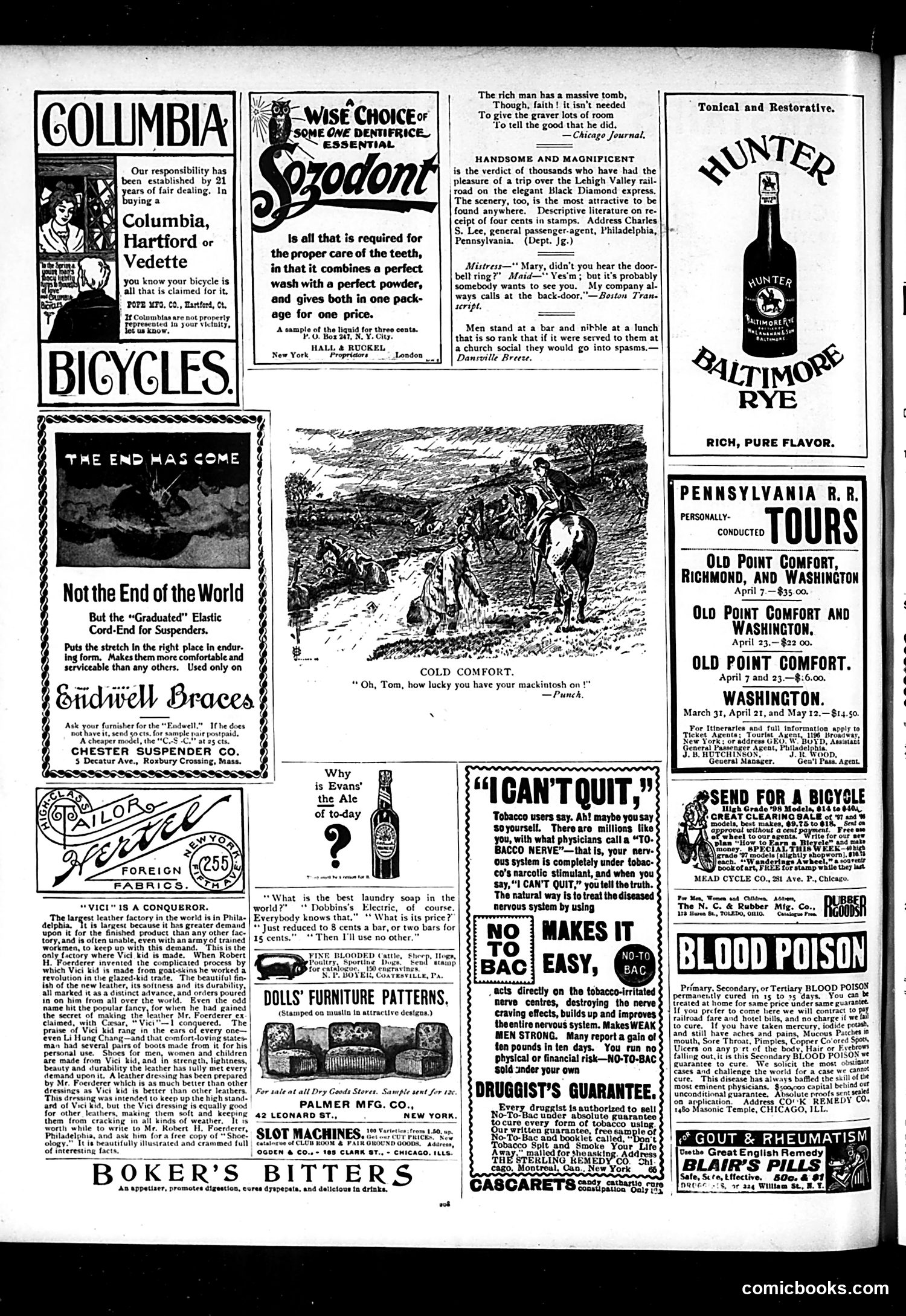
This page is predominantly **advertisements and humor snippets** rather than political cartoons. The content reflects late-19th/early-20th century American consumer culture and social commentary. **Key elements:** - **Bicycle ads** (Columbia, Hartford, Vedette): Reflect the bicycle craze of the era - **Lehigh Valley Railroad ad**: Promotes leisure travel, indicating expanding transportation - **Vici kid leather**: Details a Philadelphia factory's innovation in leather processing - **Social humor snippets**: Brief satirical observations about class differences (rich men's tombs, bar food quality, church socials), typical of Judge's format - **Various patent medicines and personal products**: Toothpaste, suspenders, shoe dressing—reflecting consumer goods expansion - **Tobacco/nicotine references**: "I Can't Quit" tobacco ad and anti-tobacco messages coexist, showing period ambivalence about the substance The page exemplifies Judge's mix of satirical social commentary with heavy advertising. The humor is gentle, class-conscious observation rather than political cartooning. No specific political figures or events are referenced.
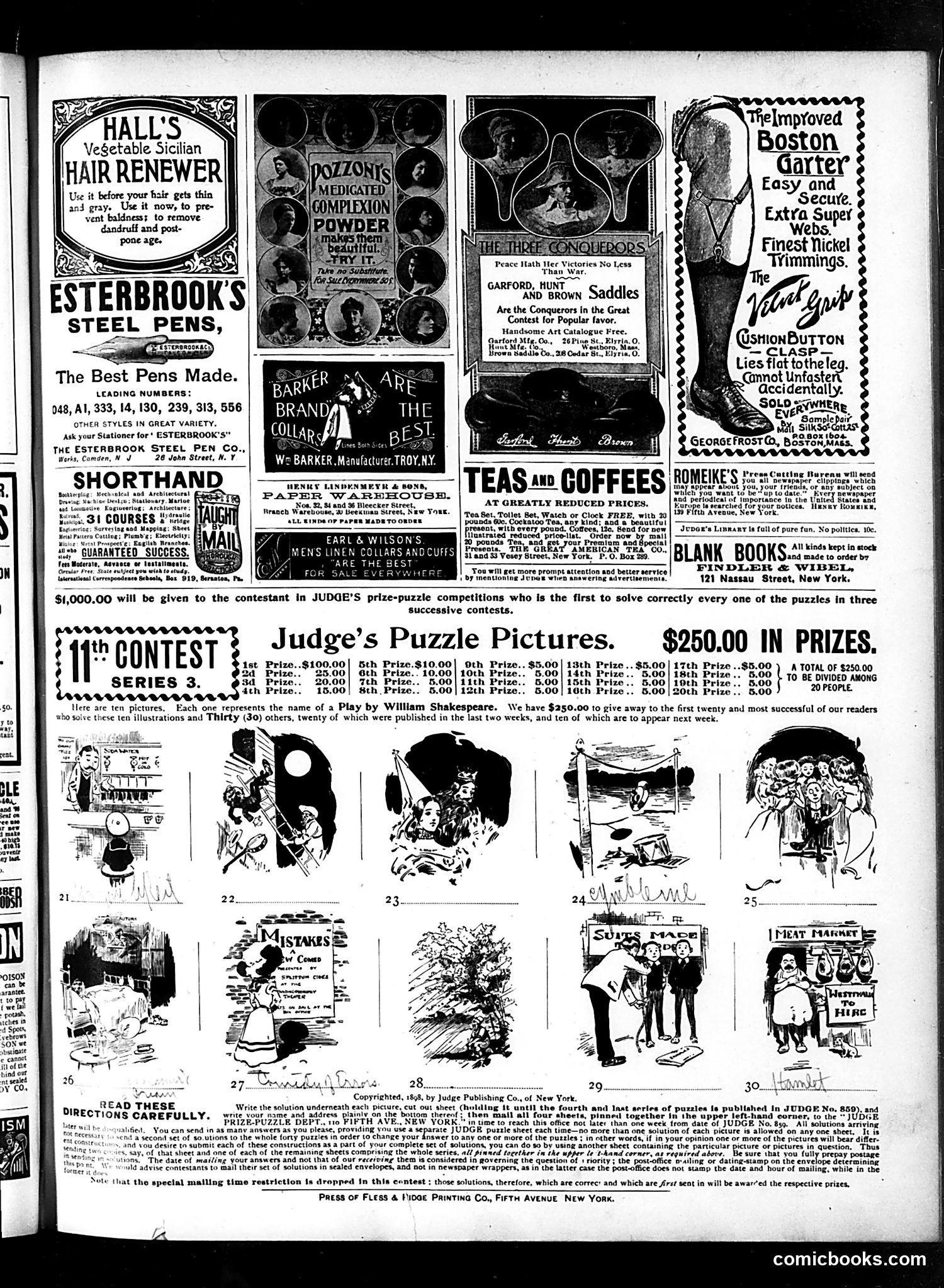
This is primarily an **advertising and puzzle competition page** from Judge magazine, not a political cartoon page. The main content is Judge's 11th puzzle contest, featuring **ten illustrations representing Shakespeare play titles**. Readers submit solutions to compete for $250 in prizes. The instructions indicate this is part of a larger 40-puzzle series across multiple magazine issues. The page is bordered by **period product advertisements** (steel pens, hair renewers, garters, tea, blank books)—typical for early 1900s magazines. These ads reflect contemporary consumer goods and services. **No political satire is evident here.** This is a straightforward puzzle competition using literary references (Shakespeare) to engage readers and boost magazine circulation—a common marketing strategy of the era. The competitive element and prize money incentivized reader participation across multiple magazine issues, encouraging subscription retention.
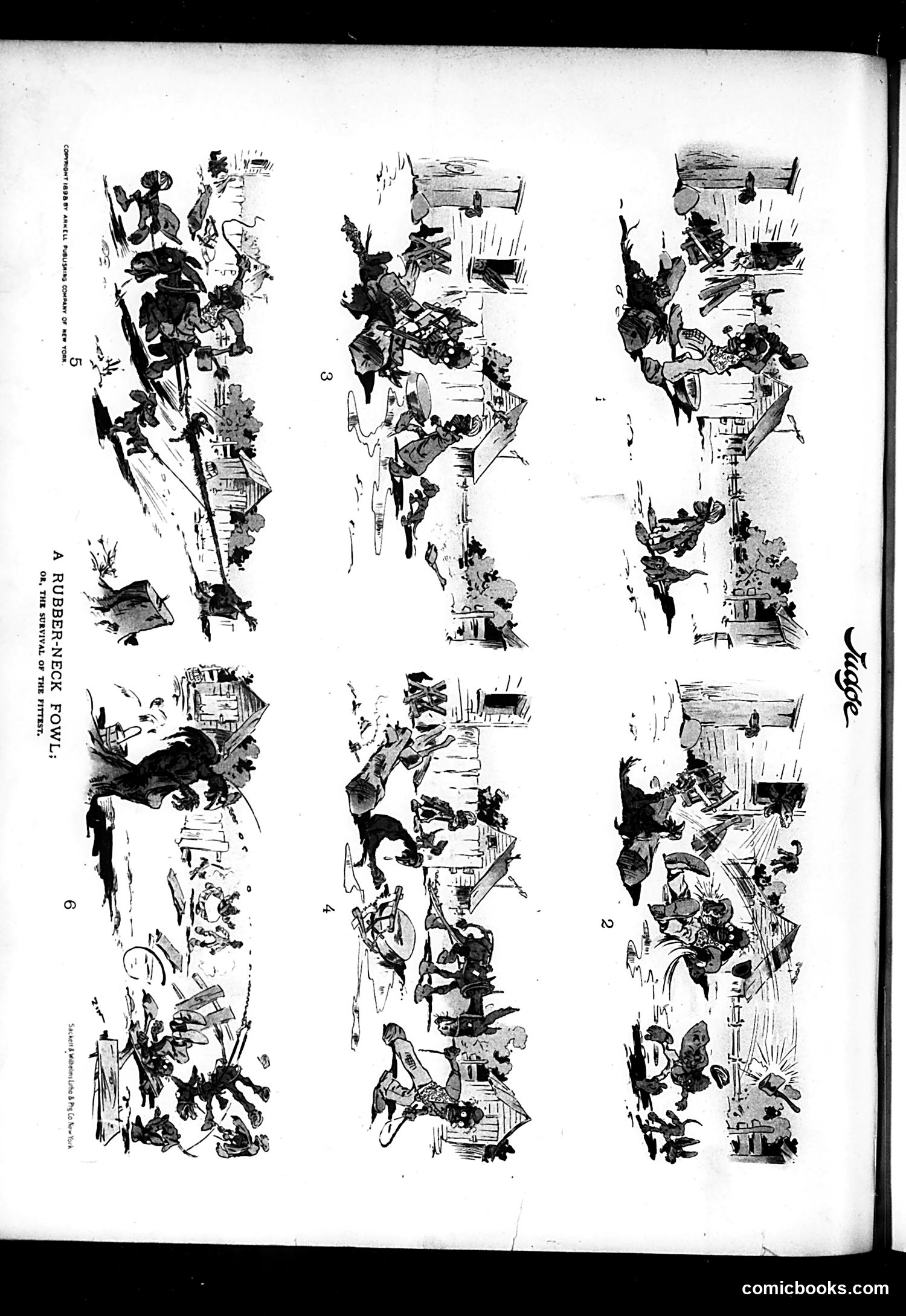
I can see this is a page from *Judge* magazine containing six numbered cartoon panels arranged in a grid, all rotated 90 degrees (requiring the reader to turn the page sideways). The OCR text is too corrupted to read clearly, and the image quality makes it difficult to identify specific political figures or read captions with certainty. The cartoons appear to depict chaotic domestic scenes with multiple figures in interaction, typical of satirical *Judge* content. However, without legible captions or clearer imagery, I cannot reliably identify which politicians or public figures are being caricatured, what specific events are being referenced, or what the satirical point of each panel is meant to be. To properly explain these cartoons' meaning, I would need either higher image resolution or the original OCR text corrected.