
A complete issue · 16 pages · 1898
Judge — March 19, 1898
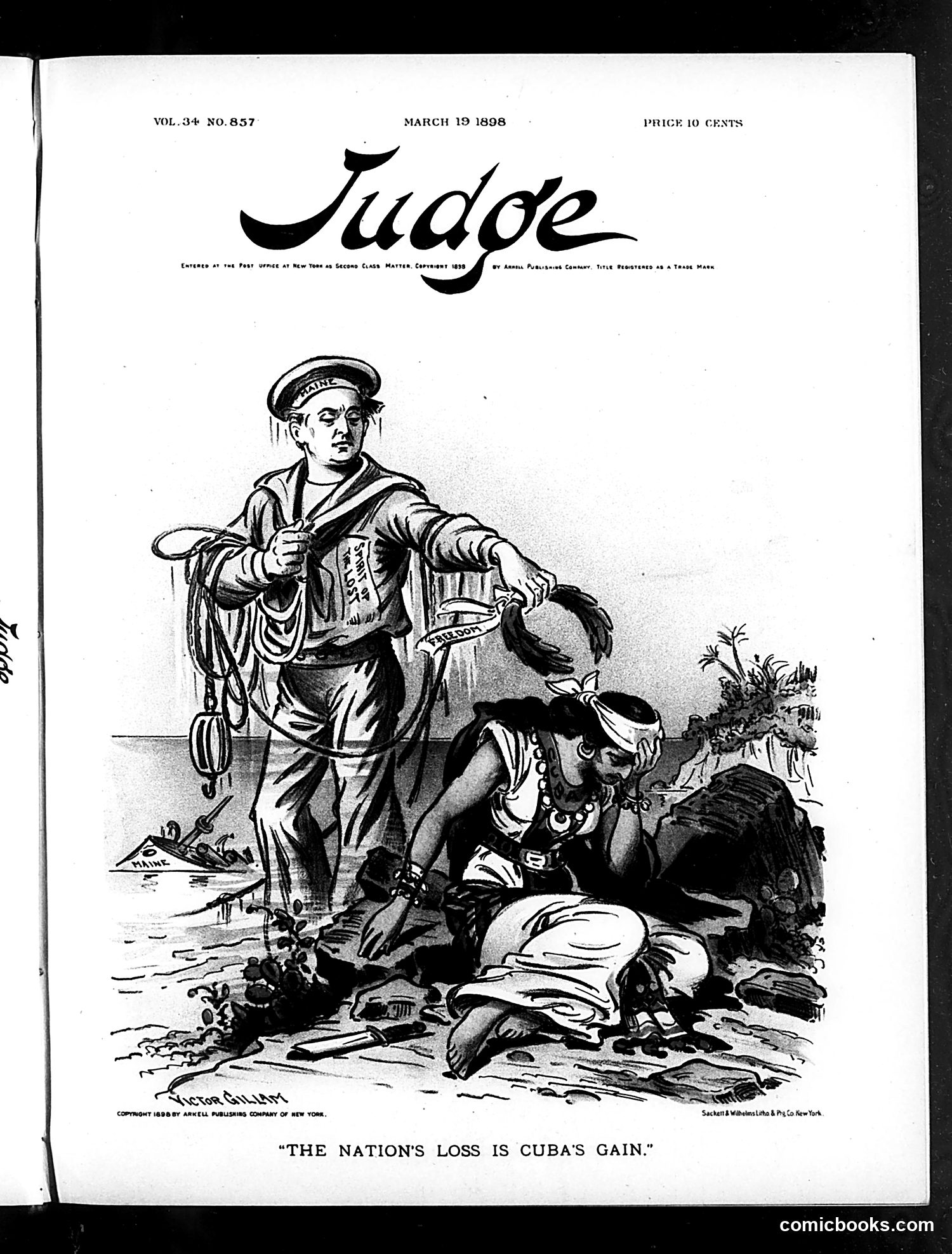
This political cartoon satirizes American imperialism regarding Cuba. The standing figure represents Uncle Sam (identified by sailor outfit), pouring what appears to be water or resources onto a fallen figure labeled or representing Cuba. The caption "The Nation's Loss is Cuba's Gain" ironically suggests that while America sacrifices resources and loses financially, Cuba benefits from American intervention. The cartoon critiques U.S. involvement in Cuban affairs during the Spanish-American War period. Uncle Sam is depicted as a provider/caretaker figure, but the satire implies this "help" comes at significant American expense. The image reflects contemporary debate about whether U.S. intervention in Cuba served American or Cuban interests—or merely served American imperial ambitions masked as humanitarian aid.
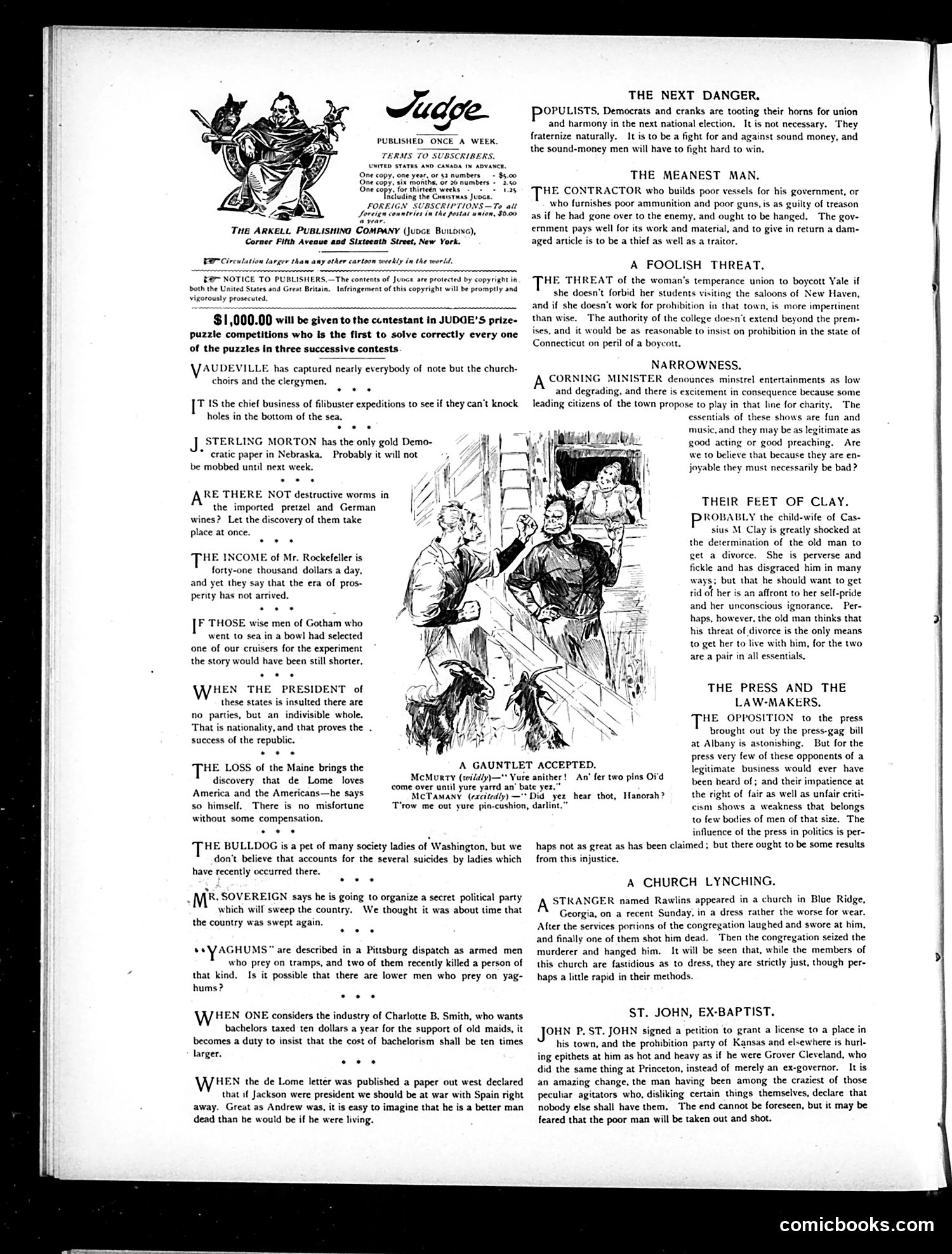
This page contains political commentary rather than a primary cartoon. The sketched illustration titled "A Gauntlet Accepted" depicts what appears to be a confrontational scene, likely referencing a political or social debate of the period. The editorial pieces address contemporary issues: "The Next Danger" warns about labor organizing; "The Meanest Man" criticizes government contractors; "A Foolish Threat" mocks women's temperance activism at Yale; and "Narrowness" attacks ministerial entertainments. Later sections cover divorce law, press freedom, a lynching incident in Georgia, and religious persecution. Without knowing the specific publication date, the exact political figures referenced remain unclear, though the tone suggests conservative criticism of progressive reform movements and labor activism common in early 20th-century American satire.
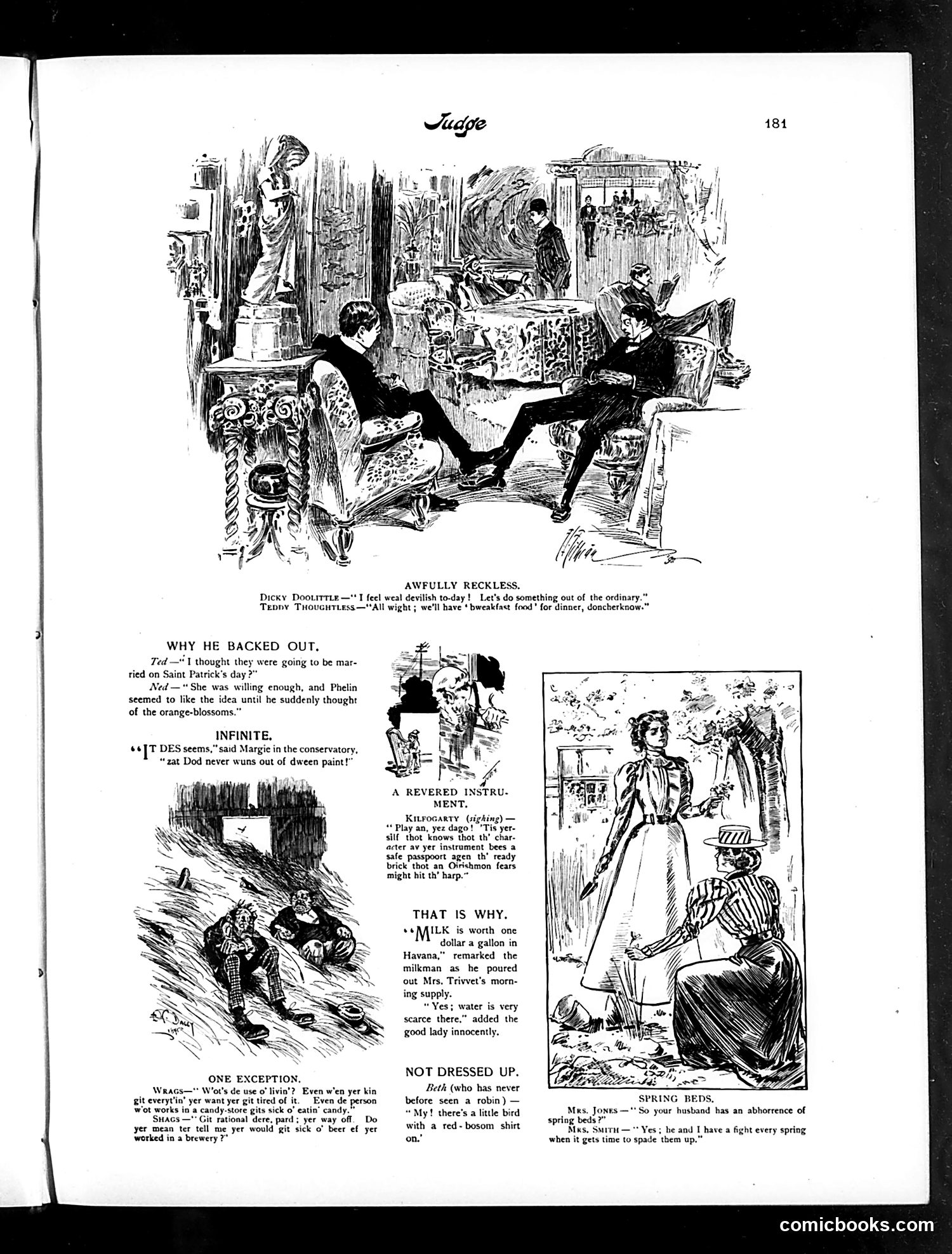
This page contains several short satirical pieces and jokes typical of Judge magazine's humor: **"Awfully Reckless"** (top): Two men in an ornate interior discuss doing "something out of the ordinary," with breakfast food mentioned for dinner—mild satire of predictable upper-class routines. **"Why He Backed Out"**: A brief joke about Saint Patrick's Day marriage plans being abandoned due to unexpected thought of blooming flowers—plays on superstitions and male hesitation about commitment. **"Infinite," "A Revered Instrument," "That Is Why"**: Short one-liners with accompanying sketches mocking various subjects—paint preservation, musical instruments, and milk prices in Havana. **"One Exception," "Not Dressed Up," "Spring Birds"**: Additional brief jokes about persistence, robin spotting, and marital dynamics. The page exemplifies Judge's style: quick, class-focused humor aimed at educated readers, heavy on wordplay and domestic/social observation rather than political commentary.
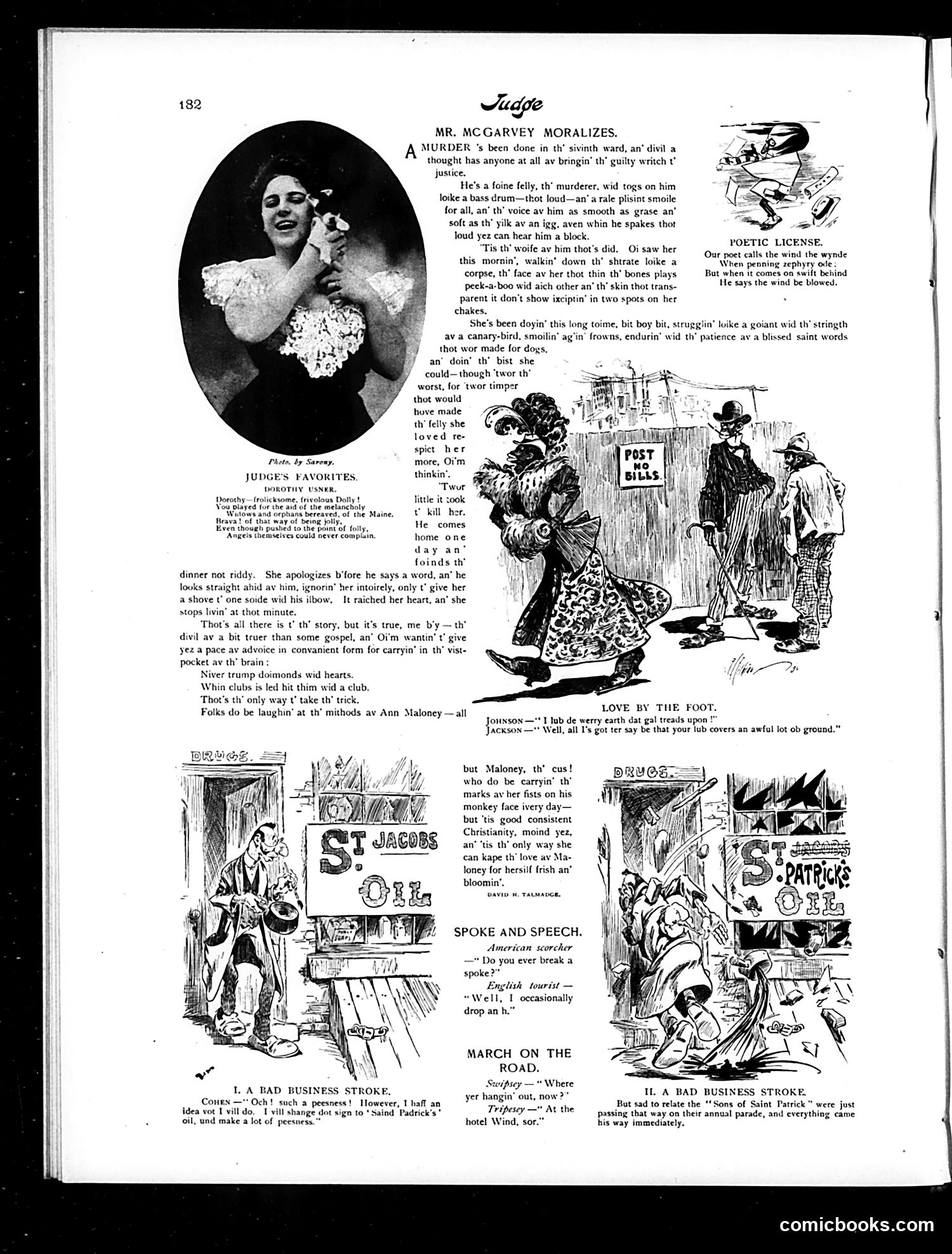
This page features social satire typical of early 20th-century Judge magazine. The main photograph shows "Judge's Favorites" - Dorothy Tanner, labeled as a performer praised for her theatrical talents. The accompanying text "Mr. McGarvey Moralizes" uses dialect humor to mock a murder case, employing working-class Irish speech patterns common in period satire. The sketches below—"St. Jacobs Oil," "St. Patrick's Oil," and sections titled "Love by the Foot," "Spoke and Speech," and "March on the Road"—appear to be comedic vignettes and advertisements using ethnic and class-based humor. The cartoons employ exaggerated caricature and vernacular speech to satirize urban immigrant life and social pretension, reflecting Judge's satirical approach to contemporary American society and popular culture.
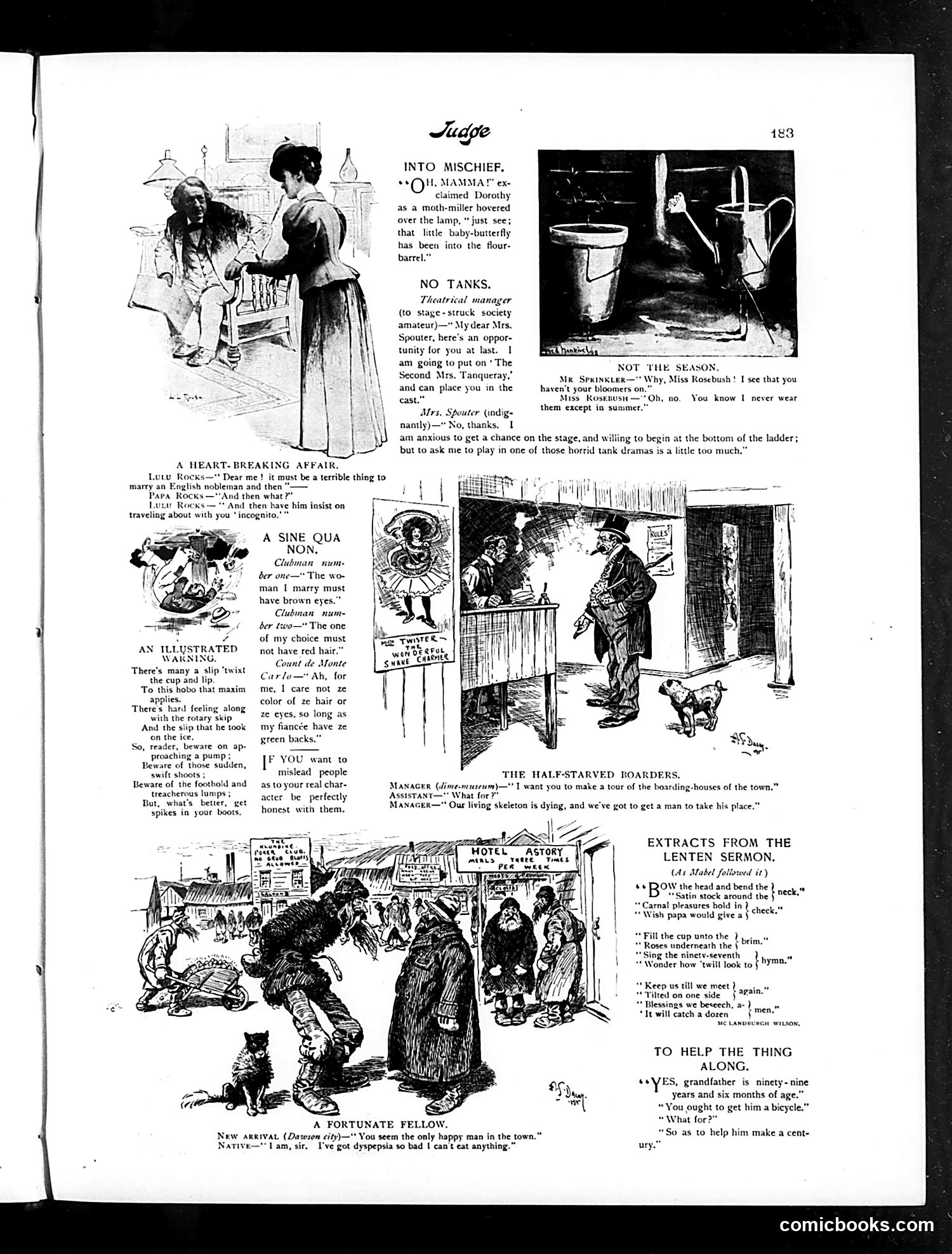
This page contains multiple unrelated satirical sketches typical of Judge magazine's format. Key items include: **"No Tanks"** mocks society women aspiring to stage careers who refuse unglamorous roles in "tank dramas" (cheaply-produced plays, often featuring water effects). **"A Heart-Breaking Affair"** jokes about English nobility—a common American anxiety about wealthy daughters marrying titled but impoverished foreigners who then demand traveling "incognito" (avoiding creditors). **"The Half-Starved Boarders"** satirizes dime museums (cheap freak shows), where a manager needs to replace a dying "living skeleton" performer—dark humor about exhibition of human oddities. **"A Fortunate Fellow"** presents ironic commentary: a Dawson City prospector (Klondike Gold Rush era) claims happiness despite severe dyspepsia, suggesting even illness beats poverty. The cartoons reflect early 1900s American preoccupations: social climbing, theatrical pretension, and immigrant/frontier anxieties. The humor relies on period-specific references now requiring context.
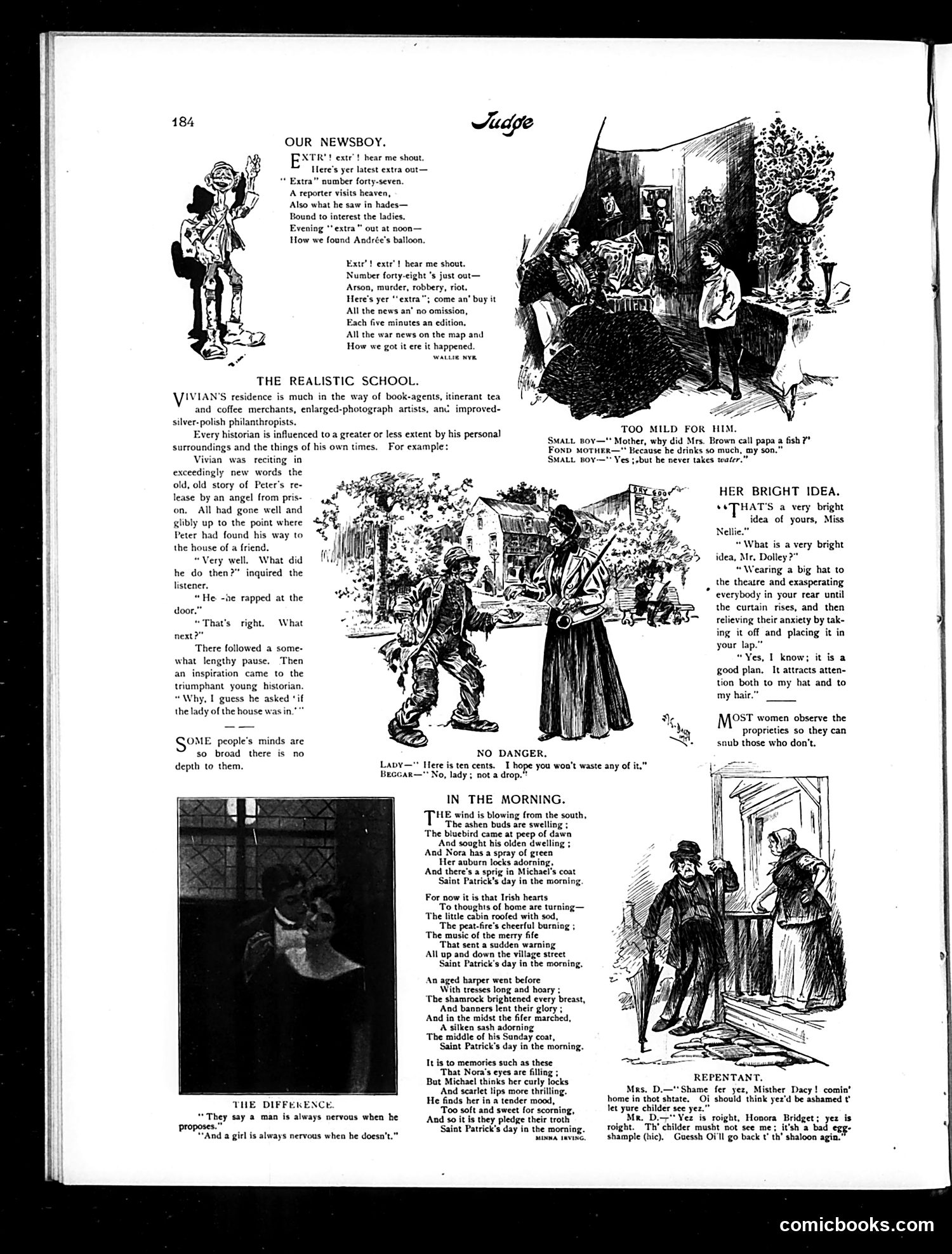
This page contains several satirical pieces typical of late 19th-century American humor: **"Our Newsboy"** mocks sensationalist journalism—the newsboy hawks increasingly dramatic "extras" (special editions), from celestial reporting to crime coverage, suggesting papers manufactured urgency and triviality equally. **"The Realistic School"** lampoons a young historian whose modern sensibilities distort biblical narrative: when recounting Peter's escape from prison, he asks if Peter rang the doorbell—absurdly applying contemporary domestic conventions to ancient history. **"Her Bright Idea"** satirizes women's theater etiquette, with Miss Nellie intentionally wearing an enormous hat to theater performances, claiming it draws attention to her appearance rather than admitting rudeness. **"In the Morning"** is sentimental verse about Saint Patrick's Day, depicting Irish-American nostalgia and courtship, reflecting the magazine's ethnic comedy conventions. Minor pieces joke about drunkenness and domestic relationships using working-class dialect humor common to the era.
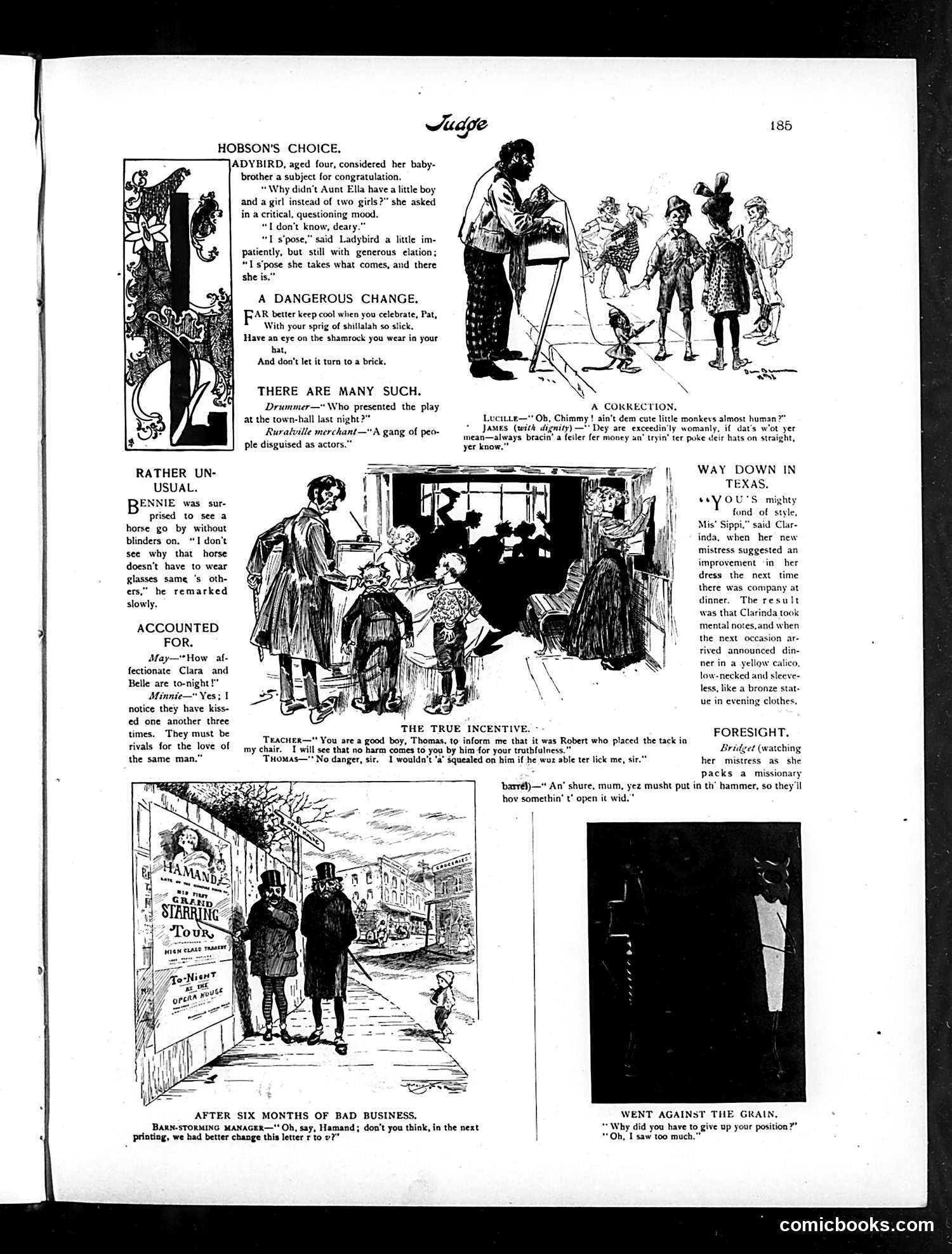
This is a collection of short humorous sketches typical of Judge's satirical style. Key pieces include: **"Hobson's Choice"**: A child questions why her aunt didn't have a boy and girl instead of two girls—satirizing Victorian gender preferences and assumptions about family planning. **"A Dangerous Change"**: Anti-Irish stereotype humor warning "Pat" that celebrating (implied St. Patrick's Day with a shillelagh) might turn his shamrock into a brick—playing on period caricatures of Irish-Americans as heavy drinkers prone to violence. **"The True Incentive"**: A boy gets praised for honesty about a classroom tack, but admits he only tattled because the culprit could beat him up—deflating moral virtue through cynicism about real motives. **"Way Down in Texas"**: A servant mimics her employer's "style," literally interpreting "low-necked and sleeveless" advice by wearing it to a formal dinner, resulting in ridicule. The overall tone reflects Gilded Age attitudes: class hierarchy, ethnic stereotyping, and gentle mockery of social pretension and human hypocrisy.
This cartoon by Victor Gillam warns about industrial safety hazards. Uncle Sam stands on an elevated platform supervising four workers below a massive piece of machinery labeled "HUDSON'S DANGEROUS WORK FOR DUTY." The workers appear to be in peril beneath the heavy equipment. The satire critiques inadequate workplace safety protections during industrial operations—likely referencing either wartime production demands or broader labor exploitation. Uncle Sam's commanding position suggests government oversight (or lack thereof) of dangerous working conditions. The "BE CAREFUL!" caption underscores the irony: workers are urged to be cautious despite being placed in inherently unsafe situations by industrial priorities. The cartoon advocates for stronger safety regulations to protect laborers from preventable injuries.
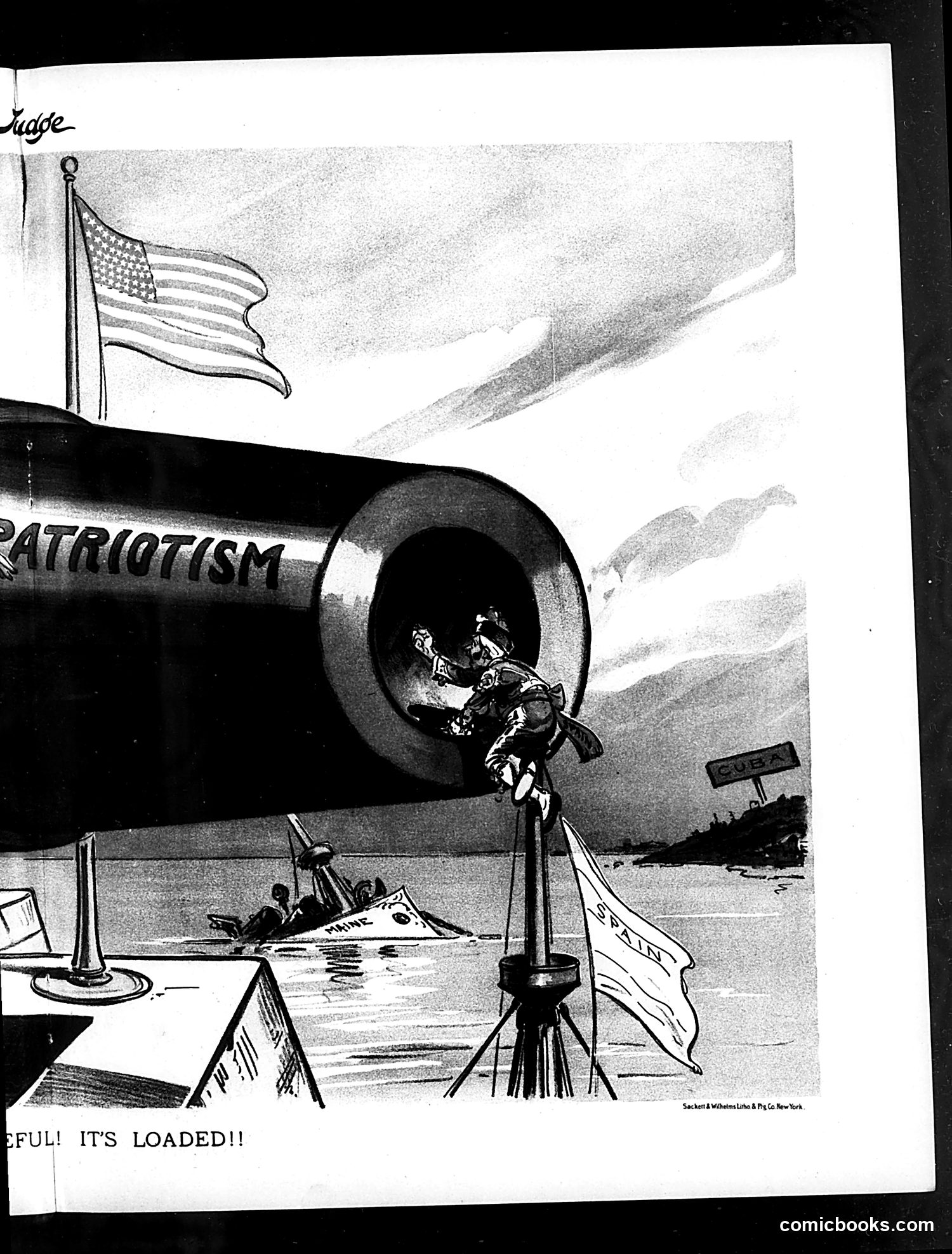
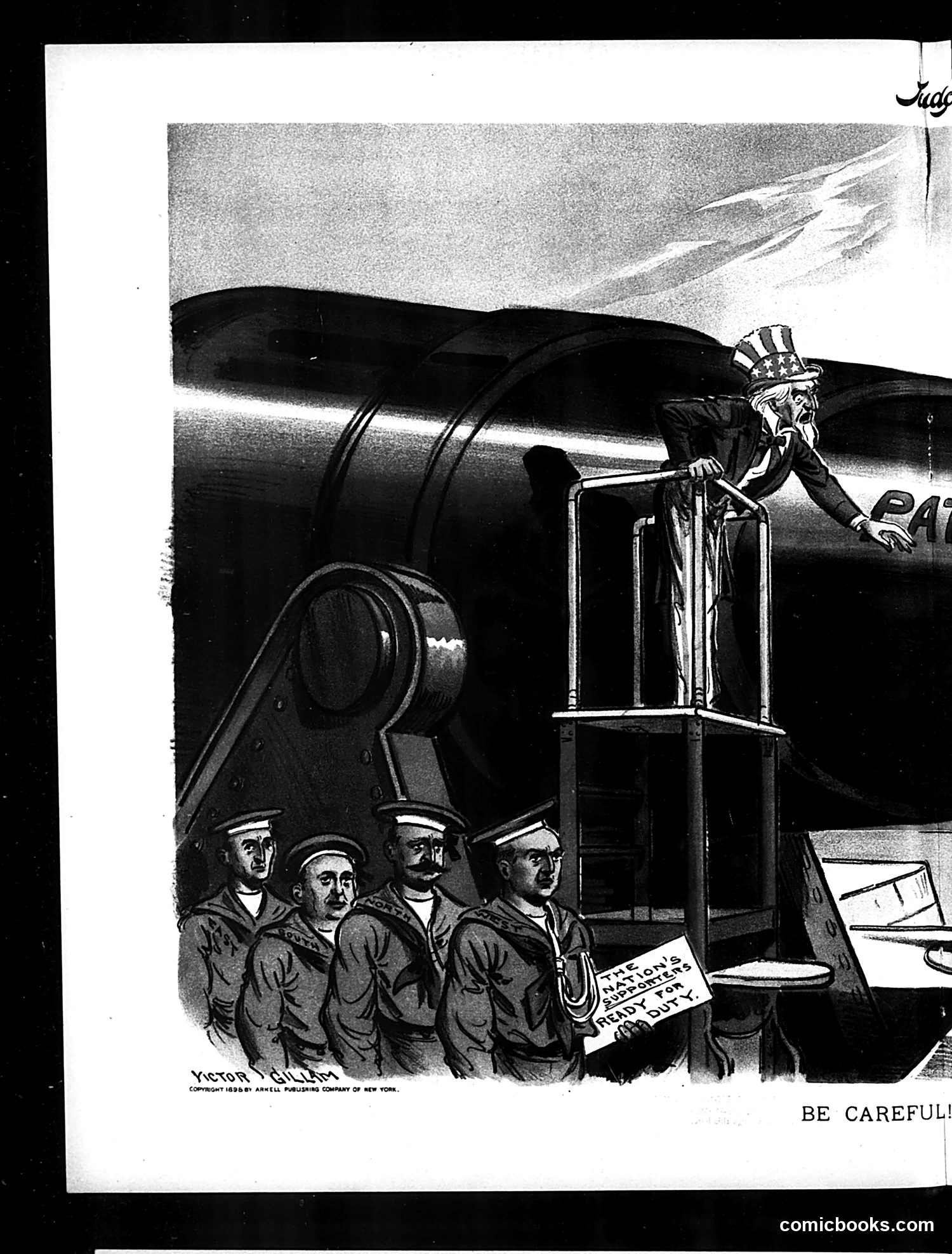
This is a satirical cartoon about American patriotism and military preparedness. A large artillery piece labeled "PATRIOTISM" is being aimed by a figure at what appears to be a military target or enemy position ("CUBA" is visible on a sign). The cannon is "loaded," as the caption states—suggesting patriotic sentiment is being weaponized or mobilized for military action. The American flag flies prominently above, and military vessels appear in the water below. The cartoon satirizes how patriotic rhetoric can be deployed to justify military intervention or warfare. The loaded cannon metaphor suggests that patriotism is being used as a tool of aggression rather than defense. The specific reference to Cuba indicates this likely concerns American military policy toward Cuba, possibly related to the Spanish-American War era or subsequent interventions, though the exact historical moment remains unclear from the image alone.
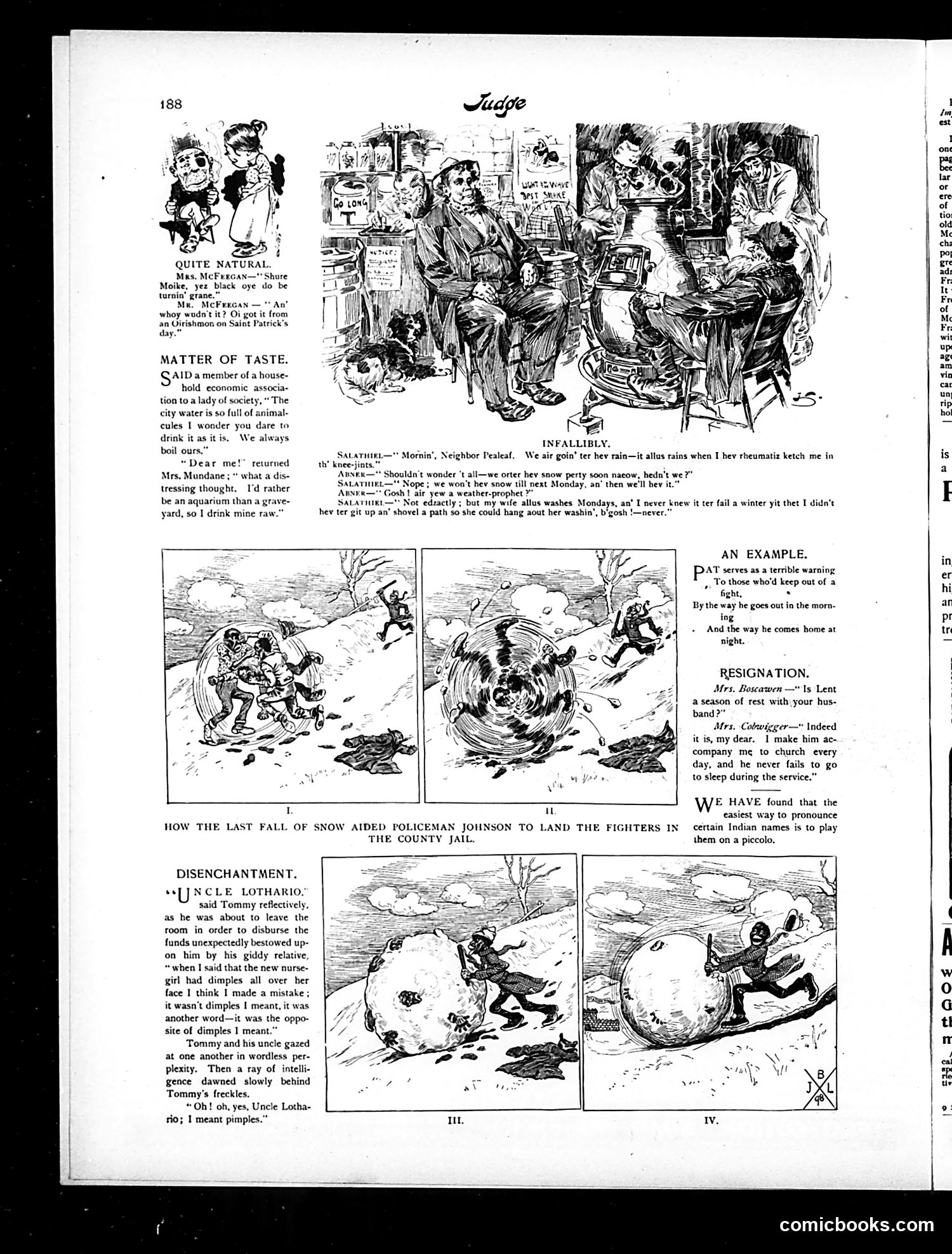
This page contains several satirical humor pieces typical of Judge magazine's social comedy: **"Quite Natural"** mocks Irish immigrants through dialect humor, playing on stereotypes about fighting on Saint Patrick's Day. **"Matter of Taste"** satirizes class differences: a society lady worries about microbes in city water while drinking boiled water, but a working-class woman dismisses such concerns and drinks raw tap water—suggesting that either the concern is pretentious or working-class people are oblivious to health risks. **"Infallibly"** presents rural characters whose weather predictions are hilariously backwards—they predict rain based on rheumatism, and assume snow will follow because the wife does laundry on Mondays, creating circular logic. The **snow sequence** and other brief pieces offer gentle domestic humor about marital relations and childhood misunderstandings (the "pimples/dimples" joke). Overall, the page targets class pretension, immigrant stereotypes, rural superstition, and domestic relationships—standard Judge fare combining gentle social observation with period ethnic humor now considered offensive.
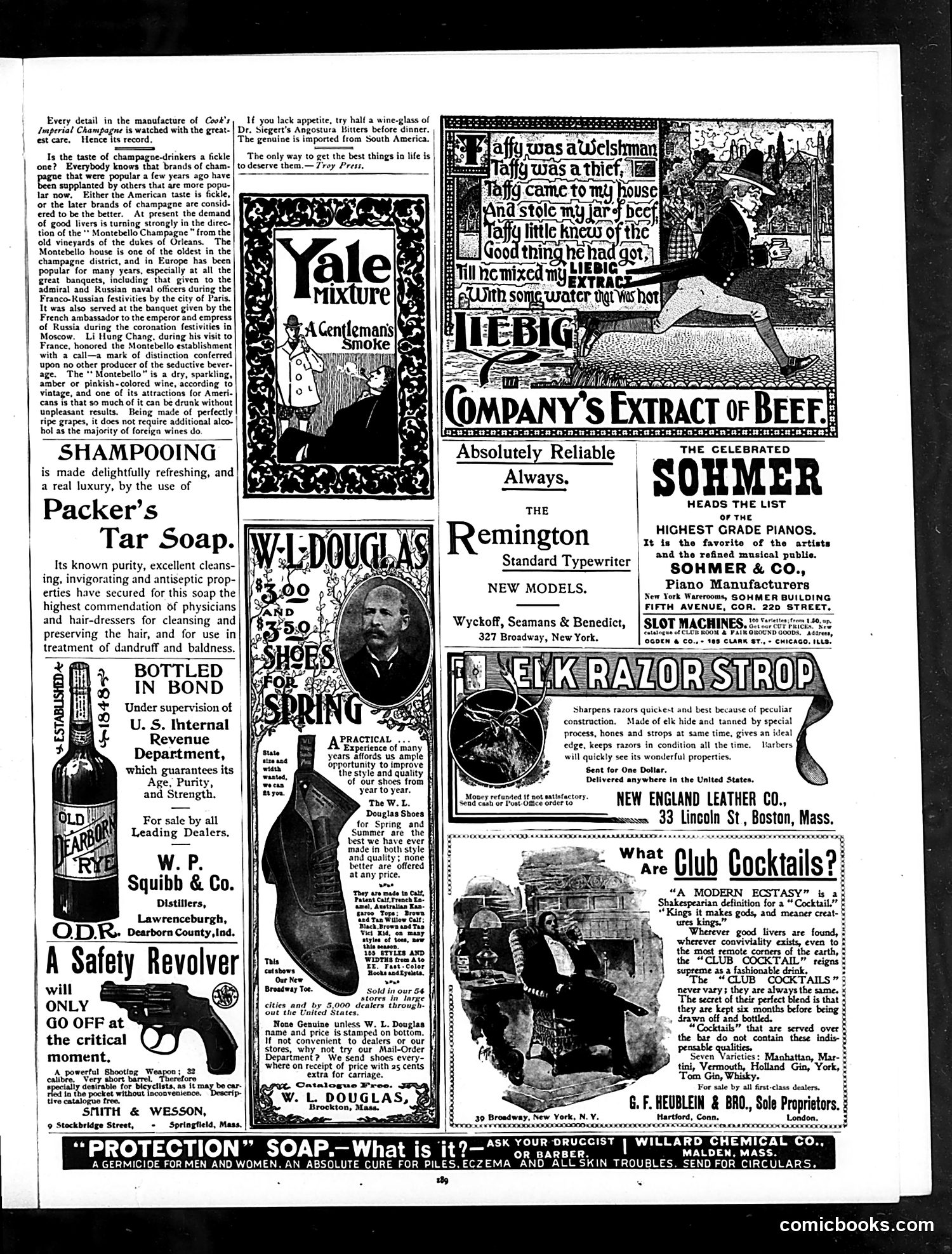
This page is primarily **advertising**, not editorial or satirical content. It contains various product advertisements (champagne, soap, shoes, typewriters, pianos, beverages) typical of Judge magazine's commercial pages. The only identifiable image with potential satirical content is the **Liebig Company's Extract of Beef advertisement** (center-right), which shows a woodcut scene with figures. However, without clear context or accompanying text explaining the satire, it appears to be a straightforward advertisement illustration rather than political commentary. The page demonstrates how early-20th-century magazines financed themselves through extensive advertising rather than subscription revenue. The products advertised—champagne, safety revolvers, tar soap—reflect contemporary consumer goods marketed to wealthy readers, the magazine's target audience. No specific political cartoon or satirical commentary is apparent on this page.
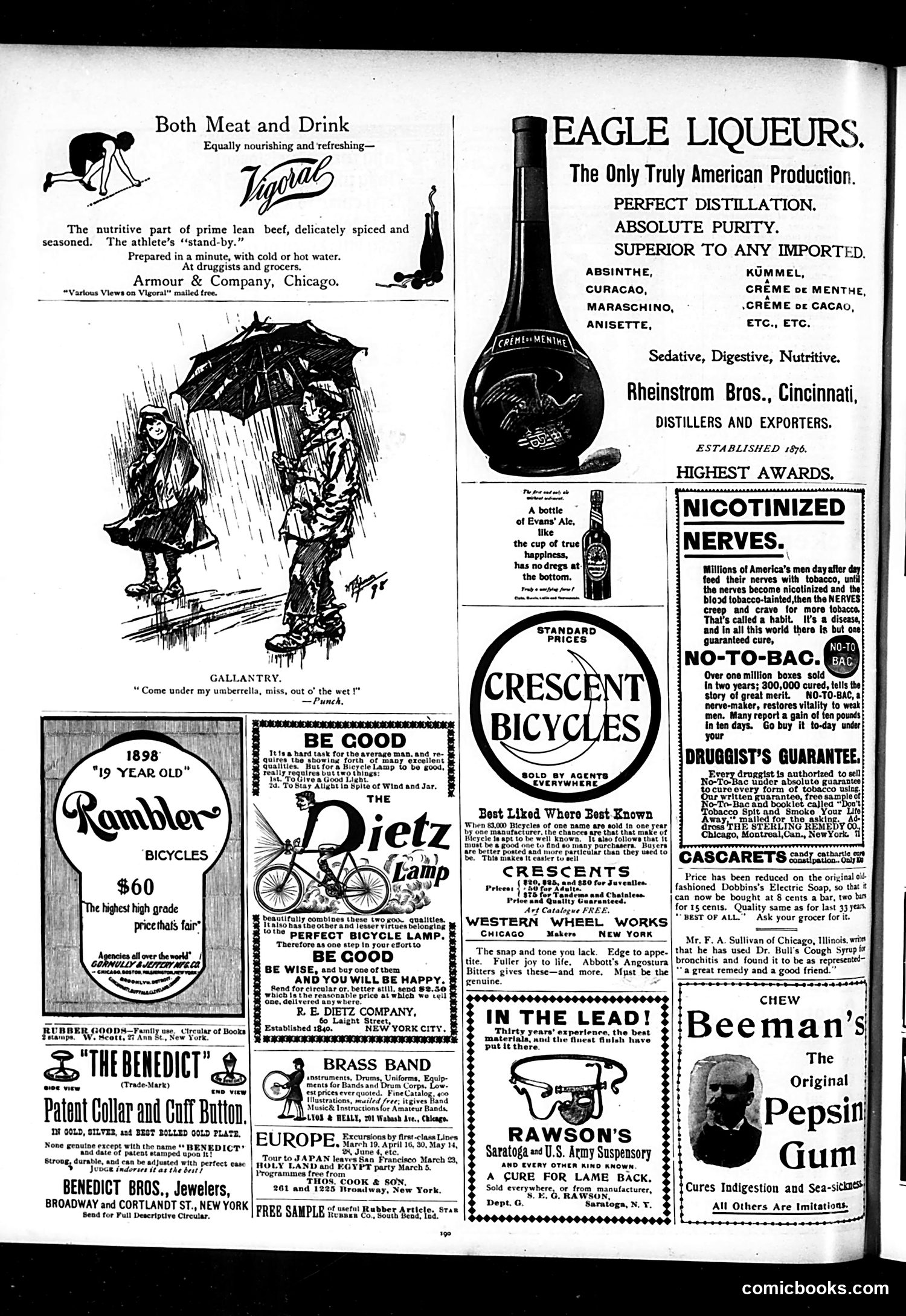
This page is primarily **advertising**, not political satire. It contains roughly 15-20 product advertisements from the 1890s, with only one small cartoon labeled "GALLANTRY." **The single cartoon** depicts two figures sharing an umbrella in the rain, with the caption "Come under my umbrella, miss, out o' the wet!" It's a genteel joke about courtship—a man offering protective shelter to a woman as a romantic gesture. This reflects Victorian-era social conventions around chivalry and courtship rituals. **The advertisements** reveal period concerns: Vigoral beef extract (nutrition), Eagle liqueurs (medicinal alcohol), bicycles (new transportation technology), suspensories for back pain, and notably **NO-TO-BAC** (a tobacco-cessation product claiming to cure nicotine addiction). The existence of such anti-tobacco products suggests growing awareness of tobacco's addictive and health dangers by the 1890s. The page reflects Gilded Age commercial culture and emerging health consciousness.
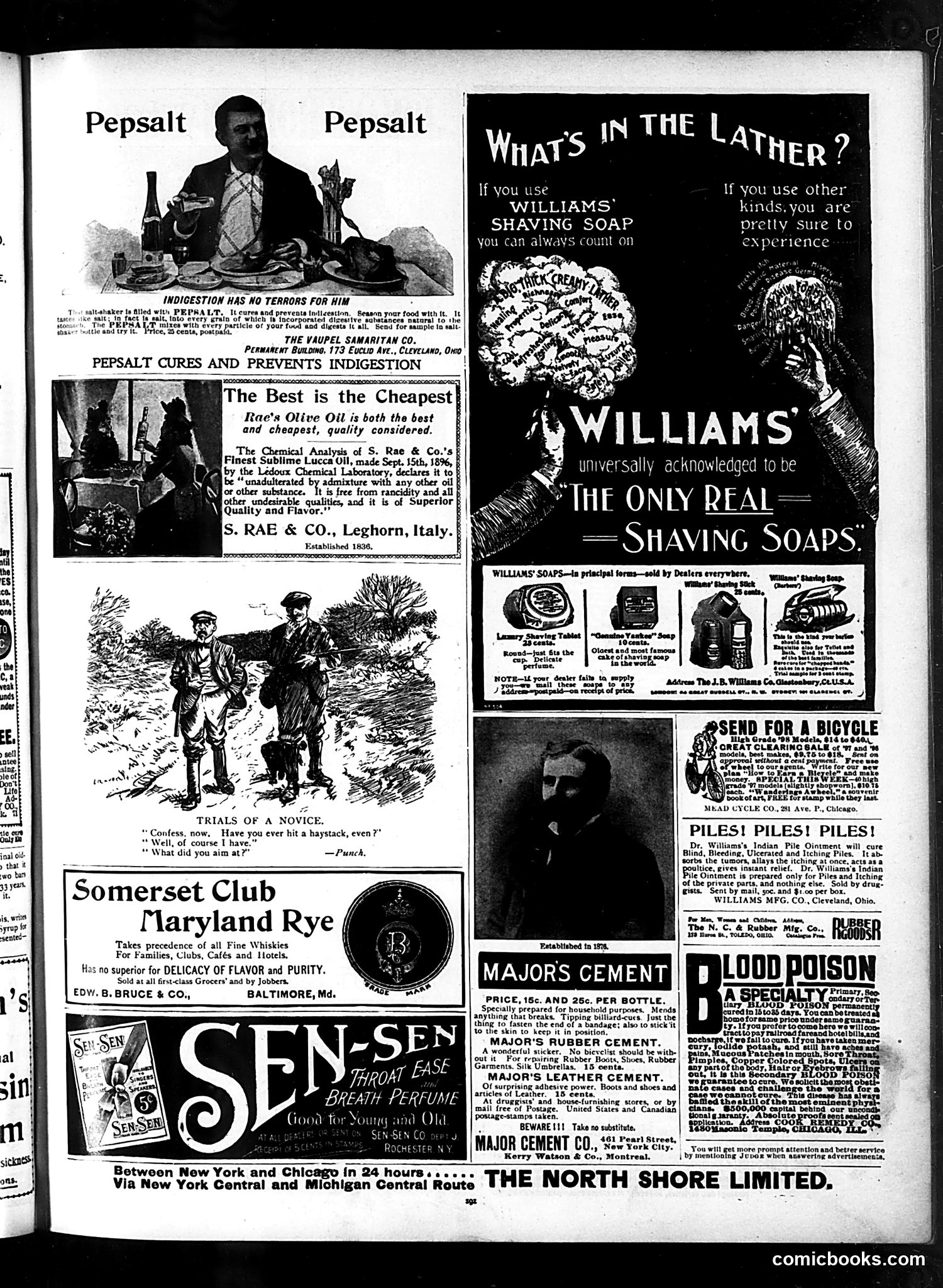
This page is primarily **advertising**, not editorial cartoons. It's from an early 20th-century *Judge* magazine and contains product advertisements with minimal satirical content. The notable items: **"Trials of a Novice"** (small cartoon): A mild Punch magazine reprint showing someone confessing they've never actually hit a haystack despite claiming to—a joke about pretense and dishonesty. **Main content**: Advertisements for digestive aids (Pepsalt), olive oil, whiskey, shaving soap, rubber cement, and various patent medicines—including **Dr. Williams's Indian Pile Ointment**, a hemorrhoid treatment typical of the era's often-dubious medical products. The **Williams' Shaving Soap ad** uses exaggerated claims of superiority and quality, common in period advertising. **"Blood Poison" remedy**: Represents early 20th-century patent medicine culture, where dubious treatments claimed to cure serious conditions. The page reflects an era before FDA regulation, when magazines freely advertised unproven remedies alongside legitimate products. The satirical content is minimal; this is primarily a commercial publication page.
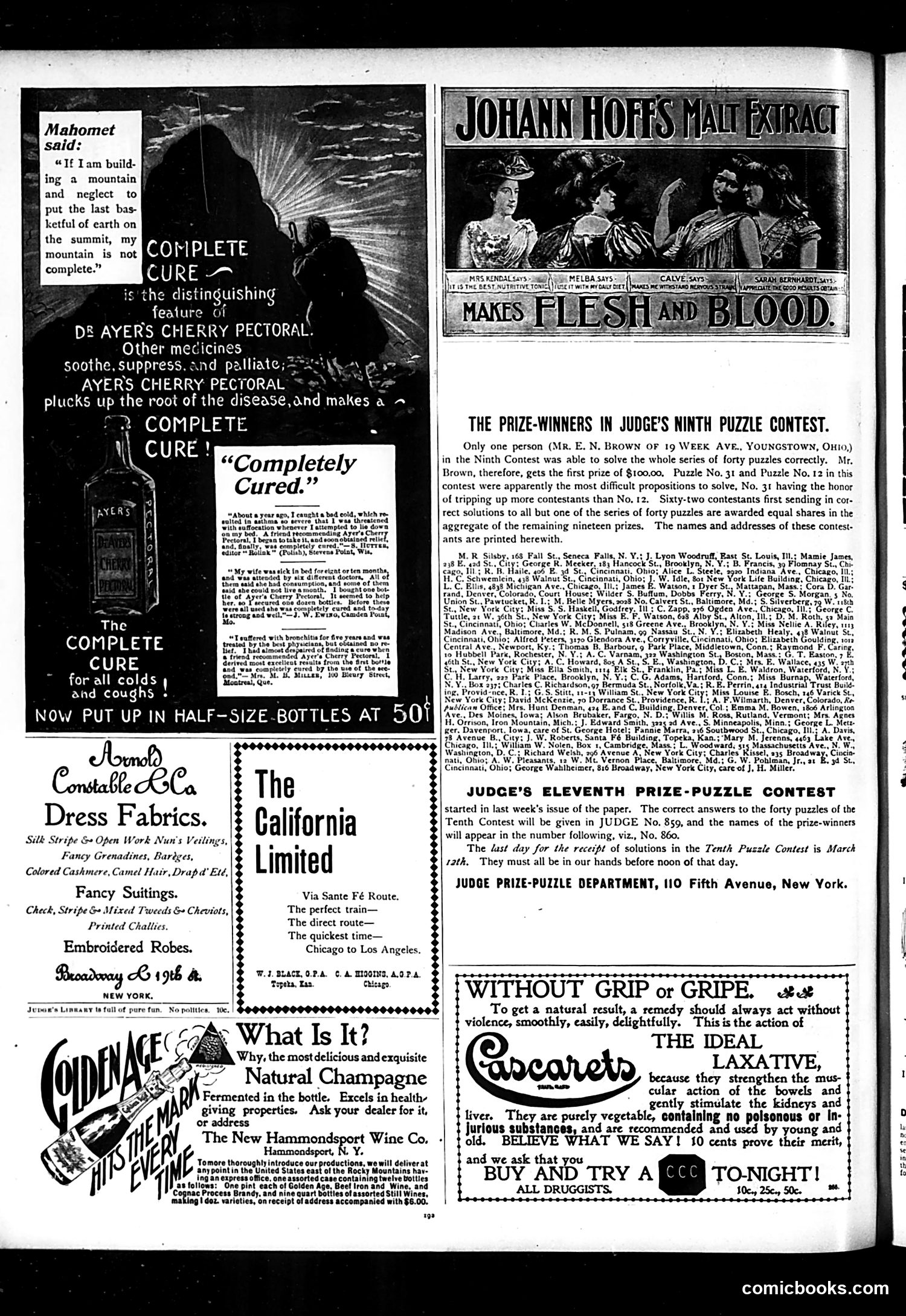
This page is primarily **advertising and contest results**, not political satire. The dominant content announces winners of Judge's Ninth Puzzle Contest—a series of 40 puzzles readers solved. One contestant (E.N. Brown of Youngstown, Ohio) solved all 40 correctly, winning $100; sixty-two others solved all but one puzzle and shared remaining prizes. The left side features an **Ayer's Cherry Pectoral advertisement** using a Mahomet quote about completing work: the medicine "plucks up the root of disease" for a "complete cure"—typical late-19th-century patent medicine marketing claiming total healing. Other ads include dress fabrics, "The California Limited" train service, Codenage champagne ("What Is It?"), and **Cascarets laxatives**, promising natural results "without grip or gripe." The upper right shows a Johann Hoffs Malt Extract ad featuring figures labeled to suggest that the product "makes flesh and blood." This reflects Judge as a **commercial publication** where advertising revenue funded editorial content.
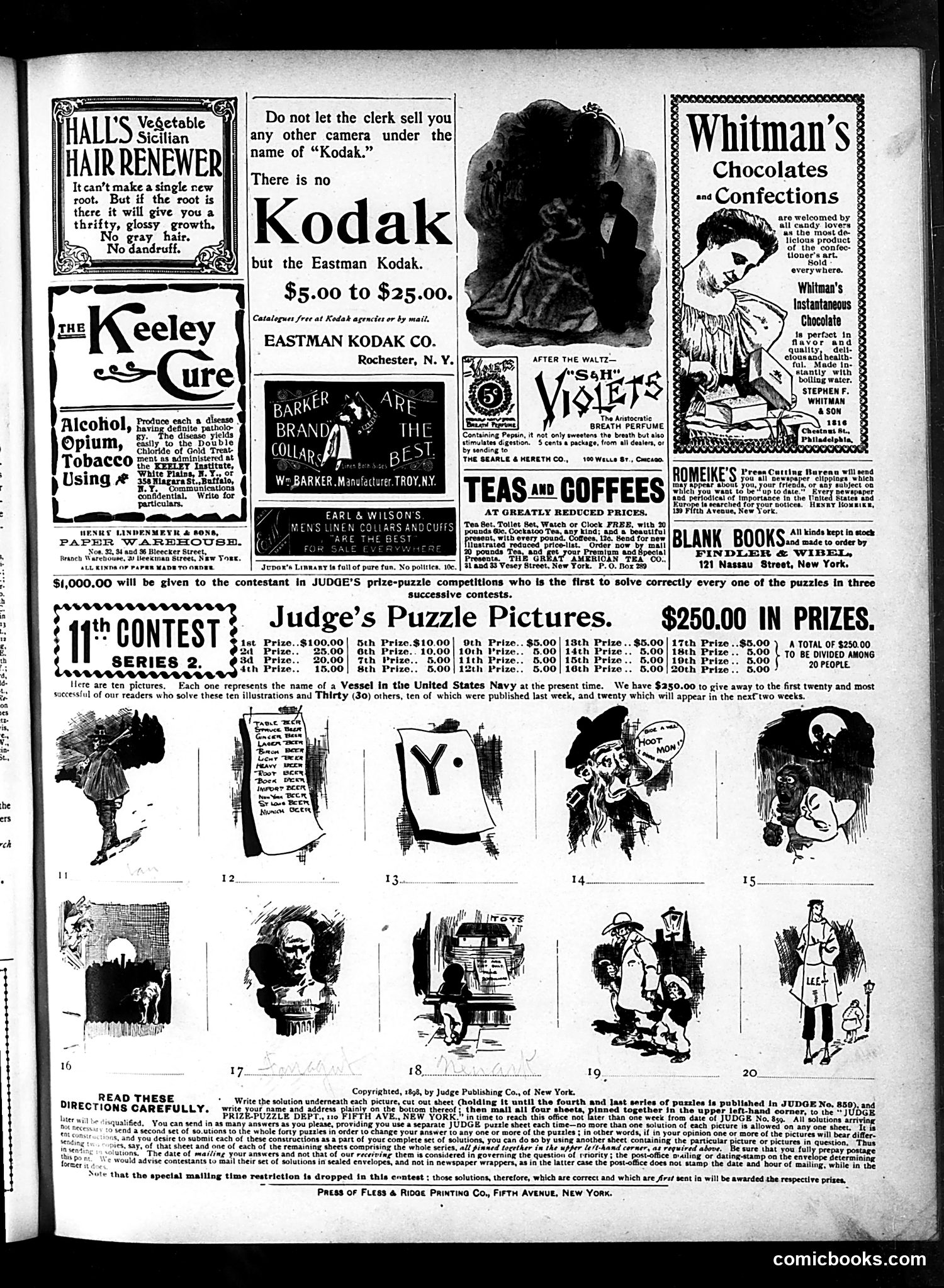
This is primarily an **advertising and puzzle page** from Judge magazine (circa 1898, based on visible date references). The main content is the **"11th Contest: Judge's Puzzle Pictures"** — a puzzle competition offering $250 in prizes. The puzzle asks readers to identify **U.S. Navy vessel names** from ten illustrated rebus pictures (images 11-20 visible). Each picture uses visual puns or symbolic imagery to represent ship names. For example, picture 13 shows the letter "Y," likely representing a ship name containing that letter sound. The surrounding advertisements (Kodak cameras, Whitman's Chocolates, hair products, teas, coffees) are typical period marketing. **Historical context for modern readers**: This represents how magazines engaged readers through interactive contests before digital media, encouraging subscriptions and repeat purchases as successive puzzle installments appeared weekly. The naval vessel theme reflects America's growing maritime interests during the 1890s Spanish-American War period.
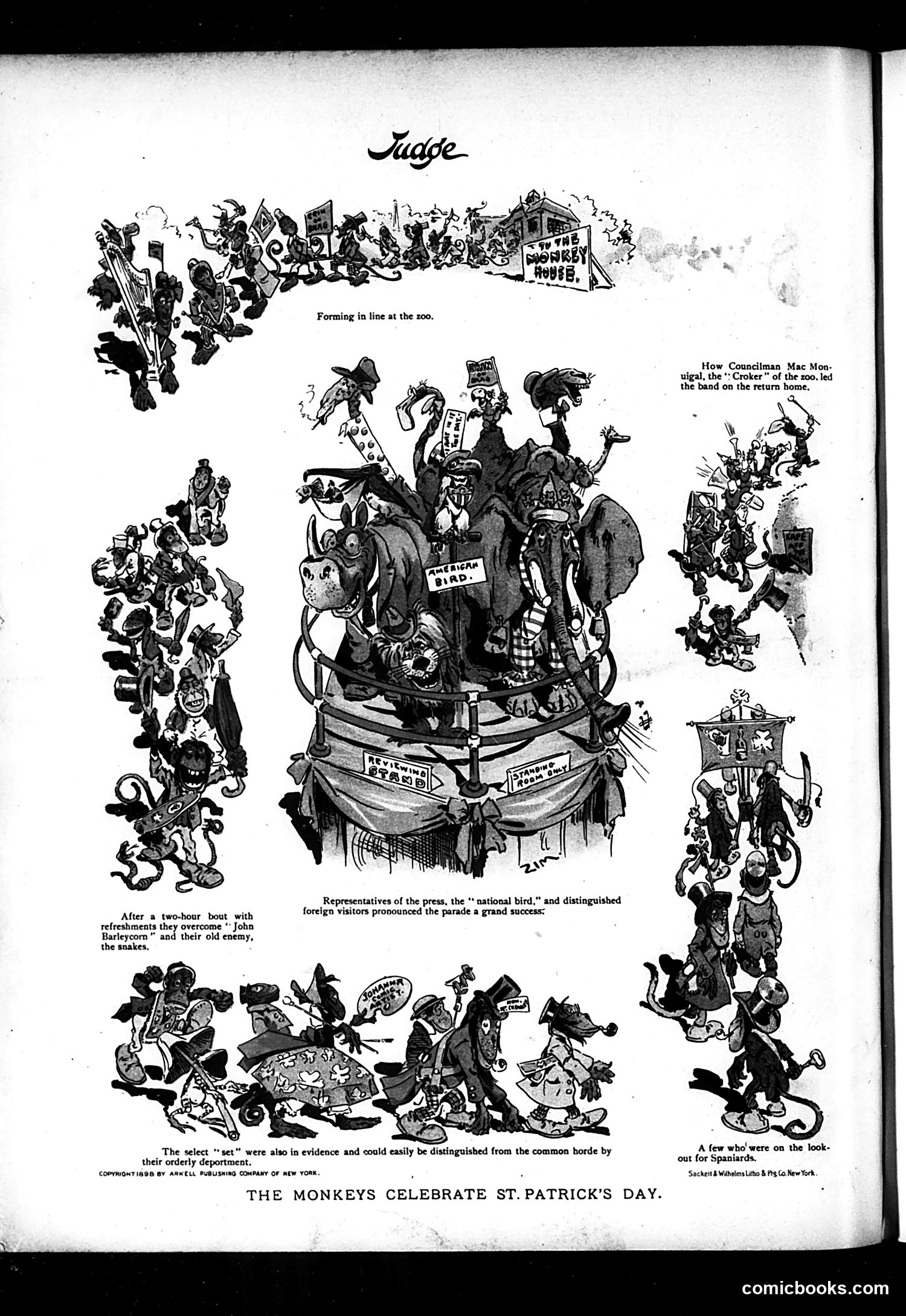
This Judge magazine cartoon satirizes a St. Patrick's Day parade, likely from the early 1900s. The imagery uses monkeys to mock Irish-American celebrants and political figures. "Councilman Mac Monuigal" (a play on an Irish name) is compared to "Croker" (likely Richard Croker, the Tammany Hall political boss), suggesting corrupt Irish political leadership at New York's zoo. The satire ridicules Irish stereotypes—drunkenness ("John Barleycorn"), superstition ("snakes"), and rowdy behavior. References to "the press," "the national bird," and "distinguished foreign visitors" suggest the parade was treated as a major civic event, which the cartoon mocks as undignified. The depiction of participants as monkeys reflects the nativist prejudice of the era against Irish immigrants, presenting them as uncivilized.