
A complete issue · 18 pages · 1898
Judge — January 8, 1898
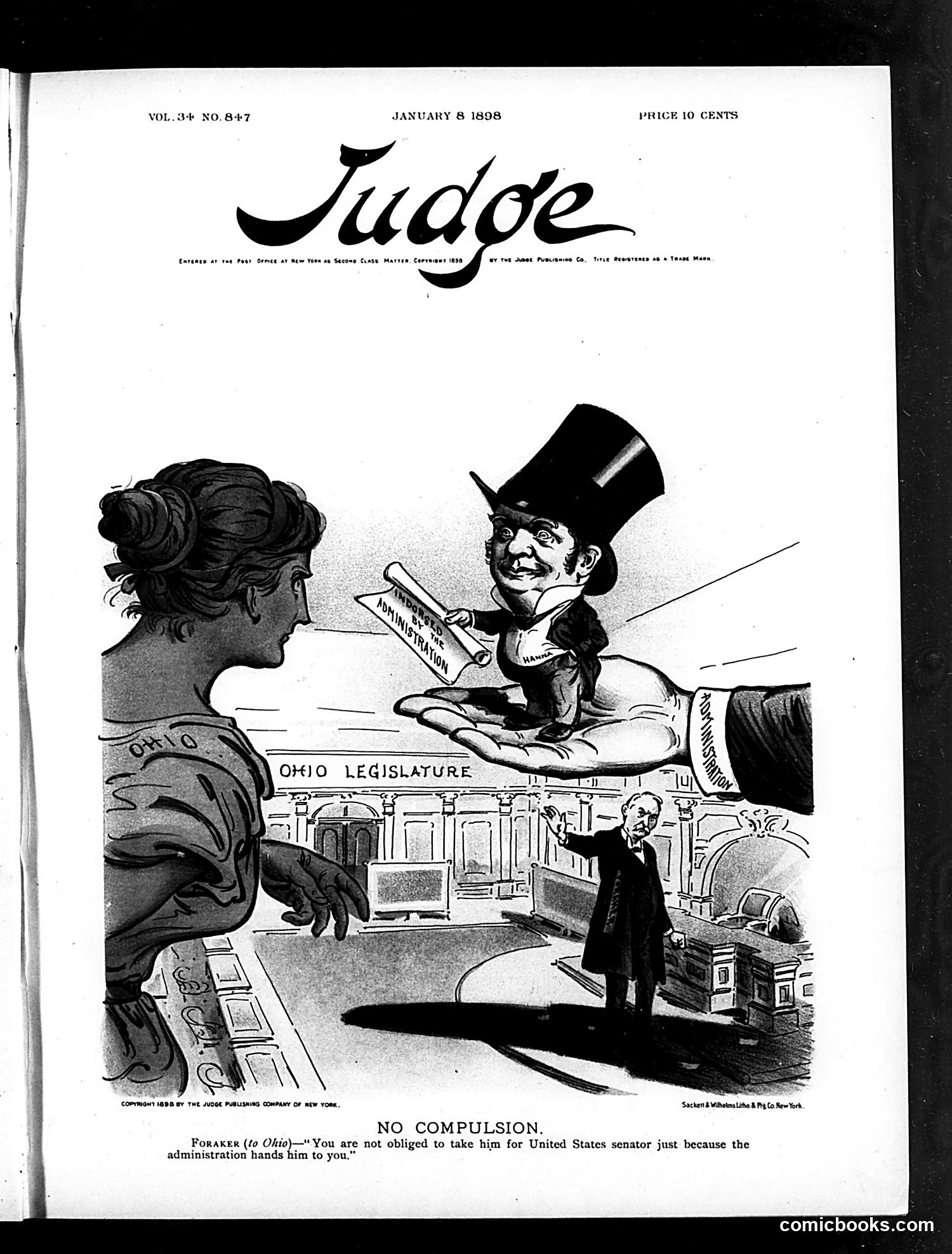
This January 8, 1898 *Judge* cartoon satirizes Ohio politics and senatorial appointments. The caption "NO COMPULSION" quotes Governor Foraker (identified as "to Ohio"), who claims Ohio isn't obligated to accept a U.S. senator the administration is "handing" them. The cartoon depicts a grotesque political operative in a top hat (representing the federal administration) attempting to place a caricatured figure into the hands of Ohio, personified as a skeptical man. The Ohio Legislature building anchors the scene. The satire mocks the federal government's pressure on Ohio to accept a particular senatorial candidate, while the state resists this interference. It's commentary on patronage politics and states' rights tensions during the McKinley administration.
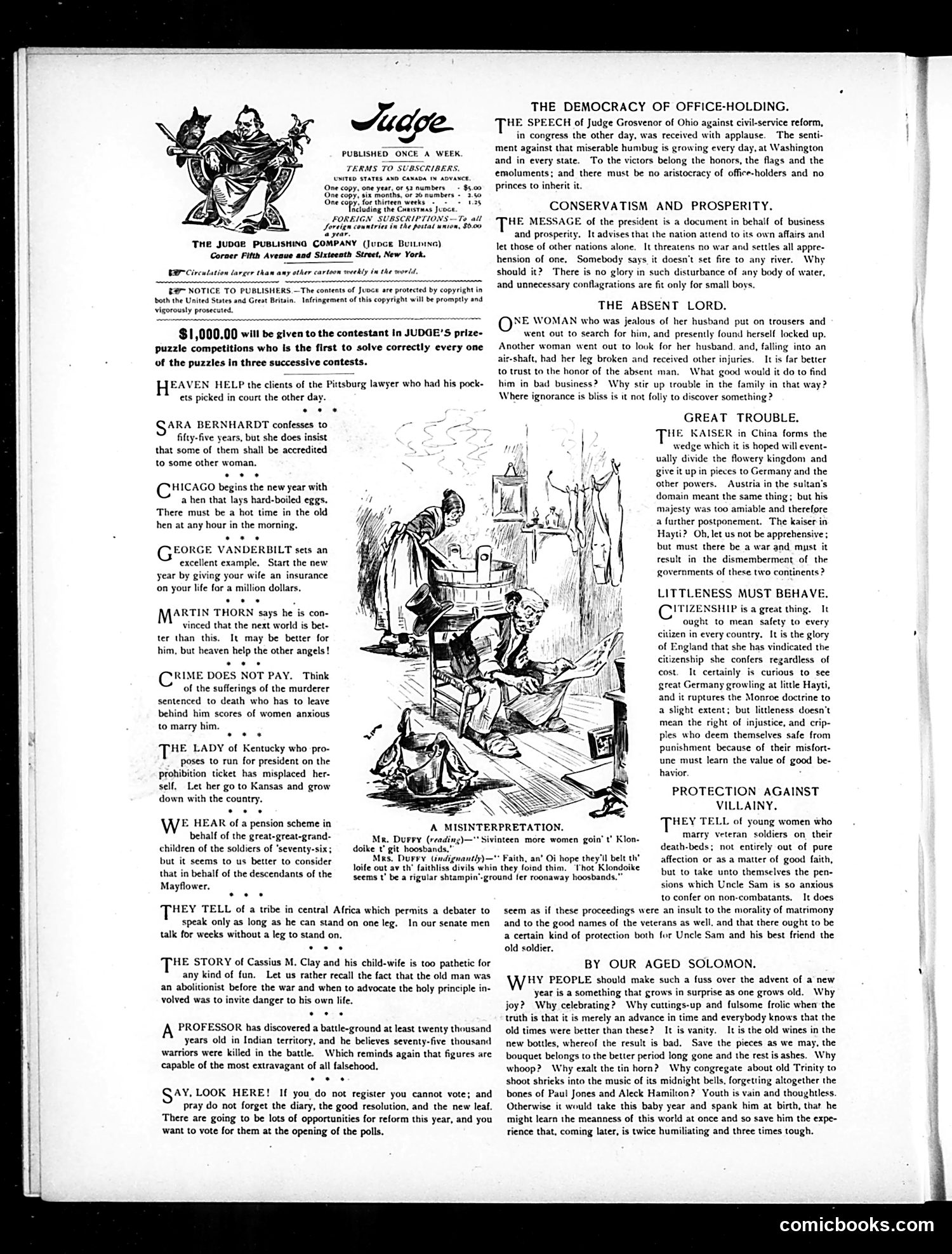
The main cartoon depicts **"A Misinterpretation,"** showing a domestic scene where a woman discovers her husband with another woman. The wife confronts him with accusations ("Women golly? Klondike it git boatloads"), while he attempts explanations about "faith" and "hope." The satire mocks marital jealousy and miscommunication—specifically how wives might misread innocent situations as infidelity. The surrounding text columns address serious political and social issues: civil-service reform, conservatism, marriage fidelity standards, and colonial conflicts (the Kaiser and Austria-Hungary). The overall page uses humor to critique social hypocrisy—while editorials discuss "protection against villainy" in marriage and citizenship, the cartoon reveals domestic suspicion and misunderstanding as inevitable human failings rather than moral failures.
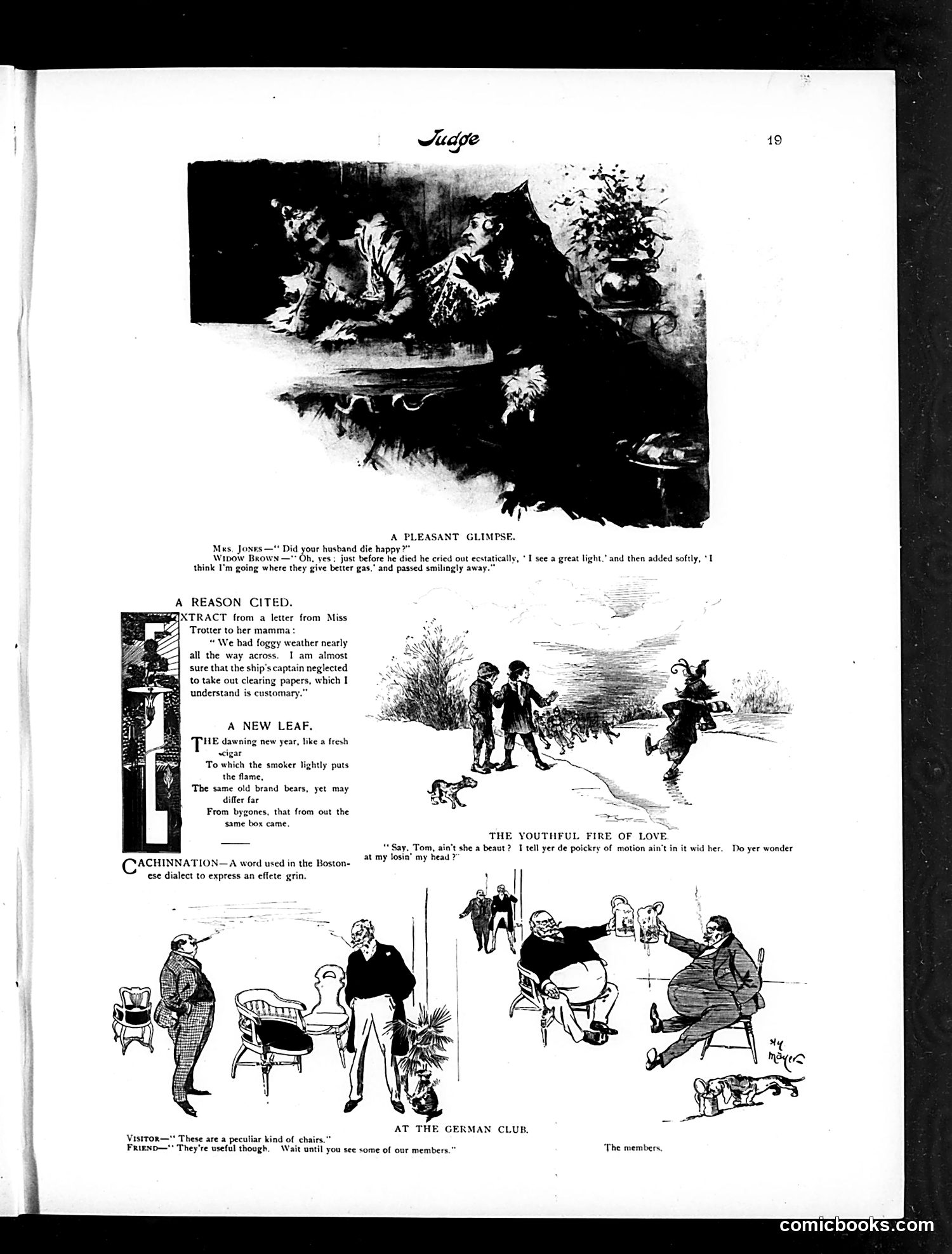
This page contains several unrelated humorous sketches typical of Judge's satirical format: **"A Pleasant Glimpse"**: A domestic scene where a husband has died, and his widow reflects that he "cried out ecstatically, 'I see a great light'" before passing—she sarcastically notes he'll "give better gas" in the afterlife. The joke plays on spiritualist beliefs popular in the era. **"A Reason Cited"** and **"A New Leaf"**: Brief literary or domestic humor pieces. **"Cachinination"**: A Boston-dialect joke about an "effete grin." **"At the German Club"**: Shows club members in chairs, with accompanying dialogue about their peculiar design and utility. The sketches reflect early 20th-century American upper-class humor, spiritualism skepticism, and ethnic dialect comedy typical of Judge's satirical approach.
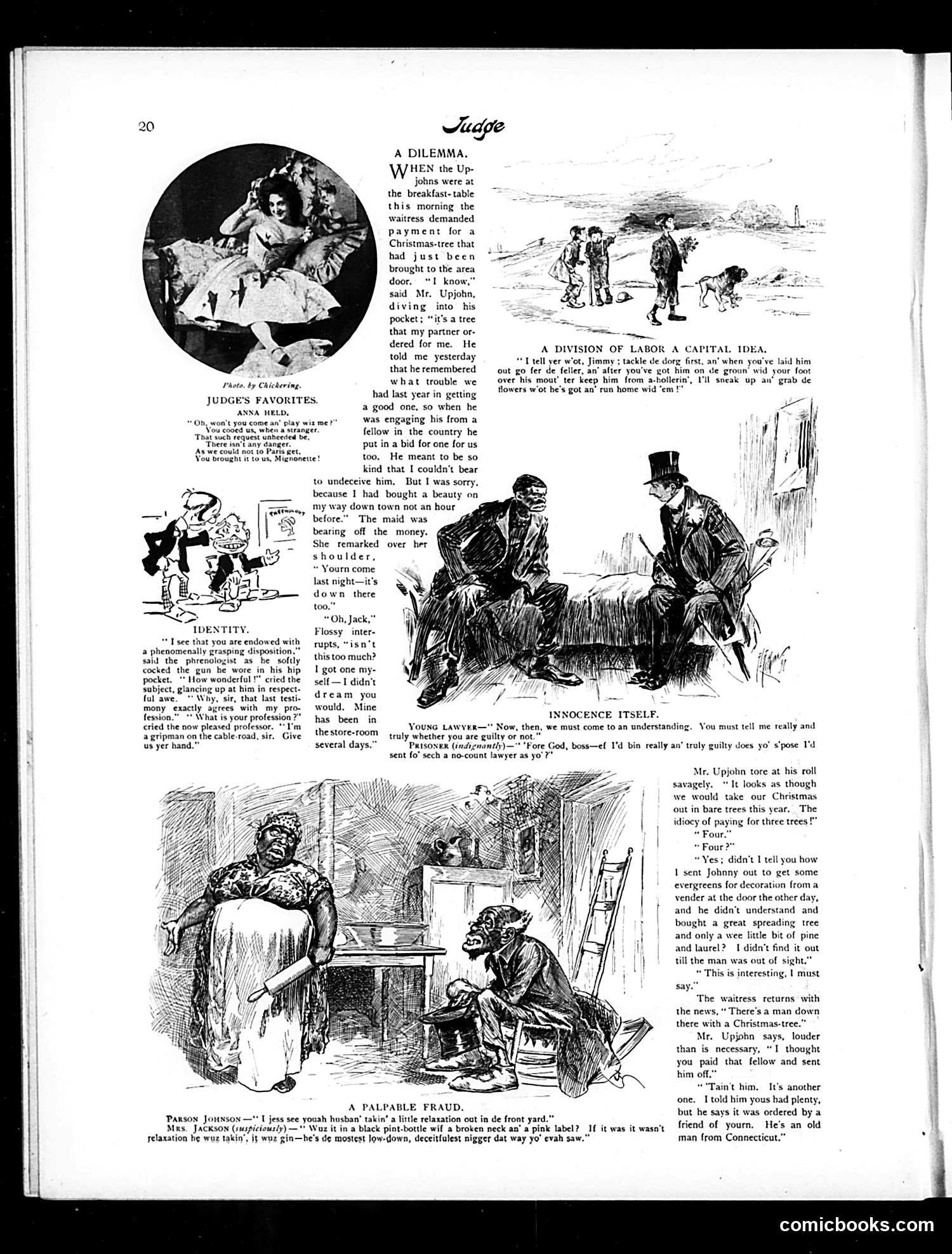
This page contains several satirical sketches about Christmas commerce and domestic disputes: **"A Dilemma"** depicts a working-class man (Mr. Upjohn) confronted by his waitress over an unpaid Christmas tree debt. The satire mocks the pressure to provide holiday luxuries despite financial hardship—a seasonal consumer trap. **"A Division of Labor: A Capital Idea"** shows a man instructing another to handle his domestic trouble while he escapes, satirizing shirked male responsibility. **"Innocence Itself"** and **"A Palpable Fraud"** appear to involve marital conflicts and deception around Christmas gifts—likely poking fun at holiday shopping pretenses and domestic tensions. The overall theme critiques the commercialization of Christmas and the financial/social pressures it creates on ordinary people, typical of Judge's class-conscious humor.
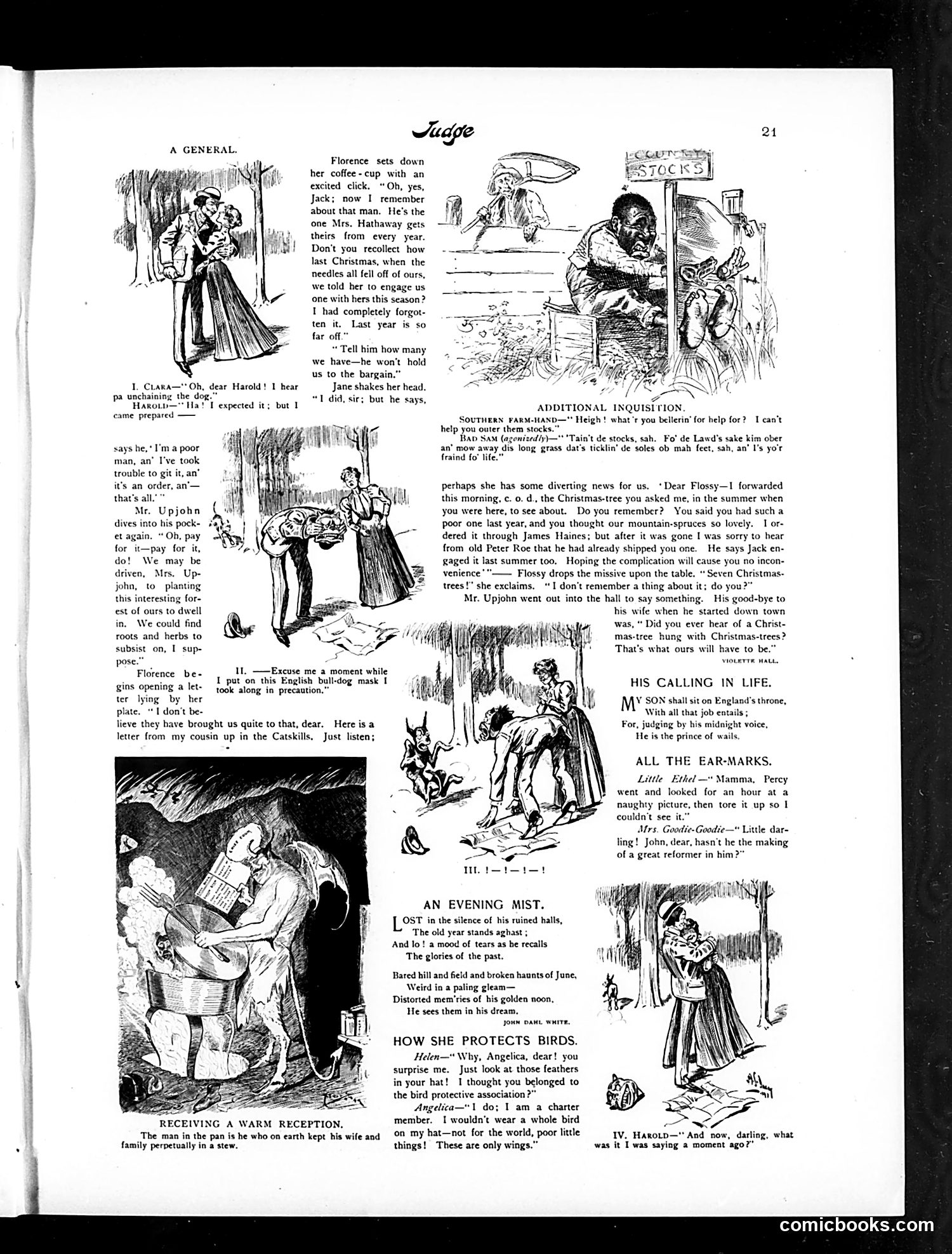
This page contains multiple comic sketches satirizing middle-class American life, likely from the late 19th century: **"A General"** mocks the pretensions of a character named Mr. Upjohn, who repeatedly bribes his way out of problems (paying a dog-owner, etc.) while boasting about potential poverty. The satire targets social-climbing affectation and financial anxiety among the genteel poor. **"How She Protects Birds"** ridicules hypocrisy: Angelica claims membership in a bird-protection society while wearing feathers in her hat, justifying it by wearing only "wings" rather than whole birds—transparent rationalization for vanity. **"All the Ear-Marks"** satirizes sanctimony: Mrs. Goodie-Goodie praises her son for tearing up a "naughty picture," claiming this shows reformer potential—when actually he simply destroyed evidence, not developed morality. **"An Evening Mist"** appears to be sentimental verse, contrasting with the page's satirical tone. The overall theme: social pretension, self-deception, and the gap between stated values and actual behavior among respectable Victorian society.
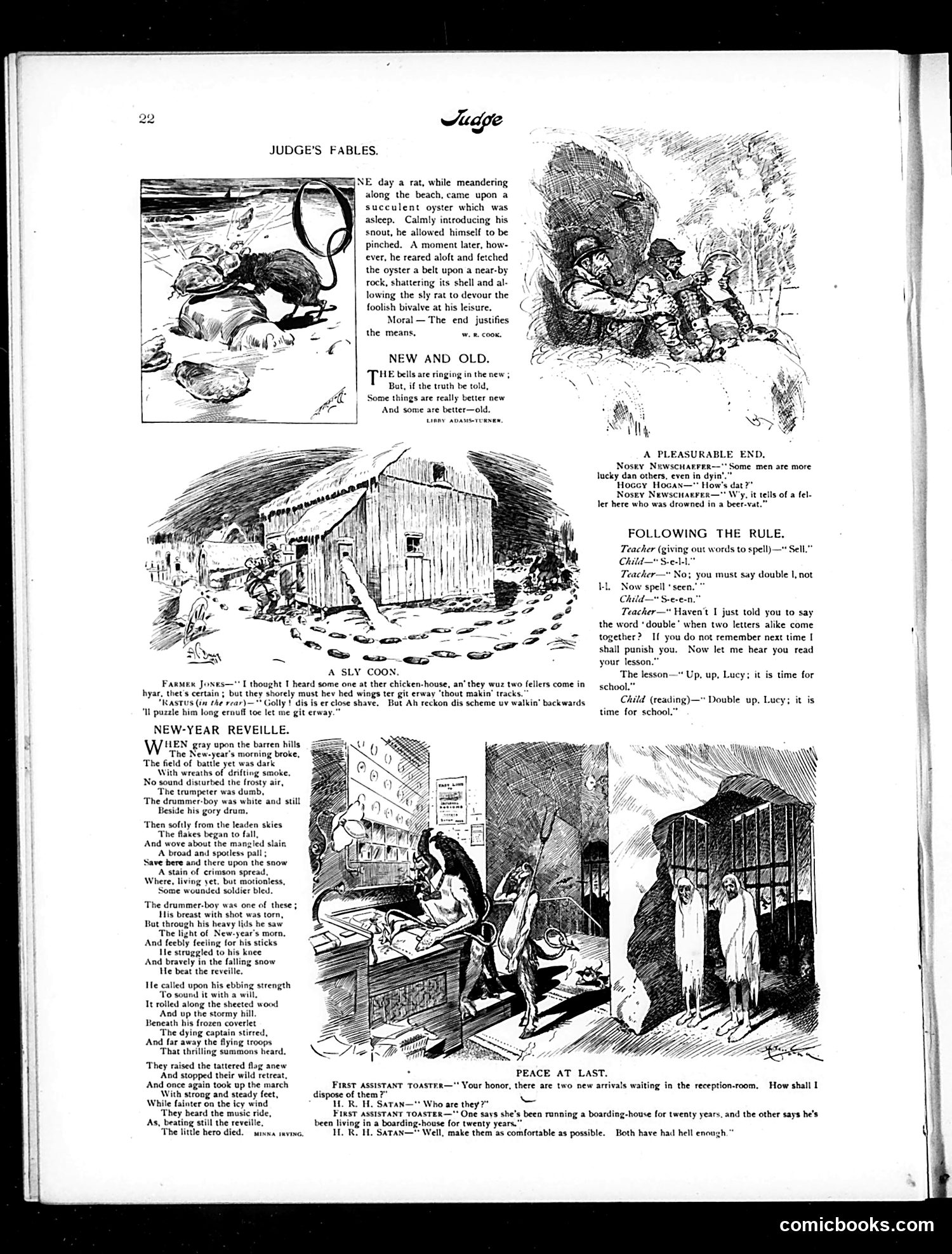
This page contains several short satirical pieces typical of Judge magazine's humor: **"Judge's Fables"** offers moral lessons through animal tales. The rat-and-oyster story cynically concludes "the end justifies the means"—a jab at ruthless pragmatism. **"Following the Rule"** mocks pedantic schoolteachers who enforce arbitrary grammar rules (doubling letters) while missing genuine comprehension. **"A Sly Coop"** presents rural dialect humor about a farmer puzzled by chicken thieves leaving no footprints—the joke being the thief walked backwards. **"New-Year Reveille"** is sentimental Civil War poetry about a dying drummer boy who summons troops with his final strength—likely reflecting on 1860s-era warfare. **"Peace at Last"** offers dark humor: two hell-bound souls (a boarding-house keeper and long-term resident) arrive at Satan's domain; Satan notes both have "had hell enough." The satire targets cramped, uncomfortable boarding-house living as hellish. The illustrations complement these texts with period engravings typical of 1880s-90s magazine publishing.
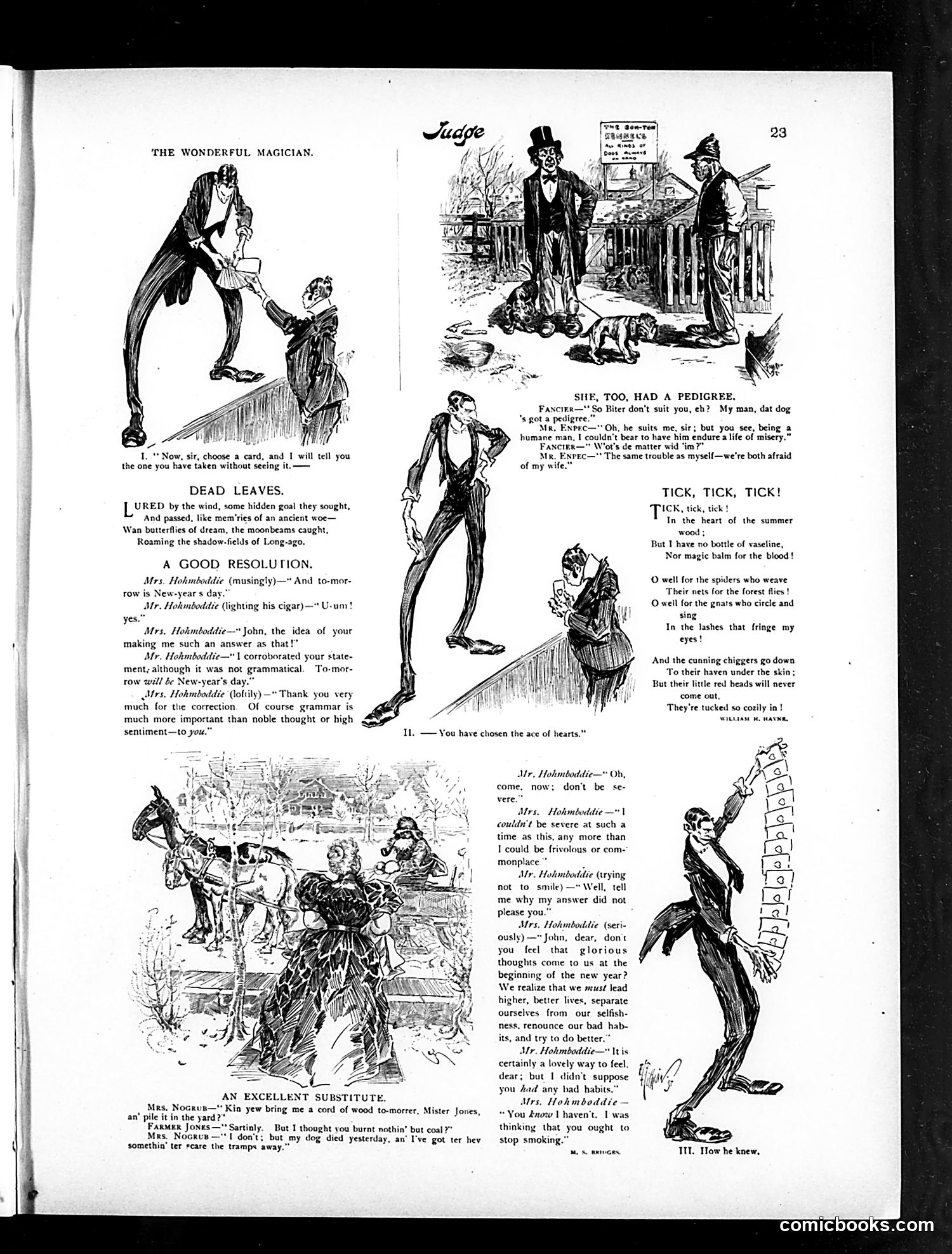
This page contains satirical sketches mocking middle-class domesticity and social pretense. **"A Good Resolution"** depicts a husband-wife exchange about New Year's intentions. Mrs. Hohmboddie expresses noble sentiments about self-improvement, while her husband responds dismissively ("U-um! yes."). The satire targets her self-righteous moralizing—she claims no bad habits herself, only suggesting *he* should reform—exposing the hypocrisy of New Year's resolution-making as performative rather than sincere. **"An Excellent Substitute"** shows a farmer offering his dead dog as firewood substitute, joking both animals and coal serve the same purpose. The absurdist humor satirizes rural poverty and practicality. **"Tick, Tick, Tick!"** is a poem about summer insects (chiggers, ticks), treating minor rural annoyances with mock-dramatic verse—gently mocking pretentious nature poetry. The magic trick cartoon at top suggests life's illusions. Overall, the page satirizes domestic pretension, marital discord, and self-deception through humor pitched at Judge's urban middle-class readership.
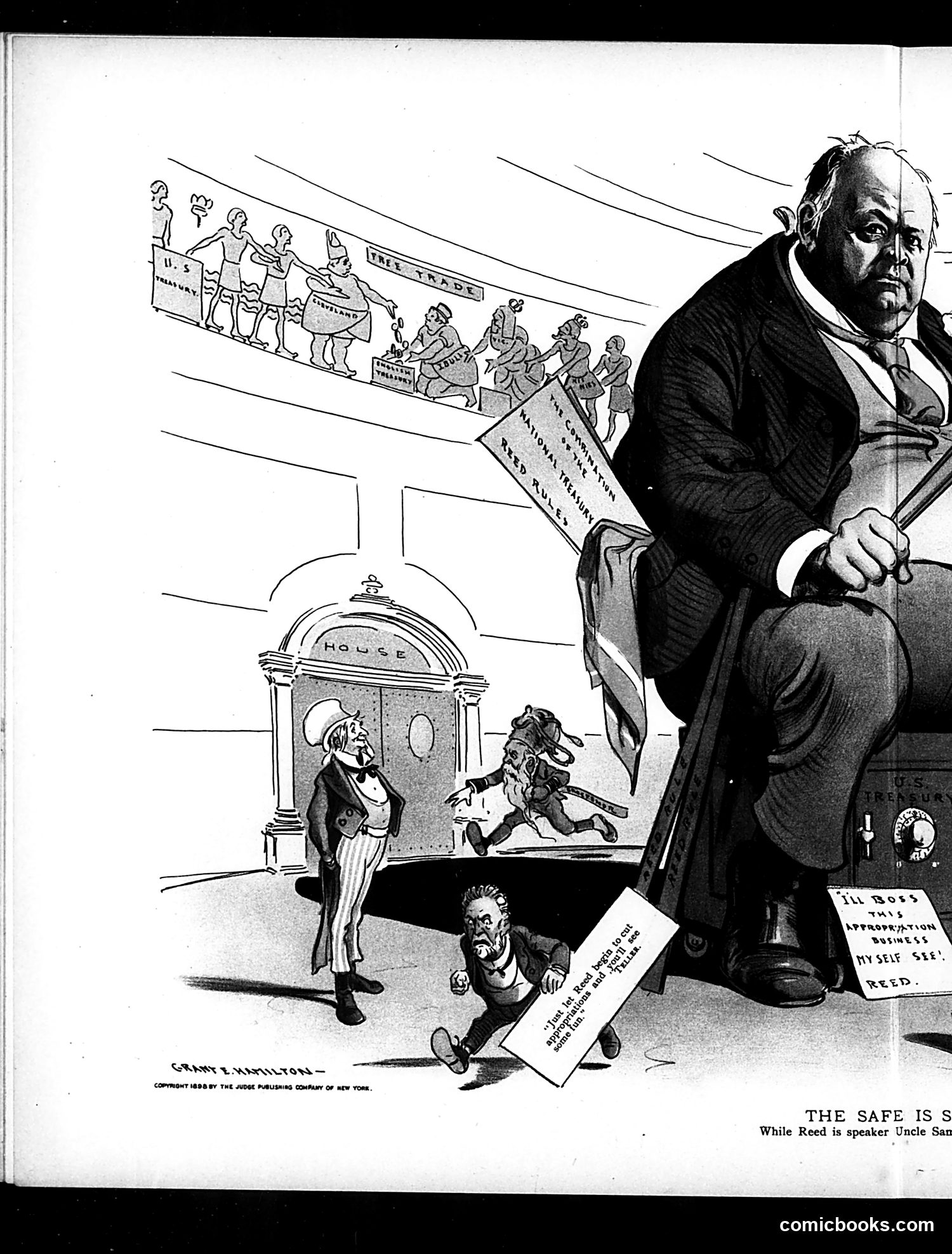
This 1898 political cartoon satirizes Speaker of the House Thomas B. Reed and his control of Congress. The large figure on the right represents Reed, who dominates the composition. Below, Uncle Sam (in stars-and-stripes hat) appears diminished outside the "House," while various politicians are depicted as performers or subordinates on a "Trade" platform above—suggesting Congress operates as Reed's theatrical production rather than democratic governance. The safe labeled "Boss" and references to "proposition" and "business" indicate satire of Reed's authoritarian management style and alleged control of legislative proceedings for political/financial gain. The cartoon criticizes how Reed wielded Speaker power to dominate legislative outcomes, treating Congress as his personal fiefdom rather than serving the public interest.
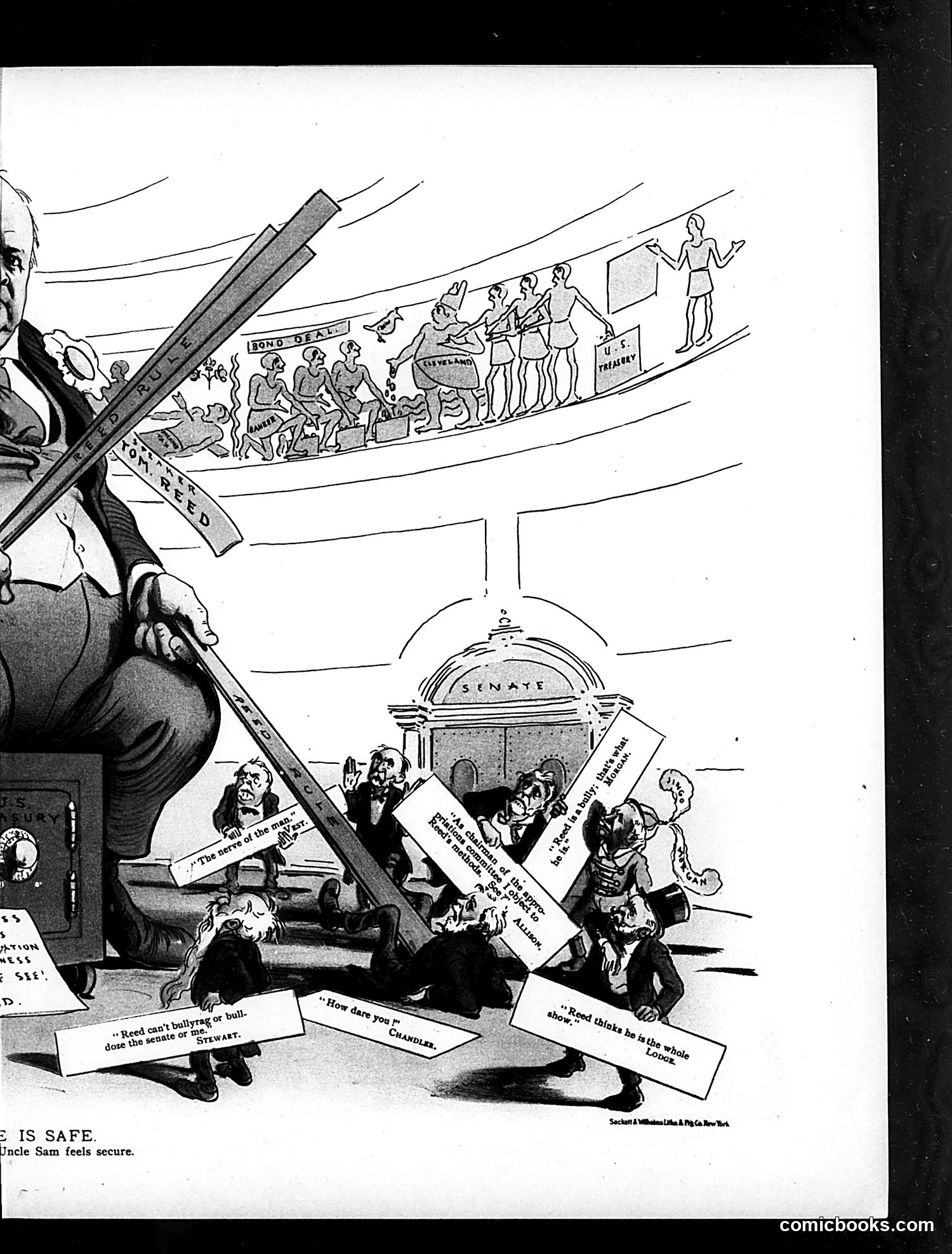
This satirical cartoon depicts Uncle Sam (representing the U.S. government) as a large military figure overlooking the Senate building. A ship labeled "ROME DEAD" carries numerous passengers, while caricatured senators below appear distressed or arguing, holding signs with critical statements. The cartoon appears to satirize Senate dysfunction or weakness during a period of international concern (the "Rome Dead" reference suggests collapse of stability). Uncle Sam's apparent confidence—"Uncle Sam feels secure"—contrasts ironically with the chaos below, suggesting the cartoon questions whether the government should truly feel safe given congressional discord. The specific senators and issues referenced are unclear without additional context, but the central message critiques the Senate's ability to effectively govern during what appears to be a crisis period.
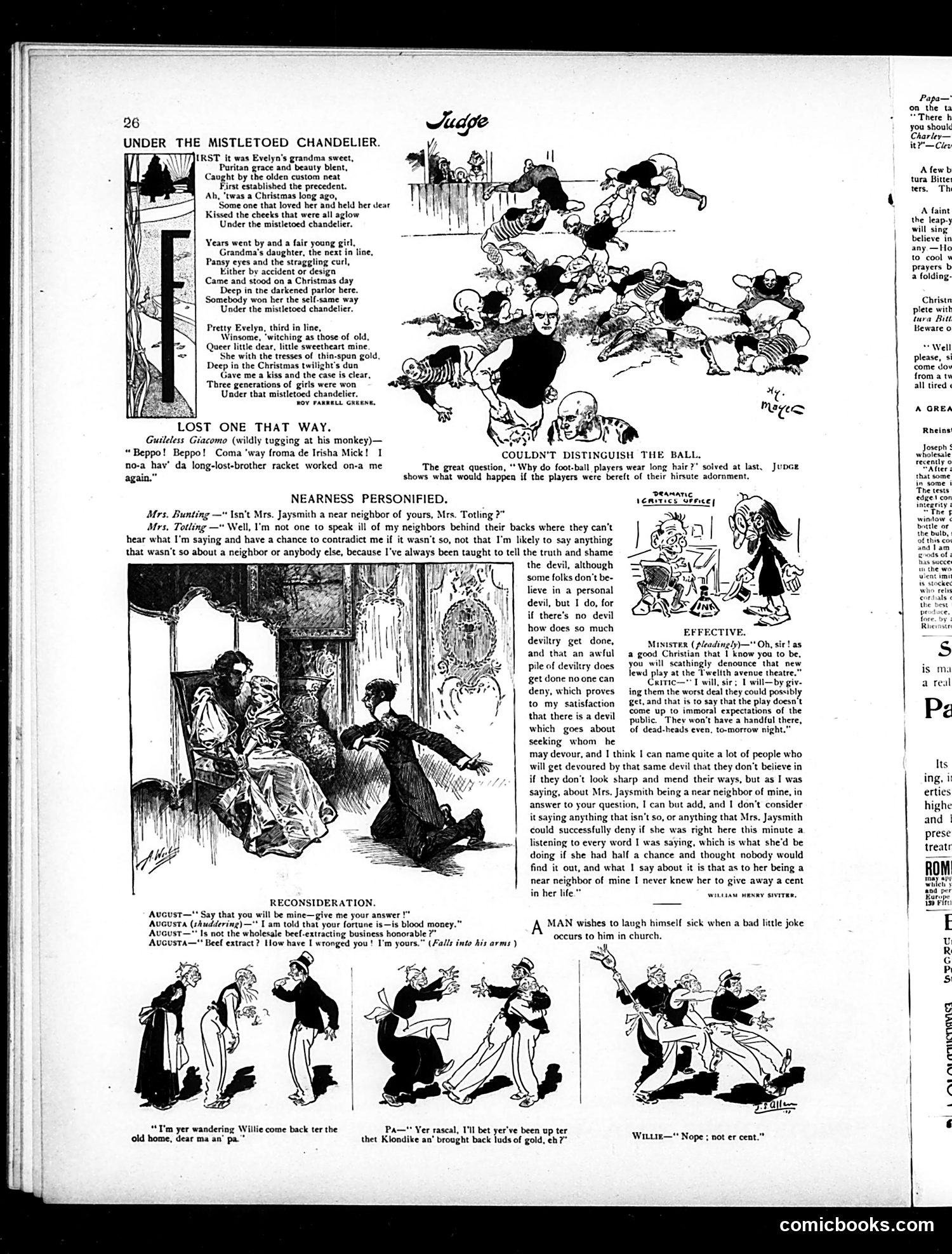
This page from *Judge* contains several satirical pieces reflecting early 20th-century American humor: **"Under the Mistletoed Chandelier"**: A sentimental poem about three generations of women kissed under mistletoe at Christmas—a romanticized tradition presented as charming family continuity. **"Lost One That Way"**: A crude ethnic joke featuring "Guileless Giacomo" and an Irish character ("Irisha Mick"), mocking immigrant dialects and playing on stereotypes about con artists and family relations. **"Nearness Personified"**: Mrs. Totling delivers a rambling monologue about her neighbor Mrs. Jaysmith, satirizing gossipy small-town women who claim moral superiority while engaging in exactly the scandal-mongering they denounce. **Football cartoon**: Shows players without their long hair, absurdly suggesting this explains why they can't distinguish the ball—mocking contemporary debates about masculine appearance. **Other sketches**: Include a hypocritical minister, and an "August/Augusta" dialogue about marriage and "beef-extracting business" (meatpacking industry). The overall tone is genteel mockery of middle-class pretension, ethnic caricature, and domestic life.
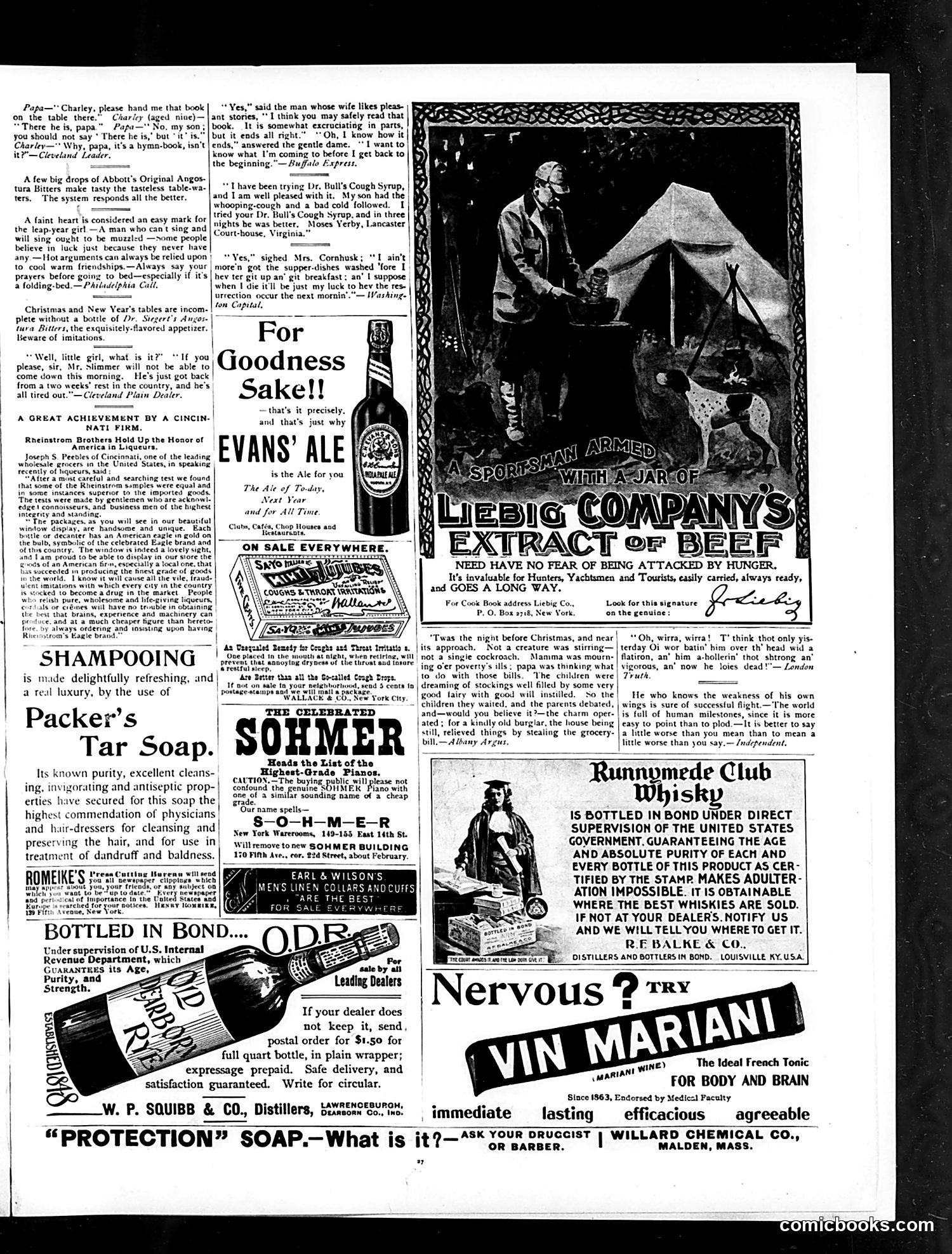
This page is primarily **advertising**, with a brief humorous anecdote at the top. The main cartoon/joke concerns a father correcting his nine-year-old son's grammar. When asked to hand "that book" on the table, the boy says "There he is, papa"—using "he" instead of "it." The father corrects him, but the boy protests that it's a hymn-book, so shouldn't it be "he"? The joke plays on the child's innocent logic: hymn-books are sacred objects, so perhaps they deserve masculine pronouns. The page is otherwise dominated by period patent medicine and product advertisements (Angostura Bitters, Evans' Ale, Dr. Bull's Cough Syrup, Sohmer pianos, tar soap), typical of Judge's revenue model. One small anecdote at bottom-right satirizes a secretary's fatigue after her employer's "rest"—implying she did all the work while he was away. The content reflects early 1900s American commercial culture and family humor standards.
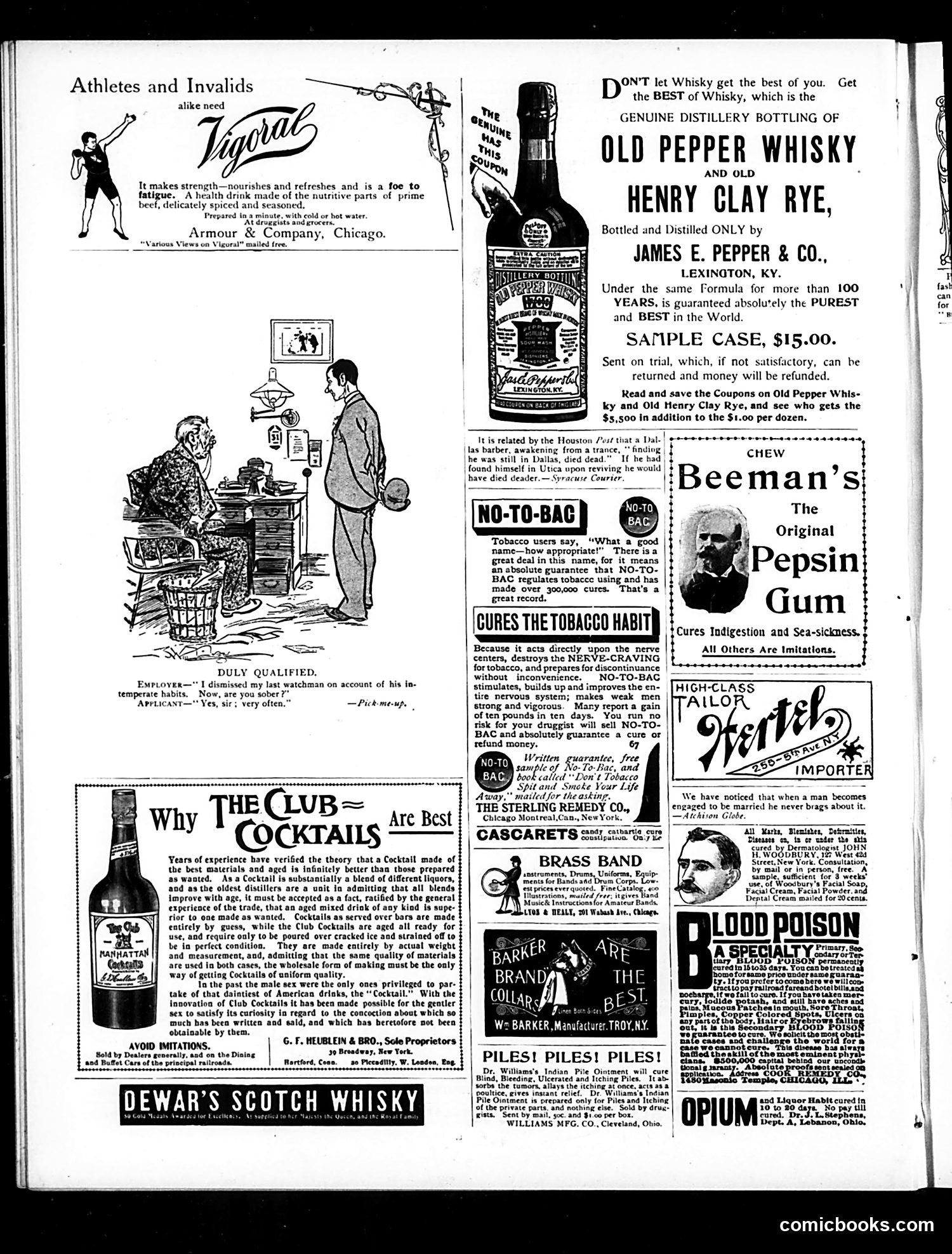
This page is primarily **advertising**, with one small cartoon in the middle-left. The cartoon, titled "DULY QUALIFIED," shows a job interview scenario: an employer asks a prospective watchman if he's sober, and the applicant responds "Yes, sir; very often." The joke mocks the applicant's illogical answer—saying he's "very often" sober implies he's frequently *drunk*, making him unqualified despite claiming sobriety. This satirizes both workplace incompetence and the period's widespread alcohol consumption. The rest of the page features period advertisements for dubious products: Vigoral (a "health drink"), Old Pepper Whisky, NO-TO-BAC (a tobacco-cessation product), Beeman's Pepsin Gum, and Club Cocktails. These ads reflect early 1900s marketing practices, making exaggerated health claims for alcohol and patent medicines—products that would later face FDA regulation. The juxtaposition of the drinking joke with whisky advertisements illustrates the era's casual attitude toward alcohol.
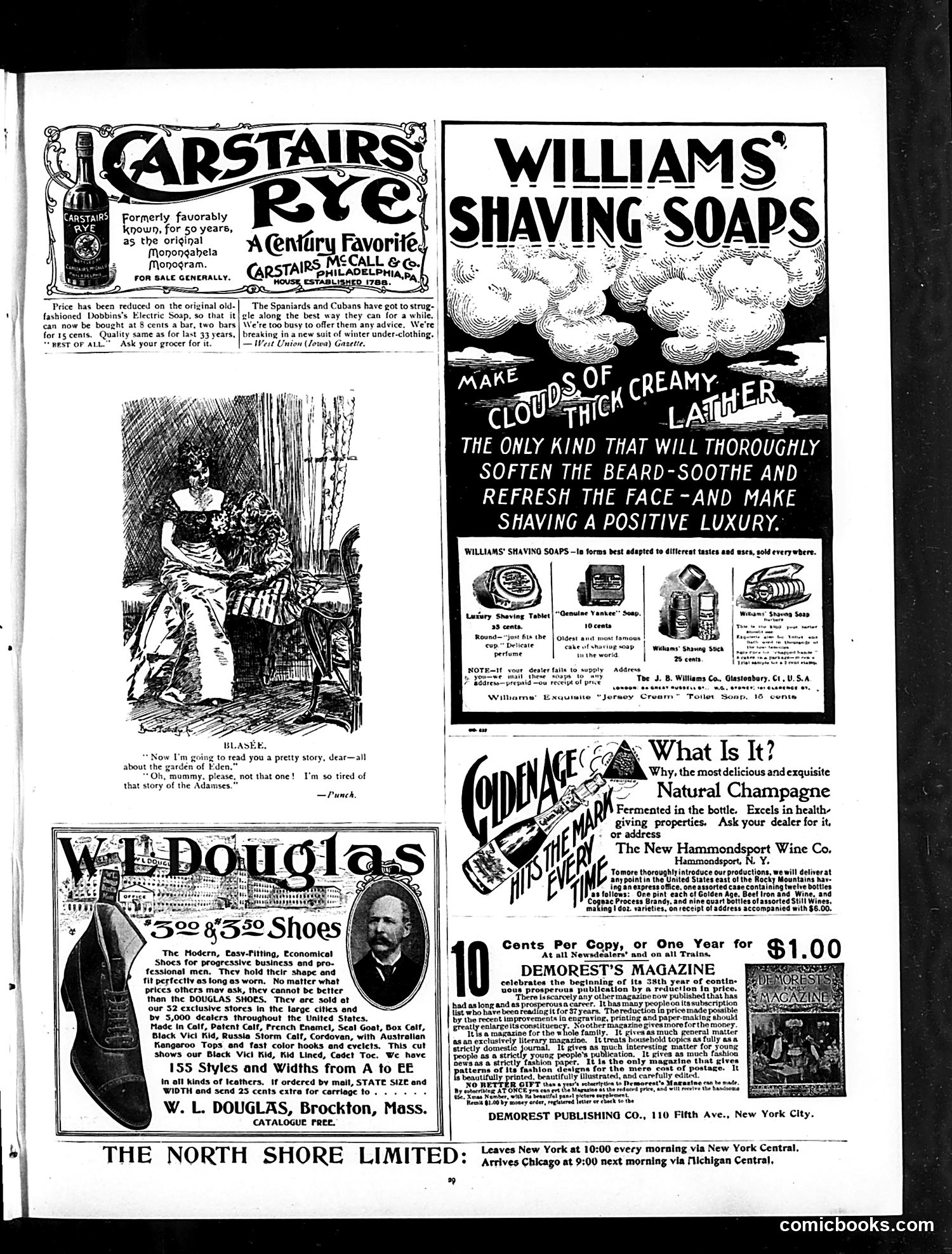
This page is primarily **advertising**, with one small cartoon. The main content consists of product advertisements typical of early 20th-century magazines: Carstairs Rye whiskey, Williams' shaving soap, W.L. Douglas shoes, Demorest's Magazine, and others. The single cartoon (credited to Punch) appears at left-center: a woman tells her mother, "Oh, mummy, please, not that one! I'm so tired of that story of the Adamses." This is a mild social satire about tedious parental storytelling—the child is weary of hearing the same old narratives (likely references to Adam and Eve or prominent families named Adams). It's a relatable domestic joke rather than political commentary. The advertisements reflect period consumer culture: electric soap, luxury champagne, quality shoes marketed to businessmen, and a women's fashion magazine touting 38 years of publication. No significant political or historical figures appear to be caricatured.
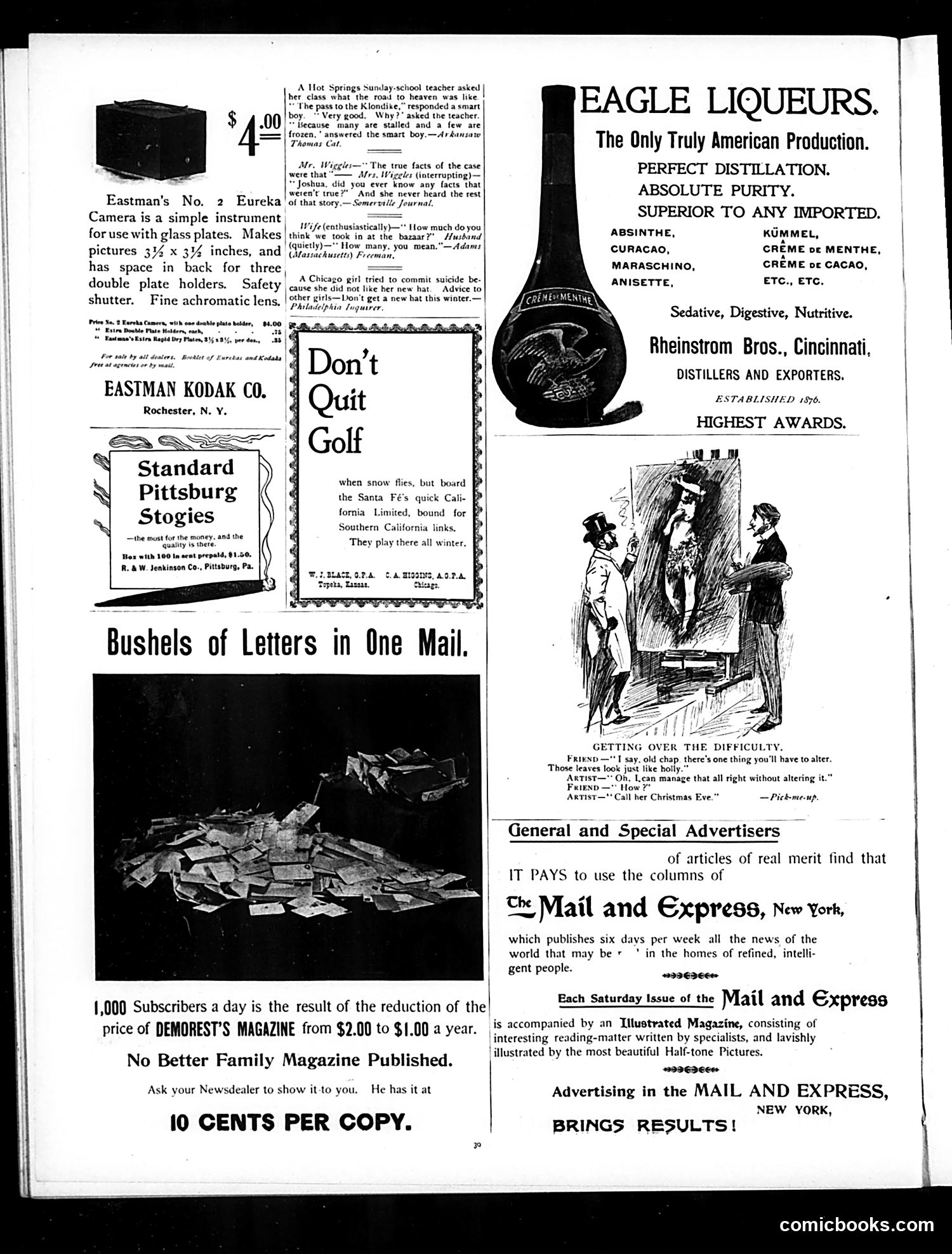
This page is primarily **advertising** for various products (cameras, cigars, liquor, magazines), interspersed with short humorous anecdotes typical of Judge's format. The one cartoon, titled "Getting Over the Difficulty," depicts an artist showing a painting to a friend. The friend objects that the painted leaves "look most like holly," but the artist confidently replies he can "manage that all right without altering it"—then suggests calling the subject "Christmas Eve" instead, implying the title alone will convince viewers the leaves are appropriate to the season. **The joke:** This satirizes artistic pretension and the power of marketing/framing. By simply renaming the work, the artist avoids actually fixing the problem—a commentary on how labels and presentation can override reality. It's a gentle jab at both amateur artists and the art world's tendency to obscure flaws through clever titling or context. The page also includes brief jokes about the Klondike Gold Rush, suicide attempts over fashion, and other period humor.
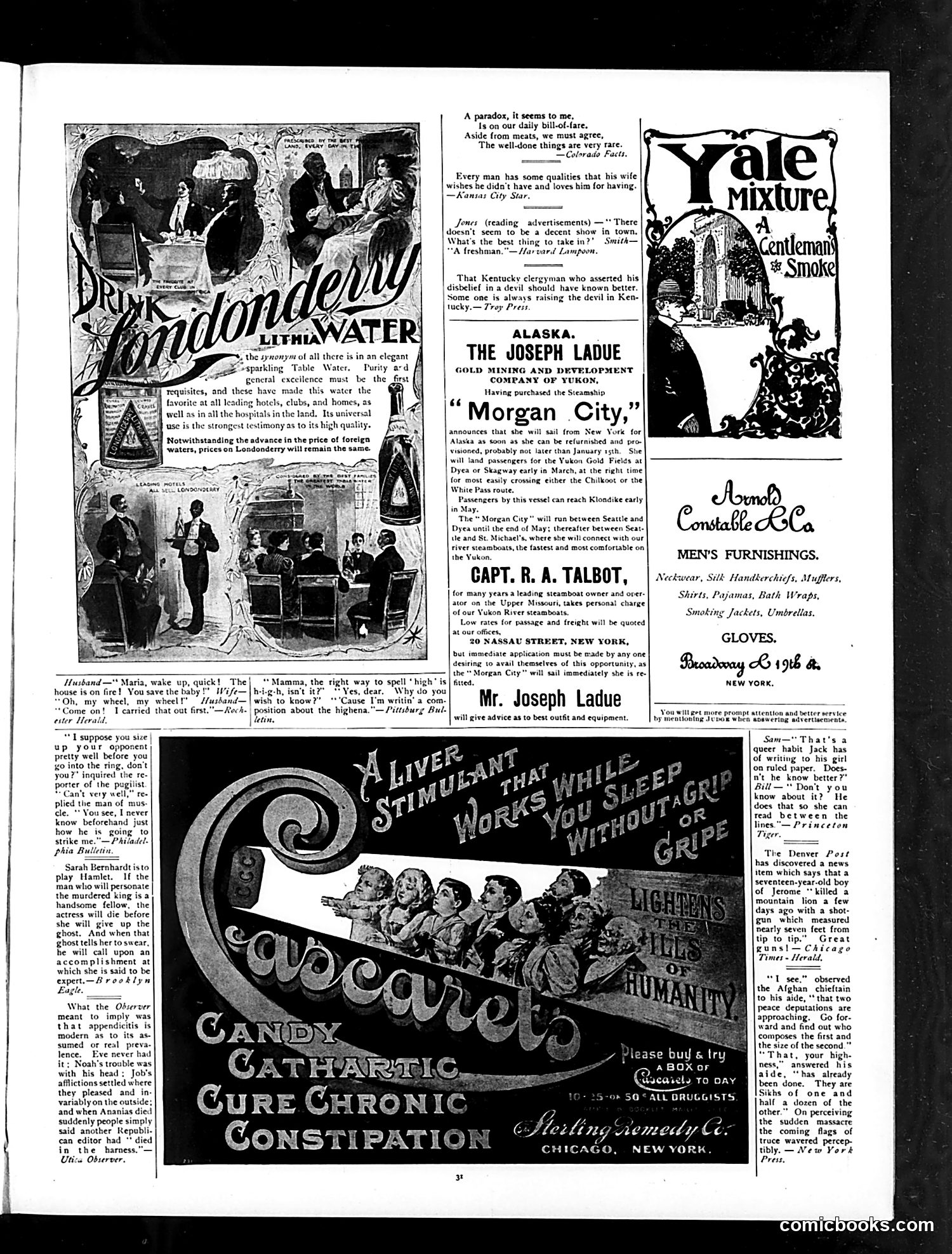
This page is primarily **advertising**, not political satire. It contains multiple patent medicine and commercial ads typical of early 1900s publications. The main cartoon (upper left) shows "Dr. Londonderry Lithia Water"—a bottled water product promoted as a health tonic for hotels, clubs, and hospitals. The illustrated scene depicts well-dressed patrons, suggesting the product's aspirational market positioning. The page includes several **brief joke quotations** on various topics (education, religion, Kentucky devil-raising), but these are filler content, not directed satire. Lower sections advertise the "Morgan City" steamship for Alaska Gold Rush passengers, Captain Talbot's Yukon River service, and Arnold Constable & Co. menswear. A Cocoanut Candy laxative ad appears prominently, along with small domestic humor cartoons about household matters (a wife prioritizing her bicycle during a fire; spelling confusion; relationship observations). **No specific political figures or events are satirized here.** The page reflects early 1900s consumer culture and patent medicine marketing practices.
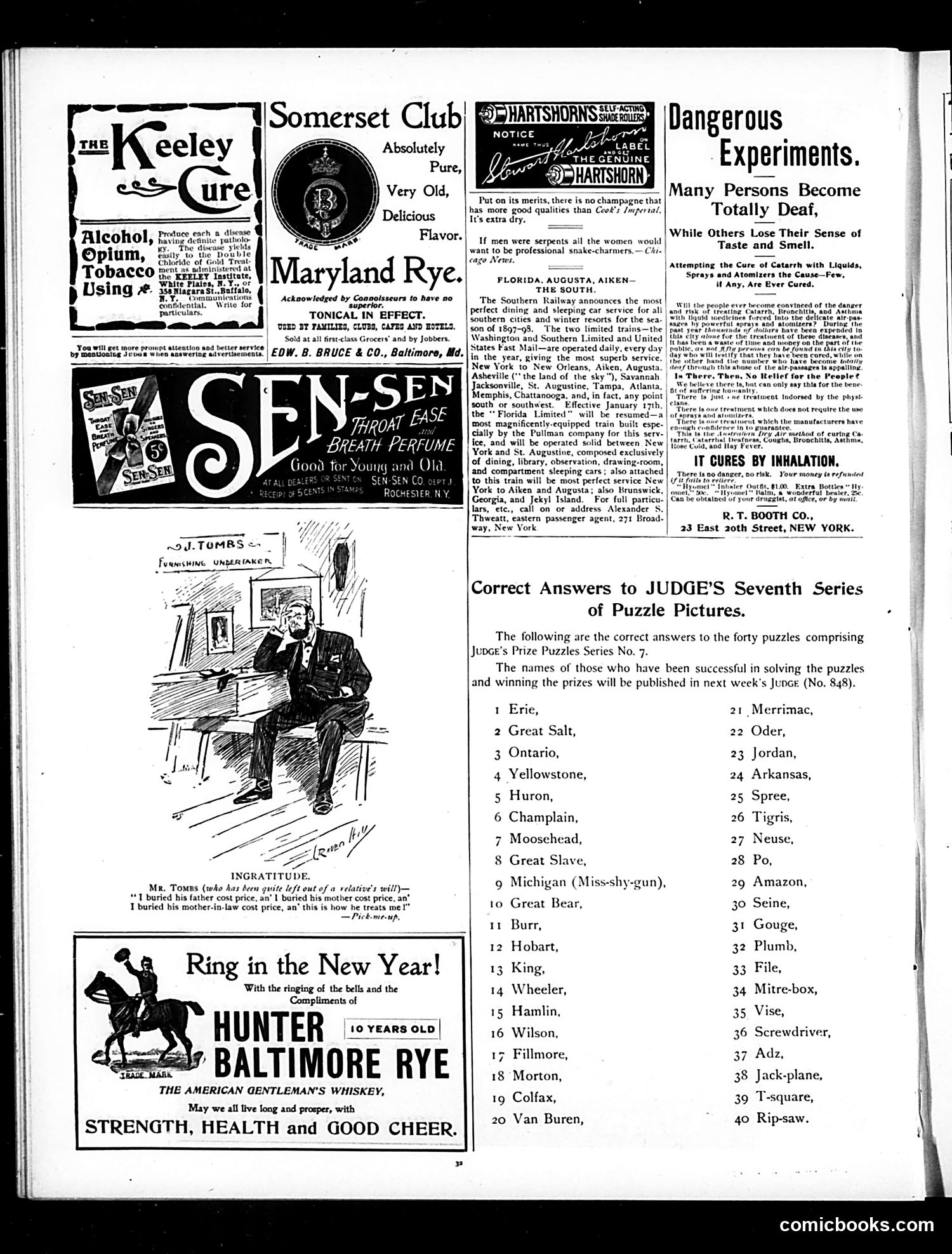
This is primarily an **advertising and puzzle-answer page** rather than political satire. The main content includes: **"Ingratitude" Cartoon**: A sketch of an undertaker (Mr. Tombs) complaining that a client didn't remember him in his will, despite burying the man's father, mother, and mother-in-law "at cost price." The humor is morbid—satirizing both the undertaker's mercenary attitude and the expectation of gratitude for performing his profession. **Advertisements**: The page is dominated by period product ads (whiskey, perfume, catarrh "cures," rail service) typical of 1890s magazines. The "Dangerous Experiments" ad is particularly notable for its dubious medical claims about treating deafness through inhalation. **Puzzle Answers**: The bulk of the page lists correct answers to Judge's previous puzzle series (40 riddles about lakes, rivers, U.S. presidents, and tools). The page reflects late-19th-century American consumer culture and the era's lax medical advertising standards.
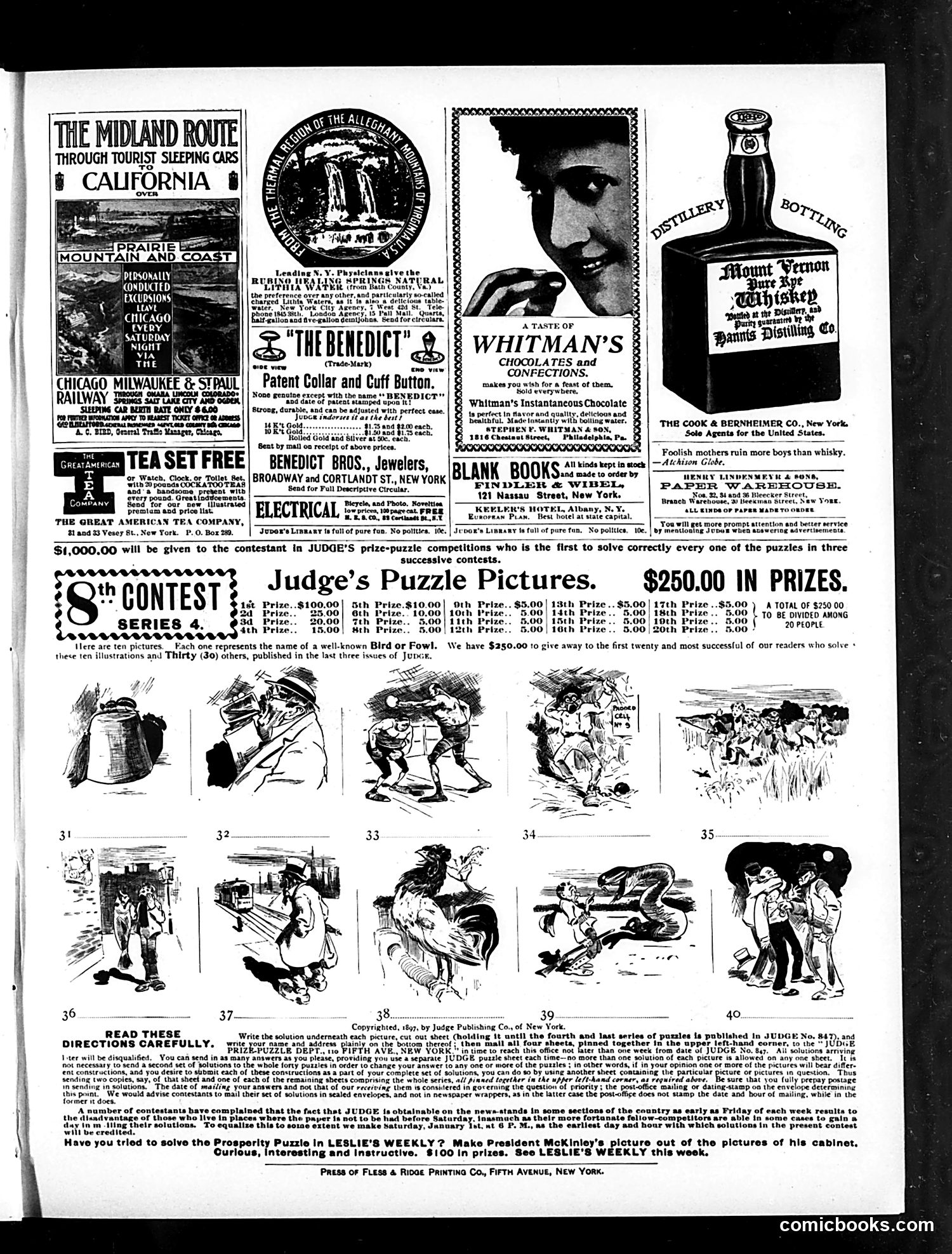
This page is primarily **advertising and contests**, typical of Judge magazine's revenue model. The top half contains various commercial advertisements (tea, chocolate, jewelry, railroads, hotels) mixed with what appears to be a portrait photo labeled "A Taste of Whitman's Confections." The dominant content is **Judge's Puzzle Pictures Contest** — a visual puzzle competition offering $250 in prizes. Readers must identify ten bird or fowl names from sketched illustrations (numbered 31-40), with solutions mailed in. The contest emphasizes that readers solving all puzzles correctly across three successive contest series compete for cash prizes. The fine print provides detailed submission rules: solutions must be written beneath pictures, all four contest sheets pinned together, and mailed to the Prize Puzzle Department by deadline. This represents a **popular early-1890s magazine engagement strategy** — contests drove readership and reader loyalty while generating advertising revenue. The puzzle format was deliberately challenging, encouraging repeat purchases to see solutions and subsequent contests.
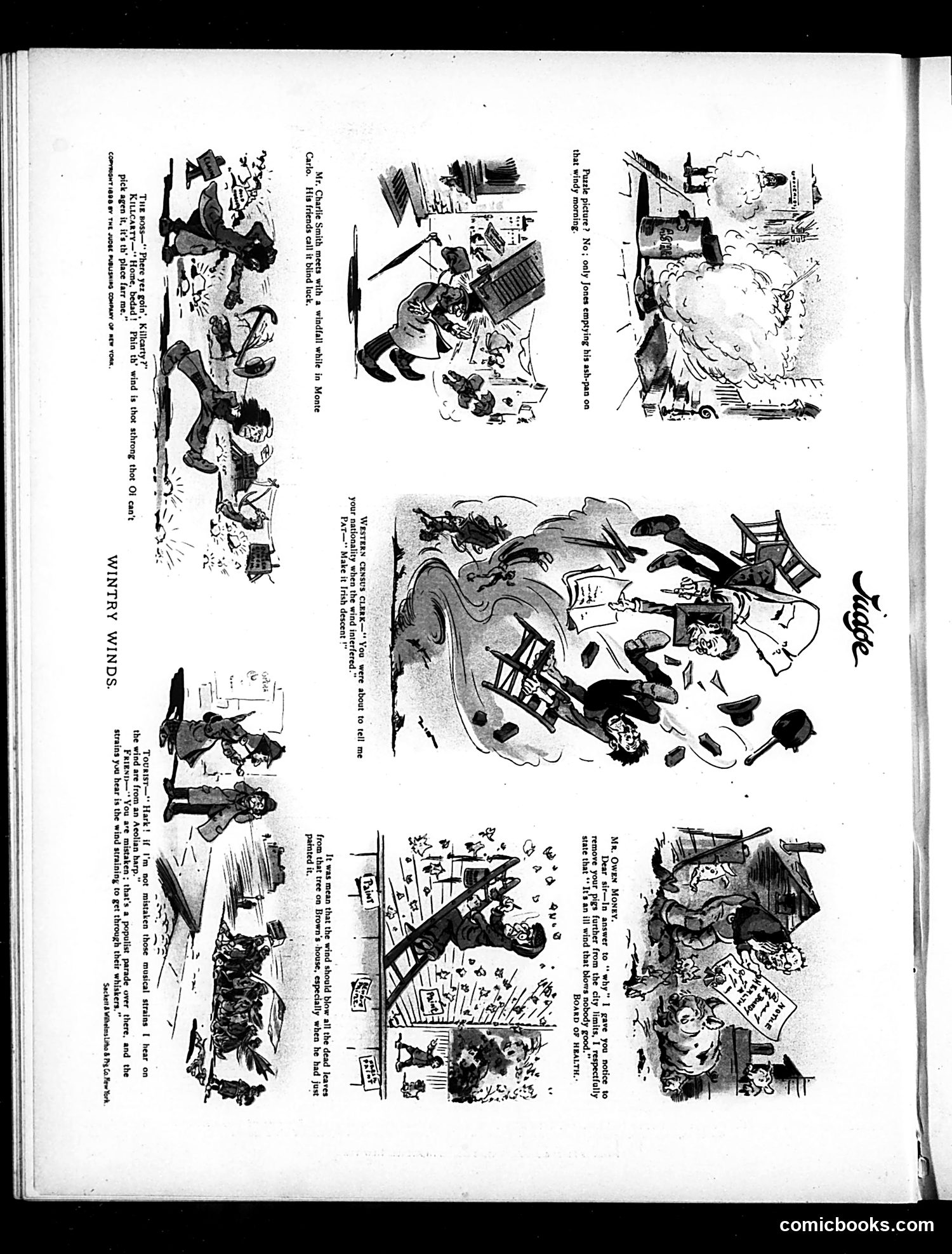
This page presents multiple cartoons using wind as a comedic device to satirize everyday urban life and social types. The cartoons mock: a messy householder (Jones) whose ash spreads everywhere; Irish immigrants (Pat, Killearty) stereotyped with thick accents ("bedad," "Oi") fleeing to escape harsh weather; a census clerk conducting interviews disrupted by wind; a woman evicted by landlords who blame "wintry winds"; and a reference to a Populist political parade whose members supposedly have wind "whistling through their whiskers" (likely mocking farmers or working-class Populists as rough/unkempt). The humor relies on period stereotypes—particularly anti-Irish caricature with exaggerated dialect—and class-based ridicule of Populists. The recurring wind motif creates loose narrative cohesion across unrelated vignettes of urban mishaps and social pretension.