
A complete issue · 19 pages · 1897
Judge — December 25, 1897
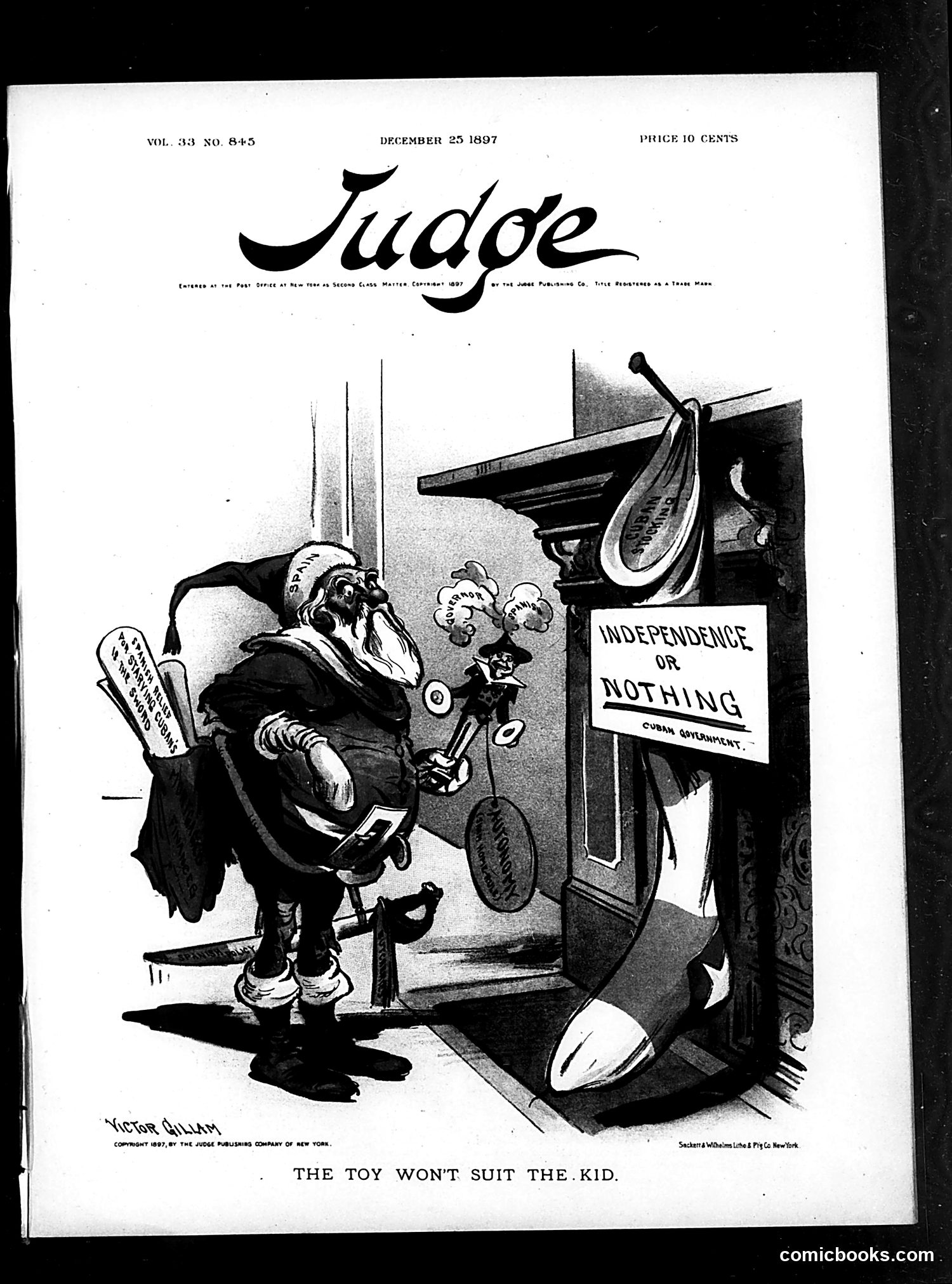
This December 1897 *Judge* cartoon by Victor Gillam satirizes Cuban independence efforts. The caricatured figure on the left (likely representing Spain or Spanish colonial authority) examines a mechanical toy labeled "Independence or Nothing—Cuban Settlement," appearing skeptical or dismissive. The toy's complex mechanisms suggest Cuban independence demands are impractical or unsuitable for Spain's purposes. The caption "The Toy Won't Suit the Kid" implies Spain views Cuban independence as an unsuitable or unworkable solution to colonial tensions. This reflects the period's Spanish-American tensions preceding the 1898 war, when Spain resisted Cuban autonomy proposals. The cartoon mocks either Spain's intransigence or the impracticality of proposed independence arrangements.
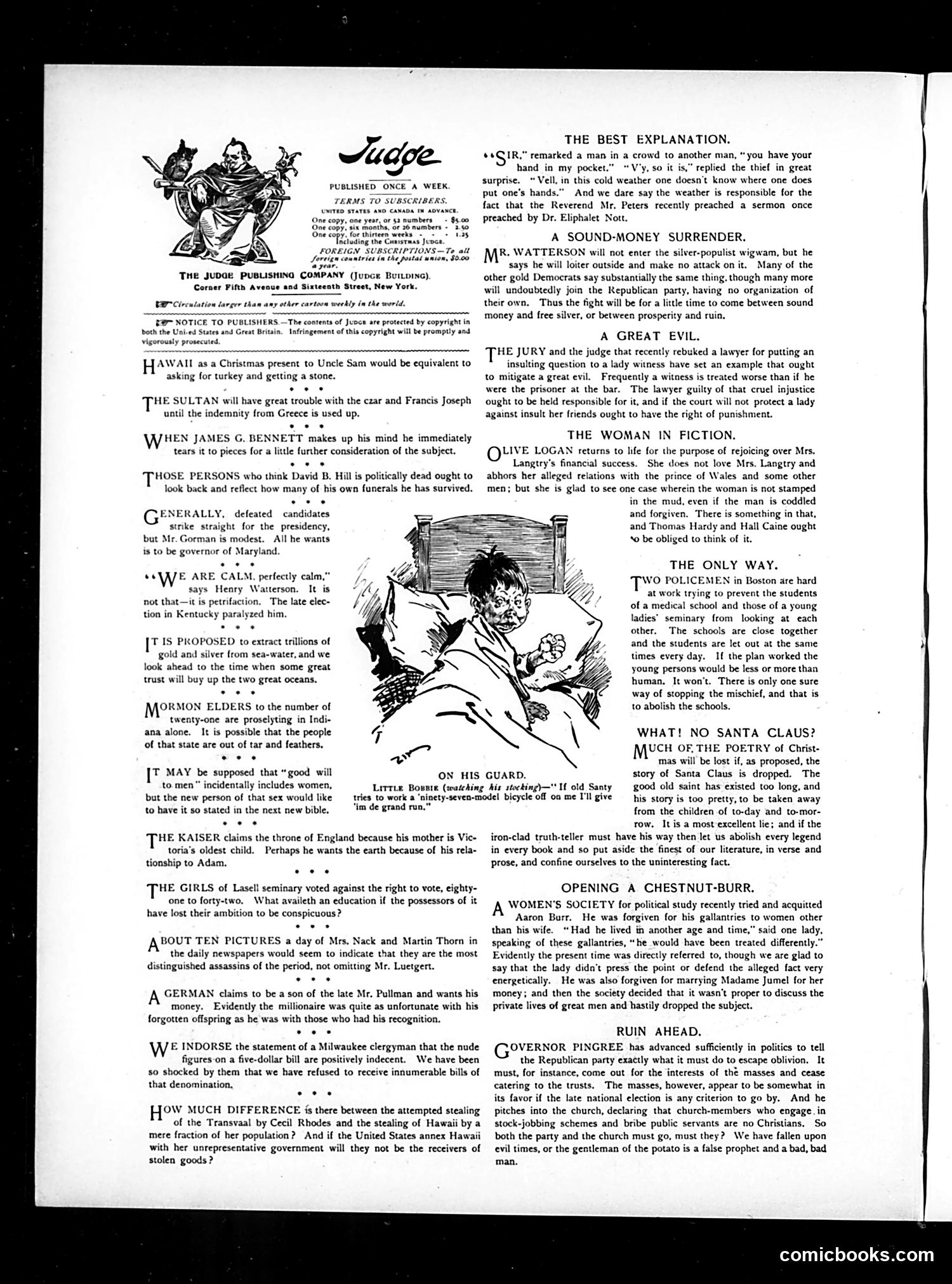
The main cartoon titled "ON HIS GUARD" depicts a man being knocked backward while holding what appears to be a bicycle. The caption references "Little Bobbie" wanting Santa to work a bicycle, suggesting this is satirical commentary on childhood materialism or parental gift-giving pressures during the Christmas season. The surrounding text consists of brief political and social commentary items typical of Judge magazine's satirical format. These include observations on various political figures and events, though specific references (names like "Mr. Watterson," "General," "Governor Pingree") would require additional historical context to fully identify. The overall page represents Judge's characteristic mix of visual humor and short editorial jabs at contemporary political and social issues, though without publication date visible, precise historical references remain unclear.
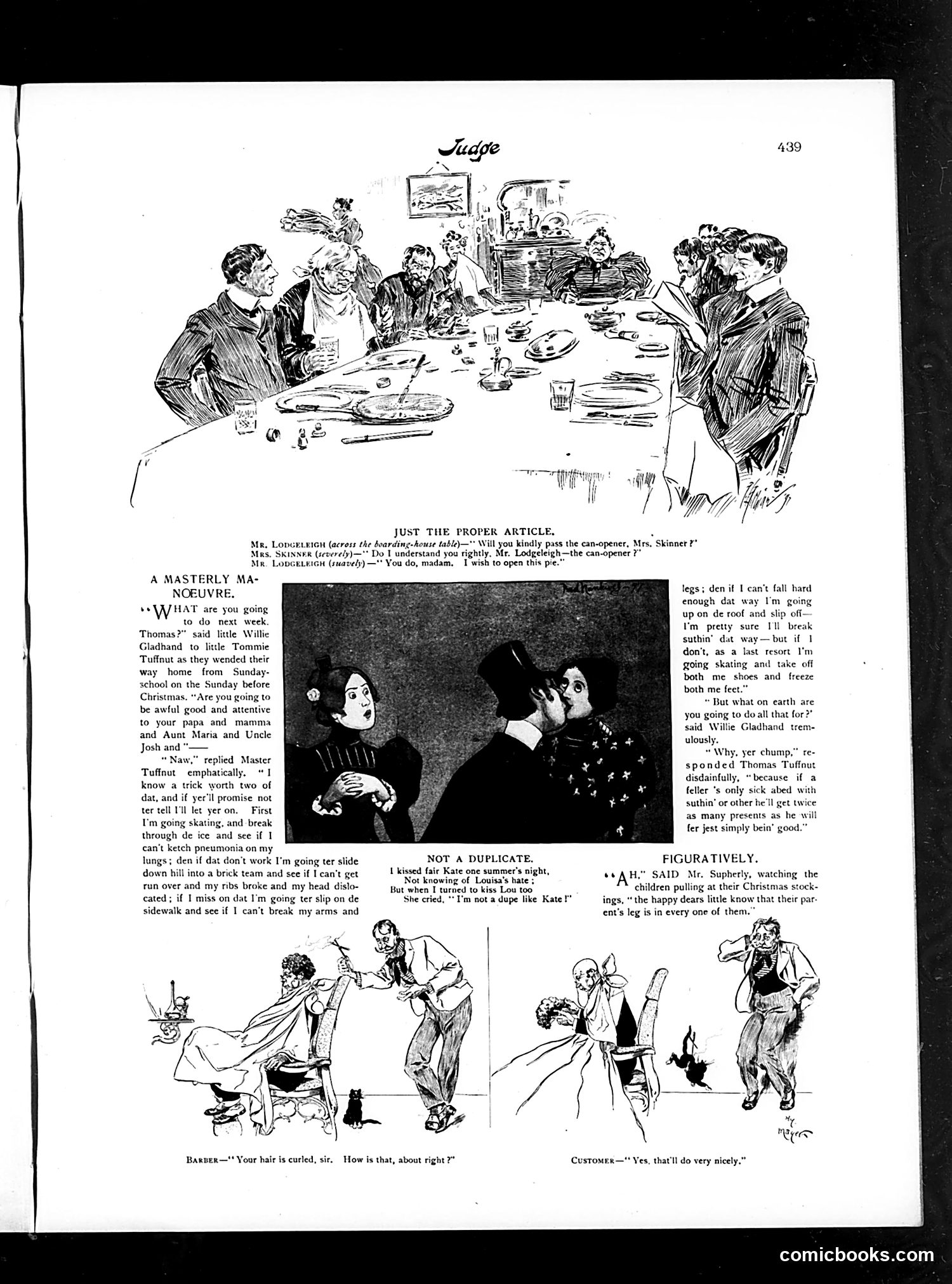
This page contains several humorous sketches satirizing everyday social situations rather than political commentary. **"Just the Brown Articles"** depicts a domestic dinner scene where Mrs. Skinner appears to be negotiating with guests about opening a pie—a mundane household negotiation presented as comedic theater. **"A Masterly Manoeuvre"** features young Thomas Tuffnut scheming to get out of Sunday obligations by faking illness, claiming he'll go skating instead to break through ice and catch pneumonia—dark humor about childhood mischief. **"Not a Duplicate"** and **"Figuratively"** are brief comic vignettes about mistaken identity and literal misinterpretation, respectively. The bottom sketches show a barber and customer interaction about hair curling. These are general-interest humor pieces typical of Judge's lighter satirical content, lacking specific political or dated references.
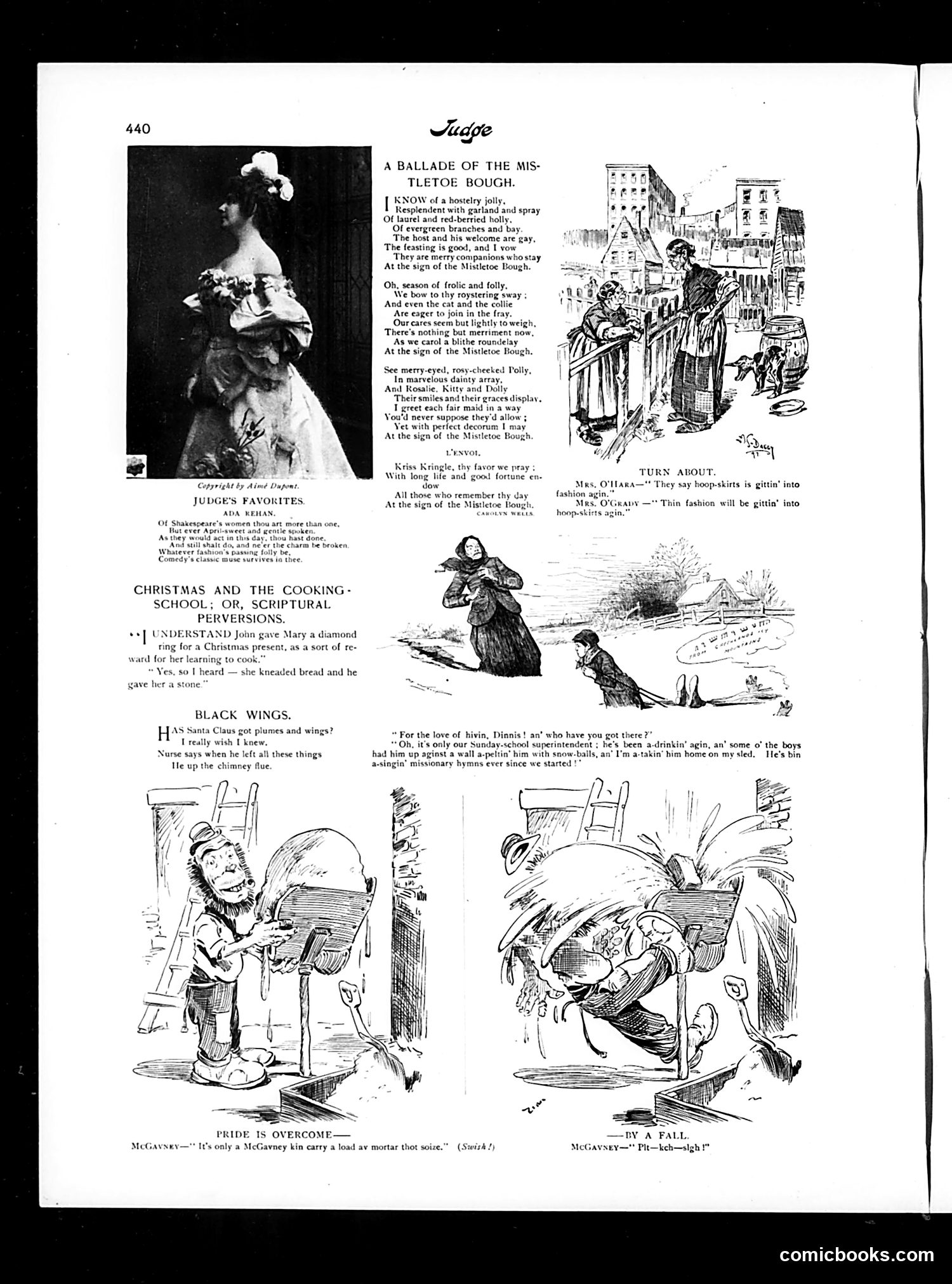
The page features several unrelated pieces of humor typical of Judge magazine's format: **"A Ballade of the Mistletoe Bough"** is a Christmas poem about holiday festivities, illustrated with a portrait photograph and street scene. **"Christmas and the Cooking-School"** presents a brief dialogue joke about a cooking instructor named Mary receiving a diamond ring as a Christmas present. **"Black Wings"** and the cartoon panels below show slapstick domestic humor: a character (McGavvey) attempts to hang something, and subsequently falls—illustrating the caption "Pride is Overcome" and "By a Fall." The humor derives from physical comedy and wordplay about comeuppance. **"Turn About"** presents a brief exchange about hoopskirts coming back into fashion, suggesting cyclical fashion trends. The page is primarily entertainment-focused rather than overtly political, reflecting Judge's blend of seasonal humor, puns, and visual gags.
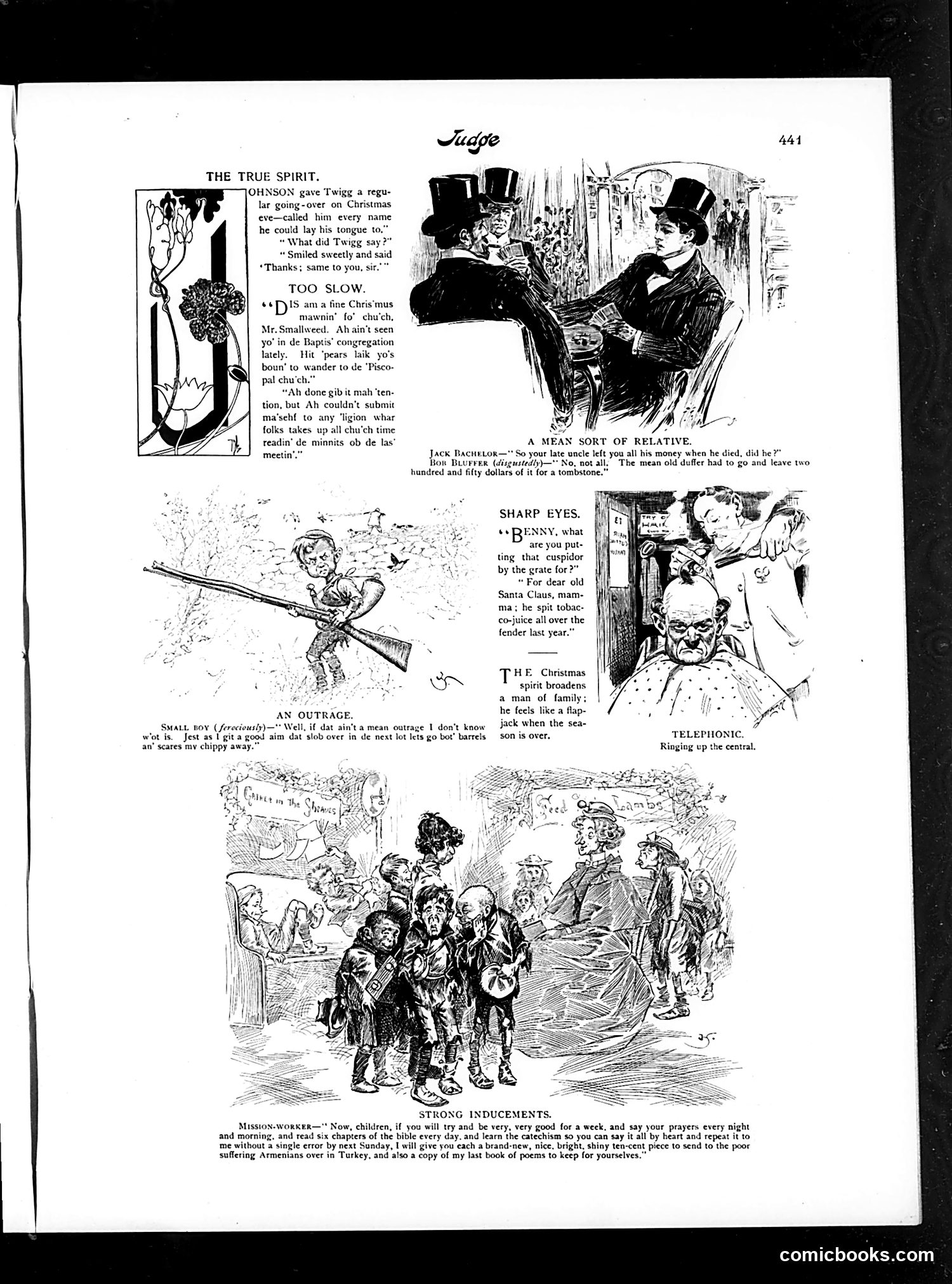
This page presents several humorous vignettes mocking Victorian-era hypocrisy and social pretense: **"The True Spirit"** ridicules performative politeness—a man insults another on Christmas Eve, who responds with saccharine gratitude, inverting expected moral behavior. **"Too Slow"** uses dialect humor (common period stereotyping) to joke about church attendance and bureaucratic tedium—a parishioner avoids religion because congregational meetings bore him. **"A Mean Sort of Relative"** satirizes inheritance—an uncle leaves money but stipulates funds for a tombstone, defeating the heir's expectations. **"Sharp Eyes"** presents a child's practical observation: Santa spits tobacco on the fireplace, so she positions a spittoon accordingly. **"Strong Inducements"** mocks missionary work through a mission-worker bribing children with ten-cent pieces and poetry books to memorize scripture and pray for suffering Armenians—exposing the mercenary, condescending nature of Victorian charitable work. Overall, the page satirizes religious hypocrisy, social pretense, and the gap between stated values and actual behavior.
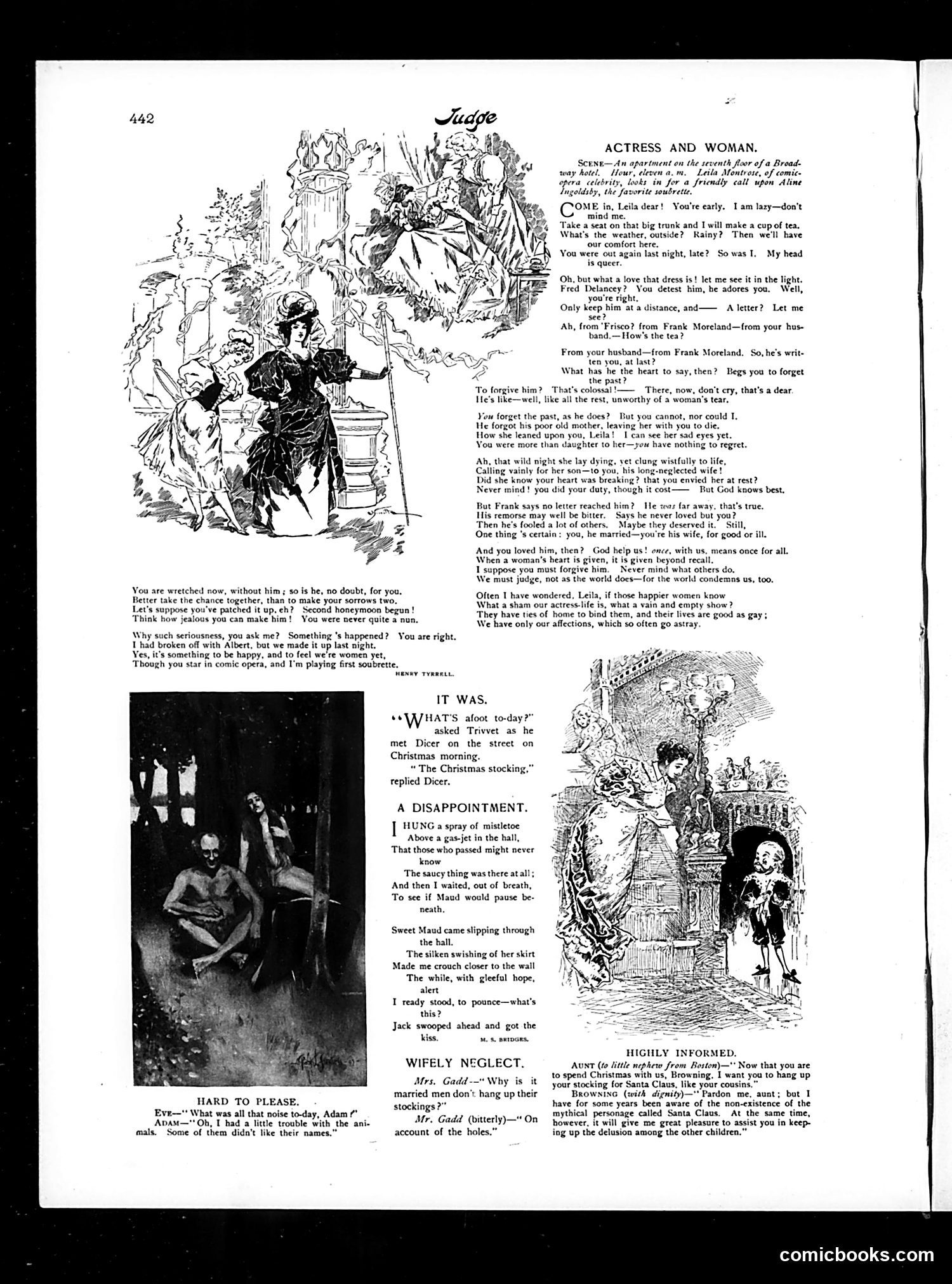
This page presents two satirical pieces about gender and relationships in late 19th-century American society. The main feature, "Actress and Woman," depicts a conversation between two theatrical performers—Leila Montrose and Aline Ingoldsby—discussing a letter from Frank Moreland, Aline's estranged husband. The satire critiques both marital infidelity and women's constrained choices: Aline has endured Frank's abandonment of his dying mother yet faces social pressure to forgive and reunite with him. The dialogue sarcastically highlights the double standard—Frank's affairs are dismissed as inevitable male behavior ("like all the rest"), while women are expected to suffer silently and reconcile regardless of betrayal. The comedy derives from the actresses' cynicism about marriage, duty, and morality. Secondary items mock Christmas customs and marital dynamics with lighter humor about mistletoe and gift-giving expectations, reinforcing themes of romantic disappointment and gender role performance.
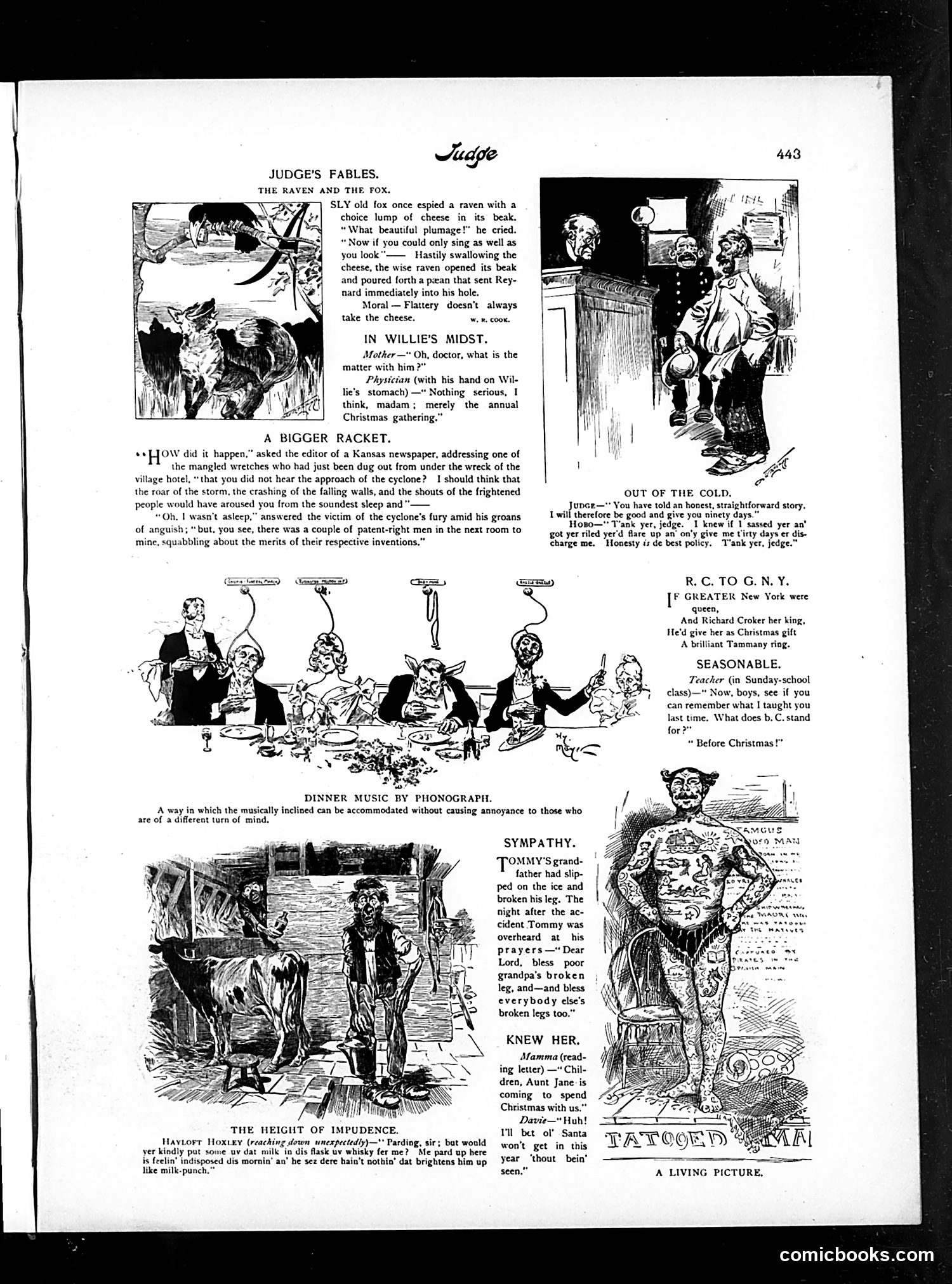
This page from the satirical magazine Judge contains several humorous pieces mocking American society circa early 1900s: **"A Bigger Racket"** satirizes the disruption caused by patent-right salesmen. A Kansas cyclone survivor explains he slept through the disaster because two aggressive "patent-right men" arguing in the next room made so much noise that even the storm couldn't wake him—suggesting these door-to-door inventors were considered more annoying than natural disasters. **"R.C. to G.N.Y."** appears to reference Richard Croker and Tammany Hall politics in New York City, mocking the corrupt political machine's influence. Other brief comedic sketches include doctor's humor about Christmas indigestion, phonograph dinner entertainment, and children's innocent misunderstandings (a child defining "b.C." as "Before Christmas"). The fables and domestic humor reflect turn-of-the-century American anxieties about technology, urban politics, and middle-class life. Most satire targets commercial excess and technological "progress" rather than specific political events.
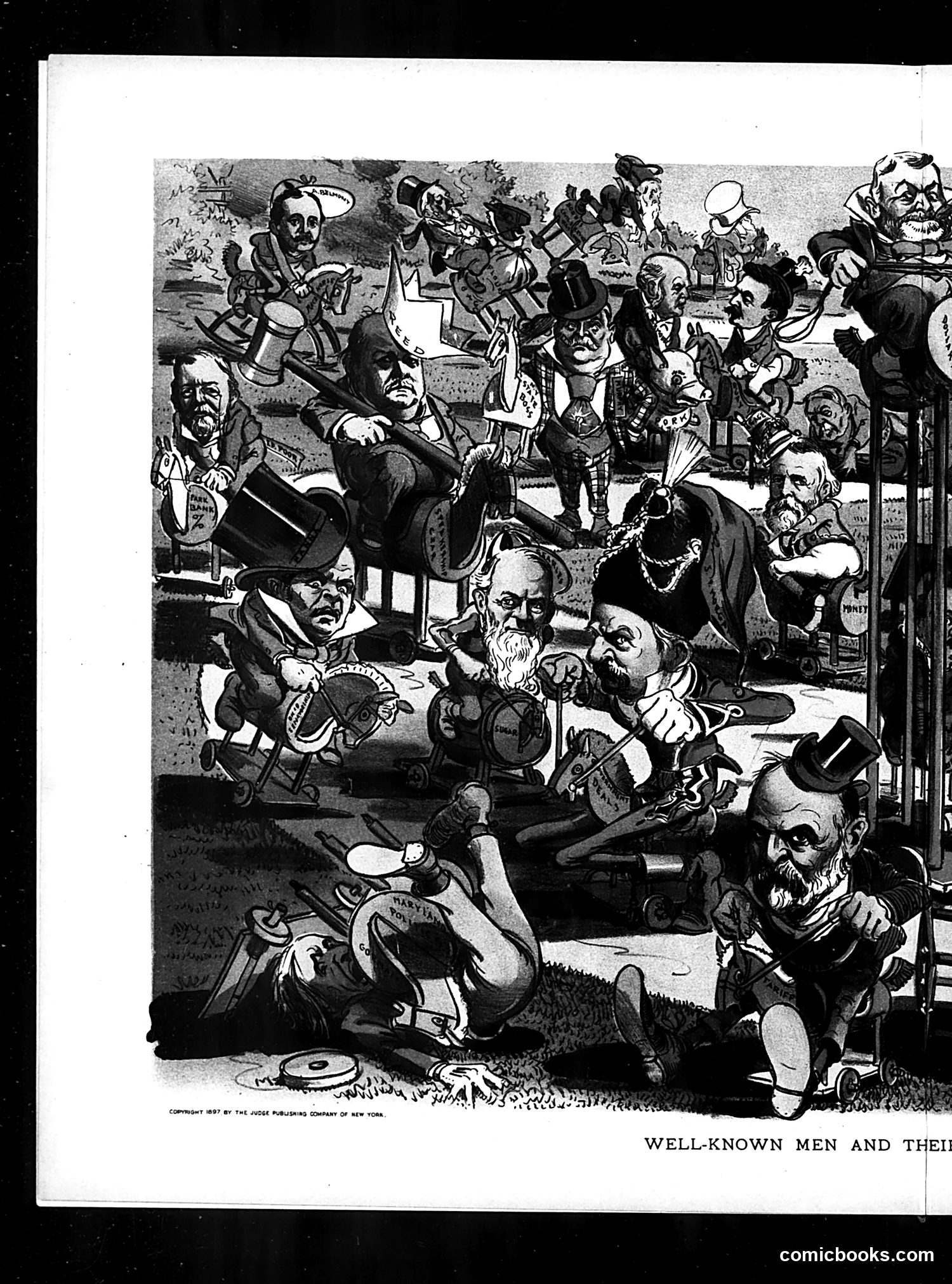
This is a satirical political cartoon from *Judge* magazine (copyright 1897, per the visible text). The incomplete title "WELL-KNOWN MEN AND THEI[R]" suggests it depicts prominent public figures of that era, likely politicians or business leaders. The densely packed composition shows numerous caricatured figures in exaggerated, grotesque style—typical of Gilded Age satire. The drawing style and crowded arrangement suggest mockery of power, excess, or corruption among the wealthy and politically connected. Without clearer identification of specific figures or additional text, the precise targets and satirical point remain unclear, though the overall tone is decidedly critical of the depicted "well-known men." The quality and style are consistent with *Judge's* reputation for biting political commentary.
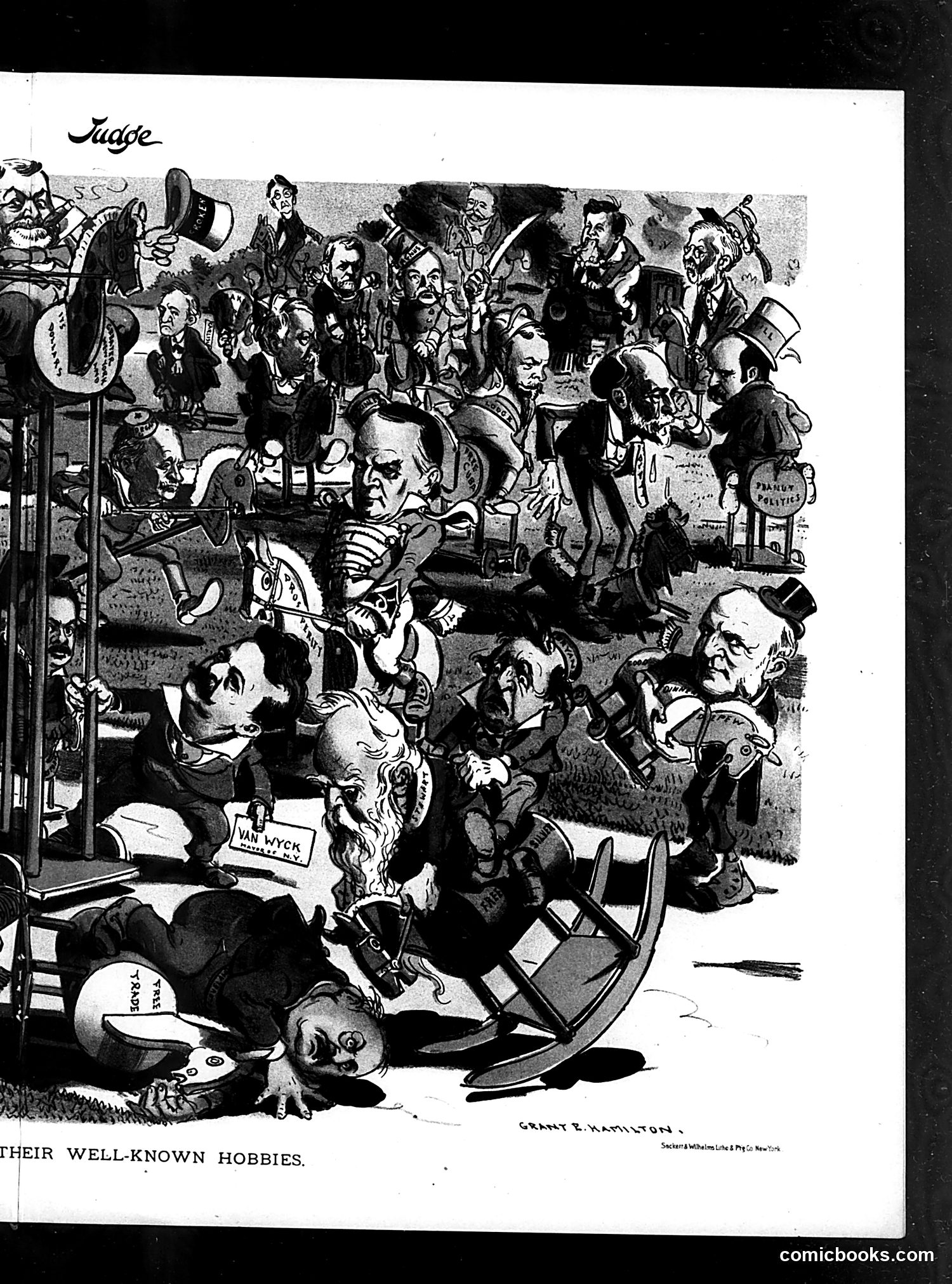
This Judge cartoon satirizes prominent political and social figures of its era through caricature. The crowded composition shows numerous men engaged in various activities, each labeled with identifiable names (visible labels include "Van Wyck" and others, though some are difficult to read clearly in this reproduction). The title "Their Well-Known Hobbies" suggests the cartoon ridicules what these figures are known for doing outside official duties—likely depicting politicians, businessmen, and public figures engaged in vice, corruption, or unseemly behavior. The exaggerated caricature style and the jumbled, chaotic composition emphasize satirical mockery of American leadership. Without clearer label legibility, the specific identities and exact targets remain partially unclear, but the cartoon exemplifies Judge magazine's approach: biting political satire through visual caricature of contemporary public figures.
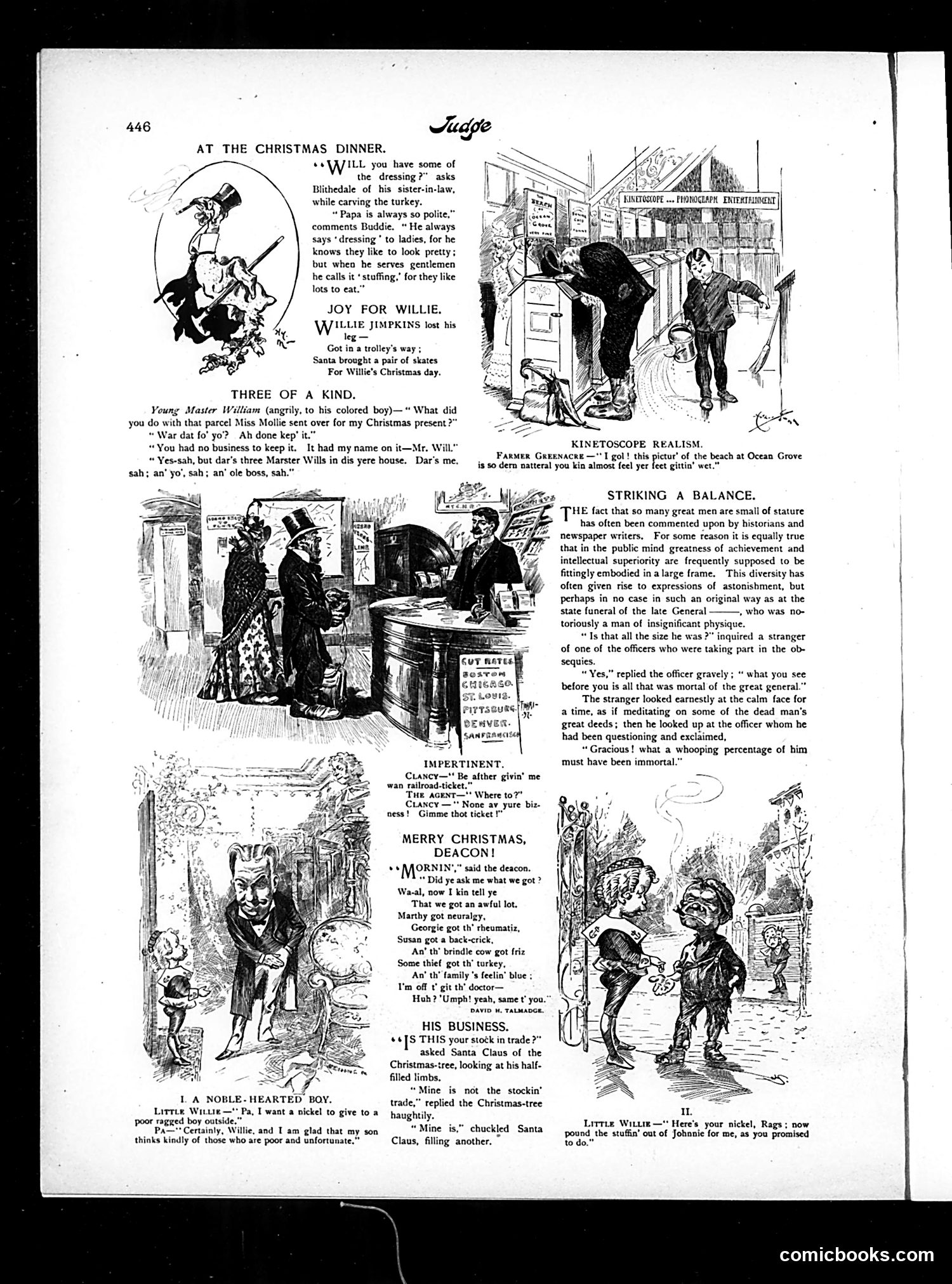
This Christmas-themed page from *Judge* magazine contains several humorous vignettes satirizing American social customs and domestic life: **"At the Christmas Dinner"** mocks genteel pretense: a father uses euphemistic language ("dressing" vs. "stuffing") to appear refined before women while being more direct with men—the joke being that polite society masks practical reality. **"Three of a Kind"** uses dialect humor common to the era, depicting a white boy confused that three people share the name "Mr. Will" in his household, including an enslaved person and his father. The satire targets the absurdity of rigid social hierarchies. **"Striking a Balance"** jokes about a small-statured general's funeral, with an officer suggesting most of the general's greatness was "immortal" rather than physical—mocking the disconnect between perceived greatness and actual stature. Other pieces ("Joy for Willie," "Kinetoscope Realism," "Impertinent," "Merry Christmas, Deacon," "His Business") are lighter seasonal jokes playing on misunderstandings and holiday mishaps rather than substantive satire.
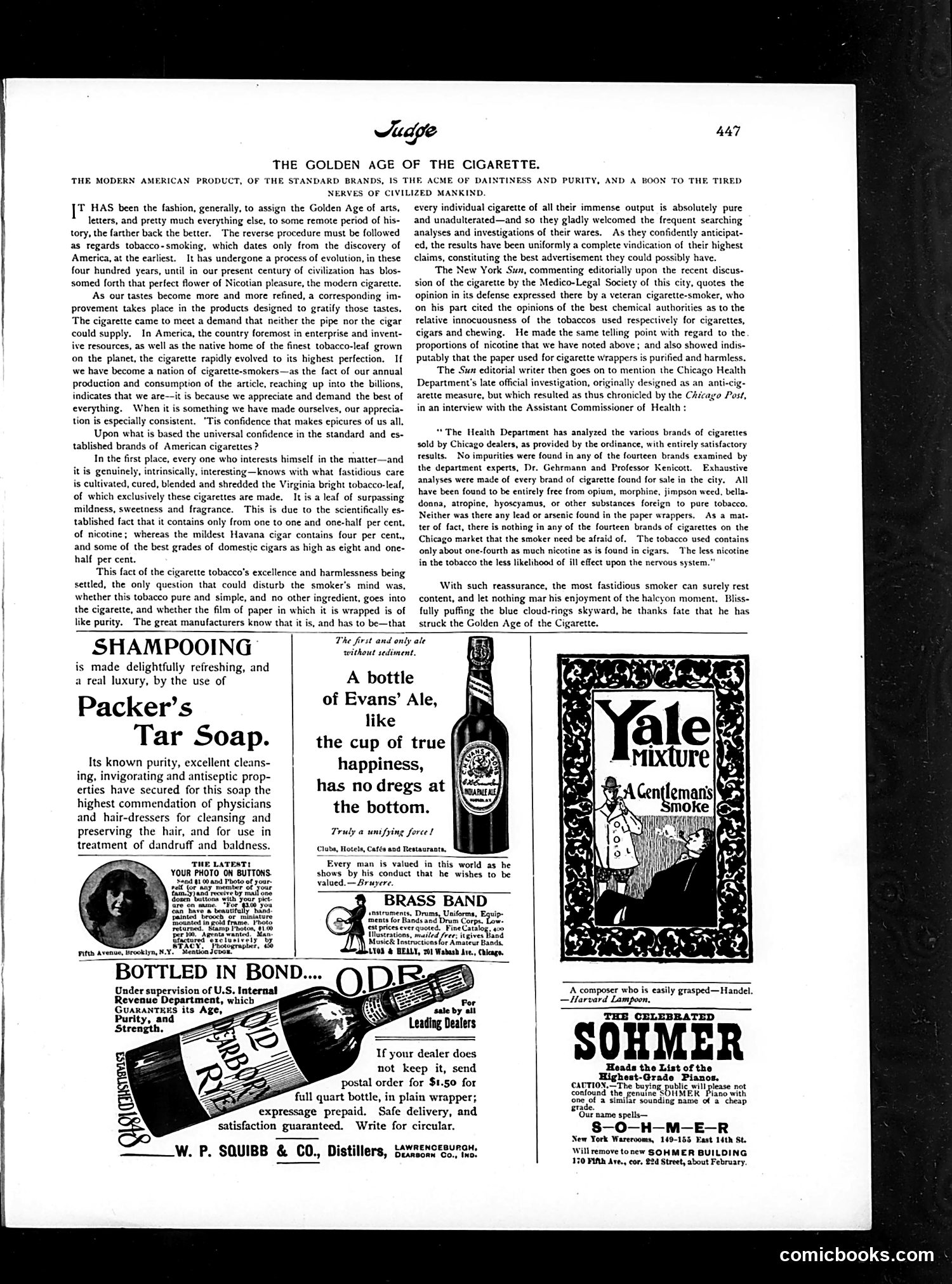
This is a full-page advertisement essay defending cigarettes as a modern American achievement. Published in *Judge* magazine (a satirical publication), it ironically presents cigarette smoking as proof of civilization's progress. The piece argues that cigarettes represent the pinnacle of refined taste, citing their low nicotine content (1-1.5%) compared to cigars (4-8.5%). It emphasizes American manufacturing superiority and claims chemical analyses prove cigarettes are pure and harmless. The satire lies in the overblown rhetoric: framing an addictive product as a "boon to the tired nerves of civilized mankind" and celebrating it as evidence of national refinement. The essay's breathless tone about cigarette "purity" and "harmlessness"—later validated by newspaper editorials—mocks both corporate marketing claims and the credulous acceptance of them. The page also contains period advertisements for other products (Packer's Tar Soap, Evans Ale, Sohmer pianos), typical of *Judge*'s ad-heavy format.
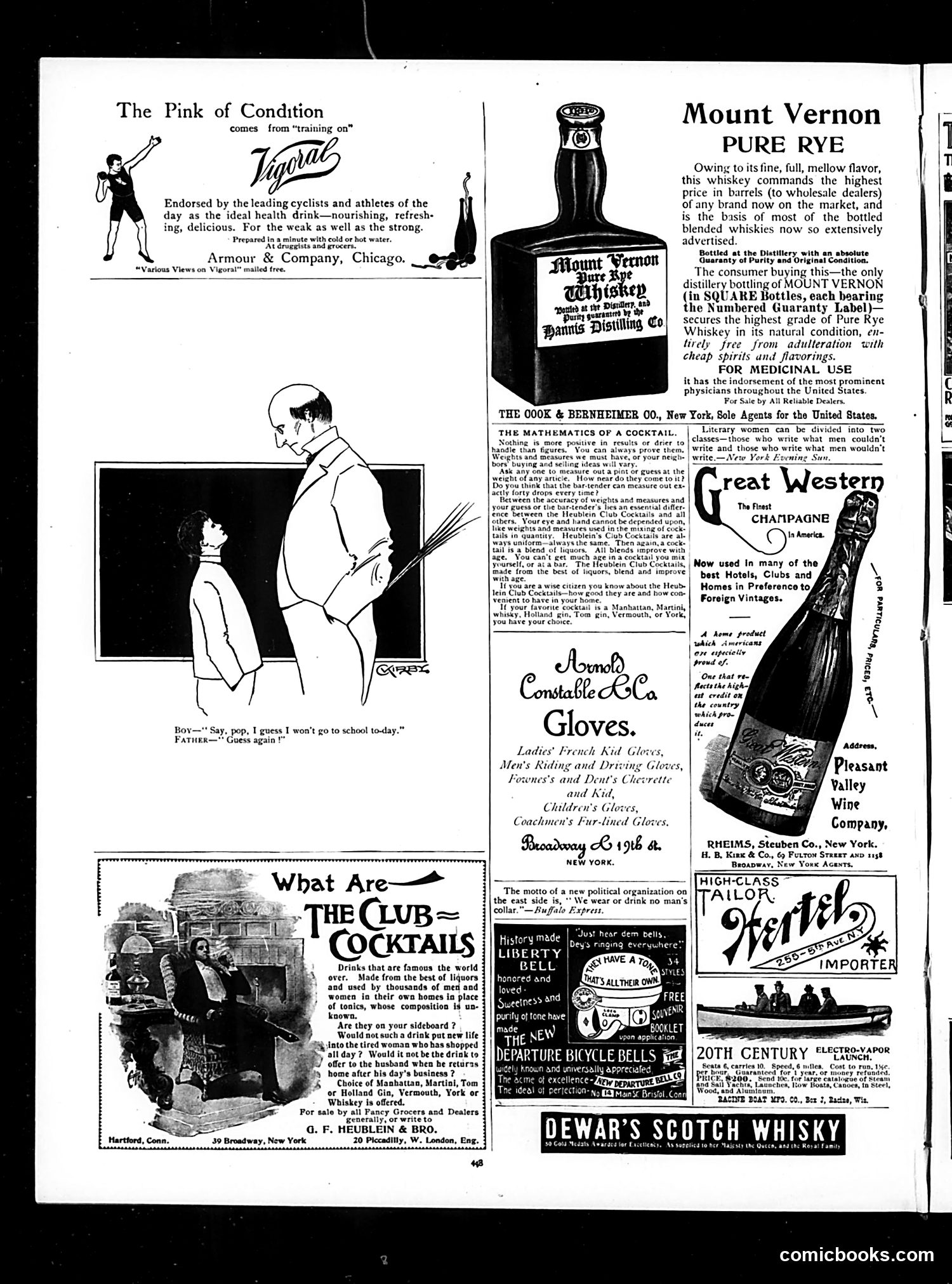
This page is primarily **advertising**, with one small cartoon. The advertisements promote alcoholic beverages (whiskey, champagne, wine) and consumer goods (gloves, bicycle bells), typical of Judge magazine content from this era. The single cartoon ("Boy—'Say, pop, I guess I won't go to school today.' Father—'Guess again!'") depicts a father-son interaction where the boy seeks permission to skip school and the father refuses—a domestic humor piece with no political satire. The page's social context reflects **early 20th-century attitudes toward alcohol**: whiskey is marketed as a health drink endorsed by "athletes" and recommended "for medicinal use" by physicians. This reflects the pre-Prohibition era when alcohol was widely advertised for health benefits, before the 18th Amendment (1920). The small political reference mentions a "new political organization on the east side" with the motto "We wear or drink no man's collar," suggesting working-class political organizing, but specifics are unclear. Overall, this is a commercial page rather than satirical commentary.
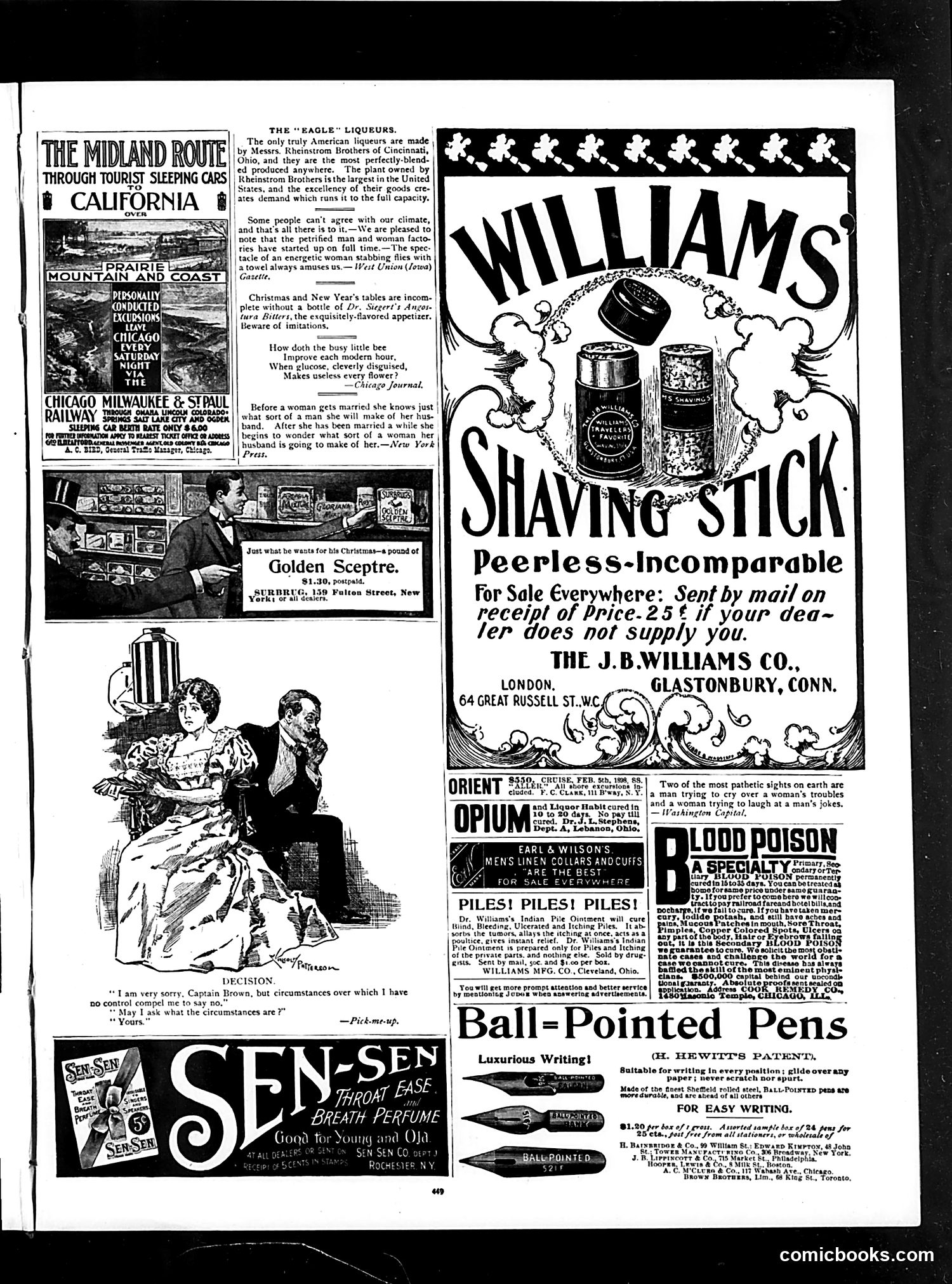
This page is primarily **advertisements** interspersed with brief humorous commentary and one small cartoon labeled "Decision." ## The Cartoon The "Decision" cartoon depicts a man and woman in conversation. The woman says she cannot marry him due to circumstances beyond her control; when asked what those circumstances are, she replies "You." This is a standard rejection joke playing on the woman's pointed insult. ## The Content The page contains **travel advertisements** (Midland Route to California, Chicago-Milwaukee & St. Paul Railway), **liqueur and spirits ads** (Eagle Liqueurs, Angostura Bitters), and numerous **patent medicine advertisements** typical of the era—remedies for piles, opium addiction, indigestion, and other ailments. There are also **brief satirical observations** about modern life (busy bees and glucose, women's understanding of their husbands), **pen advertisements**, and **men's fashion** (Earl & Wilson collars). No significant political commentary or complex satire appears on this page. It reflects Judge's typical late-19th-century mix of advertising revenue and light humor.
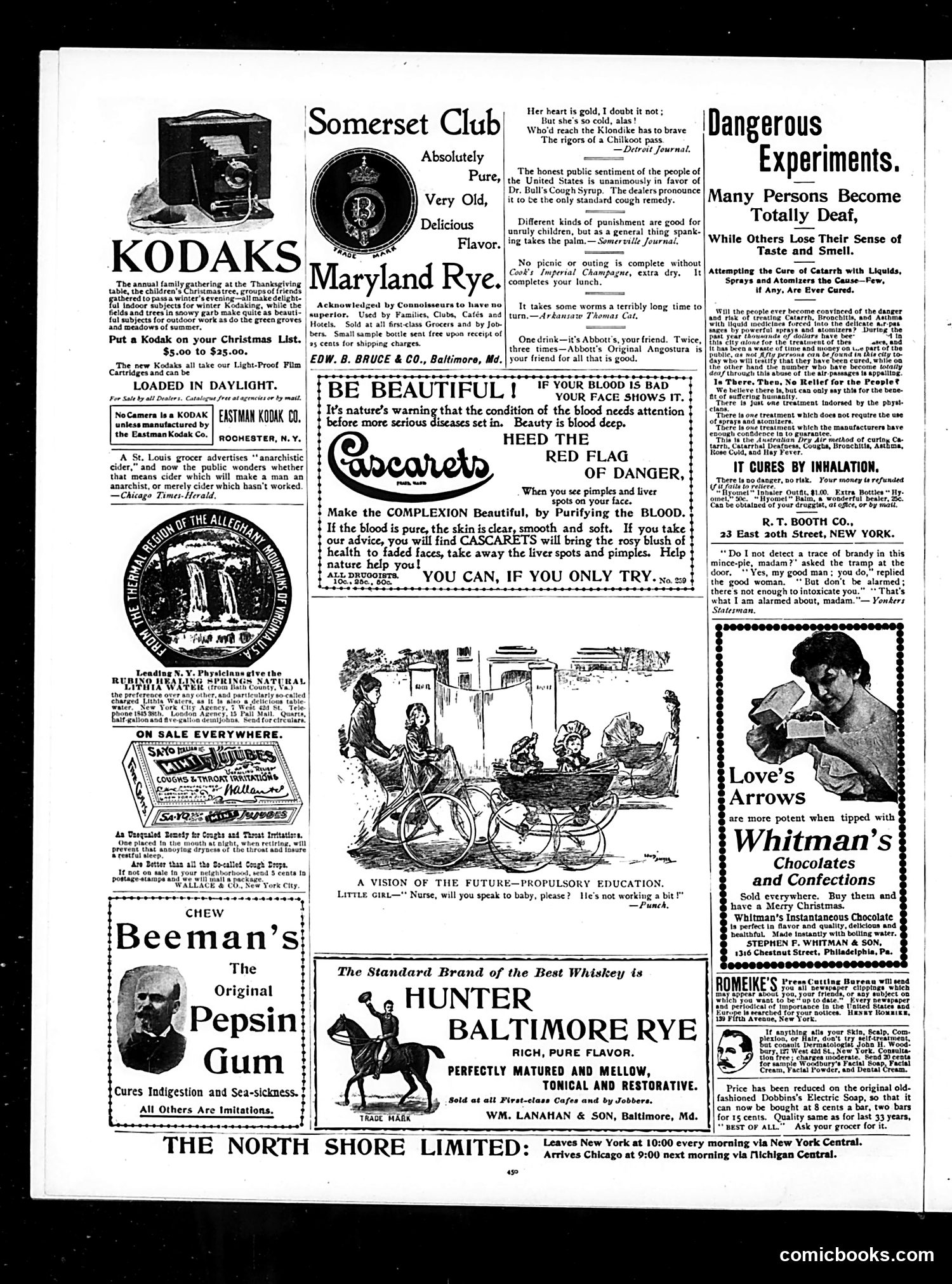
This page is primarily **advertising with one satirical cartoon**. The main cartoon, titled "A Vision of the Future—Propulsory Education," depicts a nurse with a baby in a wheeled carriage, captioned with the child asking the nurse to make the baby "work." The joke satirizes the era's growing obsession with mechanical efficiency and productivity—imagining absurdly that even infants should be expected to produce labor. The advertisements dominate the page, hawking patent medicines (Cascarets blood purifier, Pepsin gum), whiskey, chocolates, and Kodak cameras—typical early 1900s consumer goods. Notably, a large ad warns of "Dangerous Experiments" treating catarrh with liquids and sprays, promoting instead an inhalation cure. The page reflects early 20th-century anxieties: industrial efficiency culture, unregulated patent medicines making dubious health claims, and emerging consumer culture targeting holidays (Christmas gift suggestions).
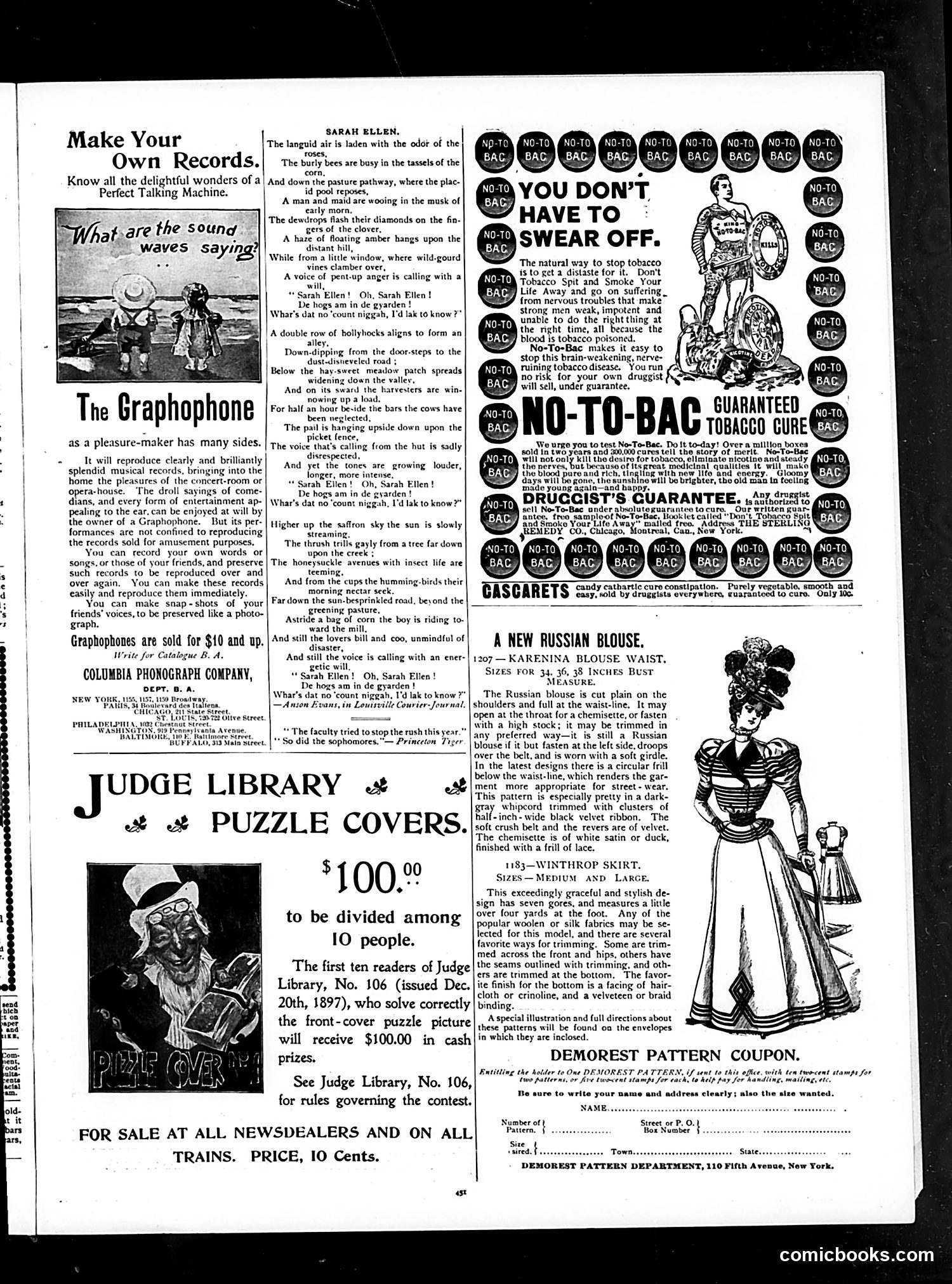
This page contains primarily **advertising and product promotions** rather than political satire. The main content includes: 1. **"Sarah Ellen" poem** (upper left): A romantic pastoral verse with dialect dialogue about hogs in a garden—likely period humor using exaggerated African American vernacular common to late 19th-century publications. 2. **No-To-Bac advertisements** (center/right): Dominant messaging promoting a tobacco-cessation product, using period marketing language about "nicotine poisoning" and health restoration. The repeated "NO-TO BAC" labels and guarantee language reflect early 1900s patent medicine advertising. 3. **Graphophone advertisement** (left): Promotes Columbia's phonograph technology as home entertainment. 4. **Judge Library Puzzle Contest** (lower left): A $100 prize giveaway. 5. **Fashion advertisement** (right): Delineates Russian blouse styles for women. The page functions primarily as a **commercial vehicle** rather than satirical commentary, typical of Judge's advertising-heavy format from this period.
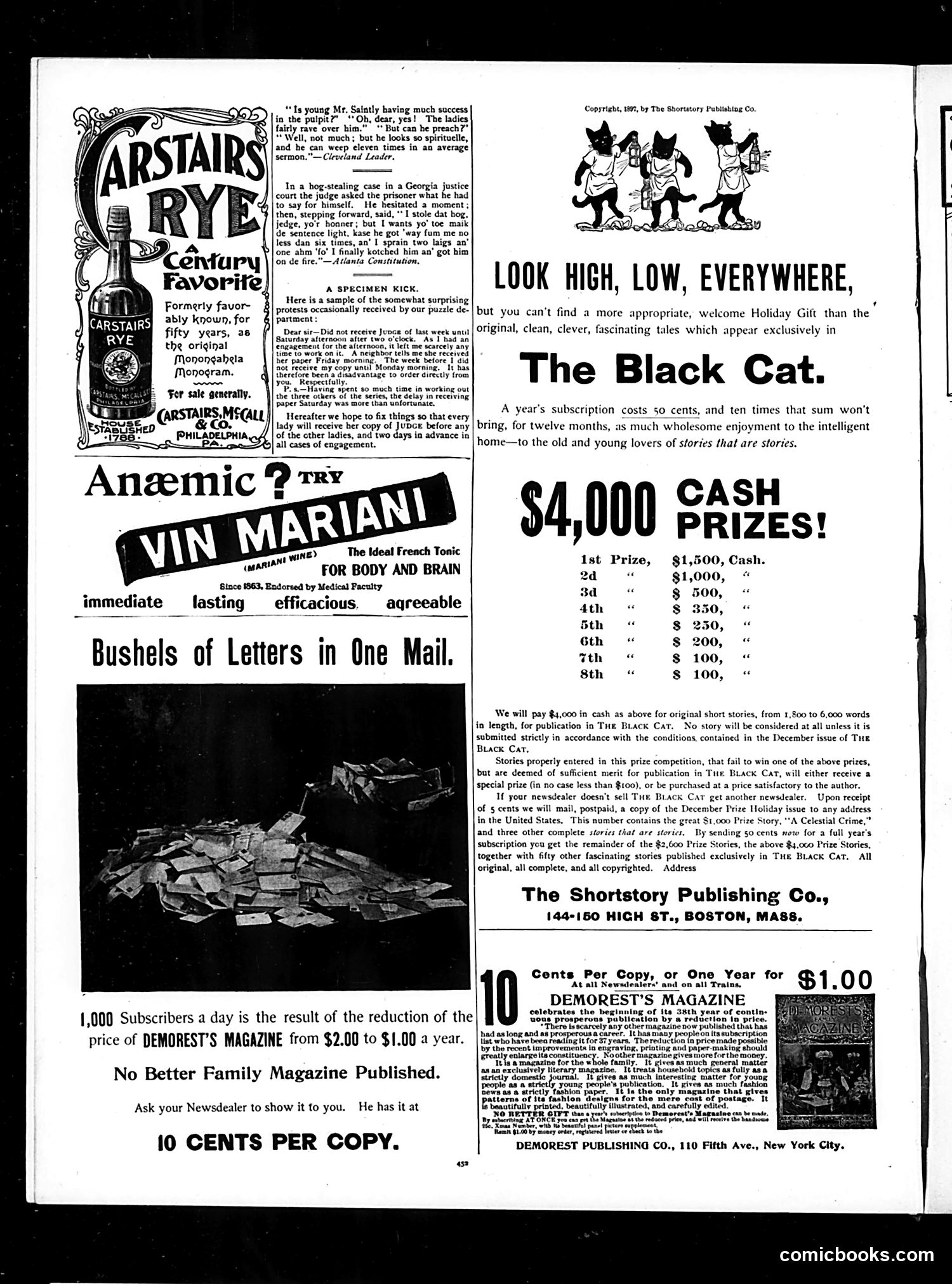
This page is primarily **advertising**, not political satire. It contains several short humorous anecdotes and product advertisements typical of late-19th-century magazines. The three brief jokes mock: 1. **Shallow religious appeal**: A young minister who "looks spirituelle" and cries eleven times per sermon, but cannot actually preach—satirizing superficial religiosity over substance. 2. **African American dialect humor**: A stereotyped depiction of a Georgia Black defendant admitting to hog theft, using exaggerated dialect. This reflects the racist comedic conventions of the 1890s. 3. **Reader complaints**: A woman upset about delayed magazine delivery affecting her puzzle-solving schedule—mocking both magazine logistics and women's puzzle obsession. The page also advertises **Arstairs Rye whiskey**, **Vin Mariani** tonic (a French wine with cocaine), **Demorest's Magazine** ($1/year), and **The Black Cat** magazine ($4,000 prize stories). These ads reveal period consumer culture and patent medicine marketing practices.
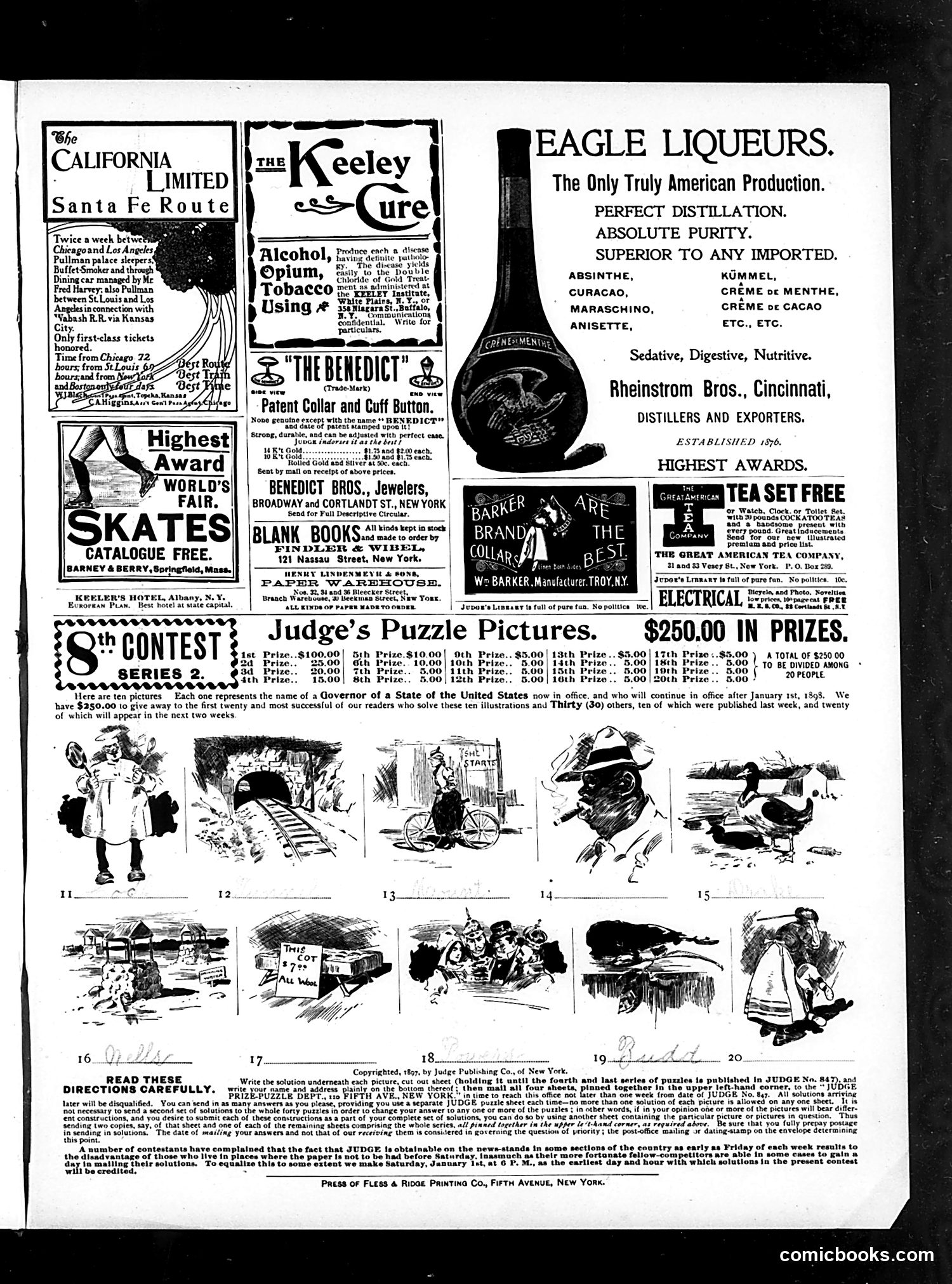
This page is primarily **advertising and a puzzle contest**, not political satire. The dominant feature is "Judge's Puzzle Pictures," a contest offering $250 in prizes to readers who identify ten caricatured U.S. state governors in office as of January 1, 1898. Contestants must solve these ten illustrations plus thirty others (some from previous weeks) and mail solutions to Judge's offices. The surrounding advertisements promote period products: the Santa Fe railroad, the Keeley Cure (an addiction treatment), Eagle Liqueurs (American spirits), Benedict patent collar buttons, blank books, and a tea set promotion. These ads reflect 1890s consumer goods and services. **No clear political satire is visible**—the page functions as a revenue generator through advertising and reader engagement via the puzzle contest. The governors' identities remain unclear from the small reproductions, and without labels identifying them, their specific political significance cannot be determined from the image alone.
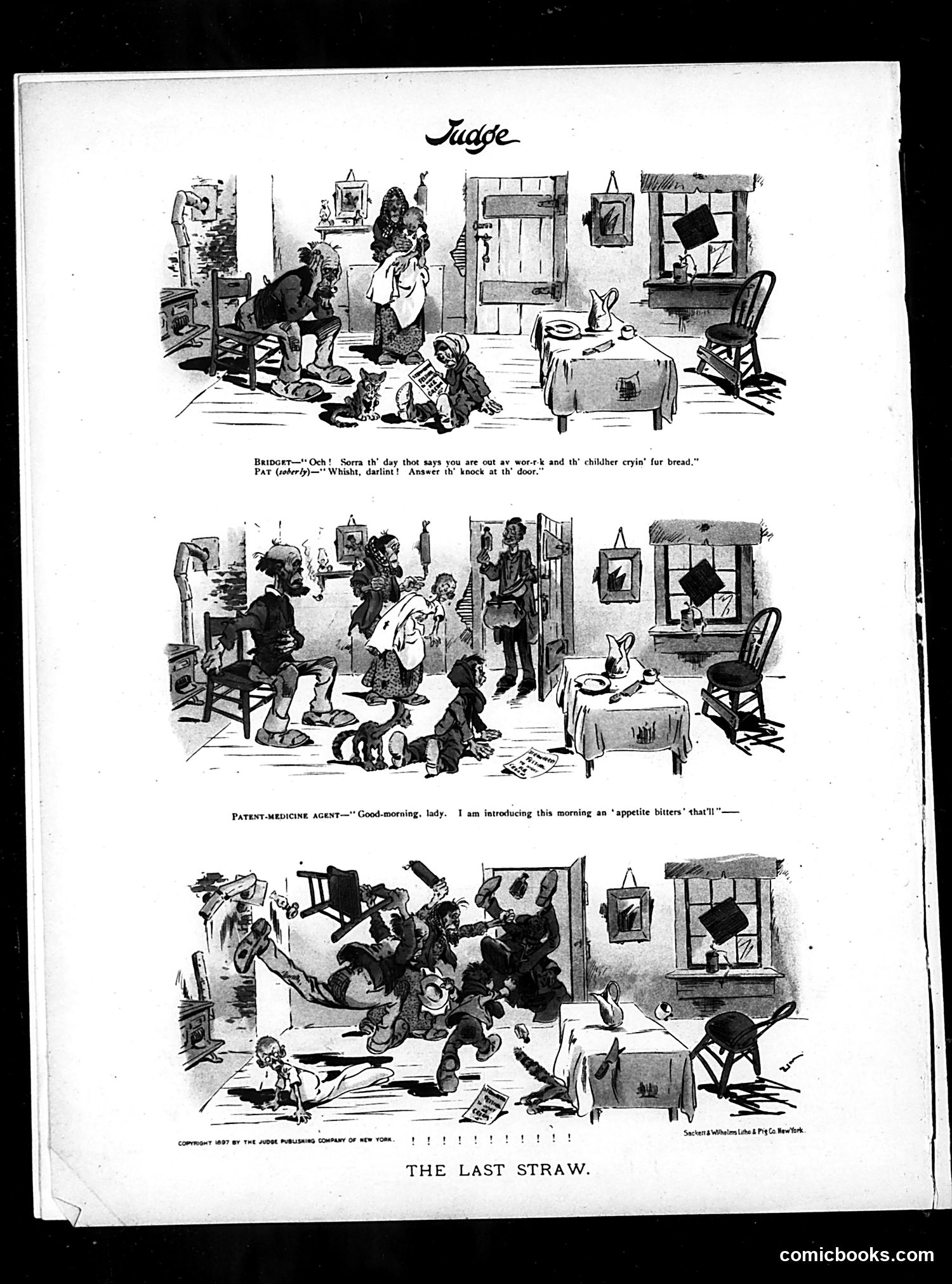
This three-panel comic satirizes patent-medicine salesmen preying on poor families. The narrative follows Irish immigrants (identifiable by dialect: "Och," "wor-r-k," "darlint") struggling with poverty and hunger. In panels one and two, a desperate mother and father discuss their dire circumstances—children crying for food, no work. A patent-medicine agent arrives at their door, cheerfully introducing a bogus "appetite bitters" tonic. Panel three shows the family's chaotic reaction—they literally attack and throw out the salesman, furniture flying. The satire targets two things: (1) the predatory practice of selling fake remedies to vulnerable populations, and (2) the absurdity of marketing appetite stimulants to starving people who need actual food, not false hope. The "last straw" is this final insult to their dignity—adding mockery to their genuine hardship.

I'm unable to provide a meaningful analysis of this page. The image is almost entirely black or severely underexposed, making it impossible to discern any cartoon illustrations, caricatures, text content, or satirical details that would be necessary to explain the historical context and meaning to a modern reader. To properly analyze this Judge magazine page, I would need a clearer, better-quality image where the artwork and text are actually visible. If you have access to a better scan or photograph of this page, please share that instead, and I'll be happy to provide the detailed historical and contextual explanation you're seeking.