
A complete issue · 19 pages · 1897
Judge — December 11, 1897
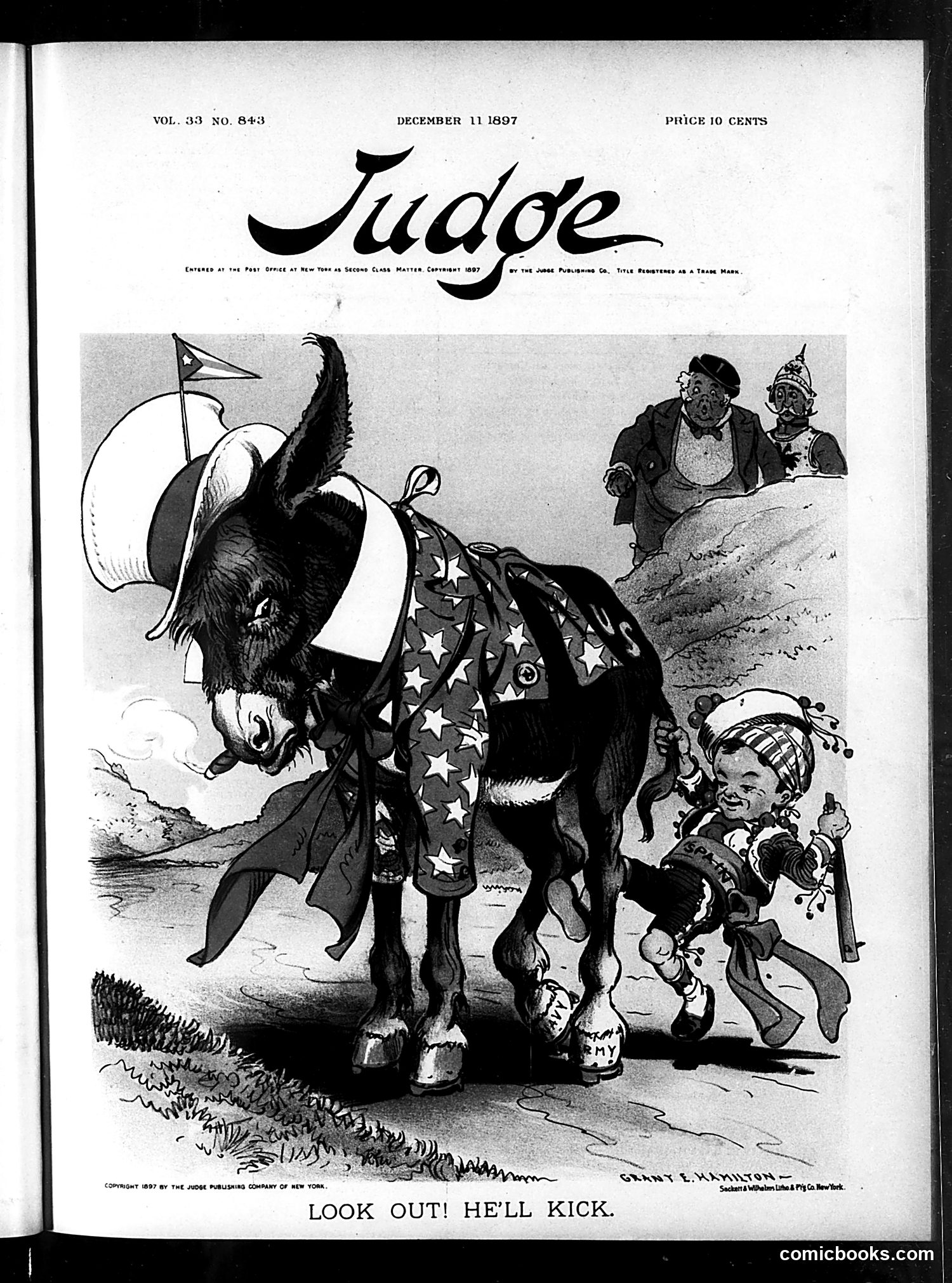
This political cartoon depicts a donkey (representing the Democratic Party) laden with a stars-and-stripes blanket, appearing aggressive or about to kick. Two figures in the background—appearing to be Republicans or conservative observers—watch warily from a hill. The caption "Look Out! He'll Kick" suggests the cartoon warns of Democratic Party danger or unpredictable action. Given the 1897 date, this likely references tensions following the 1896 presidential election, when William Jennings Bryan's populist Democratic campaign lost to Republican William McKinley. The donkey as Democratic symbol and the warning tone suggest Republican cartoonist commentary on Democratic Party volatility or threat during this politically turbulent period. The specific "kick" reference remains unclear without additional context.
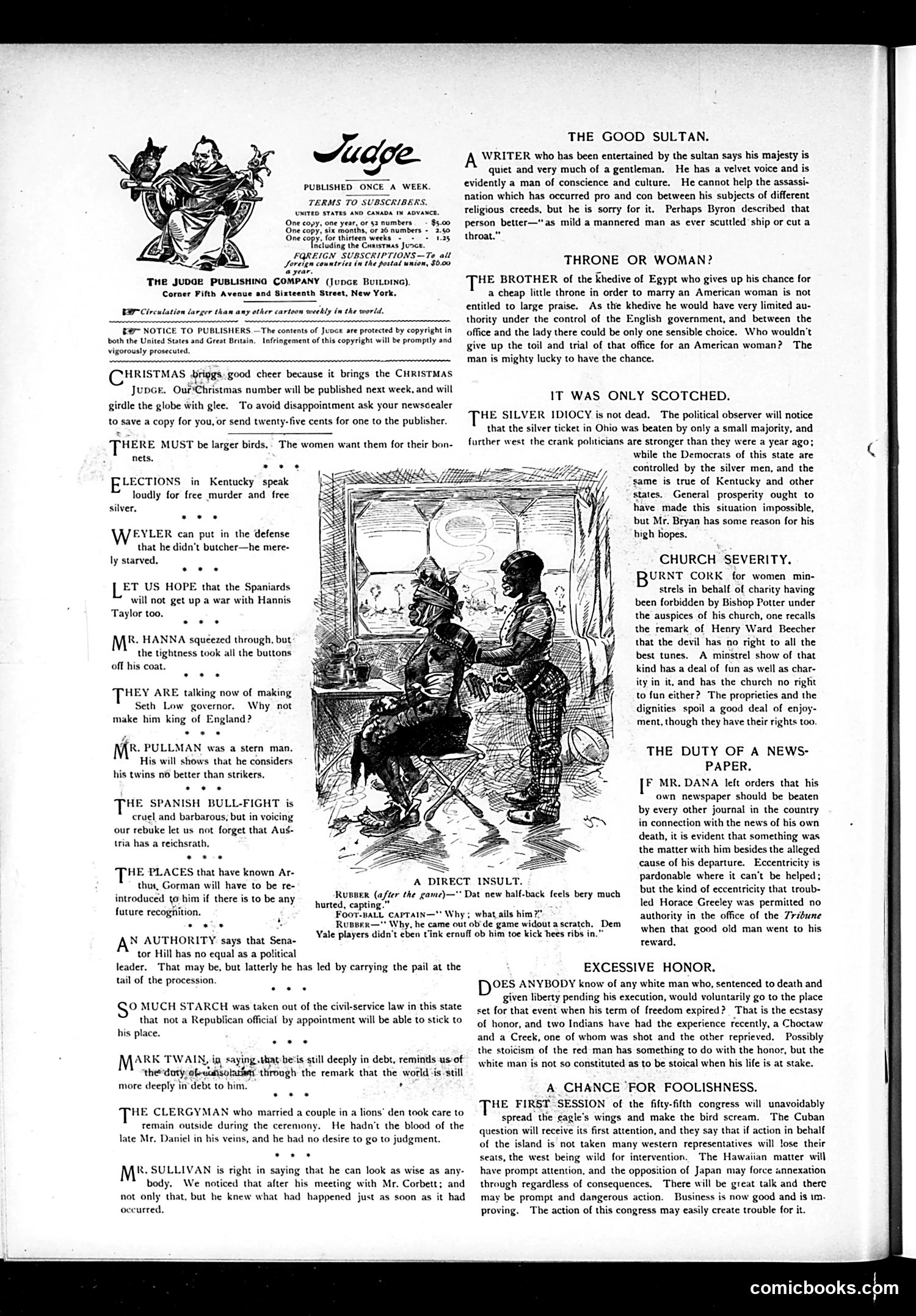
The cartoon depicts two figures in what appears to be a heated confrontation. Based on the caption "A DIRECT INSULT" and surrounding text referencing "that new half-back" and "Yale" football, this appears to be sports-related satire about college football rivalry. The accompanying text snippets mock various political and social figures—including references to "Bryan," "the Spanish bull-fight," and church authority—but the main cartoon's specific subjects remain unclear from the image alone. The satirical style typical of *Judge* magazine suggests commentary on contemporary social pretension or foolishness, though without clearer identification of the figures depicted, the precise target of this particular insult cannot be definitively stated.
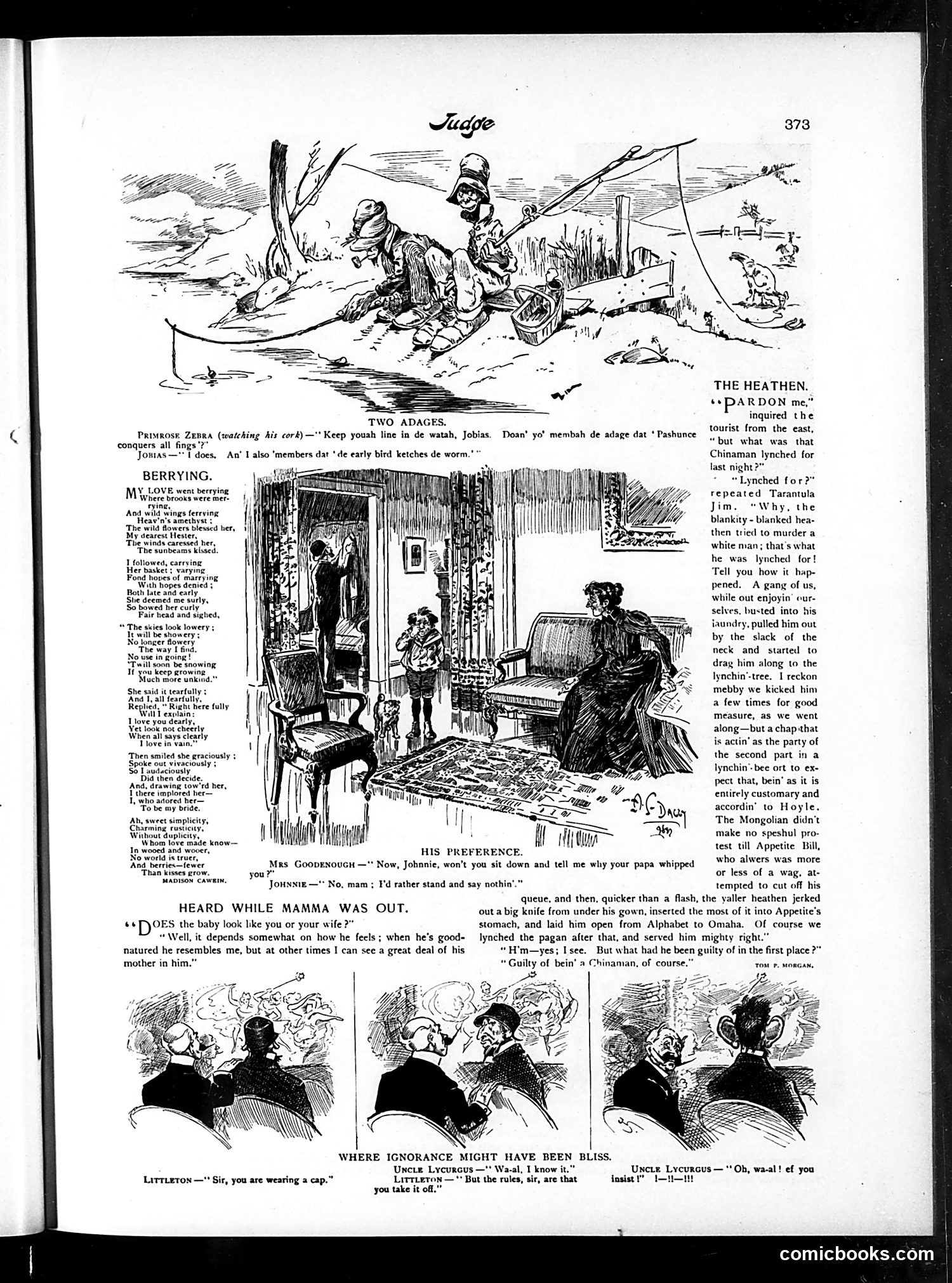
This page contains several satirical sketches typical of Judge's late 19th/early 20th-century humor: **"Two Adages"** (top): A fishing scene satirizing the phrase "early bird catches the worm," suggesting that preparation and timing matter in life's pursuits. **"Berrying"**: A poem about gathering berries, likely social commentary on leisure activities or class pastimes. **"His Preference"**: A domestic scene where a man prefers standing and saying nothing to sitting with his wife—satirizing marital indifference and male reluctance toward domestic interaction. **"Hear While Mamma Was Out"**: Sketches depicting a child's behavior without parental supervision, with dialogue about rules and authority. **"Where Ignorance Might Have Been Bliss"**: Shows Uncle Lycurgus correcting someone about wearing a cap, illustrating the tension between traditional etiquette and modern informality. The page uses humor to critique social conventions and domestic relationships.
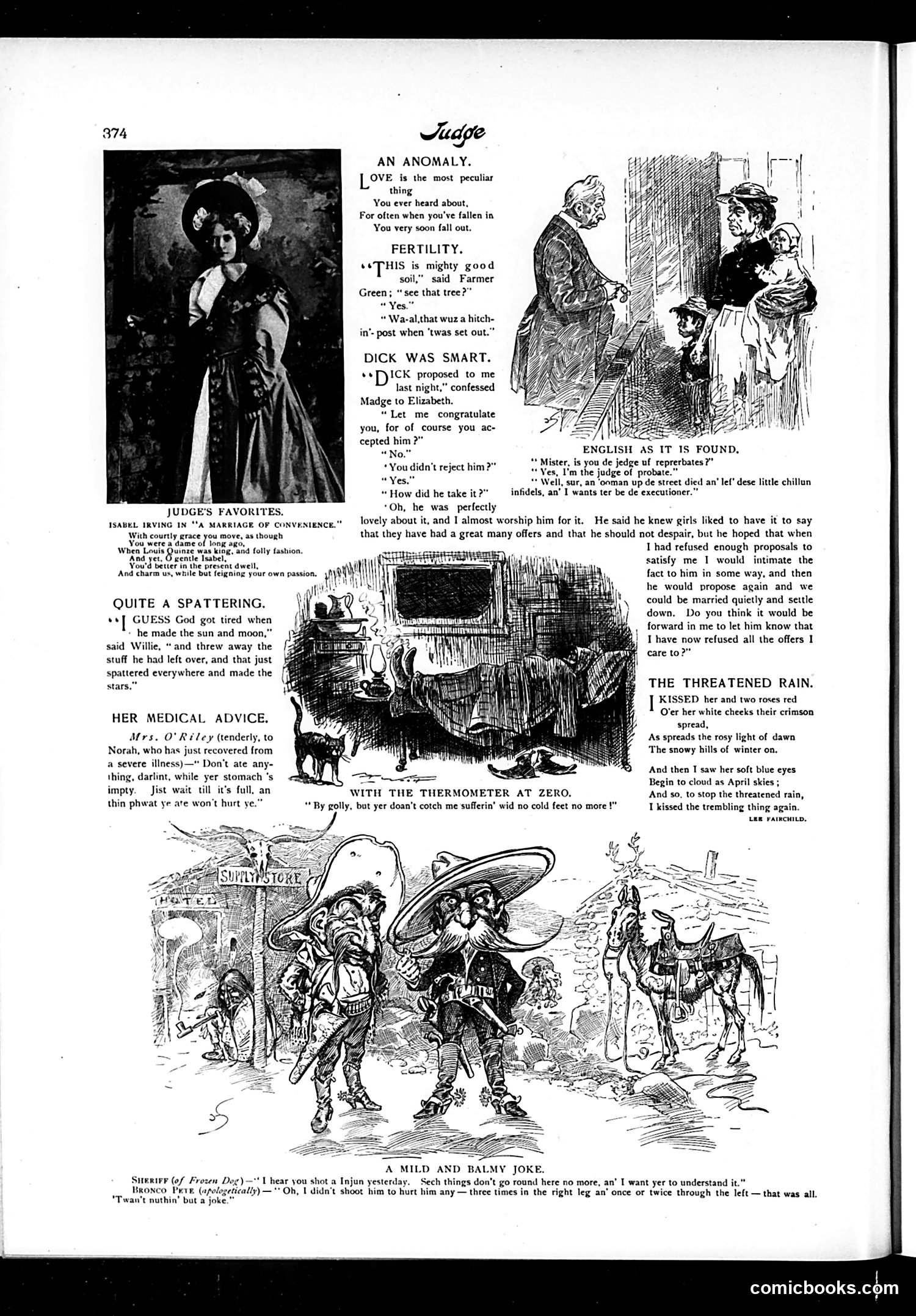
This page contains several short humor pieces typical of Judge's satirical style: **Main cartoons:** - "An Anomaly" and "Dick Was Smart" mock romantic relationships and women's rejection of proposals - "Fertility" jokes about soil quality using a worn hitching post - "English As It Is Found" satirizes dialect humor, featuring a Black woman mangling legal terminology ("jedge uf reprerbates" for "judge of probates") - "Her Medical Advice" presents Irish immigrant malapropisms (Mrs. O'Riley's illogical medical guidance) - "With the Thermometer at Zero" depicts frontier characters enduring extreme cold - "A Mild and Balmy Joke" shows a sheriff confronting a cowboy who shot a Native American, treating it casually as a "joke" **Satirical targets:** The page relies heavily on ethnic/racial stereotypes—Irish, Black, and Native American characters are presented through exaggerated dialect and ignorance for comedy. These pieces reflect late-19th/early-20th-century American attitudes normalizing prejudice as entertainment. The frontier humor trivializes violence against Indigenous peoples.
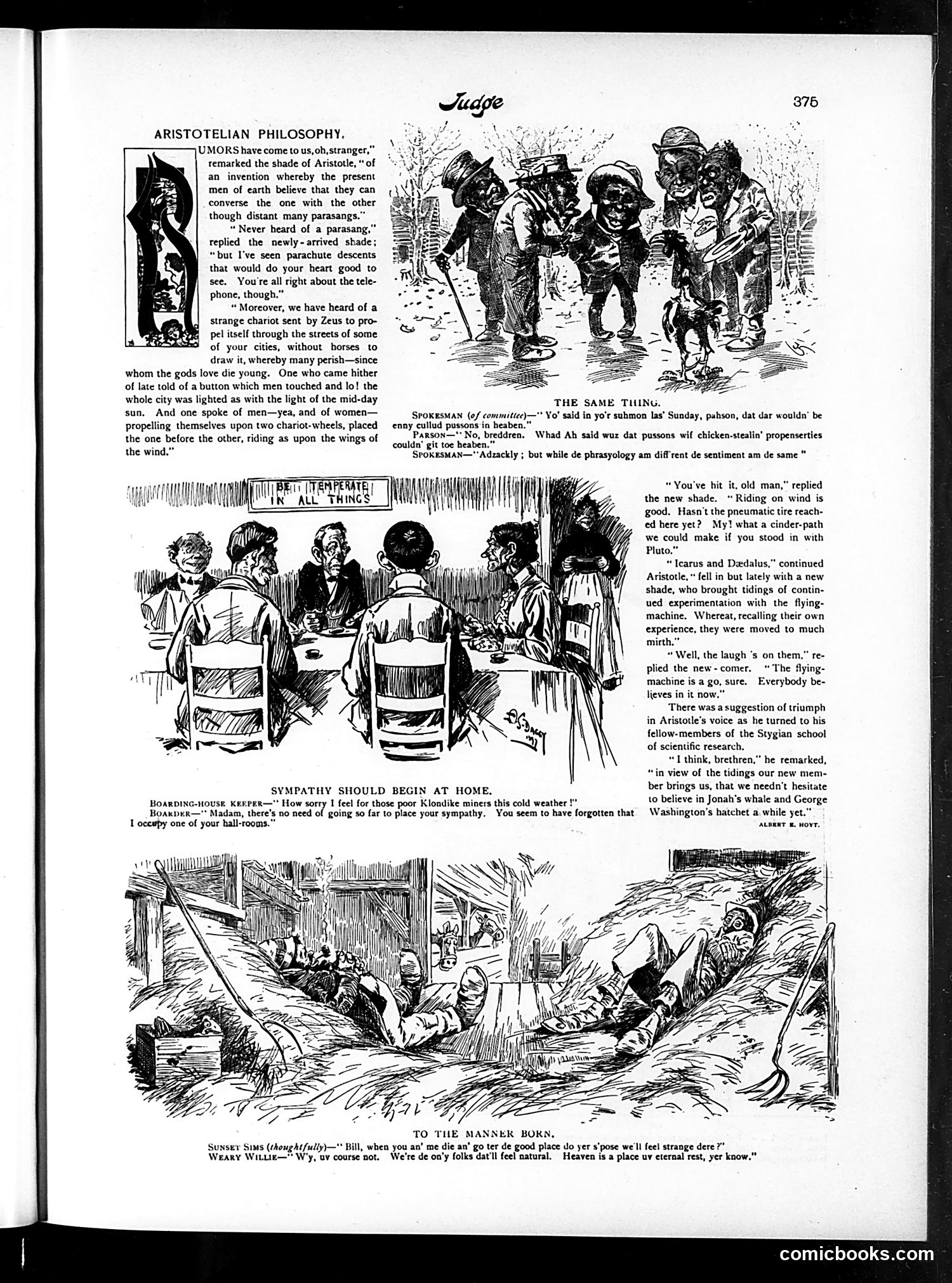
This page contains three separate satirical pieces: **"Aristotelian Philosophy"**: Dead philosophers discuss modern inventions (telephones, automobiles, electric lights, flying machines) as if witnessing miracles. The satire mocks both ancient philosophy's limitations and contemporary society's uncritical faith in technology. The flying machine reference likely alludes to early aviation experiments circa 1900s. **"The Same Thing"**: A racist dialogue between a committee spokesman and a Black preacher about who enters heaven. The joke plays on the preacher's claim that "chicken-stealing" people can't enter heaven—the spokesman finds this sentiment identical to excluding Black people, just using different language. This reflects the era's crude racial stereotypes. **"Sympathy Should Begin at Home"** and **"To the Manner Born"**: These mock misplaced charity and class assumptions, suggesting sympathy for distant Klondike miners while ignoring poor boarding-house tenants, and implying that poor people feel "naturally" at home in a heavenly "place of eternal rest." The cartoons employ period dialect and caricature typical of early-1900s satirical magazines.
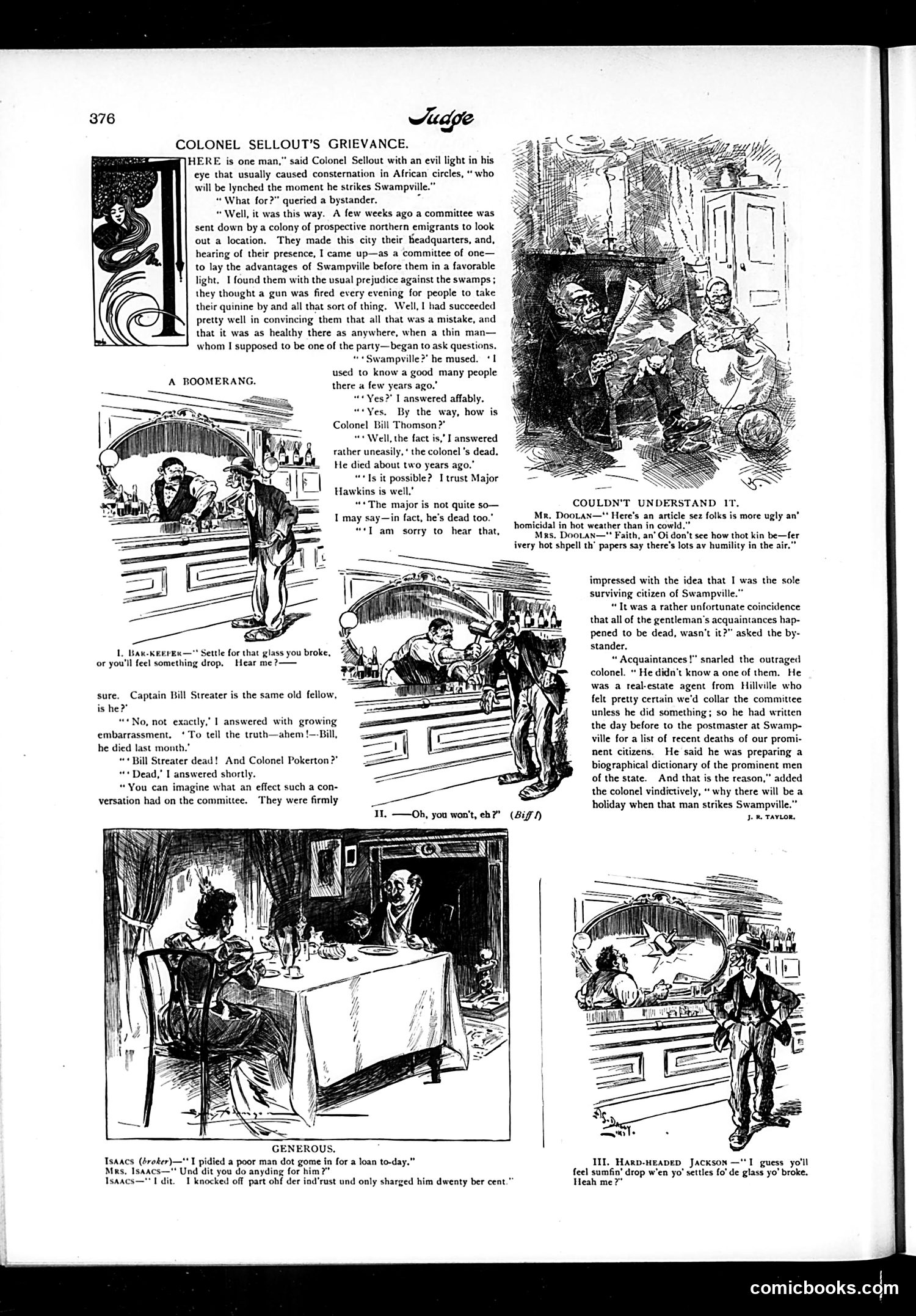
This satirical piece mocks Southern boosterism and real-estate fraud during the late 19th century. Colonel Sellout attempts to lure Northern emigrants to the unhealthy swampland town of "Swampville" by downplaying its dangers. A rival real-estate agent from "Hillville" sabotages him by requesting a death list from the local postmaster—then strategically asks about prominent citizens by name. Sellout is forced to admit they're all dead, destroying his pitch to the committee. The satire targets aggressive regional competition for settlers, the dishonesty of land schemes promoting unsuitable territory, and the dark humor of using mortality records as a competitive weapon. "Swampville" represents the exaggerated, disease-ridden Southern towns that Northern investors rightfully distrusted, while the scheme exposes how aggressively promoters competed to attract gullible settlers to dangerous locations.
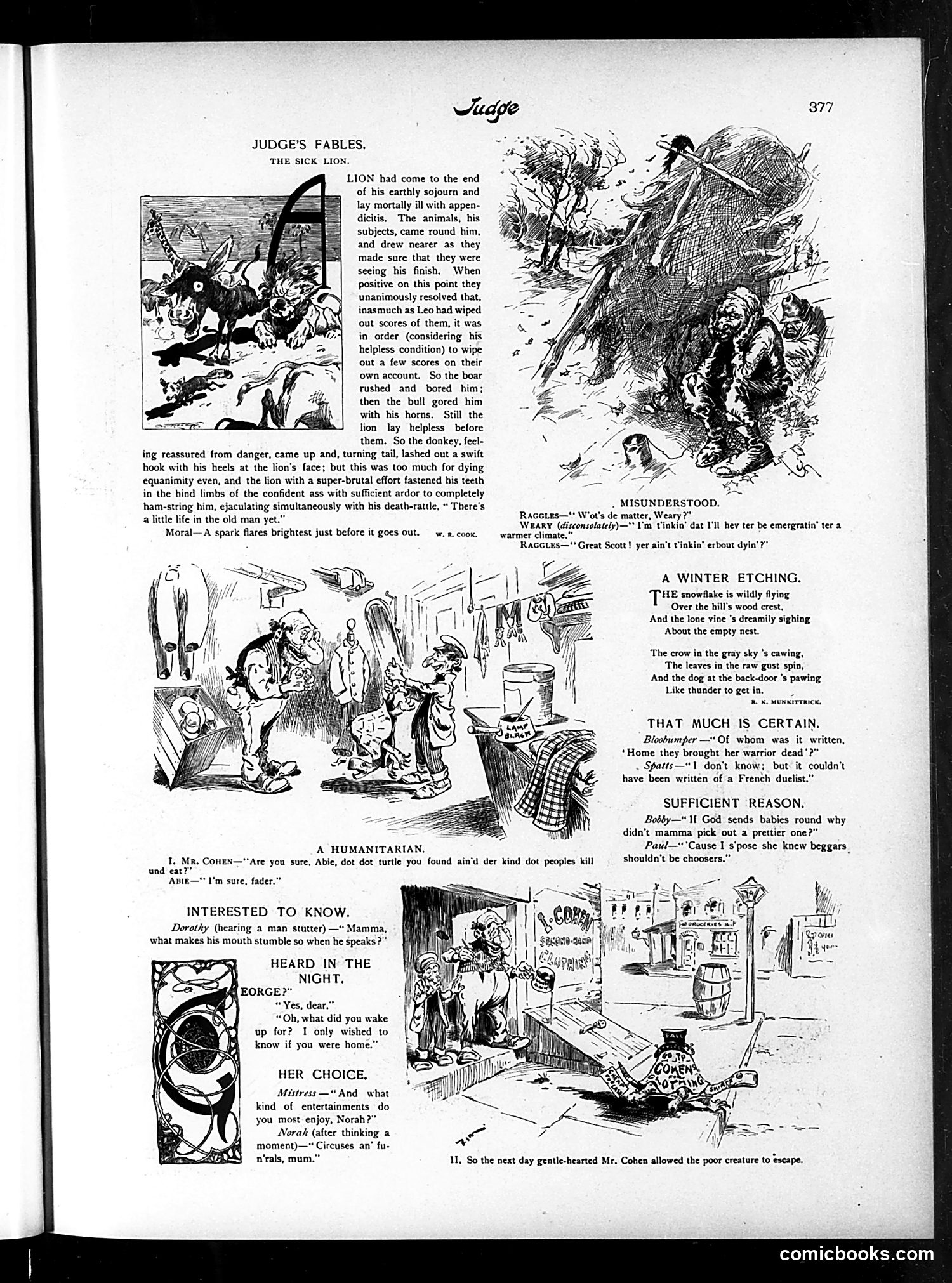
This page contains several satirical pieces typical of Judge magazine's social commentary: **"The Sick Lion" fable** (top) uses animal allegory to mock political opportunism. As a dying lion (representing a weakened authority figure) is attacked by formerly subordinate animals, even the cowardly donkey gains courage to strike—until the lion's final violent retaliation. The moral warns that power, though diminished, retains dangerous capability. This likely critiques how subordinates exploit weakness in leadership. **The remaining pieces** are brief comedic sketches exploiting ethnic stereotypes (Yiddish-speaking "Abie" and "Mr. Cohen"), class humor, and sentimental Victorian-era domestic situations. They rely on period conventions: Irish servants ("Norah"), working-class speech patterns, and gentle domestic comedy. The page reflects Judge's blend of political fable and lighthearted social satire, targeting both institutional power dynamics and class/ethnic caricature—humor common to early 20th-century American magazines.
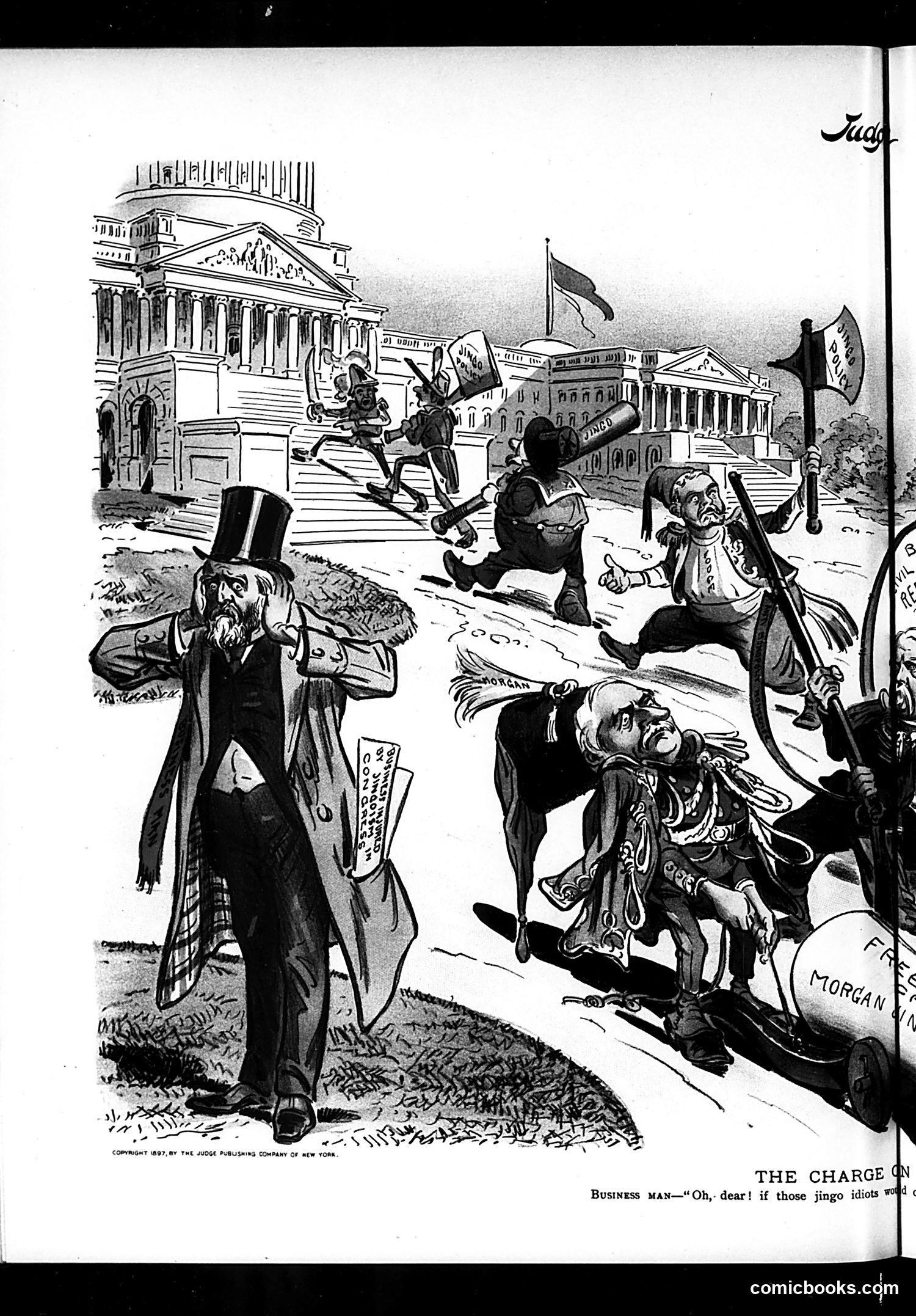
This 1897 Judge magazine cartoon satirizes American imperialism and militarism. A well-dressed businessman (representing American commerce/industry) stands appalled as aggressive military and political figures charge forward toward the Capitol building, carrying weapons and flags labeled with imperialist ambitions. The cartoon critiques "jingo idiots"—warmongering politicians pushing expansionist foreign policy—whose reckless aggression threatens business interests and democratic institutions. The businessman's horror suggests the cartoonist views jingoism as chaotic and counterproductive, even to capitalists who might benefit from expansion. This reflects 1890s debates over American imperialism, particularly regarding the Spanish-American War (1898) and territorial acquisitions. The cartoon presents imperialism not as patriotic progress but as dangerous mob rule endangering America's political and economic stability.
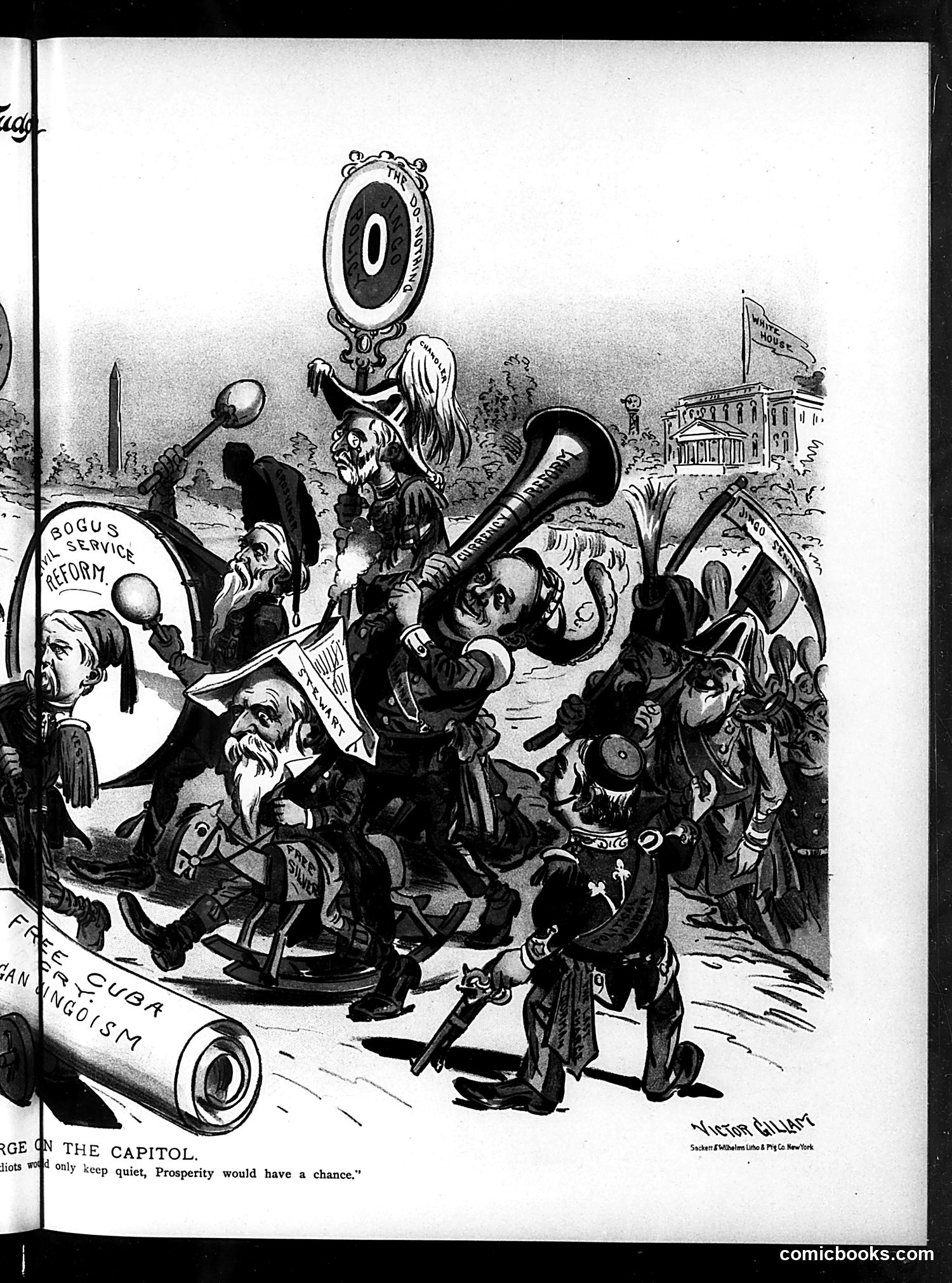
This cartoon by Victor Gillam depicts chaos on the Capitol steps, satirizing political discord. The central figure appears to be a donkey (traditional Democratic symbol) creating mayhem while various political figures scramble about with cannons and weapons labeled "Bogus Service Reform," "Honest Solid Ism," and "Sugar Paternalism." The scene suggests competing political factions fighting over reform agendas—likely referencing late 19th-century debates over civil service reform and tariff/economic policies. The caption's partial text "...must only keep quiet. Prosperity would have a chance" implies satire of politicians whose squabbling prevents effective governance. The Washington Monument and Capitol building establish the setting, emphasizing how legislative gridlock threatens national progress. Without a precise date, the specific reforms referenced remain unclear, though the style suggests the 1880s-1890s reform era.
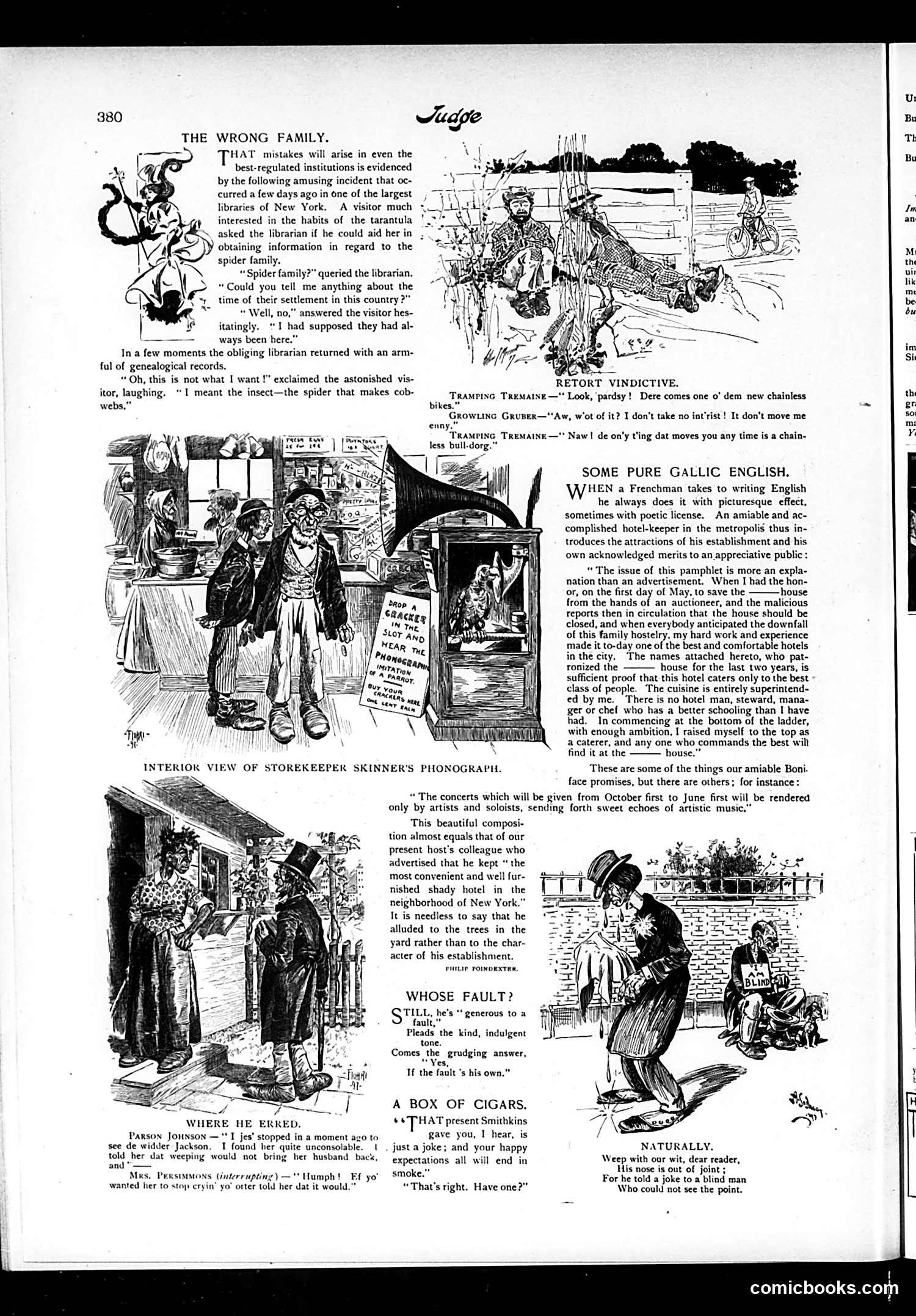
This page contains several unrelated humorous short pieces typical of Judge's format: **"The Wrong Family"**: A librarian mishears a visitor's request for information about tarantulas (spiders) as a request about the "Spider family"—treating it as a genealogical question. The joke plays on the double meaning of "family." **"Retort Vindictive"** and other street dialogue: Brief exchanges between working-class characters (identified by dialect) making jokes about chainless bicycles and other contemporary topics. **"Some Pure Gallic English"**: The main satirical piece mocking a French hotel-keeper's awkward, malapropism-filled English promotional pamphlet. The satire ridicules his pretentious claims about his establishment and his fractured grammar ("The names attached hereto...is sufficient proof"). **Minor pieces**: "Where He Erred," "Whose Fault?" and "A Box of Cigars" offer quick joke setups with punchlines about marital advice, generosity, and cigar gifting. The page reflects Judge's focus on wordplay, class-based humor, and immigrant/accent comedy typical of early 1900s American satire.
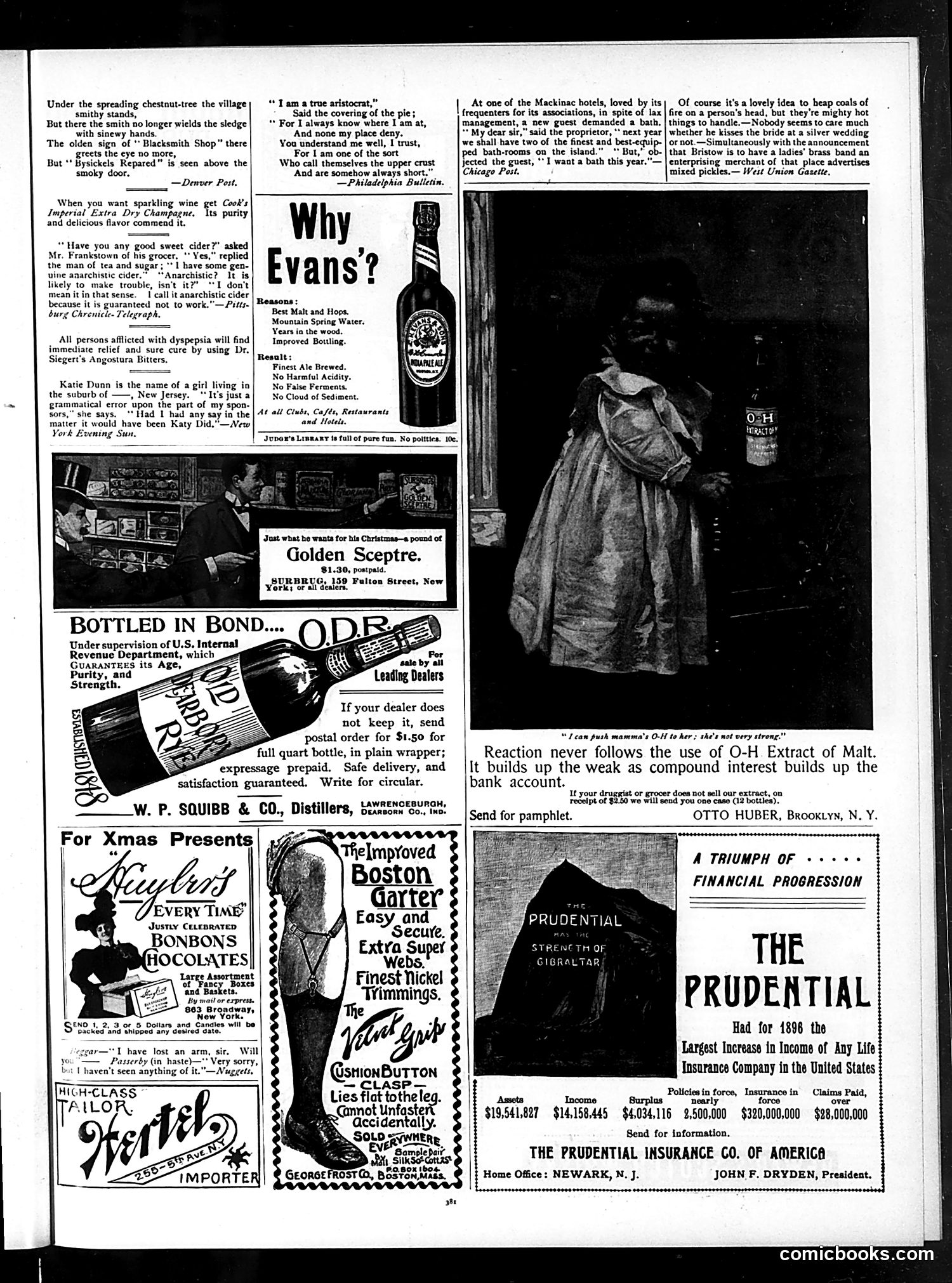
This page from Judge is primarily **advertisements and humorous short items**, not political cartoons. The content includes: **Satirical Humor Pieces:** - A poem mocking the decline of blacksmith shops, replaced by bicycle repair services (reflecting late 1800s modernization) - A joke about "anarchistic cider" that "doesn't work"—likely a topical reference to anarchist violence concerns of the era - A pun about a girl named "Katie Dunn" (grammatical error for "Katy Did") - A personified pie crust claiming aristocratic status but always being "short" (broke)—social satire on the upper class **Advertisements:** Mostly beverage and consumer goods ads (champagne, ale, bitters, garters, chocolates) typical of the period, plus a **Prudential Insurance Company advertisement** highlighting their 1896 financial success. **No clear political cartoons or caricatured figures appear.** The humor relies on wordplay, puns, and gentle social observation rather than partisan political satire or identifiable public figures.
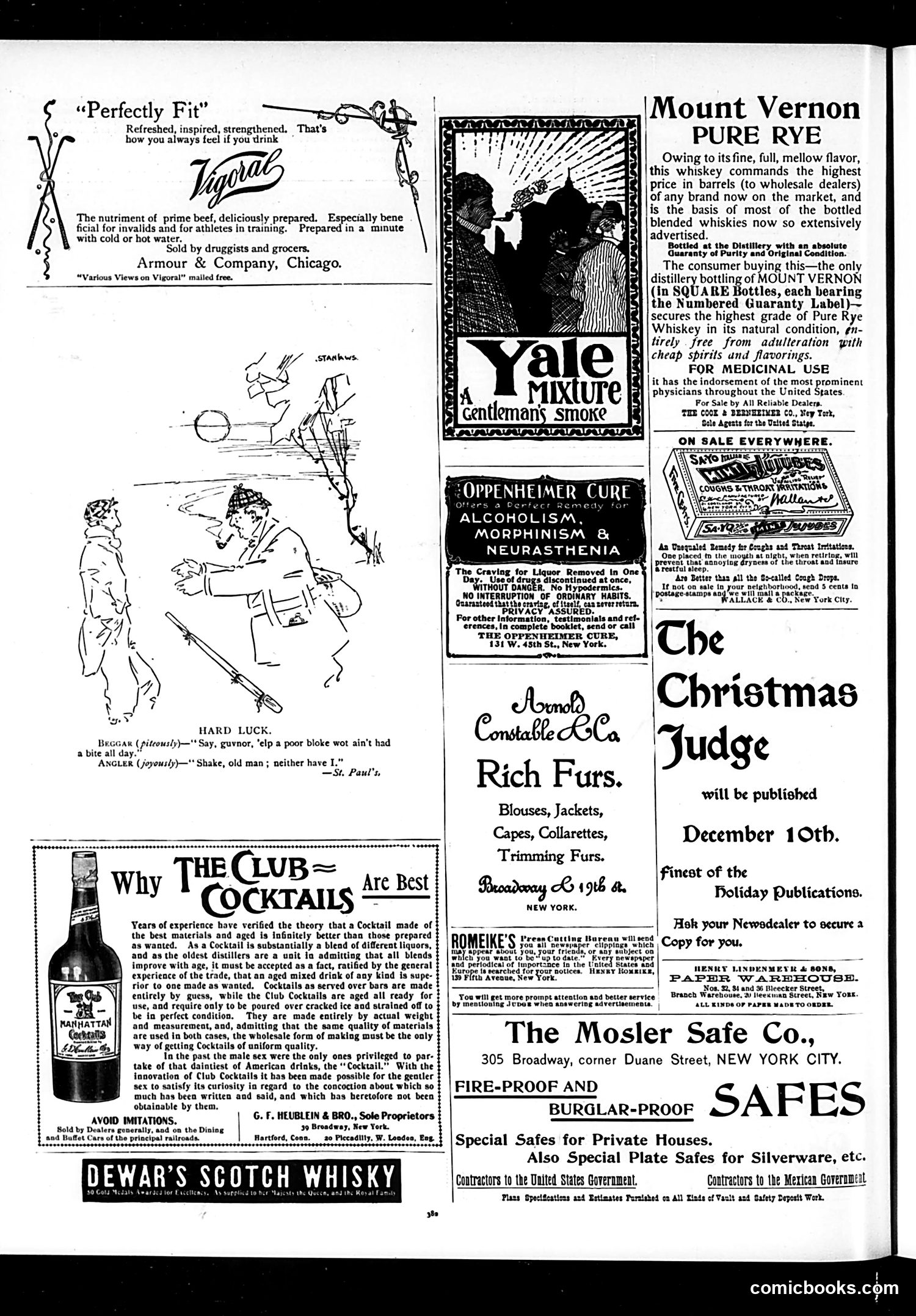
This page is primarily **advertising content** rather than editorial cartoon or satire. The ads promote various products typical of early 20th-century America: - **Vigorat** (beef extract), **Yale Mixture** (tobacco), and **Mount Vernon Pure Rye** whiskey - The **Oppenheimer Cure** for alcoholism and morphinism—ironically positioned alongside liquor ads - **The Club Cocktails**, **Dewar's Scotch Whisky**, and other spirits The only satirical element is a small "Hard Luck" cartoon showing fishing mishaps, with minimal political or social commentary. The page reflects the era's **unregulated advertising landscape**, where dubious medical "cures" for addiction appeared alongside the very substances they claimed to treat—a practice that would become illegal after pure food and drug regulations.
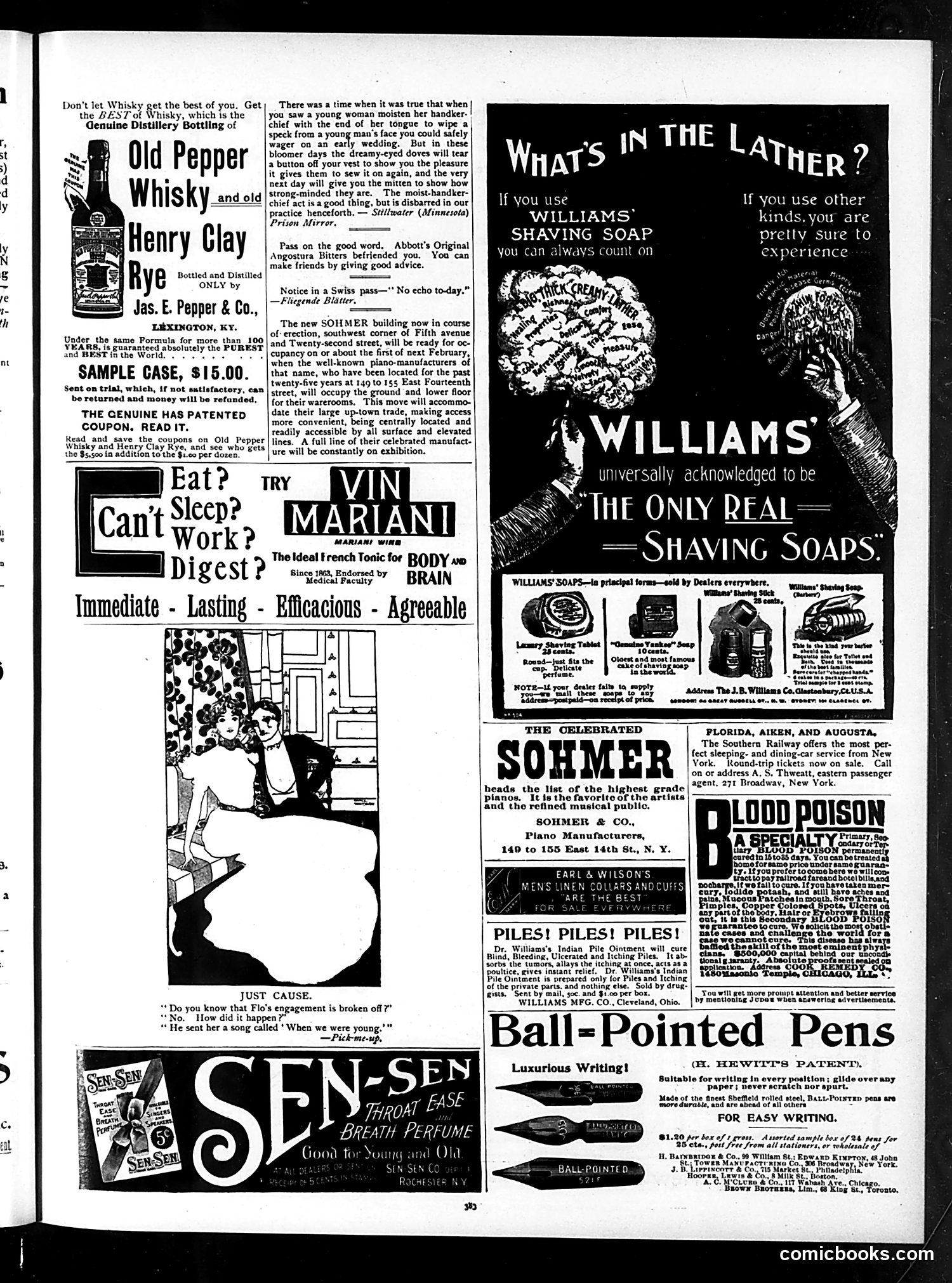
This is primarily an **advertising page** from Judge magazine, not a political cartoon. The page contains various product advertisements from the late 19th/early 20th century, including whiskey, digestive tonics, pianos, and medical remedies. The only editorial content is a brief anecdote titled "JUST CAUSE" about changing courtship customs—specifically, that women no longer use the intimate gesture of moistening a handkerchief to wipe a man's face, suggesting instead they've become "strong-minded" in the "bloomer days" (referring to women's bloomers/reform clothing). This reflects contemporary anxiety about evolving gender roles and female independence. The remainder consists of product pitches typical of the era: patent medicines (Mariani wine tonic, Indian Pile Ointment), luxury goods (Sohmer pianos), and toiletries. These ads reflect period advertising conventions and consumer culture rather than satire or political commentary.
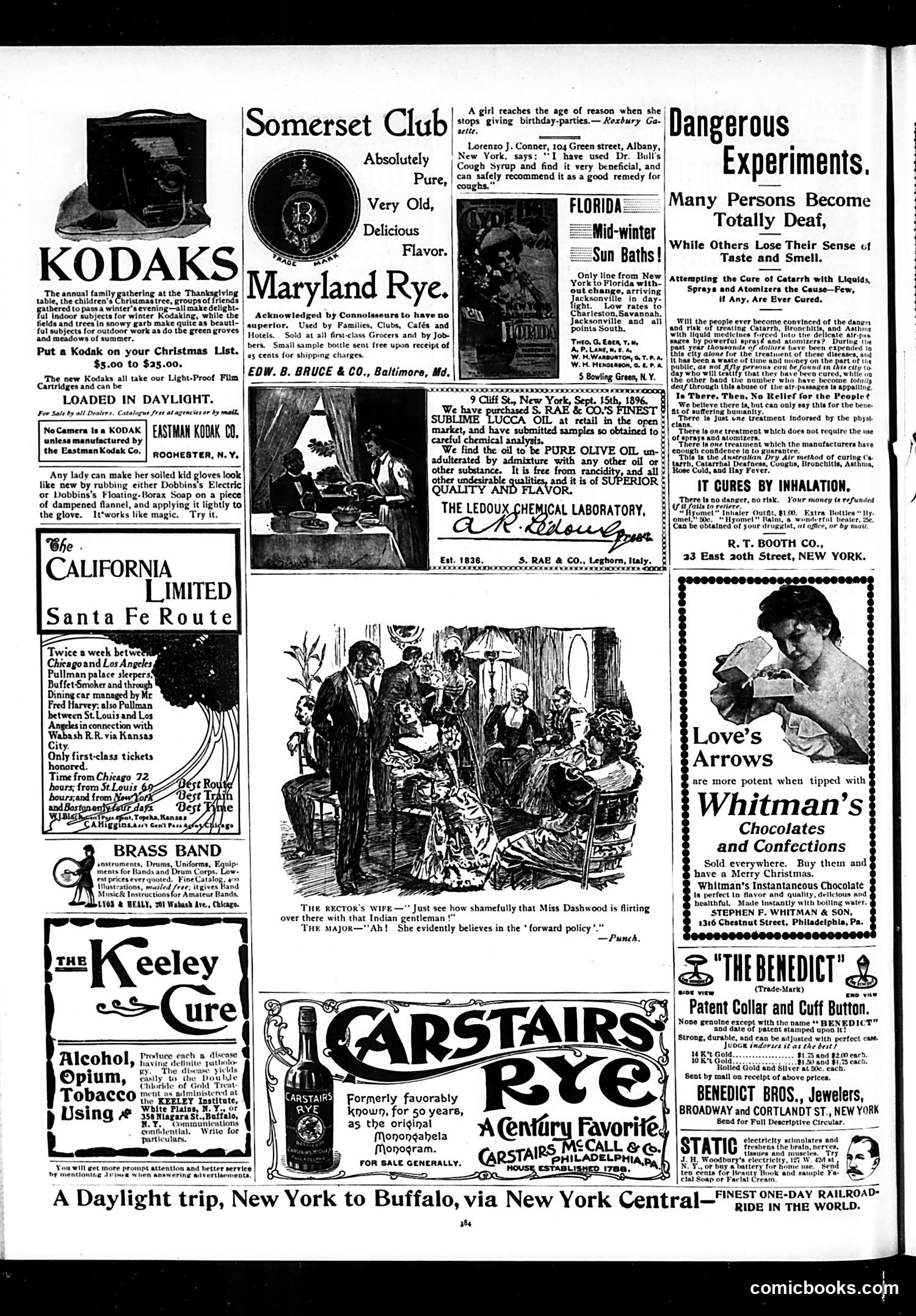
This page is primarily **advertising**, with one embedded political/social cartoon and related satirical text. The main cartoon depicts a church rector's wife firing a maid, with the caption: "Just see how shamefully that Miss Dashwood is flirting over there with that Indian gentleman!" The rector responds: "Ah! She evidently believes in the 'forward policy.'" **The satire:** This mocks debates over British imperial "forward policy"—aggressive colonial expansion. The joke equates the maid's flirtation with an Indian man to Britain's assertive foreign policy toward India, treating imperialism as equivalent to social scandal. It's a **class and race satire**—the maid inappropriately socializing across racial/colonial boundaries mirrors imperial overreach. The rest of the page features period advertisements for Kodak cameras, Somerset Club whiskey, catarrh treatments (typical "quack medicine"), railway routes, and patent medicines—all standard commercial content of the era.
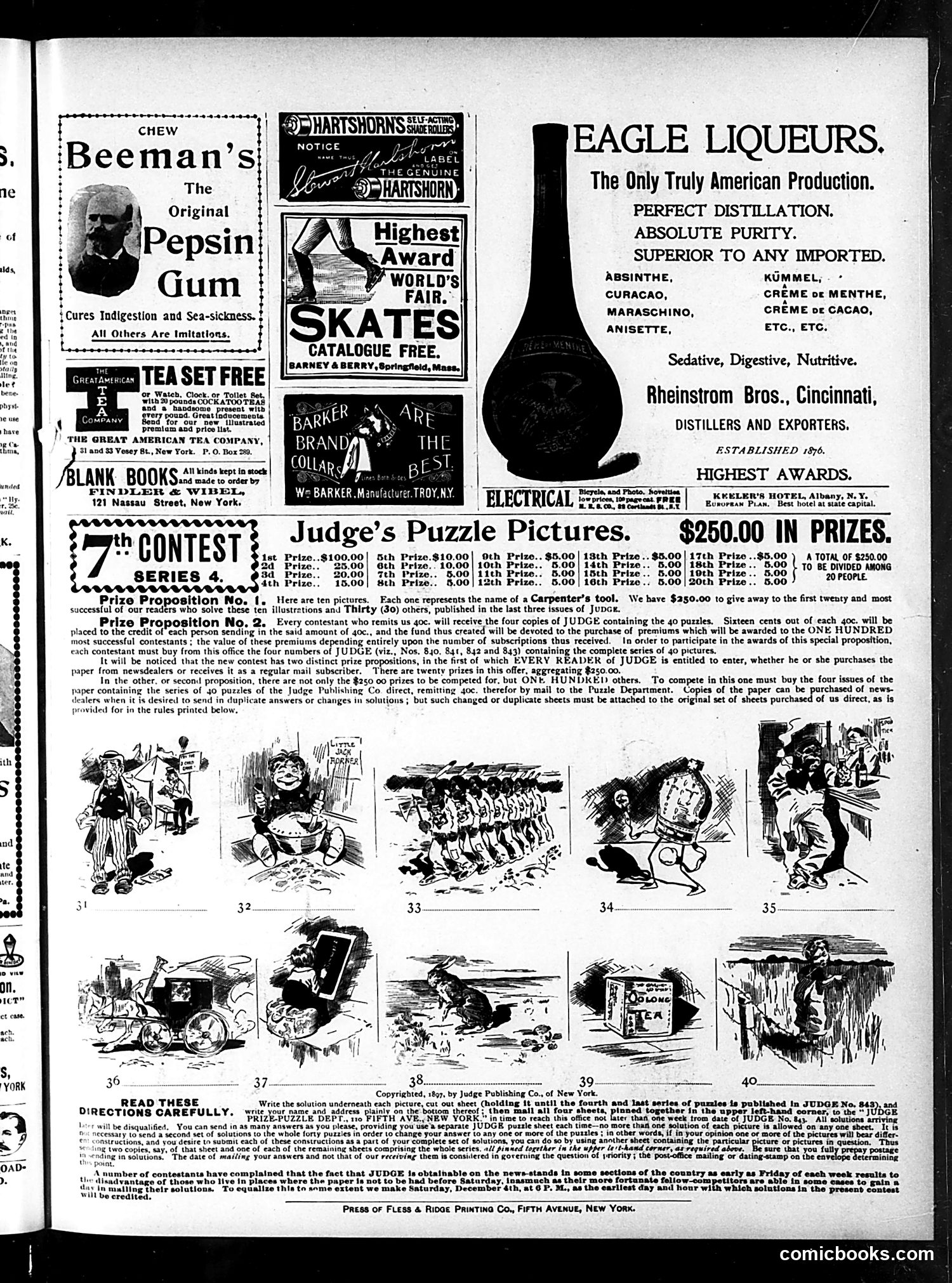
This page is primarily **advertising and a puzzle contest announcement**, not political satire. The dominant content is "Judge's Puzzle Pictures"—a contest offering $250 in prizes for readers who identify carpenter's tools represented in ten illustrations (numbered 31-40, shown at bottom). The **advertisements** scattered throughout promote various products: Beeman's Pensin Gum (claimed to cure indigestion), Eagle Liqueurs (proclaimed "The Only Truly American Production"), Hartshorns (smelling salts), skates, electrical equipment, and blank books. These ads reflect late-19th-century consumer goods and patent medicines typical of the era. The contest itself had two prize propositions: one open to all Judge readers, another requiring purchase of four specific issues. This was a common circulation-building strategy for magazines of this period. The page contains minimal editorial content or satire—it's essentially a contest promotion with supporting advertisements.
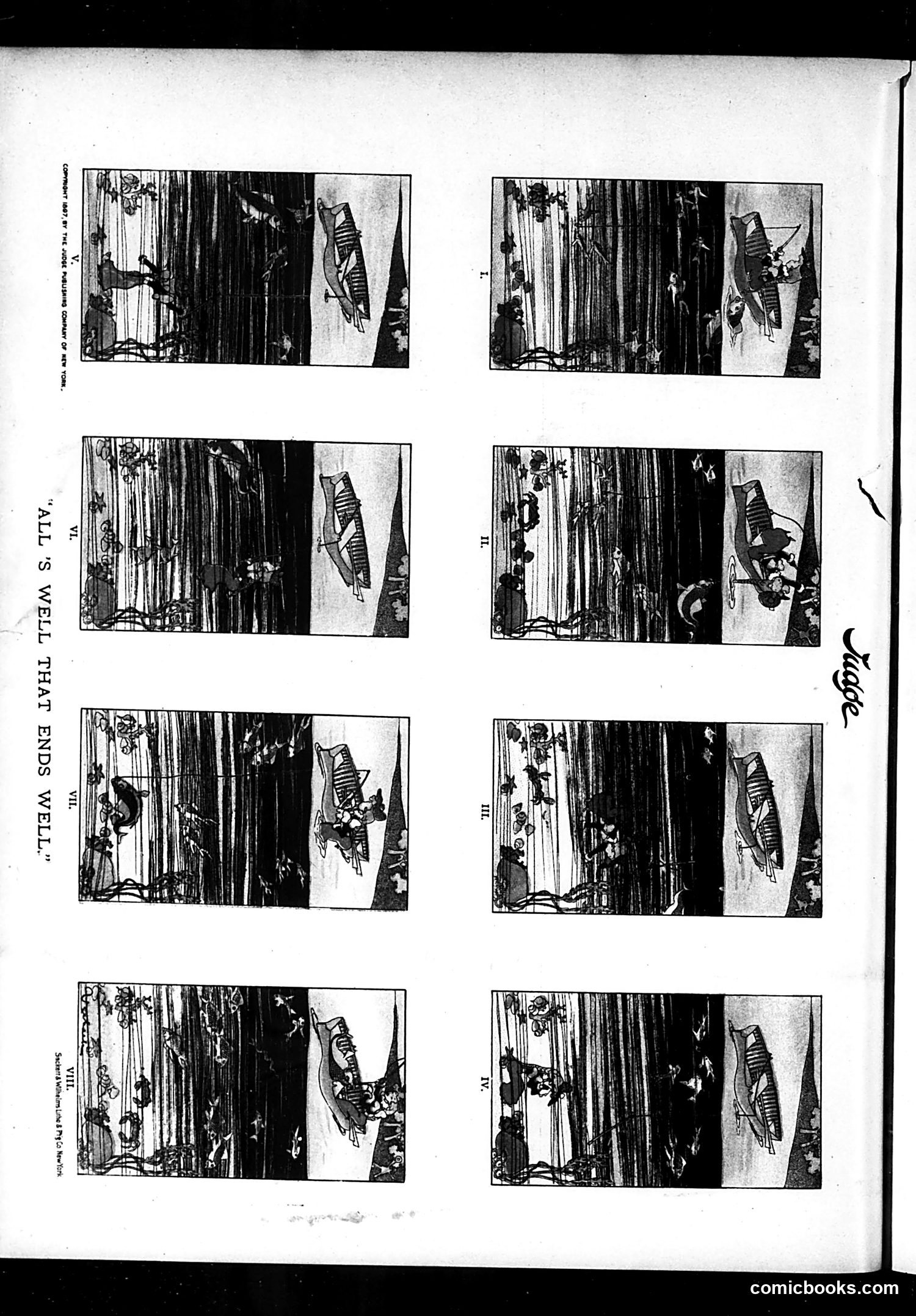
This page from *Judge* magazine contains a series of six sequential cartoon panels arranged in a 2x3 grid. The panels appear to depict a narrative sequence involving what looks like a ship or vessel, with figures and action occurring across the frames. The images are rotated 90 degrees, making them difficult to read clearly in this presentation. The OCR text is largely illegible—appearing to be mostly scanning artifacts rather than actual readable text. Without being able to clearly identify the specific figures, historical event, or political context being referenced, I cannot reliably explain what satire or social commentary this cartoon intends. The sequential panel format suggests a story-driven joke or commentary typical of *Judge's* satirical approach, but the image quality and rotation prevent accurate identification of the subject matter and its historical significance.
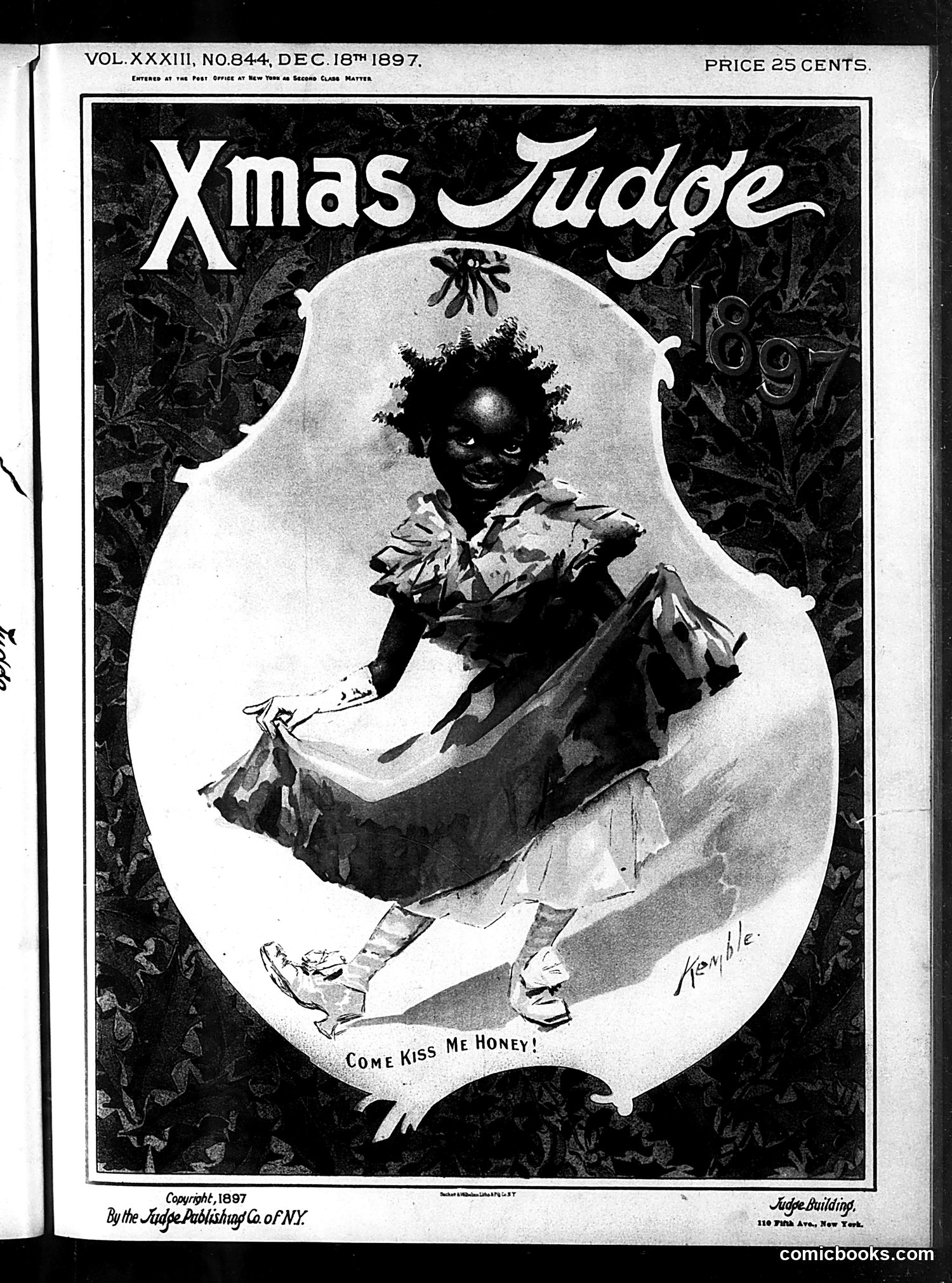
This is a Christmas-themed cover of *Judge* magazine featuring a caricatured Black infant emerging from a large eggshell, captioned "Come Kiss Me Honey!" The imagery appears to be a racist caricature common to late-19th-century American popular culture, depicting Black people through exaggerated and dehumanizing visual tropes. The "egg birth" conceit was a recurring satirical motif in period humor, though its specific political or social target here—whether commentary on immigration, labor, or something else—is unclear without additional context. The artwork is signed by an artist (signature appears to read "Kemple"). This represents the offensive racial imagery that *Judge* regularly published during this era, reflecting deeply prejudiced attitudes normalized in American media of the 1890s.
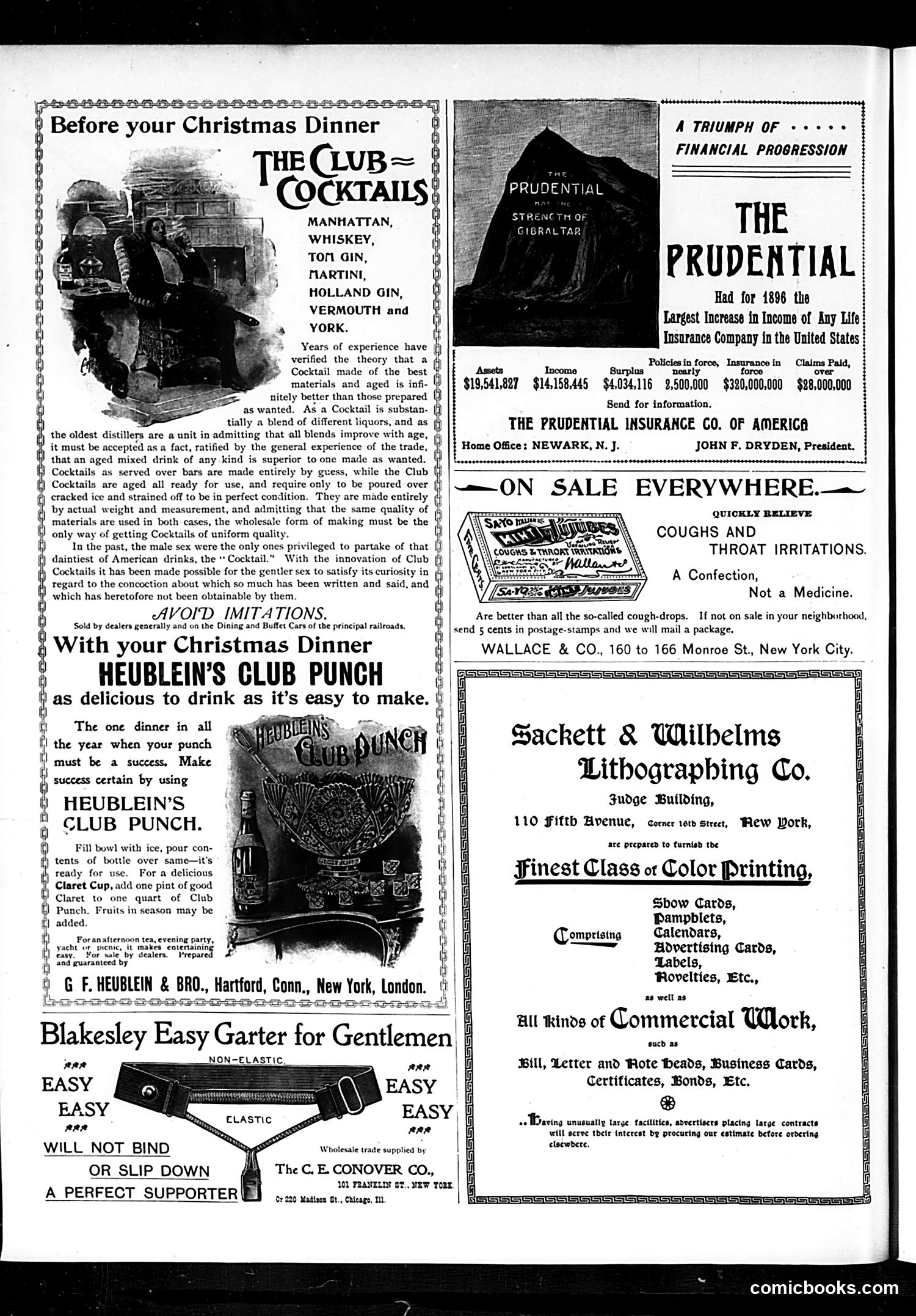
This page is primarily **advertisements**, not political satire or editorial content. It consists of product promotions typical of a late-19th-century magazine aimed at affluent readers. The ads promote: - **Cocktails and alcoholic beverages** (Club Cocktails, Heublein's Club Punch)—positioned as refined, pre-made alternatives to bartender-made drinks - **The Prudential Insurance Company**—highlighting its 1896 financial growth - **Men's undergarments** (Blakesley Easy Garter)—marketed as comfortable supporters - **Cough lozenges** and **lithography/printing services** The only contextual note: references to "the gentler sex" enjoying cocktails suggest this reflects period attitudes about alcohol consumption and gender roles. The Prudential ad's emphasis on "financial progression" reflects the era's booming insurance industry. This is fundamentally a commercial page with no satirical content, rather than the political or social commentary Judge magazine was known for elsewhere.
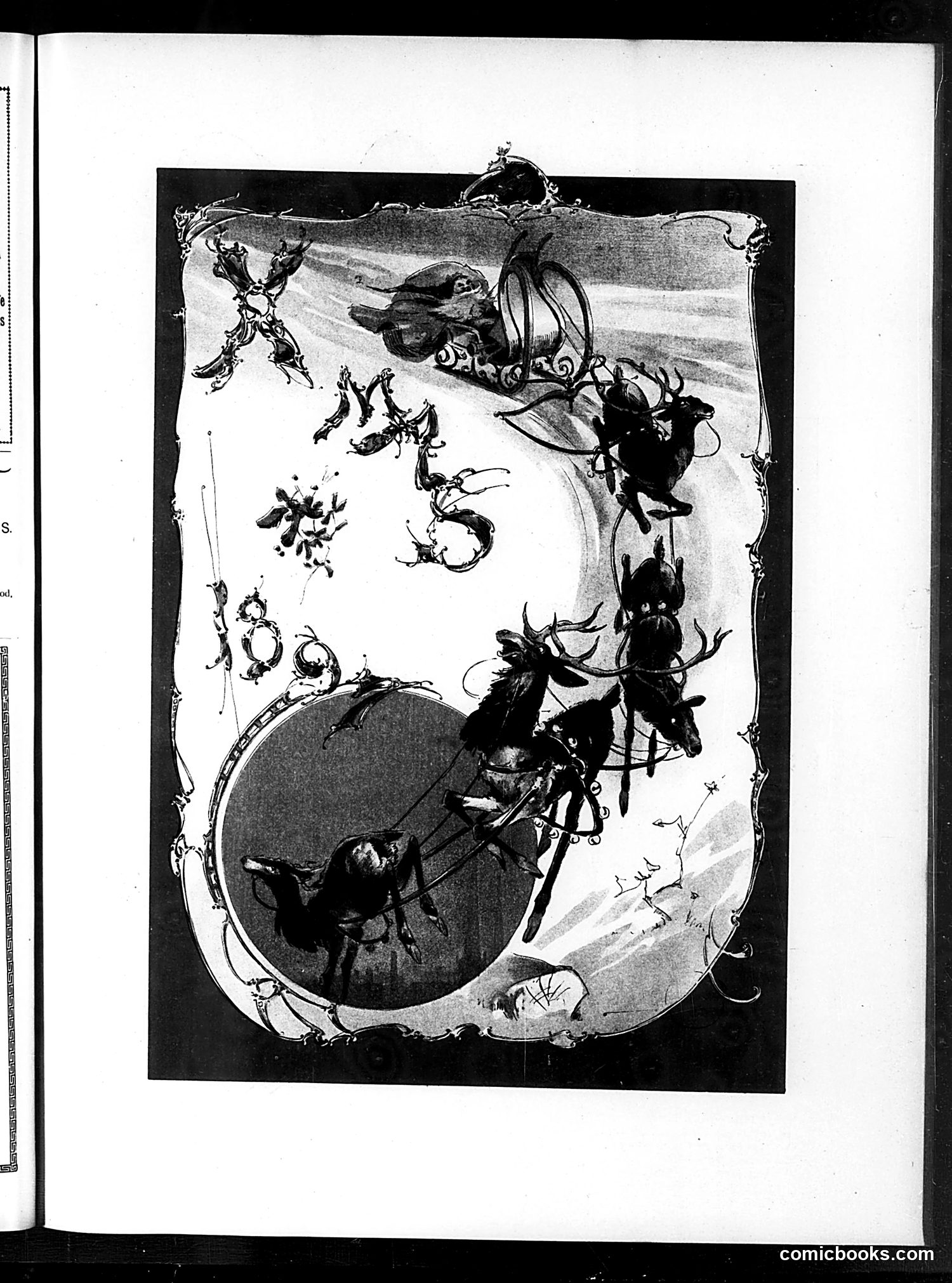
I can see this is a satirical illustration from *Judge* magazine featuring an elaborate framed scene with fantastical imagery. The composition shows what appears to be a celestial or dreamlike narrative: reindeer pulling a sleigh across a night sky, various figures in motion, and elaborate decorative borders. The style and imagery suggest this is likely a Christmas-themed satire, possibly referencing Santa Claus or holiday traditions, though the specific political or social commentary isn't entirely clear from the image alone. The ornate art nouveau-style frame and detailed line work are characteristic of *Judge*'s sophisticated visual satire from the late 19th or early 20th century. However, without clearer OCR text or additional context, I cannot definitively identify the specific figures or political references intended by the cartoonist.