
A complete issue · 16 pages · 1897
Judge — October 30, 1897
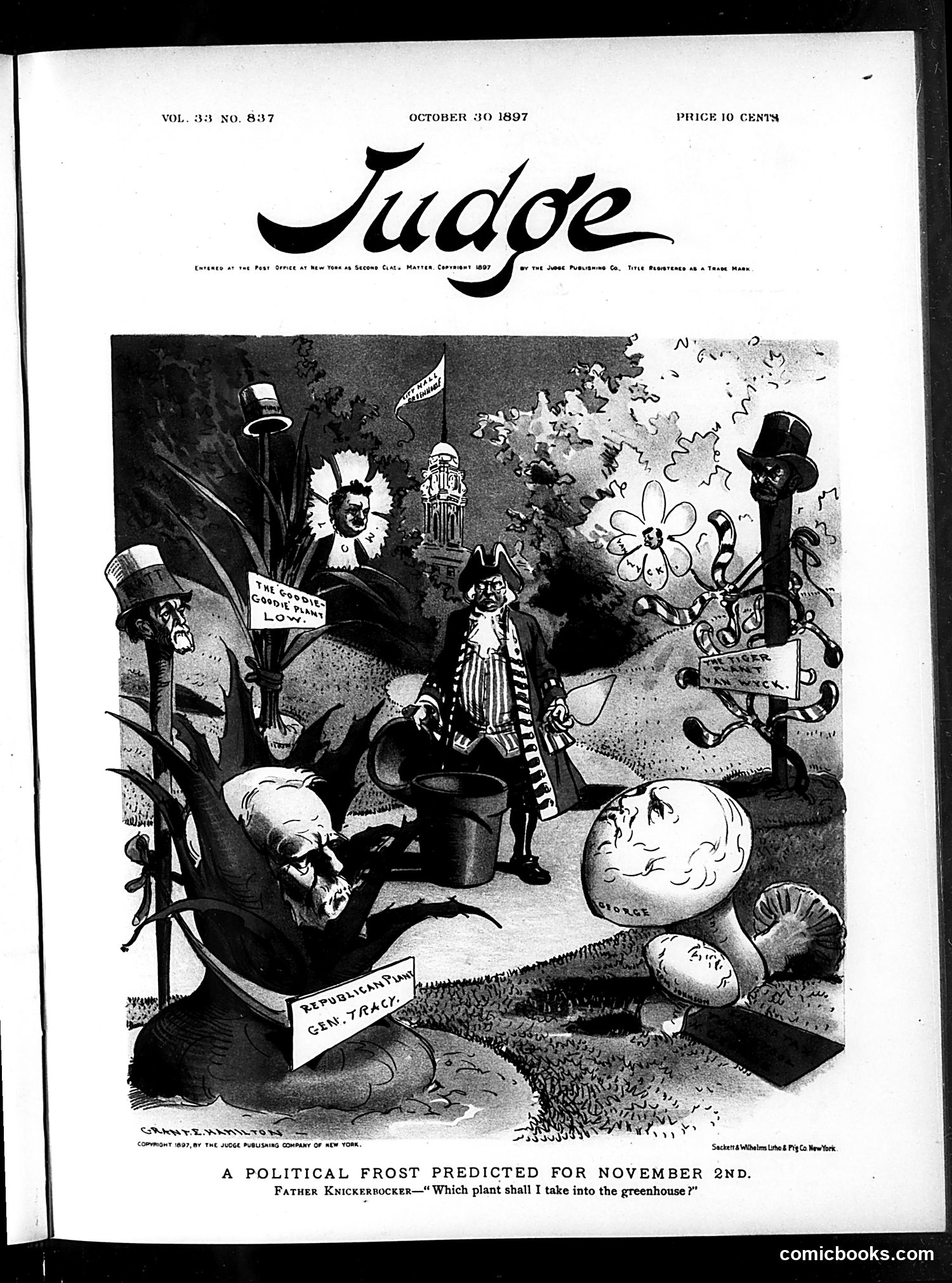
This satirical cartoon depicts a surreal political scene titled "A Political Frost Predicted for November 2nd," with the subtitle "Father Knickerbocker—'Which plant shall I take into the greenhouse?'" The cartoon shows personified figures and symbols in a garden setting. Father Knickerbocker (representing New York) must choose which political "plants" to protect before frost arrives on election day. The various caricatured figures and objects—appearing to represent different political candidates, parties, or issues—are presented as delicate plants requiring shelter. The satire mocks the political uncertainty and vulnerability of different candidates or causes facing the upcoming November election. The "frost" metaphorically threatens political fortunes, while the greenhouse represents protective political action or voter support needed for survival through the election season.
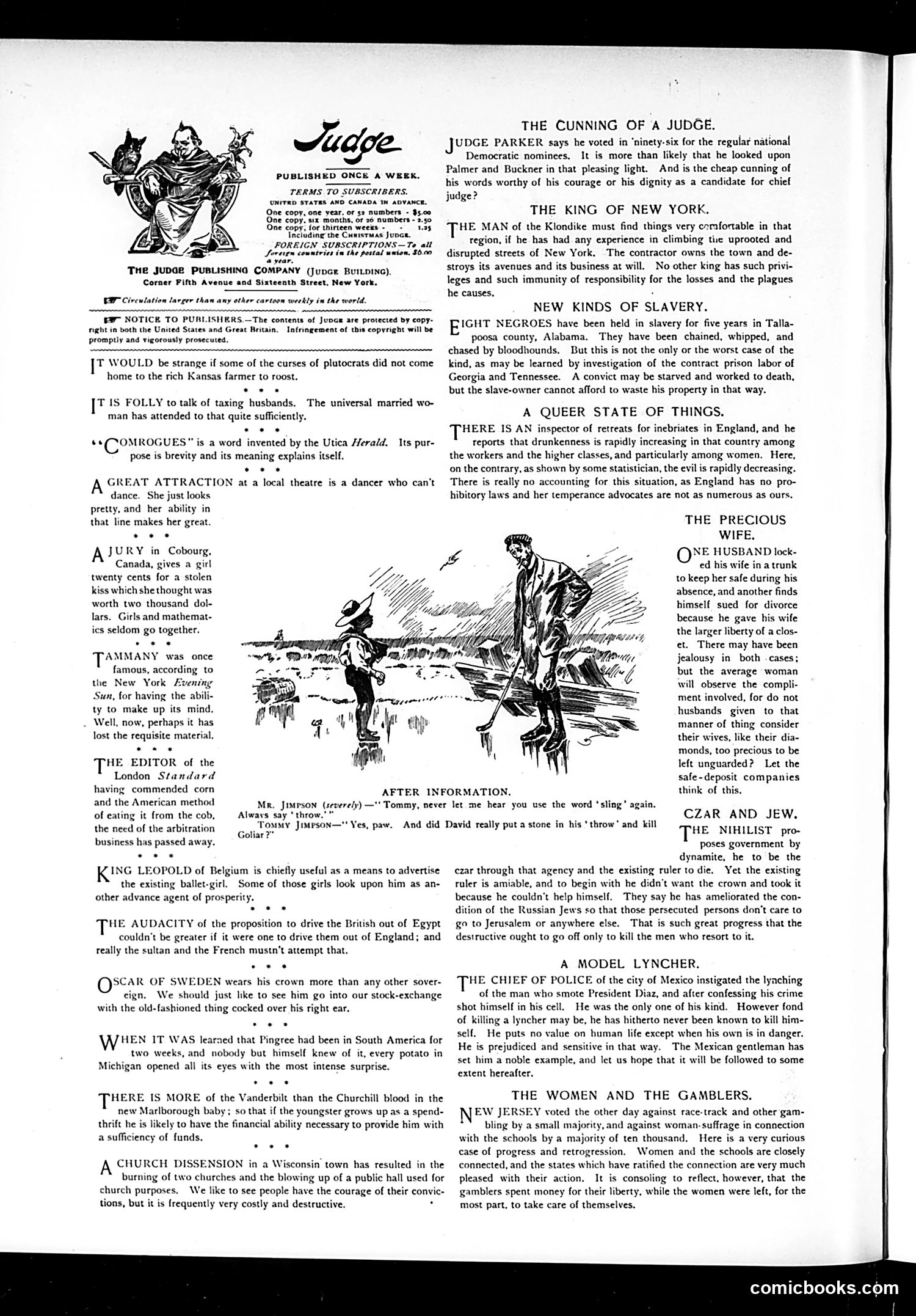
The main cartoon titled "AFTER INFORMATION" depicts two figures in a rural setting. Based on the caption exchange—"Tommy, never let me hear you use the word 'sling' again" / "Yes, paw. And did David really put a stone in his 'throw' and kill Goliath?"—this is a humorous commentary on linguistic pedantry. A parent corrects a child's grammar while the child responds with an absurdist question about biblical language, suggesting the parent's strict rule is equally arbitrary. The surrounding articles address contemporary social issues: slavery abuses in Alabama, drunkenness in England, a custody dispute over a trunk, and political instability regarding a czar. These represent typical Judge content—satirizing American and international social problems through short commentary pieces.
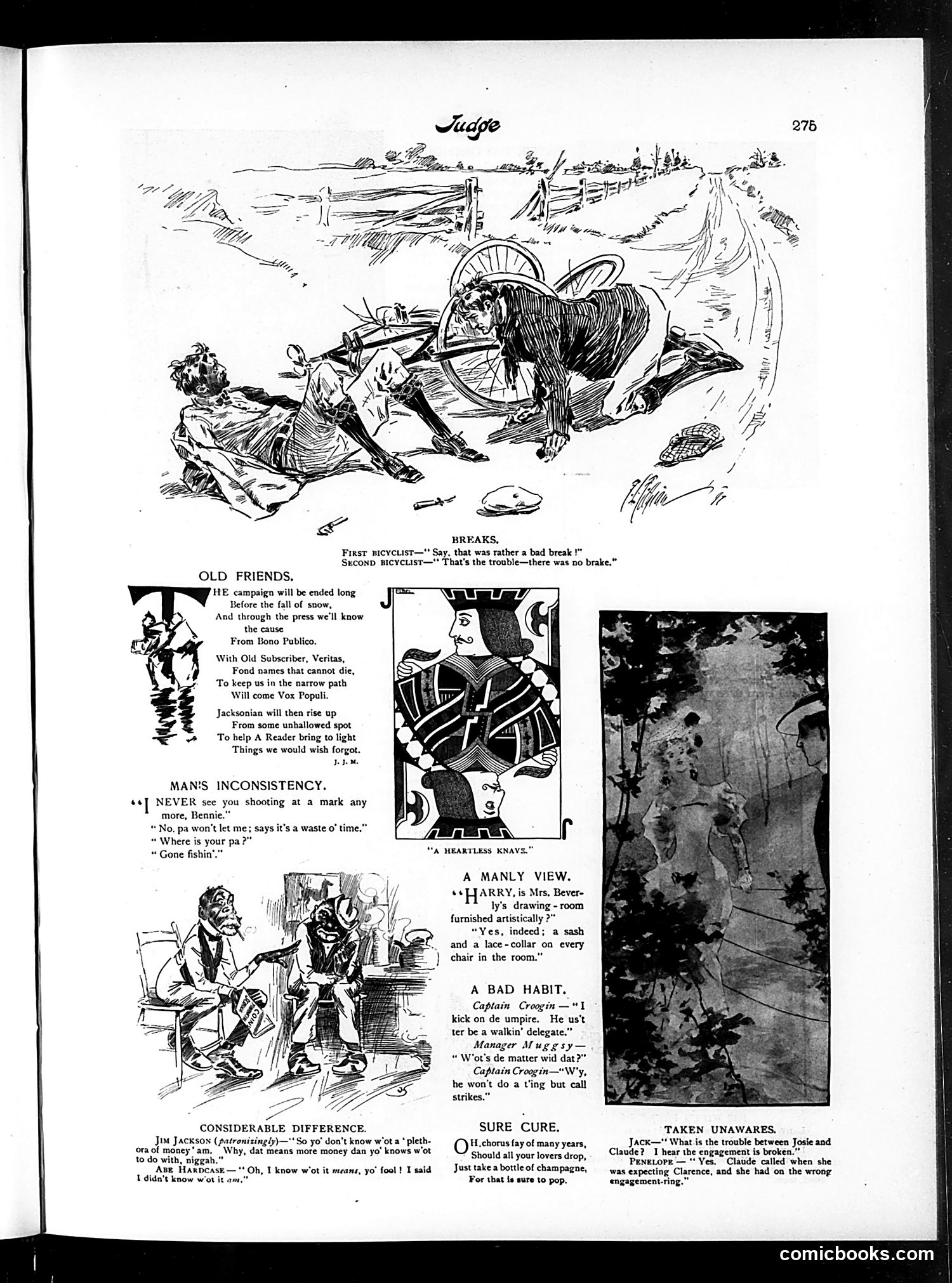
**Main Cartoon - "Breaks":** Depicts two cyclists who've crashed. The caption contrasts their explanations: one claims "a bad brake," the other counters "there was no brake." This is straightforward physical humor about bicycle accidents, likely satirizing the unreliability of early bicycle technology and riders' tendency to blame equipment rather than operator error. **Surrounding Content:** The page contains various joke sections ("Old Friends," "Man's Inconsistency," "A Heartless Knave," etc.) that appear to be unrelated satirical quips rather than political commentary. References to "Jacksonians" and "Reader" are unclear without fuller context. The content suggests general social satire typical of Judge's era rather than specific political events.
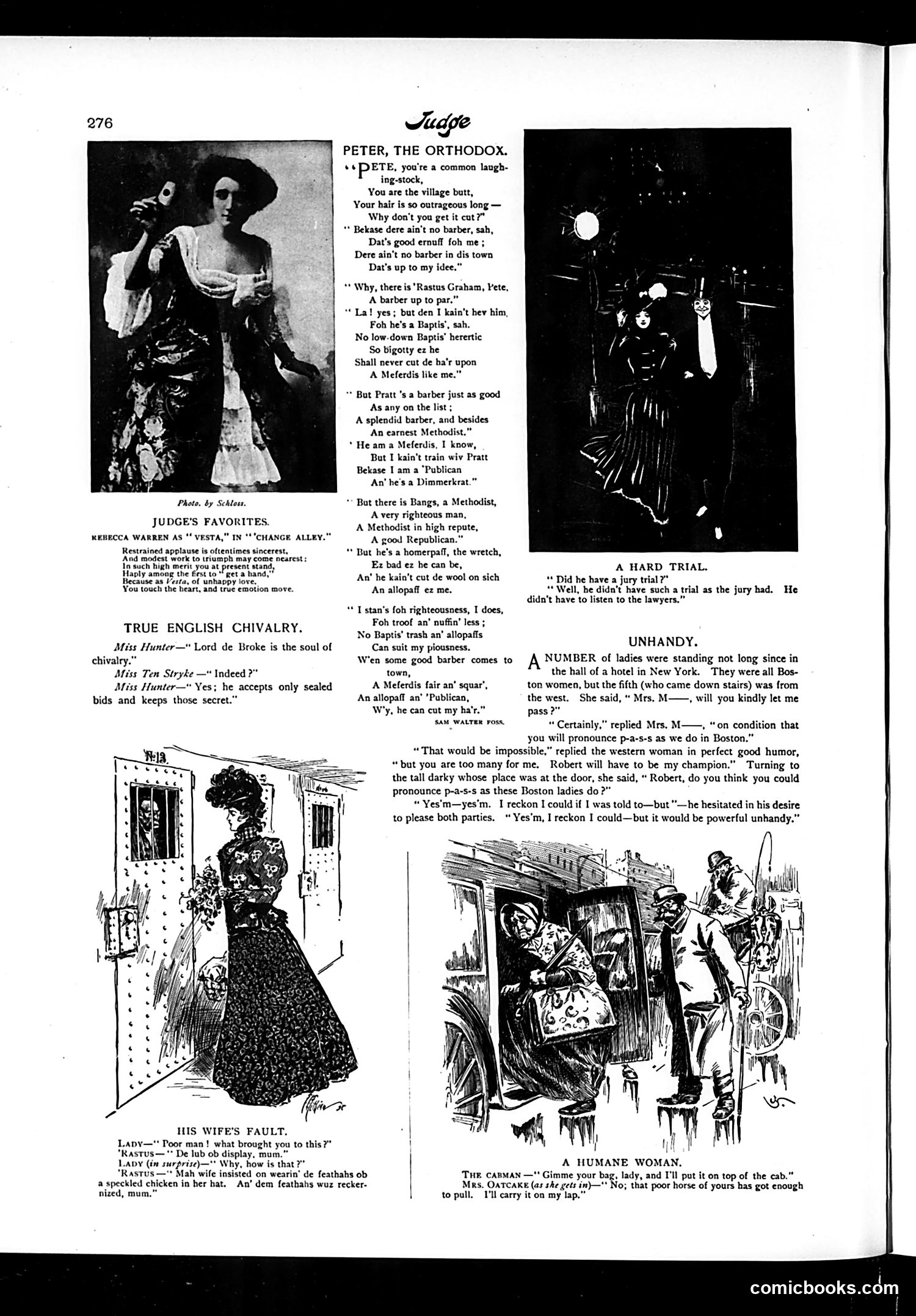
This page contains racial stereotypes typical of late 19th/early 20th-century American satire. The main cartoon, "Peter, the Orthodox," depicts a Black character who refuses haircuts from barbers of different religions and political affiliations—he'll only accept a Methodist Republican barber, but rejects one who is a Democrat or a Baptist. The satire mocks rigid religious and political sectarianism, but does so through a racist caricature using exaggerated dialect. The other sketches address various social subjects: "True English Chivalry" jokes about discretion, "His Wife's Fault" and "A Humane Woman" satirize vanity and class pretension, while "Unhandy" mocks Boston accent prejudice against westerners. The page reflects Judge's satirical approach to contemporary social divisions, though expressed through offensive racial imagery now considered deeply inappropriate.
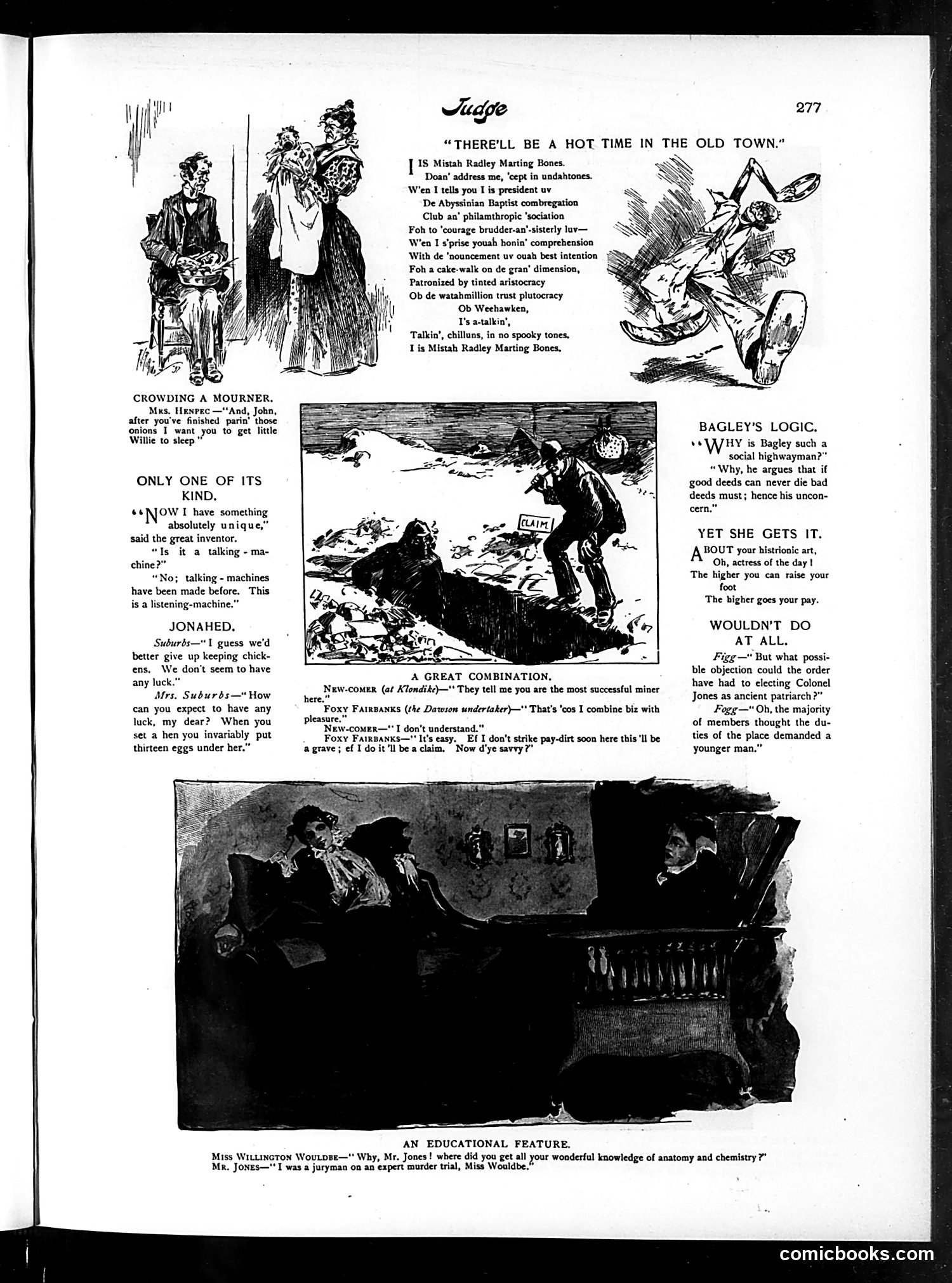
This page contains several brief satirical sketches typical of early-20th-century humor magazines: **"Marting Bones" poem**: A caricatured dialect piece mocking African American social pretension, depicting a Black church leader boasting about organizing an elaborate cake-walk (a popular Black social event). The exaggerated dialect and focus on conspicuous display reflect period racial stereotypes. **"A Great Combination"**: A dark joke about a Klondike miner who's also an undertaker—he profits either way: striking gold claims or burying failed prospectors. **"Bagley's Logic"**: A satirical take on moral relativism, arguing if good deeds are immortal, bad ones must be too—justifying indifference. **"Yet She Gets It"**: Commentary on actresses' pay correlating to leg-raising, a jab at both theatrical economics and perceived morality. **"Educational Feature"**: A juror gained anatomy/chemistry knowledge from a murder trial—darkly implying criminal expertise as education. These are character sketches and wordplay typical of Judge's satirical approach to contemporary society, class, and morality.
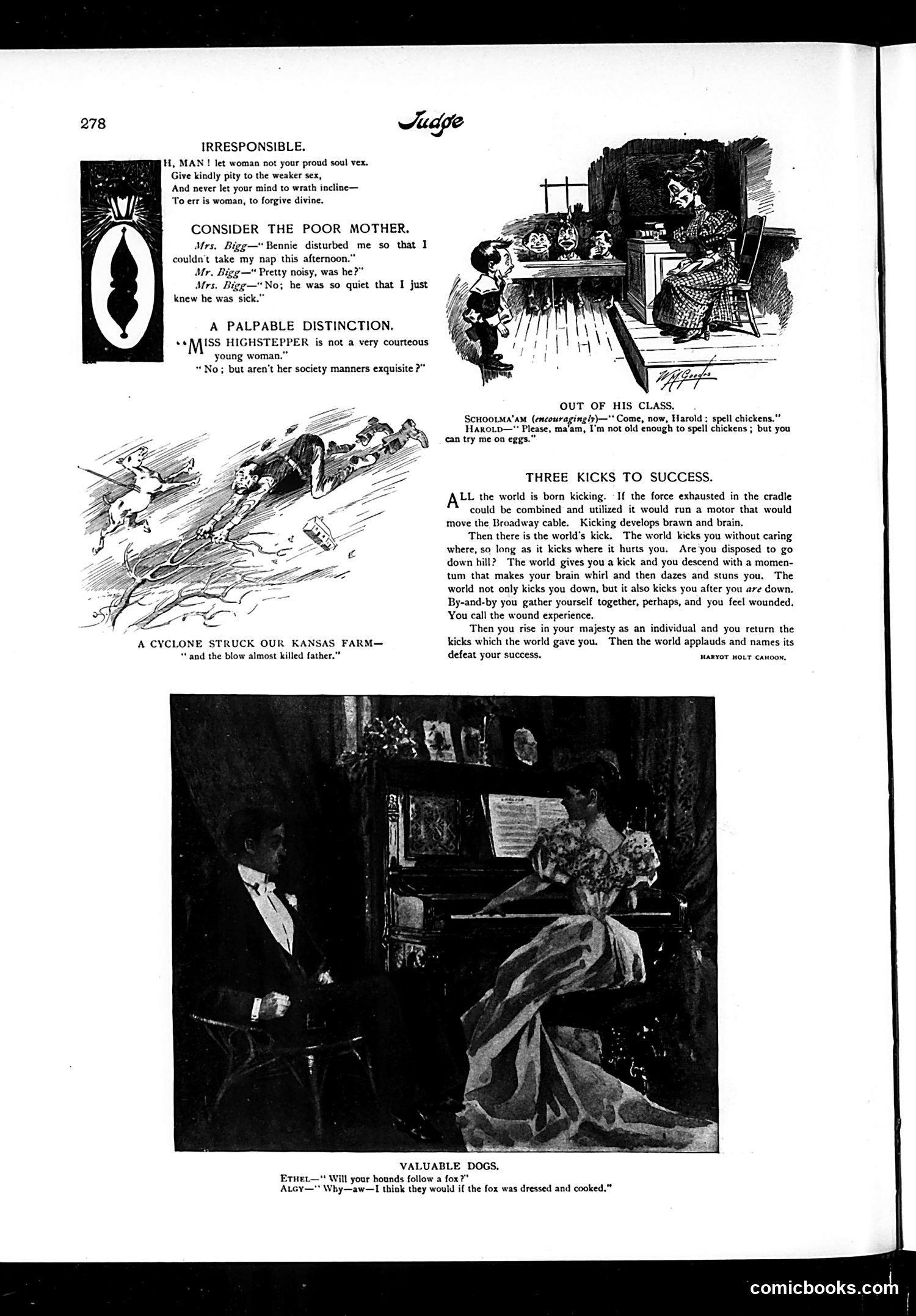
This page contains multiple short satirical items typical of Judge's format: **"Irresponsible"** opens with verse about forgiving women's errors—likely mocking sentimental attitudes toward female behavior. **"Consider the Poor Mother"** jokes that Mrs. Bigg complains her son disturbed her nap by being *too quiet*—satirizing self-centered mothers who resent children regardless. **"A Palpable Distinction"** contrasts a discourteous "Miss Highstepper" with society manners, suggesting social pretension masks actual rudeness. **"Out of His Class"** features a schoolboy (Harold) deflecting a spelling question about "chickens" by claiming he's only old enough for "eggs"—a joke about class consciousness or intellectual limitations. **"Three Kicks to Success"** offers inspirational philosophy: life's hardships ("kicks") build character; adversity teaches resilience, eventually allowing one to overcome and succeed. **"A Cyclone Struck Our Kansas Farm"** and **"Valuable Dogs"** are brief humorous exchanges about farm disasters and hunting dogs. The imagery supports these gentle, domestic satirical observations about American social life.
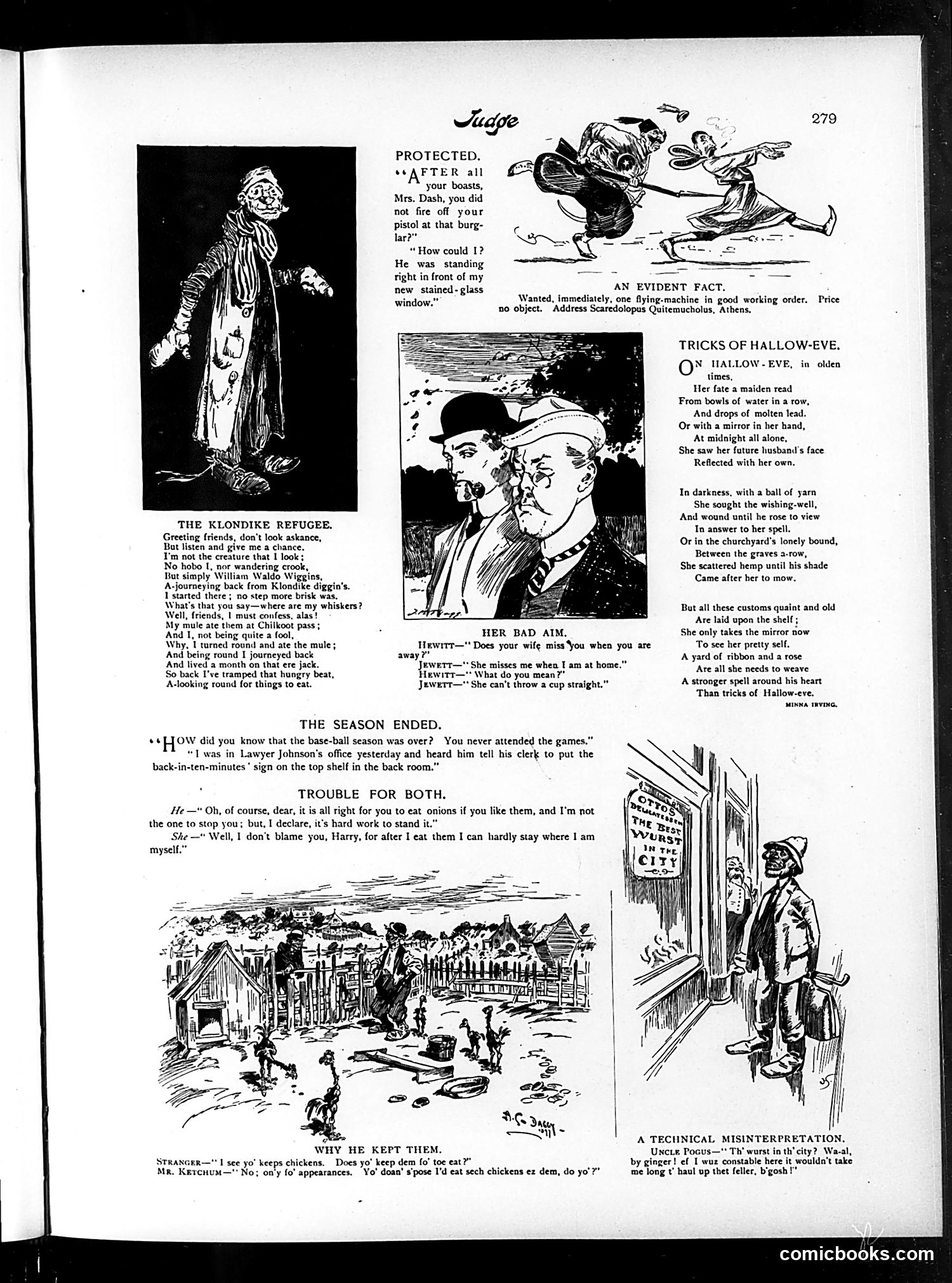
This page contains multiple brief humorous sketches typical of early 1900s satirical magazines: **"Protected"** mocks upper-class pretension: Mrs. Dash boasts of firing at a burglar but couldn't shoot because he stood before her expensive new stained-glass window—implying material possessions matter more than safety. **"An Evident Fact"** is a classified ad joke: someone wants a flying machine, "price no object"—satirizing the absurdity of early aviation fantasies. **"Tricks of Hallow-Eve"** presents nostalgic folklore about divination customs (mirror rituals, wishing wells) before concluding modern girls only use mirrors for vanity—gentle social commentary on changing attitudes. **"Her Bad Aim"** is domestic humor: a wife misses her absent husband only because she can't throw a cup straight when he's home. **"Why He Kept Them"** presents rural dialect humor: a farmer keeps chickens "for appearances" only, implying they're too scrawny to eat—poking fun at rural poverty or pretense. The page is primarily light domestic and social satire without specific political content.
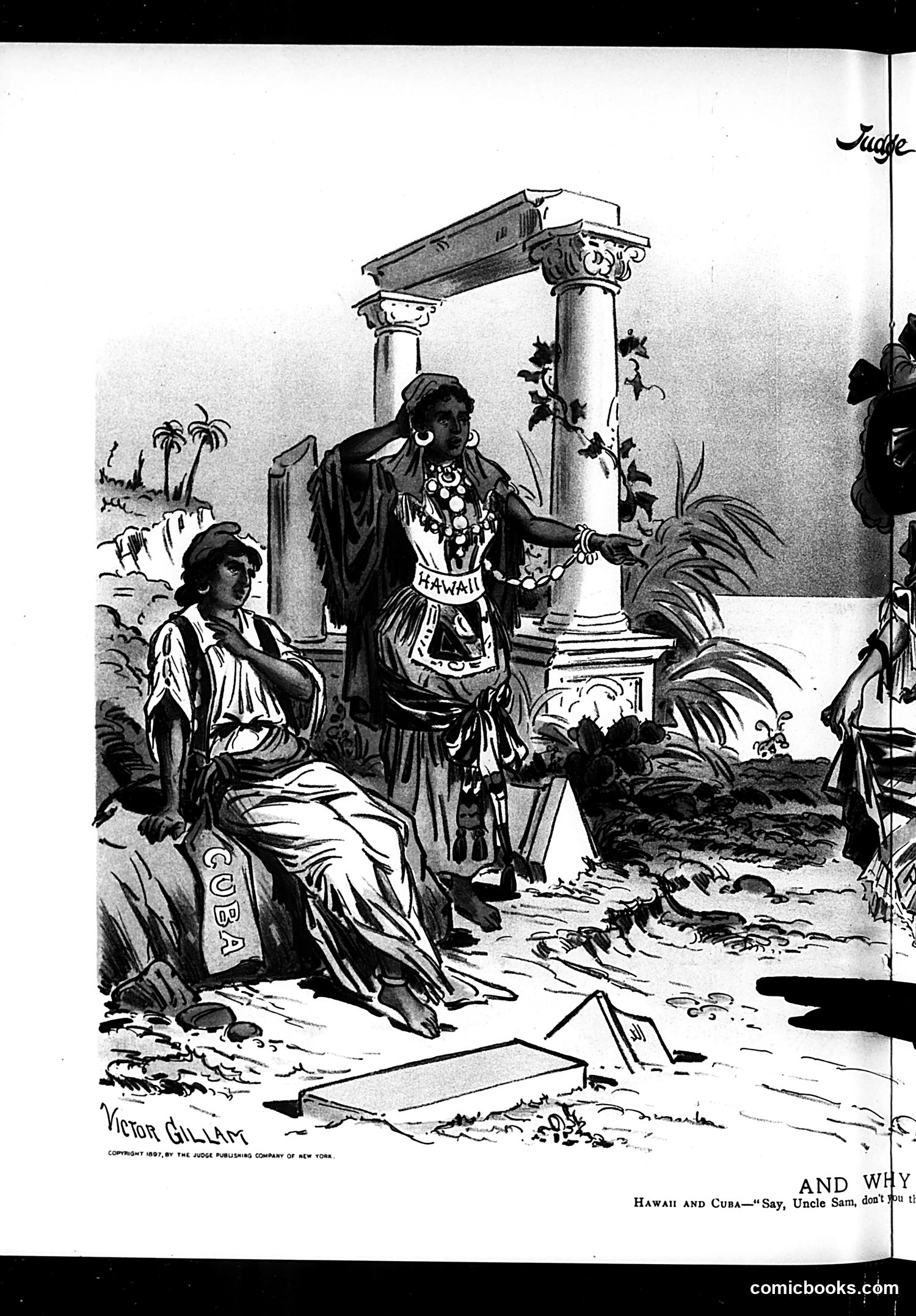
This Judge magazine cartoon by Victor Gillam satirizes American imperial expansion. The figure labeled "CUBA" sits dejected in the foreground, while a standing figure labeled "HAWAII" gestures dismissively. Uncle Sam (representing the U.S. government) appears to be deciding between acquiring both territories—a reference to late-19th-century American expansionism. The classical architectural setting suggests civilization and empire-building. The caption's incomplete text ("Say, Uncle Sam, don't you th[ink]...") likely poses a rhetorical question about acquiring these islands. This reflects the period around the Spanish-American War (1898) and subsequent U.S. territorial acquisitions in the Caribbean and Pacific. The cartoon critiques—or possibly endorses, depending on Judge's stance—America's imperialist ambitions during this era of colonial expansion.
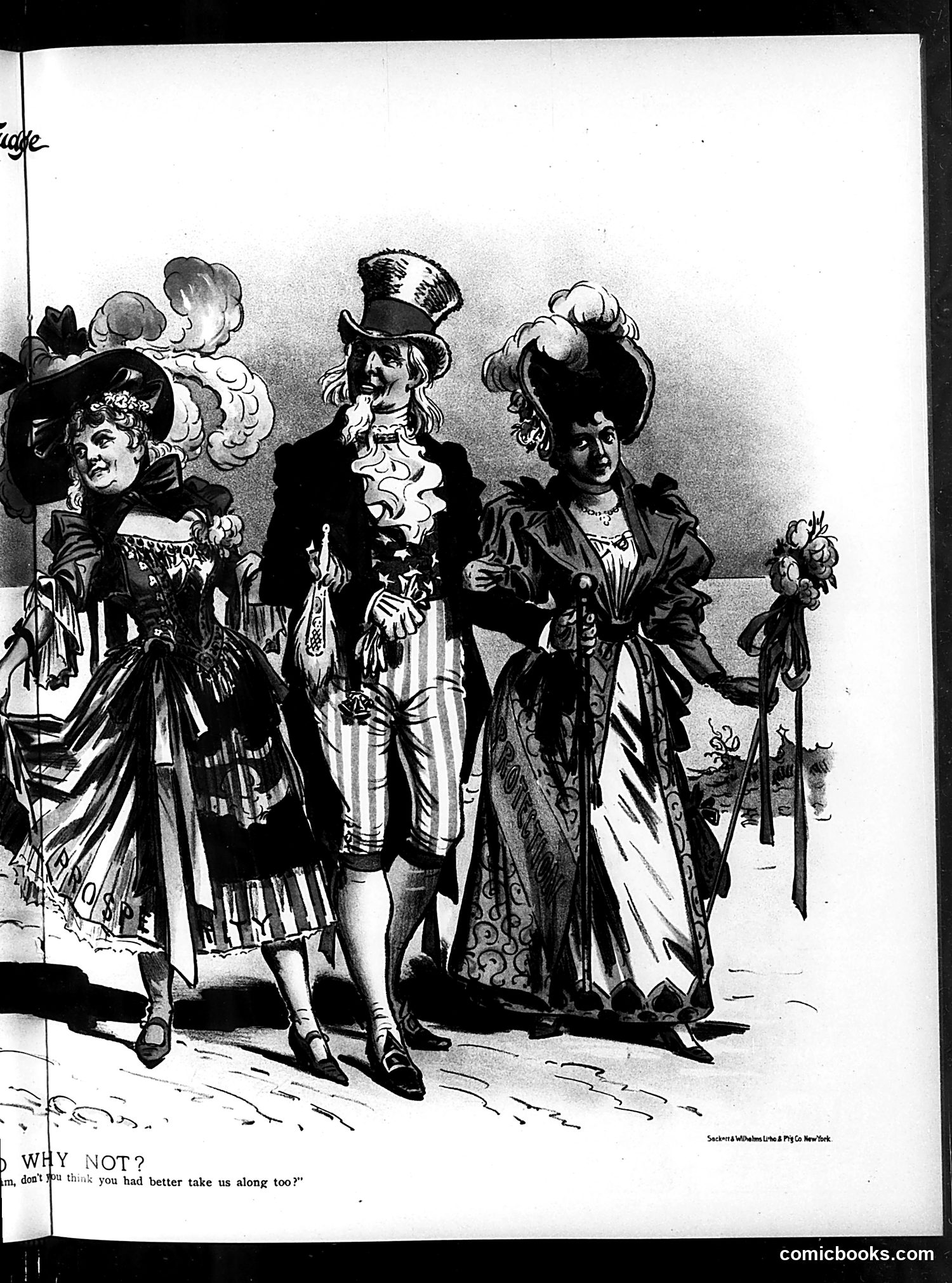
This appears to be a satirical cartoon titled "WHY NOT?" depicting three fashionably dressed women in elaborate early 20th-century attire—featuring large hats, corsets, and ornate clothing typical of the Gibson Girl era. The visible caption reads: "...don't you think you had better take us along too?" The satire likely comments on women's fashion excess or the social dynamics of courtship and companionship during this period. The three women's coordinated appearance and the plea to be "taken along" suggests commentary on matrimonial prospects or social expectations. However, without seeing the full context or setup preceding this panel, the specific target of the satire remains unclear—it could address women's autonomy, fashion trends, or gender relations of the era.
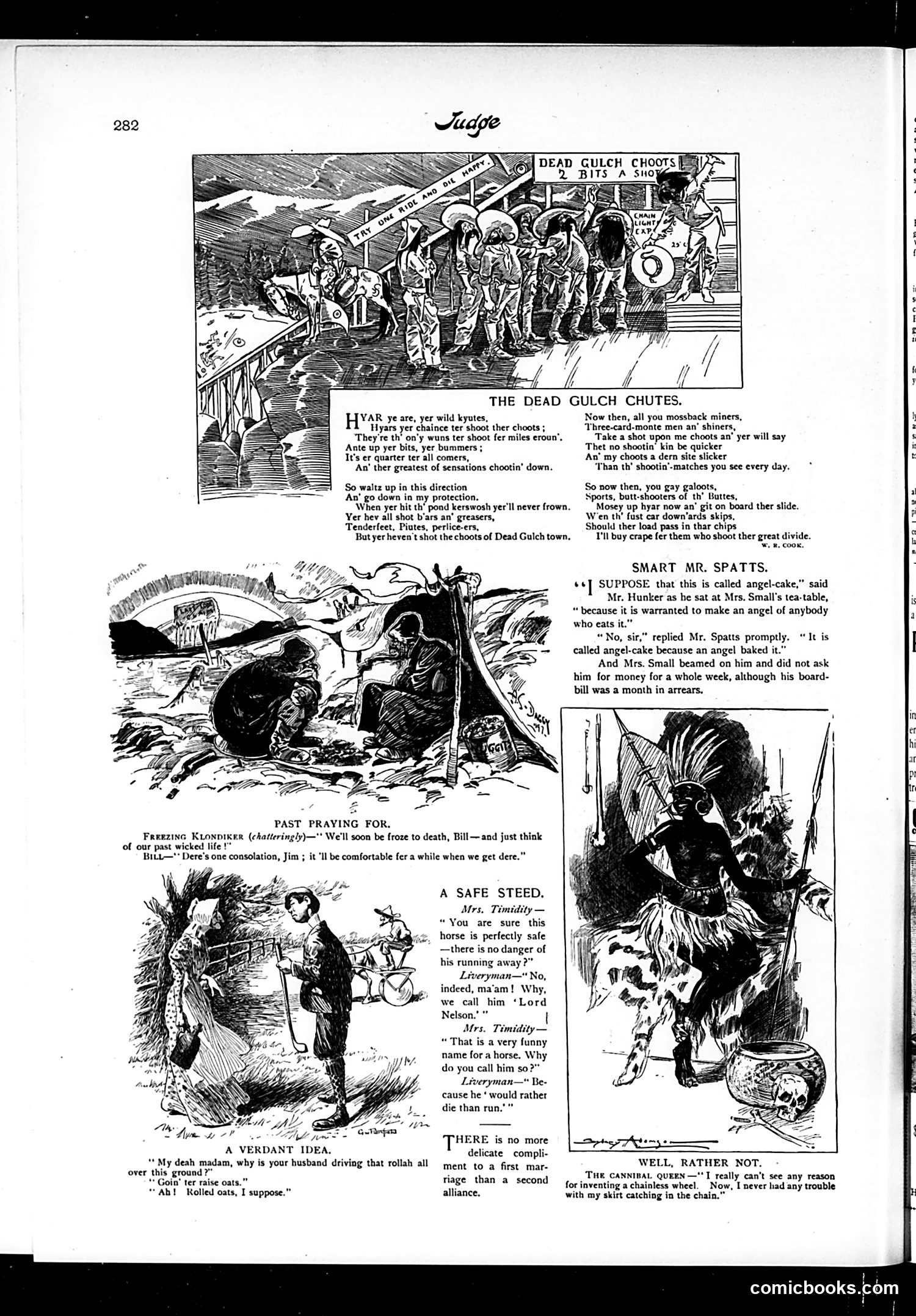
This satirical page contains several unrelated humorous sketches typical of late-19th-century American humor: **"The Dead Gulch Chutes"** depicts a Wild West con artist operating a dangerous water-slide attraction, using frontier dialect to mock both gullible miners and exaggerated frontier culture. The premise satirizes risky amusement schemes. **"Smart Mr. Spatts"** shows a quick-witted boarder flattering his landlady (Mrs. Small) with a clever compliment about angel-cake to avoid paying his overdue bill—satirizing social climbing and debt avoidance through charm. **"Past Praying For"** presents two freezing prospectors in the Klondike gold rush joking darkly that Hell will be comfortable compared to their current suffering—mocking the brutal conditions of gold-rush fever. Minor sketches include wordplay jokes ("rolled oats"), a nervous woman's trust in a horse named "Lord Nelson," and a cannibal queen commenting on chainless wheels—absurdist humor typical of Judge's style. The overall tone ridicules frontier excess, gullibility, and the era's social pretensions through exaggerated dialect and situations.
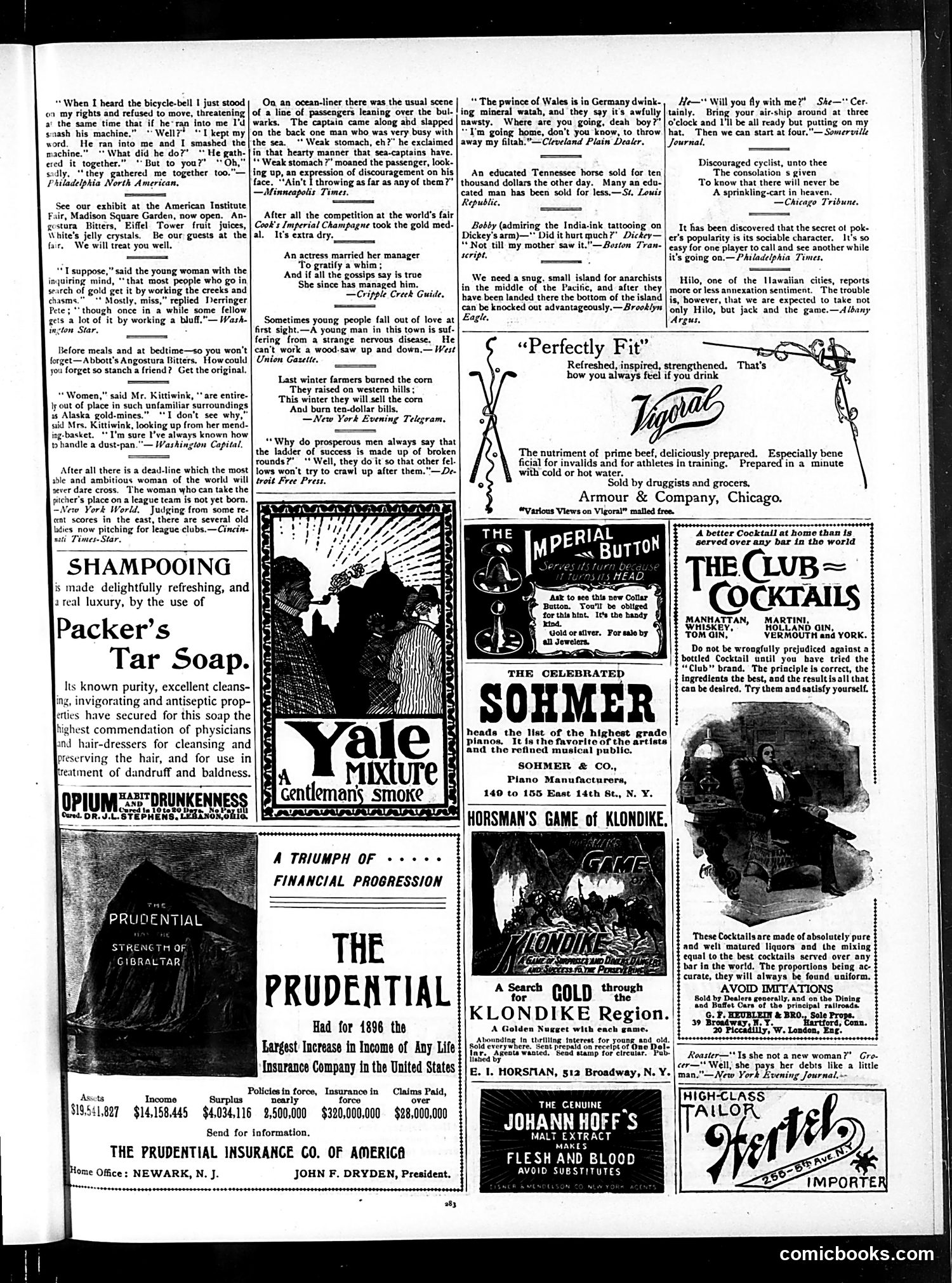
This page consists primarily of **advertisements** (Angostura Bitters, Packer's Tar Soap, Yale Mixture tobacco, various other products) and short **humorous anecdotes** typical of turn-of-the-century Judge magazine. The brief jokes satirize contemporary social issues: a man's stubborn assertion of pedestrian "rights" against a bicycle results in him being "gathered together" along with the wrecked machine (mocking extreme stubbornness); women's place in traditionally male domains like gold-mining and baseball; weak stomachs on ocean liners; and wealthy men discouraging others from climbing the "ladder of success." The content reflects **late 1800s anxieties**: the bicycle craze, frontier gold rushes, women's expanding roles, and industrial wealth disparity. No major political cartoons or caricatures appear on this particular page—it's a typical mixed-content issue of advertising revenue supporting satirical commentary.
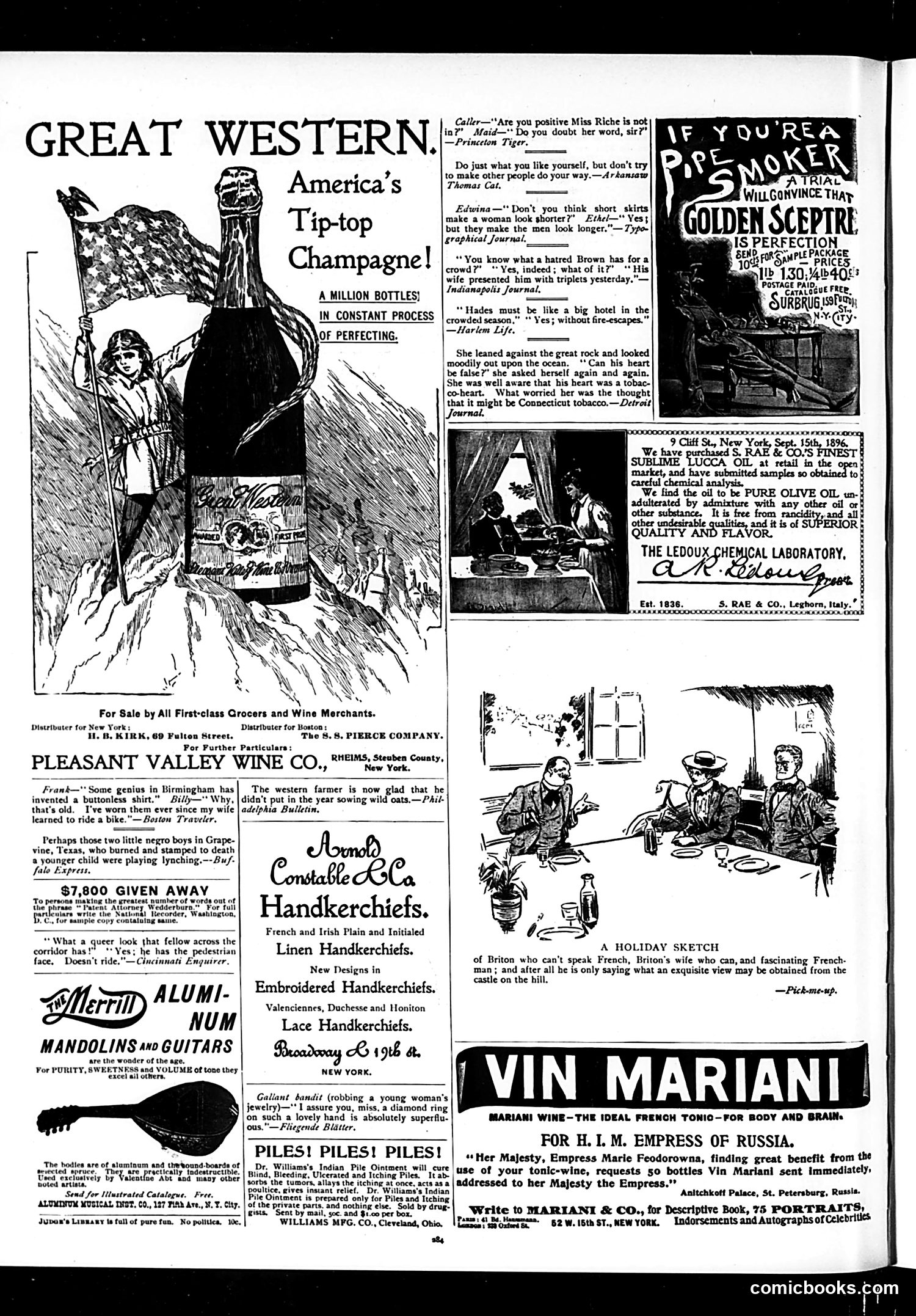
This page is primarily **advertising with scattered short jokes** rather than sustained political cartoons. The main visual is a **Great Western Champagne advertisement** featuring allegorical female figures celebrating American prosperity—typical turn-of-the-century marketing imagery. The **jokes and quips** scattered throughout reflect contemporary social humor: - Short skirts making men "look longer" (fashion commentary) - A man receiving triplets (domestic humor about large families) - A "tobacco-heart" reference (unclear specific reference) - Racial stereotypes appear in a note about "two little negro boys" in Texas (reflects the racist attitudes of the 1890s) **Other advertisements include**: handkerchiefs, mandolins, guitars, olive oil, and notably **Vin Mariani wine**, marketed with a dubious claim of endorsement by the Russian Empress. The **"Holiday Sketch"** cartoon shows tourists (likely British) miscommunicating in France—gentle satire of travel and language barriers. Overall, this reflects 1890s consumer culture, casual racism, and light social satire typical of Judge magazine.
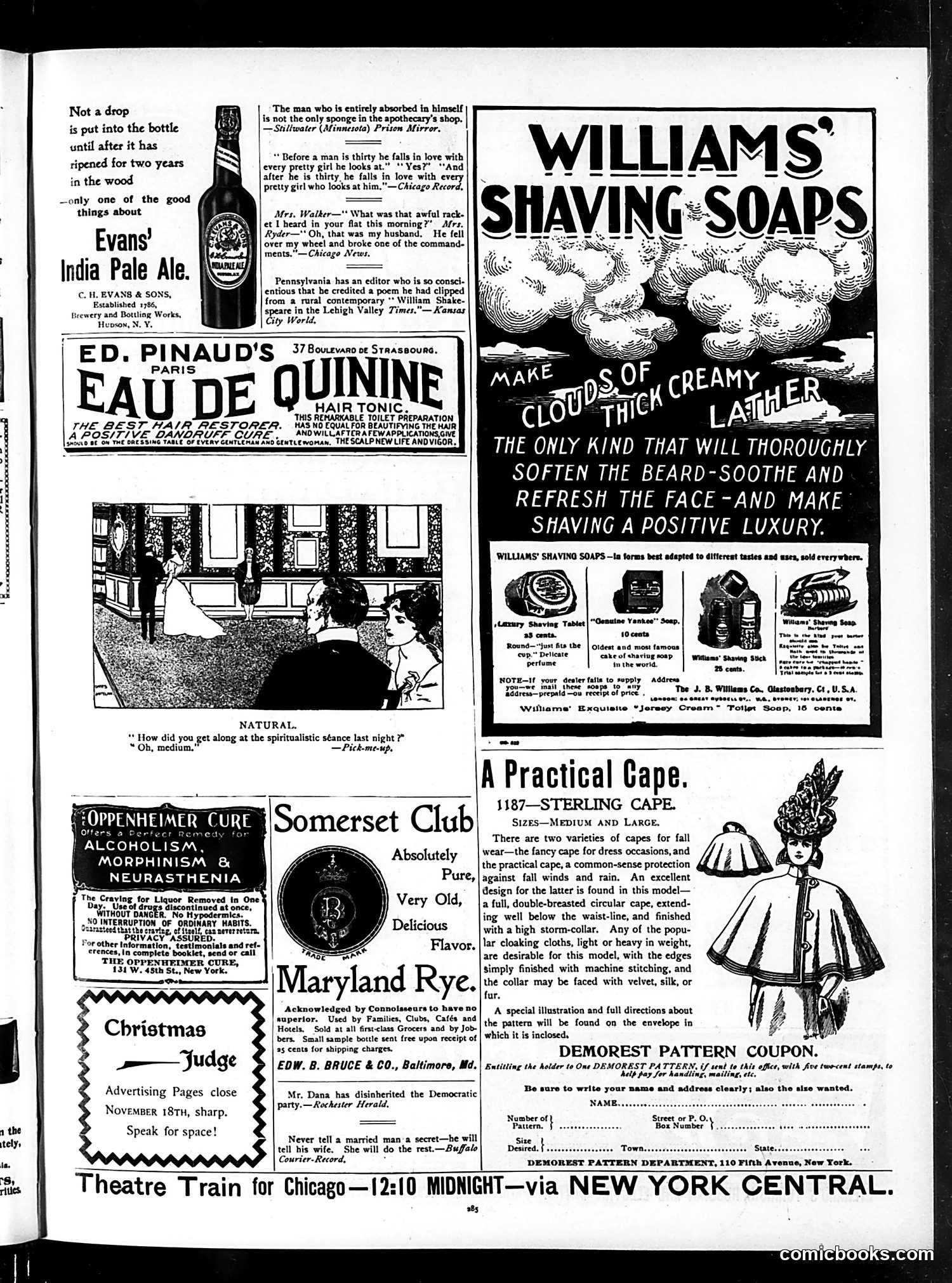
This page is primarily **advertisements and filler content**, not political satire. The layout includes multiple product ads (Evans' India Pale Ale, shaving soaps, hair tonic, Maryland Rye whiskey, a practical cape pattern) interspersed with brief humorous quotations typical of Judge's humor section. The small jokes scattered throughout rely on period domestic comedy: a spiritualist séance gag, marital discord humor ("He fell over my wheel and broke one of the commandments"), and editorial plagiarism. These are generic wisecracks rather than political commentary. The only potentially satirical element is a brief reference to "Mr. Dana" disinfecting the Democratic party—likely referencing a political figure's break with the party—but context is insufficient to identify which Dana or determine the specific political reference. This appears to be a typical late-19th or early-20th century magazine page mixing advertising revenue with lightweight humor content.
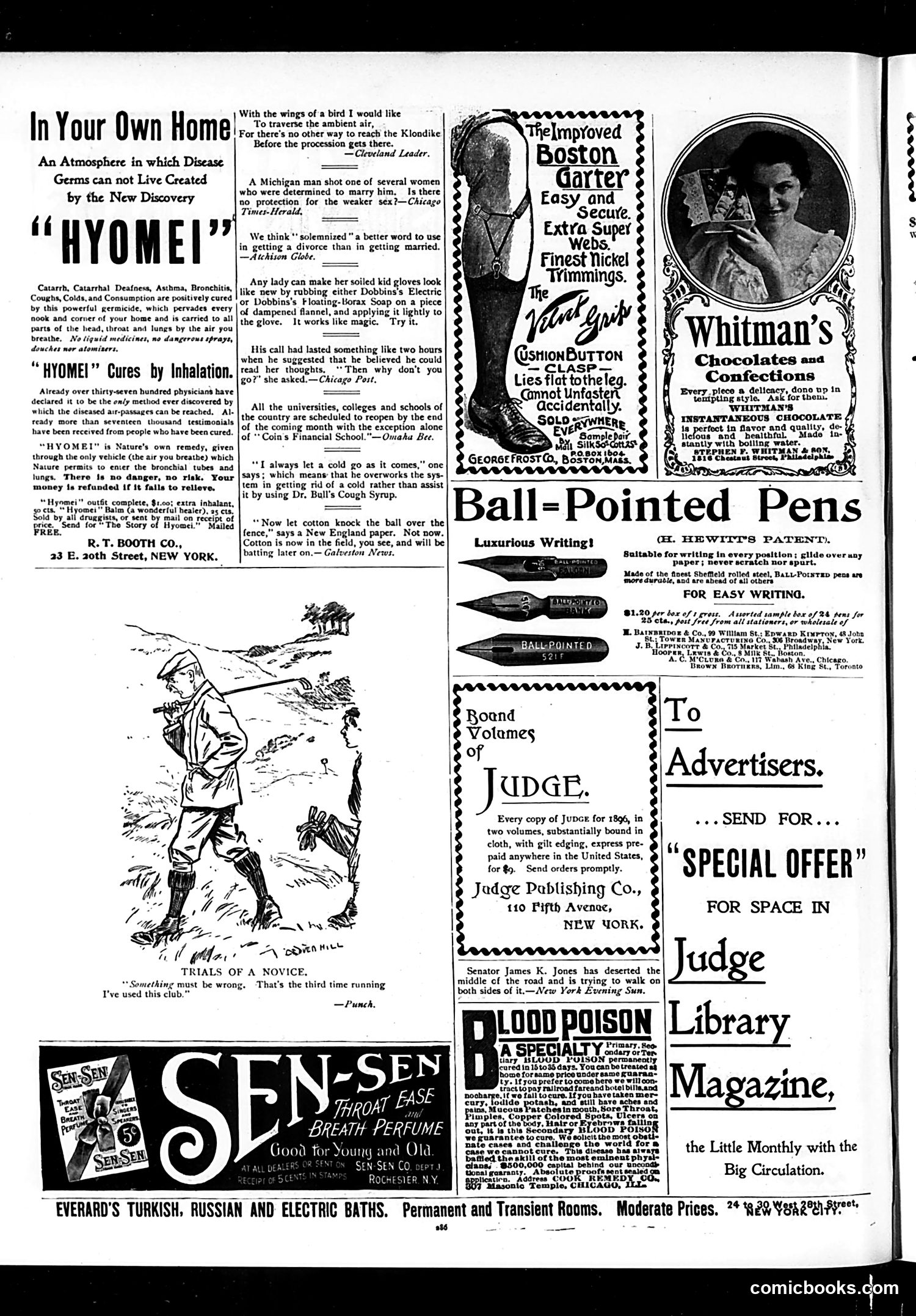
This page is primarily **advertising and editorial filler** rather than political cartoons. The one cartoon present—"Trials of a Novice"—shows a golfer repeatedly missing the ball, with the caption suggesting repeated failure. It's a light sports joke, not political satire. The page is dominated by **patent medicine and consumer product advertisements** typical of 1890s magazines: "Hyomei" (an inhalation cure for respiratory diseases), Sen-Sen breath perfume, Whitman's Chocolates, and Ball-Pointed Pens. These ads reflect contemporary medical quackery and commercial goods. Interspersed are brief **editorial quips** from various newspapers on trivial topics (Klondike gold rush, divorce language, glove-cleaning, golf). The page illustrates how Judge operated: mixing satirical commentary with lucrative advertising revenue, presenting a snapshot of late-19th-century consumer culture and medical fraud.
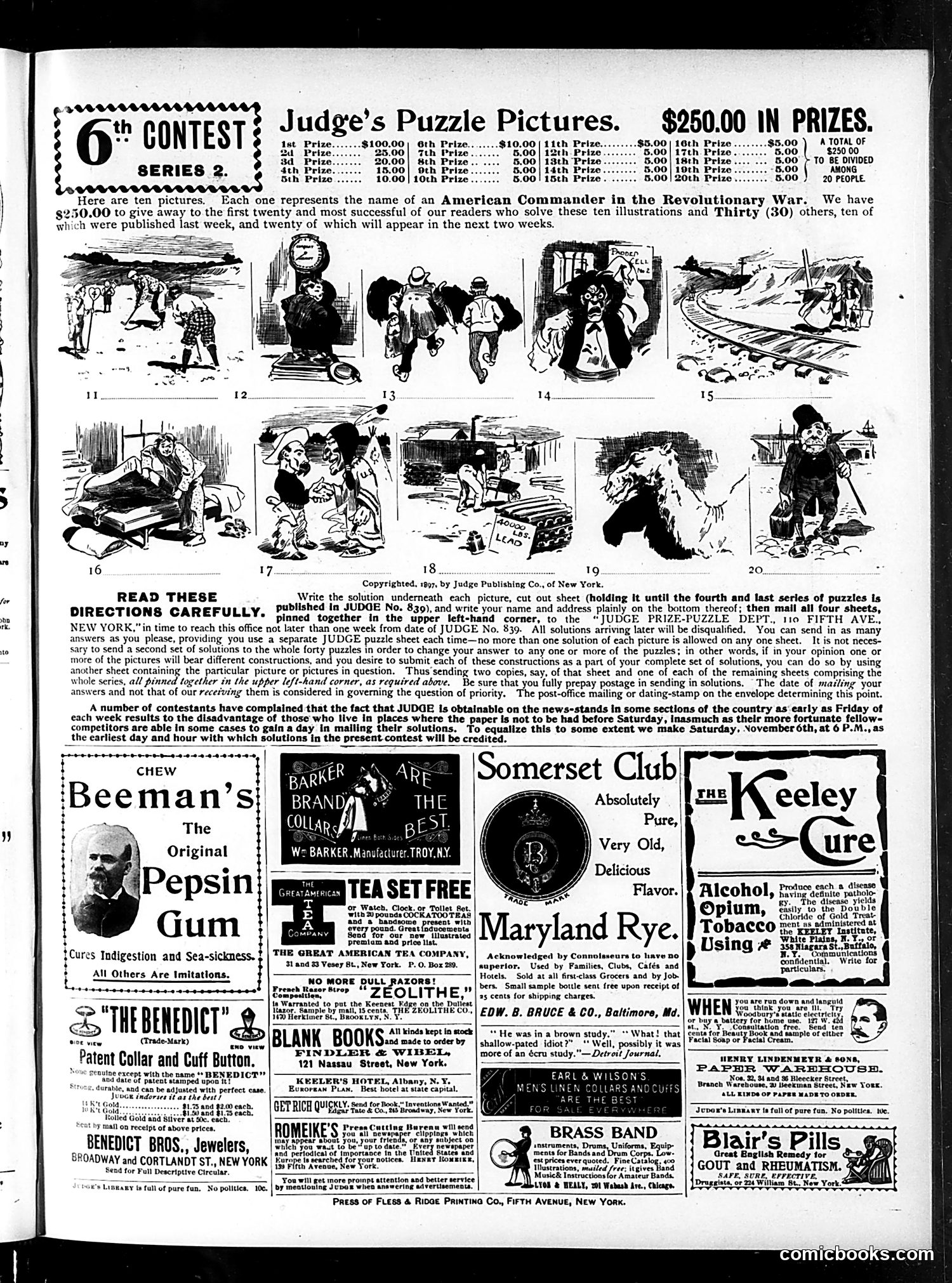
This page presents a **puzzle-solving contest** rather than political satire. The central content features ten pictorial riddles representing names of American Revolutionary War commanders. Readers must identify the military figures depicted in the sketches and submit solutions for cash prizes totaling $250. The contest instructions explain the mechanics: solvers must identify the ten pictured commanders (alongside thirty others published across multiple weeks) and mail in solutions by a specified deadline. The remaining space consists of **period advertisements**—for Beeman's Pepsin Gum, Benedict collar buttons, a tea set promotion, blank books, "The Keeley Cure" (likely alcohol treatment), Somerset Club Maryland Rye whiskey, and Blair's Pills. This represents the **typical magazine layout of the 1890s**, mixing editorial content with substantial advertising revenue. The Revolutionary War commander puzzle appears designed to engage readers while maintaining Judge's reputation for witty illustration.
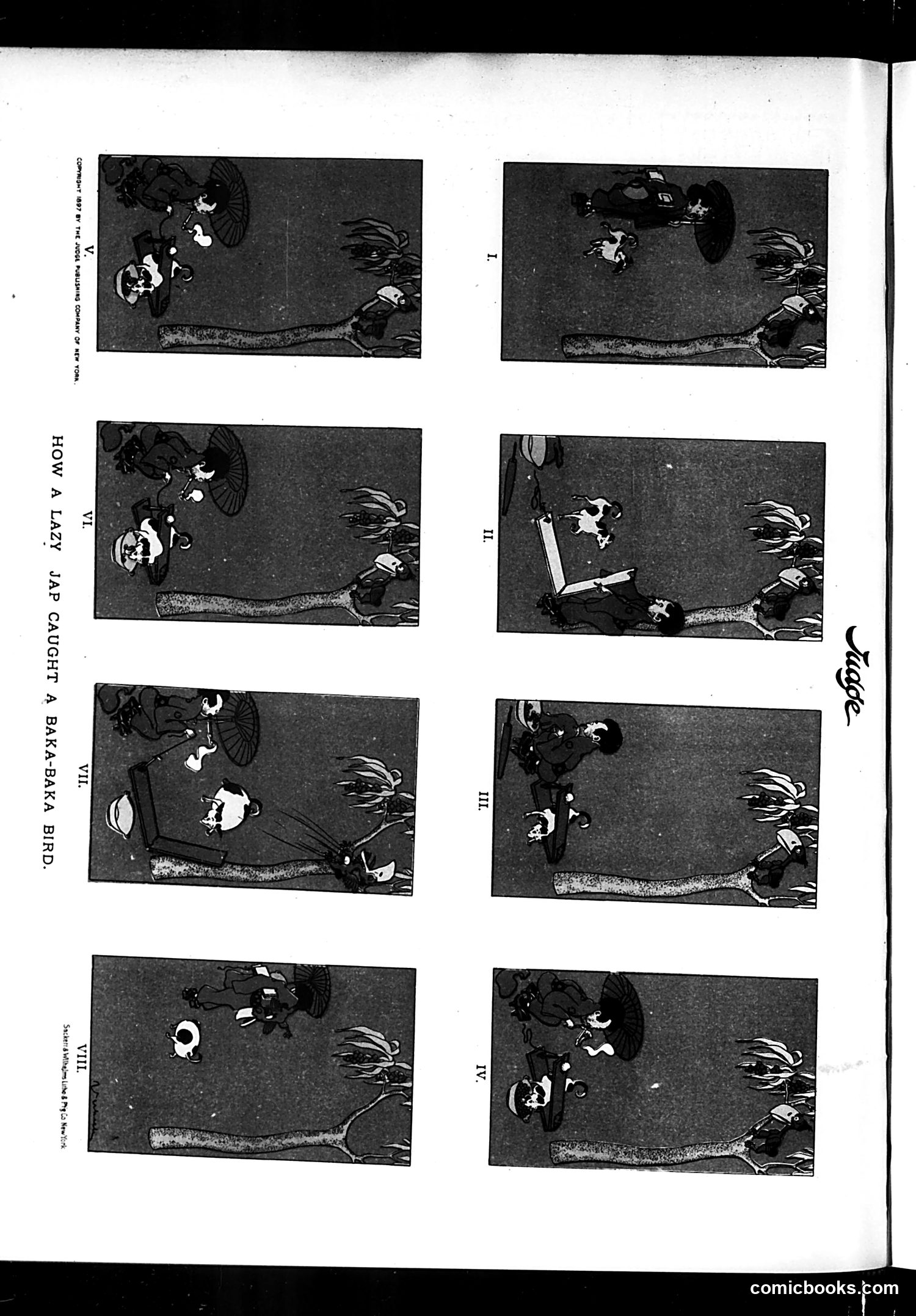
This appears to be a six-panel sequential comic titled "How a Lazy Jap Caught a Baka-Baka Bird" from Judge magazine (1897). The narrative shows a stereotypically caricatured Japanese figure attempting to catch an exotic bird through increasingly elaborate and comedic schemes—using nets, traps, and other contraptions that repeatedly fail or backfire on him. The satire relies on racial stereotyping common to 1890s American humor: the "lazy Jap" character and the nonsensical "baka-baka" bird name play on orientalist tropes. The joke's structure—repeated failure through elaborate effort—suggests commentary on either Japanese methods or the futility of the character's endeavor itself, though the specific historical reference is unclear without additional context. The copyright confirms Judge's authorship and publication in New York.