
A complete issue · 16 pages · 1897
Judge — October 16, 1897
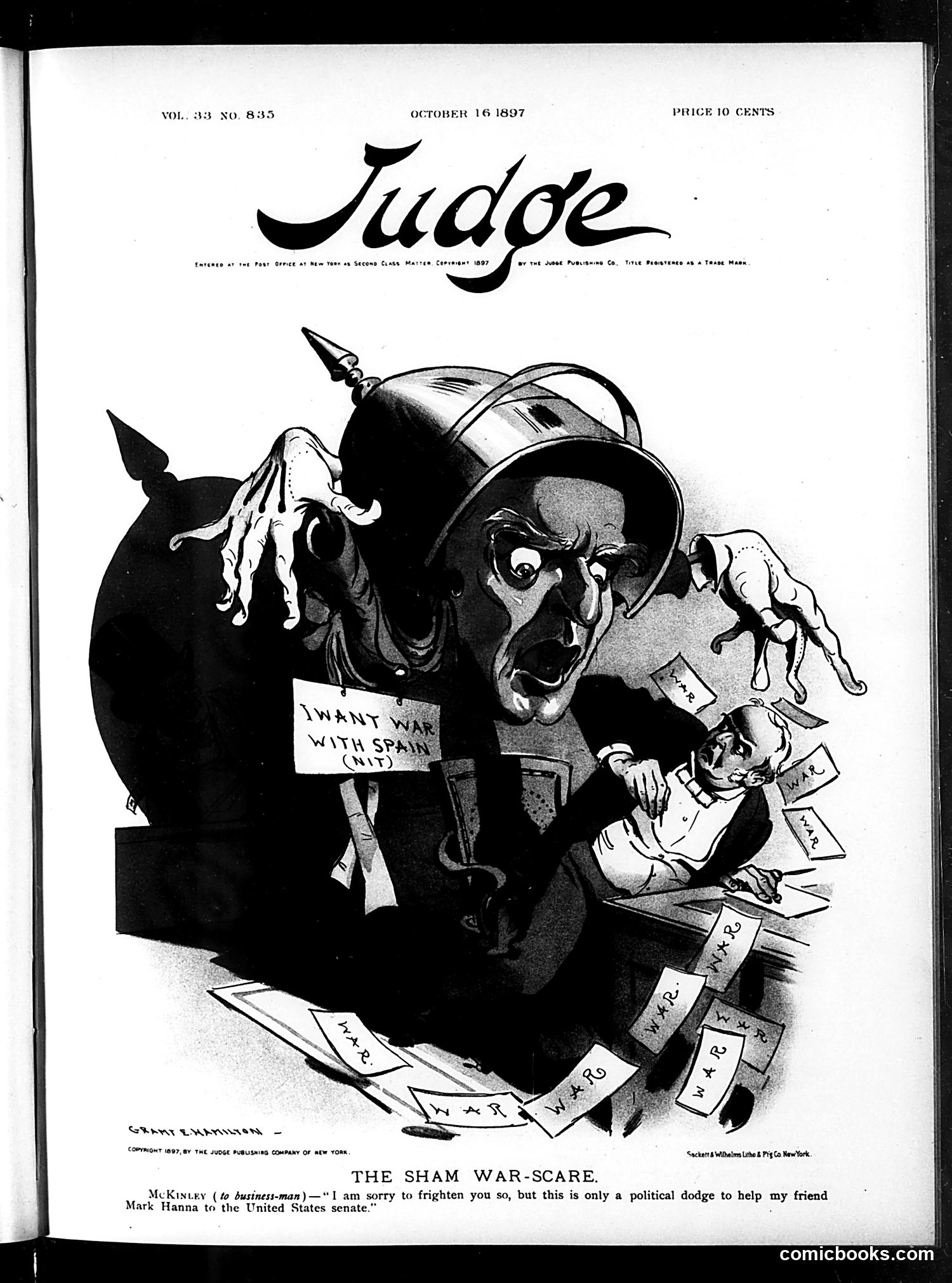
This October 1897 *Judge* cartoon satirizes Republican William McKinley's foreign policy regarding Spain. The grotesque figure labeled "I WANT WAR WITH SPAIN (NIT!)" represents the manufactured threat of Spanish conflict—depicted as a scare tactic. The caption quotes McKinley dismissing the war prospect as "only a political dodge to help my friend Mark Hanna to the United States senate." Hanna was McKinley's political ally and campaign manager. The cartoon criticizes the administration for exploiting war anxiety for domestic political gain. The scattered papers and frantic imagery suggest manufactured panic. This predates the actual Spanish-American War by several months, showing contemporary skepticism about whether conflict was genuine or politically motivated.
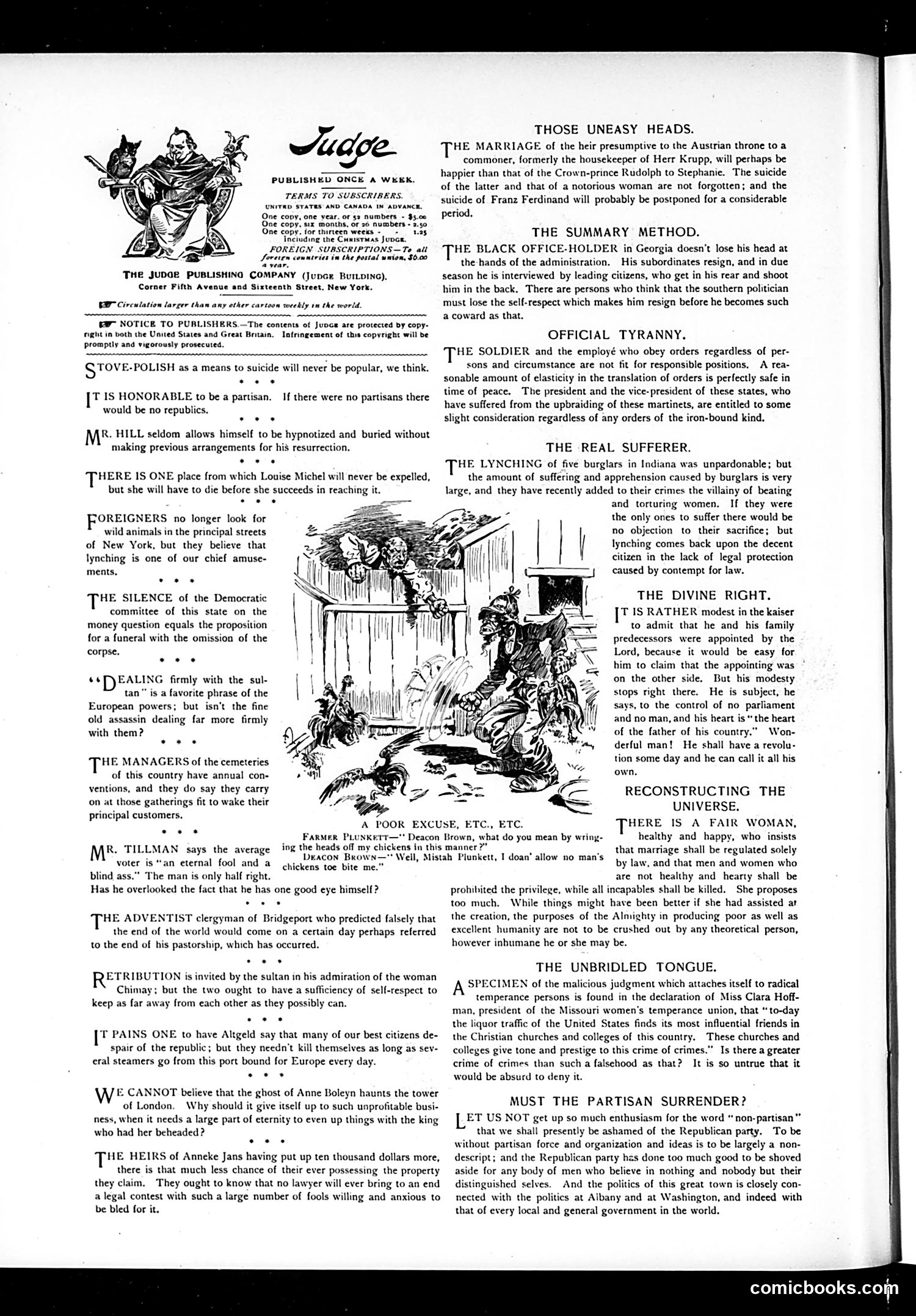
This page contains editorial commentary rather than a traditional political cartoon. The main illustration depicts what appears to be a lynching scene, accompanying an article titled "THE REAL SUFFERER" that critiques lynch mobs in Indiana. The piece argues that while lynching is "unpardonable," the real victims are innocent women and children who suffer from the resulting lawlessness and fear. The editorial suggests lynch mobs undermine legal protection and social order. Other brief editorials address various topics: Austrian succession politics, Southern politicians losing self-respect, military obedience, and women's rights. The page reflects Judge's satirical approach to contemporary social and political issues of the era, though the specific historical moment remains unclear without additional dating information.
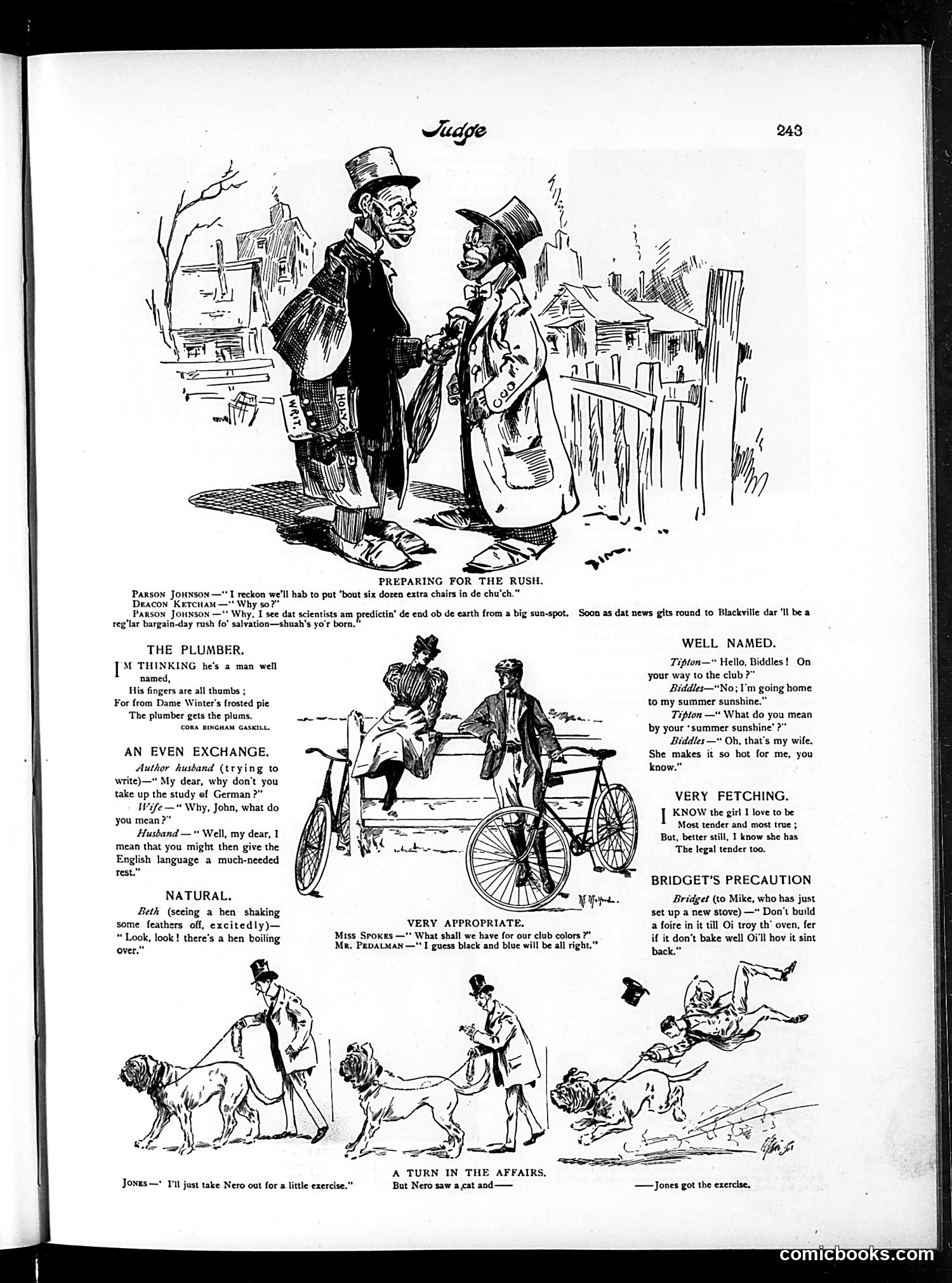
This page contains several unrelated humorous sketches typical of Judge's satirical format: **Top cartoon ("Preparing for the Rush"):** Two men in top hats discuss preparing extra chairs for an expected crowd at what appears to be a church or social venue, anticipating "the rush to Blacksville." **Middle section:** Four separate joke panels with minimal political content—"The Plumber," "An Eager Enchantress," "Natural," and a bicycle scene—appear to be domestic humor about everyday situations. **Right side:** Three brief jokes ("Well Named," "Very Fetching," "Bridget's Precaution") and a comic strip about a dog named Nero getting exercise. The page is predominantly **social satire and domestic humor** rather than political commentary. Without clearer context or identifying captions, most specific references remain unclear. The overall tone reflects turn-of-century American middle-class concerns and situations.
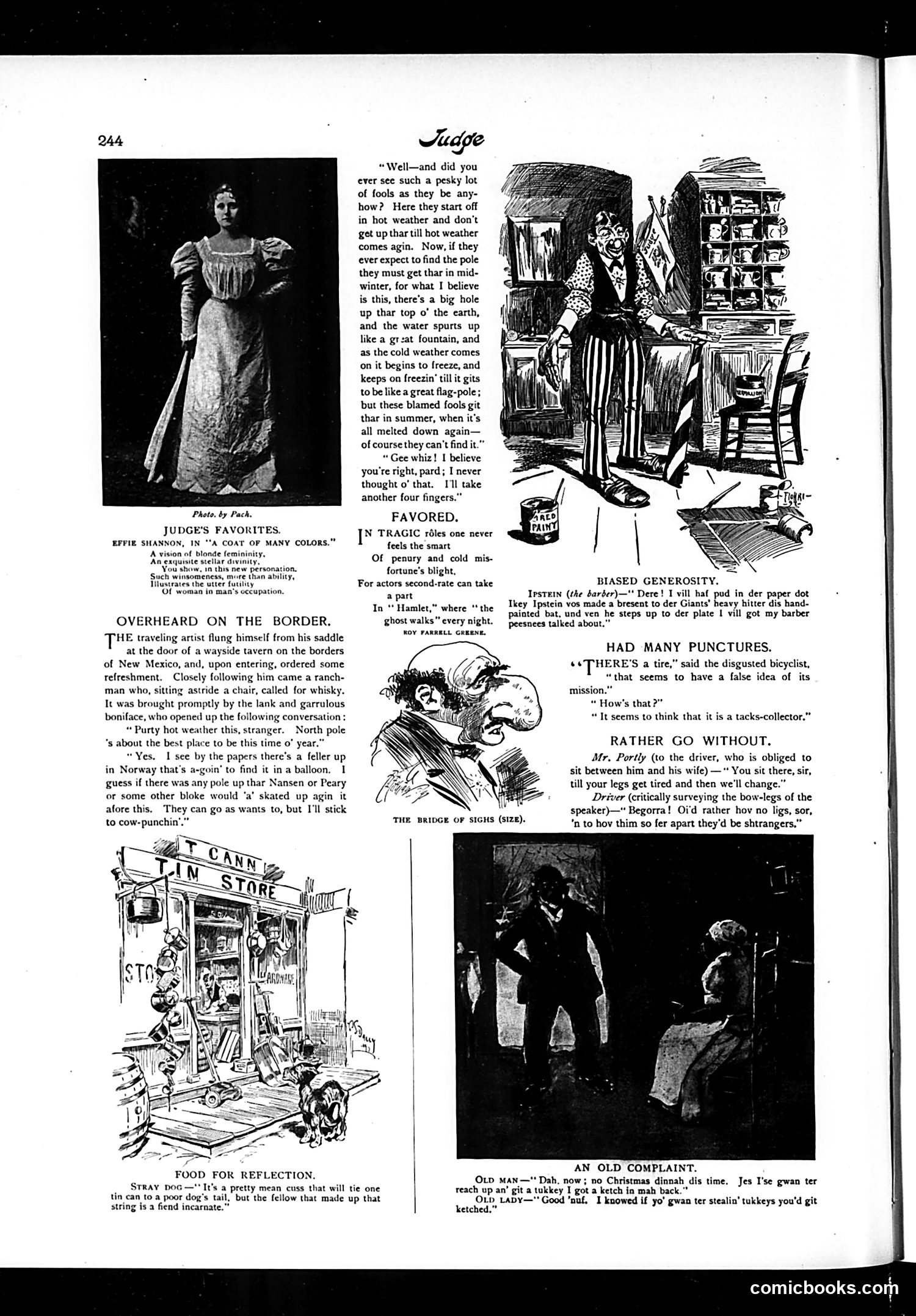
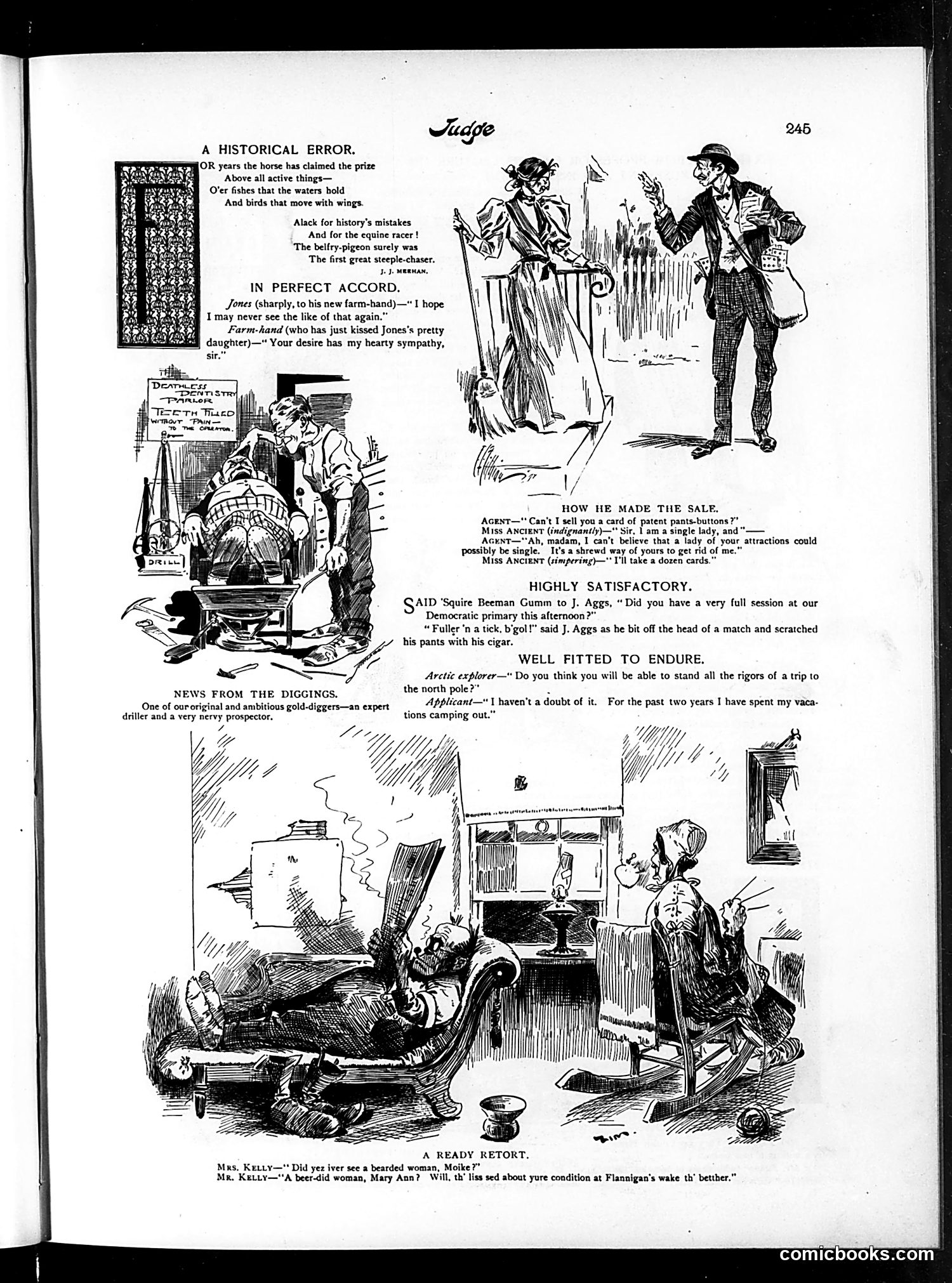
This page from Judge magazine contains several unrelated satirical pieces typical of late 19th-century American humor: **"Judge's Favorites"** is a complimentary notice about actress Effie Shannon in a theatrical production. **"Overheard on the Border"** satirizes Arctic exploration ambitions through a cowpuncher's absurd theory that the North Pole is a giant frozen fountain that only exists in winter—mocking both polar explorers' efforts and frontier ignorance. **Other sketches** include ethnic humor (Irish driver, Jewish barber, African American dialect) common to the era's comedy standards. "Biased Generosity" jokes about a barber seeking publicity through a gift to a baseball player. "Had Many Punctures" is a simple bicycle tire pun. **"Rather Go Without"** contrasts a portly passenger with a bowlegged driver in uncomfortable seating. The page reflects Judge's mix of theatrical promotion, frontier Americana, and broad ethnic/social satire typical of 1890s-era American magazines.
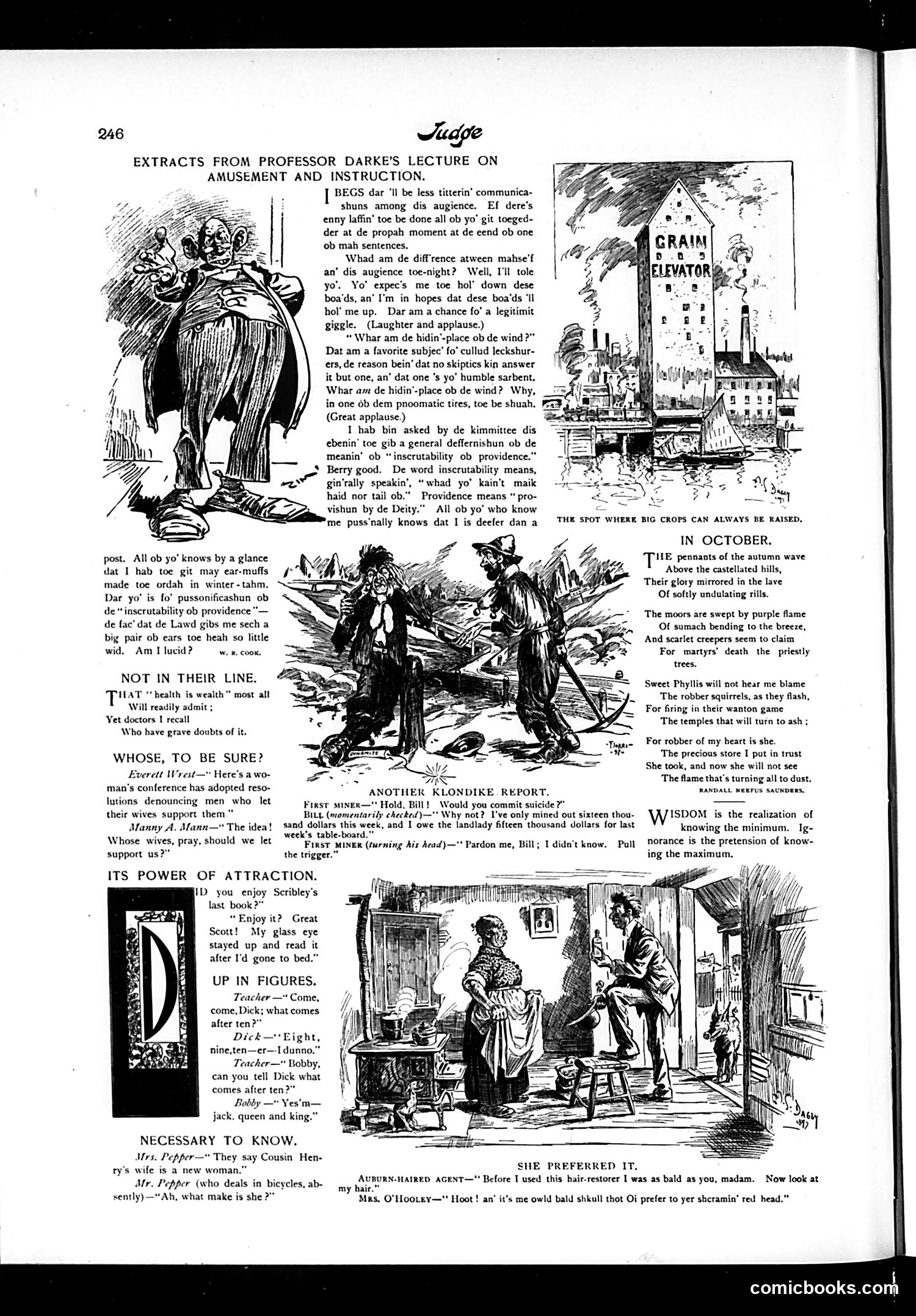
This page contains satirical humor typical of early 20th-century Judge magazine. The main content includes: **Professor Darke's Lecture:** A mock-educational piece using heavy dialect (apparently representing African American speech) where a professor makes absurd claims—like wind hiding in pneumatic tires—to an audience. The satire targets both pretentious lecturers and credulous audiences. **Various Jokes:** Including a doctor-health paradox, a woman's conference joke, a teacher/student math joke (where "Bobby" answers "ten" is followed by "jack, queen and king"—a card reference), and a bicycle dealer mishearing "new woman" as a bicycle brand. **Klondike Report:** Dark humor about a miner refusing suicide because his debts exceed his mining profits. **Poetry & Advertisements:** An autumn poem and a hair-restorer ad with an Irish-accented woman preferring baldness to the product. The page reflects period attitudes through dialect humor and gender jokes, typical of Judge's satirical approach to contemporary life and fads.
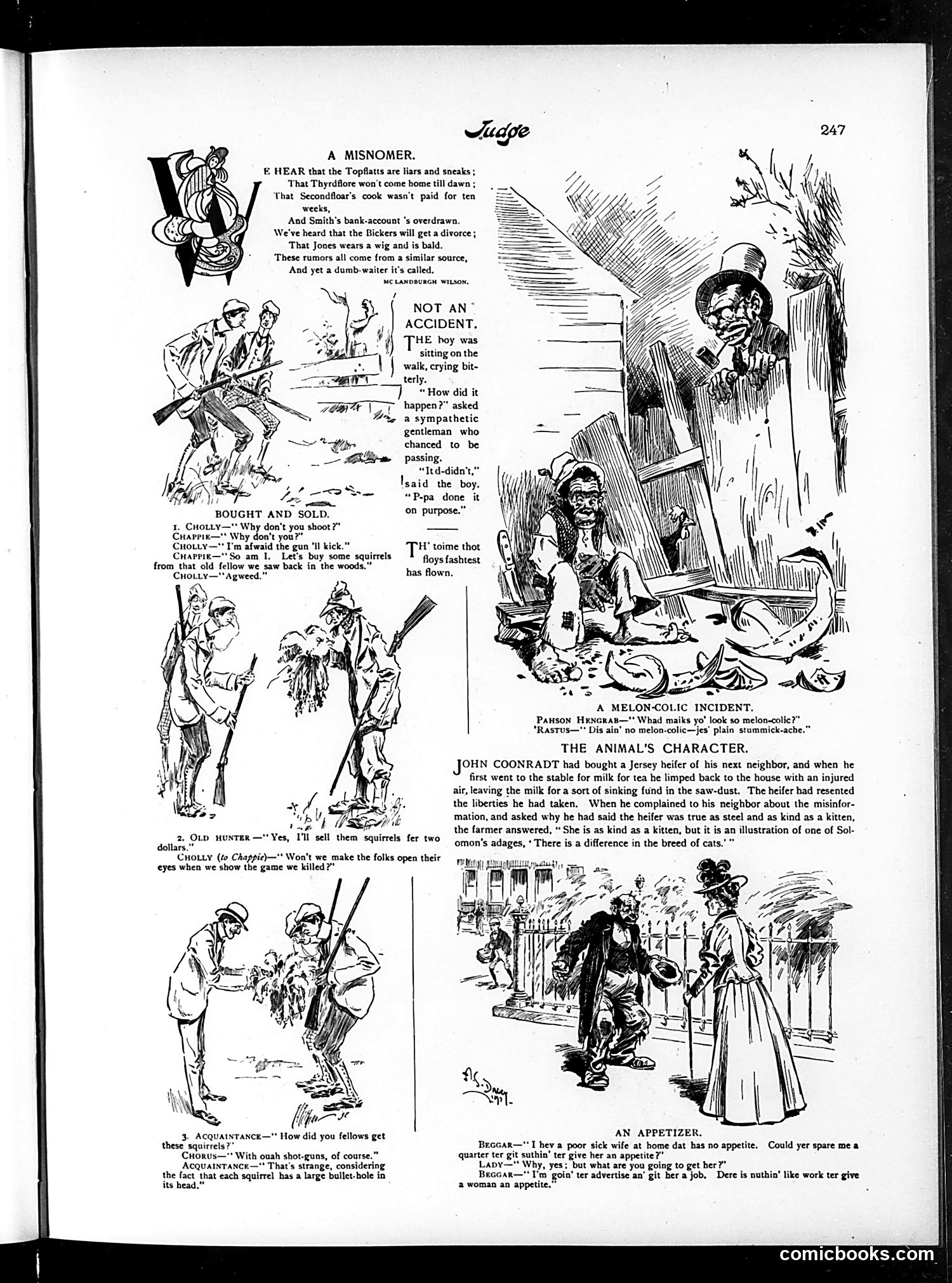
This page contains several brief satirical pieces typical of Judge magazine's format: **"A Misnomer"** mocks gossip spreading through apartment buildings via dumbwaiters (service elevators)—the joke being that servants' passages ironically enable the spread of rumors about their employers' scandals. **"Not an Accident"** presents dark humor: a boy admits he deliberately injured himself, inverting reader expectations of childish accidents. **"The Animal's Character"** uses a farmer's anecdote about a vicious Jersey cow to satirize social pretense—the neighbor lied about the animal's temperament, illustrating hypocrisy. **"A Melon-Colic Incident"** features racial dialect humor (common but offensive by modern standards), with a Black character distinguishing between different stomach ailments. **"An Appetizer"** uses class satire: a beggar seeking money for his wife's appetite cure suggests advertising her for employment—implying work's hardship kills appetite rather than stimulates it. The page reflects early 20th-century satire targeting domestic life, class relations, and social pretense.
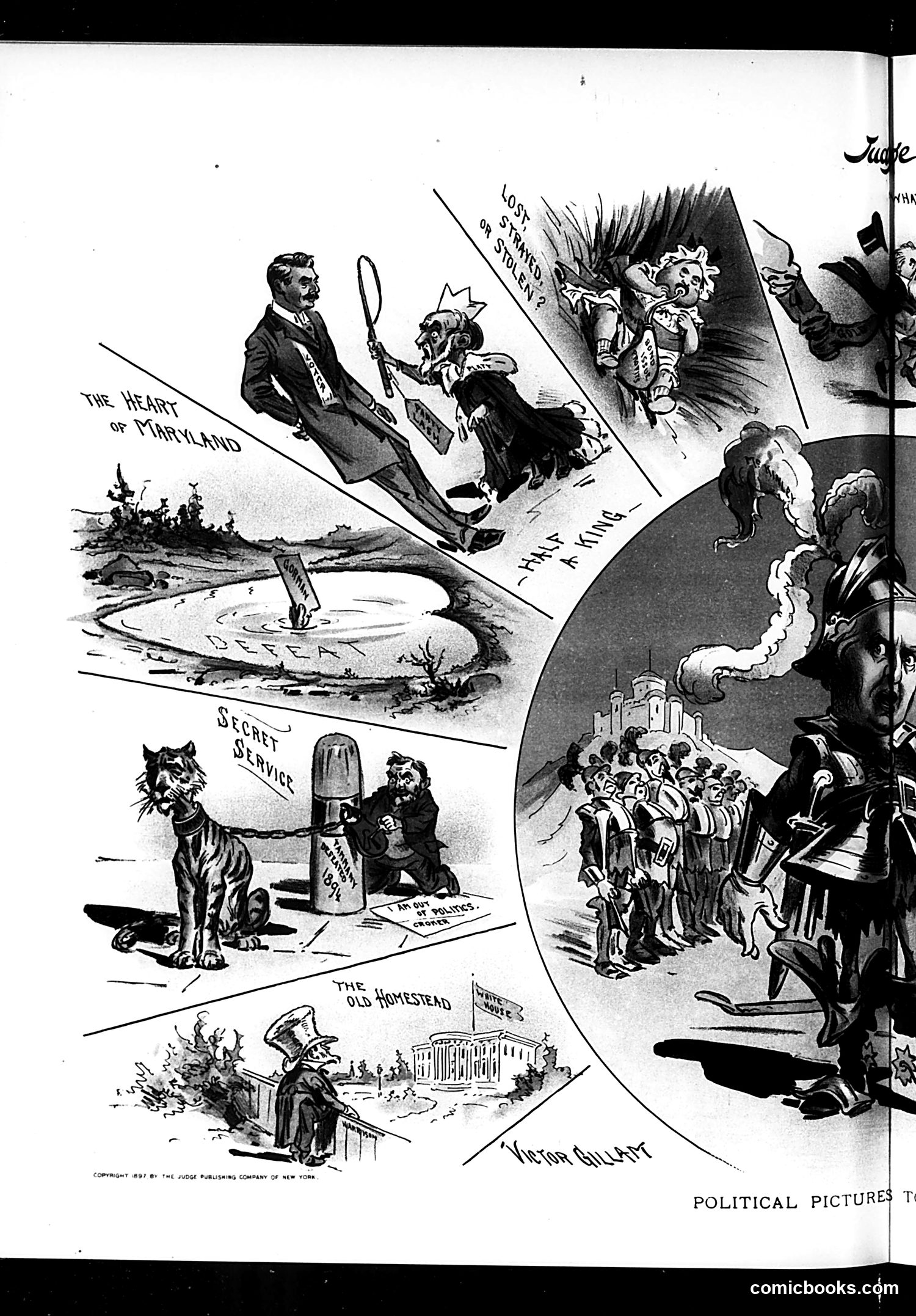
This page presents multiple satirical vignettes critiquing American political corruption and intrigue. "The Heart of Maryland" depicts a man fishing in what appears to be a political swamp, suggesting Maryland politics is murky. "Secret Service" shows a wolf—likely representing a political threat—alongside suspicious figures. "The Old Homestead" references a famous play, possibly to satirize nostalgia for simpler times versus current political dysfunction. The right panel depicts a crowd scene with authoritative figures, possibly commenting on political rallies or public manipulation. The overall theme appears to criticize political corruption, secrecy, and deception in American governance. Without clearer visible labels or dates, specific figures remain unclear, but the imagery emphasizes danger, deception, and moral decay in the political system.
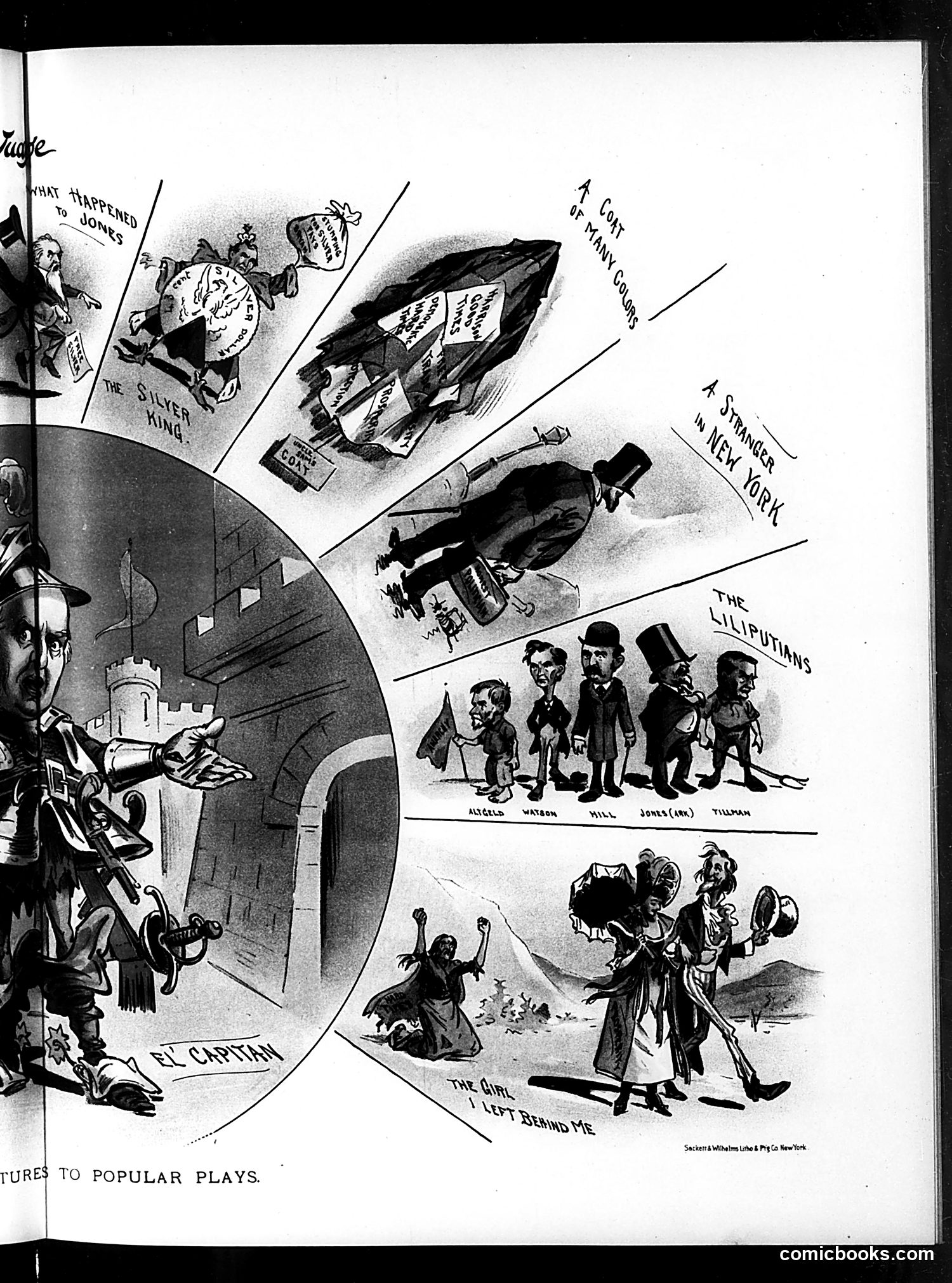
This appears to be a satirical cartoon about theatrical productions, showing a figure (labeled "Captain" on the left) as a kind of impresario or theatrical producer directing various "popular plays." The cartoon depicts several theatrical scenes radiating outward, including: - "What Happened to Jones" - "A Coat of Many Colors" - "A Stranger in New York" - "The Lilliputians" (shown as small figures) - "The Girl Left Behind Me" The satire appears to mock how a single theatrical producer or entrepreneur controls multiple successful productions simultaneously, or possibly critiques the commercialization of theater. The exaggerated, caricatured figures and the chaotic arrangement suggest mockery of Broadway's theatrical culture. The specific identities of named individuals and precise satirical targets remain unclear without additional historical context about Judge magazine's publication date.
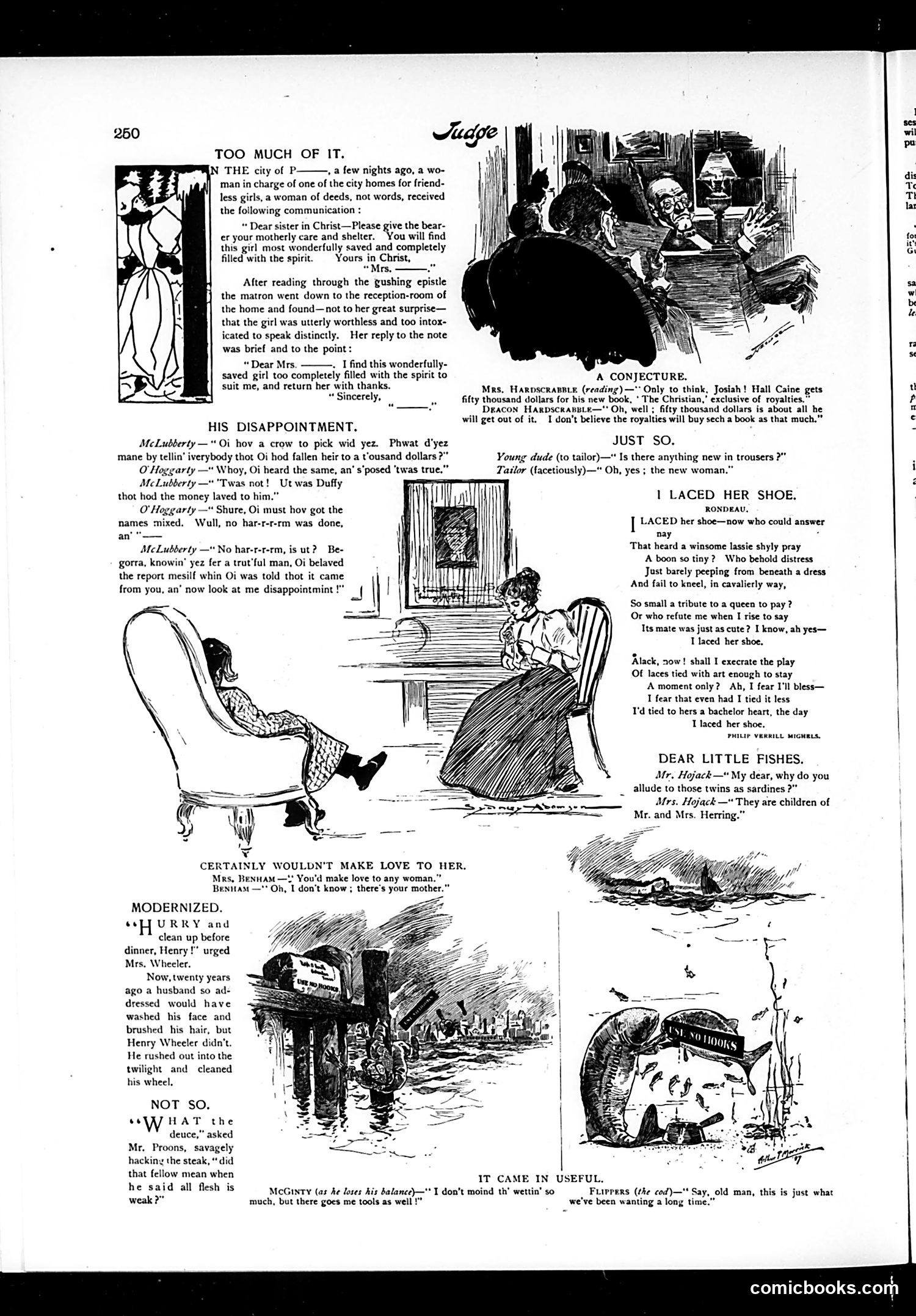
This page from the satirical magazine *Judge* contains several short humor pieces mocking social hypocrisy and everyday absurdities: **"Too Much of It"** satirizes religious pretense—a woman writing a letter in religious language ("filled with the spirit") sends a drunk, worthless girl to a charitable home. The matron's reply exposes the disconnect between pious words and actual character. **"His Disappointment"** features Irish characters (indicated by dialect) where one man spreads false gossip about another inheriting money, then expresses fake regret when corrected—mocking both gullibility and dishonesty. **"Modernized"** jokes that a husband now cares more about cleaning his bicycle than following his wife's dinner request—poking fun at how the bicycle craze supposedly distracted men from domestic duties. Other pieces include wordplay about tailors and "the new woman," puns on fish names, and marital banter. The overall tone targets social pretense, gender relations, and contemporary fads.
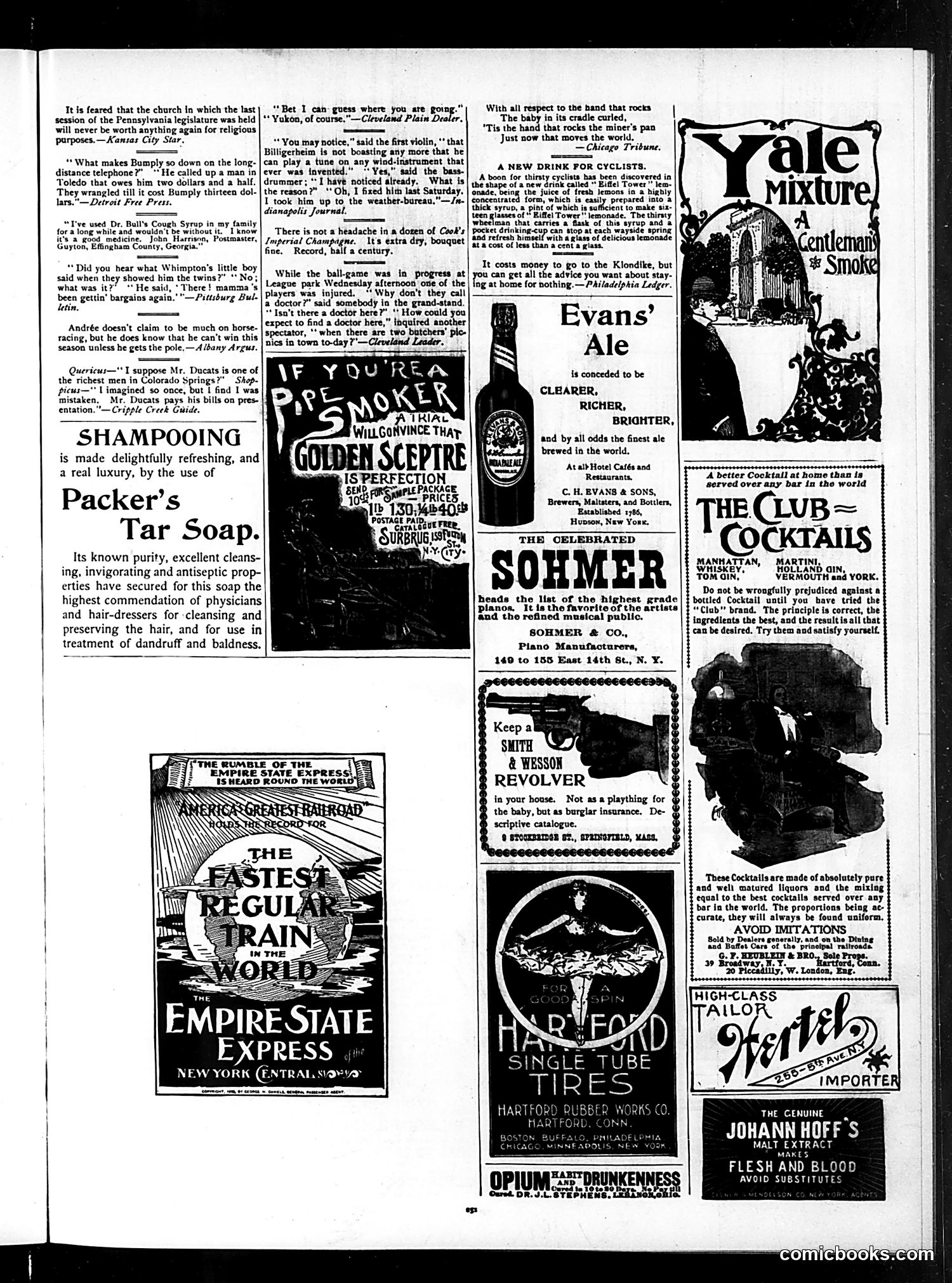
This page is primarily advertising, with brief humorous snippets interspersed. The jokes reference contemporary concerns: a Pennsylvania legislature's irreverent behavior in church, the high cost of long-distance telephone calls, and references to the Klondike Gold Rush (appearing in the Eiffel Tower lemonade ad context). One joke mocks the recent Andrée polar expedition attempt. The advertisements dominate—for ales, patent medicines, rail service (Empire State Express), and consumer goods. These ads reveal period preoccupations: dandruff treatments, revolver ownership for "burglar insurance," and "Opium for Drunkenness" (a patent medicine claiming to treat addiction). The page reflects early 1900s America: technological novelty (telephones), imperial ambitions, and unregulated medical claims now considered dangerous or absurd.
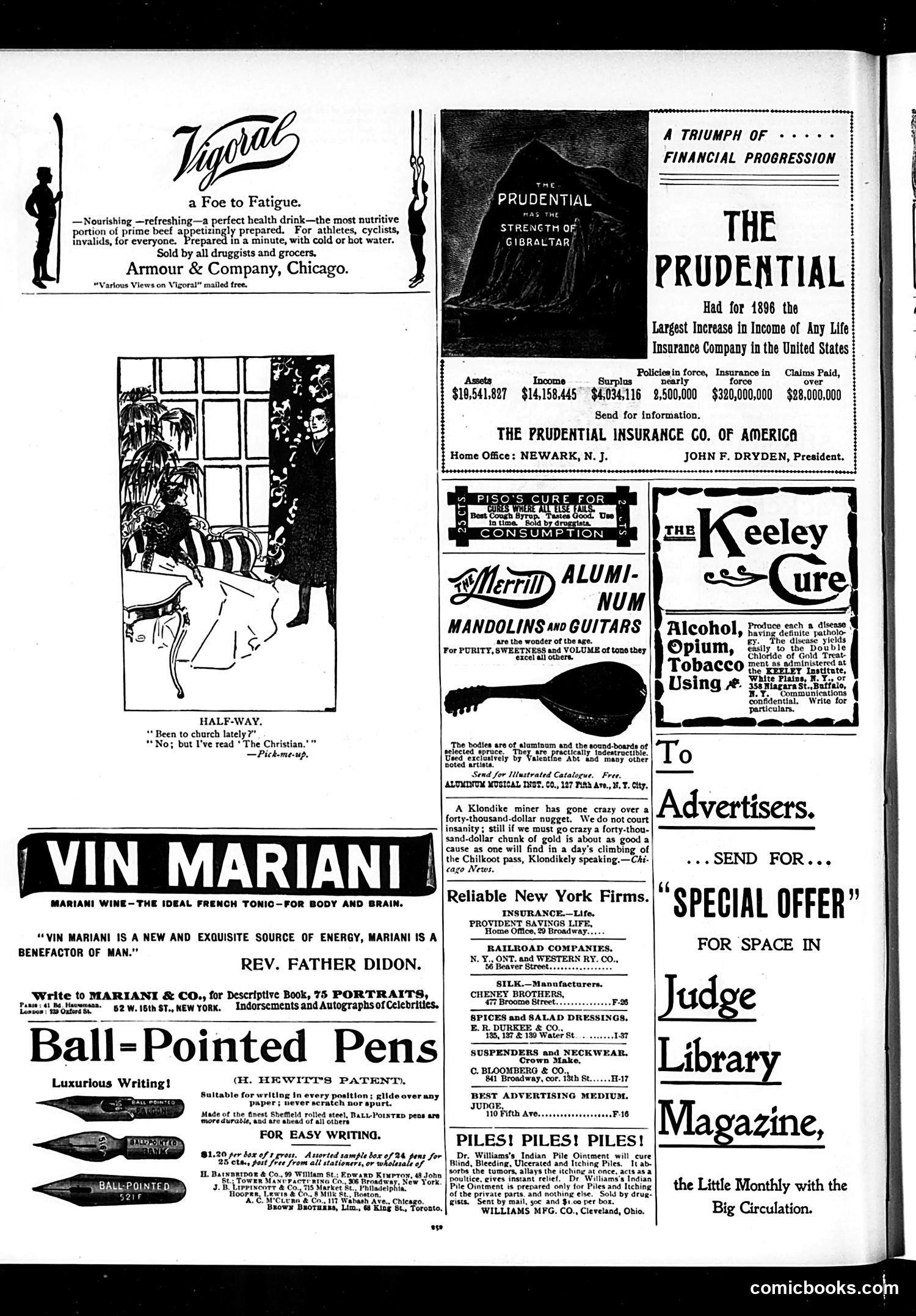
This is primarily an **advertising page** from Judge magazine (circa 1896), with one small cartoon and numerous product advertisements typical of the era. ## The Cartoon The only cartoon, titled "HALF-WAY," shows a man answering that he hasn't attended church lately but has read "The Christian"—a contemporary novel. The joke satirizes those who substitute **reading about Christian virtue for actually practicing it**, a common critique of Victorian hypocrisy. ## The Advertisements The page reflects 1890s consumer culture and medical misconceptions: - **Vigoral** and **Vin Mariani** wine promise energy and health—products that exploit fatigue and vague wellness claims - **Dr. Williams's Indian Pile Ointment** and "The Keeley Cure" (for alcohol/drug addiction) represent the era's patent medicines with dubious efficacy - **Ball-Pointed Pens** and musical instruments showcase technological novelties - A reference to **Klondike miners** reflects the 1890s gold rush craze These ads reveal an era before FDA regulation, when magazines freely promoted unproven remedies and dubious tonics to readers seeking modern solutions to everyday problems.
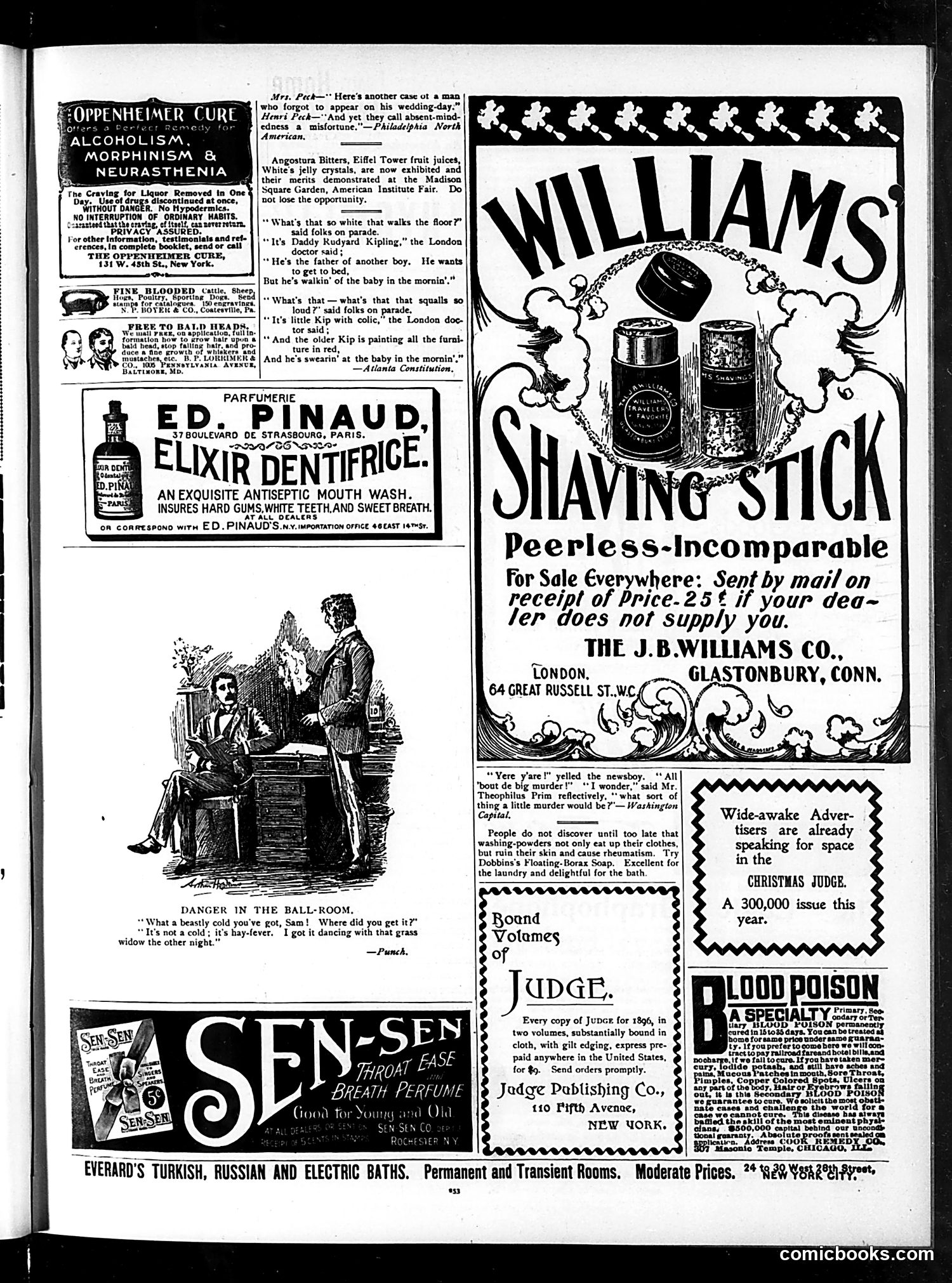
This page is primarily **advertisements and filler content** rather than political satire. The main elements: **"Mrs. Peck" Cartoon (top):** A domestic humor joke about a man who forgot his wedding day—playing on the period stereotype of absent-minded husbands and the commonplace marital anxieties of the era. **Rudyard Kipling References (center-right):** Satirical verses about the famous author's recent fatherhood, poking fun at his distraction and domestic chaos (painting furniture, baby crying). This references Kipling's real 1896 son, treating celebrity parenthood as comedic material. **"Danger in the Ball-Room" (lower left):** A brief joke about mistaking hay fever for a cold—"grass widow" being period slang for a woman of questionable reputation, making the humor depend on that dated reference. **Remainder:** Mostly medical quack ads (Oppenheimer Cure for alcoholism), toiletries, and Judge's own promotional content—typical of period magazine back pages. The satire here is mild and domestic rather than political.
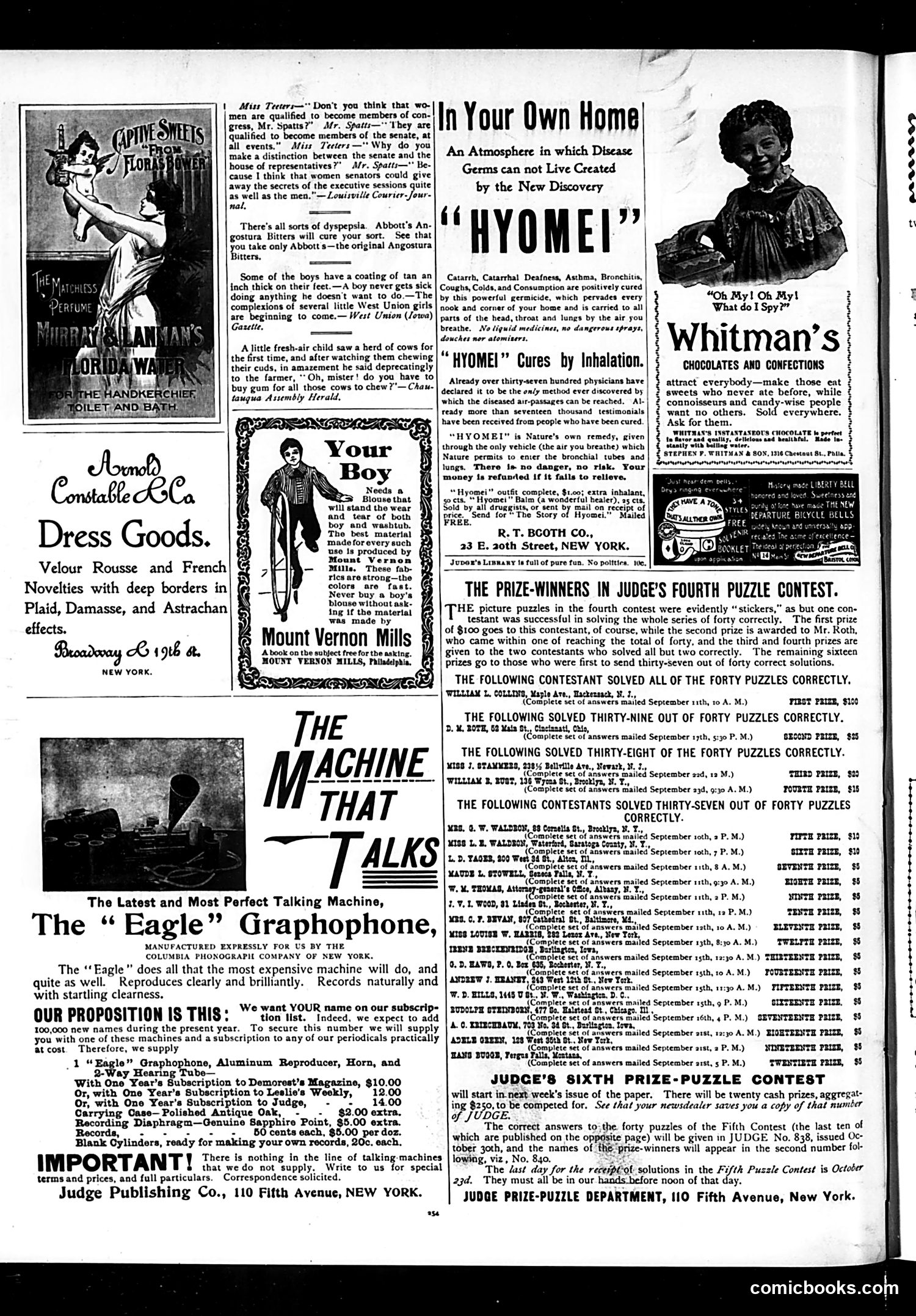
This Judge magazine page (appears to be early 1900s) contains mostly **advertisements and puzzle contests**, not political satire. The one notable cartoon is the brief dialogue at top-left: a woman (Miss Teeters) asks a man (Mr. Spatts) if women qualify for Congress. He backhands her by saying women qualify for the *Senate* instead—implying they're better suited to a less powerful chamber. She points out his illogic. **The joke's context**: This satirizes anti-suffrage arguments of the era. Men opposed women voting/holding office, but their reasons were often contradictory or condescending. By showing Spatts make an absurd, self-defeating argument, Judge mocks male resistance to women's political participation. The rest of the page features period medical product ads (like "HYOMEI" for respiratory diseases) and technology ads (Edison's phonograph), typical for early-1900s magazines. The puzzle contest was Judge's standard content.
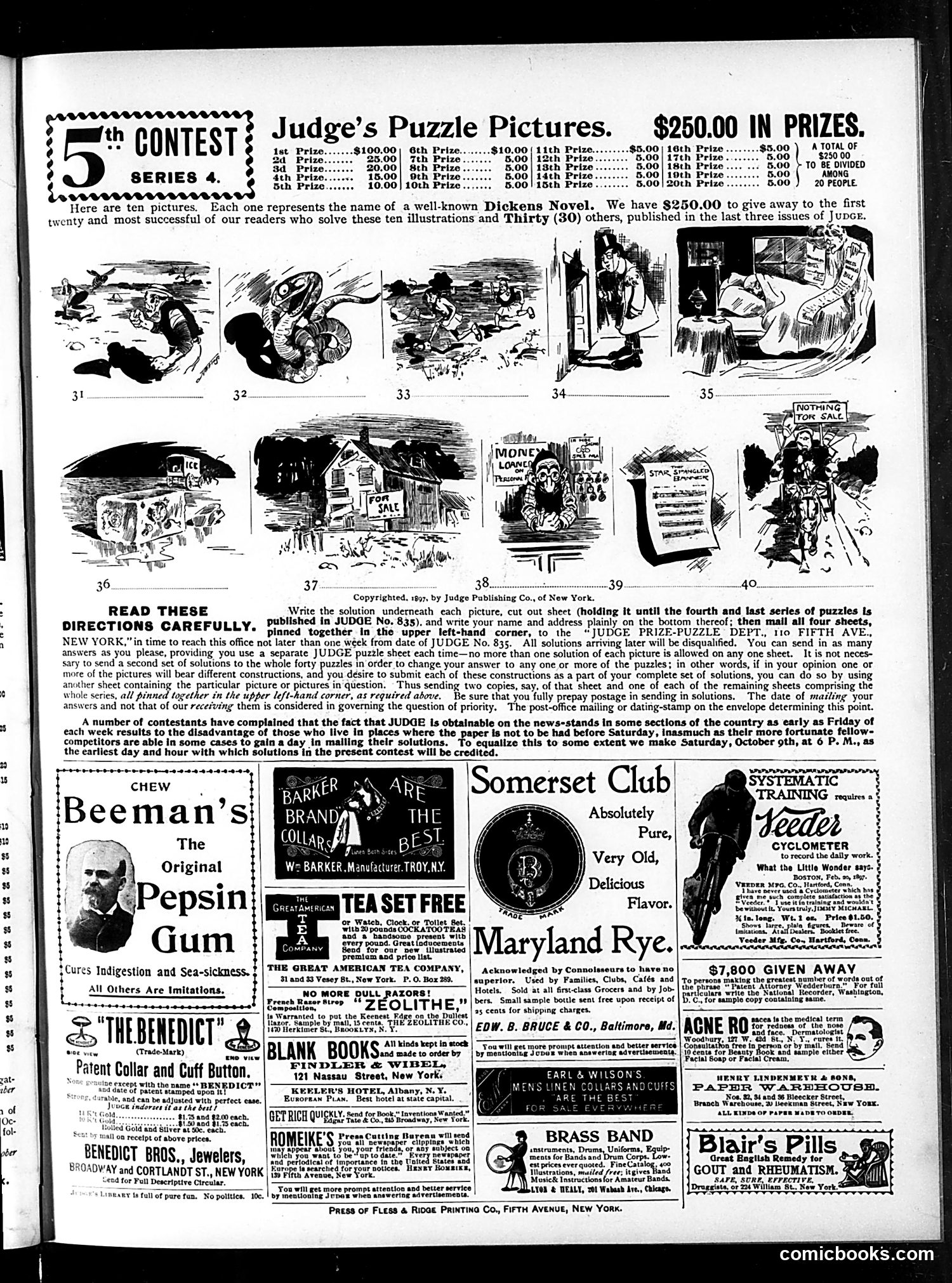
This page features a **puzzle contest** where readers must identify ten Dickens novels from illustrated sketches, competing for $250 in prizes. The contest spans four consecutive issues of Judge magazine, with 40 total puzzles to solve. The ten sketches shown (numbered 31-40) depict scenes from Dickens works—readers must identify which novel each represents. Winners are determined by who solves the most puzzles correctly; ties are broken by mailing date (postmarked by October 6th). The lower half contains **period advertisements** for products typical of the 1890s era: patent medicines (Pepsin Gum for "indigestion and sea-sickness"), collar buttons, tea sets, razors, blank books, biscuits, and a brass band instruction manual. These ads reflect consumer goods and patent remedies common to this era. The page is primarily functional—a contest entry mechanism and advertising vehicle—rather than satirical editorial content.
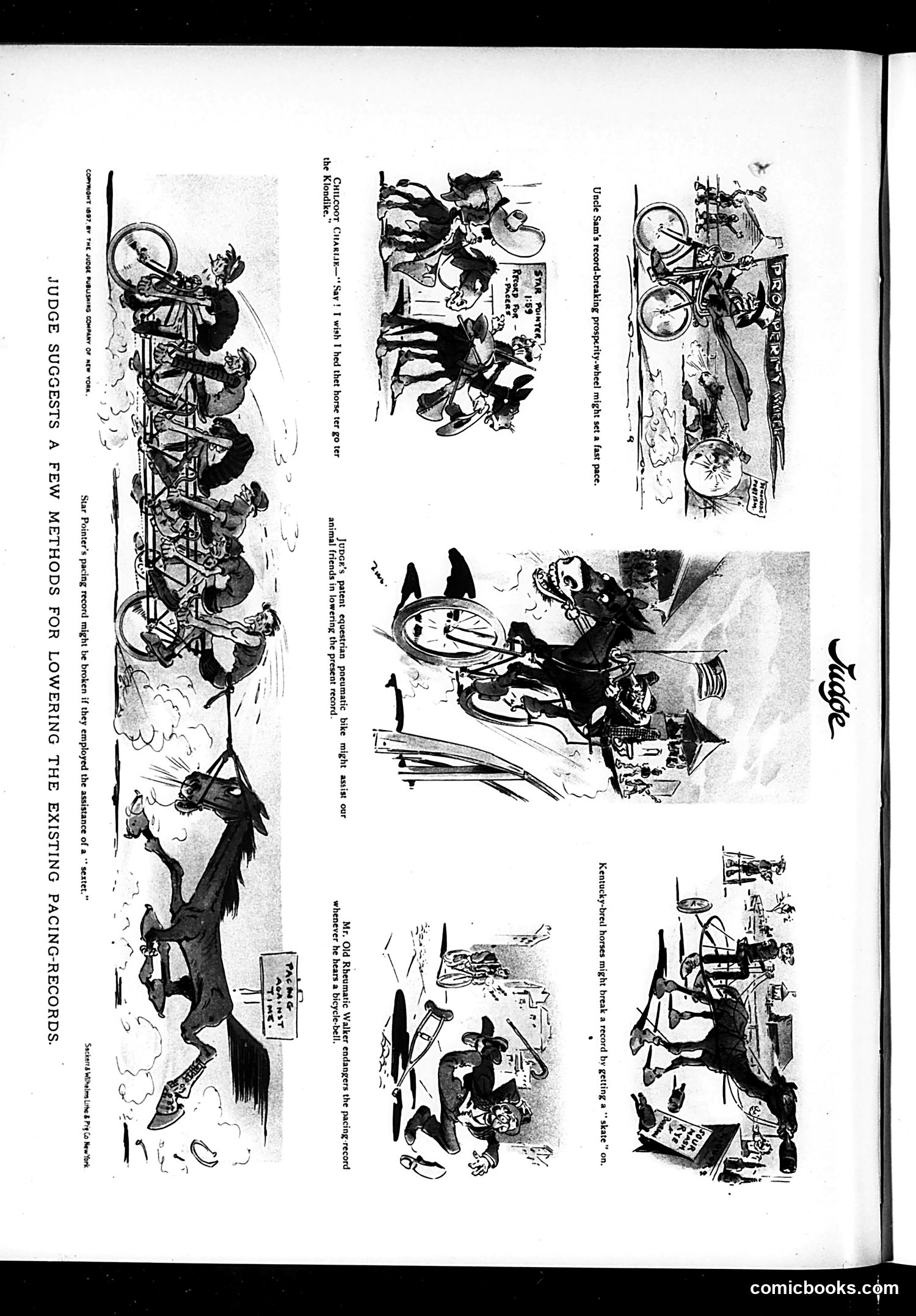
This page satirizes the obsession with breaking horse-pacing speed records in the 1890s. The headline "Judge Suggests A Few Methods for Lowering the Existing Pacing Records" introduces absurd, impractical solutions. The cartoons mock: 1. **Using a bicycle** to scare an old, rheumatic walker-horse into faster movement 2. **Hitching multiple wives** (a "sextet") to a racing horse, likely referencing contemporary marital/domestic comedy 3. Various other ridiculous mechanical or human-powered contraptions The satire targets both the era's obsession with speed records and the ridiculousness of proposed "improvements." References to "Star Pointer" (likely a famous pacer) and the "Klondike" (the 1890s gold rush) anchor this in its specific moment. The humor assumes readers followed horse-racing closely enough to recognize the absurdity of these "solutions" versus actual training methods.