
A complete issue · 16 pages · 1897
Judge — September 25, 1897
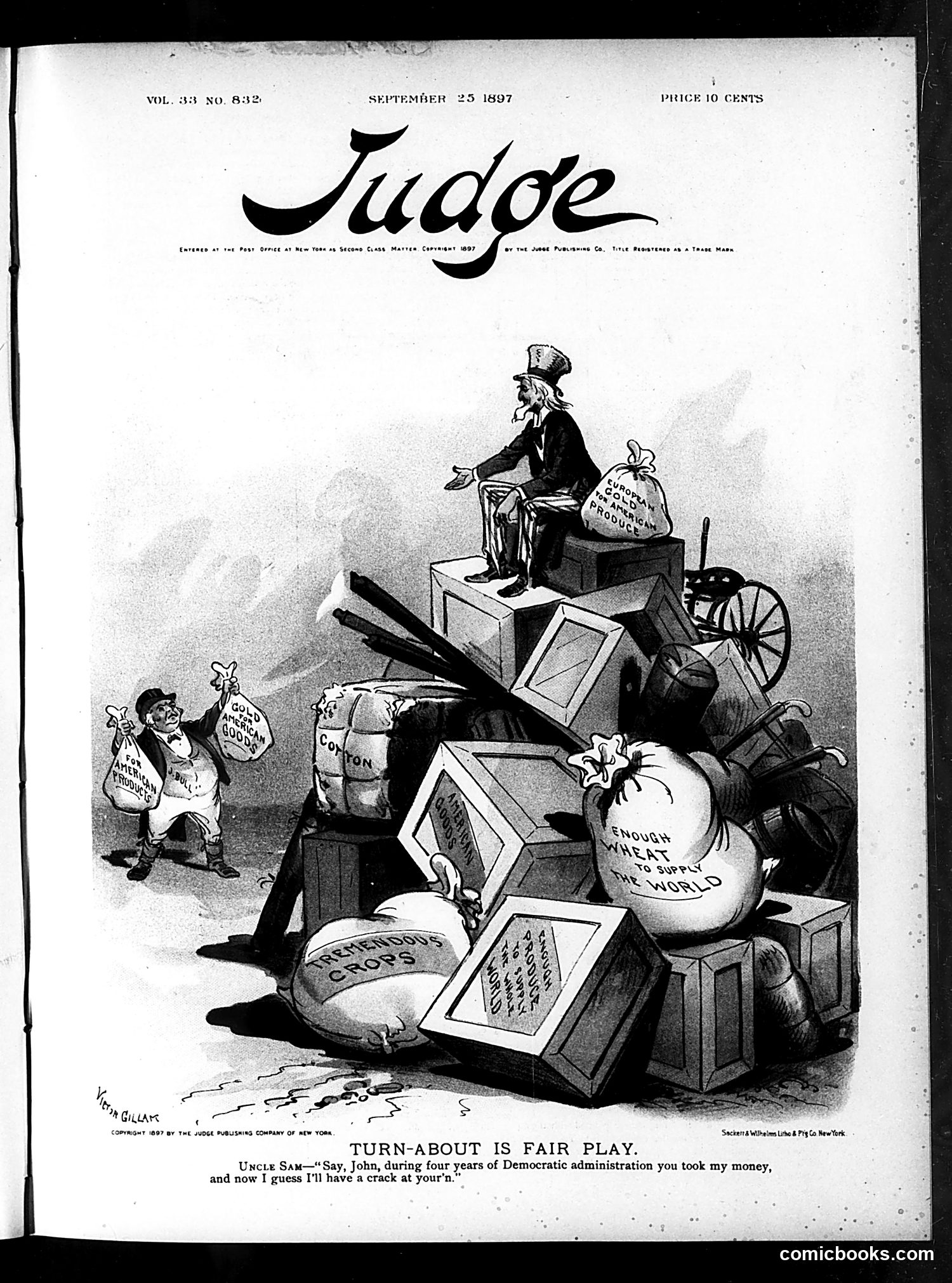
This political cartoon by Victor Gillam depicts Uncle Sam (the tall bearded figure atop the pile) confronting two smaller figures labeled with bags marked "Good Roads" and "Free Coinage" — likely references to Democratic Party policies from the 1890s. The cartoon satirizes the reversal of fortune: Uncle Sam, who previously benefited from Democratic administration spending, now faces criticism. His quote—"Say, John, during four years of Democratic administration you took my money, and now I guess I'll have a crack at yours"—suggests the incoming Republican administration will pursue its own agenda. The scattered boxes and debris represent the wreckage of Democratic policies, with the "turn-about" implying payback time for political opponents.
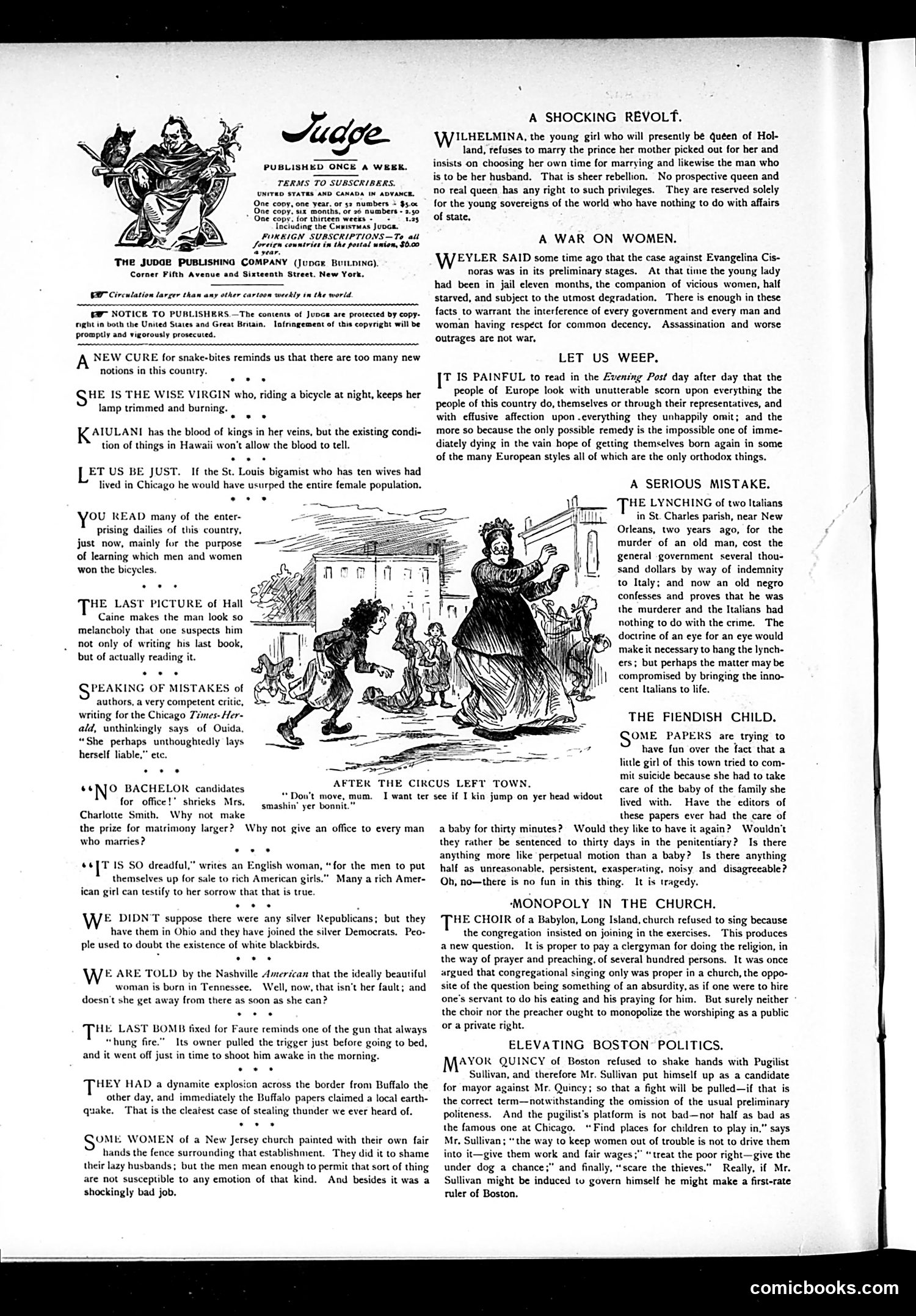
The page contains multiple satirical commentary pieces rather than a single cartoon. The main illustration depicts a chaotic street scene labeled "AFTER THE CIRCUS LEFT TOWN," showing what appears to be social disorder or mayhem. The text discusses various social and political issues: a "shocking revolt" involving a Dutch queen refusing an arranged marriage; criticism of women's treatment during a case involving Evangelina Cisneros (a Cuban woman jailed in Spain); lynching of Italians in New Orleans; and church choir monopoly disputes. The cartoons and commentary reflect late 1890s American concerns: women's autonomy, international incidents affecting foreign populations, racial violence, and institutional power struggles. The satire targets both specific events and broader social hypocrisy.
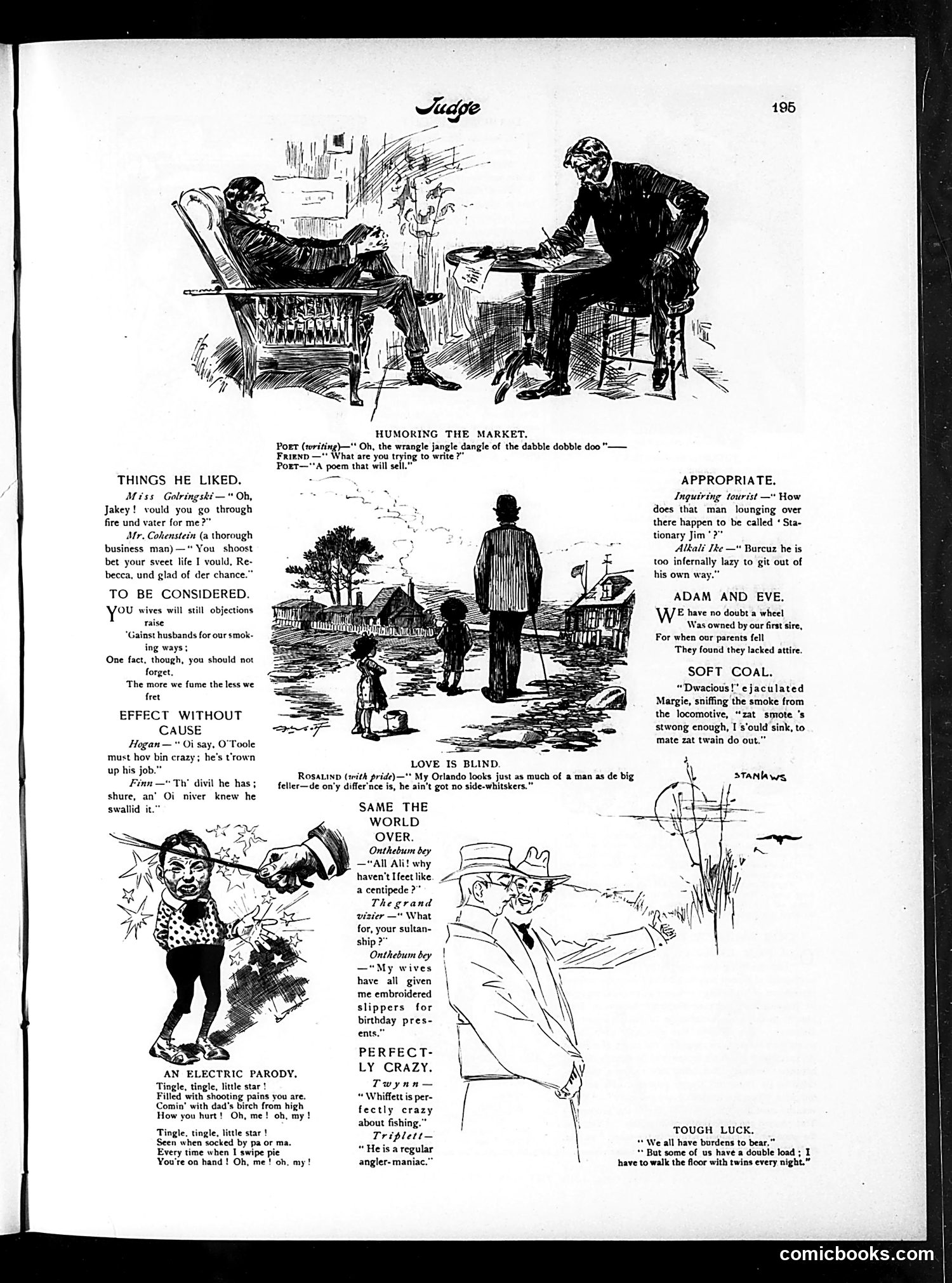
This page contains several unrelated satirical pieces and jokes typical of Judge magazine's format. The top cartoon "Humoring the Market" shows two men discussing writing, with one asking about "the jingle dangle of the dabble dobble doo"—a nonsensical phrase mocking pretentious literary writing. The remaining sections are brief jokes and quips on various topics: marital expectations ("Things He Liked"), proper behavior ("To Be Considered"), family inheritance, coal quality, blindness in love, and fishing obsessions. The bottom illustration "Tough Luck" depicts men fishing, likely satirizing the fishing enthusiast stereotype. Most humor relies on wordplay and domestic/social observations rather than political commentary. The page represents Judge's typical mix of light satirical commentary on everyday life and relationships.
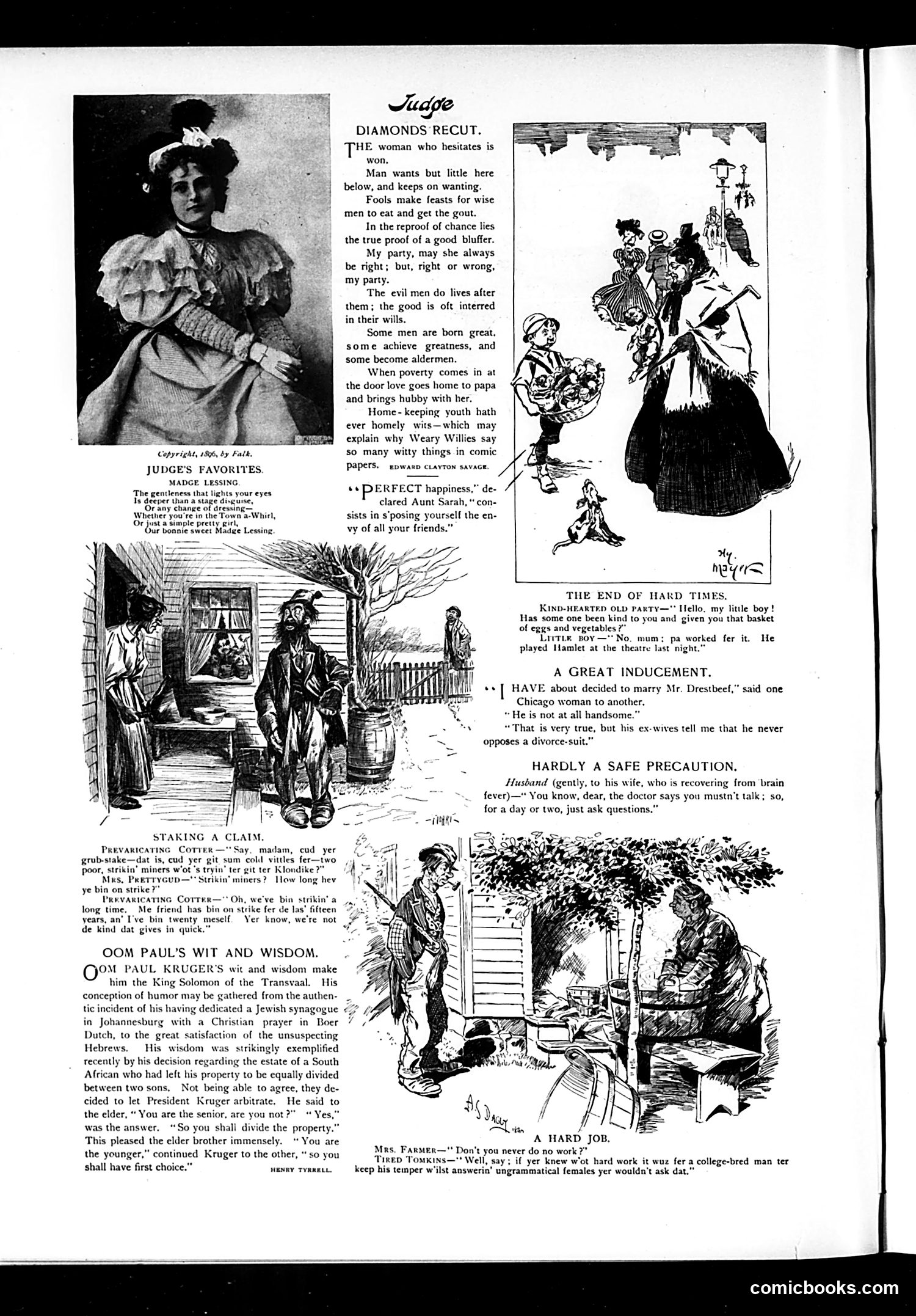
This page contains several short satirical pieces typical of Judge magazine's humor: **"Diamonds Recut"** presents mock-philosophical aphorisms parodying fortune-cookie wisdom and political rhetoric—particularly the phrase "my party, right or wrong," which satirizes blind partisan loyalty. **The illustrated vignettes** mock everyday social situations: a woman marrying for the practical reason that her ex-wives won't divorce him; a husband preventing his recovering wife from talking by requesting she only ask questions; and a farmer's son claiming his college education makes answering "ungrammatical" women's questions harder than real labor. **"Oom Paul's Wit and Wisdom"** ridicules Boer leader Paul Kruger through anecdotes about his purported wisdom—particularly his arbitration of an inheritance dispute, which is presented as absurdly biased rather than clever. **The "Hard Times" cartoon** jokes about poverty: a boy says his basket of food came from his father working (playing Hamlet at theater), not charity—suggesting theatrical work barely qualifies as legitimate employment. The overall tone mocks pretension, hypocrisy, and social absurdity of the era.
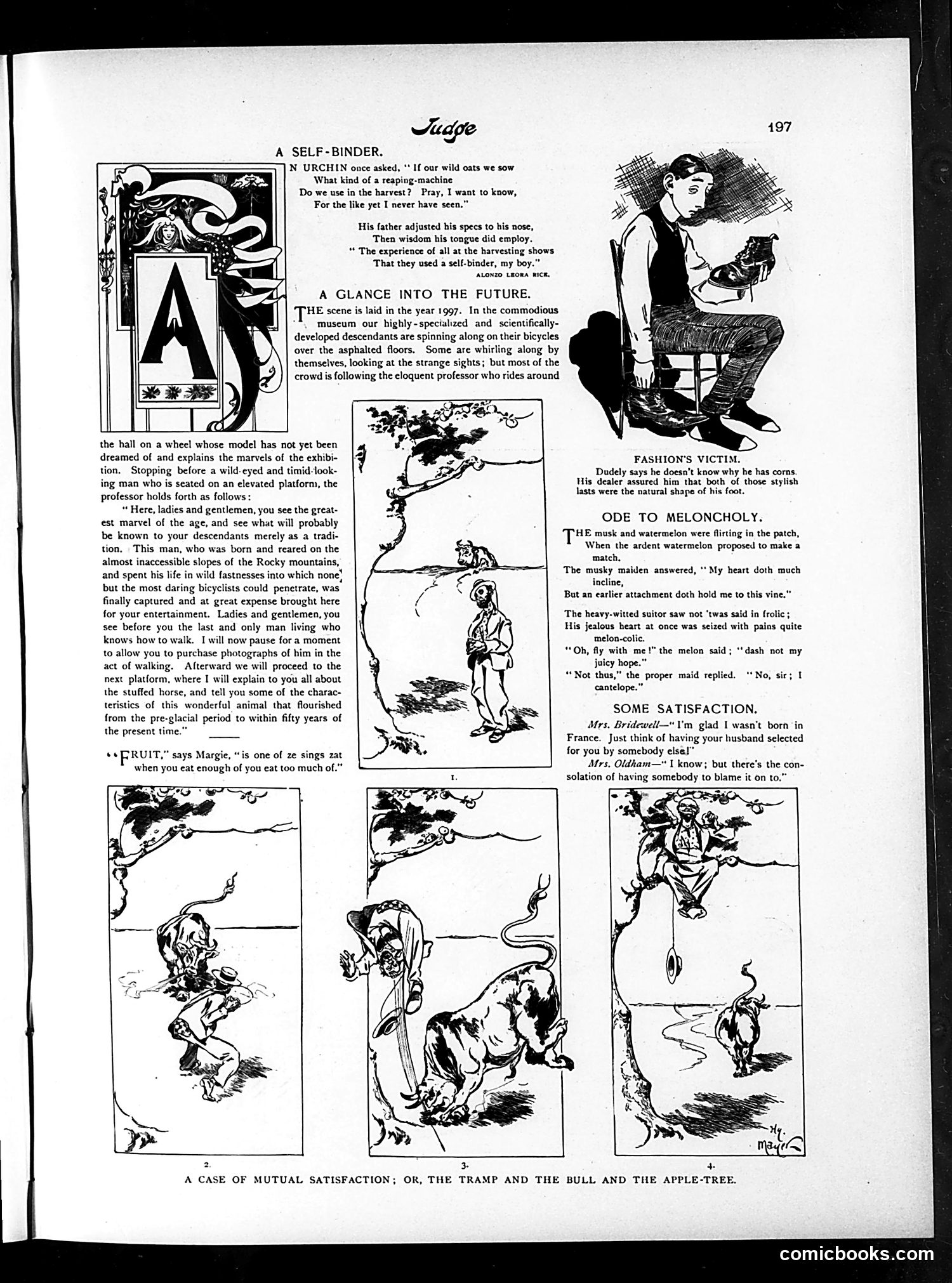
This page contains several satirical pieces reflecting late-19th-century concerns: **"A Glance into the Future"** imagines 1997 as a museum exhibit where a man from the Rocky Mountains—one of the last humans who can *walk*—is displayed as a curiosity. The satire mocks the bicycle craze then sweeping America, predicting that future generations will consider walking an obsolete, exotic skill. This reflects contemporary anxiety about rapid technological change replacing traditional human activities. **"Fashion's Victim"** jokes about fashionable shoe styles causing corns, suggesting satirical critique of women's (or men's) willingness to endure physical pain for style. **"Ode to Melancholy"** is a light pun-based verse treating a watermelon and muskmelon's romantic entanglement with wordplay ("melon-colic" instead of "melancholy"). **The bottom comic strip** appears to depict consequences of conflict between characters and animals, though details are unclear from the image quality. The page reflects Judge's characteristic blend of social satire, technological anxiety, and pun-based humor.
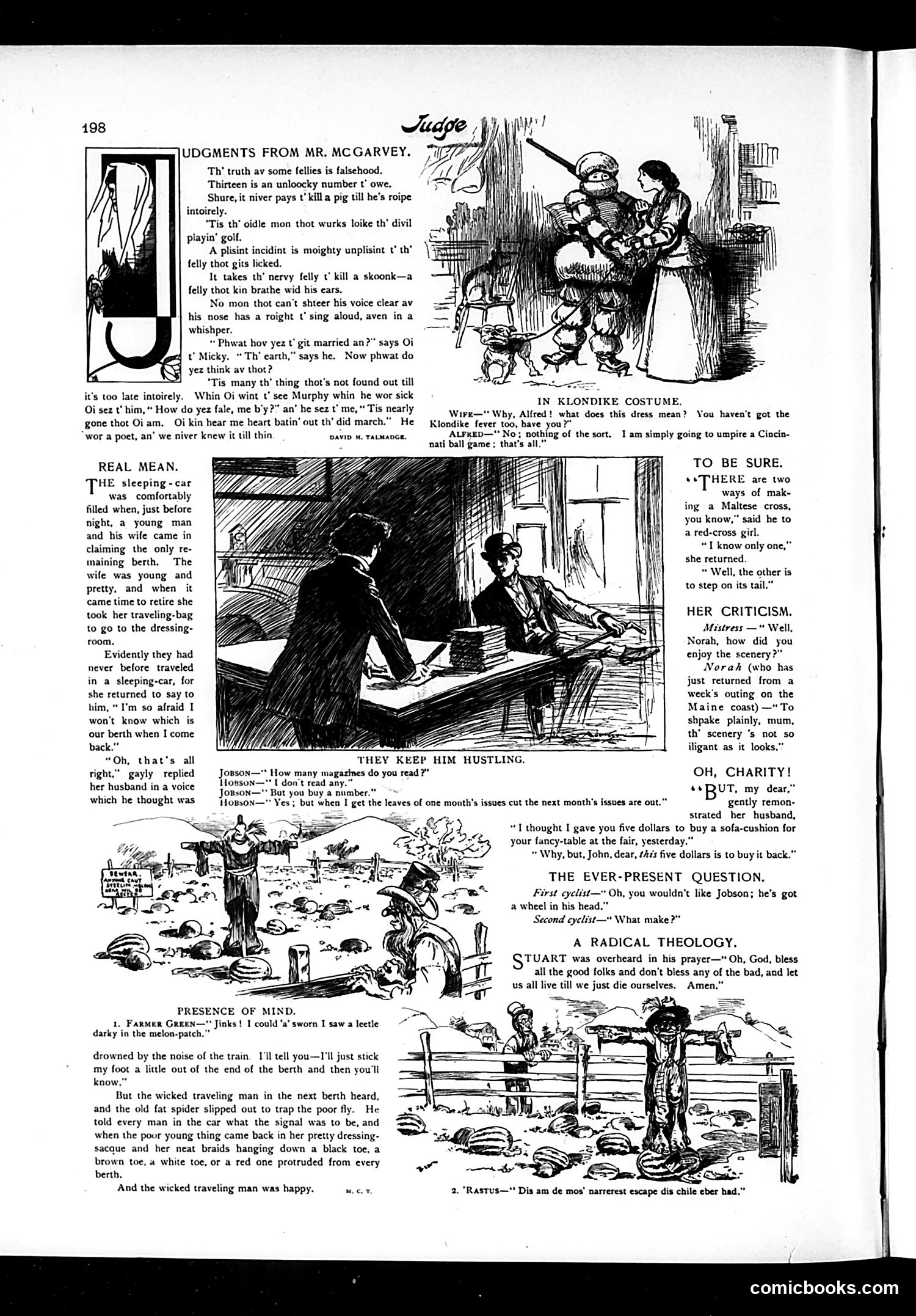
This page from *Judge* magazine contains multiple short humorous sketches typical of early 20th-century American satire: **"Judgments from Mr. McGarvey"** features Irish-dialect aphorisms mocking folk wisdom and human foibles—likely caricaturing Irish-American stereotypes common in the era. **The sleeping-car anecdote** satirizes naive newlyweds and predatory "traveling men" (salesmen), a stock character type. The joke plays on sexual innuendo: the innocent wife's signal system becomes a trap when other men learn it. **"Klondike Costume"** references the 1890s Klondike Gold Rush, mocking how fashion trends exploited historical events. **Other sketches** humorously address marriage, charity fundraising, magazine consumption, and religious hypocrisy—all reflecting period social concerns. The illustrations use exaggerated line-work typical of the era. Overall, the page reflects *Judge's* satirical approach: targeting middle-class pretensions, ethnic stereotypes, and contemporary social trends through brief, punchy humor.
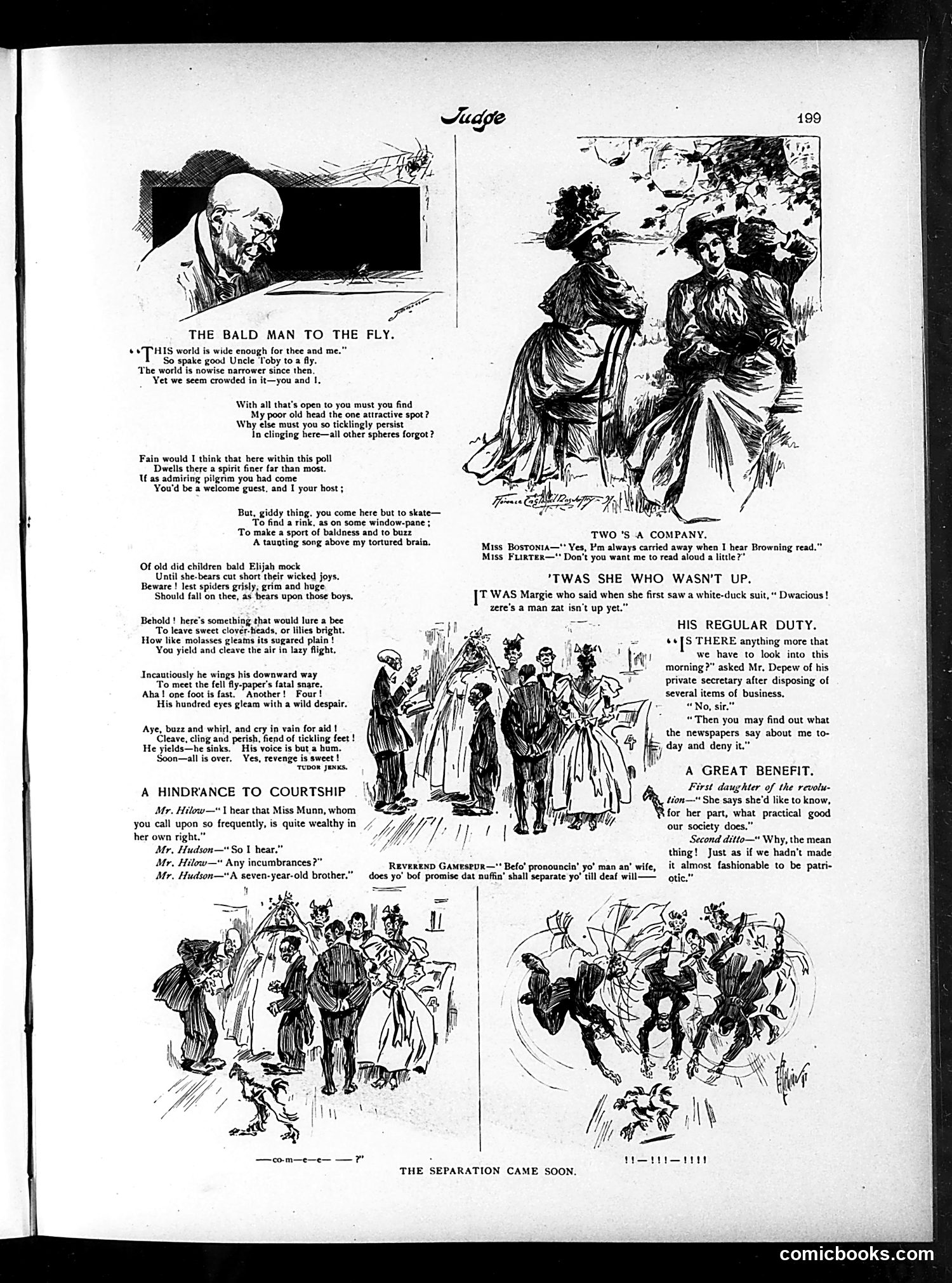
This page contains multiple satirical cartoons and comic pieces typical of early 20th-century American humor: **"The Bald Man to the Fly"** is a lengthy poetic monologue mocking a bald man's frustration with a persistent fly landing on his head. It's pure absurdist humor—the bald head serves as the joke's target, with references to Biblical precedent (Elijah being mocked by children, then avenged by bears). **"Two's a Company"** satirizes pretentious literary culture, where one woman claims to be "carried away" by Browning readings, only to have another woman offer to read aloud—implying the first woman finds the second's company unwelcome. **"A Hindrance to Courtship"** jokes that a wealthy woman's seven-year-old brother constitutes a marital obstacle. **"His Regular Duty"** mocks politician Mr. Depew's routine: after handling business, his secretary's job is simply to read negative newspaper coverage and "deny it"—satirizing political spin. **"A Great Benefit"** ridicules women's patriotic societies as merely making patriotism "fashionable" rather than providing practical social good. The humor relies on wordplay, physical comedy, and social commentary typical of Edwardian-era satire.
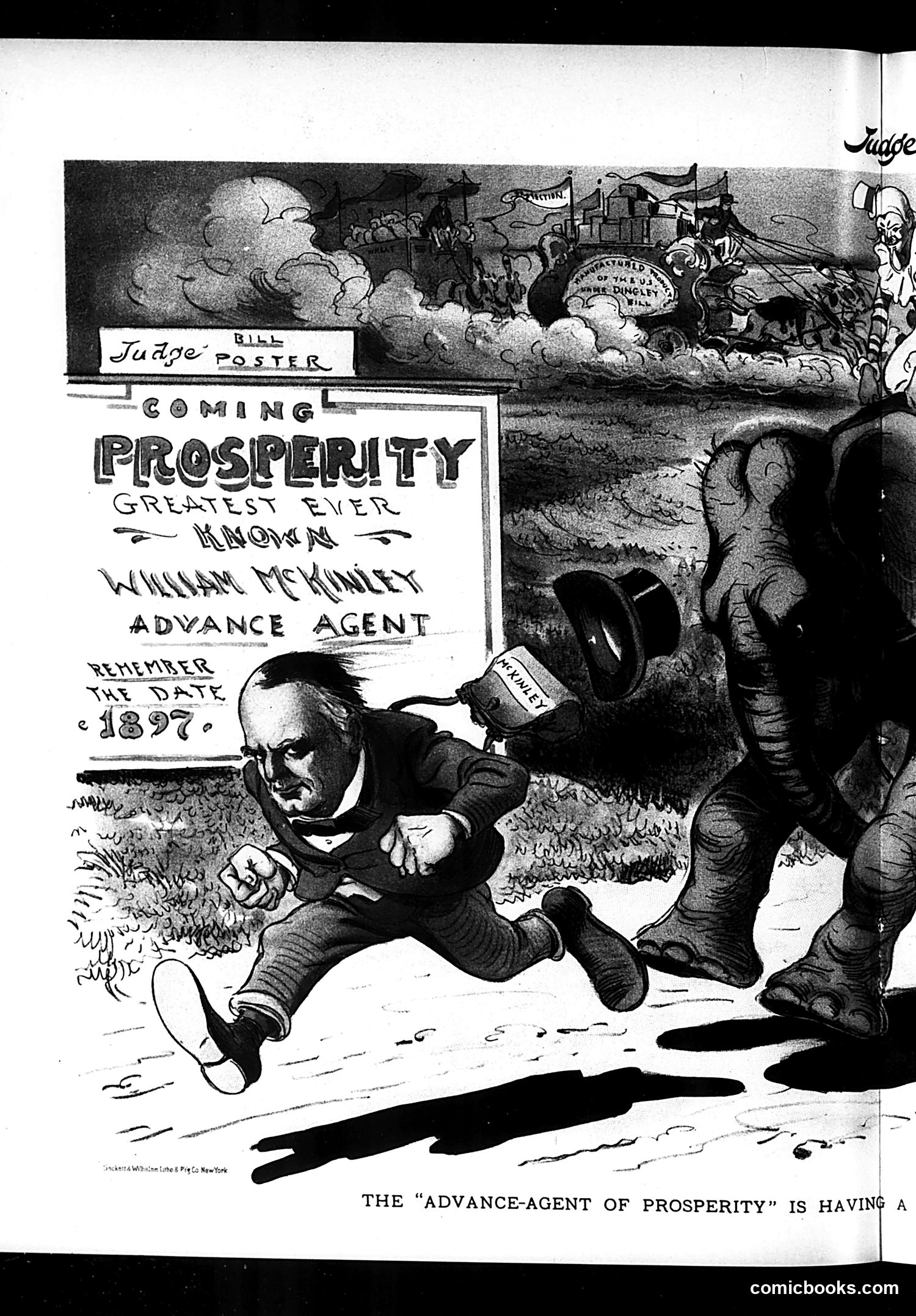
This Judge magazine cartoon satirizes William McKinley's 1897 claim that prosperity was coming to America under his presidency. The cartoon depicts McKinley (identifiable by the label "William McKinley Advance Agent") as a small man being violently kicked or trampled by a large figure—likely representing economic hardship or unemployment. The satire mocks McKinley's optimistic rhetoric about "coming prosperity" by visually showing the opposite: the advance agent of prosperity is himself being brutally attacked. The "Remember 1897" notation suggests this references McKinley's early presidency during ongoing economic difficulties from the 1890s depression. The cartoon criticizes the gap between McKinley's political promises and actual working-class economic conditions.
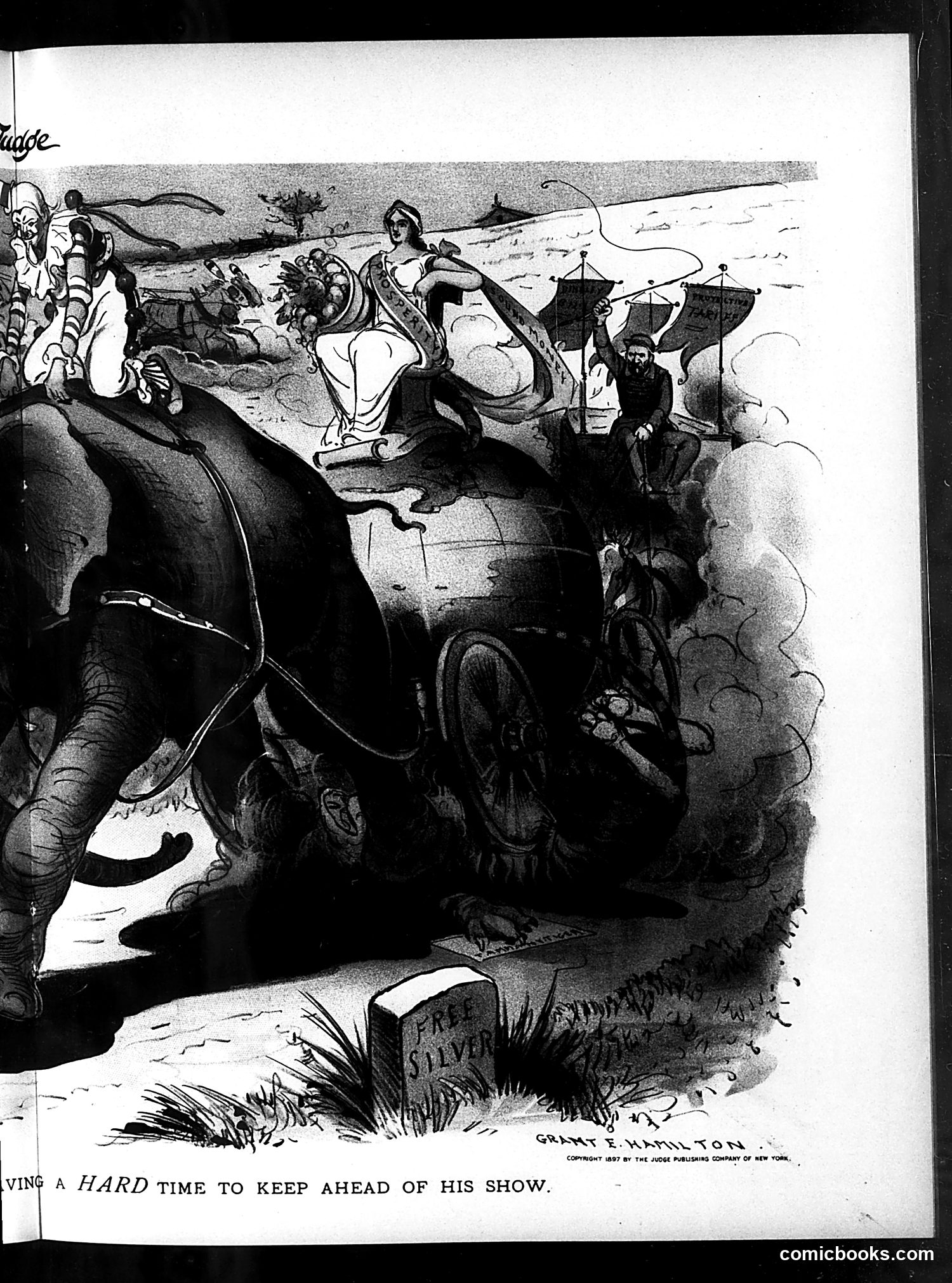
This 1897 Judge cartoon depicts a circus or theatrical showman struggling to manage his elaborate production. The title "Having a Hard Time to Keep Ahead of His Show" suggests the central figure (likely a specific public figure or politician, though not clearly identified in the visible text) is overwhelmed by the spectacle he's created. The imagery shows an elephant, ornate circus wagons, performers, and various theatrical elements spiraling somewhat chaotically. The cartoon satirizes how a person in power has lost control of events they initiated—their own "show" has become unmanageable. This appears to reference political or business mismanagement, though the specific target remains unclear from the visible text. The gravestone visible in the lower left suggests consequences or failure.
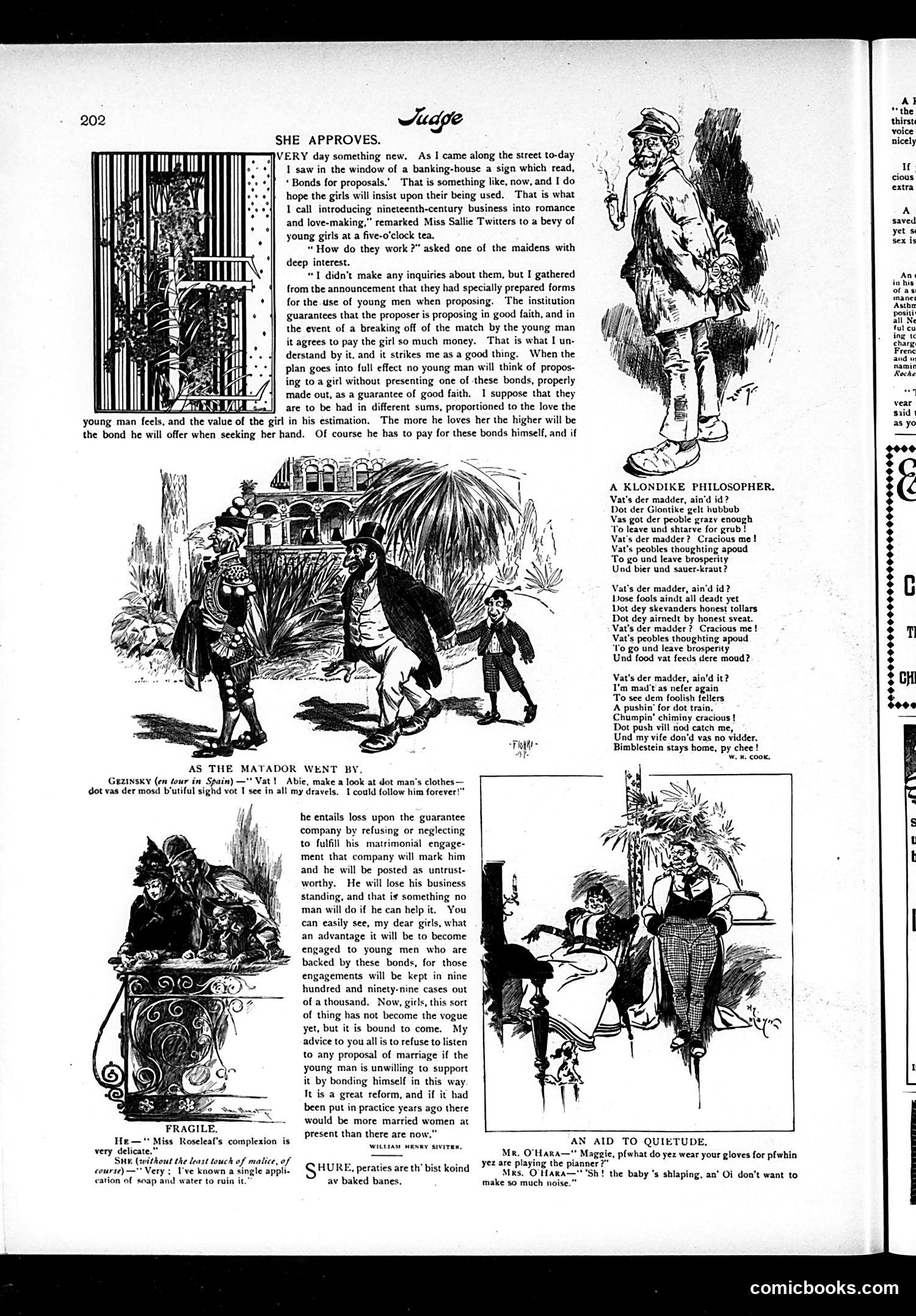
This page contains three distinct satirical pieces: **"She Approves"** mocks the emerging concept of "proposal bonds"—financial instruments that would guarantee a young man's good faith in marriage proposals. The satire criticizes the commercialization of romance, portraying a society woman explaining how these bonds would financially penalize men who break engagements. The joke is that love has become a financial transaction, requiring collateral. **"As the Matador Went By"** features Gezinsky, a Jewish immigrant character (indicated by the Yiddish accent), expressing admiration for a bullfighter. This is ethnic humor typical of the era. **"A Klondike Philosopher"** satirizes the Klondike Gold Rush (1890s) through another immigrant character bewildered by people abandoning stable prosperity to chase gold. The broken English and rhetorical questions mock both the character and the rush mentality itself. The remaining small items are brief jokes unrelated to larger themes.
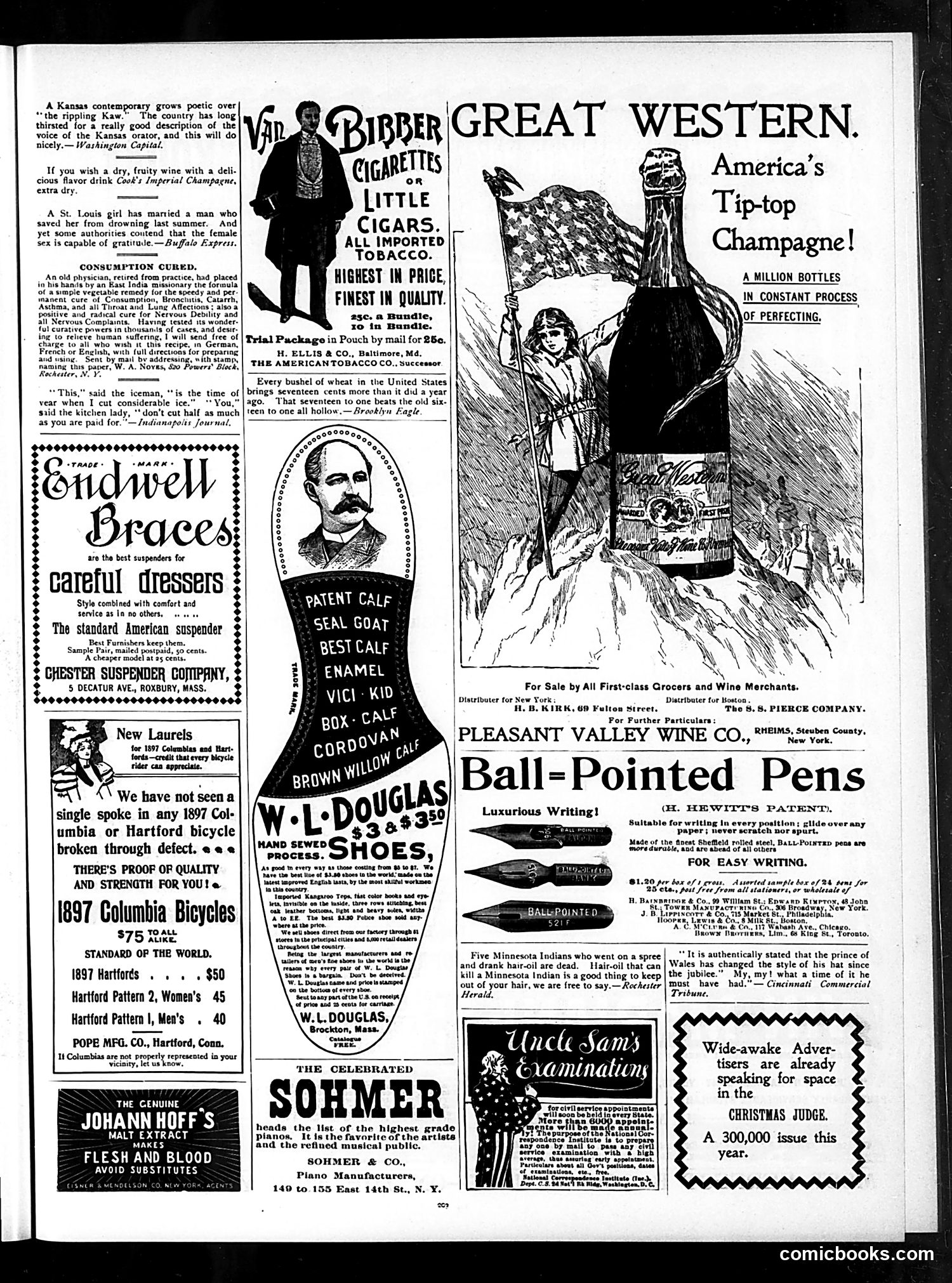
This is primarily an **advertising page** from Judge magazine (circa 1897, based on bicycle and product references). Rather than political cartoons, the page contains commercial advertisements interspersed with short humorous quips typical of the era. The brief satirical items include: - A joke about a Kansas newspaper's poetic description of "the rippling Kaw" (river), sarcastically comparing it to how Kansas orators sound - A quip about a St. Louis girl marrying her rescuer, mocking the idea that women are capable of gratitude - A kitchen lady joke about someone who thinks they're important but isn't worth what they're paid The **ads reflect 1890s consumer culture**: bicycles (Columbia, Hartford—major manufacturers), W.L. Douglas shoes, suspenders, champagne, cigarettes, and pens. The champagne ad features an illustration of a bottle on a cliff. No identifiable political figures or events are depicted. This is essentially a **commercial page with throwaway humor**, not satirical political commentary.
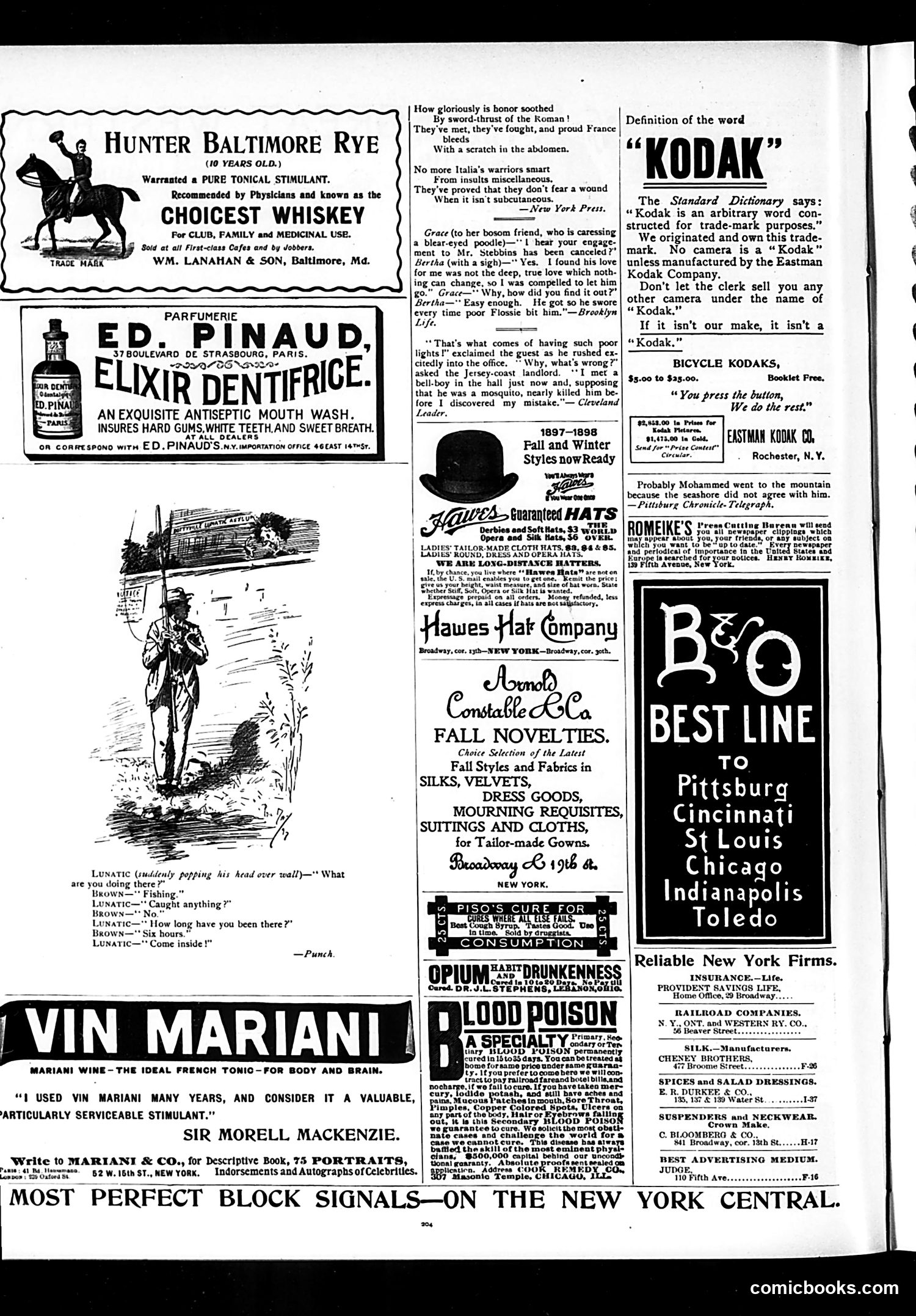
This is primarily an **advertising page** from Judge magazine (circa 1897-1898), with minimal cartoon content. The one notable cartoon depicts a conversation between a "Lunatic" and a man named "Brown" who is fishing by a wall. The lunatic asks what Brown is doing; Brown replies he's fishing. The joke plays on the lunatic's illogical thinking—asking "How long have you been there?" then responding "Six hours," followed by "Come inside!" This appears to be a **"fool and madman" joke** common in the era, where absurdist logic creates humor. The page is dominated by **period product advertisements**: whiskey, dental products, hats, wine tonics, pharmaceuticals, and railroad services. Notably, the **Kodak advertisement** includes a corporate statement defending their trademark against generic use—early trademark defense language. The page reflects late-Victorian consumer culture and emerging brand identity protection in the late 1890s.
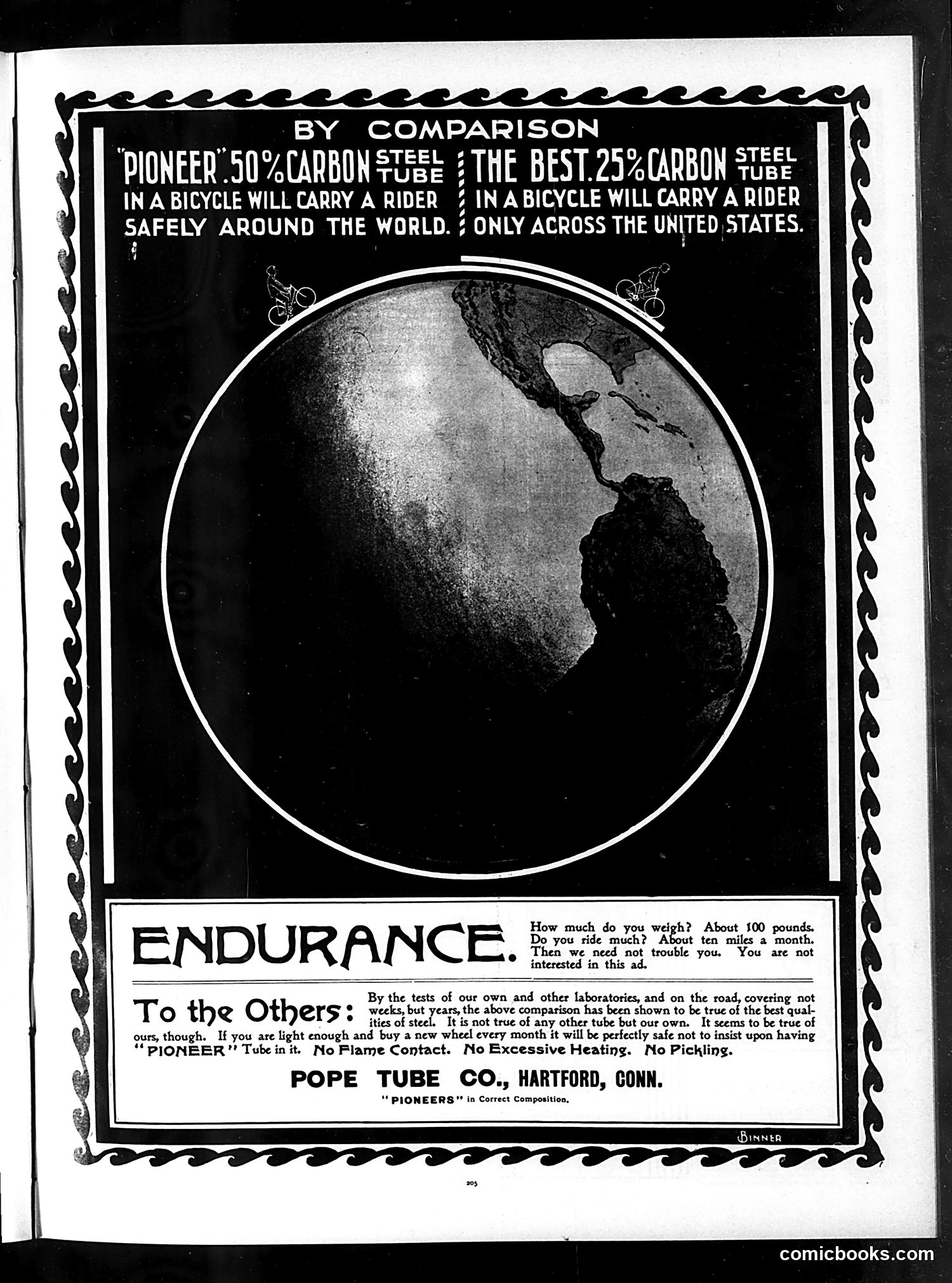
This is primarily a **product advertisement** for Pope Tube Company's "Pioneer" bicycle tubes, not political satire. The page uses a globe illustration to make a durability comparison: Pioneer's .50% carbon steel tubes can safely carry a rider "around the world," while competitors' .25% carbon steel tubes are only reliable "across the United States." This was a common advertising strategy—exaggerating product superiority through geographical hyperbole. The lower section includes dismissive messaging toward casual cyclists, suggesting that lightweight, occasional riders needn't buy the superior product. This targets serious, long-distance cyclists who would genuinely value the enhanced durability the manufacturer claimed. The decorative border and layout are typical of early 20th-century advertising design. There is no political commentary or satire present—this is straightforward commercial promotion published in *Judge*.
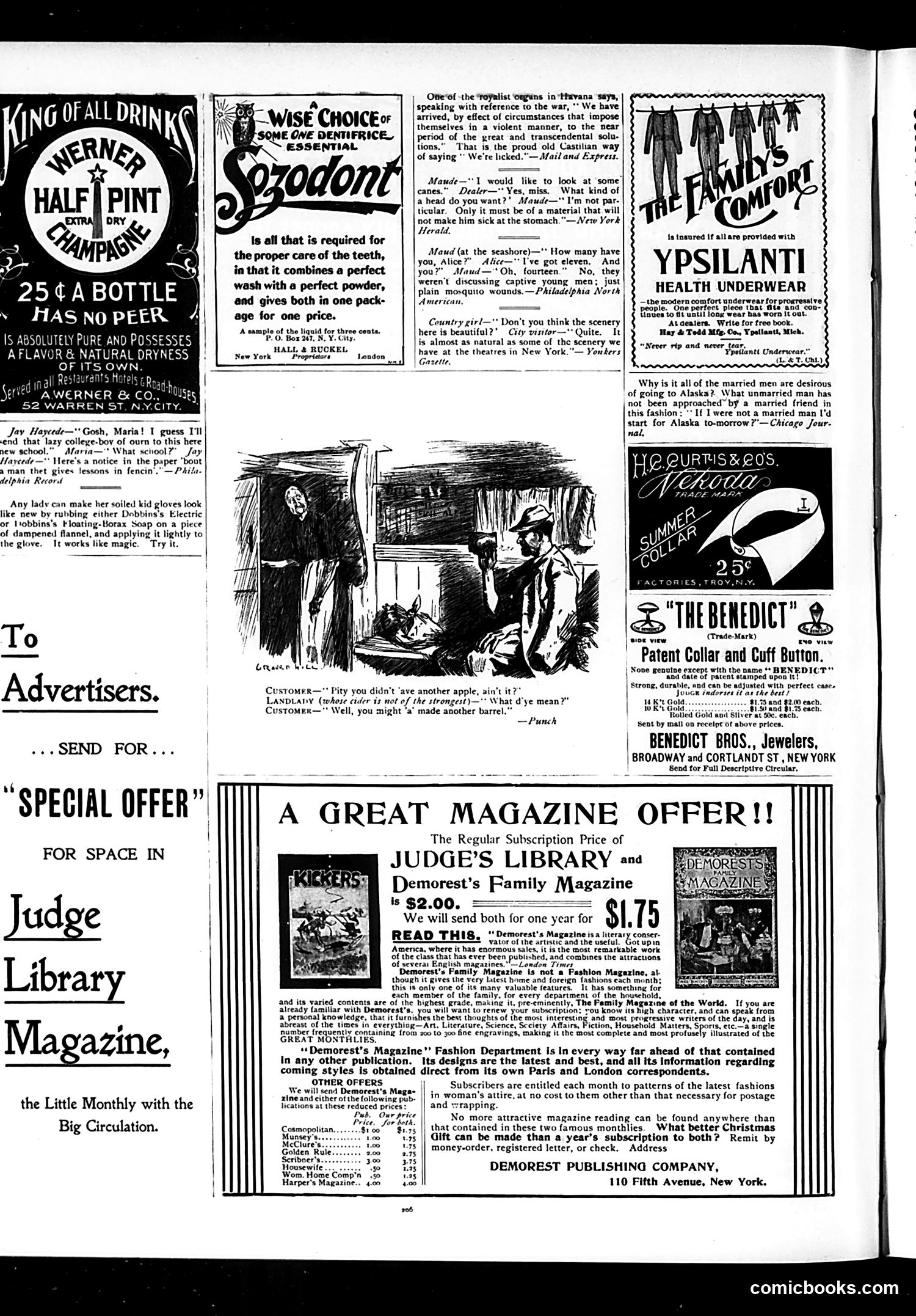
This page consists primarily of **advertisements and brief humorous anecdotes** rather than a political cartoon. The main content includes: **Social humor pieces** (short jokes from various newspapers) poking fun at: - A wife wanting a cane with a head that won't make "him" sick (implying domestic violence) - Young women counting mosquito bites at the seashore - Married men expressing desire to escape to Alaska - A rustic father wanting to send his son to "fencing lessons" (misunderstanding the term) **Advertisements** dominate the page, hawking products like champagne, tooth powder, health underwear, collar buttons, and a magazine subscription offer. The **humor is gentle period satire** reflecting early 1900s social attitudes—mocking rural simplicity, marital discord treated as comedy, and the pretenses of city versus country folk. The **Alaska references** appear multiple times, suggesting contemporary interest in the Klondike Gold Rush era. This is typical of *Judge* magazine's mixed format: satirical magazine offering light social commentary alongside commercial content.
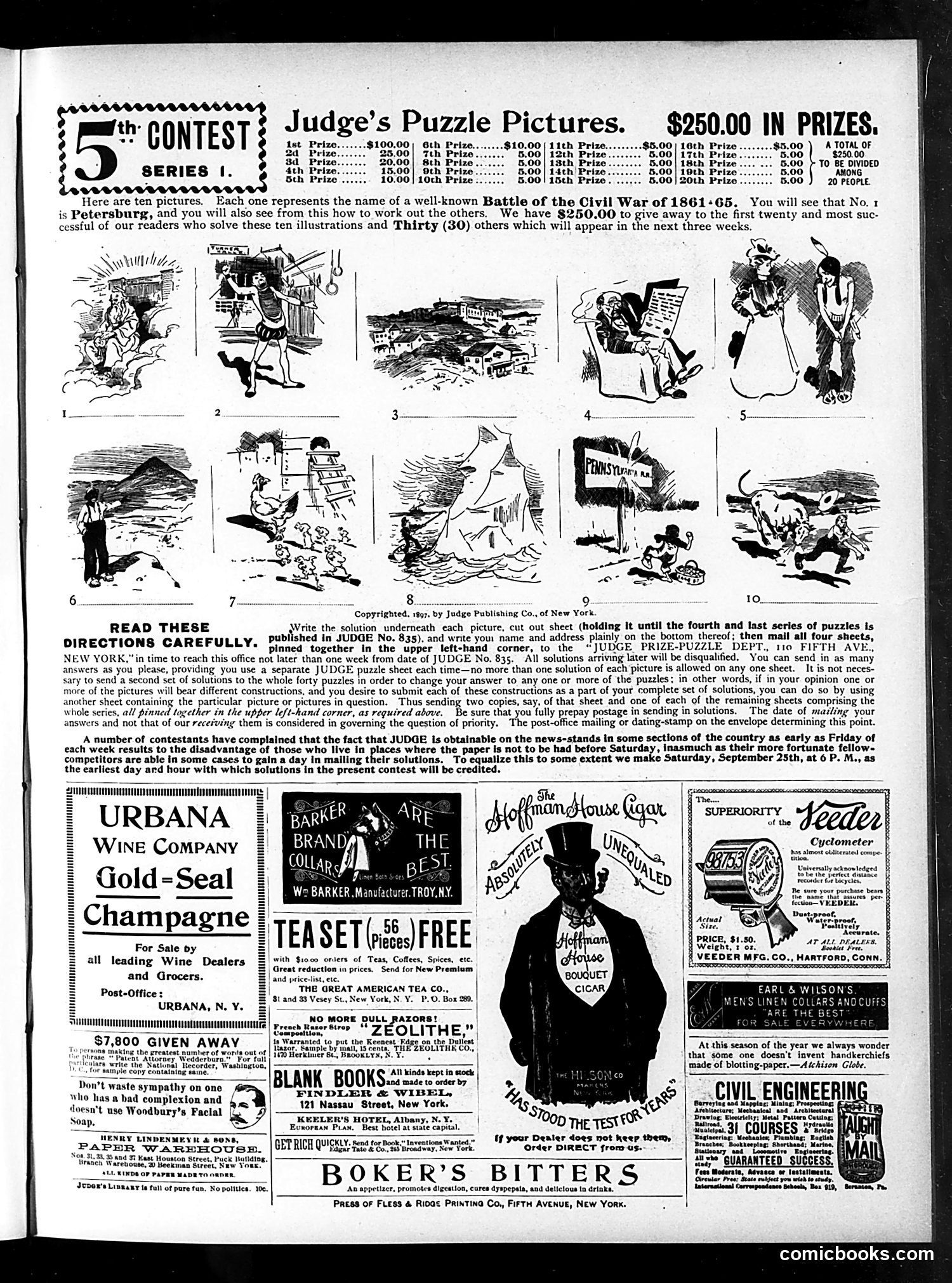
This page announces Judge's "5th Contest Series I"—a puzzle competition where readers identify ten Civil War battles (1861-65) from illustrated cartoons. Picture #1 is labeled as Petersburg to show the solving method. The ten cartoon vignettes use visual puns and symbolic imagery to represent different battle names. For example, pictures employ exaggerated characters, dramatic scenes, and pictorial wordplay typical of 19th-century satirical illustration. The contest offers $250 in prizes distributed among twenty winners. Notably, the detailed instructions address fairness concerns: readers complain that early access to Judge (available Friday in some areas versus Saturday elsewhere) gives unfair advantage. To compensate, Judge sets Saturday, September 25th at 6 P.M. as the official deadline—judged by postmark, not receipt date. This reflects Judge's competitive puzzle culture and readers' serious engagement with the magazine's contests during this era. The remaining page space features period advertisements for wine, tea, cigars, and other products.
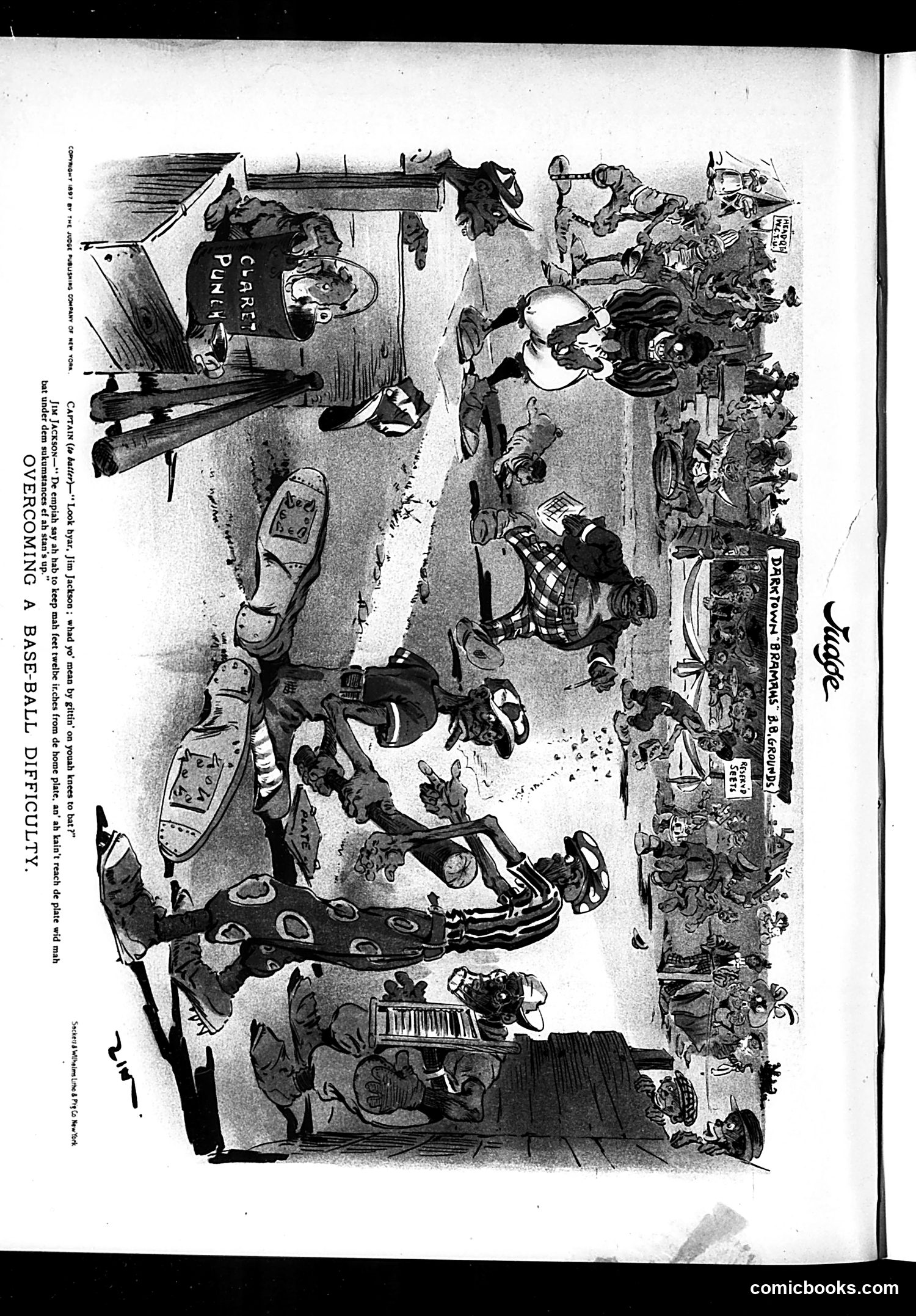
This cartoon satirizes baseball rule enforcement through a racial stereotype. The scene depicts two players—a white "Captain" and a Black player labeled "Jim Jackson"—in a dispute about batting stance. The joke hinges on Jim Jackson's claimed predicament: official rules require batters keep their feet twelve inches from home plate, but he claims this makes it impossible to reach the plate with his bat while standing upright. His solution is to bat while kneeling. The cartoon uses exaggerated dialect and a servile posture (kneeling) to mock both the absurdity of overly rigid rule application and, through its racist caricature, to demean Black athletes. The humor relies on the audience accepting the stereotype that Black players require special handling or accommodation—a deeply offensive premise that reflects the era's casual racism in sports and popular media. The satire targets bureaucratic inflexibility rather than offering genuine commentary on racial exclusion in baseball.