
A complete issue · 16 pages · 1897
Judge — September 18, 1897
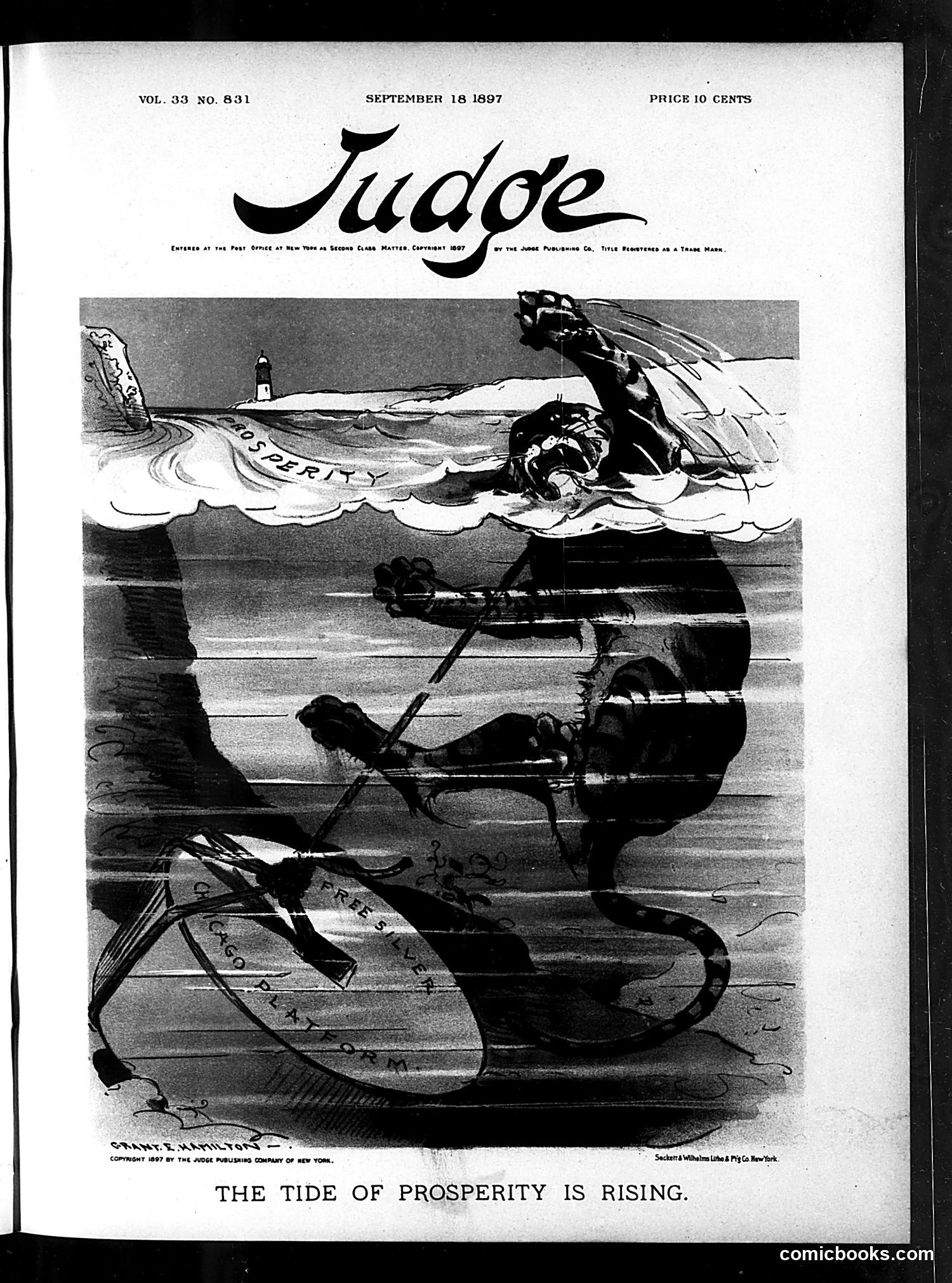
This political cartoon depicts "The Tide of Prosperity is Rising" through an allegorical ocean scene. A figure representing prosperity (shown as a classical female form) rises from the waves at the top, while below, various symbolic vessels and figures are lifted by the incoming tide. The cartoon appears to celebrate economic improvement during the McKinley administration (which began in 1897). The rising tide metaphor suggests widespread economic benefit—a common Victorian-era political image suggesting that general prosperity lifts all economic classes. The specific vessels and their occupants likely represent different economic sectors or social groups benefiting from improved conditions. Without clearer labeling visible in this reproduction, precise identification of individual symbols remains uncertain, though the overall message of optimistic economic outlook is clear.
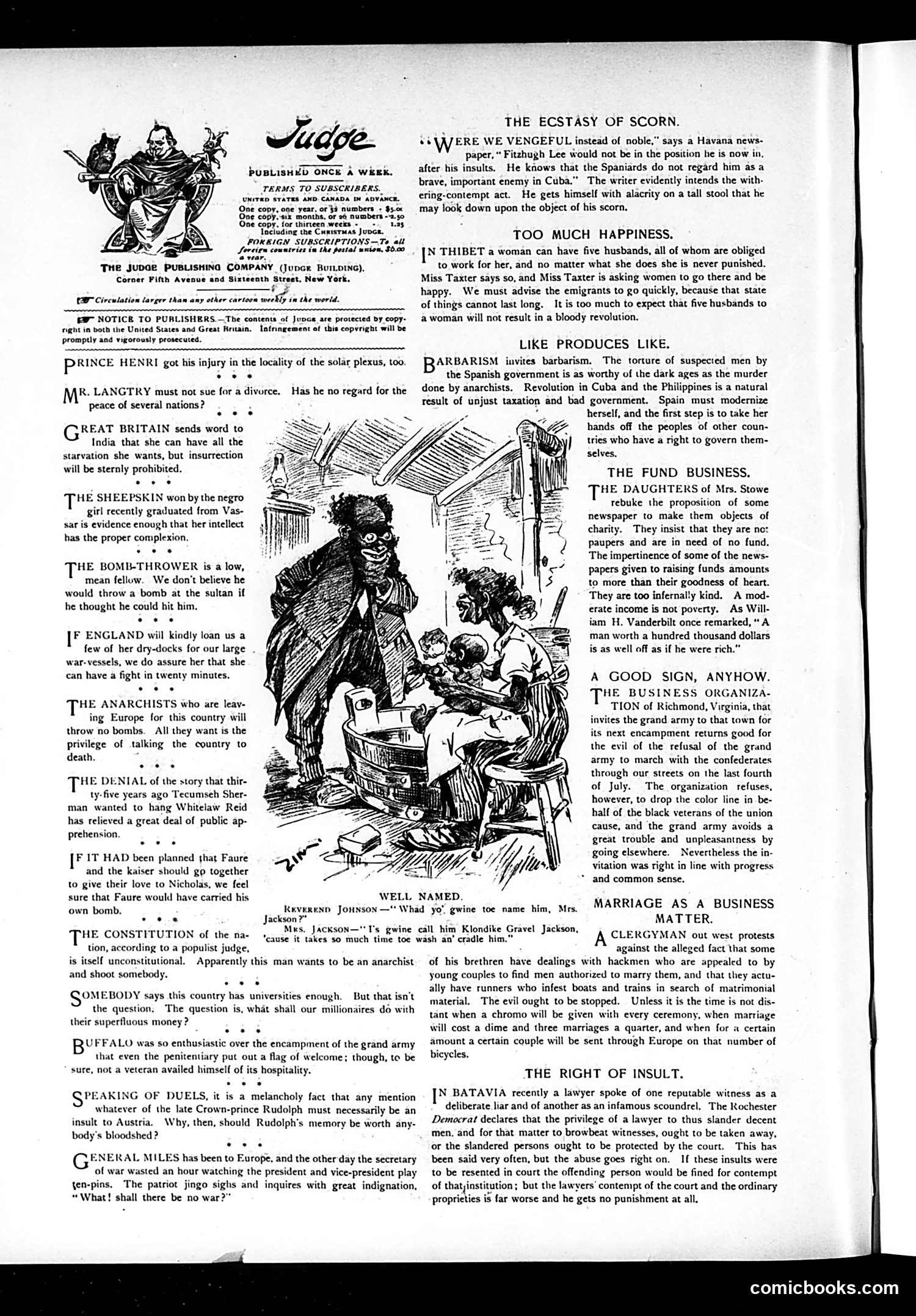
The central illustration depicts a caricatured figure in ragged clothes distributing papers or pamphlets to seated people. This appears to satirize **anarchist propaganda distribution**, particularly referencing the text's mention of anarchists "leaving Europe for this country" who "throw no bombs" but spread ideology instead. The surrounding brief satirical items mock various contemporary targets: British India policy, Filipino insurgency, military incompetence, and marital customs. One item criticizes Spanish colonial brutality in Cuba and the Philippines as producing barbarism. The "Marriage as a Business Matter" section satirizes matrimonial brokers arranging marriages, while "The Right of Insult" discusses lawyers' privileges. The overall tone is conservative, mocking both radical ideologies and social disruptions of the era (likely early 1900s).
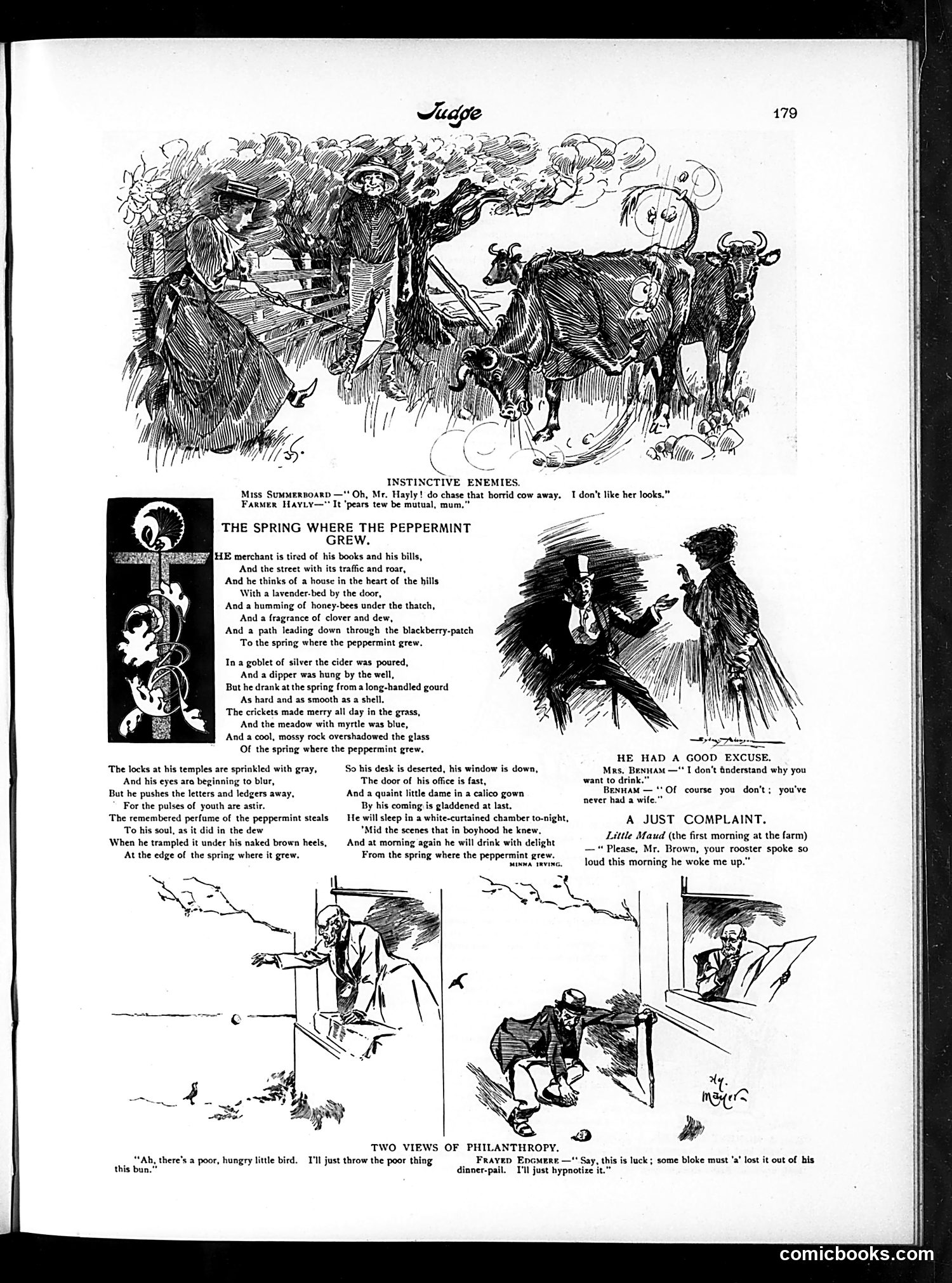
**Top Cartoon - "Instinctive Enemies":** Shows a woman (Miss Summerboard) trying to chase away a cow while a farmer (Hayly) objects. The joke plays on the phrase "I don't like her looks"—the cow apparently dislikes the woman's appearance as much as she dislikes the cow's. It's a simple gender-based humor about physical appearance and mutual dislike. **Middle Section - "The Spring Where the Peppermint Grew":** A sentimental poem about an idyllic rural location, paired with sketch illustrations. This appears to be nostalgic verse rather than satire. **Bottom Cartoons - "Two Views of Philanthropy":** Contrasts a wealthy man throwing money to a poor person versus a more involved charitable approach. The caption suggests genuine help requires more than dismissive gestures—satirizing superficial charity.
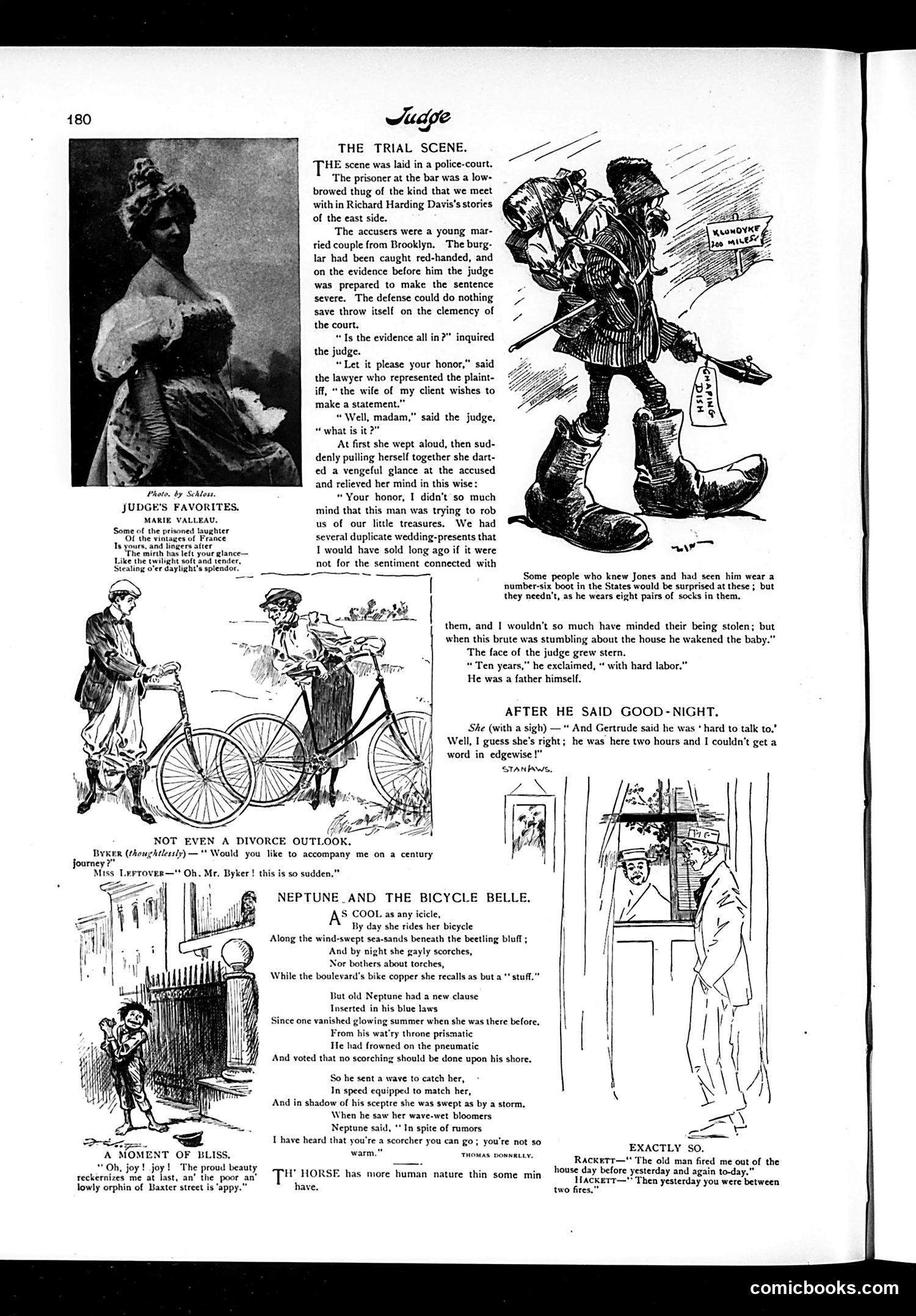
This page from Judge satirical magazine contains several separate humorous pieces: **"The Trial Scene"** depicts a burglary case where the judge prepares harsh sentencing. However, the victim's wife reveals the real injury: the burglar disturbed their baby's sleep. The judge, moved by paternal sympathy, imposes ten years hard labor—not for the theft, but for disturbing an infant. The satire mocks judges' inconsistent reasoning and sentimental priorities. **"Neptune and the Bicycle Belle"** is a verse satirizing the "New Woman" of the era—specifically women cyclists who rode bicycles at night (called "scorching"). The sea god Neptune objects to this modern behavior on his shores but ultimately allows it, finding her not as scandalous as rumored. This gently mocks both the technology's social disruption and overblown moral panic about women's independence. The page also includes lighter humor pieces about courtship and workplace mishaps, representing typical Judge magazine content mixing social commentary with gentle comedy.
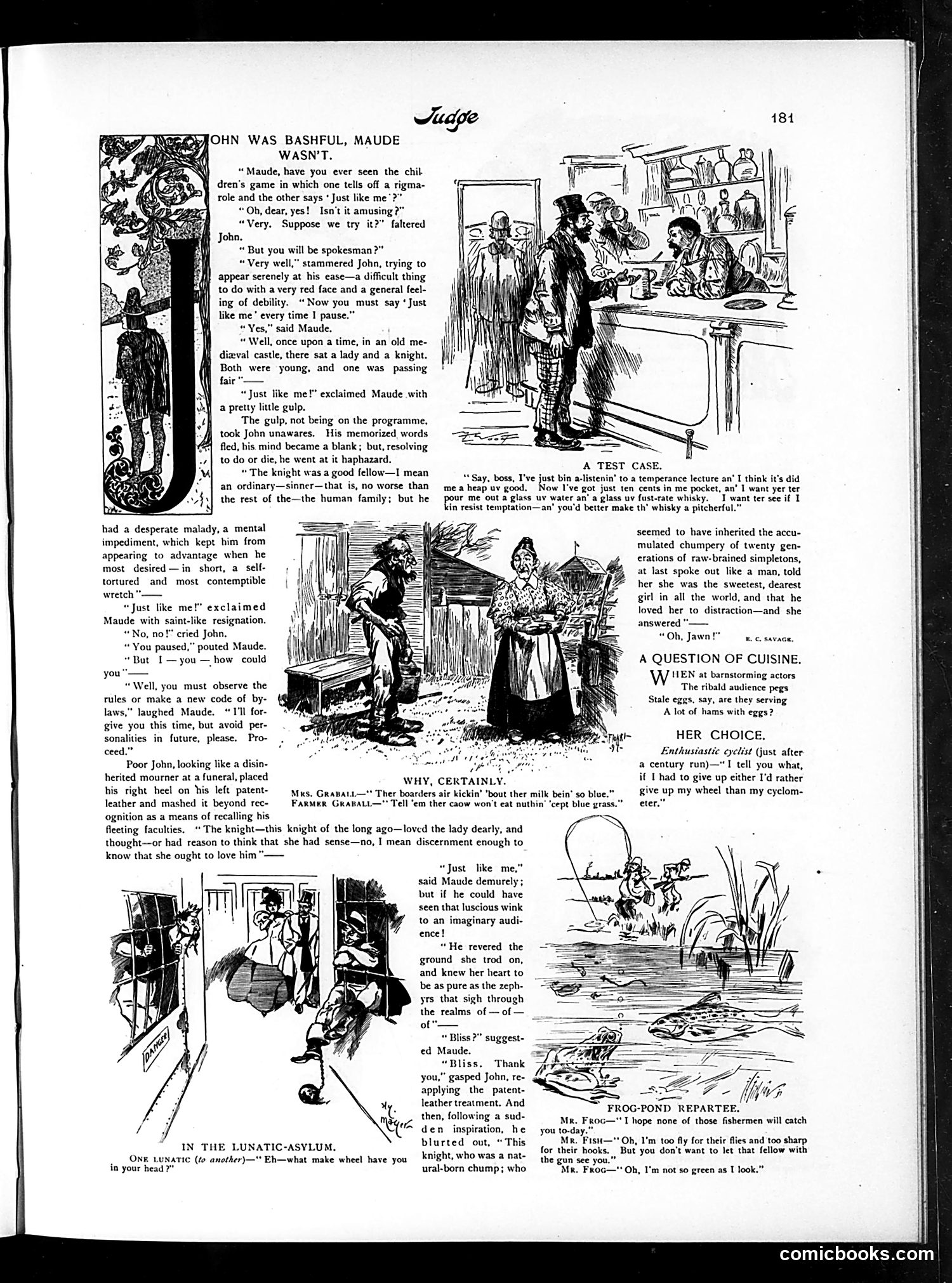
This page contains humorous domestic and social commentary typical of late-19th-century American satire. **Main Story ("John Was Bashful, Maude Wasn't"):** A young man attempts to woo a woman using a parlor game, repeatedly bungling his romantic speech. The satire mocks male awkwardness and female coyness in courtship—Maude strategically interrupts with "Just like me!" to throw him off, suggesting women manipulate romantic situations despite pretending passivity. **Side Sketches:** Multiple brief comedic vignettes satirize everyday absurdities: a temperance lecture attendee ordering whisky "to resist temptation," barnstormers throwing rotten eggs, a cyclist choosing his wheel over romance, and farmers' dietary complaints. **Overall Tone:** The humor assumes readers' familiarity with Victorian social conventions—awkward courtship rituals, temperance debates, theatrical touring, and rural life. The satire gently mocks human pretension and the gap between stated values and actual behavior.
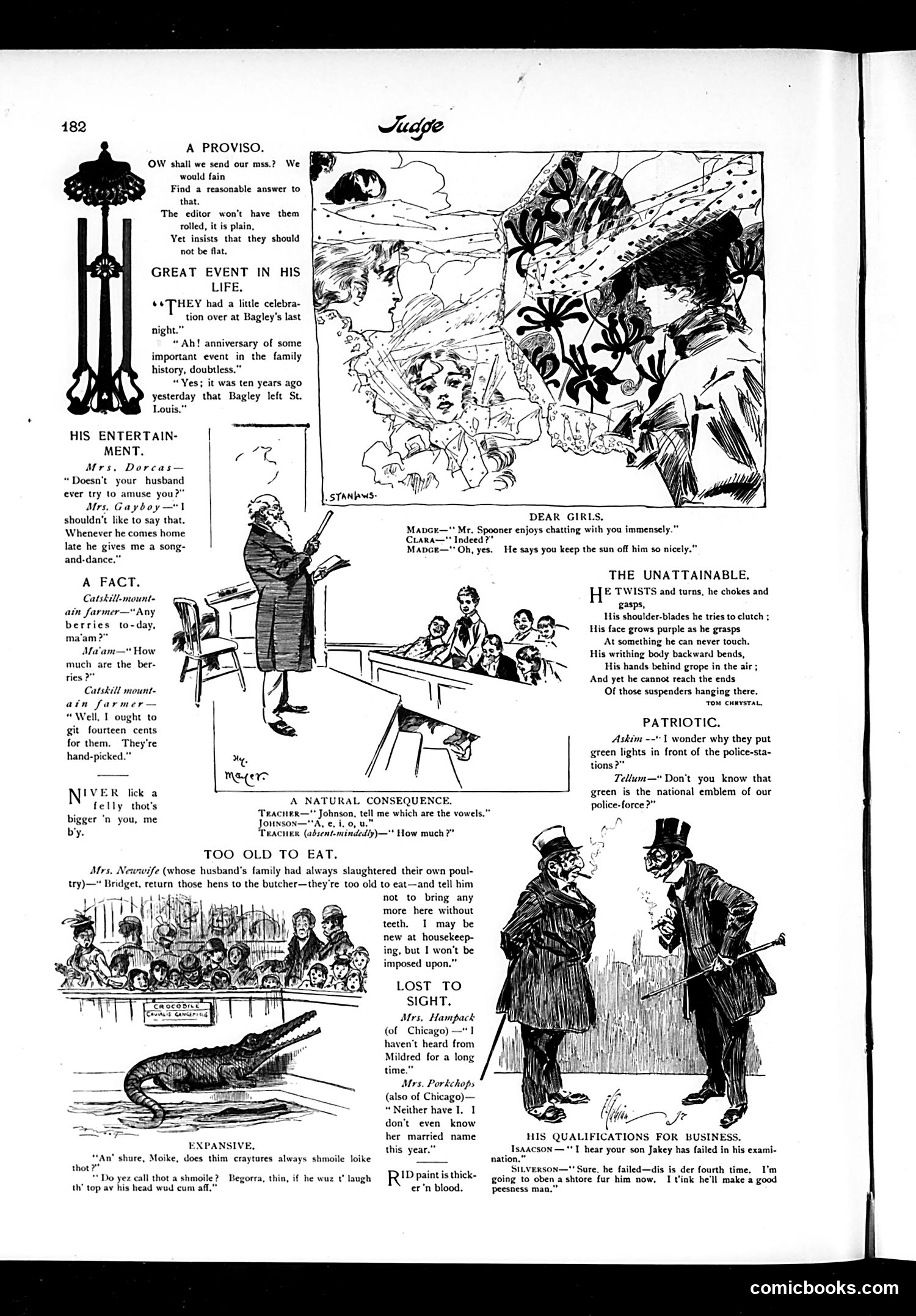
This page contains multiple satirical humor pieces typical of early 20th-century American comedy magazines: **Notable items:** - **"A Proviso"**: Meta-joke about manuscript submission standards—editors want submissions neither rolled nor flat. - **"Great Event in His Life"**: Celebrates a man's ten-year anniversary of *leaving* St. Louis, satirizing how people commemorate escapes from places they dislike. - **"The Unattainable"**: Poem about a man unable to reach his own suspenders hanging behind him—physical comedy about frustration and futility. - **"Too Old to Eat"**: Jokes a newlywed wife returning tough hens to the butcher, demanding they have "teeth"—satirizing domestic incompetence. - **"Patriotic"**: Brief exchange questioning why police stations have green lights, exploiting the audience's likely ignorance. - **"His Qualifications for Business"**: Jewish stereotype humor (Isaacson/Silverson names) about a failed student whose father plans to open a store anyway—implying business requires no education. The page showcases period humor mixing wordplay, physical comedy, and ethnic stereotypes common to turn-of-century American publications.
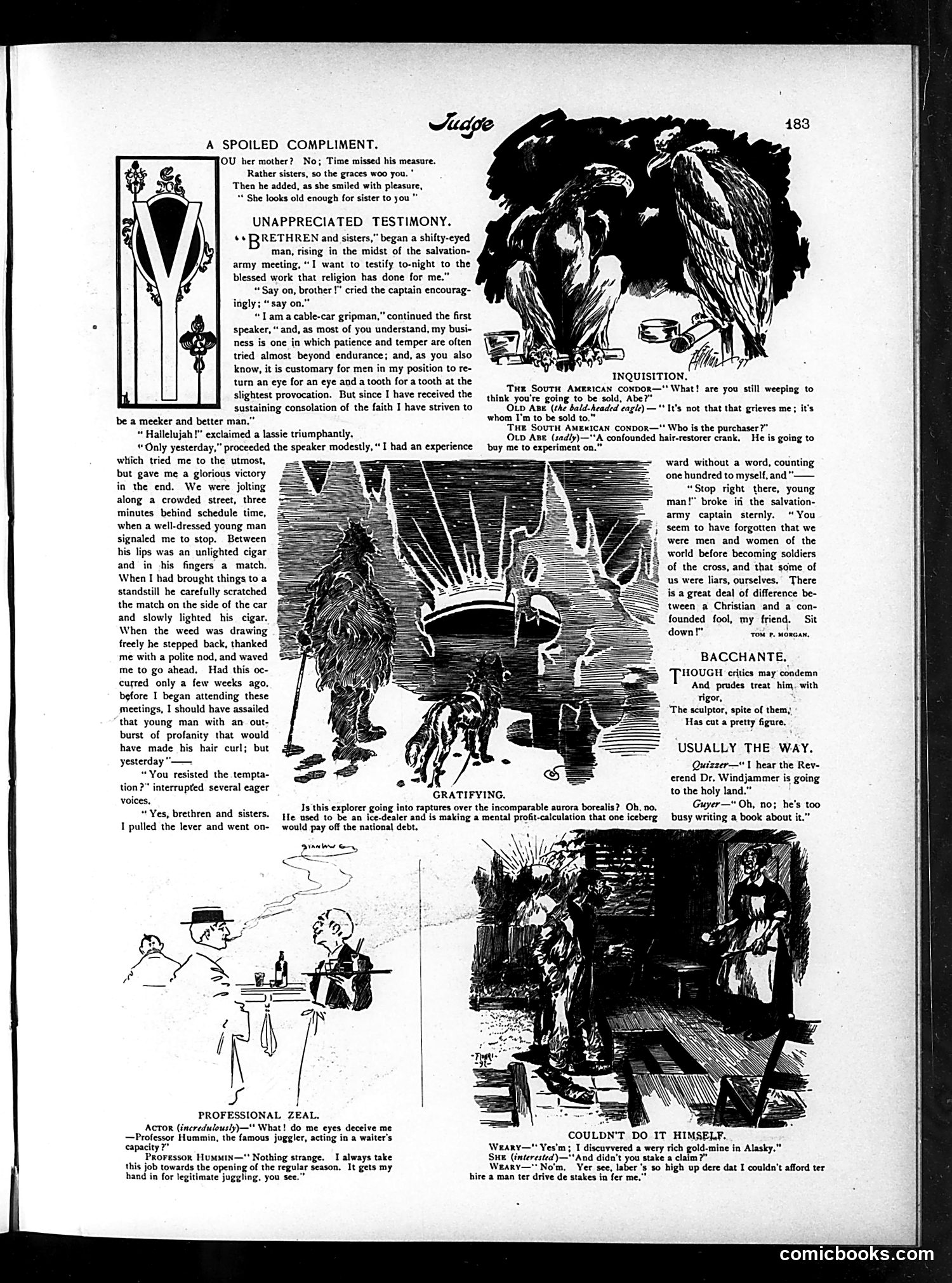
This page from *Judge* contains several satirical short pieces typical of the publication's humor: **"A Spoiled Compliment"** mocks flattery that backfires—a man attempts to compliment a woman by saying she looks old enough to be her mother's sister, insulting her age. **"Unappreciated Testimony"** satirizes Salvation Army meetings. A cable-car gripman testifies that religion made him more patient, but his "victory" is merely counting to one hundred instead of cursing at a passenger—hardly moral improvement. The captain's interruption mocks the performative nature of such testimonies. **"Inquisition"** depicts the American eagle (Uncle Sam symbol) being sold to a "hair-restorer crank" for experimentation, likely commenting on American economic exploitation or dubious business schemes of the era. **"Usually the Way"** jokes that a reverend traveling to the Holy Land is primarily motivated by writing a profitable book rather than spiritual devotion. Other brief sketches mock professional pretension and get-rich-quick schemes. The humor relies on period-specific references to cable cars, Salvation Army culture, and contemporary business practices.
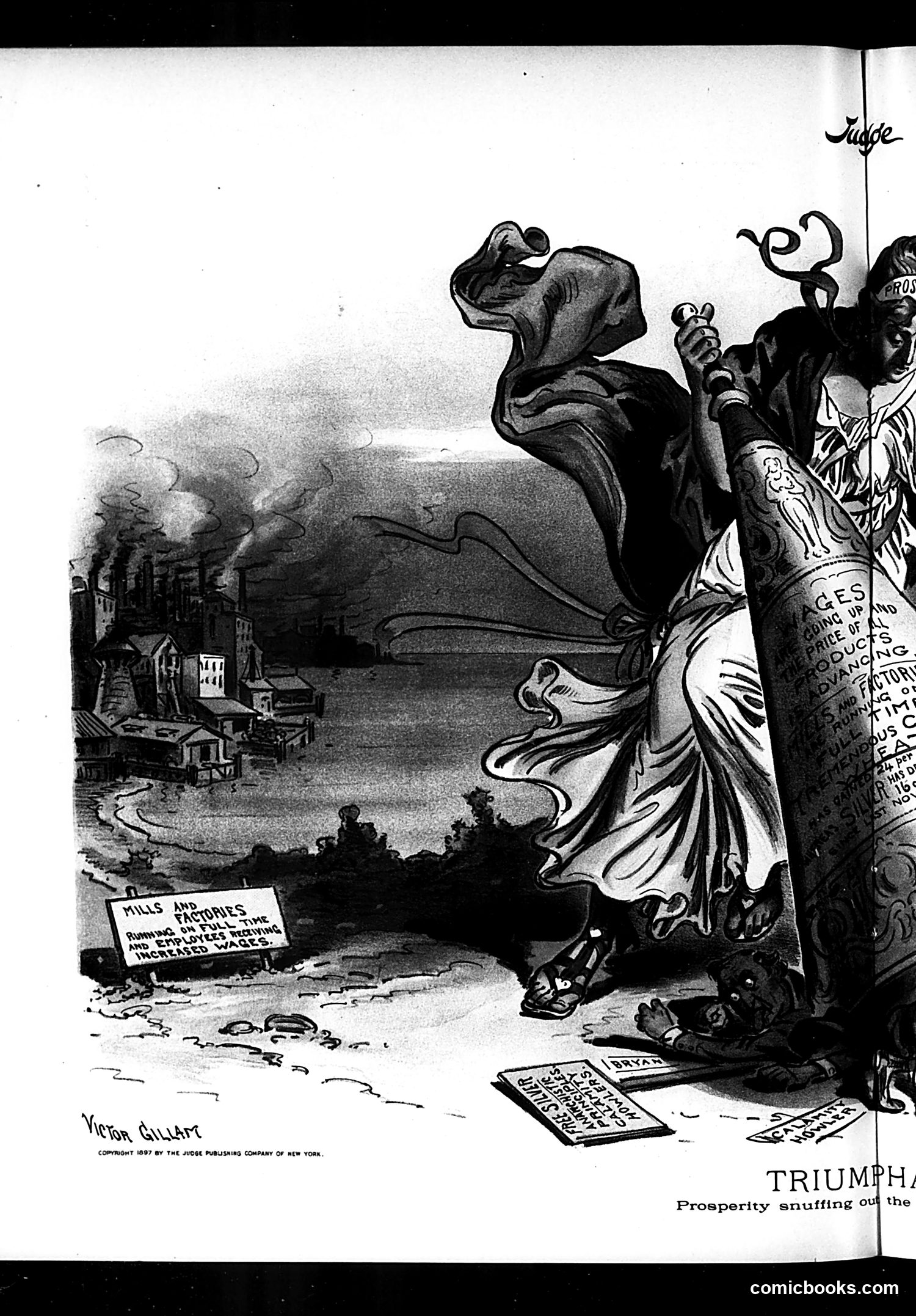
This 1897 Judge cartoon by Victor Gillam depicts "Prosperity" as a classical female figure triumphantly snuffing out industrial hazards. On the left, mills and factories belch smoke near a sign reading "MILLS AND FACTORIES...RUNNING ON FULL TIME AND GIVING EMPLOYMENT." The satire celebrates American industrial growth and worker employment during a period of economic expansion. "Prosperity" literally extinguishes the problems—depicted as snake-like demons—that plagued the economy: presumably unemployment, labor unrest, and economic hardship. The cartoon reflects late-19th-century optimism about industrial capitalism's ability to solve social problems through growth. The classical allegorical style was typical of Judge's visual rhetoric, presenting economic recovery as a noble, inevitable force overcoming previous difficulties.
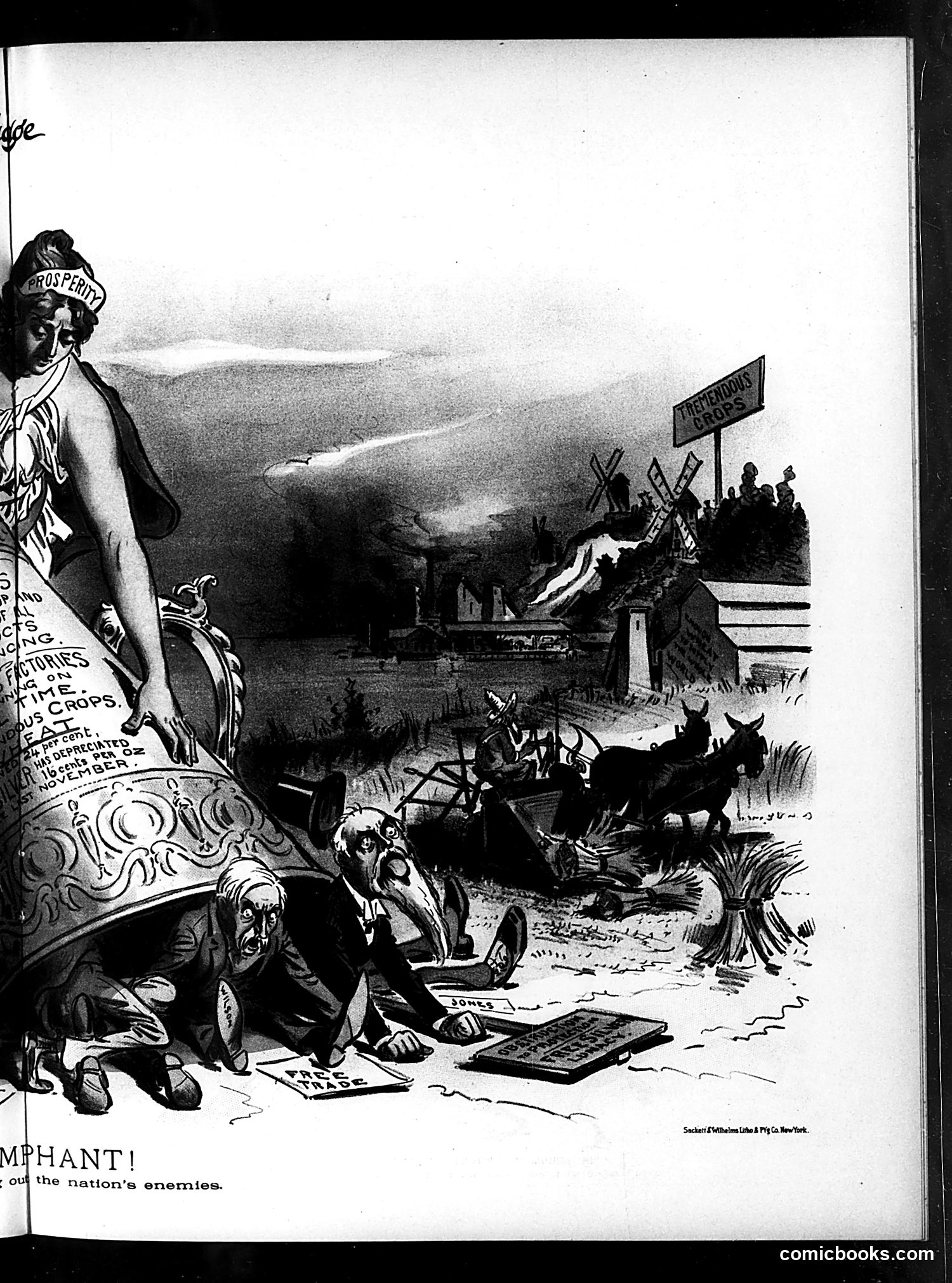
This Judge magazine cartoon depicts "Prosperity" as a classical female figure on the left, overlooking an industrial agricultural landscape. Below her, caricatured figures appear to represent political or economic adversaries labeled as "the nation's enemies"—likely depicting concerns about foreign competition or domestic economic threats during an era of American industrial expansion. The scene shows farming/industrial activity with workers, equipment, and a "Heterodonous" sign (unclear reference), suggesting anxieties about labor, trade, or agricultural policy. The contrast between the idealized "Prosperity" figure and the struggling or antagonistic figures below critiques either the unequal distribution of prosperity or identifies specific groups as obstacles to national economic success. Without clearer date context, the specific villains remain uncertain, though the imagery suggests late 19th or early 20th-century protectionist or labor-dispute themes common in Judge's satirical commentary.
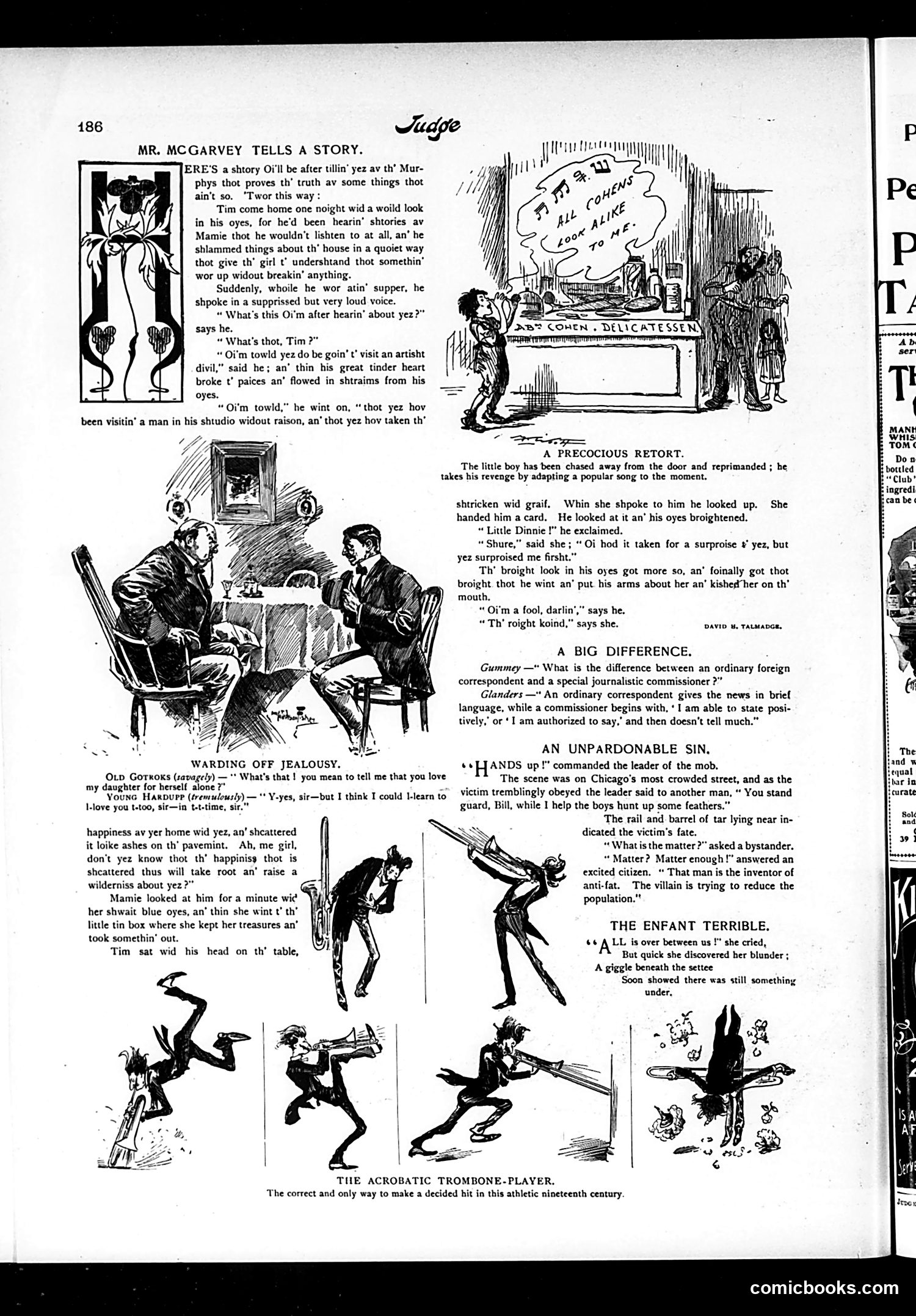
This page from *Judge* contains several satirical pieces reflecting late 19th-century concerns: **"Mr. McGarvey Tells a Story"** uses Irish dialect humor (common in period satire) about a jealous husband, Tim, suspicious of his wife Mamie visiting an artist's studio. The twist: she'd commissioned a portrait of their child ("Little Dinnie") as a surprise, reconciling them. The satire mocks baseless jealousy. **"Warding Off Jealousy"** shows a father suspicious of a suitor claiming to love his daughter "for herself alone"—the young man's nervous admission that he could "learn to love you too, sir" satirizes mercenary courtship motives. **"The Acrobatic Trombone-Player"** jokes about absurd self-promotion in the "athletic nineteenth century." **"An Unpardonable Sin"** depicts a mob planning to tar-and-feather an "anti-fat" inventor, suggesting contemporary anxieties about weight-loss products and population concerns. **"The Enfant Terrible"** humorously depicts a child eavesdropping on adult drama from under furniture—a common comedic trope.
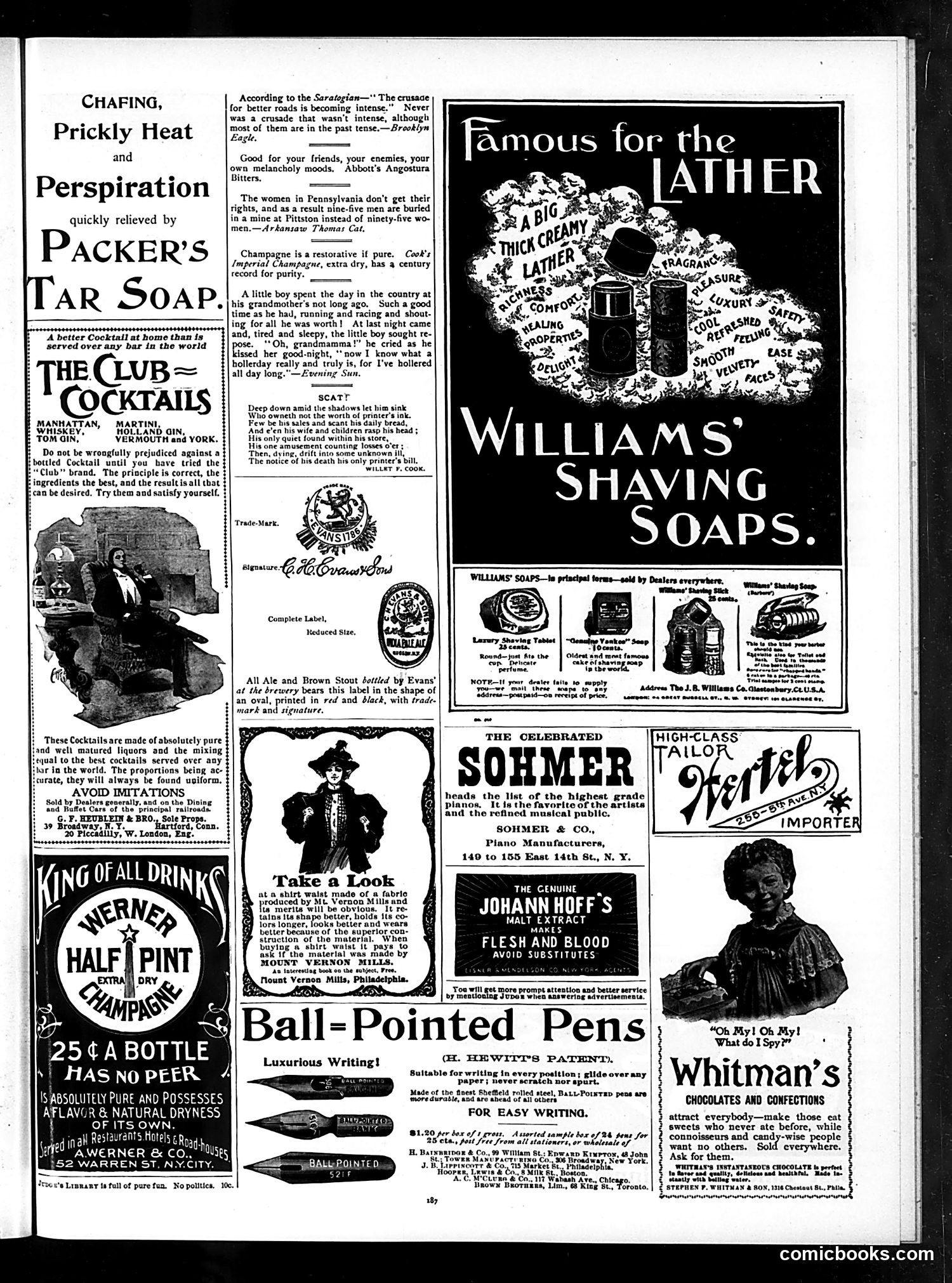
This page is primarily **advertisements** with minimal editorial cartooning. The ads showcase consumer goods typical of early 20th-century America: patent medicines (Angostura Bitters, Johann Hoff's Malt Extract), alcohol (Werner's Champagne, Evans' Ale), toiletries (Packer's Tar Soap, Williams' Shaving Soaps), and luxury items (Sohmer pianos, Whitman's Chocolates). The brief text snippets are satirical **editorial quips**—short, punchy jokes mocking contemporary issues: Pennsylvania women's suffrage, mining disasters, and urban life. One joke plays on a child's mispronunciation of "holiday" as "hollerday." The only illustration appears to be a small portrait accompanying a poem by Willet V. Cook about a struggling printer. The page reflects Judge's business model: satirical commentary interspersed with advertisements targeting middle and upper-class readers with disposable income.
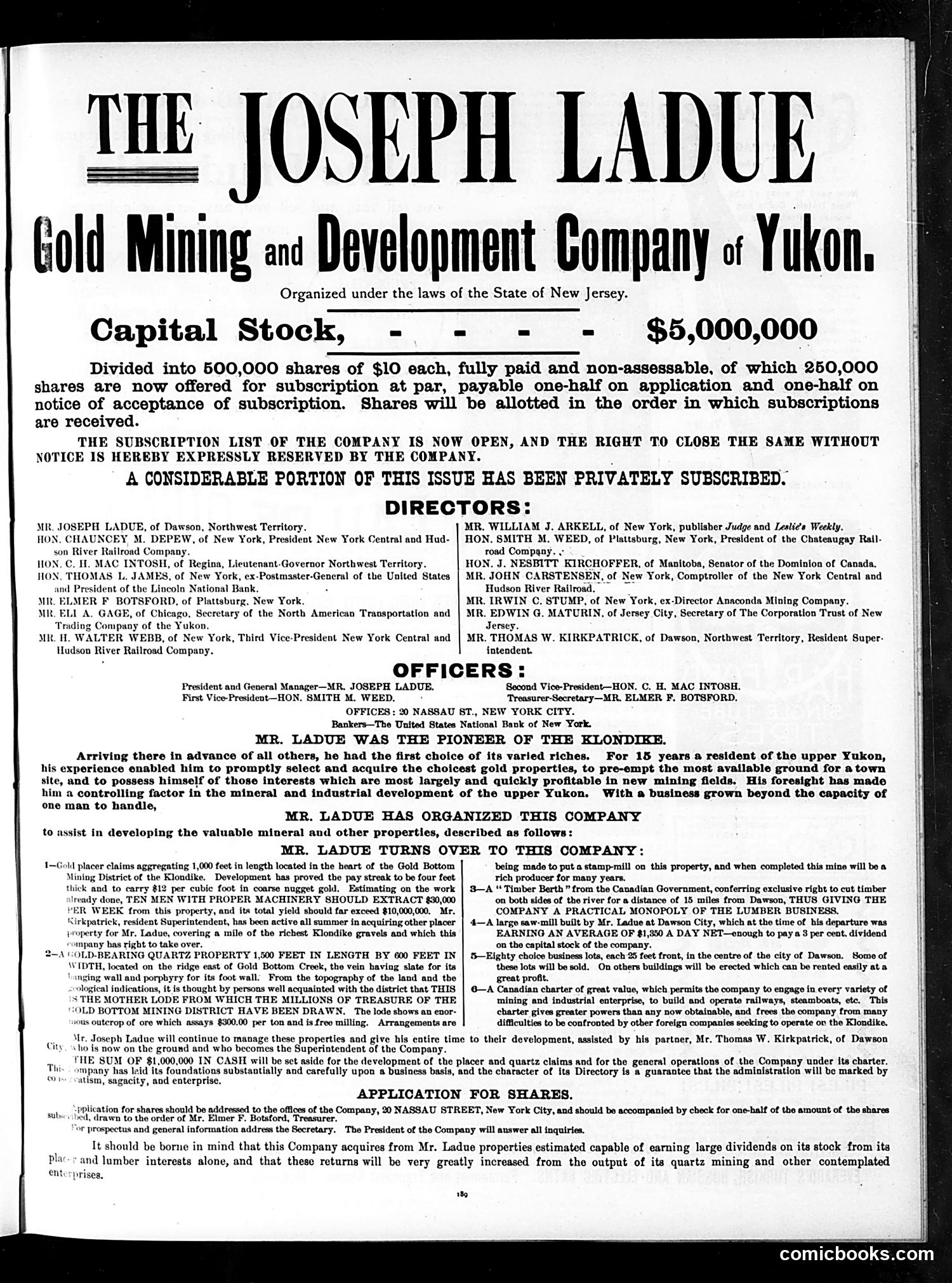
This page is primarily a **prospectus for a Yukon gold mining stock offering**, not a satirical cartoon. Published in *Judge* magazine (a satirical weekly), the irony likely lies in the advertisement's placement rather than its content. The Joseph Ladue Gold Mining Company, capitalized at $5 million, is offering shares to investors during the **Klondike Gold Rush era** (late 1890s). The prospectus emphasizes Ladue's pioneering experience in the Yukon and lists prestigious directors including railroad executives (Chauncey Depew, H. Walter Webb) and government officials. The satirical point appears implicit: *Judge* was likely running this as commentary on the speculative gold-rush fever gripping investors. The extravagant claims ("$30,000 per week," "$10,000,000" total yield) and the roster of high-society names lent credibility to ventures often based on hype rather than substance. For modern readers, this illustrates how early investment schemes exploited public enthusiasm for frontier wealth.
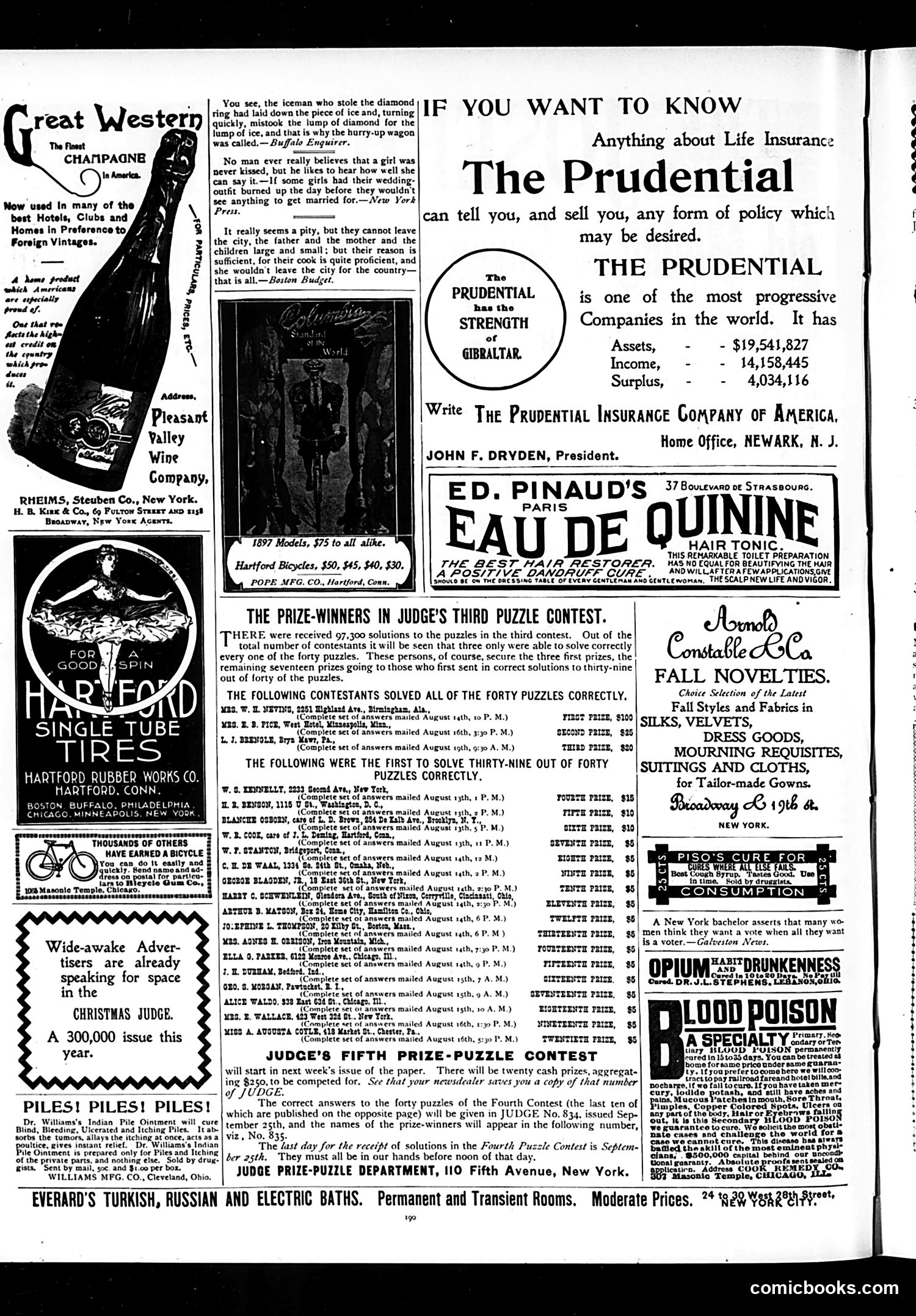
This page is primarily **advertising and contest results**, not political satire. The main content announces winners of Judge magazine's puzzle contest (three people solved all 40 puzzles correctly; 17 others solved 39 of 40). The single cartoon at top left appears to be a brief anecdote illustration about a man who mistook a diamond lump for ice, confusing his hasty wagon driver—a mild joke about absent-mindedness with no political content. The rest of the page consists of period advertisements: Prudential Insurance (emphasizing financial strength), Pleasant Valley Wine, Hartford bicycles and rubber tires, Dr. Williams's Pile Ointment, and Pinaud's Eau de Quinine hair tonic. **Context note**: Judge was a satirical weekly, but this particular page showcases its secondary function as a vehicle for advertisements and reader contests—revenue sources that kept the magazine financially viable.
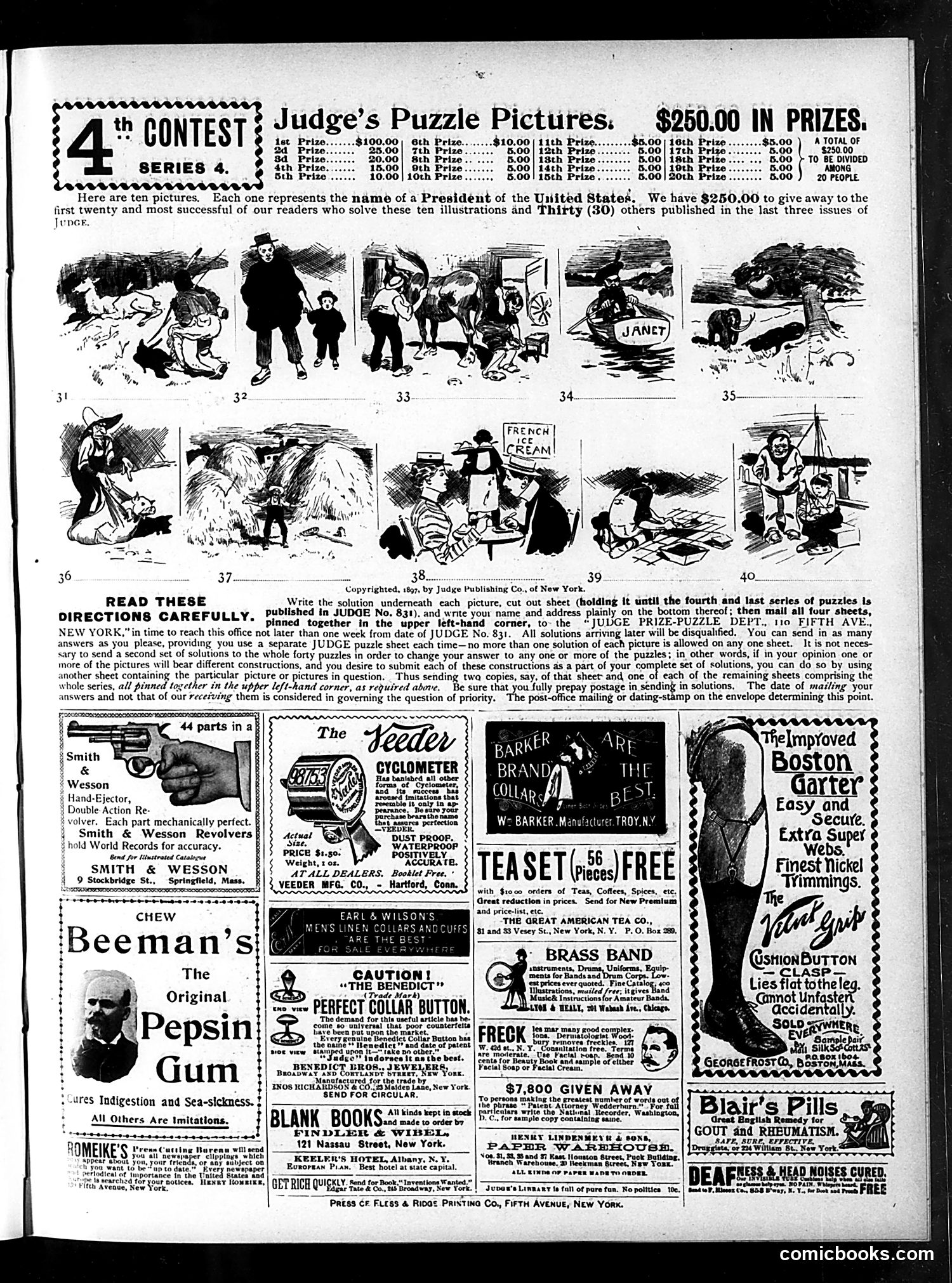
This page is primarily a **puzzle contest** rather than political satire. The top section features ten cartoon illustrations, each representing the name of a U.S. President—readers must identify which president each picture depicts. The contest offered $250 in total prizes distributed among twenty winners. The bulk of the page consists of **period advertisements** for products like Smith & Wesson revolvers, Beeman's chewing gum, tea, collar buttons, pills, and patent medicines—typical of 1897 Judge magazine content. The puzzle contest itself reflects late-19th-century American popular entertainment: visual riddles testing readers' knowledge of presidential history and iconography. The cartoons likely employ visual puns, symbolic imagery, or characteristic scenes associated with each president to make them identifiable. This is essentially a promotional contest page designed to increase magazine circulation by encouraging reader participation and repeated purchases of Judge issues to solve all forty puzzles.
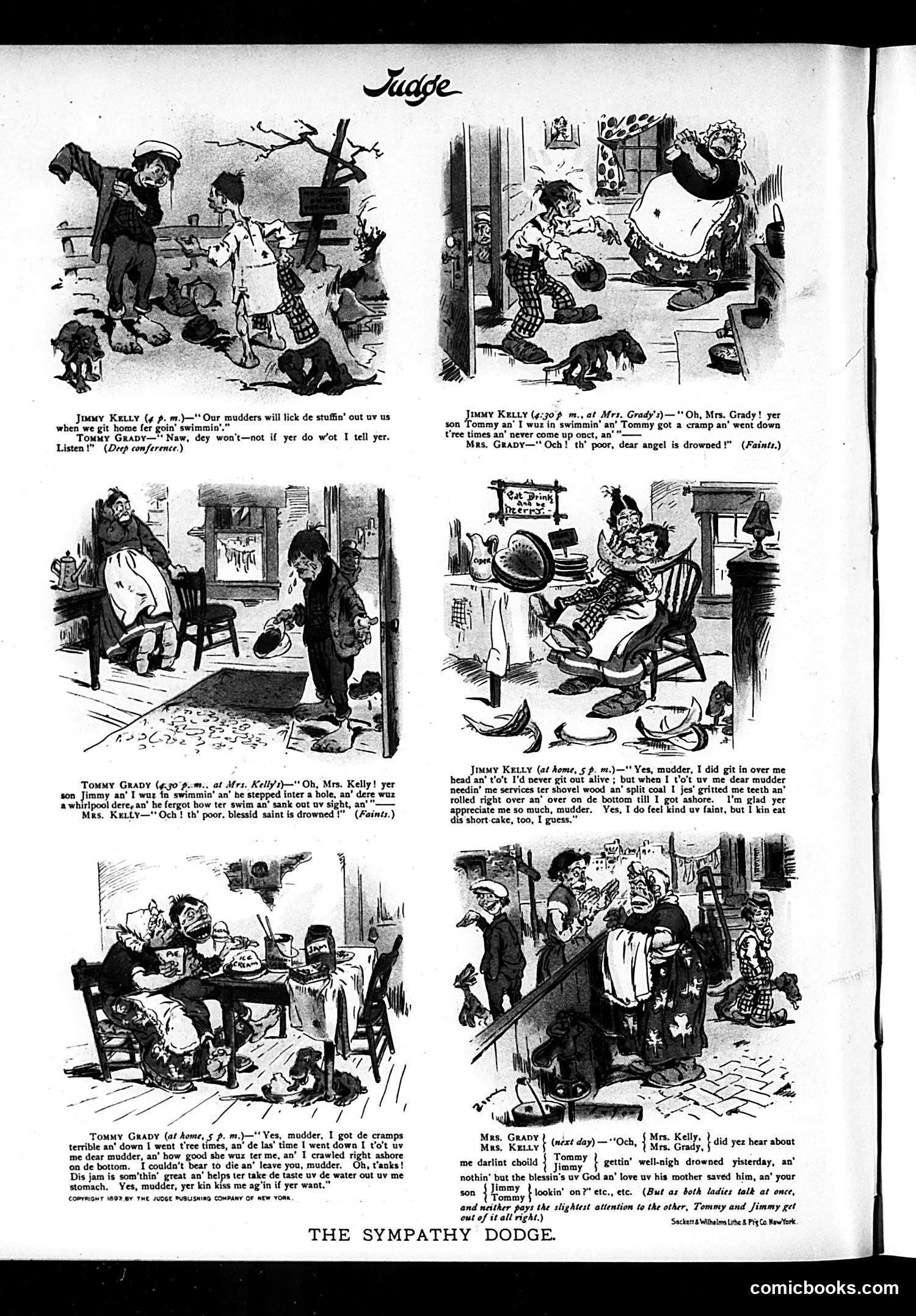
This satirical comic presents a domestic scheme where two boys—Tommy Gravy and Jimmy Kelly—fabricate near-drowning incidents to manipulate their mothers. The sequence shows: the boys plotting ("Deep conference"), Tommy reporting Jimmy nearly drowned, then Jimmy reporting Tommy nearly drowned, each story designed to trigger maternal concern and gain sympathy-based rewards (jam, cake, kisses). The satire targets Irish immigrant working-class mothers (identifiable by dialect: "Och," "mudder," "blessin's") who are portrayed as gullible, excitable, and easily manipulated through appeals to sentiment and motherly love. The title "The Sympathy Dodge" exposes the con as a calculated exploitation of maternal instinct. The boys cynically invoke their mothers' need for them as workers ("needin' me services ter shovel wood") while the mothers remain oblivious to each other's competing narratives, highlighting both parental naivety and the children's cunning duplicity.