
A complete issue · 16 pages · 1897
Judge — September 11, 1897
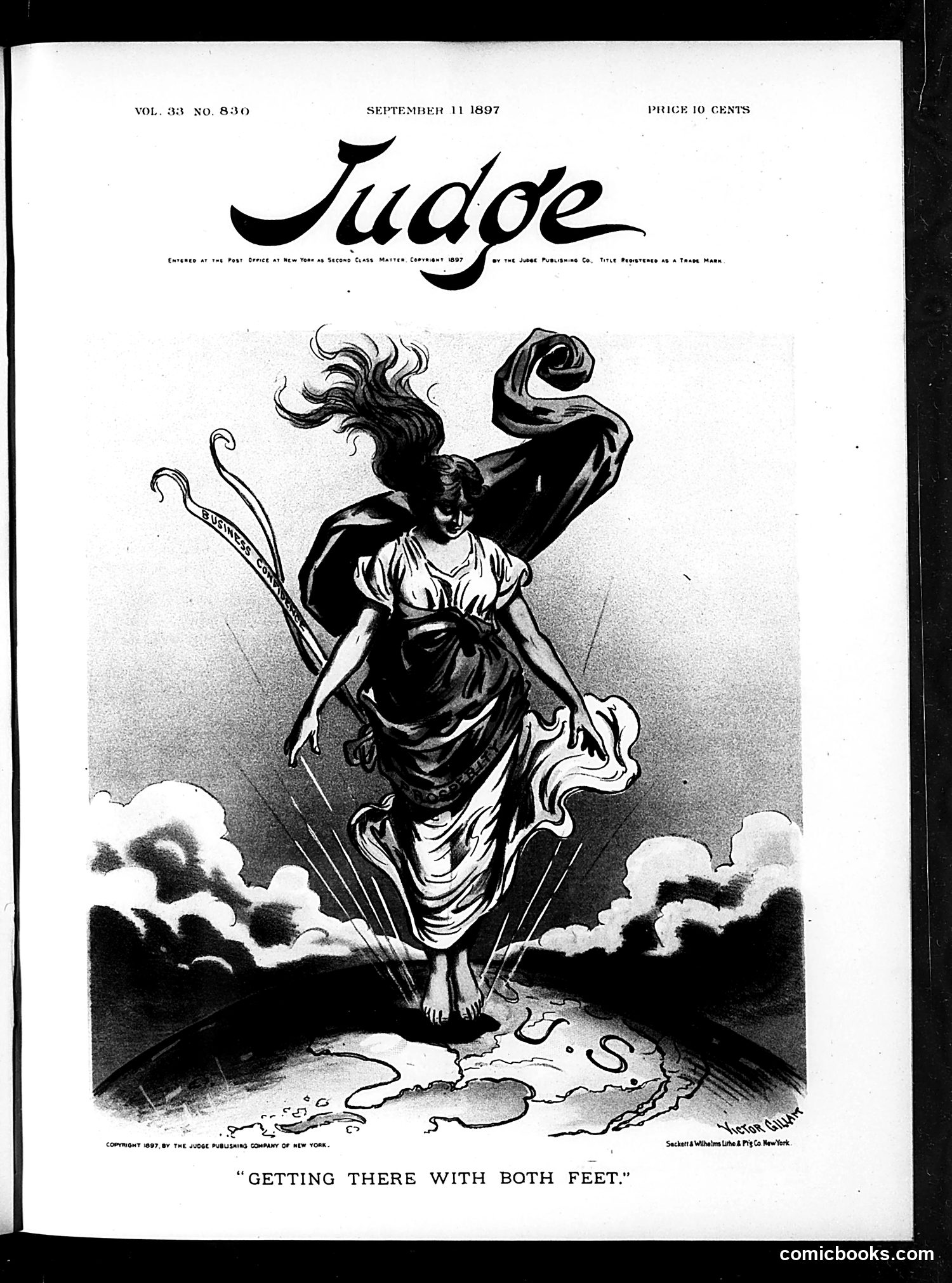
This September 1897 *Judge* cartoon depicts Liberty (recognizable by her classical female form and flowing garments) standing triumphantly above a map of the United States. The phrase "Getting there with both feet" suggests energetic, decisive progress. The satire likely comments on American expansionism or domestic political achievement during the 1890s—a period of imperial ambitions and economic dynamism. Liberty's confident pose, wind-swept hair, and commanding stance over the national map suggest optimism about American direction and power. Without additional context about specific 1897 events, the exact referent remains unclear, but the cartoon evidently celebrates American progress or vindication of a particular political agenda through Liberty as the personified ideal.
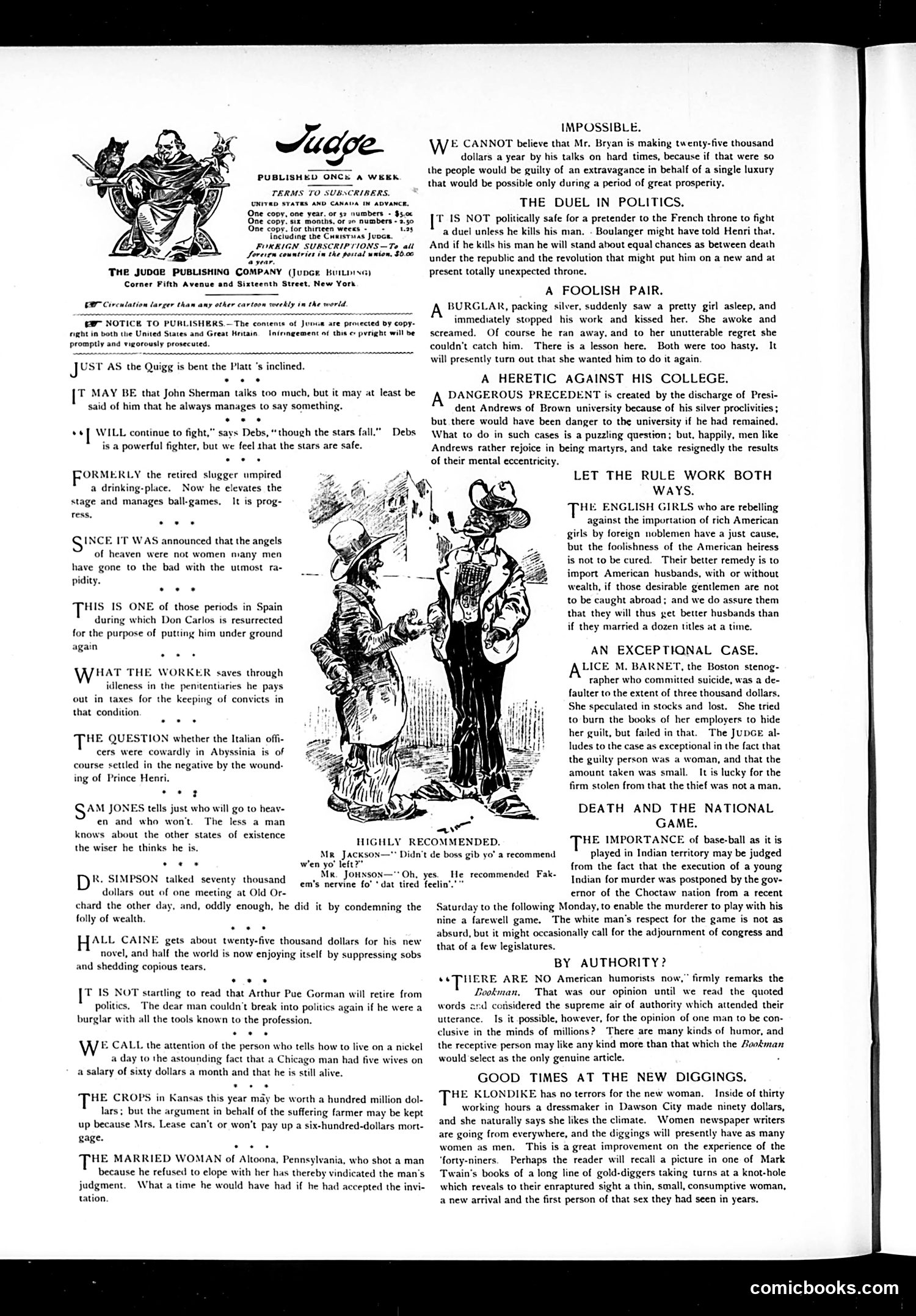
The central cartoon depicts two figures in a comedic interaction—likely representing political or social opposition based on the exaggerated caricature style typical of Judge's satirical approach. The accompanying text sections offer commentary on contemporary issues: political dueling, university controversies, labor conditions, and social behavior. Without clearer labeling in the visible image, I cannot confidently identify the specific figures or reference the exact political events. However, the cartoon's style—with its grotesque features and physical comedy—is characteristic of Judge's approach to lampooning public figures and social hypocrisies of the era (appears to be early 1900s based on typography and illustration style). The page mixes short satirical commentary pieces with visual humor, a typical Judge format for addressing scandal, corruption, and contemporary foibles.
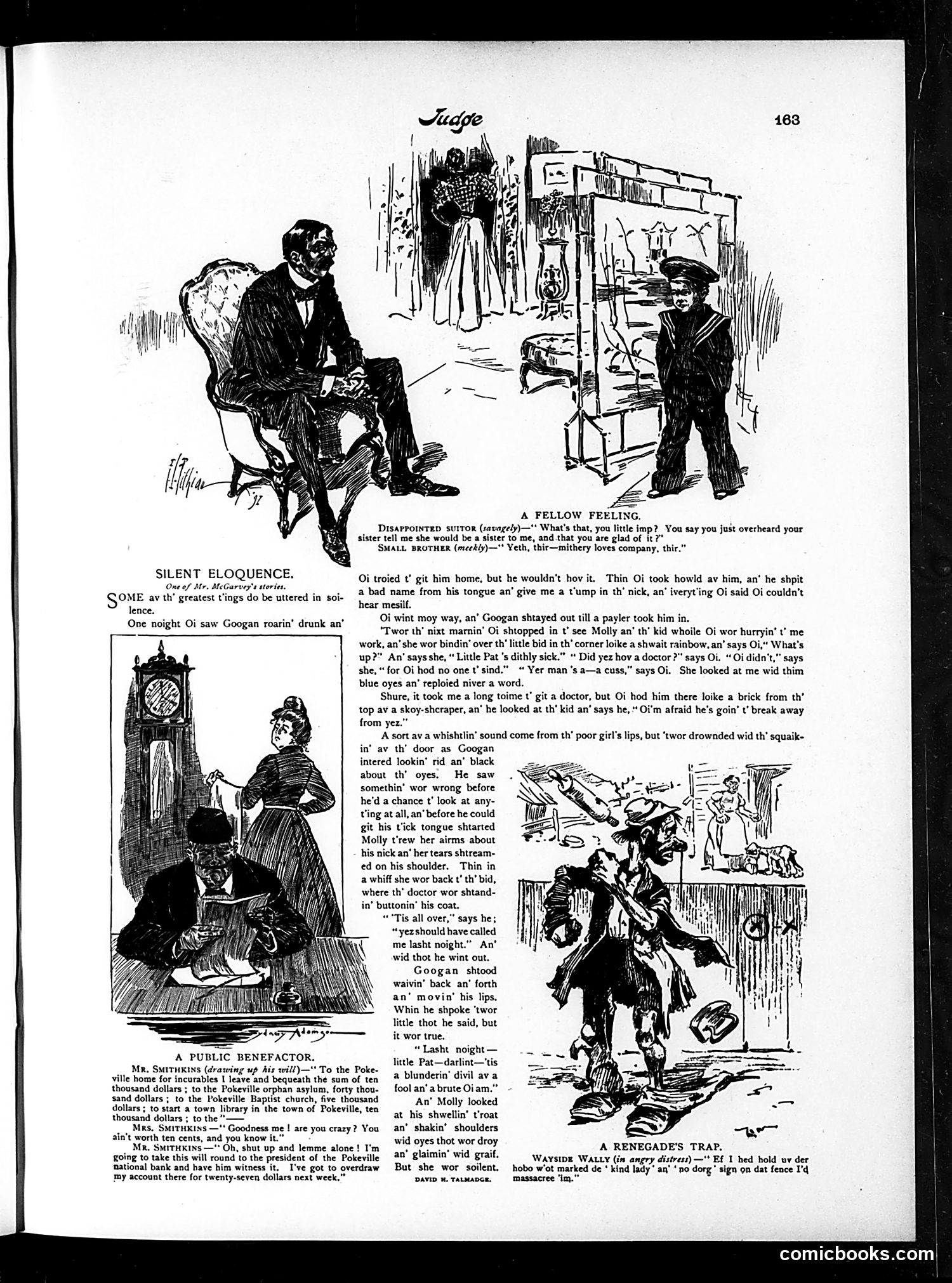
This page contains three distinct pieces of humor: 1. **"Silent Eloquence"** (left): A narrative sketch about a drunk named Coogan who comes home late. His wife communicates her disapproval entirely through silent gestures and facial expressions rather than words—the "eloquence" being her powerful non-verbal communication of anger. 2. **"A Public Benefaction"** (bottom left): A social satire about Mrs. Smithkins making a charitable donation to a town library, explicitly so she can oversee the account and control how her money is used—suggesting patronizing or self-interested charity masked as generosity. 3. **"A Fellow Feeling"** and **"Wayside Wally"** (right): Brief comedic dialogues about shared human experiences and casual street encounters, depicting working-class or lower-class characters in humorous situations. The page emphasizes domestic comedy and social observation rather than overt political satire.
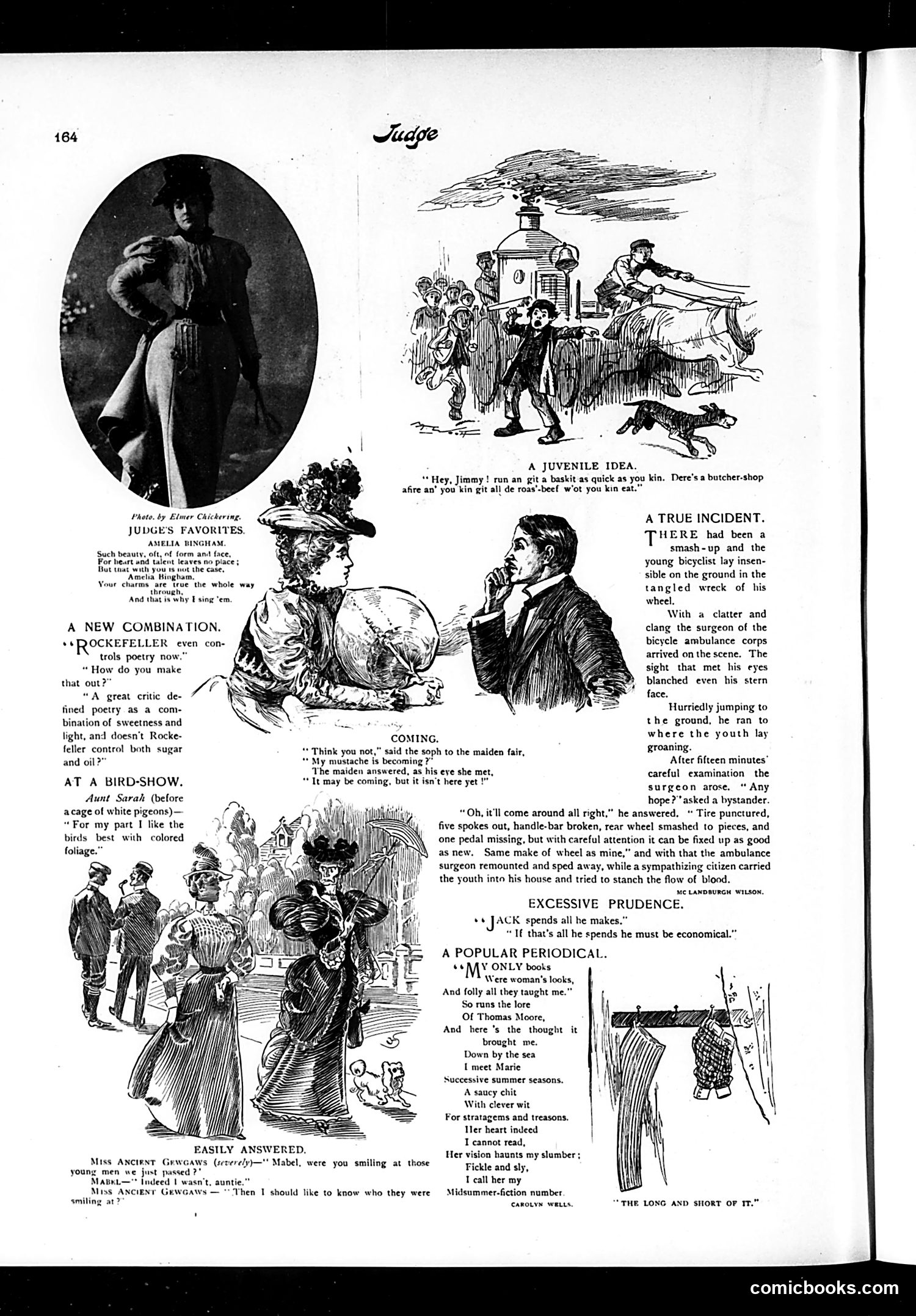
This page contains multiple short satirical pieces and jokes typical of Judge's humor: **"A Juvenile Idea"**: Dark humor about a child being sent to loot a butcher shop during a fire—satirizing either urban poverty or children's callousness. **"A New Combination"**: Mocks John D. Rockefeller's monopolistic control, joking that he now controls poetry itself since he dominates sugar (refined from sugar cane) and oil, the "sweetness and light" that define good poetry. **"A True Incident"**: Parodies the emerging "bicycle ambulance corps" (a novelty of the 1890s) by having the surgeon care more about his own bicycle's condition than the injured youth's life. **"Excessive Prudence"**: A brief joke about Jack being called economical merely for not spending more than he makes. The remaining items are minor verses and comic exchanges. The page reflects Judge's typical mix of topical satire, social observation, and puns aimed at educated readers familiar with contemporary figures like Rockefeller and emerging urban fads like cycling.
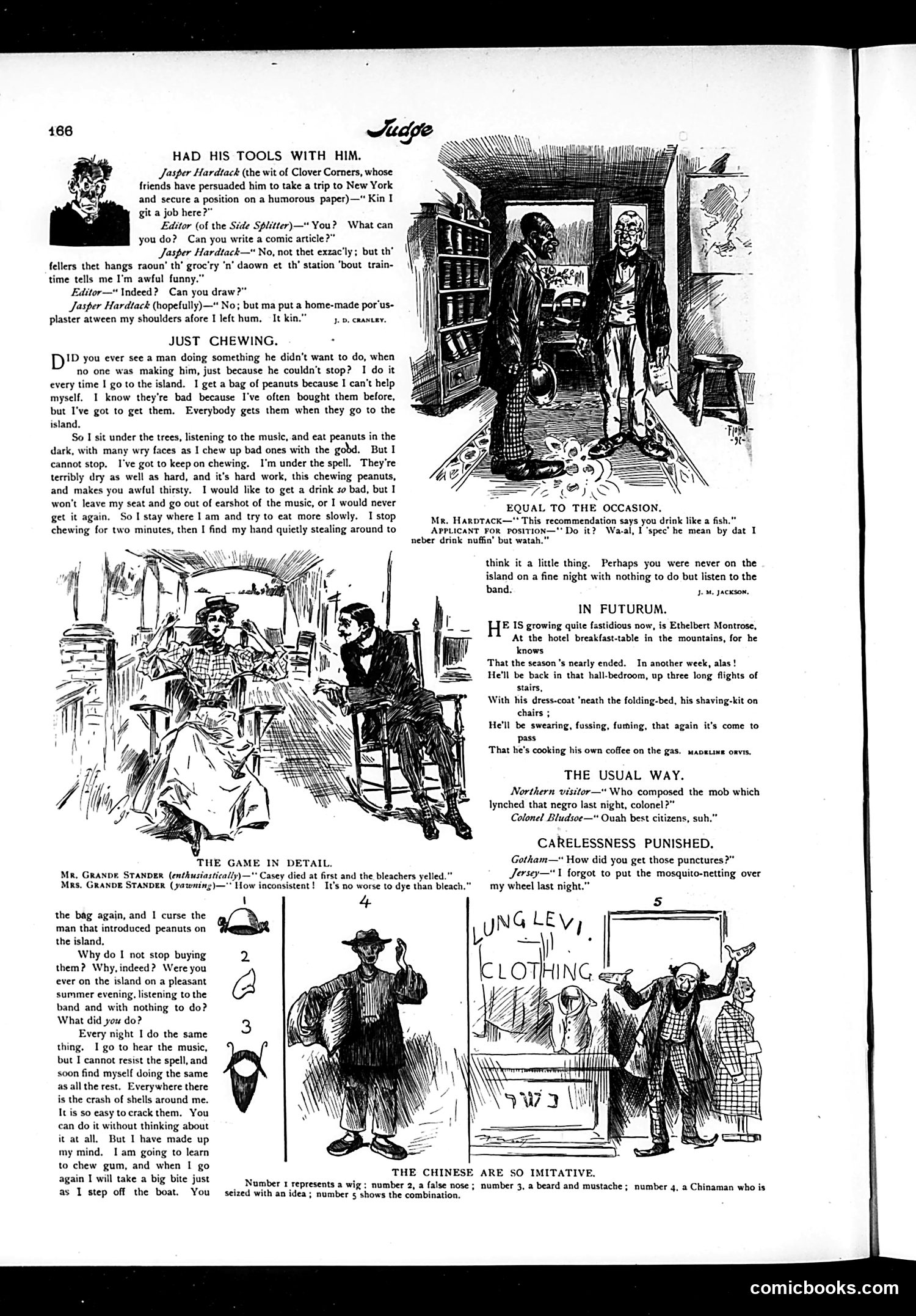
This page contains multiple satirical items typical of Judge's humor: **"Had His Tools With Him"**: A rural rube (Jasper Hardtack) seeks a job at a humor magazine, claiming he's "awful funny" because people at the general store laugh at him. When asked if he can write or draw, he offers a homemade poultice as his qualification—the joke being he's completely unqualified but doesn't realize it. **"Just Chewing"**: A humorous essay about compulsive peanut-eating at what appears to be Coney Island, mocking the inability to resist bad habits even when one knows they're foolish. **"The Chinese Are So Imitative"**: A cartoon (bottom) depicting Chinese people in disguises, reflecting the period's xenophobic stereotype that Chinese people merely copied Western appearances rather than having authentic culture. The page represents Judge's mix of gentle rural humor and more pointed ethnic stereotyping typical of early-20th-century American satire.
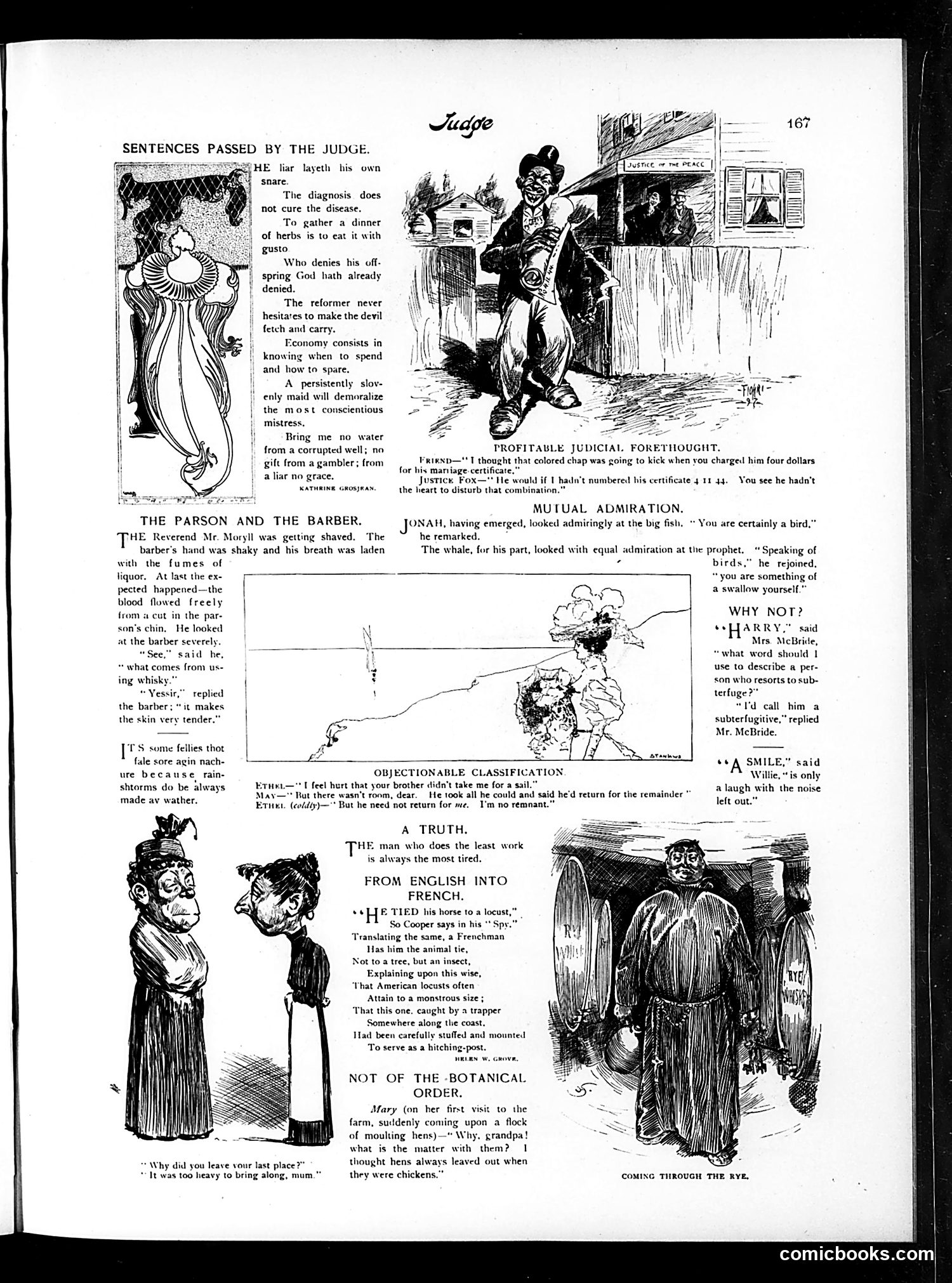
This page contains multiple satirical short pieces typical of Judge magazine's humor: **"Profitable Judicial Forethought"**: A judge exploits a Black man's superstition about numbers, charging him four dollars for a marriage certificate numbered "411 44" (a combination the man won't disturb), avoiding confrontation. **"The Parson and the Barber"**: A drunk barber cuts a minister's chin while shaving. The minister sanctimoniously blames alcohol, while the barber retorts that tender skin results from frequent shaving—mocking the parson's hypocrisy. **"Mutual Admiration"**: Jonah and the whale compliment each other, with the whale calling Jonah "a swallow"—a pun suggesting he'll be swallowed. **Other pieces** include wordplay about French translation errors, marital banter, and farm humor. These represent typical Judge content: class commentary, ethnic stereotypes, domestic jokes, and linguistic puns targeting middle-class readers of the Gilded Age.
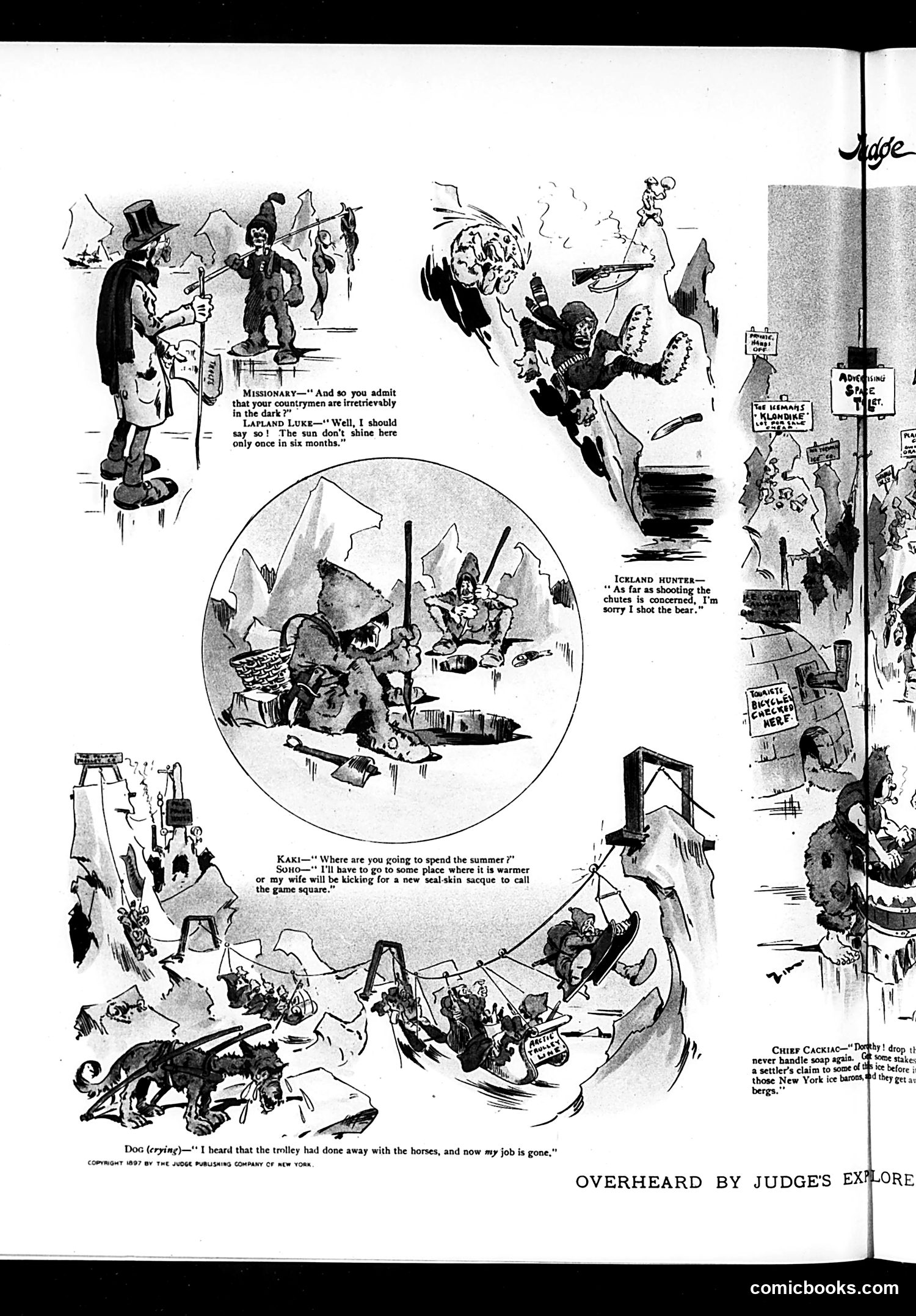
This page collects satirical one-liners mocking various regions and situations. The "Missionary" and "Creepy Luxe" exchange jokes about Iceland's darkness. The "Iceland Hunter" regrets shooting a bear while using shooting chutes (water slides), a pun on recreational activity. "Kaki" quips that Inuit people need warmer climates to justify purchasing expensive seal-skin coats—satirizing wealthy Americans' excuse-making for luxury purchases. "Chief Cackrac" appears to reference Native Americans, with a settler joke about ice harvesting. The "Dog" lament about trolleys replacing horses reflects contemporary anxiety over technological displacement of workers and animals during the 1890s-1900s Industrial Age. The cartoons use ethnic caricatures and stereotypes typical of *Judge* magazine's era, mocking both foreign peoples and American consumer culture and labor disruption through exaggerated dialogue.
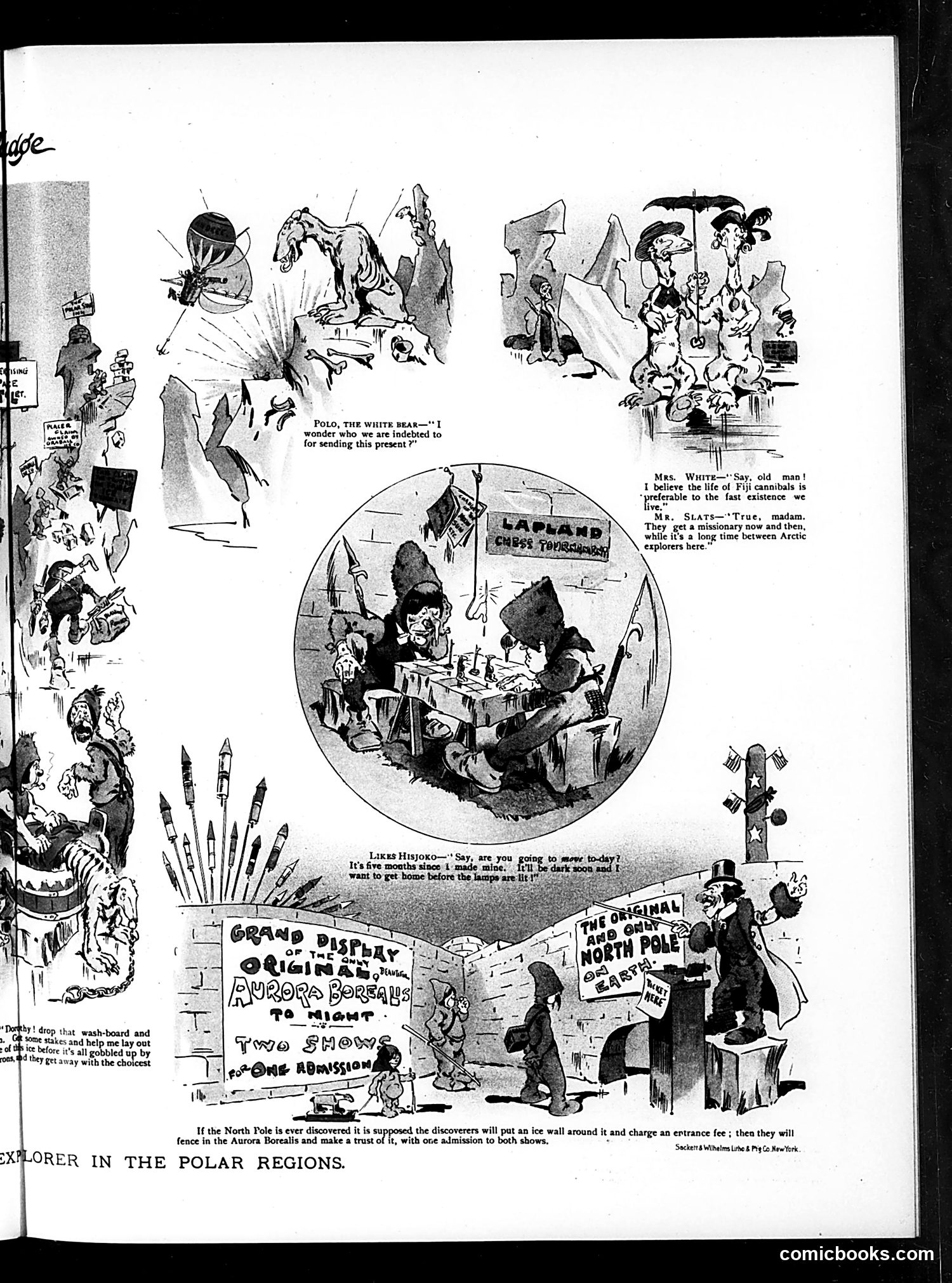
This satirical cartoon mocks the early 20th-century craze for Arctic exploration and polar discovery. The main panel shows two well-dressed figures at a table—apparently discussing a polar bear ("Polo") sent as a gift, likely referencing recent Arctic expeditions that captured exotic animals. The surrounding vignettes ridicule both the hardships of polar exploration and modern commercialization. Characters complain about Arctic conditions while others fantasize about turning polar discoveries into tourist attractions—complete with ice walls, entrance fees, and Aurora Borealis viewing rights. The satire targets two absurdities: (1) the romanticization of brutal Arctic exploration despite obvious dangers and discomforts, and (2) the American impulse to immediately commercialize and monopolize any natural wonder (creating a "trust"). The final caption explicitly states this prediction: explorers will fence in the North Pole and charge admission like a circus sideshow.
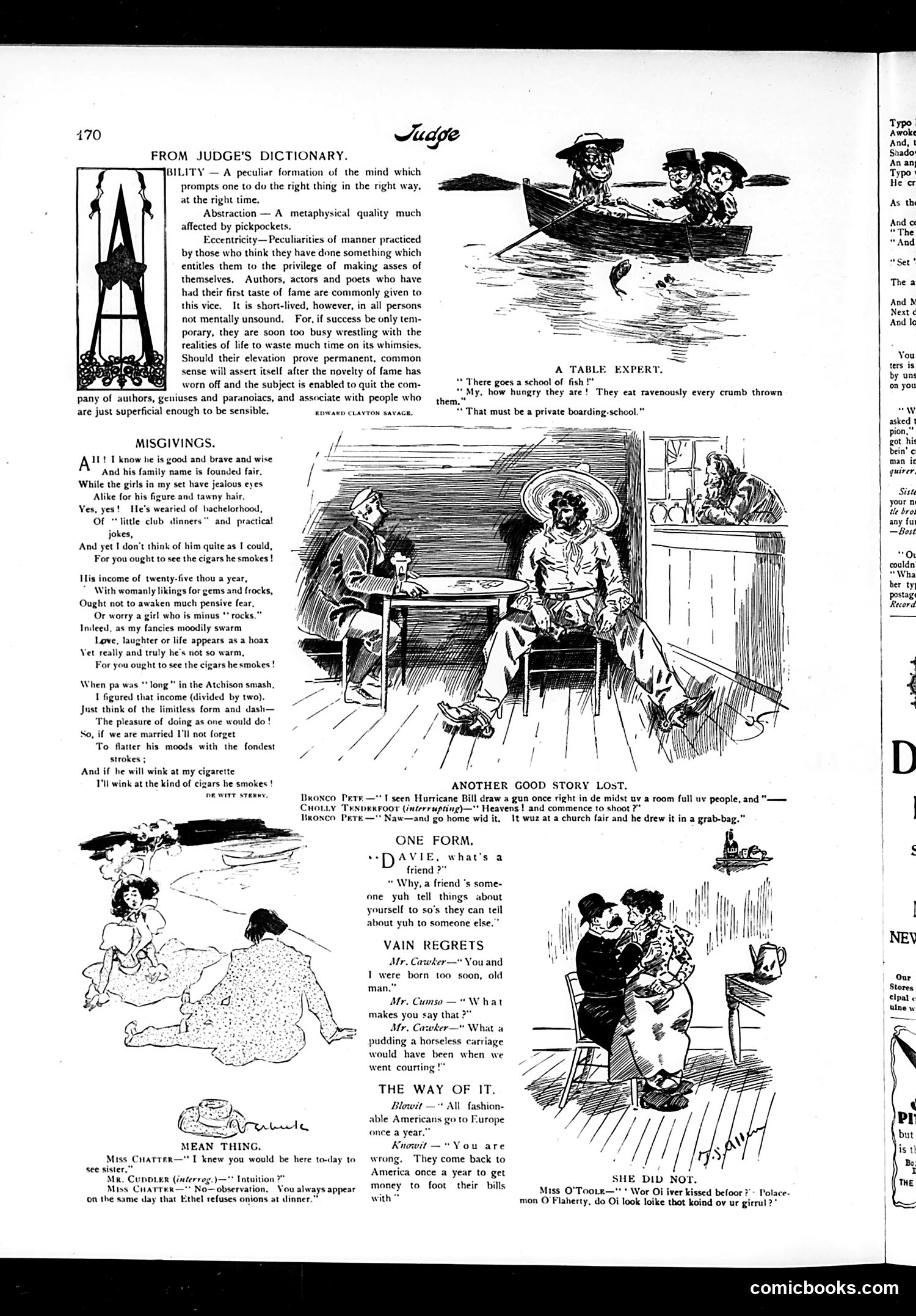
This page from Judge contains satirical humor pieces targeting various social pretensions of the era. **"Misgivings"** mocks a wealthy young woman's conflicted engagement: she's attracted to a man with substantial income ($25,000/year) and good family, but is repelled by his poor taste in cigars—suggesting vanity and superficiality override genuine compatibility in marriage decisions among the affluent. **"The Way of It"** satirizes wealthy Americans' spending habits, implying they travel to Europe annually but return home broke, requiring fresh funds to pay European debts—a jab at nouveau riche extravagance and financial irresponsibility. **"Mean Thing"** uses observational humor about courtship patterns among the upper classes. **"Vain Regrets"** contains nostalgia for pre-automobile courting days, humorously regretting modern technology's existence. The remaining brief sketches employ similar light satirical humor about social behavior, relationships, and class assumptions typical of Judge's editorial approach.
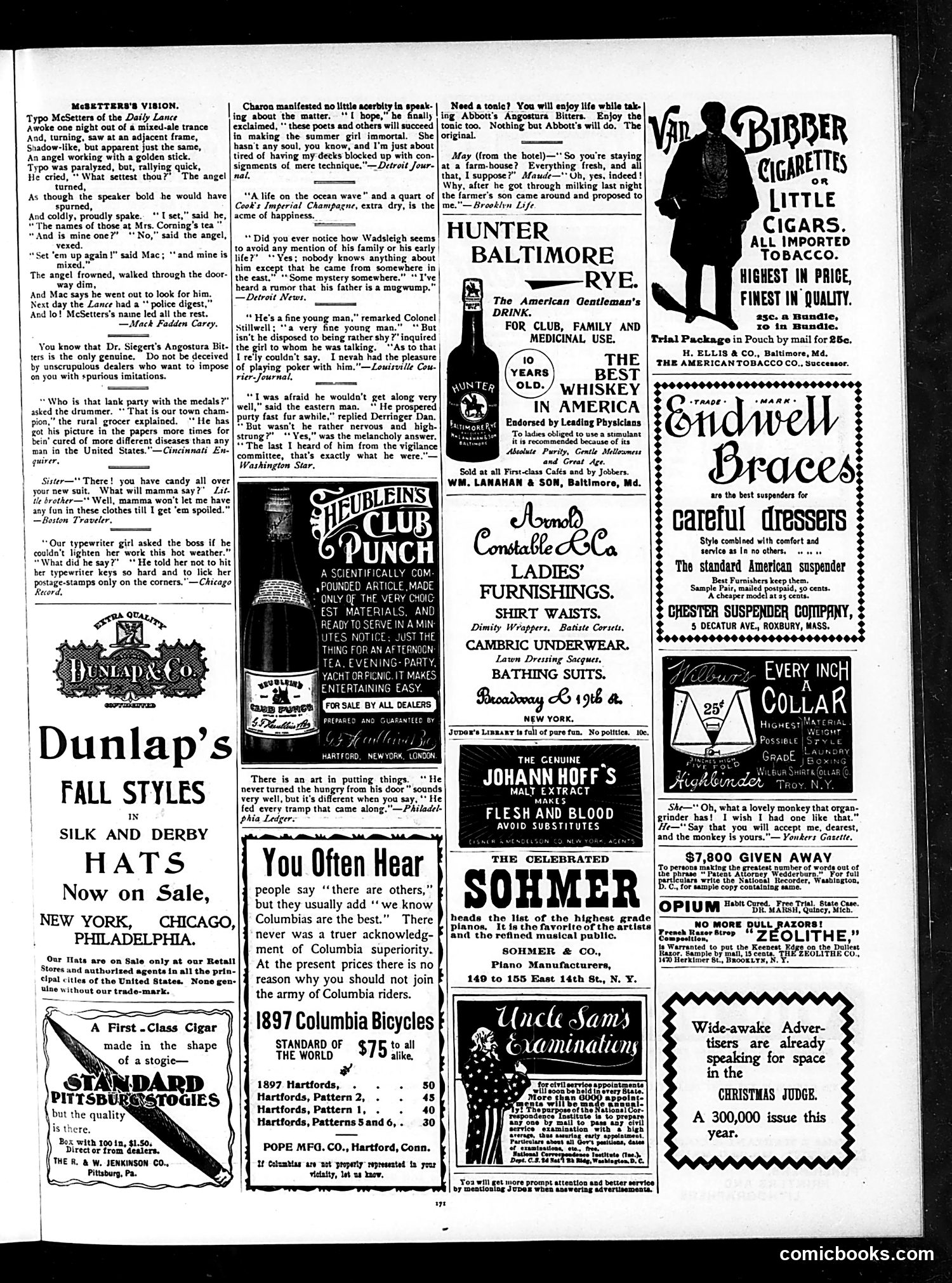
This is primarily an **advertising page** with miscellaneous short humor pieces scattered throughout. The cartoon content consists of brief satirical jokes rather than a unified political cartoon: 1. **"McSetter's Vision"**: A drunk newspaper typesetter (Typo McSetters) hallucinates an angel. The joke plays on his intoxication and his name—he asks the angel what he's "setting" (typesetting), and the angel sarcastically replies he's setting the names of society ladies at a tea party. McSetters wasn't invited, hence the joke. This mocks both heavy drinking and social exclusion. 2. **Other brief jokes** mock: a man famous for being cured of diseases (quack medicine advertisements); typewriter girls hitting keys too hard in summer heat; a mysterious man avoiding discussion of his family (possibly implying illegitimacy or scandal). The page is dominated by **period product advertisements**: Dunlap hats, Hunter Baltimore Rye whiskey, Endwell Braces, various cigars, and medicinal tonics. The ads reflect 1890s consumer culture and patent medicine marketing.
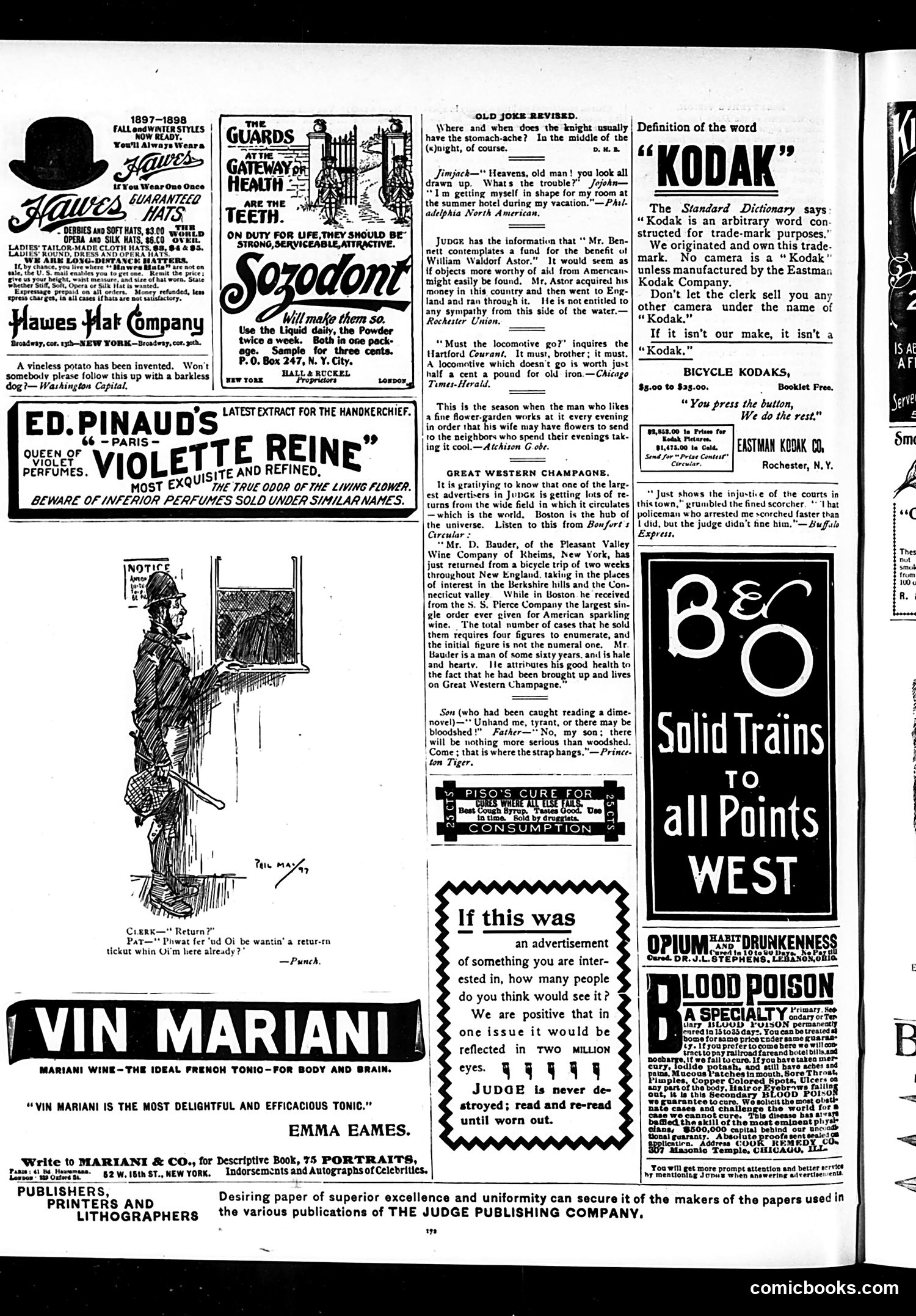
This is primarily an **advertising page** with minimal editorial content. The few jokes scattered among ads are brief, disconnected items: **The cartoons/jokes:** - A small sketch labeled "Return?" shows two Irish characters discussing a return ticket—a simple pun on the word "return" - Several brief joke excerpts (attributed to various publications) mock topics like: knights with stomachaches, wealthy men like William Waldorf Astor (who made money in America then moved to England), and locomotive requirements **The advertisements** dominate, hawking period remedies and goods: Hawes hats, Sozodont toothpaste, Pinaud's perfume, Vin Mariani (wine tonic), B&O trains, and Piso's consumption cure. **Context for modern readers:** The Astor reference mocks American self-made wealth leaving the country; the period ads reflect an era when patent medicines and tonics (many containing alcohol or dubious ingredients) were heavily marketed in magazines targeting educated, affluent readers. The page itself demonstrates how Judge subsidized editorial content through aggressive advertising.
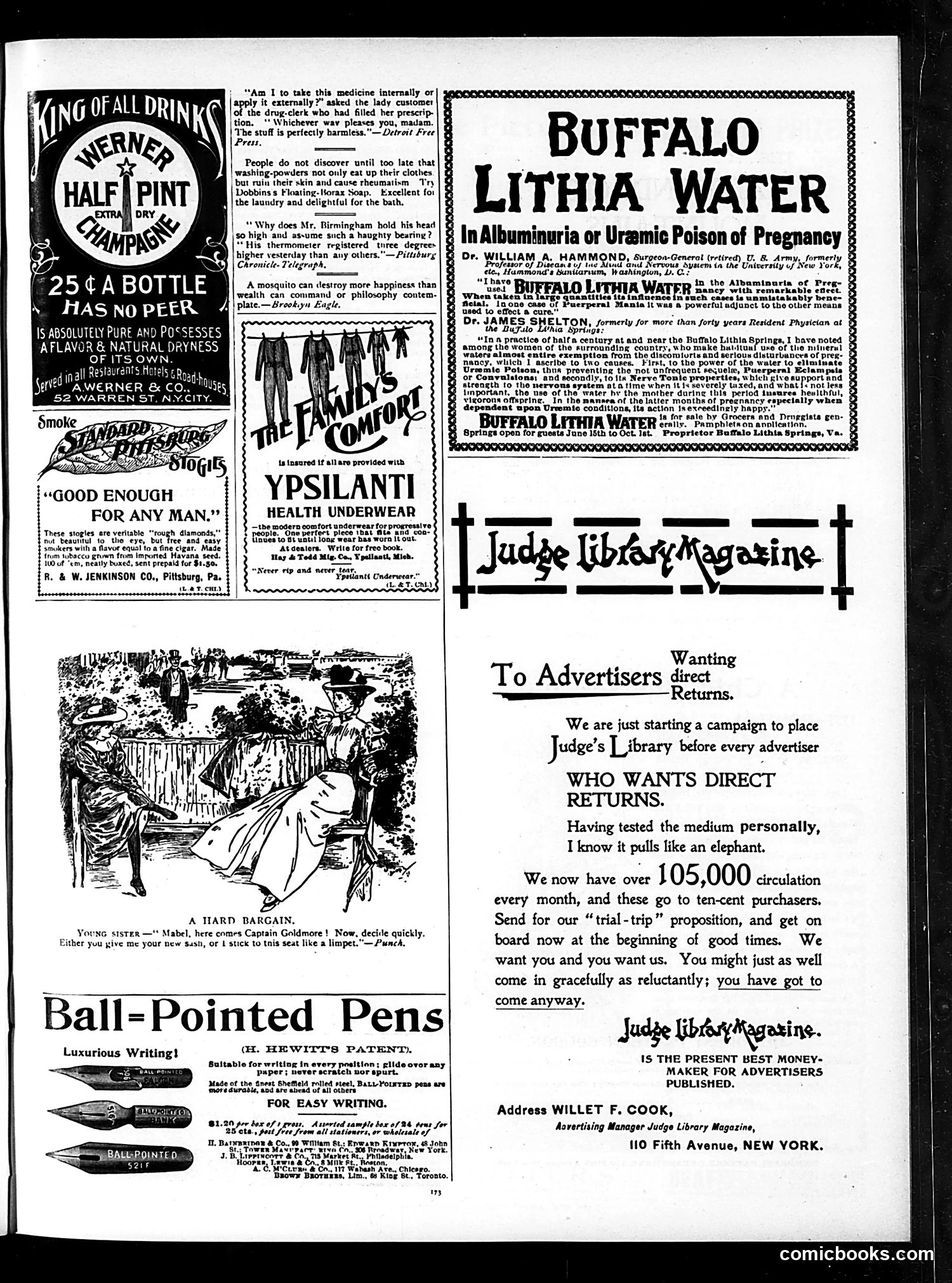
This is primarily an **advertising page** from Judge magazine, not a satirical cartoon page. The dominant content is product advertisements mixed with brief humorous anecdotes. The small jokes scattered throughout represent typical early 20th-century humor: a lady confused about medicine dosage, a man's inflated pride from a high thermometer reading, and a young woman pressuring her sister to surrender her new dress before a suitor visits. The substantial advertisements promote various products: Werner's champagne, Dobbins's soap, Ypsilanti health underwear, Ball-Pointed pens, and prominently, **Buffalo Lithia Water**, marketed as a medical treatment for pregnant women with kidney complications (albuminuria). The medical claims appear dubious by modern standards—testimonials from military and medical figures endorse it as a "nerve tonic" and general cure for pregnancy complications. The page also includes **Judge Library Magazine's** own advertising soliciting direct-response advertisers, claiming 105,000 monthly circulation among "ten-cent purchasers." Overall, this reflects the era's unregulated medical advertising and Judge's reliance on product endorsements for revenue.
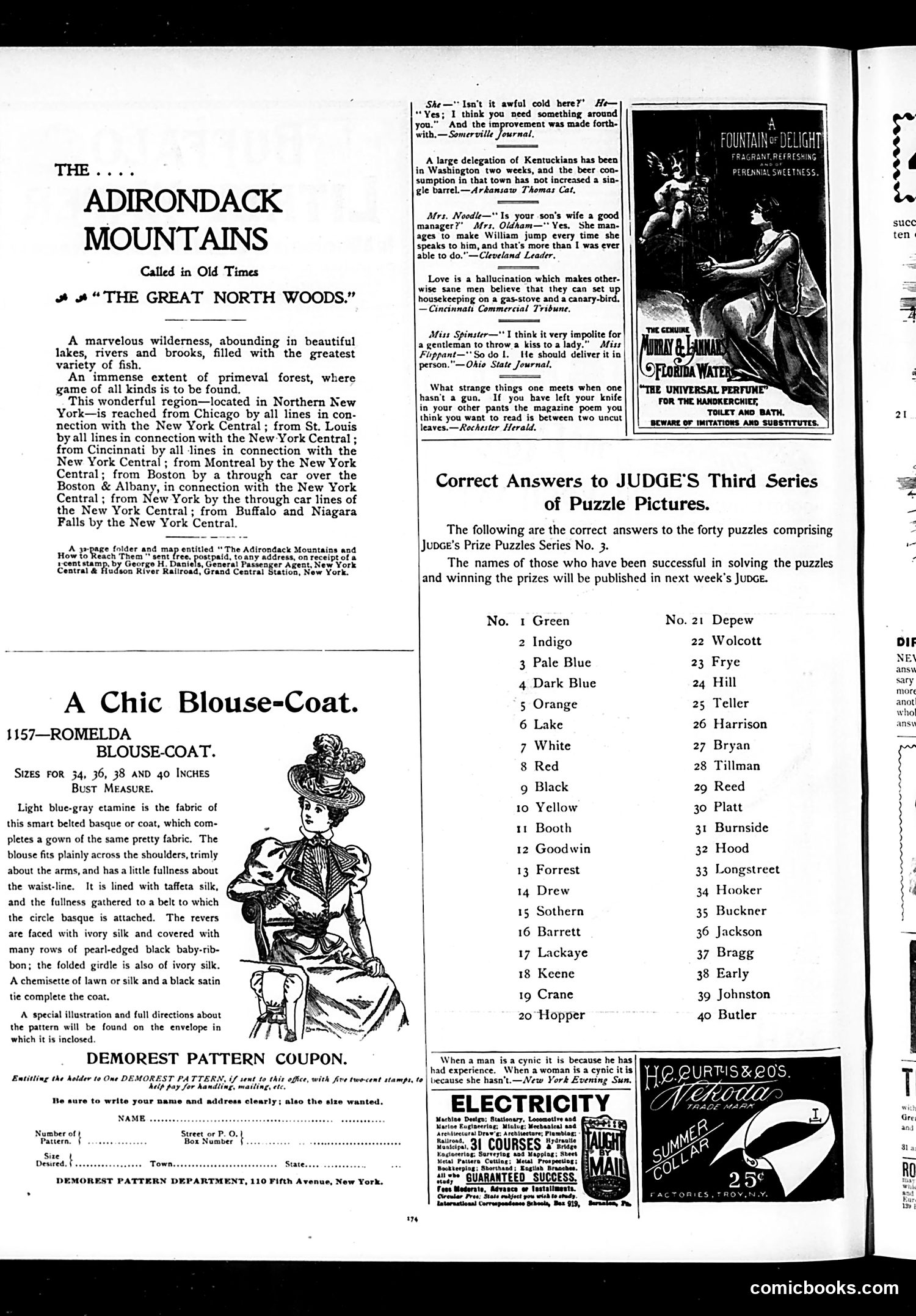
This page from *Judge* is primarily **advertising and instructional content** rather than political satire. The main content includes: 1. **Travel advertisement** for the Adirondack Mountains, promoted as "The Great North Woods"—a wilderness destination accessible via the New York Central Railroad from major cities. 2. **Fashion pattern** (Demorest #1157) for a "Chic Blouse-Coat," with detailed sewing instructions for women's clothing. 3. **Humorous short jokes** in the margins—light domestic humor typical of the era (jokes about marriage, cold weather, and manners). 4. **Puzzle answers** listing names that appear to be **prominent political figures of the time** (Depew, Wolcott, Frye, Hill, Teller, etc.), though the puzzle illustrations themselves aren't visible on this page. The page reflects *Judge*'s typical mix of advertising, practical content for readers, and light humor—rather than sharp political cartooning. The political content is subtle: the puzzle answers suggest contemporary political figures were used as quiz answers for readers.
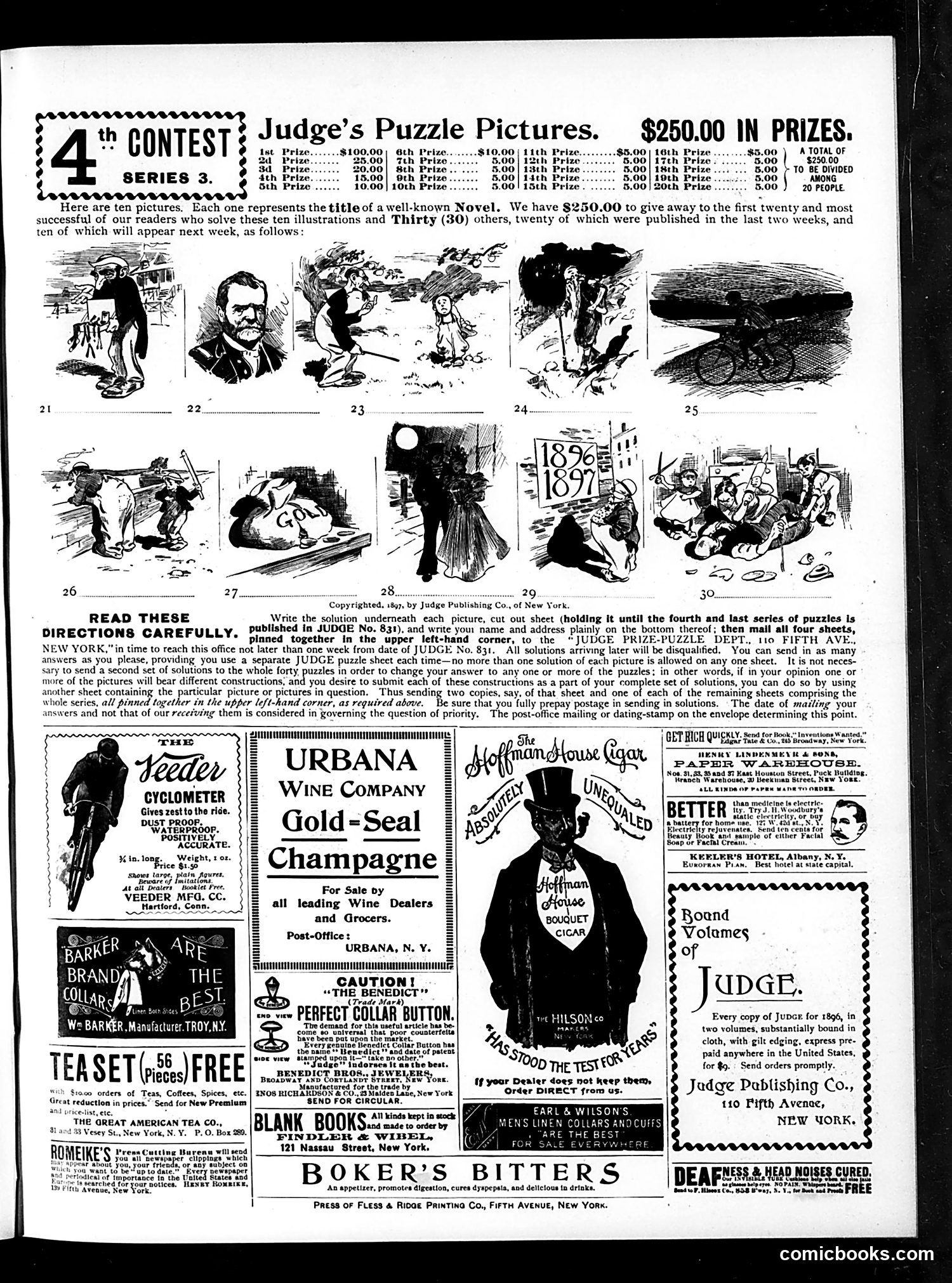
This page announces a puzzle competition: readers must identify ten novel titles represented by cartoon illustrations (numbered 21-30), with $250 in prizes for correct solutions. The contest is part of a larger series of forty puzzles published across multiple issues of Judge magazine. The ten illustrated puzzles appear to be visual puns or scenes depicting famous novel titles—for example, image 25 shows what appears to be a cannon, possibly representing a military novel. Readers were instructed to mail solutions to Judge's offices on Fifth Avenue within a specified timeframe. The remainder of the page contains period advertising for products like cyclometers, champagne, collar buttons, and tea sets—typical commercial content filling space in late-19th-century magazines. The puzzle contest itself was a common engagement strategy for magazines of this era, encouraging reader participation and repeat purchases.
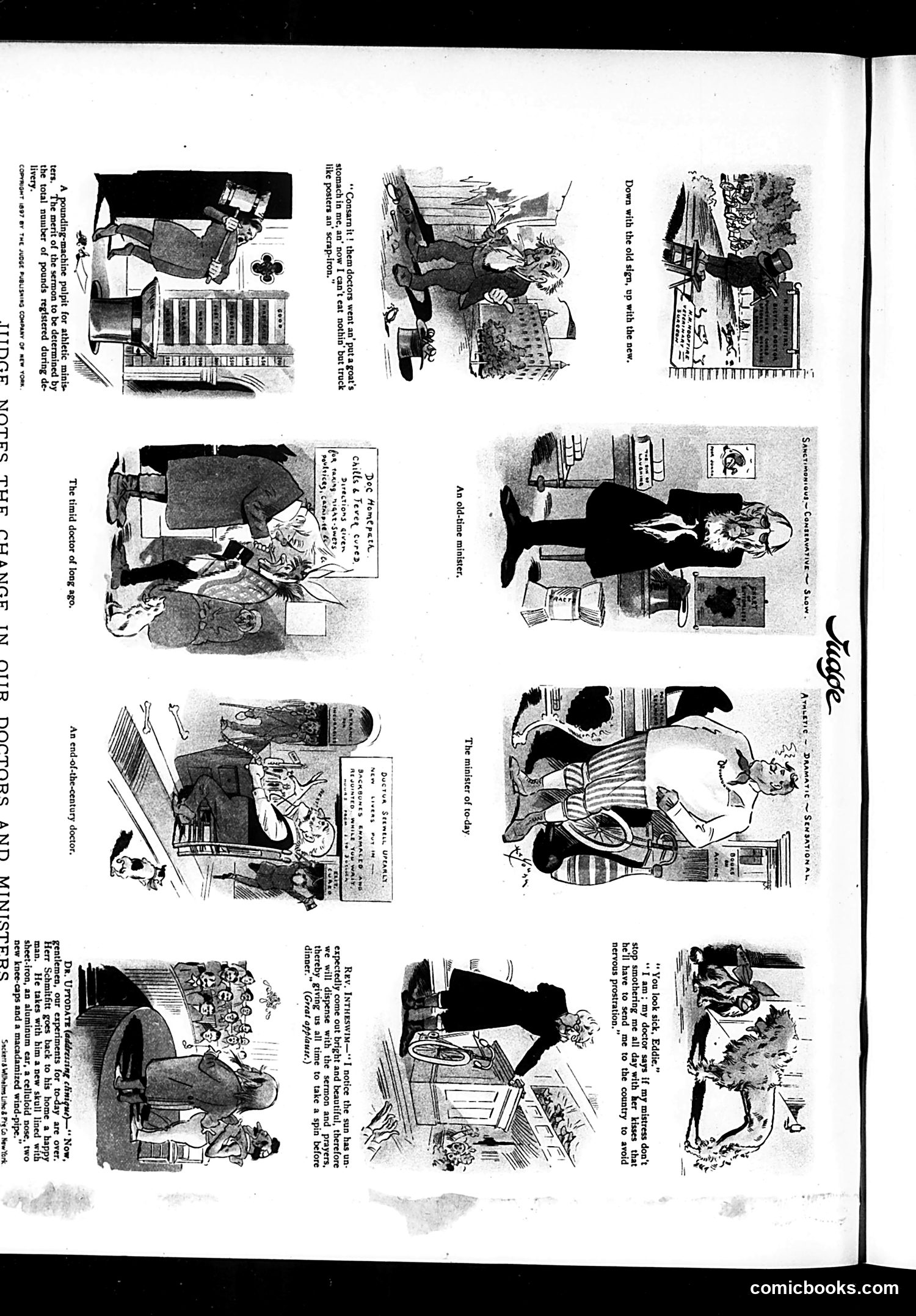
This 1897 page from *Judge* contains multiple satirical vignettes mocking contemporary American trends: **Medical Satire**: The top panels ridicule advances in transplant surgery and aggressive modern medicine. A farmer complains a goat's stomach transplant now restricts his diet—absurd commentary on experimental procedures gaining public attention. **Ministerial Critique**: The central panels contrast "old-time" versus "end-of-the-century" ministers. The modern version uses a "pounding-machine pulpit" measuring sermon quality by physical force registered—mocking how 1890s religious life had become sensationalized and performance-driven rather than spiritually meaningful. **Doctor Comparison**: Similar contrast between the "timid" traditional doctor and the aggressive modern one, satirizing how medicine was becoming increasingly confident and interventionist. **Pet Indulgence**: The "Eddie" dialogue mocks upper-class excess—a lap dog's owner smothers it with affection so intensely the doctor prescribes country rest, satirizing both pet-spoiling and medical overcautiousness. The overarching theme: *Judge* warns that modernity's "progress"—aggressive medicine, theatrical religion, overwrought sentimentality—threatens traditional values.