
A complete issue · 16 pages · 1897
Judge — July 17, 1897
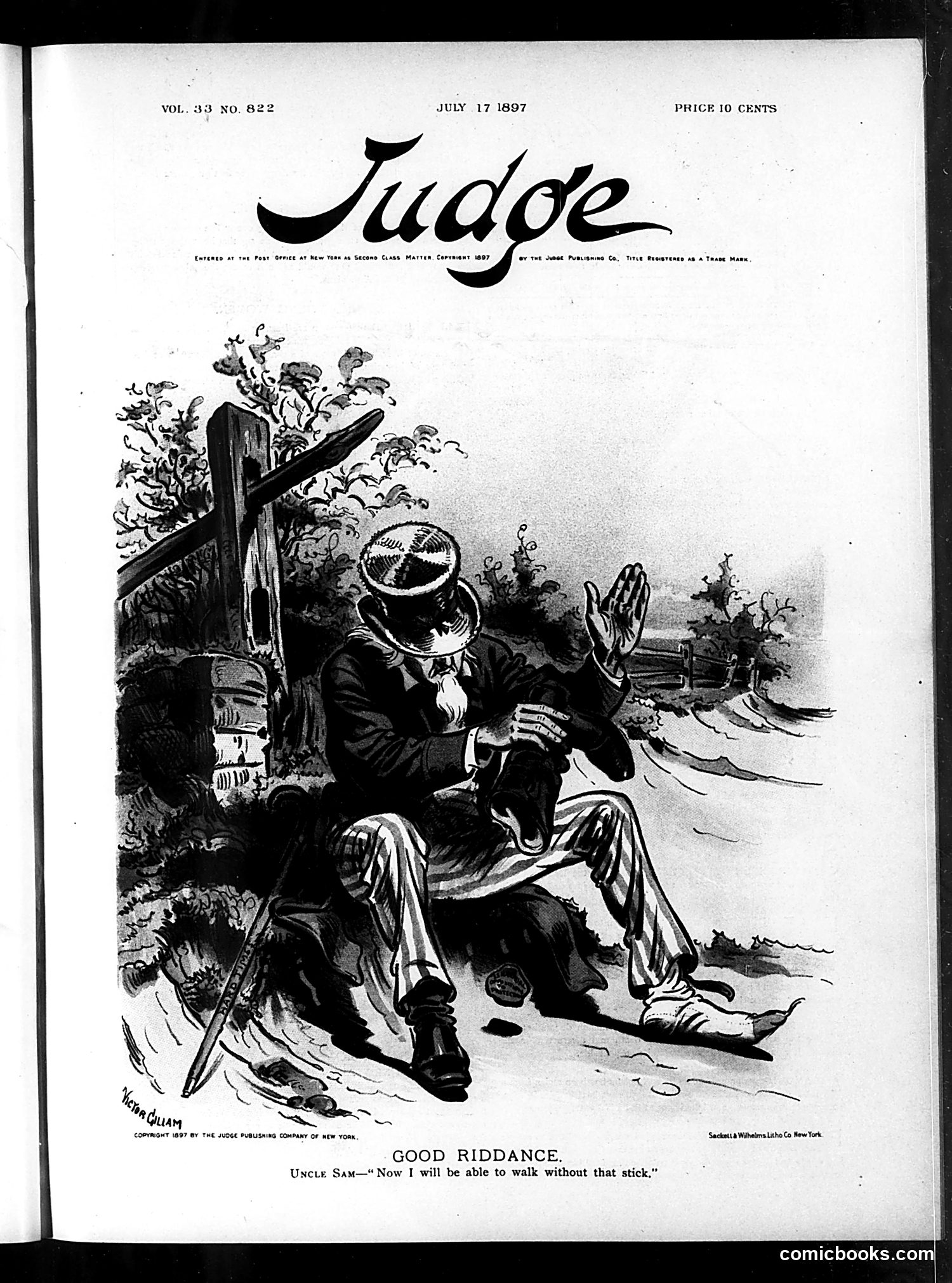
This cartoon depicts **Uncle Sam** discarding a crutch, with the caption "Now I will be able to walk without that stick." The image appears to satirize the end of American dependence on some burden or constraint—likely referencing the conclusion of the **Spanish-American War** (which ended in August 1898, though this predates that). The crutch symbolizes a past limitation or foreign entanglement that Uncle Sam is rejecting. The figure's posture—leisurely seated by vegetation—suggests relief and confidence about America's future independence or strength. The satire celebrates American self-sufficiency and perhaps critiques previous hesitation or reluctance in foreign policy. Without additional context from the magazine's other content, the exact reference remains somewhat unclear, though it definitely concerns American geopolitical autonomy.
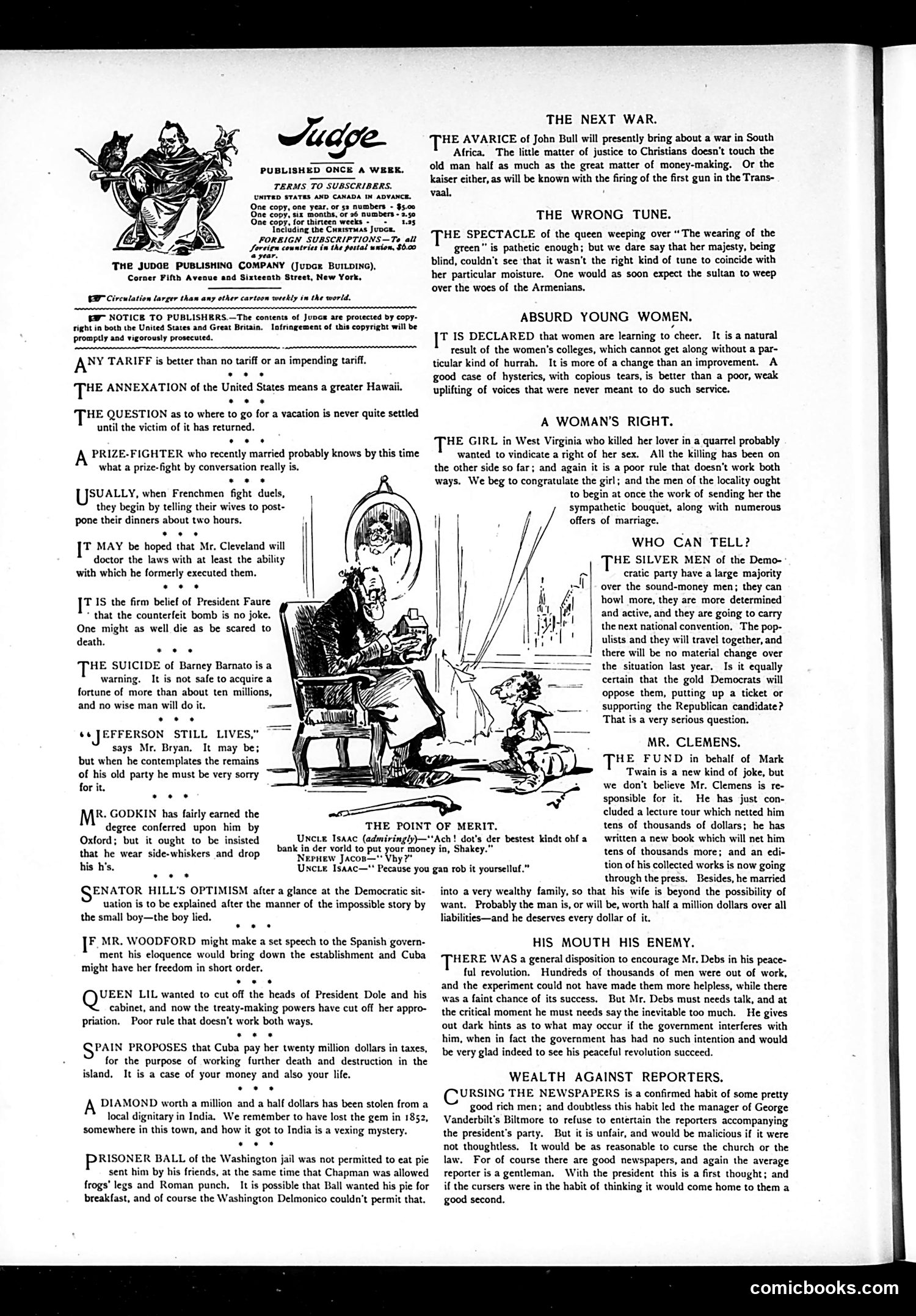
This page contains brief satirical commentary rather than a single cartoon. The main illustration shows a figure (likely a political figure, though identity isn't entirely clear from the image alone) seated in a chair speaking with what appears to be a child or small figure. The text items mock various political and social topics: President Cleveland's ability to enforce laws, the counterfeited bomb of President Faure (referencing an anarchist threat), Democratic Party silver policy, Mark Twain's lecture tour profits, and newspaper reporters seeking access to political figures. The satire targets political incompetence, corruption, and the absurdities of late-19th-century American politics and society. Without clearer identification of specific figures or dating information visible in the image, precise attribution of some references remains uncertain.
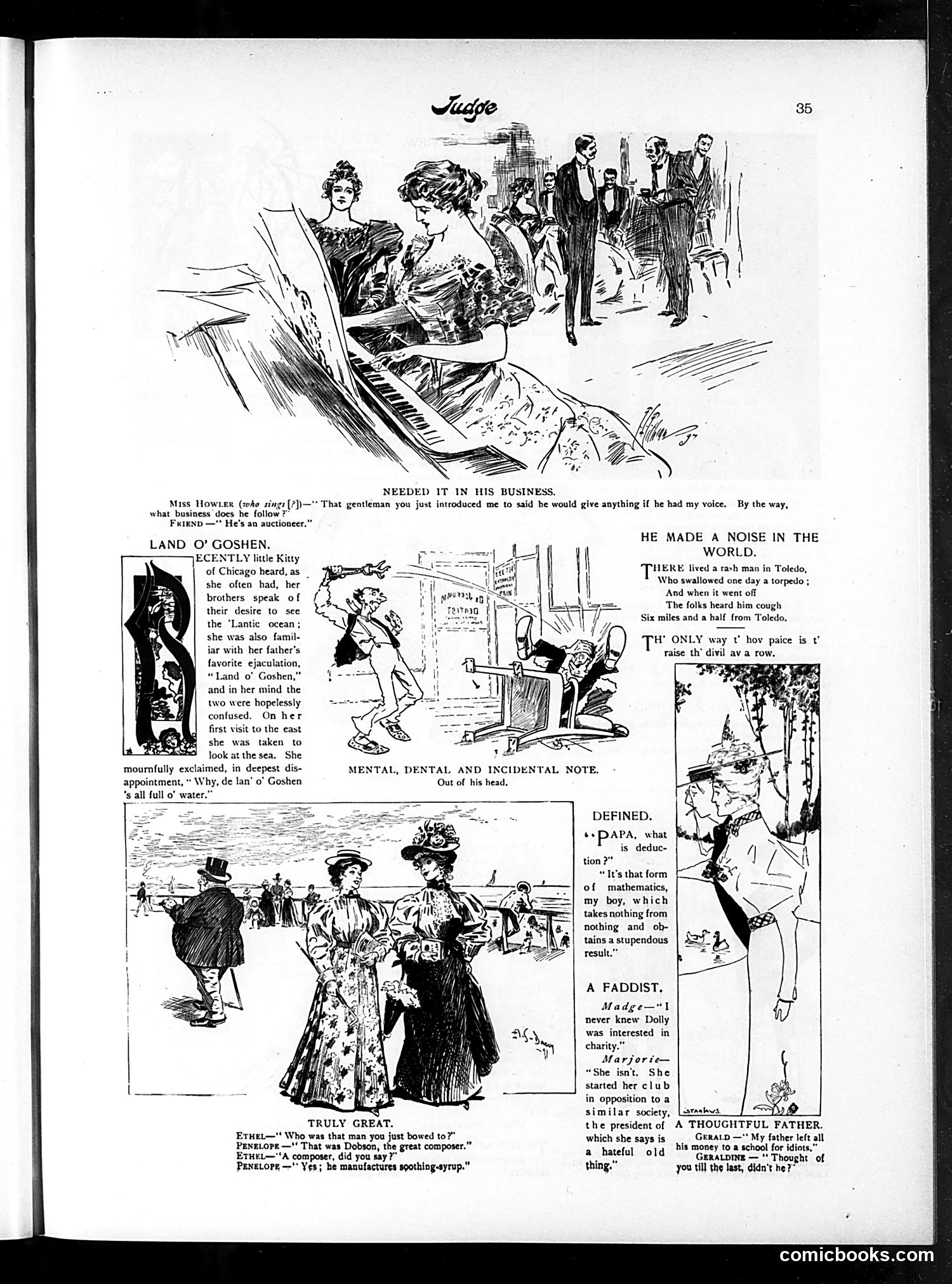
This page contains several satirical sketches typical of early 20th-century humor magazines: **"NEEDED IT IN HIS BUSINESS"** depicts a society scene where a gentleman introduces an acquaintance, then asks for a favor—a joke about social networking for personal gain. **"LAND O' GOSHEN"** is a humorous anecdote about a Midwestern family's disappointment visiting the East Coast, playing on regional stereotypes and cultural differences. **"HE MADE A NOISE IN THE WORLD"** tells of a Toledo man whose coughing disturbed neighbors—simple physical comedy. The remaining entries ("MENTAL, DENTAL AND INCIDENTAL NOTE," "DEFINED," "A FADDIST," "TRULY GREAT," and "A THOUGHTFUL FATHER") are brief joke definitions and comedic dialogues about contemporary social types and behaviors. Overall, this reflects Judge's typical format: light, observational humor about American society rather than hard political satire.
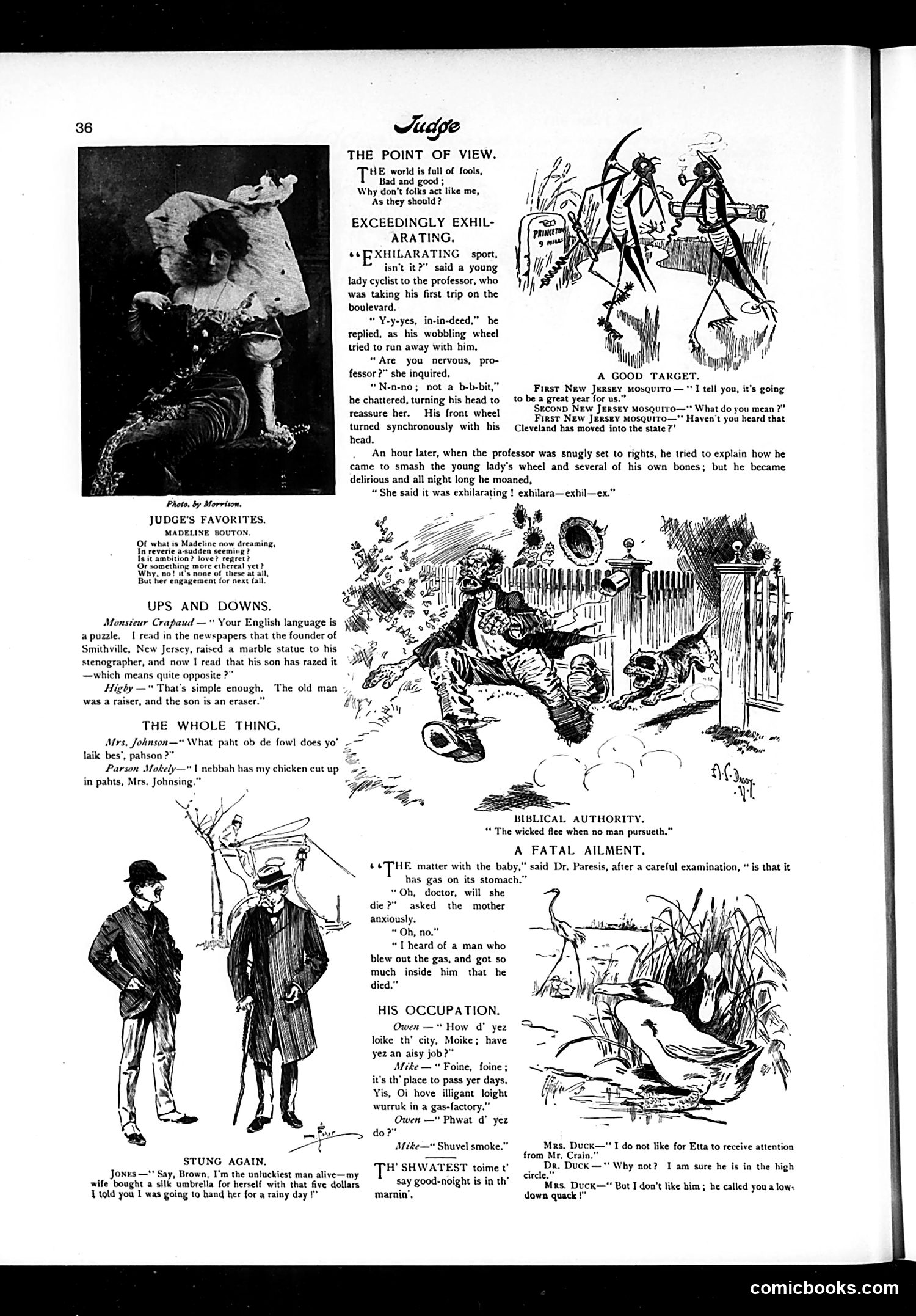
This page contains multiple short humorous pieces typical of Judge's satirical style: **"Exceedingly Exhilarating"** mocks the bicycle craze of the 1890s. A nervous professor on his first bicycle ride claims he's "not nervous" while wobbling dangerously. The joke: he crashes, then deliriously repeats "exhilarating" all night—satirizing how fashionable people enthusiastically embrace dangerous fads without genuine enjoyment. **"A Good Target"** jokes about New Jersey mosquitoes celebrating Cleveland's relocation to their state, treating it as an opportunity for feeding. **"His Occupation"** features Irish-dialect characters discussing factory work, with a pun: the worker shovels smoke at a gas factory. Other pieces include wordplay jokes ("raiser/eraser"), ethnic humor in dialect, and relationship comedy. The page reflects period preoccupations: new technologies (bicycles), contemporary relocations, and working-class life—all delivered through the magazine's characteristic mix of visual cartoons and brief comic dialogues.
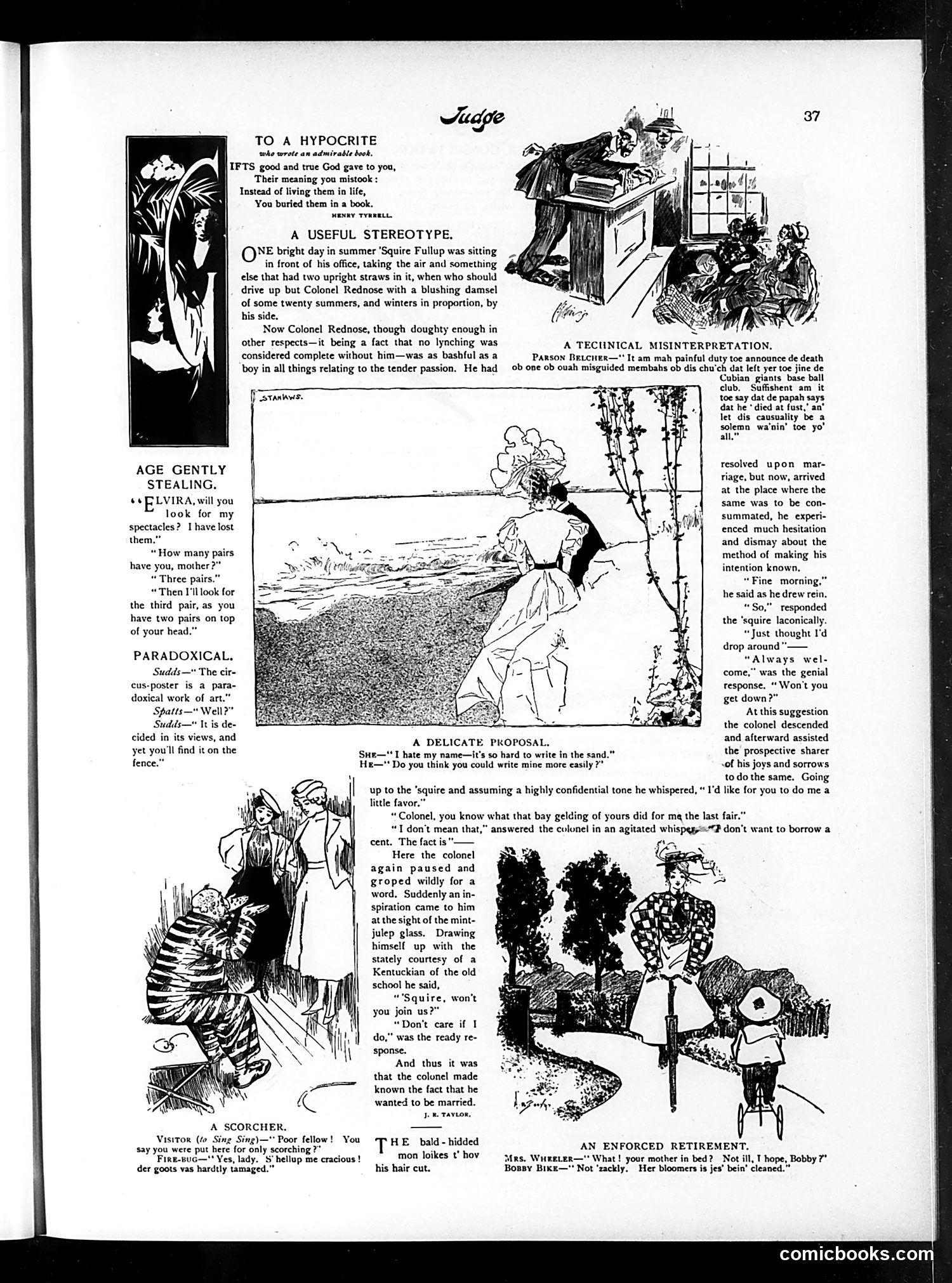
This page contains several short satirical pieces typical of late 19th/early 20th-century American humor magazines: **"A Useful Stereotype"** mocks Southern gentlemen's social awkwardness around romance. Colonel Rednose, depicted as rough and violent (involved in lynchings), becomes bashful when proposing marriage—a stereotypical contradiction the cartoonist finds amusing. **"Age Gently Stealing"** is a simple joke about elderly women losing spectacles while wearing them on their heads—playing on absent-mindedness in aging. **"A Technical Misinterpretation"** satirizes a Black preacher misunderstanding a baseball player's death report, confusing sports terminology with religious language. This reflects deeply racist period stereotypes using dialect humor. **"A Delicate Proposal"** depicts a shy suitor using a mint julep glass as social lubricant to propose—another Southern gentleman stereotype. The remaining pieces are brief jokes about everyday life. The overall tone reflects period attitudes: rural/Southern stereotypes, class-based humor, and racist caricatures presented as entertainment for Judge's middle-class readership.
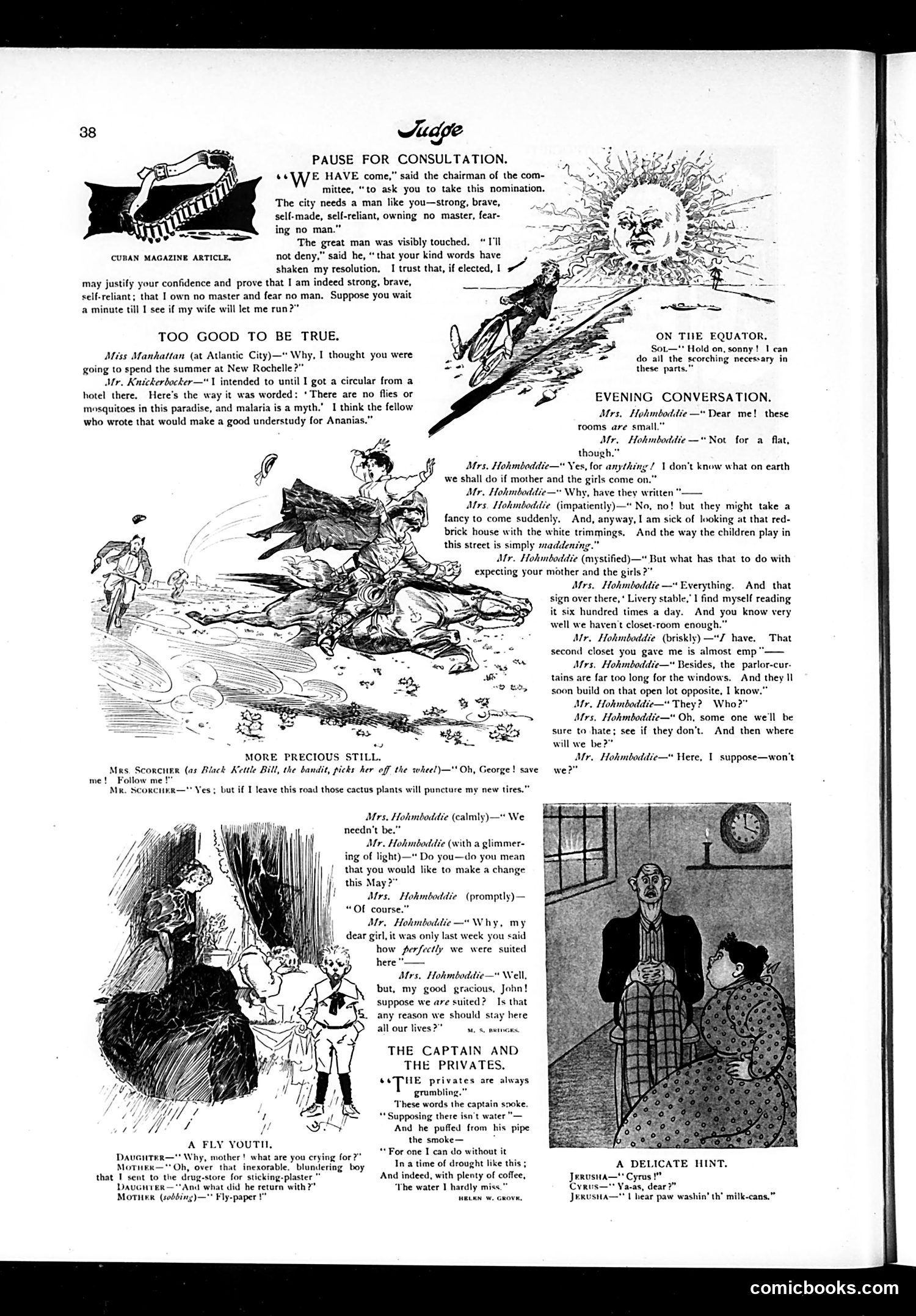
This page contains several short satirical pieces typical of Judge's humor: **"Pause for Consultation"** mocks male politicians' actual lack of independence—a man nominated for office must consult his wife before accepting, undermining his claims of being "strong" and "self-reliant." **"Too Good to Be True"** jokes about exaggerated hotel advertising claims, comparing a hotel owner's false promises to Ananias (a biblical figure known for lying). **"Evening Conversation"** satirizes wives' perpetual dissatisfaction with their homes—Mrs. Hohmboddie complains about room size, neighbors, street activity, and curtain length, then reveals she simply wants to move in May regardless of actual problems. **"More Precious Still"** humorously depicts a man prioritizing his car's new tires over rescuing his wife from a bandit. **"The Captain and the Privates"** appears to reference labor/military tensions, with officers dismissive of soldiers' legitimate complaints about water shortage. These vignettes satirize domestic life, commercialism, and authority figures of the era through exaggeration and ironic juxtaposition.
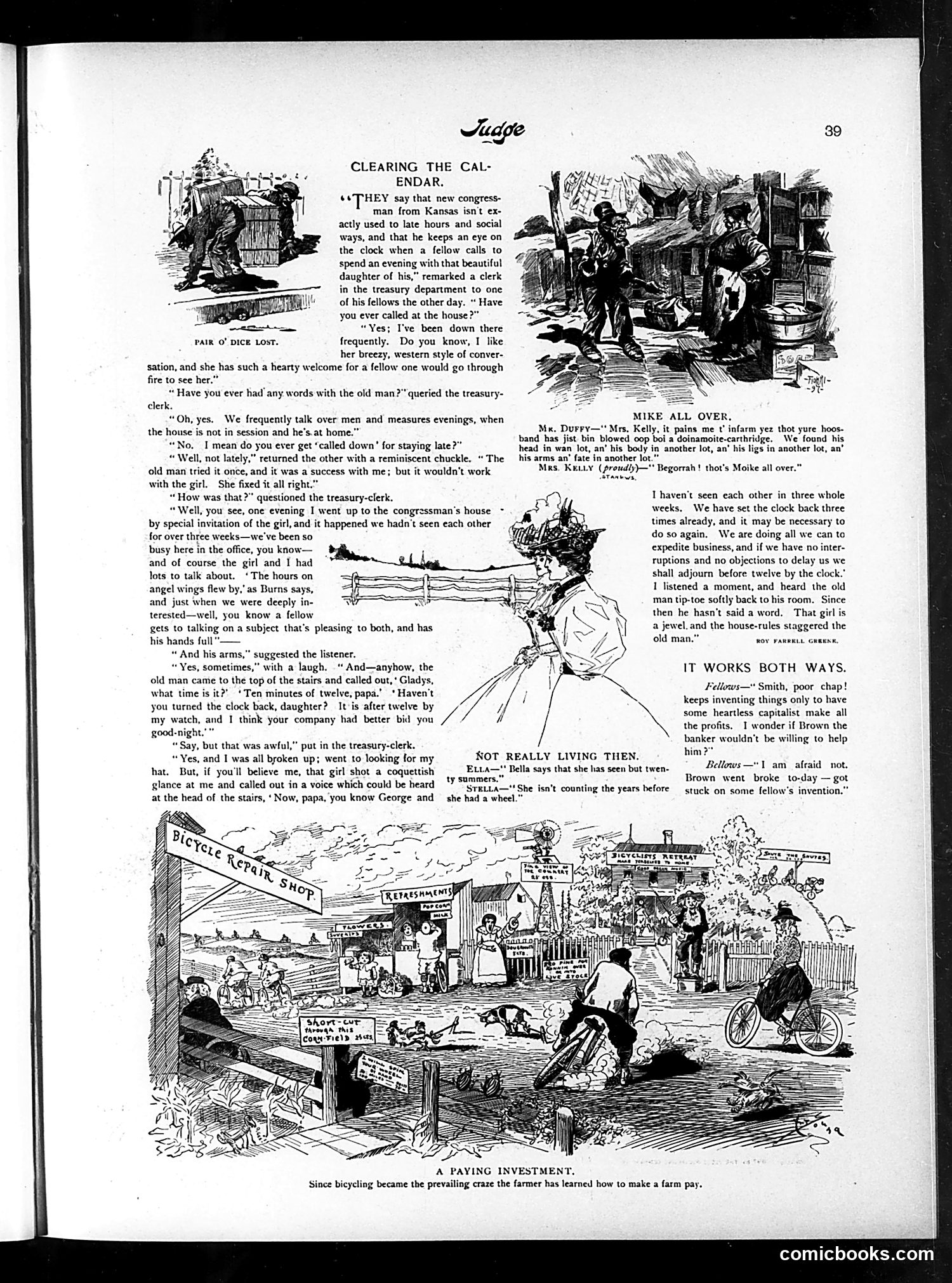
This page contains three unrelated comic sketches satirizing late-1890s American social life: **"Clearing the Calendar"** mocks a naive Kansas congressman who enforces strict curfews on suitors visiting his daughter. His daughter outwits him by setting back the clock, allowing her beau to stay longer while technically complying with the rules. The joke targets both old-fashioned parental control and young people's romantic scheming. **"Mike All Over"** is a brief Irish-immigrant joke. Mrs. Kelly responds to news that her husband was blown to pieces in an explosion with proud acceptance, saying it's typical of him—the humor relies on crude stereotyping of Irish working-class fatalism. **"A Paying Investment"** shows farmers profiting from the bicycle craze by renting cycles. The accompanying dialogue ("It Works Both Ways" and "Not Really Living Then") satirizes how inventors rarely benefit financially from their creations while capitalists and middlemen profit instead—a critique of industrial-era economic inequality. The page reflects 1890s concerns: generational conflicts, ethnic stereotyping, and resentment toward capitalist exploitation.
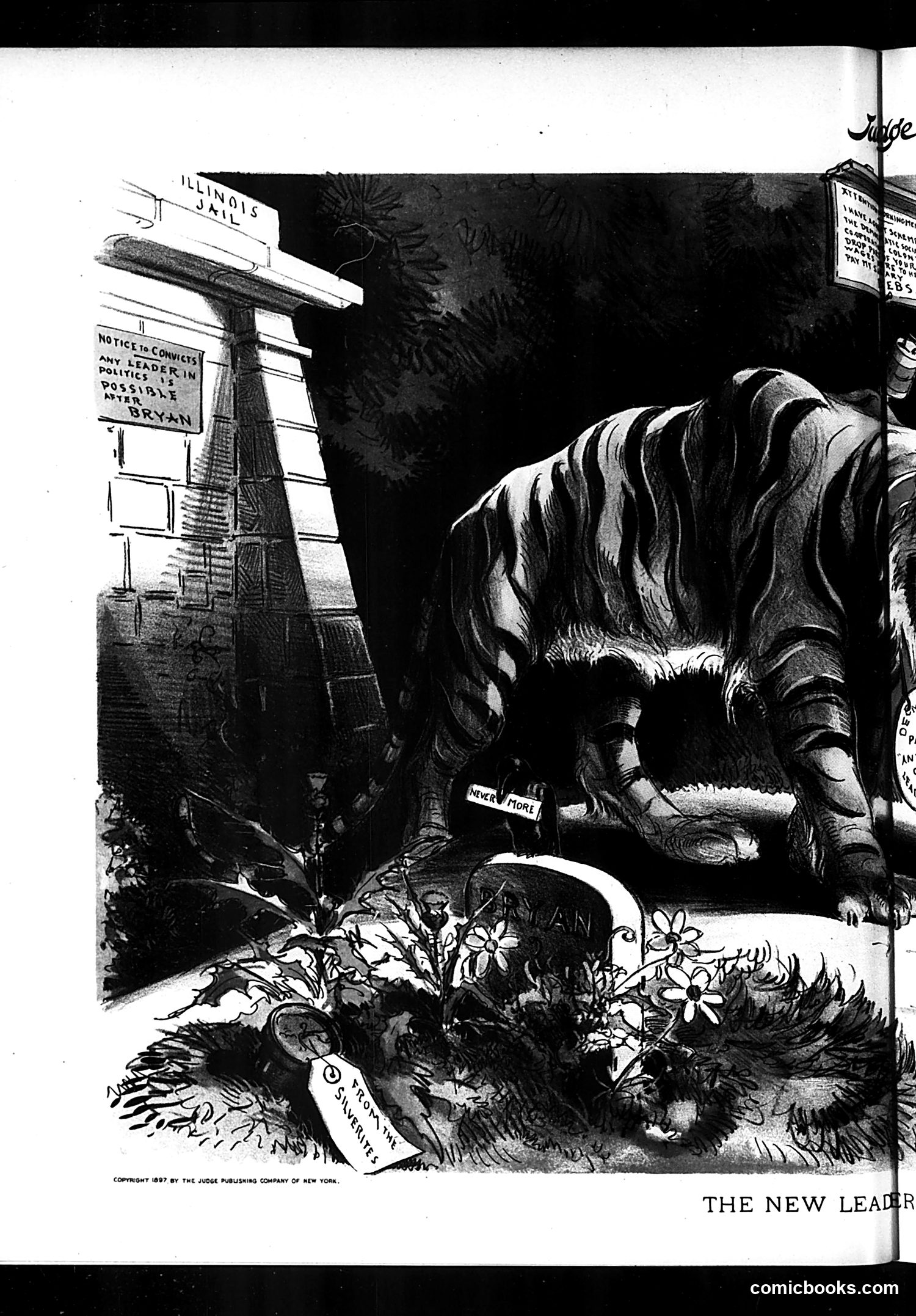
This 1927 Judge magazine cartoon depicts a large, aggressive bull labeled "NEVER FORGET" destroying a grave marked with flowers and a cross. A sign reads "NOTICE TO CONVICTED LEADER IN POLITICAL POSITIONS ASTER BRYAN," apparently referencing William Jennings Bryan. The satire appears to criticize Bryan's political legacy, suggesting his influence refuses to "die" despite defeat. The bull—symbolizing relentless force or obstruction—tramples commemoration of his political career, implying his ideas or methods were destructive and should be abandoned rather than memorialized. The exact political grievance isn't entirely clear from the image alone, but the cartoon expresses strong disapproval of Bryan's continued political relevance or ideological persistence among American voters.
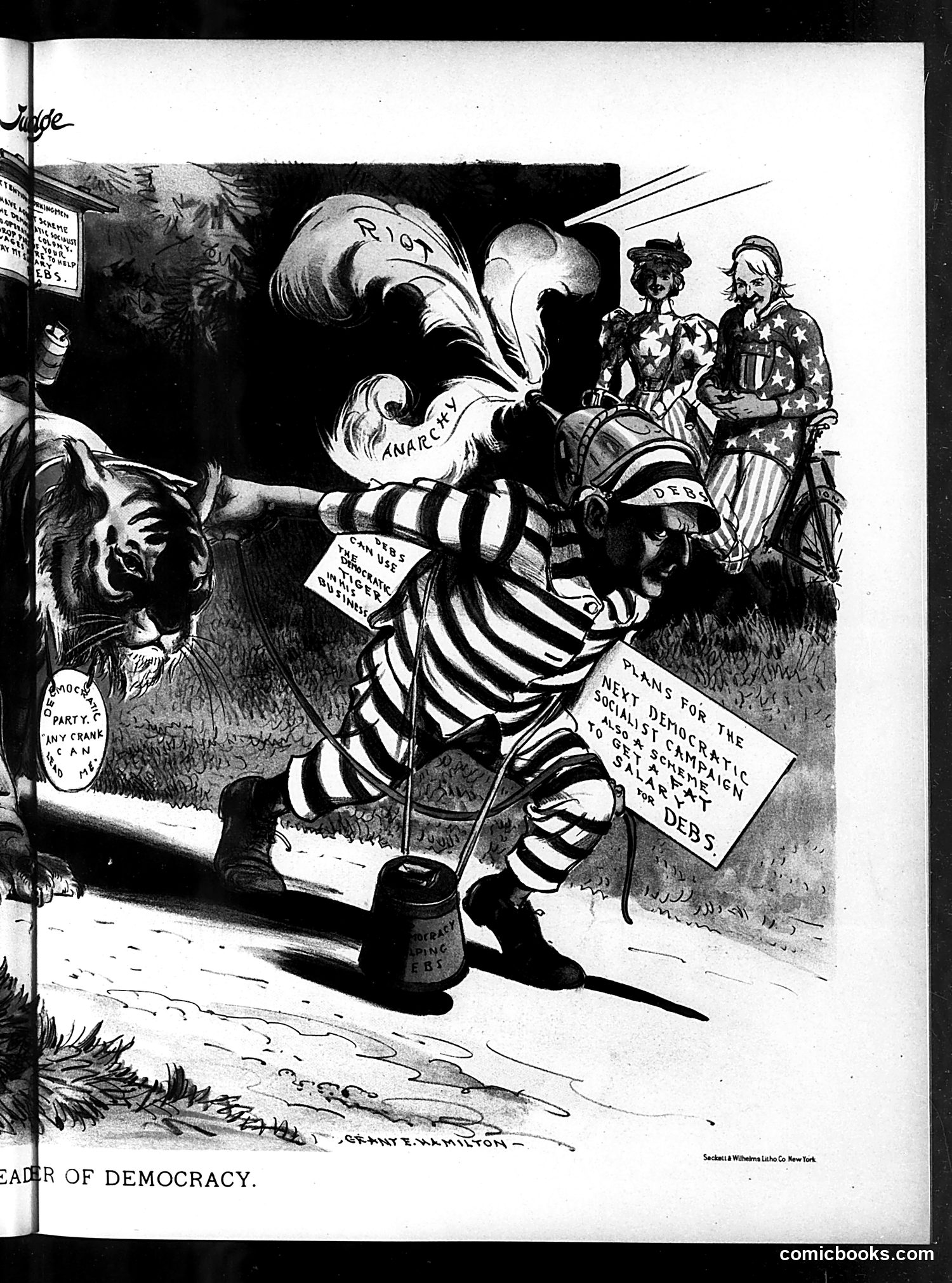
This political cartoon depicts a grotesque, striped figure labeled with references to "Riot," "Anarchy," and "Debt." The character appears bloated and menacing, carrying signs about "Plans for the Next Democratic Socialist Democratic Campaign" and "Scarfs for Deds [Debts]." Two well-dressed figures on the right—likely representing Republican politicians or establishment figures—observe this caricature with apparent alarm or disdain. The satire targets Democratic leadership or socialist-leaning Democratic movements of the era, portraying them as embodying chaos, financial mismanagement, and dangerous ideology. The "Leader of Democracy" title is ironic, suggesting the Democrats' actual leadership promotes disorder rather than democratic governance. The cartoon reflects early-to-mid 20th century conservative anxieties about Democratic politics and socialism.
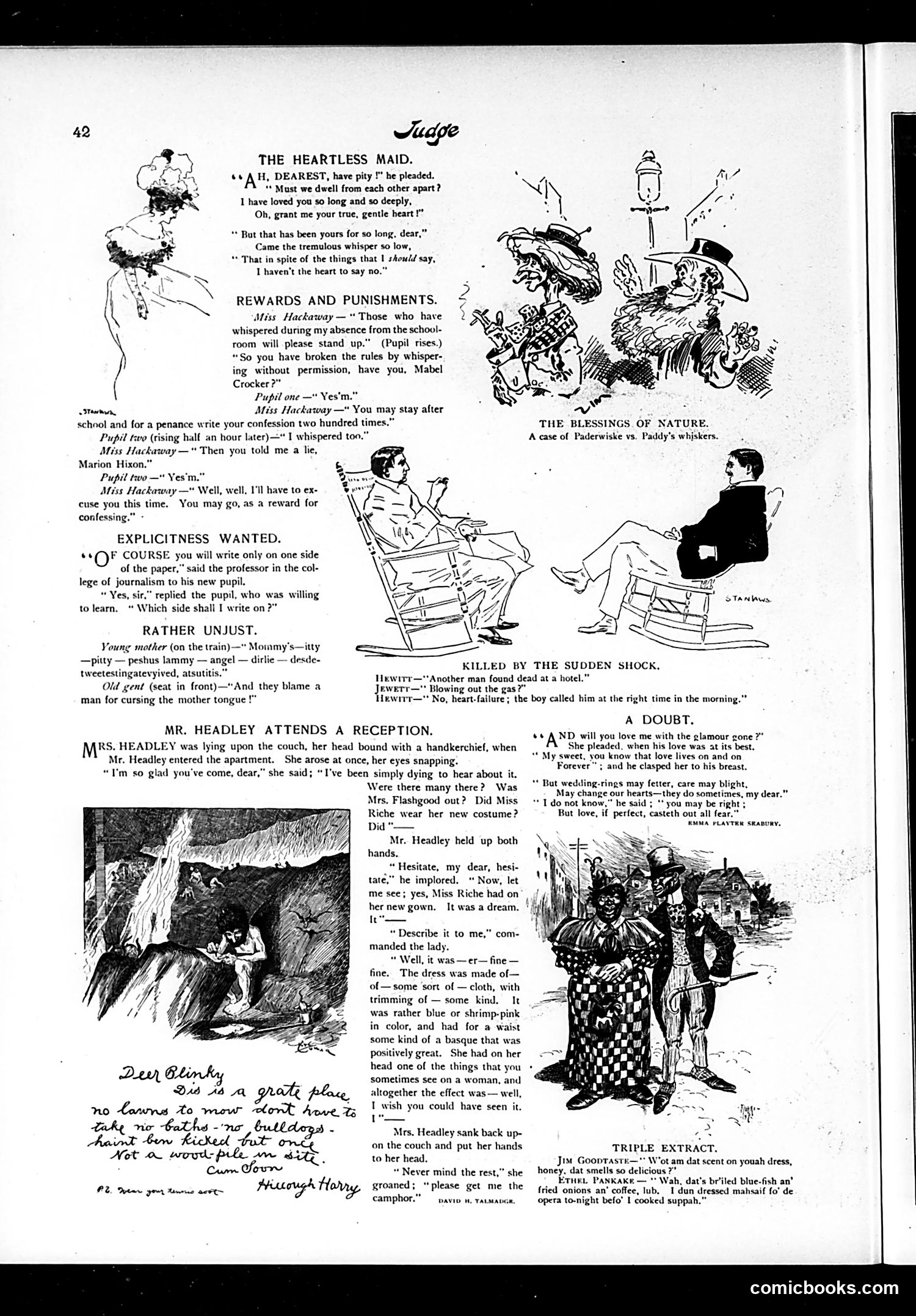
This page contains several brief satirical pieces typical of early 20th-century American humor: **"The Heartless Maid"** mocks romantic melodrama—a suitor pleads passionately while his beloved deflates the moment with practical rejection. **"Rewards and Punishments"** satirizes schoolroom logic: a teacher rewards a pupil for *confessing* to lying, exposing the absurdity of the punishment system. **"Explicitness Wanted"** jokes about journalistic vagueness—a student's literal question about *which side* of paper to use reveals the professor's imprecision. **"Rather Unjust"** ridicules baby-talk on trains, with an elderly man blaming mothers for corrupting language. **"Mr. Headley Attends a Reception"** depicts marital miscommunication: the husband provides hilariously vague descriptions of a woman's dress, infuriating his detail-obsessed wife. **"Triple Extract"** uses dialect humor (likely mocking African American speech patterns, period-typical but offensive today) about a woman dressed for opera while cooking. The cartoons employ visual gags and social observation typical of Judge's satirical approach to American manners and relationships.
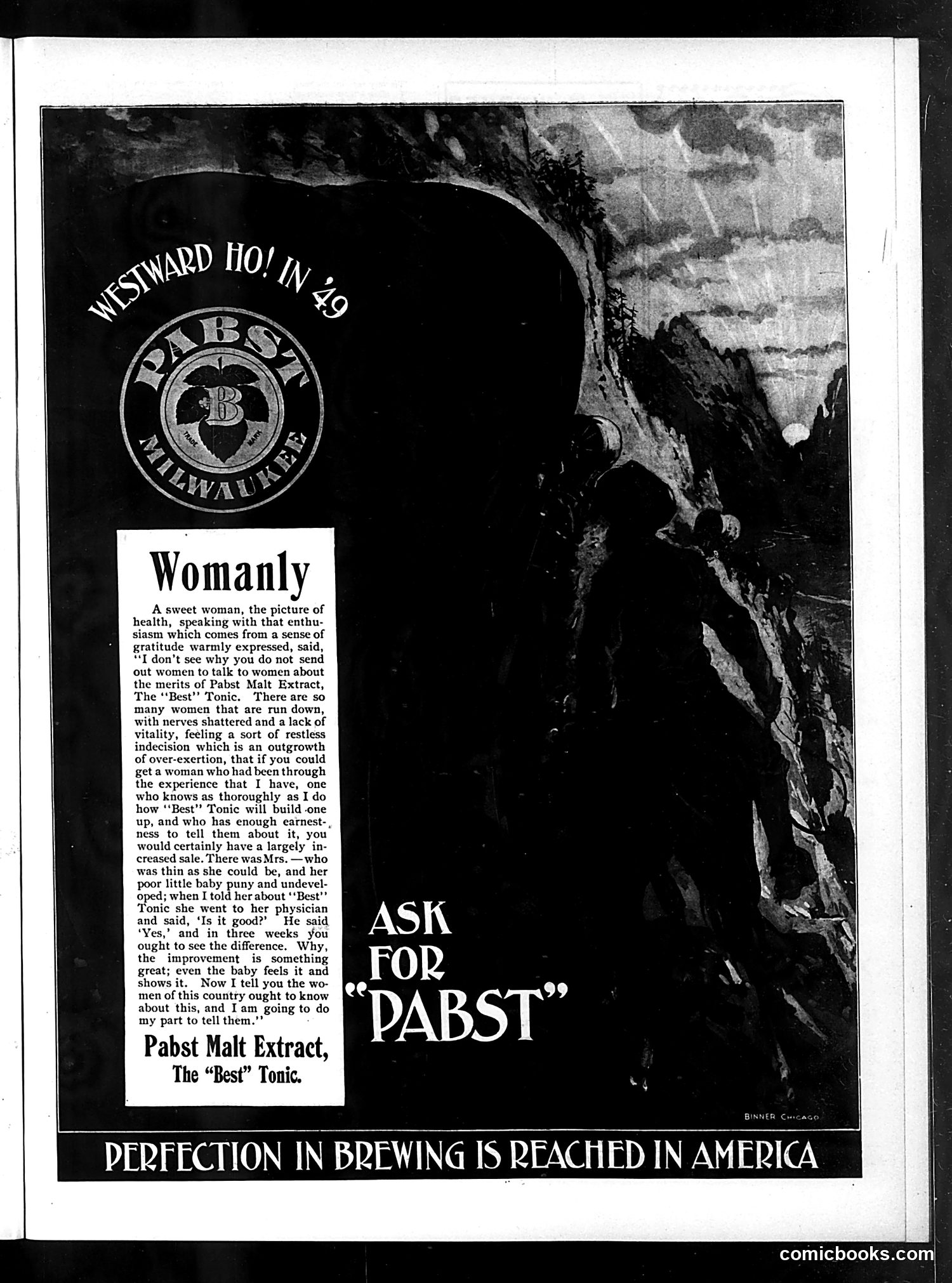
This is primarily a **product advertisement**, not political satire. It promotes Pabst Malt Extract as a health tonic for women, appearing in *Judge* magazine around 1949. The ad features a testimonial from an unnamed woman endorsing the product's ability to restore health and vitality to run-down, exhausted women. She describes a specific case where a thin woman with an underdeveloped baby improved visibly after using "Best" Tonic. **The satire**, if present, is **subtle**: the ad uses the format of heartfelt personal testimony to market what was essentially a malt-based patent medicine. The emphasis on women's nervous exhaustion and vitality reflects early 20th-century attitudes toward female health and "female weakness." The mountainous landscape illustration serves as generic aspirational imagery suggesting health and vigor. The tagline "Perfection in Brewing is Reached in America" connects the product to national pride in American manufacturing.
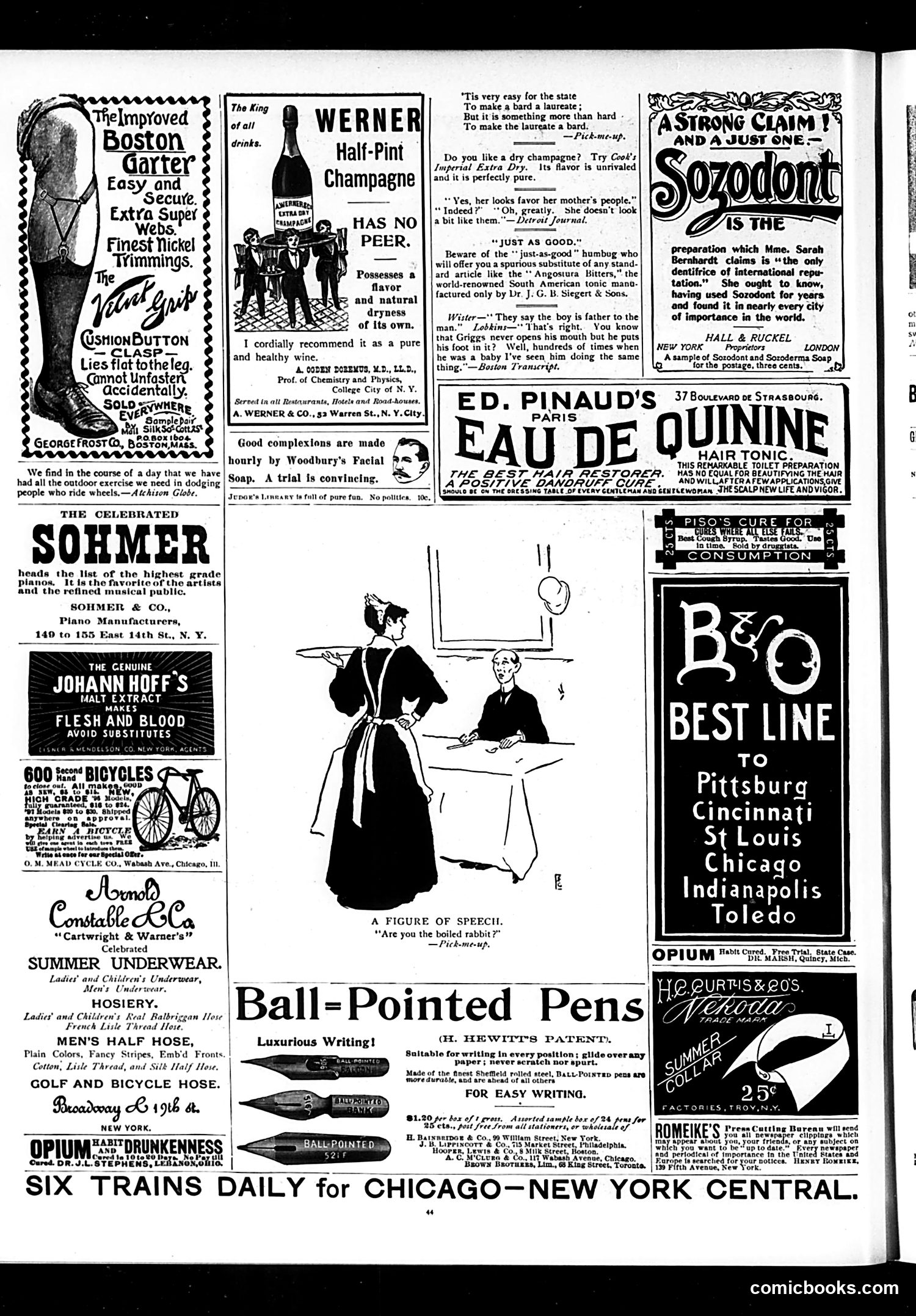
This page is primarily **advertising**, typical of Judge magazine's revenue model. Most content consists of product advertisements with minimal satirical cartoons. The one notable cartoon shows a woman at a desk speaking with a man, captioned "Are you the boiled rabbit?" — a nonsensical phrase joke playing on absurdist humor popular in the era. The advertisements reflect late 19th/early 20th-century consumer culture: patent medicines (opium cures, hair tonics), champagne, bicycles, pianos, and underwear. Notable is the prominent warning against "just-as-good" substitute products, reflecting concerns about counterfeit goods. One ad features **Sarah Bernhardt**, the famous French actress, endorsing Sozodont toothpaste — an early example of celebrity endorsement advertising. The page also advertises train service and various patent-medicine remedies, some promoting treatments (like opium addiction cures) we now recognize as dangerous. The content reveals commercial priorities over satire on this particular page.
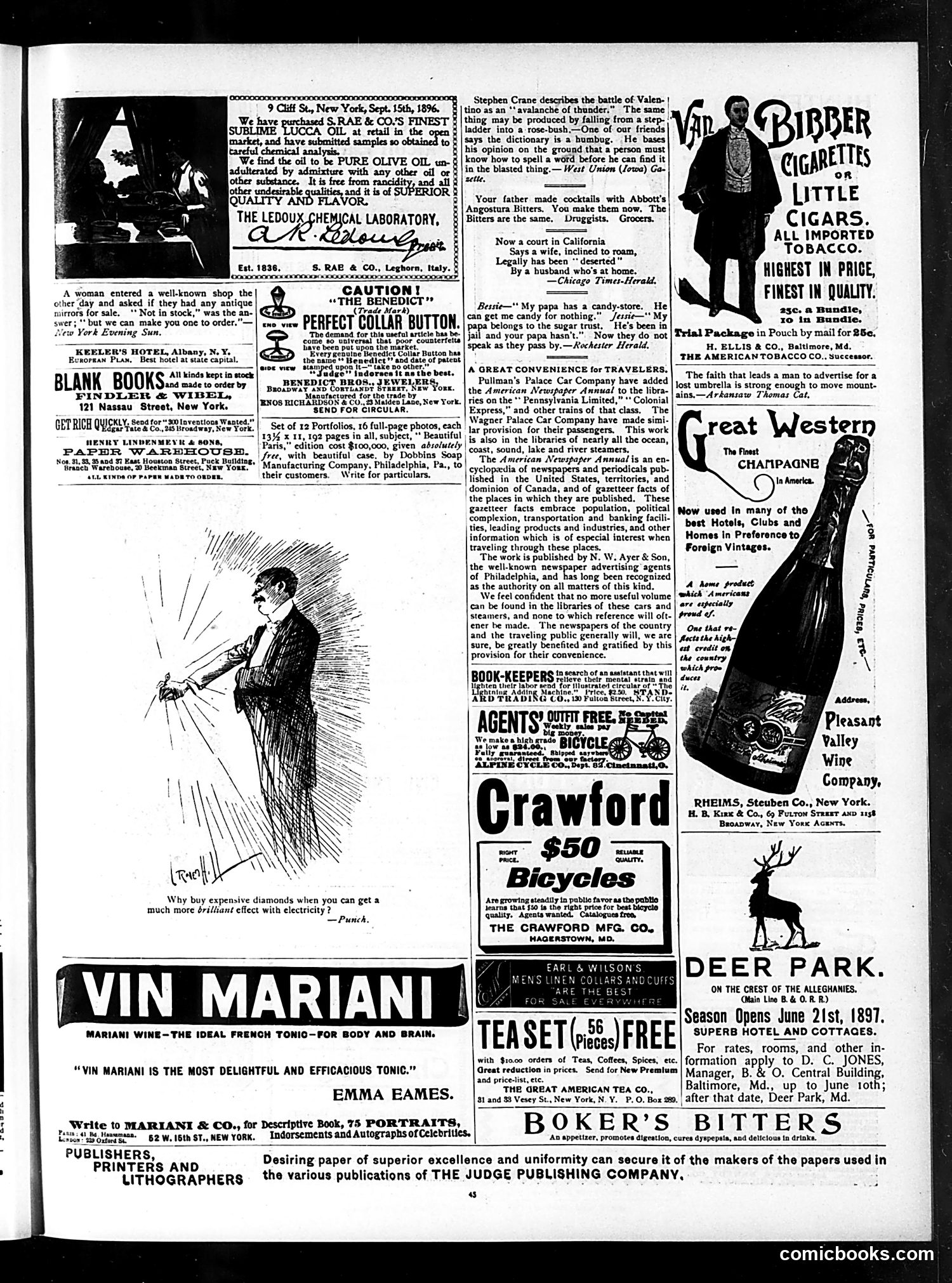
This is primarily a **advertisements and filler content page** rather than a coherent political cartoon. The dominant content includes ads for products like Vin Mariani wine, Crawford Bicycles, Vap-Bibber Cigarettes, and Boker's Bitters. The only cartoon visible is a small sketch showing a man holding what appears to be a bright electrical light or spark, with the caption asking "Why buy expensive diamonds when you can get a much more brilliant effect with electricity?" This joke reflects late-1890s excitement about electricity as a modern marvel—a new consumer technology promising to replace old luxuries. The satire suggests that flashy electrical novelties could appeal to the nouveau riche seeking to display wealth without genuine gems. The page also includes brief humorous anecdotes (about Stephen Crane's war writing, a wife's "desertion," and children's rivalry) typical of Judge's satirical miscellany format, but these lack political significance.
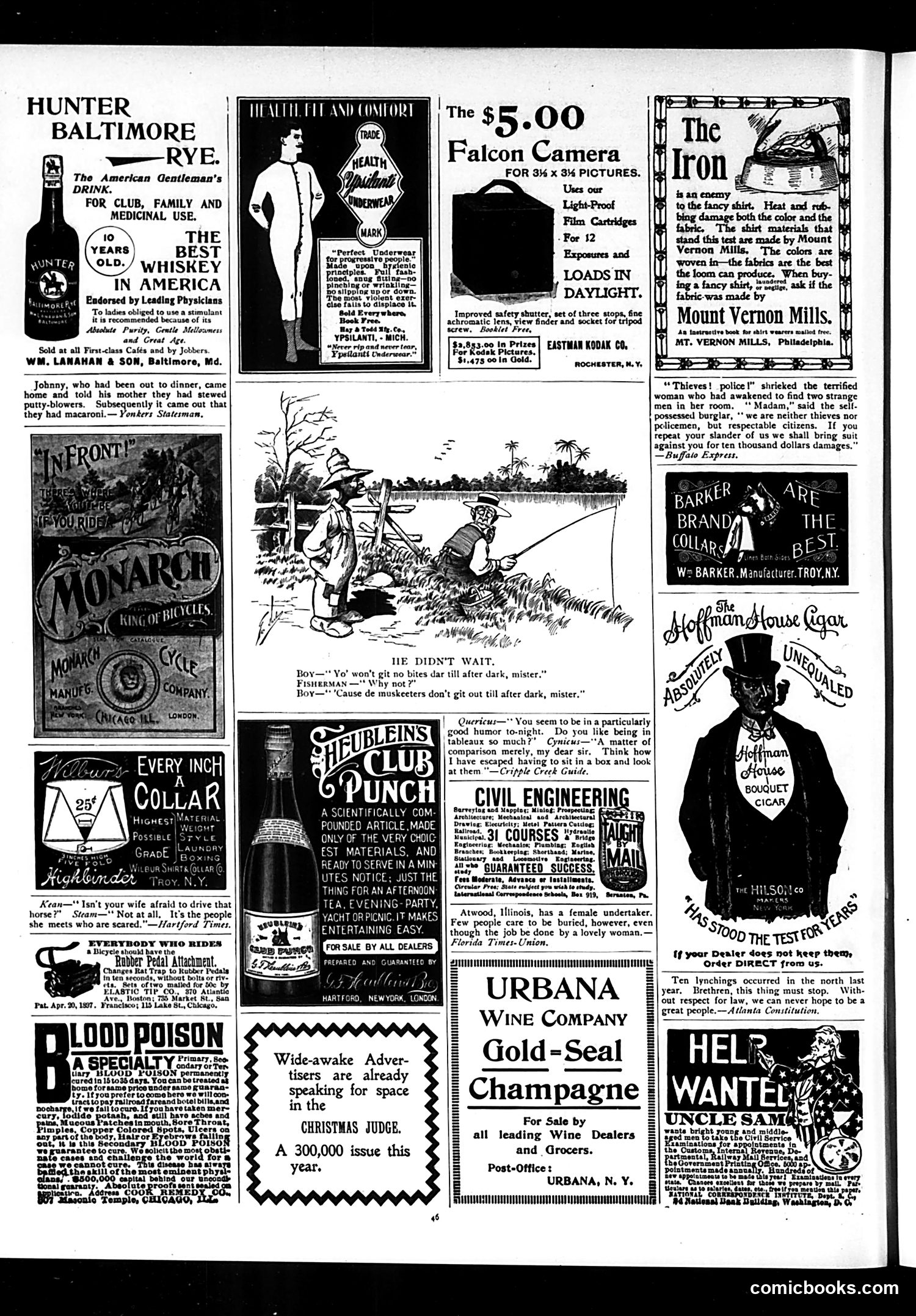
This is primarily an **advertising page** from Judge magazine with minimal political content. The page features product advertisements (whiskey, cameras, bicycles, champagne) interspersed with brief humorous anecdotes. The notable satirical content includes: **"He Didn't Wait"** cartoon: A boy warns a fisherman that mosquitoes don't emerge until dark—a simple joke about insect behavior with no deeper meaning. **"Quericus and Cynicus" dialogue**: Satirizes theater-goers who prefer being *in* tableaux over *watching* them—gentle social commentary on entertainment preferences. **Brief anecdotes mock**: A wife's driving abilities, a boy's mispronunciation of "macaroni" as "putty-blowers," and a burglar's absurd threat to sue for defamation. The page's final line about "ten lynchings...in the north last year" appears jarring to modern readers but reflects how Judge occasionally addressed serious social issues amid lighter fare. Overall, this represents early 20th-century magazine humor: domestic mishaps, mild social observations, and product promotion rather than pointed political satire.
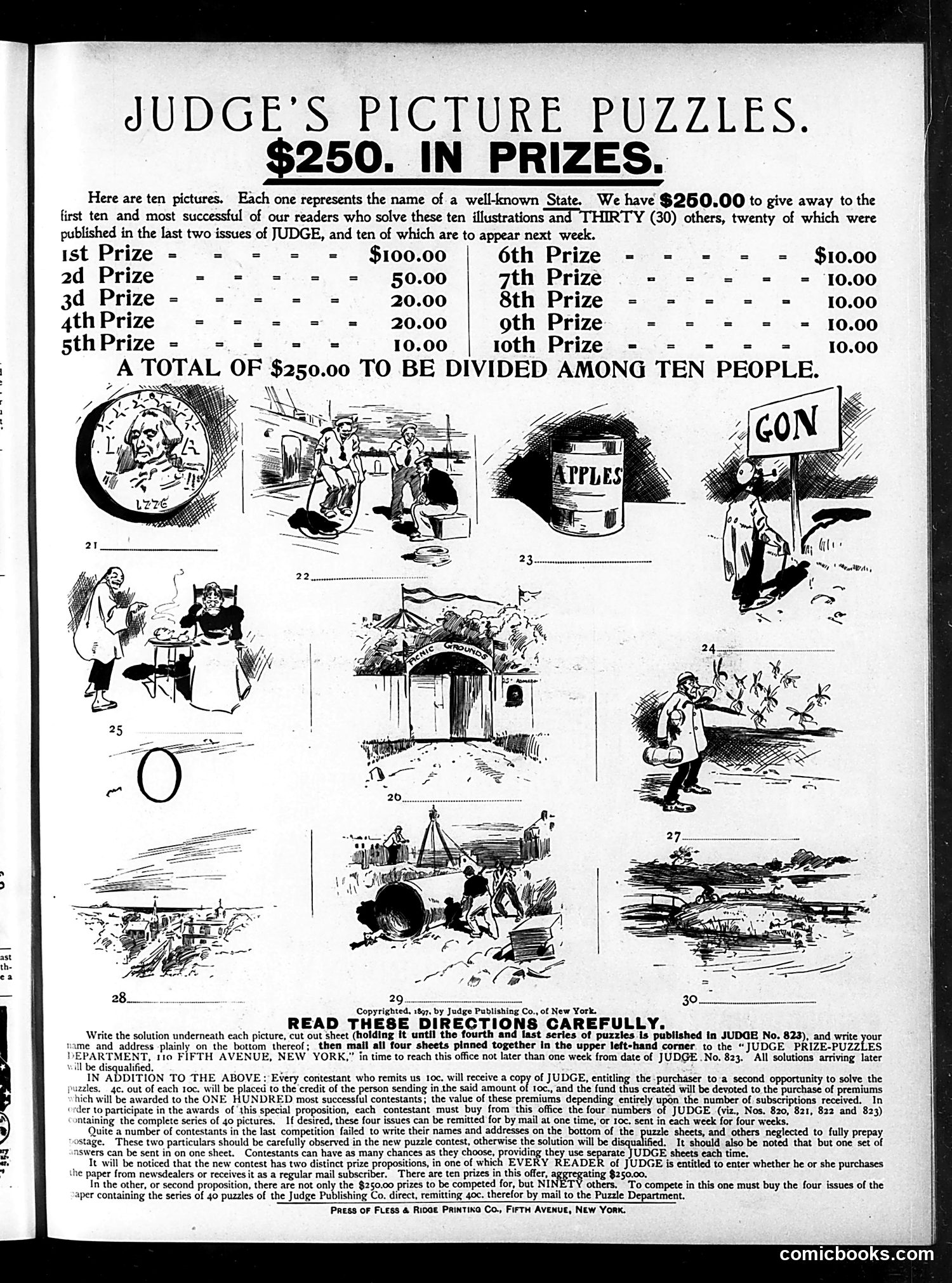
This is primarily a **contest advertisement**, not a political cartoon. Judge magazine is running a puzzle competition where readers must identify ten U.S. states represented by visual rebuses or symbolic illustrations. The page shows ten numbered sketches—each a visual pun representing a state name. For example, image 21 appears to show a moon (likely representing "Maine"), image 23 shows an apple barrel (possibly "New York" or another state), and image 24 depicts someone fleeing (possibly "Georgia" from the "Gone" sign visible). The contest offers **$250 in total prizes** ($100 for first place, descending to $10 for places 6-10), with detailed rules for submission. Notably, there's a secondary "premium" tier where subscribers buying all four puzzle installments can compete for 90 additional prizes. This reflects **Gilded Age magazine culture**: contests were common circulation-boosting tools, requiring readers to purchase multiple issues to solve the complete puzzle series.
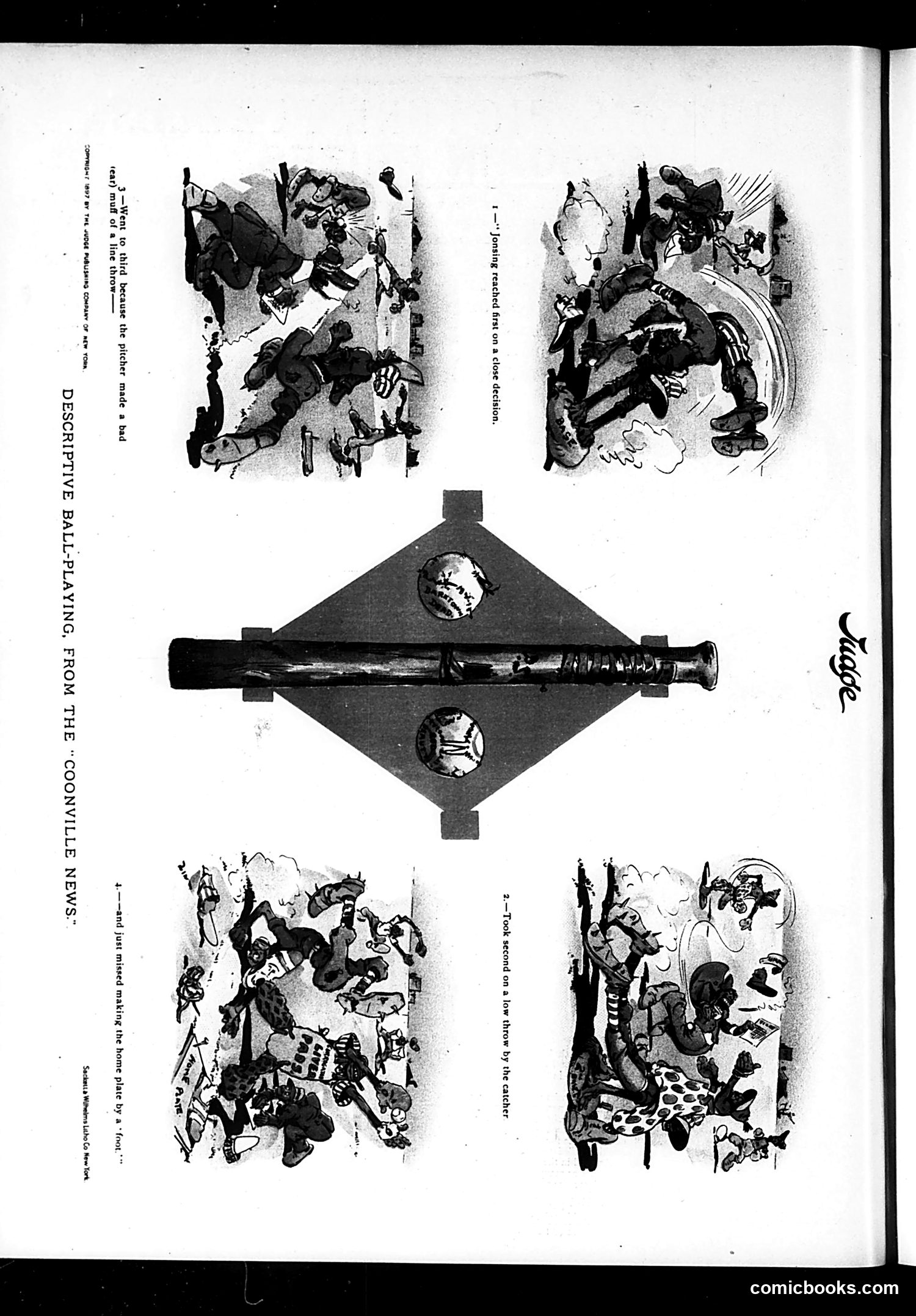
This page satirizes racist depictions of African Americans through a mock sports commentary titled "Descriptive Ball-Playing, from the 'Coonville News.'" The slur in the title indicates this is a late-19th-century caricature piece. The four illustrated panels show exaggerated, dehumanizing drawings of Black figures engaged in baseball play. The accompanying text provides deliberately awkward, grammatically poor sports descriptions (evident in the OCR fragments), reinforcing stereotypes about speech patterns. The central diamond-shaped device with a baseball and spyglass likely represents the "viewpoint" or satirical perspective from which these caricatures are presented. **For modern readers:** This represents a now-repugnant form of entertainment that was mainstream in the 1897 *Judge* magazine—racist mockery disguised as sports humor. It demonstrates how segregation-era publications normalized dehumanizing stereotypes through "humorous" distortion of Black Americans' appearance, speech, and activities.