
A complete issue · 17 pages · 1897
Judge — June 26, 1897
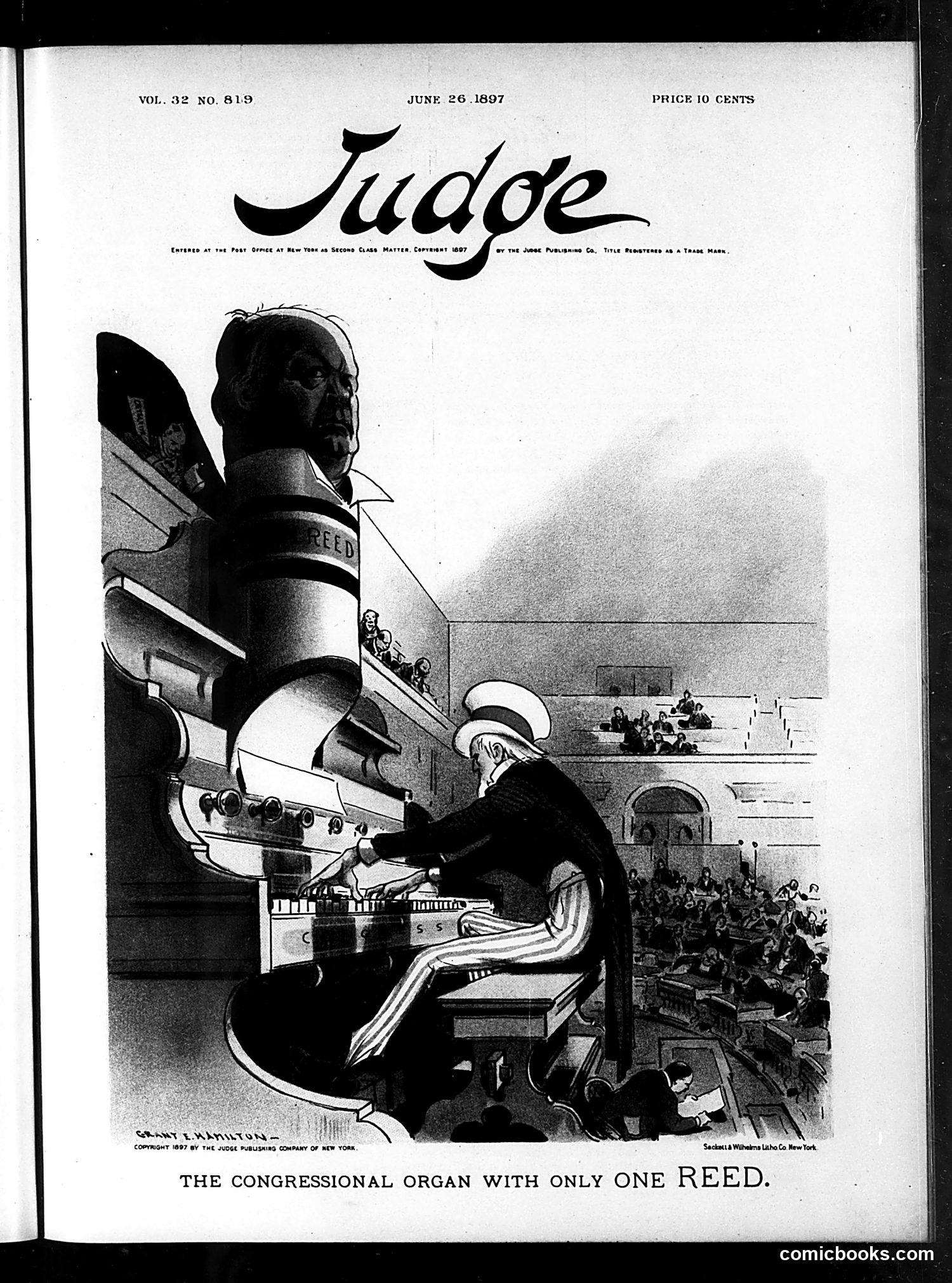
This political cartoon satirizes Congress as a malfunctioning musical instrument. A figure (likely representing Congress or a congressman) plays an organ labeled "REED," but the organ produces only one note—suggesting Congress has become monotonous, ineffective, or controlled by a single voice or faction. The "reed" pun references Thomas B. Reed, the powerful Speaker of the House who served multiple terms in the 1890s and was known for dominating Congressional proceedings through controversial parliamentary tactics. The cartoon criticizes how Reed's control reduced Congress to a single-minded instrument serving his will rather than representing diverse viewpoints. The stadium crowd watching implies public awareness of this political dysfunction.
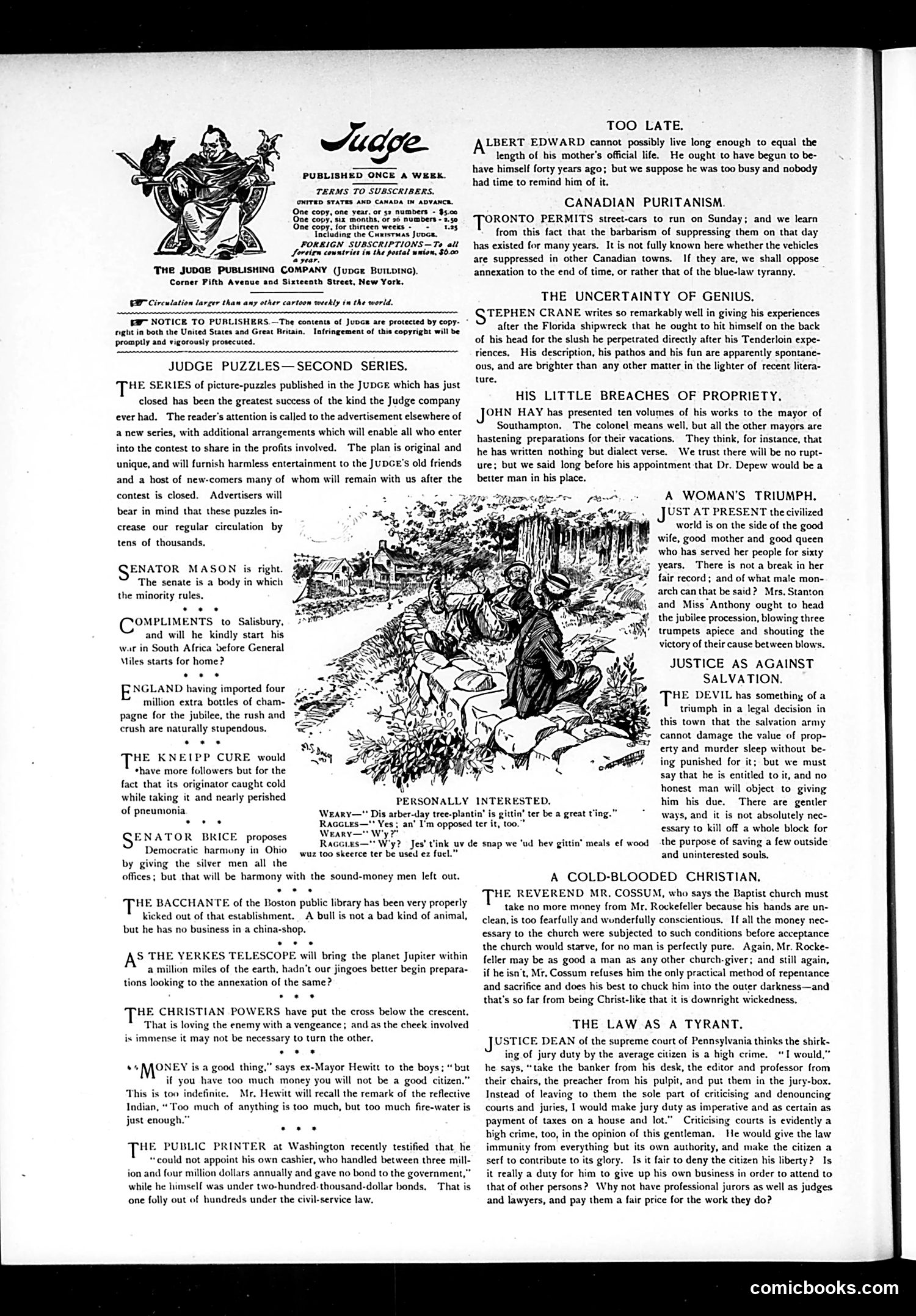
The page contains several brief satirical commentaries rather than a single large cartoon. The central illustration depicts what appears to be a rural or poverty scene with figures in distress. **Identifiable content:** - "CANADIAN PURITANISM" critiques Toronto's suppression of Sunday streetcars, comparing it unfavorably to other Canadian cities - "THE UNCERTAINTY OF GENIUS" references Stephen Crane's experiences after the Florida shipwreck - "A WOMAN'S TRIUMPH" celebrates Mrs. Stanton and Miss Anthony leading a jubilee procession—likely referencing women's suffrage activism - Other brief items mock Senator Mason, English champagne imports, and church authority The page functions as a **topical commentary magazine**, mixing social criticism with humor rather than featuring elaborate political cartoons. Topics span Canadian morality laws, literary figures, and women's rights.
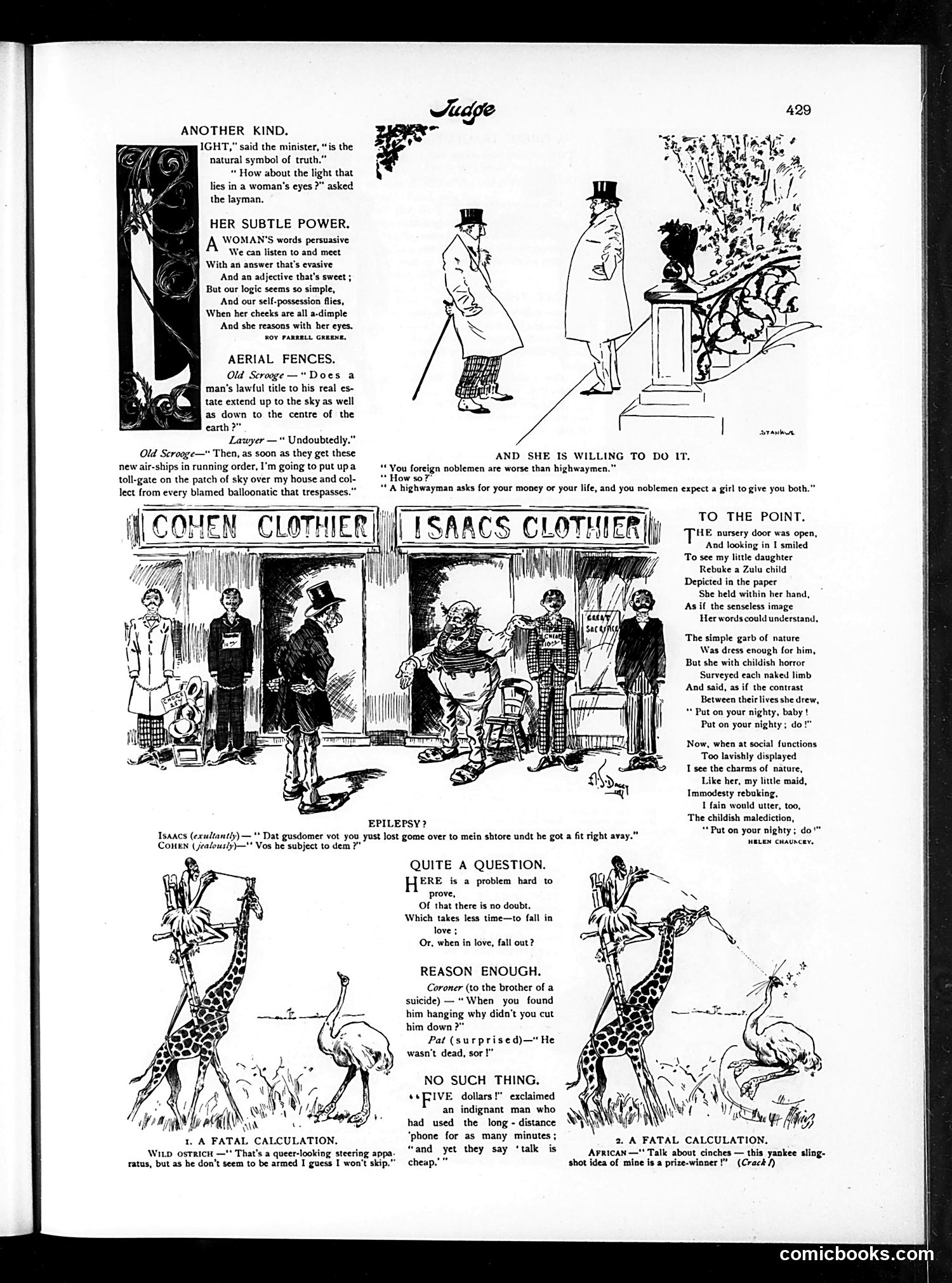
This page contains several unrelated satirical pieces typical of Judge magazine's format: **"And She Is Willing to Do It"** depicts a man approaching a nobleman, with text about a woman willing to marry for money—standard early-20th-century social satire about marriage mercenary behavior among the wealthy. **"Aerial Fences"** mocks Old Scroge's complaint about property disputes extending into airspace as real estate boundaries expand. **The Clothing Store Scene** appears to satirize immigrant or working-class families shopping, with ethnic dialect humor typical of the era's problematic comedy. **"Epilepsy," "Quite a Question," "Reason Enough,"** and **"No Such Thing"** are brief joke segments with varying targets—romantic mishaps, dark humor about suicide, and commentary on technology (long-distance phones being "cheap"). The page exemplifies Judge's mix of social commentary, ethnic stereotyping, and period humor from approximately the 1910s-1920s.
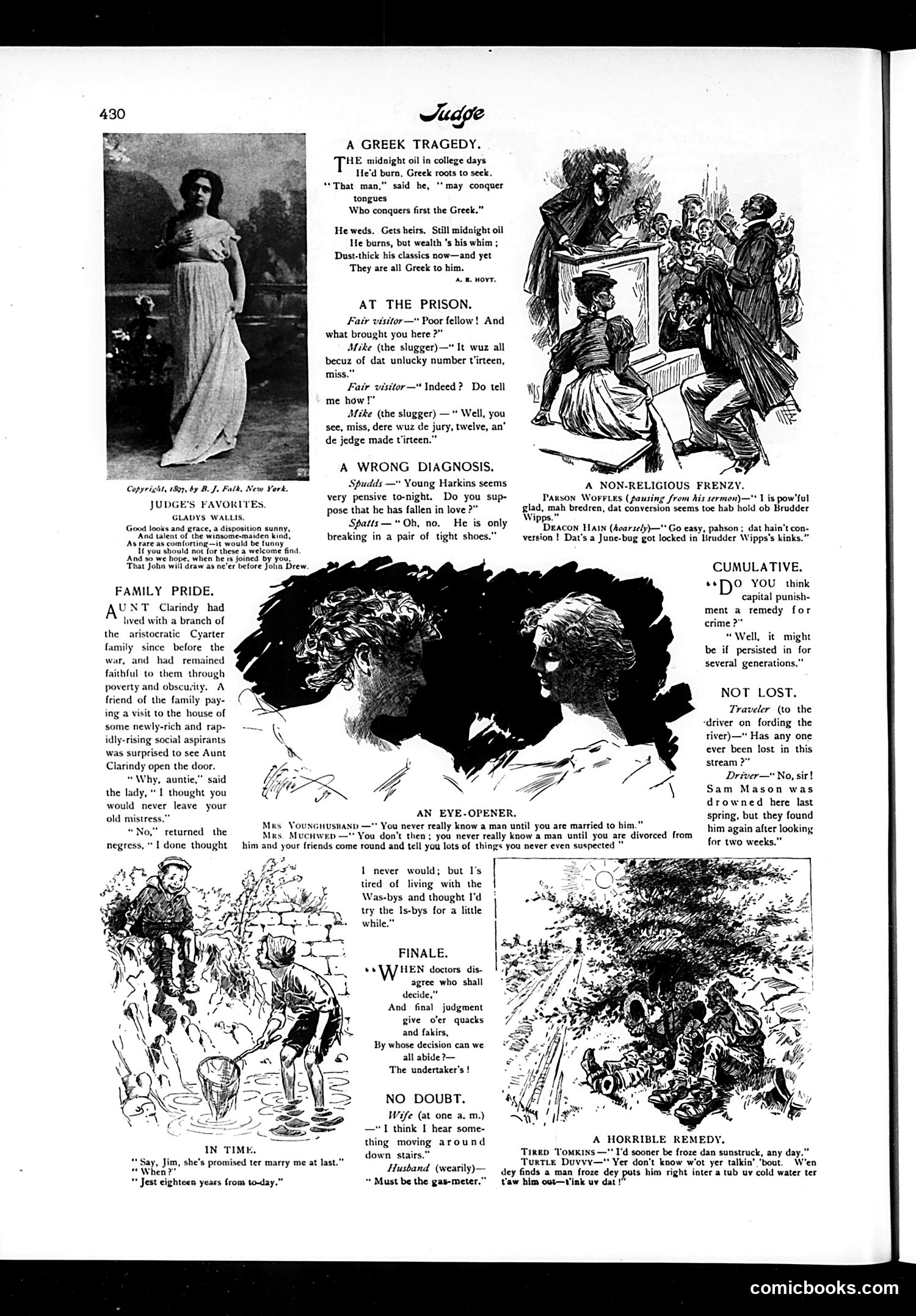
This page contains multiple satirical humor pieces typical of 1890s Judge magazine: **"A Greek Tragedy"** mocks a man who studies Greek intensely before marriage, then abandons his classics for wealth—yet remains ignorant ("It's all Greek to him"). **"At the Prison"** uses dialect humor: a prisoner blames his conviction on "unlucky number thirteen"—the twelve jurors plus the judge made thirteen. **"A Wrong Diagnosis"** jokes that a pensive young man hasn't fallen in love, merely has tight shoes. **"Family Pride"** features "Aunt Clarindy," a formerly enslaved woman who stayed with her aristocratic employers through poverty. She refuses a wealthy family's invitation because she prefers her original mistress—sentiment presented as loyalty. **"An Eye-Opener"** quips that divorce (not marriage) reveals a man's true character. Additional pieces use racial dialect humor and offer cynical observations on capital punishment, marriage, and death. The page reflects period attitudes: racial caricature, class commentary, and domestic satire aimed at middle-class readers.
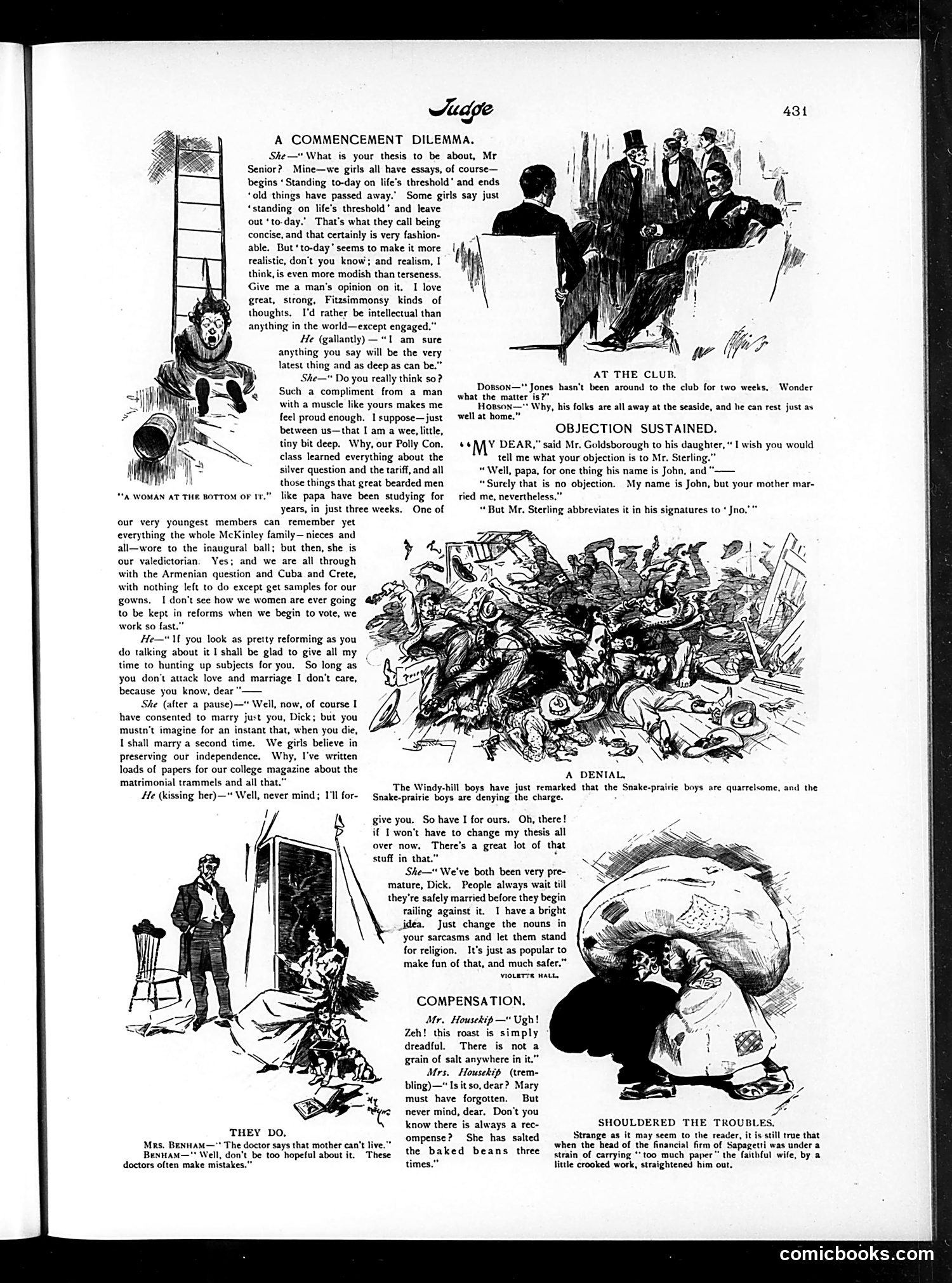
This page from Judge satirizes turn-of-the-century American social attitudes, particularly regarding women's education and independence. **Main cartoon ("A Commencement Dilemma")**: A young woman delivers an absurdly verbose college thesis while claiming to value brevity. She boasts that her class mastered complex political topics (McKinley family fashions, the Armenian question, Cuba, Crete) in weeks, yet admits women have "nothing left to do except get samples for our gowns." The satire mocks the shallow, fashionable nature of women's college education—they've memorized current events without genuine understanding. Her engagement contradicts her declarations about preserving independence and avoiding "matrimonial trammels," exposing the hypocrisy of her progressive rhetoric. **Secondary items**: Brief comic vignettes mock domestic life ("Compensation"—a burnt roast), social gossip, and a father's disapproval of a suitor named John because he shares that name. The overall message: Women's newfound educational access and voting rights are treated as superficial fads rather than serious intellectual pursuits. Their progressive statements ring hollow against their actual choices.
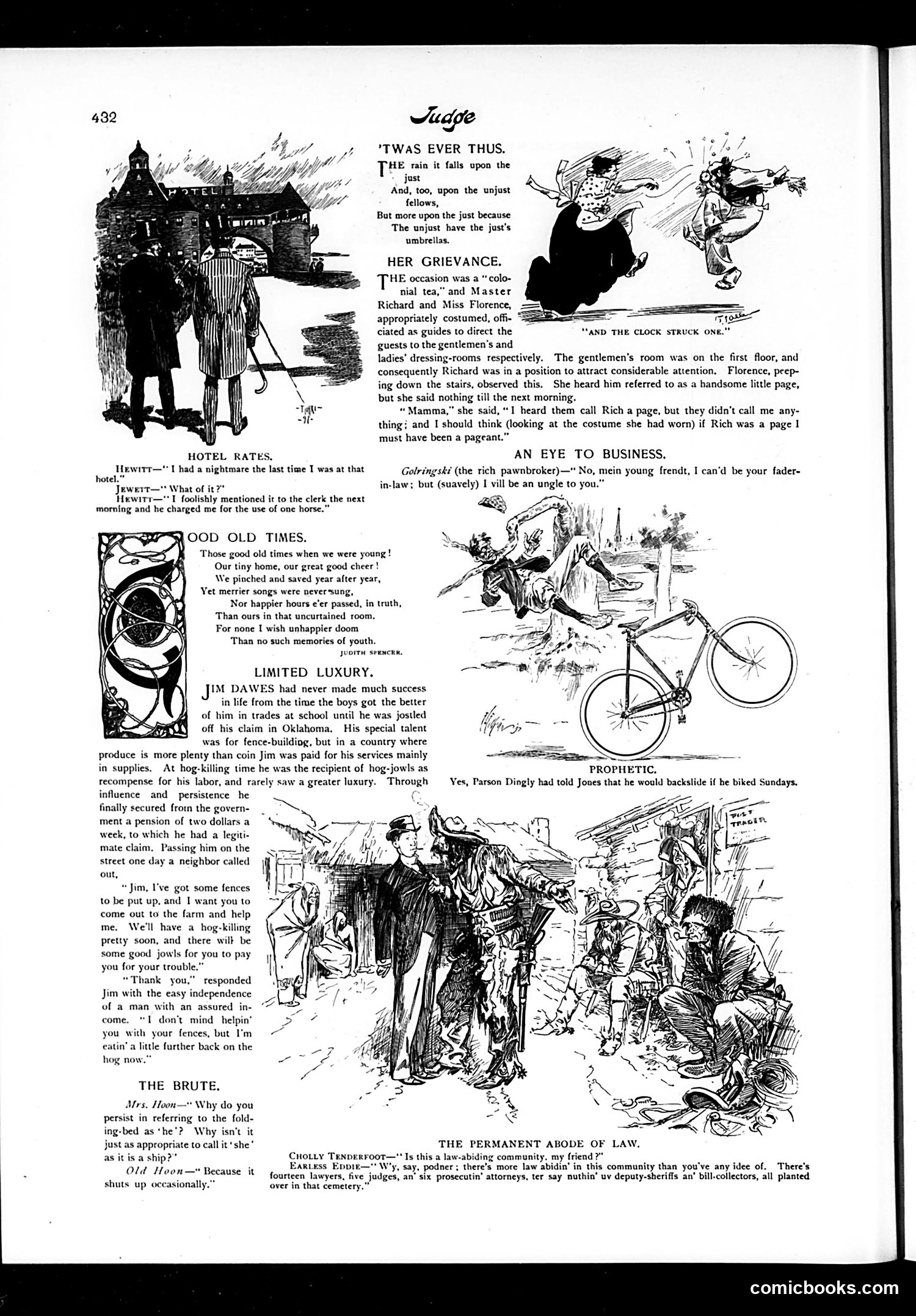
This page from *Judge* contains several satirical pieces mocking American social conventions and institutions: **"'Twas Ever Thus"** is a witty inversion: the poor (unjust) stay dry because they steal umbrellas from the wealthy (just), inverting moral expectations. **"Her Grievance"** satirizes gender inequality. At a colonial-themed party, Richard's costume as a "page" draws attention while Florence's identical outfit goes unremarked—she protests the unfairness by calling herself a "pageant" instead. **"An Eye to Business"** depicts a pawnbroker refusing to become a father-in-law, offering instead to be an "uncle"—a darkly comic rejection of marriage. **"Limited Luxury"** praises humble rural life, celebrating a frontier farmer's pride in his modest two-dollar weekly pension. **"The Permanent Abode of Law"** satirizes American legal corruption: a supposedly law-abiding community is actually overrun with lawyers, judges, prosecutors, and bill-collectors—all profiting from litigation rather than justice. The overall tone mocks pretension, inequality, and institutional hypocrisy.
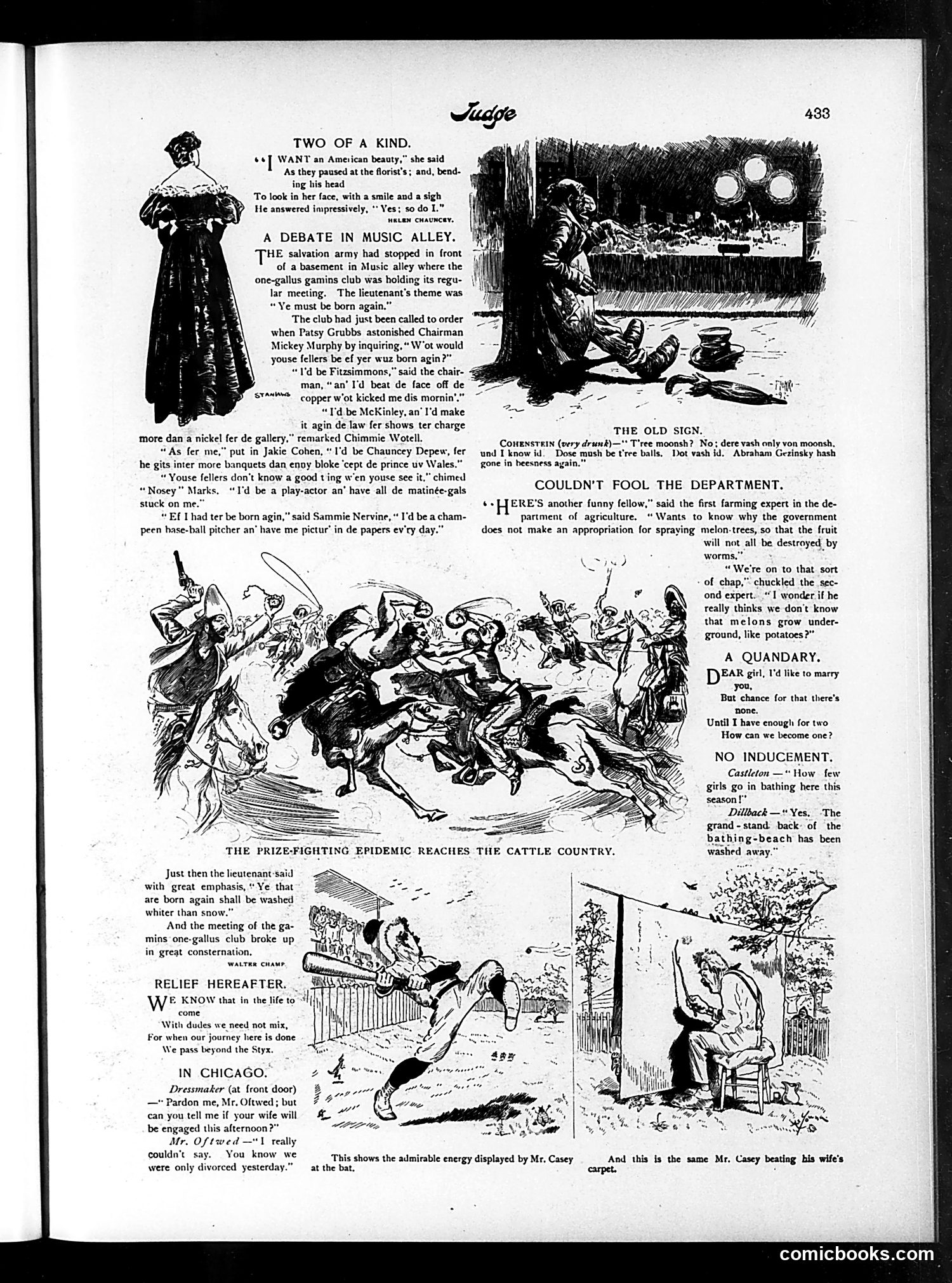
This satirical page from Judge magazine contains multiple cartoons mocking contemporary American life and politics: **"A Debate in Music Alley"** depicts street urchins from a poor neighborhood discussing what they'd become if "born again" (referencing Salvation Army preaching). Their answers—becoming McKinley (President), Chauncey Depew (a wealthy railroad executive/politician), or a baseball pitcher—satirize both working-class aspiration and the gap between their circumstances and those of the wealthy and famous. **"Couldn't Fool the Department"** ridicules agricultural department experts as ignorant frauds who don't know melons grow underground, mocking government bureaucratic incompetence. The remaining cartoons are lighter domestic humor: a marriage proposal dilemma, a bathing-beach closure, and a divorce joke about a man beating his wife. The overall tone reflects Judge's trademark satirical approach to class divisions, political figures, and social pretension in early 20th-century America.
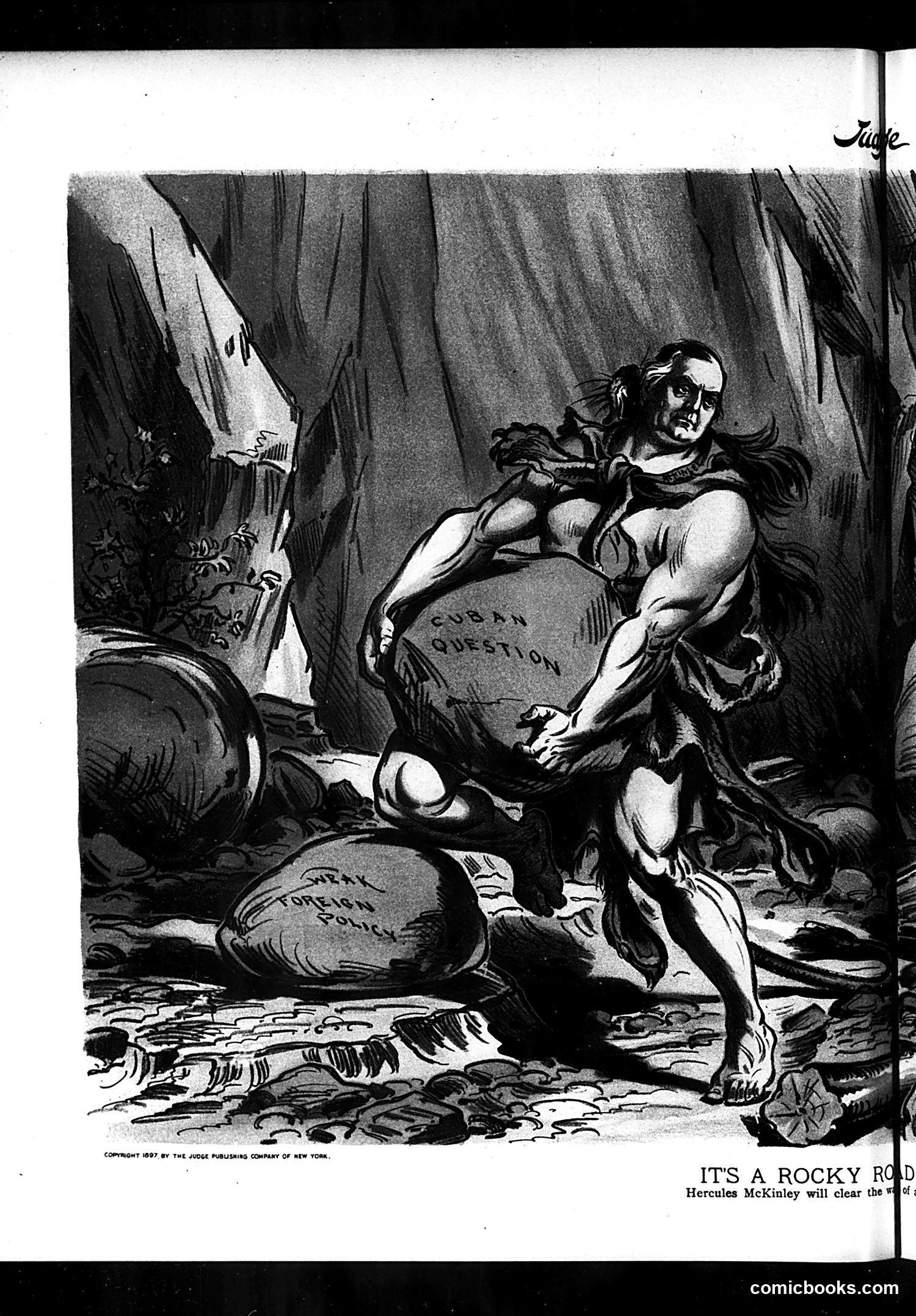
This 1897 *Judge* cartoon depicts Hercules clearing obstacles labeled "Cuban Question" and "Foreign Policy" from a rocky road. The figure represents President William McKinley, portrayed as the classical strong man Hercules to suggest he possesses the strength to overcome significant political challenges. The cartoon references McKinley's administration facing two major issues: the Cuban independence struggle (which would lead to the Spanish-American War in 1898) and broader foreign policy decisions. By invoking Hercules and his legendary labors, the cartoonist suggests McKinley's presidency will be defined by tackling these formidable obstacles. The satire's optimism implies McKinley is equipped—or will prove equipped—to handle these difficult matters, though the "rocky road" ahead suggests the path won't be smooth.
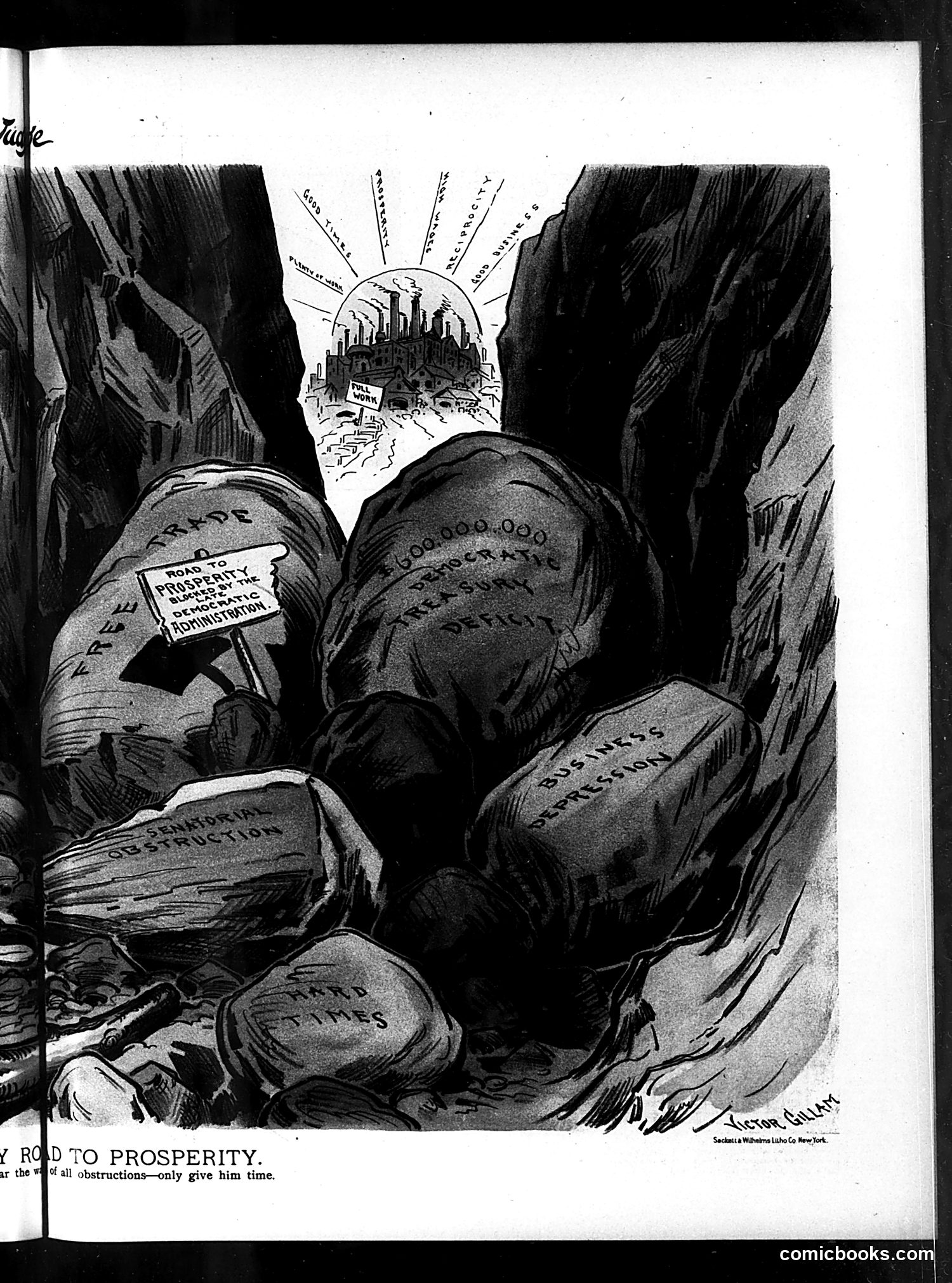
This is a political cartoon titled "Road to Prosperity" showing a figure (likely representing the U.S. economy or a political leader) trapped in a narrow canyon or crevasse, weighed down by large boulders labeled with various economic obstacles and government restrictions. Above, a distant cityscape represents prosperity, radiating light. The caption suggests that removing "all obstructions" will enable progress toward prosperity—implying the cartoonist advocates for deregulation or reduced government intervention in the economy. The "Road to Prosperity" theme and emphasis on removing bureaucratic obstacles suggest this likely dates to the post-WWI or 1920s era, when laissez-faire economic arguments were prominent in American political discourse. The satire critiques what the artist views as excessive governmental or administrative burdens hindering economic growth.
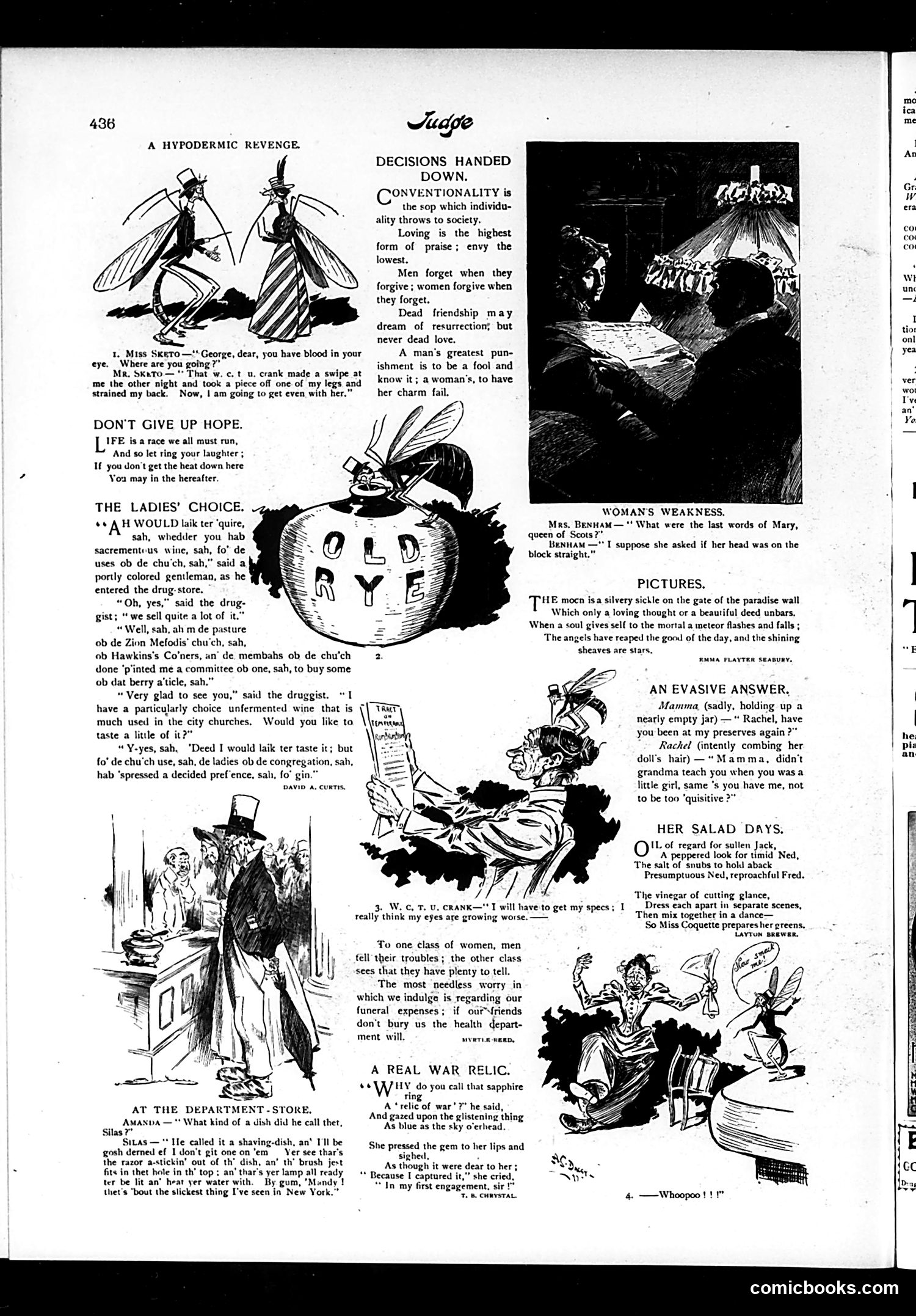
This page from *Judge* magazine contains multiple short satirical pieces typical of early 20th-century American humor: **"A Hypodermic Revenge"** depicts a marital dispute where Mr. Sketo, injured by his wife during a quarrel, plans retaliation—satirizing domestic conflict. **"The Ladies' Choice"** mocks both racial stereotypes and temperance hypocrisy: a Black church committee member asks a pharmacist for "sacramental wine," but the druggist reveals the congregation's ladies actually prefer gin, exposing the gap between stated religious propriety and actual behavior. **"At the Department Store"** humorously shows rural characters marveling at modern consumer goods—a "shaving dish" with integrated tools. The page also includes philosophical aphorisms about conventionality, love, and forgiveness, plus lighter jokes about women's weaknesses and romantic preferences. The overall tone reflects *Judge*'s satirical approach to American social pretensions, gender relations, and emerging consumer culture.
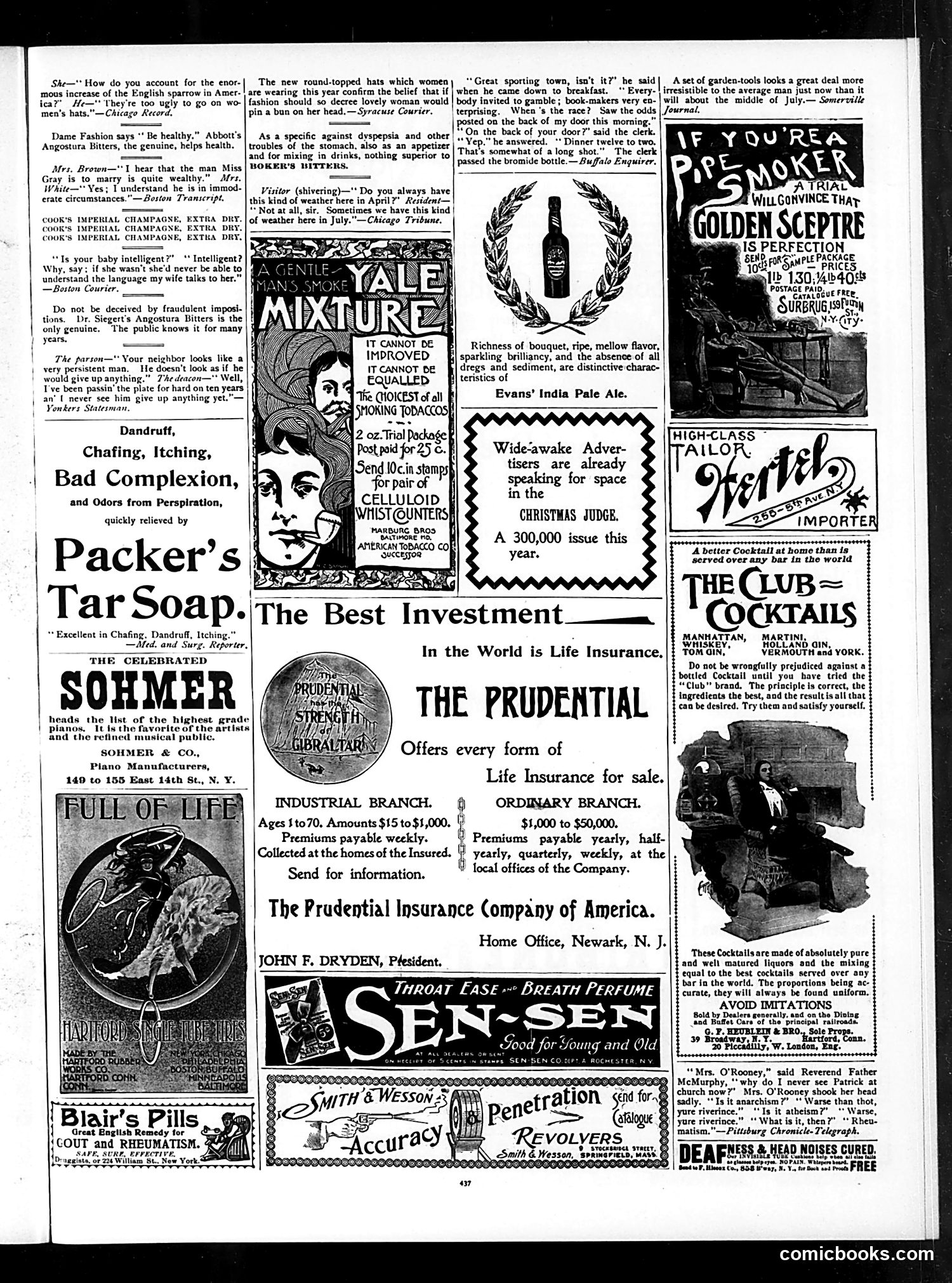
This is primarily an **advertising page** from Judge magazine, with brief humorous quotes scattered throughout. The page contains multiple **short jokes** typical of Judge's format—witty one-liners on everyday topics. Notable examples include jokes about English sparrows avoiding women's hats, a parson's observation about a "persistent" neighbor who won't give up money at church collection plates, and a visitor's confusion about "April" weather. The bulk of the page comprises **period advertisements** for products including Packer's Tar Soap, Sohmer pianos, Prudential Life Insurance, Evans' India Pale Ale, and "The Club" brand bottled cocktails. These ads reflect early 1900s consumer goods and concerns (dandruff, rheumatism, life insurance). There is **no prominent political cartoon** on this page—it's a typical mixed-content magazine page combining light satire with commercial advertising. The "cartoon" referenced in the visible masthead appears to be advertising space availability for the Christmas Judge issue (300,000 circulation).
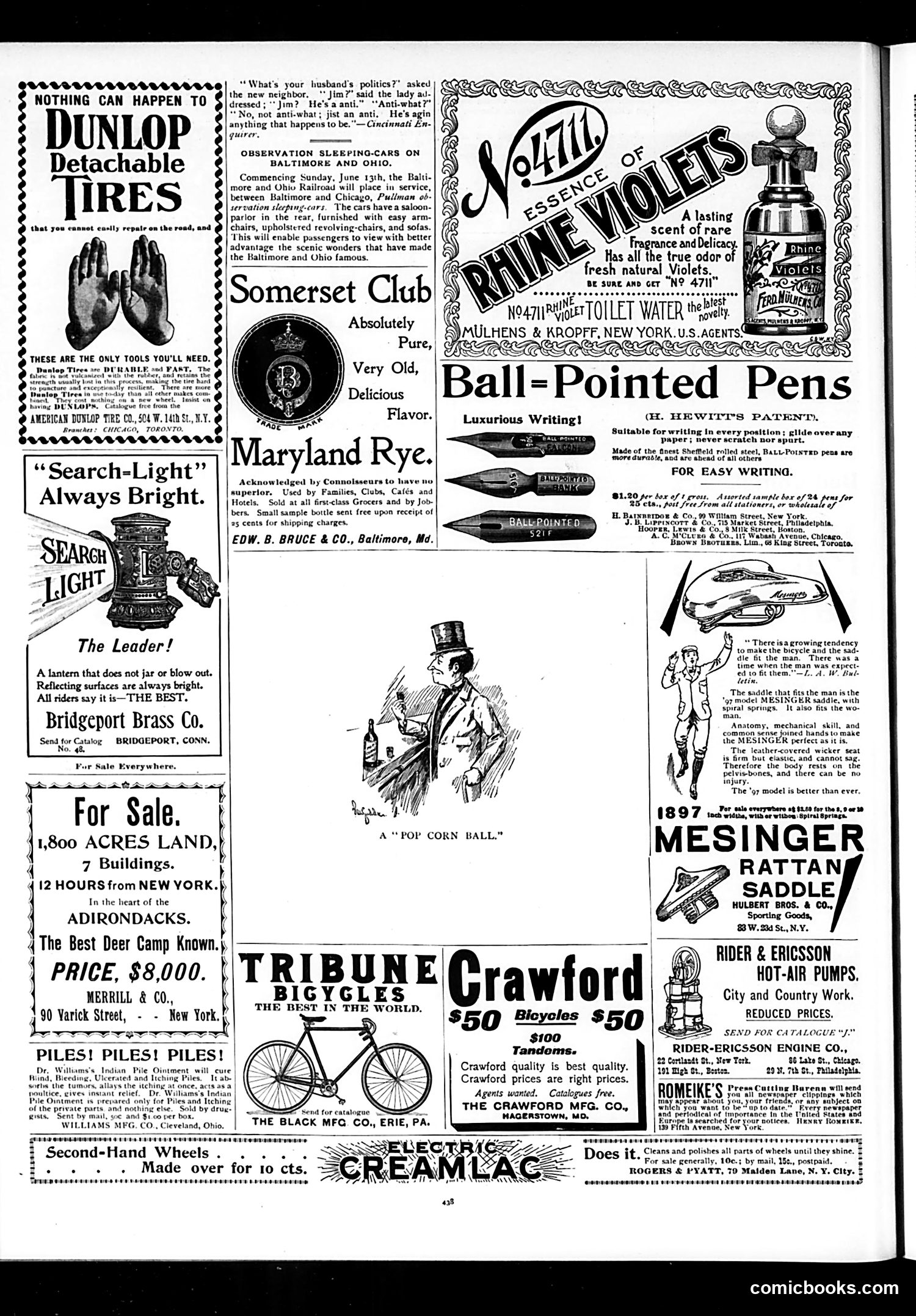
This page is primarily **advertising**, typical of late 19th-century magazines. The content centers on commercial products rather than political satire or editorial cartoons. The only identifiable cartoon appears to be the small sketch labeled **"POP CORN BALL,"** showing a man juggling or tossing objects. However, without additional context visible in the image, its satirical meaning is unclear. The advertisements reflect the era's consumer interests: bicycles (Tribune, Crawford brands), riding equipment (Mesinger saddles), transportation (Baltimore & Ohio observation cars), and mechanical goods (pumps, lamps). These suggest an affluent readership interested in leisure activities and technological advancement. One text item—a joke about a husband who is "agin anything that happens to be"—appears to be mild political humor, but it's generic rather than referencing specific contemporary figures or events. Overall, this page offers **social context** about 1890s consumer culture rather than **political commentary**.
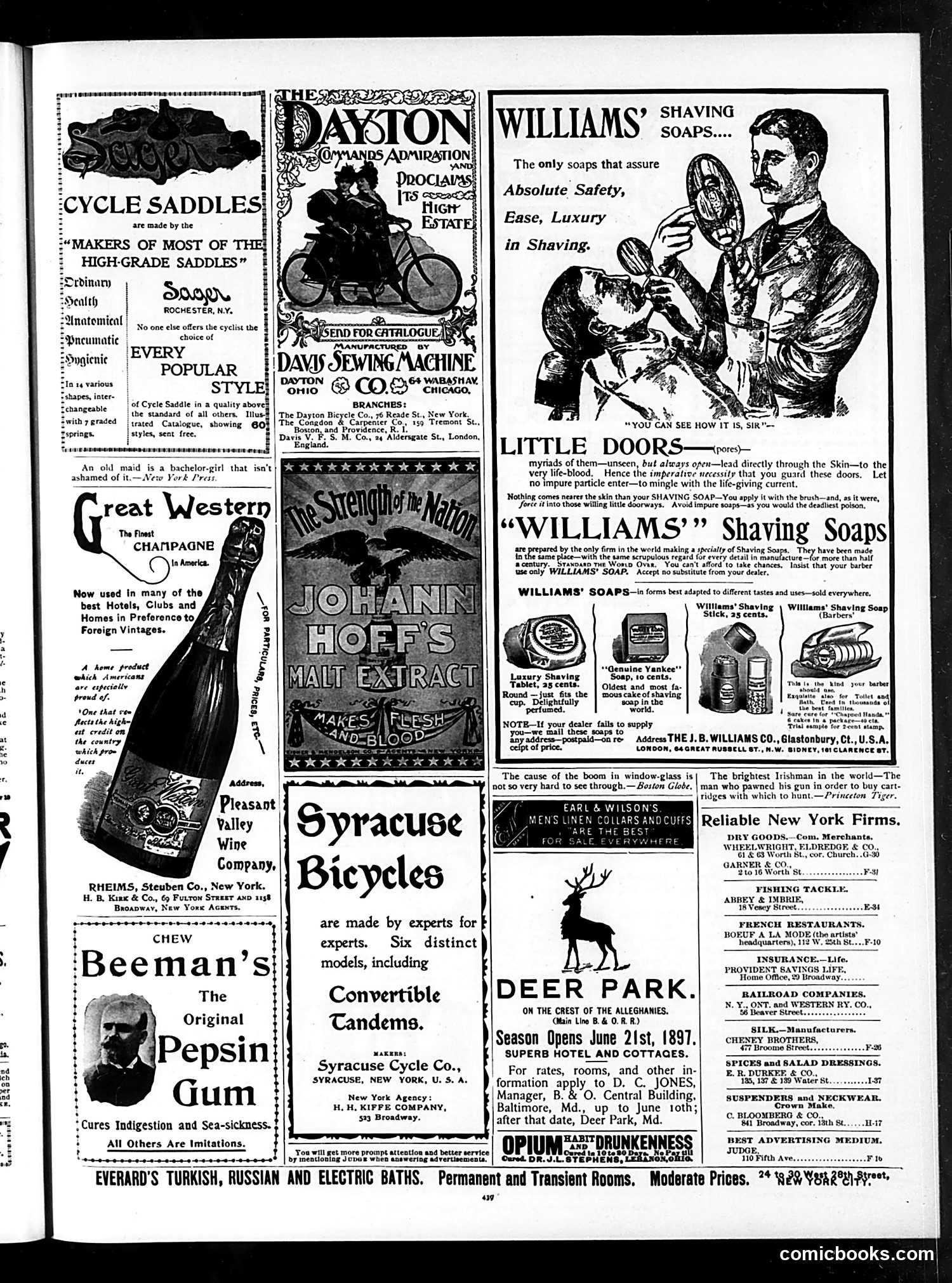
This page is primarily **advertising**, typical of late 19th-century magazines. The ads feature products of the era: cycle saddles, bicycles, champagne, and notably, **Williams' Shaving Soaps**, which dominates the right side with an elaborate pitch. The Williams ad employs pseudo-scientific language popular at the time, describing shaving soap's importance by claiming it penetrates "little doors" in the skin directly to the bloodstream. This reflects contemporary anxiety about hygiene and purity—common marketing tactics of the 1890s. The small editorial cartoons/jokes scattered throughout are minimal. One references "old maids" as "bachelor-girls"—light social commentary on unmarried women. The page also advertises resort destinations (Deer Park), wine, and various New York businesses. Overall, this represents Judge's commercial function: delivering affluent male readers to advertisers selling luxury goods, travel, and grooming products. The pseudo-medical claims in the soap advertising are particularly striking to modern readers, reflecting less-regulated advertising standards of the era.
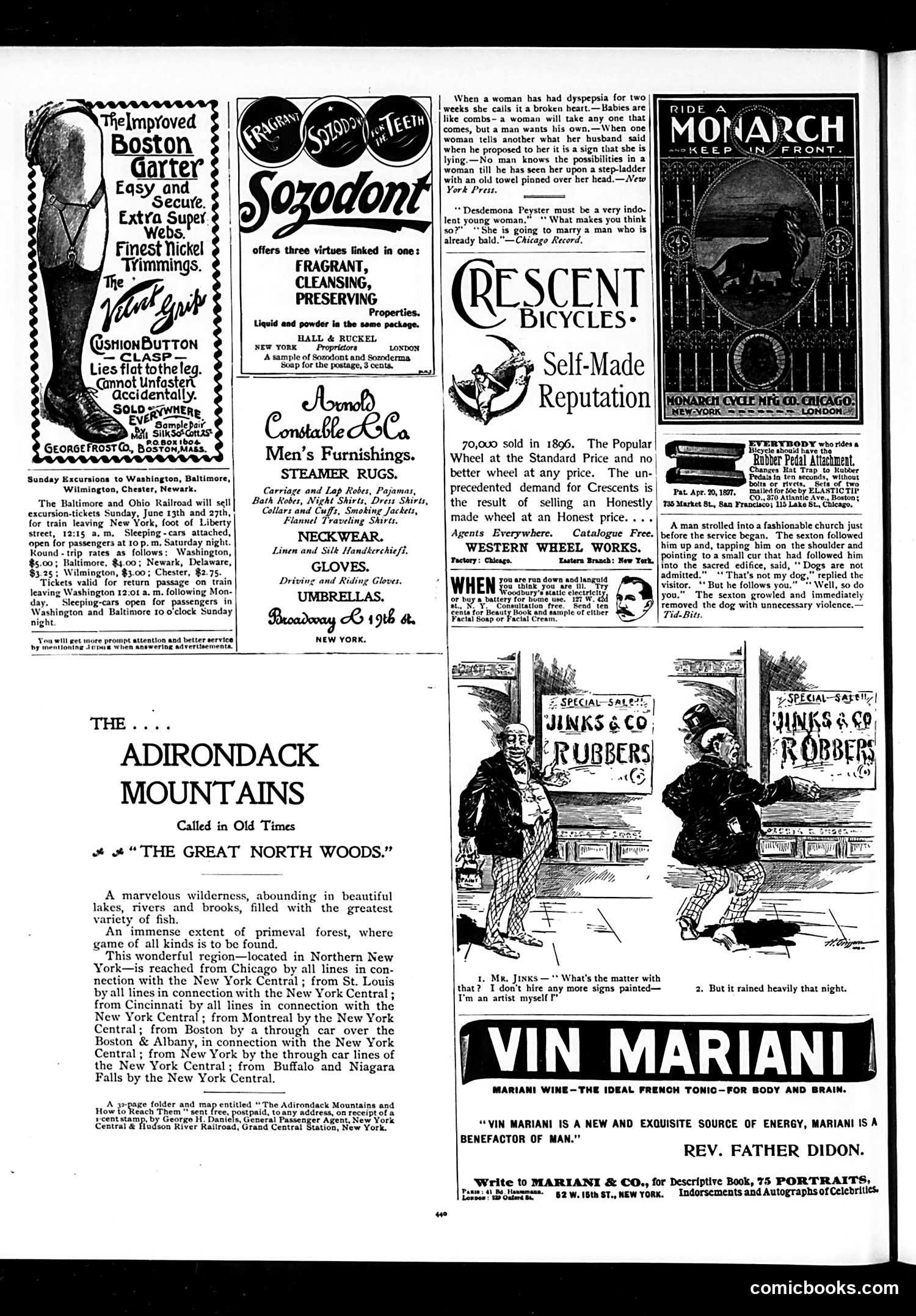
This page is primarily **advertising**, with minimal editorial cartoon content. The visible satirical elements are brief: **Humor/Satire identified:** - Small editorial quips about gender relations (e.g., "Babies are like combs—a woman will take any one that comes, but a man wants his own") - A joke about a woman's "broken heart" actually being dyspepsia (indigestion) - Commentary on female vanity and dishonesty **Main advertisements:** The page features period product ads—Boston garters, tooth powder (Sozodont), men's furnishings, bicycles (Crescent brand), and Mariani wine (promoted as a tonic). The Adirondack Mountains travel promotion occupies substantial space. **Context for modern readers:** The gender humor reflects early-1900s stereotypes about women's emotional volatility and dishonesty. The products advertised reflect Victorian-era consumer culture. This appears to be a typical Judge issue blending light satirical commentary with commercial advertising rather than serious political cartooning.
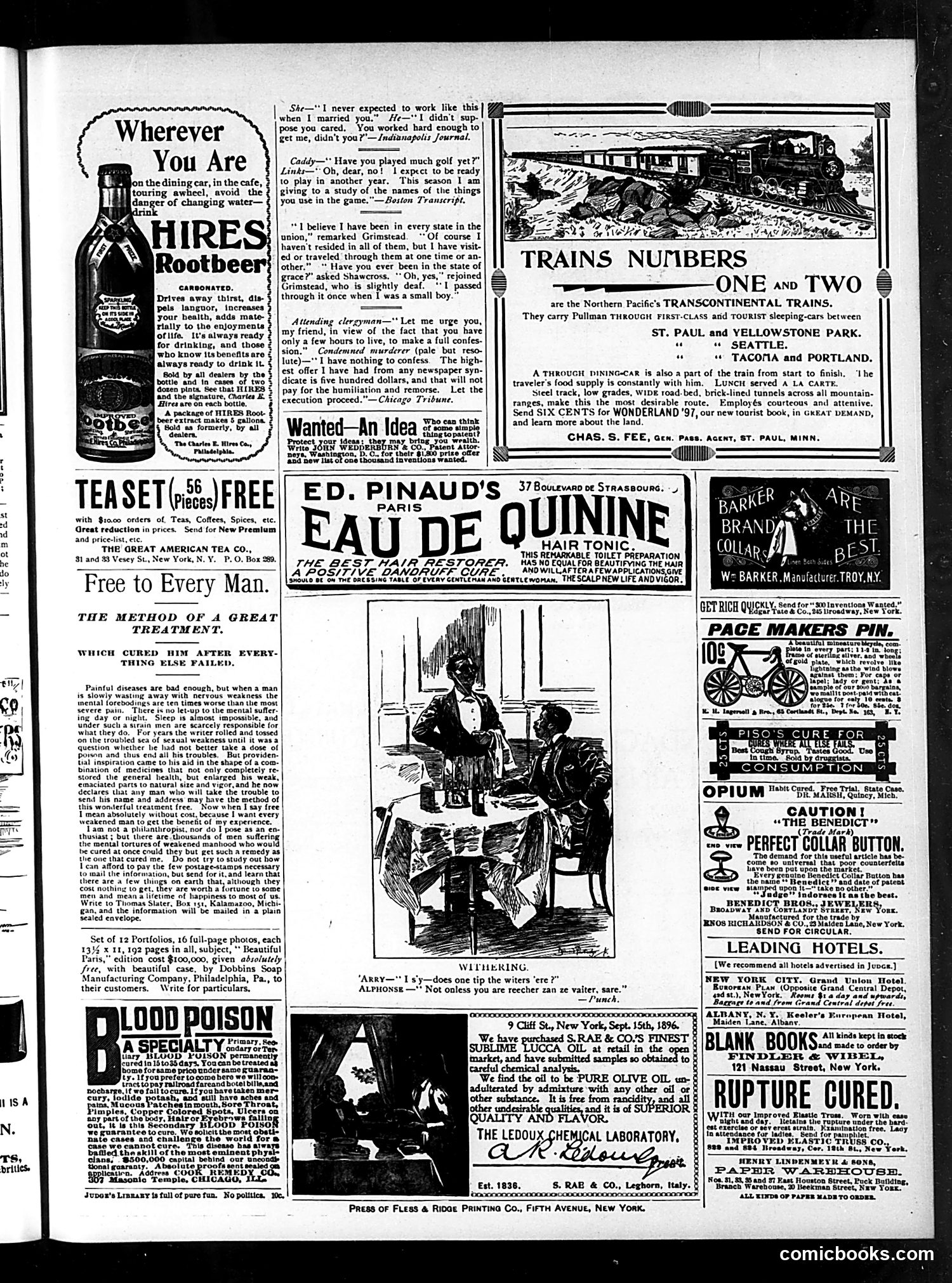
This page is primarily **advertisements and short humor pieces**, typical of Judge magazine's format. The main visual cartoon (bottom center) shows a man at a dining table with a woman—illustrating one of several brief, marriage-themed jokes scattered throughout. These jokes mock domestic life: a wife complaining about work, a husband's deaf misunderstanding of "state of grace," and a condemned murderer refusing to confess because newspaper syndicates won't pay enough. **Key advertisements include:** - **Hires Rootbeer** (left): emphasizes its universal availability for travelers - **Northern Pacific Railway** (top right): promotes transcontinental trains to Yellowstone with dining cars and tourist amenities - **Patent/invention solicitation**: offers $900 prizes for ideas - **Quinine hair tonic, bicycle pins, hotels, and medical treatments** (right column) The humor is light domestic satire typical of the era. The advertisements reflect late-1890s concerns: travel, patent innovation, and patent medicines for "nervous weakness." The page contains no political satire—it's entertainment and commerce for Judge's middle-class readership.
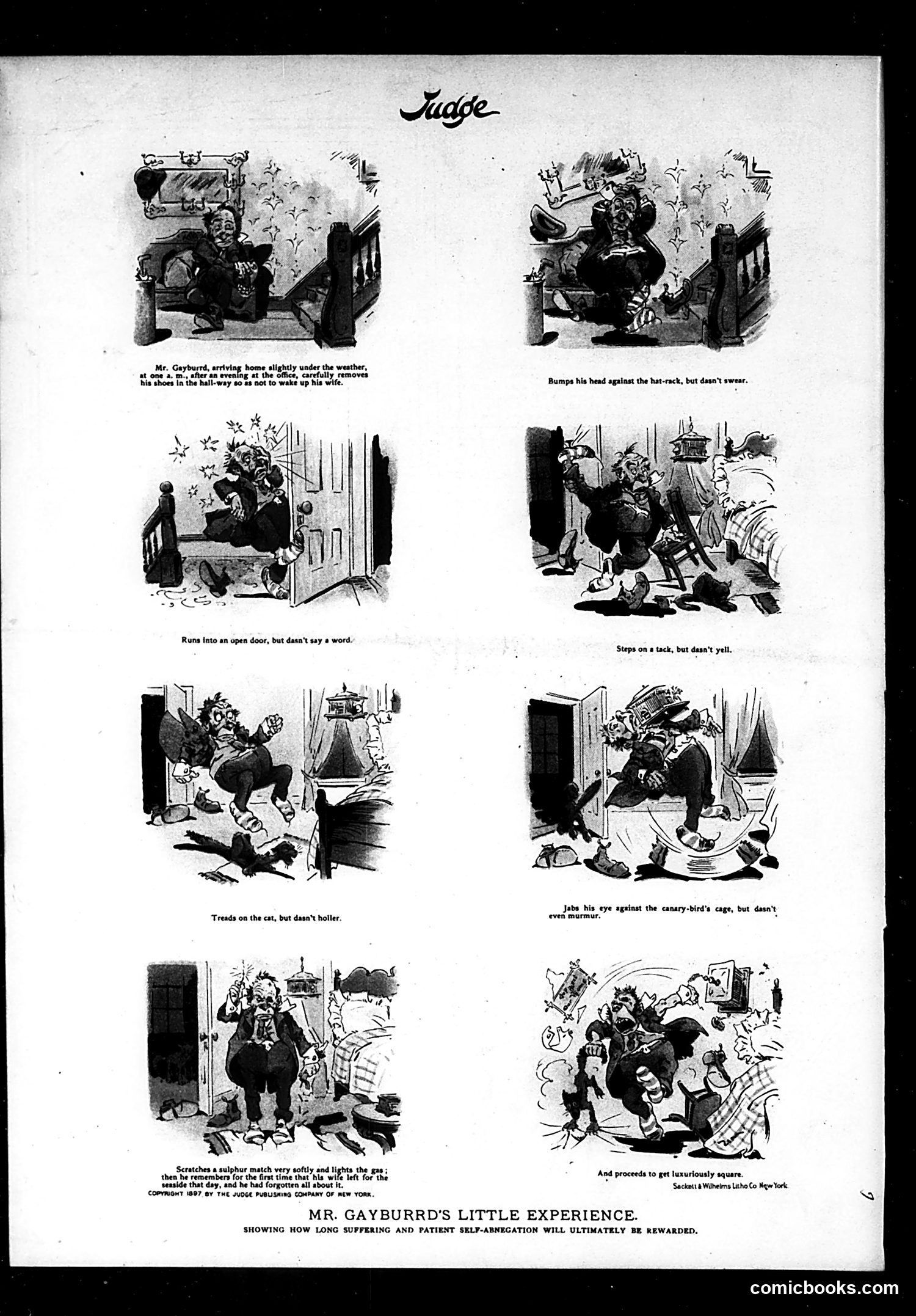
This Judge comic strip satirizes a henpecked husband's domestic suffering. Mr. Gayburrd arrives home drunk, attempts to quietly undress and slip into bed, but commits a series of silent mishaps—bumping his head, stepping on a cat, treading on his wife, striking a match that startles her, and jabbing his eye on a birdcage—all without verbal complaint or reaction. The strip's subtitle promises his "patient self-abnegation will ultimately be rewarded," but the final panel shows him getting beaten by his angry wife anyway, suggesting the satire: that a husband's meek acceptance of domestic hardship and marital discord earns no actual reward or appreciation. It mocks both the silent-suffering husband archetype and the assumption that patience guarantees marital harmony.

I can see this is a page from *Judge* magazine based on the watermark, but the image is almost entirely black with only faint traces visible along the left and right edges. The OCR text provided only shows "comicbooks.com," which appears to be a modern website attribution rather than original magazine content. I cannot reliably identify any cartoons, caricatures, political figures, or satirical content from this heavily darkened page. The reproduction quality is too poor to discern the intended artwork or read any accompanying text that would explain the satire or jokes to a modern reader. To properly analyze this *Judge* page's historical and satirical significance, a clearer image would be needed.