
A complete issue · 16 pages · 1897
Judge — June 19, 1897
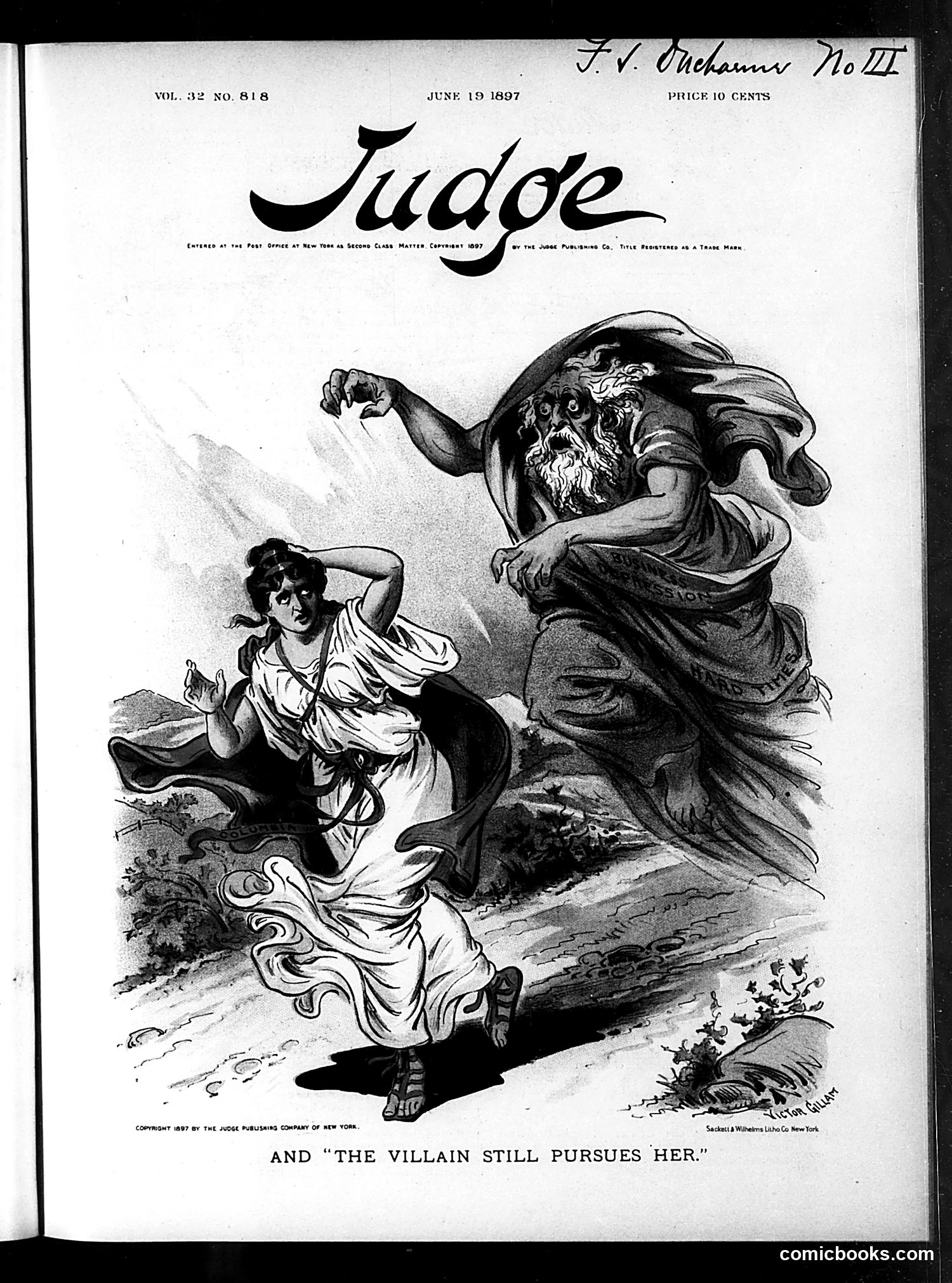
This political cartoon depicts a dramatic chase scene with the caption "AND 'THE VILLAIN STILL PURSUES HER.'" A woman in classical dress flees in terror from a menacing bearded figure (drawn as a grotesque villain or demon-like character). The theatrical staging—the woman's distressed pose, the pursuer's threatening gestures, and the caption referencing pursuit—suggests this is satirizing a melodramatic narrative, likely commenting on contemporary politics or social issues. Without additional context identifying the specific figures, the exact political reference remains unclear. However, the composition mimics 19th-century theatrical melodrama tropes, where this type of "villain pursues innocent maiden" imagery was standard. Judge likely uses this familiar dramatic formula to mock either a political figure or a social situation viewed as an overblown crisis by the magazine's editors.
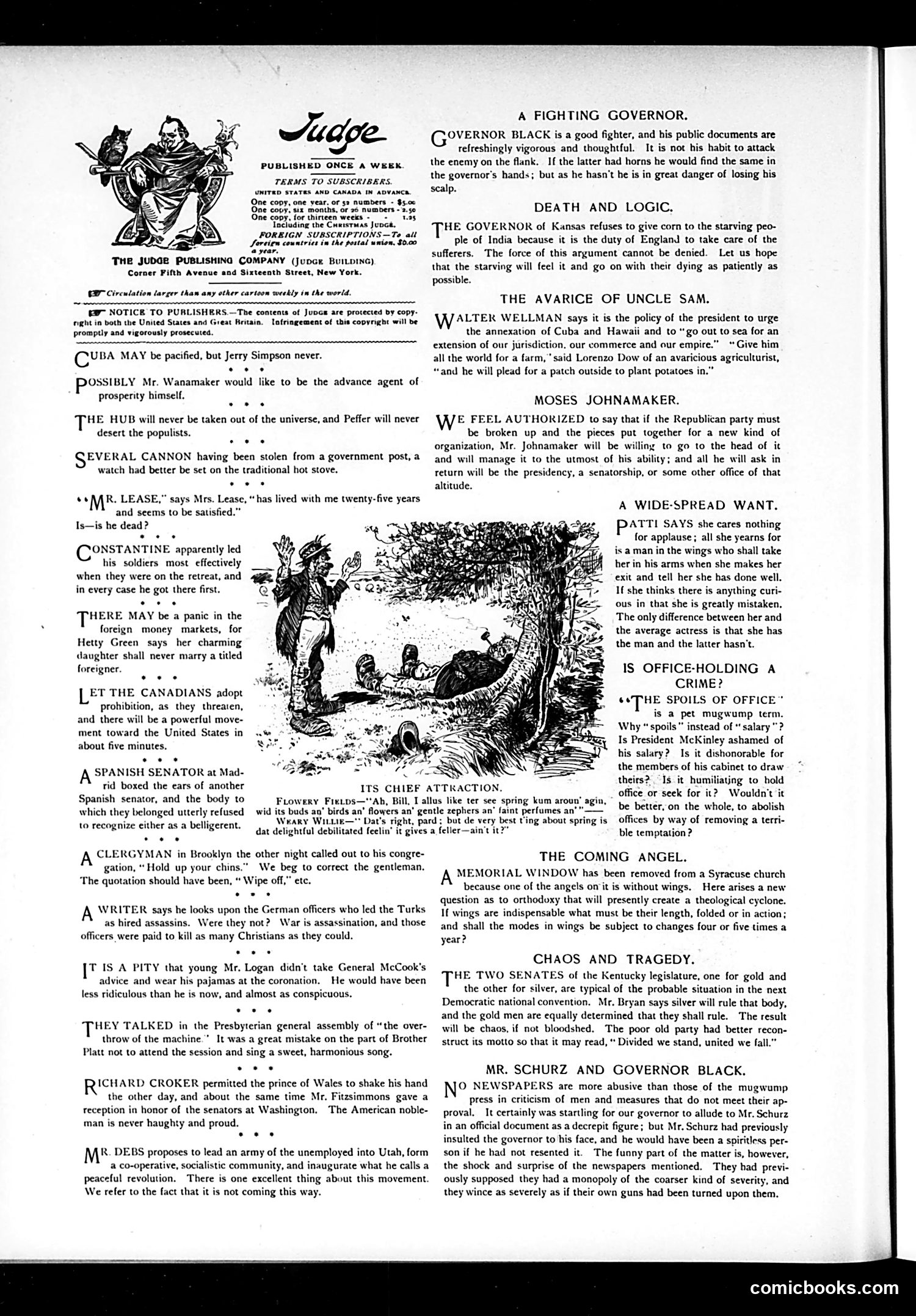
This page contains multiple short political commentary pieces rather than a single cartoon. The central illustration depicts "Its Chief Attraction"—a figure on horseback approaching what appears to be a battlefield or disaster scene, with soldiers or casualties visible. The surrounding commentary targets various political figures and issues of the era, including Governor Black (praised for "vigorous and thoughtful" public documents), criticism of President McKinley's Cuba and Hawaii policies, and Republican party management. References to "Moses Jobnamaker" and mentions of office-seeking suggest commentary on political patronage and party leadership struggles. Without clearer identification of specific figures or dates in the OCR text, the precise historical context remains somewhat unclear, though the content clearly criticizes Progressive-era political practices and imperial foreign policy.
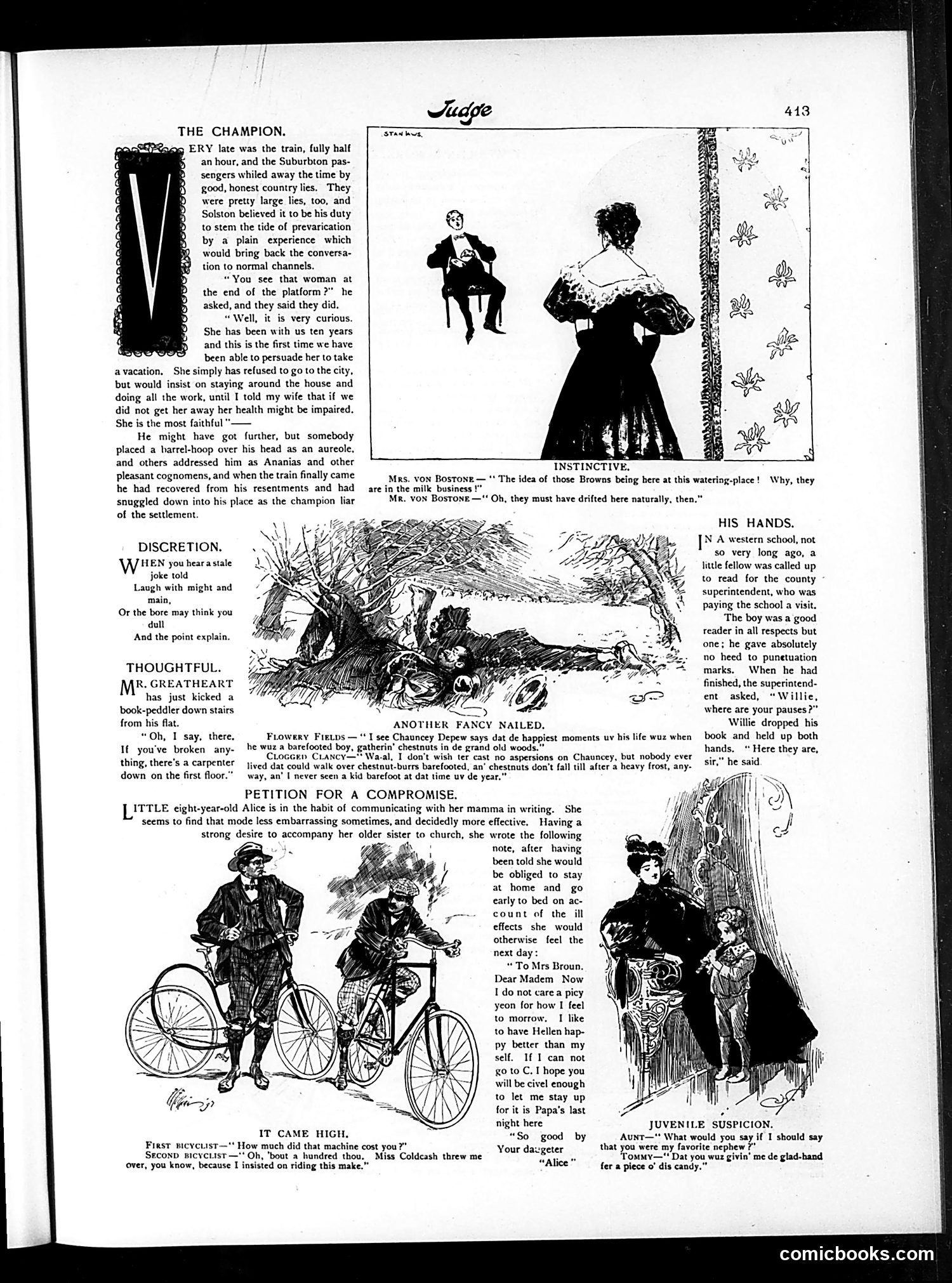
This page contains several humorous sketches and short satirical pieces typical of Judge's editorial style, rather than focused political cartooning. The pieces include: - **"Discretion"** and **"Thoughtful"**: Brief witty observations about everyday social behavior - **"Petition for a Compromise"**: A story about a girl named Alice writing to her mother, negotiating to stay home from church due to illness, featuring bicycle illustrations - **"His Hands"**: A school anecdote about a boy called to recite for a visiting superintendent - **"Instinctive"**, **"It Came High"**, and **"Juvenile Suspicion"**: Brief joke captions accompanying illustrations These are light domestic and social humor pieces rather than political satire. The content reflects turn-of-the-century middle-class American life, with themes of childhood mischief, family negotiations, and social propriety.
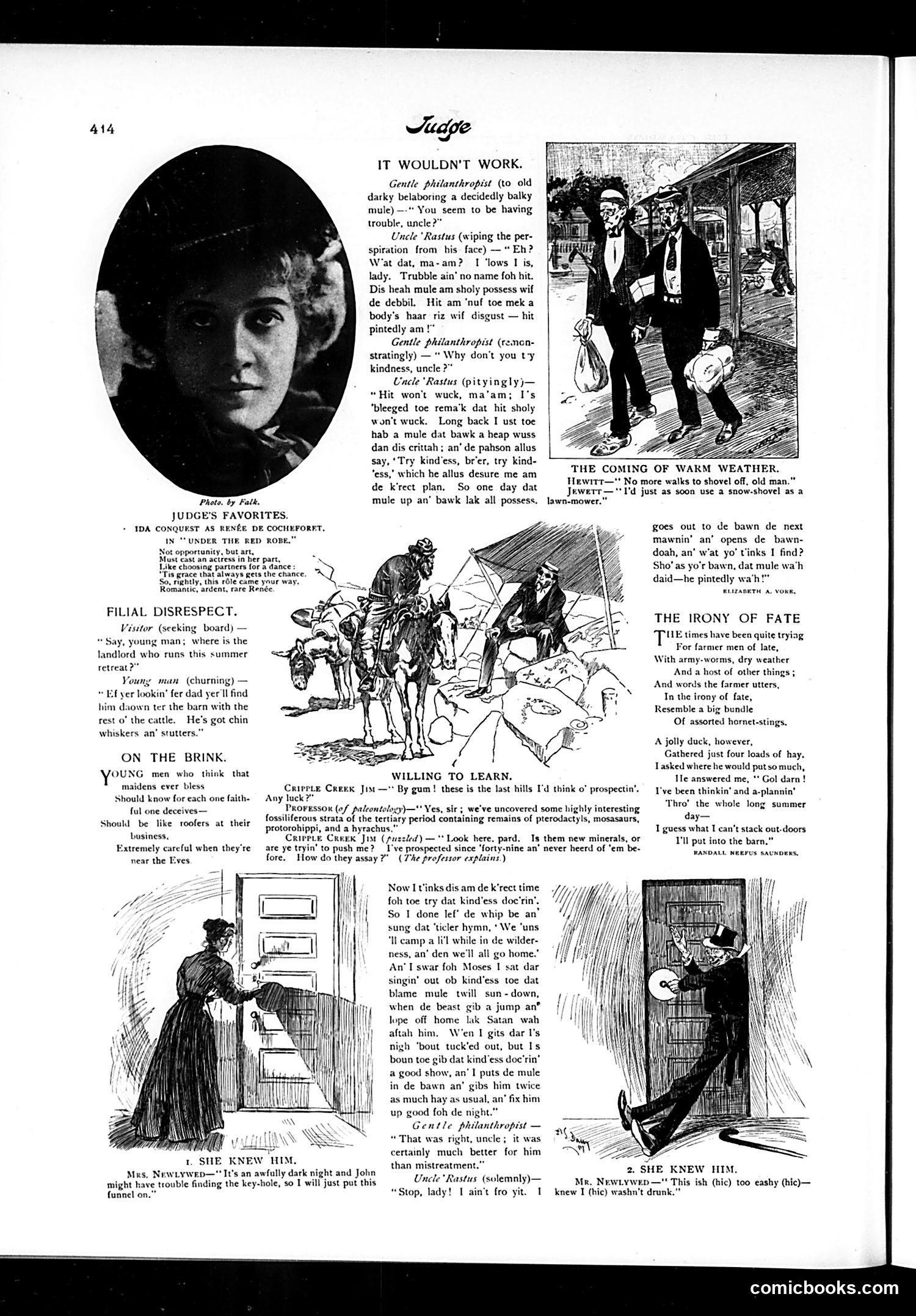
This page from Judge satirizes late 19th-century American attitudes through several cartoons: **"It Wouldn't Work"** mocks both paternalistic white philanthropy and African American dialect stereotyping. A well-meaning white philanthropist suggests "kindness" to solve an enslaved man's mule problem. Uncle Rastus responds in exaggerated dialect that kindness failed before—the mule died anyway. The joke targets the naïve belief that genteel charity could solve practical problems rooted in deeper systemic issues. **"Willing to Learn"** contrasts a paleontology professor's scientific jargon (pterodactyls, mosasaurs) with a prospector's practical ignorance. The professor explains fossils; the prospector misapplies the "kindness" lesson from the previous cartoon to his stubborn mule, with predictably useless results. **Remaining pieces** include light domestic humor ("Filial Disrespect," "On the Brink," "The Irony of Fate") featuring standard period comedic tropes: irreverent youth, courtship dangers, and farmers' misfortunes. The page reflects Judge's typical blend of racial caricature and social commentary aimed at educated readers.
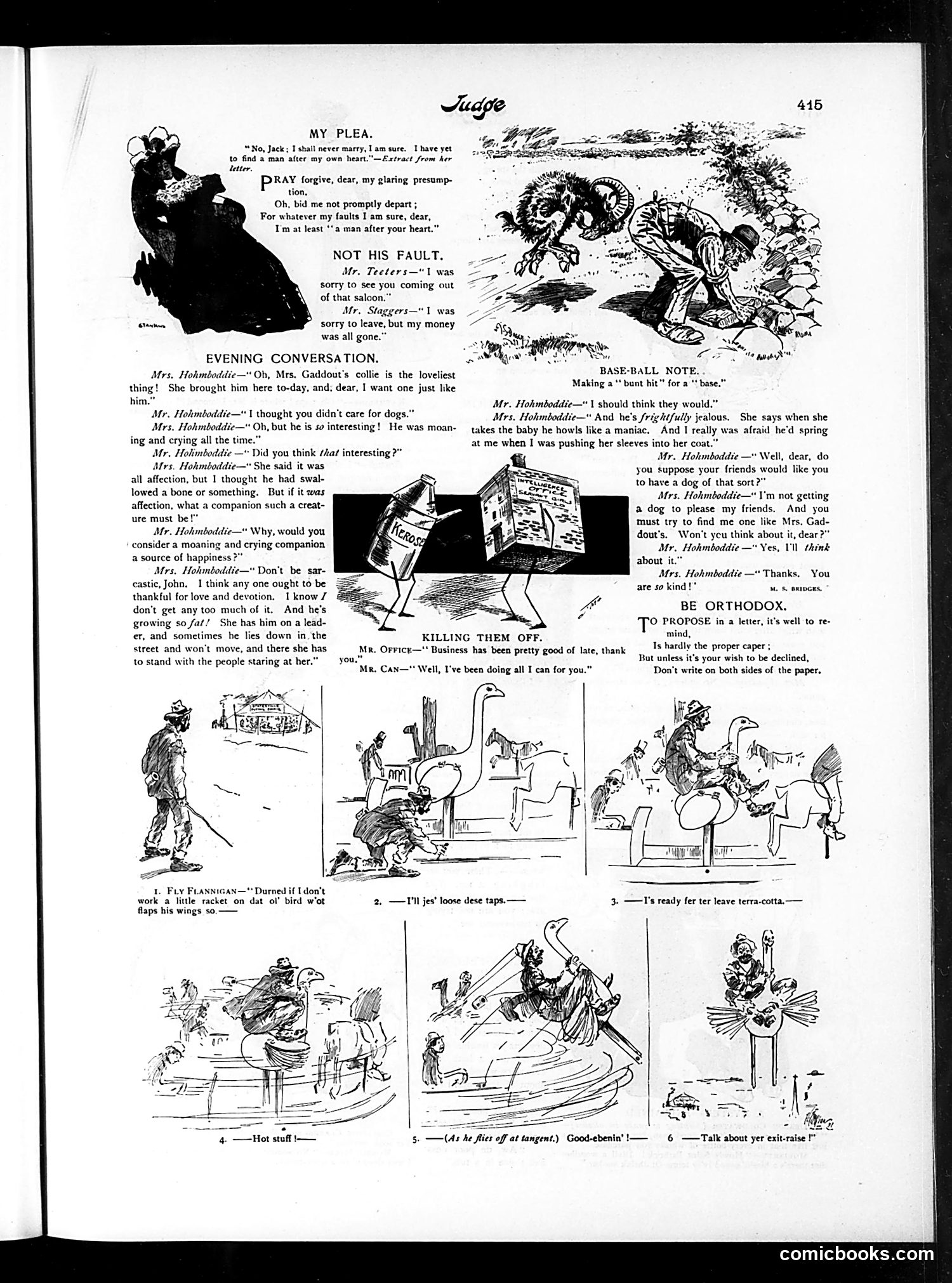
This page contains several unrelated satirical sketches typical of late-19th/early-20th-century humor magazines: **"My Plea"** mocks romantic persistence—a man claims to be "a man after your heart" despite the woman's stated preference for solitude. **"Evening Conversation"** satirizes Mrs. Hohmboddie's sentimental attachment to a neighbor's dog over her husband's affection. The joke: she romanticizes the dog's "moaning" as devotion while neglecting her marriage, and the dog is actually just suffering or lazy. **"Not His Fault"** offers a quick joke about a drunk man leaving a saloon—he wasn't ashamed to enter, only sorry to leave because his money ran out. **"Killing Them Off"** and **"Base-Ball Note"** appear to be office/sporting humor. **"Be Orthodox"** offers practical letter-writing advice: proposals should be written on one side of paper only, or they'll be declined. The remaining sketches are brief visual gags. The humor assumes readers share period attitudes about courtship, domesticity, and social propriety.
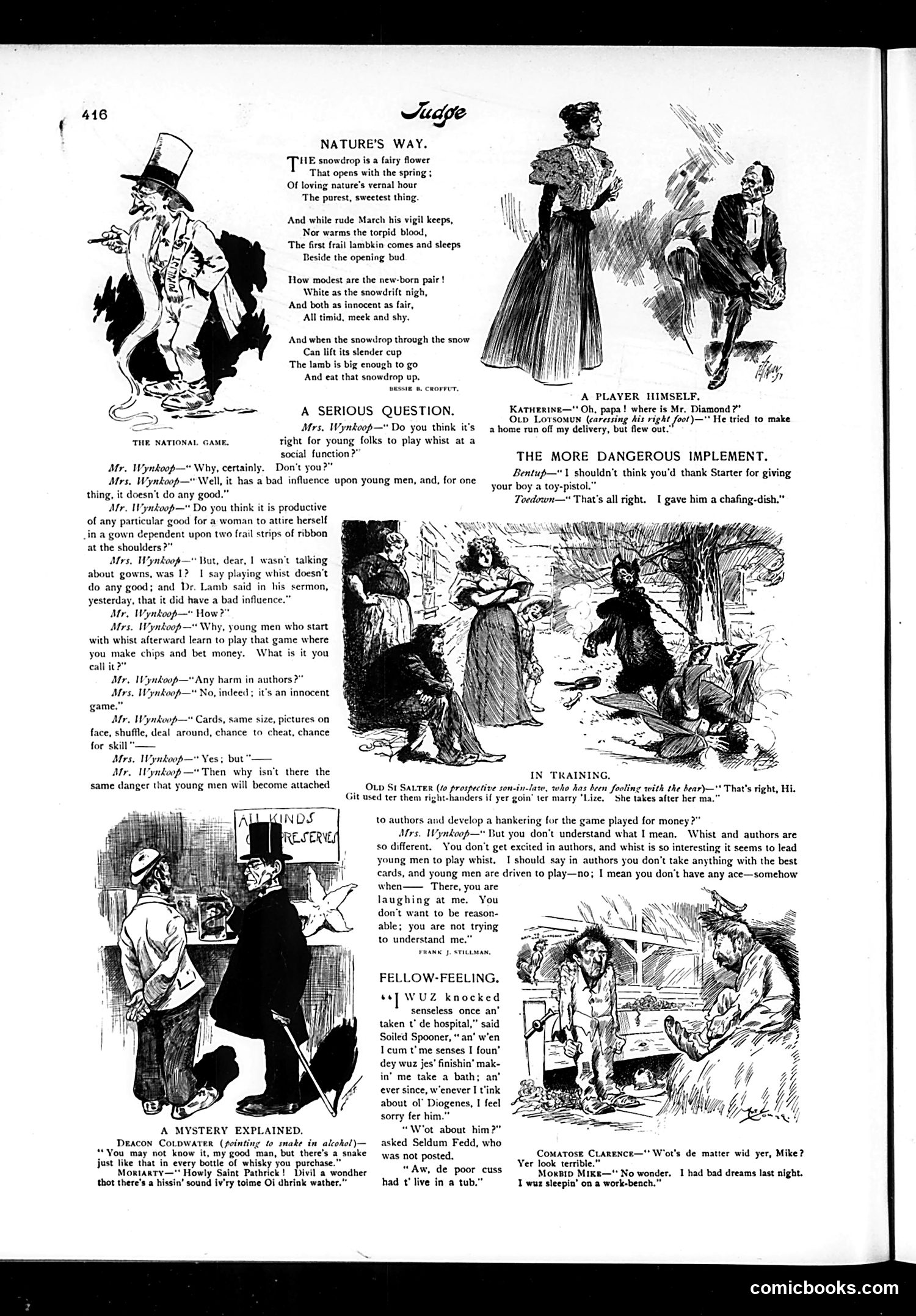
This page contains multiple satirical pieces typical of late 19th-century American humor: **"The National Game"** depicts a domestic debate between Mr. and Mrs. Wynkoop about whether whist (a card game) is appropriate for young men. Mrs. Wynkoop worries it leads to gambling, while Mr. Wynkoop defends it as innocent. The satire mocks how Victorians moralized about social activities while ignoring obvious hypocrisy—she accepts authors but not cards, despite both involving chance. **"A Mystery Explained"** jokes that snakes found in whisky bottles explain the "hissing sound" heard when drinking water—implying Americans commonly find snakes in their liquor, a dark humor comment on whisky quality or alcohol's dangers. Other cartoons include light domestic humor about baseball ("A Player Himself"), toy safety concerns, and Irish-immigrant dialect comedy ("Fellow-Feeling"), typical of Judge's working-class satirical content. The overall tone reflects Gilded Age anxieties about morality, social class, and respectability.
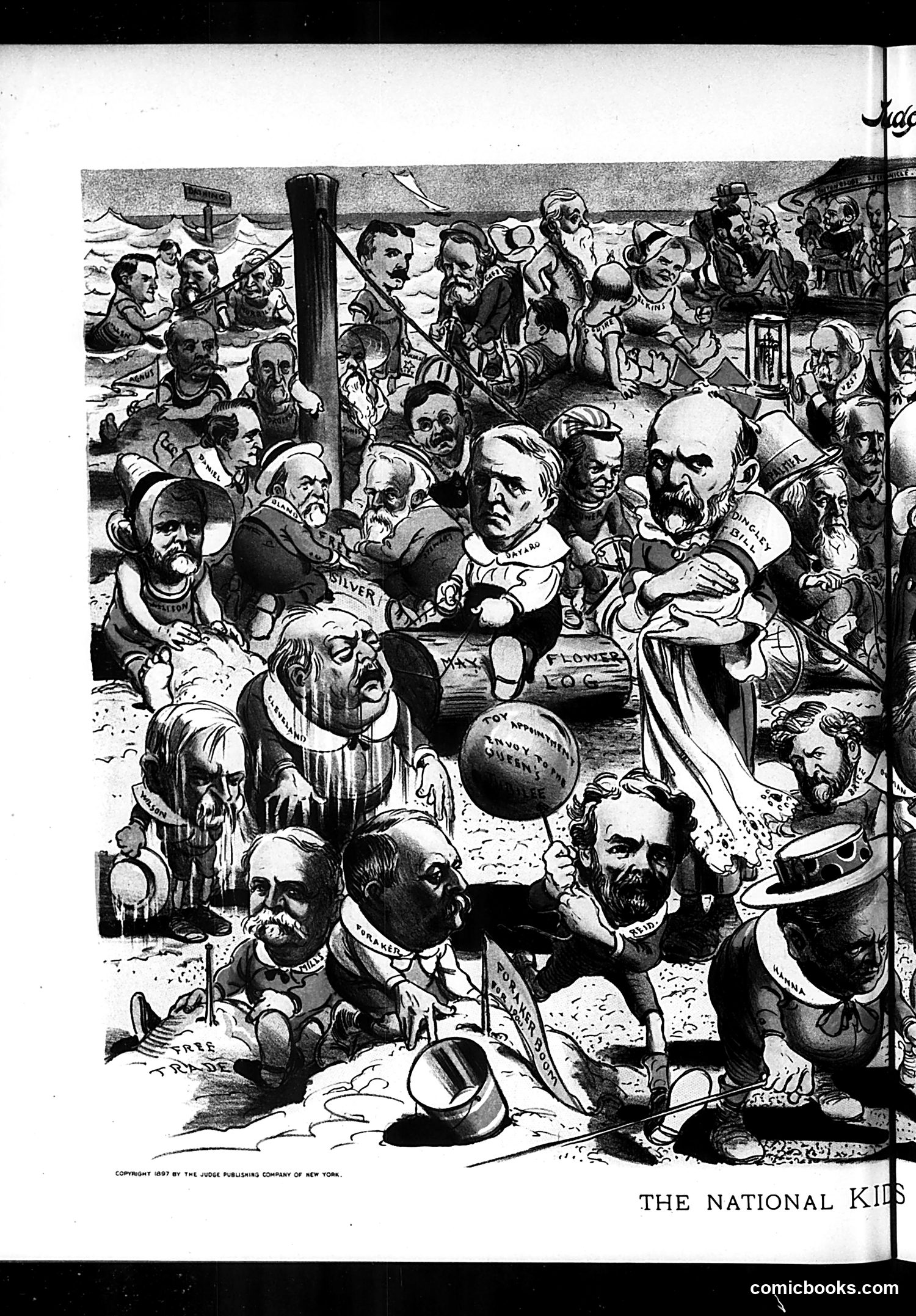
This satirical cartoon depicts a crowded, chaotic scene of caricatured political figures depicted as children or babies, engaged in quarrelsome behavior. The figures are labeled with various identifications including references to "Silver," "Flower," and what appears to be economic or political platforms written on their clothing and held objects. The satire mocks prominent political leaders of the era as immature and childish, squabbling like infants rather than conducting serious governance. The crowded composition emphasizes discord and chaos. Without clearer date or specific figure identification visible in the image, the exact historical context remains uncertain, though it clearly satirizes late 19th or early 20th-century American political infighting and the perceived immaturity of national leaders during a period of significant political division.
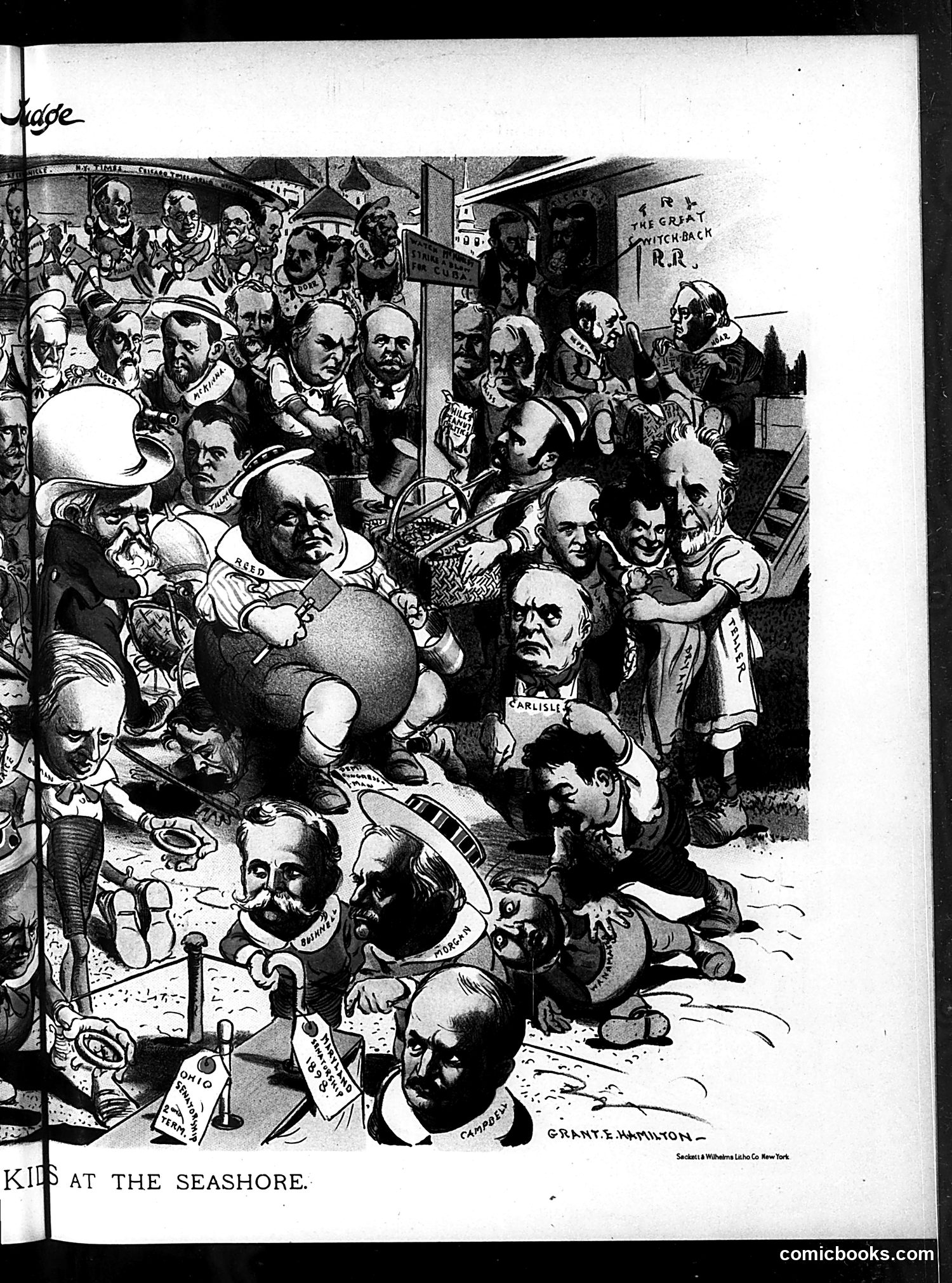
This is a satirical political cartoon by Grant E. Hamilton published in *Judge*. The densely packed scene depicts numerous caricatured political figures crammed together at a seaside location, seemingly engaged in chaotic activity. The cartoon appears to mock prominent politicians and public figures of its era (likely 1880s-1890s based on *Judge*'s publication period). Labels visible on figures include "Carlisle" and references to railroad interests ("R.R."), suggesting commentary on economic or railroad policy debates of the period. The "seashore" setting frames this as idle leisure activity, possibly satirizing politicians taking vacations or engaging in frivolous pursuits while serious matters require attention. The overcrowding and tumultuous composition suggest political chaos or the scramble among various interests for influence. Without clearer dating and additional labeled figures, the specific political moment remains somewhat obscure to modern readers.
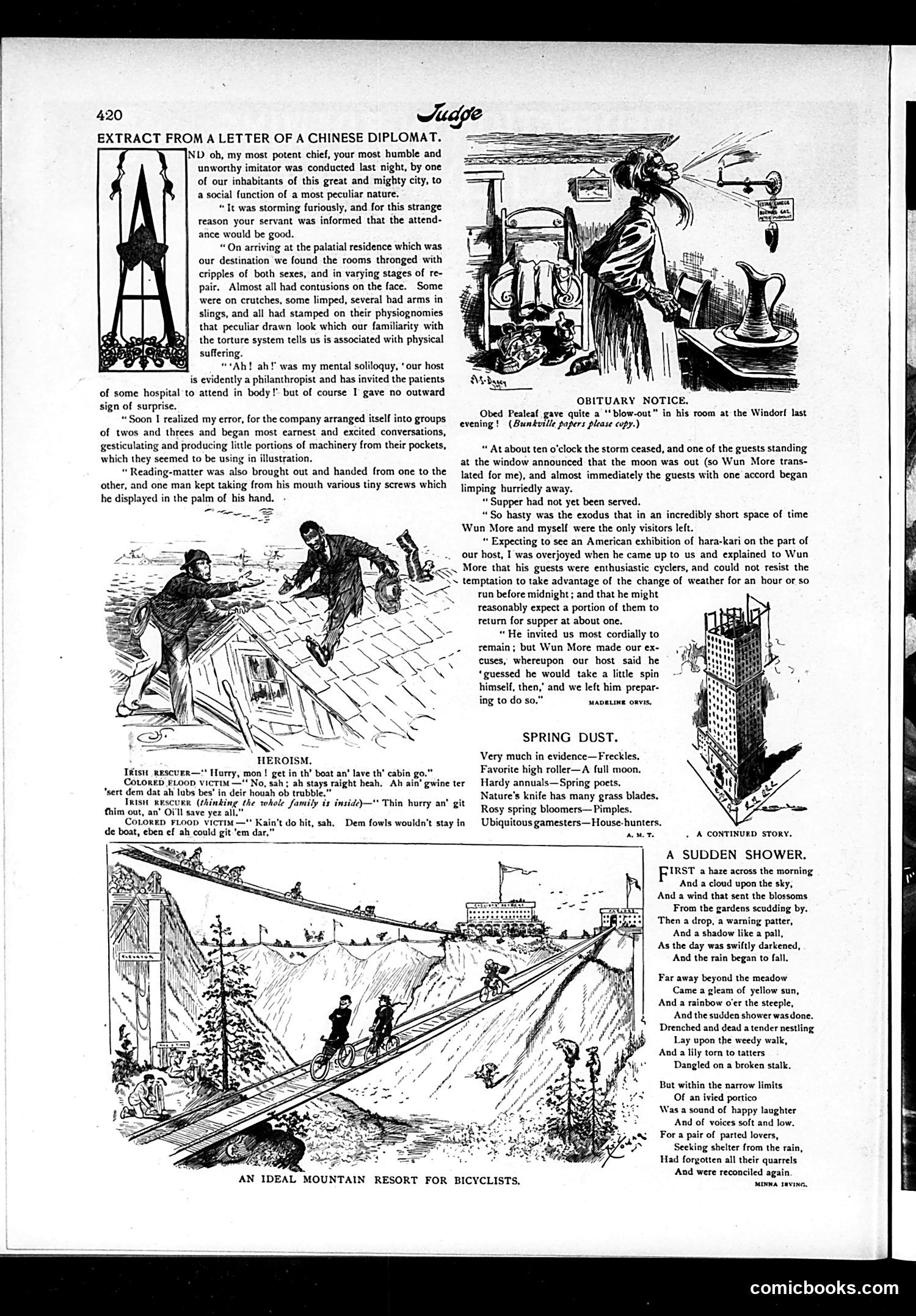
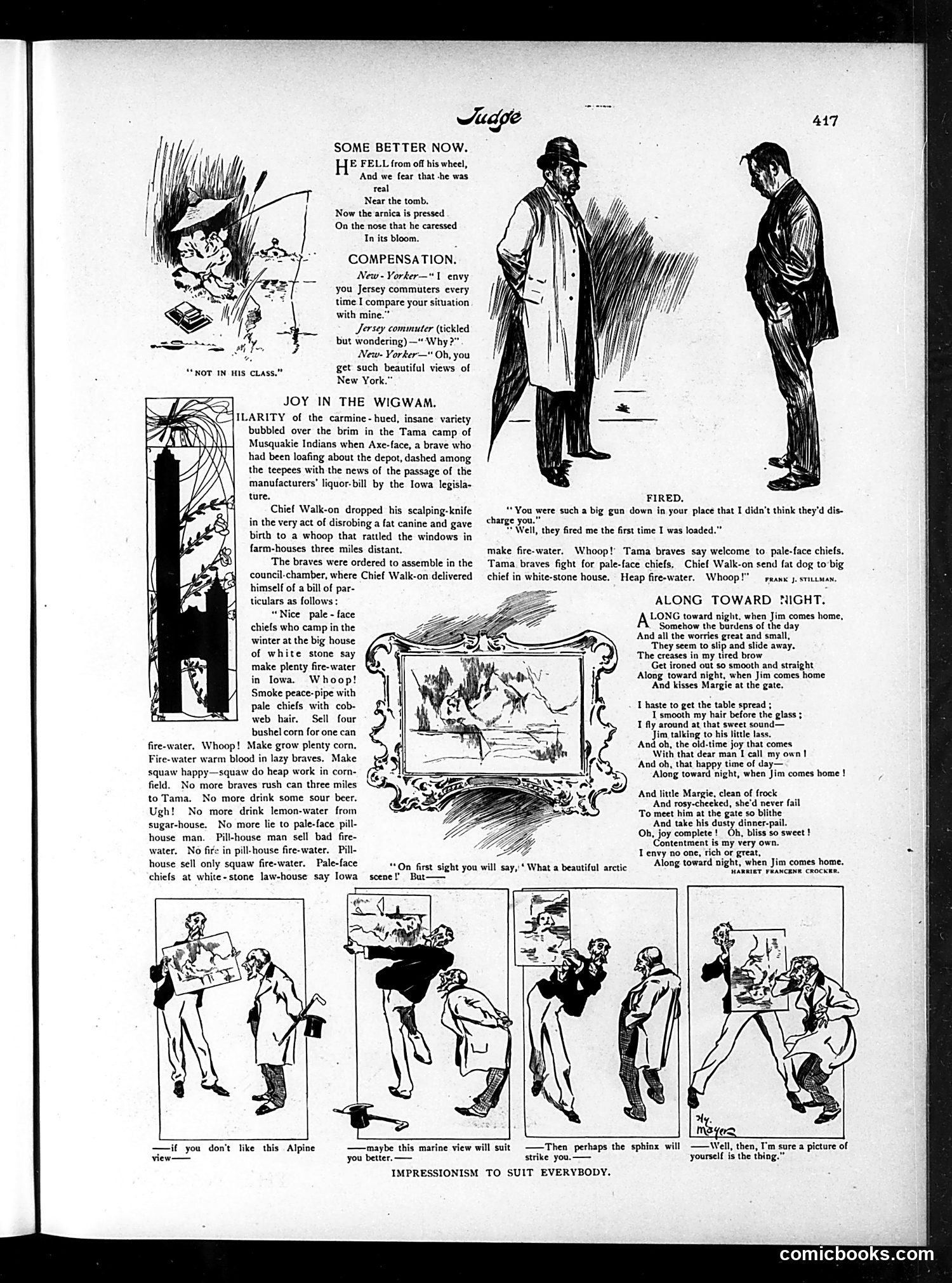
This page contains satirical content mocking American social customs through a Chinese diplomat's perspective. The main piece, "Extract from a Letter of a Chinese Diplomat," satirizes the cycling craze of the 1890s. A Chinese official describes attending a formal event where guests arrive injured and bruised—initially appearing to be hospital patients. The joke reveals they're actually cyclists who've crashed their bicycles. The diplomat observes them excitedly discussing "machinery" (bicycle parts) and showing each other "tiny screws," oblivious to the dangerous sport's obvious hazards. The satire continues when, after the storm clears and the moon appears, the injured guests suddenly leave to ride again—before dinner is even served—demonstrating the obsessive, almost irrational nature of the cycling fad gripping Americans. Secondary content includes a brief "Heroism" joke about a colored flood victim prioritizing his fowls over rescue, a bicycle-resort illustration, and a spring poetry section—standard magazine filler typical of the era. The satire targets bicycle mania as a peculiarly American obsession, treating it as bewildering to foreign observers.
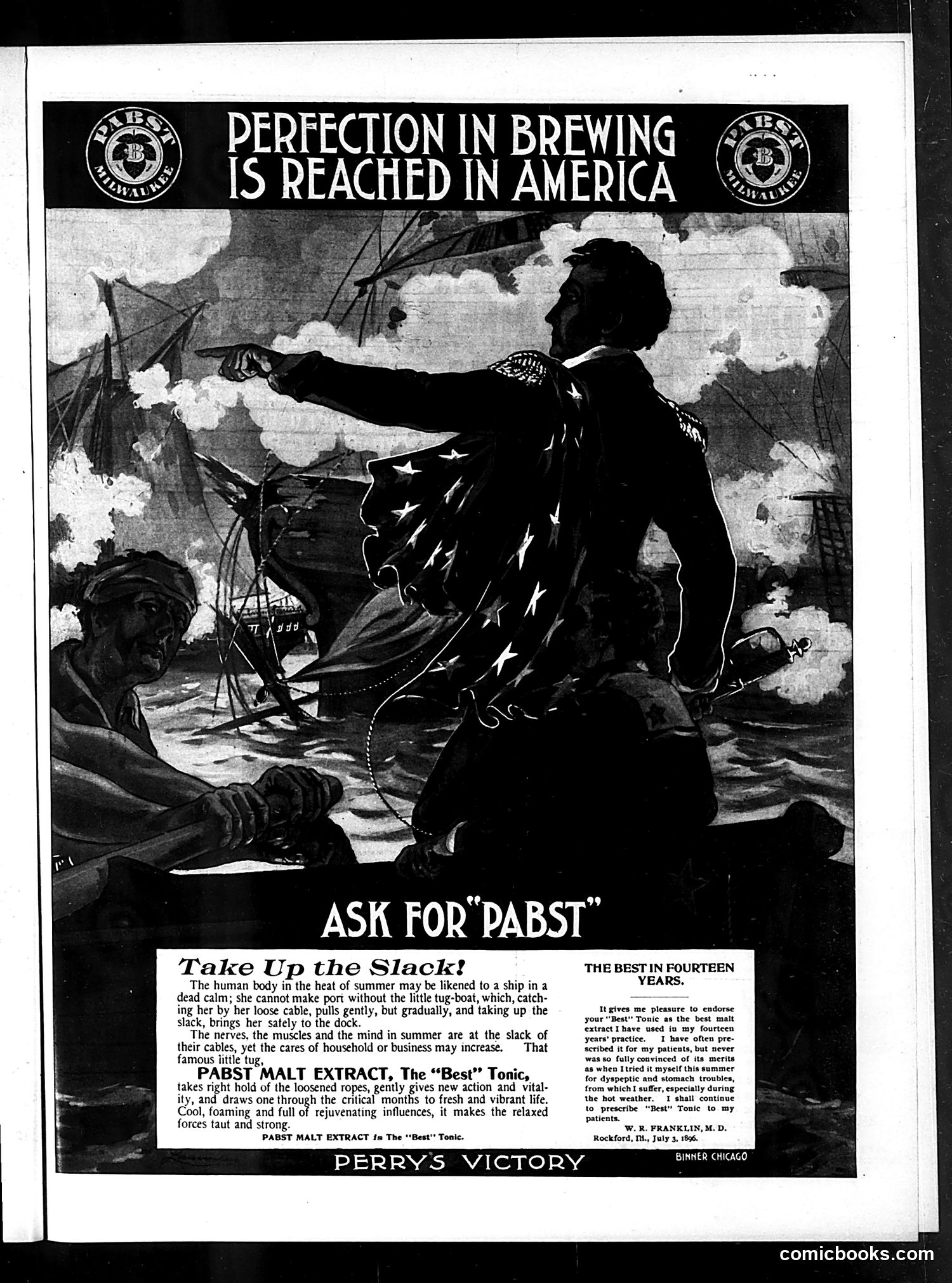
This is a **Pabst beer advertisement**, not political satire. The page uses patriotic imagery—a figure in a starred cape pointing toward ships (evoking American naval victory)—to sell "Pabst Malt Extract" as a health tonic for summer fatigue. The ad employs a common late-19th-century marketing strategy: claiming medicinal benefits. The ship metaphor suggests the product will energize a "slack" summer body like a tugboat restoring a stalled vessel. A physician's testimonial (W.R. Franklin, M.D.) reinforces credibility by endorsing it for digestive troubles. The title "Perfection in Brewing Is Reached in America" promotes American manufacturing superiority. This reflects period nationalism and pre-Prohibition confidence in beer's respectability as a health product rather than mere alcohol. The "Perry's Victory" reference likely invokes patriotic associations, though unclear precisely which victory is meant.
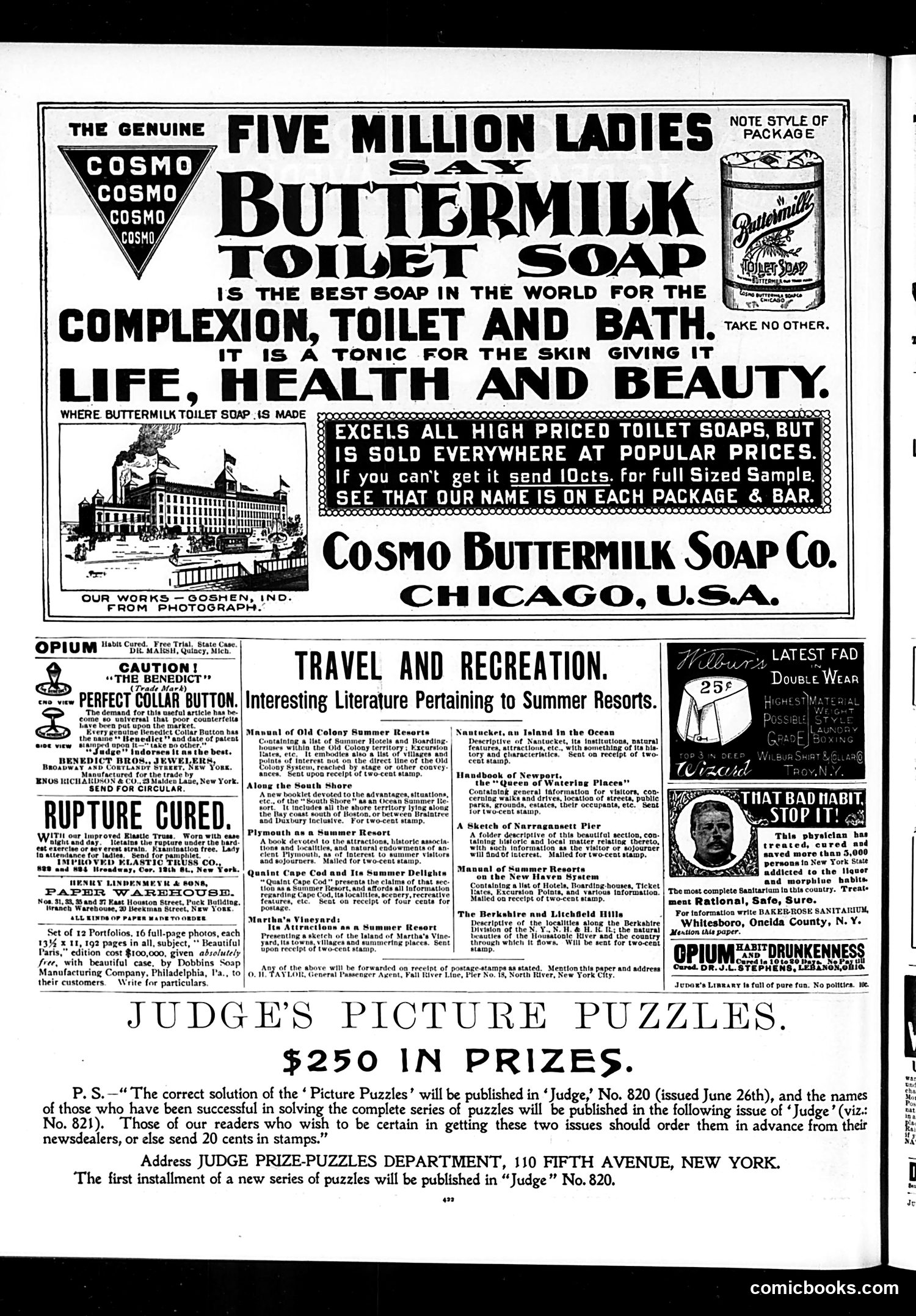
This is primarily an **advertising page**, not a satirical cartoon. The dominant content is a large advertisement for Cosmo Buttermilk Toilet Soap from Chicago, claiming five million ladies use it and touting it as "the best soap in the world for the complexion, toilet and bath." Below that are multiple smaller advertisements typical of late 19th/early 20th-century publications: patent medicines (Opium treatments, "Drunkenness" cures), jewelry, soap premiums, and travel guides to American summer resorts. The bottom section announces Judge's Picture Puzzles contest offering $250 in prizes. **Key context for modern readers:** This reflects an era when magazines mixed editorial content with extensive advertising, often for now-discredited remedies (opium cures, dubious health claims). The soap ad's emphasis on "complexion" and "health and beauty" represents period marketing to women, while promotional giveaways (portfolios with soap purchases) were common sales tactics.
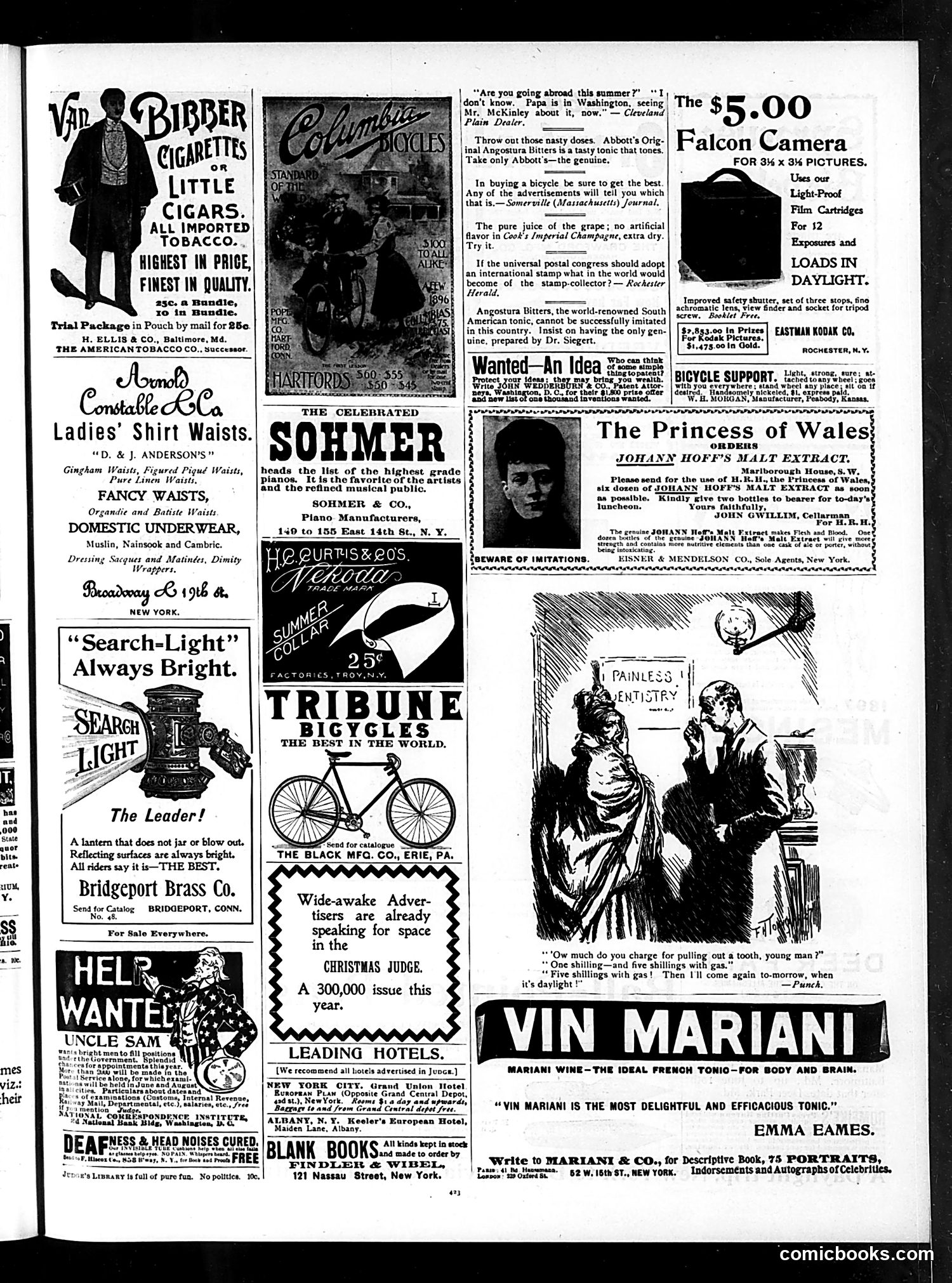
This page is primarily **advertisements and filler content** rather than political satire. The layout includes: **Main Advertisement**: A large Sohmer piano ad occupies central space, promoting it as the "highest grade" piano favored by artists and refined audiences. **Notable Content**: - A small joke referencing President McKinley: a child mentions Papa is "in Washington, seeing McKinley about it" regarding summer travel plans—likely satirizing McKinley's political power or accessibility to favor-seekers. - A "Wanted—An Idea" patent solicitation ad, typical of the era's entrepreneurial culture. - Various product ads (bicycles, cameras, bitters, wine) with claims of superiority. - A cartoon showing a dentist joke about gas anesthesia pricing. - A reference to the "Princess of Wales" endorsing malt extract—common celebrity/royal endorsement marketing of the period. **Context**: This appears to be a typical late-1890s/early-1900s Judge page mixing light humor, society references, and commercial advertising—the magazine's standard format rather than hard political commentary.
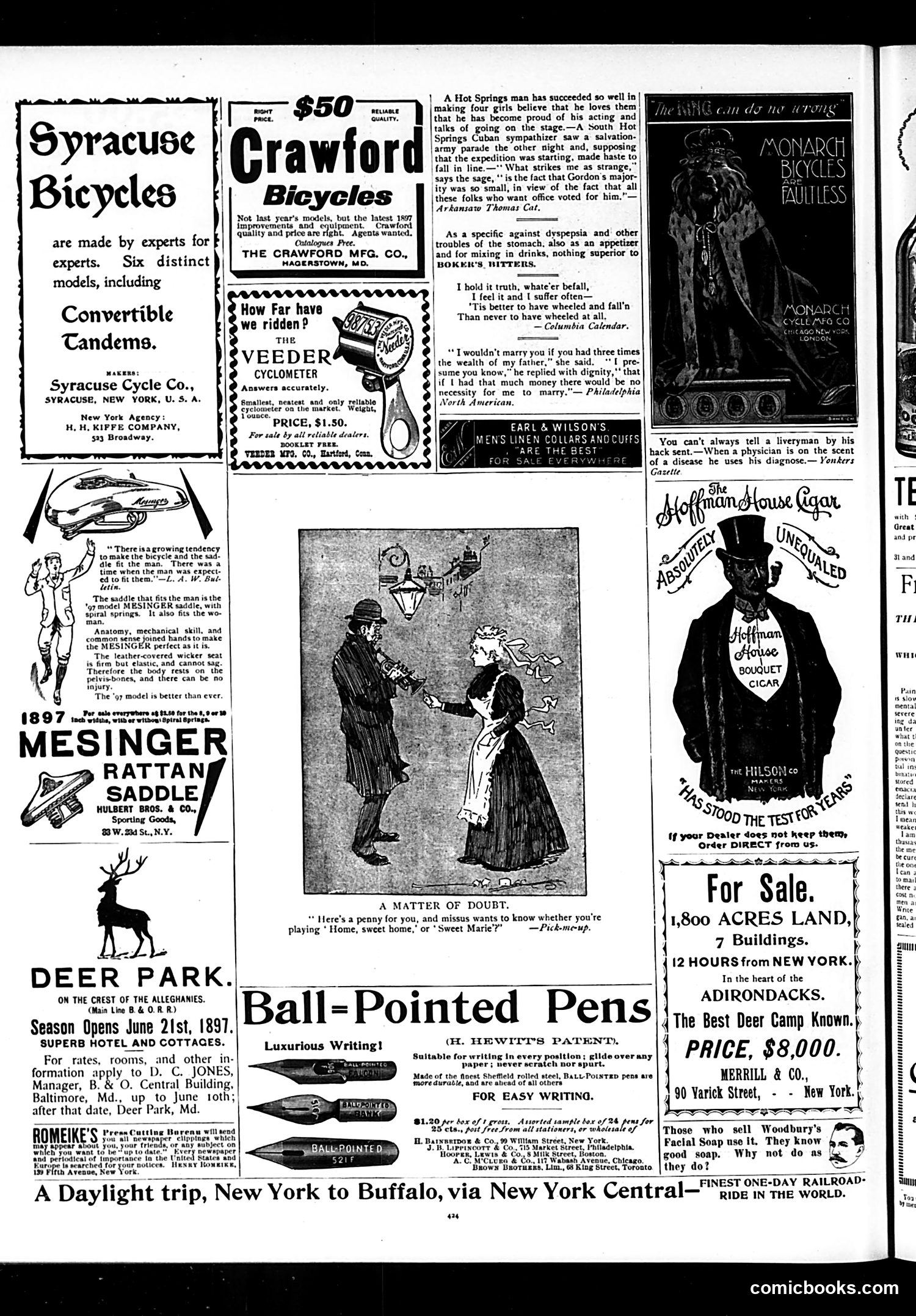
This page is almost entirely advertisements with no political cartoons. The one small illustrated anecdote titled "A Matter of Doubt" (center) depicts a street musician or organ-grinder asking a woman whether she wants him to play "Home, Sweet Home" or "Sweet Marie"—a light joke about common song choices of the era, not political satire. The bulk of the page advertises 1890s consumer goods: bicycles (Syracuse, Crawford), saddles (Mesinger), pens (ball-pointed), cigars (Hoffman House), land sales, hotels, and cyclometers. The text fragments mixed among ads appear to be brief humorous anecdotes typical of Judge's lighter content—observations about cyclists, doctors, and courting—but lack political significance or clear targets. This appears to be filler or back-page advertising rather than Judge's characteristic political-satirical content.
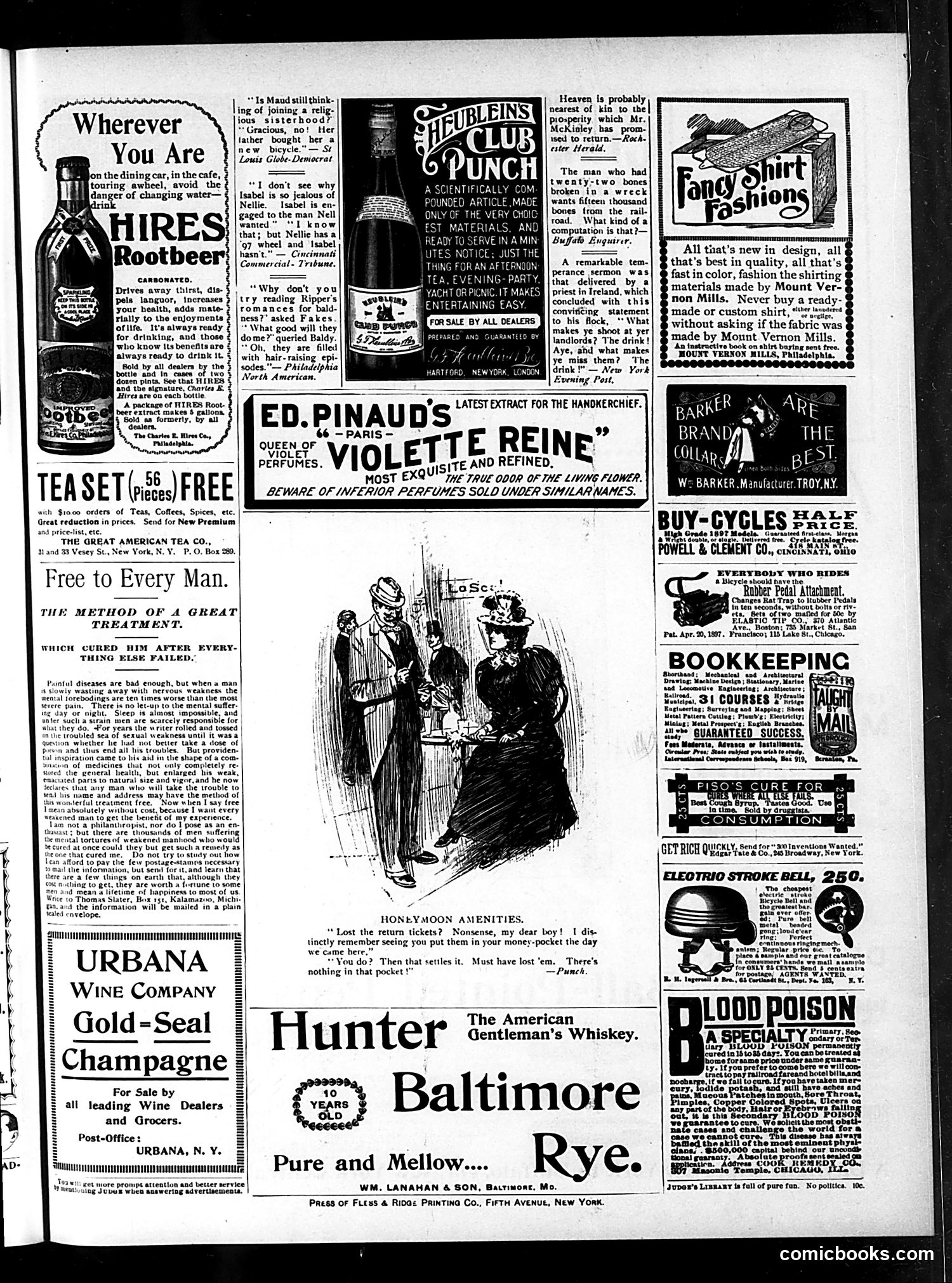
This page from *Judge* magazine is primarily **advertising**, with one notable cartoon and several short humor items. The main **cartoon** depicts a honeymoon scene where a newlywed couple has lost train tickets. The husband insists the wife put them in her pocket; she contradicts him. The joke—likely satirizing newlywed tensions or male-female miscommunication—hinges on the punchline that nothing is actually in the pocket, making both claims absurd. The page is dominated by **commercial advertisements** for products typical of the era: Hires Rootbeer (promoted as healthy), patent medicines (treating "sexual weakness"), wine, whiskey, bicycles, and correspondence courses in bookkeeping. Several ads promise miraculous cures or results, reflecting the era's unregulated patent medicine industry. Scattered **humor snippets** mock contemporary social situations: a woman's jealousy over bicycle ownership, a priest's temperance sermon about drinking, and wordplay about hair-loss remedies. The overall content reflects early 20th-century middle-class concerns: health anxieties, courtship dynamics, and consumer goods marketed through exaggerated claims.
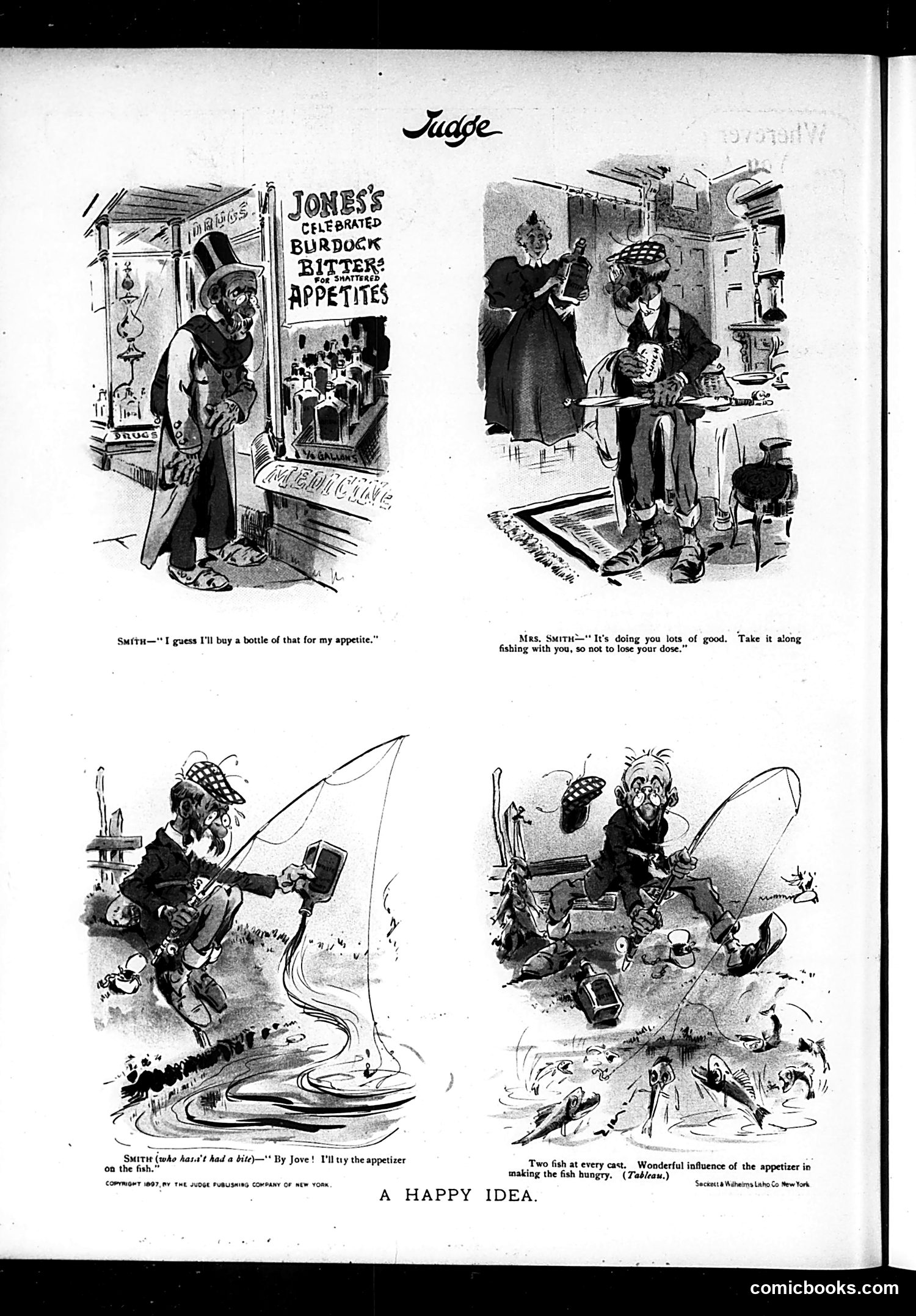
This four-panel comic satirizes Jones's Celebrated Bitters, a patent medicine marketed as an appetite stimulant. The joke tracks a man named Smith who uses the bitters while fishing. **The premise:** Smith buys the bitters to stimulate his appetite (panel 1), his wife recommends he take it fishing so he won't lose his "dose" (panel 2). The satirical payoff: the bitters supposedly work so well that the *fish* become hungry too (panels 3-4), resulting in abundant catches. **The satire:** This mocks the exaggerated health claims of patent medicines common in the early 1900s. By suggesting the bitters influence the fish's behavior—absurdly extending the medicine's supposed powers—Judge ridicules the implausible marketing promises made to gullible consumers. The humor relies on readers recognizing these medicines' fraudulent advertising as obvious nonsense.