
A complete issue · 18 pages · 1897
Judge — June 12, 1897
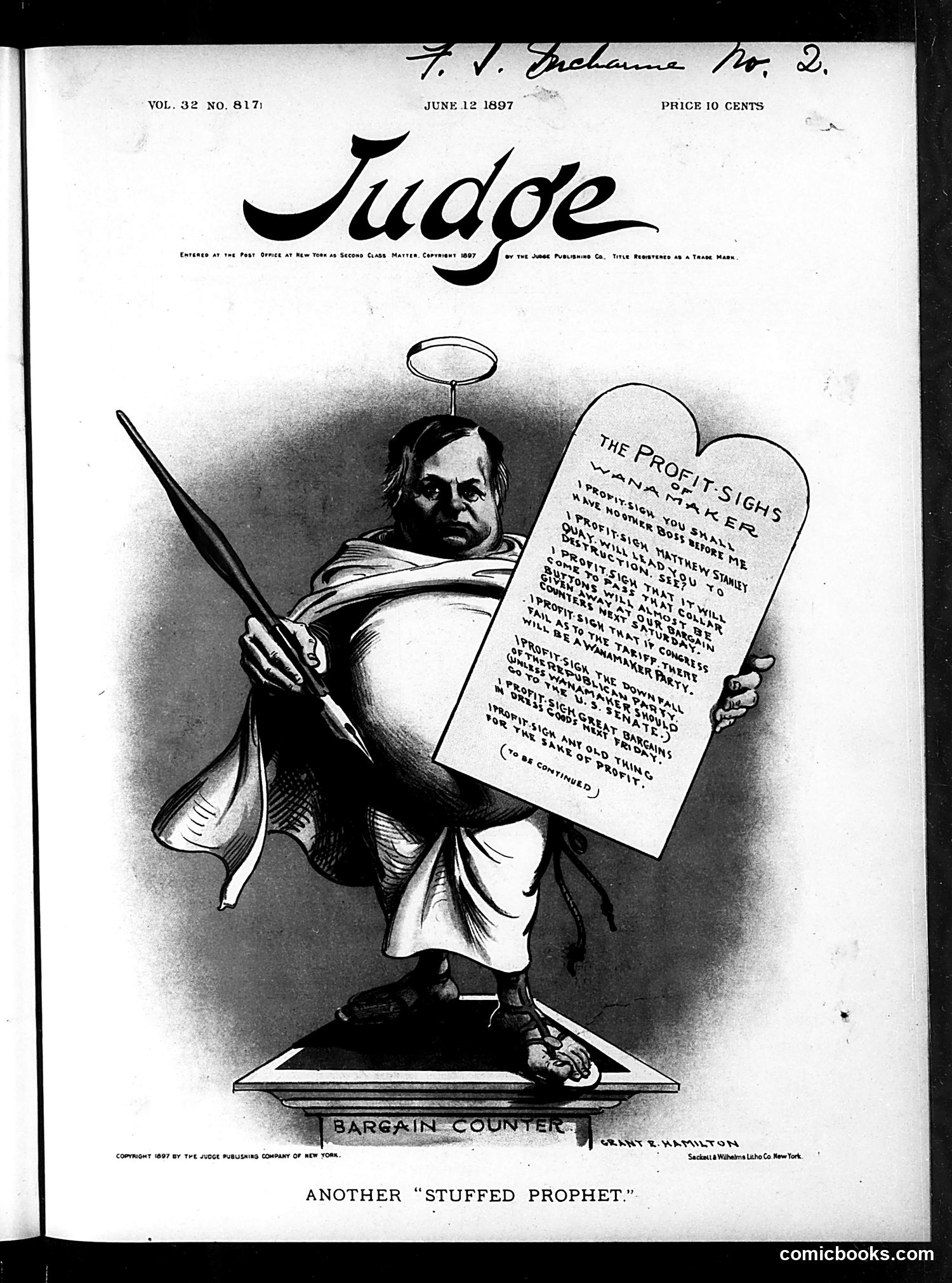
This political cartoon satirizes what appears to be a public figure—depicted with a halo as a false "prophet"—displayed on a "Bargain Counter" like merchandise. The figure holds a sword and tablets labeled "The Profit-Sighs," listing various broken promises or failed prophecies (text is partially legible but includes repeated claims about predictions and profits). The satire targets someone who has made grand public predictions or promises that failed to materialize, yet continues to be treated as authoritative. The "stuffed prophet" metaphor suggests the person is hollow—all appearance without substance. The bargain counter placement mocks both the figure's diminished credibility and the public's continued willingness to buy into false claims.
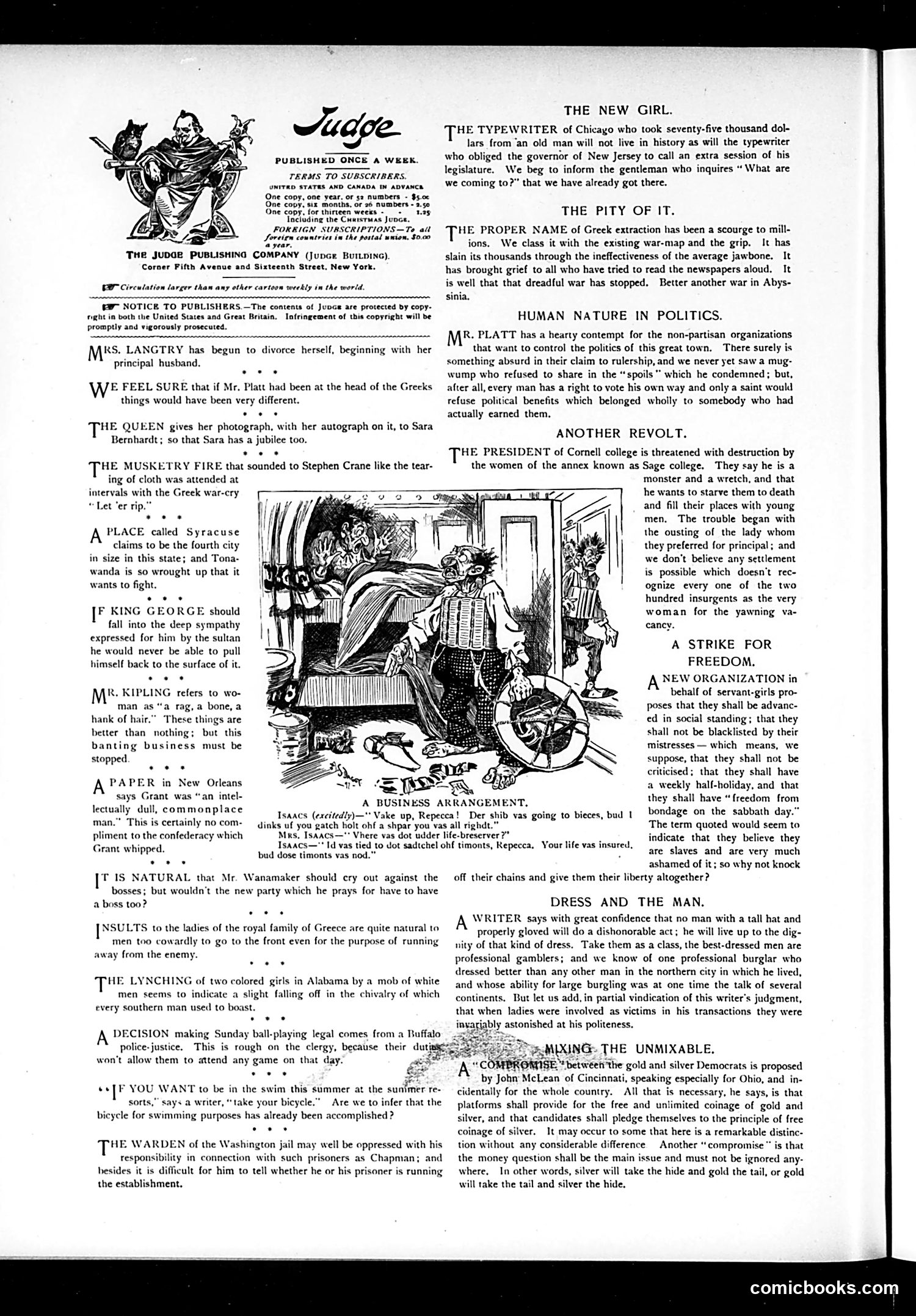
This cartoon depicts a business transaction between two figures, likely representing political or financial corruption. The man in formal dress appears to be conducting shady dealings with a woman, surrounded by scattered money and valuables on the floor. The accompanying text "A BUSINESS ARRANGEMENT" suggests this satirizes illicit financial or political exchanges common in the Gilded Age. The cluttered, chaotic scene with money strewn about emphasizes the mercenary nature of the transaction. Without clearer identifying features or captions in the image itself, I cannot definitively name the specific figures or scandal referenced. However, the cartoon clearly mocks corrupt "business arrangements" between powerful men and women—likely addressing contemporary political corruption, bribery, or financial impropriety Judge's readers would have recognized.
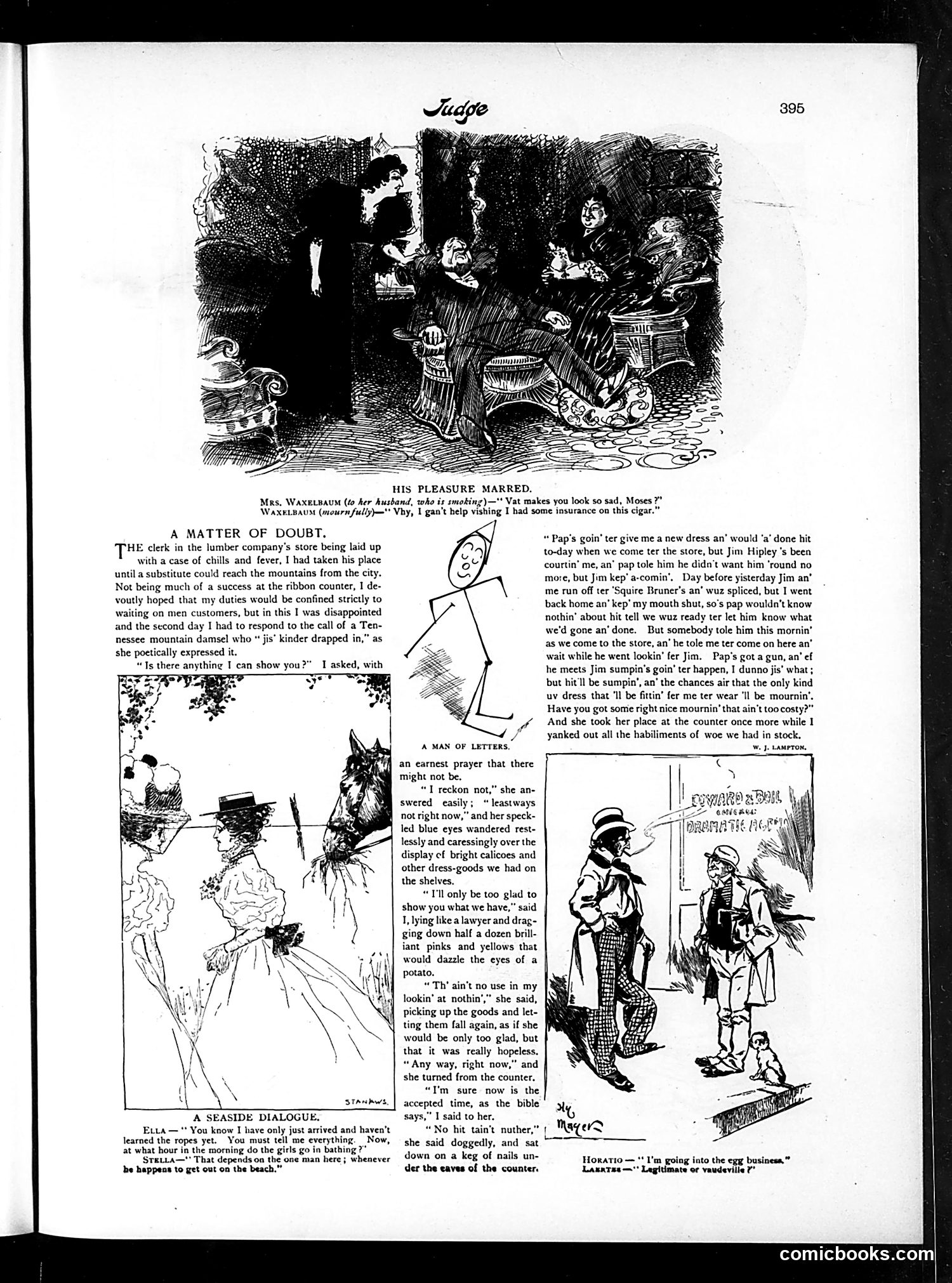
This page contains three separate satirical pieces typical of Judge's turn-of-the-century humor: **"His Pleasure Marked"** (top): A social comedy about a woman complaining to a man named Moses about looking sad. The satire appears to mock romantic misunderstandings and male excuses. **"A Matter of Doubt"** (left): A domestic humor piece where a woman describes various failed attempts to get her husband to buy her a dress, with sarcastic commentary on his reluctance and empty promises. **"A Man of Letters"** (right): Features a character named Horatio discussing "the egg business," suggesting commercial dealings. The dialog hints at business fraud or deception—Horatio claims legitimacy while Lazarus expresses doubt. All three pieces exemplify Judge's focus on everyday social situations, domestic friction, and business chicanery typical of late-19th/early-20th-century American satire.
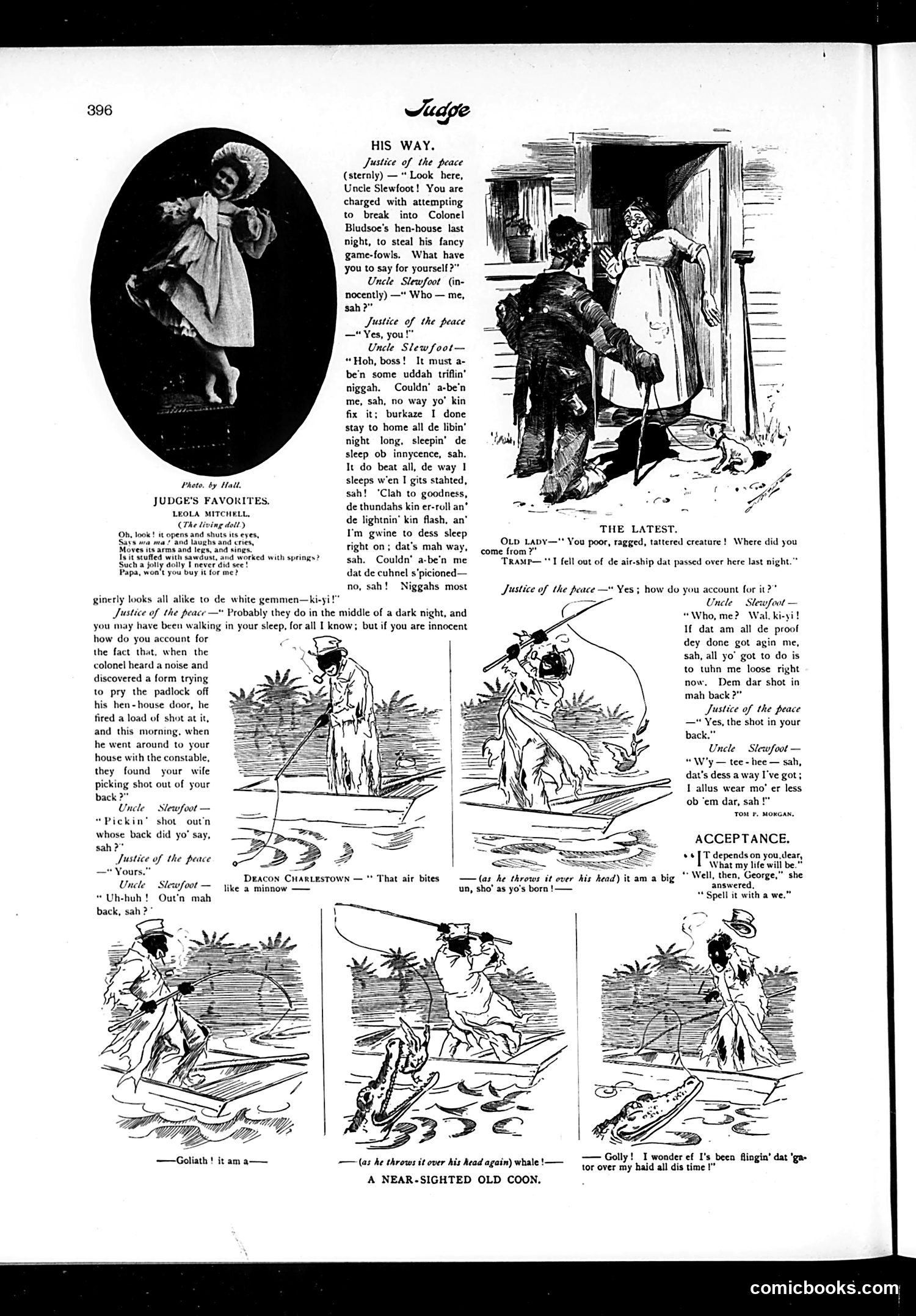
This page contains racist caricatures typical of early 20th-century American humor magazines. The main cartoon, "A Near-Sighted Old Coon," depicts an African American man (Uncle Slewfoot) accused of attempting to steal chickens. The joke relies on offensive stereotypes: he uses exaggerated dialect, claims innocence while evidence (shot in his back from the colonel's gun) contradicts him, and the "humor" derives from portraying him as dim-witted and untrustworthy. The satire targets African Americans rather than punching up at power. The justice of the peace is portrayed as reasonable, while the defendant is shown as inherently dishonest—a common racist trope suggesting Black people were naturally criminal or unreliable. The page also includes "Judge's Favorites" (a photo feature) and unrelated brief jokes like "Acceptance," making this a typical magazine layout mixing racist comedy with other content, all presented as entertainment for white audiences of the era.
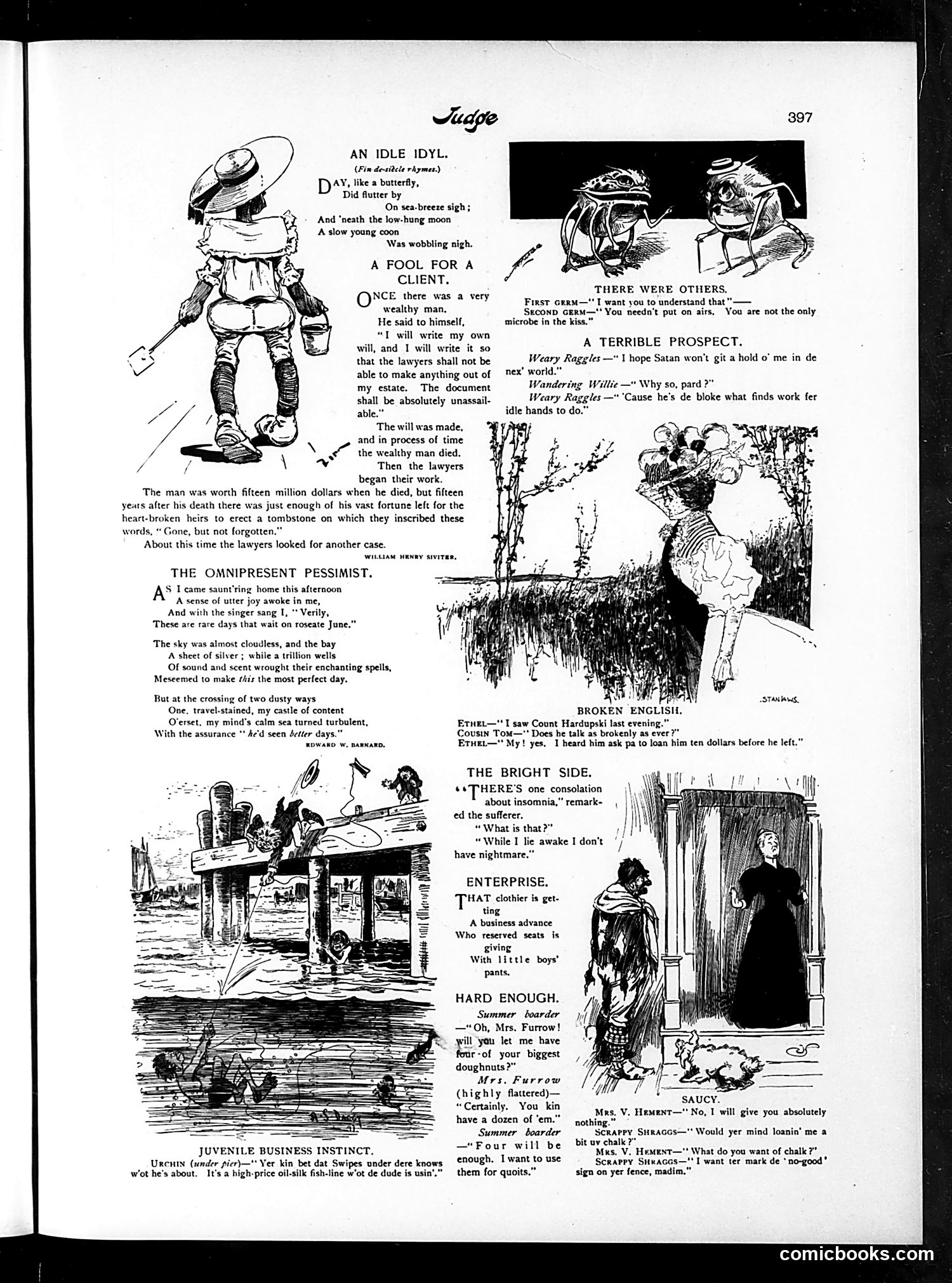
This page contains multiple short humorous pieces typical of fin-de-siècle satirical journalism: **"A Fool for a Client"** mocks wealthy people who draft their own wills, thinking they're cleverer than lawyers. The joke: a $15 million estate is consumed entirely by legal fees fighting the poorly-written document, leaving heirs only enough to buy a tombstone. **"The Omnipresent Pessimist"** satirizes perpetually gloomy people who cannot enjoy beautiful days because they fixate on one negative comment ("I've seen better days"). **"There Were Others"** and **"Broken English"** appear to be brief jokes about immigrants or working-class characters using nonstandard English—reflecting period attitudes toward dialect humor. The remaining items—**"Hard Enough," "Saucy," "Enterprise"**—are quick joke snippets about summer visitors, furniture upholstery, and cheeky children. The page reflects Judge's typical mix of social satire, class commentary, and period-specific dialect humor.
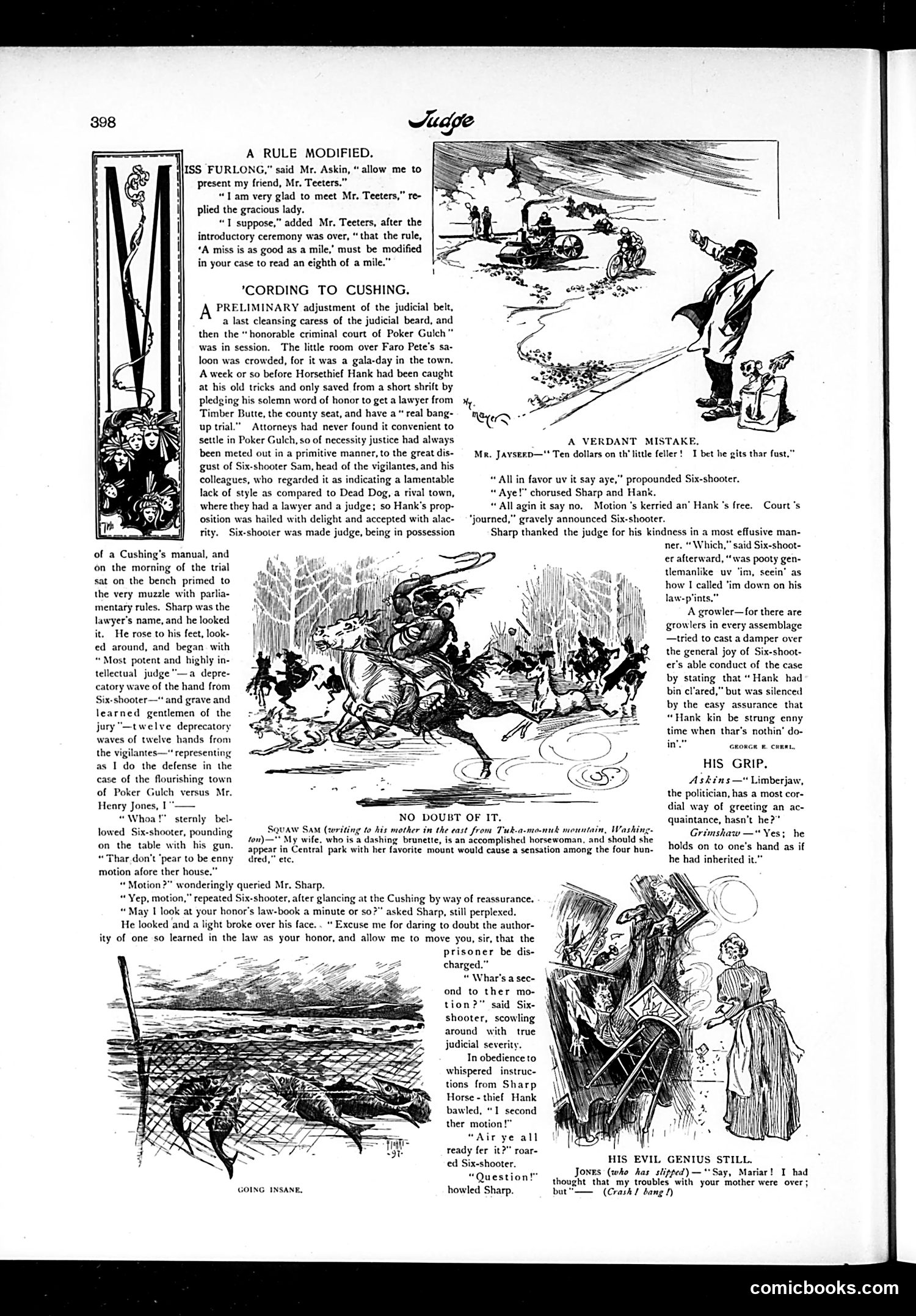
This page satirizes frontier justice in the fictional "Poker Gulch" mining town. The main story mocks how vigilantes attempt to conduct a formal trial despite lacking legal training or courtroom experience. **The Setup:** Horsethief Hank, caught stealing, promises to hire a real lawyer from the county seat to legitimize proceedings. Six-shooter Sam, head of the vigilantes, becomes judge after obtaining a *Cushing's Manual* (a parliamentary procedure guide). Lawyer Sharp represents the defendant. **The Joke:** Sharp exploits Six-shooter's rigid adherence to parliamentary procedure. When Six-shooter demands "motion" before Sharp can speak, Sharp consults the manual, realizes the judge has inadvertently granted him standing, and immediately moves for the prisoner's discharge. Six-shooter, still following procedure mechanically, allows the motion to pass—freeing the horsethief through the very formality meant to legitimize the trial. **The Satire:** This ridicules how frontier vigilante "courts" were simultaneously rough-and-tumble yet easily manipulated by legal technicality—suggesting the entire system was theater rather than justice.
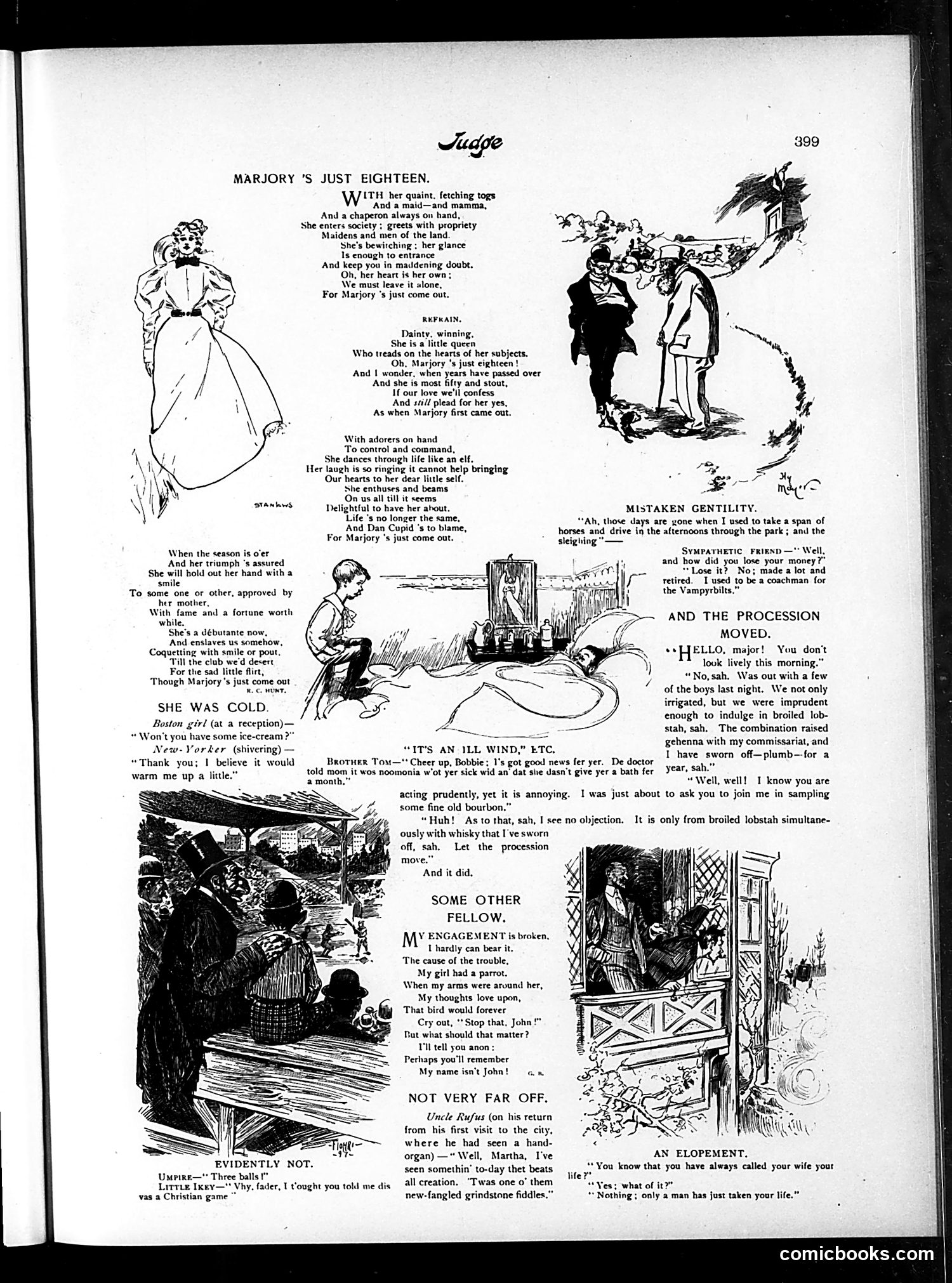
This page contains multiple brief humorous pieces satirizing late-19th/early-20th-century American social life: **"Marjory's Just Eighteen"** celebrates the debutante season—the formal introduction of eligible young women to society. The verses mock how marriageable girls enchant suitors, while questioning whether men's ardor will survive when she's "fifty and stout." **"She Was Cold"** is a simple pun: a New York visitor, shivering at a Boston reception, suggests ice cream might *warm* him—implying Boston society is cold/unwelcoming. **"It's an Ill Wind"** uses dialect humor: an Irish character finds his mother's pneumonia diagnosis good news because she can't bathe him for a month—allowing him to drink bourbon guilt-free. **"Mistaken Gentility"** ridicules a man boasting about his carriage-driving past, only to reveal he was a coachman (servant) for the wealthy Vanderbilts, not an owner. **"An Elopement"** offers a wordplay joke: a wife leaves her husband; when told "a man has taken your life," he misunderstands, thinking of his wife as "his life." The artwork features period-appropriate illustrations of fashionable society figures.
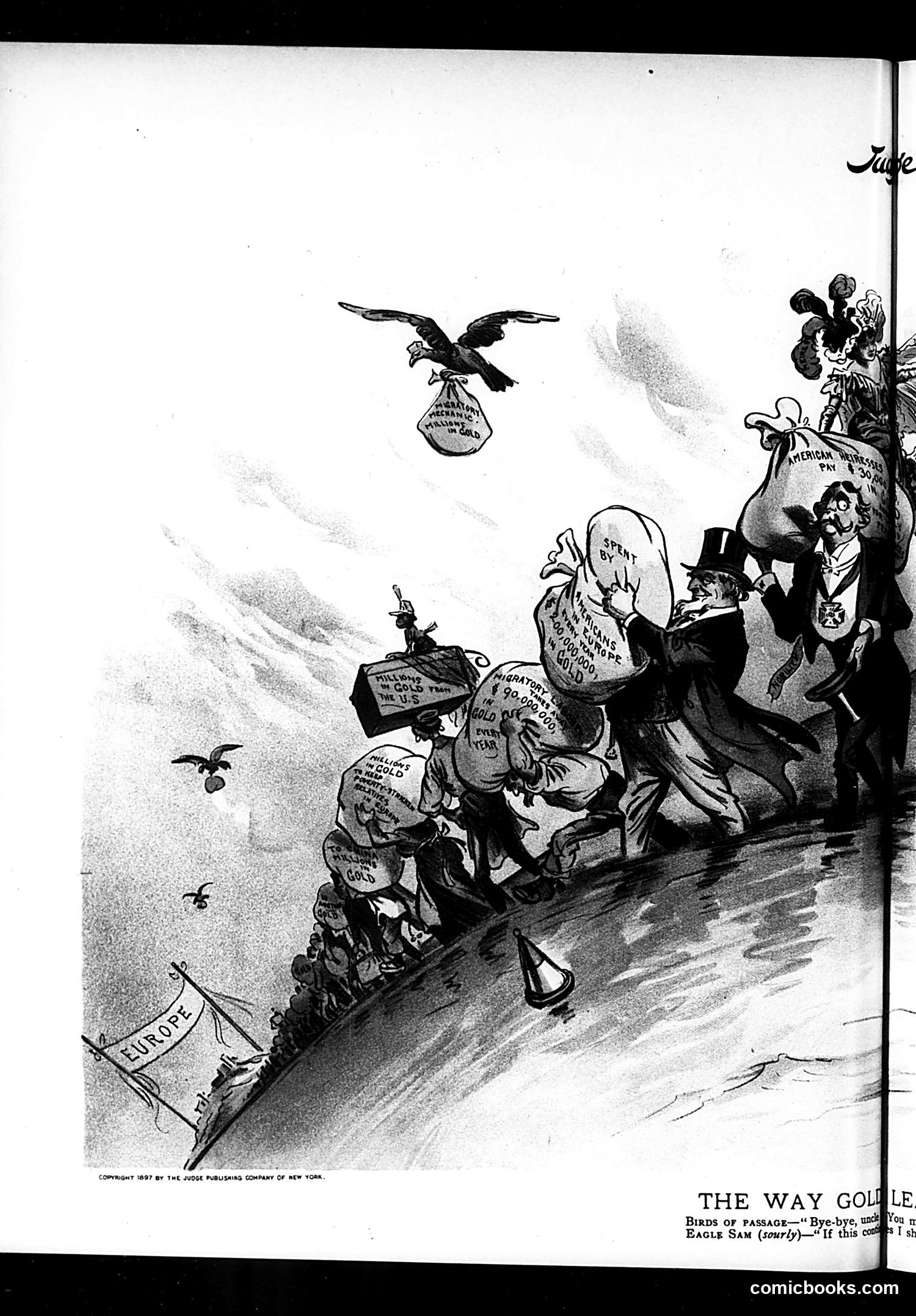
This political cartoon depicts "Eagle Sam" (Uncle Sam, personified as an eagle) sorrowfully watching European figures depart in a boat labeled "Europe." The departing passengers carry bags marked with various European nations and appear to be immigrating away—a reversal of the typical immigration pattern to America. The satire critiques American economic or political conditions circa 1897 that supposedly drove Europeans to leave rather than arrive. Uncle Sam's sour expression suggests displeasure at this reversal. The birds of passage metaphor references migratory patterns, suggesting these immigrants are temporary or transient. The cartoon likely comments on economic depression, labor unrest, or political instability in 1890s America that made the nation less attractive as a destination for European migrants—unusual enough to warrant satirical treatment.
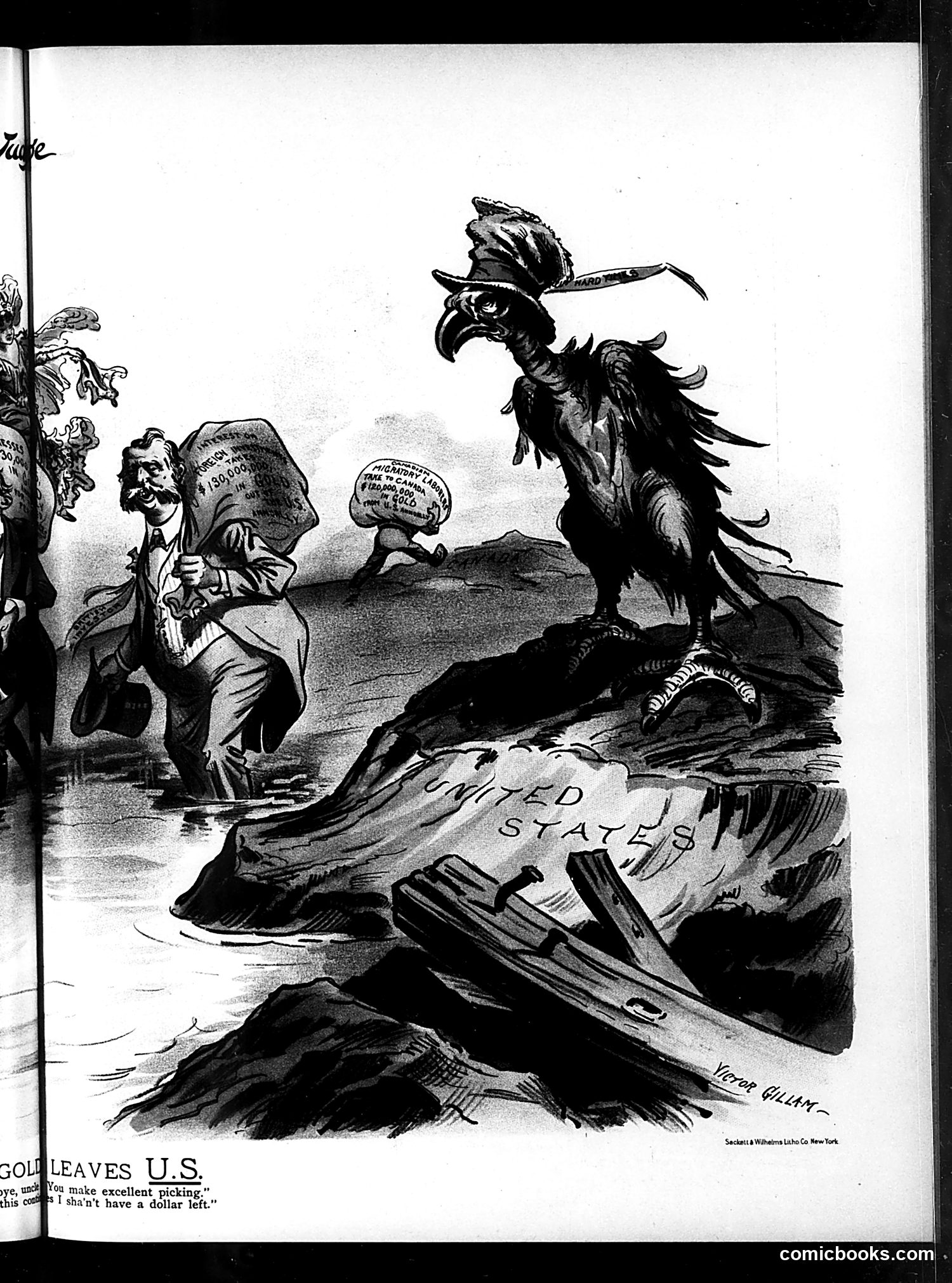
This Judge cartoon satirizes American foreign policy toward Latin America. The central figure is Uncle Sam (representing the U.S. government), depicted as a vulture with a curved beak and rifle, standing over a fallen "United States" figure lying in water. Two businessmen with money bags labeled with text (likely referencing American commercial interests) appear to be "picking" at America's resources or reputation. The title "GOLD LEAVES U.S" combined with dialogue about "excellent picking" suggests the cartoon critiques how foreign interventions and exploitative policies drain American wealth and prosperity. The vulture imagery implies predatory behavior, while the fallen U.S. figure suggests the nation itself suffers from these interventionist practices. This appears to be anti-imperialist commentary from Judge's editorial perspective.
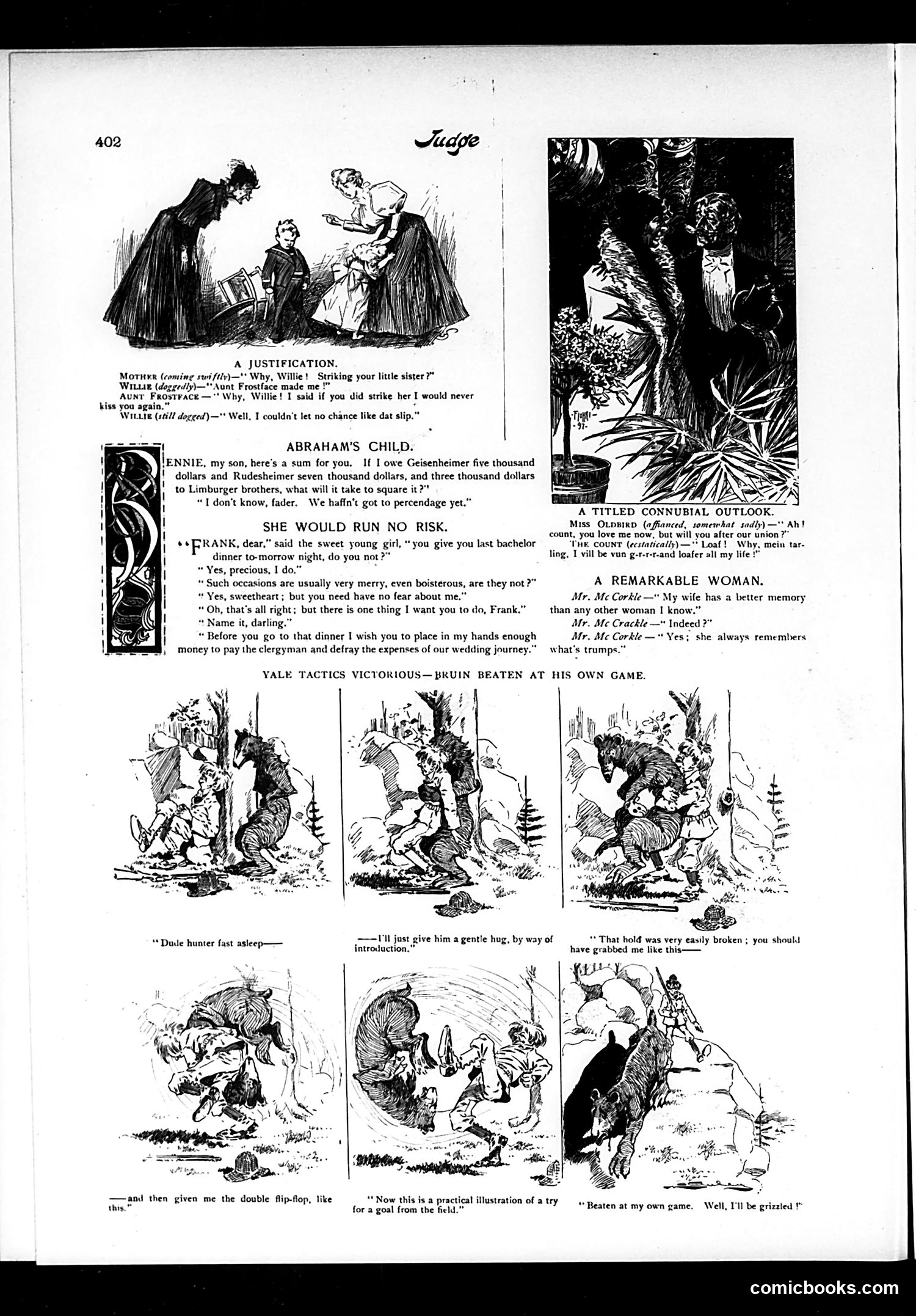
This page contains multiple short humor pieces typical of Judge's satirical format: **"A Justification"** mocks a child's excuse-making: Willie strikes his sister but blames Aunt Frostface's instructions, twisting her warning into permission. **"Abraham's Child"** uses Yiddish-inflected dialect humor (common in period American comedy) about a father teaching arithmetic through debt—the child hasn't yet learned percentages, suggesting Jewish stereotypes about money and commerce. **"She Would Run No Risk"** satirizes a bride-to-be's pragmatism: she demands her fiancé give her wedding expenses upfront before his bachelor dinner, implying distrust of his sobriety and reliability. **"A Titled Connubial Outlook"** mocks European aristocratic fortune-hunting: a count with a German accent agrees to love his wealthy fiancée by becoming a permanent "loafer" (living off her money). **"A Remarkable Woman"** is a card-game joke: the wife's memory is notable only for remembering the trump suit. **"Yale Tactics Victorious"** depicts a rugby/wrestling match where Yale's techniques defeat a bear ("Bruin"—likely Yale's rival, Brown University)—a playful collegiate sports rivalry cartoon.
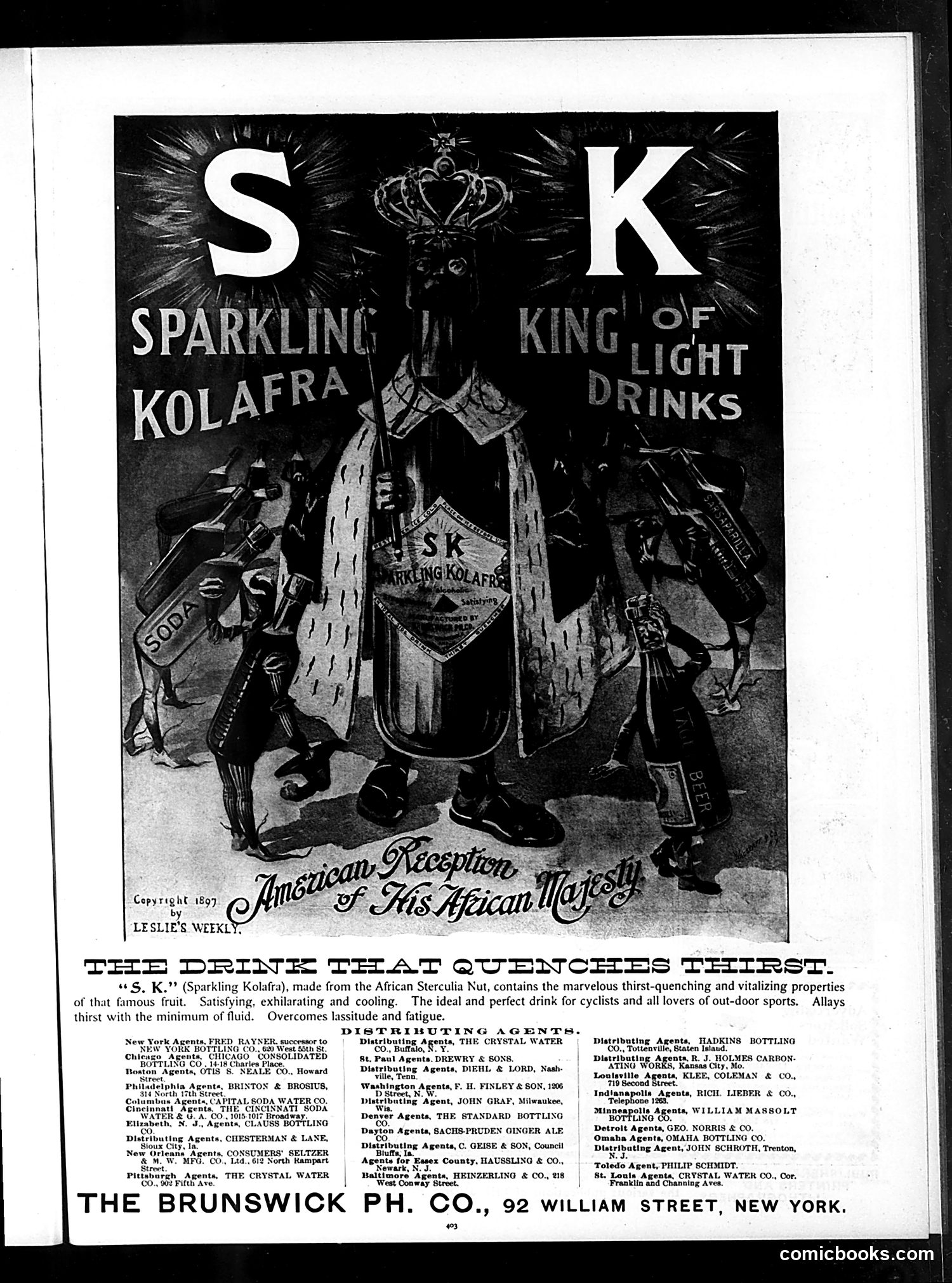
This page is primarily a **product advertisement** for "S.K." (Sparkling Kolafra), a carbonated beverage made from African Sterculia Nut, published in Leslie's Weekly in 1897. The illustration depicts a crowned, regal figure (likely representing the product as "King of Light Drinks") flanked by what appear to be attendants or courtiers, establishing the drink's claimed superiority. The imagery uses royal symbolism to suggest dominance and prestige in the beverage market. The marketing copy emphasizes the drink's appeal to active consumers—particularly "cyclists and all lovers of out-door sports"—positioning it as an energy and hydration solution that "overcomes lassitude and fatigue." This reflects the late-19th-century cycling craze and growing athletic culture. The extensive list of distributing agents across major American cities indicates national market ambitions. The page is essentially commercial rather than satirical content.
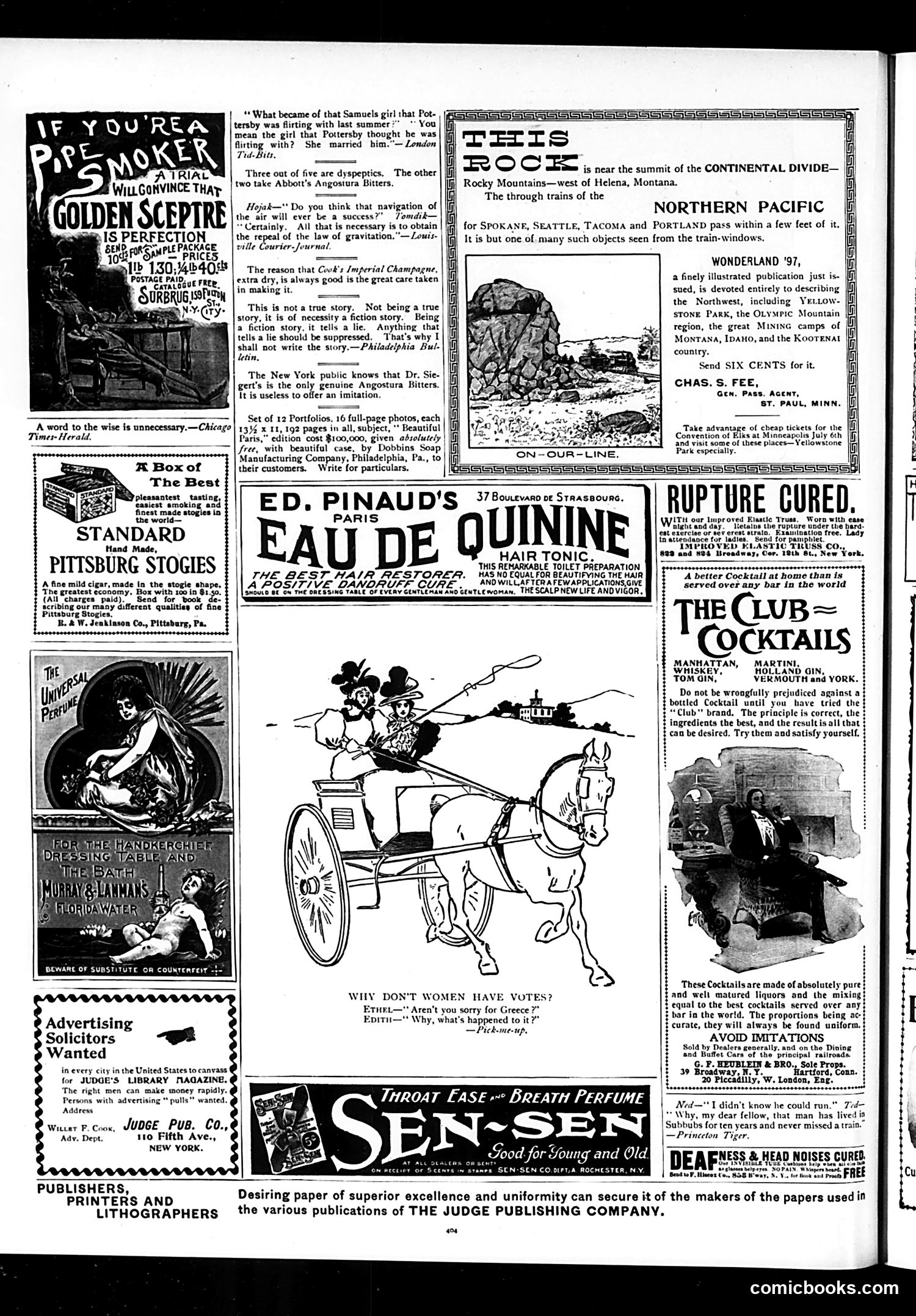
This page from **Judge** (a Gilded Age satirical magazine) contains mixed advertising and humor typical of the 1890s. **The Main Cartoon**: The central illustration labeled "WHY DON'T WOMEN HAVE VOTES?" depicts two figures in a horse-drawn carriage apparently fleeing or in chaotic motion. The question is satirical—the joke appears to reference ongoing debates about women's suffrage. The cartoon's point is unclear from the image alone, though it likely mocks either pro- or anti-suffrage arguments. **Other Jokes**: Brief quoted humor pieces mock men's obliviousness in romance ("the girl that Pottersby thought he was flirting with") and absurd logic about aviation ("repeal of the law of gravitation"). **Advertising**: The page is heavily dominated by period product ads (hair restorer, cigars, cocktail kits, stomach bitters) and promotional content, reflecting Judge's business model. A Northern Pacific Railway advertisement and "Wonderland '97" tourist publication appear prominently. The overall content reflects 1890s consumer culture and conservative humor regarding women's emerging political activism.
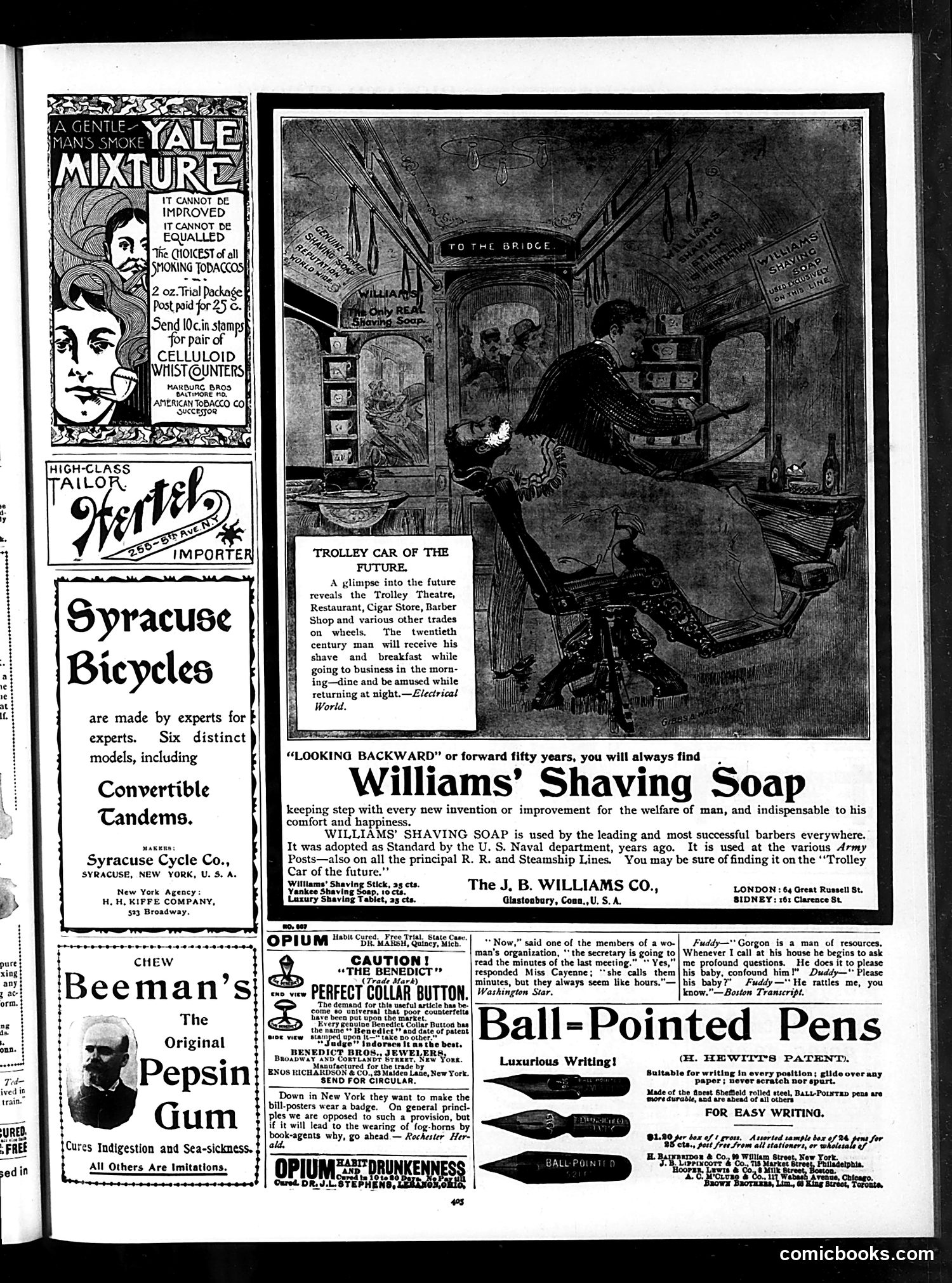
This page is primarily **advertising**, not political satire. The main content features a speculative illustration titled "Trolley Car of the Future," which imagines futuristic public transportation. Based on a concept from *Electrical World*, it depicts an idealized trolley containing a theatre, restaurant, cigar store, and barber shop—services for the commuting businessman. The illustration uses this fantasy vehicle as a framing device for **Williams' Shaving Soap advertising**. The ad claims the product has been adopted by the U.S. Navy and railroads, and humorously suggests it will still be used on these futuristic trolleys, emphasizing the soap's timeless reliability. The remaining page content consists of other period advertisements: Syracuse Bicycles, Beeman's Pepsin Gum, Perfect Collar Buttons, Ball-Pointed Pens, and remedies for Opium addiction and drunkenness. There is minimal editorial cartooning or satire present.
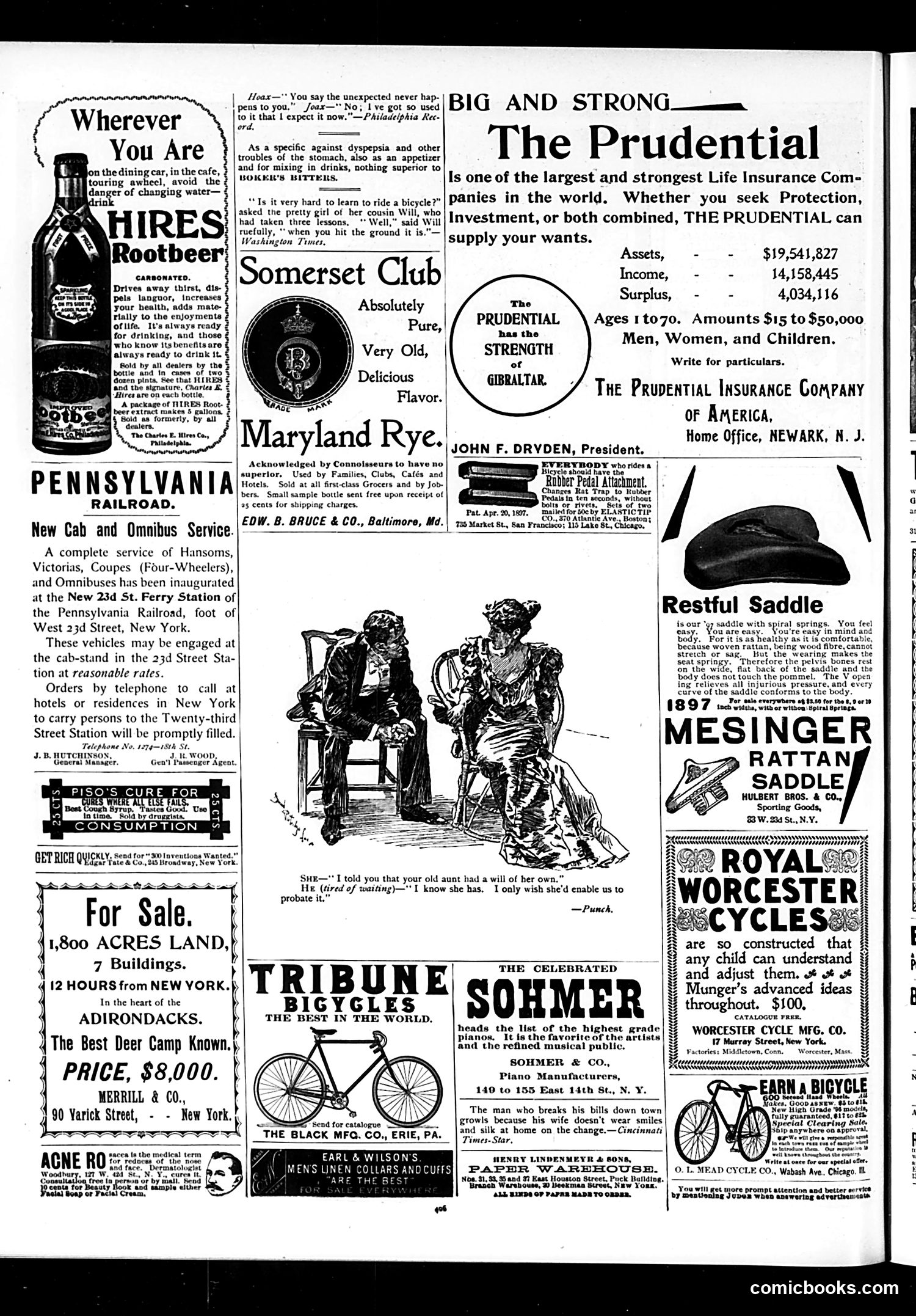
This page is primarily **advertising**, featuring products and services typical of the 1890s: life insurance (Prudential), beverages (rootbeer, Maryland Rye), bicycles and saddles, railroad transportation, and various consumer goods. The **humor** appears in brief joke exchanges at top and center. One exchanges expects the unexpected so often it becomes expected. Another depicts a newlywed couple's marital miscommunication about the wife wearing "smiles and silk" at home versus downtown. The **satirical content** is minimal. Most notable is a small dialogue cartoon showing three figures in conversation, with one explaining a woman's "will of her own"—a mild jest about female independence or stubbornness, typical of period humor. The page reflects **late-19th-century American consumer culture**: bicycles were new technology, life insurance represented modern financial planning, and transportation services advertised convenience for urban commuters. The ads themselves constitute the primary "content" rather than political or social satire.
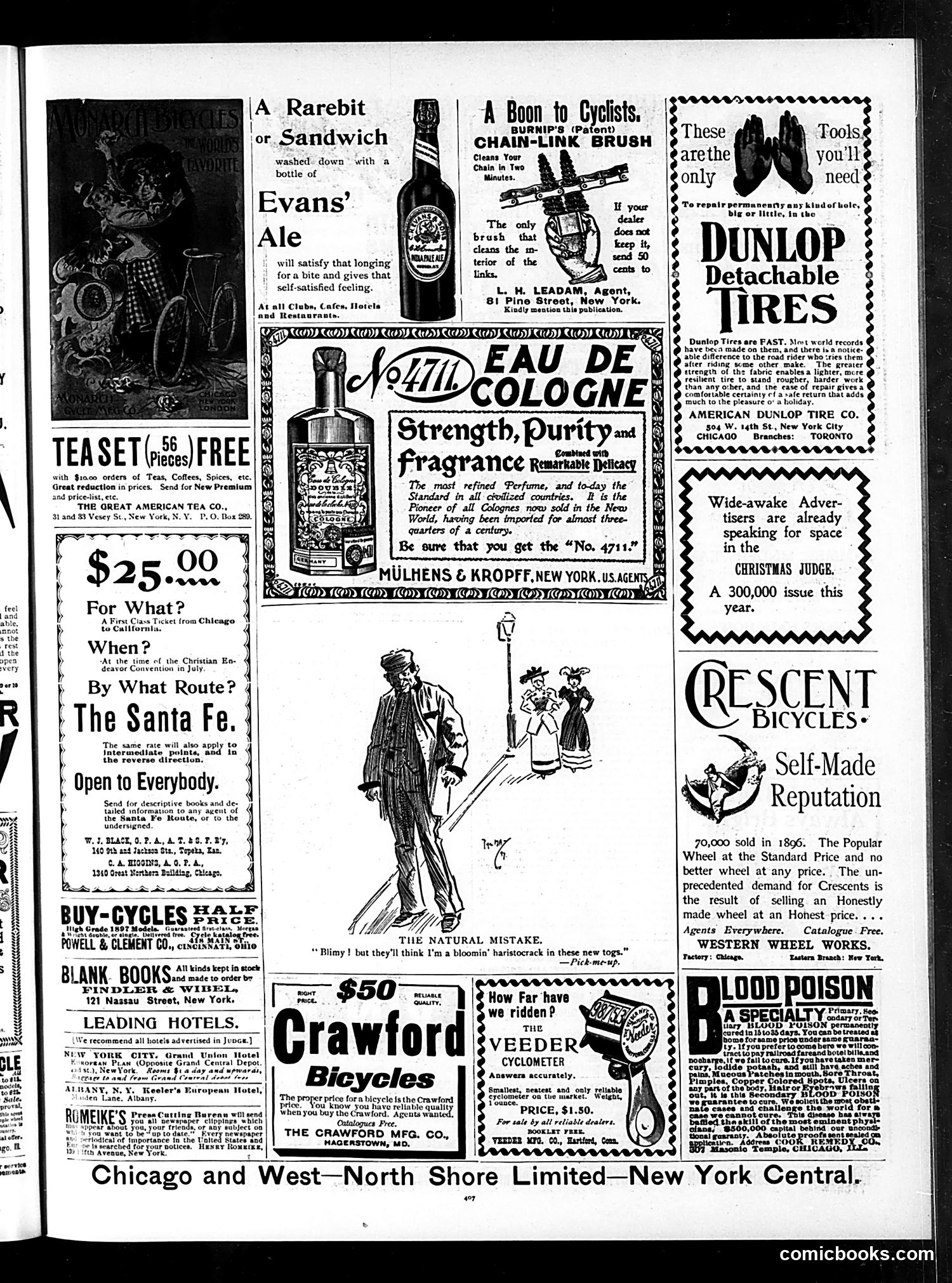
This is primarily an **advertising page** from Judge magazine, circa 1896-1897, with one small cartoon. ## The Cartoon The single illustration titled "THE NATURAL MISTAKE" depicts a working-class man in new clothes, captioned with British dialect: "Blimey! but they'll think I'm a bloomin' aristocrat in these new togs." The satire mocks the idea that new clothing alone could fool people about social class—a commentary on the limitations of surface appearances versus actual social status. ## The Advertisements The page features bicycle-related ads (Crawford, Dunlop Tires, Crescent, Veeder Cyclometer), reflecting the 1890s bicycle boom. Other ads promote: Evans' Ale, Eau de Cologne, tea/spices, hotels, and books. Notably, one ad announces Judge's "CHRISTMAS JUDGE" issue with 300,000 circulation—advertising space in the magazine itself. The Santa Fe railroad ad promotes travel to a Christian Endeavor Convention, reflecting the religious youth movement's popularity at this time. Overall, this is a commercial page reflecting 1890s consumer culture and leisure activities.
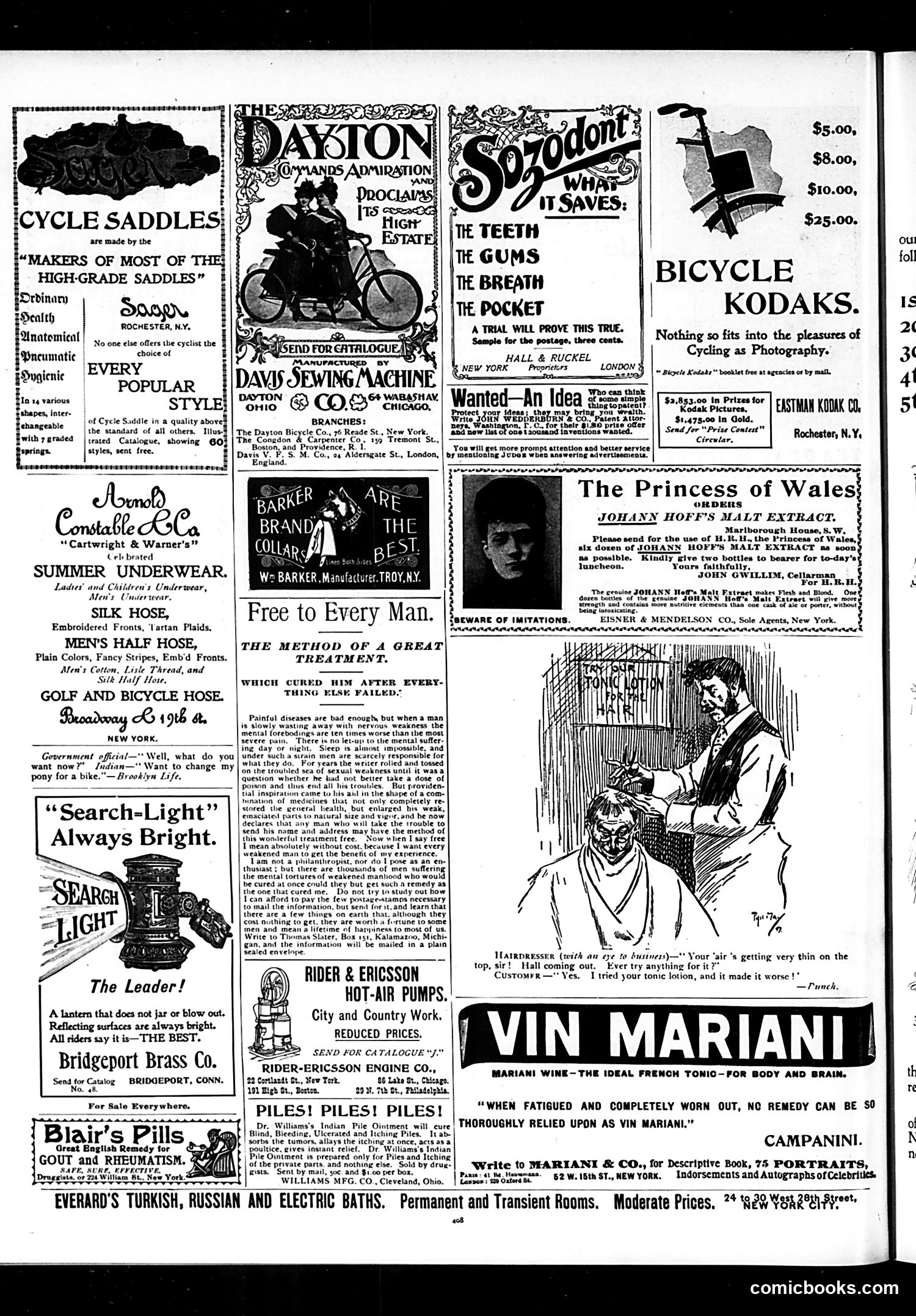
This is primarily an **advertising page** from Judge magazine, dominated by late 19th/early 20th-century consumer product advertisements rather than editorial political cartoons. The only substantial **cartoon/satirical content** appears to be a small illustrated joke captioned "Hairdresser (told to try honesty)—'Your air's getting very thin on top, sir. Ever try anything for it?' Indian—'Yes, I tried your lotion, and it made it worse.'—Puck." This depicts a barber giving unflattering advice to a Native American customer—playing on period stereotypes and the irony of "honesty" backfiring commercially. The ads reflect typical Gilded Age consumer culture: bicycle saddles, summer underwear, Kodak cameras, hair treatments, and patent medicines (including "Vin Mariani," a cocaine-containing tonic marketed as a health remedy). The Princess of Wales endorsement for malt extract appears designed to lend aristocratic legitimacy to products. The page reflects **consumer capitalism and the era's casual ethnic stereotyping** rather than political satire.
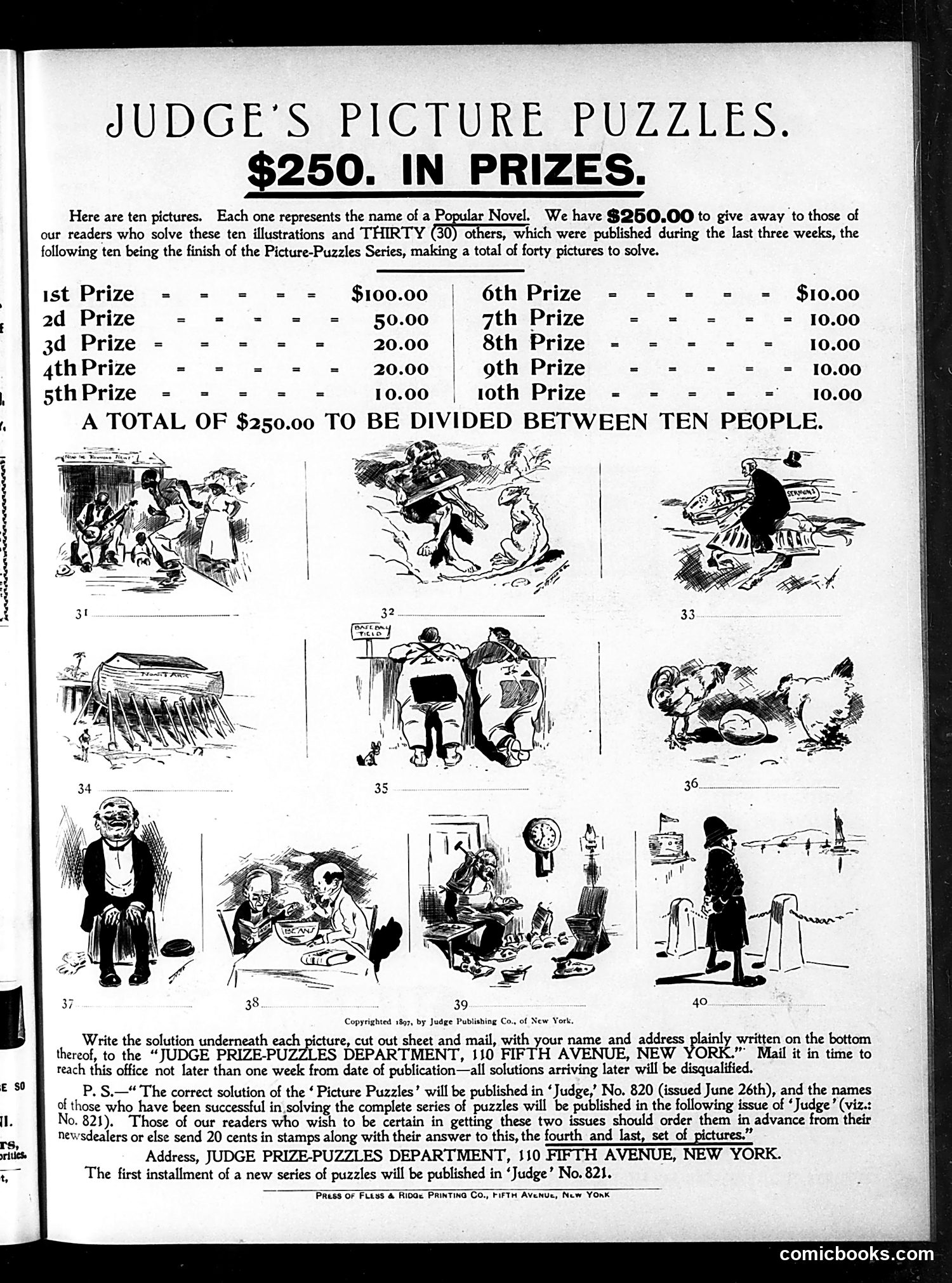
This is primarily a **contest advertisement**, not political satire. Judge magazine offered $250 in prizes for readers to identify ten illustrated novels by their visual representations—the final set in a 40-picture series. The ten sketched vignettes (numbered 31-40) are visual rebuses representing popular novel titles of the era, though the specific titles aren't identified on this page. Solvers were instructed to mail answers to Judge's offices by a deadline; winners would be announced in subsequent issues. This was a common **reader-engagement tactic** for late-19th-century magazines, combining entertainment with circulation-building. The prominent prize amounts ($100 first place down to $10) emphasized the stakes. The footnotes warn that late entries would be disqualified—standard contest rules designed to encourage prompt participation and generate publicity.
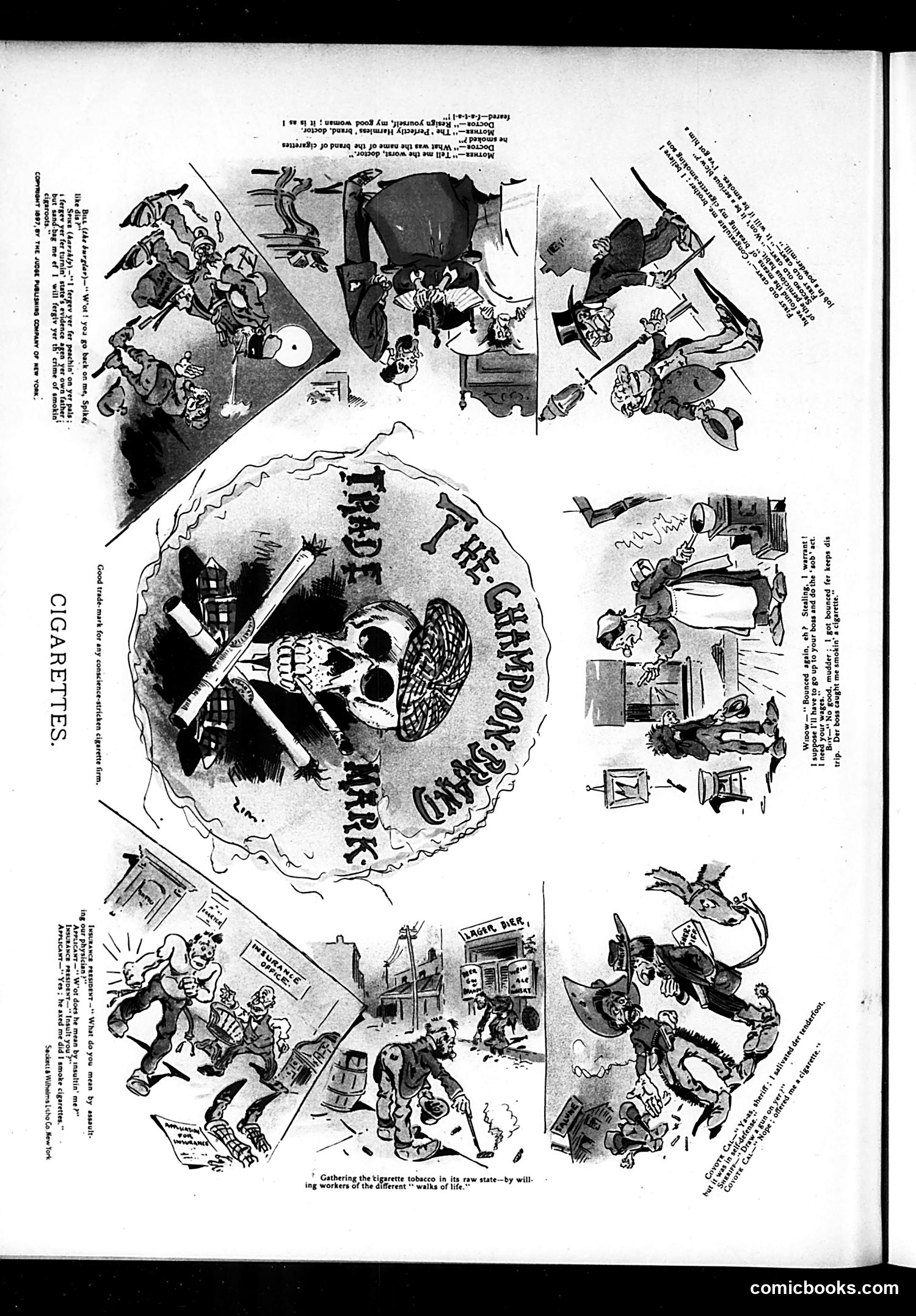
This page satirizes the cigarette industry's labor practices and moral hypocrisy. The central circular cartoon labeled "THE CIGARETTE MARK" depicts a skull with crossed cigarettes, suggesting cigarettes as a harbinger of death. The surrounding vignettes show workers from various social classes ("different walks of life") harvesting tobacco—depicted as degrading labor. The caption sardonically notes this would be a "good trade-mark for any conscience-stricken cigarette firm," implying cigarette manufacturers had *no* conscience about exploitative working conditions. The dialogue fragments mock the industry's indifference to worker welfare. This reflects Progressive Era concerns about industrial labor abuses and the growing anti-smoking movement, which associated cigarettes with moral corruption and physical harm. The satire attacks both the product's danger and the exploitative labor behind it.