
A complete issue · 16 pages · 1897
Judge — June 5, 1897
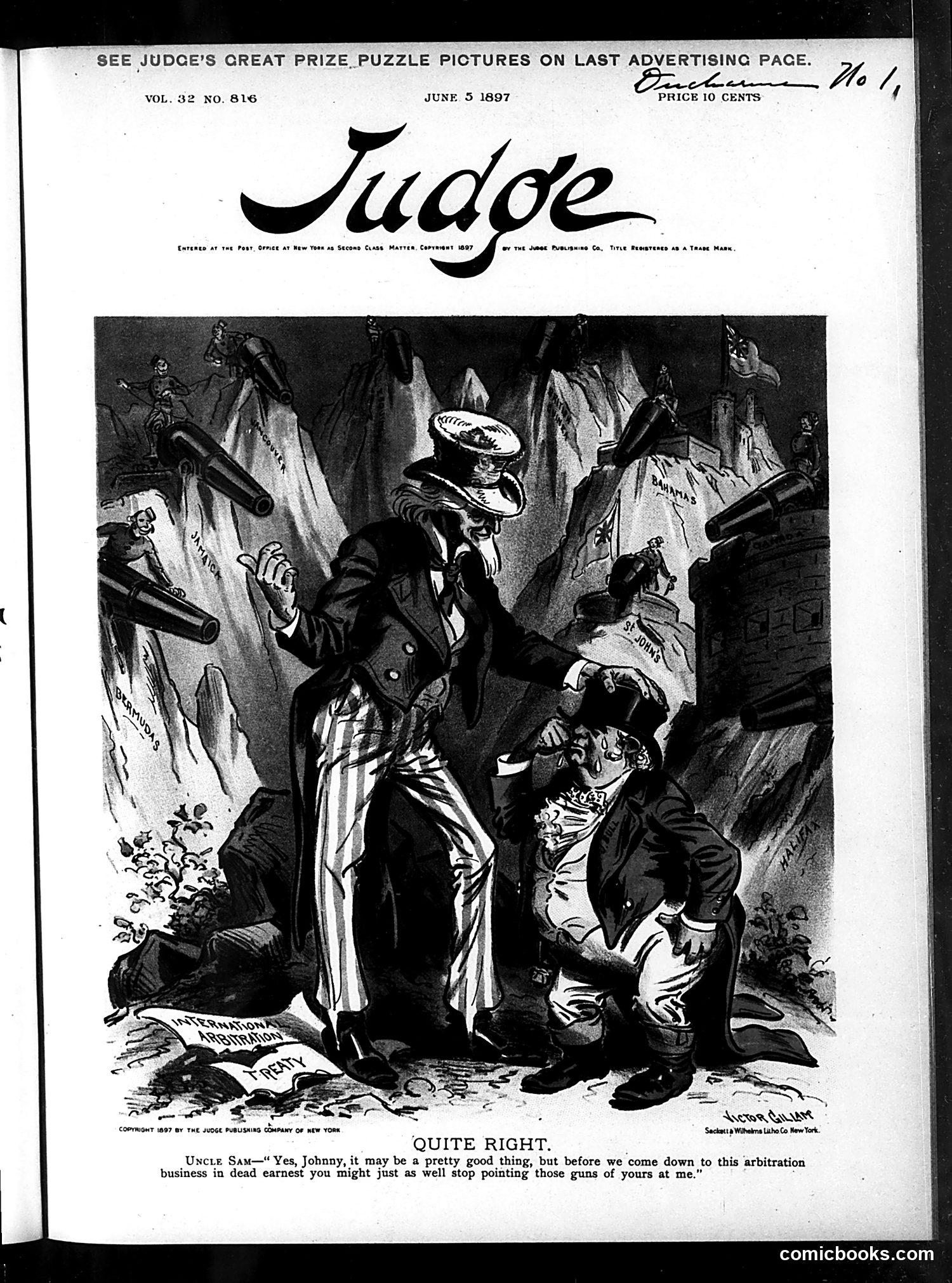
This political cartoon depicts Uncle Sam (tall figure in starred hat and striped pants) addressing a smaller figure labeled "Johnny" (appearing to represent a younger nation or subordinate power). Uncle Sam holds cannons and warns Johnny to stop pointing his own guns before they proceed to "arbitration business." The satire likely concerns international disputes and America's role in mediating conflicts, possibly referencing the Spanish-American War period or competing imperial ambitions. The joke suggests Uncle Sam is hypocritically demanding disarmament from another power while maintaining his own military superiority—a commentary on American foreign policy and imperial double standards during the expansionist 1890s. The title "Quite Right" underscores the sarcastic tone.
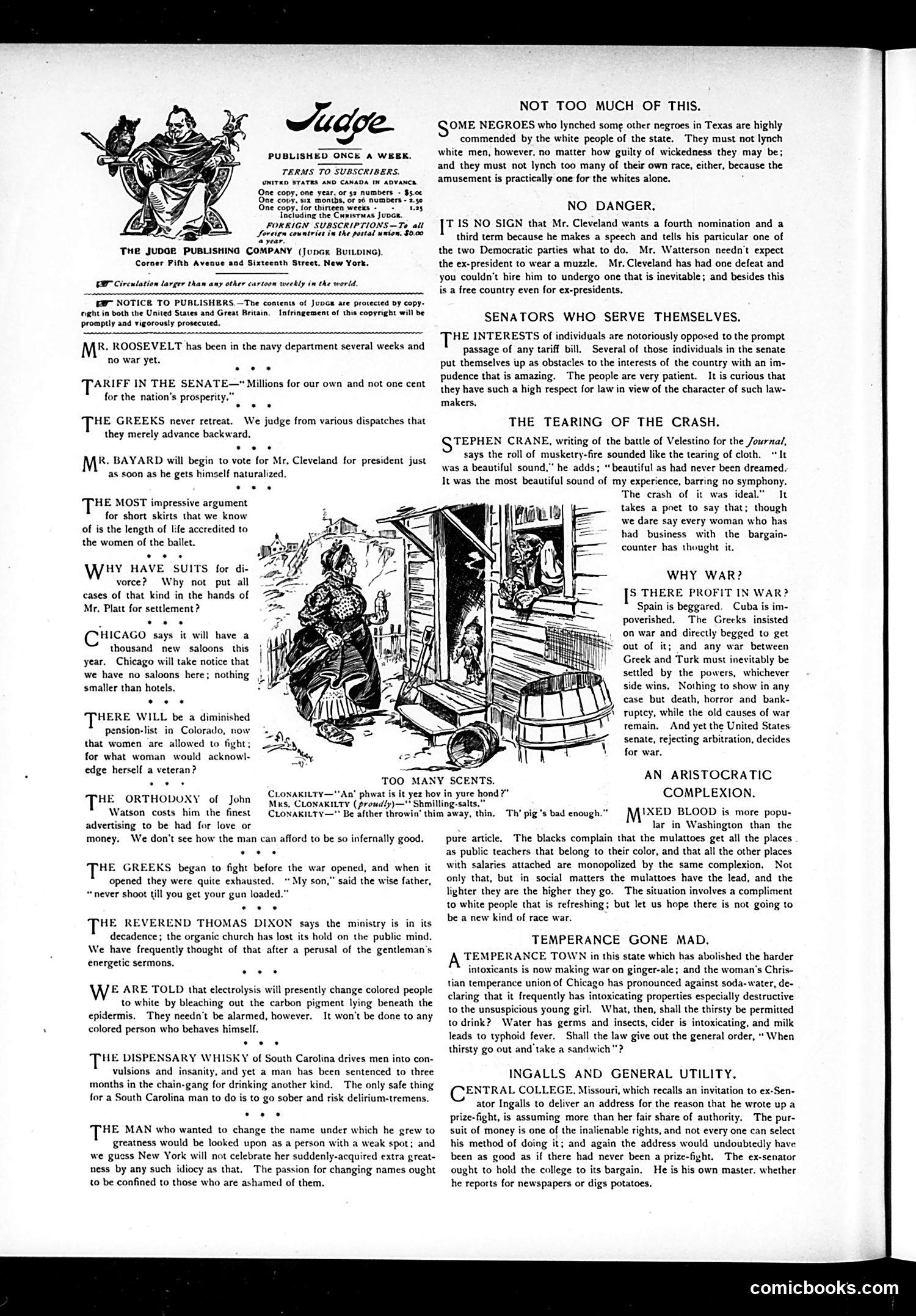
The main cartoon depicts a domestic scene illustrating the article "Too Many Scents" — a woman at her door confronts a visitor, with dialogue about perfume ("Ah phwat is it yer boy in yre bond?" / "Smellin' salts"). This appears to satirize excessive use of fragrances or perfumes, a contemporary consumer trend. The surrounding text mocks various topics: Roosevelt's navy service, Cleveland's political prospects, Greek military withdrawal, Chicago's saloon proliferation, and debates over tariffs and racial violence in Texas. The satire targets both political figures (Roosevelt, Cleveland) and social issues (temperance movements, women's suffrage, racial lynching). The overall tone is irreverent commentary on American politics and culture of the Gilded Age/Progressive Era period.
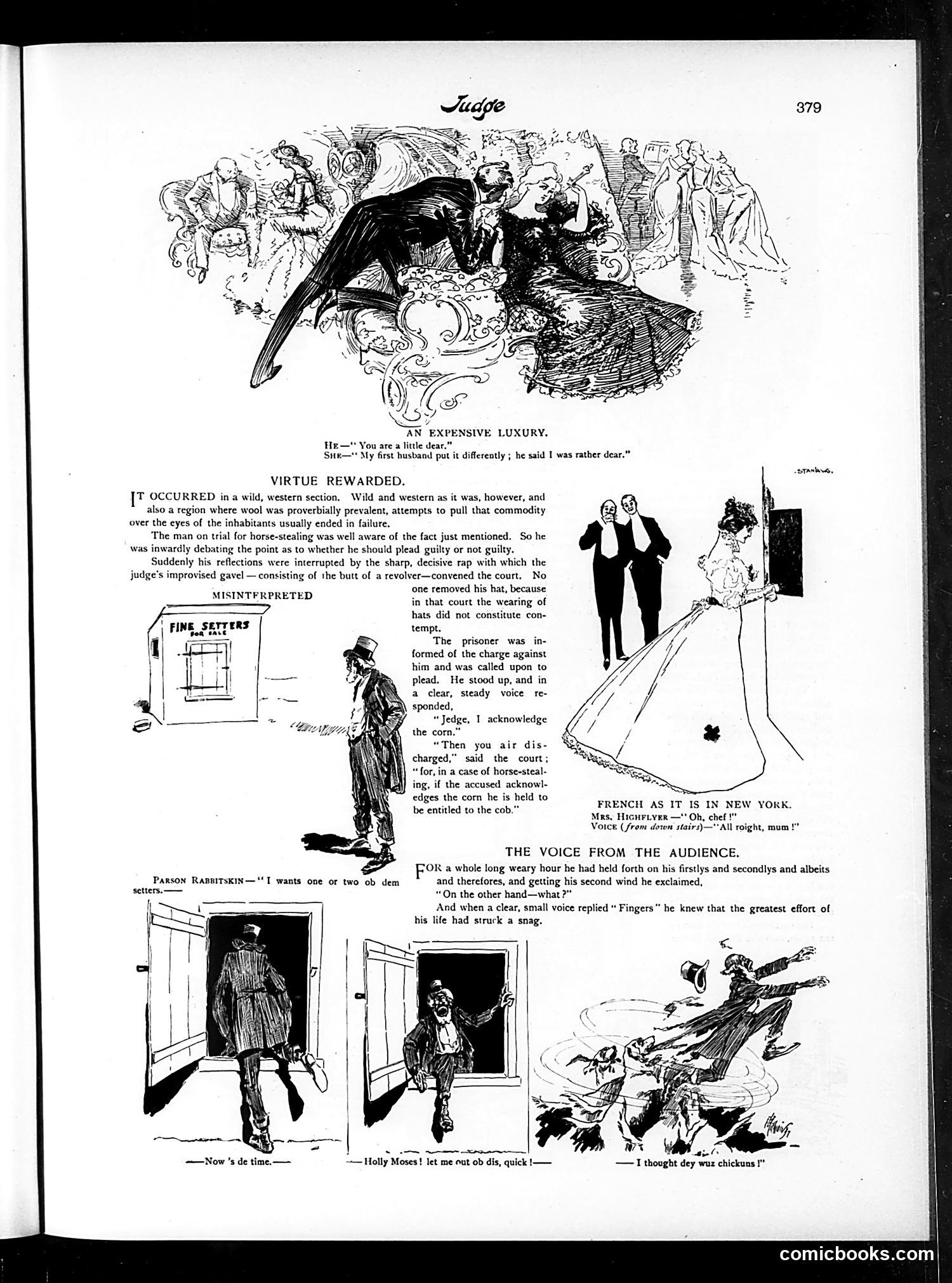
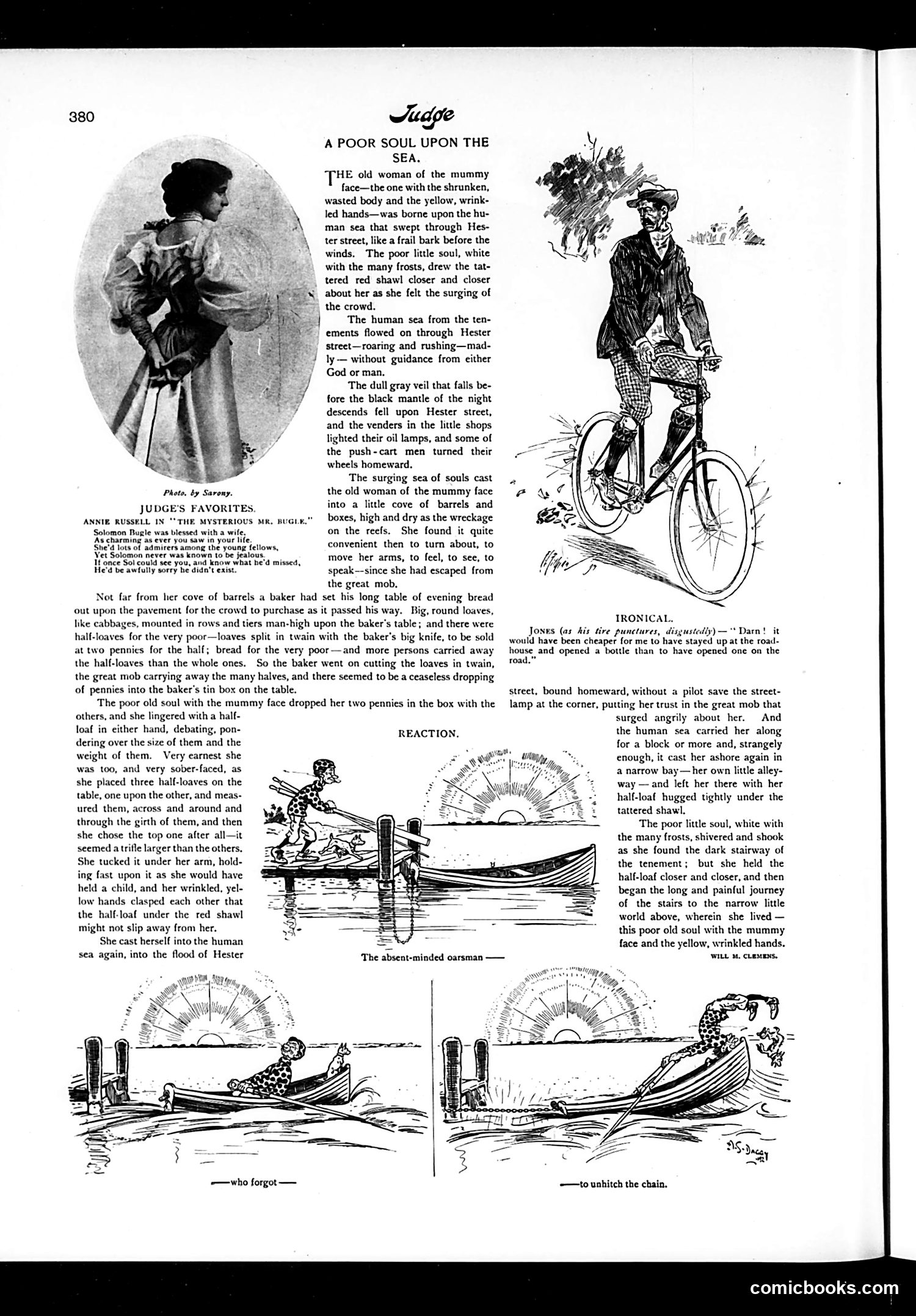
This is a sympathetic social commentary on poverty in New York City's immigrant tenements, likely the Lower East Side's Hester Street—a known center of Jewish and Eastern European immigration. The story uses nautical metaphor to describe an elderly, impoverished woman navigating the overwhelming crowd of poor people on the street as if it were a dangerous sea. The satire's point: the vulnerable poor are literally swept along by forces beyond their control—economic desperation, urban chaos, and the indifference of society. The detailed description of her purchasing half a loaf of bread (the cheapest option) emphasizes her extreme poverty. The "human sea" lacks "guidance from either God or man," suggesting society abandons the poorest. Judge uses this sentimental narrative to critique the callousness toward urban poor and the structures that leave them helpless and adrift. The accompanying cartoons and other content address different topics.
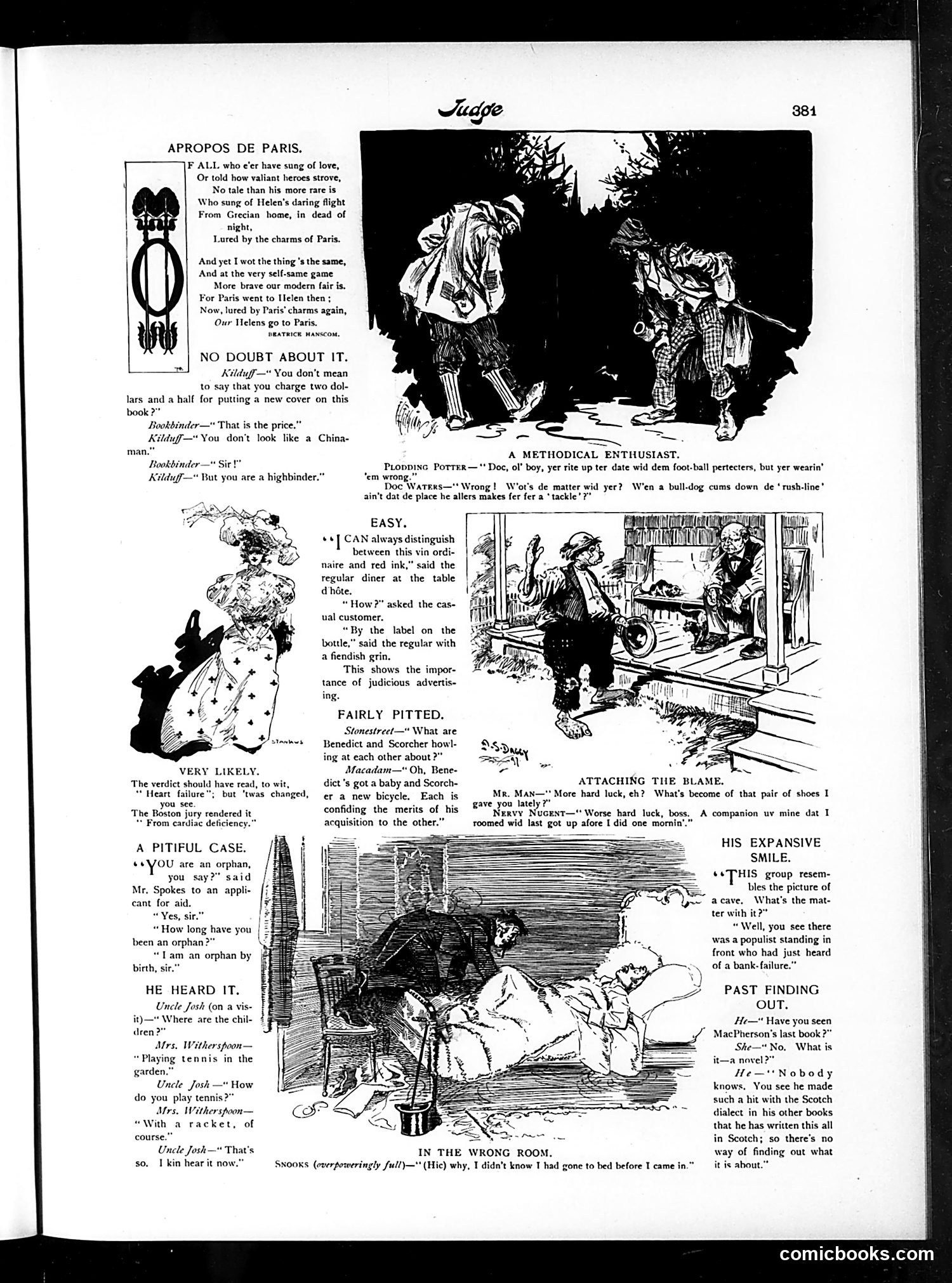
This page contains multiple brief satirical sketches typical of Judge magazine's humor: **"Apropos de Paris"** opens with a poem comparing Helen of Troy's abduction to Paris with modern women voluntarily traveling to Paris—satirizing the city's fashionable appeal to society women. **"No Doubt About It"** jokes about a bookbinder charging high prices; the punchline suggests he's a "highbinder" (a Chinese term for extortionist), playing on ethnic stereotypes common to the era. **"A Methodical Enthusiast"** features football slang about protective equipment worn incorrectly. **"Fairly Pitted"** depicts two men arguing—one about his new baby, another about his bicycle. Other sketches mock: wine versus "red ink" served at cheap restaurants, a Boston jury's verdict terminology, an orphan's ironic life history, populist anxiety over bank failures, tennis with audible rackets, and a Scotch-dialect author whose recent book is incomprehensible. The humor relies on wordplay, social observation, and period-specific references—particularly mocking lower classes, immigrants, and emerging political movements like populism.
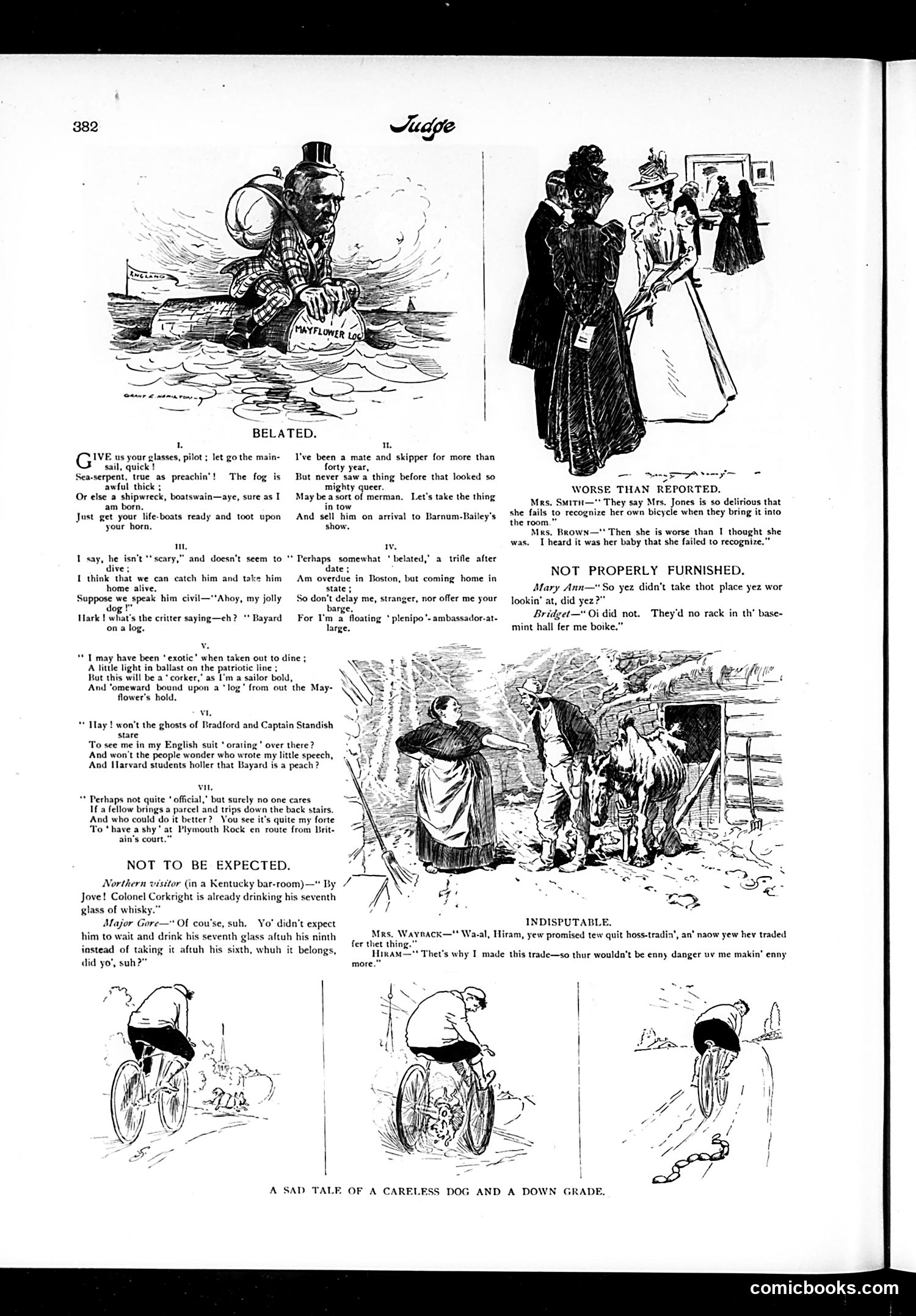
This page from *Judge* contains multiple satirical pieces targeting American politics and social foibles circa the 1880s-90s. **"Belated"** is the primary political cartoon. The sea-serpent sighting is a metaphor for **Thomas F. Bayard**, U.S. Secretary of State (later Ambassador to Britain), returning from diplomatic duties. The sailors' dialogue mocks his delayed return and his upcoming role as an ambassador. References to "Bradford and Captain Standish" invoke Pilgrim heritage, suggesting irony about this politician representing America abroad. The "plenipo'-ambassador-at-large" jest ridicules his diplomatic pretensions. The remaining items are humor vignettes about bicycle accidents, domestic disputes over horses and drinking, and class-based comedic dialogue featuring rural and Irish-American characters. The cartoons collectively reflect *Judge*'s satirical focus on political figures, technological anxieties (bicycles were new), and ethnic stereotyping common to the era.
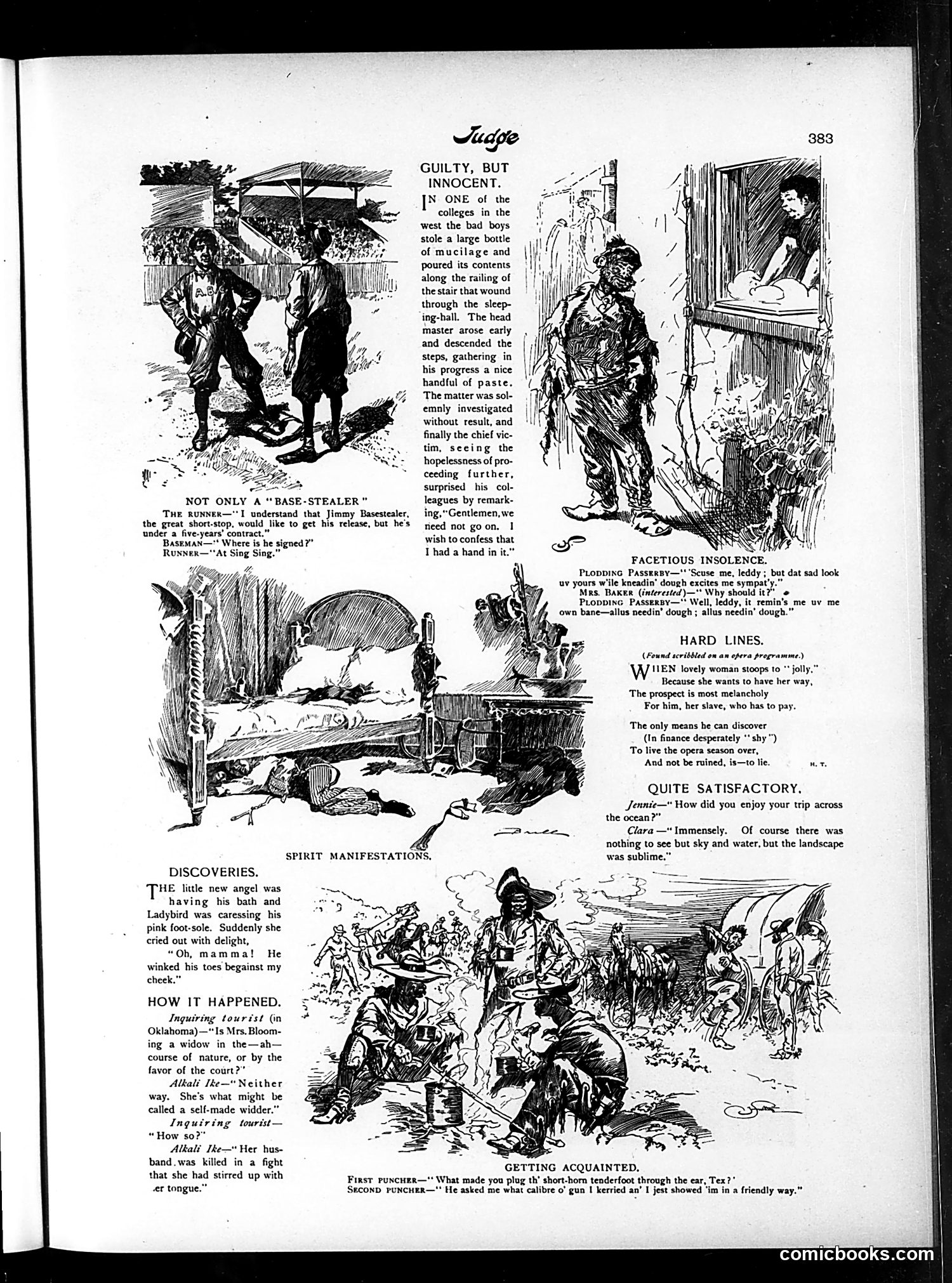
This page contains multiple short humorous sketches typical of early 20th-century American satire: **"Base-Stealer"**: A pun on baseball terminology. A player nicknamed "Base-Stealer" is revealed to be imprisoned at Sing Sing prison—he's literally a criminal, not just a skilled athlete who steals bases. **"Discoveries" and "How It Happened"**: Gentle domestic humor about new motherhood and frontier life, with no apparent political content. **"Guilty But Innocent"**: A college prank story where a prankster confesses to mucilage-related mischief he didn't actually commit, surprising his peers. **"Hard Lines"**: Satirizes the financial burden men face supporting women's desires—here, opera season attendance—forcing them to lie about finances. **"Getting Acquainted"**: Western frontier humor about rough cowboys shooting a "tenderfoot" through the ear as a "friendly" introduction. The page reflects Judge's blend of wordplay, social observation, and period stereotypes (dumb cowboys, financial anxiety about women's spending) rather than focused political commentary.
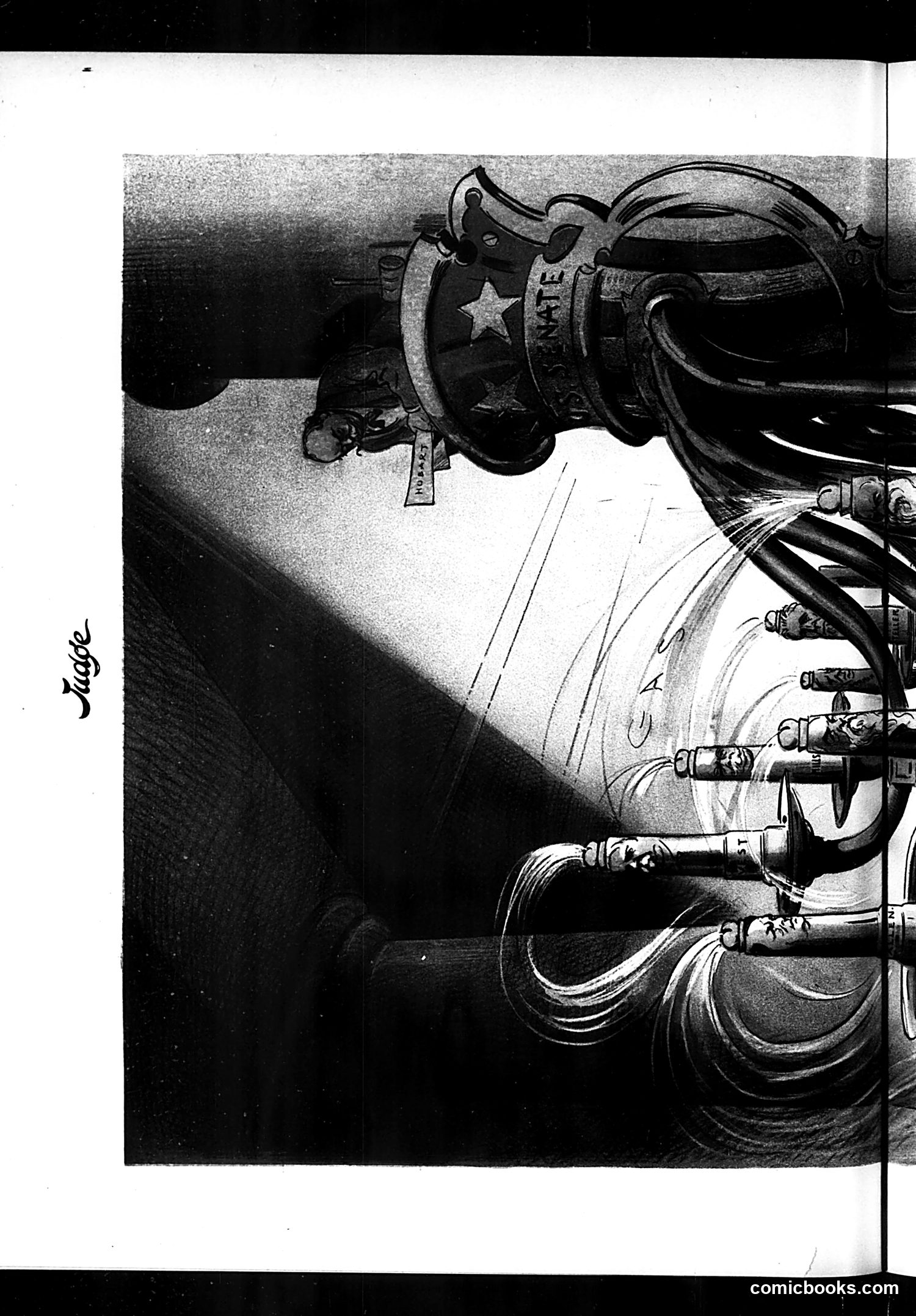
This black and white photograph (rotated 90 degrees) shows industrial machinery—specifically what appears to be a large valve or pipe fitting with a star emblem visible on its side. The image emphasizes heavy industrial manufacturing. Without accompanying OCR text that clarifies the satirical message, intent, or historical context, I cannot definitively explain what political or social commentary this represents in *Judge* magazine. The star emblem suggests possible Soviet or communist imagery, which would fit *Judge*'s Cold War-era satirical approach, but the lack of visible labels, captions, or article text prevents me from confidently stating the cartoon's specific target or message. The image alone does not provide sufficient context for accurate interpretation.
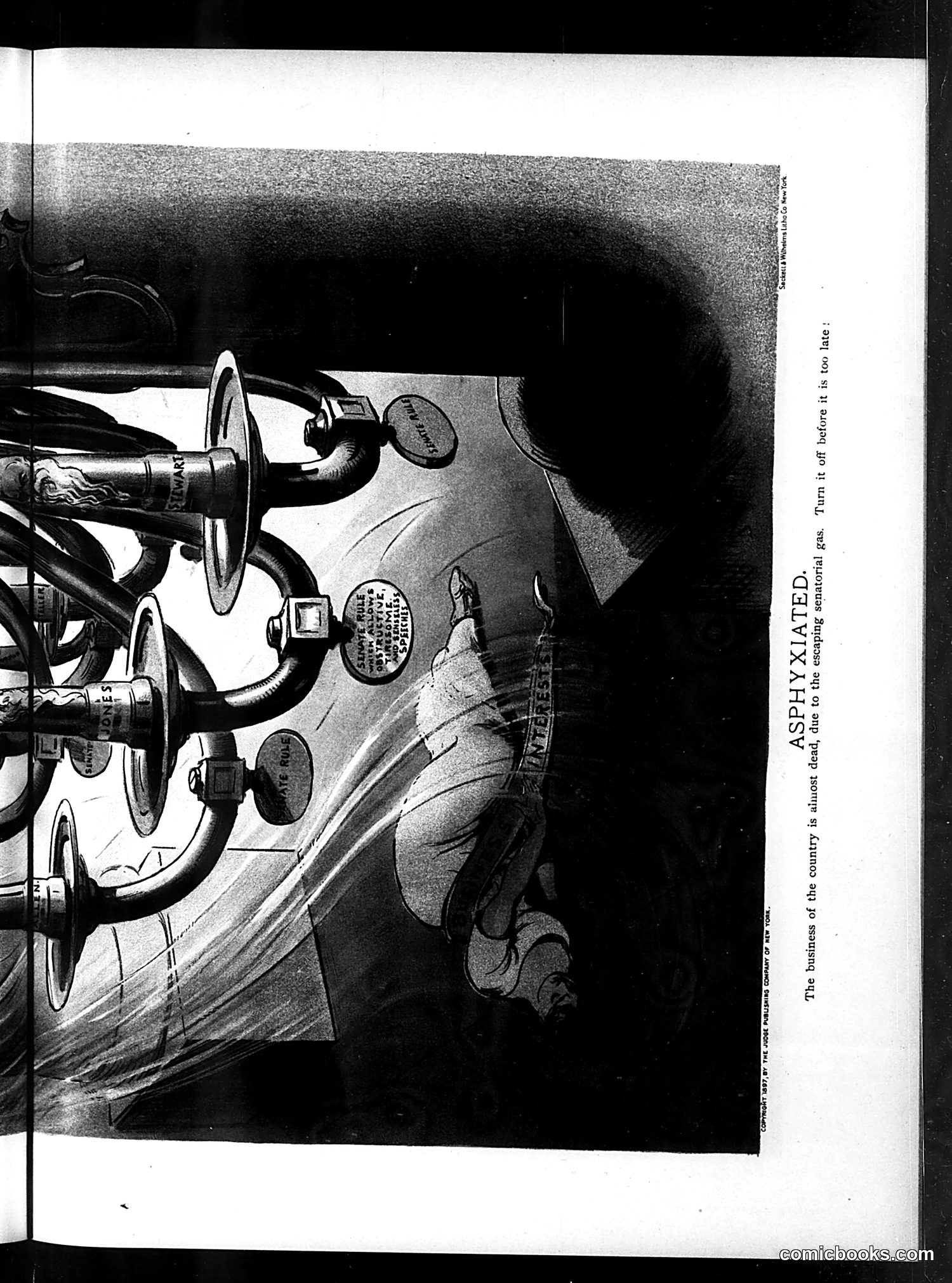
The page shows a black and white photograph (not a cartoon) of someone operating what appears to be industrial or mechanical equipment with multiple large wheels or gauges. The caption reads "ASPHYXIATED," with text indicating "The business of the country is almost dead line to the escaping noxious gas. Turn it off before it is too late." This appears to be political commentary on industrial or governmental mismanagement during the early 20th century—suggesting that current policies or practices are "suffocating" the nation's business. The image uses the metaphor of asphyxiation from noxious gas to critique whatever the operator represents, likely a political figure or administrative body. However, without clearer OCR text or additional context about Judge magazine's publication date, I cannot identify the specific historical event or figure being satirized.
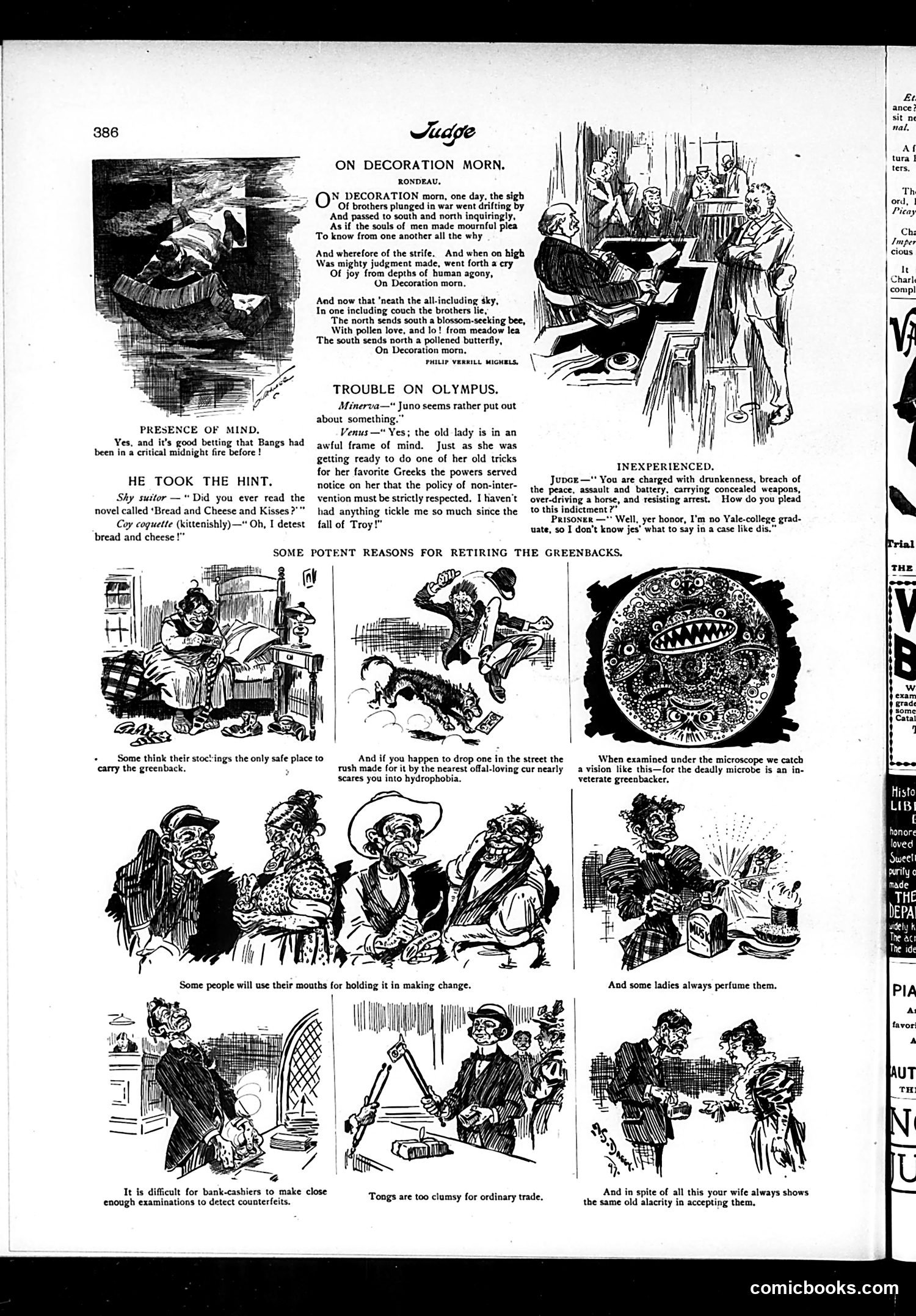
This page contains several satirical pieces typical of late 19th-century American humor: **"On Decoration Morn"** is a patriotic poem about Memorial Day, celebrating reconciliation between North and South after the Civil War through shared mourning of fallen soldiers. **"Trouble on Olympus"** mocks Greek mythology, depicting the gods as petty and dysfunctional—Juno is angry about Jupiter's interference in human affairs, suggesting satirical commentary on divine or authority figures. **"Some Potent Reasons for Retiring the Greenbacks"** is economic satire attacking paper currency. The cartoons humorously suggest greenbacks are unsanitary (carried in stockings, dropped in streets where dogs eat them), difficult to authenticate, and unreliable. The microscope joke implies paper money harbors "deadly microbes"—a contemporary argument for metallic currency standards during debates over monetary policy. The various domestic humor sketches ("He Took the Hint," "Inexperienced") are typical period jokes about courtship, legal incompetence, and marital dynamics, offering light relief between weightier satire.
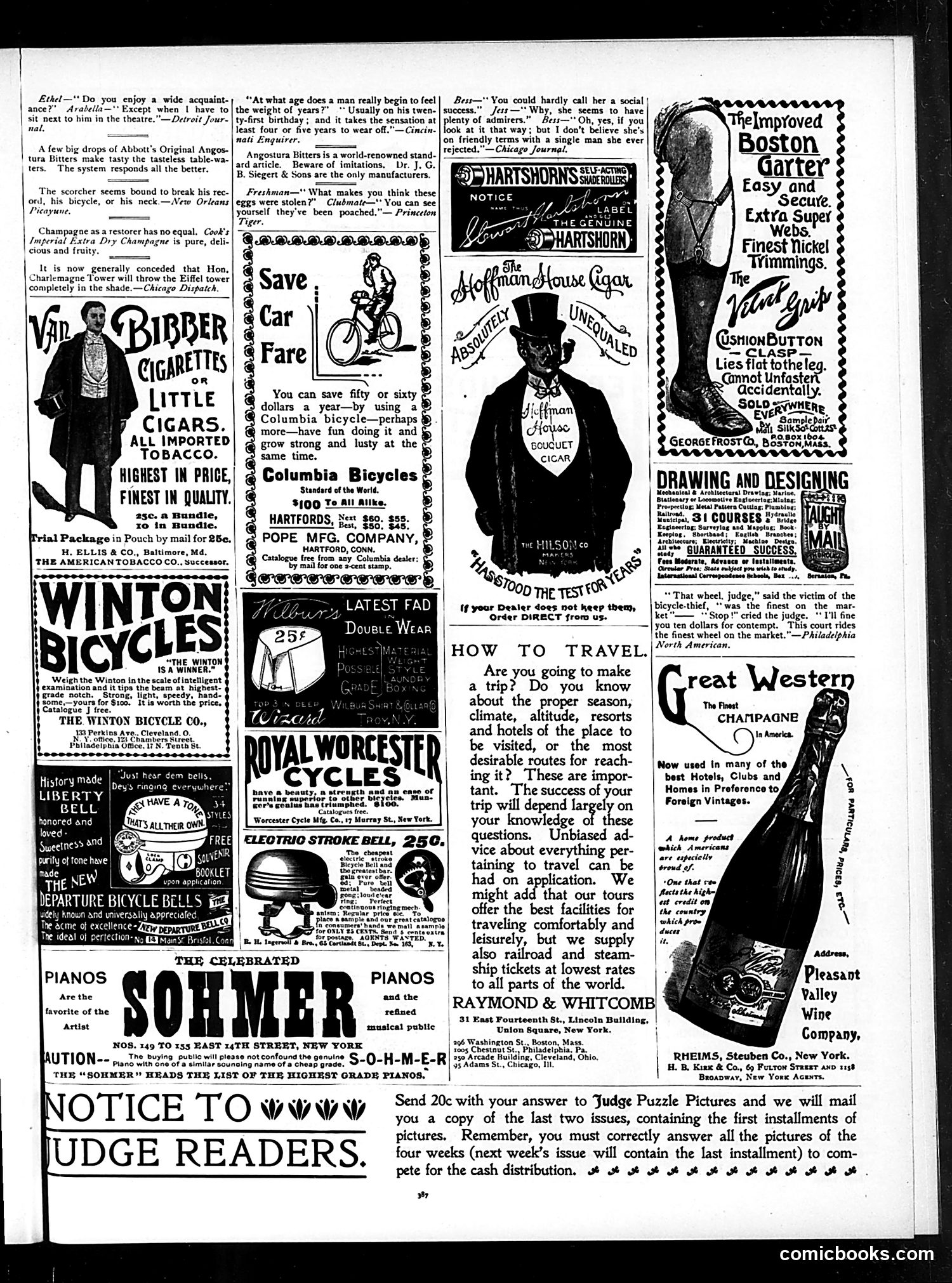
This is primarily an **advertising page** from Judge magazine, with brief humorous quotations scattered throughout. The small jokes are typical period humor: one about an acquaintance becoming tedious at theaters; another about young men feeling age's weight at their 21st birthday; a third playing on the double meaning of "poached" eggs (stolen vs. cooked). The bulk of the page consists of **product advertisements** common to the early 1900s: bicycles (Winton, Columbia, Hartford, Royal Worcester), cigars (Van Bibber), champagne, Angostura Bitters, piano manufacturers (Sohmer), bicycle bells, and travel services (Raymond & Whitcomb). There is **no political cartoons or satire** visible on this page. The content reflects the commercial priorities and consumer goods marketed to Judge's middle-class readership during the turn-of-the-century era.
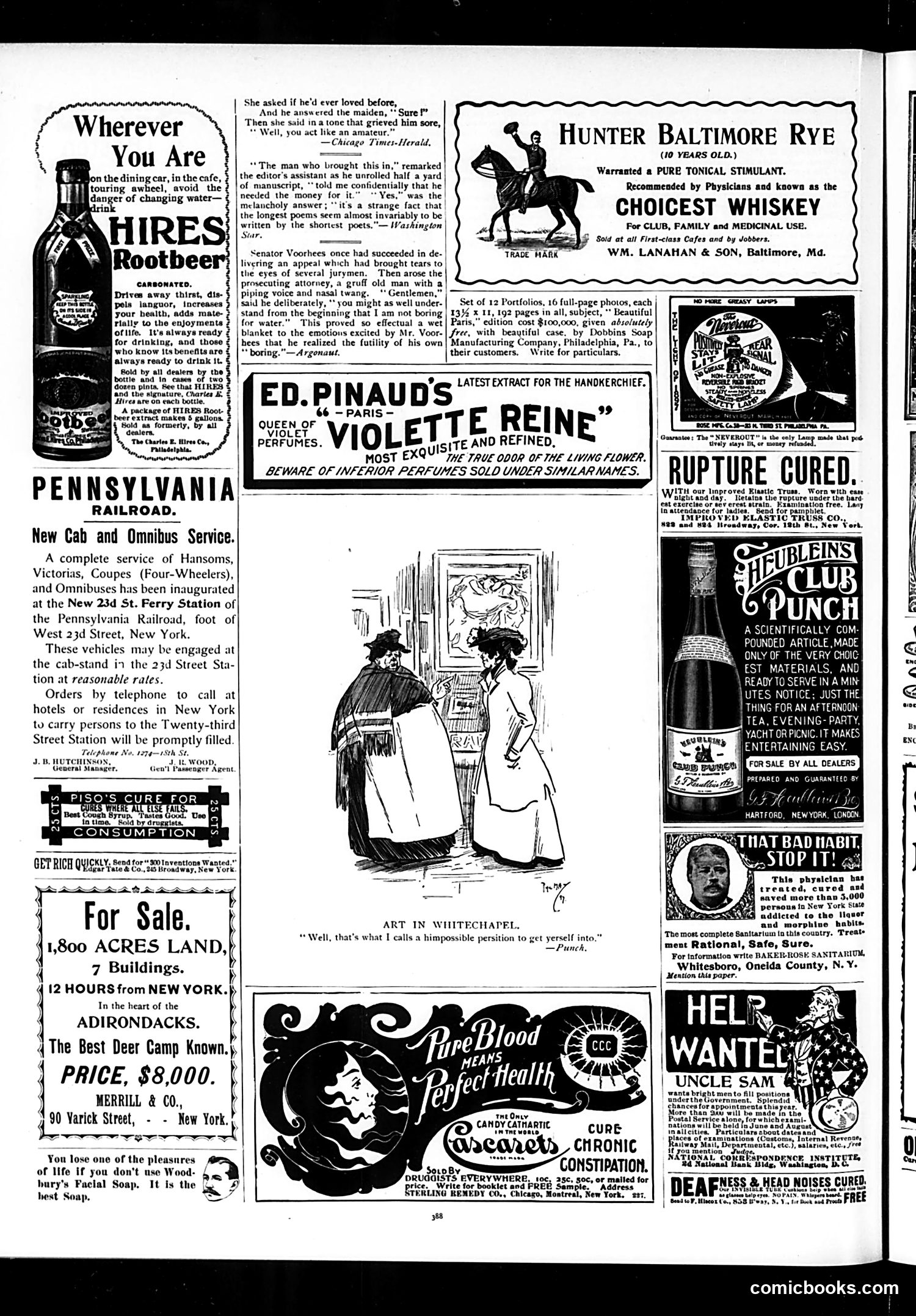
This is primarily an **advertising page** from the satirical magazine Judge, with minimal editorial content. The page includes two small **humorous anecdotes** (likely by Judge staff): 1. **"Chicago Times-Herald" joke**: A woman rejects a man's romantic claim because he "acts like an amateur"—a joke about his inexperience in courtship. 2. **"Washington Star" joke**: An editor's assistant notes that a poet submitting a long manuscript needed money—the joke being that lengthy poems are characteristically written by short poets (a play on words). 3. **"Argonaut" anecdote**: Senator Voorhees delivers an emotional legal appeal, but is undercut by a gruff prosecutor who declares he's "not boring for water"—a humorous deflation using drilling terminology. The remainder comprises **period advertisements** for patent medicines, whiskey, real estate, and remedies (cure-all tonics were common in this era). No political cartoons appear on this page. The content reflects typical late-19th-century magazine humor: puns, wordplay, and brief witty observations about everyday life.
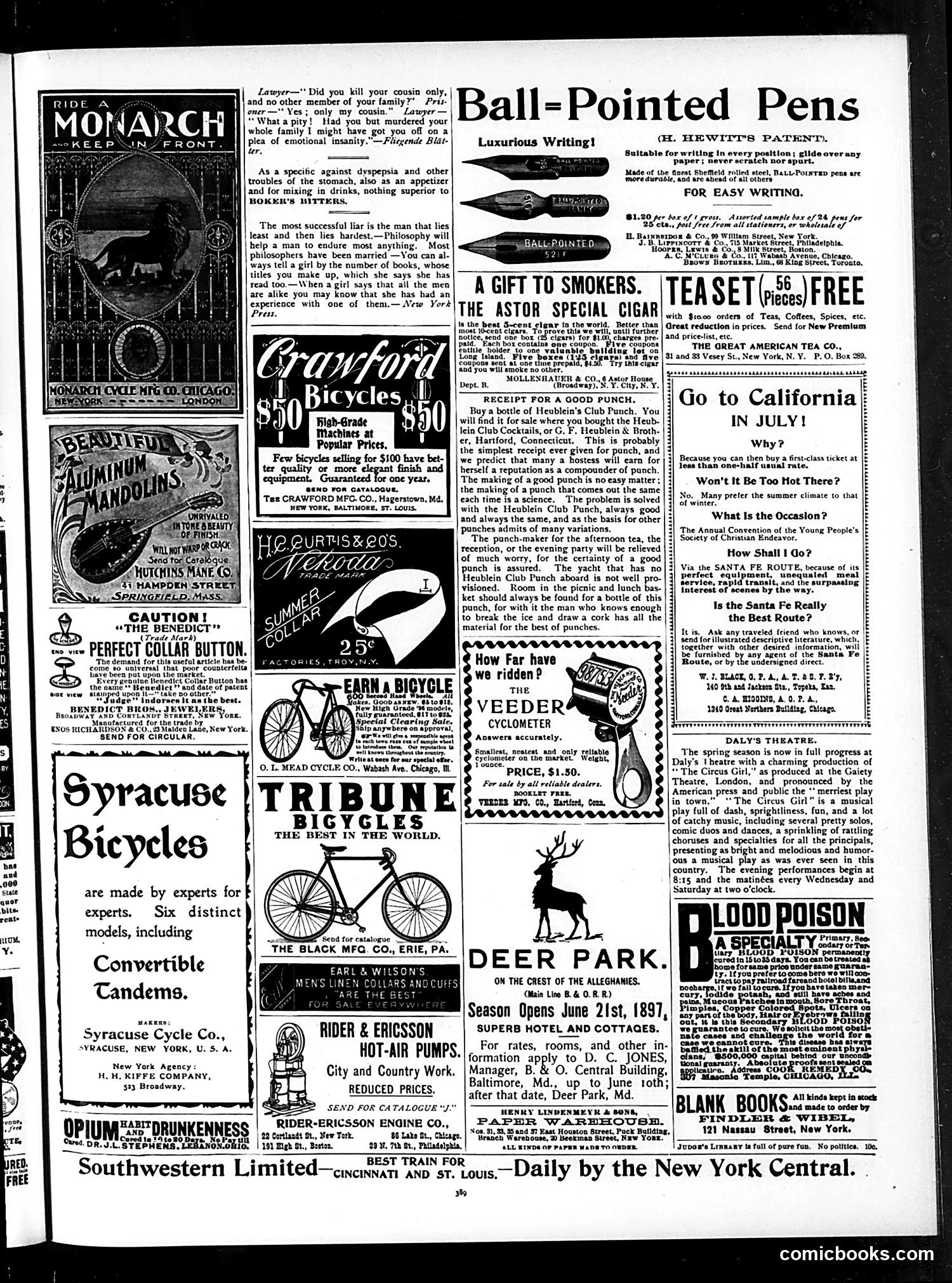
This page is primarily **advertisements and filler content** rather than political satire. The main cartoon occupies the upper left—a lawyer joke about a defendant who murdered only his cousin. The lawyer laments he could have gotten him acquitted if he'd killed his entire family, implying a plea of "emotional insanity" works better for multiple murders. This is dark gallows humor typical of period magazines, mocking both the legal system's absurdity and the defense of crimes of passion. The rest of the page consists of period advertisements: bicycles (Monarch, Syracuse, Tribune brands), pens, cigars, cocktail mixers, pumps, and other consumer goods. There is no broader political commentary visible—the content reflects late-19th-century commercial advertising mixed with generic satirical humor rather than topical satire.
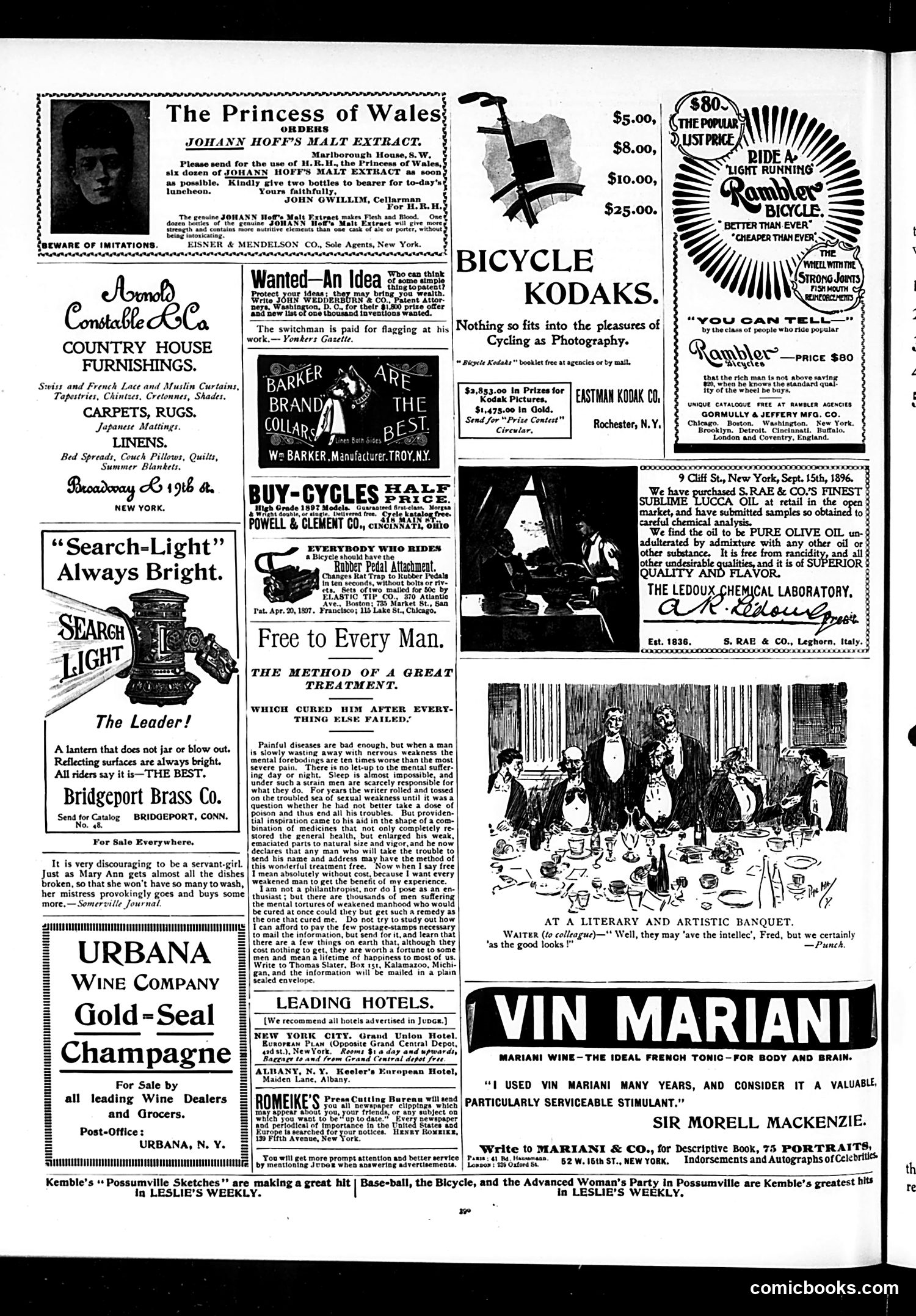
This page is primarily **advertising**, with one small cartoon at the bottom. The main items: **The Cartoon**: Titled "A DAINTY AND ARTISTIC BANQUET," it depicts a waiter serving an elaborate formal dinner. The caption jokes that the waiter (to colleagues) says "the good looks" will "save the intellect, Fred, but we certainly doubt it"—a satirical comment on superficial attractiveness substituting for substance, likely referencing contemporary anxieties about shallow social climbing. **The Advertisements** include products typical of the 1890s: bicycle-related items (Kodaks for cyclists, Rambler bicycles), wine and champagne, household furnishings, and notably, a patent-medicine testimonial for treating "nervous weakness" and sexual dysfunction—a common advertisement category in this era that exploited male health anxieties. **Note**: There's also a fake endorsement attributed to "The Princess of Wales" for Johann Hoff's Malt Extract (marked "BEWARE OF IMITATIONS"), exemplifying how manufacturers fraudulently used celebrity names to sell products.
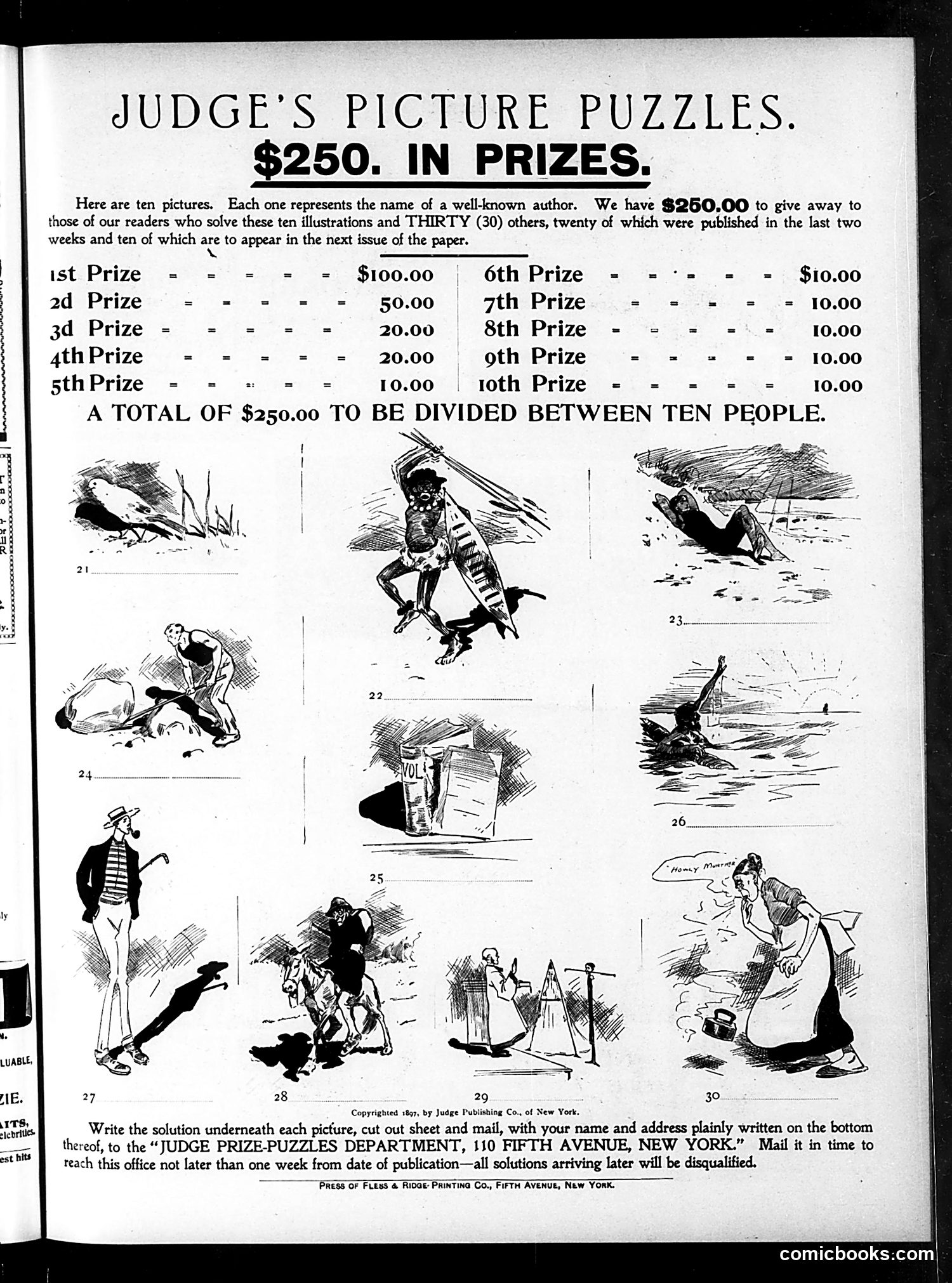
This is a competition page from *Judge* magazine (dated 1897) featuring a visual puzzle contest. Readers must identify ten famous authors based on illustrated visual puns or symbolic drawings—a "rebus" style puzzle common in 19th-century magazines. The contest offered $250 in total prizes ($100 for first place, descending to $10 for subsequent winners), with forty total puzzles across multiple issues of the magazine. Solvers had to mail their answers to Judge's office within one week. The actual puzzle images appear as numbered illustrations (21-30 visible here), each depicting a scene meant to represent an author's name through wordplay, visual metaphor, or symbolic imagery. Without more context, the specific authors referenced are unclear, though the cartoonish, exaggerated drawing style was typical of Judge's satirical aesthetic. This represents how magazines engaged readers through interactive competitions before digital entertainment.
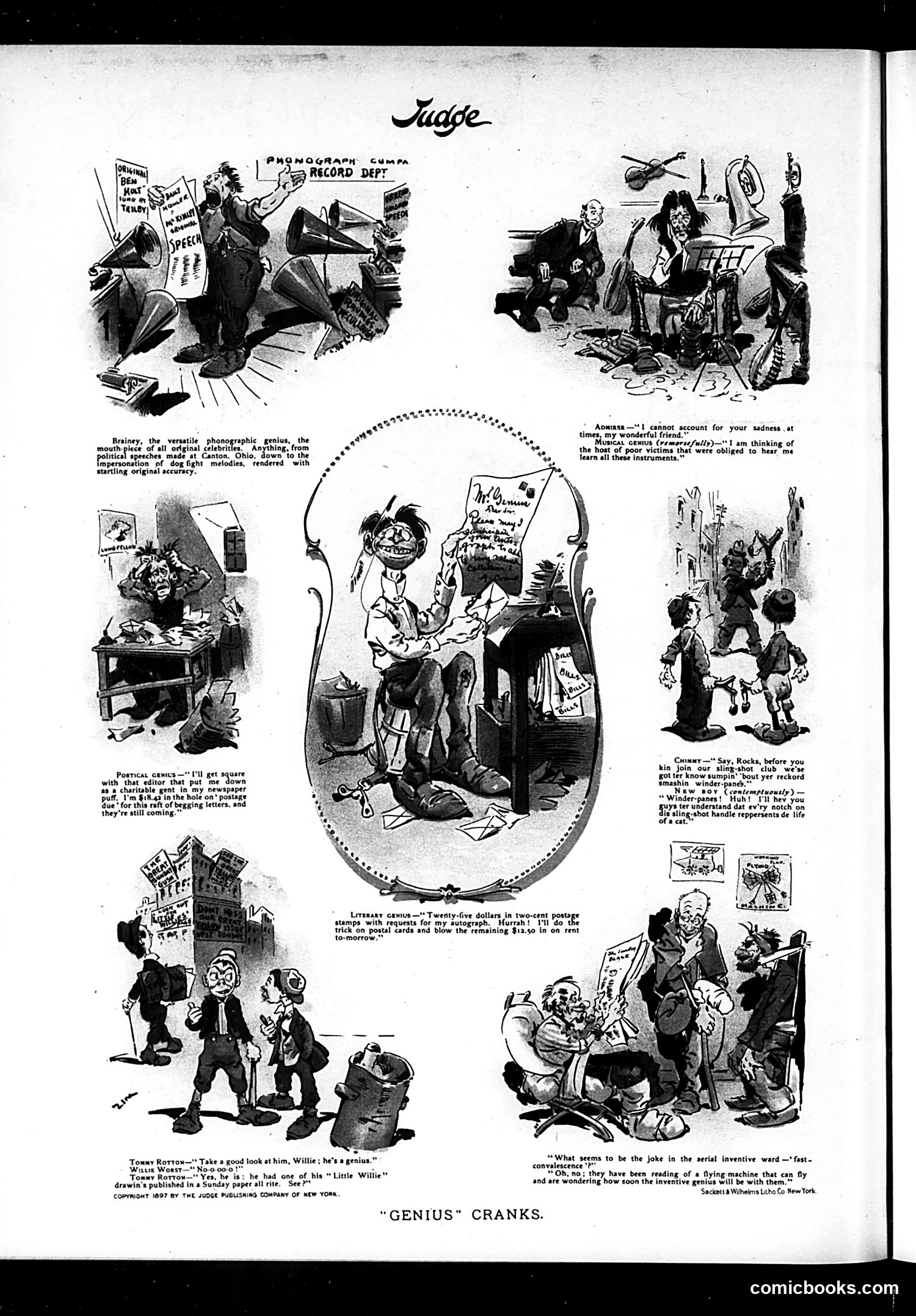
This page satirizes various eccentric "geniuses" whose talents are either useless or socially burdensome. Each cartoon mocks a different type of crank: **Musical Genius** laments the "poor victims" forced to hear him practice instruments—humor lies in his self-absorbed obliviousness to others' suffering. **Political Genius** complains about being out money from a newspaper puff piece, revealing vanity masked as charity. **Literary Genius** boasts about profiting from autographs on postcards, prioritizing profit over art. **Tower Rotter** and others appear to represent similar pretentious or delusional characters. The central large cartoon shows a phonograph expert ("Brainey") who can reproduce anything from political speeches to dog fights with "startling accuracy"—mocking both his inflated self-importance and the era's fascination with recording technology. The satire targets late-19th-century American society's tendency to celebrate mediocre talent and self-promoters who mistake notoriety for genuine genius.