
A complete issue · 18 pages · 1897
Judge — May 1, 1897
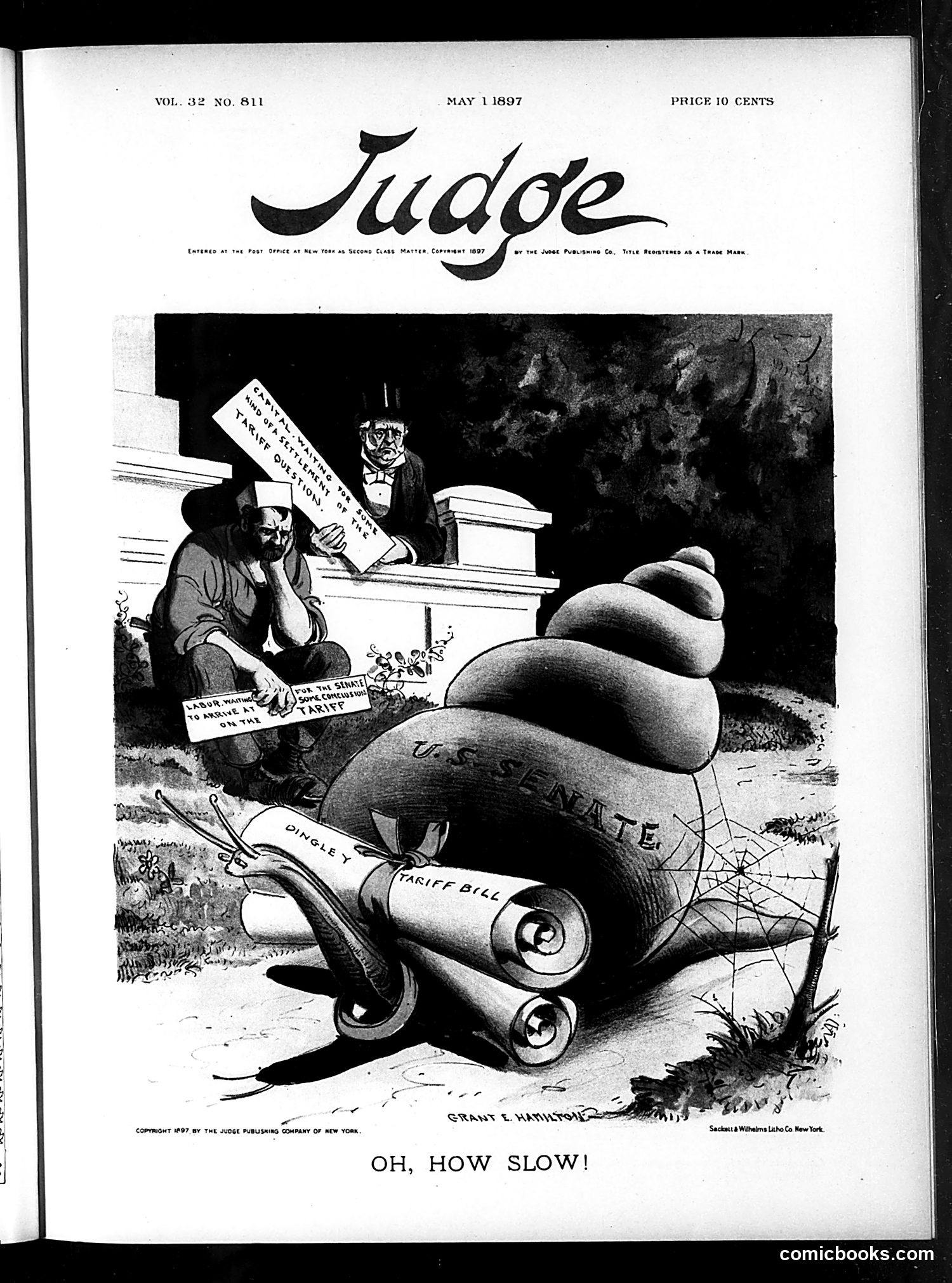
This political cartoon satirizes the slow progress of tariff legislation. A tortoise labeled "U.S. Senate" moves at a glacial pace, carrying enormous cannonballs marked "Tariff Bill" and "Dingley Tariff." Two distressed figures sit nearby—one holding a sign reading "Labor Suffering From a High Tariff," the other appears to be a judge or official at a desk marked with "Tariff Discrimination" regulations. The cartoon criticizes Congress's sluggish handling of tariff reform while American workers and citizens suffer economic consequences. The title "Oh, How Slow!" expresses frustration with legislative delays on this pressing economic issue. This likely references the Dingley Tariff debates of 1897, which eventually passed to raise protective duties.
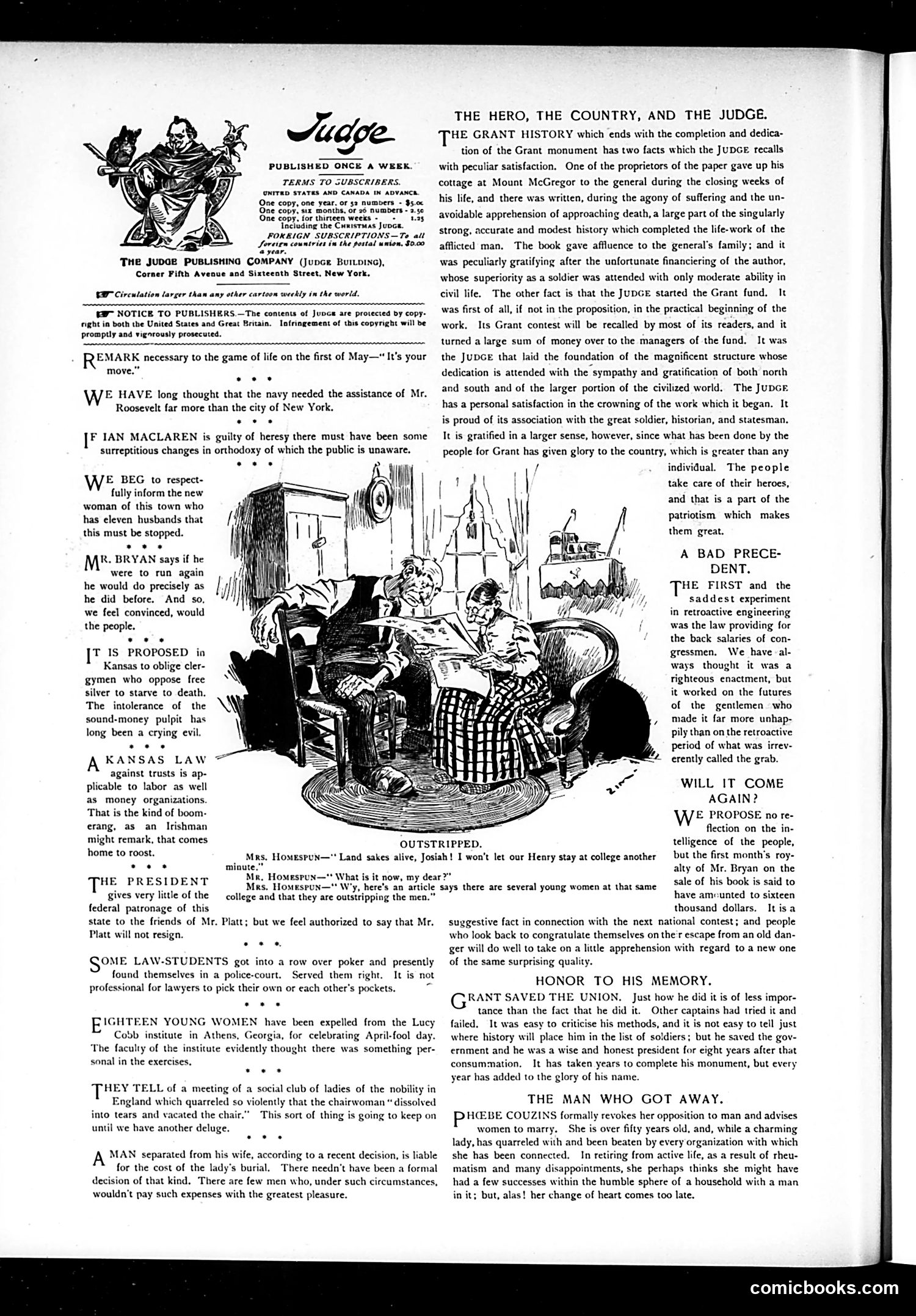
This page contains editorial commentary rather than a political cartoon. The main illustration titled "OUTSTRIPPED" depicts a domestic scene with a man and woman, apparently illustrating a piece about marital finances or domestic relations. The editorial content addresses various social issues of the era, including: - Naval preparedness and military readiness - Labor organizing and union activities - Women's education and propriety (expulsions from female institutes) - Marital law and financial responsibility - General social commentary on contemporary morality The text references General Grant and patriotism, suggesting this is from the post-Civil War period. Most items are brief satirical comments on current events rather than sustained political arguments. The overall tone critiques various aspects of contemporary American society through humor and social observation.
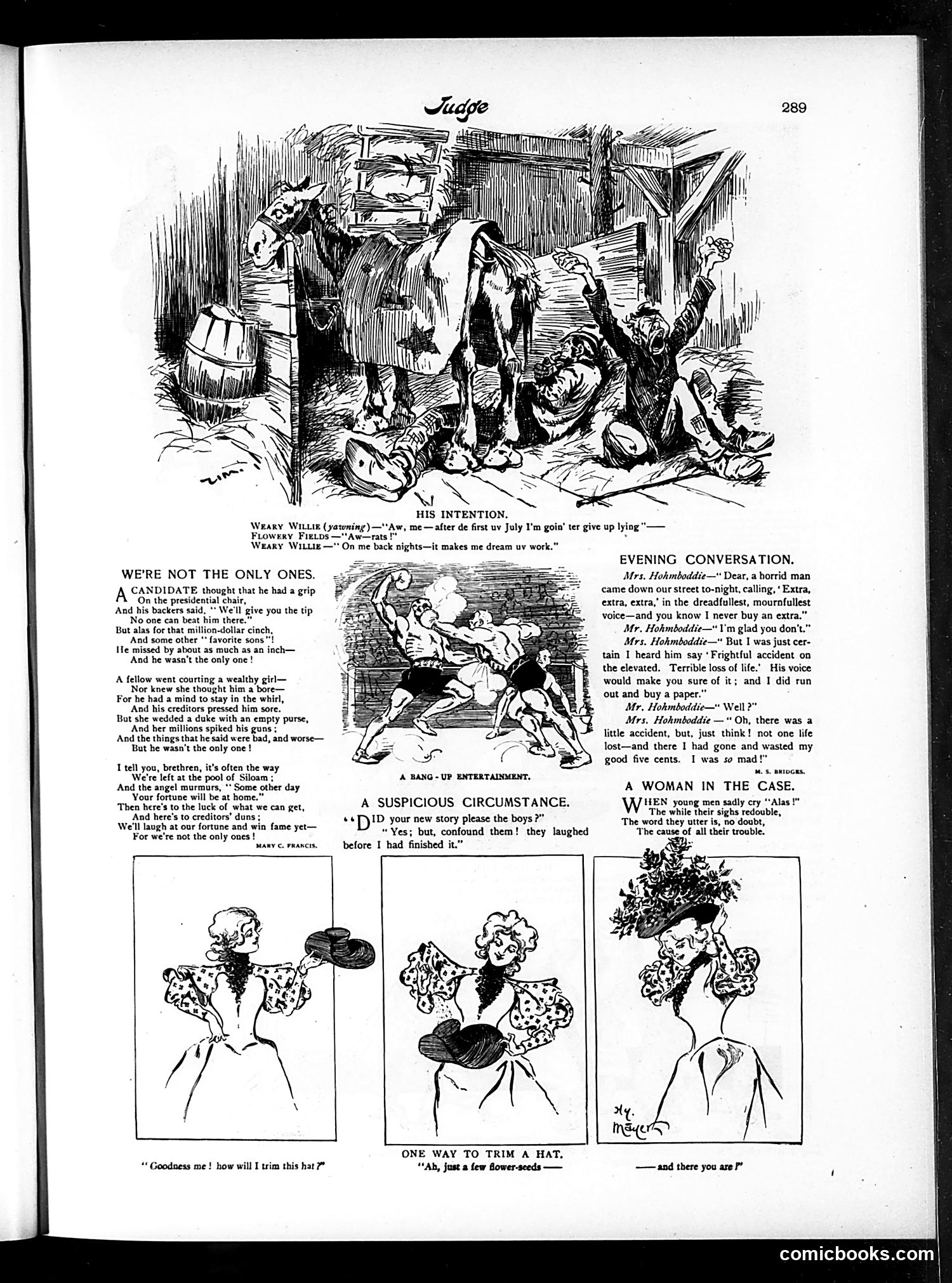
This page contains several unrelated humor pieces typical of Judge's satirical format: **"His Intention"** (top): A rural scene with a farmer and children. The joke involves July 4th celebrations and someone claiming they won't "give up lying"—likely satirizing American patriotic hypocrisy or rural folk humor. **"We're Not the Only Ones"** (left column): A poem by Mary C. Francis about a political candidate losing an election, mocking his failure and comparing it to others' misfortunes. **"One Way to Trim a Hat"** (bottom): Three cartoon panels showing a woman with increasingly elaborate hat decorations—satirizing the absurdity of women's fashion trends and over-decorated hats, a common Judge target. **"A Woman in the Case"** and other brief comedy pieces: Short joke formats typical of the magazine's miscellaneous humor sections. The page reflects Judge's focus on domestic life satire, fashion mockery, and political commentary aimed at educated, middle-class readers.
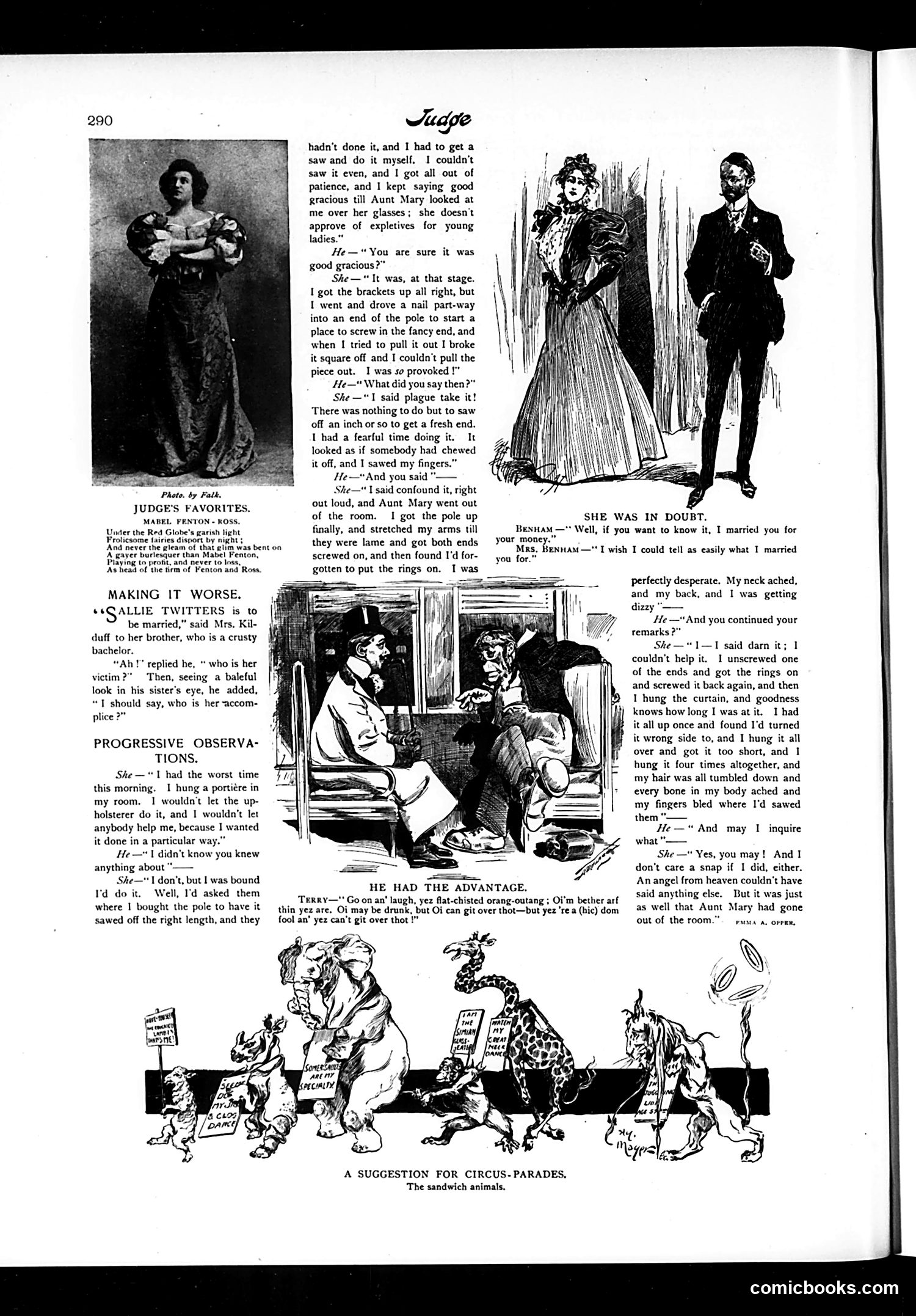
This page contains humorous domestic dialogues typical of early 20th-century American humor. The main content satirizes middle-class married life and courtship: **"Making It Worse"** depicts a wife recounting her frustrating morning hanging a curtain, progressively uttering mild expletives (from "good gracious" to "darn it" to "confound it") while her aunt disapproves. The humor lies in the escalating exasperation and the gap between Victorian propriety and genuine emotion. **"She Was in Doubt"** presents a cynical joke: a husband admits he married for her money; the wife responds she can't recall why *she* married him, suggesting her regret or his financial uselessness. **"He Had the Advantage"** shows working-class characters (likely Irish, based on dialect) where a drunk man argues he's superior because he can "get over" his condition, unlike his sober but foolish opponent. The bottom cartoon, **"A Suggestion for Circus-Parades,"** satirizes animal acts by depicting costumed performers as "sandwich animals" advertising themselves—likely mocking circus commercialism. Overall, the page reflects early 1900s humor focused on domestic frustrations, class distinctions, and social pretension.
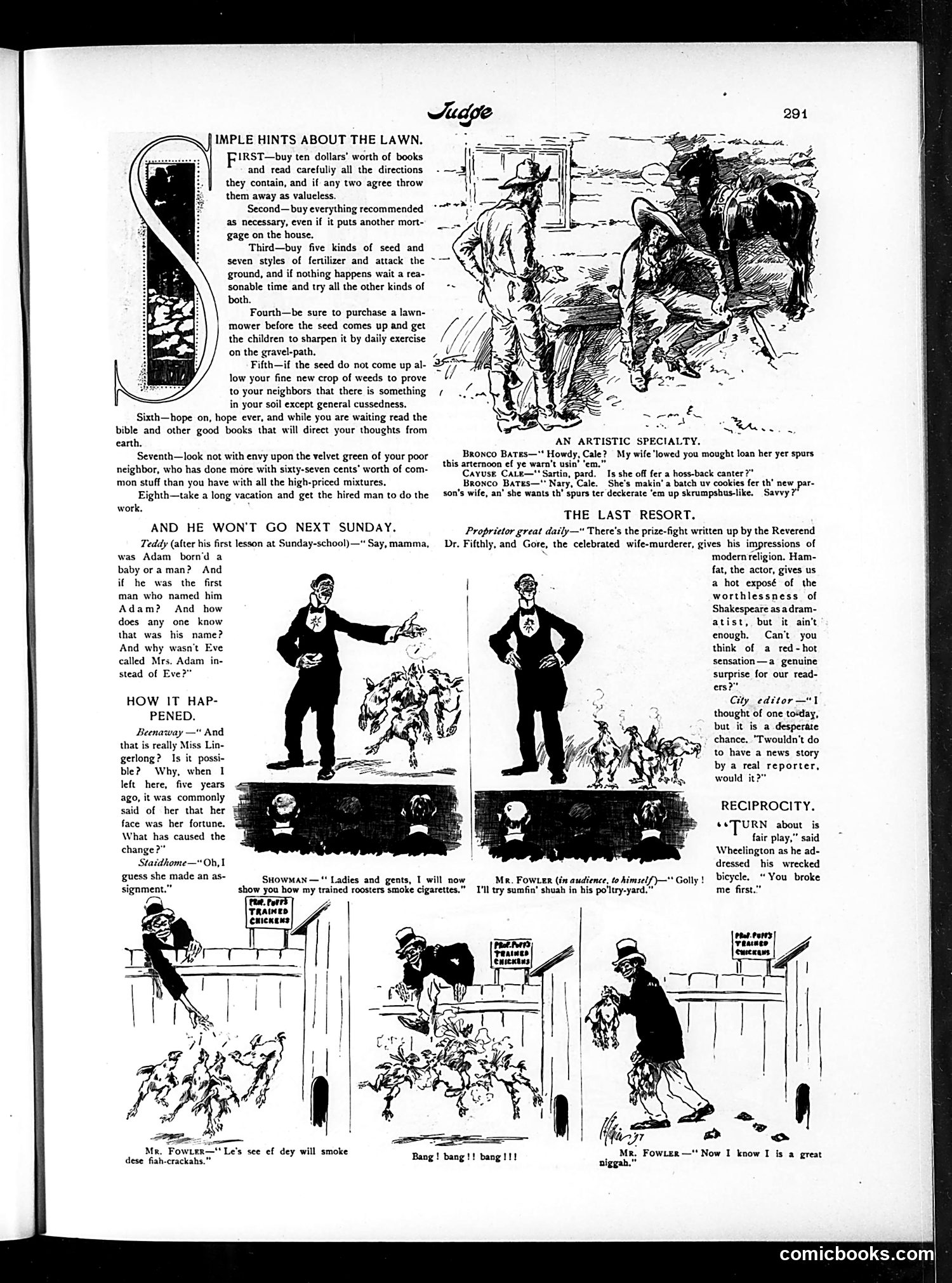
This page from *Judge* magazine contains satirical commentary on everyday American life, circa early 1900s. **"Simple Hints About the Lawn"** mocks the obsessive consumerism and contradictory advice plaguing homeowners—buy expensive books with conflicting directions, purchase multiple seed types and fertilizers, invest in equipment before results appear. The satire suggests Americans wastefully follow commercial recommendations while achieving mediocre results. **The illustrated anecdotes** depict working-class humor: cowboys borrowing decorative spurs for cookie-making, a child's innocent theological question at Sunday school, and a showman's trained roosters performing tricks. **"The Last Resort"** criticizes newspapers for sensationalism—editors pursuing shocking crime coverage and exposés rather than substantive journalism. **"Reciprocity"** is a simple pun about revenge ("turn about is fair play"). The overall tone ridicules consumer culture, journalistic excess, and the gap between aspirational middle-class life and reality—common *Judge* themes mocking Gilded Age American society.
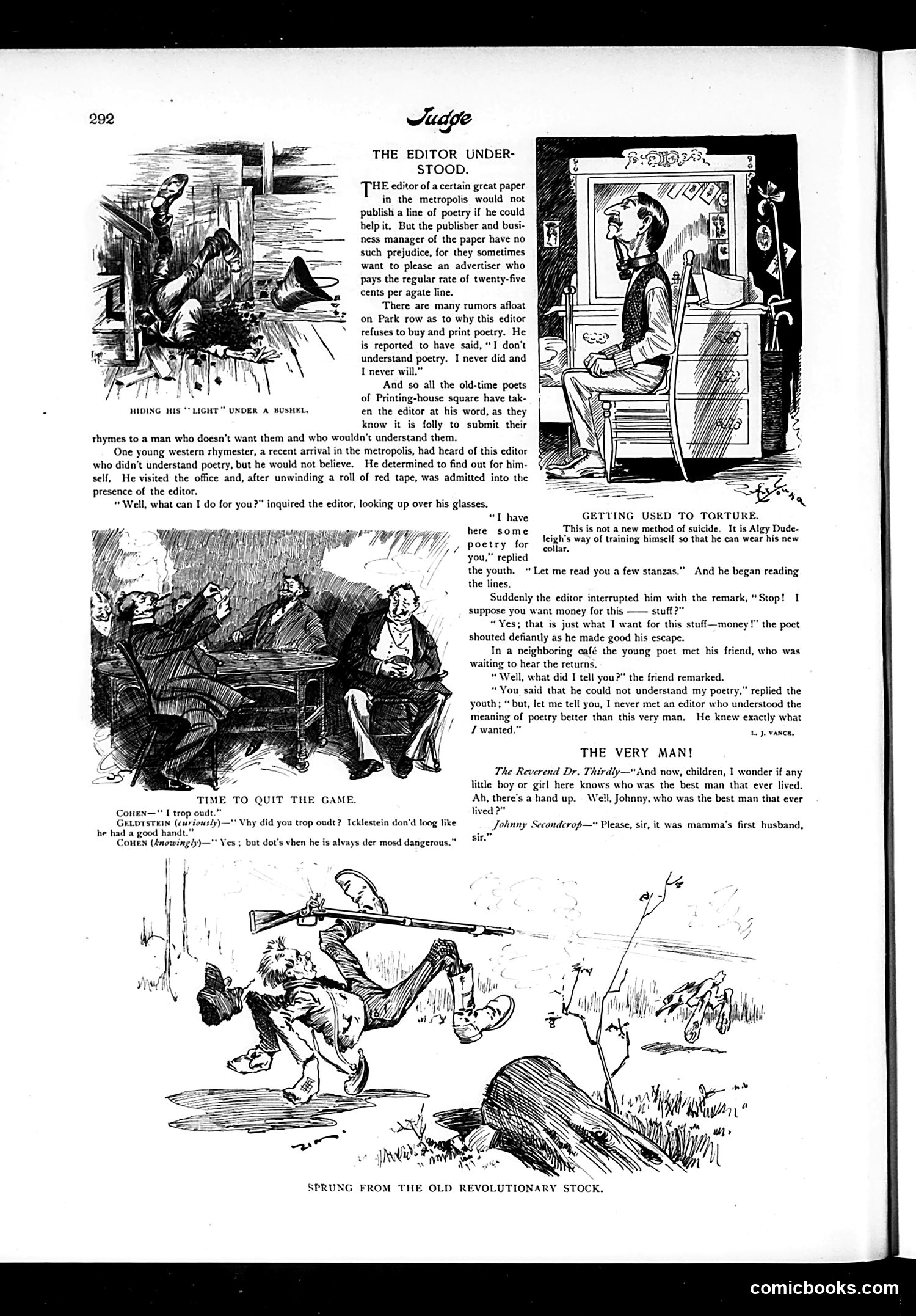
This page contains several satirical pieces mocking different subjects: **"The Editor Understood"** (main story with illustrations): A young poet visits a newspaper editor on Park Row (New York's publishing district) who famously refuses to print poetry, claiming "I don't understand poetry." The satire works both ways—the editor actually *does* understand poetry perfectly: he knows the poet wants payment, which is the only thing the editor truly comprehends. The joke is that the editor's "lack of understanding" is actually shrewd business sense. **Other cartoons** mock specific types: "Getting Used to Torture" ridicules fashion-obsessed dandies; "Time to Quit the Game" features Jewish characters gambling (using Yiddish dialect); "The Reverend Dr. Thirdly" presents a children's sermon joke; and "Sprung from the Old Revolutionary Stock" appears to satirize someone's dubious pedigree claims. The page reflects Judge's typical satirical targets: literary pretension, business cynicism, and ethnic stereotyping common to 1880s-90s American humor.
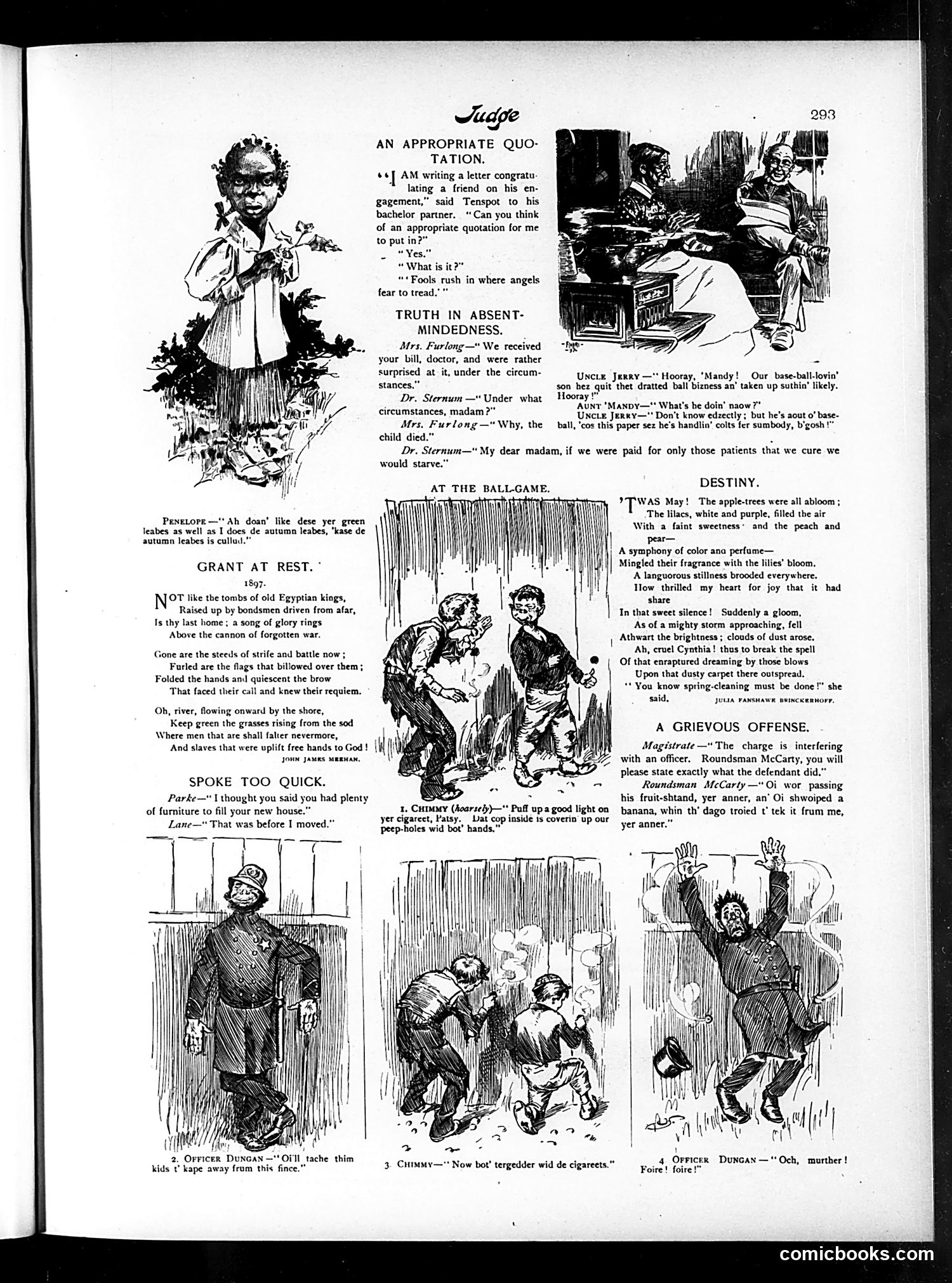
This page contains multiple satirical sketches typical of late-19th-century American humor: **"Grant at Rest"** (1897): A poetic tribute to General Ulysses S. Grant following his death, treating his military tomb reverently—contrasting with typical Judge irreverence. **Ethnic/Class Humor**: Several pieces mock working-class and immigrant characters through racist dialect ("dese yer green leabes," "dago," Irish "Och"). "At the Ball Game" shows lower-class men sneaking peeks through a fence using cigarette smoke as cover—mocking both their resourcefulness and poverty. **"Truth in Absent-Mindedness"**: A doctor jokes that he'd starve if only paid for curing patients, sarcastically commenting on medical incompetence or fraud. **"Spoke Too Quick"**: A simple moving-day joke about furniture being damaged in transit. The page reflects Judge's blend of class-based ridicule, ethnic stereotyping, and gentle social satire aimed at educated readers. The artwork uses cross-hatching in period style, and humor relies heavily on visual gags and dialect comedy now recognized as deeply offensive.
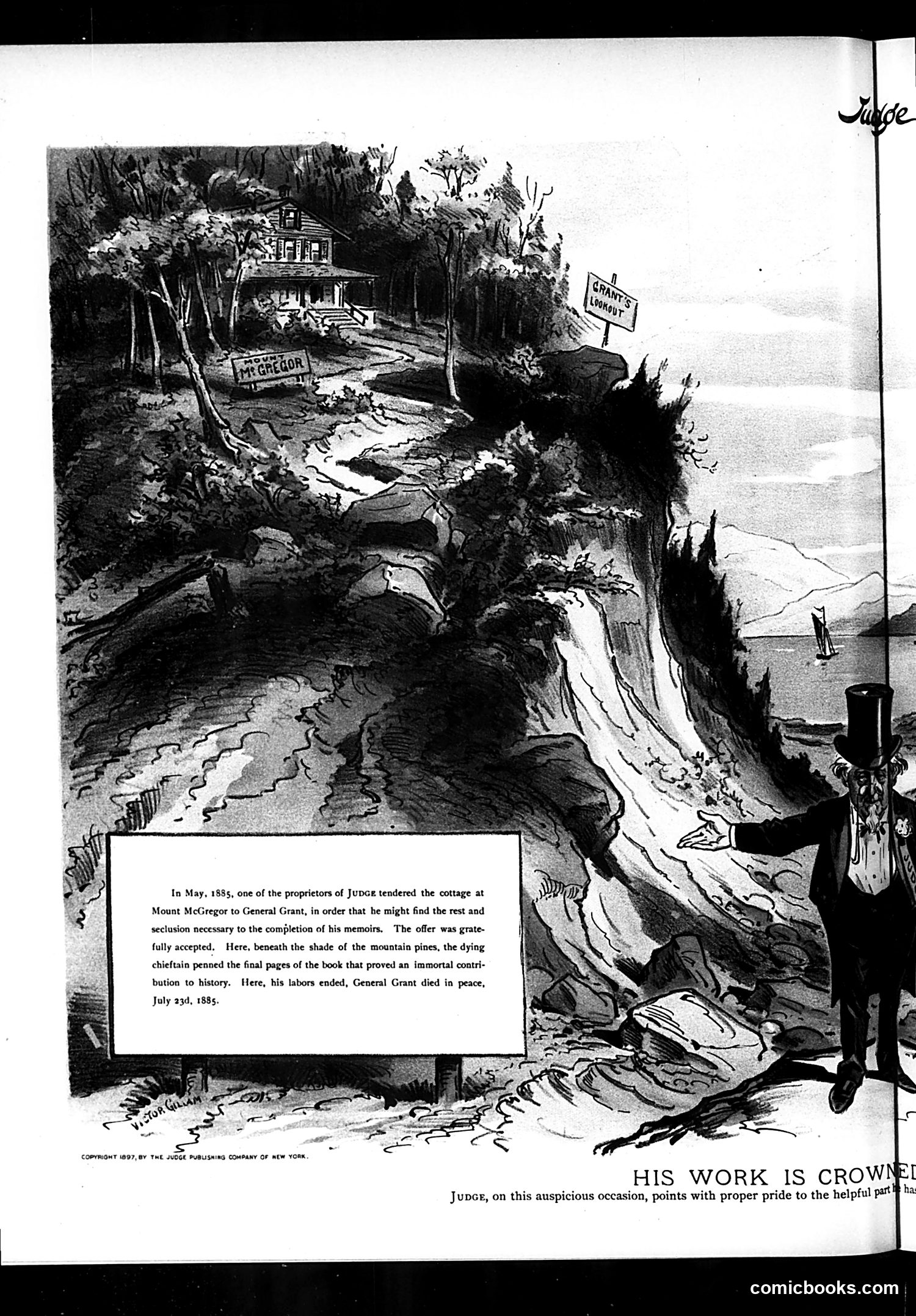
This commemorative illustration celebrates **General Ulysses S. Grant's death and legacy**. The cartoon depicts Mount McGregor, where Grant spent his final months in 1885 completing his memoirs at a cottage provided by *Judge* magazine's proprietors. The image shows Grant as a "dying chieftain" working beneath mountain pines, positioning his memoir-writing as a heroic final act. The text emphasizes that *Judge* magazine facilitated this historically significant completion by offering him rest and seclusion. The satire's purpose appears self-congratulatory rather than critical: *Judge* points "with proper pride" to its own role in enabling Grant's immortal literary contribution. This reflects late-19th-century reverence for the Civil War general and demonstrates how publications used historical moments for prestige-building and self-promotion. The bottom caption ("His Work Is Crowned") suggests Grant's memoirs secured his historical immortality—a theme common in Victorian-era tributes to the deceased general.
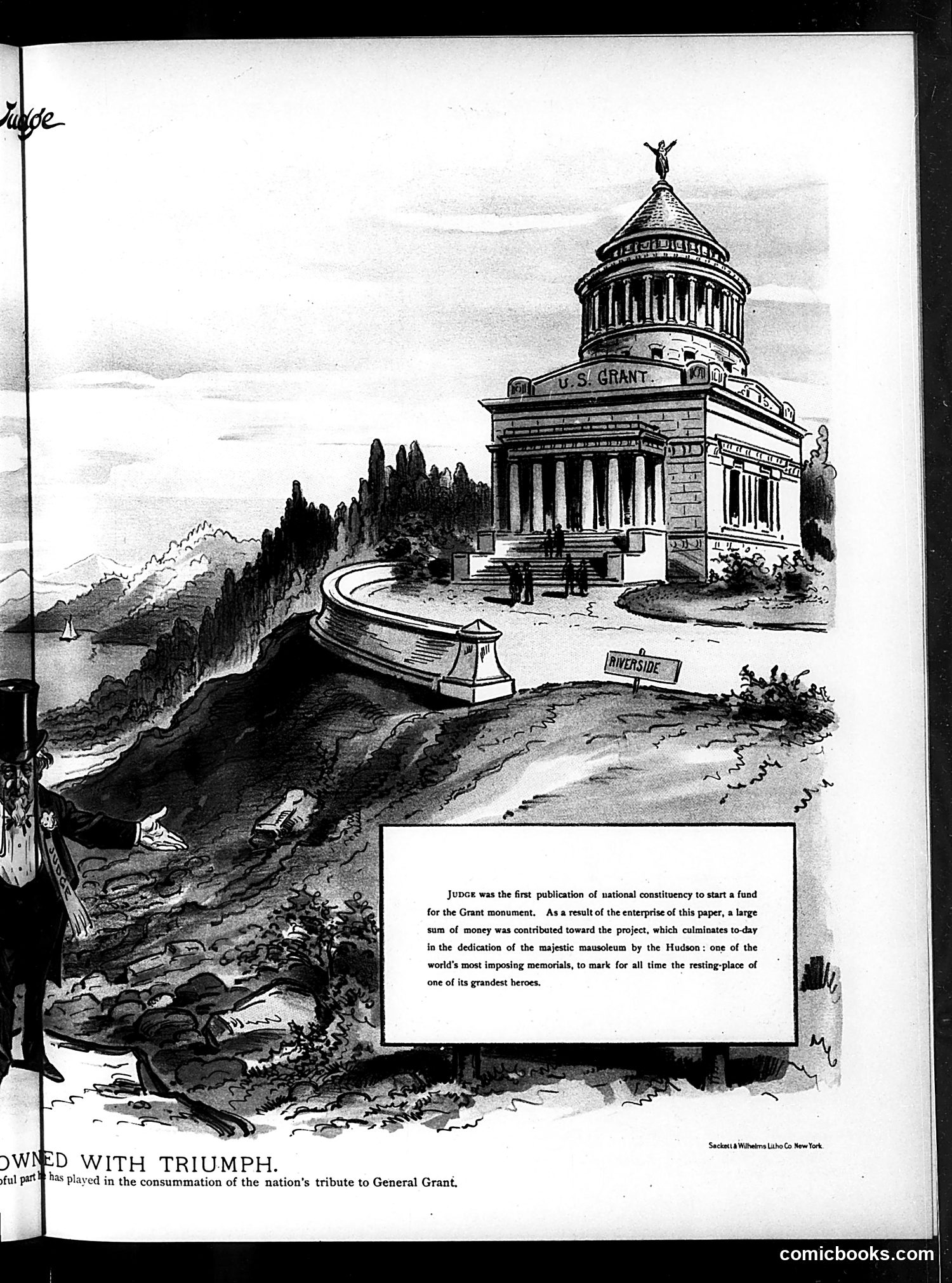
This page celebrates *Judge* magazine's role in fundraising for the Grant Monument (General Ulysses S. Grant's tomb). The illustration depicts the completed mausoleum overlooking the Hudson River in New York, with "U.S. GRANT" inscribed on the building and "RIVERSIDE" marked nearby. The satire is self-congratulatory: *Judge* claims credit as "the first publication of national constituency" to initiate funding for this memorial to "one of its grandest heroes." The text emphasizes the magazine's enterprise in collecting contributions that enabled construction of "one of the world's most imposing memorials." The page appears designed to tout *Judge*'s civic influence and patriotic leadership in honoring Grant's legacy—a form of institutional self-promotion typical of publications seeking to enhance their prestige and readership during the Gilded Age.
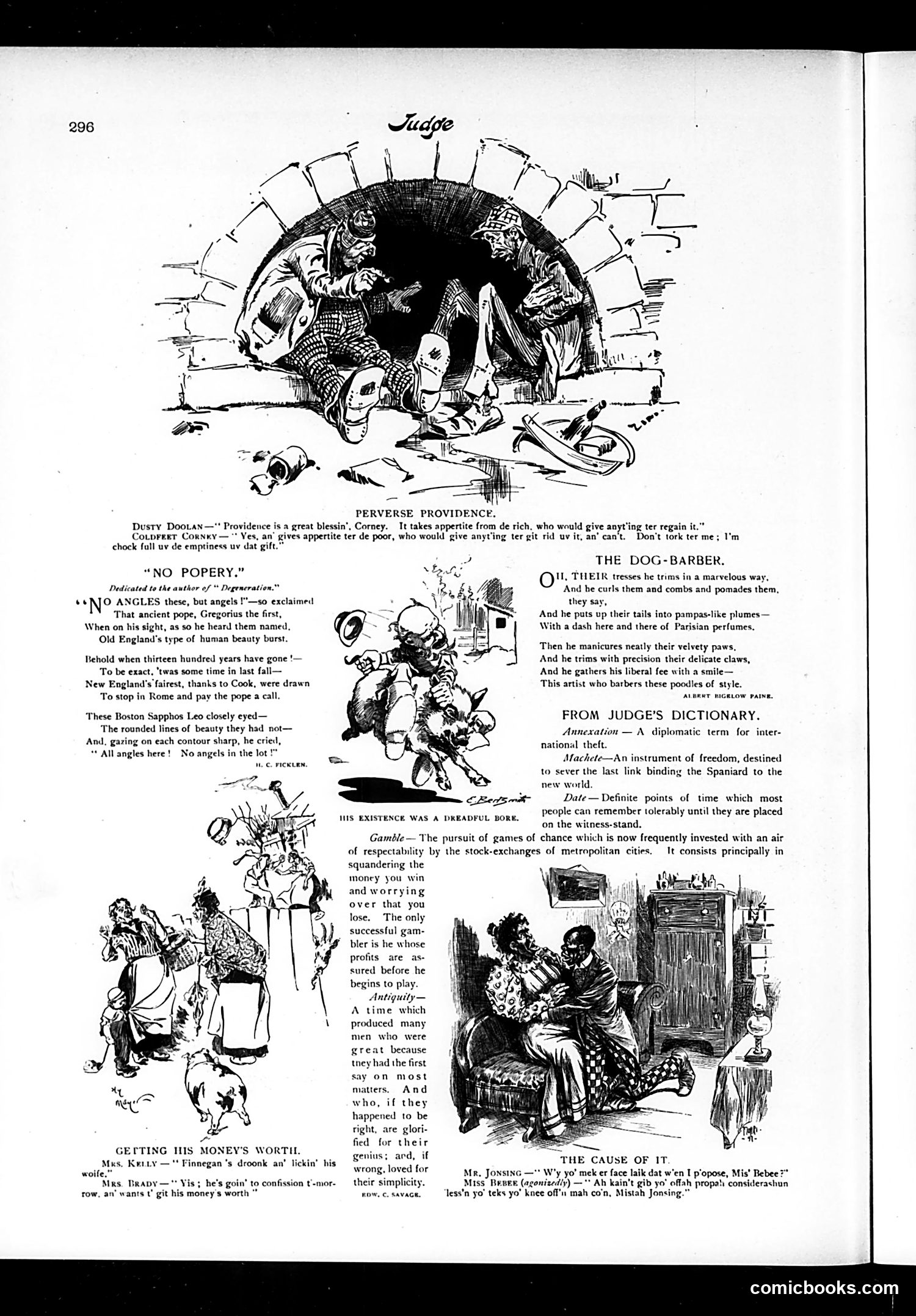
This page from *Judge* magazine contains several distinct satirical pieces: **"No Popery"** mocks Boston's elite women ("Boston Sapphos") who traveled to Rome. The joke: Pope Gregory I supposedly called English women "angels"; thirteen centuries later, when refined Bostonians visited, the Pope supposedly called them "angles"—a pun suggesting they were angular and unattractive rather than beautiful. **"The Dog-Barber"** humorously describes the absurdity of wealthy pet owners grooming their poodles to fashionable excess, with manicures and Parisian perfumes—satirizing class pretension through pet care. The dialect-heavy comic vignettes ("Getting His Money's Worth," "The Cause of It") use working-class Irish and African-American speech patterns typical of period humor, depicting domestic situations with economic struggle. **"From Judge's Dictionary"** offers cynical definitions: "Annexation" as diplomatic theft (likely referencing American imperial expansion), and "Machete" as an instrument severing Spanish colonial ties—contemporary political commentary on imperialism. The overall tone reflects *Judge*'s satirical stance on wealth disparity, American imperialism, and class pretension.
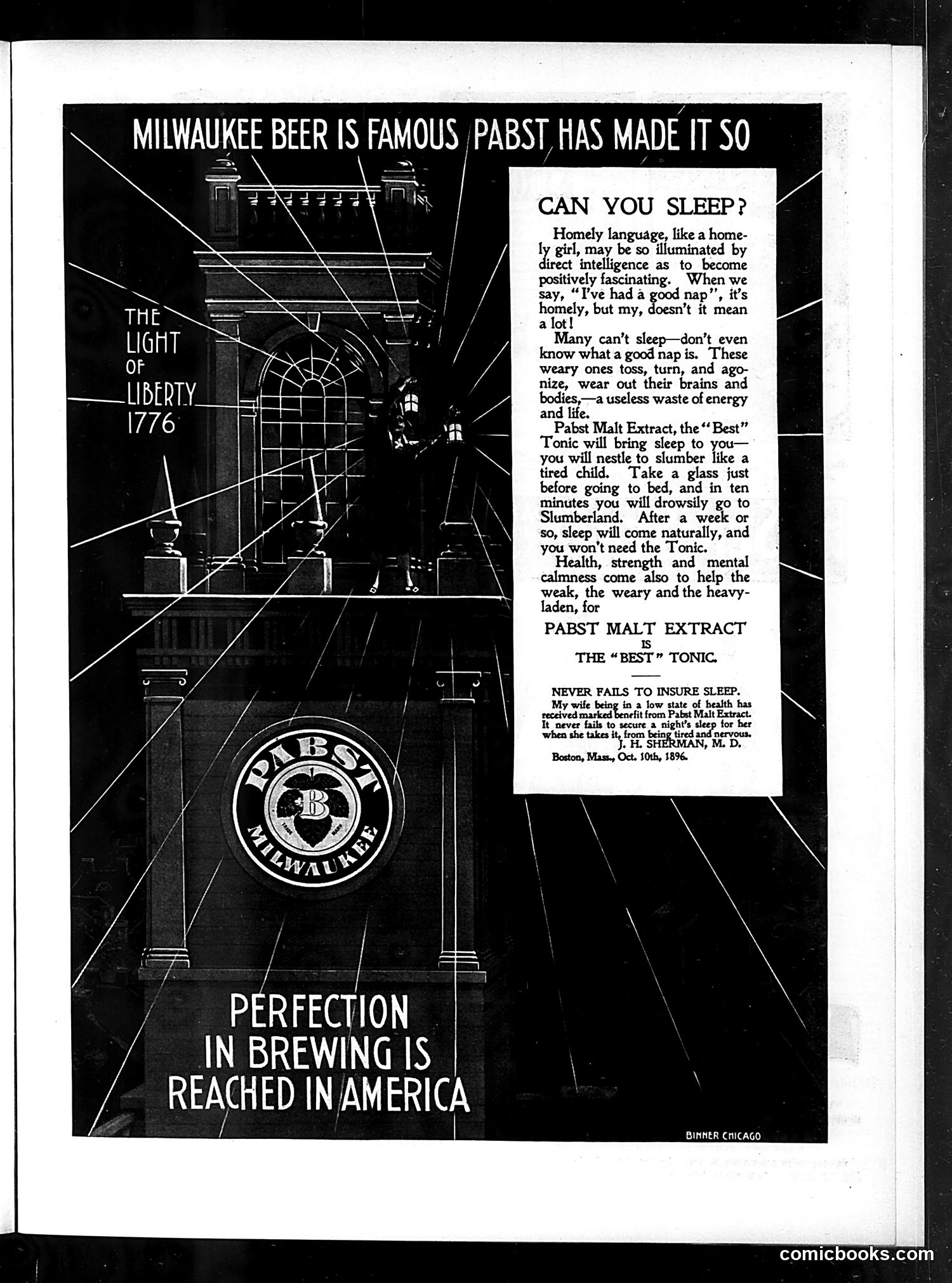
This page is primarily a **Pabst beer advertisement** disguised as editorial content in Judge magazine, not a political cartoon. The ad uses "The Light of Liberty 1776" imagery—an architectural interior with radiating light—to associate Pabst beer with American patriotism and progress. The tagline "Perfection in Brewing is Reached in America" claims American brewing superiority. The right-side text presents Pabst Malt Extract as a medical tonic for insomnia, using testimonial-style claims from "J. H. Sherman, M.D." of Boston (dated Oct. 10th, 1896). This reflects the era's common practice of marketing alcohol as therapeutic medicine—before FDA regulations and the recognition that alcohol is not a sleep aid but a depressant. The "homely language" framing attempts to make the product seem accessible and trustworthy to ordinary Americans. The overall message: buy our beer as both patriotic consumption and health treatment.
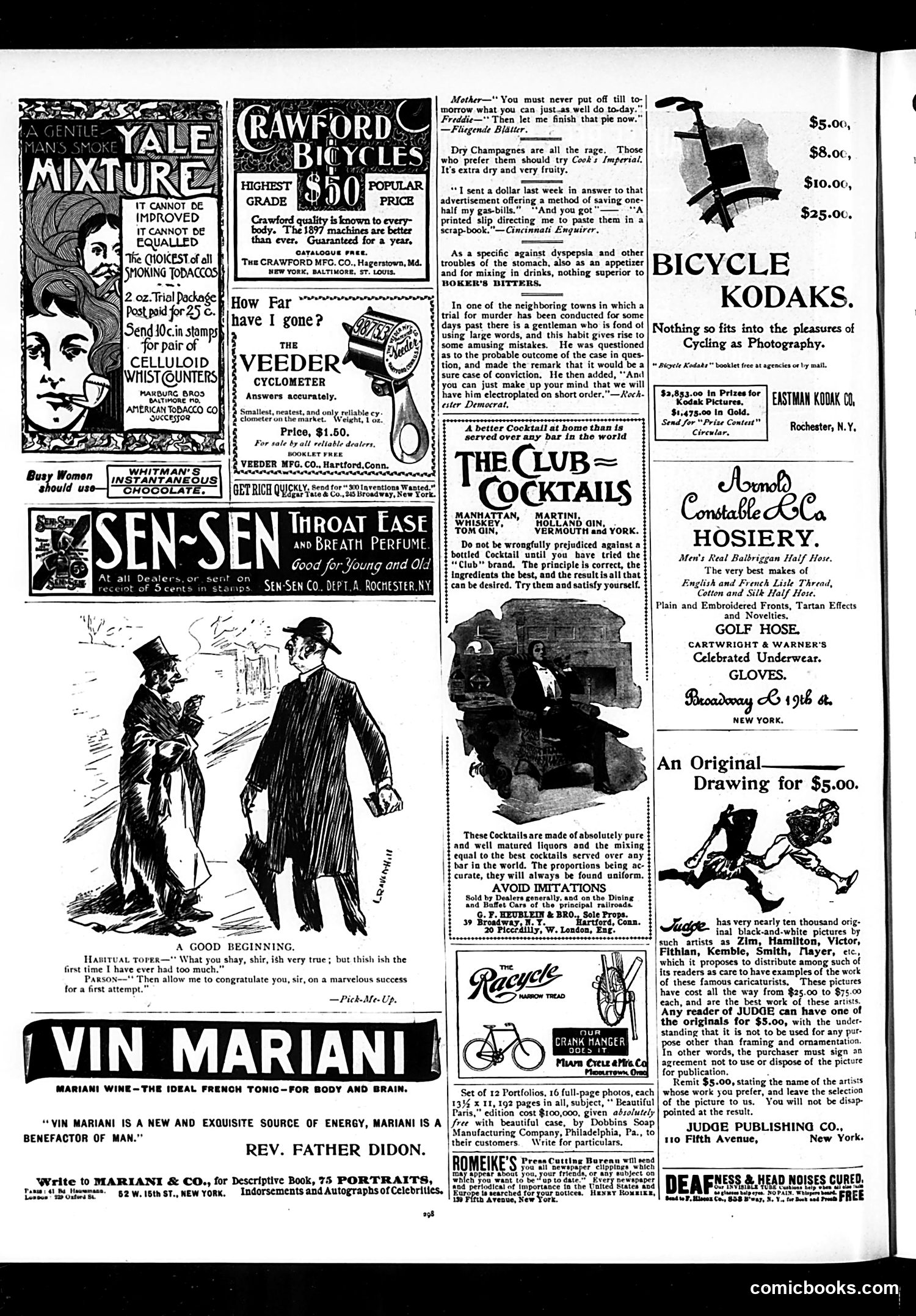
This is primarily a **page of period advertisements** with limited satirical content. The main elements are: ## The One Cartoon: **"A Good Beginning"** depicts a drunk man speaking to a parson, claiming he's never before overindulged in alcohol. The parson congratulates him on this "marvelous success"—the joke being that the man's first excess drinking is treated as an accomplishment worthy of praise. It's gentle satire on drunkenness. ## The Advertisements: The page is dominated by late-19th/early-20th-century product ads: bicycles, hosiery, cocoa, patent medicines (SEN-SEN breath perfume, VIN MARIANI wine tonic), bottled cocktails, soap, and photography services. Notable is **Vin Mariani**—a cocaine-containing patent medicine promoted with an endorsement allegedly from "Rev. Father Didon," representing the period when such products were marketed as health tonics. The page reflects early 1900s consumer culture and (for modern readers) the shocking prevalence of unregulated medicinal alcohol and drugs in advertising.
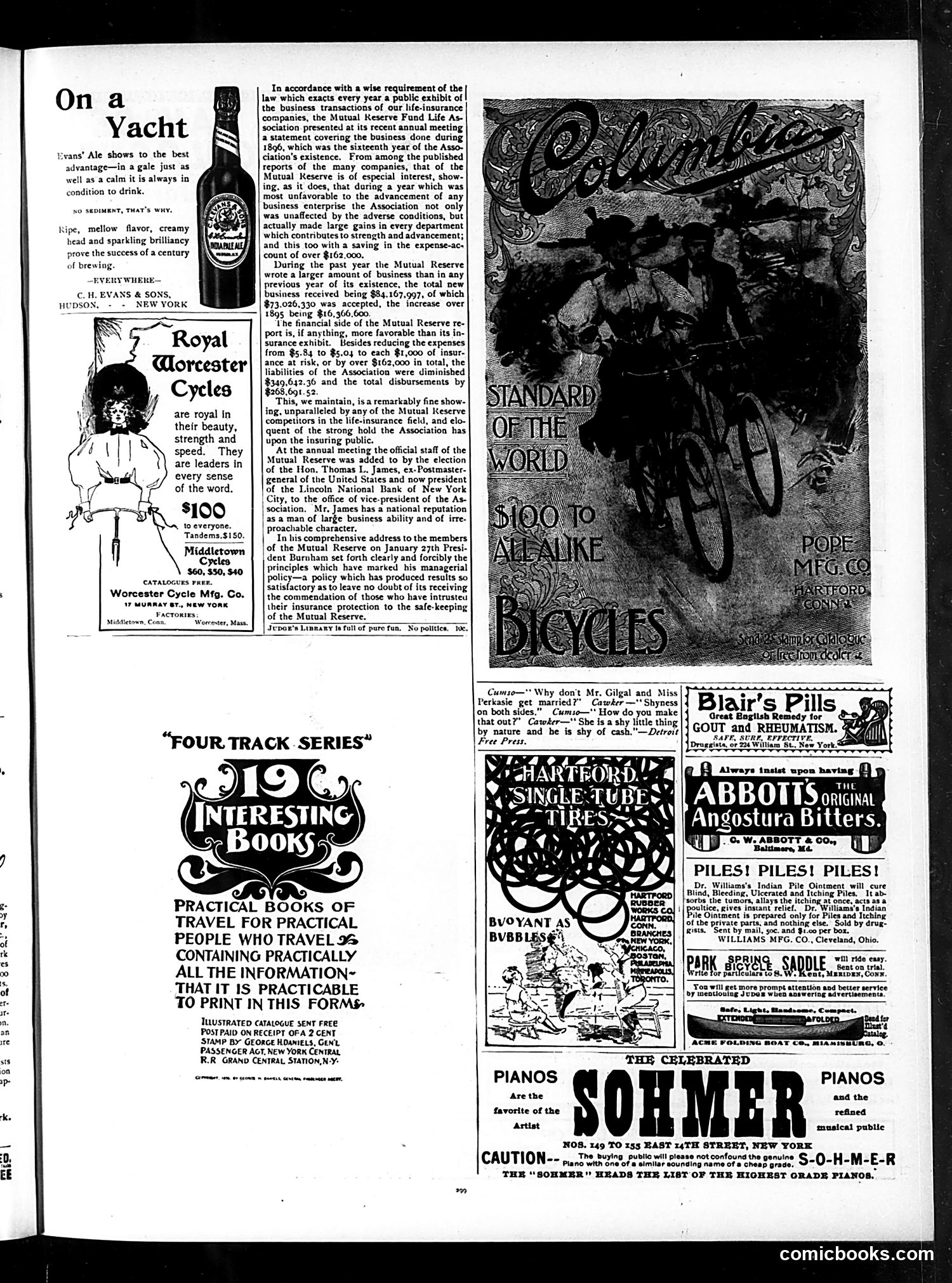
This page is primarily **advertising**, with one notable editorial feature. The main content includes: **Editorial Section**: A lengthy text praising the Mutual Reserve Fund Life Association's 1896 financial performance—strong business growth ($84M+ in new business), reduced expenses, and decreased liabilities. The piece celebrates the company's addition of Thomas L. James (ex-Postmaster General and bank president) as vice-president, framing him as evidence of the organization's respectability and strength. **Advertisements** dominate: Evans' Ale ("shows to best advantage"), Royal Worcester Cycles ($100), the "Four Track Series" travel books, Hartford Single-Tube Tires, Standard bicycles, and various patent medicines (Blair's Pills for gout, Abbott's Angostura Bitters, Dr. Williams's Indian Pile Ointment, Sohmer Pianos). **Brief Joke**: A single comic exchange about a shy woman and a man "shy of cash"—typical period humor about courtship and finances. There is **no political cartoon** on this page. It reflects Judge magazine's mixed editorial-and-advertising format typical of 1890s publications.
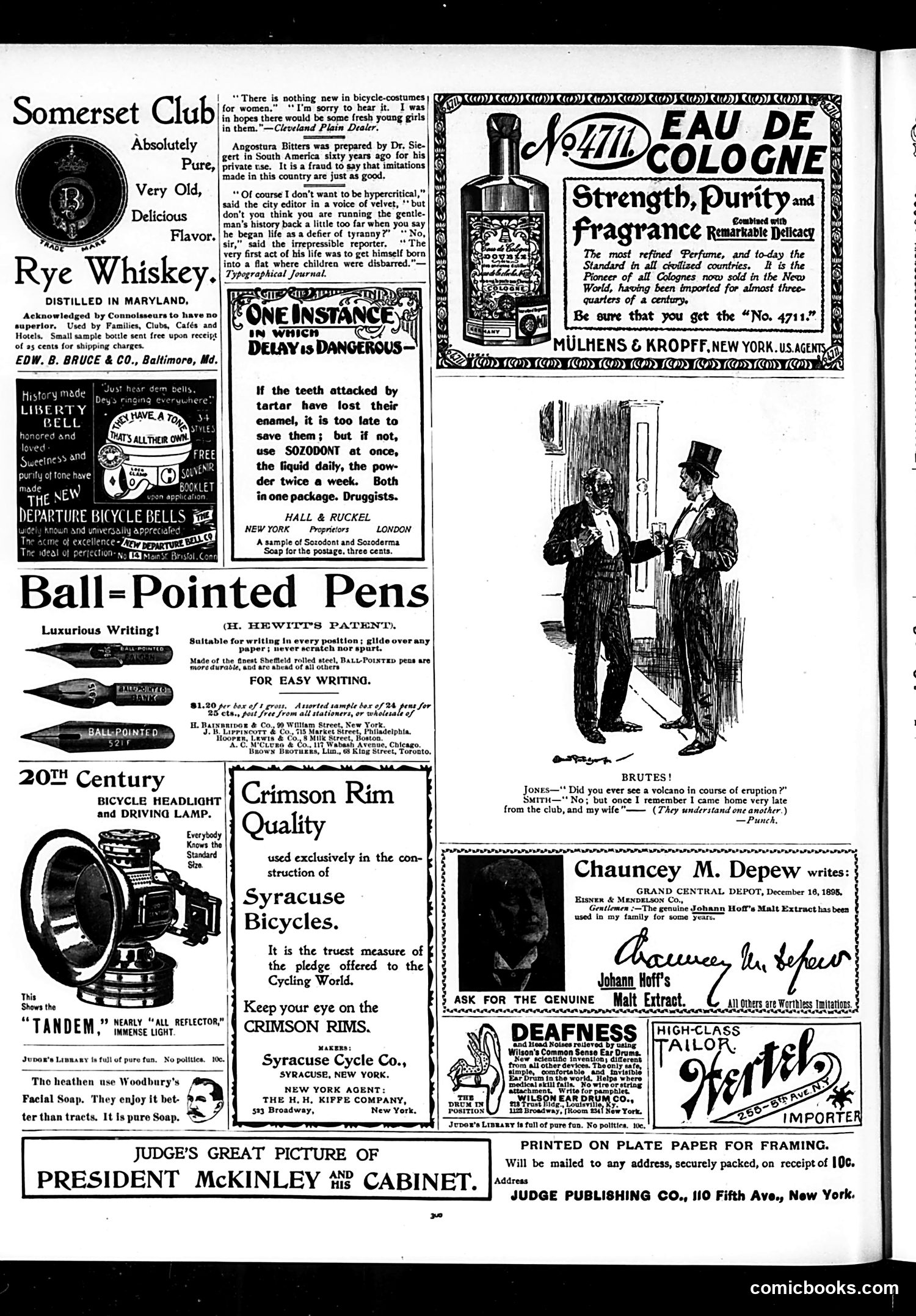
This page is primarily **advertising and filler content** rather than political satire. The dominant features are product advertisements (whiskey, pens, bicycles, cologne, soap) typical of early 1900s magazines. The one satirical cartoon present is titled "BRUTES!" — a domestic humor joke where a man tells his wife he once saw a volcano "in course of eruption," then clarifies he means his wife's anger when he came home late from his club. The humor relies on the era's domestic cliché of the nagging, temperamental wife. There is also a brief satirical quote about bicycle costumes for women, suggesting the (male) editor finds it disappointing that women's cycling outfits haven't become more revealing. The page's bottom advertises a picture of **President McKinley and his Cabinet**, suggesting this Judge issue dates to McKinley's presidency (1897-1901). However, no political commentary about McKinley appears on this particular page. Overall, this represents typical magazine filler: advertisements interspersed with mild, conventional domestic humor rather than substantive political satire.
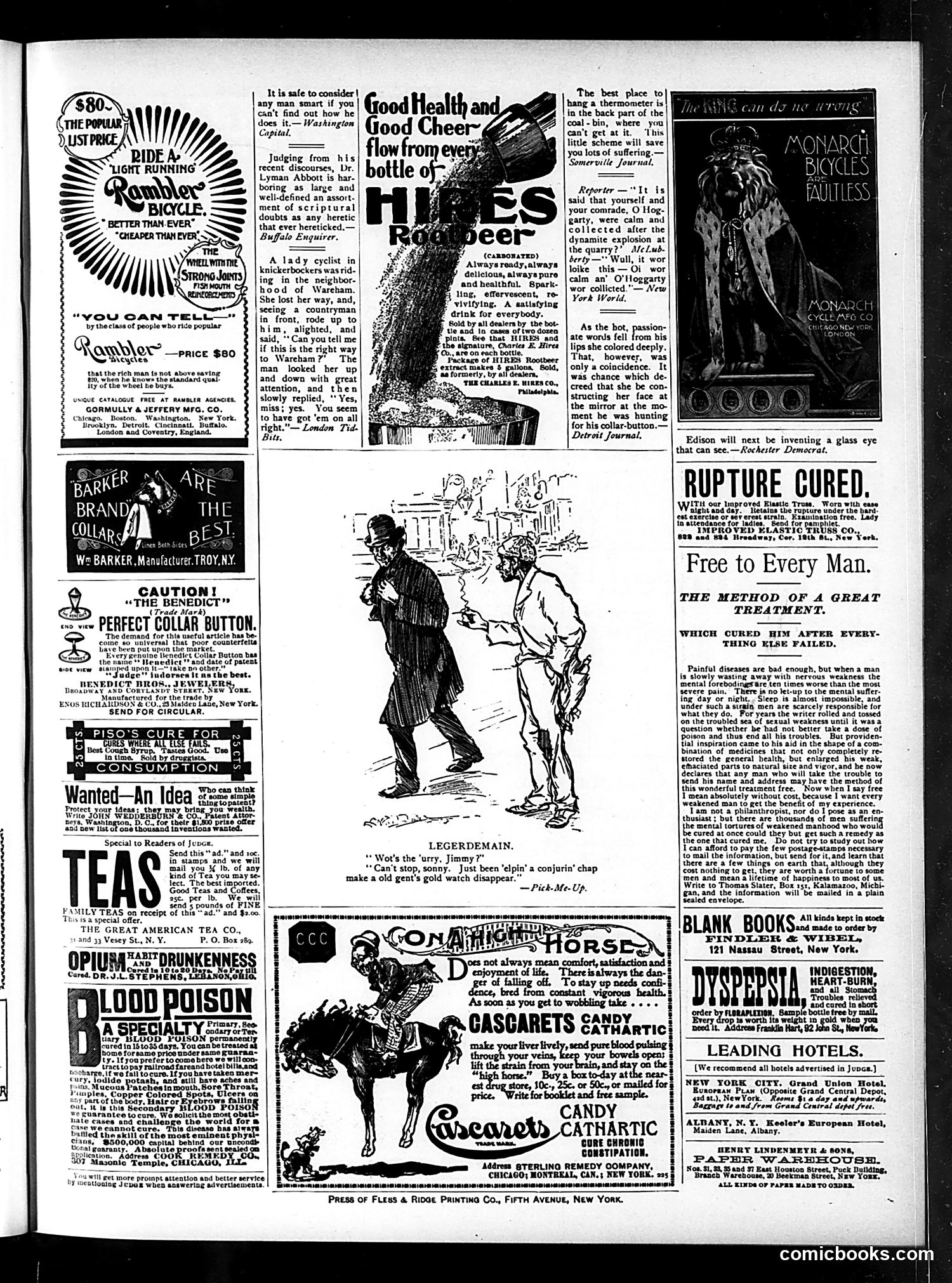
This page is primarily **advertising and humor snippets** rather than political cartoons. The main cartoon shows two figures labeled "Legerdermain"—a street conjurer confronting what appears to be a well-dressed man, with dialogue about a disappearing coin trick ("'Won't the coin disappear?'" / "'Can't stop, sorry. Just been 'slipt' a conjurin' chap'"). The satirical snippets are brief social commentary: jokes about Dr. Lyman Abbott's theological doubts, a reporter questioning quarry workers about their composure after a dynamite explosion, and Edison being mocked for inventing unnecessary devices. The bulk of the page comprises patent medicines, bicycle advertisements (Rambler brand), trusses for rupture treatment, tea offers, and treatments for venereal disease and alcoholism—typical of late 19th-century publications. These ads reveal period attitudes toward health and advertising practices rather than political satire. The page offers little sustained political commentary; it's representative of Judge's mixed editorial/advertising format.
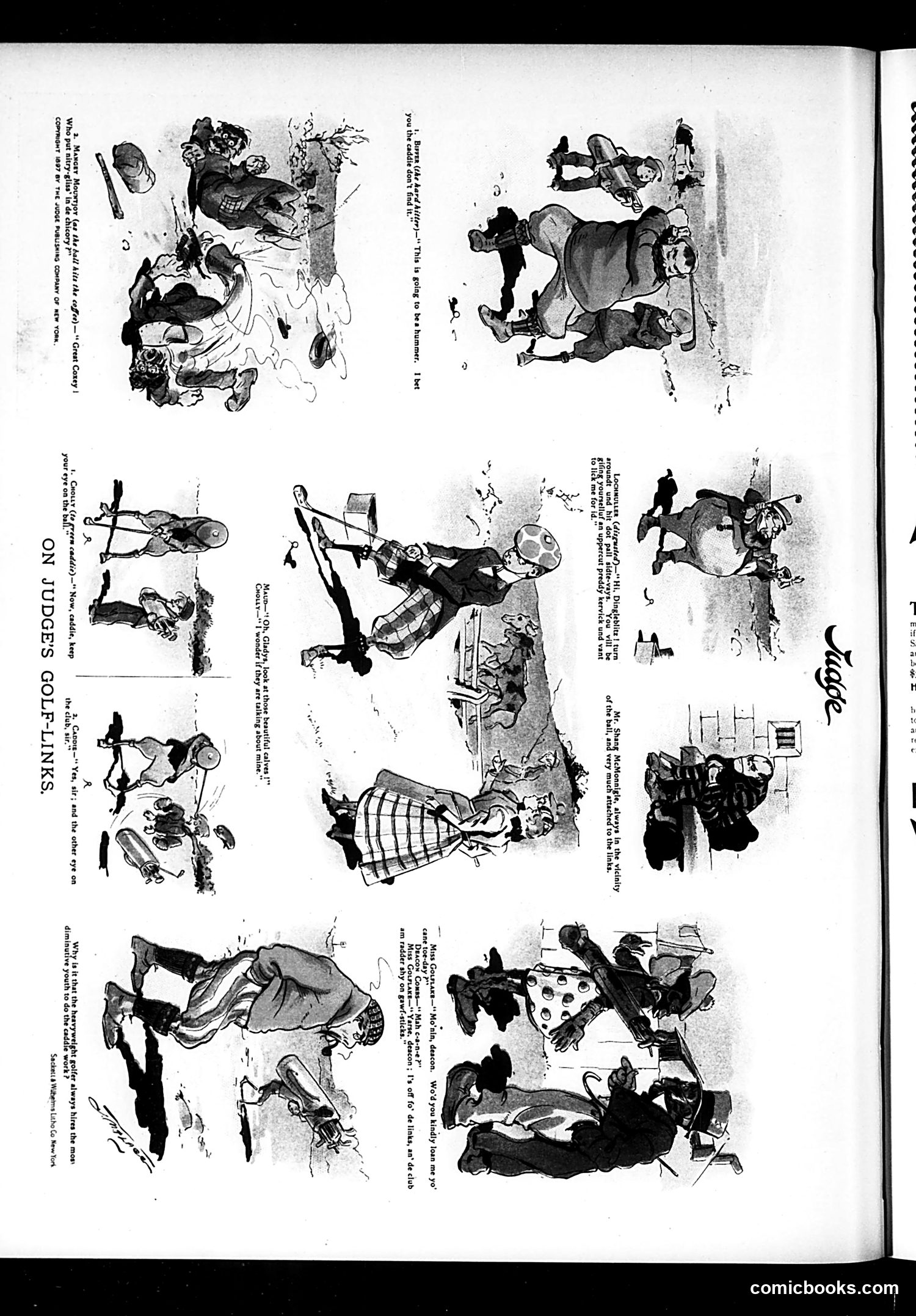
This page depicts satirical scenes from a golf outing, poking fun at golfers' behavior and the sport itself. The cartoons mock various golfing stereotypes: players making wild, inaccurate shots; the absurdity of hiring small caddies to carry clubs for large men; and the pretentious socializing surrounding the sport. References to "Coxey" suggest commentary on Coxey's Army (1894 labor march), possibly comparing golf's frivolity to serious social issues. The captions capture period dialect humor and exaggerated golfing mishaps—balls flying wildly, players making overconfident boasts about their drives. The overall satire critiques golf as an elite leisure activity where wealthy men engage in bungling incompetence while maintaining pompous attitudes. The page likely appeared during the 1890s golf boom in America, when the sport was gaining wealthy adherents and Judge regularly satirized upper-class pursuits and pretensions.
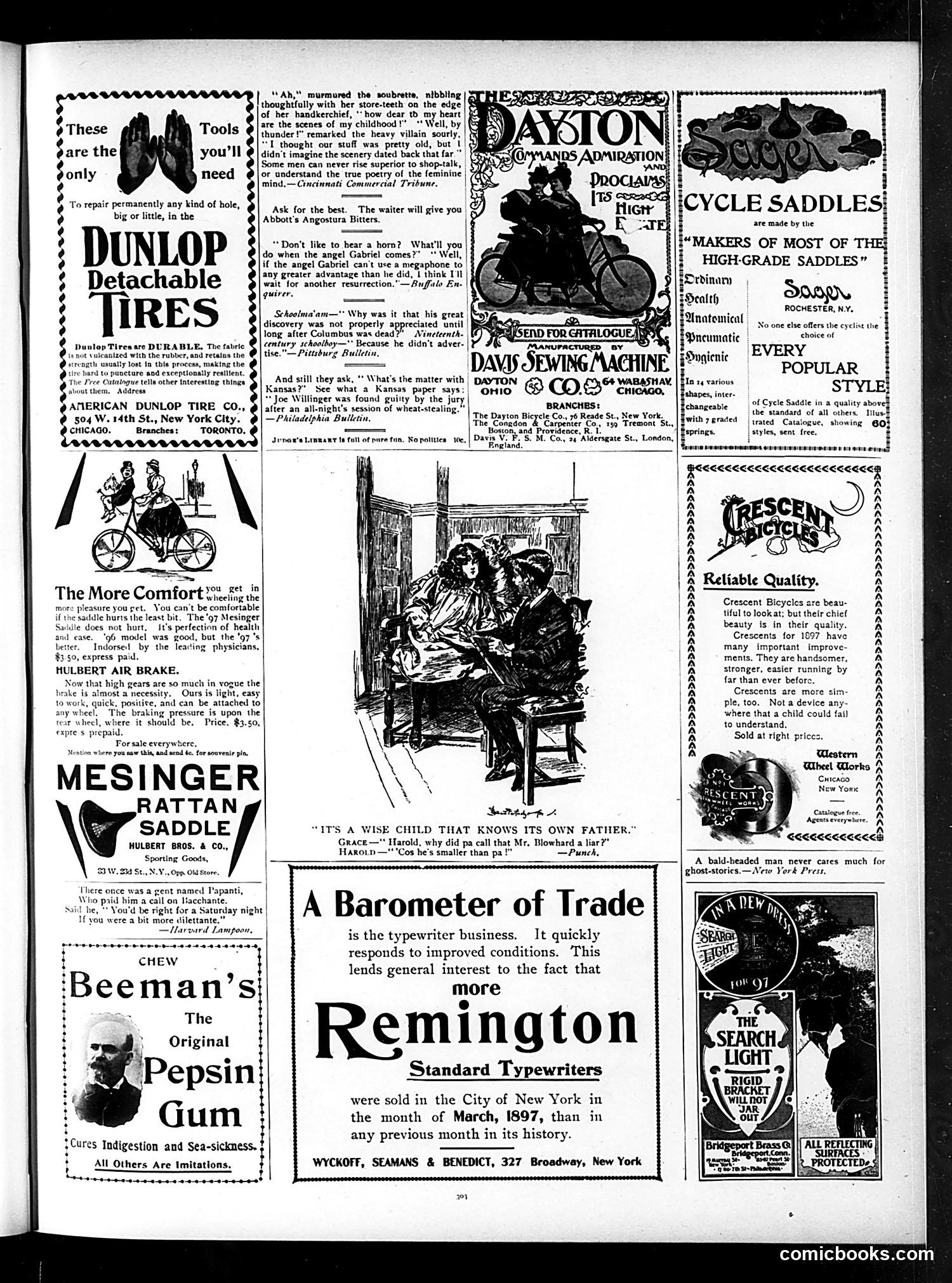
This is primarily an **advertising page** from Judge magazine, circa 1897, featuring bicycle/sporting goods ads interspersed with brief humorous anecdotes. The page contains **no significant political cartoons**. Instead, it showcases period humor: jokes about theater actors' antiquated scenery, Columbus's poor marketing, Kansas wheat theft, and a child's innocent logic about his father's honesty. These are mild, topical quips typical of Victorian-era magazines. The advertisements dominate—Dunlop tires, Dayton bicycles, Mesinger saddles, and Remington typewriters. One notable ad states Remington typewriters outsold competitors in March 1897, framing typewriter sales as a "barometer of trade." **Historical context**: This reflects the 1890s bicycle craze and emerging typewriter market. The humor is genteel rather than satirical—social commentary is absent. The page primarily served as revenue through ads, with light entertainment filler.
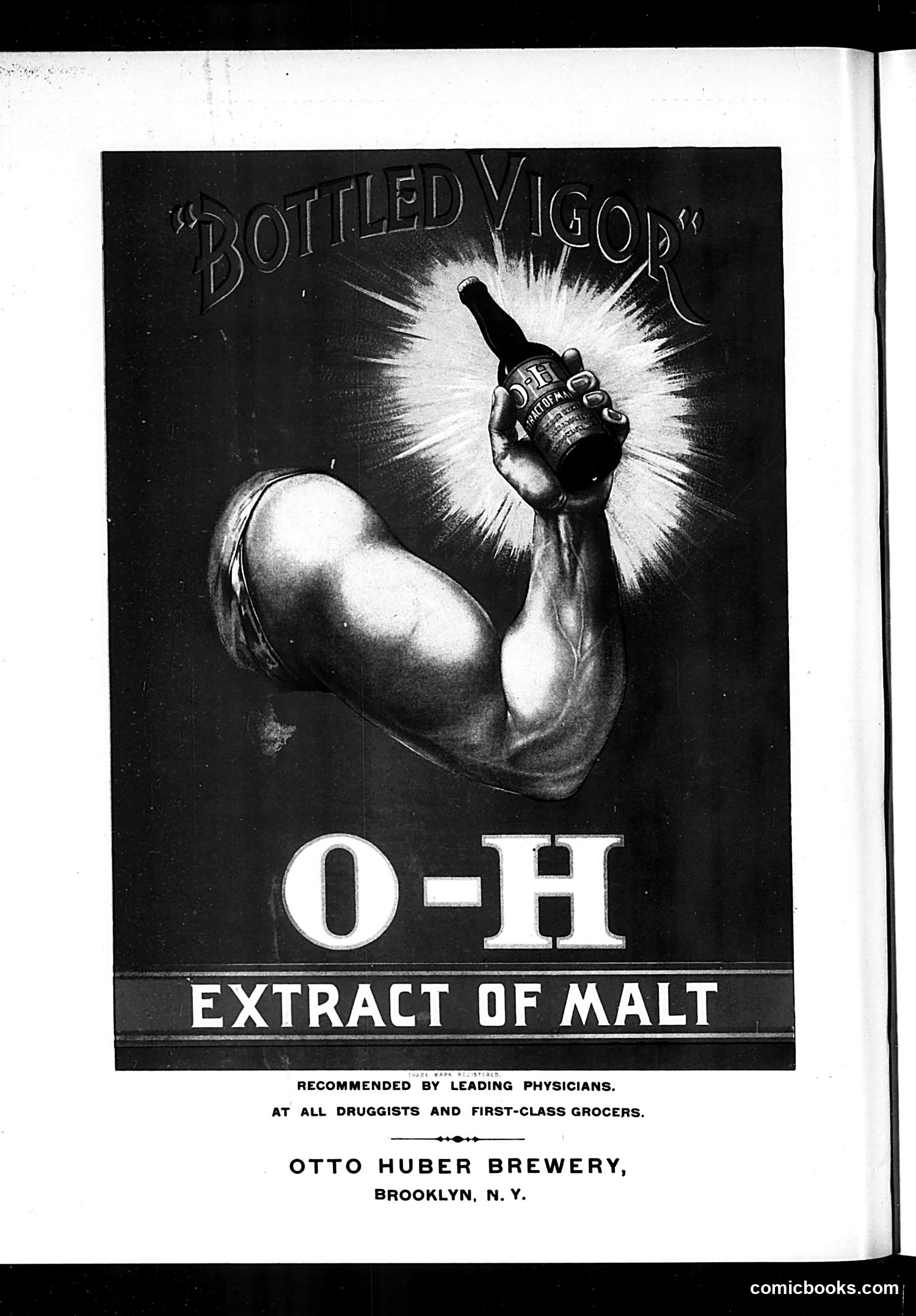
This is a **full-page advertisement**, not editorial content or satire. It promotes "O-H Extract of Malt," a malt extract product from Otto Huber Brewery in Brooklyn. The ad features a muscular male figure flexing and holding a bottle, with dramatic radiating lines emphasizing the product. The "Bottled Vigor" headline suggests the extract provided strength and vitality. This reflects **early 20th-century patent medicine marketing**: malt extracts were widely marketed as health tonics, often with dubious medical claims. The ad's claim that the product is "recommended by leading physicians" and sold at drugstores alongside groceries was typical of the era, when such products occupied a gray area between food and medicine—many later proved ineffective or harmful. The muscular imagery sells an implicit promise of physical vigor and masculine strength.