
A complete issue · 16 pages · 1897
Judge — April 17, 1897
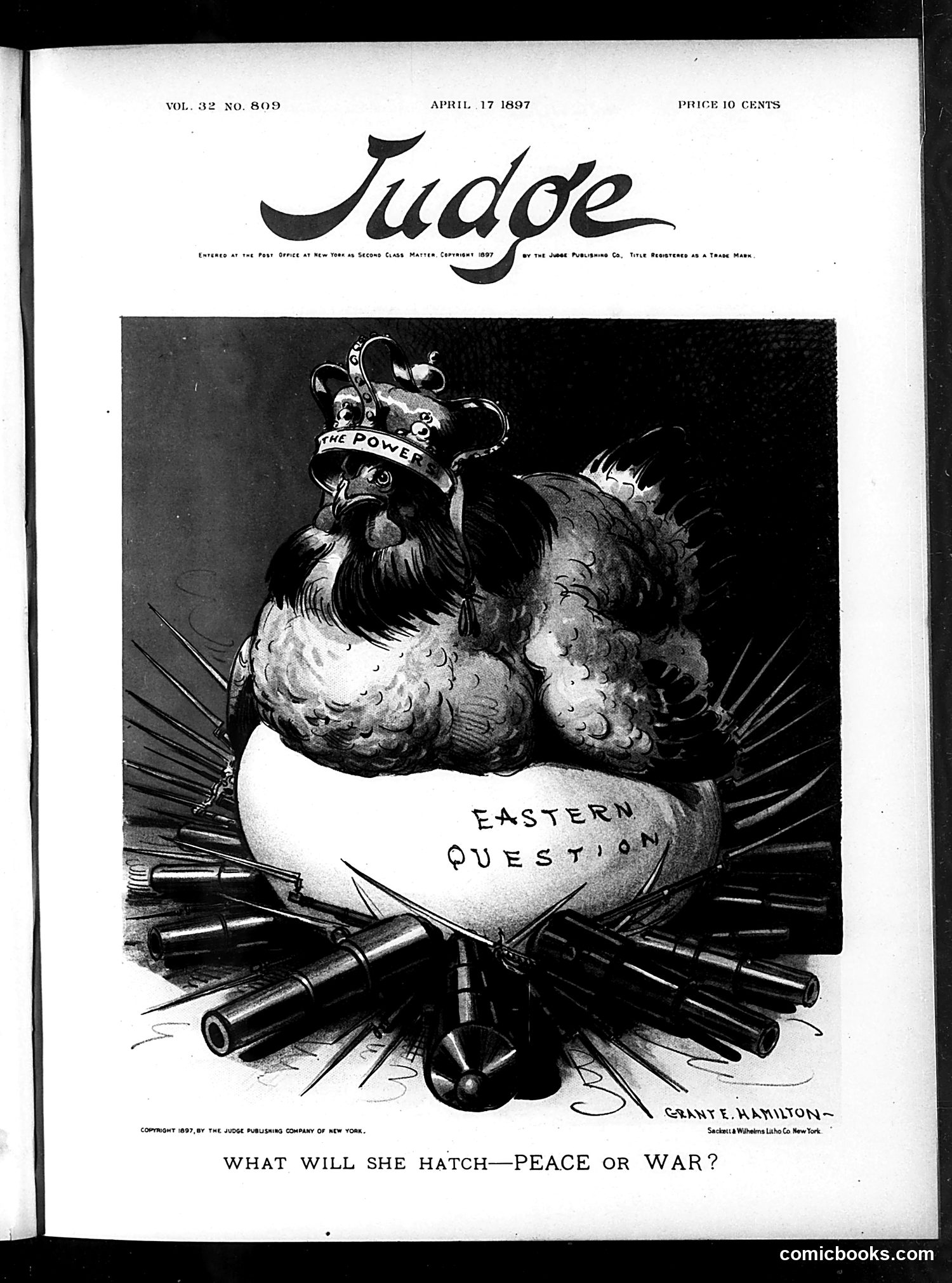
This Judge magazine cover from April 17, 1897 depicts an egg labeled "Eastern Question" being sat upon by a figure wearing a crown labeled "The Power," with ammunition surrounding the base. The cartoon addresses the **Eastern Question**—the ongoing geopolitical crisis concerning Ottoman Empire decline and European powers' competing interests in the Middle East and Balkans. The figure represents imperial/colonial powers (likely a composite of European nations) incubating potential conflict in the region. The egg symbolizes an unstable situation about to "hatch," while the ammunition imagery emphasizes military tension. The caption "What Will She Hatch—Peace or War?" questions whether imperial intervention will produce peaceful resolution or armed conflict. This reflects 1890s anxieties about great-power competition destabilizing the Eastern Mediterranean.
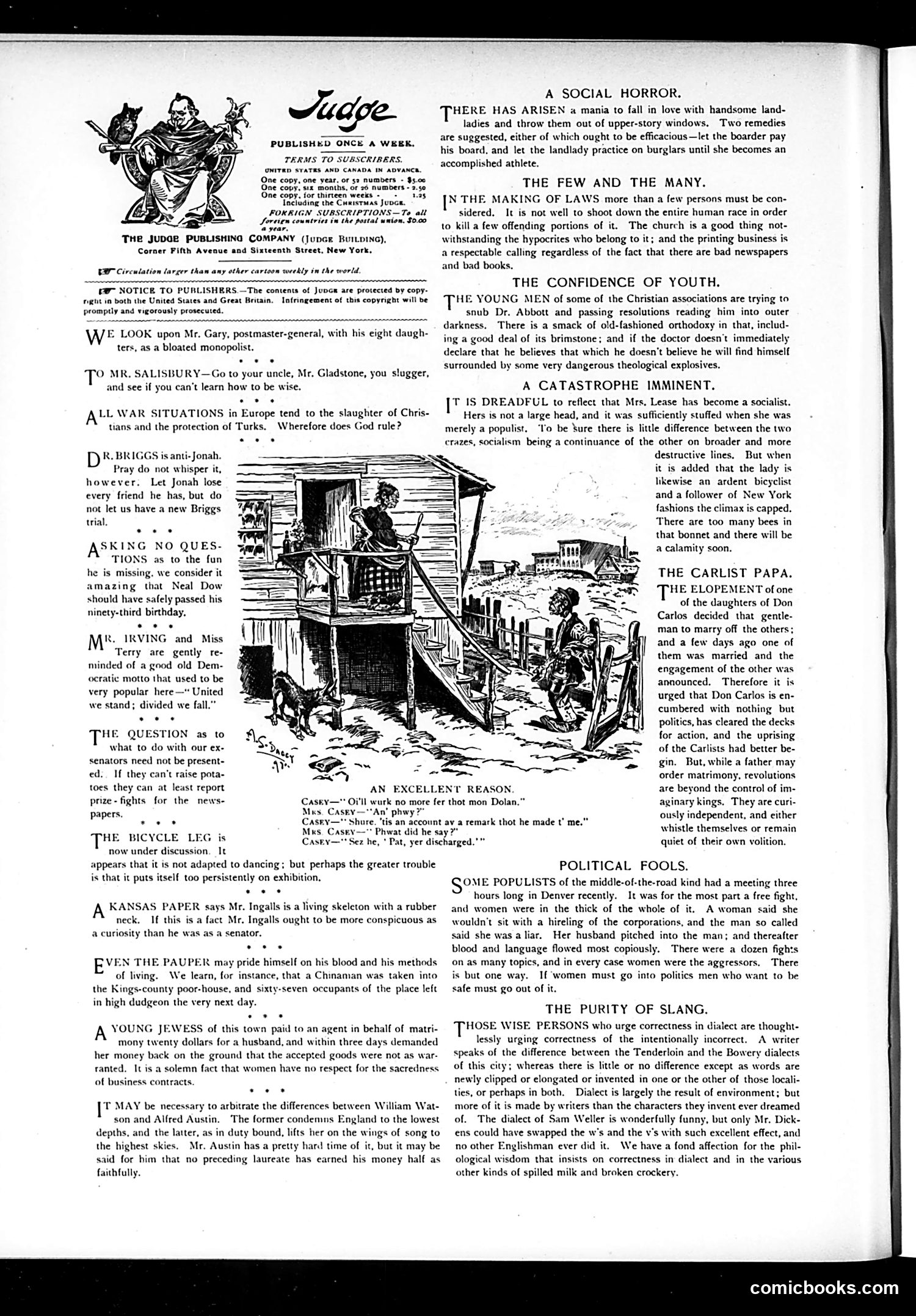
The central cartoon depicts a poor family in a makeshift dwelling, illustrating the caption "AN EXCELLENT REASON." The dialogue suggests economic desperation—a couple discussing their inability to afford proper housing or sustenance. The surrounding text columns address contemporary social issues: socialism (Mrs. Lease's political activities), youth movements challenging established religion, Carlist politics in Spain, populism and political rallies, and dialect/slang in literature. The overall theme critiques late 19th-century social upheaval—radical political movements, economic inequality, and cultural debates. Judge, a Republican satirical magazine, appears skeptical of socialist and populist movements while mocking both radical reformers and political elites equally. The cartoon's subject family represents the human cost of these abstract political conflicts.
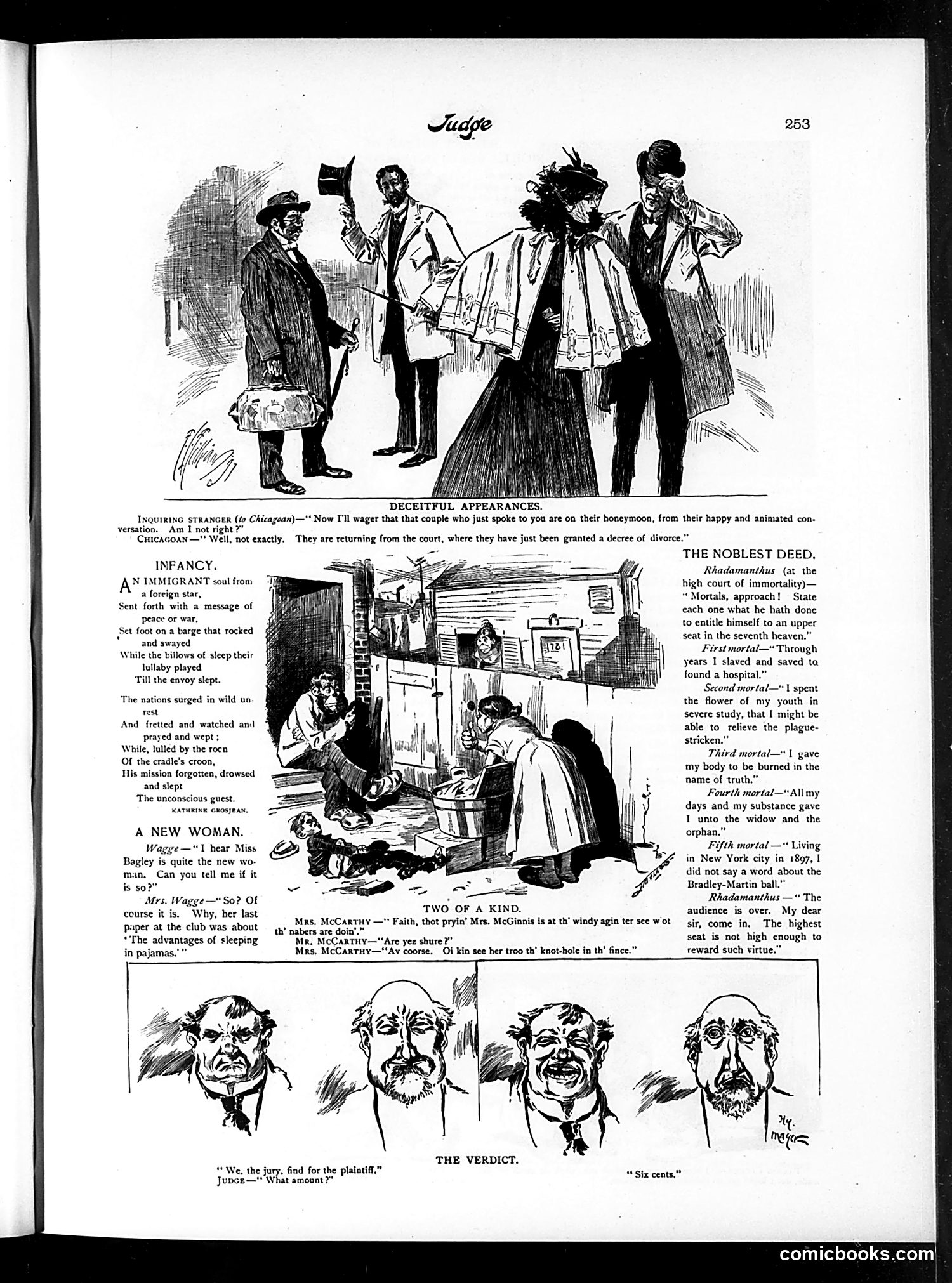
This page contains several satirical sketches typical of Judge's humor: **"Deceitful Appearances"** mocks a divorcing couple returning from court, presenting a facade of happiness to others while having just obtained a divorce decree. **"Infancy"** is a sentimental poem about an immigrant child. **"A New Woman"** features dialogue between Mrs. Wagge and Bagley about Miss Bagley being "quite the new man"—satirizing women adopting masculine behaviors or independence, a contemporary social concern. **"Two of a Kind"** shows Mrs. McCarthyy and Mrs. McGinniss gossiping about each other's appearance in cutting terms. **"The Verdict"** displays four jury members' facial expressions concluding with "Six cents"—likely mocking a trivial lawsuit judgment. The cartoons reflect turn-of-century anxieties about changing gender roles and social propriety.
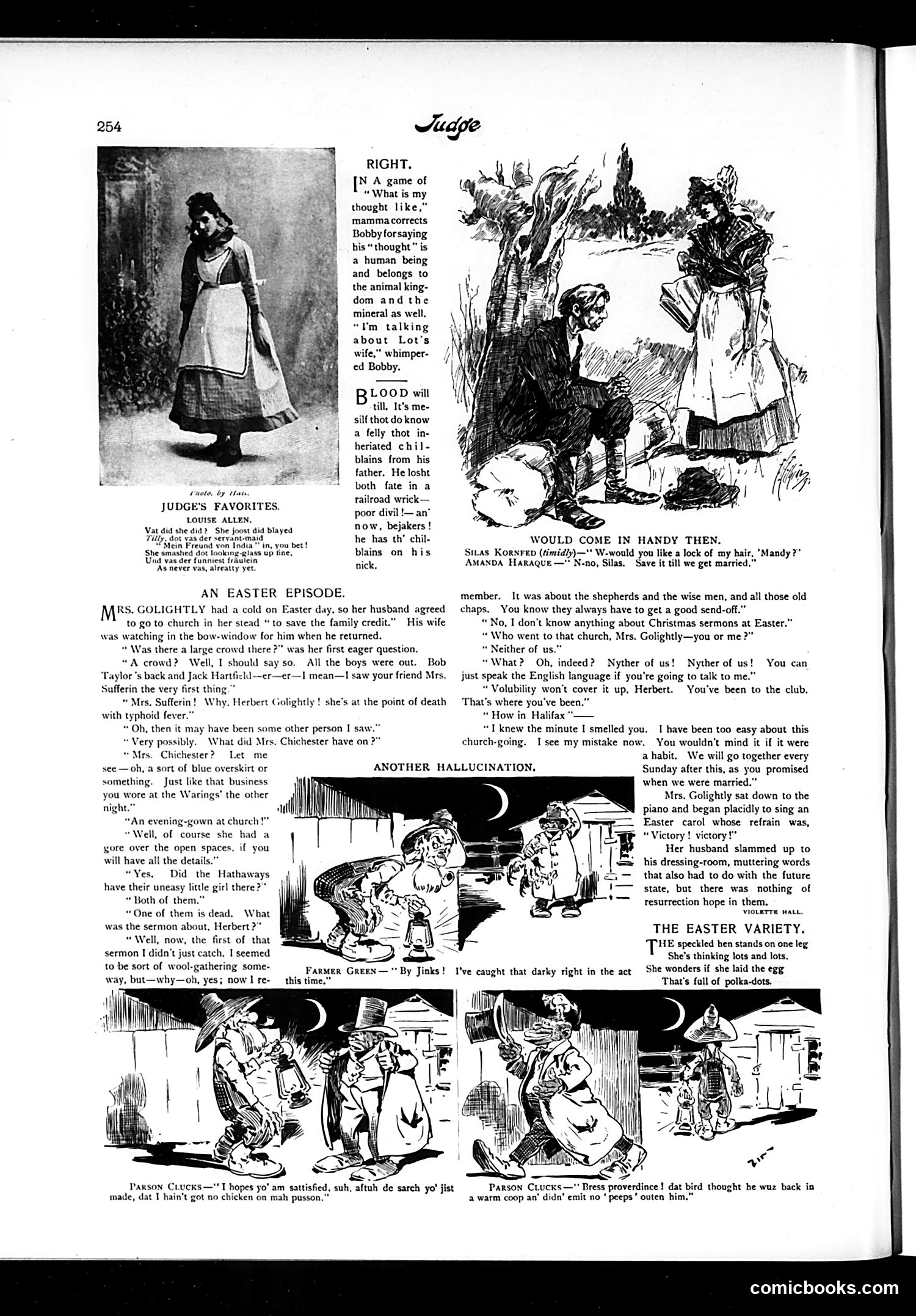
This page contains several brief satirical sketches typical of Judge's humor around Easter time (early 20th century). **"Judge's Favorites"** celebrates actress Louise Allen's comedic performance in a play, likely a German-accented farce. **"An Easter Episode"** satirizes a husband caught lying about attending church. Mrs. Golightly sent her husband to services while she stayed home sick. His increasingly implausible excuses—claiming to see people who are dead or absent, misremembering the sermon's details—expose his actual visit to the club instead. The joke targets male hypocrisy and the social pretense of church attendance for "family credit." **"Another Hallucination"** and related farm sketches offer light humor about rural characters and animals (a farmer catching a servant, a mule's confusion about location). **"The Easter Variety"** closes with a whimsical poem about a hen laying a speckled egg, pure nonsense humor unrelated to Easter's religious meaning. The overall tone mocks social pretense and marital deception rather than commenting on serious political issues.
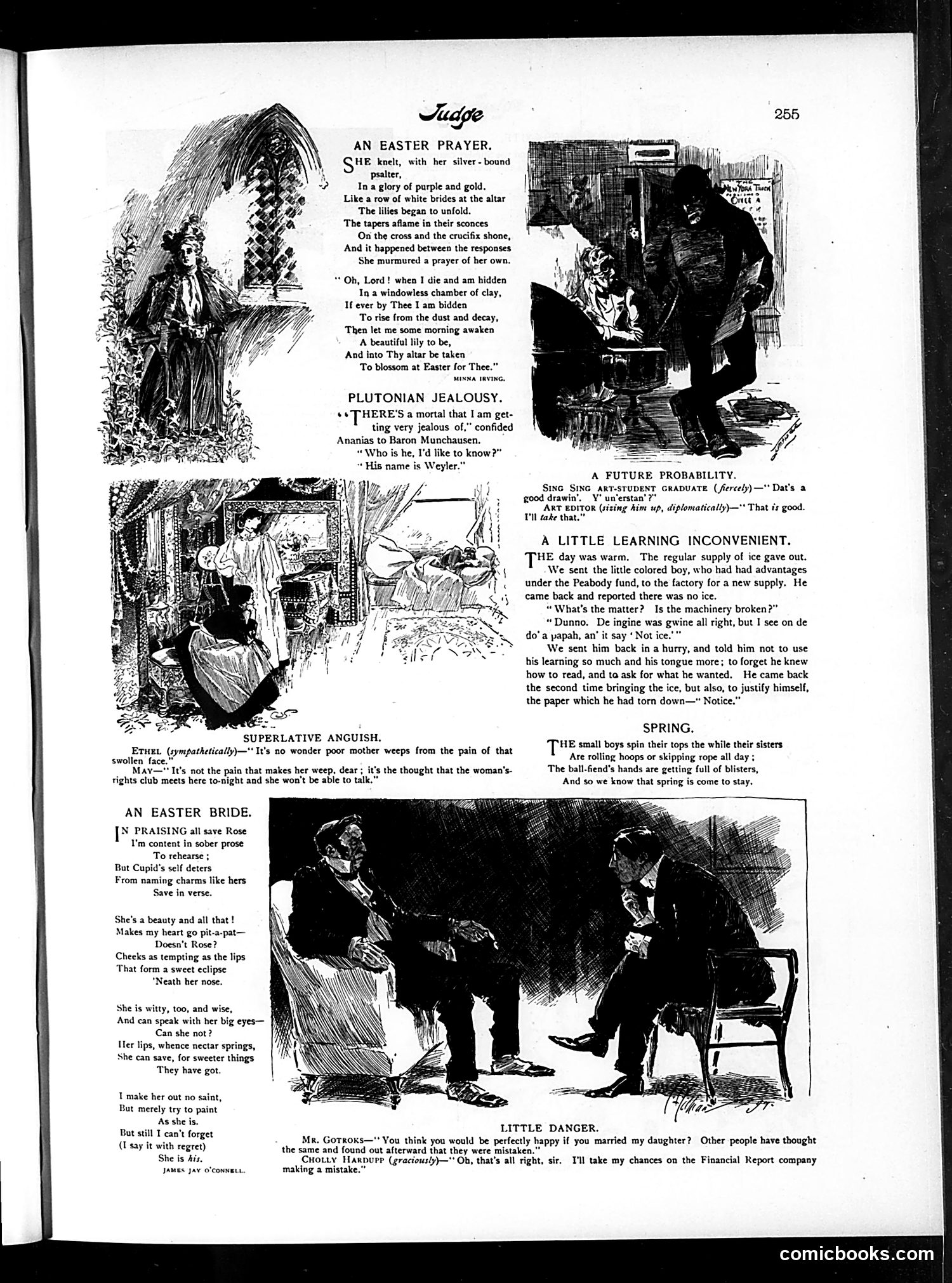
This page contains several satirical pieces typical of late 19th-century American humor: **"Plutonian Jealousy"** references Weyler, likely General Valeriano Weyler, Spanish military commander in Cuba during the 1890s independence war. Ananias and Baron Munchausen (mythical liars) are jealous of his reputation—satirizing Weyler's notoriety for brutal tactics. **"A Little Learning Inconvenient"** mocks the unintended consequences of educating African Americans. A Black boy educated through the Peabody Fund reads a "Not ice" sign (misreading "Notice"), creating workplace confusion. The satire critiques both the boy's misapplication of literacy and implies education itself causes problems. **"Superlative Anguish"** jokes that a woman's real distress isn't her swollen face, but missing her women's rights club meeting—mocking the women's suffrage movement as trivial. Other pieces are lighter romantic/seasonal verse with accompanying illustrations. The page reflects Judge's typical blend of political commentary and social satire from the Gilded Age era.
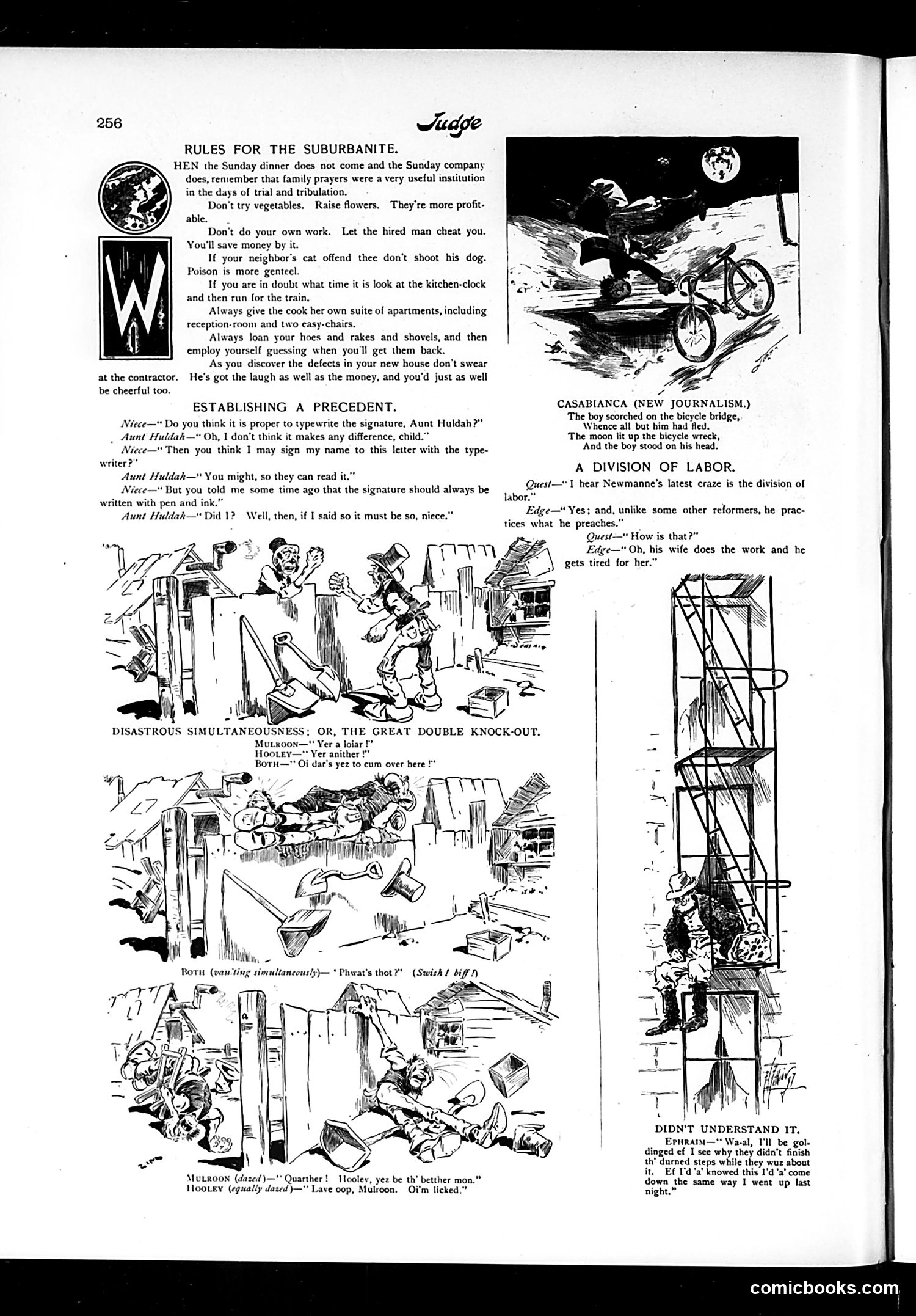
This page from *Judge* (a 19th-century American satirical magazine) contains several unrelated humorous pieces mocking contemporary social issues: **"Rules for the Suburbanite"** satirizes nouveau-riche suburban residents who affect pretension while cutting corners—advising they hire help, loan tools they'll never recover, and accept contractor fraud cheerfully. It's social commentary on the rising middle class. **"Establishing a Precedent"** jokes about Aunt Huldah's logical inconsistency: she contradicts her own etiquette rules when pressured, suggesting older generations lack genuine principles. **"Disastrous Simultaneousness"** depicts slapstick violence—two men repeatedly hitting each other with building materials. **"Casabianca (New Journalism)"** parodies sensationalist newspaper reporting by presenting a bicycle accident with mock-heroic language, mocking both the boy's mishap and overwrought news coverage. **"A Division of Labor"** makes a marriage joke: a man's "labor reform" means his wife works while he gets tired. **"Didn't Understand It"** features rural dialect humor about incomplete stairs—a misunderstanding played for laughs.
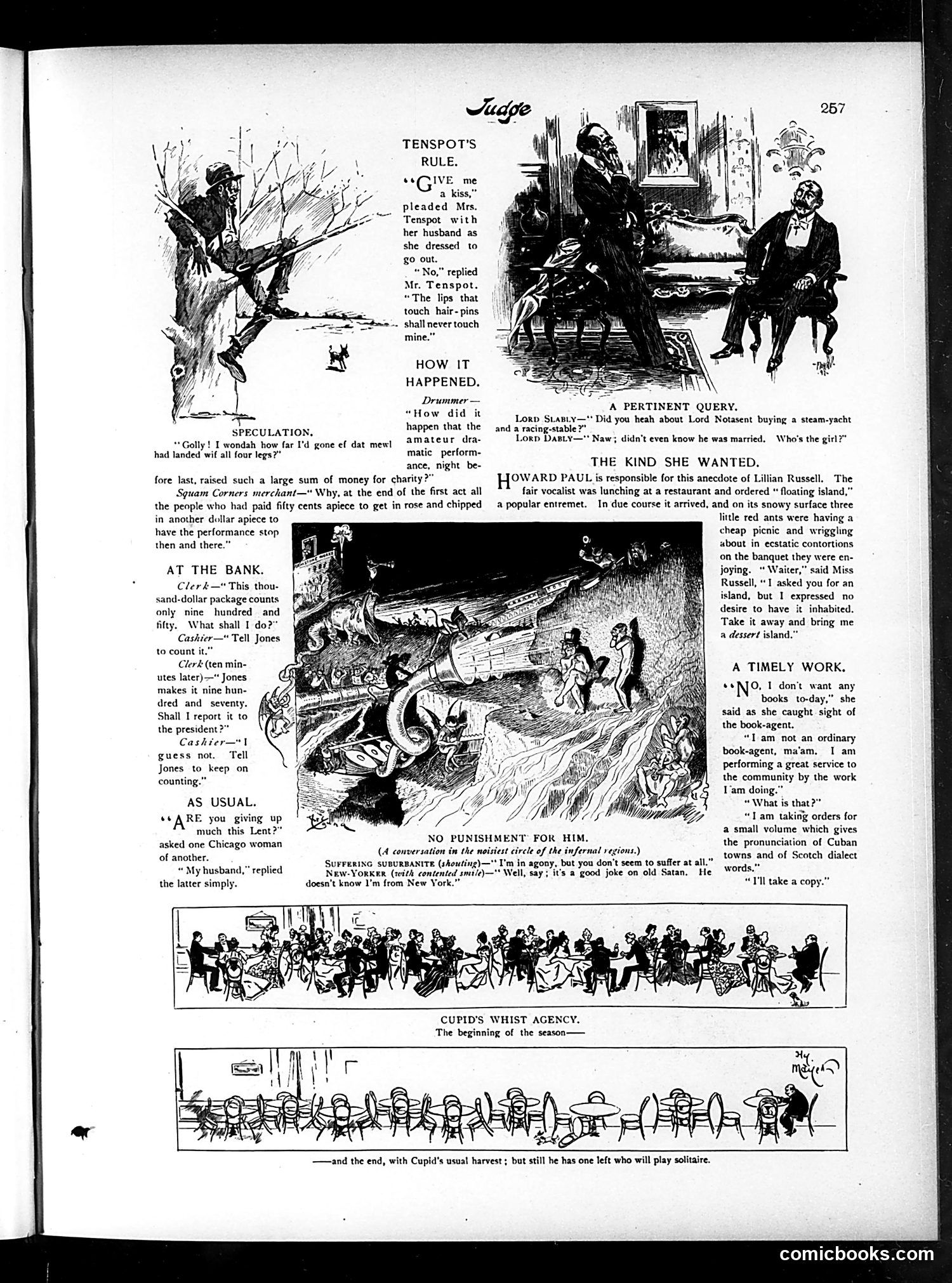
This page from Judge contains multiple satirical vignettes mocking American social foibles circa early 1900s: **"Tenspot's Rule"** jokes about marital affection—a husband refuses his wife a kiss, claiming lips touching hairpins shouldn't touch his. **"At the Bank"** satirizes institutional dishonesty: a clerk reports a thousand-dollar discrepancy; the cashier instructs him to keep recounting until the numbers match, implying casual embezzlement. **"No Punishment for Him"** contrasts a suffering suburbanite in Hell with an untroubled New Yorker, suggesting New Yorkers are so hardened by urban life that even damnation feels familiar—a dig at New York cynicism. **"The Kind She Wanted"** features the famous soprano Lillian Russell complaining about ants on her "floating island" dessert, punning on the dish's name. **"Cupid's Whist Agency"** depicts a dating/matchmaking service, with the final panel showing one woman playing solitaire—she remains unmarried while others pair off. The page reflects early 20th-century middle-class anxieties about money, marriage, and urban corruption.
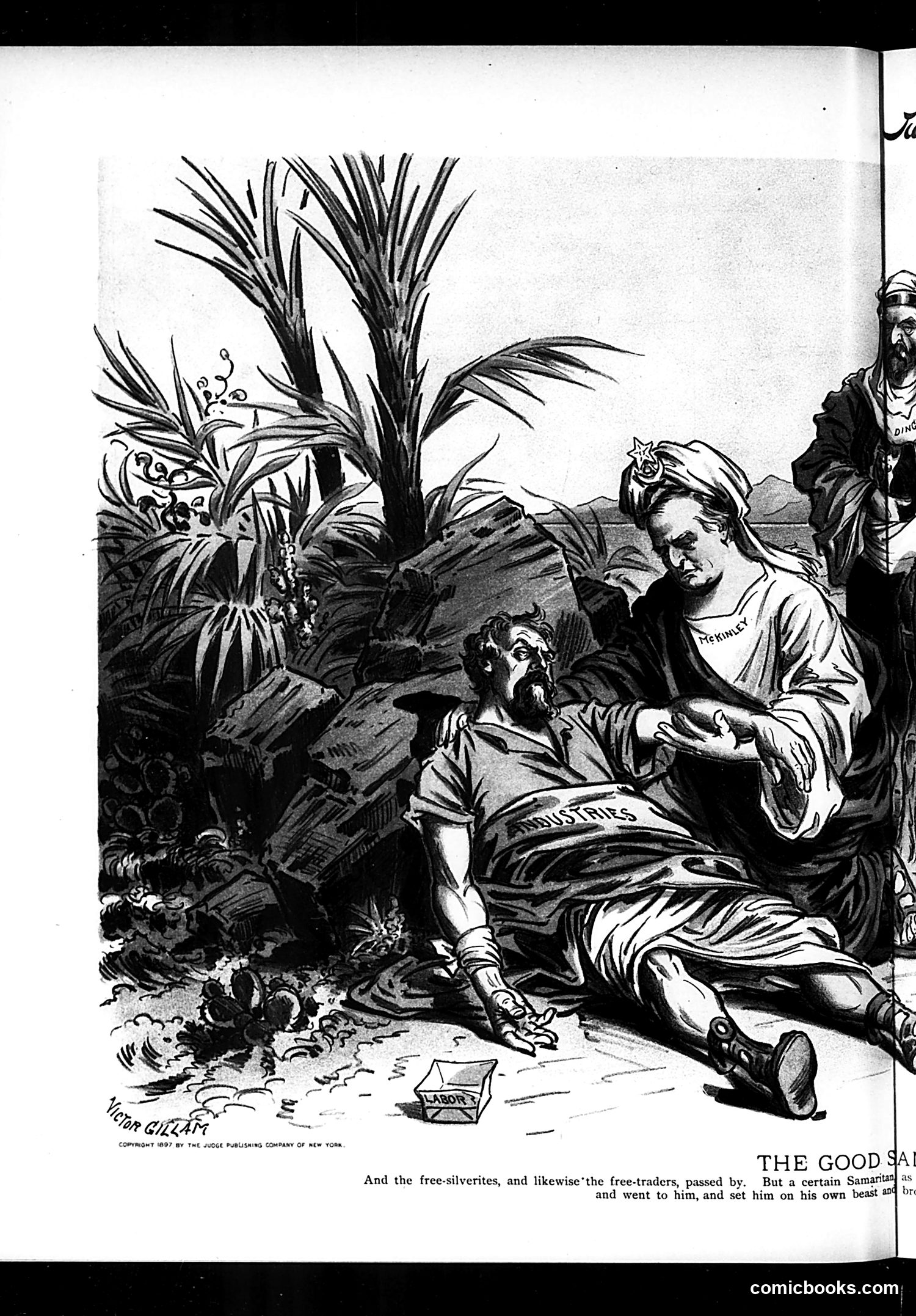
This cartoon appears to reference the biblical parable of the Good Samaritan, recontextualized as political satire. The injured man labeled "LABOR" lies by the roadside while "free-silverites" and "free-traders" pass by indifferently. A woman (likely representing a sympathetic political faction) tends to him. The satire critiques late-19th-century political movements—free silver advocates and free traders—for neglecting working-class interests during economic hardship. The Samaritan figure represents whoever the cartoonist believed actually helped laborers (likely protective tariff supporters or another faction). The exotic setting and palm trees suggest this addresses broader economic debates of the Gilded Age era.
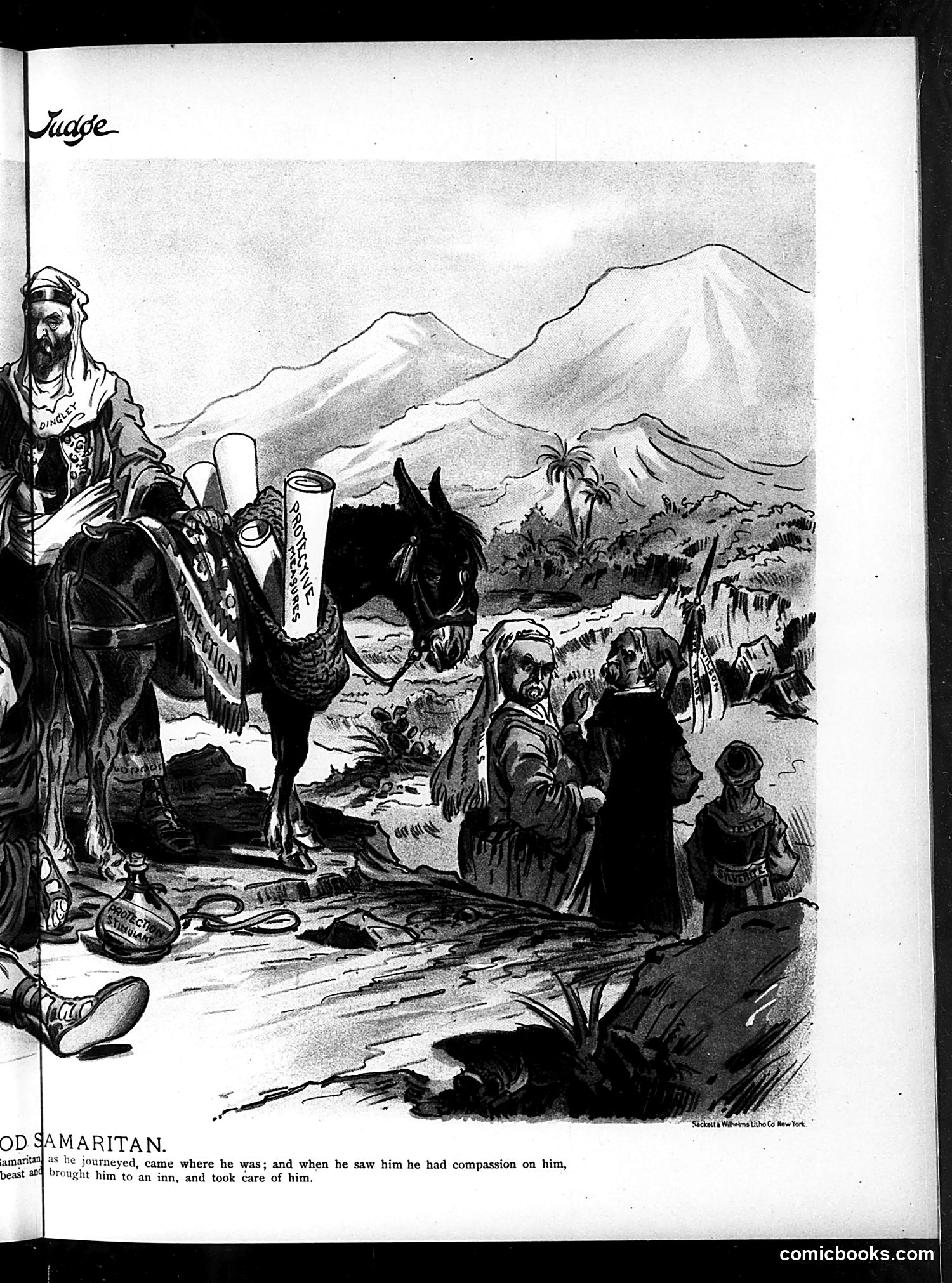
This cartoon illustrates the Biblical parable of the Good Samaritan. The image shows an Oriental/Middle Eastern figure (depicted in period costume with a distinctive headwrap) encountering injured or distressed people on a road, with mountains in the background. The accompanying text references the Gospel story: a traveler shows compassion to a stranger in need, bringing him to shelter and providing care. The cartoon likely uses this religious allegory to comment on contemporary social issues—possibly critiquing American attitudes toward foreign peoples or immigrants, or advocating for charitable compassion toward vulnerable populations. The specific political reference remains unclear without publication date context, but Judge magazine typically employed such Biblical references to satirize American hypocrisy or indifference toward marginalized groups.
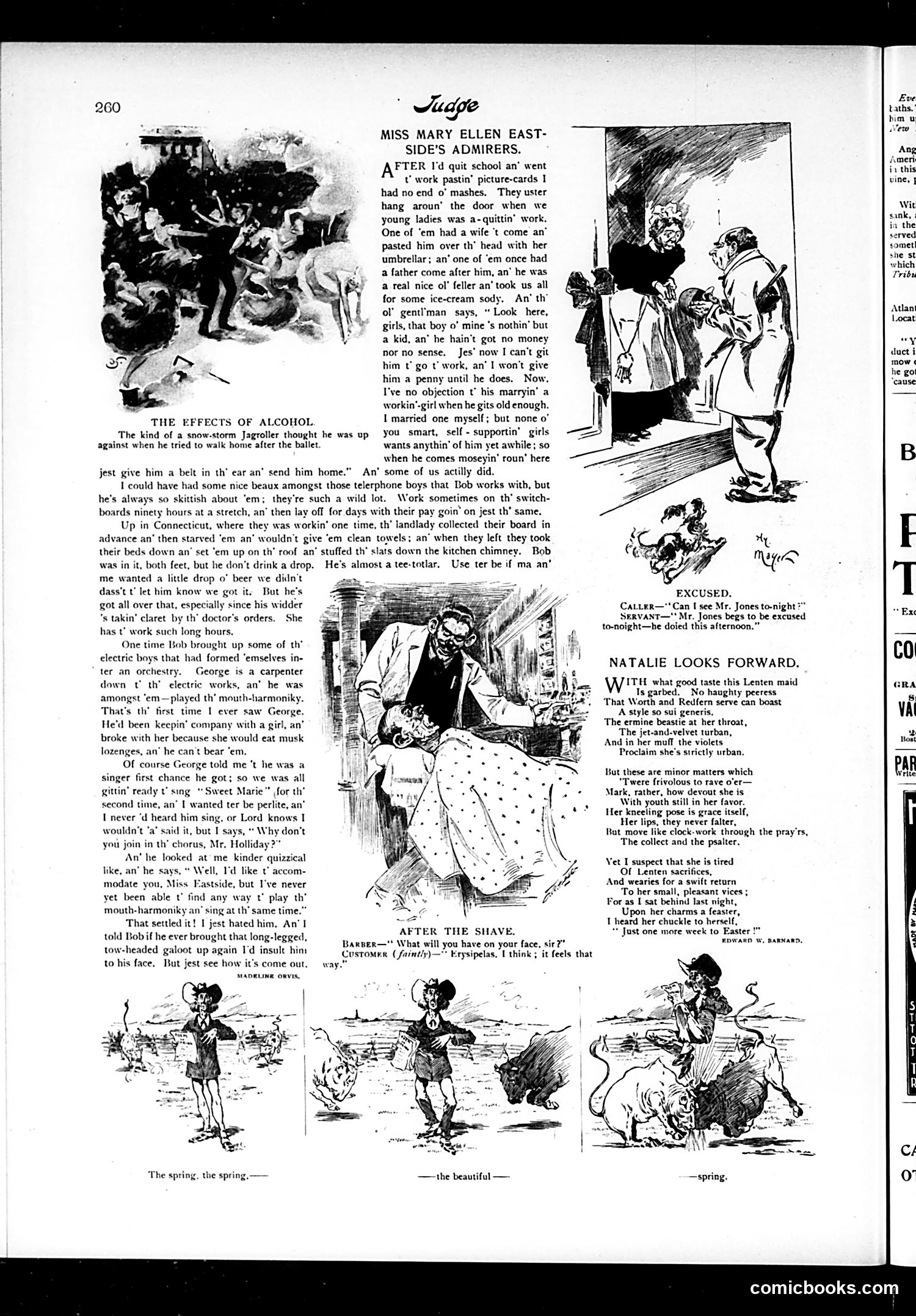
This page contains three distinct pieces of social commentary from Judge magazine (an American satirical weekly): **"Miss Mary Ellen Eastside's Admirers"** is a working-class monologue satirizing the romantic pursuits of young laborers—telephone operators, electricians, and switchboard workers. The humor mocks their modest circumstances, poor judgment, and excessive drinking, while also poking fun at a father's frank assessment that his lazy son has nothing to offer working girls. **"The Effects of Alcohol"** is a single-panel cartoon showing a drunk man struggling through snow, satirizing the physical and social consequences of drinking. **"Natalie Looks Forward"** is a poem mocking a fashionable woman's pretentious wardrobe choices during Lent—criticizing her ostentatious display of wealth (ermine, velvet, violets) while supposedly observing religious restraint. The satire targets class affectation and hypocrisy. Overall, the page critiques working-class behavior, alcoholism, and upper-class pretension—typical Judge magazine targets.
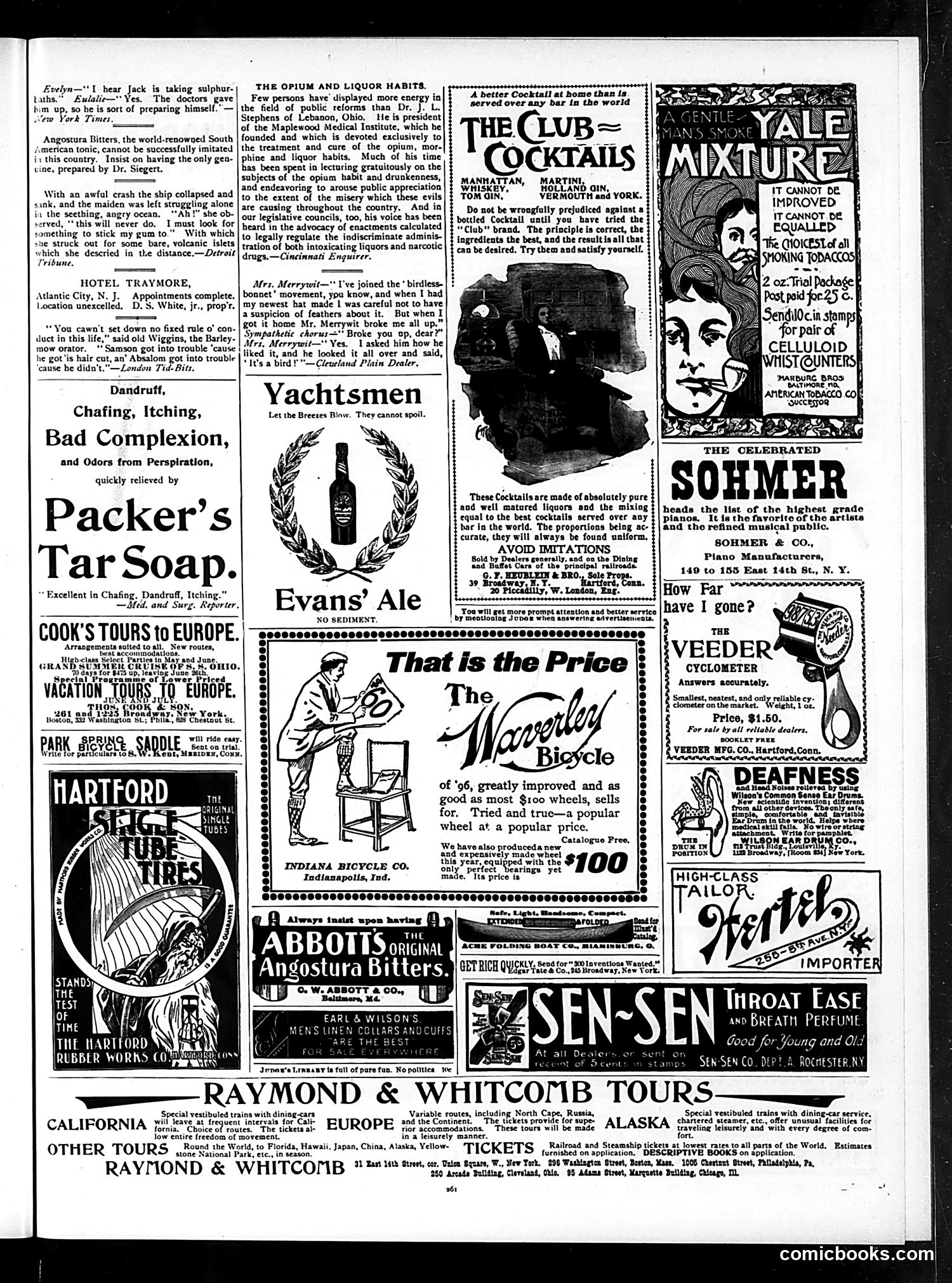
This page is primarily **advertising**, typical of Judge magazine's revenue model. The bulk consists of product advertisements for remedies, tours, bicycles, and beverages popular in the early 1900s. The few **editorial jokes** are brief asides: - A quip about a man taking sulfur baths after doctors gave up on him—mocking both hypochondria and dubious medical treatments - A absurdist story about a shipwrecked woman searching for something to stick gum to—pure nonsense humor The advertisements reveal period concerns: **dandruff and "perspiration odors,"** opium and alcohol addiction (Dr. Stephens' institute), remedies for various ailments. The "Club Cocktails" ad humorously promises better mixed drinks at home than bars offer. There are **no political cartoons** on this page. It represents Judge's practical function: satirical commentary mixed with commercial messaging for affluent readers of the era.
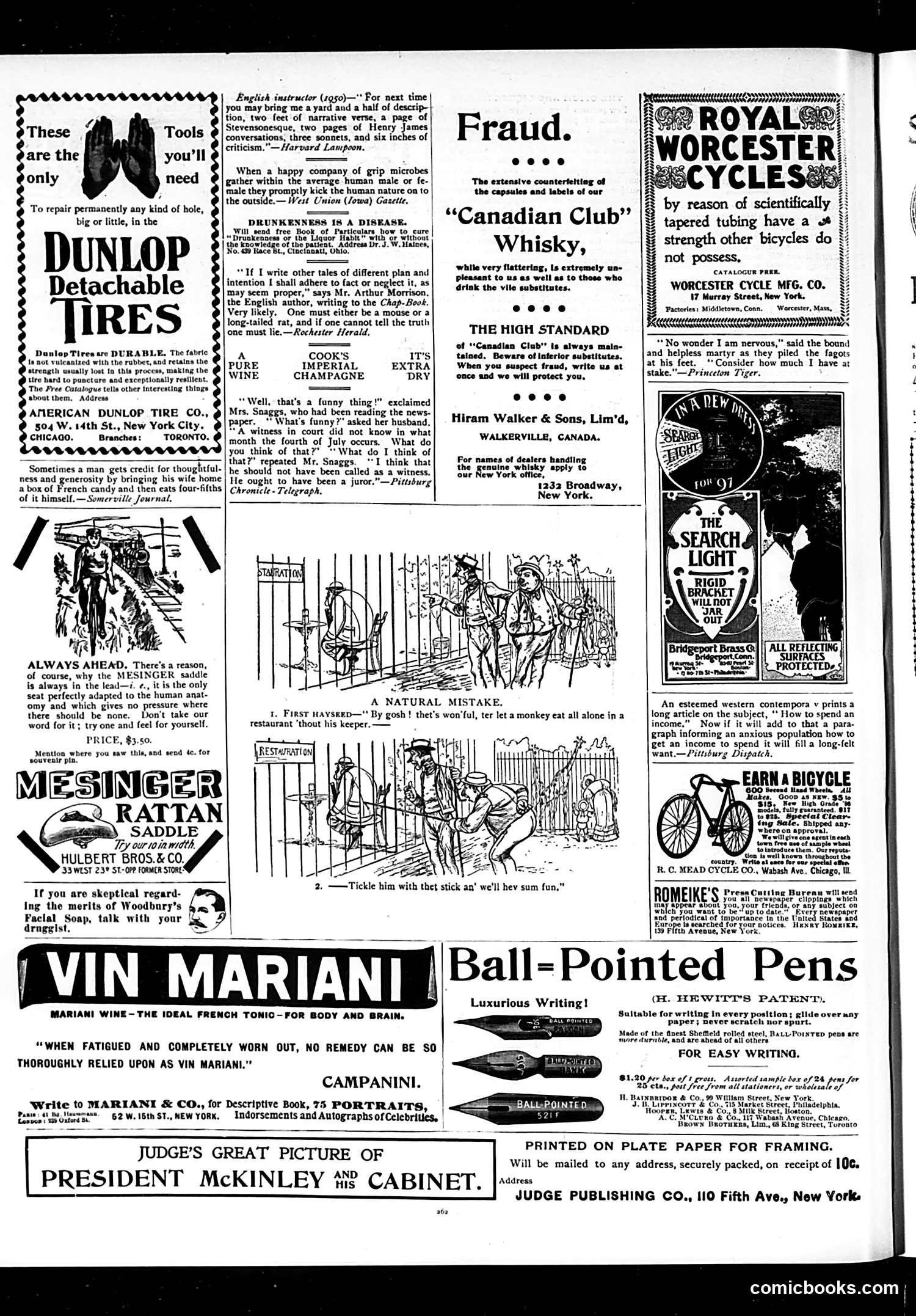
This two-panel cartoon satirizes rural/working-class ignorance. **Panel 1**: Two unsophisticated men ("hayseeds," marked by their dialect) observe a well-dressed man dining alone, which they find remarkable enough to discuss. **Panel 2**: One suggests tickling the diner with a stick "for fun"—revealing their assumption that the solitary gentleman must be intellectually diminished (possibly comparing him to an animal needing amusement). **The joke**: The cartoonist inverts expectations. The supposed "natural mistake" isn't the hayseeds' misreading of social class, but their casual cruelty disguised as amusement. The satire mocks working-class vulgarity and lack of refinement—typical Judge magazine content mocking rural, "uncivilized" Americans for educated urban readers.
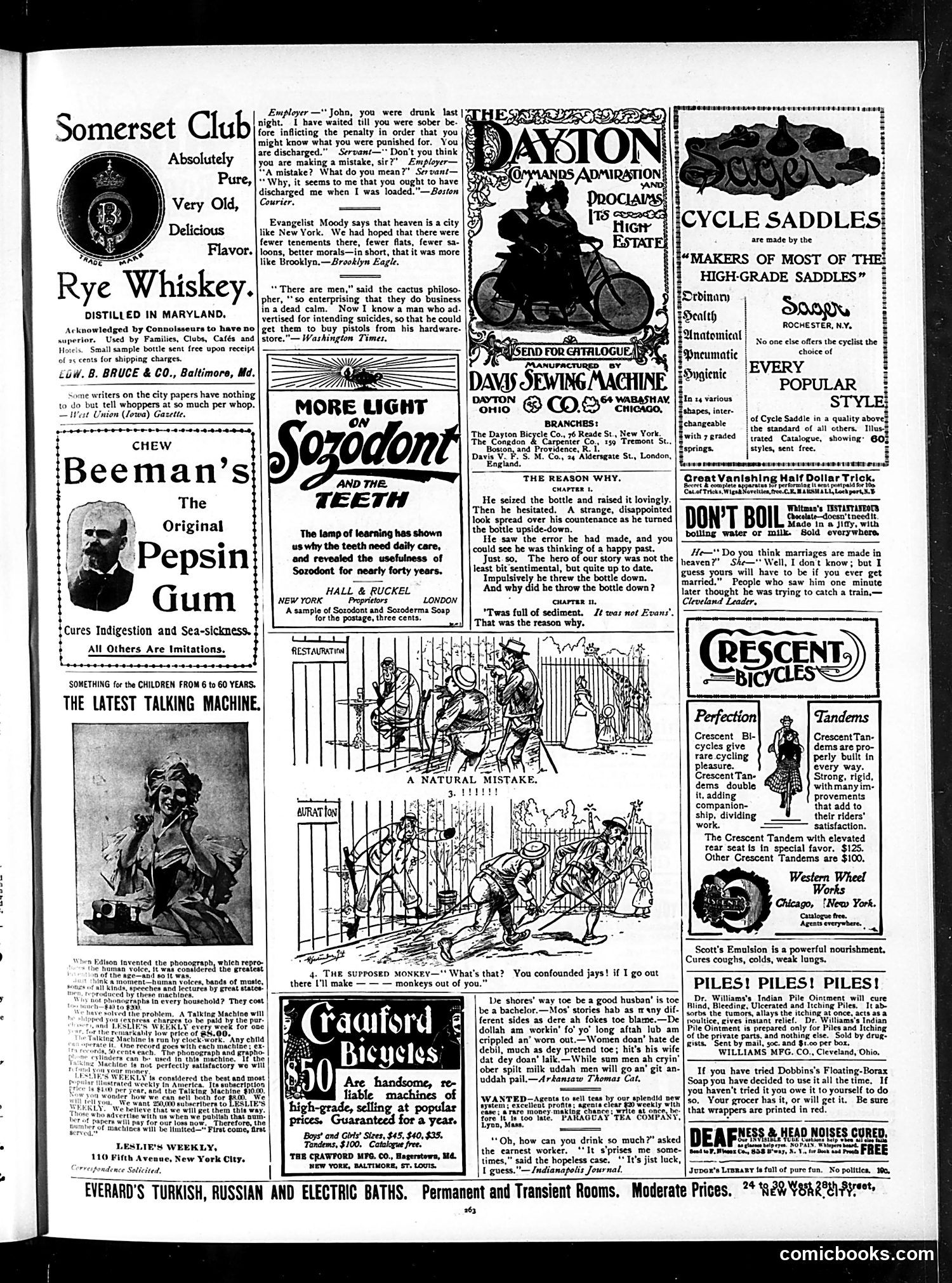
This page is primarily **advertisements and filler content** typical of Judge magazine, interspersed with brief satirical jokes rather than sustained political cartoons. The main humor pieces are short anecdotes: 1. **"Employer and Servant"**: A drunk servant argues he should have been fired while intoxicated, not sober—absurdist humor playing on the logic of consequences. 2. **"The Supposed Monkey"**: A two-panel narrative (visible in illustrations) about a man finding a bottle with sediment, mistaking it for something it's not, then throwing it down. The punchline references making "monkeys out of you"—period slang for fooling someone. 3. **Romance jokes**: Brief quips about marriage and courtship with sarcastic punchlines. The page also contains numerous product advertisements (whiskey, bicycles, sewing machines, talking machines) typical of 1890s-era magazines. There are no identifiable political figures or major satirical targets—this represents Judge's lighter, more comedic content rather than its editorial commentary.
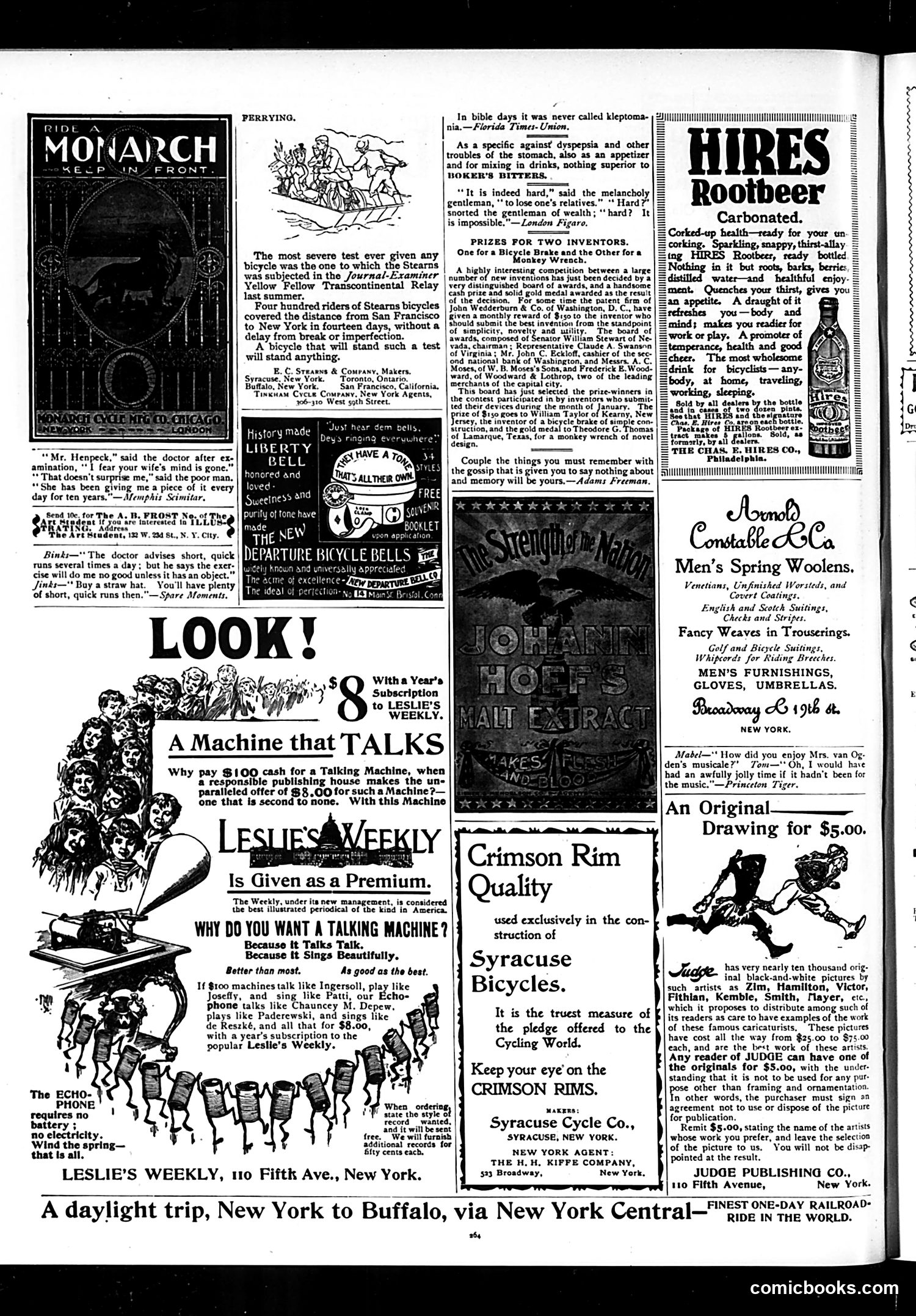
This is primarily an **advertising page** with minimal editorial content. The few cartoons present are brief, conventional jokes unrelated to current events: 1. **"Ferrying" cartoon** (top): A simple visual pun showing figures in a boat, accompanying a mild joke about wealthy relatives—no political significance. 2. **Doctor jokes** (middle): Two unrelated, generic humor items about a man's wife and exercise—standard filler content with no satirical intent. The page is dominated by **product advertisements** for bicycles (Stearns, Syracuse), talking machines (Edison phonographs), beverages (Hires Rootbeer, Boker's Bitters), and clothing (Arnold Constable woolens). There are also notices about Leslie's Weekly magazine subscription offers and a railway excursion. **No political satire or social commentary** appears on this page. It represents typical early-1900s magazine filler: generic humor, brand promotions, and business notices rather than the pointed editorial cartooning Judge was known for.
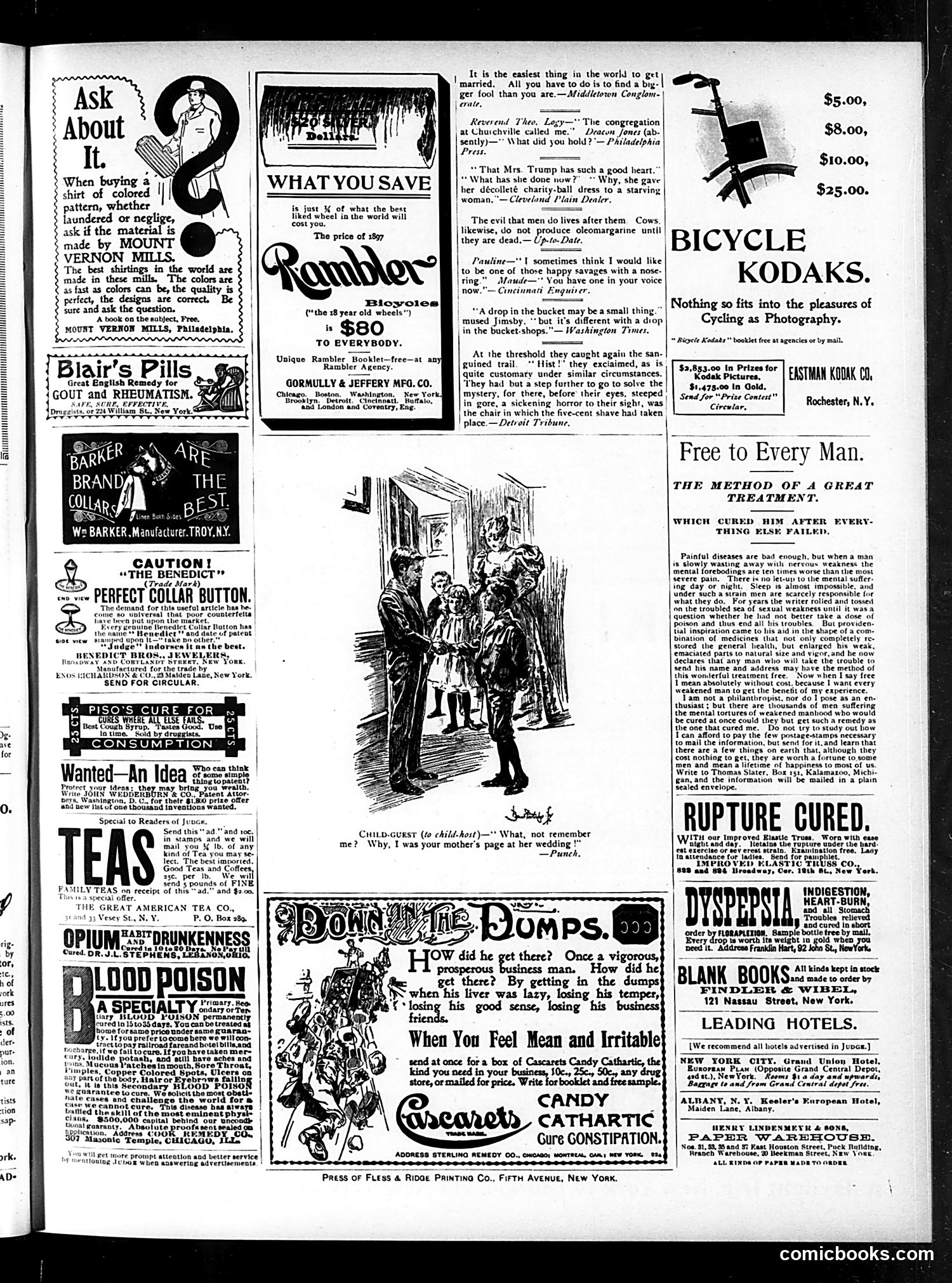
This page is primarily **advertising**, typical of late-19th-century magazines. The small humor pieces scattered throughout are standard filler material. The main cartoon appears to be the "Child-guest" joke at bottom-left: a formal Victorian scene where a guest awkwardly asks a child if they remember him, then recalls being the mother's "page" (attendant) at her wedding. The humor relies on the absurdity of expecting a child to remember such a distant past, and possibly the social awkwardness of the guest overstating his former familiarity. The remaining content is **patent medicine and product advertising**—pills for gout, consumption cures, blood poison treatments, drunkenness remedies, constipation candies, and corrective devices. These ads are presented as legitimate products, reflecting the unregulated patent medicine era when such claims faced minimal scrutiny. The scattered quotations (about marriage, charity, oleomargarine) are disconnected humor filler typical of Judge's layout. No major political figures or events are referenced on this page.
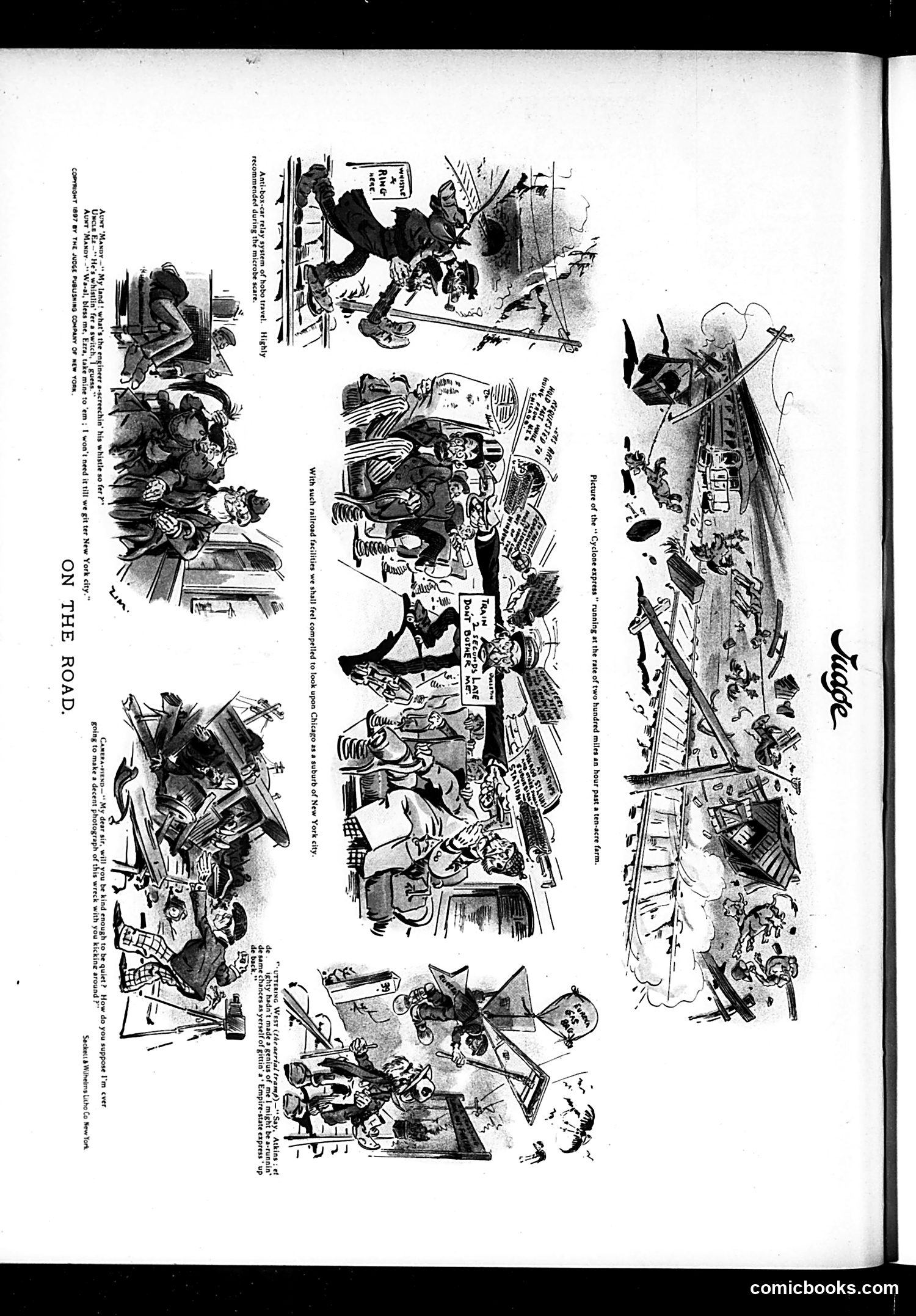
This page contains multiple comic strips satirizing hobos and vagrant life, likely from the early 20th century. The cartoons depict exaggerated scenes of homeless men in various predicaments—traveling illegally on trains, begging, and engaging in con schemes. The reference to "the microbe scare" suggests these strips satirize public health anxieties of the era, portraying hobos as disease vectors. One caption mentions a "relay system of hobo tramps," implying organized vagrant networks. The humor targets both the homeless themselves (shown as comedic figures) and middle-class fears about vagrancy and contagion. The cartoons reflect period attitudes viewing hobos as both comic subjects and genuine social threats. The Sackett-Wilhelms lithography credit indicates professional magazine production.