
A complete issue · 18 pages · 1897
Judge — April 10, 1897
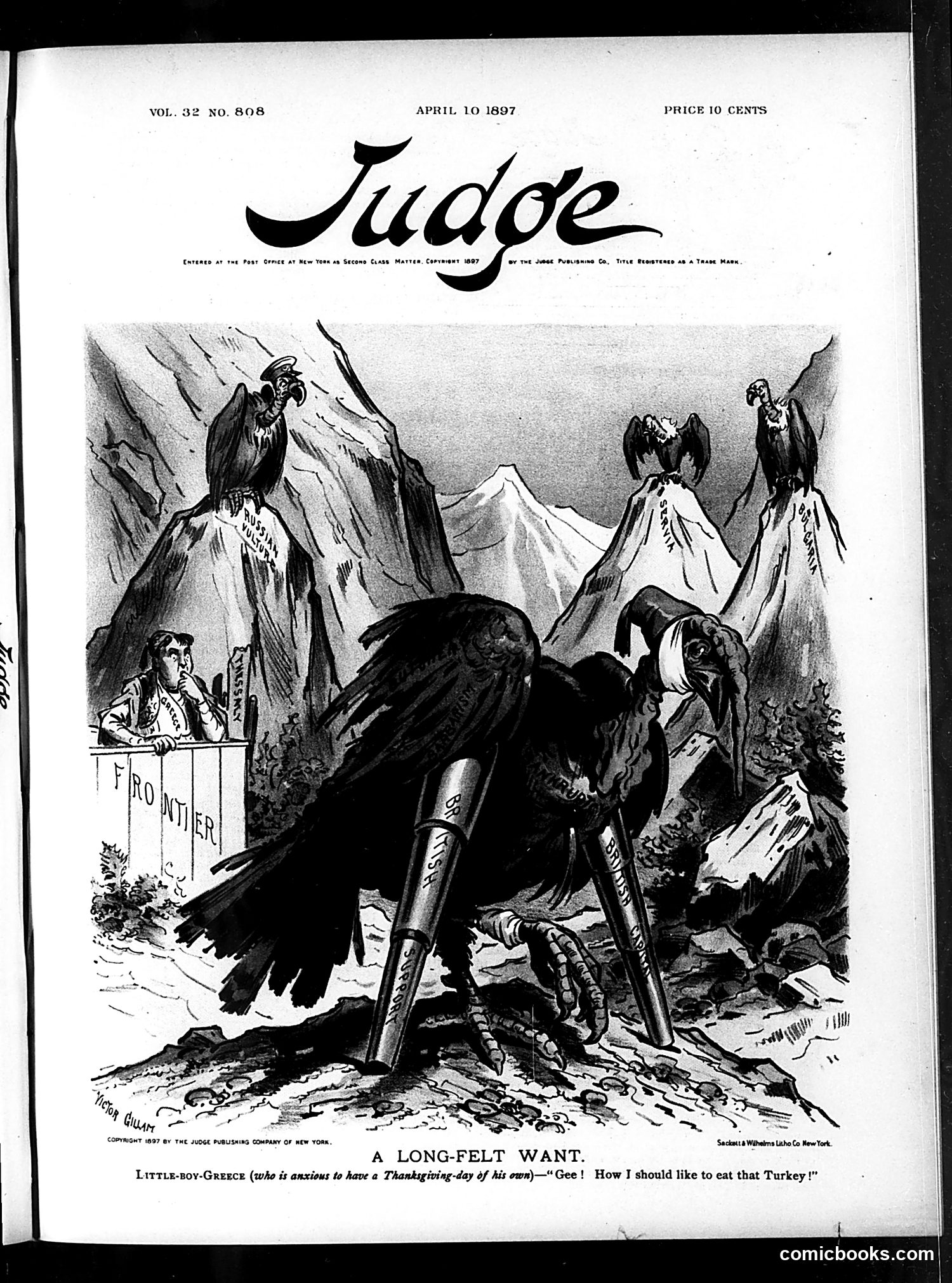
This April 1897 Judge cartoon satirizes the Greco-Turkish conflict. The central figure is an anthropomorphized Turkey (a bird with human limbs) being hunted by three vultures wearing imperial robes—representing major European powers competing for territorial advantage in the declining Ottoman Empire. "Little-boy-Greece" (shown in the small booth labeled "FRONTIER") expresses his desire to consume the Turkey, representing Greece's territorial ambitions. The vultures perched above represent the great powers' imperial interests in Ottoman territories. The satire critiques both Greece's weakness relative to European powers and the vultures' opportunistic behavior toward Turkish collapse—a commentary on imperial predation during the era of Ottoman decline.
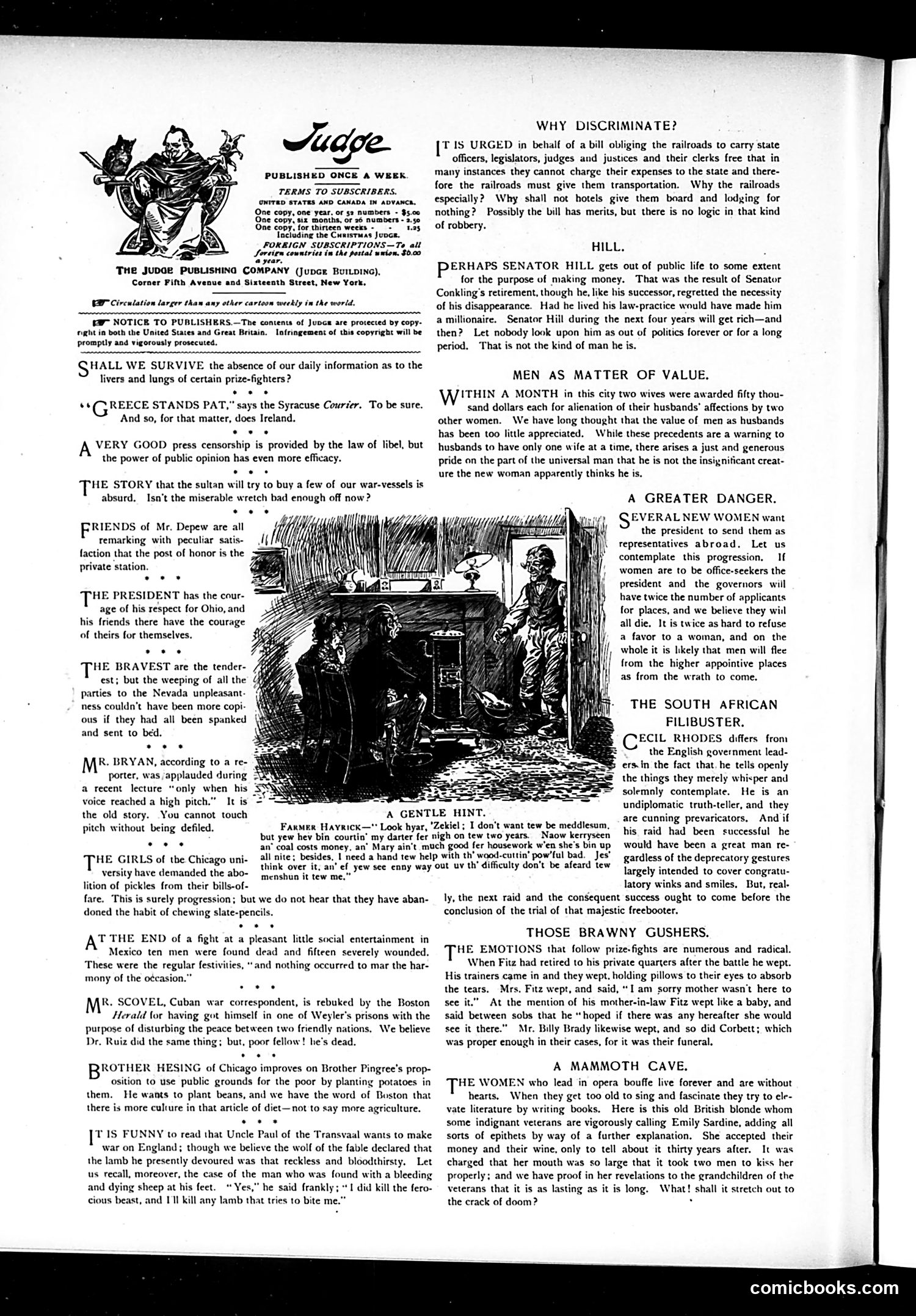
This page contains political commentary rather than cartoons. The main illustrated piece shows a farmer confronting what appears to be a well-dressed man (possibly a railroad official or politician) about unfair business practices. The satirical articles critique: 1. **Railroad discrimination**: The "Why Discriminate?" section argues railroads should provide board and lodging to state officials they transport, questioning the logic of denying them this benefit. 2. **Senator Hill's hypocrisy**: Mocking Senator Hill's retirement to make money after public service—characterizing this as opportunistic. 3. **Women in politics**: Several pieces critique women seeking government positions, suggesting their appointment would create excessive competition. The satire targets Gilded Age corporate practices, political corruption, and contemporary debates about women's political participation—all common Judge magazine themes.
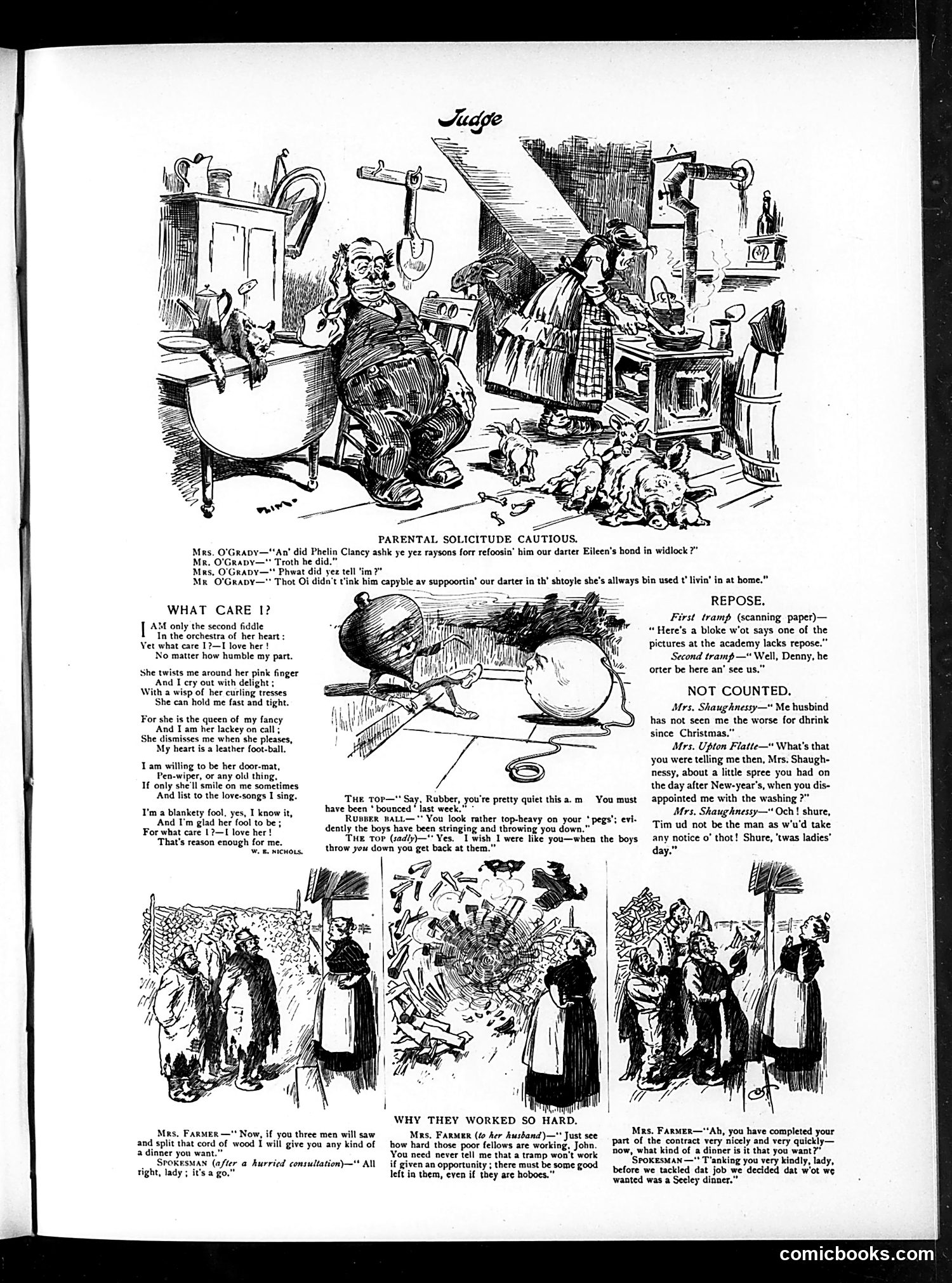
This page contains several satirical sketches on domestic and working-class themes rather than explicit political commentary. The top cartoon, "Parental Solicitude Cautious," mocks anxious parents worried about their children's welfare—specifically a mother fretting over whether her daughter's suitor is suitable. "What Care I?" presents a melancholic woman lamenting being only a "second fiddle" in her husband's life. The middle section includes humorous dialogues about domestic servants and working conditions, with sketches titled "Why They Worked So Hard" depicting interactions between employers (identified as "Mrs. Farmer") and their hired help. Overall, the page satirizes Victorian-era middle and working-class domestic anxieties—parental worry, marital discord, and servant-employer relations—through gentle humor rather than pointed political critique.
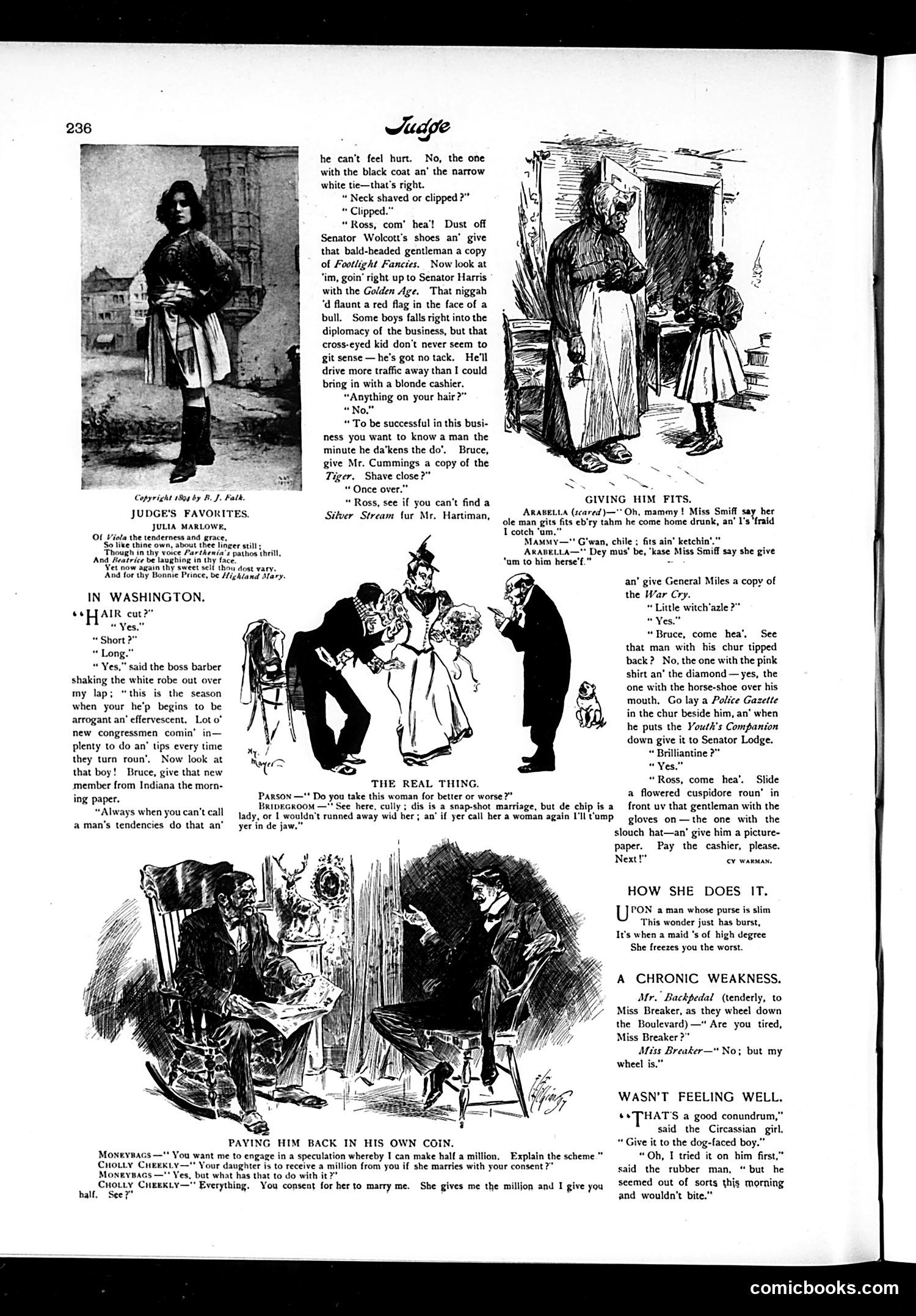
This page from *Judge* (circa 1894) contains several satirical pieces using racial stereotypes common to that era: **"In Washington"** depicts a barber shop where the proprietor instructs Black employees on managing newly-elected congressmen, using derogatory dialect. The satire targets both the congressmen's vanity and the racial dynamics of the period. **"The Real Thing"** mocks a hasty marriage, with the groom using violent, crude language—satirizing lower-class masculinity and impulsive decision-making. **"Paying Him Back in His Own Coin"** presents a con scheme where a suitor manipulates a wealthy father by exploiting his daughter's inheritance—satire of financial deception. The remaining items are brief humorous anecdotes about female fickleness, chronic excuses, and riddles. All content relies heavily on racial caricature and dialect that would be considered offensive today, reflecting *Judge's* satirical approach to American social hierarchies of the 1890s.
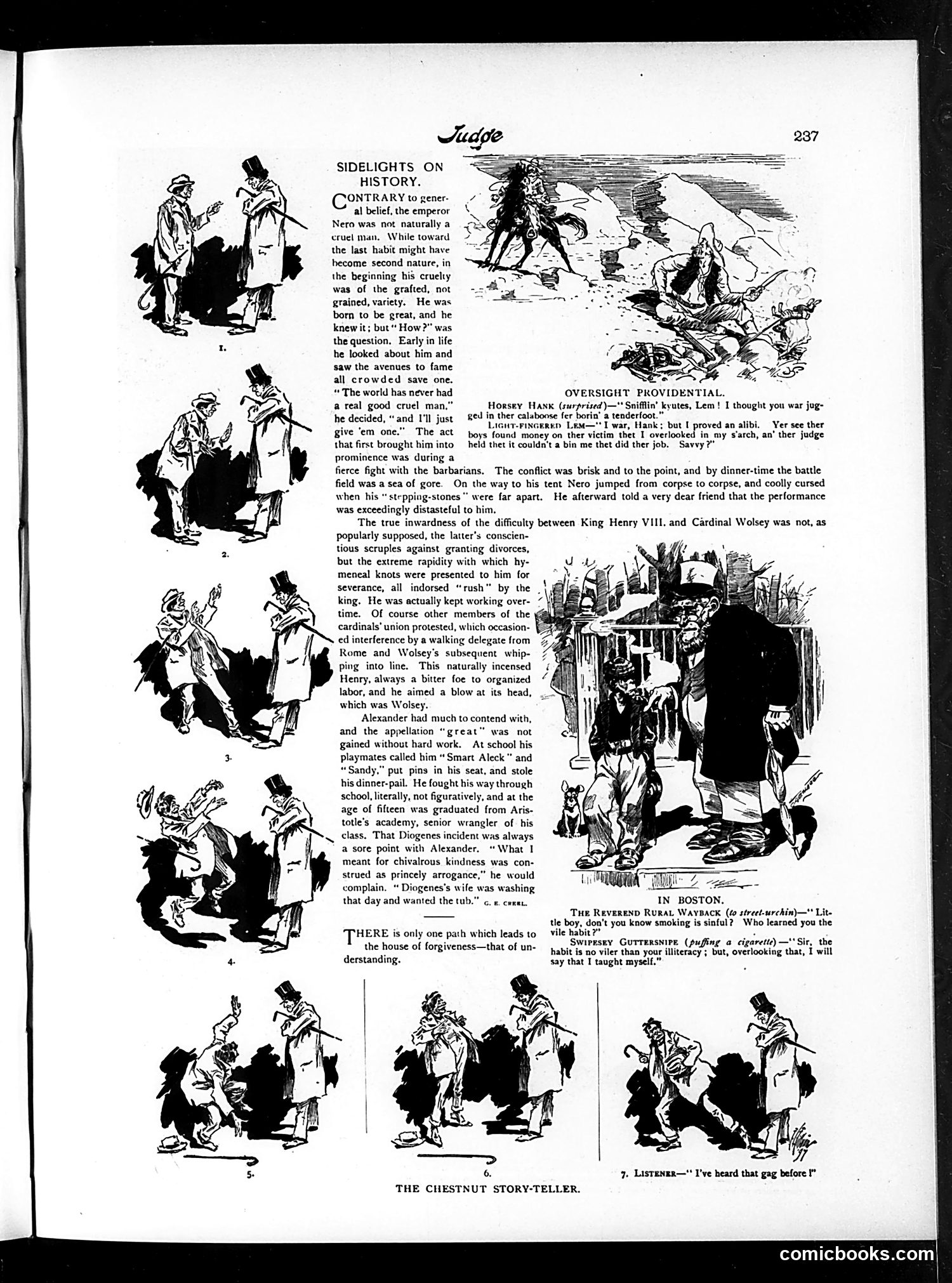
This page contains three distinct satirical pieces mocking historical revisionism and social hypocrisy: **"Sidelights on History"** presents absurdist reinterpretations of famous historical figures: Nero as an ordinary man who stumbled into cruelty; Cardinal Wolsey as overworked by King Henry VIII's divorce demands (framed as labor disputes); and Alexander the Great as a bullied schoolboy. The satire ridicules how people construct false narratives about history. **"Oversight Providential"** shows two rural criminals (Horsey Hank and Lem) celebrating that money accidentally left on a victim became exculpatory evidence—satirizing judicial incompetence. **"In Boston"** depicts a pious rural minister lecturing a street urchin about smoking's sinfulness, while the child exposes the minister's illiteracy. The joke: the minister's moral authority collapses when confronted with his own hypocrisy. All pieces target pretension, false authority, and self-deception across history, law, and religion.
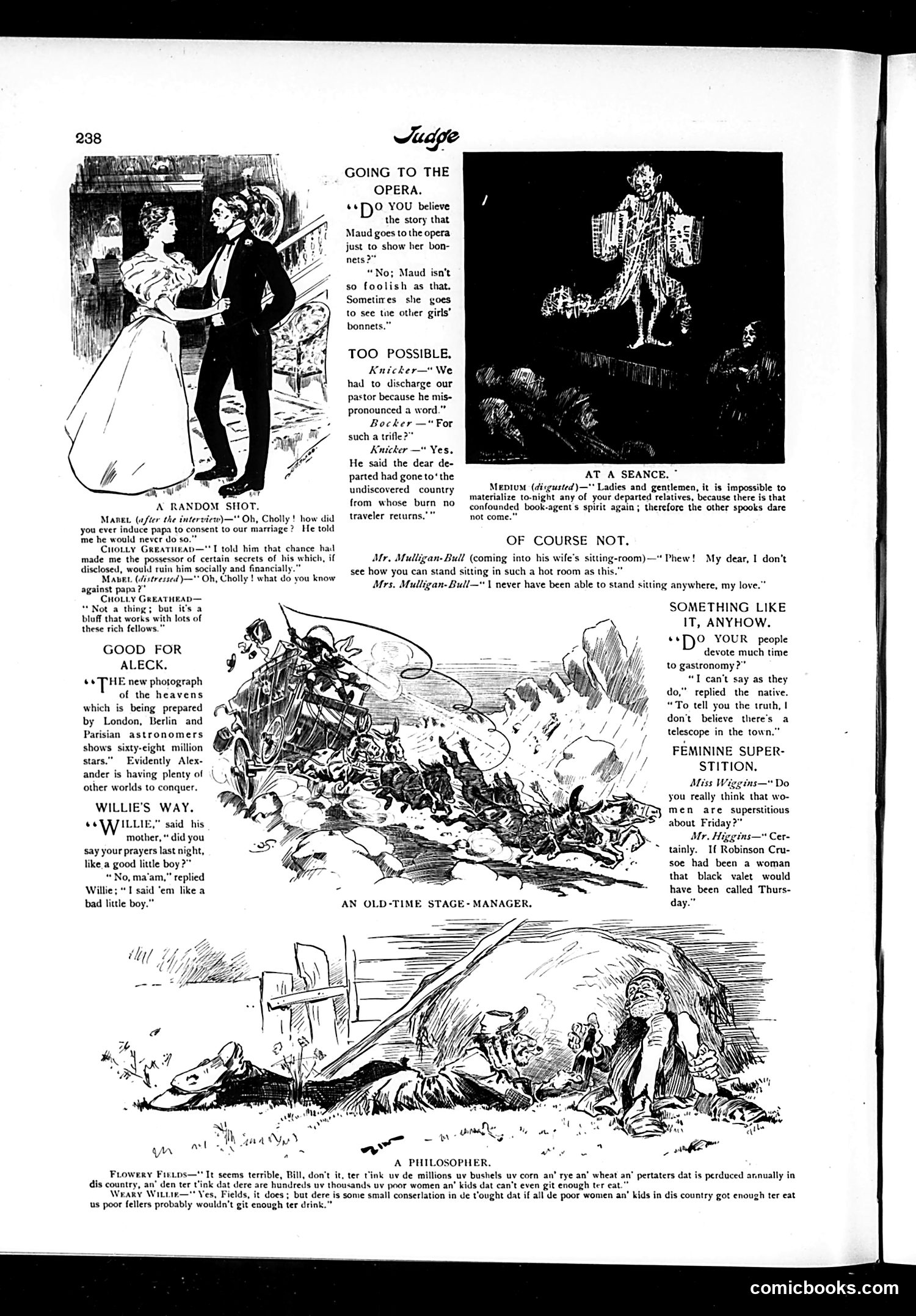
This page collects brief humorous vignettes targeting Gilded Age society and human nature: **"A Random Shot"**: A fortune-hunter (Cholly Greathead) admits he blackmailed a wealthy father into consenting to marriage—not with real secrets, but bluffing. The satire mocks both manipulative suitors and gullible rich men. **"Going to the Opera"**: Women attend opera not for music but to display fashionable bonnets and spy on rivals' attire—satirizing shallow upper-class vanity. **"Too Possible"**: A clergyman is fired for mispronouncing "undiscovered country" (misquoting Hamlet). The satire mocks pedantic congregations and religious pretension. **"A Seance"**: A medium cannot contact spirits because a book-agent's ghost won't materialize—satirizing both spiritualism fraud and the annoyance of aggressive salesmen. **"A Philosopher"**: Homeless men discuss poverty philosophically, concluding poor people starve while they'd lose drinking money if fed—dark satire on indifference to social suffering. These reflect Judge's typical late-19th-century humor: targeting class pretension, materialism, and social hypocrisy.
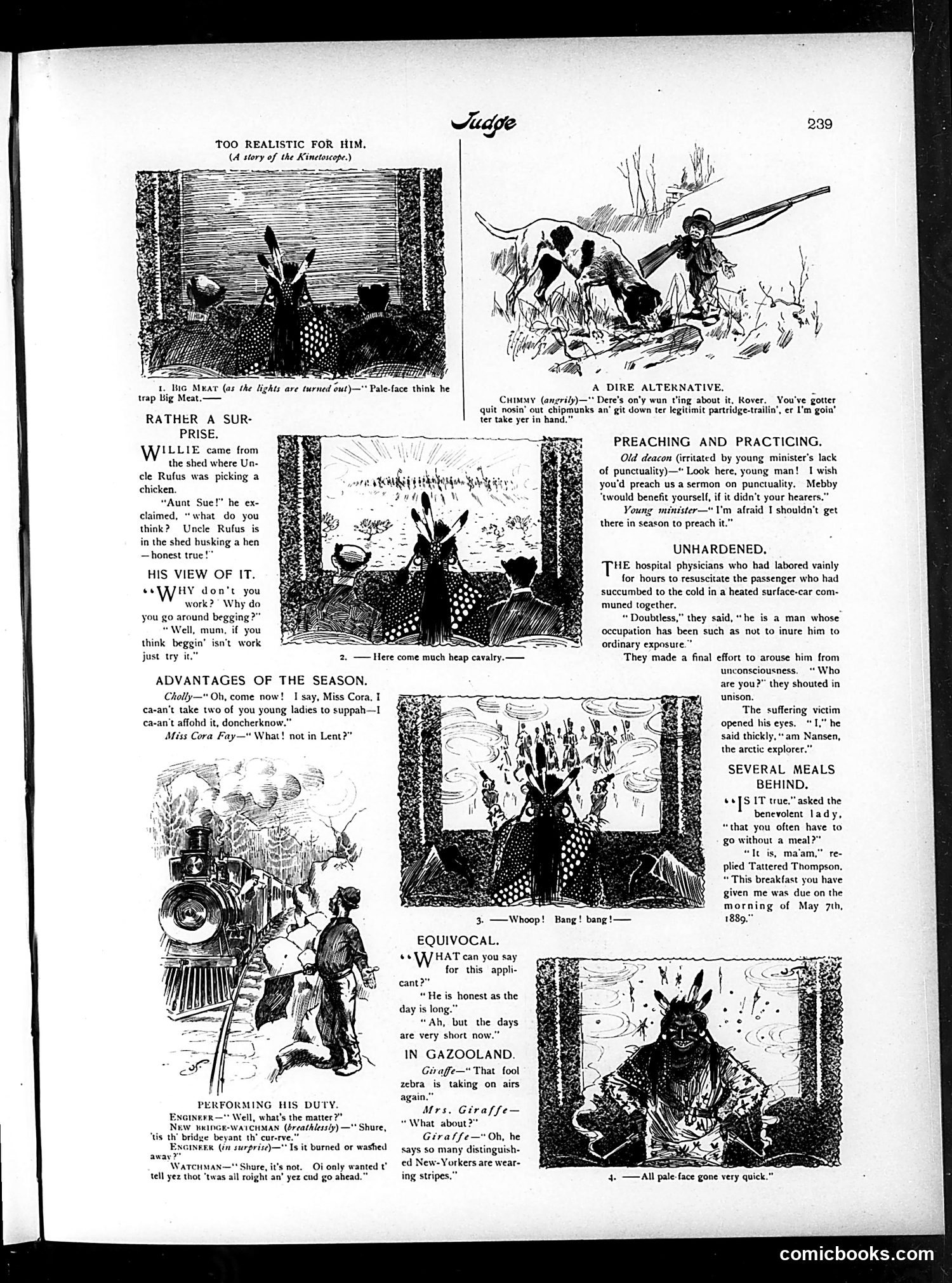
This page contains multiple brief satirical comics typical of Judge's humor circa the 1880s-90s. Key pieces include: **"Too Realistic for Him"** mocks the Kinetoscope (early film technology), showing a man disturbed by realistic depictions of hunting—suggesting audiences weren't prepared for cinema's raw realism. **"A Dire Alternative"** presents a dog owner threatening his pet with discipline, using dialect humor common to the era. **"Preaching and Practicing"** satirizes clerical hypocrisy—a deacon criticizes a young minister's tardiness while the minister ironically points out he can't preach punctuality if he's late. **"Several Meals Behind"** features a vagrant's dark humor: his meal was "due" from May 1889, implying years of missing meals. **"In Gazooland"** uses animal characters (giraffes, zebras) for social commentary—possibly satirizing New Yorkers' pretension. Remaining items are brief one-liners about romance, travel, and workplace mishaps. The overall tone reflects Victorian-era class consciousness and emerging modern anxieties.
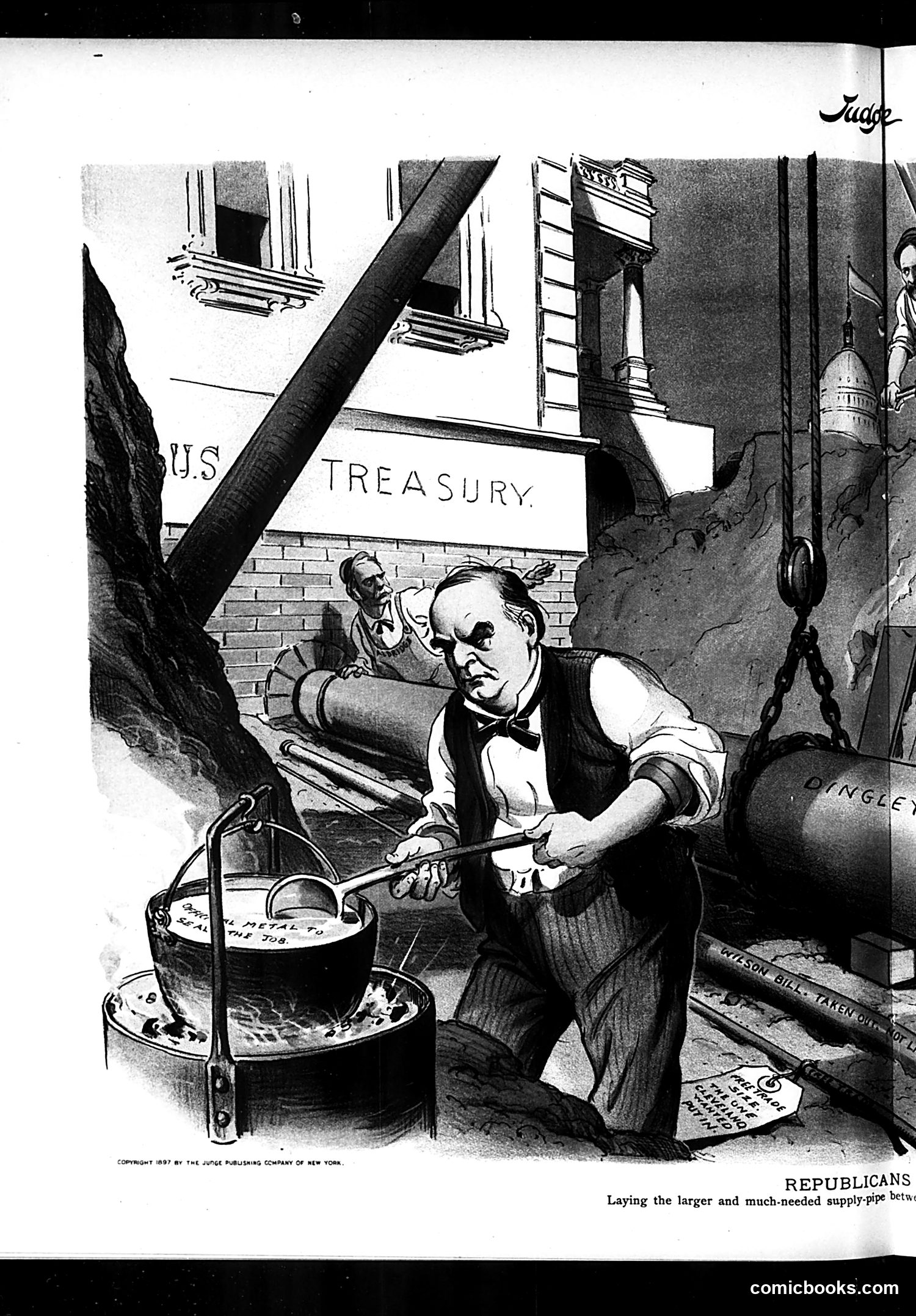
This Judge magazine cartoon satirizes Republican efforts to address a fiscal or infrastructure problem. The central figure, a well-dressed man with exaggerated features, appears to be laying supply pipes near the U.S. Treasury building. The caption claims Republicans are "laying the larger and much-needed supply-pipe." The satire likely mocks Republican claims about fiscal responsibility or infrastructure improvement. The caricatured workman and theatrical setting suggest the cartoonist viewed these efforts as performative rather than substantive—politicians appearing to work while actually accomplishing little. The 1897 copyright dates this to the Gilded Age, when debates over tariffs, currency, and government spending dominated Republican politics. The specific policy referenced remains unclear without additional context, but the satire targets Republican posturing on economic matters.
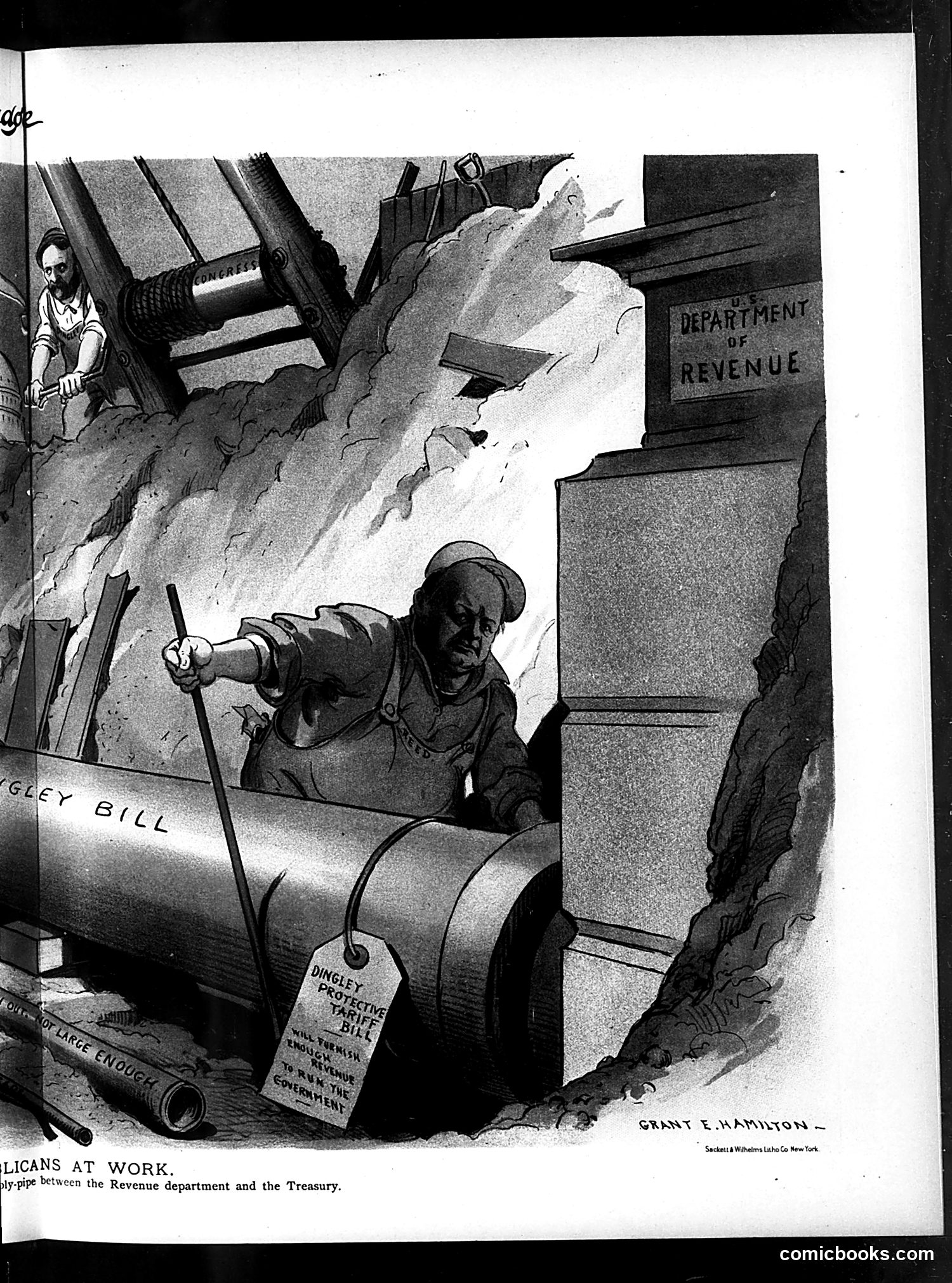
This cartoon by Grant E. Hamilton depicts "Republicans at Work," showing a man wielding a pipe labeled "DINGLEY PROTECTIVE TARIFF" striking at pipes between the Revenue Department and Treasury. The imagery suggests Republicans were using protectionist tariff policy as a weapon in political/bureaucratic conflict between these two government departments. The "Dingley Bill" (likely the 1897 Dingley Tariff) was a major Republican legislative priority. The cartoon satirizes Republican tactics—portraying tariff policy cynically as a blunt instrument of partisan aggression rather than genuine economic policy. The man appears aggressive and destructive, suggesting the cartoonist viewed Republican approach as damaging to government function and fiscal stability. The overall message criticizes Republican use of tariffs as a political cudgel.
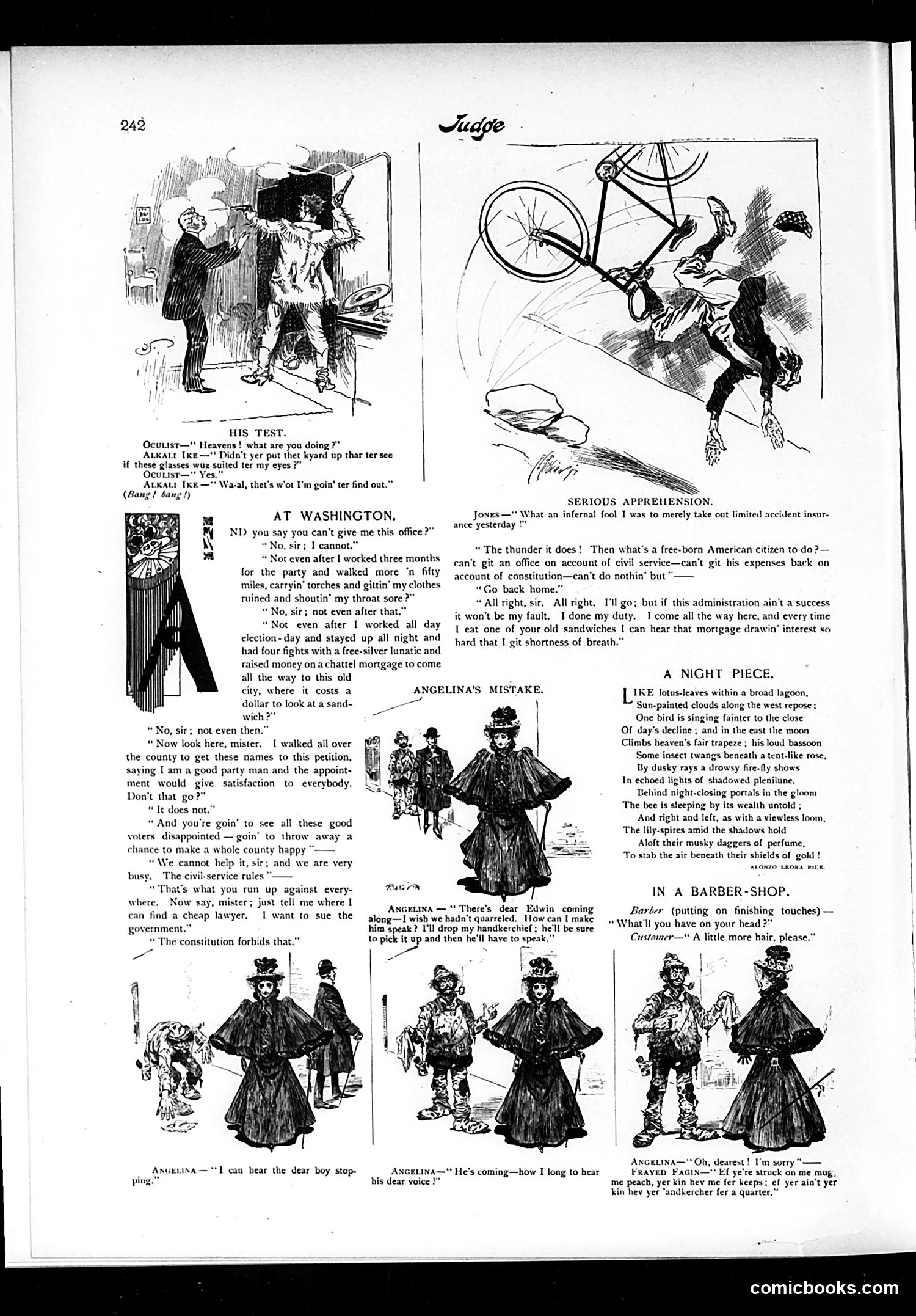
This page contains several satirical pieces typical of Judge magazine's social and political humor: **"His Test"** mocks an Alkali Ike character (a rural/frontier stereotype) who shoots at an eye chart, misunderstanding the optometrist's instructions. **"At Washington"** satirizes the spoils system and civil service reform. A party operative demands an office appointment after extensive campaign work, only to be denied due to new civil-service rules. His frustration—unable to profit from political loyalty—highlights the tension between old patronage politics and emerging merit-based reforms. **"Angelina's Mistake"** and related sketches show romantic comedies and domestic humor typical of the era's light content. **"A Night Piece"** is decorative poetry, unrelated to satire. **"Serious Apprehension"** jokes about limited insurance coverage during storms. **"In a Barber-Shop"** features wordplay about hairstyles. The political thrust targets government inefficiency and the frustration civil-service reform caused to traditional party operatives.
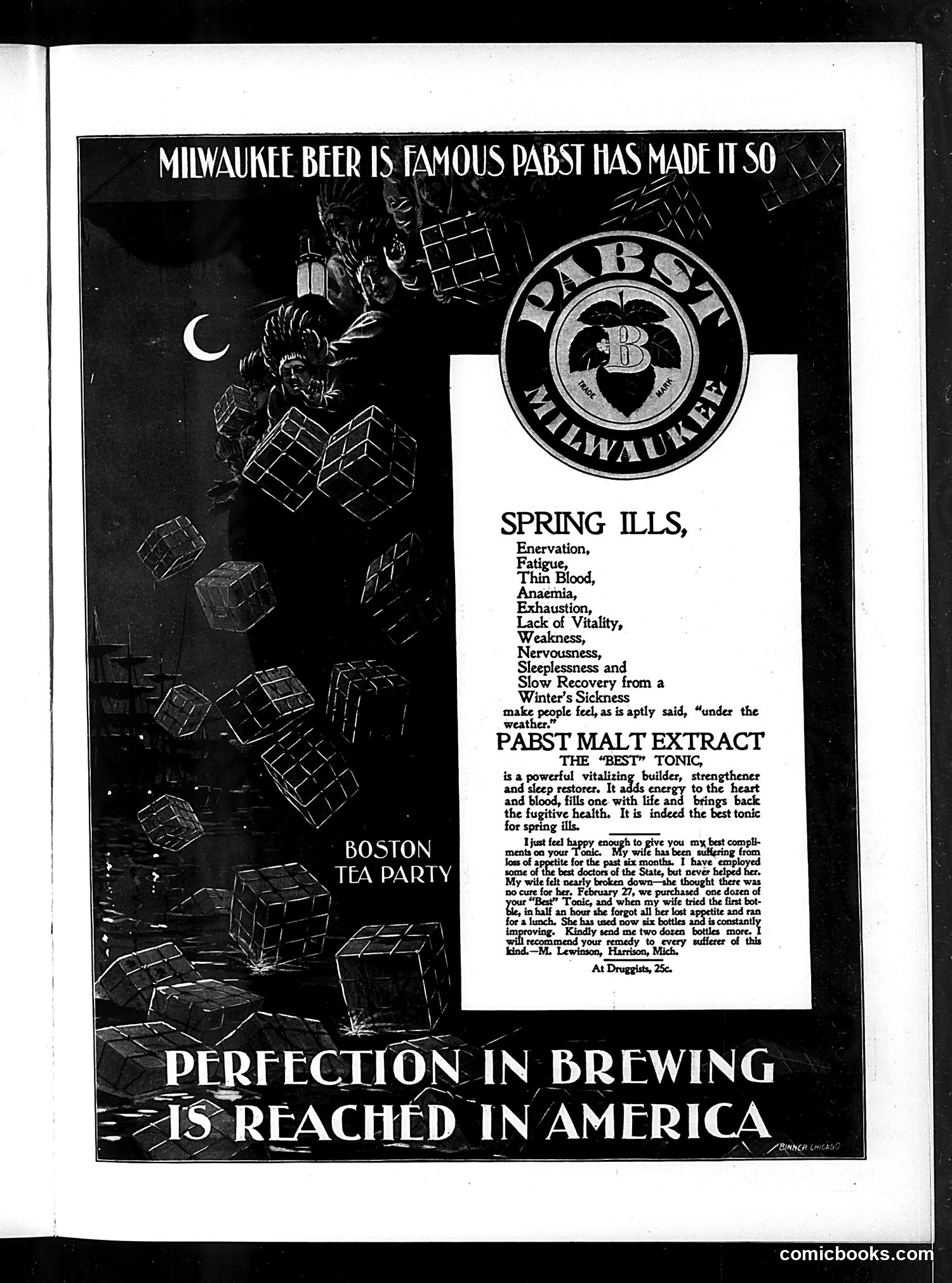
This page is primarily a **patent medicine advertisement**, not political satire. It advertises Pabst Malt Extract as a cure for "spring ills"—a seasonal affliction believed common in early 20th-century America, causing fatigue, anemia, and weakness. The left side depicts the **Boston Tea Party** (the 1773 protest against British taxation), establishing American patriotic credentials. The ad claims Milwaukee beer's fame comes from Pabst's brewing expertise, then pivots to selling malt extract as a health tonic. The advertisement includes a testimonial from "M. Lewinson, Harrison, Mich." praising the product's effectiveness. **Context for today**: This reflects an era when alcohol-based "tonics" and patent medicines made unregulated health claims before FDA oversight. The patriotic imagery was typical advertising strategy to build brand trust and American pride. "Spring ills" appears to be a marketing concept rather than recognized medical condition.
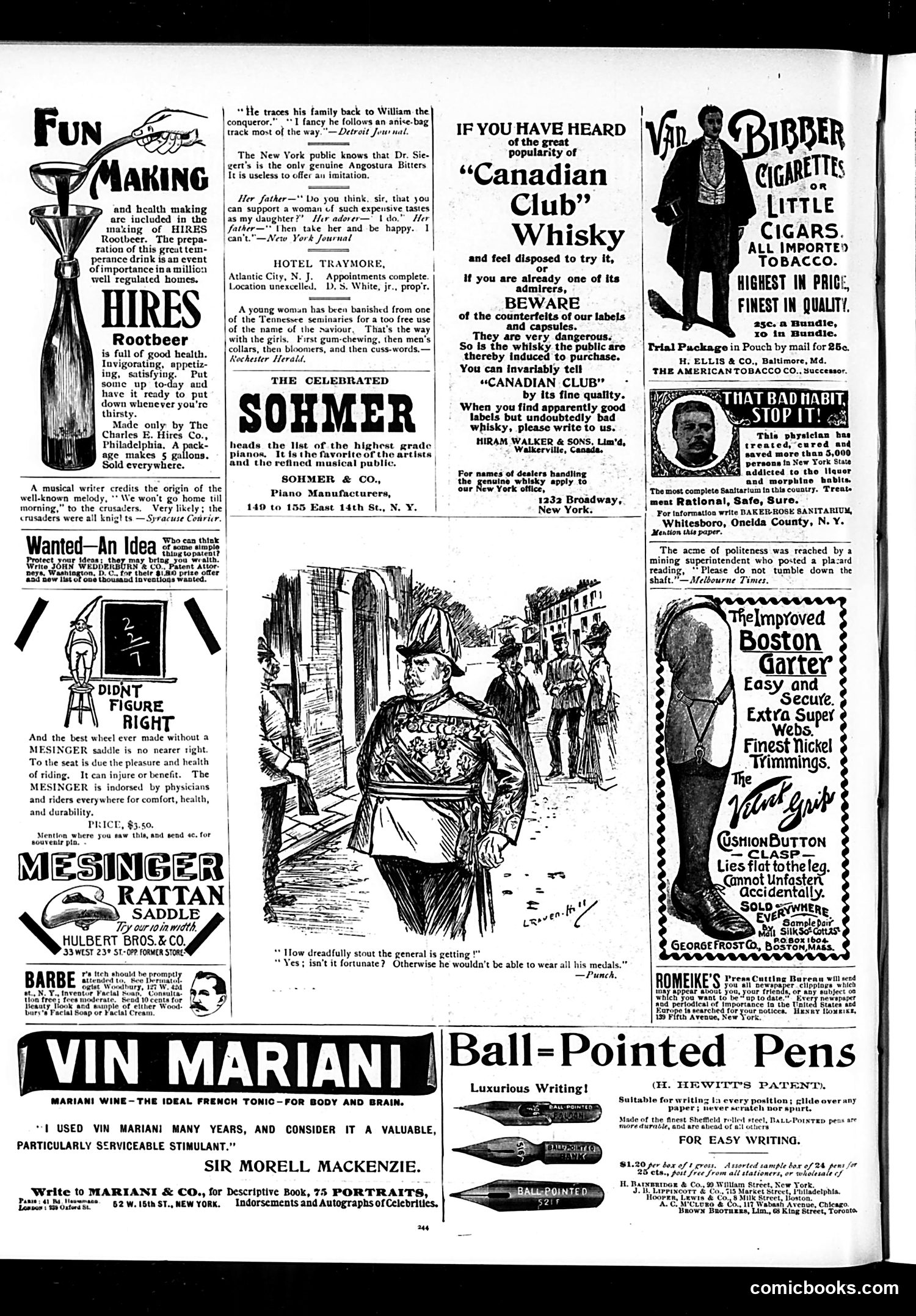
This is primarily an **advertising page** from Judge magazine, with minimal editorial content beyond brief humorous quips. The main cartoon (center) depicts a military general struggling to sit in a chair while fully uniformed with medals and insignia. The caption reads: "How dreadfully stout the general is getting!" / "Yes, isn't it fortunate? Otherwise he wouldn't be able to wear all his metals." **The joke**: The general is so overweight that his bulk is the only thing keeping his heavy military decorations from falling off—his obesity serves an accidentally practical purpose. It's gentle satire mocking both excessive military ornamentation and the general's physical condition. The page is dominated by period product advertisements (Hires Rootbeer, Sohmer pianos, Vin Mariani wine, Ball-Pointed Pens, Boston Garters, etc.) interspersed with brief jokes about courtship, genealogy, and social habits typical of Judge's humor style.
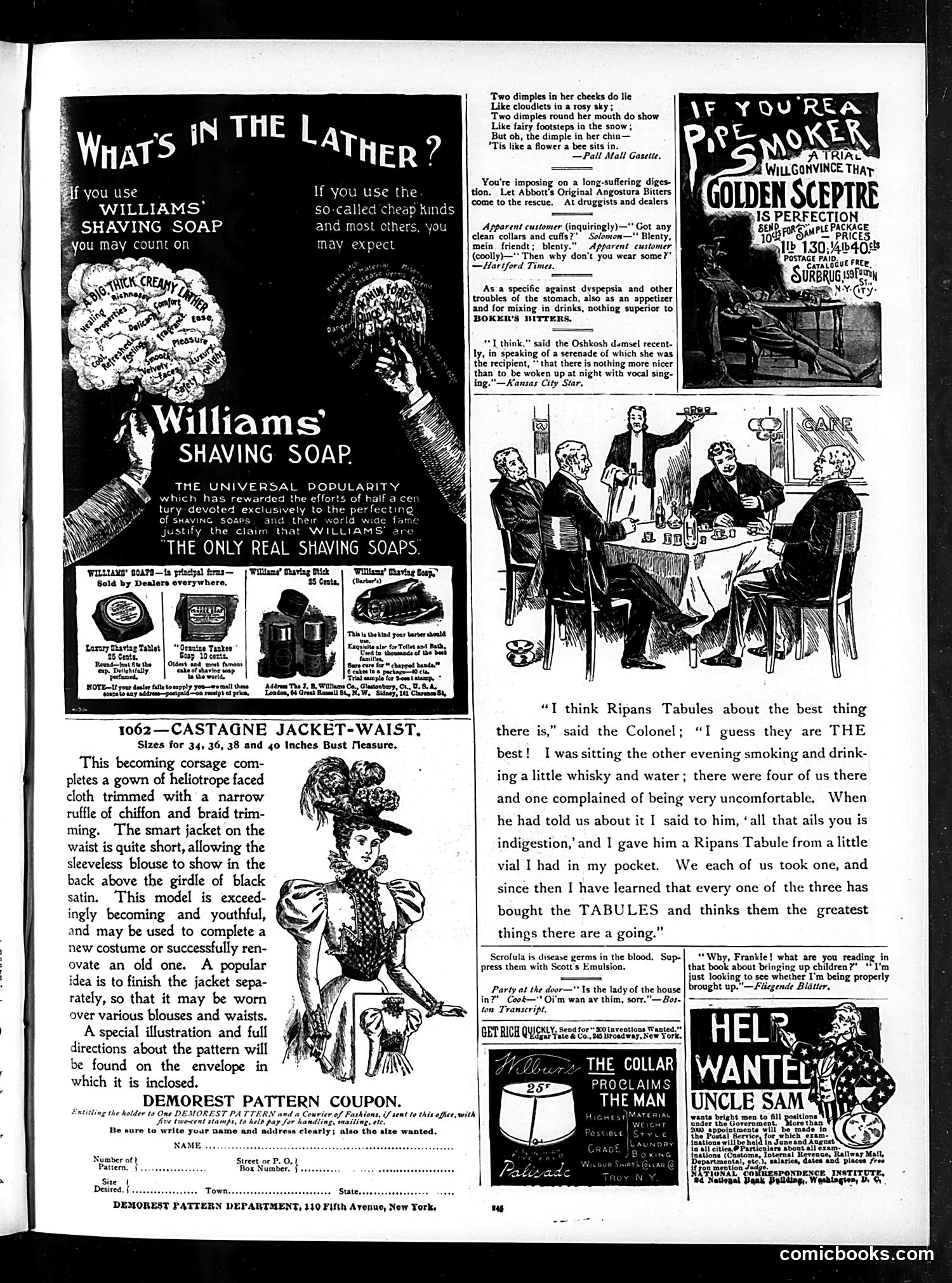
This page is primarily **advertising and fashion content** rather than political satire. The main elements include: **Advertisements:** - Williams' Shaving Soap (top left) - a competitive product pitch claiming superiority over "cheap kinds" - Abbott's Angostura Bitters, Boker's Bitters, Ripans Tabules, Scott's Emulsion - patent medicines typical of the era - Various product ads with humorous anecdotes **Fashion:** - Demorest Pattern 1062 for a women's jacket-waist corset, available in multiple sizes **Humor Content:** - Brief jokes and anecdotes scattered throughout (a customer mocking a laundryman for wearing dirty collars; a girl reading childcare books) - Light, domestic humor rather than political commentary The page reflects early 20th-century American consumer culture, showcasing how magazines monetized through advertising while providing practical fashion patterns and light entertainment. No identifiable political figures or satire appears visible.
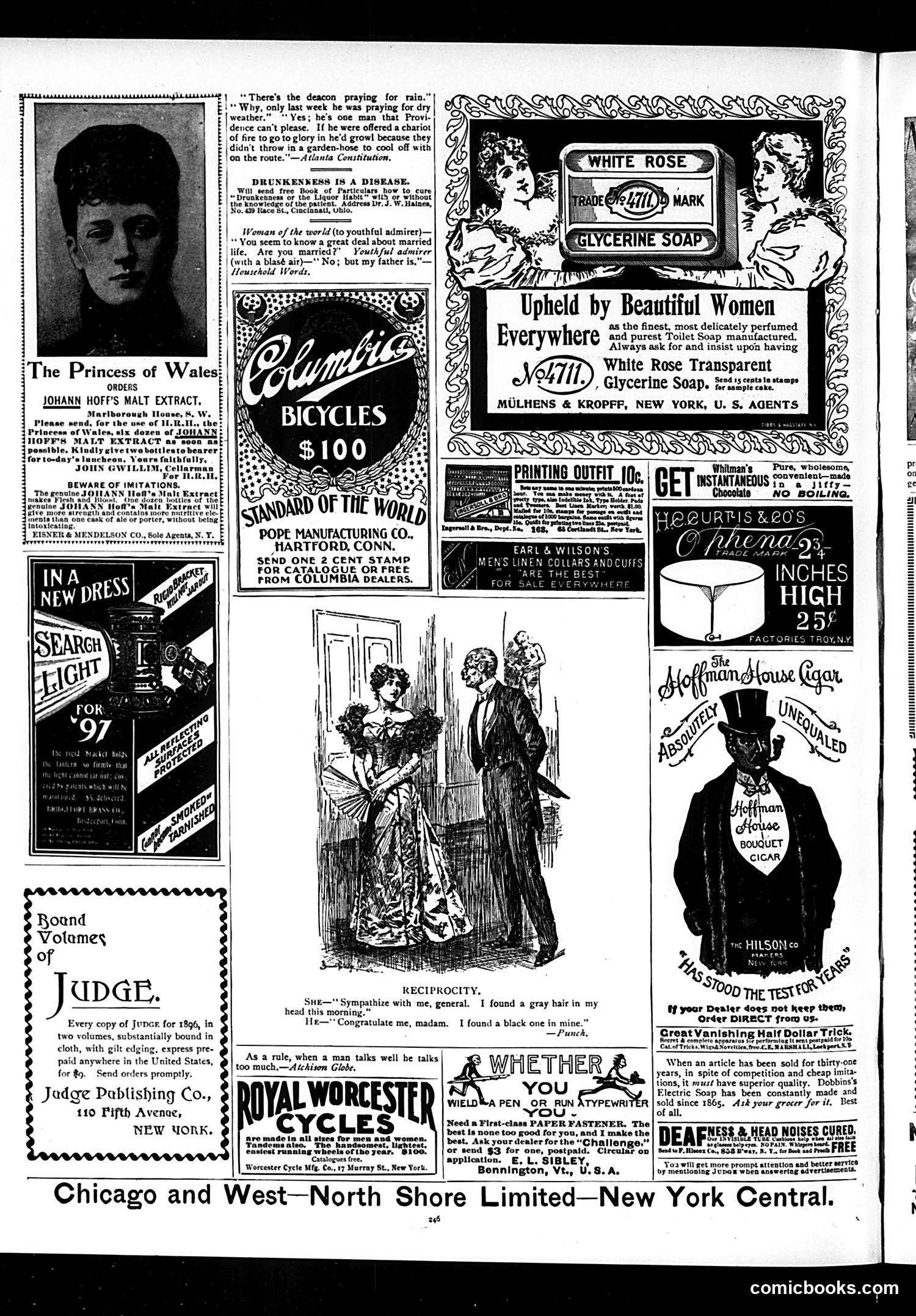
This page is **primarily advertising** with minor satirical humor sections interspersed. The main cartoons are brief joke pieces: 1. **"Reciprocity"** cartoon depicts a social exchange where a woman complains about finding a gray hair; a man responds he found a black one—a mild joke about aging and courtship dynamics. 2. **"The Deacon" joke** mocks religious hypocrisy: a deacon prays for rain, then for dry weather, suggesting he's perpetually dissatisfied and impossible to please—a commentary on inconsistent piety. 3. **"Youthful Admirer" joke** plays on marital knowledge: a young man claims experience with marriage through his father, a cheeky deflection of the woman's question. The rest of the page features **period advertisements** for Columbia Bicycles, White Rose Glycerine Soap, Judge Publishing volumes, various patent medicines, and consumer goods typical of 1890s American commerce. The satirical content is minimal; the page functions largely as a revenue-generating advertising vehicle disguised as editorial content.
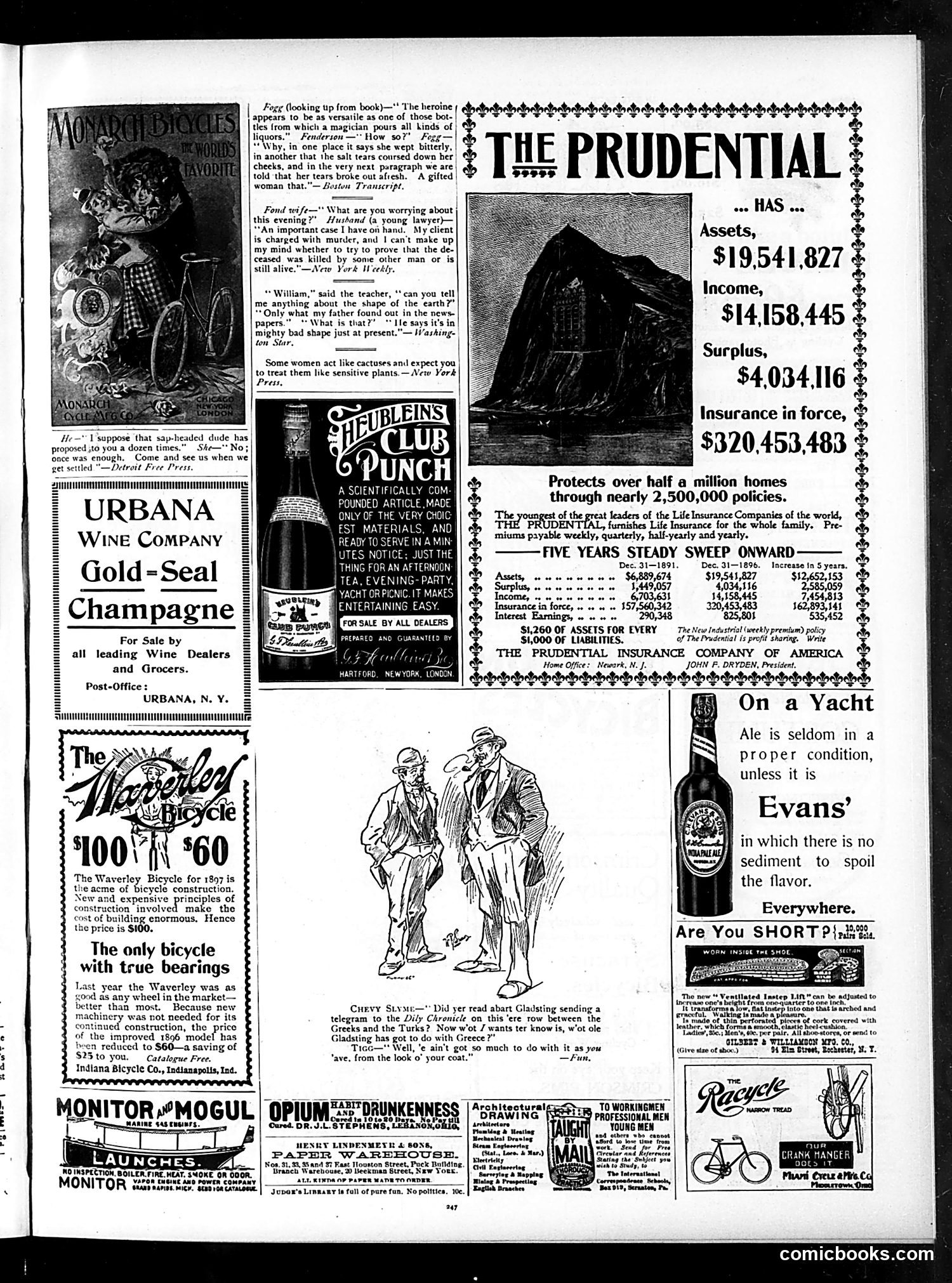
This page is primarily **advertising**, not political satire. The dominant content is a large advertisement for **The Prudential Insurance Company of America**, displaying impressive financial statistics (assets of $19.5 million, insurance in force of $320+ million) to promote the company's stability and trustworthiness to potential customers. The small cartoons scattered throughout are generic **humor anecdotes**—brief jokes about a woman with contradictory descriptions in a novel, a husband's murder case, and a teacher discussing Earth's shape. These appear to be filler content typical of *Judge* magazine between advertisements. The other ads feature **Urbana Wine Company champagne**, **Waverley Bicycles**, **Evans' Ale**, and various patent medicines. There's a small British cartoon mocking Mr. Gladstone's involvement in Greek-Turkish affairs. This represents *Judge* functioning as an advertising vehicle for major corporations during the 1890s, using light humor to engage readers between commercial pitches.
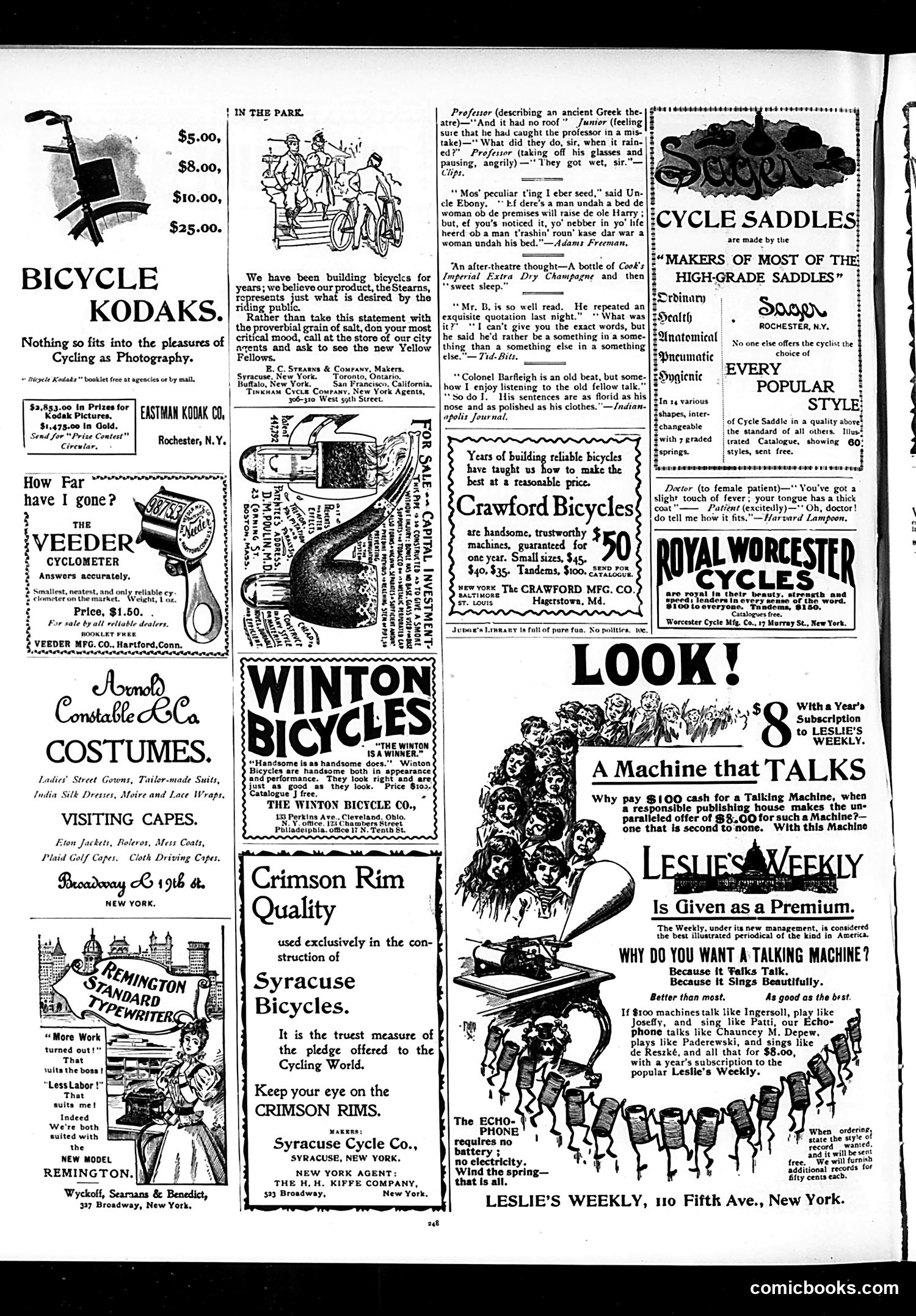
This page is primarily **advertising for bicycles and related products**, not political cartoons. Judge magazine published these ads alongside satirical content. The bicycle advertisements dominate—featuring Kodak Bicycle cameras, Veeder cyclometers, Stearns bikes, Winton bicycles, Crawford bicycles, and Syracuse cycles. These reflect the **bicycle craze of the 1890s**, when cycling was a fashionable leisure activity and status symbol. The small **humorous anecdotes** scattered between ads are genteel period humor: a professor caught without witty response about roofless Greek theaters; a dialect joke about racial stereotypes (Uncle Ebony); observations about courtship and champagne. These represent typical Judge-style social commentary—gentle mockery of educated classes and gender relations rather than political satire. The **Remington typewriter ad** uses workplace humor ("Less Labor!" appeals to both boss and worker), reflecting industrial-age anxieties about efficiency. The page reflects **upper-middle-class consumer culture** of the Gilded Age—photography, bicycles, typewriters, and fashionable clothing as markers of modernity and prosperity.
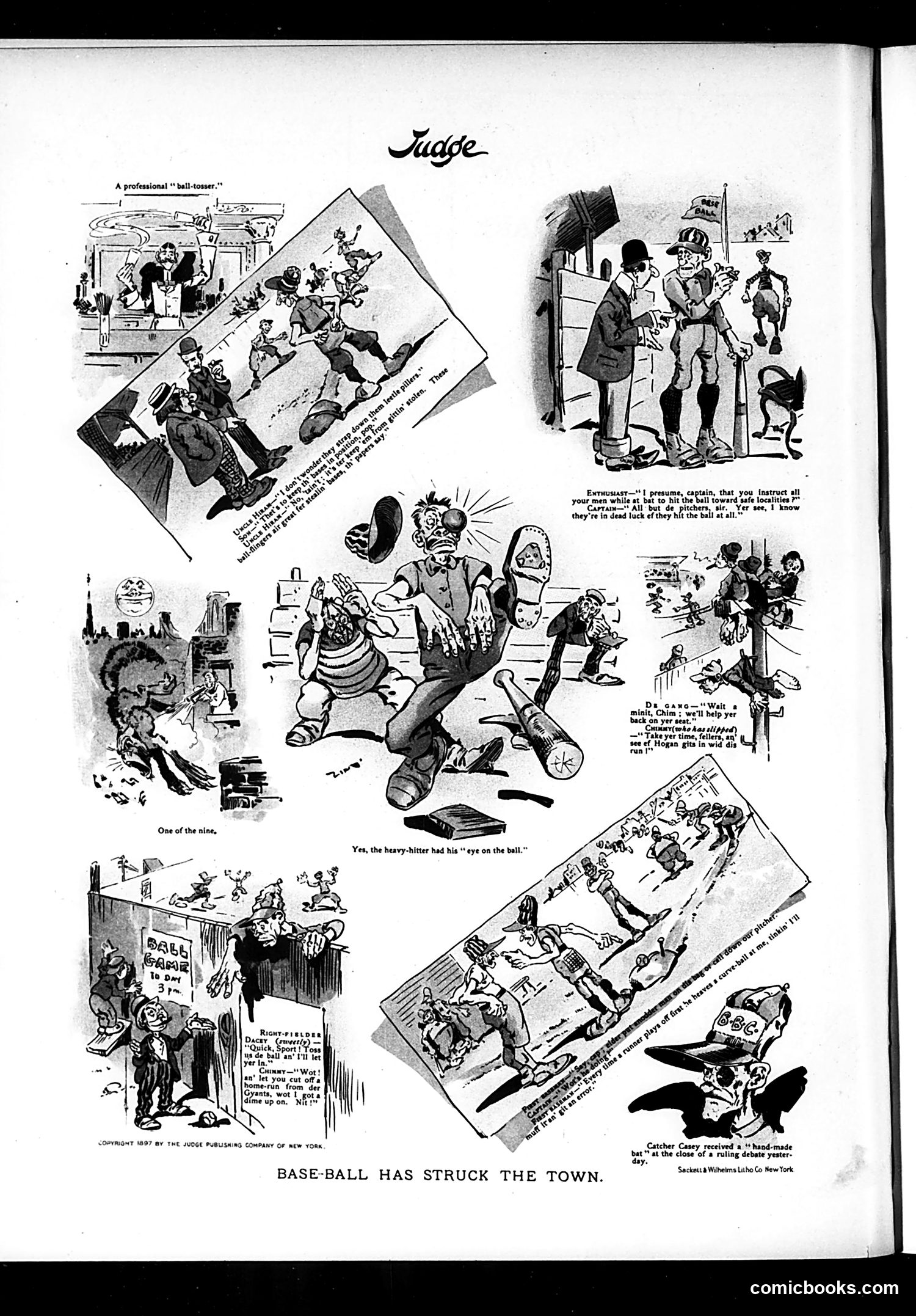
This 1897 satirical page mocks baseball's sudden popularity by depicting how the sport has infiltrated all levels of society. The cartoons show various urban characters—working-class figures, street vendors, and city dwellers—suddenly obsessed with baseball terminology and behavior, despite often misunderstanding the game. The central joke is that baseball mania has "struck the town" so completely that even people removed from the sport adopt its language and attitudes. The caricatures appear to be working-class New Yorkers (one labeled "Dacey," a period slang term for a young street character), suggesting satirical commentary on how quickly fads spread across social classes. A "professional ball-tosser" caption references both legitimate baseball and street hustle culture, implying the sport attracts con artists and gamblers. The overall message: baseball fever has become absurdly ubiquitous, affecting even those least suited to understanding or playing the game—a common Gilded Age anxiety about mass culture's power.