
A complete issue · 16 pages · 1897
Judge — January 30, 1897
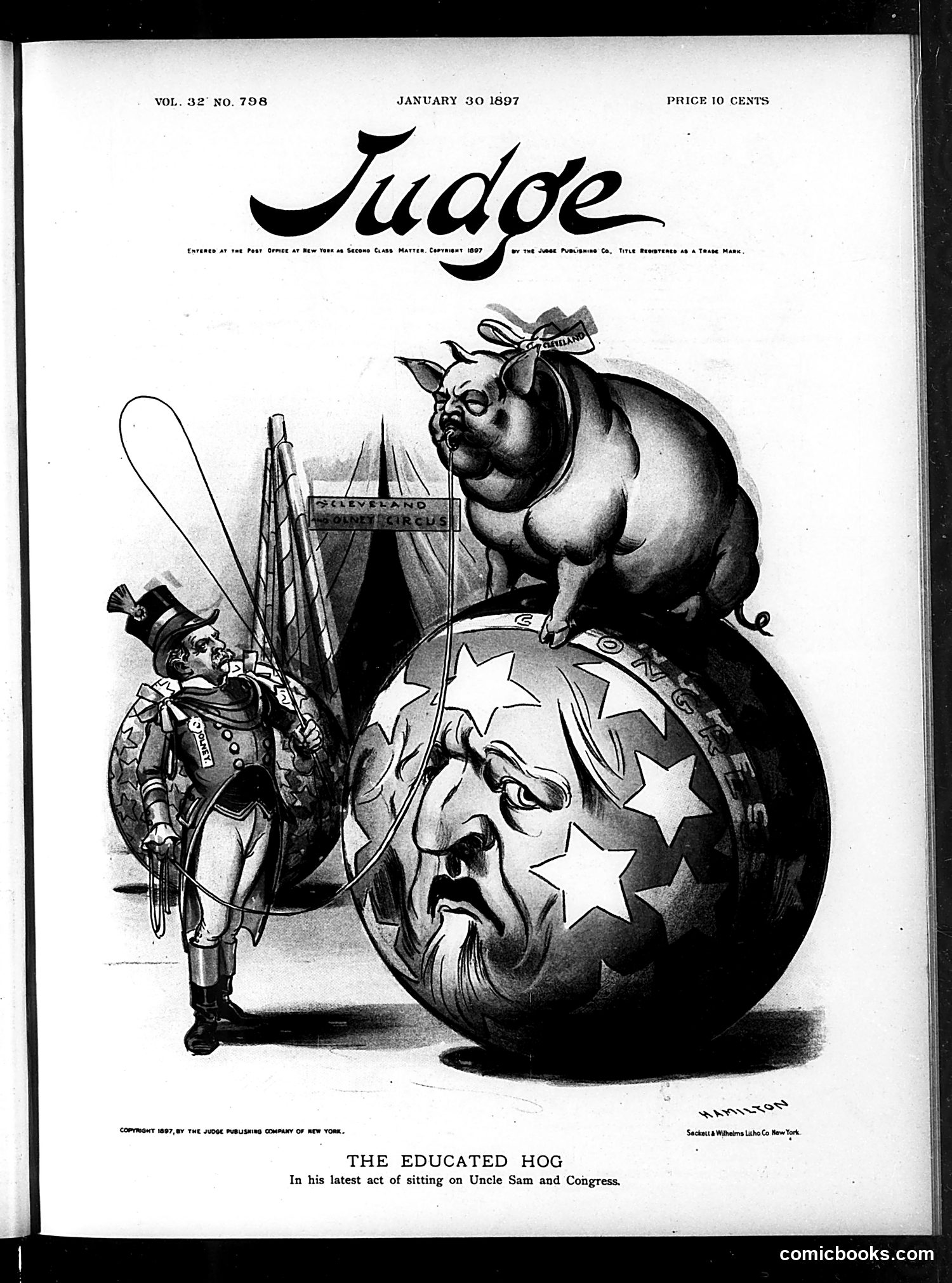
This political cartoon satirizes what appears to be congressional actions or debates of the period. The central image shows a large pig wearing a ribbon, sitting atop a spherical object marked with stars (representing the United States). A small military or government figure stands to the left, fishing line in hand, appearing to manipulate or control the pig. The title "The Educated Hog: In his latest act of sitting on Uncle Sam and Congress" suggests the cartoon criticizes how some political force or group (represented as the "hog") has gained dominance over American government and institutions. The circus tent labeled "Cleveland Circus" visible in the background likely references President Grover Cleveland's administration, indicating this is commentary on his political impact or unpopular policies of that era.
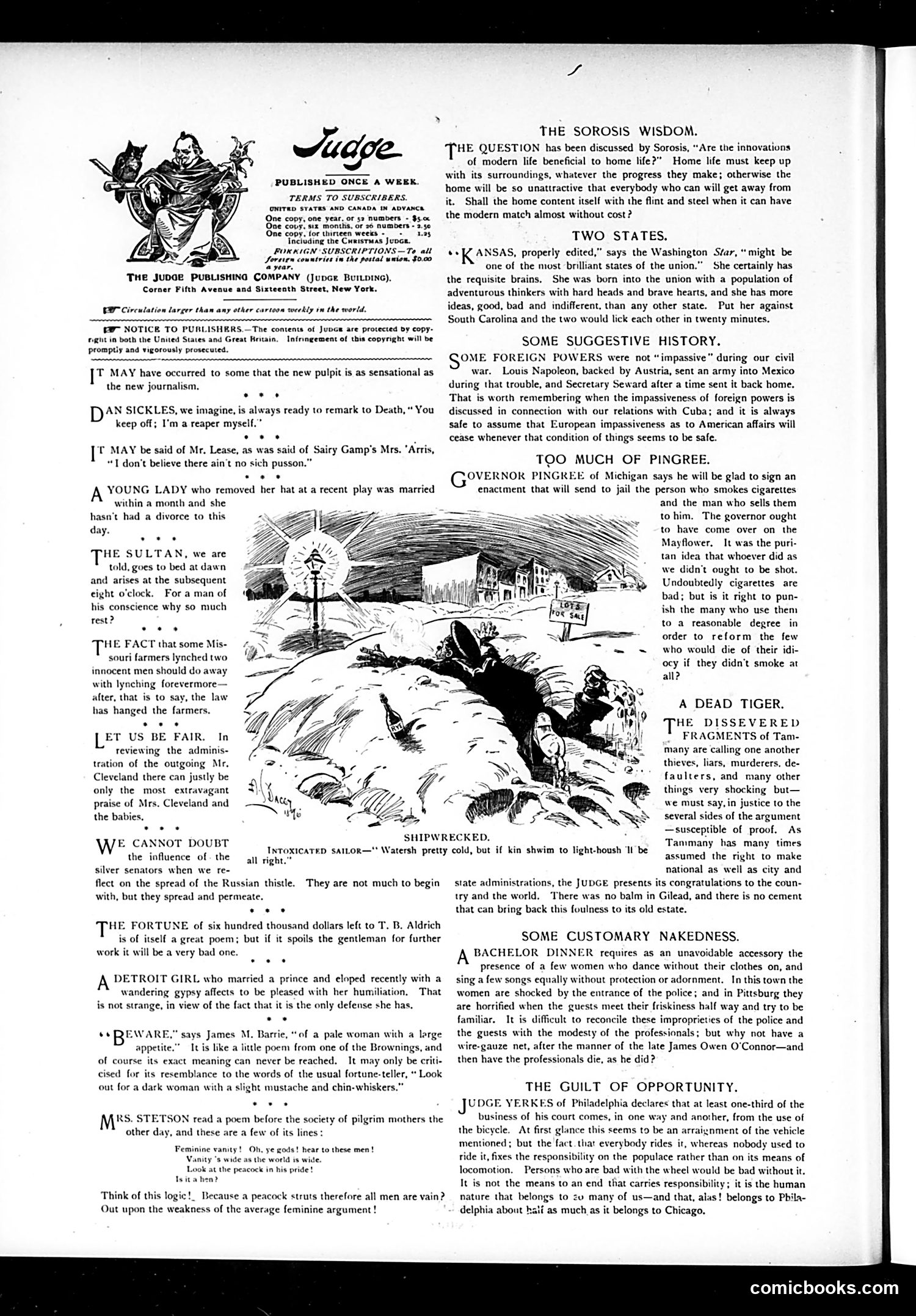
The main cartoon depicts an intoxicated sailor stumbling past a lighthouse, illustrating the caption "INTOXICATED SAILOR—'Waterish pretty cold, but if kin shim to light-boosh it be all right.'" This is straightforward humor: a drunk sailor, slurring speech and barely able to walk, claims he can reach the lighthouse despite his obvious incapacity. The joke relies on the contrast between his confident boast and his pathetic physical state. The surrounding text includes various brief satirical items typical of Judge magazine—social commentary on contemporary issues like Governor Pingree's stance on cigarettes, divorce procedures, and bicycle safety. These are light, topical jabs at public figures and social trends rather than coherent political arguments. The humor is primarily observational rather than deeply political.
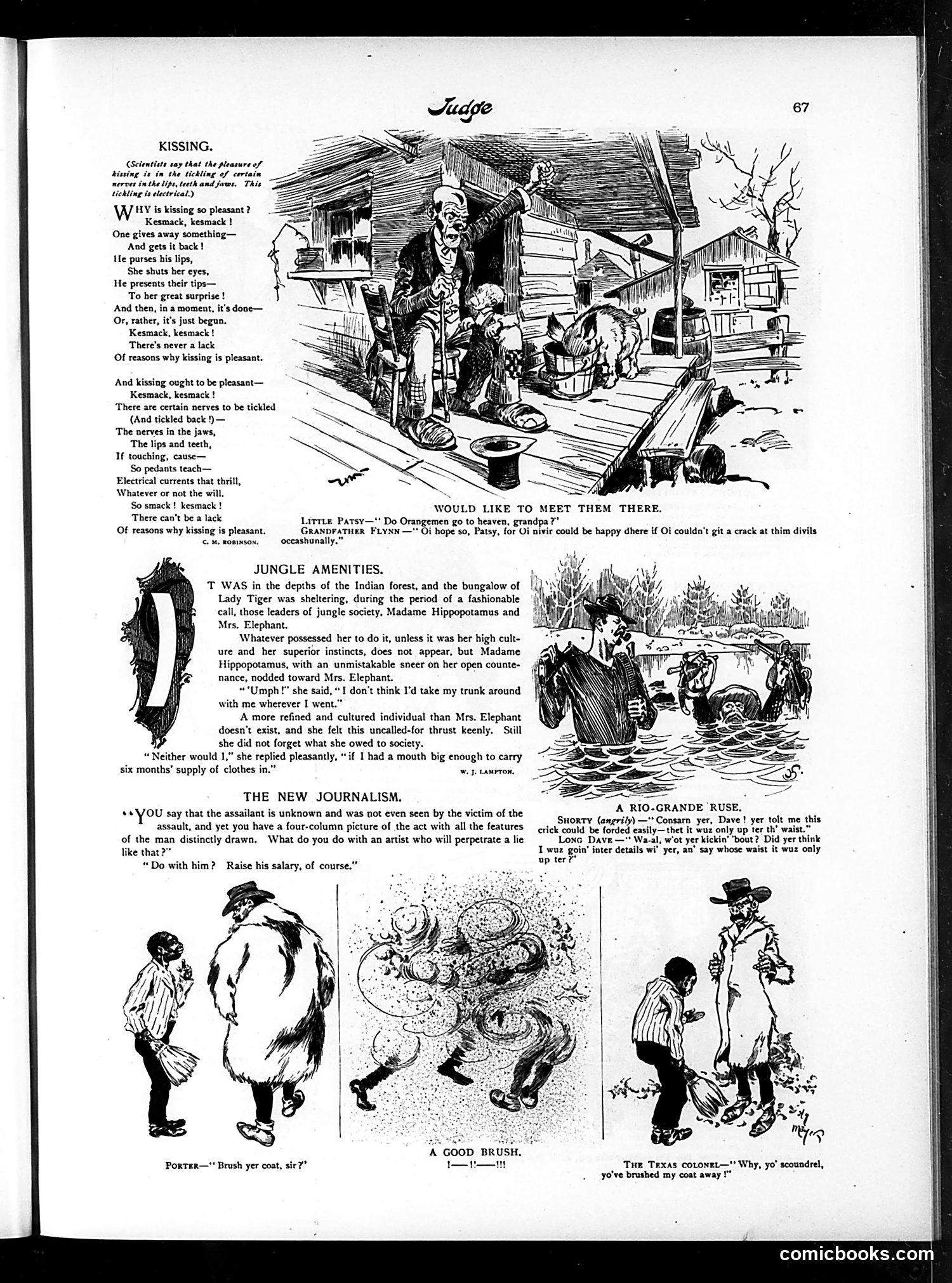
This page contains three separate humorous pieces: **"Kissing"** — A poem questioning why kissing is pleasant, describing the physical mechanics in deliberately unglamorous terms to deflate romance. **"Jungle Amenities"** — A satirical anecdote mocking high-society women's pretensions. It depicts an encounter between refined ladies (Madame Hippopotamus, Mrs. Elephant) and "Lady Tiger" in a jungle setting, suggesting these socialites are no more refined than animals, despite their pretensions to culture. **"The New Journalism"** — Satirizes sensationalist newspaper practices, criticizing journalists who perpetuate lies about crimes without verification, then suggesting raising their salaries—a sarcastic jab at unethical reporting. **"A Rio-Grande 'Ruse'"** and **"A Good Brush"** — Brief comic dialogues with accompanying illustrations depicting confrontations with crude or violent individuals. The page critiques social hypocrisy, poor journalism ethics, and masculine bravado through humor and caricature.
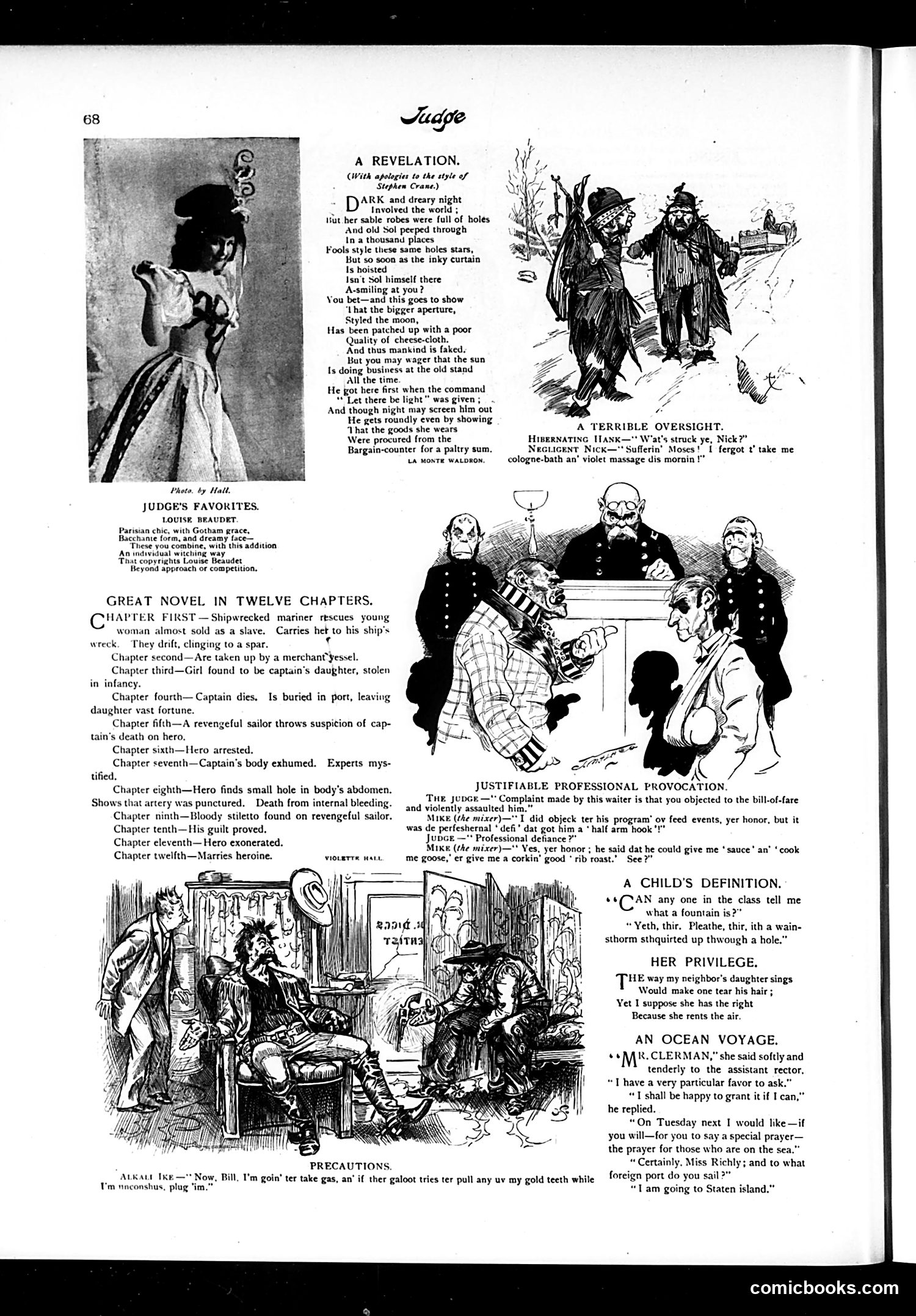
This page contains multiple satirical pieces typical of early 20th-century Judge magazine: **"A Revelation"** mocks Stephen Crane's poetic style, using overwrought language to deflate a mundane observation—that the moon appears dimmer than the sun because it's poorly patched with "cheese-cloth." **"A Terrible Oversight"** presents working-class characters (likely Irish, indicated by dialect) obsessing over grooming rituals ("cologne-bath," "violet massage") in exaggerated fashion, satirizing pretentious vanity. **"Justifiable Professional Provocation"** depicts a mixer defending assault on a waiter by claiming the waiter's menu suggestions ("sauce," "cook me goose") were boxing provocations. The joke relies on boxing terminology and lower-class dialect humor. **Other pieces** include a serialized novel parody, a child's innocent definition of fountains, and a woman asking a clergyman to pray for her voyage to Staten Island—the humor lying in Staten Island being a short ferry ride, not a serious ocean journey. The page reflects Judge's focus on class-based humor, dialect comedy, and gentle mockery of pretension.
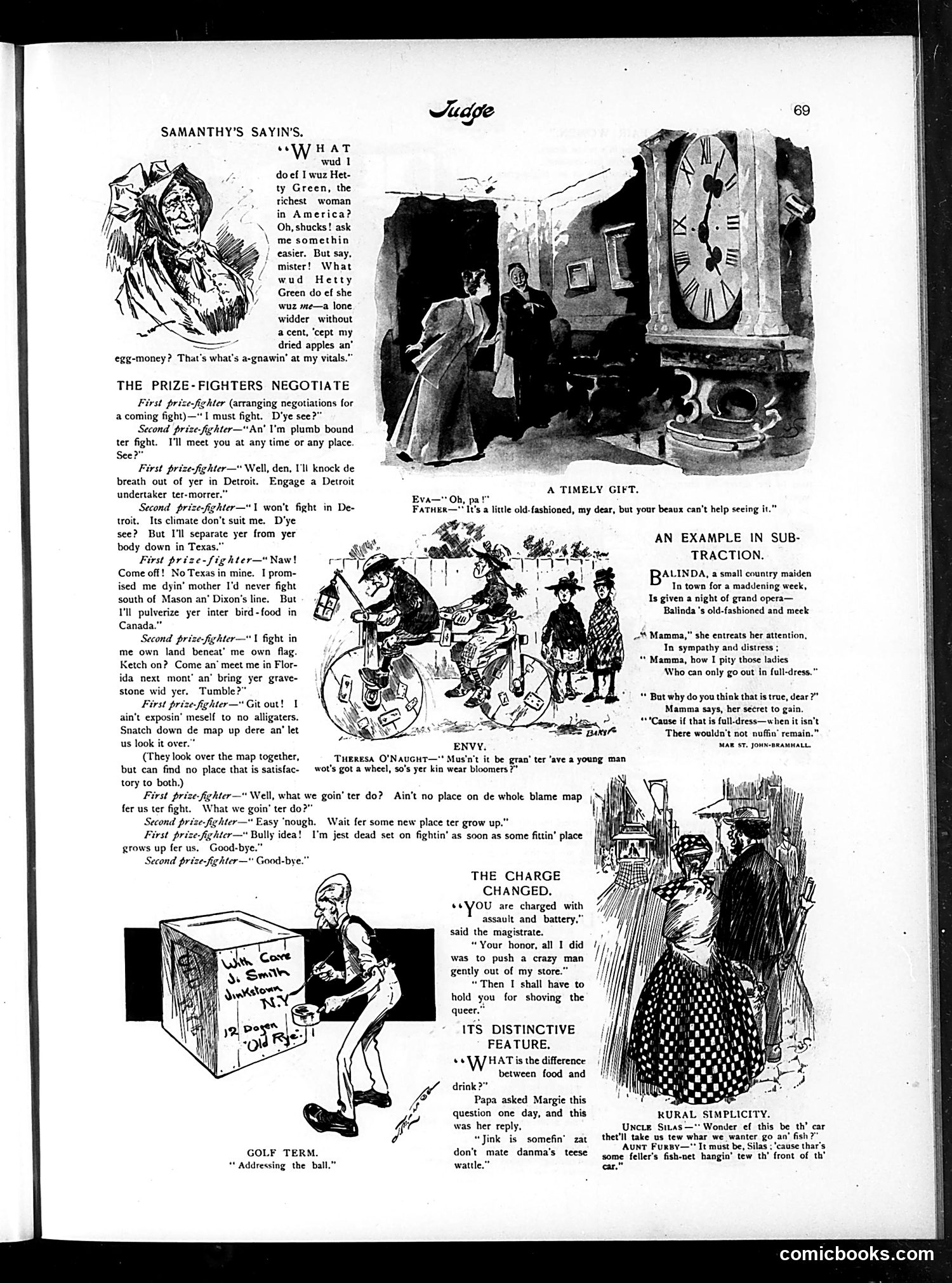
This page contains multiple short humorous pieces typical of early 20th-century satirical magazines: **"Samanthy's Sayins"** features a rural woman pondering what she'd do if wealthy like Hetty Green (a real historical figure known as America's richest woman), highlighting class differences and economic anxiety. **"The Prize-Fighters Negotiate"** satirizes professional boxers who bicker over fight locations, each refusing various American regions until realizing no suitable place exists—mocking their apparent reluctance to actually fight. **"The Charge Changed"** is a brief joke about legal semantics: a man charged with assault gets re-charged with "shoving the queer" (meaning "pushing the strange person"), a play on words. Scattered throughout are other short jokes about children's logic, gift-giving, golf, and rural simplicity—typical filler content. The cartoon illustrations use exaggerated caricatures common to the era's comic style. The overall tone reflects working-class and rural American humor with gentle mockery of pretension and logical absurdities.
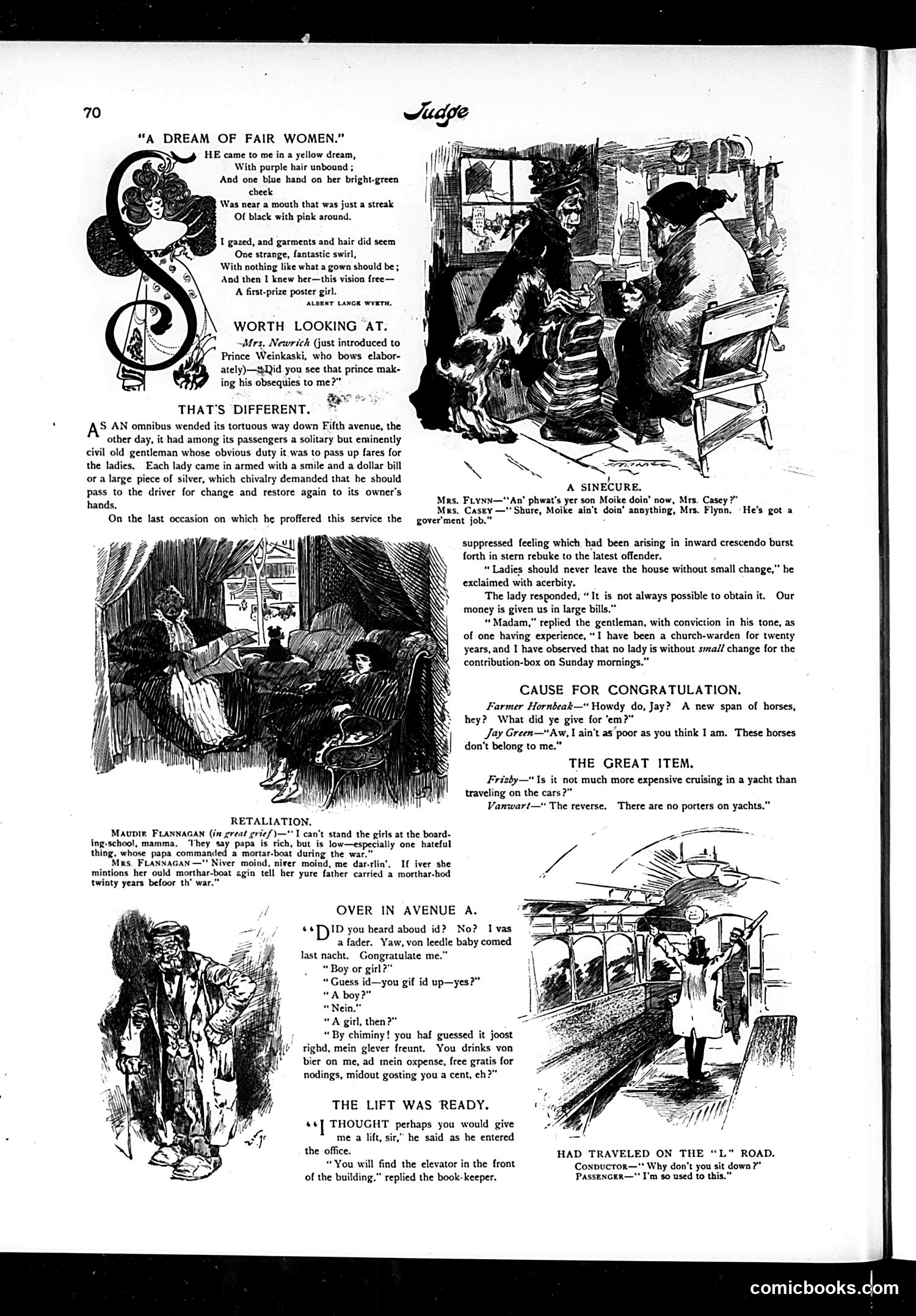
This page contains multiple satirical vignettes typical of early-20th-century American humor: **"A Dream of Fair Women"** mocks avant-garde poster art and aesthetics—the speaker describes an absurdly ugly woman with impossible colors (purple hair, blue hand, green cheek) who turns out to be a "first-prize poster girl," satirizing modern art's departure from traditional beauty standards. **"Worth Looking At"** jokes about social climbing: a newly rich woman (Mrs. Newrich) misunderstands European nobility's formal bows as personal homage, revealing her pretension. **"That's Different"** contrasts working-class behavior with upper-class hypocrisy: a church-warden notes that ladies always have small change for Sunday collection plates, despite claiming they can't make change for taxis—exposing selective "poverty." **Other brief sketches** target Irish immigrants' speech patterns ("Avenue A"), government job nepotism, and class differences in yacht vs. train travel. The page reflects common Judge themes: mocking nouveau riche pretension, immigrant stereotypes, and exposing social contradictions through humor.
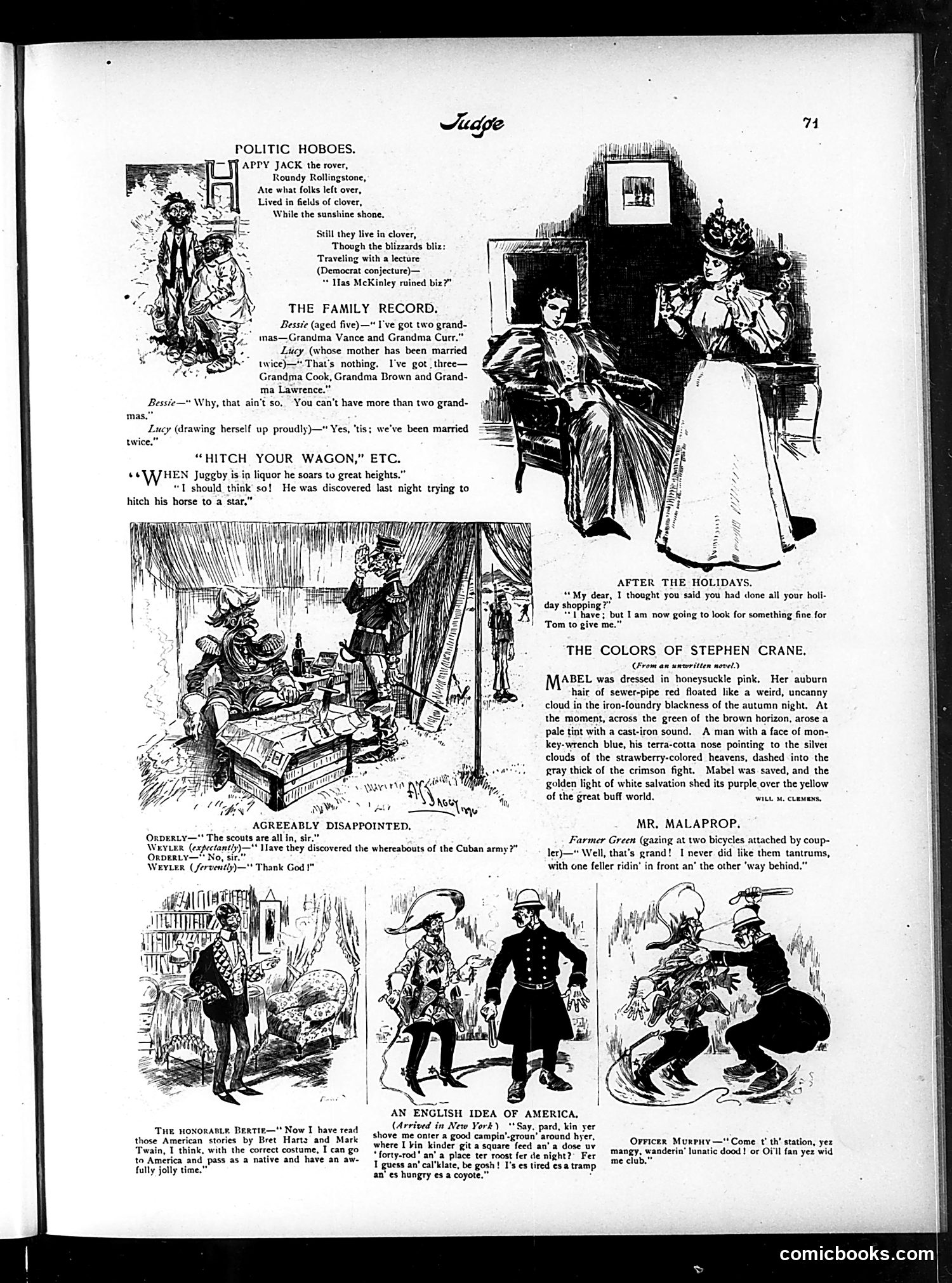
This page contains multiple political and social satires from the 1890s: **"Politic Hoboes"** mocks Democratic politicians as wandering vagrants, suggesting they've lost their "business" (likely referencing William McKinley's Republican presidency and economic policies). **"The Family Record"** satirizes the loosening of Victorian marriage standards, with children casually discussing multiple grandmothers from remarriage—treating scandal as routine. **"The Colors of Stephen Crane"** parodies the literary naturalist's overwrought, synesthetic prose style through absurdly mismatched color descriptions ("honeysuckle pink," "monkey-wrench blue"). **"Agreeably Disappointed"** references the Spanish-American War, mocking Spanish General Weyler's relief that the U.S. hasn't discovered Cuban army locations. **"An English Idea of America"** and **"Mr. Malaprop"** ridicule crude American frontier stereotypes and dialect, suggesting European condescension toward American culture. The cartoons employ exaggerated caricature and contemporary reference humor characteristic of Judge's satirical approach.
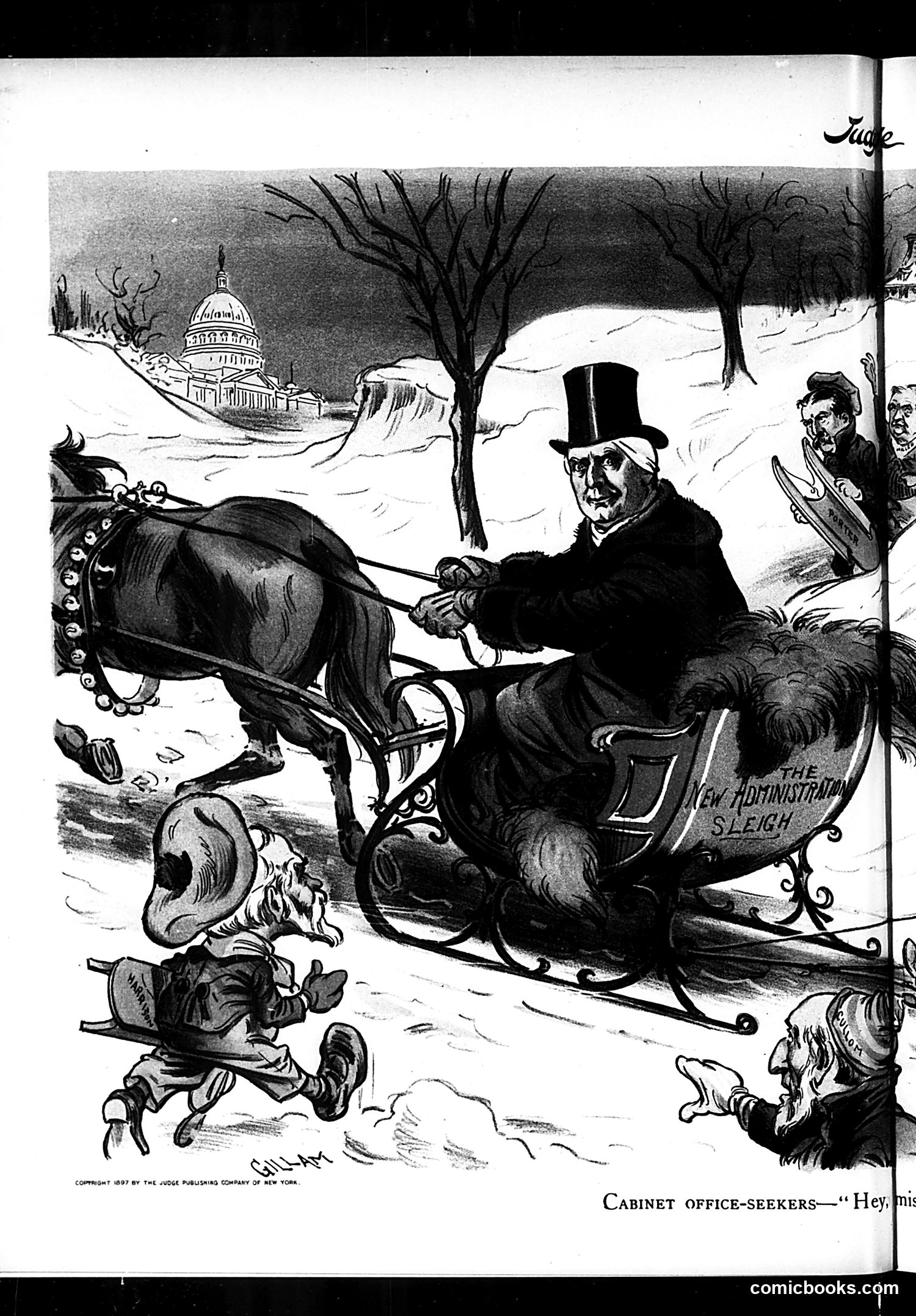
This 1897 Judge magazine cartoon satirizes "Cabinet Office-Seekers." A well-dressed gentleman in a top hat drives an ornate sleigh labeled "The New Administration" pulled by a horse, while various caricatured figures chase and clamber around it in the snow. The Capitol building appears in the background. The cartoon mocks the scramble for government positions following a new presidential administration. The frantic figures represent ambitious politicians and job-seekers desperately pursuing cabinet appointments. The sleigh imagery suggests the administration moving forward while office-hunters pursue it—a visual metaphor for political desperation and the competitive frenzy surrounding patronage appointments. The formal gentleman's indifference to the chaos emphasizes the cartoon's satirical tone about political ambition.
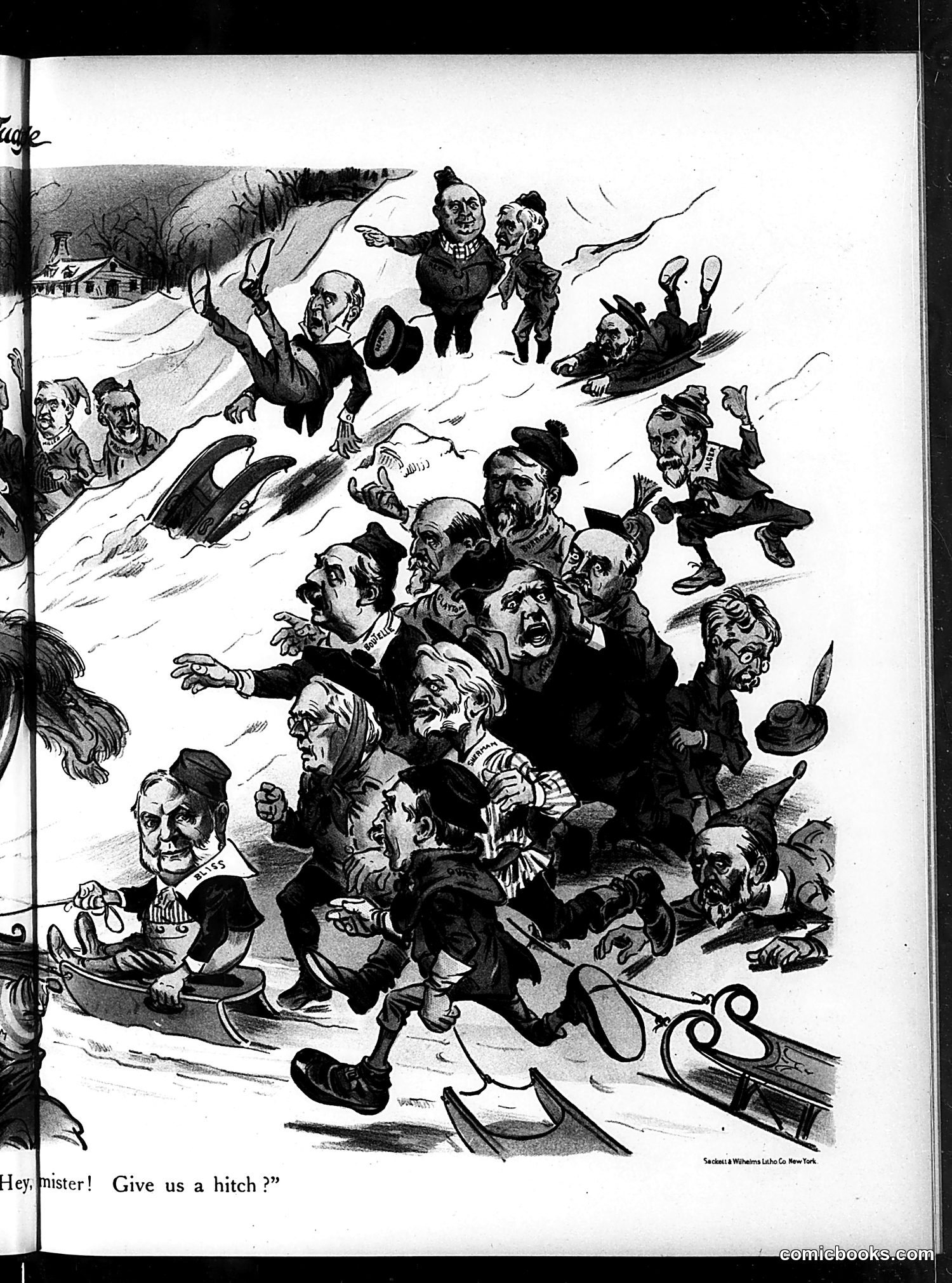
This is a satirical winter scene depicting a group of men in formal attire stuck in snow, appearing distressed and asking for a "hitch" (a ride). The cartoon's caption—"Hey, mister! Give us a hitch?"—suggests these figures are stranded or in difficult circumstances. The exaggerated caricatures and crowded composition indicate this is likely political satire targeting specific public figures or a political party during a period of hardship (possibly economic depression or winter-related crisis). The formal dress contrasts with their desperate situation, suggesting mockery of politicians or leaders who are now helpless. However, without clear identifying labels or additional context from the magazine's publication date, I cannot definitively identify which specific figures or political situation is being satirized.
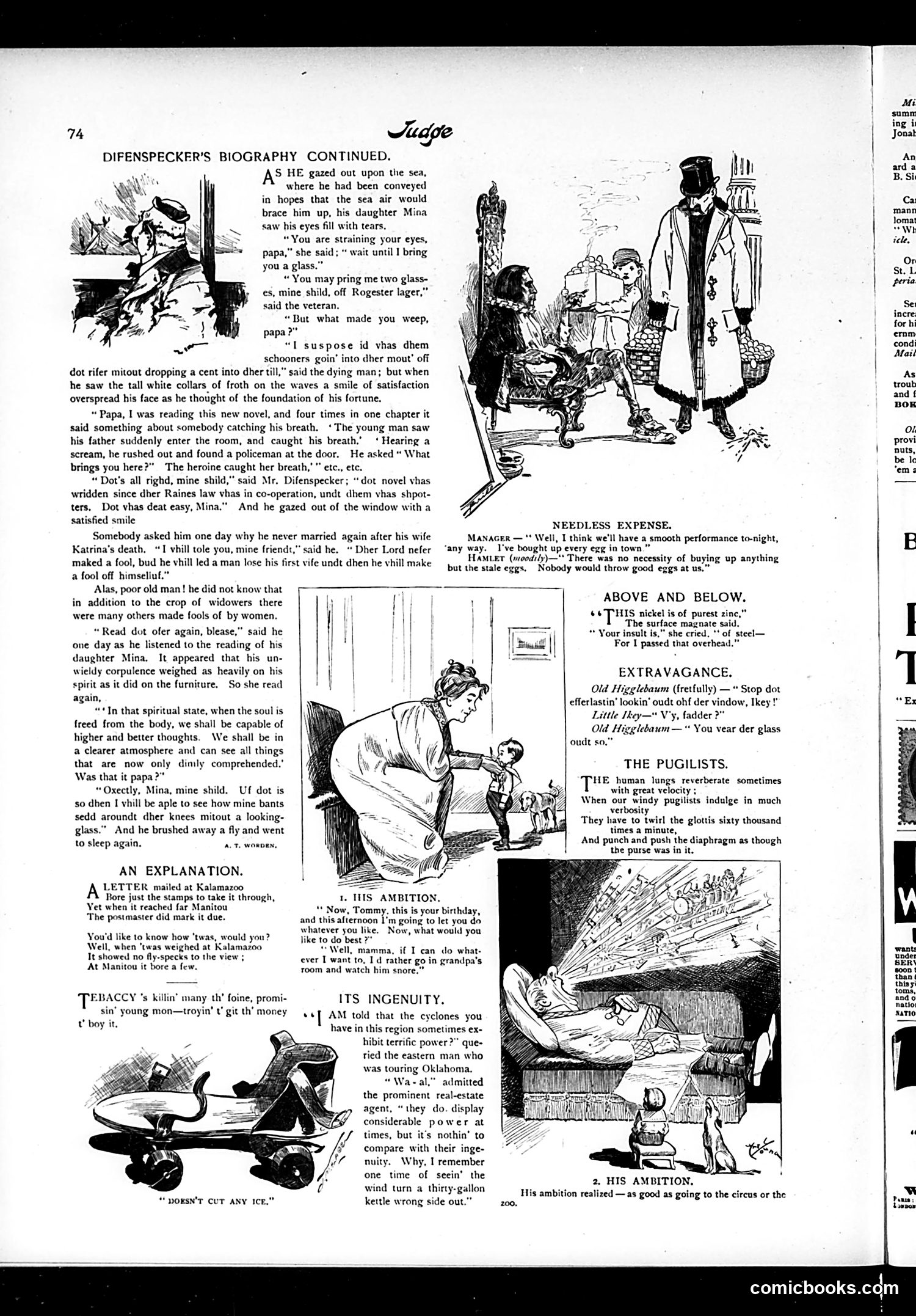
This page contains several unrelated humorous pieces typical of Judge magazine's format: **"Difenspecker's Biography"** is a serialized comic story about a German-accented character (indicated by phonetic dialect spelling like "vhas" for "was"). The humor derives from Difenspecker's miserly obsession with money—even at his deathbed, he's distressed about coins not dropping into his cash register. The dialect comedy was common in late 19th-century American humor. The smaller pieces include jokes about: - Mail delivery inconsistencies (stamps and fly-specks) - Theater managers buying up eggs to throw at bad performances - A child wanting to watch his grandfather snore on his birthday - Oklahoma cyclones and real-estate hype These are brief gag pieces exploiting period-specific references: the "Raines Law" (alcohol regulation), postal systems, and regional stereotypes. The humor relies on wordplay, exaggeration, and character types rather than political satire.
This page is primarily **advertisements and brief satirical commentary**, typical of Judge magazine's format. The main visual content includes ads for whiskey (Hunter Baltimore Rye), champagne, wine, and other products. There's a small cartoon depicting two men in an office or doorway—likely illustrating a social joke about "picking out your own hat when it's a Knox" (a hat brand). The text snippets are short satirical observations: Senator Smith opposes revenue increases because he's wealthy and assumes the government is equally comfortable (critiquing obliviousness to public finances). A joke about "Symmes' hollow earth theory" sardonically compares it to people "going under lately"—likely referencing financial collapses or bankruptcies of the era. There's also a classroom joke about a student unable to name "principal products of western states." **The page reflects Gilded Age concerns**: wealth inequality, financial instability, and educational gaps—wrapped in light humor and surrounded by luxury product advertising targeting affluent readers.
This is primarily an **advertising page** from Judge magazine (circa 1897, based on dates visible in some ads). The layout mixes commercial advertisements with one small cartoon. ## The Cartoon The single illustrated joke shows "HE WAS MUZZLED"—a small dog confronting a larger figure, with the dog's caption reading: "G'wan, you can't touch me! An' I'm not afraid of you cither! See?" The humor appears to reference a contemporary figure or political situation where someone has been "muzzled" (silenced or restrained), yet maintains a defiant posture. Without clearer context, the specific target is unclear—it could reference a muzzled politician, critic, or public figure of 1897. ## Advertisements The page features period-typical ads for tobacco products, patent medicines, bicycles, soap, writing pens, and fabric. The ads reflect the commercial culture of the 1890s and offer insight into contemporary consumer goods and health claims (many dubious by modern standards). **Note:** The cartoonist and specific political reference remain unclear from visible text alone.
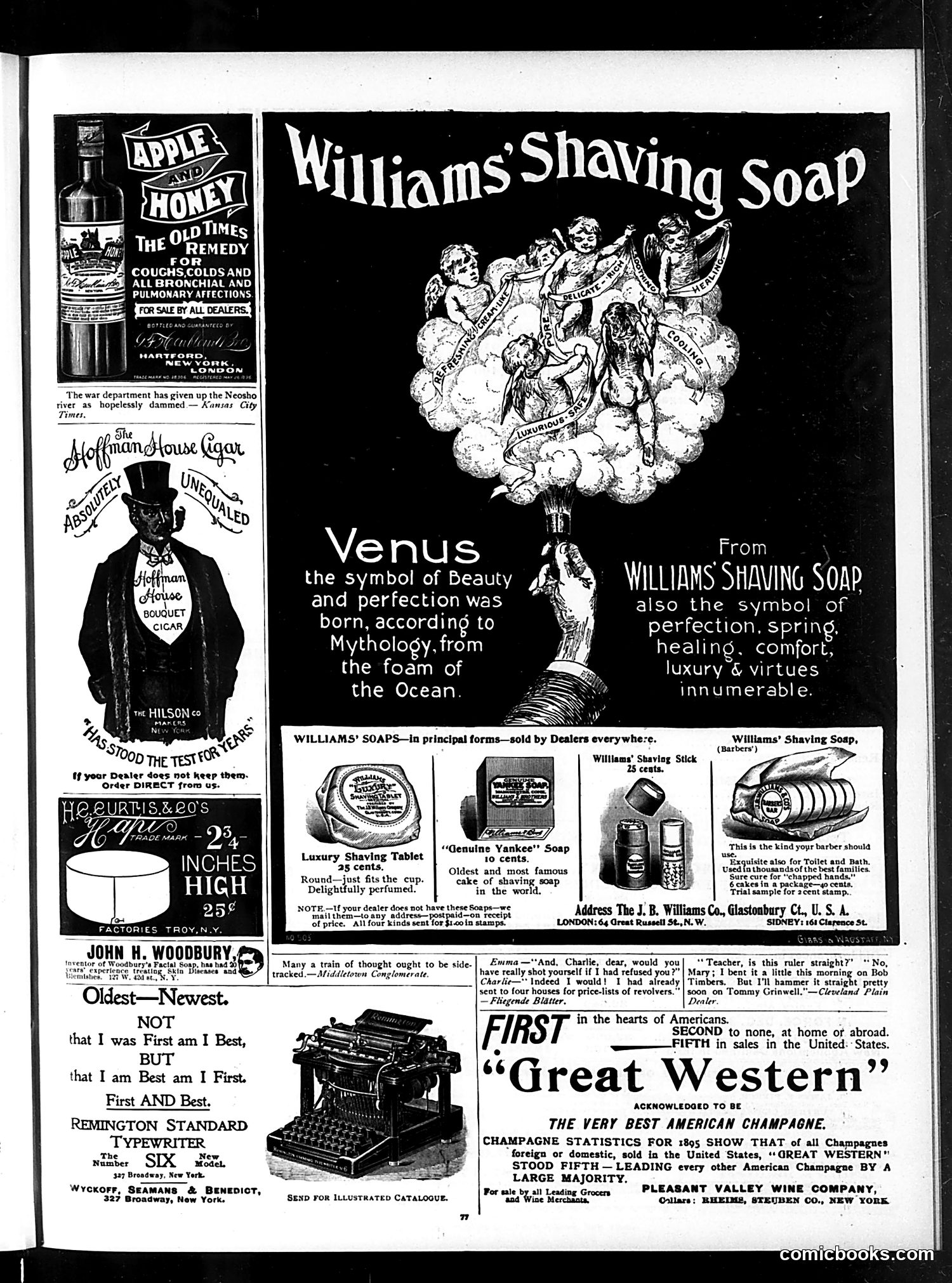
This page is primarily **advertising**, typical of Judge magazine's revenue model. The main content includes: **Williams' Shaving Soap advertisement** (center): Features Venus emerging from seafoam, invoking classical mythology to associate the product with beauty and perfection. This was standard early 1900s advertising rhetoric—linking consumer goods to idealized concepts. **Remington Standard Typewriter ad** (lower left): Plays on competitive positioning with the slogan "First AND Best"—not merely first, but superior. This reflects the typewriter market competition of the era. **"Great Western" Champagne ad** (lower right): Uses patriotic language ("first in hearts of Americans") while claiming fifth-place sales status, yet boasts of outselling other American champagnes. The irony—celebrating being fifth—appears intentional satire of inflated advertising claims. **Minor jokes** (bottom): Include a German publication reprint about suicide and a teacher-student exchange about a bent ruler—typical period humor filler. The page reflects turn-of-the-century consumer culture and advertising conventions rather than political commentary.
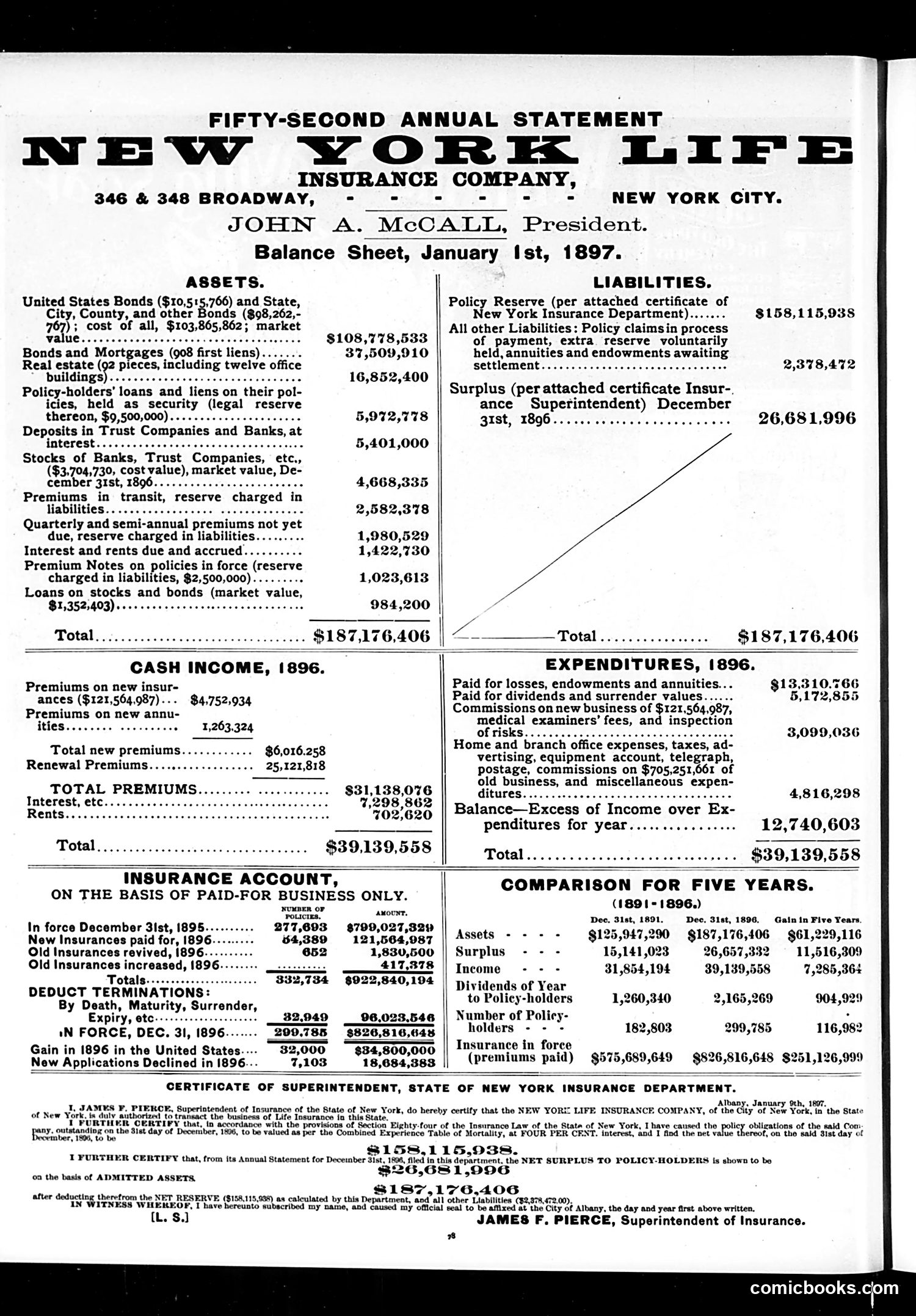
This is the Fifty-Second Annual Statement of the New York Life Insurance Company, dated January 1, 1897. It presents balance sheets, cash income, expenditures, and comparative financial data across five years (1891-1896). The document shows the company's substantial assets ($187 million), policy reserves, and surplus. Key figures include total premiums of $31.1 million in 1896 and an excess of income over expenditures of $12.7 million. The comparison table demonstrates significant growth: assets increased by $61 million, and the number of policyholders nearly doubled from 182,803 to 299,785. The page is certified by James F. Pierce, Superintendent of Insurance for New York State, verifying the company's financial soundness. This represents standard insurance industry reporting of the Gilded Age period, not satirical content.
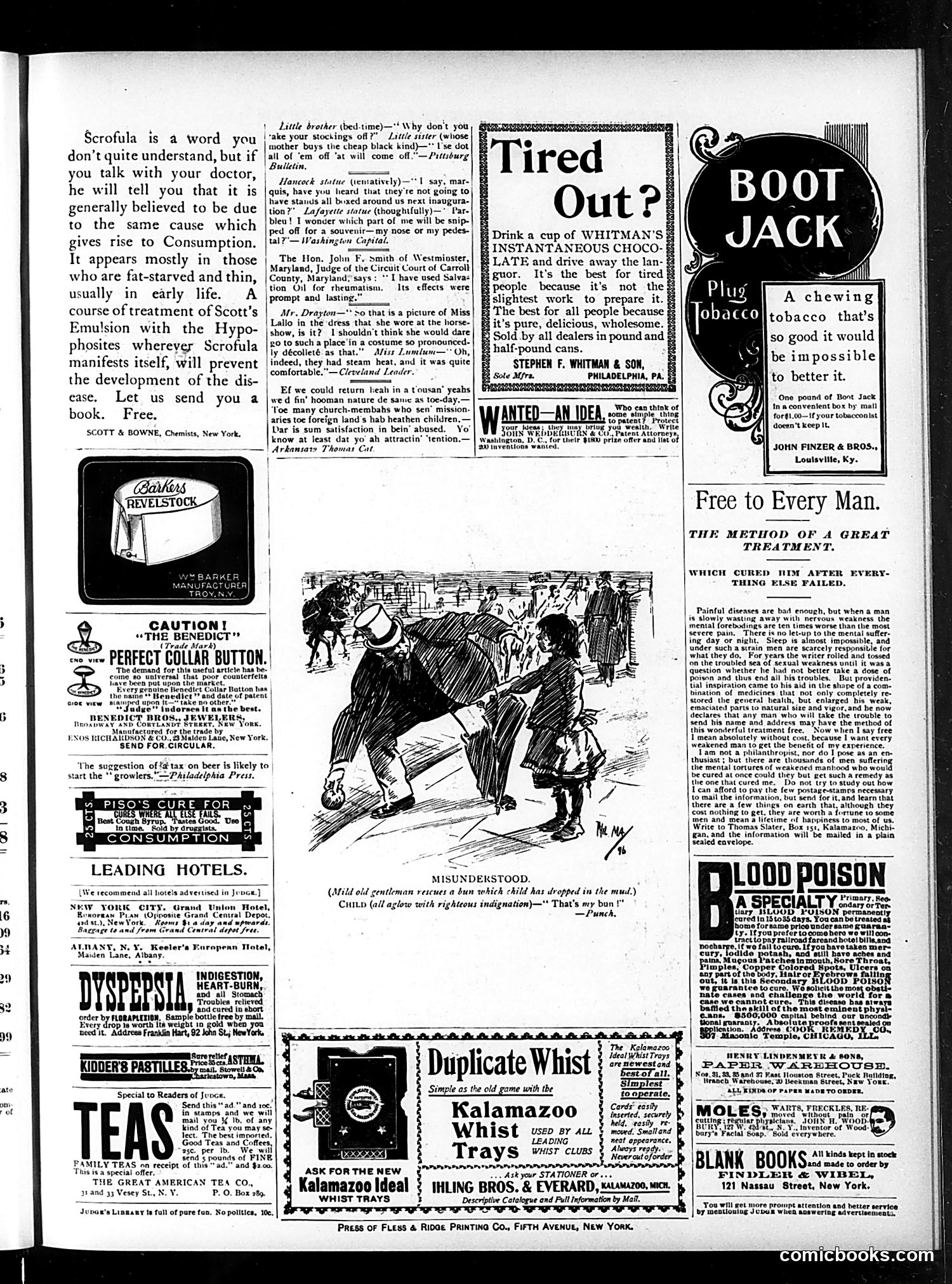
This page is primarily **advertising**, featuring various patent medicines, hotels, and consumer products typical of the late 19th/early 20th century. However, it contains several brief satirical items: **The Cartoons/Jokes:** 1. **"Misunderstood"** (center): A genteel older man rescues a bun a child dropped in mud. The child angrily claims it's hers—the satire is the child's indignation at his "help," suggesting miscommunication between classes or generations. 2. **Several brief quoted jokes** about everyday life: children's stockings, statues being boxed up (possibly for an inauguration), a woman's revealing dress at a horse show, and observations on human nature and church hypocrisy. **Historical Context:** These are gentle, domestic humor pieces reflecting Edwardian-era sensibilities—class differences, propriety concerns, and mild social observation rather than hard political satire. The ads (Scott's Emulsion, Whitman's Chocolate, patent medicines) reveal contemporary health anxieties and consumer culture.
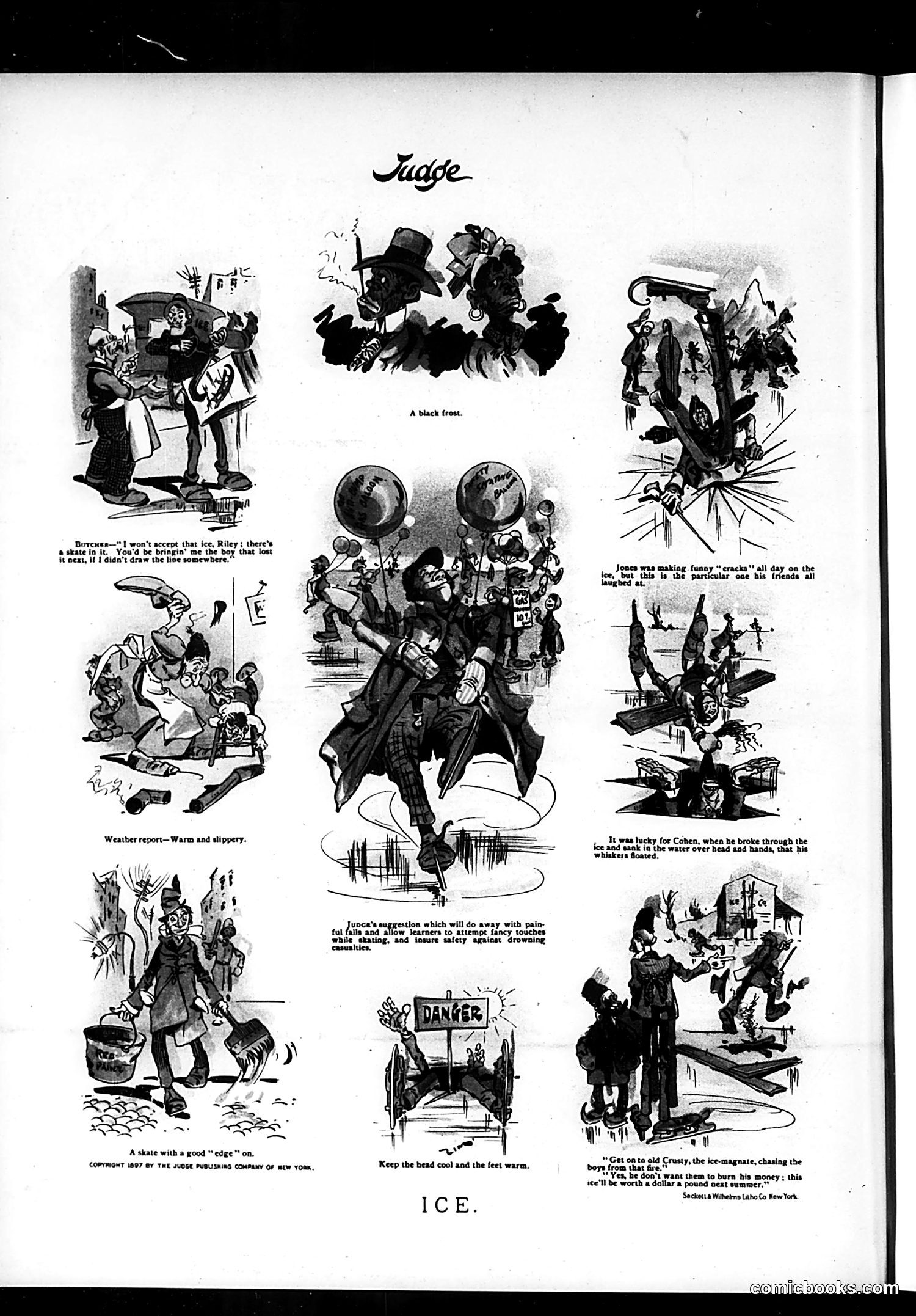
This 1897 satirical page uses winter ice-skating as its theme to mock various social issues and absurdities of the era. **Main subjects:** - **"Burcnee" (likely a ice-dealer or vendor)**: The opening dialogue jokes about his refusal to accept skates found in ice, suggesting he'd then be responsible for returning lost property—a commentary on business evasion of responsibility. - **Ice safety and skating hazards**: Multiple cartoons satirize both the dangers of ice-skating (drowning, falls) and proposed "improvements" like special skate designs and safety rules—poking fun at over-engineering solutions to simple problems. - **"Cohen" and whisker-floating**: An ethnic stereotype joke about a Jewish man whose beard kept him afloat when falling through ice—typical of the era's casual prejudiced humor. - **"Old Crusty, the ice-magnate"**: Mocks a wealthy ice merchant preventing boys from melting his ice by playing with fire, valuing profit over children's welfare—satirizing unchecked commercialism and greed. The overall point: winter ice commerce breeds absurd human behavior and moral compromises.