
A complete issue · 16 pages · 1896
Judge — October 24, 1896
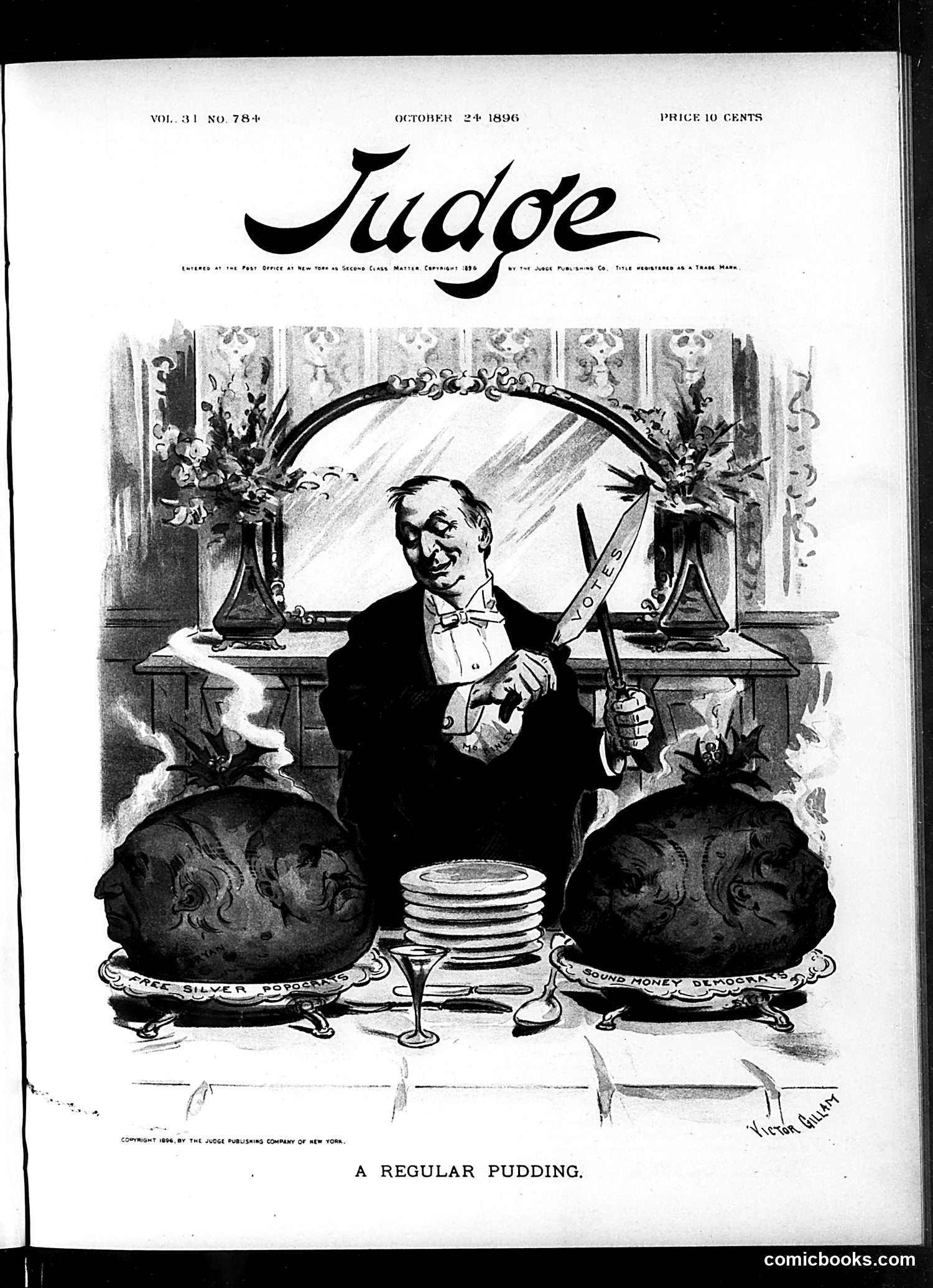
This political cartoon depicts a well-dressed man carving what appears to be a pudding, with two large heads labeled "FAKE SILVER POODLE" (left) and "SOUND MONEY DEMOCRAT" (right) positioned as serving dishes below. The cartoon satirizes the 1896 presidential election, specifically the monetary policy debate dividing Democrats. William Jennings Bryan's "free silver" platform split the Democratic Party—some Democrats opposed unlimited silver coinage ("sound money" advocates) while Bryan's faction championed it. The "pudding" being carved suggests the outcome will be divided or messy regardless. The carver appears to be a political figure—likely representing someone facilitating this Democratic schism. The cartoon mocks how both factions will be served an unappetizing result from this party division.
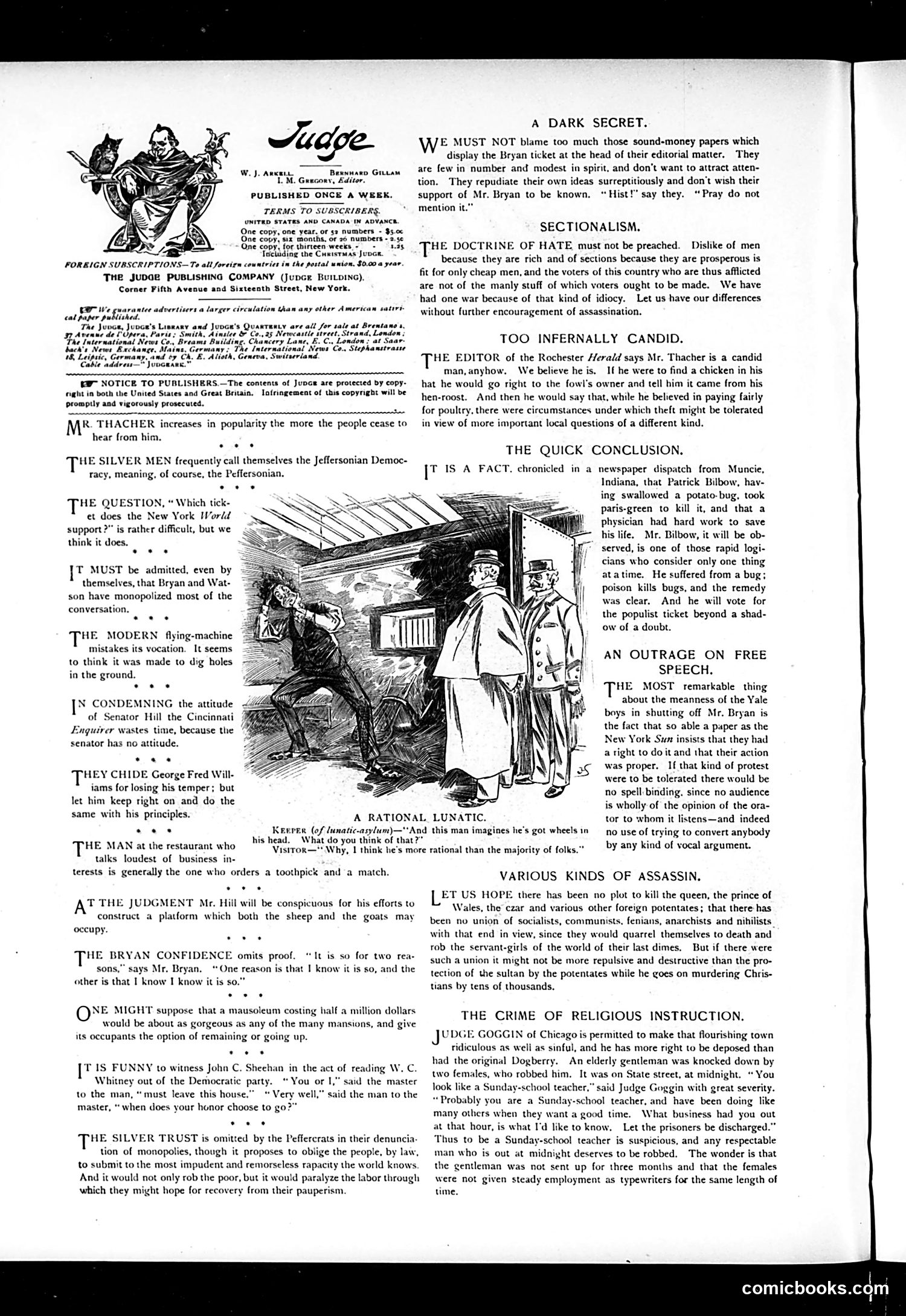
The central cartoon depicts a doctor attending to a patient who has swallowed a potato-bug, based on a newspaper dispatch from Muncie, Indiana about Patrick Dilbow. The satire mocks both the absurdity of the news story itself and the press's breathless coverage of trivial, sensationalized incidents. The surrounding brief editorial commentary satirizes various contemporary targets: Bryan (likely William Jennings Bryan) on political matters; Senator Hill's attitude; George Fred Williams' temperament; and criticisms of Yale students' protest against a speaker, calling their actions "mean" and questioning free speech protections. The overall tone treats these items as ridiculous, exposing the period's obsession with trivial scandal-mongering.
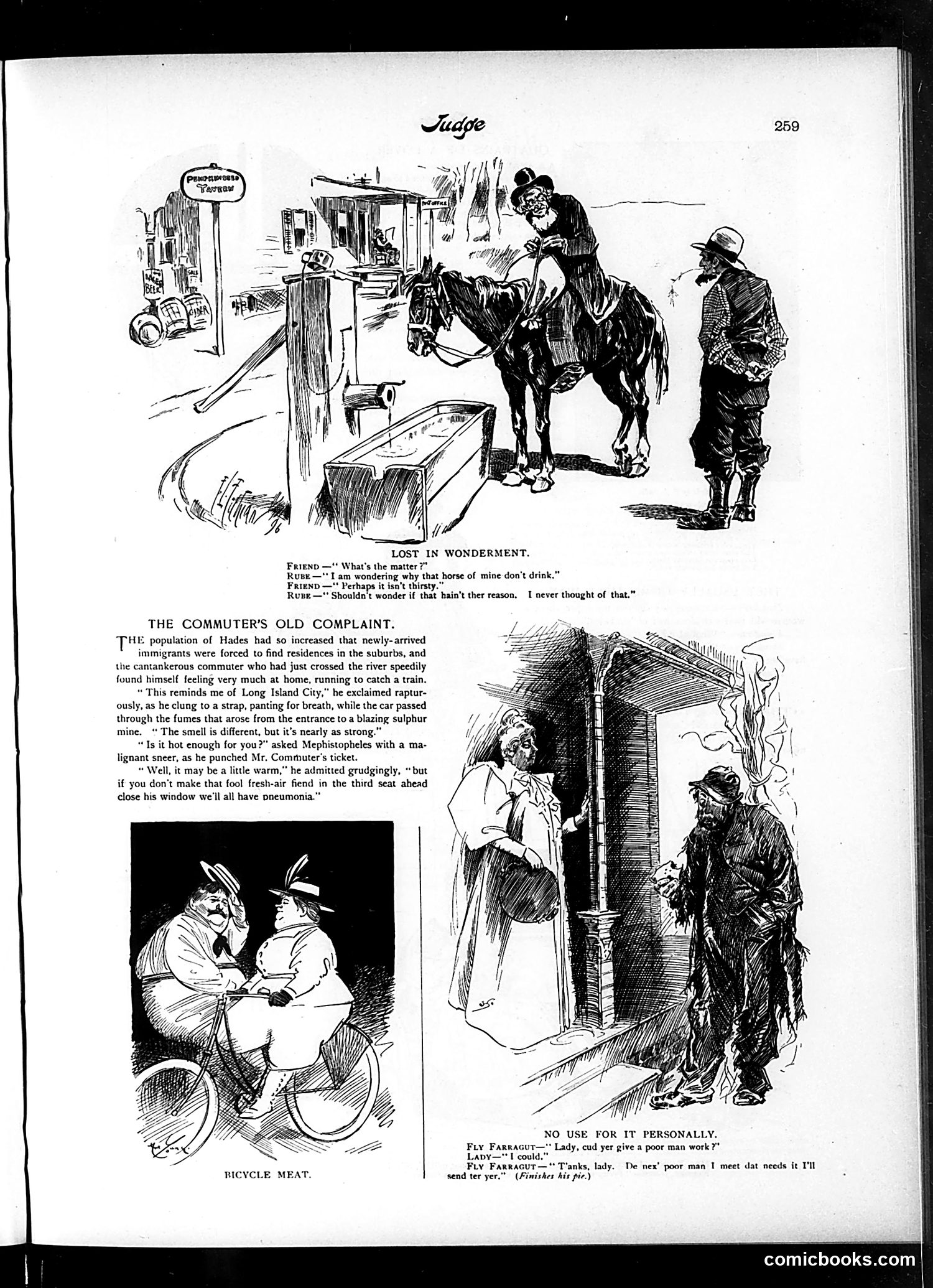
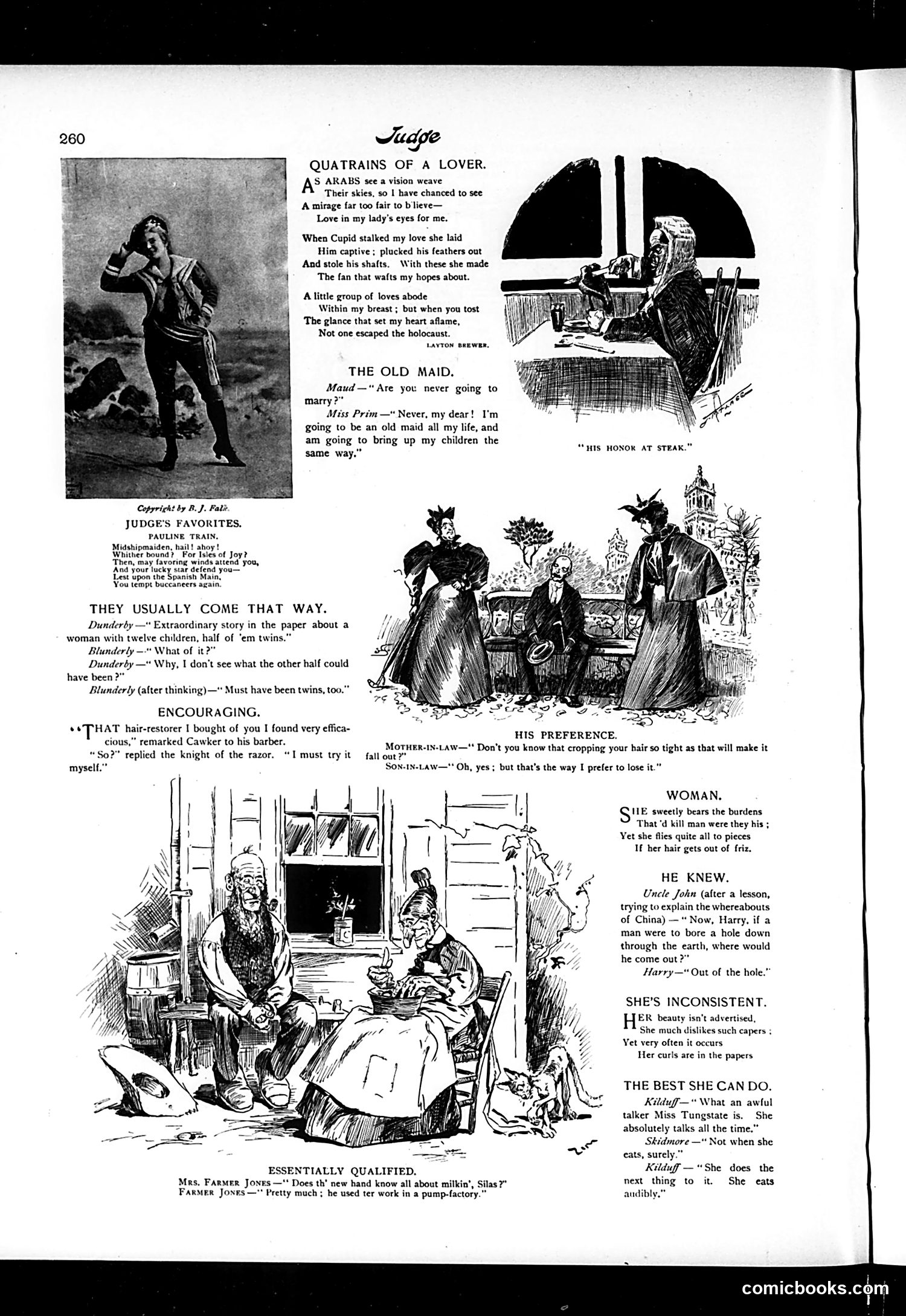
This page from Judge presents miscellaneous satirical humor typical of the publication's style. The content includes: **Romantic Poetry Section**: "Quatrains of a Lover" and "The Old Maid" mock sentimental love literature and spinsters—standard Victorian-era jokes about unmarried women. **Brief Comic Sketches**: Several short exchanges satirize contemporary absurdities: - "They Usually Come That Way" plays on logical fallacy (twins begetting twins) - "Encouraging" jokes about a hair-restorer's effectiveness - Gender stereotypes appear throughout: women's vanity about appearance, emotional instability regarding hair, and chattiness **Social Commentary**: The humor reinforces period attitudes about gender roles, marriage expectations, and class distinctions (the farmer's servant, the hair-restorer customer). The illustrations are generic Victorian-style engravings. Overall, this represents typical early-20th-century American satirical magazine content—lightweight comedy relying on predictable punchlines about contemporary domestic life and gender relations.
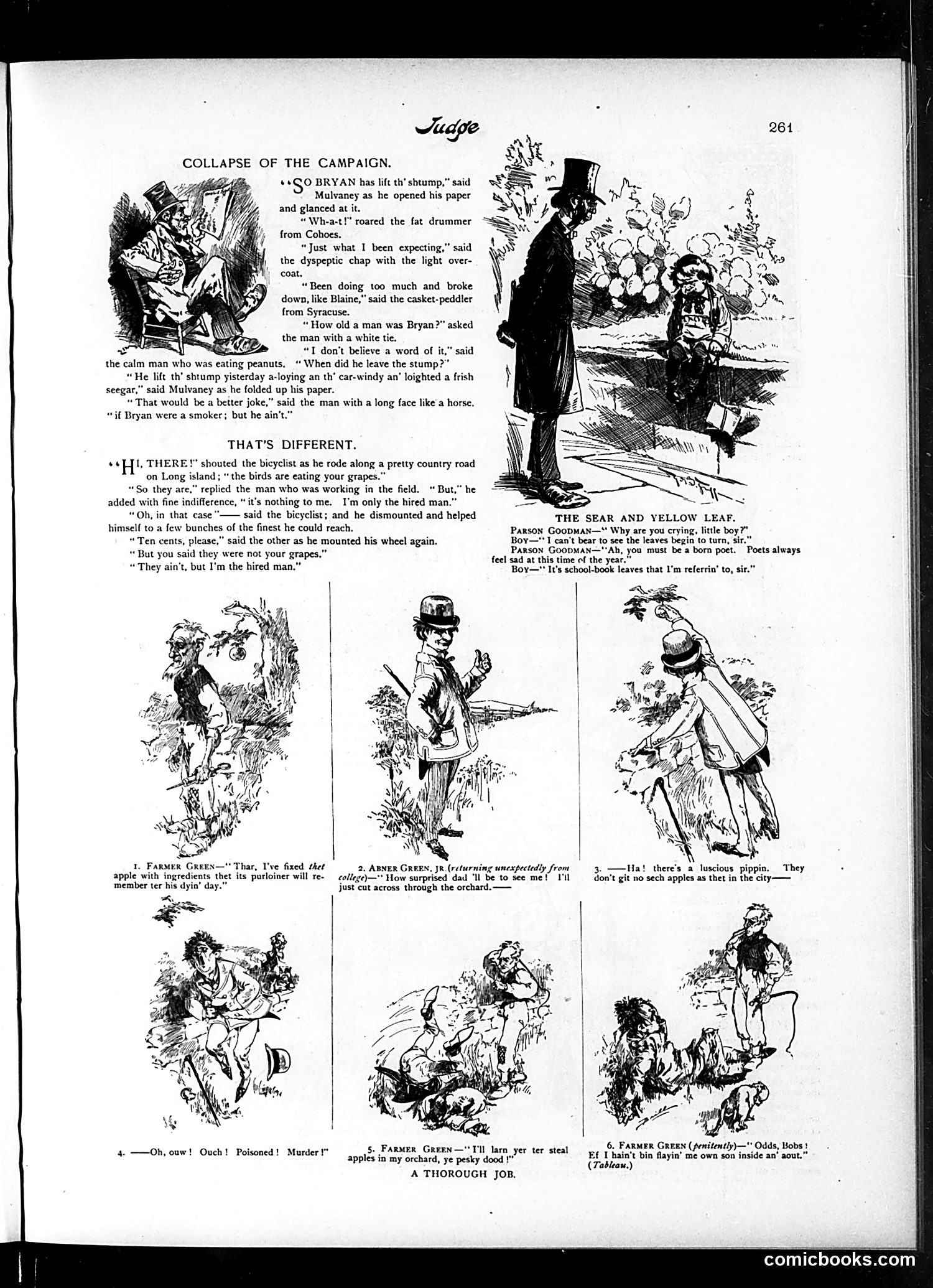
This page contains three separate satirical pieces from the 1890s: **"Collapse of the Campaign"** mocks William Jennings Bryan's 1896 presidential run. The dialogue suggests Bryan abandoned his campaign ("left the stump"), with various working-class characters dismissing it—one notes he quit to smoke a cigar. The satire targets both Bryan and his supporters' credulity. **"That's Different"** satirizes class hypocrisy. A bicyclist righteous about birds eating grapes becomes a fruit thief himself once learning the vineyard owner is "only the hired man"—suggesting wealthy people feel entitled to steal from those they view as beneath them. **"The Sear and Yellow Leaf"** and "A Thorough Job"** depict farmer schemes. One shows poisoning stolen apples to catch thieves; another shows a farmer's son returning from college, unaware he's about to unknowingly eat the poisoned fruit his father set as a trap. The dark humor lies in the ironic comeuppance. All pieces reflect period cynicism about politics, morality, and rural life.
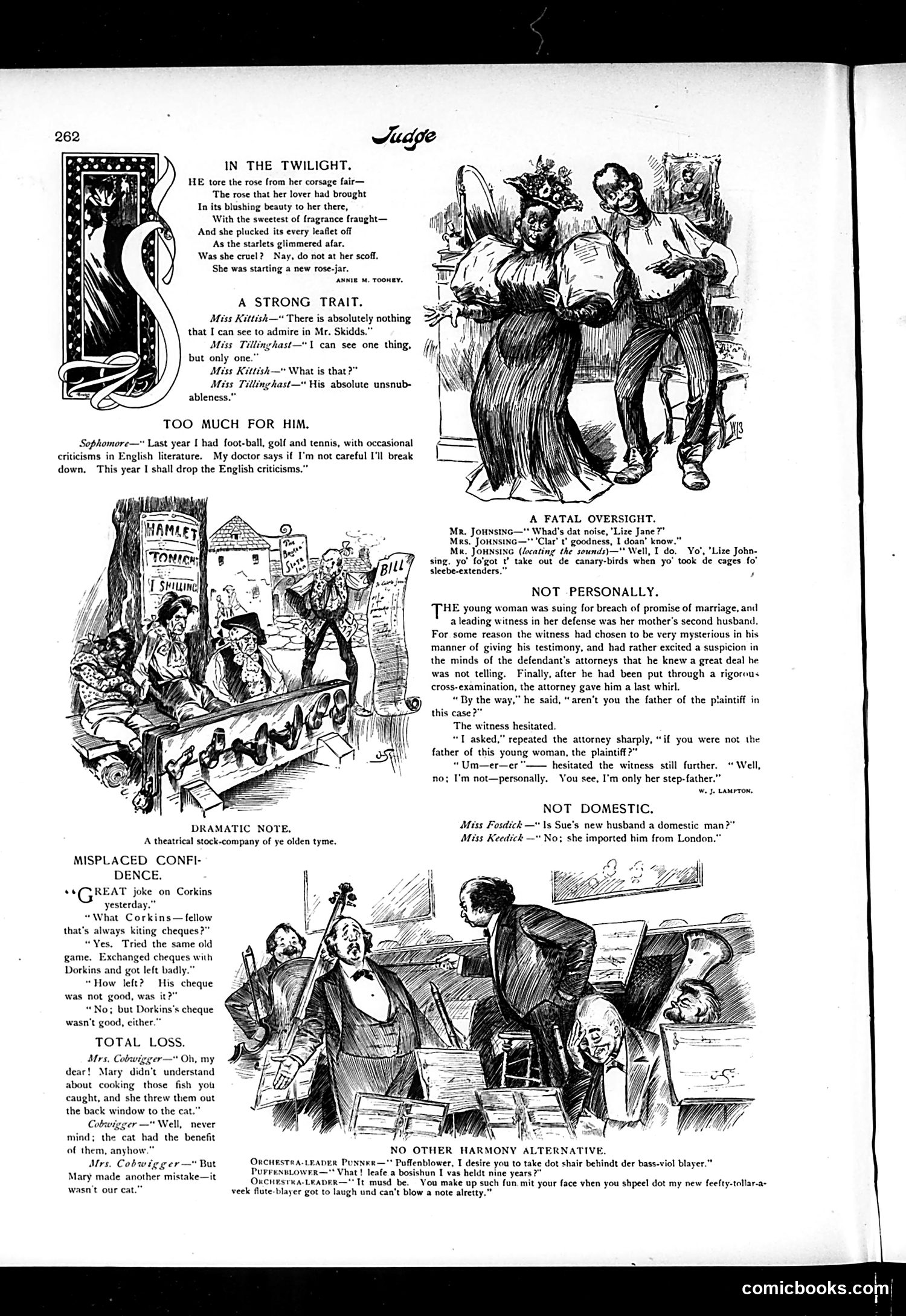
This page presents miscellaneous satirical humor typical of Judge magazine's content. The cartoons and jokes target social pretension and domestic absurdity rather than specific political figures. **"A Fatal Oversight"** mocks African American dialect humor (common in period satire), depicting a couple who forgot to remove caged canaries before using the cages as bed-extenders—physical comedy at their expense. **"Not Personally"** ridicules legal evasion through semantic hair-splitting: a stepfather testifies he's "not personally" the plaintiff's father, exploiting the word "personally" to dodge a straightforward question during a breach-of-promise suit. **"Misplaced Confidence"** depicts failed check-kiting schemes where both parties attempted fraud simultaneously, canceling each other's schemes. **"No Other Harmony Alternative"** shows an orchestra conductor accepting a poor musician because his comically expressive face entertains the audience—form over substance in musical performance. The page emphasizes domestic mishaps, class pretension, and verbal trickery as humor sources, reflecting early 1900s satirical priorities.
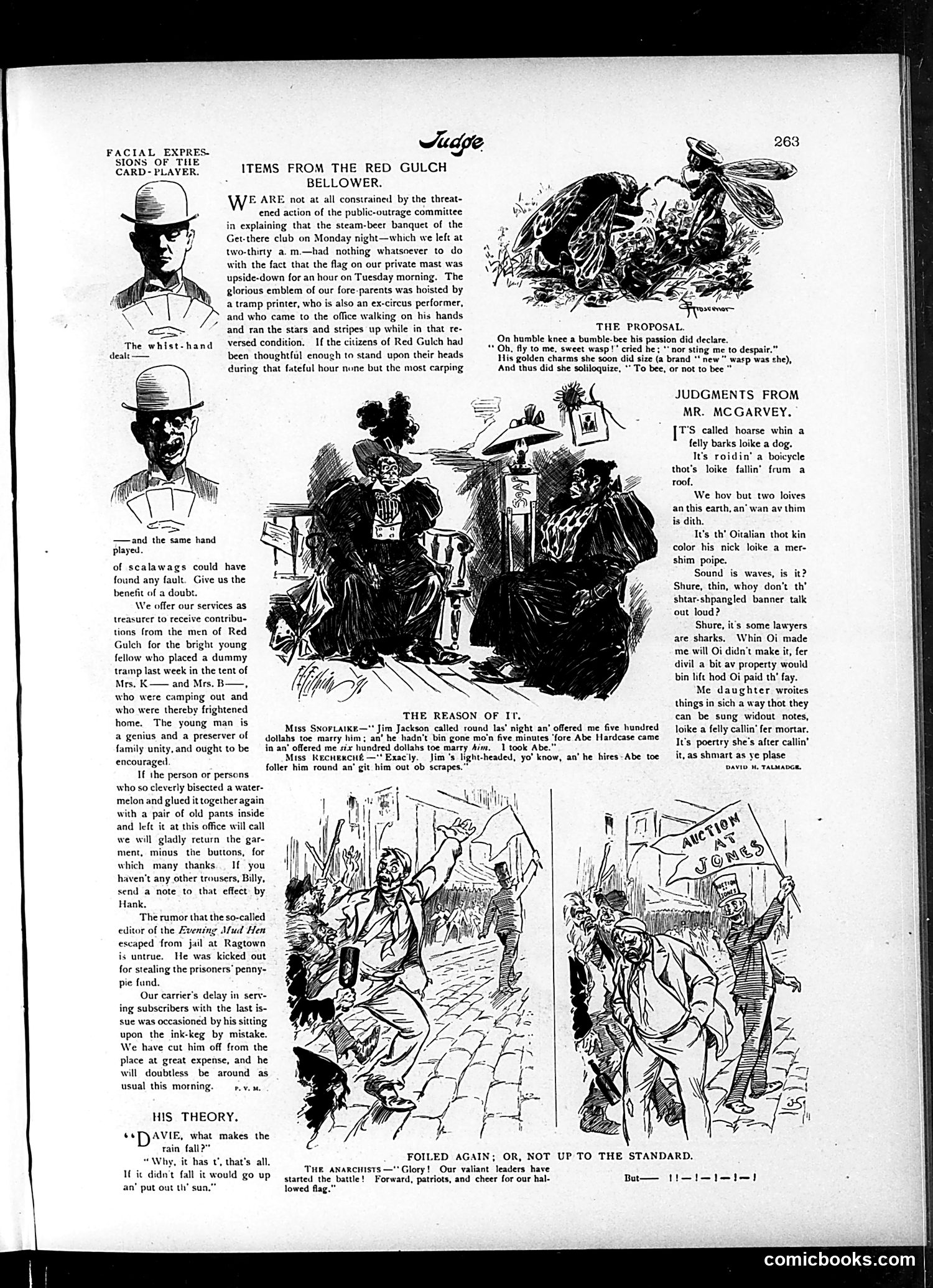
This page collects humorous rural sketches and one-liners from "Red Gulch," a fictional frontier town. The main items include: **"Items from the Red Gulch Bellower"**: A tongue-in-cheek explanation for why Judge's flag flew upside-down—blamed on a drunk ex-circus performer tramp printer who walked on his hands while raising it. The joke mocks the magazine's own carelessness. **"The Proposal"**: A pun-based poem about a bumble-bee proposing to a wasp with Shakespeare wordplay ("To bee or not to bee"). **"Judgments from Mr. McGarvey"**: Irish-dialect aphorisms delivered by a character with stereotypical working-class Irish speech patterns, offering homespun philosophy on various topics. **"The Reason of It"**: A brief comic dialogue about a woman accepting one suitor's marriage proposal over another's because the rejected man is foolish enough to employ the other as his handler. The cartoons throughout use exaggerated character types typical of 1890s American humor—rural eccentrics and stereotypical ethnic characters presented for comedic effect.
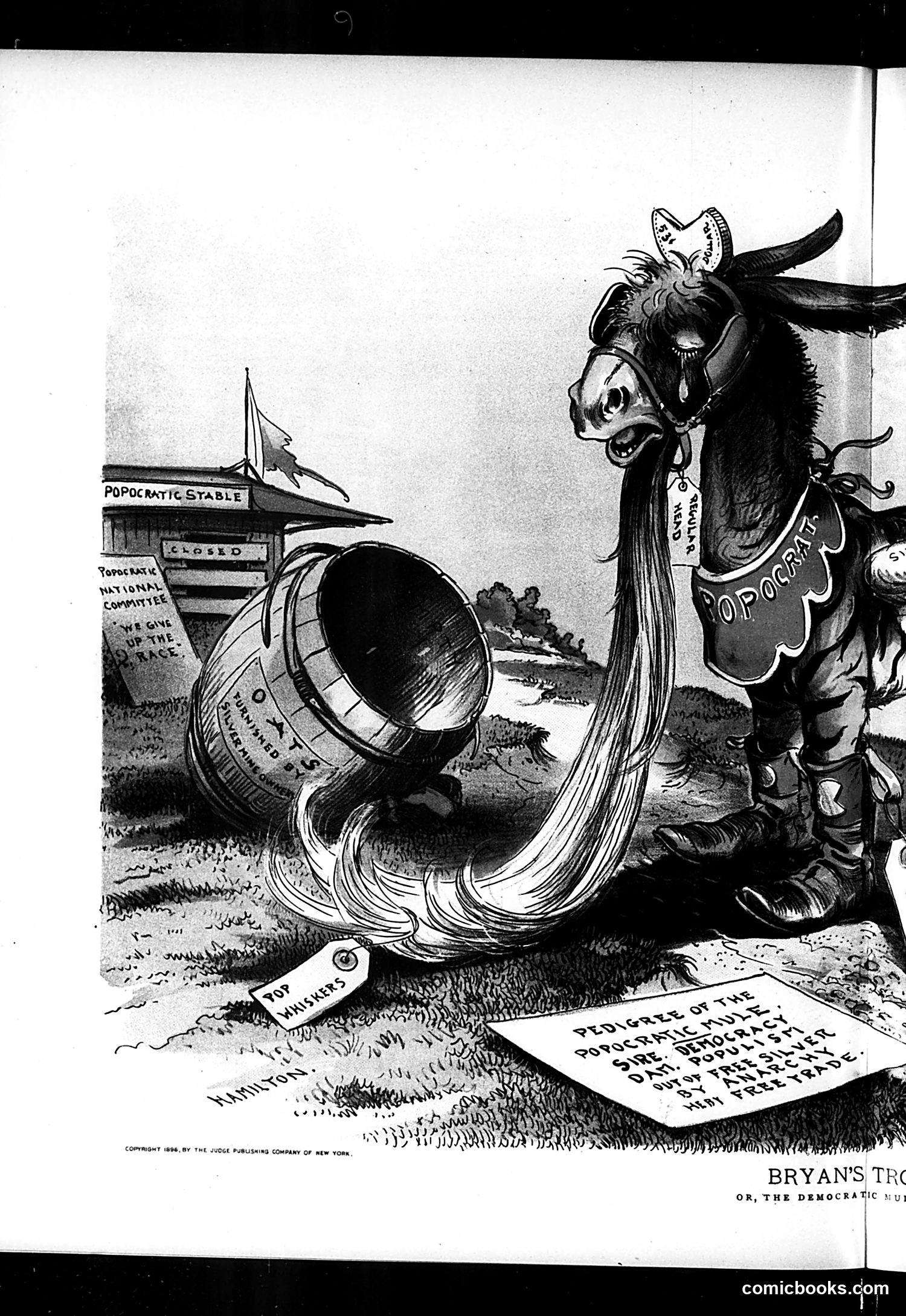
This appears to be a satirical cartoon from *Judge* magazine attacking William Jennings Bryan and the Democratic Party (the "Popocratic Stable"). The cartoon depicts a donkey—the traditional symbol of the Democratic Party—being led from a closed stable labeled "Popocratic Stable." The donkey wears decorative regalia and is pulling a large barrel marked with text (partially legible as references to Bryan and populism). The satire suggests the Democrats are being paraded out, likely mocking Bryan's political campaign or the party's populist platform. The "stable" imagery implies the party controls or constrains its candidates. A sign visible in the image references "Hamilton" and appears to be a dedication or monument-related marker. The cartoon's point appears critical of Bryan's Democratic-Populist movement and the party's management of its candidates.
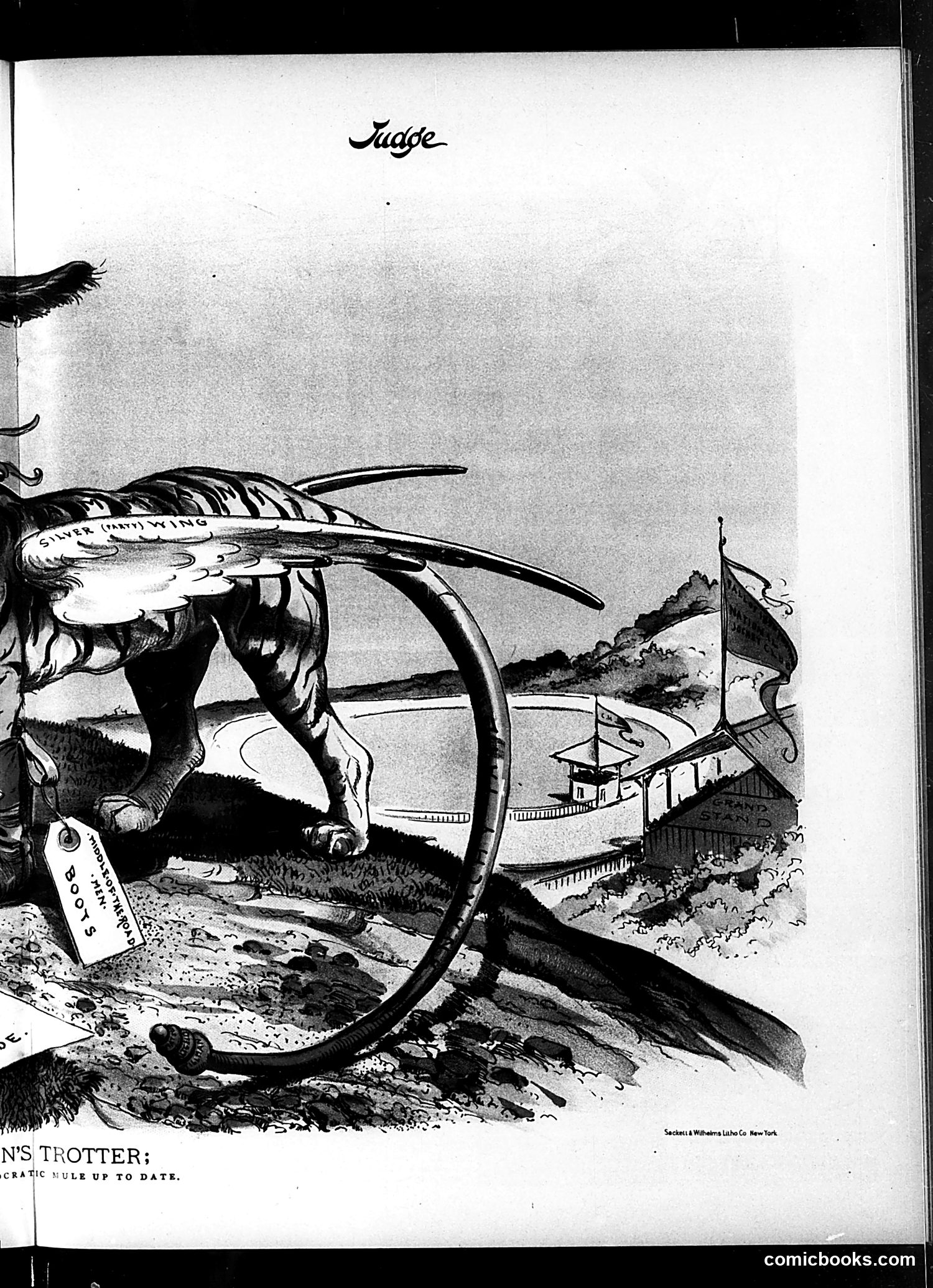
This political cartoon depicts a large lobster with an exaggerated claw in the foreground, positioned menacingly near a coastal Asian structure (pagoda-style building with a flag). The visible text fragment "N'S TROTTER" is incomplete, making the specific reference unclear. The cartoon likely comments on American imperial ambitions or conflicts in Asia during the early 20th century—a common *Judge* magazine theme. The lobster appears to represent either American aggression or commercial expansion ("trotter" suggesting movement/advancement). The Asian setting and architectural details suggest a specific historical incident or policy debate regarding U.S. involvement in Asian territories or trade. Without the full title and date, the precise political context remains uncertain, though the imagery clearly satirizes American foreign policy expansion.
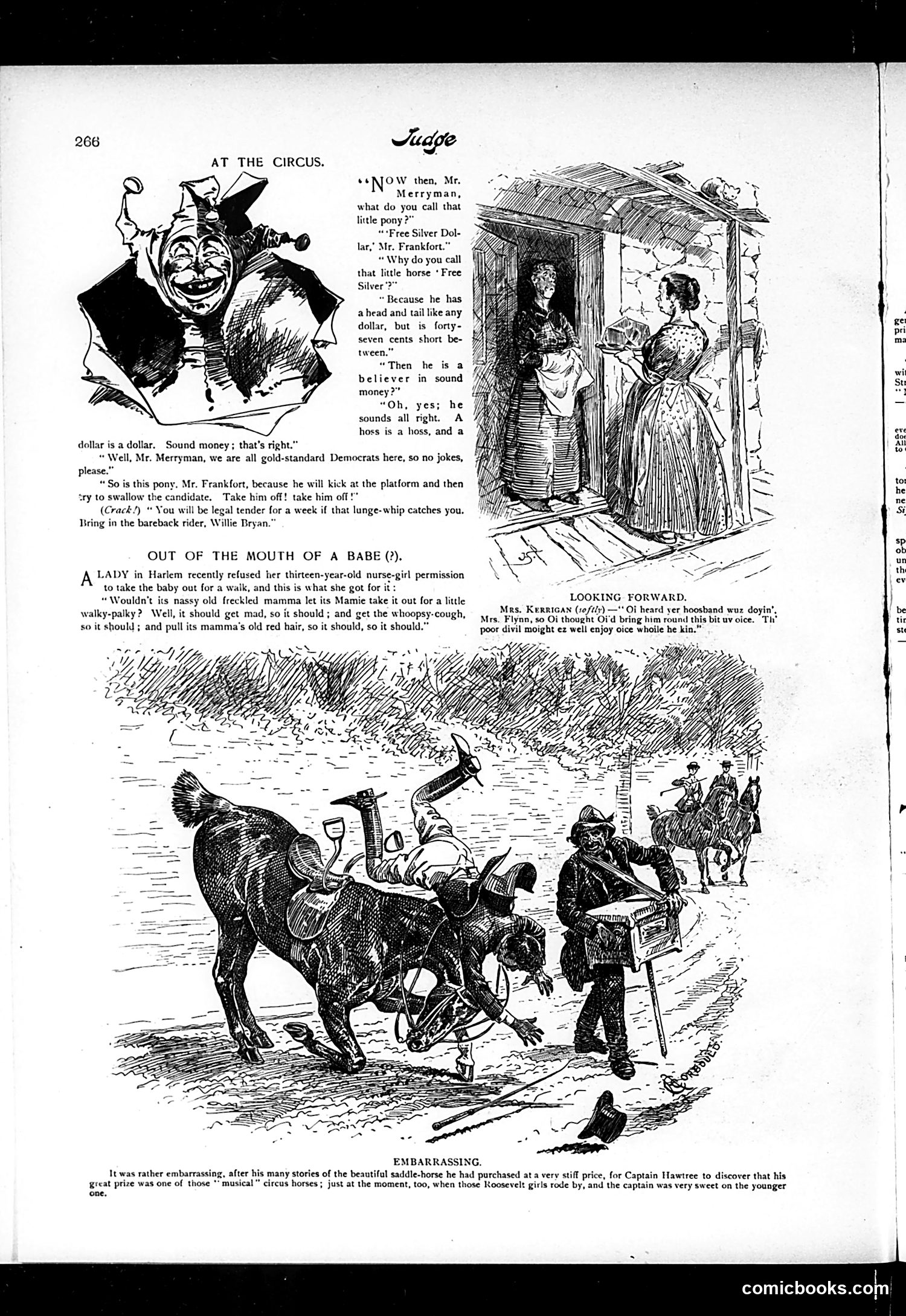
This Judge page contains three satirical pieces: **"At the Circus"**: A political joke mocking the "Free Silver" currency debate. The pony named "Free Silver Dollar" is forty-seven cents short of its value—a jab at free silver advocates who Democrats viewed as economically unsound. References to "gold-standard Democrats" and "Willie Bryan" (likely William Jennings Bryan, free silver's champion) indicate this targets the 1896 presidential campaign's central monetary dispute. The joke ridicules free silver as worthless. **"Out of the Mouth of a Babe"**: A brief anecdote about a neglectful nurse-girl who vindictively curses her employer's baby, using exaggerated dialect humor common to the era. **"Embarrassing"**: A social comedy about Captain Hawtree's embarrassment when his expensive saddle-horse is revealed as a circus animal (likely one trained to perform tricks). The Roosevelt girls' appearance adds to his humiliation, as he's romantically interested in one of them. The page reflects late-19th-century American political satire and period humor conventions.
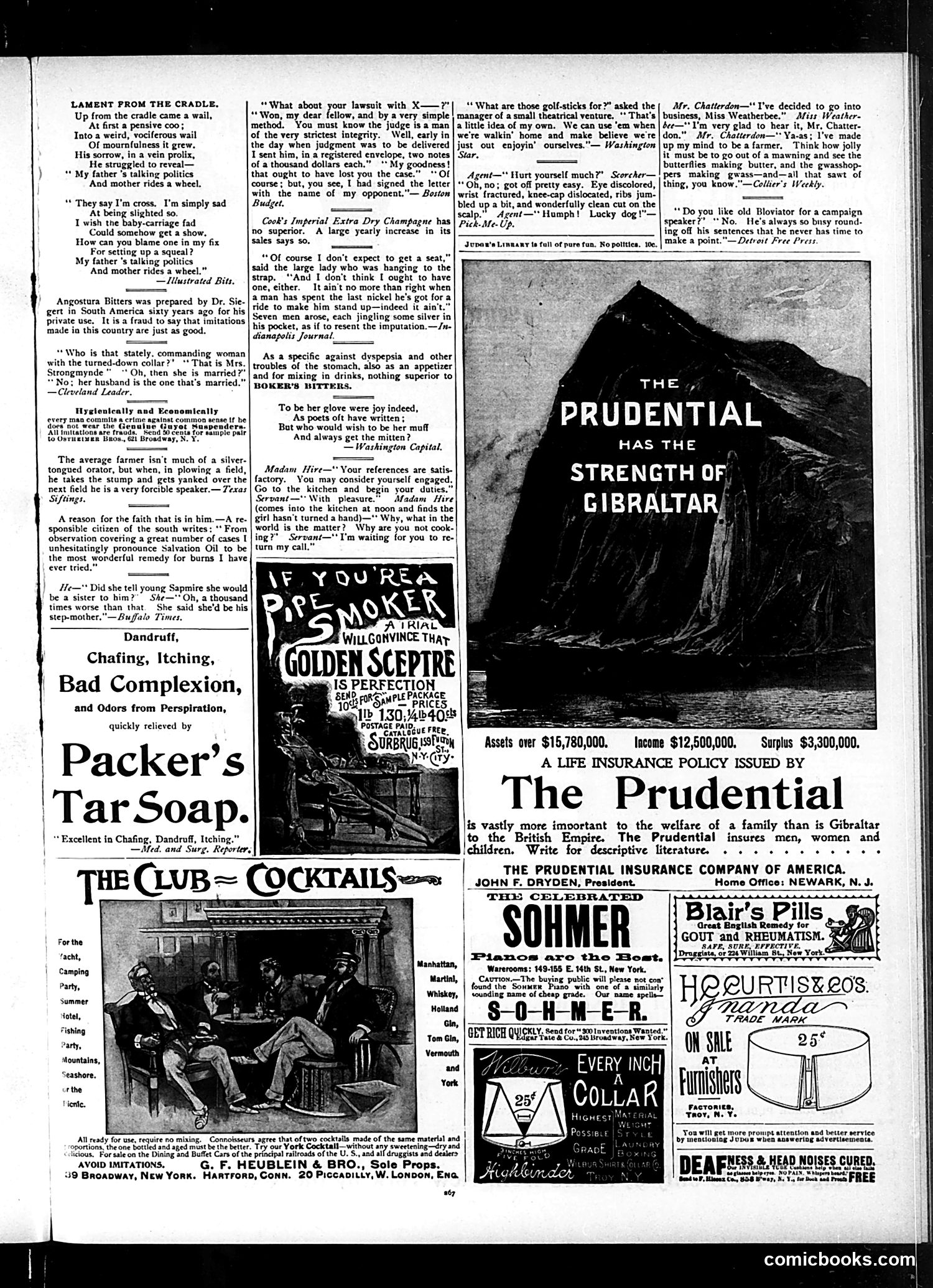
This page is primarily **advertisements and humorous short pieces**, typical of Judge's satirical format. The main cartoon-like content includes several jokes mocking contemporary social trends: 1. **"Lament from the Cradle"** satirizes the "New Woman" movement—a baby complains that his father talks politics constantly while his mother rides a bicycle (the "wheel"). This mocks both political obsession and women's emerging independence through cycling, which was controversial at the time. 2. **Servant/Mistress exchange** jokes about class and social etiquette, where a new servant refuses to work until her employer returns her social call—absurdly applying calling-card customs to employer-employee relationships. 3. **Various one-liners** mock judges' corruption, women seeking train seats, and romantic disappointments. The remainder is **product advertising**: Angostura Bitters, Packer's Tar Soap, alcoholic beverages, insurance, and patent medicines—typical of Judge's revenue model. The ads themselves sometimes contain small humorous elements but are primarily commercial.
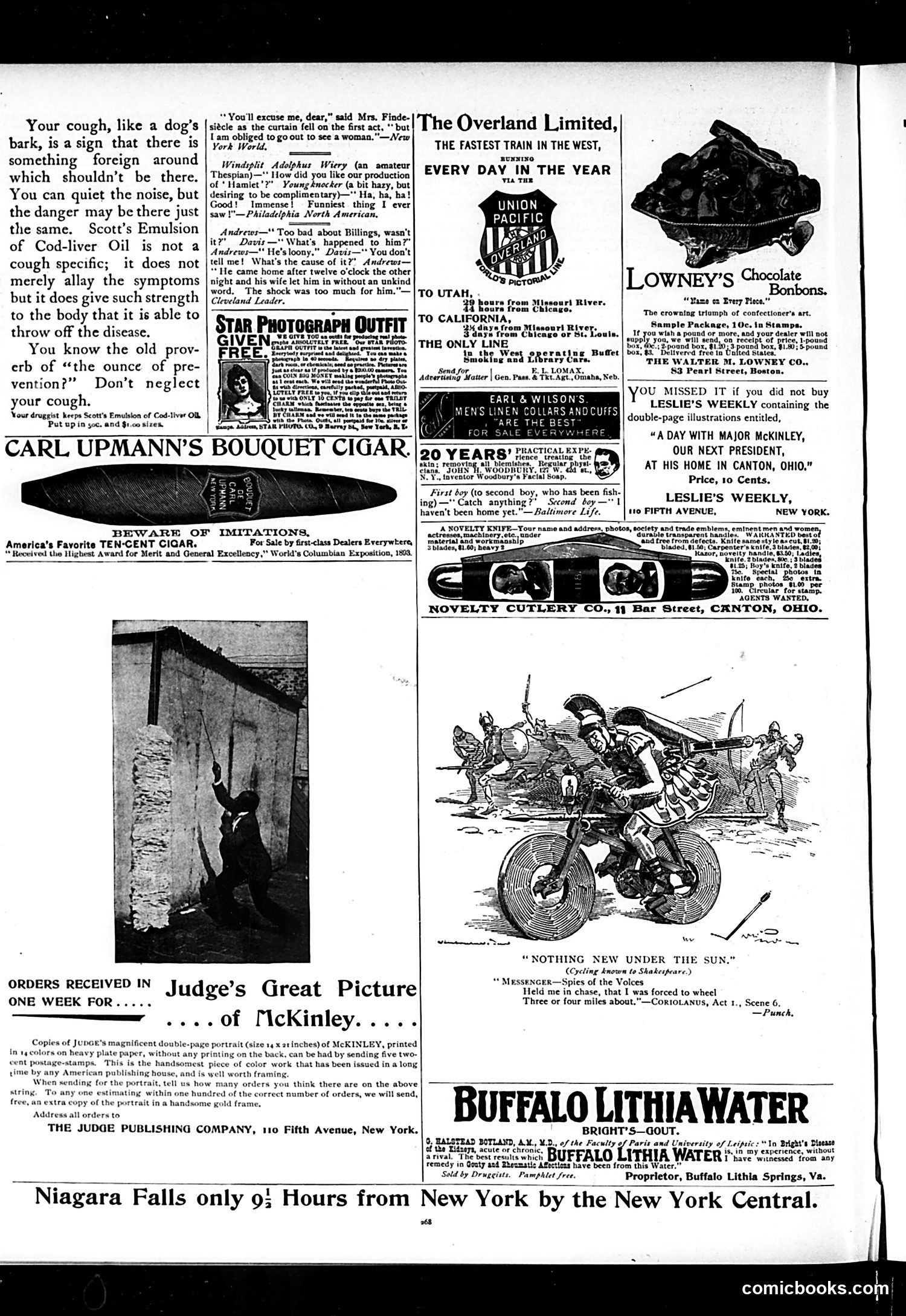
This page is primarily **advertisements and short humorous anecdotes** rather than political cartoons, typical for Judge magazine's format. The few actual jokes visible are social comedy: - **"You'll excuse me, dear"** joke: A woman interrupts her theater date to meet another woman—satirizing women's social obligations and gossip culture. - **"Too bad about Billings"** anecdote: A man goes mad simply from his wife greeting him kindly at midnight—dark humor about marital discord and wives' alleged lack of affection. - **"Nothing New Under the Sun"**: A whimsical illustration connecting Shakespeare's reference to messengers on horseback with modern bicycling—typical late-19th-century humor finding "modern" activity in classical texts. The page also advertises **McKinley portrait prints**, referencing then-President William McKinley (suggesting publication date around 1900-1901). Most space is devoted to **commercial advertisements**: cigars, chocolate, patent medicines, cutlery, and train service—reflecting the magazine's revenue model.
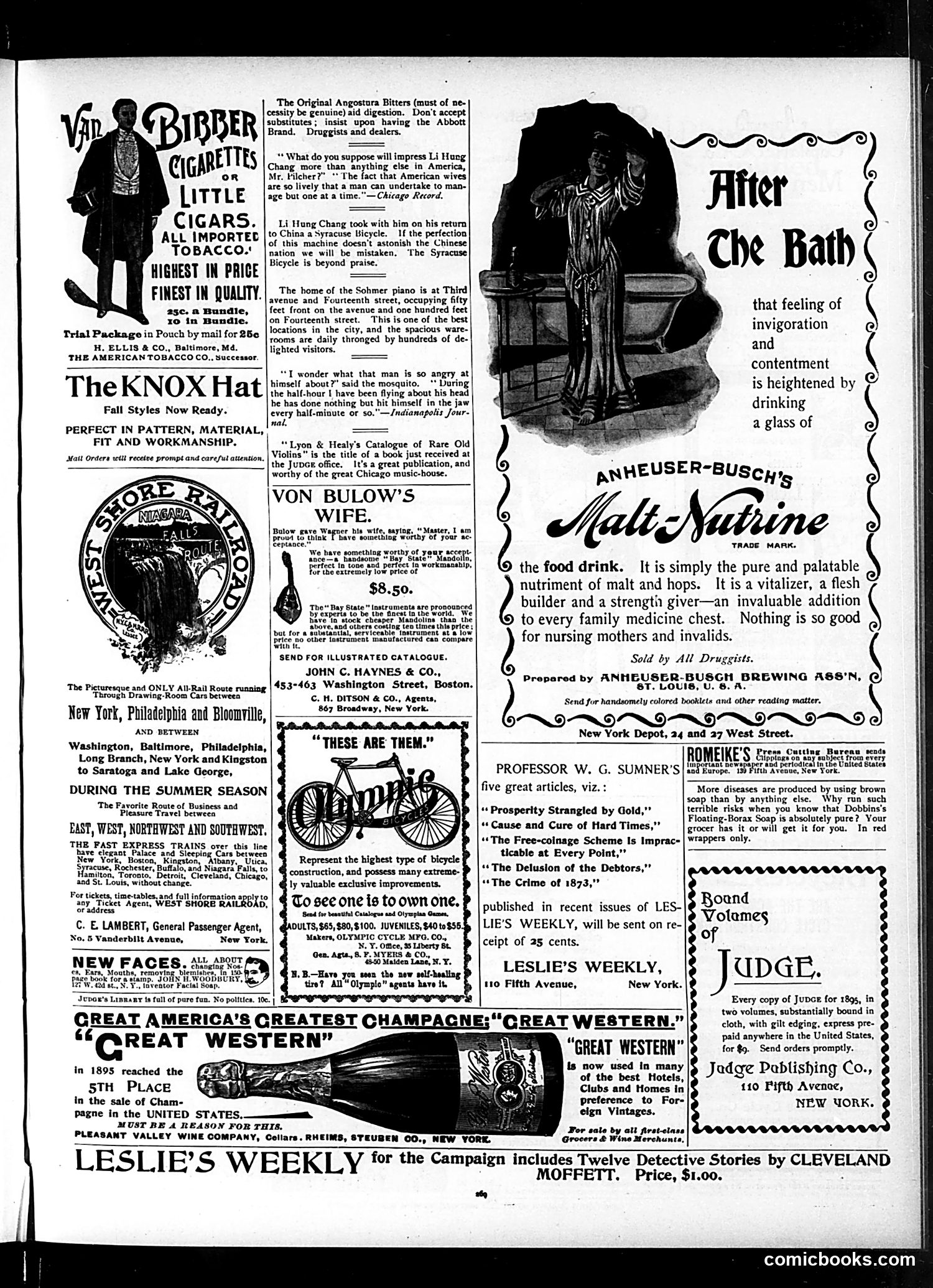
This page is primarily **advertising**, not editorial cartoon content. It contains product advertisements for late 19th-century goods: cigars, hats, railroads, pianos, bicycles, and musical instruments. The only satirical content appears in brief **humorous anecdotes** embedded among ads: 1. A joke about **Li Hung Chang** (Chinese diplomat visiting America in 1896) marveling at American women's liveliness and independence—the humor deriving from the cultural contrast between American and Chinese gender relations. 2. A **mosquito joke** about a man repeatedly hitting himself in frustration. 3. A reference to **Von Bülow's wife** (conductor Hans von Bülow), playing on a famous anecdote where he allegedly offered his wife to Wagner, here repurposed as a musical instrument advertisement. These brief jokes reflect Judge's typical satirical style—topical references, cultural observations, and wordplay—but the page's primary function is commercial, not comedic commentary.
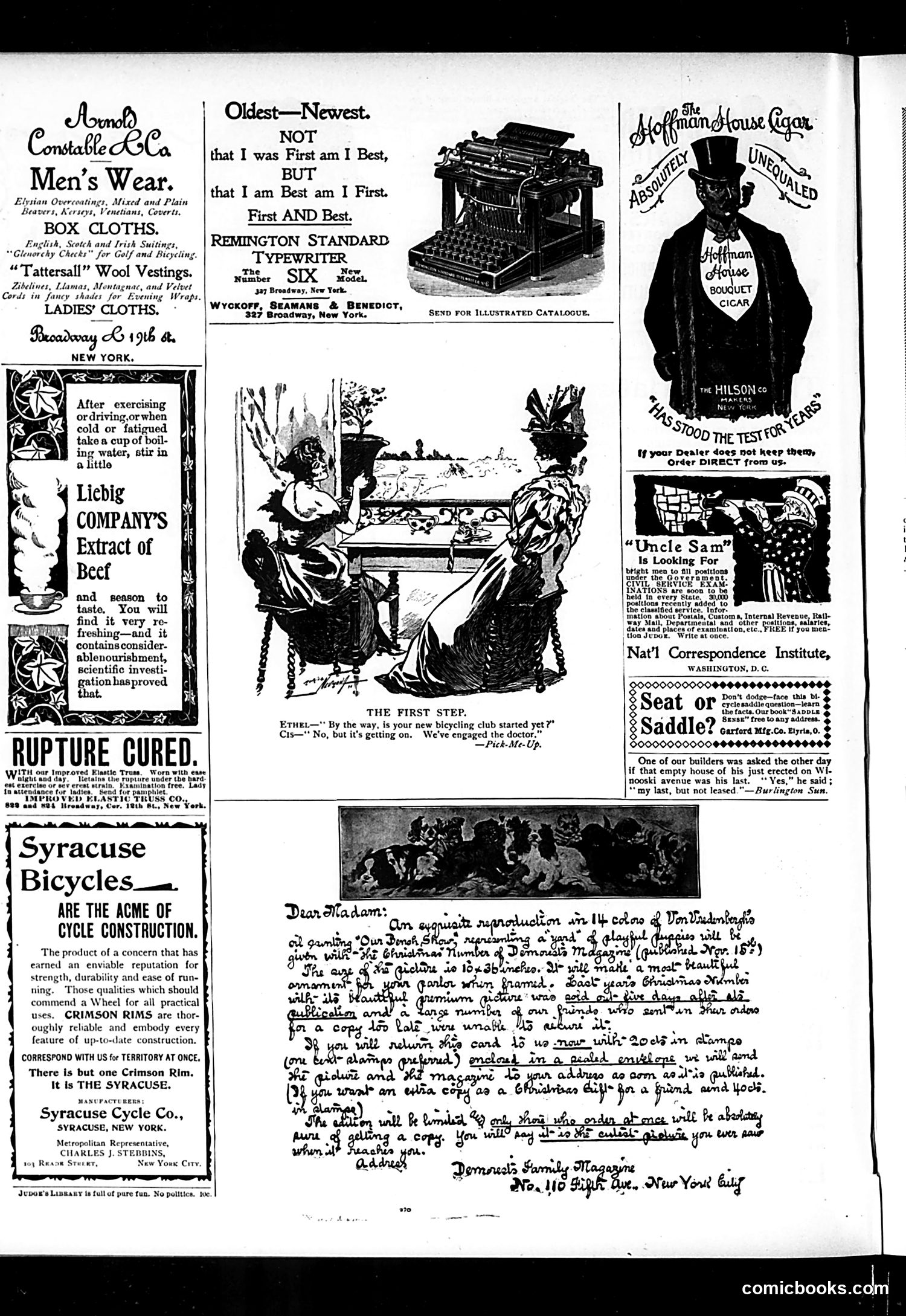
This page is primarily **advertisements and filler content** rather than political satire. The main cartoon, "The First Step," depicts two society women discussing a new bicycling club—a genteel joke about leisure activities among the wealthy. The humor is mild and social rather than political. The page features various product ads (typewriters, bicycles, clothing, beef extract) typical of early 1900s magazines, plus a handwritten letter from a reader to *Delineator Family Magazine* about Christmas issues. The only potentially satirical element is the "Seat or Saddle?" section, which appears to be a humorous reader contribution poking fun at real estate development, mentioning an empty house that was "leased" (not "last"). Overall, this represents the **non-political content** Judge used to fill space—advertisements and genteel humor aimed at affluent readers interested in consumer goods and domestic life.
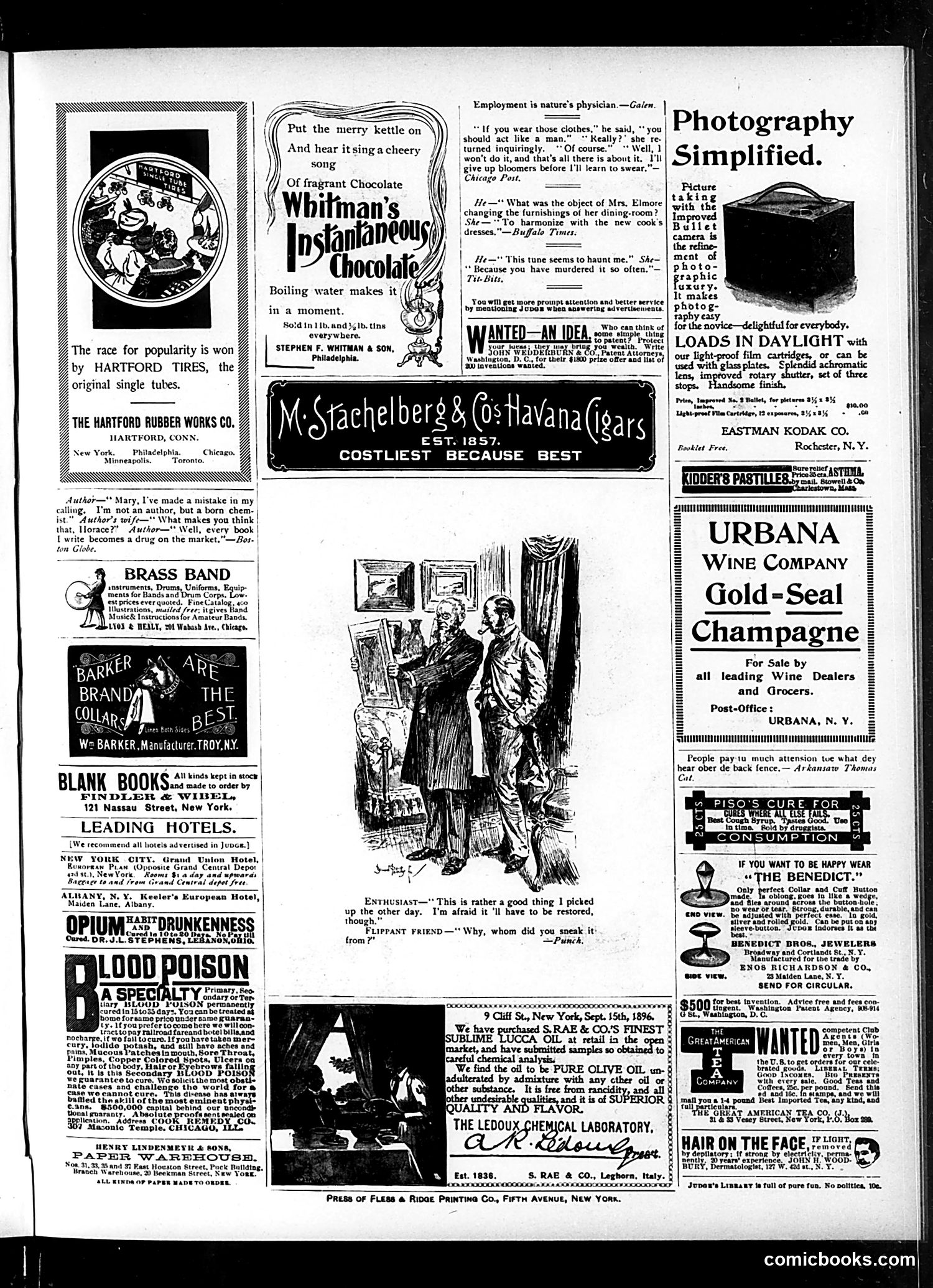
This page is primarily **advertising**, typical of Judge magazine's business model. The layout mixes commercial advertisements with short humorous anecdotes and jokes. The central cartoon depicts two well-dressed men examining framed pictures on a wall—likely an art enthusiast showing a friend a recent acquisition. The accompanying dialogue jokes about the piece being "restored," with the friend humorously accusing the owner of having "sneaked it" from somewhere, implying the art was stolen rather than legitimately obtained. This satirizes both art collecting pretension and the sometimes-questionable origins of valuable pieces. The scattered jokes throughout address contemporary social topics: gender roles (women wearing bloomers and refusing to swear), marital dynamics, and publishing industry satire (an author's books becoming "a drug on the market"). The advertisements reflect Edwardian-era consumer goods: Hartford Tires, Whitman's Chocolate, Kodak cameras, champagne, medical treatments (opium cures), and jewelry. These reveal period concerns about photography as an emerging consumer technology and various patent medicines marketed as cure-alls.
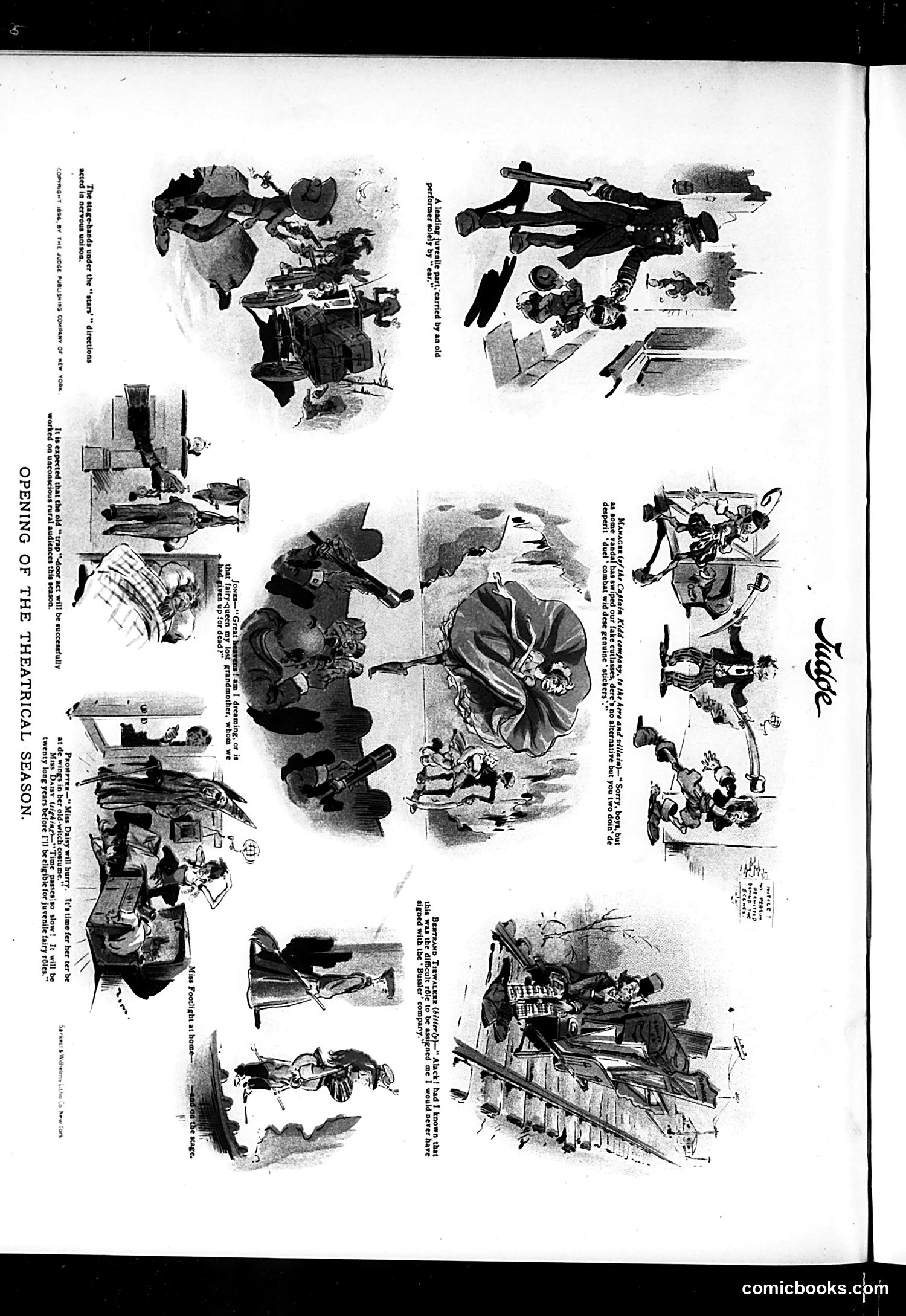
This page satirizes the incompetence and chaos of theatrical productions during the season's opening. Multiple vignettes mock: **The Captain Kidd Company**: A manager admits they've lost fake props, forcing actors to use real weapons for a "duel"—absurdly dangerous and unprofessional. **Inexperienced Performers**: An older actor carrying a juvenile lead role "by ear" (memorizing badly) and a young actress regretting signing with the "Bussler" company, suggesting poor judgment in casting. **Incompetent Stage Crew**: Stagehands nervously following unclear directions, creating backstage chaos. **Theatrical Tricks**: References to "trap door acts" exploiting "unconscious rural audiences"—suggesting traveling theater companies deliberately fooled unsophisticated viewers with cheap special effects. The satire targets the low quality, amateurism, and outright deception of period theater, particularly touring companies that preyed on provincial audiences unfamiliar with theatrical conventions.