
A complete issue · 16 pages · 1896
Judge — October 17, 1896
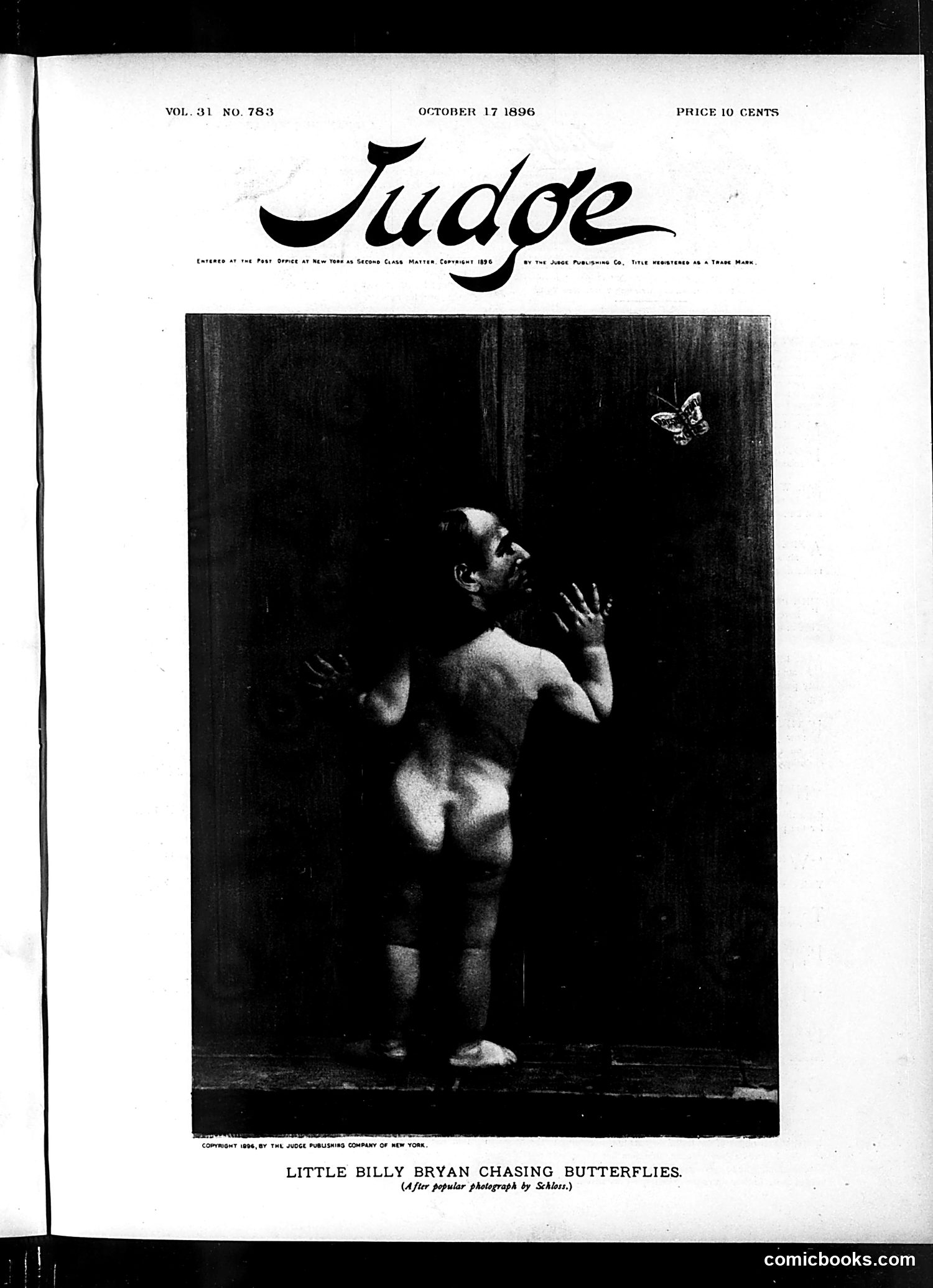
The caption identifies this as "Little Billy Bryan Chasing Butterflies" (after a popular photograph by Sarart). This is a political satire mocking William Jennings Bryan, the 1896 Democratic presidential candidate. The image depicts a bare-chested man childishly reaching for a butterfly, suggesting Bryan is naive, immature, or frivolously distracted from serious matters. The satire likely refers to Bryan's signature campaign issue—free silver coinage—implying his economic policies were foolish pursuits rather than substantive governance. Judge, a Republican-leaning publication, frequently attacked Bryan before his electoral defeat by William McKinley. This cover ridicules him as unfit for the presidency through infantilizing imagery.
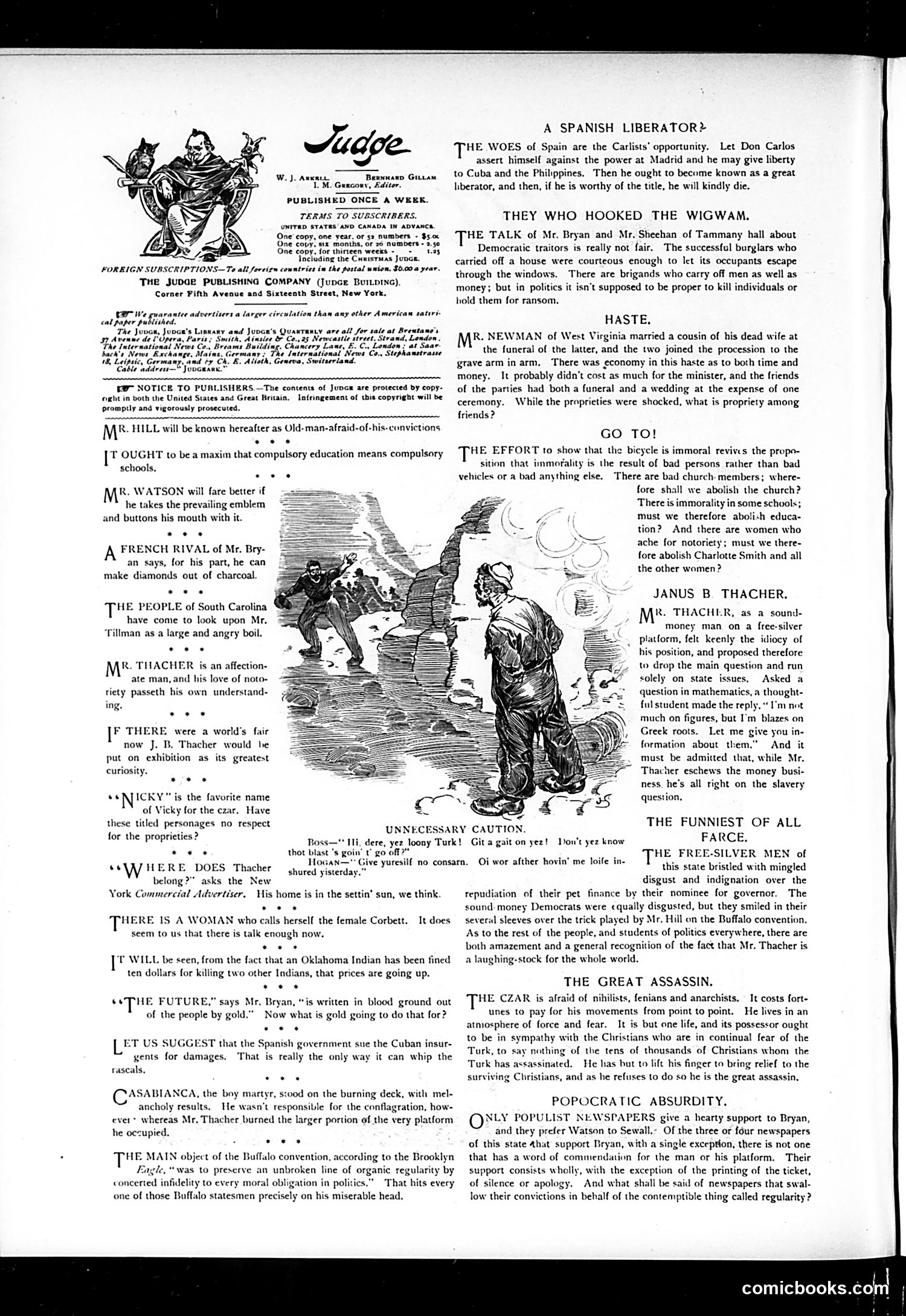
This cartoon depicts two figures in period dress (likely 19th century) examining or handling what appears to be a large barrel or container. The caption "UNNECESSARY CAUTION" suggests they're being overly worried about something. The accompanying text references "Ross" as a "loony Turk" and mentions "borrowin' her bull on consarn," suggesting folk dialect humor about borrowed property or broken agreements. The joke appears to involve people being excessively cautious about a transaction or loan that's already gone wrong ("shared yesterd'y"). Without clearer identification of which specific political figures or events this references, the precise satirical target remains unclear, though the humor relies on depicting rustic or foreign characters in comedic situations typical of Judge magazine's style.
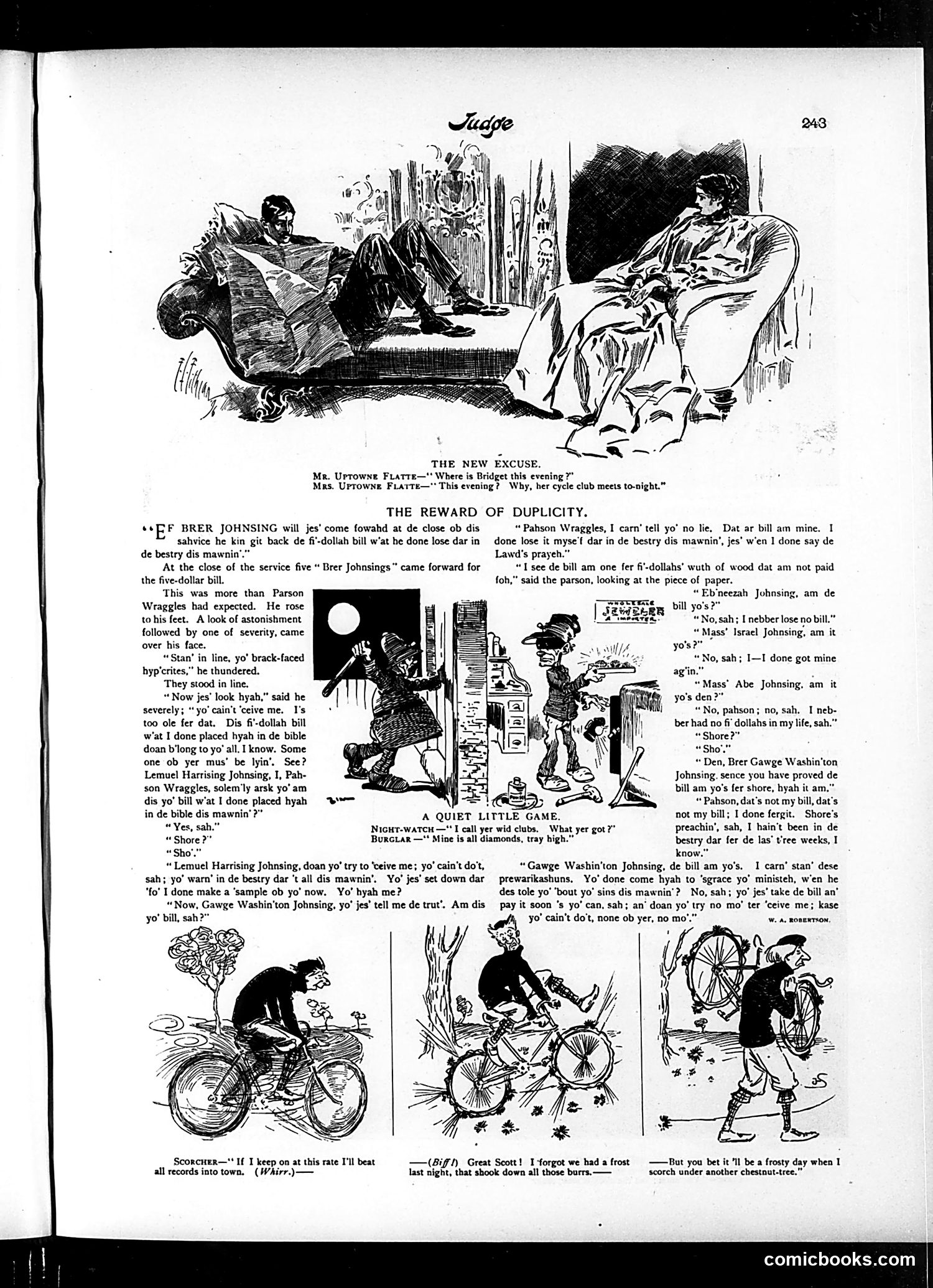
This page contains two distinct pieces: **Top section:** A cartoon captioned "The New Excuse" shows two figures discussing whether "Bridget" will appear—apparently satirizing domestic help reliability in the era. **Main story:** "The Reward of Duplicity" concerns a character named Eber Johnsing who attempts financial deception. The narrative—written in heavy dialect—depicts Johnsing trying to convince a parson he's owed money through religious manipulation and false claims. The text emphasizes the comeuppance he receives when his duplicity is exposed. **Lower cartoons:** A three-panel sequence shows someone repeatedly falling off a bicycle into thorny vegetation, the visual joke being the ironic "reward" for dishonesty paralleling the narrative above. The overall theme satirizes moral hypocrisy and fraudulent behavior, suggesting deception inevitably results in humiliation or failure.
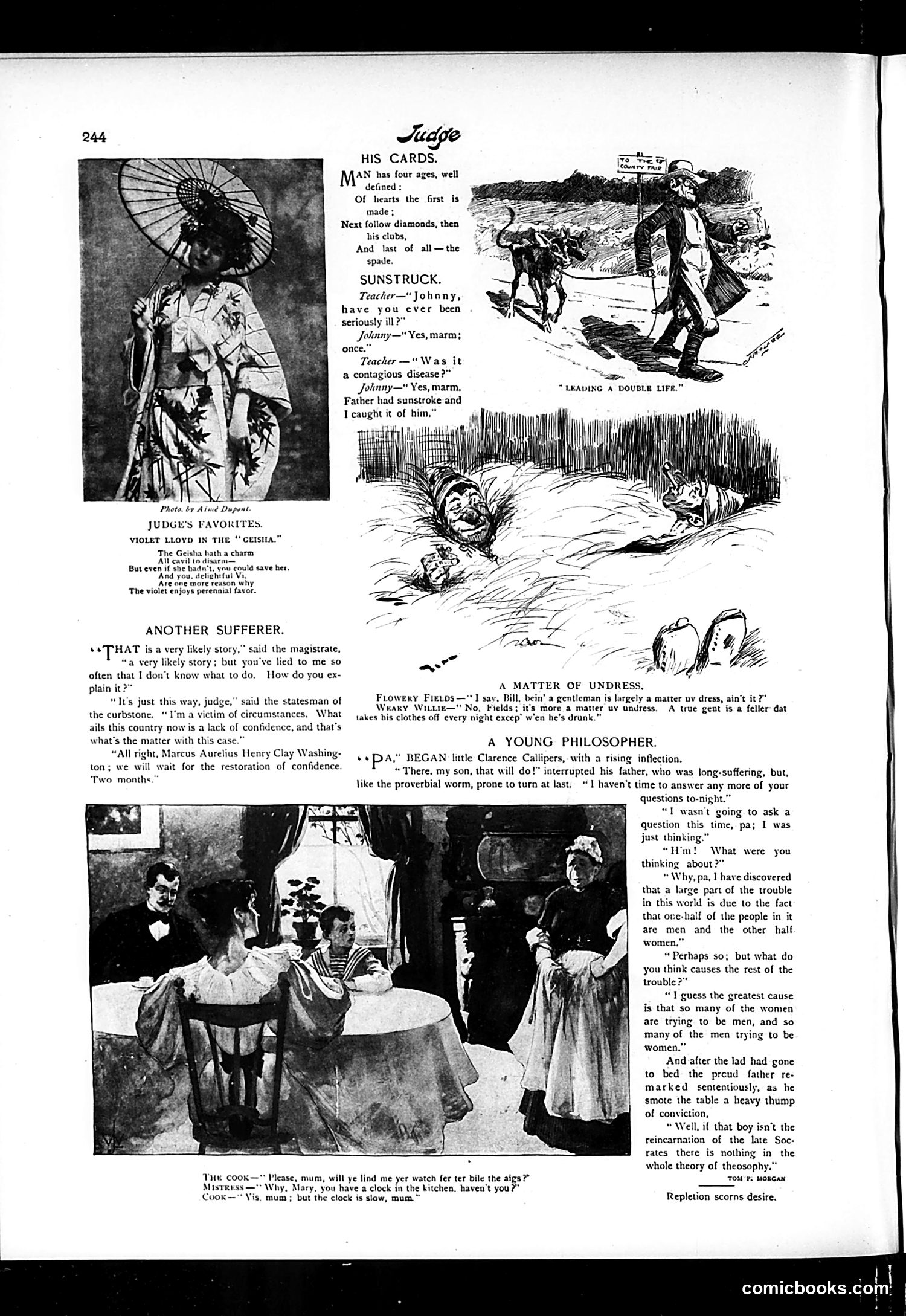
This page contains several satirical pieces typical of early 20th-century American humor: **"Another Sufferer"** depicts a streetside "statesman" (vagrant or con artist) before a magistrate, who repeatedly lies but blames his predicament on "lack of confidence" in the country—a jab at politicians who excuse national problems through vague appeals to public sentiment rather than taking responsibility. **"Sunstruck"** is a simple children's joke playing on the double meaning of "contagious" (the boy caught sunstroke from his father, as if it were an illness). **"A Young Philosopher"** satirizes pseudo-intellectual child precocity. Young Clarence spouts half-baked gender observations (blaming society's troubles on men and women existing), which his father finds profoundly wise—mocking both pretentious children and credulous adults impressed by superficial philosophy. **"A Matter of Undress"** is working-class humor about gentility being performative; true gentlemen reveal their nature through undressing (behavior when defenses are down). The page emphasizes Judge's satirical focus: political incompetence, social pretension, and generational foolishness.
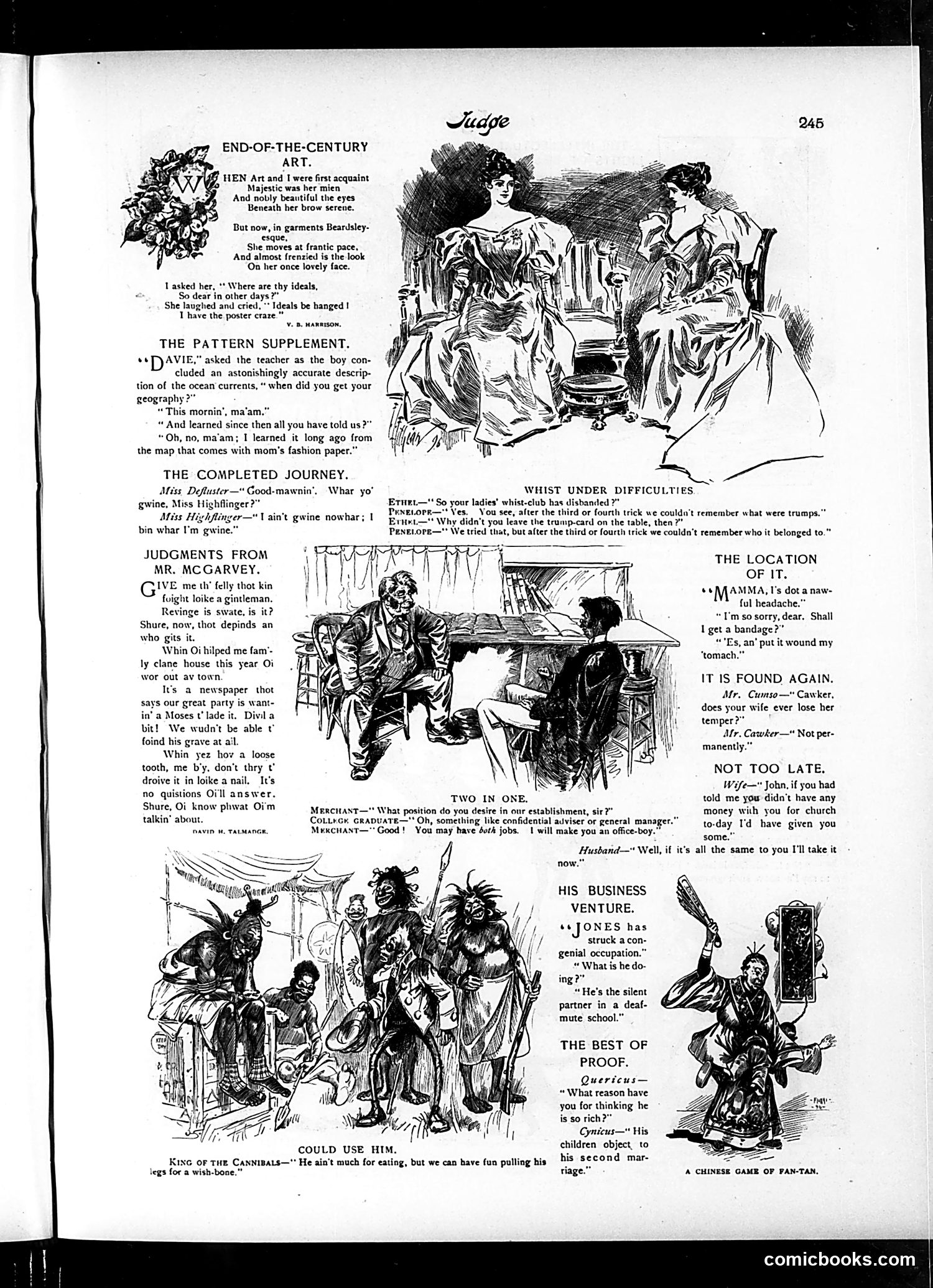
This page satirizes late-19th-century American social trends through multiple short pieces: **"End-of-the-Century Art"** mocks the aesthetic movement (likely referencing Aubrey Beardsley's controversial illustrations), showing how modern fashion and artistic trends have made women frantic and lost their former ideals and grace. **"The Pattern Supplement"** jokes that children learn geography from women's fashion magazines rather than proper schooling—a dig at both educational neglect and women's magazines' limited content. Other vignettes target social absurdities: a women's whist club dissolving because players can't remember trumps, a college graduate hired as both "confidential adviser" and office-boy, and marital comedies about forgotten church money and permanent bad tempers. **"Mr. McGarvey"** offers Irish-dialect folk wisdom about politics, honesty, and practical matters—a common Judge feature. The cartoons employ ethnic stereotypes (Irish, African American dialect) typical of the era's humor, while critiquing contemporary social pretension, educational gaps, and marriage dynamics.
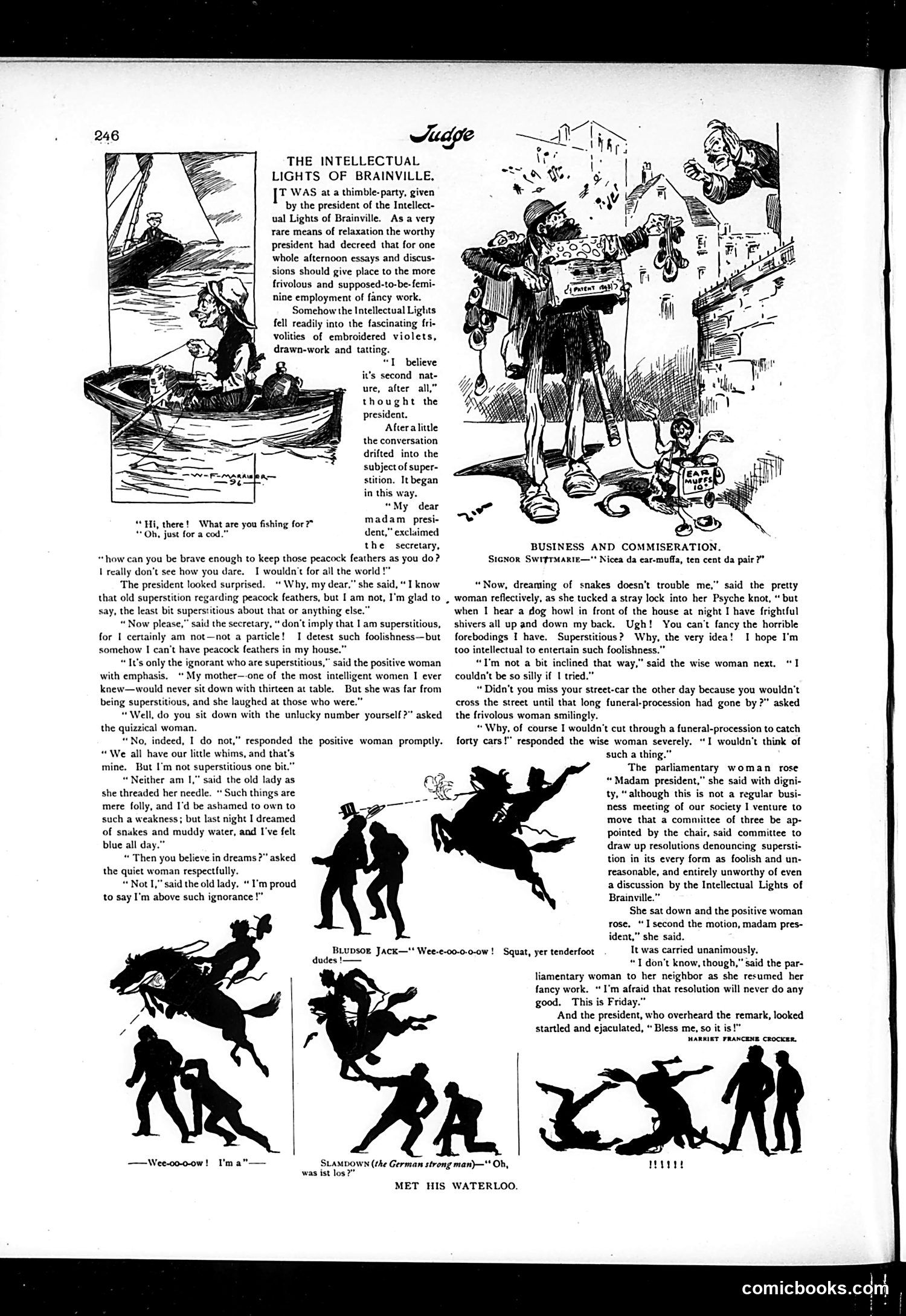
This satirical piece mocks pretentious women who deny harboring superstitions while simultaneously revealing contradictory behaviors. At a "thimble-party" hosted by the president of an intellectual club, the women discuss superstitions—peacock feathers, the number thirteen, snake dreams, dog howls, and funeral processions—each insisting *she* isn't superstitious while describing avoidance behaviors proving otherwise. The satire targets hypocrisy and self-deception among the educated classes. The "intellectual lights" fancy themselves above such "foolishness," yet their actions betray deep superstitious beliefs. The climax comes when a "parliamentary woman" proposes formal resolutions denouncing superstition—the ultimate irony, as the entire conversation demonstrates they're all believers who won't admit it. Judge ridicules both superstition itself and the intellectual dishonesty of denying personal irrationality.
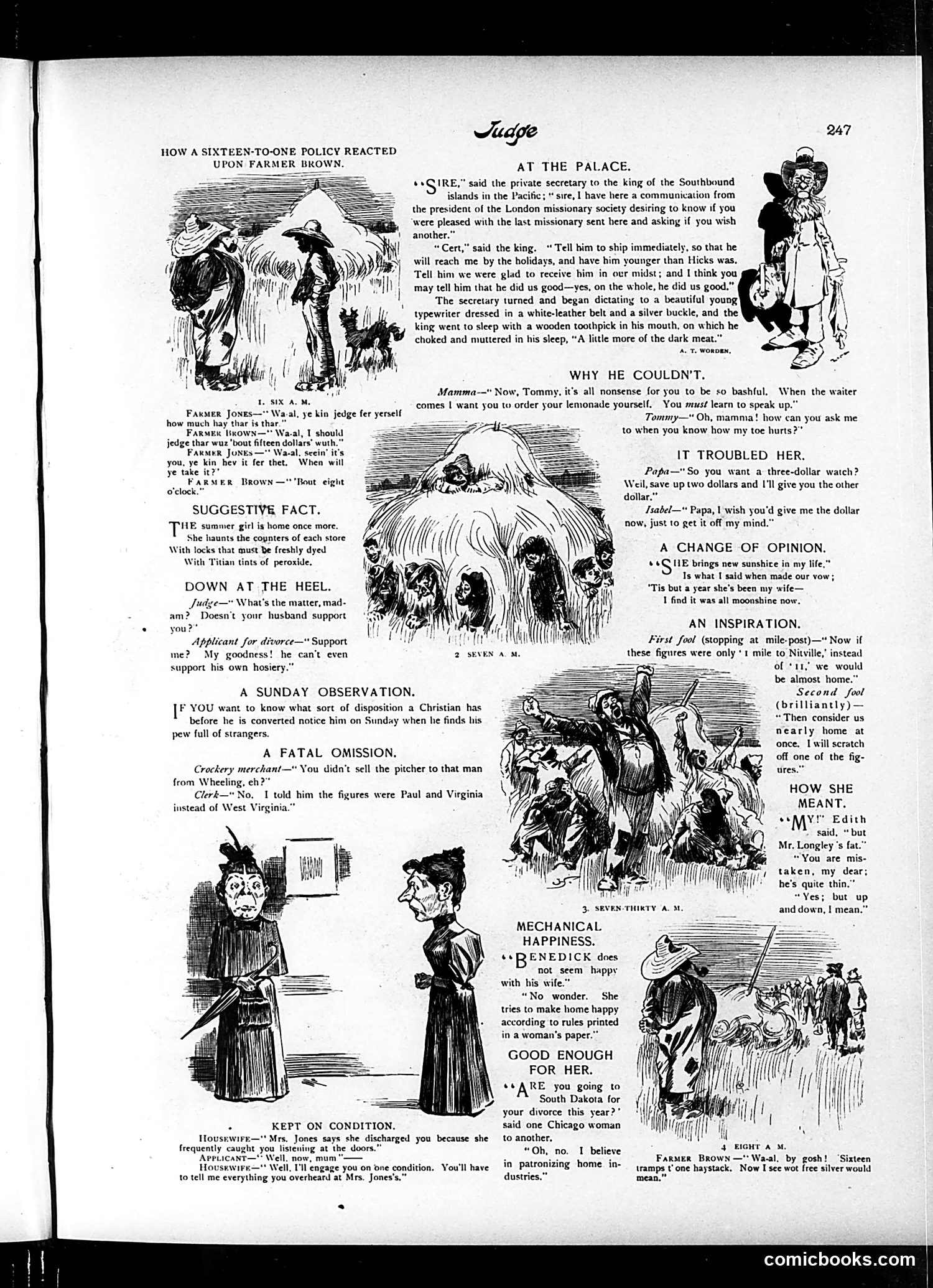
This page from *Judge* magazine contains multiple satirical cartoons and brief comedic sketches mocking various social issues of the era. The prominent cartoon "How a Sixteen-to-One Policy Reacted Upon Farmer Brown" references the **"16-to-1" currency debate**—a heated political issue of the 1890s concerning the silver-to-gold monetary ratio. The joke suggests that farmer Brown, apparently supporting this policy, ironically ends up with a haystack worth only "sixteen ramps to one haystack" of value, satirizing how the proposed policy would supposedly harm farmers economically. Other sketches mock contemporary social attitudes: a child too shy to order lemonade, a woman anxious about a watch purchase, the "summer girl" and her peroxide-dyed hair, divorce anxieties, and marital discord. The "Fatal Omission" cartoon plays on the confusion between "Paul and Virginia" versus "West Virginia" on decorative pitchers. The overall tone is light domestic satire targeting American middle-class manners, gender relations, and economic policy of the 1890s era.
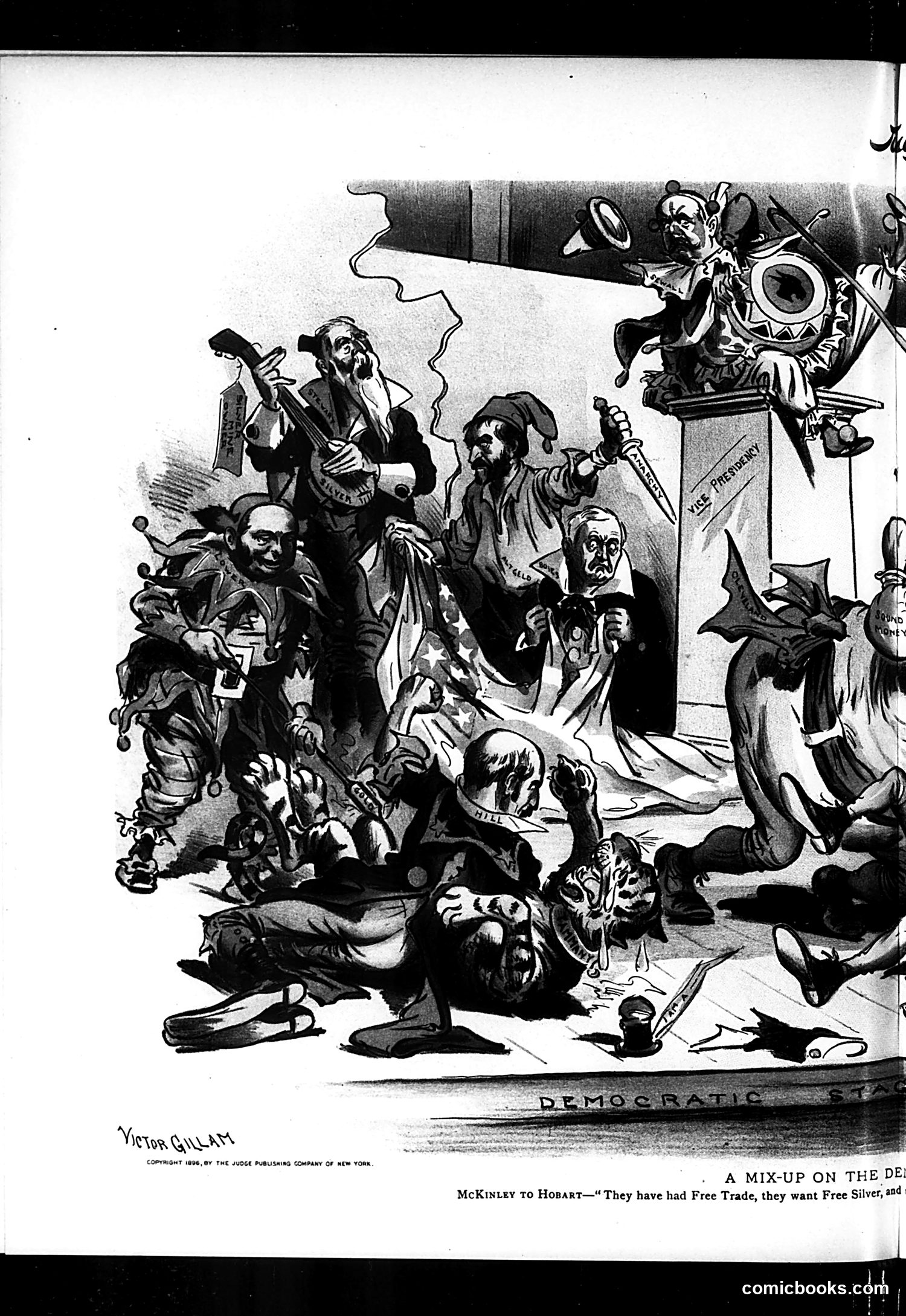
This political cartoon by Victor Gillam satirizes the conflicting demands facing President McKinley regarding economic policy. The chaotic scene shows various figures (likely representing different political factions or interest groups) making contradictory demands: "Free Trade," "Free Silver," and other economic positions—suggesting political confusion or impossibility of satisfying everyone simultaneously. The title "A Mix-Up on the De[mand]" references the debate over currency policy (free silver coinage) and trade tariffs that dominated 1890s American politics. McKinley, who championed protective tariffs and sound money, faced pressure from competing economic interests. The cartoon mocks the seemingly impossible task of pleasing all political constituencies, depicting the disorder as absurd chaos with figures in distress, suggesting McKinley's diplomatic predicament.
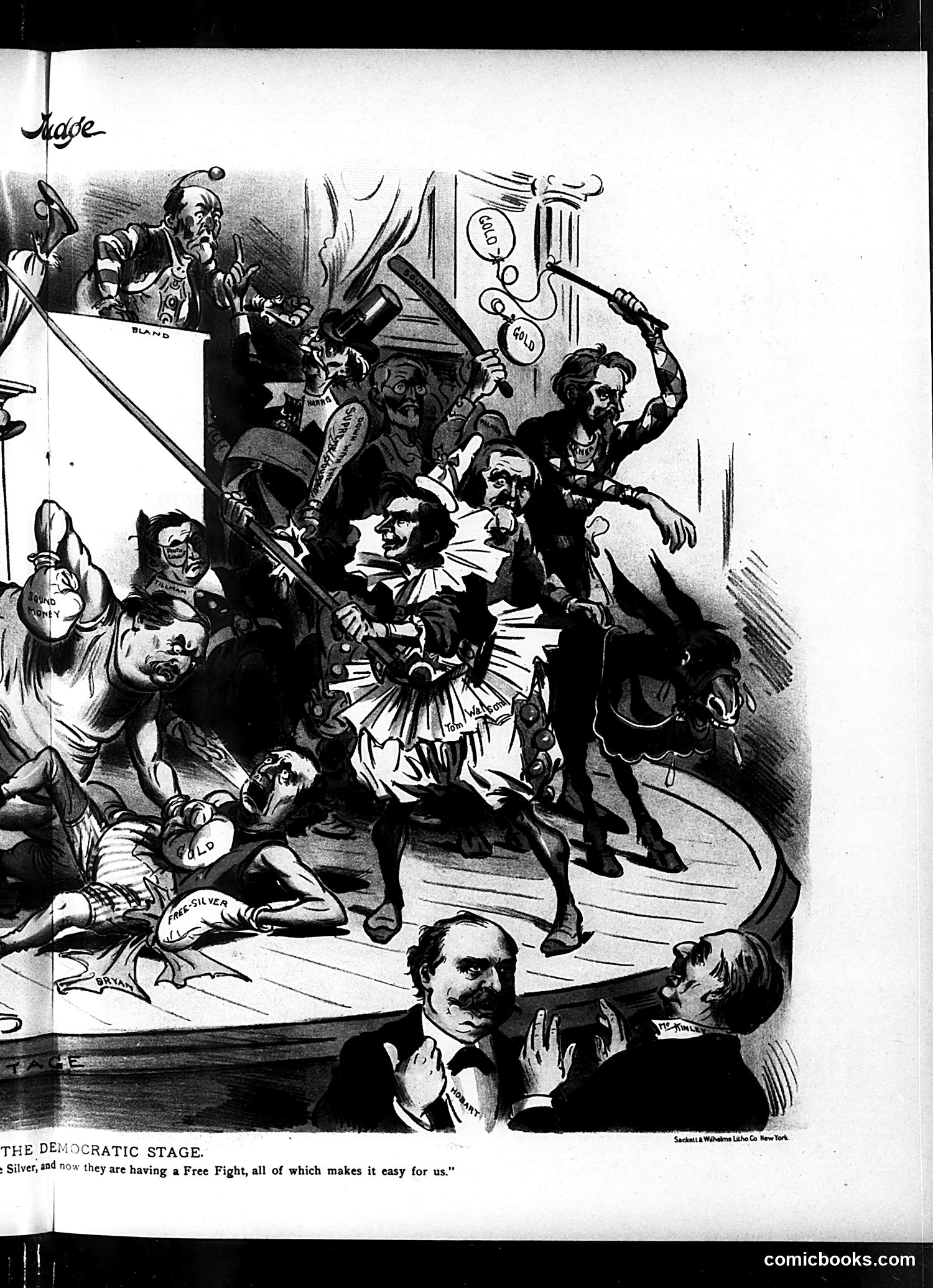
This political cartoon satirizes chaos within the Democratic Party, likely from the 1890s given references to "Silver" (the free silver debate that divided Democrats). The image depicts a theatrical stage where Democratic figures literally fight each other—with weapons and violent gestures—while an audience watches. The title and caption suggest the cartoonist is mocking the Democrats' internal divisions over monetary policy and other issues. The "Free Fight" reference indicates uncontrolled party infighting that benefits their political opponents (the Republican cartoonist's implied allies, suggested by "makes it easy for us"). The theatrical framing—treating politics as a chaotic stage performance—emphasizes how the public viewed Democratic discord as entertainment rather than serious governance.
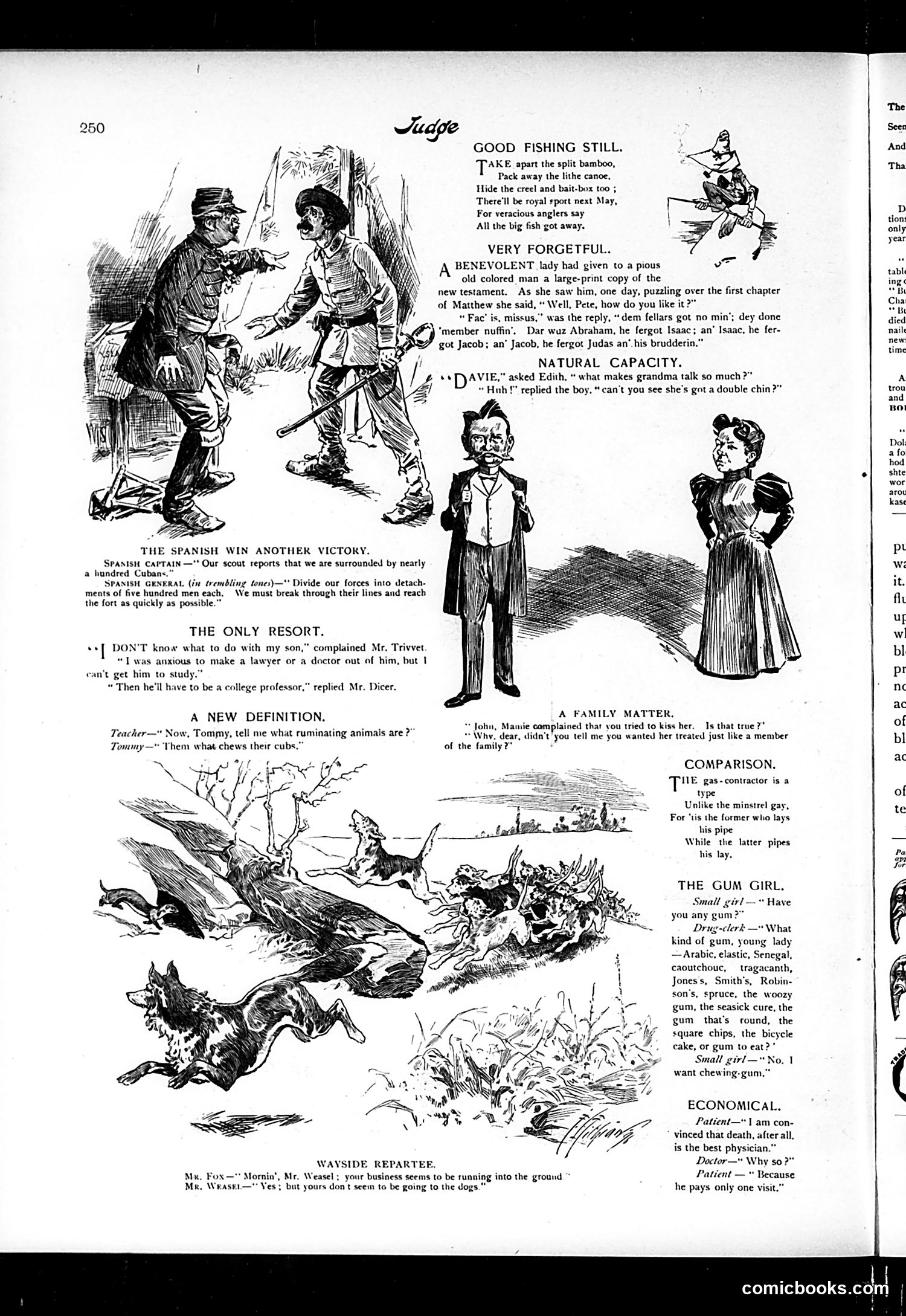
This page from Judge magazine contains several short satirical pieces typical of late 19th-century American humor: **"Good Fishing Still"** mocks anglers who claim large fish escaped—a timeless joke about fishermen's exaggerations. **"Very Forgetful"** uses dialect humor (common in this era, though offensive today) to caricature an elderly Black man who confuses biblical names, suggesting poor memory or comprehension. **"The Spanish Win Another Victory"** references the Spanish-American War or Cuba conflict, satirizing Spanish military strategy by showing them vastly outnumbered yet proposing to "divide forces"—absurd tactics. **"Natural Capacity"** contains a crude joke about a grandmother's chin size explaining her talkativeness. Other items are brief wordplay jokes: a child misdefining "ruminating animals," a pharmacist overwhelmingly listing gum types, and a patient claiming death is the best physician because it "pays only one visit." The page reflects Judge's style: topical political satire mixed with domestic humor and ethnic/dialect comedy that was popular but is now considered insensitive.
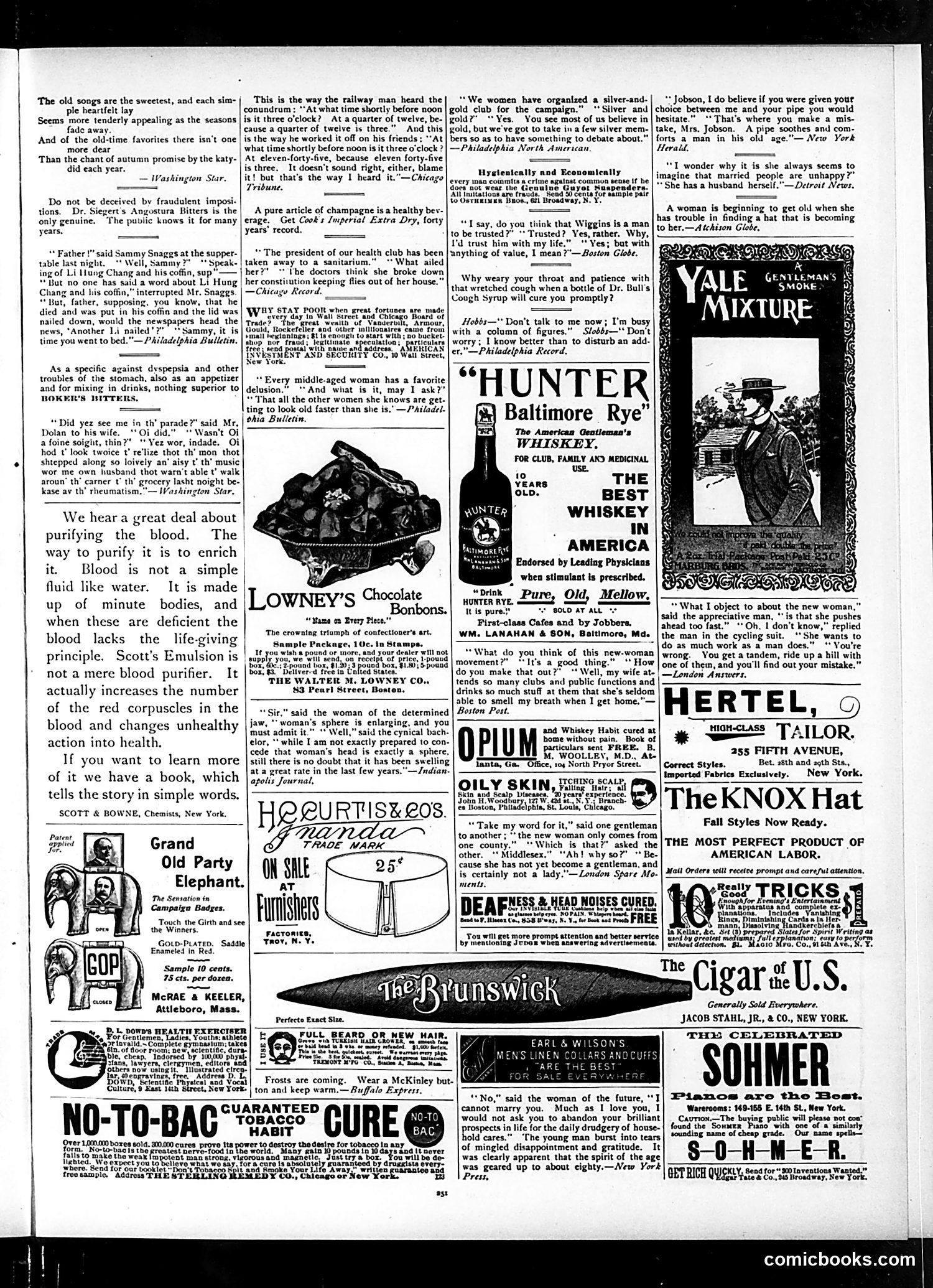
This page is primarily **advertisements and comic anecdotes** rather than political cartoons. The notable content includes: **Comic Anecdotes:** - A joke about Li Hung Chang's coffin, playing on the surname "Li" and the phrase "nailed" (suggesting a pun on "Li nailed") - A dialogue between Mr. Dolan and his wife about appearing in a parade, highlighting class contrast—he appeared dignified in the parade but struggles with rheumatism in daily life - A railroad worker's misunderstanding of a riddle about time **Advertisements:** The page is dominated by patent medicines (Scott's Emulsion for blood purification, Boker's Bitters), whiskey, cigars, and the "Grand Old Party Elephant" campaign badge—reflecting the Gilded Age's commercial culture and Republican Party merchandise. **Historical Context:** The references to Li Hung Chang (Chinese statesman) and ongoing rheumatism jokes reflect contemporary concerns. The overall tone treats working-class immigrants (Irish Mr. Dolan) with gentle mockery typical of the era's humor.
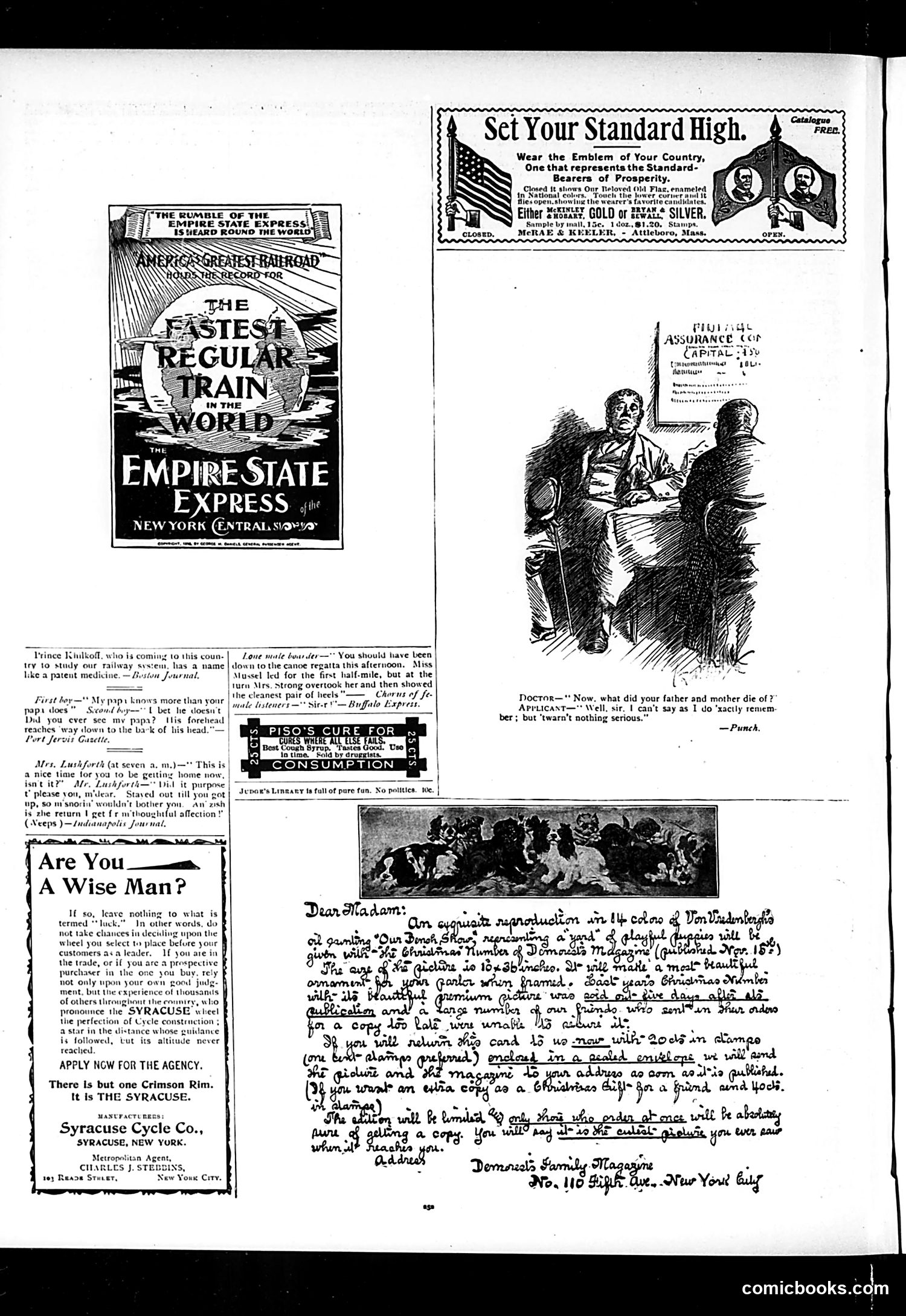
This page is primarily **advertising and miscellaneous content** rather than political satire. Key elements: **Advertisements:** - Empire State Express (railroad) - Gold/silver emblems promoting patriotism and prosperity - Syracuse Cycle Company (bicycles) - Piso's Cure for Consumption (patent medicine) **Humorous Shorts:** Multiple brief jokes and anecdotes, including: - A comment about Prince Kutuzoff visiting America to study railroads "like a patent medicine" (satirizing both foreign observers and American patent medicine culture) - Domestic humor about couples and canoe races - A doctor-patient exchange about causes of death **Reader Letter:** A handwritten letter to "Dear Madam" from Domestic Family Magazine requesting Christmas gift suggestions and magazine subscriptions. The page reflects early 1900s American magazine content: promotional ads mixed with light humor and reader correspondence. There is **no significant political cartoon or unified satirical message**—it's a typical miscellaneous page from a satirical magazine's advertising/filler section.
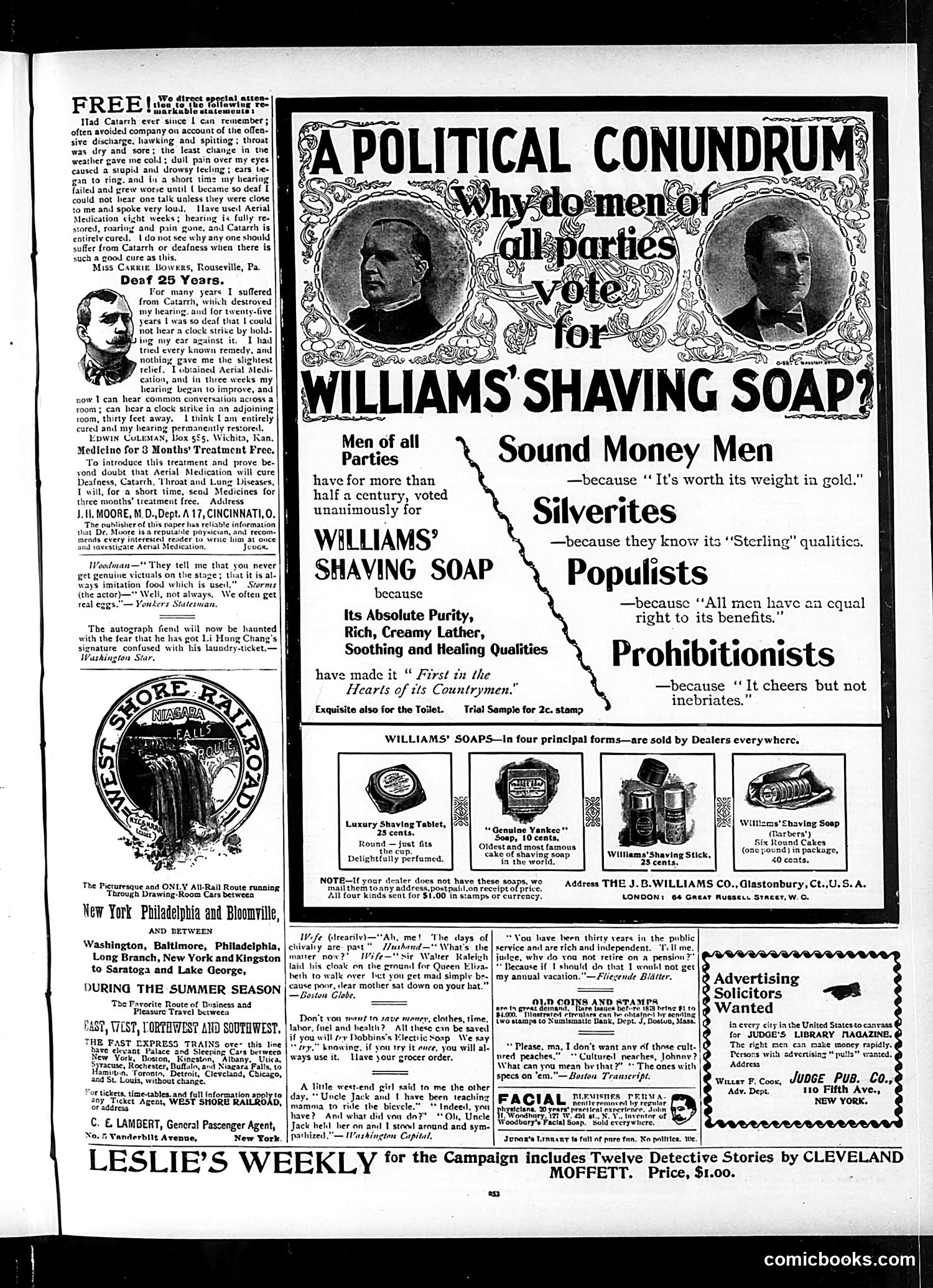
This advertisement for Williams' Shaving Soap uses satirical wordplay to mock different American political factions circa the 1890s. The "conundrum" is why voters from all parties—each with opposing values—would unanimously buy the same product. The satire works through puns: "Sound Money Men" value it because it's "worth its weight in gold" (referencing the gold standard monetary debate); "Silverites" appreciate its "Sterling qualities" (punning on silver currency); "Populists" support its "equal right to benefits" (mocking their egalitarian rhetoric); and "Prohibitionists" like that it "cheers but not inebriates" (joking about alcohol restrictions). This reflects the intense political divisions of the era—the Free Silver movement, monetary policy disputes, and Prohibition debates—while suggesting soap transcends these bitter partisan conflicts. The advertisement cleverly uses contemporary hot-button political issues for commercial humor.
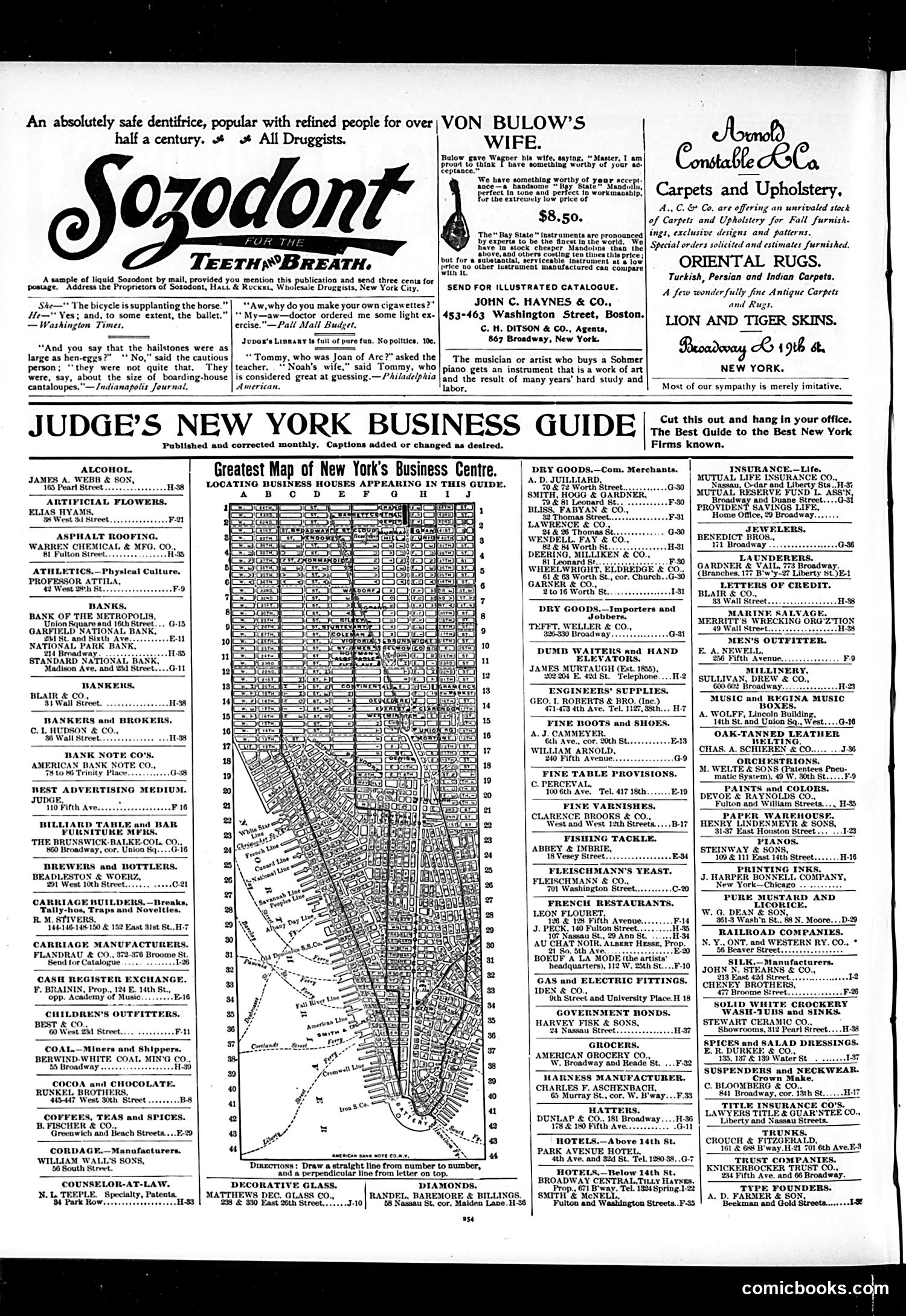
This page is **primarily a business directory** rather than a satirical cartoon publication. It consists mostly of advertisements and a "Judge's New York Business Guide"—a practical directory of Manhattan businesses organized by category (banks, dry goods, railroads, etc.) with a locating map. The small humorous content includes brief **comic snippets**: - A joke about "Von Bülow's Wife" (likely referencing a contemporary scandal, though unclear without additional context) - Quips about bicycle popularity and doctor-prescribed exercise - A child's misidentification of Joan of Arc as Noah's wife - An anecdote about exaggerated hailstone sizes The page also advertises **Sozodont**, a 19th-century dental product marketed as safe and popular with "refined people." This appears to be a **house ad and revenue-generating section** of Judge magazine—the editorial satire likely appeared elsewhere in the issue. The business guide served both practical and financial purposes for the publication.
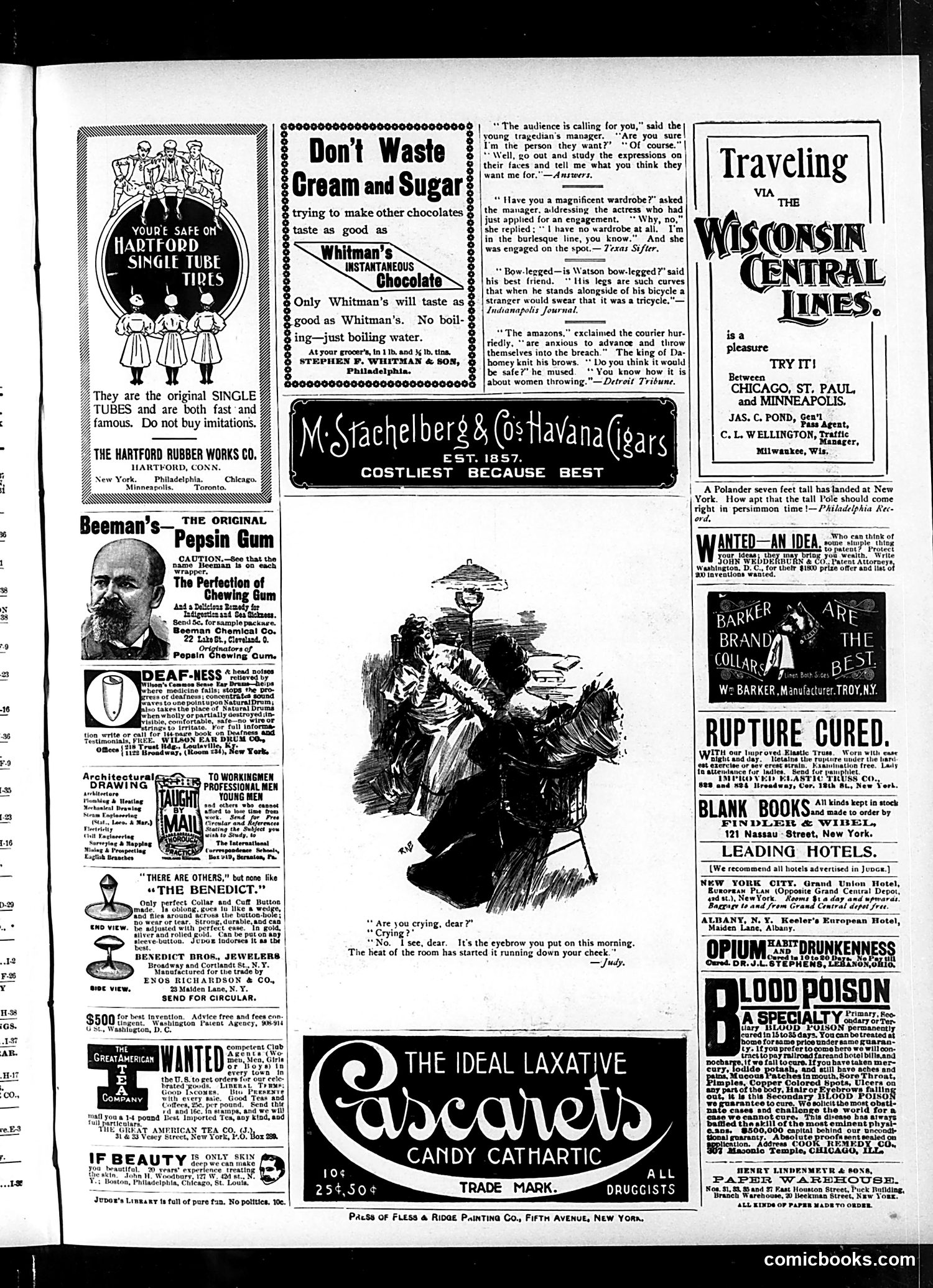
This is primarily an **advertising page** with minimal editorial content. The layout features various commercial advertisements for products including: - **Hartford Rubber single-tube tires** (emphasizing safety/originality) - **Whitman's and other chocolates** - **Beeman's Pepsin Gum** - **M. Stachelberg & Co. Havana Cigars** - **Cascarets laxative candy** - Various other patent medicines and services The **small cartoon/joke** appears mid-page: a dialogue between a woman and man about her eyebrow makeup running down her cheek from room heat—a light joke about cosmetics and vanity. **For modern readers:** This reflects early 1900s consumer culture and advertising practices. The prominence of "patent medicines" (many containing opiates or other dangerous substances, per visible ads) highlights how unregulated such products were. The persistent messaging about "originality" and "imitations" suggests market competition was fierce even then.
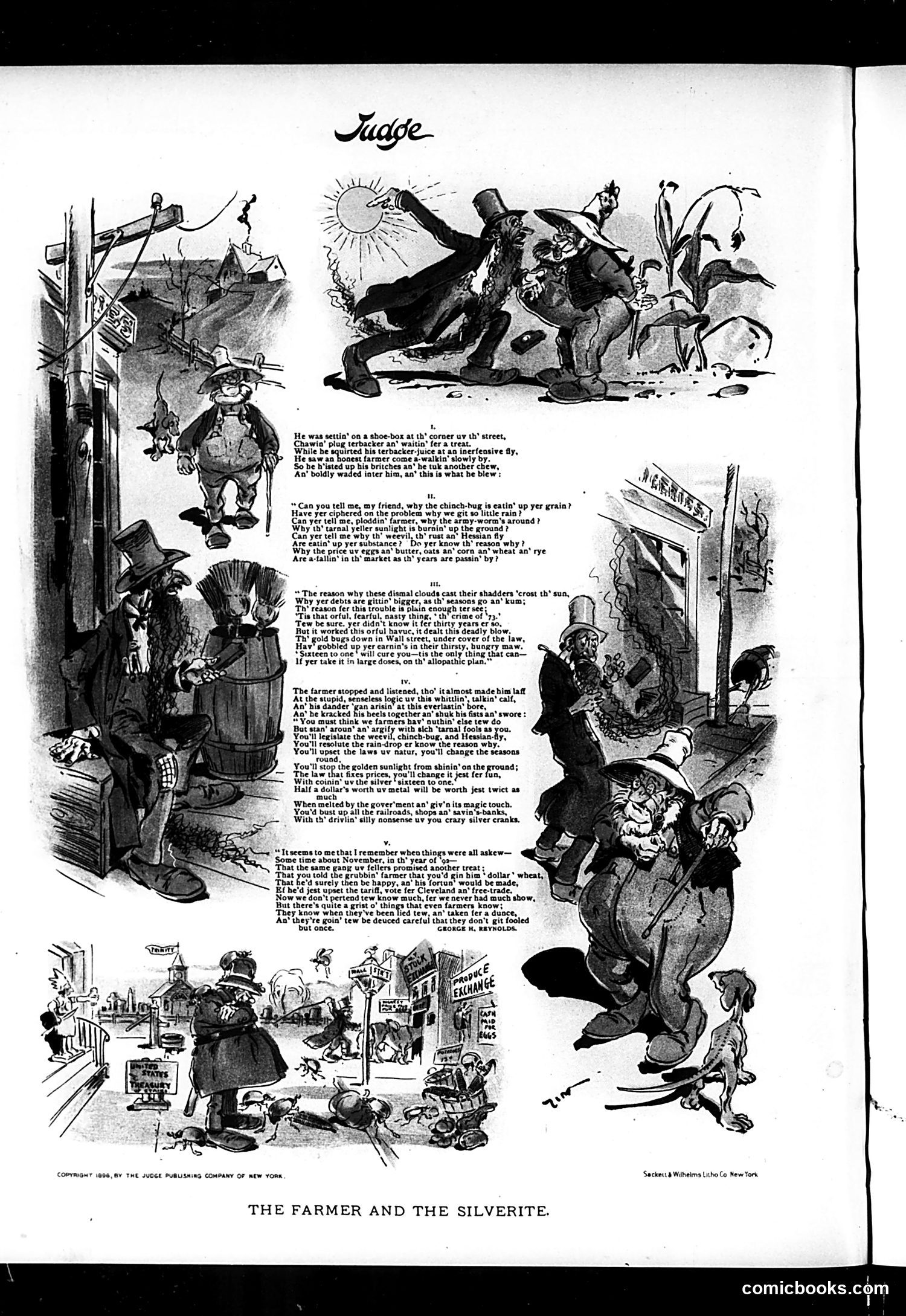
This political cartoon attacks the free-silver movement, which advocated unlimited coinage of silver at a 16-to-1 ratio with gold. The "Silverite" (a silver-advocate politician) encounters a farmer and blames all agricultural problems—chinch bugs, rust, falling crop prices—on the "Crime of '73" (demonetization of silver in 1873), claiming free silver would magically solve everything. The farmer responds with scathing logic: the Silverite's claims are absurd—you cannot legislate away natural disasters or control nature through monetary policy. The cartoon's final section sarcastically references false Democratic promises to farmers (likely Cleveland's tariff/free-trade pledges), warning farmers against being fooled twice. The satire ridicules silver-advocacy as economic nonsense that exploits farmers' genuine hardships with false solutions. The author is identified as George M. Reynolds.