
A complete issue · 16 pages · 1896
Judge — October 10, 1896
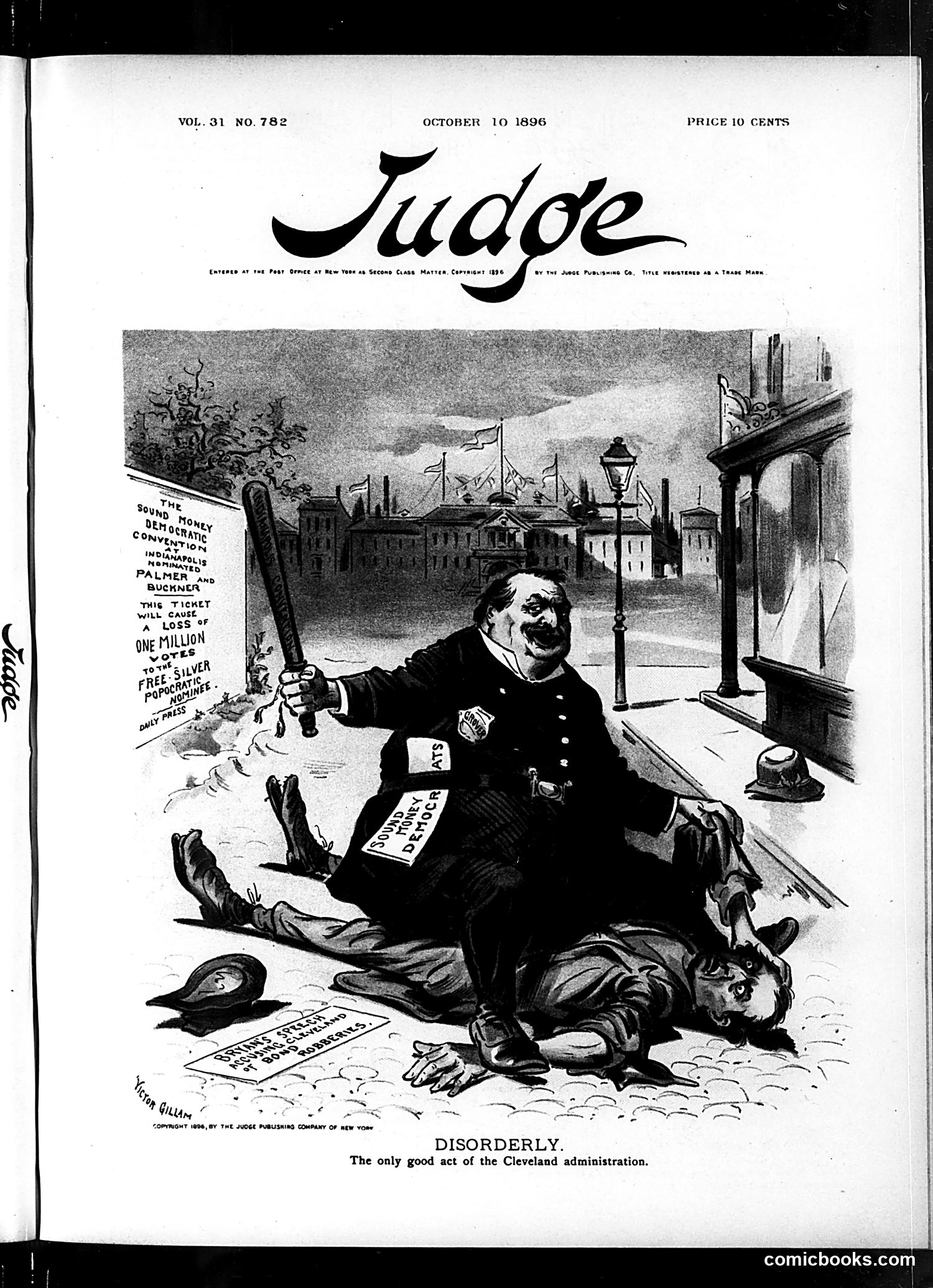
This cartoon criticizes President Grover Cleveland's administration through physical slapstick. A portly, mustached figure—representing Cleveland—sits sprawled on the ground amid chaos, holding a club labeled "ACTS." Various documents scatter around him, including references to financial loss and "FREE SILVER" (a major 1896 political debate). The caption states: "The only good act of the Cleveland administration." The satire suggests Cleveland's policies caused disorder and economic damage. The figure's undignified pose—sitting on the ground with legs up—mocks his leadership as ineffectual or clumsy. The "acts" he wielded failed to solve problems, making disorder itself seemingly his only accomplishment. This reflects 1896 Republican criticism of Democratic economic policy during that year's contentious presidential campaign.
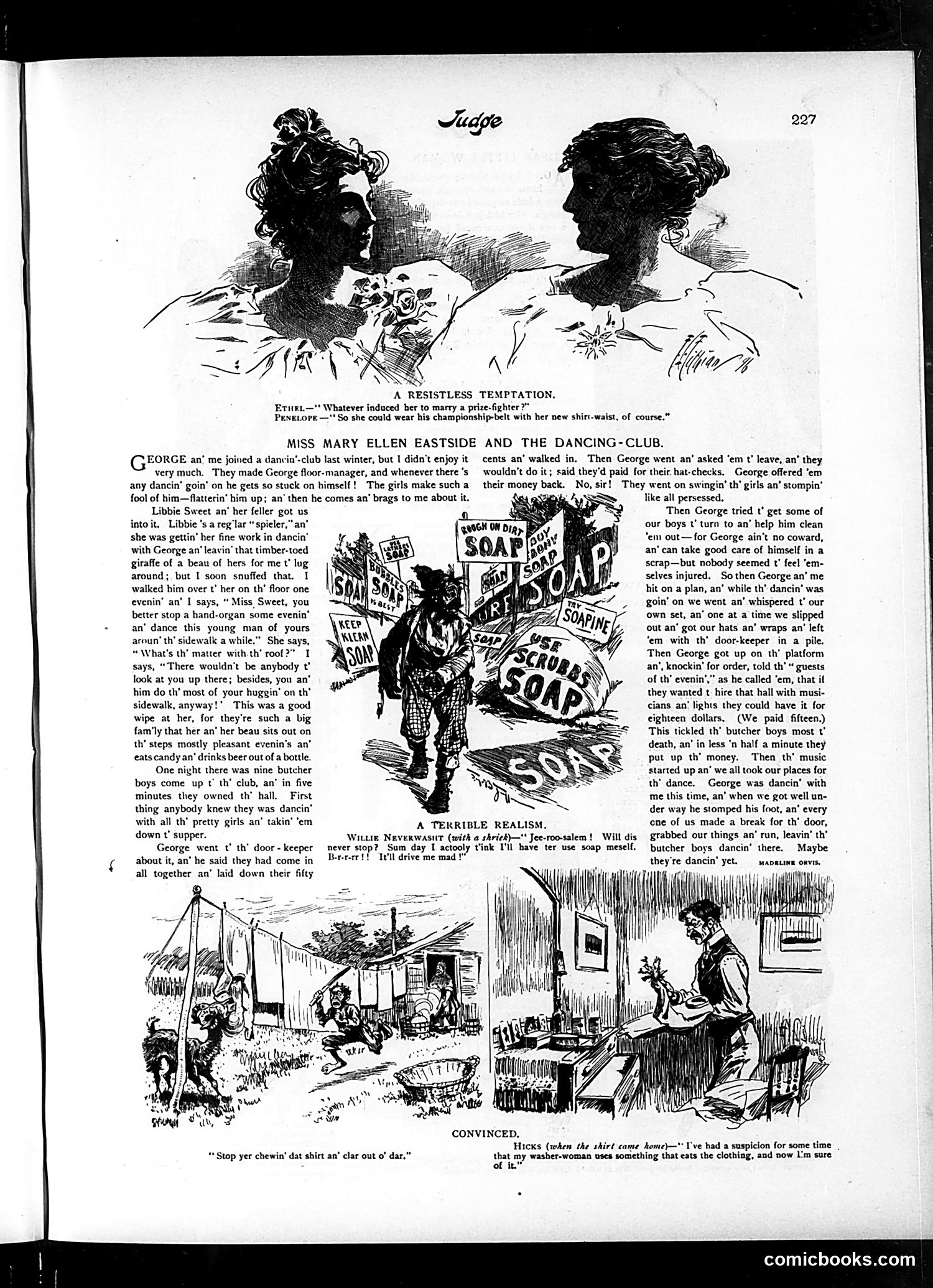
This page contains three satirical pieces about working-class life and courtship around the early 20th century. **"A Resistless Temptation"** (top) jokes about a woman's resistance to marrying a prizefighter—she could wear his championship belt as a waist. **"Miss Mary Ellen Eastside and the Dancing-Club"** (center) satirizes working-class entertainment culture. George joins a dance club where admission is cheap but the venue is squalid. The humor mocks both the butcher boys' entrepreneurial scheme using soap boxes as props and the characters' poor English dialect ("ain't," "th'" for "the"). **"A Terrible Realism"** (middle) depicts someone complaining about soap deteriorating clothing—the joke suggests commercial soap is so harsh it damages fabric. **"Convinced"** (bottom) shows a man discovering his washerwoman used something eating through his shirt, proving her negligence. All pieces use dialect and class stereotyping typical of early-20th-century American humor.
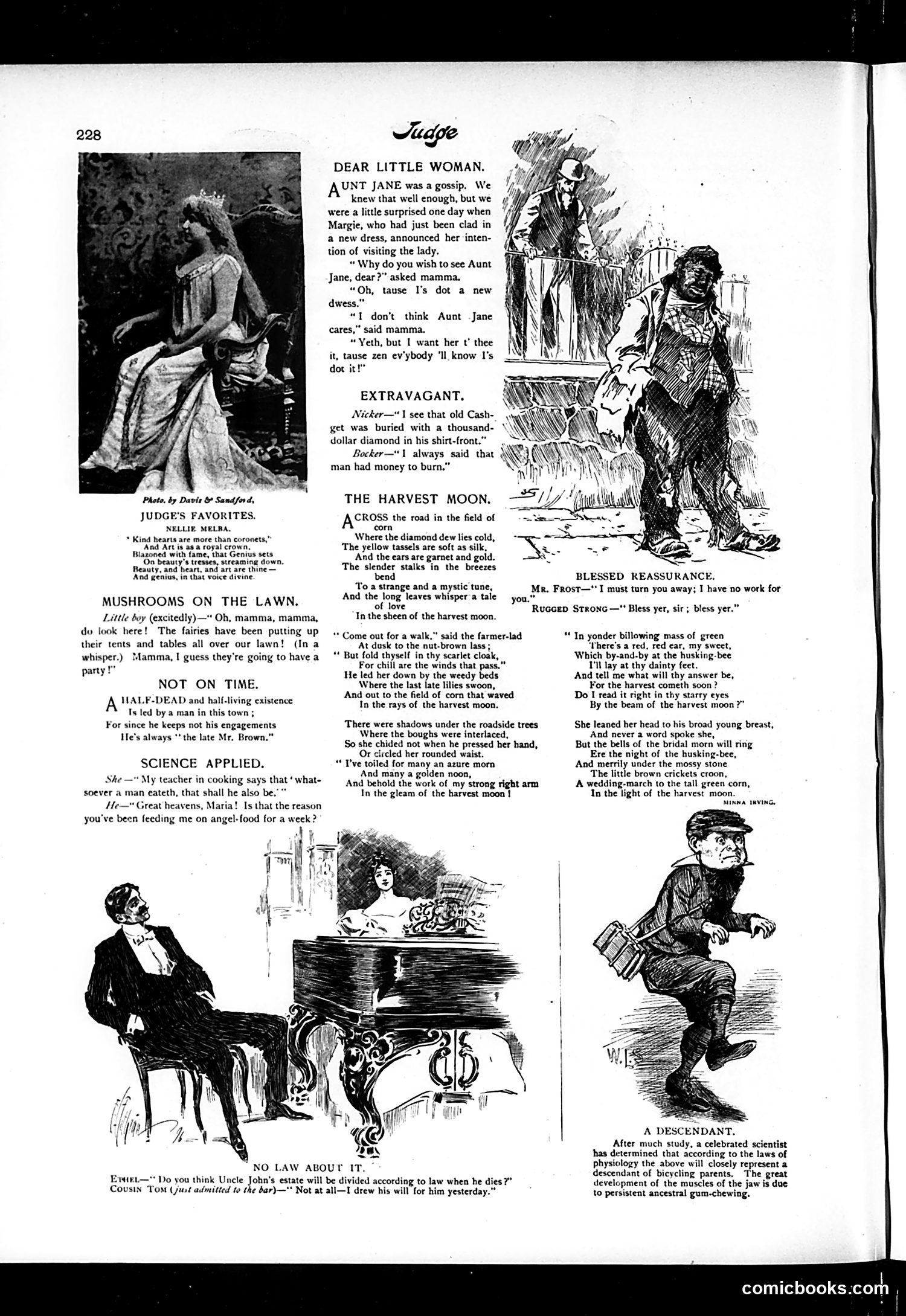
This page from the satirical magazine *Judge* contains several short humor pieces and illustrations typical of late 19th-century American comedy journalism. **Key Content:** The main items are brief jokes and witty observations rather than political cartoons. "Dear Little Woman" depicts a child wanting to show off a new dress to gossipy Aunt Jane. "Science Applied" plays on literal biblical interpretation ("whatsoever a man eateth...he shall also be"), with a wife feeding her husband angel-food cake as a consequence. "The Harvest Moon" is a sentimental poem about a farmer's courtship, illustrated romantically. **"A Descendant"** (bottom right) is the most pointed satire—mocking the then-popular bicycle craze by suggesting cyclists' descendants would develop enlarged jaw muscles from constant gum-chewing, implying bicyclists were frivolous gum-chewers. This reflects contemporary anxiety about new technologies and leisure activities. The page also features a portrait of performer "Nellie Melba" under "Judge's Favorites," indicating the magazine mixed entertainment gossip with humor. Overall, this represents general-audience satire without specific political targets—mostly domestic comedy and social observation.
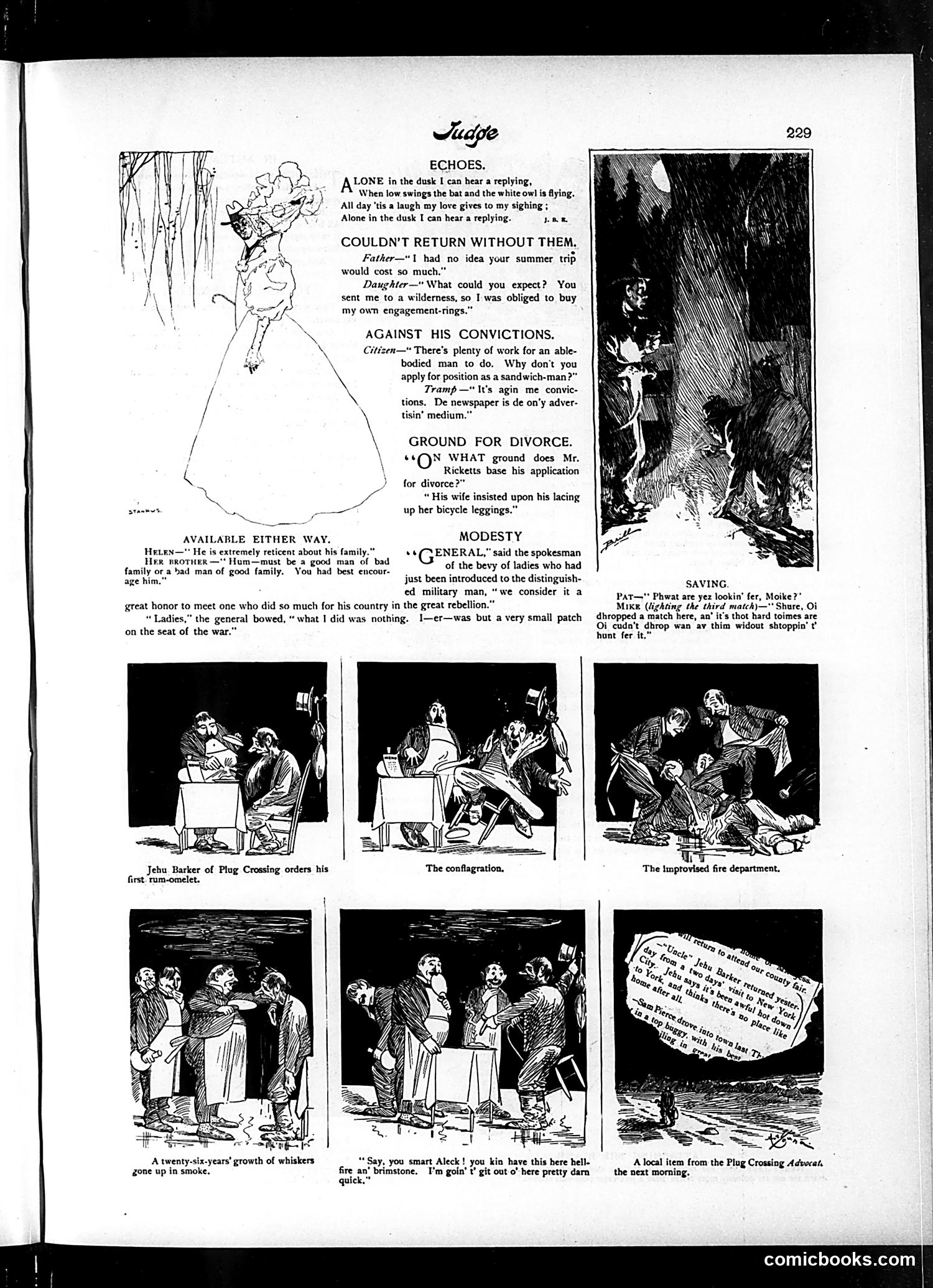
This page from Judge (an American satirical weekly) contains multiple short humor sketches mocking various social situations and character types circa early 1900s. **Key sketches:** - **"Couldn't Return Without Them"**: Satirizes materialistic daughters—a young woman claims she needed to buy engagement rings during a wilderness trip, mocking both female acquisitiveness and courtship customs. - **"Against His Convictions"**: A tramp refuses legitimate work as a sandwich-man because newspapers are "the only advertising medium"—mocking both vagrant logic and newspaper advertising's prominence. - **"Ground for Divorce"**: Absurdist humor about a marriage ending over a husband refusing to lace his wife's bicycle leggings—satirizing both trivial marital disputes and the new "bicycle craze." - **"Modesty"**: A military general claims credit for winning the Civil War, then admits he did almost nothing—mocking false military heroism and self-aggrandizement. The remaining sketches involve rural/working-class characters at "Plug Crossing," using dialect humor (then common) for slapstick situations. **Overall**: Judge's humor targets materialism, dishonesty, pretension, and social absurdities through exaggeration.
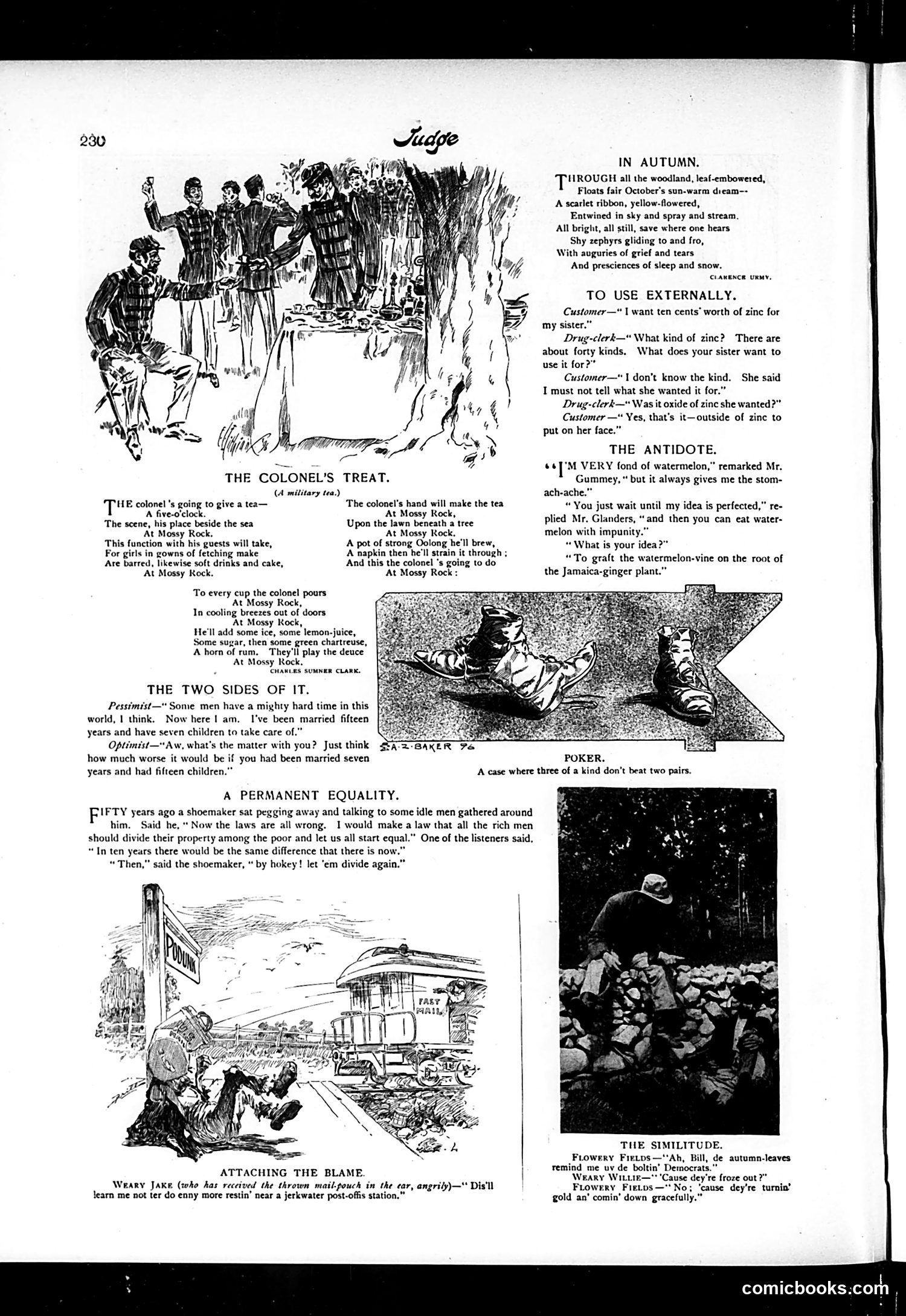
This page contains several light satirical pieces typical of Judge's humor: **"The Colonel's Treat"** mocks military pretension—a colonel hosts a supposedly proper "five-o'clock tea" that devolves into heavy drinking (with rum and chartreuse), suggesting officers' actual behavior contradicts their refined appearances. **"The Two Sides of It"** presents a simple joke contrasting pessimism and optimism about marriage and children—the optimist finds perspective by imagining worse circumstances. **"A Permanent Equality"** satirizes utopian wealth-redistribution schemes through a shoemaker's anecdote: even if riches were divided equally, natural human differences in ability and effort would recreate inequality within ten years—a conservative critique of socialist ideology. **"Attaching the Blame"** shows a railway worker angry after receiving a mail pouch to the face, blaming the postal system rather than accepting risk. Minor pieces mock pharmacy confusion, watermelon remedies, and autumn leaves' resemblance to "boltin' Democrats" (likely referring to Democratic Party divisions of the era). The tone throughout is genteel mockery of social pretense and foolish reasoning.
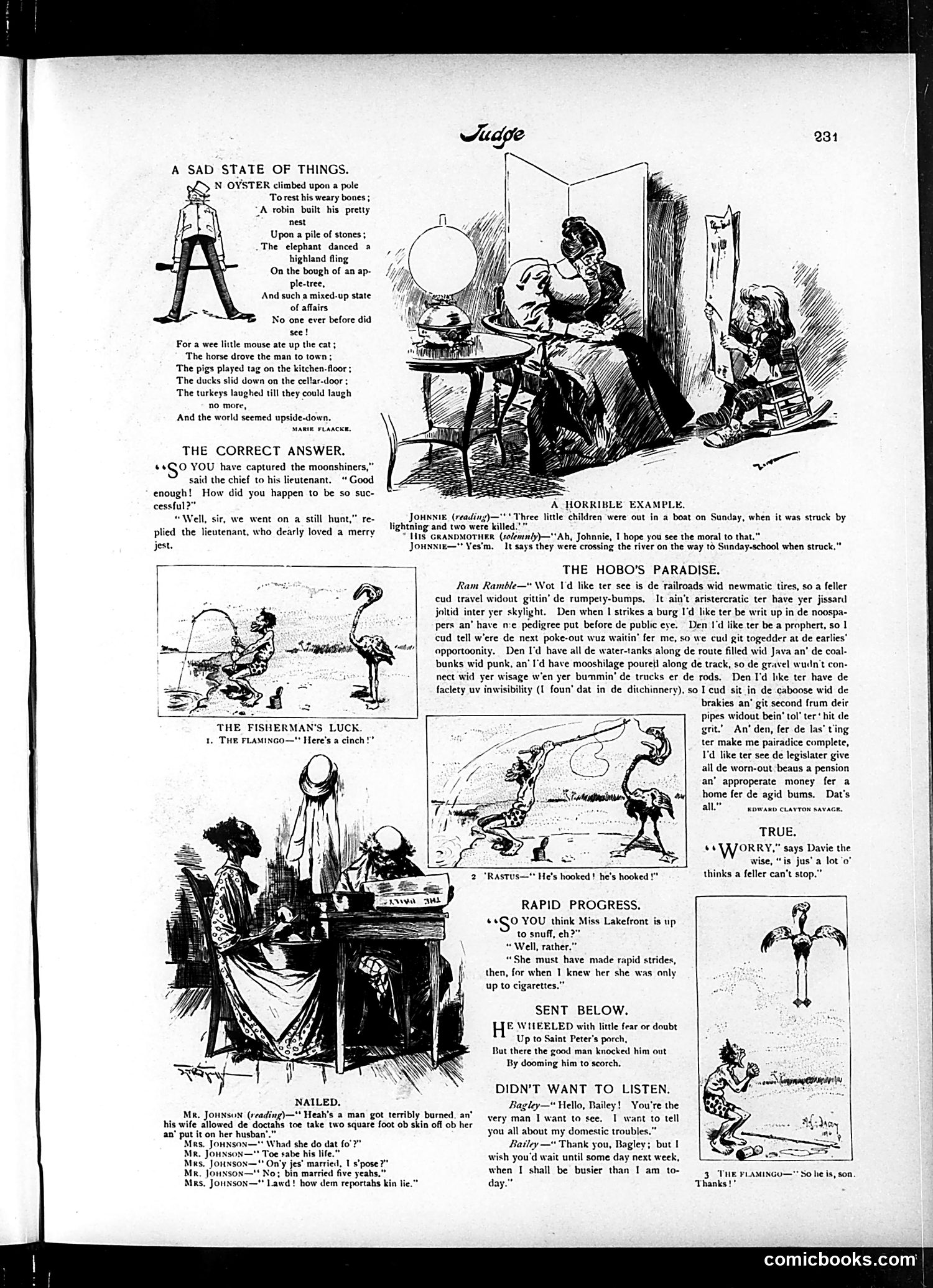
This page contains multiple short humorous pieces typical of Judge's satirical style: **"A Sad State of Things"** presents whimsical, topsy-turvy scenarios (oysters on poles, mice eating cats) — absurdist humor with no apparent political meaning, likely just playful nonsense. **"The Correct Answer"** mocks police inefficiency through wordplay: a lieutenant's "still hunt" (pun on hunting terminology) captures moonshiners, suggesting law enforcement stumbles into success accidentally. **"The Hobo's Paradise"** satirizes hobos' unrealistic aspirations through exaggerated dialect, lampooning working-class fantasies of luxury (pneumatic tires, pensions, homes). **"Rapid Progress"** uses innuendo about a woman named Lakefront progressing from cigarettes to "snuff" — implying moral decline or loose behavior. The remaining pieces are brief conversational jokes about marriage, fishing luck, and domestic troubles — typical period humor relying on stereotypes and wordplay rather than specific political commentary.
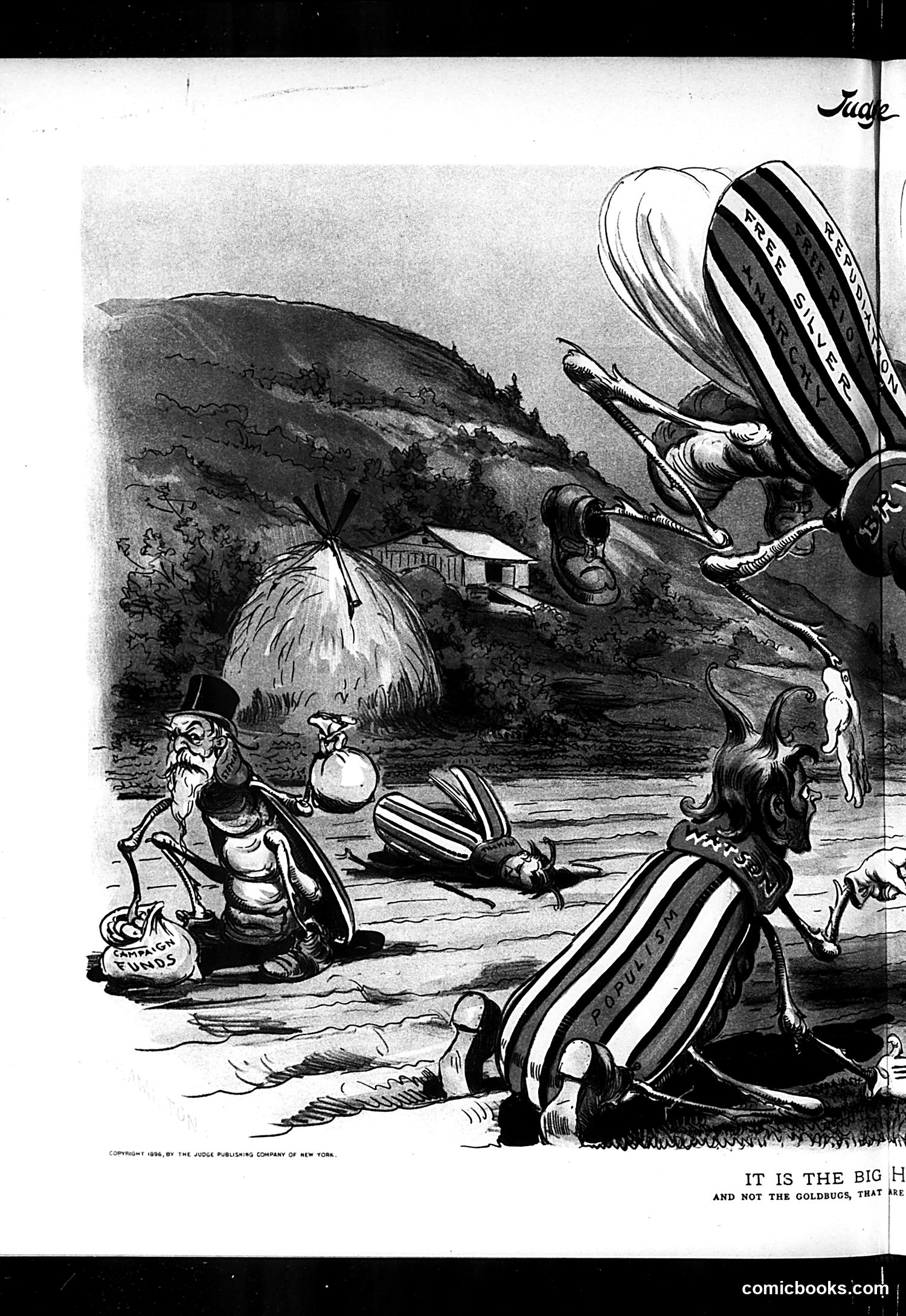
This is a political cartoon from Judge magazine (copyright 1896). The caption "It is the Big H / And not the goldbug, that are..." suggests commentary on late-1890s monetary politics, when "goldbugs" (gold standard advocates) were a major political faction. The cartoon depicts caricatured figures in a rural/mountainous setting with various symbolic elements—including what appears to be money bags and striped bundles labeled with text (possibly representing currency or financial instruments). The figures' exaggerated features and the overall composition suggest satire targeting specific political opponents. However, without seeing the complete caption or having clearer visibility of all labels, I cannot definitively identify which specific "Big H" figure or political faction is being mocked, or what precise argument the cartoon makes about monetary policy. The imagery clearly engages 1896 currency debates, but the exact targets remain partially unclear from this page alone.
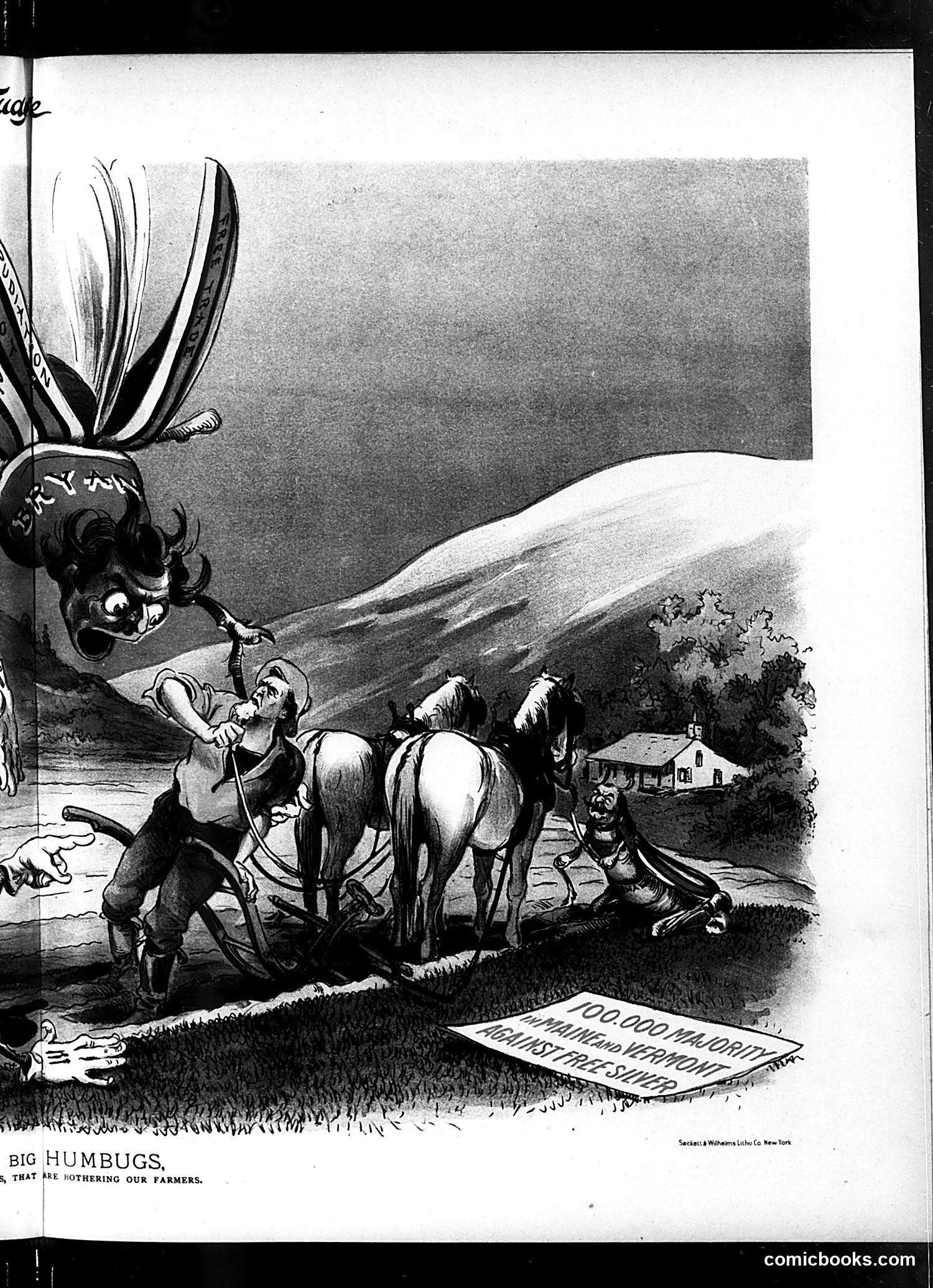
This political cartoon depicts agricultural exploitation through surrealist imagery. A massive insect (representing "big humbugs"—fraudulent schemes or exploitative interests) looms over struggling farmers. The farmers appear distressed while controlling horses, suggesting they're laboring hard despite external pressures. A sign reading "100,000 MAJORITY" and text mentioning "SHORTEST STUMP" likely references a political election or agricultural policy debate of the Judge magazine era (likely late 19th or early 20th century). The rural farmhouse in the background emphasizes this is about rural livelihoods. The cartoon critiques whatever "humbugs" (corrupt practices, unfair policies, or monopolistic business interests) Judge's editors believed were harming American farmers—a recurring populist concern in this period.
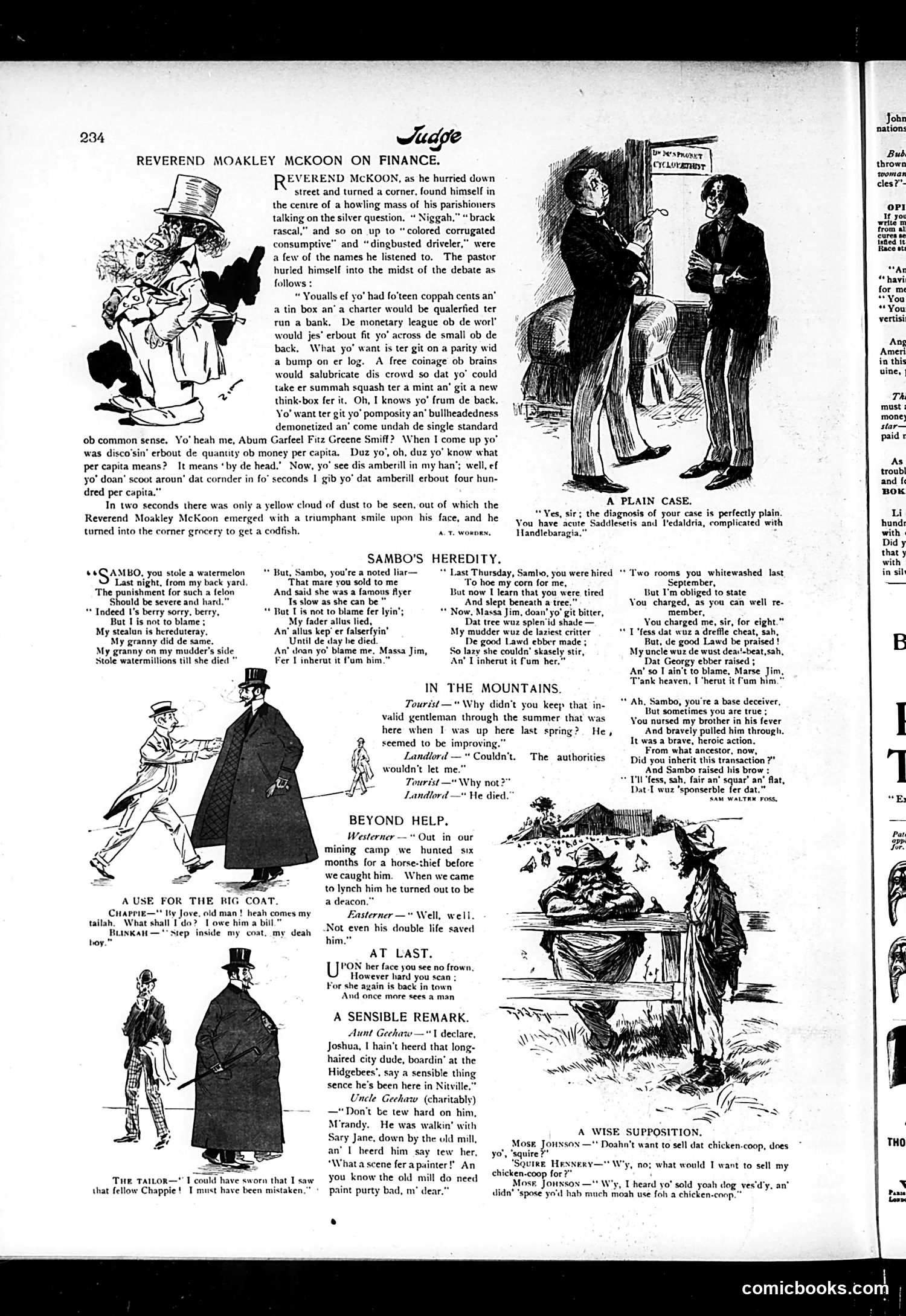
This Judge magazine page (circa 1890s) contains racist satirical sketches using offensive dialect and caricature—common in period humor but deeply problematic today. **"Reverend Moakley McKoon on Finance"**: A Black preacher character uses mangled dialect to lecture parishioners about monetary policy (likely the silver vs. gold debate of the era). The satire mocks both the financial arguments AND presents Black speech as inherently comic and foolish. **"Sambo's Heredity"**: A Black character defends stealing by claiming it's hereditary—the "joke" being that his father and grandmother were thieves. This reinforces racist stereotypes about criminality. **Other sketches** ("Beyond Help," "At Last," etc.) are gentler domestic humor unrelated to race. The underlying message: the magazine presents Black Americans as intellectually inferior, criminal, and suited only for comic ridicule. This represents the casual dehumanization embedded in 19th-century American popular media.
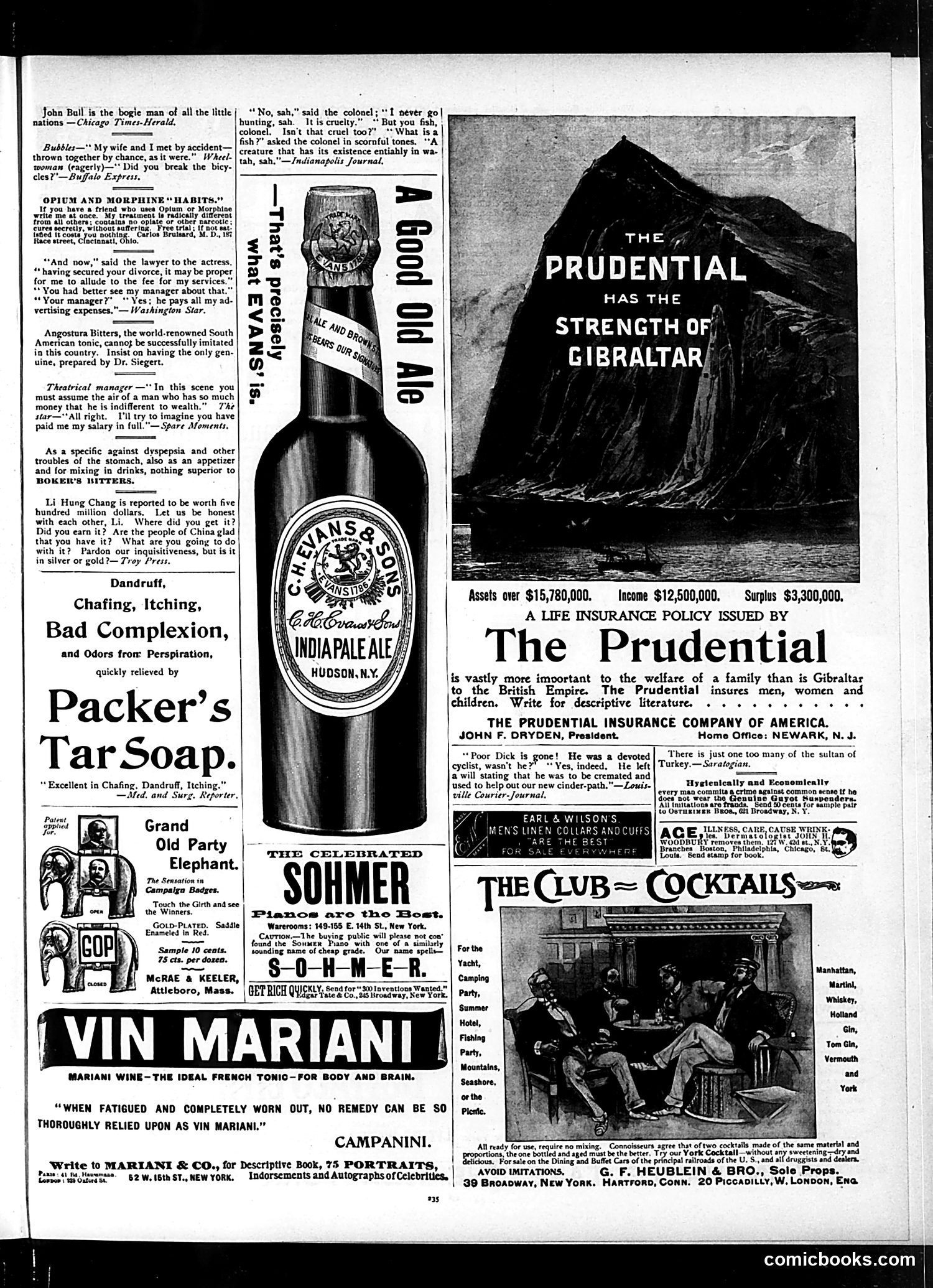
This page is primarily **advertisements and short humorous anecdotes** rather than political cartoons. The main content consists of: 1. **Brief jokes/quips** on various topics—a colonel's views on fishing cruelty, a divorce lawyer's fee dispute, theatrical salary complaints—typical of Judge's satirical humor format. 2. **Period product advertisements**: Packer's Tar Soap, Boker's Bitters, Vin Mariani (a cocaine-containing wine tonic, legal then), and piano makers. These reveal what was marketed and normalized in the era. 3. **A Prudential Insurance ad** comparing life insurance to "the strength of Gibraltar," using the famous rock as a metaphor for stability. 4. **Brief political/social commentary**: References to Li Hung Chang's wealth and a comment about "too many" sultans in Turkey suggest contemporary geopolitical interest, though without elaboration. The page lacks sustained satire or caricature. It's essentially a typical Judge magazine section—mixing light humor, product promotion, and topical quips for educated, middle-class readers.
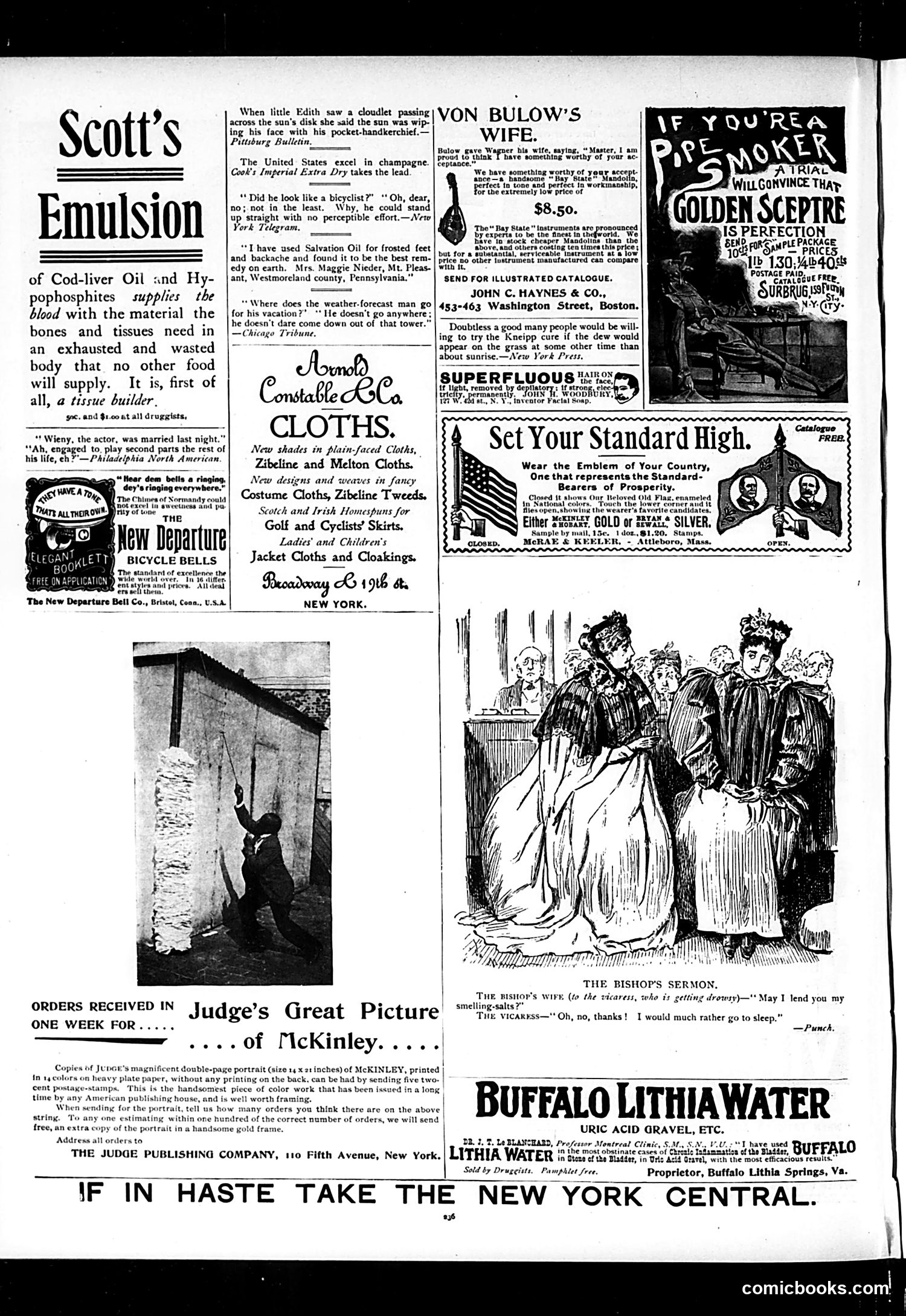
This page is primarily **advertisements and filler content** rather than political satire. The dominant features are product ads (Scott's Emulsion cod-liver oil, bicycle bells, clothing, mandolins, lithia water) and short joke items—typical of Judge's format. The one illustration with potential satirical content is **"The Bishop's Sermon,"** a cartoon showing a bishop's wife falling asleep during his sermon. The accompanying Punch magazine quote makes the joke explicit: the drowsy woman would "much rather go to sleep" than listen to his preaching. This is gentle domestic satire about boring clergymen, not political commentary. The page also advertises **Judge's portrait of McKinley** (likely President William McKinley, suggesting this is from around 1897-1901), but this is simply a commercial offer, not editorial commentary. Overall, this appears to be a standard late-19th-century magazine page mixing advertising revenue with light humor and social observation rather than hard-hitting political satire.
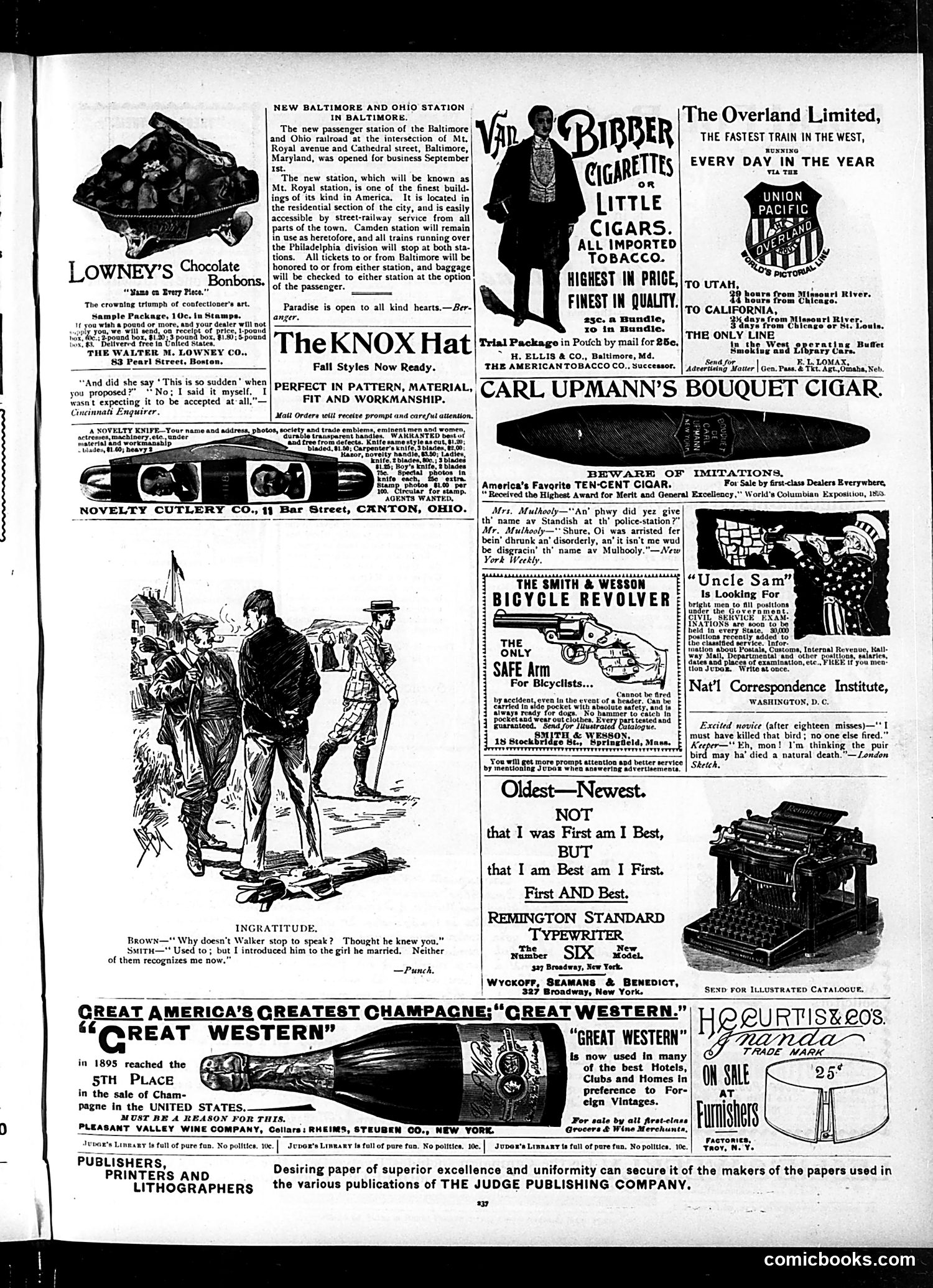
This page is primarily **advertising**, with minimal editorial cartooning. The layout showcases various consumer products from the early 1900s era. **Notable content:** The top carries news about Baltimore's new Mt. Royal train station—straightforward reportage, not satire. **The cartoon** labeled "INGRATITUDE" depicts a social joke: a man complains that his acquaintance Walker won't speak to him anymore, despite having introduced Walker to the woman he married. The satire targets human ingratitude—Walker has forgotten his matchmaker benefactor. This reflects period attitudes about social obligation. **The advertisements** reveal era preoccupations: luxury chocolates, quality hats, typewriters, bicycles, cigars (heavily promoted), and champagne. The "Smith & Wesson Bicycle Revolver" for cyclists suggests period anxieties about street safety. **One humor snippet** features Irish-accented dialect humor (popular in Judge), mocking an arrested Irishman's pride about his surname. The page reflects turn-of-century consumer culture and genteel social anxieties rather than serious political satire.
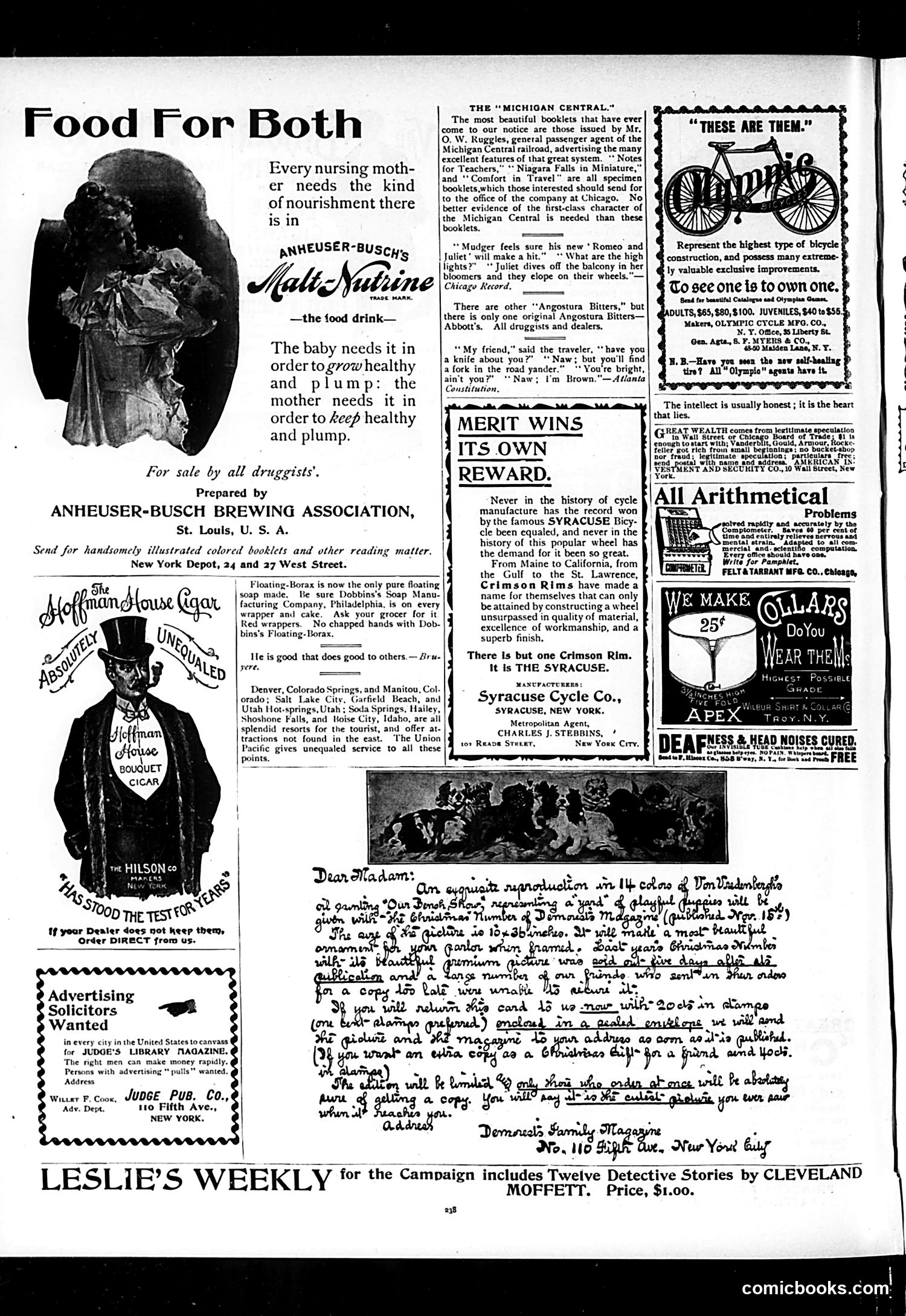
This page consists primarily of **advertisements** interspersed with minor editorial content rather than political cartoons or satire requiring historical context. The main items are: 1. **Anheuser-Busch Malt Nutrine ad** (top left): Appeals to nursing mothers and the health-conscious, promoting beer as nutritious and healthful—reflecting turn-of-century marketing practices when alcohol was pitched as medicinal. 2. **Michigan Central Railroad** and **Angostura Bitters** snippets: Standard transportation and patent medicine promotions. 3. **Hoffmann House Cigar** ad: Period cigar branding. 4. **Light editorial jokes** scattered throughout (brief one-liners about Romeo/Juliet and road travel) lack sufficient context to analyze deeper satirical meaning. 5. **Reader letter** ("Dear Madam") appears handwritten, likely a personals or correspondence section. 6. **Advertising solicitation notice**: Judge magazine itself recruiting ad salespeople. The page reflects **late 1800s American commercial culture** where alcohol and patent medicines were heavily advertised with health claims now considered dubious.
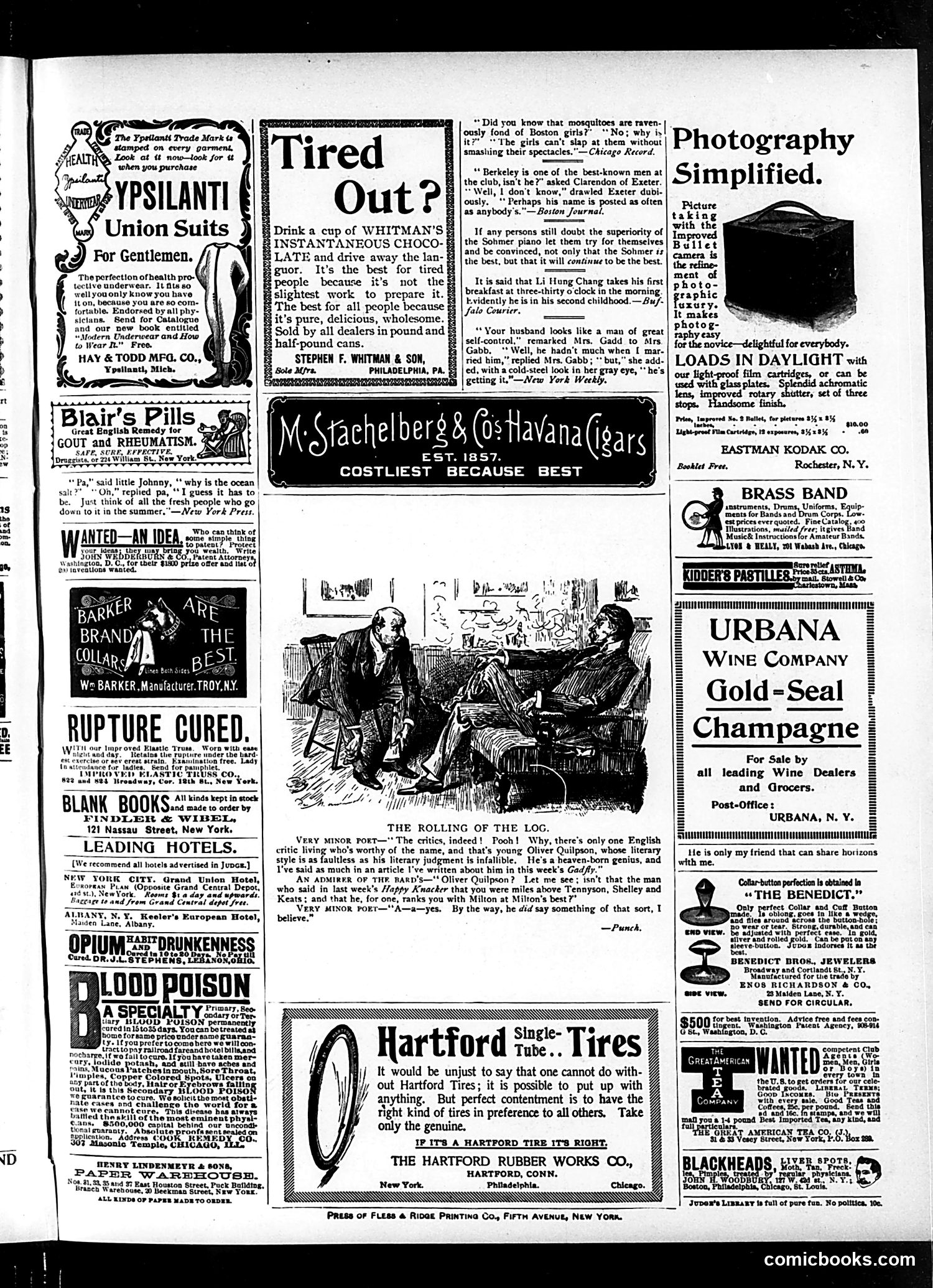
This page is primarily **advertisements and filler humor** typical of Judge magazine's format. The main cartoon, "The Rolling of the Log," depicts two men in conversation where one enthusiastically praises a literary critic named Oliver Quilpson as "the only English critic living who's worthy of the name." The satire is revealed in the final line: the speaker admits he wrote this glowing assessment *himself* in an article in *Gadfly* magazine. The joke mocks **mutual back-scratching in literary circles**—critics praising each other's work to inflate their reputations. The title "Rolling of the Log" is a period phrase meaning reciprocal favors or quid pro quo arrangements. The remainder of the page consists of advertisements for patent medicines (blood poison cures, opium addiction treatment), underwear, chocolate, cigars, tires, and hotels—standard Judge advertising. Several brief humorous quips appear (mosquitoes and Boston girls' spectacles; Li Hung Chang's breakfast timing), typical of the magazine's filler content.
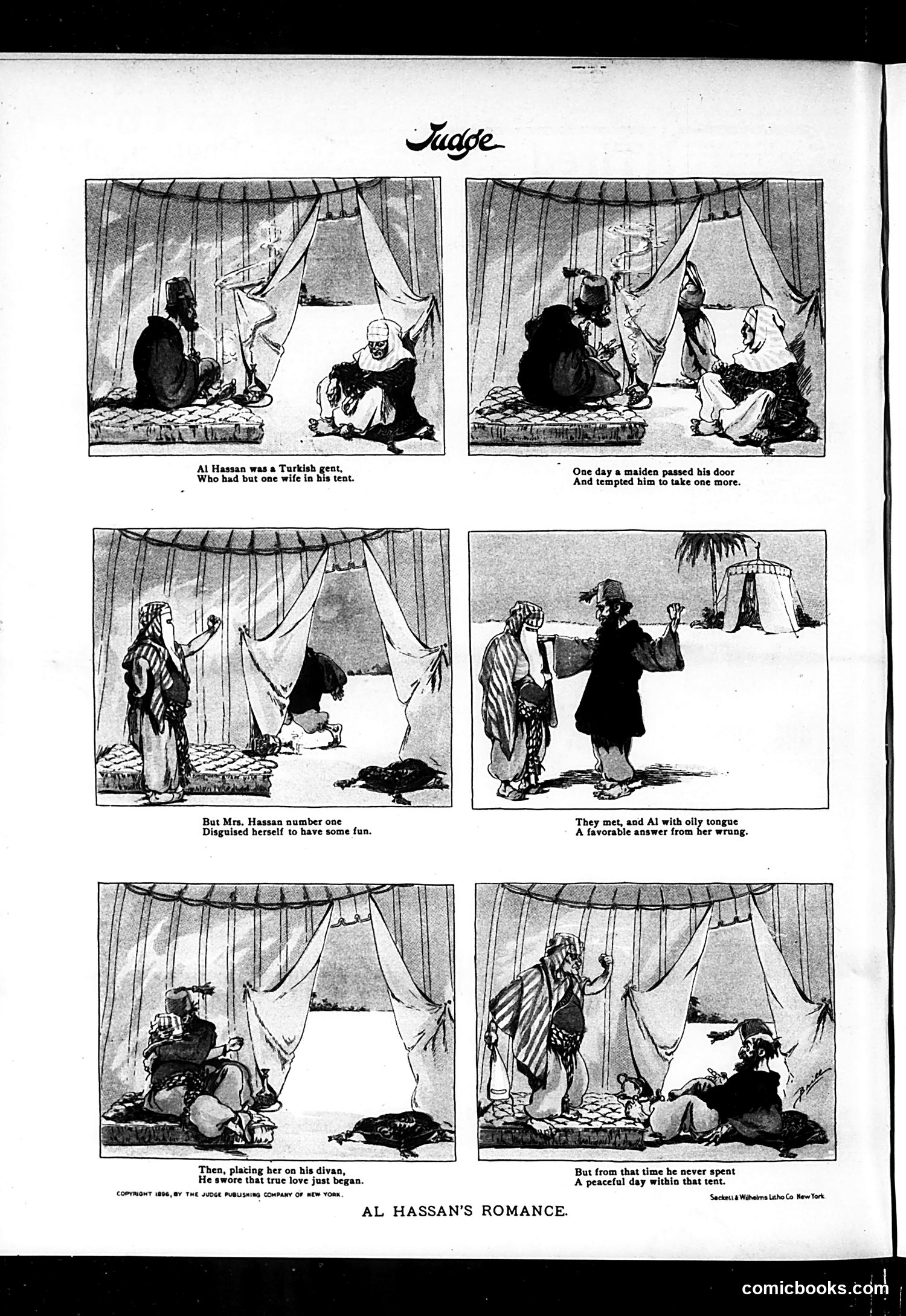
This comic strip satirizes polygamy through the story of a Turkish gentleman who takes a second wife. The narrative follows Al Hassan's attempt to romance a maiden while married, using "oily tongue" (flattery/deception) to seduce her. The satire's point emerges in the resolution: when the first wife discovers the infidelity, she disguises herself and infiltrates the household, transforming Al Hassan's domestic life into chaos. The final caption—"he never spent / A peaceful day within that tent"—delivers the moral: attempting polygamy backfires when a deceived spouse seeks revenge. This reflects late-19th-century American attitudes portraying Turkish/Muslim customs as morally inferior and comedically ridiculous. The "exotic" setting allows Judge magazine to mock infidelity and celebrate the vengeful wife's clever cunning as justified punishment, appealing to contemporary anxieties about marriage and marital fidelity.