
A complete issue · 16 pages · 1896
Judge — August 29, 1896
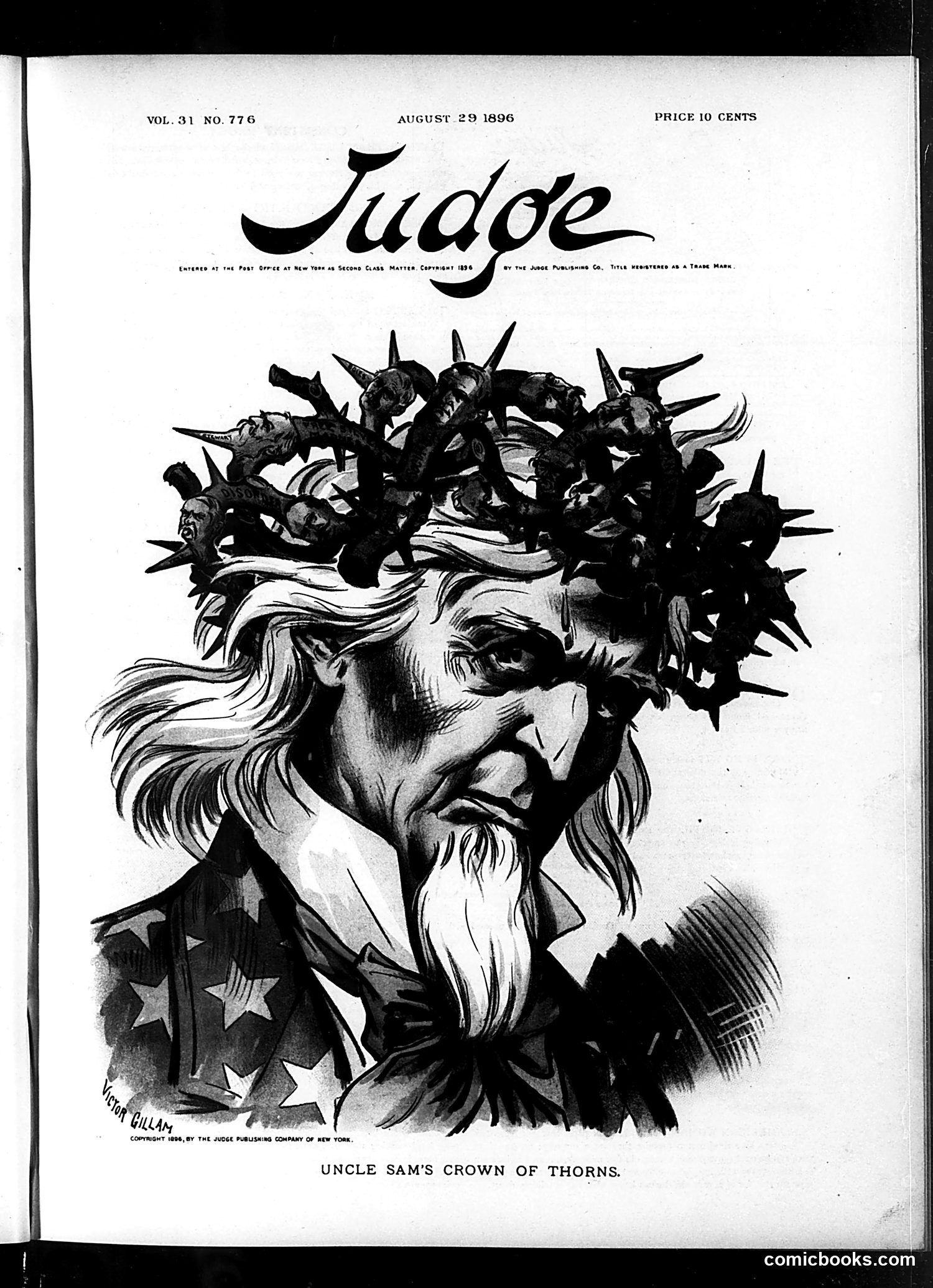
This August 1896 *Judge* cartoon depicts Uncle Sam (the bearded figure wearing the star-spangled shirt) crowned with thorns and devils' heads instead of a laurel wreath. The title references Christ's crown of thorns, creating a religious metaphor for American suffering. The satire likely addresses political turmoil or economic hardship facing the nation in 1896—a year of significant economic depression and the heated presidential election between William McKinley and William Jennings Bryan. The "crown of thorns" suggests America is being tormented by internal conflicts or misguided policies, while the demonic heads symbolize the forces causing this national anguish. The cartoonist (signed "Gillam") uses religious imagery to critique the nation's leadership or circumstances as spiritually and politically corrupting.
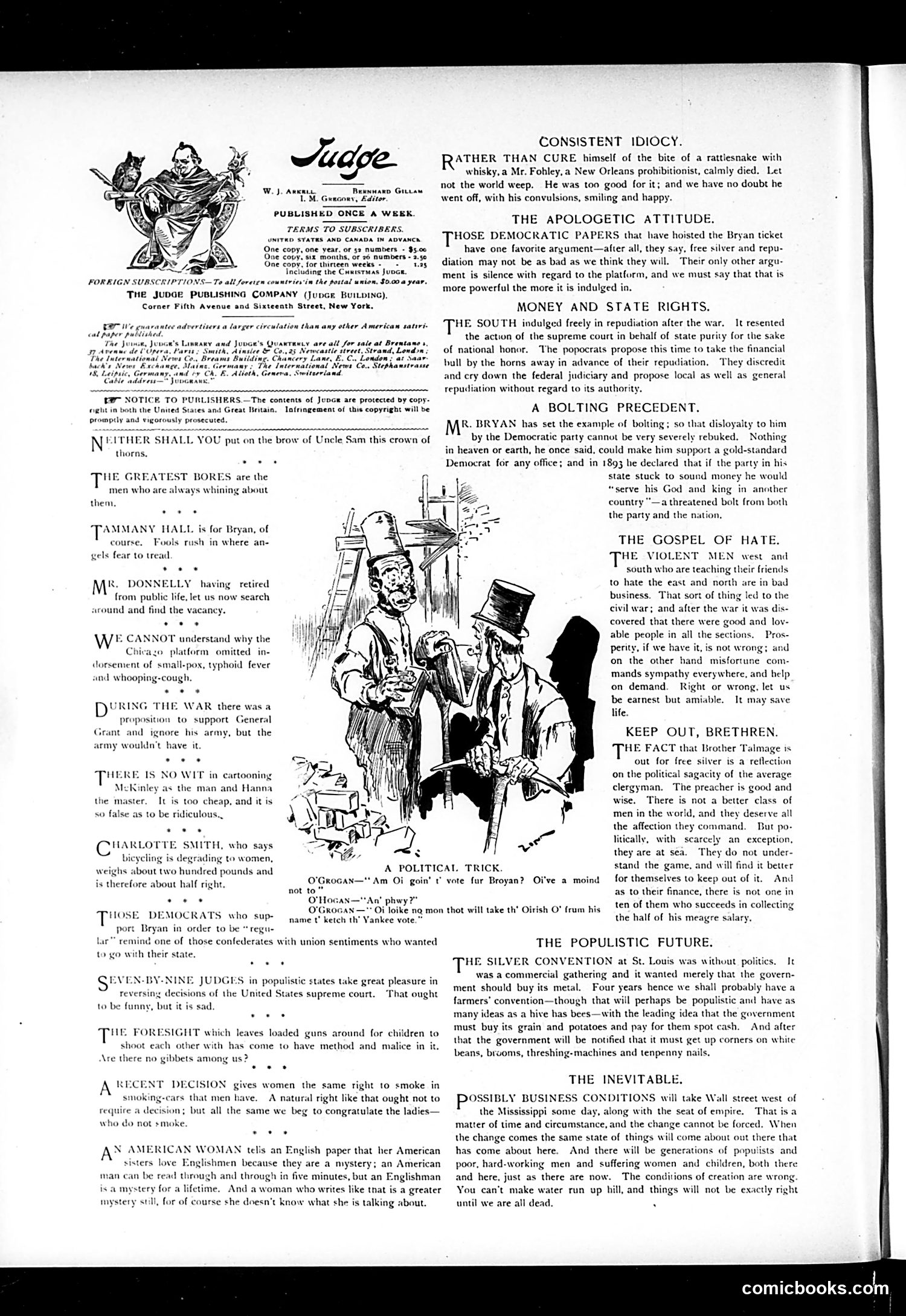
This page contains political commentary rather than a single cartoon. The main illustration depicts a figure labeled "A POLITICAL TRICK" showing what appears to be a man being manipulated or controlled, with dialogue about voting for "Bryan" and taking "Orish O'" (likely "Irish O'"). The text sections satirize Democratic Party politics and William Jennings Bryan's 1896 presidential campaign. "THE GOSPEL OF HATE" criticizes Democratic efforts to pit regions against each other during the campaign. "A BOLTING PRECEDENT" references Bryan's controversial stance on free silver and party loyalty. The commentary suggests Judge opposed Bryan's candidacy and Democratic divisive tactics, using satire to mock their political maneuvering and regional appeals to voters.
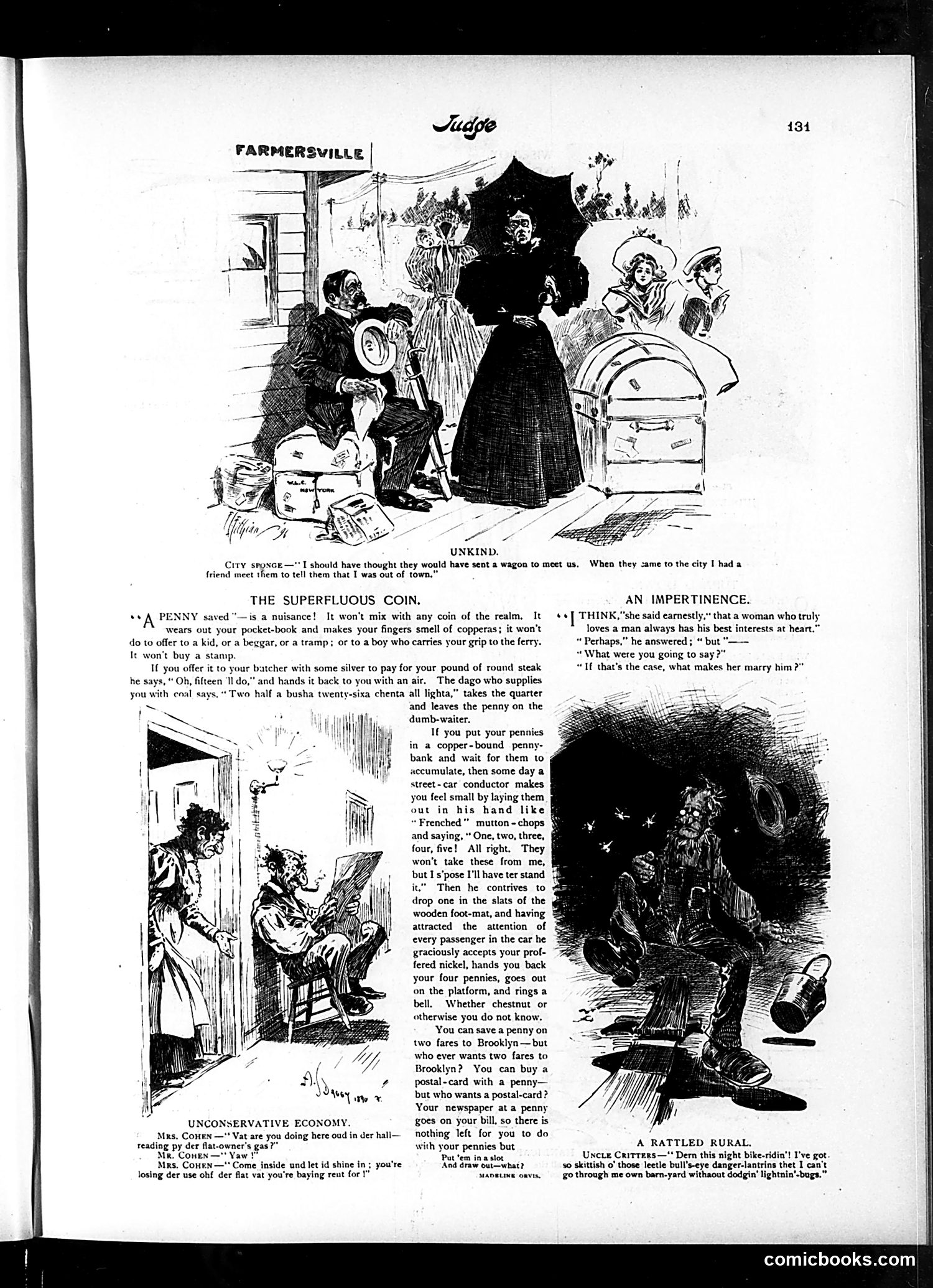
This page contains three satirical pieces from Judge magazine (page 131): 1. **"Unkind"** (top): A sketch mocking rural visitors to the city, with a woman apparently arriving by wagon, suggesting unsophisticated country folk. 2. **"The Superfluous Coin"** (left): A humorous piece about penny economics, satirizing the impracticality of pennies in daily transactions. It mocks how pennies accumulate without real utility—streetcar conductors, shopkeepers, and others refuse them or treat them dismissively. 3. **"An Impertinence"** (center-right): A brief dialogue joke about romantic assumptions. 4. **"A Rattled Rural"** (bottom right): Depicts what appears to be a bewildered country person encountering urban life, likely poking fun at rural-urban cultural differences. The overall theme reflects Judge's characteristic mockery of class distinctions and rural-urban divides common in early 20th-century American satire.
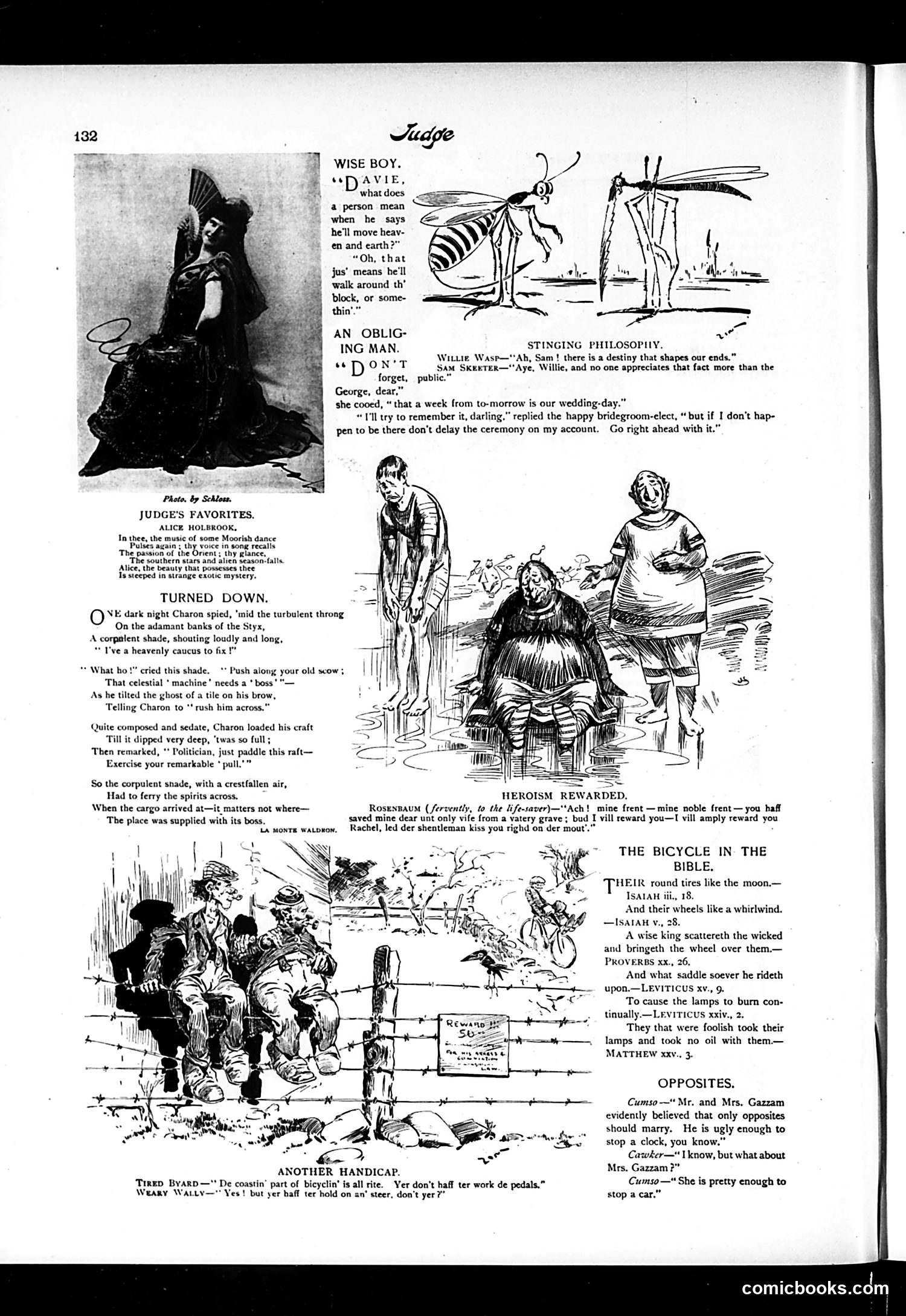
This satirical magazine page from the early 1900s contains several humor pieces typical of the era: **"Wise Boy, Davie"** and **"An Obliging Man"** are brief comic dialogues mocking pretentiousness and indifference—a man claiming he'll "move heaven and earth" actually means walking around the block; a groom says he might not attend his own wedding. **"Turned Down"** is a longer satirical poem about a dead politician attempting to bribe Charon (the mythological ferryman) with his political "pull," only to be forced to do the actual work himself—mocking corrupt politicians' inflated self-importance. **"The Bicycle in the Bible"** humorously reinterprets biblical passages to find references to bicycles, a contemporary technology, creating absurdist comedy from anachronism. **"Opposites"** and **"Another Handicap"** are brief punchlines about mismatched couples. The cartoons feature caricatures and satirical drawings typical of Judge's style. The page exemplifies how early 1900s satirical magazines used exaggeration, wordplay, and social commentary to mock politicians, pretension, and modern absurdities.
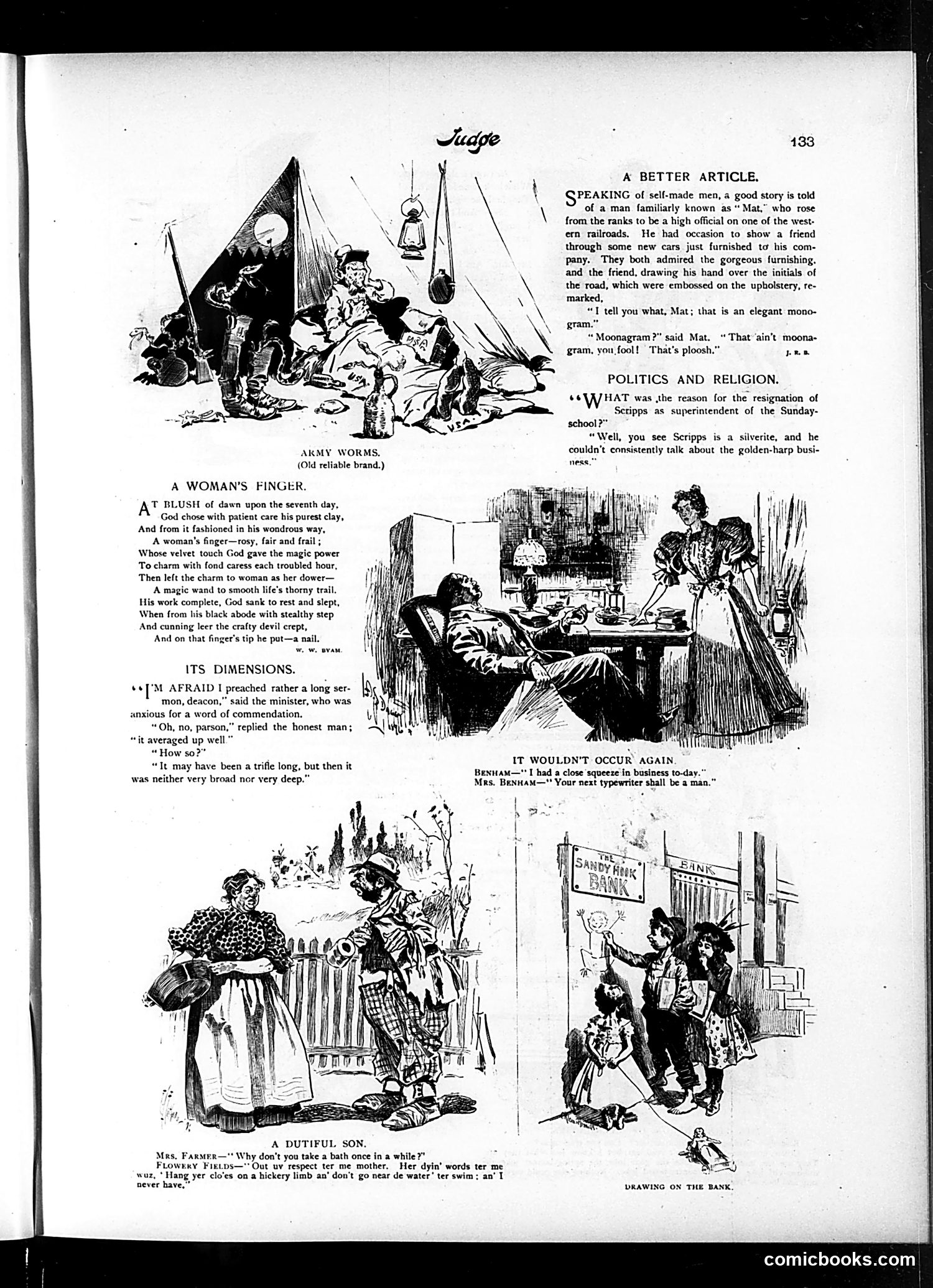
This page contains several brief humorous anecdotes typical of Judge's satirical style: **"A Better Article"** mocks a self-made railroad man named Mat who confuses "monogram" with "plush," revealing his lack of education despite his success—a jab at Gilded Age wealthy industrialists lacking refinement. **"Politics and Religion"** satirizes hypocrisy: a superintendent resigned from Sunday school because he's a "silverite" (supporter of free silver coinage) and couldn't ethically discuss the "golden-harp business" (heaven/religion), exposing how political ideology conflicted with religious authority in the 1890s. **"A Woman's Finger"** is a sentimental poem about feminine virtue, ending darkly when the devil adds a "nail"—likely referencing women's "claws" or manipulative nature, reflecting period misogyny. Other jokes target ministerial verbosity, domestic duty, and working-class dialect humor. The cartoons illustrate these stories with period-appropriate illustrations showing class distinctions and social interactions.
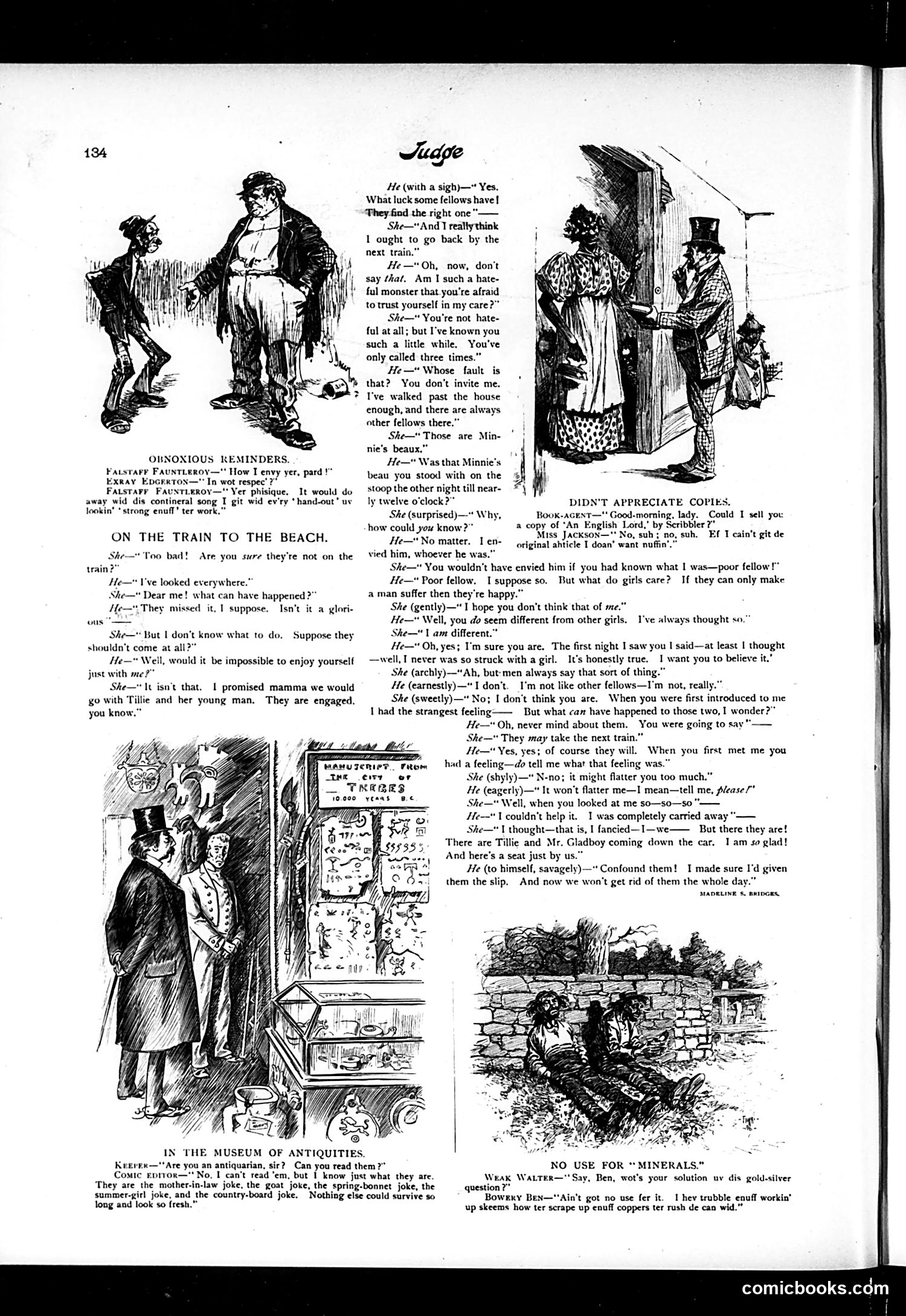
This page from *Judge* contains several satirical vignettes mocking Victorian courtship and social pretension: **"On the Train to the Beach"** is the main feature—a lengthy dialogue between a young couple. The man attempts seduction by flattering the woman while complaining about her absent chaperones (Tillie and her fiancé). The satire targets male duplicity: he claims to be different from other men while employing transparent romantic clichés. The woman remains coy but skeptical, ultimately abandoning him when the chaperones arrive—satirizing both affected courtship rituals and the woman's strategic use of propriety. **"Obnoxious Reminders"** mocks the "Fauntleroy" dandy type—appearing refined but actually weak. **"In the Museum of Antiquities"** jokes that ancient inscriptions survive only because they contain timeless humor (mother-in-law jokes, etc.). The cartoons collectively satirize Victorian courtship conventions, male pretense, and social hypocrisy—common *Judge* targets of this era.
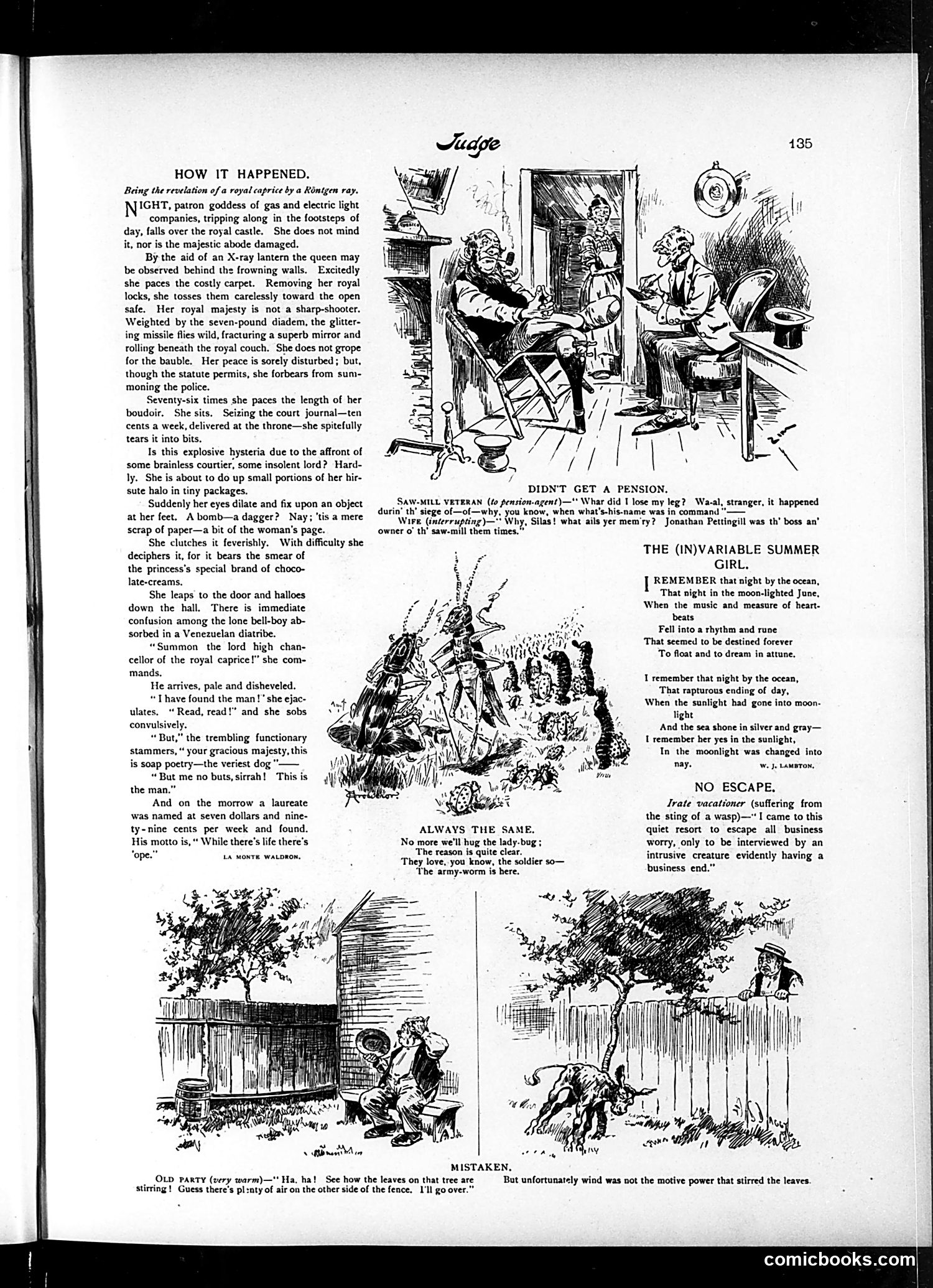
This page collects several satirical pieces typical of early 20th-century Judge magazine: **"How It Happened"** uses X-ray technology (recently discovered) as a humorous device to reveal a queen's vanity—she loses her composure over a chocolate-stained scrap of paper, suggesting royalty are no different from ordinary people. The "soap poetry" joke culminates in rewarding a mediocre poet, satirizing aristocratic patronage. **"Didn't Get a Pension"** mocks a Civil War veteran's failing memory—he cannot recall which general commanded during his industrial accident, and needs a journalist's correction. This critiques how ordinary soldiers' sacrifices were forgotten by history. **"The (In)variable Summer Girl"** is a sentimental poem about romantic constancy that's undercut by the title's parenthetical "(In)"—suggesting the "summer girl" is actually *variable*, not faithful. **"No Escape"** and other brief cartoons offer light commentary on modern inconveniences—even vacations offer no respite from business concerns. Overall, the page mixes social satire, romantic irony, and light humor typical of Judge's middle-class readership.
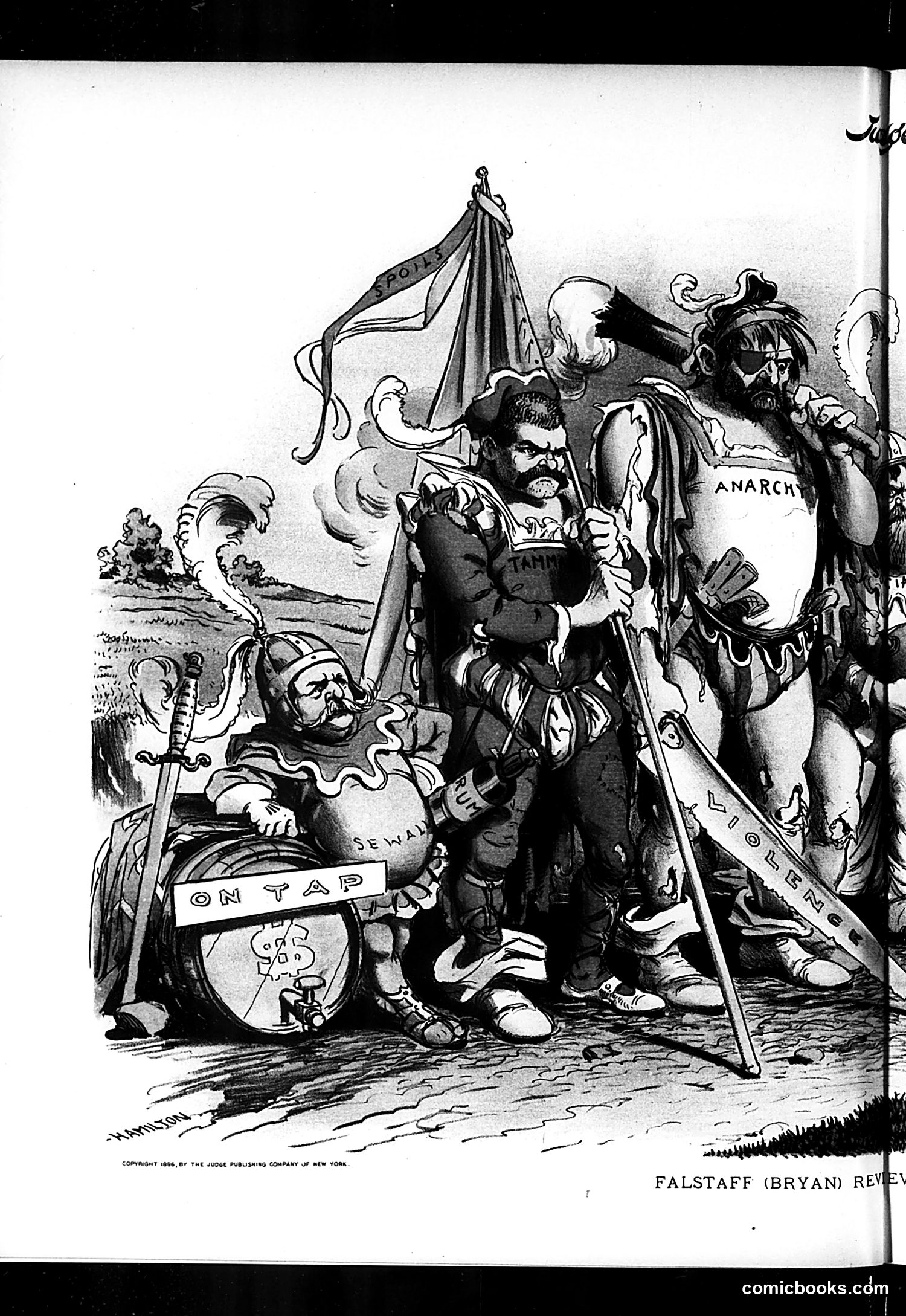
This appears to be a satirical cartoon from *Judge* magazine depicting William Jennings Bryan as Falstaff, the corpulent, blustering character from Shakespeare's plays. The cartoon shows a rotund figure labeled "FALSTAFF (BRYAN)" surrounded by armed supporters bearing flags marked "ANARCHY" and "POPULISM." The satire equates Bryan with Falstaff—a character known for boasting, cowardice, and comic incompetence—suggesting Bryan was an ineffectual blusterer. The association with anarchism and populism reflects conservative anxieties about Bryan's 1896 presidential campaign, which championed populist causes and radical economic reform. The military staging implies these movements were dangerous or absurd threats. The cartoon mocks Bryan's political movement as both theatrical and threatening.
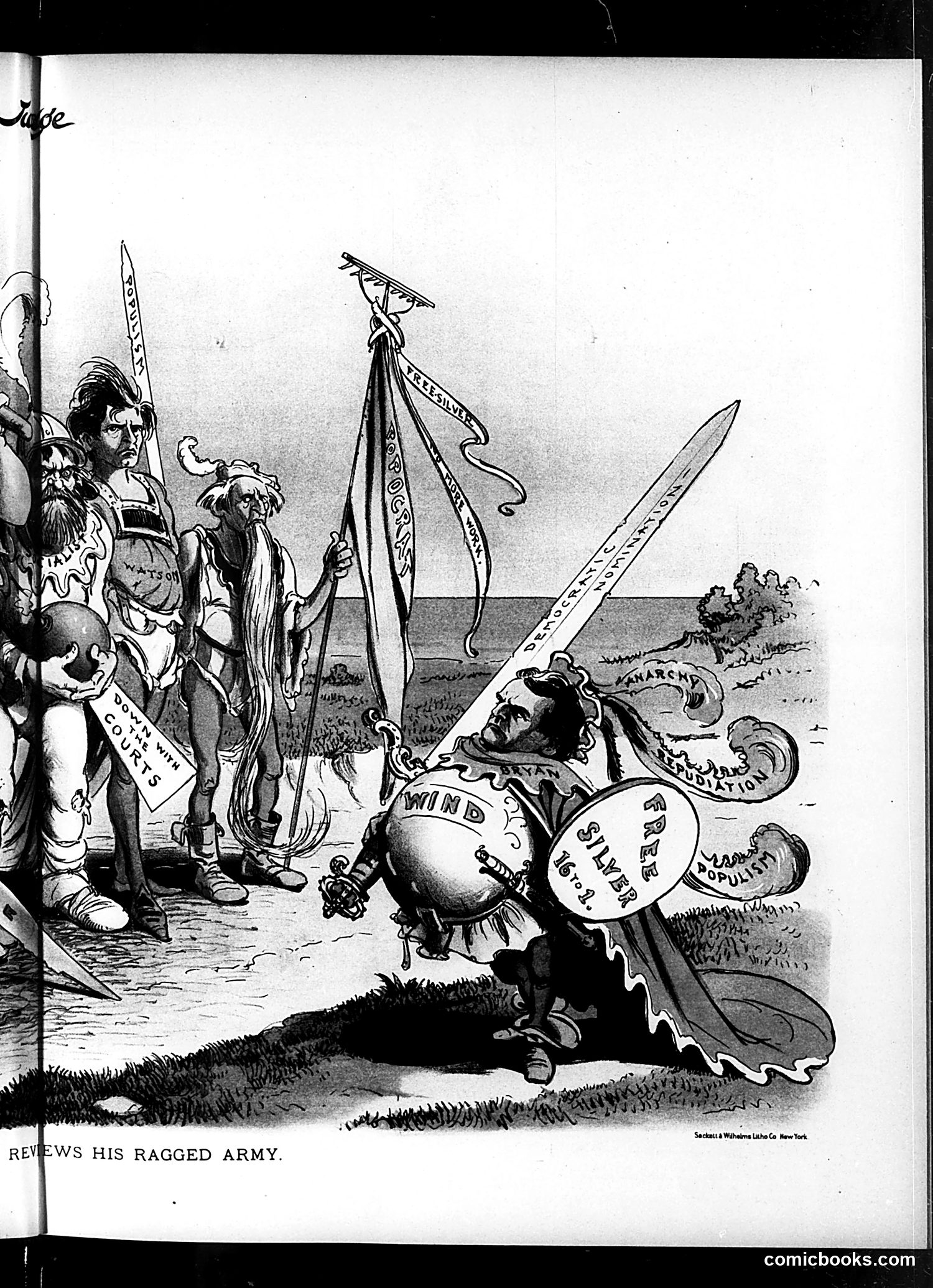
This political cartoon satirizes a military leader reviewing troops in poor condition. The central figure, depicted as bloated and well-fed, wields an oversized sword while examining a ragged, undernourished soldier. Labels visible on the spherical figure include "WIND," "SILVER," and references to "FREE POPULISM" and "ANARCHY." The satire appears to mock leadership that is disconnected from or indifferent to the suffering of their forces. The contrast between the commander's corpulent appearance and the soldier's emaciated condition emphasizes hypocrisy or incompetence. The references to "Silver" and "Populism" suggest this critiques late-19th-century political movements, though the specific historical event or figure remains unclear without additional context. The cartoon's message criticizes wealthy or corrupt leadership squandering resources while soldiers suffer deprivation.
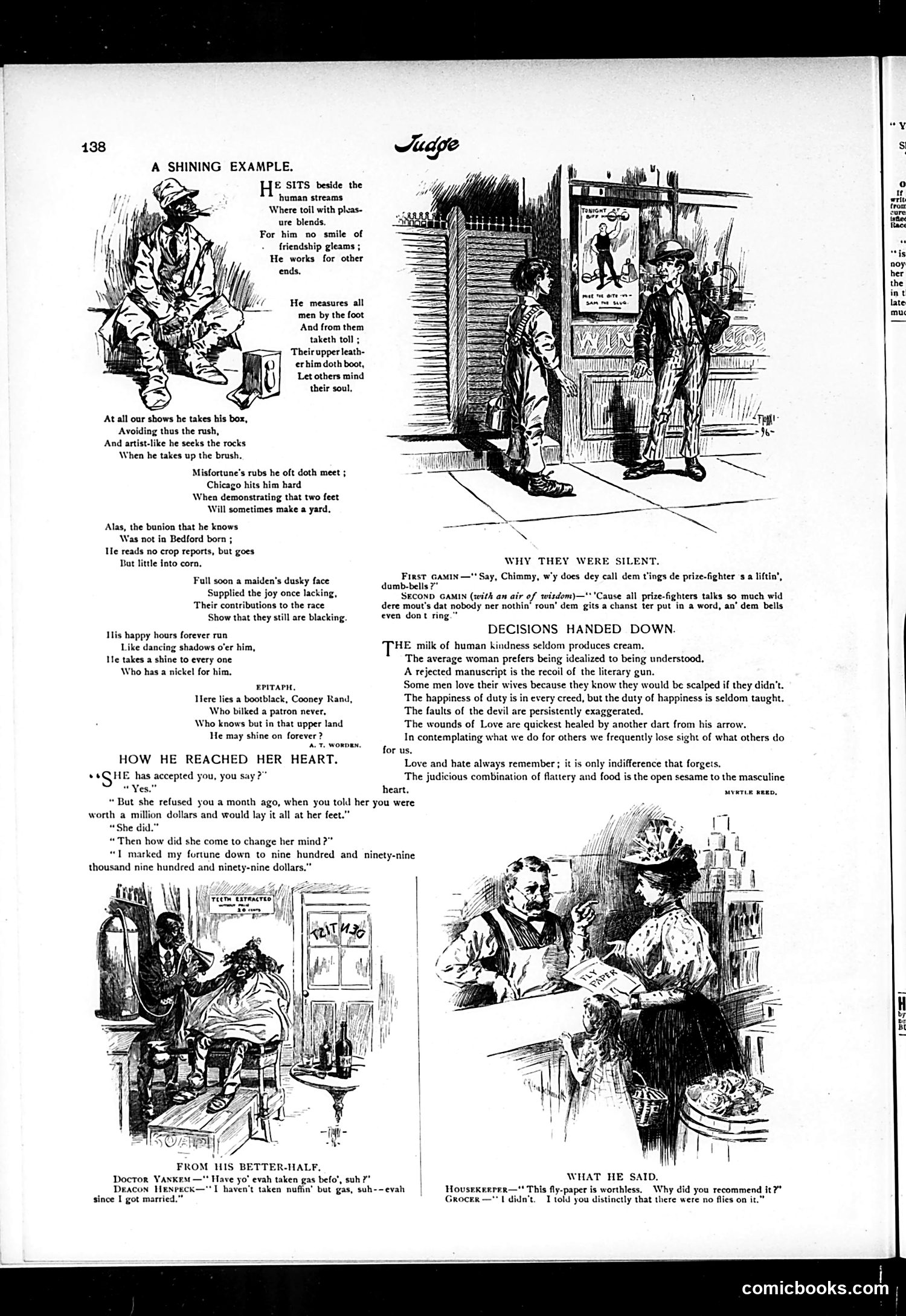
This page satirizes a bootblack (shoeshine worker), likely a Black man given the racist caricature and dialect humor typical of the era. The long poem mocks his profession, poverty, and romantic life—he "measures all men by the foot" (literally and figuratively), takes money from customers, and finds joy only when receiving tips ("a nickel"). The accompanying jokes employ period stereotypes: street children ("gamins") speak in exaggerated dialect; a woman accepts a suitor only after he *reduces* his fortune; racist sketches pair Black dialect with servile positions (the doctor-patient exchange). The "Decisions Handed Down" section offers generic aphorisms about human nature, while other sketches mock domestic life and commercial deception. The satire reflects late-19th/early-20th-century class prejudices and casual racism—targeting working-class immigrants and Black Americans through caricature and dialect as humorous subjects rather than serious social commentary.
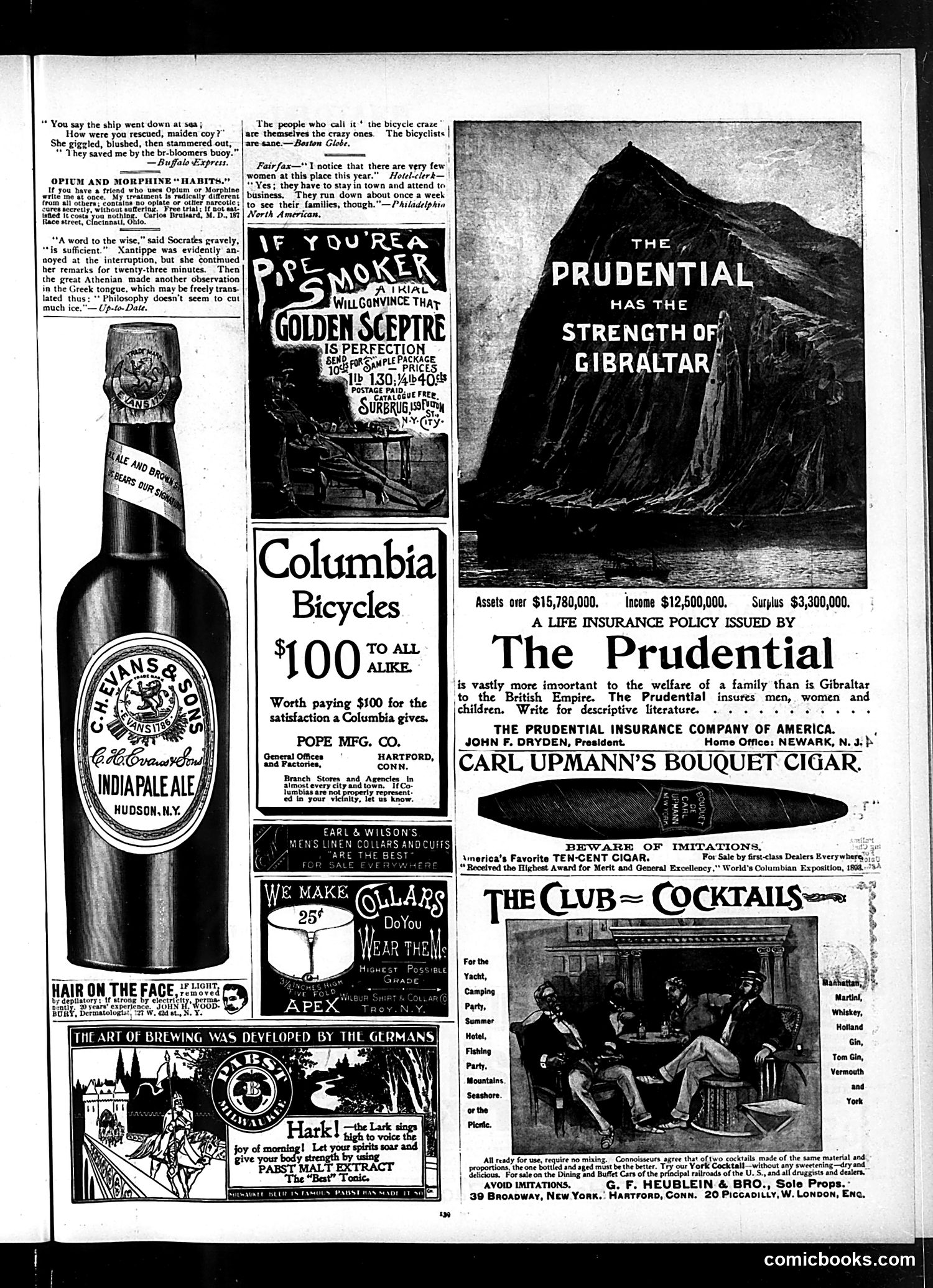
This page is primarily **advertising**, with brief comic snippets interspersed. The content reflects late 19th-century American concerns: **Comic Jokes:** - A rescuer saves a drowning woman using her "bloomers buoy"—a risqué joke playing on Victorian modesty and women's undergarments - A domestic humor piece about Xantippe (Socrates' famously nagging wife), suggesting wives talk excessively - A hotel clerk's quip that women visit town only to attend to business, implying they're primarily occupied with domestic duties **Advertisements** dominate, hawking bicycles, life insurance, cigars, beer, collars, hair removal products, and medical treatments for opium/morphine addiction—reflecting both consumer goods expansion and genuine substance-abuse problems of the era. The page captures Judge's blend of social satire (mocking gender relations, addiction) alongside commercial messaging, typical of early American humor magazines catering to middle-class male readers.
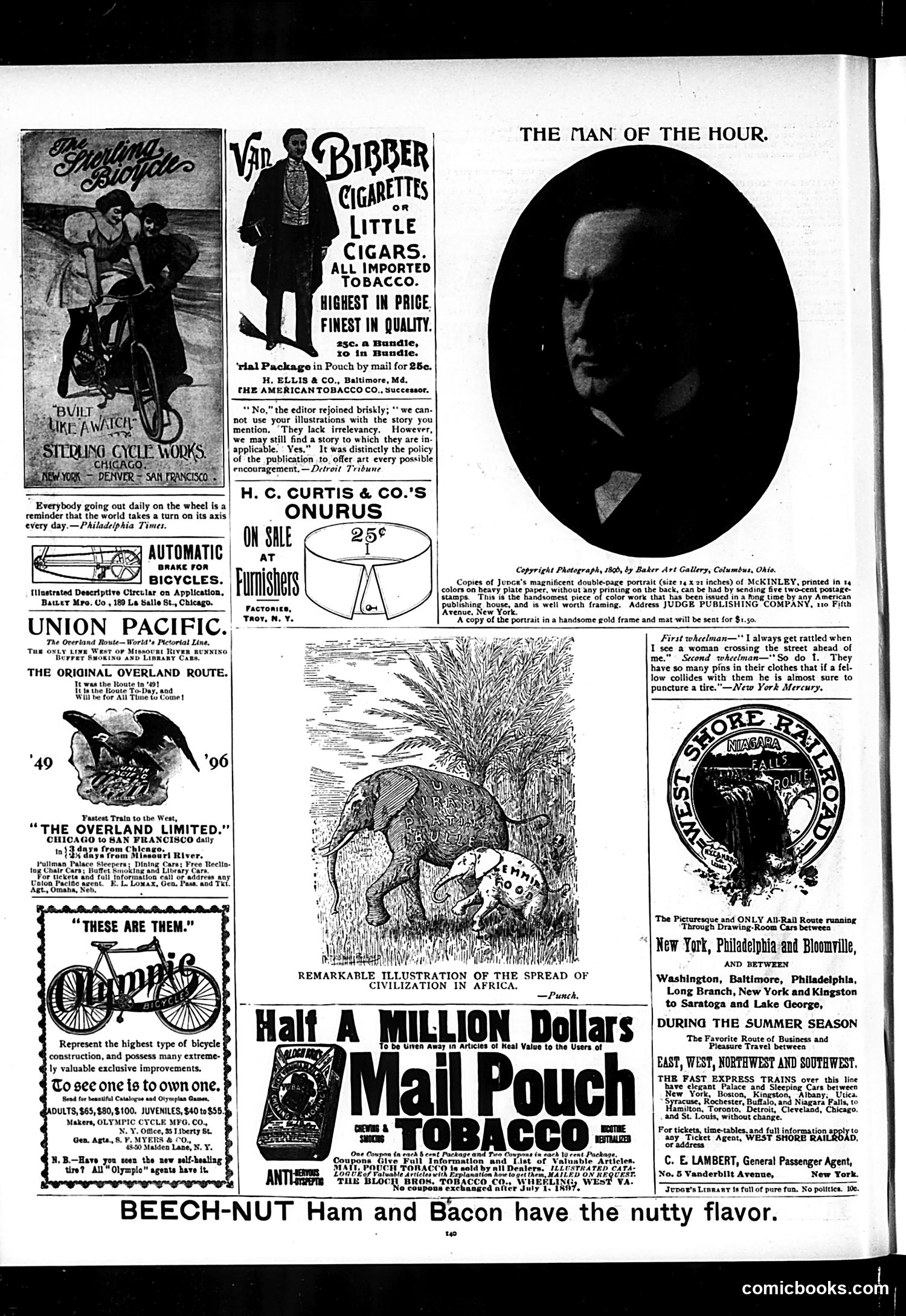
This page is primarily **advertising and promotional content** rather than satirical commentary. The dominant feature is a large oval portrait labeled "THE MAN OF THE HOUR," identified by the caption as McKINLEY (William McKinley, U.S. President circa 1897-1901), with copyright attribution to Baker Art Gallery, Columbus, Ohio. The surrounding content consists entirely of period advertisements: bicycle manufacturers (Olympic Cycle, Union Pacific railroad promotions), tobacco products (Van Bibber cigarettes, Mail Pouch tobacco), and railroad services. There are two small comic vignettes at bottom—one satirizing magazine editors rejecting illustrations, another making a period joke about women cyclists and their clothing pins puncturing tires—but these are minor filler content. **The page's primary purpose was commercial**: selling McKinley portraits and advertising various consumer goods to Judge's readership, using the sitting president's popularity as the page's centerpiece draw.
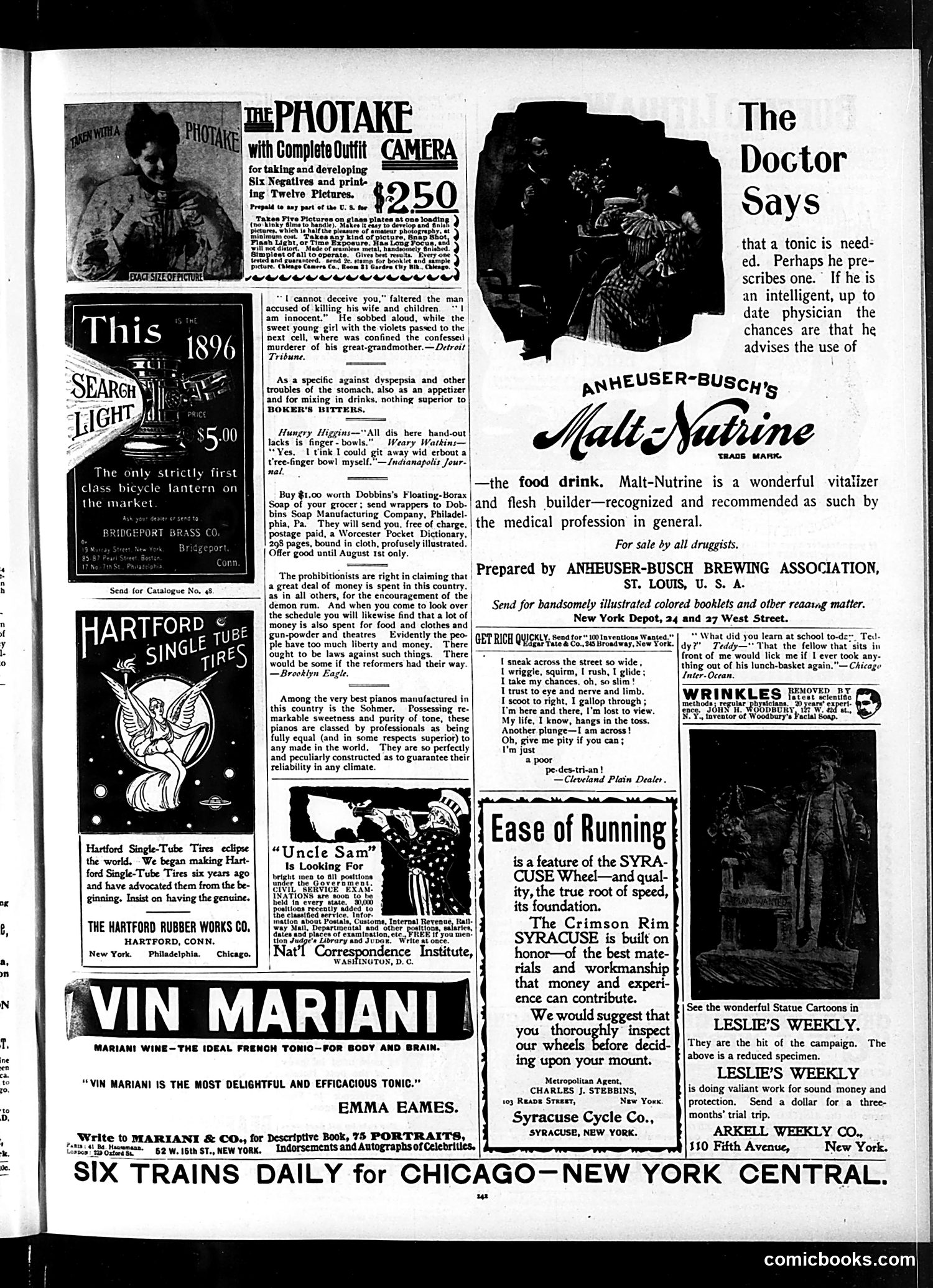
This page is primarily **advertising**, not political satire. It's a collage of late 19th-century product ads (cameras, bicycles, tires, wines, tonics) interspersed with brief humorous anecdotes typical of Judge magazine. The small comic pieces include: - A **Detroit Tribune joke** about a murder trial contrasting an innocent man's tears with a guilty man's confession—likely mocking inconsistent justice or sentimental courtroom drama - A **vagrant humor bit** ("Hungry Higgins") joking about hobos' lack of table manners - A **prohibition critique** (Brooklyn Eagle) sarcastically arguing reformers want to ban everything people enjoy, not just alcohol The "**Uncle Sam**" recruiting image (lower left) appears to be a straightforward government employment advertisement, not satire. The page reflects the era's aggressive patent-medicine marketing, where tonics, wines, and bitters were hawked with dubious medical claims—practices that would become illegal after subsequent food/drug regulations.
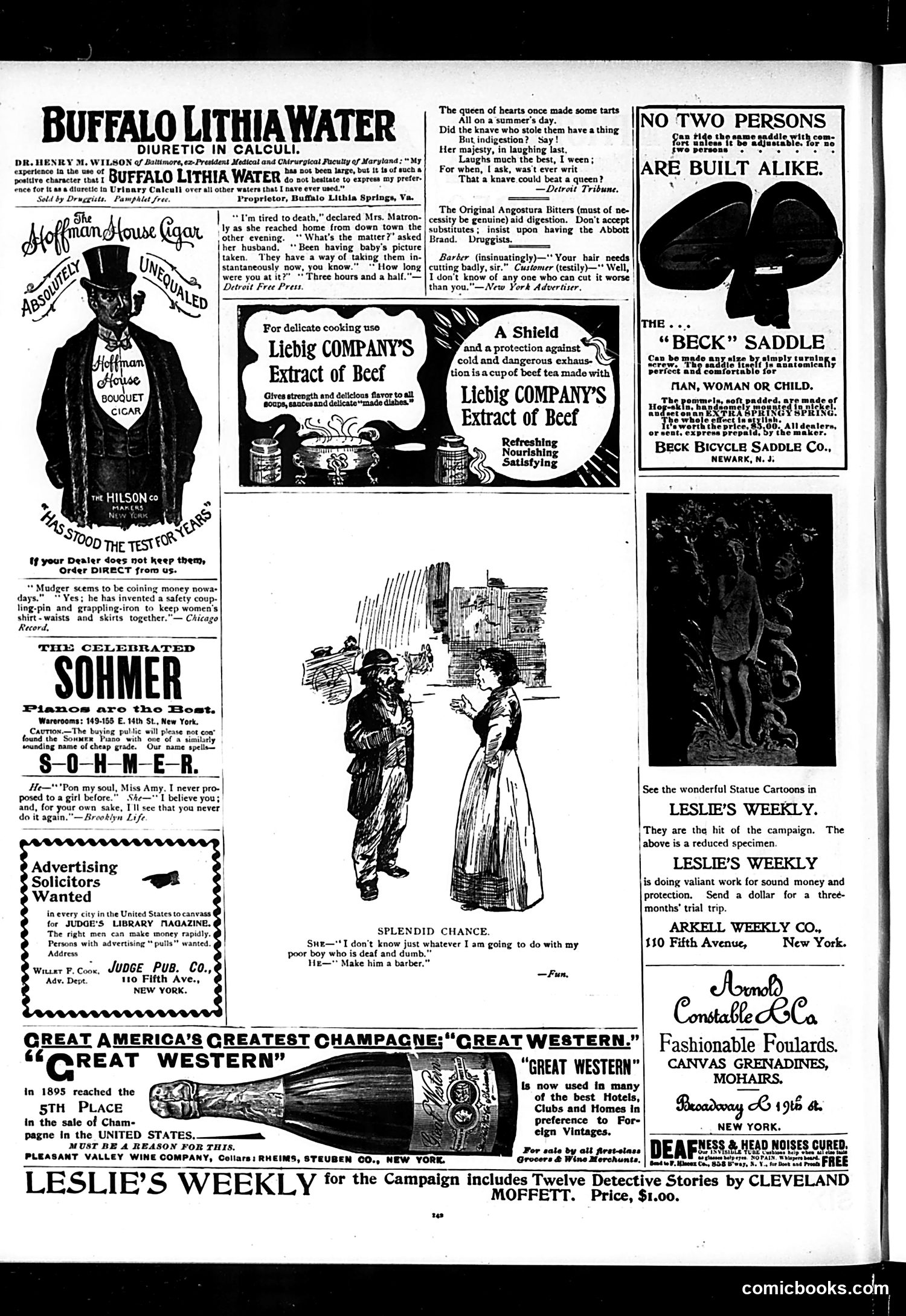
This page is primarily **advertising**—a typical mix for early 1900s magazines. Most content consists of product advertisements (Buffalo Lithia Water, Liebig's Extract of Beef, Sohmer Pianos, champagne, bicycle saddles). The few **editorial jokes and cartoons** include: - Brief humor pieces (Mrs. Matron complaining about a three-hour photograph sitting; a barber's insult about a customer's hair) - A reworked "Queen of Hearts" nursery rhyme about digestion - "Splendid Chance": a widower jokingly suggesting his deaf and dumb son become a barber—the humor relies on the dark implication that such disability suits that profession The **"Advertising Solicitors Wanted"** box indicates Judge itself was actively recruiting advertisers nationwide. References to "**the Campaign**" and "**sound money and protection**" (in the Leslie's Weekly advertisement) suggest this page dates to a presidential election era, likely 1900 or 1904, when currency debate was politically prominent.
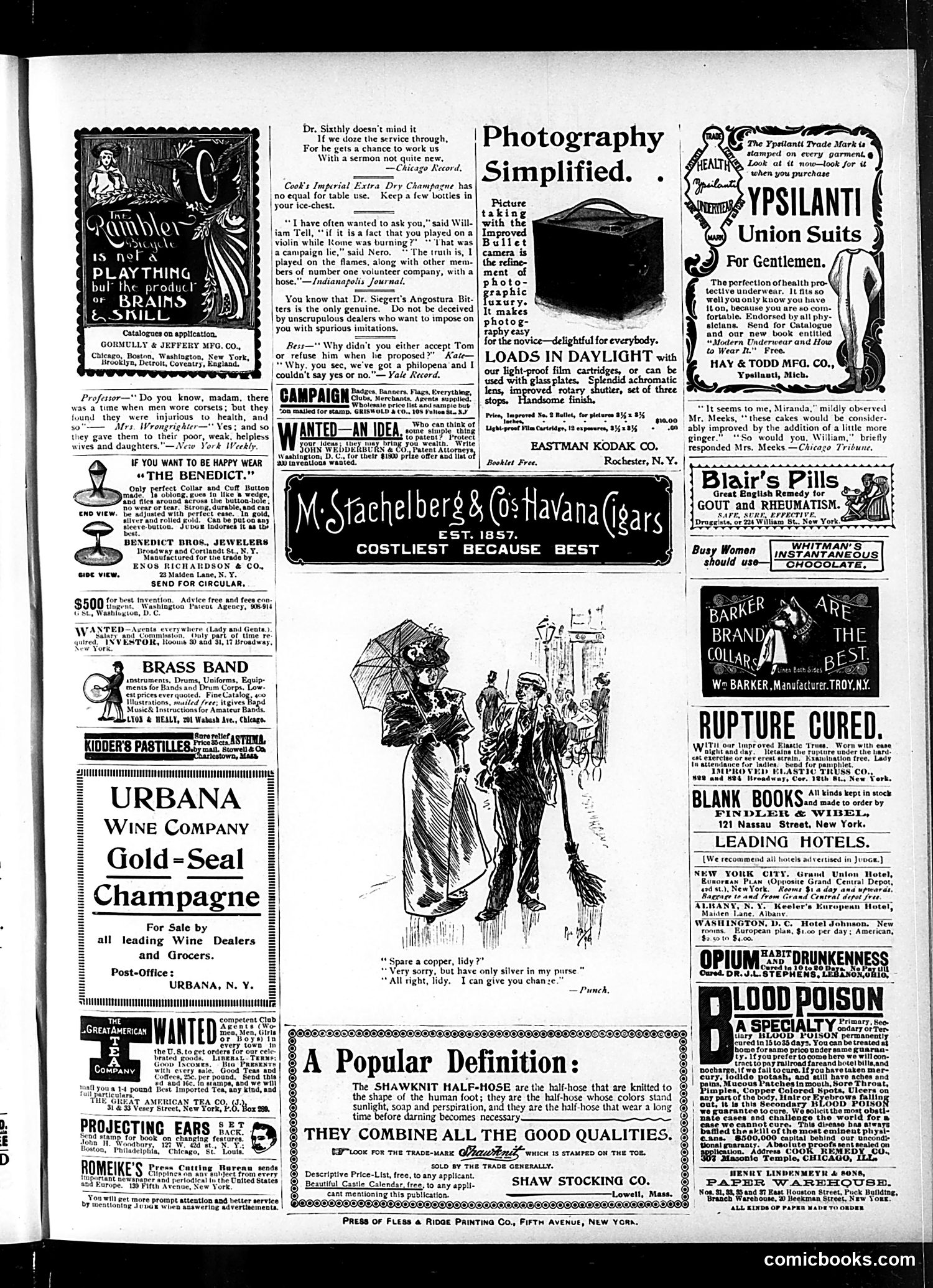
This page is primarily **advertising**, typical of Judge magazine's revenue model. However, it contains several period-specific jokes and references: **Main Cartoon**: A sketch showing figures with an umbrella, captioned "Spare a copper, lady?" and "All right, lady. I can give you change." This appears to be a **panhandling joke**, likely satirizing urban poverty or begging practices of the era. **Notable Social Commentary**: A dialogue between "Professor" and "Mrs. Wrongrighter" critiques **gender inequality in corset-wearing**—men abandoned corsets as "injurious to health," but imposed them on "poor, weak, helpless wives and daughters." This mocks the hypocrisy of Victorian-era health claims used to justify restricting women's bodies. **Advertisements**: Most content promotes products (champagne, cameras, jewelry, remedies) typical of wealthy readers. One ad for "The Benedict" collar button and another for Kodak's "Bullet" camera show technological advancement marketed to the leisured class. The page reflects turn-of-century American attitudes toward gender, class, and consumerism.
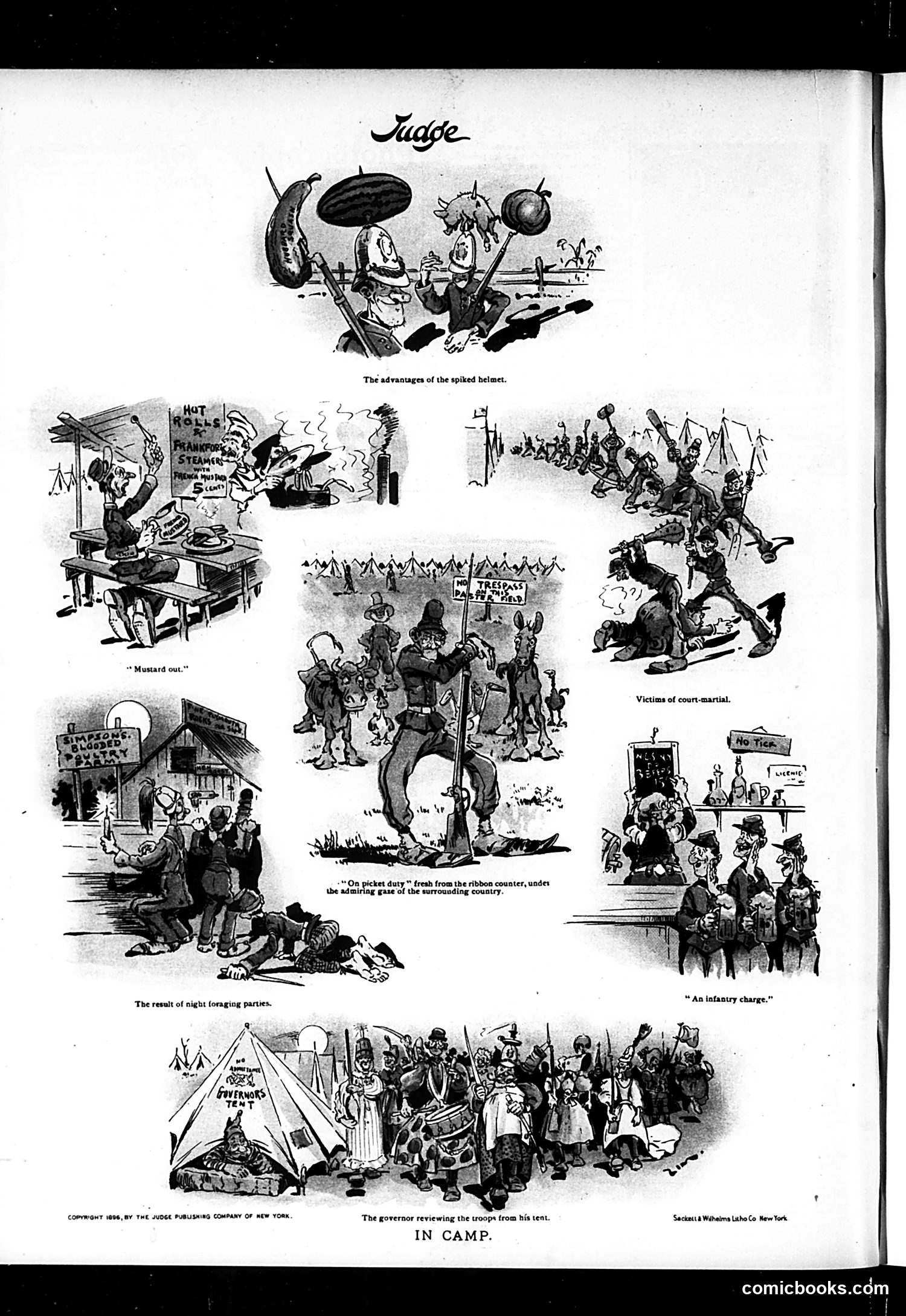
This page satirizes military incompetence and amateurism, likely during the Spanish-American War era (based on the 1898 copyright). The cartoons mock hastily-assembled volunteer troops and their inexperienced officers. Key scenes include: - A raw recruit on "picket duty" (sentry watch), described as fresh from commercial work ("ribbon counter"), watched by country folk - The governor safely reviewing troops from his tent while soldiers suffer - "Court-martial" victims and casualties from poor leadership - Chaotic camp scenes showing disorganization The satire targets the gap between military pretense and reality: untrained civilians drafted into military service, incompetent officers distant from danger, and the resulting casualties. The "spiked helmet" mentioned in the title suggests German or European military references, emphasizing how unprepared American forces were for modern warfare. The overall message criticizes America's unpreparedness and the folly of amateur soldiering.