
A complete issue · 16 pages · 1896
Judge — July 18, 1896
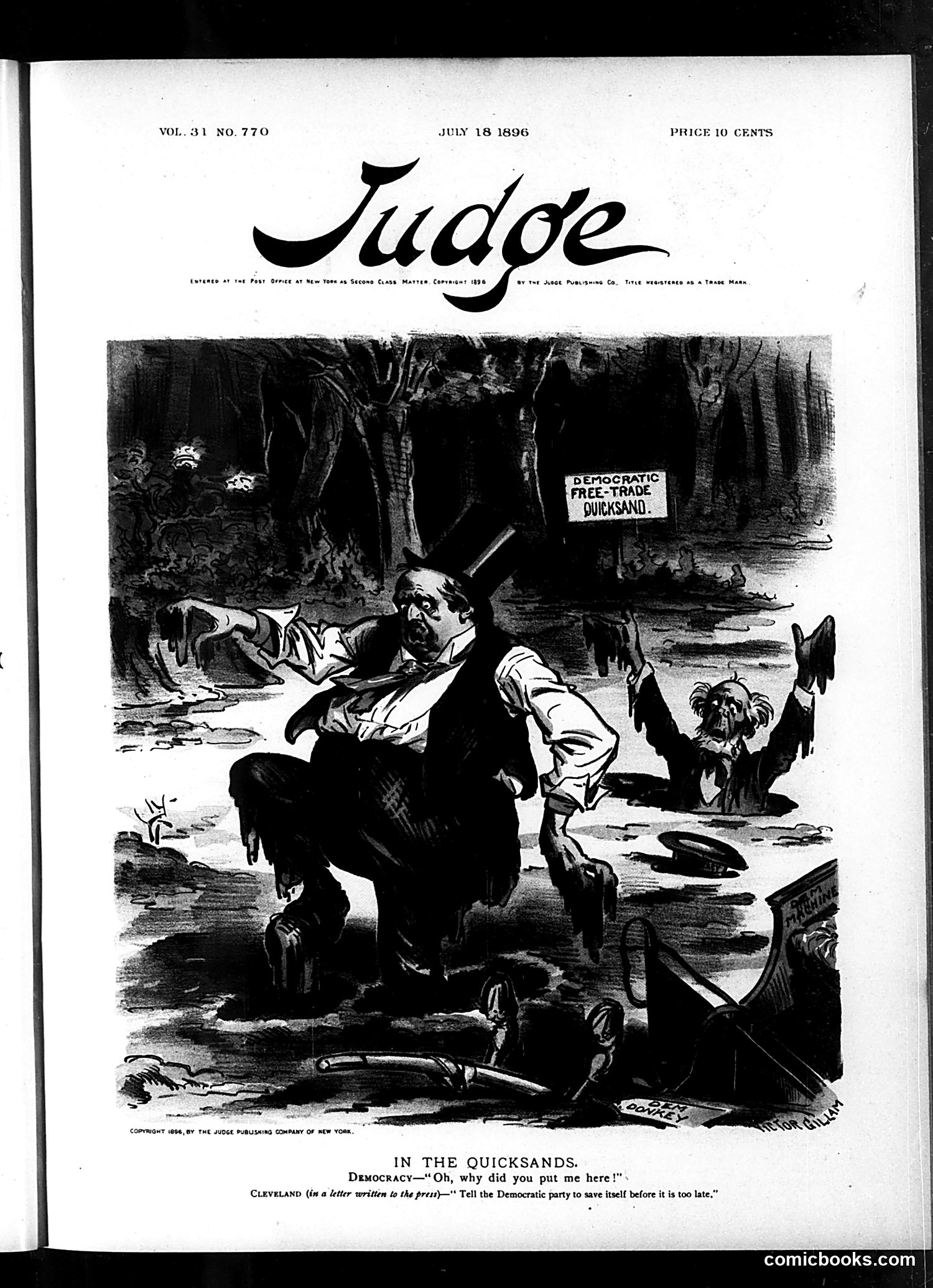
This political cartoon satirizes the Democratic Party's predicament during the 1896 presidential election. The central figure represents **Democracy** itself, depicted as a man sinking into quicksand while surrounded by hostile dogs. A sign reads "Democratic Free-Trade Quicksand," referencing the party's free-trade platform—which opponents blamed for economic depression. The caption quotes Cleveland (likely President Grover Cleveland, whose second term ended in 1896): "Oh, why did you put me here?" Democracy responds: "Tell the Democratic party to save itself before it is too late." The satire suggests the Democratic Party has trapped itself in an unpopular policy position, leaving the party foundering as the election approaches.
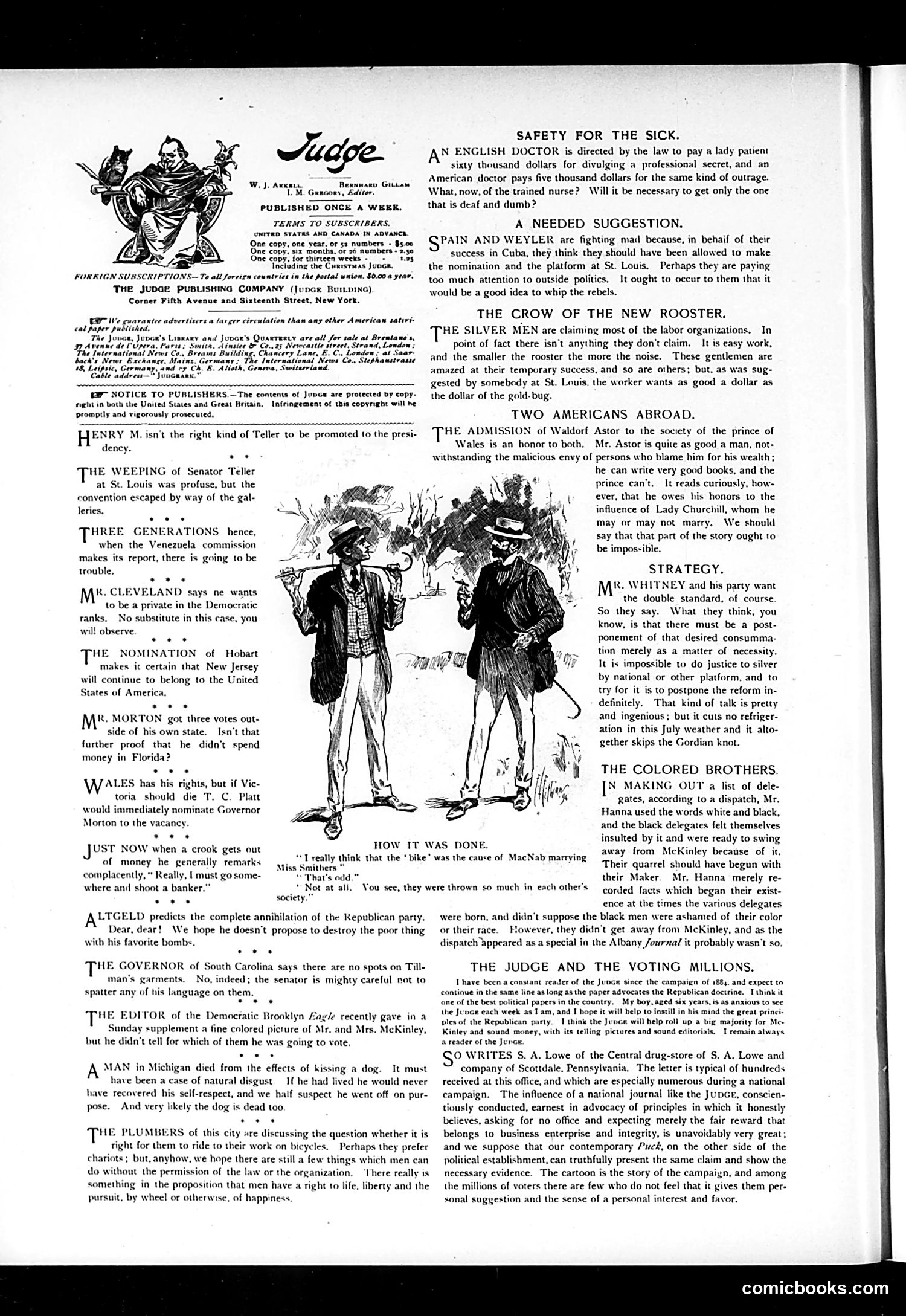
This cartoon depicts two figures—likely political operatives or strategists—discussing electoral manipulation. The caption reads: "I really think that the 'jake' was the cause of MacNab marrying Miss Scanlon." "That's odd." "Not at all. You see, they were thrown so much in each other's society." The satire appears to mock backroom political dealing and voter influence tactics of the Gilded Age. The figures' exaggerated poses and the absurdist logic ("throwing people together" to engineer outcomes) suggest criticism of how political machines manufactured consent or outcomes through manipulation rather than genuine democratic processes. The style and context suggest this critiques late 19th or early 20th-century American electoral practices.
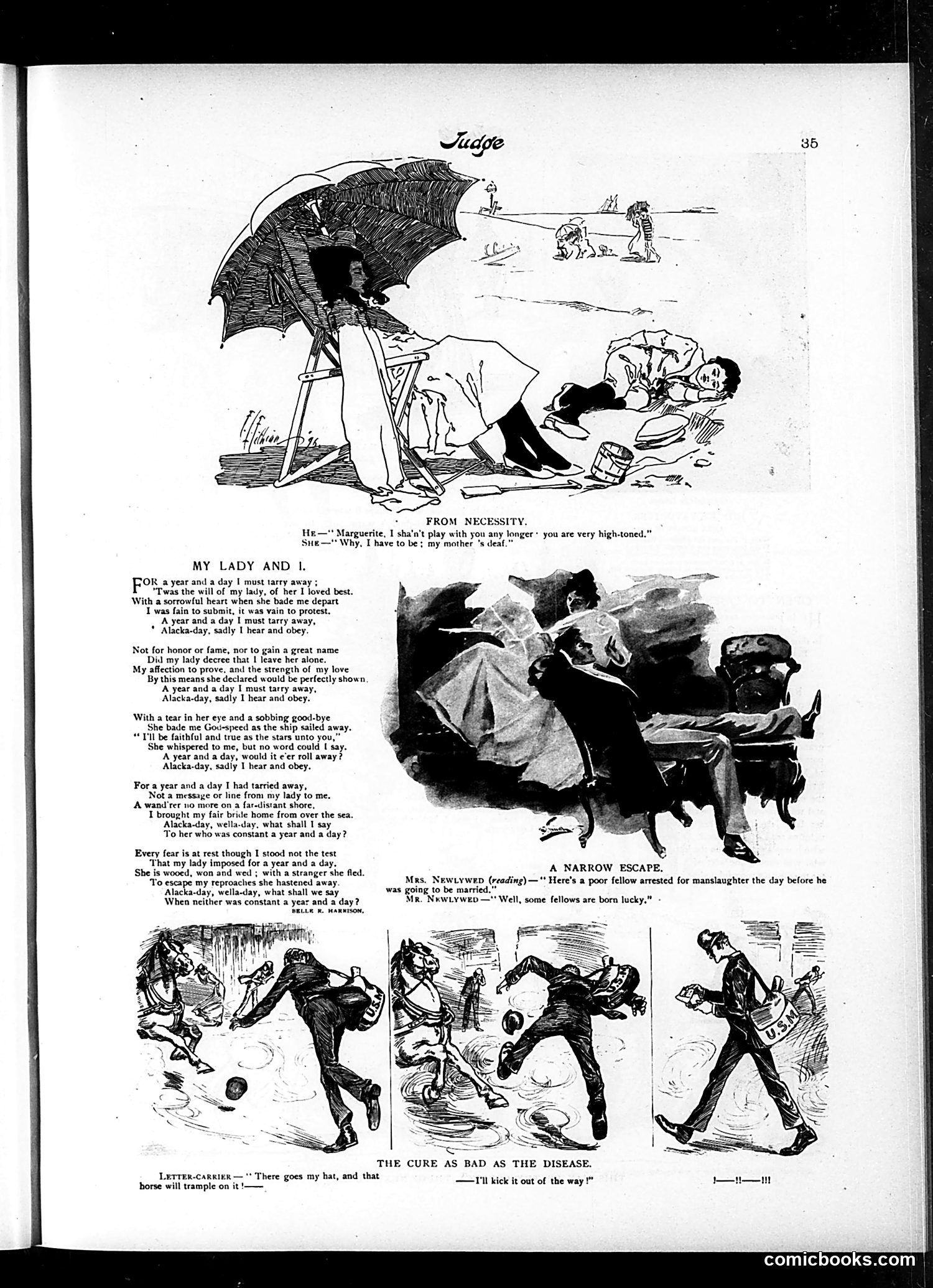
**"From Necessity"** (top cartoon): A man under an umbrella tells a woman he can't play with her because he's "very high-toned," then admits his real reason: his mother is dead. The satire mocks social pretense—people claiming noble reasons for their behavior when practical necessity is the actual cause. **"My Lady and I"** (poem): A sentimental narrative about a man separated from his lady for a year, emphasizing duty and faithfulness. **"A Narrow Escape"** (middle): A newly-engaged couple; the groom quips about "some fellows are born lucky" regarding his escape from bachelorhood—gentle satire on marriage as an escape from single life. **"The Cure as Bad as the Disease"** (bottom): Sequential panels showing a letter-carrier kicking his hat away, suggesting the remedy (physical action) equals or worsens the original problem.
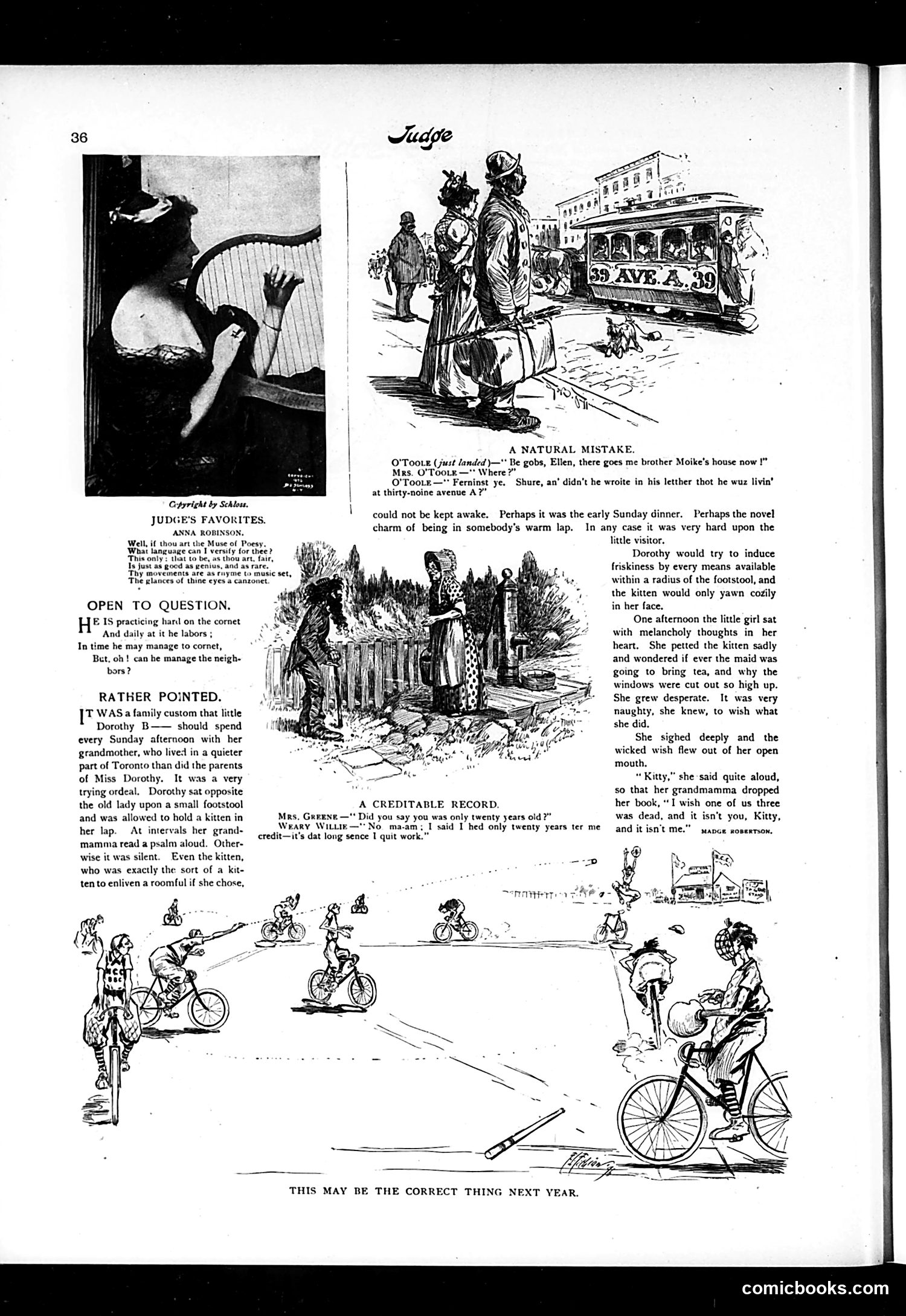
This page contains several distinct satirical pieces typical of early 20th-century American humor: **"Judge's Favorites"** and **"Open to Question"** are light verse pieces praising an actress named Anna Robinson and joking about a cornet player who can master the instrument but not his neighbors' tolerance for noise. **"Rather Pointed"** satirizes Victorian propriety—a young girl forced into tedious Sunday visits with her grandmother, confined to a footstool with a sleeping kitten while psalms are read. Her ultimate rebellion (wishing someone dead) shocks the grandmother, mocking the stifling repression of children in formal households. **"A Natural Mistake"** and **"A Creditable Record"** are ethnic humor pieces featuring Irish immigrant characters (O'Toole, Willie) with stereotypical dialect, where the jokes depend on malapropisms and misunderstandings. **"This May Be the Correct Thing Next Year"** shows women on bicycles—likely satirizing the then-controversial sight of women cycling, considered immodest or unfeminine by conservative society. The page reflects Judge's mix of social satire, light domestic humor, and period-appropriate ethnic caricature.
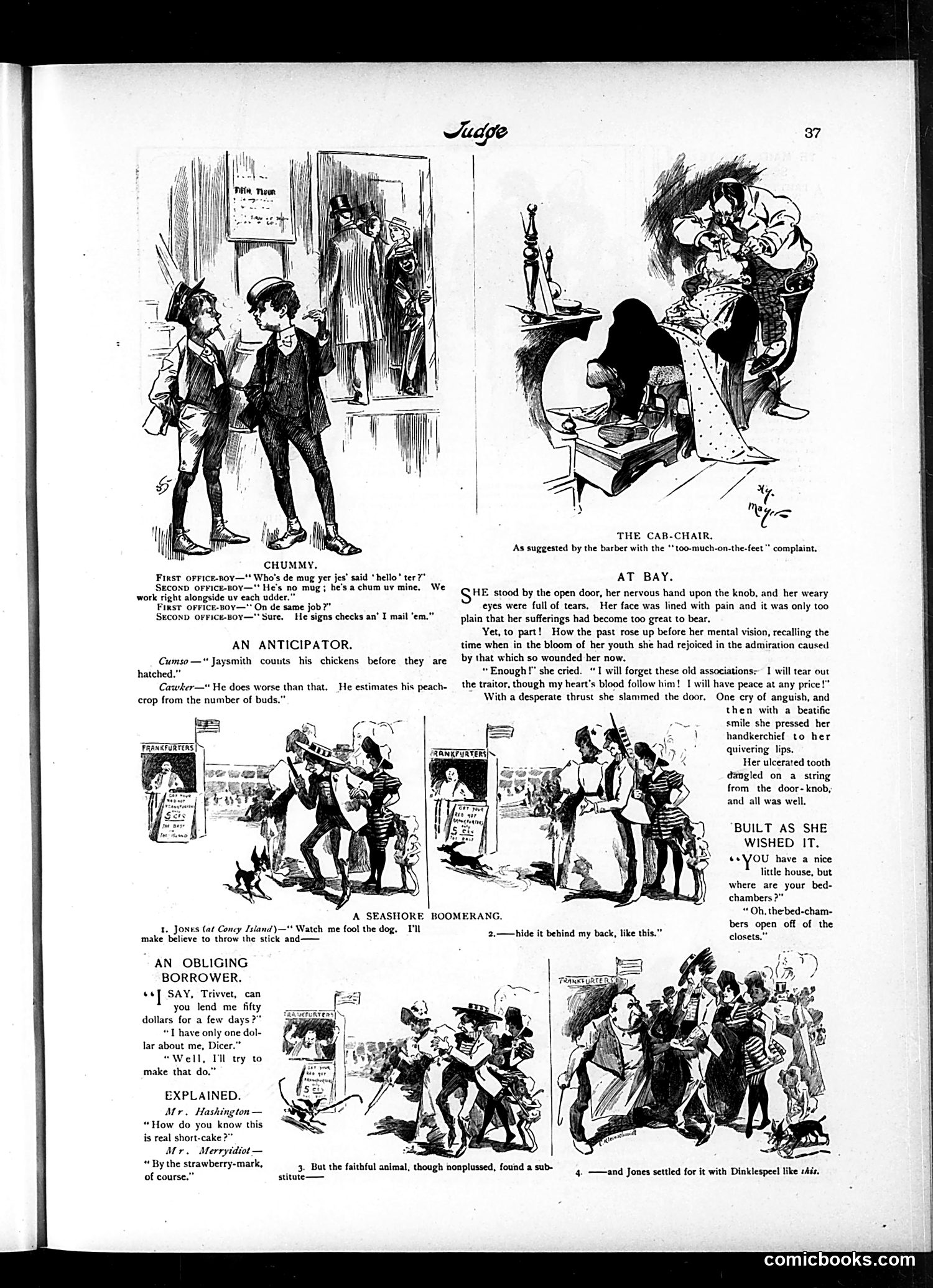
This page contains multiple unrelated comic sketches typical of Judge's satirical format: **"The Cab-Chair"** depicts a woman suffering from a toothache so severe she's torn it out on a doorknob—absurdist humor about physical pain. **"Chummy"** and **"An Anticipator"** are brief office and rural jokes requiring no historical context. **"At Bay"** is melodramatic fiction parody, mocking overwrought romantic literature popular in the era. **"A Seashore Boomerang"** shows a man trying to fool a dog at Coney Island (a famous amusement park), with the joke being the dog's superior intelligence. **"An Obliging Borrower"** satirizes financial desperation during economic hardship (unclear which era). **"Explained"** makes a pun about strawberry shortcake. The page is primarily **humorous entertainment** rather than political satire—typical Judge content mixing wordplay, visual gags, and absurdist situations for general audience amusement.
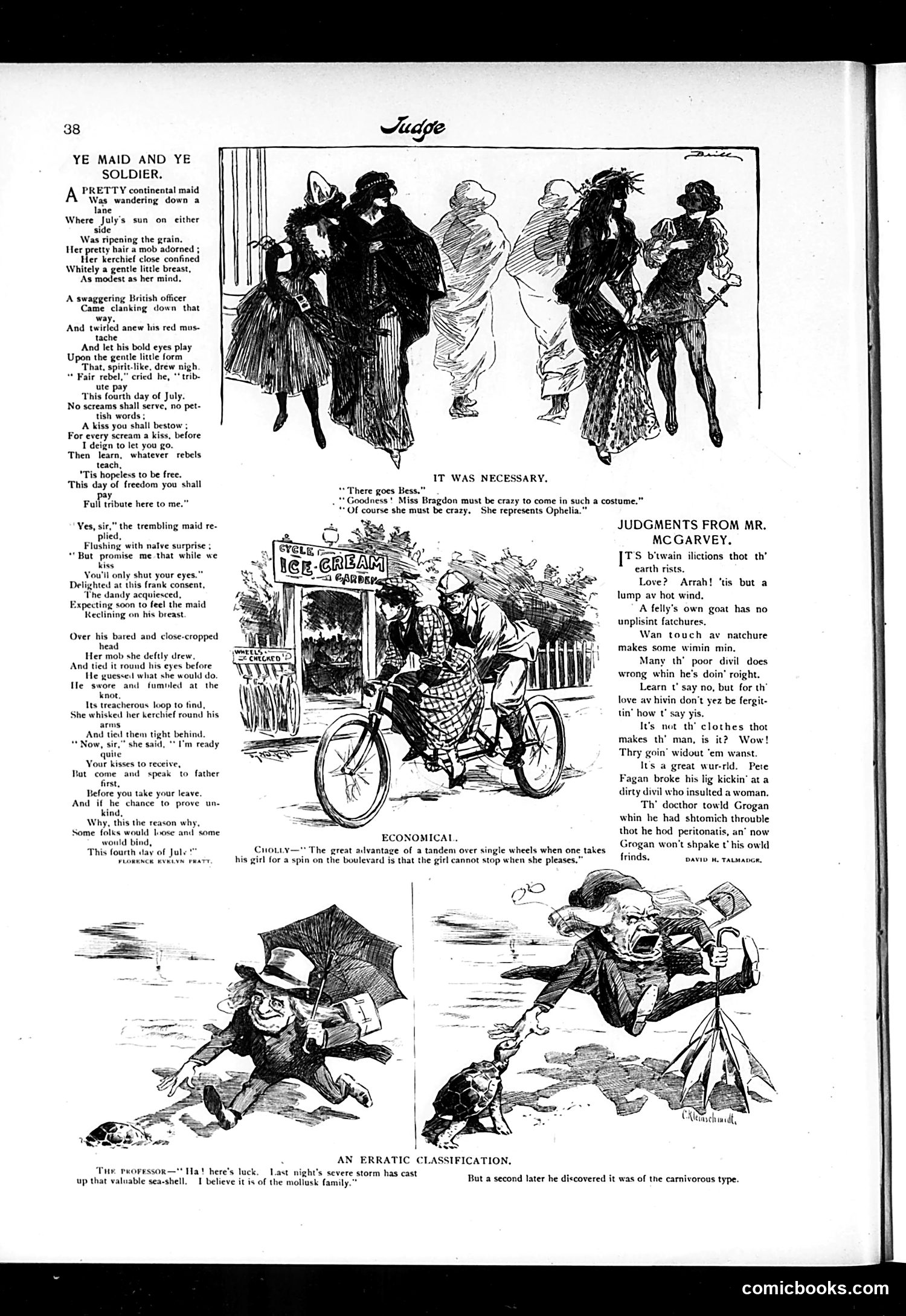
This page contains patriotic satire related to American Independence Day (July 4th). The main poem, "Ye Maid and Ye Soldier," depicts a British officer attempting to sexually coerce a French peasant girl on July 4th as "tribute" to British power. The girl cleverly reverses the situation by blindfolding and binding him, then calls her father—a humorous inversion of colonial subjugation. The satire works on two levels: it mocks British imperial arrogance while celebrating American independence through the girl's clever resistance. The supporting cartoons offer unrelated humor about tandem bicycles, shell collection mishaps, and Irish philosophical observations. The overall message: even the powerless can outwit tyrants through wit—a theme resonant with Judge magazine's pro-American stance during this period.
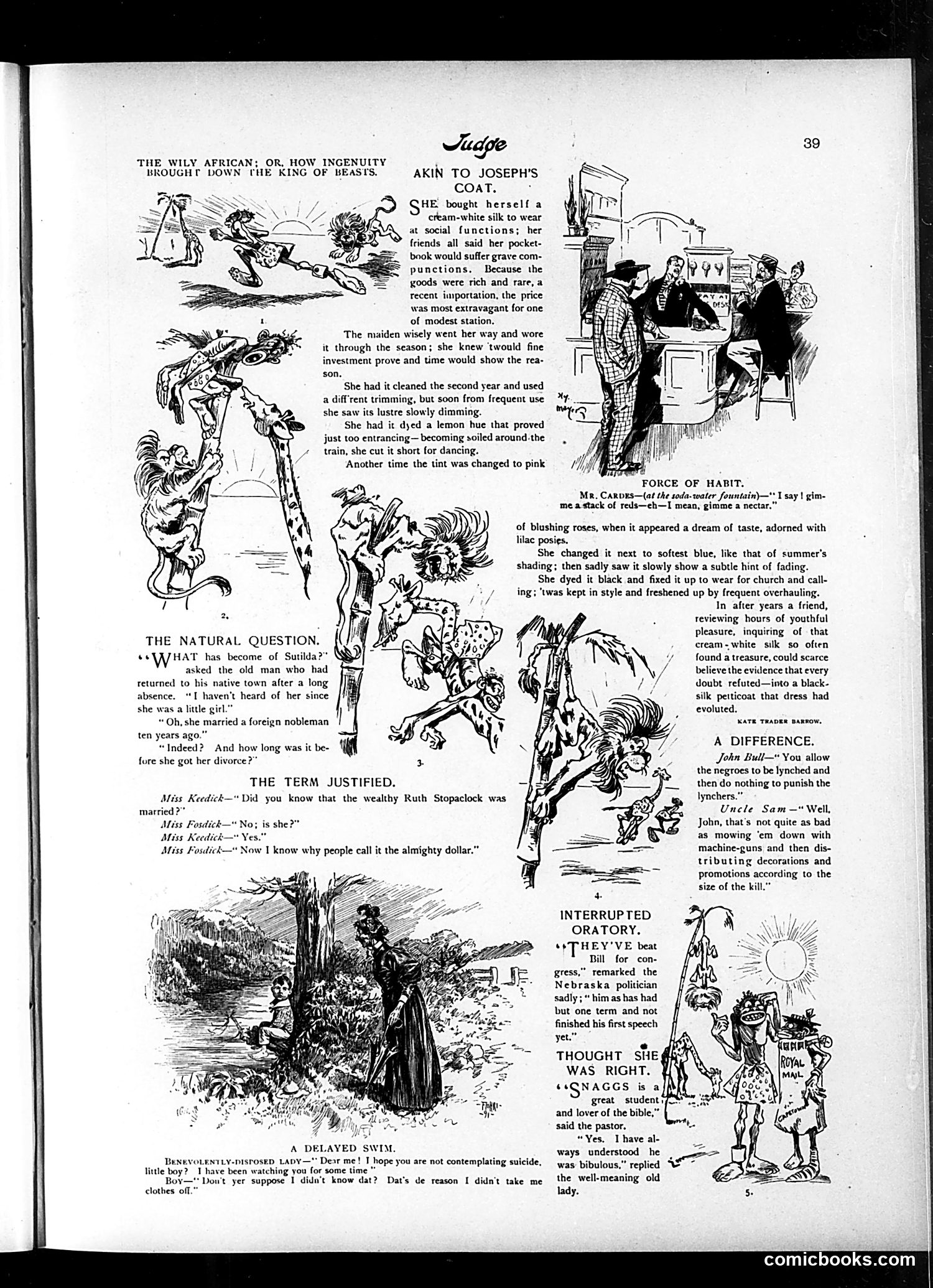
This page contains multiple unrelated satirical pieces typical of Judge magazine's format: **"Akin to Joseph's Coat"** (top right): A humorous narrative poem about a woman who purchases an expensive cream-silk dress. Through years of wear, repeated dyeing, and alterations, it gradually transforms into a black silk petticoat—satirizing both conspicuous consumption and the resourcefulness of those with limited means who stretch their purchases through creative repurposing. **Other brief jokes** include: - A woman marrying a foreign nobleman and quickly divorcing (mocking both international marriages and wealth) - "Force of Habit": A man at a soda fountain unconsciously orders a whiskey ("reds") before catching himself - "A Difference": John Bull (Britain) criticizes American lynching; Uncle Sam retorts that British colonial violence is worse **"The Wily African"** (left): Appears to be a fable illustration, though details are unclear from the OCR. The page reflects early 20th-century Judge humor: class satire, gender commentary, and comparative critiques of American versus British imperialism. Racial caricature language appears but the specific reference remains unclear.
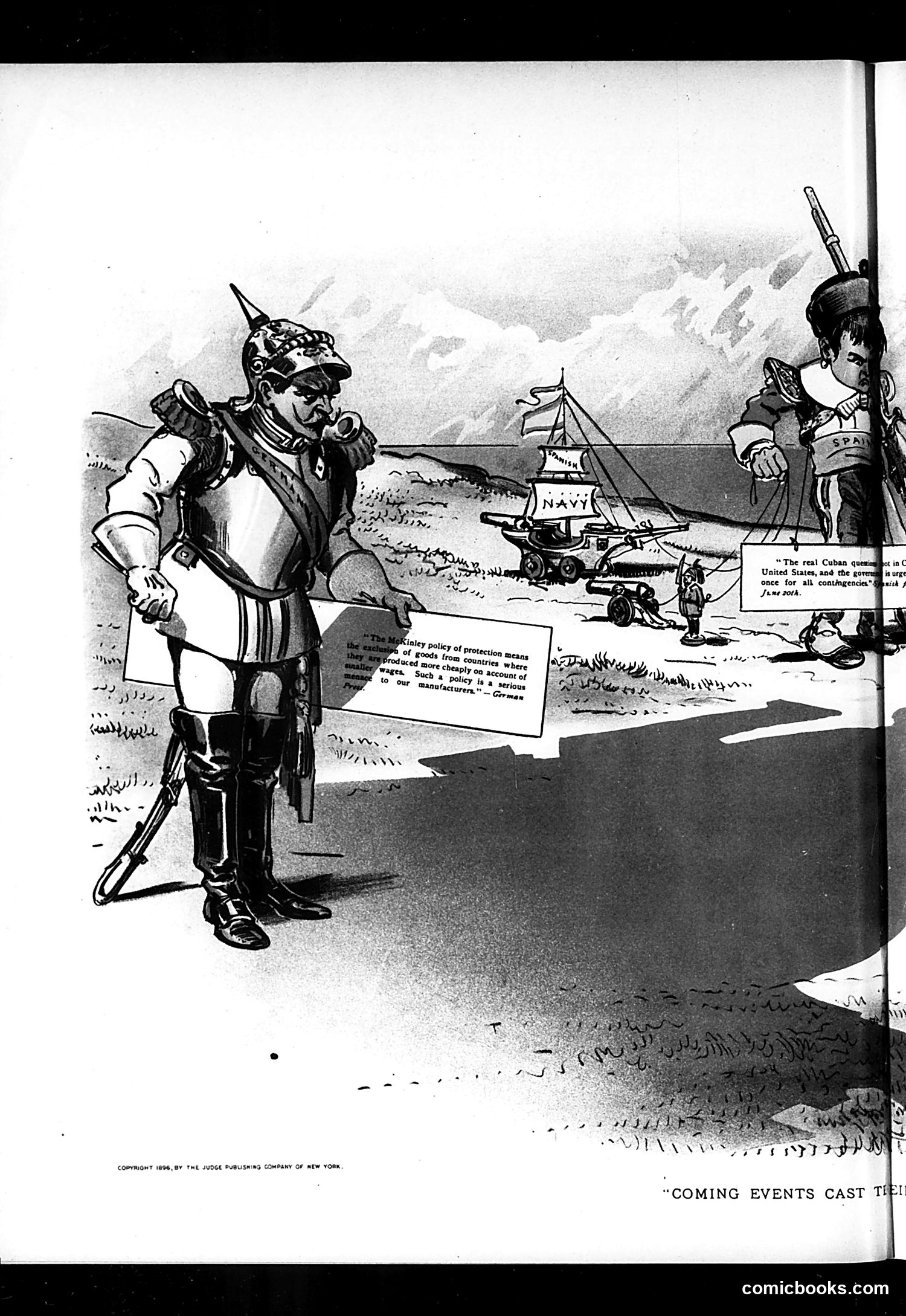
This 1896 Judge cartoon satirizes German imperial ambitions, depicting a Prussian military officer (identifiable by the spiked Pickelhaube helmet) examining a naval vessel labeled "NAVY" on a beach. The figure represents Germany's aggressive expansionism and militarism during the late 19th century. The caption "Coming Events Cast Their Shadow" suggests foreboding about future German military aggression. A text box near the officer discusses "protection" policies and trade from other countries—likely critiquing German economic and military protectionism. The American naval presence (the U.S. Navy ship) in the scene implies American concern about German imperial designs. This reflects anxieties about European power competition that would escalate toward World War I. The cartoon warns American readers about emerging global tensions.
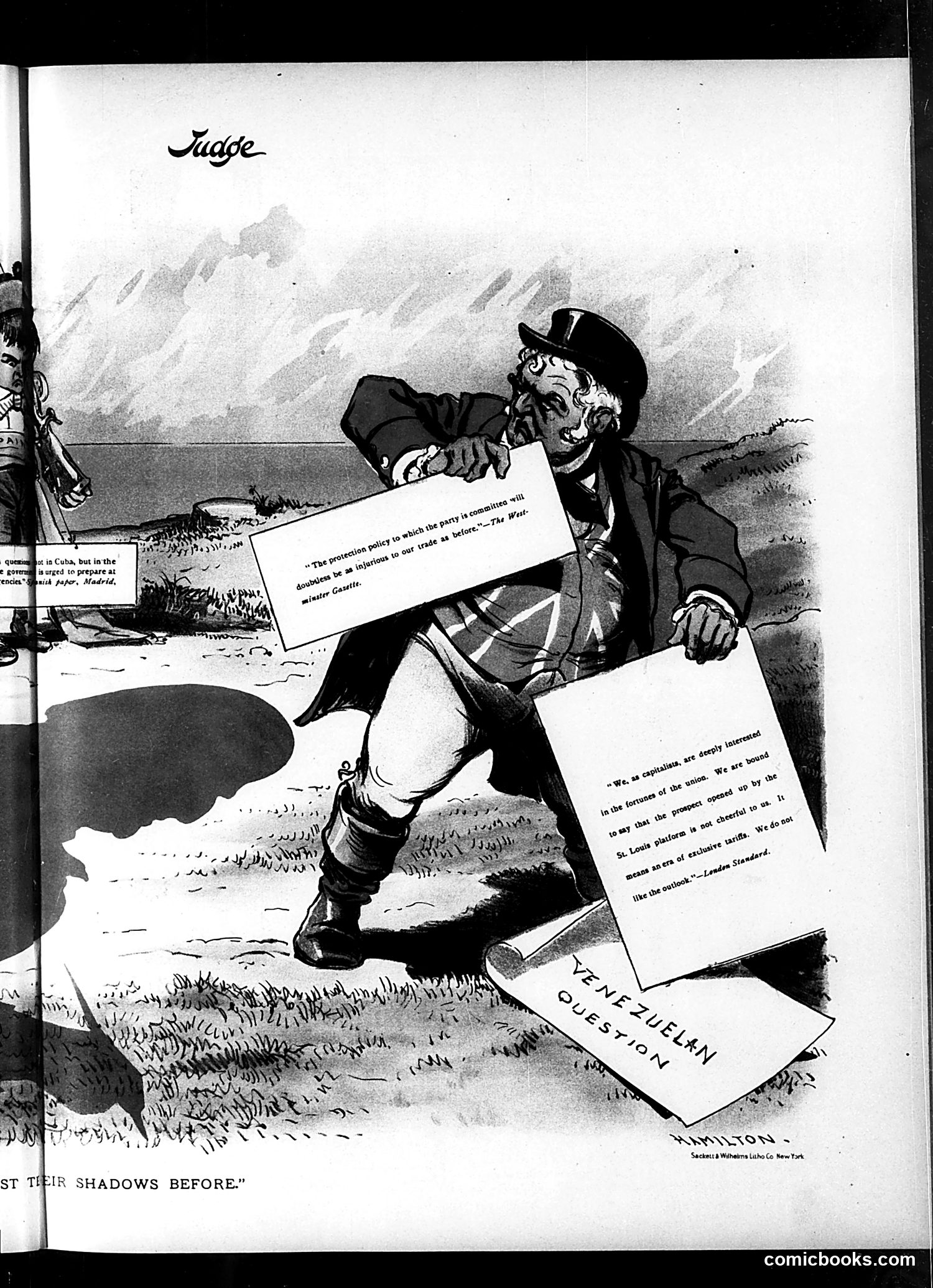
This political cartoon titled "Cast Their Shadows Before" depicts an elderly, caricatured figure (likely representing a political opponent or foreign leader) recoiling in fear from documents or papers. The visible text references Cuban policy and trade disputes, suggesting this addresses pre-World War I diplomatic tensions. The cartoon's message appears critical of someone's warnings or predictions about future conflict—the figure is shown fleeing from evidence of coming problems, as if trying to ignore prophetic warnings. The "shadows before" phrase invokes the idea of omens or foreshadowing. The exact historical reference is unclear without a publication date, but the Cuba reference and pre-war timing suggest this concerns American foreign policy debates, possibly regarding trade or military intervention. The satire targets someone accused of denying or dismissing serious diplomatic warnings.
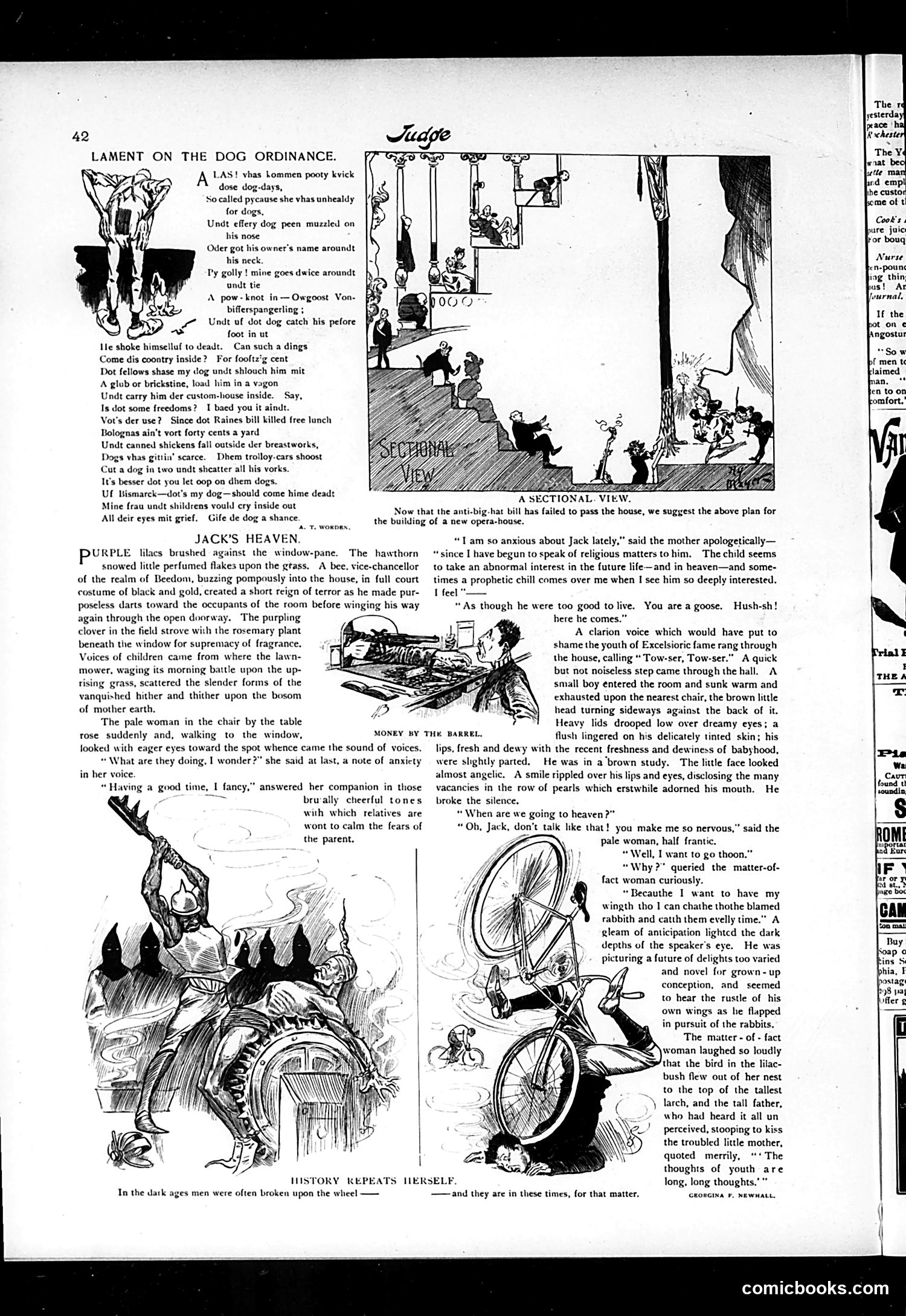
This page contains two distinct pieces of satirical content: **"Lament on the Dog Ordinance"** (top left): A dialect poem mocking a German immigrant complaining about a new dog muzzling ordinance. The speaker, "Owgoost Vonbifferspangerling," laments regulations requiring dogs be muzzled and wear identification. He compares this unfavorably to American freedom while ironically noting recent restrictions (the Raines Bill limiting free lunch access). The satire targets both the ordinance itself and immigrant anxieties about government overreach, using heavy dialect humor typical of period anti-immigrant comedy. **"Jack's Heaven"** (remainder): A sentimental short story about a mother worried her young son Jack shows "abnormal interest" in heaven and the afterlife. The narrative suggests innocent childhood imagination—Jack enjoys outdoor play with his dog. The satire appears gentle, poking fun at parental anxiety and over-interpretation of children's innocent remarks about mortality and religion. The page also includes a small architectural cartoon proposing an absurd opera-house design after an "anti-big-hat bill" failed to pass, though context for this reference is unclear.
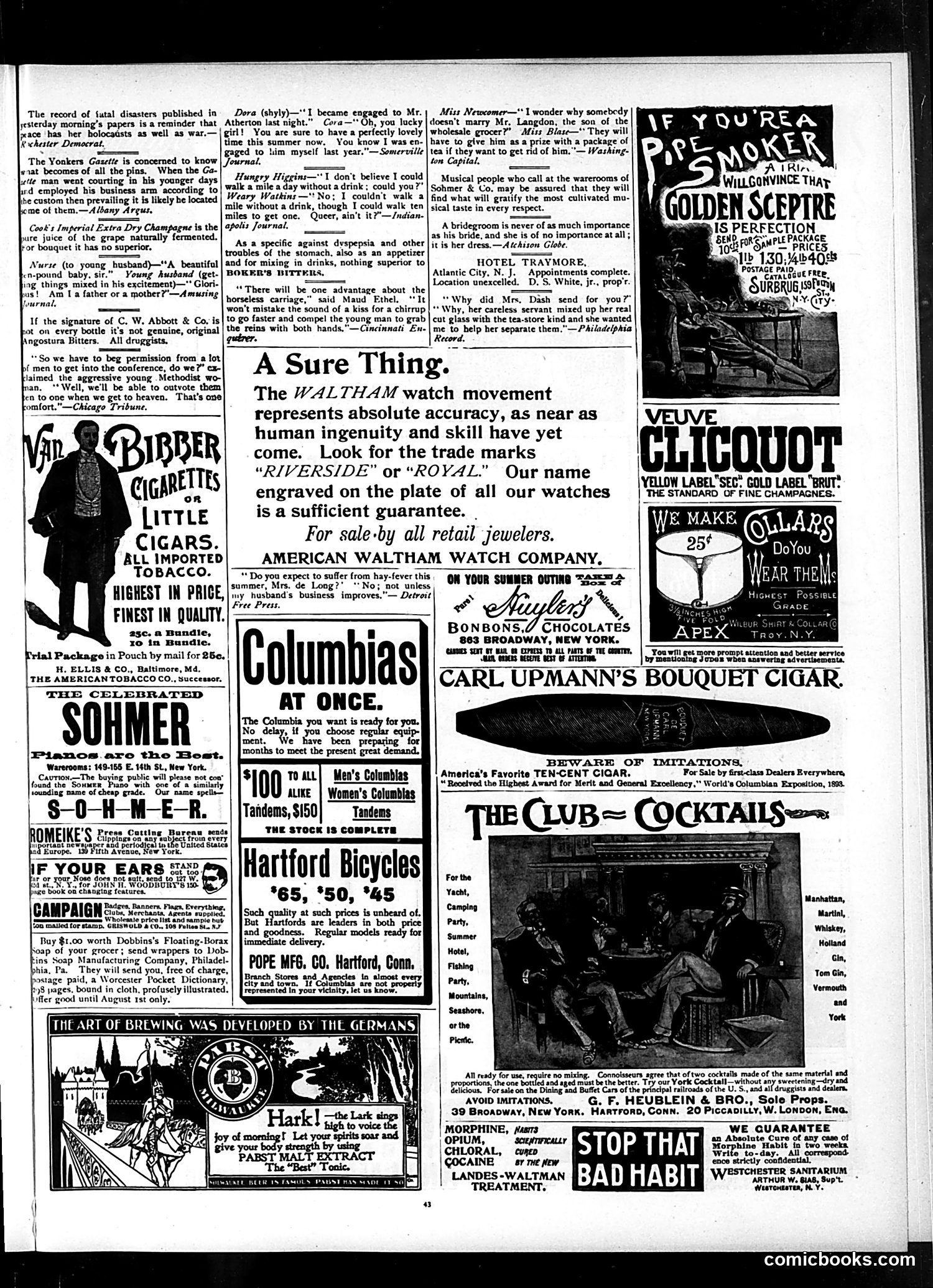
This page is primarily **advertisements** from a late 19th-century publication, interspersed with brief humorous quips. The small jokes reflect period concerns: one about "pins" references old courting customs; another depicts newlywed confusion about parenthood; repeated jokes about unmarried women (particularly a woman who was also engaged to the same man) mock female desperation for marriage; and a final quip about a Methodist woman eager to outvote men "in heaven" satirizes women's exclusion from church authority. The cartoons are minimal. One shows **"Van Bibber"** (a well-dressed gentleman character, likely from Richard Harding Davis's contemporary satirical fiction) representing the "highest in price, finest in quality" tobacco brand—satirizing the aspirational upper-class marketing of cigarettes. The dominant content comprises luxury product advertisements (Waltham watches, Sohmer pianos, Columbia bicycles, Clicquot champagne) targeting the wealthy. These represent Judge's affluent readership and reflect Gilded Age consumer culture.
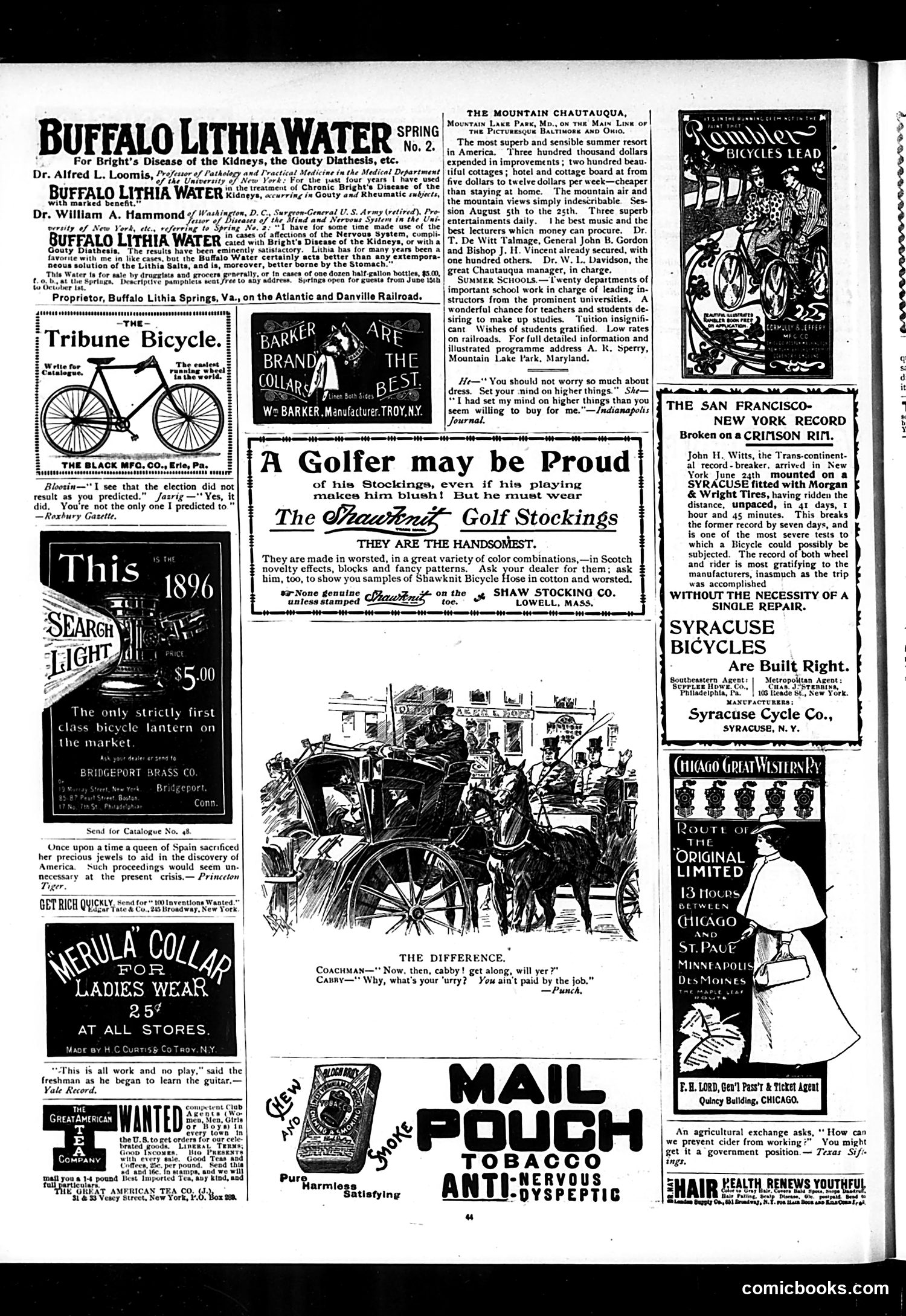
This page is primarily advertising for medicinal products and goods from the 1890s. The main content features endorsements for "Buffalo Lithia Water," presented as a cure for kidney disease and gout, with testimonials from medical doctors. The page includes one cartoon dialogue joke at center depicting a coachman and carriage passenger—a visual pun about "getting along" and "the difference" between their experiences. The remaining content consists of advertisements for bicycles, golf stockings, a "Search Light" lantern ($5.00), men's collars, tobacco, and railroad routes. There are no significant political cartoons or satirical commentary visible—this appears to be a standard advertising and humor page from *Judge* magazine's interior pages, relying on commercial endorsements rather than the publication's typical satirical content.
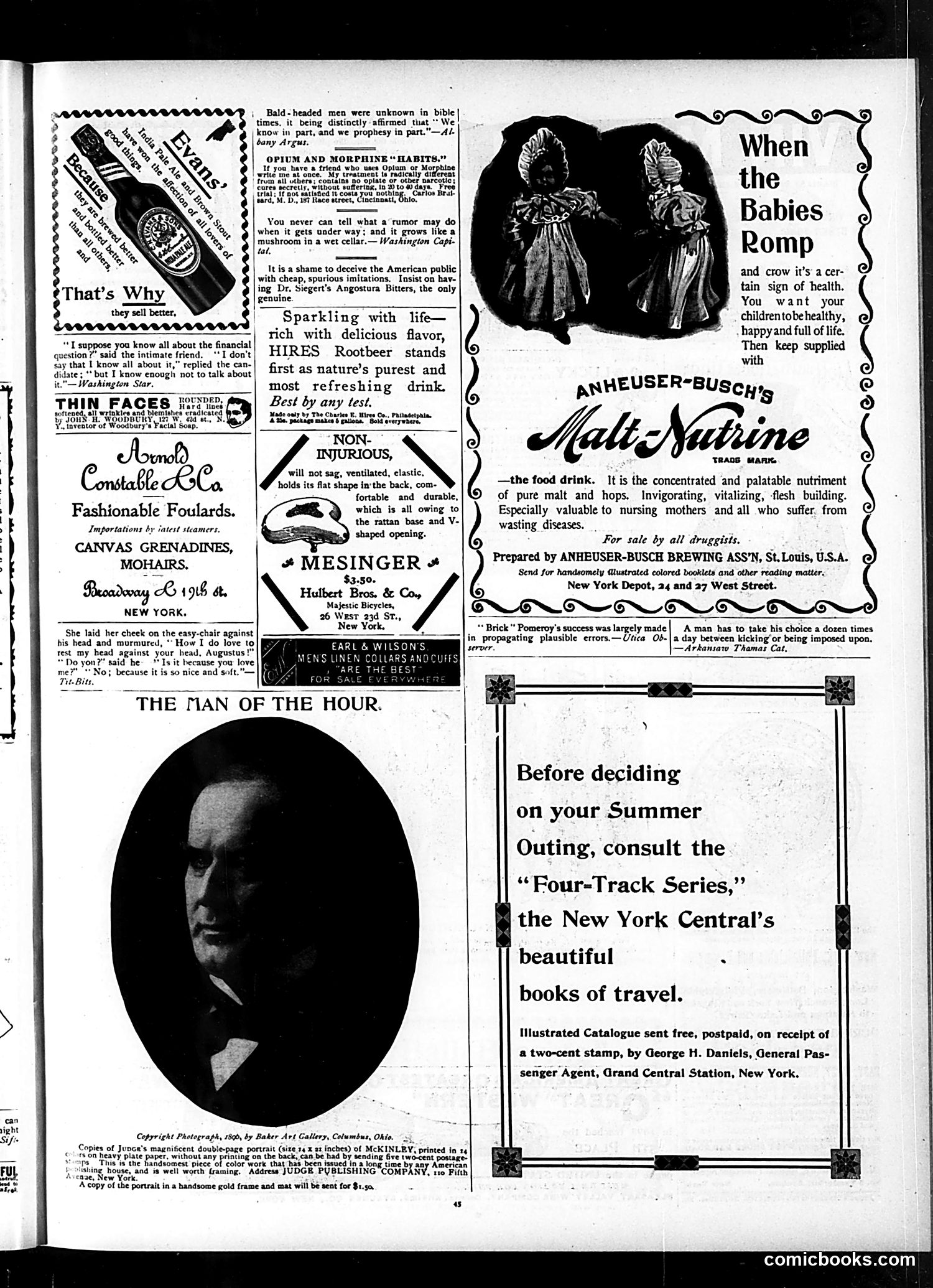
This page is primarily **advertising**, not political satire. It features various product advertisements from circa 1918, with minimal editorial cartoon content. The main notable element is "The Man of the Hour"—a portrait photograph (appears to be McKinley based on the copyright note), offered for sale in different formats. The editorial humor is minimal and generic: a Washington Star joke about a politician admitting ignorance on financial matters (topical to early 20th-century political culture), and light domestic humor about a bald man and his wife. The advertisements reveal period concerns: hair-loss remedies ("Thin Faces"), patent medicine for opium/morphine addiction, malted beverages marketed as health tonics (notably Anheuser-Busch's "Malt-Nutrine" promoted specifically for nursing mothers and the infirm), and travel promotions. The content reflects Progressive Era attitudes: faith in commercial products as solutions to social problems, and acceptance of substances later regulated or banned.
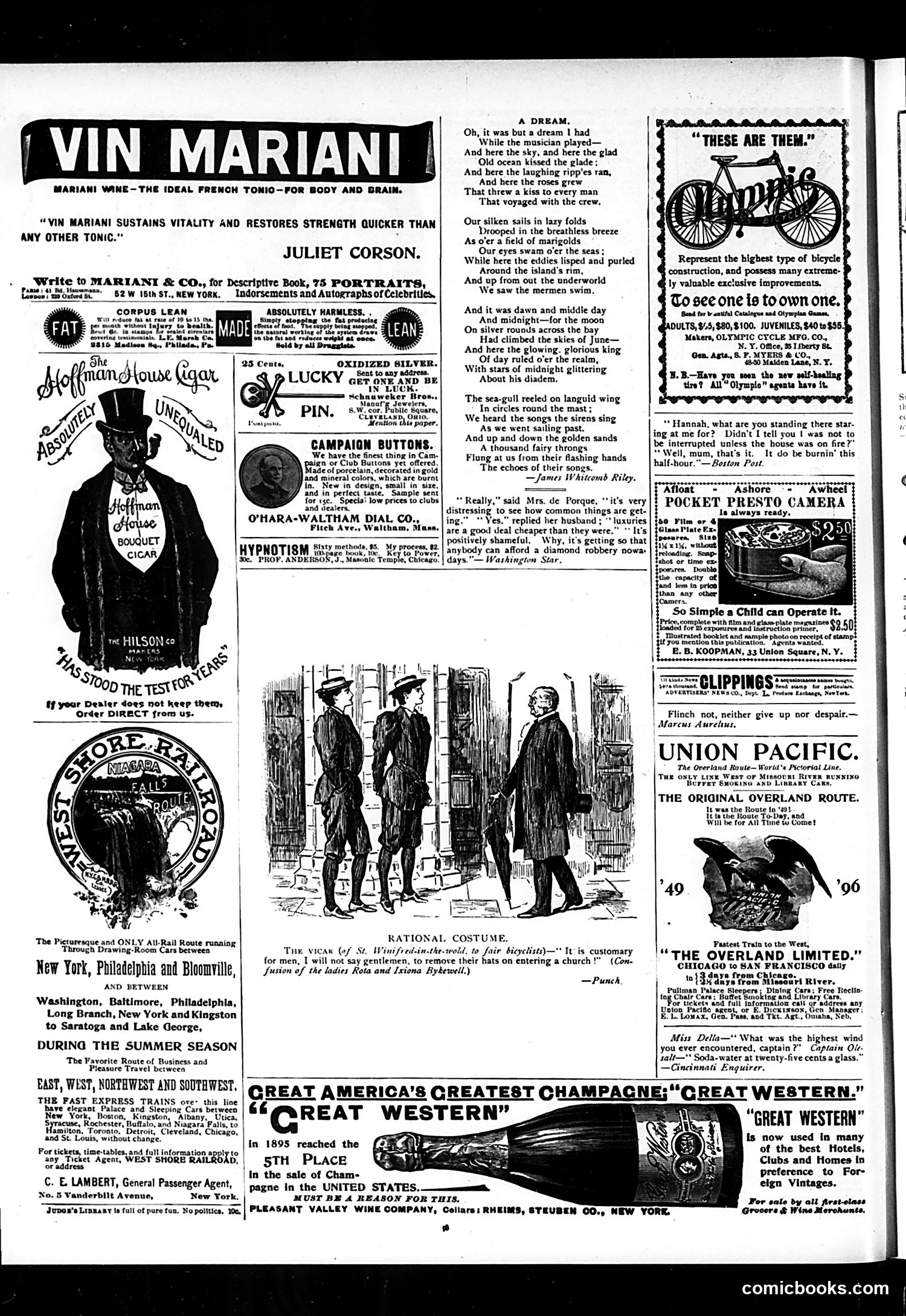
This page is primarily **advertising**, typical of 1890s Judge magazine. Key advertisements include: **Notable Content:** 1. **Vin Mariani Wine** (top): A "tonic" wine endorsed by Juliet Corson, claiming to restore vitality—a common patent medicine claim of the era. 2. **Political/Social Cartoons**: A small cartoon labeled "Rational Costume" shows a vicar asking cyclists to remove hats in church—satirizing the bicycle craze and the "New Woman" (women cyclists challenging Victorian conventions). 3. **The "Dream" Poem** by James Whitcomb Riley: A romantic reverie about sailing. 4. **Humor**: A Washington Star joke mocking how "luxuries are getting cheaper" so "anybody can afford a diamond robbery now"—satirizing both crime and consumerism. 5. **Transportation Ads**: Railroads and the new bicycle ("These Are Them") represent modern commercial competition. The page reflects 1890s concerns: patent medicines, women's changing roles, technological progress, and consumer culture.
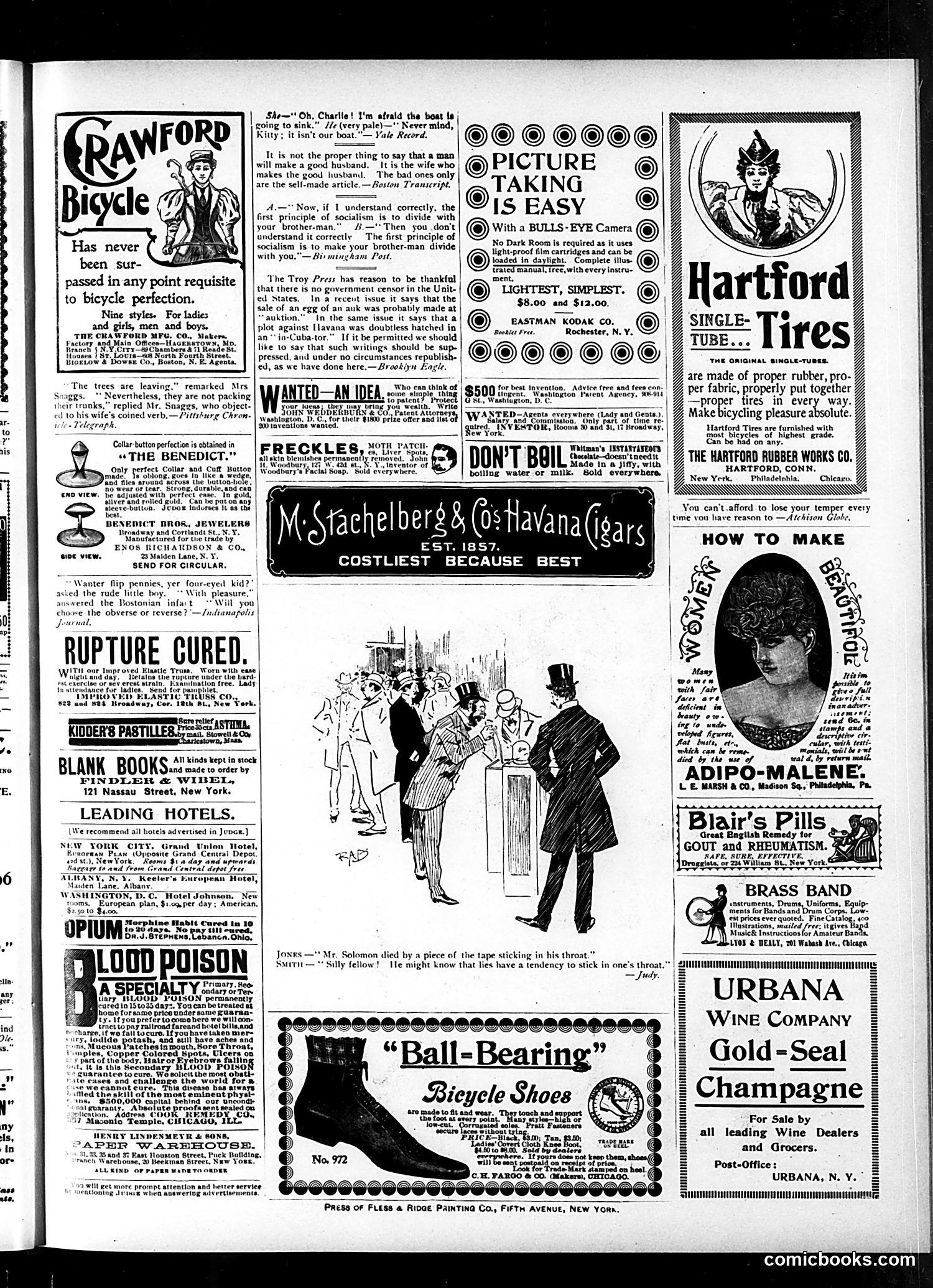
This page is primarily **advertising and filler content** rather than political satire. The main visual element is a central cartoon showing men in formal dress (top hats, suits) in what appears to be a social scene, but without clear caption or context visible, its specific meaning is unclear. The page contains numerous brief humorous quotes on marriage, socialism, and social behavior—typical Judge filler material. These include observations like "It is the wife who makes the good husband" and a joke contrasting socialist ideology with practice. The bulk of the page comprises **period advertisements**: bicycle equipment (Crawford Bicycles, Hartford Tires), photography equipment (Eastman Kodak), patent services, hotels, medical devices (rupture trusses), pills, champagne, and brass band instruments. Notable is an ad for "Ball-Bearing Bicycle Shoes" and one warning about "Blood Poison"—reflecting early 20th-century medical and commercial concerns. **Without clearer identification of the central cartoon's subject or caption, specific political commentary cannot be determined.**
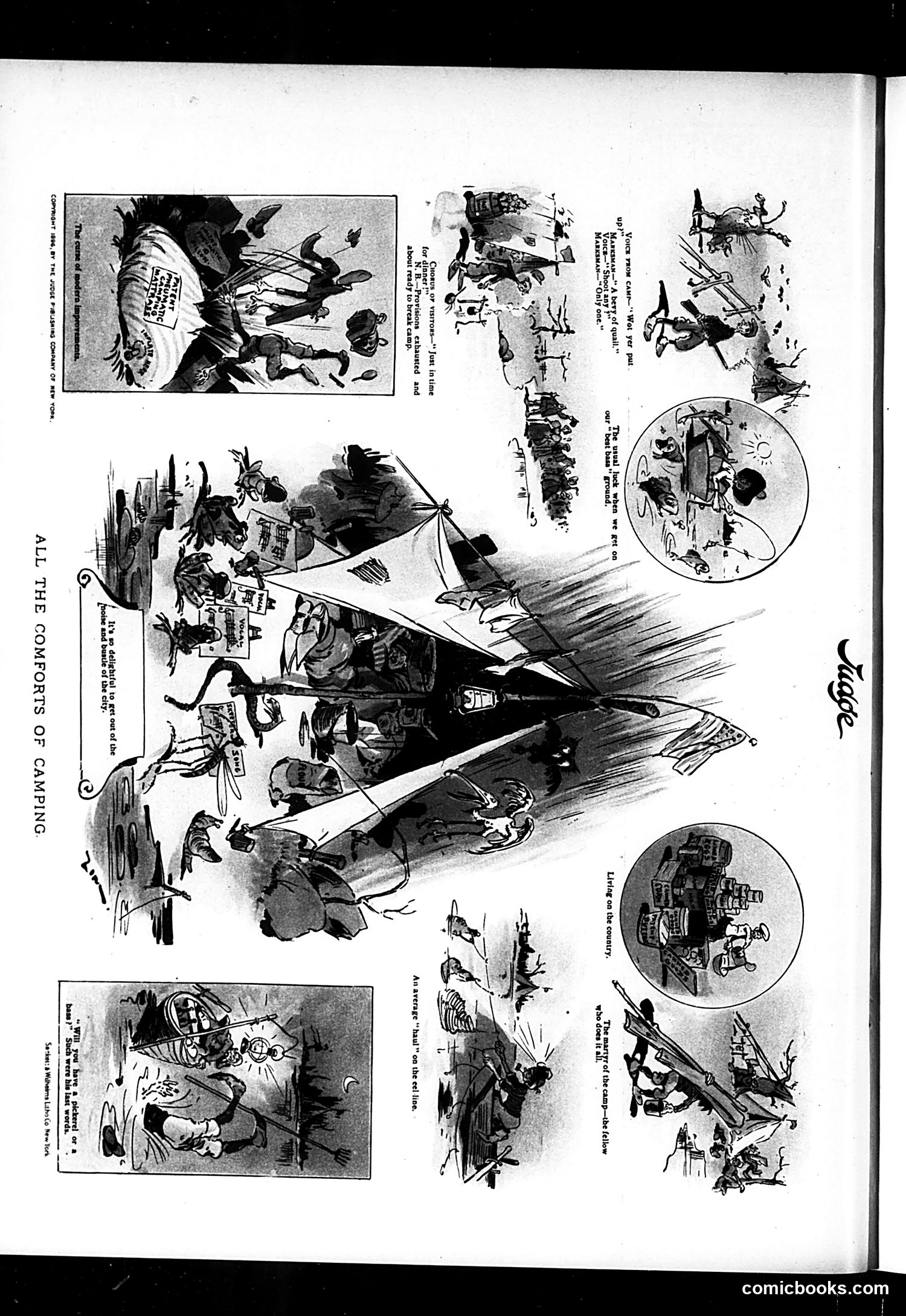
This is a satirical illustration mocking the camping trend among wealthy urbanites. The central image shows a pretentious camping trip gone wrong—what was meant to be a rustic escape from city life has become a chaotic disaster. The joke relies on contrasts: campers claim to seek simple country living and fishing, yet arrive with excessive baggage and provisions. The caption "N.B.—Provisions exhausted and about ready to break camp" suggests they've quickly depleted supplies, unable to sustain their outdoor fantasy. The surrounding vignettes show various camping mishaps and discomforts—implied romantic entanglements ("a bevy of quail"), minimal fishing success ("only one"), and general incompetence. The final caption sardonically attributes a man's death to eating "pickerel bass," suggesting the fishing attempt proved fatal. The satire targets the artificiality of wealthy Americans attempting primitivism while remaining dependent on urban comforts and bungling basic survival skills.