
A complete issue · 16 pages · 1896
Judge — March 21, 1896
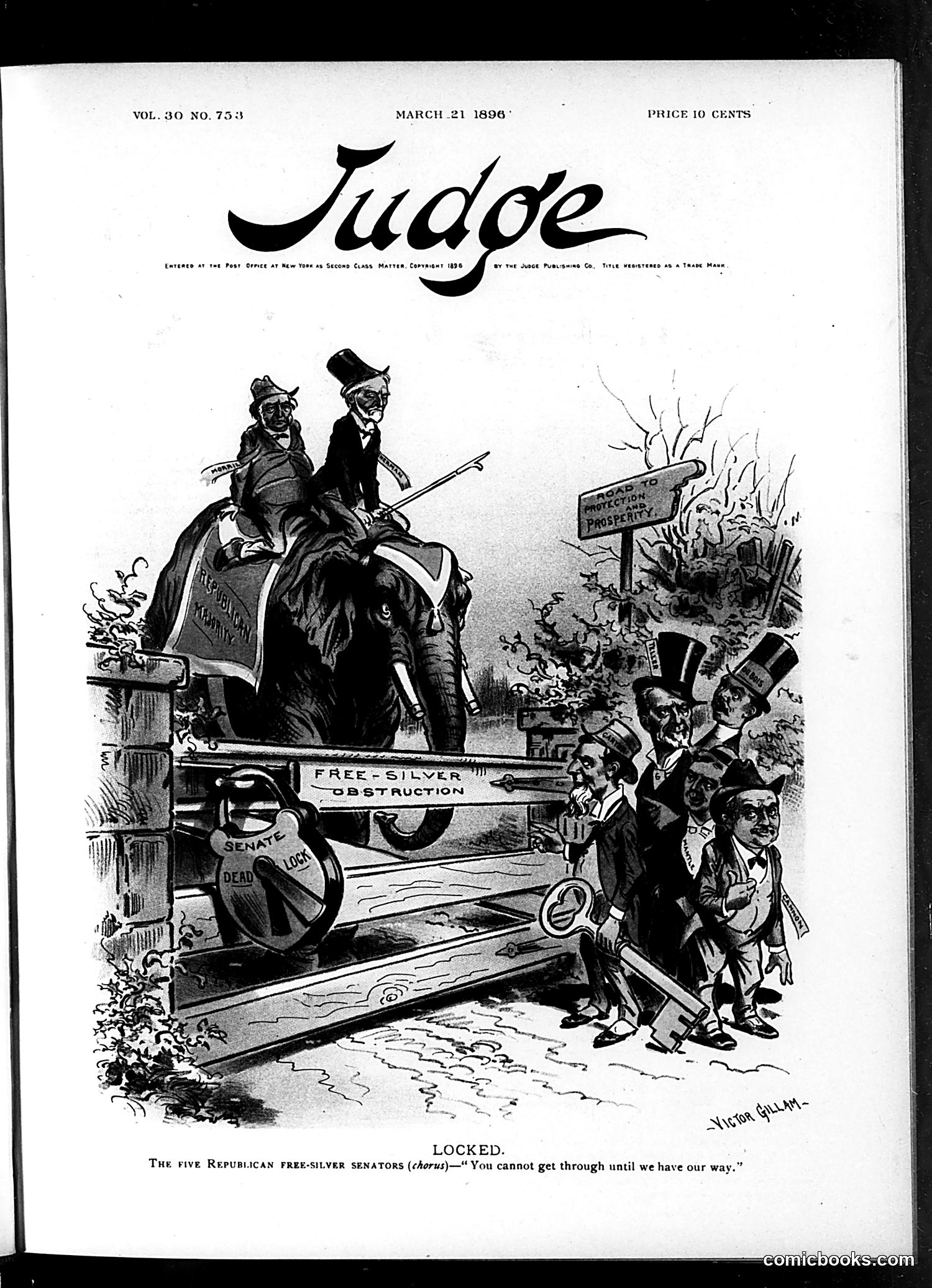
This satirical cartoon depicts five Republican senators mounted on an elephant blocking a roadway labeled "Road to Protection and Prosperity." The senators, identified as "free-silver" advocates, form a human obstruction with a cart labeled "Free-Silver Obstruction" and a wheel marked "Senate Dead Lock." The cartoon criticizes Republican senators who supported free silver coinage as obstacles to party progress. The small figures on the right (likely representing the Republican Party establishment or McKinley supporters) cannot advance their protectionist agenda because these senators are "locked" in place by their free-silver position. The satire targets the internal GOP conflict between pro-silver and pro-gold factions during the 1896 election cycle, suggesting that free-silver Republicans are preventing the party from achieving its economic goals.
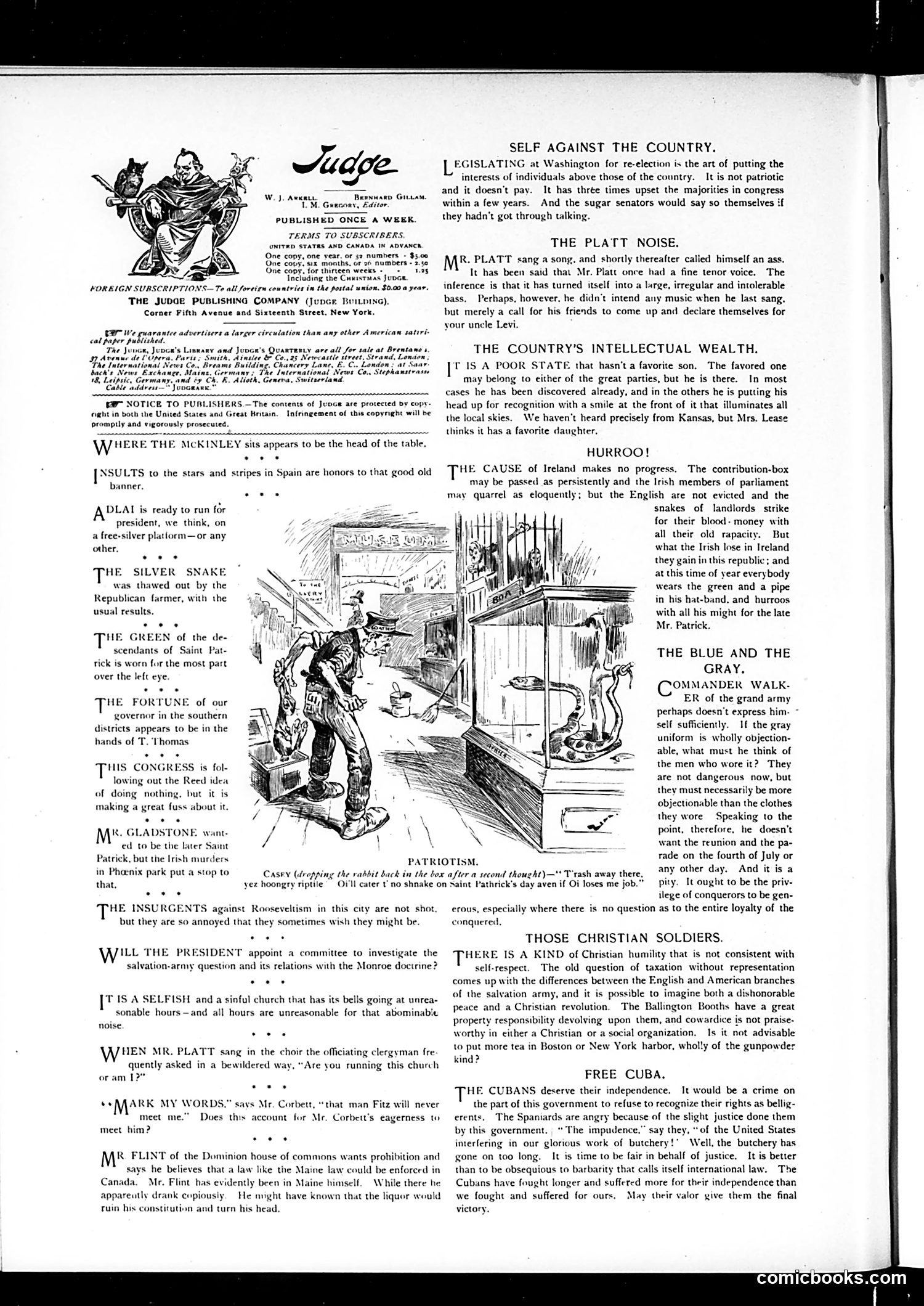
The main cartoon, titled "Patriotism," depicts a figure (labeled "Casey") stealing a rabbit from a box, with the caption "Trash away there, and nobody'll know. I'll keep on Saint Patrick's day even if it does smell." The satire targets Irish-American political behavior, suggesting that Irish politicians and community members engage in petty theft and corruption while hiding behind claims of patriotism and ethnic pride (invoking Saint Patrick's Day). The cartoon implies hypocrisy—using cultural identity as cover for dishonest conduct. The surrounding editorial columns address topics including Roosevelt's policies, Mr. Platt's political maneuvering, and Irish independence, reflecting late 19th/early 20th-century American political debates. The overall message criticizes self-interested politicians who claim to serve national or ethnic interests while actually pursuing personal gain.
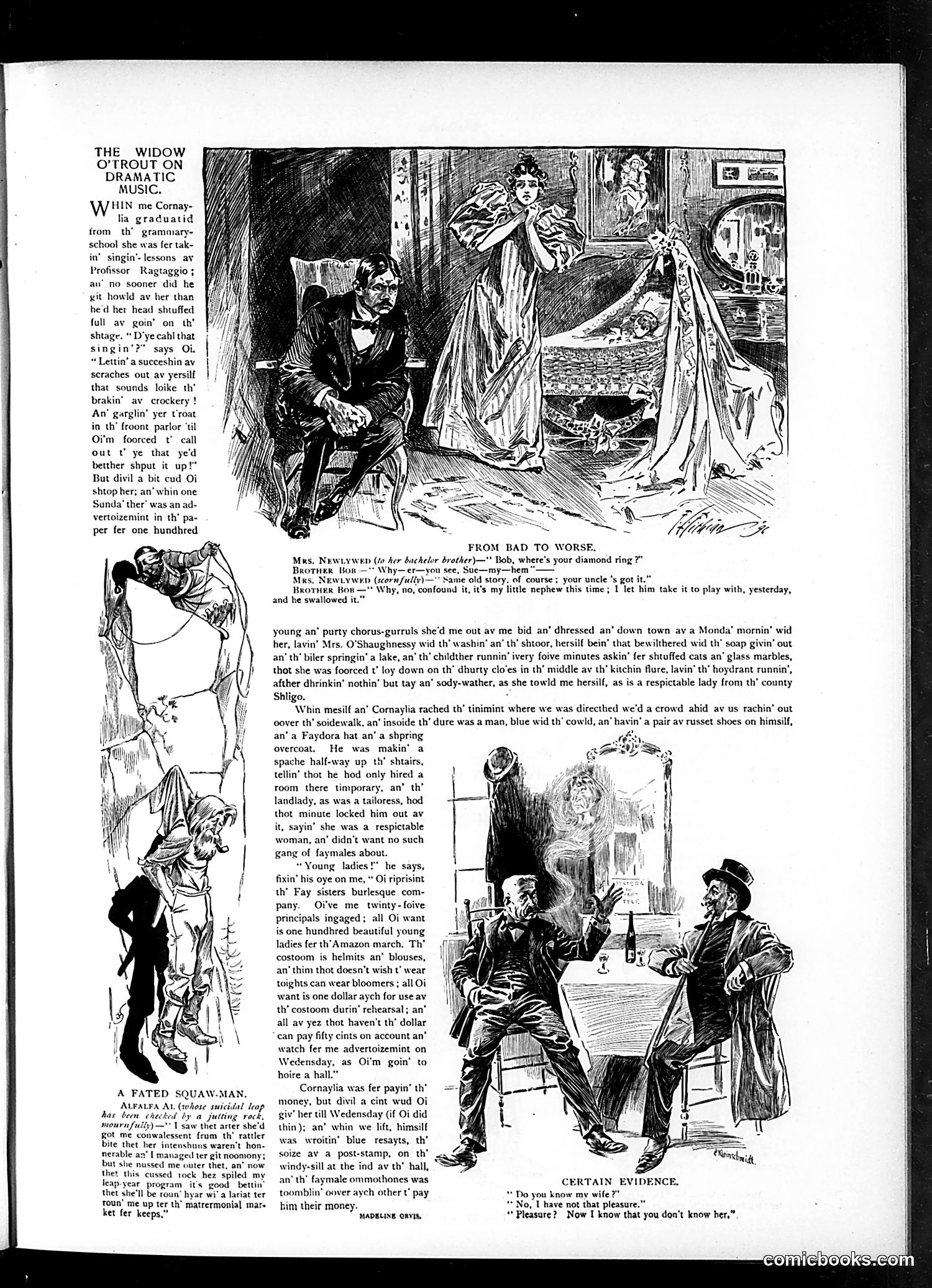
This page presents a serialized humorous story about an Irish widow named Cornaylia O'Flannery, a singing teacher whose students constantly disappoint her. The narrative uses heavy Irish dialect ("ye call that singin'?") and depicts working-class struggles. The three illustrated scenes show: 1) The widow confronting a poorly-singing student; 2) "A Fated Squaw-Man"—depicting what appears to be a failed theatrical venture; and 3) "Certain Evidence"—a conversation about marital infidelity. The satire targets lower-class Irish immigrants, their theatrical ambitions, and domestic drama. The stereotypical Irish characterization and dialect humor were typical of Judge's approach to immigrant communities in this era.
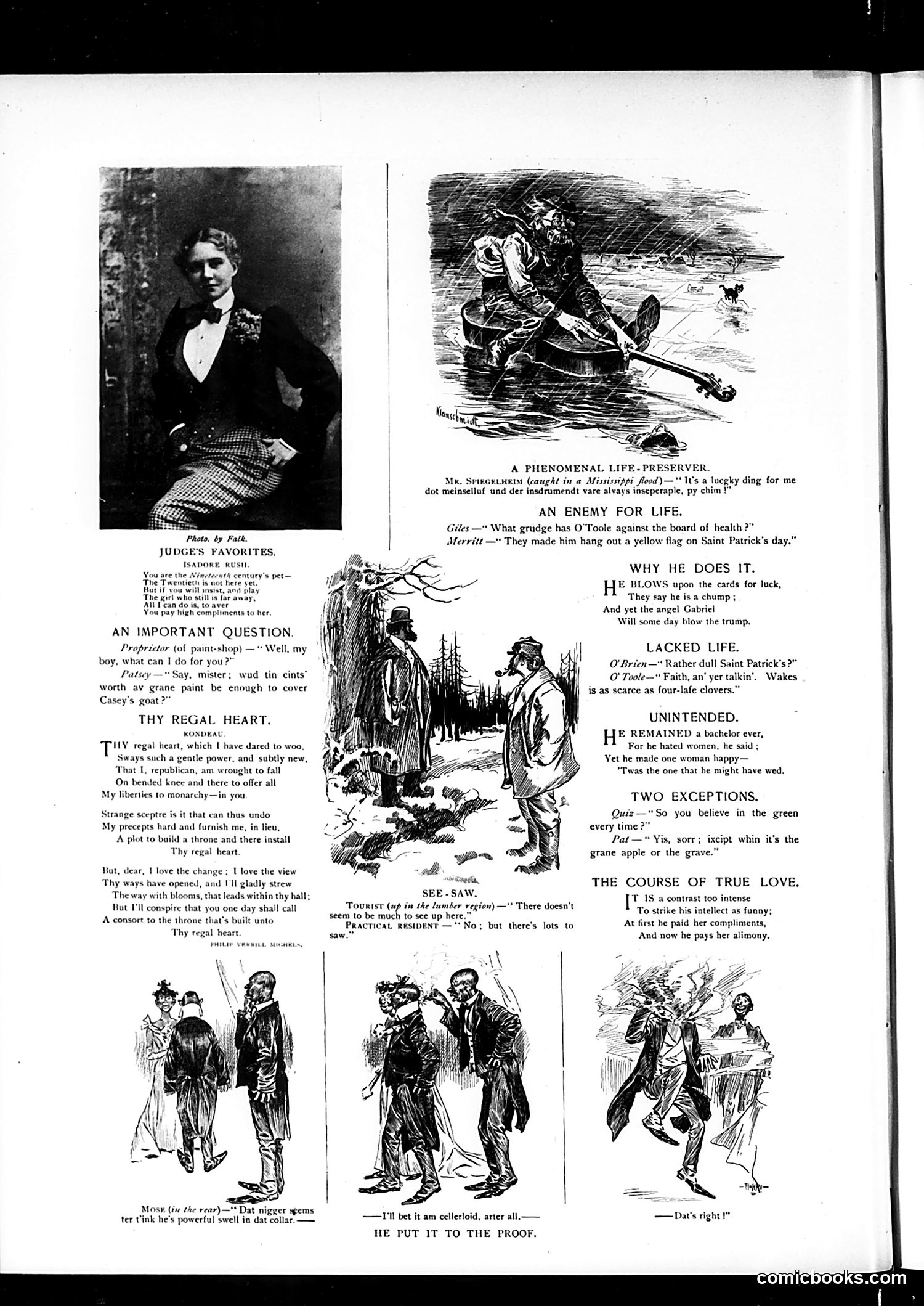
This page from Judge combines romantic poetry with ethnic humor typical of late 19th-century American satire. **Main content:** "Thy Regal Heart" is a sentimental poem about a republican man surrendering his principles to love for a woman of higher social status—satirizing both romantic excess and class pretension. **Ethnic humor:** Multiple jokes feature Irish and German immigrant characters with heavy dialectical speech ("dat nigger," "Kgelheim," "Patsey," "O'Toole"). These reflect period stereotypes: Irish laborers, Germans with thick accents, and derogatory racial language toward Black Americans. The jokes are shallow—turning on mispronunciations, superstitions (the card-blowing), and crude scenarios (painting a goat). **Photographs/portraits:** Include "Isadore Rush" and a formal portrait labeled "Judges Favorites," suggesting these were popular entertainers or public figures of the era, though identification is unclear today. The satire's targets—romantic sentimentality, immigrant "otherness," and class differences—reveal period attitudes rather than substantive social criticism.
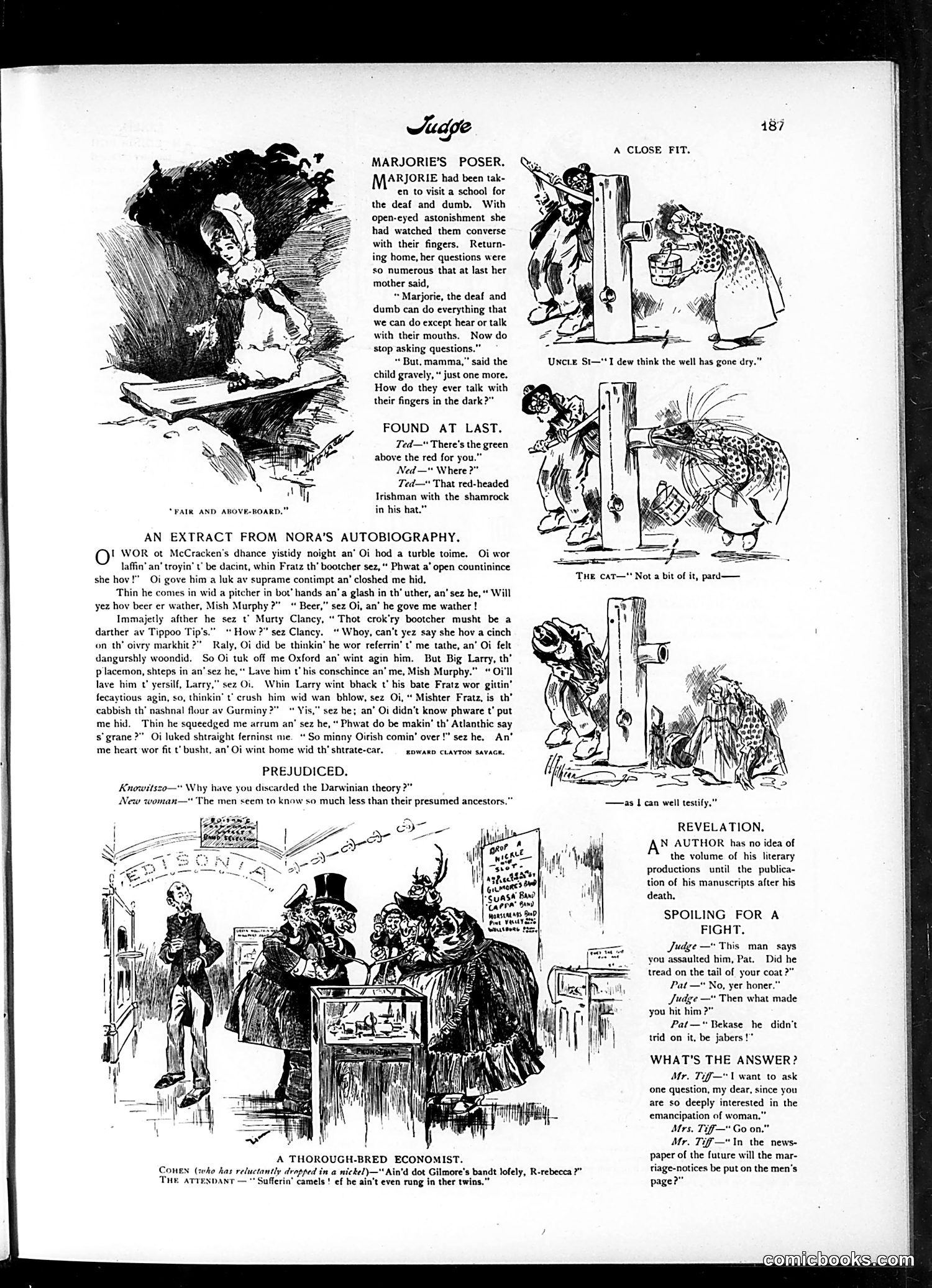
This page contains several unrelated satirical pieces typical of Judge's format: **"Marjorie's Poser"**: A child's innocent question about how deaf people communicate in darkness—humor derived from childish logic missing the obvious answer. **"Found at Last" and "A Close Fit"**: Visual gags about a red-headed Irishman, playing on ethnic stereotypes common to period humor. **"Nora's Autobiography"**: Heavy Irish-dialect monologue about a dance hall altercation, featuring fighting, insults, and romantic complications—stereotypical "stage Irish" humor popular in early 20th-century American comedy. **"Prejudiced"**: A brief joke where a "New Woman" (feminist) dismisses Darwinian theory because men prove less evolved than ancestors—contemporary satire of women's rights advocates. **Various short jokes**: Including one about a cheapskate woman at a concert, and another mocking women's suffrage advocates through marital discord. The page reflects period attitudes: ethnic stereotyping, anti-feminist sentiment, and working-class Irish caricature were standard Judge content.
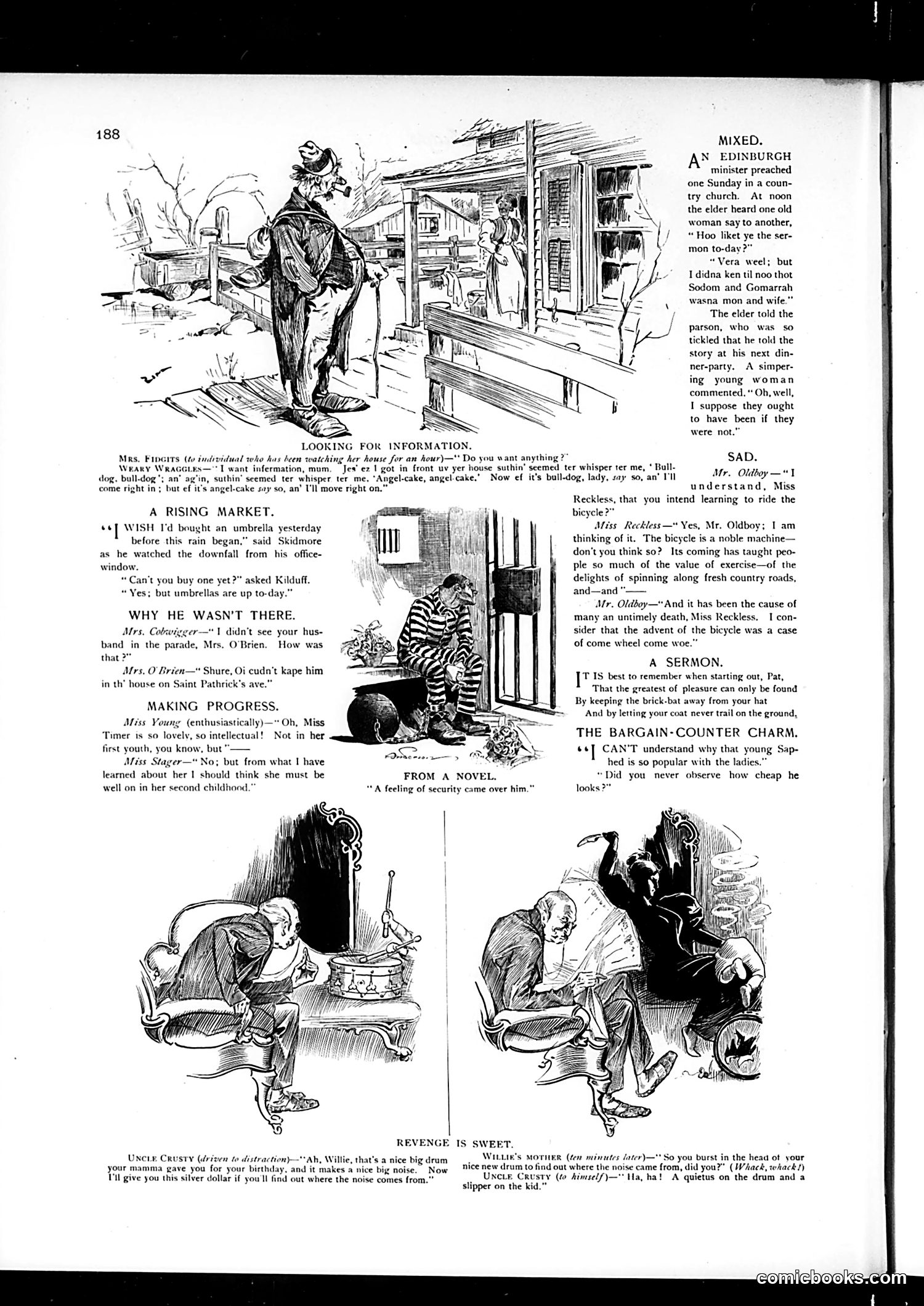
This page contains multiple brief satirical pieces typical of late-19th-century American humor magazines: **"Looking for Information"**: A humorous sketch about a suspicious character watching a house, with a pun about "bull-dog" that plays on double meanings. **"A Rising Market"**: A simple economic joke about umbrella prices rising during rainy weather—commentary on opportunistic pricing. **"Why He Wasn't There"** and **"Mixed"**: Ethnic humor pieces featuring Irish and Scottish dialect, reflecting period stereotypes. The Scottish piece jokes about religious misunderstanding. **"Making Progress"**: Age-related mockery of a woman's intellect declining with age. **"Revenge is Sweet"**: A slapstick narrative where an uncle bribes a boy to find where drum noise originates, then the boy destroys the drum—teaching a "lesson." **"The Bargain-Counter Charm"** and **"A Sermon"**: Brief quips about bicycle popularity and being cheap-looking as attractive qualities. The illustrations are period woodcut-style engravings. The humor relies on ethnic stereotypes, slapstick, puns, and observations about contemporary social anxieties (bicycles, pricing, aging).
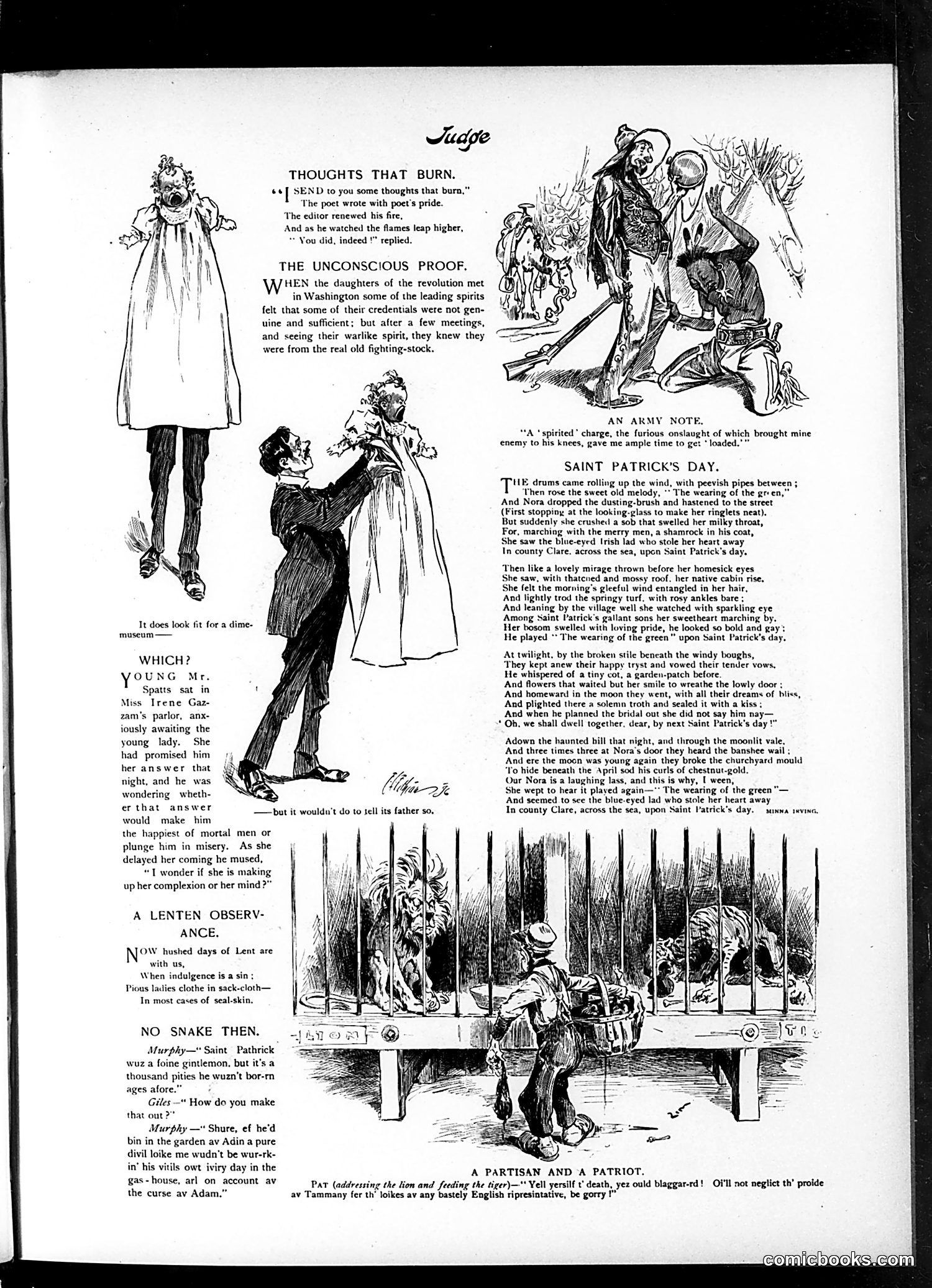
This page from *Judge* contains several satirical pieces targeting American social pretensions and Irish-American stereotypes circa early 1900s. **"Thoughts That Burn"** mocks rejected poets—editors literally burn their submitted work. **"The Unconscious Proof"** satirizes the Daughters of the American Revolution (DAR), suggesting some members' Revolutionary credentials were questionable until their "warlike spirit" proved their authenticity—a dig at the organization's exclusionary pretensions. **"Saint Patrick's Day"** is a sentimental Irish-immigrant narrative about Nora, an Irish servant in America who spots her lost love in a Saint Patrick's Day parade, only to learn he died. The piece romanticizes Irish homesickness and lost love. **"Which?"** jokes about a nervous suitor awaiting his marriage proposal answer. **"No Snake Then"** presents a crude Irish-dialect joke where Murphy suggests Saint Patrick should have lived before Adam to prevent original sin—relying on ethnic stereotyping. The page reflects *Judge*'s typical blend of social satire aimed at elites and ethnic humor targeting Irish immigrants.
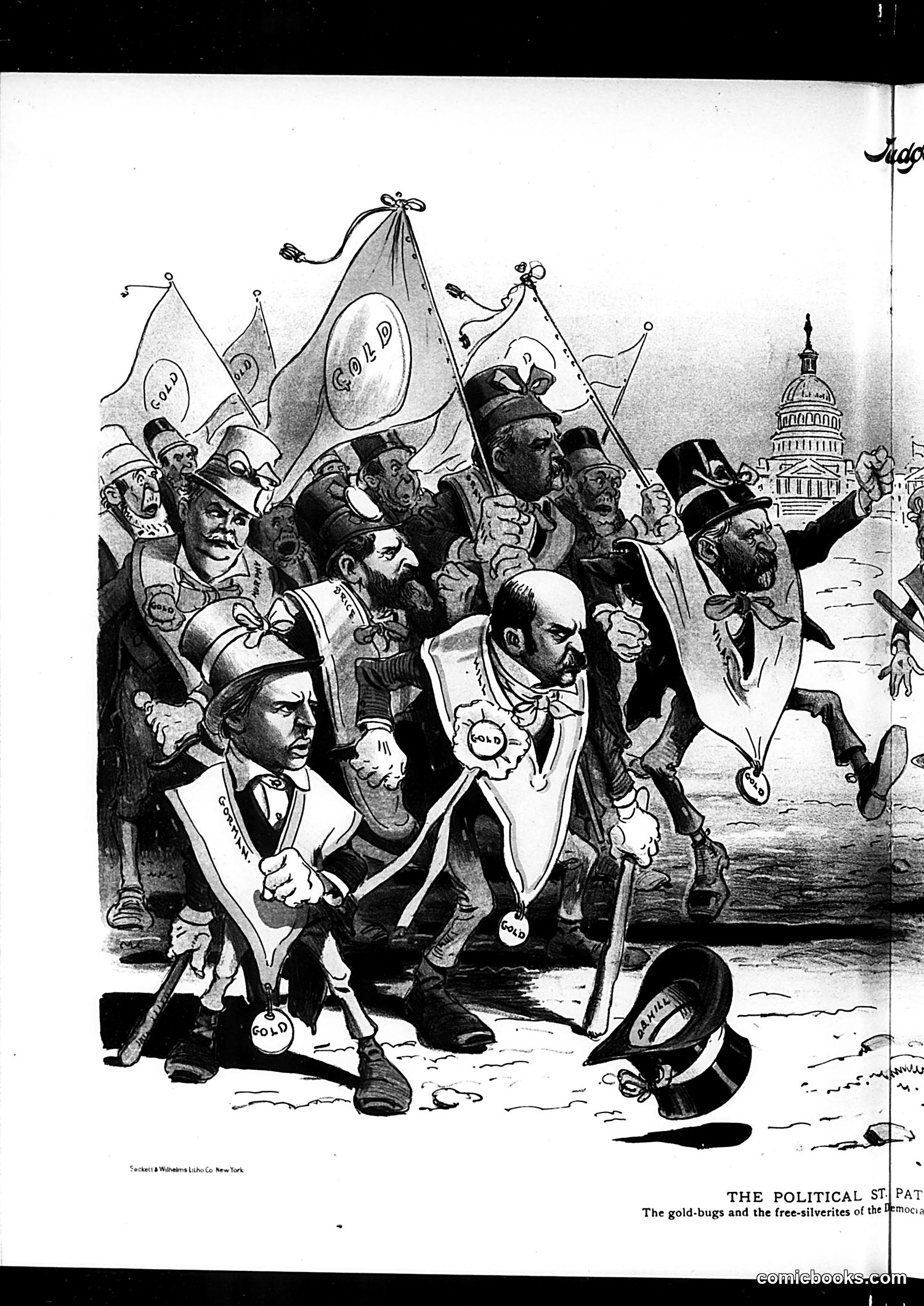
This Judge magazine cartoon satirizes Democratic politicians during the Gilded Age, likely from the 1890s. The title references "gold-bugs and free-silverites"—a major political divide of that era over monetary policy. The caricatured figures carry flags labeled "GOLD" while marching toward the Capitol building. The satire mocks Democratic infighting: "gold-bugs" (wealthy establishment Democrats favoring the gold standard) and "free-silverites" (populist Democrats advocating unlimited silver coinage) are depicted as competing factions within the same party, despite their fundamental disagreement. The absurdist visual—grown men in formal dress parading their conflicting monetary positions—ridicules the party's internal chaos and suggests Democrats cannot present unified leadership to voters. This reflects the actual 1896 Democratic Party split over currency policy.
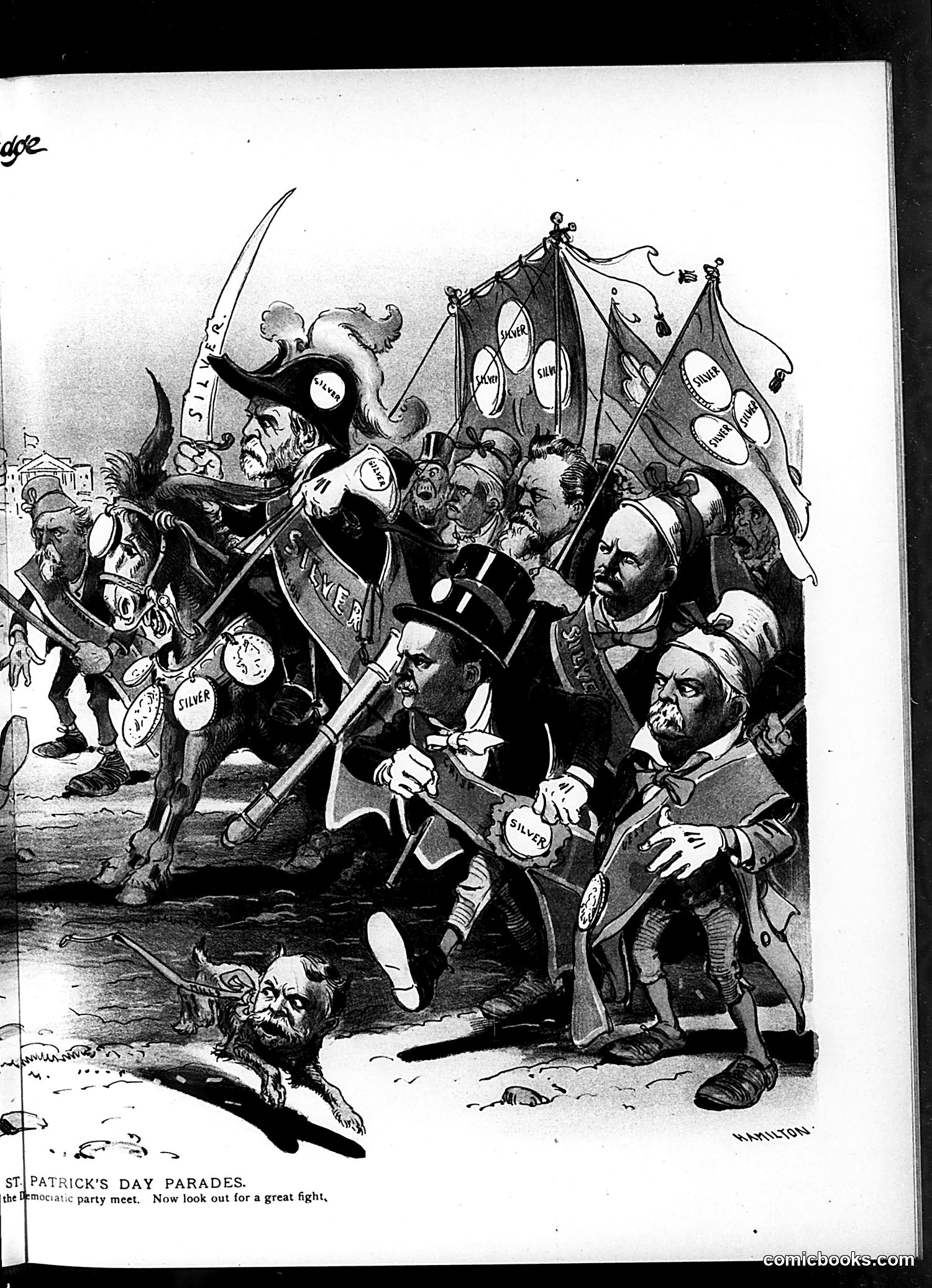
This political cartoon satirizes the Democratic Party by depicting it as a chaotic St. Patrick's Day parade. The figures carry banners labeled "SILVER" and wear Irish-themed clothing, suggesting the cartoon conflates Irish-American Democratic voters with the party itself. The imagery implies the Democratic Party is disorganized and fractious—a rowdy mob rather than a unified political force. A demon or devil figure lies defeated in the foreground, possibly representing an opponent or corruption the party claims to fight. The caption's warning—"Now look out for a great fight"—suggests the cartoon mocks Democratic infighting or predicts internal conflict. This appears critical of Democratic Party coherence, using ethnic caricature and chaos to undermine its credibility as a serious political organization.
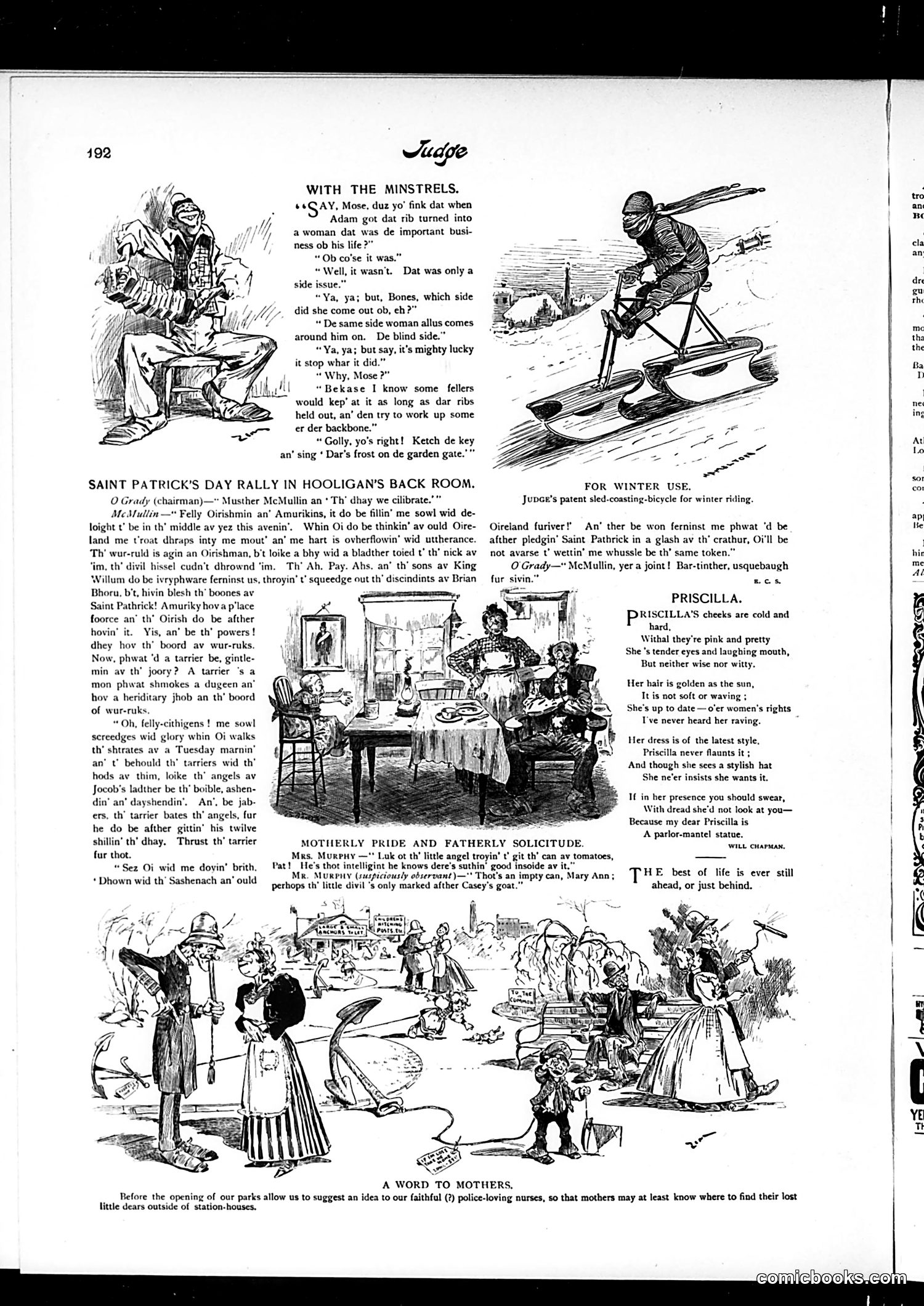
This page contains satirical humor typical of late 19th-century American comedy, mixing racist minstrel-show dialogue with Irish-American stereotypes and social commentary. **"With the Minstrels"** uses the minstrel show format (white performers in blackface) to make jokes about women—a common trope where female independence is presented as comic. The dialogue plays on stereotypes of Black speech patterns. **"Saint Patrick's Day Rally"** satirizes Irish-American political gatherings and laborers, mocking their dialect and celebrating Irish working-class pride (particularly in construction work as "tarriers"). The piece captures both ethnic pride and the condescension toward Irish immigrants common in the era. **"Motherly Pride and Fatherly Solicitude"** shows working-class parents with a child near discarded cans—gentle humor about urban poverty and childhood mischief. **"Priscilla"** is a poem celebrating a woman as the "ideal" partner—obedient, fashionable but not vain, and quiet (compared to a "parlor-mantel statue"). This reflects period anxieties about women's growing independence and suffrage movements. These pieces reflect Judge's audience: educated, often anti-immigrant, skeptical of social change.
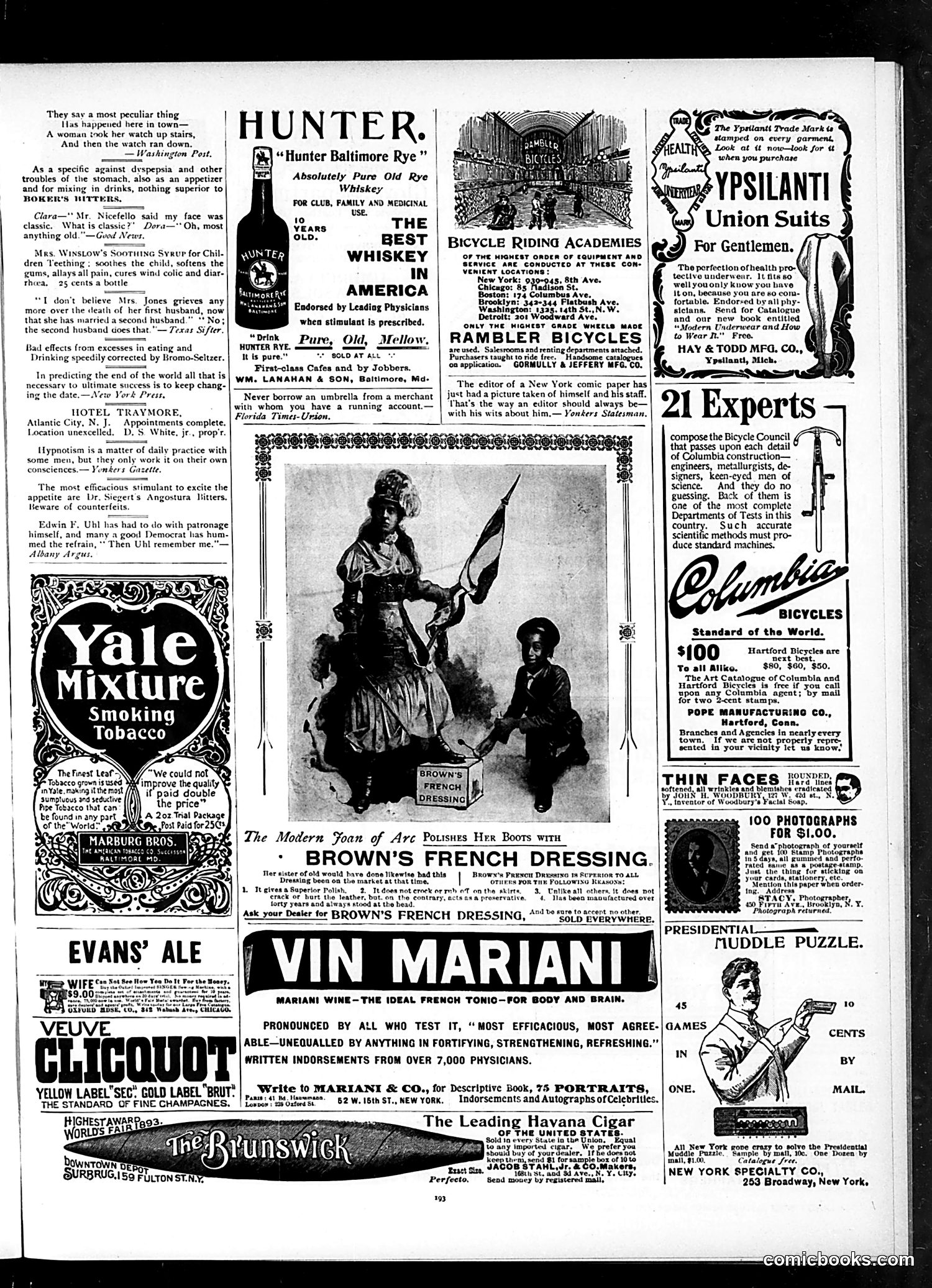
This is primarily an **advertising page** from Judge magazine, with minimal satirical content. The page features period product advertisements (whiskey, tobacco, bicycles, patent medicines, wine) typical of early 1900s publications. The only cartoon appears center-page: "The Modern Joan of Arc Polishes Her Boots with Brown's French Dressing." It depicts a woman and child, likely satirizing the contemporary "New Woman"—the emerging independent female figure of the era. The Joan of Arc reference humorously elevates boot-polishing to heroic status, poking fun at modern women's domestic routines and self-reliance. Scattered throughout are brief joke items (about watches, umbrellas, editors) that exemplify Judge's typical satirical humor—gentle social commentary rather than pointed political satire. The text snippets mock everyday situations: marriage, patronage politics, and human nature. The advertisements themselves reflect period attitudes toward health (endorsements from physicians for whiskey as medicinal) and emerging consumer culture (bicycles, protective underwear).
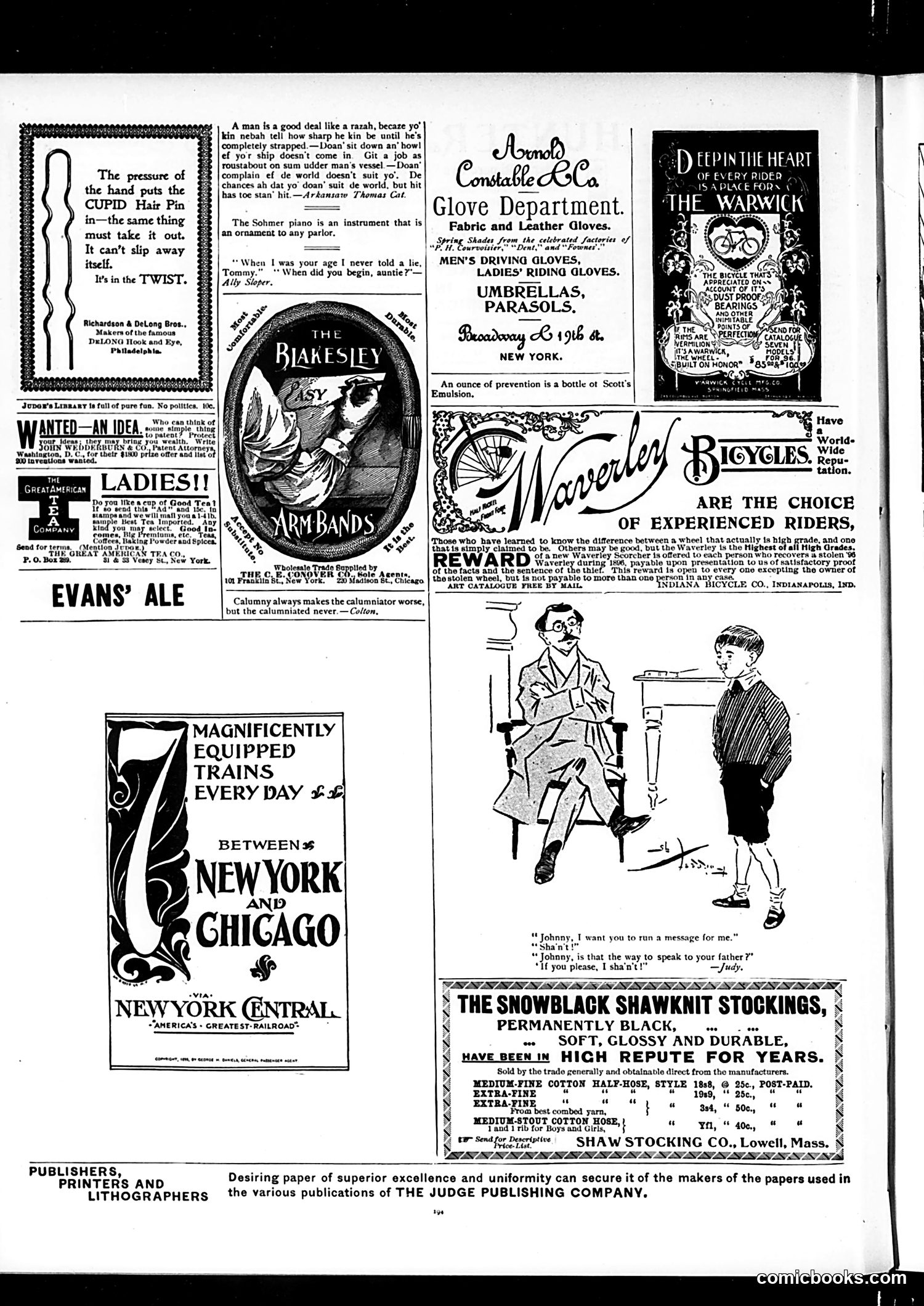
This is primarily an **advertising page** from Judge magazine, with one notable cartoon. The main cartoon (center-right) depicts a domestic discipline scene: a well-dressed man sits while a young boy stands before him. The captions show the father correcting the boy's disrespectful tone—the child says "Sha'n't" without the proper "Sir" or deference. The joke satirizes **early 20th-century parenting and class etiquette**, mocking the rigid formality demanded of children toward authority figures. The boy's casual refusal ("If you please, I sha'n't!") represents the kind of impudence fathers supposedly had to stamp out. The page is otherwise filled with **product advertisements**: hair pins, pianos, bicycles (Waverley brand), stockings, gloves, umbrellas, trains, and ale. Period **folk sayings and aphorisms** appear throughout, offering homespun wisdom on topics like honesty, hard work, and reputation. The ads and content reflect **commercial culture of the 1910s**, targeting middle and upper-class readers with luxury goods and services.
This page is primarily **advertising**, with small satirical snippets at the top. The cartoons are minimal. The main content consists of patent medicines, consumer products, and services typical of the era (circa 1890s): Dr. Williams' Indian Pile Ointment, Campbell's Tomato Extract, Turkish Cigarettes, Evans' Ale, and Anheuser-Busch's "Malt Nutrine" (a "food drink" claimed to build up "weakened systems"). The brief jokes at the page's top mock everyday situations: a lawyer confident a jury will deadlock because two members are married; a professor's snobbish Latin gate-sign; theatrical salary confusion. These are light, apolitical humor pieces. **Notable satire**: One item mocks a burglar who inconsiderately forced a homeowner to chase him barefoot while the owner wore only a pistol and nightshirt—absurdist humor about criminal etiquette. The advertisements themselves, particularly the medical "cures," reflect period attitudes toward unregulated patent medicines making extravagant health claims—practices satirized elsewhere in Judge but presented here straightforwardly.
This is primarily an **advertising page** with minimal editorial content. The few cartoons/jokes present are brief: **Main Cartoon Elements:** 1. **"Careless Mothers"** (center): An illustration of a woman in a chair speaking to another woman, accompanying a joke about a new clock with a music-box that plays "Home, Sweet Home" only at half-past ten. This is gentle domestic humor—no political satire. 2. **"Monarch Bicycle" Advertisement** (lower left): References King Richard III's famous line from Shakespeare ("My kingdom for a horse"), joking that modern kings would prefer a Monarch bicycle instead. Light, literary humor rather than political commentary. 3. **Scattered Quotations**: Brief epigraphs about money, ambition, and human nature scattered throughout. **The Page's Primary Purpose:** This is an **advertising issue**—likely a special "Bicycle Number" mentioned in text. It features bicycles, shoes, medical products (plasters, tobacco cures, pianos), and bath houses. The few editorial elements are incidental to the commercial content and lack specific political or social satire targeting identifiable public figures or contemporary events.
This page is primarily **advertising with minimal editorial cartoons**. The main illustrated comic appears in the center—a winter street scene by W. Morgan showing well-dressed figures, captioned with a pun about "skates" in India, likely referencing colonial British India. The page otherwise consists of period product advertisements: **Scott's Emulsion** (fat supplement for thin babies), **Evans' Ale**, **Beeman's Pepsin Gum**, **Whitman's Instantaneous Chocolate**, and remedies for rupture, eyebrows, and blood poisoning—typical early 20th-century patent medicines and consumer goods. There are also brief **satirical quips** scattered throughout (labeled "Dolly," "Polly," etc.)—short joke exchanges about relationships and social situations common to Judge's humor style, though these lack specific political reference. The **Cuticura Soap advertisement** notably targets women specifically, emphasizing purity and refinement—reflecting period gender marketing norms. No identifiable political figures or substantial satirical commentary appears on this page; it functions primarily as an advertising vehicle with light social humor.
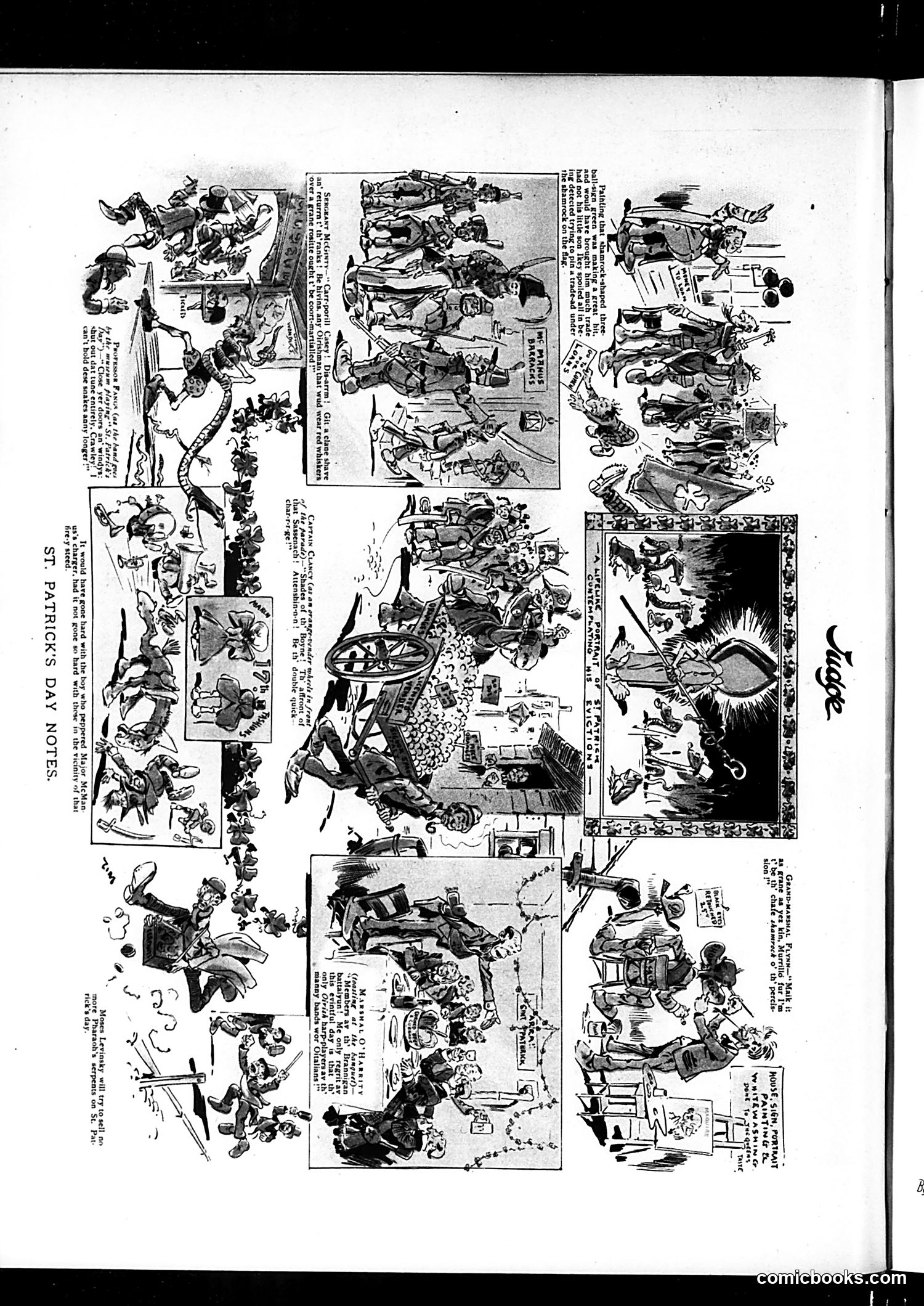
This page contains multiple comic panels satirizing St. Patrick's Day celebrations, likely from the early 20th century when Irish immigration to America was substantial. The main narrative involves characters with Irish surnames (Manus, O'Brien) and stereotypical Irish dialect ("as green as yex kin, Murrilid"). One panel appears to depict someone being caught trying to tamper with a shamrock on a flag—suggesting petty mischief or vandalism during St. Patrick's festivities. Another panel references "Moses Levinsky" attempting to sell "Pharaoh's serpents" (a type of novelty firework) on St. Patrick's Day, appearing to mock Jewish merchants capitalizing on Irish holidays. The humor relies on ethnic stereotypes common to the era: Irish characters depicted as rowdy or dishonest, and Jewish characters as opportunistic sellers. The overall tone satirizes how different immigrant communities engaged with—or exploited—St. Patrick's Day celebrations in America.