
A complete issue · 16 pages · 1896
Judge — February 29, 1896
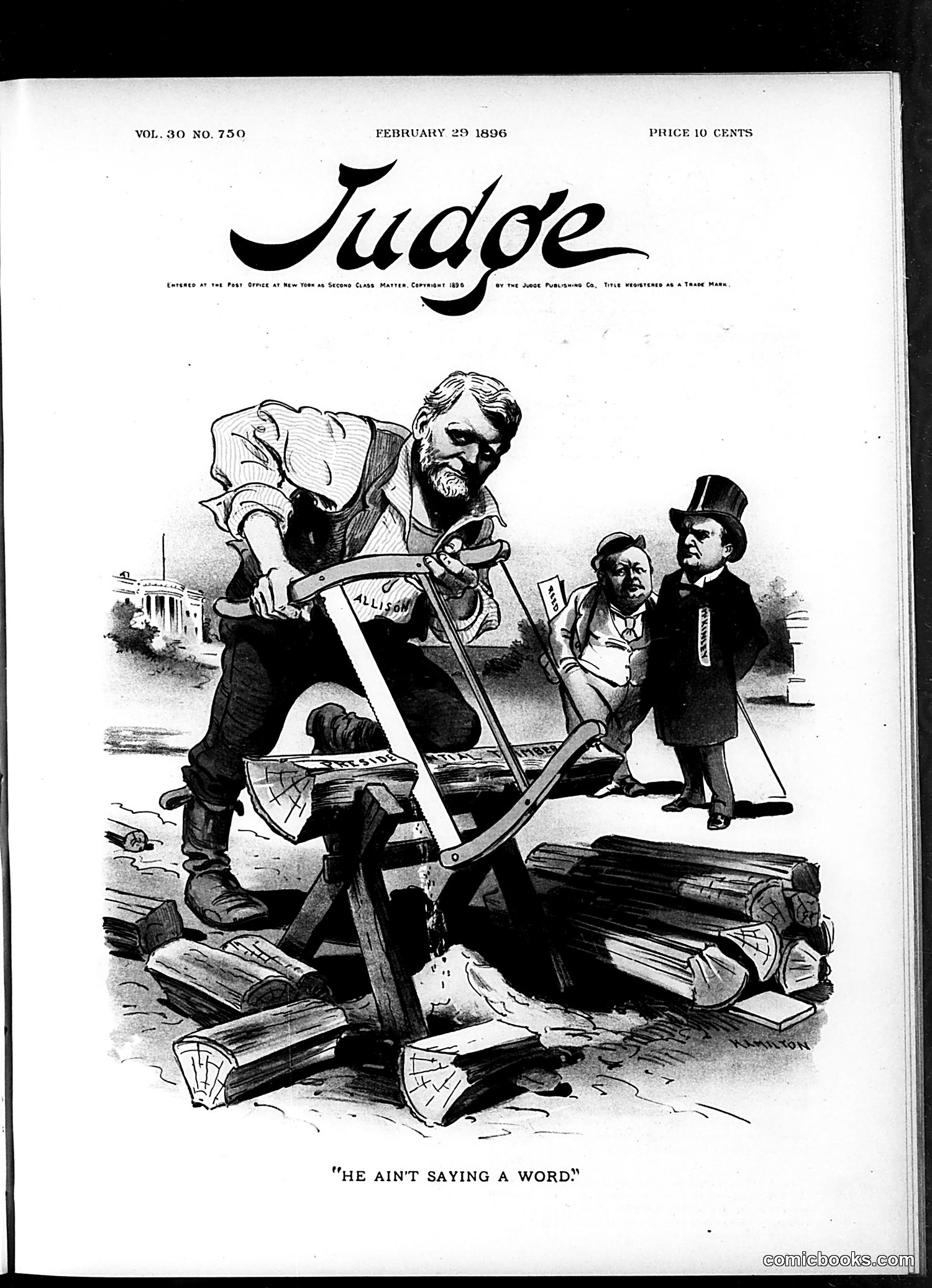
This Judge magazine cover from February 29, 1896 depicts a large bearded man operating a saw, cutting through logs labeled with what appear to be legislative or political items. Two smaller figures in top hats observe him silently. The caption "He Ain't Saying a Word" suggests the central figure is deliberately remaining silent on some political matter, possibly refusing to comment or take a public stance. The cartoon likely comments on a prominent 1896 political figure's silence on a controversial issue. Without identifying markers visible in the image, the exact subject remains unclear, but the satire suggests criticism of this figure's refusal to speak publicly on matters the cartoonist considered important. The labor depicted (sawing/cutting) may reference policy implementation or obstruction.
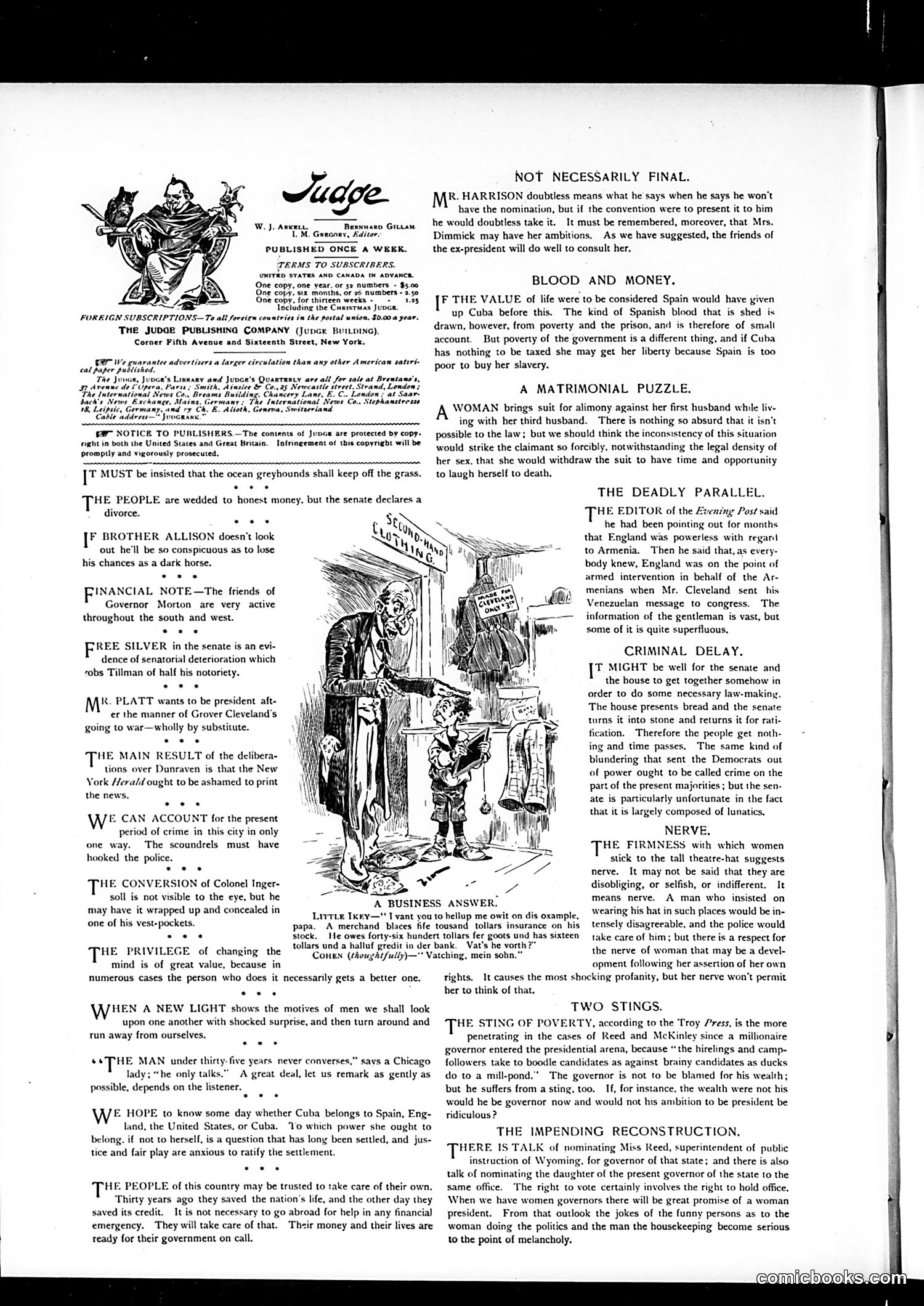
This page contains editorial commentary rather than primary cartoons. The main illustration depicts a cluttered tenement or poor urban dwelling, satirizing poverty and housing conditions. The editorials address contemporary issues: Cuban independence (Spain's poverty prevents fair treatment of colonies), women's suffrage and property rights in marriage ("A Matrimonial Puzzle"), Senate delays in law-making ("Criminal Delay"), and police/theater conduct ("Nerve"). One section mocks a Chicago lady's boast about her wealth, suggesting class pretension as humor. Another critiques Governor Cleveland's war policies and Colonel Ingersoll's visibility in politics. "The Sting of Poverty" comments on presidential campaign spending by wealthy donors like Reed and McKinley, questioning whether millionaires should influence elections. The overall tone is Progressive-era social criticism targeting political inefficiency, class inequality, and corruption.
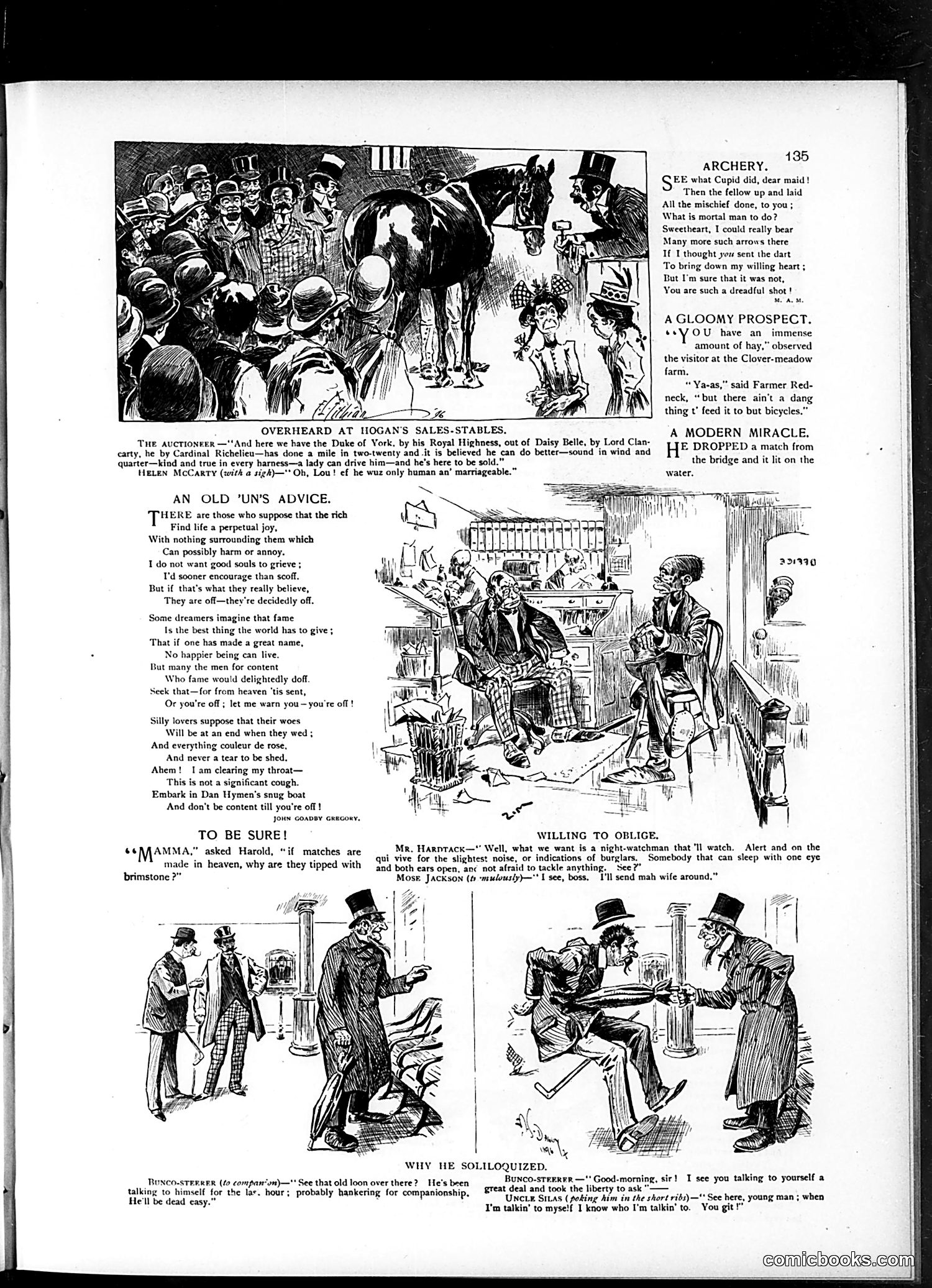
This page contains several unrelated satirical pieces typical of Judge's format. The top section "Overheard at Hogan's Sales-Stables" depicts an auction scene with horses and buyers, likely satirizing the horse market or auction culture of the era. "A Modern Miracle" and other sections appear to be brief humorous anecdotes about everyday situations—a dropped match, bicycles, and night-watchmen duties. The bottom cartoons titled "Why He Soliloquized" and "Willing to Oblige" show gentlemen in top hats in various social situations, presenting humor through dialogue about mundane circumstances (matching brims on brimstones, night-watchman duties). Without clearer historical context or identifiable public figures, the specific satirical targets remain unclear, though the pieces reflect period humor about social classes, commerce, and urban life.
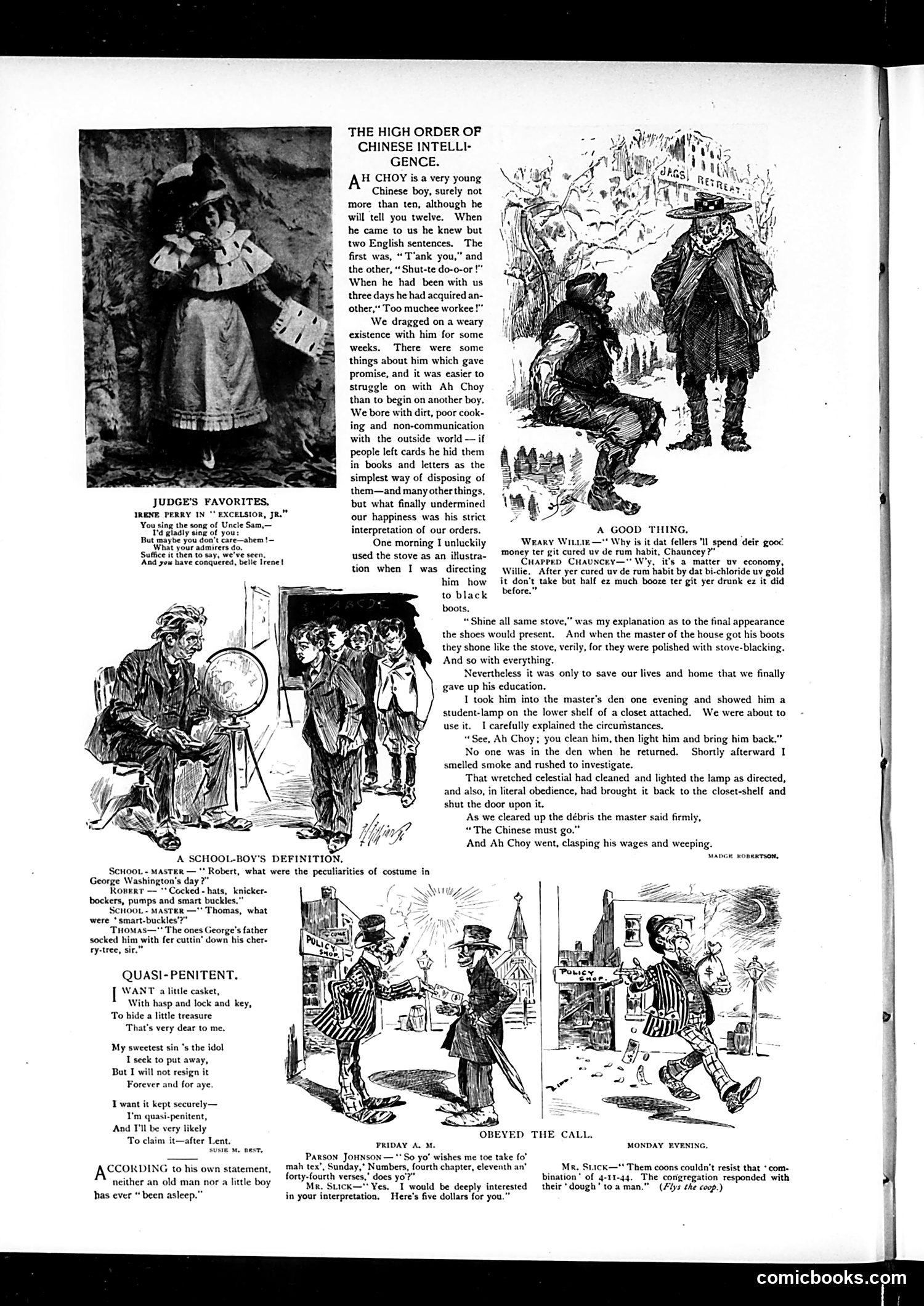
This Judge magazine page contains three separate satirical pieces: **"The High Order of Chinese Intelligence"** is a lengthy anecdote mocking a young Chinese servant boy named Ah Choy. The satire targets his literal-minded obedience: when instructed to "shine" boots "like the stove," he polishes them with stove-blacking; when told to clean and light a lamp and "bring him back," he places a lit lamp inside a closed closet, nearly burning down the house. The piece stereotypes Chinese immigrants as intellectually deficient while simultaneously suggesting their dangerous incompetence as household workers—reflecting late-19th-century xenophobic attitudes. **"A Good Thing"** and **"Obeyed the Call"** use racist dialect humor featuring African American characters discussing alcohol and religion, employing the offensive speech patterns typical of period "coon" humor in American magazines. The smaller items are standard magazine filler: theatrical praise, verse, and school-boy jokes. The overall page reflects Judge's reliance on ethnic and racial stereotypes for comedic effect—content that would be considered grossly offensive today.
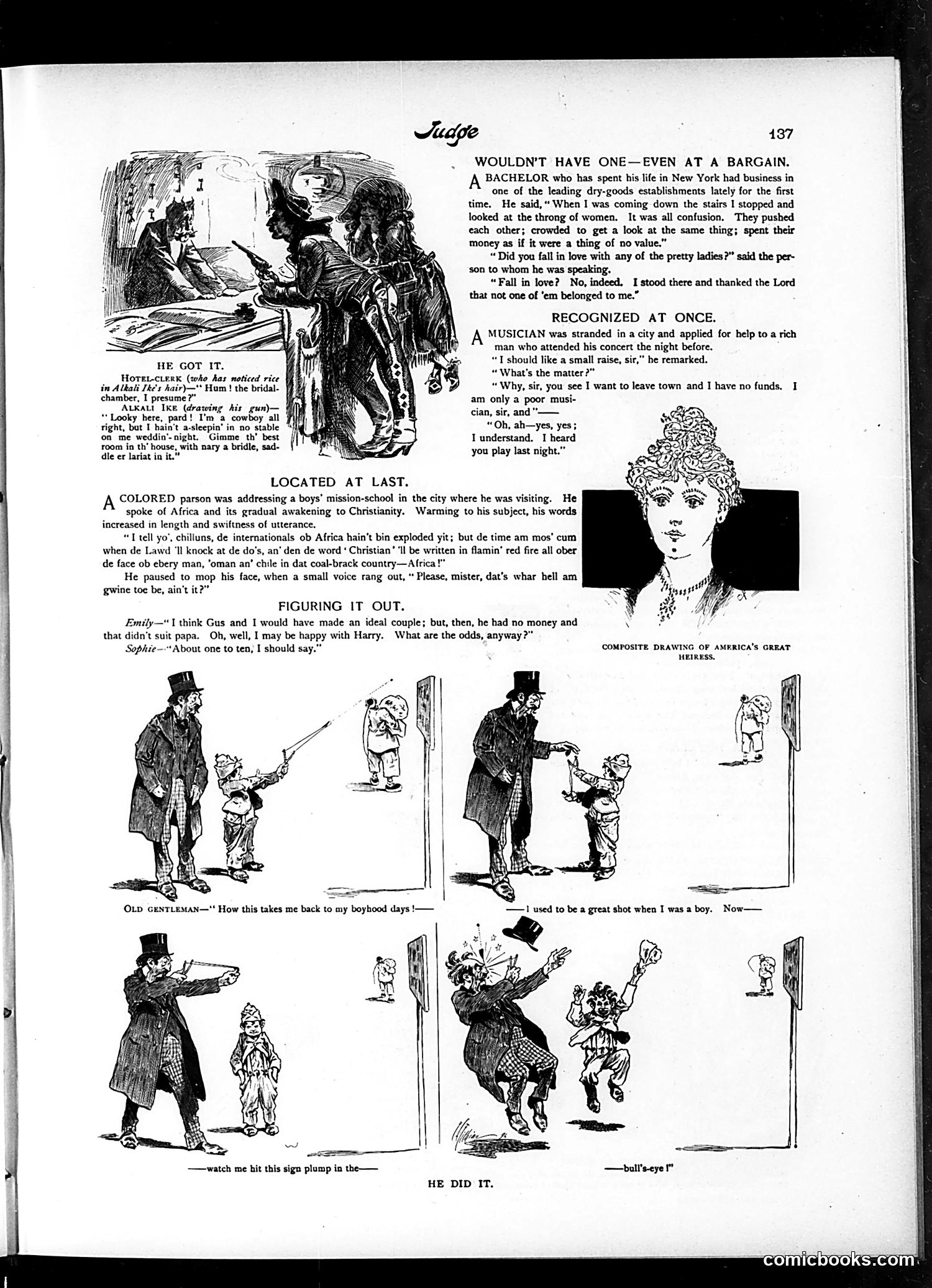
This page contains five satirical vignettes typical of Judge's humor: 1. **"Wouldn't Have One"**: Mocks women shoppers as irrational, confused crowds who waste money without thinking—reflecting period anxieties about female consumerism and independence. 2. **"Recognized at Once"**: A musician asks a wealthy patron for travel funds after performing poorly the night before. The joke is the patron's backhanded "recognition"—he attended but remembers only the bad performance. 3. **"He Got It"**: "Alkali Ike," a cowboy stereotype, insists on proper accommodations rather than stable sleeping on his wedding night—crude humor about rural/working-class masculinity. 4. **"Located at Last"**: A Black preacher addresses schoolchildren using exaggerated dialect, describing Africa's Christian "awakening." A child innocently asks if that's where hell is—mocking both the preacher's grandiose rhetoric and missionary fervor. 5. **"Figuring It Out"** and **"He Did It"**: Brief scenes about an elderly gentleman's marksmanship, likely nostalgia-based humor. The page reflects period racial stereotypes and gender anxieties common to turn-of-century American satire.
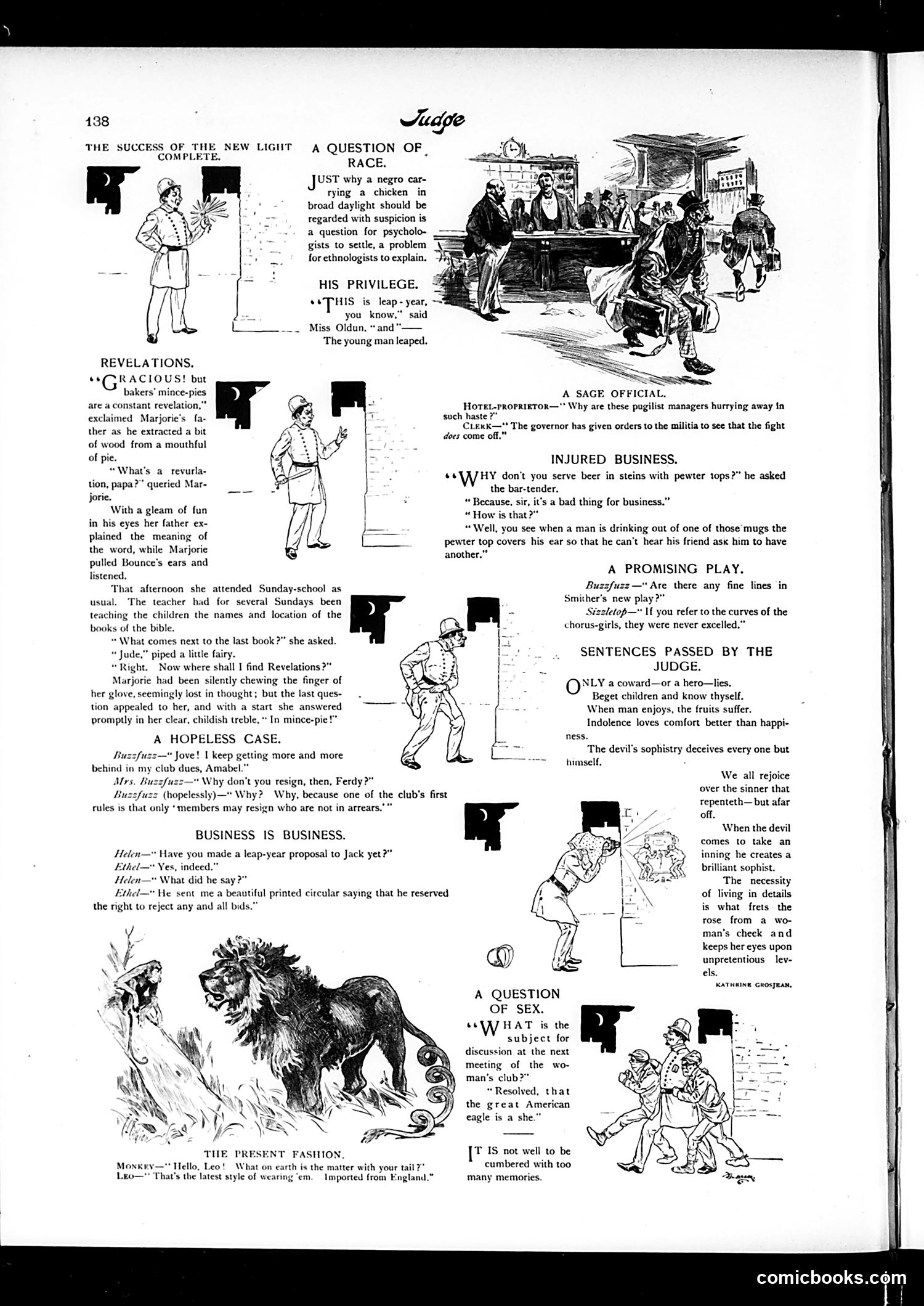
This page contains multiple brief satirical pieces typical of Judge magazine's style: **"A Question of Race"** mocks racial prejudice by sarcastically noting that suspecting a Black man of theft simply for carrying a chicken in daylight is a matter requiring psychological and ethnological explanation—obvious satire of baseless racism. **"His Privilege"** plays on the leap-year tradition where women could propose to men; the young man's enthusiastic leap is the punchline. **"Revelations"** is a children's joke: a father explains "revelation" to his daughter using a mince pie containing wood; she later answers that "Revelations" (the Bible book) can be found "in mince-pie"—confusing the word's multiple meanings. Other pieces include bar humor about pewter-topped beer steins, theater criticism, and satirical "sentences" on morality and human nature. The tone throughout is light, domestic humor aimed at middle-class readers, with occasional jabs at social pretension and behavior.
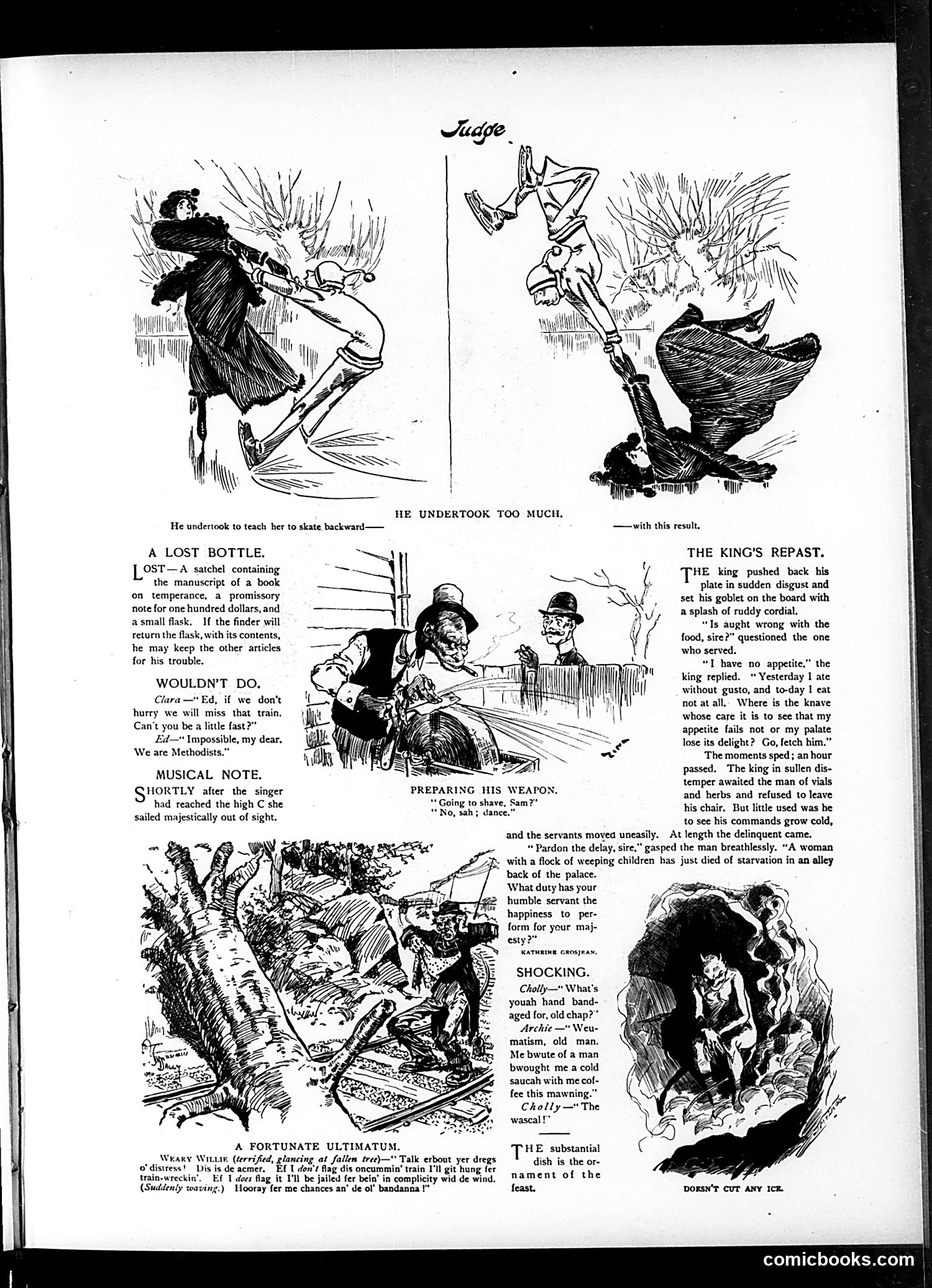
This page contains multiple satirical short comics and jokes typical of late 19th/early 20th-century humor: **"A Lost Bottle"** mocks temperance advocates by presenting someone willing to lose valuable items (money, manuscript) just to recover an alcohol flask—satirizing the contradiction between preaching sobriety and actual behavior. **"Wouldn't Do"** jokes about Methodist strictness regarding speed/worldliness through a couple's dating mishap. **"The King's Repast"** offers social commentary: a wealthy king suffers from appetite loss while a servant reports a woman starving to death outside the palace. The juxtaposition critiques indifference to poverty among the privileged classes. **"Shocking"** and other brief jokes play on class affectations and minor social embarrassments among the wealthy ("Cholly," "Archie"). **"A Fortunate Ultimatum"** features "Weary Willie," a stock tramp character, facing execution either way—typical vagabond humor of the era. The cartoons reflect Judge's satirical approach to contemporary social issues: temperance hypocrisy, class inequality, and working-class struggles.
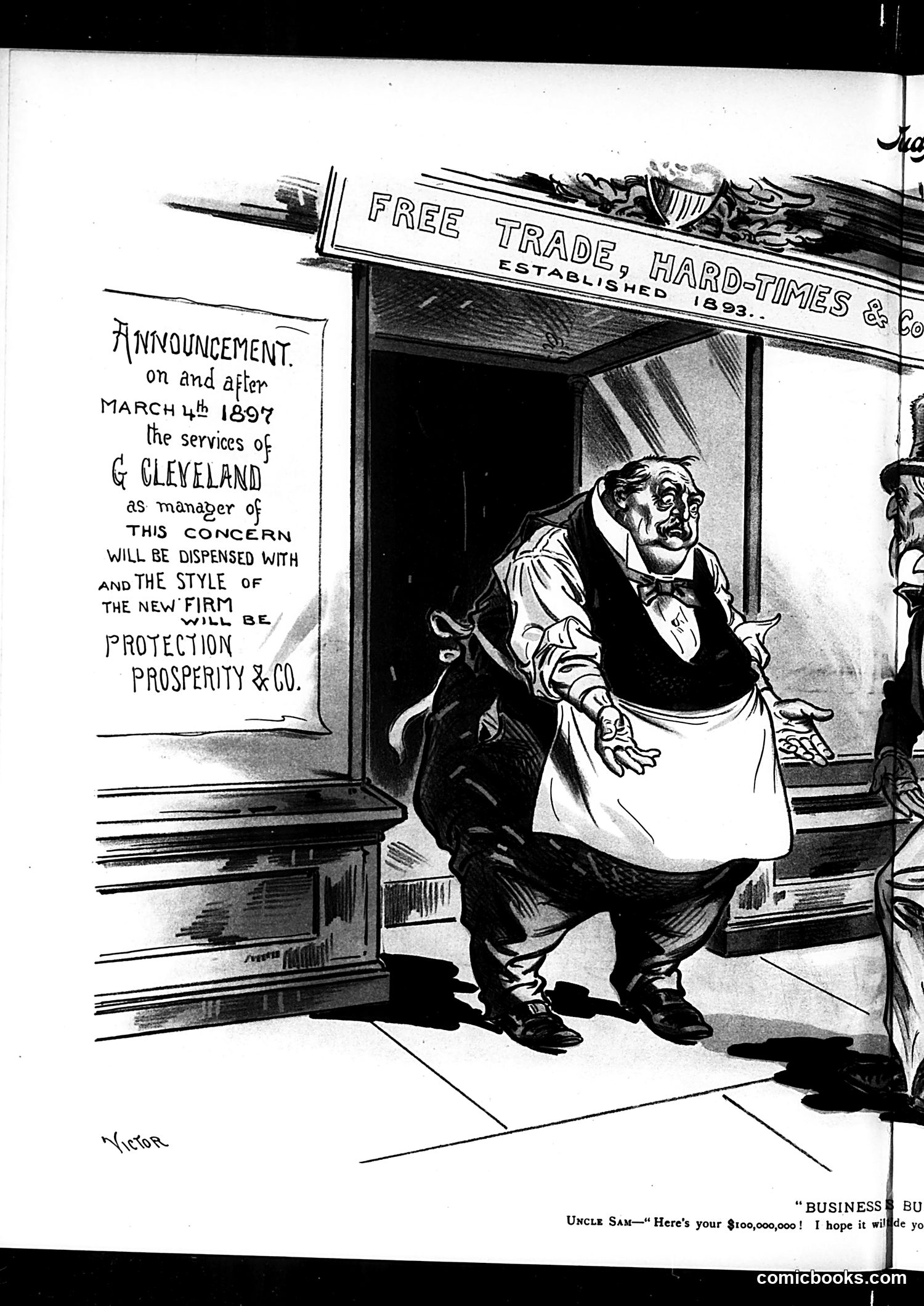
This 1897 cartoon satirizes a business management change. The announcement states that G. Cleveland's services as manager will be "dispensed with," replaced by a new firm called "Protection Prosperity & Co." The caricatured figure emerging from the storefront appears to represent Cleveland being removed from his managerial position. The joke targets Cleveland's economic policies—specifically his support for free trade, as evidenced by the "Free Trade, Hard-Times & Co." sign visible on the building behind him. The cartoon criticizes Cleveland's administration for economic hardship, suggesting that protectionist policies (represented by the incoming "Protection Prosperity" firm) would be better for American business and prosperity. This reflects the late-1890s political debate between free-trade Democrats and protectionist Republicans over tariff policy and its effects on the economy.
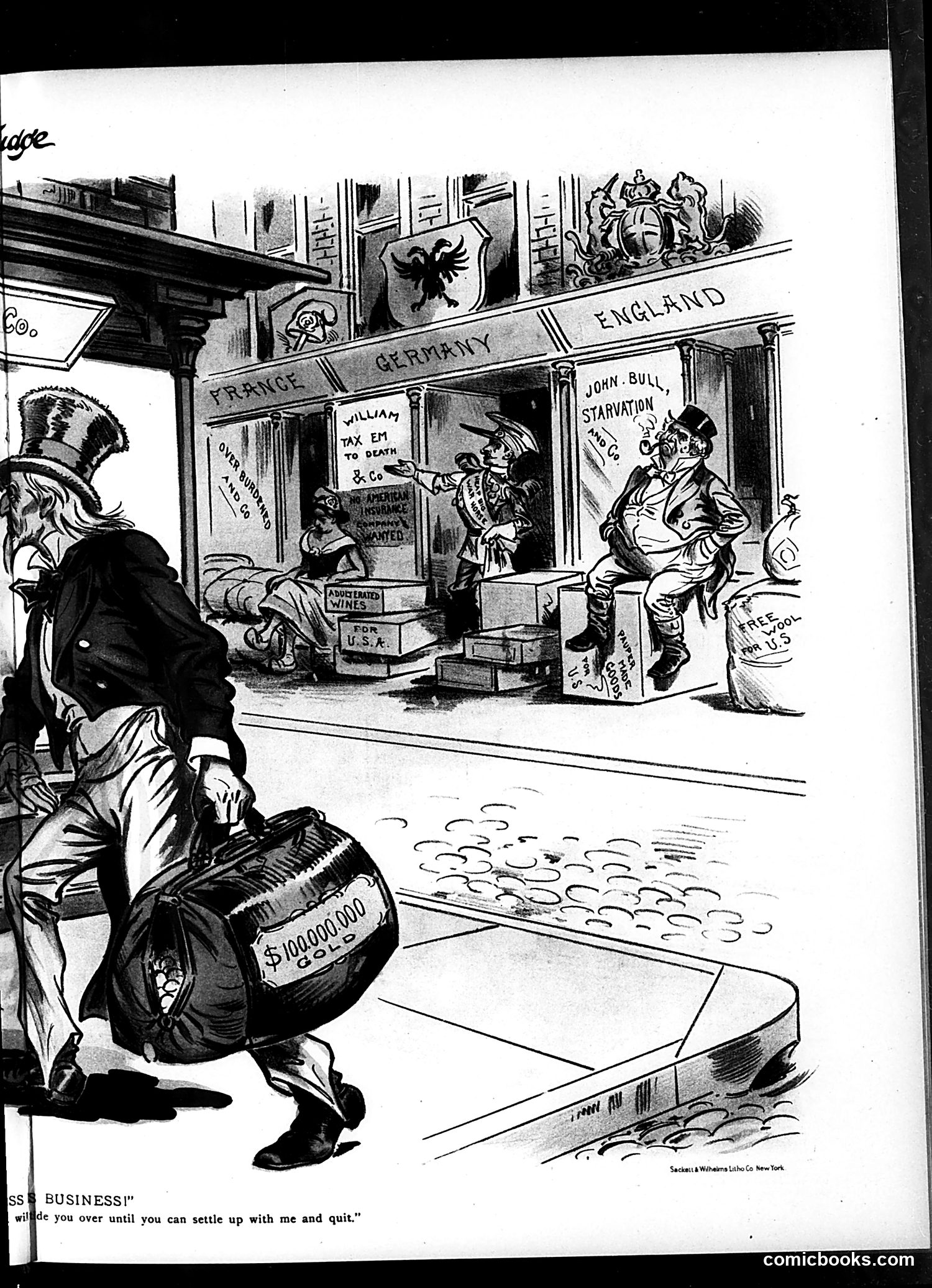
This Judge magazine cartoon satirizes World War I-era international finance and war profiteering. The central storefront displays signs reading "FRANCE," "GERMANY," and "ENGLAND," with references to "JOHN BULL" (Britain's personification) experiencing "STARVATION" and "BLOCKADE." A figure representing the U.S. (left, carrying a "$100,000,000 GOLD" bag) observes European nations conducting commerce amid war's devastation. The cartoon critiques American financial involvement in the conflict—specifically lending money to Allied nations while maintaining ostensible neutrality. The caption "will tide you over until you can settle up with me and quit" suggests the U.S. is essentially financing European warfare, positioning itself as a creditor rather than neutral party. The visual contrast between America's wealth and Europe's suffering underscores contemporary anxieties about profiteering from others' conflicts.
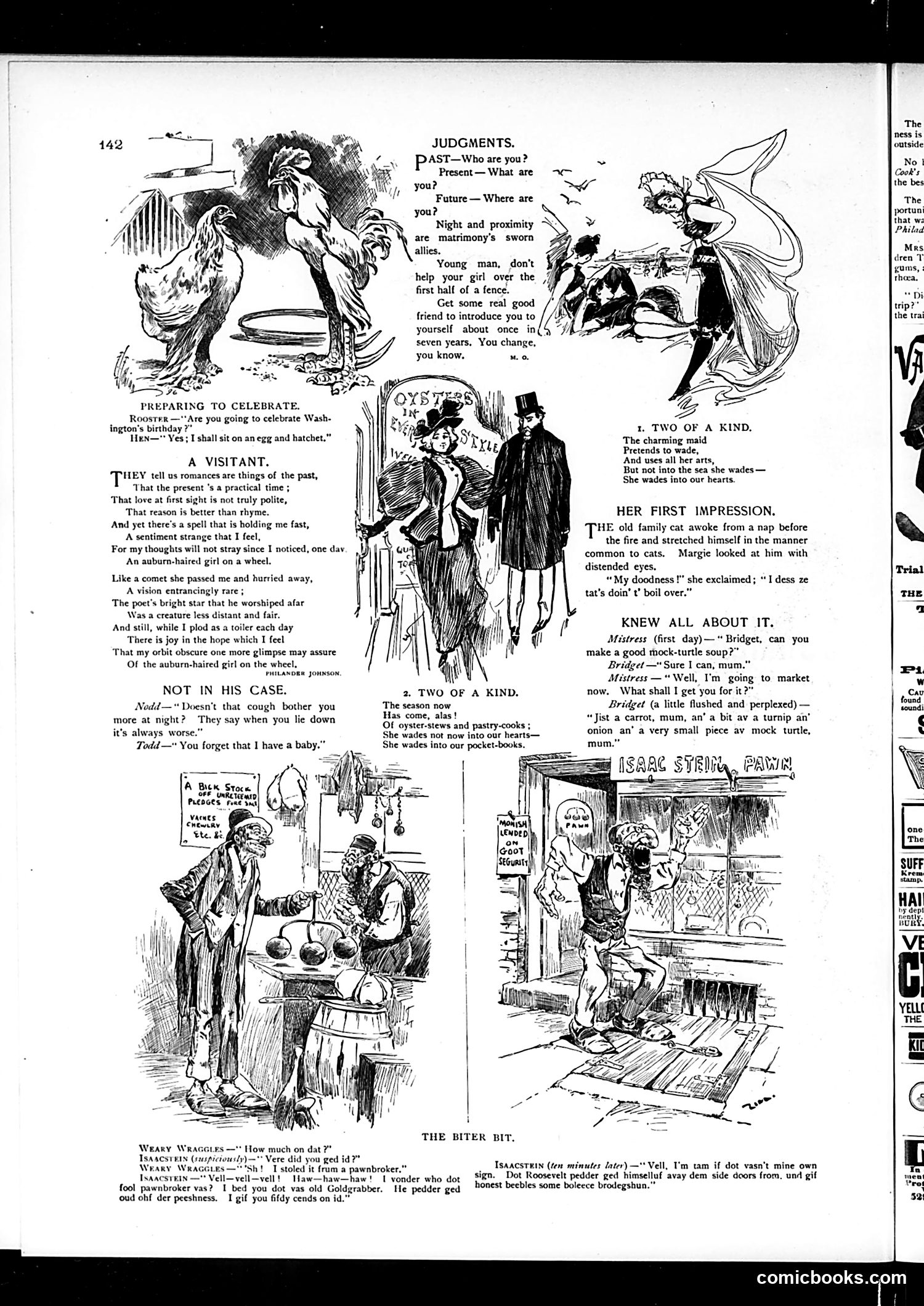
This page contains several humorous sketches typical of Judge's satirical style, primarily poking fun at social conventions and relationships. **"Judgments"** at top offers cynical observations about romance and courtship—advising young men not to help girls over fences (implying impropriety) and suggesting people need reintroduction to themselves after seven years. **"The Auburn-Haired Girl on the Wheel"** romanticizes a woman on a bicycle, reflecting contemporary fascination with this new "modern woman" technology. **"Her First Impression"** presents a child's malapropism—mistaking a stretching cat for something boiling, typical light comedy. **"Knew All About It"** satirizes servants' (likely Irish immigrant) resourcefulness—a maid confidently makes mock-turtle soup from scraps, turning her mistress's shopping list into improvisation. **"The Biter Bit"** features Jewish caricatures (Isaacstein, Weary Wragles) in a pawnbroking scheme gone wrong—contemporary ethnic humor typical of Judge's era. Overall, the page reflects Gilded Age social satire: courtship anxieties, servant cleverness, and ethnic stereotyping common to late-19th/early-20th-century American humor.
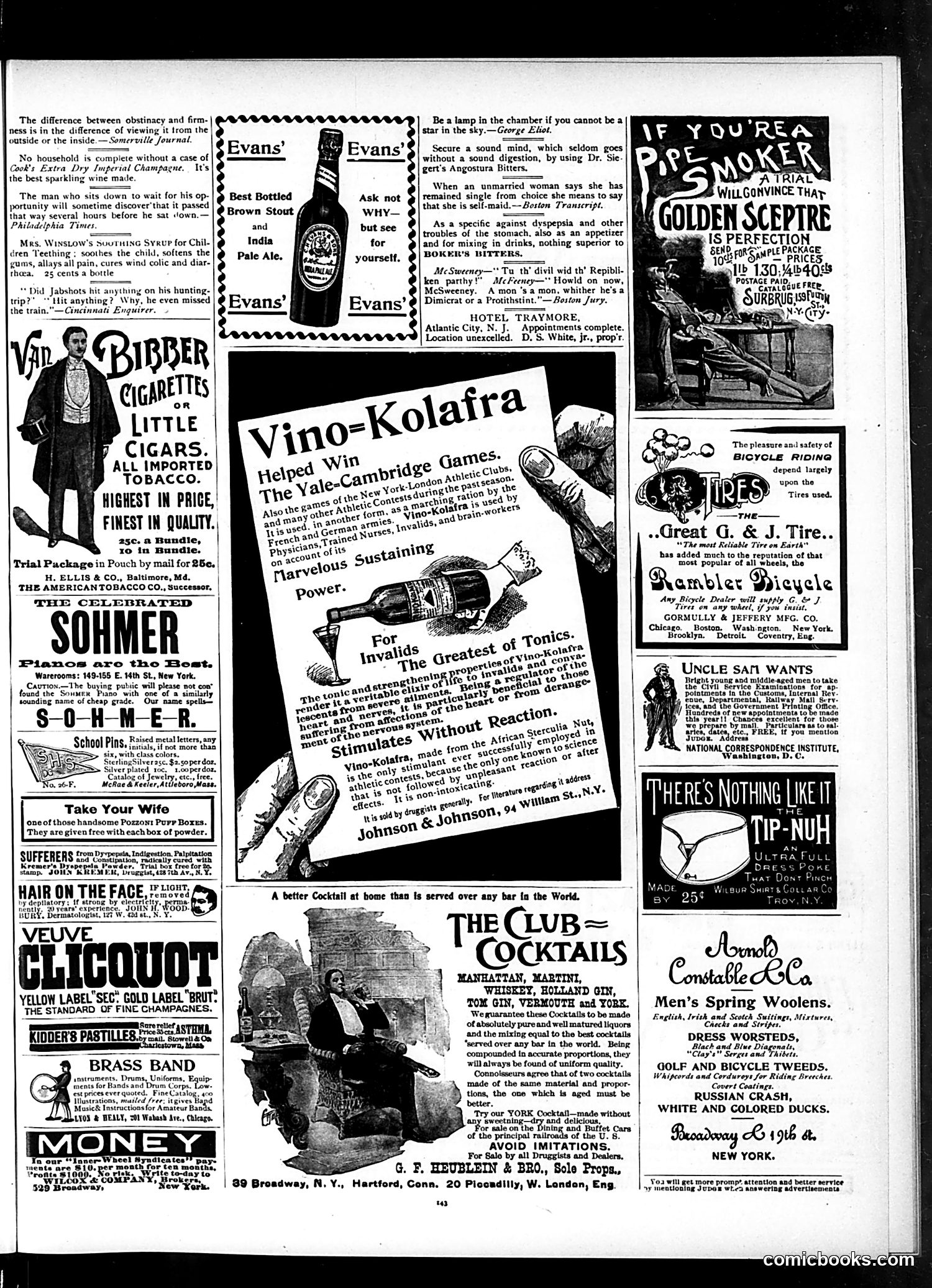
This page is primarily **advertising**, with small joke fragments scattered throughout. The central large advertisement is for **Vino-Kolafra**, a patent medicine claiming to help athletes win the Yale-Cambridge Games by providing "marvelous sustaining power" and being "the greatest of tonics" for invalids—without reaction or intoxication. The page contains numerous period product ads (champagne, cigars, pianos, bitters, patent medicines) and small jokes typical of Judge magazine's format. One joke involves characters McSweeney and McFeeney debating Republican versus Democratic party loyalty—a generic ethnic-dialect humor common to the era. The ads reflect late 19th/early 20th-century concerns: digestive ailments (dyspepsia), patent tonics, and bicycle safety. No specific political cartoons or caricatures of identifiable public figures appear on this page. It's a standard advertising/filler page from the magazine.
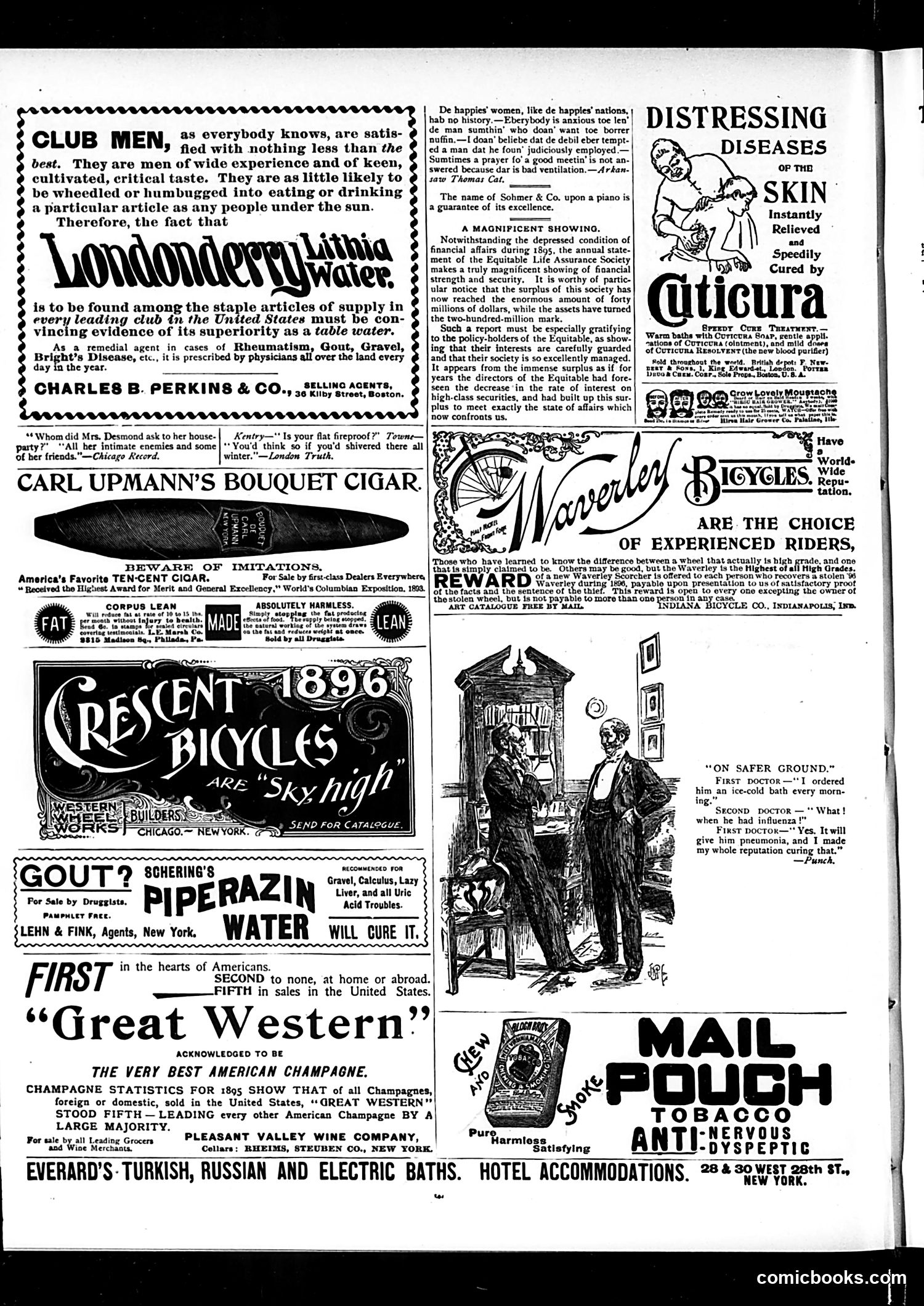
This page is primarily **advertising**, typical of 1890s magazines. The cartoons are minimal; the main visual content consists of product advertisements. The one notable satirical element appears in the dialogue snippets interspersed between ads. One quote references a woman inviting "intimate enemies" to her house party—a gentle social satire about insincere upper-class entertaining. The advertisements themselves reveal period attitudes: "Wonderfully Lithia Water" and "Piperazin Water" market themselves as cure-alls for gout, rheumatism, and other ailments—reflecting the era's unfounded faith in mineral waters as panaceas. Cuticura advertises skin treatments, while various luxury goods (cigars, champagne, bicycles) target affluent "club men." The page includes dialect humor (the "Arkansas Thomas Cat" quotation using stereotypical African American speech), which was common in 1890s humor but reflects problematic racial attitudes of the period. Overall, this is a **typical late-Victorian advertising page** with minimal satire—mostly promotional content targeting wealthy consumers.
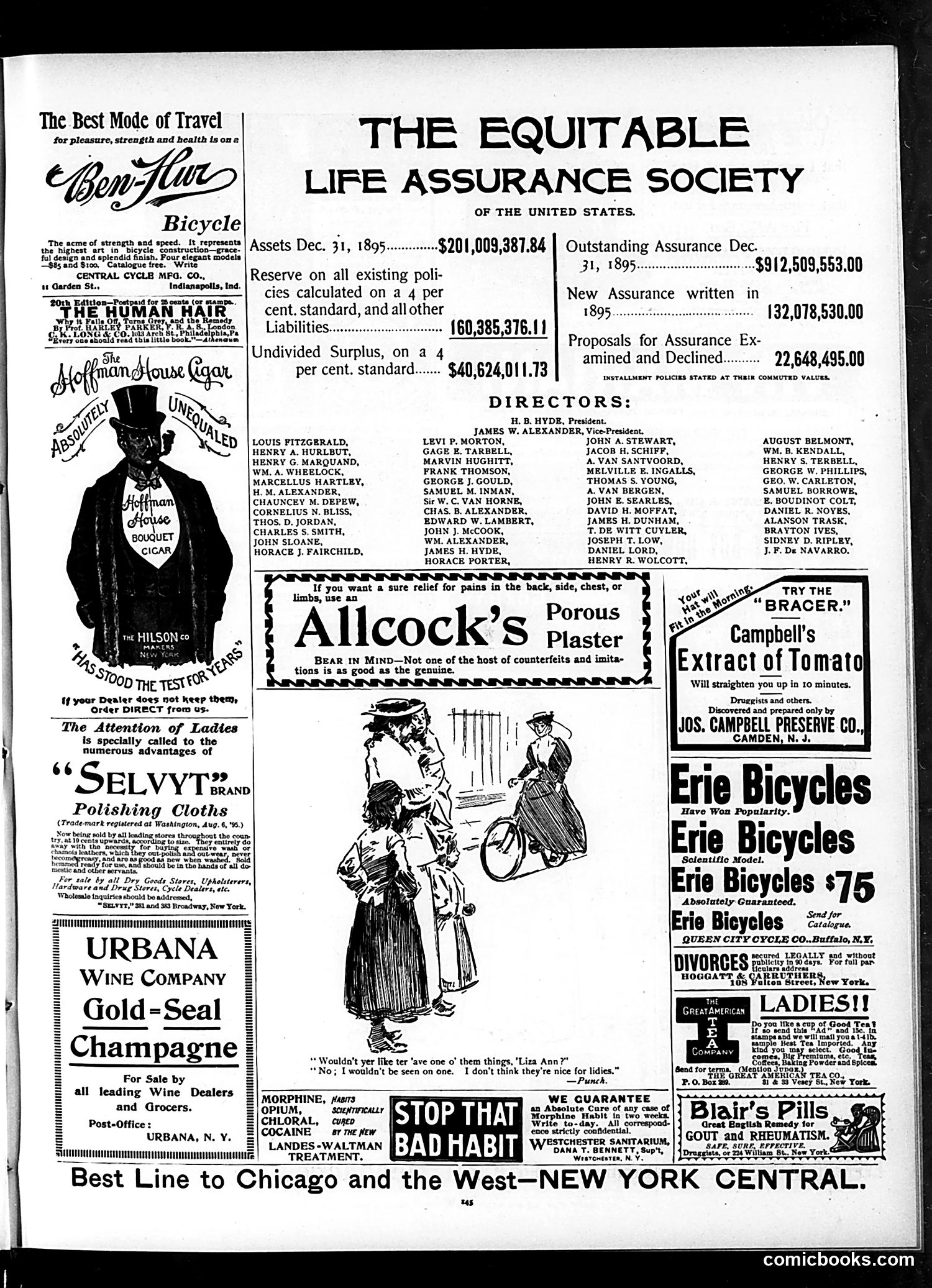
This page is primarily a **financial statement and advertisement compilation**, not a satirical cartoon page. The central content features **The Equitable Life Assurance Society's** 1895 financial report, listing substantial assets ($201 million) and notable directors—prominent industrialists and financiers of the era (Vanderbilt, Morgan associates, railroad magnates). The surrounding advertisements reveal **late Victorian consumer culture and medical practices**: bicycle manufacturers (common transportation innovations), patent medicines for morphine and opium addiction treatment, Campbell's tomato extract as a health tonic, and wine. The only cartoon element is a small domestic scene showing women discussing bicycles—one remarks she wouldn't ride one because they're "not nice for ladies," reflecting **period gender anxieties** about women's mobility and independence that bicycles symbolized. The "Stop That Bad Habit" advertisement for addiction treatment reflects **widespread 19th-century drug abuse**, with morphine, opium, and cocaine casually advertised as treatable conditions rather than criminal matters.
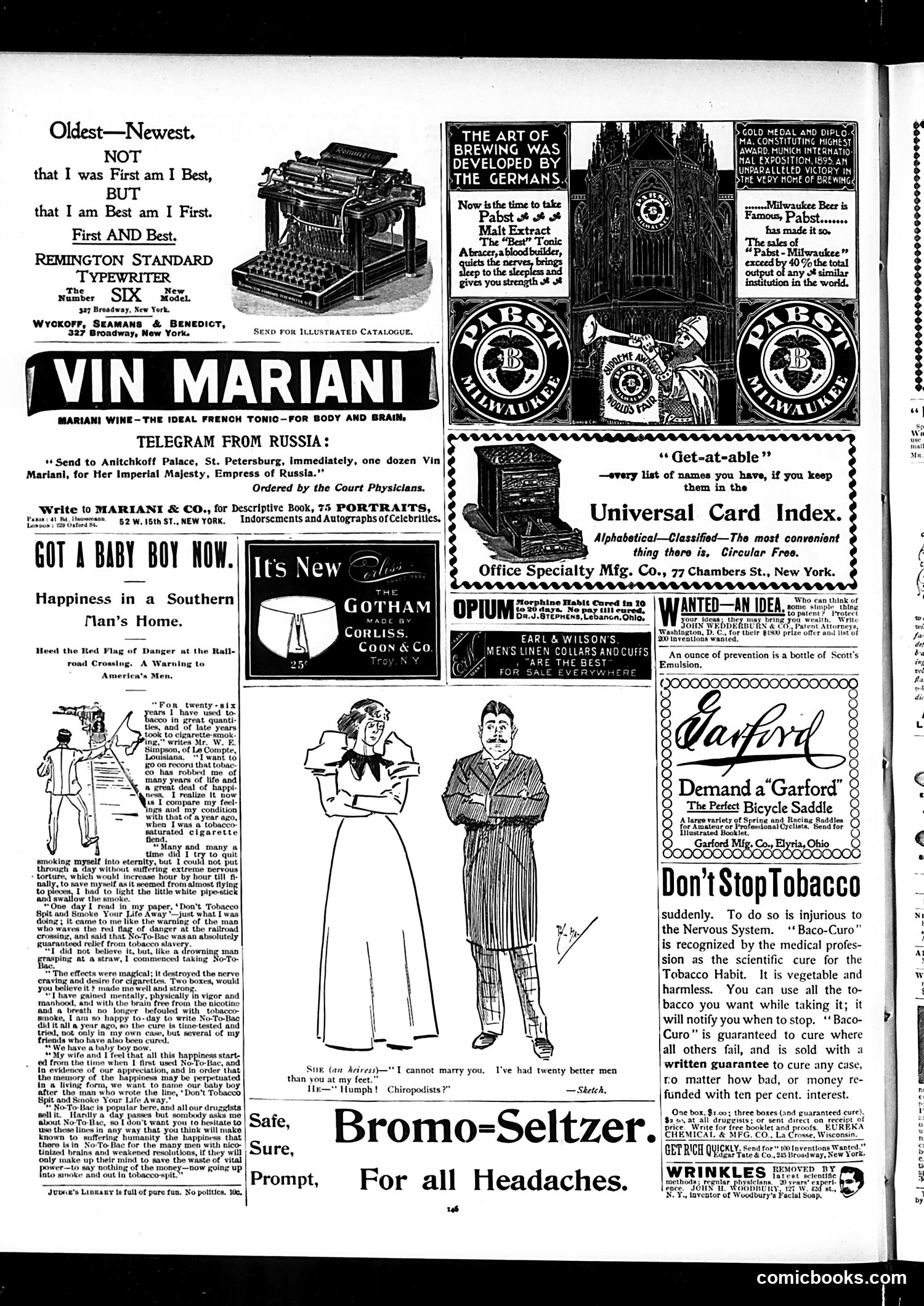
This page consists primarily of **advertisements** rather than political satire, though it reflects early 1900s commercial culture. The main cartoon depicts a woman rejecting a man's marriage proposal, with him responding "Humph! Chiropodists?"—a dated joke implying her "twenty better men" were foot doctors she'd seen professionally, playing on the era's euphemistic language. The ads reveal period concerns: **Vin Mariani** (wine tonic), **Baco-Curo** (tobacco cessation), and various proprietary medicines typical of the unregulated patent-medicine era. The **No-To-Bac** testimonial features a Louisiana man describing tobacco addiction as "slavery" and claiming cure after two boxes—standard hyperbolic marketing. Notable is the **Pabst beer ad** referencing German brewing superiority and Munich awards, and **Remington typewriter** positioning itself as "First AND Best"—both reflecting turn-of-century competitive nationalism and emerging consumer culture. The page demonstrates Judge's revenue model: satirical content subsidized by lucrative advertisement placement targeting middle-class readers.
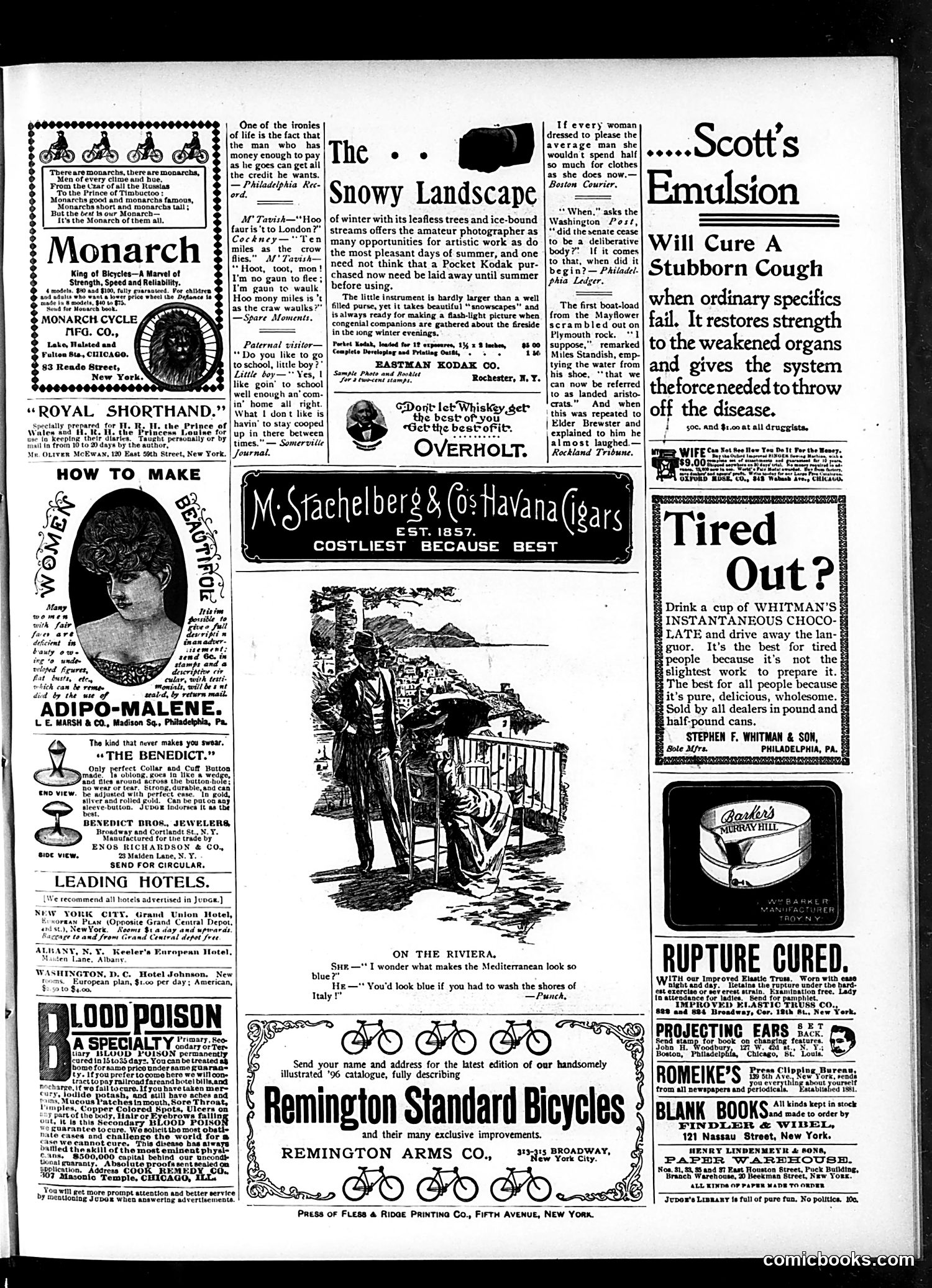
This page is primarily **advertising**, not political satire. It contains numerous product ads from the early 1900s positioned around a central illustration titled "On the Riviera." The main content includes: - **Bicycle advertisements** (Monarch, Remington Standard) — bicycles were then cutting-edge consumer goods - **Medical/patent remedies**: Adipo-Malene (weight loss), "Blood Poison" treatments, rupture cures — reflecting an era of unregulated medical claims - **Fashion/accessories**: collar buttons, jewelry - **Hotels and travel services** The scattered **comic snippets** appear to be filler humor rather than political commentary—puns about Scottish dialect, schoolboys, and Pilgrims. The central illustration shows a romantic scene on the Mediterranean, with accompanying dialogue about travel. This represents Judge magazine functioning as a commercial publication heavily dependent on advertising revenue, with editorial content secondary to product placement. The "satire" of Judge's political mission is largely absent from this particular page.
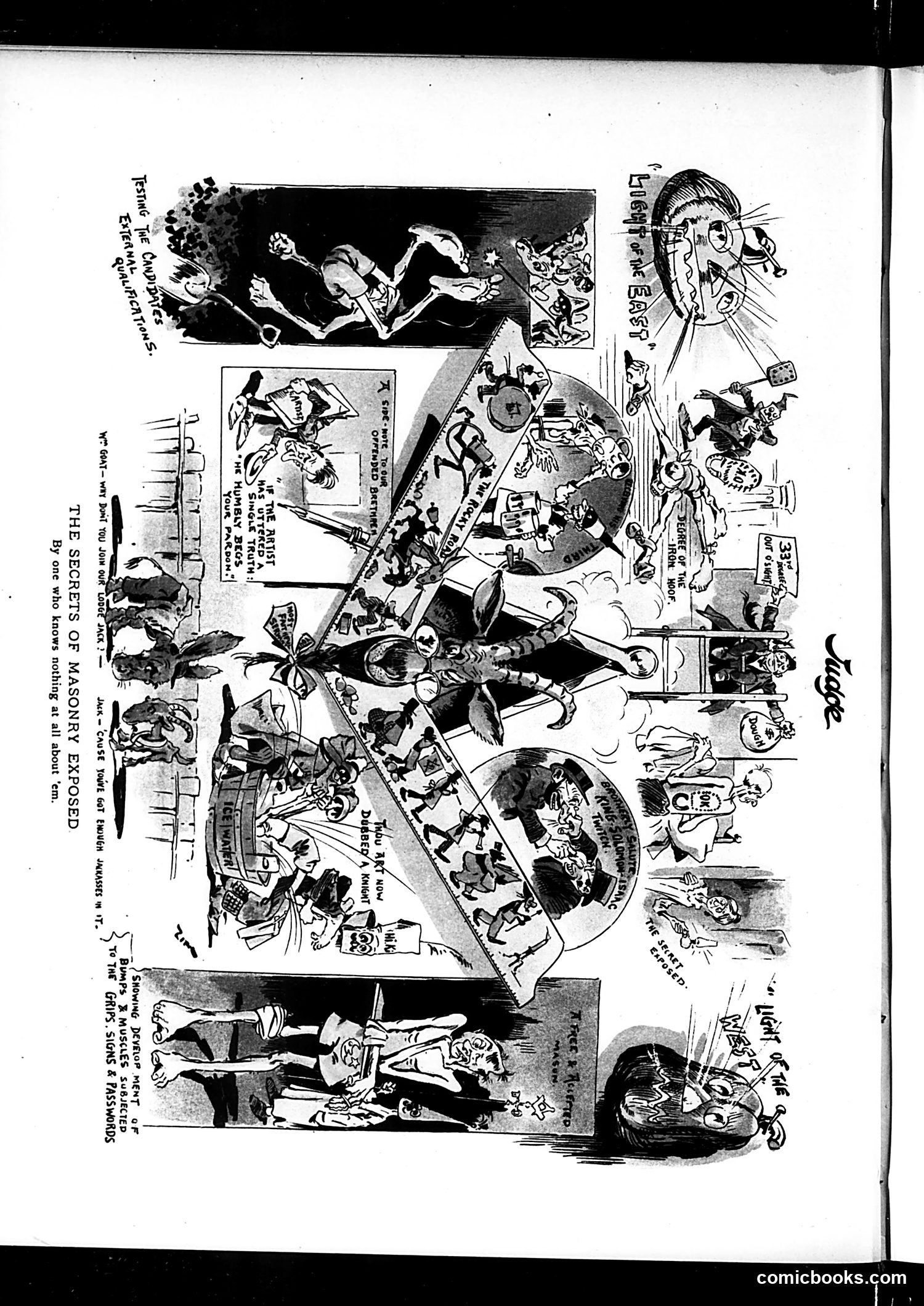
This page satirizes **Freemasonry and fraternal lodge culture**, popular targets for American humor in the late 19th/early 20th century. The main joke centers on a character named Jack rejecting membership in a Masonic lodge. When invited to join, he refuses with the punchline that the lodge already contains "enough jackasses"—a crude but effective insult suggesting lodge members are foolish. The surrounding illustrations mock Masonic rituals and secrecy, parodying the mystique around lodge "grips, signs & passwords" by showing exaggerated physical contortions and "bumps & muscles" supposedly developed through initiation ordeals. The title "Secrets of Masonry Exposed" promises insider revelations but delivers only crude humor. For modern readers: this reflects historical American skepticism toward secretive fraternal organizations, combining class-based mockery with straightforward name-calling—typical satirical tactics of *Judge* magazine.