
A complete issue · 16 pages · 1896
Judge — February 22, 1896
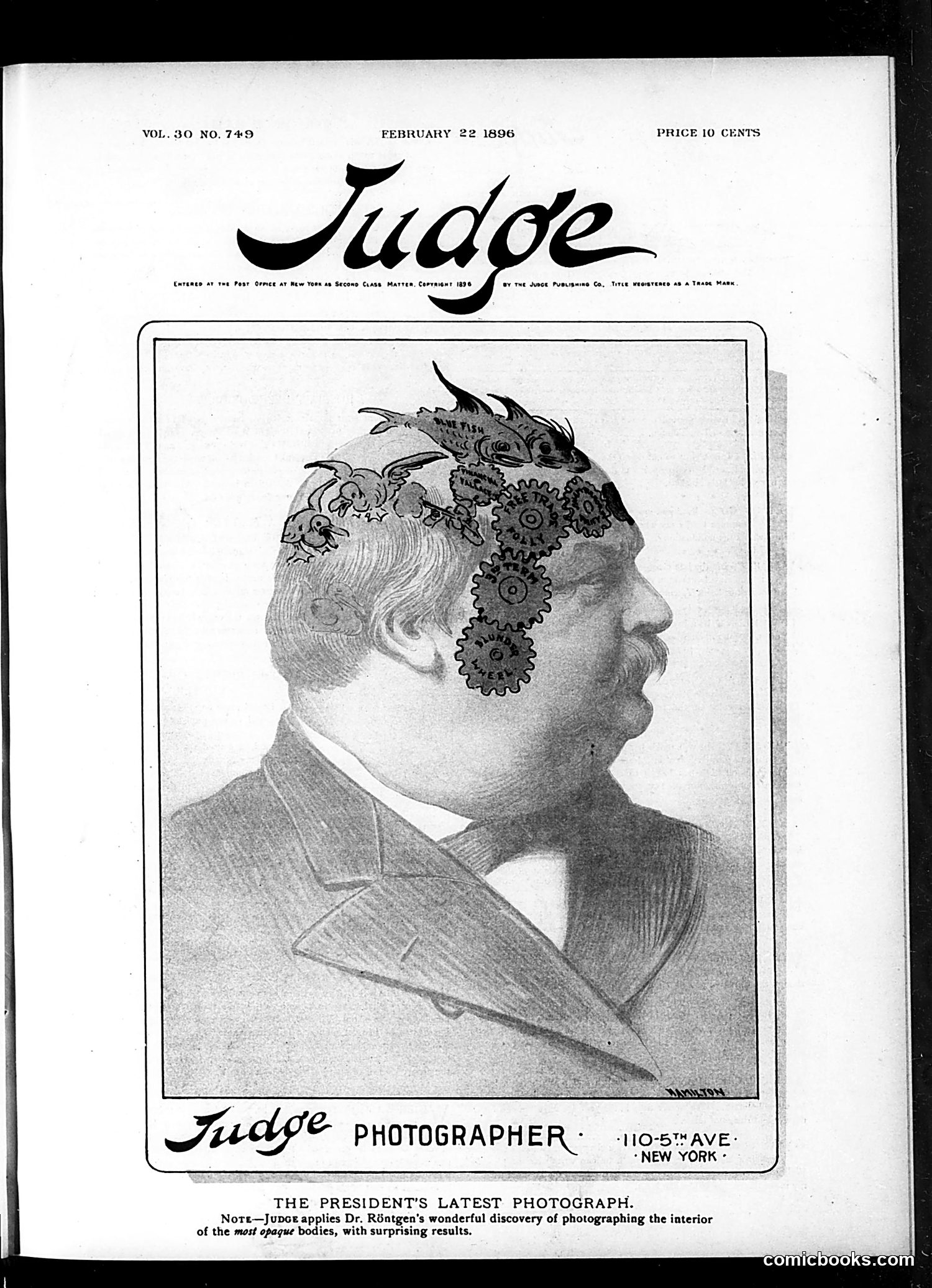
This is a satirical cover from *Judge* magazine (February 22, 1896) mocking a photograph published by the president's photographer. The illustration shows a man's head opened like a machine, filled with gears and mechanical parts instead of a brain, with creatures crawling inside. The caption references "Dr. Rüntgen's wonderful discovery of photographing the interior" — referring to Wilhelm Röntgen's recent X-ray discovery (1895). The satire suggests the president's mind is purely mechanical and devoid of genuine thought or intelligence. The specific president is unclear from this image alone, but the joke ridicules political leadership as intellectually hollow and machine-like, using the novelty of X-ray technology as the comedic vehicle.
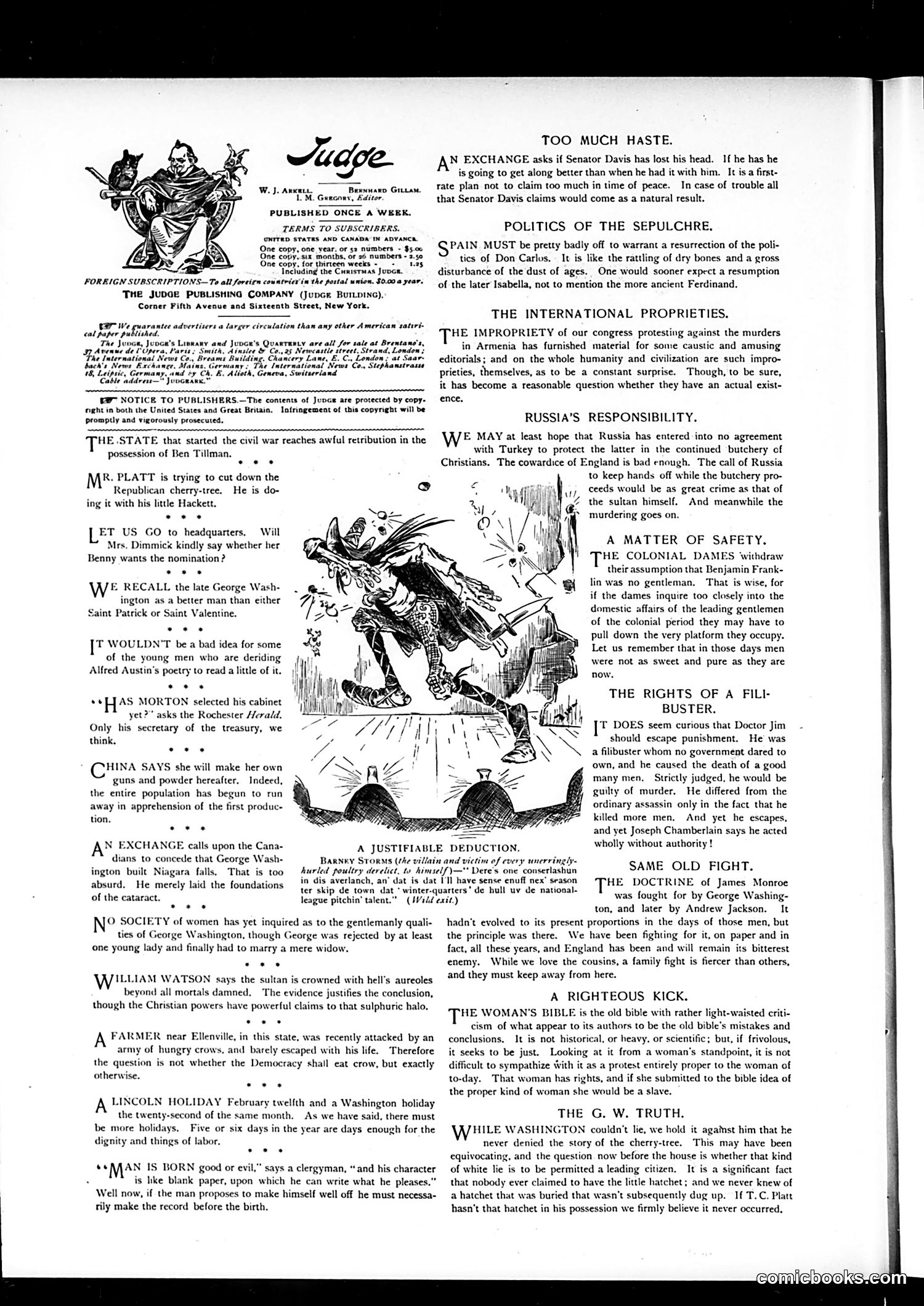
This page contains political commentary and satire from an unspecified date. The central cartoon depicts a figure being thrown or falling violently, likely satirizing a political figure or policy being rejected. Without clearer identification of specific individuals or dated references in the visible text, I cannot definitively identify all figures. However, the various short commentary sections reference contemporary political issues: Senator Davis, Don Carlos (Spanish politics), Benjamin Franklin, and debates about colonial governance and women's rights. The satirical tone criticizes political figures for various failings—broken promises, authoritarian behavior, and hypocrisy. The "Woman's Bible" reference suggests commentary on women's rights debates of the late 19th century. The page appears primarily editorial rather than advertising, using biting humor to critique political decisions and figures of its era.
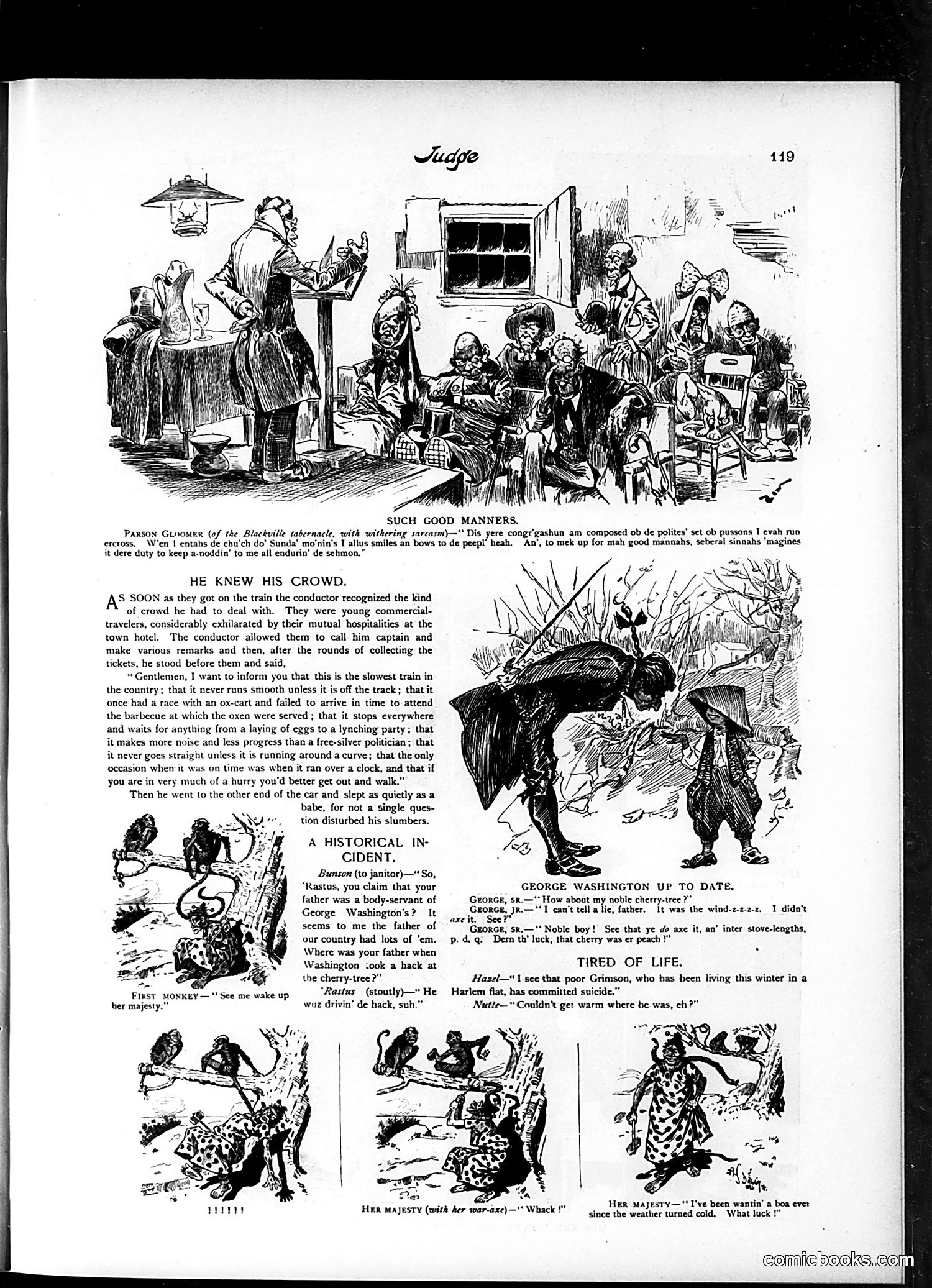
**"Such Good Manners"** (top cartoon): This depicts a crowded scene with poorly behaved passengers at what appears to be a train station or public venue. The caption mocks their lack of decorum—the satire targets working-class or immigrant travelers whose boisterous conduct contrasts sharply with the title's ironic reference to "good manners." This reflects period anxieties about public behavior and social class. **Lower section** contains three separate comic strips featuring what appears to be dialogue between characters about George Washington and complaints about cold weather. The "George Washington Up to Date" segment seems to humorously update historical reference with contemporary concerns. The overall page satirizes social behavior, class distinctions, and the gap between idealized conduct and actual public deportment in early 20th-century America.
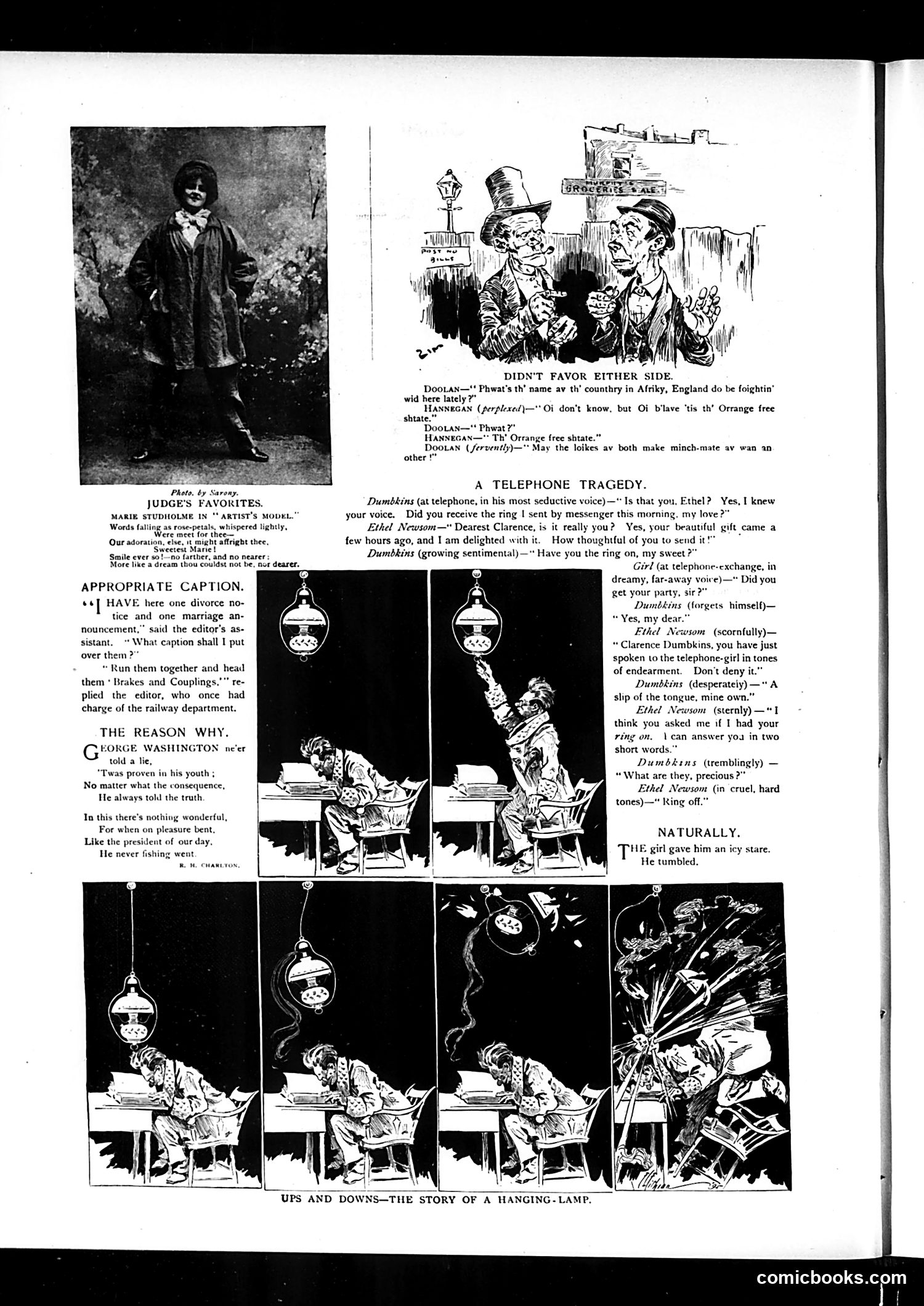
This page contains three distinct pieces of humor: 1. **"Didn't Favor Either Side"** (top cartoon): Two Irish-accented characters (Doolan and Hannegan) discuss the Orange Free State in Africa. The joke plays on their confusion about the Boer War's Orange Free State—one favors neither British nor Boer side, humorously wishing both would "make minch-mate" (fight each other). This satirizes Irish-American attitudes toward the Boer conflict. 2. **"A Telephone Tragedy"** (center): A man (Dumbkins) flirts with a telephone operator while ostensibly speaking to his girlfriend (Ethel). The operator responds to his romantic words, and Ethel discovers the deception via his slip. The punchline—the operator telling him to "Ring off"—satirizes early telephone technology's lack of privacy and men's casual infidelity. 3. **"Ups and Downs"** (bottom): A visual gag showing a hanging lamp's mishaps, with minimal text. The page also includes an actress photo and verse about George Washington's honesty contrasted with contemporary political dishonesty.
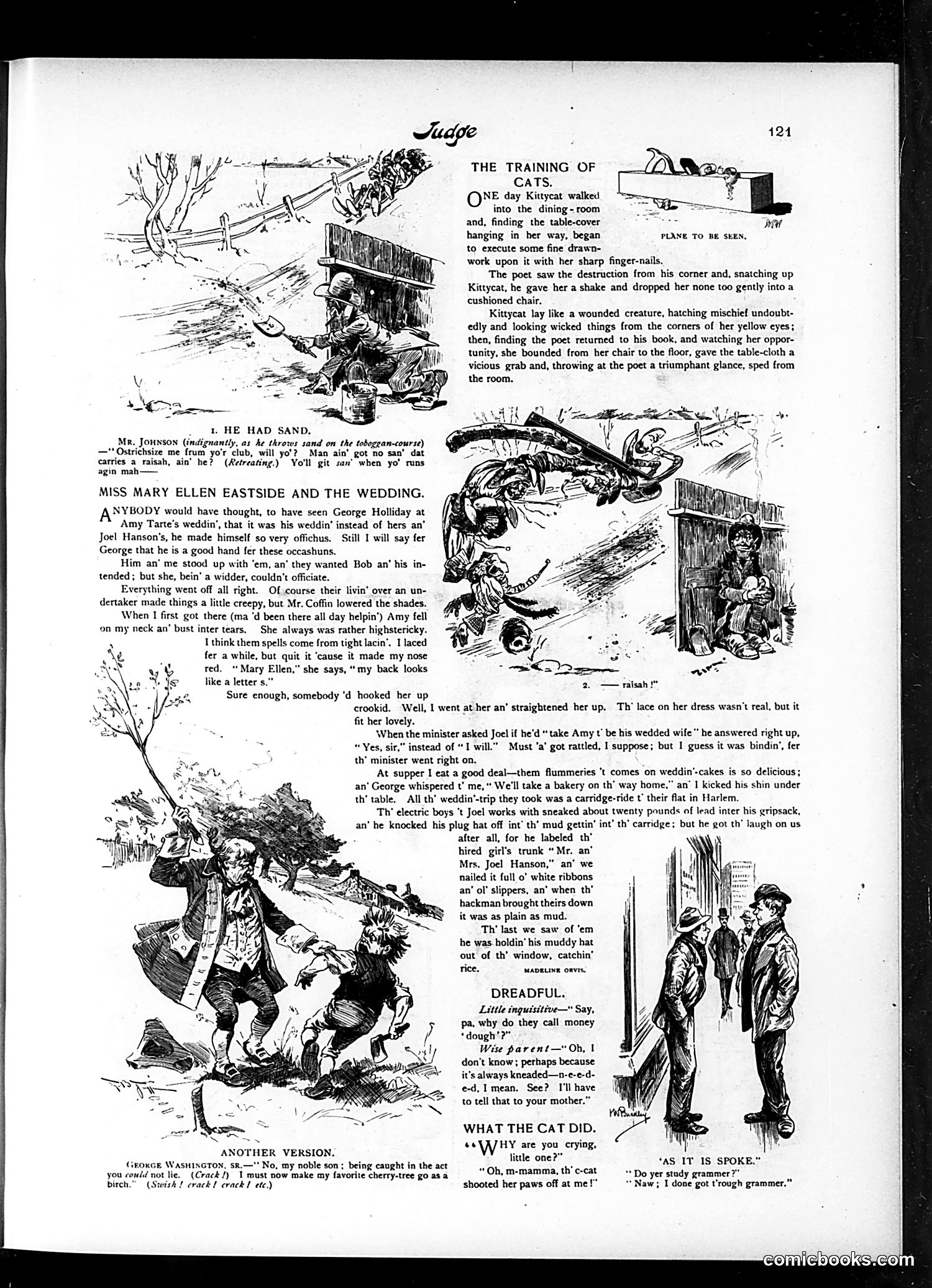
This page contains three distinct humorous pieces typical of early 20th-century American satire: **"The Training of Cats"** uses a cat's mischievous behavior as a mild domestic comedy—the poet punishes the cat for scratching furniture, but the cat defiantly repeats the offense, illustrating the futility of discipline. **"Miss Mary Ellen Eastside and the Wedding"** is a monologue in working-class dialect about a wedding, filled with gentle humor about social awkwardness: a bride's corset is hooked wrong, the groom answers "Yes, sir" instead of "I will," and pranks involving the couple's luggage. **"What the Cat Did"** offers a pun on teaching grammar versus colloquial speech, with a child saying the cat attacked them, illustrating how children mispronounce or misuse language. The page also includes brief joke segments like "Dreadful" (a pun on "dough" needing to be "kneaded") and "Another Version" (riffing on the cherry-tree/Washington myth). These are lighthearted, non-political humor pieces aimed at middle-class American readers.
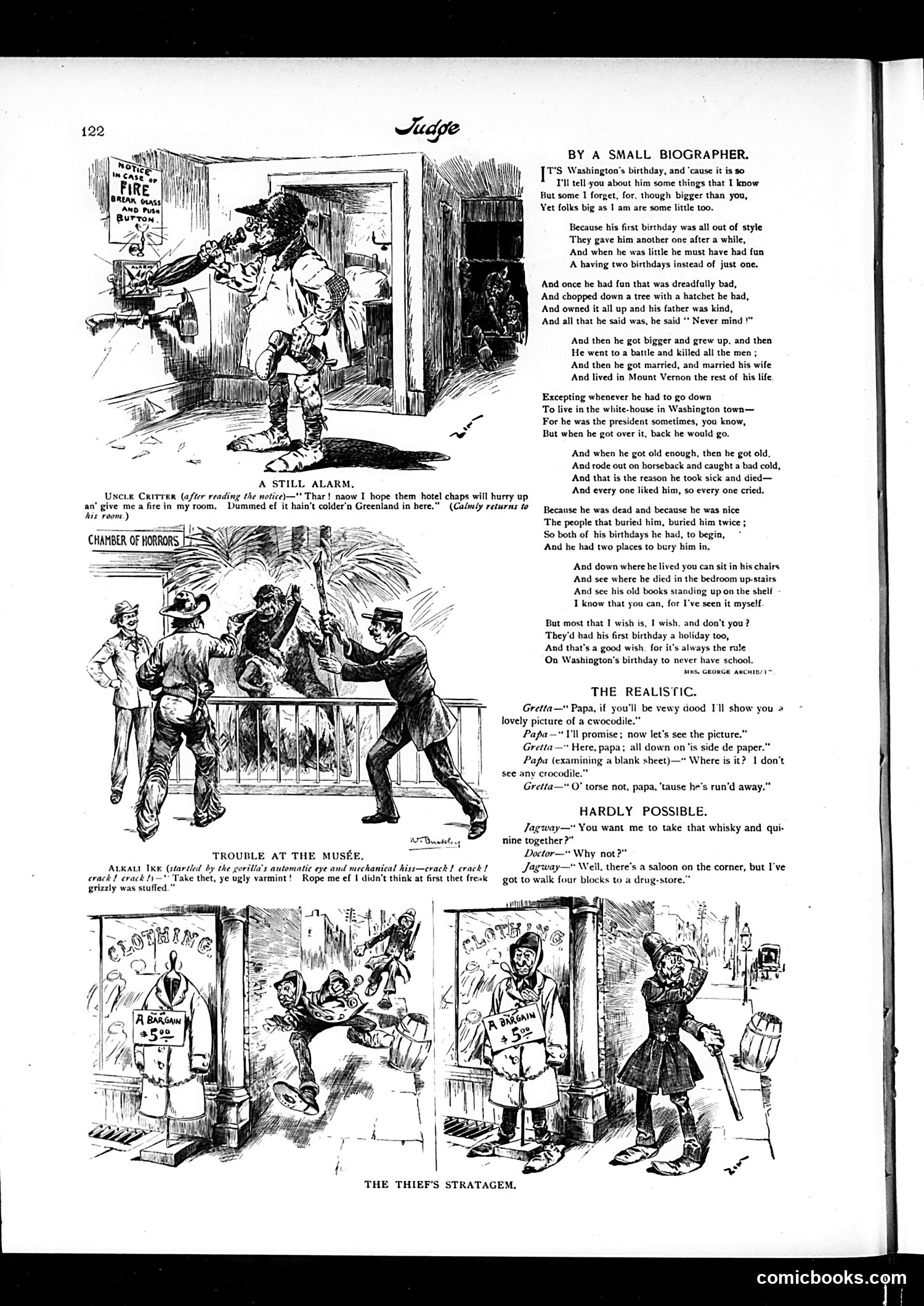
This page from Judge contains several unrelated humorous pieces typical of late 19th-century American satirical magazines: **"A Still Alarm"** and **"Trouble at the Musée"** are brief comic vignettes featuring stock characters—Uncle Critter (a rural type complaining about cold hotel rooms) and Alkali Ike (a Western prospector startled by a mechanical gorilla exhibit). **"By a Small Biographer"** is a longer poem about George Washington's birthday, written from a child's innocent perspective. It humorously recounts Washington's life—his two birthdays, the cherry tree legend, his military service, presidency, and death—ending with a child's wish that his first birthday also became a school holiday. The remaining pieces—**"The Realistic,"** **"Hardly Possible,"** and **"The Thief's Stratagem"** (with accompanying illustrations)—are brief joke scenarios involving parents, doctors, and comical misunderstandings. The satire targets nothing specific politically; instead, these are general-interest humor pieces aimed at family entertainment, typical of Judge's content during this era.
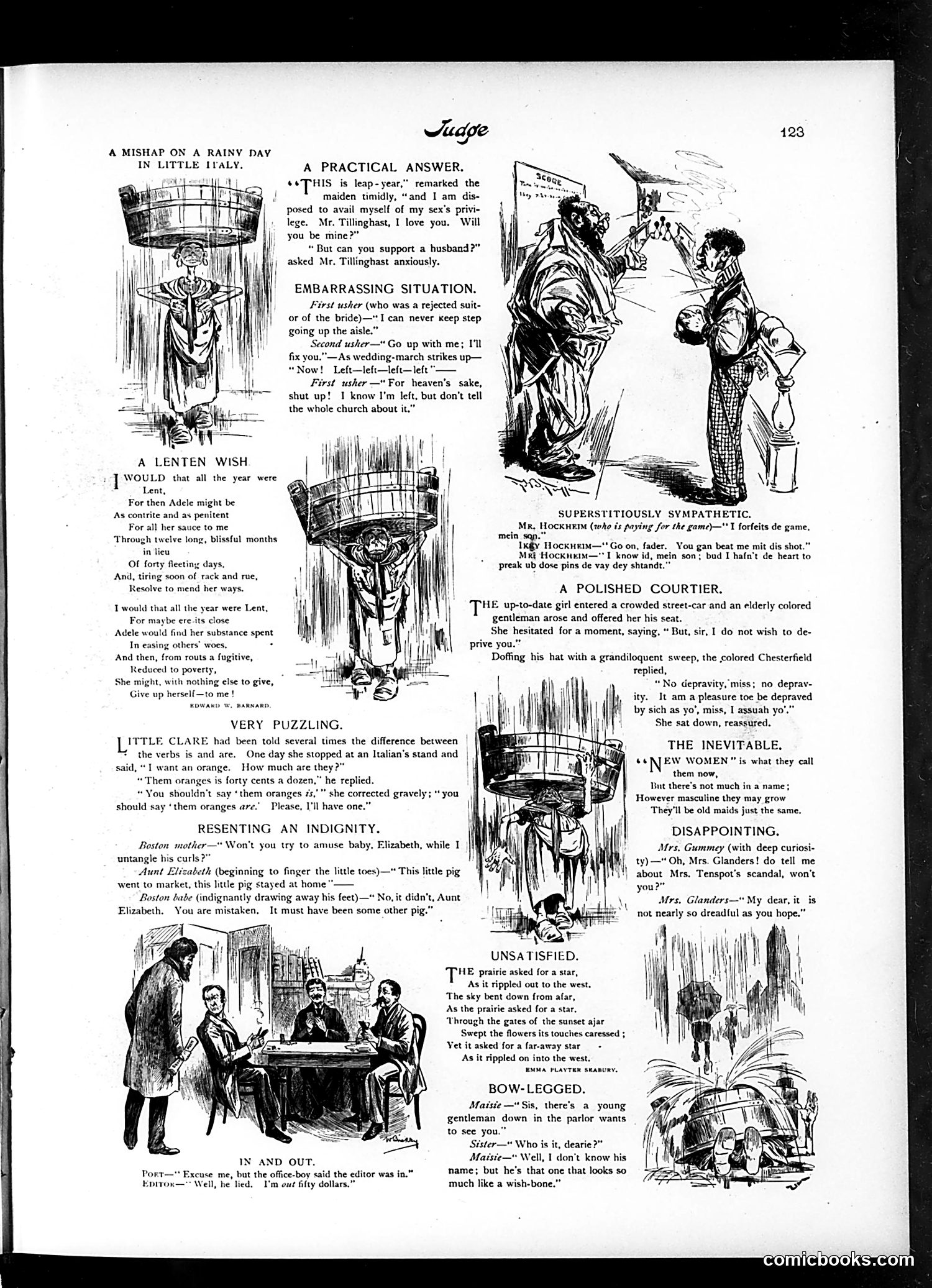
This page from Judge magazine (circa early 1900s) contains multiple short humorous sketches satirizing contemporary social situations: **Key sketches:** - **"A Practical Answer"**: Satirizes leap-year tradition where women propose to men. The joke hinges on the woman's practicality—she asks if he can support a husband, reversing traditional gender economics. - **"Embarrassing Situation"**: Mocks wedding etiquette when a rejected suitor must serve as usher, accidentally revealing his status through the wedding march choreography. - **"A Polished Courtier"**: A Black gentleman's exaggerated courtesy toward a modern girl who accepts his offered seat. The satire appears directed at both affected manners and evolving social interactions. - **Italian vendor dialogue**: Jokes about immigrant speech patterns and grammar correction ("oranges is" vs. "are"). - **"New Women"**: Satirizes the emerging "New Woman" movement, suggesting career ambitions won't prevent spinsterhood. The humor relies on class distinctions, immigrant caricatures, gender role reversals, and social propriety violations—typical of early 20th-century American satire.
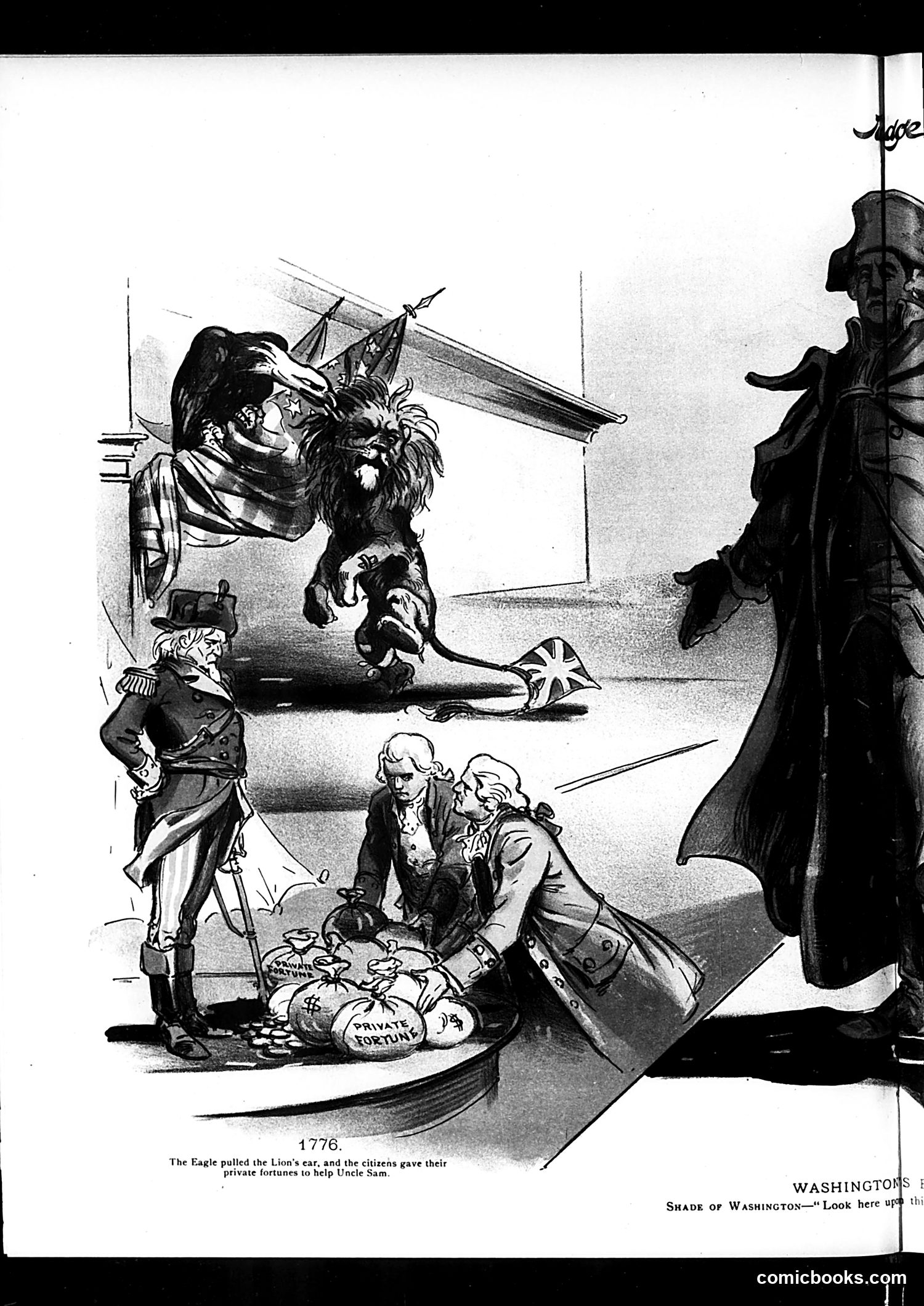
This 1776-dated cartoon uses animal personification to satirize American Revolutionary War financing. The "Eagle" (representing America) pulls the "Lion's ear" (Britain), while below, three citizens—appearing to be merchants or wealthy men—hand over bags labeled "Private Fortunes" to "Uncle Sam" (the personified United States government). The satire critiques how ordinary citizens funded the Revolutionary War through voluntary contributions of their private wealth. The caption suggests this was presented as patriotic duty, though the cartoon's tone implies skepticism about whether such "private" giving was truly voluntary or economically sustainable. The reference to "Washington's Shade" in the footer suggests this reflects on George Washington's leadership during the war effort.
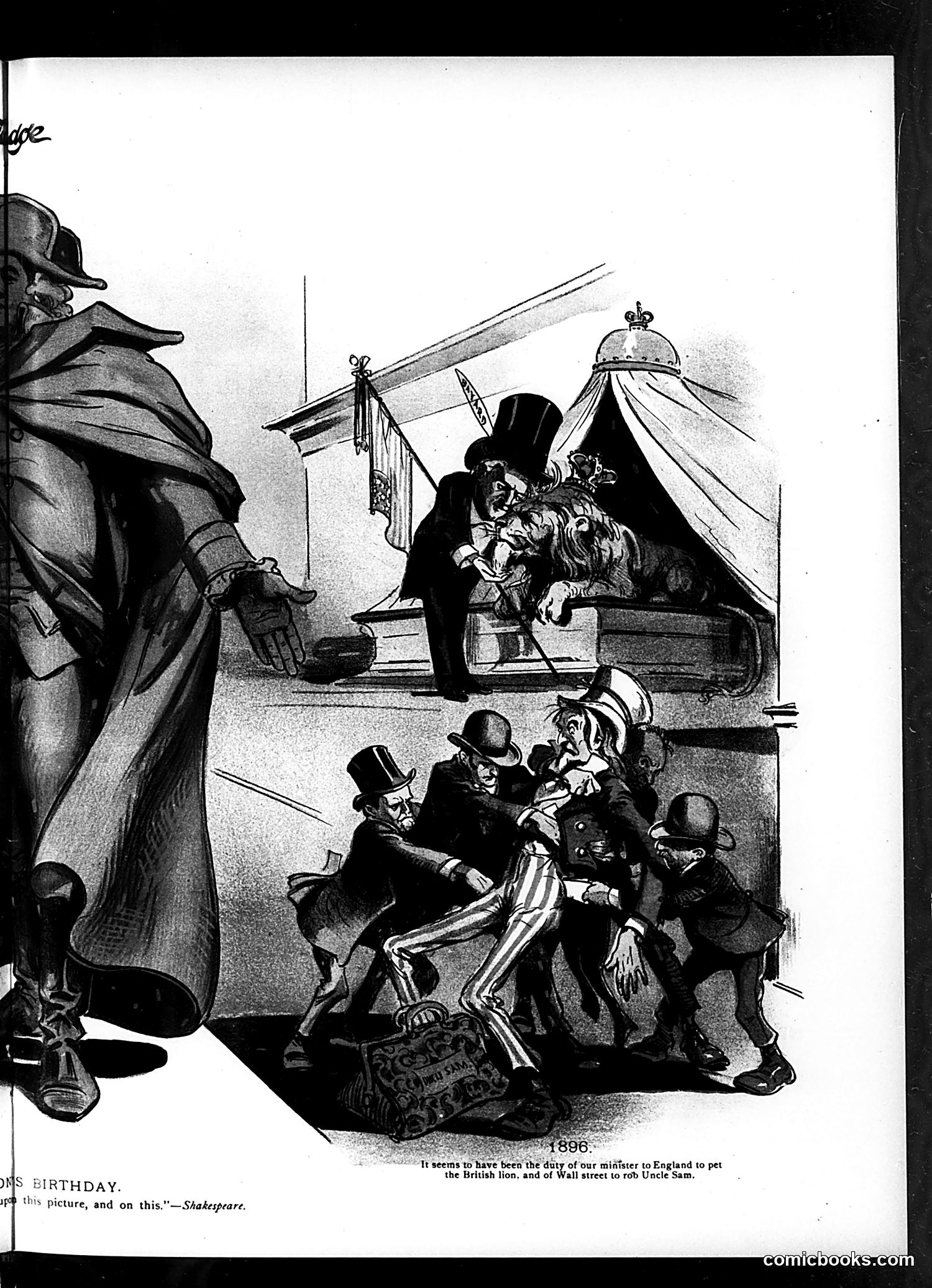
This is a satirical cartoon criticizing American foreign and domestic policy in 1896. The large figure on the left represents "Uncle Sam" (America). The cartoon depicts two separate scenes of betrayal: **Upper section**: The U.S. minister to England is shown "petting the British lion"—suggesting excessive diplomatic deference to Britain. **Lower section**: Wall Street figures (depicted in top hats) are robbing Uncle Sam, representing financial exploitation of American interests for private profit. The cartoon's central complaint is that America's leadership class is simultaneously appeasing foreign powers while allowing wealthy domestic speculators to exploit the nation's resources. The caption reinforces this dual betrayal, suggesting both diplomatic weakness and internal corruption during the 1896 election period.
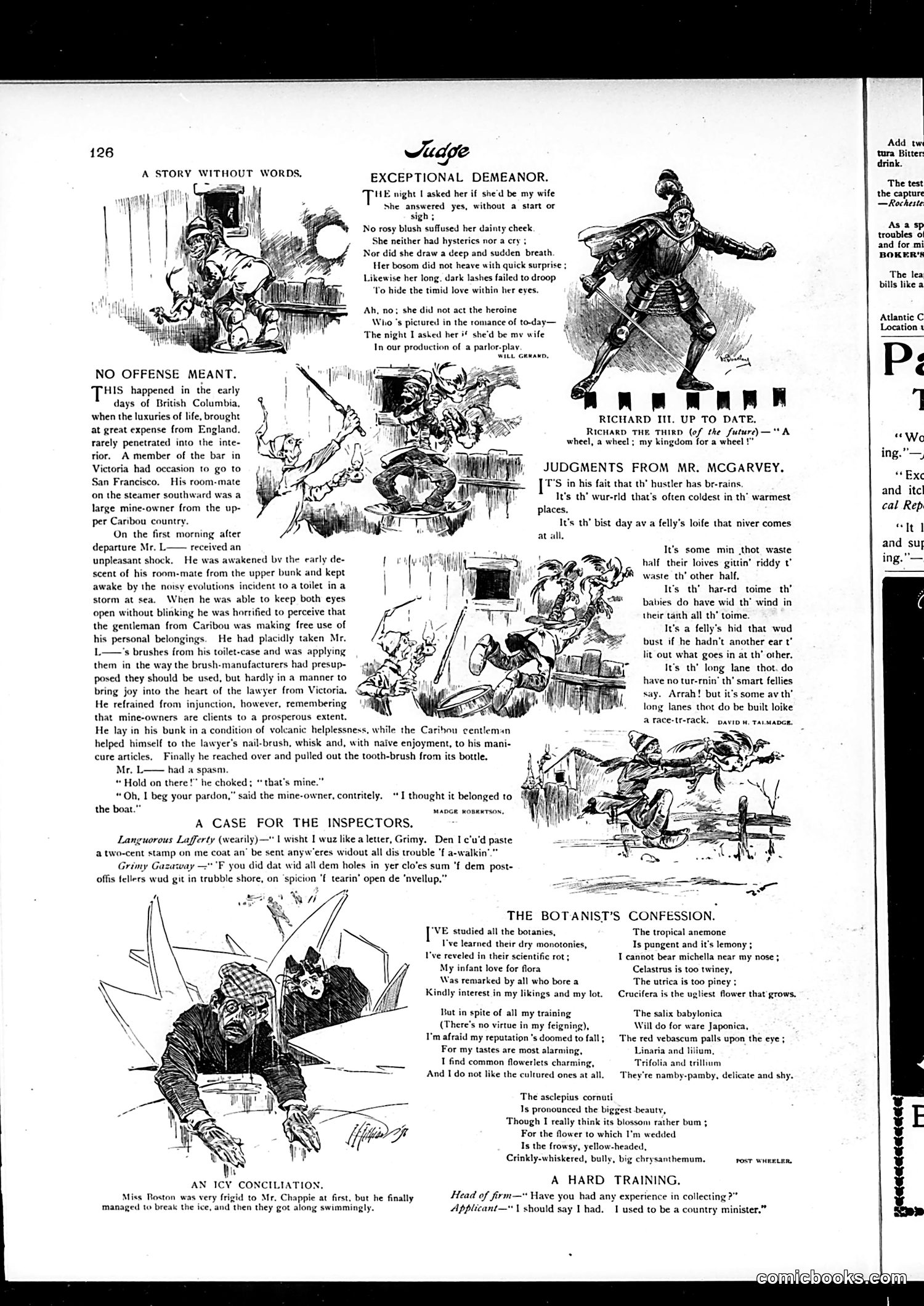
This page contains several satirical pieces typical of Judge's humor: **"No Offense Meant"** depicts a clash of manners between a refined lawyer and a rough Caribou miner sharing a ship cabin. The miner casually uses the lawyer's personal grooming items without permission, culminating in him reaching for the tooth-brush. The satire mocks the uncouth behavior of frontier/mining types who lack Victorian social propriety, while showing the lawyer's reluctant tolerance (fearing to offend a paying client). It's social-class humor about frontier roughness versus civilized etiquette. **"Richard III Up to Date"** is a one-panel joke adapting Shakespeare's famous line to modern times—the future king wants "a wheel" (automobile) instead of a horse, reflecting contemporary anxieties about emerging automobile technology. **"Judgments from Mr. McGarvey"** presents Irish-dialect aphorisms, stereotyping Irish immigrants through exaggerated phonetic dialect ("th'" for "the," "felly" for "fellow"). The other pieces are brief humorous sketches and poems of similar vintage satirical style.
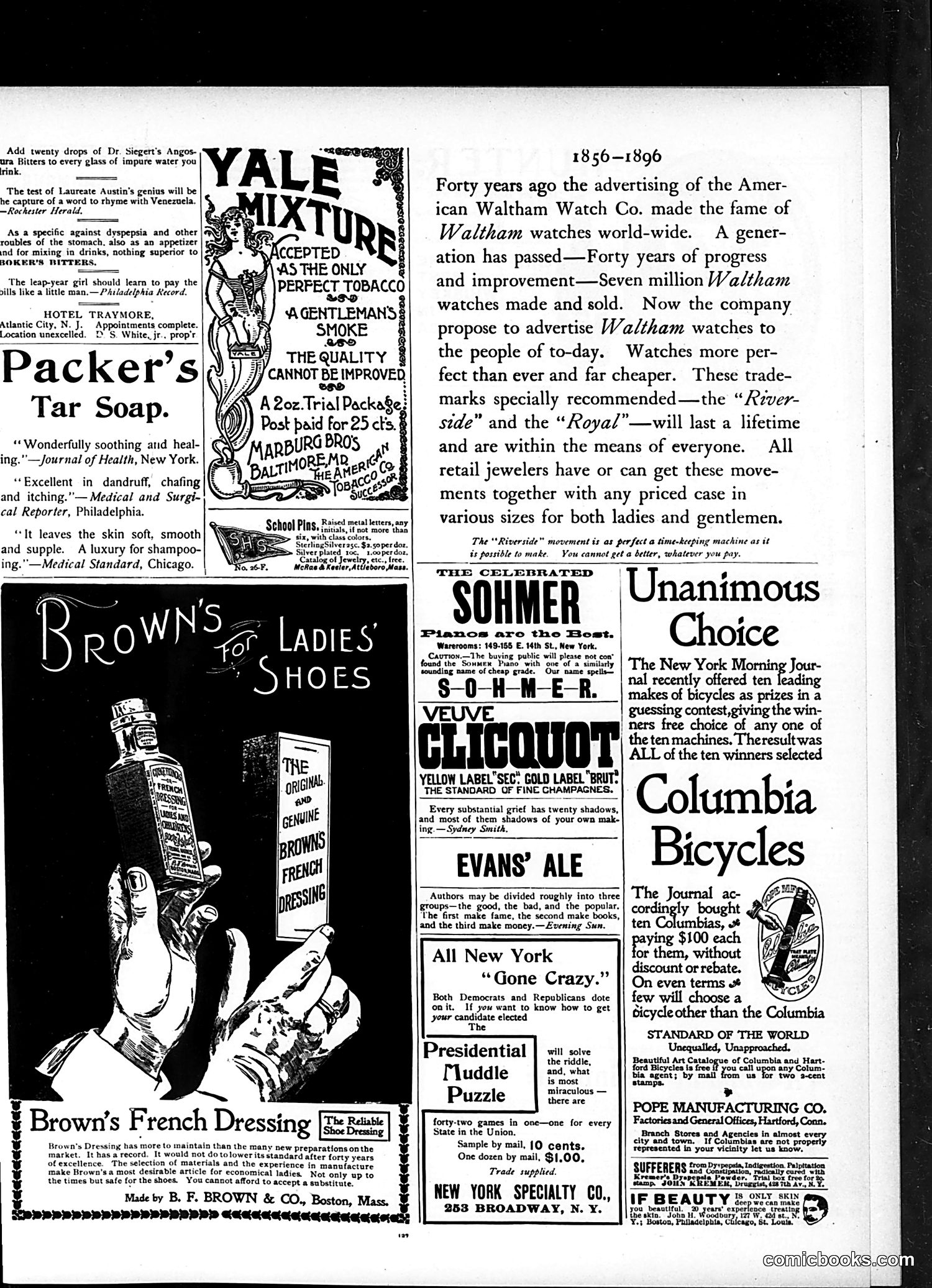
This appears to be primarily an **advertising page** from Judge magazine (1856-1896 masthead visible). The layout combines multiple product advertisements with minimal editorial content. The notable satirical element is the small item about **Laureate Austin** attempting to find a word rhyming with "Venezuela"—a gentle jab at poetic difficulty. Similarly, brief quips mock "leap-year girls" paying bills and politicians' election tactics (the "Presidential Muddle Puzzle"). The bulk of the page advertises consumer goods typical of the 1890s: **Waltham watches, Brown's shoes and French dressing, Sohmer pianos, Evans' ale, champagne, soaps, and bicycles**. The **Columbia Bicycles advertisement** prominently notes that in a New York Journal contest, all ten winners chose Columbia—emphasizing its market dominance during the 1890s bicycle craze. Overall, this is a **commercial product page** with minimal political satire, primarily serving Judge's dual function as entertainment and advertising vehicle for affluent readers.
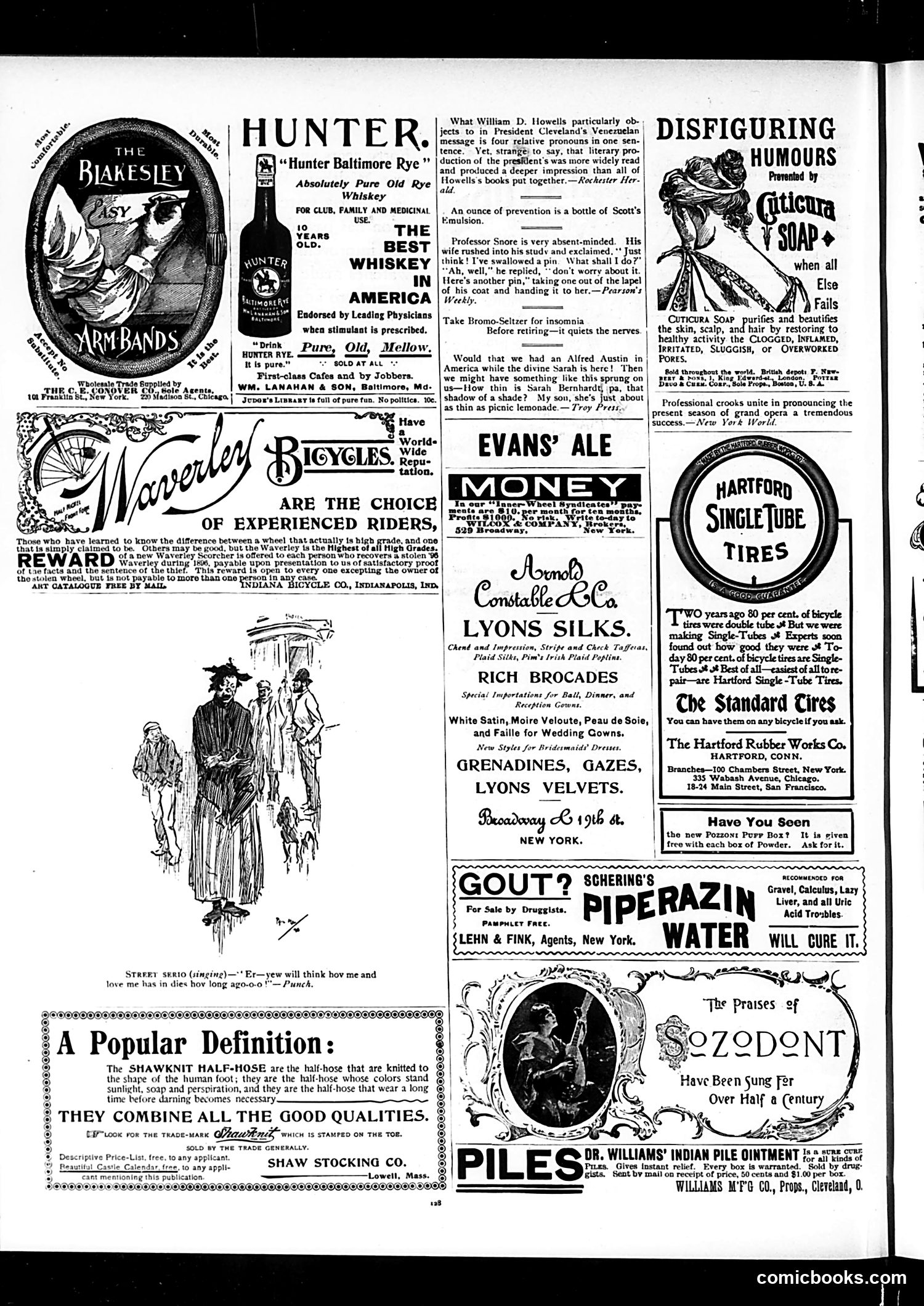
This page is primarily **advertising**, typical of Judge's revenue model. However, the header contains **one satirical piece** about literary criticism: **"HUNTER" Section:** A jab at author **William D. Howells**, criticizing his Venezuelan message from President Cleveland. The satire points out the irony that Howells—a celebrated literary figure—complained about Cleveland's grammar (four pronouns in one sentence), yet Cleveland's political writing reached far more readers and had greater impact than any of Howells's own books. This mocks intellectual pretension: a famous author's technical critique is undermined by the fact that the "flawed" political writing was vastly more influential and widely read. **The remainder** consists of period advertisements: whiskey ("Hunter" brand, endorsed by physicians—common medical claims of the era), bicycles (Waverley brand), stockings, silks, patent medicines (Piperazin Water for gout, Sozodont toothpaste, Dr. Williams' Pile Ointment), and soap—all with typical Victorian-era marketing language and visual conventions.
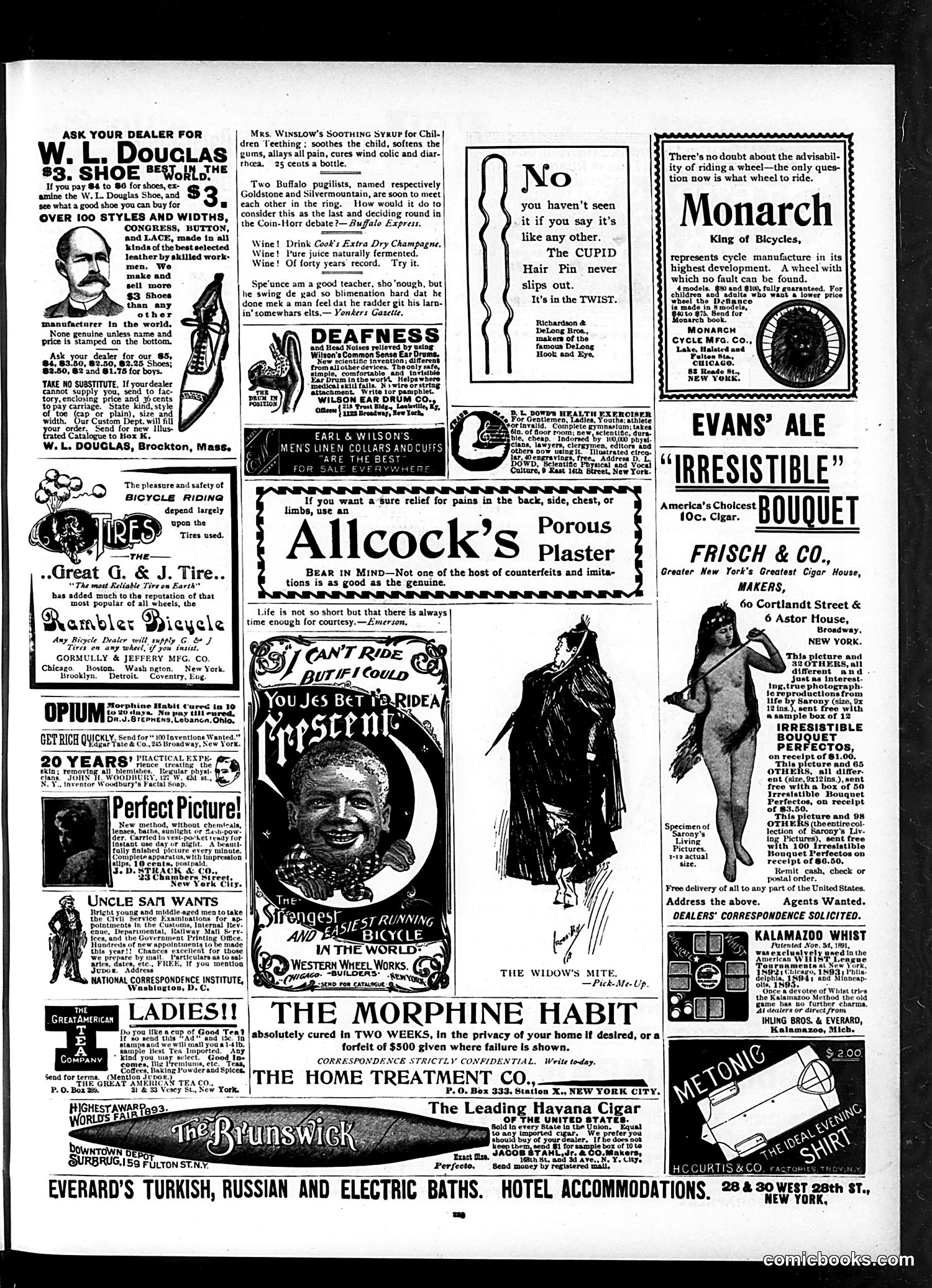
This page is primarily **advertising**, typical of Judge magazine's revenue model. The ads promote consumer goods from the early 1900s: W.L. Douglas shoes, Mrs. Winslow's Soothing Syrup (a patent medicine), bicycles, collars, and notably, treatments for morphine addiction and deafness. **Key satirical element**: The morphine addiction treatment ad promises a cure "in TWO WEEKS" with a "$500 forfeit" — a common fraudulent claim of the era. Judge readers would recognize this as quackery, as such addiction treatments were notoriously ineffective. **Social context**: These ads reveal period anxieties: drug addiction was openly advertised (opium, morphine); deafness solutions were sought through dubious ear devices; and "patent medicines" made extravagant claims without regulation (pre-FDA). The small cartoon labeled "The Widow's Mite" appears unrelated to the ads — the page is cluttered, typical of Judge's dense advertising layout rather than coherent satirical commentary.
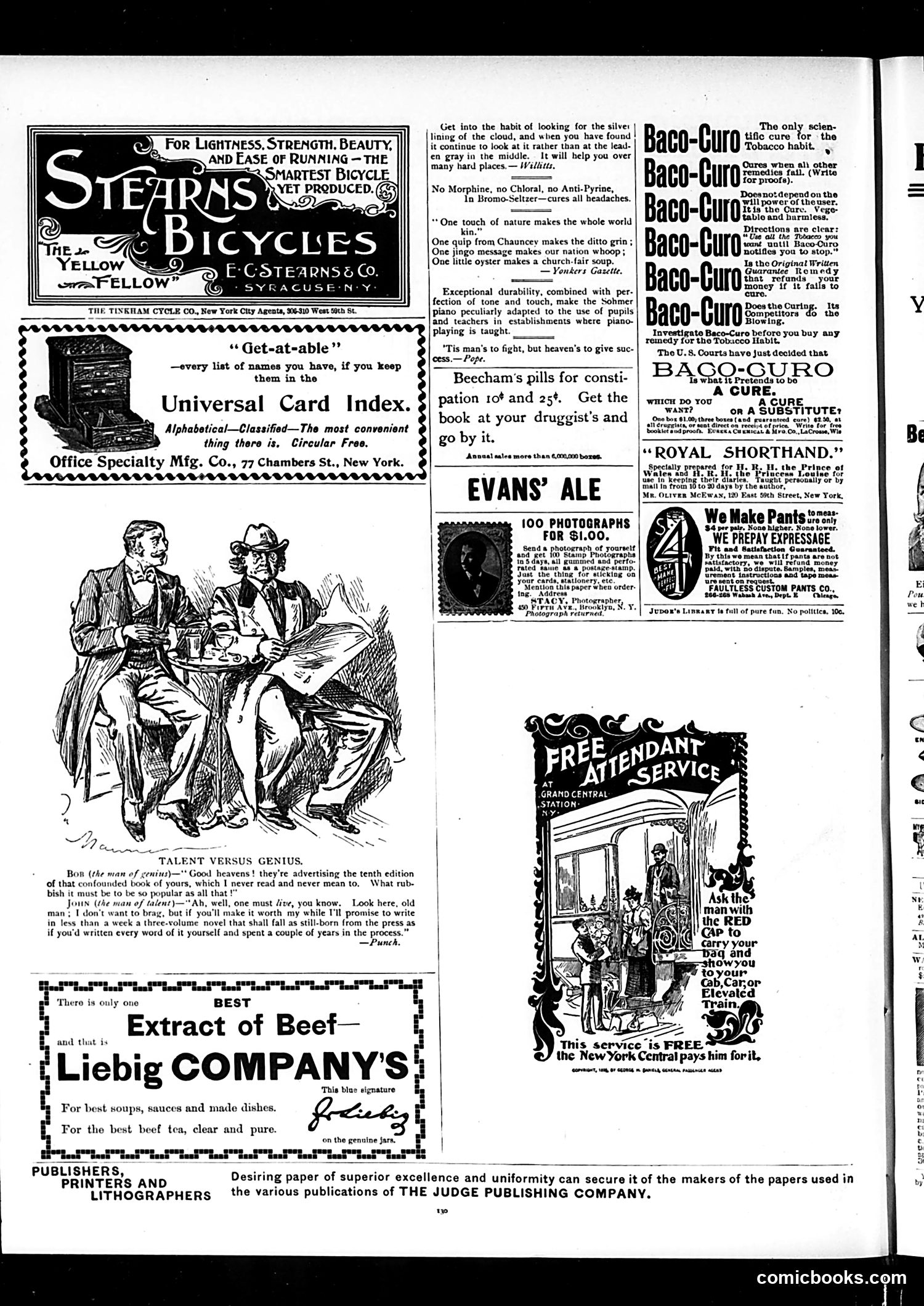
This page is primarily **advertising**, but the main cartoon—titled "Talent Versus Genius"—offers social commentary through a Punch reprint. The cartoon depicts two men debating literary merit. "Bob" (representing genius) dismisses the tenth edition of a popular book as "confounded" rubbish. "John" (representing mere talent) pragmatically counters that he can write a three-volume novel quickly if paid, even though it will fail commercially—suggesting it will be as "still-born" as if Bob himself had written it. **The satire's point**: It mocks the paradox that commercial success and artistic merit are often inversely related. Popular books sell despite being mediocre, while genuinely talented work may languish. John's cynical admission that he can manufacture forgettable prose for money undercuts Bob's snobbish dismissal—both are ultimately producing unmarketable work, whether through pretension or honest hack writing. The cartoon critiques both artistic arrogance and commercial mediocrity in publishing.
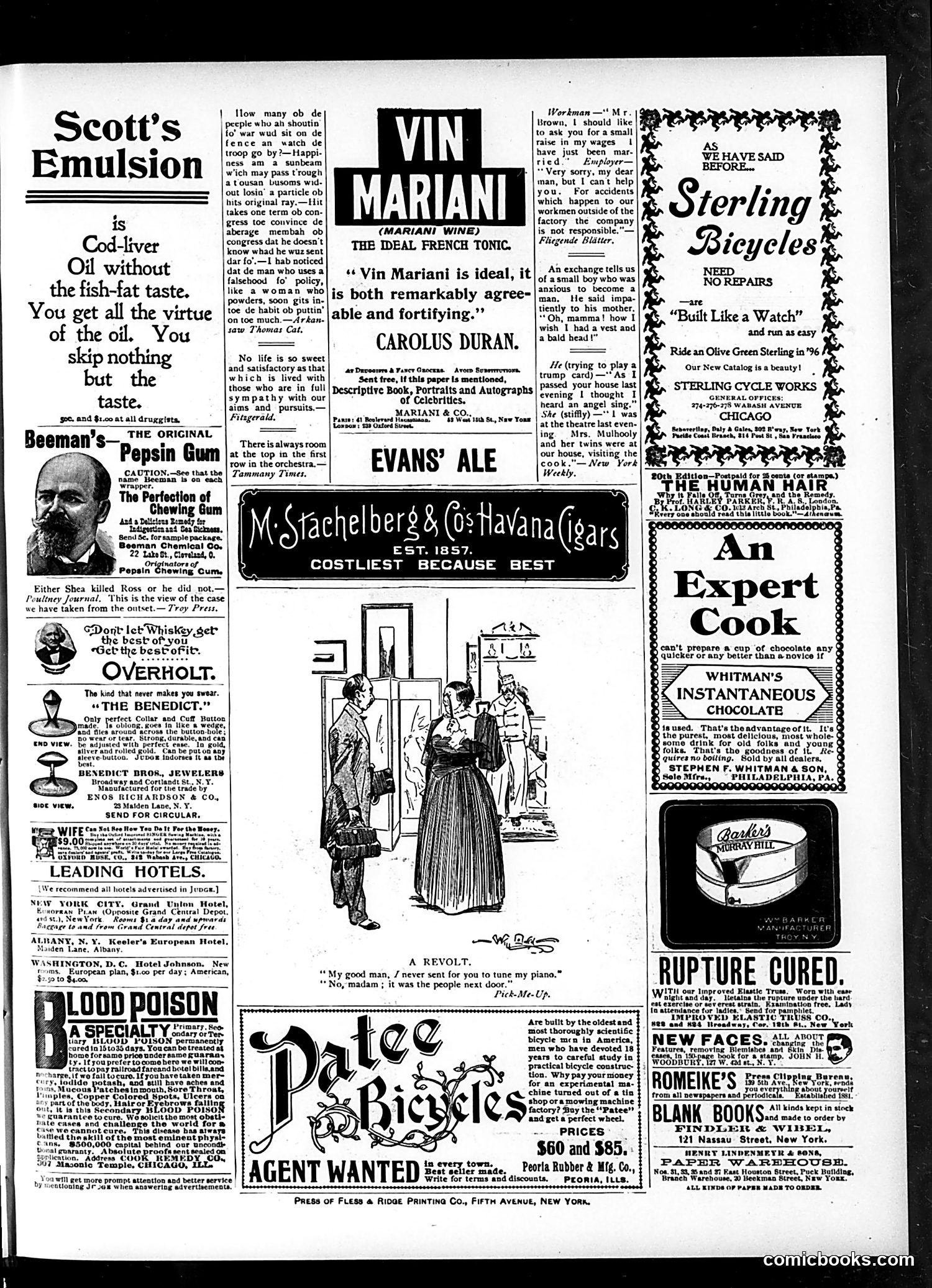
This page is predominantly **advertising**, not political satire. It features various late-19th/early-20th-century product advertisements and brief humorous quotes rather than sustained cartoons. The only illustrated cartoon depicts a domestic scene labeled "A REVOLT" with the caption: "My good man, I never sent for you to tune my piano.—No, madam; it was the people next door." This is a simple domestic humor joke about mistaken identity—a piano tuner arrives at the wrong house. The page includes scattered wisdom quotes attributed to "Arkansas Thomas Cat" about politics, sincerity, and human nature—typical period humor commentary. The rest consists of advertisements for products like Scott's Emulsion (cod-liver oil), Beeman's Pepsin Gum, Overholt whiskey, hotels, and medical treatments. There is no significant political cartoons or satire requiring historical context to understand.
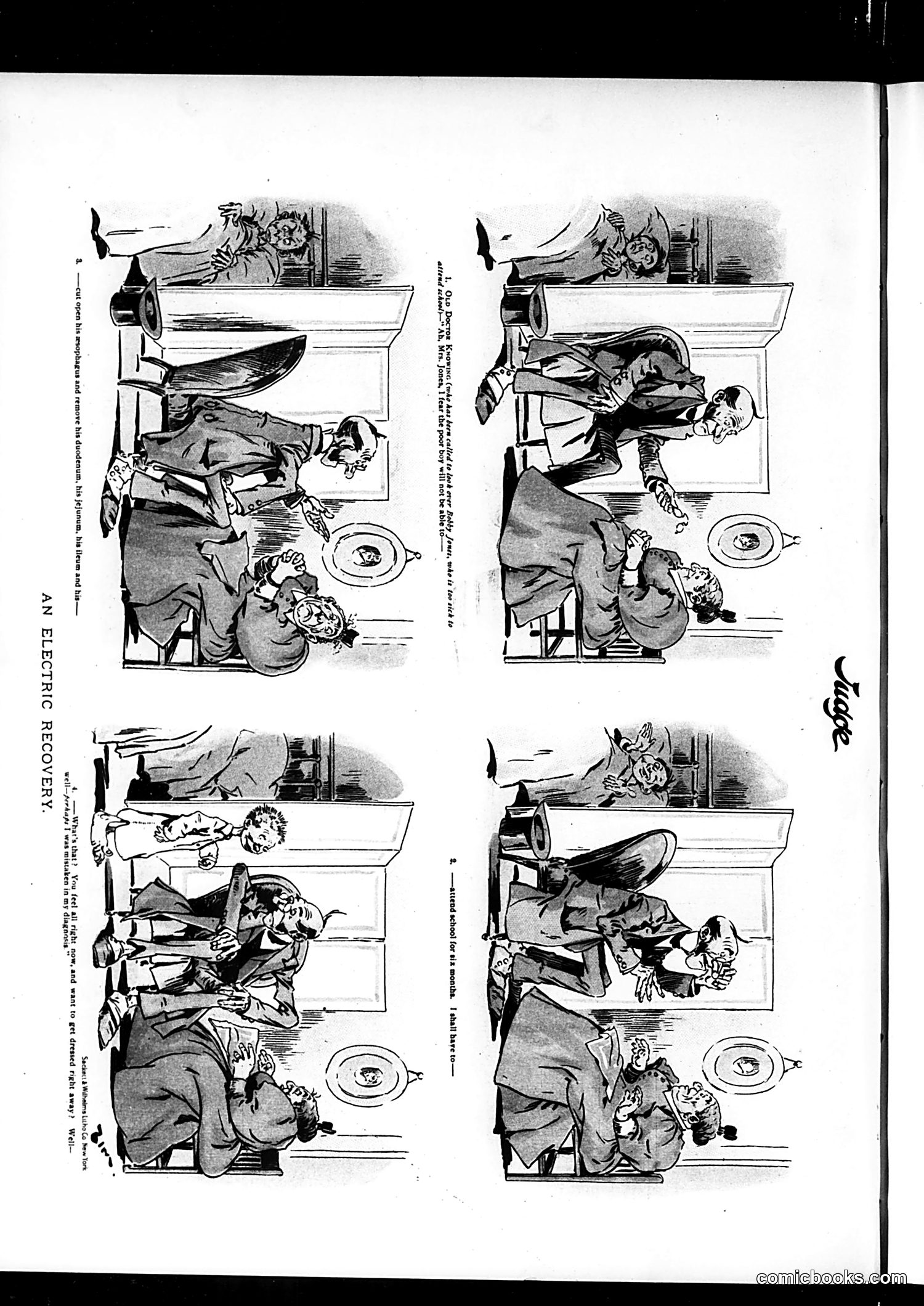
This appears to be a four-panel demonstration comic titled "An Electric Recorder" showing the operation of an early recording device. The panels depict figures (appearing to be men in period dress) positioned at or near what looks like a mechanical apparatus with a horn speaker and rotating mechanism. The satire likely mocks either the novelty of early phonograph/recording technology or possibly critiques how such devices might be used to capture embarrassing moments or private conversations. The repeated positioning of figures and the mechanical nature of the device suggest humor around the indignity of having one's voice or actions mechanically recorded and potentially replayed. The OCR text is too corrupted to confirm specific details about the intended joke or whether it references particular public figures or events from Judge magazine's era.