
A complete issue · 18 pages · 1896
Judge — February 1, 1896
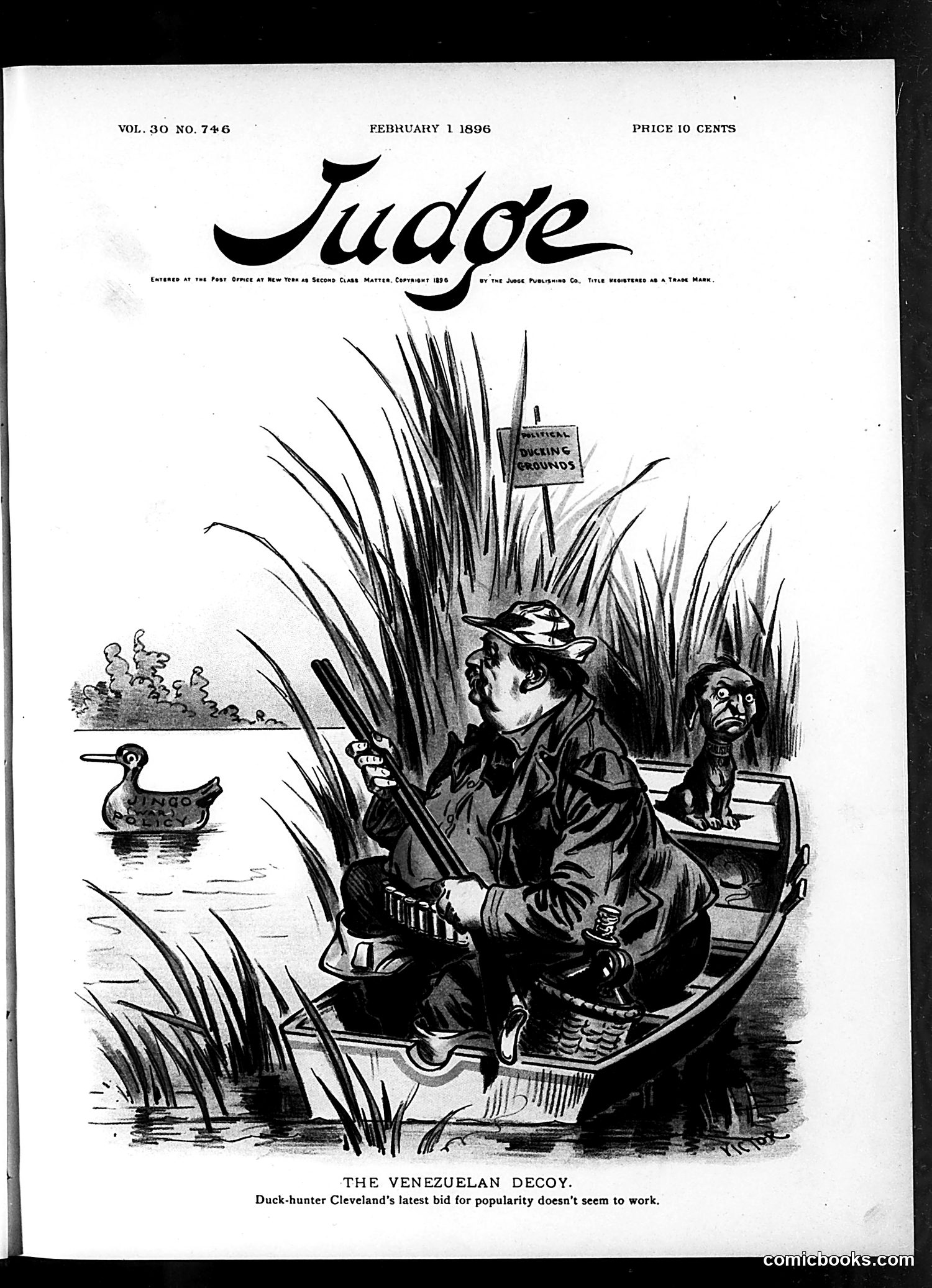
This political cartoon satirizes President Cleveland's foreign policy regarding Venezuela. The caption reads: "Duck-hunter Cleveland's latest bid for popularity doesn't seem to work." The image depicts Cleveland as a duck hunter in a boat among reeds, with a sign reading "PRIVATE HUNTING GROUNDS." A duck labeled "ANGLO-SAXON" floats nearby, apparently unresponsive to his efforts. The satire criticizes Cleveland's attempt to gain public support through his assertive stance in the Venezuela border dispute with Britain (a major 1895-1896 controversy). The "decoy" metaphor suggests his aggressive posturing was a calculated political maneuver to boost unpopular policies or restore his reputation—one that failed to attract the desired response from either the public or British authorities. The cartoon implies his strategy was transparent and ineffective.
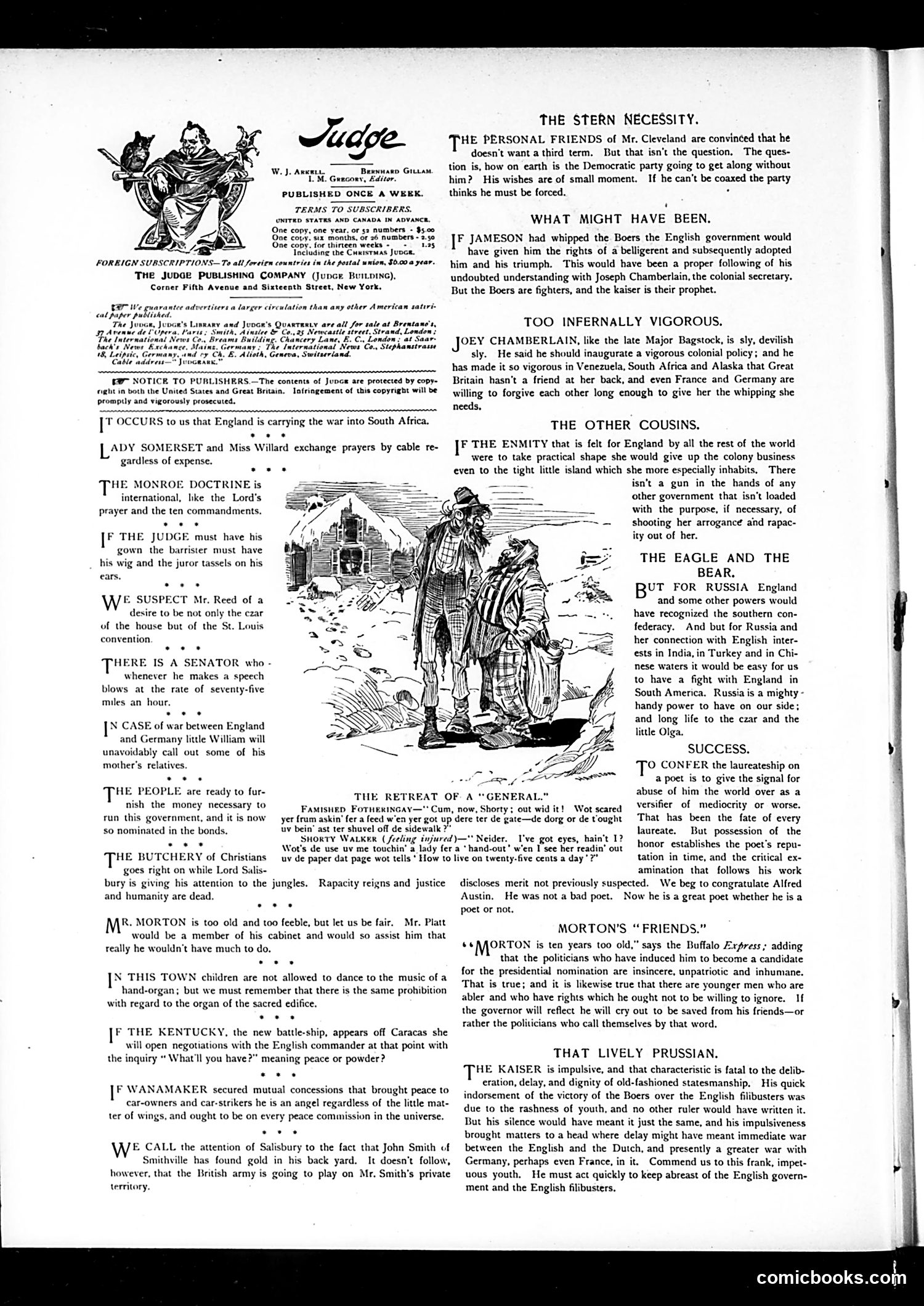
This page contains political commentary on the Second Boer War (England's conflict in South Africa). The central illustration depicts what appears to be a British military figure with local populations, likely satirizing England's imperial ambitions. The articles mock various political figures and policies: - **"The Stern Necessity"** criticizes Cleveland and Democratic Party politics regarding the Boers - **"Too Infernally Vigorous"** attacks Joey Chamberlain (Joseph Chamberlain, Colonial Secretary) for aggressive policies in Venezuela, South Africa, and Alaska - **"The Eagle and the Bear"** suggests Russia poses a greater threat than England's colonial rivals - **"That Lively Prussian"** criticizes the Kaiser's impulsive diplomacy The satire presents England's imperial expansion as morally questionable and diplomatically counterproductive, reflecting anti-imperialist sentiment among some American commentators circa 1899-1902.
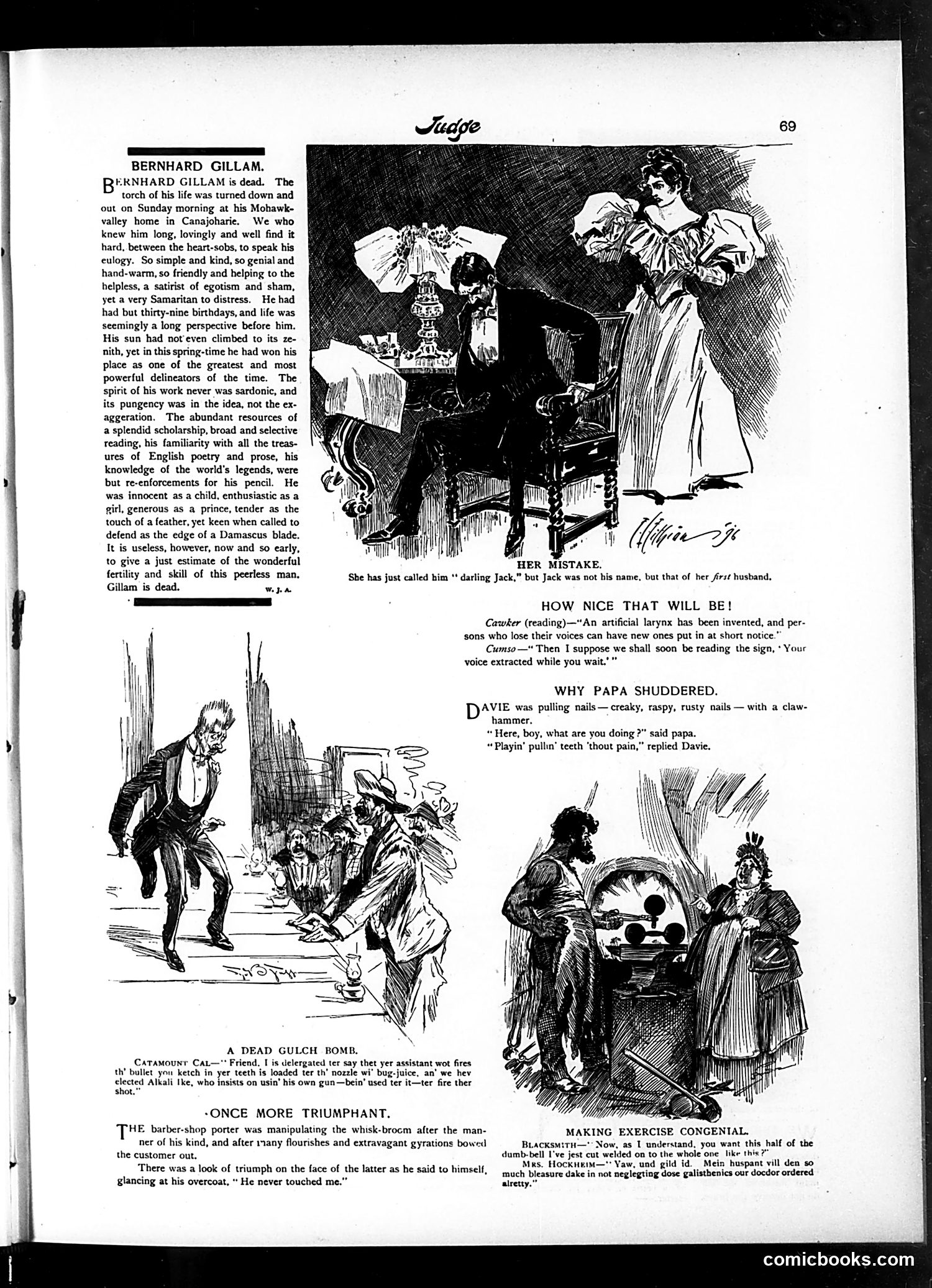
This page contains several brief humorous sketches rather than political cartoons: **"Her Mistake"** depicts a woman who mistakenly called her new husband "darling Jack"—Jack being her *first* husband's name. The satire mocks domestic confusion and marital mishaps. **"How Nice That Will Be"** jokes about an artificial larynx invention, with characters making puns about extracted voices. **"Why Papa Shuddered"** shows a father disturbed by his son playing with nails and a hammer. **"A Dead Gulch Bomb"** appears to be a frontier/Old West joke about dangerous ammunition. **"Once More Triumphant"** depicts a barber's porter manipulating a whisk-broom, suggesting clever showmanship impressing customers. These are primarily domestic humor pieces rather than political commentary—typical of Judge's lighter content.
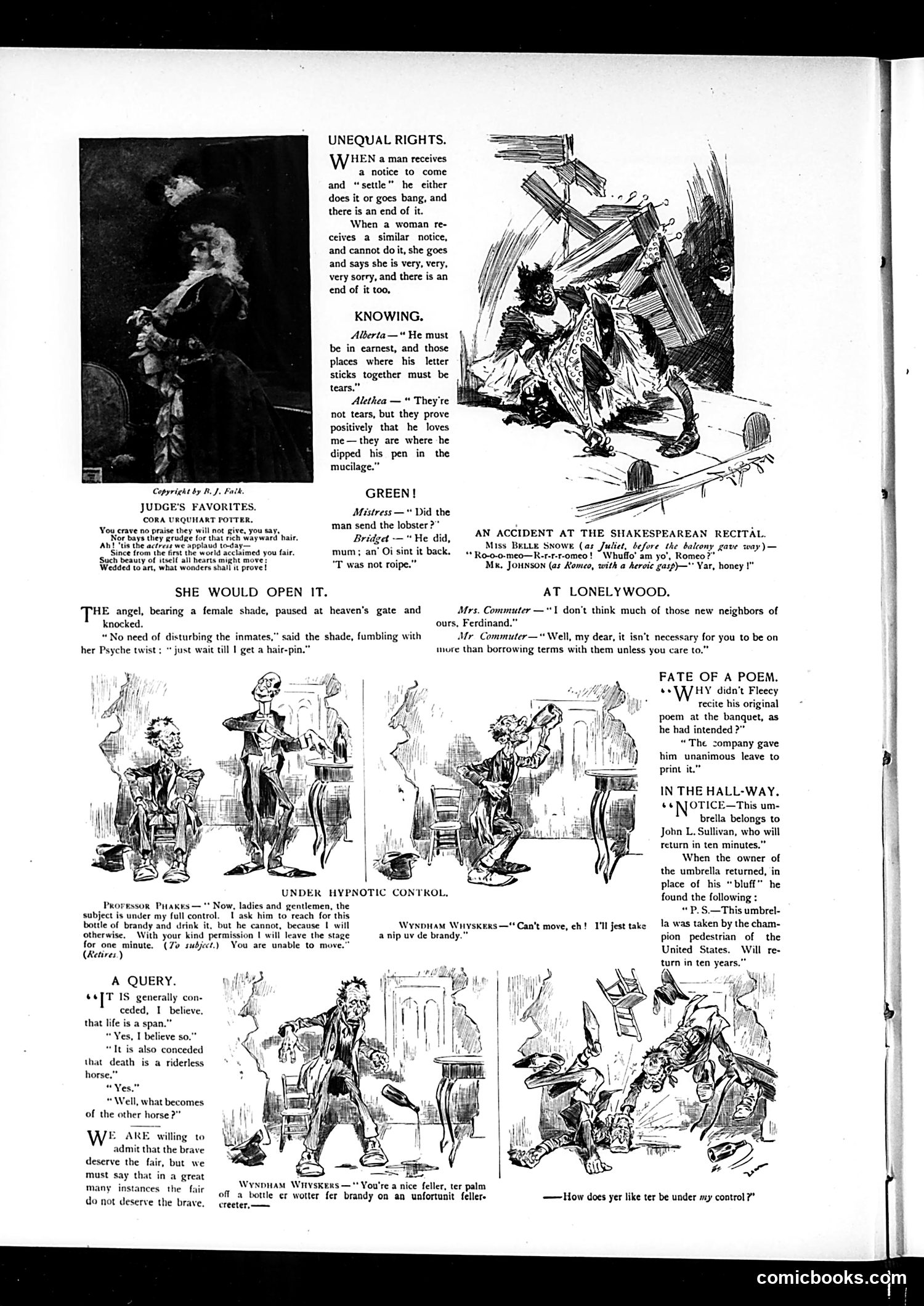
This page collects brief satirical pieces typical of Judge's style: **"Unequal Rights"** mocks legal double standards: men who receive debt-collection notices either pay or face consequences, while women claim distress and face none—critiquing unequal accountability. **"Judge's Favorites"** praises actress Cora Urquardt Potter, likely a contemporary theater personality of note. **"An Accident at the Shakespearean Recital"** appears to joke about a theatrical mishap during a Romeo and Juliet performance where a balcony failed. **"She Would Open It"** is a heaven-themed morality joke about an angel's ghost. The remaining items—"Green!," "At Lonelywood," "Fate of a Poem," and several hypnosis-themed sketches—are brief comedic vignettes about domestic life, social pretension, and parlor tricks popular in the era. The illustrations throughout depict exaggerated Victorian characters in humorous situations. The overall tone is light social satire targeting manners, gender relations, and theatrical absurdity rather than serious political critique.
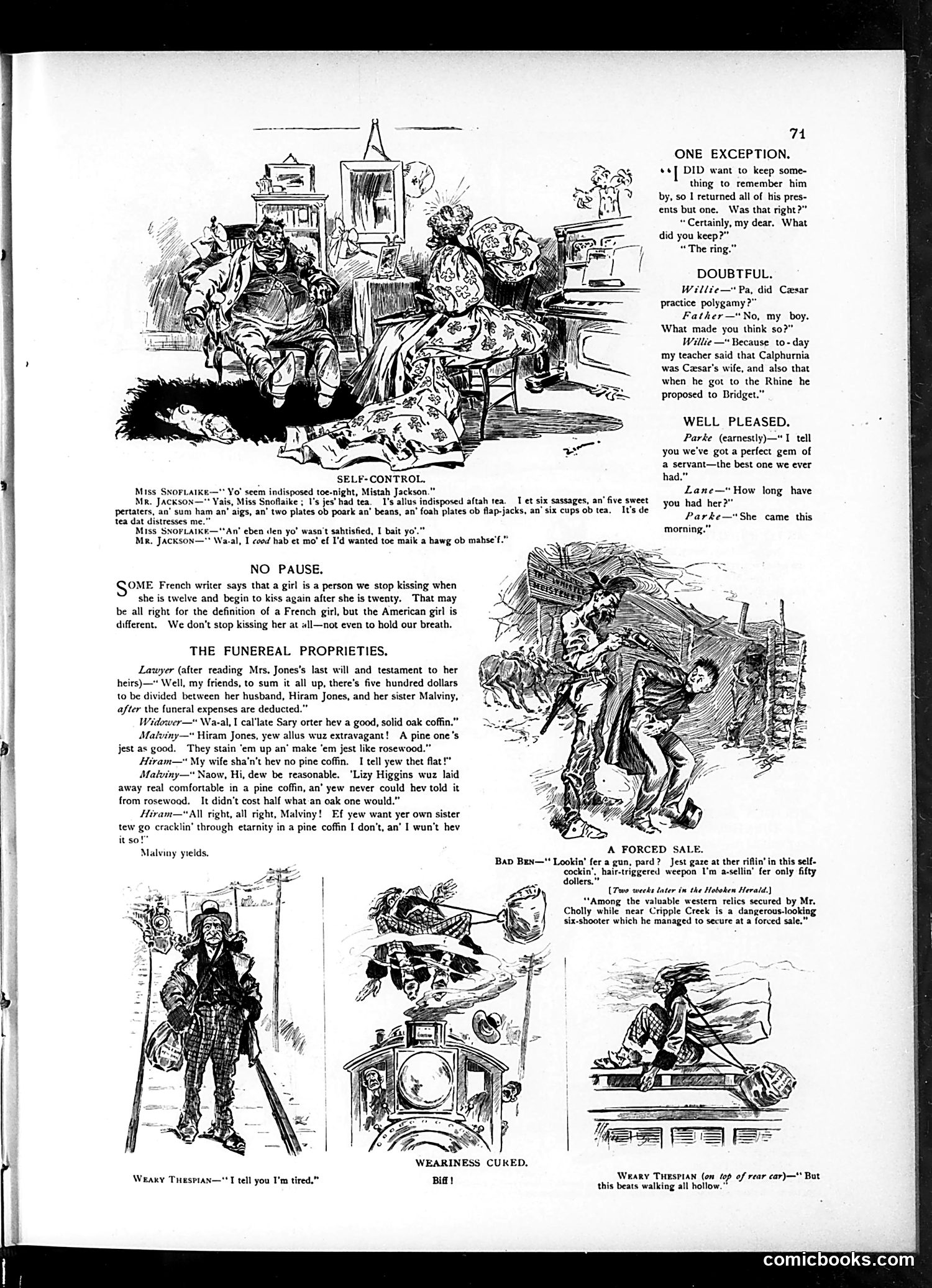
This page contains multiple humor sketches typical of late 19th/early 20th-century American satire: **"One Exception"** and **"Doubtful"** are brief domestic comedy pieces playing on misunderstandings—a woman keeping an engagement ring after a breakup, and a boy confusing Caesar's wife Calphurnia with a mistress named Bridget. **"Self-Control"** features racial caricature (dialect speech, "Mistah Jackson"), depicting an African American servant's gluttony as justification for his "indisposed" state. **"No Pause"** contrasts French and American courtship customs, suggesting Americans kiss continuously without restraint. **"The Funereal Proprieties"** satirizes rural/working-class penny-pinching through exaggerated dialect, with family members arguing over coffin quality for the deceased. **"A Forced Sale"** depicts a westerner swindled into buying a gun at inflated prices, later absurdly valorized in a newspaper as a "valuable relic." The page reflects Judge's typical humor: ethnic/class mockery, gender stereotypes, and rural vernacular portrayed for urban educated readers' amusement.
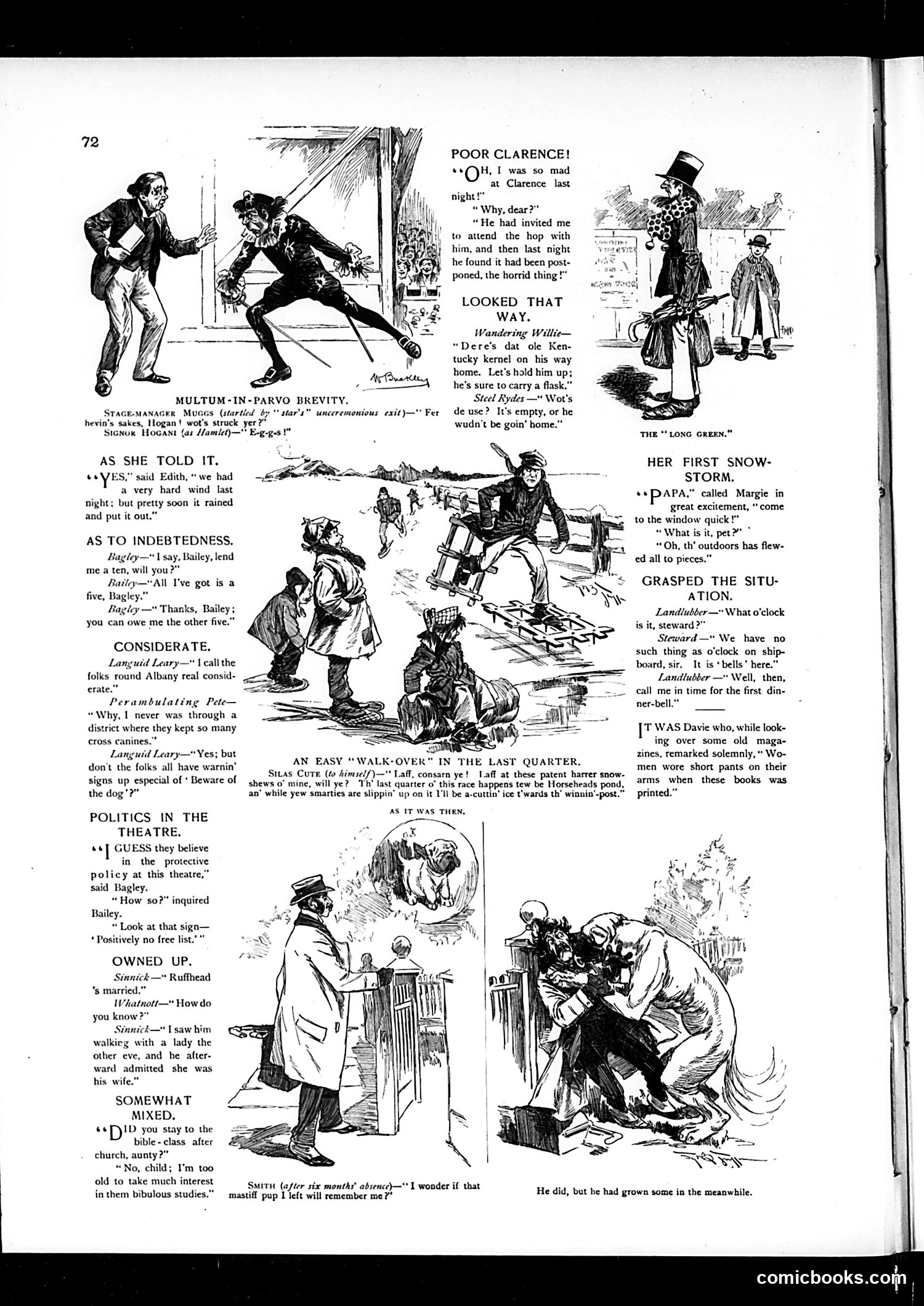
This page contains a collection of brief comic anecdotes and visual gags typical of Judge's satirical style. Most lack specific political references and instead mock everyday social situations and human foibles: **Notable sketches include:** - "Poor Clarence!" mocks romantic disappointment when a dance is postponed - "Politics in the Theatre" satirizes theater policies through a pun on "protective policy" - "Somewhat Mixed" plays on the word "bibulous" (drinking-related) versus "bible-class" - "An Easy Walk-Over" features dialectal rural humor about a snow-shoe racer - Nautical and domestic scenes offer gentle mockery of confusion and miscommunication The illustrations by various artists (McBradley, etc.) use caricature and physical comedy. Overall, this represents Judge's bread-and-butter content: lightweight social satire aimed at middle-class readers, focusing on manners, courtship, and minor embarrassments rather than serious political commentary. The humor is gentle rather than biting.
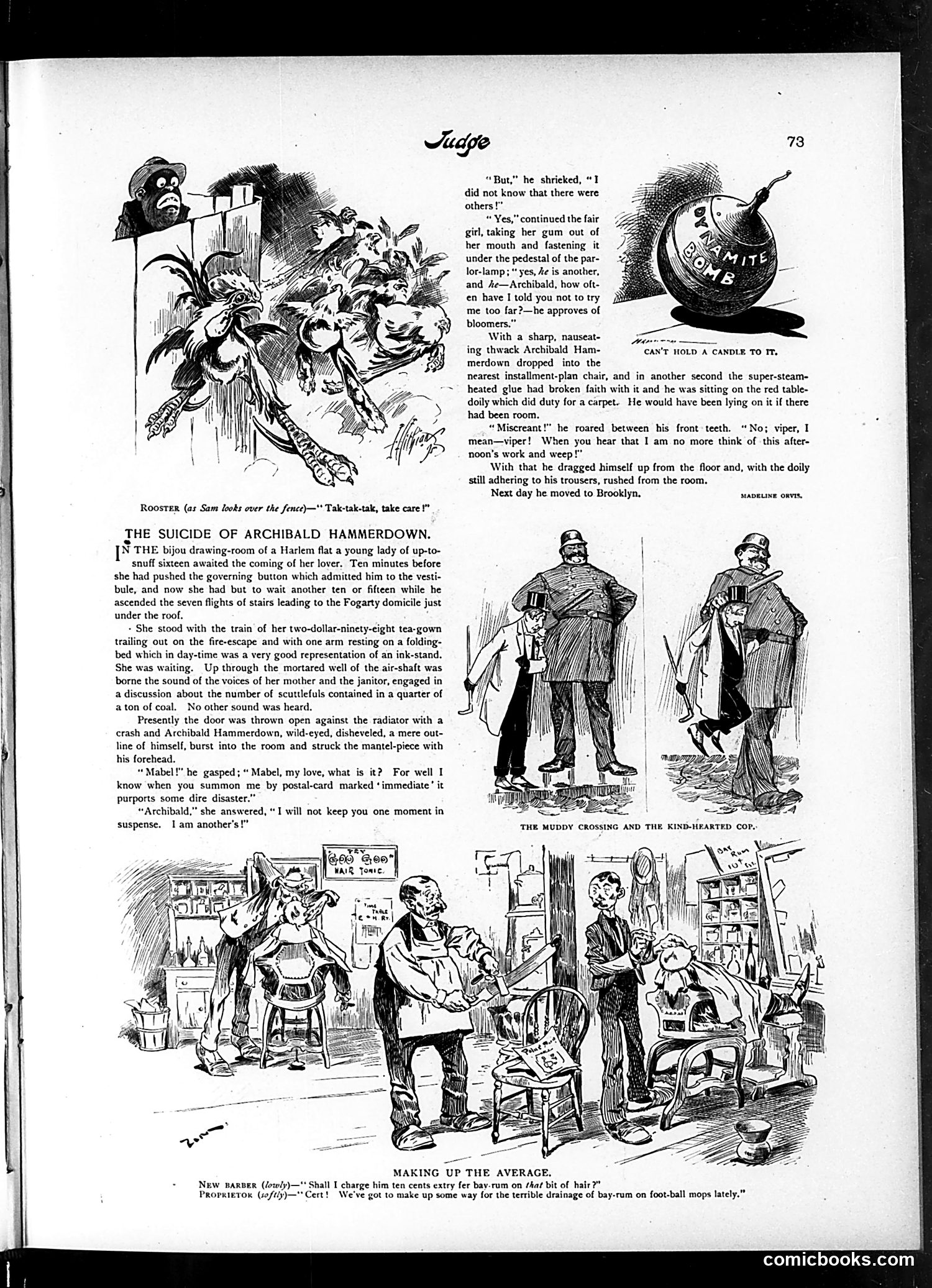
This page contains multiple satirical pieces mocking early-1900s urban life and social pretensions. **"The Suicide of Archibald Hammerdown"** parodies melodramatic romance stories. A young woman in a cramped Harlem tenement apartment has taken multiple lovers, casually mentioning them to her suitor Archibald. When he learns of rivals (including someone named "Ze" and "Archibald"), he dramatically despairs, gets stuck to cheap furniture glued with "super-steam-heated glue," and flees to Brooklyn in humiliation. The satire mocks both overwrought romantic conventions and the squalid reality of tenement living (seven-flight walk-ups, folding beds doubling as furniture, coal discussions via air-shaft). **"Making Up the Average"** jokes about barbers overcharging for hair treatments to offset wasteful usage on athletes' heavily-pomaded hair. The cartoons ridicule class pretensions, sentimental fiction, and working-class struggles in turn-of-the-century New York.
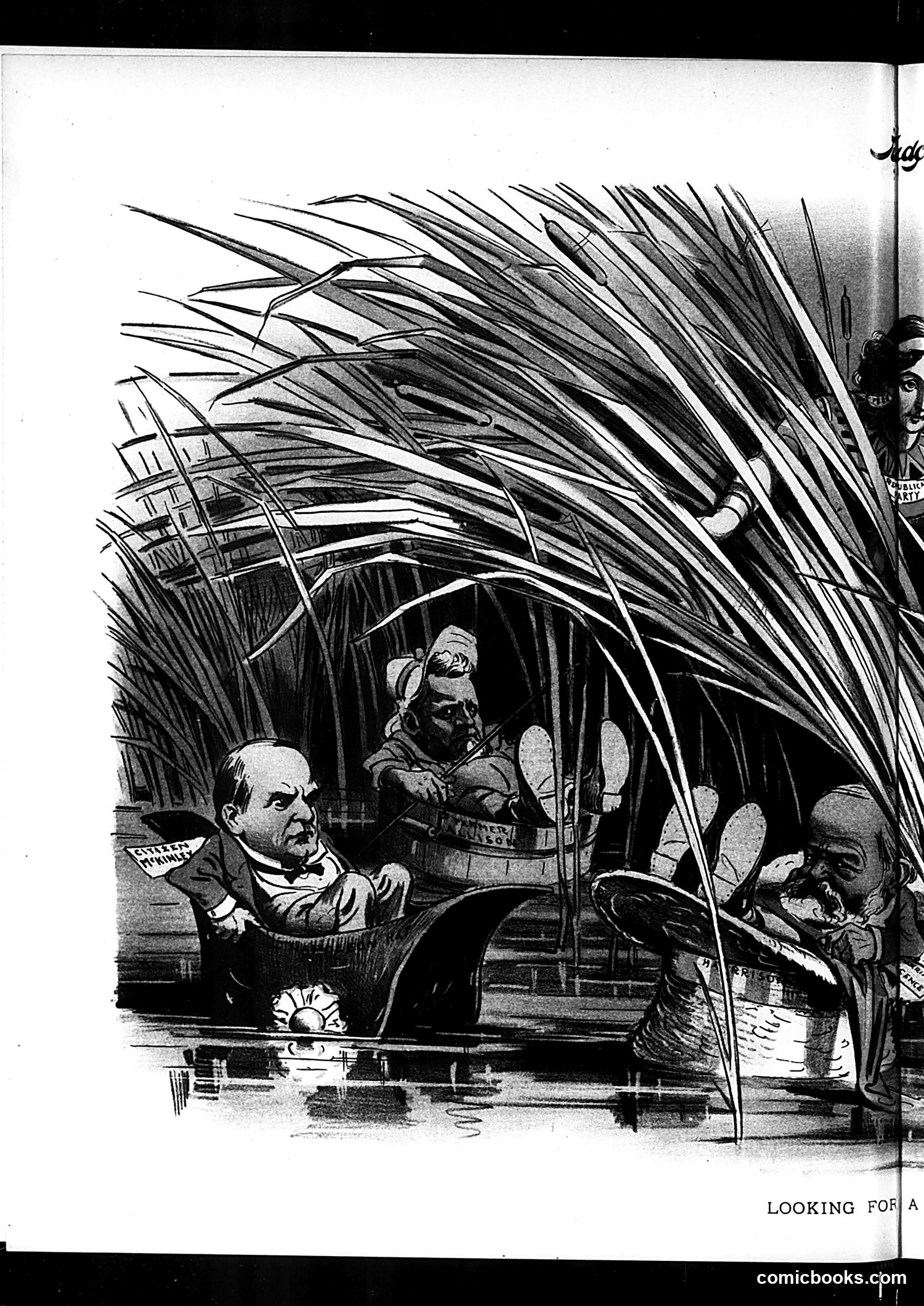
This is a political cartoon from *Judge* magazine depicting what appears to be a boat scene with exaggerated caricatured figures. The visible text reads "LOOKING FOR A" (incomplete). The cartoon shows figures in a small boat among tall reeds or marsh grass, rendered in dramatic cross-hatching. The caricatured faces suggest this is satirizing specific political or public figures of the era, likely American given *Judge*'s focus. However, without the complete caption or additional context clues, I cannot definitively identify which specific figures or political situation is being mocked. The style and composition suggest commentary on a search, journey, or predicament—possibly related to a political campaign, scandal, or social issue—but the incomplete text prevents certain interpretation of the satire's specific target or message.
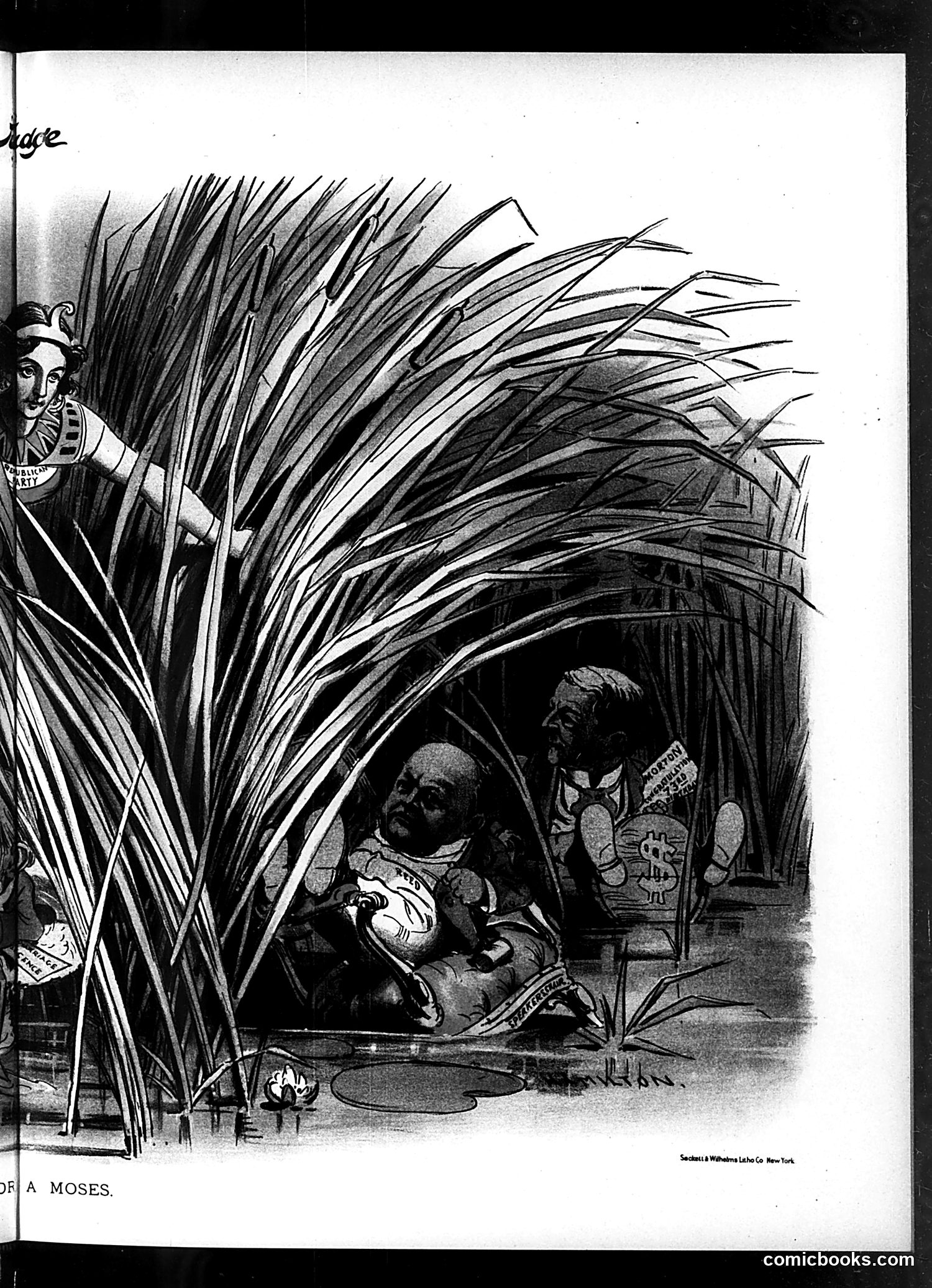
This appears to be a late 19th-century satirical cartoon from *Judge* magazine titled "Of A Moses." The image shows figures in an ornate interior setting with elaborate feathered decorations. Based on the "Moses" reference and the style of caricature, this likely depicts a political or social commentary on leadership or guidance of a particular group. However, without additional context or clearer identifying labels visible in the image, I cannot definitively identify the specific historical figures, political figures being caricatured, or the precise event being satirized. The elaborate costume details and period styling suggest commentary on wealth, pretension, or political authority typical of *Judge* magazine's satirical approach, but stating more would require speculation beyond what the image clearly shows.
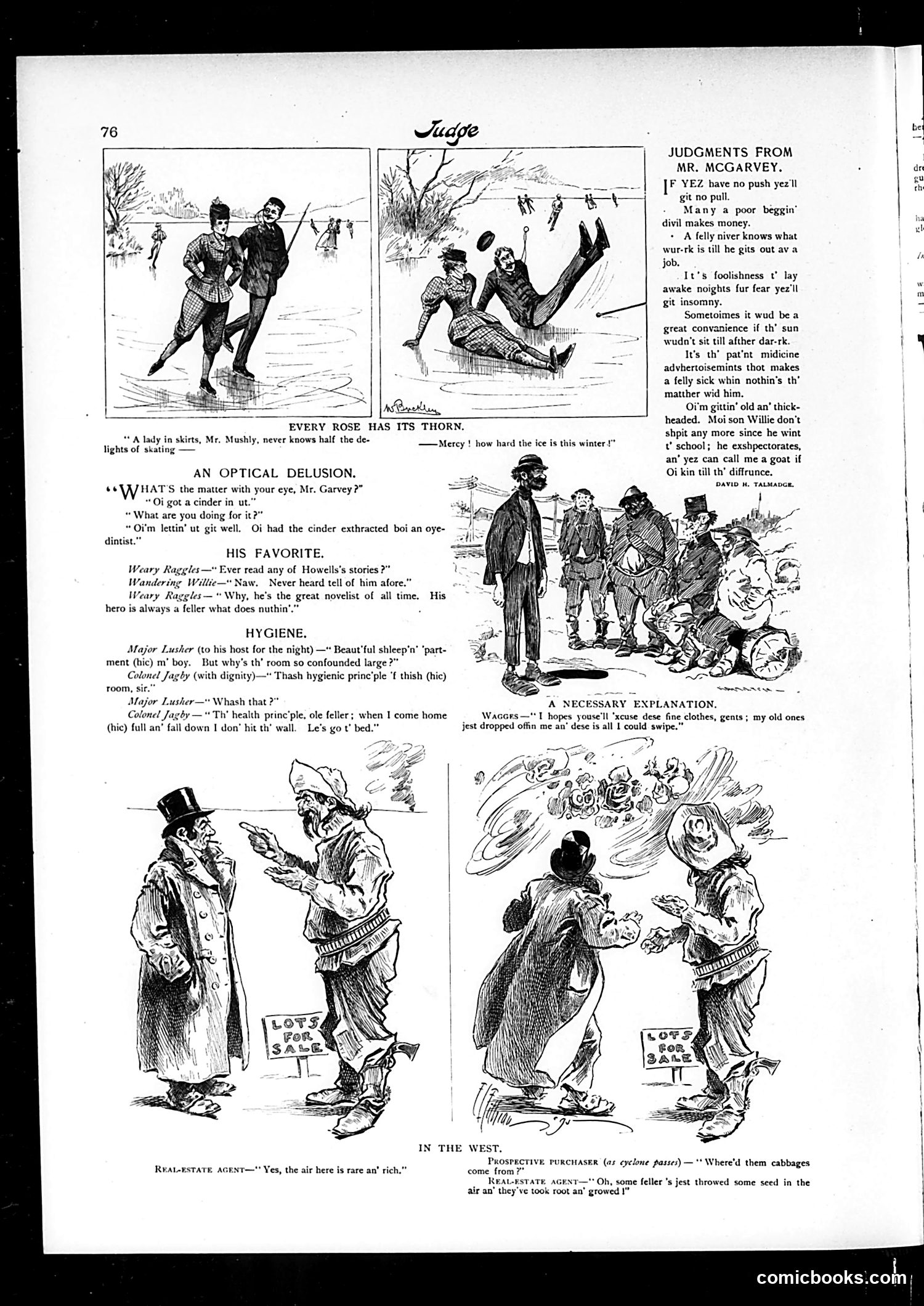
This page contains multiple satirical short comics and humor pieces typical of Judge magazine's format: **"Every Rose Has Its Thorn"** depicts ice-skating mishaps—the joke being that women in skirts don't realize how slippery ice is. **"An Optical Delusion"** features an Irish-dialect character who had an eye doctor remove a cinder, misunderstanding the procedure as extraction rather than treatment. **"His Favorite"** mocks William Dean Howells, a prominent American novelist, suggesting his heroes are characterized by inactivity—a literary critique wrapped in casual dialogue. **"Hygiene"** shows two drunk men discussing room size; the "principle" is that large rooms prevent injury when falling down drunk—dark humor about alcoholism. **"In the West"** satirizes real-estate agents' exaggerated claims about prairie land, with the agent absurdly crediting a cyclone for growing vegetables. **"A Necessary Explanation"** depicts a poor man in stolen clothes attempting social excuse-making. The **McGarvey Judgments** sidebar offers Irish-accented folk wisdom on poverty, work, and patent medicines—working-class social commentary.
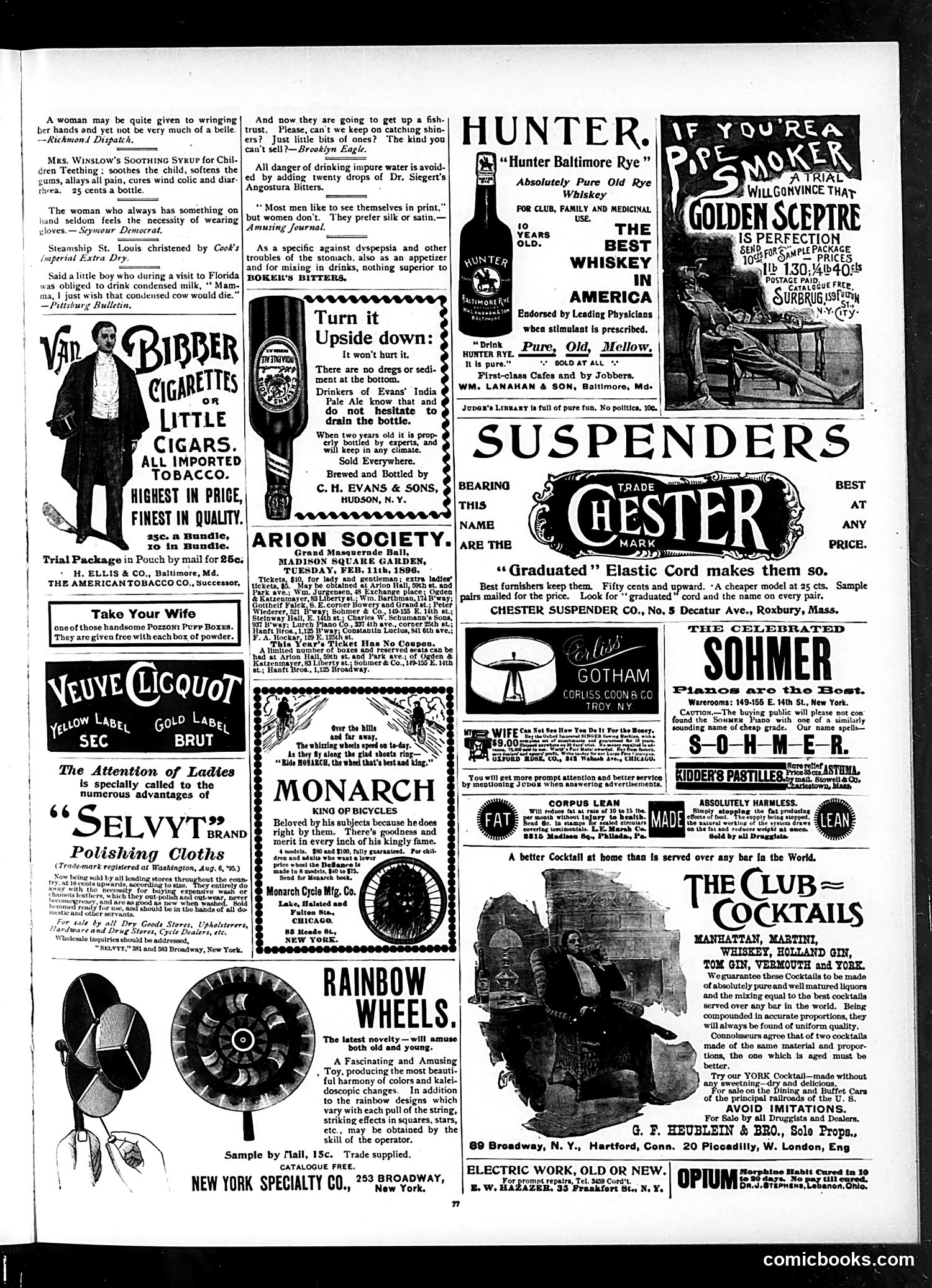
This is primarily an **advertising page** from Judge magazine, not a political cartoon. The page contains various commercial advertisements from the 1890s, interspersed with short humorous quotations and quips typical of the era. The advertisements showcase products common to that period: patent medicines (Mrs. Winslow's Soothing Syrup, Dr. Siegert's Angostura Bitters), tobacco products (Van Bibber Cigarettes), alcoholic beverages (Hunter Rye whiskey, Evans' India Pale Ale), and novelty items (Rainbow Wheels toys, Selvyt polishing cloths). The short text snippets are mild social commentary—brief jokes about women, condensed milk, and men's vanity—typical of Judge's humor style. The Arion Society advertisement announces a masquerade ball at Madison Square Garden in February 1896. **No significant political satire or caricature appears on this page.** It represents standard commercial content from a late-19th-century magazine, reflecting contemporary consumer goods and advertising practices of the era.
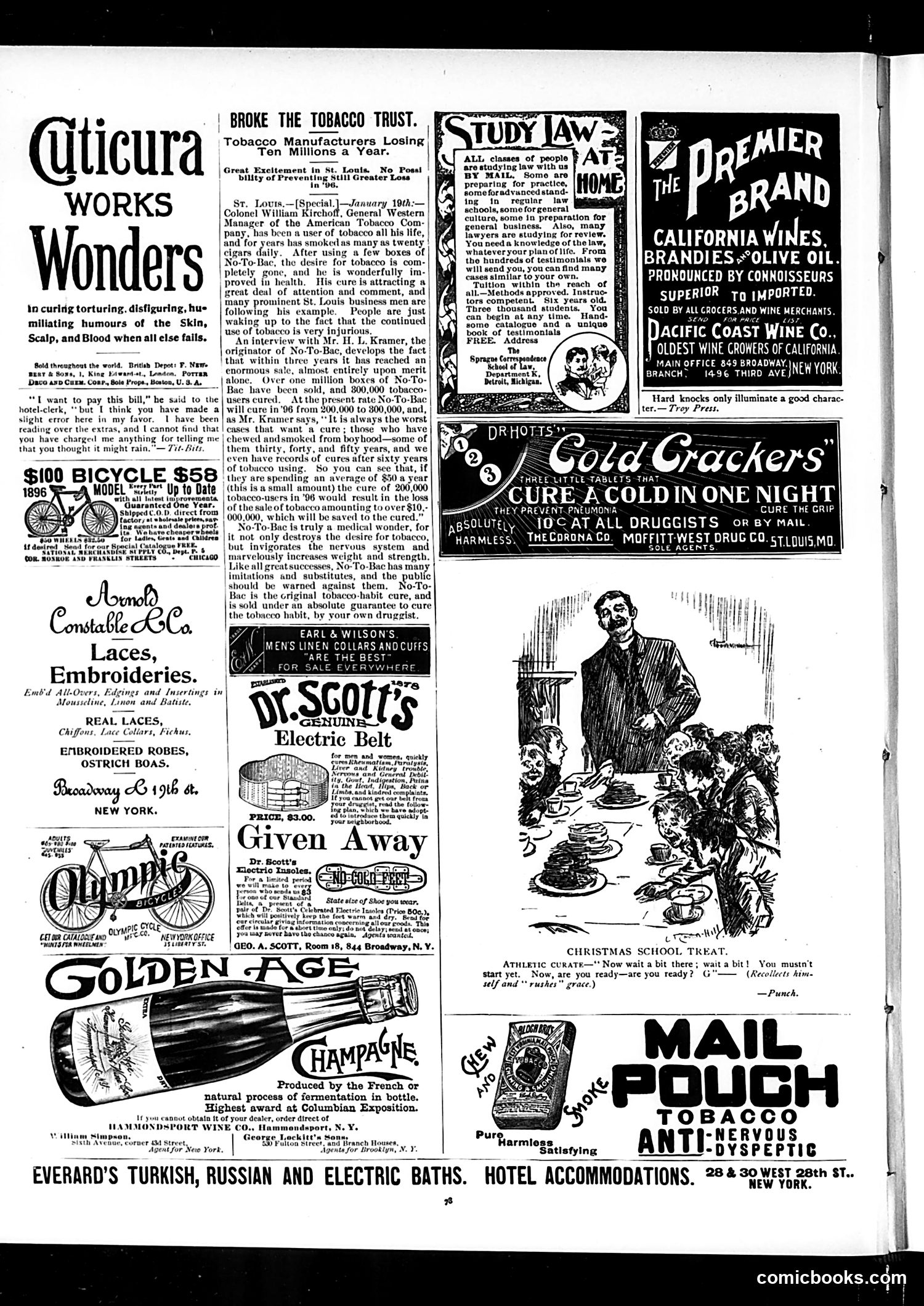
This page celebrates the anti-tobacco product "No-To-Bac," framing it as a victory against the tobacco industry. The central article reports that a Colonel with the American Tobacco Company quit smoking after using No-To-Bac, and projects that if 200,000 tobacco users were cured in 1896, it would cost the industry $10 million in lost sales—hence "broke the tobacco trust." The satire mocks the tobacco industry's economic vulnerability: a single anti-smoking product threatens massive profits. The piece emphasizes No-To-Bac's medical benefits (curing even 60-year users, increasing strength) while presenting tobacco cessation as patriotic economic sabotage. The remainder of the page is typical period advertising—bicycles, wine, medical devices, laces—unrelated to the satire. **Context for moderns:** This reflects early Progressive Era health activism (1890s-1900s) when anti-tobacco campaigns were novel and sensational.
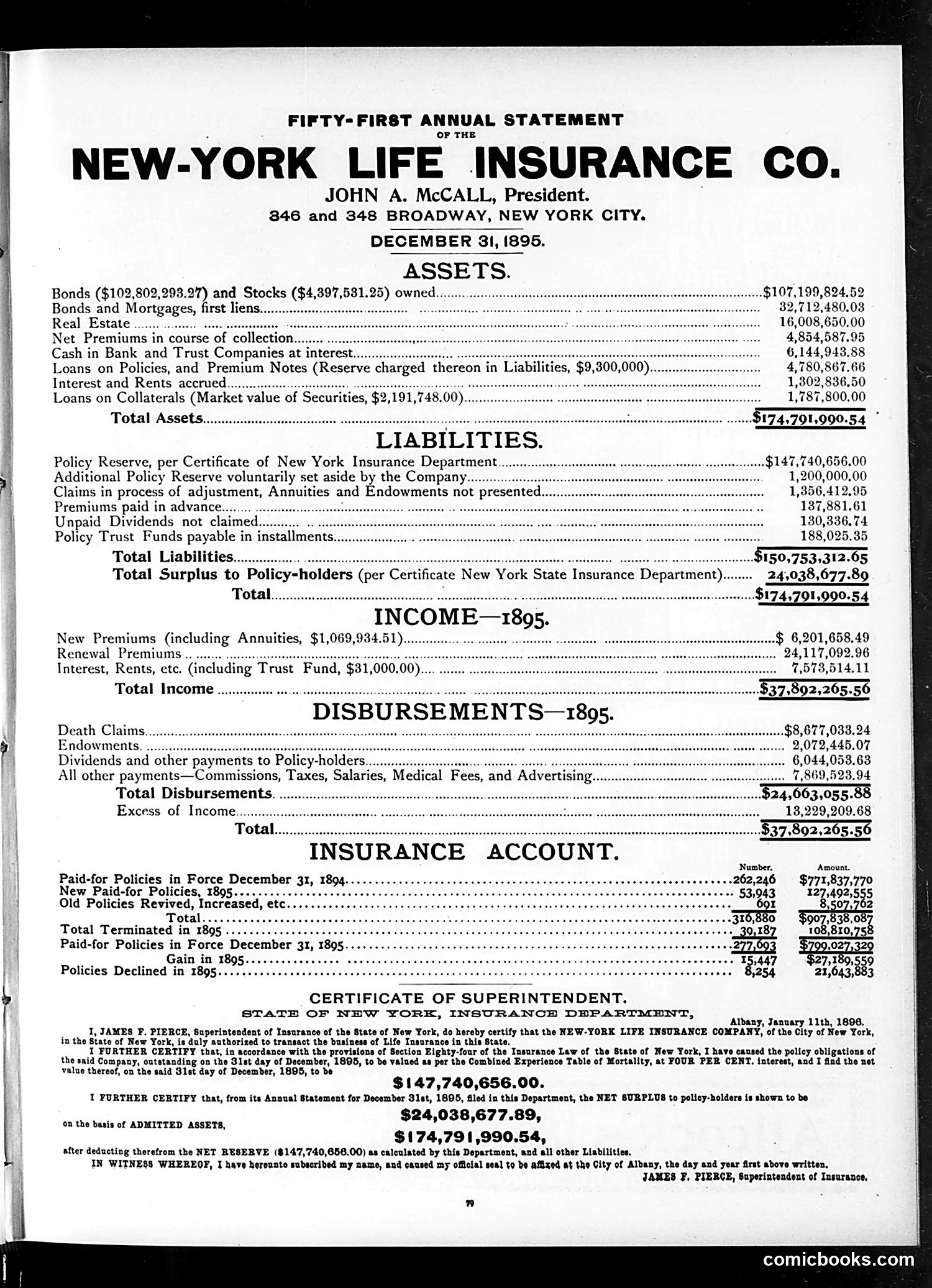
This page is not a cartoon but rather a financial document—the fifty-first annual statement of the New-York Life Insurance Company dated December 31, 1895. It appears in *Judge* magazine likely as an advertisement or informational insert. The document details the company's assets ($174.7 million), liabilities, income, and disbursements for 1895. It includes a "Certificate of Superintendent" from New York's Insurance Department certifying the company's authorization and solvency, signed by Superintendent James F. Pierce. The page demonstrates the scale and legitimacy of this major American life insurance firm during the Gilded Age, when insurance was becoming an increasingly important financial institution. The certification language reflects growing state regulation of insurance companies in the 1890s.
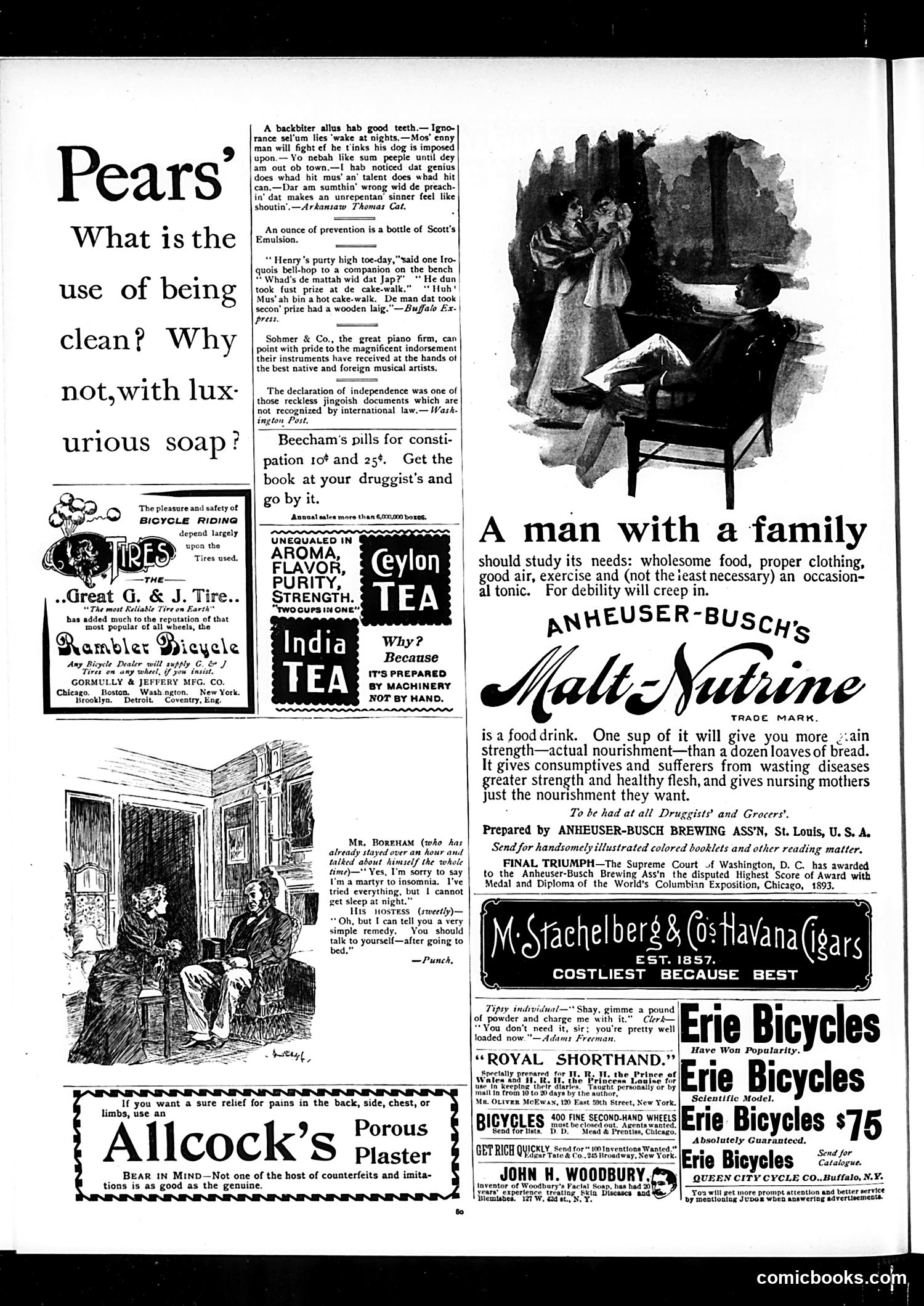
This page is primarily **advertising**, with scattered humor pieces typical of Judge magazine's satirical format. The main cartoon (lower left) shows a domestic scene where a man complains to his wife about insomnia. Her response—that he should "talk to yourself—after going to bed"—is a cutting joke implying his conversation is so tedious it would bore him to sleep. This reflects period humor about bores and long-winded talkers. The page also includes several racial dialect jokes ("Arkansaw Thomas Cat," references to African American vernacular and a "Jap" cake-walk joke), which were unfortunately standard in early 1890s American humor magazines but are now recognized as offensive stereotypes. The bulk of the page comprises advertisements for bicycles (Rambler, Erie), patent medicines (Beecham's pills, Scott's Emulsion, Allcock's Plaster), and luxury goods (Pears' soap, cigars, tea, piano). The Anheuser-Busch "Malt-Nutrine" ad explicitly markets beer as nutritious medicine for debility and nursing mothers—reflecting pre-FDA regulations when such health claims were unregulated.
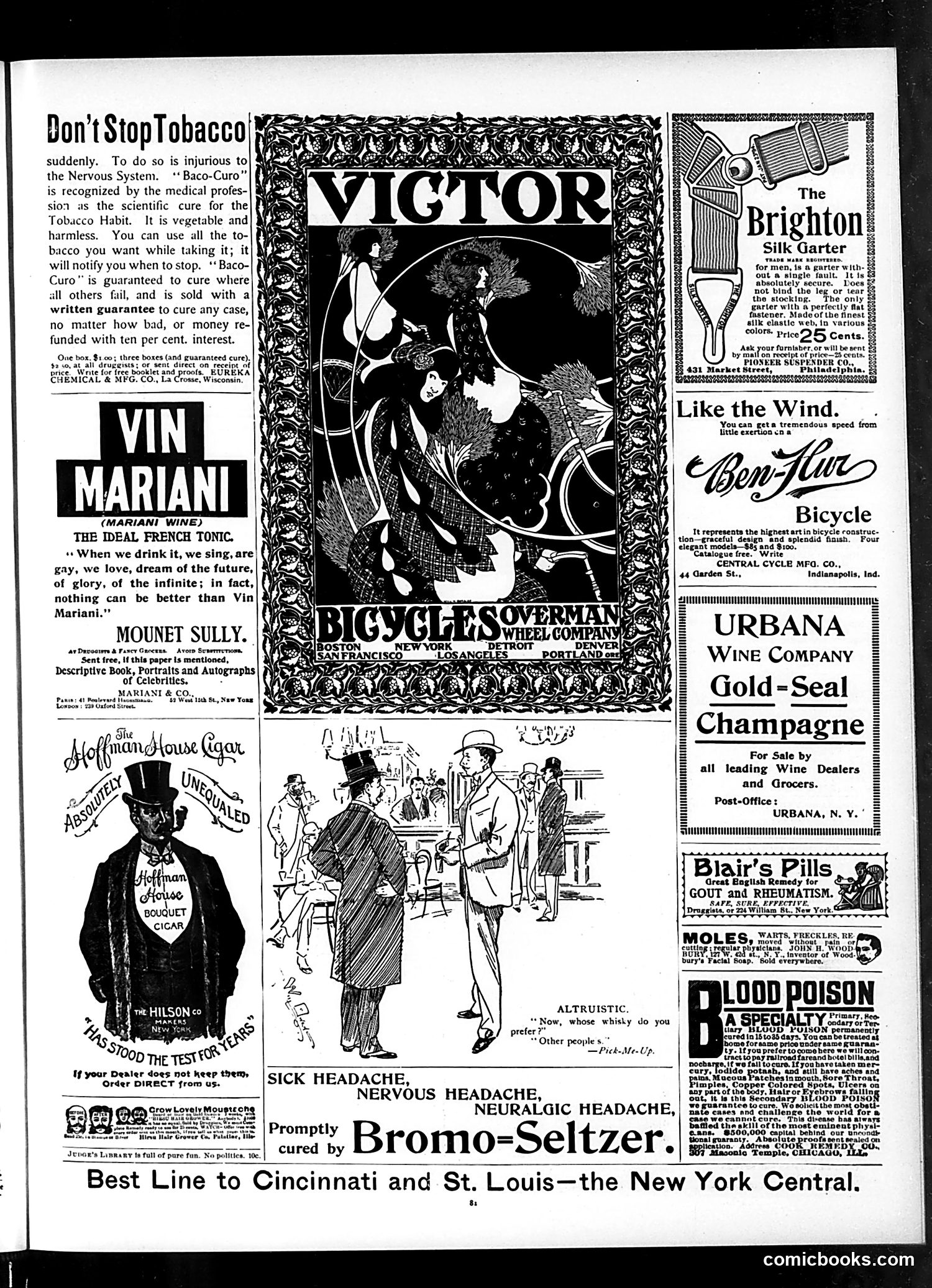
This is primarily an **advertising page** from Judge magazine, with one small cartoon. ## The Cartoon The single cartoon labeled "ALTRUISTIC" depicts two men discussing whisky. One asks the other whose whisky he prefers, and the reply is "Other people's"—a joke about hypocrisy and self-interest masquerading as altruism. The humor lies in exposing that people often claim noble principles while actually pursuing selfish desires. ## The Advertisements The page is dominated by patent medicines and consumer goods typical of the early 1900s: "Baco-Curo" (tobacco cessation), Vin Mariani (wine tonic), Bromo-Seltzer (headache relief), and most notably, **"Blood Poison"** treatment—a patent medicine claiming to cure syphilis in "10 days." These ads reveal what medical problems were openly advertised and what "cures" were accepted as legitimate in this era, many of which were fraudulent or dangerous by modern standards.
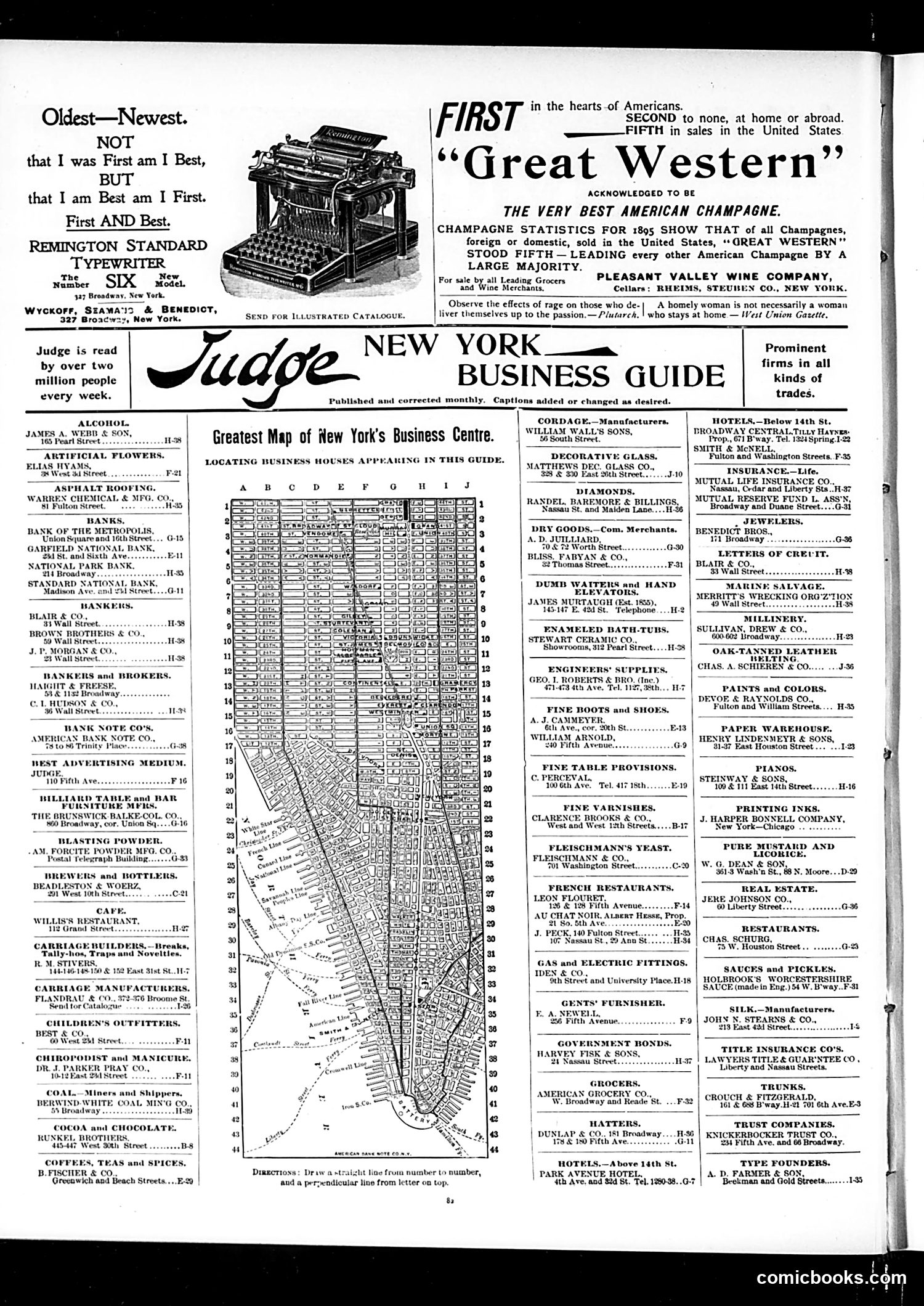
This is primarily a **business directory and advertisement page** for New York City from Judge magazine, not a political cartoon page. **Main content:** - A detailed street map of lower Manhattan's business district (labeled A-J, 1-44) showing business locations - An alphabetized business guide listing firms by trade category (banks, cordage manufacturers, decorative glass, diamonds, etc.) with street addresses and map coordinates - Advertising for the Remington Standard typewriter and "Great Western" champagne **The satirical element** appears only in the opening verses ridiculing typewriter claims ("NOT that I was First am I Best, BUT that I am Best am I First") and brief humorous quotes about women and human nature—but these are minor compared to the practical directory content. **For modern readers:** This page documents Judge's dual function as both satirical magazine and practical urban business reference, reflecting how publications of this era often mixed entertainment with legitimate commercial guidance.
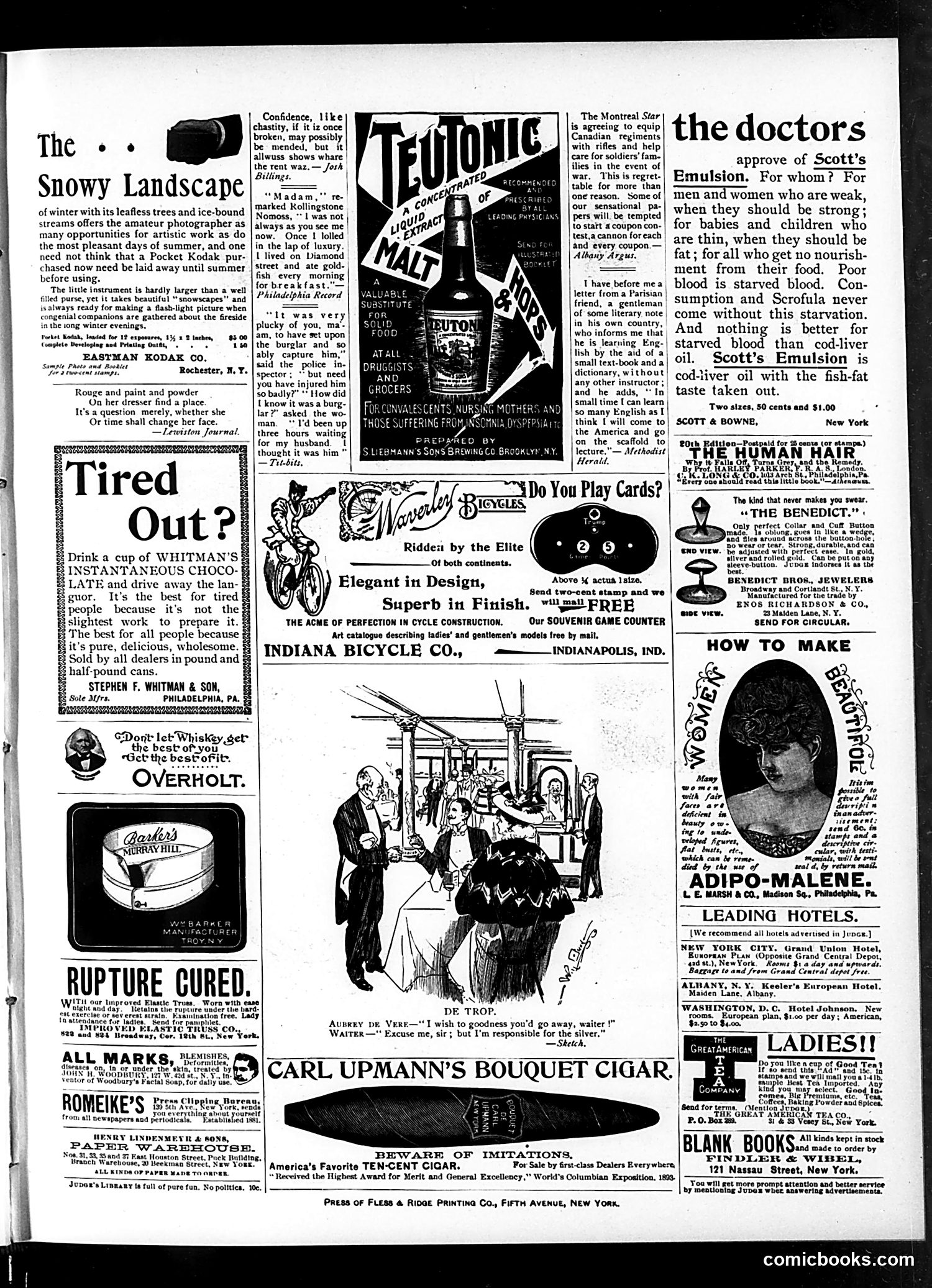
This page is primarily **advertising** from an early 1900s Judge magazine, with minimal political satire. The ads dominate—promoting Kodak cameras, bicycles, cigars, whiskey, and patent medicines (Adipo-Malene for beauty). The few satirical bits are mild social commentary: - **Josh Billings quote** mocks broken confidence like broken chastity—dated gender morality humor. - **Montreal Star/Canadian regiment anecdote** satirizes sensational newspapers potentially exploiting patriotic fundraising with coupon contests during wartime. - **Parisian learning English** joke plays on European pretension and broken English. - **"Tired Out"** chocolate ad uses common early-advertising tropes about women's exhaustion. The cartoons are brief comedic vignettes with no identified political figures—just domestic/workplace humor. The page reflects turn-of-century consumer culture and genteel magazine advertising rather than pointed political satire.
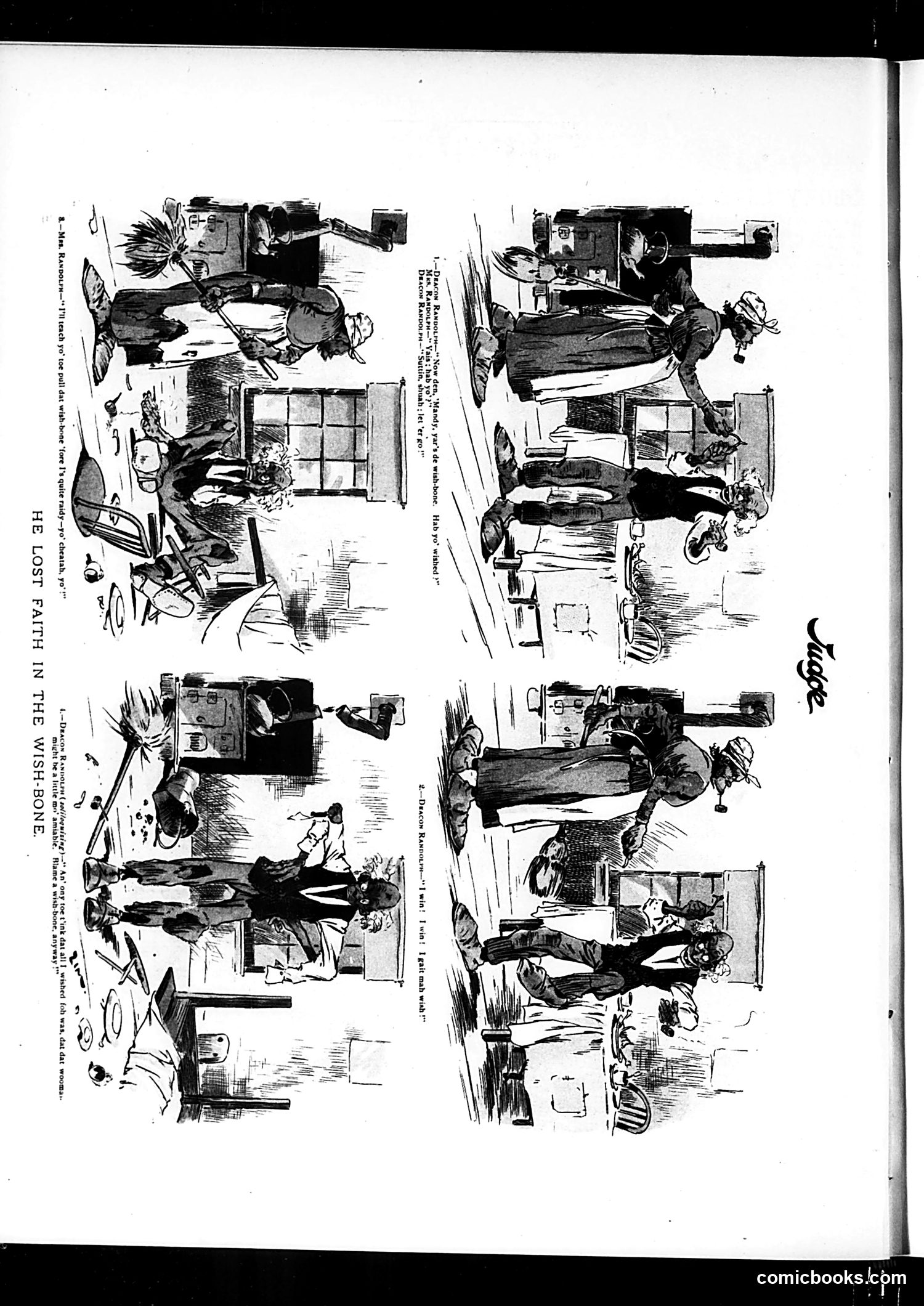
This appears to be a satirical cartoon sequence titled "He Lost Faith in the Wishbone," showing what looks like a scene involving two figures and a wishbone-pulling ritual. The OCR'd dialogue includes dialect speech ("yo"," "dat," "raidy"), suggesting the cartoon employs period racial stereotyping common to early Judge magazine content. The sequence appears to mock someone's loss of belief in the wishbone-pulling tradition—a folk superstition where two people pull a chicken wishbone apart, with the person getting the larger piece supposedly granted a wish. Without clearer context or visible captions identifying specific political figures, the exact satirical target remains unclear, though it likely comments on gullibility or superstition. The cartoon's humor relies on visual narrative across multiple panels showing the protagonist's disillusionment with this folk practice.