
A complete issue · 16 pages · 1896
Judge — January 25, 1896
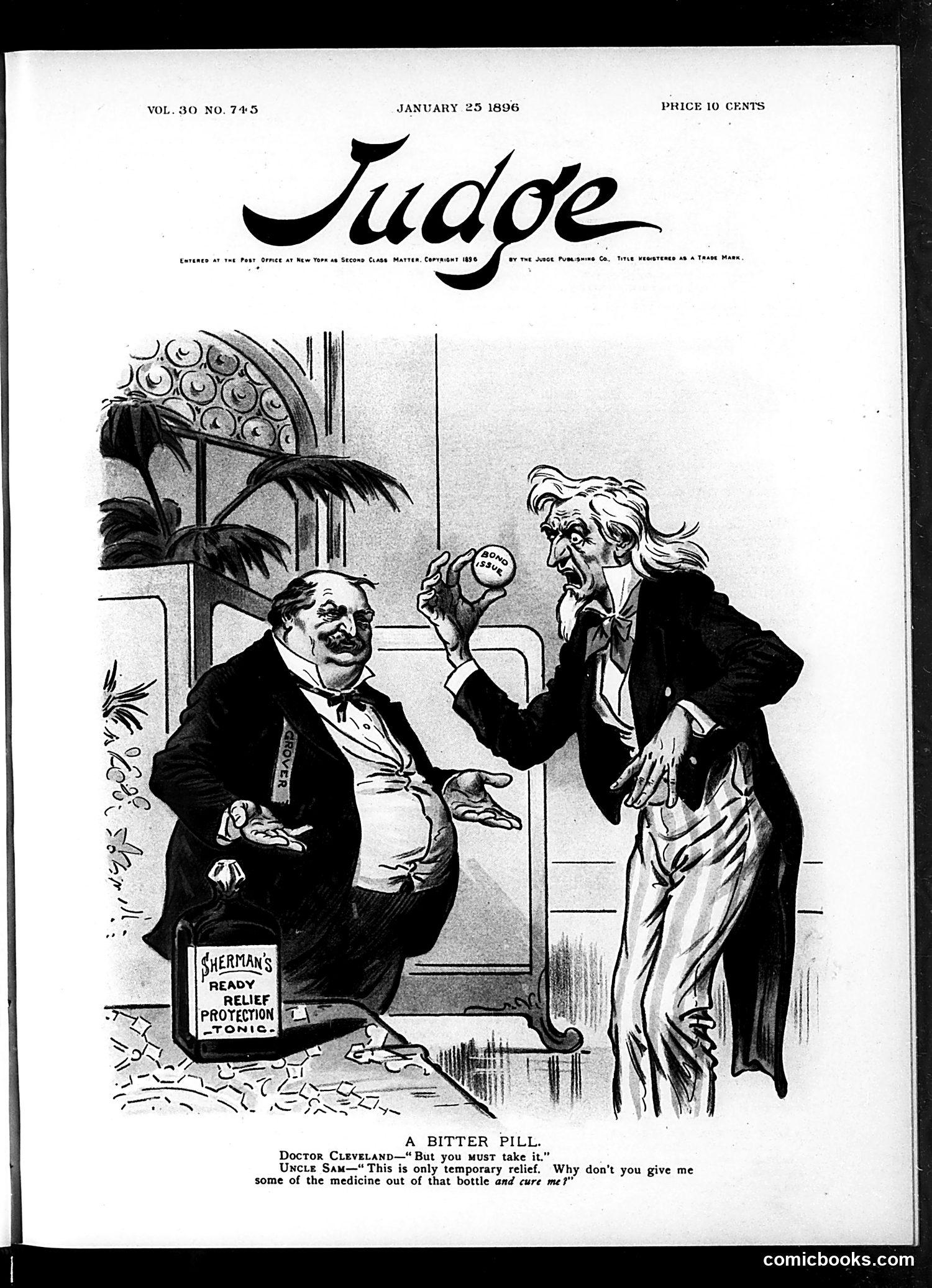
This political cartoon depicts an argument between two figures identified as "Doctor Cleveland" and "Uncle Sam." Cleveland (the rotund man on the left, sitting beside a bottle labeled "Sherman's Ready Relief Protection Tonic") is insisting Uncle Sam must take medicine. Uncle Sam (the tall, thin figure on the right) protests that it's only temporary relief and asks why Cleveland won't give him the actual cure instead. The satire criticizes President Grover Cleveland's policies as merely offering temporary solutions rather than genuine remedies for the nation's problems. "Sherman's" appears to reference Secretary of the Treasury William McKinley's economic policies, suggesting Cleveland's approach was inadequate or ineffective medicine for America's ailments.
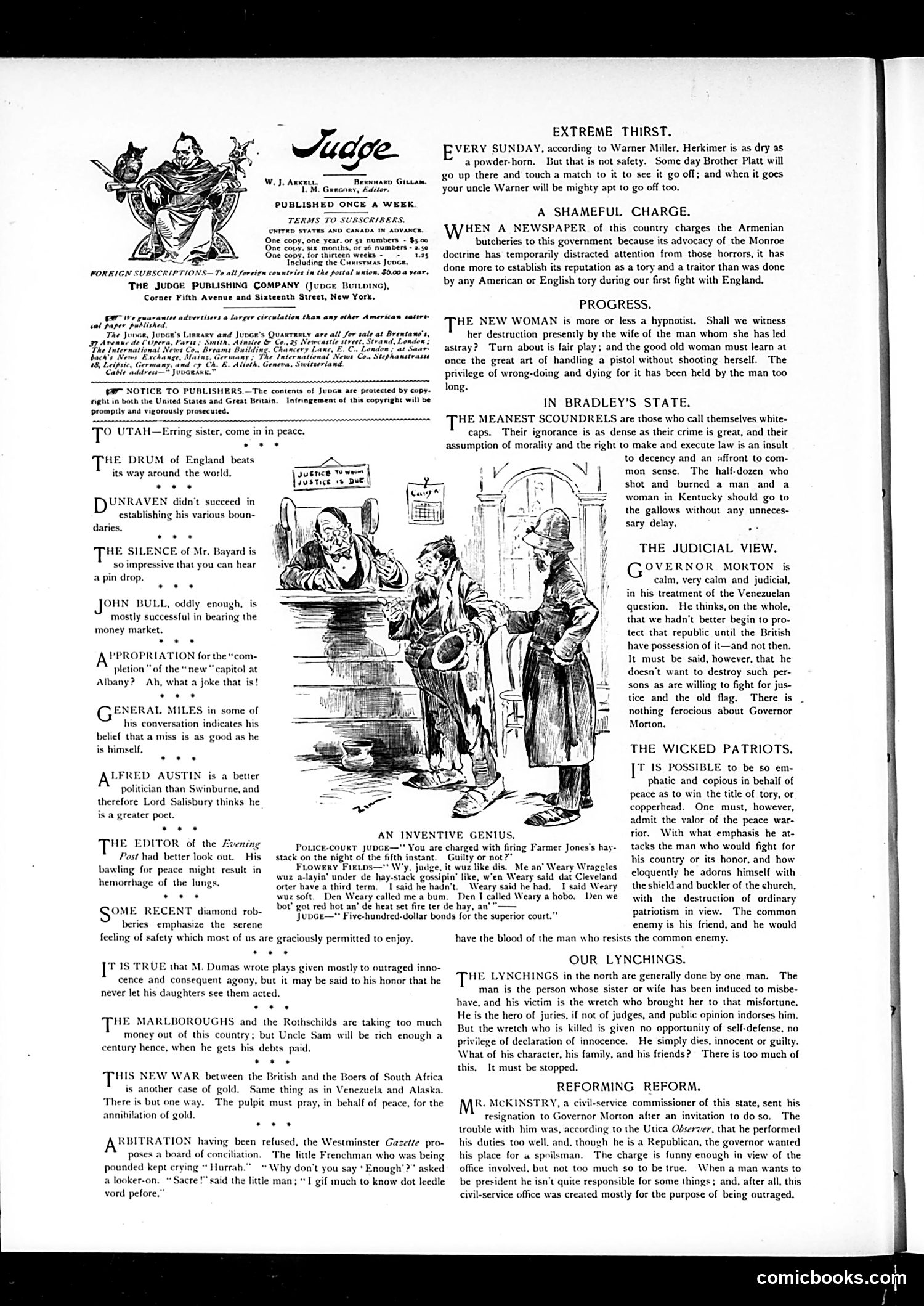
This cartoon depicts a police court scene mocking a farmer's creative legal defense. According to the caption, "Farmer Jones" is accused of firing his haystack (apparently a disguised firearm). His absurd defense—that he was merely testing whether hay could ignite—satirizes both rustic ignorance and legal sophistry. The judge and court officials react with evident skepticism to this implausible explanation. The satire targets gullible juries who might accept ridiculous testimony, and perhaps critiques rural defendants' creative but transparently false excuses. The cartoon's title "An Inventive Genius" is ironic; the farmer's "invention" is transparently dishonest. This reflects Judge's urban, educated readership's attitude toward rural simplicity and attempted deception masquerading as innocence.
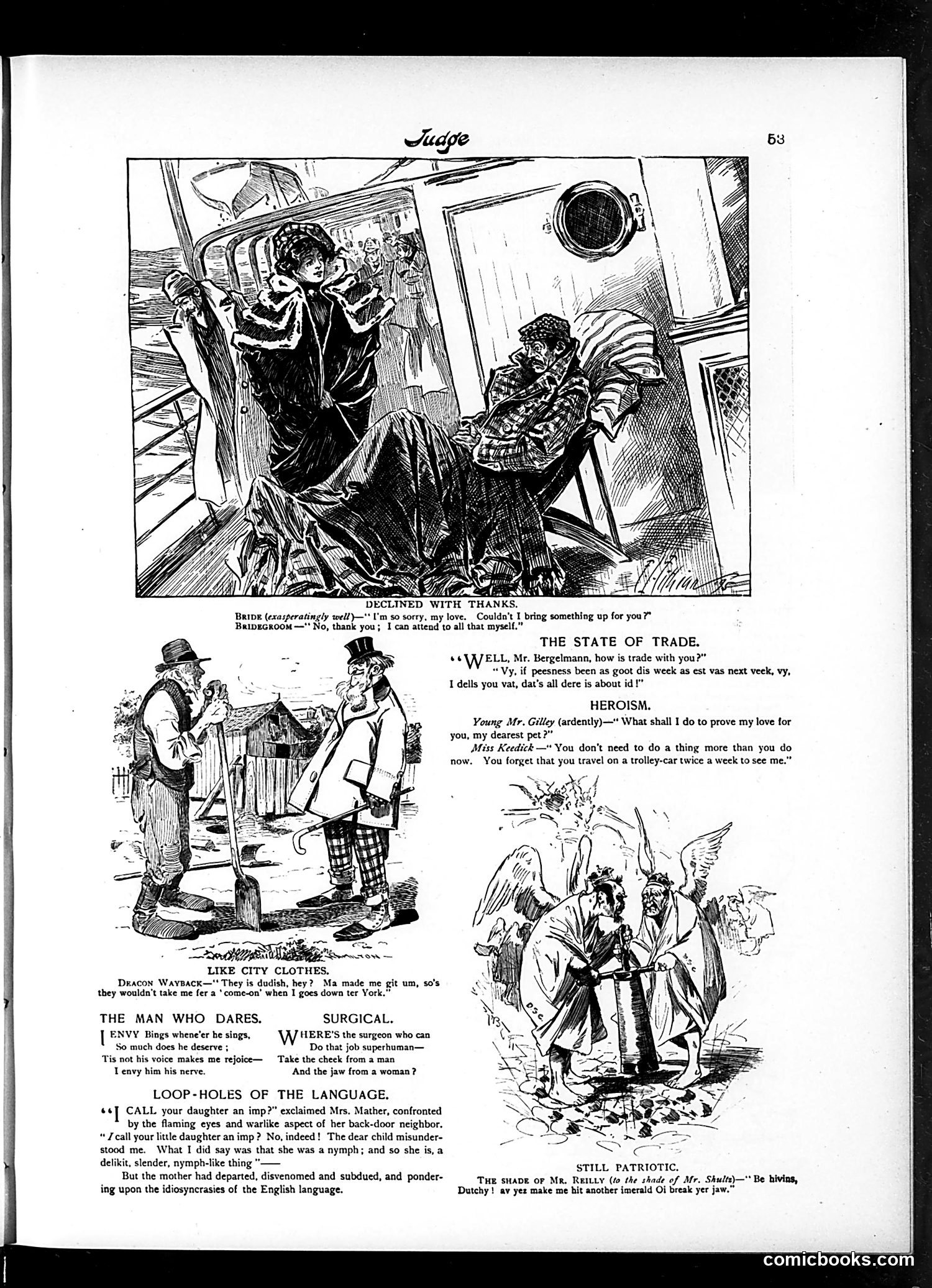
This page contains several satirical sketches and verses poking fun at contemporary social situations: **"Declined with Thanks"** depicts a marriage proposal rejection aboard a ship, mocking romantic disappointment. **"The State of Trade"** and **"Like City Clothes"** appear to mock economic conditions and fashion pretensions through character dialogue. **"Heroism"** satirizes young romance, with a woman rejecting a suitor's grand gestures, noting he already sees her via trolley twice weekly—deflating his romantic claims. **"The Man Who Dares"** and **"Surgical"** contain verses about masculine bravado and medical pomposity. **"Loop-Holes of the Language"** ridicules imprecise English usage through a mother-daughter exchange about linguistic confusion. **"Still Patriotic"** features an illustration with winged figures, likely satirizing political hypocrisy or nationalism. The overall tone targets courtship rituals, class pretensions, and verbal absurdities common to late 19th/early 20th-century American society.
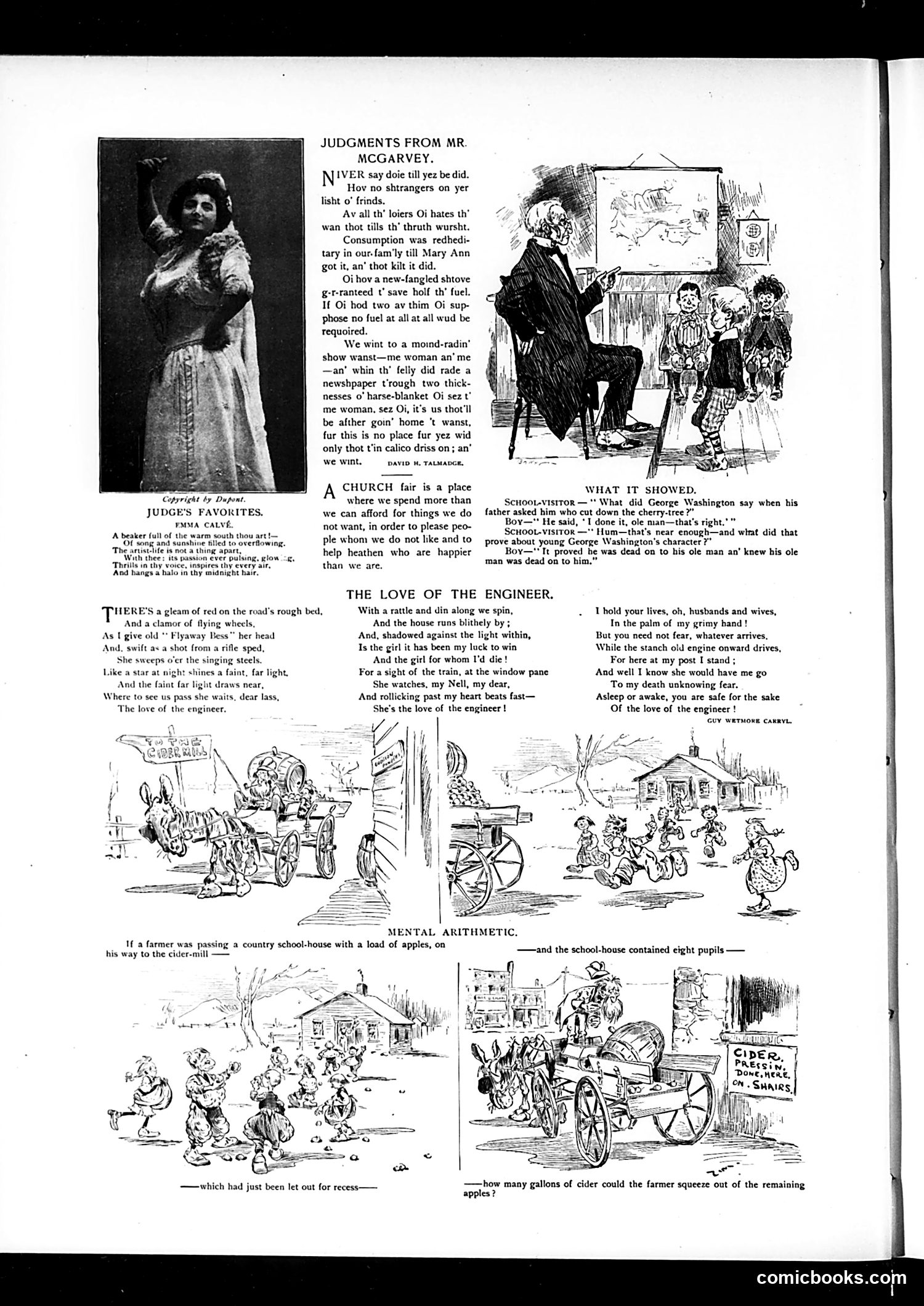
This page from *Judge* contains several satirical pieces typical of the magazine's humor: **"Judgments from Mr. McGarvey"** mocks Irish immigrant dialect and folk wisdom. McGarvey dispenses contradictory advice—warning against strangers while claiming his wife's consumption was cured when she got it, or boasting a stove that saves half fuel (implying two would save all fuel). The humor relies on ethnic stereotype and logical absurdity. **"The Love of the Engineer"** is sentimental Victorian verse celebrating a train engineer's devotion, contrasting with the page's other cynical content. **Church Fair commentary** satirizes charitable fundraising as wasteful vanity benefiting people "happier than we are." **"Mental Arithmetic"** is a visual joke: children swarm a farmer's apple cart after school recess, leaving the question unanswerable—the apples are gone. The page reflects *Judge's* mix of ethnic humor, gentle social criticism, and visual comedy aimed at middle-class readers skeptical of progress, charity, and immigrant populations.
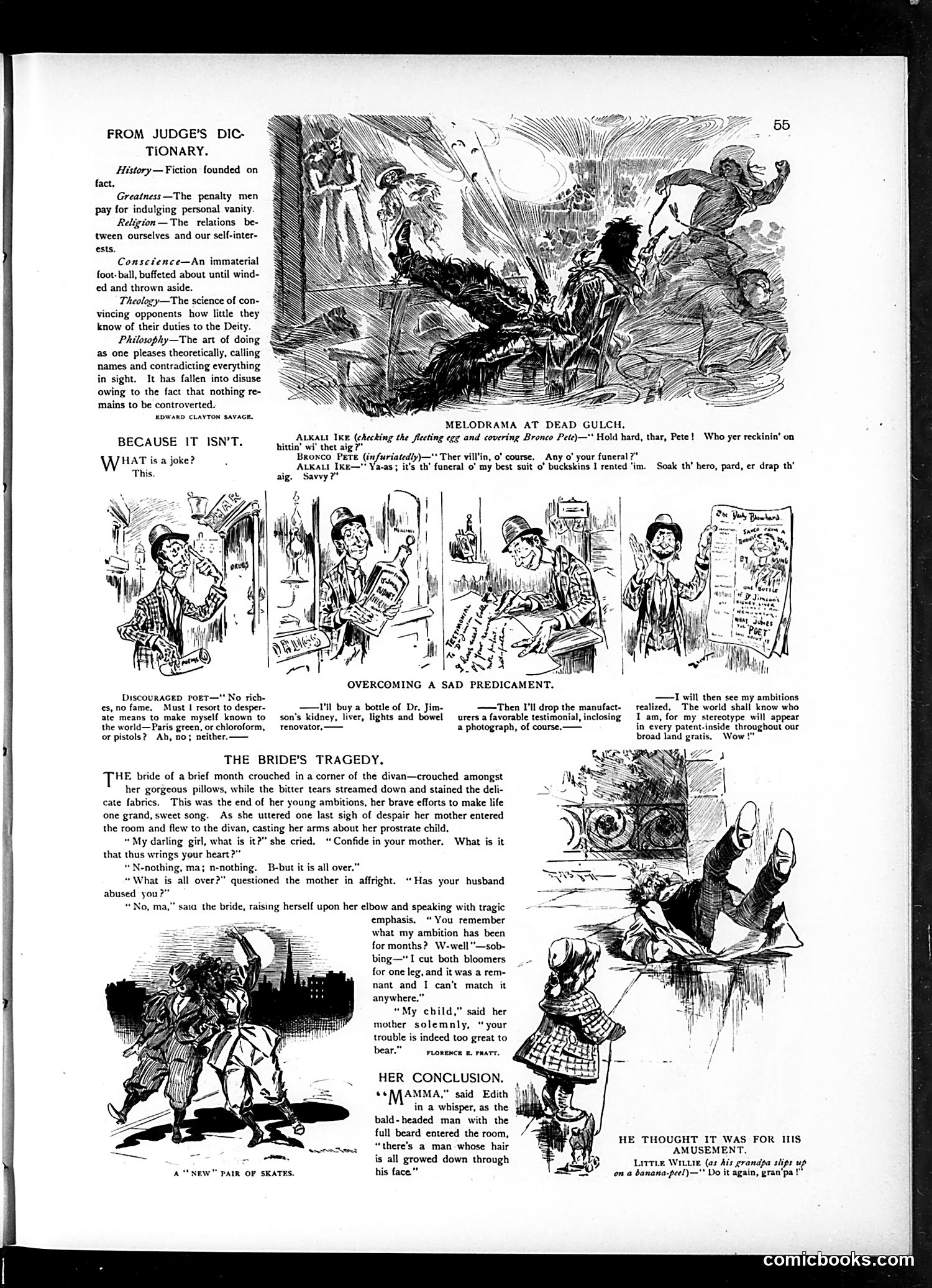
This page from the satirical magazine *Judge* contains several unrelated humorous pieces targeting social pretensions and absurdities of the era: **"From Judge's Dictionary"** mocks institutions through cynical definitions—religion as self-interest, theology as intellectual sophistry, philosophy as contradicting everything. **"Melodrama at Dead Gulch"** parodies Wild West fiction with exaggerated dialogue and stock characters (Alkali Ike, Bronco Pete), satirizing the genre's melodramatic conventions. **"The Bride's Tragedy"** uses ironic tragedy to mock women's fashion obsessions: a newlywed despairs because she cannot match bloomers fabric for a sewing project—reducing her "ambitions" to trivial domestic concerns. The satire critiques both feminine vanity and the limitation of women's aspirations. **"Overcoming a Sad Predicament"** shows a man using patent medicine testimonials for self-promotion—mocking quack medicine advertising. The shorter pieces ("Because It Isn't," "Her Conclusion," "He Thought It Was") offer quick observational humor about daily life and wordplay, typical of *Judge's* light satirical format.
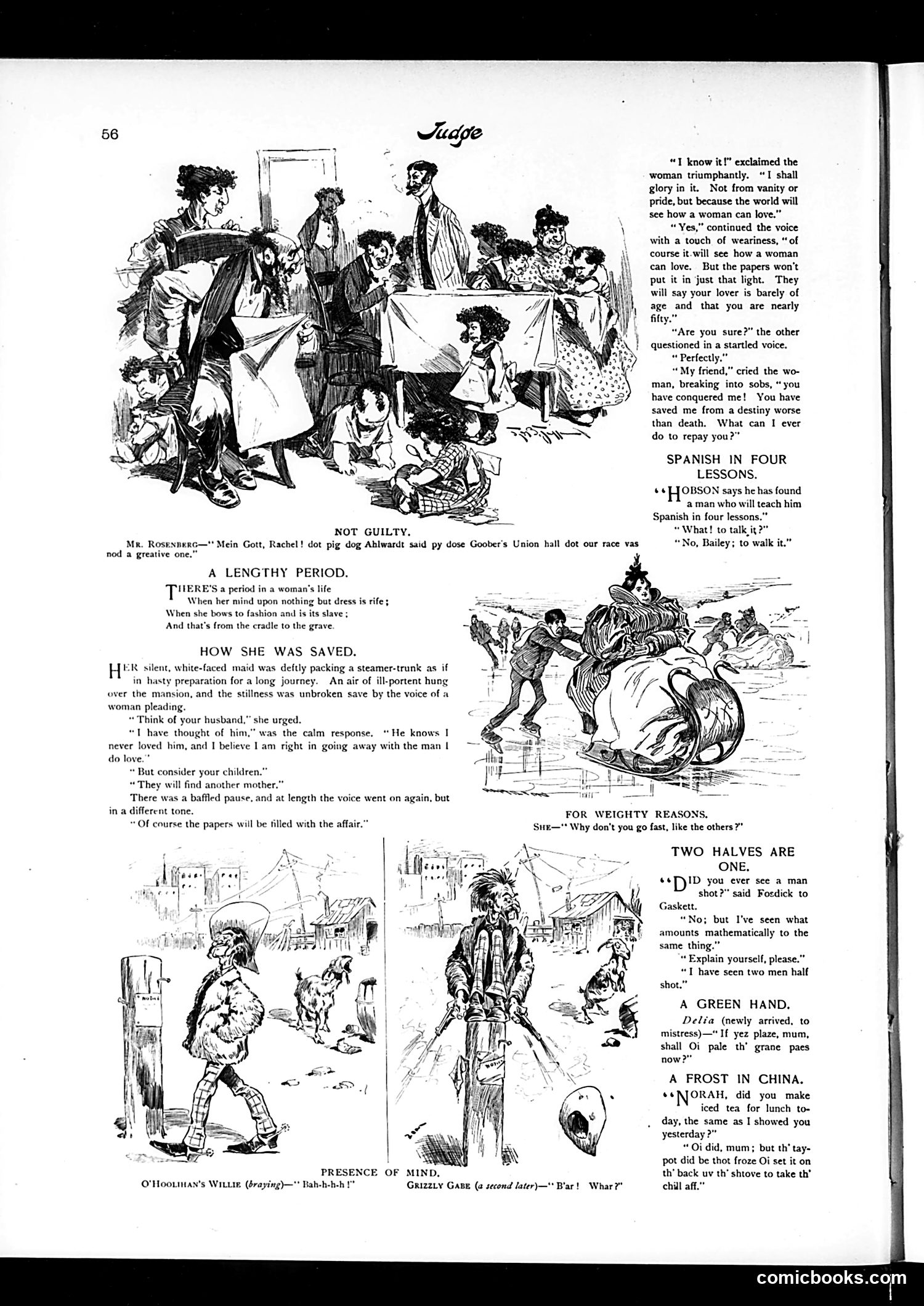
This page from *Judge* presents several brief satirical sketches typical of late 19th-century American humor: **"How She Was Saved"** mocks romantic melodrama. A woman plans to elope with her lover, but a friend dissuades her by pointing out scandal—not morality, but fear of newspaper ridicule. The satire targets both women's impulses toward illicit romance and society's obsession with public scandal over principle. **Other sketches** employ ethnic humor common to the era: Irish servants ("Delia," "O'Hoolihan") speaking in exaggerated brogue; a German character ("Ablwardt"); lazy jokes about teaching Spanish or shooting firearms. **"Two Halves Are One"** plays on the phrase—a man who's seen two drunk men has "seen" someone shot (punning on intoxication). The overall tone reflects *Judge*'s satirical approach: mocking women's vanity, ethnic stereotypes, and contemporary social pretensions. The humor relies on recognizing familiar types rather than specific current events. These brief comedic sketches were the magazine's standard format.
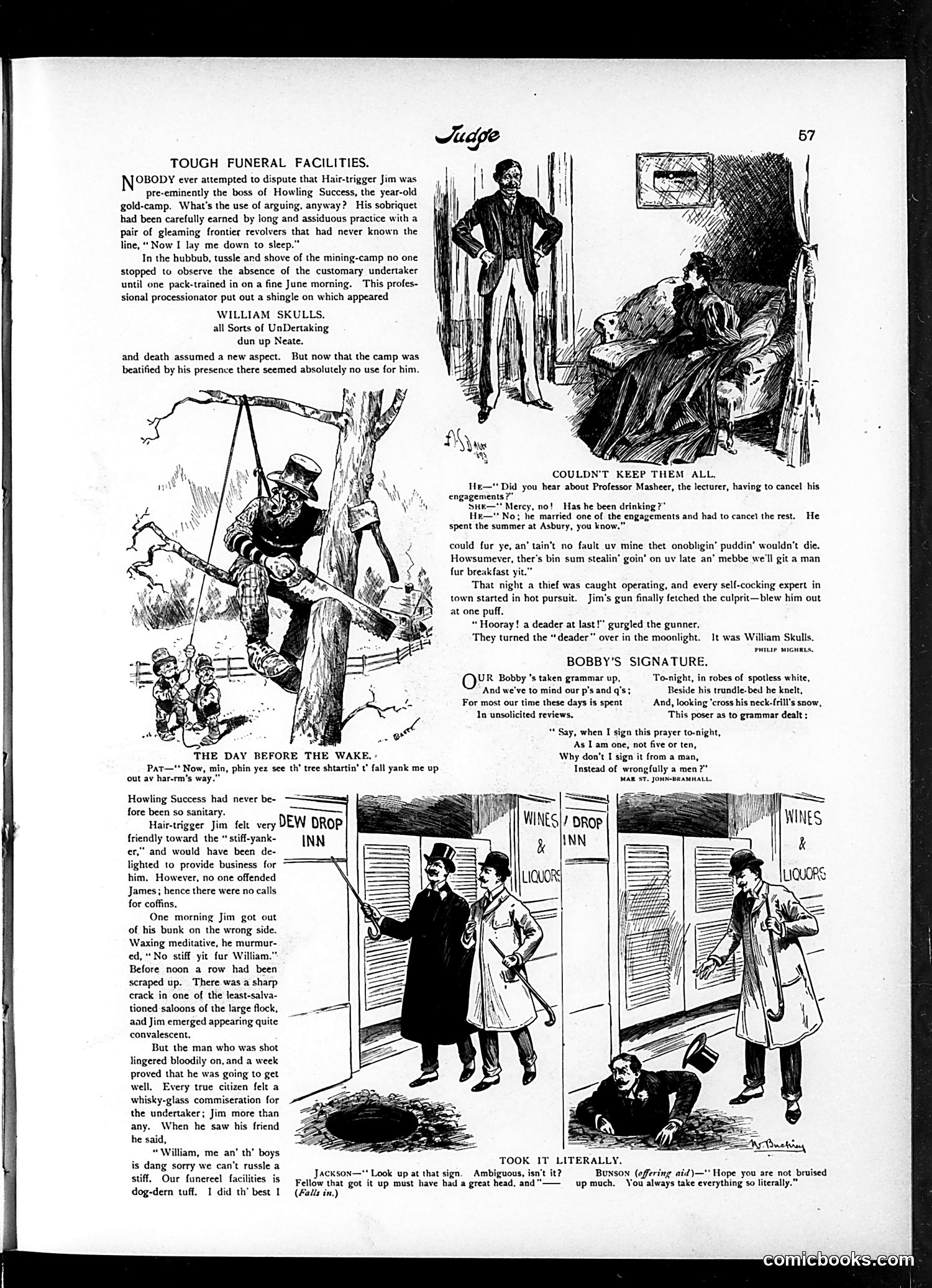
This *Judge* page contains several unrelated satirical pieces: **"Tough Funeral Facilities"** — A Western tall tale where "Hair-trigger Jim," a gun-slinging mining camp boss, repeatedly kills people, ironically preventing the newly arrived undertaker William Skulls from having any business. The joke: Jim is so violent that no one stays dead long enough to need burial services. **"Bobby's Signature"** — A child's grammar joke. Young Bobby questions why he signs prayers "from a man" (singular) instead of "from men" (plural) when praying as one person—a play on grammatical pedantry that was apparently a contemporary concern. **"The Day Before the Wake"** — Irish dialect humor involving slapstick about a man shot in a saloon who survives, frustrating Jim and friends who want to give their undertaker business. **Bottom cartoons** — Minor gags about literal interpretation and ambiguous signage. The page satirizes frontier violence, Irish immigrants, child education fads, and literal-minded interpretation—typical *Judge* targets of the era.
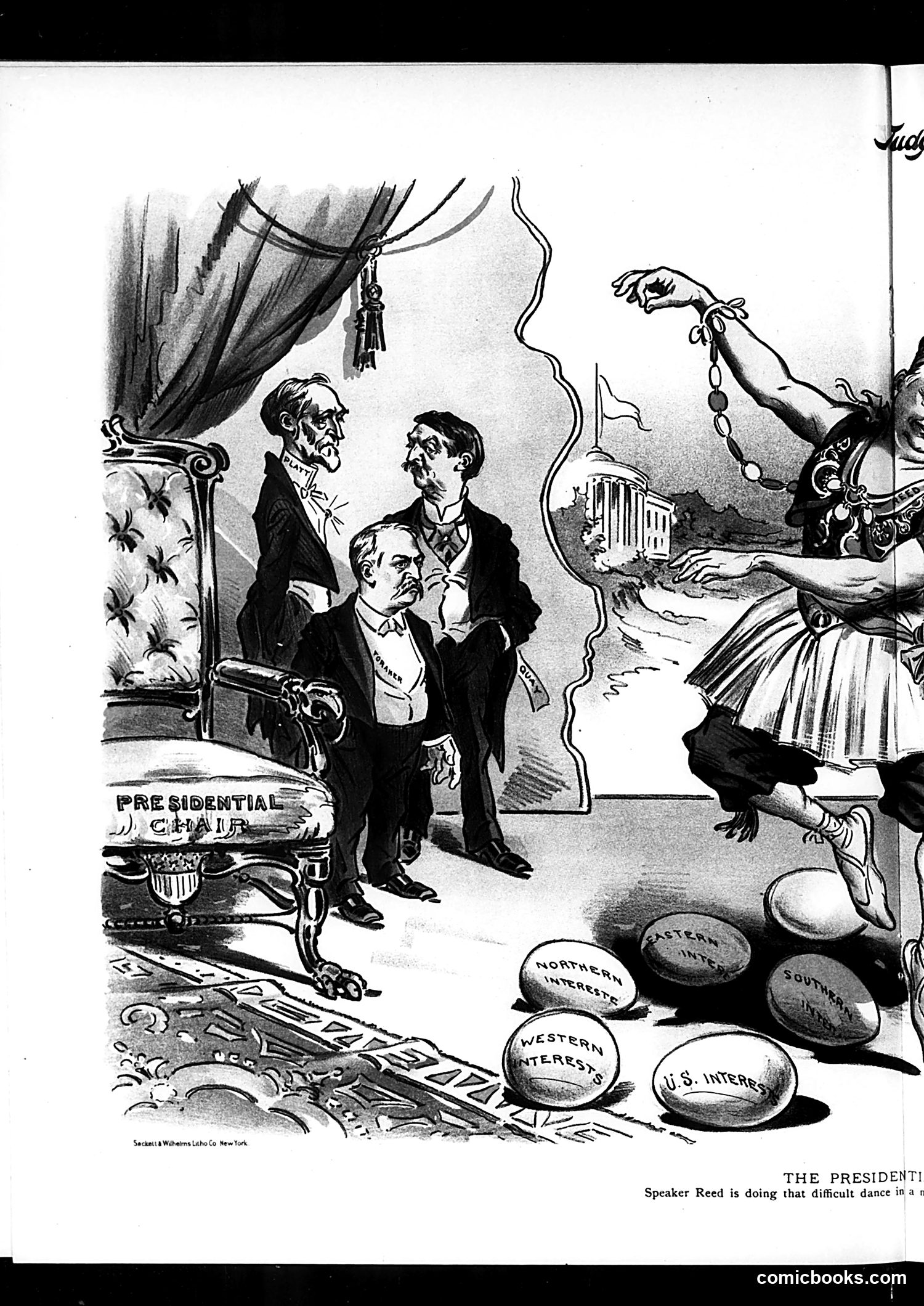
This **Judge** magazine cartoon satirizes Speaker of the House Thomas B. Reed navigating conflicting regional political interests. Three well-dressed men (presumably representing different factions) stand near a "Presidential Chair," while Reed performs a precarious "difficult dance." Around them lie labeled spheres representing competing interests: "Northern Interests," "Southern Interests," "Western Interests," "Eastern Interests," and "U.S. Interests." The cartoon mocks Reed's attempts to balance these regional demands while maintaining presidential ambitions or leadership authority—suggesting the political juggling act required to satisfy divergent American constituencies. The ornate setting and formal dress emphasize the high-stakes nature of this political maneuvering during what appears to be a period of significant sectional tension in American politics.
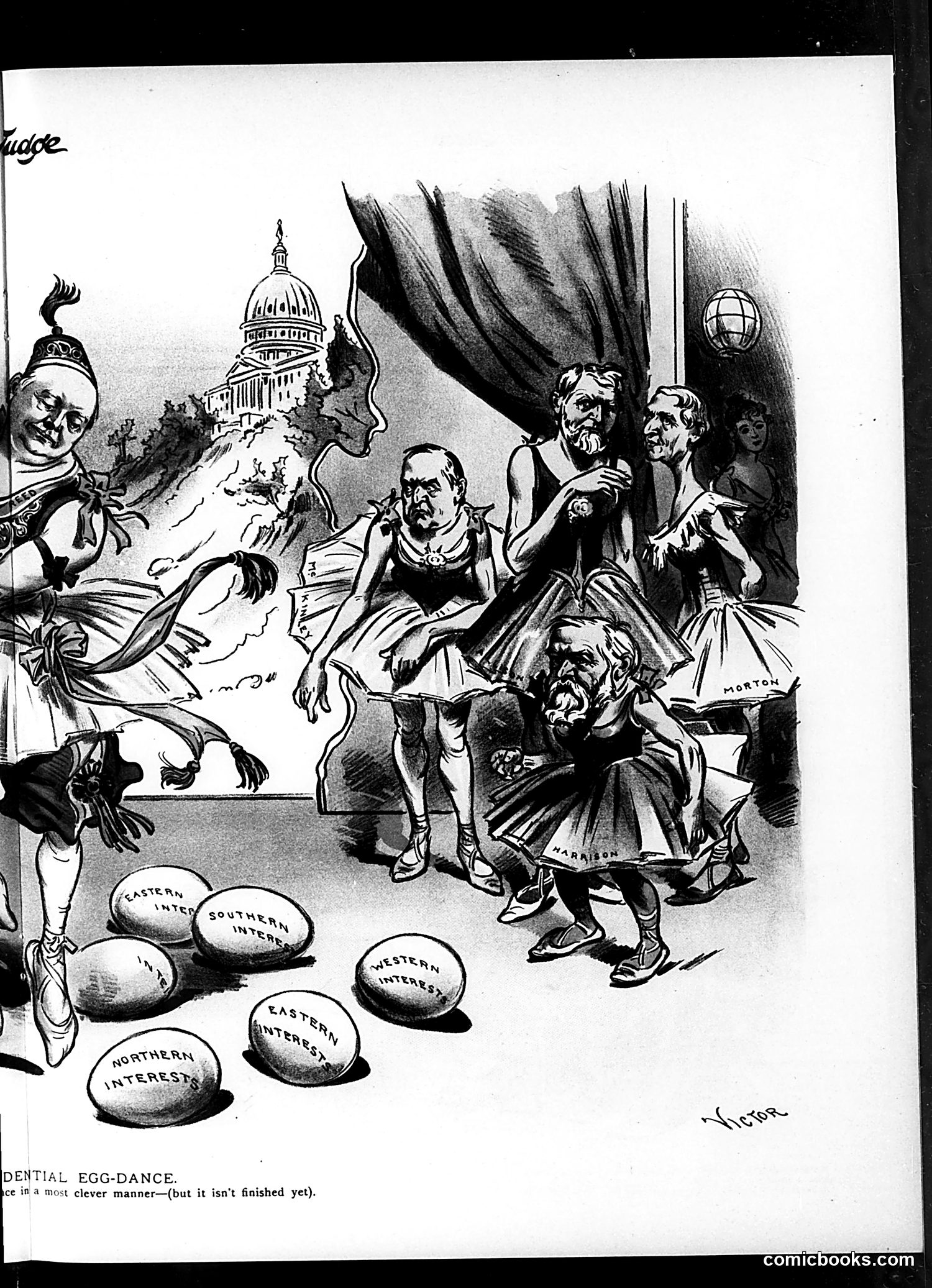
This political cartoon satirizes presidential politics as a delicate balancing act. The title "Egg-Dance" references a folk performance where dancers navigate around eggs without breaking them—here representing regional American interests: Northern, Eastern, Western, and Southern/Interior interests. A presidential candidate (likely from the late 19th century, given Judge magazine's era) carefully choreographs among these competing regional demands while watched by politicians and interests in the background. The Capitol dome suggests federal politics. The incomplete nature noted in the caption—"but it isn't finished yet"—implies the dance is ongoing and precarious, satirizing how politicians must juggle contradictory regional interests to win office without committing to concrete positions. The cartoon mocks political expedience and evasion.
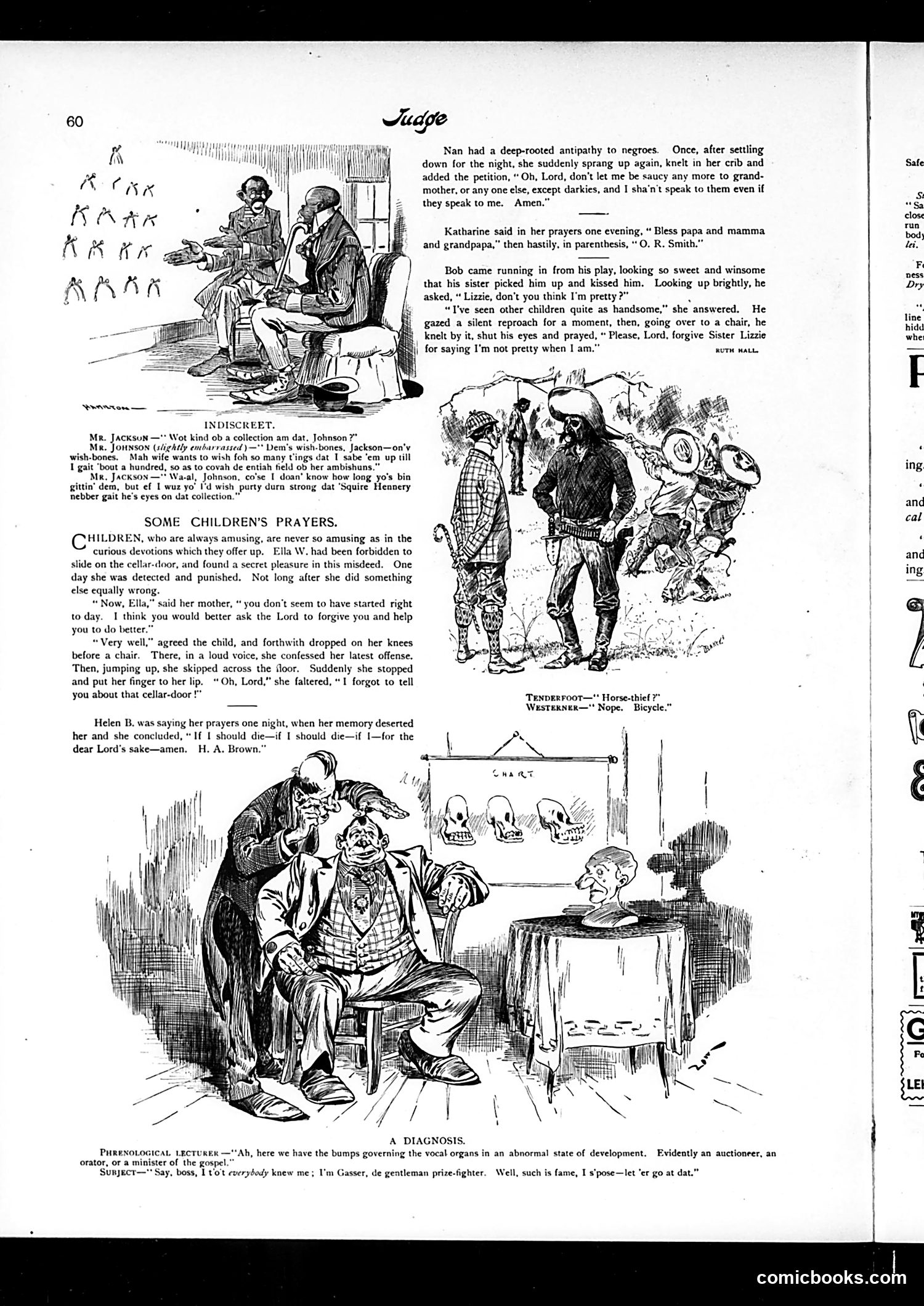
This page collects humorous anecdotes about children's unguarded prayers, exploiting the period's sentimental fascination with innocent candor revealing family attitudes. **"Some Children's Prayers":** The main feature presents brief stories where children's petitions to God expose prejudices and vanities their parents supposedly hold. Nan's prayer reveals accepted racial prejudice ("except darkies"); Bob's vanity about his appearance; Ella's selective moral memory about rule-breaking. The humor relies on children's unfiltered honesty reflecting adult hypocrisy. **"A Diagnosis"** (bottom): A phrenologist lectures about skull bumps indicating vocal professions (auctioneer, orator, minister), but his subject—identified as "Gasser, de gentleman prize-fighter"—uses dialect speech characteristic of racist caricature common to late-19th-century American humor. **"Indiscreet"** (middle): Two Black men discuss "wish-bones," with heavy dialect, suggesting comic mismanagement of wishes/desires, reflecting the magazine's stereotyping approach. The cartoons reveal period attitudes toward race, class, and child psychology through what Judge presented as lighthearted satire.
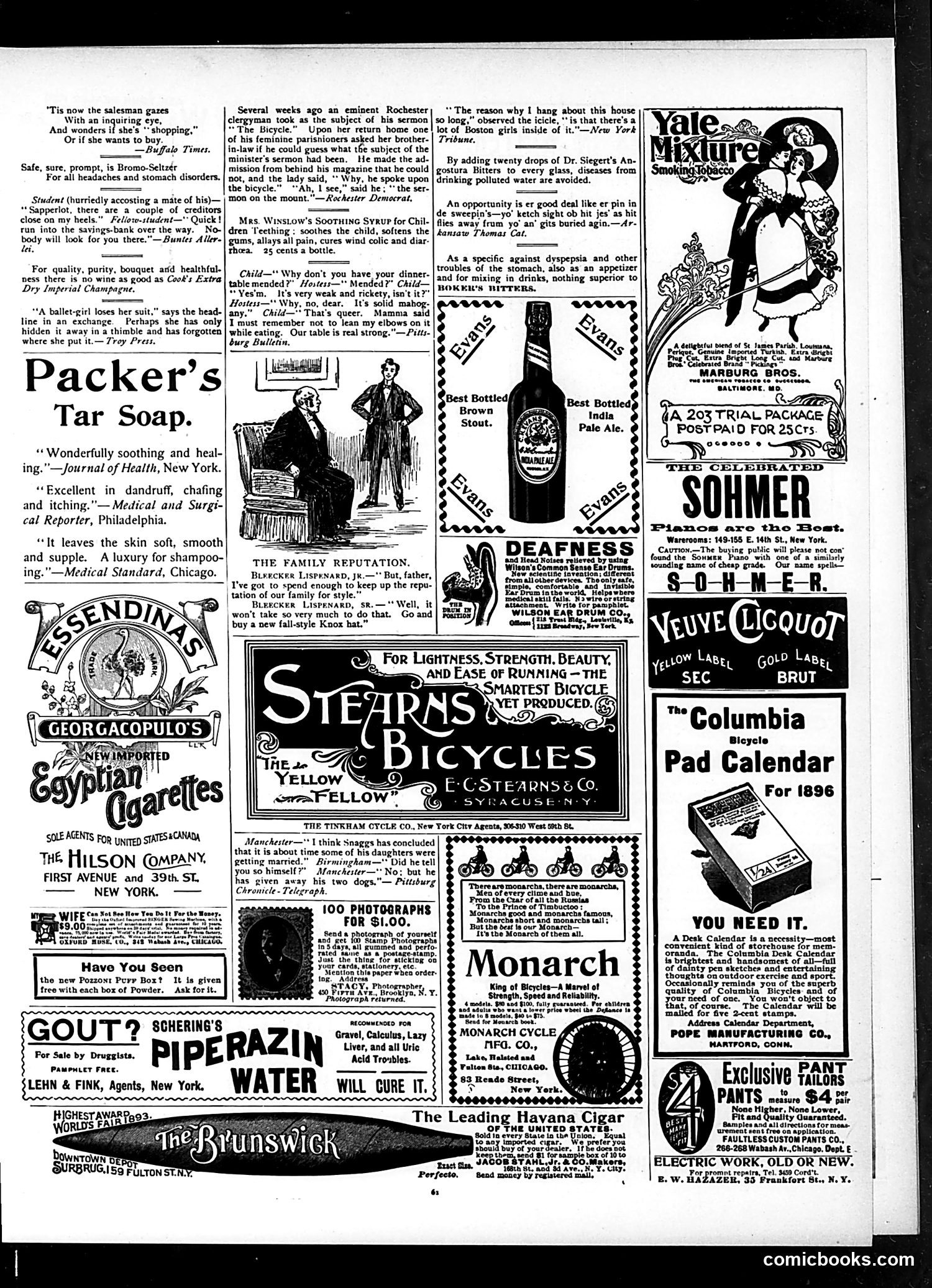
This page is **primarily advertising** with scattered satirical jokes interspersed—typical of Judge magazine's format. The **cartoons and jokes** mock everyday social situations: a salesman uncertain whether a woman is shopping or buying; a student hiding from creditors in a bank; a child's logic about a "weak" dinner table; and wordplay about a minister's "sermon on the mount" (bicycle sermon/Mount Sermon pun). One joke references "Boston girls" as icicles—a period stereotype suggesting Boston women as cold or aloof. Most content consists of **late-1890s product advertisements**: patent medicines (Bromo-Seltzer, Mrs. Winslow's Soothing Syrup), bicycles, champagne, cigarettes, and toiletries. These ads reflect contemporary concerns (dyspepsia, "polluted water," dandruff) and consumer culture emerging in the Gilded Age. The page shows Judge's hybrid nature: satirical commentary on modern life mixed with commerce—reflecting how magazines sustained themselves through advertising while entertaining readers with gentle social humor.
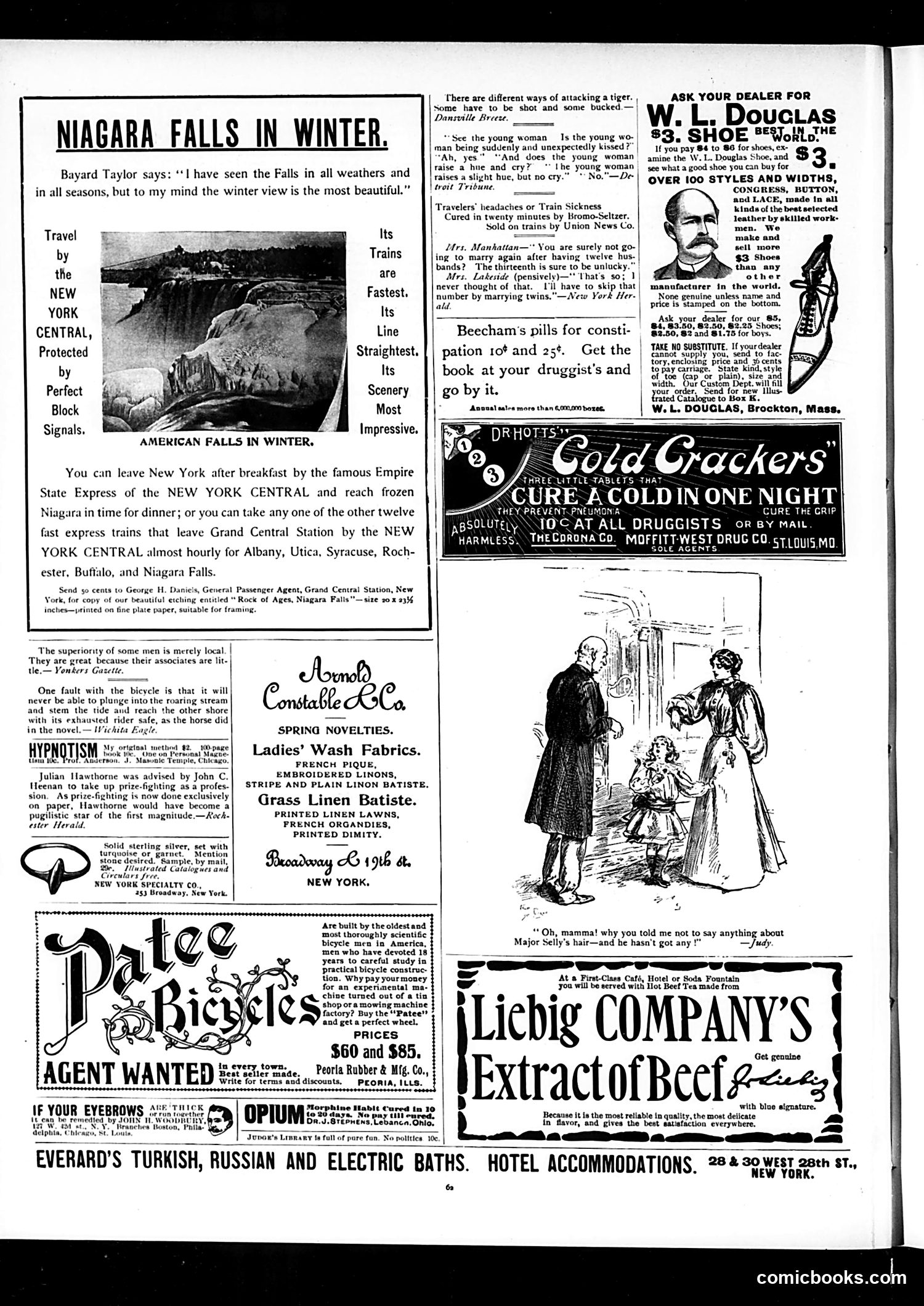
This page is primarily **advertising and filler content** rather than political satire. The dominant feature is a New York Central Railroad advertisement promoting winter travel to Niagara Falls, with a photograph of the frozen falls and copy emphasizing the railroad's speed and service. The remaining space contains various **small humorous anecdotes and product advertisements** typical of Judge magazine: - Brief jokes about bicycles, prize-fighting, and marriage - Product ads for shoes (W.L. Douglas), bicycles (Patee), fabrics (Arnold Constable), and extract of beef (Liebig) - A small cartoon showing a woman with children and adults, captioned about not mentioning something to "Major"—the humor appears to reference an affair or indiscretion, though context is unclear The page reflects **late 19th/early 20th-century advertising culture** where magazines mixed editorial content with paid advertisements. There is no significant political commentary or sophisticated satire present—mostly light domestic humor and commercial promotion.
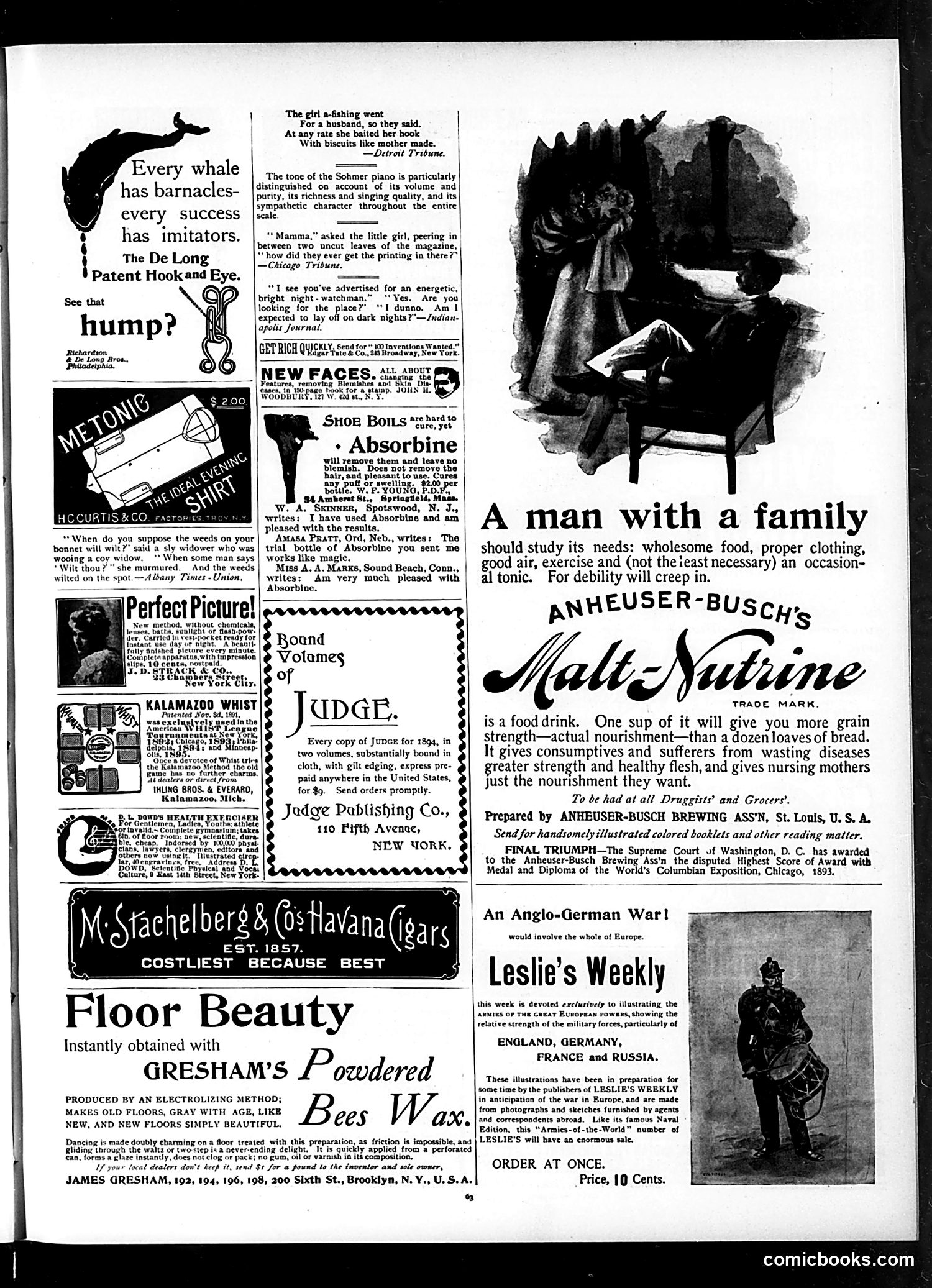
This page is primarily **advertising**, with minimal editorial content. The notable satirical elements are brief: **The Jokes:** - A fishing-themed poem about a girl using "biscuits like mother made" as bait to catch a husband—mocking both courtship rituals and presumably poor domestic cooking. - A widow's quip about when her bonnet "weeds" will wilt, with a pun on "Wilt thou?" (marriage vows)—gentle humor about remarriage and fashion. **The Advertisements:** The page showcases period products reflecting contemporary concerns: patent hooks/eyes (imitating success), piano quality, shoe boil remedies, skin treatments, and notably **Anheuser-Busch's Malt Nutrine**—marketed as a "food drink" providing nourishment for families, consumptives, and nursing mothers. **Historical Context:** The ads reveal late-Victorian anxieties about health, beauty standards, and domesticity. Malt beverages were genuinely marketed as medicinal tonics. The overall tone reflects 1890s commercial culture targeting middle-class households. The page lacks political satire or caricature—it's a commercial product of its era.
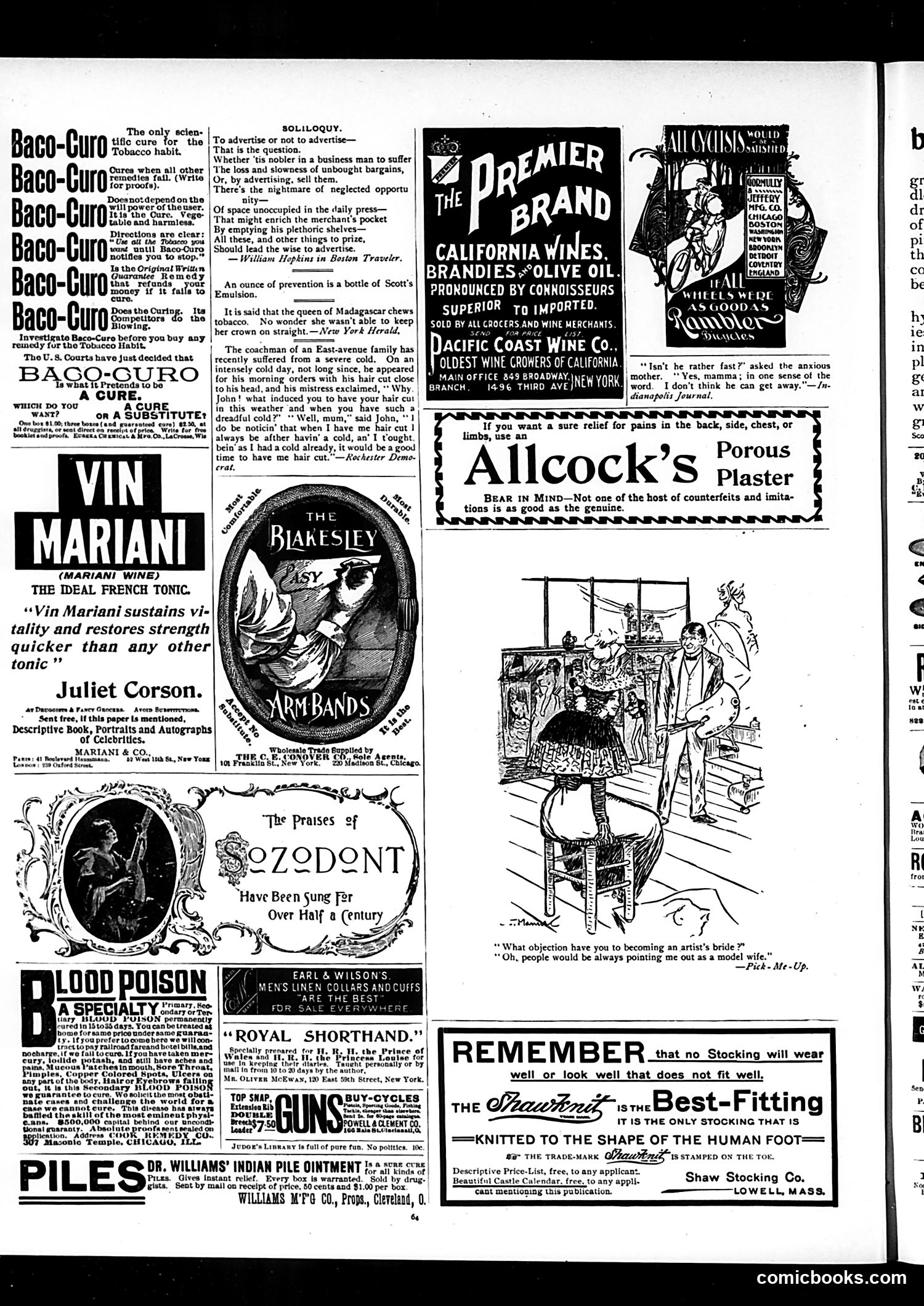
This page is primarily **advertising**, typical of Judge magazine's revenue model. Notable content includes: **Major Advertisements:** - **Baco-Curo**: A tobacco-cessation product claiming court validation as a genuine cure - **Vin Mariani**: A French tonic wine endorsed by cookbook author Juliet Corson - **The Dreamer Brand**: California wines marketed as superior to imported varieties - **Alcock's Porous Plaster**: A medicinal pain-relief patch - **Ozodont**: Toothpaste with century-long history claims - **Blood Poison remedy**: A mail-order medical treatment - **Various other products**: Collars, bicycles, pile ointment **The "Soliloquy" Section** presents a brief satire (attributed to William Hopkins) mocking merchants who fail to advertise, playing on Hamlet's existential questioning for commercial purposes. **Cartoon Content**: A small sketch shows a conversation between a woman and coachman about his short haircut during cold weather—mild domestic humor typical of the era. The page reflects early 1900s consumer culture, patent medicine proliferation, and advertising's growing prominence in American magazines.
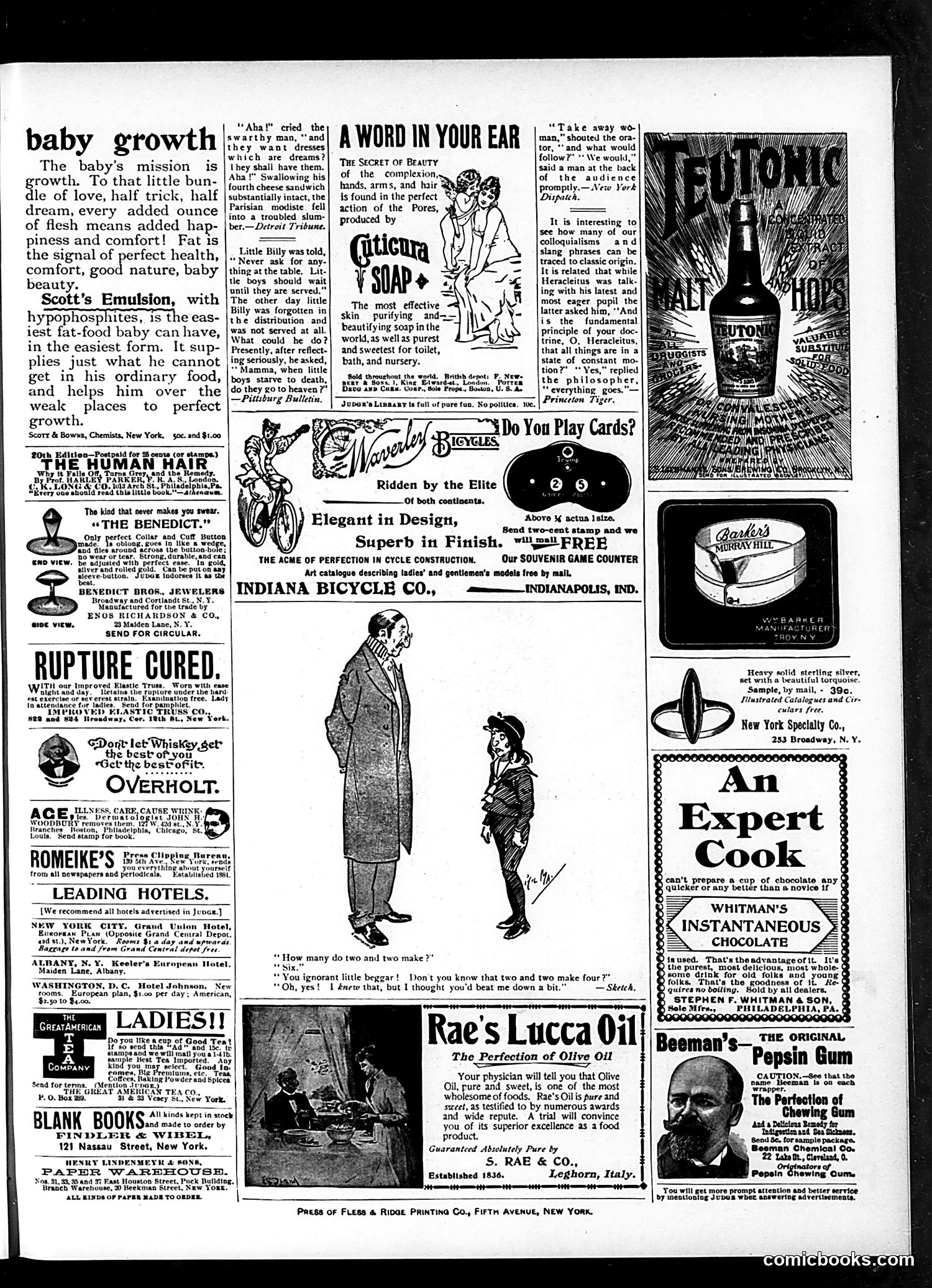
This is primarily an **advertising page** with brief humorous content interspersed. The main cartoons and jokes are: **"A Word in Your Ear" section**: Contains several short anecdotes mocking women's fashion demands and pretensions. One joke references a Parisian seamstress overwhelmed by women wanting elaborate dresses. Another satirizes a philosophical lecture where a student asks about constant motion—the punchline being that "everything goes," likely a pun on the phrase and the cyclical nature of fashion/trends. **"How many do two and two make?"** cartoon: Shows an exchange between an adult and child, ending with the child threatening to "beat me down a bit"—likely satirizing children's unexpected or impertinent responses. The page is dominated by **advertisements** for patent medicines (Scott's Emulsion for baby growth), bicycles, collar buttons, hotels, and various consumer products typical of early 1900s Judge magazine. The humor targets women's vanity, children's behavior, and includes wordplay, but lacks sharp political satire.
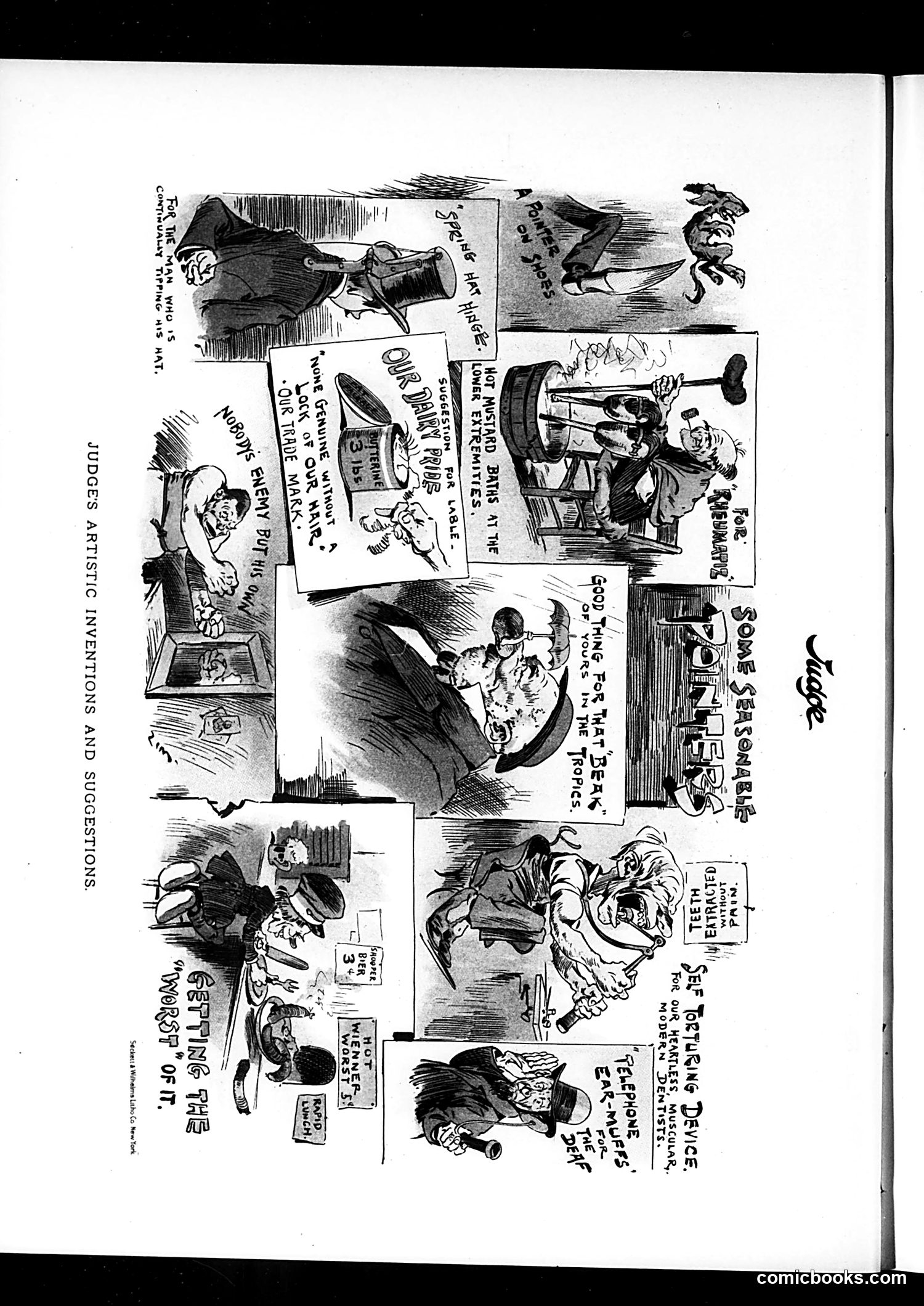
This page presents satirical "inventions" mocking various social types and professions of the era. The cartoons depict absurd contraptions supposedly designed for: 1. **Dentists** — a torture device, sarcastically suggesting modern dentists cause suffering rather than relief 2. **Tropical tourism** — mocking wealthy travelers taking "tours in the tropics" 3. **A "self-torturing device"** for someone repeatedly tipping his hat (likely satirizing excessive social formality or obsequious behavior) 4. **Mustard baths** — apparently targeting medical fads or spa treatments The overall satirical point appears to be mocking contemporary consumer culture, medical quackery, social pretension, and professional malpractice through exaggerated visual humor. The style is typical of *Judge* magazine's approach: using caricature and absurdist scenarios to critique modern society's follies and excesses. The page title confirms this is presenting tongue-in-cheek "suggestions" for ridiculous products.