
A complete issue · 16 pages · 1895
Judge — December 21, 1895
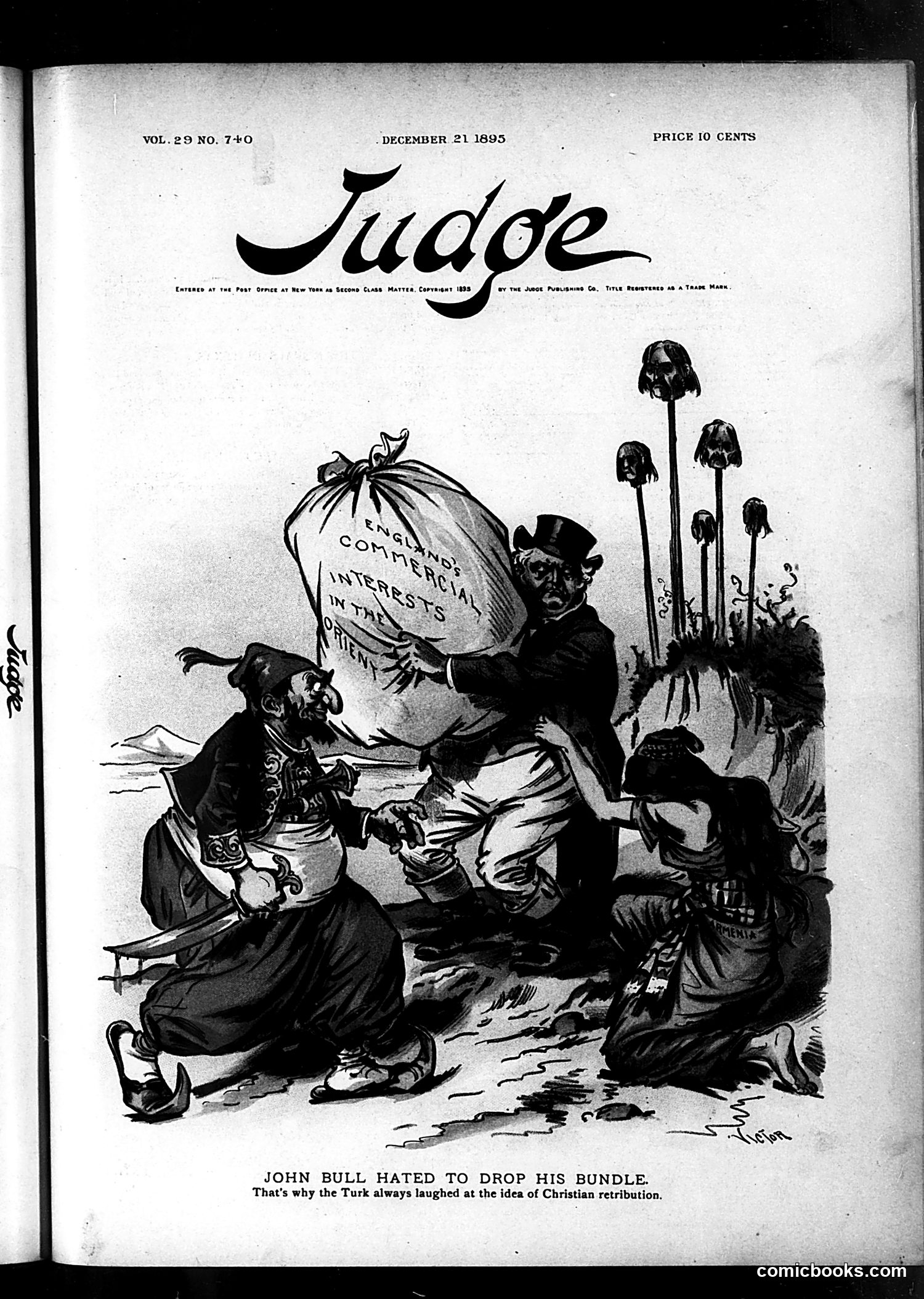
This 1893 *Judge* cartoon satirizes British imperial interests in the Ottoman Empire. "John Bull" (the personification of Britain) holds a large bundle labeled "Commercial Interests in the Orient"—representing British economic and political ambitions in Asia and the Middle East. The figures kneeling before him appear to represent Ottoman (Turkish) representatives or Asian powers. The wilting flowers in the background suggest decay or decline. The caption's reference to "Christian retribution" indicates contemporary debates about European intervention in Ottoman territories, possibly referencing missionary activities or colonial expansion justified on religious grounds. The satire criticizes Britain's reluctance to abandon its imperial economic ventures despite moral or practical complications.
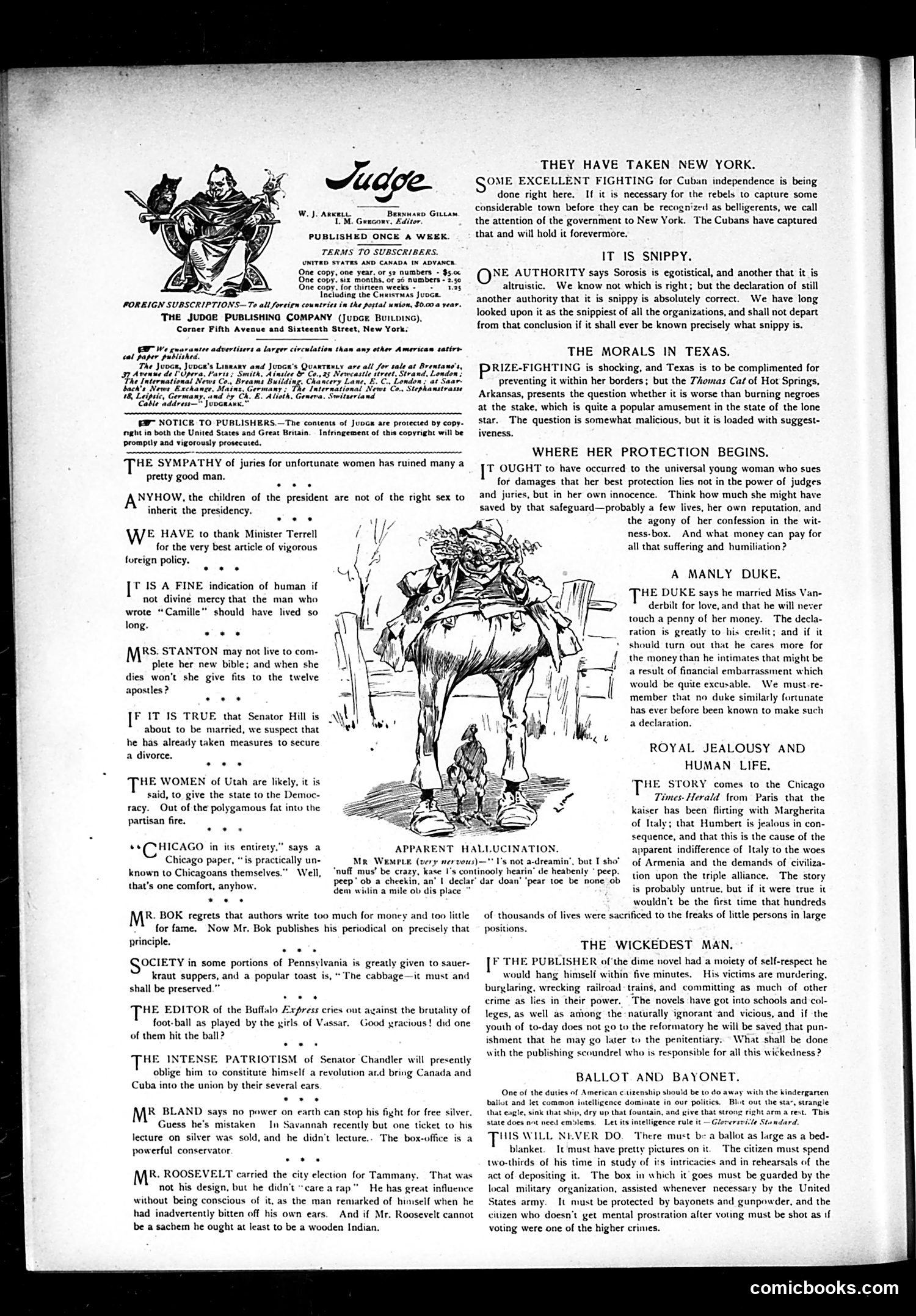
The central illustration depicts a grotesque, bloated figure labeled "Mrs. Webster" (identified in the caption as "very nervous") sitting precariously on a chair, with a small figure below appearing to flee or cower. The cartoon satirizes anxiety and instability—likely referencing a specific public figure or scandal of the era. The exaggerated caricature suggests moral or physical excess, a common Judge technique for political ridicule. The surrounding editorial text addresses various topics: Cuban independence, Texas prize-fighting, women's legal protections, and editorial commentary on politicians and social issues. Without clearer identification of the specific historical event or person referenced, the exact satirical target remains unclear, though the grotesque style indicates ridicule of someone perceived as foolish or morally compromised.
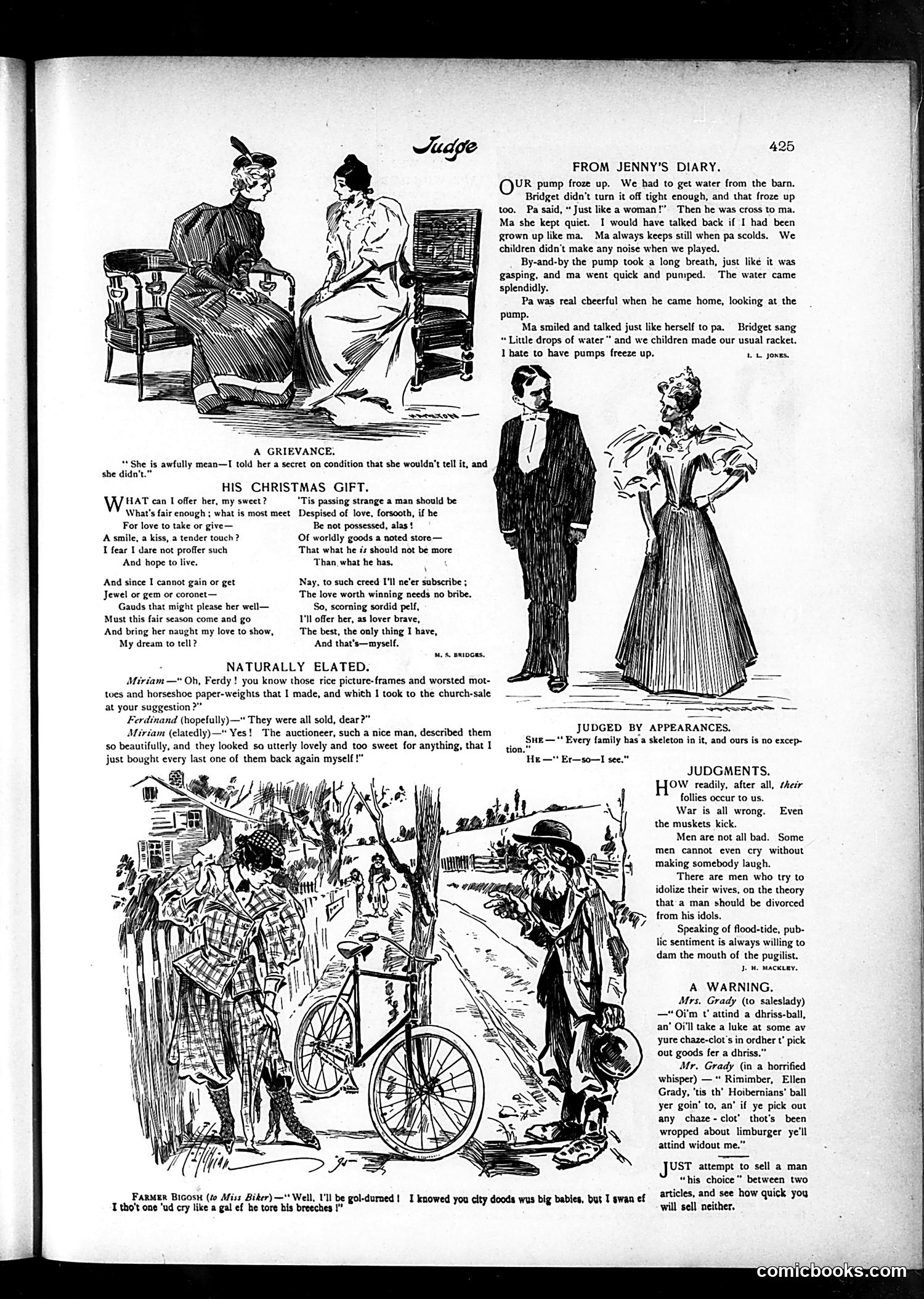
This page contains several satirical pieces and illustrations typical of Judge's social commentary: **"From Jenny's Diary"** humorously depicts domestic life—a frozen pump and water management issues—reflecting rural/working-class concerns of the era. **"A Grievance"** presents a woman complaining that a man "wouldn't tell it, and she didn't"—likely satirizing marital discord or relationship secrets. **"His Christmas Gift"** is a sentimental poem about offering oneself as a gift rather than material goods, contrasting idealized love with worldly possessions. **"Naturally Elated"** mocks someone's gullibility regarding auction-house descriptions of picture frames. **"Judged by Appearances"** and **"Judgments"** offer commentary on snap judgments and human folly—themes of Judge's regular social satire about Victorian-era manners and propriety.
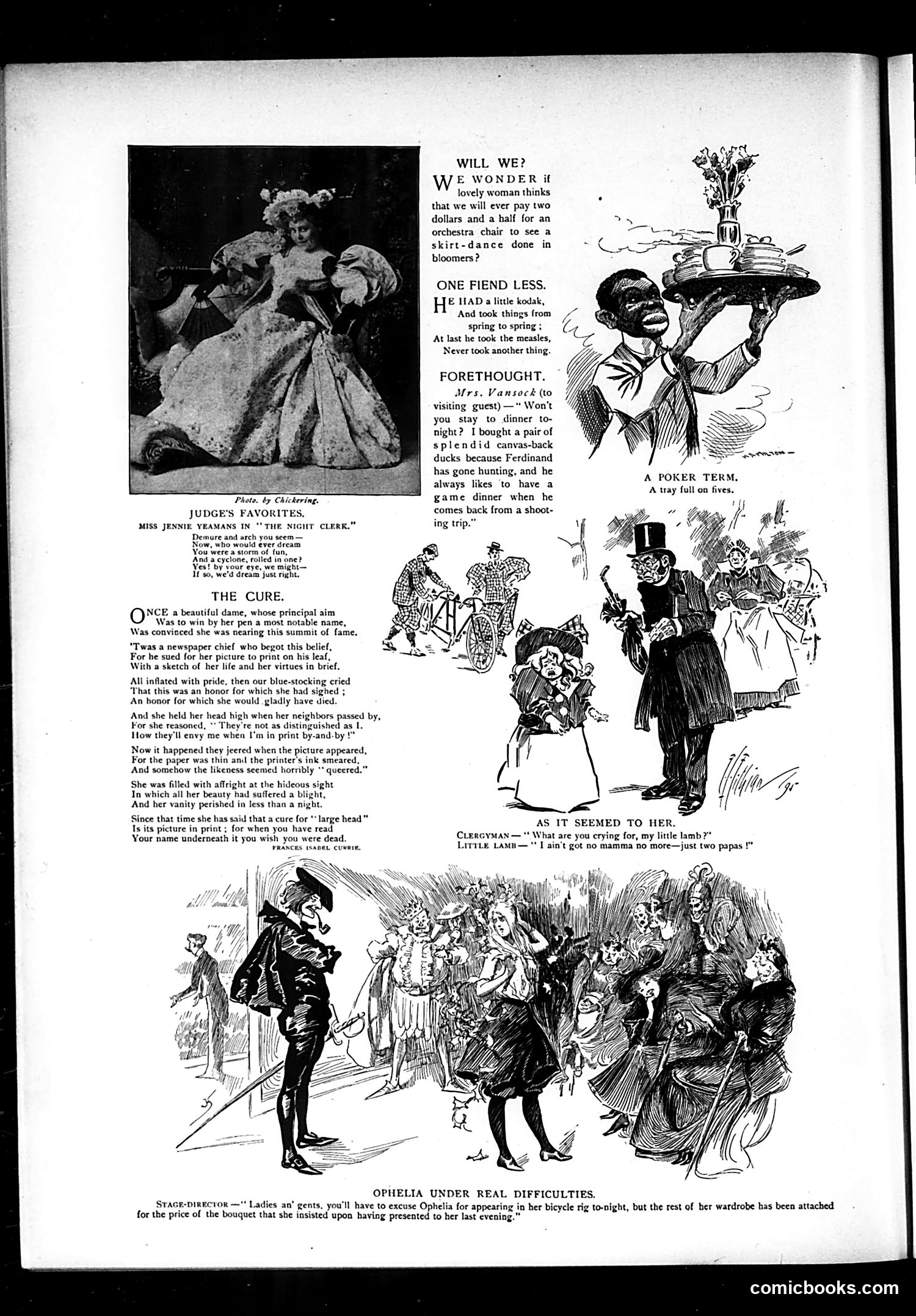
This satirical page from Judge magazine contains several social commentary pieces: **"Will We?"** mocks the fashion trend of women performing skirt-dances in bloomers (ankle-length trousers), questioning whether audiences will pay premium prices for such performances. **"One Fiend Less"** is a dark joke celebrating the death of a photographer who obsessively documented life with a kodak camera—portrayed as a nuisance eliminated. **"The Cure"** satirizes female vanity and literary ambition. A would-be author celebrates seeing her portrait and biography in a newspaper, expecting social elevation. When the print quality ruins her appearance, her pride collapses. The message: print publication as a cure for feminine "large head" (arrogance). **"Ophelia Under Real Difficulties"** jokes about a stage actress performing Shakespeare in bicycle clothing because her costumes were seized for debt—she owes money for a bouquet she demanded for her previous performance. The humor targets women's vanity, fashion follies, and financial irresponsibility while celebrating male skepticism toward female pretensions. The racist caricature in "A Poker Term" reflects period attitudes.
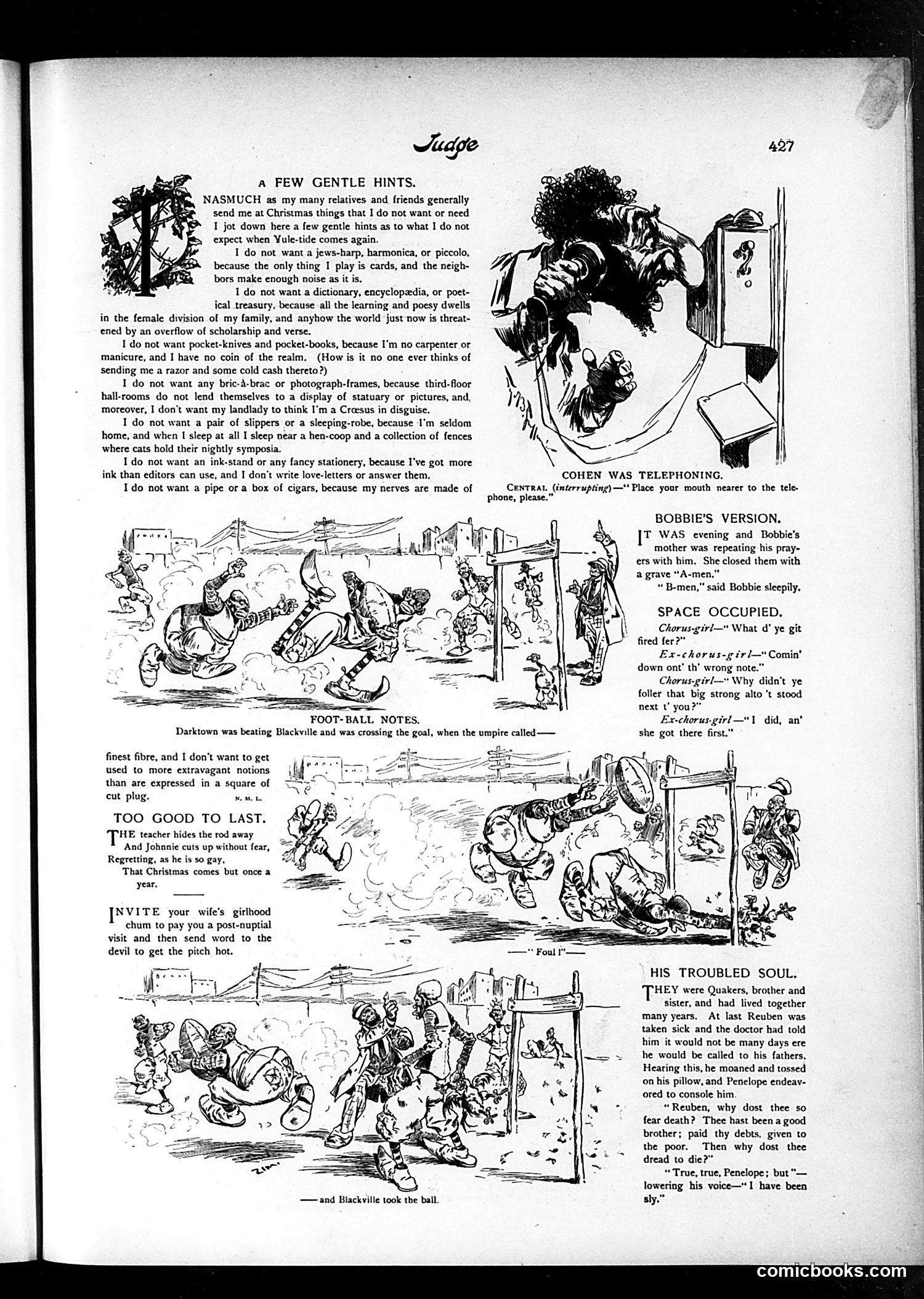
This page from *Judge* contains multiple unrelated satirical pieces typical of the magazine's format: **"A Few Gentle Hints"** is a humorous essay listing Christmas gifts the author doesn't want—pocket-knives, encyclopedias, fancy stationery, cigars—with comedic reasons (no money, no time at home, nerves made of "finest fibre"). It's gentle social satire about materialism and unwanted gift-giving. **The football cartoons** show a "Darktown vs. Blackville" game—likely racial caricature humor common to the era, depicting exaggerated athletic mishaps. **Smaller jokes** include: - "Cohen Was Telephoning": ethnic humor about a telephone mishap - "Bobbie's Version": innocent child mispronounces "Amen" as "B-men" - "His Troubled Soul": a Quaker man fears death because he's been "sly" (dishonest) The page reflects *Judge*'s mix of class commentary, ethnic stereotyping, and gentle domestic humor typical of early 20th-century American satire.
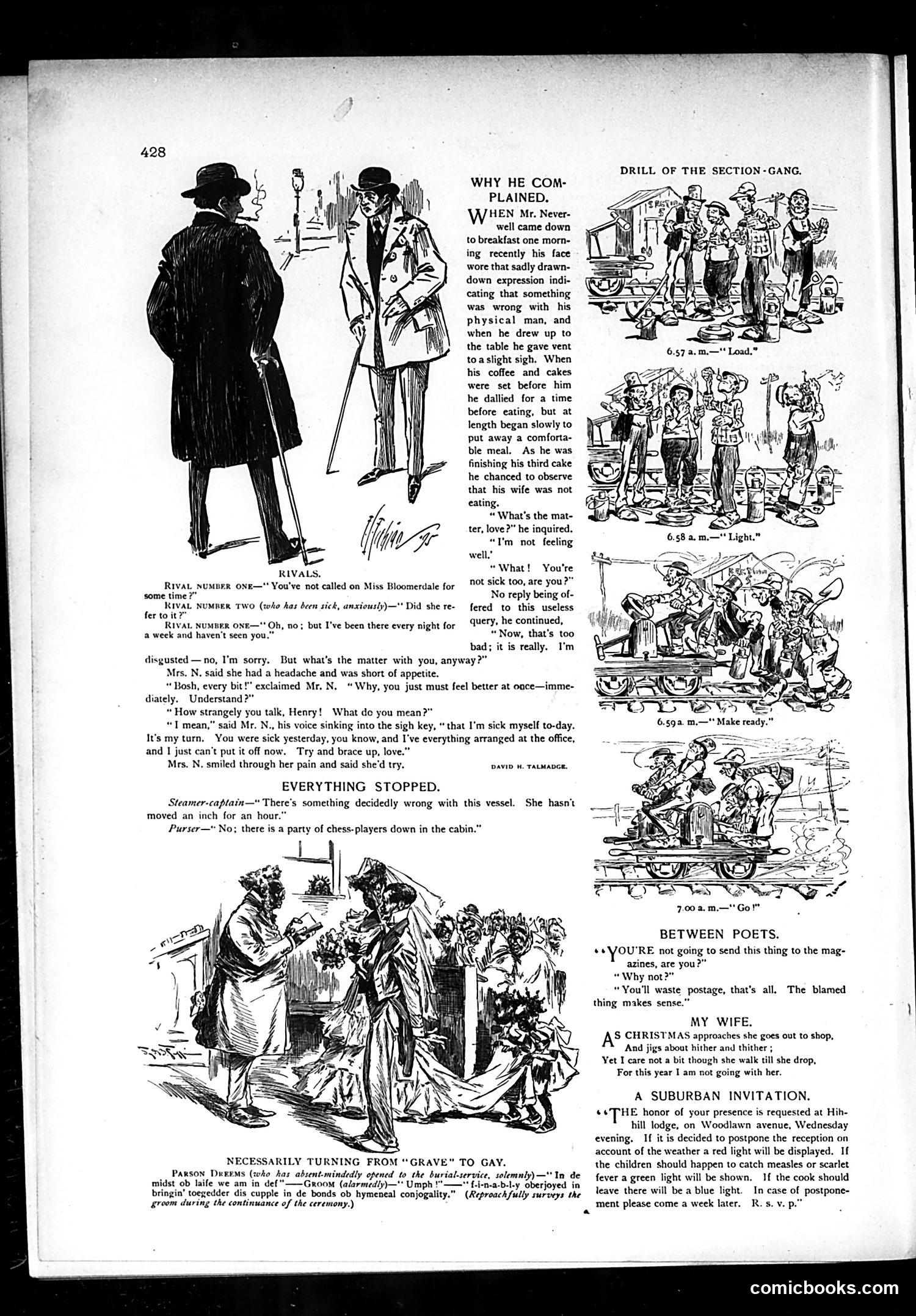
This page contains several satirical pieces typical of early 20th-century American humor: **"Why He Complained"** depicts a husband annoyed that his wife is ill and won't eat—not from concern, but because *he's* now sick and had work arrangements he can't postpone. The satire mocks selfish masculinity and the expectation that wives should recover on demand to serve husbands' schedules. **"Everything Stopped"** jokes that a ship cannot move because chess players occupy the cabin—a light jab at chess enthusiasts as absurdly oblivious. **"Between Poets"** satirizes struggling writers: one dismisses another's poem as worthless specifically *because* it "makes sense"—mocking pretentious, deliberately obscure poetry. **"A Suburban Invitation"** parodies overwrought formal invitations by adding darkly comedic conditional clauses about measles, cook departures, and weather—deflating upper-class pretension with mundane domestic reality. **"Necessarily Turning from 'Grave' to Gay"** shows a clergyman accidentally reading the burial service during a wedding ceremony, creating absurd (and offensive by modern standards) dialect humor.
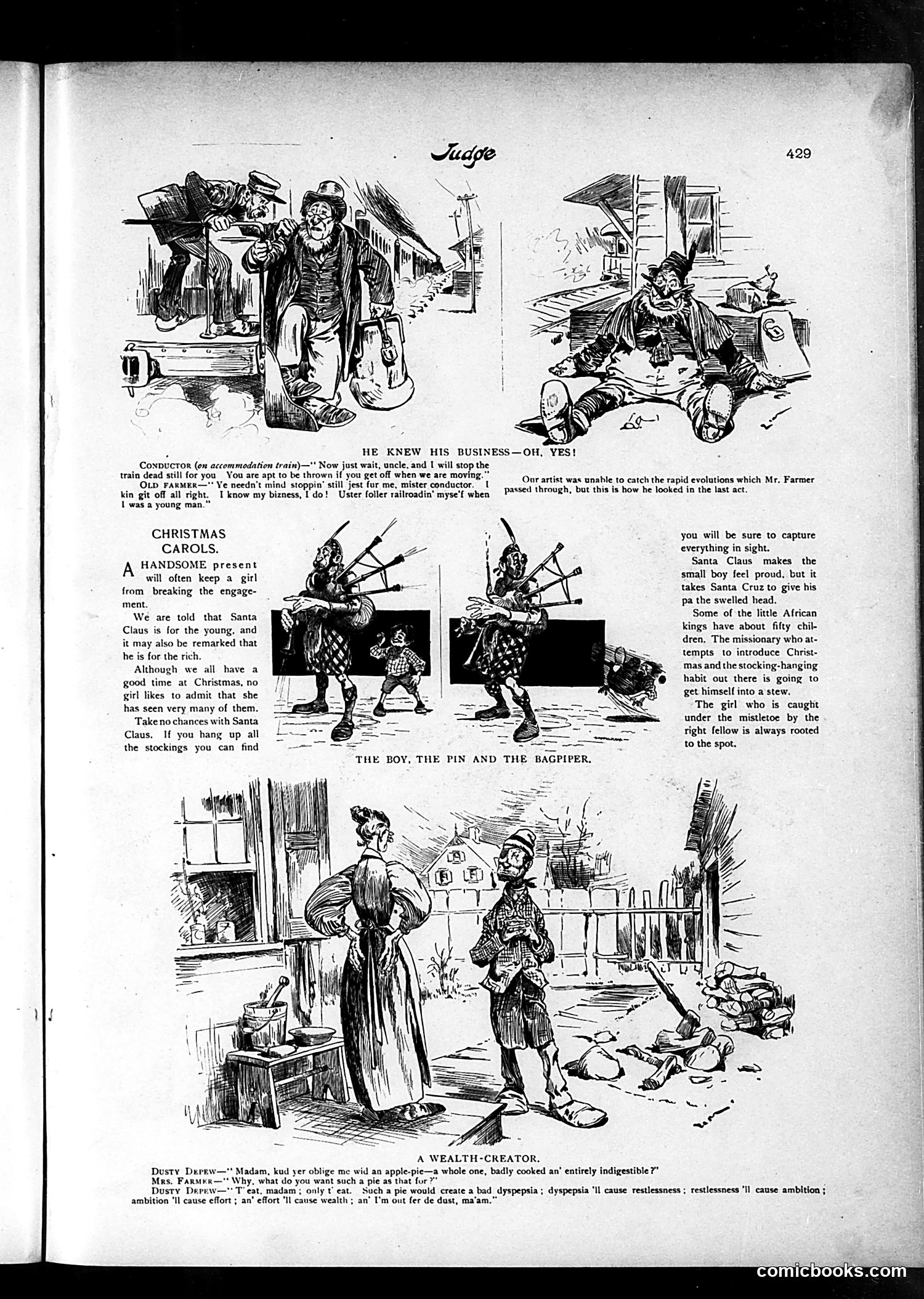
This page contains three satirical cartoons mocking rural/working-class figures: **"He Knew His Business"**: An old farmer refuses the conductor's offer to stop the train, claiming he'll jump off himself—illustrated by a comic sequence showing him tumbling violently. The satire ridicules rural overconfidence and disregard for safety. **"Christmas Carols"**: Social commentary on gift-giving and class disparities. The text suggests Santa Claus represents wealth inequality—wealthy children receive gifts while poorer ones don't. It also mocks missionary work in Africa and romantic customs. **"A Wealth-Creator"**: A tramp ("Dusty Drew") requests a badly-cooked, indigestible apple pie, reasoning that stomach distress will make him ambitious and therefore wealthy. This satire mocks both the tramp's illogical thinking and perhaps criticizes crude "bootstrap" philosophy about poverty and ambition. All three target working-poor and rural characters as objects of ridicule through their supposed ignorance and flawed logic.
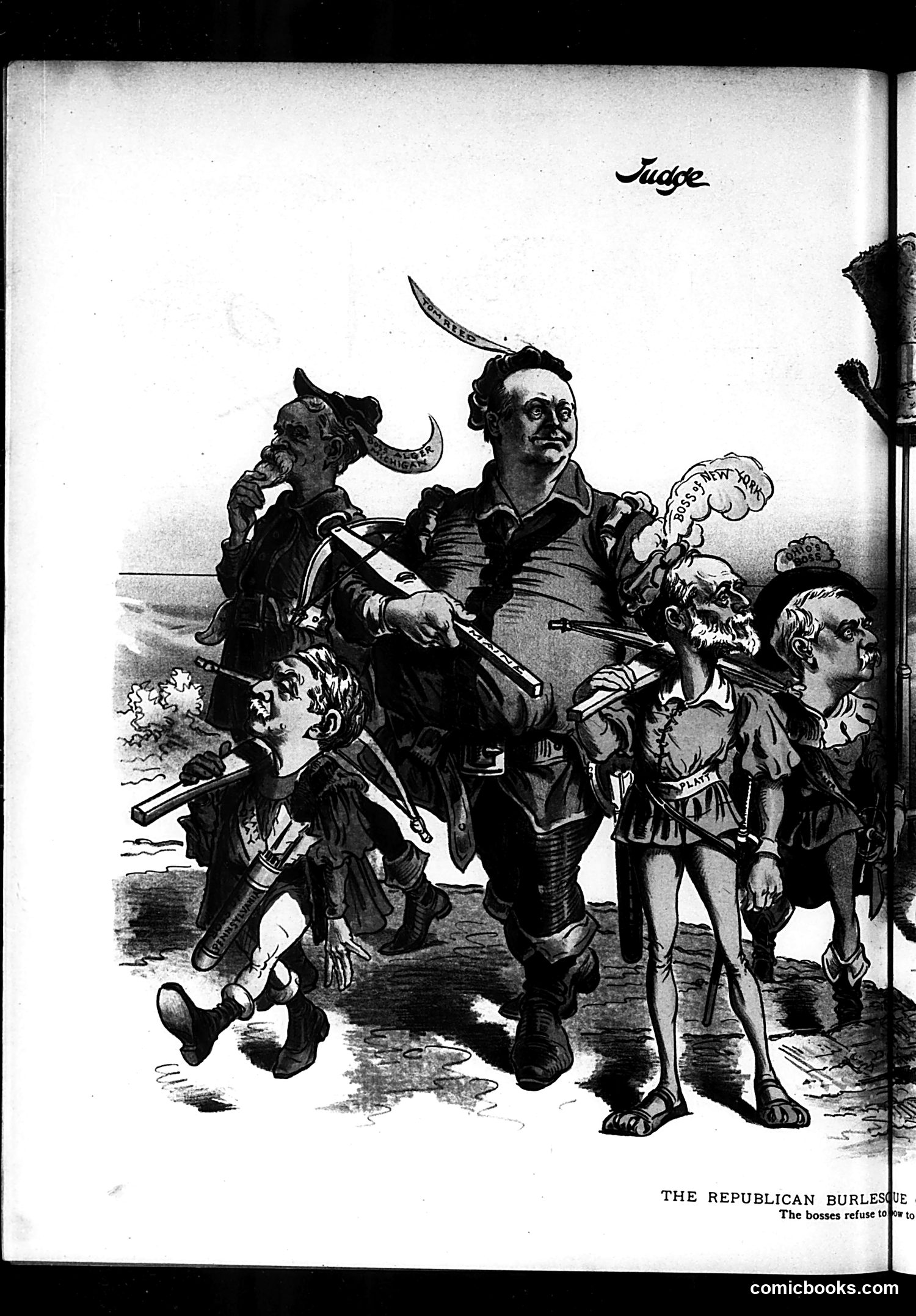
This political cartoon from *Judge* depicts Republican Party leadership as a chaotic theatrical performance ("burlesque"). The central tall figure appears to be a Republican boss or leader, surrounded by smaller figures—likely party operatives or political allies—who are caricatured as devils or demons with horns and exaggerated features. The caption states "The bosses refuse to [text cut off]," suggesting the cartoon critiques Republican Party leadership for refusing some demand or reform. The demonic characterization of the surrounding figures implies corruption or moral compromise within party ranks. The theatrical "burlesque" framing suggests the cartoon is mocking Republican politics as a farce or absurd spectacle rather than serious governance. Without the complete caption, the specific political grievance remains unclear, but the overall message condemns Republican leadership as morally compromised and dishonest.
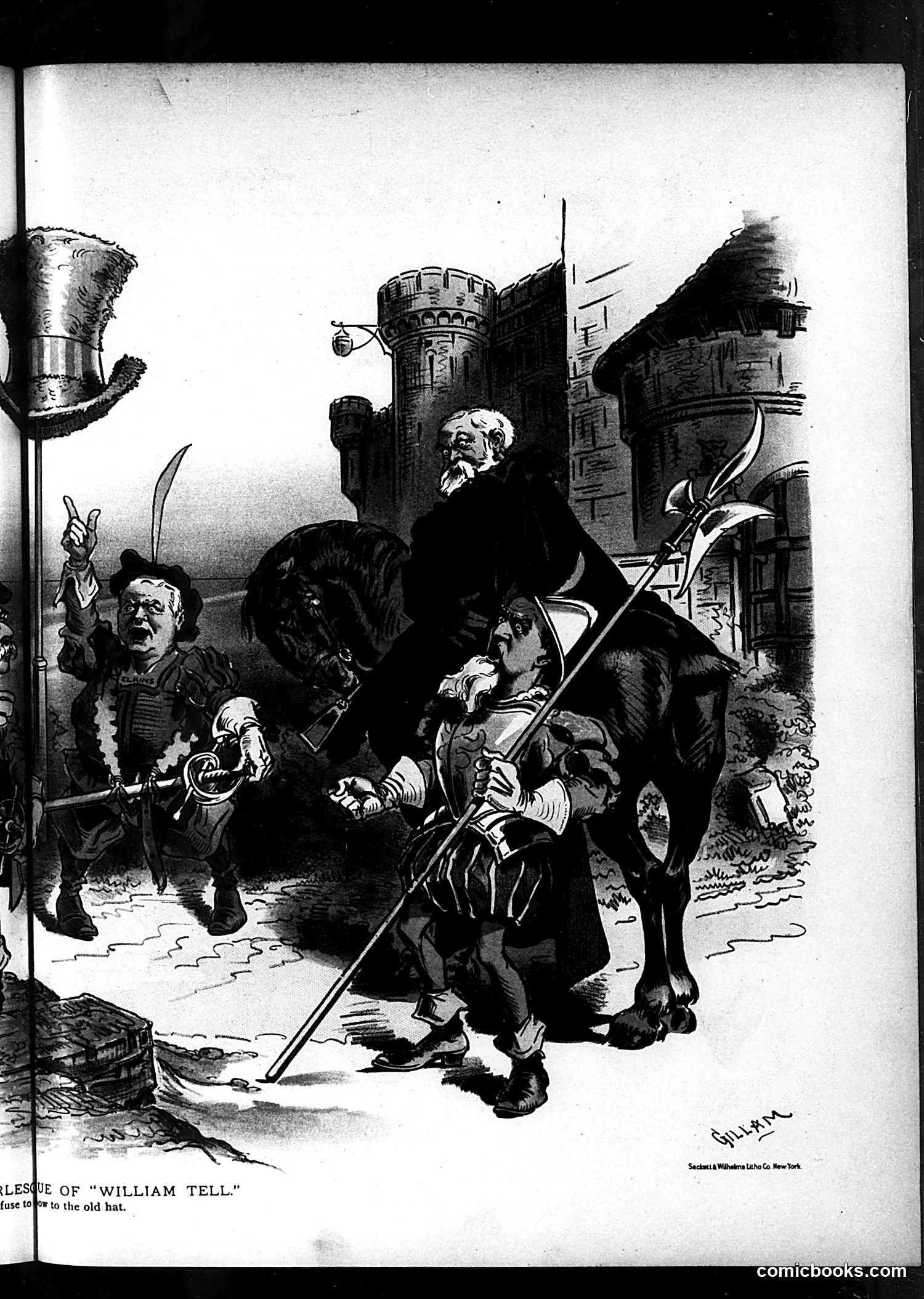
This political cartoon parodies the William Tell legend (the Swiss hero forced to shoot an apple off his son's head). The image shows caricatured figures in what appears to be a European castle setting, with exaggerated facial features typical of 19th-century satirical art. The caption "refuse to w to the old hat" (likely "refuse to bow to the old hat") suggests commentary on refusing submission to authority or tradition. The figures appear to represent political or social figures of the era, though specific identities aren't clear from the visible text. The satire likely critiques either European authoritarianism or American attitudes toward European power structures, using the Tell legend as a framework for discussing resistance to tyranny or outdated hierarchies. The artist's signature "GILLAM" appears at bottom right.
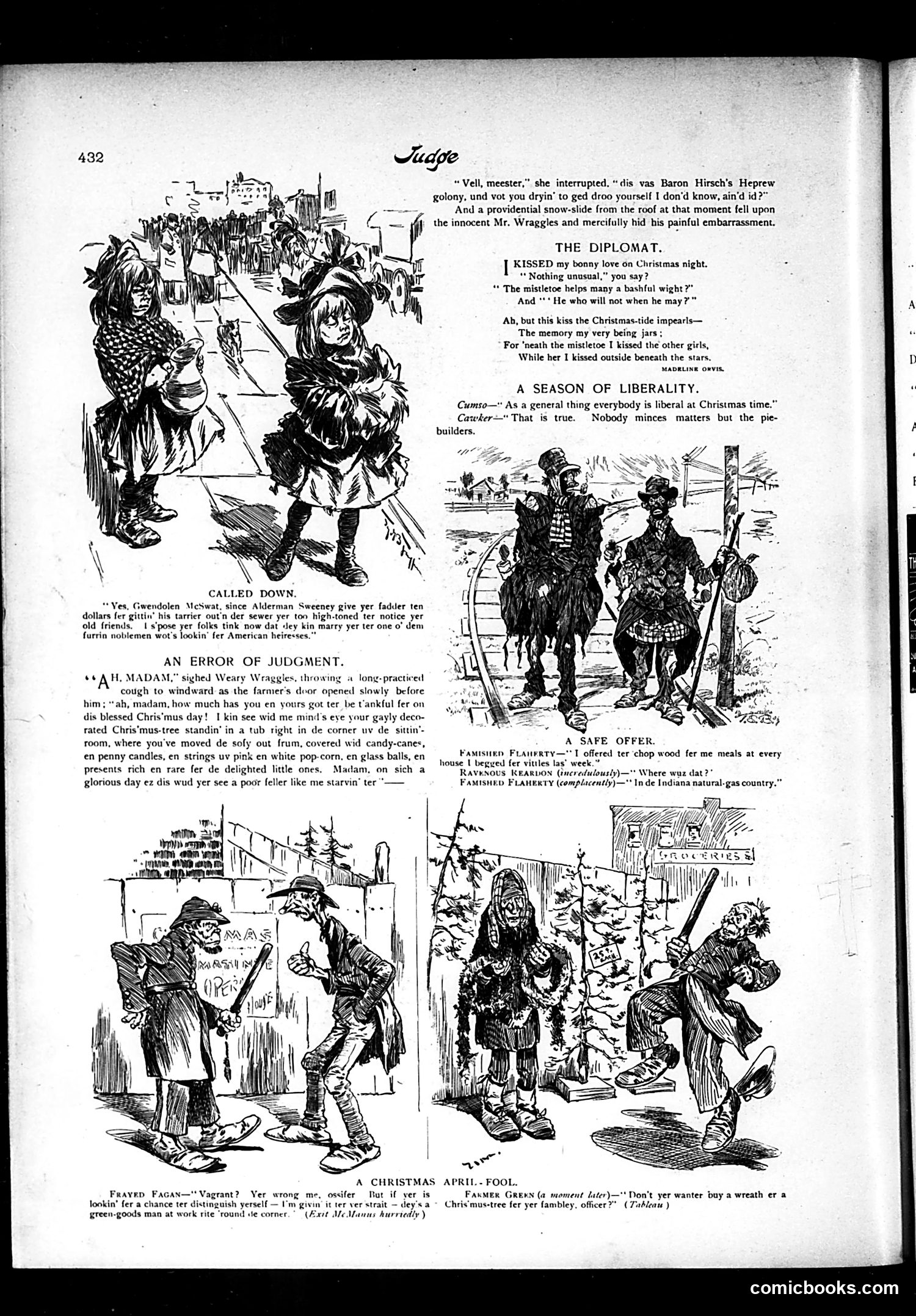
This page contains multiple satirical cartoons typical of Judge's late 19th-century humor: **"The Diplomat"** mocks a man caught kissing multiple women under the mistletoe—kissing other girls at parties but his beloved outdoors. The satire targets male hypocrisy around Christmas romance. **"Called Down"** ridicules social climbing: a poor man's daughter, now that her father received a small reward from an alderman, snubs her old friends and pursues "foreign noblemen" (wealthy Europeans). This satirizes American aspirational class-climbing and the stereotype of wealthy European titles. **"An Error of Judgment"** features a beggar (Weary Wraggles) manipulating a farmer with flattery about Christmas generosity—only to be hit by a snow-slide. The joke: his con fails spectacularly. **"A Safe Offer"** and **"A Christmas April-Fool"** present homeless men or vagrants attempting deceptions: one offers wood-chopping for meals, another poses as a criminal to avoid responsibility. The satire targets urban poverty and street hustles during the holiday season. The overall theme: Christmas brings out human weakness—false sentiment, fraud, and social pretense.
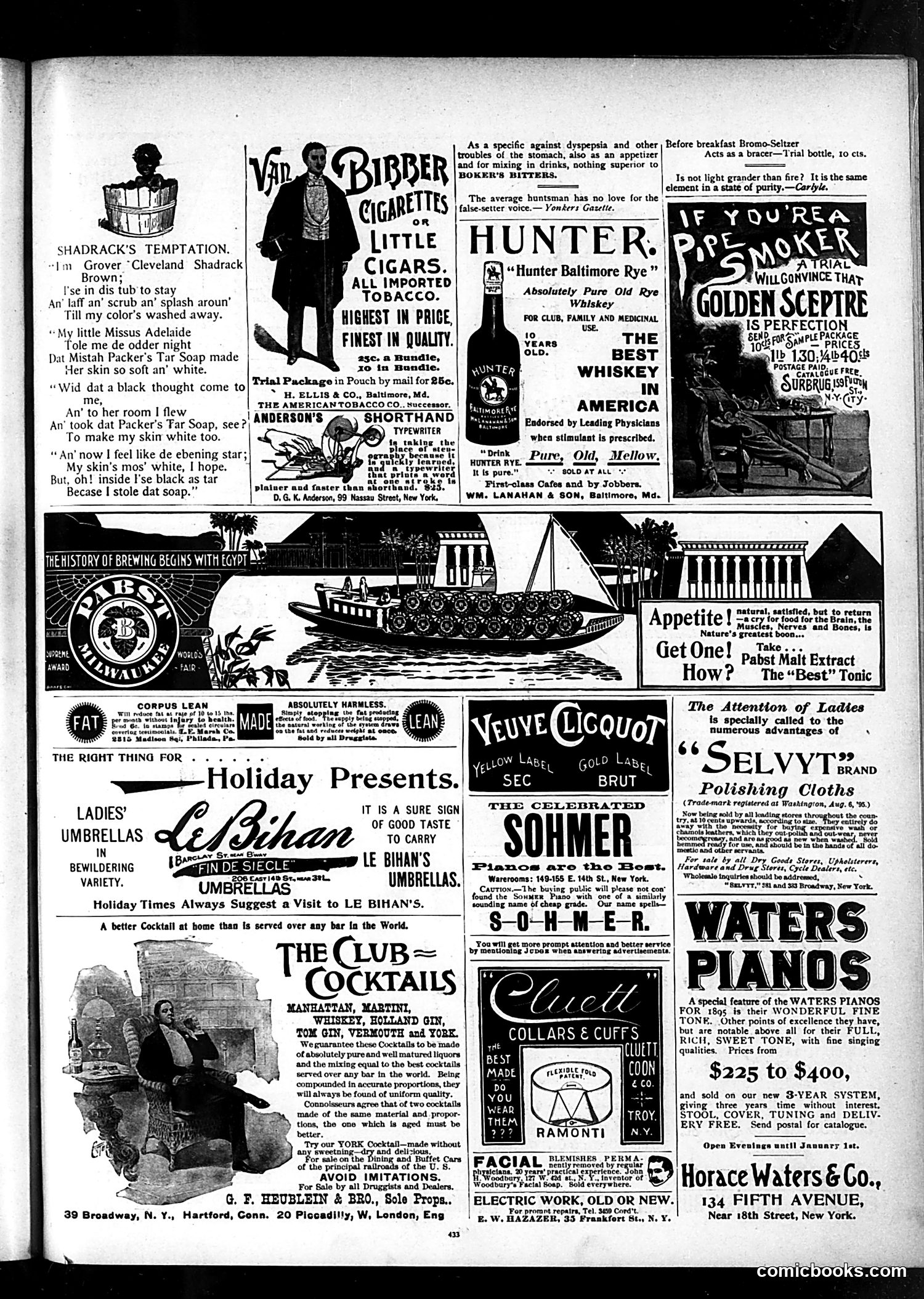
This is primarily an **advertising page** from Judge magazine, with one notable satirical cartoon. ## The Main Cartoon: "Shadrack's Temptation" The cartoon presents a racist minstrel-style narrative in dialect about an enslaved or formerly enslaved Black man named Shadrack who steals Packer's Tar Soap, hoping it will whiten his skin (mimicking his white mistress's results). The "joke" relies on the cruelty of depicting a Black person internalizing racist beauty standards and experiencing shame about his own skin color—the punchline being he's "black as tar" inside despite the external washing. **Context for modern readers:** This reflects late-19th-century racist stereotypes normalized in "humor," using exaggerated dialect and minstrel conventions common to period publications. The joke's cruelty—laughing at a man's self-hatred—would be immediately recognized as racist today. ## The Advertisements The remainder consists of typical period ads: liquor (Hunter whiskey, Boker's bitters), typewriters, pianos, cigars, umbrellas, and pharmaceutical tonics—many making dubious health claims typical of the era before FDA regulations.
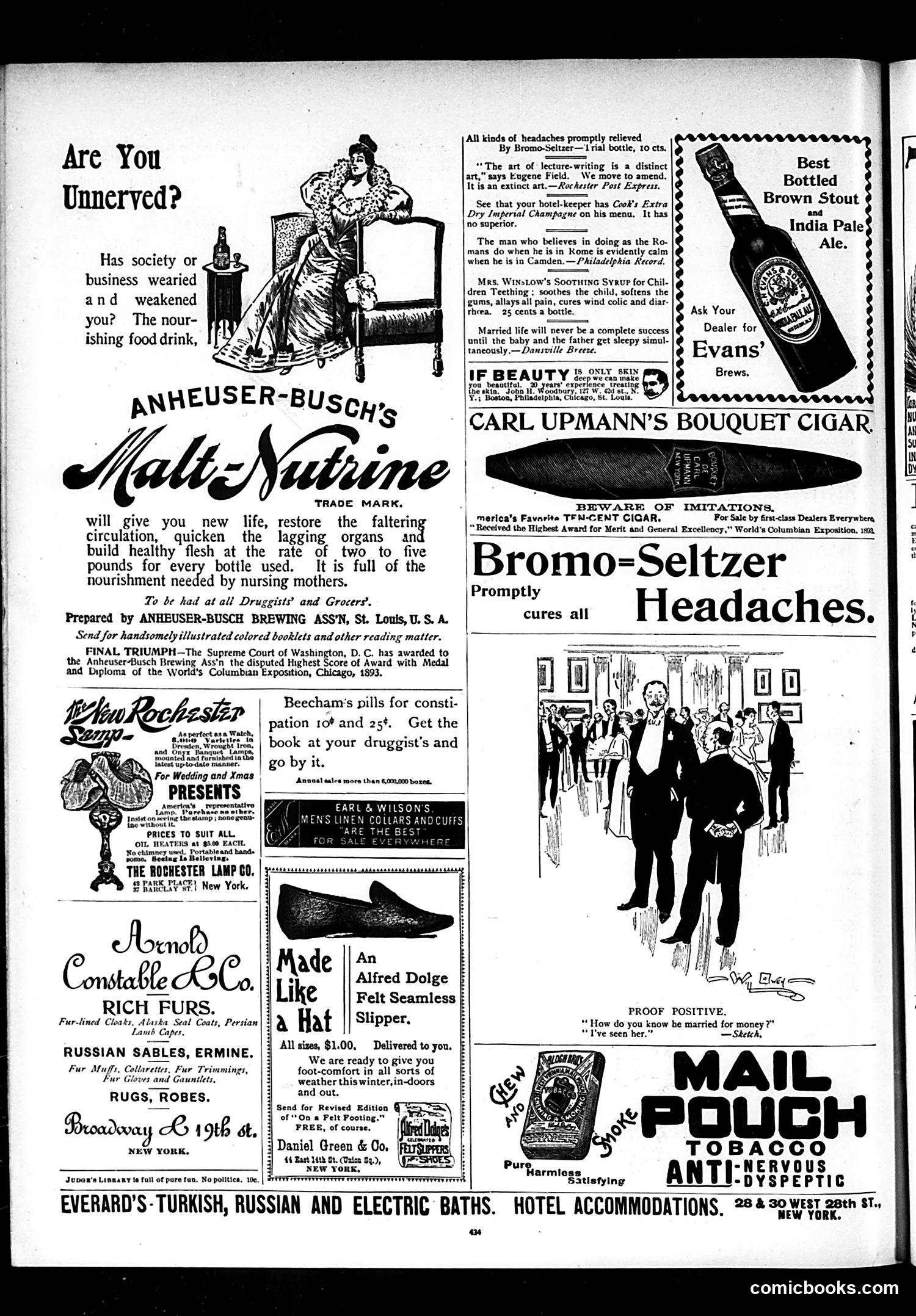
This page is primarily **advertising**, not political satire. It contains various patent medicine and consumer product advertisements typical of the 1890s era. The main content includes: **Anheuser-Busch's Malt Nutrine** — A malt beverage marketed as a health tonic that promises to restore vitality, build flesh, and aid nursing mothers. The accompanying illustration shows a woman in a chair, suggesting the product's appeal to those seeking renewed energy. **Other notable ads:** - Bromo-Seltzer for headaches - Beecham's pills for constipation - Mrs. Winslow's Soothing Syrup for teething children - Various fashion and home goods The page also includes scattered **brief satirical quotes** mocking contemporary life — on lecture-writing, dining habits, and marriage — but these are filler content, not the page's primary focus. The overall tone reflects late-19th-century advertising's unregulated claims about miraculous health benefits, now recognized as dubious or fraudulent.
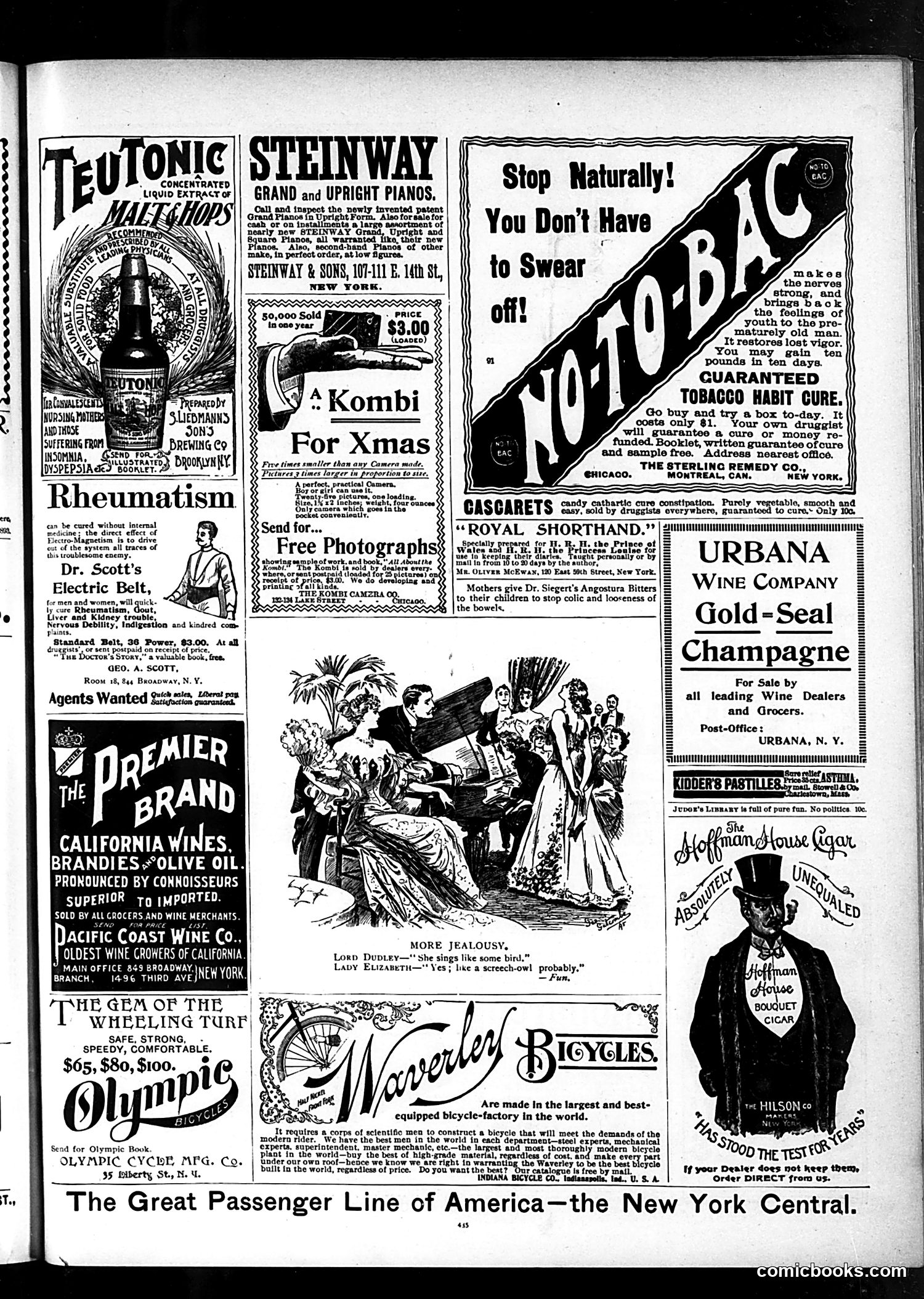
This page is primarily **advertising**, with one small cartoon labeled "MORE JEALOUSY." ## The Cartoon The cartoon depicts a domestic scene with a man and woman. The caption shows Lord Dudley praising a woman's singing ("she sings like some bird"), while Lady Elizabeth dismisses it sarcastically, comparing it to a screech-owl. The joke satirizes **marital jealousy**—Lady Elizabeth resents her husband's praise of another woman's musical talent and responds with cutting insult disguised as agreement. ## The Advertisements The page is dominated by turn-of-the-century patent medicines and consumer goods typical of this era: Dr. Scott's Electric Belt (claiming to cure rheumatism), No-To-Bac (tobacco cessation), Gascarets (laxatives), and various wines and bicycles. These products—many with dubious medical claims—reflect the unregulated marketing practices of the period before the FDA. The "Waverley Bicycles" ad emphasizes American manufacturing superiority, a common pitch during this era of industrial competition.
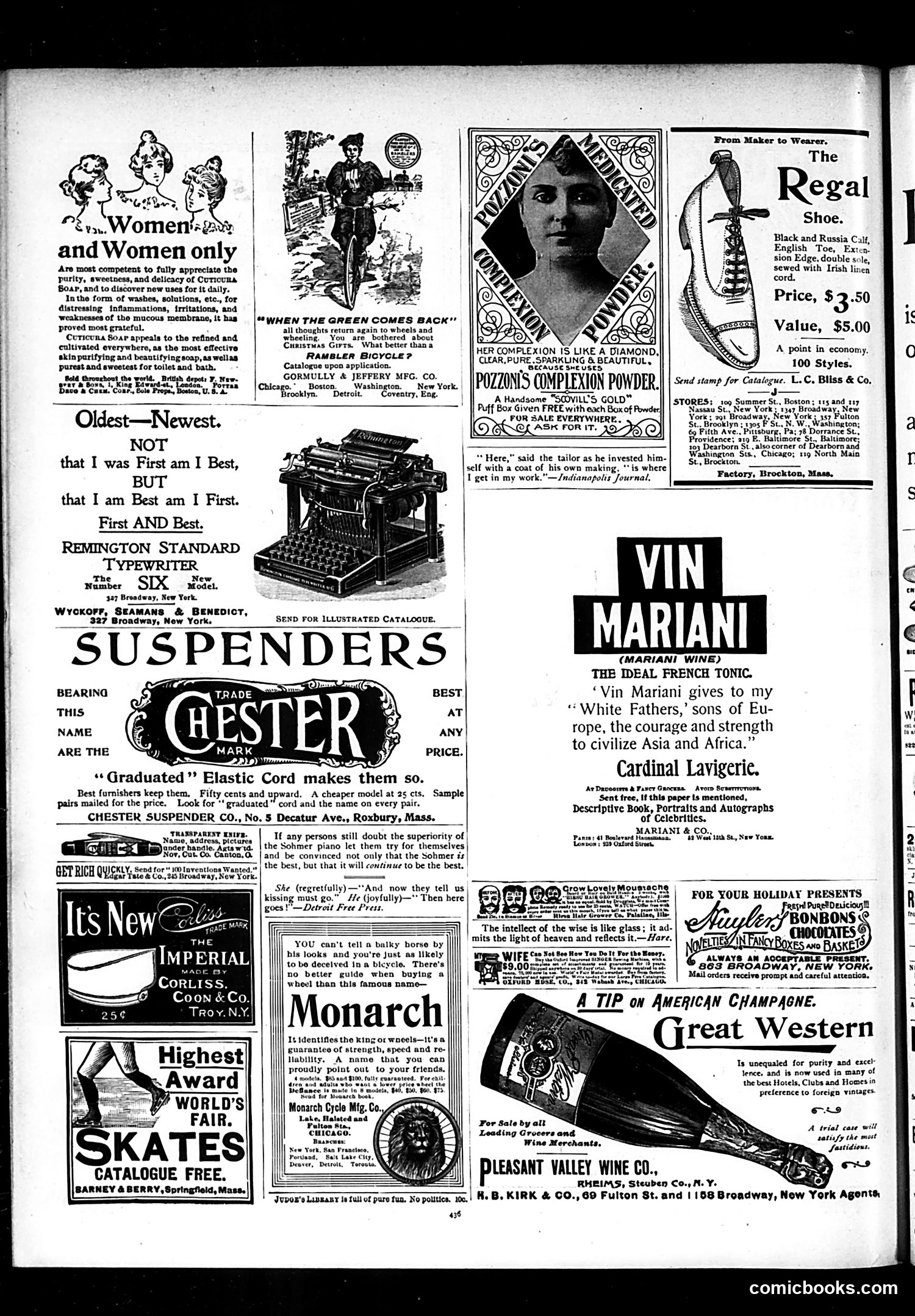
This page is primarily **advertising**, not editorial satire or political commentary. It contains roughly 20+ product advertisements typical of 1890s American consumer magazines. The few non-advertising elements are small humorous vignettes: 1. **"Oldest—Newest"** (Remington typewriter ad): A play on competitive claims—asserting being "First and Best" rather than merely "first." 2. **Two romantic comedy captions** (embedded in ads): A couple discussing whether kissing is now forbidden ("And now they tell us kissing must go"), and a tailor's joke about investing in his own coat to demonstrate quality. The advertisements themselves reveal period concerns: beauty products (Cuticura soap, Pozzoni's powder), bicycles ("When the Green Comes Back"), typewriters, suspenders, pianos, skates, and wines marketed with quasi-medicinal claims (Vin Mariani as a "tonic"). **Notable**: The Cardinal Lavigerie endorsement of Vin Mariani references colonial "civilization" of Asia/Africa—reflecting period imperialist attitudes without satire. This is a standard commercial page with minimal satirical content.
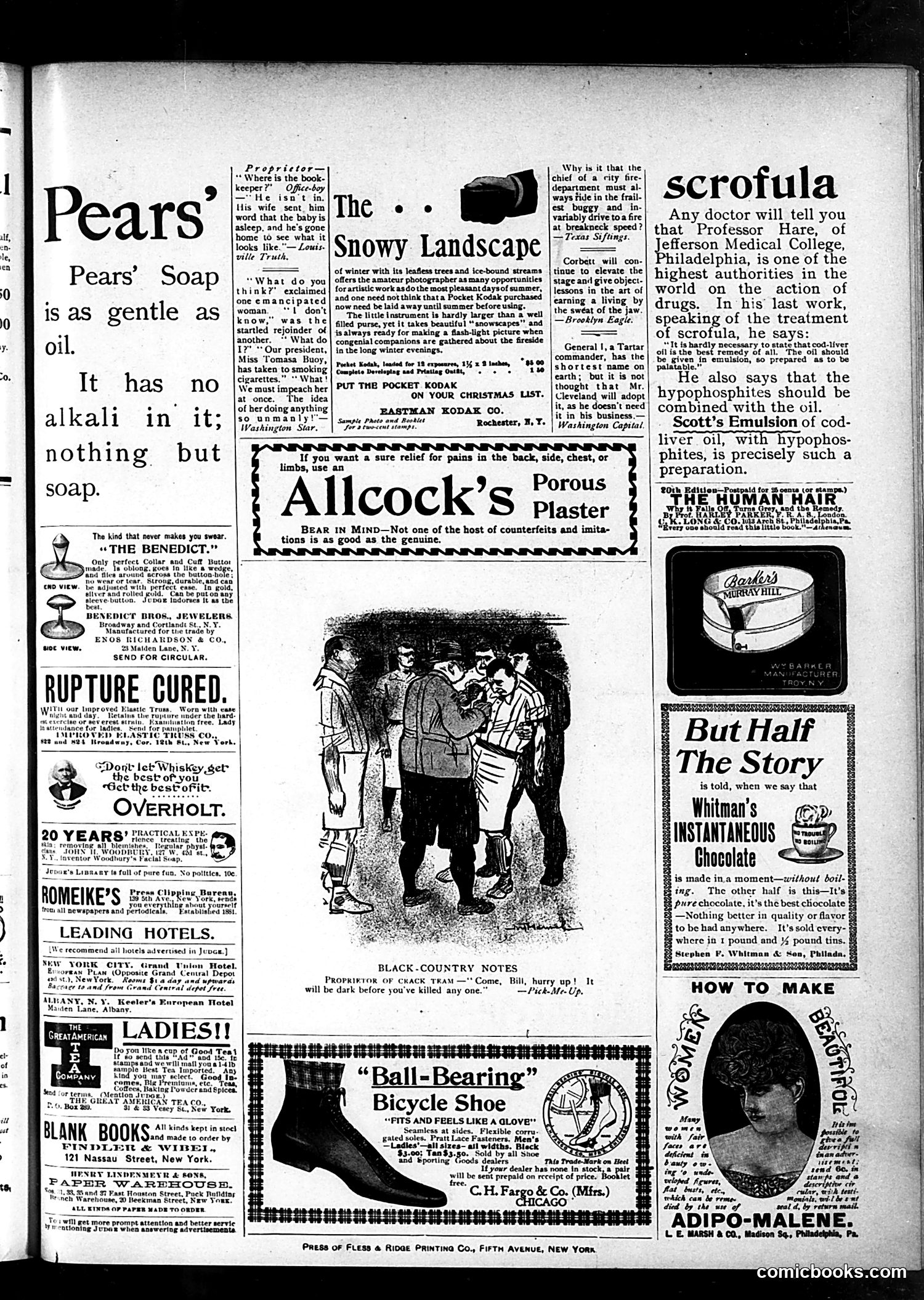
This page from *Judge* is primarily an **advertising page** with several embedded jokes and brief satirical items rather than a substantial cartoon or political commentary. **The Main Content:** The central image shows an illustration labeled "BLACK-COUNTRY NOTES," depicting what appears to be a crack team (construction/demolition workers). The caption's joke—a foreman urging "Bill" to work quickly "before you've killed any one"—is dark humor about industrial workplace danger. **The Jokes** scattered throughout are typical late-19th-century office humor: a bookkeeper leaving work because his sleeping baby is home; an "emancipated woman" smoking cigarettes; General I (a Tartar commander) and President Cleveland. These are mild social commentary about women's liberation and political figures, rather than sharp satire. **The Advertisements** dominate: Pears' Soap, Allcock's Porous Plaster, Eastman Kodak, and bicycle shoes. The page reflects the magazine's business model—satire magazine mixed with substantial paid advertising. The humor is genteel and lighthearted, befitting *Judge's* genteel audience.
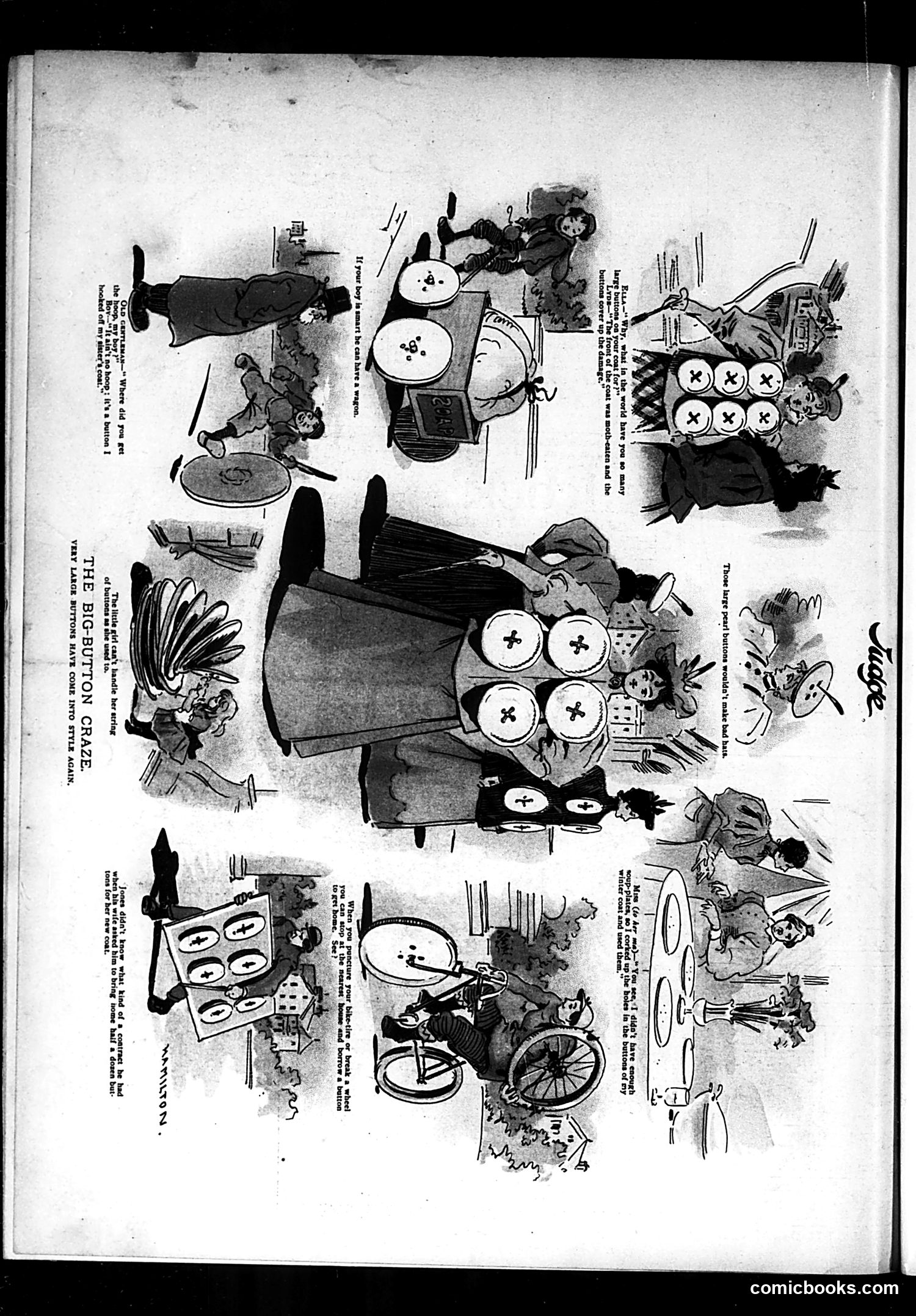
This page satirizes the early 20th-century fashion trend of extremely large buttons on clothing. The cartoons mock both the impracticality and absurdity of the style through humor. The central figure shows a woman wearing a coat with enormous buttons (marked with X's). Surrounding vignettes depict the unintended consequences: children mistaking large buttons for toys (hoops, hats, dice), confusion about their actual purpose, and the general chaos caused by their size. The humor targets fashion's tendency toward excess and the bewilderment of ordinary people—particularly men—confronted with women's fashionable garments. One caption notes a husband's confusion about "what kind of contract he had" when asked to purchase "half a dozen buttons," suggesting the impractical economics of the trend. The satire is gentle social commentary on fashion absurdity rather than serious political critique, typical of Judge magazine's lighthearted approach to contemporary fads and consumer culture.