
A complete issue · 16 pages · 1895
Judge — December 14, 1895
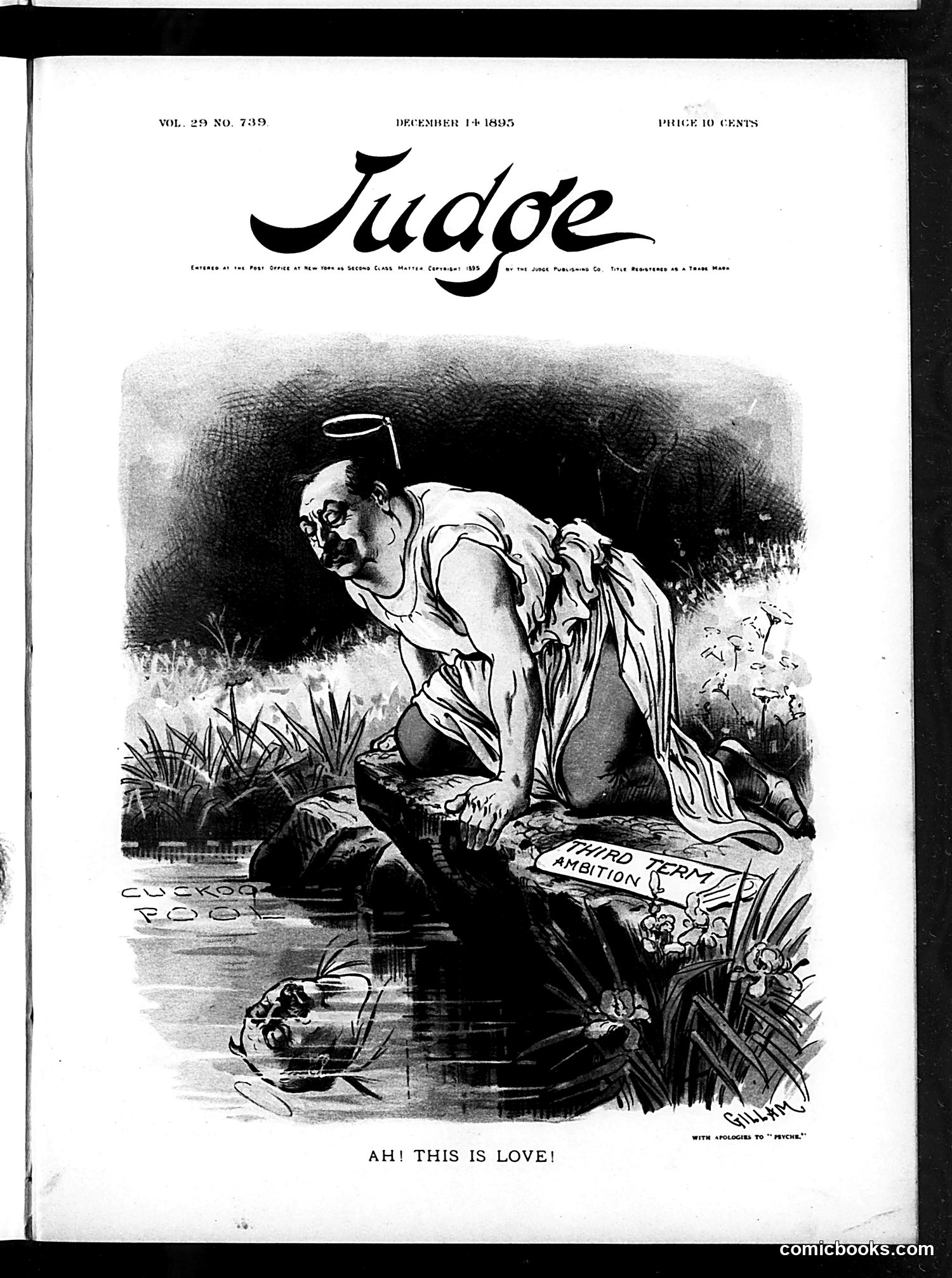
This political cartoon satirizes what appears to be a political figure pursuing romantic or amorous interests while neglecting serious matters of state. The man, depicted with a halo (suggesting false sanctity), crouches beside water labeled with references to "THIRD AMBITION" and "ARM," indicating unfulfilled political goals or military ambitions he's abandoned. The caption "AH! THIS IS LOVE!" suggests ironic commentary—the figure has prioritized personal romantic pursuits over political responsibilities or military expansion. The cherubs and romantic imagery mock this misplaced focus. Without clearer identification of the specific politician or historical event referenced, the general satirical point remains clear: **a leader distracted by romance at the expense of national duties**.
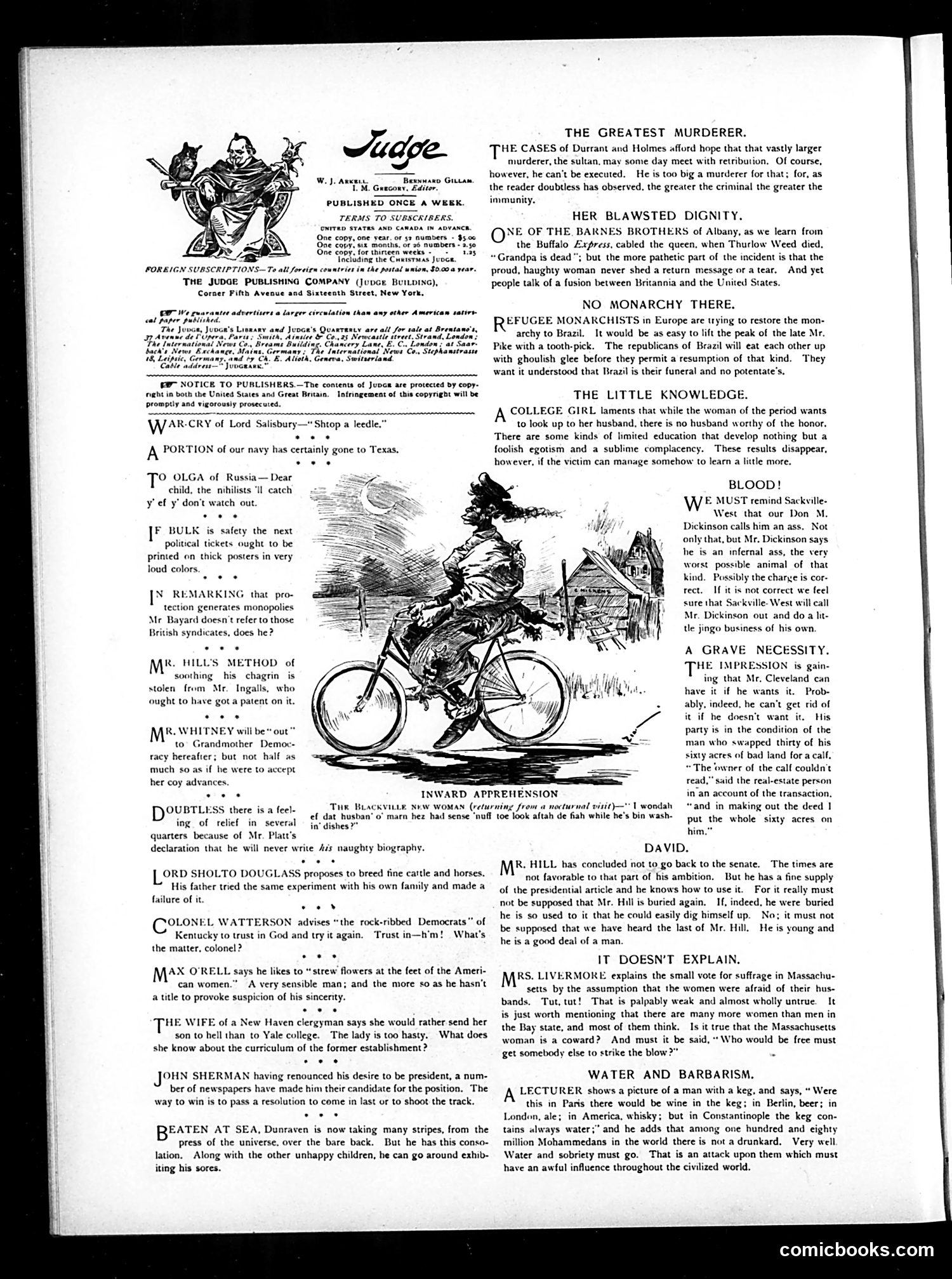
The main illustration shows a woman on a bicycle with the caption "INWARD APPREHENSION," depicting anxious body language. This satirizes late-19th-century concerns about women cycling—a new, controversial activity. The accompanying text "I wonder if dat husban' o' mine had sense 'nuff too look aftah de fah while he's bin wash-in' dishes?" suggests anxiety about gender role reversal: husbands managing domestic work while wives enjoy independent leisure activities. The page contains numerous brief satirical snippets mocking contemporary figures and politics, including references to Lord Salisbury, Russian politics, and American political candidates. The humor relies on topical references now requiring historical context to fully appreciate, though the general satirical tone critiquing social pretension and political hypocrisy remains evident.
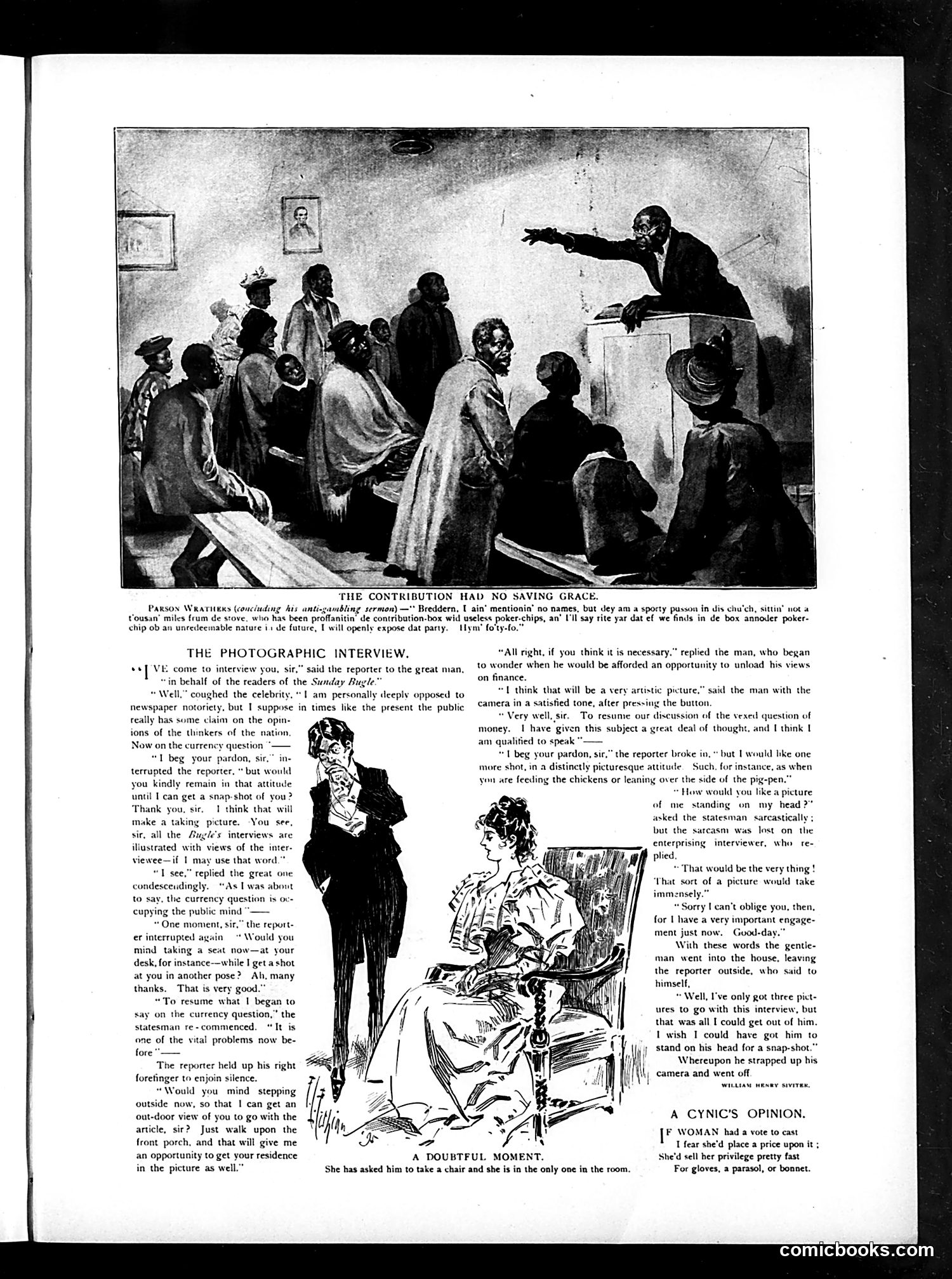
The top cartoon, "The Contribution Had No Saving Grace," depicts a parson soliciting money from parishioners at a church gathering. The satire targets clergy who aggressively pressure congregants for financial contributions while offering little spiritual value in return—the parson is literally a "spooky" figure more interested in "poker chips" than genuine faith. The lower section, "The Photographic Interview," satirizes journalists who ambush public figures (here, an unnamed statesman) with cameras to obtain candid photographs for newspapers. The reporter seeks to photograph the subject in an unflattering moment—appearing tired, disheveled, or caught off-guard—to undermine his public image. The joke critiques invasive press tactics and the emerging use of photography as a weapon against political figures.
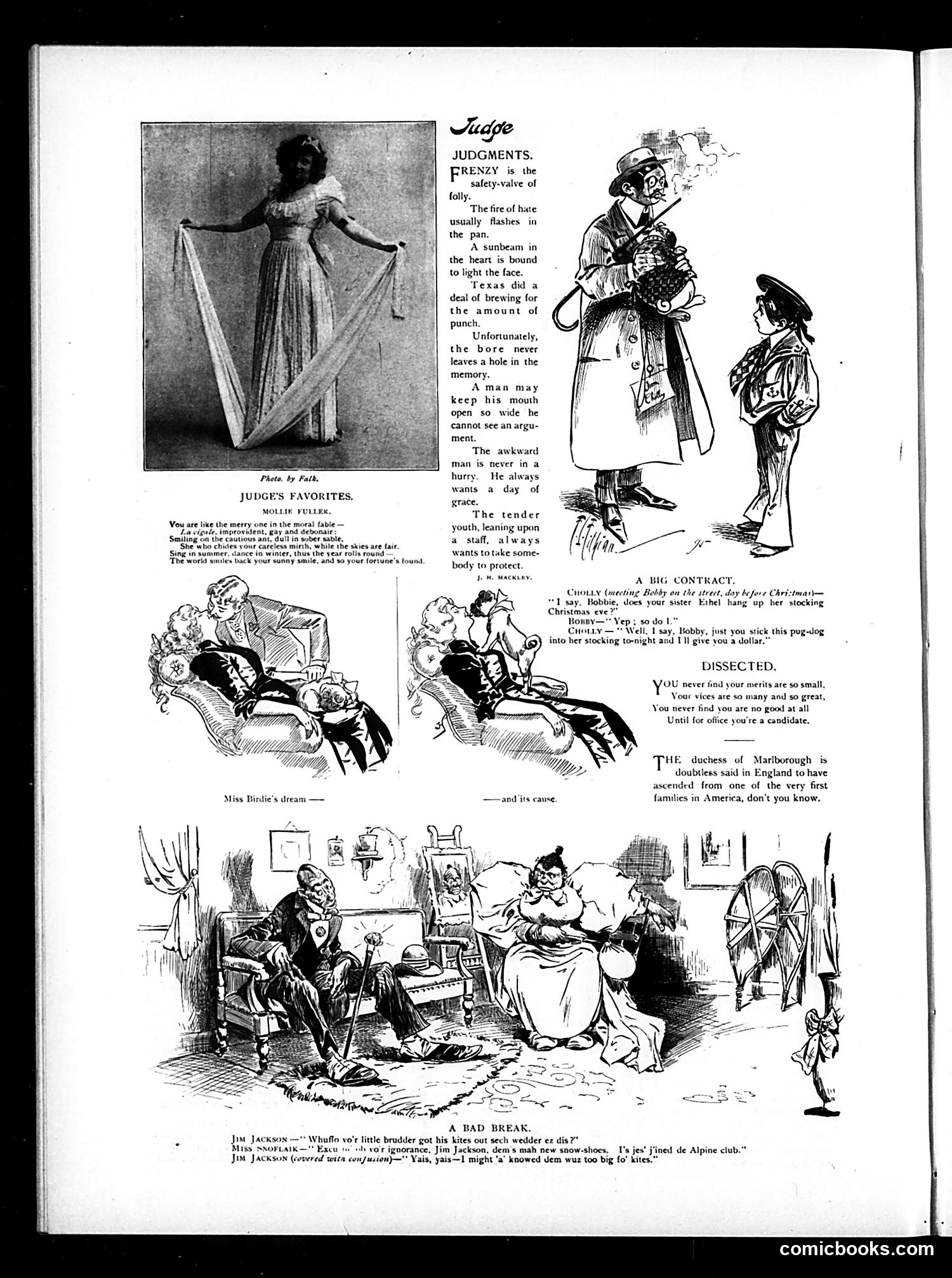
This page contains several satirical items typical of late 19th-century American humor: **"Judge's Favorites"** features Mollie Fuller, likely a popular performer or public figure of the era, shown in a theatrical pose. **"Judgments"** offers aphoristic observations on human folly—frenzy as folly's "safety-valve," bores who leave no impression, etc.—standard Victorian moral commentary. **"A Big Contract"** depicts children discussing Christmas stockings in dialect, with crude racial/class humor typical of the period. **"Dissected"** is political satire about candidates for office, suggesting that seeking public position exposes one's actual mediocrity. **"A Bad Break"** uses heavy dialect humor (appearing to mock African American speech) about snowshoes mistaken for kites, with "Alpine club" as the joke's punchline. The page reflects Judge's mix of theatrical promotion, moral philosophy, and period humor that relied heavily on dialect and social stereotyping now considered offensive.
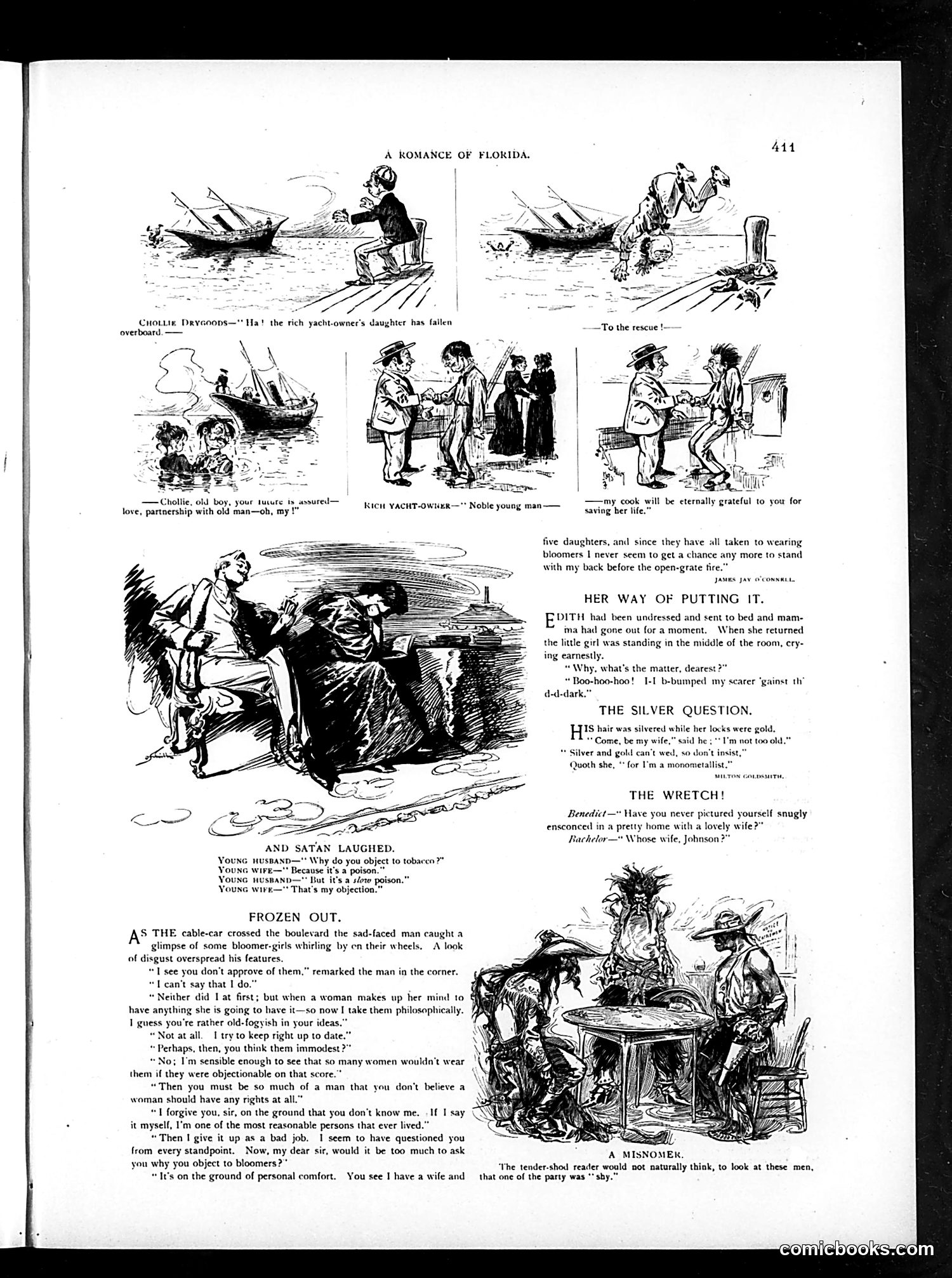
This page contains several satirical sketches typical of 1890s-era humor: **"A Romance of Florida"** mocks melodramatic rescue narratives—a yacht owner's daughter falls overboard, and a poor man heroically saves her, expecting gratitude or reward from the wealthy father. The satire targets predictable romantic tropes. **"And Satan Laughed"** presents a domestic dispute about tobacco, where the wife objects it's a "slow poison," the husband counters it's not *fast* enough—dark humor about marital discord and accepting wives' complaints. **"Frozen Out"** satirizes men resisting women's bloomers (divided skirts enabling cycling). A man insists his objection isn't moral propriety but personal comfort: with five daughters now wearing bloomers, he can't warm himself by the fireplace. The joke mocks both anti-feminist resistance and male self-interest. **"The Silver Question"** is political wordplay: a silver-haired man proposes to a gold-haired woman, who refuses because she's a "monometallist"—referencing the 1890s currency debate between gold and silver standards. The remaining sketches are brief domestic humor unrelated to contemporary politics.
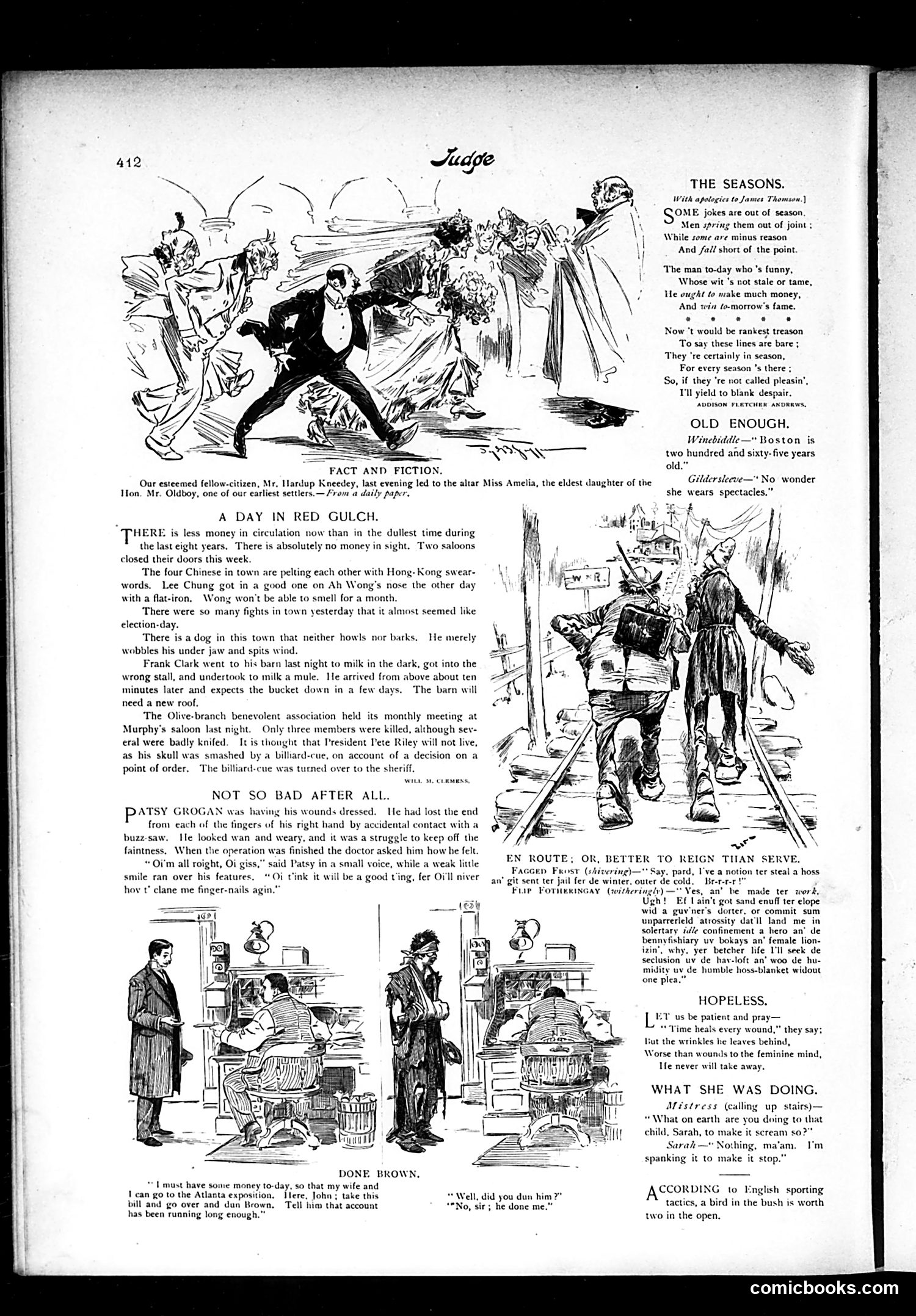
This page contains several satirical pieces typical of late-19th century American humor: **"A Day in Red Gulch"** mocks a frontier mining town during economic depression. The exaggerated mishaps—Chinese laborers fighting, a man milking a mule in darkness, a benevolent society meeting that erupts in knife violence—satirize the lawlessness and desperation of struggling frontier communities. The brutal humor underscores economic hardship and social disorder. **"Not So Bad After All"** features Irish immigrant Patsy Grogan, whose working-class dialect and stoic acceptance of losing his fingertips to machinery reflects period attitudes toward labor accidents and immigrant resilience. The joke's dark humor comments on industrial danger. **"Done Brown"** plays on debt collection—the punchline being the debtor "duns" the creditor back, suggesting financial reversal. Minor pieces include jokes about Boston's age, seasonal humor, and frontier characters. The illustrations throughout show period-typical cartooning style emphasizing exaggerated features and social types.
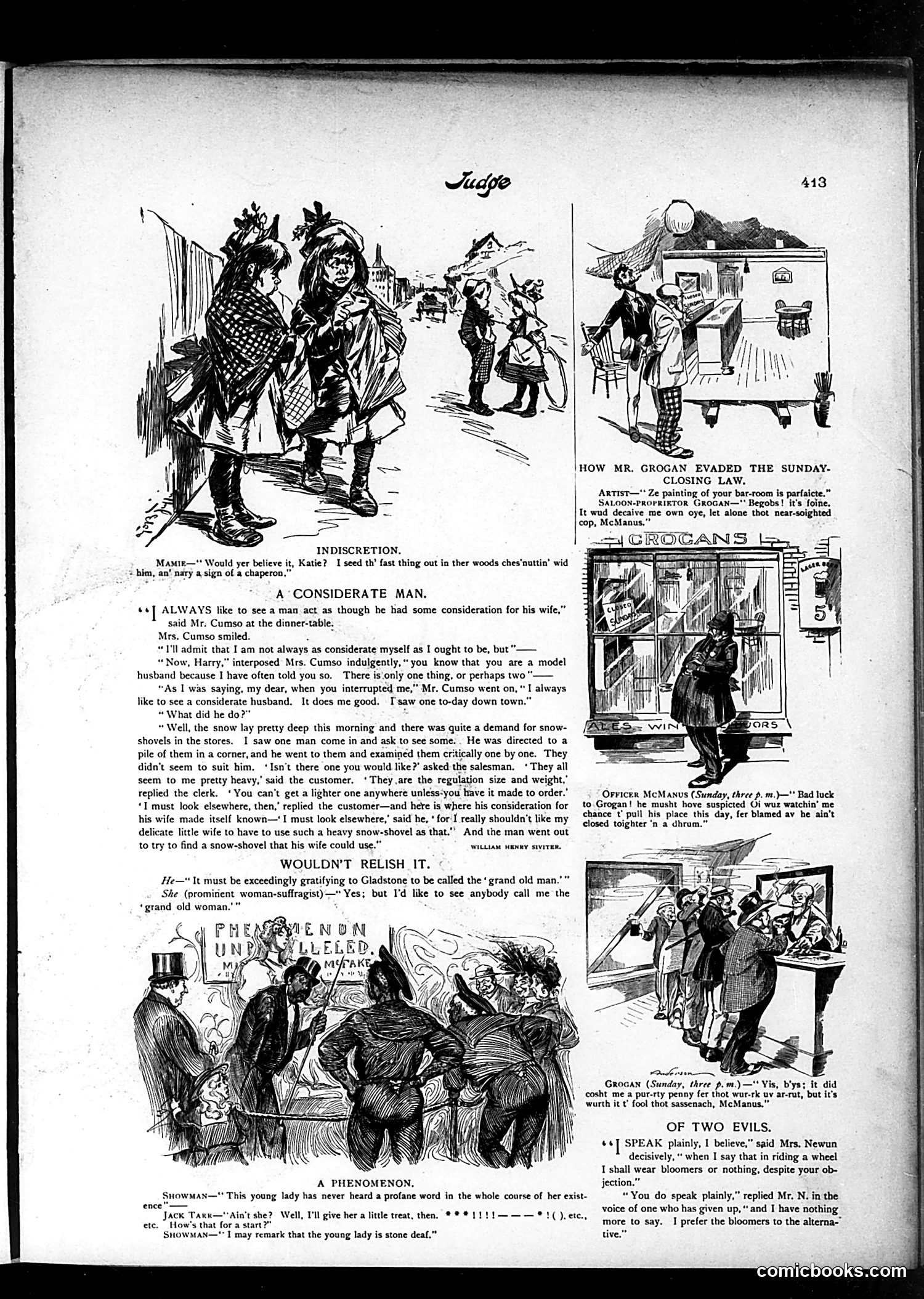
This page contains several satirical vignettes typical of late-Victorian American humor: **"A Considerate Man"** mocks husbands who boast of consideration toward wives while being oblivious to their own self-centeredness. Mr. Cumso praises a man who won't buy a heavy snow shovel for his "delicate" wife—a transparent excuse to avoid the purchase himself. **"Wouldn't Relish It"** references William Gladstone, the prominent British statesman called "the grand old man." A woman suffragist responds that she'd like to be called "grand old woman"—satirizing both the gendered language used for public figures and women's limited social recognition. **"How Mr. Grogan Evaded the Sunday-Closing Law"** depicts an Irish saloon owner (Grogan) fooling Officer McManus by disguising his bar as a painting studio to operate on Sundays, when closing laws applied. The Irish dialect and immigrant experience are key to the humor. **"Of Two Evils"** jokes about women's bloomers (controversial athletic wear). A husband resigns himself to accepting bloomers as preferable to his wife riding a bicycle unclothed.
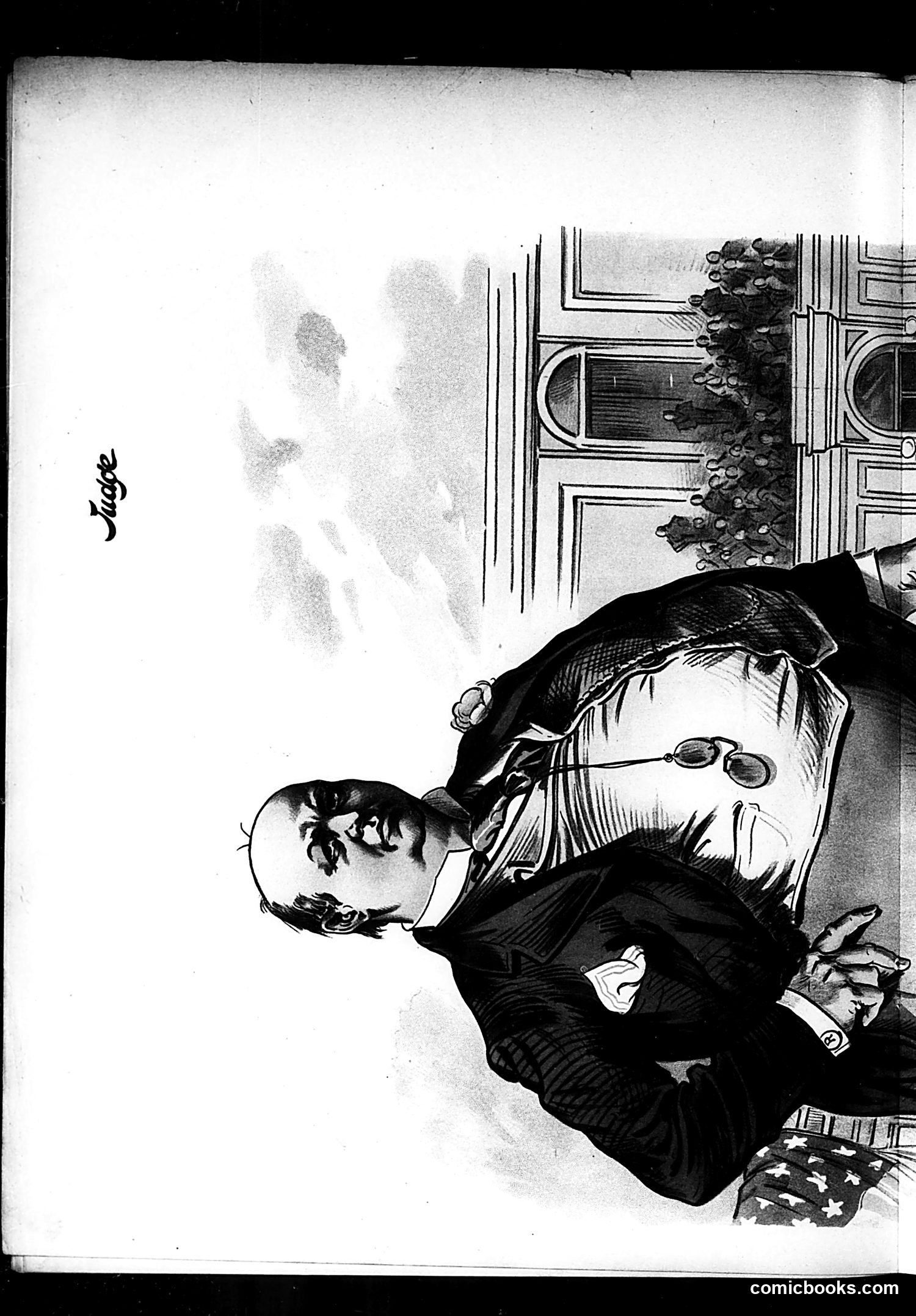
This appears to be a page from *Judge* magazine, though the OCR text provides minimal content beyond the source attribution. The image shows a black and white illustration of a man in formal attire (dark suit, glasses) viewed from above, positioned next to an ornate doorway with ivy or flowering vines. The artistic style and composition suggest this is likely political satire or social commentary typical of *Judge*'s content. However, **without clearer OCR text or visible captions**, I cannot confidently identify the specific figure being caricatured, the historical event referenced, or the satirical point being made. The formal setting and exaggerated artistic treatment indicate social or political criticism, but determining the precise target and message requires more legible text or contextual information from the original magazine publication date.
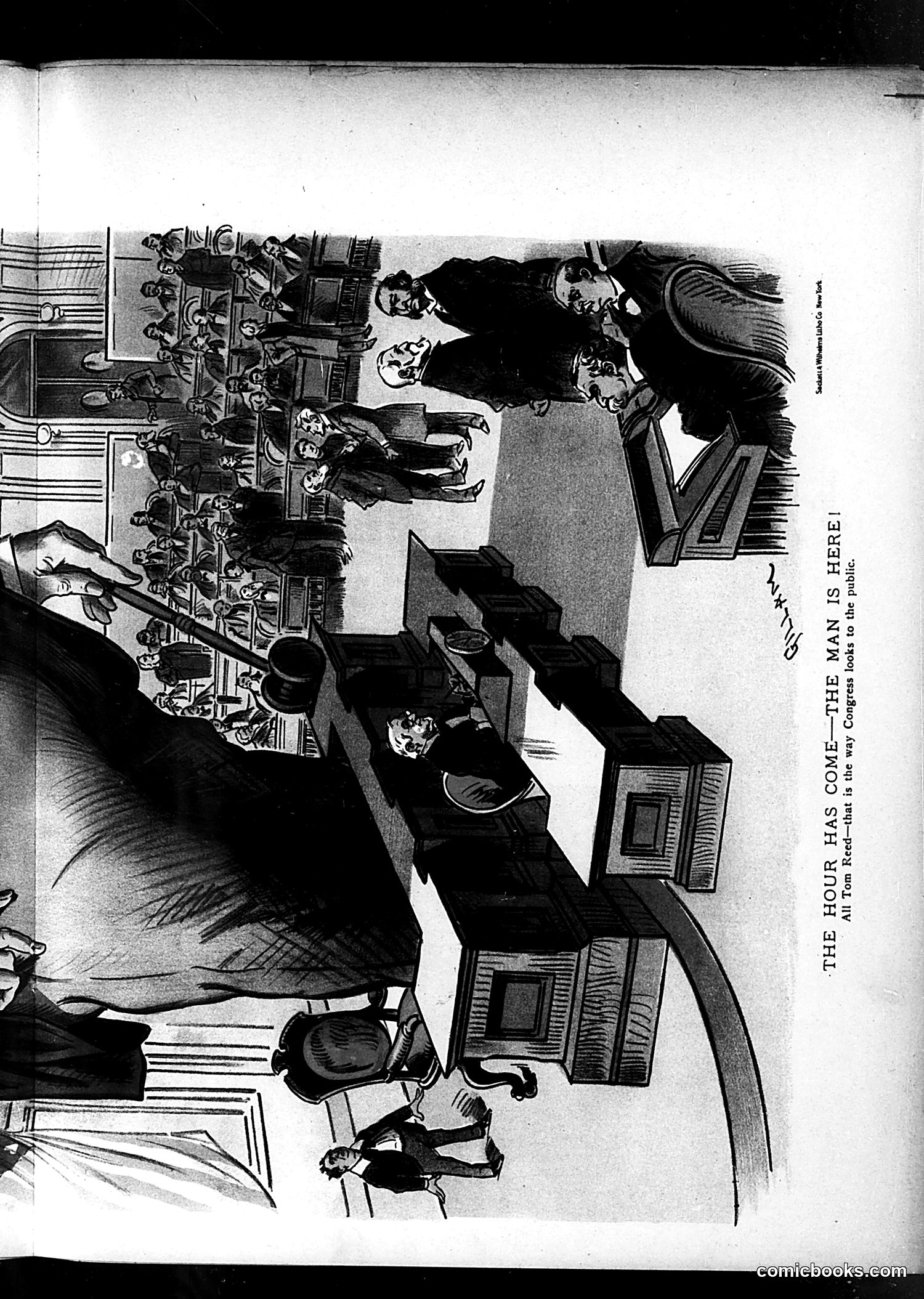
This cartoon satirizes **Tom Reed** (likely Speaker Thomas B. Reed of Maine, prominent late 19th-century congressman) by depicting him as dominating Congress. The caption "The Hour Has Come—The Man Is Here!" suggests Reed wielded outsized personal power over the legislative body. The visual metaphor shows Reed as a large, looming figure literally towering over the assembled members of Congress, who appear diminished below him. The subtitle's cynical observation—that this is "the way Congress looks to the public"—indicates public perception that Reed controlled Congress rather than governing through democratic consensus. This reflects contemporary concerns about concentrated power in the Speaker's office and the erosion of legislative independence under strong leadership.
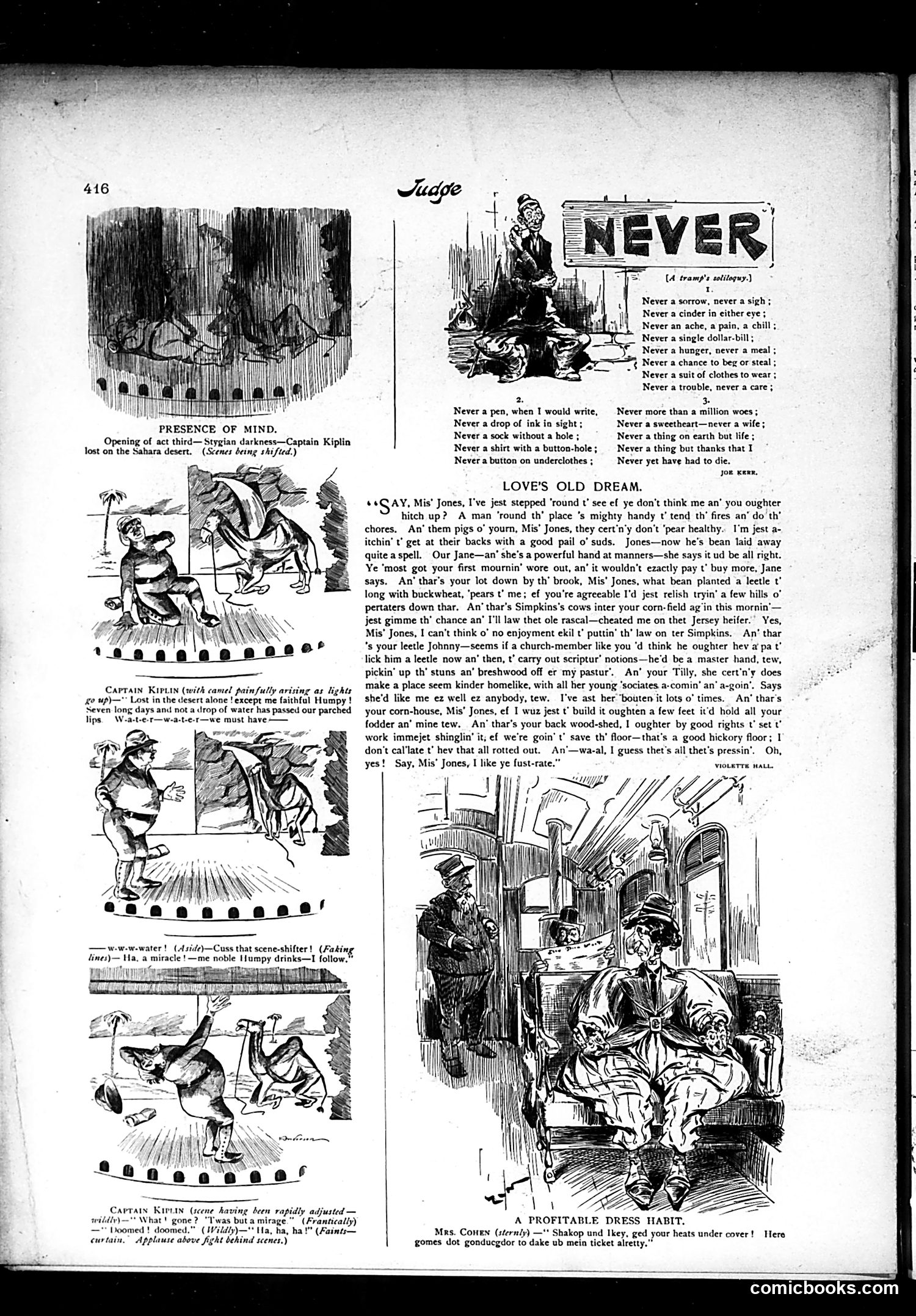
This page contains three distinct satirical pieces: **"Presence of Mind"** mocks theatrical melodrama, showing Captain Kiplin lost in the Sahara. The joke satirizes overwrought stage acting—when a camel appears (likely a scene-shifter's mistake), he treats it as a mirage and faints dramatically, poking fun at actors' overwrought responses. **"Never"** is a sardonic poem about a tramp's paradoxically optimistic philosophy: he claims never to suffer sorrow despite poverty, homelessness, and want. The satire targets either romanticized portrayals of the poor or critiques the tramp's delusional denial. **"Love's Old Dream"** features a rural suitor's transparently self-interested marriage proposal to a widow, disguising his real motives (her property, labor, her daughter) behind false concern and neighborly offers. The satire exposes calculated opportunism masked as courtship. **"A Profitable Dress Habit"** shows an immigrant conductor (likely German-Jewish, indicated by dialect spelling) scolding passengers about proper dress—a brief joke about urban transit etiquette.
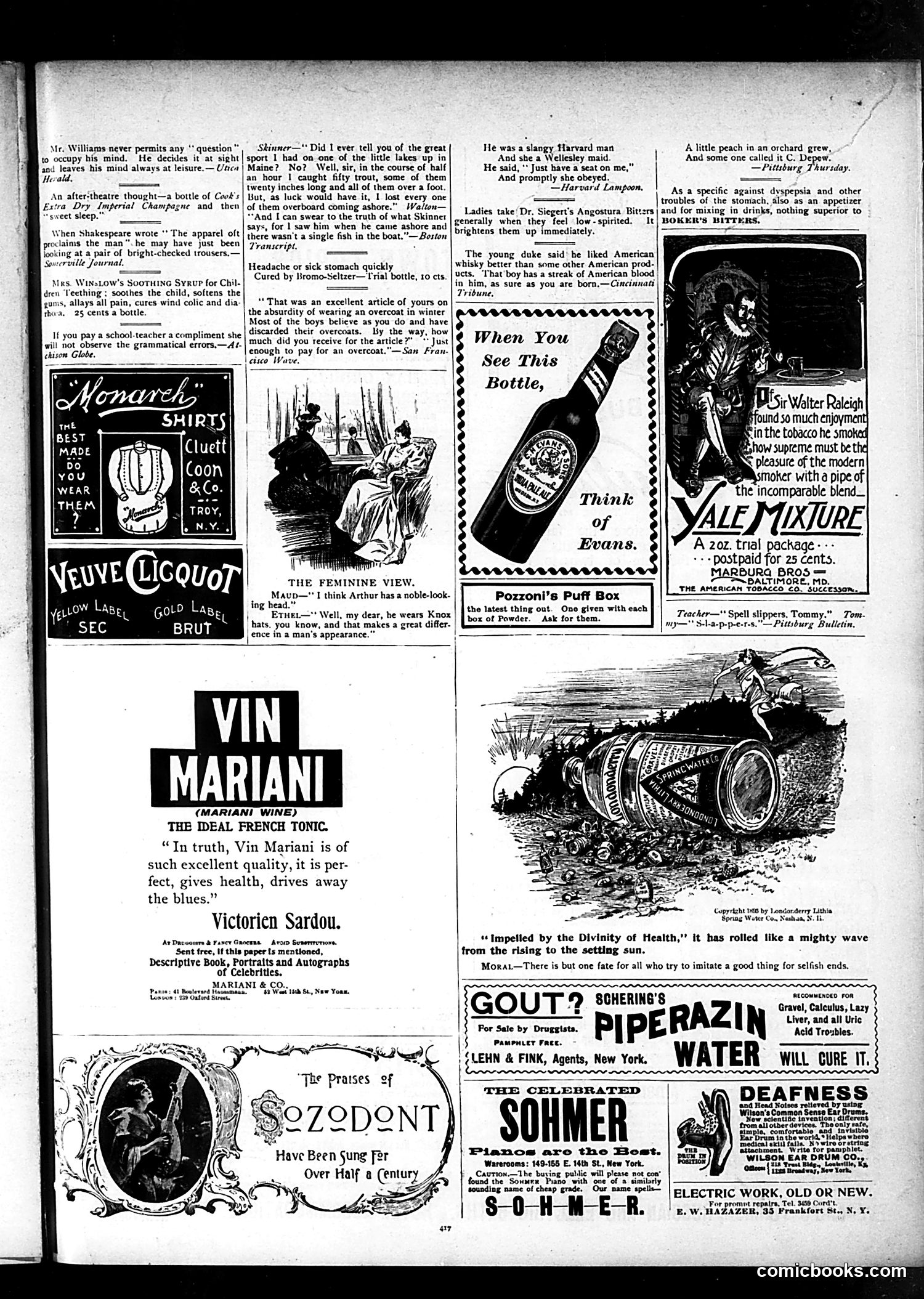
This page is primarily **advertisements and short humorous anecdotes**, not political satire. The content includes: **Humorous Anecdotes:** - A joke about a man who caught fifty trout but lost them all overboard—a companion vouches for the lie by noting the fisherman arrived with no fish - A quip about a writer paid just enough for an anti-overcoat article to buy an overcoat - Observations on appearance, collegiate life (Harvard/Wellesley romance), and a reference to "C. Depew" (likely Chauncey Depew, a famous politician/businessman) **Advertisements:** The bulk comprises patent medicines and luxury goods typical of the era: Vin Mariani wine tonic, Bromo-Seltzer, Mrs. Winslow's Soothing Syrup, Piperazin water, Sohmer pianos, and tobacco products. **Context for modern readers:** This reflects the early 20th-century American acceptance of unregulated medicinal claims and heavy advertising of alcohol and drugs as health tonics—practices later restricted by the FDA.
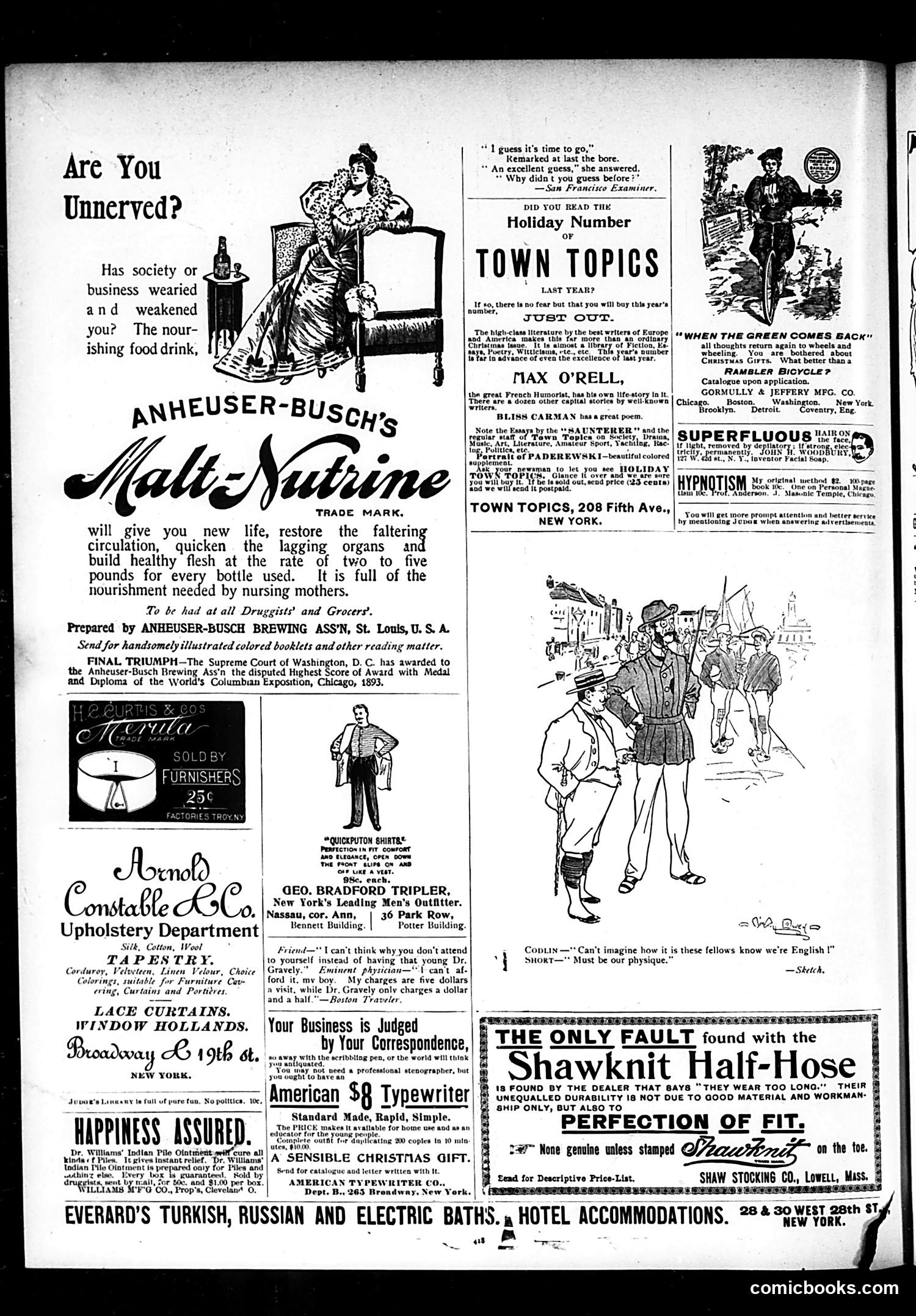
This page is primarily **advertising**, typical of Judge magazine's revenue model. The dominant advertisement is for **Anheuser-Busch's Malt Nutrine**, a malt beverage marketed as a health tonic for nursing mothers and the infirm—reflecting late 19th-century patent medicine culture when alcohol was sold as medicinal. The small cartoons and jokes scattered throughout are minor filler: 1. **"Are You Unnerved?" cartoon**: A woman tells a boring visitor "it's time to go," satirizing tedious social calls—a common period complaint. 2. **"Your Business is Judged by Your Correspondence"**: Advertises the American Typewriter, positioning typewritten letters as more professional than handwriting. 3. Other ads promote men's clothing, bicycles, hypnotism lessons, and bath houses—all period-typical offerings. The page reflects **Gilded Age consumer culture**: patent medicines, new technologies (typewriters, bicycles), and leisure pursuits marketed to the wealthy. The satire is gentle social observation rather than political commentary.
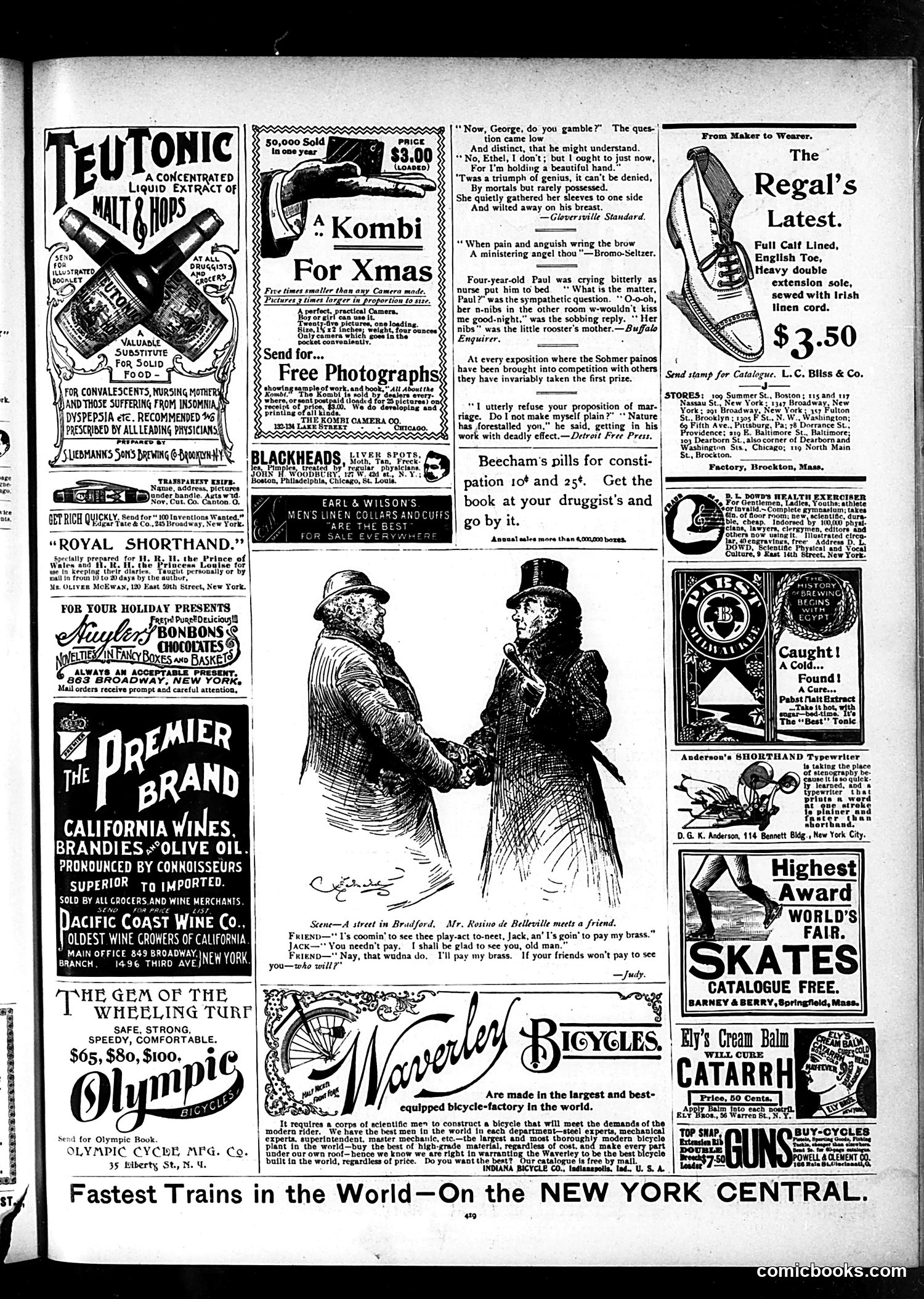
This page is primarily **advertising**, with scattered light humor pieces typical of Judge magazine's format. The main cartoon depicts two working-class men in Bradford meeting on the street. The caption references a friend paying to see someone "play-act" (perform theatrically). The joke appears to be about working-class pride and reciprocal obligation—the man refuses free admission, insisting on paying his "brass" (money) because his friend is performing, suggesting honor and mutual respect even among poor laborers. The page's other content consists of brief humorous anecdotes about romance, gambling, and domestic life, interspersed with era-appropriate advertisements for bicycles, wines, shorthand instruction, and patent medicines like Beecham's Pills. There are no identifiable political figures or major satirical targets. This represents Judge's typical mix of **genteel Victorian humor** and commercial advertising rather than sharp political commentary.
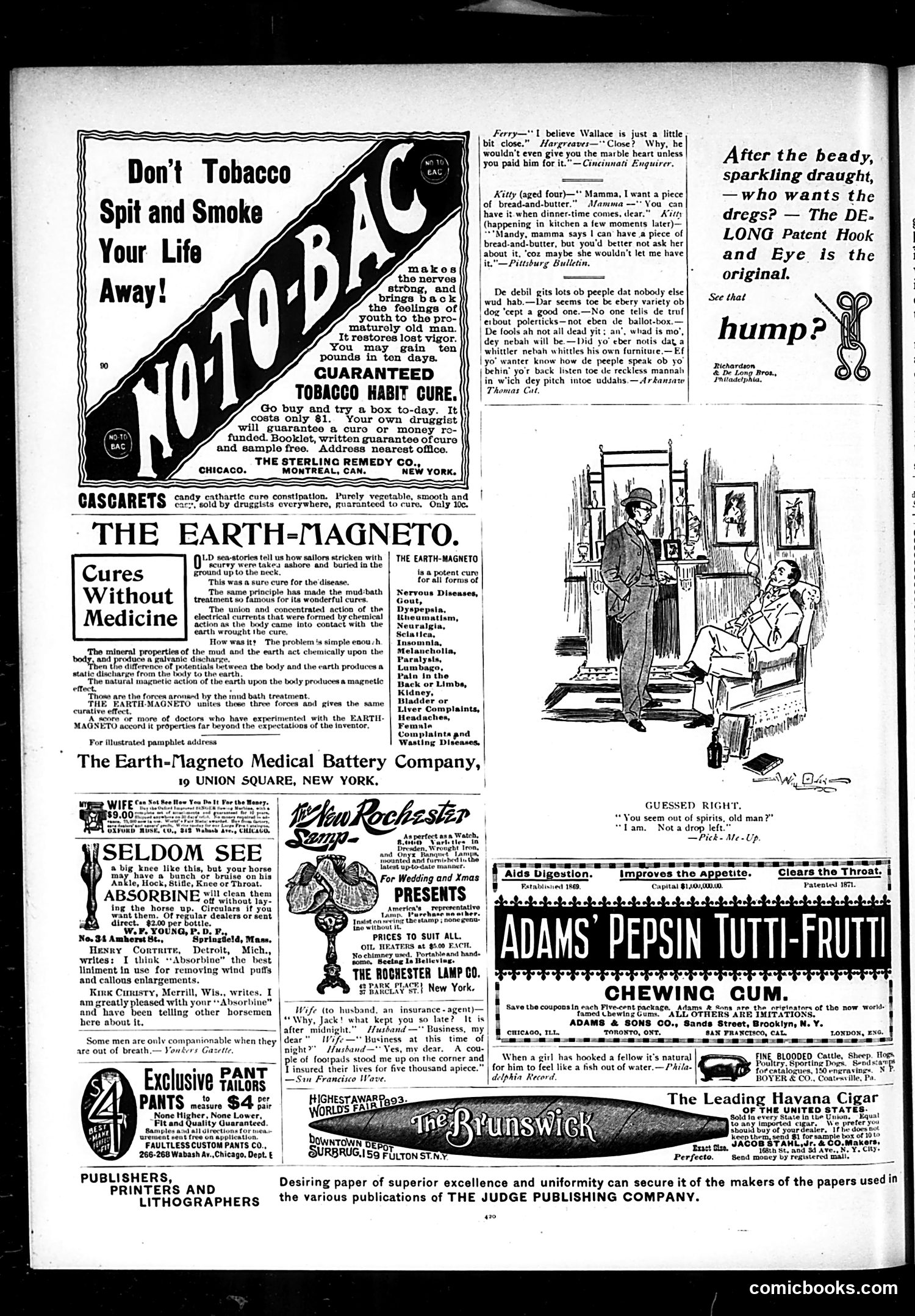
This page is primarily **advertisements and brief humor items**, typical of Judge magazine's format. The main cartoon (upper right) shows a man viewing gallery paintings while a woman sits nearby—a visual joke about aesthetic taste and relationships, captioned "Guessed Right." The humor snippets scattered throughout are short, punchy jokes on common themes: money (Ferry and Hargreaves debating someone's stinginess), children's logic (a girl manipulating her mother about bread-and-butter), and racial dialect humor (African American vernacular observations about human nature and politics—standard and offensive for this era). The page is dominated by **patent medicine advertisements**: NoToBAC (tobacco habit cure), Earth-Magneto (a magnetic therapy device claiming to cure nervous disorders), and Adams Pepsin chewing gum. These represent the era's widespread promotion of dubious medical treatments and products. The bottom notes this is from **Judge Publishing Company**, establishing it as an official publication page. The overall content reflects early 20th-century American popular culture: casual bigotry, quack medicine marketing, and domestic humor.
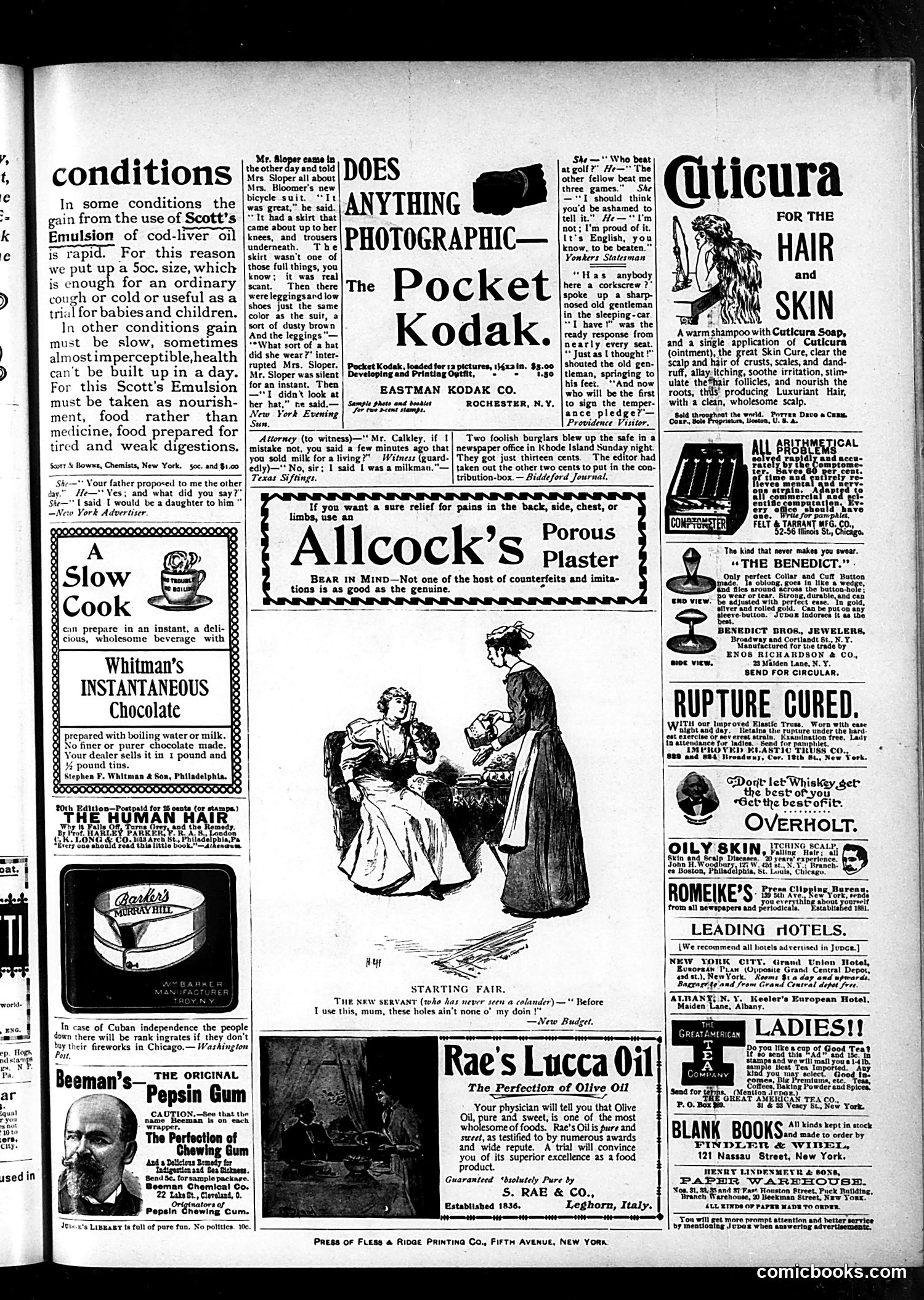
This page from **Judge magazine** is primarily **advertising with small comic vignettes** rather than a major political cartoon. The advertisements dominate (Kodak cameras, Whitman's Chocolate, Cuticura products, Beeman's Gum, Rae's Lucca Oil). The small jokes scattered throughout reflect late 19th/early 20th-century humor: - A woman criticizes a man for admitting he lost at golf, but he proudly claims it's "English" to lose - A "new servant" (immigrant or inexperienced worker) doesn't understand what a colander is, suggesting class/cultural humor - A temperance pledge joke mocking abstinence advocates **Context:** These brief quips target everyday social pretensions, gender roles, and working-class ignorance—typical Judge satire. The magazine used humor to mock Victorian social conventions, immigrant unfamiliarity with American culture, and moral crusades like temperance. The page lacks heavy political commentary; it's mainly a vehicle for consumer advertising with light social comedy interspersed.
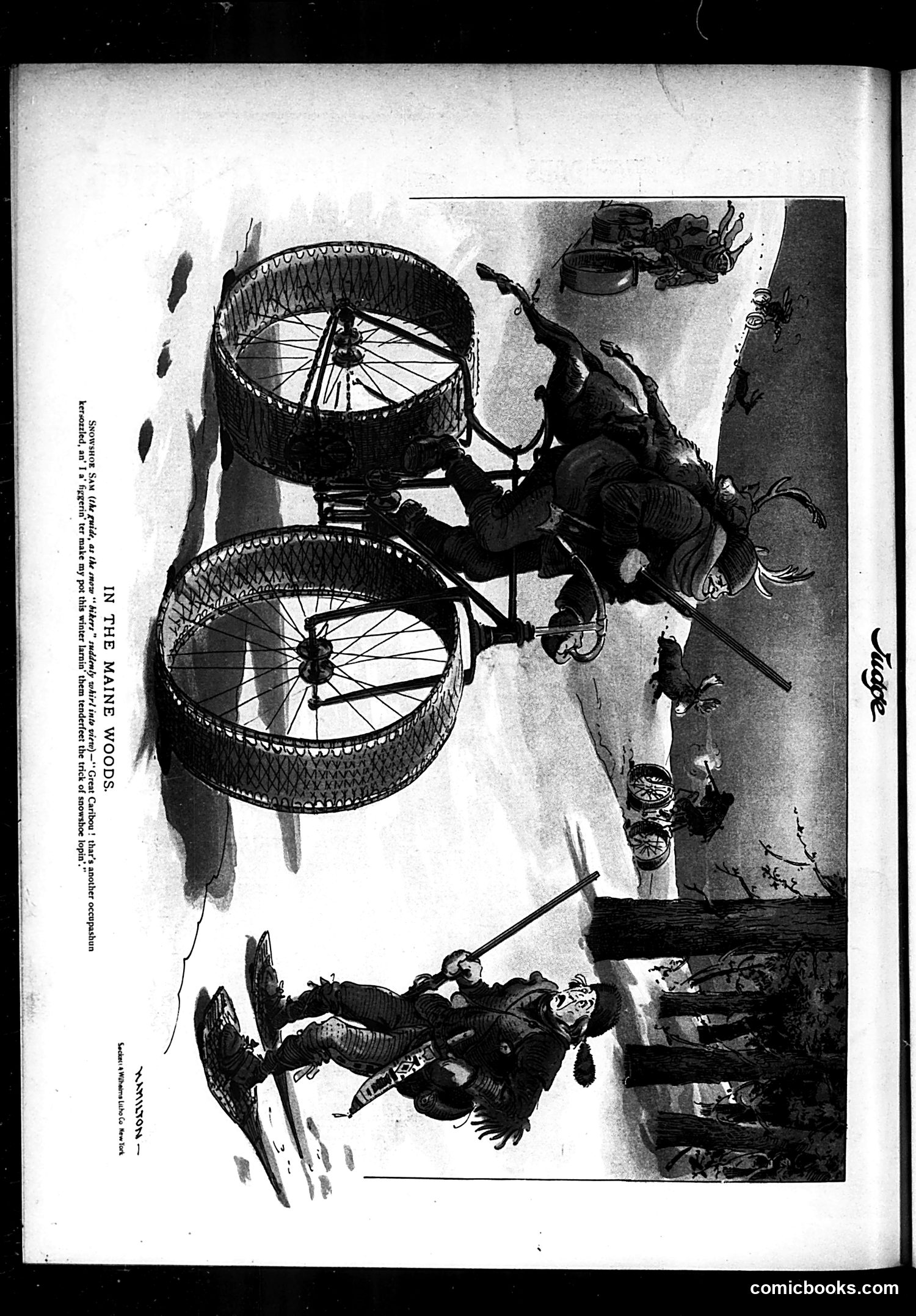
This is a satirical cartoon about technological disruption and rural employment. "Snowshoe Sam," depicted as a Maine woods guide, watches in dismay as "snow bikes" (early motorized snow vehicles) whirl past. His complaint—that another traditional occupation is being "kerflummoxed" (disrupted)—reflects genuine early-20th-century anxieties about mechanization replacing skilled labor. Sam had planned to earn money teaching wealthy tourists ("tenderfeet") the difficult skill of snowshoe travel. The joke satirizes both the guide's obsolescence and the wealthy urbanites' rush to adopt newfangled machinery over traditional methods. The cartoon captures a recurring American tension: industrial progress versus rural livelihoods, mechanization versus craft knowledge. It's emblematic of Judge's satirical commentary on technological change and class conflict during this era.