
Judge, 1895-12-14 · page 10 of 16
Judge — December 14, 1895 — page 10: what you’re looking at
What you’re looking at
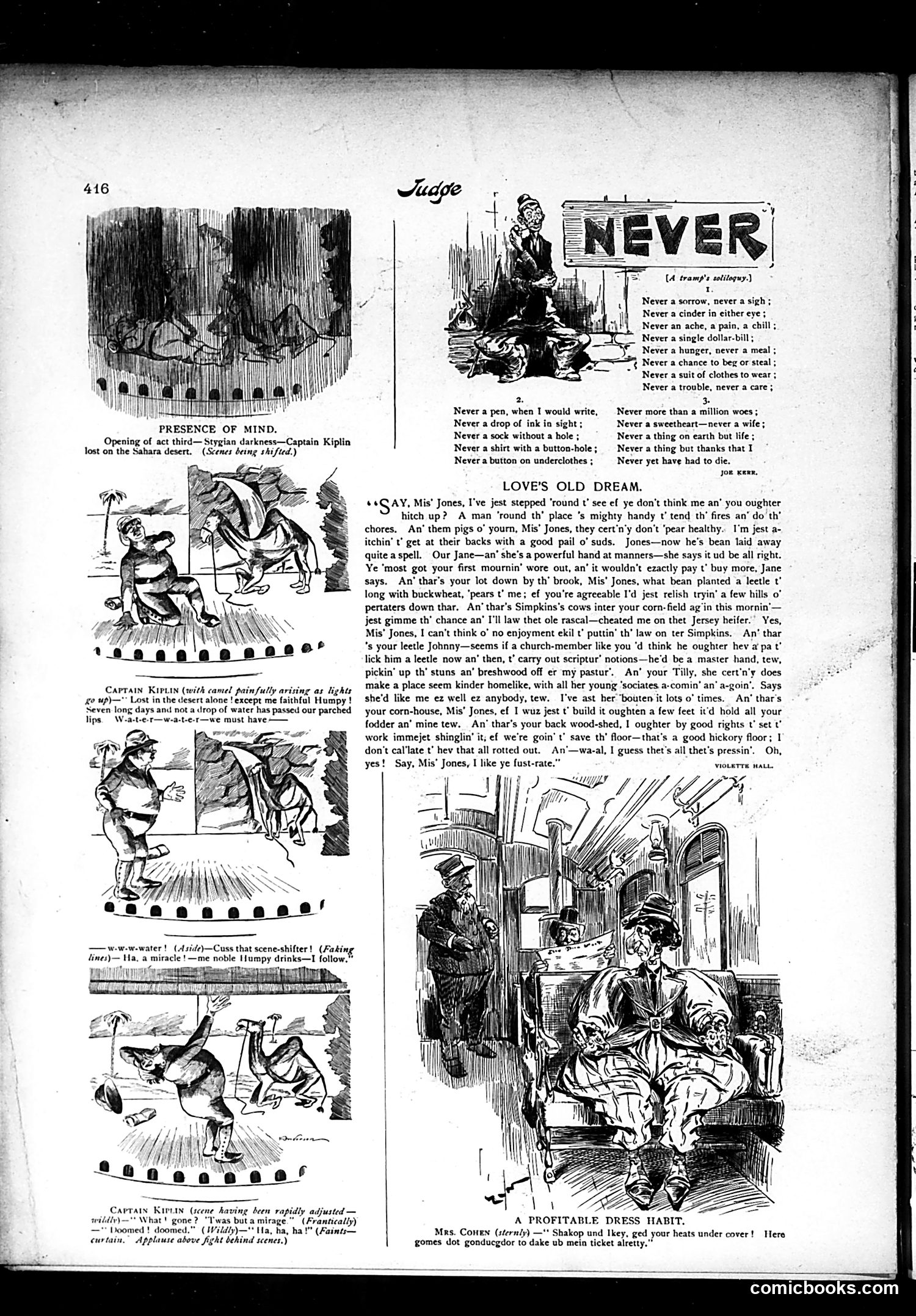
This page contains three distinct satirical pieces: **"Presence of Mind"** mocks theatrical melodrama, showing Captain Kiplin lost in the Sahara. The joke satirizes overwrought stage acting—when a camel appears (likely a scene-shifter's mistake), he treats it as a mirage and faints dramatically, poking fun at actors' overwrought responses. **"Never"** is a sardonic poem about a tramp's paradoxically optimistic philosophy: he claims never to suffer sorrow despite poverty, homelessness, and want. The satire targets either romanticized portrayals of the poor or critiques the tramp's delusional denial. **"Love's Old Dream"** features a rural suitor's transparently self-interested marriage proposal to a widow, disguising his real motives (her property, labor, her daughter) behind false concern and neighborly offers. The satire exposes calculated opportunism masked as courtship. **"A Profitable Dress Habit"** shows an immigrant conductor (likely German-Jewish, indicated by dialect spelling) scolding passengers about proper dress—a brief joke about urban transit etiquette.
📄 Transcribed text from this page (OCR, searchable)
Machine-transcribed from the original scan — historical spelling and the odd misread are preserved.
PRESENCE OF MIND. Opening of act third— Stygian darkness—Captain Kiplin (Scenes being shifted.) lost on the Sahara desert. CAprain KIPLin (swith camel painfully arising as lights £0 up)—"" Lost in the desert alone !except me faithful Humpy ! Seven long days and not a drop of water has passed our parched lips. W.a-t-e-r—w-a-t-e-r—we must have-—— —w.w.wewater! (Aside)—Cuss that scene-shifter! (Faki Jines)— a, a miracle !—me noble Humpy drinks—I follow. Captain Kurtin (scene having been rapidly adjusted — dlv)—"* What! gone? "Twas but a mirage.” (Frantically) —"' Doomed ! doomed.” (IVildly)—"* Ma, ha, ha!" (Faints— curtain, Applause above fight behind scenes.) (A tramp's sotiteguy.) I Never a sorrow, never a sigh ; Never a cinder in either eye ; Never an ache, a pain, a chill ; Never a single dollar-bill; Never a hunger, never a meal ; % Never a chance to beg or steal ; Never a suit of clothes to wear ; Never a trouble, never a care ; ‘Never more than a million woes ; Never a sweetheart—never a wife; Never a thing on earth but life; Never a thing but thanks that I Never yet have had to die. Jon Kenn, Never a pen, when I would write, Never a drop of ink in sight ; Never a sock without a hole ; Never a shirt with a button-hol Never a button on underclothes ; LOVE’S OLD DREAM. + +GAY, Mis’ Jones, I've jest stepped ‘round t' see ef ye don’t think me an’ you oughter hitch up? A man ‘round th’ place 's mighty handy t’ tend th’ fires an’ do th’ chores. An’ them pigs 0’ yourn, Mis’ Jones, they cert’n’y don’t ‘pear healthy. I'm jest a- itchin’ t' get at their backs with a good pail o’ suds. Jones—now he’s bean laid away quite a spell. Our Jane—an’ she’s a powerful hand at manners—she says it ud be all right. Ye ‘most got your first mournin’ wore out, an’ it wouldn't ezactly pay t' buy more, Jane says. An’ thar's your lot down by th’ brook, Mis’ Jones, what bean planted a leetle t’ long with buckwheat, ‘pears t’ me; ef you're agreeable I'd jest relish tryin’ a few hills o° pertaters down thar. An’ thar’s Simpkins's cows inter your corn-field agin this mornin'— jest gimme th’ chance an’ I'll law thet ole rascal—cheated me on thet Jersey heifer.’ Yes, Mis’ Jones, I can’t think 0’ no enjoyment ekil t’ puttin’ th’ law on ter Simpkins. An’ thar 's your leetle Johnny—scems if a church-member like you ‘d think he oughter hev a pat’ lick him a leetle now an’ then, t’ carry out scriptur’ notions—he'd be a master hand, tew, pickin’ up th’ stuns an’ breshwood off er my pastur’. An’ your Tilly, she cert'n'y does make a place seem kinder homelike, with all her young ‘sociates a-comin’ an’ a-goin’. Says she'd like me ez well ez anybody, tew. I've ast her ‘bouten it lots o° tim An’ thar's your corn-house, Mis’ Jones, ef I wuz jest t’ build it oughten a few feet it'd hold all your fodder an’ mine tew. An’ thar’s your back wood-shed, I oughter by good rights t’ set t* work immejet shinglin’ it; ef we're goin’ t’ save th’ floor—that's a good hickory floor; I don’t cal'late t’ hev that all rotted out. An'—wa-al, I guess thet’s all thet’s pressin’. Oh, yes! Say, Mis’ Jones, I like ye fust-rate.” vioverre nau. JZ pei is Fe My cull a: a IM IZA OZ.” Md A PROFITABLE DRESS HABIT. Mrs. Conen (sternly) —* Shakop und Ikey, ged your heats under cover ! Here gomes dot gonducgdor to dake ub mein ticket alretty."*