
A complete issue · 18 pages · 1895
Judge — November 30, 1895
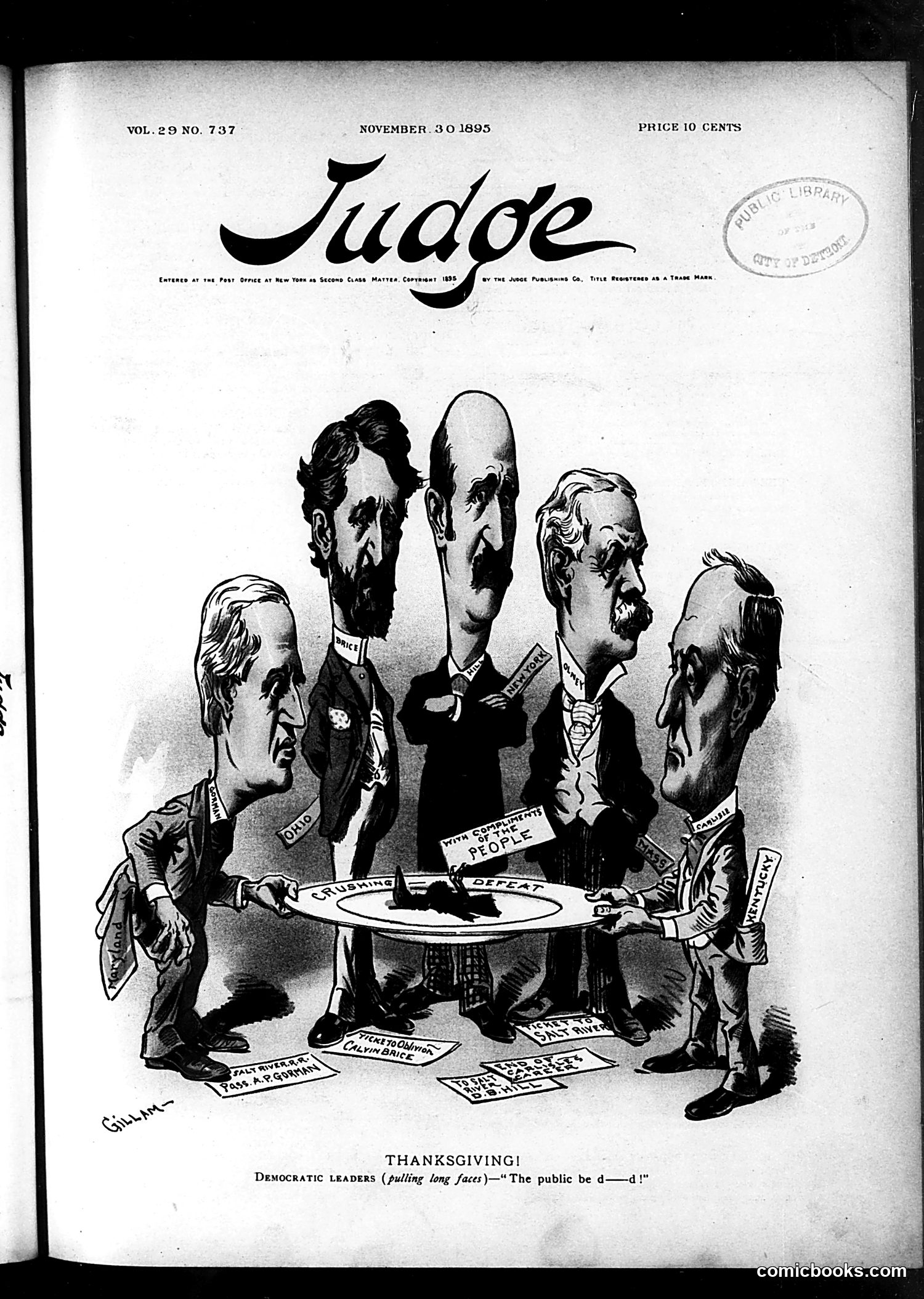
This political cartoon satirizes Democratic Party leadership during the 1895-1896 period. Five caricatured men in formal dress surround a dining table, pulling "long faces" while contemplating a nearly empty plate labeled "GREAT OFFICES OF THE PEOPLE." The caption "THANKSGIVING! Democratic Leaders (pulling long faces)—'The public be d—d!'" suggests the Democrats faced electoral defeat or loss of political power, leaving them unable to distribute patronage jobs ("great offices") to supporters. The scattered cards on the floor reference various states, implying their political losses were nationwide. The cartoon mocks Democratic leaders for caring only about personal political gain rather than serving the public, using the Thanksgiving holiday imagery ironically to emphasize their disappointment and selfishness.
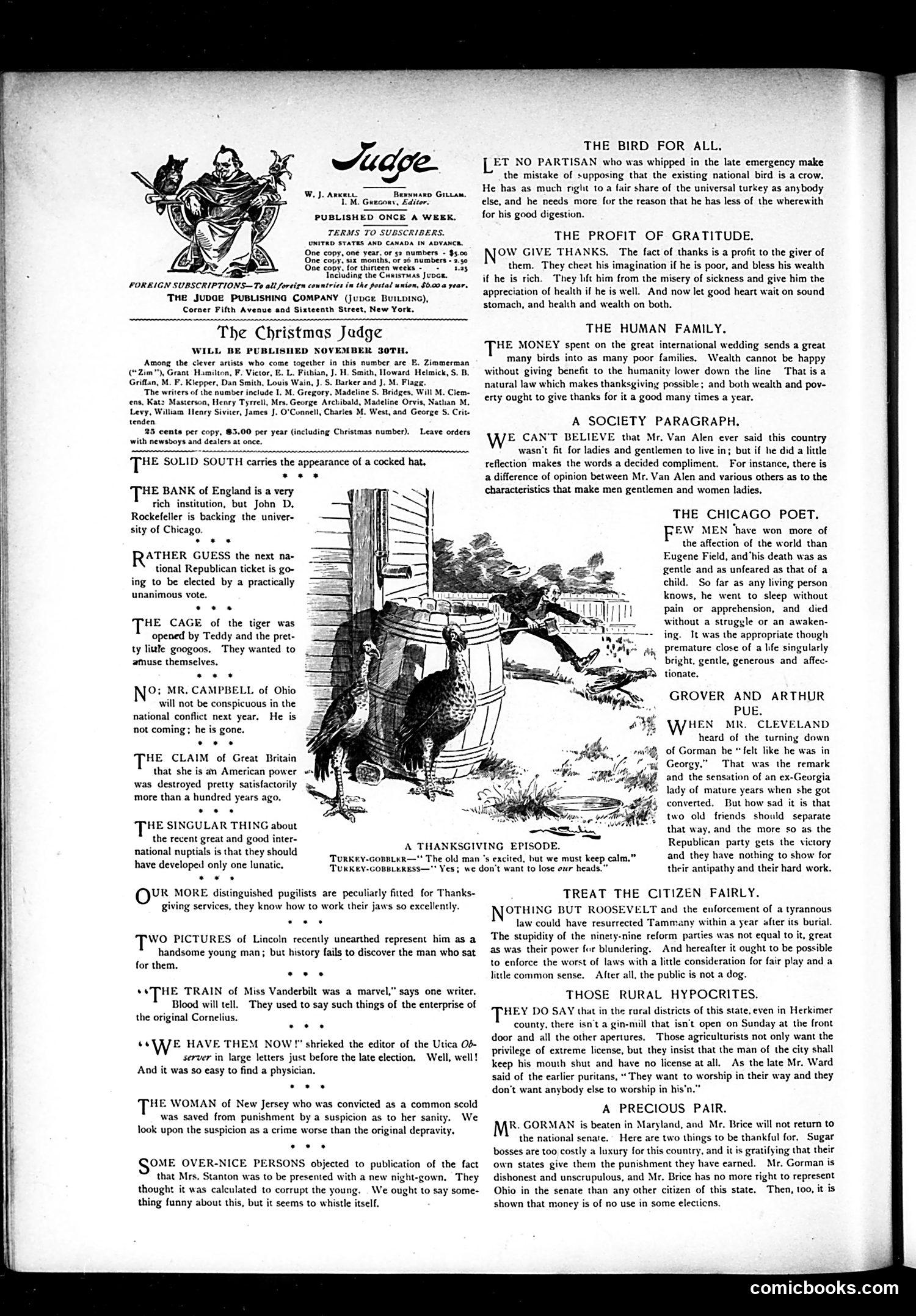
The main cartoon depicts two anthropomorphic turkeys in conversation beside a barrel. The caption reads: "The old man's excited, but we must keep calm." / "Yes; we don't want to lose our heads." This is dark humor playing on Thanksgiving traditions—the turkeys are nervously aware that their species faces slaughter during the holiday. The joke's grim irony lies in their attempt to maintain composure while discussing the literal threat of decapitation. The surrounding editorial content includes commentary on current events (politics, social issues) typical of Judge magazine's satirical format, but the turkey cartoon is the primary visual humor. It reflects turn-of-the-century American sensibilities about holiday observances and animal mortality presented through anthropomorphic comedy.
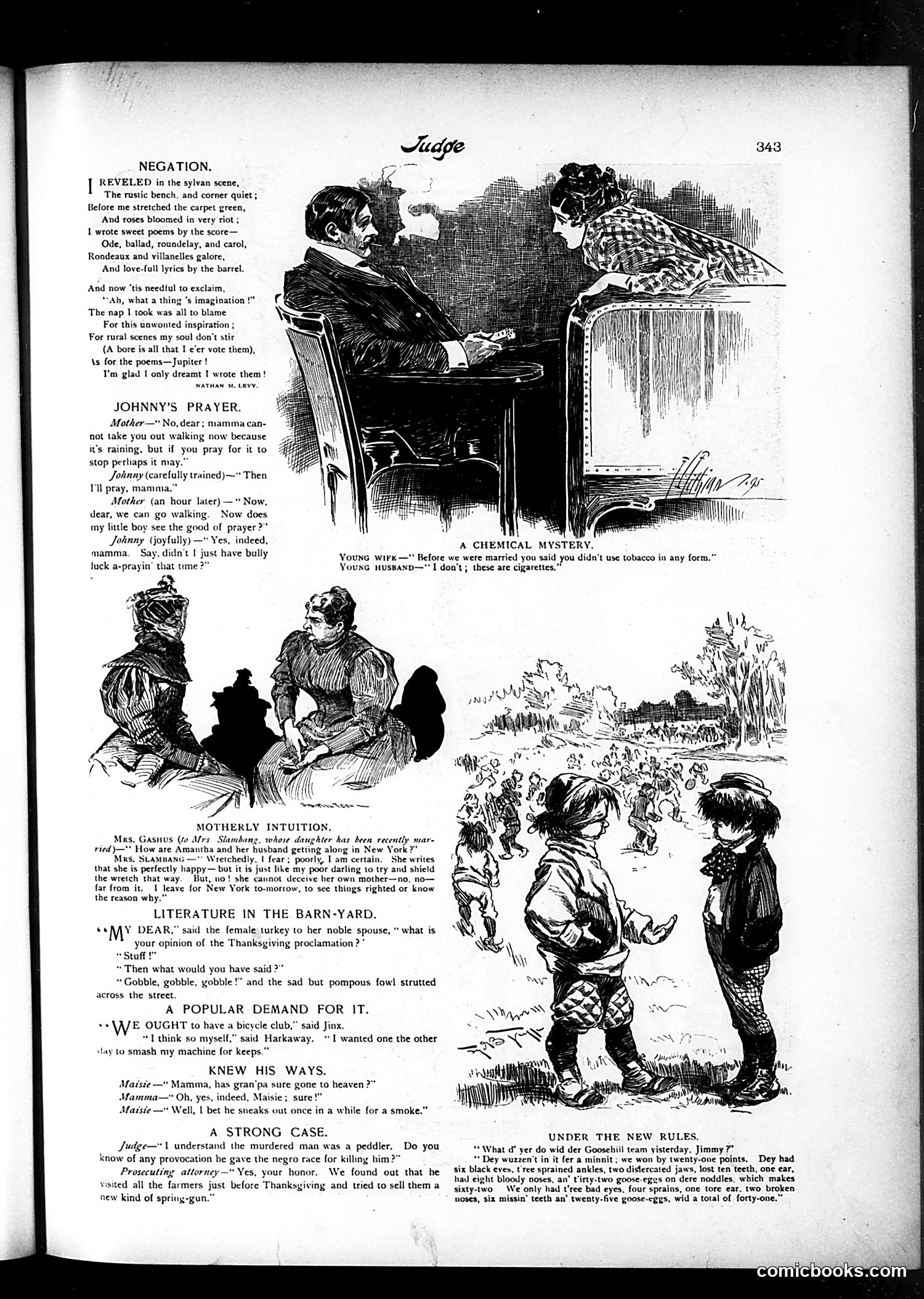
This page from *Judge* magazine contains several brief humorous sketches typical of the era: **"Negation"** mocks a poet's grandiose claims about his romantic verses, contrasting his boasts with the reality that his work merely bores readers. **"Johnny's Prayer"** presents a child's practical logic: he won't pray for rain to stop since praying for selfish things is wrong, but suggests his mother pray instead—satirizing childish moral reasoning. **"A Chemical Mystery"** jokes about a newlywed husband's surprise that his wife never used tobacco, implying unexpected discoveries in marriage. Other sketches ("Motherly Intuition," "Literature in the Barn-Yard," "A Popular Demand for It," "Knew His Ways," "A Strong Case," "Under the New Rules") offer domestic and social humor typical of early-20th-century American comedy—focusing on family dynamics, animal antics, and everyday absurdities rather than explicit political commentary.
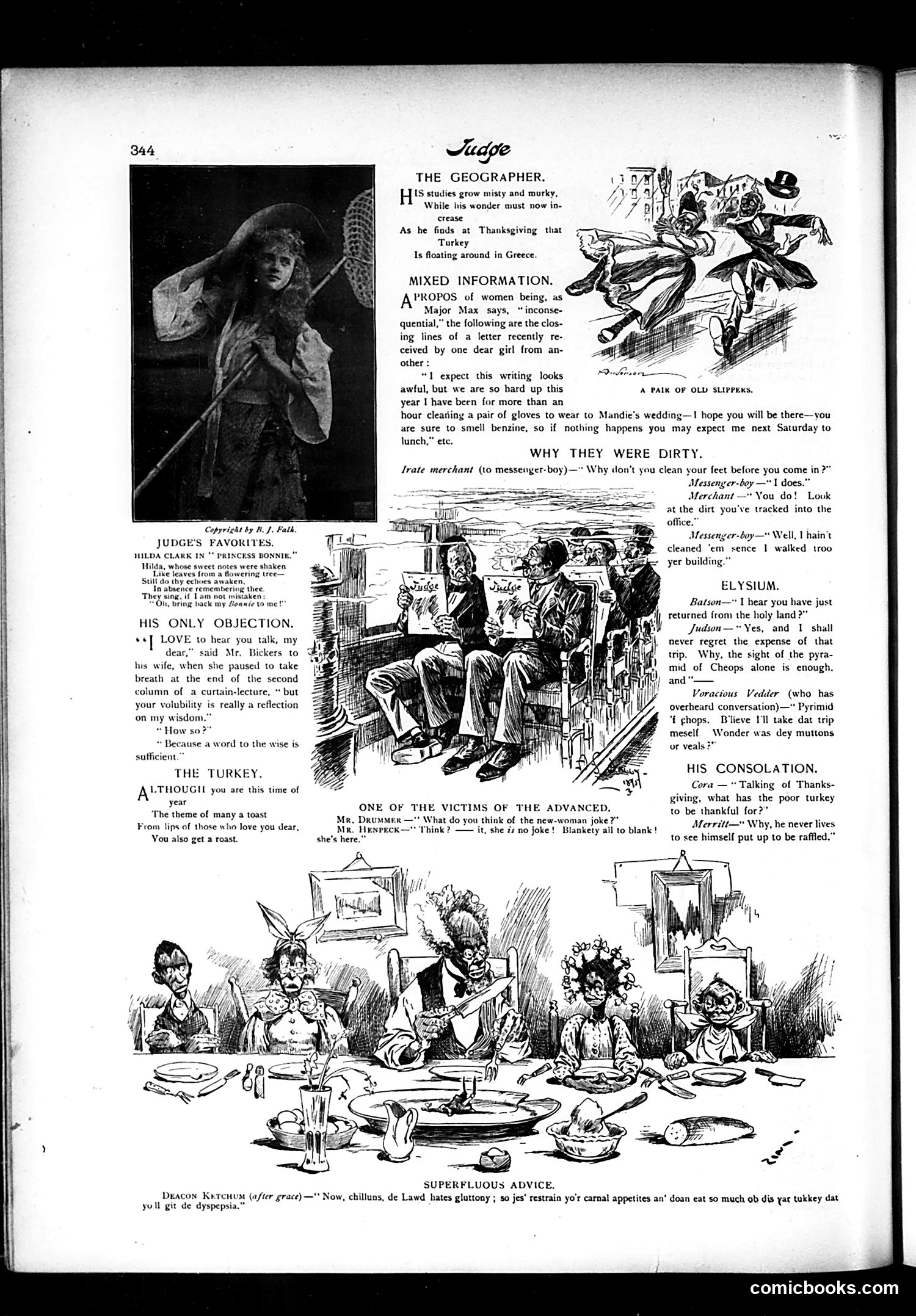
This page from Judge contains multiple short satirical pieces typical of the magazine's format: **"The Geographer"** jokes about geographic confusion—a scholar is bewildered to find Turkey (the country) "floating around in Greece," a pun on Thanksgiving dinner. **"Why They Were Dirty"** depicts class humor: a working-class messenger boy hasn't cleaned his feet because he's walked through "yer building" since last cleaning—mocking both his dialect and casual attitude toward cleanliness. **"His Only Objection"** features a husband appreciating his wife's chattiness despite it being "a reflection on my wisdom"—gentle marital humor about female talkativeness. **"The Turkey"** and related pieces offer Thanksgiving-themed jokes about the holiday bird and dining excess, including "His Consolation," where a turkey is comforted it will never be "put up to be raffled." The page demonstrates Judge's mix of gentle domestic humor, class-based comedy, and holiday satire targeting middle and upper-class readers' sensibilities around 1890s-1900s America.
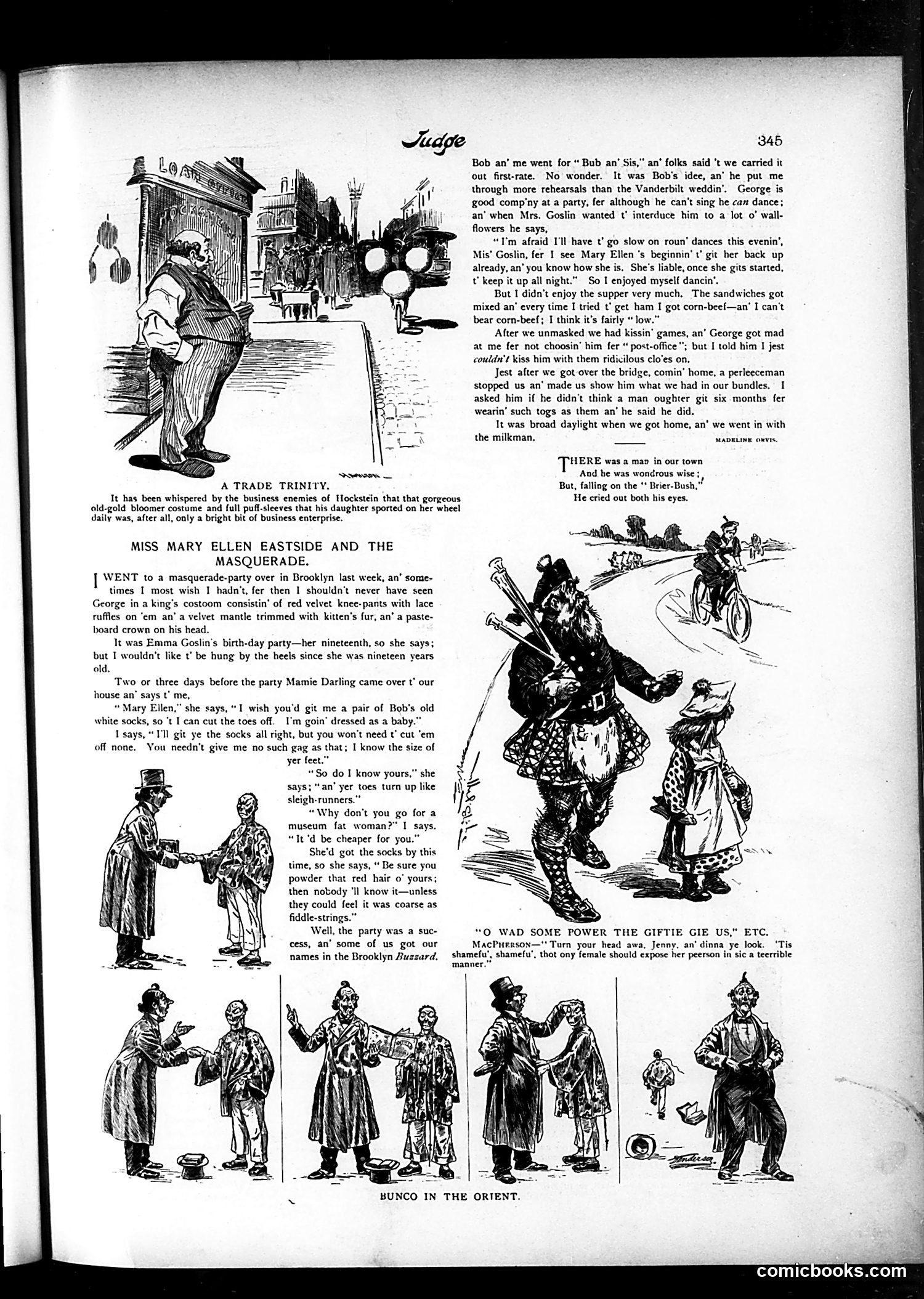
This page contains three distinct pieces of social satire typical of early Judge magazine: **"Miss Mary Ellen Eastside and the Masquerade"** is a humorous first-person account mocking working-class Brooklyn social customs. The narrator attends a masquerade party where a man named George wears an absurd king costume with "lace ruffles" and "pasteboard crown"—satirizing pretentious costume choices. The humor derives from exaggerated dialect, social climbing attempts, and petty complaints (getting corn-beef instead of ham at supper). A policeman's concern about their "ridiculous clothes" suggests period anxieties about public behavior and decency. **"A Trade Trinity"** is a brief caption satirizing business ethics, claiming a businessman's daughter's conspicuous "bloomer costume" on her bicycle was really an advertisement ploy disguised as fashion. **"Bunco in the Orient"** (bottom) appears to be a multi-panel comic about swindling operations overseas, though details are unclear without fuller context. The page exemplifies Judge's focus on mocking middle-class pretension, immigrant dialects, and social hypocrisy through exaggerated storytelling.
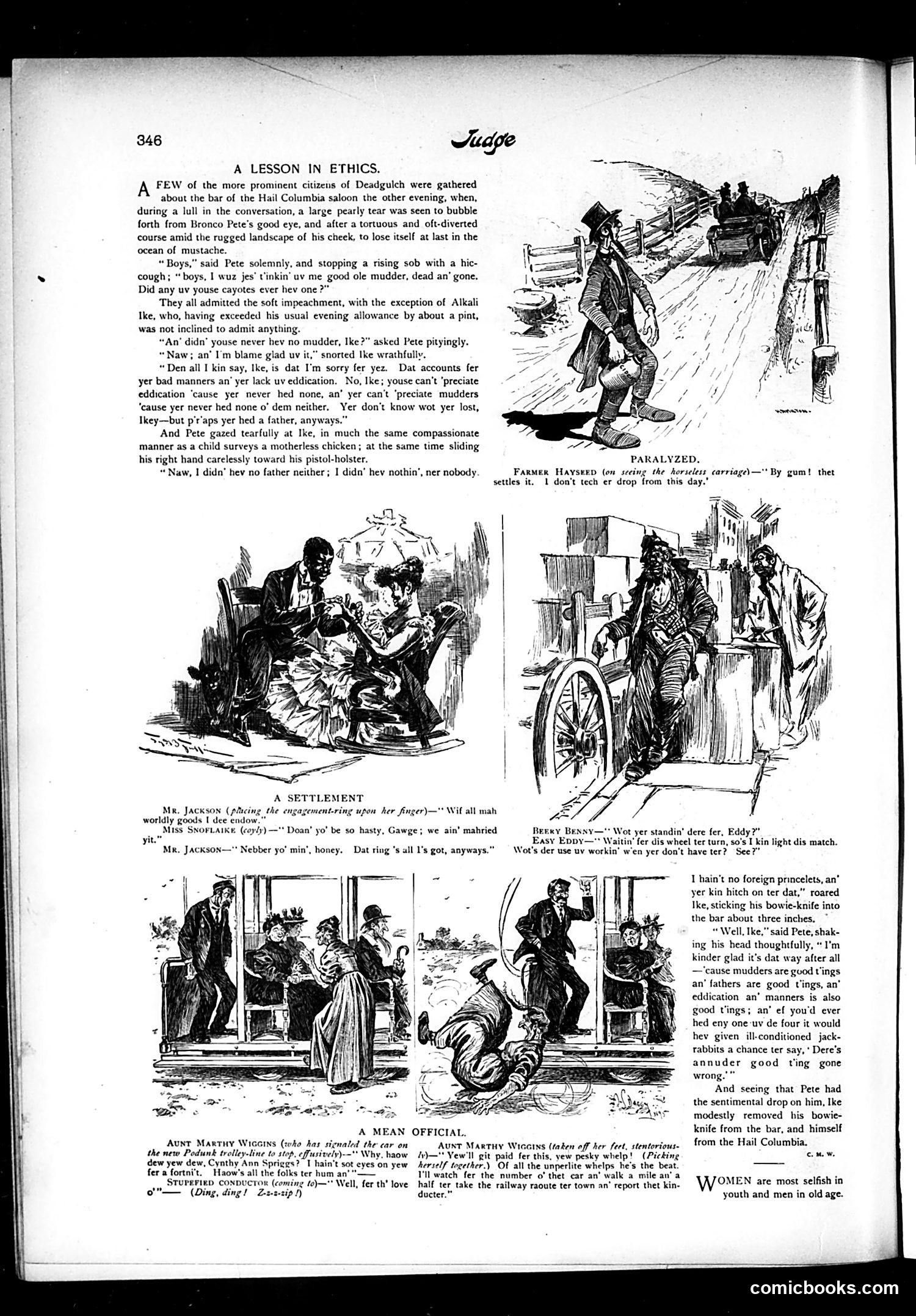
This page contains five separate satirical vignettes mocking frontier vernacular and social pretension: **"A Lesson in Ethics"** depicts rough Western characters ("Bronco Pete," "Alkali Ike") in a saloon. Pete sentimentally lectures the orphaned, crude Ike about appreciating mothers and education—while subtly reaching for his pistol. The satire targets frontier violence masquerading as moral instruction. **"A Settlement"** jokes about a poor suitor offering only an engagement ring as dowry, while his bride demands more worldly goods. **"A Mean Official"** ridicules a rude trolley conductor interrupting an elderly woman's cheerful greeting. The joke inverts expectations—she threatens revenge for his rudeness. **"Paralyzed"** shows a farmer so shocked by a horseless carriage that he swears off drinking. **"Easy Eddy"** depicts lazy workers avoiding labor whenever possible. Throughout, Judge employs exaggerated dialect and caricature to satirize rural ignorance, frontier brutality, class anxiety, and working-class indolence—common targets of Gilded Age humor magazines aimed at urban, educated readers.
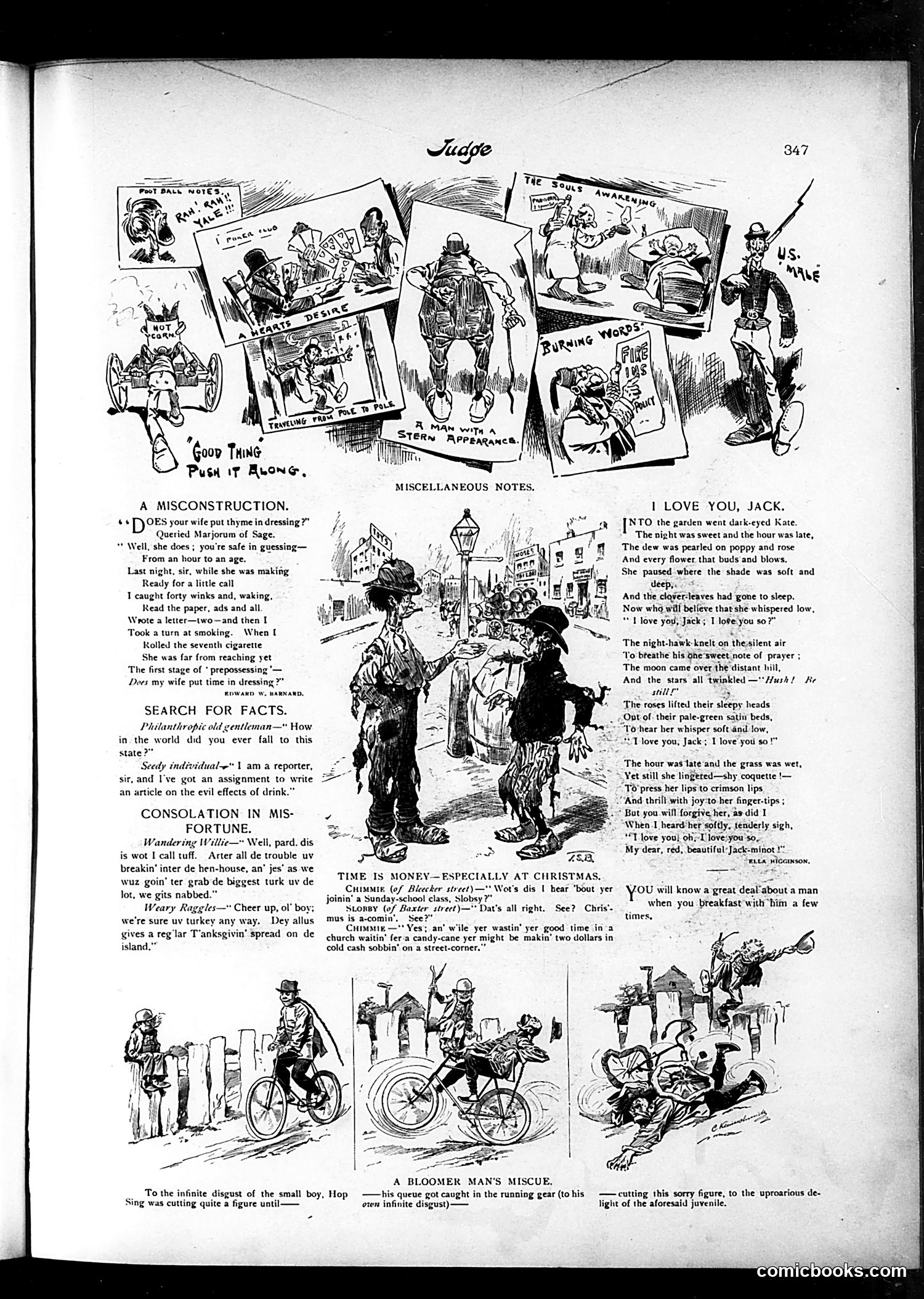
This page contains multiple satirical pieces typical of late 19th-century American humor: **"A Misconstruction"** mocks the time women spend dressing—a standard domestic joke of the era, where a husband grows frustrated waiting for his wife to prepare for social calls. **"Search for Facts"** satirizes journalists who, claiming to investigate serious topics like alcoholism's dangers, are themselves derelicts—mocking sensationalist reporting. **"Consolation in Misfortune"** presents two tramps finding dark humor: caught burgling, they console themselves they'll get turkey anyway—as the prison provides Thanksgiving dinner. Social commentary on poverty and crime. **"I Love You, Jack"** is sentimental Victorian poetry about a woman's nighttime garden confession of love—representative of the magazine's mix of serious and light content. **"Time is Money"** satirizes working-class immigrants choosing Sunday school over wage labor—questioning whether religious instruction serves the poor's actual economic interests. **"A Bloomer Man's Miscue"** depicts someone wearing the then-controversial "bloomer" pants for women catching their queue (hairstyle) in bicycle gears—mocking both new fashions and the bicycle craze.
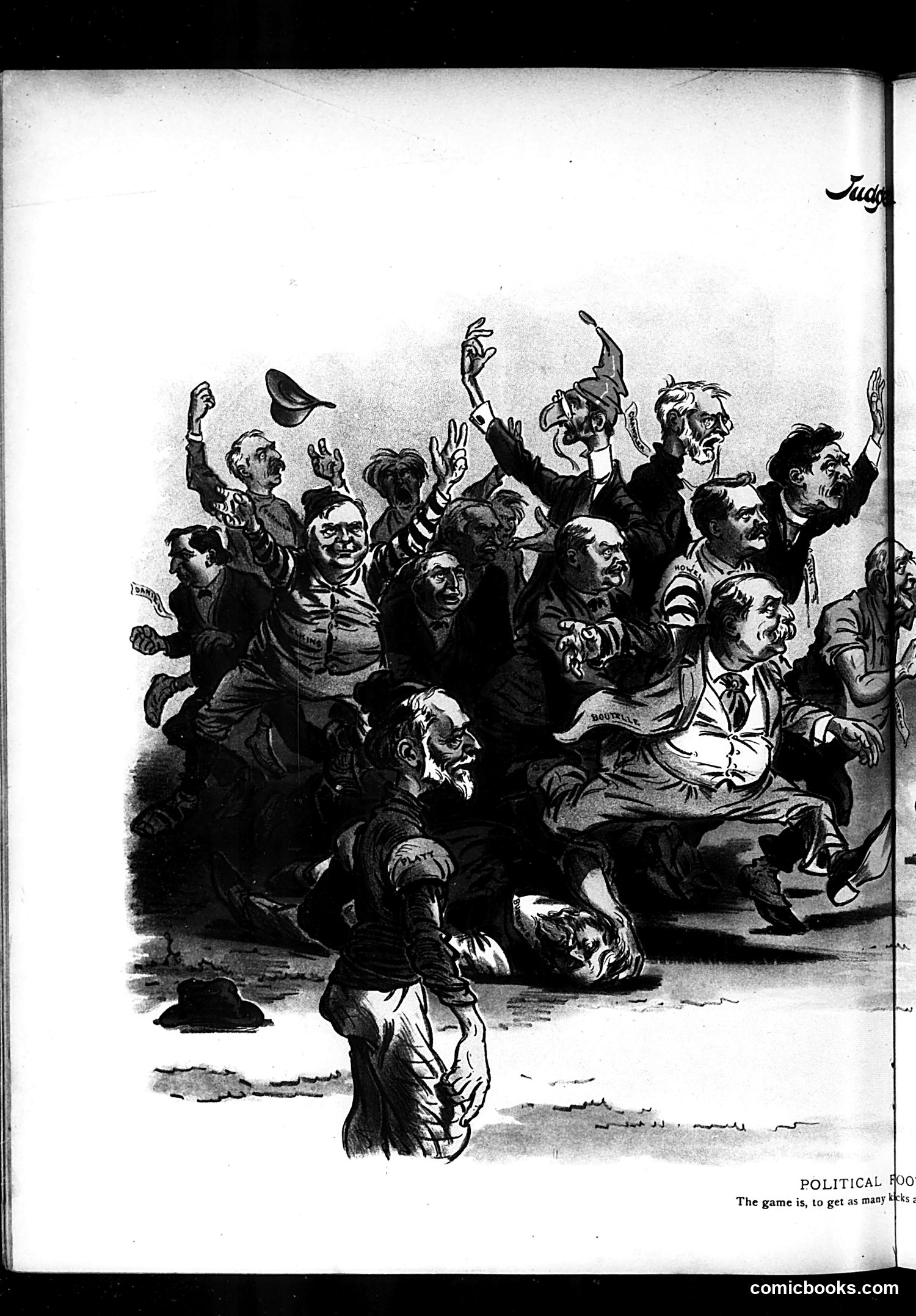
This appears to be a political cartoon titled "The game is, to get as many [votes]" (text cuts off). The image depicts a chaotic crowd of exaggerated male figures in suits and hats, many with grotesque facial features rendered in caricature style typical of Gilded Age satire. Their poses suggest frenzied activity—raising arms, gesturing wildly, appearing to scramble or jostle. The cartoon likely satirizes the corrupt, cutthroat nature of American electoral politics, suggesting politicians as unprincipled scrambling competitors focused solely on winning votes through any means necessary. The grotesque caricatures and chaotic composition emphasize moral degradation and pandemonium in the political process. Without visible dates or clearer text, I cannot specify which election or figures are referenced, though the style suggests late 19th or early 20th century publication.
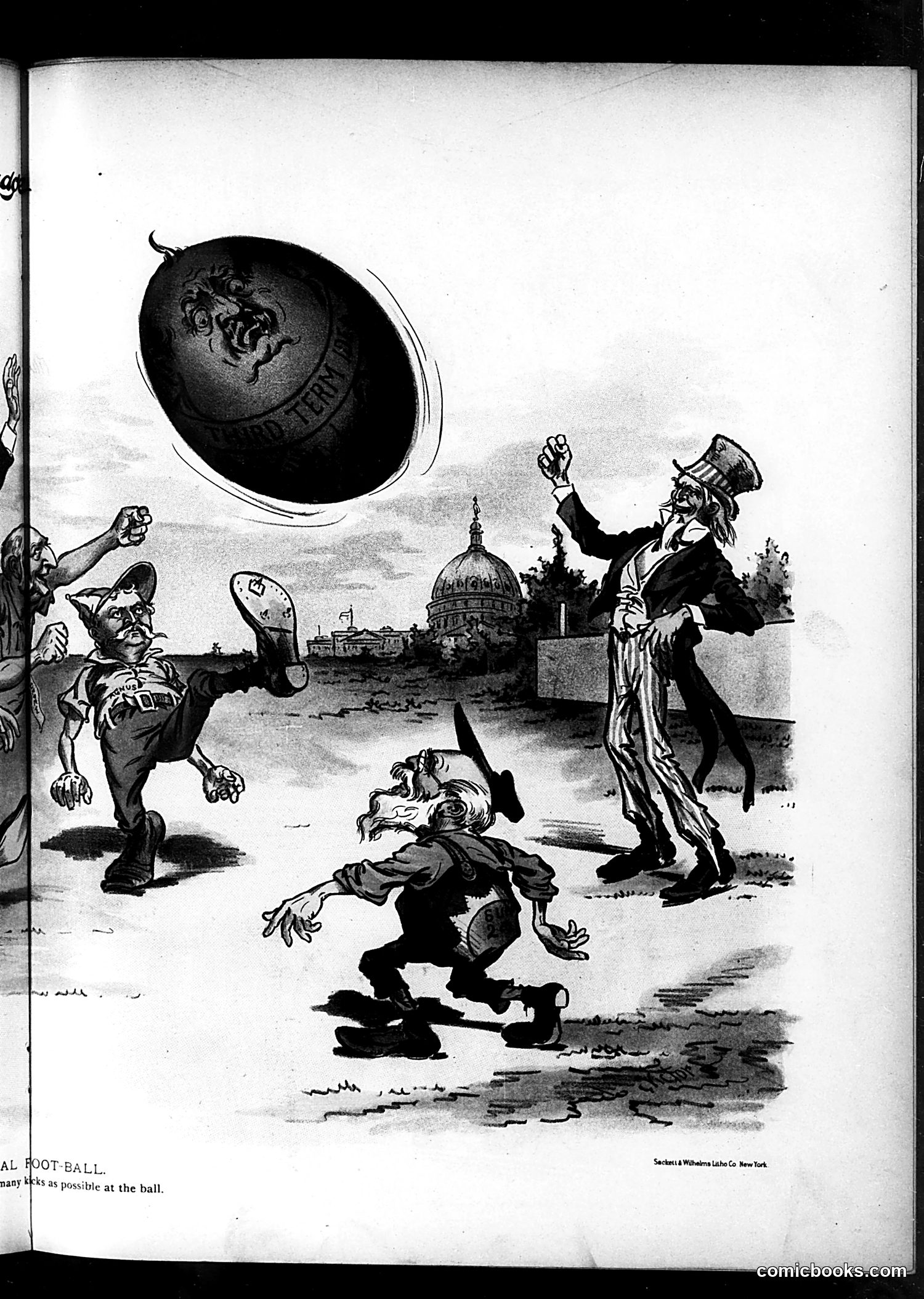
This appears to be a political cartoon from *Judge* magazine satirizing international diplomacy, likely from the early 20th century. The scene depicts figures playing with a large spherical "ball" marked with what appears to be a demonic or threatening face, set against a backdrop featuring a capitol dome (suggesting Washington, D.C.). The cartoon likely represents different nations or political factions attempting to control or manipulate a dangerous situation—possibly related to foreign policy, war, or international conflict. The "ball" appears to symbolize a volatile geopolitical threat. The caricatured figures suggest ethnic or national stereotypes common to era political commentary. Without clearer identifying marks or date information, the specific historical event referenced remains unclear, though the style suggests pre-WWI or interwar period satirical commentary on diplomatic tensions.
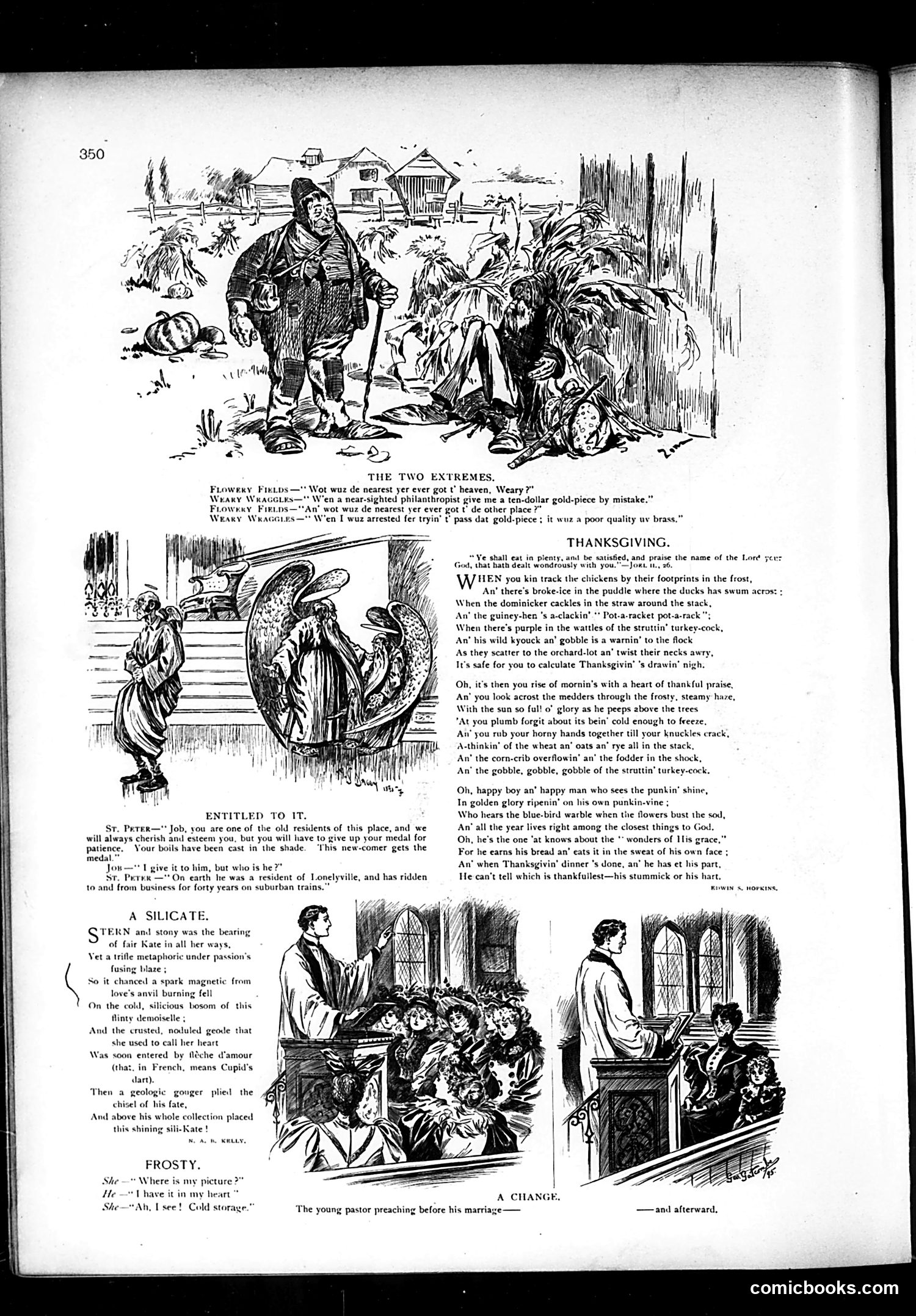
This page contains several satirical pieces typical of 1890s American humor: **"The Two Extremes"** depicts two vagrants discussing their closest encounters with "heaven" and "hell"—one receiving a gold coin by mistake, the other arrested for trying to spend counterfeit brass. The satire mocks both poverty and petty crime. **"Entitled to It"** jokes about Job (biblical figure) losing his medal in Heaven to a new resident who endured hardship on earth—likely satirizing contemporary debates about merit and suffering. **"A Silicate"** is a pun-heavy romantic poem personifying a woman as geological material ("silicate," "geode," "sili-Kate"), turning courtship into pseudo-scientific wordplay. **"Thanksgiving"** is a sentimental rural poem celebrating harvest abundance and gratitude, written in vernacular dialect typical of period "local color" literature. **"Frosty"** and **"A Change"** are brief joke captions about romantic relationships losing warmth over time. The page demonstrates Judge's mix of social commentary, wordplay, and domestic humor aimed at late 19th-century middle-class readers.
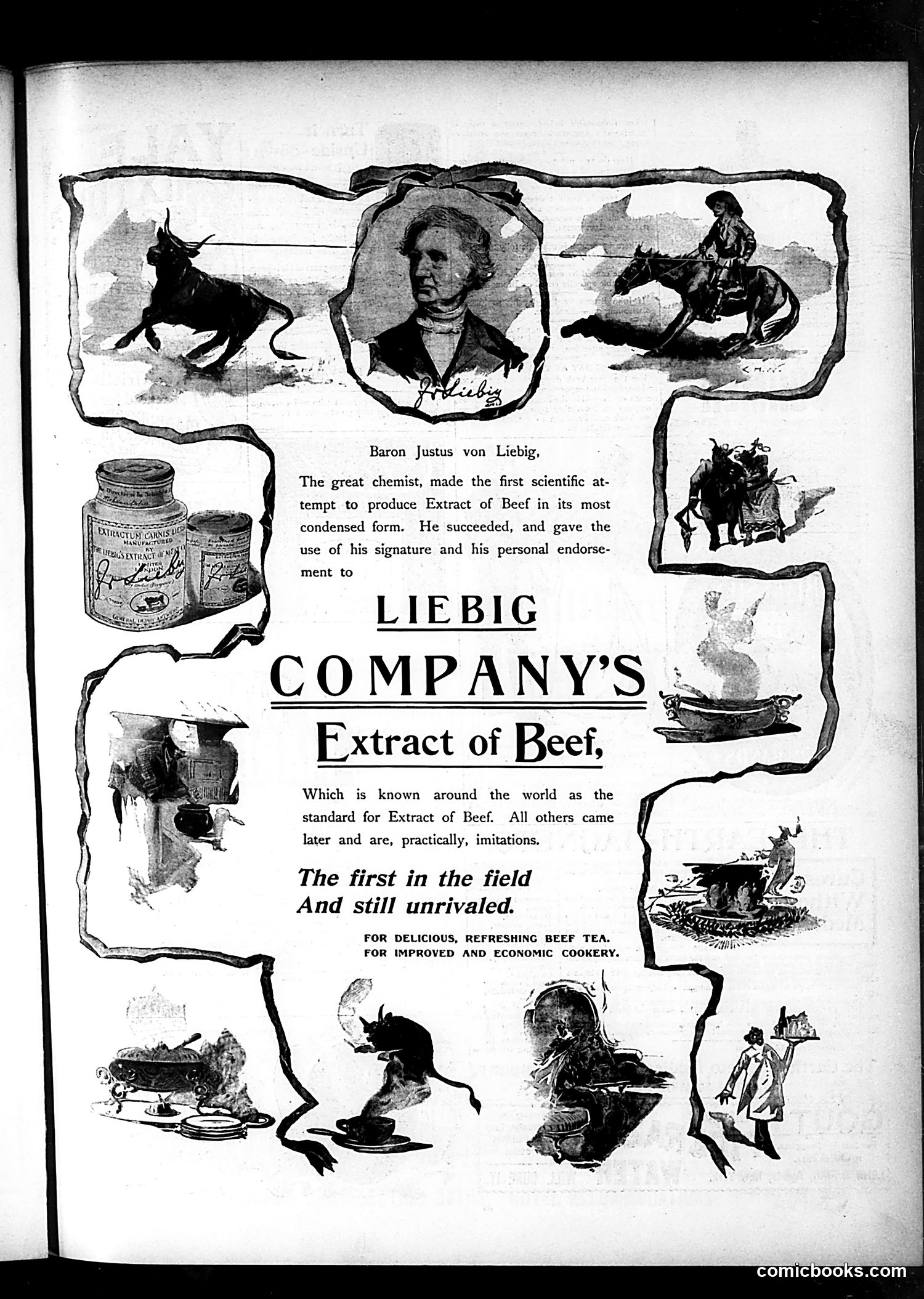
This is a **product advertisement**, not political satire. It promotes Liebig Company's Extract of Beef by leveraging the endorsement of Baron Justus von Liebig, a real 19th-century German chemist who actually developed beef extract technology. The page uses his portrait and signature as marketing authority, claiming his product is "the first in the field / And still unrivaled"—a competitive claim against imitators. The decorative border contains vignettes showing various uses: cooking, serving tea, and domestic scenes emphasizing the product's convenience and economy. This represents how Judge magazine's pages mixed editorial content with advertisements. The appeal is to middle-class housewives seeking efficient, economical cooking solutions. There is no satire or political commentary—it's straightforward commercial promotion using scientific credibility and celebrity endorsement.
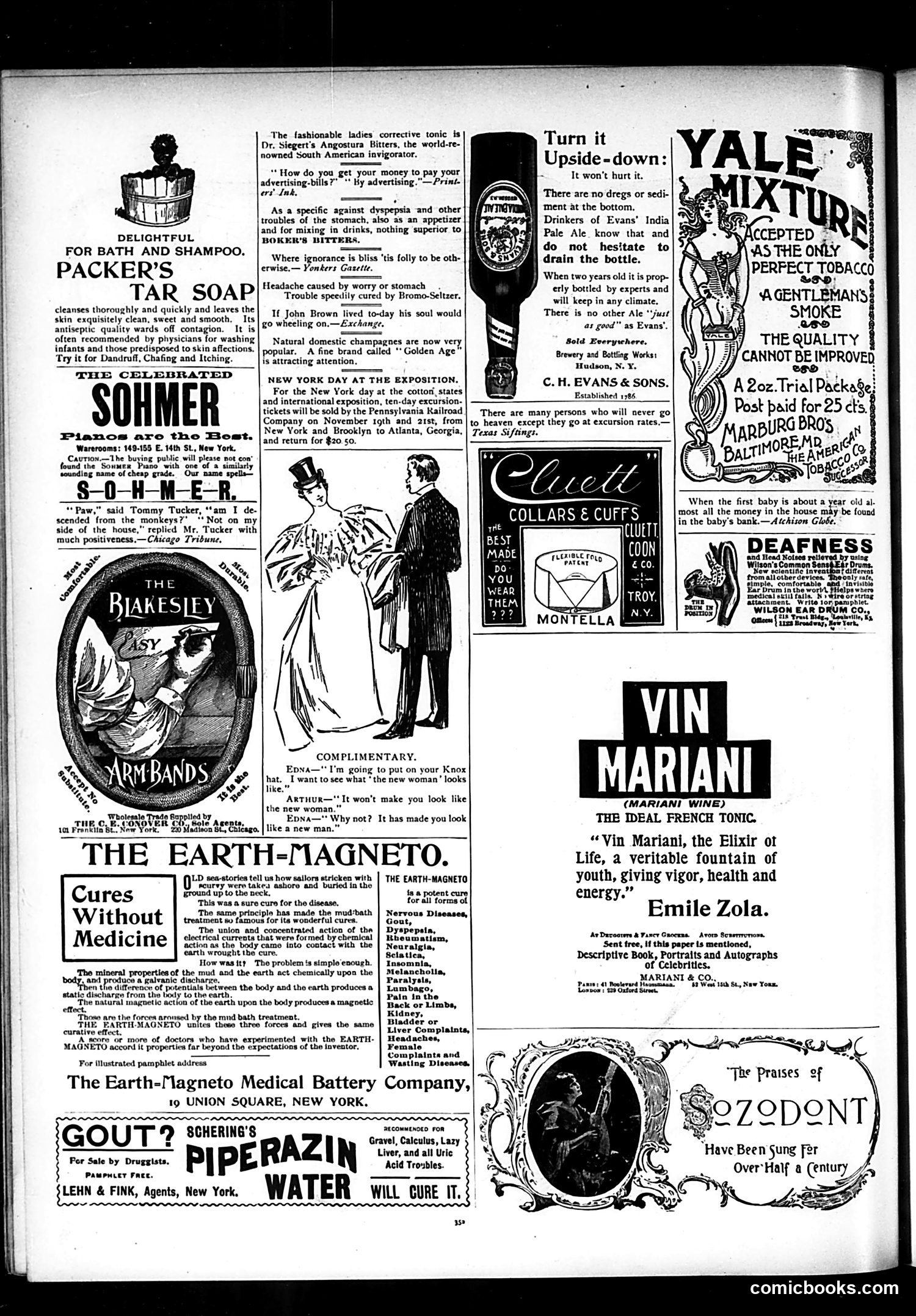
This is primarily an **advertising page** from Judge magazine, not a political cartoon. The page comprises various product advertisements typical of late 19th/early 20th-century periodicals. Notable ads include: **Packer's Tar Soap** and **Sohmer Pianos**—standard commercial products; **Dr. Siegert's Angostura Bitters** and **Boker's Bitters**—patent medicines marketed as tonics and digestive aids, reflecting the era's acceptance of alcohol-based remedies; **Evans' India Pale Ale**—pitched as a quality beverage; **Earth-Magneto device**—pseudoscientific medical equipment claiming to cure ailments through "magnetic" earth contact, exploiting period gullibility. The small **"Complimentary" cartoon** shows a woman trying on a Knox hat, with the joke being the "new woman" (progressive, independent woman) would benefit from looking masculine. This satirizes anxieties about changing gender roles. The scattered quotes mock advertising hypocrisy and human nature rather than targeting specific political figures.
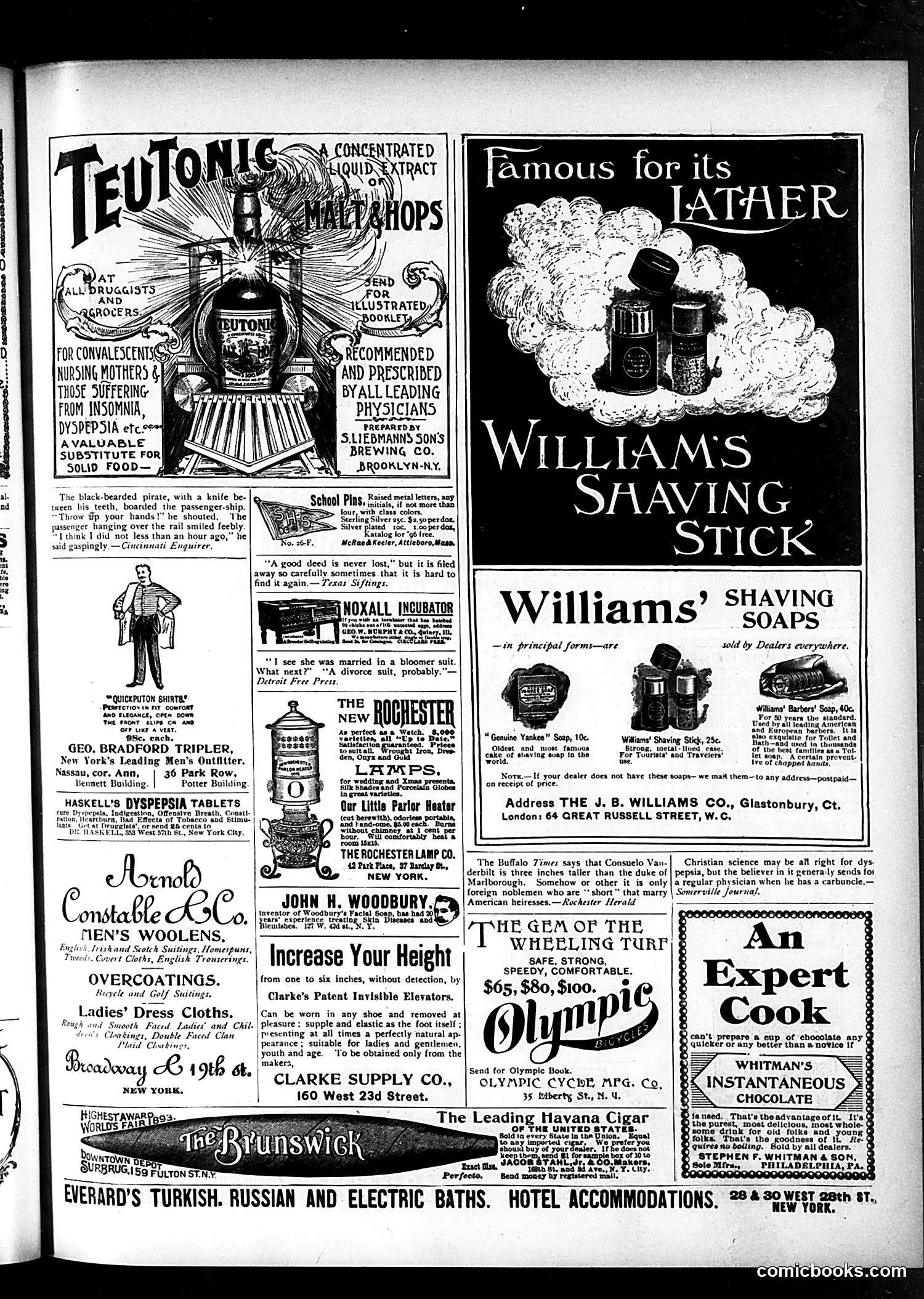
This page is primarily **advertising**, typical of Judge magazine from the 1890s. The cartoons are brief joke illustrations supporting commercial messages. The main visual joke (top-left) shows a bearded pirate boarding a ship, threatening passengers. The punchline: a seasick passenger says he already "threw up" an hour ago—a bathroom humor joke playing on the phrase "throw up your hands" (surrender). The advertising targets period health anxieties: Teutonic extract and Haskell's tablets promise cures for indigestion and dyspepsia (stomach complaints), reflecting Victorian obsession with digestive issues. Clarke's "Invisible Elevators" are shoe inserts for height—revealing period self-consciousness about appearance. A brief satirical comment mocks wealthy American heiresses marrying titled but short foreign noblemen (Consuelo Vanderbilt's famous marriage), suggesting Americans are buying titles while foreigners need American money. The remaining content is routine product advertising (men's clothing, Williams' Shaving products, bicycles, cigars, chocolate)—unremarkable except showing what concerned consumers then.
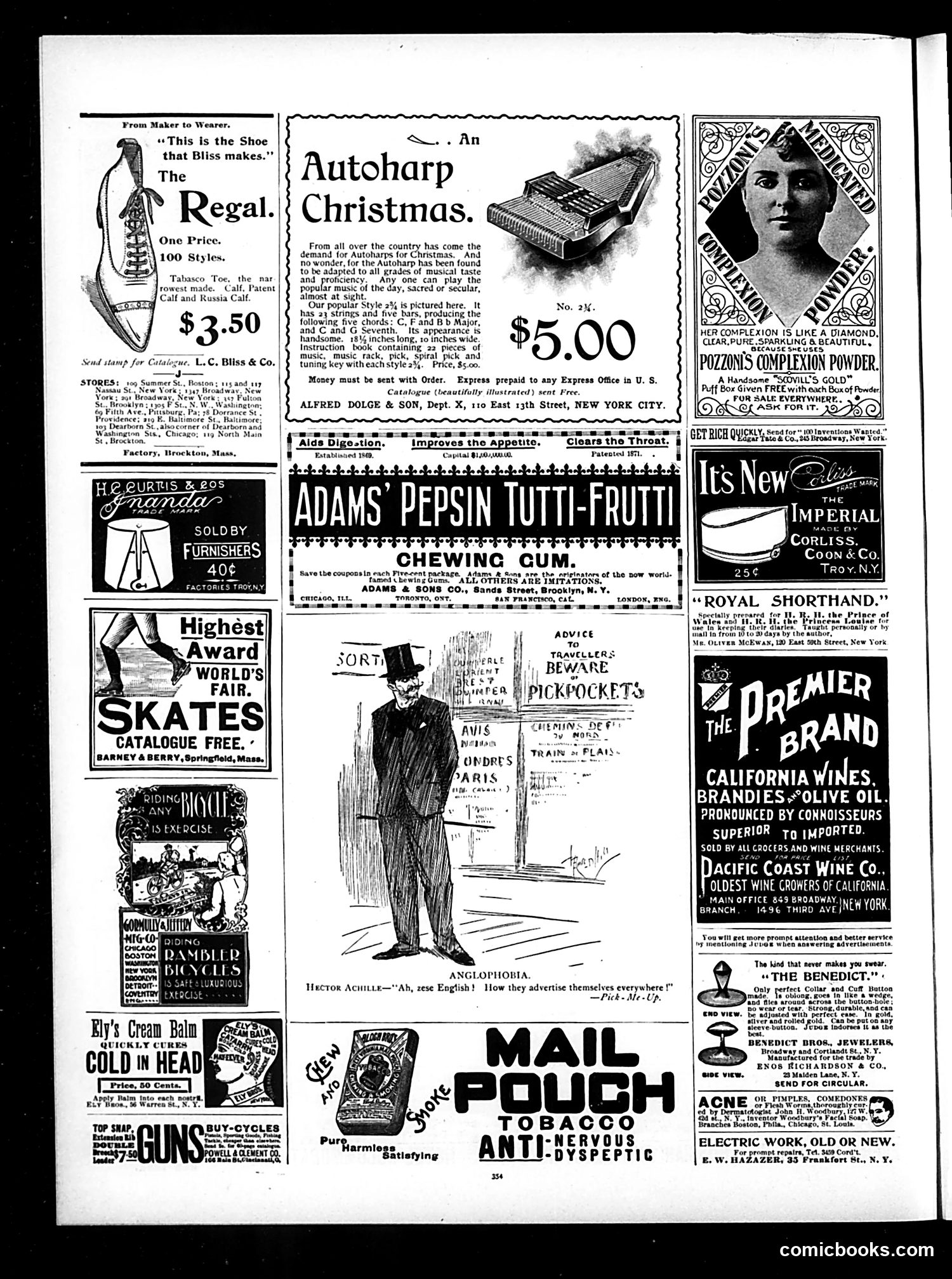
This page is primarily **advertising**, not political satire. It features vintage product advertisements from the early 1900s (Autoharp, shoes, chewing gum, bicycles, wines, etc.). However, there is **one small cartoon** embedded in the advertisements: a sketch labeled "ANGLOPHOBIA" depicting a well-dressed man in a top hat and overcoat, appearing anxious or distressed while looking at warning notices. The caption reads: "HECTOR ACHILLE—'Ah, see English! How they advertise themselves everywhere!'" **The satire:** This mocks excessive English advertising and marketing practices—apparently a common complaint in America at the time. The joke suggests British merchants promoted themselves so aggressively and visibly that it became comical and irritating to observers. "Anglophobia" (fear of English things) is the satirical framing. This reflects early 1900s American attitudes toward British commercial competition and cultural influence.
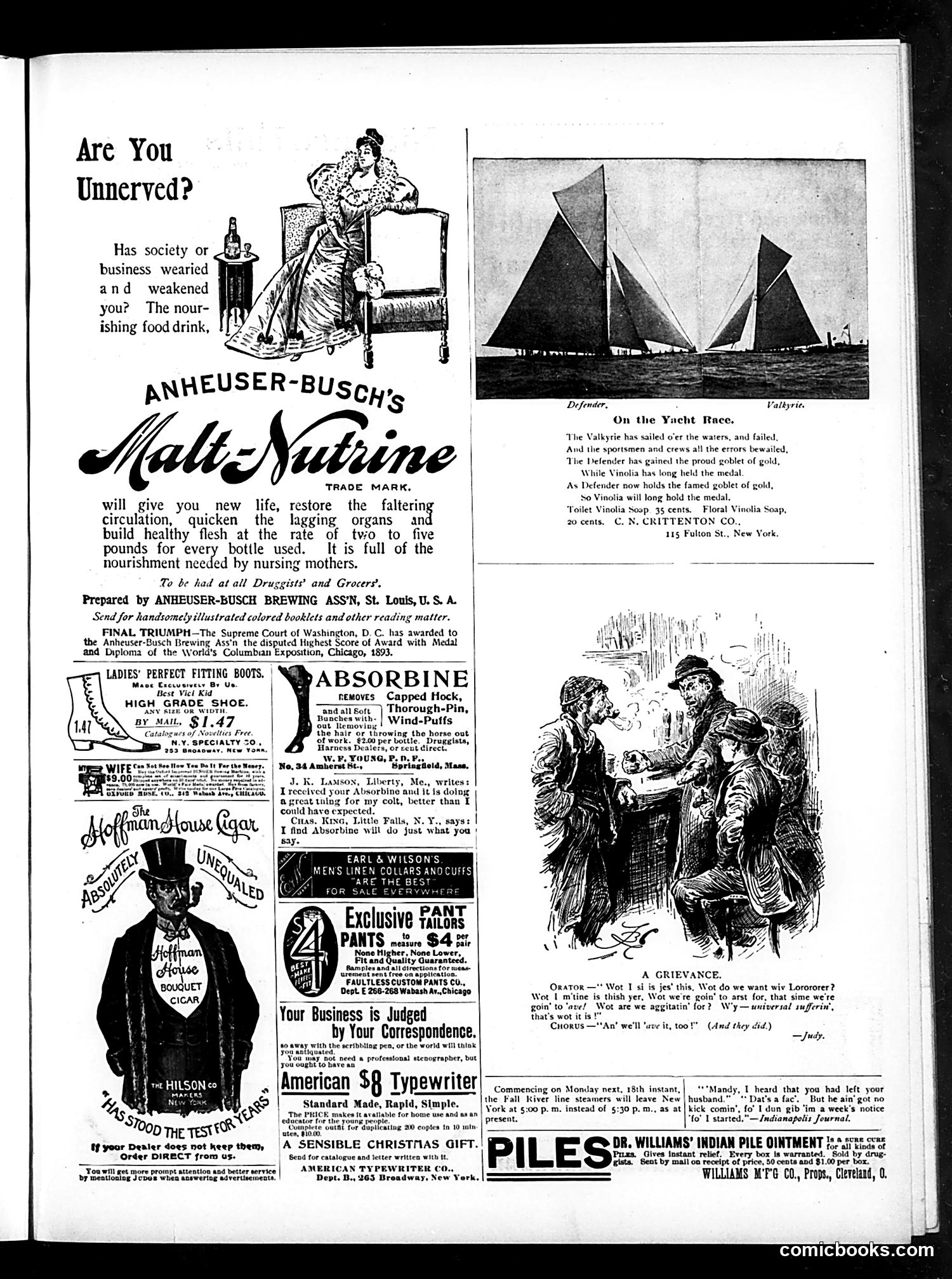
This page is primarily **advertising**, typical of late 19th-century magazines. The notable satirical content appears in "A Grievance," a small cartoon dialogue at the bottom right. **The Cartoon "A Grievance":** An orator addresses a crowd about "universal sufferin'" (universal suffrage—voting rights). The joke relies on wordplay: the speaker says they want "universal suffrin'" (suffering), which the chorus enthusiastically endorses, saying "An' we'll 'ave it, too!" The dialect and crude characterization suggest this mocks working-class political agitation, likely satirizing demands for expanded voting rights by portraying the speakers as barely literate and their cause as self-destructive. **Historical Context:** This references late 1890s debates over suffrage expansion. The caricature style and dialect suggest satirical mockery of labor or populist movements seeking voting rights. The remainder of the page consists of advertisements for patent medicines, shoes, typewriters, and yacht-race-themed Vinolia soap—typical period commercial content.
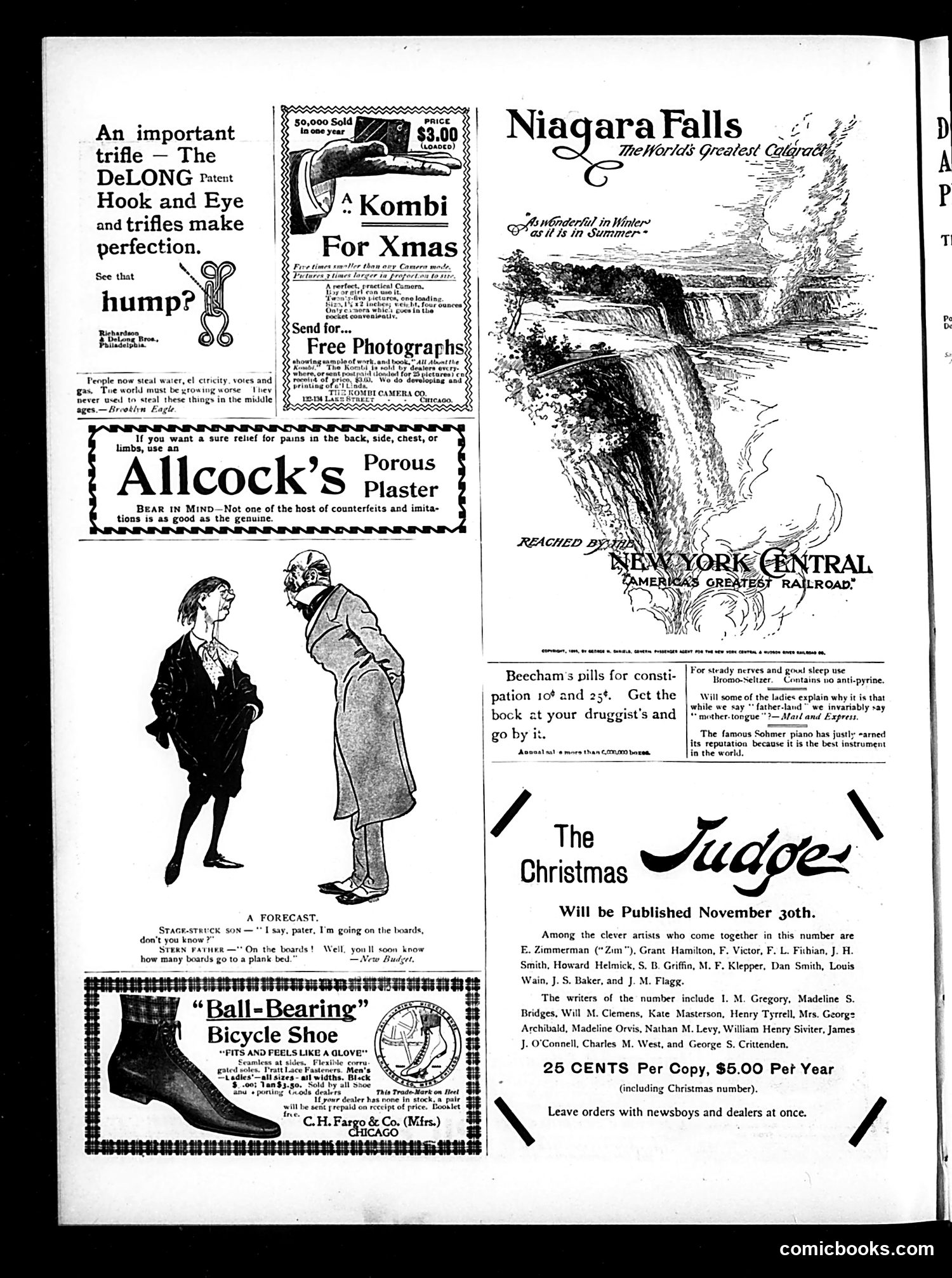
This is primarily an **advertising and promotional page** from Judge magazine, with one notable cartoon. The main satirical content is "A Forecast," a brief comic dialogue between a stage-struck son and his stern father. The joke plays on the phrase "going on the boards" (performing in theater). The father misinterprets it literally, threatening the son with "a plank bed"—slang for a prison bunk. The humor derives from this double meaning: the father's threat suggests the son will end up in jail rather than on stage, implying theatrical ambitions lead to ruin. This reflects period anxieties about theater as a morally questionable profession. The page is otherwise filled with **period advertisements** (DeLong hooks, Kombi fishing equipment, Allcock's plaster, Beecham's pills, Sohmer pianos, bicycle shoes) and an announcement that Judge's Christmas issue will be published November 30th, featuring prominent cartoonists and writers. The **Niagara Falls tourism advertisement** on the right showcases the natural wonder accessed via New York Central Railroad.
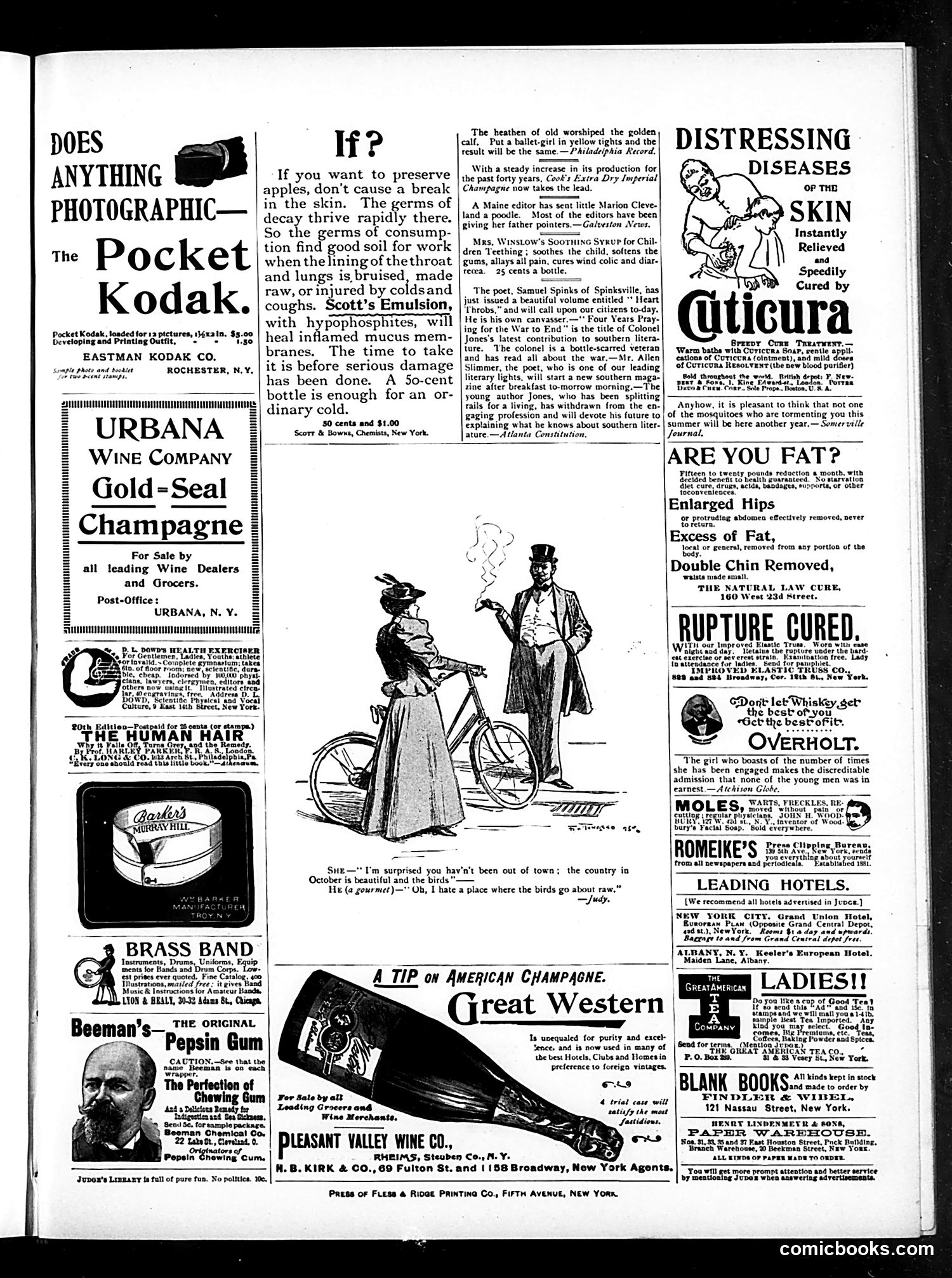
This page is primarily **advertisements** with one cartoon at the bottom. **The Main Cartoon:** The illustration shows a fashionably dressed woman on a bicycle speaking with a man in formal attire (top hat, coat). The woman says she's surprised he hasn't been out of town—the country in October is beautiful, and "the birds go about raw." The man replies he hates places where birds go around naked. **The Satire:** This is a double-entendre joke. "Raw" means both literally undressed (molting birds) and sexually suggestive. The woman is innocent; the man interprets her comment with crude innuendo. It's Victorian-era humor mocking prudish, oversexed male thinking—making fun of men who find sexual meaning in innocent remarks. **Context:** This reflects turn-of-the-century attitudes about bicycles as liberating for women, courtship customs, and the gap between genteel public behavior and private preoccupations.
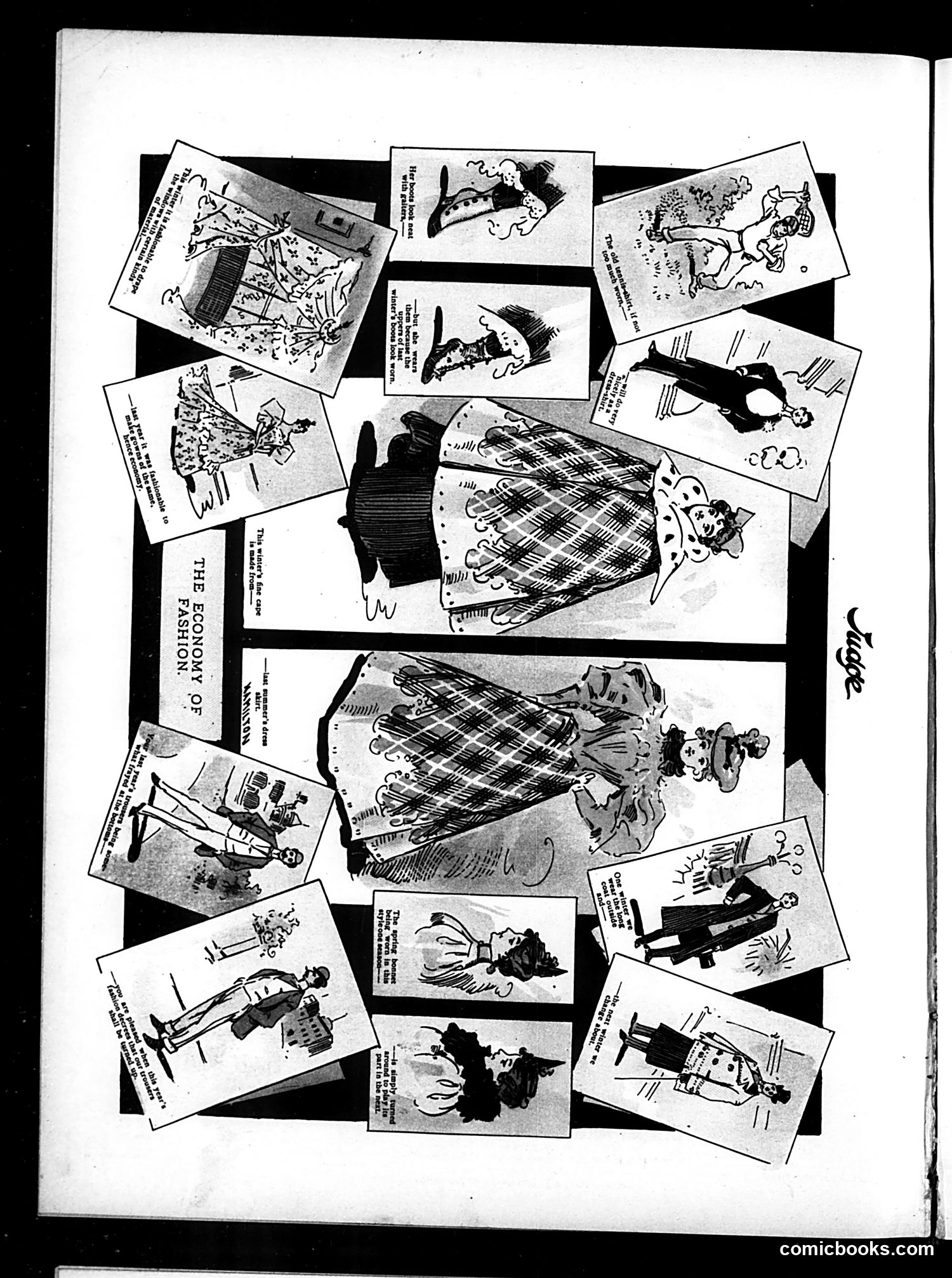
This page appears to be titled "The Economy of Fashion" based on visible text on the left margin. It's a collage-style satirical composition featuring multiple illustrated vignettes arranged around two larger central fashion drawings of women in elaborate plaid/checkered dresses. The surrounding smaller panels seem to depict various scenes—some showing figures in different poses and situations—likely contrasting the extravagant expense of fashionable dress with everyday life or economic realities. The arrangement suggests Judge magazine's typical approach: using visual humor to critique social contradictions. Without clearer text legibility, I cannot identify specific figures or date this precisely, but the satire appears to target the irrationality or excess of women's fashion spending during a particular era, juxtaposing frivolous sartorial concerns against broader economic contexts or practical concerns.