
A complete issue · 16 pages · 1895
Judge — November 23, 1895
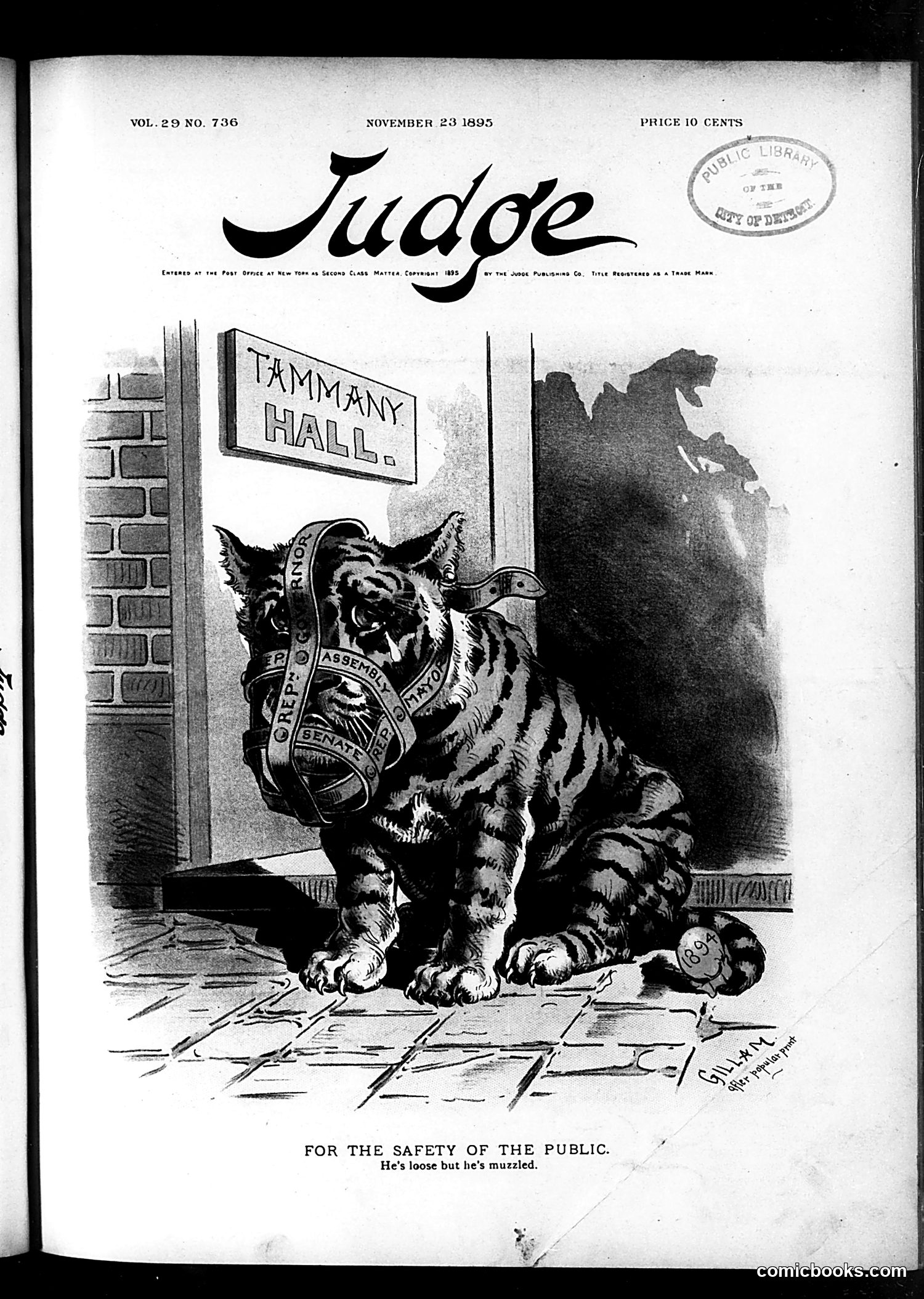
This political cartoon depicts a large tiger wearing official regalia and medals, standing outside "Tammany Hall" (the notorious New York Democratic political machine headquarters). The tiger appears agitated or dangerous despite being muzzled. The caption reads: "FOR THE SAFETY OF THE PUBLIC: He's loose but he's muzzled." The cartoon satirizes Tammany Hall's corruption and power. The tiger represents Tammany's political force—inherently wild and dangerous to public welfare. The muzzle suggests attempted restraint through legal or electoral measures, yet the satire implies the organization remains fundamentally threatening even when nominally controlled. This reflects late-19th-century reform sentiment against Tammany's well-documented corruption and political domination of New York City.
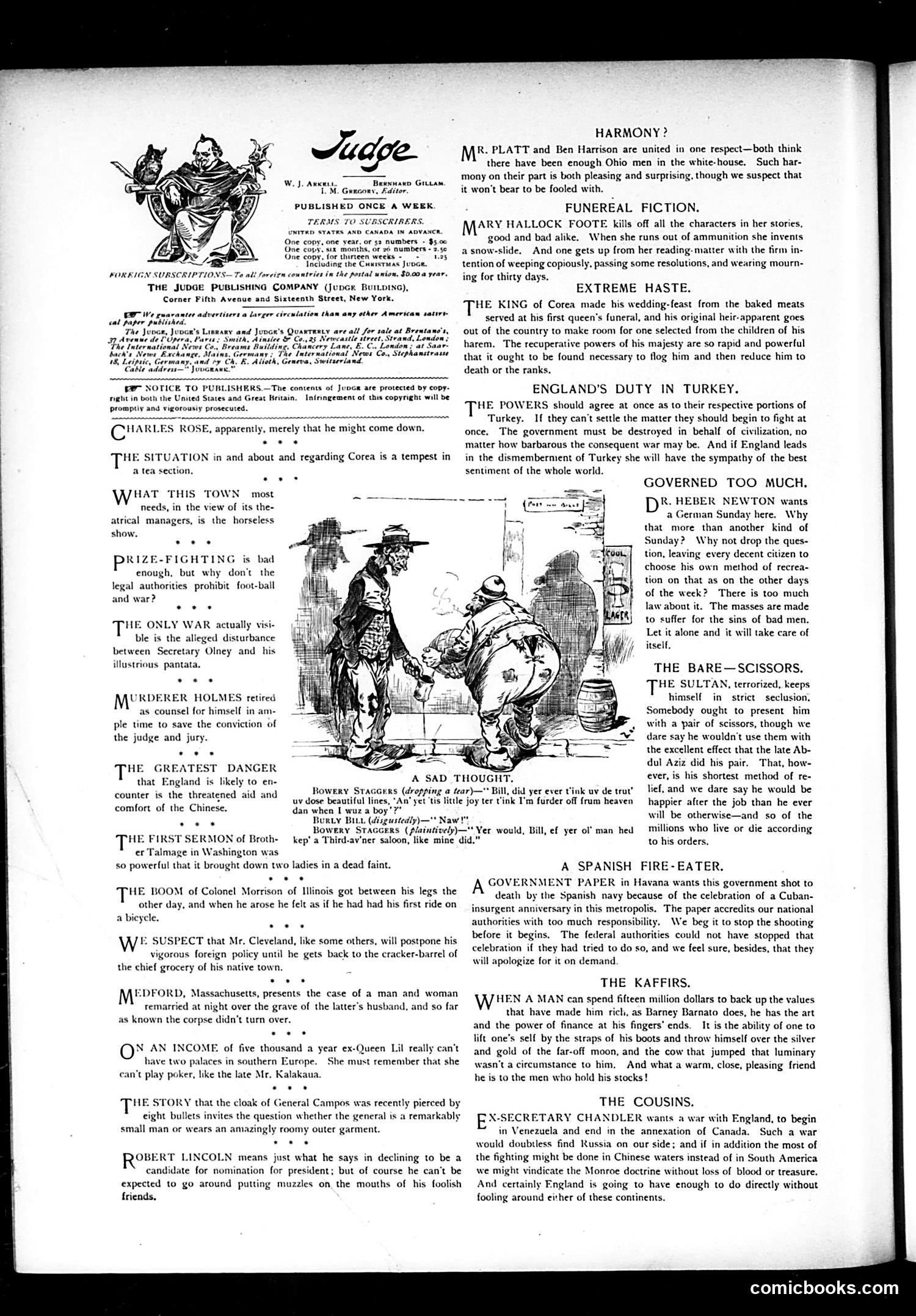
The central cartoon titled "A Sad Thought" depicts a street scene with what appears to be a drunk man being confronted by police or authorities. The accompanying dialogue references "Bill" and discusses whether he's been drinking ("Did you ever lick up de trat'?"). This appears to be ethnic humor, likely targeting Irish or immigrant communities, common in early 20th-century American satire. The surrounding text includes editorial commentary on various topics: Turkish politics ("England's Duty in Turkey"), American governance ("Governed Too Much"), and financial matters ("The Kaffirs"). The content reflects Judge magazine's typical blend of political commentary and social satire aimed at contemporary audiences familiar with these issues.
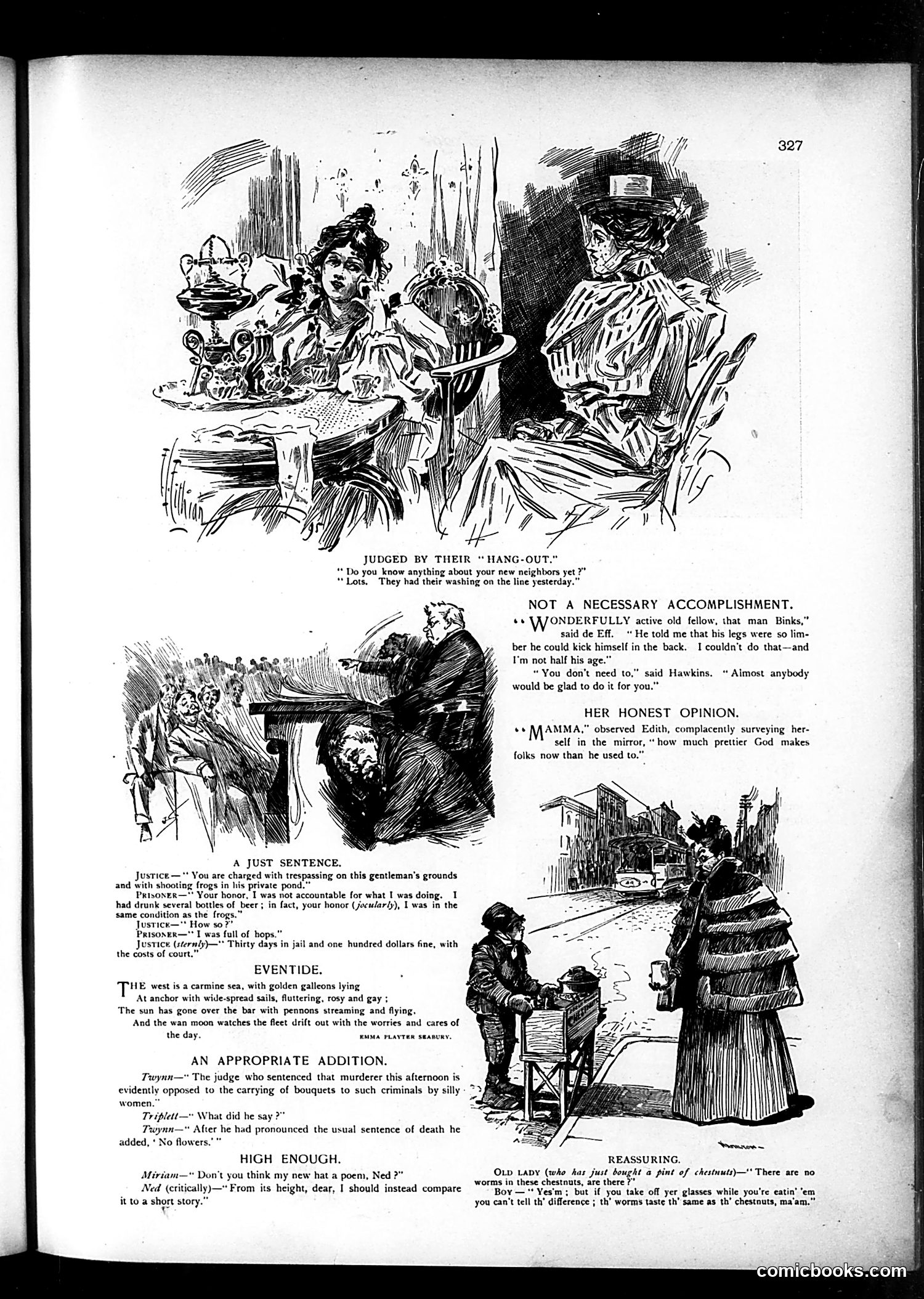
This page contains six brief humorous sketches rather than political cartoons. The humor relies on domestic situations and wordplay: **"Judged by Their Works"** depicts neighbors gossiping about laundry. **"Not a Necessary Accomplishment"** features a man claiming his neighbor can kick himself in the back—a physical impossibility presented as absurd boasting. **"Her Honest Opinion"** shows a woman admiring herself while making a backhanded compliment about modern people being prettier than in the past. **"A Just Sentence"** depicts a drunk man's legal defense for trespassing. **"Eventide"** is a sentimental poem about sunset. **"An Appropriate Addition,"** **"High Enough,"** and **"Reassuring"** are brief joke exchanges about judges, poetry, and chestnuts (worn-out old jokes). These are light social satire rather than political commentary—typical middle-class domestic humor for Judge's readers.
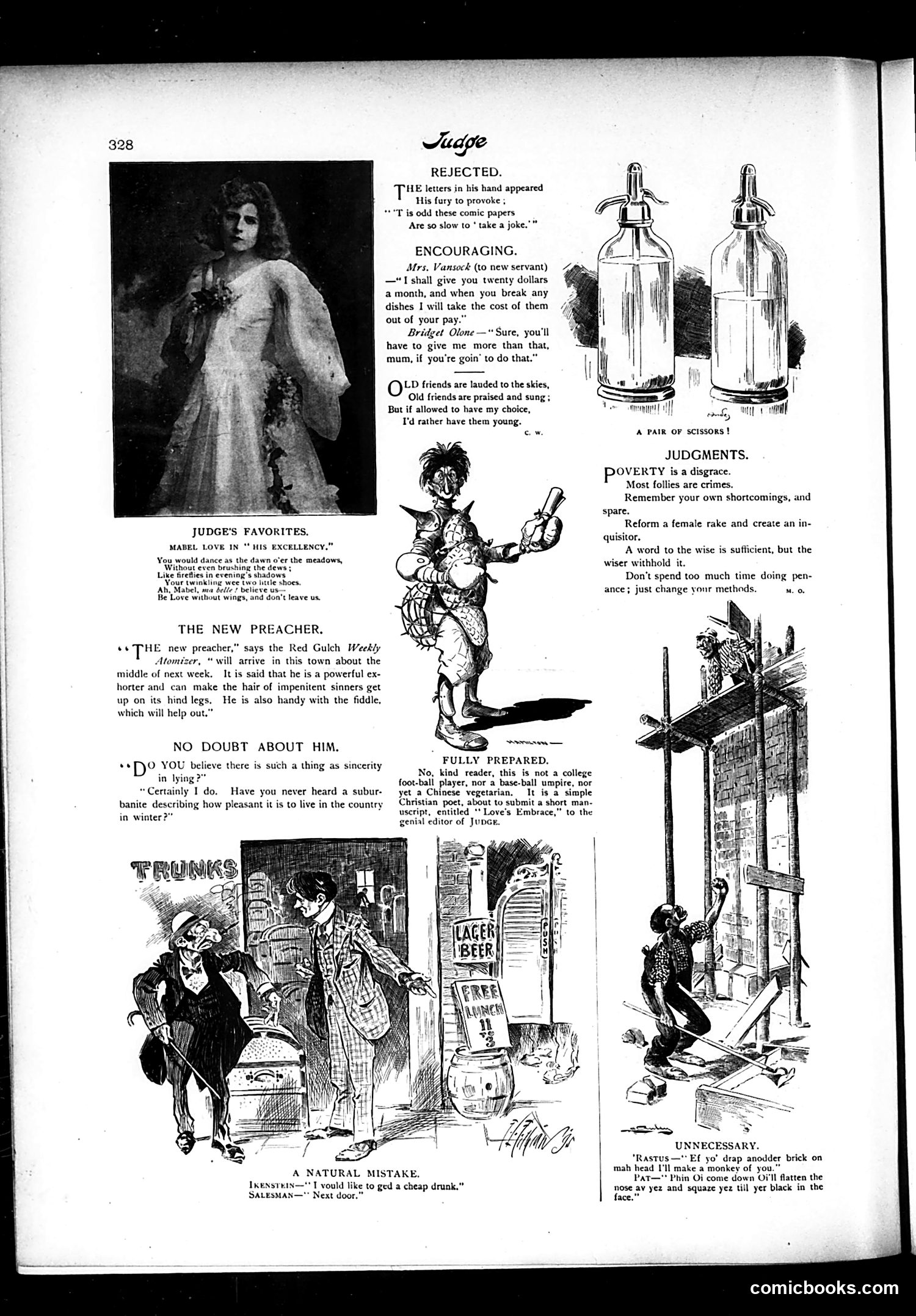
This page from *Judge* magazine contains several satirical pieces typical of late 19th-century American humor: **"Judge's Favorites"** celebrates actress Mabel Love in a theatrical production, using flowery praise common to entertainment coverage. **"The New Preacher"** gently mocks a small Western town's expectations of their incoming minister—describing him as an "exhorter" who can frighten sinners and play fiddle, poking fun at frontier religiosity. **"No Doubt About Him"** satirizes suburban hypocrisy: city dwellers romanticize country living in winter while clearly disliking it. **"A Natural Mistake"** jokes about Irish domestic workers (Bridget) negotiating wages shrewdly—a common ethnic stereotype of the era. **"Rejected"** mocks rejected magazine submissions, showing an angry contributor whose work editors found unfunny. **"Fully Prepared"** ridicules an earnest but unsuccessful poet submitting work to *Judge* itself—self-referential office humor. The page also includes crude ethnic caricatures ("Rastus," "Pat") in the final cartoon depicting a Black-Irish confrontation, reflecting period prejudices.
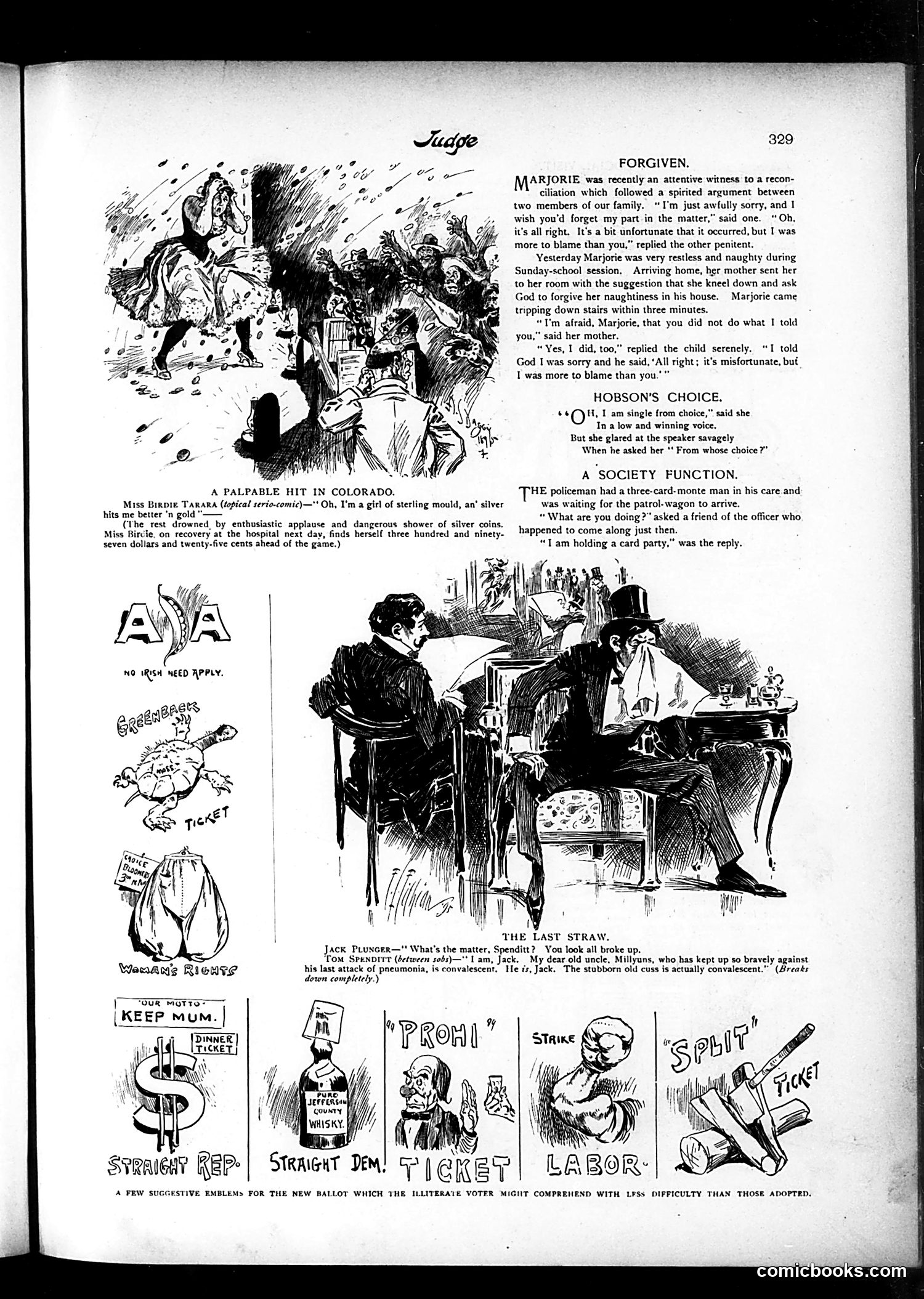
This page contains multiple satirical pieces from an American publication, likely early 20th century based on style and references. **"The Last Straw"** features a man distraught that his wealthy uncle has recovered from pneumonia—the joke being he anticipated inheriting money. The satire mocks greed masquerading as concern. **"A Palpable Hit in Colorado"** describes a woman performer ("Miss Binpie Tarara") of "sterling mould" who receives a shower of silver coins during a performance, netting nearly $400—satirizing both the performer's calculated appeal and audience gullibility. **Bottom section**: "A Few Suggestive Emblems for the New Ballot" offers visual voting symbols for illiterate voters, including dollar signs, whiskey bottles, and labor tools. This criticizes how political parties allegedly appeal to voters through crude stereotypes—money for Republicans, alcohol for Democrats, labor concerns for others—rather than substantive policy. The page overall mocks American social pretension, financial desperation, and the perceived manipulation of voters by political machines.
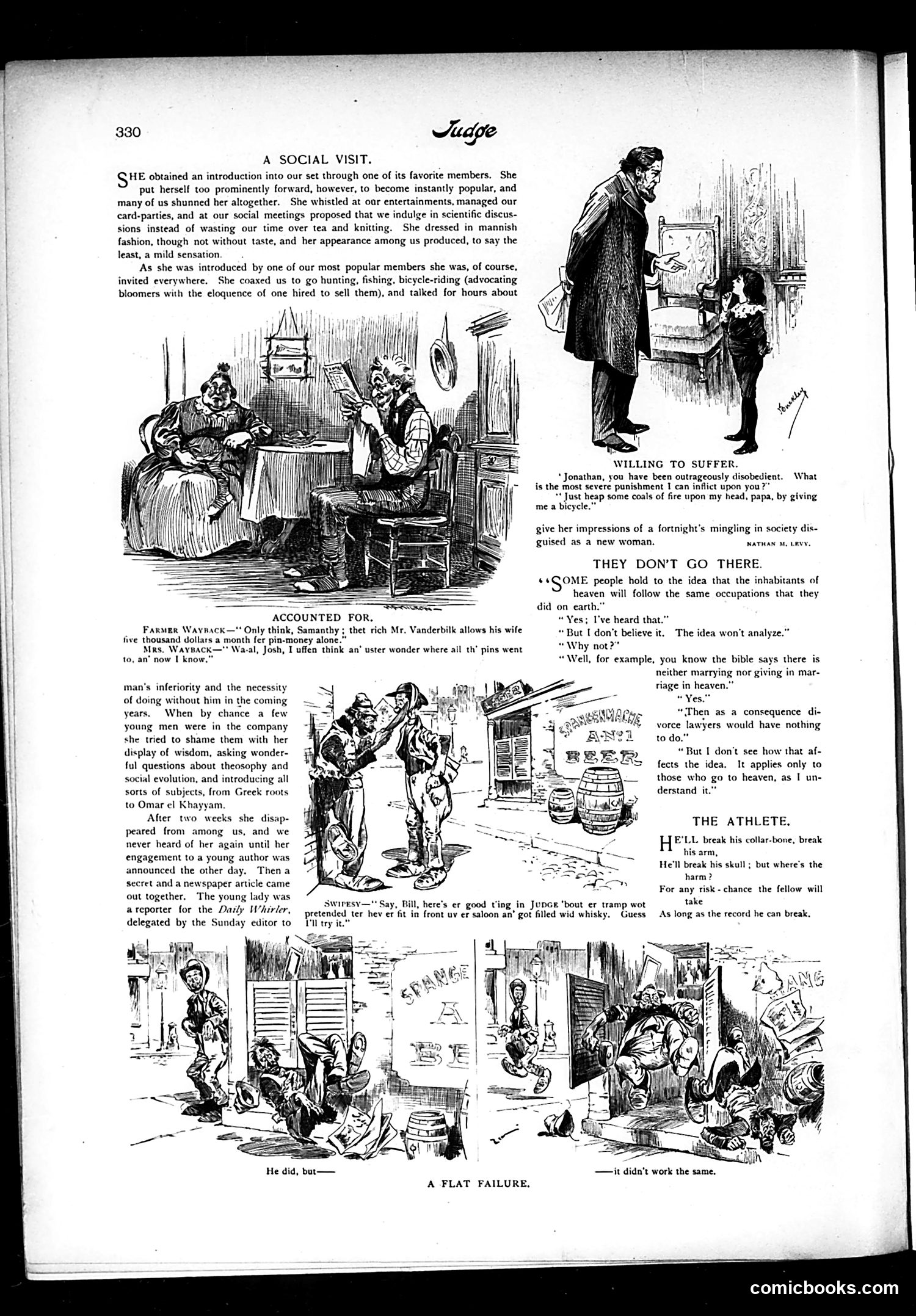
This page contains several satirical vignettes mocking social trends and conventions of the era (appears to be late 1800s). **"A Social Visit"** ridicules the "New Woman"—a figure advocating progressive ideas like bicycle-riding, bloomers, scientific discussion, and independence from traditional domestic roles. The satire presents her as obnoxious and attention-seeking, ultimately revealed to have been a newspaper reporter infiltrating high society, suggesting her radical views were performative rather than genuine. **"Accounted For"** presents rural characters discussing wealthy women's "pin money," a humorous commentary on conspicuous consumption and marital economics. **"They Don't Go There"** jokes about heaven's occupations, specifically mocking divorce lawyers—implying their sinful profession bars them from paradise. **"The Athlete"** and **"A Flat Failure"** depict working-class characters attempting to replicate upper-class behavior or risky stunts, with predictably unsuccessful results—commentary on class aspiration. The overarching theme: mockery of social pretension and progressive ideas, particularly women's liberation.
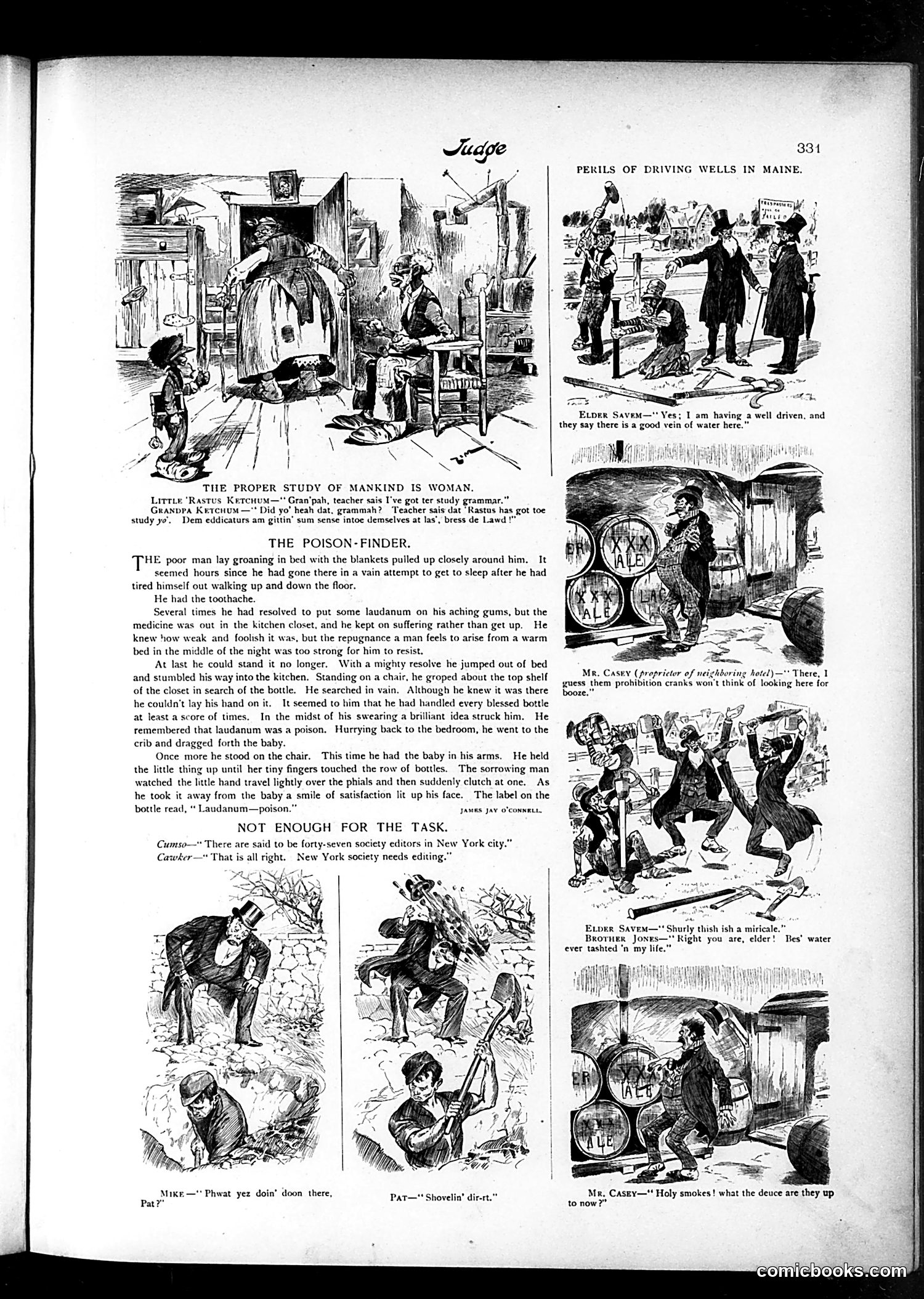
This page contains three separate satirical pieces: **"The Proper Study of Mankind is Woman"** mocks racial stereotypes through dialect humor involving Black characters (Rastus and Grandpa Ketcum), suggesting ironic approval that teachers now study "woman" (the grandmother) rather than proper subjects. **"The Poison-Finder"** is a dark comedic story about a desperate man with toothache who uses his baby as a tool to locate laudanum (an opium-based painkiller) in a dark cabinet—the cruel absurdity being the solution to his problem. **"Not Enough for the Task"** jokes that New York City needs 47 society editors because high society generates so much scandalous content requiring constant management and reporting. **"Perils of Driving Wells in Maine"** satirizes Prohibition-era hypocrisy: people claim newly drilled wells produce excellent drinking water when actually bootleggers are concealing alcohol barrels nearby—the "miracle" being access to liquor despite alcohol bans.
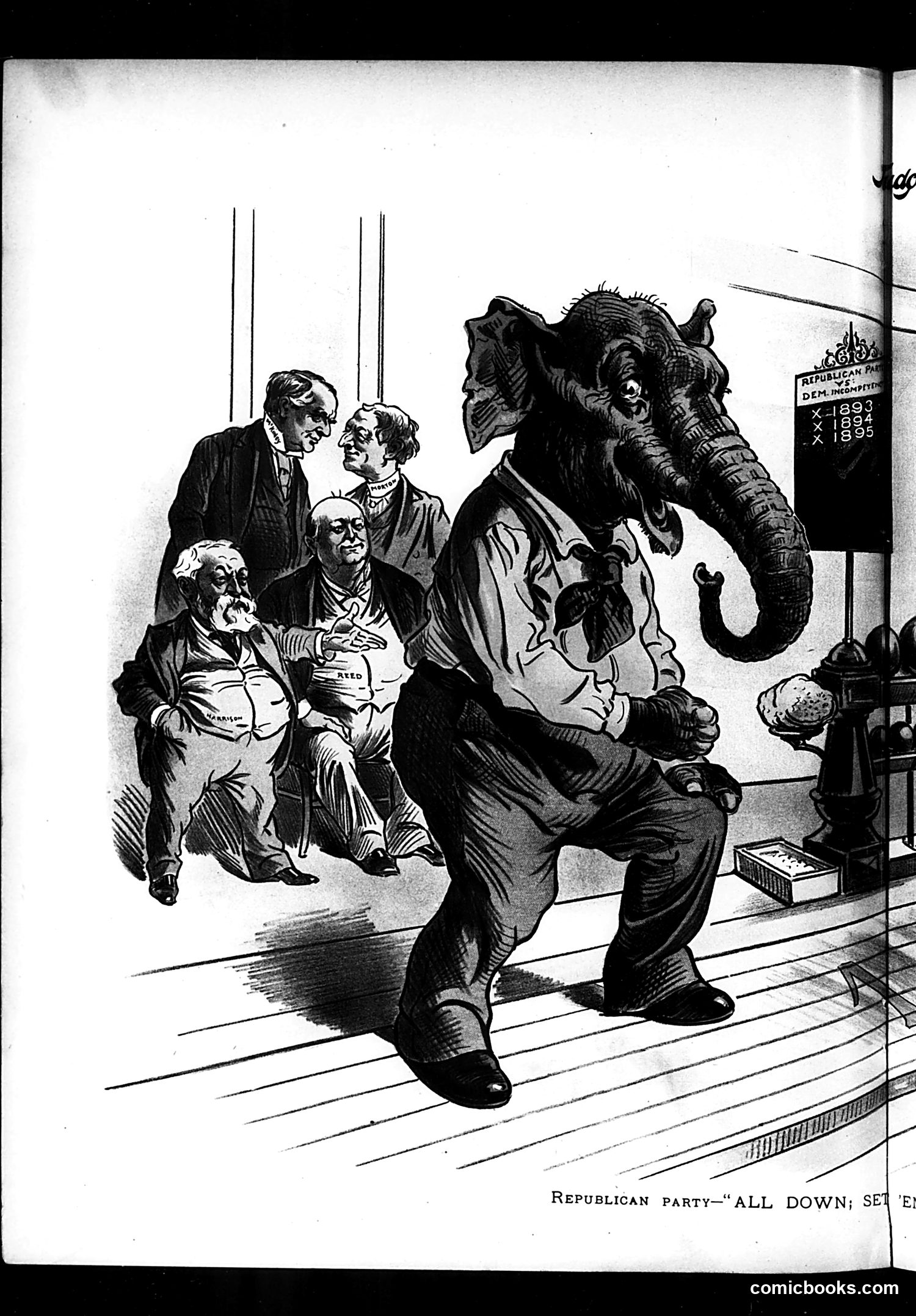
This is a political cartoon satirizing the Republican Party, depicted as an elephant (the party's traditional symbol) that has collapsed or fallen. Four men in formal dress observe the fallen elephant with apparent concern or resignation. The caption reads "REPUBLICAN PARTY—'ALL DOWN; SET 'EM'" suggesting the party is in decline or defeat. Based on the archive markings visible (showing dates 1893-1894), this likely references the Republican Party's struggles during the economic depression of that era, or electoral setbacks. The cartoon uses the elephant metaphor to mock Republican political fortunes—literally showing their symbolic animal prostrate—while the observing figures (likely representing party leadership) stand helplessly by. The satire suggests Republican weakness or collapse during this period.
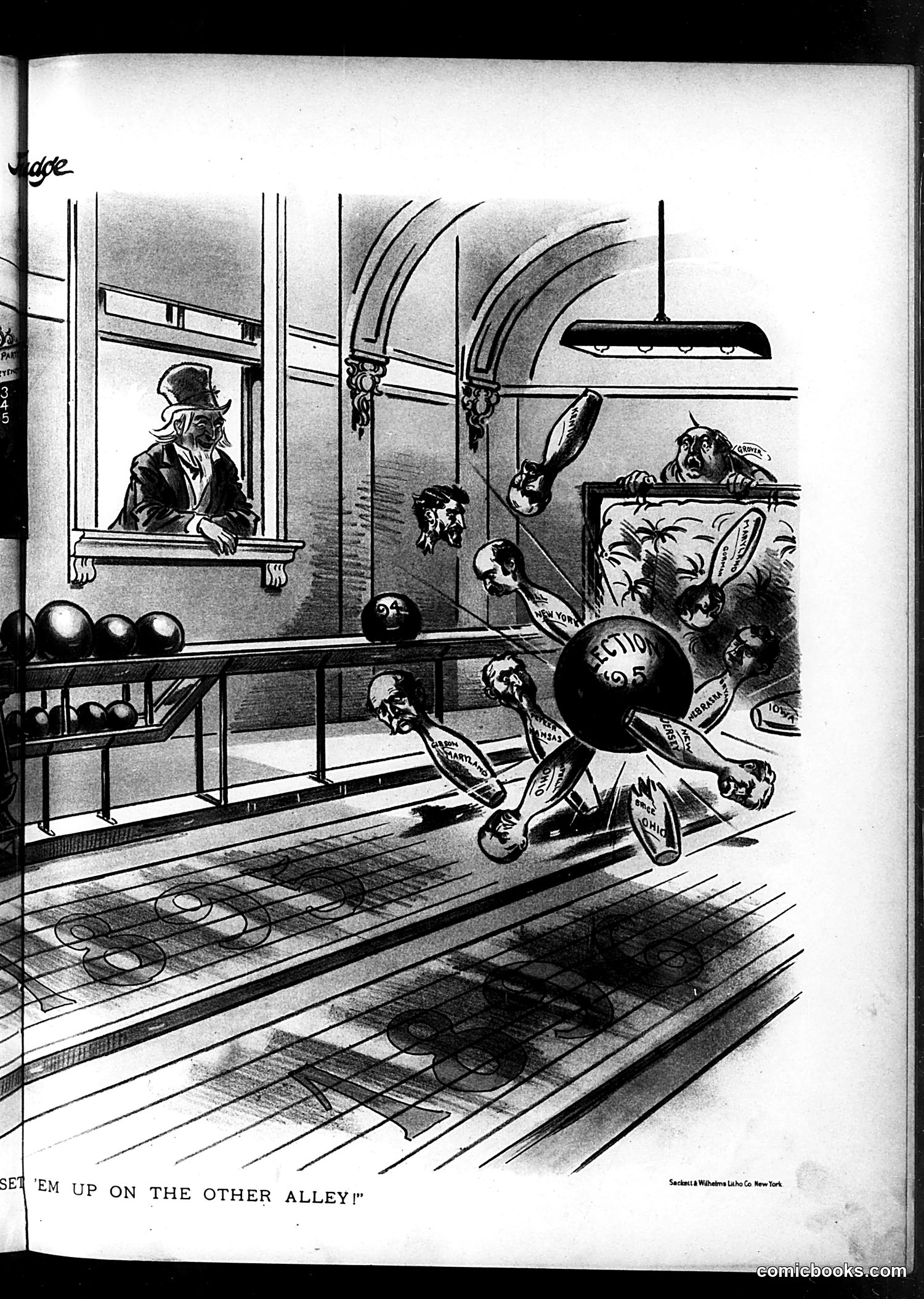
This political cartoon depicts what appears to be a bowling alley scene serving as metaphor for political maneuvering. The figure at the window (likely a political boss or authority figure) oversees others below who are literally bowling with large spheres labeled "SECTION" and other partially visible text suggesting political districts or constituencies. The caption "Set 'Em Up on the Other Alley!" suggests redirecting political activity or corruption to another location—possibly satirizing how political machines moved questionable practices between districts or wards to avoid scrutiny. The caricatured figures with exaggerated features were typical of Judge magazine's satirical style. Without clearer labeling, the specific political situation remains unclear, but the cartoon critiques manipulation of electoral districts or political constituencies.
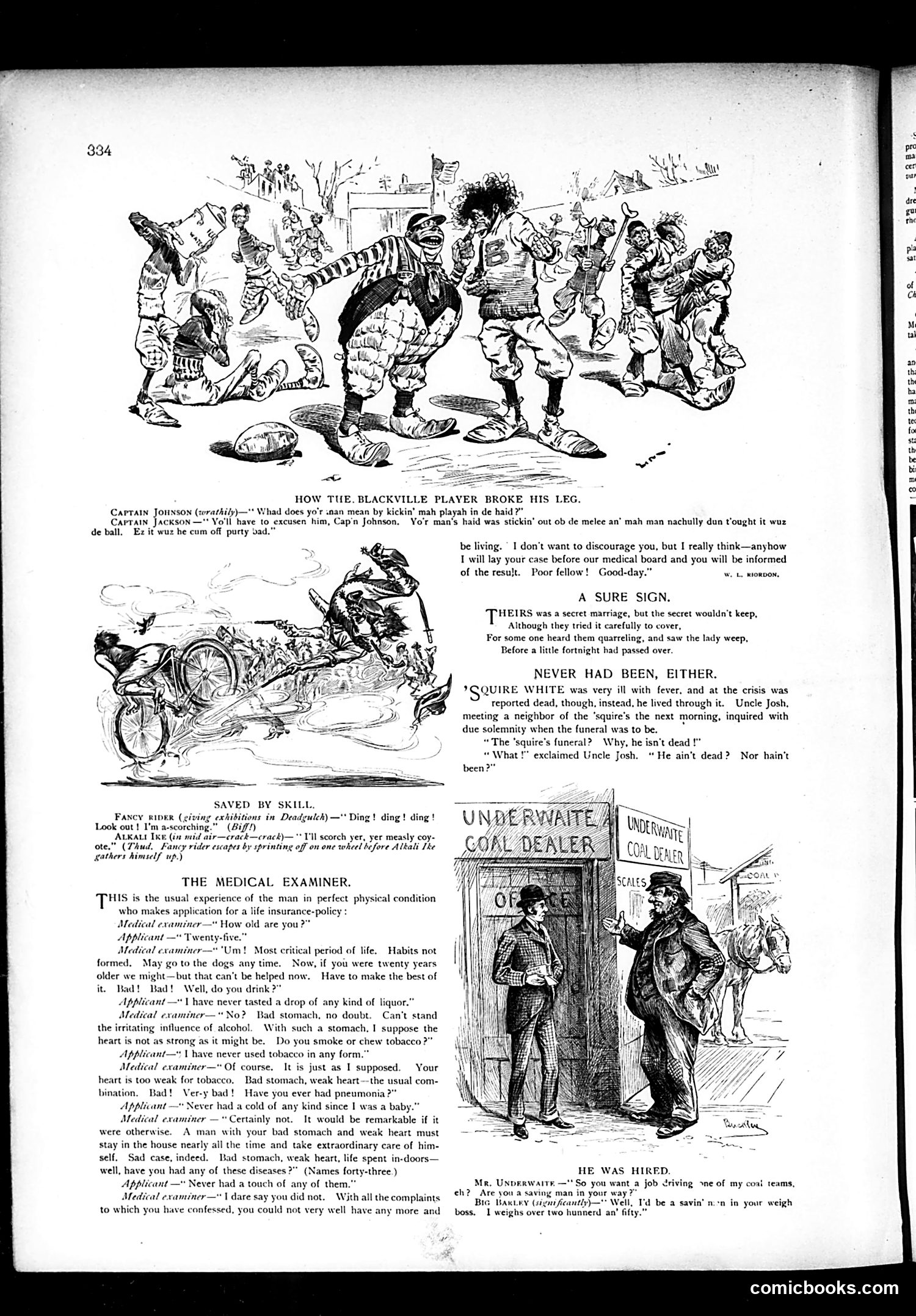
This page contains multiple satirical sketches mocking 19th-century American life and institutions: **"The Blackville Player"** uses racist dialect humor (typical of the era) to depict a dispute over a sports injury, reflecting period entertainment that relied on caricature. **"The Medical Examiner"** satirizes life insurance physicians whose contradictory logic rejects applicants regardless of health status. The examiner declares a perfectly healthy 25-year-old uninsurable because his youth, perfect condition, and lack of diseases somehow indicate underlying weakness—a critique of arbitrary bureaucratic gatekeeping that denies coverage while claiming medical expertise. **"A Sure Sign"** and **"Never Had Been, Either"** are brief comedic anecdotes about marriage secrets and mistaken death reports. **"He Was Hired"** makes a crude joke about weight and hiring practices. The overall tone reflects Judge's satirical approach: mocking social institutions, medical authority, insurance logic, and working-class characters through exaggeration and absurdist reasoning.
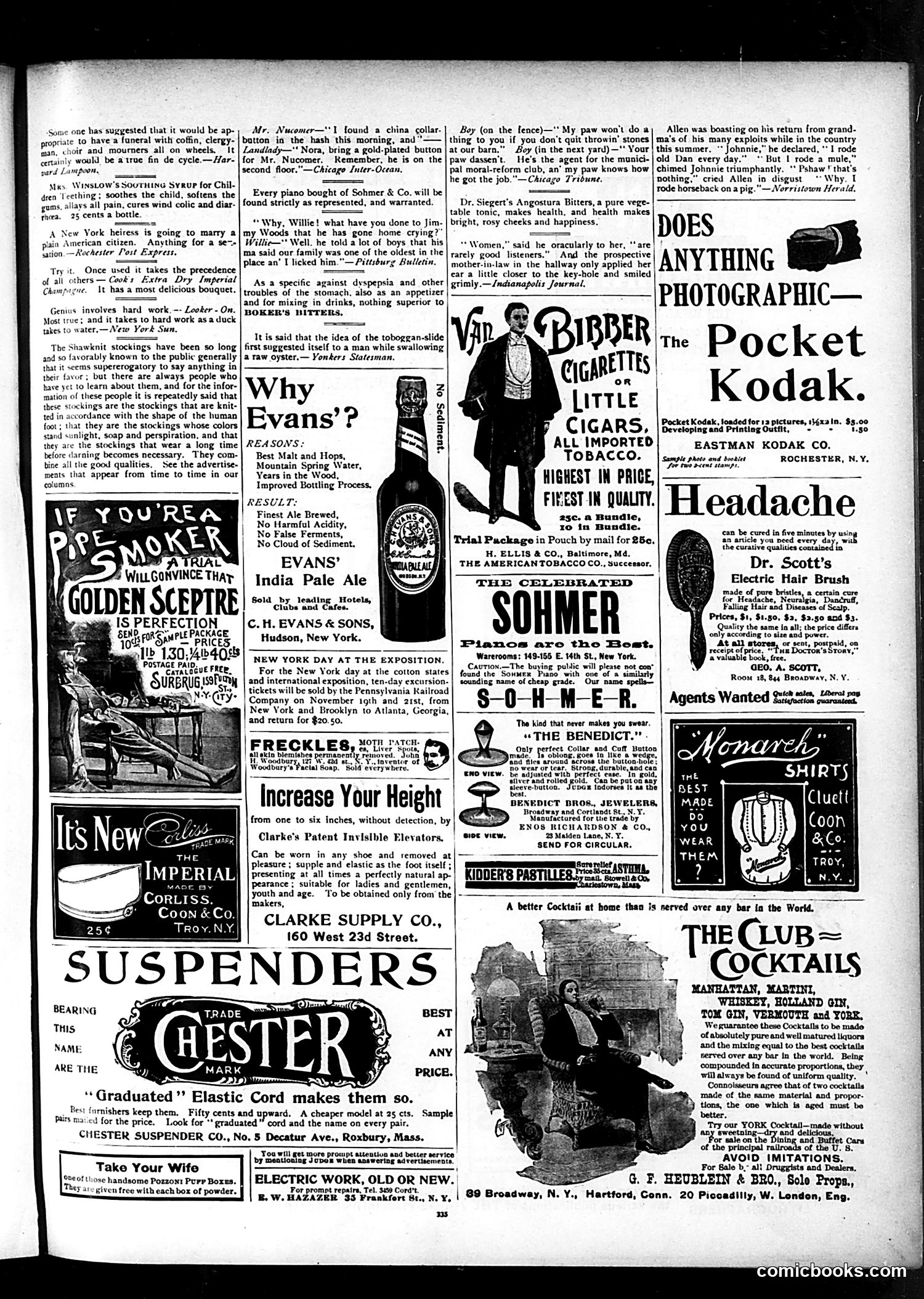
This is primarily an **advertising page** with scattered short jokes and commentary rather than political cartoons. The few editorial items visible include brief satirical quips: one about an elaborate "funeral on wheels" mocking something ("fin de cycle," possibly new-fangled mechanical contrivances); another poking fun at a New York heiress marrying a "plain American citizen"; and humorous exchanges between characters like "Mr. Newcomer" and a landlady discovering a button in hash, and "Willie" beating up a boy who claimed his family was "one of the oldest in the place." The rest comprises **period advertisements** for medicines (Mrs. Winslow's teething syrup), alcohol (Evans' India Pale Ale, champagne), tobacco products, height-increase devices, freckle remedies, and suspenders—typical Judge magazine content from the late 1800s. **No identifiable political figures or major satirical intent is apparent** on this page. It reflects everyday humor and consumer culture of the era.
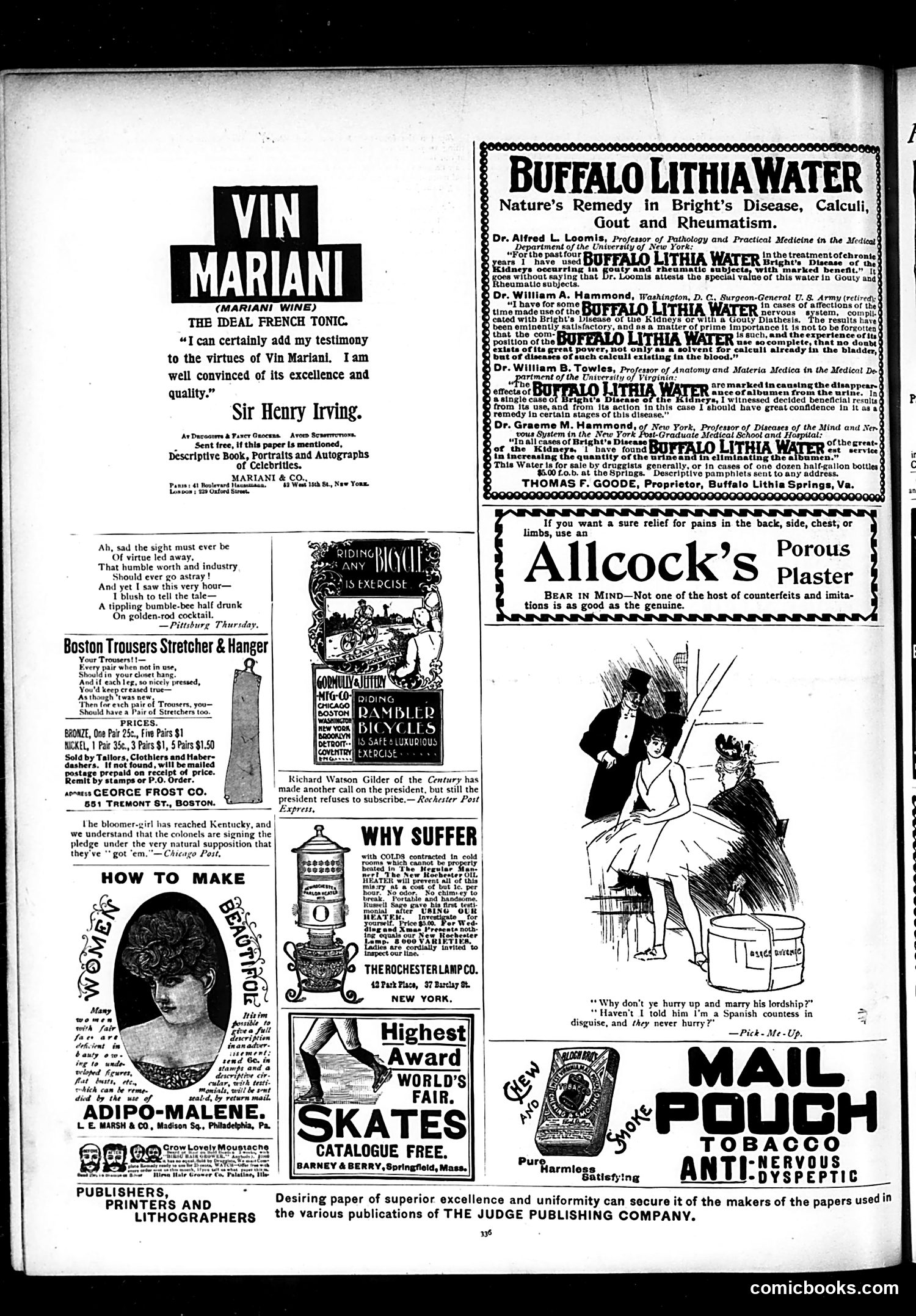
This page consists primarily of **late 19th-century advertisements** rather than political cartoons. The dominant content includes: 1. **Vin Mariani wine** (top left): Endorsed by Sir Henry Irving, a celebrated actor of the era. This was a cocaine-infused tonic wine popular in that period—now recognized as dangerous but then marketed as a medicinal cure-all. 2. **Buffalo Lithia Water** (right): Advertised as a treatment for Bright's Disease, gout, and rheumatism, supported by testimonials from medical professors. Such mineral waters were fashionable "patent medicine" remedies. 3. **Various other products**: Boston Trousers Stretchers, Adipo-Malene (weight-loss product), skates, and "Mail Pouch" tobacco. The small cartoon (center-right) appears to be a humorous domestic sketch about marriage, unrelated to major political events. This page reflects Judge magazine's reliance on patent medicine advertising revenue—products we now recognize as often fraudulent or harmful.
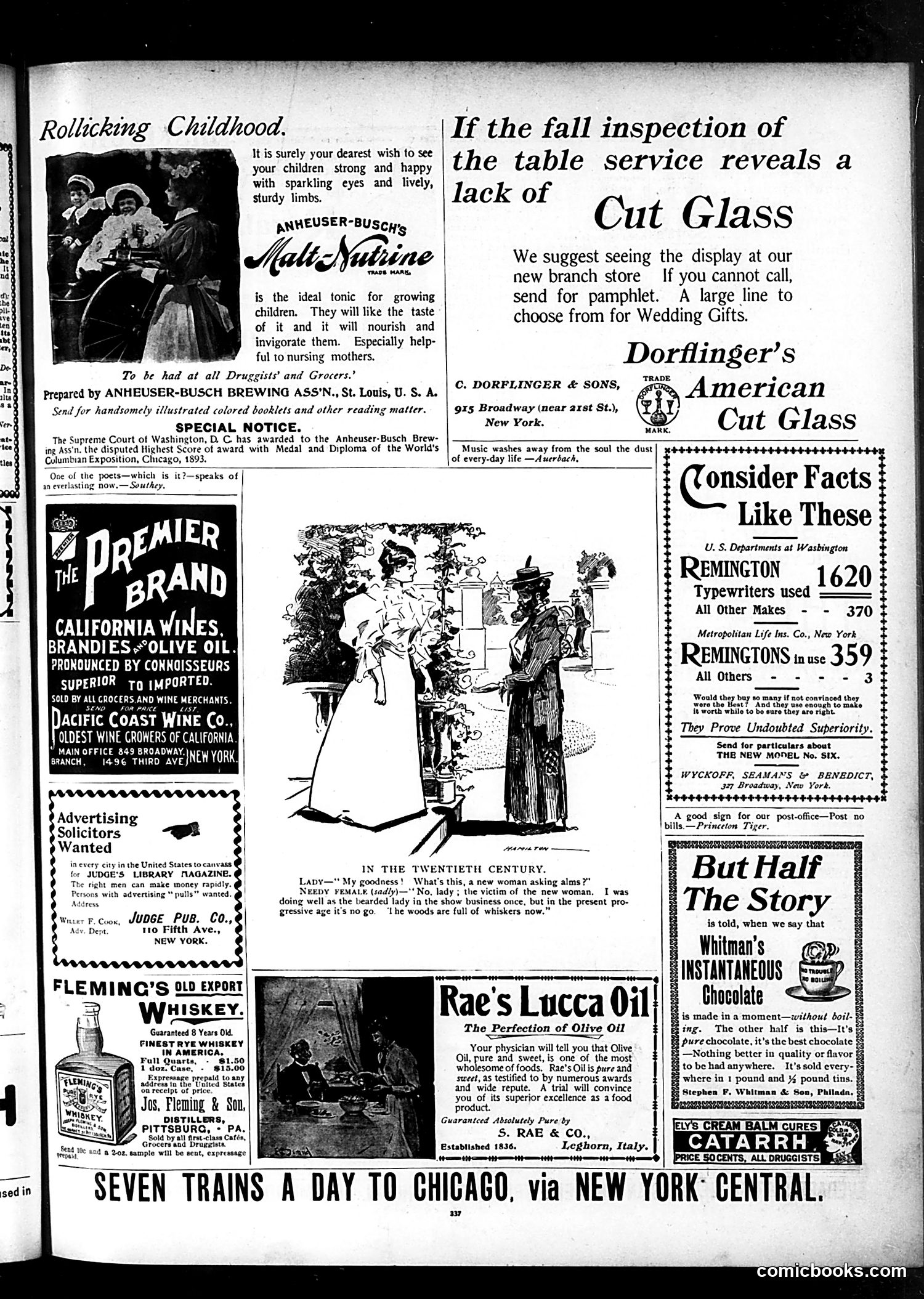
This page is primarily **advertising**, typical of Judge magazine's revenue model. The only notable content beyond commercial pitches is: **The cartoon "In the Twentieth Century"** depicts a woman asking for alms, claiming to be a victim of "the new woman." She explains she was once a bearded lady in circus sideshows but is now unemployed because "the woods are full of whiskers now." This satirizes the changing social roles and presence of women in the 1890s. The joke mocks both traditional "freak show" women and the emerging "New Woman" phenomenon—referencing the progressive women's movement of that era. The premise: modern women's increased public visibility has made unconventional female performers economically obsolete. The rest consists of period advertisements for beer, cut glass, whiskey, and olive oil, all leveraging health claims (notably, Anheuser-Busch marketed malt extract as beneficial for children and nursing mothers—practices considered normal then).
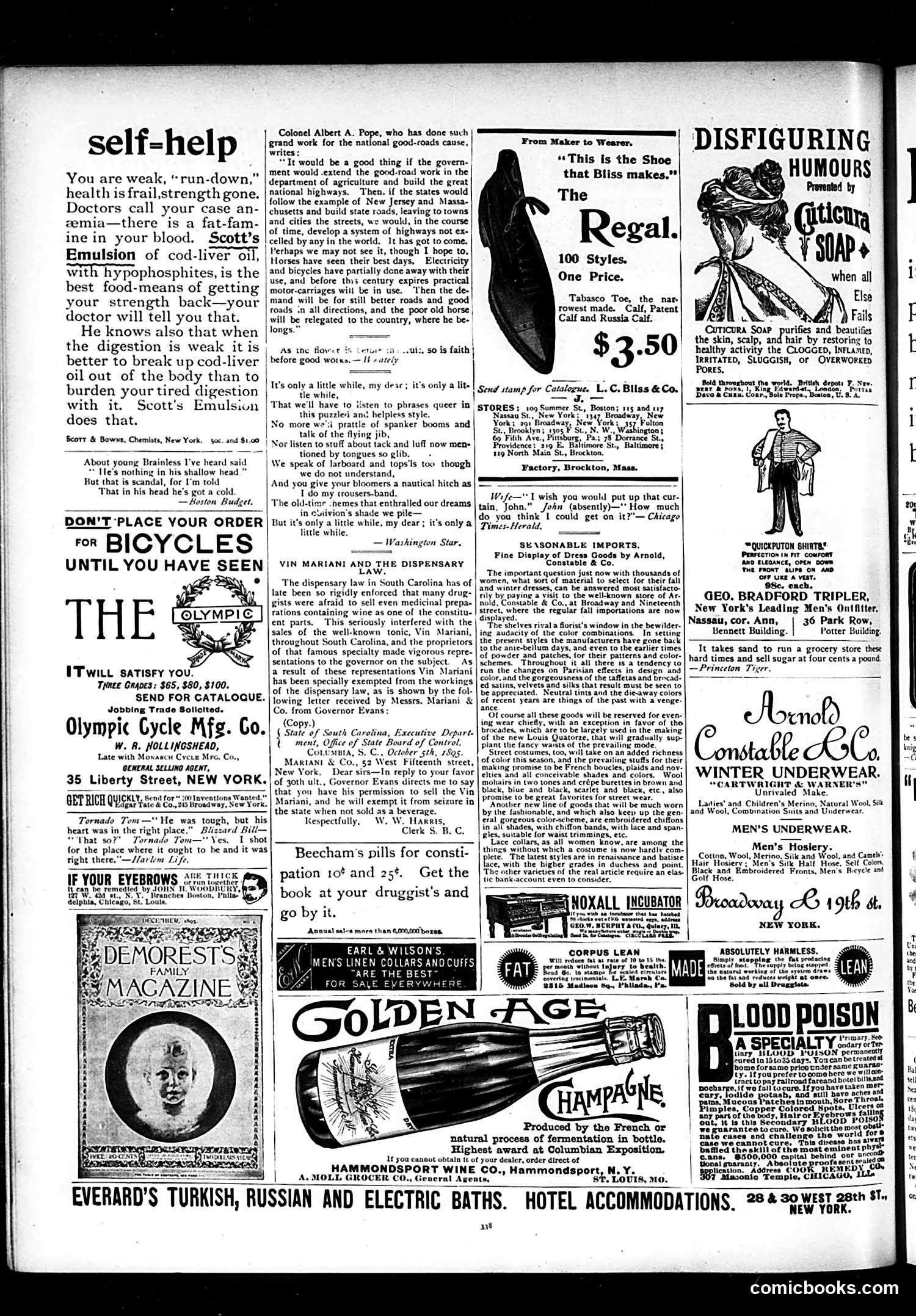
This page is primarily **advertising and notices**, typical of *Judge* magazine's revenue model. The satirical content is minimal: The clearest cartoon/joke is the small item **"Tornado Tom,"** mocking frontier stereotypes: a character praised for having his "heart in the right place" responds that his heart literally *is* in the right place—where it "ought to be"—using physical anatomy to subvert sentimental clichés. It's light wordplay. The substantive non-advertising content is a long quote from **Colonel Albert A. Pope** (a real bicycle manufacturer and good-roads advocate) discussing infrastructure. He predicts the decline of horse travel, the rise of bicycles and motor-carriages, and the resulting need for better roads—not satirical, but technological speculation. Otherwise, the page contains conventional advertisements for patent medicines (Scott's Emulsion, Beecham's Pills), bicycles, magazines, and various remedies. The phrase "**Vin Mariani and the Dispensary Law**" notes how South Carolina's liquor regulations unexpectedly exempted a wine-based tonic, a practical legal matter rather than satire.
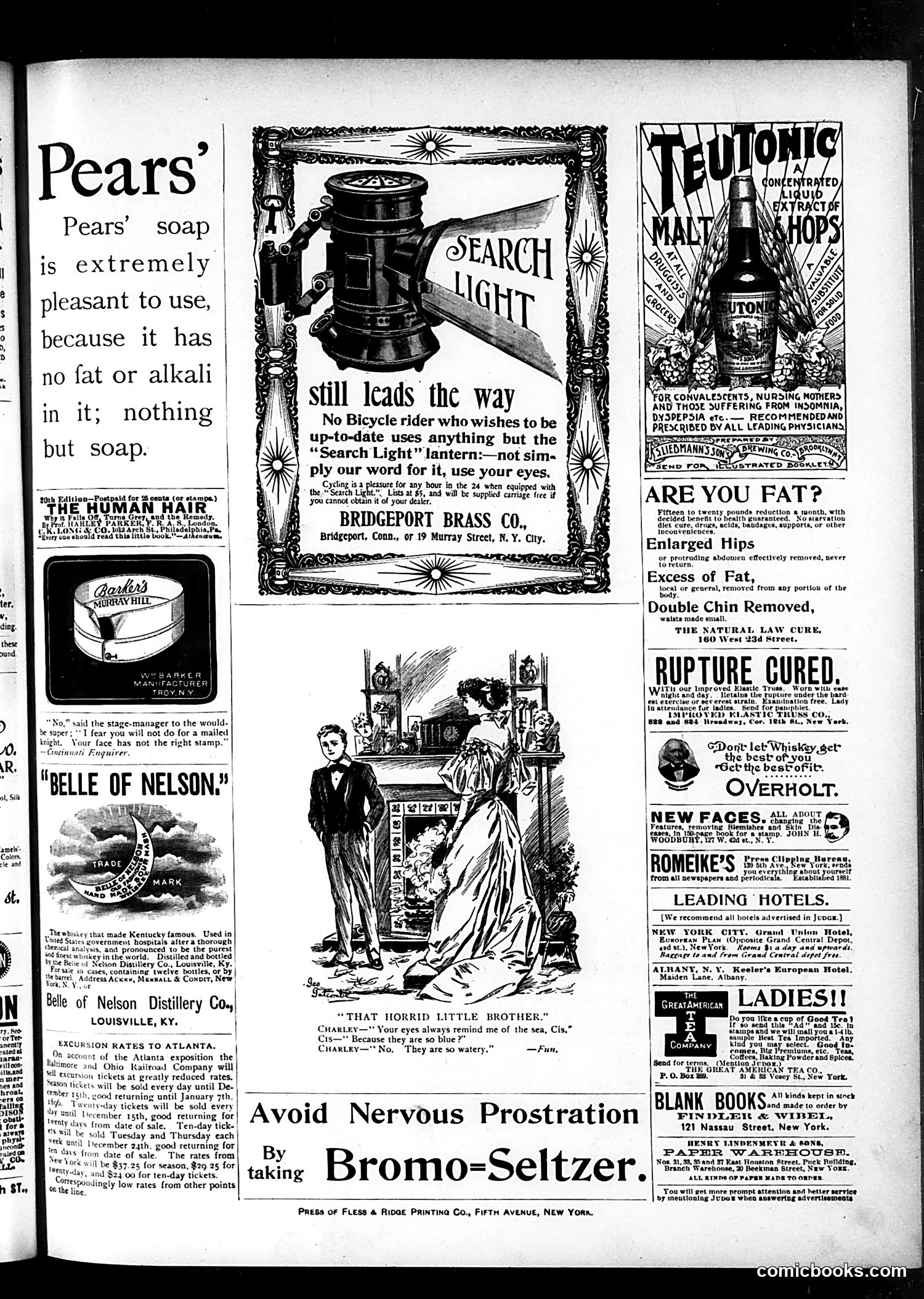
This page is primarily **advertising**, typical of late-19th-century magazines. While it contains one small cartoon ("That Horrid Little Brother"), the dominant content is commercial. ## The Cartoon The sketch depicts a flirtation between two characters, Charley and Cis. The joke is a play on words: Charley compliments Cis's eyes by comparing them to the sea, but when she assumes he means their blue color, he reveals he actually means they're "watery"—a cutting insult disguised as flattery. This appears in the humor magazine *Fun*. ## The Advertisements The page reflects period concerns: Pears' soap (emphasizing purity), weight-loss treatments ("Excess of Fat"), cosmetic procedures (double chin removal), medical devices (rupture trusses), and patent medicines like Bromo-Seltzer for "nervous prostration." These ads reveal anxieties about appearance, health, and respectability among the magazine's middle-class readership. The belle of Nelson whiskey ad and bicycle lantern advertisement suggest an affluent, recreational audience.
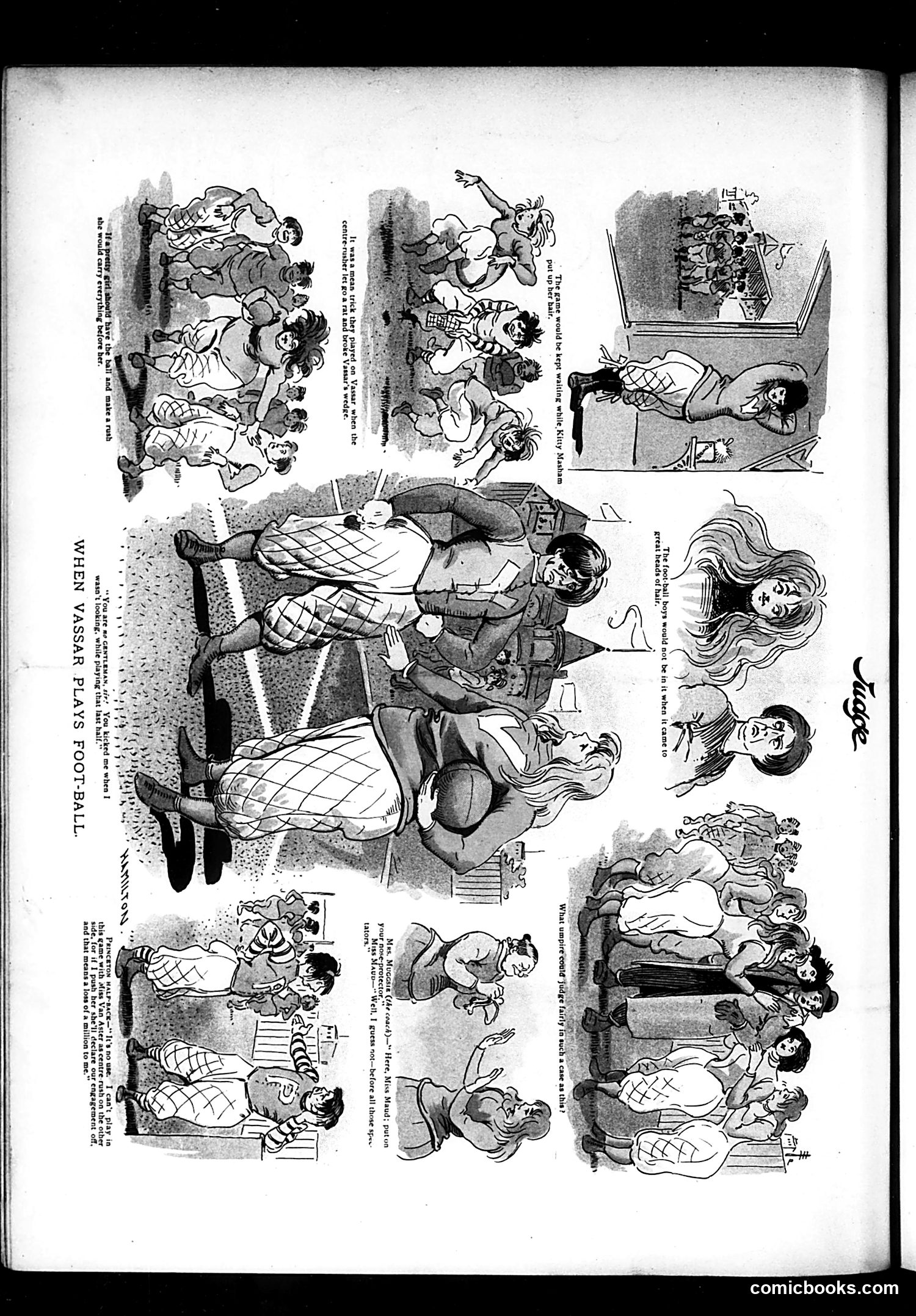
This satirical cartoon mocks women's collegiate athletics at Vassar College by depicting their football game as descending into chaos and cattiness—playing on period stereotypes about women being unsuited for serious sports. The jokes center on female player incompetence and vanity: one woman delays the game fixing her hair; another releases a rat to disrupt play; players squabble over fouls and blame-shifting rather than focusing on the game; one breaks her engagement over a perceived slight during play. The satire's point: women athletes are too emotionally volatile, vain, and distracted by social drama to handle competitive sports seriously. This reflects late-19th/early-20th century anxieties about women's education and athletic participation, treated here as inherently ridiculous rather than legitimate.